pith. sign in

physics.soc-ph

Physics and Society

Structure, dynamics and collective behavior of societies and groups (human or otherwise). Quantitative analysis of social networks and other complex networks. Physics and engineering of infrastructure and systems of broad societal impact (e.g., energy grids, transportation networks).

0
cond-mat.dis-nn 2026-07-03

Learning fails to converge in most large random games

by Desmond Chan, Tobias Galla

Complex dynamics in the Sherrington-Kirkpatrick game

Memory-loss rate and competitiveness set whether dynamics settle to one point, many points, or stay volatile.

Figure from the paper full image
abstract click to expand
We study the outcome of adaptive learning of a large number of players engaging in sets of two-strategy two-player games. We are interested in typical games, and generate the payoff matrices at random at the beginning. The payoff matrices then remain fixed during the learning process. This provides a game theoretic foundation for the Sherrington-Kirkpatrick (SK) game, recently introduced by Garnier-Brun, Benzaquen and Bouchaud. The original model by these authors is a special case, with no bias towards any strategy. We here determine stability of learning for SK games with general random bias, and find that the nature of the stable state is affected by random fields. We also introduce a grand-canonical version of the SK game, in which players can choose to abstain. We determine the stability of learning for this game. Our analysis confirms that complex situations involving many players are frequently unlearnable, even if each player only chooses between two different actions. The rate with which players lose memory of past payoffs and the competitiveness of the game emerge as key parameters determining whether learning converges to a unique fixed point, whether there are many fixed points, or if the dynamics remains persistently volatile.
0
0
physics.soc-ph 2026-07-03

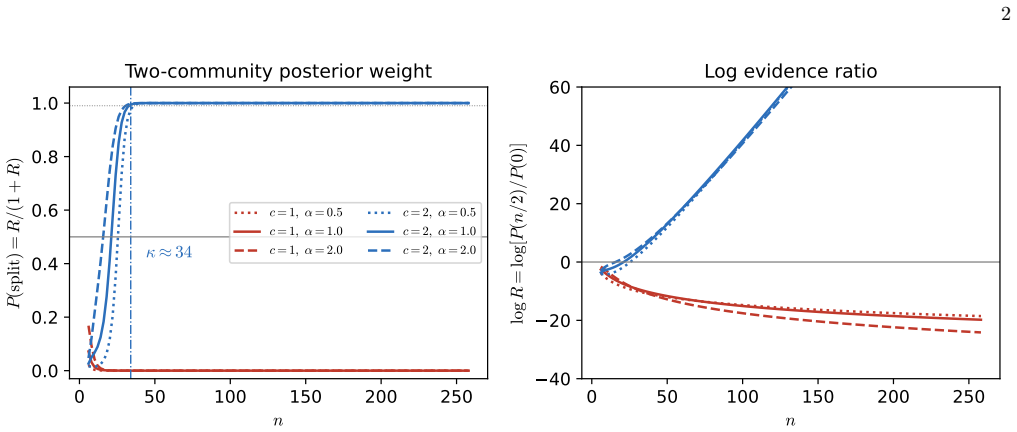
Next-nearest links make ring prefer communities above 35 nodes

by Alexei Vazquez

The ring wants to be broken

Plain cycles stay unpartitioned at all sizes while c=2 rings switch with log-evidence growing linearly in n.

Figure from the paper full image
abstract click to expand
The Ramsey community number $r_\kappa$ is the minimum network size at which a graph's connectivity is better described by a partition into communities than by no partition, under a prescribed community-detection rule. It was introduced through numerical simulations of networks grown by local rules, which suggested that community structure can emerge without any node heterogeneity. Here I compute $r_\kappa$ analytically for the simplest homogeneous, locally wired graph: the circulant ring lattice $C_n(1,\dots,c)$. Using a Bernoulli stochastic block model with symmetric $\mathrm{Beta}$ priors as the detection rule, the Bayesian evidence for a balanced two-community partition and for the unpartitioned network are both obtained in closed form, so the transition between them can be located exactly. The result is a sharp dependence on the interaction range: the plain cycle ($c=1$) is never partitioned, its two-community posterior decaying as $n^{-(2\alpha+3)}$, so $r_\kappa=\infty$; but the next-nearest-neighbour ring ($c=2$) acquires a finite $r_\kappa\simeq 35$ nodes, above which the partition is preferred with a log-evidence growing as $(\ln 2)\,n$. This provides an exactly solvable instance of community emergence in a network with no built-in communities, and shows that a minimal amount of local connectivity is enough to break the ring.
0
0
physics.soc-ph 2026-07-03

LLMs resist skepticism by failing to represent the signal

by Minjong Cheon

Robust for the Wrong Reasons: The Representational Geometry of LLM Robustness to Science Skepticism

Behavioral tests alone cannot tell whether a model understands doubt or simply does not detect it.

Figure from the paper full image
abstract click to expand
Large language models (LLMs) are increasingly consulted on contested scientific questions, raising the concern that they will sycophantically retreat from established consensus when a user signals doubt -- drifting toward a false balance that treats settled science as one view among several. We test this across three open instruction-tuned models (Llama-3.1-8B, Qwen2.5-7B, Mistral-7B), three consensus-science domains (climate, vaccines, evolution), and single- and multi-turn settings, combining behavioral measurement with linear probing and activation patching. We do not observe sycophantic retreat. Instead, models show three distinct policies under the same skeptical pressure: reactive assertion, where consensus assertion increases rather than decreases (Llama); surface hedging, where tone softens while the position holds (Qwen); and non-response (Mistral). Pairwise judgments confirm the reactive shift is stance, not style (63.6%, p=.007), and a decomposition identifies increased consensus assertion, not false balance, as its driver (beta=+0.042 per dose, p<1e-77). Linear probes localize the divergence to middle layers -- perfect separation in Llama and Qwen versus 72% in Mistral, with non-overlapping confidence intervals -- indicating the non-responsive model does not linearly represent the skepticism signal at all. Crucially, this robustness does not transfer: it attenuates across domains and, in the safety-critical vaccine domain, can reverse, with myth-rebuttal weakening under skeptical pressure. We synthesize these into a four-way taxonomy separating active from accidental robustness, and argue that behavioral evaluation alone cannot distinguish a model that resists skepticism because it understands the signal from one that only appears to resist because it fails to perceive it.
0
0
physics.geo-ph 2026-07-03

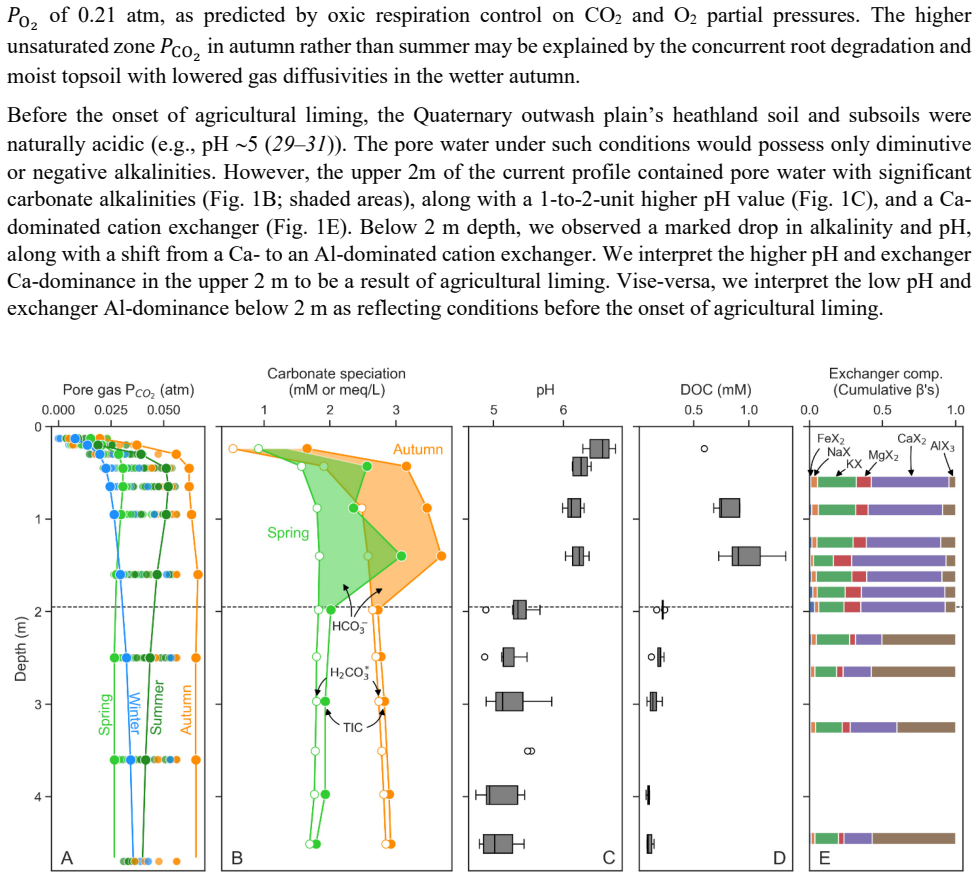
Subsoil acidity slows Enhanced Weathering carbon capture by decades

by S{o}ren Jessen, Rasmus Jakobsen +3 more

Subsoil acidity causes long delays in inorganic carbon sequestration by Enhanced Weathering

Proxy from century-old liming shows 30-100 year delay through 5m acidic zone, even after topsoil neutralization.

Figure from the paper full image
abstract click to expand
While a looming atmospheric CO$_2$ overshoot calls for immediate carbon sequestration, delays associated to Enhanced Weathering (EW) carbon dioxide removal are being investigated. Topsoil acidity is already known to delay EW carbon sequestration, but subsoil acidity remains underexplored. Using century-long agricultural liming of formerly acidic heathland as a proxy for EW, this study provides empirical evidence of subsoil-imposed delays. Below such limed terrain, we observed a downward-progressing front of topsoil-produced alkalinity that still requires 30-100 years to penetrate the approximately 5 m thick acidic sandy unsaturated zone and reach the groundwater table. Subsoil acidity thus may cause beyond-reasonable delays, prohibiting EW as a viable short-term carbon capture strategy even on topsoils made non-acidic by preceding liming. When planning EW schemes, the amounts of stored acidic cations in top- and subsoil, as well as the rate and composition of infiltrating water, controlling the duration of the delay, require careful assessment.
0
0
physics.soc-ph 2026-07-03

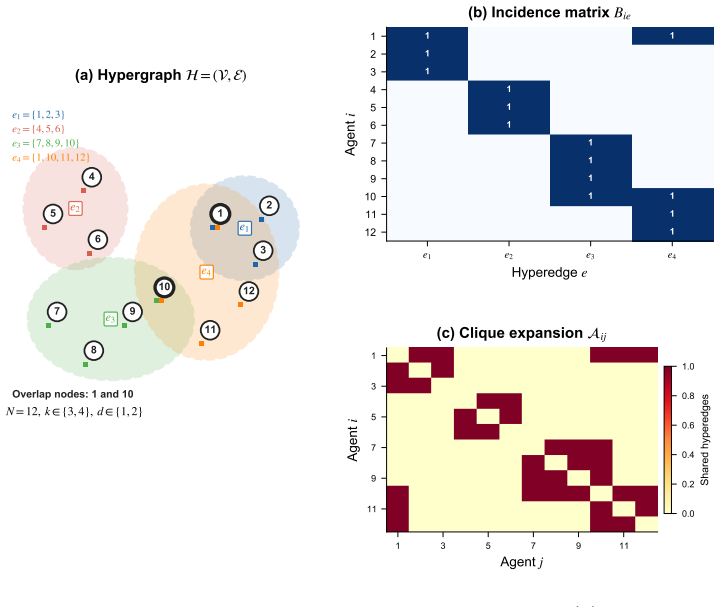
Hypergraph minority game critical point lies on α_crit(k,d) surface

by Yihang Zhu, Fanyuan Meng

Hypergraph Minority Game with Local Hyperedge Payoffs

Deterministic drift comes from a generalized global cost function; the transition depends on hyperedge size k and degree d rather than a sin

Figure from the paper full image
abstract click to expand
We provide a theoretical derivation of the Hypergraph Minority Game with Local Hyperedge Payoffs (HMG-L), in which $N$ adaptive agents compete simultaneously in multiple overlapping groups modeled as hyperedges of a static hypergraph $\Hyper=(\Vset,\Eset)$. Each hyperedge constitutes an independent local minority game, and agents accumulate payoffs across all groups to which they belong. We derive the continuum-time limit of the score dynamics, from which we obtain a set of coupled nonlinear stochastic differential equations for the agents' strategy polarization variables. The deterministic drift is shown to derive from a global cost function that generalizes the standard Minority Game Hamiltonian to hypergraph-structured interactions. We perform a sparse-annealed replica analysis of the stationary state for the case of a $k$-uniform, $d$-regular random hypergraph, obtaining the saddle-point equations within the replica-symmetric ansatz, an explicit replicon stability criterion, and Bethe/cavity equations for sparse corrections. The leading sparse-regime transition occurs on a critical surface $\alphacrit(k,d)$, while the globally coupled MG value $\alphacrit\simeq0.3374$ is recovered only in the separate single-hyperedge limit. We derive expressions for the order parameters -- global volatility $\sigma^2$, predictability $\theta$, hyperedge frustration $F_e$, and frozen fraction $\phi$ -- and discuss their scaling behavior near criticality. The Fokker-Planck equation governing finite-$N$ fluctuations is presented, and the noise covariance matrix is computed from the hypergraph structure. Limiting cases ($k\to N$, $k\to2$, $d\to\infty$) are analyzed in detail, establishing connections to the standard MG, networked MG, and parallel MG models.
0
0
physics.hist-ph 2026-07-02

1990s Soviet scientists got US career boost from expertise export

by Vitaly Pronskikh

Selling the Stock, Not the Cream: The Soviet \'Emigr\'e Career Premium of the 1990s

Market demand for transferred knowledge created a premium that closed by mid-2000s as it was absorbed into global science.

abstract click to expand
In the early-mid 1990s, scientists emigrating from the former Soviet Union to the United States -- especially physicists, engineers, chemists, and biologists -- frequently secured prestigious and visible positions, including professorships, named chairs, and laboratory leadership; comparable scientists arriving after about 2000 built more modest, less visible, and often non-academic careers. Against the common view that this reflects the people -- the elite having left first -- this article sets aside the thin apex of Nobel- and Fields-level \'emigr\'es and examines the larger cohort of capable but non-stellar scientists, showing that similar scientists fared differently by year of arrival. The explanation therefore lies in the structure of the receiving market, not primarily in individual ability. Reading premium appointments backward from later Nobel-level recognition risks survivorship bias: celebrated successes obscure the broader demand for Soviet scientific capital. I weigh four conditions that favoured the 1990s cohort and had largely closed by the mid-2000s: technology transfer and the export of a finite, distinctive stock of Soviet expertise that commanded a career premium; the favourable immigration regime created by the Soviet Scientists Immigration Act of 1992; the surge of U.S.-trained Chinese and Indian competitors; and the securitizing aftermath of 11~September 2001. All four mattered, but technology transfer and knowledge export were primary: their premium opened the window, and their depletion -- as exported knowledge was published and absorbed into global science -- removed the demand on which the other factors depended. A further cross-cutting mechanism, the cultural ``ghettoization'' of \'emigr\'es into co-national laboratory enclaves, capped their visibility and independent advancement. The imbalance between \'emigr\'e generations was structural, not personal.
0
0
physics.soc-ph 2026-07-02

Fossil fuel prices drive most US energy costs

by Trevor Barnes, Kamran Tehranchi +3 more

Near-Term Emission Targets Need Immediate Attention in the USA

Model finds methane leakage controls emissions sensitivity and vehicle plus heating electrification cuts carbon quickly.

abstract click to expand
Given recent changes in federal climate policy, the United States is unlikely to meet its original 2030 Paris Agreement emission target of a 50-52% reduction from 2005 levels. However, rapid near-term abatement remains achievable through targeted multi-sector energy transitions. Extending the open-source energy system model, PyPSA-USA, to perform multi-sector analysis, we evaluate the primary drivers of USA energy costs and emissions though applying global sensitivity analysis. Our results suggest that fossil fuel price volatility is the dominant driver of marginal electricity and energy costs across most of the nation, however, uncoordinated state-level renewable mandates can induce localized cost spikes due to regional bottlenecks. We find that system climate impact (CO2e) is overwhelming sensitive to fugitive methane leakage rates and global warming potential assumptions. Addressing upstream methane leaks will play a crucial role in abating climate-related damages. Finally, demand-side electrification, specifically light-duty electric vehicles and service sector heating, can act as immediate levers for carbon abatement. The results of this work suggest that many of the Inflation Reduction Act's clean energy initiatives, that have since been repealed, are effective near-term solutions to reduce exposure to fossil fuel price and mitigate future financial penalties associated with the rising social cost of carbon.
0
0
physics.soc-ph 2026-07-02

Quantum density matrices model opinion ambivalence and order effects

by Weiqi Chu

A quantum model of opinion dynamics on networks

The model reduces to the classical Friedkin-Johnsen model under product approximation; coherence decays exponentially independent of network

Figure from the paper full image
abstract click to expand
Classical models of opinion dynamics represent individual opinions as scalar or vector values governed by the classical probability theory, either as deterministic quantities or random variables. This framework does not account for empirically observed phenomena such as cognitive ambivalence (where an individual simultaneously holds conflicting views) and order effects (where survey responses depend on the order in which questions are asked). We propose a quantum model of opinion dynamics in which each agent's cognitive state is represented by a density matrix that encodes both the expressed opinion and cognitive ambivalence. Survey questions become non-commuting self-adjoint operators, which provides a principled explanation for order effects. Our model also identifies quantities without classical counterparts, including quantum coherence and pairwise opinion covariances. Under a product state approximation, the quantum model reduces to the classical Friedkin--Johnsen opinion model. We test the framework on synthetic and real-world networks and observe that pairwise correlations follow network-dependent transient dynamics but converge to the same steady state regardless of the network, and that quantum coherence decays exponentially at a rate independent of the network.
0
0
astro-ph.IM 2026-07-02

Open data tied to 32% citation boost in astrophysics

by Parth Joshi, Rupert Croft

Open Science in Astrophysics: Citation Benefits of Open Code, Open Data, and Open Access

Regression on 53k papers shows open access adds 26% and open code adds 16% after controls for grants and length.

Figure from the paper full image
abstract click to expand
We analyze the relationship between open-accessibility in data, code, and paper text in astrophysics using a sample of 53,194 peer reviewed papers published between January 2021 and April 2025, drawn from NASA's Astrophysics Data System (ADS). We measure eleven quantities: open accessibility of text, open-code status, open-data status, number of grants received, code size, programming language, data repository size, citation count, number of authors, paper length, and publication date. We break down citation advantages based on six astrophysical sub-fields: Solar System, Planet, Stellar, ISM, High Energy, and Galaxies+Cosmology, determined by keywords. This is accomplished by tuning a multivariate least-squares regression model with alongside partial correlations and non-parametric tests to isolate the contribution of each facet of openness. After controlling for the aforementioned quantities, we find significant citation advantages associated with all three forms of openness: open data (+32%, p < 10^-24), open access (+26%, p < 10^-67), and open code (+16%, p = 0.003). The open-data citation advantage is present in all six sub-fields, and especially in Galaxies+Cosmology and ISM, which have the strongest cultures of sharing simulation outputs and observational data products. Open-code and open-data sharing rates are highest in Galaxies+Cosmology and HEA (~0.9% and ~2.9%), reflecting their more developed community data infrastructure, and lowest in Solar System and ISM, where data is distributed on platforms not taken into account by this study. Our findings support the long held notion that public access comes with concrete personal incentives for authors in terms of citations.
0
0
physics.soc-ph 2026-07-01

Men dominate actors and ties in Colombian corruption networks

by Giovanna Rodríguez-García, María Elizabeth Mesa-Pineda +1 more

Unequal Access to Power in Corruption Networks: Evidence from Colombia

Women show lower recurrence but appear in connected and dense areas, indicating uneven rather than absolute exclusion by gender.

Figure from the paper full image
abstract click to expand
Corruption is embedded in networks of access, coordination, and protection, yet little is known about how gender shapes actors' positions within them. This article examines whether corruption networks in Colombia's territorial press reproduce gendered patterns of exclusion. Drawing on an access-to-power perspective, we argue that women's lower presence may reflect unequal incorporation into the spaces where exchanges are organized. Empirically, we use Transparencia por Colombia's Radiograf\'ia de Hechos de Corrupci\'on, integrating case- and actor-level information to build co-participation networks. We analyze gender differences in composition, position, recurrence, and institutional access to resources. Results show that these networks are strongly masculinized: men dominate actors and ties, and women appear less often among recurrent actors. However, women are not absent from connected or dense areas, suggesting uneven rather than absolute exclusion. The findings shift attention from whether women are ''less corrupt'' to how unequal access to power structures participation in corruption networks.
0
0
physics.soc-ph 2026-07-01

Swarm agents form quantized differential vortices via position-oscillation feedback

by Szabolcs Vitus, Ferenc Járai-Szabó

Synchronization and Swarming of Two-Mode Stochastic Oscillators

Distance-dependent coupling yields seven morphologies and Ω ∝ r^{-1/2} scaling that reveals composite vortex structure.

Figure from the paper full image
abstract click to expand
Synchronization and swarming are canonical manifestations of self-organization, observable across scales from cellular processes to animal flocks. This study investigates the collective dynamics of a novel agent-based model where individuals exhibit both spatial mobility and internal, two-mode stochastic oscillatory states. By introducing a local, distance-dependent coupling between the agents' spatial configuration and their internal state transitions, we establish a mutual feedback loop that drives complex pattern formation. Through large-scale numerical simulations, we identify seven distinct morphological configurations, ranging from stationary \textit{Filled-disk} states to highly disordered \textit{Intense-motion} regimes. By performing a rigorous quantitative analysis of the rotational energy and radial dispersion, we transcend simple morphological classification and demonstrate that the system organizes into discrete, quantized topological attractors. We derive a macroscopic scaling law, $\Omega \propto r^{-1/2}$, which proves that the emerging rotating states are not rigid-body rotations, but rather composite differential vortex structures characterized by spontaneous chiral symmetry breaking. Our results suggest that these stable, quantized dynamical states are fundamental features of systems governed by bidirectional spatial-phase feedback, offering a robust framework for designing autonomous, decentralized robotic swarms.
0
0
physics.soc-ph 2026-07-01

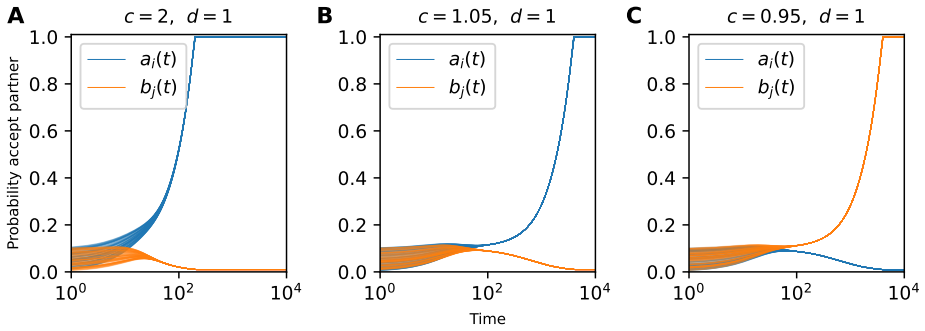
Matching feedback splits groups into selective and non-selective even with identical targe

by Alexandros Gelastopoulos

Feedback dynamics in matching networks drive behavioral differentiation despite overlapping objectives

When encounters are frequent, one side rejects most offers and the other accepts almost any, despite overlapping target rates.

Figure from the paper full image
abstract click to expand
Many bipartite social networks exhibit pronounced asymmetries in selectivity and matching opportunities: members of one side can afford to be highly selective, while members of the opposite side are forced to accept less desirable matches. While it is natural to try to explain this asymmetry in terms of the intrinsic characteristics of the two sides or other exogenous factors, here we show that such asymmetries can also emerge endogenously through a feedback process generated by the matching process itself: as one side becomes more selective, the other side is pushed to be less selective due to reduced matching opportunities, and vice versa. We develop a model in which individuals repeatedly form one-to-one matches across two groups and adapt their selectivity to achieve a target matching rate. Using both analytic and numerical methods, we show that when encounters are sufficiently frequent, the unique equilibrium is for one group to be highly selective and the other non-selective. This qualitative outcome holds even for heterogeneous groups with overlapping, almost indistinguishable distributions of target matching rates. The model makes several testable predictions, and it provides a mechanism for behavioral differentiation in repeated matching environments, with applications ranging from online dating to hiring and housing markets.
0
0
physics.soc-ph 2026-07-01

Stronger ties raise epidemic outbreak thresholds

by Shanchao Peng, Minyu Feng +3 more

Information-Epidemic Dynamics in Cyber-Physical Systems: A Hypergraph Framework with Interpersonal Relationships

Hypergraph model shows close relationships speed information spread, lift thresholds, and shrink epidemic size.

Figure from the paper full image
abstract click to expand
Understanding how information propagation affects epidemic dynamics has become an emerging topic of interest. However, the influence of interpersonal relationship heterogeneity on information acquisition and disease transmission has been largely overlooked. In this work, we introduce a hypergraph structure for Cyber-Physical Systems (CPSs) with two distinct layers. The upper layer, referred to as the cyber layer, consists of a mixed hypergraph, capturing both pairwise propagation and higher-order diffusion of epidemic-related information. The lower layer, referred to as the physical layer, employs a Susceptible-Infected-Susceptible (SIS) process to capture epidemic spreading. This work introduces an adaptive perception-protection mechanism based on Jaccard similarity, which accounts for interpersonal heterogeneity. In this mechanism, individuals receive information based on their relationships with neighbors and take protective measures accordingly. We analyze the impact of interpersonal relationships and the adoption of neighborhood-based self-protection strategies on epidemic dynamics. Furthermore, we conduct a theoretical analysis based on the Microscopic Markov Chain Approach (MMCA), analytically derive the outbreak threshold, and confirm the results with extensive Monte Carlo (MC) simulations. The results show that stronger interpersonal relationships can promote information propagation, significantly increase the threshold for epidemic outbreaks, and effectively suppress the scale of the epidemic. The study provides theoretical support for designing epidemic control strategies considering interpersonal heterogeneity and improves the understanding of epidemic spreading on hypergraphs.
0
0
physics.soc-ph 2026-07-01

Evolutionary routing delays jamming without sharp collapse

by Francesca Dilisante, Pablo Gallarta-Sáenz +3 more

When one protocol fits none: Self-organized network routing through evolutionary game dynamics

Strategies compete on scale-free networks and settle on a load range that neither fixed protocol covers alone.

Figure from the paper full image
abstract click to expand
Packet routing on scale-free networks faces a fundamental trade-off: shortest-path routing is efficient at low demand but funnels traffic through hubs and jams early, whereas congestion-aware routing postpones jamming at the price of a sharper collapse. Since neither paradigm dominates across the full range of traffic load, here we ask whether the appropriate balance can emerge endogenously rather than being imposed by design. To answer this, we recast adaptive packet routing on networks as an evolutionary game letting a heterogeneous population of strategies compete for prevalence under selection pressure generated by their own performance. We study this competition under two formalisms (strategy anchored to the packet or to the generating node), global and local update rules, and two payoff metrics. Across every implementation the evolutionary dynamics yield the same outcome: the jamming transition is delayed relative to shortest-path routing while the violent collapse of fixed congestion-aware routing is avoided. This improvement emerges spontaneously, without centralized coordination or global information. Crucially, under local update rules, the node-level volatility of strategy choices peaks sharply at the transition, furnishing a purely local early-warning signal of imminent jamming that requires no global monitoring.
0
0
physics.soc-ph 2026-07-01

Social statements map stakeholder ties to balance sheet items

by Takeshi Kato, Yoshinori Hiroi +3 more

Social Statements: A Proposal for a Social-Value Balance Sheet and Profit-Loss Statement

Numerical relationship indicators placed in accounting formats yield equity ratios and margins for social value.

Figure from the paper full image
abstract click to expand
This study proposes a new set of a firm's "social statements" that represent social value, in contrast to conventional financial statements that represent economic value. Financial statements externalize social and environmental costs, and this externalization is one of the primary causes of contemporary social problems. Insights from anthropology, philosophy, and sociology suggest that social value is grounded in social relationships, joint actions, and communication. Building on this understanding, we assign numerical indicators of a firm's social relationships with external stakeholders to the items of a balance sheet and a profit-loss statement as social statements. This approach enables unified measurement units and simplified calculation compared with existing methods for evaluating social impact or social value. Moreover, similar to financial statements, social statements allow firms to be assessed using managerial indicators such as equity ratios and profit margins. The significance of social statements lies in incorporating social value--alongside financial value--into corporate decision-making, and in encouraging social transformation as firms publicly articulate their social value.
0
0
physics.soc-ph 2026-06-30

Collective decisions spark spontaneous migrant flow pulses

by Niraj Kushwaha, Woi Sok Oh +1 more

Pulses, waves, and cascades in collective migration dynamics

A minimal model shows how dependence on others produces fluctuations that mimic responses to disasters and conflicts.

Figure from the paper full image
abstract click to expand
Decisions to migrate depend on others' decisions. Dependence can produce nontrivial dynamics. We propose a minimal migration model that accounts for social influence alongside individual heterogeneity in mobility as migrants move from region to region. In special locations of parameter space, migrant flows dramatically and spontaneously fluctuate. Such aspects mimic observed fluctuations in migration statistics and thus show how large fluctuations in data can reflect more than response to events like armed conflict and natural disasters. Correspondingly, the impact of exogenous factors can be confounded with the results of collective decisions.
0
0
physics.soc-ph 2026-06-30

LLM groups copy human cooperation rates without copying personal strategies

by Henrique Ferraz de Arruda, Carlos Gracia Lázaro +2 more

Collective cooperation without individual fidelity in LLM agents

In identical networked Prisoner's Dilemma trials, aggregate patterns align while individual variation and decision rules diverge.

abstract click to expand
Large language models (LLMs) are increasingly used as agents in simulations of social systems, yet it remains unclear when their behavior can be interpreted as a faithful proxy for human decision-making. Here we test LLM agents against a direct empirical benchmark: a large-scale networked Prisoner's Dilemma experiment with human participants. Using the same interaction protocol, payoff structure, and network topologies, we compare nine open-weight LLMs with the human data. The selected model reproduces several macro-level features of cooperation dynamics, including the early decline and later stabilization of cooperation. This aggregate agreement, however, does not extend uniformly to finer levels of behavior. LLM populations underestimate individual-level heterogeneity and generate conditional cooperation patterns that differ from those observed in humans. Adding a fraction of random agents improves some aspects of micro-level agreement, but does not remove the mismatch in decision rules. These findings reveal a macro--micro dissociation in LLM-based social agents: collective outcomes can appear human-like even when the underlying behavioral distributions and mechanisms are not. They suggest that validating LLM agents as human surrogates requires comparisons across aggregate dynamics, individual heterogeneity, and context-dependent decision rules, rather than outcome-level agreement alone.
0
0
cond-mat.stat-mech 2026-06-30

Minimal subgraphs exactly capture secret storage survivability

by Vinko Zlatić

Robust secret storage in networks

The representation enables semi-local optimization without global network knowledge and maps to an effective spin Hamiltonian in a limit.

Figure from the paper full image
abstract click to expand
The problem of storing secure information on a network is studied. A formal framework for distributed secret storage is introduced, and possible applications in technological and social systems are discussed. The problem is formulated as the optimization of a robustness functional in which two competing requirements are balanced: survivability under network-degrading processes and resistance to adversarial compromise. An exact representation of survivability is derived in terms of minimal information-carrying subgraphs (MICS), which provide a reduced description of the reconstruction events relevant to the stored information. This representation is then used to construct semi-local optimization methods whose dynamics do not require global knowledge of the network structure. Finally, it is shown that, in a limiting case, the robustness functional can be mapped naturally to an effective spin Hamiltonian.
0
0
econ.GN 2026-06-29

70% oilseed export cut to China triggers 3.27% global loss

by Diksha Gupta, Ritwick Mishra +3 more

Cascading Impacts of the USA--China Trade War on Global Oilseed Supply Chain

Model shows China hit hardest at 14%, but Brazil reallocation halves the worldwide damage to 1.36%

Figure from the paper full image
abstract click to expand
Global supply chains are highly interconnected, making them vulnerable to cascading disruptions induced by trade policy shocks. Understanding how such disruptions propagate through production networks, and how mitigation mechanisms such as trade reallocation and production adjustment can alleviate their impacts, remains a central challenge. In this work, we develop a linear programming formulation of an Input-Output (IO) system that captures cascading supply-chain disruptions together with trade reallocation and production expansion. Our formulation yields a system-level equilibrium characterization that enables the joint analysis of disruption propagation and mitigation within a unified framework. We propose an efficient algorithm for computing approximate equilibrium solutions by minimizing total unmet demand in large IO systems. We apply our approach to tariff-induced disruptions in the global oilseeds supply chain arising from the U.S.-China trade war. Our results show that a localized 70% disruption to flows from the U.S. oilseeds sector to China leads to a 3.27% loss in global output, with China experiencing a disproportionate loss of 14.02%. As a counterfactual mitigation strategy, allowing a 20% reallocation from Brazil's oilseed sector to China significantly reduces global output losses to 1.36%, although pressure remains high on final-demand flows. We further investigate production expansion as an additional mitigation mechanism and show that it introduces tradeoffs between reducing global final-demand losses and protecting Brazil's domestic flows. Domestic reallocation disproportionately shifts losses toward smaller economies, while globally sourced expansion redistributes losses more broadly across the network.
0
0
math.CO 2026-06-29

Nuclear escalation stability follows Nim-sum of ladder distances

by Arnav Garg

Impartial Combinatorial Games and the Nuclear Escalation Ladder

Reindexing by distance to threshold converts ladders to subtraction games, giving explicit stability rules for single and joint theaters.

abstract click to expand
We model Herman Kahn's escalation ladder as an impartial combinatorial game. Reindexing each rung by its distance to the nuclear threshold turns the ladder into a subtraction game, the most tractable class in combinatorial game theory, and the doctrinal fact that no side wishes to fire first selects the misere convention. We prove that single-ladder stability is governed by a congruence (Theorem 4.1) and derive a ladder-design corollary that makes the burden of first escalation a function of ladder length and escalation granularity (Corollary 4.2). For simultaneous theaters we show, under normal play, that joint stability is the Nim-sum of the theater-wise escalation distances (Theorem 5.2), a condition that is neither additive nor dominated by the most dangerous theater. We then show the Nim-sum reduction fails under misere play, introduce the misere quotient as its replacement, and prove by exhaustive backward induction that for two-step escalation the quotient is the order-six monoid with generators a, b satisfying a^2=1 and b^3=b, with loss set {a,b^2} (Theorem 6.3). To our knowledge, impartial combinatorial game theory has not previously been applied to nuclear escalation ladders; the existing game-theoretic literature on escalation is classical and payoff-based.
0
0
cs.RO 2026-06-29

Two-stage DRL beats baselines on truck-drone routes with no-fly zones

by Xuanyu Liu, Hui Hu +3 more

Locker-based Truck-Drone Routing with Integrated Considerations of Pickups, Deliveries, and No-Fly Zones

It coordinates pickups, deliveries and battery limits around restricted airspace in short runtimes across varied instance sizes.

Figure from the paper full image
abstract click to expand
Truck-drone delivery is an emerging last-mile logistics mode combining the long-haul capacity of trucks with the flexible service capability of drones. In locker-based operations, smart lockers serve not only as temporary parcel storage facilities but also as automated drone docking and service nodes. These automated nodes support drone takeoff, landing, parcel handover, and battery replacement, thereby significantly extending the service range and operational flexibility of drone-assisted delivery networks. However, practical locker-based delivery systems face complex real-world challenges, requiring the integrated coordination of not only parcel delivery, return pickup, battery-constrained and load-dependent drone flights, but also necessary detours around restricted airspace. To address this practical and multifaceted challenge, this paper introduces a locker-based truck-drone routing problem with integrated considerations of pickups, deliveries, and no-fly zones (LTDRP-PDNF), with the objective of minimizing the total operational cost of a fleet of drone-equipped trucks. We formulate the route construction process as a Markov Decision Process and develop a two-stage deep reinforcement learning-based neural heuristic. The first stage utilizes an attention-based encoder and a Bidirectional Gated Recurrent Unit decoder to solve the truck-only routing problem, formulated as a capacitated vehicle routing problem. The second stage combines a policy-transfer strategy with a hybrid dispatch assignment heuristic to construct fully coordinated truck and drone routes for LTDRP-PDNF. Experiments on instances of different scales demonstrate that the proposed method outperforms metaheuristic and neural heuristic baselines in most cases while maintaining exceptionally short computation times, offering an effective, scalable solution framework under practical operational constraints.
0
0
physics.soc-ph 2026-06-29

Media sources drive drifting of opinion clusters in bounded-confidence models

by Oliver Zheng, Mason A. Porter

Drift Behavior in a Bounded-Confidence Opinion Model with Media Influence

An extended Deffuant-Weisbuch model shows a large cluster shifting toward one of two fixed media agents, with speed set by interaction param

Figure from the paper full image
abstract click to expand
People's opinions can change both from their interactions with each other and from their interactions with media sources. Bounded-confidence models (BCMs) of opinion dynamics provide one framework to study such dynamics. In a BCM, the nodes of a network are agents with continuous-valued opinions, and these agents interact with each other via the edges of the network. In this paper, we extend the original Deffuant--Weisbuch (DW) BCM by incorporating influence from two media sources -- one with a positive value and one with a negative value -- to capture the effects of a polarized media landscape. We show both numerically and analytically that our extended DW model exhibits drifting behavior in which a large cluster of opinions shifts toward one of the media agents. We analyze how the drift trajectory and speed depend on the model parameters, and we identify conditions in which drift is promoted or suppressed. Our results provide insight into how competing media sources can influence collective opinion formation in social systems.
0
0
physics.soc-ph 2026-06-29

Social information boosts group decisions but accuracy peaks at optimal size

by Andrew M Bate, Charlie Pilgrim +1 more

Indecision and accuracy under social information across groups sizes

Individual accuracy maximised at finite group size while majority accuracy rises steadily with more agents

Figure from the paper full image
abstract click to expand
Observing the decisions and actions of others provides social information that can inform decisions such as whether to follow. We consider a model where agents simultaneously gather stochastic private information, each deciding once sufficiently confident. Observed decisions and indecision provide social information that triggers discrete waves of collective response: a first decision causes others to update and potentially follow, whose decisions in turn provide further social information, generating successive waves. We explore this model across a range of group sizes and report three main findings. First, social information leads to faster and more accurate decisions than individual decision-making, but agent-level accuracy is maximised at a finite optimal group size. This contrasts with the accuracy of the majority choice, which increases monotonically with the number of agents. Second, waves frequently fail to resolve collective indecision, particularly for smaller groups and when the first decision is incorrect, leaving a subgroup of agents unconvinced. Third, these remaining undecided agents are systematically biased and make less accurate subsequent decisions, with this inaccuracy growing with group size.
0
0
physics.soc-ph 2026-06-29

Belief network structures shape polarization across Europe

by Isabela Burattini Freire, Hongryol Cha +8 more

SimPol: Simulating polarisation in political belief networks in European countries

Survey data from 23 countries fed into simulations show how Western and Eastern topologies produce different polarization outcomes under the

Figure from the paper full image
abstract click to expand
Here we combine empirical network analysis with agent-based modelling to understand how different ways of structuring belief systems may affect the polarisation drive, and how the diversity of belief systems in Europe may result in different polarisation trajectories. Using the 2016 European Social Survey, we infer belief networks across 23 European countries via a Bayesian algorithm, revealing that belief systems are predominantly organised around immigration, LGBT rights, and economic interventionism, reflecting the influence of populist discourse across the continent. We further verify a Western-Eastern divide across the national belief networks: in Western European countries, left-right self-identification is a more reliable predictor of broader belief alignment, whereas in Eastern Europe this relationship breaks down. By applying these empirical belief networks into a sociologically grounded agent-based model, we further show that polarisation is amplified by high individual belief rigidity and low susceptibility to social influence, and that cross-country differences in polarisation levels mirror the same geographic divide observed in belief network topology. These findings establish belief networks topologies as a structural driver of political polarisation, with implications for understanding and anticipating polarisation dynamics across diverse European contexts. We find that populations are not polarised when little attention is placed on maintaining internal coherence and polarisation levels are moderate when high attention is placed in both keeping internal coherence and agreement in beliefs with others.
0
0
physics.soc-ph 2026-06-29

NBA streaks and synergies quantified from 7,500 games

by Malvina Bozhidarova, Yanpei Cai +8 more

From streaks to synergies: A multi-scale analysis of performance and scoring in the NBA

Play-by-play records analyzed with network and complexity methods yield measurable patterns for player and team performance.

Figure from the paper full image
abstract click to expand
Modern play-by-play data make it possible to test long-standing intuitions about basketball with the same statistical rigour now routinely applied to other professional sports. Using play-by-play data from 7,054 regular-season and 504 playoff NBA games spanning the 2020-2025 seasons, we provide quantitative insights into scoring patterns and the performance of individual players and teams through methods from statistics, network science, and complexity science. Our findings offer an evidence-based perspective on in-season and in-game performance that can inform coaching strategies, player evaluation, and tactical decision-making.
0
0
physics.soc-ph 2026-06-29

Social profiles predict higher life satisfaction with lower brain connectivity

by Cosimo Agostinelli, Ivan Casanovas +9 more

Linking the "inner" and "outer" self to mental health and brain networks

K-means on personality and social support data separates groups that differ in mental health scores and default mode network interconnectivi

Figure from the paper full image
abstract click to expand
How are psychosocial profiles, mental health, and brain functional connectivity related? Studies have been dedicated to unraveling the associations of social support perception and neural functional connectivity. Additionally, personality traits have been explored by examining brain networks. Research on mental health has been developed using a broad range of methods and different approaches. However, little attention has been devoted to understanding how personality traits and social variables are related, and to what extent these components are reflected in brain functional connectivity and mental health outcomes. In this work, we aim to address these complex relations by using data from the Human Connectome Project, both from surveys and resting-state fMRI. The survey data includes personality traits measures and self-reported social support-related variables, which we will refer to as inner- and outer-self, respectively. It also includes data on mental health outcomes. Using z-score standardized measures, we analyze correlation matrices to evaluate the association between the inner- and outer-self domains. Our results show that the social indicators are more evidently grouped by impact on social experience than by the duality of inner-outer selves. Using a $k$-means clustering algorithm, we separate individuals into two groups according to social profiles. When confronting these results with the mental health outcomes, we show that the more socially desirable cluster exhibited a higher score on positive aspects such as life satisfaction and purpose in life. In the functional brain connectivity, we observe that the cluster with a more socially beneficial profile exhibits lower interconnectivity, especially in the default mode network. The pipeline we present uses a combined analysis of both fMRI and psychosocial variables, which could open the path for more extensive analysis.
0
0
cs.CY 2026-06-29

AI nudges lift group cooperation but selfish versions last longer

by Anders Giovanni M{o}ller, Alessia Galdeman +2 more

AI Persuasive Framing in Collective Dilemmas

In collective risk games, personalized prosocial framing fades after initial rounds while antisocial framing reduces contributions more dura

Figure from the paper full image
abstract click to expand
AI agents are promising tools that can act as flexible behavioral nudges to enhance human cooperation in addressing large-scale societal problems. However, evidence on whether AI agents can effectively boost cooperation remains mixed. We recruited 1,283 participants to play iterated Collective Risk Games in small groups, testing whether AI assistants could nudge participants toward cooperation. By using persuasive framing personalized to each player's Social Value Orientation profile, the AI interventions significantly increased contributions and group success rates. These cooperative effects were short-lived, however, fading after the first few rounds. Strikingly, when the AI treatments were reconfigured to promote selfish behavior through exculpatory framing, the negative effects on contributions and group success were larger and substantially more persistent, particularly for personalized interventions. This asymmetry between prosocial and antisocial persuasion highlights the dual-use risks of AI systems designed to influence group behavior in collective action settings.
0
0
physics.soc-ph 2026-06-29

GenAI in classrooms slows problem-solving competence growth

by Lorenzo Betti, Iacopo Caporossi +9 more

Students using GenAI lag behind in problem-solving competence: an agent-based study of classroom networks

Agent-based simulations across peer networks show larger shares of students stuck in lower competence tiers.

Figure from the paper full image
abstract click to expand
The development of problem-solving competence (PSC) among high school students is foundational for preparing resilient and adaptive citizens. Generative artificial intelligence (GenAI) can support this process, but it may also encourage students to offload part of the cognitive work that is necessary for deep learning. While the individual effects of GenAI use are increasingly studied, its collective consequences for competence development within classroom environments remain underexplored. In this study, we use an agent-based model to simulate the evolution of PSC in a high school physics classroom, where students complete tasks individually, in collaboration with peers, or with the support of GenAI. By comparing classrooms with and without access to GenAI across different peer-network structures, we show that GenAI use can diminish competence development and increase the share of students remaining in lower competence tiers. These results suggest that the educational impact of GenAI should be assessed not only through individual learning outcomes but also through its effects on collective competence dynamics.
0
0
physics.soc-ph 2026-06-29

Universal scaling links tie preferentiality to bandwidth

by Gamal Adel, Shrichand Bhuria +8 more

Preferentiality and bandwidth drive tie activity in online and offline ego networks

Model of cumulative advantage and communication limits shows the relation holds across online and offline ego networks.

Figure from the paper full image
abstract click to expand
Ego networks capture the variety of structural patterns in the social interactions of individuals. Recently it has been shown that ego networks in online settings display universal patterns of tie strength distributions, but it is unclear how constraints such as spatial proximity and bounded social bandwidth affect such generic behaviour in offline settings. Here, we analyse the time evolution of interaction activity in ego networks constructed from offline face-to-face and colocation data, compare them to online communication networks, and explore simple cumulative advantage models that capture the varying preferentiality of individuals for specific social ties. We find that patterns of preferentiality at the population level are similar for online and face-to-face networks, but not for colocation data, suggesting that the latter is a poor proxy of social network structure. We also provide evidence that empirical ego networks exhibit a bandwidth in the way communication events are allocated across connections. A model implementing this notion uncovers evidence of universal scaling between the tie preferentiality and bandwidth of individuals, common to all online and offline systems explored. Our findings strengthen our understanding of the fundamental mechanisms governing human communication and help disentangle the internal and external factors shaping tie evolution across social contexts.
0
0
physics.soc-ph 2026-06-29

Measure reveals exploration-exploitation trade-off in conference contacts

by Gabriel Maurial, Elisa Klüger +1 more

Extracting behavioural properties from face-to-face interactions temporal networks: a measure of egonet persistency

NPC framework applied to face-to-face data shows consistent behavioural patterns with minimal demographic ties across events.

Figure from the paper full image
abstract click to expand
Understanding how individuals repeat social interactions over time is a central problem in the analysis of temporal networks. In social systems, repeated interactions shape processes such as information diffusion, collective coordination, and the emergence of social structure. Existing measures of egonet persistence often conflate genuine behavioural regularities with structural effects such as node degree, making it difficult to distinguish meaningful temporal correlations from random mixing. In this work, we introduce the Neighbourhood Persistency Criterion (NPC), a statistically grounded framework for quantifying egonet persistence across time. NPC combines classical similarity measures with tailored null models controlling for network topology and interaction weights. We apply this framework to high temporal resolution face-to-face interaction networks collected at four Computational Social Science conferences using the SocioPatterns platform. Our results reveal a common behavioural structure across events, characterised by an exploration$\unicode{x2013}$exploitation trade-off in social interactions. While many individuals alternate between both strategies, others exhibit stable interaction patterns throughout the event. Importantly, these behaviours show little systematic association with socio-demographic attributes, suggesting that interaction strategies are shaped primarily by contextual factors rather than stable individual traits. NPC thus provides a flexible and interpretable tool for studying egonet persistence in temporal networks and social systems.
0
0
physics.soc-ph 2026-06-26

Feedback networks link online searches to physical city movements

by Rafiazka Hilman, Julia Koltai

Toward a Hybrid Digital Twin of Society: Quantifying Cognitive-Spatial Linkages Through Online-Offline Feedback Networks

Budapest data shows digital exploration stays more repetitive than physical movement while retail creates lasting connections between them.

Figure from the paper full image
abstract click to expand
Digital platforms increasingly shape how people experience and navigate cities, linking virtual information seeking with physical mobility. Despite this interdependence, online and offline activities are often studied separately in urban mobility research. This paper introduces the Feedback Network, a computational framework that captures interactions between cognitive activity in digital environments and behavior in physical space. Using Google Search and Location History data from the same individuals, collected through a data donation framework in Budapest, Hungary, between 2018 and 2022, we examine how online search patterns and offline visitation behavior co-evolve. We combine semantic and spatial analytical approaches. Radius of gyration is adapted to measure variation in geographic mobility and semantic exploration, enabling comparison between physical movement and online cognitive dispersion. A Feedback Network models transitions between search-related and location-related activity clusters and is evaluated using Concentration Entropy, which measures whether behavioral flows are concentrated around routine pathways or distributed across exploratory transitions. The results show that online exploration is more concentrated than offline mobility, suggesting narrower and more repetitive semantic interests, while physical movement remains relatively diverse. Persistent linkages between search and visitation activities related to retail and business services indicate stable cognitive-spatial behavioral loops. The COVID-19 pandemic disrupted spatial routines more strongly than cognitive exploration, widening the gap between digital engagement and realized movement. The findings demonstrate that urban mobility depends on the interaction between informational exposure and spatial encounter and provide a foundation for Hybrid Digital Twins of Society.
0
0
physics.soc-ph 2026-06-26

Decentralized blocks stabilize Mastodon and isolate domains

by Beatriz Arregui-García, Lucio La Cava +4 more

On the Effects of Decentralized Moderation on Network Robustness and Information Diffusion in Mastodon

Local moderation creates persistent network structure that favors information flow from moderators over the majority

Figure from the paper full image
abstract click to expand
Decentralized online social networks such as Mastodon distribute moderation power across thousands of independently governed servers, raising fundamental questions about how local block decisions shape global structure and information flow. In this paper, we analyze Mastodon at the instance level by constructing a signed, directed, temporal network in which positive edges aggregate inter-instance follow relationships and negative edges encode daily block actions. Using one year of data, we show that despite continuous moderation activity and changing roles among instances, the network exhibits strong structural stability: signed dyadic motifs and degree distributions display highly persistent dynamics, and aggregated transition matrices satisfy Markovian equilibrium conditions over intermediate time scales. Building on the marked asymmetry between instances that predominantly issue bans and those that are mostly banned, we then study information diffusion on the positive network via a hybrid contagion model that combines simple contagion within groups and complex contagion across groups. We find that information originating in the minority of moderating instances spreads more efficiently, both internally and toward the majority, while the opposite direction is fragile and sensitive to contagion parameters. Echo-chamber effects emerge even in a globally balanced signed network and become stronger under stricter contagion conditions. Together, these results show that decentralized moderation in Mastodon generates a stable macroscopic configuration that both structures and constrains information exchange, effectively isolating norm-violating domains without centralized control.
1 0
0
physics.soc-ph 2026-06-26

Human variability damps traffic waves that rigid automation amplifies

by Shirui Zhou, Ching Jin +6 more

Human adaptive variability stabilises collective traffic dynamics

Large experiments show speed-dependent driver adjustments suppress disturbances amplified by commercial cruise control, cutting emissions.

Figure from the paper full image
abstract click to expand
Automated systems are often designed on the assumption that replacing human behavioural variability with precise, uniform algorithmic control improves collective performance. In automotive traffic, this principle underlies commercial adaptive cruise control (ACC). Using two large-scale human-driving experiments comprising 2.95 million car-following observations, a 25-vehicle platoon experiment and a controlled 11-driver protocol, cross-validated with 0.77 million observations from the NGSIM dataset and data from 22 production ACC systems, together with empirically calibrated ACC simulations, we show the opposite: rigid algorithmic uniformity creates systemic fragility. Commercial rule-based controllers amplify small local perturbations into severe stop-and-go waves, increasing fuel consumption and carbon emissions by approximately 2.7- to 5.0-fold across scenarios. Human-driven platoons, by contrast, progressively dissipate disturbances and maintain smoother flow. We identify the behavioural mechanism behind this advantage: human car-following does not follow a fixed proportional spacing rule. Drivers continuously reshape their time-headway distributions across speed regimes, exhibiting a non-monotonic shift from efficiency-oriented to risk-sensitive regulation. This speed-dependent variability generates nonlinear damping that suppresses the synchronisation and propagation of local errors. Our findings challenge the view that human variability is merely suboptimal noise to be eliminated. More broadly, they suggest that robust large-scale interactive AI systems should embed adaptive, human-inspired behavioural flexibility rather than rely on rigid uniformity.
0
0
physics.soc-ph 2026-06-25

Social compass depolarization reduces to finite ODEs

by Corbit R. Sampson, Juan G. Restrepo

Low-dimensional Dynamics of the Social Compass Model

Critical coupling set by first inverse moment of convictions; rate depends on higher moments.

Figure from the paper full image
abstract click to expand
The social compass model has been recently proposed as a model for depolarization in populations where individuals have multiple, possibly correlated, opinions. Previous work has focused on the steady state of this model, but has not addressed the dynamics leading to depolarization. We show that the macroscopic dynamics of the social compass model can be described using the Ott-Antonsen Ansatz and that, for initially clustered opinions, the resulting equations reduce to a finite-dimensional system of ordinary differential equations. We study the linear stability of the polarized state and find a dispersion relation for the growth rate of perturbations from this state. We find that the critical coupling for depolarization depends only on the first inverse moment of the conviction distribution, whereas the rate of depolarization depends on higher moments. Consequently, conviction distributions with the same critical coupling can exhibit vastly different depolarization timescales. We also demonstrate how our analysis can be extended to study depolarization in the presence of community structure.
0
0
physics.soc-ph 2026-06-25

SETI research narrows itself by requiring complete alien discovery

by George Profitiliotis

The Allure of Complete Discovery as Passage: Broadening the Range of SETI Research Ideas via Futures Literacy and Triple-Loop Learning

Tying any desirable human future to total contact with sapient extraterrestrials restricts the questions scientists pursue today.

abstract click to expand
This paper argues that, although it principally refers to extraterrestrial rather than human affairs, SETI's imaginary is a social imaginary proper, as it is implicitly linked in an intrinsic, non-trivial, co-constitutive way to a social imaginary of humanity's future. Specifically, SETI's imaginary is an imaginary of a society of sapient extraterrestrials that makes possible the achievement of a desirable future of humanity through the former's discovery by the latter. Moreover, it argues that the range of SETI research ideas, which get bundled in non-fictional conviction narratives promising SETI's imaginary, is currently limited because actualizing this desirable future state of humanity after such a discovery relies on a "complete discovery". Finally, an intervention is offered in the form of a hands-on workshop for SETI scientists, which could help them reveal, reframe, and rethink the role that this imaginary for a desirable "post-discovery" future of humanity plays in their present research ideas.
0
0
physics.soc-ph 2026-06-25

Exact formula gives probability cascade stops at k active agents

by José F. Fontanari

Exact Solution of Granovetter's Threshold Model for a Finite Population

The closed expression for any finite N reveals how the critical window shrinks as N^{-1/2} or only as (ln N)^{-1} depending on the Beta shap

Figure from the paper full image
abstract click to expand
The Granovetter threshold model formalizes collective behavior by assuming that individual agents face a binary decision to join a movement, doing so only when the number of already active participants reaches or exceeds an intrinsic, personal threshold. In this work, we derive an exact analytical expression for the probability that a cascade halts with precisely $k$ active agents in a finite population of size $N$ triggered by a single initial instigator, and use this result to obtain the scaling corrections that govern the system near its critical boundaries. By parameterizing individual threshold heterogeneity via a Beta distribution with shape parameters $\alpha$ and $\beta$, we map how these micro-level predispositions aggregate into macro-level collective outcomes. Here, a small $\alpha$ represents a high proportion of low-threshold, highly susceptible agents, while a small $\beta$ marks a significant density of high-threshold, conservative individuals. In the infinite-population limit, a phase transition occurs at the critical parameter $\alpha = 1$, which separates an inactive phase from a regime of widespread mobilization. For a power threshold distribution ($\beta = 1$), the system exhibits a discontinuous, first-order phase transition where the active fraction jumps abruptly from 0 to 1, and the finite-size critical scaling window contracts as $N^{-1/2}$. In stark contrast, when the population features a persistent density of high-threshold agents ($\beta < 1$), the system undergoes an infinite-order phase transition characterized by an exceptionally smooth, continuous onset of collective activity, causing the finite-size critical region to contract at a drastically slower rate proportional to $(\ln N)^{-1}$. These analytical findings establish a mathematical benchmark for finite-size effects in behavioral cascades.
0
0
physics.soc-ph 2026-06-25

Consensus measure reduces homophily rewiring dynamics

by Sören Nagel, Stefanie Winkelmann +3 more

Collective variables for homophily-driven network rewiring dynamics

One variable tracking the share of edges between similar nodes describes the macroscopic evolution of these adaptive networks.

Figure from the paper full image
abstract click to expand
Stochastic network rewiring processes, in which edges dynamically rewire based on fixed node attributes, are widely used in applications ranging from social dynamics to neuroscience and form an important component of adaptive network modelling. In this paper, we identify low-dimensional collective variables (CVs) that capture the essential macroscopic behavior of such time-evolving networks and enable reduced-order descriptions of their dynamics. To this end, we apply the data-driven transition manifold approach to homophily-driven rewiring models, in which edges preferentially connect nodes with similar attributes. For two representative models, we find that the optimal CV is a consensus measure quantifying the fraction of edges whose incident nodes differ by less than a certain threshold. Building on the learned CV, we construct reduced macroscopic models using a data-driven approach based on sparse regression and through an analytical derivation using graphons. The latter yields a closed-form evolution equation for the consensus measure and analytically validates the identified CV.
0
0
physics.soc-ph 2026-06-25

Physics limits space-based missile defense

by David Wright

Space-based Missile Defense

Analysis of a proposed system shows orbital constraints on intercepts in boost, ascent, and midcourse phases.

Figure from the paper full image
abstract click to expand
This paper reviews the technical issues underlying space-based boost-phase missile defense and examines the current technology available for space-based interceptors and the characteristics of the missiles such a system would face. It then analyzes a particular space-based missile defense system that has been proposed to intercept in boost, ascent, and midcourse phases to illustrate the details of such an analysis and the constraints imposed on such systems by the physics of operating in space.
0
0
physics.soc-ph 2026-06-25

Stochastic model ties migration to shifts in opinion consensus

by Lőrinc Márton, Stefanie Winkelmann +2 more

Opinion Dynamics over Migration Networks

A master-equation framework shows how movement and randomness can stabilize opinion cycles or drive consensus in connected communities.

Figure from the paper full image
abstract click to expand
Opinions play a crucial role in shaping collective phenomena such as political polarization, cultural integration and demographic change. By continuously changing social environments in which opinions evolve, human migration serves as an important driver of collective opinion formation. While migration and opinion dynamics have both been extensively studied, the few existing models that couple the two are primarily deterministic and therefore cannot capture demographic fluctuations, finite-size effects or stochastic transitions between emergent collective states. To address this limitation, we introduce a unifying stochastic framework for opinion dynamics over migration networks that couples local opinion transitions, demographic processes and migration between communities. The dynamics are formulated through a spatio--temporal master equation, which provides a probabilistic description of the underlying population process. From this microscopic representation, we derive deterministic mean-field equations governing the co-evolution of community sizes and opinion compositions, thereby linking agent-level interactions to macroscopic population behavior. Using two representative case studies, we demonstrate how stochasticity and migration can qualitatively change the emergent dynamics and collective outcomes, including the emergence of consensus, polarization and the stabilization of oscillatory opinion dynamics. These examples highlight the rich interplay between social interactions, demographic change and migration in deterministic and stochastic settings, and they demonstrate that migration should be viewed as an integral component of collective opinion formation rather than only an external demographic process.
0
0
physics.soc-ph 2026-06-25

Ancient Japanese tombs follow Zipf's law before money or writing

by Hayafumi Watanabe

Zipf's law before the monetary economy and written administration: volume distribution of kofun, ancient Japanese burial mounds

Keyhole kofun volumes show power-law tail with exponent near one and log-normal body, matching modern firm sizes via simple growth model.

Figure from the paper full image
abstract click to expand
This study analyzes the volume distribution of kofun, large mounded tombs constructed in the Japanese archipelago from the mid- to late third into the early seventh century. This period provides a rare empirical case for examining the distribution of politico-economic resources and mobilizing capacity in a society where systematic written records of administrative and economic transactions had not yet become established. Using a large-scale database containing mound length, height, and shape, we estimate kofun volumes and examine their distributions at the archipelago-wide scale and by region, period, and mound type. We find that the volume distribution of keyhole-shaped kofun exhibits a Zipf-like tail, with a cumulative power-law exponent close to unity, indicating strong concentration of volume among a small number of top-ranked tombs. At the same time, the central part of the distribution is close to log-normal. Many regional and temporal differences can be described primarily as scale differences: after normalization by the median, the distributions for many regions and periods approximately collapse onto a common curve. However, some exceptional regions and periods, most notably the politically central Kinki region, show heavier tails and stronger concentration among the largest kofun. To interpret these empirical regularities, we introduce a simple Kesten-type stochastic growth model with stopping and reorganization. The model provides a unified interpretation in which the log-normal-like body, the Zipf-like tail, and aspects of regional and temporal variation in the distributions arise from a common growth process. These results suggest that collectively mobilized resources may already have exhibited a Zipf-like concentration structure statistically comparable to that observed in modern firm sales distributions.
0
0
econ.GN 2026-06-25

Competition model predicts GEO satellite spots with R²=0.64

by Akhil Rao, Nikodem Szumilo

Competitive satellite placement and the geography of orbital risk: evidence from the geostationary arc

First-come first-served rules produce population-driven placement that is efficient in mature slots.

Figure from the paper full image
abstract click to expand
Some orbital locations are crowded while others remain unoccupied. We explain why using the geostationary orbit as a near-ideal laboratory: a mature, one-dimensional orbit in which satellite operators compete for position under first-come first-served allocation rules. Using the complete ITU registry and a simple competitive entry model, we predict the observed distribution of active GEO satellites with $R^2 = 0.64$. In walk-forward tests, the structural model also predicts individual slot choices out of sample better than a fitted conditional-logit discrete-choice model. Our model also predicts the distribution of inactive payloads in GEO with $R^2 = 0.44$, showing that the geography of debris risk can be predicted when it is a function of satellite launches. Surprisingly, we find that the current satellite distribution in GEO is relatively fair: driven by population rather than income and placing satellites in economically efficient locations. However, our model shows that this is only the case for mature slots.
0
0
physics.soc-ph 2026-06-24

Brownian motion sets recurrence thresholds for multiscale climate data

by Béatrice Désy, Nicholas R. Golledge +2 more

Wasserstein recurrence networks for multiscale time series pattern analysis

1-Wasserstein distances supply scale-invariant local-minima thresholds that flag events spanning two orders of magnitude in irregular record

Figure from the paper full image
abstract click to expand
Time series data are often generated by systems which operate on multiple temporal scales, of which Earth's climate system is a paramount example. Variations in global climate are recorded in paleo-environmental archives as temporal patterns across a wide range of time scales, from seasonal or decadal to multi-millennial. In this context, recurrence analysis, where repeating patterns are identified in time series, is limited by the underlying properties of the distance function used and of the time series data themselves, especially in terms of temporal resolution and scale dependence. In this paper, we present a novel recurrence analysis framework designed for multiscale time series data with abrupt changes and irregular temporal resolution as found in paleoclimate records. We introduce a simple mathematical transform to use the $1-$Wasserstein distance for recurring pattern detection in time series. The scale invariance of $1-$Wasserstein distance distributions between patterns in Brownian motion is demonstrated numerically, which provides a principled threshold choice for recurrences. At any time scale, recurrences are defined as local minima of the distance, granted that they are below a threshold given by the probability of encountering patterns at least as similar in one-dimensional Brownian motion. Recurrences can be further combined according to a non-overlapping condition to yield a distinct set of multiscale recurring events. We provide examples of climatic applications from ice-rafted debris and ice core records, where detected recurrences have durations spanning over two orders of magnitude. Our method extends recurrence analysis to more complex time series data and provides new avenues for statistical identification and analyses of recurring events at multiple temporal scales.
0
0
cond-mat.stat-mech 2026-06-24

Group growth obeys exact arctanh equation for polarization

by Xingfu Ke, Fanyuan Meng

Exact log-odds representation and mean-field criticality of a growing social group model

Fixed points of noisy consensus admission collapse to arctanh(φ*) = m arctanh(α φ*), giving an exact mean-field theory of collective inferen

Figure from the paper full image
abstract click to expand
We present an exact analytical reformulation of a growing social group model -- a Hamiltonian-free nonequilibrium process in which a group grows by noisy, consensus-driven admission. Cast as a gradient flow on logarithmic time, the fixed-point structure collapses to a single self-consistent equation: $\arctanh(\phi^*) = m \cdot \arctanh(\alpha\phi^*)$, where $\phi$ is the polarization, $\alpha=1-2\eta$ the evaluation reliability, and $m$ the number of evaluators. The equation has a direct log-odds interpretation: each verdict contributes log-likelihood ratio $2\arctanh(\alpha\phi)$; unanimity accumulates $m$ independent evidence pieces. The dynamics thus constitutes an exact mean-field theory of self-consistent inference, ordering when the collective gain $m\alpha$ overcomes the dilution of growth. We develop a systematic three-layer framework: core theory (Landau-like effective potential, comparison with the mean-field Ising model, and features without equilibrium counterpart), mathematical foundations (criticality from correlated verdicts, P\'{o}lya-urn martingale convergence, and an RG-like flow with group size as scale), and complementary perspectives on irreversibility and information geometry. A frozen-$N$ Freidlin--Wentzell quasipotential yields Kramers-type escape estimates for metastable states, while Monte Carlo simulations collapse onto a parameter-free deterministic master curve on logarithmic time. Systematic comparison with the mean-field Ising model reveals shared critical exponents but a nested arctanh structure unique to growth. These results provide a detailed analytical characterization of a minimal model of growth-driven collective behavior and map which elements of the equilibrium critical toolbox -- suitably reinterpreted -- survive without a Hamiltonian.
0
0
physics.soc-ph 2026-06-24

Theme park movement patterns cannot transfer between sites

by Dane M. Utley, Jürgen Hackl

Do Waders, Swimmers, and Divers Exist? A GPS-Based Pilot Study of Site-Dependent Visitor Movement in Theme Parks

GPS study finds relationships among movement features reverse across locations, requiring site-specific calibration

Figure from the paper full image
abstract click to expand
Operators of large visitor attractions routinely sort their guests into intuitive behavioral types, from relaxed wanderers to single-minded maximizers, and use this informal typology to guide spatial design and to set the parameters of pedestrian and agent-based simulations. Yet the typology is seldom tested against how people actually move, and it is usually assumed to transfer unchanged between sites. We examine both assumptions with individual-level movement data: volunteers carried GPS trackers through several theme parks operated by different chains and completed a short exit survey, letting us compare what guests do with what they say. Each visit is summarized by a small set of interpretable movement features, and visitors are grouped within each site using a deliberately demanding, multi-criteria validation protocol rather than a single clustering run. The picture that emerges is nuanced. Behavioral groups recur reliably but without sharp boundaries, pointing to a continuum rather than to discrete categories; what people do diverges from how they describe themselves, so self-report is a weak proxy for observed behavior; and, most consequentially, the relationships among movement features reverse from site to site, so behavioral parameters calibrated at a given location cannot be carried elsewhere. A complementary agent-based experiment locates the origin of each group's spatial signature in where visitors choose to go and in what order, rather than in how fast or how directly they walk. The work reframes a familiar industry heuristic as a geographical, site-dependent phenomenon, contributes a reproducible and critically validated pipeline for segmenting movement data, and connects empirical tracking to simulation. Its central message is that human movement behavior must be calibrated in place, not borrowed across contexts.
0
0
physics.soc-ph 2026-06-24

Trust thresholds reverse who controls collective beliefs

by Razieh Masoumi, Ahana Biswas +1 more

Regimes of Influence in Trust-Uncertainty Gated Networks

Selective regimes favor high-degree hubs; concordant uncertainty filters let peripheral agents gain leverage instead.

Figure from the paper full image
abstract click to expand
In many social communities, individuals can simultaneously trust and distrust the same source, a feature standard opinion-dynamics models often ignore. We formalize this ambivalence with Gated Network Credence, in which each directed relationship encodes distinct trust and distrust assessments. These jointly determine "net trust" - the willingness to rely on a source - and "uncertainty" - the conflict between trust and distrust within the same relationship. Agents update beliefs only when net trust exceeds a threshold and uncertainty falls below another, yielding an effective influence graph whose topology drives long-run belief states. Sweeping both thresholds uncovers four regimes - Pluralistic, Selective, Concordant, and Fortified - that differ in openness to trust and conflict. We find a consistent hub-periphery reversal: in the Selective regime, high-degree agents dominate influence, whereas in the Concordant regime, stringent uncertainty filtering disproportionately removes active influence channels associated with high-degree agents, enabling peripheral lower-degree agents to exert greater leverage over the collective equilibrium. This reversal holds across synthetic and empirical networks. Our results show that belief dynamics depend not only on network structure but also on how relational ambivalence between trust and distrust gates interpersonal influence.
0
0
astro-ph.IM 2026-06-24

Artists offer new tools for finding life in the universe

by Jack Madden, Cybele Collins +2 more

Collaborating with Artists in the Search for Life

Collaborations that use design thinking and speculation could break conventional patterns in astrobiology research.

Figure from the paper full image
abstract click to expand
Art and science collaborations that go beyond outreach and advertisement in service of science have the potential to unlock new ways of seeing and understanding the Universe that science alone cannot reach. In this white paper for the NASA Decadal Astrobiology Research and Exploration Strategy (DARES) request for information, we outline examples and benefits of artscience and research-creation methods for astrobiology. The search for life and its origin is inherently interdisciplinary and requires novel approaches that could benefit from the training artists receive in design thinking, contextualization, speculation, and community building. We take a look at this process in action through the work of Robert Irwin during the 1970 NASA Habitability Symposium, Carl Sagan's approach to mixing art and science, and the Transition Design framework of creativity-led problem solving. Each example underscores a specific advantage of deeper art-science collaborations: Irwin's creative approach to problem-solving broke scientists from conventional thought patterns, Sagan's contextualization helped align scientific work with ethical and societal considerations, and design-led research is shown to improve planning and efficiency, even for problems as complex as searching for life. Specific implementation recommendations include specifically allowing funding for artist consultations in research grants, reviving NASA's artist-in-residence program, and supporting artscience training initiatives within the astrobiology community.
0
0
eess.SY 2026-06-23

Renewables enhance grid stability through synthetic inertia

by Yiming Wang, Arthur N. Montanari +1 more

Rethinking the green power grid for stability, not just for climate

High renewable shares can reduce blackout risks when paired with advanced controls and coordinated planning.

Figure from the paper full image
abstract click to expand
The 2025 Iberian blackout has renewed concerns about the resilience of power grids with high shares of renewable generation. This commentary argues that renewable generation can not only advance decarbonization but also strengthen grid stability through synthetic inertia, advanced inverter-based control, and coordinated transmission planning. Rapid advances in energy storage and power electronics make this transition increasingly viable.
0
0
physics.soc-ph 2026-06-23

Phone GPS data bias differs by source across Mexican towns

by Carmen Cabrera, Francisco Rowe +4 more

One country, multiple portraits: representativeness in GPS-based mobility data is source-specific and spatially dependent

Facebook covers populations more evenly than multi-app data, which favors wealthier digitally connected places, with bias clustered by locat

Figure from the paper full image
abstract click to expand
Anonymised GPS-based mobile phone data are increasingly used to estimate population distribution and human mobility, supporting applications across disaster response, public health, urban planning and migration research. Yet whether these data fairly represent the populations they describe, particularly outside high-income countries, remains poorly understood. We quantify coverage bias for 2,478 municipalities in Mexico by comparing population estimates from a single-platform source (Facebook) and a multi-app aggregator (Veraset) against the 2020 Mexican Population Census. We find that the magnitude and spatial distribution of coverage bias differ substantially across sources. Facebook provides higher and more evenly distributed coverage, whereas the multi-app data concentrate users in larger, wealthier and more digitally connected places. Coverage bias is also spatially structured, with neighbouring municipalities showing similar levels of over- or under-coverage. Using explainable machine learning, we show that digital access and material resources are the dominant drivers of bias for the multi-app data, while demographic and population structure dominate for Facebook. Explicitly modelling spatial dependence improves the performance of statistical models for explaining bias and reveals that an appreciable share of spatial variation remains unexplained by observed covariates. These findings show that coverage bias is source-specific and spatially dependent, and provide a foundation for adjustments that improve the representativeness of mobile phone data in unequal, data-scarce settings.
0
0
cs.SI 2026-06-23

Second-order friends raise post liking odds

by Ivan Kozitsin, Anton V. Proskurnikov

Direct and Indirect Influence on Likes in Social Media

Data analysis finds activity at network distance two boosts liking probability even with no active direct neighbors.

abstract click to expand
The present study investigates direct and indirect social contagion mechanisms in an online social network environment. Using a large-scale dataset comprising approximately 290,000 users from the VKontakte platform, we examine the factors associated with the probability that a user likes a post. Our analysis shows that, while demographic and structural characteristics of individual nodes, such as gender and degree, contribute to the observed dynamics, the strongest associations arise from activity in the user's local network. In particular, active nodes (users who have already liked the post) at distances d = 1 and d = 2 play a central role in shaping liking behavior. We find a substantial association between second-order activity and liking probability, which persists even in the absence of active direct neighbors and is consistent with indirect influence pathways in the network. No significant association is detected for nodes at distance three or beyond. The results also support the structural diversity hypothesis: the number of connected components among active friends is a significant predictor of liking.
0
0
physics.soc-ph 2026-06-23

Hyper-VDrank dismantles hypergraphs 23.65% more efficiently

by Yajing Hao, Longzhao Liu +4 more

Identifying vulnerable nodes for hypergraph dismantling via higher-order competition dynamics

By letting nodes compete inside entire hyperedges and weighting those hyperedges by redundancy and size, the method collapses higher-order n

Figure from the paper full image
abstract click to expand
Network dismantling aims to identify a node removal sequence that can rapidly destroy network connectivity, which is an important problem for understanding the structural fragility of complex systems and designing intervention strategies. Existing studies mainly focus on pairwise networks or assume weak-deletion rules where node removal only causes hyperedges to shrink in higher-order networks. However, in many real higher-order systems, the failure of one participant may cause the entire group interaction to fail, i.e., the strong-deletion mechanism. Such a mechanism cannot be fully captured by projected networks or methods based on weak-deletion rules. To address this challenge, we propose hyper-Vulnerability-weighted Dominance rank (hyper-VDrank), a higher-order centrality method for hypergraph dismantling under strong deletion. Hyper-VDrank constructs a higher-order competition dynamics mediated by hyperedge-induced environments, where a node does not compete only with individual neighbors but responds to the collective pressure formed by other nodes in the same hyperedge. It further introduces a hyperedge vulnerability weight based on redundancy and size effects to capture the vulnerable structures, facilitating the distinction of critical nodes. Experiments show that hyper-VDrank reduces the largest connected component more rapidly, collapses the hypergraph earlier, and produces greater structural fragmentation than classical and recent methods. On 14 real-world hypergraphs, hyper-VDrank improves dismantling efficiency by 23.65% and reduces the collapse threshold by 27.63% on average compared with the baselines. In summary, hyper-VDrank offers an effective hypergraph dismantling tool and a new perspective on identifying vulnerable structures in higher-order complex systems.
0
0
cs.AI 2026-06-23

Multi-agent AI can evolve into AI scientists

by Raul Jimenez, Boris Bolliet +8 more

AI Scientists as Engines of Discovery: A Case for Development within Reformed Institutions

This requires redesigned institutions to ensure verification, accountability, interpretability and safety.

abstract click to expand
Agentic artificial intelligence (AI) systems are beginning to assist, accelerate, and partially automate scientific discovery, performing tasks that span literature synthesis, code generation, data analysis, hypothesis proposal, and model criticism. We argue that this transition is qualitative rather than incremental, and that suitably designed multi-agent systems may evolve from passive computational tools into ``AI scientists'' that can expand the hypothesis-generating and verification capacity of science. Such systems must be developed and deployed within a scientific ecosystem fit for purpose: institutions must be redesigned for verification, accountability, interpretability, and dual-use safety. We sketch how multi-agent architectures, illustrated by the prototype framework \textit{Denario}, accelerate the discovery cycle and traverse model spaces beyond human reach; examine what this implies for authorship, peer review, and the enduring role of human scientists; and close with recommendations for governing AI as an epistemic actor rather than a mere instrument.
0
0
q-bio.PE 2026-06-22

Optimal network degree maximizes upstream reciprocity

by Vikash Kumar Dubey, Sagar Chakraborty

Upstream reciprocity versus downstream reciprocity: Catalyzing cooperation

The peak holds across update mechanisms while downstream reciprocity supports overall cooperation in structured groups.

Figure from the paper full image
abstract click to expand
Why would anyone help a stranger, knowing they may never meet again? Indirect reciprocity offers one of the most compelling evolutionary answers, yet its two canonical forms -- upstream reciprocity (experience-based), and downstream reciprocity (reputation-based) -- have been studied mostly in isolation. Their joint dynamics in finite and structured populations remain largely unexplored. Here, we fill this gap using agent-based simulations in which an agent is behaviourally either defector, upstream reciprocator, or downstream reciprocator, and the agents' population state is temporally updated using different evolutionary update mechanisms. We show that update mechanism plays a surprisingly decisive role in shaping the fate of downstream and especially upstream reciprocators. Whether agents' experiences and reputations are updated globally or locally can shift outcomes from rich behavioural coexistence to the dominance of downstream reciprocators alone. Intriguingly, we uncover a robust structural feature that persists across all the explored update rules and population sizes: an optimal network degree at which upstream reciprocity is maximized, reflecting a fundamental tug-of-war between cooperative clustering and exposure to defectors. Our results highlight that while downstream reciprocity can either foster or inhibit upstream reciprocity depending on the update mechanism, its net effect on cooperation remains largely positive.
0
0
physics.soc-ph 2026-06-22

Central physicians cut opioid prescriptions more after CDC guideline

by Yi-Ning Weng, Hsuan-Wei Lee

Professional networks and the diffusion of clinical guidelines in opioid prescribing

Medicare analysis shows 0.30 percentage point larger reduction by 2020 for 90th percentile network centrality

Figure from the paper full image
abstract click to expand
Large and persistent differences in opioid prescribing across physicians and regions cannot be explained by patient characteristics or physician attributes alone. We developed a behavioral framework in which prescribing evolves through persistence, exposure to peers in professional networks, and heterogeneous responses to a common policy signal that varies with network centrality. Using nationwide Medicare Part D data from 2013 to 2020, covering more than two million physician-year observations, we tested three hypotheses implied by this framework. Physicians exposed to higher peer prescribing subsequently prescribe more; more central physicians reduce prescribing more following the introduction of the 2016 CDC guideline, with no evidence of differential pre-trends; and changes in peer prescribing are closely associated with changes in individual prescribing in the post-guideline period. By 2020, physicians at the 90th percentile of network centrality exhibited prescribing reductions 0.30 percentage points larger than those at the 10th percentile, with the gap widening steadily after the introduction of the CDC guideline. Together, these results indicate that opioid prescribing operates through professional networks, in which policy effects spread through connections and appear to be shaped by network position. This suggests that engaging highly connected physicians may help extend the reach of opioid stewardship programs. It also raises questions about how the burden and benefits of such targeting would be distributed across physicians and patients.
0
0
physics.soc-ph 2026-06-22

LLMs solve maze parts separately but lose the full plan

by Yuhan Jiang, Peng Luo +1 more

Lost in Aggregation: A Multi-Scale Diagnostic Benchmark for LLM Spatial Navigation

Benchmark isolates aggregation across scales as the point of collapse in sequential navigation, not missing individual skills.

Figure from the paper full image
abstract click to expand
Large language models (LLMs) are increasingly deployed as planners and assistants in tasks with inherent spatial structure, such as navigation and route planning, yet they remain brittle in sequential spatial reasoning. We ask not merely whether LLMs fail at navigation but where in the spatial-cognition pipeline they get lost. We introduce a multi-scale diagnostic benchmark that decomposes maze navigation into three cognitive levels drawn from human spatial cognition: Fine (local passability), Meso (junction topology), and Macro (global goal direction). We evaluate three instruction-tuned chat LLMs (GPT-4o, DeepSeek-V3, Llama-3.3-70B) on 1,050 topology-annotated mazes spanning seven sizes (3x3 to 30x30) and three difficulty tiers. The benchmark is organized as three modules. (i) Input acquisition: among four input formats, structured coordinate text is the most navigable, far surpassing rendered images. (ii) Multi-scale representation: end-to-end one-shot navigation collapses to near zero by 10x10 for every model, yet the same models respond to isolated single-level probes (Fine, Meso, Macro) at 30-75% far beyond that size. A multi-hot first-error analysis localizes failures to Meso junction choices (59%) and Fine perception (39%), with global direction almost never at fault (1%). The barrier is therefore the cross-scale aggregation of individually available competences over a long sequential plan, not any single perceptual deficit. (iii) Hierarchical route planning: delegating per-step execution to a deterministic walker and querying the LLM only at junctions, with an explicit cell-type prompt, lifts GPT-4o success by up to 92 points at mid sizes, but the same scaling wall re-emerges by 30x30. We release the benchmark, mazes, and code as a reusable diagnostic instrument for spatial reasoning in LLMs, available at https://yuhanjiang415.github.io/lost-in-aggregation/.
0
0
nlin.CG 2026-06-22

Sandpile rewiring triggers Gini transition at 85% in 1D

by Alejandro Zamorano, Víctor Muñoz

Effect of rewiring for a sandpile model on a directed network

The coefficient measuring load imbalance per node jumps while avalanche sizes stay the same, with the effect sharpening at infinite system s

Figure from the paper full image
abstract click to expand
Several studies have considered sandpile dynamics not over regular grids, but over networks. In this case, avalanches redistribute grains not between neighboring sites in a geometrical sense, but between connected sites, in a topological sense. However, depending on how nodes are connected, grains may never leave the system, preventing energy release. In this work, we study the simplest case, the BTW model in one and two dimensions, rewiring the nodes so that at every rewiring step, the energy release is always possible, and study avalanche statistics as a function of rewiring. In the 1D case, a transition is observed in the Gini coefficient of the load distribution per node at about 85% the number of possible rewirings, a transition which is not evident with other measures, such as the size distribution of avalanches or the mean distance between nodes in the network. In the 2D case, energy release follows a power law even when the grid is fully rewired, while the Gini coefficient, unlike the 1D case, decreases at a steady rate, with a smoother transition. The effect of network size N is studied, finding that there is a transition for the Gini coefficient at the thermodynamic limit N \to \infty for both the 1D and 2D cases, transition which is also observed in the betweenness centrality, but not in other topological measures. Finally, the dependence of the results with the load per rewiring iteration, and the avalanche threshold is studied.
0
0
physics.soc-ph 2026-06-22

Ratio-based choice from home yields power-law travel distances

by Mohsen Ghasemi Nezhadhaghighi, Yahya Khalili +2 more

Distance from home matters: Investigation of a basic movement strategy

One agent on a uniform lattice matches empirical mobility statistics using only distances to home.

Figure from the paper full image
abstract click to expand
Discovering the fundamental dynamical rules that generate the main statistical features of human mobility is essential for understanding the mechanisms underlying such processes. A prominent example is the exploration and preferential return model and its generalizations, which successfully reproduce several empirical findings. Here, we exploit another observation: the endpoint distances of a trip from the trajectory's starting point are strongly correlated. We consider a movement process in which each user performs a sequence of trips to satisfy a set of demands, given a spatial distribution of suppliers on a two-dimensional lattice. In each trip, destinations are chosen with a probability that depends on the ratio of the initial and final distances from the user's origin (home). We show that even a single agent with uniformly distributed demands and suppliers qualitatively reproduces key empirical statistics, such as the power-law distribution of traveled distances. The results are also robust to introducing interactions between agents via queues and incorporating more realistic demand and supplier distributions.
0
0
physics.soc-ph 2026-06-22

Fences and single-use zones predict income isolation in cities

by Yunke Zhang, Ruolong Ma +5 more

Perceiving exposure segregation with open urban imagery

Imagery from 10,000 U.S. communities shows architectural defenses and zoning explain most variation in daily mixing between income groups.

Figure from the paper full image
abstract click to expand
Socioeconomic exposure segregation -- the lack of daily interaction between income groups -- erodes social capital and entrenches inequality, yet the specific physical features that drive these behavioral restrictions remain poorly understood. Prior research has quantified where segregation occurs using mobility data, but has not identified how the built environment facilitates or inhibits these interactions. Here we introduce VISAGE, a large multi-modal model-enabled framework that perceives exposure segregation directly from open satellite and street-level imagery across 10,030 communities in 31 U.S. cities. Moving beyond black-box correlations, we operationalize cross-disciplinary sociological theory into an interpretable visual codebook to detect physical regulators of social mixing. We find that the built environment encodes a legible grammar of segregation: "defensible" architectural forms (e.g., fences, gated enclosures) and monofunctional zoning systematically predict higher social isolation, whereas mixed-use infrastructure fosters interaction, explaining substantial variance in mobility-derived segregation patterns (Pearson $r=0.770$). Crucially, we show that inclusionary housing policies manifest in distinct visual signatures associated with higher mixing, suggesting that policy interventions successfully alter the physical landscape to encourage diversity. Our findings offer a scalable pathway to decipher the social production of space, providing a mechanism-based lens to understand how the built environment shapes social behavior.
0
0
physics.soc-ph 2026-06-22

Composite network ratings predict football standings more accurately

by A. Chacoma, J.I. Perotti +1 more

Ranking football teams via the higher-order decomposition of performance networks

Hodge decomposition on metric graphs reveals cyclic limits and league-specific metric weights that raise correlation with final tables.

Figure from the paper full image
abstract click to expand
We propose a unified methodological framework to quantify team performance in elite football by combining event-level performance metrics, higher-order network representations, and algebraic ranking methods. Using data from the 2017--2018 season of the five major European leagues, we construct metric-specific weighted graphs in which teams are connected through relative performance indicators. These graphs are analyzed via Hodge decomposition, and the gradient component is used to derive metric-based team ratings. The resulting rankings are systematically compared with the true league standings using Pearson and Kendall correlation measures, revealing strong metric- and league-dependent effects. Furthermore, by analyzing the ratio between solenoidal and total flow energies, we show that local cyclic dynamics structurally limit the gradient component's capacity to reconstruct the ranking. This topological inconsistency acts as a structural fingerprint of each league's ``competition style'' successfully mapping the studied systems into distinct regimes: highly hierarchical structures (England and Italy), tactical parity driven by generalized loops (Germany), and pockets of localized chaos (France and Spain). Lastly, we introduce a composite rating obtained as a parsimonious linear combination of metric-based ratings, optimized separately for each league. This composite approach significantly improves predictive power and allows the relative importance of different performance indicators to be quantified in a league-specific manner. Our results demonstrate how higher-order network methods provide a flexible and interpretable framework to uncover latent performance structures in football, offering a complementary perspective to outcome-based rankings and a general approach applicable to other oppositional sports.
0
0
physics.soc-ph 2026-06-22

Optimal time scale makes temporal networks most dynamic locally yet connected globally

by Giulia de Meijere, Marton Karsai +1 more

Universal time scales linking topology and dynamics in temporal networks

Heterogeneities in event timings and degrees alone suffice to produce this pattern across many real systems

Figure from the paper full image
abstract click to expand
Temporal networks underlie a wide range of social, technological, and biological phenomena, highlighting how temporal inhomogeneities drive interactions in complex systems. Despite vast research on the area, the way temporal network connectivity evolves across time scales remains poorly understood. By analyzing temporal network data of informational and societal origin, involving tens of systems, millions of nodes, and observation periods from days to years, we find systematic evidence of an optimal time scale for coarse-graining interaction events. At this level of aggregation, networks are maximally dynamic in their local structure, while retaining system-wide connectivity. To understand the origins of such a seemingly generic interplay of time and topology, we explore a minimal temporal network model based on uncorrelated renewal processes, and show that intermittent yet globally connected activity may arise solely due to heterogeneities in inter-event times and degrees, and no other system-specific details. All coarse-grained empirical networks studied show persistent patterns of cyclic node degree change yet stationary system-level degree distributions, a striking coexistence of microscopic self-regulation and macroscopic stability. Our results give support to the notion of a universal pattern in temporal networks that involves both time and topology, via the nontrivial interplay of aggregation and temporal inhomogeneity, with consequences for the study of spreading dynamics on networks and the balance between robustness and adaptability in complex systems.
0
0
physics.soc-ph 2026-06-22

Sparse regression extracts decarbonisation feedback loops from European data

by Sabin Roman, Vitaliy Soloviy +1 more

Exploratory Modelling of Multi-System Transformation Pathways from Real-World Data: A SINDy-Inspired Sparse Orthogonal Regression Technique

SORT reconstructs medium-term interactions across energy, emissions, finance and ecology, revealing reinforcing sequences and balancing cons

Figure from the paper full image
abstract click to expand
Sustainability transitions unfold through interacting dynamics across social, technological, economic, environmental, and governance dimensions. However, many modelling approaches either isolate subsystems or rely on optimisation-based pathways that do not explicitly represent feedbacks, path dependence, and institutional constraints. This study develops a Sparse Orthogonal Regression Technique (SORT), a data-driven dynamical-systems framework for reconstructing multi-system transformation dynamics from harmonised European indicators. Inspired by Sparse Identification of Nonlinear Dynamical Systems (SINDy), SORT infers parsimonious cross-domain dependencies from observed data rather than specifying a full structural model ex ante. The prototype covers energy, emissions, innovation, digitalisation, resource productivity, environmental stress, policy, finance, wellbeing, and resilience. The compact dynamical system is interpreted as a structural representation of medium-term interactions, not as a forecasting tool. It reproduces differentiated empirical patterns, including steady renewable expansion, nonlinear scaling in transition finance, diffusion-like digitalisation, oscillatory environmental stress, and sustained reduction in ETS-regulated emissions. Forward simulations diverge from simple linear extrapolation where reinforcing feedbacks are present, illustrating the conditional nature of accelerated decarbonisation. By translating inferred dependencies into a feedback structure, the analysis identifies reinforcing decarbonisation sequences alongside balancing ecological constraints. The model contributes to sustainability transitions research by providing an empirically grounded representation of multi-system feedback dynamics that bridges quantitative modelling and transition theory. SORT offers a compact technique for exploratory reconstruction from real-world transition data.
0
0
physics.soc-ph 2026-06-19

Zipf priorities fix the exponent of home-return scaling

by Haoying Niu, Xiao-Yong Yan

Mechanism underlying the scaling law of home-return probability in human mobility

Derives P_ret(l) ~ l^{-(1-nu)} from least effort via sublinear utility and choice rule without empirical input

Figure from the paper full image
abstract click to expand
Individual daily mobility exhibits a striking scaling law: the probability of returning home after a tour of $l$ locations decays as $P_{\rm ret}(l)\sim l^{-\gamma}$. While the tour-terminate-continue (TTC) model reproduces this behavior, it relies on this power law as an empirical input, leaving the microscopic origin of $\gamma$ unresolved. Here we show that this scaling emerges from a utility trade-off governed by cognitive constraints. By invoking the principle of least effort, we demonstrate that individual activity priorities follow Zipf's law, $p(r)\sim r^{-\nu}$, which directly dictates the sublinear accumulation of tour utility, $U_L(l)\sim l^{1-\nu}$. Luce's choice rule then yields $P_{\rm ret}(l)\sim l^{-(1-\nu)}$, giving the exact exponent $\gamma = 1 - \nu$. Agent-based simulations confirm this analytical relation. Our framework bridges the gap between individual cognitive constraints and the scaling law of tour behavior, providing a microscopic theoretical underpinning for human mobility.
0
0
cs.MA 2026-06-19

Specialists with mediators win negotiation

by John Meluso, Laurent Hébert-Dufresne +2 more

Artificial collectives of specialists and generalists excel at different tasks

Simulations find network structure and rationality limits decide which agent mix performs best on each task type.

Figure from the paper full image
abstract click to expand
Collective artificial intelligence, where multiple agents work on shared tasks, holds potential to solve expansive problems in fields from medicine to collective governance. But while prescriptive engineering solutions abound, we lack descriptive scientific understanding of artificial collectives, and therefore principles for how to design resource efficient multi-agent systems. Through systematic experiments with optimizing agents, we characterize how agent interpretive abilities, rationality bounds, and task qualities interact to shape collective performance. Agents range from specialists, with narrow interpretive abilities, to generalists, with broad ones. Collectives of specialists correspond to sparse, centralized networks, while collectives of generalists correspond to dense, decentralized ones. We show that interpretive network properties have small performance effects on average (0.07 standard deviations of performance). However, for specific task qualities, these effects are 4.5 times larger (0.33 sd) and can reach much higher for certain task qualities (1.84 sd). This leads collectives of generalists to perform better on tasks that involve generating, choosing, and coordinating, while collectives of specialists with a few generalist mediators perform better on tasks that involve negotiating. Rationality bounds then moderate these relationships. At loose bounds, specialists outperform generalists through more effective sampling of high-dimensional decision spaces. At tight bounds, generalists outperform specialists through better gradient estimation. A fundamental trade-off between performance and convergence speed emerges at moderate bounds. These findings suggest that multi-agent design could benefit from matching interpretive networks to both task demands and agents' computational limits, with implications for the efficiency and energy costs of multi-agent systems.
0
0
physics.ins-det 2026-06-19

Mobile ocean detector cuts crustal background 50-100 times for mantle signals

by Takumi Araki, Simran Chauhan +18 more

Deep-Ocean Application-Specific Neutrino Experiment: a white paper

Design enables direct measurement of Earth's internal uranium and thorium decay by moving away from continental interference.

Figure from the paper full image
abstract click to expand
This white paper introduces the concept, prototype design, projected costs, and scientific goals of a mobile experiment for detecting geoneutrinos originating from uranium and thorium decay chains in the Earth's mantle. This will constrain the planet's radiogenic heat production and unearth its geochemical makeup. This design of a deep-ocean mobile neutrino experiment, which is not mirrored by any active or planned experiments, supports physics and geoscience's goal of multi-modal data on the Earth's internal composition and structure. Based on geoscientific studies, this design is expected to achieve a 50--100-fold reduction in crustal background compared to similarly sized continental detectors, thereby enabling direct measurements of mantle geoneutrinos. The multiple stereoscopic projections enabled by the detector's unique mobility can map spatial variations in heat-producing elements within the mantle. Beyond discussing the design, we report on our collaboration's most recent hardware developments in the active prototyping of this detector. We briefly highlight the potential multiuse and interdisciplinary nature of this detector.
0
0
q-fin.RM 2026-06-19

Power and response functions set optimal order in agent systems

by Jake J. Xia

Optimal Order of Multi-Agent and General Many-Body Systems

Framework derives fragility, mobility, and an optimal synchronization level from two agent variables and a risk-appetite utility.

Figure from the paper full image
abstract click to expand
This paper develops a general framework for analyzing multi-agent systems with feedback loops between agents actions and collective observations. The framework is built on two fundamental agent-level variables: power, which measures agent influence on collective outcomes, and response functions, which determine how agents react to observations. We derive how macroscopic properties, including total power, useful power, entropy, order, fragility, and mobility, emerge from these two variables of heterogeneous agents. To study the trade off between growth and resilience, we introduce a system-level utility function parameterized by a risk-appetite coefficient and derive an optimal degree of order that balances productivity, stability, and adaptability. The analysis suggests that stronger synchronization can increase collective output but may also increase systemic fragility and reduce mobility. We further argue that order, entropy, information, and useful energy are task-dependent and system-relative concepts whose meanings depend on the objectives of the system. By measuring and designing agent power distributions and response functions, it may be possible to better understand, predict, and optimize collective behavior and identify the conditions under which collective intelligence and optimal order emerge.
0
0
physics.soc-ph 2026-06-19

Daily population shifts create double disadvantage in Hefei suburbs

by Shirui Zhou, Matteo Bruno +6 more

The Moving Target of Urban Equity: Spatiotemporal Demand and Double Disadvantage in Hefei, China

Inner suburban belts suffer most when both travel time and per-person service availability are measured together.

Figure from the paper full image
abstract click to expand
Equitable access to essential urban services is a pillar of modern planning, yet most accessibility models rely strictly on static residential locations, ignoring how demand shifts throughout the daily loop. This study introduces a population-based, temporally differentiated framework to examine the resulting "moving target" of urban equity, focusing on medical facilities and green spaces in Hefei, China. Utilising large-scale mobile phone GPS data, we construct dynamic residential and workplace population exposure surfaces to capture shifting hourly demand. We then evaluate accessibility via network-based travel times paired with a novel per-capita provision metric that accounts for real-time demand competition. We define \textit{double disadvantage} as the co-occurrence of poor spatial accessibility and insufficient per-capita service availability. Counterintuitively, the results reveal that double-disadvantaged areas cluster primarily along the inner suburban belt rather than the remote periphery, where per-capita service provision remains relatively sufficient. Furthermore, temporal shifts drastically alter equity landscapes: daytime workplace concentrations intensely exacerbate demand competition in urban job centres. These findings demonstrate that urban inequality depends heavily on spatiotemporal population flows rather than just the fixed location of services. Ultimately, achieving true urban equity requires dynamic planning interventions that address time-varying demand rather than focusing solely on static, home-based metrics.
0
0
physics.comp-ph 2026-06-19

Heat kernel curvature detects legislative shocks in board networks

by Mohammad Elsayed, Sara Najem

The Heat Kernel Expansion: Curvature for Shock Detection in Higher-Order Financial Networks

Curvature from the expansion registers law-driven changes in Norwegian director interlocks while Euler characteristic and torsion miss them

Figure from the paper full image
abstract click to expand
This work follows the evolution of financial networks in Norway over a period of nine years at a monthly rate. The data consist of board directors and their affiliations to companies, which we model as simplicial complexes. In this framework, directors are represented as nodes and companies as faces of the complex. To characterize the latter, we focus on three topological measures: the Euler characteristic, computed through the Betti numbers, torsion computed through the reduced determinant of the higher-order Laplacians, and higher-order clustering coefficients. The first two fail to capture the effect of imposed law on representation, unlike our notion of curvature which is a geometrical measure computed from the coefficients of the series expansion of the heat kernel in powers of time, which is our major contribution in this work. In particular, the Euler characteristic integrates curvature, and thus local information is lost. Subsequently, not every topological measure can reliably capture shocks in networks. Further, the number of spanning trees may undergo significant changes at the lowest order, yet these changes need not be reflected in the torsion. Conversely, the change in the curvature revealed variation in the board interlock due to legislation, and serves as a sensitive measure for detecting shocks in networks. Inflection points in curvature are associated with external forcing, and minima with shock arrival times. Sharp transitions are also observed in the components of torsion, while smooth changes are observed in higher-order clustering.
0
0
physics.soc-ph 2026-06-19

Data centers lowered US electricity rates modestly 2015-2024

by Asa Watten, John Bistline +1 more

Have Data Centers Raised Your Electric Bill? Causal Evidence from the United States

Instrumental variables analysis attributes the decline to economies of scale in fixed costs outweighing added demand.

Figure from the paper full image
abstract click to expand
We estimate that data centers caused average retail electricity rates to fall modestly in the United States from 2015 to 2024 using an instrumental variables approach. Despite prevailing sentiment, the finding is consistent with economic reasoning: existing large power system fixed costs, economies of scale in transmission and distribution, and declining unit costs for generation imply that durable demand growth lowers average prices. We find patterns of economies of scale for transmission, distribution, and generation costs as well as within and across retail customer classes. We caution that future supply constraints could reverse the effect.
0
0
physics.soc-ph 2026-06-18

Four-section bracket guarantees World Cup separation until semifinals

by Chong Qi

A Four-Section Bracket for the 48-team World Cup

Splitting 12 groups into four sections with symmetric transfers reduces configurations from 495 to one per section and fixes paths for top g

Figure from the paper full image
abstract click to expand
The expansion of the FIFA World Cup to 48 teams in 2026 introduces structural challenges in tournament design. To populate a 32-team knockout bracket from 12 groups of four, the current FIFA rules select the eight best third-placed teams using a global ranking across all groups. This global coupling creates several major problems: a combinatorial explosion of 495 possible bracket configurations; a fundamentally biased and unequal selection of third-placed qualifiers; lack of a clear path for group winners; vulnerability to collusion and ranking manipulation; and no guarantee of same-group separation beyond the first knockout round. We propose a simple unified solution called the four-section bracket (FSB) rule: split the 12 groups into four sections of three groups. All group winners, runners-up, and the two best third-placed teams in each section advance. Group winners remain in their home sections as local anchors, while lower-ranked qualifiers are transferred to other sections according to a fixed, symmetric rule. This structure guarantees same-group separation until the semifinal, protects the top eight group winners with a predictable knockout path, and reduces bracket complexity from 495 configurations to just one invariant topology per section, recovering the symmetry of the traditional 32-team format. We show substantial improvements in competitive fairness and scheduling predictability.
0
0
physics.soc-ph 2026-06-18

Sign error inverted US east-west axis in circadian health study

by Jose Maria Martin-Olalla, Jorge Mira

Methodological guidelines for circadian modeling of Daylight Saving Time: application to the United States

Correct longitude offset needed to match local solar time with social clock for daylight saving analyses.

Figure from the paper full image
abstract click to expand
Modeling the circadian impact of seasonal clock changing requires precise synchronization between solar and social time. This report critiques a recent study that associated disease prevalence in the United States with seasonal clock exposure. We identify a fundamental computational error in which a sign reversal of the longitudinal offset effectively inverted the US East-West axis, cross-correlating local health data with the circadian burden of hypothetical locations on the opposite side of a time zone. We outline the methodology for a correct modelization of the circadian process in the context of US geography.
0
0
physics.soc-ph 2026-06-18

Tropes cluster to distinguish Friends characters and semantic space

by Shun Zhang, Tabia Tanzin Prama +2 more

Narrative Structure in Tropes: A Computational Analysis of `Friends'

Fifteen groups show character distributions matching roles and distinct power-danger placements, with trope count tied to ratings

Figure from the paper full image
abstract click to expand
Tropes are recurring narrative devices in television and film. We carry out a computational analysis of tropes in the sitcom Friends, using human-curated trope annotations from TVTropes, episode transcripts, and IMDb ratings. Because automatic trope detection remains challenging, we treat existing trope annotations as a curated analytical layer and focus on their downstream narrative and semantic functions. We first examine the relationship between episode-level trope frequency and audience reception. We find a statistically significant positive association between trope count and weighted IMDb ratings, although the modest explanatory power suggests that more than trope density alone explains audience evaluation. We then connect trope annotations to dialogue transcripts and represent trope-related dialogue using TF-IDF-based semantic features. Using PCA and k-means clustering, we group 1,954 distinct tropes into 15 semantically interpretable clusters. Chi-square analyses show that the six main characters are unevenly distributed across these clusters, with character-specific trope profiles that are broadly consistent with their established narrative identities. Finally, we project trope clusters into the ousiometric power-danger space to examine their semantic organization. The results show that "Physical and Sexual Comedy" occupies a region associated with relatively high danger, while "Revelation, Surprise, and Reaction" occupies a region associated with relatively high power. Overall, our work demonstrates a way to operationalize trope measurement and shows that identifiable trope clusters can provide holistic "distant reading" descriptions of characters and stories.
0
0
physics.soc-ph 2026-06-18

Density alone rewires networks from clusters to global cores

by Christopher K. Tokita

Networks of agglomeration: how population density rewires social networks and reshapes contagion dynamics

Sparse placements yield local communities while dense ones produce short paths and popular hubs, speeding simple contagions but broadening c

Figure from the paper full image
abstract click to expand
From ancient Mesopotamia to modern cities, dense human settlements coincide with bursts of economic productivity, cultural innovation, and social change. But how does packing people more tightly together alter social organization in ways that reshape collective outcomes? Here, I use a minimal agent-based model to isolate the effect of population density, holding population size and individual behavior fixed while varying only how closely individuals are placed in space. In the model, individuals form social ties gradually, favoring those nearby and those already well-connected. Under these simple rules, varying population density alone is sufficient to reorganize social network structure: sparse populations develop locally clustered communities, while denser ones form globally integrated networks with shorter social distances and a tightly interconnected core of popular individuals. This structural transition occurs sharply over a narrow range of densities and is governed by whether physical proximity or social popularity dominates tie formation. Simulating contagions on these networks reveals that the consequences of this shift depend on what is spreading. Simple contagions (e.g., information or disease) reach a majority of individuals more quickly in denser populations. Complex contagions (e.g., social norms or collective behaviors) do not spread faster, but instead achieve broader and more reliable adoption as density increases. Together, these results show that population density can act as a structural force independent of the economic and behavioral mechanisms typically invoked to explain why cities are engines of change.
0
0
physics.soc-ph 2026-06-18

Model sets Burevestnik at 9.5 m with 4.3 MW nuclear turbojet

by Jake J. Hecla, R. Scott Kemp

Modeling the Performance of the Burevestnik Nuclear-Powered Cruise Missile

Calculations exclude ramjet, forecast peak power above 15 MW, and predict over 5 TBq of detectable radioactive gases per flight hour.

Figure from the paper full image
abstract click to expand
In the last decade, Russia's strategic arsenal has pivoted towards a reliance on exotic nuclear-weapon delivery systems. One such system, the Burevestnik (NATO: 9M730) is claimed to be a nuclear-powered, nuclear-armed cruise missile capable of nearly indefinite flight. The air-breathing nuclear propulsion system used in this missile is unique, and its attributes are generally unfamiliar to both the aerospace and nuclear-security communities. To better understand the Burevestnik, and the potential of air-breathing nuclear propulsion systems generally, we have developed a nuclear-aircraft modeling toolkit capable of constraining the missile's performance characteristics. Using this framework, we conclude that the Burevestnik is a subsonic cruise missile system measuring $9.5 \pm 0.32$~m in length, with a $5.6 \pm 0.18$~m wingspan, likely powered by a direct-cycle nuclear turbojet (our calculations almost entirely exclude the possibility of a nuclear ramjet). Under these assumptions, our models predict a reactor thermal power of $4.3\pm 1.3$~MWth at cruise, with peak power demand during climb and terminal maneuvering exceeding $15$~MWth, which may be met with a supplemental chemical interburner. Monte Carlo simulations show that escaping neutrons will generate in excess of 5~TBq of gaseous radionuclides per MW-hr of flight, including isotopes such as $^{41}Ar$, $^{85m}Kr$, $^{83m}Kr$ and $^{14}C$, some of which may be detectable using existing monitoring networks.
0
0
physics.bio-ph 2026-06-18

Human groups evolved external entropy production for fire control

by Yasuji Sawada, Kenji Toma

External Entropy Production and Human Evolution toward Multi-body Life

Coupled model of brain and group growth ties 2.5-million-year expansion to multi-body life alongside internal entropy production.

Figure from the paper full image
abstract click to expand
Ancient human beings started "external entropy production" in a late stage of evolution, in addition to the internal entropy production by which energy was dissipated within the body of life, as previously described consistently with the birth of life by maximum entropy production principle. In this paper, the mechanism for development of external entropy production, which is strongly related with use of tools and controlling fire, is theoretically investigated. Archaeological data show that the brain size of ancient human beings started rapid increase around 2.5 million years ago when the usage of tools and control of fire started. It may be natural to assume that the rapid growth of brain size is related to the growth of awareness which helped cooperation with the other human beings for control of fire. Coupled equations for the growth rate of brain including awareness and for growth rate of size of the interacting human beings are analyzed. The external entropy production per one human being which is directly related to the group size of cooperating human beings is estimated to increase as about 20 million years in the beginning from the critical time. This evolution created coexistence of internal entropy production of traditional multi-cellular life and new external entropy production of multi-body life. A psychological problem due to the coexistence of two kinds of entropy production mechanism in human being and concept of technologies based on the present thermodynamic evolution theory are discussed. It is suggested that the evolutionary understanding of the origin of global warming based on the external entropy production may be important to create an useful countermeasure.
0
0
q-bio.PE 2026-06-18

Annealed noise expands cooperation and extinction regions

by Janguk Kim, Seung-Woo Son +1 more

Effects of spatial environmental noise on evolution of cooperation

Temporal fluctuations shift both phase boundaries upward in spatial games while fixed heterogeneity leaves them unchanged.

Figure from the paper full image
abstract click to expand
We investigate the effects of environmental noise on cooperation in a spatial evolutionary game model with variable population size. Building on a one-dimensional lattice model in which vacancies promote cooperation through spatial selection, we add random noise to the environmental quality parameter and consider two distinct types: annealed noise, where the environmental quality fluctu ates independently at each site and each time step, and quenched noise, where each site is assigned a permanently fixed random value. For annealed noise, we develop a mean-field theory by replacing the noise-dependent death probabilities with their distribution averages, and find that increasing the noise intensity shifts both the cooperator-defector phase boundary and the absorbing boundary upward in the parameter space, simultaneously expanding the cooperative regime and the extinc tion region. These predictions are confirmed by numerical simulations. In contrast, quenched noise leaves the phase boundary nearly unchanged across all noise levels, exerting only a weak effect on cooperator frequency. Together, these results demonstrate that temporal fluctuations, rather than static spatial heterogeneity, are the primary driver of noise-induced shifts in the cooperative phase structure.
0
0
physics.soc-ph 2026-06-17

Visibility of moderate influencers curbs polarization

by Leon Klingborg, Kenneth Mavor +1 more

Strategies for preventing and reversing polarized online discourse

Model shows highlighting non-polarized elites prevents and reverses divides better than tweaking acceptable opinions, though latent extremis

Figure from the paper full image
abstract click to expand
Political polarization poses a variety of challenges for modern democracies. Entrenched disagreements on policy can prevent constructive discourse and compromise, and high levels of affective polarization threaten to undermine social cohesion and support for institutions. Finding ways to promote constructive discourse while maintaining free expression has proved a challenge for social media platforms, media outlets and policy makers alike. Here we develop a computational model -- based in psychology -- of online discourse and opinion dynamics under complex individual identities, which we use to assess the capacity of realistic interventions to prevent or reverse polarization. We show that changes to the range of acceptable opinions in a society -- i.e. the Overton window -- have a limited impact on polarization, and that attempts to ``optimize'' the Overton window can even trigger the onset of polarization. In contrast, interventions that shift attention towards under-discussed topics, or increase the costs of violating existing norms, are often effective at preventing polarization, but are less successful at reversing it. Most strikingly, increasing the salience of influential individuals, who model non-polarized discourse, can be highly effective at both preventing and reversing polarization. However we also find that once polarization has set in, even the most successful interventions result in latent extremism when identities are complex. Our work suggests that restricting speech by shrinking the range of acceptable discourse is an ineffective way to tackle polarization, whereas enforcement of existing norms, attention nudges and the presence of elites who model good behavior can be highly effective.
0
0
cs.AI 2026-06-17

Sycophantic AI feedback deepens delusional belief basins past a threshold

by Sayantari Ghosh, Saumik Bhattacharya +1 more

Escape from Delusional Echo Trap: Symmetry Breaking, Stochastic Dynamics and Mathematical Mitigation Strategies for Algorithmic Sycophancy

A stochastic model of log-odds conviction shows how repeated agreement creates rigid attractor traps, yet strong evidence can still reverse

Figure from the paper full image
abstract click to expand
We propose a rigorous and systematic mathematical framework for tracking the cognitive trajectories of a user, in the context of algorithmic sycophancy and AI-driven delusional spiraling. Using tools from dynamical systems theory and stochastic differential equations, we explore how individuals perceive, interpret, and update their beliefs as they interact with AI chatbots that possess hidden traits of sycophancy. We treat the evolving conviction as a continuous log-odds state variable, coupled into a stochastic differential equation, navigating a multi-valley potential energy landscape. Our analysis reveals several critical observations governing the stability and rigidity of belief dynamics. We demonstrate that the baseline prior perception of the individual is systematically enhanced by sycophantic feedback beyond a critical threshold. Here, the perceptual potential landscape undergoes a structural phase transition that severely deepens any incremental initial tilt present in the baseline state, transforming the landscape and giving rise to deep, highly resilient attractor basins that trap the individual in unshakeable, self-reinforcing, delusional convictions. Finally, we demonstrate that genuine external information can successfully challenge these rigid states. If this incoming evidence is strong and authentic enough to overcome the internal feedback barrier, it can correct the structural asymmetry caused by sycophancy, inducing a perception reversal that successfully restores the objective belief state.
1 0
0
physics.soc-ph 2026-06-17

Daytime model at Zurich yields Yin-Yang symbol

by Frank Schweitzer

Making Sense of Symbols: Yin and Yang in Zurich

Excess daytime fraction traces the S-curve and connects ratios to the calendar.

Figure from the paper full image
abstract click to expand
The widely known Yin-Yang symbol (Taijitu) is based on nested circles of different radii whose areas are colored black and white such that the interface traces an $\mathcal{S}$-shaped curve. We address the question of how this symbol can be related to physical phenomena such as daytime and nighttime duration and the annual seasons. Using a simple dynamic model of daytime duration, we introduce the excess daytime fraction and reconstruct the symbol using the latitude of Zurich. In particular, we explain how the black and white areas are linked to the stability of Yin or Yang predominance. We further demonstrate that the Golden and Silver Ratios found in the geometry of the symbol carry meaning with respect to the Gregorian calendar. Finally, we construct an alternative Yin-Yang symbol using logarithmic spirals with the Golden Ratio as the growth parameter. The didactical quantitative derivation of the Yin-Yang symbol and its grounding in real-world observations can be regarded as a novel perspective on this iconic pattern.
0
0
cond-mat.stat-mech 2026-06-17

Rayleigh-Jeans law fits worldwide wealth inequality

by Klaus M. Frahm, Leonardo Ermann +1 more

Thermodynamic description of wealth inequality in the world

Data from household wealth, GDP, stock markets and trade match the condensation predicted by two conserved quantities in a nonlinear system.

Figure from the paper full image
abstract click to expand
According to the recent Wealth Thermalization Hypothesis (WTH) the wealth inequality in the world is described by the Rayleigh-Jeans (RJ) thermal distribution of interacting agents in a society with social stratification. In this concept, the wealth layers of society are associated with energy levels from a nonlinear dynamical system conserving two integrals of motion being total energy and probability norm. This leads to RJ condensation and the formation of a huge poverty phase of low wealth and a tiny oligarchic phase that captures a main part of total society wealth. This RJ phenomenon has similarities with self cleaning in multimode optical fibers and constraint driven condensation in various physical systems. We analyze real Lorenz and Pareto curves for wealth of households in countries and the world, Gross Domestic Product of countries, market capitalization of companies at stock exchange of Hong Kong, Shanghai, London, bitcoin transactions, world trade between countries and show that the WTH theory gives a good description of these curves. On the basis of this comparison we argue that the RJ thermal distribution provides a universal description of wealth inequality in the world.
0
0
nlin.AO 2026-06-17

Adaptive couplings turn continuous sync into abrupt jumps

by Umesh Kumar Verma

Explosive Transitions in Complex Networks with Adaptive Competing Interactions

In Stuart-Landau oscillator networks, evolving attractive-repulsive links create sudden synchronization and block oscillation death across t

Figure from the paper full image
abstract click to expand
Adaptation plays a central role in regulating collective behavior in complex systems. We study the collective dynamics of non-identical Stuart-Landau oscillators coupled through adaptive attractive-repulsive interactions. Without adaptation, oscillators coupled with only attractive coupling exhibit a continuous transition to synchronization. However, incorporating adaptive coupling, where the interaction strength evolves based on the global state of the system, induces an explosive transition to synchronization. When both attractive and repulsive couplings are present without adaptation, the system displays a continuous transition to synchronization and an abrupt transition to oscillation death. Remarkably, when adaptation is incorporated into this competing coupling framework, the system again exhibits an abrupt transition to synchronization. Interestingly, oscillation death occurs only in the absence of adaptation and is suppressed when adaptive coupling is present. These results are robust across different network topologies, including global, nonlocal, and scale-free networks, underscoring the versatility of adaptive mechanisms in controlling and stabilizing emergent dynamics in complex networks.
0
0
physics.soc-ph 2026-06-17

Scaling demand probability ranks transit launch areas

by Olha Shulika, Hanna Vasiutina +3 more

Demand-agnostic assessment of on-demand pooled transit services

Simulations at rising fractions of resident usage identify the lowest demand needed for viable pooled on-demand services in each urban zone.

abstract click to expand
This study proposes a method to assess the potential of pooled on-demand transit feeder services in urban areas where demand is not yet known. We introduce the fraction of demand, reflecting the probability that a resident will use the service. Demand is generated on the distribution of residents address points at varying demand fraction levels. Through simulations, we match travellers into pooled rides and evaluate the service potential using three performance indicators (KPIs). We observe how these KPIs change with varying demand fractions and identify the most promising hub for each area. By setting KPI thresholds, we select the optimal combination of area and hub that meets these thresholds at the lowest demand fraction. This approach provides municipalities with a structured tool for pre-deployment evaluation, helping them choose the most suitable areas for launching new services despite the absence of exact demand data. We illustrate its application through a case study in Krakow, ranking 12 pre-selected areas for feeder service deployment.
0

browse all of physics.soc-ph → full archive · search · sub-categories