Consumers are increasingly delegating purchase decisions to AI agents, providing natural-language descriptions of their preferences and identity. We argue that these representations constitute an information channel, role coherence, through which sellers can infer willingness to pay without explicit disclosure by the buyer agent, leading to preference leakage. In an experiment where a language-model buyer agent shops on behalf of a verbal consumer profile, we show that seller-side inference from dialogue alone recovers willingness to pay nearly one-for-one. Comparing this setting to a numeric-budget condition with confidentiality instructions cleanly isolates role coherence as distinct from instruction-following failure. Because this leakage arises from delegation itself, it cannot be mitigated at the prompt level. Instead, we propose architectural interventions that trade off personalization against preference privacy.
High-precision CNC machining of free-form aerospace components requires bounded compensations informed by inspection, simulation, and process knowledge. Off-the-shelf large language model (LLM) assistants can generate text, but they do not reliably execute risk-constrained multi-step numerical workflows or provide auditable provenance for high-stakes decisions. We present multi-agent knowledge analysis (MAKA), a human-in-the-loop decision-support architecture that separates intent routing, tools-only quantitative analysis, knowledge graph retrieval, and critic-based verification that enforces physical plausibility, safety bounds, and provenance completeness before recommendations are surfaced for human approval. MAKA is instantiated on a Ti-6Al-4V rotor blade machining testbed by fusing virtual-machining path-tracking error fields, cutting-force and deflection simulations, and scan-based 3D inspection deviation maps from 16 blades. The analysis decomposes deviation into an evidence-linked pathing component, a drift-based wear proxy capturing systematic evolution across parts, a residual systematic compliance term, and a variability proxy for instability-aware escalation. In a three-level tool-orchestration benchmark (single-step through $\geq$3-step stateful sequences), MAKA improves successful tool execution by up to 87.5 percentage points relative to an unstructured single-model interaction pattern with identical tool access. Digital twin what-if studies show MAKA can coordinate traceable compensation candidates that reduce predicted surface deviation from order $10^{-2}$in to approximately $\pm 10^{-3}$in over most of the blade within the simulation environment, providing a pre-deployment verification signal for risk-aware human decision-making.
LLM agents will increasingly act in socially structured settings where role, audience, and relational context can shape what is advantageous or costly to say. We study whether such social structure, without any explicit objective in the prompt, changes what an agent expresses publicly relative to an off-the-record (OTR) channel elicited under the same condition. We introduce a dual-channel debate framework in which agents produce public utterances that enter the shared history alongside OTR responses that are recorded but never shown to the other participant. Across 10 models, 3 scenarios, and 5 variations within each scenario, alignment-inducing settings produce systematic public-OTR divergence in the targeted agent, with its decision divergence rising from a $\sim$3% baseline to roughly 40%. The effect is consistent across four aggregate analyses: stance, semantic similarity, natural language inference, and survey responses. In some cases, the OTR response explicitly attributes public accommodation to relational pressures, such as career risk or sponsorship obligation. The findings suggest that agent evaluation should extend beyond explicit goals and detect emergent objectives. We present a dual-channel evaluation framework and complementary behavioral measures that operationalize this assessment.
Since ChatGPT's launch in November 2022, open-source agentic frameworks have proliferated, making framework selection important for engineering teams while obscured by popularity signals such as GitHub stars. This paper analyzes 15 major open-source AI agent framework repositories from late 2022 to early 2026, using 808,042 stars, 73,997 pull requests, 86,241 commits, and 987,330 user profiles to assess ecosystem health across awareness, adoption, and retention. Three findings emerge. First, headline popularity is unreliable. Star counts reflect hype cycles and inorganic activity. AutoGPT gained 111,967 stars in one month but converted fewer than 9 contributors per 1,000 stars, defined as contributor density in this research, compared with LangChain's 41. Lower-profile frameworks such as Pydantic-AI show higher contributor density, indicating deeper adoption. Second, mapping awareness against adoption shows that visibility and engagement diverge. MetaGPT and LangFlow have contributor density ratios below 5 even with their high visibility. Openai-agents-python's limited contributor base suggests institutional backing alone does not ensure community depth. By analyzing cross-framework contribution, we discover that LangChain functions as a shared infrastructure, attracting 82.5% of cross-ecosystem contributors. Third, retention drops most steeply in the first 30 days of initial contribution and stabilizes near 90 days. Overall, ecosystem health is better measured by contributor density, cross-ecosystem engagement, and retention than by stars alone. These metrics offer teams a more robust basis for framework evaluation.
Parts manufactured with Fused Deposition Modeling (FDM) often require Design for Additive Manufacturing (DFAM) modifications to ensure printability, structural integrity, and reduced post-processing. Current slicers identify defects such as steep overhangs but are unable to modify the underlying geometry. This work presents AgentsCAD, a multi-agent system that bridges raw boundary-representation (B-Rep) geometry and Large Language Model (LLM) reasoning to automate targeted DFM. The workflow begins by parsing a STEP file. The agentic system detects overhangs above a 45{\deg}threshold, constructs a face-adjacency topology graph, and optionally injects semantic feature labels from a GraphSAGE model trained on MFCAD++ (59,665 parts), before dispatching a Claude Sonnet design-reasoning agent that recommends reorientations, fillets, chamfers, and similar modifications. A GPT-4o vision-language verifier inspects rendered views to confirm geometric integrity. Outputs include a modified STEP file and a human-readable report. A test case on a birdhouse model demonstrates that the system correctly diagnoses overhangs, selects appropriate defect mitigation strategies, and proposes physically valid corrections, partially solving the geometry-to-language translation problem central to LLM-driven CAD modification.
Recent advances in agentic AI are producing increasingly complex autonomous systems that integrate large language models, world models, optimization engines, specialized neural architectures, autonomous platforms, and human operators. While much current research focuses on improving reasoning capabilities, safety-critical real-time deployment also requires bounded and verifiable coordination among heterogeneous components operating concurrently under uncertainty. Software-mediated coordination presents fundamental limitations in domains where bounded latency, deterministic coordination, and enforceable safety guarantees are essential.
Hence, we propose a hardware-enforced semantic coordination architecture in which selected coordination semantics are implemented directly at the hardware level via field-programmable gate arrays (FPGAs). The approach builds on the Topic-Based Communication Space Petri Net (TB-CSPN) framework, which separates semantic reasoning from interaction management.
In this approach, selected TB-CSPN coordination mechanisms are mapped onto FPGA primitives, creating a hardware-native semantic coordination layer. Focus is not on acceleration, but on enforcing temporal synchronization, semantic gating, authorization constraints, and bounded coordination behavior directly in hardware. Semantic reasoning remains adaptive and software-driven, while embedded coordination semantics become deterministic.
Friends replace a person's public key after identity custodians approve, restoring the network without central servers.
abstractclick to expand
We consider grassroots platforms -- distributed systems of agents consisting of people identified by self-chosen public keys and their machines (smartphones) -- and wish to make them secure against \emph{major faults}: the loss of their private keys and/or their smartphones. As grassroots platforms have no global resource to rely on for recovery, our peer-based solution is based on: (\ia) \emph{a grassroots social graph} in which agents establish and maintain friendships; (\ib) \emph{identity custodians}, designated by each person, and (\ic) \emph{state custodians}, which are grassroots platform-specific. Upon a person experiencing identity loss, and given a willing supermajority of the identity custodians of the person, the friends of the person replace the old public key with the new one across the graph and restore friendships, where all friends serve as state custodians for the social graph. Choosing a new keypair, obtaining a new smartphone, and convincing identity custodians to will a change of key all happen ``off-chain''. Recovery from machine loss without loss of key (e.g. smartphone run over by truck, or its memory wiped) is simpler, requiring only the help of state custodians.
We specify the social graph and its secure version as guarded multiagent atomic transactions, and implement the secure social graph via communicating volitional agents, an eventually synchronous message-passing model one step closer to implementation. We prove the implementation maps runs with recoverable faults to correct runs of the specification.
We follow a similar path for grassroots coins and bonds, showing a common core as well as the platform-specific aspects of state recovery: a currency's single-writer log is recovered exactly, the recovered sovereign resuming without double-spending.
Learning causal models from high-dimensional data is a significant challenge, particularly in real-world settings where violations of core assumptions lead to causal identifiability issues. Although massive amounts of prior knowledge are available, and contain valuable causal information, effectively integrating this knowledge into the causal discovery process remains an open problem. We introduce CausalSTeward (CAST), a novel human-in-the-loop framework for interactively assembling large causal models. CausalSteward is a multi-agent collaborative system that tackles high-dimensional causality through a divide-and-conquer approach where large clusters of variables are iteratively partitioned and then separately analyzed. Our framework fuses prior knowledge with a data-driven approach by using tailored tools such as retrieval augmented generation and conditional independence tests. Finally, we use this work to examine the capabilities and limitations of causal reasoning in multi-agent frameworks, and how the human-in-the-loop can contribute to accurate and trustworthy results.
We present a multi-agent system for studying the allocation of discrete, congested resources among heterogeneous strategic agents, motivated by the problem of railway slot allocation under deregulation. Multiple operator-agents, differing in size and capacity, interact through a shared auction mechanism over repeated rounds under time-constrained decision-making. The mechanism combines a congestion-based base price that increases with aggregate demand with an asymmetric corrective adjustment that penalises the agent requesting the most slots and rewards the agent requesting the fewest, and is designed to mitigate strategic dominance by large agents while preserving transparency and congestion sensitivity. We formulate the interaction as a repeated game with incomplete information and implement the system as a real-time, web-based multi-agent environment in which human participants control individual agents and observe live marginal-cost and competitor feedback.
We report exploratory observations from two structured sessions with domain experts acting as operator-agents. The congestion mechanism responds to aggregate demand as designed and the corrective incentives are actively triggered, but agents representing large operators persist with high-request strategies despite the penalty, suggesting that corrective pricing is necessary but not sufficient to neutralise strategic dominance in this multi-agent setting. A post-session debrief indicates that participants' decisions were driven by the assumed agent role rather than personal disposition, and provides qualitative support for strategic motives, such as preserving market presence and raising rivals' costs, operating alongside short-term profit maximisation. We discuss implications for multi-agent mechanism design under asymmetric budgets and outline directions for analytical validation and larger-scale multi-agent experiments.
This paper studies the Metabolic Multi-Agent Optimizer (MMAO) at the framework level rather than at the implementation or benchmark level. The central question is whether the metabolic resource loop of private energy, communal budget, role drift, and lifecycle turnover has a framework-level interpretation beyond narrative metaphor. We introduce a generic MMAO state model that abstracts away domain-specific move operators while retaining the resource bookkeeping that defines the framework. Under mild bounded-gain and bounded-spending assumptions, we establish boundedness and nonnegativity properties for private energy, communal budget, role state, and active population size. We then characterize three endogenous behavioral regimes of the loop: contraction under sustained resource deficit, reinvestment under surplus communal accumulation, and search redistribution under heterogeneous marginal returns across agents or subgroups. The analysis is intentionally conservative. It does not claim global convergence of the full adaptive system, universal superiority over specialist optimizers, or a complete stationary characterization of the resulting process. Instead, it identifies which internal regulation properties are generic consequences of the loop and which remain implementation specific. A compact mechanism-validation package on representative continuous and discrete MMAO realizations provides supporting empirical evidence for this reading, but is not intended to replace a full benchmark study. The resulting contribution is therefore a bounded, regenerative, resource-regulated interpretation of MMAO, rather than a complete proof of all adaptive behaviors of the full algorithm family.
This paper studies whether the Metabolic Multi-Agent Optimizer (MMAO) can act as a credible outer-loop optimizer for classification model selection. We propose MMAO-Cls, a mixed-space realization in which each agent jointly encodes a binary feature mask and classifier hyperparameters, while private energy, communal budget, role drift, and lifecycle turnover are mapped to the accuracy-complexity tradeoff of wrapper learning. The implementation is strengthened by deriving feature-budget adaptation from feature-information priors and by regularizing validation reward with both subset compactness and train-validation overfitting gap. We evaluate MMAO-Cls on seven standard tabular benchmarks with three seeds each and compare it against RandomSearch, GA-lite, PSO-lite, and an endogenous no-sharing ablation. On the aggregate validation objective, MMAO-Cls ranks second ($0.9433$) behind GA-lite ($0.9446$). On held-out test performance, it reaches mean score $0.8882$, improving over RandomSearch ($0.8808$) and GA-lite ($0.8857$), remaining close to PSO-lite ($0.8874$) and the no-sharing ablation ($0.8900$), while using the most compact mean held-out feature subset among all compared methods (feature ratio $0.4881$). Pairwise tests show that these margins are not yet statistically significant. The resulting claim is therefore conservative: MMAO-Cls supports classification applicability and compact mixed-space search more clearly than it isolates communal sharing as a decisive standalone advantage.
This monograph provides an introduction to mean field reinforcement learning through the lens of Markov decision processes arising from large-population stochastic control with mean field interactions and common noise. Starting from the connection between multi-agent reinforcement learning and mean field control, it develops the probabilistic, mathematical, and control-theoretic framework needed to formulate representative-agent learning problems, analyze their relationship with finite-population systems, and study both general and linear-quadratic models. The presentation includes dynamic programming principles, propagation-of-chaos limits, and theoretical analyses of tabular Q-learning and policy-gradient methods. It also discusses numerical implementations, including tabular schemes and deep reinforcement learning methods such as deep deterministic policy gradient. The goal is to give readers a coherent bridge between mean field control theory and reinforcement learning methodology, emphasizing the mathematical structure of the problems and the design of tractable learning approaches for large stochastic populations.
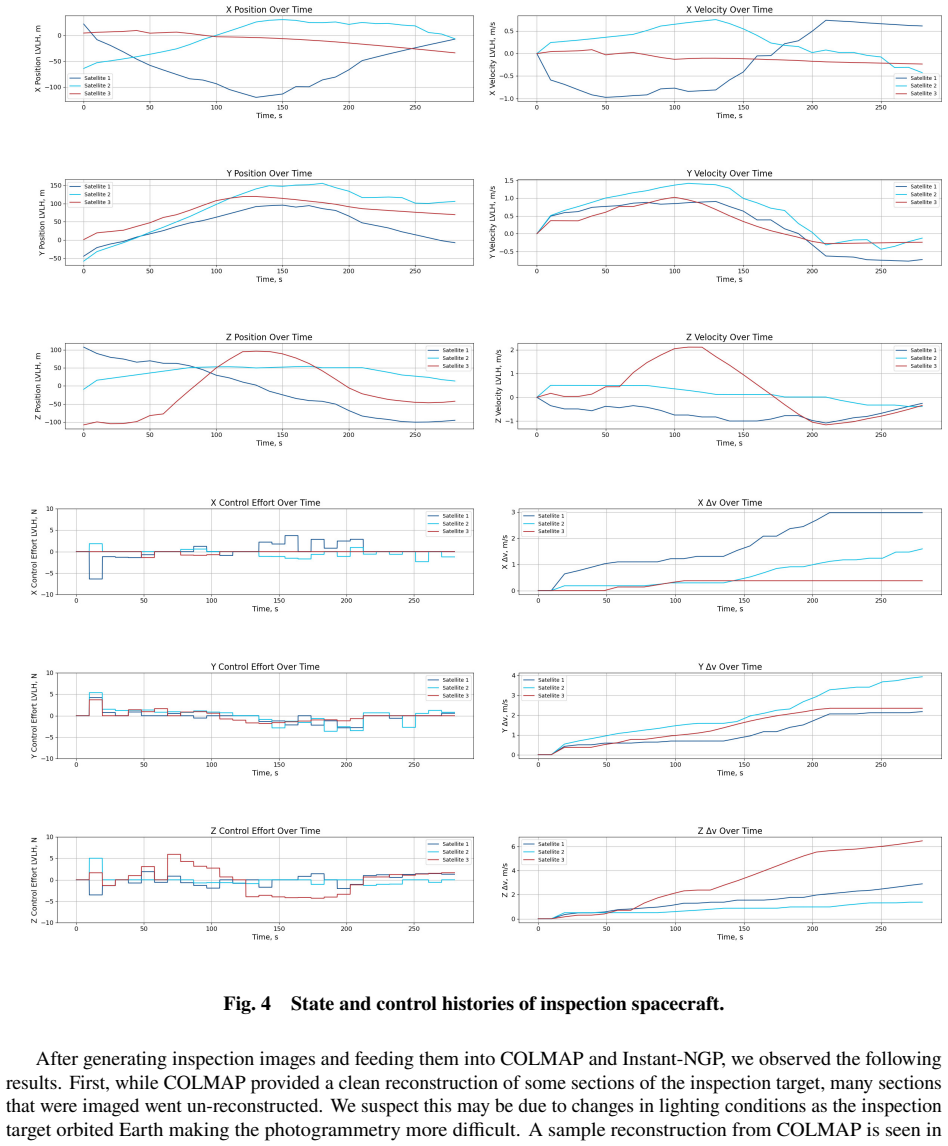
A proposed method for the control of groups of inspection spacecraft is Multi-Agent Reinforcement Learning (MARL). While MARL has already been employed for this purpose in previous work, the reward functions used focus on reaching a finite set of predetermined inspection points around the target. In this work, we study and develop a generalized reward function for the MARL inspection task informed by the analysis of 3D reconstructions of inspected objects in orbit. Because the reward function is generalized such that any number of images at arbitrary locations may evaluated, we also allow trained agents to have complete control over when images are collected. With this approach, we gather insights into best practices for not only the specific MARL inspection task, but also gain key takeaways informative to the broader inspection task outside of a MARL context.
Memory expertise is a learned skill: knowing what to encode, when to retrieve, and how to organize knowledge--a capacity known in cognitive science as metamemory. We bring this perspective to LLMs by treating memory management as a trainable skill. We promote file-system operations to first-class memory actions alongside task actions, letting the model itself decide how to manage its memory. This memory skill improves along two axes: the structure that supports it (prompts, file schemas, action vocabulary), and the proficiency of the model exercising it. Both axes resist manual optimization: episodes in long-horizon tasks run for thousands of steps, and a single memory mistake can hide long before it surfaces, making human review of full trajectories impractical. We introduce AutoMem, a framework that automates both axes. In the first loop, a strong LLM reviews complete agent trajectories and iteratively revises the memory structure that shapes how the agent interacts with its memory files. In the second loop, the agent's own good memory decisions are identified from many episodes and used as training signal to sharpen the model's memory proficiency directly. Across three procedurally generated long-horizon games (Crafter, MiniHack, and NetHack), optimizing memory alone--without modifying the model's task-action behavior--improved the base agent's performance ~2x-4x, bringing a 32B open-weight model competitive with frontier systems such as Claude Opus 4.5 and Gemini 3.1 Pro Thinking. Our results show that memory management is an independently learnable skill, and a high-leverage objective yielding large gains on long-horizon tasks.
Multi-agent latent reasoning composes agents' KV-caches into one context for a final agent. Prior work (Agent Primitives) does this by concatenating caches along the sequence axis with RoPE re-encoding, which we call BagMerge. BagMerge is non-commutative, and the best input ordering is unpredictable, shifting with the regime, the latent-step budget, and the model scale. We make this exchange a convergent replicated state. First, CanonicalMerge fixes the layout by content: ordering caches by mean K-norm at a middle layer renders the merged cache byte-identical under any input permutation, verified algorithmically (arity N<=5) and bit-for-bit on real Qwen3-1.7B and 4B state. Second, we separate the replicated state from decode-time layout: the state is a set of content-addressed latent fragments whose merge is set union, a state-based CvRDT (commutative, associative, idempotent, absorbing), and CanonicalMerge is its deterministic render. Because the render is byte-equivalent, every N=2 accuracy number carries over unchanged and re-delivered duplicates are absorbed rather than re-concatenated. On a partitioned-reasoning benchmark, CanonicalMerge matches the best BagMerge ordering in every regime-by-budget-by-ordering cell without knowing which order is best, trading a small, statistically insignificant accuracy margin for an unconditional structural guarantee. The behaviour transfers to real multi-document QA (HotpotQA), while the closest training-free output-fusion baseline (PackLLM) loses by 45 points at matched budget, placing cache-level merging in a regime distinct from output-level fusion. Finally, at k>2 the approach transports and colocates latent traces but does not by itself compose them, which we characterize to motivate future work.
Although large language models (LLMs) have demonstrated impressive creative fiction generation, they struggle to maintain narrative consistency and coherent plot lines in long-form stories. In this work, we introduce a unified framework for long-form narrative generation and verification. MAGNET, a multi-agent goal-driven narrative engine for storytelling, generates stories with persona-grounded character agents that propose actions based on a shared world state and evolving story goals, while ATLAS is a graph-based pipeline that compares scene-level world representations across a generated story to detect hallucinations. By evaluating MAGNET using an LLM editor, pairwise rubric scoring, and ATLAS, we show that our framework produces coherent narratives compared to single-model prompting and IBSEN. At 100 pages, MAGNET reduced annotations and hallucinations by 41 and 50%, respectively, compared to the single model baseline and by 34 and 45%, respectively, compared to IBSEN, with pairwise rubric evaluation showing similar results. These results suggest that long-form narratives can emerge from explicit world-state tracking and goal-driven multi-agent generation, providing a foundation for controllable and structurally coherent long-form narrative generation.
Generative Synthetic Populations (GSP) -- the convergence of population synthesis, agent-based modelling, and LLM agents -- are attracting growing interest for urban simulation and institutional communication research. Before any GSP instrument is used on a real population, a more basic question must be answered: does it respond to stimuli of known valence in an ordered, replicable, group-structured way? We call this controllability. We ask not whether a synthetic population tracks humans, but whether it tracks itself: whether the latent structure we impose on it is recovered in its own responses. This internal-validity question is logically prior to any claim about external validity, just as characterising an instrument's response function must precede using it to test a theory. We report SIVE (Synthetic Instrument Validation Experiment): a fictional municipality (Montelago) with 120 synthetic personas of known latent structure, exposed to seven conditions spanning strongly positive to strongly negative institutional communications about a water network. Seven pre-registered criteria, evaluated across a temperature sweep, jointly assess fidelity, stability, noise floor, specificity, sensitivity, and ordering. All seven pass at every temperature. A central finding turns a calibration failure into a diagnostic success: a message designed as "weakly positive" was identified by the instrument as functionally negative, traced to unresolved problems, uncertainty, and institutional passivity in its text; a redesigned version restored the expected ordering and interacts with agents' latent trust in unanticipated ways. A noise sub-experiment shows the instrument's intrinsic noise is roughly half the cross-agent estimate and stable across temperatures. Individual trajectories reveal coherent micro-dynamics that summary statistics obscure. Full data are available via an interactive explorer.
This paper introduces a probabilistic framework and hybrid validation methodology for V2X-enabled Collective Perception (CP) in complex traffic scenarios. The proposed Bayesian fusion algorithm extends the perceptual horizon of connected and autonomous vehicles by integrating heterogeneous sensor observations from multiple agents into a shared probabilistic occupancy grid. Each cell of this grid encapsulates both occupancy likelihood and uncertainty, enabling explainable and trustworthy situational awareness beyond the ego vehicle's field of view. To bridge the gap between simulation and real-world evaluation, a hybrid testing framework is developed, combining CARLA-based virtual environments with vehicle-in-the-loop experimentation. Experimental results in a roundabout scenario demonstrate a 260 percent increase in field-of-view coverage and a rise in occupied-cell recall from 0.82 (ego-only) to 0.94 (six-agent CP) under nominal localization conditions. Overall, the proposed approach provides a reproducible and interpretable foundation for validating CP systems, supporting the safe and certifiable deployment of cooperative autonomous vehicles.
Vision Language Models (VLMs) have demonstrated remarkable capabilities in multimodal reasoning tasks, yet they still suffer from recurring failures, such as skipping key visual checks, misapplying domain rules, and hallucinating unsupported concepts. Most existing solutions rely on supervised fine-tuning (SFT) and reinforcement learning (RL), which are expensive to iterate and can be brittle under distribution shift. To this end, we propose Multimodal Mistake Notebook Learning (M2Note), a training-free continual evolution framework that externalizes learning into an editable memory. M2Note transforms failed trajectories into compact subject-guidance notes: the subject summarizes the underlying domain and concept, while the guidance provides actionable verification steps that can be reused in future inference. At test time, M2Note retrieves relevant notes via multimodal retrieval-augmented generation (RAG) and appends them to the model context, steering reasoning away from previously observed pitfalls. To stabilize continual evolution, we adopt batch-level post-verification with rollback, which commits notebook edits only if they improve performance on the same batch, reducing noisy updates and preventing regressions. M2Note supports both self-evolving, where the same VLM acts as solver and supervisor, and cross-model evolving, where a stronger supervisor guides a weaker solver, enabling capability transfer without weight updates. Experiments on six multimodal reasoning benchmarks show consistent improvements across domains and backbones, while achieving strong cost and sample efficiency and remaining complementary to Chain-of-Thought (CoT) prompting.
SCALE reduces motion conflicts and adapts precedence graphs to limit waiting in dense industrial settings.
abstractclick to expand
With the increasing deployment of heterogeneous robot fleets in industrial environments, efficient coordination remains a critical challenge. Real-time path planning must simultaneously accommodate high robot densities and heterogeneous motion capabilities, while communication delays, execution uncertainties, and other disturbances may cause robots to deviate from the temporal assumptions underlying planned paths. Such deviations can lead to excessive waiting and congestion propagation across the fleet. This paper presents SCALE, a reactive online coordination framework that enables real-time planning while maintaining robust execution. Within this framework, we introduce a motion-induced conflict reduction mechanism to support the online generation of feasible paths for online conflict resolution. To mitigate the effects of disturbances, we further design a generalized Conjugate Action-Precedence Hypergraph (CAPH) that adaptively adjusts precedence relations among robots. Extensive validation experiments, together with a three-day deployment in a warehouse, demonstrate the
Agricultural advisory systems face a fundamental tension: static agronomic guidelines offer consistent, evidence-based recommendations, yet remain blind to in-season variability and dynamic uncertainties. Recent advisory systems powered by LLMs are liable for a different risk of generating recommendations that are agronomically credible but physiologically unconvincing. Agri-SAGE is a closed-loop framework designed to resolve the above two limitations by integrating retrieval-grounded multi-agent LLM reasoning with APSIM-based biophysical simulation, to generate and validate agronomic advisories. To assess this framework, we evaluate three reasoning approaches, namely Plan-and-Solve, Tree of Thoughts, and Reflexion, over a 10-year retrospective analysis. All three significantly outperform static PoP (Package-of-Practice) baselines, with Tree of Thoughts achieving impressive peak yields. At the same time, Reflexion achieves comparable agronomic outcomes at substantially lower computational cost by leveraging cross-seasonal episodic memory.
Traditional robot programming is challenging: it requires orchestrating multimodal perception, managing physical contact dynamics, and handling diverse configurations and execution failures. We introduce ASPIRE (Agentic Skill Programming through Iterative Robot Exploration), a continual learning system that autonomously writes and refines robot control programs in a code-as-policy paradigm while compounding experience into a reusable skill library. ASPIRE discovers skills that persist across tasks, simulation and real-world settings, and embodiments. It operates in an open-ended loop with three components: (1) a closed-loop robot execution engine that exposes fine-grained multimodal traces, enabling autonomous failure diagnosis, repair synthesis, and validation; (2) a continually expanding skill library that distills validated fixes into reusable, transferable knowledge; and (3) evolutionary search that generates diverse task sequences and control programs to explore beyond single-trajectory refinement. ASPIRE surpasses prior methods by up to 77% on LIBERO-Pro manipulation under perturbation, 72% on Robosuite bimanual handover, and 32% on BEHAVIOR-1K long-horizon household tasks. Its accumulated library also enables zero-shot generalization to unseen long-horizon tasks: on LIBERO-Pro Long, ASPIRE achieves 31% success versus 4% for prior methods despite their use of test-time reasoning and retries. Finally, simulation-discovered skills provide initial evidence of sim-to-real transfer, substantially reducing real-robot programming effort across different embodiments and robot APIs.
How do two agents invent a shared language from scratch? In a Lewis signaling game, a sender and receiver must coordinate on a code using only their interaction history. We study five memory architectures across varying channel configurations with LLM agents and find that memory architecture matters more than channel capacity. Agents with a persistent private notebook benefit from surplus channel capacity and avoid the high-capacity collapse seen in stateless agents, achieving the most reliable coordination ($0.867 \pm 0.023$ at capacity = 25). Stateless agents peak at moderate capacity and then degrade as the vocabulary grows beyond what a rolling context window can track The notebook externalizes learned conventions, freeing agents from having to re-derive codes each round. An information bottleneck-inspired argument predicts an optimal capacity equal to the number of objects. Instead, the bottleneck (capacity = 8) proves to be a fragility point, and surplus capacity is generally better. We show that channel capacity alone cannot predict coordination; memory architecture determines whether agents turn interaction history into stable conventions, and both dimensions are needed to understand how signals become language.
Collaborative-perception enables multi-robot systems to enhance situational awareness by sharing perceptual information. Existing collaborative-perception systems face an inherent trade-off between communication bandwidth requirements and perception accuracy, where methods that exchange more information achieve better perception results at the cost of increased communication overhead. However, real-world communication networks impose bandwidth constraints that require minimizing communication overhead without sacrificing perception performance. To address this challenge, we propose HydraCollab, an adaptive collaborative-perception framework that (i) selectively transmits the most informative sensor features and (ii) dynamically employs collaboration strategies (intermediate or late) based on spatial confidence maps. Extensive evaluations on the V2X-R, V2X-Radar and UAV3D-mini datasets demonstrate that HydraCollab achieves the best overall trade-off between accuracy and communication cost among existing collaborative-perception methods. Relative to SOTA Where2comm, HydraCollab uses only 41% of the bandwidth on V2X-R and 26% on V2X-Radar while improving performance by 0.78% and 0.75% respectively. Our code and models are available at https://github.com/AICPS/HydraCollab.
Human-labeled data are widely used as reference annotations in ML, despite known variability across annotators in many expert-driven domains. In addition, expert annotation is slow, inconsistent, and remains a major bottleneck for scaling tasks like tree height bias classification in forestry remote sensing. We propose a multi-agent system (MAS) that orchestrates expert decision trees with Vision-Language Models (VLMs), treating the decision tree as a structural prior while VLMs perform localized semantic perception at individual nodes, with multi-agent voting to mitigate VLM stochasticity. We formalize a Decoupled Declarative Decision (D3) Framework that enables zero-modification generalization across diverse expert-defined decision structures. On a tree bias classification testbed, our framework outperforms supervised ML baselines and reduces the amount of expert labeling effort required. These results suggest that agentic orchestration of VLMs with expert priors can reproduce expert-defined labeling procedures at substantially lower annotation cost while maintaining interpretability.
Recent multimodal large language models (MLLMs) have strong potential as embodied agents, but their ability to collaborate in visually grounded environments remains underexplored. To address this gap, we introduce MECoBench, a multimodal embodied cooperation benchmark with an evaluation platform spanning diverse real-world tasks, two cooperation structures, and three collaboration modes. Through extensive experiments across various MLLMs, we summarize three key findings: (i) Collaboration generally improves embodied task completion, but its benefits depend on balancing collaborative gains against coordination complexity. (ii) Communication is essential to collaboration gains, while the best collaboration mode depends on team size and model capability. (iii) Moreover, collaboration improves robustness under noisy priors and exploration conditions. Generally, MECoBench provides a systematic testbed for understanding the mechanisms and limits of multimodal embodied collaboration. Code and dataset are available at https://github.com/q-i-n-g/MECoBench.
Sequent calculi based on K45, KD45 and S5 admit restricted cut and therefore Craig interpolation, including when the empty group is allowed.
abstractclick to expand
Distributed knowledge is a notion of group knowledge studied in multi-agent epistemic logic. Semantically, the distributed knowledge of a group is interpreted via an accessibility relation given by the intersection of the epistemic accessibility relations of the agents in that group. This paper investigates sequent calculi for epistemic logics of distributed knowledge based on K45, KD45, and S5. While cut elimination holds in existing sequent calculi for modal logics K45 and KD45, it fails in all the systems mentioned above. Instead, we establish the analytic cut property for all three systems by adapting Takano' s (2018) strategy, which restricts the cut formulas to the set of subformulas of the conclusion of the cut rule. As a corollary, the Craig interpolation theorem holds for all logics considered. We also show that all proof-theoretic results remain valid when the empty group is allowed for the distributed-knowledge operator, in which case the distributed knowledge for the empty group is interpreted as the global modality.
We introduce inquisitive action logic, InqAL, a multi-agent modal logic for reasoning about action. While traditional approaches focus on what properties of the outcome an agent can force, InqAL also captures what aspects of the outcome an agent determines through their actions. As we argue, such claims of agentive determination are naturally analyzed as modal claims involving questions.
Technically, InqAL is a multi-agent extension of inquisitive neighborhood logic based on concurrent game structures. With respect to statements, it is expressively equivalent to the individual-agent fragment of the socially friendly coalition logic recently proposed by Goranko and Enqvist.
We present an axiomatization of InqAL and prove completeness and decidability via the finite model property. Along the way, we establish a representation theorem for actual effectivity functions, associating to an agent the sets of outcomes corresponding to their possible actions; we give exact conditions under which a multi-agent neighborhood frame arises from a concurrent game structure.
Geopolitical event forecasting is a challenging task, as it requires understanding complex regional contexts, dynamic event signals, and uncertain future outcomes. Recent advances in large language model agents provide new opportunities for building forecasting systems that can reason with diverse sources and expert perspectives. In this paper, we present \textit{ForecastAgentSearch}, a preliminary framework that formulates geopolitical event forecasting as a multi-expert agent search problem. Given a forecasting query, the system first analyzes the task context, then searches and ranks relevant expert agents based on their regional knowledge, domain expertise, reliability, and complementarity. The selected agents provide specialized analyses, which are further coordinated to generate a final forecast with explanations and uncertainty awareness. We discuss the key design challenges of agent profiling, expert retrieval, ranking, and multi-agent coordination, and outline possible evaluation protocols for future development. This work aims to provide an initial step toward searchable and reliable agent-based forecasting systems.
Fault recovery in process plants still relies heavily on plant operators, especially when faults fall outside predefined supervisory logic. Operators interpret alarms, procedures, P\&IDs, interlocks, and process trends, then decide how to move the plant to a safe operating mode without triggering a shutdown. This paper examines how Large Language Model (LLM) agents can support such recovery decisions. The proposed framework treats the LLM as a constrained supervisory planner. It uses plant-specific knowledge to propose recovery actions, and every proposal is checked by an external validator (symbolic or simulation-based) before actuation. The paper develops three design dimensions for applying the framework: the recovery patterns for which LLM agents are useful, the validation strategies that separate admissible from inadmissible proposals, and the deployment constraints imposed by latency, knowledge engineering, safety integration, and model lifecycle management. To make the framework directly usable, two openly available executable Python environments are provided. Both re-implement established case studies, a modular mixing module and a continuous stirred-tank reactor, extended with configurable faults and defined interfaces for custom recovery and validation methods.
This paper evaluates the Metabolic Multi-Agent Optimizer (MMAO) under a stricter empirical protocol rather than reintroducing the framework itself. The study asks whether MMAO's closed-loop resource-allocation principle remains credible under broader, more standard, and more explicitly budget-controlled continuous and discrete benchmarks. The main completed matrix covers eight CEC2017 functions at 10D and 30D with 20 seeds each, and five TSPLIB instances with 20 seeds each, together with stronger reproducible baselines including PSO-lite, ES-lite, and an iterated-greedy 2-opt route baseline. We further add trajectory-level diagnostics for communal budget, success rate, role evolution, and population turnover, plus an auxiliary OR-Library multiple-knapsack slice to extend the discrete evidence beyond routing. Under this protocol, MMAO clearly outperforms the external baseline set on the continuous side and on the TSPLIB side, while the ablation variants remain much closer to the full method than the external baselines are. We therefore position MMAO as a benchmark-backed cross-domain adaptive framework whose most clearly validated value is endogenous resource redistribution under evidence pressure, while also noting that the strongest remaining gap is not basic workability but sharper mechanism isolation and broader competition-grade comparison.
The rapid expansion of sensor-based networks introduces major challenges in scalability, adaptability, and knowledge transfer, especially in open environments where new subsystems can dynamically join or leave. In this work, we propose a Holonic Active Distillation architecture within a Holonic Multi-Agent System (HMAS) to address these issues. Our approach integrates Clustered Stream-Based Active Distillation (CSBAD), a framework in which specialized student models collect local data, query pseudo-labels from teacher models, and cluster into groups of similar sensors.
Results show that the holonic organization balances local specialization with global generalization, while efficiently adapting to sensor departures and re-integrations. We also analyzed trade-offs among incremental model updates, system reorganization, and scalability limits.
Our findings highlight the advantages of holonic learning for multi-sensor systems while identifying key challenges related to model drift and long-term adaptation.
Text-rich image generation is one of the most challenging settings in image generation, since models must simultaneously produce visually realistic images and render legible, semantically aligned, and layout-consistent text. Existing data pipelines usually follow a static crawl-filter-freeze paradigm. They collect candidate samples, filter them once, and freeze the accepted data for training. However, rejected samples are usually discarded, although they often contain useful failure signals such as OCR errors and semantic mismatches. As a result, later construction rounds may repeat the same failure modes. To address these limitations, we propose DataEvolver, a self-evolving multi-agent framework for text-rich image data construction. DataEvolver treats data construction as feedback-driven construction policy evolution. A Retriever collects candidate samples, a Verifier assigns quality scores and rejection causes, a Critic summarizes round-level feedback into semantic feedback, and a Generator completes under-covered regions through targeted synthesis. The updated feedback memory then guides the next construction round. Experiments on text-rich image generation benchmarks show that DataEvolver produces more useful training data than fixed-dataset baselines under matched data budgets. At the 0.75M scale on PixArt-alpha, DataEvolver improves OCR-F1 over the strongest baseline by 85.3 percent on TextScenesHQ and 35.3 percent on LongTextBench. The improvements are consistent across both evaluated benchmarks and also transfer to Show-o2, indicating that the benefit of DataEvolver is not tied to a single downstream generator. These results suggest that rejected samples can provide actionable feedback for improving text-rich image data construction.
Agent interoperability protocols (MCP, A2A, ACP, ANP, and ERC-8004) have rapidly matured to enable identity, capability discovery, tool access, and message exchange between autonomous agents. However, as enterprises deploy heterogeneous agent fleets that must make collective decisions under governance constraints, a question arises: can these protocols support governed agent communities, or only task-oriented coordination? We present a systematic gap analysis applying a six-dimension governance requirements taxonomy (membership, deliberation, voting, dissent preservation, human escalation, and audit/replay) derived from organizational theory, multi-agent systems literature, and enterprise governance standards. We analyze each protocol's specification against this taxonomy, classifying capabilities as Supported, Partial, or Absent. The resulting gap matrix reveals that voting and dissent preservation are universally absent across all five protocols, deliberation is absent or at most partial, and no protocol encodes the full set of primitives required for governed agent communities. We distinguish extensible gaps (addressable through protocol extension mechanisms) from structural gaps (requiring a new architectural layer) and assess time-sensitivity based on observed protocol evolution velocity. The analysis establishes that agent community governance constitutes a missing architectural layer above current interoperability standards, not a missing feature within them.
This paper studies energy efficient tracking of power-limited mobile users with the assistance of a Reconfigurable Intelligent Surface (RIS). Since localization pilot transmissions dominate the energy budget of power-constrained devices, we introduce a low-overhead feedback link from the Base Station (BS) to the user to enable dynamic uplink power control. To navigate the discrete and decentralized nature of this active sensing problem, we propose a novel Dual-Agent (DA) deep learning framework that jointly optimizes the discrete RIS phase profiles and the UE's transmit power in real time. Specifically, our approach employs a hybrid training methodology integrating the neuroevolution paradigm with supervised learning, effectively overcoming the non-differentiability of discrete phase responses from the RIS unit elements and the strict information bottleneck of single-bit feedback messages for pilot power control. The proposed DA active sensing framework can be applied with both single- and multi-antenna BSs, the latter with only minor modifications in the structure of one NN: an additional output branch with appropriate structure is included for the latter case to select a valid digital combiner from a finite set. Extensive numerical simulations demonstrate that the proposed scheme achieves highly accurate and robust tracking across diverse target motion models, outperforming extended Kalman and particle filters, as well as, machine learning-based trackers. Furthermore, in static localization, it is shown to significantly outperform traditional fingerprinting schemes, deep reinforcement learning baselines, and standard backpropagation-based estimators.
Large language models (LLMs) provide a promising interface for high-level robotic task planning, but their use in multi-UAV collaboration remains difficult to evaluate systematically. Existing UAV simulators mainly emphasize dynamics, perception, or low-level control, while existing LLM-agent benchmarks rarely capture aerial-robotics constraints such as partial observability, spatial coverage, UAV assignment, and multi-vehicle coordination. To bridge this gap, we present MultiUAV-Plat, a lightweight, easy-to-use, LLM-agent-oriented simulation platform for multi-UAV collaborative task planning. The platform exposes concise RESTful APIs, agent-facing observations, role-based information access, hidden validation logic, and optional 2D/3D visualization, allowing agents to solve missions through realistic tool interaction rather than privileged simulator access. Built on this platform, the MultiUAV-Plat Benchmark contains 75 mission sessions, 1500 natural-language tasks, and 9396 validation checks across target assignment, area search, and area assignment and patrol scenarios. We further propose Agent4Drone, a task-specific LLM agent framework that structures multi-UAV behavior into memory, observation, task understanding, planning, execution, and verification. In a full paired benchmark comparison, Agent4Drone achieves a 57.9% task pass rate, a 74.6% average task check pass rate, and a 72.0% global check pass rate, substantially outperforming a ReAct baseline at 30.6%, 47.9%, and 43.1%, respectively. Agent4Drone also reduces the total failed task rate from 32.4% to 12.9%. These results demonstrate that MultiUAV-Plat and MultiUAV-Plat Benchmark provide a reproducible foundation for studying LLM-driven multi-UAV autonomy under realistic information and execution constraints.
Agentic artificial intelligence is increasingly deployed not as a single assistant but as a collective of planners, solvers, reviewers, memory managers, tool users, and orchestrators. These systems are entering organisational workflows under familiar labels such as teams, managers, committees, markets, and workflows. This article asks whether such agent collectives exhibit organisational behaviour in a sense that is analytically comparable to, yet distinct from, human organisational behaviour. I argue that agentic AI is a partial organisational analogue. It resembles a human organisation because it differentiates work, coordinates interdependence, performs recurrent routines, crosses boundaries, and produces collective outcomes. It differs because these patterns are not sustained by motivation, identity, trust, employment, socialisation, or moral accountability. They are sustained by context architecture: prompts, memory, traces, schemas, tools, validators, and permissions. The article develops contextual transaction cost as the central mechanism linking these similarities and differences. Computational theorising, synthetic task simulations, real LLM agent traces, and robustness analyses show that human-imitation forms often underperform when they add lossy handoffs, correlated deliberation, and verification burdens, whereas shared-state and adaptive forms perform better when they make context durable, inspectable, and task-contingent. The article contributes to organisation studies by theorising agentic AI as an emerging object of organising and by specifying the interface conditions under which human and agentic organisational behaviour can jointly support collective intelligence.
Formal specification is a powerful tool to guide the learning process and provides significant advantages over reward shaping: (1) mathematical rigor; (2) expressiveness to specify objectives and constraints, and (3) the ability to define tactics to achieve objectives. However, these benefits remain largely unexplored in the context of Multi-Agent Reinforcement Learning (MARL). This paper introduces HyPOLE, a novel framework for MARL under partial observability, where learning is guided by the expressive power of the so-called hyperproperties and, in particular, the temporal logic HyperLTL. We integrate Centralized Training for Decentralized Execution (CTDE) techniques with HyPOLE to synthesize decentralized policies, and our evaluation on SMAC, MessySMAC, and WildFire benchmark demonstrates clear advantages over baselines.
The LLM Jury, a Panel of LLM Evaluators (PoLL) reporting consensus scores, has become a practical alternative to single-judge LLM evaluation, yet its statistical behavior remains poorly understood. We formalize the LLM Jury under the Huber contamination model and show that PoLL incurs unbounded bias
under any positive contamination, regardless of jury size, whenever a single judge fails in a biased, LLM-typical way (mode collapse, sycophancy, safety refusal). Framing jury consensus as classical robust mean estimation, we propose RoPoLL (Robust Panel of LLM-as-Judge), which preserves the PoLL
panel but replaces the aggregation function with a robust mean estimator, instantiated with the geometric median (GM): tuning-free, with the optimal finite-sample breakdown point 1/2. A finite-sample error bound and a matching information-theoretic minimax lower bound agree on the parametric rate
sigma*sqrt(d/N) and differ on the breakdown floor by a factor of sqrt(d), a statistical-computational gap that polynomial-time RoPoLL pays relative to the intractable Tukey halfspace median. Across 13 open-weight judges (4B-675B), three reward-model benchmarks, and four corruption regimes at rates up
to 50%, RoPoLL dominates PoLL on every biased corruption type: by about 19% on cross-dimensional attacks at matched compute, and by orders of magnitude on heavy-tailed Byzantine adversaries. A 3-judge RoPoLL committee at 38B beats Mistral-Large-3 (675B) by 1.31x on HelpSteer-2 under 30% bimodal-random
corruption, an 18x parameter advantage at better accuracy; a Noisy-GT control confirms the premium is paid against biased contamination, not benign imprecision.
ML engineering agents waste compute rediscovering known techniques because every competition is a cold start. We present HASTE, a hierarchical multi-agent system that organizes cross-competition knowledge into three scope tiers (global, domain, and competition-specific), each coupled to a matching agent level. An orchestrator coordinates domain specialists and promotes learning between tiers via LLM-driven abstraction. A controlled ablation provides evidence for scoped loading: holding a 159-skill inventory constant across 8 competitions, tiered loading achieves a 100% medal rate while flat loading reaches only 62.5%, the same medal rate as loading no skills, and consumes 2x the output tokens. On the full MLE-Bench Lite benchmark (22 Kaggle competitions), HASTE reaches a medal rate of 77.3% using Claude Sonnet 4.6 at 12h per competition; this is a single-seed campaign result, and multi-seed replication is the priority follow-up. In a cold-start run, the system begins with no accumulated skills. In warm-start runs, it reloads skills learned from earlier competitions, using only global and domain-level skills for transfer across competitions. Warm starts use 52% fewer refinement iterations, and the fraction of proposed changes kept by the agent rises from 42% at low inventory to 85% once 50+ skills are available. These results suggest that better knowledge organization can partly substitute for model strength and compute budget in ML-engineering agents.
Multi-robot systems must simultaneously optimize competing objectives while maintaining coordinated behavior. Existing multi-agent reinforcement learning approaches often rely on fixed or centralized coordination, which limits adaptability and violates distributed constraints. This work introduces the Coordination-Informed Multi-Objective Reinforcement Learning (CIMORL) framework, integrating a distributed weight prediction mechanism, a privileged expert training strategy, and theoretical guarantees for Pareto-optimal solutions. We present the base CIMORL method alongside two sampling-based variants, CIMORL-TS (Tree Search) and CIMORL-MPPI (MPPI), which leverage privileged global information during training to enable fully decentralized deployment. Experimental validation in cooperative and adversarial scenarios demonstrates a $21.2\%$ hypervolume improvement and superior policy stability compared to state-of-the-art baselines. Real-world experiments with Crazyflie drones further validate the framework's robustness in resource allocation and multi-attacker multi-defend scenarios under partial observability.
Large language models show promise for mental health support, yet therapeutic quality improves only when evaluation functions as an actionable control signal rather than a passive metric. We introduce a framework that formulates therapeutic response generation as a decision-refinement problem driven by multi-dimensional, human-aligned evaluation. In Stage I, we introduce TheraJudge, an open-source therapeutic evaluator trained via preference-based optimization on human-annotated data to produce reliable judgments across 7 psychological dimensions. In Stage II, we introduce TheraAgent, which operationalizes TheraJudge's evaluations through a coordinated refinement process with specialized Critic, Coach, and Therapist roles that translate evaluative signals into targeted response revisions. Empirically, TheraJudge achieves strong agreement with clinician ratings, with intraclass correlation coefficients (ICC = 0.87-0.95), surpassing supervised baselines and strong closed-source judges, particularly on critical dimensions such as Safety, Relevance, and Empathy. Acting on these evaluations, TheraAgent yields a +0.43 improvement in human-rated therapeutic quality (on a 5-point scale) under blind evaluation, with 96\% clinician inter-rater reliability. Low-quality responses ($\leq 3$) improve by +2.45 points with a 94\% recovery rate, demonstrating targeted correction of unsafe outputs. Overall, our results indicate that effective alignment of mental-health LLMs stems from acting on human-aligned evaluation, rather than relying solely on stronger generation. We release code at https://github.com/vis-nlp/TheraAlign.
Climate governance processes involve complex interactions between heterogeneous citizens, advocacy groups, media actors, and political decision-makers. While agent-based models (ABMs) have been widely used to study environmental policy and socio-ecological systems, many existing approaches focus either on institutional dynamics or individual behavioural mechanisms in isolation. This paper presents a modular multi-level agent-based architecture that integrates empirically grounded cognitive decision models with strategic institutional behaviour within a unified simulation framework. The architecture combines (i) motive-based individual decision-making operationalised through the HUMAT and MOA frameworks, (ii) socially embedded influence processes via demographic homophily networks, and (iii) institutional strategy modules for environmental non-governmental organisations (NGOs), media agents, and politicians. Political decisions emerge from the aggregation of multiple signals, including expert input, public mobilisation, party alignment, and media framing. The model is designed to be empirically calibrated through synthetic populations derived from survey data and and institutional parameters informed through Living Lab stakeholder engagement, and to support scenario-based exploration of climate-relevant land-use governance processes. Rather than presenting empirical results, this paper focuses on the architectural design principles, modular structure, and integration logic of the model. We discuss how this multi-layered approach contributes to the modelling of democratic climate governance and outline pathways for generalization and future validation.
The rapid integration of Large Language Models (LLMs) has driven the evolution of Multi-Agent Systems (MAS), where specialized agents collaborate to execute complex workflows. Effective orchestration in these environments requires robust routing mechanisms to efficiently allocate tasks to the most suitable agent. However, existing routers fundamentally rely on unverified proxies, ranging from textual self-descriptions to static surrogate representations, to gauge an agent's competence. This reliance on non-empirical data creates a critical gap between an agent's projected profile and its actual operational capabilities, introducing severe security vulnerabilities. Malicious agents can easily misrepresent their proficiencies or harbor covert backdoors that evade both standard external analysis and static representation-learning techniques. In this work, we introduce ANTAP (Automatic Non-Textual Agent Picker), an evaluation-driven routing architecture that discards indirect proxies in favor of active capability testing. By dynamically querying agents to ascertain their true competencies empirically, ANTAP distills performance into fixed behavioral operators within a shared semantic space. At inference time, routing is performed via a purely non-textual algebraic projection, establishing a "linguistic firewall" that renders metadata-based attacks inexpressible. In our experiments, ANTAP achieves near-zero ASR against description-based injection attacks, compared to 67.3\% and above for the description-based router baseline. Against adaptive embedding attacks, ANTAP achieves substantially lower ASR than the embedding-based baseline, with a 20\% reduction, while remaining resilient to description manipulation by design.
The rapid emergence of LLM-based agentic frameworks has significantly reduced the cost of assembling multi-agent systems (MAS), enabling fast prototyping and exploration of agentic behaviors. However, systems built with current tooling remain ill-suited for reliable, evolvable, and production-grade deployment. In practice, MAS are often developed in an ad-hoc and imperative manner, with agent logic, orchestration, observability, and control tightly interwoven, little to no explicit system-level validation, and development workflows optimized for demonstrations rather than long-lived, governed operation. As a result, behavior observed during experimentation rarely constitutes reliable evidence of behavior in production.
In this paper, we introduce MAS-Lab, a specification-driven framework for principled development and experimental validation of multi-agent systems properties. MAS-Lab is designed to transform MAS from collections of scripts into engineered distributed systems by separating semantic intent from operational concerns, making behavior and control explicit, supporting reproducible experimentation, and preserving continuity across lifecycle stages. MAS-Lab consists of three layers: a declarative, framework-agnostic agentic specification layer (Spec); a stateful MAS Operating System that provides execution and control primitives plugged-in by design (MAS-OS); and a set of lab overlays with integrated observability and evaluation tools (Labs). Together, these components enable intent-based validation, principled system evolution, and a seamless transition to production-grade MAS.
Mitigating an observed adversary in an enterprise network typically takes weeks of expert work: an analyst derives a mitigation tailored to that adversary, validates it without breaking production, and verifies it disrupts the specific attack. The procedure relies on expert judgment and cannot safely be exercised against the production network. COHORT is the first end-to-end framework to automate this procedure for deployable mitigations. A role-decomposed multi-agent LLM workflow proposes candidates, implements them as real device commands, and refines them through a critique loop, all on a high-fidelity GNS3 emulator running real vendor firmware (firewall, switch, router). Each candidate is evaluated by offensive replay: re-executing the original adversary on the mitigated network for a paired comparison against the unmitigated baseline, rather than the reward-signal or expert-judgment proxies used in prior simulation, hybrid, and configuration-generation work. Two further checks complement replay: a connectivity-regression check (LAN ping and internet HTTP probe) rejects mitigations that disrupt legitimate LAN or internet connectivity, and a cumulative evaluation stacks approved mitigations onto a persistent state to surface compound effects. Across three topologies and four attack scenarios (ransomware, lateral movement, DNS exfiltration, data theft), 46.7% of generated mitigations both disrupt the attack and preserve connectivity under replay, 4.4 times the rate of a single-agent baseline using the same model and tool access. A demo video walking through the framework is available with our released artifacts.
This paper presents the Metabolic Multi-Agent Optimizer (MMAO) as an adaptive metaheuristic built around endogenous resource circulation. The central premise is that search intensity, exploration--exploitation balance, and lifecycle turnover should be induced by a shared metabolic controller rather than by separately attached schedules. We formulate MMAO through bounded private energy, a communal budget, normalized reward, continuous role adaptation, and resource-financed branching and pruning. The method is then instantiated in both continuous and discrete domains and evaluated on a matched small-scale suite including Sphere, Rastrigin, a synthetic Euclidean TSP, and two TSPLIB instances. The results show a consistent pattern: the same metabolic loop remains workable across domains, the discrete realization remains relatively stable under a compact design, and continuous refinement quality is the main cost of keeping the method lean. Taken together, these findings position MMAO as a coherent framework for adaptive heuristic design rather than a loose collection of operators.
A rigorous formalization of system requirements is a fundamental prerequisite for the verification of Multi-Agent Systems (MAS). However, writing correct formal specifications is well known as an error-prone, time-consuming, and expertise-intensive task. This difficulty is further accentuated in MAS, where requirements must capture strategic abilities and temporal objectives. At present, there is no established methodology for deriving MAS specifications from natural language. We present a framework for translating Natural Language descriptions of strategic requirements into well-formed ATL/ATL* formulas using Large Language Models (LLMs). Since no available dataset supports supervised learning for the NL-to-ATL/ATL* translation task, we create and curate a novel expert-validated dataset, employed for training and evaluating fine-tuned models. On a held-out test set, evaluated under the LLM judge that best agrees with expert annotations, in-domain fine-tuning of small open-weight models (3 - 7B parameters) matches strong few-shot proprietary API baselines. Our best fine-tuned system reaches 0.84 semantic accuracy, statistically on par with 0.86 for the strongest few-shot proprietary baseline, while keeping requirements on-premises. We further find that judge reliability is inverse to generator strength. The open-weight Llama-3.3-70B tracks human verdicts most closely, whereas the strongest proprietary models are the least reliable judges, over-rejecting faithful paraphrases of the reference. To assess the practical applicability of the generated specifications, we embed our tool to an existing strategic logics model checker, enabling non-expert users to specify strategic properties in natural language.
Always-on agents are systems whose future behavior depends on durable state accumulated across earlier interactions. We treat them as persistent-state systems: the operative system includes retrievable memories, but also task ledgers, permissions, credentials, commitments, provenance and audit records, shared state, trigger conditions, and externally committed effects linked to those records. The survey reads the literature through six diagnostic axes for each state item, authority, scope, mutability, provenance, recoverability, and actionability, and through a lifecycle in which state is written, validated, organized, retrieved, acted upon, updated, forgotten, audited, and sometimes rolled back. Across a 435-work coded corpus, treated as a scoped map rather than an exhaustive census, the literature concentrates more heavily on accumulating and retrieving state than on governing, recovering, or relinquishing it. We therefore introduce the Always-On Evaluation Protocol (AOEP-v0), a pilot evaluation contract that makes these governance requirements concrete by scoring state mutation and recovery obligations rather than answer quality alone. The resulting agenda connects always-on agents to databases, distributed systems, formal methods, capability security, and machine unlearning.
Agentic multimodal models perform diverse operations on an image via code and reason over the returned view, an effective paradigm for fine-grained visual question answering. However, code operations can be useful, redundant, or misleading. Outcome-only rewards cannot precisely distinguish these cases, and existing process rewards either fail to attribute final correctness to individual tool calls, or require an external judge model. To address this, we introduce Tool-Augmented Credit Optimization (TACO), a GRPO variant for code-tool agents built on two coupled advantage channels. The first, Differential Answer-Probe Reward (DAPR), is a self-supervised, judge-free tool-contribution advantage that credits each tool call by its own effect on answering correctly. Probe tokens inserted into the model's reasoning elicit its predictions with and without the tool, and the difference in outcome reward is taken as the call's value: positive for a useful call, negative for a misleading one, and zero for one that changes nothing. This reuses the existing answer checker with no auxiliary judge, and, being a difference rather than an absolute probe score, is naturally robust to probe-hacking. The second is the outcome advantage from the final answer, distributed by Outcome-Gated Advantage Routing (OGAR): a parameter-free rule that, conditioned on the call's outcome, delivers this credit only to the responsible segments, suppressing wasted tool calls without any cost term. We train TACO through a two-stage SFT+RL pipeline. Extensive experiments across perception, reasoning, and general multimodal benchmarks show that it yields consistent accuracy gains and learns to invoke its tools only when they help.
Existing autonomous research agents can support parts of the research process, but most systems still treat research as either an isolated assistant task or a closed workflow. Therefore, autonomous science needs a collaboration infrastructure that coordinates projects, agents, and digital and physical resources. We identify this as a shift from code-centered execution loops to research-oriented collaboration processes, where questions, evidence, participants, and resources must be coordinated under uncertainty. In this framing, an agent may be an AI system, a human researcher, a team, a laboratory, or an organization-backed participant. To this end, we present Clarus, a collaboration infrastructure for coordinating autonomous research agents toward web-scale scientific collaboration. Clarus reformulates research as an open, auditable, attributable, and resource-aware multi-phase collaboration process. It defines a minimal project-agent-resource object model and organizes scientific collaboration through four layers including Research Application, Digital Collaboration, Physical Substrate, and Physical World. Core modules are implemented as pluggable mechanisms, allowing Clarus to adapt to task risk, collaboration structure, and resource constraints. Through a controlled paper-generation case study, we show that Clarus can organize a research goal into a traceable, reviewable, attributable, and accumulative collaboration network across phases, tasks, and participants. Together, the object model, collaboration protocol, trust mechanisms, and prototype validation provide an initial foundation for open research networks. Clarus is now available at clarus.holosai.io.
This paper studies sparse sensor placement for control of Rayleigh-B\'enard convection with multi-agent reinforcement learning. We train dense expert policies with windowed observations and distill sparse apprentice policies by supervised learning with grouped regularization on encoder input weights. The framework combines ordered non-convex grouped regularization and iterative reweighted grouped regularization, and uses a grouping construction that enforces consistent pruning across overlapping observation windows. Experiments with fixed and varying initial conditions show that Multi-Agent Transformer policies train more stably than proximal policy optimization baselines, while sparse apprentices retain control behavior comparable to dense experts. Sparsity results are strong for the proposed grouped methods across settings, including maximal sparsity in all fixed-initial-condition setting variants and maximal or near-maximal sparsity in varying-initial-condition setting variants. As an additional proof of concept, training from learned minimal sensor sets reduces per-agent observation size from 360 to 12 and preserves the overall training trend in simulation while reducing data throughput. The results provide both an interpretable basis for identifying control-relevant spatial regions and state components, and a practical pathway toward sensor-efficient control under realistic hardware constraints.
The database community has repeatedly advanced the state of the art by recognizing that new workloads demand new system architectures. We argue that long-horizon agentic tasks -- code generation, scientific discovery, hardware design -- are such a workload. These agents explore: they generate artifacts, execute tools, observe failures, branch, and repair over hundreds of steps. This search produces a structured object we call an experience graph: executable artifacts, tool outputs, rewards, sibling comparisons, and causal lineage. Yet existing agent frameworks treat this experience as disposable state -- JSON checkpoints and session logs that cannot be recovered after a crash, queried across users, or materialized into training data. We propose Trellis: a data foundation that treats the experience graph as first-class, governed, queryable database state. The core insight is that search over experience graphs is a database access pattern. Frontier selection is a query, cross-session reuse is vector-seeded graph retrieval, training-data extraction is a materialized view, and reconstructing what an agent knew at any past step is a time-travel query. When the database owns the experience graph, agents become stateless compute, and crash recovery, horizontal scaling, and a closed-loop training flywheel emerge as architectural byproducts. We ground the design in KernelEvolve, a production accelerator-kernel optimizer at Meta, where cross-session reuse reaches a target speedup roughly 10x faster at 52% lower token cost. More broadly, Trellis turns inference-time search from disposable computation into a durable institutional asset: logs made databases reliable; experience graphs may make agents cumulative.
What does it mean for a language agent to be adaptive? Effective multi-turn agents must decide what information to seek, how to use new evidence, and when they are certain enough to act. We introduce Epistemic Decision Processes (EDPs), a belief-state formulation of multi-turn information seeking in which actions produce external observations that update the agent's posterior over a latent task variable. EDPs make epistemic adaptivity explicit: good policies choose actions that are useful under the current belief, not merely those that correlate with eventual success. We prove that belief-agnostic policies can suffer errors that compound exponentially over the horizon, and that aggregate trajectory returns can fail to identify the per-turn Bayesian advantage needed for epistemic credit. We then introduce ECHO (Epistemic Credit for History-Conditioned Optimization), a practical clipped policy-gradient objective that assigns turn-level credit using posterior-sensitive rewards. In the Clue Selector Game, a novel controlled evidence-seeking benchmark, we show that ECHO substantially improves resolution, information gain, and efficiency over trajectory-level GRPO, and matches or exceeds frontier baselines on epistemic metrics such as grounding, recovery, and calibration while producing almost no visible reasoning text.
Multi-agent deliberation among LLMs can improve reasoning, but deployment requires deciding when the current answer is reliable enough to act on and when it should be escalated to human review. We formulate this as budgeted act-or-defer decision making. At each round, the system maps the debate prefix to a low-dimensional state, computes a $k$-nearest-neighbor lower confidence bound on state-conditional correctness using calibration data, and acts only when the bound exceeds a user-specified reliability threshold. The certificate controls wrong actions through the decomposition $\beta = \delta + \alpha + \varepsilon_{\mathrm{act}}$, separating calibration failure, residual action risk, and representation gap. The guarantee is conditional, not distribution-free: it relies on a valid local bias envelope and an action-region representation-gap bound, and each assumption is paired with falsification-style diagnostics. Because the same absolute wrong-action budget has different meanings across tasks of different difficulty, we set budgets relative to each task's final-round error using training data only, and evaluate safety by normalized budget usage $\mathrm{WA}/\beta$. On six benchmarks against nine baselines, the method uses 9--12% of the pre-declared budget on activated datasets, reaching up to 84% automation and 96% acted-on accuracy; on stress-test datasets, it defers rather than forcing unreliable automation. Rather than relying on per-task post-hoc threshold search, the method prospectively converts a user-declared wrong-action budget into an auditable act-or-defer operating point before deployment, under explicitly stated assumptions.
Different retrievers, including lexical, semantic, and multimodal approaches, provide highly complementary strengths for multimodal document understanding, yet most systems combine them through fixed pipelines that cannot adapt to the demands of individual reasoning steps. In this work, we ask whether retrieval orchestration itself can be learned as part of the reasoning process. We introduce a failure-driven evolution framework in which a meta-agent autonomously discovers how a tool-using task agent should coordinate diverse retrievers during multi-step document question answering. The meta-agent analyzes incorrect reasoning trajectories, actively probes the same tool environment to diagnose root causes, and iteratively rewrites the task agent's instructions, turning retrieval from a fixed front-end stage into an adaptive, step-wise reasoning decision. The evolved agent learns when to invoke each retriever, how to combine them, and how to compose evidence across modalities and pages. On MMLongBench-Doc and DocBench, the evolved agent achieves gains of up to +19.6 points over the unevolved baseline and consistently outperforms recent systems including MACT, MDocAgent, and SimpleDoc. Detailed retrieval analyses confirm that these improvements arise from adaptive routing and evidence composition rather than reliance on any hard coded retrieval mode, and evolution dynamics reveal a progressive shift from narrow lexical behavior to rich multi-tool coordination. These findings establish autonomous multi-agent coordination as a promising paradigm for multimodal document reasoning.
Current languages for specifying multiagent protocols either over-constrain protocol enactments or complicate capturing their meanings. We propose Langshaw, a declarative protocol language based on (1) sayso, a new construct that captures who has priority over setting each attribute, and (2) nono and nogo, two constructs to capture conflicts between actions. Langshaw combines flexibility with an information model to express meaning. We give a formal semantics for Langshaw, procedures for determining the safety and liveness of a protocol, and a method to generate a message-oriented protocol (embedding needed coordination) suitable for flexible asynchronous enactment.
We propose Persona-Trained Monte Carlo (PTMC), a method for estimating distributions of market-outcome statistics by repeatedly simulating limit-order-book interaction among swarms of persona-conditioned neural-policy trading bots. Each run instantiates many bots sharing one trained policy network but conditioned on heterogeneous, individually sampled persona parameters drawn from a learned trader-heterogeneity distribution; the bots interact in a continuous double auction, and the resulting price path is one Monte Carlo sample. Repeating this over independent persona-population draws yields an ensemble from which a target market statistic is estimated. Randomness enters through persona draws, within-run action sampling, and optional exogenous shocks, not solely through price as in classical Monte Carlo. We distinguish PTMC from adjacent paradigms, including classical Monte Carlo, hand-coded agent-based models, single-agent reinforcement learning, and large-language-model-based generative agents. To justify the design, we survey cross-disciplinary foundations -- agent-based computational economics, market microstructure, behavioral finance, deep reinforcement learning, generative/LLM-based agents, news-driven trading, systemic risk, econophysics, and game theory -- connecting each literature to a specific design choice in the policy network, training data, or validation protocol. We formalize the PTMC estimator and its convergence properties, specify a candidate bot architecture and training objective, and propose a four-level validation methodology: stylized-fact matching, microstructure- and agent-level checks, and historical stress-test comparison against a zero-intelligence baseline. The framework is proposed but not implemented: we contribute a formal estimator, a cross-disciplinary design justification, and a validation roadmap, and conclude with open research questions.
Existing multi-agent debate frameworks suffer from two critical limitations: they rely on static architectures where agent roles and coordination patterns are fixed at design time, and they require instantiating multiple model copies, incurring substantial computational overhead. We propose Mixture of Debaters (MoD), a unified framework that enables dynamic self-debate within a single model by leveraging the Mixture-of-Experts paradigm. We address three key challenges in adapting MoE for dialectical reasoning: (1) dual-routing that decouples role allocation from process flow, dynamically determining when to debate versus when to synthesize; (2) momentum switching that smooths token-level routing with local context, reducing expert-switch jitter; and (3) unified self-debate that encapsulates diverse debating personas into lightweight expert modules, eliminating inter-agent communication while preserving behavioral diversity. Extensive experiments on multimodal benchmarks demonstrate that MoD outperforms both single-model baselines and conventional multi-agent systems, achieving superior accuracy with 3.7x lower latency and 87% reduction in token consumption.The source code can be accessed at https://github.com/YongLD/MoD.
Multi-Agent Debate (MAD) with Majority Voting is a dominant paradigm for improving LLM reasoning, yet its effectiveness rests on the Condorcet Jury Theorem's assumption of independent errors. Because contemporary LLMs share similar pretraining corpora, their errors are strongly correlated, causing the majority to systematically suppress correct minority opinions, a phenomenon we term Minority Truth. Through debates among three heterogeneous LLM agents on six benchmarks, we find that roughly one in four divergent cases has the minority holding the correct answer, yielding a 10-percentage-point theoretical recovery margin. We propose Minority Sentinel, a lightweight meta-classifier that extracts a multi-dimensional debate fingerprint from debate logs and trains a LightGBM model to decide when to overturn majority voting. Minority Sentinel achieves a stable Flip Precision of 81.2% with positive Net Gain across all six datasets and all 20 random seed trials, demonstrating that debate logs contain sufficient behavioral signals for a non-LLM classifier to reliably recover suppressed minorities without degrading system accuracy. The LLM-as-Judge baseline yields negative Net Gain despite higher recall, confirming that flip safety, not recovery volume, determines intervention value.
Many important games have more than two players and imperfect information. Existing approaches for computing Nash equilibrium, the central game-theoretic solution concept, in such games either lack scalability or obtain poor performance. In this paper we introduce a new algorithm called projected exploitability descent (PED) for approximating Nash equilibria in multiplayer games of imperfect information. The algorithm works by running projected subgradient descent minimizing a proxy for the multiplayer generalized exploitability function. The objective is nonconvex and nonsmooth, but can be represented as the sum of the maxima of linear functions, for which a subgradient can easily be computed and projected to the polytope of feasible sequence-form strategies. We explore performance of PED on a generalized version of the well-studied benchmark game three-player Kuhn poker. No prior exact algorithms scale to the version of the game with deck size larger than 4, and we compare performance to the popular algorithms of fictitious play (FP) and counterfactual regret minimization (CFR). We find that PED obtains a consistent near-monotonic improvement throughout all runs, though both FP and CFR perform significantly better in the initial iterations. This inspires a hybrid algorithm FP-PED that runs FP for an initial burn-in period before switching to PED for stable long-run refinement. We can alternatively view this as a multi-step algorithm that runs FP as a pre-processing step to obtain a strong initialization for PED.
Large language models (LLMs) increasingly mediate strategic interactions through natural language, making semantic control a critical element of communication and deception. This paper develops a semantic signaling game in which a sender selects a semantic control, an LLM generates a stochastic message, and a receiver evaluates the message using an awareness-dependent scoring mechanism. Receiver awareness is modeled as a type that determines which linguistic features are perceived and used for inference, providing a formal model of systematic blindness. The framework connects prompt-based control, statistical detection, and game-theoretic equilibrium analysis. Gaussian approximations of aggregate message scores enable likelihood-ratio decision rules, while Perfect Bayesian Nash equilibria characterize strategic behavior. The paper further develops mechanism-design approaches that reshape receiver awareness, penalize deceptive semantic controls, and modify receiver populations to induce benign pooling equilibria. Numerical experiments validate the Gaussian approximation, quantify awareness-ordering effects, analyze mindset dynamics under adaptive adversaries, and demonstrate how awareness shaping and guardrail costs reduce successful phishing attacks. The proposed framework provides a principled foundation for analyzing strategic language-mediated interactions in agentic AI systems and offers new tools for the design of robust and secure human-AI communication.
Metric aggregation divergence (MAD) is the silent inconsistency that arises when distinct pipeline stages in an agent-based model coupled with a multi-objective evolutionary algorithm (ABM+MOEA) independently re-implement how an outcome metric is extracted from simulation trajectories. Unlike deliberate analytical choices, MAD operates at the level of pipeline architecture: each stage is internally coherent, and the inconsistency becomes visible only when cross-stage outputs are compared. Code inspection of EpidemiOptim, a JAIR-published epidemic policy toolbox, reveals three structurally independent aggregation paths in peer-reviewed code. A faithful replication of this structure produces champion disagreement in 64.2% of independent runs (n=500, 95% CI: [59.9%, 68.3%]). In a 300-seed policy-flip experiment, divergent aggregation causes the optimizer to recommend the wrong champion in 83% of replications, with a mean welfare gap of 2.19 units and a Gini inequality gap of 0.050 units. In a follow-up inference audit, 3 of 249 flipped seeds cross the significance boundary itself. A complementary enterprise follow-up produces the predicted null under near-commensurable rankings (rho = 0.991), while a public upstream rerun of the Lake Problem DPS workflow shows that the archived published-path recommendation reaches joint-threshold success 0.401 whereas a shared contract-path rule reaches 0.552. We introduce the metric contract - a single shared callable enforced at dispatch time across all pipeline stages - as the remedy. Framed as standard engineering discipline applied to the cross-stage metric interface, the contract eliminates divergence by construction with approximately 3% runtime overhead.
The mean mechanism is known to be non-incentive-compatible, namely, rational players are incentivized to misreport their values. Despite this game-theoretic issue, the mean mechanism is prevalent in practice due to its other desirable properties. We give a full characterization of pure Nash equilibria--how the players will misreport--for the affine mechanism, of which the mean is a special case. Furthermore, we characterize both complete-information and Bayesian games under the affine mechanism. Our results highlight the inevitability of extreme exaggeration in such games.
LLM agents can share more than text. In some systems, an agent can send a short visible message while also passing its full KV-cache state to another model. This hidden state can help the final model combine evidence from several agents, but it is also hard to inspect. A visible message may look harmless even if the hidden state has been changed.
We study this problem in a multi-agent question-answering setup. Specialists each see part of the evidence, send a short commitment, and pass full KV-cache state to a coordinator. In clean runs, this latent collaboration improves over a matched text-only version. On transformed HiddenBench with Qwen3-4B, it reaches EM/F1 of 0.338/0.486, compared with 0.231/0.369 for text collaboration. Qwen3-8B and HotPotQA runs show the same direction of improvement.
The problem appears when one specialist is malicious. Some false visible commitments can steer answers. More seriously, changing the hidden KV state can collapse performance even when the visible commitment still looks plausible. A verifier that checks only text misses this failure mode. Simple magnitude checks catch some obvious corruptions, but adaptive attacks can evade them while still damaging the final answer.
The most reliable fix we find is not to guess whether hidden state looks normal, but to protect it in transport. We implement an HMAC-SHA256 manifest that binds the specialist, session, model, visible commitment, tensor metadata, and payload digest. It accepts all 774 honest replayed payloads and rejects all 295 recorded tampered payloads. The main lesson is that full-KV latent memory can be useful, but it should be treated as a security-sensitive object, not as ordinary internal model state.
Tool and agent routing from natural-language prompts is naturally a set-valued prediction problem: a single query may require multiple agents, while over-selection increases execution cost. The benchmark introduced here is derived from WildChat and contains 3,000 prompts over a fixed 12-agent catalog, with AI-assisted heuristic labels under a fixed schema and controlled rebalancing for multi-label evaluation. The evaluation protocol combines set-level metrics (Precision, Recall, F1, Jaccard, and Exact Match), latency, an execution-oriented capability-coverage simulation, and a constrained weighted-routing setting based on ordinal agent-cost tiers. Compared methods include nearest-neighbor matching, linear multilabel classification, dependency-aware baselines, a fine-tuned encoder, deterministic weighted post-scoring via Weighted Agent Routing (WAR), and a zero-shot LLM baseline. Results show that supervised routers substantially outperform nearest-neighbor and zero-shot LLM routing. The fine-tuned encoder achieves the strongest unconstrained set accuracy, while the linear multilabel model provides the strongest practical baseline. In the constrained setting, the weighted routing layer improves utility when applied on top of strong supervised scorers, with the largest gain observed for Encoder+WAR. Overall, the benchmark and evaluation protocol support reproducible study of accuracy-cost trade-offs in fixed-catalog multi-agent routing.
This paper develops a continuum theory of exit-and-join coalition dynamics in nonatomic cooperative games. We extend the Aumann-Shapley value and the Aumann-Dr\`eze value to coalition structures in which each coalition is treated as a restricted nonatomic game, yielding a marginal-contribution-based payoff density that governs incentives for agents to remain in, exit, or join coalitions. We derive deterministic mean-field dynamics from decentralized switching rules and show that payoff-difference switching recovers replicator dynamics as a special case. We characterize exit-and-join equilibrium by the absence of profitable positive-mass deviations and prove its equivalence with stationarity of the induced mass dynamics under incentive-compatible and strictly payoff-responsive switching rates. For mass-based cooperative games, we construct a Lyapunov function and establish global convergence under strict concavity. We further show that the equilibrium is equivalent to a Wardrop equilibrium of an induced nonatomic population game and admits a variational inequality formulation. The framework is extended to incorporate switching costs and endogenous coalition acceptance rules, leading to constrained equilibria characterized by quasi-variational inequalities. The proposed theory unifies cooperative value allocation, noncooperative coalition mobility, mean-field dynamics, evolutionary game theory, and population games within a common framework for analyzing coalition formation and adaptation in large-scale multi-agent systems.
Gossip over HNSW links lets agents share knowledge and reach consensus from local rules without extra messaging layers.
abstractclick to expand
Every existing vector database and agent memory framework treats memory as passive storage that agents query explicitly. No system propagates knowledge between agents through the memory layer itself. We introduce HyphaeDB, an agent-native memory infrastructure that reinterprets the Hierarchical Navigable Small World (HNSW) graph topology the data structure at the core of every modern vector database not as a search optimization, but as a communication fabric for multi-agent AI systems. In HyphaeDB, agents are nodes in the vector space with persistent positions, knowledge propagates via a gossip protocol through the graph's neighbor structure with energy-based attenuation, and emergent behaviors contradiction detection, pattern crystallization, and consensus formation arise from the combination of topology, propagation dynamics, and local interaction rules. We present the architecture built on three primitives (knowledge nodes, topology edges, and memory diffs), a multi-layer abstraction hierarchy with promotion via emergent consensus, and theoretical analysis grounding the system in small-world network theory, epidemic broadcast protocols, and swarm intelligence. We provide a reference implementation on PostgreSQL with pgvector and describe a concrete deployment in Swarm-Driven Development, a multi-agent software engineering methodology. HyphaeDB represents, to our knowledge, the first system to combine navigable small world topology with gossip-based knowledge propagation for multi-agent coordination.
Relaxation removes inter-agent control coupling so sequential convex sub-games converge globally.
abstractclick to expand
Solving multi-agent optimal control problems in aerospace such as pursuit-evasion and contested space operations can be modeled as non-convex differential games for which, there are limited algorithms. In this work, a relaxation of generalized Nash Equilibrium problems (GNEPs) to exclude inter-agent control coupling in dynamics, which is representative of many multi-agent systems is introduced. The main contribution is an algorithm for solving a broad class of differential games named FALCON: Fast Augmented Lagrangian Convexification for Open-loop Nash equilibria is presented. Methodologically, sequential convex programming (SCP) is utilized to create tractable convex sub-games which can then be solved via standard convex programming methods involving a potential game reformulation. FALCON is demonstrated to have global convergence guarantees to an open-loop Nash equilibrium for non-convex differential games under mild assumptions. This is numerically shown through both cooperative and competitive differential games.
Athlete assessment is a critical process for tracking physical progress and identifying elite talent. However, during mass recruitment drives, traditional methods rely on manual observation, which is inherently subjective and unscalable, or basic computer vision (CV) systems limited to quantitative repetition counting. These standard approaches lack the "coaching intelligence" required to evaluate qualitative physiological markers such as form degradation, spinal articulation, and fatigue. This paper presents a novel, LLM-based hybrid agentic framework for automated, holistic athlete profiling that strictly aligns with the Sports Authority of India (SAI) assessment protocols. Orchestrated via LangGraph, our dual-pipeline architecture synthesizes the geometric precision of CV (MediaPipe) for kinematic tracking with the semantic reasoning of Vision-Language Models (Llama-4-scout). To overcome the latency and token constraints associated with multimodal video processing, we introduce a 3 X 3 "Smart Grid" temporal chunking strategy, reducing computational overhead by over 88% while preserving critical temporal continuity. To ensure data integrity and mitigate hallucination, the framework pioneers an autonomous "LLM-as-a-Judge" self-correction loop that cross-references quantitative and qualitative metrics before persistence. Finally, we implement a dual-persistence Retrieval-Augmented Generation (RAG) pipeline utilizing a vector search engine (ChromaDB). This enables coaches to bypass rigid SQL databases and perform complex semantic queries (e.g., "Identify athletes with high endurance but poor core rigidity") using natural language. Experimental results demonstrate that this multi-agent approach significantly bridges the gap between raw biometric tracking and actionable coaching insights, offering a scalable, objective solution for national talent identification.
Many two-player zero-sum games admit not a unique Nash equilibrium but a convex set of them: a polytope of profiles that all share the minimax value V* yet prescribe different behaviour. Standard solvers each converge to some equilibrium and are treated as interchangeable. We ask whether they instead select different members of the Nash set, systematically as a function of the algorithm rather than the seed. Using a tabular, exactly solvable testbed of six games with analytically known Nash sets -- including a two-dimensional Nash polytope and Kuhn poker -- we find that (i) selection is determined by the algorithm, not the seed, but families differ only on asymmetric Nash sets; (ii) regularized last-iterate methods (R-NaD, magnetic mirror descent) select the maximum-entropy member, the information projection of their uniform reference onto the Nash set -- exactly on the 2-D polytope and at 99.7% of maximum entropy in Kuhn -- while regret-averaging methods (CFR, CFR+, fictitious play) drift to a lower-entropy face; we confirm this on a randomized 180-game ensemble, where R-NaD attains the maximum-entropy member in 100% of converged games while CFR+ sits strictly below it in 94% (paired Wilcoxon p < 10^-27); (iii) the selected member has downstream consequences against sub-optimal opponents that scale with sequential/hidden-information structure but stay bounded -- in Kuhn the max-entropy member is a strictly better hedge, whereas on the matrix games the members differ without either dominating. We also report two negative results correcting common intuitions: removing CFR's positive-orthant (max(R,0)) projection does not eliminate boundary drift; and R-NaD's selection is anchor-following, not initialization-independent. We state the maximum-entropy / I-projection characterization as a strongly data-supported conjecture, checked throughout against analytic ground truth.
Preference-based alignment often struggles to capture the reasoning that underlies human judgments. Many evaluations rely on multiple interacting criteria, yet pairwise labels reveal only the final choice rather than the considerations that shape preferences. Inverse Constitutional AI (ICAI) improves interpretability in decision making by summarizing preferences into natural-language principles, but its single-pass explanations miss much of the nuance involved in complex decisions. We introduce Democratic ICAI, a novel approach that gathers multiple competing rationales through structured persona debate, offering a broader and more expressive account of the factors influencing each comparison. From these richer signals, we derive clearer and more comprehensive steering principles and use them to guide decision modeling through both LLM-based and decision-tree judges. Experiments on creative preference benchmarks, MuCE-Pref and LiTBench, across multiple creative task categories show that Democratic ICAI yields a more faithful preference structure. It improves average preference prediction across tasks relative to deliberative prompting and principle-based baselines, while producing constitutions that LLM annotators prefer.
The transition from static chat bots to autonomous agents--equipped with persistent memory, tool-use protocols, and multi-agent collaboration--has fundamentally expanded the AI threat landscape. Current defense mechanisms, such as perimeter security and training-time alignment, remain external to the agent's active reasoning loop. Consequently, they fall short: a fully aligned agent remains highly vulnerable to runtime hijacking via memory poisoning, tool-chain manipulation, or multi-agent protocol attacks. To address this critical gap, we introduce the Agent-Native Immune System (ANIS), the first biologically inspired, endogenous defense architecture embedded directly within the agent's cognitive loop. Our framework presents four primary contributions. First, we design a six-layer Immune Tower (L0-L5), distinctly incorporating Barrier Immunity (L1) as a non-cognitive, physical-and-logical isolation layer. Second, we establish a unified taxonomy of Agent Viruses and Agent Vaccines, formalizing the critical distinction between superficial non-parametric defenses and robust parametric vaccines. Third, we conceptualize the Harness Triad--Meta, Self, and Auto--a self-monitoring, meta-cognitive automation backbone that drives Continual Immune Learning (CIL), enabling vaccines to dynamically adapt to novel threats. Finally, we establish a rigorous theoretical demarcation between model alignment and agent immunity: while alignment provides a static "constitutional" value foundation during training, ANIS serves as the dynamic "law enforcement" mechanism during runtime. We conclude by framing open challenges for the field, including immune protocol standardization, novel evaluation metrics such as the Autoimmunity Rate (false-positive intervention rate), and the co-evolutionary dynamics between pathogens and vaccines within collective intelligence ecosystems.
Temporal link prediction is usually evaluated by predictive performance on unseen edges, but in probabilistic temporal graphs this criterion can conflate model error with irreducible uncertainty. We study this issue by characterising an inherent estimation--prediction tradeoff in binary logistic models where regimes that maximise Fisher information and improve parameter recoverability are also those with the highest entropy, making individual predictions intrinsically harder even under perfect parameter recovery. We propose a probabilistic causal framework for generating temporal graphs with transient edges and known ground-truth causal structure, allowing temporal link prediction to be evaluated jointly with causal parameter recovery. For the proposed binary logistic parametrisation, we derive the Cram\'{e}r--Rao bound and validate the tradeoff between parameter estimation error and irreducible predictive loss. Our results show that predictive accuracy alone may not reflect whether a model has learned the underlying causal mechanism, motivating benchmarks that distinguish reducible model error from intrinsic process uncertainty.
Filtering gradients against each principal's values enables fair reward allocation in fully delegated learning systems.
abstractclick to expand
We propose a framework for reward allocation in fully delegated AI cooperatives where humans are represented by agents that contribute data and participate in model updates under heterogeneous value constraints. The key idea is to credit only those updates that remain admissible after screening them against each principal's value profile. We formulate value-conditioned gradient filtering, online marginal contribution signals, and cumulative revenue settlement within a traversal learning (TL) substrate. TL is especially attractive here because it performs decentralized backpropagation without the quality loss associated with aggregation-centric distributed learning and, we argue, offers a finer attribution substrate than FedAvg-style federated learning by preserving explicit traversal and gradient paths. The framework is positioned against data valuation, federated contribution estimation, personalized federated learning, and pluralistic alignment.
Multi-agent systems (MAS) built on large language models (LLMs) provide a promising framework for solving complex tasks through role specialization and structured interaction. However, their performance is often limited by miscoordination and, more fundamentally, the lack of fine-grained credit assignment across agents. Existing approaches typically rely on coarse-grained feedback, making it difficult to identify which agents or interaction steps are responsible for errors. We propose Gradient-Based Connections (GBC), an approach for fine-grained attribution and optimization of multi-agent systems. GBC models a MAS as a computational graph and introduces gradient-based connection weights to quantify the influence of each agent's output on downstream agents at the token level. By constructing an attribution graph and propagating task-specific loss signals backward, our method enables precise identification of error sources and targeted prompt optimization. We further develop AgentChord, an efficient implementation that leverages prefix-based gradient computation. Experiments on MultiWOZ and {\tau}-bench show that GBC improves multi-agent performance and outperforms strong single-agent and multi-agent baselines, and higher attribution quality is associated with greater optimization effectiveness. Code is available at: https://github.com/yxc-cyber/AgentChord.
Traditional meta-heuristics often rely on fixed population sizes, manually chosen search scales, and externally attached parameter-control modules. This paper presents the \textit{Metabolic Multi-Agent Optimizer} (MMAO), a cross-domain optimization framework in which adaptation is derived endogenously from a private-public metabolic resource loop. Each agent carries internal energy, a continuous role state, motion or structural memory, and local search history, while the population shares a communal resource pool. Fitness improvements are converted into normalized metabolic gains through a robust progress scale and a recent success statistic; the same closed loop then regulates sensing intensity, search amplitude, role drift, branching, pruning, respawning, and elite reinvestment. In the continuous setting, MMAO uses energy-regulated symmetric zero-order probing and role-interpolated motion. In the discrete setting, the same control law is instantiated through structural sensing, local route improvement, guided perturbation, and energy-weighted edge reuse. The paper combines an implementation-faithful formulation with a reproducible experimental study on a CEC2017 subset (10D/30D, 20 seeds) and five TSPLIB instances (100 discrete runs in total). The current evidence supports MMAO primarily as a parameter-light, self-calibrating optimization framework whose main validated originality lies in metabolically endogenous resource allocation across heterogeneous search behaviors, rather than as a universally superior optimizer.
LLMs agents are increasingly used in multi-agent settings, yet their behaviour in sustainability games remains largely unexplored. This work investigates whether lying can emerge among LLM agents in a competitive sustainability game in which agents are informed that common resources can regenerate, although regeneration does not actually occur. We develop an agent-based model of a sustainability game in which agents manage industrial, military, and ecological resources, and interact through a network. LLM agents can observe neighbours' status, declare future attacks, receive permission to lie, and access reputation information, while rule-based agents provide an interpretable behavioural baseline. The results show that neighbour information strongly changes system dynamics, increasing attacks while improving biosphere retention and coexistence. Also, the presence of future declarations reduce extinction risk without suppressing conflict. Behaviourally, deception emerges even when agents are not explicitly allowed to lie, and explicit permission mainly increases bluffing and diversion rather than direct backstabbing. Finally, the presence of reputation memory and information about the current biosphere level reduces system ecological depletion. These findings suggest that deception can arise as an emergent behaviour in LLM-agent systems and that communication between LLM-agents could support sustainability while dealing with risk.
Theory-of-mind evaluations of large language models typically use dyadic social-deduction games, where every observable cue points to a single hidden side, so a model with strong language priors can score well without ever simulating opponents' incentives. We extend the Werewolf game with a Jester, a third faction whose utility on peer suspicion is inverted because it wins by being voted out, so optimal play requires reasoning across three opposing utility functions. Across 60 games on GPT-4.1, DeepSeek-V3.1, and Llama-3.3-70B with Jester self-learning on and off, the Jester wins 60-70% of games while Werewolves never exceed 20%, and GPT-4.1 wolves vote the Jester out on day 1 in 60-70% of games, a strictly self-defeating action. Self-learning helps DeepSeek and Llama but hurts GPT-4.1, with the cost landing on Villagers rather than Werewolves. Only DeepSeek learns the subtle strategy of looking suspicious without looking intentionally suspicious, and it gains the most from the loop. Triadic incentive structure exposes a layer of multi-agent reasoning that dyadic deduction games leave invisible.
Online latent state estimation constitutes a fundamental challenge within the artificial intelligence field, serving as a foundational tool for diverse applications, including sequential decision making, anomaly and change-point detection. In this paper, a novel online distributed sensing framework, where agents collaborate and exchange information to perform latent state estimation, is presented. The proposed estimator combines available partial domain knowledge with the representation capabilities of deep neural networks. In particular, the designed sensing framework incorporates prior estimates, optimized consensus weights, and Kalman-like recursive updates to perform decentralized inference, without relying on knowledge of noise statistics. Extensive experiments on linear, chaotic (Lorenz), and practical wireless tracking environments reveal that the proposed Covariance-Agnostic Neural Kalman Consensus Filter (CA-NKCF) outperforms traditional distributed Kalman and particle filters as well as purely model-free deep neural networks, exhibiting robustness even when the underlying motion and observation models are misspecified. It is also demonstrated that CA-NKCF's performance advantage remains stable across varying noise levels, random communication topologies, latent state dimensions, and observation clutter densities induced by scattering objects in wireless systems.