pith. sign in

physics.flu-dyn

Fluid Dynamics

Turbulence, instabilities, incompressible/compressible flows, reacting flows. Aero/hydrodynamics, fluid-structure interactions, acoustics. Biological fluid dynamics, micro/nanofluidics, interfacial phenomena. Complex fluids, suspensions and granular flows, porous media flows. Geophysical flows, thermoconvective and stratified flows. Mathematical and computational methods for fluid dynamics, fluid flow models, experimental techniques.

0
physics.flu-dyn 2026-07-03

Piezo waves cut turbulent drag by 27 percent

by Amir Amjadimanesh, Aman Kidanemariam +3 more

Direct numerical simulations of turbulent drag reduction via piezoelectric actuation

Simulations show realistic actuator deformations create spanwise waves that weaken the near-wall turbulence cycle for net savings.
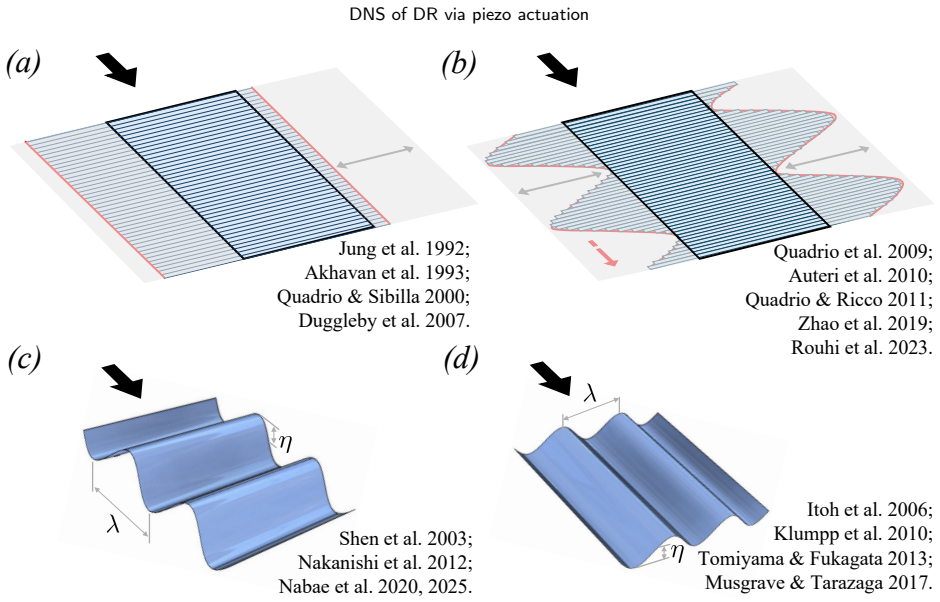
Figure from the paper full image
abstract click to expand
We have conducted Direct Numerical Simulations of turbulent half-channel flow over realistic surface deformations at friction Reynolds number $Re_\tau=200$. We generated the surface deformations using piezoelectric actuators. We simulated the piezoelectric actuation over the practical actuation frequency range $(119Hz\le f_\mathrm{act}\le543Hz)$ and voltage range $(250V\le Q \le500V)$ beneath an Aluminum sheet using Finite Element Analysis. The sheet deformation amplitude and actuation frequency in viscous units vary within the range $2 \le \eta^+_\mathrm{max} \le 34$, and $-0.58 \le \omega^+ \le 0.70$. The vertical surface deformations from our actuation setup generate three types of waves: travelling, hybrid, and standing waves. Surface deformations are applied as bottom-wall boundary conditions of the turbulent channel flow to generate waves in the upstream, downstream, and spanwise directions. We achieved maximum drag reductions of 1.6\%, 5.4\%, and 27.6\% for upstream, downstream, and spanwise waves, respectively. The streamwise waves generate alternating adverse and favorable pressure gradients, which locally increase and decrease drag, leading to a marginal net change in drag. In contrast, spanwise waves introduce transverse shear, accompanied by high- and low-streamwise-momentum zones that respectively attenuate and energize the near-wall turbulence. Such disruption of the near-wall turbulence-regeneration cycle produces up to $27\%$ drag reduction for the realistic spanwise hybrid wave; such an outcome demonstrates the efficacy of unconventional realistic surface deformations in achieving significant drag reduction.
0
0
physics.flu-dyn 2026-07-03

Linear wall-pressure contribution stays O(1) under inner scaling

by J. M. O. Massey, S. J. Zimmerman +2 more

An Inner-Scaled Linear Contribution to Wall-Pressure Variance at High Reynolds Number

Data to δ+ ~10^4 show the linear source saturates, so the log growth must come from the nonlinear term fed by the same vorticity depletion.

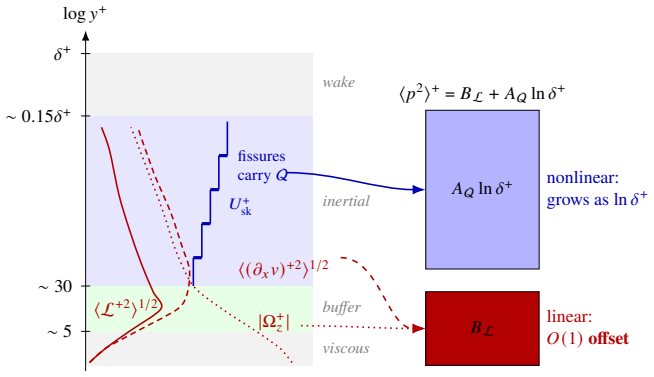
Figure from the paper full image
abstract click to expand
In canonical turbulent wall-bounded flows, the inner-scaled wall-pressure variance is empirically well described by a constant offset plus a slope logarithmic in the friction Reynolds number ($\delta^+$). Because the fluctuating pressure is predominantly a Poisson response to only two source terms -- a linear contribution from the mean shear coupled to a fluctuating velocity gradient, and a nonlinear contribution from the fluctuating velocity field -- the origin of this growth can be pinned down by elimination: if the linear source saturates at a Reynolds-number-independent value, the nonlinear source must carry the logarithmic growth. Here we supply the complementary evidence for inner-scaled invariance of the linear source at $\delta^+$ up to $O(10^4)$, using the simultaneous velocity and velocity-gradient hot-wire measurements of Zimmermann \textit{et al.} (2019 \textit{JFM} vol. 869 pp. 182--213) acquired with a single eight-sensor probe in both a zero-pressure-gradient turbulent boundary layer and a high-Reynolds-number pipe flow. The inner-scaled factors entering the linear source collapse across Reynolds number, and the inertial-layer variance of the relevant fluctuating velocity gradient decays inversely with wall distance. Together with the established inner scaling of the mean shear, this is consistent with a linear wall-pressure contribution that, under inner normalisation, remains $O(1)$ as $\delta^+\to\infty$. Both source terms then trace to one structural mechanism: the near-wall depletion of mean spanwise vorticity that caps the linear source also feeds, through vortex stretching, the inertial-layer fissures that carry the growing nonlinear contribution.
0
0
physics.flu-dyn 2026-07-03

Pressure drop concentrates at interface in two-phase Poiseuille flow

by Naoko Nakagawa, Shin-ichi Sasa

Pressure-drop localization and momentum insulation in liquid-gas coexistence Poiseuille flow

Weak driving with macroscopic phases reduces particle current and cools the interface when reservoir temperatures are equal.

Figure from the paper full image
abstract click to expand
We study pressure-driven Poiseuille flow of a one-component fluid between adiabatic plates in liquid-gas coexistence. The analysis uses Poiseuille flow and Fourier heat conduction in the bulk regions together with particle and energy conservation. From these bulk equations, we identify extremely small dimensionless parameters $A^\mathrm{L}$ and $A^\mathrm{G}$ describing coexistence Poiseuille flow, whose smallness comes from squared microscopic-to-macroscopic length ratios. In weak driving with macroscopic liquid and gas regions, the pressure difference is concentrated across the interfacial region, and the ordinary Poiseuille particle current is strongly reduced. For equal-temperature reservoirs, this residual particle current produces interfacial cooling.
0
0
physics.flu-dyn 2026-07-03

Surfactant type sets final wetted area after drop impact on rough surfaces

by S. Rodríguez-Aparicio, M. Herreruela-Rosado +3 more

Effect of surfactant kinetics on the wetting following the drop impact onto rough surfaces

At twice CMC, Surfynol 465 matches water during spreading but yields larger coverage than Triton X-100 or SDS because recession is controlle

Figure from the paper full image
abstract click to expand
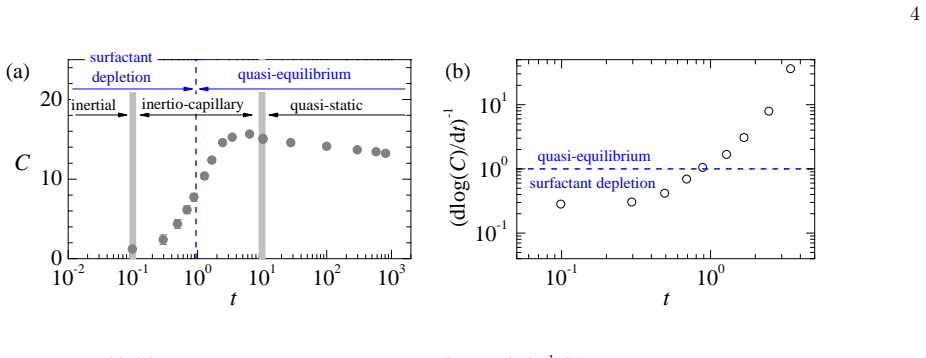
We experimentally analyze the effect of a surfactant on wetting following drop impact on rough surfaces, paying special attention to the role of dynamic surface tension. To this end, we compare the results obtained with Triton X-100, SDS, and Surfynol 465. For concentrations below the critical micelle concentration $c_{\textin{cmc}}$, the evolution of the coverage area is nearly identical for all three surfactants, suggesting that the surfactant concentration is too low to significantly influence droplet spreading. In contrast, pronounced differences emerge due to the distinct dynamic surface tensions of the surfactants at $c/c_{\textin{cmc}}=2$. The evolution of the coverage area during spreading is nearly the same for pure water droplets and those containing Surfynol 465, indicating that surfactant depletion is negligible during the rapid spreading stage. As the Weber number increases, droplet spreading becomes progressively less sensitive to surface tension, thereby reducing the influence of surfactant adsorption kinetics. Nevertheless, Surfynol 465 produces larger coverage areas than Triton X-100 and SDS. The final coverage area is governed by the quasi-static recession of the triple contact line, which is controlled by the receding contact angle. Surfynol 465 consistently yields substantially larger final coverage areas across the range of surface roughness considered in this study.
0
0
physics.flu-dyn 2026-07-03

Gliding mammal wing shapes trade lift for control authority

by Liming Zheng, Baihui Chen +2 more

Patagium and tail morphology shape aerodynamic performance and control authority in gliding-mammal-inspired wings

CFD tests of different patagia and tails find each excels at distinct tasks rather than converging on one optimum.

Figure from the paper full image
abstract click to expand
Gliding mammals exhibit diverse patagium and tail/uropatagium morphologies that may influence aerodynamic performance and maneuverability. Here, we use computational fluid dynamics to isolate the aerodynamic effects of representative gliding-mammal-inspired morphologies under controlled flow conditions. Three patagium configurations were compared to evaluate the effects of membrane outline on lift generation, drag, stall behavior and pitching moment. Three tail/uropatagium configurations were further tested under baseline, symmetric-deflection and asymmetric-deflection conditions to assess their longitudinal and lateral control authority. The results show that a broader patagium configuration generated the highest lift and lift coefficient, whereas an intermediate patagium morphology showed a smoother post-stall response with lower drag. For the tail configurations, the colugo-like integrated uropatagium enhanced lift and pitch-control authority under symmetric deflection, while the flat-tail configuration produced stronger rolling and yawing responses under asymmetric deflection. These findings indicate that gliding-mammal-inspired morphologies produce distinct aerodynamic trade-offs rather than a single optimal design. The results provide insight into the functional diversity of gliding mammal morphology and offer design guidance for bioinspired morphing aerial robots.
0
0
cs.LG 2026-07-03

Integral decomposition gives neural operators built-in spatial explanations

by Mojgan Alishiri, Amirhossein Arzani

Self-explainable Operator Learning for Discovering Spatial Patterns in Functional Data

Localized contributions from input subdomains directly link regions to output patterns in blood-flow and aerodynamics problems.

Figure from the paper full image
abstract click to expand
Operator learning has emerged as a powerful tool for modeling complex physical systems in functional spaces. However, their neural network-based architectures make them opaque models, obscuring the reasoning behind their predictions. In this work, we introduce a self-explainable operator learning framework that overcomes this challenge by reformulating operator learning as a linear combination of generalized functional linear models expressed through integral equations. Exploiting the additive decomposability of these integral equations, we divide the input domain into subdomains and compute localized integrals to evaluate the contribution of each region to the final prediction. This decomposition enables direct interpretability where the model explains both inputs and outputs by linking specific input regions to corresponding output patterns, thereby revealing which spatial features drive predictions. We demonstrate the framework on function-to-scalar and function-to-function mappings in fluid flow problems involving blood flow and unsteady aerodynamics. The results show that the operator most often prioritizes regions with strong feature gradients, providing physically meaningful insight into the model's decision-making process. Comparisons with established post-hoc explainability methods demonstrate qualitative agreement while highlighting the key advantage of the proposed approach: explainability is embedded directly within the operator structure itself and does not require an external tool. Therefore, our framework provides a mathematically transparent and physically interpretable approach to uncover relationships within data, fostering trust in machine learning for scientific applications by enabling more informed data-driven analysis of physical systems.
0
0
cond-mat.soft 2026-07-03

Polarization defects split active swimmers into upstream and downstream regions

by Akhil Varma, David Saintillan

Pore-scale distribution and transport of active particles in a two-dimensional lattice

Kinematic defects nucleate at moderate flows in a pillar lattice, producing coexistence of swimming directions at higher flows

Figure from the paper full image
abstract click to expand
Suspensions of motile microswimmers such as bacteria and other active colloids frequently encounter porous environments where obstacles and complex shear flows strongly influence their dynamics. Here, we study the distribution and transport of a dilute suspension of active particles in a square lattice of pillars, which serves as a model porous medium. The microswimmers are modeled as slender point particles, and Brownian Dynamics simulations are performed to determine how their number density and polarization fields change with systematic variations in the medium porosity, polydispersity, flow strength, and self-propulsion strength. We find that in the absence of flow, self-propulsion drives particle accumulation and radial polarization at the pillar surfaces. In the presence of a background flow, particles preferentially accumulate in the wake of pillars and exhibit upstream polarization near their surface, consistent with experimental observations. At moderate flow strengths, topological defects nucleate in the polarization field. These defects are of purely kinematic origin and mark the transition from global upstream swimming at low flow strengths to the coexistence of upstream and downstream swimming regions in the lattice at high flow strengths. The structured lattice studied here provides a controlled framework for isolating the physical mechanisms governing active transport in complex geometries, with direct relevance to transport in structured microfluidic settings.
0
0
cs.LG 2026-07-03

Time-increment FNO beats full-state baseline on convection

by Chelsea Maria John, Thibaut Lunet +4 more

Fourier Neural Operators for Rayleigh-B\'enard Convection

Compact 314k-parameter model runs in 7 ms and generalizes to finer meshes, yet accuracy stays bounded by training resolution.

abstract click to expand
We propose an improved Fourier Neural Operator (FNO) for modeling two-dimensional Rayleigh-B\'enard convection by predicting time increments instead of full solutions, achieving higher accuracy than a standard FNO baseline. The resulting model is compact (314k parameters, 1.26 MB) and fast (7 ms inference), while maintaining similar accuracy as demonstrated in previous benchmarks. We show that although FNOs generalize to finer meshes, accuracy remains limited by the resolution of the training data.
0
0
physics.flu-dyn 2026-07-03

Intermediate Froude numbers produce VSHFs and steepened spectra

by Chandra Shekhar Lohani, Vishwanath Shukla

Energy transfer, Intermittency and Mixing in Shear-Driven Stratified Turbulence

Shear-driven stratified turbulence develops three regimes where mixing coefficient holds near 0.1 and forward transfer dominates.

Figure from the paper full image
abstract click to expand
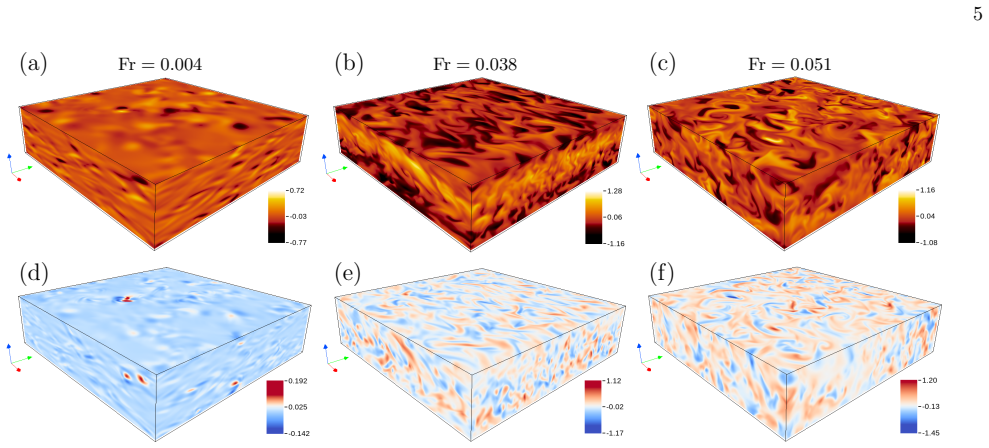
We investigate a stably stratified flow driven by deterministic Kolmogorov forcing that generates horizontal shear, using direct numerical simulations over a broad range of stratification strengths characterized by the Froude number $Fr$. As the stratification is progressively weakened, the flow exhibits a sequence of regimes: a buoyancy-dominated, strongly stratified regime, an intermediate regime characterized by Kelvin--Helmholtz instabilities and enhanced mixing, and a nearly isotropic turbulent regime. A key feature of the intermediate stratification range is the emergence of energetically significant vertically sheared horizontal flows (VSHFs), accompanied by a marked steepening of the reduced one-dimensional perpendicular kinetic energy spectra. The spectral energy transfer remains predominantly forward, although the perpendicular flux becomes negative at large horizontal scales; this apparent upscale transfer reflects anisotropic energy redistribution rather than a true inverse cascade. Strong stratification enhances intermittency, producing increasingly non-Gaussian vertical velocity fluctuations and large kurtosis associated with localized vertical bursts. The energetics-based mixing coefficient remains of order $10^{-1}$ over the parameter range investigated, with a modest enhancement near the Kelvin--Helmholtz instability regime.
0
0
physics.flu-dyn 2026-07-03

RIS matches IB aortic valve pressure gradients within 15%

by Han Zhao, Alexander D. Kaiser +6 more

Comparative analysis of resistive immersed surface and immersed boundary methods for aortic valve simulation

Prescribed-motion method recovers bulk flow features of fully coupled simulation at 60% lower computational cost.

abstract click to expand
Numerical modeling of aortic valve dynamics is essential for understanding the complex fluid-structure interaction (FSI) governing valve biomechanics in health and disease. Immersed methods provide a flexible computational framework for simulating the large deformations of valve leaflets and associated blood flow without requiring body-fitted meshes. Among these approaches, the Resistive Immersed Surface (RIS) and Immersed Boundary (IB) methods are widely used. However, systematic comparative analysis of these methods for realistic aortic valve simulations has not been performed. In this work, we compare a prescribed-kinematics RIS workflow implemented in SimVascular's svMultiPhysics solver with a fully coupled IB workflow using IBAMR for trileaflet and bicuspid aortic valve configurations. The RIS method represents the valve as a surface with prescribed kinematics embedded in the fluid domain and introduces a penalty force that drives the surrounding fluid velocity toward the prescribed leaflet velocity. This formulation reduces modeling complexity and provides useful hemodynamic predictions when representative leaflet kinematics are available. In contrast, the IB method models the leaflets as elastic structures fully immersed in the fluid domain and resolves leaflet deformation through fully coupled two-way FSI. The study focuses on the extent to which RIS reproduces bulk hemodynamic features and transvalvular pressure gradients. Results show that the RIS method captures the large-scale flow structures and predicts the mean transvalvular pressure gradient with a relative error within 15% of the fully coupled IB simulation, improving to within 5% when inlet boundary conditions are matched, while reducing computational cost by approximately 60%.
0
0
physics.flu-dyn 2026-07-03

Scalar extrapolation restores second-order accuracy in phase-change flows

by Wenyuan Chen, Yantao Yang

A second-order diffusive-interface immersed boundary method for incompressible flow with phase change and moving interfaces

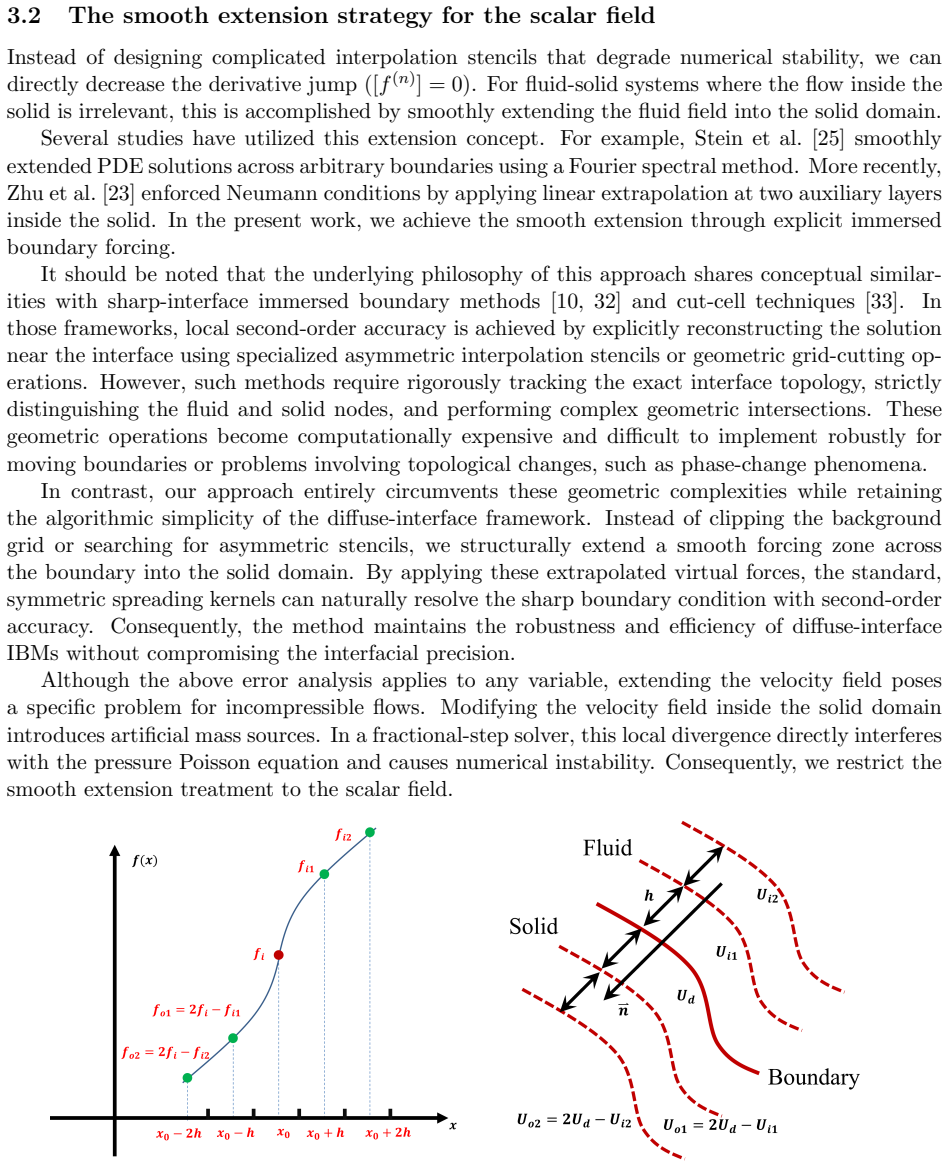
A smooth extension applied only to scalar fields fixes derivative discontinuities while keeping velocity divergence-free.

Figure from the paper full image
abstract click to expand
Accurately resolving interfacial gradients is critical for simulating two-phase flows, particularly those involving phase transitions or active matter. The traditional diffuse-interface immersed boundary methods (IBMs) are highly efficient for such problems, but they typically suffer from a reduction to first-order accuracy near the phase-changing boundaries. We clarify that the main reason is the local derivative discontinuities. Here, we propose a smooth extension strategy to restore formal second-order spatial accuracy. By extrapolating the scalar field across the interface, the method structurally ensures derivative continuity. To preserve the divergence-free condition in incompressible fluid solvers, this smooth extension is applied exclusively to the scalar transport equations. The velocity field retains the standard diffuse-interface treatment. The proposed framework is systematically validated against classical phase-change benchmarks, specifically one-dimensional evaporation and boiling problems. Additionally, the method is applied to the spontaneous autophoretic motion of isotropic particles. The numerical results confirm the capability of our method in resolving the complex multi-physics boundary couplings.
0
0
cond-mat.soft 2026-07-02

Mutual info shows optimal microswimmer mixing at finite squirmer strength

by Yihong Shi, Yuto Hosaka +2 more

Mixing induced by microswimmers as probed by mutual information

Disorder boosts efficiency while aggregation hinders it; pushers outperform pullers at fixed energy cost.

Figure from the paper full image
abstract click to expand
We investigate fluid mixing induced by microswimmers using mutual information as a global, information-theoretic measure of mixing efficiency. For a two-dimensional squirmer model in a confined domain, we compute numerically the swimmer-generated flows and solve the advection-diffusion equation for the transport of tracer particles in the fluid. We show that the spatial distribution of swimmers strongly affects mixing, which is suppressed by swimmer aggregation and enhanced by positional and orientational disorder. At fixed energy dissipation, mixing efficiency depends non-monotonically on the squirmer parameter, with an optimal finite value arising from the balance between swimmer translation and dipolar flow generation. When hydrodynamic interactions are included, pushers outperform pullers. The mutual information as a function of time decays in three stages: an initial diffusion-dominated stage, an intermediate advection enhanced regime, and a final relaxation stage controlled by system size. Our results demonstrate that mutual information, previously validated as a measure of mixing efficiency only in simplified model systems, can equally be used in complex flows. Its application reveals that mixing by microswimmers is subject to a trade-off between the generation of strong shear flows and achieving optimal dispersion across the fluid domain.
0
0
physics.flu-dyn 2026-07-02

2D rotor simulations recover gap route but shift high-Re boundary

by Tsorng-Whay Pan, Jiwen He

Two-dimensional simulations of hydrodynamic spin coupling in a two-rotor corral

Planar model matches moderate-Re counterrotation band and vortex sequence yet reverses spin via torque redistribution instead of experimenta

Figure from the paper full image
abstract click to expand
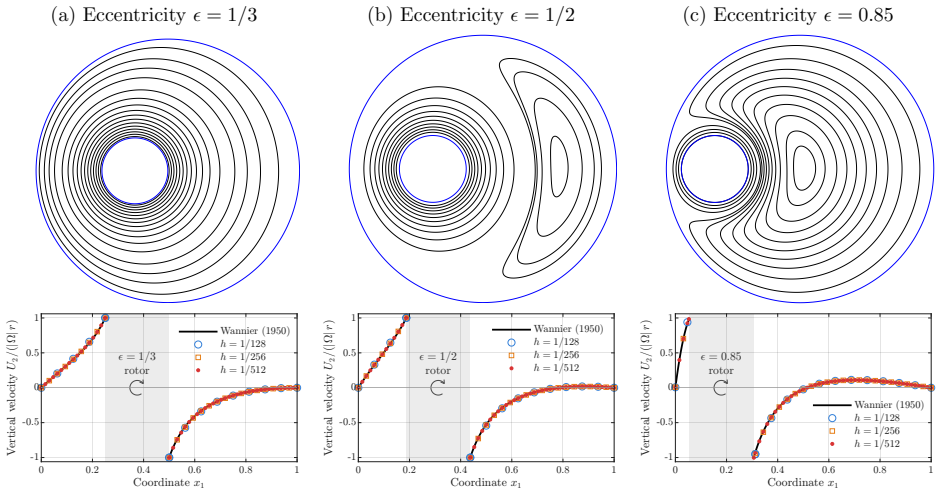
We study hydrodynamic spin coupling in a two-rotor corral using DNS of 2D incompressible viscous fluid flow. An active rotor is driven at angular velocity W, and a nearby torque-free passive rotor selects an angular velocity w through hydrodynamic torque balance. The signed gear ratio Gamma=w/W distinguishes corotation from counterrotation, with Reynolds number Re=|\Omega|r^2/\nu. Motivated by a recent quasi-two-dimensional experiment, we use a DLM/FD method to compute planar phase diagrams of $\Gamma(G,Re)$ at corral sizes C=3, 4.5, and 6. The planar model recovers the benchmark gap route at Re=20: an intermediate counterrotation band, a wide-gap transition to corotation, gear-ratio magnitudes of order 10^{-2}, and the observed sequence of vortex attachment, detachment, and merger. It also produces a reentrant-like gap structure with a small-gap corotation region whose relation to the experimental close-range geometric state remains unresolved. The main discrepancy is the high-Re boundary. At the experimental mid-gap transect G about 0.3, the planar gear ratio approaches zero from the counterrotating side but does not cross through Re=400; at the narrower gap G=0.22, by contrast, the planar terminal spin reverses near Re=44. Wall-traction diagnostics show that this crossing is not the experimental shear-competition mechanism: the gap-facing counterrotating arc narrows but does not collapse or deflect as in the experiment, and the reversal at G=0.22 occurs by redistribution of the integrated planar torque. The strictly planar model therefore captures the broad gap-route architecture and the existence of a Reynolds-driven spin boundary, but displaces that boundary in gap and alters its surface-stress mechanism. The remaining mismatch points to finite-depth secondary motion, end-wall stresses, and apparatus geometry as plausible contributors to the experimental shear balance.
0
0
cond-mat.soft 2026-07-02

Magnetic filament speed peaks at EH length ratio of order one

by Sohum Kapadia, Julien Chopin +1 more

Elasto-Hydrodynamic Propulsion of a Magnetically Actuated Filament

Speed varies non-monotonically and is largest when swimmer length matches the scale set by elasticity and viscosity.

Figure from the paper full image
abstract click to expand
We investigate the low-Reynolds-number propulsion of a slender elastic filament with a dipolar magnetic head actuated by an oscillating field in a viscous fluid by studying its strokes and net forward motion. To capture these dynamics, we employ an elasto-hydrodynamic (EH) framework that couples Euler-Bernoulli beam mechanics with resistive force theory. Unlike prescribed-kinematics models, filament shapes here emerge self-consistently from the actuation and the force and torque boundary conditions (BCs). We demonstrate that viscous boundary contributions are crucial for quantitative agreement and show that the swimming dynamics are governed by the EH length and a magneto-viscous-elastic stroke amplitude introduced here. The swimming speed is non-monotonic with increasing ratio of the swimmer length to the EH length, and is shown to reach a maximum when the swimmer length is on the order of the EH length. We further discuss the analytical limit in which the tail BCs can be described as free, and the limitations that arise when viscous contributions to the BCs are ignored.
0
0
physics.flu-dyn 2026-07-02

Lagrangian paths compute polymeric stresses from velocity data

by Mohammad Majidi, Rishu Gandhi +4 more

Lagrangian evaluation of polymeric stress in viscoelastic fluids

Reconstructs stresses along trajectories in known steady flows and matches Eulerian results for FENE-P and Oldroyd-B in obstacle channels.

Figure from the paper full image
abstract click to expand
Polymeric stresses in viscoelastic flows arise from the deformation of polymer chains and are commonly computed using Eulerian constitutive models, in which the conformation tensor is evolved as a transported field over the entire domain. This approach is computationally intensive, prone to numerical instabilities, and not directly applicable to experimentally measured velocity fields. In this work, we develop a Lagrangian integration scheme that reconstructs the polymeric stress field from the deformation-gradient history along fluid element trajectories in a known, steady velocity field. This approach avoids solving the full Eulerian constitutive transport equation, which we develop for the nonlinear FENE-P model as well as the Oldroyd-B model as a reference case. After validation on unidirectional, canonical flows, the scheme is applied to non-trivial channel flows past circular obstacles using velocity fields quantified from both numerical simulations and microfluidic experiments. The reconstructed stress fields across both experiments and simulations are in agreement with traditional Eulerian reference solutions. Not only does this new Lagrangian scheme enable the quantification of stress fields directly from experimental velocity field data, but it also enables partial or whole-field mapping of stresses without solving fully-coupled viscoelastic constitutive equations.
0
0
physics.flu-dyn 2026-07-02

Collapse flow adds no vorticity to irrotational turbulence

by Axel Brandenburg, Evangelia Ntormousi +1 more

No evidence of vorticity production from initially irrotational turbulent gravitational collapse

Simulations show all vorticity traces to initial conditions, with none generated by the gravitational collapse itself.

Figure from the paper full image
abstract click to expand
Gravitational collapse creates large amounts of kinetic energy that could potentially seed turbulence. If such turbulence were also suitable to initiate dynamo action, the resulting magnetic field would further modify the dynamics, especially on small length scales. However, a small-scale dynamo requires vortical turbulence, while the collapse produces mainly irrotational motions, which may not be efficient for dynamo action. Here, we study the efficiency of vorticity production during a turbulent collapse. We use a barotropic equation of state, where pressure and density gradients are parallel, and no magnetic field, so that vorticity can only be produced by viscosity. Using direct numerical simulations of gravitational collapse, we show that, for the parameter space accessible to our numerical resolution, this effect is related to the initial irrotational turbulence and is not a consequence of the collapse flow.
0
0
physics.flu-dyn 2026-07-02

Objective vorticity tensor yields frame-invariant FENE equation

by Liviu Iulian Palade, Alan Jeffrey Giacomin

Objective kinetic theory for FENE dumbbell suspension

Kinetic theory for polymer dumbbell suspensions is corrected so the constitutive relation remains unchanged under arbitrary frame rotations.

abstract click to expand
The novelty of this work is that it takes a result of macromolecular theory that is not objective, and fixes it. To do so we use an objective vorticity tensor to obtain a fully frame invariant form of the classical constitutive equation for FENE dumbbell fluids obtained within the conceptual framework of kinetic theory for polymer solutions. The influence of such an objective formulation is discussed for steady shear flows.
0
0
physics.flu-dyn 2026-07-02

Entrainment ratio rises with compressibility in supersonic shear layers

by M. R. B. Shahadat, Z. Li +2 more

Numerical Study of Compressibility and Velocity Parameter Effects on Spatially Evolving Supersonic Turbulent Shear Layers

DNS yields a closed-form expression showing excess mixing on the high-speed side once self-similarity is reached.

Figure from the paper full image
abstract click to expand
Direct Numerical Simulations (DNS) of a spatially developing supersonic turbulent shear layer are conducted for a range of convective Mach numbers ($M_c$) and velocity parameters ($\lambda$) to examine the effects of compressibility and advection on the growth rate, self-similarity, flow statistics, asymmetry, and entrainment of the layer. At distant downstream locations, self-similarity is attained for all cases. The self-similar region is identified by the collapse of normalized mean streamwise velocity, the constant peak of normalized Reynolds stresses, and the linear growth rate of the shear layer thickness and momentum thickness. Despite significant variations in lower-order and higher-order statistics across different $M_c$ and $\lambda$ values, profiles of all turbulence quantities examined collapse within the self-similar region using our proposed self-similar scalings. The self-similar forms of continuity, momentum, and energy equations have been formulated, incorporating compressibility and centerline shifts. The self-similar normalized density distribution inside the layer is used to explain the effects of compressibility on various flow statistics, including the far-field cross-stream velocity. The density variation is linked to dissipation effects as revealed by our analysis of the self-similar energy equation. An approximate equation for the cross-stream velocity is developed, and the profiles of cross-stream velocity obtained from this equation show good agreement with the DNS results. A geometric interpretation of the entrainment ratio is presented, and the approximate equation for the cross-stream velocity is used to provide a general closed-form expression of the entrainment ratio. The entrainment ratio increases with $M_c$ and $\lambda$, favoring excess entrainment on the high-speed side.
0
0
cond-mat.soft 2026-07-02

Diffuse fronts enhance phoretic removal from dead-end pores

by Amir A. Pahlavan

Diffusiophoretic transport of colloids and emulsions in complex environments

Cross-streamline migration in flowing pathways also shifts breakthrough and dispersion by orders of magnitude.

Figure from the paper full image
abstract click to expand
Chemical gradients are ubiquitous in porous and crowded environments, including soils, filters, fabrics, tissues, hydrogels, biofilms and living cells. They arise from displacement fronts, dissolution and precipitation, ion exchange, metabolism, root exudation, evaporation, gas dissolution, freeze--thaw cycles and externally imposed chemical treatments. These gradients can drive colloids, macromolecules and emulsion droplets by diffusiophoresis, while simultaneously driving diffusioosmotic flows along confining surfaces. Classical models of colloid transport in porous media emphasize hydrodynamic dispersion, surface interactions, straining, deposition, detachment and filtration. This chapter places diffusiophoresis within that broader transport framework and reviews how porous media generate, stretch, disperse and sustain the solute gradients that drive phoretic motion. We first discuss sources of chemical gradients and the distinction between spreading and mixing, then summarize classical colloid transport, the minimal physicochemical model for diffusiophoresis and diffusioosmosis, and the experimental platforms used to study these effects. Particular emphasis is placed on recent results showing that diffuse solute fronts can enhance phoretic removal from dead-end pores by prolonging the duration of forcing, and that cross-streamline migration within flowing pathways can change macroscopic breakthrough and dispersion by orders of magnitude. We close by discussing emulsion droplets, multiphase flows, confined and living media, and open problems, including the transition from algebraic mixing in two-dimensional micromodels to chaotic mixing in three-dimensional porous media.
0
0
physics.flu-dyn 2026-07-02

PICNN replaces traditional solver in two-phase porous flow

by Yuanshuo Kong, Xue Wang +1 more

The PICNN-Assisted Physics-Preserving Scheme for Thermodynamically Consistent Two-Phase Flow in Porous Media

Network trained on finite-volume residuals with TPFA yields energy-stable, mass-conservative solutions after correction.

Figure from the paper full image
abstract click to expand
In this paper, we develop a physics-informed convolutional neural network (PICNN) assisted physics-preserving method for a thermodynamically consistent model of incompressible and immiscible two-phase flow in porous media. Following the physics-preserving prediction-correction scheme of Li et al. \cite{li2025class}, the prediction step is performed by a PICNN trained with finite-volume residuals, where the interfacial fluxes are evaluated by the two-point flux approximation (TPFA) using two-point difference quotients of neighboring cell-centered unknowns to approximate interfacial normal gradients. The PICNN output is further corrected by a post-processing procedure to obtain energy-stable, mass-conservative, and bounds-preserving solutions. Numerical results show that the finite-volume residuals trained PICNN can replace the traditional prediction solver within the physics-preserving framework. Compared with conventional physics-informed neural networks (PINNs), the PICNN better captures local spatial interactions between each control volume and its neighboring cells, while the finite-volume residuals accommodate discontinuous permeability fields and interfacial flux continuity.
0
0
physics.flu-dyn 2026-07-02

Bubble curtains split into three regimes set by density ratio

by Shravan K.R. Raaghav, Herman J.H. Clercx +1 more

Lock-exchange flow regimes under low air Froude number bubble curtains

Salt-to-fresh density ratio joins air Froude number in controlling flow patterns and salt blocking in lock-exchange setups.

abstract click to expand
The flow and density field characteristics around a bubble curtain in a laboratory scale lock-exchange setup are investigated using two-phase large-eddy simulations. We study the detailed hydrodynamics and show that there are three qualitatively distinct (sub)regimes within the previously classified breakthrough regime. The occurrence of these regimes depends not only on air Froude number that characterises the relative strength of the bubble curtain and the gravity current, but also on an additional non-dimensional parameter: the density ratio between the salt and fresh water. The dependence on this additional parameter is also observed in how effective bubble curtains are in blocking the transport of salt to the fresh part of the lock. Hence, it has important implications for the optimisation of bubble curtains in ship locks.
0
0
physics.bio-ph 2026-07-02

Hydrodynamic flow accelerates Brassica root growth and triggers ROS

by Kaushal Agarwal, Sumit Kumar Mehta +1 more

Plant-On-a-Disc (POD): A Phytofluidic platform enabling In Situ Root Analysis

Eight-seedling radial device reveals multi-scale root responses to fluid forces that static systems miss.

abstract click to expand
Phytofluidic platforms have enabled controlled studies of plant roots, however, most existing systems either impose geometric confinement without flow or introduce hydrodynamics in single-channel devices that limit throughput and disrupt downstream analysis. New experimental platforms are therefore needed to investigate how roots integrate mechanical confinement and hydrodynamic nutrient transport, two defining features of the rhizosphere that remain difficult to reproduce under controlled laboratory conditions. Here, we present the Plant-on-a-Disc (POD), a phytofluidic platform that enables the parallel cultivation of eight seedlings under controlled hydrodynamic conditions while allowing non-invasive, in situ multimodal analysis of the intact root-shoot system. The device is fabricated in PDMS using a cost-effective wire-drawing technique to generate radial microchannels that converge into a central sump beneath an optical window. This design enables sequential bright-field, fluorescence, and Raman measurements using a single microscope objective without disturbing neighbouring seedlings. Dimensionless transport analysis and finite-element modelling confirm that the radial architecture equalizes hydraulic resistance across channels, establishing creeping laminar flow with convection-dominated nutrient transport under physiologically safe shear conditions. Using Brassica seedlings, we show that hydrodynamic flow drives coordinated root responses across multiple scales. Roots grown in flow condition exhibit accelerated elongation, substantial ROS generation and anisotropic cortical cell expansion, accompanied by carotenoid signatures detected by Raman spectroscopy.
0
0
physics.flu-dyn 2026-07-02

Particles map hidden heat transport paths in unsteady flows

by Besm Osman, Andrei Jalba +2 more

Visualizing Lagrangian Heat Transport Paths and Density Structures in Unsteady Heat Transfer

Reparameterized spacetime advection lets massless particles trace coherent routes and attracting structures missed by temperature plots.

Figure from the paper full image
abstract click to expand
Convective heat transfer is traditionally visualized from a Eulerian perspective using scalar temperature fields, offering limited insight into the underlying transport mechanisms. A Lagrangian view, analogous to mass transport along fluid paths, can reveal coherent structures and transport routes invisible from a Eulerian view of temperature. However, heat transport is aperiodic and non-conservative, hampering the application of fluid mixing and transport visualization techniques, developed primarily for time-periodic, conservative transport. We present a particle-based visualization technique that addresses these challenges by advecting massless particles along a time-reparameterized spacetime formulation of thermal transport, accumulating path contributions to reveal coherent transport routes and finite-time attracting and repelling structures that conventional methods cannot show.
0
0
astro-ph.GA 2026-07-02

Kolmogorov cascade spans 0.05 to 20 parsecs in Polaris Flare

by Xunchuan Liu, Pak-Shing Li +1 more

Kolmogorov turbulence across multi-fractal gas in Polaris Flare

Mapping shows the apparent break at 0.5 pc comes from projection and density changes, not a shift in turbulent regime

Figure from the paper full image
abstract click to expand
We reveal a pristine, scale-invariant 3D Kolmogorov velocity cascade ($\alpha_V^{\mathrm{3D}} \sim 2/3$) spanning $0.05$--$20$~pc in the Polaris Flare using \texttt{PPCOS} $^{12}\text{CO}$ data. A transition scale at $\sim 0.5$~pc marks a bifurcation in the structure functions' exponents, below which the degree of intermittency is also saturated. By deriving an analytical mapping relation ($\alpha_V^{\mathrm{3D}}=\alpha_V-\frac{1}{3}\alpha_I$), we obtain the scale-invariant value of $\alpha_V^{\mathrm{3D}}$, proving that the apparent transition stems from geometric projection and a changing density fractal dimension rather than a turbulent mode shift. Kolmogorov turbulence is smoothly inherited from the large-scale cold neutral medium, remaining uninterrupted by compression or gravity below 0.1 pc.
0
0
physics.flu-dyn 2026-07-02

Superfluid vortex lattice shows inertial waves below twice rotation rate

by Florian Lorin, Charles Peretti +4 more

Visualization of Inertial and Kelvin Waves on the Quantum Vortex Lattice in Superfluid Helium

Heat flux perturbation in rotating helium-4 reveals continuous spectra matching inertial waves and Kelvin wave cascade evidence at higher fr

Figure from the paper full image
abstract click to expand
Superfluid $^4$He subjected to steady rotation develops a regular lattice of quantum vortices aligned with the rotation axis. We prepare this lattice in a rotating cryostat, perturb it with a constant heat flux, and visualize vortex deformation waves that propagate in the lattice and grow in energy with the forcing. Below twice the rotation rate, we show that these waves feature a continuous frequency spectrum whose structure corresponds to inertial waves. At larger frequencies, we report evidences supporting the observation of a turbulent cascade of Kelvin waves. Our experiments hence provide a direct approach to deepen our understanding of collective dynamics in perturbed quantum vortex systems across all quantum fluids.
1 0
0
cond-mat.stat-mech 2026-07-02

Non-ideal equation of state fixes hard-disk cooling flow predictions

by Amit Kumar, Abhishek Dhar +1 more

Slow heat-driven flow in a gas of hard disks

Simulations match the extended one-dimensional isobaric theory in both dilute and finite-density regimes.

Figure from the paper full image
abstract click to expand
We study a slow heat-driven flow in a gas of elastically colliding hard disks confined to a long channel. The initial state consists of two regions with large temperature and density contrasts but nearly equal pressures, leading to a low-Mach-number, nearly isobaric evolution. In the dilute limit, the corresponding isobaric hydrodynamic theory reduces to a previously known ideal-gas description. We extend this theory to finite densities by incorporating a non-ideal equation of state of a hard-disk fluid, and solve the resulting one-dimensional equations numerically. Finite-density effects produce appreciable deviations from the ideal-gas prediction. We then test the theory directly against event-driven molecular dynamics simulations of hard disks and find very good agreement in both the dilute and finite-density regimes. The results provide, to our knowledge, the first particle-level test of isobaric gas dynamics of a strongly inhomogeneous cooling flow.
0
0
physics.flu-dyn 2026-07-01

ALE mapping makes Boltzmann DG scheme obey geometric conservation on moving meshes

by Atakan Aygun, Onur Ata +2 more

A High-Order Arbitrary Lagrangian-Eulerian Discontinuous Galerkin Method for the Boltzmann Equation in Nearly Incompressible Flows

Added advection term from reference mapping enables accurate simulations of plunging airfoils and swimming fish.

Figure from the paper full image
abstract click to expand
We propose the arbitrary Lagrangian-Eulerian (ALE) form of the Galerkin-Boltzmann formulation for the simulation of nearly incompressible flows with moving boundaries. The continuous Boltzmann equations are mapped to a reference state to compensate the mesh motion with an advection term. The resulting system is discretized in space using the discontinuous Galerkin method on unstructured meshes. A semi-analytic Runge-Kutta time discretization is used to overcome the stiffness introduced by the continuous Boltzmann equations. The well-known geometric conservation law is shown to be satisfied by the time and space discretizations and consistent update of geometric factors of the discretization. The implementation is on the GPU accelerated kernel library libParanumal and validated by a free stream preservation and moving Taylor-Green vortex test cases. Then, the capabilities are shown using a plunging symmetric airfoil in two-dimensions and moving carangiform fish in three-dimensions using perfectly matched layers.
0
0
physics.flu-dyn 2026-07-01

Flexible nozzles enhance thrust when natural period matches pulse

by Roberta Santoriello, Francesco Viola +1 more

Flexibility as a Universal Nature-Inspired Mechanism for Thrust Enhancement

Standing-wave response charges energy to fluid at optimum; model explains how curvature strain picks species geometries.

abstract click to expand
Nature has equipped jet-propelled swimmers with flexible nozzles that outperform rigid ones, yet the origin of this advantage has remained unexplained. By tracking where and when energy is exchanged between fluid and structure, three-dimensional numerical simulations resolve the underlying mechanism: a standing-wave response of the nozzle, in which the structure dilates and then recoils synchronously, charging and releasing energy to enhance thrust. Outside of this regime, the structure exhibits a traveling wave response, with expansion and contraction coexisting along the nozzle, reducing the thrust gain. We propose a physics-based model that captures the boundary between standing and traveling responses in a closed form, showing that the optimum occurs when the natural period of the structure matches the pulse duration. Beyond this optimum the strain imposed by the nozzle curvature required for steering selects the geometry observed across marine species. The propulsion and maneuverability are reconciled within a single framework that yields design principles for soft robotic propulsors.
0
0
math.NA 2026-07-01

GQL reformulation yields non-iterative PCP limiters for relativistic hydro

by Linfeng Xu, Shengrong Ding +1 more

GQL-Based Physical-Constraint-Preserving High-Order Finite Difference Schemes for Special Relativistic Hydrodynamics in Arbitrary Dimensions

Linear inequalities and small eigenvalue solves enforce positive density and subluminal velocity in high-order WENO schemes up to 3D

Figure from the paper full image
abstract click to expand
High-order accurate simulations of special relativistic hydrodynamics (RHD) are prone to numerical breakdown if intrinsic physical constraints (positive rest-mass density/pressure and subluminal velocity) are violated near strong discontinuities. In this work, we develop a robust and efficient physical-constraint-preserving (PCP) flux-limiting framework for high-order schemes, using finite-difference WENO as a representative example. By leveraging the geometric quasilinearization (GQL) representation, which equivalently reformulates the nonlinear RHD constraints into a family of linear inequalities, we integrate a Zalesak-type Flux-Corrected Transport (FCT) update into a scalar-style limiter that acts directly on conservative variables. A critical innovation is the explicit, non-iterative determination of limiting parameters via a rational stereographic parameterization of the GQL normal vector. This technique transforms the required worst-case minimization over auxiliary variables into a generalized Rayleigh-quotient formulation, allowing the optimal parameters to be obtained by solving small symmetric eigenvalue problems ($2\times2$ in 1D; $(d+1)\times(d+1)$ in $d$ dimensions). Relaxed variants are further introduced to reduce computational costs in multidimensions while retaining the PCP guarantee. Extensive numerical benchmarks ranging from 1D to 3D, including ultra-relativistic Riemann problems and astrophysical jets, demonstrate that the proposed method robustly enforces physical admissibility, sharply resolves discontinuities, and maintains design-order accuracy for smooth solutions.
0
0
physics.flu-dyn 2026-07-01

Mean-flow adjoints enable turbulent flow sensitivity analysis

by Shota Ito, Johannes L. Grafen +3 more

Mean-Flow Adjoint Sensitivity Analysis of Unsteady Flow Around Porous Cylinders Using a Homogenized Lattice Boltzmann Method

Lattice Boltzmann framework with automatic differentiation handles unsteady porous cylinder flows and compares to frozen turbulence assumpti

Figure from the paper full image
abstract click to expand
Adjoint-based sensitivity analysis is an indispensable tool for large-scale fluid-dynamic design and distributed control problems, yet its application to unsteady and turbulent flows is frequently hindered by the prohibitive memory footprint of transient checkpointing and the divergence of gradients in chaotic regimes. To address these computational bottlenecks, this paper presents a mean-flow adjoint sensitivity analysis framework for unsteady flows around porous cylinders using the homogenized lattice Boltzmann method (HLBM). Within this framework, solid structures are efficiently modeled as local porous media utilizing a Brinkman penalization approach. We systematically investigate HLBM-based adjoint gradients for drag and energy dissipation objective functionals, transitioning from steady laminar to unsteady, and finally to turbulent flow regimes. For the turbulent case at Re = 3900, a proof-of-concept is conducted where the framework relies on automatic differentiation to automatically generate adjoint kernels containing subgrid-scale (SGS) turbulence models for large eddy simulations (LES), circumventing manual derivation and allowing for a direct comparison against the frozen turbulence assumption (FTA).
0
0
physics.flu-dyn 2026-07-01

Polymers damp turbulence vortices from small scales to large

by Yusuke Koide, Susumu Goto

Lagrangian velocity statistics of homogeneous isotropic turbulence in dilute polymer solutions

This scale progression weakens Lagrangian velocity spectra first at high frequencies and lengthens the integral timescale.

Figure from the paper full image
abstract click to expand
We conduct direct numerical simulations of homogeneous isotropic turbulence in dilute polymer solutions to investigate the Lagrangian velocity statistics. We show how polymers modulate the power spectral density of the Lagrangian velocity and the Lagrangian integral timescale by varying the Reynolds number, forcing method, and polymer relaxation time. As the polymer relaxation time increases, the attenuation of the power spectral density extends successively from high to low frequencies, and the Lagrangian integral timescale increases. To clarify the mechanism underlying the modulation of the Lagrangian velocity statistics, we decompose the Lagrangian velocity into the contributions from vortices at different length scales. Using this scale-decomposition analysis, we demonstrate that the observed modulation of the Lagrangian velocity statistics results from polymer-induced suppression of vortices that proceeds from smaller to larger scales.
0
0
physics.flu-dyn 2026-07-01

Methods compute 2D turbulence equilibria from arbitrary initial vorticity

by Koki Ryono, Keiichi Ishioka

New numerical methods for calculating statistical equilibria of two-dimensional turbulent flows, strictly based on the Miller-Robert-Sommeria theory

The techniques preserve all Casimir invariants and recover states matching time-dependent simulations, including symmetry-broken ones.

Figure from the paper full image
abstract click to expand
New numerical methods are proposed for the mixing entropy maximization problem in the context of Miller-Robert-Sommeria's (MRS) statistical mechanics theory of two-dimensional turbulence, particularly in the case of spherical geometry. Two of the methods are for the canonical problem; the other is for the microcanonical problem. The methods are based on the original MRS theory and thus take into account all Casimir invariants. Compared to the methods proposed in previous studies, our new methods make it easier to detect multiple statistical equilibria and to search for solutions with broken zonal symmetry. The methods are applied to a zonally symmetric initial vorticity distribution which is barotropically unstable. Two statistical equilibria are obtained, one of which has a wave-like structure with zonal wavenumber 1, and the other has a wave-like structure with zonal wavenumber 2. While the former is the maximum point of the mixing entropy, the wavenumber 2 structure of the latter is nearly the same as the structure that appears in the end state of the time integration of the vorticity equation. The new methods allow for efficient computation of statistical equilibria for initial vorticity distributions consisting of many levels of vorticity patches without losing information about all the conserved quantities. This means that the statistical equilibria can be obtained from an arbitrary initial vorticity distribution, which allows for the application of statistical mechanics to interpret a wide variety of flow patterns appearing in geophysical fluids.
0
0
physics.flu-dyn 2026-06-30

Diagram turns filament breakup times into relaxation time and tension

by Nada Nazzal, Martin Drahé +8 more

Dripping-onto-droplet rheometry of sodium alginate solutions

Dripping-onto-droplet experiments on alginate solutions yield a map from breakup time to Deborah number for viscoelastic fluids.

Figure from the paper full image
abstract click to expand
In this experimental and theoretical study, we assess the extensional relaxation time of sodium alginate solutions by using dripping-onto-droplet capillary breakup rheometry (DoD), e.g., the capillary thinning and breakup of viscoelastic filaments formed following the coalescence of a millimetric-nozzle-generated pendant drop with a lower droplet cap of the same fluid contained in a millimetric pool in ambient air. Hence, we extend the analyses conducted by El Khoury et al. (2026) from Newtonian to viscoelastic fluids. Our approach relies on experiments recorded with a high-speed camera using sodium alginate in deionised water, with alginate concentrations ranging from 0.1% to 8% by weight. The results are depicted by considering the dynamics of fluid filament thinning, stress balances, and scaling laws. Extensional relaxation times are resolved from the filament diameter evolution. Three flow regimes are highlighted: capillary-inertial, capillary-elastic, and mixed capillary-inertio-elastic. The findings are summarised in a two-dimensional diagram that correlates the filament breakup time with different flow regimes using the important dimensionless parameter of the problem, e.g., the intrinsic Deborah number (which relates the extensional relaxation time to the characteristic capillary-inertial time). This diagram can be used to quantify both the solution's extensional relaxation time and the liquid/air surface tension solely from filament breakup times.
0
0
physics.flu-dyn 2026-06-30

Shear and veer cut turbine efficiency by over 20 percent

by Kirby S. Heck, Storm A. Mata +1 more

Influence of wind shear and veer on power, thrust, and induction of an actuator disk

Inductive pressure gradients and local induction changes explain much of the loss beyond rotor-equivalent speed averaging.

Figure from the paper full image
abstract click to expand
Wind shear and wind veer (gradients of wind speed and direction, respectively) are ubiquitous in the atmospheric boundary layer (ABL), and wind turbines therefore routinely operate in sheared and veered conditions. Previous field campaigns have observed statistically significant variations in power production efficiency (quantified by a power coefficient) upwards of 15% due to shear and veer. However, it is not yet clear how non-uniform inflow conditions alter rotor aerodynamics and drive these efficiency variations. In this study, we perform concurrent-precursor large-eddy simulations (LES) of an actuator disk-modeled wind turbine across stratified ABL conditions to demonstrate that shear and veer can reduce wind power efficiency by more than 20%. To support these ABL simulations, we perform simplified inflow LES where shear and veer are controlled independently. Using these controlled simulations, we demonstrate that shear and veer effects can be decomposed into: (1) geometric effects, due to changes in rotor-equivalent wind speed, and (2) inductive effects, which change the rotor aerodynamics and induced velocities. Inductive effects of wind shear modulate the power coefficient through changes to the local induction, while inductive effects of wind veer reduce the power coefficient by generating an adverse pressure gradient at the rotor scale. The geometric and inductive effects of shear and veer approximately linearly superimpose, with increasing losses as shear and veer magnitudes increase. Inductive effects account for a significant fraction of the observed losses, and the induction of a turbine is affected by shear, veer, and wall proximity through processes that are neglected in existing engineering models. Revealing the mechanisms through which shear and veer affect rotor performance establishes a framework that can enable improved power prediction in realistic ABL conditions.
0
0
astro-ph.SR 2026-06-30

Rotation boosts wave mixing in red giants over 100 times

by Simon Blouin, Paul R. Woodward +3 more

Wave-Driven Mixing Enhanced by Rotation in Red Giant Branch Stars

3D simulations show internal waves carry material far more efficiently when stars spin, matching observed surface chemistry.

abstract click to expand
Stars like our Sun expand as they exhaust their core hydrogen fuel, becoming red giants that eventually reach sizes up to 100 times their original radius. These giants have long presented a puzzle: they show systematic changes in their surface chemical composition that can only be explained by the transport of material from their nuclear-burning interior to their surface. The challenge is that this transport must somehow cross a stable layer that acts as a barrier between the star's outer convective envelope and its nuclear-burning interior. The convective motions in the envelope create internal waves that propagate through this barrier layer, but on their own these waves produce very little material transport. Here we show through high-resolution three-dimensional hydrodynamical simulations that stellar rotation dramatically amplifies how effectively these waves can mix material across this barrier. We find that the mixing rates can exceed those in non-rotating stars by over 100 times, increasing with faster rotation rates. This enhanced mixing provides a natural explanation for the observed chemical signatures in typical red giants. The amplification of wave-driven mixing by rotation may have implications beyond red giants to other types of stars.
0
0
math.AP 2026-06-30

NS/Allen-Cahn system converges to sharp interface in 3D

by Helmut Abels, Mingwen Fei +2 more

Higher Order Convergence for the Sharp Interface Limit of 3D Navier--Stokes/Allen--Cahn Systems

Higher-order estimates now reach variable viscosity and three space dimensions when the limit solution stays smooth.

abstract click to expand
We show convergence of solutions to a Navier--Stokes/Allen--Cahn system as the interfacial thickness $\varepsilon>0$ tends to zero for well-prepared initial data as long as the limit system possesses a sufficiently smooth solution. The limit system consists of a two-phase Navier--Stokes system separated by a sharp interface in the presence of surface tension coupled to a convective mean curvature flow equation. In comparison to previous results we obtain improved convergence estimates for higher-order norms. These enable us to prove convergence in the case of three space dimensions and non-constant viscosity, which was unknown before. The convergence results relies crucially on uniform higher-order estimates for the associated linearized Navier--Stokes/Allen--Cahn system in suitably weighted $L^2$-Sobolev spaces. Here a novel problem-adapted weight proportional to the sum of $\varepsilon$ and the distance to the sharp interface of the limit, which gives improved and sharp estimates, is an important new ingredient. This approach can be potentially adapted to other sharp interface limits as well.
0
0
physics.flu-dyn 2026-06-30

Porous droplet electrophoresis transitions continuously to rigid-particle limit

by Sutapa Mandal, Subrata Majhi

Electrophoretic motion of a liquid droplet with Brinkman-screened internal hydrodynamics

A single Brinkman-screened resistance inside links clean-droplet and solid-particle behaviors for arbitrary Debye-layer thickness.

Figure from the paper full image
abstract click to expand
We develop a theory for the electrophoresis of a spherical porous liquid droplet with prescribed uniform surface charge. The exterior electrokinetics is governed by the Poisson-Nernst-Planck-Stokes equations, while the internal liquid motion is described by the Brinkman-Debye-Bueche equation. A regular perturbation expansion in the applied electric field reduces the governing equations to coupled radial ordinary differential equations. In the Debye-H\"uckel regime, we derive a closed-form mobility expression valid for arbitrary Debye layer thickness. The analysis shows that the porous interior modifies clean-droplet electrophoresis through a single Brinkman-screened hydrodynamic resistance, yielding a continuous transition between clean-droplet and rigid-particle limits. Numerical solutions beyond the low-potential regime reveal a non-universal role of permeability: increasing the Darcy number can either suppress or enhance the mobility. This reversal is determined by the sign of the interfacial-velocity mode, which is governed by the competition between tangential Maxwell traction and hydrodynamic shear generated by electric-double-layer distortion. Dielectric polarization, surface charge and double-layer thickness can reverse the internal circulation, while the Darcy number controls how strongly this circulation is transmitted through the porous interior. This permeability sensitivity is especially pronounced for highly polarizable droplets in the thin-double-layer regime. The theory provides a basis for tuning electrokinetic transport of soft porous droplets in microfluidic and biomedical technologies.
0
0
physics.flu-dyn 2026-06-30

Closed-loop retraining restores stable wall drag control

by Giorgio Maria Cavallazzi, Miguel Pérez-Cuadrado +1 more

Offline accuracy is not enough: closed-loop instability and stabilisation of a wall-sensor neural estimator in opposition control

Offline-accurate neural estimators fail in feedback from distribution shift; retraining on self-generated data recovers most of the ideal dr

abstract click to expand
Opposition control reduces skin-friction drag by opposing the wall-normal velocity on a near-wall detection plane, but the detection-plane velocity it requires is not available from wall-mounted sensors. Wall data can reconstruct inner-flow quantities accurately when assessed offline on a fixed flow state, and we ask whether such a reconstructed field can instead serve as a live surrogate sensor inside the feedback loop. We train a recurrent estimator to infer the detection-plane velocity from the two wall-shear-stress components in opposition-controlled turbulence. Offline it performs extremely well, reaching a correlation of 0.99 and near-unity coherence across the energetic scales; yet the same estimator fails in closed loop, decorrelating from the true field within a few viscous time units as the control collapses. The failure is not one of accuracy but of distribution shift induced by the controller itself: small closed-loop errors carry the flow off the attractor represented in the training data, while unresolved high-wavenumber errors enter through the wall boundary condition and return as out-of-distribution inputs. Standard remedies such as low-pass filtering and exponential averaging only delay numerical breakdown while accelerating decorrelation. Stable wall-only control is recovered by imposing spectral consistency on the deployed actuation and retraining the estimator on its own closed-loop data, giving a controller that holds much of the drag reduction of ideal opposition control from wall quantities alone. The obstacle is not whether the near-wall flow can be reconstructed offline, but whether that reconstruction stays dynamically consistent when allowed to modify the flow it senses.
0
0
physics.flu-dyn 2026-06-30

Lateral flows remove critical threshold for symmetry breaking

by T. Salamon, R. Debuysschère +3 more

Sudden expansion stability thresholds modified by lateral flows

In a band of flow rate ratios, no Reynolds number triggers jet deflection to the side wall.

Figure from the paper full image
abstract click to expand
We study the flow in a symmetric three-dimensional confined sudden expansion with lateral inflow at Reynolds number below 300 and varying lateral-to-central flow rate ratio, using experiments, linear stability analysis, weakly nonlinear theory, and direct numerical simulations. Three distinct flow regimes are identified. Outside an intermediate band of lateral-to-central flow rate ratio, the flow undergoes a steady symmetry-breaking bifurcation above a critical Reynolds number, deflecting the central jet toward one side wall; weakly nonlinear analysis shows this bifurcation to be supercritical, excepting a very narrow parametric range. Within the intermediate band, no such critical Reynolds number exists and direct numerical simulations confirm that residual velocity asymmetries reflect the imposed geometric imperfections rather than intrinsic amplification. Fluctuations observed experimentally in the intermediate band of lateral-to-central flow rate ratio remain unexplained and warrant further investigation.
0
0
physics.flu-dyn 2026-06-30

Wall model cuts near-wall grid needs twentyfold for turbulent separation

by Yaqing Yang, Fengxiang Zhao +1 more

Efficient Wall-Modeled High-Order Compact Gas-Kinetic Scheme for Compressible Turbulent Flows

The CGKS-5th scheme plus pressure-gradient wall model matches reference separation and friction on coarse meshes with under 1 percent added

Figure from the paper full image
abstract click to expand
Scale-resolving simulations of wall-bounded turbulent flows remain prohibitively expensive at high Reynolds numbers, owing to the stringent near-wall resolution requirements. High-order compact gas-kinetic schemes (CGKS) are accurate, robust, and efficient for compressible flows, making them an attractive foundation for reducing this cost. Building on the fifth-order scheme CGKS-5th, we develop a wall-modeled CGKS framework that alleviates the near-wall resolution burden through a pressure-gradient-based non-equilibrium wall model while preserving the resolving power of the outer solver. CGKS-5th resolves the outer flow and supplies the wall model with data at the exchange location. On coarse near-wall meshes, the wall model reconstructs the under-resolved viscous wall stress, while CGKS-5th provides the inviscid wall flux directly; the two combine to form the wall momentum flux. To capture non-equilibrium effects in adverse-pressure-gradient and separated regions, the wall model retains a pressure-gradient source term together with a pressure-gradient-corrected near-wall damping function. We assess the framework on two distinct flows: bluff-body separation past a circular cylinder, and a shock-induced separation bubble on the transonic RAE 2822 airfoil, using near-wall meshes far coarser than wall-resolved simulations require. For the RAE 2822 case, this corresponds to a twentyfold coarsening in the wallnormal direction, with comparable coarsening in other directions. In both cases, the wall-modeled CGKS-5th reproduces the separated flow structures and markedly improves near-wall predictions over its wall-model-free counterpart, most notably the skin-friction coefficient. The framework thus delivers accurate predictions of these separated flows at substantially reduced near-wall cost, while its lightweight coupling adds less than 1% runtime overhead in a multi-GPU implementation.
0
0
hep-th 2026-06-30

Viscous fluid modes decay linearly with n

by Yan Liu, Hao-Tian Sun

Nonlinear nature of near-equilibrium viscous fluids

An attractor locks higher harmonics to multiples of the fundamental frequency and enforces a cascading amplitude relation fixed by viscosity

abstract click to expand
We study the late-time relaxation of a neutral relativistic viscous fluid in $d+1$ dimensions. In the long-wavelength regime, linearized hydrodynamics predicts that the sound mode at momentum $nk$ decays as $e^{-n^2\omega_I t}$. However, nonlinear analysis gives a decay of $e^{-n\omega_I t}$. We derive a closed asymptotic attractor solution in which the frequency of the $n$-th harmonic locks to $n$ times the complex frequency of the fundamental mode. The amplitude envelopes for energy current $J$ obey a simple cascading relation, $J_n=\alpha_J^{\,n-1}J_1^n$, with $\alpha_J$ fixed by the equation of state, the longitudinal viscosity, and the fundamental wavenumber. For conformal fluids, $\alpha_J=1/(8\eta k)$, in agreement with the holographic result of arXiv:2512.07242. The existence of the attractor shows that, even near equilibrium, field powers are not equivalent to amplitude order.
0
0
physics.flu-dyn 2026-06-30

Exact solutions derived for piston effect in supercritical fluids

by Mátyás Szücs

Exact analytical solutions for the piston effect in supercritical fluids under post-acoustic approximation -- Short-time asymptotics, thermal penetration depth and comparison with the Spacelab D-2 experiments

Post-acoustic model turns the coupled problem into a driven diffusion equation whose closed-form results match Spacelab temperature data.

Figure from the paper full image
abstract click to expand
Near the liquid-vapor critical point, fluids become highly compressible, giving rise to a special, strongly coupled thermo-mechanical process: the piston effect. In this phenomenon, a thin thermal boundary layer develops near a heated wall; owing to strong thermal expansion, this layer acts like a piston, compressing the bulk fluid adiabatically and resulting in a seemingly accelerated thermal response. Although the piston effect is a thermo-acoustic process, the characteristic time scale of the boundary perturbation is typically orders of magnitude larger than the acoustic time scale of the setup. Consequently, rapid acoustic propagation can be neglected, justifying a post-acoustic approximation with a spatially uniform but time-dependent bulk pressure. Within the linear regime, the temporal evolution of pressure can be directly connected to the heat flux entering through the boundaries. As a result, the problem reduces to a diffusion equation governed by a spatially homogeneous source term that depends explicitly on the boundary conditions. Exact, closed-form analytical solutions are derived for effectively one-dimensional problems in both Cartesian and spherical coordinates, considering boundary conditions of the first and second kinds. Short-time asymptotic behavior and thermal penetration depth are analyzed for all four cases. By incorporating the heat capacity of a container via a homogeneous model, an effective boundary condition coupling the wall heat flux and the time derivative of the wall temperature is derived, allowing for a direct comparison with experimental data from the Spacelab D-2 mission. The analytical predictions show good agreement with the experimental results without relying on any numerical simulations.
0
0
physics.flu-dyn 2026-06-30

Second-order UGKWP cuts mesh sensitivity in hypersonic cylinder flows

by Junzhe Cao, Rui Zhang +3 more

A second-order unified gas-kinetic wave-particle method with enhanced mesh independence for hypersonic flows

Updated particle sampling and flux terms deliver shear and heat-flux coefficients that stay stable on coarser grids than DSMC requires.

Figure from the paper full image
abstract click to expand
Benefiting from the direct modeling of physical laws in a discretized space and the automatic decomposition of the gas distribution function into hydrodynamic waves and particles, the UGKWP method offers significant advantages for multiscale flows such as hypersonic flows, plasma transport, and radiation transport. In this study, the particle sampling accuracy in the UGKWP method is improved from first order to second order, so that the second-order spatial and temporal accuracy is preserved across the full scheme. Specifically, the modifications include second-order particle sampling based on local macroscopic gradients, a weighted least-squares gradient reconstruction that incorporates wall values, a revised Venkatakrishnan limiter for highly stretched cells, and conservation corrections after particle sampling. Moreover, the first-order Chapman--Enskog term is considered in the free-transport part of the hydrodynamic wave flux, enabling better recovery of the GKS in the near-continuum regime. Based on these improvements, the mesh-independence behavior of the UGKWP method is notably enhanced, which is more consistent with the performance of the UGKS, validated by a detailed hypersonic cylinder flow test case. Furthermore, systematic comparisons with the single-scale DSMC method are performed for two-dimensional hypersonic flow over a cylinder and three-dimensional flow over a blunt cone. Wall pressure, shear stress, and heat flux coefficients (CP, CF, and CQ) are examined in the cylinder case, while the overall aerodynamic coefficients (CL, CD, and L/D) are assessed in the cone case. The multiscale UGKWP method exhibits significantly better mesh-independence performance than DSMC for mesh-sensitive quantities such as CF, CQ, CD, and L/D, which are critical for aerodynamic and thermal protection design of near-space hypersonic vehicles.
0
0
physics.flu-dyn 2026-06-30

Diffusion model reconstructs bubble velocities from liquid data

by Hridey Narula, Tianyi Li +3 more

Gappy Reconstruction of Bubbly Flows by Guided Diffusion Models

Training on 2D slices from 3D simulations enables realistic reconstructions inside bubbles guided by surrounding flow.

Figure from the paper full image
abstract click to expand
Experiments in multiphase flows are often limited in their ability to simultaneously obtain velocity measurements in different phases. At the same time, flow reconstruction from phase-limited measurements is a challenging problem due to the substantially different velocity statistics across the phases. We address this problem for buoyancy-driven bubbly flows in the pseudo-turbulence regime by using a guided diffusion model. We train the model using two-dimensional slices of the velocity field extracted from fully resolved three-dimensional direct numerical simulations. The model generates physically realistic velocity fields both unconditionally and when conditioned on the surrounding liquid flow. The reconstructed bubble-phase velocity field accurately reproduces key statistical features of the flow. We further show that a simple patching procedure for adjacent two-dimensional slices enables a reasonable reconstruction of the three-dimensional flow inside a bubble. These results establish the potential of diffusion models to serve as generative priors for three-dimensional turbulent multiphase flows, opening a route toward the reconstruction of unobserved or experimentally inaccessible velocity fields from sparse, partial, or phase-limited measurements.
1 0
0
physics.flu-dyn 2026-06-29

Data-driven models beat empirical formulas for perforated plate losses

by Shuai Li

Kriging and neural network models for pressure losses across perforated plates

Kriging and neural networks trained on limited experiments give better pressure-drop predictions and plug into flow simulations.

Figure from the paper full image
abstract click to expand
In this paper, two novel data-driven models based on kriging and neural networks (NN) are proposed to predict pressure losses across perforated plates with circular perforations in turbulent flows. The models are developed using two sets of experimental data available in the literature. The predictive performance of the proposed models is assessed and compared against widely used empirical formulae. It is found that the proposed models consistently outperform existing empirical models for most perforated plate configurations contained in the experimental datasets. Besides, the predicted pressure losses generally show good agreement with experimental measurements, demonstrating that data-driven approaches based on kriging and NN provide a feasible framework for modelling pressure losses across perforated plates. Overall, both approaches are promising, despite being trained on a relatively limited amount of experimental data, owing to the scarcity of measurements reported in the literature. To demonstrate the applicability of the proposed models in numerical simulations, two-dimensional channel flows are simulated using the Reynolds-averaged Navier-Stokes (RANS) equations, in which the new pressure-loss models are implemented as a source term in the momentum equations. The RANS predictions are found to be in excellent agreement with the model predictions, confirming the suitability of the proposed approaches for practical computational fluid dynamics applications.
0
0
physics.flu-dyn 2026-06-29

One kinetic equation covers flows inside and outside porous media

by Nikita O. Gusev, Ilya V. Karlin

Monolithic kinetic algorithm for heterogeneous porous media systems using a continuous one-domain approach

Recovers correct porosity scaling for pressure and convection while keeping viscous stress isotropic across free-fluid and porous regions.

abstract click to expand
We propose a lattice Boltzmann model (LBM) on standard lattices for simulating multi-dimensional, weakly compressible, isothermal flows within and around isotropic heterogeneous porous media. The model incorporates Darcy-Forchheimer drag and a Brinkman-like effective viscous stress tensor. In the hydrodynamic limit, it recovers a generalized volume-averaged formulation valid in both free-fluid and porous-medium regions. By relying on a single kinetic equation and a monolithic LBM algorithm, the formulation provides a one-domain solver for free-fluid/porous-medium interactions. Unlike previous LBM formulations for porous media, the proposed model recovers the correct porosity scaling of both the pressure and convective terms, while preserving the isotropy, and hence the Galilean invariance, of the viscous stress tensor. Linear and nonlinear drag, variable-porosity corrections, and additional body forces are incorporated through a consistent generalized forcing scheme. The model allows the speed of sound to be specified independently thereby improving computational efficiency. In addition, it includes a freely tunable effective bulk viscosity that can be used to enhance numerical stability. Model performance was evaluated using 2D benchmark flow problems. The ability of the proposed LBM model to simulate transport between free-fluid and heterogeneous porous regions within a one-domain framework enables a broad range of applications, particularly in early-stage, device-scale design studies of engineered porous structures with spatially varying porosity.
0
0
physics.flu-dyn 2026-06-29

Closed-form moments derived for stochastic advection equation

by Keiko Kircher, Cristian Proistosescu +1 more

Single-point statistical moments of the nonhomogeneous stochastic advection equation in the small correlation length limit

First four moments expressed using velocity correlation length and mean-profile derivatives, matching simulations

Figure from the paper full image
abstract click to expand
This paper presents the derivation of closed-form expressions of the single-point statistical moments of a solution to a nonhomogeneous stochastic advection equation with a linear relaxation. While analytical solutions exist for homogeneous systems, nonhomogeneous cases have traditionally relied on intensive numerical simulations. Here, we provide an analytical framework for calculating single-point statistical moments by first obtaining the solution to the stochastic advection equation via the method of characteristics, from which the moments are derived. Explicit, closed-form expressions for the first four moments are derived as functions of the characteristic length scale of the stochastic velocity field and the spatial derivatives of time-mean profile of the field. The analytical results are validated against numerical simulations, demonstrating excellent agreement across a range of physical parameters. The resulting theory acts as a generalized ``equation-of-state" style approach for predicting variability and non-Gaussian statistical behavior directly from the macroscopic mean state, providing applicability across transport systems with a wide range of time and length scales, including geology, hydrology, and atmospheric sciences.
0
0
cs.CE 2026-06-29

Integral projection spots fluid regimes in noisy measurements

by Samuel Ahnert, Esther Lagemann +5 more

Weak Dominant Balance for Robust Identification of Dynamically Consistent Fluid Flow Structure

Weak formulation avoids derivatives, succeeds on third-order turbulent equations, and matches simulation with experiment.

Figure from the paper full image
abstract click to expand
Extracting interpretable, localized physical mechanisms from complex spatiotemporal data is a foundational challenge across physics, biology, and engineering, but has remained out of reach on real measurements. The central obstacle is obtaining high-quality gradients of data via numerical differentiation, which amplifies noise, diverges for high-order equations, and falters on irregular geometries, limiting the scope of existing approaches to clean simulations of low-order systems. Here, we present weak dominant balance, a derivative-free framework that projects governing equations into a weak (integral) formulation, offloading differentiation onto smooth analytical test functions and leaving the data untouched. The method sustains accurate regime identification under severe noise where existing approaches categorically fail, delivers the first data-driven decomposition of a third-order partial differential equation applied to turbulent duct flow, and produces matching decompositions across direct numerical simulation and particle-image velocimetry measurements of a wavy channel flow, uncovering a previously uncharacterized dynamical regime. Weak dominant balance brings mechanism-level analysis out of simulation and onto measured data, and opens complex physical systems to direct, equation-grounded interpretation.
0
0
physics.flu-dyn 2026-06-29

Viscosity change sets strain jump in Darcy-governed flames

by Prabakaran Rajamanickam, Joel Daou

Premixed flames in a stagnation point flow under Darcy's law

Burnt gas forms viscous barrier in porous-media flows, altering migration and producing new extinction regimes unlike density-driven cases.

Figure from the paper full image
abstract click to expand
Premixed flames in stagnation point flows are traditionally described using Navier--Stokes equations where inertia and density variations play an important part in determining the flame structure. However, in porous media or Hele-Shaw configurations, Darcy's law replaces the momentum balance, shifting the governing physics to a balance between pressure and viscous forces. This study investigates non-adiabatic strained premixed flames under Darcy's law, pertinent in particular to confined flames in Hele-Shaw burners, accounting for non-unity Lewis numbers and volumetric heat losses. The flame is established in a planar counterflow formed by impinging a cold unburnt gas and a hot burnt gas maintained at the adiabatic flame temperature. We show that the jump in the strain rate across the flame is associated with a jump in viscosity, rather than, as in the classical Navier--Stokes case, a jump in density. Furthermore, the ratio of viscosity to the density-permeability product $\mu/\rho \kappa$, i.e., kinematic viscous resistance, is identified as a key coordinate stretching factor in the mathematical description of the flame structure. This ratio increases significantly across the flame. As a result: (1) the burnt gas acts as a strong viscous barrier, (2) for an increasing strain rate, flame migration towards the burnt gas is hindered, (3) for a decreasing strain rate, migration towards the unburnt gas is promoted, and (4) streamline refraction is augmented. By analysing the burning rate across varying strain rates and heat-loss parameters, we identify distinct extinction and ignition regimes that fundamentally differ from classical combustion theory, thereby providing new insights into flame stabilisation in friction-dominated environments and under confinement.
0
0
physics.flu-dyn 2026-06-29

Complete decomposition identifies all vorticity sources on deforming boundaries

by Tao Chen

The intrinsic decomposition of vorticity dynamics on an arbitrarily moving and deforming boundary

Theory expresses contributions from forces, geometry and kinematics as bilinear curvature couplings for any boundary motion.

abstract click to expand
Boundary vorticity dynamics provides a rigorous theoretical foundation for understanding vorticity creation at boundaries, vorticity-boundary interactions, as well as the rational design of effective boundary flow control strategies. It cornerstone is the boundary vorticity flux (BVF), first introduced by Lighthill in 1963, which quantities the local rate of vorticity production at a boundary, and thereby serves as a mathematical measure of distributed vorticity source strength. By adopting a differential-geometric approach, we develop a general theory of the intrinsic decomposition of BVF for compressible Newtonian fluid interacting with an arbitrarily moving and deforming boundary surface. The analyses are further extended to the decomposition of boundary enstrophy dynamics, centered on the boundary enstrophy flux (BEF). Beyond the existing literature, the new theory explicitly identifies a complete set of boundary sources for the rigid-rotation and spin modes, as well as for various enstrophy constituents, arising from the interplay among external force, surface geometry and kinematics, and both longitudinal and transverse physical processes on a deformable boundary. It is noteworthy that introducing a conjugate curvature tensor pair consistently yields compact mathematical representations for all source terms, manifesting as bilinear (or quadratic-form-type) couplings between fundamental vortcity modes and the surface curvature tensors, irrespective of the complexity or generality of the boundary kinematics.
0
0
physics.flu-dyn 2026-06-29

Quadruple split separates wall vorticity flux into four mode creation rates

by Tao Chen, Tianshu Liu

Quadruple decomposition of boundary vorticity flux

Decomposition isolates rigid-rotation and spin contributions for tangential and normal components using only friction and pressure data.

abstract click to expand
First introduced by Lighthill in 1963 for two-dimensional flows and later generalized by Jie-Zhi Wu to three-dimensional scenarios since 1986, the boundary vorticity flux (BVF) is the cornerstone of boundary vorticity dynamics, which quantifies the vorticity source strength on a solid boundary. Recent advances in vorticity and vortex dynamics have revealed both the rigid-rotation and spin modes of vorticity from multiple perspectives. In the present study, we propose a novel quadruple decomposition of the BVF on a stationary solid wall, which essentially uncovers the boundary creation rates of the elementary vorticity modes for both the tangential and wall-normal BVF components, respectively. The proposed framework is illustrated through skin-friction and surface-pressure measurements for flow over a hill model in a low-speed wind tunnel, revealing a set of intriguing BVF patterns for the first time. These theoretical results are expected to be valuable for global surface flow diagnostics when combined with experiments, as well as for understanding the formation mechanisms of near-wall coherent structures and flow-induced noise.
0
0
physics.bio-ph 2026-06-29

Microbes generate spontaneous flows to cut cooling energy use

by Nilanjan Mondal, Soumitree Mishra +1 more

Engineering Collective Microbial Dynamics for Sustainable Thermal Management

Review finds motile microorganisms create density-driven plumes that boost heat transfer without pumps or external forcing.

abstract click to expand
The rapid growth of energy-intensive technologies, including artificial intelligence, large-scale computing, and thermal management systems, has intensified global energy demand amid accelerating climate change. Meeting these demands requires innovative, low-carbon thermal management strategies that improve energy efficiency while minimizing environmental impact. This review revisits the underexplored phenomenon of bioconvection, a self-organized fluid motion generated by motile microorganisms, as a bio-inspired approach to sustainable heat transfer. Drawing on studies from natural ecosystems and laboratory experiments, we synthesize current knowledge of microorganism-induced hydrodynamics, pattern formation, and thermofluidic transport to assess the feasibility of harnessing bioconvection for thermal management. We further support this assessment through quantitative analyses of the thermal performance of bioconvective systems and discuss this in the framework of relevant non-dimensional numbers. By generating spontaneous convective plumes through density stratification, motile microorganisms enhance heat and mass transfer without external mechanical forcing. These self-organized flows provide a promising route toward hybrid bio-engineered cooling systems that reduce pumping energy, disrupt thermal boundary layers, and improve heat transfer efficiency. We conclude the review with the key challenges on the way to practical implementation, including microbial stability, material compatibility, controllability, scalability, as well as integration with existing cooling technologies. Finally, we identify critical research directions spanning heat transfer, microbiology, and nonlinear fluid mechanics within the broad context of sustainability, positioning bioconvection as a promising strategy for environmentally responsible thermal management in an era of rapidly increasing energy demand.
0
0
physics.flu-dyn 2026-06-29

Shallow liquids yield smaller jet drops from bursting bubbles

by Zhengyu Yang, Vatsal Sanjay +2 more

Confinement-Induced Suppression of Jet Drop Size by Bubble Bursting in Shallow Liquids

Wall-induced viscous sticking steepens the cavity and cuts drop size, with a scaling law in viscosity and wall distance.

Figure from the paper full image
abstract click to expand
Bubble bursting is a major source of aerosol generation in a wide range of natural and industrial systems. While the resulting jet dynamics have been extensively studied in deep liquid pools, bubble bursting often occurs in shallow liquid layers where the influence of the nearby solid boundary remains poorly understood. Here, we show numerically that a shallow liquid layer produces smaller and more numerous jet drops, even when the initial bubble shape is unchanged. We identify a wall-induced viscous sticking effect that suppresses the upward motion of the cavity bottom, leading to a steeper cavity geometry during capillary-wave focusing. We further develop a semi-empirical scaling law that predicts the jet drop radius as a function of the Ohnesorge number and the initial bubble-wall distance. Our results establish geometric confinement as a governing factor in bubble bursting and provide a framework for predicting and controlling aerosol generation in shallow liquid environments.
0
0
physics.flu-dyn 2026-06-29

Instability produces complexity in inertialess elasto-viscoplastic flow

by James D. Shemilt, Neil J. Balmforth +1 more

A transition to elasto-viscoplastic turbulence in inertialess channel flow?

2D simulations find fluctuations near yield surfaces for Weissenberg numbers of order one without inertia.

Figure from the paper full image
abstract click to expand
We conduct 2D numerical simulations employing a widely used constitutive law for elasto-viscoplastic fluids to show that linear instability leads to spatio-temporal complexity in inertialess channel flow. Fluctuations in the final state are pronounced near and between the yield surfaces that border an unyielded plug spanning the centre of the channel. The instability and transition arise for Weissenberg numbers of order unity and higher.
1 0
0
physics.flu-dyn 2026-06-29

Subtracting nonlinear terms lets DMD recover linearized flow dynamics

by Benjamin Herrmann, Katherine Cao +3 more

Data-driven linear analysis of turbulent flows

The NSDMD method approximates the mean-flow linearized operator from standard simulation snapshots for use on channel and aircraft flows.

Figure from the paper full image
abstract click to expand
Mean-flow-based linear analyses of turbulent flows, such as resolvent analysis, provide valuable insight about flow structures and their dynamics that has been widely leveraged to model, control and understand the underlying flow physics. However, these analyses are computationally expensive for flows over complex geometries and require the use of specialized codes that are typically only available in research environments. On the other hand, data-driven modal decompositions, such as the dynamic mode decomposition (DMD), identify turbulent flow structures that, although statistically relevant, do not provide insight into the physical mechanisms driving their dynamics. Here we introduce a novel data-driven method -- nonlinearity-subtracted DMD (NSDMD) -- that leverages knowledge of the structure of the Navier--Stokes equations to ensure that the learned operator is a low-rank approximation of the underlying mean-flow-linearized dynamics. Specifically, the method uses snapshots of the nonlinear terms in the perturbation equations to explicitly account for the contribution of the nonlinear forcing to the dynamics. We demonstrate the use of NSDMD to perform data-driven resolvent analysis on direct numerical simulation (DNS) and large-eddy simulation (LES) datasets, starting with a minimal channel flow and scaling up to the flow over a full aircraft model. As a result, NSDMD allows performing linear analyses of turbulent flows as a post-processing step on simulation data obtained with any available high-fidelity computational fluid dynamics (CFD) code.
0
0
hep-th 2026-06-29

Wave scattering amplitude equals hydrotope volume

by Nima Arkani-Hamed, Francesco Calisto +3 more

Surface Water Wave Scattering and the Hydrotope

In one dimension and the two-negative sector, surface gravity wave amplitudes reduce to the volume of a box sliced by a hyperplane for any n

Figure from the paper full image
abstract click to expand
We study the classical tree-level scattering amplitudes of deep-water surface gravity waves using the methods of high-energy physics. For scattering in one horizontal dimension and in the two-negative-wavenumber sector we obtain a closed formula for $n$-wave scattering. Up to a kinematic prefactor, the amplitude is the volume of a classic polytope -- a box sliced by a hyperplane, which we dub the hydrotope, whose purpose in life is simply to organize the sign patterns of the "chambers" characterizing all the different regions of the two-minus kinematic space. The general formula was discovered by Claude Opus 4.6 working under our guidance, beginning with our earlier discovery of a one-term expression valid in the "simplest" kinematic chamber. Our results resolve the puzzle raised by Y.V. Lvov's 1997 computation of the five-wave amplitudes, unifying and extending it to all multiplicities.
0
0
physics.bio-ph 2026-06-29

Compressible turbulence caps Allee strength before extinction

by Jonathan Bauermann, Roberto Benzi +2 more

The Allee Effect in Compressible Flows

In thin ocean layers, flow sinks and sources drive microbial populations extinct once Allee strength exceeds a value set by turbulence stati

Figure from the paper full image
abstract click to expand
Microbes in marine environments are often confined to thin near-surface layers while being advected by turbulent flows. Because such constrained advection generates an effectively compressible flow, reproduction and transport interact in a nontrivial way. Here, we focus on populations whose growth is governed by an Allee effect and show that sinks and sources, generated by the compressible flow, have dramatic consequences for the survival of such species. We derive analytical expressions for the carrying capacity as a function of the Allee strength in the limit of small and large Damk\"ohler number, which measures the product of the large eddy turnover time and the organism growth rate. Numerical simulations reveal how these two limits connect. In the limit of small Damk\"ohler number, we find a maximal Allee strength, set by the statistics of the compressible flow, that leads to species extinction in fully developed turbulence.
0
0
cond-mat.soft 2026-06-29

Bubble film drainage is universal across electrolytes

by Afsal Chakkam Palliyalil, Gaurav Tomar +1 more

Universality of Bubble Coalescence in Electrolytic Media

Thickness and time rescaling collapses all data to one curve, showing electrolytes only adjust the speed of the three-regime sequence

Figure from the paper full image
abstract click to expand
Bubble coalescence phenomenon in electrolytic media finds applications in technologies from mineral flotation to electrochemical energy conversion. However, the underlying governing physics still remains unresolved, with longstanding disagreement over the extent to which Marangoni stresses affect the coalescence time by modulating the interfacial mobility. Here, we show that the thin film morphology governs drainage more strongly than the interfacial boundary conditions. We demonstrate experimentally that thin film drainage during bubble coalescence proceeds through three distinct regimes. An initial visco-capillary stage that exhibits a power-law thinning, followed by an exponential decrease in film thickness with time induced by rim stabilisation. The final regime is governed by disjoining pressure and is marked by an exponential relaxation of the film to the equilibrium thickness. We show that, irrespective of the electrolyte type and concentration, film evolution exhibits universal behavior by collapsing onto a single curve when rescaled with the characteristic film thickness and time scale, demonstrating that electrolyte effects act only to renormalize timescales rather than alter the underlying dynamics.
0
0
physics.ao-ph 2026-06-29

Fully-developed seas follow k to the -2.5 wave spectrum tail

by Hannah Hata Williams, Michael E. Mueller +1 more

Observations and empirical functions for the ocean surface wave spectrum

Using peak wavenumber and wave height the form fits field data and shifts modeled boundary-layer roughness by amounts seen in real wave chan

Figure from the paper full image
abstract click to expand
Accurate parameterizations of ocean wave spectra are necessary in a wide array of disciplines including coastal, ocean, and naval engineering as well as in the study of wave interactions and ocean-atmosphere momentum flux. Many such applications use spectrum parameterizations based on temporal data collected well over a half century ago. The development of spatial wave measurement techniques that can accurately capture a larger range of scales allows us to revisit the question of how best to represent an ocean wave spectrum in a variety of ocean wave conditions. We discuss two commonly used wave spectrum parameterizations through a comparison to data collected in field campaigns studying fetch-limited, fully-developed, and mixed sea conditions. We discuss a spectrum parameterization for fully-developed seas that has a $k^{-2.5}$ (or $\omega^{-4}$) dependence on the wavenumber (or angular frequency) in the tail as opposed to the $k^{-3}$ (or $\omega^{-5}$) dependence seen in other frequently-used parameterizations. With knowledge of the peak wavenumber $k_p$ and significant wave height $H_s$, alongside the wind speed, fully-developed conditions can be well-represented. We then compare the impact of using different wave spectrum parameterizations through a Large Eddy Simulation (LES) study of Marine Atmospheric Boundary Layers (MABLs) over the sea surface and find that changing the parameterization used results in variations in the equivalent roughness akin to significant changes in wave conditions.
0
0
physics.flu-dyn 2026-06-29

Bubble sizes evolve as Markov chain in cavitation model

by Fynn Jerome Aschmoneit

Multiscale Cavitation Sub-Grid Modeling via Population Balances as Linear Stochastic Process

Transitions split into precomputable mesh geometry and pressure shift, recovering classical closures at one scale.

Figure from the paper full image
abstract click to expand
A multiscale sub-grid cavitation model is developed in which the bubble size distribution evolves as a linear stochastic process in radius space. Starting from the integrated Rayleigh--Plesset equation, the population balance is recast as a hyperbolic transport equation for the number density per radius, whose method-of-characteristics solution, projected onto a discrete histogram basis, yields a column-stochastic Markov chain governing the bubble counts per size bin. The transition matrix factors into a precomputable, mesh-only geometric part and a local, pressure-dependent shift, isolating the coupling to the surrounding flow into a single dimensionless vector per cell. The framework recovers classical homogeneous-mixture cavitation closures in the limit of a single representative scale.
0
0
physics.flu-dyn 2026-06-29

Finite-rate chemistry shrinks separation bubble in Mach 6.4 shock interaction

by Marco Fratini, Pedro Stefanin Volpiani +1 more

Effects of thermochemical modelling on a hypersonic shock-wave/turbulent boundary-layer interaction

Three DNS runs with identical conditions show reacting flow lowers heat flux and temperatures versus frozen models while caloric perfection

Figure from the paper full image
abstract click to expand
Thermochemical non-equilibrium can alter the structure, loads, and time scales of hypersonic shock-wave/turbulent boundary-layer interactions, yet its role in fully turbulent configurations remains largely unquantified. The present work addresses this issue by performing three direct numerical simulations of an oblique shock impinging on a turbulent high-enthalpy boundary layer at edge Mach number $M_e=6.4$ and stagnation enthalpy $H_e=16.9$ MJ/kg. The simulations share identical geometry and freestream conditions, but employ a hierarchy of progressively simplified thermochemical descriptions: a finite-rate reactive case, a single-species thermally perfect gas model, and a single-species calorically perfect model. The reactive simulation shows that the shock-induced temperature rise substantially enhances chemical activity relative to the incoming boundary layer, with peak concentrations of dissociation products attained downstream of the interaction. Thus, the thermal and chemical responses are not synchronised: the composition lags the rapid thermal forcing imposed by the shock system, and turbulent Damk\"ohler numbers reach values of order unity within the recirculation region, indicating non-negligible turbulence-chemistry interaction. The comparison among the three models shows that thermally and calorically perfect descriptions yield similar predictions, whereas finite-rate chemistry produces systematic differences: a smaller separation bubble, lower post-interaction wall heat flux, lower mean and fluctuating temperatures, and a less inclined reflected shock. In the present regime, the dominant modelling distinction is therefore between frozen and chemically reacting descriptions, with caloric-model effects playing only a secondary role.
0
0
physics.flu-dyn 2026-06-29

Wall slip reduces flow reversal in wavy porous channels

by Shyamal Kumar Mondal, Sougata Mandal +1 more

Flow dynamics in a wavy channel filled with anisotropic porous material under the effect of wall slip

Velocity slip at the walls raises near-wall speeds, lowers centerline velocity, and limits separation in channels filled with anisotropic po

abstract click to expand
In this study, a theoretical and graphical analysis is conducted to examine the effects of wall-velocity slip, anisotropic ratio, and porosity parameter on a two-dimensional, viscous, laminar, and incompressible flow through a wavy channel filled with anisotropic porous media. The flow is assumed to be steady and symmetric, with a constant volumetric flow rate imposed along the channel walls. The governing equations are described using the Darcy-Brinman model coupled with the continuity equation, while the tangential velocity at the wavy boundaries is represented through Navier slip conditions. An analytical solution is obtained using a perturbation approach under physically consistent boundary conditions. The effects of key parameters, including anisotropic ratio, Darcy number, and slip parameter, on flow characteristics such as axial velocity, pressure gradient, shear stress, and streamline patterns are examined in detail and presented graphically. The results indicate that wall velocity slip significantly reduces flow reversal, enhances near-wall velocity, and decreases the center-line velocity. For a fixed non-zero slip, a decrease in the Darcy number leads to a pronounced modification in the velocity profile, while increased slip further strengthens near-wall flow and weakens the core flow. Additionally, the streamline analysis reveals that velocity slip plays an important role in controlling flow separation near the crest of the wavy wall. In the case of isotropic porous media with a large amplitude wavy channel, flow separation can also be effectively regulated. Overall, the study demonstrates that velocity slip provides a powerful mechanism for controlling flow behavior by altering the shear distribution within the perturbed flow, with potential applications in technological, geophysical, and biophysical transport systems.
0
0
cond-mat.stat-mech 2026-06-29

Finite element scheme matches stochastic forcing to discrete dissipation

by Dimitrios Gourzoulidis, Mirko Gallo +3 more

A Finite Element Method for Fluctuating Navier--Stokes Equations

Preserves fluctuation-dissipation balance so equilibrium thermal statistics remain correct across mesh sizes in compressible fluid simulatio

Figure from the paper full image
abstract click to expand
We introduce a finite-element framework for simulating thermal fluctuations in compressible fluids governed by the fluctuating Navier-Stokes equations. The method is designed to preserve the fundamental fluctuation-dissipation balance at the discrete level. This is achieved by defining the stochastic forcing term in the weak formulation, ensuring its covariance is proportional to the discrete viscous dissipation operator. A nodal quadrature rule is employed to eliminate unphysical mesh-scale correlations. The time integration is performed using the Crank-Nicolson scheme to maintain numerical stability and accuracy. The proposed approach is numerically validated in one, two, and three spatial dimensions, demonstrating its capability to correctly capture equilibrium fluctuation statistics across various discretisation parameters.
0
0
physics.flu-dyn 2026-06-29

Steady current adds period-doubling to oscillatory cylinder wakes

by Geng Chen, Lian Gan +1 more

Effect of an aligned current on the stability of oscillatory incompressible flow past a circular cylinder

Neutral curve in (KC, m) space turns non-monotonic, creating re-stabilization beyond m ≈ 0.9 at peak Reynolds number near 190.

Figure from the paper full image
abstract click to expand
The stability of incompressible flow past a circular cylinder under collinear steady and oscillatory forcing is investigated within a two-dimensional Floquet framework. The flow is parameterised by the Keulegan-Carpenter number $KC \in [4,12]$, the steady-to-oscillatory velocity ratio $m \in [0,1]$, and the oscillatory Reynolds number $Re_m \in [20,100]$. The loci of the leading Floquet multipliers, and hence case-specific bifurcation modes, are examined by progressively reducing $Re_m$ to subcritical values for prescribed $m$. A steady current with $m > 0.5$ gives rise to a period-doubling subharmonic bifurcation that does not occur in purely oscillatory flow, where only synchronous and quasi-periodic modes arise. For $Re_m = 100$, three key features are discernible. First, the neutral stability curve in $(KC,m)$ space is strongly non-monotonic in $m$, separating intrinsically stable regions from those with single unstable modes; a sub-region of striking mode re-stabilisation appears beyond $m \approx 0.9$, where the flow recovers a $Z_2$-symmetric state at peak Reynolds number $\approx 190$, despite the steady and oscillatory components each being individually unstable. Second, a distinct regime supports the coexistence of two unstable modes of different types. Third, complementary direct numerical simulations show that, for a single unstable mode, the linear analysis successfully predicts the saturated nonlinear state even when $Re_m = 100$ substantially exceeds the critical Reynolds number, whereas under mode coexistence the quasi-periodic attractor tends to dominate the developed dynamics.
0
0
physics.flu-dyn 2026-06-29

Quadrupole vorticity fields emerge as statistical equilibria on sphere

by Koki Ryono, Keiichi Ishioka

Statistical equilibria of two-dimensional turbulent flows for generic initial vorticity fields on a sphere, calculated on the basis of the original Miller-Robert-Sommeria theory

Maximum-entropy states match long-time flow topology but omit the concentrated vortices seen in simulations, underscoring the role of mixing

Figure from the paper full image
abstract click to expand
Based on the original Miller-Robert-Sommeria theory, we explicitly compute a statistical equilibrium of two-dimensional turbulent flow on a sphere for a generic initial vorticity field introduced in a previous study. The macroscopic vorticity field corresponding to the obtained statistical equilibrium has a quadrupole structure. The resulting quadrupole structure is topologically consistent with the final state of the long-term time integration of the vorticity equation. However, the statistical equilibrium does not predict the formation of concentrated vortices as seen in the time integration. We also calculate statistical equilibria for the initial vorticity field with a planetary vorticity term, and find a change of statistical equilibria from quadrupole states to zonally symmetric states as the angular velocity of the sphere increases. The quadrupole statistical equilibria show nearly linear relations between the macroscopic vorticity and the macroscopic stream function, implying that higher-order Casimir invariants are virtually ineffective even when all Casimir invariants are considered. The discrepancy between the equilibria and the time integration results emphasizes the importance of mixing barriers, which prevent the relaxation of the evolving vorticity field to the statistical equilibria and allow the point-vortex-like dynamics of coherent vortices to persist.
0
0
physics.flu-dyn 2026-06-29

Off-center laser on particle drives one-way microscale flow

by Tetsuro Tsuji, Shota Suzuki +3 more

Optothermal Actuation of Unidirectional Thermo-osmotic Flows

Asymmetric heating controls thermo-osmotic flows through changes in salt concentration and surface chemistry.

Figure from the paper full image
abstract click to expand
In this paper, we experimentally demonstrate the microscale direction control of thermoosmotic flows using a focused-laser heating. The key is the off-center laser irradiation on an immobilized light-absorbing microparticle, which generates a nonuniform, asymmetric heat source. The resulting thermo-osmotic flows are evaluated using the optically trapped particle tracking velocimetry (ot-PTV), presented in our preceding paper (T. Tsuji, et al., Physical Review Fluids 11, 034901 (2026)). It is shown that the flow characteristics can be modulated by the ionic strength of a sample solution and/or the surface molecular coating of the substrate. In particular, the significance of ionic strength on thermo-osmotic flows are discussed based on the surface potential of the substrate measured by frequency-modulated atomic force microscopy.
0
0
physics.flu-dyn 2026-06-29

Algorithm stitches Lagrangian and Eulerian interfaces for filament breakup

by Raaghav Ramani

Interface tracking with Microscale Topological Surgery for two-dimensional filament breakup

MTS achieves second-order convergence and optimal scaling while producing coherent droplet statistics in alternating-shear flows.

Figure from the paper full image
abstract click to expand
We design and implement a Microscale Topological Surgery (MTS) algorithm to detect and enforce topological transitions in two-dimensional tracked interfaces. The method combines classical Lagrangian tracking with an intermittent topological processor that: (i) constructs Eulerian snapshots from which an interface family with microscale-resolved topology is extracted, (ii) infers adjacency topology between dual Lagrangian and Eulerian interface families, and (iii) performs interface surgery to stitch the two families together across microscale defect regions. A novel long-time nonlinear alternating-shear flow is introduced, in which repeated stretching and folding generate rich multiscale interface dynamics with filamentation at microscales. Using the MTS algorithm and a posteriori geometric and material diagnostics, we compute and visualize microscale filament-breakup dynamics. Error analysis and scaling studies demonstrate second-order geometric convergence and optimal computational scaling of the MTS algorithm, with topology-processing costs comparable to those of the underlying Lagrangian evolution. Ensemble simulations generated by pseudo-random perturbations of the flow further reveal coherent droplet size distributions and statistically robust filament-breakup dynamics.
0
0
physics.flu-dyn 2026-06-26

Framework generalizes internal wave spectrum beyond hydrostatic limits

by Leticia Fabre-Lima (1), Jeffrey Early (2) +3 more

Toward a Universal Framework for the Internal Gravity Wave Spectrum

Wavenumber-space vertical modes from arbitrary stratification improve vertical energy and boundary representations over GM theory

abstract click to expand
The Garrett-Munk (GM) spectrum has long provided a canonical model of the oceanic internal gravity wave field. However, it relies on hydrostatic assumptions and idealized stratification that limit its applicability where non-hydrostatic dynamics, vertical boundary effects, or non-monotonic stratification are important. Here we develop a generalized framework for the internal wave spectrum based on non-hydrostatic vertical modes formulated in horizontal wavenumber-vertical mode space. Energetic orthogonality among wave modes requires that such a formulation be cast in horizontal wavenumber space rather than frequency space. In this formulation, the deformation radius associated with each vertical mode provides a proxy for distinguishing hydrostatic and non-hydrostatic regimes. Vertical modes are obtained numerically from the fixed-K Sturm-Liouville problem, allowing arbitrary stratification and multiple turning depths. Combined with a generalized spectral function, the formulation yields expected distributions of horizontal kinetic, vertical kinetic, and potential energy as functions of depth, frequency, and horizontal wavenumber. Example applications illustrate departures from GM theory associated with boundary effects and non-hydrostatic dynamics, including improved representation of vertical variance and high-frequency vertical kinetic energy, while reproducing observed features of horizontal wavenumber spectra.
0
0
physics.flu-dyn 2026-06-26

Selective non-hydrostatic fixes reduce tsunami model runtime by 40%

by Kemal Firdaus, Jörn Behrens

Two-Dimensional Locally Adaptive Non-Hydrostatic Extension of Shallow Water Equations

Indicators based on depth and velocity limit the expensive elliptic solve to key regions in wave tests.

Figure from the paper full image
abstract click to expand
We introduce a two-dimensional non-hydrostatic model for shallow water wave dispersion. The model is based on a locally adapted application of a non-hydrostatic correction to the hydrostatic shallow water equations (SWE) in a predictor-corrector scheme. Applying the non-hydrostatic correction uniformly to the entire domain demands a high computational cost, since an elliptic system of equations needs to be solved for the correction terms. We demonstrate that by determining the area where the non-hydrostatic effects are significant, and applying the correction only locally, the computational effort can be reduced by approximately 40\% without sacrificing accuracy in tsunami-like scenarios. As indicators for the non-hydrostatic effect, we use the ratio between total water depth and surface elevation, as well as horizontal velocity norms. Results are shown for several well-known test cases, including wave trains over a semi-circular shoal, static, and moving bottom tsunami-like wave propagation.
0
0
physics.flu-dyn 2026-06-26

Binomial models match multifractal dissipation spectrum in turbulence

by Charles Meneveau, K.R. Sreenivasan

The multifractal nature of turbulent energy dissipation

Lab and atmospheric measurements yield consistent f(α) curves whose latent parts emerge from 1D cuts and are captured by simple multiplicati

Figure from the paper full image
abstract click to expand
The intermittency of the rate of turbulent energy dissipation ${\epsilon}$ is investigated experimentally, with special emphasis on its scale-similar facets. This is done using a general formulation in terms of multifractals, and by interpreting measurements in that light. The concept of multiplicative processes in turbulence is (heuristically) shown to lead to multifractal distributions, whose formalism is described in some detail. To prepare proper ground for the interpretation of experimental results, a variety of cascade models is reviewed and their physical contents are analysed qualitatively. Point-probe measurements of ${\epsilon}$ are made in several laboratory flows and in the atmospheric surface layer, using Taylor's frozen-flow hypothesis. The multifractal spectrum $f({\alpha})$ of ${\epsilon}$ is measured using different averaging techniques, and the results are shown to be in essential agreement among themselves and with our earlier ones. Also, long data sets obtained in two laboratory flows are used to obtain the latent part of the $f({\alpha})$ curve, confirming Mandelbrot's idea that it can in principle be obtained from linear cuts through a three-dimensional distribution. The tails of distributions of box-averaged dissipation are found to be of the square-root exponential type, and the implications of this finding for the $f({\alpha})$ distribution are discussed. A comparison of the results to a variety of cascade models shows that binomial models give the simplest possible mechanism that reproduces most of the observations. Generalizations to multinomial models are discussed.
0
0
physics.geo-ph 2026-06-26

Brookfield readings match precision rheometer after correction

by A. E. Vasiliev, A. S. Besov +1 more

Quantitative interpretation of Brookfield DV3TLV measurements: shear rate conversion, correction factors, and applicability limits

Geometry-specific factors convert spindle speed to shear rate for viscosity estimates in labs without high-end equipment.

abstract click to expand
The flow behavior and hydrodynamic characteristics of fluids in rotational viscometry systems are investigated using the Brookfield DV3TLV viscometer, with emphasis on measurement reliability and applicability limits of different measuring geometries. The results are compared and validated using the high-precision MCR 302 rheometer manufactured by the Austrian company Anton Paar. Both Newtonian (water and glycerol) and non-Newtonian fluids (guar-based gels), exhibiting fundamentally different viscosity-shear rate behavior, were included in the study. Based on the comparison of measurements obtained with the Brookfield DV3TLV viscometer and the MCR 302 rheometer, empirical coefficients were determined that relate the spindle rotational speed to the shear rate, taking into account the geometry of the measuring systems. Analysis of the Reynolds number range showed that laminar flow conditions were maintained for all measurement systems, which justifies the application of quasi-static models that neglect possible flow turbulence within them. Comparison with high-precision measurements performed on the MCR 302 rheometer showed that, with appropriate interpretation, the data obtained using the Brookfield instrument can be used to estimate the real viscosity of process fluids with an accuracy specific to each geometry and its operating conditions. The proposed methodology enables reliable characterization of flow properties in rotational systems and can be applied in engineering practice and laboratory analysis of complex fluids, especially at oil and food production facilities where high-end rheometers are unavailable or impractical to use. The study is formulated within the framework of experimental fluid mechanics and non-Newtonian flow characterization.
0
0
physics.flu-dyn 2026-06-26

Non-resonant acoustic streaming unpinns trapped oil droplets

by D. Tsiklauri

Unpinning of trapped oil droplets via non-resonant acoustic streaming in capillary tubes

Model shows bulk force from attenuated waves overcomes pinning when absorption length equals half the distance to the droplet.

Figure from the paper full image
abstract click to expand
We establish a self-consistent analytical model demonstrating that trapped non-wetting liquid phases in narrow capillary channels can be successfully unpinned via non-resonant, second-order acoustic streaming (acoustic wind) coupled with background static drive gradients. Moving away from boundary-guided or resonant mechanisms, our approach exploits the bulk acoustic-wind force density generated by the steady-state momentum flux of attenuated first-order linear wave interactions. By expanding the hydrodynamic equations up to second order, we determine the critical assisted acoustic wave amplitude required to break capillary pinning thresholds and derive an explicit formulation for steady transport velocity under viscous wall constraints. Furthermore, incorporating both boundary-layer wall effects and bulk core thermo-viscous dissipation reveals a natural mathematical optimum condition where the spatial absorption coefficient matches half the inverse distance to the target droplet ($\alpha = 1/2x_0$). This condition is then numerically validated and cross-correlated against legacy industrial frequency baselines, providing a fundamental theoretical framework for minimizing transducer power requirements while maximizing localized mobilization velocities in geological pore networks. Finally, we demonstrate that this optimal operational frequency scales inversely with the transmission distance, providing an analytical framework to optimize downhole acoustic tools according to the spatial damping constraints of the specific formation rather than relying on rigid hardware parameters.
0
0
cond-mat.soft 2026-06-26

Weak flow rotates dielectric axes in dipolar suspensions

by Pramodt Srinivasula

Weak-Flow Induced Dielectric Axes Rotation in Dipolar Suspensions

Linear off-diagonal permittivity terms exceed higher-order diagonal corrections under planar shear.

Figure from the paper full image
abstract click to expand
Conventional rheodielectric studies of dipolar suspensions primarily examine flow-induced variations in the principal permittivity components. In contrast, an asymptotic solution of the perturbed Fokker--Planck equation for orientable Brownian dipoles under weak flow predicts the emergence of off-diagonal permittivity components that are linear in the relative flow strength. For planar shear flow, these terms exceed the corresponding higher-order diagonal corrections, leading to a rotation of the principal dielectric axes. This previously unrecognized rheodielectric response suggests new possibilities for flow-controlled dielectric and electro-optical functionalities.
0
0
cs.LG 2026-06-26

KANs match MLPs on airfoil pressure prediction with less complexity

by Miguel Jaraiz, Fermin Gutierrez +5 more

Kolmogorov Arnold networks (KAN) for aerodynamic prediction: a comparison with MLPs and GNNs

Graph networks do better overall but KANs train quicker, though they need careful tuning to avoid instability.

Figure from the paper full image
abstract click to expand
Kolmogorov Arnold networks (KAN) have recently been introduced as a (deep) neural network architecture whose trainable parameters adapt the activation functions, instead of the coefficients of the affine transformations at the core of traditional architectures such as deep multilayer perceptrons (MLPs). This architecture builds on the Kolmogorov-Arnold theorem, which endows it with universal approximation properties. While the advent of KANs has been received with excitement, there is a current debate about the possible KAN supremacy over deep multilayer perceptrons (MLPs) for classic fields such as symbolic regression, generic-purpose machine learning, natural language processing or computer vision. Here we assess the performance of KANs --and its nuanced comparison against MLPs and graph neural networks (GNNs)-- in the realm of fluid dynamics surrogate modelling. To that aim, we consider the task of predicting the surface pressure distribution over subsonic and transonic airfoils, a canonical task in aerodynamics. Our results show that KAN models show good performance in predicting the whole pressure coefficients and is able to interpolate across Mach numbers and angles of attack, however its performance is comparable --marginally inferior-- to a suitably trained MLP, where best performance is achieved by a GNN at the expense or requiring lengthier training. While the optimal KAN model have typically much lower complexity than MLP and GNN --hence resulting in faster training--, we find that KANs suffer from training instabilities, and their performance is highly dependent on a proper hyperparameter optimisation.
0
0
math.NA 2026-06-26

Relativistic detonations show pressure jump minimum then rise with mass flux

by Sara Rinaldi, Olindo Zanotti +1 more

An Arbitrary-Lagrangian-Eulerian solver for relativistic detonation waves

ALE solver computes ZND profiles to gamma approximately 7 and identifies non-monotonic behavior absent in Newtonian cases

Figure from the paper full image
abstract click to expand
In this paper we study the dynamics of relativistic detonation waves theoretically and numerically. The reaction is physically accounted for by an extra term in the definition of the total energy density and by an additional equation for the evolution of the mass fraction of the reactant, while leaving formally unmodified the equations of mass and energy-momentum conservation. In this way, the Rankine-Hugoniot relations maintain the same formal structure of the inert version. For the numerical solution we use a second order finite volume ALE scheme with TVD reconstruction, where the mesh velocity is chosen equal to the shock speed. We also adopt a locally implicit algorithm for the treatment of potentially stiff reaction source terms that arise in the equation of the reactant. We furthermore propose a particularly efficient algorithm for the conversion from the conserved to the primitive variables, which for the relativistic Euler equations is known to be nontrivial. Following this approach, we can successfully solve the Zel'dovich-von Neumann-Doering profile of a relativistsic detonation wave, up to Lorentz factors of the shock front $\gamma_S\sim 7$. Our analysis allowed us to highlight a new special relativistic effect, which has remained unnoticed so far. While in Newtonian detonations the Zel'dovich pressure jump decreases monotonically with the mass flux through the shock front, in the relativistic case it shows a minimum and then rises monotonically as a function of the mass flux. This may have interesting physical implications on the amount of energy that can be extracted from a relativistic detonation wave.
0
0
physics.flu-dyn 2026-06-26

Slow-down convection amplifies vorticity by √R near hypersonic noses

by Ming Dong, Mingze Sun +2 more

Excitation of non-modal perturbations in hypersonic boundary layers by free stream forcing. Part II: asymptotic theory and key mechanisms

Asymptotic analysis identifies this plus lift-up as the route to O(R) velocity growth, with a reduced model matching full simulations.

Figure from the paper full image
abstract click to expand
Recently, Zhao & Dong (J. Fluid Mech. 2025, vol. 1013: A44) developed a high-efficiency, high-accuracy numerical framework, the shock-fitting harmonic linearised Navier-Stokes (SF-HLNS) approach, which enables a systematic study of the receptivity of non-modal perturbations in hypersonic blunt-body boundary layers over a wide parameter range. In this Part II, we employ a high-Reynolds-number asymptotic analysis to elucidate the physical mechanism of the receptivity process. A distinct slow-down convection mechanism is identified in the nose region, amplifying the perturbation streamwise vorticity from the post-shock position to the boundary layer around the stagnation point by a factor of O(\sqrt{R}), where R is the Reynolds number based on nose radius. Downstream, the lift-up mechanism further leads to a transient growth of the perturbation streamwise velocity up to an amplitude of O(R). Based on these mechanisms, a reduced model is developed to predict the downstream evolution of the non-modal perturbations initiated by receptivity, whose predictions agree well with SF-HLNS calculations. This model can also be used to investigate the effects of wall temperature and nose radius on non-modal receptivity efficiency, as will be detailed in Part III of this work series.
0
0
physics.flu-dyn 2026-06-26

Darcy's law flames governed by three distinct Markstein numbers

by Prabakaran Rajamanickam, Joel Daou

Hydrodynamic theory of premixed flames under Darcy's law: Interfacial conditions and effects of nonunity Lewis number and heat loss

First-principles derivation gives curvature, tangential strain and gravity terms, plus a dispersion relation different from classical models

Figure from the paper full image
abstract click to expand
Premixed flames propagating in porous media or Hele-Shaw channels are governed by Darcy's law, which accounts for the strong frictional forces imposed by the solid matrix or confining walls. Prior theoretical studies of such flames have typically employed phenomenological Markstein-type corrections and have assumed unity Lewis numbers and adiabatic conditions. In this work, we develop a rigorous hydrodynamic theory for premixed flames under Darcy's law that incorporates nonunity Lewis numbers and heat losses. Using large activation-energy asymptotics and a systematic multiple-scale analysis, we derive the interfacial jump conditions across the flame from first principles. The conventional continuity requirements of mass flux and pressure at an interface under Darcy's law acquire corrections to the finite thickness of the flame. The adiabatic burning rate is shown to involve three distinct Markstein numbers, corresponding to curvature, tangential flow strain, and gravity-induced strain. The gravity term is unique to Darcy's law and has no counterpart in classical Navier--Stokes formulations. Moreover, the curvature Markstein number and the tangential strain Markstein number are found to be unequal, in contrast to the classical case where they coincide under constant transport properties. Explicit formulas for the Markstein numbers are provided, and the resulting new dispersion relation, linking the perturbation wave number $k$ to the growth rate $s$, takes the form $s = (a|k| - bk^2 - d|k|^3) / (1 + c|k|)$. This relation, applicable under Darcy's law, is to be compared to the classical Clavin--Garcia dispersion relation derived from the Navier--Stokes equations. The theory provides a rigorous foundation for flame dynamics in strongly confined environments, with direct applications to porous media combustion and Hele-Shaw cell experiments.
0
0
physics.flu-dyn 2026-06-26

Weight factors alter Earth reentry flows more than Mars

by Gibson De Marchi Poltronieri, Farney C. Moreira +1 more

Influence of Park's Two-Temperature Model Control Temperature on the Flow Properties in Hypersonic Reentry Conditions

Simulations show significant impact on FIRE II temperatures and heat flux but little on Mars Pathfinder.

Figure from the paper full image
abstract click to expand
Numerical simulations of reactive hypersonic flows under thermochemical non-equilibrium conditions are presented for the FIRE II and Mars Pathfinder capsules. An 11-species chemical model is employed to simulate Earth's atmosphere, while an 8-species chemical model simulates Mars' atmosphere. The current formulation uses Park's two-temperature model to account for the non-equilibrium phenomena. The present work analyzes the impact of different sets of weight factors used in Park's model to calculate the control temperature. The code used to simulate the hypersonic flow addressed in this work solves the Navier-Stokes equations for reacting gas flows. The findings are depicted in terms of the Mach number, temperature modes, and mass fraction distributions along the stagnation streamline in a region closer to the shock wave. The study also includes results regarding the stagnation point convective heat flux. The results presented are encouraging and show that the weight factors significantly impact the FIRE II test cases while having little impact on the Mars Pathfinder flows. In all cases, it is possible to observe some effect of the weight factor selection on property distributions. In summary, the weight factors influence the flow behavior with varying intensities depending on the flow conditions.
0
0
physics.comp-ph 2026-06-26

Python library designs constrained discrete filters automatically

by Z. Nikolaou, P. Domingo +2 more

pyDOF: a Python library for the design of discrete forward and inverse filters

Users set monotonicity, positivity and other rules; coefficients are written to plain text usable in any code.

Figure from the paper full image
abstract click to expand
In this work, we present pyDOF, a Python-based software library which provides a domain-specific framework for the design of symmetric, physical-space, forward as well as inverse discrete filters. pyDOF is based on a constrained optimisation framework developed in our previous work [1, 2]. This framework allows the user to impose a wide range of constraints on the discrete filter transfer-function such as monotonicity, positivity, value-fixing, gradient-smoothing etc. amongst many others. pyDOF additionally includes an adaptive filter stencil selection option, and a van Cittert-based inverse-filter design with a user-controlled reconstruction order. The filter coefficients are computed automatically, and saved to a plain text file which can be readily parsed by any programming language. pyDOF can be used to design a wide range of low-pass, high-pass, multi band-pass/band-stop etc. discrete filters. In addition, due to its generality and abstraction, pyDOF can be used to design specific filters for user-defined target filter transfer functions. Although developed primarily for application to computational fluid dynamics simulations, pyDOF can be used to design discrete filters for a wide range of signal processing applications.
0
0
cond-mat.soft 2026-06-26

Solid adsorption resolves surfactant contact-angle mismatch

by Parvathy K. Kannan, Kazi T. Iqbal +6 more

Solid adsorption: the missing mechanism for surfactant contact lines -- a phase-field approach

Phase-field model with wall adsorption produces greater hydrophilicity at every initial angle, matching experimental trends.

Figure from the paper full image
abstract click to expand
We develop a thermodynamically consistent phase-field model for soluble surfactants in two-phase flows, incorporating both interfacial and solid surface adsorption. The model is derived via variational principles consistent with the second law of thermodynamics, resulting in modified free energies and boundary conditions that capture surfactant transport, adsorption, and wetting dynamics. A key contribution of this work is the inclusion of surfactant adsorption on solid walls, which leads to qualitative agreement with experimental observations: unlike prior numerical studies that predicted hydrophilic surfaces becoming more hydrophilic and hydrophobic surfaces more hydrophobic, our model shows a shift toward increased hydrophilicity across all contact angles-consistent with experimental trends. Our results establish that solid adsorption provides the missing mechanism required for predictive modelling of surfactant-laden contact line dynamics.
0

browse all of physics.flu-dyn → full archive · search · sub-categories