pith. sign in

physics.app-ph

Applied Physics

Applications of physics to new technology, including electronic devices, optics, photonics, microwaves, spintronics, advanced materials, metamaterials, nanotechnology, and energy sciences.

0
physics.app-ph 2026-07-03

Transient drive creates virtual critical coupling for microwave plasmas

by Muhammad Rizwan Akram, Abbas Semnani

Transiently Driven Reflectionless Resonant Microwave Plasmas via Virtual Critical Coupling

Exponentially growing waveform lets resonators store 4x energy and cut ignition costs in experiments

Figure from the paper full image
abstract click to expand
Microwave plasma sources play a critical role in scientific research and a wide range of industrial, biomedical, and space applications. Resonant microwave structures have recently enabled highly energy-efficient plasma generation by concentrating electromagnetic energy within compact volumes. However, once plasma is ignited, the formation of a conductive region at the resonator's electric-field hotspot significantly perturbs the resonant impedance, resulting in severe impedance mismatch, increased reflection, and reduced power-transfer efficiency. This limitation arises because conventional resonant operation relies on critical coupling, in which the input coupling simultaneously provides impedance matching and perturbs the resonator. This paper overcomes this fundamental limitation by operating the resonator in an over-coupled regime and achieving dynamic impedance matching through temporally modulated excitation. Specifically, an exponentially growing incident waveform is used to emulate the critical coupling condition without physically modifying the resonator, a concept known as virtual critical coupling. The proposed approach enables the resonator to store up to four times as much electromagnetic energy as a conventionally critically coupled resonator. Experimental results demonstrate ultra-efficient resonant microwave plasma generation with multi-fold reductions in ignition energy consumption and enhanced dynamic control over plasma dynamics.
0
0
cond-mat.mes-hall 2026-07-03

Quantum confinement drives exponential resistivity rise in ultra-thin films

by Alessio Zaccone

Electrical transport in ultra-thin films: from Fuchs-Sondheimer to quantum-confinement

Classical scattering models fail at few-nanometer scales, so a new theory unifies them with quantum effects for nanoelectronics.

Figure from the paper full image
abstract click to expand
Ultra-thin films are fundamental components of modern nanoelectronics, where reducing thickness to the few-nanometer scale leads to a dramatic increase in electrical resistivity. For decades, this behavior has been interpreted in terms of classical size effects, primarily surface scattering within the Fuchs--Sondheimer theory and grain-boundary scattering in the Mayadas--Shatzkes model. While these approaches successfully describe transport when the film thickness is comparable to the electronic mean free path, growing experimental evidence indicates that they become insufficient under extreme confinement. This review discusses the crossover from classical scattering to a quantum-confinement regime in which the electronic states available for transport are fundamentally restructured by finite size. We review the recently proposed reciprocal-space confinement theory, which predicts an exponential increase of resistivity with decreasing thickness at the nanoscale, and discuss how it can be combined with classical surface-scattering models to provide a unified description of ultra-thin metallic and semiconducting films. Finally, we summarize recent experimental evidence supporting this picture and discuss its implications for future nanoelectronic devices, nanoscale interconnects, and quantum transport under extreme spatial confinement.
0
0
cond-mat.mes-hall 2026-07-03

Delay-line machine solves 2048-spin Ising problems

by Venkatesh Vadde, Roman Ovcharov +4 more

A 2048-spin bulk acoustic wave Ising machine for number partitioning and Sudoku

Bulk acoustic waves deliver all-to-all connectivity and four orders higher thermal stability than optical coherent Ising machines.

abstract click to expand
Optical coherent Ising machines based on time-multiplexing have demonstrated significant progress in terms of connectivity and spin scalability. However, they are constrained by large physical footprints, high power consumption, poor thermal stability, and high cost. Here, we present a time-multiplexed Ising machine leveraging propagating wave packets in solid-state delay lines at microwave frequencies, enabling thermally stable, robust, low-power, tabletop, and affordable design. We use two serially connected 20.5 MHz, 707 {\mu}s bulk acoustic wave delay lines supporting 2,048 spins. Our design provides all-to-all connectivity with 15-bit coupling resolution and finds approximate MAX-CUT solutions in 341 ms, potentially scalable to sub-ms by using higher frequency delay lines. Additionally, we demonstrate solutions to number partitioning and Sudoku problems. Compared with state-of-the-art Coherent Ising machines, our machine exhibits four orders of magnitude higher thermal stability. Against the simulated bifurcation algorithm, our design achieves comparable results on the MAX-CUT problem, while outperforming it on the more complex number-partitioning and Sudoku problems.
0
0
physics.app-ph 2026-07-02

Woven copper-cotton fabric creates vibration bandgap

by Michael Y Wang, Hridyesh Tewani +3 more

Fabric Phononic Crystals for Passive Vibration Control

Double weaving with periodic stiff inclusions suppresses out-of-plane waves in tests, unlike uniform cotton, and also yields topological edg

Figure from the paper full image
abstract click to expand
Weaving patterns in fabrics, traditionally used for aesthetic purposes, present a largely untapped opportunity to create metamaterials that serve as passive layers for sensing, filtering, and signal processing. However, the hierarchical architecture of fabrics makes structural design and wave prediction challenging. Here, we establish fully woven fabrics as phononic crystals that passively filter and route elastic vibrations. Using double weaving, we integrate a soft cotton weave with stiff woven copper inclusions to form periodic fabric lattices with engineered dispersion. A multiscale modeling framework that combines homogenization of weave blocks with an effective-property macroscale model enables computationally efficient design of phononic crystals. Simulations and experiments confirm a pronounced phononic bandgap for out-of-plane vibrations in a finite fabric crystal, while an equivalent pure cotton weave shows no band suppression in the corresponding frequency range. Building on the same platform, we realize a fully woven higher-order topological insulator. Modal analysis and transmission measurements reveal in-gap edge states and localized corner states. These results show that phononic bandgaps and topological states can be directly encoded through weaving patterns and material contrast, enabling passive vibration management layers and multifunctional waveguiding fabrics for sensing, haptic interfaces, robotics, and noise mitigation.
0
0
physics.app-ph 2026-07-02

RF drone classifiers memorize recordings when R is small vs d

by David Shulman

How Much Do RF Drone Benchmarks Overstate? A Controlled Study and Theory of Data Leakage in UAV Signal Identification

Segment-level splits from few continuous captures let models reach near-1 accuracy that drops to chance under honest grouped evaluation.

Figure from the paper full image
abstract click to expand
Radio-frequency (RF) sensing is a central modality for counter-unmanned-aerial-system (counter-UAS) defence because it exploits the control, telemetry, and video links between a drone and its operator. Reported accuracies for RF-based drone detection and identification are often very high, but many are obtained using cross-validation that splits a small number of continuous recordings into short segments. This can place near-duplicate slices of the same recording in both training and test partitions, creating data leakage. We study this leakage problem through theory and measurement. We formalise the optimism of segment-level cross-validation and show, using Cover's function-counting theorem, that a classifier can exactly memorise the recording-to-label map when the number of independent recordings, R, is small relative to the feature dimension, d. In particular, this can occur when 2R is less than or approximately equal to d. Under these conditions, naive accuracy approaches 1, and the inflation gap approaches 1 - ACC*, where ACC* is the Bayes accuracy. The inflation eases only once R grows beyond this separability threshold. A controlled synthetic experiment with 10 seeds confirms the predicted curves: naive balanced accuracy rises from the Bayes level toward 1.0 as recording-specific nuisance variation grows, while honest recording-grouped evaluation declines to chance, with a gap reaching about 0.5. On the public DroneRF dataset, pooled leave-one-recording-out cross-validation shows drone type identification, AR versus Bebop, collapsing from a naive macro-F1 of 0.74 to 0.46, the two-class chance level. A leakage-pathway ablation attributes essentially all of the inflation to segment-level leakage.
0
0
physics.optics 2026-07-02

s-SNOM maps mode losses in WS2 waveguides from 800 to 1400 nm

by Zara S. Taylor, Luke M. Hallacy +8 more

Near-Field Characterisation of Guided Modes in WS2 Nanobeams and Quasi-Bulk Crystals

Cavity imaging bounds extinction while near-field probes show dispersion trends and interference artefacts that shift indices by up to 0.25

Figure from the paper full image
abstract click to expand
The exceptionally high in-plane refractive index, low sub-bandgap absorption, and strong optical anisotropy of WS2 make it a promising material platform for next-generation integrated circuits for nanophotonics. Its layered van der Waals structure further enables heterogeneous integration with silicon photonics and emerging two-dimensional optoelectronic materials. However, despite increasing interest in the waveguiding properties of WS2, experimental studies of wavelength-dependent modal confinement and attenuation remain limited. Additionally, though the extinction coefficient of WS2 is expected to be near-negligible beneath the bandgap, reported values span orders of magnitude, leading to large uncertainty in predicted modal decay lengths and wafer-scale integration feasibility. To resolve these ambiguities we perform hyperspectral cavity-enhanced imaging, determining high-resolution upper and lower bounds on the extinction coefficient of WS2 within the visible-NIR edge. We further employ scattering-type scanning near-field optical microscopy (s-SNOM) to probe TE0, TM0, and higher-order modes in both quasi-bulk and nanobeam WS2 waveguides across the 800-1400 nm spectral range, enabling identification of mode-specific trends in wavevector dispersion and loss. This work simultaneously assesses s-SNOM as a probe of waveguide performance, and we find that while absolute loss values depend on measurement geometry, s-SNOM reliably captures relative modal trends and provides upper bounds on propagation loss, supporting its use as a diagnostic tool for anisotropic waveguides. We further identify significant artefacts in nanobeam measurements arising from transverse interference and spatial sampling effects when the structure size approaches the excitation wavelength, which can shift extracted effective indices by up to 0.25.
0
0
quant-ph 2026-07-02

Gaussian process speeds quantum gate calibration

by Caleb Walton, Patricia García-Caspueñas +4 more

Active Learning for Calibrating Entangling Gates via Surrogate-Based Optimization

Active learning with a surrogate model finds optimal laser parameters for trapped-ion entangling gates using fewer noisy measurements.

Figure from the paper full image
abstract click to expand
The fidelity of a quantum gate is sensitive to small deviations in the physical control parameters. Unfortunately, it is generally difficult to exactly model the implemented Hamiltonian for a set of user-defined parameters, necessitating on-device calibration. Here, we present an active learning framework based on Bayesian optimization with a Gaussian Process surrogate to find the optimal parameter set. We validate the technique through numerical calibration of the laser amplitude and frequencies that implement the trapped-ion M{\o}lmer S{\o}rensen gate. We show that a Gaussian process can model the Hamiltonian dynamics. The addition of active learning accelerates the discovery of the optimal parameter set with speed and final fidelity dependent on the quantum projection noise of the data. These results establish the utility of active learning and surrogate models for quantum calibration and control.
0
0
eess.SP 2026-07-01

ADC-aware training keeps 87% accuracy with one-bit ADCs in DMA sensing

by Philipp del Hougne

ADC-Aware End-to-End Optimization of a Dynamic Metasurface Antenna with Strong Mutual Coupling for Monostatic Scene Classification

Ignoring quantization and mutual coupling drops performance from 95% to random guessing; modeling both restores usable classification with e

Figure from the paper full image
abstract click to expand
Dynamic metasurface antennas (DMAs) enable programmable wave-domain signal processing that can be jointly optimized with downstream digital processing in an end-to-end manner. Existing studies, however, typically assume ideal analog-to-digital conversion (ADC) and often rely on simplified electromagnetic models. Here, we study ADC-aware end-to-end optimization of a monostatic sensing pipeline based on a DMA with strong mutual coupling (MC). We model the wave domain using an MC-aware multiport-network model whose parameters were experimentally estimated for a fabricated chaotic-cavity-backed DMA with 96 one-bit-programmable meta-elements. We perform ADC-aware end-to-end optimization of the DMA configurations and digital classifier, either with awareness of a fixed uniform ADC or, optionally, with jointly learned ADC decision thresholds, and compare against baselines that assume an ideal ADC and/or ignore MC. Our results show that ADC awareness is essential in low-resolution ADC regimes: with one-bit ADCs and eight DMA configurations, deploying an ideal-ADC-trained system with a uniform one-bit ADC reduces the test accuracy from 95.5% to 56.0%, whereas ADC-aware training with the same fixed uniform one-bit ADC achieves 87.2%. We also show that without MC awareness the accuracy drops to the random-guess level. Learning non-uniform ADC thresholds provides at most modest additional gains over fixed uniform ADCs in the considered DMA-based sensing pipeline.
0
0
physics.app-ph 2026-07-01

MnSe monolayer combines compensated ferrimagnetism with three ferroic orders

by Zhuang Ma, Hongfei Liang +6 more

Fully compensated ferrimagnetic triferroics and multistate transport in hidden-phase wurtzite MnSe monolayer

The single-phase material enables giant multistate resistance changes via magnetic, electric, or strain control.

Figure from the paper full image
abstract click to expand
Fully compensated ferrimagnets (fFIMs) have attracted interest due to their compensated moments and nonrelativistic spin splitting across the Brillouin zone. Known fFIMs, however, are mostly restricted to complex three-dimensional (3D) systems or require external fields in two-dimensional (2D) heterostructures, leaving intrinsic fFIM monolayers unexplored. We identify a hidden-phase MnSe monolayer, derived from the (001) planes of wurtzite, as an intrinsic fFIM featuring inequivalent sublattices not linked by any symmetry. It is a unipolar magnetic semiconductor (UMS) with perpendicular magnetic anisotropy (528.60 * 10^-3 eV per unit cell) and simultaneously exhibits ferroelectricity (polarization 4.63 * 10^-10 C/m) and ferroelasticity (signal 61%), with barriers of 7.6 * 10^-3 and 0.10 eV/f.u., respectively, establishing a single-phase triferroic system. The ground fFIM UMS characteristics are robust against strain up to 3%. The In2Se3/MnSe heterostructure enables nonvolatile electrical control between semiconducting and metallic states. Constructed tunnel junctions exhibit giant tunneling magnetoresistance (2.98 * 10^5%), electroresistance (6.97 * 10^14%), elastoresistance (7.95 * 10^4%), and near-perfect spin filtering (~100%). Collectively, this spontaneous 2D fFIM with coexisting triferroic orders provides a promising platform for ultrahigh-density, low-power, and miniaturized memory devices.
0
0
physics.optics 2026-07-01

LED array turns monochrome camera into task-adaptive hyperspectral system

by Yi-Jing Chen, Bao-Lei Liu +7 more

Reconfigurable wavelength-encoded stochastic illumination for active hyperspectral imaging

Stochastic patterns from programmable illumination allow reconstruction of 60 bands at 2048 by 1536 resolution for varied applications.

Figure from the paper full image
abstract click to expand
Traditional hyperspectral imaging (HSI) relies on sequential scanning with complex and bulky hardware, inherently limiting its temporal resolution while increasing system complexity and cost. Computational HSI offers cost-effective alternatives with simplified hardware. However, most existing computational methods rely on fixed spectral encoding units, which lack adaptability for different spectral tasks. Here, we present a reconfigurable optical stochastic encoding (ROSE) framework with programmable illumination, which can be adaptively optimized for different spectral tasks, for high-throughput, compressive HSI. By leveraging an array of monochromatic light-emitting diodes (LEDs), we synthesize stochastic spectral patterns that enable compressive acquisition using a standard monochrome camera. The proposed framework allows dynamic reconfiguration of illumination patterns, making it adaptable to diverse imaging requirements. We experimentally validate the proposed method and achieve HSI with a spatial resolution of 2048 by 1536, reconstructing 60 spectral bands across the spectral range of 400-700 nm. Furthermore, we introduce an automatic optimization strategy to search for optimal illuminations tailored to specific tasks, improving both reconstruction accuracy and task-oriented performance. We demonstrate the effectiveness of our approach in applications including anti-counterfeiting inspection and oral imaging, and further validate its compatibility with standard microscope and endoscope systems. The developed ROSE illumination module could serve as a universal, plug-and-play add-on for conventional cameras and existing optical systems, providing a cost-effective pathway to upgrade them into high-performance, task-adaptive HSI systems.
0
0
cond-mat.mtrl-sci 2026-07-01

Compound layers inside GSST alloys explain stability and optics

by Chenxu Yu, Linggang Zhu +5 more

Hidden ordered compound-layer and its tailoring of the electronic/optical property in Ge2Sb2SexTe5-x alloys

Simulations show SeTe2 or Se2Te in-layer structures stable above 370 K match experiments better than separate Se and Te layers.

abstract click to expand
Ge2Sb2SexTe5-x (GSST) alloys represent an emerging class of phase-change materials for integrated photonics. However, the microscopic origins underlying their superior performance compared to the parent compound Ge2Sb2Te5 remain elusive. By using atomic simulations, this work elucidates that the thermal stability and low optical loss of GSST are fundamentally governed by the formation of an in-layer compound-like structure with SeTe2 or Se2Te stoichiometry depending on the Se content, contrasting to the previously believed pure-element-layered model where Se and Te atoms occupy separate layers inside GSST. The newly identified compound-layered structures maintaining stability at temperature above 370 K, yield an enlarged bandgap, weakened antibonding character, and more importantly, a moderate refractive index as well as decreased extinction coefficient which align better with the experiment compared to the previously believed model. The present findings not only help bridge the long-standing theory-experiment gap regarding the optical properties of GSST by redefining its atomic structure, but also establish local chemical ordering as a critical materials design principle for high-performance photonics.
0
0
cond-mat.mtrl-sci 2026-06-30

Uniform polarity forces inversions at two GaN boundaries in silicon pyramids

by David Lister, Melissa Radford +5 more

Role of polarity in the growth of cubic GaN within silicon inverted pyramids

Four-fold templates lose symmetry when h-GaN polarity stays constant, creating interfaces that must be blocked for working micro-LEDs.

Figure from the paper full image
abstract click to expand
A lack of spontaneous internal polarization makes cubic GaN (c-GaN) a well-suited material for emerging micro-LED-based short-range communication, where c-GaN promises increased speed over conventional hexagonal GaN (h-GaN). Although c-GaN is metastable, there are well-established methods for growing it in Si V- or U-grooves; the logical step is to truncate these grooves to wedges or inverted pyramids for small devices. There are limited reports of GaN grown in inverted pyramid templates, and the results are contradictory. To study this process, we perform selective area growth of GaN using organometallic vapor phase epitaxy (OMVPE) on Si inverted pyramidal templates and analyze our samples by cross-sectional TEM. We find that polarity is critical to understanding the growth of c-GaN in this four-fold geometry, in contrast to the growth in long grooves. This effect fits within the broader set of challenges of polar-on-nonpolar heteroepitaxy; the c-GaN inside the four-fold symmetric template has its symmetry reduced by polarity to be two-fold. In typical growth conditions -- where the underlying h-GaN polarity is uniform -- we find this implies that two h-GaN to c-GaN grain boundaries will have a polarity inversion. We observe two different structures at these inverting boundaries, including a previously unreported inversion domain boundary along the basal plane of the undoped h-GaN. These findings show that for small devices -- such as micro-LEDs -- the polarity-inverting interfaces must be prevented, for example by suppressing the growth of h-GaN on two facets of the template or by locally controlling the h-GaN polarity.
0
0
quant-ph 2026-06-30

Modular stages let spin-qubit arrays stay stable at scale

by Justyna P. Zwolak, Anthony Sigillito

Overcoming Configuration Bottleneck: Modular Pathways to Stable Semiconductor Spin-Qubit Arrays

Five workflow modules with defined interfaces and aggregate metrics replace ad-hoc tuning for larger devices.

Figure from the paper full image
abstract click to expand
Over the past decade, semiconductor spin qubits have progressed from few-qubit demonstrations towards larger-scale devices fabricated in increasingly reproducible academic and industrial processes. This progress marks an inflection point: the central challenge is no longer to demonstrate high-fidelity operation in carefully tuned devices, but to discover, verify, and maintain stable operating conditions reliably across many interdependent controls, varied device geometries, and disparate material platforms. In this Perspective, we frame spin-qubit operation as a modular automation problem. We decompose the workflow into five modules: bootstrapping from minimal prior information, configuration tuning, virtualization of physical gates into effective control axes, qubit-level tuning, and an operation layer with drift-aware maintenance. Using recent demonstrations from our work and the broader community, we argue that scalability will depend on explicit interfaces between modules, standardized intermediate data products, and workflow-level metrics such as throughput, success probability, stability time, recovery time, and robustness. We close by outlining the infrastructure needed to move beyond isolated tuning demonstrations toward sustained operation: qubit-performance-aware feedback, reusable software and benchmark tasks, and tight collaboration among experimental, theoretical, and software efforts.
0
0
cond-mat.mes-hall 2026-06-30

Floquet modulation builds magnon lattice in one YIG device

by Amin Pishehvar, Jayakrishnan M. P. Nair +6 more

Experimental Realization of Synthetic Magnonic Lattice via Floquet Engineering

Time-periodic drive couples frequency modes for high-dimensional dynamics without extra device space.

Figure from the paper full image
abstract click to expand
Magnonic systems, which exploit spin-wave excitations in magnetic materials, offer a promising platform for coherent information processing due to their low dissipation, strong nonlinearities, and intrinsic nonreciprocity. However, scaling magnonic circuits remains challenging, particularly with low-loss insulators such as yttrium iron garnet (YIG), which are difficult to pattern. Here, we experimentally realize a synthetic dimension in a magnonic system by coupling multimode magnon resonances in the frequency domain using time-periodic Floquet modulation. This approach enables electronically tunable interactions between discrete modes within a single YIG device, forming a reconfigurable mode-space lattice that supports functionalities such as Bloch oscillation. Our results demonstrate that high-dimensional magnonic dynamics can be achieved without increasing device footprint, establishing synthetic dimensions as a scalable and programmable route for integrated magnonic technologies. This advancement positions magnonic systems as promising platforms for engineering emergent phenomena that are inaccessible at equilibrium.
0
0
cond-mat.supr-con 2026-06-30

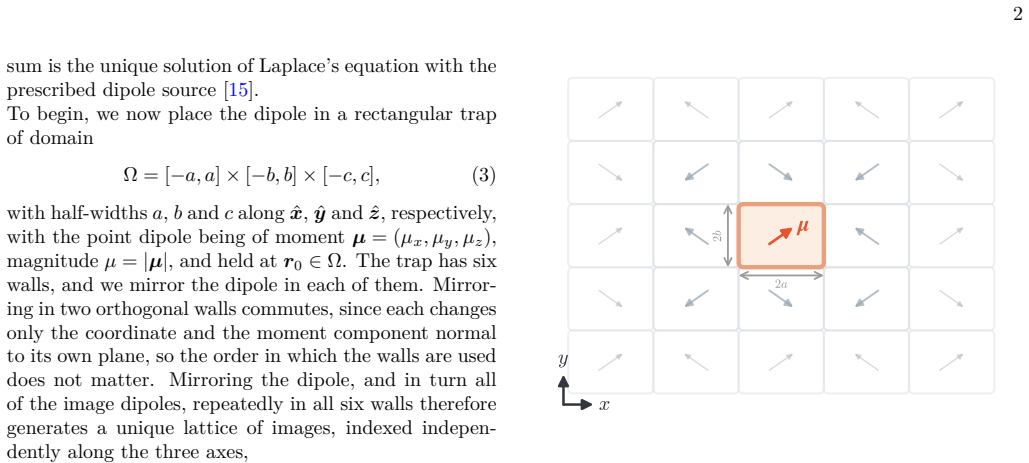
Dipole aligns with short axis in cuboidal superconductor trap

by Francis J. Headley

Magnetic Dipole in a Cuboidal Superconducting Trap

Exact image lattice reduces energy to quadratic form in Epstein-zeta sums, with alignment holding over finite aspect-ratio ranges.

Figure from the paper full image
abstract click to expand
We derive the exact image-dipole potential of a point dipole inside a closed cuboidal superconducting trap. The construction generalises the parallel-plate result to a geometry that confines every translational degree of freedom, and we prove that the image lattice satisfies the Meissner boundary condition on all six walls. For a centred dipole the orientational energy reduces to a diagonal quadratic form whose three coefficients are Epstein-zeta-type lattice sums. We show that in both the infinite and finite rectangular traps the dipole orientation aligns with the \emph{short} cross-sectional axis over a finite range of aspect ratios. The equilibrium orientation in both cases is described by a phase diagram whose degeneracies we classify. Every prediction is verified against finite-element solutions of the same boundary-value problem, with agreement better than $0.16\%$.
0
0
physics.soc-ph 2026-06-30

Collective decisions spark spontaneous migrant flow pulses

by Niraj Kushwaha, Woi Sok Oh +1 more

Pulses, waves, and cascades in collective migration dynamics

A minimal model shows how dependence on others produces fluctuations that mimic responses to disasters and conflicts.

Figure from the paper full image
abstract click to expand
Decisions to migrate depend on others' decisions. Dependence can produce nontrivial dynamics. We propose a minimal migration model that accounts for social influence alongside individual heterogeneity in mobility as migrants move from region to region. In special locations of parameter space, migrant flows dramatically and spontaneously fluctuate. Such aspects mimic observed fluctuations in migration statistics and thus show how large fluctuations in data can reflect more than response to events like armed conflict and natural disasters. Correspondingly, the impact of exogenous factors can be confounded with the results of collective decisions.
0
0
cond-mat.mes-hall 2026-06-30

Fabrication process yields 30% Au/graphene platelets in suspension

by Sunghyun Kim, Joyce E. Coppock +1 more

Microfabricated Au and Au/graphene bilayer platelets for levitation experiments

HF etching and cleaning produce minimal aggregation for levitation and nanostructure applications

Figure from the paper full image
abstract click to expand
We describe a fabrication process for preparing liquid suspensions of micron-scale Au and Au/graphene bilayer platelets using thin-film deposition, optical lithography, ion milling, hydrofluoric acid (HF) substrate etching, and release from the substrate into a liquid suspension. Residual HF is removed through repeated centrifugation, decanting, and dilution cycles. The resulting suspension is characterized by electrospray deposition onto a secondary substrate, followed by electron and atomic force microscopy. The deposited platelets exhibit minimal aggregation, and the overall platelet yield reaches up to 30% of the platelets originally patterned on the wafer. Lateral force microscopy further confirms that the Au/graphene bilayer remains intact throughout fabrication, release, and electrospray deposition. This process provides a practical route for preparing high-quality platelet suspensions for levitated nanoparticle experiments and other applications requiring suspensions of two-dimensional nanostructures.
0
0
cond-mat.soft 2026-06-30

Friction slope at chemical edge sets tactile accuracy

by Kayla A. Hepler, Leanne Ton +1 more

Role of Single Chemical Heterogeneities in Generating Anisotropic Tactile Sensitivity and Soft Sliding Friction Phenomena

Soft-probe tests show humans detect a boundary better in the direction where friction force changes sharply rather than where materials diff

abstract click to expand
Physical heterogeneities in the context of sliding friction, such as a human finger exploring an object, have been well studied, yet the behavior of chemical heterogeneities in mesoscale soft sliding remains underexplored, despite the similar prevalence of chemical and physical variations in real systems. Here, we experimentally characterized the friction of a planar soft elastic probe sliding across a single chemical heterogeneity that was formed at the interface of two silanes on silicon wafers. By constructing phase maps across multiple loads and velocities, we quantified the occurrence of several frictional phenomena at and around the chemical edge, including stiction spike formation, edge slope direction, baseline shifts, and baseline drift, and quantified their sliding direction-dependent formation. We found that chemical heterogeneities made by more disparate materials (butyl- and aminopropyl-terminated) exhibited several phenomena that were more often direction-independent compared to chemical heterogeneities formed from more similar materials (butyl- and hexyl-terminated). We attributed this directional asymmetry to elastic body effects. In subsequent human testing (n=36), we observed that humans also exhibited directional-dependent accuracy (66.7% versus 38.9%) on one pair (butyl- and hexyl-terminated) but not the other (77.8% versus 75%), which in the context of our phase maps, suggests that the slope of the friction force when sliding over a chemical edge is important for generating a clear edge of a tactile feature, rather than the differences in simple material properties or other friction phenomena.
0
0
physics.app-ph 2026-06-30

Collective PV sharing cuts needed capacity and raises savings

by Ana B. Cristóbal (0000-0002-4314-6160), Daniel Sierra +3 more

Decision-support strategies for photovoltaic self-consumption under declining electricity prices and limited remuneration of surplus generation

In tests with 24 rural users, internal coordination matched subsidies for investment under falling prices and low surplus pay.

abstract click to expand
The success of distributed photovoltaics may be undermining its own future. As solar penetration increases, electricity prices decline during periods of peak generation, reducing the value of surplus photovoltaic production. This raises a critical question: can citizen-led energy systems remain economically viable in electricity markets dominated by renewable generation? Rather than exploring technically optimal but institutionally unrealistic solutions, we examine the options available under current regulatory and market conditions. Using high-resolution consumption data from a rural community sharing a PV facility among 24 users, we identify pathways for long-term sustainability. The study makes two contributions. First, it shows that effective internal coordination can mobilize participation and investment as successfully as external subsidies. Second, it compares static, dynamic, and hybrid energy-sharing models, with and without storage, providing a flexible framework that balances efficiency, fairness, and governance. Results show that collective self-consumption reduces required PV capacity, lowers investment costs, and increases annual savings compared with individually operated systems. Alternative allocation schemes further improve benefit distribution and local electricity use, although gains depend on trade-offs between efficiency, fairness, and governance complexity. Under current electricity prices and remuneration schemes, battery storage provides limited additional economic value and becomes attractive only under specific market conditions. Overall, the long-term viability of citizen-led photovoltaic initiatives depends less on technological sophistication than on collective coordination and adaptive governance.
0
0
physics.app-ph 2026-06-30

TDA extracts phase from saturated light scattering

by Timothy Holt, Maxim Goryachev +1 more

Probing Light-Matter Interaction with Topological Data Analysis

Scattering data analysis reveals symmetry classes and degrees of freedom without clean peaks or undistorted lineshapes.

Figure from the paper full image
abstract click to expand
We explore application of Topological Data Analysis to study light matter interaction through scattering response data in different dimensions. This method is robust against Fano resonance backgrounds in both strong and weak coupling regimes, maintaining accuracy even with reduced mode contrast, distorted lineshape, and the introduction of random trace noise. It scales to any number of interacting modes, reflecting the system's effective degrees of freedom. Crucially, TDA is not merely peak counting but reveals phase-encoded features in the scattering response and may be used even for a fully saturated amplitude response. The analysis is also applied to a three mode system with time reversal symmetry breaking, revealing change in apparent number of loops and voids in combined two way scattering data. This approach is demonstrated to differentiate the three Dyson ensembles through their topological complexity and probability density functions, enabling analysis of complex modal systems.
0
0
physics.optics 2026-06-30

Hysteresis tunes exceptional points for 8% spectral shifts in VO2 metastack

by Ryan Hogan, Zihan Lu +5 more

Dynamic Topological Light Control in Reconfigurable Non-Hermitian Metastacks

Path-dependent EPs in a simple planar stack deliver reversible modulation without lithography

Figure from the paper full image
abstract click to expand
Metasurfaces often require complex lithography for dynamic optical control. To overcome this, we utilize a lithography-free, non-Hermitian planar metastack comprising a distributed Bragg reflector and a vanadium dioxide (VO2) thin film. By virtue of temperature and thermal hysteresis as an active synthetic dimension and exploiting the VO2 insulator-to-metal transition, we actively tune topological interface states to achieve polarization-sensitive spectral control. Notably, our system hosts path-dependent exceptional points (EPs); the intermediate hysteretic states generate a continuum of hot and cold EP pairs that ultimately converge into a single, degenerate EP. Furthermore, we experimentally observe wide-range dynamic optical control, comprising reversible 8% spectral shifts with near-unity reflectance modulation, alongside potential for ultrafast dynamics. Ultimately, our CMOS-compatible design provides a scalable, simple platform for active and topological photonics.
0
0
physics.app-ph 2026-06-30

Electrical outputs realized for spin-wave Rowland circle spectrometer

by Johannes Greil, Maximilian Hofschen +4 more

Design and Realization of Broadband Magnonic Spectrometers With Local Electrical Outputs

Micrometer concave gratings in YIG deflect waves by frequency for local detection, matching predictions.

Figure from the paper full image
abstract click to expand
Microscopic radio-frequency (RF) devices based on propagating spin waves (SWs) are promising for compact, energy-efficient RF signal processing, but their implementation is impeded by fabrication complexity and the lack of efficient electrical readout. In this work, we demonstrate a SW-based Rowland circle spectrometer with electrical input and local electrical output transducers. The device is realized using a scalable fabrication process based on sputter deposition and wet-chemical etching of Yttrium-Iron-Garnet (YIG), forming concave grating structures with micrometer-scale features. The device functionality is confirmed by combined electrical and magneto-optical measurements, which show that the deflection of SW wavefronts at different input frequencies closely follows the analytically predicted behavior. The linear excitation of SWs via two input tones further confirms the spectrometer operation for simultaneously propagating waves. Beyond the single-device demonstration, we propose a concept for scalable architectures comprising multiple Rowland circles with tunable operating points. When combined with broadband parallel electrical readout, this approach enables control over bandwidth and spectral resolution, which are relevant to spectral occupancy detection in wireless communication systems.
0
0
cond-mat.mtrl-sci 2026-06-30

Amorphous carbon reaches k=1.35 at 0.8 nm thickness

by Chee-Tat Toh, Artem K. Grebenko +18 more

Atomically Thin Amorphous Carbon with an Ultralow Dielectric Constant

Single layers also block metal ions for 10^10 seconds, removing the need for extra barrier films near 10 nm lines.

Figure from the paper full image
abstract click to expand
Two-dimensional (2D) materials exhibit excellent properties at monolayer thickness and are viable replacements for various microelectronic components as scaling gradually approaches the atomic limit. Despite significant advancements in the ongoing 2D revolution of integrated circuits, one crucial building block, namely a 2D ultralow-k (ULK) dielectric, remains unreported. The challenge lies in achieving a dielectric constant less than 3, as traditional low-k dielectrics are inherently unstable at the 2D limit due to their amorphous or porous nature. The realisation of ultrathin dielectrics with low-k is also needed to address current bottlenecks in integrated circuits scaling. Specifically, low-k materials are necessary to minimise parasitic capacitances as the distance between conductive elements shrinks below 10 nm. Moreover, advanced architectures like gate-all-around field effect transistors (GAA FET) require even lower dielectric constants (k<2) at sub-3nm thickness. Here, we show that layer-by-layer grown multilayer amorphous carbon (ML-AC), as thin as 0.8 nm, is a mechanically robust 2D ULK dielectric with k of 1.35 and dielectric strength of 28-31 MV cm-1. The lack of any long-range order, its intrinsic 2D nature, sp2 carbon character and low density are all essential for minimising dielectric permittivity. Moreover, ML-AC overcomes the vulnerability of existing dielectrics to ion diffusion degradation with a record metal ion diffusion time to failure (TTF) of 10^10 s for even a single layer. Therefore, otherwise necessary additional layers occupying up to 3 nm can be eliminated, which is especially significant as metal line widths approach 10 nm. Combined with its low-temperature, direct and conformal growth even on a dielectric, these critical features enable substantial improvements in silicon-based semiconductor electronics and ensure compatibility with future 2D electronics.
0
0
physics.app-ph 2026-06-29

DDA-Scott snow model matches sub-THz data to 2.5 dB/km

by Kefeng Huang, Jiabiao Zhao +9 more

Sub-Terahertz Channel Performance under Snowfall

Derived compact expression reproduces reference over 100-500 GHz and 0-3 mm/h rates; Mie spheres overestimate tolerable snowfall by factor 3

abstract click to expand
The terahertz (THz) band promises terabit-per-second links but is highly sensitive to snowfall. Natural snowflakes are non-spherical. Yet existing THz studies treat them as spheres under Mie theory, and no ITU-R model covers THz snow attenuation. This work combines line-of-sight measurements at 120, 140, and 160 GHz with physics-based scattering modeling. The measured loss is compared against the ITU-R P.1817-1 optical model, Mie models, and a discrete dipole approximation (DDA) for randomly oriented hexagonal-plate ice crystals, each with the Scott and Gunn-Marshall size distributions. Over the measured band, ITU-R P.1817-1 overestimates and the Mie models underestimate the loss. The shape-aware DDA-Scott model agrees best, with the lowest RMSE at every frequency. From DDA-Scott, we derive a compact modified ITU-R expression in carrier frequency and liquid-water-equivalent (LWE) rate. It reproduces the reference to within 2.5 dB/km over 100-500 GHz and 0-3 mm/h. A Rician K-factor analysis shows the channel stays LoS-dominated, so snowfall degrades the link mainly through attenuation, not multipath fading. A QPSK/16-QAM link-budget analysis then quantifies the cost of the spherical assumption. Mie-based margins overestimate the tolerable snowfall rate by 3.4 across 120-160 GHz, rising toward 5.8 in the upper transparency windows by model extrapolation. The model is further mapped into snow-limited range and adaptive-modulation switching boundaries. These results support future ITU-R recommendations for THz channels under snowfall.
0
0
cs.SD 2026-06-29

Session-grouped splits drop drone detection from 0.796 to 0.745

by David Shulman

EchoHawk: A Reproducible Acoustic Pipeline for Drone Detection, Classification, and Direction-Finding, with a Cautionary Study of Session-Level Data Leakage

Public acoustic datasets leak session information when clips are split randomly, inflating reported counter-drone performance.

Figure from the paper full image
abstract click to expand
Passive acoustic sensing is an attractive modality for counter-unmanned aerial system (counter-UAS) defence: it is covert, low-cost, and effective against drones with small radar cross-sections or minimal radio emissions. We present EchoHawk, an open and fully reproducible reference pipeline that detects a drone from its rotor harmonics, estimates its blade-passing frequency, and localises it with a microphone array via classical wideband beamforming (delay-and-sum, MVDR, MUSIC) and time-delay processing (GCC-PHAT, SRP-PHAT), followed by temporal tracking. We evaluate the system on a physically transparent synthetic benchmark that pits drones against hard low-frequency harmonic confusers, such as ground vehicles, and on real recorded audio. Our central methodological contribution is a documented case of session-level data leakage in a widely used public dataset: because its recordings are pre-segmented into short clips, naive clip-level splits place adjacent slices of the same continuous recording in both training and test sets, inflating reported performance. Enforcing recording-session-grouped cross-validation reduces, for example, a random-forest baseline's detection probability at a 1% false-alarm rate from 0.796 to 0.745, yielding honest numbers. All code, figures, and a synthetic data generator are released so that every result runs without any download.
0
0
cond-mat.soft 2026-06-29

Anchored magnetic bot chains buckle into sustained flagellar beating

by Francisca Guzmán-Lastra, Daniel Hernández +3 more

Emergence of beating in a magnetic flagellum consisting of active bots

Stress from self-propulsion overcomes dipole stiffness, producing Hopf-bifurcation oscillations in macroscopic chains.

Figure from the paper full image
abstract click to expand
We investigate the emergence of flagellar beating in chains of magnetic self--propelled particles (MSPPs) built from centimeter--scale vibrating robots (Hexbugs) with embedded neodymium dipoles. When one end of the chain is anchored and self--propulsion is activated, longitudinal stress accumulates along the chain until it overcomes the magnetic bending stiffness, triggering a buckling instability that drives sustained flagellar beating. Using a combination of experiments and numerical simulations, we identify three distinct dynamical regimes straight chain, stable flagellar beating, and fission governed by the competition between active force, chain length, and magnetic bending stiffness. The onset of beating requires a seed misalignment set by the balance between magnetic torques and rotational noise, and we show that the transition corresponds to a supercritical Hopf bifurcation. A kinematic model reproduces the observed orientation dynamics with excellent agreement. The magnetic bending stiffness, which arises directly from dipole--dipole interactions, is fully tunable via dipole strength and chain length, offering independent experimental control over both activity and rigidity. Our results establish a macroscopic platform for studying force-induced buckling and self--oscillations in active filaments, with direct connections to flagellar motion in biological and synthetic microswimmers.
0
0
cond-mat.mtrl-sci 2026-06-29

Harmonic current yields stress spectrum that encodes electrode couplings

by Junning Jiao, Juner Zhu

Multiphysical impedance spectroscopy of porous electrodes based on linear irreversible thermodynamics

MEIS factorizes impedance into chemical accumulation times chemo-mechanical and poro-mechanical kernels derived from microstructural free en

Figure from the paper full image
abstract click to expand
Porous electrodes couple electrical, chemical, mechanical, hydraulic, and thermal fields, yet conventional frequency-domain diagnostics interrogate only one of them: electrochemical impedance spectroscopy (EIS) the electrical response and dynamic mechanical analysis (DMA) the mechanical. Each reads a diagonal entry of the multiphysical constitutive matrix and is blind to the cross-couplings that govern structural evolution and degradation. Starting from linear irreversible thermodynamics, we formulate a general theory of multiphysical impedance spectroscopy, in which perturbing one field and measuring the conjugate response of another probes an off-diagonal entry of the constitutive matrix, recovering the static coupling coefficient and resolving its relaxation dynamics across frequency. Specializing to the electro-chemo-mechanical pathway yields a closed-form theory of mechano-electrochemical impedance spectroscopy (MEIS), in which a small harmonic current is applied and the stack stress is measured; the impedance factorizes into a chemical-accumulation term multiplying the sum of a chemo-mechanical and a poro-mechanical kernel. The porosity-accommodation bridge function is derived from a Helmholtz free energy -- following from a microstructural stiffness and viscosity rather than a fitted form -- and a three-phase (solid-fluid-void) closure interpolates continuously between unsaturated and Biot-saturated limits through a void-accommodation fraction. Non-dimensionalization reduces the spectrum to five groups, identifies the phase angle as the discriminator of the chemo-mechanical parameters, and locates the onset of second-quadrant behavior, which in a full cell arises from the competition between an expanding and a contracting electrode. MEIS emerges as one member of a family of cross-coupled spectroscopies the same framework brings within reach.
0
0
physics.app-ph 2026-06-29

Deep etch lifts β-Ga₂O₃ diode breakdown from 287 V to 500 V

by Saleh Ahmed Khan, Ahmed Ibreljic +1 more

Vertical β-Ga₂O₃ Schottky Diodes with Deep-Etch Field Termination using Plasma-free Ga-assisted Etching

Ga-assisted plasma-free mesas redistribute electric fields while keeping forward conduction identical to planar devices.

Figure from the paper full image
abstract click to expand
A deep-etch field termination strategy using a Ga-assisted plasma-free etching technique in a low-pressure chemical vapor deposition (LPCVD) system is demonstrated for $\beta$-Ga$_2$O$_3$ Schottky barrier diodes (SBDs). The thermally activated etching method provides a plasma-free approach for forming deep mesa terminations while maintaining excellent device integrity. The fabricated diodes exhibit excellent forward conduction characteristics with a turn-on voltage of 1.14~V, a Schottky barrier height (SBH) of 1.15~eV, an ideality factor of 1.20, and a specific on-resistance of 3.72~m$\Omega\cdot$cm$^2$, all closely matching those of the unetched planar devices. Capacitance-voltage analysis further confirms a uniform carrier concentration of $2\times10^{16}$~cm$^{-3}$ and an SBH of 1.23~eV, indicating stable electrical characteristics after deep mesa formation. Temperature-dependent electrical measurements from 25 to 250$^\circ$C demonstrate stable thermionic-emission transport behavior, with a gradual increase in on-resistance at elevated temperatures due to phonon-limited carrier mobility. Over this temperature range, the SBH decreases from 1.16 to 1.12~eV, while the ideality factor increases from 1.21 to 1.33. The leakage current remains low throughout the entire temperature range, and the rectification ratio remains above $10^{5}$ even at 250$^\circ$C. Under reverse bias, the diodes exhibit an increase in breakdown voltage from 287V to 500V, confirming the effectiveness of geometric electric-field redistribution achieved by the deep-etched mesa structure. Silvaco TCAD simulations corroborate these experimental observations by showing significant suppression of electric-field crowding near the anode edge. These results establish Ga-assisted plasma-free etching as a reliable, damage-free field termination technique for high-performance $\beta$-Ga$_2$O$_3$ power devices.
0
0
cond-mat.mtrl-sci 2026-06-29

CISS matches on MBE and sputtered films but MIPAC magnetism only in sputtered ones

by Lokesh Rasabathina, Thi Ngoc Ha Nguyen +13 more

Microscopic and macroscopic characterization: MBE-grown versus sputter-deposited Au/Co/Au thin films for CISS and MIPAC effect studies

Microscopic spin selectivity holds on both while macroscopic magnetic shifts after peptide exposure track deposition microstructure

Figure from the paper full image
abstract click to expand
Chirality-induced spin selectivity (CISS) enables spin-dependent transport at chiral molecule/Au(111) interfaces and is used in spintronics when combined with ferromagnetic thin films in spin-valve-type hybrids. However, the influence of substrate microstructure on CISS and the related magnetization induced by the proximity of adsorbed chiral molecules (MIPAC) effect is still not well understood. In this study, we compare the effects of the adsorption of L-chiral alpha-helical alanine-rich peptides on Au/Co/Au ferromagnetic thin films fabricated by molecular beam epitaxy (MBE) and magnetron sputtering. X-ray reflectivity and X-ray diffraction show sharper interfaces and a narrower Au(111) rocking-curve width for the MBE-grown sample. However, atomic force microscopy and scanning tunneling microscopy images reveal that both sample types have locally smooth Au(111) surface regions suitable for peptide adsorption, despite clear differences in larger-scale morphology. Microscopic scanning tunneling spectroscopy after peptide exposure yields similar magnetization-direction-dependent tunneling currents in both sample types, confirming a similar magnitude CISS effect on the molecular scale. In contrast, macroscopic magneto-optical Kerr effect hysteresis loops and effect microscopy reveals that only sputter-deposited samples show slight coercivity enhancements and a consistent reduction in domain wall velocity after peptide exposure. These results suggest that microscopic CISS signatures are robust for both sample types, whereas macroscopic MIPAC-type magnetic responses are more sensitive to the substrate microstructure.
0
0
physics.optics 2026-06-29

Double-slit fringes captured directly in momentum space

by Fugui Yang, Xiaoxiao Liang +2 more

Direct Observation of X-ray Double-Slit Interference in Momentum Space

Crystal diffraction projects X-ray interference pattern right after aperture for compact coherence checks without propagation.

Figure from the paper full image
abstract click to expand
Young's double-slit experiment is conventionally deemed a spatial phenomenon emerging from free-space transport. In this Letter, we invert this perspective to demonstrate that Young's interference can be accessed directly as a pure momentum-space observable. Using a perfect-crystal diffraction to project the field's reciprocal-space profile immediately downstream of the aperture, we resolve the complete hard X-ray double-slit fringe structure without any propagation arm, focusing optics, or imaging detector. This direct capture of the field's invariant momentum marginal establishes a compact, lensless, and propagation-free approach to coherence diagnostics, proving that the fundamental physics of wave interference can be detached from real-space propagation.
1 0
0
cond-mat.mtrl-sci 2026-06-29

Dipole glass delivers 211 J/cm³ at 4 K in thin films

by Yangyang Si, Denan Li +22 more

Unlocking Cryogenic Energy Storage by Constructing Dipole Glass with Unit-cell-level Polar Disorder

Unit-cell polar disorder near the antiferroelectric boundary cuts hysteresis losses to below 12 percent even at liquid-helium temperatures.

abstract click to expand
Cryogenic energy storage is vital for frontier technologies including deep-space exploration and quantum computing, yet conventional electrochemical energy systems fail below ~230 K due to frozen ion migration. While relaxor-based dielectric capacitors provide high efficiency at room temperature, the intrinsic freezing/growth of polar nanodomains at extended cryogenic regime limits their applications with deteriorated hysteresis losses. Here, we realize superior cryogenic energy-storage performance by designing unit-cell-level disordered dipole-glass state in Pb0.6Sr0.4ZrO3 thin films with composition near antiferroelectric-paraelectric phase boundary. The antiferroelectric-derived dipole-glass introduces enhanced unit-cell-level complexity of dipole interaction that suppresses long-range ferroelectric order. This enables ultralow-hysteresis operation (efficiency > 88%) down to 4 K, delivering record-high energy density (211 J/cm^3) at 9 MV/cm, stability over 10^8 charge/discharge cycles and microsecond-scale charge/discharge capability. This work establishes a dipole-glass paradigm for cryogenic dielectric capacitors, opening a new avenue to highly-efficient energy-storage systems with broad applications in frontier nanoelectronics.
0
0
quant-ph 2026-06-29

Thousands of foundry quantum dots hit quantum computing benchmarks

by Hêlio Huet, Hubert Lam +46 more

Industry-ready spin-photon interfaces for hybrid photonic quantum computing

Pilot-line devices deliver near-unity purity, record Wigner negativity, and seven-partite entanglement with microsecond spin coherence.

Figure from the paper full image
abstract click to expand
Hybrid photonic quantum computers, combining stationary matter qubits and flying photonic qubits, offer an intrinsically networked and resource-efficient route to large-scale, error-corrected quantum computation. Their core components are cavity-coupled matter qubits that act as light--matter interfaces, enabling: high-efficiency on-demand single-photon generation, stable near-unity photon indistinguishability and spin--multi-photon entanglement. Semiconductor quantum dots in microcavities are a leading platform for realizing such devices. Yet reaching the performance, reproducibility and spin-coherence thresholds for large-scale error correction remains a major challenge requiring industrial fabrication and control. Here we report thousands of monolithic semiconductor quantum-dot devices fabricated using a III--V pilot production-line process compatible with large-scale deployment. Systematic control of source parameters yields state-of-the-art efficiency and supports a path to optical losses below fault-tolerance thresholds. Using field-quadrature state reconstruction as a stringent joint test of efficiency and indistinguishability, we observe near-unity photon quantum purity stable over tens of minutes and a record single-photon Wigner-function negativity. We further demonstrate seven-partite spin--multi-photon entanglement and spin coherence extendable to microsecond timescales in the low-magnetic-field regime. Finally, photons from distant sources are as indistinguishable as photons emitted successively by a single source. These results establish foundry-compatible III--V quantum dots as a scalable platform for hybrid photonic quantum computing.
0
0
physics.flu-dyn 2026-06-29

Off-center laser on particle drives one-way microscale flow

by Tetsuro Tsuji, Shota Suzuki +3 more

Optothermal Actuation of Unidirectional Thermo-osmotic Flows

Asymmetric heating controls thermo-osmotic flows through changes in salt concentration and surface chemistry.

Figure from the paper full image
abstract click to expand
In this paper, we experimentally demonstrate the microscale direction control of thermoosmotic flows using a focused-laser heating. The key is the off-center laser irradiation on an immobilized light-absorbing microparticle, which generates a nonuniform, asymmetric heat source. The resulting thermo-osmotic flows are evaluated using the optically trapped particle tracking velocimetry (ot-PTV), presented in our preceding paper (T. Tsuji, et al., Physical Review Fluids 11, 034901 (2026)). It is shown that the flow characteristics can be modulated by the ionic strength of a sample solution and/or the surface molecular coating of the substrate. In particular, the significance of ionic strength on thermo-osmotic flows are discussed based on the surface potential of the substrate measured by frequency-modulated atomic force microscopy.
0
0
cond-mat.mtrl-sci 2026-06-26

3D imaging reveals barrel-shaped skyrmion tubes with twisted helicity

by I. Binnie, H. Fang +17 more

3D Imaging of Complex Skyrmion and Hopf Topologies in an Extended Sample

First full-volume reconstruction shows depth-dependent domain walls and fractional Hopf index of 0.3 in Fe/Gd films.

Figure from the paper full image
abstract click to expand
Spin textures are key for emergent magnetic phenomena such as topological protection and underpin novel spintronic device paradigms based on racetrack memory, logic gates, and neuromorphic computing. Using a coherent diffractive imaging technique called vector ptycho-tomography, in combination with algorithms that are robust to noise, we image the 3D magnetic texture of skyrmion and Hopf topologies with no prior assumptions about the sample. This directly reveals experimentally for the first time an extended 3D skyrmion lattice, including the domain wall shape, topological charge, helicity, and Hopf index. Our findings demonstrate experimentally that dipole stabilized skyrmions in Fe/Gd multilayers exhibit barrel-shaped skyrmion tubes with a twisted helicity, transitioning from N$\'e$el-type winding at the surfaces to both clockwise and counterclockwise Bloch-type winding in the bulk, that can also be described as fractional hopfions. We image a lattice of 24 skyrmions with topological charge 1, average depth-dependent domain wall width of 23 to 40 nm, depth-dependent twisted helicity from $\pm$155$\deg$ to $\pm$30$\deg$, and fractional Hopf index of $\pm$0.3. Over 10 TB of data were analyzed to yield a fully-resolved 3D reconstruction over a >0.4 $\mu$m$^3$ volume, with high fidelity down to the Nyquist limit of 8 nm. This method fills a key gap in the current landscape of magnetic imaging by enabling high-resolution, element-specific 3D reconstructions of full-field extended spin textures - offering a new route for exploring the topological complexity of magnetic materials in three dimensions.
0
0
physics.flu-dyn 2026-06-26

Non-resonant acoustic streaming unpinns trapped oil droplets

by D. Tsiklauri

Unpinning of trapped oil droplets via non-resonant acoustic streaming in capillary tubes

Model shows bulk force from attenuated waves overcomes pinning when absorption length equals half the distance to the droplet.

Figure from the paper full image
abstract click to expand
We establish a self-consistent analytical model demonstrating that trapped non-wetting liquid phases in narrow capillary channels can be successfully unpinned via non-resonant, second-order acoustic streaming (acoustic wind) coupled with background static drive gradients. Moving away from boundary-guided or resonant mechanisms, our approach exploits the bulk acoustic-wind force density generated by the steady-state momentum flux of attenuated first-order linear wave interactions. By expanding the hydrodynamic equations up to second order, we determine the critical assisted acoustic wave amplitude required to break capillary pinning thresholds and derive an explicit formulation for steady transport velocity under viscous wall constraints. Furthermore, incorporating both boundary-layer wall effects and bulk core thermo-viscous dissipation reveals a natural mathematical optimum condition where the spatial absorption coefficient matches half the inverse distance to the target droplet ($\alpha = 1/2x_0$). This condition is then numerically validated and cross-correlated against legacy industrial frequency baselines, providing a fundamental theoretical framework for minimizing transducer power requirements while maximizing localized mobilization velocities in geological pore networks. Finally, we demonstrate that this optimal operational frequency scales inversely with the transmission distance, providing an analytical framework to optimize downhole acoustic tools according to the spatial damping constraints of the specific formation rather than relying on rigid hardware parameters.
0
0
cond-mat.supr-con 2026-06-26

Heaters and moats clear trapped flux in superconducting circuits

by Rohan T. Kapur, Alex Wynn +11 more

Elimination of Flux Trapping in Superconducting Circuits in Ambient Magnetic Fields

Removes vortices from field cooling and operation up to 60 μT, enabling large-scale use with basic shielding.

Figure from the paper full image
abstract click to expand
Superconductor digital electronics and quantum computing with superconducting qubits are promising next-generation computing technologies. When cooled down or operated in the presence of a nonzero background magnetic field $B_r$, superconducting thin films comprising the circuits can trap magnetic vortices that can degrade circuit or qubit performance. In this work, we report a practical solution for eliminating flux trapped during cooldown in ambient magnetic fields, $B_r\leq 60$ $\upmu$T, based on controlled local thermal gradients and moats, etched holes in the superconducting films of the circuit. Thermal gradients created by integrated on-chip resistive heaters move vortices towards the moats, where they become trapped away from circuitry regions and pinning sites. Using magnetic imaging and electrical circuit readout, we demonstrate that this approach is capable of removing magnetic flux trapped during field cooling and magnetic flux nucleated by circuit operation. If used in an environment with basic magnetic shielding, this solution is capable of suppressing all magnetic flux in a large-scale circuit, overcoming one of the long-standing challenges preventing high-performance scalable computing using superconductors.
0
0
cond-mat.soft 2026-06-26

Vapor-guided droplets align nanowires to boost transistor current 40%

by Robert Malinowski, Alessandro Rossi +9 more

Organic Semiconductor Alignment via Confinement in Vapor-Guided Droplets

Internal flows in confined microliter droplets yield directionally ordered films on curved surfaces as well.

Figure from the paper full image
abstract click to expand
Organic semiconductors are lightweight, solution-processable materials with strong potential for printed and flexible electronics, from deformable displays to wearable sensors. Despite significant advances in materials synthesis and manufacturing, controlling molecular and mesoscale alignment during deposition remains a central challenge, as film morphology critically governs charge transport and device performance. Here, we demonstrate that flows developing within the intrinsically confined volume of microliter vapor-guided droplets can be harnessed to produce highly aligned organic semiconductor films. As droplets move in response to an external vapor source, internal flows align organic semiconducting nanowires within the droplet prior to deposition, yielding films with pronounced directional order. Organic field-effect transistors fabricated with this approach exhibit approximately 40% enhancement in saturation current relative to spin-coated controls. Beyond improved device performance, the contactless and compact nature of our method enables the deposition and alignment of organic semiconductors on curved and flexible surfaces. More broadly, vapor-guided droplets offer a scalable framework for the confinement-induced alignment of functional soft materials, with potential for integration into existing additive manufacturing platforms for flexible electronics and beyond.
0
0
physics.optics 2026-06-26

Neural networks recover modal coefficients for target near-fields

by Wannes Luts De Martelaere, Joeri Lenaerts +1 more

Neural Networks for Inverse Design of Cascaded-Mode Near-Field Landscapes

Trained models turn gradient optimization into a practical tool for designing longitudinal and lateral field profiles inside multimode waveg

Figure from the paper full image
abstract click to expand
Structuring optical near-fields is important for applications in microscopy and nanoparticle manipulation. Traditionally, near-fields are structured using antenna nanostructures that locally convert propagating far-fields into bound near-fields. Recently, a remote structuring approach was proposed using cascaded mode interference in a multimode waveguide. However, determining the complex coefficients of the optimal modal combination needed to obtain specific near-fields remains a challenge. We address this inverse design problem using artificial neural networks. We model the relationship between the design parameters and near-field landscapes using multilayer neural networks. After training, these networks are used for gradient-based optimization to reconstruct target near-field profiles. We implement this methodology to design longitudinal and lateral field variations. Our approach designs simple and complex longitudinal landscapes, demonstrating accurate prediction and flexibility. Lateral field reconstruction is more challenging but improved with training data selection and augmentation. This work establishes deep learning as an efficient and scalable framework for cascaded-mode near-field inverse design.
0
0
cond-mat.mtrl-sci 2026-06-25

Strain activates altermagnetic spin torques in RuO2 films

by Qi Jia, Seung Gyo Jeong +11 more

Epitaxial Strain Activates Altermagnetic Spin-Splitting Torques in RuO2(100)

The symmetry-selected response is strongest under epitaxial strain and fades as films relax to bulk, unifying conflicting bulk and thin-film

Figure from the paper full image
abstract click to expand
The altermagnetic nature of rutile RuO2 remains under active debate: bulk measurements indicate a nearly nonmagnetic ground state, whereas thin-film studies have reported symmetry-dependent transport signatures consistent with altermagnetism. Here, we provide experimental evidence that altermagnetic spin splitting in RuO2 is a strain-stabilized emergent state rather than an intrinsic bulk property. Angular-resolved spin-torque measurements reveal a symmetry-selected spin Hall response characteristic of altermagnetic spin splitting, which is strongest in the strained regime but progressively suppressed as the lattice relaxes toward the bulk limit. Complementary magnetic measurements further reveal enhanced coercivity and exchange-bias behavior exclusively in strained films, indicating the emergence of a strain-stabilized magnetic state. First-principles calculations reproduce the strain-dependent evolution of the Neel order and spin-split electronic structure, supporting the experimental observations. Together, these results establish altermagnetic spin splitting in RuO2 as a strain-stabilized emergent state and provide a unified explanation for the long-standing discrepancy between bulk and thin-film observations.
0
0
cs.RO 2026-06-25

Quantum drones recover magnetic rubble maps in 100 samples

by Samuel Tovey, Stefan Prestel +1 more

From Rubble Simulation to Active Magnetic Mapping: Quantum Sensing for Disaster Response

Simulation shows sub-nT signals detectable 1m above collapsed parking garages for structural analysis.

Figure from the paper full image
abstract click to expand
Locating survivors of building collapses within the first 72 hours is a critical challenge in disaster response, and existing sensing modalities provide only partial information about the structure beneath the rubble. This paper proposes drone-based quantum magnetometry as a complementary modality and develops a simulation pipeline spanning rubble physics, sensor-array deployment, and active spatial reconstruction. We use Unreal Engine to generate a steel-reinforced concrete parking-garage collapse and compute the induced magnetic field via a per-triangle dipole approximation, establishing that meaningful magnetic structure is recoverable in the sub-pT to sub-nT range from roughly 1 m above the roofline. Then, we feed sparse multi-sensor samples into a Gaussian Process Regression back-end driven by Bayesian active sampling and validate the pipeline across multiple independent collapse realizations; a three-sensor array optimizes the trade-off between gradient resolution and UAV payload constraints, and active sampling reaches peak structural correlation in roughly $100$ samples. Together, these results indicate that quantum-grade sensing could become a useful tool for drone-based structural analysis and potentially void detection in collapsed buildings.
0
0
cond-mat.mtrl-sci 2026-06-25

Sintering route yields TiO2 pellets with loss tangent 0.006 at THz

by Djihad Amina Djemmah, Delphine Gourdonnaud +4 more

Impact of sintering conditions on the dielectric properties of TiO2 ceramics for metamaterialsapplications at terahertz frequencies

Permittivity reaches 103, satisfying the thresholds for all-dielectric metamaterials with negative or near-zero index.

Figure from the paper full image
abstract click to expand
Titanium dioxyde (TiO2) is a promising dielectric material for the realization of metamaterials operating in the terahertz (THz) range. Indeed, these necessitate a high permittivity and low loss material. In this paper, we compare the processes of fabrication and the results of characterisation of bulk TiO2 pellets. From the results of this characterization, we have numerically designed 2D all dielectric metamaterials (ADM) showing that they may exhibit negative or near-zero effective index. Our previous simulations show that the relative permittivity epsilon has to be around 100, while the loss tangent has to be lower than 0.02. We have thus compared conventional sintering (CS) vs spark plasma sintering (SPS), and investigated the effect of post-sintering annealing on the loss to satisfy these two criteria. The samples were characterized by THz Time Domain Spectroscopy (THz-TDS). One of the samples exhibits a loss tangent as low as 0.006, with a permittivity epsilon = 103. These results highlight the importance of the fabrication process on the EM properties of bulk TiO2, and demonstrate that it is a promising material for the development of metamaterial in the THz band.
0
0
physics.optics 2026-06-25

Hybrid CNN plus L-BFGS reaches 0.99 efficiency on wavefronts

by Y. Rodimkov, A. Kotov +5 more

Hybrid deep learning-based phase diversity method for wavefront reconstruction

Initial neural-network estimate refined by optimization yields Strehl ratio 0.96 in 2-4 steps on real laser distortions.

Figure from the paper full image
abstract click to expand
The efficiency of high-power laser systems is limited by wavefront distortions in the beam, particularly non-common path aberrations, which reduce the peak intensity at the focal plane. Compensating for these aberrations requires the calibration of the adaptive optics system. Conventional calibration methods rely on a time-consuming iterative optimization that is highly sensitive to initial conditions. While deep learning-based models offer high speed, they often demonstrate insufficient accuracy. In this work, we present a hybrid wavefront reconstruction method that combines a convolutional neural network to generate an initial estimate of the wavefront distortions, with the L-BFGS (Limited-memory Broyden-Fletcher-Goldfarb-Shanno) algorithm for its subsequent refinement. In numerical simulations, the method achieved an efficiency of $\sim 0.99$ in 80% of the cases for a root-mean-square (RMS) of wavefront distortions ranging from 0 to $1.3\lambda$. In a physical experiment, for initial wavefront distortions with RMS values from 0.15 to $0.6\lambda$, the method achieved an efficiency of $\sim 0.75$. As a result, focusing with a Strehl ratio of $0.96 \pm 0.02$ was attained within 2 to 4 iterations of the algorithm, confirming the applicability of the method for the fast and accurate calibration of adaptive optics systems under real experimental conditions.
0
0
physics.atom-ph 2026-06-25

Theory unifies collisions and stopping of fast particles in matter

by Francesc Salvat

Collisions and Stopping of Fast Charged Particles in Matter

Presents elastic, inelastic and dielectric models plus transport distributions for the intermediate-energy regime.

Figure from the paper full image
abstract click to expand
This text is intended to offer a consistent presentation of the theory of collisions and stopping of charged particles in matter, limited to the range of intermediate kinetic energies where atomic aggregation effects are relatively unimportant and processes such as the creation of particle-antiparticle pairs are not likely to occur. The first three Chapters contain introductory material on the classical description of electromagnetic fields in matter, an overview of quantum wave equations for a particle in a central potential, and an account of elementary atomic-structure models. Chapters 4 and 5 are devoted to the classical and quantum theories of elastic collisions of charged particles with atoms. The theory of inelastic collisions and stopping is split into two parts: first, collisions with atoms are considered within the plane-wave Born approximation in Chapter 6, which includes a derivation of the Bethe stopping power formula; second, the theory of inelastic collisions in dense materials is based on the dielectric formalism, which is formulated for the electron gas, and extended to arbitrary materials by means of optical-data models in Chapter 7. Chapter 8 offers a detailed review of the theory of stopping, starting with the classical study by Bohr and ending with derivations of the Bloch and Barkas corrections to the stopping power. Chapter 9 deals with general aspects of transport theory, including derivations of energy-straggling distributions and multiple-scattering distributions, which are the basis for condensed simulation schemes of charged particle transport. Finally, Chapter 10 describes the Fortran programs elastic and sbethe, which implement the main theoretical models presented in the preceding Chapters and are distributed as ancillary information.
0
0
quant-ph 2026-06-25

Source separation modulates single-photon states for free-space QKD

by Yu-Ming Bai, Yu-Xuan Liu +2 more

A Candidate Framework for Free-Space Quantum Key Distribution based on Geometrical-Configuration Modulation

A candidate framework correlates tunable photon-mode separation with far-field position to generate raw key data without polarization or tim

Figure from the paper full image
abstract click to expand
This paper proposes a candidate framework for free-space quantum key distribution (QKD) based on geometrical-configuration modulation (GM). In the minimal implementation considered here, Alice coherently splits a single photon emitted from one source into two spatial output modes with a tunable separation, and uses the source separation $R$ as the GM variable that defines the prepared single-photon spatial superposition state. Bob records the single-photon detection coordinate in the far field or Fourier plane, providing the correlated data used for soft-input information reconciliation. Based on this physical mechanism, we first establish an $R-x$ protocol model in which the source separation $R$ and the single-photon detection coordinate $x$ are random variables, and further propose an $R-\Delta x$ extension based on the difference variable $\Delta x$ between adjacent accepted detection events to mitigate slowly varying center drift in free-space links. The framework specifies state preparation, far-field conditional probabilities, soft-input information generation, parameter estimation, reconciliation, and asymptotic candidate key-rate formulas. A complete composable security analysis further requires derive an explicit computable upper bound on Eve's information from experimentally observed parameters, together with finite-key analysis and experimental validation under free-space conditions. The proposed candidate framework (GM-QKD) provides a modulation approach based on spatial degrees of freedom in which the source geometry serves as the modulation variable.
0
0
physics.flu-dyn 2026-06-25

Video time-of-arrival data predicts blast duration and impulse to 5% error

by Caio Barbosa Amorim, Clare Knock +2 more

A Novel Methodology for Evaluating Positive Phase Blast Wave Loading Parameters Using High Speed Video

A method extracts positive phase parameters from ta versus distance curves alone and matches pressure-gauge experiments for several ideal ex

Figure from the paper full image
abstract click to expand
Traditionally, the critical blast wave parameters used to characterize loading conditions are obtained through pressure gauge measurements. However, these instruments are costly, require careful calibration, provide discrete location measurements only, and must be deployed in hazardous environments. Recent events, such as the Beirut port explosion have demonstrated that video recordings, which provide time of arrival (ta) versus distance data, offers valuable information for post-event blast analysis. However, methodologies capable of predicting key blast parameters, such as positive phase duration and impulse, using video data alone remain limited. This work proposes and validates a novel methodology to predict positive phase duration and impulse for spherical, non-cased, free air bursts of ideal explosives using ta data only. The proposed methodology was evaluated using experimental datasets from the literature for bulk and cartridge PE4, PE7, Composition B, and PETN. The positive phase duration and impulse models achieved, respectively, mean absolute percentage errors of 5.3% and 5.3%, maximum deviations of 20% and 9.4%, absolute biases of zero and 3.1%, and confidence interval coverages of 86% and 83%. The predicted results achieve remarkable comparison to all reported experimental data, verifying the ability to capture positive phase blast loading for high speed video; a step-change in explosive characterisation through full spatial and temporal primary shock characteristics.
0
0
cond-mat.mtrl-sci 2026-06-25

Voltage rate programs resistance state and its lifetime in CuCrP2S6

by Suzanne Lancaster, Francesco Calavalle +9 more

Rate Programmable Ionic-Redox Switching with Tunable Volatility in CuCrP2S6

Faster sweeps create states that decay more slowly because the ions take longer to relax after the write step.

Figure from the paper full image
abstract click to expand
Metal thiophosphates are emerging as a multifunctional material platform for neuromorphic electronics due to their accessible polar phases and ion dynamics on biologically relevant timescales. While resistive switching in these materials is frequently attributed to ferroelectric or antiferroelectric polarization, the intrinsic role of ion dynamics remains underexplored. Here, we isolate and demonstrate purely ion-driven resistive switching in paraelectric CuCrP2S6. Robust and reproducible resistive switching is observed in the absence of measurable ferroelectricity. The conductance can be tuned through both voltage amplitude and sweep rate, revealing a rate dependence characteristic of ion dynamics. The resulting resistance states exhibit controllable volatility, where switching rate determines the decay time constant of the readout current, attributed to ionic relaxation. Using either inert or reactive electrodes, we observe electrical evidence of solid-state redox activity associated with the interfacial reduction of native Cu+ ions, enabling controlled formation of filamentary conduction pathways. Analysis of this process allows extraction of the Cu+ diffusion coefficient, providing quantitative insight into the underlying transport kinetics. The understanding of ionic-redox based resistive switching in CuCrP2S6 is crucial for unleashing its full potential as a material platform for dual- or multi-mode operation.
0
0
physics.app-ph 2026-06-25

Stress fields recovered from shear waves without material models

by Yiwei Duan, Michel Destrade +2 more

Direct stress imaging from shear wave propagation

Acoustoelastic Imaging inverts full waveform data to map stress magnitude and directions at sub-wavelength resolution in heterogeneous solid

Figure from the paper full image
abstract click to expand
Quantitative imaging of stress fields in heterogeneous solids remains challenging because stress is not directly measurable and is typically inferred from deformation using constitutive models. Here we present Acoustoelastic Imaging (AEI), a non-destructive framework for reconstructing stress fields from shear wave propagation. AEI exploits the acoustoelastic effect, whereby pre-existing stress modifies local wave dynamics, and formulates stress recovery as an inverse problem of the governing wave equations. Using full shear waveform inversion with physics-informed learning, AEI reconstructs wave-equation coefficients from full-field wave measurements, enabling estimation of stress magnitude and principal directions without explicit constitutive model specification or material-parameter calibration. We demonstrate sub-wavelength spatial resolution (< 0.28 {\lambda}) and accurate reconstruction of nonuniform stress fields in heterogeneous materials through numerical simulations and ultrasound shear wave elastography experiments. These results establish a general framework for high-resolution stress imaging and provide a route toward non-invasive mapping of internal mechanical states in complex materials and biological tissues.
0
0
physics.app-ph 2026-06-25

NV centers image magnetic fields at 7 GPa and 500 K

by Masahiro Ohkuma, Eikichi Kimura +8 more

Wide-field NV magnetometry under simultaneous high-pressure and high-temperature conditions

Optically detected resonance remains usable inside pressure cells, allowing stray-field maps of iron samples under combined extreme conditio

Figure from the paper full image
abstract click to expand
We demonstrate wide-field optically detected magnetic resonance (ODMR) under simultaneous high-pressure and high-temperature conditions using nitrogen-vacancy (NV) centers. Although NV-center magnetometry has been widely used for spatially resolved magnetic-field imaging, its application to extreme environments combining pressure and temperature remains challenging. In this work, we show that ODMR can be observed at 5 GPa and 500 K, demonstrating the feasibility of NV spin readout under such combined extreme conditions. We further perform wide-field ODMR of iron at 7 GPa and 500 K, where the stray magnetic field from the sample is spatially visualized through the pressure cell. These results establish NV-center magnetometry as a promising platform for imaging magnetic phenomena in materials under high-pressure and high-temperature environments.
0
0
physics.app-ph 2026-06-25

GaN efficiency gains appear only in select data center power stages

by Donald Intal, Abasifreke Ebong

GaN Power Devices and Converter Architectures for AI Data Centers: Efficiency, Reliability, and Deployment Pathways

Stage-specific device choices cut losses, cooling demand, and carbon output in AI facility power chains.

Figure from the paper full image
abstract click to expand
The growth of artificial-intelligence workloads is increasing the electrical and thermal demands on data-center power-delivery systems, making conversion efficiency, power density, and reliability critical design priorities. This review examines how gallium-nitride (GaN) power devices can be matched to specific stages of the grid-to-load conversion chain, including power-factor correction, isolated DC/DC conversion, 48-V intermediate-bus conversion, and point-of-load regulation. Si, SiC, and GaN are compared using converter-relevant metrics, and lateral, vertical, and specialized GaN architectures are evaluated in terms of voltage scalability, switching behavior, reverse conduction, thermal pathways, gate control, and technology maturity. The analysis shows that GaN provides a stage-dependent rather than universal advantage. Commercial lateral GaN HEMTs are particularly effective in high-frequency, low-to-mid-voltage stages, while specialized and hybrid devices support bidirectional operation, normally-off control, extreme conversion ratios, and integration. Vertical GaN remains an emerging option for higher-voltage and higher-power conversion. A quantitative framework links cascaded converter efficiency to electrical-loss reduction, cooling demand, annual facility energy use, and operational carbon emissions. Broad deployment further requires low-parasitic packaging, disciplined gate-drive and EMI co-design, mission-profile reliability qualification, scalable manufacturing, and supply-chain resilience. GaN is therefore best treated as a stage-specific system lever whose value depends on coordinated device, topology, package, and thermal co-design.
0
0
cond-mat.mtrl-sci 2026-06-24

Node coupling sets band gap onset in beam networks at axial cutoff frequency

by Kwangmin Lee, Charles Emmett Maher +2 more

Mechanism of Band Gap Formation in Beam Networks

Lower edge scales with one-dimensional beam cutoff and upper edge follows rotational branches, applying equally to ordered and disordered ca

Figure from the paper full image
abstract click to expand
Band gaps are commonly attributed to Bragg scattering or local resonance, yet it remains unclear whether these mechanisms govern band gap formation in beam networks. In this work, we explain band gap formation in beam networks in terms of a new mechanism, geometry-induced coupling between deformation modes. Specifically, band gap onset arises from axial-bending coupling at lattice nodes and scales with the axial cutoff frequency of a one-dimensional periodic beam, whereas band gap termination is primarily governed by high-frequency rotational branches associated with beam geometry. This mechanism holds for both periodic and disordered beam networks. In periodic lattices, it manifests through beam orientations at lattice nodes, whereas in disordered networks it manifests through short-beam statistics arising from variations in beam length. Together, these results establish a unified mechanism for band gap formation across both periodic and disordered beam networks, providing new insight into the physical origin of band gaps in beam-network materials.
0
0
physics.app-ph 2026-06-24

Lab X-ray tracking identifies metals by pairing absorption and phase

by Sumera Rehman, Ashkan Ajeer +4 more

Material identification using laboratory X-ray beam tracking: quantitativeness and signal-to-noise ratio requirements

Monochromatic beam tracking on a standard source extracts atomic-number and electron-density signals whose combination distinguishes Ag, Fe

abstract click to expand
Simultaneous structural and elemental characterisation of a specimen in a non-destructive manner is an instrumental approach with applications in a variety of fields including energy materials, cultural heritage and life sciences. This is routinely performed at synchrotron facilities, e.g. by combining X-ray imaging and X-ray fluorescence. In this work we describe an approach based on a monochromatic implementation of X-ray beam tracking (XBT), a multimodal imaging technique compatible with standard laboratory sources. Monochromatic XBT gives simultaneous access to quantitative absorption and phase properties of the sample, which are related to the atomic number and the electron density respectively: their combination allows for material discrimination. Here we focus on investigating the effect of the signal-to noise ratio on the quantitativeness of the results, hence on the elemental identification. We present an XBT experiment performed using a standard X-ray laboratory source to identify the composition of three different test samples made out of Ag, Fe and Cu. These specific materials were selected as relevant to archaeological studies e.g. when specimen buried for centuries are in contact with the surrounding soil containing traces of these metals. We review the results, current limitations and provide guidance for future developments for structural and elemental characterisation in a laboratory setting.
0
0
physics.optics 2026-06-24

Merging etch fronts yields 180-degree sharp nanochannels in WS2

by Abhay V. Agrawal, Wouter Holman +3 more

Precise one-dimensional nanochannels in transition metal dichalcogenides as building blocks for advanced nanophotonics

Lithography control sustains zigzag facets over long distances for precise 1D photonic structures and nanoribbons.

abstract click to expand
Atomically sharp edges are essential for future high-index nanophotonic structures, yet conventional lithography and dry etching methods inevitably introduce edge roughness that limits optical confinement and reproducibility. Recently, anisotropic wet etching of multilayer van der Waals crystals, such as transition metal dichalcogenides (TMDs), has enabled crystallographically defined, atomically sharp zigzag edges, eliminating the edge-roughness problem. However, the process is intrinsically limited to confined geometries such as isolated triangular or hexagonal features dictated by crystal stacking symmetry. Here, we demonstrate a lithography-guided anisotropic etching framework that drives TMDs etching beyond isolated confined geometries by enforcing controlled interaction of neighboring etched nanoholes regions. In multilayer 2H-WS2, merging of anisotropic etch fronts enables sustained long-range propagation of zigzag facets, introducing a previously inaccessible 180-degree edge alignment and a crystallographically defined design space combining 120-degree and 180-degree junctions. Using this approach, we fabricate extended nanophotonic structures with ultrasharp sidewalls, including sub-100-nm-gap one-dimensional gratings, waveguides, defect-engineered photonic cavities, angle programmed photonic lattices, and diffractive zone plates. Back-focal-plane reflection spectroscopy of atomically sharp 1D periodic 2H-WS2 gratings demonstrates their photonic functionality, revealing symmetry-protected bound states in the continuum (SP-BICs) and strong exciton-photon coupling in multilayer WS2. Finally, we fabricate ultrathin, ultranarrow, and ultralong nanoribbons with record-high aspect ratios. Together, these results demonstrate edge merging as a generic route to fabricate edge-defined, atomically sharp nanophotonic and nanoelectronic architectures in layered van der Waals platforms.
0
0
cond-mat.mtrl-sci 2026-06-24

Magnetic field tunes thermal oscillator via superconductor transition

by Poonam Rani, Yoshikazu Mizuguchi

Low-temperature magnetic-field-driven thermal oscillator based on metal-superconductor joint

Cu-Pb joint produces stable 180 mK sine waves at 0.17 Hz by sweeping field across lead's transition.

abstract click to expand
Thermal control is one of the important technologies for fundamental science and thermal management. Among them, thermal oscillators have been in demands in the field of materials science and device application. In general, flexible frequency, amplitude, and waveform are needed for useful thermal oscillator, and the stability of the average temperature is also highly required. However, thermal oscillators based on an AC-current-driven heater require complicated control of input power to achieve the above-mentioned flexibility and stability of the outputs. Here, we demonstrate that magnetically-driven thermal oscillators fabricated using a metal-superconductor (Cu-Pb) joint achieve those requirements easily by tuning the applied magnetic field (H). A DC-current-driven heater is attached on the metal (Cu) side, and the superconductor (Pb) edge is attached to thermal bath. We use a sharp and huge change in thermal conductivity at the superconducting transition of the Pb wire to generate thermal oscillation at the Cu-wire side. A sine-shaped thermal oscillation with an amplitude of 180 mK and a frequency of 0.17 Hz is observed with highly stable average temperature. Furthermore, a larger amplitude is achieved in a square-shaped oscillation with a larger H amplitude. Our thermal oscillator with temperature stability, large amplitude, and relatively high frequency will work as a flexible AC heat source at cryogenic temperatures.
0
0
cs.LG 2026-06-24

Autoencoder extracts FinFET metrics directly from I-V curves

by Amit Sarkar Suman Sau, Swagata Mandal

Rapid FinFET Modelling Using an Autoencoder

Trained on modest data, the model reconstructs full curves and reads out threshold voltage, subthreshold slope, and transconductance from it

Figure from the paper full image
abstract click to expand
This work presents a machine learning framework that leverages an autoencoder (AE) for the efficient modeling of FinFET. We first calibrated a BSIM-CMG model to generate a dataset of current-voltage (ID-VG) characteristics. This data was used to train an autoencoder that compresses full I-V curves into a low-dimensional latent space, which intrinsically encodes key device physics. A key innovation is the explicit incorporation of parameter such as drain to source voltage (VDS) as an input feature, enhancing the model ability to capture bias dependent variation. The trained model successfully reconstructs full I-V curves and directly extracts critical device metrics including threshold voltage (VTH), subthreshold slope (SS), and peak transconductance (gm). This approach demonstrates that data driven compact models, built from actual characterization data, can achieve high accuracy with minimal training data, providing a powerful tool for rapid device characterization, modelling and circuit level simulation.
0
0
physics.plasm-ph 2026-06-23

Fusion leakage must stay near 10^{-6} to limit radiocarbon

by Brian James Albright, James Alastair Mercer-Smith

Atmospheric carbon-14 production from neutron leakage in fusion energy systems

At 2500 GWe scale, neutron escape into air must average one part per million to keep added C-14 below 10 percent of natural levels

Figure from the paper full image
abstract click to expand
Neutron-producing fusion systems can generate atmospheric carbon-14 when neutrons leak into nitrogen-containing gas. We use MCNP6.2 neutron-transport calculations to estimate the probability that leaked neutrons produce $^{14}$C through $^{14}$N$(n,p)^{14}$C under representative near-ground conditions. For 14.1 MeV deuterium-tritium source neutrons, the conversion probability is 0.25-0.50 across the geometries studied; softer leakage spectra can give larger yields. Scaling this response to a 1 GWe fusion plant shows that percent-level neutron leakage into air would produce an atmospheric $^{14}$C source within a factor of a few of natural global production. At a 2500 GWe fleet scale, limiting fusion-derived radiocarbon to 10% of the natural source implies a mean atmospheric leakage fraction of order $10^{-6}$. These results provide a screening-level source-term estimate for atmospheric $^{14}$C production from terminal neutron leakage in neutron-producing fusion systems, with particular relevance to architectures containing open ports, beamlines, ducts, or other streaming paths.
0
0
cond-mat.mtrl-sci 2026-06-23

In-situ references improve PXRD intensity fidelity at Omega and NIF

by Marius Millot, Federica Coppari +2 more

Data analysis methods for powder x-ray diffraction intensity under laser-driven dynamic compression at Omega and NIF laser facilities

Pinhole signals plus thermal corrections allow consistent intensity comparisons across x-ray sources for compressed materials.

Figure from the paper full image
abstract click to expand
Powder x-ray diffraction (PXRD) under laser-driven dynamic compression is a powerful tool to investigate material response to extreme pressure, temperature and strain rates. Robust PXRD platforms have been developed at kJ and MJ laser facilities worldwide including the Powder X-Ray Diffraction Image Plate (PXRDIP) at the Omega Laser Facility at the Laboratory for Laser Energetics (LLE) and the TARget Diffraction In Situ (TARDIS) at the National Ignition Facility (NIF). Here we present further developments of data analysis methods focused towards improving the fidelity of the PXRD intensity determination for these platforms. We illustrate these methods by discussing how they can be implemented in a data analysis package and applied to shock compression data on diamond near 1 TPa. We discuss using the XRD signal from the collimating pinhole or a layer of un-compressed material in the sample package as \textit{ in-situ} references for XRD intensity. We detail how to compare data collected with different x-ray sources and how to account for thermal damping of XRD signal when comparing XRD from a shock-compressed, hot material with the reference material at ambient.
0
0
physics.app-ph 2026-06-23

Accelerated model predicts fatigue in UHPC and high-strength steel

by Jiaqi Li (1), Zhihua Xiong (1) +10 more

High performance construction materials fracture and high cycle fatigue assessment based on accelerated PF-CZM

Envelope-load approximation and adaptive increments let PF-CZM reproduce three-stage fatigue and mixed-mode cracks at far lower cost than cy

Figure from the paper full image
abstract click to expand
Given the widespread application of high-performance materials in cyclic loaded infrastructure, a thorough understanding of the fracture and high-cycle fatigue behavior of high-performance materials is of critical importance. However, these behaviors predominantly rely on experimental methods, which are often costly, time-consuming and limited in generalizability. To address these issues, this paper proposes the constitution and high-cycle fatigue of Ultra-High Performance Concrete (UHPC) and High Strength Steel (HSS) within the Phase-Field Cohesive Zone Model (PF-CZM) framework. A generic stress-based failure criterion for UHPC is derived from the biaxial tensile test results to calculate crack driving force. Furthermore, a fatigue degradation function and an acceleration algorithm are integrated into the PF-CZM framework to enable efficient high-cycle fatigue simulations. In the acceleration algorithm, the envelope load is used to approximate the real cyclic load to avoid the simulation of each cycle, and the three-stage fatigue process is simulated through adjusting the cyclic increment adaptively. The proposed model successfully captures mixed-mode fracture and high-cycle fatigue behavior of UHPC and HSS, with validation provided through relevant experimental comparisons.
0
0
cond-mat.mtrl-sci 2026-06-23

Clustering decomposes nanobeam diffraction datasets automatically

by Ian MacLaren, Ala Al-Afeef +6 more

High Throughput Analysis of Nanobeam Electron Diffraction Datasets using Unsupervised Clustering

Peak position vectors allow unsupervised separation of crystalline phases, orientations, and amorphous regions in materials samples.

Figure from the paper full image
abstract click to expand
If disk detection is applied to nanobeam electron diffraction datasets, then the results are effectively a list of vectors describing the position of every diffraction peak in real and reciprocal space. This is the natural territory for the application of clustering algorithms, and they are shown to be highly effective at decomposing such datasets and automating imaging and analysis. Examples are shown in both polycrystalline and single crystal (with precipitates) systems. Additionally, automated separation of amorphous or deeply nanocrystalline components is also found to be possible allowing composite images of both amorphous and crystalline components in partially crystallised samples to be easily and automatically generated. These advances promise to increase throughput in atomic structure analysis with nanobeam diffraction, and also make finding minor components much easier. They can also serve as a preliminary step towards more detailed crystallographic or crystal size/shape distribution analysis.
0
0
physics.app-ph 2026-06-23

Charge hierarchy unifies TENG analytical and numerical models

by Hongfa Zhao, Baiqiao Wang +8 more

Physics-governed executable modelling of triboelectric nanogenerators

Self-consistent electrostatic states link uniform-field limits to edge-dominated device simulations for traceable outputs.

abstract click to expand
Predictive modelling of triboelectric nanogenerators (TENGs) remains fragmented across analytical theories, finite-geometry solvers and disconnected simulation workflows. These disparate approaches must be unified into an executable framework to advance quantitative TENG research.Here we introduce a charge-defined modelling framework and implement it as TENG-CLAW, a physics-governed platform for traceable TENG simulation. The framework establishes a self-consistent electrostatic hierarchy in which triboelectric charges, pre-charging charges and compensating electrode charges serve as defining state variables.This hierarchy connects the infinite plate analytical limit for near-uniform fields with finite-geometry numerical formulations required for edge-dominated devices. Built on this basis, TENG-CLAW converts user-defined research requests into physically admissible simulation tasks, so that generated outputs are tied to explicit charge states, boundary conditions, solver routes and reusable artifacts across spatial, temporal, field-level, comparative and reporting workflows. This work establishes a rigorous computational basis for interpreting TENG mechanisms and provides reproducible research infrastructure for simulation and physics-guided device design.
0
0
quant-ph 2026-06-23

Permanent dipoles shield qubits from cavity decay

by Alex Krasnok

Protecting Qubits from Purcell Decay via Permanent Dipoles

Displaced wave functions weaken transverse exchange, raising lifetime from 11 to 47 while cutting readout error at fixed signal.

Figure from the paper full image
abstract click to expand
Reading out a qubit often requires coupling it to a resonator, but that same resonator can also give the qubit an extra path to decay. Here, we study a way to reduce this loss using a built-in permanent electric dipole. The dipole shifts the cavity field in different directions for the qubit ground and excited states. This shift makes the relevant wave functions overlap less, which weakens the transverse qubit--cavity exchange that causes Purcell decay. In a simplified displaced rotating-wave model, this exchange vanishes at $\eta=\sqrt{2}$. In the full transverse model, this exact zero is lifted, but strong suppression remains at a larger dipole-induced displacement. Using dressed open-system decay rates, we find an operating point where the cavity-mediated decay is strongly reduced while the longitudinal readout signal remains finite. For the benchmark studied here, at fixed pointer separation, the normalized lifetime increases from $\kappa T_1=11.1$ to $47.3$, and the estimated single-shot readout error drops from $0.21$ to $0.07$. These results show that permanent electric dipoles can provide an internal, channel-selective form of Purcell protection.
1 0
0
cond-mat.mtrl-sci 2026-06-22

Hf0.5Zr0.5O2 nanoparticle charge follows polarization theory

by Anna N. Morozovska, Oleksandr S. Pylypchuk +3 more

Pyroelectric, electrocaloric and thermoelectric properties of core-shell HfxZr1-xO2 nanoparticles: theory and experiment

Measurements on 7 nm pressed powders agree with core-shell calculations, supporting use in CMOS-compatible thermal devices.

abstract click to expand
Nanosized hafnia-zirconia (HfxZr1-xO2) in the form of thin films, multilayers, and nanoparticles are indispensable CMOS-compatible ferroelectric materials for advanced electronic memories and logic devices. Using the Landau-Ginzburg-Devonshire free energy functional with trilinear and biquadratic couplings of polar, nonpolar, and antipolar order parameters, we analyze the pyroelectric and electrocaloric properties of an ensemble of spherical core-shell HfxZr1-xO2 nanoparticles. Complementary to theoretical calculations, we experimentally measure the temperature dependence of the electric charge accumulated in pressed powders consisting of oxygen-deficient Hf0.5Zr0.5O2 nanoparticles with an average size of 7 nm. The observed temperature-dependent behavior of the accumulated charge and its derivative with respect to temperature are in qualitative agreement with the dependences of polarization and pyroelectric coefficient calculated for the ensemble of densely packed spherical core-shell HfxZr1-xO2 nanoparticles. Thus, these results can open the way for creation of CMOS-compatible HfxZr1-xO2 nanoparticles for pyroelectric, electrocaloric, and thermoelectric applications.
0
0
cs.CE 2026-06-22

Phase-field model predicts MIC pitting rates under SRB and stress

by S. Kovacevic, E. Martínez-Pañeda

A phase-field model for microbiologically influenced corrosion

The formulation links Monod microbial kinetics and stress-enhanced mobility to forecast damage from microstructure to monopile scales, inclu

Figure from the paper full image
abstract click to expand
A phase-field-based reaction-diffusion corrosion model is developed to predict microbially influenced corrosion (MIC) in metal alloys, with a focus on anaerobic conditions and sulfate-reducing bacteria (SRB). The formulation couples microbial sulfate reduction, sulfate transport, electrochemical kinetics, material dissolution, and mechanical effects. Microbial activity is modelled using a Monod-type expression for sulfate consumption, whereas the mechano-chemical coupling is incorporated through an enhanced mobility relationship that captures the influence of mechanical fields on corrosion kinetics. The model is calibrated against experiments and shows strong agreement in predicting pitting kinetics under SRB activity. Sensitivity analyses quantify the competing roles of microbial kinetics, transport, and thermodynamic driving forces in governing corrosion behaviour. The capability of the formulation to capture both MIC-induced pitting and stress-assisted corrosion across multiple length scales is demonstrated through case studies that include microstructure-sensitive simulations and structural-scale coupling with a cathodic protection (CP) model. Results show that finer grain sizes reduce pitting severity but promote faster defect propagation under mechanical loading. At the structural scale, coupling with the CP model enables predictions of defect growth under varying electrochemical conditions and over engineering-relevant length scales, as exemplified with the analysis of an offshore wind turbine monopile. CP delays pitting and suppresses crack propagation, although its effectiveness diminishes as sacrificial anodes degrade. The framework provides a predictive and computationally efficient tool for assessing MIC-induced damage over extended times, with potential applications in the integrity and life assessment of metallic structures operating in aggressive microbial environments.
0
0
cs.AR 2026-06-22

Memristor crossbar supports multi-level analog weights for on-chip LLMs

by David Alejandro Trejo Pizzo

Multi-Level Resistive Synapses for On-Chip Neural Networks: A Physics-Based Design of a Memristive Crossbar Fabric with Quasi-Continuous Conductance States

Physics-derived conductance states enable in-memory inference and learning with projected efficiency gains orders of magnitude above CPUs fo

Figure from the paper full image
abstract click to expand
Building on resistive communication, this paper presents a physics-based design of an on-chip neural network with multi-level memristive synapses supporting a dense spectrum of conductance states. Derived from ionic transport physics, we develop a state-variable model and quantify storable sub-levels under thermal noise, drift, and quantized conductance. We assemble these devices into a 1T1R crossbar fabric, derive the linear algebra of analog vector-matrix multiplication (VMM) under wire resistance, and design a differential synapse for signed weights. A multilayer pipeline executes inference, backpropagation, and weight updates physically in the analog domain. We derive the in-situ outer-product learning rule, its discretization onto the conductance lattice, and the resulting quantization noise. We provide energy, area, capacity, and inter-tile models, showing this substrate is ideally suited for large language models (LLMs). Our design eliminates weight movement, surpassing binary ReRAM and traditional CMOS. We detail the material stack (HfO_2-based), the FEOL/BEOL CMOS foundry-integration flow, a self-contained SPICE model, the complete memristive-FPGA neuromorphic system, and an in-memory self-attention engine with current-mode translinear softmax. Finally, a ternary BitNet datapath shows projected per-token efficiency orders of magnitude better than advanced CPUs or GPUs. The result is a self-contained hardware-native blueprint for a high-density, analog, in-memory neural processor.
0
0
physics.optics 2026-06-22

Effusivity contrast sets interfacial heat spreading rate

by Adarsh B Vasista, Anita Kumari +1 more

Effusivity-Controlled Interfacial Thermal Transport Revealed by Nanoscale Optical Thermometry

New optical measurements show lateral thermal diffusivity follows effusivity difference, explaining faster spreading in some low-bulk-diffus

Figure from the paper full image
abstract click to expand
Quantitative imaging of heat transport with high spatial and temporal resolution is essential for understanding thermal processes in heterogeneous systems, yet direct measurements of transient temperature fields at material interfaces remain challenging. Here, we employ time resolved thermal optical diffraction tomography (thermal ODT), a label free nanoscale optical thermometry technique that reconstructs spatio-temporal evolution of three dimensional temperature fields from thermally induced refractive index changes. We show that thermal diffusion along an interface is controlled by their thermal effusivity contrast. We also derive an effective interfacial diffusivity that accurately describes the lateral propagation of thermal fields and validate the model through finite-element simulations across a broad range of liquid-glass interfaces. Surprisingly, liquids with lower bulk thermal diffusivities exhibit faster interfacial thermal spreading due to their lower effusivities. The measured diffusivities agree quantitatively with theoretical predictions over diverse material combinations. By combining volumetric thermal imaging with a general framework for interfacial heat transport, our work establishes thermal ODT as a powerful platform for investigating nanoscale thermodynamics and engineering heat flow in heterogeneous environments.
0
0
hep-ph 2026-06-22

Analytical formulas for nonlinear Compton spectra in finite pulses

by M. P. Malakhov, Th. Benahmed +5 more

Analytical calculation of the spectrum of nonlinear Compton scattering beyond local approximations

Asymptotic phase integrals with uniform approximation remove caustic divergences while retaining harmonic substructure.

Figure from the paper full image
abstract click to expand
We derive compact analytical formulae for the spectrum of nonlinear Compton scattering in a finite plane-wave pulse with a smooth temporal envelope. The strong-field QED probability is reduced to finite-pulse phase integrals, which are evaluated asymptotically for multicycle pulses with a broad class of smooth envelopes. We use the uniform approximation to remove the caustic divergences that appear at the nonlinear edges of broadened harmonics. Away from the caustics, it reduces to the standard saddle-point result. The behavior near the linear edge is further improved by an envelope-corrected saddle-point approximation. The approach retains the harmonic substructure in the spectral-angular region carrying the dominant part of the emitted radiation. The locally monochromatic approximation is recovered by averaging the finite-pulse interference. Within their asymptotic domain of applicability, the resulting formulae agree with direct numerical calculations and can be used to evaluate spectra from an electron beam.
0
0
physics.app-ph 2026-06-22

Defect width tunes elastic wave transmission in pillar arrays

by Alok Pokharel

Defect-Width-Tunable Resonant Elastic-Wave Transmission in Micro-Pillar Arrays

Simulations show missing pillars in micro-pillar lattices control resonant propagation via localized modes.

abstract click to expand
Periodic micro-pillar lattices integrated on elastic substrates provide a promising plat-form for controlling elastic-wave propagation through localized resonant interactions. In this work, defect-engineered resonant transmission in periodic tungsten micro-pillar arrays deposited on silicon substrates is numerically investigated using finite-element simulations. Two-dimensional frequency-domain analyses were performed to evaluate the influence of one-, two- and three-pillar defects on elastic wave transmission characteristics. The results reveal strong defect-width-dependent transmission modulation together with the localized resonant elastic-wave redistribution within the periodic lattice. Full three-dimensional simulations further confirm the presence of defect-sensitive resonant localization and modified elastic-wave transport pathways. Floquet dispersion analysis of a periodic unit cell reveals multiple nearly flat resonant branches associated with low-group-velocity elastic-wave modes, indicating predominantly subwavelength locally resonant behavior. A comparative study between tungsten and copper resonators demonstrates enhanced resonant confinement in tung-sten-based structures due to their larger inertial contrast with the supporting sub-strate. The proposed defect-engineered micro-pillar lattices provide an effective approach for frequency-selective elastic-wave control and localized resonant wave ma-nipulation in elastic metamaterial systems.
0
0
physics.app-ph 2026-06-22

Ion pumping enables analog optical control in SrFeO3 films

by Alicia Ruiz-Caridad, Paul Nizet +5 more

Structure-driven analog optical control in ion-pumped SrFeO_(3-δ) thin-film devices

Reversible brownmillerite-perovskite transitions plus an Al2O3 layer produce continuous transmittance and color tuning.

Figure from the paper full image
abstract click to expand
Electrochromic devices (ECDs) offer a compelling route toward low-power, non-emissive optical modulators with nonvolatile states. However, their widespread implementation is hindered by limitations in operating voltage, switching speed, color tunability, and long-term stability. Mixed ionic-electronic conductors (MIECs) provide a promising alternative platform, enabling optical modulation through ion-driven redox and structural transformations. Oxygen-based MIECs offer enhanced durability, environmental robustness, and compatibility with oxide electronics and silicon photonics, yet remain largely underexplored for electrochromic and photonic applications. Here, we demonstrate structure-driven analog optical control in an ion-pumped SrFeO$_{3-\delta}$ thin-film device by undergoing reversible oxygen-driven phase transitions between brownmillerite and perovskite structures. Phase transition is accompanied by pronounced changes in its electronic structure and optical constants. By harnessing these ion-induced structural transformations and integrating an optically passive Al$_2$O$_3$ interference layer, we achieve continuous and reversible modulation of optical transmittance and color. These results provide a general framework for ion-driven analog photonic and electrochromic devices and highlight the potential of oxygen-based MIECs for next-generation ionochromic systems compatible with silicon-based photonic platforms.
0
0
physics.app-ph 2026-06-22

Frequency detuning steers objects via acoustic metasurfaces

by Sam Keller, Matthew Stein +1 more

Steerable Radiation Forces with Frequency-Detuned Acoustic Metasurfaces

Metasurface patterns turn small shifts around 22.5 kHz into opposite forces and torques on large items.

Figure from the paper full image
abstract click to expand
We demonstrate that acoustic waves can induce controlled translation and rotation of macroscopic objects through small, but deliberate, detuning of the driving wave frequency. When an object is patterned with a suitably designed acoustic metasurface, small changes in the incident frequency $\omega \pm \delta \omega$ are converted into directional radiation forces and torques, enabling steerable motion even for objects much larger than the acoustic wavelength. We present the concept of a force-optimal metasurface topology and show that it enables fully reversible forces in real time: the object is moved in one direction for positively detuned incident frequency $\omega+\delta \omega$ and in the opposite direction for negatively detuned frequency $\omega-\delta \omega$, where $\omega=22.5 \textrm{ kHz}$ and $\delta \omega =2.5 \textrm{ kHz}$ for a proof of concept at inaudible frequencies. This mechanism is demonstrated experimentally at ultrasonic frequencies with 3D-printed metasurfaces. The proposed concept is scalable across frequencies and materials, offering a building block for realizing complex, remote-controlled, dynamical behaviors that can be programmed by reconfiguring material surface patterns.
0
0
physics.app-ph 2026-06-22

Reversible model sets lower bound on Seebeck coefficient

by Yuchao Hua

Revisiting Theoretical Modeling of Seebeck Coefficient of Semiconductors

Derived from drift-diffusion with Soret effect in open circuit, the expression eliminates velocity terms and matches n-doped silicon measure

abstract click to expand
We revisit the closed-form models of Seebeck coefficient, and identify the thermodynamic flaws in those extensively-used methodologies, essentially including the confusion of electrochemical potential and electrical potential within the definition, arbitrarily neglecting the dependence on conduction band bottom and Fermi level when calculating distribution function spatial gradient, and the improper heat flux presentation. Here, an alternative methodology is presented, which derives the Seebeck coefficient model based on the drift-diffusion equation with the Soret effect in the open circuit condition. The reversible model that eliminates the electron velocity and relaxation terms in the formulation is recovered for the band term in the near-equilibrium case, and it can give the lower bound of Seebeck coefficient in theory, while the phonon-drag term is of the identical form to the Boltzmann transport equation(BTE)-based one. A case study is performed for highly-n-doped Silicon, where the reversible, ballistic(based on Landauer formulation) and BTE models are compared with each other and with the experimental data. The reversible model gives the fairly-good predictions for the experiments. Given its theoretical-soundness, simple form and low computation cost, the reversible model can serve as a concise alternative for evaluating thermoelectric properties in both the reversible and near-equilibrium cases.
0
0
physics.app-ph 2026-06-22

Synthetic DSD priors train THz rain sensors zero-shot

by Wanzhu Chang, Yuheng Song +9 more

Physics-Constrained Synthetic Training for Sub-Terahertz Channel Rainfall Sensing

Models map power sequences to rainfall rates on real data, with prior spread bounding path-DSD uncertainty.

Figure from the paper full image
abstract click to expand
Terahertz channels can serve as opportunistic rainfall sensors because rain-induced extinction couples received power to rainfall intensity. Unlike satellite, radar, and commercial microwave link retrieval, THz channel rainfall estimation lacks large operational datasets that supervised learning requires. This article uses an outdoor campaign over a 41.5 m THz channel at 140 GHz and 229 GHz to calibrate the channel statistical properties, then synthesizing physics constrained training data that combine the ITU-R P.838-3 and Mie-theory rain attenuation across four raindrop-size-distribution priors with controlled stochastic fluctuations. RainFormer, a hybrid attention-convolution network, maps a short received-power sequence to rainfall rate by fusing local fluctuation structure, long-range temporal dependencies, and explicit physical-statistical descriptors. Ablation shows that the explicit descriptors and temporal-order information carry most of the predictive information, with convolution and attention acting as complementary refinements. Applied zero-shot to measured rainfall, the synthetic-trained models produce rank-consistent, physically interpretable estimates whose inter-prior spread bounds the uncertainty arising from the unobservable path DSD (raindrop size distribution), establishing DSD-bracketed synthetic training as a viable foundation for THz rainfall sensing under severe data scarcity.
0
0
cond-mat.mes-hall 2026-06-22

Transcapacitor cuts logic energy by 100 times via capacitance modulation

by Amrita Mathuriya, Roza Kotlyar +10 more

Solid-state transcapacitor, a new gain element for logic, memory and interconnects

Gate stress on polar channels replaces current flow, removing Boltzmann limits and enabling dense memory at lower voltage.

abstract click to expand
Today's transistors dictate the voltage and charge scales for both logic and memory. While AI systems are recognized to be limited by memory energy, the dominant share of the energy is expended in the intrachip interconnects whose voltage and charge scales are set by transistors. The energy scaling challenges of transistors can be attributed to simultaneously meeting high current density, high current/impedance modulation, and the inability to lower voltages. Hence, a new logic element that lowers the voltage and charge needs is a priority, not only for lowering logic power but also memory access power. Here, we propose a novel 3-terminal logic element for low energy computing, a solid-state transcapacitor (TCAP). A TCAP is a solid state displacement current modulator realized by a gate which controls the charge-voltage relationship of the channel. Unlike transistors, TCAPs eliminate the dissipative transport current, are not bound by the Boltzmann current modulation limit, and operate with displacement currents limited only by the polarization response and contact resistance. Hence, TCAP circuits may simultaneously overcome the voltage, current density, and current modulation limits of CMOS. We describe a solid state TCAP using a piezoelectric transcapacitor in which a gate-controlled stressor modulates the capacitance of a polar channel via electromechanical coupling. This device achieves inversion and gain, essential for logic, and is functionally equivalent to a 1T-1C memory cell, enabling dense memory. Using voltage scaling, capacitive energy recovery, and high polarization densities of polar materials, the logic based on TCAP offers a pathway to 100 fold lower energy consumption with a delay comparable to ultimately scaled CMOS devices. This approach provides a new potential pathway for low-energy computing beyond the limits of transistors using electro-mechanics and multiferroics.
0
0
physics.optics 2026-06-22

Mirror symmetry splits opposite-helicity modes in hexagonal photonic crystal

by Chong Cao, Xiong-Xiong Xue +2 more

Mirror-Symmetry-Enforced Photonic Altermagnet

Simulations show a slab separates linearly polarized light into handedness channels with over 85 percent target output and paths tunable by

Figure from the paper full image
abstract click to expand
Altermagnets host momentum-dependent spin splitting without net magnetization, a symmetry-enforced band phenomenon whose photonic analogues have so far been realized only in square lattices governed by fourfold rotation. Here we introduce a photonic altermagnet on a hexagonal lattice whose helicity splitting is governed by mirror rather than rotational symmetry. Elliptical chiral elements of alternating handedness, placed at the vertices of a regular hexagon, leave the two opposite-chirality sublattices connected only by chirality reversal combined with a mirror reflection. Full-wave simulations reveal mirror-related splitting of the two opposite-helicity branches in the band structure and isofrequency contours, with the channels exchanged when the ellipse orientation is reversed. Using a finite photonic crystal slab, we show that such splitting separates a linearly polarized beam into handedness-resolved channels, thus enabling beam splitting and direction-selective helicity filtering with target-helicity output fractions above 0.85 and output paths continuously tunable through the ellipse rotation angle. These results extend photonic altermagnetism to a previously unexplored lattice-symmetry class and establish mirror-symmetric chiral textures as building blocks for altermagnetism-inspired on-chip chiral photonics.
0
0
cond-mat.stat-mech 2026-06-22

Q-exponential cascades yield Lévy hydrographs

by Henrique Santos Lima, Márk Honti +1 more

Asymptotic hydrographs and anomalous dispersion in mass-conserving storage cascades

Replacing exponential waits with q-exponentials in mass-conserving chains produces shifted stable laws for 1<q<2 without fractional derivati

Figure from the paper full image
abstract click to expand
Sums of independent exponential random variables lead to the Erlang distribution, providing a direct probabilistic route from exponential waiting times to the integer-shape gamma law. This paper investigates how this classical construction changes when the exponential waiting-time density is replaced by the $q$-exponential density of nonextensive statistics. Our main result is an analytical asymptotic expression for the outflow of a mass-conserving cascade of reservoirs driven by a $q$-exponential waiting-time kernel. In the critical case $q=5/3$, the large-cascade flow rate converges to a stable L\'{e}vy density whose time argument is shifted by a Galilean-type transformation. This shifted L\'{e}vy law gives the asymptotic hydrograph of the cascade. We also found that for the entire regime $1<q<2$ the macroscopic dynamics are governed by $\alpha$-stable L\'{e}vy laws. This proves that anomalous non-Gaussian dispersion can emerge from pure mass-conserving convolutional chains without invoking fractional derivatives.
0
0
cond-mat.mtrl-sci 2026-06-19

Ambient AFM noise from liquid necks supplies chemical contrast

by Jaime Colchero (1), Juan F. González-Martínez (2) ((1) Universidad de Murcia +7 more

Deciphering Noise in tip--sample Interactions: Insights into Nanoscale Dynamics

Non-thermal fluctuations exceed thermal background and give a signal separate from electrostatic mapping.

Figure from the paper full image
abstract click to expand
Noise sets the fundamental limits of resolution and sensitivity in Dynamic Atomic Force Microscopy (DAFM). While thermal fluctuations are conventionally assumed to be the dominant noise source, this work demonstrates that tip--sample interactions in ambient conditions introduce a non--thermal noise component that significantly exceeds the thermal background. Using a model system of sodium dodecyl sulfate (SDS) on graphite, we characterize this noise through force spectroscopy, 3D imaging modes, and Kelvin Probe Force Microscopy (KPFM). This interaction--induced noise arises from the stochastic formation and rupture of nanoscopic liquid necks, serving as a direct fingerprint of local wettability and dissipative dynamics. Crucially, we find that this ``noise channel'' provides chemical contrast that is distinct from and complementary to the electrostatic potential mapped by KPFM. By deciphering the physical origin of these fluctuations, we establish that noise is not merely an instrumental artifact but a rich spectroscopic signal, and we propose that Frequency Modulation (FM--DAFM) offers a superior approach to decouple these dissipative effects for high--resolution imaging.
0
0
physics.app-ph 2026-06-19

Shared aperture array hits below 0.1 dB axial ratio at 50 deg scan

by Mohamed Räsänen, Juha Ala-Laurinaho +9 more

Fully Scalable Polarization-Reconfigurable S/X-Band Shared-Aperture Phased Array for Ultra-Low Axial-Ratio Scanning

Modular S/X-band design supports scalable apertures and reconfigurable polarization for satellite reception

Figure from the paper full image
abstract click to expand
This paper presents a modular S-/X-band shared-aperture phased-array antenna (SAPAA) for satellite-communication ground-station reception. The proposed architecture uses a repeatable unit cell that supports independent S- and X-band operation within the same physical aperture and enables arbitrary aperture scaling. Dual-polarized radiators are combined with calibrated complex receive coefficients to synthesize linear polarization (LP), right-hand circular polarization (RHCP), and left-hand circular polarization (LHCP). The design burden of the electrically large shared aperture is reduced by using theoretical estimates for scan matching and inter-band isolation before full shared-aperture verification. Simulated and measured results demonstrate axial ratios below 0.1 dB in the target S- and X-band receiving bands over a +/-50 deg scan range. The prototypes are validated using two approaches: passive measurements, where the element responses are measured individually, and RF system-on-chip-based active measurements, where all available receive channels are measured simultaneously. The results confirm that the proposed SAPAA provides wide-angle scanning, very high polarization purity, and polarization-reconfigurable operation for multi-mission SATCOM ground terminals.
0
0
cond-mat.mtrl-sci 2026-06-19

Silicon biosensors reach lab sensitivity but stall before clinic

by Ang Liu, Jun Cao +2 more

Silicon Nanostructures for Biosensing: From Field-Effect Transistors to Photonic Resonators, and the Long Road to the Clinic

Review finds three decades of platforms limited by variability, fouling, and drift; integration and benchmarking offer the clearest path for

Figure from the paper full image
abstract click to expand
Silicon has a unique combination of properties that makes it one of the best material choices for biosensor platforms: it is inexpensive, its native oxide is atomically smooth, its fabrication processes are CMOS-compatible and have been refined for more than three decades, and it can support many transduction mechanisms in biosensor design. Over the past thirty years, researchers and engineers have used silicon nanostructures to produce ion-sensitive transistors, ultrasensitive nanowire field-effect biosensors, refractive-index-based porous silicon films, microring photonic resonators, suspended cantilevers, luminescent quantum dots, and solid-state nanopores. These device families have demonstrated successful sensing capabilities at the single-molecule, single-virus, or sub-femtomolar level under laboratory conditions; however, they have rarely been widely deployed in clinical assays. This gap is mainly caused by several well-characterized bottlenecks: for nanowire BioFETs, device variability and Debye screening; for porous silicon, fouling, pore wetting, and surface stability; for silicon photonics, thermal drift, spectral readout, and packaging; and across all platforms, calibration, reproducibility, and validation in real biofluids. In this review, we trace the development of silicon biosensors from their early stages to their current state, search and organize the literature focusing on the three most mature platforms and a set of emerging directions, summarize and compare the performance and bottlenecks of different platforms, and argue that progress over the next decade will come primarily from integrated readout, interface engineering, and systematic benchmarking rather than from the discovery of new silicon nanostructures.
0
0
physics.app-ph 2026-06-19

Thickness controls intrinsic loss in silicon nitride resonators

by Geena Benga, Vincent Dumont +7 more

Determination of the intrinsic mechanical quality factor in high-stress silicon nitride resonators

Ringdown data from many modes shows a loss term that grows as membranes get thinner, outside existing models.

Figure from the paper full image
abstract click to expand
Recent advances in silicon nitride nanomechanical resonators have pushed mechanical quality factors to ultra-high values by combining stress-induced dissipation dilution with mode-shape engineering. Neither mechanism alters the intrinsic quality factor $Q_{\mathrm{intr}}$. Targeting the intrinsic loss itself therefore remains an untapped route to even higher $Q$. Doing so first requires reliable quantification of $Q_{\mathrm{intr}}$, which has proven challenging. Here we present a robust methodology that quantifies $Q_{\mathrm{intr}}$ by combining automated mode identification with systematic ringdown measurements over a large number of mechanical modes. Applied to high-stress silicon nitride membranes, it reveals a systematic dependence of $Q_{\mathrm{intr}}$ on thickness that cannot be described using established models, particularly in the ultra-thin limit. We account for this trend with a phenomenological model that incorporates a thickness-dependent loss channel. Together, our method and model open a route toward a microscopic understanding of intrinsic dissipation and toward directly mitigating its loss channels.
0
0
physics.optics 2026-06-19

Ultra-thin lightsails displace 1.75 micrometers under laser pressure

by Lucas Norder, Ata Keşkekler +1 more

High-Power Laser Drives Motion in Ultra-thin Photonic Crystal Lightsails via Radiation Pressure

Patterned silicon nitride membranes reach 99 percent reflectivity at subwavelength thickness and survive solar-surface intensities.

Figure from the paper full image
abstract click to expand
Laser-driven lightsails have emerged as a promising route for accelerating ultralight spacecraft to high speeds using beamed optical energy. Realizing this concept pushes the limits of light-matter interaction, materials science, structural engineering, and nanomechanical design. A central challenge is to create nanophotonic reflectors that combine ultralow mass, large illuminated area, and survival under high optical power densities. No previous experiment has combined these constraints in a single structure sufficient to produce measurable radiation-pressure displacement. Here, we report the largest subwavelength tethered lightsails to date: nanoscale-thickness, millimeter-wide silicon nitride membranes patterned with billions of holes. Despite their subwavelength thickness, they achieve 99% reflection through resonant photonic modes, combining ultralow areal density with high reflectivity. Their compliance enables radiation-pressure displacements of up to 1.75 micrometer, a 50,000-fold increase over previous lightsail optomechanical responses. These thin mirrors are shown to withstand and maintain high reflectivity under directed laser intensities comparable to optical intensities at the surface of the Sun. Together, these results establish a testbed for high-power nanophotonics, directed-energy systems, and light-driven propulsion, defining the practical limits of ultrathin photonic materials under intense optical loading.
0
0
physics.app-ph 2026-06-19

Hall data map three transport regimes in high-purity germanium

by Narayan Budhathoki, Dongming Mei +2 more

Temperature-Dependent Charge Transport in USD-Grown High-Purity Germanium: Interplay Between Freeze-Out and Multi-Scattering Mechanisms

Mobility and carrier concentration trends from 2-300 K link freeze-out to phonon scattering for detector crystal optimization.

Figure from the paper full image
abstract click to expand
We report temperature-dependent charge transport measurements in p-type high-resistivity germanium crystals grown at the University of South Dakota. Hall-effect and four-probe resistivity measurements were performed on five planar samples over the temperature range of 2-300 K. The apparent Hall mobility exceeds 10$^6$ cm$^2$ V$^{-1}$ s${^-1}$ at cryogenic temperatures and decreases systematically with increasing temperature, while the effective Hall carrier concentration exhibits strong carrier freeze-out behavior at low temperatures. The combined evolution of Hall mobility, effective Hall carrier concentration, and resistivity reveals distinct transport regimes associated with carrier freeze-out, extrinsic conduction, and phonon-limited scattering. The transport behavior is interpreted using a Matthiessens-rule-inspired phenomenological mobility model motivated by the combined influence of ionized impurity, neutral impurity, and acoustic phonon scattering. Variations among samples are correlated with differences in effective Hall carrier concentration and transport behavior. These measurements establish a transport baseline for USD-grown high-resistivity germanium crystals and provide guidance for future material optimization toward detector-grade high-purity germanium for low-background rare-event detector applications.
0
0
cond-mat.mes-hall 2026-06-19

Phononic ring encodes all seven logic gates by junction tuning

by Swaraj Biswas, Santanu K. Maiti

Designing all possible logic gates in phononic lattices: A theoretical study

Transmission probability matches truth tables in separate frequency windows using one ring structure.

Figure from the paper full image
abstract click to expand
We propose a scheme for realizing thermal logic gates at the nanoscale using a phononic ring system. Two atomic sites, placed in close proximity to the ring, serve as the inputs for two-input logic operations, while a single proximity site is employed for single-input logic functionality. The logic output is encoded in the phonon transmission probability, which is calculated within the framework of non-equilibrium Green's function formalism. By appropriately tuning the ring-electrode junction configuration, all seven standard logic gates, comprising three fundamental and four combinatorial operations, are successfully realized in different phonon frequency regimes. Our results suggest that the proposed logic operations remain valid over a broad range of phonon frequencies, highlighting the generality and reliability of the proposed approach.
0

browse all of physics.app-ph → full archive · search · sub-categories