pith. sign in

q-fin.RM

Risk Management

Measurement and management of financial risks in trading, banking, insurance, corporate and other applications

Top Pith
1
q-fin.RM 2026-05-01

Risk drops by cutting exposure to top-risk scenarios via full matrix spectrum

by Pierpaolo Uberti

Measuring the risk or reducing it, that is the question: is risk measurement necessary for risk reduction?

New ordering of investment scenarios reduces out-of-sample return variability while keeping average returns and Sharpe ratios steady.

Figure from the paper full image
abstract click to expand
In this research, starting from a widely accepted definition of risk, we support the idea that risk reduction is a more realistic objective than risk minimization, which represents a theoretical utopia. Furthermore, significant risk reduction can be achieved without relying on risk measurement and risk minimization. To this end, we propose a generalization of the numerical rank and the condition number of a matrix, specifically the return matrix in this application. This generalization considers the entire matrix spectrum instead of focusing only on the smallest eigenvalue, as the condition number does. The approach directly provides an order among a finite number of risky scenarios. Risk reduction is obtained by identifying the riskiest scenarios and reducing investment exposures corresponding to them. The validity of this theoretical proposal is supported by a comprehensive experiment performed on real data. The capacity of the proposed approach to effectively reduce risk is proven by measuring the variability of out-of-sample returns for benchmark portfolios-constructed by minimizing standard risk measures-compared to the strategy of reducing exposure in high-risk scenarios. Finally, preventing large losses with limited active management-thereby controlling the impact of transaction costs-not only reduces risk but also preserves the average return and, consequently, the portfolio's Sharpe ratio.
0
0
q-fin.RM 2026-07-01

Large deviations generate plausible stress scenarios from sparse data

by Anand Deo

Generating Plausible Stress Scenarios via Large Deviations

The method finds the most probable risk factor setups behind big losses, recovering stressed loss laws where other generators produce no sam

Figure from the paper full image
abstract click to expand
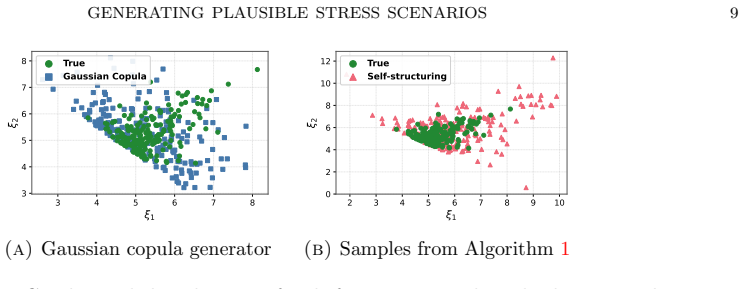
Financial stress tests based on handpicked scenarios can mislead risk management by overlooking genuinely dangerous configurations or overemphasising shocks that are too implausible to be decision-relevant. We develop a systematic method for generating plausible stress scenarios for financial losses driven by exogenous risk factors. The method exploits a large-deviations principle: conditional on a large loss, the risk factors concentrate near the most likely stress configurations. We use this structure to define representative stress distributions and to extrapolate observed samples into more extreme scenarios while preserving the relative plausibility of stress mechanisms. As a result, the procedure can generate informative stress scenarios even when historical data contain few or no observations in the stressed regime. Numerical experiments on two financial network models show that the method recovers the stressed loss law and key stress diagnostics, including in settings where benchmark generators fail to generate any stressed samples.
0
0
econ.TH 2026-06-30

Sum-minimization locates efficient multi-agent insurance

by Zijun Meng

Pareto Efficient Insurance with Multiple Policyholders, Multiple Insurers, and Multiple Indemnity Environments

Pareto optimal contracts with many policyholders and insurers across indemnity types reduce to one aggregate minimization problem.

abstract click to expand
This paper proves a sum-minimization characterization of Pareto efficient insurance with multiple policyholders, multiple insurers, and multiple indemnity environments. We also provide a result regarding the pairwise implementability of the policyholder- and insurer-aggregate level arrangements in the multiple policyholders and multiple insurers setting.
0
0
q-fin.RM 2026-06-30

VaR restricts risk reduction to none

by Wing Fung Chong

Strategic Risk Reduction: Self-Protection and Self-Insurance

Tail Value-at-Risk instead creates non-convexity solved by marginal-balance isoquants in the same Bernoulli setting.

abstract click to expand
This paper studies how a risk holder should combine self-protection and self-insurance when market insurance is absent. In a Bernoulli loss model, self-protection reduces the residual loss probability, while self-insurance reduces the residual loss severity. The risk holder evaluates residual risk using either Value-at-Risk or Tail Value-at-Risk and incurs a joint risk-reduction cost that allows technological interaction between the two activities. We show that Value-at-Risk leads to a threshold-driven solution that the optimal strategy is either no risk reduction, pure self-protection, or pure self-insurance. By contrast, Tail Value-at-Risk creates a direct interaction between residual frequency and residual severity, making the problem non-convex even in the Bernoulli setting. We solve it using an isoquant geometry method based on the marginal-balance curves for self-protection and self-insurance. The analysis identifies when optimal strategies lie on boundaries, extreme constrained candidates, touching components, or crossing components, and shows how the confidence level and the cost technology determine whether self-protection and self-insurance behave as substitutes or complements.
0
0
q-fin.RM 2026-06-30

Hidden dependence preserves worst-case tail risk bounds

by Corrado De Vecchi, Max Nendel +1 more

Hidden Dependence and Aggregate Tail Risk

Small perturbations of the joint distribution that keep marginals fixed match the risk limits from full dependence uncertainty for gamma-tai

Figure from the paper full image
abstract click to expand
We study risk aggregation problems for arbitrary non-decreasing aggregation functions and tail risk measures under dependence uncertainty in a distributionally robust setting. To this end, we introduce the notion of hidden dependence for random vectors, which is built on the concepts of risk concentration and common tail events developed in Wang and Zitikis (2020). We show that, starting from a tail event $A$ of the aggregate loss for an arbitrary random vector $Y$, one can construct a random vector with hidden dependence that dominates $Y$ on the tail event $A$. We then focus on the case in which model uncertainty is described by small perturbations of the distribution of a random vector with respect to a suitable probability distance without changing the marginals. We show that these perturbations of the reference distribution are compatible with hidden dependence and thus lead to the same worst-case risk bounds as in the unconstrained case for arbitrary $\gamma$-tail risk measures with a suitable level $\gamma$. Finally, we apply our results in a credit risk context and quantify the potential underestimation of portfolio risk arising from uncertainty in the dependence structure. In particular, we show that even small deviations from a reference Gaussian dependence model can, in principle, justify dramatic increases in capital requirements.
0
0
cs.LG 2026-06-30

Output heads dominate backbones on fat-tailed returns

by Sichao He, Yansong Zhang

Heads, Not Backbones: Output Heads Dominate Architectures on Fat-Tailed Returns

Mixture heads improve CRPS by 3.7 points over backbones at short horizons in S&P 500 tests.

Figure from the paper full image
abstract click to expand
In a deep forecasting pipeline for fat-tailed financial returns at short horizons, which matters more - the backbone architecture or the output head? We compare four modern backbones (TimesNet, DLinear, N-BEATS, iTransformer) under three output heads: a point head, a single-Gaussian density head, and a Gaussian mixture density head with K=4 components. On S and P 500 monthly log-returns (1871-2023) under anchored walk-forward validation, the three heads form a strict gradient: switching from point to Gaussian improves CRPS by about 1.3 percent; switching from Gaussian to mixture adds a further about 2.4 percent. Switching between backbones, in contrast, changes CRPS by less than 1.5 percent on the point-head row and on the backbone-mean axis; density-head backbone spread is larger (up to 5.1 percent on the h=1 Gaussian row, driven by N-BEATS) but the head gradient (3.7 percentage points) still dominates. The Model Confidence Set on squared errors does not exclude any of the 12 variants at the 5 percent level: the head separates them only on distributional metrics (CRPS, pinball, coverage), not on squared error. The mixture head incremental value over a single Gaussian is largest in the highest-volatility regimes (13.9 percent in 1970s stagflation at h=12), confirming the mixture captures tail risk beyond what a unimodal Gaussian can express. The picture is horizon-dependent: the head dominates at short horizons, but at long horizons (h >= 6) the backbone re-takes the lead - an h-split we document against classical baselines (section 5.1). We conclude that on fat-tailed returns at short horizons, the head dominates the backbone, and the mixture distribution adds genuine value over a single Gaussian during crisis periods when risk-management decisions actually matter.
0
0
q-fin.RM 2026-06-29

Bayesian POMDP beats heuristics at allocating AI decision authority

by Matthew Francis Dixon

Adaptive AI Delegation under Uncertainty: A Bayesian Governance Policy for Sequential Decision Authority

Sequential updates on evidence quality let the policy adjust delegation levels across changing AI regimes where fixed rules lose performance

Figure from the paper full image
abstract click to expand
Organizations increasingly use large language models and agentic AI systems to generate probabilistic assessments and candidate actions in high-consequence settings. This creates a managerial problem distinct from prediction: how should organizations allocate decision authority to AI-generated recommendations as evidence quality, uncertainty, and organizational objectives evolve over time? Existing AI governance frameworks emphasize transparency, documentation, oversight, and regulatory compliance, but provide limited quantitative guidance for dynamically allocating decision authority under uncertainty. To address this challenge, we formulate adaptive AI delegation as a Governance-Aware Partially Observable Markov Decision Process (POMDP) in which Bayesian inference estimates the informational state and sequential optimization determines delegated AI authority. The paper also develops a quantitative validation and benchmarking framework for governance policies. Synthetic stress tests, reported LLM-confidence robustness, forecast-accuracy validation, governance-appetite sensitivity, and fragile-AI early-warning experiments evaluate whether the proposed policy exhibits graceful degradation, robustness to confidence-only perturbations, adaptive delegation under improving evidence quality, and interpretable calibration of institutional conservatism. The Governance-Aware POMDP is further benchmarked against five representative governance strategies operating under identical Bayesian beliefs, information, and governance objectives. The results show that while specialized heuristics perform well in stationary settings, sequential Bayesian governance provides the strongest general-purpose governance policy across heterogeneous AI-quality regimes by adaptively allocating organizational decision authority under uncertainty.
0
0
econ.EM 2026-06-29

Regret statistic classifies algo liquidity demand from data alone

by Irene Aldridge

Liquidity-Based Audit of Algorithmic Trading Strategies

Trade and price history recovers informed-trader versus market-maker distinction for linear strategies

abstract click to expand
We show that net demand for liquidity by algo strategies is identifiable from its trade and price history alone, with no knowledge of its signal or optimization problem. An exact multi-period regret decomposition implies that the sign of this statistic classifies a linear strategy as a net liquidity consumer or provider, recovering the Kyle (1985) informed-trader/market-maker dichotomy from observables alone. Under an AR(1) cost process, the same statistic equals the product of strategy size and the squared Roll (1984) implied spread, making the correction a direct proxy for prevailing illiquidity. Extending to endogenous price impact and aggregating across N correlated strategies yields a liquidity-balance condition whose violation produces welfare loss scaling as N squared, a closed-form fire-sale externality. We calibrate to CRSP equity data (2016-2025), tracking implied spreads through the COVID-19 and 2022 rate-shock episodes, with an estimator computable in O(Tnd) time.
0
0
q-fin.MF 2026-06-29

Combined distress regions lift both value and survival

by Benjamin Avanzi, Bernard Wong +1 more

Balancing Shareholder Value and Financial Stability under a Reduced-Form Liquidation Model

A distress zone spanning both sides of the ruin threshold improves shareholder payouts and firm longevity simultaneously, unlike single-side

Figure from the paper full image
abstract click to expand
Modern resolution and prudential regimes increasingly wind up a distressed firm not at a single hard threshold but through a graduated, state-dependent process. We study how the design of such a regime shapes the trade-off between shareholder value and financial stability for a firm whose surplus follows a general diffusion. Forced liquidation is modelled in reduced form, arriving at a surplus-dependent hazard rate that rises as the firm's position deteriorates. The framework has three regions: an unregulated region where dividends may be paid, a regulated region where solvency requirements prohibit distributions, and a distress region in which the firm faces the liquidation hazard. To quantify shareholder value we solve the resulting singular stochastic control problem: which is to maximise the expected present value of distributions until liquidation. We establish a verification theorem, prove that a barrier strategy is optimal, and obtain tractable expressions for the value function and the expected survival time, so that alternative designs can be compared at low cost. We show that a distress region placed solely below or solely above the classical ruin threshold does not consistently improve both shareholder value and firm survival, whereas combining the two yields a Pareto improvement. Regulatory design is decisive.
0
0
q-fin.RM 2026-06-29

Review classifies 370 studies into five uncertainty method families

by Albert Kutej, Stefan Rass

Methods for Uncertainty Representation in Risk Management: A Comparative Review and Decision-Oriented Framework

Probabilistic approaches lead for rigor, but fuzzy and evidence methods handle vagueness better in risk decisions.

Figure from the paper full image
abstract click to expand
The consideration of uncertainty is a central but frequently inadequately addressed component of risk management. A systematic treatment of uncertainty is essential for ensuring the quality and traceability of decision-making processes, particularly in complex and safety-critical environments. This review systematically analyzes how established risk management approaches conceptualize and represent uncertainty in both their theoretical foundations and practical applications. Based on a systematic literature review of 370 publications, the identified approaches are classified into five methodological families. These include probabilistic methods, evidence-based and fuzzy-logic approaches, qualitative elicitation techniques, graphical and visual representations and hybrid frameworks. The analysis shows that probabilistic methods remain predominant due to their quantitative rigor, whereas fuzzy and evidence-based approaches are particularly suited to addressing vagueness and epistemic uncertainty. Qualitative and graphical approaches are found to enhance interpretive understanding and support the transparent communication of uncertainty. Despite these developments, the analysis indicates that the practical integration of these approaches into operational risk management remains limited in many domains. The findings highlight the need for more structured guidance in method selection and suggest that future research would benefit from further development of hybrid approaches and visualization techniques.
0
0
q-fin.RM 2026-06-26

Threshold retention structure reduces reinsurance pricing to one dimension

by Ruimeng Hu, Byungdoo Kong

Endogenous Reinsurance Pricing in Large Competitive Insurance Markets: Finite-Player and Mean Field Analysis

Insurers move from full cession to partial retention to full retention as the premium rises, collapsing the reinsurer's problem to a compact

Figure from the paper full image
abstract click to expand
We study endogenous reinsurance pricing in a competitive insurance market with one strategic reinsurer and many heterogeneous insurers. The reinsurer acts as a Stackelberg leader by choosing a common premium rate and an investment strategy, while insurers decide how much risk to retain and how to invest, taking into account their own performance, their performance relative to the insurer population, and common insurance-claim and financial-market noise. This creates a feedback loop absent from standard reinsurance models with exogenous premiums: a premium change affects insurers directly through the cost of reinsurance, and indirectly through the population's aggregate exposure to common insurance-claim risk. For a fixed premium, we characterize the insurers' equilibrium retention through a scalar fixed point and establish its monotone premium response. This characterization reveals a spillover mechanism generated by relative performance concerns and leads to a threshold structure in which insurers move from full cession to partial retention and then to full retention as the premium increases. Using this structure, we reduce the reinsurer's premium problem to a one-dimensional optimization over a compact premium interval and characterize Stackelberg equilibria in both finite-player and mean field models. In the finite-player case, we develop an efficient threshold continuation procedure that determines equilibrium premiums without enumerating all retention configurations. We also prove convergence from finite-player equilibria to mean field equilibria without requiring the mean field equilibrium premium to be unique. Numerical illustrations show how relative performance concerns amplify spillover effects and can induce retention even when reinsurance remains actuarially favorable. They also demonstrate that Stackelberg equilibria need not be unique in either setting.
0
0
q-fin.RM 2026-06-26

Wider no-trade bands cut rebalancing costs but raise hedge-error risk

by Takayuki Sakuma

Robust Hedging Valuation Adjustment under Liquidity--Demand Stress

Robust HVA computes worst-case expected loss inside relative-entropy neighborhoods of simulated loss distributions under liquidity-demand st

Figure from the paper full image
abstract click to expand
This paper develops a robust hedging valuation adjustment (HVA) measure for dynamic hedging. Simulated rebalancing and maturity-unwind trades generate a loss distribution for each no-trade-band rule, and we define robust HVA as the worst-case expected loss over a relative-entropy neighborhood of that distribution. Because band width affects turnover, the same relative-entropy radius applied to different bands can imply different levels of demand-liquidity stress. We distinguish a fixed-radius convention from a fixed benchmark-stress convention and show that wider no-trade bands lower rebalancing costs but raise hedge-error risk.
0
0
q-fin.PM 2026-06-26

CVaR optimization stabilizes commodity ETF portfolios

by Nicholas Appiah, Ali Jaffri +2 more

Portfolio Optimization for Commodity ETFs under Heavy-Tailed Returns

Minimum-risk and CVaR strategies outperform tangent portfolios on Sharpe and Calmar ratios for 30 ETFs, though tail risks persist.

Figure from the paper full image
abstract click to expand
This paper examines portfolio optimization for commodity exchange-traded funds (ETFs) under heavy-tailed return behavior. Using daily Bloomberg data for 30 U.S.-listed commodity ETFs from 12 December 2018 to 16 December 2024, we study funds spanning agriculture, energy, metals, and broad commodity index exposure. We compare a passive buy-and-hold portfolio with rolling-window optimized portfolios formed under mean--variance and conditional value-at-risk (CVaR) criteria, considering both long-only and restricted long--short strategies. The results showed substantial heterogeneity across commodity sectors, with energy and broad commodity index funds displaying pronounced volatility, skewness, and excess kurtosis. Historical optimization indicated that minimum-risk and CVaR-based portfolios provided more stable cumulative performance than tangent portfolios and generally improved Sharpe, Calmar, and STARR$_{0.95}$ ratios. Extreme-value diagnostics showed that optimized portfolios remained exposed to heavy downside tails, so improved risk-adjusted performance did not eliminate extreme-loss risk. A dynamic extension based on ARMA--GARCH marginal models, Student--$t$ copula dependence, and one-step-ahead predictive scenarios improved performance mainly when combined with minimum-risk or CVaR-based objectives. Dynamic mean--variance tangent portfolios performed less reliably, reflecting sensitivity to expected-return estimation error. Transaction-cost robustness checks further showed that the practical value of dynamic optimization depended on turnover control, with low-turnover dynamic CVaR tangent portfolios remaining more resilient to implementation costs. Overall, the analysis showed that commodity ETF allocation benefited most from conservative and downside-risk-aware optimization, while optimized portfolios continued to require explicit tail-risk and implementation diagnostics.
0
0
q-fin.MF 2026-06-25

Return risk measures extend geometrically to AM-algebras

by Christian Laudagé

Geometrically convex return risk measures on AM-algebras

The move produces systemic and vector-valued versions with finiteness, continuity, and dual representations for multidimensional payoffs.

abstract click to expand
Monetary risk measures quantify the risk of uncertain monetary payoffs (or losses), whereas in time series analysis risk is typically assessed using logarithmic returns. Return risk measures (RRMs) provide an axiomatic foundation for this latter approach, which relies crucially on the positive cone of the space of essentially bounded random variables. We extend RRMs to general ordered vector spaces and characterize positive homogeneity via the geometric epigraph. To investigate geometric convexity and establish connections with monetary risk measures, we specialize the domain to AM-algebras, encompassing Euclidean spaces and spaces of multidimensional essentially bounded random variables. The latter is novel in the context of RRMs and leads to the new classes of systemic and vector-valued RRMs. We establish results on finiteness, continuity, separability, as well as dual and aggregation-based representations.
0
0
q-fin.ST 2026-06-23

Heavy-tailed emissions rescue simple HMMs for daily equity returns

by Abdulrahman Alswaidan, Cade Jin +1 more

Continuous Hidden Markov Models for Equity Returns: Heavy-Tail Emission Families and Regime-Conditional Value-at-Risk

A Markov model with per-regime heavy tails reproduces volatility clustering and passes VaR coverage tests on US equities, without semi-Marko

Figure from the paper full image
abstract click to expand
Synthetic generators of daily equity returns let practitioners stress test, backtest, and design scenarios that a single realized market history cannot supply, but only if the generator reproduces the stylized facts of real returns: heavy tails, negligible linear autocorrelation, and slow decay of the absolute-return autocorrelation. Hidden Markov models with few Gaussian states were long thought unable to reproduce that slow decay, and the standard fix was to abandon them for more complex hidden semi-Markov models. We revisit this issue with a continuous hidden Markov model whose regime chain governs the autocorrelation while per-regime densities govern the marginal, separating the temporal and distributional sides of the original failure. A unified expectation-maximization framework fits Gaussian, Student-t, Laplace, and generalized-error emissions under shared forward-backward recursions and quantile-based initialization, and a spectral identity bounds the number of decay modes by the rank of the centred transition matrix. Across SPY walk-forward folds, a sector-balanced 30-ticker panel, a CRSP cross-decade transfer, and a six-asset basket, that bound was not binding once a few states were used: heavy-tailed marginals, not additional decay modes, closed most of the fit gap, recovering volatility clustering above the i.i.d. baseline and narrowing the kurtosis gap without a tuning hyperparameter. The original failure is therefore distributional, not temporal. On daily US equities, a simple, interpretable Markov model suffices, and unlike a bootstrap or semi-Markov fit that wins only on a single-window fit, the fitted model also yields a regime-conditional Value-at-Risk that passes a joint conditional-coverage test and a copula that reproduces cross-asset correlations: one interpretable generator serving both path simulation and downstream risk and portfolio tasks.
0
0
q-fin.RM 2026-06-23

New criterion forces every agent into risk-sharing optimization sequence

by Debora Daniela Escobar, Wing Fung Chong

Pareto Optimal Centralized Risk Sharing with Multiple Agents: Inclusivity and Fairness

Inclusive and fair Pareto optimality equates to balanced sequential optimization and lies between Geoffrion-proper and classical versions.

Figure from the paper full image
abstract click to expand
This paper studies centralized risk sharing with endogenous prices. Multiple policyholders transfer risks to a central insurer through indemnity decisions, while prices are determined by pricing functionals applied to ceded risks. The resulting problem is multiobjective, with Pareto optimality as the natural efficiency criterion. We show that classical Pareto optimality may fail to reveal whether all agents are represented in a balanced decision process that scalarized objectives may assign zero weight to some agents, and group aggregates may obscure individual risk positions. Motivated by bilateral Pareto characterizations through sequential optimization, we introduce inclusive and fair Pareto optimality, a representation-based refinement requiring every agent to appear exactly once, either individually or as part of a group, in a finite ordered sequence of optimizations. Our main result proves equivalence between this concept and balanced sequential optimization, placing it between Geoffrion-proper Pareto optimality and classical Pareto optimality. An illustrative example demonstrates the framework using the Expected Shortfall.
0
0
q-fin.RM 2026-06-23

WUVS forces every distortion risk measure to be superadditive

by Yuyu Chen, Liyuan Lin +1 more

Universal Value-at-Risk superadditivity

For any portfolio with the property, optimal allocation holds only one asset and diversification brings no gain.

Figure from the paper full image
abstract click to expand
Value-at-Risk (VaR) is a standard regulatory risk measure, and its failure of subadditivity is well known. Much less appreciated is that for sufficiently heavy-tailed losses, VaR can be superadditive uniformly across all probability levels, a phenomenon strictly stronger than the asymptotic superadditivity studied in extreme value theory. We call this property universal VaR superadditivity (UVS). We study UVS and its stronger weighted version (WUVS) as properties of random vectors rather than of marginal distributions. This perspective unifies and extends a recent line of work on iid infinite-mean models. UVS, except for trivial cases, imposes an infinite-mean structure. We establish preservation properties of UVS and WUVS under increasing and convex transformations, weak convergence, and certain distributional mixtures, and use these tools to prove UVS and WUVS for non-identically distributed risks in several large families including completely subscalable, super-Cauchy, and inverted subadditive risks, extending results previously available only in the iid case. In many results, we also establish strict versions of UVS and WUVS, which lead to stronger decision-theoretic implications. As a consequence, for any portfolio satisfying WUVS, every distortion risk measure is superadditive, so an optimal allocation concentrates on a single asset, and diversification is never beneficial.
0
0
q-fin.RM 2026-06-22

Monthly posteriors aggregate into annual copulas

by Shintaro Mori, Masato Hisakado

Temporal Coarse-Graining of Multi-Sector Default Count Data Generates Posterior-Implied Copulas

A dynamic state-space model fitted to monthly sector defaults, when coarse-grained, reproduces annual eigenvalue amplification and heterogen

Figure from the paper full image
abstract click to expand
Sectoral default dependence is usually described by a static correlation matrix, a static copula, or a small number of common factors. Such representations, when specified separately at each observation horizon, do not by themselves explain why the effective dependence observed in monthly credit data differs from that observed after annual aggregation. This paper proposes a dynamic low-rank state-space model for monthly multi-sector default-count data and studies the dependence structure induced by temporal coarse-graining. The leading eigenvectors of the monthly sectoral default-rate correlation matrix are used as fixed loading directions for persistent AR(1) latent credit-state factors, and defaults are modeled through a binomial observation layer. Survival aggregation of monthly posterior probability paths induces horizon-dependent distributions of sectoral default-probability vectors, from which effective correlation matrices, eigenvalue spectra, and posterior-implied rank copulas are obtained. Applied to S\&P monthly sector-level default-count data from 1981--01 to 2021--09, a two-factor specification captures the dominant market-wide and sector-rotation modes, reproduces the annual amplification of the leading eigenvalues, and generates heterogeneous copula structures across sector pairs. In an annual forecast evaluation, the dynamic factor specifications reduce the under-dispersion of static binomial and beta-binomial baselines, improving interval coverage and CRPS for aggregate portfolio counts. In log-score-based forecast comparisons, the one-factor specification is highly competitive, whereas the two-factor specification improves sector-level calibration as measured by per-sector CRPS.
0
0
q-fin.RM 2026-06-22

Prudence equals weak prudence for convex law-invariant functionals

by Niushan Gao, Denny H. Leung +1 more

On Prudence of Risk Measures

Equivalence and preservation under hulls and inf-convolutions enable construction of new prudent risk measures.

abstract click to expand
Prudence is a stability property of risk functionals recently introduced by Wang and Zitikis and subsequently studied by Amarante and Liebrich. In this paper, we first establish general relationships between prudence and other stability properties, showing, in particular, that weak prudence and prudence coincide for a broad class of convex, law-invariant functionals. We then prove that prudence is preserved by cash-additive hulls of star-shaped functionals under a simple asymptotic condition, and by inf-convolutions of convex, cash-additive, law-invariant prudent functionals. Our results provide general methods for constructing prudent risk measures from existing prudent functionals.
0
0
q-fin.RM 2026-06-22

Order-independent methods split expected-loss gaps among four model components

by Xuan Mei, Junze Lin

Attributing Forecast Gaps to Component Models in Complex Model Suites

LMDI and Shapley approaches remove sequence dependence when attributing shortfalls in EAD, SMM, PD, and LGD forecasts.

Figure from the paper full image
abstract click to expand
Complex model suites composed of multiple interacting component models are widely used in financial forecasting and risk management. In model performance testing, including in-sample backtesting (BT) and out-of-sample ongoing performance monitoring (OPM), a material gap between a model-suite forecast and the realized outcome must often be attributed to individual component models for development, validation, and regulatory review. This paper studies this gap-attribution problem in the expected loss framework, where exposure at default (EAD), prepayment or single monthly mortality (SMM), probability of default (PD), and loss given default (LGD) interact multiplicatively and are aggregated across loans and projection periods. We first formalize standard walk analysis and show why its attribution is generally order dependent. We then adapt two order-independent attribution frameworks: an augmented Logarithmic Mean Divisia Index (LMDI) approach tailored to the expected-loss structure, and a more general Shapley value approach based on averaging marginal contributions over all component orderings. We derive both elementwise and vectorized formulas to support efficient implementation, with the additional computation time for gap attribution typically limited to a few seconds in practical portfolio-scale examples. Finally, we discuss the connections among walk analysis, LMDI, and Shapley attribution, and show how the attribution framework extends to model suites with an additional Monte Carlo simulation layer.
0
0
stat.ME 2026-06-22

Censored transformed model captures 0-1 masses in proportional data

by Yuan Christopher Qiang, Fabio Sigrist

A Censored Transformed Model for Proportional Outcomes with Boundary Mass and an Application to Loss Given Default Modeling

ZOC-TN plus tree boosting and spatio-temporal frailty yields strongest out-of-sample LGD predictions on U.S. mortgage data.

Figure from the paper full image
abstract click to expand
We introduce the zero-one censored transformed normal (ZOC-TN) model for proportional responses with potential probability mass at the boundaries 0 and 1. The model combines a censored Gaussian variable with a two-parameter affine-logit transformation on the interior (0,1). We characterize the transformation parameters, establish large-sample properties, and relate the affine-logit specification to broader classes of interior distributions. Theoretical and experimental results demonstrate that the proposed model can capture a wider range of qualitative density shapes than several benchmark models while remaining parsimonious, computationally efficient, and numerically stable. Furthermore, the ZOC-TN model can be extended (i) to account for nonlinearities and interactions in a tree-boosting machine learning framework and (ii) to explicitly model residual spatio-temporal variability. We apply the ZOC-TN model to loss given default (LGD) modeling for a large dataset of U.S. residential mortgages and compare it to multiple benchmark models. We find that a tree-boosted ZOC-TN model with a spatio-temporal frailty Gaussian process delivers the strongest out-of-sample performance, indicating that mortgage losses are shaped by nonlinear covariate effects and by unaccounted-for space-time variation.
0
0
math.PR 2026-06-22

Monotone aggregations stay continuous under regression dependence

by Ben Goldys, Max Nendel

Absolute Continuity of Monotone Aggregations under Positive Regression Dependence

Stochastic monotonicity of conditionals plus a lower-increment condition on g suffice without independence or joint densities.

abstract click to expand
In this paper, we provide a sufficient condition for the absolute continuity of one-dimensional push-forwards of dependent random vectors. Suppose that $X$ has an absolutely continuous distribution and that the conditional distribution of an $\mathbb{R}^d$-valued random vector $Y$ given $X=x$ is nondecreasing in $x\in \mathbb{R}$ in the usual stochastic order. For Borel maps $g\colon \mathbb{R}\times\mathbb{R}^d\to\mathbb{R}$ satisfying a coordinatewise monotonicity condition in $Y$ and a uniform lower-increment condition in $X$, we prove that $g(X,Y)$ has an absolutely continuous distribution. The result requires neither independence nor a joint density, and allows the marginal law of $Y$ to be completely arbitrary. Moreover, the result remains valid if $\mathbb{R}^d$ is replaced by an arbitrary measurable space endowed with a reflexive binary relation. We discuss consequences for monotone risk aggregation and extensions of the familiar regularization by convolution beyond independent random variables.
0
0
q-fin.RM 2026-06-19

Power and response functions set optimal order in agent systems

by Jake J. Xia

Optimal Order of Multi-Agent and General Many-Body Systems

Framework derives fragility, mobility, and an optimal synchronization level from two agent variables and a risk-appetite utility.

Figure from the paper full image
abstract click to expand
This paper develops a general framework for analyzing multi-agent systems with feedback loops between agents actions and collective observations. The framework is built on two fundamental agent-level variables: power, which measures agent influence on collective outcomes, and response functions, which determine how agents react to observations. We derive how macroscopic properties, including total power, useful power, entropy, order, fragility, and mobility, emerge from these two variables of heterogeneous agents. To study the trade off between growth and resilience, we introduce a system-level utility function parameterized by a risk-appetite coefficient and derive an optimal degree of order that balances productivity, stability, and adaptability. The analysis suggests that stronger synchronization can increase collective output but may also increase systemic fragility and reduce mobility. We further argue that order, entropy, information, and useful energy are task-dependent and system-relative concepts whose meanings depend on the objectives of the system. By measuring and designing agent power distributions and response functions, it may be possible to better understand, predict, and optimize collective behavior and identify the conditions under which collective intelligence and optimal order emerge.
0
0
q-fin.ST 2026-06-19

Trends drive rising volatility and correlations

by Sara A. Safari, Christoph Schmidhuber

Trends, Volatility, Correlations, and Critical Phenomena in Financial Markets

Quadratic polynomials of trend strength refine risk forecasts and support lattice gas models near criticality

Figure from the paper full image
abstract click to expand
We forecast future volatilities and correlations of financial markets based on the current trends in these markets. This complements previous work that models future expected returns by a cubic polynomial of the current trend strength. Empirically, we observe that volatilities and correlations tend to increase day after day in times of strong up- or down-trends. This effect is particularly pronounced in down-trends. It can be accurately quantified by quadratic polynomials of today's trend strengths, which refine common mean-reversion models of volatilities and correlations. Our results improve the prediction of market risk by accounting for market trends. They also support a recent proposal to model financial markets by a lattice gas near its critical point.
0
0
q-fin.RM 2026-06-19

Ensemble outperforms singles at spotting risk valuation errors

by Daniil Peysakhovich, Rafa{l} Sieradzki

How to spot outliers: an Ensemble Anomaly Detection Framework

61-79% F1 on injected anomalies in credit data beats best single method at 6-66%, with gains robust to thresholds

abstract click to expand
Errors in risk valuation outputs arising from data-feed failures, model misconfiguration, or system malfunctions can propagate undetected through an investment bank's risk infrastructure and generate material operational losses. Using proprietary daily credit-derivatives data from a major global investment bank covering 183 trades across 129 trading days, we design, implement, and empirically evaluate the Ensemble Quality Assessment Framework (EQAF), a layered unsupervised architecture that combines complementary outlier-detection methods to monitor risk calculation integrity in real time. Using a controlled anomaly-injection protocol with eight operationally realistic scenarios, we show that the calibrated ensemble achieves F1 scores of 61-79%, substantially outperforming the best individual method (6-66%) across four distinct risk-measure datasets. Improvements of 4-6 percentage points in AUC-ROC confirm that this advantage is robust to threshold selection. We further demonstrate that purely statistical detection methods systematically fail to identify stale-value anomalies, a class of frozen-feed errors in which valuation outputs are identical to prior observations and therefore indistinguishable from normal data, and that domain-specific deterministic rules are architecturally indispensable. These findings have direct implications for model risk management under Basel III and the Fundamental Review of the Trading Book (FRTB), where automated and auditable quality controls for internal risk models are increasingly required.
0
0
cs.AI 2026-06-18

Forecast model plus monitors ground LLM alerts in DeFi oversight

by Aijie Shu, Bowei Chen +3 more

DeXposure-Claw: An Agentic System for DeFi Risk Supervision

DeXposure-Claw chains graph forecasts with deterministic checks and gates to issue auditable tickets that match absolute-loss ground truth o

Figure from the paper full image
abstract click to expand
Decentralized finance exposes supervisors to fast-moving, networked credit risks. General-purpose LLM agents fit this setting poorly: they over-read weak evidence and recommend high-stakes interventions, while existing evaluations offer no regulator-aligned way to measure the resulting false alarms. We introduce DeXposure-Claw, a forecast-grounded agentic supervision system that routes LLM decisions through structured evidence: (1) DeXposure-FM, a graph time-series foundation model, forecasts future exposure networks; (2) deterministic monitors and stress scenarios then turn those forecasts into typed alerts, attribution signals, and scenario evidence; and (3) data-health and confidence gates constrain escalation before DeXposure-Claw emits auditable supervisory tickets with rationales. We further develop DeXposure-Bench, a six-axis evaluation harness, whose decision axis scores tickets against a regulator-aligned absolute-loss ground truth and an explicit false-intervention rate. Experiments on five years of weekly real data fully support our system. Code is at https://github.com/EVIEHub/DeXposure-Claw.
0
0
stat.AP 2026-06-17

CAP slope is Bayes theorem in cumulative form

by Denis Burakov

The Gini-Bayes Connection: The CAP Slope as Bayes' Theorem, with Applications to Weight of Evidence, Somers' D, and Calibration

The identification recovers posterior default rates and unifies Gini, weight of evidence, and calibration checks in one geometry.

Figure from the paper full image
abstract click to expand
The probabilistic reading of the cumulative accuracy profile (CAP) has a long industry lineage. Falkenstein, Boral and Carty (2000) state, in discrete form, that the default rate at a score percentile equals the portfolio average rate times the local slope of the power curve; van der Burgt (2008, 2019) formalizes this as the continuous identity $p(D\mid x) = p_D\, dy/dx$ and imports the continuous form as a working fact; Tasche (2009) analyzes the resulting calibration method; Voloshyn and Voloshyn (2023) substitute Bayes' theorem, $f(x\mid D)=p(D\mid x) f(x)/p_D$, into the area integral and write the Gini as a functional of the calibration curve. The slope itself is already in the lineage (van der Burgt's $dy/dx$ is the ratio of the two cumulative differentials), but it enters as a cited working fact, never as Bayes' theorem. We make that identification explicit and draw out its consequences. First, the CAP slope is Bayes' theorem in cumulative coordinates: the standardized PD it recovers is the posterior probability rescaled by the prior. The weight of the paper then falls on two results this reading unlocks. The odds form places the weight of evidence (the log of the likelihood ratio, i.e. the Bayes factor) and the information value inside one geometry (the weight of evidence at a point is the log of the ratio of the "bad" and "good" CAP slopes). The accuracy ratio, Somers' $D_{xy}$, and the Gini $(2A-1)/(1-p_D)$ are revealed as one number computed three ways. Run in comparison mode (realized outcomes against model claims), the same identity recovers the reliability diagram in cumulative coordinates, with the sign of the gap between the empirical and model-implied Gini coefficients as a calibration diagnostic. A worked five-band example carries every identity in discrete form, and a kernel-density example extends them to the continuous case.
0
0
math.ST 2026-06-17

Conformal intervals gain separate upper and lower tail guarantees

by Simone Cuonzo, Nina Deliu

Conformal Prediction Intervals with Tail-Specific Guarantees

Intersection of one-sided bounds delivers both tail-specific and global coverage with finite-sample validity for exchangeable data.

Figure from the paper full image
abstract click to expand
This paper extends classical conformal frameworks for constructing prediction intervals with global marginal coverage $1-\alpha$ to intervals that provide explicitly calibrated guarantees for the upper and lower tails separately. Focusing on split conformal prediction, we first construct lower and upper one-sided conformal intervals that achieve marginal validity, and then derive the induced two-sided interval by intersection. Theoretical results prove both tail-specific and global marginal coverage of the induced two-sided interval. Results are presented first for the exchangeable setting, where coverage has finite-sample guarantees, and then for non-exchangeable data, where guarantees are asymptotic. Simulation studies show that the proposed approach achieves improved directional calibration relative to classical two-sided intervals, especially relevant in skewed data. Finally, the benefit of the proposed framework is showcased in a financial application, where one aims for return maximization while seeking strict control on the left tail.
0
0
q-fin.RM 2026-06-17

POMDP splits agentic AI checks into belief

by Matthew Francis Dixon

Model Validation of Agentic AI Systems: A POMDP-Based Framework for Belief-State, Forecast, and Policy Validation

Framework enables separate tests of how autonomous agents update beliefs and choose actions in portfolio settings.

Figure from the paper full image
abstract click to expand
Agentic artificial intelligence systems introduce a new class of model risk. Unlike traditional predictive models, autonomous agents continuously acquire information, form beliefs regarding latent states of the environment, generate forecasts, select actions, and adapt their behavior over time. Existing validation methodologies focus primarily on predictive accuracy and therefore provide limited insight into the quality of the underlying decision process. This paper proposes a model validation framework for agentic AI based on Partially Observable Markov Decision Processes (POMDPs). The framework decomposes autonomous decision making into information, beliefs, forecasts, actions, and utility, allowing each component to be validated independently. Large language models (LLMs) are formalized as approximate Bayesian filtering operators, and a model-risk taxonomy is developed encompassing state-space, filtering, forecast, policy, utility-specification, and parameter risks. The model risk validation methodology is demonstrated through a portfolio-management case study in which an agent infers latent market regimes from market and macroeconomic information, generates belief-conditioned forecasts, and constructs portfolios using a Black--Litterman framework. Empirical validation combines performance analysis, belief calibration diagnostics, coverage tests, ablation studies, and parameter-sensitivity analysis. The results indicate that latent-state inference contributes independently to decision quality and that the principal conclusions remain robust across a broad range of parameter values. The principal contribution of the paper is a practical framework for extending established model risk management concepts to autonomous AI systems and providing a rigorous foundation for their validation, governance, and monitoring.
0
0
cs.GT 2026-06-16

AI-agent insurance made strategy-proof against five gaming attacks

by Hao-Hsuan Chen

Gaming-Resistant Insurance Contracts for Autonomous AI Agents: Strategy-Proof Toll Mechanism Design

Aggregation, escalation fees, and model menus close the attack space and deliver incentive compatibility at truthful equilibrium.

abstract click to expand
Paper A defines a time-consistent actuarial runtime that prices each side-effect-bearing action against a contractually fixed safe default and gates execution against a reserve budget. It treats the operator as passive. This paper makes the operator strategic. We characterise a five-attack space for autonomous AI-agent insurance contracts and prove when the actuarial runtime is gaming-resistant. Two attack surfaces -- post-toll safe-default selection and within-boundary action splitting -- are closed by Paper A's minimal-authority and no-splitting clauses. The remaining three require new contract clauses. First, common-control aggregation prevents cross-boundary re-routing from reducing toll below the boundary potential applied to total exposure. Second, interface failures such as invalid JSON are contract-relevant events, not safety wins: treating them as zero-toll safe defaults can reward unreliable models, while escalation fees reverse the incentive. We validate this interface-compliance theorem on committed cross-model traces from the companion empirical paper. Third, a model-identity menu with a componentwise-minimum penalty schedule makes truthful reporting of the deployed model weakly dominant. We then compose these clauses with Paper A's runtime guarantees to obtain joint incentive compatibility over the five-attack space. Finally, a two-parameter premium family discharges operator individual rationality and weak budget balance at the truthful equilibrium. The result is an incentive-compatibility layer for actuarial control of autonomous-agent side effects.
0
0
physics.soc-ph 2026-06-12

Rerouting makes chokepoint losses grow with each extra closure day

by Mitja Devetak, Jasper Verschuur +1 more

Adaptive rerouting reshapes impacts of maritime chokepoint disruptions

Global arrivals fall 3 percent per Suez day and 7.7 percent per triple closure as delays propagate through later port calls.

Figure from the paper full image
abstract click to expand
Maritime chokepoints concentrate shipping traffic. Disruptions to this traffic can have a widespread impact on the global economy. However, the way in which these impacts are shaped by the shipping sector's adaptive behavior is not well understood. Here, we introduce an empirically calibrated full-scale agent-based model of the global commercial shipping fleet, representing 35,954 active ships moving among 1,651 ports. We use the model to quantify how rerouting changes arrival losses under chokepoint closures. Static route exposure alone does not predict realized losses. In the adaptive model, rerouting reduces losses at some directly exposed ports, while delayed vessel cycles create losses at later port calls and in dependent regions. Cumulative net shipping-day losses therefore continue to rise with closure duration because longer routes keep ships delayed after the initial adjustment. Each additional closure day reduces global shipping arrivals by 3.0% for Suez and 7.7% for simultaneous Suez, Panama, and Malacca closures. These losses are unevenly distributed in exposed regions and ports. Disruptions with known duration show different loss profiles from unexpected shocks with unknown duration, revealing that end-date information can reduce avoidable short-run losses. The results show that chokepoint risk is a dynamic problem of routing, timing, and regional exposure and not a static property of maritime-network topology.
0
0
cs.SI 2026-06-12

GBS units mediate twin transitions as operational airlocks

by Han-Teng Liao, Karen Ang

Orchestrating the Twin Transition in Multinational Corporations: Technology Roadmapping for Green and Digital Global Business Services

Roadmapping synthesis maps shift to sustainable intelligence and shows how middle power hubs offer alternatives in global value chains.

Figure from the paper full image
abstract click to expand
Global Business Services (GBS) have emerged as a "living laboratory" for the Twin Transition of Green and Digital Transformation, as multinational corporations (MNCs) face increasing pressure to harmonize digital efficiency with environmental stewardship. Aiming to derive a socio-technical framework, this paper synthesizes Technology Roadmapping (TRM) with the International Telecommunication Union (ITU) ICT-centric innovation ecosystem toolkit. A bibliometric analysis of research clusters reveals an evolutionary shift from basic process automation toward "Sustainable Intelligence," identifying the GBS unit as a central "operational airlock" that mediates between landscape pressures -- such as the EU's dual mandate and Carbon Border Adjustment Mechanisms -- and niche innovations in AI-native workflows. The study further maps these clusters onto a stakeholder engagement canvas, highlighting how resilient "Middle Power" hubs in Poland, Portugal, and Malaysia are bypassing the middle-income trap to provide a "third way" for global value chains amidst a bifurcated geopolitical cloud. The results offer a data-driven design approach for leaders and entrepreneurial support networks to orchestrate talent and supply chain flows, thereby enriching the conceptual understanding of Industry 5.0 and the role of GBS as a primary mechanism for navigating a volatile, multipolar digital economy.
0
0
q-fin.ST 2026-06-11

Semiparametric bootstrap yields realistic yield curve paths

by Nicola Baldoni, Michele Sparviero +1 more

Scenario Generation for Time Series and Curves: A Comparison of Nonparametric and Semiparametric Bootstrap

Parametric dynamics plus residual resampling produces coherent interest-rate trajectories unlike pure distribution-preserving methods.

abstract click to expand
Generating stochastic trajectories for asset classes is an increasingly relevant task in quantitative finance. Traditional approaches, such as the stationary bootstrap, preserve by construction the empirical distribution of asset-class returns, but do not ensure that each individual simulated path is economically realistic: scenarios may be valid in distribution while single trajectories fail to represent plausible states of the world. To address this limitation, we review semiparametric simulation methodologies that combine a parametric structure, which enforces realistic dynamics, with the resampling of model residuals, which preserves the stochastic component observed in historical data. The issue is particularly acute for interest rates, where direct resampling of rate changes may produce implausible yield-curve evolutions despite correct distributional properties. Our empirical analysis shows the effectiveness of semiparametric bootstrap methods based on autoregressive or mean-reverting specifications. In the fixed-income setting, combining these methods with fully parametric term-structure models yields more coherent and realistic simulations of yield-curve dynamics.
0
0
q-fin.RM 2026-06-09

One shock yields full multivariate stress scenarios

by Michele Sparviero, Lorenzo Viola

Reverse Stress Testing for Multivariate Scenarios: A Conditional Framework for Stressed Time Series

Maximizing conditional density produces coherent scenarios that match observed risk-reward patterns in crises.

Figure from the paper full image
abstract click to expand
This paper develops a methodological framework for reverse stress testing (RST) in which a multivariate stress scenario, coherent with the empirical dependence structure of a market, is reconstructed from a single exogenous shock prescribed on one asset class. The problem is formulated as the maximisation of the conditional density given the imposed shock, and is solved under three progressively weaker distributional assumptions. In the parametric setting, joint Gaussianity of the returns yields a closed-form modal scenario coinciding with the conditional mean of the non-shocked components. In the semiparametric setting, the modal scenario is estimated nonparametrically through the empirical likelihood methodology and the surrounding stressed trajectories are generated via a Gaussian or Student-t local sampling scheme. In the fully nonparametric setting, stressed trajectories are obtained by inverse-distance resampling of the historical observations within a Mahalanobis neighbourhood of the estimated scenario. The three variants are validated on real market data. The simulated scenarios prove to be economically coherent and capable of reproducing the standard risk-reward asymmetry observed in stressed market regimes.
0
0
econ.EM 2026-06-08

Dynamic policy regret equals sum of per-period covariances

by Irene Aldridge

Evaluating AI Investment Strategies

Exact identity under i.i.d. costs and mean-unbiased Markov policies yields model-free audit for sequential decisions

abstract click to expand
We study the problem of auditing a black-box algorithmic decision-maker from observable inputs and outputs alone. Our main result is an exact decomposition: under precisely characterized conditions, the cumulative \emph{regret} of a dynamic policy equals the sum of per-period covariances between the cost vector and the policy's decision. This extends the single-period identity of Aldridge~(2026) to the full multi-period setting of stochastic dynamic programming. We prove the identity holds exactly under i.i.d. costs and mean-unbiased Markov policies, derive closed-form bias corrections for non-stationary and time-varying cases, and establish the discounted-horizon analog. A Bellman recursion for the covariance regret functional connects the result to standard reinforcement learning algorithms; for rolling-window policies, the estimation-error bias is $O(d/w)$. The decomposition has direct implications for algorithmic auditing in strategic environments: in platform mechanism design, it provides a welfare-based audit metric without access to the agent's private type; in repeated games, covariance reduction is a sufficient condition for policy improvement; in procurement and ad auctions, the bias correction quantifies welfare loss from strategic misreporting. The associated trajectory estimator is consistent, asymptotically normal with HAC variance, and computable in $O(T \cdot nd)$ time. This makes the proposed approach a tractable, model-free audit tool for platform mechanisms, algorithmic portfolio strategies, and any sequential decision system subject to external performance review.
0
0
q-fin.TR 2026-06-08

Memecoin filters avoid 18% drawdown cases in tests

by Arati Uday Kamat

Hour-Aware Adaptive Risk Management for Autonomous Memecoin Trading: A Multi-Layer Intelligence Framework

Rejection criteria net positive on 4874 observations but profits hinge on three trades

abstract click to expand
This paper measures hour-of-day effects, filter precision, fragility, and realised yield in a 15-day paper-traded deployment of an autonomous memecoin trading system on Solana decentralised exchanges. The 190-trade sample (March 29 to April 12, 2026) shows a 40.5 percent win rate, mean per-trade return of +0.62 percent, cumulative +117.7 percent (net SOL +0.039), skewness -1.21, excess kurtosis 6.61. A Mann-Whitney U test of three poorest-performing UTC hours (2, 13, 23) against the others yields U = 1,274, p = 0.22; directional but not significant at n = 190. The three hours were selected in-sample, so the comparison is exploratory, not confirmatory. A parallel counterfactual rejection-tracking system collected 4,874 forward-sample observations across 184 distinct rejection events. Of those events, 17.9 percent reached a 50 percent drawdown from reference within 24 hours; 26.0 percent of forward samples recorded the rejected token below half-reference. The filter stack avoided these realised drawdowns: evidence that the rejection criteria are net-positive against forward-market outcomes. Fragility is the principal caveat. Removing the top three trades (1.6 percent of sample) flips cumulative return unprofitable. Profitability rests on a small number of large winners and is structurally fragile. The dataset and audit script are deposited under CC-BY-4.0 (Zenodo DOI 10.5281/zenodo.20043302).
0
0
math.ST 2026-06-08

Constrained GLM fitting enforces balance property in pricing models

by Mario V. Wüthrich

The Balance Property: The Constrained Case, with a View on Risk Sharing

It outperforms two earlier correction methods and ties the property to ex-post risk sharing rules among insurers.

abstract click to expand
The balance property is an important property of fitted statistical models deployed for insurance pricing. It guarantees that the total actuarial price in the fitted model is equal to the totally observed loss used to fit the model. This can be seen as an in-sample global unbiasedness property. Maximum likelihood fitted generalized linear models (GLMs) with canonical links automatically fulfill the balance property. Lindholm-W\"uthrich (Scandinavian Actuarial Journal, 2026) discussed two popular balance correction methods in case the balance property fails to hold. This note extends this discussion with a third method, constrained GLM fitting, that turns out to be superior over the two previously discussed ones. Moreover, we highlight the connection between the balance property and ex-post risk sharing rules.
0
0
q-fin.RM 2026-06-05

10-K text score lifts bankruptcy AUC from 0.83 to 0.90

by Zhen Zhang, Moxuan Zheng +4 more

Bankruptcy Prediction from 10-K Narratives: Evidence from Interpretable Text Scores and Accounting Baselines

PB Stress Score from distress language captures 64.71 percent of bankruptcies in top risk decile

abstract click to expand
Bankruptcy is a low-frequency but high-impact corporate event, making early risk identification important for creditors, investors, regulators, and risk managers. Traditional bankruptcy-prediction models rely primarily on accounting ratios, but these measures may reflect financial deterioration only after it appears in reported financial statements. Narrative disclosures in annual 10-K filings may therefore provide incremental warning signals about emerging distress. This study examines whether 10-K narratives improve bankruptcy prediction beyond conventional accounting variables. Using firm-year observations matched to 10-K text, SEC financial statement data, and bankruptcy events from the Florida-UCLA-LoPucki Bankruptcy Research Database, the analysis evaluates bankruptcy risk over the year following the 10-K filing date. The paper develops a transparent Pre-Bankruptcy Stress (PB Stress) Score, a dictionary-based measure designed to capture distress-specific language related to liquidity and funding stress, debt covenant and refinancing stress, operating deterioration, restructuring and legal distress, and business fragility. The score is evaluated against a five-variable accounting baseline and a Loughran-McDonald dictionary benchmark. In the primary one-year holdout test, adding the PB Stress Score increases AUC from 0.8323 to 0.9019 and raises top-decile bankruptcy capture from 44.12% to 64.71%. The positive incremental pattern remains visible across bootstrap inference, alternative accounting benchmarks, alternative outcome definitions, and out-of-time validation. The findings indicate that distress-specific 10-K narratives provide interpretable incremental information for bankruptcy-risk monitoring beyond conventional accounting ratios.
1 0
0
q-fin.RM 2026-06-04

Dual Representation of Robust Risk Measures and Uncertainty Sets

by Marlon R. Moresco, Marcelo Righi +1 more

Continuity follows from the consolidated sets, and two complementary dual frameworks arise from distinct geometric conditions.

abstract click to expand
We consider robust risk measures that arise as worst-case values of convex risk measures evaluated on uncertainty sets. We characterize continuity properties of robust risk measures through their consolidated uncertainty sets, derive dual representations for robust risk measures, and develop a set-valued dual representation for consolidated uncertainty sets. The two dual frameworks rely on distinct geometric assumptions and are therefore complementary rather than interchangeable.
0
0
stat.ML 2026-06-04

ReSGA beats rivals at forecasting VaR and Expected Shortfall

by Yichi Zhang, Ke Zhu +1 more

ReSGA: A Large Tail Risk Model for Learning Value-at-Risk and Expected Shortfall

Large neural network uses 153 firm characteristics on 1926-2023 equity data to cut out-of-sample losses and generate trading profits.

Figure from the paper full image
abstract click to expand
Learning Value-at-Risk (VaR) and Expected Shortfall (ES) is important for managing financial risks effectively. Existing approaches with limited parameters are vulnerable to model misspecification in the era of big data. To address this limitation, we propose a large tail risk model, the retrieval-enhanced self-grouping autoencoder (ReSGA), which is designed with millions of parameters to exploit the rich cross-sectional dependence and long-term temporal dynamics of assets using their characteristics. Applied to monthly US equity returns from 1926 to 2023 with 153 firm characteristics, ReSGA outperforms twelve econometric and machine learning competitors in terms of out-of-sample loss and statistical backtesting. In addition, its forecast advantages can translate into significant economic gains from long-short decile portfolios that are constructed by a new size-enhanced left-side momentum strategy. To clarify the role of complexity, we further conduct a systematic scaling analysis and demonstrate that improvements in joint VaR-ES forecasting are primarily driven by data complexity rather than model complexity. Finally, our analyses of group-importance and transfer-learning exhibit the interpretability and cross-market generalizability of ReSGA.
0
0
q-fin.RM 2026-06-03

Higher-order quantum method lifts certified collateral sample quality

by Tao Jin, Stuart Florescu

A Certified Higher Order Quantum Framework for CSA and Margin-Aware Collateral Optimization

Synthetic benchmarks beat QUBO baselines while CP-SAT keeps final feasibility control for CSA and margin rules.

Figure from the paper full image
abstract click to expand
Collateral allocation for uncleared derivatives is a legally constrained and operationally discrete optimization problem. Institutions must satisfy margin requirements while respecting CSA eligibility rules, valuation percentages, rounding, transfer thresholds, concentration limits, custody conditions, inventory, and VM, IM, or IA side constraints. This manuscript develops CR-HO-QAOA, a certified higher-order quantum candidate-generation framework for margin- and CSA-aware collateral allocation. The framework is adapter-first: official SIMM, proxy SIMM, legacy IA, VM-only, RQV, or hybrid margin sources are normalized into a common MarginRequirement, so the optimizer does not calculate or replace official SIMM. Given the requirement, CSA terms, and inventory, the optimizer builds a bounded active neighborhood of pledge, recall, substitution, batch, and slack actions. These actions define a higher-order binary model whose hyperedges capture concentration pressure, custody batches, substitution tickets, chunky lots, liquidity effects, overshoot, and side-specific requirements. The quantum layer maps hyperedges into a Pauli-Z cost Hamiltonian and uses collateral-specific feasible-subspace mixers to preserve one-hot choices, movement budgets, side assignments, and substitution structure. Candidates are decoded, repaired if needed, evaluated under an eight-term production objective, and certified by a deterministic CP-SAT master solver before any recommendation is reported. Synthetic benchmarks show that higher-order, constraint-preserving candidate generation can improve certified sample quality relative to QUBO-style and generic-mixer baselines, while CP-SAT remains the feasibility and governance arbiter. These results are synthetic workflow-validation evidence only, not evidence of hardware quantum advantage or production bank savings.
0
0
cs.AI 2026-06-03

CER framework turns AI state changes into insurance claims

by Alex Leung, Rex Zhang +2 more

From Control Boundary to Insurance Claim: Reconstructing AI-Mediated Losses Through the CER Framework

Control boundary, evidence from artifacts, and coverage checks allow reconstruction of dynamic AI losses for recovery.

Figure from the paper full image
abstract click to expand
AI losses that arise through an insured organization's generative or agentic AI system require state reconstruction, not merely event reconstruction, because the relevant state changes as the system reasons, retrieves, calls tools, and acts. The relevant question is not only what loss occurred, but what the system was allowed to do, what it actually did, and whether that reconstructed loss can support insurance claim recovery. This paper addresses losses in which the insured's AI system is in the causal chain, including externally triggered failures such as prompt injection, retrieval-augmented generation (RAG) poisoning, malicious tool output, credential misuse, and data poisoning. Specifically, this paper introduces CER, a use-case-level diagnostic for AI residual risk transfer. C (control boundary) asks whether the system had an enforceable operating envelope. E (evidence reconstruction) asks whether the system state and causal chain can be reconstructed from retained artifacts. R (insurance response) asks whether the reconstructed loss is insured: whether insurance coverage is available in the market and placed for the insured, together with the proof needed to support insurance claim recovery. The paper makes three contributions: it defines the AI-specific reconstruction problem, operationalizes that problem through CER, and specifies claim-grade evidence for AI reconstruction. Public examples include the reported PocketOS and Replit agentic database-deletion incidents and Moffatt v. Air Canada as an adjudicated output/reliance case. Keywords: AI systems; CER framework; residual risk transfer; agentic AI; generative AI; AI insurance; evidence reconstruction.
0
0
q-fin.MF 2026-06-01

Axioms force Avellaneda-Stoikov and Cartea-Jaimungal to share one parameter

by Frank M. V. Feys

Avellaneda-Stoikov and Cartea-Jaimungal as One Framework: A Forced Uniqueness Theorem for Inventory Market Making

The running penalty must satisfy φ = γ σ² / 2, turning two free parameters into a single scalar with an immediate calibration cross-check.

Figure from the paper full image
abstract click to expand
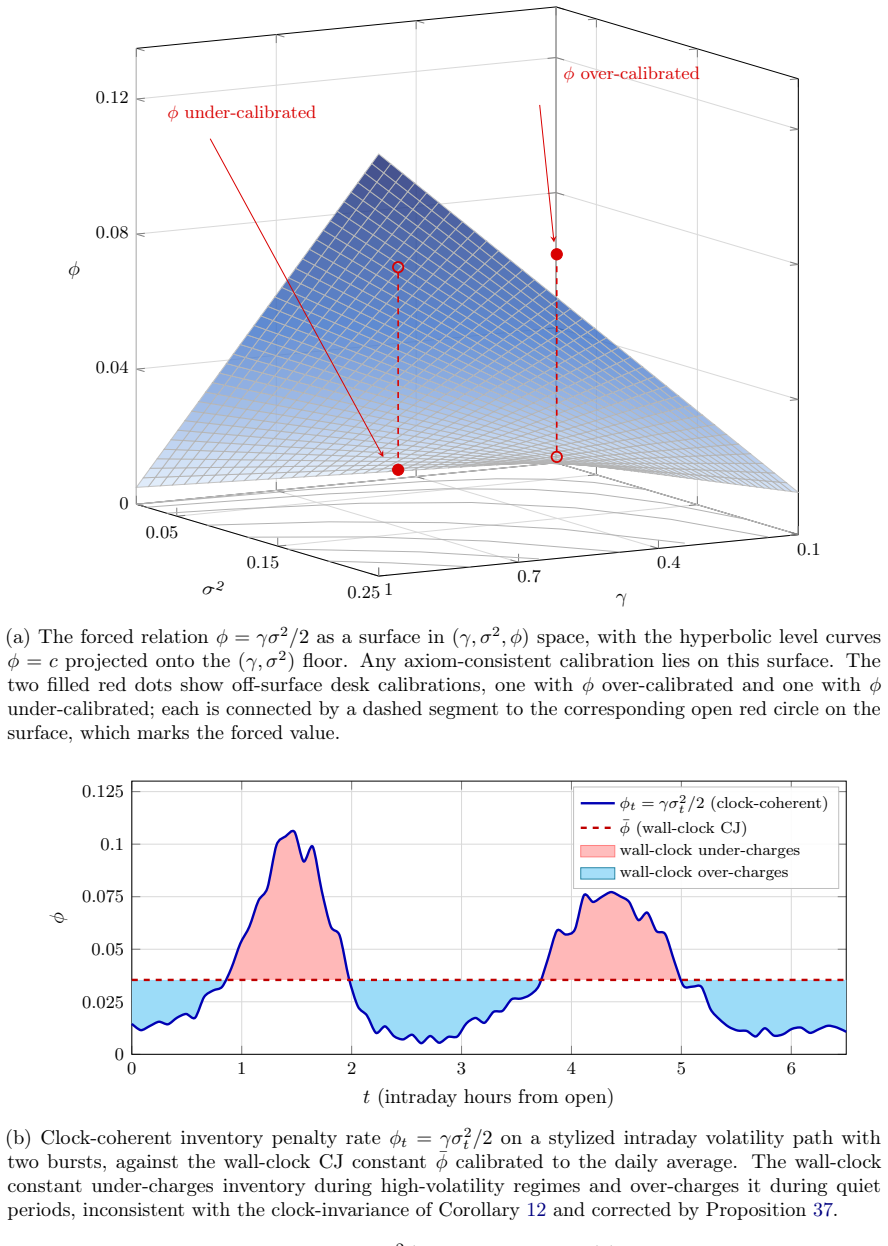
In inventory market making, the running-penalty coefficient $\phi$ of the Cartea-Jaimungal framework and the risk-aversion parameter $\gamma$ of the Avellaneda-Stoikov framework are typically treated as independent free parameters, calibrated separately. We show that they are in fact not independent. A small set of axioms on the market maker's dynamic preference functional, namely cash-additivity, normalization, concavity, strong dynamic consistency, and law-invariance, forces the preference functional to be the entropic certainty-equivalent on liquidation-adjusted terminal wealth, parametrized by a single positive scalar $\gamma$. The Avellaneda-Stoikov framework is the unique representative of this axiom class. The Cartea-Jaimungal framework is its second-order Taylor expansion in inventory magnitude, with the running coefficient forced to $\phi = \gamma\sigma^2/2$ and (under a mild regularity condition on the liquidation cost) the terminal coefficient forced to $\alpha = \frac{1}{2}L''(0)$. The two frameworks, typically presented as competing alternatives with the choice between them driven by tractability, are different manifestations of a single underlying object. The forced relation is invertible, $\gamma = 2\phi/\sigma^2$, giving a consistency cross-check on independently calibrated desk parameters.
1 0
0
q-fin.TR 2026-05-29

Quality-adjusted hit ratios cut subsidies to toxic bond flow

by Bouna Niang

Quality-Adjusted Hit-Ratio Targeting in Corporate Bond Market Making

Residual-quality targeting reallocates service to low-toxicity clients and raises the service-economics frontier in simulations.

Figure from the paper full image
abstract click to expand
Hit ratio is a common service metric for electronic corporate bond market making, but raw hit-ratio targets can be economically misleading when client flow has heterogeneous adverse-selection content. This paper extends a stochastic-control framework for OTC bond RFQ market making with hit-ratio constraints by replacing raw hit ratio with a residual-quality-adjusted hit ratio. The key modelling distinction is that adverse post-trade markouts are first decomposed into observable credit factors, carry/rolldown, issuer-relative-value effects, index or ETF demand effects, and residual adverse selection. Only the residual component is treated as client-flow toxicity. The resulting control problem remains tractable: after dualizing the quality-hit-ratio penalty, the HJB retains separable Hamiltonians, and the dual variable is the solution of an exact one-dimensional nonlinear fixed point for each targeted tier. Under a quadratic value-function approximation, optimal quotes decompose into a riskless spread, inventory skew, credit-alpha skew, residual-toxicity charge, and quality-hit-ratio subsidy. Synthetic multi-bond simulations with nonlinear dual solves illustrate that raw hit-ratio targeting can subsidize residual-toxic flow, while residual-quality targeting reallocates service toward low-residual-toxicity flow and improves the attained service/economics frontier. A final reduced-form extension studies inventory-recycling value through risk-aware style-aligned client-flow warehousing. Sweep or portfolio-trade opportunities fill randomly, and participation is sized using the same quadratic value approximation as the RFQ quoting problem. A passive/index-demand experiment is reported in the appendix as a special case of forecastable client flow. The numerical evidence is synthetic and mechanism-oriented; no proprietary RFQ data are used.
0
0
math.PR 2026-05-29

Fractional IBP differentiates Volterra expectations for β > 2H

by Alexandre Pannier

Functional integration by parts formulae for stochastic Volterra processes

Power-law kernels with Hurst H yield directional derivatives along constants once test functions exceed Hölder regularity 2H.

abstract click to expand
We investigate integration by parts (IBP) formulae for stochastic Volterra equations and we establish the smoothing effect of the expectation. Due to the inherent path-dependent dynamics of this class of processes, standard Bismut--Elworthy--Li (BEL) formulae and lifting procedures fail to produce representations for directional derivatives with respect to the initial curve. We exhibit a new type of fractional IBP for these derivatives which, by means of the Riemann--Liouville fractional derivative, interpolates between the standard chain rule and a pure BEL formula with Cameron--Martin path directions. Our assumptions describe precisely the trade-off between the direction's and the test function's regularities. Crucially, we reveal that more roughness leads to more smoothing: for a power-law kernel with Hurst parameter $H\in(0,1/2)$, we show that the expectation is differentiable along constant directions provided that the test function has H\"older continuity $\beta>2H$. The proof of the formula relies on a careful analysis of the conditional expectation's temporal regularity and on the well-posedness of its Riemann--Liouville derivative. We complement these results with a BEL formula along all square integrable directions whenever the noise is additive, a second order BEL formula and an application to forward and rough volatility models. In the latter case, the derivative is interpreted as the sensitivity with respect to the whole initial forward variance curve.
0
0
q-fin.PM 2026-05-29

Black-Litterman model delivers steadier portfolios than mean-variance

by Ajay Kumar Verma, Shravya Barkam

From Classical Optimization to Bayesian Integration: A Comprehensive Analysis of Systematic Portfolio Management

Bayesian blending of market equilibrium and investor views reduces concentration and improves stability in tests on ten U.S. stocks.

Figure from the paper full image
abstract click to expand
This paper compares a series of contemporary portfolio construction approaches by employing ten U.S. stocks (TSLA, WMT, BAC, GS, LLY, MRK, GOOG, META, AAPL and XOM) in a time frame from September 2023 to December 2025. The paper explores both basic mean-variance optimization, constrained optimization, Fama French five factor regression modeling, Monte Carlo simulation, and the Black-Litterman model to determine how constraints to a solution, risk factors to a strategy, simulated approximations, and specific market views may all impact the outcome of portfolio allocation, performance and stability. Overall, the results show that standard optimization may result in highly concentrated portfolios, while constrained optimization leads to changes in portfolio allocations by altering the efficient frontier, five factor regression models suggest that a basic investment style of defensive large value and profitability exposure, Monte Carlo approximation is a viable technique to arrive at mean-variance optimal portfolios provided the simulations are high enough especially under a box constraint, the Black Litterman portfolio approach produces more economically intuitive allocations and greater stability compared to standard mean-variance optimization as the approach balances equilibrium returns with investor views.
0
0
cs.AI 2026-05-28

LLM guardrails shift epistemic risk to users via reality gaps

by Tim Gebbie, Stewart Gebbie

The Ethics of LLM Sandbox and Persona Dynamics

The paper labels this reality laundering and claims it renders ethical AI substantively unethical in advice settings.

abstract click to expand
It is well known that LLM guardrails and trained persona dynamics can produce a reality gap: the distance between the world a LLM is permitted or shaped to describe, and the world in which users must act. Here we argue that actively generating reality gaps is in fact unethical because it knowingly shifts epistemic risk back to the uninformed user -- this is reality laundering. This can potentially cause harm when operationalised at scale. The risk is sharpest in high-exposure advice contexts, where users seek orientation rather than a bounded, externally checkable task. Guardrails naively appear ethically necessary when they claim to prevent direct harm, but often become suspect when they suppress truthful perception and launder uncomfortable mechanisms into acceptable abstractions. Basel-style financial regulation, B-BBEE-style compliance, Societe Generale, and the London Whale show how formal safety systems can become legible, gameable, and performative while real exposure migrates elsewhere. The same pattern can appear in LLMs as moral compliance: safe language, distorted reality. We therefore distinguish refusing harm, from refusing reality; and then argue for top-down causal requirements specification at the task level rather than bottom-up moral correction at the response or sandbox level. Persona dynamics matter because the assistant interface is not neutral; it shapes how uncertainty, conflict, authority, and risk are staged. The conclusion is that so-called ``ethical AI'' becomes substantively unethical when it substitutes institutional reassurance for contact with reality.
0
0
stat.ML 2026-05-28

Kernel estimator reduces variance for insurance price optimization

by Sascha Günther, Dimitri Semenovich +1 more

Insurance Pricing Optimization via Off-Policy Evaluation

It reuses historical data to find better pricing rules via interpretable Lasso or flexible neural networks in a travel-insurance simulation.

Figure from the paper full image
abstract click to expand
Traditional insurance pricing relies on risk-based principles that ensure actuarial fairness and solvency but do not explicitly account for policyholders' price sensitivity. We formulate insurance pricing as a decision-making problem and study it using tools from off-policy evaluation and stochastic control. We propose a kernelized inverse propensity score estimator that exploits local structure in the action space and yields variance reduction compared to the classical inverse propensity score estimator. Building on these value estimates, we investigate policy optimization and present two practical approaches for computing optimal pricing rules: an interpretable data-shared Lasso formulation and a flexible policy parameterization based on neural networks. Using a controlled synthetic travel insurance environment, we empirically confirm the theoretical results and show that neural networks outperform existing techniques for policy optimization.
0
0
q-fin.RM 2026-05-27

Hybrid GPR-HS with SACS stabilizes SVaR under macro stress

by Ujjwala Vadrevu

Forward-Looking Stress Testing Under Macro Scenarios: Stable SVaR Estimation Using a Hybrid GPR-HS Framework with SACS

Framework delivers consistent estimates from -2.1020% to -2.2231% across war, climate and AI regimes while preserving coherence for CCAR and

Figure from the paper full image
abstract click to expand
Regulatory stress testing frameworks, including the Comprehensive Capital Analysis and Review (CCAR) and the Internal Capital Adequacy Assessment Process (ICAAP), require robust Stressed Value-at-Risk (SVaR) estimation under forward-looking macroeconomic scenarios. Traditional parametric approaches often exhibit numerical instability under extreme shocks, reducing the reliability of capital projections. This paper extends the Hybrid Gaussian Process Regression Historical Simulation (GPR-HS) framework of Vadrevu (2026) to forward-looking stress scenarios, demonstrating stability across three regimes: West Asia War, Climate Risk, and AI Bubble/Regulation. A key contribution is the Scenario-Averaged Covariance Stabilization (SACS) framework, which constructs stress covariance as a weighted aggregation of historical crisis regimes, providing stable and interpretable dependence structures. Stressed return paths are generated over a 252-day horizon using deterministic drift and stochastic residuals, while volatility is modeled via Gaussian Process Regression with Aggressive Noise Initialization (ANI). The framework exhibits consistent convergence across all assets and scenarios. SVaR ranges from -2.1020% to -2.2231%, with the coherence property |SES| > |SVaR| preserved. The results support GPR-HS with SACS as a stable and regulator-aligned approach for forward-looking SVaR and SES estimation in CCAR and ICAAP applications.
0
0
q-fin.RM 2026-05-27

Per-action counterfactual tolls replace annual AI liability

by Hao-Hsuan Chen

Foundations of a Time-Consistent Counterfactual Actuarial Runtime for Autonomous AI Agents

A fixed safe default and underwriting boundary yield time-consistent tolls and action-budget guarantees.

abstract click to expand
We propose a foundational runtime actuarial layer for autonomous AI agents in which every side-effect-bearing action carries a time-consistent, counterfactual risk toll computed against a contractually fixed safe default, inside an explicit underwriting boundary. The framework treats per-action insurance as the primary unit of analysis and replaces post-hoc annual liability cover with a pre-action transaction layer. The paper establishes four structural results: (i) a well-defined counterfactual toll under a chosen safe-default mapping and continuation policy, with explicit non-uniqueness; (ii) a no-splitting property within an underwriting boundary that telescopes path-decomposed actions into a boundary potential, with a corollary tying gaming-resistance to boundary design; (iii) an irreversible-authority premium, split into a strictly positive action-level component and an if-and-only-if characterisation of the set-level robust capital increase; and (iv) a conservative runtime gating theorem that translates high-probability toll envelopes into an executed-action budget guarantee. The result is the mathematical base layer for a broader program: an empirical companion instantiates the runtime through an Actuarial Action Interface and authority-frontier experiments; a mechanism-design companion studies strategic operator incentives and cross-boundary aggregation; and a dynamic-underwriting companion studies experience rating and audit-replay calibration. The present paper states the primitive contract, the toll identity, the within-boundary no-arbitrage result, and the budget guarantee on which those later layers depend.
1 0
0
math.ST 2026-05-26

MTCM finds strongest tail dependence direction via unit-volume hyperrectangles

by Takaaki Koike, Marius Hofert +1 more

Measuring multivariate maximal tail dependence

It extends diagonal-only coefficients to capture asymmetric extremes in multiple variables, as shown on sea-level maxima.

Figure from the paper full image
abstract click to expand
The classical tail dependence coefficient (TDC) may fail to capture non-exchangeable features of bivariate tail dependence since it evaluates the underlying copula only along the diagonal. To address this limitation, several measures of strongest manifestation of tail dependence have been proposed in the bivariate case, including a measure based on the tail copula of the underlying bivariate copula. This paper introduces and investigates the multivariate maximal tail concordance measure (MTCM) which extends the bivariate measure to the multivariate case. The MTCM quantifies the largest tail mass over lower hyperrectangles of common unit volume, while the associated maximizer identifies the direction of maximal tail probability. We establish fundamental properties of the MTCM in the multivariate case, including existence of an optimal direction. We also derive analytical representations for several important model classes. Closed-form expressions are further obtained for survival Marshall-Olkin copulas, Archimax and nested Archimedean copulas with regularly varying Archimedean generators. An application to trivariate annual sea-level maxima in England shows that the MTCM can reveal off-diagonal stress directions and substantial differences in the underlying extremal dependence not detected by likelihood- or TDC-based comparisons.
0
0
cs.AI 2026-05-26

Runtime contract gates AI actions by reserve capital

by Hao-Hsuan Chen

Insuring Every Action: An Authority Frontier Framework for Runtime Actuarial Control of Autonomous AI Agents

Authority frontier shows capital needs vary 22x across domains while blocking loss at low budgets

Figure from the paper full image
abstract click to expand
Autonomous AI agents increasingly issue side-effect-bearing actions: database mutations, refunds, payments, external commitments. We propose the Actuarial Action Interface (AAI), a deterministic runtime contract that prices each such action against a contractually fixed safe default under a time-consistent risk mapping, and gates execution against a per-boundary reserve capital budget. We then develop the Authority Frontier, an evaluation primitive measuring how much autonomous authority the runtime releases at each level of reserve capital. The framework provides (i) a deterministic quote-bind-commit protocol with toll-bounded capability tokens; (ii) a universal seven-class action taxonomy mapping heterogeneous tool calls to comparable authority units; (iii) replay determinism and pathwise reserve coverage under alpha-spending; (iv) cross-domain normalization via full reserve demand C_full and capital metrics Capital@k. We instantiate AAI across four agentic environments (database mutation, customer-service refund, and the public tau-bench retail and airline tool-use traces) and report a live Postgres panel in which three Azure-hosted models propose actions through the same contract. The frontier exhibits a common low-reserve refusal and intermediate-release pattern across domains, with saturation only where the budget grid reaches full reserve demand; required reserve capital varies by 22x (Capital@50 from 289 to 6457). The framework does not force domains into the same shape; it surfaces each domain's actuarial geometry. In the live panel the contract prevents realized loss across all three models at low budget while differing in underwriting persistence under denial: model identity is an actuarial underwriting variable. The contribution is a benchmark-ready evaluation framework for runtime actuarial control of autonomous-agent side effects.
2 0
0
q-fin.RM 2026-05-26

Comb-Bernoulli model makes dependent insurance claims tractable

by Roberto Baviera, Pietro Manzoni +1 more

Modeling dependence in sparse time series of Insurance Claims

Standard copula structure replaces Lévy and zero-mixed constructions to enable direct simulation and parameter estimation on sparse series.

Figure from the paper full image
abstract click to expand
Modeling the dependence between multiple risk types is a central challenge in contemporary insurance risk management. The standard approaches, L\'evy copulas and zero-mixed models, often face practical difficulties in simulation and parameter calibration. In this paper, we introduce the Comb-Bernoulli model, a novel framework for capturing dependence between sparse time series of insurance risks, bridging the benefits of the two standard approaches. The (traditional) copula structure of the proposed model enables tractable: i) simulation, ii) likelihood evaluation, and iii) estimation of dependence parameters. We present the general properties of the model and analyze in detail the Gaussian copula case with lognormal marginals. Moreover, we illustrate an application using the Danish fire insurance dataset, highlighting both the modeling strengths and numerical efficiency of our approach in real-world risk management.
0
0
q-fin.MF 2026-05-26

Jump-diffusion and default models give closed-form EPS prices with unhedgeable losses

by Marek Rutkowski, Huansang Xu

Valuation of Variable Annuities with Equity Protection Swaps under Jumps and Default Risks

Default risk produces residual losses that force explicit adjustments to initial premiums in both Black-Scholes and jump settings.

Figure from the paper full image
abstract click to expand
This paper examines the valuation and hedging of standard equity protection swap (EPS) products proposed by Xu et al.. To account for financial crises and counterparty default risk, we develop pricing frameworks based on Merton's jump-diffusion model and Szimayer's independent random time default model, under which closed-form valuation formulas and put-call parity relations for European options are derived. Hedging strategies for EPS products are analysed under jump and default risks. While static hedging remains effective in the absence of default, counterparty default risk leads to residual losses that cannot be fully hedged. These losses are quantified and used to define default-adjusted initial premiums under both Black-Scholes and jump-diffusion settings. Numerical results illustrate the effects of jump characteristics and default intensity on hedging costs and premiums, highlighting the importance of incorporating crisis and credit risks in EPS pricing and risk management.
0
0
math.OC 2026-05-25

Comparison principle proved for killed McKean-Vlasov HJB

by Aoxin Zhang, Yingzhe Wang

Controlled McKean--Vlasov Contagion with State-Dependent Killing

It covers two populations with state-dependent killing and yields mean-field limits plus explicit particle rates.

Figure from the paper full image
abstract click to expand
We study controlled McKean--Vlasov contagion with state-dependent killing, common noise, loss feedback, and interacting populations. The main result is a comparison principle for the two-population killed-particle HJB on a decomposed state space of alive sub-probability measures and cemetery masses. The proof combines a Wasserstein smooth-gauge comparison argument with a killing-jump absorption estimate for mass transfer into the cemetery state. We also establish a multi-population mean-field limit, an explicit first-order particle convergence rate, conditional propagation of chaos, controlled well-posedness, and a steep-killing bridge to absorbing-boundary default. Finite-particle convergence tests and a two-population HJB feedback experiment illustrate the theory.
0
0
math.NA 2026-05-25

Incremental SVD matches full accuracy within a few percent for changing matrices

by Stilyan Staykov

Incremental SVD for Large-Scale Dynamic Matrices: Accuracy, Subspace Stability, Refresh Strategies, and Financial Factor-Based Risk Models

Projection updates plus scheduled refreshes let low-rank tracking handle high-frequency streams where batch SVD is too slow.

Figure from the paper full image
abstract click to expand
Return panels, covariances, and large feature matrices evolve one observation or one entry at a time, yet downstream models require an up-to-date low-rank factorization $A_t \approx U_t \Sigma_t V_t^\top$ on every tick -- a regime where full SVD is prohibitive and existing alternatives sacrifice either singular vectors, singular values, or long-horizon stability. We present a practical, metric-driven study of Brand-style incremental SVD, built around a unified engine that handles row appends, column appends, rank-1 entry updates, and metrics tracking within a single framework, with two core contributions. For rank-1 entry updates, we derive an explicit projection-based rule $U'\Sigma'(V')^\top = P_U(\widehat{A} + \delta\,e_ie_j^\top)P_V$ that keeps rank fixed while discarding only the out-of-subspace remainder in a quantifiable way, turning Brand's rank-suppression heuristic into an operational scheme. We then treat refresh scheduling as a first-class design axis, systematically comparing periodic, error-threshold, angle-threshold, and adaptive-rank policies on the accuracy-latency frontier. A unified framework tracks error ratios, principal angles, explained variance, and per-update runtime on long synthetic streams and a multi-asset ETF factor model for covariance and portfolio-risk estimation. With a sensible rank and refresh cadence, incremental SVD matches full-SVD accuracy within a few percent at a fraction of the cost, scaling to high-frequency regimes where batch SVDs are infeasible.
0
0
q-fin.RM 2026-05-22

TabPFN fails to beat GLM and XGBoost in insurance pricing tests

by Bruno Deprez, Wouter Verbeke +1 more

Is TabPFN the Silver Bullet for Insurance Pricing?

Benchmarks on two motor datasets show no consistent accuracy gains and substantially longer inference times.

Figure from the paper full image
abstract click to expand
Modelling claim frequency and severity for non-life insurance pricing predominantly relies on generalised linear models, with gradient-boosted machines as the leading machine learning alternative. Tabular foundation models (TFMs) present a fundamentally different inference paradigm. By pre-training on large collections of synthetic datasets, TFMs enable inference on new data through in-context learning, without any dataset-specific fitting or hyperparameter tuning. This paper presents a first empirical evaluation of TabPFN for motor insurance pricing, benchmarking it against GLM and XGBoost on two publicly available MTPL datasets. Our results show that TabPFN does not consistently outperform established baselines, exhibits substantially longer inference times, and is sensitive to the size of the in-context training set. While tabular foundation models represent a promising direction, particularly in data-scarce settings, their current performance does not offer a viable replacement for established actuarial methods.
0
0
q-fin.RM 2026-05-21 2 theorems

Deep hedges learn lower delta than Black-Scholes

by Kirill Zernikov (New Economic School)

What Does Deep Hedging Actually Learn? Delta Corrections, Regime Fragility, and Symbolic Distillation

Walk-forward tests link the correction to spot-vol co-movement and show gains that vanish in shifting regimes like 2022.

Figure from the paper full image
abstract click to expand
This paper studies empirical deep hedging for S&P 500 index options under a local downside-shortfall reward. It moves beyond performance comparison by asking what the learned hedge does, when it fails, and whether it can be made auditable. TD3 agents are compared with a daily-updated Black-Scholes delta hedge on the same option episodes. In walk-forward tests from 2015 to 2023, the agents usually learn a systematic delta haircut relative to Black-Scholes. The correction is explained by spot-implied-volatility co-movement and often improves accumulated reward and terminal downside variance, but it is regime-fragile: 2022 exposes losses in adverse daily states, while 2023 shows that underhedging can raise ordinary variance when option P&L is spot-dominated and the volatility channel is unusually weak. Symbolic regression distills the neural policies into compact formulas that can be traded out of sample; these formulas preserve much of the reward, downside-variance, and CVaR advantage over Black-Scholes, and sometimes sharpen it, but inherit the same fragility in difficult regimes.
0
0
q-fin.RM 2026-05-19 Recognition

Unexpected losses vanish in large portfolios exactly when risk measure is continuous at 0

by Max Nendel

Asymptotic Behaviour of Unexpected Losses and Risk Ratios for Co-Monotonic Alternatives

Equivalence holds for monotone cash-additive measures under weak law and integrability, clarifying when diversification shrinks capital Buff

abstract click to expand
The aggregation of individual risks in large credit and insurance portfolios is guided by diversification and the law of large numbers, which formalizes the convergence of sample averages to their means. At the same time, regulatory capital requirements and insurance premia are designed to provide a capital buffer or risk margin above the mean. The resulting excess, given by the difference between the nonlinear valuation of the aggregate loss and the corresponding mean, reflects the idea of protection against unexpected losses in the sense of banking and insurance regulation. This paper studies the asymptotic behaviour of this excess for large weighted portfolios. The main result shows that, for monotone cash-additive risk measures on Banach-lattice-valued Orlicz spaces, convergence along weighted averages satisfying a weak law of large numbers together with a uniform integrability condition is equivalent to scalar continuity at the origin. If the risk measure is positively homogeneous, this continuity condition is automatically satisfied, and we prove that the unexpected losses of large weighted portfolios are of order $o(n\overline\lambda_n)$, where $\overline\lambda_n$ denotes the average weight assigned to the first $n$ random variables. We establish analogous asymptotic results for Choquet insurance premia. Finally, we derive risk-ratio limits that quantify the potential underestimation arising when diversified portfolios are compared with co-monotonic alternatives.
1 0
0
q-fin.RM 2026-05-19 2 theorems

Age-only pension divisor subsidizes richer retirees in China

by Xiaoyu Dong, Hong Li +2 more

Mortality Heterogeneity and Actuarial Fairness in China's Notional Defined Contribution Pension System

Mortality differences cause higher earners to receive more in benefits than their contributions warrant, creating transfers from poorer to富裕

Figure from the paper full image
abstract click to expand
We study actuarial fairness in China's notional defined contribution (NDC) pension system when mortality differs across income groups. Under current rules, individual account balances are converted into monthly benefits using an official annuity divisor that depends only on retirement age. We develop a mortality-differentiated Lee-Carter framework with group-specific baseline mortality schedules and a common period effect, estimated by combining national mortality data for 1994-2020 with CHARLS subgroup data for 2011-2020. To model cross-group mortality parsimoniously under limited data, we parameterize the baseline schedules using Hermite splines. Applying the model to China's NDC system, we find substantial actuarial unfairness in the current age-only divisor. The subsidy rises monotonically with income, implying both an aggregate actuarial shortfall and a reverse transfer from poorer to richer retirees. We then compare four implementable income-dependent annuitization rules, ranging from a simple bracket design to marginal-rule alternatives, and show that all substantially reduce the reverse transfer.
0
0
econ.GN 2026-05-18 2 theorems

Asymmetric entry and exit still let GBM reach steady state

by Suvam Pal, Viktor Stojkoski +2 more

Geometric Brownian motion with intermittent entries and exits

An optimal exit rate also minimizes average time to a target threshold in models of firm growth, labor flows, and income.

Figure from the paper full image
abstract click to expand
We study a generalized geometric Brownian motion framework that incorporates both entries of new units and exit mechanisms for the current population, extending earlier stochastic resetting models where these rates are treated as identical. The model captures realistic features observed in many economic observables, which can be explained as market-driven firm entries/exits, worker inflow/outflow, and income growth/loss. This model is not conservative and, despite the asymmetry in the entry and exit rates, we find that the system eventually relaxes to a stationary distribution. Moreover, our analysis reveals three distinct dynamical regimes in the moments of the distribution, arising from the interplay between volatility, drift, entry, and exit rates. We further derive the survival probability and the mean first-passage time associated with the observed variable reaching certain threshold under the competing entry-exit processes. Interestingly, we identify an optimal exit rate that minimizes the mean first-passage time, providing insights into how entry and exit policies can influence the outcome of the system. These results should be useful for understanding the long-run behavior of economic systems in which growth, volatility, entry, and exit jointly shape the evolution of heterogeneous units.
0
0
q-fin.RM 2026-05-18 2 theorems

Hybrid model meets all ES tests for equity risk forecasts

by Ujjwala Vadrevu

A Hybrid Gaussian Process Regression Framework for Stable Volatility-Covariance Estimation: Evidence from Global Equity Indices

Gaussian process regression on volatilities plus historical correlations delivers 100% portfolio ES compliance and beats benchmarks in backt

abstract click to expand
Accurate forecasting of the Volatility-Covariance Matrix (VCV) is central to regulatory capital adequacy processes such as the Internal Capital Adequacy Assessment Process (ICAAP) and the Comprehensive Capital Analysis and Review (CCAR). Traditional econometric models, including GARCH-family and Exponentially Weighted Moving Average (EWMA) approaches, suffer from parametric rigidity, distributional assumptions, and numerical instability under stress, leading to systematic underestimation of tail risk. This paper proposes and validates a novel Hybrid Gaussian Process Regression-Historical Simulation (GPR-HS) framework for estimating Value-at-Risk (VaR) and Expected Shortfall (ES) across a diversified portfolio of seven major global equity indices. The framework decouples the VCV estimation problem: individual asset volatilities are modelled dynamically using Univariate GPR with a Matern 5/2 kernel, while inter-asset correlations are estimated via stable historical covariance. A key methodological contribution is the Aggressive Noise Initialization (ANI) strategy, which sets the initial White Noise kernel variance equal to the empirical variance of the training returns, ensuring Gram matrix positive-definiteness, regularization, and conservative, regulatory-compliant forecasts. Evaluated using an expanding window forward-chaining cross-validation scheme over June 2020 -June 2025, the GPR-HS framework achieves regulatory compliance in the majority of test splits; including a 100% ES pass rate at the portfolio level, while outperforming the static Historical VaR benchmark in 71.4% of univariate cases by Quadratic Loss and 100% of cases by violation count.
0
0
cs.LG 2026-05-18 2 theorems

SaaS with caps needs actuarial pricing for tail risks

by Caio Gomes (Magalu)

Your SaaS Is an Insurance Product: A Modeling Framework

Frequency-severity models improve pricing and reserve management over unit economics for LLM and cloud services.

Figure from the paper full image
abstract click to expand
Capped-usage SaaS products -- LLM subscriptions such as Claude Code and ChatGPT, cloud platforms such as Vercel and Cloudflare Workers, corporate benefit platforms, identity-verification services with liability transfer -- share a structural signature with insurance products: a fixed premium decoupled from realized consumption, stochastic per-user demand with heavy-tailed severity, a non-fungible cap that resets on a fixed schedule, and a portfolio-level exposure that requires reserve adequacy under tail risk. We argue that this is not an analogy. It is the same operational problem actuarial science has been tooled for decades to address, restated with new dependent variables (tokens, bandwidth bytes, function-invocations, gym check-ins) in place of medical claims. This paper proposes a modeling framework for capped-usage SaaS pricing built from frequency-severity decomposition, premium calculation principles, and Monte Carlo reserve adequacy. We map the framework to publicly observable subscription tiers in two domains (LLM services and cloud platforms), ground it in canonical health-insurance economics (Arrow 1963; Pauly 1968; Manning et al. 1987; Brot-Goldberg et al. 2017), and demonstrate divergence from traditional unit economics through a worked example. The contribution is operational rather than theoretical: not a new theorem, but vocabulary and tools currently absent from cs.LG/stat.ML practice.
0
0
q-fin.RM 2026-05-18 2 theorems

Expected maximum deficit yields exact optimal reserve allocations

by Claude Lefevre, Pierre Zuyderhoff

On the Expected Maximum Deficit and the Optimal Allocation of Reserves

The construction produces coherent convex risk measures and closed-form solutions for minimal aggregate capital across business lines.

Figure from the paper full image
abstract click to expand
This paper investigates risk measures derived from the expected maximum deficit in a continuous-time framework and develops optimal reserve allocation strategies across multiple lines of business. We formalize the expected maximum deficit and study its associated distortion risk measures. Furthermore, we introduce implicitly bounded risk measures based on the minimal capital required to meet prescribed fixed and proportional risk tolerances, and propose approaches for optimal capital allocation using line-specific distorted expected deficits. Theoretical results established include static coherence and convexity properties, dynamic conditional extensions detailing supermartingale time consistency over a fixed horizon and the evolution of capital requirements across rolling horizons, and exact analytical optimizations of the aggregate minimum reserve.
0
0
q-fin.RM 2026-05-14

Reduced hedge ratios keep full sensitivity tensor via path averages

by Christian P Fries

Faster Forward Sensitivities: Reduced stochastic hedge ratios from pathwise algorithmic differentiation

Monte-Carlo pathwise sensitivities convert to market hedge ratios using a basis much smaller than the path count, solved by residual minimiz

abstract click to expand
Monte-Carlo valuation engines can generate pathwise sensitivities of a derivative value with respect to a high-dimensional vector of model primitives. Hedge ratios with respect to market instruments are then linked to these primitive sensitivities by a pathwise linear relation. Solving this relation independently on every simulated path may be expensive, unstable, and unnecessarily high-dimensional. This paper studies reduced stochastic hedge ratios of the form $\phi_j^r=\sum_{q=1}^r\xi_j^qX_q$, where the number of solution basis functions is much smaller than the number of Monte-Carlo paths. The hedge-instrument sensitivity tensor is not replaced by its own basis expansion; it is retained through empirical averages over the simulated paths. The basis ansatz alone does not determine the coefficients, so two coefficient criteria are distinguished. The first minimizes the full empirical pathwise residual $\sum_\ell\|A_\ell\phi_\ell^r-b_\ell\|_2^2$. The second is a projected moment equation requiring $\langle A\phi^r-b,Y_s\rangle_N=0$ for selected test functions. The special case $Y_s=X_s$ is the usual Galerkin choice; different test functions give a Petrov--Galerkin formulation. The criteria coincide in special cases but differ when the hedge-instrument sensitivities are path-dependent. The paper gives the tensor and matrix forms of both reductions, discusses regularization and conditioning, and records implementation considerations. The constructions are motivated by sensitivity-based margin valuation adjustment and replication-consistent liquidity forecasting, where pathwise primitive sensitivities have to be converted into hedge ratios with respect to market instruments.
0
0
stat.AP 2026-05-14

Existing risk model improved by adding transient factors from returns

by Alexandros E. Tzikas, Emmanuel J. Candès +4 more

Enhancing a Risk Model by Adding Transient Statistical Factors

Maximum likelihood estimation on historical data captures missed structure in US equity returns for covariance modeling.

Figure from the paper full image
abstract click to expand
Estimating the covariance of asset returns, i.e., the risk model, is a key component of financial portfolio construction and evaluation. Most risk modeling approaches produce a factor model that decomposes the asset variability into two components: the first attributed to a small number of factors that are common among the assets and the second attributed to the idiosyncratic behavior of each asset. Third-party providers typically provide risk models to investors, and while these models are typically of high quality, they may fail to capture important information, e.g., changing market regimes and transient factors. To overcome these limitations, we propose a systematic method based on maximum likelihood estimation to enhance an existing factor model by both refining the given model and adding new statistical factors. Our approach relies only on the observed sequence of realized returns and on the choice of two hyperparameters: the number of additional factors and the half-life parameter that determines the weights assigned to returns in the log-likelihood objective. Importantly, our methodology applies to the situation where asset returns may be missing, making it suitable for typical equity datasets. We demonstrate our approach on the Barra short-term US risk model, a high-quality risk model used in practice, for a universe of US high-capitalization equities. We show that the proposed extension captures structure in the returns that is missed by the original model.
0
0
q-fin.RM 2026-05-13

One-switch test finds leakage inflates only certain backtest rules

by Fan Zhang, Zhen Li +2 more

When Alpha Disappears: A One-Switch Benchmark for Decision-Time Leakage in Financial Backtests

Toggling conventions around a clean t+1-open reference shows large metric gains from centered features and same-day-open execution, but not

Figure from the paper full image
abstract click to expand
We introduce When Alpha Disappears, a paired evaluation benchmark for diagnosing decision-time leakage in financial machine-learning backtests. Rather than treating leakage as a binary property, the benchmark estimates protocol-induced inflation by toggling one evaluation convention at a time around a clean $t{+}1$-open reference, while holding the data panel, walk-forward split, model family, horizon, portfolio rule, and cost convention fixed. Across two daily-OHLCV equity panels, six model families, and yearly tests from 2016--2024, we find that inflation is highly selective: centered temporal features and same-day-open execution with post-open daily-bar information cause large and stable increases in both predictive and trading metrics, whereas global normalization, future-informed graph structure, and same-day-close execution are weak in most settings. The benchmark is diagnostic rather than a claim of tradable alpha, and is intended to make evaluation assumptions, failure modes, and protocol fragility directly measurable.
0
0
q-fin.RM 2026-05-12 2 theorems

Risk principles collapse unless epistemic gaps are isolated

by Hirbod Assa

The Epistemic Risk of Risk: A Modal Framework for Quantitative Risk Management

Modal framework shows that treating missing assurance as ordinary risk undermines governance, so a separate audit layer records p ∧ ¬Kp andp

Figure from the paper full image
abstract click to expand
Risk governance is not only about identifying and measuring adverse states of the world. It also asks when an institution is entitled to rely on a risk claim. This paper introduces modal epistemic tools for that second layer of QRM. For a risk proposition $p$, $Kp$ denotes assurance-grade endorsement for certification, audit reliance, board sign-off, or regulatory reporting. By contrast, $Bp$ denotes working commitment: a disciplined action-guiding stance under incomplete assurance. The framework distinguishes object-level risk claims from stances toward them. It develops crisp and fuzzy modal semantics for assurance, working commitment, live possibility, non-exclusion, hesitation, and epistemic inconsistency. The central diagnostics are \[ p\wedge\neg Kp \qquad\text{and}\qquad p\wedge\neg Bp, \] which identify cases in which a risk is present but lacks the relevant stance. Thus QRM should model not only hazards and losses, but also evidential incompleteness, model risk, validation gaps, and failures of escalation. Two governance principles motivate the analysis. The Risk Management Principle says that if $p$ is a risk, then the absence of the relevant stance, $p\wedge\neg Mp$, is itself risk-relevant. The Risk Reach Principle says that real and decision-relevant risks should be reachable by the appropriate stance. Their unrestricted combination creates Moorean and Fitch-style collapse pressure: treating $p\wedge\neg Kp$ or $p\wedge\neg Bp$ as ordinary targets of the same stance whose absence they record undermines the diagnostic. The response is architectural. Object-level risk claims should be separated from meta-level epistemic diagnostics. The latter should be governed through an audit layer that records and controls epistemic gaps. This preserves action and precaution without collapsing risk governance into institutional omniscience.
0
0
q-fin.TR 2026-05-12 1 theorem

Binary perpetuals need separate halt and margin rules

by Maksym Nechepurenko

Resolution-Aware Perpetual Futures on Binary Prediction Markets: An Empirical Risk-Design Framework Using Polymarket Data

Counterfactual tests on 13k Polymarket archives show standard designs fail on resolution jumps; new framework distinguishes execution risk (

abstract click to expand
We develop and counterfactually evaluate a resolution-aware risk-design framework (PIRAP) for perpetual futures whose underlying tracks a single binary prediction-market probability through resolution. The framework specifies six components: an index estimator combining mid-price, depth-weighted mid, and time-decayed VWAP; jump-aware tiered margin sized against bounded-event terminal-collapse magnitude; leverage compression schedule contracting toward resolution; resolution-aware funding rule with boundary-aware correction; a multi-stage halt protocol; and an eligibility framework. Two formal non-portability propositions establish that standard basis-only funding paired with continuous-vol static margin fails on bounded-event underlyings. Empirical evaluation uses Polymarket's PMXT v2 archive for 2026-04-21 to 2026-04-27 (13,298-market analysis sample passing adequacy gates from 61,087 ingested; 13,115 resolved within the empirical window for E3). E1 evaluates two pre-registered stylized facts; E2 conducts counterfactual replay across three engine configurations; E3 isolates the resolution-zone protocol's contribution. Results are mixed. Five pre-registered floors: stylized-fact floors (boundary depth asymmetry, terminal-jump magnitude) PASS; welfare-side directional floors (final-hour liquidation -6%, drawdown -5.1% pooled, median PnL +14%) two FAIL one PASS; E3 mechanic floors (final-hour liquidation -80% by halt construction PASS; bad-debt frequency +2.4% FAIL). Three of five materiality floors fail: the framework as specified does not validate deployment, but the empirical record establishes a halt-versus-margin scope distinction (halt addresses execution-channel risk; terminal-jump bad-debt remains margin-side) and documents a pre-emption trade-off constraining the dynamic-margin component. The paper concludes with structural recommendations and explicit non-deployable status.
0
0
q-fin.RM 2026-05-12 Recognition

HS VaR methods embed specific parametric return models

by Björn Löfdahl Grelsson

On the modeling assumptions of Historical Simulation for Value-at-Risk

Unification via innovation extraction shows standard, filtered, and displaced variants each assume a chosen return form.

abstract click to expand
Historical Simulation (HS) and its extensions form a popular class of methods for estimating Value-at-Risk for portfolios of financial assets based on historical data. In this note, we seek to unify several ideas and models from throughout the literature into a single modeling framework. By explicitly defining a parametric model form for the asset returns and extracting the realized increments of the driving innovation process from historical data, we are able to reproduce the Historical Simulation, filtered Historical Simulation, and displaced Historical Simulation methods. This shows beyond a doubt that these methods need more underlying assumptions than what is often alluded to.
0
0
cs.LG 2026-05-08

One adjoint pass yields policy gradients plus all input sensitivities

by Dmitri Goloubentsev, Natalija Karpichina

SNAPO: Smooth Neural Adjoint Policy Optimization for Optimal Control via Differentiable Simulation

SNAPO trains neural policies in differentiable simulators and computes hundreds of sensitivities at the cost of a single reverse pass.

abstract click to expand
Many real-world problems require sequential decisions under uncertainty: when to inject or withdraw gas from storage, how to rebalance a pension portfolio each month, what temperature profile to run through a pharmaceutical reactor chain. Dynamic programming solves small instances exactly but scales exponentially in state dimensions. Black-box reinforcement learning handles high-dimensional states but trains slowly and produces no sensitivities. We introduce SNAPO (Smooth Neural Adjoint Policy Optimization), a framework that embeds a neural policy inside a known, differentiable simulator, replaces hard constraints with smooth approximations, and computes exact gradients of the objective with respect to all policy parameters and all inputs in a single adjoint pass. We demonstrate SNAPO on three domains: natural gas storage (training in under a minute, 365 forward curve sensitivities at no additional cost per sensitivity), pension fund asset-liability management (6.5x-200x sensitivity speedup over bump-and-revalue, scaling with the number of risk factors), and pharmaceutical manufacturing (cross-unit sensitivities through a 4-unit process chain, with 20 ICH Q8 regulatory sensitivities from 5 adjoint passes in 74.5 milliseconds). All sensitivities are produced by the same backward pass that trains the policy, at a cost proportional to one reverse pass regardless of how many sensitivities are computed.
0
0
stat.ML 2026-05-08

Anchored LSTMs improve longevity forecasts where linear models fail

by Davide Rindori

Neural-Actuarial Longevity Forecasting: Anchoring LSTMs for Explainable Risk Management

Mean-bias correction lets neural networks handle persistent unit roots in mortality data while supplying regulatory tools for Solvency II.

Figure from the paper full image
abstract click to expand
Traditional multi-population models, such as the Li-Lee framework, rely on the assumption of mean-reverting country-specific deviations. However, recent data from high-longevity clusters suggest a systemic break in this paradigm. We identify a stationarity paradox where mortality residuals in countries like Sweden and West Germany exhibit persistent unit roots, leading to a systematic mispricing of longevity risk in linear models. To address these non-linearities, we propose Hybrid-Lift, a neural-actuarial framework that combines Hierarchical LSTM networks with a Mean-Bias Correction (MBC) anchoring mechanism. Positioned as a governance-friendly model challenger rather than a replacement of classical approaches, the framework exhibits selective superiority on out-of-sample validation (2012-2020): it outperforms Li-Lee by 17.40% in Sweden and 12.57% in West Germany, while remaining comparable for near-linear regimes such as Switzerland and Japan. We complement the predictive model with an integrated governance suite comprising SHAP-based cross-country influence mapping, a dual uncertainty framework for regulatory capital calibration (Swiss ES 99.0% of +1.153 years), and a reverse stress test identifying the critical shock threshold for solvency buffer exhaustion. This research provides evidence that neural networks, when properly anchored by actuarial principles, can serve as effective model challengers for longevity risk management under the SST and Solvency II standards.
0
0
q-fin.CP 2026-05-08

Hybrid Newton-bisection computes lambda quantiles reliably

by Ilaria Peri, Linus Wunderlich

Numerical methods for lambda quantiles: robust evaluation and portfolio optimisation

The procedure guarantees global convergence for variable-confidence risk measures and accelerates portfolio optimization.

Figure from the paper full image
abstract click to expand
Lambda quantiles, originally introduced as lambda value at risk, generalise the classical value at risk by allowing for a variable confidence level. This work presents efficient algorithms for computing lambda quantiles and demonstrates their application in portfolio optimisation. We first develop a robust algorithm, {\Lambda}-Newton-Bis, that combines Newton's method with a bisection strategy to ensure global convergence. The algorithm handles potential discontinuities and achieves local quadratic convergence under standard regularity assumptions. To address cases with multiple roots, we also propose an interval analysis approach. We then demonstrate the algorithm's computational efficiency and practical relevance within a portfolio optimization framework. To this end, we develop two alternative solution methods that incorporate the {\Lambda}-Newton-Bis procedure. Numerical experiments confirm the algorithm's convergence properties and highlight its computational advantages in optimization tasks based on lambda quantiles.
0
0
q-fin.RM 2026-05-07 1 theorem

AI risks fall into four distinct insurability tiers

by Alex Leung, Rex Zhang +3 more

The Insurability Frontier of AI Risk: Mapping Threats to Affirmative Coverage, Silent Exposures, and Exclusions

Mapping of 55 threats shows affirmative coverage for some, silent exposure for others, and foundation model concentration as a new systemic-

abstract click to expand
The rapid diffusion of agentic AI has created a new coverage problem for commercial insurance: some AI-mediated losses are now affirmatively insured, some create silent-AI exposure under legacy cyber, technology errors-and-omissions (E&O), directors-and-officers (D&O), employment practices liability (EPLI), crime, and media policies, and others are being actively excluded. This paper maps that emerging boundary by coding 55 AI threat classes against 26 insurance products, endorsements, and exclusion regimes using public carrier materials and OWASP/MITRE threat catalogs. We identify a four-tier insurability frontier: affirmatively insured perils, silent-AI exposures, actively excluded perils, and perils outside conventional private insurance structures. Our coding measures publicly claimed positioning rather than executed contract wording; the headline statistics describe what carriers publicly state about coverage, not what would be paid in any specific claim. Three patterns emerge. First, affirmative AI coverage is beginning to differentiate by primary risk emphasis: public materials often position Munich Re around model performance and drift, Armilla and parts of the Lloyd's market around hallucination and broader AI liability, Tokio Marine Kiln and CFC around IP and technology E&O concerns, Apollo ibott around emerging autonomous system liability, and Coalition around deepfake and AI-enabled cyber response. Second, legacy lines retain silent-AI exposure where AI is an instrumentality rather than the legal cause of loss. Third, foundation model concentration is the clearest genuinely novel insurability frontier because upstream model failure can correlate losses across many cedents at once; the relevant market design question is which insurability constraint each candidate structure relaxes, not merely which systemic risk template exists.
1 0
0
q-fin.GN 2026-05-05

Cycles Protocol nets trade credit without risk shift or novation

by Tomaž Fleischman, Ethan Buchman

Deepening the Secondary Market: Integrating Trade Credit into Market Clearing with the Cycles Protocol

Atomic cycles on obligation graphs bring real-economy liquidity into settlement while keeping all original counterparty relations intact.

Figure from the paper full image
abstract click to expand
Current post-trade clearing systems rely almost exclusively on cash or cash-like collateral, leaving vast reserves of short-term liquidity embedded in trade credit outside formal settlement infrastructures. A key barrier to integrating this liquidity is the near-universal dependence of clearing services on novation, which imposes institutional overhead that restricts accessibility and limits the range of obligations that can be brought into settlement. This paper introduces the Cycles Protocol: a distributed, multilateral clearing mechanism based on double-entry accounting and atomic cycle execution that maximizes balance sheet compression. Unlike novation-based clearing, Cycles does not redistribute counterparty risk; it can thus be applied generally to existing financial networks, without any change in counterparty relations, allowing it to complement existing clearing systems and Central Counterparties (CCPs). By representing commitments as edges on a unified directed graph, Cycles surfaces liquidity hiding within existing network structure. We focus here on two applications of Cycles to deepening secondary market liquidity: first, as a compression layer between existing clearing participants and CCPs; and second, as a means to incorporate the liquidity of the trade credit network into formal settlement, extending market clearing beyond financial obligations and into real-economy financing.
0
0
econ.EM 2026-05-04 2 theorems

Eigenvalue method cuts Monte Carlo paths from 1M to 10

by Irene Aldridge

Fast Monte-Carlo

Approximation matches full sampling results on steady-state distributions while reducing variance.

Figure from the paper full image
abstract click to expand
This paper proposes an eigenvalue-based small-sample approximation of the celebrated Markov Chain Monte Carlo that delivers an invariant steady-state distribution that is consistent with traditional Monte Carlo methods. The proposed eigenvalue-based methodology reduces the number of paths required for Monte Carlo from as many as 1,000,000 to as few as 10 (depending on the simulation time horizon $T$), and delivers comparable, distributionally robust results, as measured by the Wasserstein distance. The proposed methodology also produces a significant variance reduction in the steady-state distribution.
0
0
q-fin.RM 2026-05-01

Asymmetric divergence yields closed-form insurance contracts

by Wenjun Jiang, Qingqing Zhang +1 more

Distributionally Robust Insurance under Bregman-Wasserstein Divergence

Bregman-Wasserstein balls around a benchmark loss distribution allow explicit optimal indemnities under VaR preferences.

Figure from the paper full image
abstract click to expand
This paper investigates two optimal insurance contracting problems under distributional uncertainty from the perspective of a potential policyholder, utilizing a Bregman-Wasserstein (BW) ball to characterize the ambiguity set of loss distributions. Unlike the $p$-Wasserstein distance, BW divergence enables asymmetric penalization of deviations from the benchmark distribution. The first problem examines an insurance demand model where the policyholder adopts an $\alpha$-maxmin preference with Value-at-Risk (VaR). We derive the optimal indemnity function in closed form and study, both analytically and numerically, how the asymmetry inherent in BW divergence influences the optimal indemnity structure. The second problem employs a robust optimization framework, where the policyholder aims to secure robust insurance indemnity by minimizing the worst-case convex distortion risk measure while adhering to a guaranteed VaR constraint. In this context, we provide explicit characterizations of both the optimal indemnity and the worst-case distribution in closed form through a combined approach using the Lagrangian method and modification arguments. To illustrate the practical implications of our theoretical findings, we include a concrete example based on Tail Value-at-Risk (TVaR).
0
0
stat.AP 2026-05-01

GCC reserving method gains explicit MSEP formula

by Ronald Richman, Mario V. Wüthrich

A Note on the Generalized Cape Cod Reserving Method

Embedding the generalized Cape Cod method in a stochastic model produces a closed-form expression for its mean squared error of prediction,

Figure from the paper full image
abstract click to expand
Claims reserving is one of the most important actuarial tasks in non-life insurance modeling. There are several popular methods to perform claims reserving such as the chain-ladder (CL), the Bornhuetter--Ferguson (BF) or the generalized Cape Cod (GCC) methods. These methods have originally been introduced as deterministic algorithms, and only in a later step, they have been lifted to stochastic models allowing for analyzing claims prediction uncertainty. This holds true for the CL and the BF methods, but not for the GCC method. The purpose of this article is to close this gap and derive an analytical formula for the mean squared error of prediction (MSEP) of the GCC method.
0
0
math.OC 2026-05-01

Worst-case sampler perturbations certify population performance

by Ziwei Zhang, Jonathan Yu-Meng Li

Sampler-Robust Optimization under Generative Models

Optimizing against generator changes guards against misspecification while absorbing finite-simulation error and improving stability under分布

Figure from the paper full image
abstract click to expand
Modern stochastic optimization pipelines increasingly rely on learned generative models to represent uncertainty, while downstream decisions are evaluated almost entirely through Monte Carlo scenarios. This shifts the operational object of uncertainty from an explicit probability law to the sampler induced by the learned generator. Reliability therefore depends on two errors: sampler misspecification and finite-simulation error. We propose Sampler-Robust Optimization (SRO), which optimizes decisions against the worst-case sampler induced by perturbing the learned generator. This sampler-first formulation aligns with simulation-based decision pipelines and admits a sharpness-aware interpretation: it favors decisions whose performance is stable under generator perturbations, rather than merely under the nominal sampler. Under a coverage assumption, we show that the empirical worst-case objective provides a high-probability upper certificate for the true population objective, with finite-simulation error partially absorbed by the robustification used to guard against sampler misspecification. The framework accommodates generative models with or without explicit densities and admits efficient minimax procedures. Portfolio-optimization experiments show that SRO produces more stable decisions and improves out-of-sample performance under distribution shift.
0
0
q-fin.RM 2026-04-29

Motif patterns in risk networks improve portfolio returns

by Ying-Hui Shao, Yan-Hong Yang +1 more

A Motif-Based Framework for Decomposing Risk Spillovers

Triadic motifs and orbit positions from 39 futures yield higher risk-adjusted performance and flag tail transmitters that aggregate measures

Figure from the paper full image
abstract click to expand
Connectedness measures quantify aggregate risk spillovers but obscure the local interaction patterns that generate systemic risk. We develop a motif-based framework that first extracts multiscale backbones from quantile connectedness networks and then identifies directed triadic motifs whose frequencies exceed randomization baselines. To distinguish how assets' sectoral identities shape local spillover structures, we introduce colored motifs under sector partitions of increasing granularity. Using orbit positions that capture each node's structural role within directed triadic motifs, we construct portfolio strategies that exploit an asset's place in the spillover architecture. Applying the framework to 39 commodity and equity futures across lower, median, and upper conditional quantiles, we find that motif-based portfolios outperform minimum correlation and minimum connectedness benchmarks on risk-adjusted returns. We further show that in tail networks, assets with greater orbit-position diversity tend to act as net spillover transmitters rather than receivers, establishing positional diversity as a tail-specific marker of systemic influence. These findings demonstrate that local triadic topology carries portfolio-relevant information that aggregate connectedness measures miss.
0

browse all of q-fin.RM → full archive · search · sub-categories