pith. sign in

math.CO

Combinatorics

Discrete mathematics, graph theory, enumeration, combinatorial optimization, Ramsey theory, combinatorial game theory

Top Pith
5
math.LO 2026-06-29

Nonexistence of 3-ladders at ℵ₂ matches Mahlo consistency

by Lorenzo Notaro

A solution to Ditor's problem

Ditor's 1984 question on whether the size bound ℵ_{n-1} is attained for n=3 is independent of ZFC.

Figure from the paper full image
abstract click to expand
We settle the long-standing open question whether there exists a $3$-ladder of cardinality $\aleph_2$. Given a positive integer $n$, an $n$-ladder is a lower finite lattice whose elements have at most $n$ lower covers. In 1984, Ditor proved that every $n$-ladder has cardinality at most $\aleph_{n-1}$, and that this cardinal bound is sharp for $n = 1,2$. He then raised the question of whether the bound is attained for $n\ge 3$ as well. An affirmative answer is known to be consistent with $\mathsf{ZFC}$. We prove, relative to the consistency of a Mahlo cardinal, that the question is independent of $\mathsf{ZFC}$. More precisely, we show that the nonexistence of a $3$-ladder of cardinality $\aleph_2$ is equiconsistent with a Mahlo cardinal.
0
Top Pith
5
math.CO 2026-06-23

Tree vs multipartite Ramsey numbers bounded by bipartite case

by Eric Li (Trinity College, University of Cambridge)

A Resolution of ErdH{o}s Problem 550 on Tree versus Complete Multipartite Ramsey Numbers

R(T, K_{m1..mk}) ≤ (k-1)(R(T, K_{m1 m2})-1) + m1 holds for all large trees T, resolving Erdős question 550.

abstract click to expand
We resolve Erd\H{o}s Problem 550, originally asked as question (2) of Erd\H{o}s, Faudree, Rousseau, and Schelp. Precisely, for fixed integers $k\geq 2$ and $1\leq m_1\leq \cdots \leq m_k$, we prove that, for every sufficiently large $n$ and every $n$-vertex tree $T$, $R(T,K_{m_1,\ldots,m_k}) \leq (k-1)(R(T,K_{m_1,m_2})-1)+m_1$. The proof combines a new off-Tur\'an tree-embedding theorem with a compactness-and-rounding theorem for represented bounded-rank hypergraph obstructions. The embedding theorem follows from Szemer\'edi regularity and a local regular-matching embedding lemma of Hladk\'y and Piguet. The compactness argument uses shadow hypergraphs to retain obstructions whose vertices escape along the limiting sequence.
0
Top Pith
5
math.CO 2026-06-24

Obligatory finite triple systems exactly characterized

by Eric Li (Trinity College, University of Cambridge)

A Resolution of ErdH{o}s Problems 593 and 1177: Obligatory Triple Systems and Exact Spectra

Resolves Erdős 593 via generative class and bridge conditions; yields spectrum dichotomy for 1177.

Figure from the paper full image
abstract click to expand
We resolve Erd\H{o}s Problems #593 and #1177. Problem #593 asks which finite triple systems occur in every uncountably chromatic triple system; the answer is exactly the class generated from private-vertex expansions of finite bipartite graphs by finite disjoint unions and one-point amalgamations. Equivalently, after isolated vertices are removed, a finite triple system is obligatory precisely when it is linear, every hyperedge-node of its Levi graph has an incident bridge, and every Berge cycle is even. The proof uses an exact bridge-trace theorem for complete-rank one-apex sequence lifts. We also prove that, for every uncountable cardinal kappa, there is a linear triple system of chromatic number exactly kappa, with at most 2^{2^mu} vertices when kappa=mu^+. These two ingredients give a class-valued exact avoidance-spectrum dichotomy for every finite forbidden triple system. As a consequence, Erd\H{o}s Problem #1177 has truth values yes, no, and yes.
0
0
math.CO 2026-07-03

Aharoni-Korman conjecture holds for countable FAC posets without forbidden chains

by Lawrence Hollom

The structure of FAC posets and the Aharoni--Korman conjecture

Result applies to all such posets by first decomposing them into scattered components that mirror the full order.

Figure from the paper full image
abstract click to expand
A poset $P$ is said to satisfy the finite antichain condition, or FAC for short, if it has no infinite antichain. Such posets exhibit rich and complex structure, and it was conjectured by Aharoni and Korman in 1992 that any FAC poset $P$ possesses a chain $C$ and a partition into antichains such that $C$ meets every antichain of the partition. While this conjecture is now known to be false, in this paper we prove that the conjecture does hold true for a broad class of posets. In particular, we prove that the Aharoni--Korman conjecture holds for countable posets containing no saturated chain $D$ such that either $D$ or its reverse $D^*$ is of the form $\bigoplus_{x\in\omega} D_x$, where each $D_x$ is infinite and co-wellfounded. In pursuit of this goal, we prove several structural results, the foremost of which demonstrates how a countable FAC poset may be broken up into a collection of scattered posets which reflect the structure of the poset as a whole.
0
0
math.CO 2026-07-03

Random percolation preserves cycles of length nearly d

by Micha Christoph, Alp Müyesser +1 more

Robustness and hyperstability for the ErdH{o}s-Gallai theorem

Graphs with average degree d retain a cycle of length (1-c)d after keeping each edge with probability about 1/d.

Figure from the paper full image
abstract click to expand
The Erd\H{o}s-Gallai theorem states that every graph of average degree $d$ contains a cycle of length at least $d$. We prove the following robust extension of the Erd\H{o}s-Gallai theorem: For every $c>0$ there exists $K$ such that for all $d\geq K$, $p\geq K/d$ and every graph $G$ with average degree $d$, the random graph $G_p$ obtained by independently percolating each edge of $G$ with probability $p$ contains a cycle of length $(1-c)d$ asymptotically almost surely as $|V(G)|\to \infty$. With related methods, we prove the following hyperstability version of the Erd\H{o}s-Gallai theorem: any graph $G$ without a cycle of length at least $d$ is at most $c dn$ edge deletions away from a graph all of whose connected components have a vertex-cover of size $(1+c)d$. At the core of our argument lies a very general structure theorem about graphs that originates from results of Pokrovskiy concerning the hyperstability of bounded-degree trees.
0
0
math.CO 2026-07-03

Symmetric edge polytopes fail gamma-positivity test

by Luis Ferroni

Symmetric edge polytopes are not gamma-positive

An infinite family of counterexamples begins at dimension 36, showing their Ehrhart h*-polynomials are not always gamma-positive.

Figure from the paper full image
abstract click to expand
A conjecture posed by Ohsugi and Tsuchiya (2019) postulates that the Ehrhart $h^*$-polynomials of symmetric edge polytopes are $\gamma$-positive. We disprove this conjecture by exhibiting an infinite family of counterexamples. The smallest example provided by our construction is a $36$-dimensional symmetric edge polytope.
0
0
math.CO 2026-07-03

Strong Δ-matroids equal those without peerless antipodes

by Kieran Calvert, Aram Dermenjian +2 more

Characterisations of strong Delta-matroids

Five equivalent characterisations unify exchange axioms and arise from tropicalisation of the orthogonal Grassmannian quadratics.

Figure from the paper full image
abstract click to expand
We study characterisations of strong $\Delta$-matroids, compiling a list of five equivalent descriptions. We show a variant of Wenzel's exchange property and the hyperplane exchange property of Borovik-Gelfand-White are equivalent. We also introduce two novel characterisations in terms of 'peerless' and 'isolated' antipodes within the system of feasible sets, banning certain configurations of antipodes either globally or locally. As a corollary, we obtain new 'local' exchange axioms for matroids and $\Delta$-matroids. We give algebraic motivation for these new characterisations by introducing the peerless antipode equations, tropical equations that govern whether a $\Delta$-matroid has no peerless antipodes. We show that these arise as the tropicalisation of a specific basis of quadratics cutting out the orthogonal Grassmannian.
0
0
math.PR 2026-07-03

Chord-swap chain mixes in polynomial time for fixed genus

by Renan Gross, An{j̣ela Šarković

Polynomial mixing for polygonal side matchings

Genus-preserving swaps connect all diagrams of a given genus and reach uniform distribution after polynomially many steps.

Figure from the paper full image
abstract click to expand
We introduce a natural Markov chain on chord diagrams, which, at every step, selects two random chords and swaps them if doing so preserves the diagram's genus. This generalizes the chord swap chain on the Catalan structure of non-intersecting chord diagrams. We show that for fixed genus, the chain mixes in polynomial time.
0
0
cs.CG 2026-07-03

Piecewise rational cap volumes give exact ham-sandwich algorithms

by Marie-Charlotte Brandenburg, Jesús A. De Loera +1 more

From Ham-Sandwich to Centerpoints: Semialgebraic Algorithms for Cutting Polytopal Measures

For polytopal measures the cap-volume function is piecewise rational, turning prescribed-proportion cuts into polynomial-time semialgebraic

abstract click to expand
We design exact algorithms for the ham-sandwich and centerpoint theorems for polytopal measures. Our key observation is that the cap-volume function of such a measure, i.e., the volume cut off by a halfspace, is piecewise rational on a natural decomposition of the space of oriented hyperplanes. This lets us recast prescribed-proportion cutting problems as semialgebraic feasibility problems. For fixed ambient dimension, this yields polynomial-time algorithms to decide the existence of cuts, describe the full solution set, and sample or enumerate solutions. We extend this framework to the center transversal theorem, showing that spaces of deep affine flats are semialgebraic, which holds for centerpoints. We further show that the set of centerpoints of a convex polytope coincides with its floating body at level $1/(d+1)$, a useful semialgebraic description.
0
0
math.CO 2026-07-03

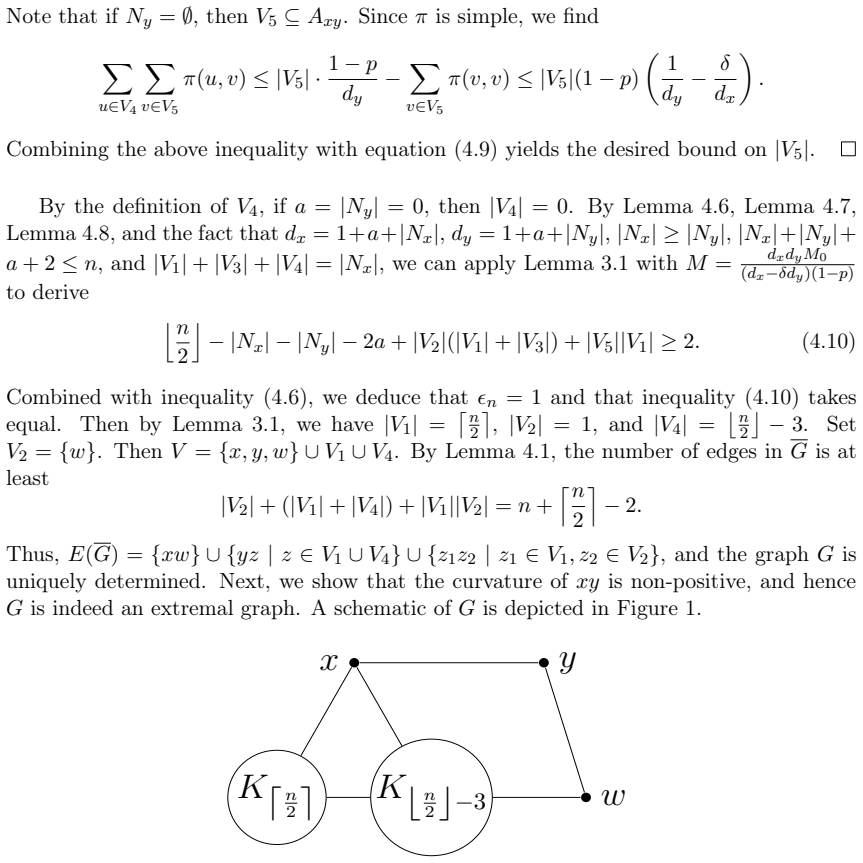
Graphs exceeding T(n) edges must have positive curvature

by Kaizhe Chen, Shiping Liu +1 more

An extremal theorem for positive curvature of graphs

The bound is optimal, with a unique extremal example when n is even and at least 12.

Figure from the paper full image
abstract click to expand
We prove an extremal theorem for positive Ollivier/Lin--Lu--Yau curvature: every graph of order \(n\geq 8\) with more than \[ T(n)=\frac{n^2-3n}{2}-\left\lceil\frac{n}{2}\right\rceil+2 \] edges has positive Ollivier/Lin--Lu--Yau curvature, and this threshold is optimal. Moreover, for even $n\geq 12$, there exists a unique graph with $T(n)$ edges that has an edge with non-positive curvature. For $n=8,10$ and odd $n\geq 9$, the extremal graphs are not unique. This suggests a new class of extremal graph-theoretic problems arising from discrete curvature notions.
0
0
math.CO 2026-07-03

Overfull Conjecture holds for graphs with Δ at least (1+ε)n/2

by Guantao Chen, Jessica McDonald +1 more

Towards the Overfull Conjecture II

Result covers all large graphs where maximum degree exceeds half the vertices by any fixed positive fraction.

Figure from the paper full image
abstract click to expand
Let $G$ be a simple graph with maximum degree $\Delta(G)$. A subgraph $H\subseteq G$ is $\Delta(G)$-overfull if $|E(H)|>\Delta(G)\left\lfloor |V(H)|/2\right\rfloor$. In any edge coloring of $G$, each color class restricted to $H$ is a matching of size at most $\left\lfloor |V(H)|/2\right\rfloor$. Thus, if $G$ contains a $\Delta(G)$-overfull subgraph, then $G$ cannot be edge-colored with only $\Delta(G)$ colors. By Vizing's Theorem, $\chi'(G)\le \Delta(G)+1$, and hence $G$ is class $2$. In 1986, Chetwynd and Hilton conjectured that whenever $\Delta(G)>|V(G)|/3$, the converse also holds: every class $2$ graph $G$ contains a $\Delta(G)$-overfull subgraph. This statement, commonly known as the Overfull Conjecture, is one of the most influential conjectures in graph edge coloring. It would imply a polynomial-time algorithm for determining the chromatic index of graphs $G$ with $\Delta(G)>|V(G)|/3$, and would also imply several other longstanding conjectures in the area, including the Just-overfull Conjecture and the Vertex-splitting Conjecture. In previous work, the third author verified the conjecture for large graphs $G$ with maximum degree at least $13|V(G)|/14$. In this paper, we confirm the conjecture for robust expanders satisfying certain density constraints. As a consequence, for every $0<\varepsilon<1$, the conjecture holds for all sufficiently large graphs $G$ with maximum degree at least $(1+\varepsilon)|V(G)|/2$.
0
0
math.CO 2026-07-03

Sidorenko property equals spectral bound in admissible graphon classes

by Yuqi Zhao

Tensor Amplification and Spectral Transfer for Sidorenko-Type Inequalities

When v(H) ≤ e(H) the combinatorial inequality holds exactly when homomorphism density meets a power of the Perron radius.

abstract click to expand
We develop a tensor-amplification framework for Sidorenko-type inequalities in graphon classes. The framework applies to any admissible class, meaning a class closed under tensor powers and normalized principal restrictions. These two closure properties isolate the structural input needed for the amplification arguments, while preserving natural positivity constraints such as the doubly nonnegative constraint. For every admissible class $\mathcal{C}$, we prove two transfer principles. First, equality cases regularize optimally: if a non-matching graph $H$ is $\mathcal{C}$-Sidorenko, then every equality case $t(H,W)=p(W)^{e(H)}$ with $W\in\mathcal{C}$ is regular. Consequently, relative forcing is equivalent to relative regular-forcing for every non-matching $\mathcal{C}$-Sidorenko graph. Second, in the range $v(H)\le e(H)$, ordinary $\mathcal{C}$-Sidorenko is equivalent, as a universal property over $\mathcal{C}$, to the spectral inequality $t(H,W)\ge \rho(W)^{2e(H)-v(H)}p(W)^{v(H)-e(H)}$ for every non-zero $W\in\mathcal{C}$. The spectral transfer is obtained from a Perron-biased tensor regularization theorem detecting the Perron spectral radius on the exponential scale. We also prove quantitative near-equality variants and apply the framework to doubly nonnegative graphons and bounded doubly nonnegative kernels. This yields spectral equivalences for Sidorenko-good graphs in the range $v(F)\le e(F)$, and identifies Sidorenko-good forcing with regular-KNRS forcing for non-matching Sidorenko-good graphs.
0
0
math.CO 2026-07-03

Poset powerdomain is RB-domain iff Hasse graph is tree with least element

by Yuxu Chen, Hui Kou +1 more

Characterizing finite posets whose probabilistic powerdomain are RB-domains

Classification shows probabilistic powerdomain fails to preserve RB-domains, with diamond as counterexample.

abstract click to expand
We classify the finite posets whose probabilistic powerdomain is an RB-domain. For a finite nonempty poset \(P\), let \(\Vone(P)\) be the probability powerdomain of $P$, which is the probability simplex ordered by the stochastic order. We prove that \(\Vone(P)\) is an RB-domain if and only if \(P\) has a least element and the undirected Hasse graph of \(P\) is a tree. Consequently, the probabilistic powerdomain does not preserve RB-domains; the four-point diamond gives a finite counterexample. The proof separates two obstructions. First, if \(P\) has no least element, then the face of probability measures supported on the minimal points must be fixed pointwise by every deflation below the identity. Secondly, once a least element exists, the Hasse graph is connected, and a cycle in it makes the local stochastic cone non-simplicial. A Euclidean finite-step cone argument then rules out the finite-valued monotone approximations supplied by the RB property.
0
0
math.CO 2026-07-03

One weight realizes every symmetric Hales-Jewett coloring

by Younes Mouhib

One-Weight Colorings, the Symmetric Class, and Lower Bounds for Hales--Jewett Numbers

The match reduces the symmetric lower-bound problem to one-dimensional Gallai coloring and supplies HJ(3,3) at least 22.

abstract click to expand
A coloring of the Hales--Jewett cube $[t]^n$ is symmetric if it is invariant under all coordinate permutations, and one-weight if it reads only an integer-weighted count of the letters. We prove that the two classes coincide -- a radix weight realizes every symmetric coloring -- so the symmetric lower-bound problem for the Hales--Jewett numbers is exactly a one-dimensional coloring problem about homothetic copies of a $t$-point set, the case $d=1$ of Gallai's theorem. Optimizing the weight yields $\mathrm{HJ}(3,3)\ge22$ and $\mathrm{HJ}(4,2)\ge14$, the latter in closed form from the new Gallai homothety numbers $G_2(\{0,2,3,5\})=67$ and $G_2(\{0,1,5,6\})=80$; new values at three colors -- $G_3(\{0,1,3\})=42$, $G_3(\{0,1,4\})=57$ and $G_3(\{0,2,5\})\ge77$ -- give $\mathrm{HJ}(3,3)\ge16$ from a one-line certificate. An anatomy of the $(4,2)$ palette locates the source of its compression: it is an extremal object of the bracket regime plus a single boundary scale. An exhaustive census shows how thin the class is: of the $1644$ line-free $2$-colorings of $[3]^3$, exactly $36$ are symmetric. For lines with at most $K$ active coordinates the same machinery gives infinite bracket numbers, $\mathrm{HJ}^{[12]}(3,3)=\mathrm{HJ}^{[12]}(4,2)=\infty$, strictly beyond the sum-type ceilings $\kappa_{\mathrm{sum}}(3,3)=11$ and $\kappa_{\mathrm{sum}}(4,2)=10$; for lines whose active set is an interval the machinery is provably blind, the interval ceiling $\lambda(3,r)$ is settled for every $r$ by assembling the known bounds, and a SAT computation gives the exact value $\mathrm{HJ}^{(1)}(3)=5>4=\mathrm{HJ}(3)$. We close with the Collapse, diagonal-only, and symmetric-extremality conjectures and with open problems on optimal weights. Every certificate displayed in this note has been re-verified by direct enumeration, independently of any solver.
0
0
math.CO 2026-07-03

Counterexamples refute two matroid conjectures

by Matt Larson

Counterexamples to two conjectures about matroids

White's toric ideal claim and Mason's log-concavity claim both fail for specific matroid constructions.

Figure from the paper full image
abstract click to expand
We give counterexamples to two well-known conjectures about matroids: White's conjecture on the generation of the toric ideal by symmetric exchange binomials, and a conjecture of Mason on the log-concavity of the counts of flats of a given rank.
0
0
math.CO 2026-07-03

Minor-free graphs admit 3-colorings with n^{4/9} cluster size

by Vida Dujmović, Hussein Houdrouge +1 more

3-Colouring Graphs Excluding a Fixed Minor

Extends the planar result to all proper minor-closed classes and improves the 2008 square-root bound

abstract click to expand
We show that, for every fixed graph $H$, every $n$-vertex graph $G$ that excludes $H$ as a minor is $3$-colourable with clustering $O_H(n^{4/9})$. That is, there exists a function $f$ such that for every graph $H$, every $n\ge 1$, every $n$-vertex graph $G$ that excludes $H$ as a minor has a vertex colouring with $3$ colours in which each monochromatic component has size at most $f(H)\cdot n^{4/9}$. This generalizes a recent result of Dujmovi\'c, Morin, Norin, and Wood (\textit{arXiv}:2507.03163) from planar graphs to all proper minor-closed graph classes and is the first improvement on clustered $3$-colouring of proper minor-closed graph classes since the upper bound of $O_H(\sqrt{n})$ due to Linial, Matou\v{s}ek, Sheffet, and Tardos (\textit{Comb. Prob. Comput.}, \textbf{17}(4):577--589, 2008).
0
0
math.CO 2026-07-03

Finite abelian groups classified by when A(G) minimally represents Davenport constant

by Guoqing Wang

The universal zero-sum invariant and weighted zero-sum for infinite abelian groups II

The classification covers every finite case; weighted versions over infinite groups reduce to kernel-cover properties on Cartesian powers.

abstract click to expand
Let $G$ be an abelian group, and let $\mathcal F (G)$ be the free commutative monoid with basis $G$, and $\mathcal A (G)$ the set consisting of all minimal zero-sum subsequences over $G$. For any subset $\Omega \subset \mathcal F (G)$, we define the universal zero-sum invariant ${\mathsf d}_{\Omega}(G)$ as the minimal positive integer $\ell$ such that every sequence $T$ over $G$ of length $\ell$ contains a subsequence lying in $\Omega$. The classical Davenport constant ${\rm D}(G)$ for $G$ can also be written as ${\mathsf d}_{\mathcal A (G)}(G)$. We give a complete classification of all finite abelian groups for which $\mathcal A(G)$ is a minimal set to represent the Davenport constant. We also investigate the weighted Davenport constant over abelian groups (which may be infinite). Let $F$ and $G$ be abelian groups, and let $\Psi \subseteq \mathrm{Hom}(F,G)$ denote a weight set. We reinterpret the weighted Davenport constant $D_{\Psi}(G)$ in terms of coverings of Cartesian powers $F^n$ by kernels of induced homomorphisms arising from tuples in $\Psi^n$; these homomorphisms are naturally linked to coproducts in the category of abelian groups. This motivates the notion of kernel-cover compactness, a property characterizing when such kernel coverings admit finite subcovers. We establish a correspondence between weighted zero-sum invariants and kernel-cover structures, where the bound $D_{\Psi}(G)\le n$ is equivalent to a canonical kernel-cover property on $F^n$. We further study finite reduction phenomena for infinite weight sets and provide sufficient conditions ensuring uniform kernel-cover compactness. The present work constitutes a follow-up to [G. Wang, Comm. Algebra, 2025].
0
0
math.CO 2026-07-03

Bounded row treewidth allows unbounded geodesic treewidth

by Laura Merker, Lena Scherzer +1 more

Separating Geodesic Structure and Product Structure

Graphs of bounded row treewidth can require arbitrarily large geodesic treewidth; deciding geodesic treewidth 1 for treewidth-2 graphs is in

Figure from the paper full image
abstract click to expand
The geodesic treewidth of a graph $ G $ is the smallest $k$ for which there is a partition $\mathcal{P}$ into geodesics such that $G/\mathcal{P}$ has treewidth $k$, where $G/\mathcal{P}$ is obtained from $ G $ by contracting each part of $ \mathcal{P} $. Based on this notion, row treewidth was developed and is defined for a graph $ G $ as the smallest $ k $ such that $ G \subseteq H \boxtimes P $ for some graph $ H $ of treewidth $ k $ and a path $ P $. Equivalently, the row treewidth of a graph $ G $ is the smallest $ k $ for which there is a partition $ \mathcal{P} $ into disjoint unions of geodesics that are aligned with respect to some layering such that $ G/\mathcal{P} $ has treewidth $ k $. We separate the two notions by showing that bounded row treewidth does not imply bounded geodesic treewidth and by presenting a polynomial-time algorithm to decide whether a graph of treewidth 2 has geodesic treewidth 1, which is known to be NP-hard for row treewidth [Biedl, Eppstein, Ueckerdt, 2025]. More generally, we provide an algorithm to decide whether a given graph has geodesic treewidth at most $ d $ that is XP in the treewidth, whereas there is no such algorithm for row treewidth, unless P = NP [Biedl, Eppstein, Ueckerdt, 2025]. On the other hand, we show that computing the geodesic treewidth is NP-hard and that every graph with geodesic treewidth 1 has bounded row treewidth. Moreover, we improve the best known lower bound on the geodesic treewidth of planar graphs to 5.
0
0
math.CO 2026-07-03

Closed form counts snail race outcomes with fixed ties

by Yu Chen, Wenxiang Zhu

A Snail Race Problem

A recurrence solved via exponential generating functions yields the number and links it to ordered Bell numbers.

abstract click to expand
Inspired by Problem 17 from the 2024 American Mathematics Competition (AMC) 10B, this work focuses on enumerating the distinct outcomes of a snail race with specified number of ties of a certain type. We begin by developing a recurrence relation and subsequently derive a closed-form formula for the number of possible outcomes using the exponential generating function method. Two special cases of the problem are considered in detail. Our analysis also explores the connections between the solution to this problem and the ordered Bell numbers, Stirling numbers of the second kind, and partial Bell polynomials.
0
0
math.CO 2026-07-03

Neighborhoods determine full orthogonal graphs on quadratic spaces

by Hans Cuypers

On Orthogonal Graphs and their Automorphisms

The graph on non-isotropic points with tangent-line edges is fixed by the induced subgraph around any single vertex.

abstract click to expand
We provide a characterization of the connected subgraphs of the graphs with vertex set the non-isotropic points in a quadratic space $(V,Q)$, two points adjacent if and only if they span a tangent line. Here $(V,Q)$ is a quadratic space $V$ over a finite field $\mathbb{F}_q$ of order $q$, where $q>3$ is odd, equipped with a non-degenerate quadratic form $Q$. The local structure of the graph (i.e. the graph induced on the neighbors of a point) determines the structure of the full graph. This characterization helps to determine the automorphism group of these graphs.
0
0
math.CO 2026-07-03

Chord diagram crossings alone set weights for q-deformed planar maps

by Timothy Budd

Double-scaled SYK from boundary metrics of planar maps

At fixed perimeter the geodesic chord diagrams follow exactly the same distribution as in the double-scaled SYK model.

Figure from the paper full image
abstract click to expand
The enumeration of planar maps with control on the boundary metric, i.e. the pseudometric induced on the outer face of the map by its bulk graph distance metric, is a difficult problem in general. However, we show that for a family of bipartite planar map models with special q-deformed face weights that arise in the physics context of the double-scaled Sachdev-Ye-Kitaev model (DSSYK) the enumeration admits a very simple answer. Encoding the boundary metric of a bipartite planar map by its so-called geodesic chord diagram, we prove that the weighted enumeration depends only on the crossing number of the chord diagram. At fixed perimeter, the induced law of the geodesic chord diagram in these planar map models coincides exactly with the chord diagram representation of the DSSYK model.
0
0
math.AG 2026-07-03

Nine-line pair counters generalized Terao conjecture

by Alexandru Dimca, Piotr Pokora

A nine-line counterexample to a conjecture on the minimal degree of Jacobian relations

Arrangements with identical lattices have mdr values 4 and 5, so one falls below the conjectured d/2 bound for degree 9.

abstract click to expand
We construct two arrangements of nine lines in the complex projective plane with isomorphic intersection lattices but with different minimal degrees of Jacobian relations. The common weak combinatorics is \[ (n_2,n_3,n_4)=(9,7,1), \] so the example is not the classical Ziegler-Yuzvinsky pair, whose weak combinatorics is $(n_{2},n_{3}) = (18,6)$. For the two defining equations $f$ and $g$ we prove \[ {\rm mdr}(f)=4,\qquad {\rm mdr}(g)=5. \] Since the degree is $d=9$, the first equality gives ${\rm mdr}(f)<d/2$. Hence the pair gives a counterexample to the Generalized Terao Conjecture.
0
0
math.CO 2026-07-03

Central graphs of regular graphs meet AVD-total coloring bound

by Amitayu Banerjee

AVD Total Coloring of Central Graphs, Subdivision Graphs, and the Join of Graphs

Verification for regular graphs, complete bipartite graphs, and equal-order joins narrows the open cases of the 2020 conjecture.

Figure from the paper full image
abstract click to expand
In 2020, Panda, Verma, and Keerti asked whether the central graph of every graph satisfies the AVD-total coloring conjecture. In this paper, we verify the conjecture for central graphs of regular graphs, complete bipartite graphs, graphs that can be expressed as the join of two graphs of the same order, and several other graph classes, thereby providing partial progress towards this open problem. We further determine the AVD-total chromatic number of subdivision graphs and establish new results on the AVD-total coloring of joins of graphs.
0
0
physics.soc-ph 2026-07-03

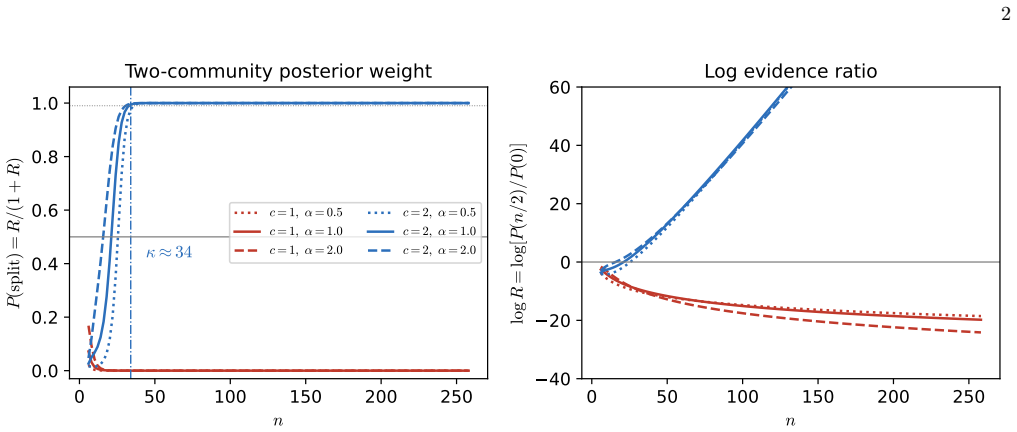
Next-nearest links make ring prefer communities above 35 nodes

by Alexei Vazquez

The ring wants to be broken

Plain cycles stay unpartitioned at all sizes while c=2 rings switch with log-evidence growing linearly in n.

Figure from the paper full image
abstract click to expand
The Ramsey community number $r_\kappa$ is the minimum network size at which a graph's connectivity is better described by a partition into communities than by no partition, under a prescribed community-detection rule. It was introduced through numerical simulations of networks grown by local rules, which suggested that community structure can emerge without any node heterogeneity. Here I compute $r_\kappa$ analytically for the simplest homogeneous, locally wired graph: the circulant ring lattice $C_n(1,\dots,c)$. Using a Bernoulli stochastic block model with symmetric $\mathrm{Beta}$ priors as the detection rule, the Bayesian evidence for a balanced two-community partition and for the unpartitioned network are both obtained in closed form, so the transition between them can be located exactly. The result is a sharp dependence on the interaction range: the plain cycle ($c=1$) is never partitioned, its two-community posterior decaying as $n^{-(2\alpha+3)}$, so $r_\kappa=\infty$; but the next-nearest-neighbour ring ($c=2$) acquires a finite $r_\kappa\simeq 35$ nodes, above which the partition is preferred with a log-evidence growing as $(\ln 2)\,n$. This provides an exactly solvable instance of community emergence in a network with no built-in communities, and shows that a minimal amount of local connectivity is enough to break the ring.
0
0
math.CO 2026-07-03

Plethystic substitution yields shifted t-Schur weight on strict partitions

by S.-J. Lee

A Shifted t-Schur Weight from the Modified Odd Operator

The operator produces explicit Pfaffian kernel, Fredholm expression for largest part, and cumulants; negative t gives a probability measure.

abstract click to expand
We study the one-time weight on strict partitions obtained from the modified odd Greaves--Jing--Zhu operator. The shifted $t$-Schur functions generated by this operator are obtained from the classical Schur $Q$-functions by the plethystic substitution $X\mapsto X-tX$. Thus the corresponding weight \[ \lambda \longmapsto \mathcal Q_\lambda(X;t)P_\lambda(Y) \] is a shifted Schur weight with a virtual first alphabet. We give its normalization, its Pfaffian correlation kernel, its Fredholm Pfaffian for the largest part, and its size cumulants. For $t=-q$ with $q\geq 0$ the virtual alphabet becomes the positive alphabet $X+qX$, giving a genuine probability measure. This positive specialization is the one-time marginal of the two-color lift considered in a companion note.
0
0
math.RT 2026-07-03

Alternative route produces Euler characters for gl(m,n)

by A.N. Sergeev

Euler characters for general linear Lie superalgebra

Results stated in new terms extend prior work on the general linear Lie superalgebra.

abstract click to expand
M. Gorelik and Th. Heidersdors in the papers \cite{GH} investigated Euler characters for Lie superalgebra $\frak{gl}(m,n)$ and $\frak{osp}(m.2n)$. In the present paper we also investigate Euler characters for Lie superalgebra $\frak{gl}(m,n)$ but we use a different approach and our results are formulated in different terms.
0
0
math.CO 2026-07-03

Only antipodal sets achieve infinite harmonic strength on spheres

by Ryutaro Misawa, Yusaku Nishimura

Spherical Designs with Infinite Harmonic Strength

For dimensions two and higher, finite point sets integrate spherical harmonics of infinitely many degrees exactly precisely when they are sy

abstract click to expand
In this paper, we study the existence problem for spherical \(T\)-designs on the \(d\)-dimensional sphere, where \(T\) is an infinite subset of \(\mathbb N\). We show that, if \(d\ge 2\), then a finite subset of \(S^d\) has infinite harmonic strength if and only if it is antipodal. For \(d=1\), we show that infinite strength spherical designs are exactly cyclotomic designs, and we characterize their existence in terms of certain \(0\)-\(1\) polynomials. We also prove that the harmonic strength of every infinite strength spherical design has the weak GCD property. Finally, for a given infinite subset \(T\subset \mathbb N\) with the weak GCD property, we give a finite procedure to decide whether there exists \(X\subset S^1\) such that \(\operatorname{Hst}(X)=T\), and apply this criterion to concrete existence and non-existence examples.
0
0
math.CO 2026-07-03

Hamiltonian graphs guarantee second cycle of length n-O(n^{2/3})

by Xiaolin Wang, Jiabao Yang +2 more

A note on long nontrivial cycle in Hamiltonian graphs

Combining a poset-based constructive method with a nonconstructive approach improves the prior n-O(n^{4/5}) bound and is tight for these tec

Figure from the paper full image
abstract click to expand
Let $G$ be an $n$-vertex graph containing a Hamiltonian cycle and with minimum degree at least $3$. Gir\~{a}o, Kittipassorn and Narayanan (Israel J. Math., 2019) proved that $G$ contains another cycle of length at least $n-O(n^{4/5})$. In this paper, we improve their bound to $n-O(n^{2/3})$. Our proof is combined with a constructive method, which is based on a poset result, and a nonconstructive method. And the bound is best possible under these two methods.
0
0
math.CO 2026-07-03

No taiko product structure meets both no-fold and triple-girth conditions

by Henry Shin

A global girth obstruction for Garg--Mineyev taiko product structures

High middle-link girth forces a rectangle decomposition that drops at least one horizontal girth below 6, closing the Garg-Mineyev route for

Figure from the paper full image
abstract click to expand
Mineyev's taiko construction, in Garg--Mineyev's finite support-size formulation, gives a concrete route from finite support data to zero divisors and units in group rings of torsion-free CAT(0) groups over $\mathbb{F}_2$. We prove that this triple-girth product-structure route is globally closed: no product structure, even or odd, with support sizes $m,n\ge2$ admits a coherent orientation for which the no-fold and triple-girth conditions both hold. Consequently the Garg--Mineyev triple-girth product-structure assembly route produces neither zero-divisor nor unit counterexamples over $\mathbb{F}_2$ for any such support-size pair. The obstruction is structural, not a bounded-search artifact. High middle-link girth forces signed colors into a balanced near-disjoint rectangle decomposition of the board, with the single odd defect omitted. The product identity, pressure inequalities, Fisher inequalities, and a dual Fisher bound force the middle link to have girth $4$ or $6$; in the girth-six case, the minimum of the two horizontal-link girths is at most $5$. This dichotomy rules out every triple-girth branch. A weighted dual Fisher inequality and an exact finite certificate sharpen the frontier: if the middle link has girth $6$, the horizontal girth is at most $4$, and characteristic-two affine-plane constructions attain equality. Thus the Garg--Mineyev finite failures reflect a structural barrier in the taiko geometry itself. The finite certificate is used only for this sharper frontier, not for the no-$T_4$ obstruction.
0
0
math.CO 2026-07-03

ex(n,K_a,b,K_3,b+1) equals Theta(n^3) for odd b at least 5

by Jing Wang, Zixuan Yang +1 more

On the generalized Tur\'{a}n number of the complete bipartite graph K_(3,b+1)

Completes the cubic-order result by handling the remaining odd-b case via a finite-geometry construction.

abstract click to expand
For graphs $F$ and $H$, let $\mathrm{ex}(n,H,F)$ denote the maximum number of copies of $H$ in an $n$-vertex $F$-free graph. Very recently, Janzer, Longbrake, and Yepremyan proved that for $3<a\leq b$ and sufficiently large $t$, \begin{equation*} \mathrm{ex}(n,K_{a,b},K_{3,t})=\Theta_{a,b,t}(n^3). \end{equation*} Later, Hou, Hu, and Wang made this threshold explicit by showing that the conclusion holds for all $t\geq 2\max\{3,\lceil b/2\rceil\}+1$. In particular, for every even $b\geq 6$, this matches the necessary threshold $t=b+1$. In this paper, we resolve the remaining case where $b$ is odd. More precisely, we prove that for all fixed integers $b\geq 5$ and $3<a\leq b$, \begin{equation*} \mathrm{ex}(n,K_{a,b},K_{3,b+1})=\Theta_{a,b}(n^3). \end{equation*} Our construction uses a finite-field point set in $\mathrm{PG}(5,q)$ together with an orthogonal polarity. The key new ingredient is the polynomial splitting lemma due to Andrade, Bary-Soroker, and Rudnick, which produces many planes whose intersections with the point set and their polar planes both have size $b$. This gives a $K_{3,b+1}$-free incidence graph while preserving $\Omega_{a,b}(n^3)$ copies of $K_{a,b}$.
0
0
math.CO 2026-07-03

Homologies recover Penrose polynomials for ribbon graphs

by D. W. Collison, D. Tubbenhauer

Categorification of some Penrose polynomials

A cube of resolutions from possibly nonorientable 2D cobordisms produces doubly- and triply-graded groups whose Euler characteristics match

abstract click to expand
We construct doubly- and triply-graded Penrose-type homologies for ribbon graphs. The construction is a TQFT-valued cube of resolutions built from two-dimensional cobordisms, which may be nonorientable. Their Euler characteristics recover specializations of some Penrose polynomials; in particular, the four color case comes with a refinement of the classical Penrose criterion.
0
0
math.CO 2026-07-03

d-Hoggatt triangles are infinitely log-concave in rows and columns

by Jianxi Mao, Wenle Shi

The analytic properties of Hoggatt triangles

Minors taken from consecutive rows and columns of Pascal's triangle yield total positivity and normal row asymptotics for every d.

abstract click to expand
The $d$-Hoggatt triangle is a lower triangular matrix whose entries are given by specific minors of Pascal's triangle formed by consecutive $d$ rows and $d$ columns. The cases $d=1,2,3$ correspond to Pascal's triangle, the Narayana triangle, and the Baxter triangle, respectively. In this paper, we present the infinite log-concavity of the row and column sequences, the log-concavity of the sequences along transversals, and the eventual log-convexity of the sequences along rays of the $d$-Hoggatt triangle. In addition, we prove the asymptotic normality of the row sequences and total positivity of the $d$-Hoggatt triangle.
0
0
math.CO 2026-07-03

Barycentric subdivision matrices proven totally positive

by Yanxin Liu, Jianxi Mao

Total positivity of transformation matrices for uniform subdivisions

Combinatorial argument shows all minors positive; sufficient condition gives TP2 for uniform and r-colored cases.

Figure from the paper full image
abstract click to expand
The transformation of the $h$-vector of a finite simplicial complex under an $\mathcal{F}$-uniform subdivision is encoded by a transformation matrix. Mu and Welker conjectured that the transformation matrix of the barycentric subdivision is totally positive. In this paper, we give a new combinatorial proof of this conjecture. We also prove the total positivity of the transformation matrix of the interval subdivision. In addition, we establish a sufficient condition for the transformation matrix of a uniform subdivision to be totally positive of order $2$ (TP$_2$), thereby partially answering a question of Mu and Welker. As an application, we show that the transformation matrix of the $r$-colored barycentric subdivision is TP$_2$.
0
0
math.CO 2026-07-03

Narayana change of basis preserves real-rootedness

by Jianxi Mao, Lijie Wang

The Narayana transformation

The operator that multiplies coefficients by Narayana polynomials sends nonnegative real-rooted inputs to real-rooted outputs and certifies

abstract click to expand
For $m\in\mathbb{Z}_{\geq 0}$, let \[ N_{n,m}(x)={}_2F_1(-n,-n-m;m+1;x), \] which specializes to the Narayana polynomials of types $B$ and $A$ for $m=0$ and $m=1$, respectively. We prove that the associated basis transformation \[ T_{N_m}\left(\sum_{k=0}^n a_kx^k\right)=\sum_{k=0}^n a_kN_{k,m}(x) \] maps every real-rooted polynomial with nonnegative coefficients to a real-rooted polynomial. The proof is based on the rectangular additive convolution of polynomials. We then apply this result to products of lower triangular matrices and obtain a general criterion ensuring that their row generating functions remain real-rooted. As consequences, we recover this property for powers and products of several classical triangular matrices, including Pascal's triangle, the Stirling triangles, and the Narayana triangles of types $A$ and $B$. We conclude with conjectures concerning the squares of the Eulerian and Delannoy triangles.
0
0
math.NT 2026-07-02

Lean verifies Rogers-Ramanujan identities

by Kenny Lau, Seewoo Lee +1 more

Formalized q-series: The Rogers-Ramanujan Identities and Beyond

Custom structures for q-Pochhammer symbols and Bailey's lemma produce computer-checked proofs of the classical identities.

abstract click to expand
The theory of $q$-series and basic hypergeometric series plays a crucial role at the intersection of combinatorics, number theory, and representation theory. From the classical partition identities of Euler and Jacobi to modern developments in class field theory, vertex operator algebras, and the Monstrous Moonshine conjecture, $q$-series provide the analytic framework for a wide range of profound applications. In this paper, we discuss the formalization of this theory in the Lean proof assistant, a process that requires careful design of scalable and versatile structures to reconcile formal algebraic identities with analytic convergence properties. We address these foundational challenges by focusing on the construction of $q$-Pochhammer symbols, $q$-binomial coefficients, Bailey's Lemma and similar primitives. To demonstrate the utility of this work, we provide fully verified proofs of the Jacobi Triple Product formula and the celebrated Rogers-Ramanujan identities, which serve as both historical and technical benchmarks for the field. This work establishes a rigorous computational foundation for the future formalization of mock theta functions, modular forms, and the diverse algebraic structures that underpin their applications across mathematics and physics.
0
0
math.CO 2026-07-02

Hypercube sumsets obey |A1+⋯+An| ≥ product of sizes to power 1/p

by Felipe Gonçalves, Danylo Radchenko

Sharp Lower Bounds for Sumsets in Hypercubes

The exponent p = n log(m+1)/log(nm+1) is optimal for subsets of {0..m}^d and resolves a long-standing conjecture.

Figure from the paper full image
abstract click to expand
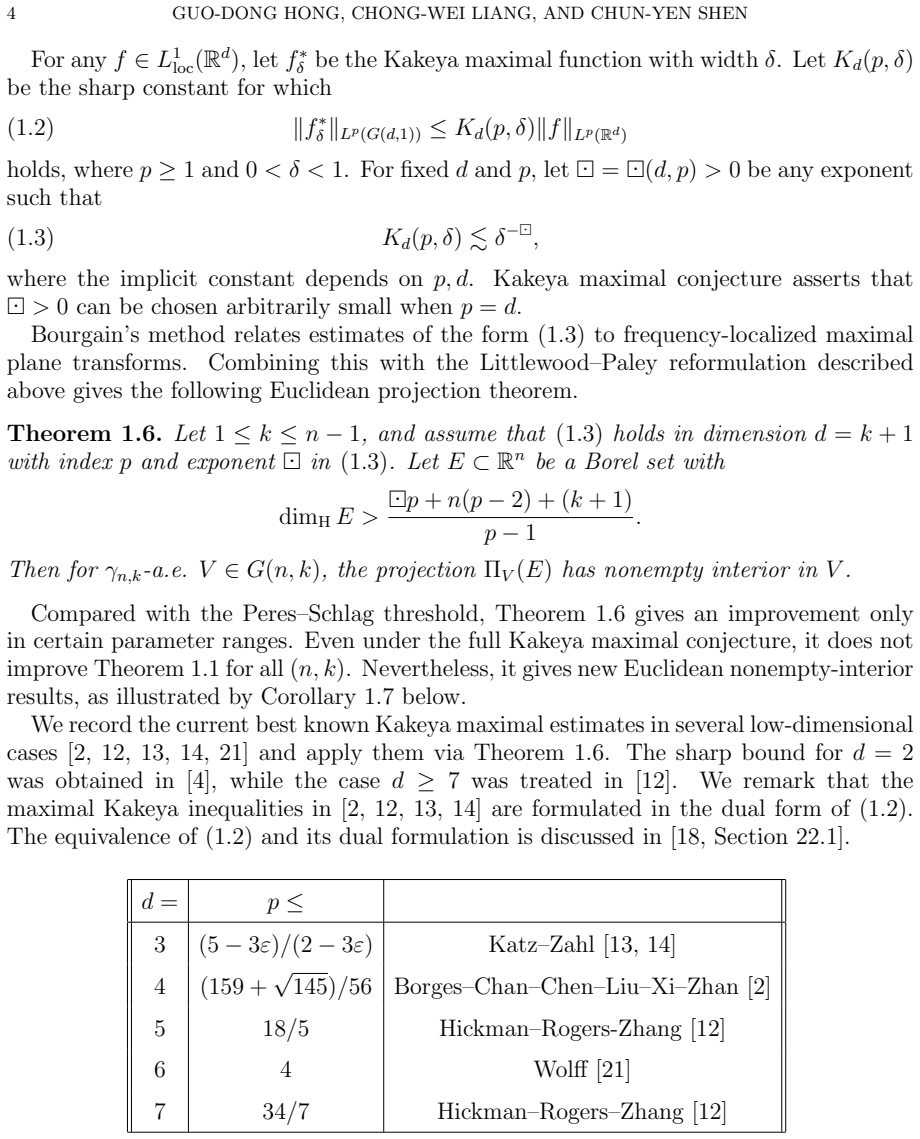
We prove a sharp lower bound for the cardinality of sumsets of subsets of $\mathbb{Z}^d$ confined to a hypercube, resolving in strong form a conjecture that was made explicit by Becker, Ivanisvili, Krachun and Madrid and had circulated in the folklore of the field for some time. Specifically, for sets $A_j\subseteq \{0,1,2,\dots,m\}^d$ we show that \[|A_1+\dots+A_n|\;\geq\; (|A_1|\cdots|A_n|)^{1/p},\qquad p=\frac{n\log(m+1)}{\log(nm+1)},\] with the exponent best possible. The only previously known sharp cases were $A_j\subseteq \{0,1\}^d$, for all $n\ge1$, and $A_j\subseteq \{0,1,2\}^d$ for $n=2$. We also prove a sharp inequality in the case when $A_j\subseteq\{0,1,\dots,m_j\}^d$ for different $m_j$. We obtain the above inequality as a corollary of a stronger result on sup-convolution of functions on $\mathbb{Z}^d$, whose proof is based on a novel mixed volume representation of a lattice path norm, together with a sharp one-dimensional functional inequality.
0
0
math.CO 2026-07-02

Annihilation gap bounded by 2μ + 1 − ceil(sqrt(6μ))

by Ohr Kadrawi, Vadim E. Levit

Annihilation, Independence, and Residue: Sharp Matching Bounds for the Annihilation Gap and a TxGraffiti Application

The difference a(G) − α(G) never exceeds a closed-form function of the maximum matching size, attained for every μ.

Figure from the paper full image
abstract click to expand
Let $G$ be a finite simple graph. The annihilation number $a(G)$ is an efficiently computable upper bound on the independence number $\alpha(G)$. We develop a sharp matching-number theory for the gap $a(G)-\alpha(G)$. The strongest general theorem is the exact closed form \[a(G)-\alpha(G)\leq 2\mu(G)+1- \lceil \sqrt{6 \mu(G)} \rceil \qquad(\mu(G)\geq 1), \] and the bound is attained for every prescribed matching number. We also prove sharp matching-dependent bounds for forests, bipartite graphs, and K\"onig-Egerv\'ary graphs, with equality constructions, equality certificates, and equality criteria. Finally, we treat a TxGraffiti output as a machine-conjecture case study. Using annihilating decompositions together with the classical Havel-Hakimi residue inequality $res(G)\leq \alpha(G)$, we give an independent proof of the TxGraffiti annihilation-residue inequality \[ \alpha(G)\geq \frac{a(G)+res(G)}{\Delta(G)} \] for every connected graph $G$ of order at least three, show that both hypotheses are necessary, and compare this proof with a recent Caro-Wei approach. We also refine the Caro-Wei annihilation estimate by an explicit nonnegative slack term, identify its equality cases in degree-sequence form, and combine the refinement with our exact matching-number bound to obtain a combined computable bracket for the independence number and a Gupta-residue bound for the annihilation gap.
0
0
math.GT 2026-07-02

Alexander conjecture holds for infinite simplicial complexes

by Martina Iannella, Vadim Weinstein

Alexander's conjecture for infinite simplicial complexes

The finite-case result extends: triangulations with a common subdivision also share a common stellar subdivision when complexes may be infin

abstract click to expand
Alexander's conjecture states that for every two finite triangulations of the same topological space, if they have a common subdivision, then they have a common stellar subdivision. We generalize the recent result of Adiprasito and Pak, who resolved Alexander's conjecture for finite simplicial complexes, to infinite simplicial complexes.
0
0
math.CO 2026-07-02

Greedy Tamari intervals decompose like bipartite maps

by Philippe Biane, Wenjie Fang

Decomposition of Greedy Tamari Intervals and Bipartite Planar Maps

An explicit recursive isomorphism proves they are equi-enumerous and supplies the missing refined count.

Figure from the paper full image
abstract click to expand
The greedy Tamari poset, inspired by the well-studied Tamari lattice, was recently defined by Dermenjian in the more general setting of greedy $\nu$-Tamari posets. Bousquet-M\'elou and Chapoton counted intervals of the greedy $m$-Tamari poset in 2024 by solving a functional equation, and found that they are equi-enumerous to planar $(m+1)$-constellations. In this work, we give a combinatorial proof of this fact for the case $m = 1$, which also gives the refined enumeration conjectured by Bousquet-M\'elou and Chapoton. This is done by establishing a recursive decomposition of greedy Tamari intervals isomorphic to that of bipartite planar maps. We also propose a more general and refined conjecture for the case of general $m$.
0
0
math.CO 2026-07-02

Sidon sets at most sqrt(N) + 0.94601 N^{1/4}

by Jianfeng Hou, Hongbin Zhao

Vector-valued smoothing for finite Sidon sets

A vector-valued convolution inequality with averaged kernel energies tightens the coefficient on the N^{1/4} term.

abstract click to expand
Let $F(N)$ denote the largest cardinality of a Sidon subset of $\{0, 1, \dots, N - 1\}$. We prove \[ F(N) \le N^{1/2} + 0.94601 N^{1/4} + O(1). \] This improves the recently announced coefficient $0.97633$ obtained by Carter, Georgiev, G\'{o}mez-Serrano, Hunter, O'Bryant, Tao and Wagner. It is also very close to, and numerically below, the tentatively reported value of approximately $0.947$. The argument is based on a vector-valued convolution inequality: several smoothing kernels share the task of producing a boundary majorant, while their $L^2$ energies are averaged. The analytic reduction is elementary. The final constant is supplied by a finite rational certificate, verified by a short program using exact arithmetic only.
0
0
math.CO 2026-07-02

Colorful Carathéodory theorem extends to spanning k-trees

by Mikhail Bludov, Alexander Polyanskii

Spanning \(k\)-trees and the colorful Carath\'eodory theorem

Elementary combinatorial argument proves the constrained version for joins with sphere wedges, replacing earlier topological proofs.

Figure from the paper full image
abstract click to expand
Very recently, using Meshulam's lemma, Blagojevi\'c proved a constrained version of the colorful Carath\'eodory theorem for joins of bipartite spanning trees and wedge of spheres. Our main contribution extends his result from joins of bipartite spanning trees with wedges of spheres to joins of spanning \(k\)-trees with wedges of spheres. Our proof is elementary and avoids the topological machinery. We also discuss a homological variation of spanning \(k\)-trees and some Carath\'eodory-type results for them.
0
0
math.CO 2026-07-02

Normal ordering defines (p,q)-deformed rook numbers

by Toufik Mansour, Lahcen Oussi +1 more

Normal ordering in the (p,q)-deformed generalized Weyl algebra. II: Interpretation in terms of rook placements

Coefficients from the algebra match weighted placements on staircase boards and interpret generalized Stirling numbers for p not equal to 1.

Figure from the paper full image
abstract click to expand
In this paper, we investigate the combinatorial structure arising from the $(p, q)$-deformed generalized Weyl algebra generated by variables $X, Y$, and $Z_p$, satisfying the $(p, q)$-commutation relations $XY-qYX=h Y^sZ_{p}, XZ_p=pZ_pX$, and $Z_pY=pYZ_p$, where $s\in \mathbb{N}_0$. Our primary objective is to use the normal ordering process defined by these relations to develop a novel model of $(p, q)$-deformed rook theory. Specifically, we introduce a new framework of $(p, q)$-deformed $s$-rook numbers derived from this normal ordering process. Utilizing these combinatorial models, we provide explicit combinatorial interpretations for the associated $(p, q)$-generalized Stirling numbers via rook placements on staircase boards. Our results extend several classical and recent formulations in the literature to the general $p\neq 1$ setting.
0
0
math.CO 2026-07-02

Conditions suffice for one-round honeymoon Oberwolfach problem

by Masoomeh Akbari

A complete solution to the generalized honeymoon Oberwolfach problem with one round table

For HOP with s small tables and one round table, the divisibility requirements guarantee a solution exists.

Figure from the paper full image
abstract click to expand
The generalized honeymoon Oberwolfach problem (HOP) asks whether it is possible to seat $2n$ participants consisting of $n$ newlywed couples at a conference with $s$ tables of size $2$ and $t$ "round'' tables of sizes $2m_1, 2m_2, \ldots, 2m_t$, where $n = s + \sum_{i=1}^{t} m_i $ with all $m_i \geq 2$, over several nights so that each participant sits next to their spouse every time and next to each other participant exactly once. We denote this problem by $HOP(2^{\langle s \rangle}, 2m_1, \ldots, 2m_t)$. In this paper, we provide a complete solution to the generalized HOP with one round table, showing that the obvious necessary conditions for $HOP(2^{\langle s \rangle}, 2m)$ to have a solution are also sufficient.
0
0
math.CO 2026-07-02

Cartesian products obey 0.5809 domination bound

by Mohsen Aliabadi, Elliot Krop

An improved constant for Vizing's conjecture

New inequality improves the constant in the open Vizing conjecture on how domination scales under graph products.

abstract click to expand
For any graph $G = (V,E)$, a subset $S {\subseteq} V$ dominates $G$ if $N[S] = V$. The minimum cardinality over all such $S$ is called the domination number, written ${\gamma}(G)$. The classical conjecture of V.G. Vizing states that ${\gamma}(G{\square} H) {\ge} {\gamma}(G){\gamma}(H)$ where ${\square}$ stands for the Cartesian product of graphs. In this paper, we apply well-known results to prove the Vizing-type inequality ${\gamma}(G{\square} H) {\ge} .5809 {\gamma}(G){\gamma}(H)$.
0
0
math.CO 2026-07-02

Spectral surplus q forces linear copies of color-critical F

by Hongzhang Chen, Yongtao Li

An edge-spectral supersaturation of Mubayi's theorem for color-critical graphs

Exceeding 2(1-1/r)m by q yields at least (B_F-o(1)) q m^{(f-2)/2} copies when q ≤ δ_F sqrt(m).

Figure from the paper full image
abstract click to expand
We study the supersaturation problem in its edge-spectral form. Let $\lambda(G)$ be the adjacency spectral radius of $G$. Nikiforov proved that every $K_{r+1}$-free graph $G$ with $m$ edges satisfies $\lambda (G)\le \sqrt{(1\!-\!1/r )2m}$. Recently, Li, Liu and Zhang proved the same bound for every $F$-free graph $G$, where $F$ is any color-critical graph with $\chi(F)=r+1\ge4$, with equality only for regular complete $r$-partite graphs. It is then natural to ask how many copies of $F$ are forced once $\lambda (G)$ exceeds this threshold. Fang, Lin and Zhai answered this at the threshold itself, and conjectured that for any fixed $C>0$, the condition $\lambda (G)\ge \sqrt{(1\!-\!{1}/{r})2m} +C$ forces $\Omega\!\left(m^{(f-1)/2}\right)$ copies. In this paper, we answer this question with the best possible constant, proving that for every color-critical graph $F$ with $\chi(F)=r+1\ge4$, there exists $\delta_F>0$ such that if $m$ is sufficiently large, $0<q\le\delta_F\sqrt m$, and $G$ is an $m$-edge graph with $\lambda^2(G)\ge 2\left(1-\tfrac1r\right)m+q$, then \[ N_F(G)\ge\bigl(B_F-o(1)\bigr)\,q\, m^{{(f-2)}/{2}}, \quad \text{where}~~ B_F:=\tfrac{\alpha_F}{4} (\tfrac{2r}{r-1} )^{{f}/{2}}, \] and the constant $B_F$ is best possible. Our result can be viewed as an edge-spectral counterpart of Mubayi's theorem, since it converts the spectral surplus $q$ into a linear number of copies with a sharp constant, and it solves the conjecture of Fang, Lin and Zhai in a stronger form.
0
0
cs.GT 2026-07-02

The paper links fair allocation of conflicting items (graph vertices) to agents with…

by Ishay Haviv

Fair Allocation under Conflict Constraints via Strong Colorability

The paper introduces a hierarchy of strong chromatic number variants to characterize and algorithmically guarantee SD-EF1, EF1, and EF[1,1]…

abstract click to expand
In the fair allocation problem under conflict constraints, the goal is to partition the vertices of a graph among agents in a fair manner, such that no two adjacent vertices are assigned to the same agent. We study this problem for agents with common preferences through the lens of three fairness criteria: stochastic-dominance envy-freeness up to one item for preference orders (SD-EF1), envy-freeness up to one item for monotone additive valuations (EF1), and envy-freeness up to one item from each side for general additive valuations (EF[1,1]). To do so, we introduce a hierarchy of variants of the strong chromatic number, a graph quantity introduced independently by Alon and Fellows in the early nineties. Our results reveal a close connection between fair allocation under conflict constraints and the first two levels of this hierarchy, providing a unified route to both existential and algorithmic results. For SD-EF1, we fully characterize the number of agents needed to guarantee a fair allocation of a given graph for every common preference order. For EF1 and EF[1,1], we provide analogous sufficient conditions, extending a result on path graphs due to Equbal, Gurjar, Igarashi, Kumar, Manurangsi, Nath, Saxena, Vaish, and Yoneda. We also show that, unlike in the SD-EF1 setting, the sufficient conditions for EF1 and EF[1,1] are not necessary in general. Our framework yields existential and algorithmic consequences in terms of the maximum degree. We obtain that every graph with maximum degree $\Delta$ admits SD-EF1, EF1, and EF[1,1] allocations for common preferences whenever the number of agents is at least $3\Delta-1$. We further provide, for any $\varepsilon>0$, deterministic polynomial-time algorithms that find such allocations whenever the number of agents is at least $(3+\varepsilon)\Delta$. These guarantees strengthen earlier work by Barman and Viswanathan on equitable colorings.
0
0
stat.ML 2026-07-02

Refined assumption gives dichotomy counts for low-dimensional data

by Konstantin Häberle, Helmut Bölcskei

Function-Counting Theory for Low-Dimensional Data Structures

Extending Cover's counting theory shows how manifold structure shapes classification capacity and generalization.

Figure from the paper full image
abstract click to expand
The success of deep learning models in classification and regression is widely attributed to the low-dimensional structure that real-world data tend to exhibit, despite their high-dimensional representation. This work attempts to provide a mathematical framework for binary classification on low-dimensional data, building on Cover's (1965) function-counting theory. With our framework, we aim to address the question of how the low-dimensional structure of the data affects the classification capabilities of learning models. Cover's theory relies on a general position assumption that blinds it to the underlying data structure. We refine this assumption to account for the low-dimensionality of the data and derive dichotomy counts that reflect the data structure. We further extend Cover's separation capacity and problem of generalization to the low-dimensional setting, enabling the impact of the underlying data structure on both to be analyzed.
0
0
math.CO 2026-07-02

Signed nabla-monomial inner products with Schur functions are nonnegative in q,t

by Dun Qiu, Minhao Zhang

The Schur positivity of nabla m_μ

A 1999 conjecture is settled by a recursion into the C_α(1) basis followed by known positivity of LLT polynomials and shuffle theorems.

abstract click to expand
Bergeron, Garsia, Haiman and Tesler conjectured in 1999 that, for all partitions $\mu,\lambda\vdash n$, the polynomial $(-1)^{|\mu|-\ell(\mu)}\langle \nabla m_\mu, s_\lambda\rangle$ has nonnegative integer coefficients, where $\nabla$ is the Bergeron--Garsia nabla operator, which acts diagonally on the modified Macdonald basis, and $m_\mu$ is the monomial symmetric function. In this article, we prove this conjecture, and more generally that $(-1)^{|\mu|-\ell(\mu)}\langle\nabla^r m_\mu,s_\lambda\rangle\in\mathbb{N}[q,t]$ for all $r\geq 1$. We establish a recursion showing that $(-1)^{|\mu|-\ell(\mu)}m_\mu$ has an expansion with coefficients in $\mathbb{Q}_{\geq 0}[q]$ in the symmetric functions $C_\alpha(1)$, where $C_a$ denotes the operator introduced by Haglund, Morse and Zabrocki. Combining this expansion with the compositional shuffle theorems of Carlsson--Mellit and Mellit, and with the Schur positivity of LLT polynomials, completes the proof. The same method, using the $e$-positivity of column LLT polynomials after the substitution $q\mapsto q+1$, also gives an $e$-positive analogue.
0
0
math.CO 2026-07-02

Scaled symmetric difference reaches size at least n for large n

by Philippa Holdridge, Péter Pál Pach

On the Extended 1-2-3 Conjecture of Pilz

For any finite A of positive integers the n-fold difference A Δ 2A Δ ⋯ Δ nA contains at least n elements once n exceeds an A-dependent thres

abstract click to expand
We resolve (for all sufficiently large $n$) a conjecture of Pilz on the symmetric difference $A\Delta (2A)\Delta \cdots\Delta (nA)$ for finite sets $A\subseteq \mathbb{N}$ of positive integers. We show that this set always has cardinality at least $n$ for large $n$.
0
0
math.CO 2026-07-02

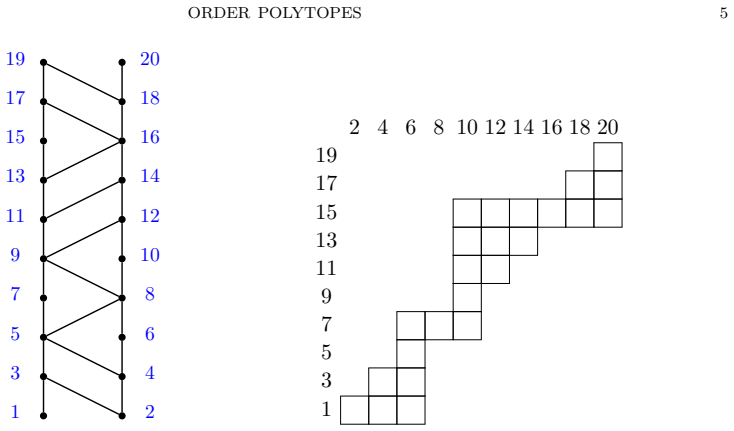
Snake poset order polytopes have real-rooted h* polynomials

by Benjamin Braun, Aryaman Jal

Order polytopes of generalized snake posets are h^*-real-rooted

A link to non-nesting rook polynomials settles the conjecture for these order and flow polytopes.

Figure from the paper full image
abstract click to expand
Order polytopes for generalized snake posets were recently studied by von Bell et al. (2022), and are known to be unimodularly equivalent to strength-one flow polytopes for acyclic directed graphs strongly dual to generalized snake posets. Lee, Vindas-Mel\'endez, and Wang (2026) conjectured that the Ehrhart $h^*$-polynomials of these order polytopes are real-rooted. We prove this conjecture using a connection between these $h^*$-polynomials and non-nesting rook polynomials, which were recently introduced by Alexandersson and Jal (2024+) in connection with $P$-Eulerian polynomials for width two posets.
0
0
math.CO 2026-07-02

Breaker wins C_k Maker-Breaker game above explicit bias threshold

by Matthias Sowa, Anand Srivastav

Constructive Winning Breaker Strategies in the Maker-Breaker C_k-Game

First polynomial-time strategies for Breaker in k-cycle games for any fixed k at least 4, with constants better than random play and asympto

abstract click to expand
Maker-Breaker subgraph games are among the most famous combinatorial games. For $n,q\in\mathbb{N}$ and a fixed subgraph $C$ of the complete graph $K_n$, the two players, called Maker and Breaker, alternately claim edges of $K_n$. Maker claims one unclaimed edge per round and Breaker may claim up to $q$ edges per round. If Maker is able to claim all edges of a copy of $C$, he wins the game. Otherwise Breaker wins. Bednarska and {\L}uczak (2000) determined in a landmark work the asymptotics of the treshold bias as $\Theta(n^{1/m(C)})$ where $m(C)$ is the 2-density of $C$, analysing random strategies. Since then it has been a major open problem to determine the treshhold bias, if it exists, with corresponding strategies, leading to sharp constants in the $\Theta$-notion. A famous case is the triangle game ($C=C_3$), studied by Chvatal and Erd"os (1978), who showed Maker wins if $q\le \sqrt{2n}$ and Breaker wins if $q\ge2\sqrt{n}$. Glazik and Srivastav (2022) improved this via a potential method, showing Breaker wins already for $q\ge\sqrt{8/3}\sqrt{n}$. Spencer (2019) conjectured generalizability to arbitrary subgraphs $C$. We confirm this conjecture, presenting a general winning strategy for Breaker if the potential function fullfils conditions depending on $C$. With this result we give the first constructive (polynomial-time) strategies for Breaker in the $k$-cycle Maker-Breaker game for arbitrary, but fixed $k \geq 4$: Breaker wins if $q>\sqrt[k-1]{(k-1)\big(\frac{2(k-1)}{k}\big)^{k-2}n^{k-2}}$. By Bednarska and {\L}uczak (2000) our bound is asymptotically optimal. However, our constants are better than those arising from their random strategies. More recently, Sowa and Srivastav (2025) gave the first constructive Maker strategy for $C_4$. Our work may motivate study of Maker strategies for $C_k, k \ge 5$, narrowing the gap towards the Breaker bounds presented.
0
0
math.AC 2026-07-02

Matchings of size p decide linearity of squarefree edge ideal powers

by Francesco Navarra, Ayesha Asloob Qureshi +1 more

On the Linearity of Squarefree Powers of Edge Ideals

I(G)^{[p]} has linear first syzygies exactly when the graph meets a matching criterion.

Figure from the paper full image
abstract click to expand
Let $G$ be a graph and $I(G)$ its edge ideal. The $p$-th squarefree power $I(G)^{[p]}$ is the monomial ideal generated by squarefree monomials corresponding to the matchings of size $p$ of $G$. In this paper, we provide a combinatorial characterization of when $I(G)^{[p]}$ is linearly related, i.e., when its first syzygy module is generated by linear forms. Moreover, for a $1$-dimensional flag simplicial complex $\Delta$ and its Stanley-Reisner ideal $I_{\Delta}$, which arises as the edge ideal of the complement graph of $\Delta$, we describe the shape of the Betti table of $I_{\Delta}^{[p]}$ and we give a combinatorial characterization of when $I_{\Delta}^{[p]}$ has a linear resolution.
0
0
math.NT 2026-07-02

Minimal non-zero sum of n fifth roots of unity computed exactly

by Akihiro Munemasa, Guillermo Núñez Ponasso

The Minimal Absolute Value of Sums of Fifth Roots of Unity

The value decreases only when n equals 5F_m, L_m or 2L_m and stays constant otherwise within each residue class modulo 5.

abstract click to expand
We determine the minimal absolute value of a non-vanishing sum of $n$ fifth roots of unity chosen with repetition, and characterize the corresponding sums. As a function of $n$, the minimal absolute value is monotone non-increasing over congruence classes of $n$ modulo $5$ and its only jumps occur when $n=5F_m$, $n=L_m$, or $n=2L_m$, where $F_m$ and $L_m$ denote the $m$-th Fibonacci and Lucas numbers respectively. To prove our results we reduce the problem to a series of inequalities involving rational approximations of the golden ratio $\varphi=(1+\sqrt{5})/2$, the solutions of which can be characterized using the theory of continued fractions.
0
0
math.CO 2026-07-02

Wythoff sequences plus Fibonacci signs partition the naturals

by Luis Martínez, Iker Malaina

Wythoff-Fibonacci Sequences and a Perturbed Greedy Almost-involution

The correction produces complementary sequences and an explicit almost-involution whose differences also cover every integer once.

Figure from the paper full image
abstract click to expand
We introduce the lower and upper Wythoff-Fibonacci sequences, obtained from the classical Wythoff sequences by a Fibonacci correction. Specifically, if we put $$\epsilon(j)=\begin{cases}(-1)^k, & \text{if }j=F_k\text{ for some }k\\ 0, & \text{in other case}\end{cases},$$ where $F_k$ is the $k$-th Fibonacci number, then we define the general terms of the lower and upper Wythoff-Fibonacci sequences by $$LWF(n)=\begin{cases} 1, & \text{if }n=1,\\ 3, & \text{if }n=2,\\ a(n)+\epsilon(n), & \text{if }n\geq 3.\end{cases}$$ and $$UWF(n)=\begin{cases} 2, & \text{if }n=1,\\ b(n)+\epsilon(n), & \text{if }n\geq 2,\end{cases}$$ respectively. We show that these sequences partition the set of natural numbers and use them to give an explicit formula for a sequence $q^{\star}_j$, defined from a greedy construction studied by the first author and his coauthors in a previous paper, but with the additional condition that $q^{\star}_1=3$, instead of being defined by the greedy rule. This sequence is a permutation of the set of non-negative integers and has the property that every integer appears exactly once in the sequence of differences $q^{\star}_j-j$. We prove that $q^{\star}_{q^{\star}_j}=j\ \forall j\geq 5$, so that $q^{\star}_j$ is an almost-involution. We also give another greedy algorithm generating $q^{\star}_j$.
0
0
math.CO 2026-07-02

Family of sequences bounds minimal r-arc ratio on circle

by David Bevan

On balancing consecutive slices of cake

Parameters inside the construction give the limsup max-to-min value directly, supplying explicit upper bounds for small r.

Figure from the paper full image
abstract click to expand
Let $\boldsymbol{a}=(a_i)_{i=1}^\infty$ be an infinite sequence of points on a circle. The first $n$ of these points cuts the circle into $n$ pieces. For any given $r$, let $\mu^r_n(\boldsymbol{a})$ be the ratio between the maximum and minimum sizes of $r$ consecutive pieces. Addressing a question of De Bruijn and Erd\H{o}s, we define a family of sequences for which the asymptotic least upper bound of this ratio, \[ \mu_r(\boldsymbol{a}) \;=\; \limsup_{n\to\infty}\mu^r_n(\boldsymbol{a}) , \] can easily be calculated. Hence, for small $r$, we present upper bounds on $\inf\mu_r(\boldsymbol{a})$.
0
0
math.CO 2026-07-02

Maximum t-stars fixed for non-k-edge-hamiltonian graphs at small t

by Yuxuan Liu, Jia-Bao Yang +1 more

Further Results on the maximun number of stars in graphs with forbidden properties

Further results confirm the conjectured extremal number when t is below the large-t threshold.

abstract click to expand
A graph $G$ is called $k$-edge hamiltonian if every linear forest (i.e., a disjoint union of paths) with at most $k$ edges is contained in a Hamilton cycle of $G$. In 2018, F\"uredi, Kostochka and Luo determined the maximum number of $t$-stars in nonhamiltonian graphs, thereby extending an earlier result of Erd\H{o}s. Recently, Berikkyzy, Hogenson, Kirsch and McDonald extended this line of research by determining the maximum number of $t$-stars in graphs that are not $k$-edge hamiltonian (as well as related notions such as traceability, hamiltonian-connectedness, and $k$-hamiltonicity). For sufficiently large $t$, they also characterized the extremal graphs, while for smaller values of $t$, they proposed a conjecture. In this paper, we investigate this conjecture.
0
0
math.CO 2026-07-02

f_{F,G}(n) at most C(log n)^β_F when G is 2-tightly connected

by Lulu Dai, Qizhong Lin

Generalized ErdH{o}s--Rogers problems for r-uniform hypergraphs

The bound holds for r-uniform hypergraphs with r≥3 whenever G admits no homomorphism to nonempty F, sharpening prior exponents and recoverin

abstract click to expand
Let \(F\) and \(G\) be \(r\)-uniform hypergraphs, and let \(f_{F,G}(n)\) be the largest integer \(m\) such that every \(n\)-vertex \(G\)-free \(r\)-graph contains an induced \(F\)-free subgraph on \(m\) vertices. We prove that, if \(r\ge3\), \(F\) is nonempty, \(G\) is \(2\)-tightly connected, and there is no homomorphism from \(G\) to \(F\), then \[ f_{F,G}(n)\le C(\log n)^{\beta_F}, \qquad \beta_F= \max_{\substack{\emptyset\ne P\subseteq\partial_2F}} \frac{e(P)}{v(P)-1}. \] For \(r=3\), this confirms a conjecture of He and Nie for tightly connected \(3\)-graphs, sharpening their earlier bound by replacing the exponent $ \max_{\substack{\emptyset\ne P\subseteq\partial_2F}} \frac{e(P)+1}{v(P)-1} $ with \(\beta_F\). When \(F=K_r^r\), our result recovers the Ramsey lower bound $r(G,K_n^r)\ge 2^{\Omega(n^{2/r})}$ whenever \(G\) is \(2\)-tightly connected and non-\(r\)-partite.
0
0
math.CO 2026-07-02

One forbidden subgraph characterizes balanced distance-hereditary graphs

by Lucía Busolini, Guillermo Durán +1 more

Characterization and linear-time recognition of balanced distance-hereditary graphs

Equivalence with hereditary clique-Helly property yields linear-time recognition inside this class.

Figure from the paper full image
abstract click to expand
A graph is balanced if its clique-matrix contains no square submatrix of odd order with exactly two $1$'s in each row and in each column. Although it is known that a graph is balanced if and only if it contains no induced extended odd sun, a characterization of balanced graphs by minimal forbidden induced subgraphs is still unknown. In this work, we prove that, within the class of distance-hereditary graphs, balanced graphs are exactly the hereditary clique-Helly graphs. Equivalently, they are characterized by a single forbidden induced subgraph, namely $\overline{3K_2}$. From this result, we derive an explicit linear-time algorithm that decides balancedness within the class of distance-hereditary graphs and returns an induced $\overline{3K_2}$ when the input graph is not balanced.
0
0
math.CO 2026-07-02

Morphic words avoid parameterized squares over three letters

by Hiroki Shibata, Takuya Mieno +2 more

Relaxation of Square-Freeness

Infinite ternary strings free of long parameterized repetitions and binary strings free of order-preserving ones are constructed via substit

Figure from the paper full image
abstract click to expand
We extend the analysis of nonrepetitive sequences of Entringer et al. [Journal of Combinatorial Theory, 1974] to relaxations of equality testing under nonstandard equivalence relations, in particular parameterized equivalence and order-preserving equivalence. For this setting, we introduce $\ell^+$-squares, defined as squares whose total length is at least $2\ell$. Using morphic constructions, we obtain an infinite $3^+$-parameterized-square-free ternary word and an infinite $3^+$-order-preserving-square-free binary word. In addition, we report the longest $\ell^+$-square-free words across several equivalence relations.
0
0
math.RT 2026-07-02

Recurrence computes A_n subcategory counts via Fibonacci link

by Volodymyr Mazorchuk

On the number of extension closed additive subcategories for uniformly oriented A_n quivers

The number of extension-closed additive subcategories obeys a recurrence, connects to Fibonacci numbers, and admits exponential growth bound

Figure from the paper full image
abstract click to expand
We provide a recurrence for computing the terms of the OEIS sequence A393920, introduced in \cite{KS}. We also describe a surprising connection between A393920 and the Fibonacci sequence A000045, obtain non-trivial lower and upper exponential bounds for its growth, and investigate connections with partial orders, Catalan numbers, and convex topologies on finite chains. For the representation-theoretic lattice underlying A393920, we describe its atoms, coatoms, join-irreducible and meet-irreducible elements.
0
0
math.CO 2026-07-02

Type B c-Birkhoff polytopes are order polytopes

by Esther Banaian, Sunita Chepuri +2 more

The construction used for type A extends, giving equivalence to order polytopes of heap posets.

Figure from the paper full image
abstract click to expand
In a previous work, we defined (type A) c-Birkhoff polytopes and showed that they were unimodularly equivalent to order polytopes of heap posets. In this note we answer the question: What about type B?
0
0
math.CO 2026-07-02

Near-bipartite bricks characterized by b-invariant edges

by Yaxian Zhang, Fuliang Lu

Near-bipartite bricks in which every b-invariant edge is a forcing edge

Complete description shows every such edge is forcing except for three small graphs.

Figure from the paper full image
abstract click to expand
A connected graph is matching covered if it has at least one edge and every edge lies in some perfect matching.Lov\'asz proved that every matching covered graph G can be uniquely decomposed into a list of bricks and braces up to multiple edges. Denote by b(G) the number of bricks in such a decomposition. An edge e of G is removable if G-e is also matching covered; is b-invariant if e is removable and b(G-e)=b(G). Furthermore, an edge e of G is a forcing edge if it lies in precisely one perfect matching of G. Lucchesi and Murty proposed the problem of characterizing bricks, distinct from K_4, \overline{C_6}, and the Petersen graph, in which every b-invariant edge is a forcing edge. In this paper, we solve this problem for near-bipartite bricks by providing a complete characterization.
0
0
math.CO 2026-07-02

Spectral maximizers coincide with edge maximizers for critical F

by Suil O, Jiadong Wu

For edge-color-critical graphs, non-r-partite spectral extremal graphs are edge extremal

When ex is within O(1) of Turán edges minus n/r, non-r-partite F-free graphs of largest spectral radius also have the most edges.

abstract click to expand
A graph is non-$r$-partite if its chromatic number exceeds $r$. For an edge-color-critical graph $F$ with $\chi(F)=r+1$, let $\mathrm{ex}_{r+1,\rho}(n,F)$ be the maximum adjacency spectral radius among non-$r$-partite $F$-free graphs of order $n$, and let $\mathrm{EX}_{r+1,\rho}(n,F)$ and $\mathrm{EX}_{r+1}(n,F)$ be the families of such graphs attaining, respectively, this maximum spectral radius and the maximum number of edges $\mathrm{ex}_{r+1}(n,F)$. Fang and Zhai conjectured that $\mathrm{EX}_{r+1,\rho}(n,F)\subseteq\mathrm{EX}_{r+1}(n,F)$ for every such $F$ and all large $n$. In this paper, we prove this inclusion under the hypothesis $\mathrm{ex}_{r+1}(n,F)=|E(T_{n,r})|-\lfloor n/r\rfloor+O(1)$, where $T_{n,r}$ is the Tur\'an graph, together with a structural condition on the sub-decomposition family of $F$. As the main application, for $F=K_{1,1,t_3,\ldots,t_{r+1}}$ with $t_3,\ldots,t_{r+1}\ge 2$ we show \[ \mathrm{ex}_{r+1}(n,F)=|E(T_{n,r})|-\Bigl\lfloor\frac nr\Bigr\rfloor+2(t_{\min}-1), \qquad t_{\min}:=\min\{t_3,\ldots,t_{r+1}\}, \] for all sufficiently large $n$, and deduce that $\mathrm{EX}_{r+1,\rho}(n,F)\subseteq\mathrm{EX}_{r+1}(n,F)$.
0
0
quant-ph 2026-07-02

Quantum automata need linear memory where classical need exponential

by Shiroman Prakash

Robust Quantum Memory Advantage from Contextuality

Promise problems on exclusivity graphs force classical automata to χ(G) states but allow quantum ones to use ξ(G)+1 dimensions with constant

Figure from the paper full image
abstract click to expand
Quantum contextuality is widely recognized as an essential non-classical resource underlying quantum technology, yet illuminating the precise mechanisms through which it translates into unconditional computational advantages remains an ongoing challenge. We demonstrate an exponential, noise-resilient memory advantage for quantum finite automata arising from graph-theoretic approaches to contextuality. We define a promise problem on an exclusivity graph $G$ for which any classical deterministic automaton acts as a non-contextual hidden variable model requiring at least $N=\chi(G)$ states, where $\chi(G)$ is the graph's chromatic number. In contrast, by exploiting a structural phenomenon we term \textit{representational contextuality}, a QFA solves this task using a memory of dimension at most $d=\xi(G)+1$, where $\xi(G)$ is the graph's orthogonal rank. This separation scales exponentially ($d=\mathcal O(n)$ versus $N=2^{\Omega(n)}$) for Boolean-orthogonality graphs. Crucially, this memory advantage maintains an $\mathcal{O}(1)$ threshold against both depolarizing and coherent noise.
0
0
math.CO 2026-07-02

Boolean lattice Ramsey number for arithmetic triples is 9

by Gyula O.H. Katona, Yaping Mao

Multiplicity for partially ordered sets

Every 2-coloring of B_9 forces a monochromatic (S,T,U) with |S|+|T|=|U|, while the total number of such triples is asymptotically 4^n/sqrt(p

abstract click to expand
Let $\mathcal Q=\{Q_a:a\geq1\}$ be a nested family of finite posets such that $Q_a\subseteq Q_{a+1}$ and $|Q_a|<|Q_{a+1}|$. For a poset $Q$, let $\mathcal C_t(Q)$ denote the set of all strict $t$-chains in $Q$. Given an $r$-coloring of $\mathcal C_t(Q_a)$ and posets $P_1,\ldots,P_r$, a weak copy of $P_i$ is called monochromatic of color $i$ if all $t$-chains in the copy have color $i$; the strong version is defined in the same way for induced copies. The corresponding weak and strong multiplicity parameters are the minimum possible total number of such monochromatic copies in the host poset.For the Boolean lattice $B_n$, define $E_n={(S,T,U)\in B_n^3:S\subsetneq T\subsetneq U,\ |S|+|T|=|U|}.$ For a two-coloring $\chi:B_n\to{0,1}$, a triple $(S,T,U)\in E_n$ is monochromatic if $\chi(S)=\chi(T)=\chi(U)$. Let $R^{\mathrm{arith}}_2$ be the least integer $n$ such that every two-coloring of $B_n$ contains a monochromatic triple in $E_n$, and let $M^{\mathrm{arith}}_2(B_n)$ be the minimum number of monochromatic triples in $E_n$ over all two-colorings of $B_n$. We prove that $R^{\mathrm{arith}}_2=9.$ Moreover, $|E_n|=\binom{2n}{n}-[x^n](1+x+x^2)^n-2^n+1=\frac{4^n}{\sqrt{\pi n}}\bigl(1+o(1)\bigr),$ and $2^{\delta n+o(n)}\le M^{\mathrm{arith}}_2(B_n)\le 2^{\gamma n+o(n)}, $ where $\delta\approx 1.356779$ and $\gamma\approx 1.567837$ are explicit entropy constants. For general nested host families, we prove a double-counting lower bound for strong poset multiplicity. For an arbitrary finite host poset $R$, we also introduce a Fourier-M\"obius method and give an exact Fourier expansion for strong multiplicity, a Parseval-type error bound, and a spectral lower bound.
0
0
math.RT 2026-07-02

Affine Hecke subalgebra carries canonical basis labeled by Weyl cosets

by Jonathan Gruber

Pseudo-centralizers in affine Hecke algebras

In types A_n, B_2 and G_2 the v-deformed Fomin-Stanley algebra is indexed by cosets of the finite Weyl group inside the affine Weyl group

Figure from the paper full image
abstract click to expand
We introduce and study a subalgebra $\mathcal{B}$ of the affine Hecke algebra, which arises from a centralizer construction in the double affine Hecke algebra, and which may be regarded as a $v$-deformation of the affine Fomin-Stanley subalgebra introduced by Lam as a combinatorial model for the affine Grassmannian homology ring. In types $\mathsf{A}_n$ and $\mathsf{B}_2$ and $\mathsf{G}_2$, we show that $\mathcal{B}_\mathrm{aff}$ admits a canonical basis indexed by the cosets of the finite Weyl group in the affine Weyl group. We also discuss conjectural positivity properties of the canonical basis and explain how it can be used to study the center of the affine Hecke algebra.
0
0
math.CO 2026-07-02

Field covering by n copies of A when |A| exceeds p to the 3/(2n-1) power

by Guo-Dong Hong, Chong-Wei Liang +1 more

Peres--Schlag's nonempty-interior problem and a shifted-product variant for product sets

The threshold improves on the naive 2/n exponent and applies equally to shifted products.

abstract click to expand
We study finite-field analogues of the Peres--Schlag nonempty-interior problem for product sets. Given \(A\subseteq\mathbb F_p\), we ask when a suitable one-dimensional linear image of \(A^n\) is full; equivalently, when there exist coefficients \(t_1,\ldots,t_n\in\mathbb F_p\) such that \[ t_1A+\cdots+t_nA=\mathbb F_p. \] For \(n\ge3\), we prove that, for every \(\eta>0\), this holds whenever \[ |A|\gg_{n,\eta} p^{\frac{3}{2n-1}+\eta}. \] This improves the exponent predicted by the direct product-set analogue of the Peres--Schlag threshold, namely \(|A|\gg p^{2/n}\). We also prove a two-dimensional near-half-density result. Motivated by sum-product phenomena, we also introduce and study a product-type variant in which linear forms are replaced by shifted product maps. We prove finite-field covering results for shifted products \[ (t_1 + A)(t_2 + A)\cdots(t_n + A) \] at the same density scale as in the linear case. Finally, we prove a Euclidean shifted-product analogue: if \(A\subseteq\mathbb R\) is Borel and \(\dim_H A>2/n\), then some shifted product of \(n\) copies of \(A\) contains a nonempty open interval.
0
0
math.LO 2026-07-02

Z^2 shift graph has continuous oriented chromatic number 7

by Ruijun Wang

The continuous oriented chromatic number of directed Schreier graphs of mathbb Z²-shift actions

Continuous maps to 7-vertex tournaments exist but none to 6-vertex ones.

Figure from the paper full image
abstract click to expand
Let \(\vec F(2^{\mathbb Z^2})\) be the directed Schreier graph on the free part of the Bernoulli shift \(\mathbb Z^2\curvearrowright 2^{\mathbb Z^2}\), with arcs in the two coordinate directions. We prove that the continuous oriented chromatic number of it is 7, that is, there is a tournament on 7 vertices receiving a continuous graph homomorphism from $\vec F(2^{\mathbb Z^2})$ and there is no continuous graph homomorphism from $\vec F(2^{\mathbb Z^2})$ to any tournament on 6 vertices.
0
0
math.CA 2026-07-02

Polynomial method yields sharp finite-field projection results

by Guo-Dong Hong, Chong-Wei Liang +1 more

On the Peres--Schlag orthogonal projection problem and Kakeya-type sets

It also improves the parameter ranges where Euclidean projections have nonempty interior beyond earlier bounds.

Figure from the paper full image
abstract click to expand
We investigate the Peres--Schlag nonempty interior problem for orthogonal projections in both the finite-field and Euclidean settings. Over finite fields $\mathbb F_q^n$, we employ the polynomial method to establish sharp projection results, and uncover a new connection with stability versions of the finite-field \((n,m)\)-set problem. Over Euclidean spaces $\mathbb R^n$, we obtain improved nonempty interior results beyond those of Peres and Schlag in certain parameter ranges. Our proof combines techniques from geometric measure theory and harmonic analysis, including $L^p$-estimates for Kakeya maximal operators and maximal $k$-plane transforms.
0
0
math.CO 2026-07-02

Fixed point families give largest t-intersecting permutations

by Nathan Keller, Andrey Kupavskii +2 more

A Complete Intersection Theorem for Large Permutation Groups

For all n larger than some n0 the maximum t-intersecting families in S_n are the F_{n,t,r} families defined by fixed points in an initial se

abstract click to expand
A family of permutations is called $t$-intersecting if any two permutations in the family agree on at least $t$ elements. We prove that there exists $n_0 \in \mathbb{N}$ such that for any $n>n_0$ and any $1 \leq t \leq n$, the maximum size of a $t$-intersecting family in $S_n$ is obtained by one of the families $\mathcal{F}_{n,t,r}=\{\sigma \in S_n: |\mathrm{Fixed}(\sigma) \cap \{1,2,\ldots,t+2r\}|\geq t+r\}$, where $\mathrm{Fixed}(\sigma)$ is the set of fixed points of $\sigma$. This proves an analogue of the classical Complete Intersection Theorem for large permutation groups, thus providing an essentially complete solution of the Deza-Frankl intersection problem for permutations (1977).
0
0
math.CO 2026-07-01

Chromatic Sum complexity fully classified on forbidden graph classes

by Clément Dallard, Daniël Paulusma +1 more

Determining the Complexity of Chromatic Sum in Classes Defined by a Set of Forbidden Graphs

New NP-completeness result on planar subdivisions completes the map for all minor-free and H-free classes.

abstract click to expand
The Chromatic Sum problem asks, given a graph $G$ and an integer $k$, whether $G$ admits a colouring $c$ with sum $\sum_{v\in V}c(v) \leq k$. We study the complexity of Chromatic Sum on graph classes defined by some set of forbidden graphs. First, we show that three known frameworks fully classify the complexity of Chromatic Sum on $HH$-minor-free graphs and $HH$-topological-minor-free graphs for any set of graphs $HH$, and on $HH$-subgraph-free graphs for any finite set of graphs $HH$. To show this, we prove a new NP-completeness result for Chromatic Sum on certain subdivisions of planar subcubic graphs. Next, we consider other containment relations. We formalise a novel framework of problems that are NP-complete for planar graphs as well as for graphs of bounded independence number. For every problem in this framework, we obtain an almost complete complexity classification on $H$-induced-minor-free graphs, $H$-induced-topological-minor-free graphs, and $H$-free graphs for every graph $H$. We show that Chromatic Sum belongs to this framework, as do several other problems. We also define a more fine-grained framework for the induced subgraph relation. We apply this to obtain a complete complexity classification for Chromatic Sum on $H$-free graphs, as well as for several other problems. We justify the choice of this framework by proving that Chromatic Sum is NP-complete for graphs of clique-width at most $3$. This result complements a known polynomial-time result for graphs of clique-width at most $2$.
0
0
math.CO 2026-07-01

Periodic Riemann functions gain duality via canonical module

by Nicolas Folinsbee, Joel Friedman

Duality and a Canonical Sheaf in Periodic Riemann Functions

r-periodic cases with perfect-matching weights turn b¹ formulas into perfect pairings on finite O_r-modules over a five-point space.

Figure from the paper full image
abstract click to expand
Let $f\colon{\mathbb Z}^2\to{\mathbb Z}$ be a Riemann function whose weight $W$ is a perfect matching. Then there is a family of sheaves of $k$-vector spaces $\{{{M}}_{W,{\bf d}}\}_{{\bf d}\in{\mathbb Z}^2}$ on a five-point topological that models $f$ in that $f({\bf d})=b^0({{M}}_{W,{\bf d}})$ and that $$ b^1({{M}}_{W,{\bf d}})= f^\wedge_{\bf K}({\bf d}-{\bf K}) $$ for any ${\bf K}\in{\mathbb Z}^2$. Hence a Riemann-Roch formula for $f$ is equivalent to an Euler characteristic computation of ${{M}}_{W,{\bf d}}$. If $f$ and $W$ are $r$-periodic, then the sheaves ${{M}}_{W,{\bf d}}$ become ${{O}}_r$-modules of finite type for a natural sheaf of rings ${{O}}={{O}}_r$. We show that in this case there is a ``canonical ${{O}}$-module'' $\omega=\omega_W$ and a pairing for $i=0,1$, $$ H^i(M_{W,{\bf 0}}\otimes F) \times {\rm Ext}^{1-i}(F,M_{W^\wedge_{\bf L},{\bf K}})\to H^1(\omega)\cong k $$ that is perfect when ${\bf L}={\bf K}+{\bf 1}$ and ${{F}}$ is a certain type of line bundle or a certain type of skyscraper sheaf. In particular when ${{F}}$ is a line bundle, we realize the above formula for $b^1({{M}}_{W,{\bf d}})$ as a duality theorem akin to Serre duality. We show that canonical ${{O}}$-module $\omega_W$ is a rather exceptional element in a family of tensor products of two modules ${{M}}\otimes_{{O}}{{M}}'$, where ${{M}}$ and ${{M}}'$ vary over ${{O}}_r$-modules of the form ${{M}}_{W',{\bf d}}$. This article doesn't assume any background in sheaf theory; rather we describe all our sheaves as a ``diagrams of vector spaces,'' where each diagram is essentially a sheaf of vector spaces on a fixed topological space of five points.
0
0
math.CO 2026-07-01

Five colors suffice for strong majority edge-colorings

by Sylwia Antoniuk, Magdalena Prorok +1 more

Strong Majority Edge-Coloring

Improving the known upper bound from eight for graphs without pendant paths of length two.

Figure from the paper full image
abstract click to expand
A strong majority edge-coloring of a graph is an edge-coloring in which, for every edge $e$ and every color $i$, at most half of the edges adjacent to $e$ have color $i$. Such a coloring exists only for graphs with no pendant path of length two, which, following Kalinowski, Kamyczura, Pil\'sniak, and Wo\'zniak, we call admissible. They proved that every admissible graph admits such a coloring with at most eight colors and conjectured that four colors always suffice. We improve the upper bound from eight to five.
0
0
cs.IT 2026-07-01

Linear constraints shift guesswork exponent by ρ(1-R)

by Hassan Tavakoli

Guesswork Under Linear Constraints: Exact Exponent for Coset Decoding

The exact rate for the ρ-th moment of coset rank equals the unconstrained value minus ρ times one minus the code rate.

abstract click to expand
We establish the exact exponential growth rate of the $\rho$-th moment of the constrained guesswork $G_{\mathrm{coset}}$ -- the rank of the true noise vector within its syndrome coset of a random binary linear code under i.i.d.\ Bernoulli$(p)$ noise: \( \lim_{n\to\infty} \frac{1}{n}\log_2\Eb\!\left[G_{\mathrm{coset}}^{\rho}\right] = \rho\,h_{\frac{1}{1+\rho}}(p)\;+\;\rho(R-1), \, \rho>0, \) where $h_\alpha(p)$ is the binary R\'{e}nyi entropy and $R=k/n$ is the code rate. The exponent shifts down by exactly $\rho(1-R)$ relative to the unconstrained Ar{\i}kan--Merhav exponent, with each of the $n(1-R)$ parity checks contributing equally. Finite-length simulations confirm convergence from below. We further establish: (i)~a transfer theorem expressing the partition-function exponent in terms of an arbitrary weight-enumerator growth rate $g(\delta)$; (ii)~the exact exponent for $L_n$-list (``$k$-th'') constrained guesswork; and (iii)~a sharp second-order refinement of order $\rho\log_2 n$. Beyond the binary i.i.d.\ setting, we prove a universality theorem: for any code ensemble $\mathcal{E}$ whose weight enumerator concentrates at rate $g_{\mathcal{E}}(\delta)$, the guesswork exponent equals $(1+\rho)\psi_{1/(1+\rho)}(g_{\mathcal{E}})-\rho\,\psi_1(g_{\mathcal{E}})$, where $\psi_\alpha(g)=\sup_\delta[g(\delta)+\alpha\ell(\delta)]$. As concrete applications, we instantiate this theorem for the $q$-ary extension, $\Lambda_q(\rho)=\rho\,h^{(q)}_{1/(1+\rho)}(P)+\rho(R-1)\log_2 q$, and for Gallager's regular LDPC ensemble, obtaining a closed-form guesswork exponent via an exact finite-length identity for the ensemble-average weight enumerator.
0
0
math.CO 2026-07-01

Deranged parking functions counted by deranged Bell numbers

by Yahia Djemmada

On Deranged Unit-Interval Parking Functions and the Deranged Bell Numbers

The ordered-set-partition bijection restricts directly to the deranged case, equating the two families and producing new generating function

abstract click to expand
Unit-interval parking functions of length $n$ are enumerated by the Fubini numbers $F_n$ and are in explicit bijection with the ordered set partitions of $[n]$. We use this bijection to single out the unit-interval parking functions whose associated ordered set partition is \emph{deranged} in the sense of Belbachir, Djemmada, and N\'emeth -- no block occupies the position indexed by its minimum element -- and call them the \emph{deranged unit-interval parking functions} $\DUPF_n$. Since the bijection restricts to the deranged objects, $|\DUPF_n| = \tilde F_n$, the $n$-th deranged Bell number. We give an intrinsic, coordinate-wise characterization of the deranged condition through the lucky cars (equivalently, the block leaders) of a parking function, and we refine the enumeration by total displacement, obtaining $d_m\Stir{n}{m}$ deranged unit-interval parking functions with $m$ blocks. We derive the exponential generating function $e^{1-e^x}/(2-e^x)$ by the symbolic method, prove a fixed-block convolution relating $F_n$, the Bell numbers, and $\tilde F_n$, refine the count by singleton blocks via $2$-associated Stirling numbers, and describe an $r$-start extension together with a deranged Cayley-permutation model. Worked examples and a table of values are included.
0
0
math.CO 2026-07-01

Covariance bounds degree-weighted Fourier overlap for monotone functions

by Fan Chang, Hong Liu +1 more

The sharp diagonal spectral correlation inequality on the discrete cube

The inequality Cov(f,g) ≥ 4 ∑ |S| ˆf(S)² ˆg(S)² holds with equality only for disjoint supports, common dictatorships, or the AND-OR pair.

abstract click to expand
We prove the sharp diagonal spectral correlation conjecture of Friedgut, Kahn, Kalai and Keller, proposed in their Fourier-analytic approach to Chv\'atal's conjecture. For every pair of increasing Boolean functions $f,g:\{0,1\}^n\to\{0,1\}$, $$\mathrm{Cov}(f,g)\ge4\sum_{\varnothing\ne S\subseteq[n]}|S|\hat{f}(S)^2\hat{g}(S)^2.$$ Thus covariance controls the degree-weighted collision of the two nonconstant Fourier spectra, giving a sharp Fourier strengthening of the Harris--Kleitman inequality. The theorem also implies the unweighted diagonal conjecture of Friedgut--Kahn--Kalai--Keller for an increasing family and a maximal intersecting family. The factor $4$ is optimal, and we determine all equality cases. Apart from pairs whose relevant coordinate sets are disjoint, equality occurs only for a common dictatorship and, up to relabelling coordinates and interchanging $f$ and $g$, for the two-coordinate AND-OR pair $(f,g)=(x_i x_j,\,x_i\vee x_j).$ The main novelty is a correlated four-restriction induction and a sharp endpoint convolution inequality. The usual two-restriction induction behind Harris--Kleitman sees only the parallel restricted pairs and loses the mixed Fourier information needed to control the degree-weighted diagonal spectral energy. We instead couple the four codimension-one restricted pairs with correlation $1/2$; this precise correlation extracts the missing degree-weighted energy as a nonnegative square.
0
0
math.CO 2026-07-01

Spectrum of Boolean lattice line graphs fully determined

by Ali Zafari, Saeid Alikhani

On the Spectrum of the Line Graph of a Family of Bipartite Graphs Arising from the Boolean Lattice

Eigenvalues and multiplicities given for all n and k; integrality holds when n equals 2k minus 1

abstract click to expand
The Boolean lattice $BL_n$, $n\geq 3$, is the graph whose vertex set is the collection of all subsets of $[n]=\{1,2,\ldots,n\}$, where two subsets $U$ and $W$ are adjacent if and only if their symmetric difference has precisely one element. In the graph $BL_n$, the \emph{layer} $L_k$ is the family of all $k$-element subsets of $[n]$. The subgraph $BL_n(k-1,k)$ is the induced subgraph of $BL_n$ on layers $L_{k-1}$ and $L_{k}$. This graph is bipartite and, when $n=2k-1$, is $k$-regular and isomorphic to the bipartite double cover $2{\cdot}O_k$ of the odd graph $O_k$. In this paper, we determine the full adjacency spectrum -- eigenvalues together with their multiplicities -- of the line graph $L(BL_n(k-1,k))$ for all admissible values of $n$ and $k$. As a consequence, we show that $L(BL_n(k-1,k))$ is an integral graph whenever $n = 2k-1$, and we recover as a special case the spectrum of the line graph $L(n)$ of $BL_n(1,2)$ established by Mirafzal~\cite{pap-sm-1}.
0
0
math.CO 2026-07-01

t-clique count bounded below by s-clique count via density functions

by Jie Ma, Tianhen Wang +1 more

On clique-to-clique densities

The inequality is asymptotically sharp for every pair s less than t and recovers a known theorem when s is 2.

abstract click to expand
Let $k_r(G)$ denote the number of $r$-cliques in a graph $G$ and let $F_r(\cdot)$ be the Lov\'asz--Simonovits $r$-clique density function. For any integers $2\le s<t$, we determine the asymptotically sharp lower bound on $k_t(G)$ in an $n$-vertex graph $G$ with a prescribed number $k_s(G)$, by showing that \[ \frac{k_t(G)}{n^t}\ge F_t\!\left(F_s^{-1}\!\left(\frac{k_s(G)}{n^s}\right)\right), \] where $F_s^{-1}$ denotes the generalized inverse. This strengthens Bollob\'as's piecewise-linear interpolation bound and, in the case $s=2$, recovers Reiher's clique density theorem via a new inductive proof.
1 0

browse all of math.CO → full archive · search · sub-categories