pith. sign in

astro-ph

Astrophysics

Top Pith
5
astro-ph.GA 2026-06-24

Barred spiral galaxy found at z=5.102

by Xiaohan Wang, Fengwu Sun +22 more

A massive barred spiral galaxy at z = 5.102 discovered by JWST

JWST imaging reveals a 4.5 kpc stellar bar and spiral arms in a massive disk galaxy only 1.2 billion years after the Big Bang.
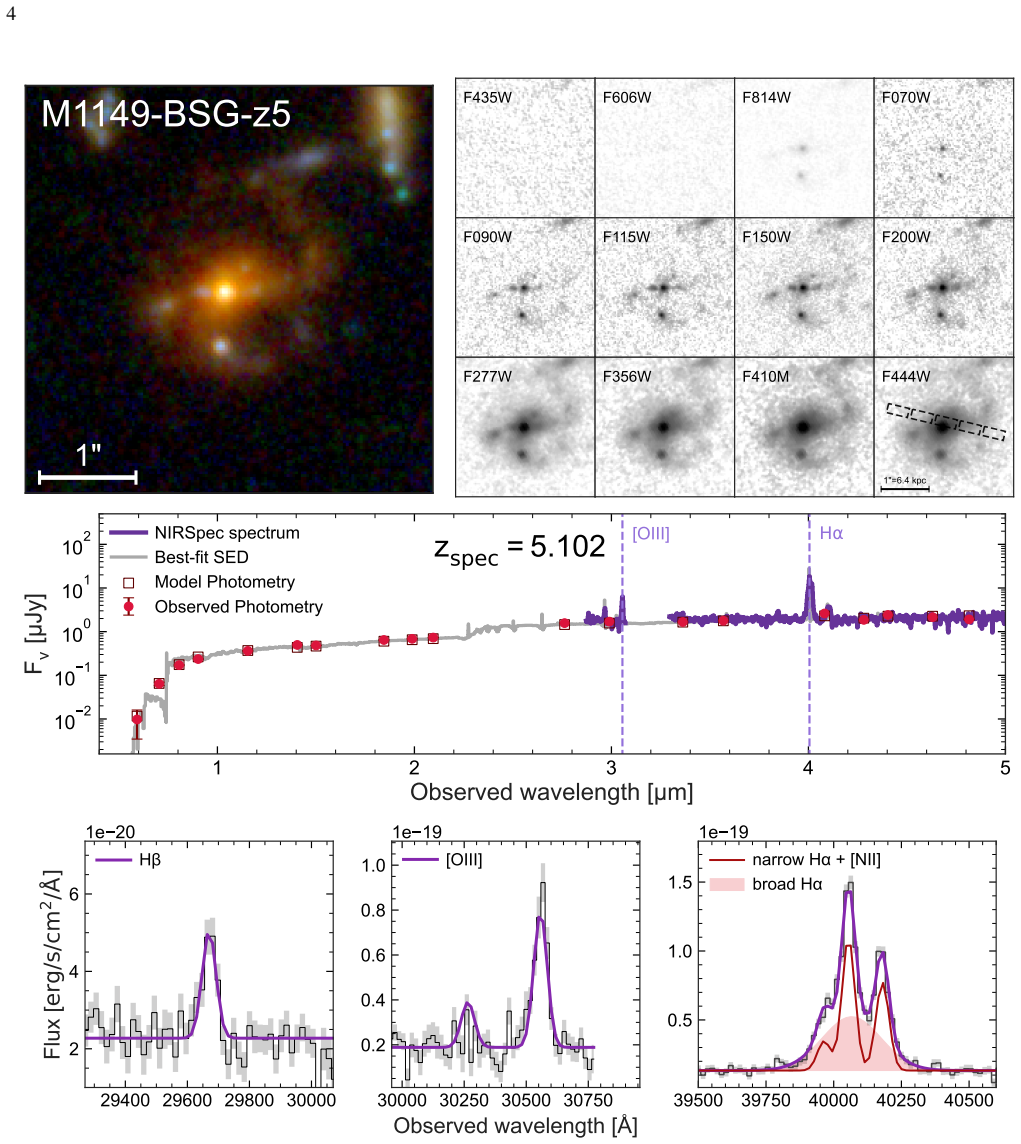
Figure from the paper full image
abstract click to expand
We report M1149-BSG-z5, a barred spiral galaxy at $z = 5.102$, identified in the parallel field of MACS J1149+2223 with JWST and HST. M1149-BSG-z5 is the highest redshift barred galaxy candidate to date. Both isophote ellipse fitting and structural modeling support a stellar bar of length $a_\mathrm{bar} \approx 4.5$ kpc, and extended spiral arms peaking at $r \approx 5.5$ kpc. M1149-BSG-z5 is a massive main sequence star-forming galaxy, with a stellar mass of $10^{10.45}\rm M_\odot$ and a star-formation rate of $144\,\rm M_\odot/yr$. A concentrated bulge is embedded in an extended disk with a global S\'ersic index $n = 2.37$. With an effective radius of $R_{e} = 2.61\rm \ kpc$, M1149-BSG-z5 is larger than typical galaxies at $z \sim 5$ and comparable to barred galaxies at $2 < z < 4$. M1149-BSG-z5 also hosts a broad-line AGN, with a relatively low black-hole-to-stellar mass ratio of $\rm M_{\rm BH}/M_\ast\sim10^{-3}$. Its metal-enriched emission-line properties indicate that it is already chemically evolved. These properties imply M1149-BSG-z5 as an early-assembled and structurally evolved galaxy. We also find that M1149-BSG-z5 resides in an overdense region with a nearby companion galaxy, suggesting an interaction-driven bar formation mechanism. Its concentrated light, early assembly and main-sequence star formation also suggest baryon-dominated, gas-rich conditions, where gravitational instability can further accelerate the bar formation.
0
Top Pith
5
astro-ph.GA 2026-05-22 2 theorems

This paper reports a mean velocity difference of about 0.05 km/s between ions traced by…

by Doris Arzoumanian, Silvia Spezzano +10 more

Probing the ion-neutral drift velocity towards the L1544 prestellar core: Detection of ambipolar diffusion using N₂D^+ and para-NH₂D

Detection of ~0.05 km/s ion-neutral velocity drift in L1544 interpreted as the first observational signature of ambipolar diffusion in a…

Figure from the paper full image
abstract click to expand
The dynamical role of the magnetic field in the star formation process is tightly linked to the coupling between matter and the field. This coupling is due to the interaction between ions and neutrals in the partially ionized interstellar medium. When the ionization degree drops in the dense environment of prestellar cores, the magnetic field and the matter may decouple, leading to differences in the infalling velocities of ions and neutrals known as ambipolar diffusion. The onset of gravitational collapse resulting from ion-neutral decoupling has never been observed. The aim of this work is to search for signatures of ambipolar diffusion within a prestellar core. We observed the deuterated N$_2$D$^+$ ion and the neutral para-NH$_2$D species towards the prototypical prestellar core L1544. These two species are ideal tracers of prestellar cores sampling the same high densities in the core interior. We compared the velocity centroid and linewidth maps of the ion-neutral pair. We find a mean ion-neutral velocity difference of $\sim$0.05 km/s towards the core. By comparing with predictions from self-consistent calculations of the ambipolar resistivity including dust grain growth, we interpret the observed ion-neutral velocity difference in L1544 as a signature of ambipolar diffusion. We do not detect a significant ion-neutral linewidth difference that may be attributed to the subsonic infall motions of the gas in L1544 and geometrical effects in the presence of inclination. These results emphasize the role of dust grain growth at the prestellar core stage in setting the ambipolar resistivity and regulating the dynamical evolution of dense cores towards their collapse into protostars. We propose that measurements of ion-neutral drift velocities provide new constraints on the total magnetic field strength and the dust size distribution within prestellar cores.
0
Top Pith
4
gr-qc 2026-05-21 2 theorems

Modified gravity changes low-frequency gravitational-wave lensing

by Alice Garoffolo, Gianmassimo Tasinato

Wave-optics gravitational wave lensing in modified gravity

A curvature-coupled propagation equation prevents the amplification factor from reaching unity at zero frequency.

Figure from the paper full image
abstract click to expand
We initiate the study of gravitational-wave lensing in the wave-optics regime within modified gravity. We consider a phenomenological setup in which the gravitational-wave amplitude obeys a curvature-coupled propagation equation. This framework reproduces the standard GR behaviour in the geometric-optics regime, while leading to qualitatively different infrared dynamics. In particular, the usual argument implying that the amplification factor approaches unity in the zero-frequency limit no longer applies. This is due to the persistence of curvature-induced interactions in the infrared, which modify the natural propagation basis itself. As a result, the standard Fresnel treatment ceases to be valid at sufficiently low frequency. The correct infrared regime is instead controlled by an interacting static Green function, with a finite-frequency completion provided by a partial-wave formulation. We show that this structure admits an equivalent distorted-wave interpretation, in which the curvature interaction is absorbed into a dressed reference propagation basis, while the residual lensing effect is encoded in finite-frequency phase shifts. We further demonstrate that these phenomena admit a natural interpretation in the language of scattering amplitudes. Wave-optics lensing can therefore probe propagation-level departures from GR that remain entirely invisible in geometric optics.
0
0
hep-ph 2026-07-03

PTA data disfavors phase transitions near EFT boundary

by Simone Biondini, Philipp Schicho

A critical look at low-scale cosmological phase transitions in the PTA era

Higher-order thermal corrections in a minimal dark Higgs model shift predictions but leave signals inconsistent with observed gravitational

Figure from the paper full image
abstract click to expand
Motivated by the recent evidence for a stochastic gravitational-wave (GW) background reported by pulsar timing array (PTA) collaborations, we perform a precision study of low-scale phase transitions in a dark Abelian Higgs sector, a minimal gauge theory of spontaneous symmetry breaking relevant for cosmological phase transitions. Using dimensionally reduced high-temperature effective field theory, we quantify the impact of thermal resummation, higher-order matching corrections, and higher-dimensional operators on the phase-transition thermodynamics and the resulting GW signal. We find that the parameter region favored by current PTA observations lies close to the boundary of validity of the effective field theory, where higher-dimensional operators become increasingly important. Even within this controlled region, the predicted signal remains disfavored by the PTA data, despite the substantial shifts induced by higher-order thermal corrections. We further delineate parameter regions where the dark and visible sectors are thermally and hydrodynamically coupled or decoupled, and revisit the dark matter phenomenology, identifying asymmetric freeze-out as naturally compatible with both the observed relic abundance and the gauge couplings favored by strong phase transitions. Our results underscore the importance of systematically controlled finite-temperature calculations for reliable GW predictions from low-scale cosmological phase transitions.
0
0
astro-ph.CO 2026-07-03

Jeffreys prior recenters DESI DR1 posteriors for H0

by Marco Bonici, Simone Paradiso +49 more

Alleviating prior dependencies for DESI DR1 clustering fits through reparameterization

Places maximum a posteriori inside 68% regions and matches HOD and frequentist results once projection effects are controlled.

abstract click to expand
Bayesian analyses of the full-shape clustering of Dark Energy Spectroscopic Instrument (DESI) Data Release 1 (DR1) exhibit prior-volume projection effects, whereby weakly constrained nuisance parameters of the Effective Field Theory of Large Scale Structure (EFTofLSS) shift marginalized cosmological posteriors away from the posterior maximum. We reanalyze DESI DR1 power spectrum multipoles using two complementary mitigation strategies: (i) nonlinear orthogonalization to decorrelate nuisance and cosmological parameter priors, and (ii) a fully reparameterization-invariant Jeffreys prior over all EFTofLSS coefficients, evaluated on-the-fly via closed-form Jacobians. Including data from DESI, Big-Bang Nuclesynthesis and a constraint on $n_{\mathrm{s}}$, baseline priors lead to multi-$\sigma$ projection in the Hubble parameter $H_{0}$ and dark energy equation of state parameters $w_{0}$ and $w_{a}$; the Jeffreys prior successfully recenters these posteriors to enclose the maximum a posteriori estimate within the 68\% credible regions, demonstrating clear mitigation of projection effects for these late-time expansion parameters. A hybrid Jeffreys+baseline-Gaussian configuration controls residual over-broad tails in the physical cold dark matter density $\omega_{\mathrm{c}}$ while preserving the volume correction, and is our favoured approach. We compare the credible intervals derived using our methodology to those obtained using Halo Occupation Distribution (HOD)-informed priors and to confidence intervals derived using frequentist profile likelihood analyses, finding agreement in both central values and degeneracy directions in the $w_{0}$--$w_{a}$ plane. This demonstrates that, once projection effects are properly controlled, we can make robust inferences about the late-time cosmological expansion independent of the statistical framework adopted.
0
0
astro-ph.SR 2026-07-03

β PsA luminosity overstated 48% as pole-on rapid rotator

by Colin Kane, Russel White +7 more

The Debris Disk Host β Piscis Austrinus is a Rapidly Rotating Star Seen Nearly Pole-On

Spectral modeling finds 4.75-degree inclination, 24% pole-equator temperature contrast, and true luminosity of 26.2 solar units for this 2.2

Figure from the paper full image
abstract click to expand
Previous studies of $\beta$ Piscis Austrinus (PsA) have speculated that the narrow and saddle-like shapes of some of its weak metallic lines are a consequence of it being a rapidly rotating star viewed nearly pole-on. Here we use the \texttt{fastrot-spec} spectral synthesis code to model high-dispersion (R = 115,000) HARPS spectra of $\beta$ PsA in order to determine its inclination and photospheric properties, with additional constraints on the surface temperature set by measures of Fe II/Fe I line ratios. The analysis confirms that $\beta$ PsA is oriented nearly pole-on ($i = 4.75^{+0.75}_{-0.50}$$^o$) and experiences substantial gravity darkening caused by its rapid rotation ($\Omega/\Omega_{crit}=0.93\pm0.17$). $\beta$ PsA has a polar temperature of $10300^{+200}_{-250}$ K that is 24% hotter than its equatorial temperature ($8275^{+317}_{-400}$ K). This results in its apparent luminosity being 48% larger than its actual luminosity of 26.2$^{+1.9}_{-2.4}$ L$_\odot$. When this methodology is applied to high-dispersion spectra of the star Vega, the analysis determines a nearly pole-on orientation that is consistent with interferometric measurements, validating the technique. Based on comparisons with PARSEC evolutionary models of stars rotating at similar velocities, $\beta$ PsA has a mass of $2.20\pm0.03$ M$_{\odot}$ and an age of $141^{+113}_{-49}$ Myr; this age is consistent with the age inferred for its G5V companion star, CD-32 17127, based on lithium depletion models. The analysis demonstrates the potential for both identifying and determining the stellar properties of rapidly rotating stars viewed nearly pole-on via spectroscopy alone.
0
0
astro-ph.GA 2026-07-03

Merger stretches Andromeda disc beyond 40 kpc

by C. Tsakonas, M. Arnaboldi +5 more

The Merger-Driven Origin of the Vast Extended Stellar Disc Around the Andromeda Galaxy

N-body model shows 2-4 Gyr event heats and warps the progenitor disc with inclination falling at larger radii

Figure from the paper full image
abstract click to expand
The closest giant spiral, the Andromeda galaxy (M31), shows compelling evidence for a recent, gas-rich major merger event. Pronounced substructures in its inner halo and a kinematically hot stellar disc, whose star formation history shows a widespread star formation episode 2.5 Gyr ago, are telltale evidence that may be directly linked to a major (mass ratio 1 to 4) merger event that took place 2-4 Gyr ago. Spectroscopy of resolved giant stars in the remote outskirts of M31's disc revealed a vast extended structure that rotates with a circular velocity close to the HI gas. In addition, the spatial distribution and significant prograde rotation of two distinct, compact groups of globular clusters (GCs) in the disc outskirts are unusual for typical inner halo GCs. We employ an available N-body hydrodynamical simulation of a major merger that reproduces the morphology of the inner halo substructures, the age-velocity dispersion relation, and the star formation history in the disc. We compare model particles with resolved tracers in the M31 disc. To examine the evolution of the progenitor M31 disc -- that appears to get stretched, distorted, and warped due to the gravitational perturbation inflicted by the major merger -- we investigate the properties of the pre- versus post-merger discs of the simulated analog. The merger transforms the disc of the progenitor galaxy, which becomes kinematically hot and asymmetric. In addition, the post-merger disc gets stretched by almost a factor of 2, and its extent spans distances greater than 40 kpc. The stellar warp in populations older than 2 Gyr is characterized by a monotonic decrease of inclination with radius, with the outer stellar distribution appearing less edge-on at larger galactic radii. These results provide a comprehensive picture of the evolution of the giant disc of M31, the closest merger-inflicted massive galaxy.
0
0
astro-ph.SR 2026-07-03

Opacity table swaps shift Cepheid model period and growth

by Zuhoor Elahi, Christopher Sirola +1 more

Native-Opacity Sensitivity of a Fixed Delta Cephei MESA-RSP Pulsation Model

In one fixed 5-solar-mass delta Cephei run, three native MESA tables change the 500-cycle period by tens of seconds and amplitude growth by

Figure from the paper full image
abstract click to expand
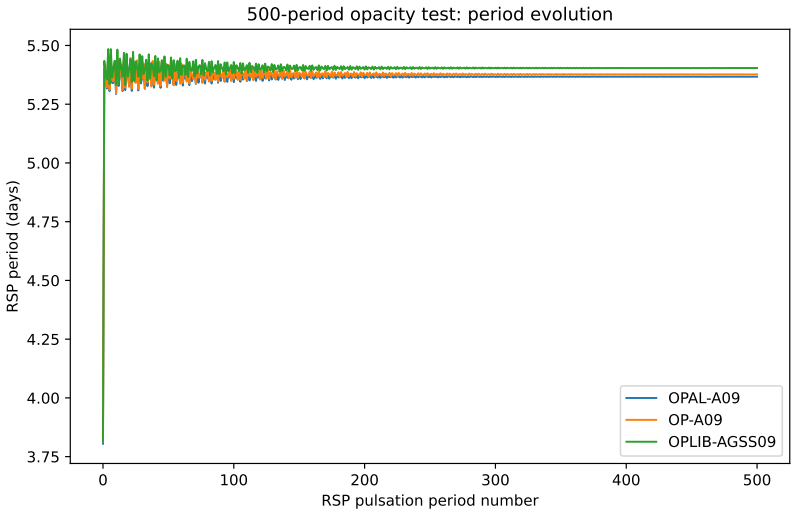
Radiative opacity is one of the central microphysical inputs controlling the thermal response of Cepheid envelopes and the driving or damping of radial pulsations. We present a controlled opacity-sensitivity experiment for a fixed delta Cephei nonlinear radial pulsation model computed with the MESA Radial Stellar Pulsation module. The stellar and pulsation parameters are held fixed at M = 5.0 solar masses , Teff = 6050 K, L = 2360 solar luminosities , X = 0.73, Z = 0.007, and RSP_alfam = 0.425, while the high-temperature opacity source is varied among native MESA opacity configurations: OPAL-A09, OP-A09, and OPLIB-AGSS09. The low-temperature opacity prefix, C/O-dependent opacity prefix, and all other RSP parameters are kept fixed so that the comparison isolates the effect of the adopted high-temperature opacity table. Verification integrations were performed at 20, 100, and 300 pulsation cycles, followed by photo-restarted continuations to 500 cycles. At 500 cycles, OPAL-A09 gives the closest period agreement, PRSP = 5.366986 d, only about 39 s longer than Pobs = 5.366531 d. OP-A09 gives the largest amplitude-growth diagnostics, with Delta Mag = 0.037307 and Delta R = 0.293677, corresponding to increases of 42.5% and 43.9% relative to OPAL-A09. OPLIB-AGSS09 gives a systematically longer period, P_RSP = 5.403926 d, with more modest amplitude-growth changes. The same ordering is reflected in the MESA history-column diagnostic rsp_GREKM, defined by the MESA defaults as the fractional growth of kinetic energy per pulsation period. These results show that native opacity choice measurably affects period matching, pulsation growth diagnostics, and nonlinear amplitude growth in this fixed {\delta} Cephei model. However, the tested opacity choices do not by themselves resolve the known observed-amplitude discrepancy.
0
0
astro-ph.GA 2026-07-03

SKAO spectra will uncover the first radio AGN in the epoch of reionization

by Jose Afonso, Stergios Amarantidis +21 more

The Road to Identifying the Earliest Radio-Powerful AGN with the SKA

Fine sampling from 50 MHz to 15 GHz overcomes biases that hide the predicted population of early radio-powerful sources.

Figure from the paper full image
abstract click to expand
The Epoch of Reionization (EoR) is one of the most pivotal frontiers in modern astrophysics, marking the emergence of the first galaxies, stars, and supermassive black holes (SMBHs). Despite insights from the Atacama Large Millimetre/submillimetre Array and the James Webb Space Telescope, we still struggle to explain how $\sim10^{9}$ M$_\odot$ SMBHs powering luminous active galactic nuclei (AGN) already exist by $z\sim7$. The recent discovery of powerful radio emission from some of these early AGN is notable, offering new constraints on early black-hole accretion and, with the Square Kilometre Array Observatory (SKAO), the prospect of directly probing neutral hydrogen through 21-cm absorption studies. Yet progress remains slow: only a few radio-powerful AGN are known at $z>6$, far fewer than theoretical predictions suggest, raising questions about whether this reflects intrinsic properties or selection biases and incomplete spectral information. In this chapter we synthesise predictions from state-of-the-art hydrodynamical and semi-analytic simulations with observational constraints from SKAO pathfinder facilities. These models suggest the existence of a substantial, still-undetected population of radio-powerful AGN in the EoR, but show that present surveys are limited by selection biases and incomplete radio spectral information. We discuss a physically motivated strategy for identifying high-redshift radio AGN, based on broadband radio spectral energy distributions, spectral curvature, dynamical jet evolution, and radio-only redshift estimation, offering a transformative alternative to traditional empirical approaches. Finally, we justify how the sensitivity and spectral coverage of the SKAO will allow fine-frequency sampling across the 50 MHz - 15 GHz range, revolutionising our ability to identify the earliest radio-powerful AGN and probe the earliest SMBHs.
0
0
astro-ph.GA 2026-07-03

Code shows dwarf-star contamination peaks near survey limits

by Onnalin Innala, Nicha Leethochawalit +2 more

Assessing Ultra-Cool Dwarf Contamination in Photometrically Selected High-Redshift Galaxy Samples

FC-ENZO finds similar fractions across HST, Roman and JWST fields but most interlopers sit at the faintest magnitudes.

Figure from the paper full image
abstract click to expand
Ultra-cool dwarf stars (UCDs) are a common source of contamination in high-redshift galaxy searches as both sources are red and these early-forming galaxies can have sizes that are difficult to resolve even with space telescopes. Standard selection techniques, including photometric redshift estimation and color-color criteria, cannot fully eliminate this contamination. We develop \textbf{F}oreground \textbf{C}ontamination \textbf{E}valuator of \textbf{N}earby dwarf stars in high-\textbf{Z} photometrically selected \textbf{O}bjects (FC-ENZO), a code that predicts the number of dwarf stars misidentified as high-redshift galaxies for a given survey setup. FC-ENZO models the number of UCDs and evaluates the fraction of synthesized dwarf stars that passes user-specified selection methods. We compare two synthetic spectral energy distribution libraries and find that the ELF OWL library, which relaxes the assumption of chemical equilibrium, predicts larger contaminant fractions than the BOBCAT library, because of stronger absorption features around $ 1 $ \micron. The contamination fraction increases with metallicity and also depends on the adopted stellar number-density model. The dominant contaminants are T to early Y-type UCDs, which are most commonly misclassified as galaxies at $z \sim 8$. Comparing deep surveys from different space telescopes, we find similar overall contamination levels within the same redshift range. However, the contamination is concentrated near the limiting magnitude of each survey. At brighter magnitudes, the relative contamination is highest for HST (COSMOS), followed by Roman deep-tier survey, and JWST. Although the predicted contaminant numbers remain sensitive to model assumptions, FC-ENZO provides a practical tool for survey design and for identifying optimal fields for spectroscopic follow-up.
0
0
astro-ph.GA 2026-07-03

Grain growth starts before collapse in forming cores

by E. Zhu, I. Ristorcelli +6 more

Tracing grain growth in the forming prestellar core L1506C with 3D modeling of Herschel, IRAM, and CFHT observations

L1506C modeling shows evolved dust grains are needed in densest regions, implying early evolution in star formation.

Figure from the paper full image
abstract click to expand
In the early phases of star formation, properties of prestellar cores are commonly inferred from observations of thermal dust emission and thus depend on dust properties, which must be carefully characterized. Our target, L1506C, is part of the filament L1506 in the Taurus molecular cloud. The spectral energy distributions over the whole spectral range (from 160 {\mu}m to 2 mm), built from Herschel PACS and SPIRE and IRAM-NIKA2 data, have been fitted with a modified blackbody. These data were also modelled using the 3D radiative transfer code SOC and the latest THEMIS 2 dust model using extinction observations from WIRCam at CFHT and from Spitzer as additional constraints. The MBB modeling reveals that L1506C is fragmented into two low density cores with masses smaller than their Jeans masses. The dust color temperature and the emissivity spectral index show clear anti-correlation and change in grain properties. Grains more evolved than the diffuse interstellar medium are needed to model the densest part showing that grain growth already occurs at very early stage of star formation, even before the onset of gravitational collapse.
0
0
astro-ph.GA 2026-07-03

GCs form at 3 million solar masses per enrichment stage

by Irina Acharova, Margarita Sharina

Indicatives of Early Stages of Star Formation in the Universe

Four matching metallicity peaks in clusters and clouds from z=0.2 to 5.9 are reproduced when each stage produces that fixed GC mass total.

abstract click to expand
The paper analyzes formation conditions for globular clusters (GCs) in circumgalactic clouds. The similarity between the metallicity distributions of GCs in the nearby Universe and of circumgalactic clouds is substantiated in detail over a wide range of redshifts: from \mbox{0.2} to \mbox{5.9}. The distributions of the number of circumgalactic clouds and GCs both contain a sequence of four local maxima at the metallicity values: \mbox{$[\rm{X/H}]\simeq -2.6, -2.0, -1.4,-0.5$}. The sequential enrichment of a circumgalactic cloud with a mass of $10^{8}\,M_{\odot}$ is calculated starting the extremely low metallicity \mbox{$ [\rm{X/H}] <-2.3$}, then following through the stages of \mbox{$-2.3 \le [\rm{X/H}]<-1.7$} and \mbox{$-1.7 \le [\rm{X/H}] < -0.9$} to the high metallicity \mbox{$[\rm{X/H}] \ge -0.9$}, where the boundaries of these ranges coincide with the local minima of the number of objects in the distributions. It is shown that for the reproduction of such distributions, it is sufficient that at each stage of enrichment of a part of a cloud in metals, one or more GCs with a total mass of \mbox{$3 \times 10^{6}\,M_{\odot}$} are formed. It is shown that the maximum mass of stars capable of leading to supernova explosions increases with the increase of metallicity. Possible values of this mass are calculated for the metallicities corresponding to the maxima in the distributions of clouds and GCs.
0
0
astro-ph.SR 2026-07-03

Clavius report caps 1567 solar radius at modern value

by Hisashi Hayakawa, Mitsuru Sôma +5 more

Analyses on Christoph Clavius' Reports of Total Solar Eclipses in 1560 and 1567: Key References for the Centennial Variations of the Earth's Rotation Speed and the Solar Radius

Revised Delta T bounds from 1560 and 1567 eclipses exclude linear shrinkage but allow oscillations

Figure from the paper full image
abstract click to expand
Variations in solar radius (hereafter R_Sun) is a key reference for solar magnetic activity in time. The sunlight amount may have varied with R_Sun and had an effect on the Earth's climate in the past. Eclipse observations offer a unique opportunity to measure the absolute R_Sun value before modern direct observations. The scientific community has discussed a possible long-term R_Sun variability from 1715 onward. Prior to their coverage, Clavius' eclipse reports had been subjected to qualitative debates regarding the local eclipse visibility and a possible secular R_Sun trend. This study leverages the recent dramatic developments of lunar topography data and ephemeris data to provide an effective resolution of this debate. Clavius' eclipse reports described an explicit totality in 1560 at Coimbra and a "slender circle" around the eclipsing Moon in 1567 at Rome. Our study revised the {\Delta}T constraints of -492 s =< {\Delta}T =< 200 s in 1560 and 140 s =< {\Delta}T =< 151 s in 1567 to satisfy Clavius' descriptions, considering the lunar limb profile and assuming Auwers' canonical R_Sun. This study constrains the R_Sun margin of 1567, utilising three scenarios to interpret Clavius' account. The local totality requires an upper R_Sun limit of 1567 as R_Sun =< 696200 km in absolute size (959.92" in angular size), indicating no linear secular R_Sun shrinkage but possible R_Sun oscillations on a centennial timescale. Conversely, the annularity scenario is considered unlikely because it requires an R_Sun decrease of 7.5" within 3 centuries, even beyond the capacity of extreme shrinking-Sun hypotheses.
0
0
astro-ph.GA 2026-07-03

3 GHz survey finds 65 polarised sources but zero star-forming galaxies

by S. Ranchod, S. A. Mao +6 more

The VLA-COSMOS 3 GHz Large Project: Polarised source counts and catalogue

Upper limit below 2 per square degree shows SKA-era work needs far deeper data to detect this population.

Figure from the paper full image
abstract click to expand
The exploration of the faint polarised radio source population is essential for interpreting the nature and evolution of magnetic fields in galaxies. While recent studies have provided insight into source counts for the $\mu$Jy polarised source population at 1.4 GHz, higher frequency surveys may be more sensitive to new populations that are depolarised at lower frequencies (i.e. due to internal or external depolarisation effects). We present the deepest polarised source counts at 3 GHz to date, at an angular resolution of $1.5''$. With these relatively higher frequency observations, we aim to probe the faint polarised star-forming galaxy (SFG) population. Furthermore, through spectral modelling, we aim to provide further insight into the frequency evolution of polarised source counts. We processed the polarisation data of the VLA-COSMOS 3 GHz Large Project, one of the deepest high-resolution radio continuum surveys. We produced Stokes Q and U mosaicked channel maps. After selecting known sources in total intensity, we performed 3D rotation measure synthesis and searched for polarised emission using an empirically determined threshold. With a sensitivity of 2.6 $\mu$Jy/beam in Faraday depth, we detect 65 polarised sources (51 deg$^{-2}$) above our threshold. We find that our cumulative and Euclidean-normalised source counts at 3 GHz are consistent with those in the literature at 1.4 GHz, which we attribute to the combined effect of spectral index and depolarisation in the detected sources. We detect no SFGs in our sample and derive a 2$\sigma$ upper limit on the density of polarised SFGs of $<2.0~\mathrm{deg}^{-2}$. This implies that significantly deeper observations will be required to readily detect this population in the SKA-era.
0
0
astro-ph.HE 2026-07-03

Five Type IIP supernovae define slow-rise high-velocity subclass

by Sondos Mohsen-Tanev, Iair Arcavi +18 more

SN 2020bij and a Possible Slow-Rise High-Velocity Subclass of Type IIP Supernovae

Models attribute their light curves to weak circumstellar interaction, offering a new probe of red supergiant mass loss.

Figure from the paper full image
abstract click to expand
Mapping how the explosion properties of Type II supernovae (SNe II) relate to the properties of their progenitors can provide strong constraints for understanding the final evolutionary stages of massive stars. Type IIP SNe, linked to the explosions of single red super-giant (RSG) stars, have recently been found to require some form of interaction with circumstellar material (CSM) to reproduce the rapid rise to the plateau often seen in their light curves. In this work, we present observations and analysis of the Type IIP SN 2020bij, characterized by a slow rise to its plateau as well as high expansion velocities. We identify four other SNe IIP from the literature (ASASSN-14kg, SN 2018fif, SN 2021yja and SN 2023axu) with similarly slowly rising light curves and find that they also show high expansion velocities. Using both analytical and numerical models, all five events can be explained with weak to no CSM interaction. We therefore propose that these events constitute a new subclass of Type IIP SNe which could be associated with relatively confined CSM. Early and dense photometric coverage of future SNe IIP together with early spectroscopic observations will further map this subclass and its physical properties. Understanding such rare events could be key to constraining the diversity of late-stage mass-loss in RSGs.
0
0
astro-ph.IM 2026-07-03

Near-IR IFS design for HWO coronagraph targets planet spectra

by Stephen P. Todd (1), Dan Dicken (1) +10 more

Design and development of a near-IR integral field spectrograph for the HWO Coronagraph Instrument

Lenslet and image-slicer options are traded to sample speckles at all wavelengths and boost contrast in the 0.8-1.7 μm band.

Figure from the paper full image
abstract click to expand
The primary mission of the Habitable Worlds Observatory (HWO) is to identify and characterise potentially habitable worlds. Spectra across a wide wavelength range are needed to cover multiple spectral features per molecule of interest. An integral field spectrometer (IFS), fed by a coronograph system, can be used to measure spectra from any planets within the nulled field of the coronograph, while also characterizing the residual speckles as a function of wavelength, enabling the contrast ratio to be further enhanced. We present design trades for an infrared IFS (0.8 to 1.7 {\mu}m) for the HWO Coronagraph Instrument, including assessment of the relative merits of lenslet and image slicer based architectures. Key requirements include full sampling of the speckle field at all wavelengths, maximized optical throughput, and control of spectral cross talk and stray light. We identify technology developments needed to advance the instrument design to the required technology readiness level.
0
0
hep-ph 2026-07-03

Axion background splits photon modes into Krein-sign sidebands

by Run-Min Yao, Xiao-Jun Bi +2 more

Sideband Structure of Axion Electrodynamics

A periodic axion field folds the dispersion into a ladder whose degeneracies are stable or unstable according to the symplectic signatures o

abstract click to expand
We develop a Floquet--Bloch sideband formulation of the linearized Maxwell--axion system in a coherent periodic axion background. Linearizing around prescribed magnetic and axion fields, we show that the pump generates a sideband ladder of photon and axion branches. Near an isolated folded degeneracy, this ladder reduces to a two-mode crossing whose algebra is fixed by the symplectic signatures of the colliding modes. In temporal fixed-momentum evolution, same-Krein-sign collisions give stable avoided crossings, whereas opposite-sign collisions give parametric instabilities, unifying the axion-photon difference channel with the Mathieu and Masaki-Aoki-Soda resonances. In stationary fixed-frequency transfer, the corresponding flux signatures distinguish bounded forward conversion from forward-backward stop bands and distributed reflection. Ray projection of a temporal pump gives a related but local WKB description of driven forward mixing, with an effective wavenumber distinct from the true axion momentum. External-field diagrams reproduce the sideband selection rules, and full temporal monodromy calculations verify the instability topology and finite-coupling shifts.
0
0
astro-ph.HE 2026-07-03

QPOs track inner disk temperature shifts in 4U 1630-47

by Haifan Zhu, Mariano Méndez +2 more

Timing and spectral analysis of the 2025 outburst of 4U 1630-47 with textit{NICER}

Rising-phase oscillations match higher disk temperatures and lower normalizations; a weak modulation appears near peak.

Figure from the paper full image
abstract click to expand
We analyzed \textit{NICER} observations of the 2025 outburst of the black hole X-ray binary 4U~1630$-$47 to investigate the spectral--timing properties of its transient low-frequency quasi-periodic oscillations (QPOs) and millihertz-scale quasi-regular modulation (QRM). During the rising phase of the outburst, the QPO centroid frequency increased from $\sim 0.24$ Hz to $\sim 3.43$ Hz. Wavelet-based state separation shows that the with-QPO intervals are associated with a higher inner disk temperature and a lower \texttt{diskbb} normalization than the without-QPO intervals, while the photon index ($\Gamma$) shows weaker changes within the uncertainties. Near the outburst peak, the source displayed a weak QRM at $\sim 0.07$ Hz with a fractional rms amplitude of $\sim 4.7\%$, lower than that of the heartbeat state observed in 2023. Phase-resolved Hilbert--Huang analysis shows that the inner disk temperature is positively correlated with the X-ray flux, the \texttt{diskbb} normalization is anticorrelated, and $\Gamma$ varies only weakly. Overall, the short-timescale spectral--timing variability is expressed most clearly through the disk-related parameters. The transient QPOs are therefore consistent with short-timescale disk-related variability during the rising phase, whereas the millihertz-scale QRM may represent a weaker heartbeat-like variability mode appearing near the outburst peak.
0
0
astro-ph.IM 2026-07-03

Narrow slit narrows line spread function below its geometric width

by Stephen P. Todd (1), Éamonn J. Harvey (1) +14 more

HARMONI at ELT: line spread functions in a diffraction limited spectrometer

Spatial coherence in HARMONI produces non-linear dependence on post-slit pupil aperture for ELT spectrograph performance.

Figure from the paper full image
abstract click to expand
HARMONI is the first light, adaptive optics assisted, near-IR integral field spectrograph for the ELT. It covers a spectral range from 800~nm to 2450~nm with resolving powers from 3000 to 7000 and spatial sampling of 25~mas and 6~mas. It can operate in two adaptive optics modes - SCAO (including a high contrast capability) and MCAO. The project is resuming its final design phase after a rescope design phase in 2025. Diffraction of the pupil becomes significant in a spectrograph where the slit width is comparable to the diffraction limited PSF. When the spatial coherence due to the narrow slit is considered, the resulting line spread function can be narrower than the geometric width of the input slit, with a non-linear dependence on the size of the pupil aperture after the slit. We outline the impact of these diffraction and spatial filtering effects on the line spread function of HARMONI and identify parameters that should be considered when designing a diffraction limited spectrograph.
0
0
astro-ph.SR 2026-07-03

Sulfur oxides detected in B[e] supergiant ejecta

by C. Bordiu, J. Ricardo Rizzo +13 more

Discovery of sulfur oxides in the ejecta of a B[e] supergiant

SO and SO2 abundances match models in 10,000 years; low 32SO/33SO ratio attributed to UV photochemistry.

Figure from the paper full image
abstract click to expand
B[e] supergiants represent a rare class of luminous, evolved massive stars surrounded by dusty circumstellar disks. Since their intense UV fields were long thought to sterilize their surroundings, molecular detections beyond carbon monoxide have remained elusive, leaving their chemical reservoirs largely unexplored. Whether these environments can sustain a complex molecular chemistry is a fundamental question with significant astrochemical implications. Here we report the detection of chemically rich molecular gas surrounding the B[e] supergiant HD~87643, using ALMA observations. Our data reveal the presence of the sulfur oxides SO and SO$_2$ and other sulfur-bearing species, marking the first detection of these molecules in an early-type evolved massive star. We find a high fractional abundance of SO$_2$ relative to H$_2$, which our chemical modelling can reproduce in timescales as short as $\sim$10$^4$ yr in an oxygen-rich environment. These results indicate that the detected molecules trace a short-lived, rapidly evolving phase of out-of-equilibrium chemistry. Furthermore, we measure an anomalously low $^{32}$SO/$^{33}$SO, that we attribute to mass-independent fractionation driven by intense photochemistry. This mechanism mirrors processes proposed to explain the $^{33}$S excesses in the atmosphere of the Archaean Earth. Our findings suggest that B[e] supergiants could serve as unique laboratories for studying sulfur chemistry under extreme radiation conditions, opening potential avenues to investigate the fractionation processes that shaped the isotopic signatures found in the early geological record.
0
0
astro-ph.GA 2026-07-03

SKA-mid AA4 to deliver resolved HI maps over hundreds of square degrees

by M. Ramatsoku, P. Serra +9 more

Resolved HI and Environmental Dynamics

Reaching 10^18 cm^{-2} sensitivity at kiloparsec scales across clusters, groups and filaments.

Figure from the paper full image
abstract click to expand
Spatially resolved, deep HI observations from SKA precursors and pathfinders such as MeerKAT, FAST, and ASKAP have demonstrated their ability to reveal the complex interactions between galaxies and their environments. These include, but are not limited to, recent observations of the Virgo cluster showing that the hydrodynamical effects of ram pressure stripping can operate effectively at unexpectedly large cluster-centric distances. In the Fornax cluster, the discovery of long HI tails with mixed tidal-ram-pressure origins indicates the interplay between gravitational and hydrodynamical mechanisms. Similar HI features in nearby filaments and galaxy groups, where ram pressure is expected to be weak, highlight the influence of hydrodynamical processes even in low-density environments. Multi-resolution studies have further revealed signs of cold gas accretion and HI replenishment driven by tidal interactions. While highly informative, these studies remain limited to small, specific regions of the sky. With SKA-mid AA4, it will become possible to carry out deep, spatially resolved HI imaging over hundreds of square degrees, covering environments from isolated galaxies to filaments. By reaching column-density sensitivities between $1.0 \times 10^{18}$ and $\sim 1.0 \times 10^{19}~\mathrm{cm^{-2}}$ at physical resolutions of $\sim$10 and $\sim$1 - 2 kpc, respectively, and by enabling sensitive, contiguous observations of wide areas within short integrations, SKA-mid AA4 will allow the construction of large, statistically representative samples of galaxies and detailed studies of environmental mechanisms operating across the full range of these less-studied environments at resolved scales.
0
0
astro-ph.CO 2026-07-03

100 solar-mass black holes reach 10,000 solar masses in 2 Myr in SIS SIDM halos

by Zhe Meng, Tan Chen +5 more

Spherically Symmetric Fluid Simulations of Black Hole Accretion in Self-Interacting Dark Matter Halos

Fluid simulations show gravity inflow outpacing SIDM heat transport in dense cores, enabling rapid early growth.

Figure from the paper full image
abstract click to expand
We investigate black hole accretion in self-interacting dark matter (SIDM) halos using a self-gravitating fluid model with thermal conduction. We develop a robust one-dimensional spherically symmetric hydrodynamic code based on an operator-splitting finite-volume method. Simulating both Singular Isothermal Sphere (SIS) and Navarro-Frenk-White (NFW) profiles, we find that black hole growth is regulated by the competition between gravity-driven inflow and SIDM heat transport. Our results demonstrate that an SIS-like environment facilitates rapid accretion, allowing a $100\,\mathrm{M_{\odot}}$ seed to grow to $10^4\,\mathrm{M_{\odot}}$ within $2\,\mathrm{Myr}$. Furthermore, we show that larger initial black hole masses, steeper density profiles, and higher scattering cross sections significantly enhance the accretion rate. This study provides a comprehensive fluid-dynamical picture of black hole growth in SIDM halos.
0
0
physics.hist-ph 2026-07-03

GRMHD models of Sgr A* carry problematic epistemic opacity

by Juliusz Doboszewski, Jamee Elder

Black Boxes in Black Hole Imaging

This signals limits in current model understanding and restricts machine learning uses in future observations.

abstract click to expand
We investigate the epistemic opacity of computer simulations and machine learning methods in the context of black hole imaging. We argue that there are forms of opacity-including opacity resulting from the use of machine learning-which do not need to affect the reliability of an inference when it is seen as a part of a broader inferential framework. We propose conditions under which that can plausibly be the case, and discuss how opaque methods can be useful in the context of the (next generation) Event Horizon Telescope. However, we also argue that at least one problematic form of opacity is currently present in black hole imaging: GRMHD models of Sagittarius A* are opaque. This form of opacity signals the limitations of current understanding of the models of this source, and constrains the potential uses of ML models in future observations.
0
0
astro-ph.IM 2026-07-03

Smartphones record cosmic ray flux changes with altitude

by Wakiko Takano, Shigeharu Udo +2 more

Development of a cosmic ray detector using CMOS sensors embedded in smartphones and Raspberry Pi devices

In-flight and Raspberry Pi tests show variations matching geomagnetic shielding using only built-in phone cameras.

abstract click to expand
Cosmic rays are ubiquitous; however, their direct observation traditionally demands specialized, high-cost hardware and significant technical expertise, presenting a high barrier for non-specialist environments such as schools and community settings. We present SORAMAME, a smartphone and tablet application that lowers this barrier by repurposing built-in CMOS image sensors as particle detectors. The system enables real-time recording and visualization of particle-like events without additional hardware, integrating on-device extraction - calibration, noise filtering, and track-candidate detection - with cloud-based data management. By simplifying the detection process, SORAMAME facilitates widespread adoption across diverse user groups, fostering an environment where educational outreach can transition into large-scale data collection. This scalability is particularly significant given the unprecedented number of internet-connected consumer devices equipped with silicon CMOS image sensors. Despite the inherent constraints of consumer-grade sensors, our in-flight validation and Raspberry Pi-based measurements successfully captured altitude and latitude-dependent variations in particle flux consistent with geomagnetic shielding. These results suggest that lowering barriers to participation in observation not only serves educational purposes but also has the potential to contribute to future scientific breakthroughs through the development of global citizen science.
0
0
hep-ph 2026-07-03

Lambda hyperons equilibrate in 10^{-10} seconds in proto-neutron stars

by Ruben Zatini, Jorge Martin Camalich +2 more

Λ hyperons in core-collapse supernovae: Equilibration and neutrino opacities

Nonleptonic reactions set this timescale orders of magnitude below star evolution times and add new muon neutrino absorption channels.

Figure from the paper full image
abstract click to expand
Strange hadrons are commonly included in dense-matter equation-of-state models by imposing chemical equilibrium, but the weak-interaction timescales required to establish it in core-collapse supernovae have not been systematically assessed. In this paper we compute the $\Lambda$-hyperon production rates in the hot, dense, and isospin-asymmetric conditions characteristic of post-collapse proto-neutron stars. We find that local $\Lambda$ chemical equilibration is driven by nonleptonic strangeness-changing reactions, especially $NN\leftrightarrow N\Lambda$ scattering, on timescales of order $10^{-11}$-$10^{-10}$ s, many orders of magnitude shorter than macroscopic proto-neutron-star evolution timescales. Using an effective-field-theory framework constrained by hypernuclear weak-decay data, we find that short-range contact interactions dominate the nonleptonic rates, beyond a pure one-meson-exchange description. Semileptonic channels are too slow to set the equilibrium $\Lambda$ abundance, but they open additional absorption channels for low-energy muon neutrinos and antineutrinos, such as $\nu_\mu+\Lambda\to\mu^-+p$ and $p+\mu^-+\bar\nu_\mu\to\Lambda$. At low energies, these $\Lambda$-induced neutrino opacities exceed the corresponding nucleonic contributions for muon (anti)neutrinos, possibly influencing the evolution of the muon lepton number during proto-neutron-star deleptonization. These results support local chemical equilibrium for $\Lambda$ hyperons under the conditions studied and provide new weak-interaction input for flavor-dependent neutrino transport, muonization, and proto-neutron-star evolution.
0
0
astro-ph.SR 2026-07-03

TESS revises IR Cas to 1.32 and 1.05 solar mass main-sequence pair

by Matúš Kamenec, Pavol Gajdoš +4 more

Revision of the Detached Eclipsing System IR Cas from TESS Observations, Ground-Based Photometry and Spectroscopy

Timing variations point to a possible third body on a 38-year orbit while stars match standard evolution tracks.

Figure from the paper full image
abstract click to expand
We present a new photometric and spectroscopic analysis of detached eclipsing binary IR Cas based on TESS observations, supplementary ground-based photometry in Sloan $g^\prime$, $r^\prime$, and $i^\prime$ filters, and newly obtained radial velocity measurements. The updated orbital and physical parameters of the system were derived using combined light-curve and radial-velocity modeling. The resulting solution indicates that both components are main-sequence stars with masses of approximately $1.32$ M$_{\odot}$ and $1.05$ M$_{\odot}$. We investigated in detail the fact, that the TESS light curves exhibit asymmetries near the maxima, which were reproduced by introducing a cool spot that moves on the surface of the secondary component. Long-term analysis of times of minima revealed quasi-periodic variations in the O$-$C diagram that can be interpreted as a light-time effect due to a possible third body with an orbital period of about 38 years. The positions of both components in the mass-radius diagram agree well with empirical relations for detached main-sequence binaries and do not indicate substantial deviations from standard stellar evolution. Overall, IR Cas appears to be an evolutionarily representative detached eclipsing system with moderate indications of stellar activity.
0
0
astro-ph.IM 2026-07-03

Classical SNR mode approximates quantum optimum for planet nulling

by Yinzi Xin, Sebastiaan Haffert +2 more

Quantum-optimal coronagraphy with spatial mode sorting for direct exoplanet observations

The match holds to leading order in leakage, enabling optimal coronagraph designs for realistic stars and complex apertures at lambda/D scal

Figure from the paper full image
abstract click to expand
Conventional coronagraphs struggle to reach the theoretical limit of exoplanet detection at close separations to the star, particularly when the telescope has a complex aperture or when the star is partially resolved. Coronagraphy or nulling using spatial mode-sorting can reach the theoretical limit, but the optimal solution has so far only been calculated for an idealized unresolved star, whose signal lies entirely in the piston mode of the telescope. This work aims to enable the calculation of optimal nulling modes for realistic observational scenarios as a function of the size of the star and planet parameters, with the goal of improving coronagraphic performance at ~lambda/D working angles given partially resolved stars and complex telescope apertures. We perform numerical calculations using tools from quantum information theory and explore the behavior of optimal mode-sorting measurements. The optimal measurement for measuring a planet parameter is calculable from the density matrix describing the state of the system. The spatial mode that maximizes the classical signal-to-noise ratio is approximately quantum optimal to leading order in the stellar leakage and the planet flux ratio. We present optimal modes for measuring planets with known signals, and we characterize the tradeoffs inherent to coronagraphs targeting more than one planet location. Example coronagraph designs are presented for three cases of scientific interest: 1) the optimal extension of the fiber nuller architecture for detecting and spectrally characterizing planets across an arbitrary field-of-view using high-resolution spectroscopy, 2) following up planets detected by the visible coronagraph of the Habitable Worlds Observatory at more challenging infrared wavelengths, and 3) detecting and localizing planets at close working angles with the Planetary Camera and Spectrograph on the Extremely Large Telescope.
0
0
astro-ph.HE 2026-07-03

SKA to test gravity with dozens of new pulsar binaries

by V. Venkatraman Krishnan, L. Shao +22 more

Testing Gravity with Binary Pulsars in the SKA Era

Better timing and fresh discoveries will probe strong-field effects and black-hole properties beyond current reach.

Figure from the paper full image
abstract click to expand
Binary (and trinary) radio pulsars are natural laboratories in space for understanding gravity in the strong field regime, with many unique and precise tests carried out so far, including the most precise tests of the strong equivalence principle and of the radiative properties of gravity. The Square Kilometre Array (SKA) telescope, with its high sensitivity in the Southern Hemisphere, will vastly improve the timing precision of recycled pulsars, allowing for a deeper search of potential deviations from general relativity (GR) in currently known systems. A Galactic census of pulsars will, in addition, will yield the discovery of dozens of relativistic pulsar systems, including potentially pulsar -- black hole binaries, which can be used to test the cosmic censorship hypothesis and the ``no-hair'' theorem. Aspects of gravitation to be explored include tests of strong equivalence principles, gravitational dipole radiation, extra field components of gravitation, gravitomagnetism, and spacetime symmetries. In this chapter, we describe the kinds of gravity tests possible with binary pulsar and outline the features and abilities that SKA must possess to best contribute to this science.
0
0
astro-ph.EP 2026-07-03

Warm Jupiter transits Sun-like star on 58-day eccentric orbit

by Ioannis Apergis, Daniel Bayliss +54 more

NGTS-39 b: A 58 d transiting warm Jupiter in an eccentric orbit

The 1.47 Jupiter-mass planet at 519 K fills a gap between hot and cold giants and shows signs of an outer companion.

Figure from the paper full image
abstract click to expand
We report the discovery and characterisation of NGTS-39 b (TIC 453147896 b), a warm Jupiter transiting a Sun-like star on a 58.2 day, eccentric (e = 0.386 +/- 0.019) orbit. NGTS-39 b was first identified from a TESS single-transit event, and subsequently confirmed with NGTS photometry and radial-velocity measurements from CORALIE and HARPS. The host star is a bright (Tmag = 11.02) F9 dwarf with an effective temperature of Teff = 6053 +67/-30 K. NGTS-39 b is a Jupiter-sized gas giant with a radius of 1.088 +/- 0.012 RJ and a mass of 1.467 +/- 0.081 MJ. Its equilibrium temperature is 519 +6/-5 K, placing it between short-period hot Jupiters and cold, Jupiter-like giants. The high orbital eccentricity and intermediate equilibrium temperature of NGTS-39 b make it a valuable test case for formation and migration models, particularly in the poorly sampled regime of long-period gas giants. The RV data show a linear trend of gamma dot = -17.75 m s^-1 yr^-1, which indicates the presence of an outer companion. The discovery of NGTS-39 b contributes to the small but growing population of transiting warm Jupiters with P > 50 days orbiting bright stars.
0
0
physics.space-ph 2026-07-03

Four Solar Orbiter shocks show energetic particles exceeding thermal plus magnetic pressur

by D. Trotta, D. Lario +11 more

Energetic particle-mediated interplanetary shocks observed by Solar Orbiter

The events are strong and fast, with particle-dominated regions extending up to 100000 ion inertial lengths upstream.

Figure from the paper full image
abstract click to expand
Context: In collisionless shocks, energetic particles can carry sufficient pressure to modify the upstream plasma and the shock structure itself, a regime often invoked in theories of cosmic-ray acceleration but rarely observed in the heliosphere. Aims: We find and characterize {interplanetary} IP shocks where energetic particles dynamically dominate the upstream pressure. Methods: We analyze IP shocks observed by Solar Orbiter inside 1 au and compute the energetic particle pressure $P_{EP}$ from proton measurements above 10\,keV, comparing it with the upstream thermal $P_{Th}$ and magnetic $P_{B}$ pressures. Results: We identify four shocks for which $P_{EP} \geq P_{Th} + P_B $. These events correspond to strong and fast shocks in the high-Mach-number tail of the Solar Orbiter shock population. In several cases the $P_{EP}$ increase coincides with a decreasing upstream bulk flow speed in the shock frame, and the resulting particle-mediated foreshocks extend up to $\sim10^5$ {ion inertial lengths} $d_i$. The extent of such energetic particle dominated region depends on shock geometry. Conclusions: These observations provide evidence that accelerated particles can dynamically modify interplanetary shocks. They highlight the importance of the coupling between energetic particles, upstream fluctuations, and shock structure for understanding particle acceleration at collisionless shocks.
0
0
gr-qc 2026-07-03

Excited boson stars violate energy conditions in teleparallel gravity

by Long-Xing Huang, Ke Yang +1 more

Boson Stars in Teleparallel Gravity with a Nonminimally Coupled Field: The Violation of Energy Conditions and Gravitational Waveforms from EMRIs

Ground states obey them, yet EMRI signals from both lie in the LISA detection range.

Figure from the paper full image
abstract click to expand
In this work, we investigate boson star models within the framework of teleparallel gravity with non-minimal coupling, and obtain static, spherically symmetric solutions for both the ground state and excited states. The results indicate that the energy density of the excited-state solutions can become negative. For these solutions, the four commonly used energy conditions are no longer satisfied. In contrast, for all the ground-state solutions we have studied, the energy density remains positive and all four energy conditions are consistently satisfied. Moreover, considering the importance of astrophysical observations, the gravitational-wave signals from Extreme-Mass-Ratio Inspirals (EMRIs) composed of these boson stars are investigated. Our results reveal that the frequency-domain characteristic strain of these waveforms falls within the detectability range of LISA, which can provide potential evidence for distinguishing compact astrophysical objects.
0
0
astro-ph.SR 2026-07-03

Small-scale dynamo generates majority of quiet Sun magnetic energy

by Wen-Jie Jiang, Lei Ni +3 more

Research Progress on Solar Small-Scale Dynamo

Review of data and models finds local turbulence sustains cycle-independent fields that affect the corona, wind, and radiation.

Figure from the paper full image
abstract click to expand
The small-scale solar dynamo theory, as the core mechanism explaining the origin of the persistent, disperse weak magnetic field in the quiet Sun regions, has made significant progress over the past three decades in the fields of observation, theory, and simulation. Breakthrough observations from high-resolution space-based and ground-based telescopes have revealed that the quiet Sun is ubiquitously populated by highly dynamic, mixed-polarity and possibly predominantly horizontal magnetic structures with complex topology. These observations confirm that their total magnetic flux is substantial, with a high and widely distributed magnetic flux emergence rate, strongly suggesting a local dynamo effect independent of the solar cycle and driven by intense turbulence and convection. Theoretical studies indicate that even in the challenging low magnetic Prandtl number ( Pm << 1) environment of the solar photosphere and convection zone, turbulent motions can self-excitedly convert kinetic energy into magnetic energy through the stretching, folding, and twisting of magnetic field lines. MHD simulations have successfully reproduced observed features, demonstrating that a pure small-scale dynamo can operate efficiently and sustain magnetic fields even in an open, stratified solar environment incorporating realistic physical processes. Current research strongly suggests that small-scale magnetic fields constitute the majority of the magnetic energy in the quiet Sun and also influence coronal heating, solar wind acceleration, and radiation distribution. This article conducts a literature review centered on observations, theoretical models, and numerical simulations of the small-scale dynamo, organizing and discussing the relevant research history and progress. Finally, it summarizes the content and provides an outlook on future research from multiple perspectives.
0
0
astro-ph.IM 2026-07-03

Eight-station coherent beamform reaches SNR 699 on PSR B0329+54

by Yukai Zhou, Junhua Gu +9 more

Pulsar Backend for 21 CentiMeter Array: Implementation of Data Acquisition and Initial Results

RFSoC backend with Cas A and Cyg A phase solutions enables 2.5-hour tied-array observation at 50-350 MHz on 21CMA.

Figure from the paper full image
abstract click to expand
We implemented a data acquisition system for 21 CentiMeter Array (21CMA), enabling baseband observations targeting pulsars and fast radio bursts. Based on the Radio Frequency System-on-Chip (RFSoC) platform, the new backend is capable of instantaneously covering the effective bandwidth from 50 to 350 MHz, with multi-board synchronization achieved at the timescale of the sampling clock. We observed PSR B0329+54 with a single station to verify the signal path integrity; then solved phase relations of multiple station pairs using bright persistent radio sources like Cas A and Cyg A; using these phase solutions, a multiple-station coherently beamformed observation of PSR B0329+54 was carried out, showing a signal-to-noise ratio of 699.09 for a 2.5-hour observation with eight stations, opening up a possibility of tied-array low-frequency pulsar observations on 21CMA.
0
0
astro-ph.IM 2026-07-03

HR-MOS defines fiber specs and multiplex for WST

by Andrea Tozzi, Anna Brucalassi +11 more

Current status of the High-Resolution Multi-Object Spectrograph (MOS-HR) for the Wide-field Spectroscopic Telescope

Trade-off studies set modular architecture, mass estimates, and stability analysis for the 12m telescope module.

Figure from the paper full image
abstract click to expand
The Wide-field Spectroscopic Telescope (WST) is a planned 12-meter class dedicated spectroscopic facility for massive spectroscopic surveys. This paper presents the current status of Work Package 4.5, the High Resolution Multi-Object Spectrograph (HR-MOS) module. We describe the international team organization and optical design resulting from extensive trade-off studies, presenting its evolution driven by scientific requirements and technical constraints. Design parameters derived from science cases and astronomical community requirements are detailed. Given the critical importance of mass and volume budgets, we present envelope dimensions and mass estimates for HR-MOS. The spectrograph constructive parameters are defined, including optical fiber specifications, multiplex capability, and modular architecture. Finally, we present the structural analysis addressing mechanical stability and performance requirements for this high-resolution multi-object spectrograph.
0
0
astro-ph.HE 2026-07-03

GRB radio colours require 500-fold optical depth boost

by S. Giarratana, O. S. Salafia +11 more

Colour evolution in the radio afterglow of GRB 241025A

A structured jet forward shock matches all bands only after the optical depth is increased by a factor of 500, possibly from cold electrons.

Figure from the paper full image
abstract click to expand
We present the observing campaign of the afterglow of GRB241025A, a gamma-ray burst (GRB) whose prompt emission has been simultaneously detected by Swift, Einstein Probe, Fermi/GBM, SVOM, Konus-Wind and VZLUSAT-2 3U CubeSat. Our multi-wavelength campaign comprises radio, near-infrared, Optical and X-ray observations. The afterglow was clearly detected in all bands. We performed a semi-empirical fit of the data, showing that the afterglow behaviour can be reasonably reproduced by a single component, i.e. an ultra-relativistic shock. However, the results from the semi-empirical fit are inconsistent with the predicted evolution from the standard afterglow model in the slow cooling regime. Specifically, we found that at early times the synchrotron self-absorption frequency $\nu_a$ should be at higher frequencies with respect to the ones sampled by our campaign, in order to explain the observed colour evolution in radio, namely the spectral evolution in time. To reconcile the prediction from the standard model with the observed data set, we fit the observations with a semi-analytical model, including a multiplicative factor $\tau_{enh}$ to the optical depth which, in turn, artificially increases $\nu_a$. We found that the radio colour evolution, together with the near-infrared, optical and X-ray emission, can be described reasonably well by a forward shock from a structured jet, provided that the optical depth in the shocked material is enhanced by a factor $\tau_{enh}=500$. We suggest that such enhancement in the optical depth can result from a population of cold electrons in the downstream material, i.e. electrons that were not accelerated by Fermi I process at the shock front, in agreement with the theoretical expectations previously reported in the literature. Overall, our work underscores the importance of systematic, multi-frequency, multi-epoch radio follow-ups of these extreme events.
0
0
astro-ph.IM 2026-07-03

Polar night dims Dome A NIR sky by 0.1-0.4 mag

by Jinji Li, Bin Ma +10 more

J and H band sky brightness measurements from polar day to polar night at Dome A, Antarctica

Continuous J/H measurements find darker backgrounds than regular day-night cycles, plus solar-activity trends in H band.

Figure from the paper full image
abstract click to expand
The near-infrared (NIR) sky brightness is a fundamental parameter for evaluating the performance of ground-based infrared observatories. Dome~A on the Antarctic plateau offers exceptional atmospheric conditions, yet its NIR sky background has not been continuously monitored. We present the first continuous $J/H$-band measurements of the sky background at Dome~A from polar day to polar night, and characterize their median levels and temporal variability. The Antarctic Infrared Binocular Telescope (AIRBT), operating in the $J$ and $H$ bands, obtained continuous fixed-pointing observations from February to May 2024, which were used to measure the NIR sky background. The median sky brightness is $5.2/2.9$ and $15.3/13.4~\mathrm{mag~arcsec^{-2}}$ in $J/H$ bands during daytime and nighttime, respectively. The twilight--nighttime boundaries occur at solar elevations of $-9.3^\circ$ in $J$ and $-7.4^\circ$ in $H$. At the same solar elevation, the NIR sky background during the polar night is darker by about $0.1$ and $0.4~\mathrm{mag~arcsec^{-2}}$ in the $J$ and $H$ bands compared with the period of regular day--night alternation. During the polar-night period, the nighttime sky brightness in the $H$ band shows a more evident association with the sunspot number, while the corresponding trend in the $J$ band is weaker. These results reveal systematic differences in sky background between polar and non-polar environments and between polar night and regular day--night cycles. The measured sky brightness may be elevated, as the observations were conducted near solar maximum, highlighting the importance of long-term monitoring across the solar cycle.
0
0
astro-ph.GA 2026-07-03

Nine southern supernova remnants receive new distance measurements

by Fupeng Liu, He Zhao +3 more

Distance Determination of Southern Galactic Plane Supernova Remnants with the Mopra CO Survey and DECaPS 3D Dust Map

CO clouds and 3D dust maps yield distances accurate to roughly 5-10 percent for objects in the galactic plane.

Figure from the paper full image
abstract click to expand
Accurate distance measurements to supernova remnants (SNRs) are crucial for understanding their physical properties, evolutionary processes, and role in the Galactic interstellar medium (ISM) cycle. In this study, we apply for the first time to the southern Galactic plane a distance determination method that utilizes CO emission data from the Mopra survey to identify molecular clouds (MCs) interacting with SNRs. By combining this with extinction-distance profiles from the DECaPS three-dimensional (3D) extinction map, we directly measure the distances to the associated MCs, thereby obtaining precise distances to the remnants. To overcome the extinction-missing bias in extremely dense regions where the 3D map suffers from a deficit of background stars, we supplement our analysis with two-dimensional (2D) extinction maps as cross-validation. Applying this method, we have derived precise distances for nine SNRs: G290.1-0.8 (7.32+0.60/-0.47 kpc), G292.2-0.5 (10.85+0.43/-0.68 kpc), G296.1-0.5 (4.59+0.18/-0.19 kpc), G296.8-0.3 (8.74+0.40/-0.29 kpc), G298.6-0.0 (6.50 +/- 0.21 kpc), G312.4-0.4 (3.60+0.19/-0.23 kpc), G332.4-0.4 (2.66+0.23/-0.15 kpc), G335.2+0.1 (2.76+0.37/-0.31 kpc), and G353.6-0.7 (1.81+0.18/-0.14 kpc). Additionally, we established a robust lower distance limit of 1.34 kpc for G351.7+0.8.
0
0
astro-ph.CO 2026-07-03

Meer21cm pipeline reaches 1 percent accuracy on HI power spectra

by Zhaoting Chen, Steven Cunnington +24 more

meer21cm: an Analysis Pipeline and Comprehensive Toolkit for HI Intensity Mapping

The toolkit recovers model spectra within 0.5 sigma on simulated 750 deg squared patches for k from 0.02 to 0.2 h Mpc inverse.

Figure from the paper full image
abstract click to expand
We present meer21cm, a comprehensive python package for cosmological data analysis of single-dish HI intensity mapping surveys. This package is simple to use, with a modularised code structure designed for interactive usage. meer21cm is designed for data analysis, with particular focus on the UHF-band observation of MeerKAT Large Area Synoptic Survey (MeerKLASS). We explicitly impose meer21cm to be survey-oriented, ensuring consistent modelling of observational effects in the clustering power spectrum with the survey specifications and data analysis choices. meer21cm covers a large range of data analysis procedures post calibration, including data read-in, foreground cleaning, power spectrum estimation, mock simulation, transfer function corrections and parameter inference. It handles both meer21cm intensity maps and overlapping galaxy catalogues, allowing for multi-tracer and cross-correlation analysis between MeerKLASS and optical galaxy surveys. Tested with a simulated survey of ten $750\,$deg$^2$ sky patches in the redshift sub-band $0.6\,{<}\,z\,{<}\,0.8$, the meer21cm pipeline achieves per-cent accuracy in the power spectrum estimation for $k \in [0.02, 0.2]\,{h{\rm Mpc}^{-1}}$, with deviations $\lesssim 0.5\sigma$ between the mock and the model power spectra, where $\sigma$ is the signal variance. The meer21cm package is publicly available and easy to install, with a comprehensive documentation website at https://meer21cm.readthedocs.io
0
0
astro-ph.EP 2026-07-03

TESS detects first bound microlensing planet

by Mallory Harris (University of New Mexico), Diana Dragomir (University of New Mexico) +3 more

TESS's First Bound Microlensing Planet: A Binary Microlensing Event Revealing a Planetary Companion toward the Galactic Plane

Combined photometry shows a 1.6 Jupiter-mass planet around a K dwarf at 4.8 AU projected separation along the Galactic plane.

abstract click to expand
We report the discovery of Gaia23bra b, the first gravitationally bound microlensing planet detected by the Transiting Exoplanet Survey Satellite (TESS). Initially flagged as a single-lens event by the Gaia Science Alerts system, Gaia23bra was serendipitously observed by TESS over two consecutive sectors. During those TESS sectors, the light curve of the event displayed caustic-crossing features characteristic of a binary-lens event. Joint modeling of Gaia and TESS photometry with pyLIMA, supplemented by stellar parameter inference using pyLIMASS, suggests a K dwarf ($M_L = 0.79^{+0.19}_{-0.17}\,M_\odot$) hosting a Jovian planet with $M_P = 1.63_{-0.38}^{+0.42}\,M_{\rm Jup}$ at a projected separation of $a_{\perp,\min} \approx 4.8\,\mathrm{AU}$. This result underscores the synergy between high-cadence photometry and long-baseline monitoring for robust microlensing characterization. Its location along the Galactic Plane highlights TESS's unexpected capacity for microlensing science through its all-sky coverage and its potential to detect planets in regions beyond the Galactic Bulge.
0
0
astro-ph.SR 2026-07-03

Atmospheric overflow stabilizes symbiotic mass transfer to q=1.5

by Tan Liu, Natalia Ivanova +6 more

Revisiting atmospheric Roche lobe overflow in symbiotic binaries

Models predict million-year interaction phases that match the long-lived S-type systems seen in the Galaxy.

Figure from the paper full image
abstract click to expand
Classical binary evolution models predict dynamically unstable mass transfer in symbiotic stars with high mass ratios, leading to a common envelope. However, many observed S-type symbiotic systems show long-lived interaction, suggesting that an additional stabilizing mechanism may be at work. We investigate whether atmospheric Roche-lobe overflow can prolong the mass-transfer phase and help reconcile theory with observations. We implement the Rapid Unified Mass Transfer framework in \texttt{MESA} and compute a grid of white-dwarf--giant binaries covering a wide range of donor masses, mass ratios, and orbital periods. We then compare the resulting lifetimes and evolutionary tracks with well-constrained Galactic S-type symbiotic systems. For convective giant donors, our models recover stable mass transfer up to $q \simeq 1.5$, while atmospheric overflow strongly extends the symbiotic phase. RGB and early-AGB systems with $q \lesssim 1.5$ can remain interacting for up to $10^6$ yr at $\dot{M} \gtrsim 10^{-9},M_{\odot},{\rm yr}^{-1}$, much longer than the commonly assumed $\sim 10^3$ yr pre-common-envelope lifetime. In these systems, the orbit shrinks mildly and may re-expand after mass-ratio reversal. Systems with higher mass ratios still evolve toward a common envelope, but even for $q \simeq 2$--$4$ the symbiotic phase can last $10^4$--$10^5$ yr. The synthetic distribution in the orbital-period--mass-ratio plane and individual evolutionary tracks are broadly consistent with observed S-type symbiotic binaries, including recurrent novae. The RUMT framework, which incorporates atmospheric RLOF, provides an explanation for the long-term stability of many symbiotic binaries and may account for their high observed occurrence rate.
0
0
astro-ph.GA 2026-07-03

Ring post-starburst galaxies evolve into AGN hosts

by Junjie Huang, Yanmei Chen +8 more

Post-starburst Galaxies with Active Galactic Nucleus: Properties and Evolutionary Sequences

Age and kinematic profiles link RPSBs to later AGN activity while high-mass central PSBs follow mergers; AGN feedback is not required for qu

Figure from the paper full image
abstract click to expand
Post-starburst (PSB) galaxies, identified by strong Balmer absorption and weak nebular emission, provide a key laboratory for studying rapid quenching. Using the final data release of the SDSS-IV MaNGA survey, we follow the traditional PSB selection criteria of Chen et al. (2019) and develop a new method to identify regions that simultaneously exhibit PSB features and nuclear activities (AGN-PSBs). Our final sample comprises 48 AGN-PSBs, 92 central PSBs (CPSBs), 89 ring-like PSBs (RPSBs), and 828 irregular PSBs (IPSBs). We find the global and spatially resolved properties of CPSBs and RPSBs are consistent with the results of Chen et al. (2019). In this work, we focus on the properties of AGN-PSBs, comparing them with CPSBs, RPSBs, and control galaxies. Similar to CPSBs and RPSBs, AGN-PSBs show positive $\mathrm{D}_{n}4000$ gradients relative to negative $\mathrm{D}_{n}4000$ gradients of their controls, which indicates younger stellar populations in the central region than that in the outskirt. Among the three sub-types, high-mass CPSBs (H-CPSBs, with $\log(M_{*}/M_{\odot})>9.5$) display the highest incidence of merger remnants and gas--star kinematic misalignment, consistent with a merger/interaction-dominated origin. AGN-PSBs and RPSBs, however, show lower and comparable fractions of merger remnants and gas--star kinematic misalignment, favoring less violent external mechanisms. Based on radial profiles of mass-weighted age and $V_{\rm star}/\sigma_{\rm star}$, we suggest that RPSBs can evolve into AGN-PSBs, whereas H-CPSBs likely follow a distinct evolutionary pathway. The existence of RPSBs and IPSBs also indicates that AGN feedback is not a necessary condition for the formation of PSB.
0
0
astro-ph.HE 2026-07-03

Black hole spin alone sets near-horizon jet polarization

by Zhenyu Zhang, Yehui Hou +3 more

Polarization Architecture of Steady GRMHD Jets from the Horizon to Infinity

A semi-analytic model finds hierarchical convergence that separates spin effects from collimation and plasma loading across image scales.

Figure from the paper full image
abstract click to expand
We develop a semi-analytic framework for stationary, axisymmetric GRMHD jets that efficiently generates resolved polarized images from the near-horizon region out to $\sim 10^5\,r_g$ across a broad parameter space, enabling rapid exploration of how gravity and magnetohydrodynamic flows imprint scale-dependent signatures on jet morphology and polarization. We identify a new scale-dependent separation in polarimetric diagnostics. Outside the photon ring, plasma loading strongly modifies the polarization-angle profile of the integrated jet-layer emission through inertia-driven winding of the magnetic field. At large image-plane radii, the polarization angle follows a power-law in radius, with an index determined by the jet collimation profile. Near the horizon, in contrast, jets converge to a universal polarization pattern controlled solely by black hole spin. This convergence is hierarchical: differences in velocity and magnetic-field structure are erased first, whereas collimation-dependent differences persist to smaller radii, thereby allowing these effects to be disentangled. These results establish a largely achromatic polarimetric diagnostic that connects GRMHD jet dynamics to resolved image structure, with direct implications for high-resolution polarimetry and for constraining black hole spin and jet formation.
0
0
astro-ph.CO 2026-07-03

PBH mergers peak at 1.79 times ISCO frequency

by Ashu Kushwaha

Gravitational Waves from Primordial Black Holes: Connecting Low-Frequency Scalar-Induced Signatures to High-Frequency Binary Mergers

Monochromatic mass function creates direct, model-independent link between low-frequency scalar-induced waves and high-frequency merger sign

Figure from the paper full image
abstract click to expand
Formation of primordial black holes (PBHs) requires a significant enhancement of curvature perturbations. This mechanism leaves a twofold gravitational-wave (GW) signature: a \emph{low-frequency} stochastic background of scalar-induced GWs (SIGWs) and a distinct \emph{high-frequency} signal from subsequent PBH binary mergers. We leverage this shared origin to establish a consistent, \emph{model-independent} connection between these two observables for a monochromatic PBH mass function. Using PBH abundance constraints on the primordial curvature power spectrum, we evaluate the stochastic SIGW background for spherical and ellipsoidal collapse models, demonstrating that the ellipsoidal scenario yields a significantly stronger signal. Furthermore, we analyze the GW signal from PBH binary mergers and find a direct correspondence between the SIGW frequency and the innermost stable circular orbit (ISCO) frequency of the binaries. Because GW emission is nearly maximal near the ISCO, we additionally show that the peak of the full merger GW spectrum relates to the ISCO frequency via $f_{\text{peak}} = 1.79 \, f_{\text{ISCO}}$, a relation that is independent of the binary masses. Remarkably, this unified framework connects these distinct GW channels, enabling the same primordial fluctuations to be probed across widely separated frequency bands.
0
0
astro-ph.CO 2026-07-03

Bumpy axion inflation produces PBHs as dark matter

by Masahiro Kawasaki, Kai Murai +1 more

Lattice study of primordial black hole formation in bumpy axion inflation

Lattice runs in the strong-backreaction regime find a narrow peak in curvature perturbations yielding the observed abundance.

abstract click to expand
We study primordial black hole (PBH) formation in axion $U(1)$ inflation using lattice simulations. In axion $U(1)$ inflation with a bumpy potential, the curvature perturbations can be enhanced in a narrow range of wavenumbers, potentially leading to PBH formation. After confirming that our lattice simulations reproduced the known curvature power spectra for chaotic inflation and simple axion $U(1)$ inflation, we calculate the curvature power spectrum in the bumpy axion inflation model in the strong backreaction regime. We find that large curvature perturbations are generated, which lead to PBH production with an abundance sufficient to account for dark matter.
0
0
astro-ph.EP 2026-07-03

Lunar longitude alters clock frequency shifts by separation

by Hongbin Zhang, Yanyue Gao +1 more

The influence of lunar tidal potential on clock frequencies at different positions on Earth

Calculations in the geocentric frame show that clocks at the same latitude but different longitudes experience changing tidal offsets as the

Figure from the paper full image
abstract click to expand
With the advancements in clock timing technology, increasingly smaller time differences can be distinguished. Therefore, it is critical to investigate the fractional frequency shift of clocks at different locations on Earth. In this paper, we study it systematically under the influence of a subtle lunar tidal potential based on a new method. Our calculations in the geocentric Fermi frame show that when two clocks are located at the same latitude, the longitude difference changes the fractional frequency shift between them. A similar phenomenon occurs when there is a difference in latitude between two clocks on the ground at the same longitude. Interestingly, when the Moon's longitude changes, the phase and amplitude of the lunar tidal fractional frequency shift between two clocks with the same longitude difference will change, while the change in the Moon's latitude only affects the amplitude of the fractional frequency shift of these two clocks. Our results provide useful information for the calibration and synchronization of clocks on Earth.
0
0
astro-ph.SR 2026-07-03

Sun's chemical differences mostly trace to galactic evolution

by Mia Babatsikos, Fan Liu +6 more

The Sun's chemical peculiarity: disentangling Galactic chemical evolution and planetary engulfment in solar twins

Bayesian separation of 79 solar twins attributes 62 percent of patterns to GCE, leaving 2-6 possible engulfment cases

Figure from the paper full image
abstract click to expand
Recent observational studies have suggested that the Sun may be chemically peculiar relative to the majority of solar twins. Here, we re-analyse high-resolution, high signal-to-noise spectra of 79 nearby solar twins using a differential spectroscopic approach and Bayesian framework to test whether the Sun's chemical peculiarity arises from Galactic chemical evolution (GCE) or planetary ingestion. Using the spectroscopic tool \texttt{Korg}, we obtain highly precise, validated atmospheric parameters and abundances for 18 elements, with an average abundance precision of 0.015\,dex (3.5\%). Employing an independent Bayesian indicator, we disentangle GCE and planetary engulfment signatures from other processes influencing stellar composition, including intrinsic abundance scatter. Our results indicate that the chemical peculiarity of the Sun relative to the average solar twin is largely driven by GCE effects, with 62.3$\pm$5.8\% of our sample exhibiting abundance patterns well-described by GCE trends. We further identify 2--6 solar twin candidates exhibiting chemical signatures consistent with planetary engulfment that warrant further investigation. These findings reinforce the importance of accounting for GCE effects when interpreting solar twin abundance patterns, and suggest that the Sun may not be chemically peculiar relative to the majority of solar twins.
0
0
hep-ph 2026-07-03

Multi-peaked GWs signal phase transitions in early matter era

by Rouzbeh Allahverdi, Fazlollah Hajkarim

Gravitational Waves from Multiple First-Order Phase Transitions in a Scenario with Early Matter Domination

Time-dependent decay creates a heating phase whose gravitational-wave signatures encode transition and reheating temperatures.

abstract click to expand
Non-standard cosmological histories with epochs of early matter domination (EMD) arise in various top-down models of the early universe. Typically, in the latter stage of EMD, temperature decreases more slowly than in a radiation dominated universe because of entropy generation from decay of the species that drives EMD. A time-dependent decay rate can significantly modify this picture and even lead to a period with increasing temperature. We study non-monotonic temperature evolution in a well-motivated scenario of EMD with a time-dependent decay rate that can give rise to multiple first-order phase transitions in both cooling and heating phases. The spectra of the ensuing gravitational waves (GW) exhibit characteristic features such as multiple peaks and a distinct behavior at high frequencies. These features allow us to determine the phase transition temperature as well as the reheating temperature at the end of the EMD. The future GW detectors can therefore provide a probe for the new physics and a window to the early thermal history.
0
0
astro-ph.IM 2026-07-03

No periodic radio signals detected from 3I/ATLAS

by Jian-Kang Li, Zhen-Zhao Tao +2 more

Periodic Radio Technosignature Search toward 3I/ATLAS with FAST

FAST telescope search using signal decomposition sets upper limit of 0.146 watts on artificial periodic emissions

Figure from the paper full image
abstract click to expand
3I/ATLAS, the third confirmed interstellar object discovered in the Solar System, provides a unique opportunity for targeted technosignature searches. We report a periodic radio technosignature search toward 3I/ATLAS using the Five-hundred-meter Aperture Spherical Telescope (FAST) L-band multibeam receiver. To search for periodically modulated signals and distinguish center-beam-dominated candidates from multibeam radio-frequency interference, we apply canonical polyadic decomposition (CPD) to the multibeam dynamic spectra. CPD factorizes the multibeam data tensor into a set of separable components, with associated time, frequency, and beam signatures. Candidate components are then selected through periodogram and autocorrelation diagnostics. We find no credible artificial periodic radio technosignature above 0.146 W is detected from the direction of 3I/ATLAS. This search expands the range of signal types explored for this target by including periodic modulated signal, and illustrates that CPD is a promising framework for multibeam periodic technosignature searches.
0
0
astro-ph.IM 2026-07-03

RAG assistant retrieves Rubin docs to cut hallucinations

by Leanne P. Guy, Connor Yablonski +6 more

Development of a Retrieval-Augmented Generation Virtual Assistant for Enhanced Information Discovery at Rubin Observatory

Prototype uses Weaviate and LangChain to ground answers in observatory-specific material for LSST users.

Figure from the paper full image
abstract click to expand
The NSF-DOE Vera C. Rubin Observatory will generate petabytes of data through the Legacy Survey of Space and Time (LSST) over the next decade, enabling discoveries across a broad range of astrophysical fields. Alongside these data products, Rubin maintains a large but heterogeneous collection of supporting documentation, including operational guides, technical notes, and scientific papers. Because this material is distributed across multiple platforms and formats, staff and scientists often struggle to efficiently locate accurate, up-to-date information. Many resources also reside on internal systems, limiting the ability of general-purpose language models to provide reliable answers to Rubin-specific questions. To address these challenges, we explore the use of Retrieval Augmented Generation (RAG) to improve information discovery. We present a prototype RAG-based virtual assistant that delivers context-aware, factual, conversational access to Rubin's vast and heterogenous documentation ecosystem. The system integrates material from multiple sources and enables semantic search through a conversational interface, using Weaviate for embeddings, LangChain for query orchestration, and an OpenAI GPT model as the LLM backend. By grounding responses in domain-specific knowledge, the assistant reduces hallucinations, improves accuracy, and demonstrates the potential of RAG to enhance access to distributed knowledge, streamline workflows, and support effective use of LSST data products.
0
0
astro-ph.SR 2026-07-03

Unsteady solar flare loop-tops accelerate electrons more efficiently

by Yoshiaki Sato, Takafumi Kaneko +2 more

Numerical Investigation of Efficient Electron Acceleration at an Unsteady Solar Flare Loop-Top

Time-varying fields enable betatron gains at edges where steady fields suppress net acceleration via cooling

Figure from the paper full image
abstract click to expand
Using magnetohydrodynamic (MHD) fields and guiding-center test-particle calculations, this study investigates how time-dependent loop-top dynamics modulate the adiabatic energization of electrons in a solar flare. Our results indicate that a time-varying loop-top structure enhances acceleration efficiency compared to a quasi-steady one. In the quasi-steady velocity field, the net acceleration is suppressed due to the decelerating effect of betatron cooling. Conversely, in the unsteady velocity field, the betatron mechanism readily accelerates electrons within the compressed magnetic field at the edge of the loop-top. These findings suggest that the acceleration of electrons at the loop-top is driven not only by the static shape of the magnetic structure but also by dynamic events such as plasmoid collisions. While previous studies have primarily focused on acceleration processes within the reconnection outflow, such as at termination shocks or within plasmoids, our research highlights the importance of the acceleration and deceleration processes at the exit point where electrons escape from the loop-top.
0
0
astro-ph.IM 2026-07-03

CRS F-Engine digitizes 1024 CHORD signals with chFPGA

by Ian Hendricksen, Jean-François Cliche +2 more

Architecture and Validation of the CRS F-Engine for the CHORD Radio Telescope

128 RFSoC boards and interchangeable firmware deliver 8192-channel outputs validated on single-board noise tests.

Figure from the paper full image
abstract click to expand
We introduce the design of the t0.technology Control and Readout System (CRS) F-Engine that will be used for the Canadian Hydrogen Observatory and Radio transient Detector (CHORD), a new radio interferometer currently being commissioned at the Dominion Radio Astrophysical Observatory (DRAO) in Canada. The CRS F-Engine will directly digitize and channelize 1024 individual RF signals from the 512 dual-polarized dishes of the core array using an array of 128 CRS boards, a multi-purpose microwave readout platform using an AMD Zynq Ultrascale+ RF-System-on-Chip (RFSoC) architecture. The CRS supports the required analog and digital signal processing and is appropriately scalable, with rack-mountable crates each supporting up to 16 CRS boards, equipped with a backplane for distribution of power, common clock and time synchronization signals, and a full-mesh network for intra-crate data transmission. Implemented on the CRS boards is the chFPGA firmware which supports the digitization of 8 analog signals at 3.2 GSPS and channelizes them with a CASPER-based PFB/FFT into 8,192 frequency bins with ~195 kHz of resolution, which are then re-quantized into (4 + 4i) bits for data offload to an external X-Engine. chFPGA supports multiple post-channelization signal processing options through separate bitstream files for different applications, such as a 100 GbE packet assembler-transmitter for CHORD to feed channelized data to its external GPU-based X-Engine, as well as FPGA-based N^2 correlators, including a single-board (N = 8) correlator (the ``Pocket Correlator"), and a multi-board corner-turn engine coupled with a half-CRS crate (N = 64) correlator. We demonstrate the performance of chFPGA by injecting a wideband Gaussian noise source into a CRS board running the Pocket Correlator firmware, and find that recovered digitized timestream and channelized data are in excellent agreement with expectations.
0
0
astro-ph.HE 2026-07-03

Turbulent acceleration shapes X-ray lag spectra in BL Lac jets

by Guang-Cheng Xiao, Wen Hu +5 more

X-ray Fourier lag-frequency spectra modulated by stochastic turbulent acceleration in the jets of high-frequency-peaked BL Lac

One-zone model shows how STA competes with cooling and escape to produce both positive and negative lags, plus a trend with flare duration.

Figure from the paper full image
abstract click to expand
X-ray interband time lags are key diagnostics of jet physics and are frequently detected in high-frequency peaked BL Lac (HBL) objects at different epochs with various X-ray telescopes. In this work, we theoretically investigate Fourier lag-frequency spectra using a generic one-zone leptonic model incorporating the stochastic turbulent acceleration (STA), which plays a crucial role in shaping the emitted photon spectra. We demonstrate that the competition between STA, radiative cooling, and escape processes not only gives rise to two well-defined time-lag regimes: hard/positive and soft/negative lags, but also reveals the existence of a transition between the two regimes. Our results indicate that time lags in the transitional and soft-lag regimes can be clearly amplified and modified by STA's suppression of high-energy electron cooling, and nonlinear synchrotron self-Compton (SSC) cooling can further amplify the emergence of time lags. We conclude that the adopted model offers a unifying quantitative framework for interpreting the diverse time-lag signatures observed in the X-ray flares of HBLs. Additionally, SSC cooling effects can account for the relatively large lags observed in TeV-bright flares, as well as the observed trend between lag amplitude and flare duration: the larger the flare duration, the larger the lag.
0
0
astro-ph.HE 2026-07-03

TDE super-Eddington flows have k_bol from tens to thousands

by Yongxin Wu, Erlin Qiao +4 more

Bolometric correction factor and radiative efficiency for the super-Eddington accretion flow in tidal disruption events

Mass and viewing angle dependence yields accreted-mass estimates that ease the missing energy problem.

Figure from the paper full image
abstract click to expand
The estimate of the bolometric luminosity and the radiative efficiency are two key aspects for understanding the properties of the accretion flow around a supermassive black hole (BH). In this paper, we focus on the estimate of the bolometric luminosity and the radiative efficiency of the early super-Eddington accretion flow in tidal disruption events (TDEs). Specifically, we first perform radiation hydrodynamic simulations of super-Eddington accretion flow in TDE environment, and then calculate the corresponding emergent spectra with the method of post processing for the simulation data. Based on the emergent spectra, we calculate the isotropic-equivalent X-ray bolometric correction factor $k_\mathrm{bol}$ and the radiative efficiency $\eta$ of the super-Eddington accretion flow. We find that both $k_\mathrm{bol}$ and $\eta$ are BH mass and viewing-angle dependent. $k_\mathrm{bol}$ is in the range of about a few tens to a few thousands, and $\eta$ is in the range of $\sim 10^{-3}-10^{-1}$ for BH mass in the range of $10^{6-7}M_\odot$ and the viewing angle in the range of $0^{\rm o}-90^{\rm o}$. Finally, we apply the derived $k_\mathrm{bol}$ and $\eta$ to some specific TDEs to estimate the accreted mass during an event, which can significantly alleviate the so-called missing energy problem in TDEs.
0
0
astro-ph.IM 2026-07-03

New splitting yields explicit high-order PN integrators

by Yujie Jiang, Lijie Mei

Efficient high-order explicit symplectic splitting methods for post-Newtonian Hamiltonian systems

Avoids order reduction for time steps below ε cubed and improves efficiency over implicit methods in binary simulations.

abstract click to expand
The nonseparability of post-Newtonian (PN) Hamiltonian systems typically necessitates the use of computationally expensive implicit integrators. Recent research overcomes this limitation by embedding the dynamics into a doubled phase space, which enables the development of explicit symplectic methods. However, existing specially designed explicit integrators suffer from order reduction for high-order methods when the time stepsize is small, i.e., $h <\varepsilon^3$. In this paper, we propose a novel extension and splitting approach for the doubled Hamiltonian, under which specially designed explicit symplectic integrators can be constructed. It is shown that the proposed integrators achieve genuine high-order convergence without order reduction and take advantage of the small PN parameter $\varepsilon$. Numerical results from simulations with 2PN spinning binaries demonstrate superior long-term conservation of invariants and significantly higher computational efficiency compared to both implicit methods and existing explicit splitting techniques.
0
0
astro-ph.HE 2026-07-03

FRB 20240114A switches burst statistics after March 21

by Xiao Li, Ying Gu +1 more

Signatures of Two Distinct Epochs of FRB 20240114A from January to August 2024 Based on its Energy and Waiting Time Analysis

Pre- and post-March epochs show different energy slopes and waiting times, pointing to a change in the emission region.

Figure from the paper full image
abstract click to expand
A comprehensive analysis of the energy and waiting time distributions of the bursts from FRB 20240114A detected by the Five-hundred-meter Aperture Spherical Radio Telescope between 28 January and 29 August 2024 is presented. For the full sample, its energy distribution cannot be fitted with the simple power-law (SPL),bent power-law (BPL), thresholded power-law (TPL) or Band function models, and its waiting time distribution excluding intervals shorter than 0.5 s cannot be fitted with the Poisson or Weibull models. Nevertheless, for the subsamples with more than 50 bursts in single-day observations, their energy distributions can be fitted with the BPL or TPL models, and their waiting time distributions are better described by a Weibull model. It is noted that the best-fitting BPL parameter $\beta$ is approximately invariant within the epochs before and after 21 March 2024, with an average of $\bar \beta_b = 1.006 \pm 0.074$ and $\bar \beta_a = 1.236 \pm 0.183$ (one standard deviation), respectively. Most subsamples from the later epoch have a smaller burst rate parameter $r$ in the Weibull model than those from the earlier epoch. The majority of bursts with $E>10^{39}$ erg occurred in the earlier epoch. The energy distributions in the high-energy range ($> 6\times10^{37}$ erg) differ significantly between the two epochs, and power-law fits to $dN/dE$ yield indices of $-1.97_{-0.02}^{+0.02}$ and $-2.34_{-0.06}^{+0.06}$, respectively. The median of the waiting time distribution of the later epoch is larger than that in the earlier epoch. These results suggest that the two epochs may be dominated by different types of bursts, possibly attributed to changes in the physical properties of the emission region.
0
0
astro-ph.SR 2026-07-03

Ions and neutrals slip by 15 km/s in solar prominence eruption

by Yuwei Huang, Kiyoshi Ichimoto +1 more

Detection of Doppler velocity differences between ions and neutrals in an erupting prominence

Spectroscopy of Ca II, He I and O I lines shows decoupling under 150g acceleration and offers a diagnostic for hydrogen ionization.

Figure from the paper full image
abstract click to expand
We performed a spectroscopic observation of an erupting prominence occurred on the solar limb on 2015 May 8th in He I 706.5 nm, O I 777.2 nm triplet and Ca II 849.8 nm lines to investigate differences in the Doppler velocity between ions and neutrals in a plasma strongly accelerated by the Lorentz force. We found that the ion-neutral velocity difference between Ca II and He I reached an order of 15 km s-1. On the other hand, the velocity difference between Ca II and O I was significantly smaller than that between Ca II and He I. This result can be interpreted as the formation of O I 777.2 nm lines in the erupting prominence is mainly contributed by the recombination from O II ions through charge transfer with hydrogen atoms, resulting in a behavior close to ions. According to an order estimate of the collisional friction among He I atoms and protons, the observed velocity difference between Ca II and He I implies the acceleration of the eruption reaching about 150 times of solar gravity. We propose a new method to evaluate the ionization degree of hydrogen from the velocity differences observed in Ca II, He I and O I lines.
0
0
astro-ph.EP 2026-07-03

Innermost V1298 Tau planet denser than outermost at 3.4 sigma

by Hinna Shivkumar, Sérgio Gomes +10 more

CHEOPS observations of V1298 Tau: updated planetary densities and implications on the early evolution of the young system

CHEOPS radii plus TTV masses reveal density contrast and no resonance trapping in this 10-30 Myr system

Figure from the paper full image
abstract click to expand
The young (10-30 Myr) multi-planet system V1298 Tau presents a unique opportunity to probe the early formation and evolution of young systems. We present new CHEOPS observations of the three innermost planets, yielding high-precision planetary radii ($\sim$5-11 $R_\oplus$ ) and improving the radius ratios (Rp/Rs) by 30-71% compared to previous multiple TESS observations. Combined with refined period and mass determinations from transit-timing variation (TTV) measurements, we derive revised bulk densities (0.06-0.23 g/cm$^3$) for these planets. We find that the innermost planet c is denser compared to the outermost planet at the 3.4-$\sigma$ level, while the bulk densities of the three outermost planets are consistent within the reported uncertainties. These bulk densities suggest differing envelope mass fraction across the system, indicating differential atmospheric evolution in the young system. We further assess the early dynamical state of the V1298 Tau system and find that within the range of simulations performed we find no evidence for present-day mean-motion resonance trapping. As an independent diagnostic, we compute the forced eccentricities and low Normalized Angular Momentum Deficit (NAMD) exhibited by the system. Our simulations suggest that no past dynamical excitation is required to explain the present orbital architecture.
0
0
astro-ph.HE 2026-07-02

MRI in solids needs strong shear to beat elasticity

by Arthur G. Suvorov, Thomas Celora +1 more

Magneto-rotational instabilities in solids: application to neutron-star crusts

Neutron-star crusts allow magnetic growth only above 300 Hz spin, or less if heated viscously.

Figure from the paper full image
abstract click to expand
The magneto-rotational instability can generate strong, turbulent substructure within magnetised shear flows. The efficacy of the mechanism as a function of microphysical aspects of the fluid, such as stratification and diffusivity, has been explored extensively. One aspect that has not been studied thus far, however, is whether the instability can also operate in solids. Motivated by the possibility that solid regions within planets or degenerate stars may rotate differentially with respect to liquid or gaseous layers during some phase of their life, we examine the extent to which elasticity suppresses the instability. A simplified, plane-parallel analysis reveals that only in cases where the flow is strongly sheared, such that the magnetic tension that would result from the instability in a liquid exceeds the shear modulus of the elastic cavity, can magnetic growth occur. In the context of dynamical tides in binary neutron-star mergers, this implies that the magnetic field can be amplified in the crust prior to coalescence only if the star boasts a spin frequency of $\gtrsim 300$Hz. If viscous heating weakens the crystalline structure prior to resonance, the required spin frequency is reduced.
0
0
astro-ph.GA 2026-07-02

Filtering creates a window for broad lines across AGN accretion rates

by Mohammad Hassan Naddaf

Radiative filtering unifies broad-line phenomenology in active galactic nuclei

The product of intrinsic ionizing output and transmission explains why lines vanish at both low and high accretion and unifies multiple obse

Figure from the paper full image
abstract click to expand
Broad emission lines (BELs) are a defining feature of active galactic nuclei (AGNs), yet they weaken or disappear in both very low- and very high-accretion systems. These regimes are typically treated separately, and a unified physical explanation has remained elusive. Here we show that this behavior arises if line formation is governed not by the intrinsic luminosity of the central engine, but by the ionizing radiation field that survives filtering before reaching the broad-line region (BLR). In this picture, line production depends on the product of intrinsic ionizing capability and an effective transmission. Because the former increases from low accretion rates while the latter declines at high accretion rates, the effective ionizing field naturally develops a finite and non-universal window for BEL formation. This framework unifies the absence or extreme faintness of BELs in low-luminosity AGNs, LINERs, and weak-line quasars (WLQs), and accounts for the Baldwin effect and the $R_{\rm Fe}$ trend. It also necessarily implies the breakdown of standard BLR-based scaling relations in extreme accretion regimes. We show that a minimal quantitative realization reproduces this behavior across black-hole mass, accretion rate, and radiative efficiency. These results suggest that AGN emission-line phenomenology is governed by global regulation of the ionizing radiation field rather than by mere presence or condition of local gas.
0
0
astro-ph.GA 2026-07-02

Variable dimension fits Milky Way curves without dark matter

by Gabriele U. Varieschi

Fractional-Dimension Gravity and the Milky Way Galaxy

A radially changing fractional space dimension matches Gaia DR3 velocities across the full observed range.

Figure from the paper full image
abstract click to expand
In this work, we focus our analysis of Fractional-Dimension Gravity (FDG) on our home galaxy, the Milky Way (MW), by using the latest Gaia DR3 data as well as previous rotation curve (RC) data for this galaxy. FDG is an alternative gravitational model (previously known as Newtonian Fractional-Dimension Gravity - NFDG) which does not require the dark matter (DM) paradigm. The MW is studied here with the methods of FDG and its observed rotation curves are successfully reproduced by using a variable fractional dimension $D\left (R\right)$, following previous studies of several other galaxies which were analyzed with the same methodology. An alternative dimension function $D_{m}\left(R \right)$, based on the mass-dimension field equation, was also used and yielded less accurate fits to the experimental data. In addition, we also considered possible implications of the FDG metric, based on the presence of additional weights, on the structure of Special Relativity (SR) for spacetimes with fractional dimension. One notable outcome of this analysis is the possibility of an effective superluminal motion in galactic regions where the space dimension is $D<3$. Although this result is very speculative, it opens interesting new perspectives for possible interstellar travel in our galaxy.
0
0
astro-ph.CO 2026-07-02

ALP dark matter produces Lyman-Werner photons via magnetic fields

by Abdias Aires, Robert Brandenberger +1 more

Secondary Production of Photons from ALP Dark Matter interacting with a Cosmological Magnetic Field

Chern-Simons interactions with cosmological B-fields yield sufficient flux without violating CMB or X-ray limits.

abstract click to expand
Under the assumption that dark matter is a coherently oscillating pseudoscalar field coupled to electromagnetism by the usual Chern-Simons term, we study the production of secondary photons from dark matter fluctuations coupled to a pre-existing magnetic field, taking into account the spectral distribution of the magnetic field. Specifically, we apply the formalism to the case of a large-scale magnetic field generated previously via a parametric resonance instability due to the same Chern-Simons coupling. However, our analysis is applicable to any spectrum of cosmological scale magnetic field fluctuations present at the time of recombination. We show that obtaining a sufficiently large flux of photons in the Lyman-Werner frequency range is consistent with constraints from CMB and X-ray observations.
1 0
0
hep-ph 2026-07-02

Neutron stars capture dipole dark matter to act as thermometers

by Sahabub Jahedi

Neutron stars as thermometers for reheating induced dipole dark matter

Momentum dependence drives efficient capture, letting internal heat constrain reheating effects on dark matter abundance.

Figure from the paper full image
abstract click to expand
We investigate the electromagnetic interactions of dipole dark matter (DM) within an effective field theory framework, considering both standard and non-standard cosmological scenarios. We first study the prospects of DM production via both the freeze-out and freeze-in mechanisms within the standard radiation-domination. We then investigate how the viable DM parameter space is modified in a non-standard cosmological scenario due to entropy dilution during reheating. Existing constraints on the parameter space are discussed, and we highlight the discovery potential of future direct detection experiments to probe these scenarios. We further investigate the implications of neutron star heating for dipole DM. Due to the momentum-dependent nature of the interaction, dipole DM is captured efficiently by neutron stars, thereby making neutron star heating a sensitive probe of the dipole DM parameter space.
0
0
astro-ph.CO 2026-07-02

Lensing-X-ray coherence finds only 16% of clusters relaxed

by Giulia Cerini (1), Sayan Saha (2) +27 more

Lensing-Reconstructed Dark Matter-Intracluster Medium Coherence as a Probe of Cluster Dynamical State: Application to HSTFF, RELICS, and CLASH Clusters

Scale-dependent alignment in 49 HST clusters yields a new diagnostic that disagrees with prior classifications on 24% of systems.

Figure from the paper full image
abstract click to expand
We present the first application of Fourier-space coherence analysis between the lensing-reconstructed projected mass distribution and the X-ray-emitting intracluster medium to a sample of 49 observed galaxy clusters. Using publicly available HST convergence maps from the Hubble Frontier Fields, CLASH, and RELICS programs, together with Chandra X-ray imaging, we measure the scale-dependent coherence between the dark-matter-dominated surface mass density and the hot baryonic gas. We use the coherence length, l_CR, defined as the scale above which the two maps remain at least 90% coherent, as a diagnostic of cluster dynamical state. Across the sample, dynamically relaxed systems exhibit high coherence over a broad range of scales and small l_CR/r500, while disturbed and merging systems show a loss of coherence on intermediate and small scales, yielding larger l_CR/r500. The inferred coherence lengths show sensitivity to lens-model assumptions and to the heterogeneous extent of the available convergence maps. Nevertheless, the coherence signal remains physically interpretable and provides a stringent measure of dark-matter-gas alignment. Applying a conservative threshold, l_CR/r500 < 0.2, we find that only 16% of the sample is relaxed; this fraction rises to 41% for a more permissive threshold of l_CR/r500 < 0.4. Relative to previous X-ray and morphological classifications, we find a 24% disagreement, with the coherence method identifying more systems as dynamically disturbed. These results demonstrate that lensing-X-ray coherence provides a complementary, scale-resolved probe of cluster dynamical state, while highlighting the need for homogeneous, wide-field weak-lensing maps to control reconstruction and field-of-view systematics.
0
0
astro-ph.SR 2026-07-02

Hyperbolic paths refine Stark profiles for ionized helium

by Patrick Tremblay, Alain Beauchamp +1 more

Stark-Broadened Profiles for Ionized Helium Lines Using Computer Simulations

Simulations for the He II 4686 line replace straight-line assumptions to capture charged-emitter interactions

Figure from the paper full image
abstract click to expand
We present new and improved calculations of Stark-broadened profiles for ionized helium, a key ingredient in the spectroscopic analysis of helium-atmosphere DO white dwarfs. Our approach builds upon the computer simulation framework previously developed for neutral helium, which fully accounts for the dynamical interactions of both ions and electrons with the emitting helium atom. We extend this theoretical formalism by relaxing the assumption of straight-line trajectories for the perturbing particles (electrons and ionized helium) and adopting the hyperbolic trajectories appropriate for their interaction with a charged emitter, thereby accounting for their dynamical influence on the line-broadening process. In this exploratory study, we focus on the He II 4686 line, the strongest absorption feature observed in the spectra of DO white dwarfs. We present the resulting Stark profiles and perform a detailed comparison with those available in the literature.
0
0
astro-ph.HE 2026-07-02

Neural net matches matched-filter sensitivity for BNS signals

by Bhavya Gupta, Deep Chatterjee +8 more

AI-enabled gravitational-waves searches for binary neutron stars at optimal sensitivity

Heterodyning data lets a black-hole network handle longer neutron-star waveforms on one GPU

Figure from the paper full image
abstract click to expand
Gravitational Waves (GWs) represent the newest window of astronomy, furthering our understanding of compact objects like black holes and neutron stars in the Universe. The signal from two merging neutron stars is especially interesting since it brings the prospect of concordant electromagnetic and neutrino emissions. Such multi-messenger observations have a transformational impact on fundamental physics, nuclear matter, astrophysics, and gravity. It was first witnessed in 2017 with the detection of the binary neutron star (BNS) merger GW170817. However, searching for BNS signals in real-time in the LIGO-Virgo-KAGRA (LVK) GW detectors presents a computational challenge, as the data streaming out must be matched against $\sim$ million reference waveforms, which requires up to a thousand CPU cores. We present a different approach using neural networks to learn the presence of a signal in the data. Our algorithm, called Aframe, was deployed in the LVK's fourth observing run and was the first artificial intelligence (AI)-enabled search to detect multiple binary black holes (BBHs) live. In this work, we demonstrate that the approach extends to the lower-mass BNS regime, and is the first AI-enabled search that achieves sensitivity comparable to matched-filter pipelines at lower computational and latency costs. The challenge of the longer-duration BNS signals is addressed by heterodyning the data, following which the network architecture used for BBHs is sufficient to distinguish signal versus background. We also show that this analysis requires a single non-flagship GPU for online deployment. Furthermore, the design and adoption of inference-as-a-service tools allow rapid offline analysis using a distributed pool of GPU resources. Hence, aside from the use case of rapid online data analysis, we also establish the use of Aframe for efficient archival data analysis.
0
0
astro-ph.HE 2026-07-02

Faraday conversion in magnetar winds explains FRB circular polarization

by Om Gupta, Pawan Kumar +1 more

Constraining the near-source relativistic wind medium using Fast Radio Burst circular polarization data

Upper limits on Stokes V constrain wind luminosity, magnetization, and Lorentz factor for sources such as FRB 20201124A.

Figure from the paper full image
abstract click to expand
Fast Radio Bursts (FRBs) exhibit diverse spectro-temporal characteristics, which can probe vital propagation and source physics via Stokes polarimetry. We investigate whether the circular polarization (Stokes $V$) observed in some bursts is produced by Faraday conversion in the near-source wind of magnetars rather than being intrinsic to the source. Our calculation includes the increase in the effective mass of $e^\pm$ in the presence of the FRB wave. We find that Faraday conversion in the magnetar wind can explain the broad range of observed circular polarization in FRBs, including its frequent non-detection. Observationally derived upper limits on $V$ provide stringent constraints on the wind luminosity, magnetization, bulk Lorentz factor, and effective particle mass when ions are present. When available, frequency resolved Stokes spectra offer direct estimates of the wind environment. The Stokes parameters can undergo rapid oscillations with frequency in the high-wind/low-FRB-luminosity regime, resulting in Stokes-V depolarization. Bursts with significantly lower luminosities than typical FRBs can also develop measurable circular polarization, within the model framework. Additionally, separate zones are favored for significant circular polarization and rotation measure, when the model is applicable. The model constrains instantaneous wind parameters for several sources, including FRB 20201124A, FRB 20180301A, and SGR 1935+2154. This work represents the first instance in which properties of winds from compact objects associated with FRBs are inferred from polarization data.
0
0
astro-ph.HE 2026-07-02

Magnetars produce higher X-ray polarization than pulsars

by Tanuman Ghosh, Shiv Sethi

X-ray polarization in magnetized neutron stars

Scattering calculations show stronger linear polarization in extreme fields, matching satellite data for a range of field strengths.

Figure from the paper full image
abstract click to expand
X-ray polarimetry has opened a new window into understanding the physics around magnetized compact objects. IXPE detection of linear polarization from such systems has prompted a new spurt of theoretical modeling. Our study is based on the dominant paradigm that the observed polarization arises from the scattering of photons around highly magnetized systems. Our main focus is the dependence of the polarization of the scattered light on properties of the incoming light, i.e., geometry and the polarization state, and the determination of the spectral shape of the polarized light for a wide range of magnetic field strengths. We also analyze the impact of vacuum birefringence on photon polarization. We show that, generically, we expect a higher linear degree of polarization from magnetars as compared to normal pulsars, which is in agreement with IXPE observations. Under some conditions, our study helps to understand the observed degree of polarization from normal pulsars and low-magnetized neutron stars and their spectral dependence. However, we cannot conclusively explain the spectral shape of the observed polarization for magnetars using only a single component emission from scattering in a strong magnetic field. This probably points to the system being more complex, e.g., multi-component, than our study allows for. Upcoming X-ray polarimeters with broader energy coverage could probe some of our other predictions, e.g., the spectral shape of the polarized light close to the resonance frequency.
0
0
hep-ph 2026-07-02

Electron stability rules out LIV explanation for neutrino delays

by Mauricio Bustamante, José Manuel Carmona +3 more

Electron stability constrains neutrino time delays

The violation term slowing neutrinos would also destabilize high-energy electrons, contradicting observations.

Figure from the paper full image
abstract click to expand
Superluminal neutrino propagation, induced by Lorentz-invariance violation (LIV), is strongly constrained by vacuum pair emission, $\nu \to \nu + e^- + e^+$, a process ordinarily forbidden, which rapidly degrades the energy of high-energy neutrinos. Consequently, observable neutrino time delays are often preferentially associated with subluminal propagation, prompting LIV interpretations of claimed time delays between high-energy cosmic neutrinos and gamma rays. However, this expectation is at odds with the observed stability of high-energy electrons. The same Lorentz-violating correction associated with subluminal neutrino propagation opens the overlooked complementary decay channel $e^- \to e^- + \nu + \bar{\nu}$, leading to electron instability. We derive constraints on LIV from recent observations of TeV--PeV astrophysical electrons. These electron stability limits rule out LIV invoked to explain delays of high-energy cosmic neutrinos. Consequently, neutrino time delays are constrained on both the superluminal and subluminal sides. Therefore, observable delays require either purely astrophysical origins, a realization of LIV that affects all particle species equally, or physics beyond the standard effective-field-theory framework.
0
0
astro-ph.GA 2026-07-02

Neural net turns edge-on galactic center data into top-down maps

by B. L. DuBois, Cara Battersby +12 more

IRIS: Deciphering Spectral-Line Imagery of the Galactic Center by Machine-Learning on Simulations

Trained only on simulations, the model produces new projections of the Central Molecular Zone from SEDIGISM observations.

Figure from the paper full image
abstract click to expand
In understanding the 3D structure of the Milky Way's Central Molecular Zone (CMZ), we are limited by our edge-on perspective. Towards addressing this problem, we introduce Imagery Reversion Informed by Simulation (IRIS). IRIS is a novel machine-learning code base featuring a deep convolutional neural network (CNN), which we have designed to translate edge-on observations of our Milky Way Galaxy into top-down images by training on data generated from AREPO galaxy simulations and synthetic observations of those simulations. We develop a large custom dataset on which we train our bespoke model, and then test the trained model on synthetic data to probe the potential of this machine-learning method, which we call supervised reversion. We then apply our trained model to real observations from the SEDIGISM 13CO(2-1) survey, yielding new top-down views of our CMZ. Though our SEDIGISM reversions are not fully consistent across model training runs, we posit that this lack of convergence can be alleviated by expansion of the training dataset. We argue that these results represent a strong proof-of-concept for the use of supervised reversion to decipher our CMZ's 3D structure. Crucial in generating our training dataset's 100k synthetic observations, we introduce IRIS Synthetic Observation (IRIS-SO), a new GPU-accelerated and fully differentiable code implemented in PyTorch for the non-LTE synthetic observation of spectral lines and dust. We find that IRIS-SO provides up to 10,000x speedups in comparison to the synthetic-observation code RADMC-3D. We release all the IRIS code open-source at https://github.com/bldubois/IRIS.
0
0
astro-ph.HE 2026-07-02

Short GRB 061201 likely from z>2 faint galaxy

by E. Troja, B. O'Connor +5 more

A possible high-redshift origin for the short GRB 061201: implications of a compact binary merger beyond cosmic noon

JWST imaging and afterglow data favor a distant origin over nearby galaxy associations with large offsets.

Figure from the paper full image
abstract click to expand
Short gamma-ray bursts (GRBs) at redshift z>2 remain exceptionally rare, yet they are crucial for tracing compact binary mergers in the early Universe and understanding their role in the production of r-process elements. GRB 061201 is an unusual and still debated event: although its optical afterglow was accurately localized, no secure coincident host galaxy was identified, and the proposed associations with nearby galaxies all require a large separation between the GRB and its birth site. In this work, we revisit GRB 061201 and argue that the observations are more naturally explained if the burst occurred within a faint F322W2~28.4 AB mag galaxy at z>2. By combining constraints from the afterglow and deep near-infrared imaging from JWST, we show that a distant origin provides a coherent explanation of the burst phenomenology. If confirmed, GRB 061201 would represent one of the most distant short GRBs known, extending the observed compact merger population to an epoch when the Universe was only about two billion years old.
0
0
astro-ph.GA 2026-07-02

Primordial segregation shapes denser cluster tidal tails

by S. Mojtaba Ghasemi, Hosein Haghi +4 more

The fingerprint of primordial mass segregation on the tidal tails of star clusters

Simulations show segregated clusters form longer, unified tails early on, with the signal weakening at later times.

Figure from the paper full image
abstract click to expand
We investigate the effect of primordial mass segregation (PMS) in shaping the tidal tail structures of star clusters, searching for any trace of PMS on the tails at both early and late evolutionary stages. Through N-body simulations, we analyze clusters with two different degrees of PMS at various Galactocentric distances (R_G), considering two black hole retention scenarios. Our findings reveal that PMS influences early cluster expansion and the formation of tidal tails with a bottom-heavy stellar mass function, this being more pronounced at smaller R_G but diminishes over time. Primordially segregated clusters exhibit denser, unified, and longer tail structures compared to non-segregated clusters. The mean stellar mass distribution along the tails shows distinct patterns for primordially segregated and non-segregated clusters, converging at later evolutionary stages. The retention of stellar remnants has a weak impact on the mean mass distribution along the tails and on its morphology. We find that although mean mass differences persist along the tidal tails, the rate of change in primordially mass-segregated clusters eventually converges with that of non-segregated clusters, suggesting that the influence of primordial mass segregation on the tidal tails gradually diminishes over the course of cluster evolution.
0
0
hep-ph 2026-07-02

Bubbles change axion misalignment relic density in two regimes

by Galymzhan Baltabay, Francesco D'Eramo +1 more

Axion Misalignment Across First-Order Phase Transitions

Rapid transitions boost abundance by delaying oscillations; slow ones suppress it through gradients from expanding bubbles.

Figure from the paper full image
abstract click to expand
When the axion mass is generated during a first-order phase transition and becomes non-vanishing only inside expanding true-vacuum bubbles, the standard picture of misalignment production is qualitatively modified. Using lattice simulations in an expanding universe, we study dark matter production within such a framework and identify two distinct regimes. For rapid transitions, the onset of oscillations is delayed until bubble percolation, enhancing the relic abundance. For slower transitions, spatial gradients generated by expanding bubbles suppress the effective misalignment angle through the bubble misalignment mechanism. We derive a semi-analytical expression for the relic density that provides a unified description of both regimes and accurately reproduces the simulation results. Finally, we show how this mechanism also modifies isocurvature perturbations and the small-scale matter power spectrum, with important implications for axion minicluster formation.
0
0
astro-ph.GA 2026-07-02

Extreme outflows mark quasars shedding dust cocoons

by Guozhen Ma, Stefan J. Geier +12 more

Extreme outflow velocities and weak UV emission lines indicate quasars shedding their dust cocoons

Six objects with 0.16c blueshifted BALs and weak UV lines fit low-inclination disc winds where dust shatters during emergence.

Figure from the paper full image
abstract click to expand
The recently discovered low-ionisation broad absorption line (LoBAL) quasar GQ 1309$+$2904 is unusual due to its very broad, highly blueshifted absorption troughs and an absence of broad emission lines except for ${\mathrm{H} \alpha}$. In this paper, we present observations of six quasars that appear very similar to GQ 1309$+$2904 in the rest-frame ultraviolet (UV). We measure the systemic redshifts of these quasars to be $z\approx$ 2.07--3.28 from detected ${\mathrm{H} \alpha}$ emission lines. We confirm that all targets are quasars with highly blueshifted BALs possessing high-speed outflows with velocities up to $\sim 0.16\,c$, and five of them are confidently identified as LoBAL quasars. Based on ${\mathrm{H} \alpha}$ emission, black hole masses and Eddington ratios of these quasars are $M_{\mathrm{BH}} \approx 10^{8.7}$--$10^{9.4}\,M_{\odot}$ and $L_{\mathrm{bol}} / L_{\mathrm{Edd}} \approx$ 0.14--0.34, indicating that their central black holes are very massive and active. Every quasar in our sample exhibits a very flat or reddened continuum. The spectral shapes of three objects are well-fitted by a normal quasar composite reddened by a Small-Magellanic-Cloud-like (SMC-like) extinction curve, while the other three require a steeper extinction law. Broad-band ($BVR$) polarimetry for two of the latter group (plus GQ 1309$+$2904) reveals their low polarisations, consistent with low inclination (more face-on) angles. We propose that these objects are weak emission-line quasars (WLQs) observed through the disc wind, caught emerging from their dust cocoons. As quasars shed their cocoons, dust grains in the disc wind are shattered into smaller particles, producing the UV-steeper extinction curve observed along the outflow. We present a schematic illustration of this shedding process that can account for the peculiar spectral features observed in our sample.
0
0
astro-ph.IM 2026-07-02

Instrument reaches 0.15% polarimetry precision with no moving parts

by Alan M. Watson, Noémie Globus

TEQUILA: Mechanism-free polarimetry for astronomy

On-chip micro-polarizer array enables single-exposure Stokes measurements for point-source transients on a 1.3 m telescope.

Figure from the paper full image
abstract click to expand
TEQUILA (Transient Event $Q$, $U$, and $I$ Light Analyzer) is an optical imaging polarimeter developed for the second Nasmyth port of the 1.3-m COLIBR\'I altitude-azimuth telescope at Observatorio Astron\'omico Nacional in San Pedro M\'artir, M\'exico (OAN-SPM). TEQUILA uses a CMOS sensor with an on-chip wire-grid micro-polarizer array to obtain simultaneous, single-exposure measurements of the Stokes parameters $I$, $Q$, and $U$ without moving optical components. This mechanism-free instrument, built entirely from commercial components, delivers seeing-limited imaging in a fixed optical band and is optimized for early-time follow-up of transient sources, including gamma-ray burst afterglows, blazars, and variable young stellar objects. In this paper, we describe the scientific motivation, the instrument design and implementation, the calibration, and initial science results. Sensor characterization reveals a polarimetric structure in the flat field and a low quantum efficiency, which we estimate to be approximately 17%, including losses introduced by the micro-polarizer array. For point sources, TEQUILA achieves absolute polarimetry with RMS uncertainties of 0.15% in pupil-tracking observations and 0.20% in field-tracking observations. In pupil-tracking mode, the observed RMS is fully explained by the measurement and standard-star uncertainties, with no evidence for an additional calibration term. In contrast, field-tracking observations require an additional calibration uncertainty of approximately 0.10%. Calibration for resolved-source polarimetry remains in progress.
0
0
astro-ph.EP 2026-07-02

JWST detects methane on a white dwarf planet

by Ryan J. MacDonald, Christopher E. O'Connor +16 more

Aerosols and hydrocarbons in the atmosphere of a white dwarf planet

The spectrum indicates the planet was reheated by migration 3-5.5 billion years after the star became a white dwarf.

abstract click to expand
Most stars, including our Sun, will one day evolve into red giants and, subsequently, white dwarfs. Several planet candidates have recently been identified orbiting white dwarfs, demonstrating that planets can survive the stellar post-main-sequence stage intact. Little is known about the atmospheric composition of post-main-sequence planets, with the most evolved transiting planets with atmospheric detections to date orbiting subgiants. Here we report an atmospheric detection for the white dwarf planet WD 1856 b, achieved through transmission spectroscopy with the JWST NIRSpec PRISM. Our 0.5-5.0 $\mu$m spectrum reveals the presence of hydrocarbons (odds ratio of $167:1$ to $5377:1$, with $\mathrm{CH}_4$ preferred at $17:1$ to $30:1$), aerosols ($2 \times 10^5:1$ to $2 \times 10^6:1$), and thermal emission from the planetary nightside ($2 \times 10^{63}:1$ to $2 \times 10^{73}:1$). Our spectral analysis constrains WD 1856 b's mass to $4.3$ to $10.9 \mathrm{M}_J$, finds a carbon-enriched atmosphere (with a $\mathrm{CH}_4$ abundance of $\approx 7\%$), and an effective temperature exceeding the expected planetary equilibrium temperature ($390$ to $412 \, \mathrm{K}$ vs. $160 \, \mathrm{K}$). Based on cooling models, these results suggest that WD 1856 b underwent a migration-related reheating event $3.0$ to $5.5 \, \mathrm{Gyr}$ into the white dwarf phase, consistent with post-main-sequence tidal evolution to the present-day $0.02 \, \mathrm{au}$ circular orbit. Our results provide a window into the ultimate fate of giant planets orbiting stars with masses similar to our Sun.
0
0
hep-ph 2026-07-02

No evidence for axions in 257 black hole spins

by Orion Ning, Benjamin R. Safdi +1 more

No Evidence for Superradiant Axions in LIGO-Virgo-KAGRA GWTC-5 Binary Black Hole Spins

LIGO-Virgo-KAGRA GWTC-5 data excludes masses 1.7e-14 to 3.3e-12 eV at 95 percent , one of the strongest robust bounds.

Figure from the paper full image
abstract click to expand
The quantum chromodynamics (QCD) axion and axion-like particles may form bound clouds around spinning black holes (BHs) when their Compton wavelength is comparable to the BH gravitational radius, depleting the BH spin through what is known as a $\textit{superradiance}$ instability. Using binary BH (BBH) spin measurements obtained from the LIGO-Virgo-KAGRA GWTC-5 catalog, the most extensive public BBH catalog to date containing $N=257$ mergers with BH masses spanning roughly $5$-$135$ $M_\odot$, we perform a hierarchical Bayesian analysis in the context of a BH spin population model to constrain ultralight axions. The presence of axions at a given mass would imprint a unique signature in the observed mass-spin relation relative to the formation distribution. We find no evidence for axions across more than two decades in mass, excluding axion masses $1.7 \times 10^{-14} \, {\rm eV} \lesssim m_a \lesssim 3.3 \times 10^{-12} \, {\rm eV}$ at 95% confidence. Because prior superradiance bounds in this range derive from X-ray spin measurements with substantial modeling systematics, this result represents one of the strongest robust lower bounds on the QCD axion mass.
0
0
astro-ph.EP 2026-07-02

Hot Neptune formed after losing 90% of its mass from Jovian start

by Grant C. Weldon, Samuel W. Yee +18 more

Discovery of an Inflated Hot Neptune and Its Formation from Jovian Mass Loss

Coupled modeling shows eccentric migration plus Roche lobe overflow can turn a cold Jupiter into the observed puffy 4-day planet on a polar

Figure from the paper full image
abstract click to expand
The production of Neptune-like planets with orbital periods of 3--6 days is challenging for conventional models of high-eccentricity migration. We present the discovery and characterization of TOI-2195~A~b, an inflated hot Neptune ($P = 4.16$ days, $m_p= 1.46M_{\rm Nep},\,R_p = 0.79R_{\rm J}$) orbiting an early K-type star with a wide binary companion at $\sim 600$~au. Detection of the Rossiter-McLaughlin effect at $\sim2.6\sigma$ confidence with Magellan/PFS reveals the planet is likely on a near-polar orbit with a sky-projected stellar obliquity $\lambda = {109^{+35}_{-53}} ^{\circ}$. We perform coupled dynamical and structural modeling that reproduces the observed characteristics of the system. We show that the planet may have originated as a cold, Jovian planet that was excited to high eccentricities via the stellar Eccentric Kozai-Lidov (EKL) mechanism, where it lost up to $\sim90\%$ of its mass via Roche lobe overflow during close periastron passages, enabling rapid tidal migration and radius inflation due to tidal heating. TOI-2195 A b provides a test for planetary migration theories, and our simulations suggest that puffy hot Neptunes originated as more massive Jovians that underwent mass loss during high-eccentricity migration.
0
0
gr-qc 2026-07-02

LISA orbit errors limit response mismatches to below 10^{-7}

by Lorenzo Speri, Olaf Hartwig +6 more

Impact of Spacecraft Orbit Uncertainties and Velocity Mismodeling on the LISA Gravitational-Wave Response

Velocity mismodeling at 10^{-4} Hz produces 10^{-4} mismatches but keeps galactic binary biases under 1 sigma

Figure from the paper full image
abstract click to expand
The Laser Interferometer Space Antenna (LISA) is a space-based gravitational wave observatory that consists of three spacecraft in a near-equilateral triangular formation. The spacecraft orbits are typically assumed to be perfectly known in LISA data analysis studies, but in reality, the orbit determination process introduces uncertainties in the spacecraft positions and velocities. In this work, we investigate how these uncertainties propagate into the LISA detector output and the impact of neglecting the spacecraft velocities. We quantify these errors in the knowledge of the LISA response using mismatches and discuss the implications for gravitational wave data analysis. We find that spacecraft orbit uncertainties impact the LISA response knowledge at high frequencies with worst mismatch below $10^{-7}$. The effect of neglecting the spacecraft velocities is largest at frequencies around $10^{-4}$ Hz with mismatches of order $10^{-4}$. For a galactic binary with frequency $10^{-4}$ Hz and SNR=200 observed for one year, we find that neglecting the spacecraft velocities in the response leads to less than 1-$\sigma$ biases in the parameter estimates. This work provides the first characterization of how errors in the LISA gravitational wave response propagate from gravitational wave strain through detector output to estimated parameters.
0
0
astro-ph.CO 2026-07-02

DESI HOD posteriors yield b_phi priors for unbiased f_NL

by Jiaxi Yu, Nhat-Minh Nguyen

How I stop worrying about non-universality and b_φ: Constraining local f_(rm NL) with b_φ priors from HOD posteriors

Sampling small-scale clustering fits generates priors that recover true local PNG amplitudes even with assembly bias present.

Figure from the paper full image
abstract click to expand
Local primordial non-Gaussianity (local PNG) induces a scale-dependent contribution to galaxy clustering proportional to $f_{\rm NL}\,b_\phi$, where $f_{\rm NL}$ is the local PNG amplitude and $b_\phi$ encodes the galaxy response to a long-wavelength primordial potential perturbation. Uncertainty in $b_\phi$ is the dominant obstacle to precise, robust constraints on $f_{\rm NL}$ from galaxy surveys. We translate small-scale clustering constraints on the galaxy--halo connection into priors on $b_\phi$: sampling the posterior of a halo occupation distribution (HOD) model fit to the DESI EDR, we generate mocks from which we measure $b_\phi$ and construct its prior. Validating against additional mocks with different local PNG amplitudes, we show that the method recovers unbiased $f_{\rm NL}$, even in the presence of assembly bias.
0
0
astro-ph.HE 2026-07-02

Beta transport cuts kilonova heating efficiency in inner and outer ejecta

by Zachary L. Andalman, Christopher L. Fryer +3 more

Beta-Particle Transport and Thermalization in Kilonova Ejecta with Detailed Atomic Microphysics

Non-local deposition and escape lower thermalization versus local models; secondary electrons boost ionization and analytic fixes are suppli

Figure from the paper full image
abstract click to expand
When two neutron stars collide, they eject material containing heavy nuclei formed by the rapid neutron capture process ($r$-process). As these nuclei decay, they power a bright optical/near-infrared transient known as a kilonova (KN). Modeling KN emission is a complex problem involving atomic opacities, radiation transport, and heating powered by the thermalization of radioactive decay products like $\gamma$-rays, $\alpha$-particles, and $\beta$-particles. For heating by $\gamma$-rays, many KN modeling codes do full radiation transport calculations. However, heating by $\alpha$- and $\beta$-particles relies on simplified descriptions of collisions and transport, and remains an important source of uncertainty in KN models. In this paper, we study the thermalization and transport of $\beta$-particles. To study thermalization, we use evaluated atomic physics data to estimate per-species contributions to energy deposition, scattering, and electron impact ionization, which we make available online. To include non-local effects, we develop a fully relativistic framework for charged particle transport in a spherically symmetric, homologously expanding ejecta, considering two limiting magnetic-field geometries. Non-local energy deposition and escape reduce thermalization efficiency, especially in the innermost and outermost ejecta, lowering the ejecta temperature and ionization state compared to local deposition models. Coulomb scattering partially offsets these effects by trapping particles at intermediate times. Ionization by secondary electrons significantly enhances the overall ionization rate. We provide analytic prescriptions for the spatially dependent thermalization efficiency for use in future light-curve calculations. Our results demonstrate that evaluated atomic data and charged-particle transport should be incorporated into the next generation of KN models.
0

browse all of astro-ph → full archive · search · sub-categories