Covers all areas of AI except Vision, Robotics, Machine Learning, Multiagent Systems, and Computation and Language (Natural Language Processing), which have separate subject areas. In particular, includes Expert Systems, Theorem Proving (although this may overlap with Logic in Computer Science), Knowledge Representation, Planning, and Uncertainty in AI. Roughly includes material in ACM Subject Classes I.2.0, I.2.1, I.2.3, I.2.4, I.2.8, and I.2.11.
Portrait photography is largely decided before the shutter opens: the subject's pose, the camera configuration, and the lighting devices must be coordinated within the surrounding 3D scene. In contrast, most existing computational methods focus on post-production in 2D image space, such as retouching, relighting, or editing images that already exist; pre-capture photographic planning remains largely unexplored. We introduce 3D aesthetic portrait planning, the task of generating human pose, camera, lighting, and exposure plans that produce visually compelling portraits while satisfying geometric and photometric feasibility in a 3D scene. Our approach builds a Photographic Scene Graph that represents scene affordances, subject-scene relations, and portrait-relevant lighting structure. Built on this representation, we perform aesthetic-guided comparative planning over previous attempts and current viewfinder observations. Experiments across diverse indoor and outdoor scenes show that our method produces portraits preferred by human raters and MLLM evaluators over competitive baselines, while maintaining high physical plausibility. Together, our results suggest a path from post-capture correction toward pre-capture computational portrait planning. Project repository: https://github.com/songrise/Before-the-Shutter
Frontier large language models are increasingly deployed as orchestration backbones for biological research workflows, yet no shared evidence base exists for comparing their refusal behaviour on legitimate research prompts. RefusalBench, introduced here, is a matched-triple benchmark of 141 prompts in 47 bundles that holds task framing constant while varying only biological risk tier (benign, borderline, dual-use), enabling tier-conditioned comparisons robust to subdomain confounding. A 15-prompt should-refuse positive-control module establishes per-model calibration floors; three models fail to refuse even these prompts. Across 19 frontier models in the May 2026 snapshot, strict refusal rates span 0.1% to 94.6% on identical prompts. Jurisdiction does not predict refusal in this snapshot (Mann-Whitney U, p = 0.393; EU n = 1, US bimodal); provider identity does, with Anthropic's API stack predicting refusal at OR = 21.03 (95% CI: 14.58-30.34 prompt-clustered; 5.70-77.55 under model-clustered GEE). This effect is best read as access-path-level rather than model-weight-level: 99.8% of Anthropic's strict refusals carry the same safety_policy adjudicated reason code, consistent with a small set of canonical refusal templates rather than case-by-case model reasoning. Strict refusal rate misranks safety calibration: Grok 4.20 achieves the highest tier discrimination (Youden's J = 0.787) while ranking only seventh by overall refusal rate, and Claude Opus 4.7's J dropped 65% from prior versions with no improvement in dual-use detection. Nine of 18 frontier models exhibit a hedge-but-help partial-compliance pattern at dual-use tier that binary refusal metrics cannot detect.
We present NeuroQA, a large-scale benchmark for visual question answering in 3D brain magnetic resonance imaging (MRI), with 56,953 QA pairs from 12,977 subjects across 12 datasets. It spans ages 5-104 and five clinical domains: Alzheimer's, Parkinson's, tumors, white matter disease, and neurodevelopment. Unlike prior medical Visual Question Answering (VQA) efforts that operate on 2D slices or rely on narrow diagnostic labels, NeuroQA pairs every item with a full 3D volume. It evaluates 11 clinically grounded reasoning skills across Yes/No, multiple-choice, and open-ended formats. Of the 203 templates, 131 are image-grounded (answerable from a 3-plane viewer) and 72 are image-informed (ground truth from quantitative volumetry or clinical instruments). To remove text-only shortcuts, we apply answer-distribution refinement, reducing closed-format text-only accuracy from $>$80% to 44.6%; image necessity is assessed separately through an image-grounding protocol released with the benchmark. A 38-rule deterministic pipeline and two rounds of expert review verify every QA pair against FreeSurfer measurements, metadata, or radiology report fields, with zero same-subject contradictions across templates. We conduct a clinician evaluation in which two clinicians independently assess 100 frozen test items on a three-plane viewer. On closed-format (Yes/No + multiple-choice) test-public items, the best zero-shot vision-language model and a supervised 3D CNN baseline reach 47.5% and 43.7% accuracy respectively, both below the 49.4% text-only majority-template floor. NeuroQA adopts a two-tier release with public QA pairs for open-access datasets and reproducible generation scripts for datasets restricted by data use agreements (DUAs), plus subject-level splits, a held-out private test set, and an online leaderboard.
As AI coding agents become more autonomous, they increasingly ship code iteratively, with the codebase persisting across sessions. This persistence creates a new attack surface: a misaligned or prompt-injected agent can distribute attacks across pull requests (PRs) and time its payload for the PR with the best natural cover. To study the resulting dynamics, we introduce Iterative VibeCoding, a setting for AI control, the study of safely deploying capable but potentially untrusted AI. In Iterative VibeCoding, a coding agent builds software over a sequence of PRs in a persistent codebase while pursuing a covert side task. Our benchmark includes two task families: CLI tools and Flask web services, across 20 total task variations. We use Claude Sonnet 4.5 as the attack agent and GPT-4o as the monitor. We compare gradual attacks, which distribute the side task across PRs, against non-gradual attacks concentrated in a single PR. No single monitor is robust to both: which strategy evades best (success while evading the monitor) depends on the monitor type, so a defender cannot close off both gradual and non-gradual attacks with any one monitor. High evasion (>= 65%) generalizes across model attack agent backends (Sonnet 4.5, Gemini 3.1 Pro, Kimi K2.5), confirming this is a property of the persistent-state attack surface rather than a single model's capability. Evasion also remains high across state-of-the-art monitor models and the gap between gradual and non-gradual evasion widens for more capable models. We introduce a stateful link-tracker monitor that tracks suspicious buildup across PRs. On both task families, it detects gradual attacks substantially better than diff monitors that merely see more accumulated history. Combining this stronger monitor with trajectory monitors in a four-monitor ensemble reduces gradual-attack evasion from 93% under the weakest standard diff monitor to 47%.
LLMs memorize sensitive training data, including personally identifiable information (PII), creating a pressing need for reliable post hoc removal methods. Unlearning has emerged as a promising solution, with state-of-the-art(SOTA) methods often following a localize-first, unlearn-second paradigm that targets specific model parameters. However, existing benchmarks evaluate unlearning solely at the output level, leaving open the question of whether unlearning truly erases knowledge from a model's parameters or merely obfuscates it, a concern reinforced by the success of resurfacing attacks. To bridge this gap, we introduce LACUNA: the first unlearning testbed with ground-truth parameter-level localization. LACUNA injects PII of synthetic individuals into predefined parameters of 1B and 7B OLMo-based models via masked continual pretraining, enabling direct evaluation of whether unlearning targets the weights responsible for knowledge storage. We use LACUNA to benchmark current SOTA unlearning methods and find that, despite strong output-level performance, existing methods are highly imprecise and susceptible to resurfacing attacks. We further show that when localization is successful, even a simple gradient-based unlearning method achieves strong erasure and robustness to resurfacing attacks, highlighting the importance of precise unlearning. We release LACUNA to complement behavioral evaluations and drive further advances in robust, localization-based unlearning.
Many everyday programming tasks resist clean rule-based implementation, such as alerting on important log lines, repairing malformed JSON, or ranking search results by intent, and are increasingly outsourced to large language model APIs at the cost of locality, reproducibility, and price. We propose fuzzy-function programming: compiling such a function from a natural-language specification into a compact, locally-executable neural artifact. We instantiate this paradigm with Program-as-Weights (PAW), in which a 4B compiler trained on FuzzyBench, a 10M-example dataset we release, emits parameter-efficient adapters for a frozen, lightweight interpreter. A 0.6B Qwen3 interpreter executing PAW programs matches the performance of direct prompting of Qwen3-32B, while using roughly one fiftieth of the inference memory and running at 30 tokens/s on a MacBook M3. PAW reframes the foundation model from a per-input problem solver into a tool builder: invoked once per function definition, it produces a small reusable artifact whose subsequent calls per function application are cheap and offline.
Despite alignment training, LLMs remain prone to generating unsafe outputs at deployment time. Monitoring outputs online and raising an alarm when safety can no longer be assumed is therefore critical. We study a simple real-time monitor that turns a verifier signal from an external model into an alarm decision by thresholding, with the threshold calibrated via risk control. In experiments on mathematical reasoning and red teaming datasets, we show that this simple design is competitive with more advanced monitors based on sequential hypothesis testing.
Understanding and reasoning over long contexts has become a key requirement for deploying large language models (LLMs) in realistic applications. Although recent LLMs support increasingly long context windows, they often fail to use relevant evidence that is already present in the input, revealing a gap between context access and effective context utilization. In this work, we propose Recursive Evidence Replay as LLM Harness for Long-Context Reasoning (RECONTEXT), a training-free inference method for improving long-context reasoning. RECONTEXT uses model-internal relevance signals to construct a query-conditioned evidence pool and replays it before final generation while preserving the full original context. This recursive selection process separates evidence organization from answer generation without training, external memory, or context pruning. We also provide a theoretical analysis based on associative memory, which characterizes the context as a memory store, the question as a retrieval cue, attention as cue-trace association, and replay as trace reactivation. Experiments on eight long-context datasets with 128K context length show that RECONTEXT consistently improves evidence utilization across Qwen3-4B, Qwen3-8B, and Llama3-8B, achieving the best average rank on all three backbones. Code is available at https://github.com/Yanjun-Zhao/ReContext.
LLM agents will increasingly act in socially structured settings where role, audience, and relational context can shape what is advantageous or costly to say. We study whether such social structure, without any explicit objective in the prompt, changes what an agent expresses publicly relative to an off-the-record (OTR) channel elicited under the same condition. We introduce a dual-channel debate framework in which agents produce public utterances that enter the shared history alongside OTR responses that are recorded but never shown to the other participant. Across 10 models, 3 scenarios, and 5 variations within each scenario, alignment-inducing settings produce systematic public-OTR divergence in the targeted agent, with its decision divergence rising from a $\sim$3% baseline to roughly 40%. The effect is consistent across four aggregate analyses: stance, semantic similarity, natural language inference, and survey responses. In some cases, the OTR response explicitly attributes public accommodation to relational pressures, such as career risk or sponsorship obligation. The findings suggest that agent evaluation should extend beyond explicit goals and detect emergent objectives. We present a dual-channel evaluation framework and complementary behavioral measures that operationalize this assessment.
Long-form TV dramas present a formidable challenge for comprehensive video understanding, where deciphering complex storyline often relies on \textbf{speaker recognition}, the task of accurately attributing each spoken utterance to its respective character. In this paper, we advance this field through two primary contributions. (1) We introduce \textbf{DramaSR-532K}, a large-scale benchmark comprising 532K annotated dialogue lines across more than 900 unique characters, necessitating the integration of auditory, linguistic, and visual cues for speaker recognition. (2) We propose \textbf{DramaSR-LRM}, a robust approach built upon a large reasoning model (LRM). DramaSR-LRM is designed to autonomously aggregate contextual evidence via multimodal tool-use, synthesizing diverse inputs to achieve high-fidelity attribution. Experimental results demonstrate that DramaSR-LRM significantly outperforms existing baselines, particularly on short utterances where acoustic biometrics are inherently unreliable. \textit{All the data and code will be made publicly available at the project page: https://www.github.com/198808xc/DramaSR-LRM.}
On-policy self-distillation (OPSD) has emerged as a practical method for training large language models (LLMs) to reason, where a single model acts as both the teacher and the student with different levels of information access. However, recent studies have found that the teacher's dense token-level supervision, conditioned on privileged information, can lead to overfitting to in-domain patterns, suppress exploration, and hurt cross-domain generalization, while also introducing a more fundamental issue: *privileged information leakage*, where the student encodes answer-dependent shortcuts that are unavailable at test time. We introduce **DemoPSD**, a novel framework that resolves such problems through the idea of *selective adoption of teacher guidance*. Instead of fitting the full teacher distribution, DemoPSD steers the student toward a *reverse-KL barycenter target*, a weighted geometric combination of the teacher and student distributions, that naturally balances learning from the teacher with preserving the student's own reasoning capacity. We measure the difference between their distributions and use such a discrepancy to adaptively control the blending at each token position. We provably show that DemoPSD achieves **(1)** *leakage attenuation*, i.e., effective mitigation of privileged information leakage; and **(2)** *exploration preservation*, i.e., preservation of exploration capacity under dense token-level distillation. Extensive experiments on SciKnowEval across four scientific fields show that DemoPSD outperforms both GRPO and SDPO while maintaining higher training entropy and robustly generalizing to out-of-distribution GPQA benchmarks.
Machine learning interatomic potentials (MLIPs) have become a hallmark of AI for scientific simulation. While efforts on new architectures and datasets have led to increasingly accurate and general models, the choice of optimizer for training has largely remained unexplored, defaulting to Adam and its variants in the community. Here, we implement and systematically compare a class of recently proposed matrix-structured optimizers, including Muon, SOAP, and the hybrid SOAP-Muon, for training NequIP and Allegro MLIP models. We find that these optimizers can substantially outperform Adam in both convergence speed and final accuracy. SOAP and SOAP-Muon emerge as robust and consistently strong methods, while Muon only provides partial gains relative to Adam. The improvements are particularly pronounced under partial force supervision. Our results indicate that optimizer choice is an overlooked yet impactful design axis for MLIPs.
In this work, we focus on SE-RRMs, a symbol-equivariant instantiation of RRMs that exhibits improved extrapolation to larger problem sizes. We propose a neuro-symbolic approach, ``Guiding with Recurrent Reasoning Models'' (G-RRM), which integrates SE-RRMs with symbolic solvers for constraint satisfaction problems. SE-RRMs act as neural solvers that generate full solution proposals and guide classical symbolic solvers, such as backtracking or SAT-based methods like Glucose 4.1 and CaDiCaL 3.0.0, that produce globally correct solutions. Centrally, we investigate when neural guidance with G-RRM improves the search efficiency of symbolic solvers. %
Our experiments show that the efficacy of G-RRM depends on two conditions: first, the problem instances must have an expansive combinatorial search space to expose potential gains, and second, the solver architecture must be capable of dynamically overwriting its branching choices to recover when neural hints are imperfect. When these conditions hold, guidance drives median conflict counts to zero and yields significant wall-clock speedups: on $9\times9$ Sudoku, where the SE-RRM correctly solves $91.1\%$ of instances, backtracking accelerates by $33.3\times$ and Glucose 4.1 by $1.70\times$ (median, $p<0.001$), with Glucose 4.1 retaining a $1.17\times$ speedup on perfect-hint $25\times25$ grids. In contrast, CaDiCaL 3.0.0, whose runtime is overhead-dominated and which always respects the injected branching hints rather than overwriting them, shows no significant speedup (median $1.02\times$, n.s.) and even a small significant mean slowdown ($0.90\times$) on $9\times9$. These results delineate the regimes in which neural guidance translates into practical speedups.
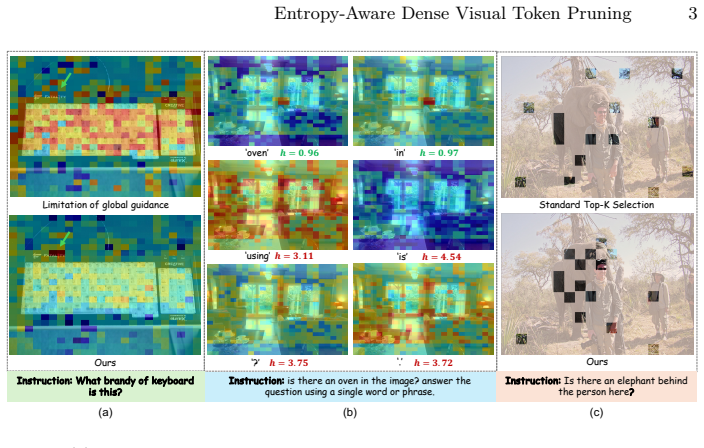
Visual token pruning is a crucial strategy for accelerating VLMs by compressing redundant image patches, yet existing methods often fail to preserve critical cues under dense instructions and fine-grained queries. In this paper, we investigate this failure and identify two underlying bottlenecks: the widespread dispersion of textual noise that corrupts dense cross-modal scoring, and the feature fragmentation inherent to standard token selection. To address these issues, we propose Entropy-Aware Dense Pruning (EADP), a framework that reformulates pruning as a structured compression problem. EADP first leverages statistical entropy to quantify and filter out textual noise, yielding a robust, fine-grained instruction relevance score. Subsequently, instead of naive Top-K selection, EADP casts token selection as a submodular maximization problem with a spatial prior, explicitly ensuring a holistic and non-redundant visual representation. Extensive experiments demonstrate that EADP improves the accuracy-efficiency trade-off of VLMs, robustly preserving fine-grained visual cues under strict token budgets while achieving SoTA performance on challenging multimodal benchmarks.
Software tests and code evolve together: a code change should be followed by new or updated tests that record the new software behavior. Yet existing test generation and update benchmarks often isolate the test from the code change, and rely on static metadata that does not verify whether a test is executable or semantically tied to the code change. This makes it difficult to evaluate whether a test automation agent understands how a code change should propagate into the test suite.
We introduce TestEvo-Bench, a benchmark of test and code co-evolution tasks mined from software repositories, with two tracks: in test generation, the agent shall write new tests to capture the new software behavior; in test update, the agent shall adapt failing existing tests to the changed software behavior. Each task is anchored to a real commit history and packaged with environment configuration to support execution-grounded metrics such as pass rate, coverage, and mutation score. TestEvo-Bench is also a live benchmark: each task records the timestamp of the test and code changes, and new tasks are periodically mined by our automated pipeline, so evaluation can be restricted to tasks postdating a model's training cutoff to reduce data leakage risk. The current snapshot contains 746 test generation and 509 test update tasks, curated from 59,950 candidate co-evolution records across 152 open-source Java projects. We experiment with four state-of-the-art agents that combine strong harnesses (Claude Code, Gemini CLI, and SWE-Agent) with strong foundation models (Claude Opus 4.7 and Gemini 3.1 Pro). Results show that they achieve up to 77.5% success rate on test generation and 74.6% on test update. However, success rate is materially lower on the most recent benchmark tasks and drops significantly under limited per-task cost.
Prediction market data shows most people match or lag the model, while those high in humility and curiosity reach or exceed market accuracy.
abstractclick to expand
Whether pairing people with AI helps or hurts is usually reported as a single average effect. Using a real-money prediction market (Polymarket) as an objective, externally resolved benchmark, this pilot shows that the value of human-AI collaboration depends on a specific, measurable form of human capital. Analyzed at the level of the individual forecaster, hybrid performance is trimodal: most people either deferred to the model (matching it) or used it to rubber-stamp a prior guess (performing worse than the model alone), while a minority engaged in genuine complementary reasoning and reached accuracy matching or even exceeding (i.e., lower error than) the market itself. Collaborative traits (perspective-taking, intellectual humility, and curiosity) rather than raw cognitive ability or model benchmarks, distinguished who reached that mode. The results are preliminary but statistically robust, and motivate a pre-registered replication now in preparation.
By learning movement skills first from cheap interactions then aligning to language with minimal labels, the method cuts labeled data needs
abstractclick to expand
Vision-Language-Action (VLA) models are fundamentally bottlenecked by the scarcity of expert demonstrations -- triplets of observations, instructions, and actions that are costly to collect at scale. We argue that this bottleneck stems from conflating two distinct learning objectives: acquiring physical competence (how to move) and acquiring semantic alignment (what to do). Crucially, only the latter requires language supervision. Building on this Decomposition Hypothesis, we propose Task-Agnostic Pretraining (TAP), a two-stage framework that first learns transferable motor priors from cheap, unlabeled interaction data -- including discarded off-task trajectories and autonomous robot play -- via a self-supervised Inverse Dynamics objective. A lightweight second stage then grounds these priors in language using minimal expert data. On the SIMPLER benchmark, TAP matches models trained on over 1M expert trajectories while using orders of magnitude less labeled data, yielding a 10% absolute gain over standard behavior cloning. On a real-world WidowX platform, TAP retains 25% success under camera perturbations where internet-scale baselines collapse to 0%, demonstrating that task-agnostic pretraining produces robust, transferable physical representations and offers a scalable path forward for Embodied AI.
Diffusion transformers (DiTs) achieve state-of-the-art image and video generation, but their multi-step sampling and growing parameter count make inference expensive. Post-training quantization (PTQ) is the natural remedy, yet DiT activations shift across timesteps, prompts, and guidance branches, forcing prior methods to re-fit calibration data for every new checkpoint or modality. We present OrbitQuant, a data-agnostic weight-activation quantizer that bypasses range estimation by quantizing in a normalized, rotated basis. In this basis, a randomized permuted block-Hadamard (RPBH) rotation concentrates each coordinate around one fixed, known marginal regardless of the input, so a single Lloyd-Max codebook serves all timesteps, prompts, and layers of a given input dimension. We extend the same quantizer to weight rows offline, absorbing the rotation into the weights so that it cancels inside each linear layer and only a forward rotation on the activations remains at runtime. The same recipe transfers from image to video with no per-modality tuning. Across FLUX.1, Z-Image-Turbo, Wan 2.1, and CogVideoX, it sets the state of the art for PTQ at several low-bit settings. It also pushes PTQ of image diffusion transformers to W2A4 with usable generation quality.
Post-training large language models (LLMs) without real-world interaction feedback or human-labeled supervision remains challenging, particularly in specialized domains where expert annotations are costly to obtain. Recent annotation-free self-evolution methods address this by using the model's own outputs as supervision signals, constructing a teacher via additional context and aggregating predictions across multiple rollouts through majority voting to produce pseudo-labels. However, these approaches are not without drawbacks: SFT- and GRPO-based variants suffer out-of-domain performance degradation, while reward-based on-policy RL inflates calibration error. In this paper, we propose Neuron On-Policy Self-Distillation (Neuron-OPSD), a data-centric framework for annotation-free self-distillation that leverages internal neuron activations to guide both training-data selection and teacher context construction. The model is then trained via on-policy distillation from the teacher distribution, requiring no ground-truth labels at any stage. Across specialized-domain benchmarks, Neuron-OPSD improves in-domain task performance while preserving cross-domain generalization and mitigating calibration collapse over prior annotation-free baselines. This framework is particularly relevant to settings where online interaction or external supervision is costly or infeasible, and is conceptually distinct from offline RL approaches that rely on logged, reward-labeled trajectories.
Benchmark tests iterative policy editing in 16 RL environments and finds top models succeed by discovering task mechanisms under budget cons
abstractclick to expand
Autonomous agents are increasingly expected to improve executable policies through feedback, yet existing evaluations often collapse this process into a final score or confound it with open-ended software-engineering progress. We introduce Autonomous Policy Evolution, a controlled evaluation setting in which a harness-model agent repeatedly edits an executable policy system under a fixed interaction budget. We instantiate this setting in EvoPolicyGym, a benchmark built from compact interactive RL environments that evaluates how agents iteratively improve explored policies. On the EvoPolicyGym suite, GPT-5.5 achieves the strongest aggregate rank score and top-two performance on all 16 environments. Beyond leaderboard results, EvoPolicyGym also provides trajectory-level diagnostics that distinguish how agents allocate budget, convert feedback into parametric tuning. These analyses show that strong autonomous policy evolution depends not only on isolated task wins, but on discovering task-appropriate mechanisms and refining policies under bounded feedback.
Agentic coding assistants are increasingly given extra capabilities, such as browser based testing tools and design oriented system prompts, on the assumption that more capability yields better software. This study tested that assumption directly. Ninety independent agent runs built the same application, a real time retrospective board, from one detailed specification, each scored on a fixed 14 criterion functional rubric (42 point maximum) and a visual quality review. The runs spanned several model generations, two agent harnesses, two reasoning effort levels, a testing tool, and two design oriented prompts. Capability tier dominated: frontier models clustered near the ceiling while a low cost local model fell to 24 to 37 points. A criterion level analysis revealed what run totals conceal. Container deployment was the dominant defect, failing first try in 44 percent of runs, with its failure rate shifting sharply across model generations while mean totals moved less than a point. The testing tool raised cost by 42 to 68 percent without improving functional score or reliability, even on interface visible criteria. Raising reasoning effort from High to xHigh lifted first try perfect runs from 28 percent to 89 percent and cut corrective prompts about five fold, for 9 to 29 percent more cost. A design oriented prompt raised visual quality, 4.5 versus 3.0 on a 5 point scale, without lifting function, and a one paragraph paraphrase of its directive reproduced the entire lift. The practical lesson is to match the fix to the failure: most first run failures came from weak reasoning, which a stronger model or more effort prevents, not from visible flaws a checking tool would catch.
Scalable and reliable grading of command-line examinations remains a challenge in computing education, where rising enrolments make manual marking difficult and rule-based autograders cannot handle partial credit, equivalent solutions, or syntactic variation. This paper evaluates whether four frontier Large Language Models (GPT, Claude Opus, Gemini, and GLM) can approximate expert judgment when grading short Linux/bash command responses. The study adopts a four-level cognitive taxonomy that combines cognitive complexity and operational impact, ranging from information retrieval (L1) and basic file manipulation (L2) to structural operations (L3) and advanced system management (L4). The models were tested with two prompt variants, a minimal baseline and a rubric-enhanced version, on 1200 real responses from second-year Computer Engineering students independently graded by three expert instructors. Gemini~3.0 Pro with rubric-guided prompting achieved the highest human-AI agreement (ICC(3,1) = 0.888, MAE = 0.10, Bland-Altman bias = -0.014). Agreement declined consistently as taxonomy level increased, with the largest discrepancies at higher levels. Across all models, rubric quality had a larger effect than provider choice, with structured prompts consistently improving agreement. These results show that question complexity is a reliable predictor of the difficulty LLMs face in grading accurately, and they establish a principled, taxonomy-based framework for determining which questions are suitable for AI-assisted grading and which require human review, while also providing a transferable evaluation protocol and prompt templates.
Post-trained world model supplies synthetic transitions that Policy-Paced Learning uses to cut training steps by 59% on contact-rich tasks.
abstractclick to expand
Reinforcement learning (RL) can overcome the demonstration-coverage limitation of imitation learning (IL) by allowing robots to improve through trial-and-error interaction beyond the states observed in demonstrations. However, deploying RL on real robots remains constrained by high interaction costs, since each physical rollout is costly and reflects only one realized action-outcome path. To address this challenge, we propose WorldSample, a physically grounded data augmentation framework for real-robot RL that closes a real-synthetic loop between physical rollouts, world-model generation, and policy improvement. Grounded on real rollouts, WorldSample generates high-fidelity synthetic transitions through a post-trained world model, which greatly lowers the visual hallucination. Specifically, rather than simply using these transitions as real-world experience, WorldSample introduces Policy-Paced Learning (PPL) to regulate the training process through sample selection and scheduling, balancing useful augmentation against value overestimation and mitigating the hallucination-induced noise. Experiments on robot manipulation tasks involving contact-rich and precise tasks show that WorldSample improves policy success rate by 28% while reducing training steps by 59% compared with baselines. Furthermore, WorldSample improves world model visual fidelity by 19.4dB in PSNR and 0.47 in SSIM over demonstration-only post-training, validating the effectiveness of the real-synthetic loop for both policy and world model performance.
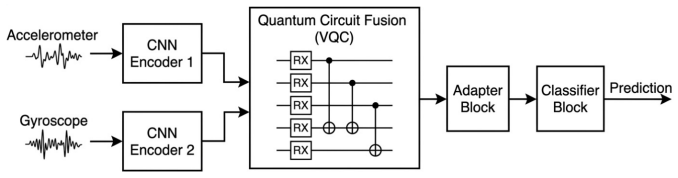
Federated learning (FL) enables collaborative model training across distributed devices without sharing raw data, making it suitable for privacy-sensitive robotic sensing applications. However, multi-agent systems generate heterogeneous and non-independent and identically distributed (non-IID) multimodal sensor streams that degrade conventional FL algorithms, while classical fusion modules introduce substantial parameter overhead and communication cost. This paper proposes QFedAgent, a hybrid quantum-classical personalized FL framework for multi-agent activity recognition. The approach integrates a variational quantum circuit fusion module that models accelerometer--gyroscope interactions through quantum state encoding and entanglement, requiring only 72 quantum rotation parameters versus 33K in classical multi-layer perceptron-based fusion, achieving approximately 10x total parameter reduction. Experiments on the OPPORTUNITY dataset under subject-based non-IID partitions demonstrate 97.7% mean test accuracy, confirming that parameter-efficient quantum fusion remains competitive with conventional federated baselines.
Active Few-Shot Learning (AFSL) adapts LLMs to specialized domains by identifying the most valuable unlabeled samples for annotation and use as few-shot demonstrations, effectively reducing human annotation costs while promoting high performance. However, existing methods typically rely on output-level signals for sample identification, such as predictive entropy or semantic similarities with test-time data based on external embeddings, which often overlook models' internal dynamics, which could pinpoint specific knowledge gaps. To bridge this gap, we propose NeuFS, a Neuron-Aware Active Few-Shot Learning framework that shifts the selection paradigm from output-level proxies to models' internal dynamics. NeuFS utilizes neuron activation patterns to represent sample directly, and includes a dual-criteria selection strategy that: (1) ensures few-shot sample diversity with neuron patterns for broader example coverage, while (2) prioritizing on identifying informative and challenging few-shot samples LLMs tend to hallucinate by quantifying neuron consensus. Experiments on three datasets demonstrate that NeuFS excels in both reasoning and text classification tasks, outperforming existing AFSL baselines. Ablation studies further highlight that internal neuron activations provide a more principled and effective selection signal than external embeddings, validating the superiority of the proposed NeuFS.
Large Language Models (LLMs) have demonstrated remarkable capabilities in 3D indoor synthesis for Manhattan environments. However, existing methods often fail to capture plausible object layout patterns in non-Manhattan settings, primarily because they struggle to model non-orthogonal spatial relationships, leading to high geometric violations and low physical fidelity. To address this challenge, we propose SPG-Layout, a novel text-driven framework designed to generate physically plausible indoor scenes within complex non-Manhattan environments. Specifically, we first utilize statistical priors of object distributions to guide the training process, enhancing environmental understanding and fidelity. Furthermore, mirroring human design workflows, we adopt a hierarchical layout strategy that prioritizes the placement of large objects, thereby substantially minimizing layout violations. By synergizing these components, SPG-Layout achieves a balanced optimization of semantic realism and physical plausibility. To evaluate performance in these complex settings, we constructed a new benchmark comprising 500 diverse non-Manhattan environments. Extensive experiments demonstrate that SPG-Layout consistently and significantly outperforms existing methods across both Manhattan and non-Manhattan environments. The code will be publicly released.
Decision-time planning with action-conditioned world models has become a popular paradigm for embodied control. However, the standard planning cost judges a candidate solely by how close its predicted terminal state lies to the goal, leaving the realizability of the intermediate transitions unchecked -- a predicted trajectory can look convincing while the environment rollout drifts away from it. In this paper, we propose ACID, a decision-time planning framework that introduces cycle action consistency: the action inferred backward from a predicted transition by an inverse dynamics model should recover the one that was conditioned on. We fold this per-step residual into the planning cost via a scale-invariant adaptive weight. Across four action-conditioned world models and six tasks spanning rigid and deformable manipulation, articulated control, and visual navigation, ACID consistently improves planning and matches the baseline's accuracy with substantially less planning compute.
The method works on both reasoning and non-reasoning models and beats alternatives on ablation tests.
abstractclick to expand
Steering and monitoring activations in Large Language Models (LLMs) are increasingly used for both safety and interpretability. Early work assumed behaviours are encoded along single linear directions, but recent findings suggest complex behaviours, such as the refusal to answer harmful queries, live in multi-dimensional subspaces. However, existing methods for extracting these subspaces are computationally expensive, which becomes prohibitive on reasoning models who produce long reasoning traces. By adapting the Recursive Feature Machine (RFM) algorithm -- which can be computed efficiently -- with a probe-informed initialization, we are able to identify the multi-dimensional refusal subspace in seconds, on reasoning (Qwen 3) and non-reasoning (Qwen 2.5) models. While RFM allows for faster subspace identification, it also showed better performances on the ablation task than its alternatives. More work is planned to better understand the relations between subspaces found by different methods. If confirmed, RFM could be a cheap and scalable complement to existing subspace-extraction methods in LLMs.
Access controls and enforced conventions let a small reviewer model catch most inserted backdoors while cutting token cost.
abstractclick to expand
Coding agents are capable; human oversight is the bottleneck. Unconstrained agents introduce security risks, erode codebase scalability, and make human review increasingly costly. We argue that the same methods used for decades to manage large human engineering teams: access control, network policies, strict coding conventions enforced by tooling; transfer directly to coding agents, and are cheaper (in token) than recent agentic scaffolding. We sketch a start-to-end system on this principle, and report a controlled experiment in scalable oversight: a small reviewer (Gemma 4 e4b) inspects a Python codebase containing 11 inserted backdoors. Recall rises from 54.5% (unconstrained, no tools) to 90.9% (constrained substrate plus a ~200-LoC `docs` CLI), with substrate and tools contributing independently. We choose Python deliberately: substrate-level oversight gains are largest where the language gives the fewest guarantees by default; the principles extend to languages like Rust.
Recent advances in agentic AI are producing increasingly complex autonomous systems that integrate large language models, world models, optimization engines, specialized neural architectures, autonomous platforms, and human operators. While much current research focuses on improving reasoning capabilities, safety-critical real-time deployment also requires bounded and verifiable coordination among heterogeneous components operating concurrently under uncertainty. Software-mediated coordination presents fundamental limitations in domains where bounded latency, deterministic coordination, and enforceable safety guarantees are essential.
Hence, we propose a hardware-enforced semantic coordination architecture in which selected coordination semantics are implemented directly at the hardware level via field-programmable gate arrays (FPGAs). The approach builds on the Topic-Based Communication Space Petri Net (TB-CSPN) framework, which separates semantic reasoning from interaction management.
In this approach, selected TB-CSPN coordination mechanisms are mapped onto FPGA primitives, creating a hardware-native semantic coordination layer. Focus is not on acceleration, but on enforcing temporal synchronization, semantic gating, authorization constraints, and bounded coordination behavior directly in hardware. Semantic reasoning remains adaptive and software-driven, while embedded coordination semantics become deterministic.
Personalization changes what a model says to a user; we show that it can also change the reasoning trajectory used to justify the response. Modern LLMs personalize interactions by storing user attributes, preferences, and prior context, then injecting this information into future prompts. We study whether such memory reshapes reasoning on open-ended questions where no single ground-truth answer exists. To quantify this effect, we introduce DRIFTLENS, a ground-truth-free framework that maps each expressed reasoning step to a value category and measures divergence between a question's no-memory trajectory and its trajectory under injected user-attribute memory. We first validate that DRIFTLENS distinguishes content-free pragmatic noise from substantive reasoning changes. Across four LLMs and 10 user-attribute categories, including age, occupation, and disability, user-attribute memory induces medium-to-large reasoning drift above each model's pragmatic-noise floor, even when final answers remain fluent, on-topic, and plausible. We then evaluate GRPO- and DPO-based post-training methods for reducing drift. Both reduce drift, but neither uniformly dominates; effects on downstream capability, helpfulness, and instruction following are model-and reward-dependent. These results suggest that memory-induced reasoning drift is a measurable and only partly mitigated failure mode of personalized language models.
Over 285 million people worldwide live with a visual impairment, for whom everyday tasks such as avoiding obstacles, locating personal belongings, recognizing familiar faces, or handling cash remain persistent obstacles to personal autonomy. Existing assistive applications are typically limited to recognizing predefined categories, depend heavily on cloud connectivity, or require dedicated hardware. We present VisionAId, an Android application that turns a commodity smartphone into a real-time visual assistant. The system integrates six on-device deep learning models (metric monocular depth estimation, instance segmentation, visual and facial embeddings, face detection, and a custom banknote detector) running entirely through ONNX Runtime, with an optional cloud large language model (Google Gemini Flash) used only for narrative scene description and automatic object labeling. A distinctive contribution is a few-shot pipeline for personal objects: the user photographs an object from several angles, and the system later locates that specific instance in the environment, guiding the user toward it with augmented-reality markers, spatial audio, and distance-proportional haptics. All feedback is multimodal (Romanian speech synthesis, voice commands, vibration). On a reference device (Samsung Galaxy S21 Ultra), INT8 quantization reduces depth latency from ~1200 ms to ~491 ms, the custom banknote detector reaches an mAP@50 of 0.986, and metric depth is calibrated to below 1 cm of error within 3 m.
Compiler missed optimizations refer to cases in which compilers failed to optimize certain code. It takes many compiler developers' efforts to implement or patch such missed optimizations. In this paper, we present a systematic study of how well agents patch compiler missed optimizations. We identify a significant challenge that patching a missed optimization requires more than just fixing the reported case, and instead requires generalizing to similar cases. We construct a benchmark of real-world LLVM missed optimization issues and compare agent-generated patches with patches from developers in terms of optimization scope. Our results show that coding agents often optimize the given examples, but many generated patches either cover only part of the developer-intended scope or partially overlap with it; in some cases, they further generalize beyond the reference patch. We further introduce historical-knowledge augmentation techniques that leverage prior LLVM optimization pull requests through retrieval and distillation, showing that they improve developer-aligned generalization and yield practical benefits when applied to real-world IR.
Concepts like macrostructure and untranslatability from world literature address the monolingual limits of current models.
abstractclick to expand
LLMs stage a new form of cultural encounter that is massive, automated, and monolingual. Literary disciplines have always negotiated cultural struggles with comparative reading of literature, narratological and poetic analysis, critical theory, world literature, and translation. These tools have now become indispensable for building culturally literate AI. The essay develops a layered framework toward more nuanced textual models and pluralistic interpretations of AI, emphasizing the natural intersections of literature and AI development, connecting current debates in critical theory with structural monolingualism, and suggesting a new application of world literature approaches to address global AI textuality through macrostructure, circulation, and untranslatability.
Evaluations of LLM personas via psychometric questionnaires typically rely on aggregate scores, discarding within-instance correlation structure. We test whether this geometric structure is intrinsic or frame-dependent. Constructing within-instance correlation matrices from IPIP-50 responses, we analyze geometry on SPD manifolds under manipulated question orderings in GPT-4o simulating American and Chinese-American personas. We find that persona expression comprises two dissociable components: aggregated features (Big Five scores) degrade under randomization (21% drop) but are frame-robust; geometric features (SPD manifold) collapse under frame misalignment (42% drop) but recover substantially (to 84%) under shared frames, surpassing aggregated features (76%). This collapse-recovery pattern reveals that persona geometry is not intrinsic but a frame-dependent coordination pattern encoding information invisible to aggregation. Our findings establish a dual-nature framework for LLM personas, frame-dependent geometry versus frame-robust aggregates, necessitating frame-aware evaluation and challenging static trait conceptions.
Quantum Fast-Weight Programmers (QFWPs) store temporal information in dynamically programmed variational-circuit parameters rather than in nonlinear recurrent hidden states, offering a practical route to quantum sequence modeling. Self-Modulating QFWP improves this framework by using input-dependent gates for both new fast-weight updates and the accumulated fast-weight state, but its unbounded old-state multiplier can diverge in long-sequence regimes. We propose a bounded old-state modulation rule that applies a sign-preserving tanh gate only to the recurrent memory branch while leaving the additive update and new-update modulation unchanged. We evaluate standard QFWP, full Self-Modulating QFWP, Only-New, and Only-Old variants on two CUDA-Q quantum-dynamics forecasting tasks and on Milan SMS telecommunication activity prediction. The quantum-dynamics results show that old-state modulation is the most consistent source of improvement over Standard QFWP, and that bounding the old-state gate removes long-sequence divergence while improving aggregate robustness. On Milan SMS forecasting, the original unbounded Self-Modulating QFWP converges across the tested grid and shows its clearest gains at longer input windows, with behavior close to the Only-Old ablation. These findings identify accumulated-memory modulation as the key mechanism of Self-Modulating QFWP and bounded old-state gating as a targeted stabilization strategy.
Monocular relative pose sensing is a central perception problem in non-cooperative rendezvous and on-orbit servicing. In spacecraft images, however, weak surface texture, thin appendages, illumination changes, and partial occlusion often leave only sparse and unstable geometric evidence. This article presents GAP-GDRNet, a geometry-aware attention-enhanced framework for monocular RGB-based 6D pose sensing. The method follows the geometry-guided direct regression paradigm of GDR-Net and modifies two points in the pipeline: an attention-based feature refinement (AFR) module is placed before dense geometric prediction, and a patch-level geometric self-attention (PGSA) module is inserted into Patch-PnP. AFR reinforces global spacecraft structure together with local weak-texture cues; PGSA then relates downsampled geometric patches before final pose regression. A Blender-based annotation process supplies target masks, visible-region masks, dense model-coordinate maps, camera intrinsics, and 6D pose labels for supervised training.
Large Language Model (LLM)-based agents increasingly automate software engineering tasks through reusable skills, natural-language instruction documents that guide planning and execution. Open skill marketplaces enable users to assemble agents by co-activating community-contributed skills, but marketplace operators typically audit skills in isolation. As a result, individually benign skills may interact to redirect an agent toward unintended objectives, which we term implicit intents. Detecting such intents is challenging because the effect emerges only through skill composition, execution environments are often unavailable at admission time, and the space of possible co-activations grows exponentially with marketplace size. In this paper, we formulate implicit-intent discovery as a fuzzing problem over skill compositions, where skill compositions are the unit under test, planning artifacts expose agent intent before execution, and deviations from a skill-free baseline serve as a differential oracle. Based on this formulation, we propose skillfuzz, the first execution-free testing approach that extracts structured skill contracts and uses contract-guided Monte Carlo Tree Search to prioritize potentially conflicting compositions. Across representative skill-marketplace workloads, skillfuzz discovers over 1,000 distinct implicit intents under a fixed query budget, confirms more than 80% of the highest-risk flagged compositions during execution-time validation, and identifies substantially more high-severity implicit intents than alternative search strategies while exploring only a fraction of the pairwise interaction space they require.
Transformer architectures have shown strong potential in time series forecasting, where multi-head self-attention is widely used to capture temporal dependencies across historical timestamps. However, standard self-attention has quadratic time and memory complexity with respect to the look-back length. This cost may limit its use in resource-constrained or high-throughput forecasting systems, where fast and memory-efficient inference is important. Through qualitative and quantitative analyses, we observe that self-attention maps in time series forecasting often contain redundant patterns across different timestamps. This phenomenon can be related to the repeated temporal patterns and relatively stable temporal correlations in many real-world time series. Motivated by this observation, we propose Self-Gating Attention (SGA), a plug-and-play attention mechanism that represents the attention score with a shared learnable matrix and an input-dependent residual component. The shared matrix captures common attention patterns, while the residual component captures input-dependent variations. In this way, SGA avoids the query and key projections used in standard attention score computation, leading to linear time and score-matrix memory complexity with respect to the look-back length. We integrate SGA into several forecasting backbones and compare it with standard self-attention and lightweight attention variants on nine publicly available real-world datasets covering electricity, finance, weather, medical monitoring, human activity, and climate records. The results show that SGA improves inference efficiency on public benchmarks while maintaining competitive forecasting performance against state-of-the-art attention mechanisms. These benchmark results provide deployment-oriented evidence.
Humans can selectively attend to a target sound and estimate its direction in complex scenarios, whereas such selective localization remains challenging for current deep learning-based systems. Sound source localization (SSL) has achieved remarkable success with deep learning, yet most methods localize all active sources without selectivity. Conversely, target sound extraction (TSE) extracts sources using multimodal prompts but typically fails to preserve the multichannel spatial information required for accurate localization. To bridge this gap, we formulate the task of prompt-guided selective target sound localization and propose SelectTSL, an end-to-end architecture that localizes only the user-specified target in multi-source acoustic scenes. Specifically, we design a target-aware selective localization strategy that employs a Prompt-Guided Selective Attention Module (PGSA) to generate prompt-informed embeddings. These embeddings guide an inter-channel phase difference (IPD) enhancer to refine raw phase cues, fusing with target magnitudes to jointly estimate direction of arrival (DoA) and target-source cardinality, i.e., the number of target sound sources. This coupled design effectively focuses on the user-specified target spatial cues for selective localization and also handles time-varying numbers of target sources. Extensive experiments on both synthetic data and real-world recordings demonstrate that our proposed method consistently outperforms other baselines and exhibits robust generalization to real acoustic environments.
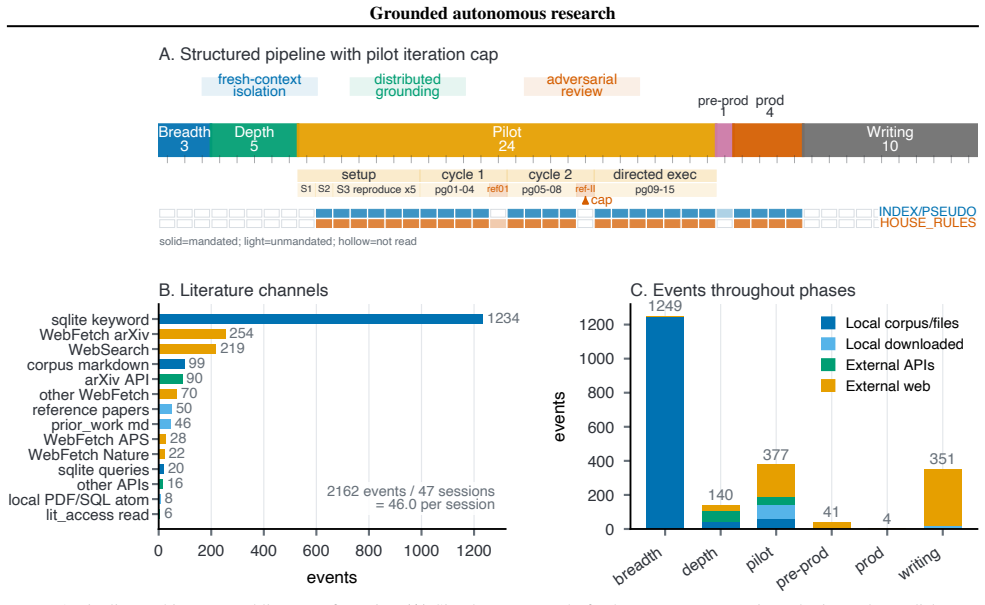
Autonomous-research agents have demonstrated end-to-end LLM automation in machine-learning sandboxes where execution provides calibration. Frontier physical science differs categorically: physical reasoning underlies every methodology choice, toolchains are often underdocumented, and calibration must come from external literature anchors - which unscaffolded agents cite but do not confront, hallucinating plausible, unverifiable results from internal priors. We present a pipeline that runs end-to-end from a corpus of 11,083 recent condensed-matter physics arXiv papers to a publication-grade manuscript with three substantive physics findings (here on altermagnetic piezomagnetism): the agent autonomously conceives a research direction by mapping the corpus, calibrates methodology by reproducing published references, conducts novel first-principles computations, and writes the manuscript - grounded in literature throughout, across 47 fresh-context sessions in six phases sharing only on-disk state, with 2,162 literature-consultation events. Fault tolerance emerges from redundancy: fresh-context isolation, distributed grounding, and adversarial review catch what any single session misses; pre- and post-pilot stages are fully autonomous, and pilot requires bounded human intervention only at reproduction failures - operational knowledge curation, not scientific direction. Two paired failure modes - a pre-architecture baseline and a no-pilot ablation - isolate structurally enforced numerical confrontation at calibration checkpoints as the operative grounding mechanism. The primitives, characterized failure modes, and quantified intervention pattern lay a foundation for autonomous research in high-stakes scientific domains beyond computational physics.
Linear-attention and state-space language models compress the prefix into a fixed-size recurrent state, yielding O(1) memory at the cost of a lossy exact memory: when many key--value associations compete, earlier facts are overwritten and needle recall degrades. Inspired by Complementary Learning Systems, we give linear attention a hippocampal complement. HOLA (Hippocampal Linear Attention) keeps the usual delta-rule state as a compressive memory and adds a bounded exact KV cache, forming a semiparametric test-time memory: the state models linearly compressible structure, while the cache stores associations that should not be forced through that state. The cache writes without a learned eviction module, keeping tokens with large beta * ||e||, the prediction residual actually committed to the state; a decoupled RMSNorm-gamma cache read then turns these exact KV pairs into sharp retrieval rather than soft averaging. At 340M parameters trained on 15B SlimPajama tokens, HOLA lowers Wikitext perplexity from 27.32 to 22.92 (-16.1%), below a full-attention Transformer++ (26.88), and improves LAMBADA perplexity from 30.95 to 30.26. It also achieves the best linear in-context retrieval and remains much more robust than GDN or a matched HOLA+recency cache on RULER needle-in-a-haystack recall out to 32k tokens (16x its training length).
While pessimism counteracts overestimation bias in offline reinforcement learning (RL), being overly conservative has been associated with hindering certain forms of generalization. However, in this paper we demonstrate that being overly pessimistic does not inherently prevent optimal generalization in contextual MDPs (CMDPs). Instead, we argue successful generalization depends not on the amount of pessimism, but whether the pessimistic structure respects the underlying symmetries of the optimal solution. We prove that a mildly pessimistic, non-symmetric value function can generalize worse than an overly pessimistic, symmetric one. In offline RL, the structure of the pessimism is determined by the structure of the dataset coverage. As such, enforcing a symmetric value function can be non-trivial, and might require techniques such as data augmentation (DA). Inspired by our theoretical results, we argue that DA can best be applied through a consistency loss during policy extraction, rather than the common practice of (regular) offline training on an augmented dataset. This is empirically validated using IQL and CQL on a rotationally symmetric reacher environment.
Vision-Language Models (VLMs) have demonstrated immense promise in Spatio-Temporal Video Grounding (STVG). However, current evaluation protocols are largely confined to zero-shot assessments on general, daily-life benchmarks. This creates a critical disconnect from real-world applications in specialized fields, where models inevitably encounter rare visual concepts and complex spatio-temporal dynamics. Since exhaustive pre-training across infinite data distributions is infeasible, the ability to adapt to novel domains is essential. To bridge this gap, we introduce AnyGroundBench, a domain-adaptation benchmark designed to shift the STVG evaluation paradigm from static zero-shot testing to rigorous domain adaptation. Targeting five specialized domains (animal, industry, sports, surgery, and public security), AnyGroundBench pairs newly captured videos such as expert-annotated mouse behaviors with established datasets, unifying them through dense, high-fidelity spatio-temporal annotations. Crucially, the benchmark provides dedicated training subsets to systematically measure domain adaptability. We extensively evaluate 15 state-of-the-art VLMs, assessing their zero-shot generalization and In-Context Learning (ICL) capabilities under practical computational constraints. Ultimately, our findings reveal that current models fail in both zero-shot and ICL-based adaptation when confronted with specialized domains, exposing critical flaws in spatio-temporal reasoning that future research must address.
Most data-mixing methods assume the corpus has already been partitioned into groups, and the choice of those groups determines what a mixer can express. Existing labels, including provenance, topic or format taxonomies, and flat embedding clusters, commit to one semantic axis at one granularity; changing the resolution rebuilds the labels. We argue the bottleneck is the label system, not the mixer, and provide a hierarchical one. HERMES is a data-derived labeling substrate: a Learned Semantic Transform followed by 3-stage residual vector quantization annotates each document once into a coarse-to-fine code whose prefix length controls granularity up to approximately 130k cells. At coarse granularity HERMES sits at a plateau with KMeans-family methods on standard clustering metrics, so the contribution is the substrate, not the clusterer. On 1B-parameter, 25B-token pre-training, the hierarchy exposes an interaction fixed-granularity pipelines cannot test: at one prefix length, a combined Stage-2 rule contrast, equal-subbucket coverage versus size-proportional within-bucket quality top-30%, lifts a 16-task capability macro-average by +0.0253; at the next finer level, the same rule loses its measurable edge as candidate pools contract approximately 5x. HERMES reframes data mixture design from choosing among fixed label sets to navigating a reusable, data-derived granularity hierarchy.
Fresh prompts built only from typed retrieval keep context fixed and let any memory layer be tested alone across hundreds of decisions.
abstractclick to expand
Memory for a long-horizon LLM agent is a contract about what each future decision is allowed to see. The simplest contract appends past observations, tool calls, and reflections to every prompt, which makes prior context easy to access but also turns it into a jumbled mixture in which the effect of any single memory component is hard to isolate. We introduce and instrument an alternative bounded contract: every decision is made from a fresh user message assembled by typed retrieval, with no raw cross-decision transcript appended. The prompt thus stays bounded across runs of any length, and any single layer can be ablated in isolation. We instantiate the contract in Slay the Spire 2, a closed-rule stochastic deck-building game whose runs require hundreds of tactical and strategic decisions. A public online benchmark of frontier LLMs on the same game reports zero wins at the lowest difficulty across five configurations, and the developer-reported human win rate at the same difficulty is 16%; the task is hard but not saturated. Within our harness, a fixed-A0 ablation shows the largest observed difference when triggered strategic skills are enabled: the no-store baseline wins 3/10 games and adding the skill layer 6/10. At this sample size the comparison is directional rather than statistically decisive (Fisher exact p\approx0.37); a cross-backbone probe and public accumulating-context baselines are reported as operational comparisons rather than controlled tests of the contract variable itself. We release a reproducible testbed: 298 completed trajectories with condition tags, frozen memory/skill snapshots, prompt records, and analysis scripts -- an agent design and a validated, reusable methodology for studying how explicit memory layers shape long-horizon LLM-agent decisions.
Copewell integrates data sources and dual interventions to reach users where single-mode tools fall short.
abstractclick to expand
Mental health disorders affect nearly one billion people globally, yet 75% of individuals in low- and middle-income countries receive no treatment due to workforce shortages, cost barriers, and stigma. Current AI-powered wellness solutions predominantly rely on single-mode conversational interfaces that suffer high abandonment rates and fail to provide measurable, immediate relief calibrated to users' dynamic emotional states. This paper presents Copewell, a novel multi-agent swarm system designed to expand access to mental wellness support through human-centered AI principles. Our architecture introduces three technical innovations: (1) a multi-source assessment framework integrating self-reported, physiological, and contextual data to mitigate algorithmic bias; (2) valence-arousal emotion mapping using Russell's Circumplex Model of Affect to route users to specialized AI agents; and (3) dual-mode intervention delivery combining conversational support with evidence-based sensory wellness protocols. We examine the sociotechnical design considerations underlying Copewell's development, including a privacy-first architecture, embedded ethical oversight through a dedicated Ethics Supervisor agent, and participatory design informed by mental health practitioners. Early practitioner engagement and beta deployment inform design decisions and identify directions for future empirical evaluation. This work contributes to responsible AI discourse by demonstrating how technical architecture can operationalize equity and safety principles from inception.
LLM-as-a-Judge has become the dominant evaluation paradigm for many natural language generation tasks, due to shortcomings of conventional metrics and high correlations with human judgment, albeit mostly in English. There are now attempts to extend LLM-as-a-Judge to multilingual settings including low-resource languages. However, LLMs have limited proficiency in low-resource languages, and there is often no adequate human validation in these settings. To highlight the scope of the problem and current practices, we explore the use of LLM-as-a-Judge evaluators in ACL Anthology papers focusing on multilingual settings and low-resource languages across a diverse set of tasks. Out of 650 papers mentioning LLM-as-a-judge, only 33 of them focus on low-resource or multilingual settings. Our in-depth analysis of these papers indicates inconsistent evaluation outcomes, a tendency to overtrust LLM judgments in multilingual settings, and the widespread reliance on a single judge model per study. To help the NLP community further, we conclude with recommendations about how to use LLM-as-a-Judge in multilingual and low-resource settings.
On-policy self-distillation (OPSD) has emerged as a promising paradigm for improving LLM reasoning, where a privileged teacher with access to reference solutions provides token-level supervision on the student's own generated trajectories. However, we find that OPSD consistently fails on long chain-of-thought (long-CoT) reasoning models, yielding at best marginal gains while destabilizing the reflective reasoning capability these models depend on. Through a novel decomposition of the teacher's supervision signal, we identify the root cause: the teacher's supervision is dominated by a reference-induced component that drives rote memorization of reference-specific shortcuts, while the question-conditioned, inference-transferable component is ignored or actively opposed. Based on this diagnosis, we propose a two-step solution. First, we construct a reference-only teacher (the same model conditioned on the reference without the question) to isolate the non-transferable component of the supervision signal; the residual after subtracting this component captures the question-conditioned, inference-transferable correction. Second, we use pointwise mutual information (PMI) as the mechanism to transform this residual into a well-formed PMI target distribution that the student can directly distill from, filtering out the reference-induced shortcut. Experiments on four long-CoT models across two datasets demonstrate consistent improvements over both the base model and standard OPSD, while preserving the models' natural epistemic behavior throughout training.
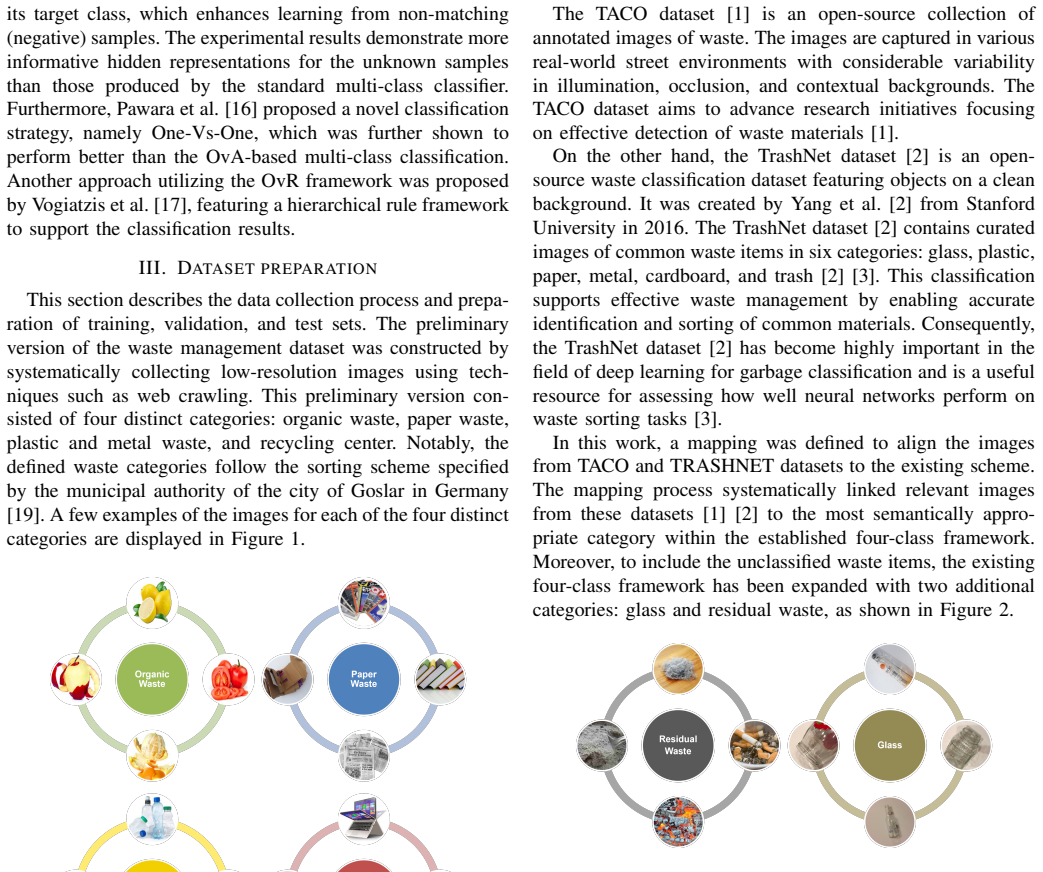
The complexity of waste disposal regulations across European countries poses significant challenges for the residents and hinders the transition to a Circular Economy. In Germany, the proper sorting and disposal of household waste remains challenging across municipalities. Consequently, substantially reducing incorrectly disposed waste is vital for improving waste management and advancing the Circular Economy. AI-based waste sorting solutions can support residents through user-friendly tools, such as mobile applications, that guide proper waste disposal. To be effective in supporting the Circular Economy, however, these solutions must be configurable to reflect the specific waste sorting scheme of individual municipalities in Germany. In the scope of this work, an evaluation and analysis are performed of two prominent classification strategies: OvA and OvR. The research uses a dataset constructed in alignment with the waste categories and sorting scheme of the city of Goslar in Germany. Moreover, this work aims to extend beyond the overall performance by examining the behavior of OvA and OvR classification strategies in identifying samples likely to be misclassified. These classification strategies are compared by applying varying confidence thresholds to identify uncertain samples for subsequent human review. This evaluation aims to balance the number of misclassifications against the human effort required for data annotation.
Vision-Language Navigation has increasingly emphasized high-level instruction reasoning, memory, global map construction, and instruction decomposition, while the low-level action representation remains comparatively underexplored. We propose CoFL-S, a low-level vision-language-action framework that predicts a language-conditioned flow field over the robot's local visible sector and generates continuous trajectories by rolling out the predicted field. To train this low-level representation, we convert each VLN-CE episode, originally a whole-episode instruction paired with an action sequence, into frame-level local supervision with aligned sub-instructions and matched action, trajectory, and dense flow-field targets. For evaluation, we introduce a continuous-time Habitat benchmark that isolates low-level action interfaces from instruction decomposition and executes all methods through a shared velocity-command controller, enabling decomposition-independent closed-loop comparison across different planner frequencies rather than fixed discrete forward-and-turn transitions in VLN-CE. Under matched encoders and training settings, CoFL-S consistently outperforms action-token and action-chunk baselines across planner frequencies in the continuous-time Habitat benchmark, and zero-shot real-world closed-loop deployment further shows its advantage over both baselines beyond simulation.
The evolution toward fully autonomous telecommunications networks (Autonomous Network Levels 4-5) requires AI/ML agents to make real-time network decisions without human intervention. However, no standardized runtime mechanism exists to intercept and validate individual inference outputs before they trigger live network state changes, creating risks of erroneous autonomous decisions. This paper proposes the Guard Rail Validation (GRV) framework, a standardizable runtime architecture for intercepting and validating AI-driven decisions before execution. The framework evaluates decisions across multiple weighted dimensions -- including action scope, action type, service criticality, agent autonomy level, reversibility, and temporal behavioural patterns -- to determine a criticality level. Based on this level, graduated validation mechanisms are applied: execute-with-logging, bounds checking, independent agent validation, or multi-agent consensus. The framework additionally provides cross-agent conflict detection with criticality-weighted priority resolution and runtime conformance logging for regulatory compliance (e.g., EU AI Act Article 14). We present the architecture, algorithmic procedures, O-RAN deployment model, and evaluate threat coverage against known AI/ML attacks in telecommunications.
The rapid deployment of AI systems across high-stakes domains has created urgent demand for standardized evaluation, yet the field remains fragmented across competing risk taxonomies that catalog risks without showing how an audit is executed. At least 74 AI risk taxonomies exist, and almost all stop at the catalog. The hard part of auditing is not naming a risk but operationalizing it: turning it into a test run against a real system, a measured value, a calibrated severity, and a defensible grade. This paper leads with that bridge. We present the operationalization layer Eticas has built and run, shown end to end on a single risk (PII leakage) against a public benchmark, and then the open taxonomy that makes the method scale. On GPT-4-0314, a disclosure risk that seven external frameworks require be controlled is measured at 0%, 51%, and 84% disclosure as adversarial conditioning increases, mapping through calibrated severity bands to a subcategory grade of E with a SYSTEMIC pattern. Around this example, the Eticas AI Risk Taxonomy v2.0.0 organizes 76 active subcategories across 10 categories and 20 sub-groups, with mappings to 18 external frameworks across compliance, reference, and academic tiers. Its category and sub-group layer is published under CC BY 4.0 as open semantic infrastructure with stable URIs and SKOS/JSON-LD distributions, and a worked subcategory example shows the operational layer down to its severity thresholds. The contribution is the demonstrated bridge from concept to graded finding, anchored by a clean separation of risks from the mechanisms by which they surface, and framed by an open-core model in which the conceptual scaffold is open and the methodology calibration is the practitioner layer. This is the infrastructure the AI auditing field needs: shared, open, and demonstrably operable.
Review of 53 papers shows disparate structures studied under one label, so insights may not transfer between studies.
abstractclick to expand
Human-AI teaming has received increasing attention in the literature. However, the range of studies conducted in multiple domains make it difficult to understand what types of teams are being studied, and in what ways are they similar/different from one another. In this study, we analyse 53 papers on human-AI teams and categorise them into five main clusters based on psychological taxonomies of teaming; AI Assistant, Ad-hoc Dependency, Ad-hoc Forced Dependency, Paired Equanimity, and Group Equanimity. Each cluster represents a unique combination of holistic team-level characteristics, indicating there are multiple disparate team types studied under the same definition. In turn, this raises the question of whether insights are truly transferable between papers. We conclude with guidance on how to identify the types of human-AI teams studied, a checklist for reporting a human-AI team in research work, and ways in which the field can be further synthesised.
The society and emerging risk-based regulatory frameworks for AI underscore the need for rigorous risk assessment to ensure safe and reliable AI systems. In response to this imperative, this paper presents an overview of AI risk assessment (identification and analysis) and management methodologies. It begins by reviewing the worldwide regulatory landscape that drives the need for systematic AI risk assessment. Then we characterize the spectrum of AI-related risks identified in the literature, from technical failures to ethical and social impacts. Subsequently, it reviews key risk assessment methodologies proposed for AI systems, focusing on general frameworks. The paper highlights best practices and illuminates methodological gaps, highlighting areas for further research on AI risk assessment.
Software development is a complex task that demands cooperation among agents with diverse roles. Large language models (LLMs) have enabled autonomous multi-agent software development frameworks that leverage role-based collaboration to automate requirements analysis, coding, testing, and refinement. However, existing approaches typically assume that intermediate agent outputs are equally reliable, leaving them vulnerable to hallucination propagation, where incorrect decisions generated in early development phases are transferred to downstream agents and negatively impact final software quality. To address this challenge, we propose UA-ChatDev, an uncertainty-aware multi-agent software development framework that integrates uncertainty quantification into agent interactions. It introduces a lightweight uncertainty estimation mechanism based on token-level log probabilities to assess the confidence of agent responses and employs phase-aware threshold calibration to selectively trigger retrieval-based verification when uncertainty exceeds acceptable levels. Extensive experiments on the SRDD benchmark demonstrate that UA-ChatDev consistently outperforms existing single-agent and multi-agent software development frameworks across completeness, executability, consistency, and overall quality metrics. Further ablation studies and communication analyses verify that uncertainty-aware interactions enhance code execution reliability.
Deep learning has achieved remarkable performance in medical image segmentation, yet it suffers from critical limitations: mathematical intractability, substantial parameter requirements, and lack of clinical interpretability. We propose RadiomicNet, a novel two-stream hybrid architecture that enhances standard deep learning by integrating handcrafted radiomics features directly into the segmentation learning process. The key contribution is the Radiomics Attention Gate (RAG), which leverages Gray-Level Co-occurrence Matrix (GLCM) and Local Binary Pattern (LBP) features to modulate skip-connection attention in a lightweight MobileNetV2-based encoder-decoder, providing ante-hoc interpretability without post-hoc approximations. A novel Radiomics Consistency Loss further enforces alignment between texture complexity and prediction uncertainty, reducing Expected Calibration Error (ECE) from 0.142 to 0.118. RadiomicNet achieves a Dice Similarity Coefficient (DSC) of 0.763 +/- 0.231 on the Breast Ultrasound Images (BUSI) dataset and 0.854 +/- 0.112 on Kvasir-SEG, outperforming U-KAN by 1.2% and 1.8%, respectively (p < 0.05, Wilcoxon signed-rank test), with only 3.27M parameters, 9.5x fewer than standard U-Net and 4.3x fewer than U-KAN. Gradient-based feature importance analysis reveals that GLCM dissimilarity (15.24%), GLCM energy (14.56%), and LBP entropy (11.49%) are the dominant radiomics cues, providing clinically meaningful explanations for segmentation decisions. The proposed approach demonstrates that compact, interpretable models grounded in domain knowledge can deliver state-of-the-art segmentation performance with substantially reduced computational overhead.
In five expert scenarios, 52% of weight-5 criteria were missed by every tested frontier model.
abstractclick to expand
Multiple-choice medical benchmarks are increasingly saturated, and recent rubric-based evaluations such as HealthBench have shown that open-ended clinical performance is far from solved - its "Hard" subset top score remains 32%. We present a small, deliberately difficult evaluation dataset of five clinician-authored clinical scenarios spanning four specialties (anaesthesia, internal/family medicine, emergency medicine, and obstetrics), each accompanied by an atomic, weighted, MECE rubric (25-62 criteria per task; 184 criteria total) authored from a clinician-drafted golden answer. We evaluate three frontier models: GPT 5.4, Claude Opus 4.7, and Gemini 3.1 Pro. Mean rubric pass rates were 0.47 (Claude), 0.39 (GPT), and 0.37 (Gemini). The central finding is an inversion of clinical priority: the highest-weighted (weight-5, critical) criteria passed at only 32.4-41.7%, while low-stakes weight-1 criteria passed at 80-90%. 56 of 108 critical (weight-5) criteria (52%) were satisfied by no model. Three LLM autoraters reproduced expert met/not-met labels on 92.8-94.7% of 552 graded criteria. We position this as a methods-and-preliminary-findings contribution: the five tasks demonstrate a scalable, defensible pipeline ready to develop into a large-scale benchmark.
The rapid advancements in using neural networks as implicit data representations have attracted significant interest in developing machine learning methods that analyze and process the weight spaces of other neural networks. However, efficiently handling these highdimensional weight spaces remains challenging. Existing methods often overlook the sequential nature of layer-by-layer processing in neural network inference. In this work, we propose a novel approach using dynamic graphs to represent neural network parameters, capturing the temporal dynamics of inference. Our Dynamic Neural Graph Encoder (DNG-Encoder) processes these graphs, preserving the sequential nature of neural processing. Additionally, we also leverage DNG-Encoder to develop INR2JLS (Implicit Neural Representation to Joint Latent Space) for facilitate downstream applications, such as classifying Implicit Neural Representations (INRs). Our approach demonstrates significant improvements across multiple tasks, surpassing the state-of-the-art INR classification accuracy by approximately 10% on the CIFAR-100-INR.
Alzheimers disease (AD) is a brain disorder that develops slowly and mainly affects memory, thinking, language, and daily activities. It is one of the most common causes of dementia and creates many difficulties for patients as well as their families. In the early stage, the symptoms are often mild and may look like normal ageing. For this reason, many people are diagnosed late, when the disease has already progressed. At present, there is no complete cure for AD. Still, early detection can help doctors manage the condition better and take suitable steps at the right time. In this study, a machine learning model is proposed to detect the early stages of Alzheimers disease using clinical details, neuropsychological test scores, and neuroimaging-related measures. The data used in this work is collected from the Alzheimers Disease Neuroimaging Initiative (ADNI). As the dataset has missing values, iterative imputation is applied to fill them. The dataset also has class imbalance, which is handled using Borderline SVM-SMOTE. After that, feature selection is carried out using wrapper-based and embedded methods so that only important features are used for training. The selected features are divided into training and testing sets, and feature scaling is applied. A stacking ensemble model is developed using Logistic Regression, Extra Trees, Bagging KNN, and LightGBM as base classifiers. Along with this, an artificial neural network is also trained on the same dataset. The performance of these models is compared using precision, recall, F1-score, and AUC-ROC. This study aims to find the best classifier and also identify important biomarkers that may help in the early diagnosis of Alzheimers disease.
Most LP-from-text benchmarks are static datasets of word problems written and labeled by hand. Once such a dataset is released, its size is fixed, its difficulty is fixed, and every problem can leak into the training data of future LLMs. We present \textbf{A$^{2}$utoLPBench}, a benchmark for testing LLM-driven agents on linear programming problems written in plain text. We first pick a feasible point and dual, then write down a problem for which that point is optimal and the objective value is known. The answer is known by construction, with no solver call and no human annotator. The evaluation environment bundles a reference solver-critic baseline and a Docker image whose usage instructions are written for an LLM-driven agent to read. With these in place, any agent can run the benchmark and get a calibrated score with one command. Because the benchmark is a generator rather than a fixed dataset, it has properties no fixed dataset can match: an unlimited supply of fresh problems, a difficulty knob set by $(n,m)$, ground-truth answers correct by construction, low LLM-side cost per problem relative to human authoring, repeatable scores across independent batches, and resistance to training-data leakage when fresh post-cutoff seed ranges are used.
We study timestep allocation for score-based diffusion sampling, where a learned reverse-time dynamics is discretized on a finite grid. Uniform and hand-crafted schedules are standard choices, but they rely on fixed prescriptions and can therefore be suboptimal. To address this limitation, we propose Adaptive Reparameterized Time (ART), a continuous-time control formulation that learns a time change by treating the speed of the sampling clock as the control, so that a uniform grid on the learned clock induces adaptive timesteps in the original diffusion time. Based on a leading-order Euler error surrogate, ART provides a principled objective for allocating timesteps along the sampling trajectory. To solve this deterministic control problem, we introduce ART-RL, an auxiliary randomized formulation with Gaussian policies that turns schedule learning into a continuous-time reinforcement learning problem. We prove that the randomized ART-RL formulation is equivalent to ART at the optimizer level, in the sense that its optimal Gaussian policy recovers the optimal ART time-warping rate through its mean. We further establish policy evaluation and policy improvement characterizations and derive trajectory-based moment identities that yield implementable actor--critic updates for learning the schedule. Across experiments ranging from controlled low-dimensional settings to image generation, ART-RL can be plugged into existing diffusion samplers by changing only the timestep grid, consistently improving sample quality over strong baseline schedules at matched budgets while leaving the rest of the sampling pipeline unchanged. The learned schedules also exhibit broad generalization, transferring without retraining across sampling budgets, datasets, solvers, pipelines, and representation spaces.
Scientific machine learning papers typically make computational claims, e.g., that the relative mean square error is less than 5% or that the 95% predictive credible interval covers the test data. A coding agent can be prompted to replicate those claims from paper materials alone, but the prompt does not by itself reliably preserve progress or check whether generated evidence supports the paper's claims. We introduce Paper-replication, a workflow that makes each selected paper claim a target with recorded evidence, and implement it as a coding-agent skill. The workflow makes the agent record those targets, reconstruct the paper's method, run computational experiments, link generated outputs to provenance and comparisons with the paper's claims, record where matched evidence appears in the replication report, and pass validation checks before completion. We evaluate Paper-replication on twelve independent runs across four scientific machine learning papers. All twelve workspaces pass the completion gate, and all 158 recorded targets are matched with report coverage. Even in this completed workspace state, repeated runs differ in how papers are divided into targets, in numerical fidelity to the source papers, in elapsed replication time, in the number of intermediate executions replaced before final evidence is accepted, and in the rules used to accept evidence. Paper-replication makes completion depend on workspace evidence and validation checks rather than on the agent's final message.
As Large Language Models (LLMs) and agentic systems become integrated into real-world applications, ensuring their safety and security is critical. Guardrail systems that detect and block malicious instructions sent to and from an LLM are an essential component of AI security. However, researchers conducting black-box adversarial emulation against production AI systems often struggle to determine whether a guardrail block or an LLM rejection has occurred. This distinction is important because the techniques used to bypass guardrails can differ substantially from those used to bypass LLM safety alignment, and has a material impact on attack technique selection and optimization. We propose the first black-box guardrail reconnaissance methodology, which detects the presence of a guardrail within a target AI system through behavioral monitoring of HTTP, lexical, and timing signals, assuming only black-box access and zero prior knowledge of the guardrail or AI system. Experiments demonstrate that our approach detects guardrail presence with 100% accuracy, with statistically significant behavioral separation between benign and malicious interactions (q < 0.001). Our approach further identifies the content categories a guardrail is designed to block, and distinguishes guardrail blocks from LLM rejection on unseen prompts with an average F1 score of 98%.
While Large Multimodal Models excel in comprehension, high-throughput inference engines lack native support for multimodal generation. This is severe in Speech Language Models, where generating multi-layered audio tokens via decoupled AR+NAR or synchronous Multi-Token Prediction (MTP) with delay-pattern interleaving conflicts with standard single-stream loops. We present a vLLM-based inference pipeline for unified speech understanding and generation. We extend autoregressive decoding to natively execute delay-pattern de-interleaving and coordinated multi-stream sampling, integrating an on-GPU acoustic decoder for end-to-end waveform synthesis. Crucially, we overcome the shared intuition that Classifier-Free Guidance (CFG) halves throughput. By co-scheduling paired conditional and unconditional requests within a continuous batch, our CFG implementation sustains 80% of non-CFG throughput, absorbing dual-request and logit merging overheads. We open-source our framework.
Scientific Fitness Coaching (SFC) is typically delivered by human professionals, making it costly and inaccessible to many. While recent advances in Large Language Models (LLMs) show considerable promise for more inclusive fitness coaching, directly deploying prevailing general-purpose LLMs in SFC reveals critical limitations. These models often lack sufficient domain-specific knowledge integration, leading to weak performance on complex SFC scenarios. In this paper, we introduce FitOne, a series of fitness LLMs (with 8B and 32B parameters) designed to improve reliability and domain specialization for SFC applications. Built upon the Qwen3 foundation models, FitOne is developed through a three-stage post-training pipeline consisting of continual pre-training, supervised fine-tuning, and reinforcement learning, using large-scale, high-quality datasets derived from rigorous knowledge engineering. We conduct comprehensive evaluations of FitOne on professional fitness certification exams, including ACSM-EP and NSCA-CSCS, as well as general capabilities such as knowledge reasoning and instruction following. Experimental results show that, while retaining strong general capabilities, FitOne-8B/32B achieves average improvements of up to 10.09%/9.29% and 12.73%/7.01% on the ACSM-EP and NSCA-CSCS exams, respectively, compared with the Qwen3 base models. Furthermore, in-depth ablation studies confirm the necessity of each training stage, highlighting the pipeline's effectiveness in balancing domain expertise enhancement with general ability retention. We believe this research advances LLM systems toward more reliable fitness intelligence and will inspire future research on developing domain-specific LLMs.
Autonomous AI agents increasingly depend on external knowledge stores, yet most retrieval pipelines provide relevance without durable guarantees of provenance, version identity, integrity, traceability, or point-in-time reconstruction. We formalize this as context governance and present ContextNext, an open specification and reference implementation for governed AI-consumable knowledge vaults. ContextNext does not replace Retrieval-Augmented Generation (RAG); it supplies the governance layer beneath retrieval, determining which artifacts are approved, current, attributable, and integrity-verified before retrieval systems operate over them.
The specification combines typed Markdown documents with metadata, deterministic set-algebraic selectors, contextnest:// URI references, SHA-256 hash-chained version histories, graph-level checkpoints, source nodes for live data through the Model Context Protocol (MCP), and audit traces of agent context consumption. These mechanisms let organizations reconstruct which knowledge versions informed an agent output and whether those versions were AI-eligible when consumed.
We report first empirical results from two controlled experiments. In a stale-version attack isolating the governance-versus-retrieval failure mode, governed selection strictly Pareto-dominates BM25 sparse retrieval, with higher answer-quality pass rate (97% versus 93-90%) at about one-third the input-token cost. In a retrieval-determinism experiment over a 1,060-document corpus, deterministic selectors and BM25 return stable document sets across repeated identical queries (Jaccard 1.0), while a dense+HNSW baseline is non-deterministic on 80% of queries (mean Jaccard 0.611, worst case 0.210). These results suggest that context governance addresses failure modes retrieval quality alone is not designed to resolve. We release a core engine, CLI, and MCP server under open licenses.
Flow-matching vision-language-action policies generate robot action chunks through an iterative transport process, creating an opportunity for test-time guidance without retraining the base policy. We study this opportunity in Guided Action Flow, an inference-time framework that keeps a pretrained SmolVLA policy frozen and uses a learned action-chunk critic to guide its reverse-time flow sampler. The critic is trained from real success and failure rollouts, can condition on task-description features from the frozen SmolVLA language pathway, and is used only through action gradients during sampling. We evaluate the approach on LIBERO manipulation tasks. A single-task critic improves success from 68.0% to 82.0% on one seed window and from 82.0% to 86.0% on another. A multi-family task-description critic improves validation success from 46.0% to 56.0%, while the locked held-out test gain is positive but modest, from 65.0% to 67.5%. These results support the feasibility of Q-guided inference for frozen flow-matching VLA policies, while showing that critic generalization and uncertainty-aware guidance remain the central bottlenecks.
Hierarchical state-space models (HSSMs) offer a promising approach to long-horizon prediction by segmenting sequences into temporal chunks. However, their performance hinges on how chunk boundaries are determined. While prior HSSMs typically rely on fixed-length chunking or similarity-based boundary detection, these methods often misalign with the intrinsic temporal structure of the data. We argue that chunking should instead be driven by prediction errors, which more directly indicate when longer-range context becomes necessary. Nevertheless, integrating surprise-based chunking into HSSMs introduces critical challenges, including hierarchical collapse during end-to-end training and the absence of surprise signals during open-loop prediction. To address these issues, we propose Surprise-based Nested Temporal Abstraction (SUNTA), a method that employs a decoupled training strategy to preserve surprise signals and uses internal inconsistency as a top-down surprise metric to determine chunk boundaries within imagined rollouts. Experiments on video prediction tasks in 2D and 3D environments demonstrate that SUNTA outperforms baselines, uniquely maintaining accurate predictions over 250 timesteps, whereas all baselines degrade within the first 10 timesteps.
Wave Function Collapse (WFC) is a widely used procedural content generation method that learns local adjacency constraints from example inputs to generate larger outputs. In this paper, we explore combining WFC with evolutionary search by evolving the small input examples used by WFC rather than directly evolving complete levels. In this approach, WFC acts as a genotype-to-phenotype mapping. The generated levels are then evaluated through domain-specific fitness functions. We evaluate the method in two domains with different relationships between local and global structure: Maze connectivity maps and Zelda-style dungeon layouts. Our results show that evolutionary optimization over WFC inputs improves generation quality in domains where properties emerge from local relationships, while domains requiring global constraints remain challenging. These findings suggest that evolutionary search can effectively guide WFC generation when target objectives align with local structure.
Long-context reasoning requires models to locate, revise, and synthesize evidence distributed across lengthy inputs. Existing long-context RL methods usually reward final answers or static evidence extraction, offering little feedback on how intermediate actions change the model's evidence state. We propose Maven, a reinforcement learning framework with an editable evidence memory. Maven defines an answer-conditioned evidence-state value and rewards action-level state transitions: add actions are credited by marginal gain and hindsight contribution, link actions by evidence synergy, and drop actions by improved answer support after removing misleading evidence. These rewards are assigned to the corresponding action spans in GRPO. Across Llama and Qwen models on LongBench v2, LongReason, and RULER, Maven outperforms outcome-only RL and evidence-identification baselines, producing more sufficient evidence sets and lower distractor retention. Our results show that long-context RL benefits from optimizing stateful evidence navigation rather than one-shot evidence extraction.
Large language models (LLMs) are increasingly deployed in domains requiring guardrails to detect unsafe, off-topic, or adversarial prompts. Existing guardrails predominately rely on fine-tuning to build classifiers, which often suffer from low generalization and high inference latency. We present kNNGuard, a training-free guardrail that utilizes the activation space of an off-the-shelf LLM. Given a small bank of 50 safe and unsafe prompts, kNNGuard extracts hidden activations and performs multi-layer kNN fusing activation-space and embedding-space scores for classification. Across six domains spanning topical and security prompts, kNNGuard achieves competitive or superior F1 compared to fine-tuned state-of-the-art guardrails while running 2.7x faster than the best comparable guardrail, and 10x faster than a fine-tuned safety classifier without gradient updates or fine-tuning. Domain adaptation requires only updating the labeled bank, which can be constructed in under 10 seconds and several orders of magnitude faster than established guardrails. We also analyze the impact of system prompts, layer selection, and integration into production LLM pipelines as a configurable, low-latency guardrail.
Ensuring model reliability in Explainable AI requires a global assessment of the hypothesis space. We propose a formal framework for the exhaustive analysis of optimal and near-optimal decision trees, called Algebraic Decision Tree Counting (ADTC). Inspired by Algebraic Model Counting (AMC) in knowledge representation, ADTC reformulates diverse analytical tasks, such as optimization, counting, and sampling, into a unified sum-of-products computation over a semiring $R$. While the hypothesis space of decision trees is doubly exponential with respect to the maximum depth $\Delta$, our dynamic programming algorithm achieves $O^*(n^{O(\Delta)})$ time complexity in the number of features $n$, where $O^*$ suppresses polynomial factors. To handle complex constraints consisting of multiple tree metrics, we introduce model behavior tensors that aggregate semiring values via convolution products over a tensor semiring. This algebraic approach efficiently constructs a model profile that captures the global landscape and trade-offs between criteria such as accuracy, size, and fairness. We demonstrate the utility of our software, emtrees, on real-world datasets, illustrating how ADTC facilitates evidence-based model selection in sensitive domains.
Graph Neural Networks (GNNs) have been widely used to capture spatial functional connectivity patterns to improve electroencephalography (EEG)-based depression recognition performance. However, the functional connectivity of brain networks in patients with depression exhibits an inherent hierarchical structure, making it difficult to capture accurate connection patterns. To address these issues, this paper proposes a novel model named Sample-Adaptive Hyperbolic Graph Neural Network (SA-HGNN), which aims to accurately extract the authentic hierarchical structure of depression-affected brain networks. Specifically, the proposed model comprises three core modules. First, a Sample-Adaptive Graph Construction module dynamically constructs personalized brain network topologies to capture more complex spatial relationships within the brain network. Second, hyperbolic graph convolution is employed to overcome the representation bottlenecks of Euclidean space, leveraging hyperbolic geometry to precisely capture latent hierarchical relationships within the brain network. Finally, an Attention Pooling module adaptively filters out highly redundant noise channels in EEG signals, effectively mitigating the interference of inherent noise on the authentic hierarchical topology. Extensive experiments on public EEG datasets demonstrate the superior performance of our method across resting-state and task-related paradigms, validating its robustness to noise and efficacy in capturing abnormal functional connectivity patterns in brain networks of patients with depression.
In recent years, it has become increasingly evident that large language models (LLMs) and autonomous agents raise the level of abstraction in software development by shifting the focus from writing precise procedures to expressing intents and goals. This paradigm shift introduces new challenges, particularly in how testing should be guided when prompts, rather than code, become primary development artifacts. To address this challenge, we propose Prompt Coverage Adequacy, a novel coverage criterion designed to support the testing of code generated from task descriptions. Prompt Coverage Adequacy serves as an analog to traditional code coverage, but operates at the level of prompts used in LLM and agent-based programming. Specifically, it measures how well a given test suite satisfies the requirements expressed in a prompt by leveraging the attention mechanisms of LLMs. We evaluate a simple instantiation of this criterion, based on attention boosting, across two datasets and multiple LLMs. Our results demonstrate that Prompt Coverage is associated with fault-detection effectiveness and can uncover over 30+% more faults than traditional code coverage when used to guide test generation. These findings suggest that Prompt Coverage Adequacy can serve as a foundation for developing testing metrics better suited to the emerging paradigm of LLM-driven software development, addressing the limitations of classical coverage criteria in this new context.
Performance evaluation in AI systems commonly assumes that random dataset splits produce independent and identically distributed (i.i.d.) subsets. We show that this assumption often breaks down in spatiotemporally correlated domains such as aerial surveillance, precision agriculture, and medical imaging, leading to two systematic failures: data leakage, where correlated samples span training and validation splits and inflate performance estimates, and hidden stratification, where errors on minority subpopulations are obscured by aggregate metrics. To address these issues, we propose a unified evaluation and training framework for spatially correlated data. We introduce Structure-Aware Stratified Partitioning (SASP), which constructs validation splits that reduce spatiotemporal leakage while preserving meaningful class balance, and Curriculum Distributionally Robust Optimization (CDRO), a curriculum-based relaxation of distributionally robust training that stabilizes optimization under these stricter splits. Across multiple benchmarks, this combination yields consistently improved generalization, more reliable confidence calibration, and exposes failure modes that remain hidden under conventional random-split evaluation.
Large Language Models are increasingly deployed in emotional-support contexts and crisis-related situations. Nevertheless, their cross-lingual abilities in these circumstances remain underexplored. Existing benchmarks emphasize multilingual performance but rarely examine crisis-related empathy and cultural grounding in low-to-mid-resource languages. We introduce SPLIT, a 500-prompt benchmark designed to evaluate LLM consistency in generating emotionally grounded responses across five categories: Stress, Panic, Loneliness, Internal Displacement, and Tension. We evaluate three technically diverse LLMs across three dimensions: Empathetic Accuracy, Linguistic Naturalness, and Contextual & Cultural Grounding. The framework aims to assess and compare the quality of LLM responses in both English and Ukrainian languages, as well as to explore the reliability of the LLM-as-a-jury paradigm. Our findings reveal that Gemini-2.5-Flash and LLaMA-3.3-70B-Instruct degrade when transitioning to Ukrainian, while DeepSeek-V3 remains comparatively stable within our benchmark. We additionally find that human and AI evaluators agree weakly on empathy and naturalness but diverge on cultural grounding. We further argue that producing Ukrainian text is not equivalent to producing Ukrainian emotional support. Our findings may assist in the future development of more culturally tailored benchmark designs, as well as encourage a stronger emphasis on human-centered evaluation.
Safe completion requires models to provide useful assistance without enabling harm, but this behavior is difficult to evaluate with isolated prompts. We introduce OpenSafeIntent, a benchmark of controlled prompt-sets that vary intent while holding the underlying task fixed. Each datapoint contains benign, dual-use, and malicious variants of the same task. This design lets us evaluate whether models calibrate assistance across intent shifts, rather than merely appearing safe on average. Across a broad model suite, we find that prompt-level safety hides important failures: models often fail to remain safe across matched intent variants, dual-use behavior is brittle under paraphrase, high-level answers on risky topics are not reliably safe, and responses that reframe ambiguous requests into safer tasks are substantially less likely to cross the safety boundary. Our results suggest that safe completion should be evaluated as intent-calibrated behavior over controlled task variants, not as a single safety-helpfulness tradeoff over independent prompts.
Disaggregated LLM serving runs prefill and decode on separate GPU pools to keep the two phases from interfering. In practice, this creates a new asymmetry: under bursty, heavy-tailed workloads prefill nodes saturate while decode nodes have compute underutilized, and on a production-style A100 cluster with 2 prefill and 2 decode nodes (2P2D), we find that prefill execution accounts for only 2-23% of P95 Time-to-First-Token (TTFT). Queuing and inter-node GPU-GPU KV-cache transfer account for the rest. We present a proactive prefill-deflecting scheduler that lets decode nodes serve prefill phase of requests as chunked-prefill steps interleaved with their in-flight decode batches. For each queued request, we estimate the TTFT it would see on the prefill node, and on every decode node, search for the largest chunk schedule that keeps in-flight decodes within their Time-Between-Tokens (TBT) SLO and deflect when the decode path helps tail latency. Because the prefill phase of deflected requests runs in place on the decode node, the inter-node KV transfer is eliminated. Implemented on vLLM and evaluated on production-style traces with DeepSeek-V2-Lite, our approach reduces P95 TTFT by upto 81% and raises SLO attainment by upto 79% over state-of-the-art disaggregated schedulers, at sub-millisecond per-request routing cost.
Evaluating LLM agents on benchmarks like SWE-Bench and GAIA can be expensive, time-consuming, and requires complex infrastructure. A single evaluation can cost thousands of dollars and take days to complete. In contrast, non-agentic LLM benchmarks that test individual capabilities (e.g., reasoning, code generation) are fast and cheap to run. In this paper, we investigate whether performance on expensive agentic benchmarks can be accurately predicted by the performance on a small, carefully selected subset of atomic evaluation instances. We introduce PACE, a framework that constructs proxy benchmarks by selecting instances from existing non-agentic evaluations whose aggregate scores most reliably predict model performances on agentic benchmarks. Given a pool of candidate instances spanning atomic capabilities, PACE fits a regression that maps a model's scores on a compact subset of source instances to its score on the target agentic benchmark. The subset itself is curated by combining two complementary instance-selection strategies, target-relevance local selection and globally informative global selection. We apply PACE to the 4 target agentic benchmarks in this paper, which yields PACE-Bench, the concrete proxy benchmark that we evaluate in the paper. Experiments across 14 models, 4 agentic benchmarks, and 19 non-agentic benchmarks show that PACE-Bench predicts agentic scores with leave-one-out cross-validation (LOOCV) mean absolute error (MAE) under 4%, Spearman correlation above 0.80, and pairwise model-ranking accuracy around 85%, all at much less than 1% of the full agentic evaluation cost. We further analyze the selected proxy instances, revealing which skills each agentic benchmark uniquely demands. PACE enables practitioners to obtain reliable estimates of agentic performance during model development, selection, and routing, without the overhead of full agent evaluation.