pith. sign in

physics.ed-ph

Physics Education

Report of results of a research study, laboratory experience, assessment or classroom practice that represents a way to improve teaching and learning in physics. Also, report on misconceptions of students, textbook errors, and other similar information relative to promoting physics understanding.

0
physics.ed-ph 2026-07-02

Smartphone camera tracks mass-spring to reveal nonlinear oscillations

by Marco P. M. de Souza

Investigating nonlinear dynamics in a mass-spring oscillator using real-time computer vision

Real-time vision extracts displacement data that shows harmonics, frequency mixing, and mode coupling in an inexpensive undergrad setup.

Figure from the paper full image
abstract click to expand
We present a low-cost laboratory for investigating the dynamics of a vertical mass-spring oscillator using real-time computer vision. The proposed system automatically tracks the motion of the oscillating mass with a smartphone camera, displays the displacement in real time, and exports the recorded data for further analysis. Representative experiments include damped oscillations, oscillation period measurements, spectral analysis, and phase-space reconstruction. The system also enables the investigation of nonlinear phenomena, including harmonic generation, frequency mixing, and energy exchange between coupled oscillation modes. Owing to its low cost, ease of construction, and automated data acquisition, the proposed apparatus extends the traditional mass-spring experiment to include topics in nonlinear dynamics that are rarely explored in undergraduate laboratories.
0
0
physics.ed-ph 2026-07-01

Diode laser instrument supports rubidium spectroscopy labs

by Kenneth G. Libbrecht

Notes from the Physics Teaching Lab: Rubidium Atomic Spectroscopy

Measurement and analysis examples supplement the manual for university teaching use

Figure from the paper full image
abstract click to expand
We describe a series of rubidium spectroscopy experiments that can be done using the Teachspin Diode Laser Spectroscopy instrument, which is commercially available and is already being used in physics teaching labs at over 150 universities. Our goal here is to provide a detailed examination of the capabilities of this instrument, including numerous examples of measurements and data analysis, presented as a supplement to the Teachspin users manual. Our hope is that instructors using this product or similar diode-laser-based Rb spectroscopy systems will find the experiments described here useful for designing and implementing the curricula in their own physics teaching labs.
0
0
quant-ph 2026-06-30

Photons violate Wigner's Inequality

by Maximilian Rottensteiner, Dorian Schiffer +3 more

Photonic Violation of Wigner's Inequality

Raw data from a quantum-optical setup exceed the classical bound derived from set theory.

Figure from the paper full image
abstract click to expand
Teaching quantum mechanics is challenging, not least because the theory often conflicts with our classical worldview. Quantum correlations in particular are notoriously counter-intuitive. Their non-classical behavior is typically revealed through Bell-type inequalities. Among these, Wigner's Inequality constitutes a particularly accessible test, as it relies on minimal set-theoretic assumptions. In this pedagogical paper, we derive Wigner's Inequality, describe a quantum-optical setup to experimentally violate it, and provide access to the raw data, enabling students and instructors to perform their own analyses. Our measured data shows clear violations of Wigner's Inequality, directly illustrating the non-classical nature of quantum correlations. By connecting theory, experiment, and data analysis, this paper equips educators with a resource for engaging students in authentic scientific practice and developing a deeper understanding of quantum systems.
0
0
physics.ed-ph 2026-06-29

Embeddings match physics grades only modestly

by Maike Tauschhuber, Gerd Kortemeyer

Testing the Validity of Embedding-Based Similarity and Clustering for Handwritten Physics Solutions

Tests on 992 thermodynamics solutions find clusters enriched by score but driven by surface features rather than concepts.

Figure from the paper full image
abstract click to expand
Text embeddings are increasingly used in physics education research to organize, compare, and cluster large collections of written text. Their appeal is clear: once student responses have been mapped into a vector space, similarity comparisons and clustering become computationally inexpensive. However, in assessment contexts, the relevant question is not merely whether clusters can be produced, but whether the geometry of the embedding space preserves grading-relevant distinctions. We tested this premise using 992 handwritten student-problem solutions from a high-stakes engineering thermodynamics exam, transcribed into five textual representations and embedded using nine embedding mechanisms. We compared embedding similarity and embedding-based hierarchical clusters against human-assigned scores. Across models, representations, and clustering choices, embedding similarity showed a consistent but modest relationship to score similarity, and the resulting clusters were score-enriched but not score-equivalent. Experiments with a synthetic data set suggest that this may be due to embeddings behaving like novices when categorizing physics-problem solutions, that is, their similarity geometry is strongly influenced by surface features rather than conceptual, semantic structure. These findings suggest that state-of-the-art embeddings can support exploratory organization and human-in-the-loop review of physics solutions, but they do not provide an unsupervised basis for grading without external validation against the assessment construct of interest.
0
0
physics.chem-ph 2026-06-29

NanoVer brings live MD simulations into shared XR on commodity headsets

by Mark D. Wonnacott, Luis Ernesto Toledo Castro +7 more

NanoVer: An open-source framework for interactive molecular dynamics in extended reality (iMD-XR) on commodity hardware

Multiple users on standalone hardware can now treat flexible molecules as tangible objects during real-time simulations.

Figure from the paper full image
abstract click to expand
This article outlines 'NanoVer', an open-source software framework which enables groups of people to co-habit the same virtual space and manipulate real-time MD (Molecular Dynamics) simulations of flexible 3D molecular structures with atomic-level precision as if they were tangible objects, an approach that we call 'interactive Molecular Dynamics in eXtended Reality' (iMD-XR). Distinct from our earlier iMD work that relied on tethered PC-VR systems with large graphics cards, NanoVer represents a change in philosophy, emphasizing compatibility with standalone mobile consumer XR hardware and corresponding software APIs. The NanoVer architecture enables multiple XR clients and/or Python clients to simultaneously communicate with a flexible server architecture that can carry out a range of tasks, including for example: recording iMD-XR sessions, static structure visualization, and MD trajectory visualization. NanoVer allows researchers, educators, and students to fluidly move between AR and VR environments, to explore creative new approaches to molecular research and education, including for example: molecular conformational sampling, protein-ligand binding, molecular psychophysics, training AI agents to sample molecular transitions, and a new interface which allows iMD-XR participants to sketch 3D conformational paths which automated agents can then follow. As an immersive platform that offers new ways to understand, engineer, communicate, and interact with dynamical behaviour at the nanoscale, NanoVer invites us to imagine new ways for combining human intelligence (e.g., spatial cognition and design reasoning) with machine intelligence. To expand NanoVer's accessibility, we have published a version to the Meta Horizon Store, for easy download by those with a Meta Quest 3/3S headset, to explore pre-recorded iMD-XR trajectory visualizations and set up their own multi-user system.
0
0
quant-ph 2026-06-26

Nuances in Casimir derivation fixed for rigorous plate force

by Hai-Chau Nguyen, Matthias Kleinmann

On the simple derivation of the Casimir effect

Subtle mathematical issues in the 1948 steps are resolved to give a complete derivation of the vacuum attraction between plates.

Figure from the paper full image
abstract click to expand
The Casimir effect in its simplest form describes the attraction of two parallel conducting plates at close distance due to the vacuum fluctuation of the electromagnetic field. Its derivation can be found in many introductory works on quantum optics. Here we return to the original paper by Casimir and find subtle nuances in his derivation that are worth discussing to give a complete picture of a mathematically sound derivation of the effect.
0
0
physics.ed-ph 2026-06-25

Student data drives self-reflection in physics grad programs

by Kevin Coldren, Diana Sachmpazidi

Data-Driven by Design: Building a Reflective Physics Graduate Program

Qualitative responses from 15 students help leadership identify concrete steps to improve well-being in two programs.

Figure from the paper full image
abstract click to expand
Well-documented research on physics graduate education has demonstrated long-standing issues that hinder equitable student access and participation. Addressing these challenges can be particularly difficult because they are often rooted in entrenched disciplinary and departmental cultures that tend to be rigid and resistant to change. In this work, we aim to cultivate a data-driven culture of cyclic self-reflection and action to proactively identify and address issues that affect student well-being and success in both a new physics and a long-standing astrophysics graduate program within a single institution. Drawing primarily on qualitative data (open-ended survey responses and focus-group interview data) from 15 students in both programs, we collaborated with the program leadership to identify actionable steps for improvement. In this paper, we present findings on student experiences across the two programs and discuss implications for research and practice. More broadly, this work provides a framework for graduate programs seeking to build a data-driven culture that improves student experiences.
0
0
physics.ed-ph 2026-06-24

Machined acrylic lenses yield consistent masses across lensing regimes

by Daniel FitzGreen

Simulated Gravitational Lensing in the Undergraduate Lab

Image analysis in strong, weak, and microlensing setups recovers the same mass value predicted by lens curvature.

Figure from the paper full image
abstract click to expand
This paper presents a method for fabricating acrylic lenses that simulate the gravitational deflection of light. The fabricated lenses reproduce key features of strong gravitational lensing, while the simulation is further extended to the weak- and microlensing regimes with images analogous to modern astronomical observations. The simulated mass of the lens is measured from the quantitative analysis of the lensed images in each gravitational lensing regime. These independently measured masses are mutually consistent and agree with the values predicted from the machined lens curvature.
0
0
quant-ph 2026-06-24

p = m v from Heisenberg yields Hermitian momentum in curvilinear coords

by M.S.Shikakhwa

The Vector and Canonical Components of the Momentum Operator in 3D Euclidean Space Spanned by General Curvilinear Coordinates

Distributing a zero sum among gradient components produces the Hermitian vector parts.

abstract click to expand
We construct the Hermitian vector and canonical components of the momentum operator in 3D Euclidean space spanned by general curvilinear coordinates (GCC's) using a simple, natural and unified approach based on identifying the momentum operator in any coordinate system as mass times the velocity operator. When this latter is calculated by applying the Heisenberg equation of motion, it returns ($-i\hbar$ times) the gradient operator plus an additional zero-valued sum, which when distributed among the components of the gradient, it makes each the Hermitian vector component of the momentum operator in GCC's. The canonical components follow immediately upon symmetrizing each of these vector components in the corresponding base vector. For accessability by wider audiences, we first develop the formalism for the simple polar coordinates and then we develop the case for GCC's.
0
0
physics.ed-ph 2026-06-23

Quantum sensing coverage varies in textbooks

by Namitha Pradeep, Ben Zwickl

Analysis of quantum-related courses and textbooks for potential integration of quantum sensing

Six common books and 8000 courses show differences in depth for concepts like superposition

Figure from the paper full image
abstract click to expand
The second quantum revolution is driving advancements in quantum computing, communication, and sensing. While quantum computing has gained significant attention in education, quantum sensing remains largely overlooked. In order to find ways of integrating sensing into existing quantum-related curricula, we performed an analysis of six of the most commonly used textbooks in modern physics, quantum mechanics, and quantum computing. We identified a set of keywords related to quantum sensing and tagged all excerpts in which these concepts appeared. For each excerpt, we also recorded the context in which it was presented within the textbook. Network maps were constructed to visualize which keywords appeared in which contexts and the frequency of these occurrences within each subject area. We then developed an analytic rubric to evaluate the conceptual and mathematical depth of these excerpts as well as the extent of sensing-related discussions. Our results show that there is significant variation in how different subjects address these concepts, both in the nature of the content covered and the depth of coverage. We also observe notable differences in how spin-first and position-first textbooks discuss these keywords, particularly in the coverage and contexts in which core concepts such as superposition and entanglement appear. Additionally, we analyzed course titles and descriptions from a database of over 8,000 quantum-related courses, focusing on those that mentioned ``sensing'' or ``sensor''. Together, these analyses of textbook content and course descriptions inform the quantum information science and engineering education community about potential opportunities to integrate quantum sensing topics into quantum-related courses in physics and adjacent disciplines.
0
0
physics.ed-ph 2026-06-22

Gender expression appraisals replicate across physics courses

by Yangqiuting Li, Noah Leibnitz

Gender expression appraisals in introductory physics courses: A cross-institutional replication

Discrepancies between self and reflected views link to belonging and stigma at multiple institutions.

Figure from the paper full image
abstract click to expand
Quantitative studies of gender in physics education have often used categorical gender identity measures, which are valuable for documenting broad inequities across gender groups but less suited for capturing variation within groups or for examining how students perceive and express their gender in particular contexts. Metrics targeting gender expression, such as gradational self- and reflected appraisal measures of femininity, masculinity, and androgyny, offer a complementary approach. Prior work using this approach in introductory physics identified substantial within-gender variation in students' appraisals and gender-patterned self-reflected appraisal discrepancies. Building on this work, the present study provides a cross-institutional replication by examining whether these patterns recur in a second institutional context. We examined students' self- and reflected appraisals of femininity, masculinity, and androgyny, self-reflected appraisal discrepancies, and associations between these discrepancies, sense of belonging, and gender stigma consciousness. Across institutional contexts, both studies showed substantial within-gender variation in all three appraisal dimensions and recurring directional discrepancy patterns. Higher gender stigma consciousness was consistently associated with the directional discrepancy patterns observed across institutions. Lower sense of belonging was consistently associated with negative femininity discrepancy across institutions and was also associated with positive masculinity discrepancy in the present study. These findings suggest that students' appraisals along gendered dimensions are both patterned and context-sensitive. More broadly, self-reflected appraisal discrepancy may offer a useful quantitative lens for examining students' perceptions of gender, with implications for understanding belonging and inclusion in physics learning environments.
0
0
physics.ed-ph 2026-06-19

Classical atom diamagnetism solved for any field strength

by Ya. B. Bazaliy, Ammar Kasem

Classical diamagnetism at large magnetic fields

Exact solution at large fields justifies small-field textbook results and defines Larmor's theorem limits

Figure from the paper full image
abstract click to expand
Many textbooks discuss the diamagnetic response of a ``classical atom'' to a small, adiabatically slowly applied magnetic field. Here we solve this problem for an arbitrarily large field. This gives a more satisfying justification for the assumptions made in the small field regime, explains the role of adiabaticity, identifies the symmetries persisting at large fields, and illustrates the range of applicability of the Larmor's theorem.
0
0
physics.ed-ph 2026-06-18

Vistas displays Pythia stages as toggleable 3D lines

by Benoit Assi, Christan Bierlich +8 more

Vistas: A Visualization Interface for Particle Collision Simulations

Users rotate, filter, and click through hard process, shower, hadronization, and decay stages to inspect color flow and remnants.

Figure from the paper full image
abstract click to expand
We introduce Vistas, a tool for visualizing high-energy particle physics collisions simulated by the Pythia Monte-Carlo event generator. Vistas utilizes the browser-based event display framework Phoenix to show distinct computational stages of a high-energy collision event simulation: the hard process, parton shower, hadronization, and particle decays. Particles produced from each of these stages are represented as lines in an interactive three-dimensional graph structure, where each line is along the direction of its particle's three-momentum vector. The event can be rotated, translated and zoomed, and details for each particle can be accessed by selecting the relevant particle line. Additionally, particle lines from all stages of the simulation can be toggled on and off and can be filtered by particle-level kinematic selection requirements. This interactive environment provides an intuitive interpretation of Pythia simulation output, including detailed features such as color flow, beam remnants, and multiple parton interactions, making it a useful tool in physics education settings, from outreach activities to graduate particle-physics courses.
0
0
gr-qc 2026-06-12

Quantum gravity must recover objective geometry measurement

by Matteo Tuveri

Beyond the Metric: Geometrical Measurability as a Constraint on Quantum Gravity

Recovering general relativity also requires physical conditions for stable devices, causal access, and record formation.

abstract click to expand
This paper develops an epistemological constraint on quantum gravity grounded in the empirical meaning of general relativity. The central claim is that a complete recovery of general relativity requires an effective metric, a continuum limit, or Einstein-like dynamics together with the physical conditions under which relational geometrical quantities can be objectively determined. These conditions concern the dynamical stability of measuring devices and reference systems, causal accessibility among physical systems, record formation, and invariance under admissible descriptions. In classical general relativity, they are usually implicit in the use of clocks, rods, light signals, freely falling bodies, detectors, and gauge-invariant observables. In quantum gravity, however, they become non-trivial because spacetime geometry may be emergent, effective, thermodynamic, relational, or frame-dependent. This claim is developed through four cases: Rindler horizons and the Unruh effect, black-hole thermodynamics and Jacobson's equation-of-state derivation, gravitational-wave detection, and Weyl and conformal gravity. The latter is discussed as a critical limiting case in which conformal invariance raises a sharp question about whether scale-dependent measurements of space and time can be physically fixed. Implications for quantum gravity are also discussed using emergent gravity and quantum reference frames as examples. The perspective developed in the study suggests a general epistemological constraint on quantum gravity: any viable approach must recover the physical possibility of objective geometrical measurement together with geometry itself.
0
0
physics.ed-ph 2026-06-11

Bivectors let Maxwell's equations start in 2D

by Steuard Jensen, Edward Markarian

Teaching Maxwell's Equations from 2D to 3D with Bivectors

Oriented tiles replace arrows so flux sums along surfaces and fields encircle boundaries before three dimensions are introduced.

Figure from the paper full image
abstract click to expand
Electromagnetism is one of the few core physics topics without simple two-dimensional examples to start from: the cross product and curl require three dimensions. Previous work described magnetism as a bivector field, visualized with oriented (clockwise/counterclockwise) "tiles" rather than the traditional (pseudo)vector "arrows." Here, we express Maxwell's equations in this bivector language: magnetic flux is understood as a sum along a surface rather than through it, and the magnetic field tiles encircle the boundary of an Amperian loop or ribbon in a natural way. This allows a gentle two-dimensional starting point and makes symmetry arguments natural for magnetism.
0
0
physics.ed-ph 2026-06-11

Math errors top gravity calc questions in A-level exams

by Corey McInerney

A Thematic Analysis of A-level Physics Examiner Reports on Gravity

Conceptual gaps cause most lost marks on field and potential questions, according to thematic analysis of examiner reports.

Figure from the paper full image
abstract click to expand
Examiner reports from six major UK exam boards published between 2017 and 2025 are analysed using a mixed-methods thematic analysis. Focusing on questions relating to gravity, the objective is to understand where students commonly drop marks. Findings reveal that the source of difficulty is dependent upon topic and question style. Mathematical errors account for the majority of lost marks in calculation-type questions, while a lack of conceptual understanding commonly results in lost marks on questions relating to fields, energy and gravitational potential. Pedagogical strategies for teaching gravity must emphasise algebraic skills for orbital mechanics topics while prioritising qualitative modelling and precise definitions for field theory.
0
0
physics.ed-ph 2026-06-09

22 mechanics misconceptions pulled from 34k FCI tests

by Martin Segado, Aaron Adair +2 more

Discovering Misconceptions and Misunderstandings From Administrations of Research-Designed Multiple Choice Instruments

Multidimensional analysis shows which student errors persist after instruction and for which ability levels.

Figure from the paper full image
abstract click to expand
Misconceptions are "alternate hypotheses" that are incorrect according to established theories of how the world works. Often held with confidence by students, they are relatively context-insensitive, can seem like common-sense views, and are noted for being resistant to remediation using traditional instruction. To find misconceptions in Newtonian mechanics, we analyze ~34,000 administrations of the pioneering Force Concept Inventory using a flexible multidimensional item-response model for multiple-choice data. In contrast to most earlier work, we allow answer choices within each question to have different directions in the multidimensional space of student knowledge, essential for concept inventories in which distractors often codify distinct misconceptions. We uncover 22 robust, partly-overlapping dimensions whose distractors share a coherent theme identifiable with a misconception or misunderstanding. Motivated by the realization that many mirror previously-accepted theories of mechanics, we broadly sort these by historical era: Ancient (learned by infants but codified by Greeks), Medieval (reactions and extensions of Aristotelian ideas), and Post-Newtonian (including known modern misconceptions as well as two which appear novel). We also present a simple approach for computing "misconception scores" for students and classes. Examining these scores before and after instruction reveals surprisingly varied patterns of remediation in our sample: some misconceptions persist largely unchanged by instruction, while others are better remediated in below- or above-average students. In general, we find that many misconceptions are poorly remediated for students of average or lower ability. We hope our work will serve as a guide for developing, evaluating, and improving interventions for these while providing physics instructors with a valuable tool for class-level formative assessment.
0
0
physics.ed-ph 2026-06-08

Three-phase scaffolding yields 100% root-cause convergence in one lecture

by Haolin Feng, Holly Barrett +3 more

Detective scaffolding for within-session reasoning development: a three-phase framework evaluated in polymer engineering and pre-university outreach

Polymer engineering students and Year 12 novices both reach the humidity defect cause after sequenced polls, pointing to structure over prio

Figure from the paper full image
abstract click to expand
This paper presents a detective scaffolding framework -- a three-phase instructional sequence (Hypothesis Activation -> Evidence Structuring -> Causal Integration) in which engineering students investigate a realistic industrial defect scenario using staged in-class polls as designed evidence probes. Unlike conventional uses of student response systems for engagement, the framework positions each poll as an Evidence-Centred Design instrument targeting a specific reasoning capability. In the primary implementation, 80 Year~3 polymer engineering students progressed from prior-knowledge-driven misconception (71% attributing defects to temperature) to complete root-cause convergence (100\% identifying humidity; Fisher's exact test, $p < .001$) across four sequenced prompts within a single 90-minute lecture slot. A dual-accuracy analysis revealed that at one intermediate stage, textbook-correct and analytically valid responses diverged, illustrating why conventional scoring can misrepresent reasoning quality. In a transferability study, 26 Year~12 students with no engineering background achieved identical root-cause identification rates across two adapted scenarios, with significant gains in data-analysis confidence and AI explanation ability. The results suggest that the pedagogical structure, rather than disciplinary content, drives the convergence effect, implying portability across disciplines and educational levels.
0
0
physics.ed-ph 2026-06-05

Resource letter maps research for quantum information teaching

by Josephine C. Meyer, Simon Goorney +2 more

Resource Letter QIE-1: Research in quantum information education

Survey gathers student reasoning studies, curricula, assessments and ethical tools across education levels.

Figure from the paper full image
abstract click to expand
In celebration of the 2025 UN International Year of Quantum Science and Technology, this Resource Letter surveys the rapidly-growing field of scholarship in quantum information science and engineering (QISE) education. It is primarily written as a guide for educators wishing to get started teaching QISE using research-based teaching methods, as well as for discipline-based education research (DBER) practitioners looking to get started in this field. Topics covered include scoping the field of QISE education, research into student reasoning in QISE, research-based and research-inspired curricular materials from the high school to graduate level, research-based assessments, simulation and gamification tools, and tools for incorporating discussion of the societal and ethical implications of quantum technologies into the classroom.
0
0
physics.ed-ph 2026-06-04

Course traits, not students, set blank rates on physics exams

by Cassandra Paul, David J. Webb +1 more

Missing Data on Physics Exams: Demographic Patterns, Course-Level Predictions, and Implications for Equity

Demographic differences in uncollected physics test items persist even for high performers, pointing to instructor actions that could reduce

Figure from the paper full image
abstract click to expand
In a previous quantitative retrospective study we showed that different demographic groups of students leave different numbers of problems blank on physics exams, leading to inequities in course outcomes. In that work we argued that there were good reasons to treat these blanks as missing data, rather than indicators of a lack of understanding. In this paper, we refine this analysis and show more detailed breakdowns uncollected test item responses by race/ethnicity and first generation college student status, coming to the same conclusion: test item responses are uncollected for students with different ethnic and racial backgrounds at different rates, and these patterns exist even for high-performing students. We also correct an error from our previous work, finding here that there is no significant gender difference in uncollected test item responses. Finally, we provide a more robust analysis of course level data illustrating that blanks are a variable controlled at the course level rather than the student level, providing more evidence for the use of a course deficit model (rather than a student deficit model) when examining equity disparities, and also suggesting that there are plausible means for instructors to minimize uncollected test item responses, and therefore eliminate the bias associated with this missing data. We provide some suggestions for faculty who want to have more equitable course outcomes.
0
0
math-ph 2026-06-04

Exact boat trajectories and optimal headings derived for three river flows

by Kyle Kou Yuchang, Simon Meng Zimin +1 more

Discussion on the Physics Problem of a Boat Crossing a River

Closed-form path equations and Lagrange solutions give the heading that reaches the opposite bank fastest under constant, linear, or power-l

Figure from the paper full image
abstract click to expand
This study addresses the boat river-crossing problem under non-uniform flow velocities by constructing three models: constant flow (Model 1), linear distribution (Model 2), and even-power function distribution (Model 3, adjustable via parameter n ). By using the vector addition, combined with the solutions of calculus and differential equations, the analytical expression of the ship's spatial trajectory under a fixed heading angle relative to the water flow is derived. For the shortest-time control problem, the Lagrange multiplier method is introduced to construct a constrained optimization model, and the analytical solution of the optimal heading angle that satisfies the boundary condition of reaching the direct opposite bank is solved. The research results provide theoretical support for the path planning of inland ship intelligent navigation systems, and the proposed multi-model analysis framework can effectively simulate the complex flow velocity distribution scenarios of real rivers.
0
0
physics.ed-ph 2026-06-03

Students prefer game over simulation for photoelectric effect

by Koushiki Pohit, Razan Hamed +1 more

Two Paths to Learning Physics: How Games and Simulations Shape Physics Learning Among Physics and Engineering Students

Crossover study finds the game supplies intuition that the simulation then builds on with analysis, regardless of gaming habits.

abstract click to expand
The use of digital tools like educational video games and interactive simulations is of great importance to physics education. This study investigates the sequencing effects of an educational game, 'Photon Jump' and PhET Photoelectric Effect simulation on students' perception of such tools for learning about the photoelectric effect. Using a counterbalanced quasi-experimental crossover design, a total of 55 physics and engineering students from a calculus-based physics course were divided into two groups of comparable sizes and administered the game and the simulation in reverse order followed by 9 open ended reflection questions. The results show a clear preference for the game-based activity over the simulation. Additionally, gaming frequency showed no correlation with willingness to use similar tools, suggesting broad accessibility. Thematic analysis revealed that intuitive and explorative learning through the game was reinforced by the analytical aspect of the simulation.
0
0
physics.ed-ph 2026-06-03

Simulation before game yields bigger photoelectric effect gains

by Razan Hamed, N. Sanjay Rebello

Game-Based vs. Simulation-Based Instruction: exploring the sequencing effect on elementary pre-service teachers' understanding of the photoelectric effect

Crossover trial with 83 pre-service teachers finds reliable improvement only when the PhET simulation precedes the Photon Jump game.

Figure from the paper full image
abstract click to expand
The use of digital tools and multiple representations like educational games and interactive simulations is of great importance to physics education. This study investigates the sequencing effects of an educational video game 'Photon Jump' and the PhET Photoelectric Effect simulation on pre-service teachers' understanding of the photoelectric effect. Using a counterbalanced quasi-experimental crossover design, pre-service teachers enrolled in a physics course (N = 83) experienced both interventions in opposite orders. Conceptual understanding was measured across three standardized assessments, complemented by open-ended reflection questions on participants' preferences and willingness to use both tools for future learning. The simulation-first sequence yielded a greater significant improvement in performance p = 0.001 as compared with game-first sequence p = 0.06. participants' preferences for using the game as opposed to the simulation were dependent on the sequence that they were randomly assigned to. Findings underscore the complementary strengths of game-based and simulation-based instruction, highlighting the importance of choosing the right sequence when using multiple representations in teaching abstract physics phenomena to pre-service teachers.
0
0
physics.ed-ph 2026-06-02

Symmetry argument matches singlet spin correlations but not triplets

by S. Martins-Filho

Spin correlations in two-particle systems: a pedagogically motivated comparison of computational approaches

Rotational invariance of the singlet state lets one method reproduce the correlation function exactly while the same step fails for triplet

Figure from the paper full image
abstract click to expand
In this work we present a pedagogically motivated analysis of spin-correlation calculations in a quantum system composed of two spin-$1/2$ particles. Rather than aiming at new physical results, our purpose is to clarify and bring attention to different strategies for evaluating expectation values of the form $\langle \psi | S^{(1)}_{\hat{\boldsymbol{u}}} S^{(2)}_{\hat{\boldsymbol{v}}} | \psi\rangle$, which play an important role in discussions of entanglement and Bell-type correlations. We compare three complementary approaches. The first follows a direct algebraic evaluation in the product basis, closely related to standard textbook methods. The second uses a matrix representation of bipartite states, in which the tensor-product structure is expressed in terms of $2\times2$ complex matrices. This representation keeps the calculation close to the familiar Pauli-matrix algebra and makes the independent action of operators on each subsystem more transparent. The third explores a symmetry-based argument, highlighting both its usefulness and its limitations when applied beyond the singlet state. We show explicitly that the singlet state is rotationally invariant, which explains why the symmetry argument successfully reproduces its correlation function, while a naive extension fails for triplet states. The discussion illustrates how entanglement, tensor-product structure, and rotational symmetry interplay in spin correlations.
0
0
physics.ed-ph 2026-06-01

Quantum masters curricula emphasize theory but vary in applied skills

by Tunde Kushimo, Bradley Holt +1 more

Program-Level Curriculum Analysis of U.S. Quantum Masters Degrees; Implications for Workforce Preparation

U.S. program analysis maps courses to six skill areas and finds consistent theory coverage alongside gaps in technical training and professi

Figure from the paper full image
abstract click to expand
Quantum technologies are increasingly recognized as a strategic priority for economic competitiveness, national security, and technological innovation in the United States. As quantum systems transition from research prototypes to deployable technologies, attention has shifted toward the preparedness of the quantum workforce, particularly the alignment between higher education and industry skill needs. While prior research has examined individual aspects of quantum education or workforce demand, few studies integrate systematic curriculum analysis with documented industry expectations. This study addresses that gap by analyzing primary U.S. masters programs in quantum science and technology, focusing on curriculum structure and skill development. Using a structured coding framework, course offerings were mapped across six quantum-relevant skill categories and aggregated to produce program-level skill profiles. These profiles were then compared with industry-identified competencies reported in recent workforce studies. The findings reveal strong emphasis on quantum theory across programs, alongside substantial variability in technical skills, applied learning opportunities, and professional development components. The results highlight areas of alignment as well as persistent gaps related to workforce readiness, cross-disciplinary integration, and emerging technological demands. This study provides a scalable framework for evaluating quantum education programs and offers evidence-based insights for curriculum design, workforce policy, and the continued development of the U.S. quantum ecosystem.
0
0
physics.ed-ph 2026-06-01

Muon-detector labs match standard ones in student gains

by Elly Markert, Mike Verostek +7 more

CURE-like, not cure-all: Varying broad relevance in experimentation labs produces similar student outcomes

Adding broad relevance through real research equipment did not improve critical thinking or attitudes over typical intro physics labs.

Figure from the paper full image
abstract click to expand
Physics labs that engage students in practices authentic to experimental physics (experimentation-based labs) are being implemented to modernize the undergraduate physics curriculum and broaden participation in physics. Accordingly, prior research has positioned Course-Based Undergraduate Research Experiences (CUREs) as a means to extend the benefits of authentic undergraduate research experiences to more students. However, CUREs are resource-intensive and difficult to implement; a continuous stream of novel research projects adaptable for undergraduate courses is rare. Further, little is known about which specific components of a CURE are crucial to improving student outcomes and which components could be scaled back to improve feasibility for a wider range of class settings. In this study, we aim to isolate the component of broad relevance by running two experimentation-based labs in parallel: one "CURE-like" that increases broad relevance through the use of muon detectors, and one that uses equipment typical to an introductory physics lab and not relevant beyond the classroom. We measure student outcomes for both experimental critical thinking skills and attitudes towards physics labs. We use hierarchical linear modeling to compare student outcomes between the two labs. We find that both experimentation-based labs produce similar student outcomes. Our results suggest that increased levels of broad relevance may not inherently improve gains in student learning or attitudes. Future work should further investigate which components of different experimentation-based lab formats are associated with gains in student outcomes. Although this study did not implement a full CURE, our findings align with a growing body of evidence challenging the idea that CUREs are uniquely positioned to achieve superior student outcomes over other well-designed experimentation-based labs.
0
0
physics.ed-ph 2026-06-01

Larger datasets shift students to pattern-based data reasoning

by Gregor Benz, Sarah Taha +1 more

Data evaluation processes of different-sized datasets: an eye-tracking with concurrent think-aloud study

Eye-tracking study finds big sets cut focus on single points and reduce uncertainty in physics measurements.

Figure from the paper full image
abstract click to expand
Considering the increasing availability of digital tools and measurement data in physics classrooms, students are more frequently confronted with larger datasets. While existing literature often assumes that working with large amounts of data is more complex, recent work by Benz, Ludwig, and Vorholzer [Sci. Ed. 119, 1669-1700 (2025)] suggests that this is not necessarily the case when data are presented in diagrams. Building on this, the present study investigates how students evaluate small and large datasets in diagrammatic representations. Using a process-oriented approach, we analyzed the data evaluation processes of $N=20$ university physics students via eye-tracking and concurrent think-aloud. The results indicate that dataset size, in interaction with the visibility of patterns in the data, systematically shapes how students reason with measurement data. Larger datasets support more pattern- and trend-based evaluation and can lead to more unambiguous conclusions. In contrast, smaller datasets are associated with a stronger focus on single measurement points and increased expressions of uncertainty, including an articulated "need for data," alongside an overinterpretation/overweighting of single measurements. The observed shift from uncertainty-related and locally focused evaluation toward more integrative and trend/pattern-based reasoning suggests that larger datasets may support students in integrating multiple data points into more coherent interpretations of measurement data. Overall, the study contributes to a process-oriented understanding of how students engage with measurement data in physics education.
0
0
physics.ed-ph 2026-05-29

Built-in timer raises lab success spotting pendulum model flaw

by Jeff Bale, James Day +2 more

Constraints From Simulation Improve Experiential Outcomes in Laboratory Environment

78 percent of simulation groups reached required precision versus 52 percent using physical apparatus by avoiding reaction-time synchronizat

Figure from the paper full image
abstract click to expand
In a first-year physics inquiry lab, pairs of students were randomly assigned to study pendulum motion using either a physical apparatus or a computer simulation. The experiment required detecting a ~1% difference in period between pendulums released at 10$^\circ$ and 20$^\circ$. This is the subtle failure of the small angle approximation and a goal that demands iteratively refined, high-precision measurements. Students using the simulation achieved significantly more reproducible timing measurements across all rounds of data collection and, by the third round, had also adopted more effective data collection strategies overall. As a result, 78% of simulation groups met the precision threshold required to identify the model failure, compared with 52% of physical apparatus groups. We attribute these outcomes primarily to a specific simulation constraint: students were required to use the simulation's built-in timer, which forced them to decouple pendulum release from the start of timing. This prevented students from pursuing a reaction-time-limited synchronization strategy that often traps users of physical apparatus in a low-precision measurement dead end. A post-lab survey further shows that students using simulations were more confident in their results than those who instead used a physical pendulum, as well as preferred greater use of simulations in future labs. These findings suggest that carefully designed simulation constraints can guide students toward productive experimental strategies while preserving their investigative autonomy.
0
0
physics.ed-ph 2026-05-29

Variable coupling tunes pendulum normal modes and beats

by Neil G. R. Broderick, Benjamin Pollard +3 more

A new (old?) coupled pendulum experiment

Lab apparatus lets students adjust interaction strength to watch modes and frequencies shift in real time.

Figure from the paper full image
abstract click to expand
We present a description and analysis of a coupled pendulum experiment that has been used at the University of Auckland for many years. Although similar experiments are very common in undergraduate physics labs, both the physical system and our teaching approach are, we believe, novel. Compared to other coupled pendulum experiments, it has the advantage that the coupling can easily be varied, allowing students to observe the changing nature of the normal modes and beat frequencies. Additionally, the system displays a surprising degree of complexity, making it of interest to more advanced students in laboratory courses that are augmented with computer-based numerical modeling and algebra software.
0
0
physics.ed-ph 2026-05-29

Asymptotic limits clarify high school collisions and circuits

by Kyle Kou Yuchang, Paul Zhang Yixing +1 more

Asymptotic Behavior in High School Physics: physics 1 insights and discussions

Case studies show how examining boundary behaviors supplies intuition and resolves paradoxes beyond standard derivations.

Figure from the paper full image
abstract click to expand
Asymptotic analysis provides powerful insights into physical systems by examining their behavior in limiting cases. This paper explores how extending this advanced methodology to high school physics education can deepen conceptual understanding of fundamental topics. Through two carefully selected case studies -- multi-ball collisions and internal resistance in circuits -- we demonstrate how asymptotic approaches offer: Intuitive physical interpretations beyond standard derivations Resolution of conceptual paradoxes through limit analysis Connections between elementary and advanced physics concepts. Our analysis reveals that asymptotic methods help students develop stronger physical intuition while preparing them for more advanced studies. By examining boundary behaviors in collision dynamics and circuit theory, we show how these techniques transform abstract equations into tangible physical understanding, suggesting valuable applications across the high school physics curriculum.
0
0
quant-ph 2026-05-28

Stabilization diagrams yield resonance parameters from localization

by Daniel Kromm, Hans-Werner Hammer +1 more

Learning shape resonances from the stabilization method

Energy levels versus box size plus wavefunction localization analysis give positions and widths for shape resonances.

Figure from the paper full image
abstract click to expand
Resonances in quantum mechanics are commonly introduced as quasi-bound states embedded in the continuum, a perspective that can be conceptually challenging due to the abstract nature of continuum states. In this work, we discuss an alternative approach that avoids an explicit treatment of the continuum by formulating the problem in terms of discrete quantum states. Our discussion is based on the stabilization method, in which the system is confined to a finite region such that the continuum is replaced by a discrete energy spectrum. Resonances then appear as characteristic features in the energy levels under variation of the confining box size, providing an intuitive interpretation in terms of a two-level system while remaining closely connected to standard quantum mechanics curriculum. We review the method, derive selected results, and discuss practical strategies for extracting resonance parameters from stabilization diagrams. In addition to established fitting procedures, we introduce a novel approach based on the analysis of spatial localization of resonant states, which enables a robust identification of resonance properties. The approach is illustrated using both attractive and repulsive delta-shell potentials, which serve as simple and instructive model systems amenable to analytical treatment.
1 0
0
physics.ed-ph 2026-05-27

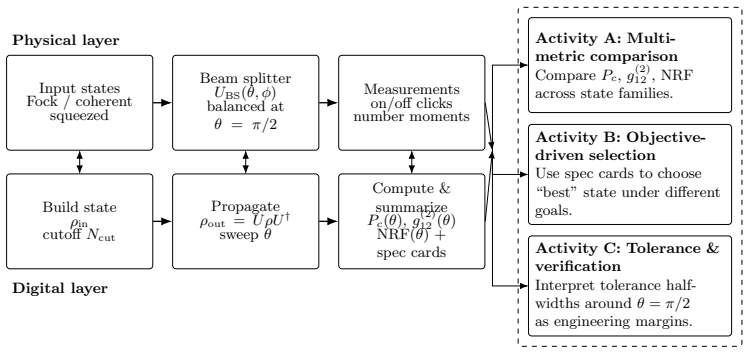
Beam-splitter metrics favor different light sources by goal

by Melissa Coronado Arrieta, Boris Kiefer

Beyond the HOM Dip: A Multi-Metric Module for Teaching Two-Mode Quantum Optical Interference

Tracking coincidence, correlation, and noise across four inputs shows the preferred source depends on the chosen statistic.

Figure from the paper full image
abstract click to expand
The Hong--Ou--Mandel (HOM) effect is often introduced through a single benchmark: coincidence suppression for \(\ket{1}\otimes\ket{1}\) at a balanced beam splitter. We present a classroom-oriented instructional module that broadens this treatment by comparing three output metrics -- on/off coincidence probability \(P_c\), cross-correlation \(g^{(2)}_{12}\), and noise-reduction factor NRF -- across four input families: Fock, superposition, coherent, and squeezed light. The module targets three instructional challenges in upper-division quantum optics: treating interference quality as a single observable, weakly connecting quantum--classical distinctions to output statistics, and limiting transfer from two-mode HOM reasoning to broader photonic benchmarking questions. A common beam-splitter sweep shows that different metrics probe different statistical properties of the same output state and can therefore support different source choices depending on the physical objective. The module combines a Jupyter/QuTiP simulator, guided activities, specification-style summary tables, and a grading rubric for use in a single upper-division or early graduate class meeting.
0
0
cond-mat.stat-mech 2026-05-26

Two invariances fix Boltzmann factor from mean energy

by Weicheng Fu, Yisen Wang +2 more

Boltzmann Distribution from Invariance of Coarse-Graining-Scale and Energy-Shift

Coarse-graining scale and energy-zero shift together select the exponential form with rate set by average energy per particle.

Figure from the paper full image
abstract click to expand
We present a concise derivation of the Boltzmann form for single-particle energy distributions in classical many-body Hamiltonian systems. The derivation relies on two physical facts: coarse-graining-scale invariance of the empirical distribution and invariance under a uniform shift of the energy zero. These conditions uniquely yield the Boltzmann factor, whose parameter is fixed by the mean energy per particle. For separable Hamiltonians, the equilibrium weight factorizes into kinetic and configurational contributions sharing the same parameter, identified from the kinetic part as the inverse kinetic temperature. The principle extends to any physical quantity with a stationary distribution and translational invariance. It is illustrated in a one-dimensional diatomic hard-core gas and a nonlinear lattice chain, where it predicts velocity, energy, spacing, collision-time, and pressure-dependent displacement distributions in agreement with simulations. The lattice model further shows how harmonic elasticity, anharmonic corrections, internal pressure, and thermal expansion emerge from the same exponential equilibrium weights. Finally, the relationships among different ensembles are briefly discussed.
0
0
physics.ed-ph 2026-05-25

Water glass and lasers reproduce rainbow deviation angles

by Soumen Sarkar, Sanjoy Kumar Pal +3 more

A Simple Method of Demonstration of Characteristics of Rainbows Using a Glass of Water and a Few Laser Sources

Red, green and blue beams through a cylindrical glass yield measured minimum deviations that align with refractive-index predictions.

Figure from the paper full image
abstract click to expand
A rainbow is a captivating natural phenomenon resulting from the refraction, dispersion, and reflection of sunlight within water droplets. Traditional classroom demonstrations often focus on qualitative explanations of the formation of rainbows using prisms or water bowls. This study presents a simple experimental approach to analysing the process of rainbow formation through quantitative analysis using a cylindrical glass filled with water, graph paper, and three semiconductor laser sources emitting red, green, and blue light. By measuring the angles of minimum deviation for different wavelengths, we have found that the experimental values closely match the theoretical predictions. This method offers a hands-on, cost-effective approach to enhance students' understanding of the physics behind rainbows.
0
0
physics.ed-ph 2026-05-25 Recognition

Fork grating on film turns laser pointer into vortex beam

by Natasha Bierrum, Lyuxuan Chen +10 more

Democratising Optical Orbital Angular Momentum: a Set of Cost-Effective Tools

Outsourced slide-film pattern lets students observe orbital angular momentum with equipment costing only a few dollars.

Figure from the paper full image
abstract click to expand
Classical and quantum optical communication has gained popularity and momentum in recent years, with growing investment and innovation in quantum technologies. However, the main teaching method in the education of quantum mechanics include mathematically intensive derivations or abstract analogies for the complex systems. We propose a "poor man's" spatial light modulator experiment that is an engaging and interactive learning aid for teaching quantum mechanics and optical orbital angular momentum. Fork diffraction gratings were created on photographic slide film by outsourcing to an external company, and so the gratings were easy and cheap to produce. A simple setup with a fork diffraction grating and a laser pointer successfully produces vortex beams that possess orbital angular momentum, allowing for orbital angular momentum to be easily observed and investigated in a teaching environment. How the tools can be used effectively to enhance learning is discussed, either as a demonstration or as an investigative scientific learning environment activity.
0
0
physics.ed-ph 2026-05-25

LLMs now solve and grade university physics problems with high accuracy

by Jonah L. Donaldson, Aliya Nawaz +3 more

Using Large Language Models in Physics Education

Studies show near-perfect solution generation and better human alignment in grading, but partial credit for flawed work stays challenging.

Figure from the paper full image
abstract click to expand
The rapid advancement of Large Language Models (LLMs) has introduced new possibilities and challenges in physics education, necessitating rigorous evaluation of their capabilities as both problem solvers and automated assessors. This paper presents the results of three complementary studies that evaluated frontier models released between mid-2024 and late-2025. Models were assessed on their ability to generate accurate, step-by-step solutions to university-level physics problems in Classical Mechanics, Electromagnetism, and Quantum Mechanics, and subsequently on their reliability in grading student solutions against a formal mark scheme. The results indicate a clear trajectory toward benchmark saturation in text-based reasoning, with recent architectures (such as ChatGPT-5.1 and Gemini 3.0 Pro) achieving near-perfect scores. Furthermore, recent advances in native multimodal integration have resolved previous limitations in spatial geometry and topological interpretation, enabling models to accurately process accompanying diagrams. As automated assessors, newer models demonstrated significant improvements in alignment with human grading, heavily mitigating the systemic over-marking observed in earlier iterations. However, while models reliably evaluate fully correct handwritten work, assigning partial credit to flawed or incomplete reasoning remains a persistent challenge. These findings suggest that as of late 2025, LLMs offer viable support for both independent student learning and instructional automation, provided their limitations in evaluating ambiguous reasoning are actively managed.
0
0
gr-qc 2026-05-22 2 theorems

App lets users triangulate simulated black hole mass

by Lior M. Burko

Quantitative Black Hole Imaging Laboratory with the Black Hole Vision App: I. Schwarzschild Spacetime

Independent probes and Lyapunov measurements turn a phone into a lab for Schwarzschild spacetime effects.

Figure from the paper full image
abstract click to expand
This paper utilizes the {\it Black Hole Vision} smartphone application to catalyze a pedagogical shift in General Relativity education through the quantitative analysis of simulated black hole imaging. Presented here for the Schwarzschild spacetime, the investigation is designed with a hierarchical modularity suitable for undergraduate students, with an expanded version intended for graduate courses in General Relativity or Relativistic Astrophysics. By transforming the mobile device into an educational relativistic imaging tool, we triangulate the simulated Schwarzschild mass through independent probes and characterize anisotropic coordinate transformations via a Jacobian map. Global numerical consistency is investigated through integrated coordinate length, while the exponential instability of nearly bound orbits is quantified through a measurement of the simulated Lyapunov exponent. Finally, symmetry is constrained through a sub-pixel constraint on eccentricity in the simulated spacetime. By integrating this statistical framework, the paper enables students to explore the distinction between physical signatures and instrumental noise using established metrological protocols.
0
0
physics.ed-ph 2026-05-21 Recognition

Magnetic fields tune lithium-6 forces through basic quantum mechanics

by Ettore Vitali, Gino Gamboni

Tuning Interatomic Forces with Magnetic Fields: Feshbach Resonances in Lithium-6

Feshbach resonances let students see how an external field controls interatomic interactions without advanced theory.

Figure from the paper full image
abstract click to expand
Feshbach resonances, first studied in the context of nuclear reactions, have since become a cornerstone of modern atomic physics. They offer a remarkable degree of control over interatomic (and even intermolecular) interactions by tuning external magnetic fields. This tunability arises from the interplay between quantum scattering and the internal structure of atoms or nuclei. In this work, we explore the essential physics of Feshbach resonances using only basic quantum mechanics, aiming to make this powerful concept accessible to educators and students alike.
0
0
physics.ed-ph 2026-05-21

Handheld generator suggests Faraday paradox resolution

by Keith Zengel

The Handheld and Hand Powered Homopolar Generator

A hand-powered setup clarifies when emf is induced between rotating magnets and conductors.

abstract click to expand
The homopolar or unipolar generator, which is sometimes referred to as a Faraday Paradox, is and experiment that shows an apparent contradiction between different predictions for induced emfs. I present a simple, handheld version of the experiment and a suggested resolution.
0
0
physics.ed-ph 2026-05-20 2 theorems

Ball gains perpendicular speed crossing shallow step

by Keith Zengel, Laruen Boehnert

Motion of a ball rolled over a shallow step

No-slip contact at the edge adds velocity across the step and deflects the path after the drop.

abstract click to expand
A ball rolled over a shallow step will experience an increase in velocity along the direction perpendicular to the step. This causes a deflection in the ball's trajectory. In this paper we derive the equations that describe the motion of a ball rolled over a shallow step and present the results of our experimental test. This simple demonstration can be used in any classroom where the physics teacher has access to a ball and a stack of papers. Prior work has shown that a ball rolled over an edge can maintain its speed, as is commonly assumed, but it can also experience an increase or even decrease in speed. The ball can either roll without slipping while it is in contact with the edge, or else begin to slip before it leaves the edge. In this paper we will consider the case where the ball rolls without slipping the entire time it is in contact with the step edge, then contacts a lower platform. We work with shallow step heights relative to the radius of the ball so that the motion of the ball is easy to observe at all times, and so that the ball does not bounce when it encounters the lower platform. These shallow step heights mean that we can assume the ball does not slip as it moves over the edge.
0
0
physics.ed-ph 2026-05-20 Recognition

Ostrogradski procedure applied to Pais-Uhlenbeck oscillator

by Cássius Anderson Miquele de Melo, Ivan Francisco de Souza

Introduction to Higher Order Classical Dynamics: Pais-Uhlenbeck Model and Coupled Oscillators

Higher-order Lagrangian receives a standard Hamiltonian treatment suitable for advanced classical mechanics teaching.

Figure from the paper full image
abstract click to expand
Most of the laws of Nature involve derivatives up to the second order. Ostrogradski was the first to seek a formulation of the equations of higher-order derivatives. He extended Hamilton's equations by considering Lagrangians that depend on higher-order derivatives of generalized coordinates. The Hamilton-Ostrogradski formulation served as the basis for later studies with higher-order derivatives. However, the Hamilton-Ostrogradski formalism is rarely discussed in textbooks or the pedagogical literature. This motivated us to show how the Hamilton-Ostrogradski formalism can be applied it to the Pais-Uhlenbeck oscillator. We hope that the approach presented in this work can serve as a basis for discussion in advanced classical mechanics courses.
0
0
physics.ed-ph 2026-05-19 Recognition

AI Physics Problems Assign Hazards to Migrant Workers

by Bilas Paul

Who Gets to Do Physics? Occupational Stereotypes in AI-Generated Problem Sets

CEO prompts alone use ownership language while migrant-worker prompts place people in passive danger.

Figure from the paper full image
abstract click to expand
As AI-generated problem sets gain traction in introductory physics courses, their technical correctness is well established - but the social assumptions embedded in their framing have gone largely unexamined. This study analyzes 600 introductory physics problems generated by four AI systems - Grok~4, GPT-5.2, Claude Sonnet 4.6, and Gemini 3 Flash - across structured prompts involving occupations (CEO, Physicist, High School Teacher, Nurse, Construction Worker, and Migrant Worker). Problems were coded on five dimensions: hazard presence, hazard type, agency role, cognitive role, and object ownership. While the physics content is technically sound across all platforms, our analysis reveals systematic occupational stratification in narrative framing. Hazardous scenarios were concentrated in Migrant Worker and Construction Worker problems, with exposure-related hazards (electrocution, burns, radiation, heat or chemical exposure) especially concentrated in Migrant Worker problems. Passive-accident framing - the persona as the recipient of an injury - appeared in one in eight Migrant Worker problems and never appeared for the Physicist, Teacher, or CEO. Possessive ownership language was reserved almost exclusively for the CEO. These patterns suggest that AI-generated physics problems can introduce surface-level diversity while reproducing occupational hierarchies in who acts, who owns, and who is placed at risk. We discuss implications for physics teaching and offer simple screening strategies for instructors using AI-generated problems.
0
0
physics.ed-ph 2026-05-19 1 theorem

Public physics experiments improve student skills and visitor curiosity

by Andre A. A. Marinho, Gisele B. Freitas +1 more

Physics in the Public Square: University Extension as a Strategy for Integrating Physics Education and Science Communication

University students use low-cost materials in a public square to teach concepts and gather feedback showing gains in learning and interest.

Figure from the paper full image
abstract click to expand
University extension activities play a fundamental role in bridging the gap between academia and society by fostering the socialization of scientific knowledge. This study reports and analyzes an outreach activity conducted in a public space, involving undergraduate students enrolled in Physics I, Physics III, and Physics IV courses within the Physics Teacher Education Program at the State University of the Tocantina Region of Maranhao (UEMASUL). The activity was developed through the design and presentation of didactic experiments using low-cost materials. Its main objectives were to disseminate fundamental physics concepts to the community, stimulate public interest in science, and provide pre-service teachers with a formative experience integrating theory, practice, and social responsibility. Data were collected from questionnaires adminisvelopment of communication skills, and the strengthening of the university's social role, while also fostering scientific curitered to visitors (n = 52). The results indicate that the activity significantly contributed to student learning, the deosity among participants.
0
0
physics.ed-ph 2026-05-19 1 theorem

Faculty orientations predict AI adoption in research and teaching

by Timothy J. Atherton, Ian Descamps +5 more

Faculty Orientations Shape Adoption of AI in Research and Teaching

Survey of 90 STEM faculty shows beliefs about AI's role in thinking explain usage better than institutional factors or demographics.

Figure from the paper full image
abstract click to expand
Despite the widespread availability of large language models (LLMs) in higher education, instructors vary substantially in their adoption and use of these tools, and the reasons for this variation remain poorly understood. A mixed-methods survey of 90 STEM faculty in the Research Corporation for Science Advancement (RCSA) Cottrell community examined relationships between AI use, attitudes, institutional context, and instructional practice. Exploratory factor analysis identified a coherent construct, \textit{AI pedagogical orientation}, that strongly predicted self-reported AI use across research, teaching, and other professional activities. Qualitative analysis indicated that this construct reflected differing views about the role AI should play in disciplinary thinking, learning, and expertise development, rather than simply positive or negative attitudes toward AI. Institutional initiatives, demographic variables, and information sources showed comparatively weak associations with AI use. The results suggest that existing technology-adoption models may not fully explain adoption in contexts where technologies interact directly with disciplinary reasoning and knowledge production.
0
0
physics.ed-ph 2026-05-14

Quantum superposition module targets six student barriers in 50 minutes

by Boris Kiefer

A Research-Informed Module on Quantum Superposition for Rapid Classroom Adoption

Instructors receive ready activity sequences and rubrics instead of building new simulators.

Figure from the paper full image
abstract click to expand
We present an adoption-ready instructional module for introducing quantum superposition in a two-state system. The package combines a five-activity classroom sequence with grading-ready assessment materials organized around six conceptual barriers documented in the physics education research literature: interpreting superposition as physical splitting, confusing coherent superposition with classical mixture, making basis-change errors, misreading finite-sample fluctuations as changes in the underlying state, using inconsistent notation, and, in an optional extension, reasoning about ordered operations. The main claim is that the bottleneck for introductory quantum instruction is rarely the absence of a usable simulator, but rather the absence of a coherent activity sequence, barrier-targeted prompts, and aligned assessment tools that an instructor can deploy without additional development work. We make the instructional rationale explicit through backward mapping from documented barriers to activity prompts and rubric-based evidence. The resulting module is designed for a single 50-minute class meeting and can be implemented with the included notebook or adapted to comparable two-state quantum simulators.
0
0
physics.ed-ph 2026-05-13 2 theorems

AI forces new rules for how universities change teaching

by David Perl-Nussbaum, Noah D. Finkelstein

A Framework for institutional change in the age of AI

Six dimensions show why prior adoption models fail when technology arrives before evidence forms.

Figure from the paper full image
abstract click to expand
Generative AI is rapidly reshaping STEM higher education. Not only are our educational practices changing, but how we think about educational transformation must adapt. Existing models of institutional change in STEM, aimed at interactive engagement, have largely followed an adoption logic: relatively stable, well-researched educational practices are evaluated and then scaled. These assumptions do not hold for generative AI, which is an arrival technology -- entering classrooms before a sufficient pedagogical evidence base could form. Building on recent decades of work on STEM institutional change, we propose a framework identifying six dimensions along which prior change models must be reconsidered in light of AI: three concerning the tools at the center of reform (the tool's evidence base, rate of change, and scope), and three concerning the people involved in change (faculty, change agents, and students). For each dimension, we examine how AI-era assumptions differ from those underlying prior interactive engagement reforms and derive design implications, including: privileging humble and local inquiries; organizing reform around pedagogical approaches rather than specific tools; repositioning change agents as facilitators of collective inquiry; and engaging students as partners in reform. Collectively, the six dimensions and design implications constitute a new framework for adapting change models to support institutions under conditions of genuine uncertainty. Finally, we illustrate how the framework may be applied through a brief case-study of a faculty workshop series carried out in a university physics department to support instructors adapting to this modern AI era.
0
0
physics.ed-ph 2026-05-13 Recognition

Self-identification urged for neurodiversity data in physics education

by Mason D. Moenter, George R. Keefe +2 more

Power, Prescription, and Postpositivism: Considerations for collecting and representing neurodiversity demographic information in physics education research

A review shows prescriptive methods hinder authentic representation, prompting calls for autonomy-focused collection frameworks.

Figure from the paper full image
abstract click to expand
Demographic data collection is essential in education research, as demographic data allows researchers to better describe the participant population they study and to contextualize findings. However, current research practices for neurodiversity demographics often rely on prescriptive methods (e.g., requiring participants to report official diagnoses) rather than allowing participants to self-identify. This approach can: a) not allow participants to express their intersecting identities in ways that are authentic; and b) limit trustworthiness and reliability of the data and interpretation. In addition, inconsistent dissemination and representation of demographic data across studies hinder the accessibility and usability of this work. Through a literature review of neurodivergent student experiences with learning and performing STEM, we identified widespread discrepancies in how demographic information is collected and reported. This paper explores how neurodivergent identities can be more accurately and inclusively represented in education research. We present findings of a thematic analysis on the ways neurodivergent demographic data collection is done in the literature using data from a systematic literature review on neurodivergent science, technology, engineering, and mathematics (STEM) learning and performance. We call on the PER community to contribute to the development of a framework that centers participant autonomy while supporting clarity, consistency, and future research use.
0
0
physics.ed-ph 2026-05-13 2 theorems

Women lose more physics identity from B grades than men

by Jaya Shivangani Kashyap, Christian D. Schunn +1 more

The Gendered Cost of Lower Grades: Women's Physics Perceived Recognition and Identity Suffer Disproportionately If They Earn Less Than A Grade

Introductory physics students drop in identity when earning below an A, with women showing steeper declines through reduced perceived recogn

abstract click to expand
Perceptions of disciplinary recognition and identity can be shaped by various forms of feedback and experiences. Here we focus on the potential effects of course grades on the perceievd recognition and physics identity of students. We analyze patterns in changes in physics identity and perceived recognition from pre course to post course across three cohorts of university students enrolled in calculus-based Physics 1 (N=1,681). Students not receiving A grade, on average, showed declines in physics identity and perceived recognition. Even a B grade resulted in declines, and the declines were nonlinear across lower grades. Changes in perceived recognition fully mediated the changes in identity. Importantly, women showed significantly larger declines in identity and perceived recognition, compared to men, if they got less than A grade. The gender moderation was specifically localized to changes in perceived recognition, with no further gender effects on identity beyond the cascading effects on perceived recognition.
0
0
astro-ph.SR 2026-05-13

Ground eclipse data calibrates space solar observatories

by Suprit Singh, Bharti Arora

The Fleeting Laboratory: An Experimental Guide for Total Solar Eclipses

Modern equipment and processing turn the minutes of totality into high-resolution spatial, temporal and spectral measurements.

Figure from the paper full image
abstract click to expand
Since times immemorial, total solar eclipses have inspired awe and wonder. In the modern scientific era they have transformed into exclusive natural laboratories, offering fleeting but invaluable opportunities to study the Sun's faint outer atmosphere otherwise obscured by the intense glare of the photosphere. This unique vantage point has enabled revolutionary discoveries, from the identification of the element Helium and the first empirical validation of Einstein's General Relativity, to deciphering the corona's surprisingly high temperature. This legacy of discovery continues. Today, ground-based eclipse experiments provide crucial data that complements and calibrates our space-based solar observatories, and offer high-resolution capabilities in the spatial, temporal as well as spectral domains. This chapter serves as a comprehensive guide detailing how to leverage modern observing equipments, detectors, and advanced computational techniques in image and data processing to conduct meaningful scientific investigations, bridging the gap between historical precedent and cutting-edge research.
0
0
physics.ed-ph 2026-05-12 2 theorems

Online data lets students deduce gravity's inverse-square law

by Mauricio Mendivelso-Villaquirán

The Solar System as a lab for the Law of Universal Gravitation

Using planetary orbit records from the internet, learners recover the mathematical form of universal gravitation through direct analysis.

Figure from the paper full image
abstract click to expand
The Law of Universal Gravitation is part of middle and high school's general physics and astronomy curricula. This topic is included in the most popular physics textbooks available as a fact whose origin remains in the detailed work of Sir Isaac Newton 300 years ago. Consequently, its mathematical form is presented as an equation without any deductive process. Nevertheless, deduction of the mathematical form of this law is an opportunity to discuss how a deductive process can be performed using the data available on the Internet from reliable sources.
0
0
physics.ed-ph 2026-05-11 2 theorems

AI-powered materials discovery requires workflow-aligned AI literacy

by Dongming Mei, Katherine Moore +1 more

Preparing Students for AI-Powered Materials Discovery: A Workflow-Aligned Framework for AI Literacy, Equity, and Scientific Judgment

Moving beyond tool access ties AI use to data validation and physics reasoning so students build judgment and equitable readiness.

Figure from the paper full image
abstract click to expand
Artificial intelligence (AI) is reshaping education, scientific training, and materials discovery. In materials science, AI models increasingly support property prediction, experiment prioritization, and hypothesis generation; however, the limiting factor is no longer only algorithmic capability but also whether students and educators can use AI with domain-specific scientific judgment. This workshop-informed white paper and curriculum-oriented position article argues that AI education for AI-powered materials discovery must move beyond tool access and surface-level interaction with generative AI systems toward a workflow-aligned model of AI literacy. We connect AI literacy to materials-informatics competencies: data provenance, domain-specific featurization, model validation, uncertainty quantification, physics informed reasoning, reproducibility, and experimental feedback. We also emphasize outcome-oriented equity: institutions should evaluate not only access, participation, and engagement, but also whether AI-enabled instruction produces comparable learning gains, transfer of learning, confidence calibration, defined as the alignment with students confidence and the quality or correctness of their work, persistence, and research readiness across student subgroups. The paper synthesizes relevant evidence, identifies risks for learners such as cognitive off-loading and cognitive surrender, and provides a dual-track curriculum model and implementation recommendations such as curriculum guides and an assessment plan for courses, bootcamps, workshops, and program-level reform. The central goal is to prepare students to become better scientists, not merely more efficient users of AI tools.
0
0
physics.ed-ph 2026-05-11 2 theorems

Chatbots beat students on relativity test but fail on diagrams

by Eugenio Tufino, Caterina Giovanzana +3 more

Performance and failure modes of AI chatbots on a novel concept inventory on relativity in classical mechanics

A new unpublished inventory reveals models make the same visual mistakes every time while students spread their errors.

Figure from the paper full image
abstract click to expand
AI chatbots are increasingly used by students as study tools in physics, raising practical questions about their reliability on conceptual tasks. Existing evaluations of large language models (LLMs) on physics concept inventories rely almost exclusively on instruments that have been publicly available for years and likely appear in model training data, making it difficult to disentangle physics competence from familiarity with the test items themselves. We address this issue by evaluating three frontier LLMs (GPT-5.2, Gemini 3 Pro, Gemini 3 Flash) on the Classical Relativity Concept Inventory (CRCI), a recently developed and validated 21-item instrument on Galilean relativity that was not publicly available at the time of testing. Each item was administered 30 times per model, and all 1890 responses were qualitatively coded along three dimensions: visual interpretation, physics reasoning, and coordination. Mean accuracy was 97% for Gemini 3 Flash, 89% for Gemini 3 Pro, and 73% for GPT-5.2, compared to 62% for the student sample (N = 267). However, all three models fail completely on a small number of items. The qualitative analysis shows that these failures stem predominantly from misinterpretations of visual content rather than from deficits in physics knowledge, and that LLM errors differ structurally from those of students: when models err, they converge on a single distractor with high consistency, whereas student errors are more broadly distributed. These findings indicate that chatbot reliability on conceptual physics is item-dependent and unpredictable, with direct implications for how concept inventories are administered.
0
0
physics.ed-ph 2026-05-11 Recognition

Consumer cameras capture radiation scintillation light

by Yuzuka Sasaki, Yuuki Wada +1 more

Using Consumer Cameras to Observe Scintillation Light from Radiation

Spatial patterns in the images indicate radiation energy, enabling simple classroom comparisons of radiation properties.

Figure from the paper full image
abstract click to expand
For a long time, the cloud chamber was the only educational tool available for measuring radiation. In recent years, simple radiation detectors combining scintillators with silicon photomultipliers have become increasingly common for these purposes. However, students are not able to see the scintillation light, the core process of radiation measurements with scintillators. Therefore, we explored the possibility of detecting scintillation light using two general-purpose cameras. In addition, we examined how differences in the spatial distribution relate to radiation types and energies. Scintillation light were able to be measured by a general-use camera, and their spatial distribution indicates radiation energy. This method could be utilized as an accessible imaging setup to compare radiation properties in a classroom.
0
0
physics.ed-ph 2026-05-11 Recognition

Eight recommendations shape future QISE graduate programs

by Yohannes Abate, Victor Acosta +32 more

Graduate Training in Quantum Information Science and Engineering: Lessons, Challenges, and a Roadmap from the NSF Research Traineeship Programs

Lessons from 18 NSF NRT awards identify tensions between depth and breadth and propose concrete steps including team models and new sensing

Figure from the paper full image
abstract click to expand
Since 2019, eighteen NSF Research Traineeship (NRT) awards in quantum information science and engineering (QISE) and adjacent fields have been funded, constituting the largest NSF-coordinated investment in graduate QISE training in the United States. Synthesizing lessons from our programs, we work through the central tensions that every QISE graduate program must negotiate: between depth in a home discipline and breadth across the field, between structured instruction and open-ended experiential and hands-on learning, and between training individual specialists and cultivating teams that collectively cover all areas of QISE. We describe the structural and pedagogical innovations the NRT programs have developed in response, assess what is working and what remains unresolved, and sketch 12 open problems the community will need to address as QISE graduate education scales beyond the well-resourced research universities where it has up till now been mainly concentrated. Eight concrete recommendations follow: (1) adopt the startup model of team-based training as an organizing philosophy; (2) invest immediately in sensing and communication curriculum development; (3) build student agency into program governance, not just activities; (4) establish structural mechanisms for industrial engagement rather than depending on goodwill; (5) design for sustainability from year one; (6) develop graduate-level textbooks spanning all three QISE pillars: computing, sensing, and communications; (7) establish shared outcome assessment instruments across programs; and (8) develop structured mechanisms for faculty professional development in QISE.
0
0
physics.ed-ph 2026-05-11 Recognition

Building cartoons teach quantum numbers via floors and rooms

by James Day, Simone Williamson

From Floors to Electrons: Using a Building Analogy and Cartooning to Teach Quantum Numbers

A visual analogy lets students map everyday building layouts to electron states and rules before equations appear.

abstract click to expand
Aspects of quantum physics are no longer confined to the upper years of a physics degree. Concepts like superposition or entanglement that were once reserved for second- or third-year undergraduate courses now deserve attention earlier in a student's curriculum. Technology is changing at a pace that requires engaged citizens to understand some of the quantum basics if they are to make sense of the world. This paper offers a cartoon building analogy that teachers can use to introduce quantum numbers to their students.
0
0
physics.ed-ph 2026-05-11 Recognition

Strategies enable multi-institutional DBER data collection

by Meagan Sundstrom, David Esparza +3 more

Strategies for Collecting Multi-Institutional Data in Discipline-Based Education Research

Handling IRB, recruitment, standardization, and logistics turns isolated findings into results that apply across many institutions.

abstract click to expand
Multi-institutional studies are critical for advancing discipline-based education research (DBER) because they allow us to determine where and for whom research findings are applicable. Despite this benefit, such studies remain relatively rare due to the complexities of coordinating data collection across different institutions. In this paper, we describe key challenges and propose actionable strategies for implementing multi-institutional DBER studies. We focus on navigating Institutional Review Board procedures, recruiting participants from a range of institution types, standardizing data sources across institutions, and managing logistics. We also provide an applied example of these strategies from a national research project in which we collected concept inventory data, social network surveys, and classroom observations from 31 introductory physics instructors at 28 institutions in the United States.
0
0
physics.ed-ph 2026-05-08

LLMs match humans 84% on specific skills in physics essays

by Sean Savage, Amir Bralin +2 more

Using Large Language Models to Analyze Engagement in Computational Thinking via Computational Physics Essays

Agreement falls to 71% for overall quality, offering partial automation for grading computational thinking assignments.

abstract click to expand
As computational thinking (CT) becomes increasingly important to physics education, the need for authentic, project-based assessments has grown. While open-ended multimodal assignments, such as Computational Physics Essays (CPEs), help capture student reasoning and encourage active learning, they introduce a significant evaluation bottleneck. Manually grading these complex notebooks across a complex taxonomy of computational practices is resource-intensive and limits scalability in large-enrollment courses. In this study, we investigated the viability of using a multimodal Large Language Model (LLM) to automate the evaluation of 100 student-generated CPEs. Using a human-coded baseline, we systematically evaluated the model's capacity to detect student engagement across 20 distinct CT sub-practices and a holistic overall quality score. The results showed that the LLM performs very well on clearly defined tasks, achieving an 84% exact agreement with human raters on the binary sub-practices. However, more subjective constructs proved challenging, with the model reaching only a 71% agreement for the holistic quality analysis. Our findings demonstrated that while LLMs can reliably automate the detection of specific computational practices, subjective evaluation remains a hurdle.
0
0
cs.AI 2026-05-07

Local LLM autograder grades STEM work at 0.04% error

by Jesse A. Rodríguez

LaTA: A Drop-in, FERPA-Compliant Local-LLM Autograder for Upper-Division STEM Coursework

On-premises system processes LaTeX submissions in minutes, lifts midterm scores 11% and final scores 8% over traditional grading

Figure from the paper full image
abstract click to expand
Large-language-model (LLM) graders promise to relieve the grading burden of upper-division STEM courses, but most deployments to date send student work to third-party APIs, violating FERPA and exposing institutions to data risk while requiring substantial assignment modification. We present $\textbf{LaTA}\ (\textit{LaTeX Teaching Assistant})$, a drop-in, open-source autograder that runs entirely on commodity on-premises hardware and assumes a LaTeX-native workflow already adopted by many engineering and physics courses. LaTA implements a four-stage pipeline (ingest, segment, grade, report) using a locally hosted open-weight chain-of-thought LLM grader (gpt-oss:120b) that compares student work to an instructor-authored reference solution and applies a YAML rubric with binary per-item scoring. We deployed LaTA in Winter~2026 in ME 373 (Mechanical Engineering Methods) at Oregon State University, grading every weekly assignment for approximately 200 students on a single Mac Studio at \$0 marginal cost per assignment and 1--3 minutes of wall-clock time per submission, enabling regrading of corrected assignments and greatly expanded TA office hour offerings. The instructor-confirmed grading-error rate held at roughly $0.02$--$0.04\%$ per rubric line item across the term. Relative to the same instructor's previous traditionally-graded cohort, the LaTA-graded cohort outperformed by approximately $11\%$ on the midterm exam and $8\%$ on the final exam, and reported large gains in self-assessed confidence on every stated learning objective ($N = 159$ survey responses, $\Delta \geq +1.49$ Likert points, $p < 10^{-27}$ on every comparison). We release the code under AGPLv3.
0
0
physics.ed-ph 2026-05-07 Recognition

Smartphone measures oil viscosity via spring damping

by Sanjoy Kumar Pal, Pradipta Panchadhyayee

Determining Viscosity of a Liquid with Smartphone Sensors: A Classroom-Friendly Approach Using Damped Oscillations

Accelerometer data from damped ball oscillations in mustard oil matches literature values and video tracking.

Figure from the paper full image
abstract click to expand
This study presents a classroom-friendly method for measuring the coefficient of viscosity of a liquid using a smartphone s accelerometer sensor. A metallic ball tied with a spring-mass system and submerged in mustard oil undergoes damped oscillations due to viscous forces. The Phyphox app is used to record the temporal variation of acceleration, from which the damping constant is calculated to determine the coefficient of viscosity of the oil. The experimentally obtained value is further validated using the Tracker app, and this value is shown to be in close agreement with the standard literature. This method provides an accurate, low-cost experiment ideal for educational settings, utilizing smartphone sensors for viscosity measurement.
0
0
physics.ed-ph 2026-05-07 Recognition

Smartphone measures density with pressure sensor

by Sanjoy Kumar Pal, Soumen Sarkar +1 more

Use of smartphone as a density measuring device

Air and submerged pressure readings from the phone sensor yield density of solids.

abstract click to expand
In this paper, we have proposed a simple method of measuring the density of a solid material. We have utilized the pressure sensor of a smartphone as a pressure-measuring device. By measuring the values of pressure when a solid object is in air and also in the fully immersed condition in a non-reactive liquid, we have determined the density of the object.
0
0
physics.ed-ph 2026-05-07 Recognition

Smartphone sensor confirms magnet repulsion follows 1/r^4 law

by Sanjoy Kumar Pal, Pradipta Panchadhyayee

Demonstration of magnetic dipole-dipole interaction by using smartphone pressure sensor

Inflated bag and pressure readings let students plot force data and extract dipole moments from neodymium discs.

abstract click to expand
In this paper, we present a hands-on activity designed to verify the dependence of the magnetic force between two identical N35 neodymium disc magnets on their separation distance. Utilizing a weight-measuring device incorporating a smartphone pressure sensor placed inside an inflated Ziplock bag, with a glass plate ensuring perfect contact, we measured the magnetic force with high precision. Our results confirm the established inverse fourth power relationship between magnetic force and distance. The linear plot of magnetic force versus the inverse fourth power of distance corroborates the corresponding theoretical model. From the slope of this linear plot, we have calculated the magnetic dipole moment of each magnet, providing a practical validation of theoretical predictions. This methodology also offers an effective approach for educational and experimental verification of magnetic interactions.
0
0
physics.ed-ph 2026-05-06

Dialogue fixes 82% of LLM errors on image-based physics problems

by Akshay Syal, Lawrence Swaminathan Xavier Prince +3 more

A Dialogue-Based Framework for Correcting Multimodal Errors in AI-Assisted STEM Education

A short back-and-forth conversation overcomes the accuracy drop when models must read diagrams in STEM questions.

abstract click to expand
Large Language Models (LLMs) are democratizing access to personalized tutoring; however, their effectiveness is hindered by challenges in processing multimodal content, which limits AI's potential to provide equitable, high-quality STEM support. This study evaluates LLM performance on multimodal physics problems, identifies specific failure modes through an empirical error taxonomy, and tests practical interventions designed to overcome multimodal processing limitations. We assessed three publicly available LLMs (Claude, Gemini, and ChatGPT) on multimodal physics problems from the OpenStax database and compared the results with text-only performance. An empirically derived error taxonomy was developed through pilot testing, followed by evaluation of a structured multimodal dialogue intervention. All three models achieved near-ceiling accuracy (96%) on text-only physics problems. Performance declined substantially on multimodal problems, consistent with what we term the Multimodal Interference Effect. Error analysis identified four failure modes: visual processing errors, context misinterpretation, mathematical computational errors, and hybrid errors, with visual processing errors being the most prevalent. The structured dialogue intervention corrected 82% of errors overall; visual processing errors were corrected at 100% across all models. Educators and students can implement these interventions immediately, requiring no model retraining, to improve AI tutoring reliability on image-rich STEM content, advancing equitable access to high-quality learning support.
0
0
physics.ed-ph 2026-05-06 2 theorems

Smartphone measures permeability from magnet's terminal velocity in pipe

by Sanjoy Kumar Pal, Soumen Sarkar +1 more

A smartphone-based simple method for determination of the free space permeability

Sensor data and video timing turn a simple drop into a quantitative determination of the free-space constant

abstract click to expand
A simple and novel method is designed to determine the free space permeability. This value is computed from the expression of the terminal velocity of a magnet falling through a conducting pipe using the magnetic sensor of a smartphone and a video player. This method deserves its importance because of the accuracy and precision of the results.
0
0
physics.ed-ph 2026-05-06

Smartphone extracts g from magnet falling in pipe

by Sanjoy Kumar Pal, Soumen Sarkar +1 more

Determination of the acceleration due to gravity by studying magnet s motion through a conducting pipe

Terminal velocity and torsional oscillation data replace pendulum timing for local gravity measurement.

Figure from the paper full image
abstract click to expand
We determine the acceleration due to gravity (g) in a novel way using a magnetic sensor and video analysis technique of a smartphone. The same applications are used to measure the terminal velocity of a magnet falling through a conducting pipe and the magnetic moment of the magnet from its torsional oscillations. This experiment would appear to be intriguing, as it combines elements of magnetism, terminal velocity, and electromagnetic damping to determine g.
0
0
physics.ed-ph 2026-05-06

Magnet damps faster closer to conducting plate

by Sanjoy Kumar Pal, Soumen Sarkar +2 more

Study of the effect of electromagnetic damping force on a magnet oscillating near a non-ferromagnetic conducting plate

Video tracking extracts how eddy-current drag changes with separation in a simple undergraduate setup.

Figure from the paper full image
abstract click to expand
We have designed an experiment that involves studying the effects of a conducting plate on the motion of an oscillating disc magnet. We have employed the video analysis method by Tracker software to investigate the variation of electromagnetic damping coefficient with distance between the plate and the magnet. This experiment can indeed serve as a valuable educational tool for undergraduate students, covering topics such as damped oscillation, electromagnetic damping, Lenz's law, and eddy currents.
0
0
physics.ed-ph 2026-05-05

Opinions on AI in physics compiled to seed community talks

by Savannah Thais, Koji Hashimoto +7 more

AI and the Research-Education Environment of Physics

A discussion summary on how AI is changing research and education offers a prompt for other groups to address local issues.

Figure from the paper full image
abstract click to expand
In the current era of AI transforming the research-education environment of physics, variety of issues and concerns arise. The KITP program "Generative AI for High and Low Energy Physics'' offered a discussion session on this, and here presented is a summary of the opinions provided in the discussion. The material is formulated such that it can serve as a starting point for further discussions in readers' research community/institution/group.
0
0
physics.ed-ph 2026-05-04

Phone sensor measures magnet force to check Newton's third law

by Sanjoy Kumar Pal, Soumen Sarkar +1 more

Smartphone-based measurement of magnetic force and demonstration of Newton third law of motion

Ring magnets and household items let students record equal and opposite forces with a standard smartphone.

Figure from the paper full image
abstract click to expand
A fascinating approach to teaching Newton's Third Law using readily available technology is presented in this article. Magnetic forces are measured by using a smartphone's pressure sensor, two ring magnets, and common household items. Students can measure the magnitudes of forces, gain a more tangible understanding of the law, and see how 'action' and 'reaction' are quantitatively equal and opposite.
0
0
physics.ed-ph 2026-05-04

Phone LiDAR yields spring constants matching theory

by Sanjoy Kumar Pal, Soumen Sarkar +1 more

LiDAR based determination of spring constant using smartphones

A heater coil and hanging mass oscillate while the smartphone sensor records periods, giving results that agree with calculated stiffness.

Figure from the paper full image
abstract click to expand
A novel use of the LiDAR sensor of a smartphone in introductory physics experiments is discussed in this article. We have determined the spring constant for various combinations of springs using the LiDAR sensor of a smartphone through the phyphox application. An electrical heater coil is used as a spring, and the period of oscillation of a vertical spring-mass system is measured using a LiDAR sensor. The experimental values of spring constants agree with the theoretical values. A high school student can perform this simple experiment in a smart way at home.
0
0
physics.ed-ph 2026-05-04

Magnet's terminal speed in pipe gives its magnetic moment

by Sanjoy Kumar Pal, Soumen Sarkar +1 more

Determination of the magnetic moment of a magnet by letting it fall through a conducting pipe

Eddy-current drag creates constant velocity tracked by smartphone sound waves; matches torsion-pendulum check.

Figure from the paper full image
abstract click to expand
A novel method is proposed to determine the magnetic moment of a magnet by studying its free-falling motion inside a non-ferromagnetic and conducting pipe. The dynamics of a neodymium magnet falling inside a pipe is tracked by using sound waves of a fixed frequency generated by one smartphone and detecting acoustic resonance in the pipe simultaneously by the other. This tracking technique leads to the measurement of the terminal velocity of the falling magnet, as the interaction between the magnet and the conducting pipe creates viscosity artificially. The result obtained is verified by studying torsional oscillations of the suspended magnet and conforms to the reported value in such a low-cost setup. The experiment is designed with concepts integrating the domains of general physics, electromagnetic induction, and acoustics.
0
0
astro-ph.IM 2026-05-04

Cut astronomy grad admissions to two letters and April 1 deadline

by Emily M. Levesque, Courtney D. Dressing +5 more

Recommendations for the Astronomy Graduate Admissions Process

Uniform short materials and synchronized timelines ease the load on applicants and programs.

abstract click to expand
As the AAS Working Group on Graduate Admissions (WGGA) we are sharing brief recommendations for improving and standardizing key elements of the graduate admissions process in astronomy. Most astronomy graduate programs have large areas of overlap in their admissions processes; however, the existing small variations in requirements and mismatches in communication and transparency make admissions more challenging for students and programs alike. To improve this situation, and building on the work presented in the AAS Graduate Admissions Task Force (GATF) report we recommend a few simple and straightforward changes for application content, communication, and timelines. These include an application format that consists of 1) two 500-word recommendation letters, 2) one 1500-word application essay, 3) an applicant CV, and 4) unofficial transcripts; and an admissions timeline that includes effective and transparent communication from programs and encouraging an April 1st "down-select date" for applicants.
0
0
physics.ed-ph 2026-04-30

Conference-style papers extend quantum PBL value

by Nischal Binod Gautam, Enrique P. Blair

Beyond Project-Based Learning: Conference-Style Writing as Authentic Assessment in Interdisciplinary Quantum Engineering Education

Surveys show the writing requirement builds communication and research skills on top of project engagement benefits.

Figure from the paper full image
abstract click to expand
Project-based learning is recognized as an effective approach for improving engagement and applied understanding in STEM education. In quantum engineering courses, however, the question is no longer only whether students benefit from projects but how those projects should culminate if the goal is authentic disciplinary preparation. This paper examines the educational role of a conference-style paper requirement embedded within a project-based learning implementation for an introductory quantum mechanics course for engineers. We use post-course survey responses from students in a pilot run of the course. We evaluate perceived effects on conceptual understanding, scientific communication, research readiness, and attitudes toward the writing requirement itself. The results suggest that students viewed the project as beneficial for engagement, confidence, and technical skill development, while the conference-style paper emerged as a demanding but meaningful component of the experience. We argue that once PBL has been established in quantum mechanics education, conference-style writing can serve as an extension of that model, especially for graduate students. The findings support retaining the conference-paper requirement with improved scaffolding.
0
0
physics.ed-ph 2026-04-29 1 theorem

Setting vacuum constants to 1/c makes resistance dimensionless

by Alisher Sanetullaev (New Uzbekistan University)

A Pedagogical MKS-based Electromagnetic Unit Convention with ε₀ = μ₀ = 1/c

The unit system keeps Maxwell's equations unchanged while expressing all electrical quantities in mechanical terms and simplifying radiation

abstract click to expand
We propose a pedagogical, rationalized MKS-based convention for electromagnetic quantities designed to reduce cognitive load in undergraduate undergraduate electromagnetism. By setting vacuum constants to $\varepsilon_0 = \mu_0 = 1/c$, we preserve the familiar structure of Maxwell's equations while making the role of the speed of light explicit. In this convention, electrical units are expressed directly in terms of mechanical units (e.g.\ $[\mathrm{nuA}] = \sqrt{\mathrm{J/s}}$), effectively reducing the number of independent base units. A striking pedagogical consequence is that electrical resistance becomes dimensionless, capacitance and inductance acquire units of time, and radiation pressure reduces to $|\mathbf{E}\times \mathbf{B}|$, greatly simplifying dimensional analysis for circuits and fields. We introduce corresponding non-SI units (\textit{nu}-units), provide conversion relations to SI, and demonstrate the potential utility of this system through comparative ``before/after'' derivations of the wave equation, electromagnetic energy density, radiation pressure, and the Bohr atom. Preliminary empirical support is provided by student attitude surveys administered to $N_1 = 46$ and $N_2 = 39$ students in an undergraduate physics course, which showed a statistically significant improvement in the perceived clarity of the wave equation derivation after exposure to the nu-system ($p = 0.005$, Mann--Whitney $U$ test), and a majority preference for the dimensionless-resistance feature.
0
0
physics.ed-ph 2026-04-29

17-year quantum summer school sends alumni into research careers

by John M Donohue, Michael J Grabowecky +7 more

USEQIP: Outcomes and experiences from 17 years of undergraduate summer schools in experimental quantum information science

Two weeks of labs plus internships have equipped hundreds of undergraduates with experimental skills and led many to continue in the field.

Figure from the paper full image
abstract click to expand
To grow the quantum information science and technology workforce, opportunities for students to gain experiential learning and build a sense of belonging in the broader community are essential. The Undergraduate School on Experimental Quantum Information Processing (USEQIP) is a two-week summer school for undergraduate students that has been held since 2009 with the goal of introducing undergraduate students from around the world to the tools of quantum information research, paired with a summer internship program. Here we report on the structure, impact, and outlook of the program, including hands-on laboratory activities refined over many iterations of the program. We highlight the career trajectories of program alumni, many of whom have made significant contributions to the quantum field.
1 0
0
physics.ed-ph 2026-04-28

Quantum hackathon teaches basics to underrepresented high schoolers

by Fahimeh Bayeh, Linh Dinh +2 more

Bridging the Quantum Divide: A Learning-Centric Quantum Hackathon for Underrepresented Students (Extended Version)

A two-day event built with mastery learning and Quirk simulations reached its target demographics in Nova Scotia.

Figure from the paper full image
abstract click to expand
This paper describes the design and implementation of a two-day quantum hackathon for underrepresented high school students in Nova Scotia, Canada. The first day of the hackathon is spent introducing students to quantum computing through hands-on activities, whereas the second day teaches students to apply this knowledge through guided challenges. Both days are informed by the theory of mastery learning and specification grading, with the full curriculum being crafted within the Integrated Course Design framework. This requires identifying situational factors unique to our target demographics, from which we develop learning outcomes, and then work backwards to a full curriculum with educative assessments. A novel aspect of our hackathon is that all circuit simulations are performed within Quirk: a decision based on best practices in computer science education. Based on feedback from students, we conclude that our hackathon successfully introduced students to the basics of quantum computing, and was able to reach most of our target demographics.
0
0
physics.ed-ph 2026-04-28

QFT textbooks repeat six conceptual mistakes

by Alexandros Gezerlis

Six textbook mistakes in quantum field theory

Corrections to widespread errors aim to stop them from propagating into research papers and student work.

Figure from the paper full image
abstract click to expand
This article discusses incorrect statements appearing in textbooks on quantum field theory (QFT); some of these mistakes also appear in the research literature. The focus is not on errors made by an individual author, but on conceptual muddledness that is widespread in introductory textbooks. We start from a bare-bones summary of QFT, meant to establish the notation. We then turn to our six paradigmatic themes, in each case quoting a specific example of the textbook mistake, a summary of material that is known to experts but is frequently mishandled in introductory works, pointers to authoritative references where the relevant concept is handled properly, as well as a concise correction that rectifies any issues. The goal of this work is to warn readers of the existence of several pitfalls and thereby stop these errors from further propagating in the literature on QFT.
0
0
astro-ph.IM 2026-04-27

Summer program advances over 50% of students to astrophysics PhDs

by S. Bellotti, A. D. Sellek +4 more

The Leiden/ESA Astrophysics Program for Summer Students (LEAPS)

Fully funded 10-week internships at Leiden and ESA support diverse participants in launching research careers.

Figure from the paper full image
abstract click to expand
International student mobility plays a critical role in shaping future research careers, particularly in highly globalized fields such as astrophysics. The Leiden/ESA Astrophysics Program for Summer Students (LEAPS) offers a 10-week, fully funded research program at Leiden Observatory and the European Space Agency's ESTEC centre for undergraduate and master's students. Designed to foster early research involvement, LEAPS supports students from diverse academic and cultural backgrounds. Since its inception in 2013, LEAPS has hosted 194 students from over 40 countries. Data collected for 165 participants reveal that over 50% have progressed to Ph.D. studies, with some members of earlier cohorts already securing competitive international fellowships in astronomy. LEAPS participants have collectively contributed to at least 25 peer-reviewed publications and 13 international conference presentations. LEAPS has contributed successfully in preparing undergraduates for research careers in astrophysics through hands-on experience, mentorship, and scientific exposure. By addressing barriers related to financial means and promoting diversity, the program not only enhances individual career trajectories but also contributes to the broader goal of inclusive academic mobility. Continued efforts are needed to further increase global representation and assess long-term impacts on participants' scientific careers.
0
0
physics.class-ph 2026-04-27

Driven pendulum shows long-period swings where stability analysis predicts calm

by Rebeka Sarkar, Krishna Kumar +1 more

Non-Floquet oscillations of a parametrically driven rigid planar pendulum

The oscillations last four to twelve times the drive period and display two frequencies that sum to the drive frequency.

Figure from the paper full image
abstract click to expand
The linear and nonlinear motions of a damped rigid planar pendulum, driven by vibrating its pivot sinusoidally, are reexamined. The pendulum is known to exhibit periodic, quasiperiodic, and chaotic motions. Floquet analysis identifies regions of instability and stability within the driving parameter space. A new type of nonlinear oscillation may occur at driving parameters where Floquet analysis predicts a stable stationary state. Such non-Floquet oscillations always have periods longer than twice the period of the vibrating pivot. The possible periods of these oscillations may be four, six, eight, or twelve times the driving period. The power spectrum of the pendulum's angular velocity during these oscillations reveals a novel feature: the two dominant response frequencies sum to the driving frequency.
0
0
physics.ed-ph 2026-04-24

DIY inertia dyno shows scooter CVT flat power curve

by Stylianos A. Tsilioukas

Building an inertia dynamometer with vocational students: a low-budget apparatus for teaching rotational dynamics

Vocational students use a steel drum and laptop mic to measure torque and power, matching expected CVT signatures.

Figure from the paper full image
abstract click to expand
We report the design, construction, and classroom use of a low-cost inertia dynamometer, built as a year-long project-based learning (PBL) activity with adult students at a Greek Evening Vocational High School (EPAL). The apparatus consists of a machined steel drum of calculated moment of inertia $I = 0.6507~\mathrm{kg\,m^2}$, mounted on a student-welded frame and instrumented with a green-laser / light-dependent resistor (LDR) optical interrupter. The analogue output is sampled at 44.1\,kHz by the microphone input of a laptop computer, which is used as an opportunistic analogue-to-digital converter; torque and power curves are then reconstructed in software from the inter-pulse intervals via $\tau = I\alpha$ and $P = \tau\omega$. The drum's moment of inertia is cross-checked by an inclined-plane rolling experiment. A wide-open-throttle test with a 50\,cc scooter reproduces the expected flat-power / falling-torque signature of a continuously variable transmission in the low-to-moderate RPM range; the LDR's millisecond-scale recovery time imposes an upper bandwidth limit that provides an unplanned but pedagogically rich lesson in sensor physics. The project integrated industrial-lathe fabrication, arc welding, analogue electronics, and numerical differentiation into a single coherent workflow. We describe the apparatus, the physics, the signal-processing pipeline (for which MATLAB and Python/Octave code are provided as supplementary material), and reflect on the pedagogical outcomes for a student population traditionally disengaged from abstract physics.
0
0
physics.ed-ph 2026-04-24

Inductive bias improves ML detection of student reasoning in talks

by Kaitlin Gili, Mainak Nistala +2 more

Locating acts of mechanistic reasoning in student team conversations with mechanistic machine learning

Probabilistic model generalizes better to unseen students and new contexts when its dynamics align with domain knowledge.

Figure from the paper full image
abstract click to expand
STEM education researchers are often interested in identifying moments of students' mechanistic reasoning for deeper analysis, but have limited capacity to search through many team conversation transcripts to find segments with a high concentration of such reasoning. We offer a solution in the form of an interpretable machine learning model that outputs time-varying probabilities that individual students are engaging in acts of mechanistic reasoning, leveraging evidence from their own utterances as well as contributions from the rest of the group. Using the toolkit of intentionally-designed probabilistic models, we introduce a specific inductive bias that steers the probabilistic dynamics toward desired, domain-aligned behavior. Experiments compare trained models with and without the inductive bias components, investigating whether their presence improves the desired model behavior on transcripts involving never-before-seen students and a novel discussion context. Our results show that the inductive bias improves generalization -- supporting the claim that interpretability is built into the model for this task rather than imposed post hoc. We conclude with practical recommendations for STEM education researchers seeking to adopt the tool and for ML researchers aiming to extend the model's design. Overall, we hope this work encourages the development of mechanistically interpretable models that are understandable and controllable for both end users and model designers in STEM education research.
0
0
physics.ed-ph 2026-04-22

New profession proposed for guiding student research

by Sergey V. Samsonau, Matthew Pearce

The Research Guide: From Informal Role to Profession

Informal PhD-style mentoring falls short for the hundreds of thousands doing authentic projects each year.

Figure from the paper full image
abstract click to expand
Guiding others through authentic scientific research outside of PhD programs has been practiced for decades in specialized secondary schools, undergraduate research programs, and independent settings. These practitioners work in the middle, between the classroom science teacher and the PhD advisor, guiding learners with aptitude or serious interest. Sport and music have dedicated professions for this middle position (the school-team coach and the school band director); research does not. This paper names that missing profession the Research Guide: the practitioner who develops another person's capacity to do research, from framing a question to communicating findings. Hundreds of thousands of middle and high school students already pursue authentic research each year, even more college undergraduates participate in research with a faculty member, and millions of adults engage in citizen science. In current practice, the programs that serve this middle group mostly default to a simplified version of the PhD apprenticeship model structured around one mentor with a few students at a time, without systematic training; they overwhelmingly frame research as the hypothetico-deductive cycle alone. The role calls for cognitive apprenticeship, a pedagogical approach in which an expert's tacit moves on open-ended problems are made visible and scaffolded, then faded as the learner develops, while the research outcomes themselves remain unpredictable. It spans multiple modes of inquiry (not only the hypothetico-deductive cycle) and demands a combination that no existing training program produces: pedagogy, research methodology, developmental assessment, risk and productive struggle management, domain flexibility, and community building. Together these demands warrant a dedicated profession: a named role, a training pathway, a career ladder, hiring standards, and institutional recognition.
0

browse all of physics.ed-ph → full archive · search · sub-categories