pith. sign in

math

Mathematics

Top Pith
5
math.LO 2026-06-29

Nonexistence of 3-ladders at ℵ₂ matches Mahlo consistency

by Lorenzo Notaro

A solution to Ditor's problem

Ditor's 1984 question on whether the size bound ℵ_{n-1} is attained for n=3 is independent of ZFC.

Figure from the paper full image
abstract click to expand
We settle the long-standing open question whether there exists a $3$-ladder of cardinality $\aleph_2$. Given a positive integer $n$, an $n$-ladder is a lower finite lattice whose elements have at most $n$ lower covers. In 1984, Ditor proved that every $n$-ladder has cardinality at most $\aleph_{n-1}$, and that this cardinal bound is sharp for $n = 1,2$. He then raised the question of whether the bound is attained for $n\ge 3$ as well. An affirmative answer is known to be consistent with $\mathsf{ZFC}$. We prove, relative to the consistency of a Mahlo cardinal, that the question is independent of $\mathsf{ZFC}$. More precisely, we show that the nonexistence of a $3$-ladder of cardinality $\aleph_2$ is equiconsistent with a Mahlo cardinal.
0
Top Pith
1
cs.IT 2026-06-26

Multi-distribution functionals reduce to integrals of coincidence divergences

by Akshay Balsubramani

All you need is log

Monotonicity under data processing and additivity on independent products force every such functional to an integral over four strata

Figure from the paper full image
abstract click to expand
Comparing two probability distributions is a basic building block of statistics and machine learning, and the right family is well understood: the R\'enyi divergences of order $\alpha\in[0,\infty]$ are the unique family monotone under data processing and additive on independent products. Many problems instead compare more than two distributions at once -- multi-population fairness, multi-prior PAC-Bayes bounds, multi-hypothesis testing -- and the right multi-distribution generalization of the R\'enyi family has been an open question. We characterize it. Every functional of $W$-tuples of distributions that is monotone under data processing and additive on independent products is a positive integral of multi-way coincidence divergences $C_{\alpha}(\pi_1,\dots,\pi_W) := -\log\int \pi_1^{\alpha_1}\cdots\pi_W^{\alpha_W}$ (with $\sum_k \alpha_k = 1$) over a parameter space with four strata: the simplex interior; mixed-sign exponent cones (the analogue of R\'enyi orders $>1$); a tropical boundary at infinity carrying max-divergences; and pairwise Kullback-Leibler edges at the simplex vertices. Each stratum is necessary -- the destination of an explicit data-processing-monotone, product-additive divergence the others cannot reproduce -- and each is a clean limit of simplex-interior atoms. The same family arises from several independent routes -- the structural axioms, Kolmogorov-Nagumo means with R\'enyi's entropy axiomatics, classical entropy characterizations, multi-hypothesis testing error exponents, and a multi-lottery betting interpretation -- structural evidence that this is the canonical multi-distribution R\'enyi calculus rather than an artefact of any one axiomatic input. The two-prior case recovers the standard R\'enyi result; a worked $W=3$ instance, numerical verification, and a conditional extension round out the treatment.
1 0
Top Pith
5
math.CO 2026-06-23

Tree vs multipartite Ramsey numbers bounded by bipartite case

by Eric Li (Trinity College, University of Cambridge)

A Resolution of ErdH{o}s Problem 550 on Tree versus Complete Multipartite Ramsey Numbers

R(T, K_{m1..mk}) ≤ (k-1)(R(T, K_{m1 m2})-1) + m1 holds for all large trees T, resolving Erdős question 550.

abstract click to expand
We resolve Erd\H{o}s Problem 550, originally asked as question (2) of Erd\H{o}s, Faudree, Rousseau, and Schelp. Precisely, for fixed integers $k\geq 2$ and $1\leq m_1\leq \cdots \leq m_k$, we prove that, for every sufficiently large $n$ and every $n$-vertex tree $T$, $R(T,K_{m_1,\ldots,m_k}) \leq (k-1)(R(T,K_{m_1,m_2})-1)+m_1$. The proof combines a new off-Tur\'an tree-embedding theorem with a compactness-and-rounding theorem for represented bounded-rank hypergraph obstructions. The embedding theorem follows from Szemer\'edi regularity and a local regular-matching embedding lemma of Hladk\'y and Piguet. The compactness argument uses shadow hypergraphs to retain obstructions whose vertices escape along the limiting sequence.
0
0
math.CA 2026-07-03

Normalizing series to probabilities turns quotient signs into moment checks

by Zakaria Derbazi

A Probabilistic Sign Rule for Quotients of Positive Series and Integral Transforms

The rule reduces monotonicity and log-convexity of hypergeometric and Stieltjes quotients to kernel monotonicity and covariance signs.

abstract click to expand
This paper develops a probabilistic sign rule for quotients of functions represented by positive series or integrals. For a function in this class, normalising the summand function in the series case or the integrand function in the integral case induces a probability law under which parameter log-derivatives of the function are expressed as moments of kernels, the log-derivatives of the same summand or integrand function with respect to the same parameters. The resulting moment identities reduce quotient monotonicity, log-supermodularity, and log-convexity to sign criteria based on kernel monotonicity, stochastic ordering of the induced laws, and covariance or variance identities. The criteria are applied to generalised hypergeometric, Stieltjes-transform, and Prabhakar quotients, yielding new Tur\'an inequalities, two-sided Stieltjes bounds, and a local failure threshold for a monotonicity conjecture for the zero-balanced Gauss function.
0
0
math.CO 2026-07-03

Aharoni-Korman conjecture holds for countable FAC posets without forbidden chains

by Lawrence Hollom

The structure of FAC posets and the Aharoni--Korman conjecture

Result applies to all such posets by first decomposing them into scattered components that mirror the full order.

Figure from the paper full image
abstract click to expand
A poset $P$ is said to satisfy the finite antichain condition, or FAC for short, if it has no infinite antichain. Such posets exhibit rich and complex structure, and it was conjectured by Aharoni and Korman in 1992 that any FAC poset $P$ possesses a chain $C$ and a partition into antichains such that $C$ meets every antichain of the partition. While this conjecture is now known to be false, in this paper we prove that the conjecture does hold true for a broad class of posets. In particular, we prove that the Aharoni--Korman conjecture holds for countable posets containing no saturated chain $D$ such that either $D$ or its reverse $D^*$ is of the form $\bigoplus_{x\in\omega} D_x$, where each $D_x$ is infinite and co-wellfounded. In pursuit of this goal, we prove several structural results, the foremost of which demonstrates how a countable FAC poset may be broken up into a collection of scattered posets which reflect the structure of the poset as a whole.
0
0
math.AP 2026-07-03

Self-similar wave solutions stay stable forward in time

by Akansha Sanwal, Birgit Schörkhuber +1 more

Stability of global self-similar solutions to the cubic wave equation and the wave maps equation

Small perturbations of special scaling-invariant solutions to supercritical wave equations remain bounded for all future time, proven via gl

abstract click to expand
We study the long-time stability of global self-similar solutions to two energy supercritical nonlinear wave equations, namely, the cubic nonlinear wave equation in $6$ dimensions and the corotational wave maps equation in $4$ dimensions. We prove the stability of self-similar solutions under perturbations that are small in the critical Sobolev spaces. The proof is based on Strichartz estimates for wave equations with potentials in similarity variables.
0
0
math.AP 2026-07-03

Jastrow factor raises wave function regularity order from 1 to 2

by Virginie Ehrlacher

Cut-off Jastrow Factors and Spectral Barron Regularity of Coulombic Electronic Wave Functions

The quotient after cut-off Jastrow extraction gains one full order in spectral Barron spaces for Coulombic eigenfunctions.

abstract click to expand
We study the spectral Barron regularity of Coulombic electronic eigenfunctions after extraction of a cut-off Jastrow factor. Let \(H=-\Delta+V\) be an \(N\)-electron Coulomb Hamiltonian with clamped nuclei, and let \(\psi\) be an eigenfunction associated with a discrete eigenvalue below the bottom of the essential spectrum. For the cut-off Jastrow factor \(F_{\rm cut}\) of Fournais--Hoffmann-Ostenhof--Hoffmann-Ostenhof--S\o rensen, we set \[ \phi=e^{-F_{\rm cut}}\psi . \] Whereas the original wave function satisfies the sharp global threshold \(\psi\in \mathcal B_{\rm sp}^s(\mathbb R^{3N})\) for every \(0\leq s<1\), we prove that the Jastrow quotient gains one full order: \[ \phi\in \mathcal B_{\rm sp}^s(\mathbb R^{3N}) \qquad \text{for every } 0\le s<2 . \] The endpoint \(s=2\) is shown to be natural through an explicit hydrogen-like eigenfunction. The many-body proof is a global Fourier-side resolvent argument. After conjugation by the cut-off Jastrow factor, the Coulomb singularities are converted into localized angular coefficient blocks with admissible Fourier-control measures. Low frequencies are controlled by the a priori \(H^1\)-bound, while high frequencies are recovered by a Neumann fixed-point argument using the resolvent multiplier and annular estimates for the coefficient measures.
0
0
math.PR 2026-07-03

Almost supermartingales obey Olivier's convergence rate

by Patrick L. Combettes, Javier I. Madariaga

Almost Supermartingale Extensions of Olivier's Theorem

The extension supplies explicit rates for stochastic iterative processes once the almost supermartingale and summability conditions hold.

abstract click to expand
Olivier's 1827 theorem provides a rate of convergence to zero of the general term of a decreasing summable sequence of positive reals. We derive stochastic extensions of this result in the context of almost supermartingales. The results are applied to the analysis of stochastic iterative processes.
0
0
math.CO 2026-07-03

Random percolation preserves cycles of length nearly d

by Micha Christoph, Alp Müyesser +1 more

Robustness and hyperstability for the ErdH{o}s-Gallai theorem

Graphs with average degree d retain a cycle of length (1-c)d after keeping each edge with probability about 1/d.

Figure from the paper full image
abstract click to expand
The Erd\H{o}s-Gallai theorem states that every graph of average degree $d$ contains a cycle of length at least $d$. We prove the following robust extension of the Erd\H{o}s-Gallai theorem: For every $c>0$ there exists $K$ such that for all $d\geq K$, $p\geq K/d$ and every graph $G$ with average degree $d$, the random graph $G_p$ obtained by independently percolating each edge of $G$ with probability $p$ contains a cycle of length $(1-c)d$ asymptotically almost surely as $|V(G)|\to \infty$. With related methods, we prove the following hyperstability version of the Erd\H{o}s-Gallai theorem: any graph $G$ without a cycle of length at least $d$ is at most $c dn$ edge deletions away from a graph all of whose connected components have a vertex-cover of size $(1+c)d$. At the core of our argument lies a very general structure theorem about graphs that originates from results of Pokrovskiy concerning the hyperstability of bounded-degree trees.
0
0
math.PR 2026-07-03

Subcritical percolation gives spin mixing time log N / lambda

by Alexandre Stauffer, Oskar Vavtar

Mixing times of spin systems on dynamical percolation

When edge flips are slow the combined chain equilibrates in time proportional to log of system size divided by the flip rate.

abstract click to expand
We study the mixing times of stochastic spin systems corresponding to nearest-neighbour Glauber dynamics on dynamical percolation, defined on $d$-dimensional torus of side-length $N$. In this model, the status of each edge (open or closed) updates independently at rate $\lambda>0$, according to $\mathrm{Ber}(p)$ samples. Simultaneously, the spin of each site updates at rate $1$ according to Glauber dynamics on the environment restricted to open edges. We show that for a relatively general class of nearest-neighbour systems, as long as $p<p_c(d)$, for any temperature, if $\lambda$ is sufficiently small, the mixing time is of order $\frac{\log N}{\lambda}$. This Markov chain is non-reversible, and the proof is obtained by developing a particular coupling that couples together local configurations whenever the environment behaves well.
0
0
math.AP 2026-07-03

Geodesic equation on Hermitian manifolds gains C^{1,1} solutions

by Mathew George

Regularity of a Geodesic equation in the space of mixed Volume Forms on Hermitian Manifolds

Under ellipticity on manifolds with balanced metrics the result also yields unique C^{1,1} solutions to the Donaldson equation.

abstract click to expand
We prove regularity of a fully nonlinear equation that arises from the study of geodesics in the space of mixed volume forms on Hermitian manifolds admitting a balanced metric. Under conditions for ellipticity, we prove that this degenerate equation has a $C^{1,1}$ solution on Hermitian manifolds. We derive uniform Laplacian estimates for the perturbed equation, and also construct explicit subsolutions. In particular, this shows the existence of a unique $C^{1,1}$ solution to the Donaldson equation on Hermitian manifolds.
0
0
math.DG 2026-07-03

Clifford torus is Willmore for every Berger sphere parameter

by Caio B. Rodrigues

Bifurcations of the Clifford Torus as Willmore Surfaces in Berger Spheres

Morse index estimates along the family detect bifurcation points that produce new symmetric Willmore tori.

Figure from the paper full image
abstract click to expand
The Clifford torus in a Berger sphere with parameter $\tau$ is a critical point of the Willmore functional for every $\tau>0$, yielding a smooth path of Willmore surfaces. By estimating the Morse index along this path, we apply bifurcation theory to produce new symmetric Willmore tori emerging from the Clifford torus.
0
0
math.OA 2026-07-03

All invariant subalgebras in lattice Poisson boundaries are crossed products

by Shuoxing Zhou

On invariant subalgebras of noncommutative Poisson boundaries for higher rank lattices

They arise exactly from larger parabolic quotients and normal subgroups of the lattice.

abstract click to expand
Let $G$ be a real connected semisimple Lie group with trivial center, no non-trivial compact factors, and all simple factors of real rank at least two. Let $\Gamma<G$ be an irreducible lattice, let $P<G$ be a minimal parabolic subgroup, and consider the crossed product $L^\infty(G/P,\nu_P)\rtimes \Gamma$. We prove that every $\Gamma$-invariant von Neumann subalgebra of $L^\infty(G/P,\nu_P)\rtimes \Gamma$ is of the form $L^\infty(G/Q,\nu_Q)\rtimes \Lambda$, where $P\leq Q\leq G$ and $\Lambda\lhd\Gamma$. This confirms a conjecture of Amrutam--Hartman.
0
0
math-ph 2026-07-03

Uniform local laws hold for any H0 and all λ in deformed Wigner model

by Giorgio Cipolloni, László Erdős +1 more

On a Rosenzweig-Porter-type model

The control on the inhomogeneous resolvent lets eigenvector localization and ETH be tracked continuously from isolated to mixed regimes.

Figure from the paper full image
abstract click to expand
We consider a very general Rosenzweig-Porter-type model, $H=H_0+\lambda W$, where $H_0$ is an arbitrary Hermitian matrix and $W$ is a standard Wigner matrix. We precisely trace the localization properties of the eigenvectors and the eigenstate thermalisation hypothesis (ETH) as the coupling constant $\lambda$ interpolates between the trivial $\lambda=0$ case and the fully mean field regime of large $\lambda$. Our results hold uniformly in $H_0$ and $\lambda$, substantially generalising all previous local laws on deformed Wigner matrices even in the mean field regime. Our proof precisely captures the deterministic approximation to the resolvent which exhibits a strongly inhomogeneous structure. As a byproduct, we conclude the emergence of a mobility edge and study the phenomenon of re-entrant localization.
0
0
quant-ph 2026-07-03

k-qubit memory forces Θ(n-k) samples for stabilizer testing

by Srinivasan Arunachalam, Louis Schatzki

Optimal Stabilizer Testing and Learning with Limited Quantum Memory

The usual constant-copy tester vanishes; learning costs Θ(n²/k) non-adaptively, so testing and learning match when memory is fractional

Figure from the paper full image
abstract click to expand
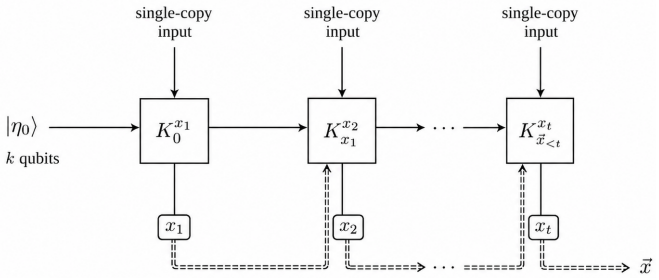
We study stabilizer state testing and learning with limited coherent quantum memory. Here an algorithm sequentially receives copies of an unknown $n$-qubit state, but may keep only $k$ qubits of coherent quantum memory between measurements. With unrestricted memory, seminal work of Gross, Nezami and Walter showed how to test $n$-qubit stabilizer states using $6$ copies, which is dimension independent, unlike the learning complexity of $\Theta(n)$. We show that this testing-vs-learning separation is lost under memory constraints. More concretely we show that (1) The sample complexity of testing stabilizer states in the $k$-qubit memory framework is $\Theta(n-k)$. Our upper bound goes via a novel connection to the hidden shift problem and the lower bound is proven using a novel approach to average case bounds on likelihood ratios via combinatorics of the stochastic orthogonal group. (2) The sample complexity of learning stabilizer states with $k$ qubits of memory, in the non-adaptive framework, is $\Theta(n^2/k)$. As a further application of our techniques, we prove an exponential lower bound for purity testing even when the memory may be left coherent throughout the protocol. Our main results identify coherent quantum memory as the resource enabling the usual separation between stabilizer testing and learning. In particular, even with $k=0.99n$ qubits of memory, there is no constant-copy stabilizer tester; furthermore for $k=cn$ qubits of memory (for $0< c < 1$), stabilizer testing is as hard as learning, with both requiring $\Theta(n)$ copies.
0
0
math.PR 2026-07-03

Formula equates Wilson loop correlations to topology in cluster model

by Paul Duncan, Benjamin Schweinhart

A Topological Formula for Potts Lattice Gauge Theory Correlations

The link yields equal correlation lengths across dual models and exponential decay away from criticality.

Figure from the paper full image
abstract click to expand
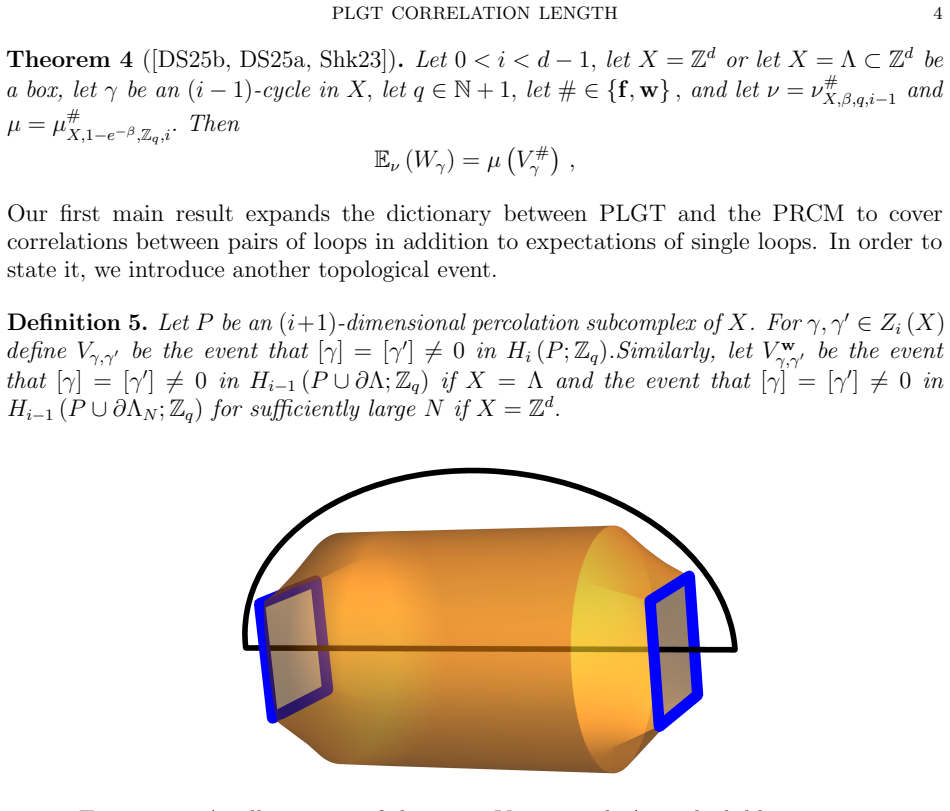
We exhibit a formula relating the correlation between Wilson loop variables in Potts lattice gauge theory to a topological quantity in the plaquette random cluster model. As applications we show that the correlation length of the model on $\mathbb{Z}^4$ with free boundary conditions equals that of the dual model with constant boundary conditions, we prove exponential decay of correlations between slowly growing Wilson loop variables for Ising lattice gauge theory on $\mathbb{Z}^3$ at all but the critical temperature, and we demonstrate that the correlation length is finite at sufficiently high or low temperatures in any dimension.
0
0
math.CO 2026-07-03

Symmetric edge polytopes fail gamma-positivity test

by Luis Ferroni

Symmetric edge polytopes are not gamma-positive

An infinite family of counterexamples begins at dimension 36, showing their Ehrhart h*-polynomials are not always gamma-positive.

Figure from the paper full image
abstract click to expand
A conjecture posed by Ohsugi and Tsuchiya (2019) postulates that the Ehrhart $h^*$-polynomials of symmetric edge polytopes are $\gamma$-positive. We disprove this conjecture by exhibiting an infinite family of counterexamples. The smallest example provided by our construction is a $36$-dimensional symmetric edge polytope.
0
0
math.CT 2026-07-03

Directed univalence holds for simplicial objects in any ∞-topos

by Evan Cavallo, Emily Riehl +1 more

Directed univalence for simplicial objects in an infty-topos

Equivalence of hom types in the universal left fibration with function types validates the axiom in this semantic model.

abstract click to expand
A fundamental component of homotopy type theory, a synthetic theory of $\infty$-groupoids, is Voevodsky's univalence axiom. Univalence characterizes the identity types in the universal fibration, a classifier for small type families: identity types in the universe are equivalent to types of equivalences. The directed univalence axiom plays a similar foundational role in simplicial type theory, a synthetic theory of $\infty$-categories. In its original form, which does not include universes or directed univalence, the simplicial type theory has semantics in categories of simplicial objects in an $\infty$-topos, with synthetic $\infty$-categories corresponding to internal $\infty$-categories. We verify that directed univalence holds in this semantic setting, constructing an equivalence between hom types in the universal left fibration and function types. In fact, we verify a higher version of this result, constructing an equivalence between homotopy coherent composites in the universal left fibration and composable sequences of functions between types. Using the technique of weighted limits, we reduce this theorem for simplicial objects in an arbitrary $\infty$-topos to calculations "on the left" with simplicial sets.
0
0
math.CO 2026-07-03

Strong Δ-matroids equal those without peerless antipodes

by Kieran Calvert, Aram Dermenjian +2 more

Characterisations of strong Delta-matroids

Five equivalent characterisations unify exchange axioms and arise from tropicalisation of the orthogonal Grassmannian quadratics.

Figure from the paper full image
abstract click to expand
We study characterisations of strong $\Delta$-matroids, compiling a list of five equivalent descriptions. We show a variant of Wenzel's exchange property and the hyperplane exchange property of Borovik-Gelfand-White are equivalent. We also introduce two novel characterisations in terms of 'peerless' and 'isolated' antipodes within the system of feasible sets, banning certain configurations of antipodes either globally or locally. As a corollary, we obtain new 'local' exchange axioms for matroids and $\Delta$-matroids. We give algebraic motivation for these new characterisations by introducing the peerless antipode equations, tropical equations that govern whether a $\Delta$-matroid has no peerless antipodes. We show that these arise as the tropicalisation of a specific basis of quadratics cutting out the orthogonal Grassmannian.
0
0
math.AP 2026-07-03

First existence and uniqueness for quasilinear Allen-Cahn systems

by Harald Garcke, Tim Laux +1 more

Weak and strong solutions for a class of quasilinear Allen--Cahn systems

Local strong solutions via maximal regularity and global weak solutions via higher integrability hold despite non-convex gradient energies.

abstract click to expand
We consider a quasilinear Allen--Cahn system which arises when the gradient energy term in the Ginzburg--Landau energy also contains zero order terms. Such systems offer significant advantages in applications, since surface tensions and mobilities can be easily calibrated. The analysis for these systems is highly challenging, partly due to the fact that the gradient term in the energy is non-convex and since gradient terms appear quadratically in the weak formulation. This explains why an existence theory has been lacking for nearly thirty years. In this paper, we give the first existence and uniqueness results for such systems. Firstly, we prove existence and uniqueness of local-in-time strong solutions using the theory of maximal regularity. Here, non-standard techniques have to be applied due to the fact that linear constraints on the solution are involved and due to nonlinear boundary conditions. Secondly, using a minimizing movement approach we show the existence of global-in-time weak solutions. Here, the main difficulty arises from the fact that the underlying energy is not $\lambda$-convex. We overcome this issue by proving higher integrability of the gradient of the solution, first showing that solutions are bounded and then using an approach by Giaquinta and Modica. This finally allows us to pass to the limit in the time-discrete approximation. Using the de Giorgi interpolation technique, we are also able to show a sharp energy decay property despite the lack of convexity of the energy.
0
0
math.AP 2026-07-03

Cartan equations hold for C^0 ∩ H^{1/2} coframes

by Isaac Newell, Luc Nguyen

Cartan's and Gauss's equations and rigidity theorems for isometric embeddings in low Sobolev regularity

The Gauss curvature identity then applies to isometric embeddings down to W^{1+2/3,3} regularity and yields convexity statements for nonnega

abstract click to expand
Let $\{\eta^i\}_{i=1}^2$ be a an orthonormal coframe on a domain $U$ on a smooth surface $(\Sigma,g)$. When $\eta^i$ is smooth, it is well-known that there is a unique connection 1-form $\omega$ verifying Cartan's first structural equations $d\eta^i = (*\eta^i) \wedge \omega$, and Cartan's second structural equation $d\omega = K_g dvol_g$. We prove that this statement remains valid when the frame is $C^0 \cap H^{\frac12}$, where the structural equations are understood in the sense of distributions. From this, we deduce that the Gauss equation $\mathrm{Det}\, D^2 f = K_g (1+|Df|^2)^2$ holds for every graphical representation $f$ of an isometric embedding of regularity $C^1 \cap W^{1+\frac23,3}$ or $c^{1,\frac12} \cap BV^2$. As an application, we prove regularity and convexity results for isometric embeddings of closed surfaces and convex caps with $K_g \geq 0$.
0
0
math.PR 2026-07-03

Chord-swap chain mixes in polynomial time for fixed genus

by Renan Gross, An{j̣ela Šarković

Polynomial mixing for polygonal side matchings

Genus-preserving swaps connect all diagrams of a given genus and reach uniform distribution after polynomially many steps.

Figure from the paper full image
abstract click to expand
We introduce a natural Markov chain on chord diagrams, which, at every step, selects two random chords and swaps them if doing so preserves the diagram's genus. This generalizes the chord swap chain on the Catalan structure of non-intersecting chord diagrams. We show that for fixed genus, the chain mixes in polynomial time.
0
0
math.PR 2026-07-03

Competition alters random walk range fluctuations

by Maxence Baccara

On the range of competing random walks

A central limit theorem for sites visited exclusively by one of N walks includes an explicit correction from the others when d/β is between

abstract click to expand
We consider $N$ independent random walks $X^1,\dots,X^N$ in the lattice $\mathbb{Z}^d$ and prove limit theorems for the competitive range $\mathcal{R}_n^k$ of the $k$-th random walk $X^k$, which corresponds to the number of distinct sites that it has discovered before any of the other $X^\ell$, $\ell\ne k$, up to time $n$. This is a natural object to study foraging mechanisms in population ecology, in which context it is also natural to ask how the effect of competition for the access to resources affects the number of resources consumed by each individual. We work with random walks in the domain of attraction of a $\beta$-stable law and focus on the regime $d/\beta\in[1,3/2)$, in which classical results for the range show that the fluctuations are described by the renormalized self-intersection local time of the limiting process. We establish a central limit theorem in which a competition term emerges, thus answering the two previous questions we asked. We end the paper with a brief discussion on the remaining regimes $d/\beta\ge3/2$, in which the fluctuations are Gaussian and are not affected by the competition, and $d/\beta<1$ in which no strong law of large numbers holds and we expect the effect of the competition to strongly affect the first-order asymptotics.
0
0
cs.CG 2026-07-03

Piecewise rational cap volumes give exact ham-sandwich algorithms

by Marie-Charlotte Brandenburg, Jesús A. De Loera +1 more

From Ham-Sandwich to Centerpoints: Semialgebraic Algorithms for Cutting Polytopal Measures

For polytopal measures the cap-volume function is piecewise rational, turning prescribed-proportion cuts into polynomial-time semialgebraic

abstract click to expand
We design exact algorithms for the ham-sandwich and centerpoint theorems for polytopal measures. Our key observation is that the cap-volume function of such a measure, i.e., the volume cut off by a halfspace, is piecewise rational on a natural decomposition of the space of oriented hyperplanes. This lets us recast prescribed-proportion cutting problems as semialgebraic feasibility problems. For fixed ambient dimension, this yields polynomial-time algorithms to decide the existence of cuts, describe the full solution set, and sample or enumerate solutions. We extend this framework to the center transversal theorem, showing that spaces of deep affine flats are semialgebraic, which holds for centerpoints. We further show that the set of centerpoints of a convex polytope coincides with its floating body at level $1/(d+1)$, a useful semialgebraic description.
0
0
math.DG 2026-07-03

Intrinsic Brown-York mass expands to ADM mass plus shape correction

by Jiangcheng You

Intrinsic Brown--York Type Mass at Infinity in Four Dimensions

For large convex hypersurfaces the boundary term converges to ADM mass; the correction vanishes for nearly round surfaces under decay compat

abstract click to expand
We study a Brown--York type mass for closed hypersurfaces in four-dimensional asymptotically flat manifolds. The reference mean curvature is defined intrinsically as the trace of the positive solution of the contracted Gauss equation. For large uniformly convex hypersurfaces with controlled scale, we derive an expansion consisting of a boundary term converging to the ADM mass and a shape-dependent correction. For the four-dimensional analogue of the nearly round surfaces of Shi--Wang--Wu, this correction vanishes under a natural decay compatibility condition.
0
0
math.DG 2026-07-03

Mutual actions merge 3-anchored bundles into 3-Lie algebroids

by Begüm Ateşli, Oğul Esen +1 more

Couplings of 3-anchored Bundles

The bicocycle double cross product unifies semi-direct products, cocycle extensions and related constructions on Whitney sums.

abstract click to expand
This work develops an algebraic framework for merging two $3$-anchored bundles over the same base manifold, equipped with mutual actions and two twisted cocycle terms, so as to obtain a $3$-Lie algebroid structure on the corresponding Whitney sum. We also record the purely algebraic counterpart of this construction, namely the bicocycle double cross product $3$-Lie algebra, obtained by removing the anchor and Leibniz-type compatibility conditions. The resulting framework provides a unified setting for $3$-Lie algebroids and contains, as special cases, unified products, double cross products, semi-direct products, cocycle extensions, and direct products.
0
0
cs.IT 2026-07-03

Fixed sparse connections cut phase-shifter count by up to 62 percent

by Honghao Wang, Qingqing Wu +4 more

Ultra-Low-Cost Hybrid Beamforming: A New Static-Connection Architecture with Sparse Phase-Shifter Sharing

The architecture keeps beamforming performance close to full-PS sub-connected designs while lowering hardware needs in single- and multi-RF

Figure from the paper full image
abstract click to expand
Hybrid beamforming is a promising solution for high-frequency multi-antenna wireless systems, but its implementation is constrained by the cost and complexity of analog phase-shifter (PS) networks. Although sub-connected architectures simplify the analog network, their conventional realization still requires a dedicated PS for each antenna, causing considerable layout area, wiring, calibration, and control overheads. To address this issue, this paper proposes a novel static-connection architecture with sparse PSs for ultra-low-cost sub-connected hybrid beamforming, where antennas within each sub-array share a PS through an optimized fixed PS-to-antenna connection matrix. The proposed architecture preserves static connections while enabling dynamic beam control via adaptive PS phase-shift adjustments and digital precoding. For the single-radio-frequency (RF)-chain scenario, the sparse-PS connection design is transformed into an antenna-grouping problem, with analytically characterized structural properties and an efficient algorithm. For the multi-RF-chain scenario, we develop a quality-of-service (QoS)-majorization-minimization (MM) algorithm to handle the mixed discrete-continuous optimization problem. Numerical results demonstrate that the proposed architecture reduces the PS count while preserving most beamforming capability of the traditional full-PS sub-connected architecture. In particular, the proposed design achieves PS-count reductions of 37.5% and 62.5% in single-RF-chain and multi-RF-chain systems, respectively, while avoiding deep-null and grating-lobe degradations associated with deterministic connection schemes. These results provide engineering insights into static sparse-PS sharing: the key to hardware-efficient hybrid beamforming is not merely reducing the PS count, but also preserving essential analog-domain degrees of freedom through optimized PS connection topologies.
0
0
math.NT 2026-07-03

Gauss-sum matrix over cyclic units reduces via periods

by Hai-Liang Wu, Li-Yuan Wang

The Gauss periods and cyclotomic matrices involving Gauss sums over cyclic groups

For prime-power modulus the array A_k(χ) of sums G_N(χ^{ki+kj}) is analyzed using known period identities.

abstract click to expand
In this paper, by using the arithmetic properties of the Gauss periods and character sums over cyclic groups, we study the cyclotomic matrix $$A_k(\chi)=\left[G_N(\chi^{ki+ki})\right]_{0\le i,j\le \varphi(N)/k-1},$$ where $N=p^m$ is a prime power, $\varphi(\cdot)$ is the Euler totient function, $k$ is a divisor of $\varphi(N)$, $\chi$ is a generator of character group $\widehat{(\mathbb{Z}/N\mathbb{Z})^{\times}}$, and $$G_N(\chi^{ki+kj})=\sum_{x\in\mathbb{Z}/N\mathbb{Z}}\chi^{ki+kj}(x)e^{2\pi ix/N}$$ is the Gauss sum over $\mathbb{Z}/N\mathbb{Z}$.
0
0
math.DS 2026-07-03

Memory breaks consensus into periodic multiconsensus via global Hopf bifurcation

by Casey Maikalani Crane

Consensus-Breaking Global Hopf Bifurcation in Memory-Based Multi-Agent Systems

Equivariant degree classifies the transition in three delay-equation classes, with UAV and market examples.

Figure from the paper full image
abstract click to expand
This dissertation provides the first systematic study of symmetric consensus-breaking bifurcation to periodic multiconsensus in multi-agent systems. It analyzes this for three classes of multi-agent systems based on three different types of memory, whose closed-loop dynamics equations form delay differential equations of retarded type, neutral type, and pseudoneutral type - a subclassification of retarded type equations introduced in this dissertation which bridges retarded and neutral type delay equations. Equivariant twisted degree is used to analyze the symmetric global Hopf bifurcation problem in these systems, i.e. bifurcation from a stable consensus to periodic multiconsensus. This shows how the effects of memory allow self-organizing agents to move beyond mere stationary consensus. Theoretical results for the global Hopf bifurcation and symmetric classification of periodic multiconsensus solutions across all three systems are provided, and numerical results are conducted to both validate and enhance the theoretical predictions by providing stability information on the branches which is not obtainable by the degree alone. These principles are demonstrated in three real-world applications: one involving the control of formations of UAVs, allowing them to maintain their overall spatial relationships while dancing in complex selectable oscillations; and two more in networked asset markets featuring different traders with different memory-based strategies, showing how similar mechanisms can be responsible for economic cycles of bubbles and crashes. Finally, we also numerically investigate resonant double Hopf bifurcations in the neutral delay system, showing strong evidence of a breakdown to chaos via the Ruelle-Takens-Newhouse scenario and the existence of riddled basins.
0
0
cs.IT 2026-07-03

Galois connections extend weight bounds from field codes to ring codes

by Yang Xu, Haibin Kan +1 more

Generalized Rank Weight and Extended Generalized Poset Weight Defined For Codes Over Rings: A Galois Connection Approach

Generalized rank weights over chain rings and poset weights over quasi-Frobenius rings inherit Singleton bounds and dualities.

abstract click to expand
In this paper, we study generalized rank weights (GRWs) and extended generalized poset weight (EGPWs) of codes over rings via a Galois connection approach. First, we show that various coding-theoretic properties related to generalized weights, including security drops of a code employed in wire-tap channel of type II, connections between generalized weights of a Gabidulin code and its associated Delsarte code, (generalized) Singleton bound, MDS discrepancy of a code, characterizations of MDS, near MDS, $i$-MDS, MRD, near MRD, $i$-MRD, (dually) quasi-MRD codes as well as evasive property of subspaces, can be reformulated in terms of Galois connections. Next, we study GRWs and rank profiles defined for modules over principal ideal rings, especially those over chain rings. Generalizing GRWs defined for vector spaces over fields, we establish a singleton bound and a Wei-type duality theorem, characterize MRD, near MRD and dually quasi-MRD codes and determine their GRWs; moreover, we characterize $i$-MRD codes and establish a scattered bound for $(h,h)$-evasive codes over chain rings, generalizing counterpart result established for vector space over finite fields. Finally, we propose and study EGPWs and extended poset profiles defined for modules with a composition series, which in fact form a Galois connection. Generalizing EGPWs defined for modules over finite Galois rings, we establish a Wei-type duality theorem for modules over arbitrary quasi-Frobenius rings, which unifies the two Wei-type duality theorems derived in both \cite{32} and \cite{33}.
0
0
stat.ML 2026-07-03

LLM personas split into frame-stable aggregates and frame-sensitive geometry

by Yuan Yuan

The Dual Nature of LLM Persona: Aggregated Tendencies and Frame-Dependent Geometry

Aggregate trait scores resist frame changes while correlation structure drops 42% on mismatch and recovers with alignment.

Figure from the paper full image
abstract click to expand
Evaluations of LLM personas via psychometric questionnaires typically rely on aggregate scores, discarding within-instance correlation structure. We test whether this geometric structure is intrinsic or frame-dependent. Constructing within-instance correlation matrices from IPIP-50 responses, we analyze geometry on SPD manifolds under manipulated question orderings in GPT-4o simulating American and Chinese-American personas. We find that persona expression comprises two dissociable components: aggregated features (Big Five scores) degrade under randomization (21% drop) but are frame-robust; geometric features (SPD manifold) collapse under frame misalignment (42% drop) but recover substantially (to 84%) under shared frames, surpassing aggregated features (76%). This collapse-recovery pattern reveals that persona geometry is not intrinsic but a frame-dependent coordination pattern encoding information invisible to aggregation. Our findings establish a dual-nature framework for LLM personas, frame-dependent geometry versus frame-robust aggregates, necessitating frame-aware evaluation and challenging static trait conceptions.
0
0
math.PR 2026-07-03

Sources and sinks turn chemical Markov chains into ergodic processes

by E. Franco, J. J. L. Velázquez

Flux solutions for stochastic chemical systems with sources and sinks

Augmented reaction networks converge to unique stationary measures that support sustained fluxes, allowing explicit computation of membrane

Figure from the paper full image
abstract click to expand
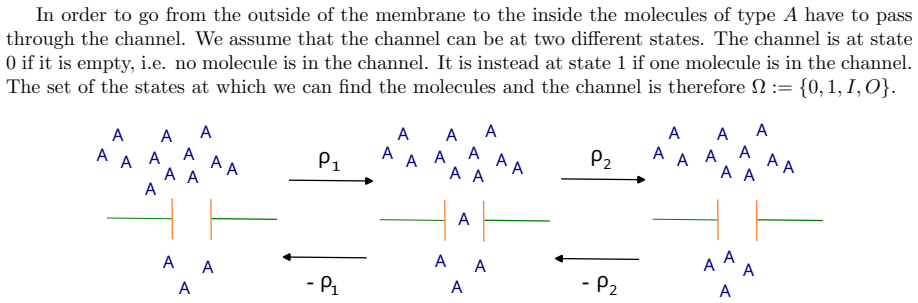
In this paper we study a class of stochastic chemical systems that, in general, do not satisfy the property of detailed balance nor the property of complex balance. These systems are obtained by adding sources and sinks to conservative chemical systems. This procedure is a way to define rigorously stochastic chemical systems in contact with reservoirs. We prove that these systems are non-explosive Markov chains and we prove that they converge to a steady state as time tends to infinity. The stationary solution are out of equilibrium solutions. We conclude the paper by applying our results in order to describe fluxes of molecules through some membrane channels.
0
0
cs.IT 2026-07-03

Weight distribution of RM(3,11) computed exactly

by Kirill Khoruzhii, Patrick Gelss +1 more

The Weight Distribution of the Third-Order Reed-Muller Code of Length 2048

The calculation over all 3.69 million cubic orbits also raises the covering radius lower bound to 408

Figure from the paper full image
abstract click to expand
We compute the weight distribution of the third-order Reed--Muller code RM(3,11) of length 2048. The weight enumerator is assembled from the coset weight enumerators of f+RM(2,10), evaluated for representatives of all 3691560 nonzero GL(10,2)-orbits of Boolean cubic forms in ten variables. The computation rests on a structural theorem: a nondegenerate Boolean cubic form admits a nondegenerate hyperplane restriction, except for a single orbit in each odd dimension. The same pass determines the second-order nonlinearity of every cubic form: the relative covering radius of RM(2,10) in RM(3,10) is 408, attained on 179 orbits. This raises the best known lower bound on the covering radius of RM(2,10) from 400 to 408. A complementary heuristic search shows that the relative covering radius of RM(6,10) in RM(7,10) is at most 32, improving the previous bound of 50.
0
0
cs.DS 2026-07-03

Sparsity bound gives poly-time deterministic exact root for sparse powers

by Qiao-Long Huang, Yichuan Cao +2 more

Deterministic Polynomial-time Exact-root Computation for Sparse Polynomials with Bounded Total Degree

When total degree is bounded, the base of an exact e-th power has at most s to a power linear in D terms, so the root can be recovered deter

abstract click to expand
We study the problem of deterministically computing the exact root of a sparse polynomial in the multivariate setting. Let $f \in \F[x_1,\ldots,x_n]$ be a nonzero polynomial that is an exact $e$-th power, say $f = g^e$. Suppose $f$ is $s$-sparse, has an individual degree of at most $d$, and a total degree of $D = \tdeg(f)$. We prove a sparsity bound on the base polynomial $g$: \[ \|g\|_0 \le s^{D(2d+2)/e + 1}. \] Based on this bound, we develop a deterministic algorithm that computes the base $g$. % In contrast to the general deterministic factorization algorithm of Bhargava, Saraf, and Volkovich \cite{BhargavaSarafVolkovich2020}, which achieves only a quasi-polynomial dependence on the input parameters, our algorithm is \emph{polynomial-time} in the setting where the total degree $D$ is bounded. Specifically, the overall complexity is \[ \mathrm{poly}\left(s^{O(Dd)}, n, d, D\right) + s\cdot R(e), \] % where $R(e)$ denotes the cost of constructing a single $e$-th root of a scalar in the base field $\F$, and, when $\operatorname{char}(\F)\mid e$, the cost of computing a single Frobenius root of a scalar. % This term is field-dependent, and over finite fields, $\mathbb{Q}$, or number fields with a suitable representation, it is absorbed into the polynomial complexity bound. % Within the bounded total-degree regime, this yields a deterministic polynomial-time algorithm for exact-root computation.
0
0
math.NA 2026-07-03

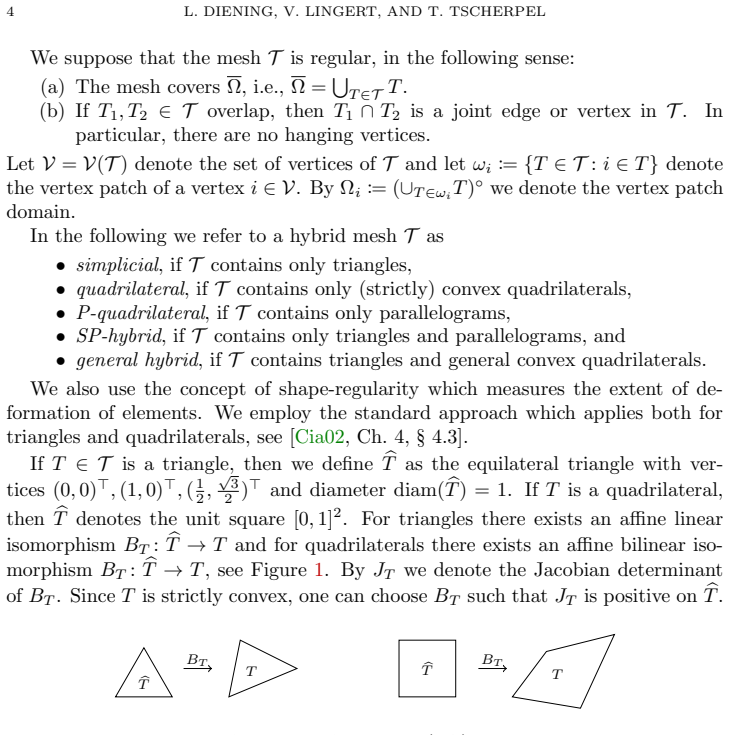
L²-projection stays W¹,²-stable on hybrid meshes for K≥2

by Lars Diening, Viktoria Lingert +1 more

Sobolev stability of the L²-projection on hybrid meshes

The bound holds for all polynomial degrees starting at two on meshes mixing triangles with convex quadrilaterals from adaptive refinement.

Figure from the paper full image
abstract click to expand
We establish $L^p$- and $W^{1,p}$-stability of the $L^2$-projection onto mapped Lagrange finite elements on hybrid meshes consisting of triangles and convex quadrilaterals arising from adaptive mesh refinement. If $K$ is the (tensor product) degree of polynomials of the discretisation, then we show, in particular, $W^{1,2}$-stability for all $K\geq 2$ for the Q-RG and Q-RB refinements. This extends results by Ali, Funken, and Schmidt (2022) which hold for the range $2 \leq K \leq 9$ for initial meshes consisting of parallelograms. Our proof relies on an extension of the technique by Diening, Storn and Tscherpel (2021) to general convex quadrilaterals.
0
0
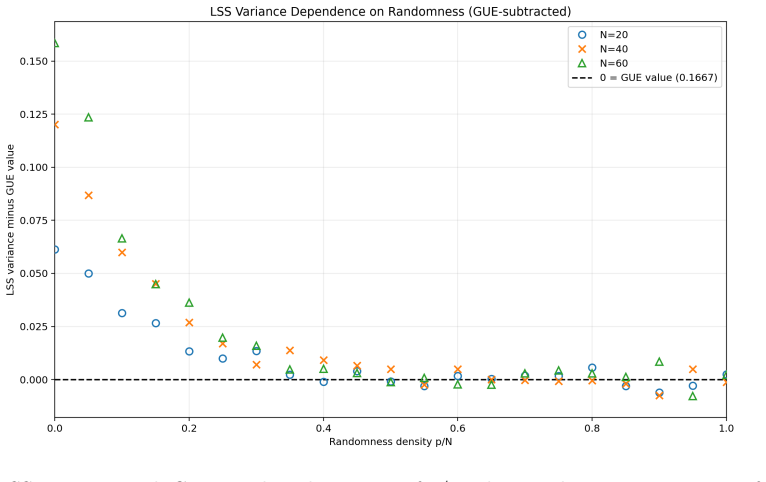
math-ph 2026-07-03

Quantum graph linear statistics match GOE/GUE variance on mesoscopic scales

by Anna Maltsev, Mohammed Osman

Mesoscopic Linear Statistics for Two Ensembles of Quantum Graphs

In the large-graph limit the variances coincide with the classical ensembles for both regular-graph sampling and Haar vertex sampling.

Figure from the paper full image
abstract click to expand
We study mesoscopic linear spectral statistics for two ensembles of random quantum graphs. These are defined by a discrete graph $G$ and a unitary-matrix-valued function $U(k)$ indexed by directed edges of $G$. The matrix function $U(k)$ is constructed from unitary matrices $U^{(v)}$ indexed by the neighbours of each vertex $v$. The first ensemble is obtained by sampling the underlying discrete graph uniformly from the set of $d$-regular graphs. The second ensemble is obtained by sampling $U^{(v)}$ uniformly from the Haar measure, independently for each vertex. We prove that the variance of a linear spectral statistic in the large graph limit on polynomial mesoscopic scales coincides with that of the Gaussian Orthogonal/Unitary Ensemble.
0
0
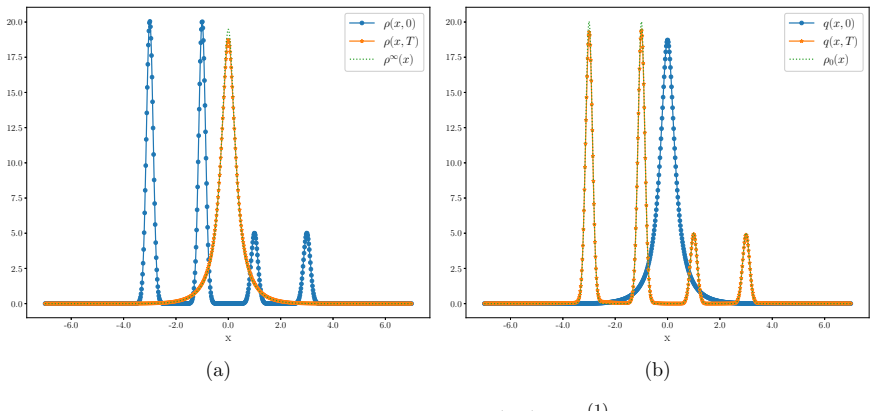
math.NA 2026-07-03

Nonlinear drift yields reverse generative PDE beyond score matching

by Horacio Tettamanti, Michael Herty

A PDE-Based Framework for Generative Modeling Beyond Classical Score-Based Diffusion

A superlinear term in the Fokker-Planck forward process creates condensation from which a stabilized reverse equation recovers the original

Figure from the paper full image
abstract click to expand
We introduce an alternative generative framework based on a nonlinear modification of the classical Ornstein--Uhlenbeck dynamics. The proposed dynamics admits both a microscopic description through an interacting particle system and, in the mean-field limit, a macroscopic formulation given by a nonlinear Fokker--Planck equation with a superlinear drift term. We show that, for suitable choices of the model parameters and sufficiently large initial mass, the forward dynamics exhibits condensation phenomena by proving the loss of $L^2$ regularity of the solution in finite time. Building upon this formulation, we derive a stabilized reverse-time partial differential equation that reconstructs the initial distribution from the asymptotic state of the forward dynamics, thereby extending the generative paradigm beyond the classical score-based framework. Furthermore, we introduce numerical discretizations of both the forward and reverse processes that accurately capture the asymptotic behavior of the continuous model while successfully reconstructing the initial distribution. Numerical experiments in one and two spatial dimensions validate the proposed methodology and illustrate its application to density filtering through successive iterations of the generative process.
0
0
math.CA 2026-07-03

Small Lipschitz tweak forces all level sets to measure zero

by Sorina Barza, Martin Lind

Eliminating positive-measure level sets by small Lipschitz perturbations

For any continuous f, a perturbation with Lip seminorm below any ε makes every level set a null set.

abstract click to expand
We establish a new regularity phenomenon of continuous functions. Specifically, given any continuous function $f$ and arbitrary $\epsilon>0$, we construct a Lipschitz perturbation $g_\epsilon$ whose Lipschitz seminorm is less than $\epsilon$ such that every level set of $f+g_\epsilon$ has Lebesgue measure zero.
0
0
stat.ME 2026-07-03

Bayesian and quasi-Bayesian estimates merge for Poisson decisions

by Stefano Favaro, Sandra Fortini

Merging of Bayes and quasi-Bayes empirical Bayes procedures for Poisson compound decisions

Concentration rates of marginal PMFs produce matching regret decay, so the faster quasi-Bayesian method performs equivalently in the multidi

Figure from the paper full image
abstract click to expand
The Poisson compound decision problem is a long-standing problem in statistics, in which empirical Bayes methods are used to estimate Poisson means under a mixture model. We study this problem from the viewpoint of $g$-modeling, comparing two nonparametric strategies for estimating the unknown mixing distribution: a Bayesian empirical Bayes strategy, based on the Dirichlet process posterior, and a quasi-Bayesian empirical Bayes strategy, based on Newton's algorithm. The latter is computationally attractive, but its relationship with the Bayesian strategy requires theoretical justification. Under a Poisson mixture model with a ``true'', or oracle, mixing distribution, we establish concentration rates for the marginal probability mass functions induced by the Bayesian and quasi-Bayesian estimates. These rates are then translated into rates of decay for the corresponding regrets, interpreted as excess Bayes risks, and used to prove a frequentist merging result between the Bayesian and quasi-Bayesian empirical Bayes strategies. We also extend the analysis to the multidimensional Poisson compound decision problem. Numerical experiments on synthetic data illustrate that the quasi-Bayesian strategy achieves accuracy comparable to the Bayesian strategy, while requiring substantially fewer computational resources, especially in the multidimensional setting.
0
0
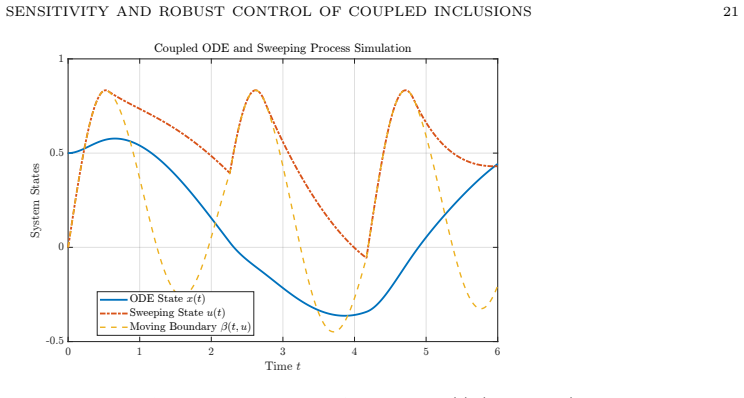
math.OC 2026-07-03

Optimal pairs exist for Bolza problems over coupled evolution inclusions

by Jinsheng Du, Boris Mordukhovich +1 more

Sensitivity Analysis and Robust Optimal Control for Coupled Evolution Inclusions with State-Dependent Maximal Monotone Operators

Value function is continuous and optimal-solution map upper semicontinuous even under parameter uncertainty.

Figure from the paper full image
abstract click to expand
We consider a class of strongly coupled nonsmooth systems consisting of a semilinear evolution inclusion and a differential inclusion governed by state-dependent maximal monotone operators. Our main contributions are fourfold. First, we collect the well-posedness, compactness, and Painlev\'e--Kuratowski continuity properties of the parameterized solution map required for the subsequent optimization analysis. Second, for Bolza-type optimization over the solution set, we prove the existence of optimal pairs, establish continuity properties of the value function, and derive upper semicontinuity of the optimal-solution map. Third, we study fixed-parameter optimal control, simultaneous control-parameter design, min--max robust control, and Hurwicz-type compromise control under parameter uncertainty, and we establish existence results for each formulation. Fourth, we report numerical experiments for sweeping-type systems that illustrate the sensitivity and robustness phenomena predicted by the theory.
0
0
math.NA 2026-07-03

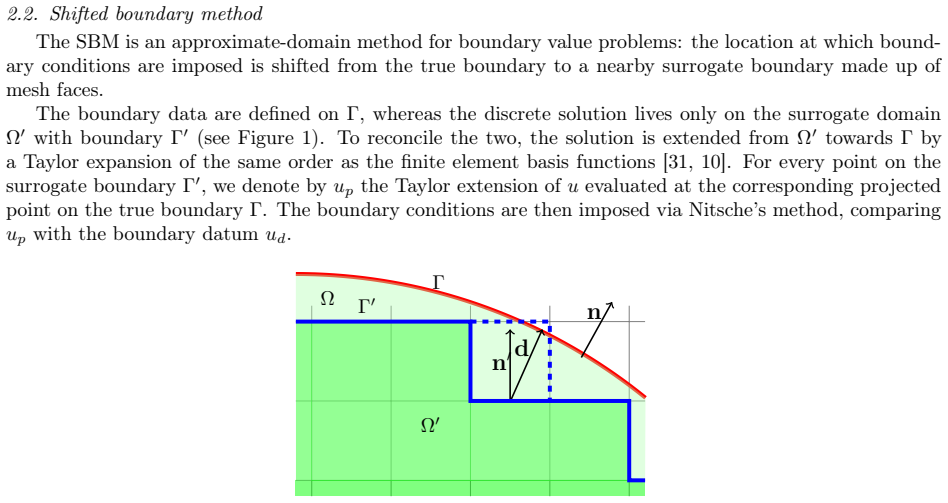
Block preconditioner yields mesh-independent GMRES for SBM Stokes

by Micha{l} Wichrowski, Ajay Ajith

Block Preconditioning for Shifted Boundary Method Discretisations of the Stokes Problem

Field-of-values analysis shows non-symmetric SBM terms become small perturbations of a standard saddle-point operator on fine meshes.

Figure from the paper full image
abstract click to expand
The Shifted Boundary Method (SBM) sidesteps body-fitted meshing by shifting boundary conditions onto a surrogate boundary and correcting for the displacement through Taylor expansions. Despite its broad analysis and application, scalable iterative solvers for the incompressible Stokes equations remain underdeveloped. We present a block preconditioner for SBM--Stokes discretisations that uses the velocity block together with a pressure mass matrix as a Schur complement approximation. Because the SBM system is non-symmetric, classical operator preconditioning does not apply directly; a field-of-values analysis instead shows that the non-symmetric SBM contributions act as asymptotically small perturbations of a standard saddle-point operator, yielding mesh-independent GMRES convergence on sufficiently fine meshes. Numerical experiments demonstrate iteration counts under refinement across geometries of increasing complexity. We expose a coarse-mesh regime in which an under-resolved grid produces elevated iteration counts, an artefact of insufficient resolution that vanishes once the mesh captures the geometry.
0
0
math.NA 2026-07-03

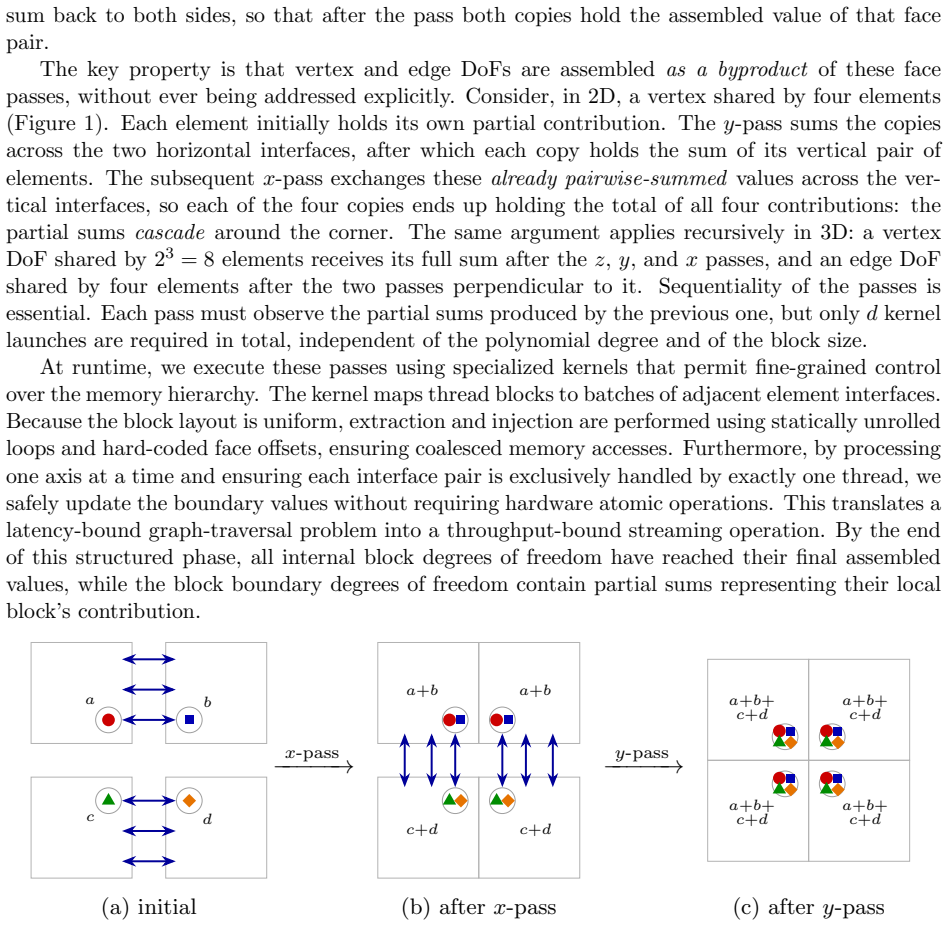
Flexible CG runs exactly on cell-local vectors with continuous preconditioners

by Micha{l} Wichrowski

Coalesced Matrix-Free Finite Elements in Cell-Wise Storage

Primal-dual pairing keeps every Krylov scalar identical to the assembled solve and confines communication to the preconditioner step alone.

Figure from the paper full image
abstract click to expand
We present a GPU-oriented formulation of continuous high-order finite elements in which the redundant, cell-wise (element-local) vector is the persistent primary representation of all field data, rather than a transient stage of matrix-free operator evaluation. We prove that, given a preconditioner whose image is continuous, the entire flexible conjugate gradient iteration can be carried out exactly on this unassembled representation: a simple primal-dual pairing identity shows that all Krylov scalars computed from local data coincide with those of the assembled solve, so inter-element communication is confined entirely to the preconditioner. The required direct stiffness summation (DSS) is then realized without indirect gather-scatter, atomics, or coloring, by a dimensionally-split cascade of one-to-one face exchanges that provably accumulates edge and vertex contributions as a byproduct of sequential axis passes; unstructured macro-block interfaces and $h$-adaptive hanging nodes are handled by disjoint topological kernels and a shadow-cell wrapper that leaves the high-throughput sweeps untouched. The cell-wise storage decouples the memory layout from the mesh topology, and we exploit this freedom to benchmark blocked layouts that trade memory coalescing against element contiguity. Numerical experiments on modern GPUs demonstrate that the resulting operator evaluation and solver outperform state-of-the-art matrix-free implementations, signifficantly exceeding throughput of existing implementations.
0
0
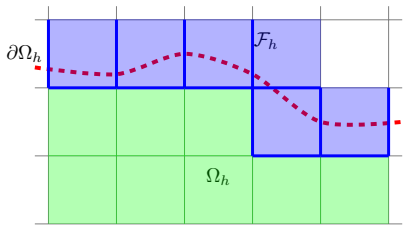
math.NA 2026-07-03

Energy stationarity defines CutFEM for finite-strain elasticity

by Micha{l} Tomasz Wichrowski, Ella Godiva Noomen

A Unified CutFEM Formulation for Finite-Strain Elasticity: Energy Minimisation and Corner Singularities

Automatic differentiation supplies model independence while analysis proves cut-independent stability and shows singularity limits match tho

Figure from the paper full image
abstract click to expand
We present a fully variational, model-independent formulation of the Cut Finite Element Method (CutFEM) for finite-strain elasticity. The discrete problem is the stationarity condition of a augmented energy functional consisting of the bulk hyperelastic energy, the Nitsche terms that impose the boundary conditions weakly, and the ghost-penalty stabilisation. The residual and the (symmetrised) tangent follow from this functional by successive variations. Automatic differentiation (AD) generates the first Piola--Kirchhoff stress tensor and the elasticity tensor directly from the scalar energy density, avoiding manual re-derivation when exchanging hyperelastic models. To our knowledge, this is the first unfitted finite-strain scheme combining an energy-only, model-independent construction with AD and an accuracy analysis at unfitted boundaries. Analysis of the linearised problem solved at each Newton step establishes cut-independent coercivity, continuity, and an $O(h^{-2})$ condition number bound, yielding a quasi-optimal convergence theorem for regular solutions through the Brezzi--Rappaz--Raviart framework. Numerically, the method attains optimal $h$-convergence for linear, quadratic, and cubic elements on a smooth test case. Furthermore, we quantify the method's accuracy limit at mixed Dirichlet--Neumann junctions using the Kolosov--Muskhelishvili characteristic equation. The exact solution's corner singularity caps the convergence rate identically for fitted and unfitted methods. We demonstrate that local mesh refinement removes this bound, with the unfitted discretisation inheriting the recovered optimal rates and cut-independent constants.
0
0
stat.ME 2026-07-03

CAP matches empirical risk at first order and removes second-order bias

by Yijian Huang

Cross-Audit Projection for Model Risk Prediction

Resampling audit plus asymptotic projection corrects over-optimism in binary classification risk estimates without sacrificing leading accur

Figure from the paper full image
abstract click to expand
For training-data-based model risk prediction, $K$-fold cross-validation~(CV) is widely used to mitigate the well-known over-optimism of the empirical risk and is often regarded as reliable. However, for binary classification via empirical risk minimization, our numerical studies reveal a surprising phenomenon: $K$-fold CV may perform poorly in estimating class-specific risks, even worse than the empirical estimator. We perform a higher-order asymptotic analysis showing that $K$-fold CV may converge at a slower rate, whereas the empirical estimator exhibits a second-order asymptotic bias that explains its over-optimism. These findings motivate a novel two-step procedure for model risk prediction, termed cross-audit projection (CAP). The cross-audit step adopts the same resampling scheme as $K$-fold CV to estimate over-optimism in subsamples, while the asymptotic-theory-informed projection step adjusts for the reduced sample size in bias correction of the empirical risk. The resulting CAP estimator is first-order asymptotically equivalent to the empirical risk while achieving second-order asymptotic unbiasedness. An accompanying inference procedure is also developed. Simulation studies support theoretical advantages of CAP and demonstrate favorable finite-sample performance. An application to breast cancer detection further illustrates the proposed method.
0
0
eess.SY 2026-07-03

Optimal reliability threshold below P90 cuts reserve costs 14.5%

by Torine R. Herstad, Jalal Kazempour +2 more

Refinement of Reliability Grid Codes in the Provision of Ancillary Services

Bilevel model treats the threshold as a design variable and shows fixed P90 is not cost-minimizing for stochastic providers in Nordic FCR-D

Figure from the paper full image
abstract click to expand
Stochastic resources such as wind farms, electric vehicle aggregators, and demand-side assets are increasingly participating as reserve providers in ancillary service markets. To manage delivery uncertainty, system operators impose minimum reliability thresholds on such providers. Energinet, the Danish transmission system operator (TSO), has pioneered this approach through the P90 requirement, requiring stochastic providers to make accepted reserve capacity bids available with at least 90% probability. Yet this threshold is set by regulatory convention, not optimization: no existing framework treats it as a design variable or characterizes the cost-reliability trade-off it governs. This paper closes that gap. We develop a bilevel optimization framework in which the TSO in the upper level sets the reliability threshold endogenously while providers in the lower levels respond through reliability-constrained bidding, with chance constraints reformulated analytically using a Weibull tail distribution. Applied to the Nordic frequency containment reserve for disturbances (FCR-D) market, the cost-optimal threshold lies below P90 in the studied cases, with cost reductions by up to 14.5% relative to the fixed standard. Dynamic hourly thresholds yield a further reduction of up to 2.4%, suggesting efficiency gains may increase in larger and more diverse reserve markets.
0
0
math.AP 2026-07-03

Fractional Dirichlet solutions split into regular and d^a-singular parts

by Gerd Grubb

The structure of solution spaces for fractional-order operators, with gradient estimates

Direct-sum decomposition on C^{1+τ} domains yields gradient estimates in Sobolev and Hölder spaces when a exceeds 1/2

abstract click to expand
The solution space of the homogeneous Dirichlet problem for the fractional Laplacian $(-\Delta )^{a}$ ($0<a<1$) or a pseudodifferential generalization $P$, on a bounded open set $\Omega \subset R^n$ with $C^{1+\tau }$-boundary, $$ Pu=f \text{ on }\Omega ,\quad u=0 \text{ on }R^n\setminus \Omega , $$ is analysed in detail. It is shown, both for solutions in Sobolev spaces of Bessel-potential type $H_q^t$ and in H\"older-Zygmund spaces $C_*^t$, that the solution space for $f$ of regularity $s\in [0,\tau -2a)$ is the direct sum of a component $\dot H_q^{2a+s}(\bar\Omega)$ resp. $\dot C_*^{2a+s}(\bar\Omega)$ with full regularity $2a+s$ and a component of the form $d^a$ times a lifting of boundary values by Poisson operators. Here $d(x)=dist(x,\partial\Omega )$. This extends to non-smooth problems results known in the $C^\infty $ setting. The knowledge is used to establish gradient estimates for $a>1/2$, e.g. estimating $d^{1-a+s}\nabla (u/d^a)$ in terms of norms of $f$ and $u$, both in $H_q^t$-spaces and $C_*^t$-spaces. This is entirely new in the case of Bessel-potential spaces; it extends previous results by Fall and Jarohs in H\"older spaces. A new tool is introduced: $\dot H^{s+t}_q(\bar\Omega)\subset d^s\dot H^{t}_q(\bar\Omega)$ holds for $s,t\ge 0$ with $s+t<1+\tau $.
0
0
math.RA 2026-07-03

R[x;δ] strongly simple iff R simple

by Johan Öinert

Bimodules in differential polynomial rings

This gives a complete description of the R-sub-bimodules as only truncations or the full ring under those conditions.

abstract click to expand
We study the $R$-sub-bimodule structure of differential polynomial rings $R[x;\delta]$ by introducing the notion of strong simplicity, requiring each nonzero $R$-sub-bimodule of $R[x;\delta]$ to be either $R[x;\delta]$ or the truncation $\sum_{i=0}^n R x^i$ for some $n \in \mathbb{Z}_{\geq 0}$. Our main result gives a complete characterization: $R[x;\delta]$ is strongly simple if and only if $R$ is simple, ${\rm char}(R)=0$, and the derivation $\delta$ is outer. We provide examples illustrating both when strong simplicity fails and when it holds.
0
0
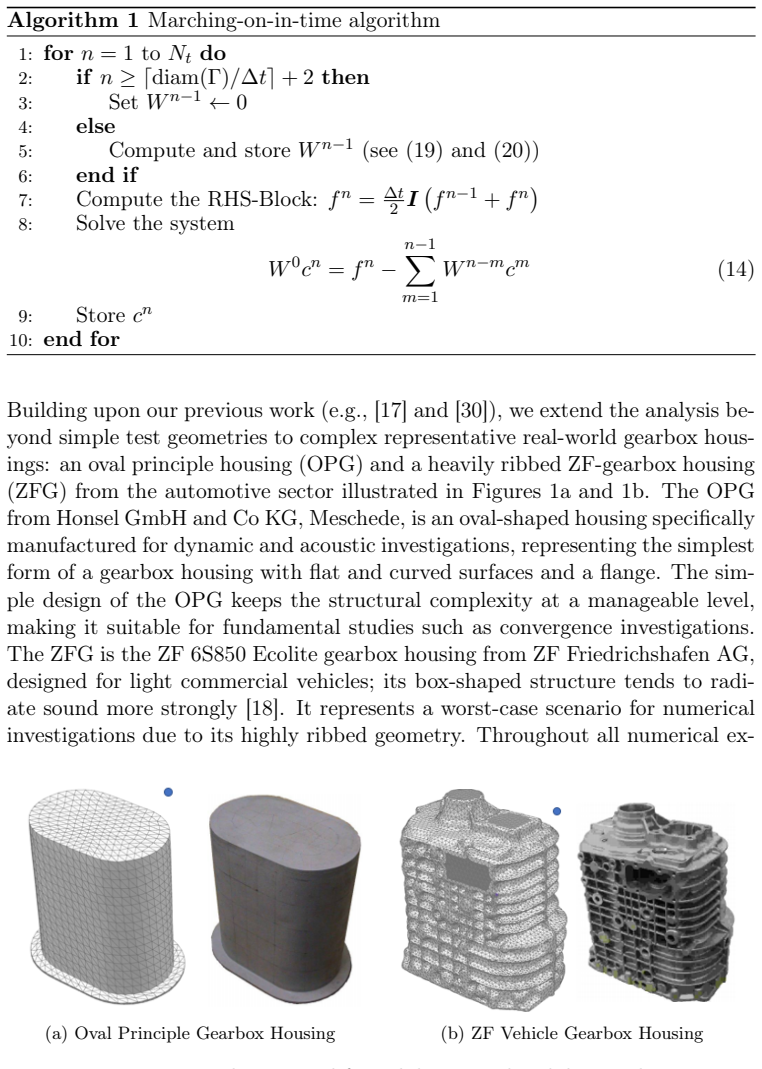
math.NA 2026-07-03

Space-time method keeps acoustics stable for long industrial runs

by Simon Schneider, Ceyhun Özdemir +3 more

A Stable Boundary Element Method for Reliable Long-Time Industrial Sound Emission

The boundary element scheme stays accurate over extended times where standard methods diverge, matching real measurements.

Figure from the paper full image
abstract click to expand
In this paper we investigate a stable space-time formulation for long-time industrial sound emission problems. To this end, we use a well-posed Galerkin formulation in space and time of the acoustic wave equation in $\mathbb{R}^3$, involving a hypersingular boundary integral operator. Our numerical experiments confirm that the resulting time stepping scheme is stable and accurate for complex acoustic problems in industrial geometries, in contrast to alternative well-known schemes. The proposed method is shown to be efficient for real-world problems, and we obtain very good agreement with physical acoustic measurements.
0
0
math.NT 2026-07-03

Factorisation formula extends to Atkin-Lehner quotients of genus zero

by Michael A. Daas

Beyond the Giampietro--Darmon Conjecture

The p-inverted Howard-Yang count proves the Giampietro-Darmon norm formula whenever an Atkin-Lehner quotient has genus zero instead of the f

abstract click to expand
Giampietro and Darmon conjectured a formula for the norm of various algebraic numbers, obtained as infinite products of $p$-adic cross-ratios of CM points. These quantities arose from the $p$-adic uniformisation of Shimura curves and displayed strong parallels with the Gross--Zagier factorisation for the norms of the differences between two singular moduli. The conjectured formula was conditional on the genus of the Shimura curve being zero, and in earlier work, this formula was proved in most cases. In this work, we extend the validity of the factorisation formula beyond what was conjectured by Giampietro and Darmon to many more cases, by relating this to the genus of an Atkin--Lehner quotient of the Shimura curve being zero instead. To this end, we solve a $p$-inverted version of a counting problem that was previously considered in work of Howard and Yang.
0
0
math.CO 2026-07-03

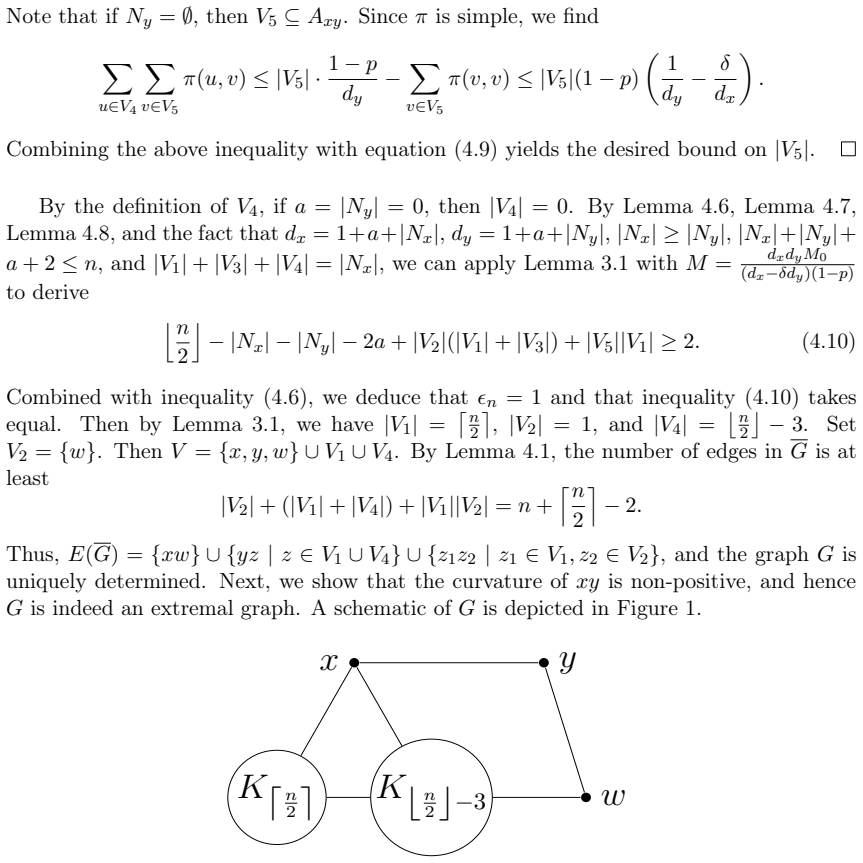
Graphs exceeding T(n) edges must have positive curvature

by Kaizhe Chen, Shiping Liu +1 more

An extremal theorem for positive curvature of graphs

The bound is optimal, with a unique extremal example when n is even and at least 12.

Figure from the paper full image
abstract click to expand
We prove an extremal theorem for positive Ollivier/Lin--Lu--Yau curvature: every graph of order \(n\geq 8\) with more than \[ T(n)=\frac{n^2-3n}{2}-\left\lceil\frac{n}{2}\right\rceil+2 \] edges has positive Ollivier/Lin--Lu--Yau curvature, and this threshold is optimal. Moreover, for even $n\geq 12$, there exists a unique graph with $T(n)$ edges that has an edge with non-positive curvature. For $n=8,10$ and odd $n\geq 9$, the extremal graphs are not unique. This suggests a new class of extremal graph-theoretic problems arising from discrete curvature notions.
0
0
math.AP 2026-07-03

Half-slope invariant extends coagulation-fragmentation existence to m=1

by Truong-Son P. Van

A convexity-type invariant for the critical coagulation--fragmentation Hamilton--Jacobi equation

The convexity bound propagates through the viscous scheme, confirming the mass threshold at unity.

abstract click to expand
We study the critical coagulation--fragmentation equation with multiplicative coagulation kernel \(a(s,\hat s)=s\hat s\) and constant fragmentation kernel \(b(s,\hat s)=1\). Under the Bernstein transform, mass-conserving solutions correspond to solutions of a singular Hamilton--Jacobi equation studied by Tran and Van (Comm.Pure Appl.Math.75 (2022), no.6, 1292--1331). Through this correspondence they proved that mass-conserving solutions are unique on the full critical range \(0<m\le1\), but could establish their existence only for \(0<m<\tfrac12\). We identify a one-sided, convexity-type invariant that holds for Bernstein-transform data and is propagated by their viscous scheme as a genuine maximum-principle bound. We call it the half-slope invariant. It sharpens the curvature barrier and thereby extends mass-conserving existence to the entire critical range \(0<m\le1\). Hence \(m=1\) is the critical mass, confirming the threshold predicted by Vigil and Ziff (J.Colloid Interface Sci.133 (1989), no.1, 257--264). The same invariant appears in the radial partial-mass formulation of the two-dimensional Keller--Segel equation, whose critical mass is \(8\pi\).
0
0
math.QA 2026-07-03

Unitriangular R-matrices conjugate via T-series and Theta series

by Huafeng Zhang

Unitriangular R-matrices of quantum affine algebras and Yangians via Theta series

The formula applies to any finite-dimensional representation and extends to the Yangian case.

abstract click to expand
The universal R-matrix of the quantum affine algebra associated to a finite-dimensional simple complex Lie algebra admits a Gauss decomposition into an uper unitriangular part, an abelian part, and a lower unitriangular part. In this paper, we provide a simple conjugation formula for the unitriangular R-matrices with one tensor factor evaluated at an arbitrary finite-dimensional representation of the quantum affine algebra. Our formula involves the T-series of Frenkel--Hernandez and the Theta series introduced in a previous work. We also extend our conjugation formula to the Yangian case, making use of associators for triple tensor product representations of shifted Yangians.
0
0
math.NA 2026-07-03

Homothetic surfaces enable time-domain reconstruction of 3D obstacles

by Lu Zhao, Heping Dong +1 more

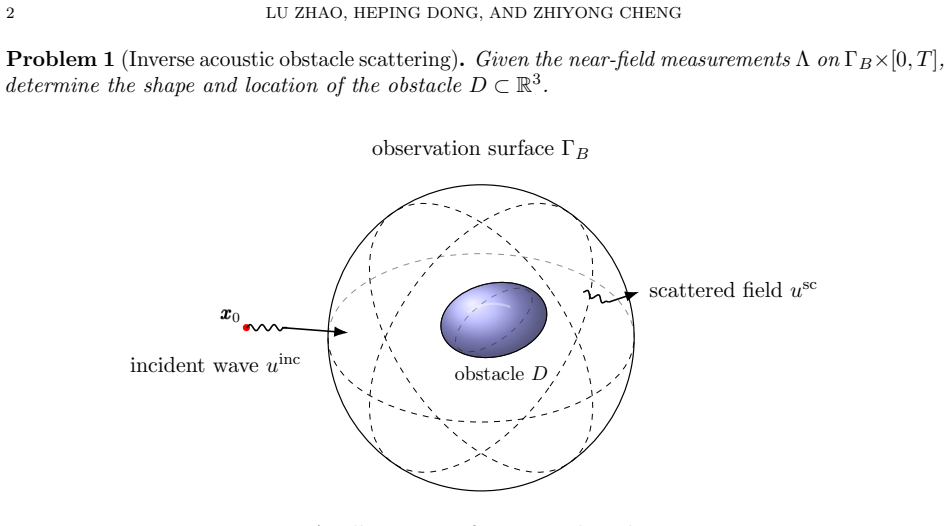
A novel time-domain iterative method for a three-dimensional inverse acoustic obstacle scattering problem

Retarded integrals on scaled surfaces converge to exact fields and support stable iterative recovery of shape and location.

Figure from the paper full image
abstract click to expand
This paper concerns the three-dimensional forward and inverse acoustic obstacle scattering problem in the time domain. For the forward problem, a retarded potential formulation discretized by convolution quadrature and Galerkin methods is introduced. By introducing the retarded boundary integral defined on a homothetic surface, we propose a novel time-domain convolution quadrature based iterative method to reconstruct both the shape and location of a rigid obstacle. The retarded integral in the time domain is reformulated into a system of integrals in the s-domain. The resulting s-domain integrals are very fast to compute, as they only involve non-singular integrals over the homothetic surfaces. Moreover, the Fr\'echet derivative with respect to the boundary can be derived straightforwardly. We also prove that the scattered field generated by the homothetic surface converges to the exact field in the time domain. To improve the stability of the inversion algorithm, an incremental truncation technique is proposed, and numerical experiments confirm the effectiveness and robustness of our method.
0
0
math.AG 2026-07-03

New K3 surfaces detect Gushel-Mukai categorical degeneration

by Ziqi Liu

Bridgeland-Enriques general K3 surfaces

Degree-10 Bridgeland-Enriques general K3 surfaces track degeneration of special threefolds via stability on Enriques categories.

abstract click to expand
This article introduces a notion of Bridgeland-Enriques general K3 surfaces motivated by the study of Enriques categories over K3 surfaces and the invariant Bridgeland stability conditions. The family of Bridgeland-Enriques general K3 surfaces of degree 10 detects a categorical degeneration of special Gushel-Mukai threefolds. Also, the families of Bridgeland-Enriques general K3 surfaces with higher degrees are closely related to Hodge-special Gushel-Mukai fourfolds and double EPW sextics.
0
0
quant-ph 2026-07-03

Bockstein braiding appears for Z_N excitations with p+q=d-1

by Po-Shen Hsin, Yu-An Chen

Bockstein braiding statistics

A unitary process on staggered operators measures statistics that block simultaneous condensation and symmetric gapped phases.

Figure from the paper full image
abstract click to expand
Braiding statistics, from the Aharonov-Bohm phase to anyons in fractional quantum Hall systems, play a central role in quantum physics. For $p$- and $q$-dimensional excitations in $d$ spatial dimensions, ordinary braiding requires $p+q=d-2$. In a field-theoretic description of $\mathbb Z_N$ excitations, ordinary braiding is described by the linking response $(2\pi i/N)\int A_{d-p}\cup B_{d-q}$, where $A_{d-p}$ and $B_{d-q}$ are background fields coupled to the two excitation types. In this work, we identify new mutual statistics in the adjacent case $p+q=d-1$. For two invertible excitations obeying $\mathbb Z_N$ fusion, one can choose local creation operators $X$ and $Y$ whose supports have a staggered one-dimensional overlap. The closed unitary process $W_N(X,Y)=(Y^{-1}X^{-1})^N(YX)^N$ measures the resulting mutual statistic. Its field-theory description is $(2\pi i/N)\int A_{d-p}\cup\beta_N B_{d-q}$, where $\beta_N$ is the Bockstein operation; we therefore call the invariant Bockstein braiding statistics. The construction yields particle-particle statistics in one dimension, particle-loop statistics in two dimensions, and loop-loop or particle-membrane statistics in three dimensions. Nontrivial Bockstein braiding statistics obstructs simultaneous condensation of the two $\mathbb Z_N$ excitations. It also rules out a fully symmetric gapped phase for systems with the corresponding mixed anomaly and implies symmetry fractionalization when one of the $\mathbb Z_N$ symmetries is broken.
0
0
math.OC 2026-07-03

Control system separates strict from ordinary invariance entropy

by Senhan Yao

Invariance Entropy in the Dust

Cantor coordinate and contracting dynamics yield finite strict entropy but infinite ordinary entropy while breaking lower semicontinuity.

abstract click to expand
We answer negatively two natural general forms of Kawan's questions on invariance entropy for control systems, open for more than fifteen years, by a single construction. We show that finite strict invariance entropy need not coincide with ordinary invariance entropy, and that strict invariance entropy need not be lower semicontinuous under Hausdorff perturbations of the initial set. The construction is a continuous-time control system in which a Cantor coordinate stores an infinite symbolic instruction, an exponentially contracting coordinate makes late mismatches geometrically invisible, and a compact matching graph forces exact symbolic agreement. It identifies a source of information complexity not generated by dynamical expansion, but by the persistence of exact viability constraints under thin invariant geometry and by the order of limits in invariance entropy.
0
0
math.MG 2026-07-03

Minkowski theory resolves Pólya-Szegő capacity conjecture

by Qiushuang Liu, Jie Xiao +3 more

A Minkowski Theory for the Exterior Capacitary Volumes and A Resolution of the P\'olya-Szeg\"o Conjecture

Exterior capacitary volumes satisfy volume-like inequalities that confirm the ball extremizes electrostatic capacity among convex bodies.

abstract click to expand
This paper establishes a unified Minkowski theory for exterior p-capacitary volumes and resolves the classical P\'olya-Szeg\"o conjecture on the electrostatic capacity of convex bodies.
0
0
math.PR 2026-07-03

BK equality holds exactly when witnesses are disjoint

by Raphaël Cerf, Pierre Tesio

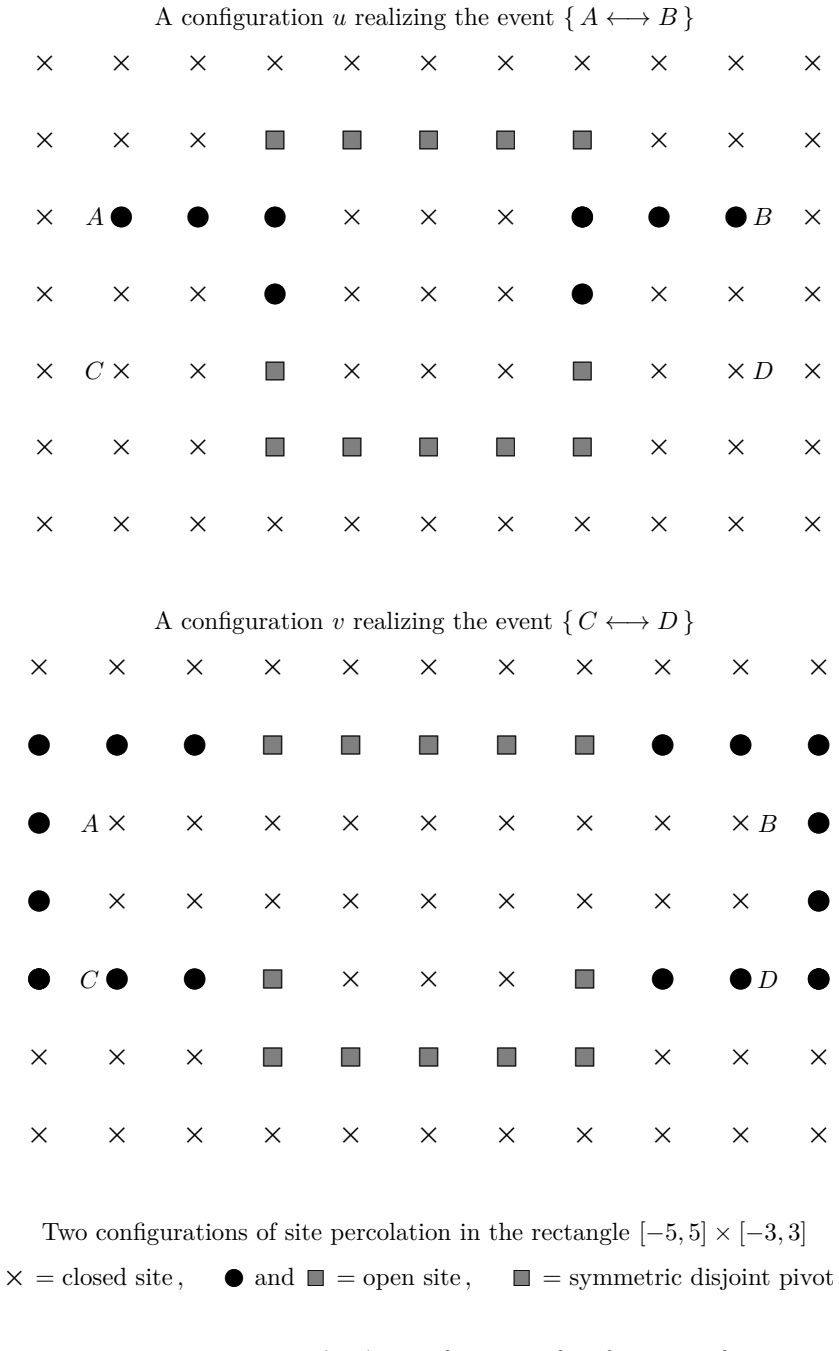
The case of equality in BK

P(A ∘ B) equals P(A)P(B) for increasing events iff every configuration pair admits separate witnesses.

Figure from the paper full image
abstract click to expand
We characterize the pairs of increasing events $A,B$ for which there is equality in the BK inequality. Namely, we show that $P(A\circ B)=P(A)P(B)$ if and only if all the configurations in $A\times B$ admit disjoint witnesses for $A$ and $B$. We discuss the strengthened BK inequality, and we provide a new simplified proof of this inequality.
0
0
math.CO 2026-07-03

Overfull Conjecture holds for graphs with Δ at least (1+ε)n/2

by Guantao Chen, Jessica McDonald +1 more

Towards the Overfull Conjecture II

Result covers all large graphs where maximum degree exceeds half the vertices by any fixed positive fraction.

Figure from the paper full image
abstract click to expand
Let $G$ be a simple graph with maximum degree $\Delta(G)$. A subgraph $H\subseteq G$ is $\Delta(G)$-overfull if $|E(H)|>\Delta(G)\left\lfloor |V(H)|/2\right\rfloor$. In any edge coloring of $G$, each color class restricted to $H$ is a matching of size at most $\left\lfloor |V(H)|/2\right\rfloor$. Thus, if $G$ contains a $\Delta(G)$-overfull subgraph, then $G$ cannot be edge-colored with only $\Delta(G)$ colors. By Vizing's Theorem, $\chi'(G)\le \Delta(G)+1$, and hence $G$ is class $2$. In 1986, Chetwynd and Hilton conjectured that whenever $\Delta(G)>|V(G)|/3$, the converse also holds: every class $2$ graph $G$ contains a $\Delta(G)$-overfull subgraph. This statement, commonly known as the Overfull Conjecture, is one of the most influential conjectures in graph edge coloring. It would imply a polynomial-time algorithm for determining the chromatic index of graphs $G$ with $\Delta(G)>|V(G)|/3$, and would also imply several other longstanding conjectures in the area, including the Just-overfull Conjecture and the Vertex-splitting Conjecture. In previous work, the third author verified the conjecture for large graphs $G$ with maximum degree at least $13|V(G)|/14$. In this paper, we confirm the conjecture for robust expanders satisfying certain density constraints. As a consequence, for every $0<\varepsilon<1$, the conjecture holds for all sufficiently large graphs $G$ with maximum degree at least $(1+\varepsilon)|V(G)|/2$.
0
0
math-ph 2026-07-03

Zero-mode covariance defines mean-field BEC ideal in resolvent algebra

by Yoshitsugu Sekine

Mean-Field Bose--Einstein Condensation and Condensate Ideals in the Resolvent Algebra

Selected condensed density with positive excess yields distinct representation data in nonregular quotients.

abstract click to expand
This paper studies the imperfect Bose gas after the Kac density law and the mean-field Euler equations have selected a condensed density with positive zero-mode excess. In this BEC regime the selected chemical potential cancels the mean-field shift, so the selected one-particle Hamiltonian is exactly the free one. The resulting zero-mode covariance defines a mean-field BEC ideal in the resolvent algebra, while the nonregular quotient and the direct-integral center record distinct representation-theoretic data. Occupation-number and Brownian-loop formulations recover the same density selection, excess density, ODLRO data, local tests, and the separation between finite-density BEC and Buchholz's stricter infinite-occupation proper-condensate criterion.
0
0
math.FA 2026-07-03

Geometric property on Y ensures all L1(μ,Y) elements have optimal tensor reps

by Luis C. García-Lirola, Juan Guerrero-Viu

Functions in L₁(μ,Y) with optimal tensor representations

Holds for Lipschitz-free spaces over scattered metrics, totally disconnected C(K), and c0(Γ); resolves two projective attainment questions.

abstract click to expand
We study the existence and characterization of optimal tensor representations of elements in the space $L_1(\mu,Y)$ of Bochner integrable functions. We completely describe the set of norm-attaining elements in two settings. First, when the Banach space $Y$ is strictly convex, and second, when $Y=L_1(\nu)$ and $\mathbb K=\mathbb R$. In both situations, our analysis yields the existence of non-norm-attaining tensors whenever the underlying measures are not purely atomic. Finally, we introduce a geometric property over $Y$ ensuring that every element in $L_1(\mu, Y)$ admits an optimal representation. In particular, this holds for Lipschitz-free spaces over complete scattered metric spaces, for $C(K)$ spaces when $K$ is a compact Hausdorff totally disconnected space, and for $c_0(\Gamma)$ where $\Gamma$ is any index set. As a byproduct, we settle two open questions regarding projective norm-attainment.
0
0
math.AP 2026-07-03

Existence of stable quasistatic evolutions shown for cohesive fracture

by Vito Crismale, Manuel Friedrich

Quasistatic evolution of cohesive-type fracture

Concave energies with activation thresholds permit unprescribed paths in any dimension via new convergence of memory variables.

Figure from the paper full image
abstract click to expand
We prove the existence of globally stable quasistatic evolutions for a cohesive fracture model with unprescribed crack path and without any topological restriction, in arbitrary dimension. The surface energy density is assumed to be concave and to exhibit an activation threshold, modeling depinning effects and fracture process zones in quasi-brittle materials. We devise a new notion of convergence for memory variables supported on evolving crack sets, inspired by $\sigma$-convergence in brittle fracture, guaranteeing compactness and lower semicontinuity properties. In contrast to the brittle case, global stability is not preserved under passage to the limit because of oscillation and branching phenomena in the approximating cracks. To overcome this difficulty, we deviate from the classical scheme for proving energetic solutions by first proving the energy balance and convergence of the surface energies, and only afterwards recovering the global stability condition.
0
0
math.CO 2026-07-03

Sidorenko property equals spectral bound in admissible graphon classes

by Yuqi Zhao

Tensor Amplification and Spectral Transfer for Sidorenko-Type Inequalities

When v(H) ≤ e(H) the combinatorial inequality holds exactly when homomorphism density meets a power of the Perron radius.

abstract click to expand
We develop a tensor-amplification framework for Sidorenko-type inequalities in graphon classes. The framework applies to any admissible class, meaning a class closed under tensor powers and normalized principal restrictions. These two closure properties isolate the structural input needed for the amplification arguments, while preserving natural positivity constraints such as the doubly nonnegative constraint. For every admissible class $\mathcal{C}$, we prove two transfer principles. First, equality cases regularize optimally: if a non-matching graph $H$ is $\mathcal{C}$-Sidorenko, then every equality case $t(H,W)=p(W)^{e(H)}$ with $W\in\mathcal{C}$ is regular. Consequently, relative forcing is equivalent to relative regular-forcing for every non-matching $\mathcal{C}$-Sidorenko graph. Second, in the range $v(H)\le e(H)$, ordinary $\mathcal{C}$-Sidorenko is equivalent, as a universal property over $\mathcal{C}$, to the spectral inequality $t(H,W)\ge \rho(W)^{2e(H)-v(H)}p(W)^{v(H)-e(H)}$ for every non-zero $W\in\mathcal{C}$. The spectral transfer is obtained from a Perron-biased tensor regularization theorem detecting the Perron spectral radius on the exponential scale. We also prove quantitative near-equality variants and apply the framework to doubly nonnegative graphons and bounded doubly nonnegative kernels. This yields spectral equivalences for Sidorenko-good graphs in the range $v(F)\le e(F)$, and identifies Sidorenko-good forcing with regular-KNRS forcing for non-matching Sidorenko-good graphs.
0
0
math.AP 2026-07-03

Quintic NLS on torus globally well-posed for s > 1/3

by Benjamin Dodson

Global well--posedness for the mass--critical nonlinear Schr{\"o}dinger equation on mathbb{T}

Improves prior threshold from s > 2/5 for the mass-critical equation on the circle.

abstract click to expand
We prove a global well--posedness result for the quintic NLS on $\mathbb{T}$ for initial data in $H^{s}(\mathbb{T})$, $s > 1/3$. This improves the previous best bound of $s > 2/5$.
0
0
math.GN 2026-07-03

Cone domains are RB-domains only when their cone is simplicial

by Yuxu Chen

Cone domains separate FS-domains from RB-domains

D_C is an RB-domain iff C is simplicial, giving FS-domains that are not RB-domains for any non-simplicial proper cone.

abstract click to expand
Let $C$ be a closed, convex, pointed and generating cone in a finite-dimensional real vector space $V$, and let \( D_C=(-C)\cup\{\bot\}\) be the negative cone with a new least element, ordered by the cone order. Keimel proved that these cone domains are FS-domains and asked whether they are always retracts of bifinite domains. We give a sharp answer: \[D_C\text{ is an RB-domain}\quad\Longleftrightarrow\quad C\text{ is simplicial}. \] Thus every non-simplicial proper cone gives an FS-domain which is not an RB-domain. The proof converts the RB approximation property into finite-valued $C$-isotone approximations of the identity. The analytic obstruction is elementary and finite-dimensional: first in Euclidean space, cone-upper sets are represented, up to null sets, as Lipschitz epigraphs; Rademacher's theorem, Fubini's theorem and integration by parts then force the matrix tested against any finite-valued isotone map to lie in the cone generated by the positive rank-one operators $v\otimes\ell$, $v\in C$, $\ell\in C^*$. If such maps approximate the identity, the identity operator lies in this rank-one cone, which is possible exactly when the cone is simplicial. This answers Keimel's question in the negative for the Lorentz cone and other non-simplicial cones.
0
0
math.LO 2026-07-03

Theory-topos duality defines conceptual completeness for logic fragments

by Ivan Di Liberti, Umberto Tarantino +1 more

Conceptual completeness for subgeometric logics

Fragments satisfying the duality embed conservatively into geometric logic; coherent, regular and disjunctive logics are shown to qualify.

abstract click to expand
We explore the notion of conceptual completeness for a fragment of geometric logic in the framework developed by the first and third author. Unlike its traditional interpretation as a reconstruction of syntax from semantics, in this paper we characterise conceptual completeness of a fixed fragment in terms of a duality between theories and topoi. We then show that conceptually complete fragments are conservatively embedded in full geometric logic, thus casting conceptual completeness in a new proof-theoretic light. We give a new proof of conceptual completeness for coherent logic, and we also show that regular, disjunctive, and essentially algebraic logic with falsum are conceptually complete. Finally, we show that our notion is equivalent to a traditional reconstruction result under the assumption of completeness with respect to set-based models: in the coherent case, we thus recover Makkai's original reconstruction theorem via ultracategories.
0
0
math.AG 2026-07-03

Tautological ring of compact type moduli is not Gorenstein

by Samir Canning, Hannah Larson +1 more

The Gorenstein property and Pixton's conjecture for compact type moduli

This holds for g at least 2 and 2g plus n at least 12, even in the first cases where 3-spin relations are complete.

Figure from the paper full image
abstract click to expand
We show that the tautological ring of $\mathcal{M}_{g,n}^{\mathrm{ct}}$ is not Gorenstein for $g\geq 2$ and $2g+n\geq 12$. We prove new cases of Pixton's conjecture that the $3$-spin relations are a complete set of relations for the tautological ring, including $\mathcal{M}_{6}^{\mathrm{ct}}$, $\mathcal{M}_{5,2}^{\mathrm{ct}}$, and $\mathcal{M}_7^{\mathrm{ct}}$. These are the first known cases where Pixton's conjecture is true, but the tautological ring is not Gorenstein. These results are also a key ingredient in recent work on non-tautological cycles on the moduli space of principally polarized abelian varieties.
0
0
math.ST 2026-07-03

AEW achieves T log(M)/(n+1) excess risk in expectation

by Mikael M{o}ller H{o}gsgaard, Patrick Rebeschini +1 more

Aggregation with Exponential Weights is Optimal in Expectation

The bound holds for large constant temperatures on bounded Lipschitz strongly convex losses without Bernstein assumptions

Figure from the paper full image
abstract click to expand
The aggregation with exponential weights (AEW) estimator is not fully understood in the basic setting of model selection aggregation with squared loss. In particular, whether it is minimax-rate optimal in expectation for large enough fixed temperatures and under random design has been an open problem since its introduction, which was explicitly posed by Lecu\'{e} and Mendelson (2013). In this paper, we settle this problem by showing that \emph{without} requiring a Bernstein-type assumption, the AEW indeed achieves the excess risk $T \log (M) / (n+1)$ in expectation, whenever the temperature $T$ satisfies $(L^2/T)\exp(B/T)\leq \mu /2$. Here, the number of dictionary elements is $M$, the estimator has observed $n$ i.i.d. samples from any distribution, and the loss is assumed to be bounded by $B$, $L$-Lipschitz continuous and $\mu$-strongly convex. For squared loss, we show that $T\geq 4 b^2$ suffices when the predictions and labels are $[0,b]$-valued. Because AEW is known to be suboptimal in expectation for temperatures below some constant, this shows that AEW has a sharp phase transition when the temperature is large enough but constant, as conjectured by Lecu\'{e} and Mendelson.
0
0
math.DG 2026-07-03

STCMC foliations arise as flow limits near AdS-Schwarzschild

by Jacopo Tenan

Foliations by constant spacetime mean curvature surfaces for asymptotically hyperboloidal initial data sets

Volume-preserving spacetime mean curvature flow from a known CMC foliation produces the surfaces and a center-of-mass definition for hyperbo

abstract click to expand
We construct an exhaustive family of constant spacetime mean curvature (STCMC) surfaces for initial data sets close to the anti-de Sitter-Schwarzschild hyperboloid. In particular, we obtain such a foliation as the long time limit of the volume preserving spacetime mean curvature flow starting from the constant mean curvature foliation constructed by Neves-Tian (Geom. Funct. Anal., 2009). As an application, inspired by the definition of STCMC center of mass for initial data sets proposed in the asymptotically Euclidean setting by Cederbaum-Sakovich (Calc. Var. PDE, 2021), we study the center of mass of an asymptotically hyperboloidal initial data set.
0
0
math.AG 2026-07-03

Hurwitz spaces always admit simple-type components for base genus 2 or higher

by Ciro Ciliberto, Andreas Leopold Knutsen +1 more

Components of simple and non--simple type of Hurwitz schemes

Necessary and sufficient numerical conditions decide exactly when non-simple components appear instead.

abstract click to expand
Let $\mathcal{H}_{g \to b,d; \mathbf{e}}$, with $\mathbf{e}=(e_1,\ldots, e_n)$, be the Hurwitz space, parametrizing all morphisms $\pi: C\to B$ of degree $d$, with $n$ points $x_1,\ldots, x_n\in C$ of ramification order $e_1,\ldots, e_n$ respectively, and where $C$ and $B$ are smooth, irreducible, projective curves of genera $g$ and $b$ respectively. In this paper we study the question of when there exist components of $\mathcal{H}_{g \to b,d; \mathbf{e}}$ whose members $\pi: C \to B$ all factor through an intermediate curve, in which case we say that these components are \emph{of non--simple type}. We give necessary and sufficient conditions for the existence of components of non--simple type. Then we prove that for $b\geq 2$ there are always components of simple type, and for $b\in \{0,1\}$ there are such components under suitable sufficient conditions. However there are easy examples for $b\in \{0,1\}$ in which there are never components of simple type.
0
0
math.NT 2026-07-03

Cyclic codes have full-weight words exactly when h_q(n) is zero

by Yangcheng Li, Pingzhi Yuan

Cyclic Codes and Cyclically Covering Subspaces over Finite Fields

The equivalence supplies sharp bounds on weights of codes that avoid full weight and proves h_q((q^m+1)/2) > 0 for odd primes q >= 3 and m >

abstract click to expand
Let \(q\) be a power of a prime \(p\), and let \(n\) be a positive integer. A subspace \(U\subseteq \mathbb F_q^n\) is called cyclically covering if the union of all its cyclic shifts covers \(\mathbb F_q^n\), and \(h_q(n)\) denotes the maximum possible codimension of such a subspace. This paper studies cyclically covering subspaces via cyclic codes. We first prove that \(h_q(n)=0\) if and only if every nonzero cyclic code in \(\mathbb F_q^n\) contains a full-weight codeword. We also relate \(h_q(n)\) to the maximum weights of cyclic codes. In particular, when \(h_q(n)>0\), we obtain sharp bounds for the maximum weight of cyclic codes without full-weight codewords and provide explicit examples attaining these bounds. Moreover, we study the number of cyclic codes containing no full-weight codeword. We determine this number completely over \(\mathbb F_2\), and give lower bounds over \(\mathbb F_3\). From this, we prove that if \(q\ge 3\) is an odd prime and \(m\ge 4\) is an integer, then \(h_q\left(\frac{q^m+1}{2}\right)>0\).
0
0
hep-th 2026-07-03

Black hole microstates follow random matrix statistics

by Eric Perlmutter

Black Holes and Random Variables

An avatar of the Fyodorov-Hiary-Keating conjecture yields bounds on CFT operator intervals and a limit on semiclassical AdS path integral re

abstract click to expand
We formulate an avatar of the Fyodorov-Hiary-Keating conjecture for black hole microstate counts in quantum gravity. By holography, this implies sharp bounds on interval counts of high-dimension primary operators in conformal field theory. The extremal fluctuations of these counts are characterized by a random variable, with a prescribed tail distribution. At large $N$, these order-one erratic fluctuations set a quantitative limit on the resolution of the semiclassical AdS gravitational path integral. Gaussian random models for state counts arise naturally in this context; we express the phenomenon of erratic $N$-dependence in AdS/CFT as a decorrelation property of these models. Our broader point is to suggest that AdS black hole microstate spectra and their field theory duals should exhibit the extreme value statistics of random matrices, lying in the universality class of Gaussian log-correlated fields.
0
0
math.CO 2026-07-03

Poset powerdomain is RB-domain iff Hasse graph is tree with least element

by Yuxu Chen, Hui Kou +1 more

Characterizing finite posets whose probabilistic powerdomain are RB-domains

Classification shows probabilistic powerdomain fails to preserve RB-domains, with diamond as counterexample.

abstract click to expand
We classify the finite posets whose probabilistic powerdomain is an RB-domain. For a finite nonempty poset \(P\), let \(\Vone(P)\) be the probability powerdomain of $P$, which is the probability simplex ordered by the stochastic order. We prove that \(\Vone(P)\) is an RB-domain if and only if \(P\) has a least element and the undirected Hasse graph of \(P\) is a tree. Consequently, the probabilistic powerdomain does not preserve RB-domains; the four-point diamond gives a finite counterexample. The proof separates two obstructions. First, if \(P\) has no least element, then the face of probability measures supported on the minimal points must be fixed pointwise by every deflation below the identity. Secondly, once a least element exists, the Hasse graph is connected, and a cycle in it makes the local stochastic cone non-simplicial. A Euclidean finite-step cone argument then rules out the finite-valued monotone approximations supplied by the RB property.
0
0
math.AP 2026-07-03

Optimal insulation leaves boundary uncovered at low mass

by Francesco Della Pietra, Francescantonio Oliva

Optimal insulation and concentration breaking for nonlinear Robin boundary value problems

Gamma-limit analysis shows the best fixed-mass distribution concentrates rather than spreads evenly on connected boundaries.

abstract click to expand
We consider an optimal insulation problem for a bounded domain in $\mathbb{R}^N$ driven by the $p$-Laplace operator ($p>1$). We model the convective heat transfer between the body and the environment, which corresponds, before insulation, to a nonlinear Robin boundary value problem. Assuming the body is surrounded by a thin layer of insulating material of size $\varepsilon^{\frac{1}{p-1}}$, we compute the $\Gamma$-limit of the governing energy functional as $\varepsilon \to 0^+$. Furthermore, we study the optimization of the heat content among all possible distributions of the insulating material with a fixed total mass. Finally, we highlight a concentration breaking phenomenon. Under a suitable non-degeneracy condition, if the boundary of the domain is connected or the external temperature profile is constant, the optimal insulating layer fails to cover the entire boundary whenever the total mass is sufficiently small. This is shown to be optimal: an explicit example provides that a disconnected boundary can trigger an anomalous double-phase transition, causing the insulation to fracture again even at intermediate mass regimes.
0
0
math.FA 2026-07-03

Counterexample disproves min equality for Daugavet thickness in l1-sums

by Rainis Haller, Andre Ostrak

A counterexample for the Daugavet index of thickness in ell₁-sums

T(X ⊕₁ X) can be strictly smaller than T(X) when X is built from a Daugavet space using a suitable norm.

abstract click to expand
We give a negative answer to a question of Haller-Langemets-Lima-Nadel-Rueda Zoca asking whether, for all Banach spaces $X$ and $Y$, the Daugavet index of thickness satisfies \[ T(X\oplus_1 Y)=\min\{T(X),T(Y)\}. \] We show that this equality does hold whenever one of the two summands has the Daugavet property. On the other hand, if $D$ is a Banach space with the Daugavet property and $N$ is a suitable absolute norm, then for $X=D\oplus_N D$, one has $T(X\oplus_1 X)<T(X)$.
0
0
math.CO 2026-07-03

One weight realizes every symmetric Hales-Jewett coloring

by Younes Mouhib

One-Weight Colorings, the Symmetric Class, and Lower Bounds for Hales--Jewett Numbers

The match reduces the symmetric lower-bound problem to one-dimensional Gallai coloring and supplies HJ(3,3) at least 22.

abstract click to expand
A coloring of the Hales--Jewett cube $[t]^n$ is symmetric if it is invariant under all coordinate permutations, and one-weight if it reads only an integer-weighted count of the letters. We prove that the two classes coincide -- a radix weight realizes every symmetric coloring -- so the symmetric lower-bound problem for the Hales--Jewett numbers is exactly a one-dimensional coloring problem about homothetic copies of a $t$-point set, the case $d=1$ of Gallai's theorem. Optimizing the weight yields $\mathrm{HJ}(3,3)\ge22$ and $\mathrm{HJ}(4,2)\ge14$, the latter in closed form from the new Gallai homothety numbers $G_2(\{0,2,3,5\})=67$ and $G_2(\{0,1,5,6\})=80$; new values at three colors -- $G_3(\{0,1,3\})=42$, $G_3(\{0,1,4\})=57$ and $G_3(\{0,2,5\})\ge77$ -- give $\mathrm{HJ}(3,3)\ge16$ from a one-line certificate. An anatomy of the $(4,2)$ palette locates the source of its compression: it is an extremal object of the bracket regime plus a single boundary scale. An exhaustive census shows how thin the class is: of the $1644$ line-free $2$-colorings of $[3]^3$, exactly $36$ are symmetric. For lines with at most $K$ active coordinates the same machinery gives infinite bracket numbers, $\mathrm{HJ}^{[12]}(3,3)=\mathrm{HJ}^{[12]}(4,2)=\infty$, strictly beyond the sum-type ceilings $\kappa_{\mathrm{sum}}(3,3)=11$ and $\kappa_{\mathrm{sum}}(4,2)=10$; for lines whose active set is an interval the machinery is provably blind, the interval ceiling $\lambda(3,r)$ is settled for every $r$ by assembling the known bounds, and a SAT computation gives the exact value $\mathrm{HJ}^{(1)}(3)=5>4=\mathrm{HJ}(3)$. We close with the Collapse, diagonal-only, and symmetric-extremality conjectures and with open problems on optimal weights. Every certificate displayed in this note has been re-verified by direct enumeration, independently of any solver.
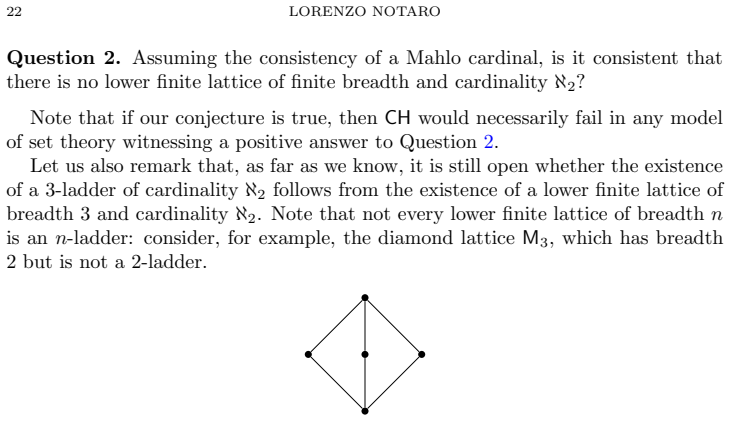
0
0
math.AG 2026-07-03

Quasi-F-splitting for all e implies numerical log canonicity

by Kenta Sato, Shunsuke Takagi +1 more

Quasi-F-splitting versus log canonicity

The implication holds in all dimensions, with a converse and classification in dimension two when the Gorenstein index avoids multiples of p

abstract click to expand
In this paper, we investigate the relationship between quasi-$F$-splitting and log canonicity. We show that if a numerically $\mathbb{Q}$-Gorenstein normal singularity is quasi-$F^e$-split for every $e\geq 1$, then it is numerically log canonical. In dimension two, we prove the converse under the condition that the Gorenstein index is not divisible by the characteristic $p$. We also classify two-dimensional quasi-$F$-split normal singularities.
0
0
math.NT 2026-07-03

Trianguline variety smooth over regularity loci for reductive groups

by Andrea Conti, Mohamed Moakher +1 more

The trianguline variety for reductive groups

Generalization establishes smoothness on triangulation parameter conditions and normality at points outside those loci

abstract click to expand
We study the trianguline variety for split connected reductive groups. We generalize a theorem of Breuil, Hellmann, and Schraen about its local structure, establishing smoothness over the loci determined by various regularity conditions on the triangulation parameter, and normality at certain points outside of these smooth loci. Along the way, we prove a crystallinity criterion for $(\varphi,\Gamma_K)$-modules with $\mathsf G$-structure.
0
0
math.CO 2026-07-03

Counterexamples refute two matroid conjectures

by Matt Larson

Counterexamples to two conjectures about matroids

White's toric ideal claim and Mason's log-concavity claim both fail for specific matroid constructions.

Figure from the paper full image
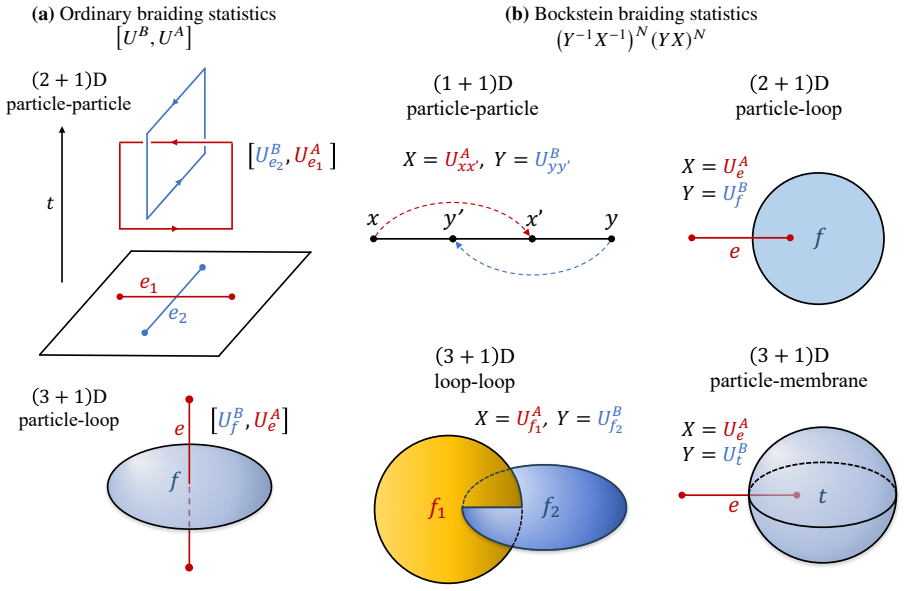
abstract click to expand
We give counterexamples to two well-known conjectures about matroids: White's conjecture on the generation of the toric ideal by symmetric exchange binomials, and a conjecture of Mason on the log-concavity of the counts of flats of a given rank.
0

browse all of math → full archive · search · sub-categories