pith. sign in

hep-ph

High Energy Physics - Phenomenology

Theoretical particle physics and its interrelation with experiment. Prediction of particle physics observables: models, effective field theories, calculation techniques. Particle physics: analysis of theory through experimental results.

Top Pith
8
hep-ph 2026-07-01

N3LO corrections to boosted WH production reach +2%

by Aude Gehrmann-De Ridder, Alexander Huss +6 more

Boosted Higgs-strahlung off a W boson at next-to-next-to-next-to-leading order in QCD

The shift typically exceeds the NNLO scale band while shrinking residual theory uncertainty below one percent

Figure from the paper full image
abstract click to expand
The production of a boosted Higgs boson in association with a charged weak ($W$) boson is a key process to scrutinize the electroweak symmetry breaking mechanism at hadron colliders. This reaction constitutes the dominant Higgs production channel at large transverse momentum, providing unique sensitivity to Higgs-boson interactions with other Standard Model particles as well as to physics beyond the Standard Model. In this Letter, we present the first fully differential calculation of this important scattering process at next-to-next-to-next-to-leading order (N$^3$LO) in perturbative Quantum Chromodynamics (QCD). We find that the N$^3$LO corrections, amounting to approximately $+2\%$ in the boosted regime, generally lie at the edge of or outside the standard scale variation band of the previous perturbative order. The residual dependence of the N$^3$LO prediction on perturbative scales is reduced to below the percent level, marking a milestone for the Higgs precision program.
0
Top Pith
5
hep-lat 2026-05-22 2 theorems

Lattice QCD yields first full form factors for rare kaon decay

by R. Di Palma, R. Frezzotti +7 more

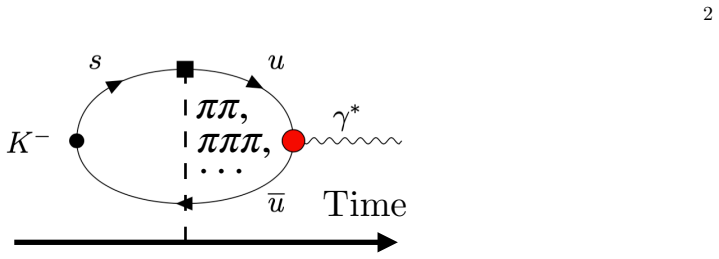
Complete lattice QCD calculation of K⁻to ell⁻bar{ν}_(ell)ell^('+)ell^('-) form factors

Physical-mass ensembles and spectral reconstruction control errors across all four lepton channels

Figure from the paper full image
abstract click to expand
We present the first complete lattice QCD calculation of the four structure-dependent form factors governing the rare charged kaon decay $K^- \to \ell^- \bar{\nu}_\ell \ell'^+ \ell'^-$, with fully controlled statistical and systematic uncertainties. Our calculation is based on gauge ensembles generated by the Extended Twisted Mass Collaboration (ETMC) with $N_f = 2+1+1$ flavors of Wilson-clover twisted-mass fermions. Simulations are performed directly at the physical values of the light and strange quark masses, and include an estimate of the quark-disconnected contributions in which the virtual photon couples to sea quarks. All four form factors are determined across the kinematical region probed by experiments. The Spectral Function Reconstruction (SFR) method of Ref. [1] is employed to overcome the analytic continuation problem for dilepton invariant masses above the two-pion threshold. Finite-volume effects are investigated using ensembles with spatial extents $L\simeq [3.8,7.6]~\mathrm{fm}$, while the continuum limit is obtained from three lattice spacings in the range $a\in[0.057, 0.08]~\mathrm{fm}$. Our results for the form factors enable the evaluation of decay rates and differential observables for all four channels, $K^- \to e^- \bar{\nu}_e e^+ e^-$, $K^- \to e^- \bar{\nu}_e \mu^+ \mu^-$, $K^- \to \mu^- \bar{\nu}_\mu e^+ e^-$, and $K^- \to \mu^- \bar{\nu}_\mu \mu^+ \mu^-$, thereby providing first-principles Standard Model predictions against which existing and upcoming measurements can be directly compared. A detailed phenomenological analysis of the decay rates and associated observables is presented in a companion paper [2].
0
Top Pith
4
hep-ph 2026-05-19 2 theorems

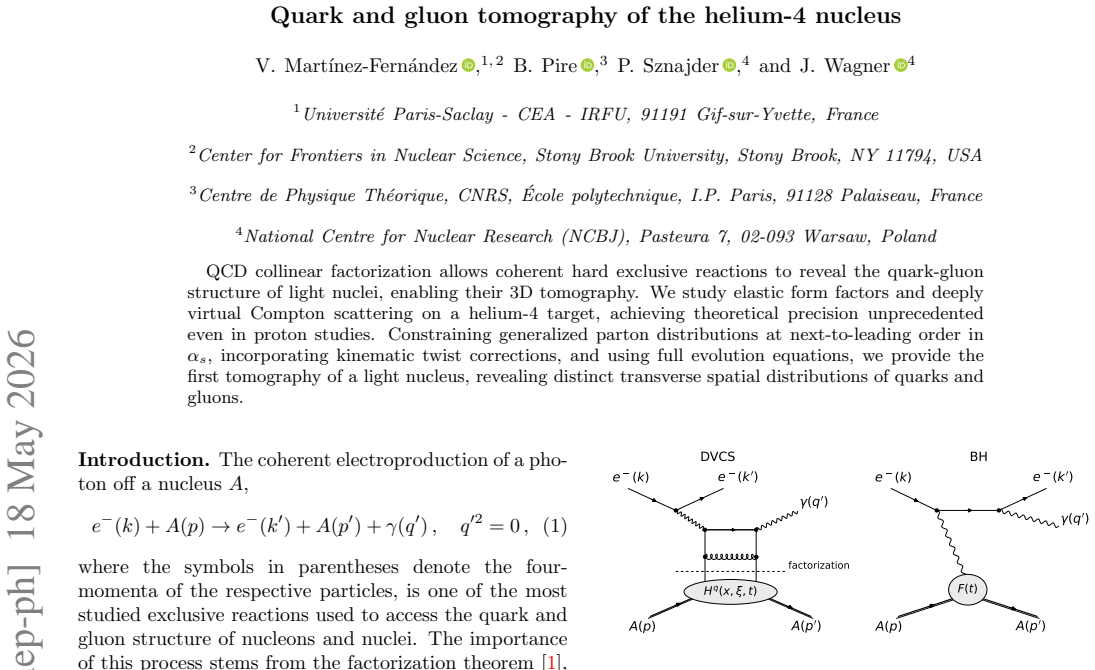
Helium-4 shows separate maps for quarks and gluons

by V. Martínez-Fernández, B. Pire +2 more

Quark and gluon tomography of the helium-4 nucleus

Calculations using QCD factorization deliver the first 3D parton tomography of a light nucleus.

Figure from the paper full image
abstract click to expand
QCD collinear factorization allows coherent hard exclusive reactions to reveal the quark-gluon structure of light nuclei, enabling their 3D tomography. We study elastic form factors and deeply virtual Compton scattering on a helium-4 target, achieving theoretical precision unprecedented even in proton studies. Constraining generalized parton distributions at next-to-leading order in $\alpha_s$, incorporating kinematic twist corrections, and using full evolution equations, we provide the first tomography of a light nucleus, revealing distinct transverse spatial distributions of quarks and gluons.
1 0
0
hep-ph 2026-07-03

PTA data disfavors phase transitions near EFT boundary

by Simone Biondini, Philipp Schicho

A critical look at low-scale cosmological phase transitions in the PTA era

Higher-order thermal corrections in a minimal dark Higgs model shift predictions but leave signals inconsistent with observed gravitational

Figure from the paper full image
abstract click to expand
Motivated by the recent evidence for a stochastic gravitational-wave (GW) background reported by pulsar timing array (PTA) collaborations, we perform a precision study of low-scale phase transitions in a dark Abelian Higgs sector, a minimal gauge theory of spontaneous symmetry breaking relevant for cosmological phase transitions. Using dimensionally reduced high-temperature effective field theory, we quantify the impact of thermal resummation, higher-order matching corrections, and higher-dimensional operators on the phase-transition thermodynamics and the resulting GW signal. We find that the parameter region favored by current PTA observations lies close to the boundary of validity of the effective field theory, where higher-dimensional operators become increasingly important. Even within this controlled region, the predicted signal remains disfavored by the PTA data, despite the substantial shifts induced by higher-order thermal corrections. We further delineate parameter regions where the dark and visible sectors are thermally and hydrodynamically coupled or decoupled, and revisit the dark matter phenomenology, identifying asymmetric freeze-out as naturally compatible with both the observed relic abundance and the gauge couplings favored by strong phase transitions. Our results underscore the importance of systematically controlled finite-temperature calculations for reliable GW predictions from low-scale cosmological phase transitions.
0
0
hep-ph 2026-07-03

Pi Σ-bar interaction removes need for Σ(1380) in J/ψ decay

by Wen-Tao Lyu, Eulogio Oset +2 more

Identifying Sigma(1380) and Sigma(1430) in the J/psi to Λ π bar{Sigma} reaction

The low-energy πΛ spectrum fits the data once the π Σ-bar channel is added, eliminating the requirement for the extra 1/2- state.

Figure from the paper full image
abstract click to expand
We study the $J/\psi \to \Lambda \pi \bar{\Sigma}$ reaction by looking at the $\pi^+ \Lambda$ mass distribution at low energies, in search of signals for the low lying $\Sigma^+$ states. Apart from a clear signal of the $\Sigma(1385) (3/2^+)$ state, we find a smaller peak for the predicted $\Sigma(1430) (1/2^-)$, which has already been confirmed by the Belle Collaboration. A first analysis, considering only the $\pi\Lambda$ interaction, shows that the low energy part of the spectrum is better reproduced including contributions from the $\Sigma(1430)$ and the predicted $\Sigma(1380)(1/2^-)$ state that has been claimed before from analyses of different experiments. However, when we consider the $\pi\bar{\Sigma}$ interaction the need for the $\Sigma(1380)$ disappears.
0
0
hep-ph 2026-07-03

D_s1(2460) is bound-state pole from SU(3) triplet

by Ze-Rui Liang, Qi-Chao Xiao +2 more

The D_(s1)(2460) and other open-charm 1^+ states in relativistic chiral effective field theory

Relativistic chiral EFT places it with lower D1(2430) pole in triplet; higher D1(2430) pole in sextet, none are q qbar states

Figure from the paper full image
abstract click to expand
We derive the pertinent chiral potentials for charmed vector meson interactions with light pseudoscalar bosons in a relativistic U(3) chiral effective field theory up to next-to-leading order. Predictions for the $S$- and $P$-wave scattering lengths are obtained for all the relevant elastic channels. A comparison with the most recent -- and currently the sole -- lattice QCD data on the $S$-wave $I=1/2$ $D^\ast\pi$ scattering length at a pion mass of $391$~MeV reveals good agreement, thereby validating the estimation of low energy constants via heavy quark spin symmetry. Within the relativistic formalism, we confirm that the $D_{s1}(2460)$ can be identified with a bound state pole, while the $D_1(2430)$ corresponds to the interplay of two poles: a lower one on the second Riemann sheet and a higher one on the third Riemann sheet. We show that the $D_{s1}(2460)$ and the lower $D_1(2430)$ pole originate from the same flavor SU(3) triplet, whereas the higher $D_1(2430)$ pole belongs to the SU(3) sextet. All these states are not of $\bar{q}q$ nature, as they flow to complex infinity in the large $N_C$ limit. Our results provide quantitative benchmarks for future lattice QCD and femtoscopic studies.
0
0
hep-ph 2026-07-03

Jet hadron-pair correlations match STAR spin data

by Zhong-Bo Kang, Andreas Metz +2 more

Transverse-spin dependent energy-energy correlators in proton-proton collisions within the dihadron fragmentation framework

Dihadron fragmentation model agrees with measurements and slightly favors lattice-consistent transversity at high jet momentum.
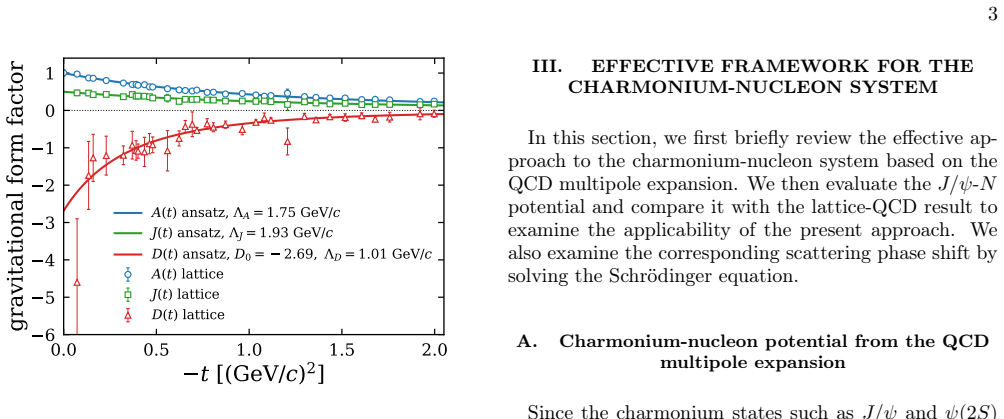
Figure from the paper full image
abstract click to expand
We calculate energy-energy correlations for two hadrons produced inside a jet in transversely polarized proton-proton collisions. We make numerical predictions based on a simple model that utilizes a previous global QCD analysis of dihadron fragmentation and transversity parton distribution functions. The results show remarkable agreement with a very recent STAR measurement. We also find the data at large jet transverse momentum have a slight preference for extractions of transversity that are consistent with lattice QCD computations of the nucleon tensor charges. Overall, this work provides further evidence for the underlying non-perturbative mechanism of near-side energy-energy correlators as well as highlights the potential for these observables to probe transverse-spin effects inside the nucleon.
0
0
hep-ph 2026-07-03

Nonperturbative model fits thrust-axis TMD data with expected parameters

by Daniel Diaz Fernandez, Patricia Andrea Gutierrez Garcia +2 more

Event-axis TMD measurements in e^+e^- and SIDIS

Event-shape dependent TMD measurements in e+e- and SIDIS are described by a model tested on Pythia simulations.

abstract click to expand
Transverse-momentum-dependent (TMD) fragmentation in $e^+e^-$ collisions can be studied by measuring hadrons with respect to the thrust axis, and has been measured at Belle. This provides a complementary way to extract TMD fragmentation functions, avoiding the need to disentangle the two TMD fragmentation functions that enter conventional back-to-back hadron-pair measurements. Starting from the established factorization theorems for this observable, we complete the operator-level formulation of the soft ingredients and perform one-loop checks using the $\delta$-regulator. We also extend existing results for 1-jettiness factorization in semi-inclusive deep-inelastic scattering (SIDIS), where analogous measurements give access to the TMD parton distribution functions of the incoming hadron. For phenomenology, we discuss the nonperturbative effects and propose a model that captures both the event-shape dependence and correlations between the event-shape and transverse-momentum measurements. We resum the transverse-momentum and thrust logarithms, explore several schemes for treating the latter, and implement it in artemide. As a first validation, we compare to simulated $e^+e^-$ data from Pythia8.3. We find that the proposed nonperturbative model is flexible enough to describe the simulated data, with fitted parameters of the expected size in powers of $\Lambda_{\rm QCD}/Q$. In this test, the resummation of the logarithms of $q_T/(\tau Q)$ appears to have little impact on the fit quality, but changes the fit parameters.
0
0
hep-ph 2026-07-03

Chebyshev approximations speed up Feynman integral calculations

by Samuel Abreu, Afonso Guerreiro +1 more

Chebyshev Approximations of Feynman Integrals for Collider Physics

Polynomial fits along paths give stable, competitive results for two-loop five-point integrals with little manual tuning for singularities.

abstract click to expand
We present a novel approach for solving canonical differential equations for Feynman integrals based on an approximation of the integrals with Chebyshev polynomials. By exploiting the analyticity properties of Feynman integrals, the method constructs rapidly converging polynomial approximations along a path, enabling highly efficient numerical evaluation. Moreover, we introduce an adaptive approximation method that dynamically samples to optimise convergence. We implement this framework in double-precision arithmetic and demonstrate its stability across physical phase space using a series of two-loop, five-point examples. Our proof-of-principle implementation proves competitive with state-of-the-art one-fold integral methods, while requiring little to no case-by-case intervention to handle spurious singularities.
0
0
hep-ph 2026-07-03

Symmetry favors 2+ states for low-energy compact tetraquarks

by Shuai Yin, Ti Gong +1 more

Symmetry Analysis of Compact Tetraquark States and Implications for the Level Ordering of the Fully Charmed Candidates X(6600), X(6900), and X(7100)

The J^P peak stays fixed with chromomagnetic effects, implying the X(6600), X(6900), and X(7100) sit among the lower levels.

Figure from the paper full image
abstract click to expand
Motivated by recent experimental observations, we investigate the $J^P$ distribution of low-energy compact tetraquark states. Assuming that two quarks and two antiquarks are arranged in either a tetrahedral or a square configuration, we employ the restricted representations of the permutation group $S_4$ onto $S_2 \times S_2$ to derive the inherent nodal structure of the $qq\bar q\bar q$ system from that of the $qqqq$ system for orbital angular momentum $L \leq 3$. Based on this framework, we determine the distribution of accessible $J^P$ states and find that low-energy compact tetraquark states are likely to favor $J^P=2^+$. Our analysis yields two observations that further support the dynamical robustness of symmetry-based classifications in exotic hadron spectroscopy. First, the symmetry-induced $J^P$ distribution of compact tetraquark states closely resembles that obtained for the three-flavor four-quark system. Second, the location of the distribution peak remains unchanged when chromomagnetic interaction (CMI) effects are incorporated. Together, these results suggest that the dominant features of the low-lying spectrum are governed primarily by symmetry constraints rather than by the details of the underlying dynamics. These findings further imply that the fully charmed tetraquark candidates $X(6600)$, $X(6900)$, and $X(7100)$ may occupy relatively low-lying levels of the fully charmed tetraquark spectrum. They also indicate that mechanisms beyond CMI dynamics are likely involved, potentially mitigating or competing with the effects of CMI in compact fully charmed tetraquark states.
0
0
hep-ph 2026-07-03

IceCube sets tightest limit yet on non-unitary neutrino mixing

by Sharmistha Chattopadhyay, Anil Kumar +1 more

New constraints on non-unitary neutrino mixing from 8 years of IceCube DeepCore atmospheric neutrino data

Eight years of DeepCore data remain consistent with unitary mixing and constrain α33 > -0.027 at 90% CL

Figure from the paper full image
abstract click to expand
The mixing between flavor and mass eigenstates of active neutrinos is described by a $3\times3$ unitary matrix. However, the presence of additional heavy sterile neutrino states can lead to a non-unitary neutrino mixing scenario. Atmospheric neutrinos, with their wide range of baselines and energies, provide an excellent probe of such effects. In particular, Earth matter effects in neutrino oscillations play an important role, as the neutral-current potential contributes non-trivially in the presence of non-unitarity. In this work, we use 8 years of publicly available atmospheric neutrino data of IceCube DeepCore to probe this non-unitary neutrino mixing scenario. This high-purity $\nu_\mu$ CC sample provides strong sensitivity, especially to the non-unitary parameters appearing at leading order in the $\nu_\mu \rightarrow \nu_\mu$ channel. The data sample is found to be consistent with the standard unitary mixing framework with no significant deviation. Using this data sample, we place the most stringent bound to date of $\alpha_{33} > -0.027$ at 90% CL, while the other non-unitary parameters are constrained at competitive levels.
0
0
hep-ph 2026-07-03

Entropy method builds GPD profiles from nucleon form factors

by Seung-il Nam

A Maximum-Entropy Method for Zero-Skewness Valence GPDs Constrained by Nucleon Electromagnetic Form Factors

Reduced ansatz matches electromagnetic moments and forward limits while producing expected transverse shrinkage at large x.

Figure from the paper full image
abstract click to expand
We formulate a reduced-profile maximum-entropy method (MEM) framework for constructing constrained zero-skewness valence-quark generalized parton distribution (GPD) transverse profiles from the four nucleon electromagnetic form factors $F_1^p(t)$, $F_1^n(t)$, $F_2^p(t)$, and $F_2^n(t)$. The form-factor sum rules fix only $x$-integrated moments of the GPDs; the forward limit of $H_v^q$ is fixed separately by the valence parton distribution functions, and the normalization of $E_v^q$ by the flavor anomalous magnetic moments. These complementary constraints are combined through the ansatz $H_v^q(x,t)=q_v(x)\exp[t f_H^q(x)]$ and $E_v^q(x,t)=e_v^q(x)\exp[t f_E^q(x)]$, where the positive profile functions encode the $x$-dependent transverse structure. Rather than attempting an unrestricted functional inversion, we use the entropy functional as a regularizing criterion on a low-dimensional positive profile manifold. In the numerical proof-of-concept calculation, a smooth elastic form-factor input and analytic forward distributions are adopted, together with the reduced form $f(x)=0.05+(1-x)^2\exp(c_0+c_1x+c_2x^2)$, which suppresses local modes that elastic moments alone cannot constrain. Within this reduced ansatz, the resulting profiles reproduce the imposed elastic moment constraints, satisfy the forward normalizations after discrete-grid normalization, and give impact-parameter distributions with the expected transverse shrinkage at large $x$. The construction provides a controlled zero-skewness baseline for connecting elastic form-factor constraints to $x$-dependent transverse profiles, and it offers a stable starting point for future analyses incorporating empirical form-factor fits, modern PDF inputs, lattice-QCD generalized form factors, and hard exclusive observables.
0
0
hep-ph 2026-07-03

B_s decays predict four lepton flavor universality ratios

by Karthik Jain, Tarun Kumar +2 more

A Comprehensive Analysis of B_s to D_s^(**)ellν_ell Decays Within and Beyond the Standard Model

Scalar and tensor operators cause some observables to deviate by more than 2 sigma from the Standard Model.

abstract click to expand
We examine the exclusive semileptonic decays $B_s \to D_s^{**} \ell \nu_\ell$, with $D_s^{**} =$ $\bigl\{D_{s0}^*,D_{s1}^*,D_{s1},D_{s2}^*\bigr\}$, within the Standard Model and beyond, using form factors evaluated in the Heavy Quark Effective Theory, including corrections up to $\mathcal{O}(\alpha_s, \Lambda/{m_Q})$. A data-driven approach is employed to extract Heavy Quark Effective Theory parameters, and the resulting synthetic data are used to parameterize the form factors via the $z$-expansion. With the resulting form factor information across the full kinematic region, we compute various observables derived from the two-fold angular decay distribution, and predict precise lepton flavor universality ratios: $R_{D_{s0}^*}= 0.158(20)$, $R_{D_{s1}^*}= 0.045(5)$, $R_{D_{s1}}= 0.073(4)$, $R_{D_{s2}^*} = 0.066(9)$. We also analyse potential new physics effects using the Weak Effective Theory and the Standard Model Effective Field Theory, performing a global analysis considering both real and complex Wilson coefficients. Furthermore, we investigate new physics contributions arising from the general Two Higgs Doublet Model. We evaluate the sensitivity of decay observables to new physics, highlighting their potential to probe deviations from the Standard Model in future measurements. Notably, the scalar and tensor new physics operators induce large sensitivity, with some observables deviating by more than $2 \sigma$ from Standard Model predictions.
0
0
hep-ph 2026-07-03

Axion background splits photon modes into Krein-sign sidebands

by Run-Min Yao, Xiao-Jun Bi +2 more

Sideband Structure of Axion Electrodynamics

A periodic axion field folds the dispersion into a ladder whose degeneracies are stable or unstable according to the symplectic signatures o

abstract click to expand
We develop a Floquet--Bloch sideband formulation of the linearized Maxwell--axion system in a coherent periodic axion background. Linearizing around prescribed magnetic and axion fields, we show that the pump generates a sideband ladder of photon and axion branches. Near an isolated folded degeneracy, this ladder reduces to a two-mode crossing whose algebra is fixed by the symplectic signatures of the colliding modes. In temporal fixed-momentum evolution, same-Krein-sign collisions give stable avoided crossings, whereas opposite-sign collisions give parametric instabilities, unifying the axion-photon difference channel with the Mathieu and Masaki-Aoki-Soda resonances. In stationary fixed-frequency transfer, the corresponding flux signatures distinguish bounded forward conversion from forward-backward stop bands and distributed reflection. Ray projection of a temporal pump gives a related but local WKB description of driven forward mixing, with an effective wavenumber distinct from the true axion momentum. External-field diagrams reproduce the sideband selection rules, and full temporal monodromy calculations verify the instability topology and finite-coupling shifts.
0
0
hep-ph 2026-07-03

Hadronic channel strengthens Y quark search at FCC-eh

by Liangliang Shang, Weifan Zhu +2 more

Searching for single production of a vector-like Y quark decaying into bW at the FCC-eh

Analysis shows tighter 2σ exclusion and 5σ discovery limits in the g*-m_Y plane as energy rises to 6.9 TeV.

Figure from the paper full image
abstract click to expand
We investigate the exclusion and discovery potential for single production of a vector-like $Y$ quark with electric charge $Q=-4/3$, followed by the decay $Y\to bW$, at the FCC-eh. The $Y$ quark is allowed to couple to both first- and third-generation down-type quarks. The analysis is performed for an electron-beam polarization of $P_e=-80\%$ at $\sqrt{s}=3.46$, $5.29$, and $6.9~\mathrm{TeV}$. Both leptonic and hadronic $W$-boson decay channels are considered. In the hadronic channel, the boosted $W$-boson is reconstructed as a $W$-jet, and kinematic observables are used to suppress the Standard Model (SM) backgrounds. By performing a detailed detector simulations and event analysis, we present the $2\sigma$ exclusion limits and $5\sigma$ discovery reaches in the $g^*$--$m_Y$ plane, where $g^*$ is $Y$ coupling strength to the SM quarks. We find that the hadronic channel can provide stronger exclusion and discovery sensitivities, which are improved with increasing $\sqrt{s}$ at the FCC-eh.
1 0
0
hep-ph 2026-07-03

Masses of light 1-- tetraquarks range 1.53-2.34 GeV

by Yi-Wei Jiang, Hua-Xing Chen +4 more

Light tetraquark states with J^(PC)=1⁻⁻ from QCD sum rules

QCD sum rules applied to six flavor-isospin sectors also complete the isotensor 1^{-+} entry for spectral comparison

Figure from the paper full image
abstract click to expand
We perform a systematic QCD sum rule study of light tetraquark states with $J^{PC}=1^{--}$ in the diquark--antidiquark picture. A complete set of local interpolating currents is constructed and projected onto six flavor-isospin configurations ($q=u/d$): the isoscalar $q q\bar q\bar q$, $q s\bar q\bar s$, and $s s\bar s\bar s$ sectors, the isovector $q q\bar q\bar q$ and $q s\bar q\bar s$ sectors, and the isotensor $q q\bar q\bar q$ sector. The lowest masses in these sectors are derived to be $1.64^{+0.15}_{-0.14}$~GeV, $1.86^{+0.14}_{-0.14}$~GeV, $2.34^{+0.23}_{-0.30}$~GeV, $1.53^{+0.17}_{-0.19}$~GeV, $1.86^{+0.14}_{-0.14}$~GeV, and $2.24^{+0.12}_{-0.14}$~GeV, respectively. We further compare the present $1^{--}$ tetraquark spectrum with previous QCD sum rule results for the $1^{-+}$ tetraquark and hybrid states~\cite{Su:2025bhv}, aiming to provide useful information for distinguishing tetraquark and hybrid configurations in the light hadron spectrum. As an additional improvement, we complete the previously missing isotensor $1^{-+}$ tetraquark entry and obtain its lowest mass to be $M=2.19^{+0.26}_{-0.24}~\mathrm{GeV}$, which is included in the spectral comparison.
0
0
hep-ph 2026-07-03

Lambda hyperons equilibrate in 10^{-10} seconds in proto-neutron stars

by Ruben Zatini, Jorge Martin Camalich +2 more

Λ hyperons in core-collapse supernovae: Equilibration and neutrino opacities

Nonleptonic reactions set this timescale orders of magnitude below star evolution times and add new muon neutrino absorption channels.

Figure from the paper full image
abstract click to expand
Strange hadrons are commonly included in dense-matter equation-of-state models by imposing chemical equilibrium, but the weak-interaction timescales required to establish it in core-collapse supernovae have not been systematically assessed. In this paper we compute the $\Lambda$-hyperon production rates in the hot, dense, and isospin-asymmetric conditions characteristic of post-collapse proto-neutron stars. We find that local $\Lambda$ chemical equilibration is driven by nonleptonic strangeness-changing reactions, especially $NN\leftrightarrow N\Lambda$ scattering, on timescales of order $10^{-11}$-$10^{-10}$ s, many orders of magnitude shorter than macroscopic proto-neutron-star evolution timescales. Using an effective-field-theory framework constrained by hypernuclear weak-decay data, we find that short-range contact interactions dominate the nonleptonic rates, beyond a pure one-meson-exchange description. Semileptonic channels are too slow to set the equilibrium $\Lambda$ abundance, but they open additional absorption channels for low-energy muon neutrinos and antineutrinos, such as $\nu_\mu+\Lambda\to\mu^-+p$ and $p+\mu^-+\bar\nu_\mu\to\Lambda$. At low energies, these $\Lambda$-induced neutrino opacities exceed the corresponding nucleonic contributions for muon (anti)neutrinos, possibly influencing the evolution of the muon lepton number during proto-neutron-star deleptonization. These results support local chemical equilibrium for $\Lambda$ hyperons under the conditions studied and provide new weak-interaction input for flavor-dependent neutrino transport, muonization, and proto-neutron-star evolution.
0
0
hep-ph 2026-07-03

PQ symmetry with vector-like quarks yields one-loop proton decay

by H. B. Câmara

One-loop proton decay from Peccei-Quinn symmetry

Residual Z2 blocks tree-level decay but permits radiative decay via u_R u_R d_R e_R while solving strong CP and fixing axion-photon coupling

Figure from the paper full image
abstract click to expand
We promote the accidental $B+L$ symmetry of the Standard Model to a Peccei-Quinn (PQ) symmetry while realizing spontaneous proton decay radiatively. The PQ anomaly sector consists of vector-like quarks (VLQs), providing a Kim-Shifman-Vainshtein-Zakharov-type axion solution to the strong CP problem. After spontaneous PQ breaking, a residual $\mathcal{Z}_2$ symmetry remains, which forbids tree-level proton decay. The VLQs required to generate the QCD anomaly, together with scalar mediators, odd under the residual $\mathcal{Z}_2$, induce one-loop proton decay through the effective operator $u_R u_R d_R e_R$. We study its ultraviolet completions, featuring distinct vector-like fermion and scalar representations, and show that the resulting models lead to distinct predictions for the axion-to-photon coupling, testable in helioscope and haloscope experiments. In addition to the proton decay channel $p \rightarrow e^+ \pi^0$, this framework predicts proton decay with an axion in the final state, $p \rightarrow e^+ \pi^0 a$, suppressed by the PQ-breaking scale. We also discuss axion dark matter in pre- and post-inflationary cosmology.
0
0
hep-ph 2026-07-03

Cannibal reactions reshape freeze-in dark sector histories

by Esau Cervantes

Dynamics of Self-Interacting Dark Sectors

Boltzmann solutions show parameter spaces that can be constrained, invisible, or accessible depending on the model, including inverse phase

abstract click to expand
This thesis investigates the dynamics of self-interacting dark sectors in the early Universe populated through the freeze-in mechanism. The main focus is on scenarios with self-number-changing reactions of the form $2\leftrightarrow3$, and on how these interactions modify the thermal history and phenomenology of the dark sector. Several realizations are studied, including scalar theories with $\mathbb{Z}_2$ and $\mathbb{Z}_3$ symmetries, self-interacting dark matter coupled to an unstable mediator, and cannibal dark matter production during non-instantaneous reheating. The thermal evolution is obtained by solving coupled Boltzmann equations for the relevant number densities and temperatures, accounting for both freeze-in production and cannibal interactions. The resulting parameter space can be strongly constrained, effectively invisible, or potentially accessible to future searches, depending on the realization considered. Finally, the thesis studies a hidden U(1) gauge sector populated via freeze-in, where continuous energy injection can induce an inverse first-order phase transition and temporarily restore the symmetric phase, linking phase-transition dynamics and chemical equilibration in hidden sectors.
0
0
hep-ph 2026-07-03

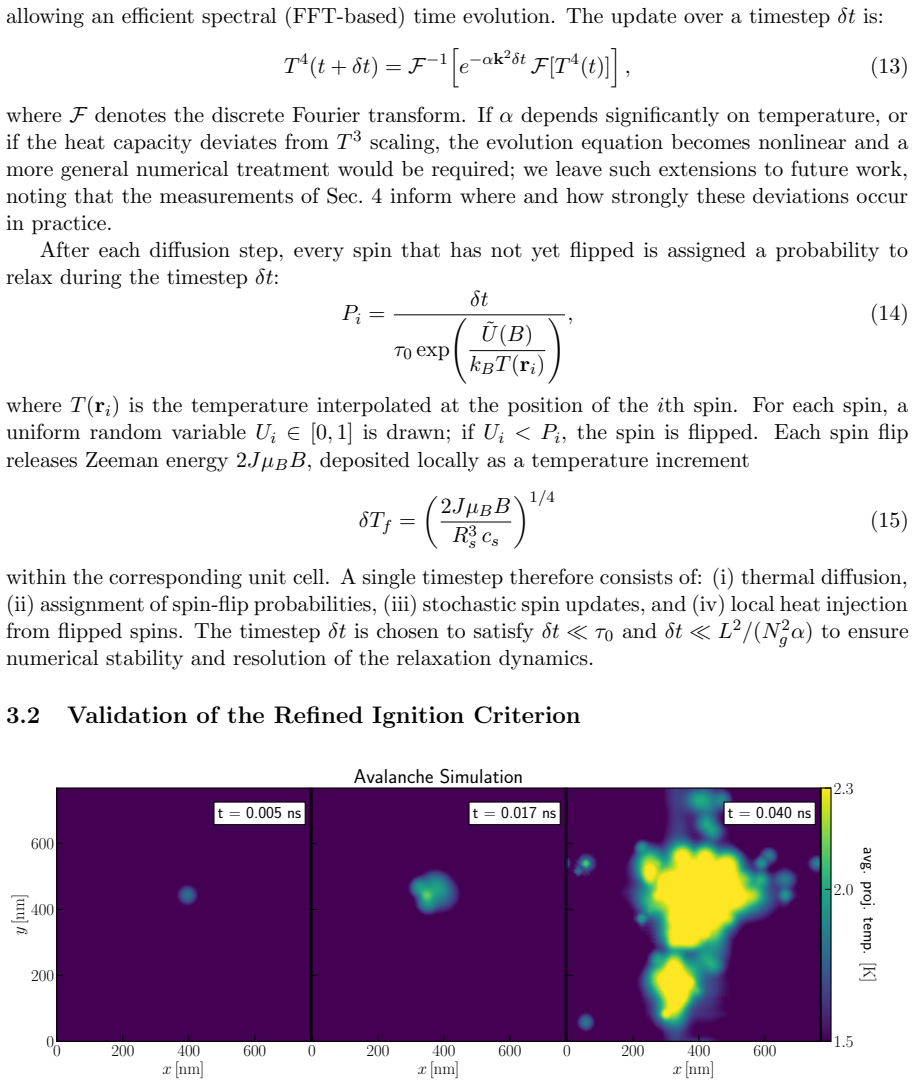
Stochastic spin relaxation lowers DM avalanche threshold

by Andrew Eberhardt, Tomoya Fukui +9 more

Refined Sensitivity Estimates for Single-Molecule Magnet Dark Matter Detectors

The fraction of spins that relax even under fast diffusion releases Zeeman energy and cuts the energy needed to start the magnetic avalanche

Figure from the paper full image
abstract click to expand
We revisit the sensitivity of Single Molecule Magnet (SMM) crystals as detectors for low-mass dark matter. In previous work, we established the concept of the ``magnetic bubble chamber'', where energy deposited by dark matter triggers a magnetic avalanche in a metastable crystal. The original sensitivity estimates relied on a conservative criterion requiring the spin relaxation time to be strictly shorter than the thermal diffusion time. Here, we demonstrate that this criterion effectively ignores the stochastic nature of spin relaxation. We derive a refined analytic estimate which accounts for the fraction of spins that relax even when diffusion is fast. We show that the Zeeman energy released by this fraction contributes to local heating, significantly lowering the energy threshold for avalanche formation. We present simulation results confirming this effect and report on experimental verification of the assumed low-temperature thermal properties of two representative SMM crystals, Mn$_{12}$-acetate and Mn$_{32}$. Together, these efforts extend this pathfinder program toward the realization of SMM-based detectors with controlled material properties and enhanced dark matter sensitivity.
0
0
hep-ph 2026-07-03

Global fit shows twist-three PDFs are universal across processes

by Guillermo Portela, Alexey Vladimirov

Phenomenology of genuine twist-three distributions from a global QCD analysis

One set of distributions describes g2, d2 and SIDIS asymmetries, confirming subleading factorization.

abstract click to expand
We present an extraction and phenomenological study of genuine twist-three parton distribution functions (PDFs) through a global QCD analysis of the structure function $g_2$ in deep-inelastic scattering (DIS), its moment $d_2$, and single-/double-spin asymmetries in semi-inclusive DIS (SIDIS). The unified description of these processes clearly confirms the universality of genuine twist-three PDFs and the validity of QCD factorization theorems at this subleading level. The extraction is accompanied by several validation tests, tests of sum rules, comparisons with earlier literature, computation forces and average transverse momentum of partons. As a by-product, we also obtain Sivers and worm-gear-T transverse momentum dependent (TMD) distributions, which allows us to construct a tomographic picture of the proton based on substantially broader data.
0
0
astro-ph.CO 2026-07-03

PBH mergers peak at 1.79 times ISCO frequency

by Ashu Kushwaha

Gravitational Waves from Primordial Black Holes: Connecting Low-Frequency Scalar-Induced Signatures to High-Frequency Binary Mergers

Monochromatic mass function creates direct, model-independent link between low-frequency scalar-induced waves and high-frequency merger sign

Figure from the paper full image
abstract click to expand
Formation of primordial black holes (PBHs) requires a significant enhancement of curvature perturbations. This mechanism leaves a twofold gravitational-wave (GW) signature: a \emph{low-frequency} stochastic background of scalar-induced GWs (SIGWs) and a distinct \emph{high-frequency} signal from subsequent PBH binary mergers. We leverage this shared origin to establish a consistent, \emph{model-independent} connection between these two observables for a monochromatic PBH mass function. Using PBH abundance constraints on the primordial curvature power spectrum, we evaluate the stochastic SIGW background for spherical and ellipsoidal collapse models, demonstrating that the ellipsoidal scenario yields a significantly stronger signal. Furthermore, we analyze the GW signal from PBH binary mergers and find a direct correspondence between the SIGW frequency and the innermost stable circular orbit (ISCO) frequency of the binaries. Because GW emission is nearly maximal near the ISCO, we additionally show that the peak of the full merger GW spectrum relates to the ISCO frequency via $f_{\text{peak}} = 1.79 \, f_{\text{ISCO}}$, a relation that is independent of the binary masses. Remarkably, this unified framework connects these distinct GW channels, enabling the same primordial fluctuations to be probed across widely separated frequency bands.
0
0
hep-ph 2026-07-03

Neural correction cuts charmonium mass error by 94.5 percent

by Tarik Akan, Metin Yalvac

Hybrid Residual Correction of VMC Charmonium Masses with a Screened Funnel Interaction

VMC baseline with screened funnel potential plus neural residual adjustment brings seven states to 24 MeV mean absolute error

Figure from the paper full image
abstract click to expand
In this study, we combine residual correction with the physical treatment of charmonium masses within a Quantum Chromodynamics (QCD) motivated potential-model framework via variational Monte Carlo (VMC). The aim is not to propose a new charmonium spectrum, since this sector has already been examined extensively through different potential models. Instead, the main objective is to evaluate how effectively a Machine Learning (ML) correction can improve a VMC baseline when both stages are built on the same screened funnel potential. In this workflow, the screened interaction provides the physical input and determines the underlying mass structure. The proposed run uses the variational method via VMC and deterministic eigenvalue diagonalization in the process of mass calculation. In total, ten charmonium states are calculated, among which seven use the experimental reference masses. The VMC step generates a large set of configurations and local energy estimators that are fed into the neural network (NN) residual corrector at the sample level, while the corrections and experimental uncertainties are collected at the state level. It then learns the residual difference between the raw physics baseline and the internal reference targets. This hybrid procedure reduces the systematic mass offset of the raw calculation across the studied states. For the experimentally verified seven states, the correction reduces the MAE from $438.1~\mathrm{MeV}$ to $24.1~\mathrm{MeV}$, corresponding to a $94.5\%$ reduction. These results show that ML can serve as a residual-correction layer for potential-model spectroscopy.
0
0
hep-ph 2026-07-03

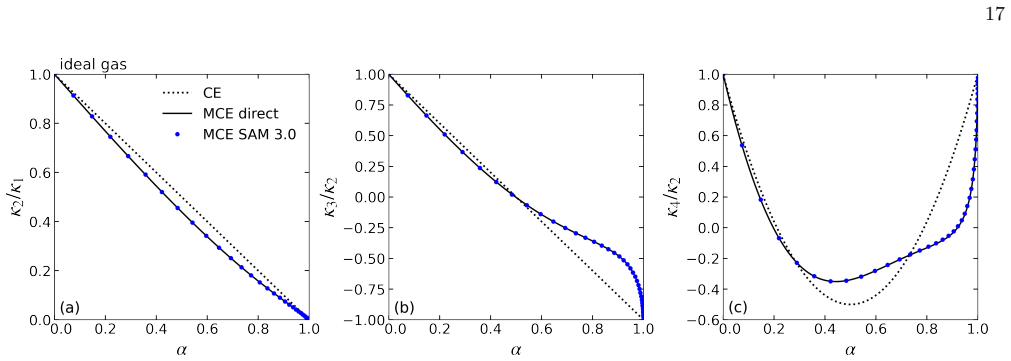
Algebraic method corrects cumulants for exact multi-charge conservation

by Roman Poberezhnyuk, Volodymyr A. Kuznietsov +2 more

Subensemble Acceptance Method 3.0: General Corrections to Cumulants from Exact Conservation Constraints

SAM-3.0 converts joint grand-canonical inputs to canonical results for any number of charges and observables.

Figure from the paper full image
abstract click to expand
We present the subensemble acceptance method 3.0 (SAM-3.0), which corrects cumulants of an observable measured in a subsystem of a large system for the effect of exact global conservation of multiple charges. The required input is the set of joint grand-canonical cumulants of the acceptance observable with the total event charges, from which the canonical cumulants follow algebraically via a closed recursion based on (multivariate) partial exponential Bell polynomials. The framework accommodates any number of observables, including non-conserved quantities such as net protons, and any number of simultaneously conserved charges, including the total energy, which yields the microcanonical ensemble. The mapping contains SAM-1.0 and SAM-2.0 as special cases and, unlike SAM-2.0, reproduces the exact binomial-acceptance limit. We also derive the leading finite-size corrections from the saddle-point expansion. We apply the method to update the hydrodynamics-based non-critical baseline (Hydro-EV) for net-proton cumulants at RHIC-BES energies, finding a refined baseline that agrees with direct canonical Monte Carlo sampling and stays close to the earlier SAM-2.0 result. We further validate the formalism against direct Monte Carlo sampling with exact simultaneous conservation of baryon number, electric charge, and strangeness, including hadronic-afterburner effects.
0
0
astro-ph.CO 2026-07-03

Bumpy axion inflation produces PBHs as dark matter

by Masahiro Kawasaki, Kai Murai +1 more

Lattice study of primordial black hole formation in bumpy axion inflation

Lattice runs in the strong-backreaction regime find a narrow peak in curvature perturbations yielding the observed abundance.

abstract click to expand
We study primordial black hole (PBH) formation in axion $U(1)$ inflation using lattice simulations. In axion $U(1)$ inflation with a bumpy potential, the curvature perturbations can be enhanced in a narrow range of wavenumbers, potentially leading to PBH formation. After confirming that our lattice simulations reproduced the known curvature power spectra for chaotic inflation and simple axion $U(1)$ inflation, we calculate the curvature power spectrum in the bumpy axion inflation model in the strong backreaction regime. We find that large curvature perturbations are generated, which lead to PBH production with an abundance sufficient to account for dark matter.
0
0
hep-ph 2026-07-03

Multi-peaked GWs signal phase transitions in early matter era

by Rouzbeh Allahverdi, Fazlollah Hajkarim

Gravitational Waves from Multiple First-Order Phase Transitions in a Scenario with Early Matter Domination

Time-dependent decay creates a heating phase whose gravitational-wave signatures encode transition and reheating temperatures.

abstract click to expand
Non-standard cosmological histories with epochs of early matter domination (EMD) arise in various top-down models of the early universe. Typically, in the latter stage of EMD, temperature decreases more slowly than in a radiation dominated universe because of entropy generation from decay of the species that drives EMD. A time-dependent decay rate can significantly modify this picture and even lead to a period with increasing temperature. We study non-monotonic temperature evolution in a well-motivated scenario of EMD with a time-dependent decay rate that can give rise to multiple first-order phase transitions in both cooling and heating phases. The spectra of the ensuing gravitational waves (GW) exhibit characteristic features such as multiple peaks and a distinct behavior at high frequencies. These features allow us to determine the phase transition temperature as well as the reheating temperature at the end of the EMD. The future GW detectors can therefore provide a probe for the new physics and a window to the early thermal history.
0
0
hep-ph 2026-07-03

Recombination model fits charmed baryon data in heavy-ion collisions

by Jing-Zong Zhang, Hua Zheng +1 more

Hadronization of Λ_c^+ baryons from recombination model in Pb+Pb collisions at the Large Hadron Collider

It reproduces spectra, baryon-to-meson ratios, and flow anisotropy at 5.02 TeV, supporting recombination as the main hadronization channel.

Figure from the paper full image
abstract click to expand
The production of $\Lambda_c^+$ baryons in Pb+Pb collisions at $\sqrt{s_{NN}} = 5.02$ TeV is investigated within the quark recombination framework, including the energy loss of light and charm quarks inside the hot and dense medium. The model simultaneously describes the transverse momentum ($p_T$) spectra of $\Lambda_c^+$ baryons, $\Lambda_c^+/D^0$ yield ratio, which is attributed to the dominance of quark recombination mechanism in the Quark-Gluon Plasma (QGP), and the second harmonic coefficient of $\Lambda_c^+$ baryons with emphasis on the effects of minijets on the azimuthal anisotropy. Furthermore, we extend the theoretical calculation to Pb+Pb collisions at $\sqrt{s_{NN}} =2.76$ TeV and make predictions for $\Lambda_c^+$ baryons and $\Lambda_c^+/D^0$ yield ratio. The simultaneous description of the yield, baryon-to-meson ratio, and azimuthal anisotropy further validates that the recombination model is an effective hadronization mechanism in heavy-ion collisions.
0
0
astro-ph.HE 2026-07-03

Turbulent acceleration shapes X-ray lag spectra in BL Lac jets

by Guang-Cheng Xiao, Wen Hu +5 more

X-ray Fourier lag-frequency spectra modulated by stochastic turbulent acceleration in the jets of high-frequency-peaked BL Lac

One-zone model shows how STA competes with cooling and escape to produce both positive and negative lags, plus a trend with flare duration.

Figure from the paper full image
abstract click to expand
X-ray interband time lags are key diagnostics of jet physics and are frequently detected in high-frequency peaked BL Lac (HBL) objects at different epochs with various X-ray telescopes. In this work, we theoretically investigate Fourier lag-frequency spectra using a generic one-zone leptonic model incorporating the stochastic turbulent acceleration (STA), which plays a crucial role in shaping the emitted photon spectra. We demonstrate that the competition between STA, radiative cooling, and escape processes not only gives rise to two well-defined time-lag regimes: hard/positive and soft/negative lags, but also reveals the existence of a transition between the two regimes. Our results indicate that time lags in the transitional and soft-lag regimes can be clearly amplified and modified by STA's suppression of high-energy electron cooling, and nonlinear synchrotron self-Compton (SSC) cooling can further amplify the emergence of time lags. We conclude that the adopted model offers a unifying quantitative framework for interpreting the diverse time-lag signatures observed in the X-ray flares of HBLs. Additionally, SSC cooling effects can account for the relatively large lags observed in TeV-bright flares, as well as the observed trend between lag amplitude and flare duration: the larger the flare duration, the larger the lag.
0
0
hep-ph 2026-07-02

Hammer v2 scales decay reweighting nearly linearly with tensor rank

by Michele Papucci, Dean J. Robinson

An introduction to Hammer v2: Helicity Amplitude Module for Matrix Element Reweighting

The update allows post-simulation mapping of b-hadron samples to high-dimensional BSM or form-factor spaces while keeping Monte Carlo statis

Figure from the paper full image
abstract click to expand
The Hammer software library provides fast and efficient reweighting of large simulated datasets containing semileptonic $b$-hadron decays to any beyond Standard Model (BSM) theory, or to any form-factor description of the hadronic matrix elements. By enabling reweighting to a different underlying theoretical model after the computationally-expensive detector simulation step has already been completed, Hammer permits experimental analyses to employ forward-folding fitting strategies to recover underlying physical parameters without biases, or to properly characterize theory systematic uncertainties. This publication details upgrades to Hammer functionalities and its application programming interface (API) for version 2.x, and also provides associated documentation of the library's structure, syntactical conventions, and code flow. Substantial optimization of Hammer's internal tensor library now enables computational complexity to generically scale almost linearly with amplitude tensor rank times size rather than as a quartic, enabling reweighting into very high dimension spaces, such as the product of BSM Wilson coefficient and form factor parameter linear spaces, while also retaining Monte Carlo uncertainties. Updated Python bindings are implemented with bijective correspondence to the C++ interface, allowing full access to library functionalities.
0
0
hep-ph 2026-07-02

Chiral symmetry fixes sizes of hadronic constants for EDM calculations

by Jordy de Vries

The theory of electric dipole moments: the view from below

A bottom-up review shows how CP-odd quark-gluon operators map to nuclear and atomic moments with symmetry-determined ratios.

Figure from the paper full image
abstract click to expand
Permanent electric dipole moments (EDMs) of nucleons, nuclei, atoms, and molecules are among the most sensitive probes of CP violation beyond the Standard Model and are intimately connected to the strong CP problem and the origin of the matter-antimatter asymmetry of the universe. This review presents the theory of EDMs from the bottom up, tracing the chain of connections that links CP-violating interactions at level of elementary particles to observable EDMs across a wide range of systems. Starting from a general CP-odd effective Lagrangian at the quark-gluon level comprising the QCD theta term, quark EDMs and chromo-EDMs, the Weinberg operator, and CP-odd four-fermion interactions, I show how chiral perturbation theory organizes the nonperturbative QCD dynamics into a small set of hadronic low-energy constants, whose relative sizes are determined by the chiral representation of the underlying source. These hadronic interactions feed into calculations of nuclear EDMs and Schiff moments, which in turn enter atomic and molecular structure calculations that connect to experimentally accessible observables in diamagnetic and paramagnetic systems. Special attention is given to the recently identified sensitivity of paramagnetic systems to hadronic CP violation, which opens a new and relatively unexplored window on the quark-gluon sector. The complementarity of the full EDM portfolio including the neutron, light nuclei, atoms, and molecules, and the role of theory in disentangling the underlying source of CP violation is discussed throughout.
0
0
hep-ph 2026-07-02

QCD currents matched at NLO to power-suppressed SCET jet operators

by Martin Beneke, Aleksey V. Rusov +1 more

One-loop matching of QCD currents to power-suppressed two-jet operators

One-loop coefficients for two- and three-particle operators up to O(λ²) enable consistent cancellation of endpoint singularities in factoriz

Figure from the paper full image
abstract click to expand
We compute the matching of QCD quark-antiquark currents onto the set of the two-particle and three-particle two-jet operators in soft-collinear effective theory (SCET) at next-to-leading order (NLO) in the perturbative QCD series, including for the first time operators up to second order in the power expansion in the transverse momentum over energy. These results contribute to the ongoing programme of computing power corrections and summing power-suppressed logarithmically enhanced terms for event shapes in the two-jet region and deep-inelastic scattering in the Bjorken-$x\to 1$ limit. The three-particle operators depend on the partonic momentum fractions of two partons moving into the same direction. When one of the momentum fractions approaches zero, the coefficient functions are shown to satisfy endpoint factorization relations, which allow for a consistent cancellation of endpoint singularities among various terms in the complete factorization formula for power corrections.
0
0
astro-ph.CO 2026-07-02

ALP dark matter produces Lyman-Werner photons via magnetic fields

by Abdias Aires, Robert Brandenberger +1 more

Secondary Production of Photons from ALP Dark Matter interacting with a Cosmological Magnetic Field

Chern-Simons interactions with cosmological B-fields yield sufficient flux without violating CMB or X-ray limits.

abstract click to expand
Under the assumption that dark matter is a coherently oscillating pseudoscalar field coupled to electromagnetism by the usual Chern-Simons term, we study the production of secondary photons from dark matter fluctuations coupled to a pre-existing magnetic field, taking into account the spectral distribution of the magnetic field. Specifically, we apply the formalism to the case of a large-scale magnetic field generated previously via a parametric resonance instability due to the same Chern-Simons coupling. However, our analysis is applicable to any spectrum of cosmological scale magnetic field fluctuations present at the time of recombination. We show that obtaining a sufficiently large flux of photons in the Lyman-Werner frequency range is consistent with constraints from CMB and X-ray observations.
1 0
0
hep-ph 2026-07-02

Neutron stars capture dipole dark matter to act as thermometers

by Sahabub Jahedi

Neutron stars as thermometers for reheating induced dipole dark matter

Momentum dependence drives efficient capture, letting internal heat constrain reheating effects on dark matter abundance.

Figure from the paper full image
abstract click to expand
We investigate the electromagnetic interactions of dipole dark matter (DM) within an effective field theory framework, considering both standard and non-standard cosmological scenarios. We first study the prospects of DM production via both the freeze-out and freeze-in mechanisms within the standard radiation-domination. We then investigate how the viable DM parameter space is modified in a non-standard cosmological scenario due to entropy dilution during reheating. Existing constraints on the parameter space are discussed, and we highlight the discovery potential of future direct detection experiments to probe these scenarios. We further investigate the implications of neutron star heating for dipole DM. Due to the momentum-dependent nature of the interaction, dipole DM is captured efficiently by neutron stars, thereby making neutron star heating a sensitive probe of the dipole DM parameter space.
0
0
hep-ph 2026-07-02

FALCON fixes local calibration for LHC amplitude surrogates

by Suprio Dubey, Henning Bahl +3 more

Local Conformal Predictions for Calibrated Surrogates

New conformal method learns local confidence intervals where standard approaches fail for non-Gaussian errors.

Figure from the paper full image
abstract click to expand
Neural network surrogates for LHC scattering amplitudes require trustworthy uncertainty estimates, a challenging task given the non-Gaussian systematics. We target it using conformal prediction, a distribution-free post-processing to complement trained surrogates with calibrated uncertainties. We find that standard conformal predictions struggle to provide locally calibrated uncertainties. This leads us to introduce FALCON, a novel conformal prediction method that learns locally calibrated confidence intervals. Our simple examples illustrate the power of distribution-free uncertainty quantification for ultra-fast event generation at the LHC.
0
0
hep-ph 2026-07-02

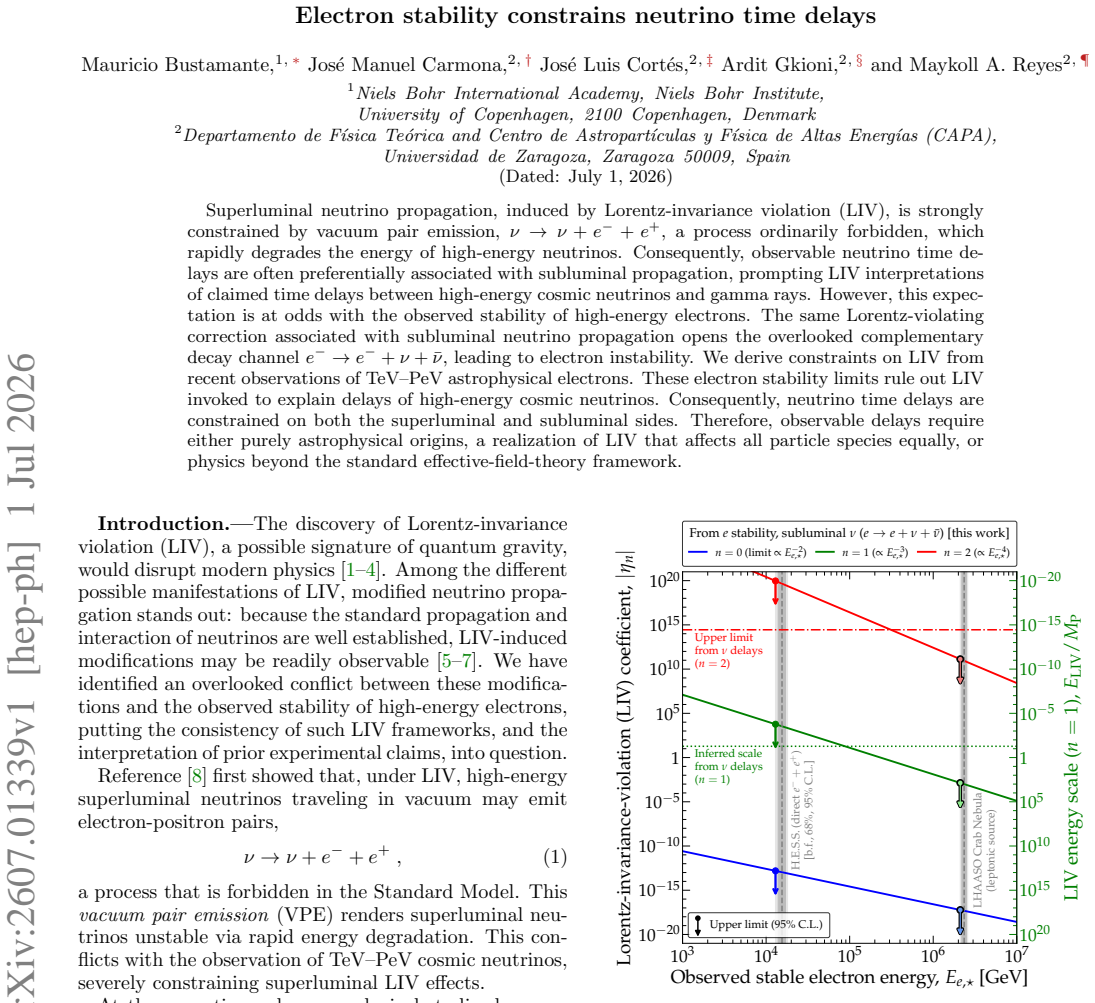
Electron stability rules out LIV explanation for neutrino delays

by Mauricio Bustamante, José Manuel Carmona +3 more

Electron stability constrains neutrino time delays

The violation term slowing neutrinos would also destabilize high-energy electrons, contradicting observations.

Figure from the paper full image
abstract click to expand
Superluminal neutrino propagation, induced by Lorentz-invariance violation (LIV), is strongly constrained by vacuum pair emission, $\nu \to \nu + e^- + e^+$, a process ordinarily forbidden, which rapidly degrades the energy of high-energy neutrinos. Consequently, observable neutrino time delays are often preferentially associated with subluminal propagation, prompting LIV interpretations of claimed time delays between high-energy cosmic neutrinos and gamma rays. However, this expectation is at odds with the observed stability of high-energy electrons. The same Lorentz-violating correction associated with subluminal neutrino propagation opens the overlooked complementary decay channel $e^- \to e^- + \nu + \bar{\nu}$, leading to electron instability. We derive constraints on LIV from recent observations of TeV--PeV astrophysical electrons. These electron stability limits rule out LIV invoked to explain delays of high-energy cosmic neutrinos. Consequently, neutrino time delays are constrained on both the superluminal and subluminal sides. Therefore, observable delays require either purely astrophysical origins, a realization of LIV that affects all particle species equally, or physics beyond the standard effective-field-theory framework.
0
0
hep-ph 2026-07-02

Bubbles change axion misalignment relic density in two regimes

by Galymzhan Baltabay, Francesco D'Eramo +1 more

Axion Misalignment Across First-Order Phase Transitions

Rapid transitions boost abundance by delaying oscillations; slow ones suppress it through gradients from expanding bubbles.

Figure from the paper full image
abstract click to expand
When the axion mass is generated during a first-order phase transition and becomes non-vanishing only inside expanding true-vacuum bubbles, the standard picture of misalignment production is qualitatively modified. Using lattice simulations in an expanding universe, we study dark matter production within such a framework and identify two distinct regimes. For rapid transitions, the onset of oscillations is delayed until bubble percolation, enhancing the relic abundance. For slower transitions, spatial gradients generated by expanding bubbles suppress the effective misalignment angle through the bubble misalignment mechanism. We derive a semi-analytical expression for the relic density that provides a unified description of both regimes and accurately reproduces the simulation results. Finally, we show how this mechanism also modifies isocurvature perturbations and the small-scale matter power spectrum, with important implications for axion minicluster formation.
0
0
hep-ph 2026-07-02

No evidence for axions in 257 black hole spins

by Orion Ning, Benjamin R. Safdi +1 more

No Evidence for Superradiant Axions in LIGO-Virgo-KAGRA GWTC-5 Binary Black Hole Spins

LIGO-Virgo-KAGRA GWTC-5 data excludes masses 1.7e-14 to 3.3e-12 eV at 95 percent , one of the strongest robust bounds.

Figure from the paper full image
abstract click to expand
The quantum chromodynamics (QCD) axion and axion-like particles may form bound clouds around spinning black holes (BHs) when their Compton wavelength is comparable to the BH gravitational radius, depleting the BH spin through what is known as a $\textit{superradiance}$ instability. Using binary BH (BBH) spin measurements obtained from the LIGO-Virgo-KAGRA GWTC-5 catalog, the most extensive public BBH catalog to date containing $N=257$ mergers with BH masses spanning roughly $5$-$135$ $M_\odot$, we perform a hierarchical Bayesian analysis in the context of a BH spin population model to constrain ultralight axions. The presence of axions at a given mass would imprint a unique signature in the observed mass-spin relation relative to the formation distribution. We find no evidence for axions across more than two decades in mass, excluding axion masses $1.7 \times 10^{-14} \, {\rm eV} \lesssim m_a \lesssim 3.3 \times 10^{-12} \, {\rm eV}$ at 95% confidence. Because prior superradiance bounds in this range derive from X-ray spin measurements with substantial modeling systematics, this result represents one of the strongest robust lower bounds on the QCD axion mass.
0
0
hep-ph 2026-07-02

NLO electroweak corrections computed for polarised ZZ scattering at LHC

by Ansgar Denner, Robert Franken +3 more

The cleanest of them all: NLO electroweak corrections to vector-boson scattering into doubly polarised ZZ pairs at the LHC

First results for doubly polarised signals in vector-boson scattering enable precise LHC predictions in fiducial regions

abstract click to expand
We present the first calculation of the next-to-leading-order electroweak corrections to vector-boson scattering into doubly polarised Z bosons at the LHC in the fully leptonic decay channel. The production and decay of the two polarised Z bosons are consistently modelled in the double-pole approximation, separating polarisation states at the amplitude level and including factorisable real and virtual electroweak corrections. Doubly polarised and unpolarised signals are investigated and confronted with off-shell results. A broad analysis, including results at integrated and differential level, is carried out in a realistic, CMS-inspired fiducial setup. Our study paves the way to upcoming analyses with LHC Run-3 and High-Luminosity data as well as to further phenomenological investigations.
0
0
hep-ph 2026-07-02

HyperFORM brings hyperlogarithm integration to FORM

by Adam Kardos, Sven-Olaf Moch +1 more

HyperFORM -- a FORM package for parametric integration with hyperlogarithms

The package adapts Maple methods for large algebraic expressions and multi-core processing, illustrated on zigzag periods up to six loops.

Figure from the paper full image
abstract click to expand
HyperFORM brings the parametric integration of hyperlogarithms, weighted by rational prefactors, into the symbolic-manipulation system FORM. It ports the capabilities of Erik Panzer's Maple package HyperInt, capitalizing on FORM's speed with bulky algebraic input and on its ability to spread a single calculation across many processor cores. We keep the description of the method brief and concentrate instead on how the package is organized and driven: a fully self-contained program for the three-loop zigzag period serves as a worked illustration, and timing measurements for zigzags through six loops gauge its present reach. HyperFORM is released openly and applies to a broad class of problems, the evaluation of Feynman integrals prominently among them.
0
0
hep-lat 2026-07-02

Lattice data interpolated with infinite-mass limit gives B_s decay rate

by Alessandro De Santis, Antonio Evangelista +17 more

Inclusive bar B_smapsto X_(bar sc) ell bar ν decays from lattice QCD: computational strategy and a first physical result

Non-perturbative results up to 4.3 GeV combined with OPE yield first-principles inclusive rate at 7 percent uncertainty.

Figure from the paper full image
abstract click to expand
We present a strategy to compute the inclusive decay rate for the process $\bar B_s \mapsto X_{\bar sc} \ell \bar{\nu}$ from first principles in lattice QCD. The physical decay rate is obtained from the interpolation of non-perturbative lattice data, obtained at lighter than physical heavy meson masses ($M_{\bar B_s}^\mathrm{max}=4.3$GeV), with the Operator Product Expansion predictions, which become exact in the limit of infinitely heavy quarks. We also present a new method for the computation of the required lattice four-point correlators, which represents a considerable improvement over the state-of-the-art on the subject. We show the effectiveness of the strategy by performing the calculation on a subset of the available $n_f=2+1+1$ physical-point Extended Twisted Mass Collaboration (ETMC) gauge ensembles. Our current determination of the inclusive decay rate has a 7% total error, that is dominated by uncertainties due to the relatively limited configuration ensembles considered herein, and can be significantly reduced in the near future.
0
0
hep-ph 2026-07-02

φ(2170) candidates show yields from 10^{-6} to 10^{-4}

by Jian Cao, Wen-Chao Zhang +9 more

Shedding light on the nature of φ(2170) with the parton and hadron cascade model PACIAE

Simulations at 4.95 GeV find order-of-magnitude differences and distinct rapidity spectra depending on assumed quark structure.

Figure from the paper full image
abstract click to expand
The nature of $\phi(2170)$ remains open. We simulate its production in $e^+e^-$ collisions at $\sqrt{s}=4.95$ GeV using PACIAE 4.0, which sequentially generates the final partonic state (FPS) and the final hadronic state (FHS). While previous studies have interpreted $\phi(2170)$ as an $ss\bar{s}\bar{s}$ or a $u\bar{u}s\bar{s}$ state, the $U(1)$ anomaly coupling allows non-strange quarks to couple to a vector $s\bar{s}$ component via soft-gluon interactions. This motivates us to also explore the $d\bar{d}s\bar{s}$ tetraquark configuration. In addition, we consider $\phi(2170)$ as an excited strangeonium state, an $s\bar{s}g$ hybrid state, a $\bar{\Lambda}\Lambda$ bound state, and a $\phi K^+K^-$ resonance state. The strangeonium, hybrid, and tetraquark candidates are formed by coalescing their constituent partons in the FPS using the dynamically constrained phase-space coalescence model. The $\bar{\Lambda}\Lambda$ and $\phi K^+K^-$ states are produced via recombination of their constituent hadrons in the FHS. We calculate the orbital angular momentum quantum number of each candidate in its rest frame and perform spectral classification. Given $J^{PC}=1^{--}$, $\phi(2170)$ can be interpreted as a $D$-wave $s\bar{s}$, a $P$-wave $s\bar{s}g$, a $P$-wave $u\bar{u}s\bar{s}/d\bar{d}s\bar{s}/ss\bar{s}\bar{s}$, an $S$-wave $\bar{\Lambda}\Lambda$, or an $S$-wave $\phi K^+K^-$ state. The yields of the $D$-wave $s\bar{s}$, $P$-wave $s\bar{s}g$, $u\bar{u}s\bar{s}$ and $d\bar{d}s\bar{s}$ states are of order $10^{-4}$; those for the $S$-wave $\bar{\Lambda}\Lambda$ and $\phi K^+K^-$ states are of order $10^{-5}$; while the $P$-wave $ss\bar{s}\bar{s}$ yield is of order $10^{-6}$. Moreover, significant discrepancies are observed in the rapidity distributions and the $p_T$ spectra among the various candidates. These discrepancies could serve as valuable criteria for unraveling the nature of $\phi(2170)$.
0
0
hep-ph 2026-07-02

Quantum statistical parton model upgraded for Marathon and SeaQuest data

by Claude Bourrely

The Quantum Statistical Approach to Parton Distributions upgraded with recent experimental data

Entropy changes with potentials clarify the main parameters while prior data fits are kept.

Figure from the paper full image
abstract click to expand
The Quantum Statistical Parton Model has been successful over the years explain a great set of unpolarized and polarized experimental data. to With the advent of the Marathon and SeaQuest experiments an upgraded version is required to maintain the validity of the model. Moreover, in order to clarify the role of the thermodynamical potentials, the main parameters of the model, we examine the variation of the proton and the neutron entropy with the potentials.
0
0
hep-ph 2026-07-02

Bethe-Heitler process enables diphoton entanglement measurement

by Yue Pan, Yipin Wang +3 more

Quantum entanglement of photon pairs at proton-proton colliders

Joint angles of electron-positron pairs from tracker conversions carry polarization information to detect quantum entanglement in high-energ

Figure from the paper full image
abstract click to expand
Diphoton systems, with photon polarizations measurable at low energies, serve as ideal qubits and were first used to demonstrate quantum entanglement. However, due to the current absence of dedicated polarimeters at high-energy colliders, the entanglement properties of diphoton systems remain largely unexplored at the high-energy frontier. Studying quantum entanglement at the high-energy frontier, where particle colliders serve as a natural relativistic laboratory, helps us better understand the quantum nature and seek new physics. In this letter, we propose a novel method to measure the entanglement of diphoton systems at proton-proton colliders. The photon spin analyzing power arises from the Bethe-Heitler process occurring in the tracker, where photons scatter off nuclei to produce electron-positron pairs whose joint angular distribution encodes the polarization of the diphoton system. Simulation results show that, under HL-LHC conditions, the statistical significance of quantum entanglement in the Higgs $\to \gamma\gamma$ process is $0.007\sigma$, while measuring the continuum diphoton process $q\bar{q} \to \gamma\gamma$ alone can reach about $1.5\sigma$.
0
0
hep-ph 2026-07-02

ML extracts longitudinal boson rates at NLO in di-boson events

by Juan M. Cruz-Martinez, Jakob Linder +3 more

Higher-order effects in amplitude-assisted polarisation extraction with machine-learning techniques

Amplitude-assisted regression at next-to-leading order with parton showers gives a new tool for polarization measurements at the LHC.

Figure from the paper full image
abstract click to expand
With increasing experimental precision, the prospect of extracting the polarisation of electroweak gauge bosons is becoming particularly attractive. To this end, regression and classification procedures based on precise and accurate theoretical predictions are becoming increasingly important. In this work, we present the first amplitude-assisted regression procedure at next-to-leading-order accuracy in QCD, supplemented with parton-shower effects, using machine-learning techniques to extract the rate of longitudinal-boson production in high-energy collisions. Several neural-network architectures are presented and benchmarked against a standard random-forest regressor, demonstrating the robustness of the results for di-boson production at the LHC.
0
0
hep-ph 2026-07-02

Entropy bound forces primordial black holes to explain dark matter and early galaxies

by Sidan A, Tom Banks +1 more

Can Primordial Black Holes Be Seeds for Early Galaxies in Models Satisfying the Covariant Entropy Bound?

Tiny early black holes decay to radiation while larger ones supply all dark matter and seed JWST galaxies.

Figure from the paper full image
abstract click to expand
We argue that cosmological models obeying the Covariant Entropy Bound (CEB) mathematically favor states with no localized excitations or one large black hole containing all the energy in a constrained initial state. In order to get a long radiation-dominated era, one must postulate that at a very early time, most horizon volumes of the universe contained tiny black holes that decayed into radiation. A previous work by two of the authors showed that such a scenario could fit the data on the Cosmic Microwave Background (CMB). In order to account for dark matter, we also postulate some random black holes of at least horizon size at that time. A reasonable distribution of such primordial black holes can account for all of dark matter as well as the early galaxies seen by the James Webb Space Telescope. Some of the dark matter may also be in Planck-scale remnants of the decaying black holes. We describe our model both in terms of approximate solutions to General Relativity and a speculative quantum gravity model whose hydrodynamics matches the flat $p = \pm \rho$ FRW model that saturates the CEB.
0
0
hep-ph 2026-07-02

DM scattering matches star luminosity near black hole at 10^{-36} cm²

by Stephan A. Meighen-Berger, R. Andrew Gustafson +4 more

Dark matter energy exchange in stars orbiting supermassive black holes

Orbit-averaged exchange in spiked profiles equals stellar output for small cross sections, providing annihilation-free dark star route.

Figure from the paper full image
abstract click to expand
Stars on tight orbits around the supermassive black hole at the Galactic Center pass through regions where the dark matter~(DM) density may be strongly enhanced. We compute the orbit-averaged DM-induced energy exchange for S4714 as an example. It is a star on an exceptionally close and relativistic orbit around Sagittarius~A*. For a spiked dark matter profile, the exchange reaches the stellar luminosity at $\sigma_{\chi p} \sim 10^{-36}~\mathrm{cm}^2$ for MeV-GeV masses and $\sigma_{\chi e} \sim 5\times10^{-38}~\mathrm{cm}^2$ for sub-MeV masses, opening a new annihilation-free route toward dark-star phases. These cross sections lie within the range predicted by freeze-in scenarios and are consistent with cosmic-ray--boosted and solar-reflection dark matter constraints.
0
0
hep-ph 2026-07-02

BESIII could measure neutron momentum distributions in nuclei

by Zi-Wei Yan, Shu-Man Hu +4 more

Exploring the neutron momentum distribution in nuclei through γ n to π^- p at an electron-positron collider

Impulse-approximation calculations predict tens of thousands of events from the pion photoproduction process on beryllium.

Figure from the paper full image
abstract click to expand
The neutron momentum distribution is essential both for reliably extracting fundamental free neutron observables from nuclear measurements and for probing the tensor force via the high-momentum neutron fraction, which is crucial to the theoretical understanding of short-range correlations (SRCs). In this work, we investigate this distribution by studying the $\gamma n \to \pi^- p$ process at an electron-positron collider, proposing to utilize the beryllium beam pipe at the Beijing Spectrometer III (BESIII). The cross sections for this process on both deuteron and beryllium targets are calculated within the impulse approximation framework. We also evaluate the effective luminosity of the photon flux from radiative Bhabha scattering, taking into account the distribution of target materials within the BESIII experimental setup. Our results show that tens of thousands of events can be generated at BESIII, offering the potential for precise measurements of the neutron momentum distribution. These findings suggest that electron-positron colliders could play a valuable role in elucidating nuclear structure and advancing our understanding of nonperturbative QCD, offering promising new avenues for both particle and nuclear physics.
0
0
hep-ph 2026-07-02

Unitary mixing inflates Δ(1232) partial width beyond total width

by S. Ceci, R. Omerović +3 more

Rethinking Partial Widths: Unitary Mixing and the Delta(1232) Pole Residue

Evaluating the perturbing S-matrix at the complex pole shows residues reflect global amplitude topology rather than intrinsic properties.

abstract click to expand
The extracted $\pi N$ partial decay width of the $\Delta(1232)$ systematically exceeds its total width ($2|r|>\Gamma$). We demonstrate this anomaly is a natural consequence of S-matrix unitary mixing. Because exact multi-channel shadow poles are distant and model-dependent, we utilize a heuristic elastic model -- treating the overlapping $\Delta(1600)$ as fully elastic -- to isolate the core mechanism. We show that evaluating a perturbing S-matrix at a state's complex pole systematically inflates the residue magnitude. This proof of principle confirms complex residues reflect global amplitude topology rather than isolated intrinsic properties, challenging naive interpretations of branching fractions.
0
0
hep-ph 2026-07-02

DLA sums double logs in QED, QCD since 1956

by B.I. Ermolaev

70 years of Doubly-Logarithmic Approximation

Review marks seventy years of the approximation that became basic for high-energy scattering and structure functions.

Figure from the paper full image
abstract click to expand
Existence of Double-Logarithmic (DL) contributions to scattering amplitudes in QED was discovered by V.V. Sudakov in 1956 and total summation of DL contributions to electron-photon scattering resulted in appearance of famous Sudakov exponentials. Then, thanks to contributions of V.G. Gorshkov, V.N. Gribov, G.V. Frolov and L.N. Lipatov, the pattern of calculations in Double- Logarithmic Approximation (DLA) was constructed. Since then, DLA has become one of basic ways of describing various high-energy processes in the framework of QED, QCD and theory of EW interactions. In the present paper, we remind the history of DLA and present a brief overview of application of DLA to various objects like form factors, scattering amplitudes, DIS structure functions.
0
0
hep-ph 2026-07-02

Tensor contractions speed dark-sector collision calculations

by Esau Cervantes

KineticXGPU: A Tensorized Collision Operator for Dark-Sector Self-Scattering

Elastic self-interactions erase bimodal freeze-in distributions and restore Maxwell-Boltzmann form

abstract click to expand
In this work, we present KineticXGPU, a PyTorch-based implementation of the $2\to 2$ elastic self-collision operator for dark-sector momentum distributions. The discretized collision operator can be expressed as tensor contractions and is therefore well suited for GPUs. As an application, we study a two-source freeze-in scenario in which the final distribution can develop a bimodal shape. We show that increasing the strength of elastic self-interactions progressively erases this structure and drives the distribution toward a Maxwell-Boltzmann distribution. We compare the phase-space formulation with a set of fluid equations that couple the number density and velocity dispersion. We also compare CPU and GPU runtimes and demonstrate the computational advantage of the tensorized approach. The code is publicly available on GitHub.
0
0
hep-ph 2026-07-02

J/ψ-N correlations probe nucleon D-form factor

by Ren Ejima, Daisuke Fujii +1 more

Charmonium-nucleon femtoscopy as a possible probe of the nucleon gravitational form factor

Correlation functions computed via effective potential exhibit sensitivity to gravitational form factors from lattice data.

Figure from the paper full image
abstract click to expand
We investigate the charmonium-nucleon interaction, focusing on its connection with the internal structure of the nucleon encoded in the gravitational form factors. To describe this interaction, we employ an effective potential based on the QCD multipole expansion within the leading chromoelectric dipole approximation. In this framework, the potential is expressed in terms of the energy and pressure distributions inside the nucleon. We first construct these distributions from the gravitational form factors fitted to lattice-QCD data. The remaining model parameters are then fixed by requiring that the resulting $J/\psi$-$N$ potential reproduce the HAL QCD potential outside the short-distance region, as well as the scattering phase shift estimated from the HAL QCD data. Based on this potential, we evaluate the $J/\psi$-$N$ correlation function and further investigate the $\psi(2S)$-$N$ system. We then examine the sensitivity of these correlation functions to the nucleon $D$-form factor.
0
0
hep-ph 2026-07-02

Equations give full gluon spectrum from quark pair in medium

by Carlota Andrés, Liliana Apolinário +5 more

Gluon radiation from a QCD antenna with realistic parton-medium interactions

Numerical solution resums all scatterings with realistic kernels and maps coherence loss across phase space.

abstract click to expand
The spectrum of coherent gluon radiation from a quark-antiquark pair undergoing multiple scatterings within a colored medium is central for understanding in-medium parton cascades. However, current efforts are constrained by reliance on a number of approximations, such as the harmonic oscillator approximation, that are only valid within limited regions of phase space. In this paper, we circumvent this problem by expressing the full in-medium gluon emission spectrum as a set of differential equations that can be solved numerically. This formalism, previously applied to the case of medium-induced radiation off a single color charge, allows to resum medium interactions to all orders while employing realistic scattering models. The resulting angle and energy distributions of emitted gluons serve to illustrate the breakdown of color coherence across the entire accessible phase-space, and constitute a definite step towards a higher-precision description of jet observables.
0
0
hep-ph 2026-07-02

QCD sum rules fix B_c(1P) mixing angle at 43.3°

by T.M. Aliev, S. Bilmis +1 more

QCD sum-rule determination of the axial-vector mixing angle in the texorpdfstring{\(B_c(1P)\)}{Bc(1P)} sector

The value indicates sizable mixing between the singlet and triplet axial-vector P states of the bottom-charm meson.

Figure from the paper full image
abstract click to expand
We determine the mixing angle between the \(1^1P_1\) and \(1^3P_1\) axial-vector states in the \(B_c(1P)\) sector using QCD sum rules. The analysis gives \(\theta_{B_c(1P)}=(43.3\pm0.2)^\circ\), indicating sizable mixing between these two states. We also compare our result with theoretical studies available in the literature.
0
0
hep-ph 2026-07-02

Rescattering suppresses magnetic form factor in Σ decays from J/ψ

by Chao-Qiang Geng, Xiang-Nan Jin +1 more

The Negative-Sigmabar{Sigma} Angular-Parameter Puzzle in J/psi and psi(2S) Decays

Common final-state mixing of S- and D-waves explains the lone negative α_Σ while fitting all channels with χ²=4.43.

abstract click to expand
Experimental measurements of $J/\psi$ and $\psi(2S)$ decays to octet baryon pairs reveal a negative-$\Sigma\bar{\Sigma}$ puzzle in the angular distributions: $\alpha_\Sigma^{J/\psi}<0$, whereas the other measured $J/\psi$ octet channels and the corresponding $\psi(2S)$ channels have positive angular parameters. We show that an $SU(3)_F$-exact singlet description fails decisively in a $\chi^2$ fit, giving $\chi^2\simeq10^4$. By contrast, a fit that allows a common final-state interaction to mix the ${\rm S}$- and ${\rm D}$-wave amplitudes, together with a symmetric $SU(3)_F$-breaking octet, gives $\chi^2=4.43$ for two nominal degrees of freedom and strongly favors this breaking pattern. The negative $\Sigma\bar{\Sigma}$ angular parameter is traced to the suppression of the magnetic form factor by the common final-state rescattering.
0
0
hep-ph 2026-07-02

Dipole boundary condition fits rho transparency data

by Tae Keun Choi, Kook-Jin Kong +1 more

Effective Color Dipole Approach to Color Transparency in texorpdfstring{rho⁰}{rho⁰} Electroproduction

CDM-derived initial cross section plus linear transport reproduces CLAS Q2 rise on C and Fe at 0.3 GeV2 expansion scale.

Figure from the paper full image
abstract click to expand
We investigate nuclear transparency in exclusive $\rho^{0}$ electroproduction on $^{12}$C and $^{56}$Fe nuclei within a multi-channel final-state interaction (FSI) framework that explicitly incorporates the kinematic decay length effect (DLE) arising from the short-lived $\rho^{0}\rightarrow\pi^{+}\pi^{-}$ decay. A realistic treatment of the deuteron reference state using the Paris potential wave function, which incorporates the short-range repulsive core and tensor correlations, provides a physically reliable normalization for the transparency ratio $T_A/T_D$. The conventional DLE and nuclear shadowing mechanisms together remain insufficient to account for the observed $Q^2$-dependent enhancement, systematically underestimating the measured transparency throughout the CLAS kinematic range. To address this, we introduce an effective Color Dipole Model (CDM) boundary condition for the initial PLC interaction cross section $\sigma_{\text{h}}(Q^2)$, evaluated as a dipole-weighted average over the $\gamma^*$--$\rho^0$ transition wave functions, in place of the purely empirical Quantum Diffusion Model (QDM) ansatz. This CDM-inspired initial condition, combined with the standard linear QDM transport, yields a consistent description of the $Q^2$-dependent CLAS data for both targets with an effective in-medium expansion scale $\Delta m^2 = 0.3~\mathrm{GeV}^2$. Although the present analysis does not provide definitive evidence for the onset of Color Transparency, it demonstrates that a CDM-inspired PLC boundary condition, together with a realistic treatment of the underlying reaction dynamics, yields a physically consistent and quantitatively improved description of the CLAS data.
0
0
hep-lat 2026-07-02

Lattice QCD+QED separates isospin effects in inclusive tau decays

by Mattia Bruno, Taku Izubuchi +4 more

Isospin-breaking effects in inclusive hadronic τ data for the muon (g-2) from first principles

Three infrared-safe classes plus Euclidean final-state strategy give first-principles access to the corrections needed for muon g-2 from tau

abstract click to expand
The knowledge of isospin-breaking effects in hadronic $\tau$ decays is required for a high-precision determination of the Hadronic-Vacuum-Polarization contribution to $(g-2)_\mu$ from experimental $\tau$ data. In this work we present a strategy for their calculation in a fully inclusive setup from first-principles Lattice QCD+QED simulations. We separate radiative corrections in three infrared safe classes, which we study individually. We provide analytic expressions for their effects in the initial state and propose a strategy for final-state corrections directly in Euclidean space. We also examine the non-factorizable contributions and highlight the challenges associated with their analytic continuation from Euclidean to Minkowski space. By studying short-distance corrections in the context of momentum schemes, we provide a prescription for the renormalization of the individual terms at first order in the ispospin-breaking parameters.
0
0
hep-ph 2026-07-02

Modular symmetry model drives inflation with 1% axion isocurvature

by Yoshihiko Abe, Komei Goto +3 more

Finite modular Coleman-Weinberg inflation

Imaginary part of modulus acts as inflaton while real part dominates after reheating and may yield detectable signals.

Figure from the paper full image
abstract click to expand
We propose a modular symmetric inflationary model based on a Coleman--Weinberg potential generated by integrating out heavy vector-like quarks that couple to the complex modulus field $\tau$ through modular forms. In this framework, the imaginary part of modulus $\tau$ plays the role of the inflaton, while the real part is identified with a heavy axion. We show that the model successfully explains the current cosmological observations. We further discuss reheating through modulus-dependent gauge kinetic functions and the cosmology of the axion. The axion oscillation dominates over the Universe after the reheating via inflaton decay, and then it decays before Big Bang Nucleosynthesis in the viable parameter region. The quantum fluctuation of the axion can be of order $\mathcal{O}(1)\% $ of that of the inflaton, which would induce isocurvature perturbations that may be detectable in future observations.
0
0
hep-ph 2026-07-02

Strange quark shifts kaon parton localizations

by Abi Jebarson A, Navpreet Kaur +1 more

Leading-twist to higher-twist generalized parton distributions of the pseudoscalar mesons at non-zero skewness

Higher-twist GPDs computed in light-front model reveal flavor symmetry breaking and mass suppression in pion versus kaon.

Figure from the paper full image
abstract click to expand
We investigate the multidimensional partonic structure of spin-0 mesons, specifically the pion and the kaon, by evaluating their complete set of eight generalized parton distributions (GPDs) up to twist-4. Utilizing the light-front quark model (LFQM) with the Brodsky-Huang-Lepage (BHL) prescription, we compute these distributions in the kinematically rich non-zero skewness ($\xi \neq 0$) domain, strictly within the DGLAP region, $x \in [\xi, 1]$. To construct a three-dimensional tomographic picture, we perform Fourier transforms of the momentum-space GPDs to obtain the impact parameter dependent parton distribution functions (IPDPDFs) in the transverse plane and the corresponding diffraction patterns in the longitudinal coordinate space. The numerical results explicitly reveal the consequences of $\mathrm{SU}(3)$ flavor symmetry breaking, as the strange quark in the kaon dynamically shifts spatial localizations compared to the lighter up quarks. We also observe that while higher-twist correlations exhibit massive amplitude scaling in the pion, they are heavily suppressed by the larger macroscopic mass of the kaon.
0
0
hep-lat 2026-07-02

A and V gradient flow schemes match fermion operators to MSbar

by Matthew Black, Anna Hasenfratz +1 more

Gradient Flow Renormalization Schemes for Composite Fermion Operators

Nonperturbative fixing of wavefunction renormalization via axial charge or vector current yields renormalization factors and quark masses fr

Figure from the paper full image
abstract click to expand
We introduce gradient flow (GF) normalization prescriptions for fermionic composite operators in which the flowed fermion wavefunction renormalization factor is fixed nonperturbatively using either the partially conserved axial charge or the conserved vector current. The resulting $A$ and $V$ schemes are defined through standard flowed two-point correlation functions and therefore avoid the backward-flow construction required by local ringed-scheme definitions. In the short-flow-time limit, the $A$ and $V$ schemes can be matched to $\overline{\mathrm{MS}}$ using known ringed-scheme short-flow-time expansion (SFTX) coefficients. We show how these schemes can be implemented through ratios of two-point correlation functions, leading to simple nonperturbative determinations of renormalization factors, anomalous dimensions, and evolution factors which connect lattice-accessible flow times to shorter flow times where perturbative matching is reliable. We illustrate the method with RBC-UKQCD domain-wall fermion ensembles, including a GF determination of the ratio of matching factors $Z_V/Z_A$, and a new GF determination of the renormalized strange quark mass.
0
0
hep-ph 2026-07-02

Dipole alone cannot fix sign of small-x gluon D-term

by Lei Wang

Sub-eikonal stress and model dependence of the small-x gluon D-term

Transverse stress appears only at next-to-eikonal order, so saturation profiles leave the D-term sign undetermined

abstract click to expand
The leading-eikonal small-$x$ dipole gives a compact representation of the gluon momentum form factor $A_g(t)$. We show that the same information is not sufficient to determine the gluon stress form factor $C_g(t)$, and hence the gluon D-term. The reason is kinematic and operatorial: in a Drell-Yan frame $A_g(t)$ is projected by $T_g^{++}$, whereas $C_g(t)$ is projected by the symmetric-traceless transverse stress $T_g^{ij}$. This stress projection first appears through next-to-eikonal fields and is represented by gauge-invariant stress-decorated Wilson lines containing $F^{i-}$, $F^{ij}$, or equivalent sub-eikonal target fields. We construct this operator and match it to the local energy-momentum tensor at tree level, obtaining an operator-level no-go statement: the ordinary dipole $S_x(b_\perp,r_\perp)$, or a saturation profile $Q_s^2(x,b)$, does not by itself determine the sign of the small-$x$ gluon D-term. We then give a finite-correlation response model in which a positive kernel generates an anti-aligned response $F^{i-}=-\epsilon R_{\rm NE}F^{i+}$, so that $\Lambda_{\rm NE}>0$ and $D_g(0)<0$ within that response class. A Gaussian benchmark and numerical scans over Gaussian, Woods-Saxon, power-edge, and McLerran-Venugopalan (MV)-inspired profiles show a stable negative forward D-term for this anti-aligned model, together with the expected core-shell pressure pattern. The gluon D-term is therefore a next-to-eikonal stress probe, not a universal leading-eikonal saturation observable.
0
0
nucl-th 2026-07-02

Spin femtoscopy isolates genuine two-particle spin correlations

by Kehao Zhang, Xuan Wang +1 more

Spin Femtoscopy: A Framework for Revealing Genuine Spin Correlations

Lambda-Lambda correlation functions with controlled singlet and triplet content separate true spin signals from quantum-statistical and inte

Figure from the paper full image
abstract click to expand
Spin correlations are among the most fundamental quantum observables in many-body systems, yet they remain difficult to access experimentally in relativistic heavy-ion collisions. Existing spin measurements, including hyperon polarization and vector-meson spin alignment, have revealed important single-particle spin phenomena, but genuine two-particle spin correlations in the produced hadronic system remain largely unexplored. Here we propose spin femtoscopy, a framework for accessing genuine two-particle spin correlations through spin-resolved femtoscopic measurements. The key principle is that different two-particle spin configurations can give rise to different femtoscopic correlation functions because of quantum statistics, spin-dependent final-state interactions. Using $\Lambda\Lambda$ pairs as a proof of principle, we exploit the self-analyzing weak decay of $\Lambda$ hyperons to construct spin-sensitive femtoscopic correlation functions with different singlet and triplet admixtures. We show that these observables provide experimental access to the spin-state populations of the pair and allow genuine spin correlations to be separated from spin-dependent femtoscopic mixing caused by quantum statistics and final-state interactions. This work extends femtoscopy from a probe of source geometry and final-state interactions to a framework for revealing the quantum spin structure of strongly interacting matter.
0
0
hep-ph 2026-07-02

Octonion rotor sets quark Cabibbo phase to conjugate law

by Bishnu Gupta Teli, Tejinder P. Singh

Fermion Mixing Matrices and the Exceptional Jordan Algebra

Mass ratios from cubic ladders plus alpha2 rotor yield exact local relation phi12 equals negative two chi

abstract click to expand
We extend the exceptional-Jordan spectral framework for fermion mass hierarchies to the problem of quark and lepton mixing. Following the companion mass paper~\cite{Teli:2026jgr}, each fermion sector is associated with a Hermitian element of $J_3(\mathbb{O}_{\mathbb{C}})$, where adjacent square-root mass ratios are obtained from cubic ladders in $\mathrm{Sym}^3(\mathbf 3)$. Here, these ratios are used as inputs to an adjacent-edge lift from spectral hierarchy data to two-generation mixing angles. The lift is derived from a Fritzsch-type two-state texture~\cite{Fritzsch:1977za, Fritzsch:1979zq} and should be regarded as an effective bridge ansatz rather than a theorem of the Jordan spectrum alone. The exact CP-transport input is supplied by the companion CP Letter~\cite{GuptaTeli:2026aqf}. In the quark sector, the octonionic ladder operator $\alpha_2$ generates a real local rotor in the $(e_1,e_3)$ plane, and the up- and down-sector local Cabibbo-edge amplitudes are complex conjugates, giving the exact local law $\phi_{12}=-2\chi$. This is a transport-level Cabibbo-rung phase law, not by itself a prediction of the standard CKM Dirac phase. With the fitted companion mass ratios, the minimal two-angle extraction from the measured $|V_{us}|$ gives an effective Cabibbo-block phase $\phi_{12}\simeq 105.7^\circ$; this number is a bridge diagnostic, while the balanced octonionic rotor remains the distinguished quadrature reference point. The $(2,3)$ sector requires a phenomenological normalization $\kappa_{23}\simeq0.56$, and the direct $(1,3)$ element remains a long-edge bridge problem. [Truncated]
0
0
hep-ph 2026-07-02

Flavor mixing predicts hidden-charm states with one or two strange quarks

by Kan Chen, Bo Wang

Classifying the hidden-charm pentaquarks via a flavor mixing scheme

Classification by light-flavor components fits Pc and Pcs data and yields mass spectra for new molecular states via channel mixing.

Figure from the paper full image
abstract click to expand
In this work, we propose a scheme to classify the molecular states consisting of ground single-charm baryons ($\Lambda_c$, $\Xi_c$, $\Sigma_c^{(*)}$, $\Xi_c^{\prime(*)}$, $\Omega_c^{(*)}$) and $\bar{D}^{(*)}/\bar{D}_s^{(*)}$ mesons. Within this framework, all considered baryon-meson systems are categorized according to the flavor components of their light degrees of freedom. We briefly illustrate how this classification scheme can consistently explain the experimentally observed $P_c$ and $P_{cs}$ states. This framework also predicts the existences of single-strange and double-strange hidden-charm bound states. The attractive interactions of these states arise from channel mixing between $\Sigma_c^{(*)}\bar{D}_s^{(*)}$ and $\Xi_c^{\prime(*)}\bar{D}^{(*)}$ for single-strange systems, and mixing between $\Xi_c^{\prime(*)}\bar{D}_s^{(*)}$ and $\Omega_c^{(*)}\bar{D}^{(*)}$ for double-strange systems, respectively. Using parameters fitted from the measured $P_c$ and $P_{cs}$ states, we systematically present the predicted mass spectra for these single- and double-strange hidden-charm bound states.
0
0
hep-ph 2026-07-01

LHC searches two-component scalar DM via soft dimuons and MET

by Alexander Belyaev, Manimala Chakraborti +5 more

Soft-Dimuon Signature from Two-Component Scalar Dark Matter at the LHC

Benchmark yields S/sqrt(B) of 1.35 at 300 fb^{-1} and 4.93 at 4 ab^{-1} in opposite-sign dimuon plus jet channel.

Figure from the paper full image
abstract click to expand
We explore the potential of the Large Hadron Collider to probe a two-component scalar dark matter scenario in the opposite-sign dimuon plus missing transverse energy final state, accompanied by a hard jet. The signal features a soft dimuon system with an invariant mass well below $m_Z$. We consider a 3-Higgs Doublet Model with one active and two inert scalar doublets, where a $Z_2 \times Z_2'$ symmetry stabilises the lightest neutral scalar in each inert sector, yielding two scalar DM candidates. The relevant parameter space is mapped in terms of the two DM masses and the mass splittings between each DM candidate and its corresponding next-to-lightest scalar state. We perform a detector-level Monte Carlo analysis and design a dedicated cut-based selection, including a transverse-mass requirement adapted to the signal topology. For a representative benchmark, we obtain $S/B\simeq 9.8%$ and a statistical-only significance of $S/\sqrt{B}=1.35$ at Run 3 with ${\cal L}=300~{\rm fb}^{-1}$, increasing to $S/\sqrt{B}=4.93$ under a statistical-only extrapolation to ${\cal L}=4~{\rm ab}^{-1}$. Before the full selection, the two dark sectors generate a double-bump structure in the dimuon invariant-mass distribution. After the cuts optimised for inclusive sensitivity, however, this feature is not statistically robust enough to establish the two-component origin of the signal. The benchmark is underabundant and is interpreted as a subdominant two-component DM scenario, while the collider analysis remains independent of its cosmological abundance. Although the numerical study is carried out in the I(2+1)HDM, the results are applicable to weakly interacting sectors with similar electroweak associated production and cascade decays, where a heavier state separated from the DM candidate by less than $m_Z$ produces a soft muon pair via an off-shell $Z$ boson.
0
0
hep-ph 2026-07-01

Dark sector scattering yields peak magic at mass ratios 0 and 1.83929

by Carlos Alvarado, Alfredo Aranda +3 more

Production of Magic States via Z Bosons and Dark Photons

New magic distribution functions for Moller-like, Bhabha-like and annihilation processes hit their highest values at two specific SM-to-dark

Figure from the paper full image
abstract click to expand
The production of magic states is studied in two settings. The first is the electroweak (EW) sector of the Standard Model (SM). The second is an extension featuring a new broken $U(1)$ gauge symmetry and a Dirac fermion charged under it. This setup resembles a dark $U(1)$ scenario, with the additional fermion playing the role of a dark matter candidate that annihilates into SM particles through its coupling to the new gauge boson. In the EW sector, the low-energy regime reproduces earlier magic production results obtained for Quantum Electrodynamics, whereas the high-energy and $Z$-resonance regimes generate new magic distribution functions and non-trivially reorganize the stabilizer state classes, with Bhabha scattering exhibiting the strongest sensitivity to electroweak effects. Also, a subset of fixed stabilizer states is identified, for which the magic distributions remain unchanged across the different energy regimes. In the dark sector, the main effect of the new massive mediator is the appearance of new magic distributions functions for Moller-like, Bhabha-like, and inverse pair-annihilation processes in the low-energy limit. These reach the maximal magic value at the SM-to-dark fermion mass ratios $m_f/m_\chi \to 0$ and $m_f/m_\chi\to 1.83929$.
0
0
physics.atom-ph 2026-07-01

Comagnetometer rotation tightens exotic spin force bounds by factor of 17

by Nathan B. Clayburn, Andrew Glassford +9 more

New Bounds on Exotic Long-Range Spin-Spin Interactions

New upper limits on electron-neutron and electron-proton couplings improve prior results for forces with ranges up to planetary scales.

Figure from the paper full image
abstract click to expand
Many proposed extensions to the Standard Model of particle physics introduce new bosons that can mediate forces which couple to particle spin. Here we describe a search for such forces coupling spin-polarized neutrons and protons in our magnetometer to spin-polarized electrons within Earth. We measure these interactions by varying the orientation of an optical $^{199}$Hg-$^{133}$Cs free-precession comagnetometer mounted upon a precision rotation platform. From these measurements, we establish upper bounds on the dimensionless coupling constants associated with the axial-axial potential $V_2$ and the axial-vector potential $V_{11}$ as a function of the force's range $\lambda$. For the electron-neutron and electron-proton potential $V_2$ at infinite range, we find $|g_A^eg_A^n| \leq 3.0 \times 10^{-48}$ and $|g_A^eg_A^p| \leq 3.0 \times 10^{-47}$. For $V_{11}$, we find our most stringent bounds to be $|g_A^eg_V^n| \leq 2.2 \times 10^{-25}$ and $|g_A^eg_V^p| \leq 2.2 \times 10^{-24}$ at $\lambda \approx 10^3$ km. Our results represent an improvement over previous results by up to a factor of 17 and set the most stringent bounds on long-range axial-axial and axial-vector couplings between electron spins and neutron and proton spins.
0
0
hep-th 2026-07-01

Geometry guides faster two-loop integral evaluation

by Stefan Weinzierl

From geometry to phenomenology

Mixed K3 and curve structures in Drell-Yan and similar processes supply information that reduces computational effort.

Figure from the paper full image
abstract click to expand
Precision calculations in quantum field theory rely very often on perturbation theory and thus on the computation of Feynman integrals. Feynman integrals are also fascinating objects from a mathematical point of view and show deep connections to algebraic geometry. Cutting-edge Feynman integrals usually have geometries of "mixed" type, for example parts of it may correspond to a K3-surface, other parts may correspond to curves of a certain genus and the simplest parts correspond to points. In this talk I will discuss how to extract the geometric information from a Feynman integral and how this information can be used to compute more efficiently Feynman integrals. Non-trivial mixed geometries already occur in $2 \rightarrow 2$-processes at two-loops, like Drell-Yan, Bhabha and Moller scattering.
0
0
hep-ph 2026-07-01

Left-hand cuts of partial waves written as right-cut integrals

by Alexandre Salas-Bernárdez

The left-cut for partial waves in terms of physical amplitudes

Exact formula isolates logarithmic structures for any isospin and angular momentum using only physical amplitudes on the right cut.

abstract click to expand
We derive a novel representation of the partial wave amplitude over the left-hand cut for $2 \to 2$ scattering. We express the left-hand cut of arbitrary isospin and angular momentum partial waves as an integral of right-hand cut imaginary parts. This formulation provides an explicit, exact extraction of the logarithmic branch cut structures, offering a valuable tool to systematically quantify left-hand cut uncertainties in unitarization methods such as the Inverse Amplitude Method or $N/D$ approaches.
0
0
hep-th 2026-07-01

Four-derivative theory stays unitary via hidden ghost parity

by Sam Bateman, Neil Turok

Escape from Ostrogradsky via Hidden Ghost Parity

Embedding the model in a two-field O(1,1) theory reveals a symmetry that keeps tree-level probabilities positive.

abstract click to expand
We present a counterexample to Ostrogradsky's famous "no go" theorem as usually interpreted in quantum field theory (QFT), namely a four-derivative, UV-complete QFT with a consistent perturbative expansion which describes high energy scattering processes. We carefully quantize the theory on an $\textit{indefinite}$ space of states - a Krein space - using covariant methods which ensure perturbative causality and unitarity (in the form of the optical theorem) to all orders. We generalize the Born rule to Krein spaces and prove that all tree level transition probabilities are positive in spite of the presence of ghosts. A key role in the proof is played by a hidden "ghost parity" symmetry which becomes explicit when the theory is embedded in a two-derivative, two-field $O(1,1)$-symmetric perturbative field theory.
0
0
hep-ph 2026-07-01

Jet substructure calculations reach tracks at NLL collinear accuracy

by Kyle Lee, Ian Moult +1 more

Putting Jet Substructure on Track(s)

Projected energy correlators up to four points computed for the first time on tracks, matching full-jet precision.

Figure from the paper full image
abstract click to expand
One of the main advances in analysis strategies at the Large Hadron Collider (LHC) has been the ability to study the detailed structure of energy flow within high transverse momentum jets, a field referred to as jet substructure. Jet substructure has provided new ways to search for new physics, measure Standard Model parameters, and study the dynamics of the strong nuclear force. To push to the next level of precision, and to make measurements of increasingly subtle correlations, requires exquisite angular resolution achieved through the use of tracking information. In this paper we leverage recent progress in our understanding of factorization theorems and renormalization group techniques to present the first complete calculations of jet substructure observables at the LHC on tracks. We compute projected energy correlators up to four points at next-to-leading collinear logarithmic accuracy, matching the state of the art for jet substructure observables, but extending to tracks. This marks a significant step in enhancing the collider physics program, enabling precise and systematically improvable comparisons between experimental measurements and theoretical calculations, made possible by the exceptional angular resolution of tracking.
0
0
hep-th 2026-07-01

Flow equations for QFT data extend to AdS3 and AdS4

by Fabiana De Cesare, Manuel Loparco

QFT as a set of ODEs: higher dimensions

The ODEs track how scaling dimensions and OPE coefficients change under bulk deformations and reproduce operator mergers and level repulsion

abstract click to expand
Correlation functions of local operators in Quantum Field Theory (QFT) in Anti-de Sitter space (AdS) are completely fixed by the QFT data: the set of scaling dimensions $\Delta_i$ and OPE coefficients $C_{ijk}$ of the boundary operators, and the bulk-boundary (BOE) coefficients $b^{\hat\Phi}_i$ encoding how bulk fields decompose into boundary operators. In this work, we generalize the ordinary differential equations (ODEs) that govern the variation of the QFT data under a bulk relevant deformation, originally derived for AdS$_2$ \cite{Loparco:2026fki}, to the cases of AdS$_3$ and AdS$_4$. We demonstrate that these flow equations natively capture the mechanism of merger-annihilation when a boundary operator hits marginality, as well as level repulsion when different $\Delta_i$'s approach each other. Furthermore, we address the practical implementation of the framework: we propose substituting the ODE for the OPE coefficients with the crossing equation for greater efficiency, and we observe that Pad\'e approximants dramatically improve the convergence of the sums over boundary operators, at least in free theories. Altogether, these advances lay the groundwork for the future application of the flow equations to the study of strongly coupled QFTs in AdS and their flat space limits.
0
0
hep-ph 2026-07-01

Radio ranges probe ultralight dark matter at 10^{-15} eV

by Jonas Frerick, Hyungjin Kim +1 more

Precision Solar System Dynamics for Ultralight Dark Matter Search

Current precision suffices if solar system density is 100000 times the local average, complementing pulsar timing.

Figure from the paper full image
abstract click to expand
Ultralight dark matter exhibits an order-one density fluctuation at the scale of its wavelength. This density fluctuation exists across the entire dark matter halo and interacts with stars and planets, perturbing their motion via gravitational interactions. We investigate the possibility of using precision solar system dynamics to search for ultralight dark matter. We examine this possibility with interplanetary radio range measurements. We show that the precision of current range measurements can probe ultralight dark matter at masses around $10^{-15}\,$eV, had its density in the solar system been $10^5$ larger than the so-called local dark matter density. This limit complements other constraints, such as the one from analyses of pulsar timing observations.
0
0
astro-ph.HE 2026-07-01

Double polytrope fits neutron star data with max mass 2.45 solar masses

by Tian-Shun Chen, Xiao-Ding Zhou +1 more

An Analytical Toy Equation of State for Neutron Stars Consistent with Current Observations

Analytic models give 11.3 km radius and tidal deformability 485-512 while staying causal.

Figure from the paper full image
abstract click to expand
Fast analytic and semi-analytic studies of neutron stars often require an equation of state that is convenient to evaluate while producing relativistic stellar sequences compatible with current multimessenger constraints. We construct such a benchmark by scanning a smooth double polytropic relation for the energy density as a function of pressure, $\hat\epsilon (\hat p)=a_1\hat p^{\Gamma_1}+a_2\hat p^{\Gamma_2}$. The parameters are selected with filters based on massive pulsars, tidal deformability from the binary-neutron-star event GW170817, and NICER mass-radius measurements. A single polytropic baseline scan finds no model passing all filters, whereas a double-polytrope scan identifies a viable region. A curve-integral score, evaluated against public NICER and GW170817 posterior data sets, is then used to choose benchmark equations of state within this region. The selected representatives support $M_{\max}=2.44$--$2.49\,M_\odot$, with $R_{1.4}\simeq 11.3$ km and $\Lambda_{1.4}=485$--$512$, and remain causal on the stable branch. This compact analytic family provides reference cases for relativistic stellar-structure tests at current observational scales.
0
0
hep-ph 2026-07-01

Concurrence minima mark cleanest energies for neutrino parameters

by Khushboo Dixit, Ritam Kundu +3 more

Quantum Information as a New Lens for Precision Neutrino Physics

Aligning NOνA and T2K regions with lowest entanglement tightens joint limits on mixing angle and CP phase.

abstract click to expand
We present a quantum-information-theoretic study of three-flavor neutrino oscillations in long-baseline experiments by mapping flavor states to qubit-like representations and quantifying quantum correlations through total concurrence. The local minima of this entanglement measure identify energy regions where the flavor state is closest to separability, enabling cleaner extraction of oscillation parameters. We explain how these local minima offer opportunities for precision measurements and provide insight into the accurate determination of neutrino oscillation parameters. We then propose a strategy to improve parameter extraction by aligning the benchmark oscillation regions of NO$\nu$A and T2K with the minimum entanglement achievable in each experiment. This shifts the concurrence minima toward higher-event-count energy regions, leading to tighter constraints and reducing the tension arising from their different energy regimes. For normal ordering, we obtain $(0.581^{+0.0136}_{-0.0150},,195^{+38}_{-32},^\circ)$ in the $(\sin^2\theta_{23},\delta_{\rm CP})$ plane and $(0.580^{+0.0140}_{-0.0153},,2.515^{+0.0344}_{-0.0344}\times10^{-3},\mathrm{eV}^2)$ in the $(\sin^2\theta_{23},\Delta m^2_{31})$ plane, yielding improved joint constraints. Using GLoBES simulations together with real data, we assess how local minima of quantum correlations influence leptonic CP-violation sensitivity, $\theta_{23}$ octant-degeneracy resolution, and mass-ordering determination. Our results show that minimizing entanglement can significantly affect these key sensitivities, highlighting quantum information measures as complementary probes of neutrino flavor oscillations and offering new insight into the role of quantum correlations in precision neutrino physics.
0
0
hep-th 2026-07-01

Geometric ordering in Laporta produces Laurent-polynomial DEs in ε

by Antonela Matijašić

The geometric bookkeeping guide for varepsilon-factorised differential equations

A two-step procedure first selects masters by geometric properties to obtain a Laurent form, then builds the matrices that factor ε out for

Figure from the paper full image
abstract click to expand
Precision predictions for high-energy experiments rely on accurately evaluating multi-loop, multi-scale Feynman integrals in dimensional regularisation. The method of differential equations is by now the standard tool for this task, but its full power is only realised when the system can be brought into an $\varepsilon$-factorised form. In this talk, we present an algorithmic framework that systematically constructs $\varepsilon$-factorised differential equations for arbitrary integral families, independent of their underlying geometry. We work in the setting of twisted cohomology and study the space of differential forms associated with a given family of Feynman integrals in the Baikov representation. Our approach consists of two steps. First, we introduce a particular ordering for the Laporta algorithm that orders Feynman integrals within a sector according to their geometric properties. We observe that this order relation yields a basis whose differential equation is in a Laurent polynomial form in the dimensional regulator $\varepsilon$. In the second step, we systematically construct transformation matrices such that the resulting system is in the $\varepsilon$-factorised form.
0
0
hep-ph 2026-07-01

Simulations show metasurface sensor could detect axions at 0.01-1 eV

by James L. Webb

Simulation of Axion-Induced Electromagnetic Signal Detection Using Plasmonic Metasurfaces and Diamond NV Centers

Plasmonic enhancement plus NV-center readout modeled for lab search in hard-to-reach THz mass window.

Figure from the paper full image
abstract click to expand
The axion represents a strong candidate for weakly interacting dark matter. To date, high sensitivity lab based experiments and astrophysical observations have ruled out a substantial part of the axion mass and photon coupling parameter space. However, a challenge remains in searching for the presence of the axion in the higher mass range 0.01-1eV corresponding approximately to axion field oscillation at THz frequencies. This work investigates via numerical simulation the feasibility of a high sensitivity, lab-based axion sensor operating in this range, based on plasmonic electric field enhancement by a nanostructured metasurface, combined with heterodyne detection and quantum sensing via nitrogen-vacancy (NV) centers in diamond. Estimates of the sensor response to anomalous electromagnetic fields resulting from axion coupling are given using Ti/Au nanopillars on LiNb at axion mass corresponding to telecommunications wavelength ($\approx$0.8eV, 196 THz). Finally, the possibility of sensing in the lower axion mass $<$10$^{-2}$ to 10$^{-1}$eV range is explored using alternative materials, with CdTe as an example.
1 0
0
hep-ph 2026-07-01

Generalized curvature lifts inflaton decay suppression in no-scale models

by Ignatios Antoniadis, John Ellis +3 more

Reheating in No-Scale Models of Inflation

Models with α≠1 or extra gauge terms produce non-zero decay rates to SM fields and new (n_s,r) predictions.

abstract click to expand
Analogously to the suppression of inflaton decays into conformally-coupled scalar fields in the original Starobinsky $R + R^2$ model of inflation, inflaton decays to Standard Model fields are also suppressed in minimal no-scale models of inflation with field space curvature $\mathcal{R} = 2/3$. We study how this suppression can be avoided in generalized no-scale inflationary models. These include models in which the field space curvature $\mathcal{R} = 2/(3\alpha)$ with $\alpha \ne 1$ as exemplified by models derived from string theory, as well as models with non-minimal gauge kinetic terms and anomaly-induced couplings. We analyze direct and anomaly-induced inflaton couplings to gauge bosons and gauginos and demonstrate the K\"ahler-frame invariance of the physical gauge coupling. We determine the resulting reheating temperatures and the corresponding predictions in the $(n_s,r)$ plane. Finally, we consider an $R^3$ deformation of Starobinsky supergravity, which modifies the inflaton and stabilizer sectors but does not, by itself, generate new tree-level inflaton couplings to visible matter fields.
0
0
hep-ph 2026-07-01

Monopole scaling networks yield broad-mass primordial black holes

by Daiki Aburatani, Wakutaka Nakano +1 more

PBHs and GWs from Scaling Monopoles

Stochastic number fluctuations in Hubble patches drive overdensities when v exceeds 0.1 Planck mass, also producing correlated gravitational

Figure from the paper full image
abstract click to expand
Monopoles with sufficiently weak gauge couplings, or from global symmetries, can form scaling networks in the early Universe whose average energy density tracks the cosmological background. In this work, we find, by performing classical lattice simulations to estimate the overdensities, that primordial black holes (PBHs) with a broad mass spectrum can be produced during this evolution if the Higgs expectation value $v$ satisfies $v\gtrsim 0.1 M_{\rm pl}$. The formation is driven by the stochastic realization of the monopole number in Hubble patches causing the overdensities. We also show that gravitational waves (GWs) generated by the scaling dynamics are produced at the same epoch, with spectra correlated with the PBH spectra and with amplitudes testable in future observations. Interestingly, if the scaling regime is terminated by the gauge boson mass for the gauged monopole, a non-negligible fraction of the PBHs can carry magnetic charge, and the resulting magnetic Coulomb force between such charged PBHs is predicted to be comparable to the gravitational force. Together with the PBH and GW signals, this provides a smoking-gun signature of the scenario. We also point out simple cosmological scenarios, which may also apply to PBH formation from scaling cosmic strings, that allow PBHs to constitute dominant dark matter.
0
0
hep-ph 2026-07-01

NNLO ttW predictions use generalised leading-colour two-loop amplitudes

by Xiang Chen

NNLO QCD predictions for tbar{t}W production at the LHC

Explicit two-loop amplitudes evaluated for the first time in this limit supply the missing pieces for the calculation of a process whose mea

Figure from the paper full image
abstract click to expand
The production of a top-antitop quark pair in association with a $W$ boson ($t\bar{t}W$) is one of the heaviest signatures currently explored at the Large Hadron Collider (LHC) and the corresponding rates have been found to be consistently higher than the Standard Model predictions, highlighting the need for more accurate theoretical predictions. In this contribution, I present next-to-next-to-leading order (NNLO) predictions for this process, in which, for the first time, the necessary two-loop amplitudes are explicitly evaluated in the generalised leading-colour limit.
0
0
hep-ph 2026-07-01

Particle physics explains the Universe's birth and evolution

by Venus Keus

Particle Cosmology

The early Universe functions as a natural laboratory revealing fundamental laws through observations like the CMB and theories such as infla

abstract click to expand
Particle cosmology is the branch of science that seeks to understand the birth and evolution of the Universe by applying the principles of particle physics. It brings together the physics of the very small (fundamental particles and forces) with the physics of the very large (the structure and evolution of the cosmos). In many ways, the early Universe acts as a natural laboratory - one far more energetic than any collider we can build - offering unique insights into phenomena that may never be accessible on Earth. Cosmological observations such as the Cosmic Microwave Background, the distribution of galaxies, and the accelerating expansion of the Universe serve as windows into the fundamental laws of nature. At the same time, theoretical developments in particle physics have led to theories, such as inflation, baryogenesis, and Dark Matter, that help explain key features of the cosmos.
0

browse all of hep-ph → full archive · search · sub-categories