pith. sign in

cond-mat.stat-mech

Statistical Mechanics

Phase transitions, thermodynamics, field theory, non-equilibrium phenomena, renormalization group and scaling, integrable models, turbulence

Top Pith
5
cond-mat.stat-mech 2026-05-20 2 theorems

Holstein model has no nontrivial local conserved quantities

by Fuga Ishii, Mizuki Yamaguchi

Proof of the absence of local conserved quantities in the Holstein model

Rigorous proof for the one-dimensional electron-phonon system shows only the Hamiltonian and fermion number are conserved locally, enabling,

Figure from the paper full image
abstract click to expand
Absence of local conserved quantities, or \textit{nonintegrability}, is often assumed when discussing various phenomena in quantum many-body systems, such as thermalization and transport. However, no concrete proof of this property is known in electron--phonon coupled systems, a typical setting for condensed matter physics. In this paper, we show that the one-dimensional Holstein model has no nontrivial local conserved quantities other than the Hamiltonian itself and the total fermion number operator. We further show that the absence of nontrivial local conserved quantities also holds for the more general Holstein--Hubbard model. Our result has accomplished an advance in nonintegrability proofs by expanding their scope to systems in which particles with different statistical properties are mixed.
1 0
Top Pith
4
math-ph 2026-05-19 2 theorems

KdV soliton gas positions defined by fluid-cell projection

by Benjamin Doyon

Where solitons are in a KdV soliton gas

The projection leaves the field unchanged in mesoscopic regions and allows conserved densities to be computed from the density of states.

Figure from the paper full image
abstract click to expand
The Korteweg-De Vries (KdV) equation is a paradigmatic model of integrable classical fields, admitting solitoning solutions. When many solitons are near to each other, their shapes are modified, and it is not manifest, from the KdV field, where they are. This is a key problem in the analysis of a soliton gas, as its main object, the density of states, is a number of solitons per unit length. How to define solitons' positions at finite densities in the macroscopic limit? A sensible criterium is that, projecting out solitons lying outside a mesoscopic region, the KdV field is unchanged in this region, and the result is a multi-soliton field supported there. In the context of emergent hydrodynamics, this is referred to as a fluid-cell projection. In this paper we solve this problem. We define solitons' positions and a fluid-cell projection, and show that it has these properties, without introducing radiative corrections. We show that the weak limit of conserved densities can be evaluated using the density of states. On large scales the solitons' positions satisfy the semi-classical Bethe equations introduced in the context Generalised Hydrodynamics, that accounts for the two-body scattering shift and encodes factorised scattering. A non-rigorous derivation reproduces the kinetic equation of the KdV soliton gas, first proposed by Gennady El in 2003 using Witham modulation theory from finite-gap solutions. The results hold under simple conditions on spectral parameters, and certain physically natural conditions on impact parameters. No randomness is required. Our proof is based on a novel tau function for the multi-soliton KdV field, which also allows us to obtain new bounds on the growth of the multi-soliton support and on the supremum of the field and its derivatives. We believe the methods are generalisable to other solitonic models.
0
Top Pith
1
cond-mat.dis-nn 2026-05-13 2 theorems

Two-layer nets cut critical slowing down to log scaling

by Luca Maria Del Bono, Giulio Biroli +2 more

The critical slowing down in diffusion models

Diffusion models for the O(n) model train in time that grows only logarithmically with size when locality is built into the architecture.

Figure from the paper full image
abstract click to expand
Computational sampling has been central to the sciences since the mid-20th century. While machine-learning-based approaches have recently enabled major advances, their behavior remains poorly understood, with limited theoretical control over when and why they succeed. Here we provide such insight for diffusion models-a class of generative schemes highly effective in practice-by analyzing their application to the $O(n)$ model of statistical field theory in the Gaussian limit $n \to \infty$. In this analytically tractable setting, we show that training a score model with a one-layer network architecture matching the exact solution exhibits a form of critical slowing down in parameter learning. This slowing down also impacts the generation process, indicating that the well-known difficulties of sampling near criticality persist even for learned generative models. To overcome this bottleneck, we demonstrate the power of combining architectural depth with physical locality. We find that using a two-layer architecture drastically reduces the critical slowing down, with the training time scaling logarithmically rather than quadratically with system size. By introducing a local score approximation we show that this acceleration in training time can be achieved without increasing the number of neural network parameters. Taken together, these results demonstrate that diffusion models can overcome the critical slowing down through appropriate architectural design, and establish a controlled framework for understanding and improving learned sampling methods in statistical physics and beyond.
0
0
cond-mat.stat-mech 2026-07-03

Integrability-breaking gates trigger chaos via OTOC hotspots

by Sounak Biswas, Sthitadhi Roy +1 more

On the emergence of quantum many-body chaos for tunably-broken integrability

In a tunable free-fermion circuit, local amplifications accumulate to set explicit crossover scales and velocity dependence.

Figure from the paper full image
abstract click to expand
We develop a quantitative theory for the emergence of quantum many-body chaos as integrability is broken via a tunable parameter. In a circuit model of free fermions, 'doped' with a tunable density of integrability-breaking gates, we uncover the microscopic mechanisms underpinning the crossover from early-time integrable behaviour to late-time chaos through the lens of the out-of-time-ordered correlators (OTOCs). The integrability-breaking gates act as local, in spacetime, hotspots which locally amplify the OTOCs such that an accumulation of them eventually leads to fully-developed chaos. We identify the explicit characteristic time and length scales governing this crossover, as well as the dependence of the chaotic OTOC characteristics -- such as the butterfly velocity and front broadening -- on the integrability-breaking parameter.
0
0
quant-ph 2026-07-03

Total correlation fluctuations distinguish integrable from chaotic dynamics

by Nirupam Sen, Keshav Das Agarwal +1 more

Quantum mutual information as a robust probe of integrability in open quantum systems

The long-time average and temporal variations of the Haar-averaged sum of total correlations serve as size-independent probes that persist u

Figure from the paper full image
abstract click to expand
The dynamics of a quantum system encode signatures of whether the underlying Hamiltonian is integrable or chaotic, giving rise to the concept of quantum information scrambling through the properties of the resulting dynamical states or operators. We introduce an information-theoretic framework based on the Haar-averaged sum of total correlations (aSTC), together with average genuine multipartite entanglement generated dynamically from initially fully separable states, as robust probes of quantum information scrambling. Using the long-range quantum XYZ spin model in transverse and longitudinal magnetic fields, whose integrable limit is the nearest-neighbor transverse XY model, we demonstrate that the long-time average and, more importantly, the temporal fluctuations of the aSTC provide a faithful and system-size-independent signature of integrable and chaotic dynamics, similar to the conventional measure of scrambling, out-of-time-ordered correlator (OTOC). When the system is in contact with the thermal reservoir and system-bath coupling follows Markovianity, we find that the fluctuations of the aSTC and OTOC continue to distinguish integrable and chaotic dynamics only at intermediate times. However, we observe that in the non-Markovian domain, information backflow restores the scrambling dynamics, enabling the aSTC to retain its distinguishing power even at long times. Interestingly, we exhibit that, under Markovian amplitude damping and non-Markovian dephasing noise, the temporal fluctuations of the aSTC can discriminate between integrability and non-integrability in the weak Markovian regime, even when OTOC fails to do so.
0
0
math-ph 2026-07-03

Uniform local laws hold for any H0 and all λ in deformed Wigner model

by Giorgio Cipolloni, László Erdős +1 more

On a Rosenzweig-Porter-type model

The control on the inhomogeneous resolvent lets eigenvector localization and ETH be tracked continuously from isolated to mixed regimes.

Figure from the paper full image
abstract click to expand
We consider a very general Rosenzweig-Porter-type model, $H=H_0+\lambda W$, where $H_0$ is an arbitrary Hermitian matrix and $W$ is a standard Wigner matrix. We precisely trace the localization properties of the eigenvectors and the eigenstate thermalisation hypothesis (ETH) as the coupling constant $\lambda$ interpolates between the trivial $\lambda=0$ case and the fully mean field regime of large $\lambda$. Our results hold uniformly in $H_0$ and $\lambda$, substantially generalising all previous local laws on deformed Wigner matrices even in the mean field regime. Our proof precisely captures the deterministic approximation to the resolvent which exhibits a strongly inhomogeneous structure. As a byproduct, we conclude the emergence of a mobility edge and study the phenomenon of re-entrant localization.
0
0
cond-mat.stat-mech 2026-07-03

Analytic GGE method works for degenerate fermions in disguise

by Dávid Szász-Schagrin, Pablo Bayona-Pena +2 more

Correlation and entanglement dynamics of free fermions in disguise

Quasi-momentum distributions are computable, but entanglement growth needs extra entropy per fermion to match numerics approximately.

Figure from the paper full image
abstract click to expand
We study the nonequilibrium dynamics following a quantum quench in spin chains that can be solved via a mapping to free fermions in disguise. These models feature an exponential degeneracy of all energy eigenvalues, raising the question of the validity of the established framework describing the properties of integrable systems out of equilibrium. We present two main results. First, we develop an analytic method to compute the quasi-momentum distribution function characterizing the generalized Gibbs ensemble, and derive an analytic formula to compute the corresponding expectation values for special observables. Second, we conjecture a modification of the standard formula for the entanglement growth based on the quasi-particle picture, taking into account that each fermion in disguise carries an additional amount of entropy due to the exponential degeneracy of the energy eigenvalues. We test our theoretical predictions against numerical tensor-network computations for different initial states and Hamiltonian parameters. For the local observables, we find excellent agreement. For the entanglement dynamics, we find small deviations suggesting that our conjecture is only approximately correct. Our results represent a first step towards the extension of the established framework of integrable systems out of equilibrium to models hosting free fermions in disguise.
0
0
cond-mat.stat-mech 2026-07-03

Contrarian updates break detailed balance in majority model

by Serge Galam

Contrarian Majority Dynamics: Violation of Detailed Balance and Nonequilibrium Steady States

Single-agent and simultaneous versions both produce stationary states with persistent probability flows instead of equilibrium.

abstract click to expand
I revisit the Galam Majority Model (GMM) with contrarian agents from a statistical-mechanics perspective, revealing three fundamental features. First, in addition to the GMM simultaneous-update of small discussion groups, I construct a related single-agent stochastic dynamics, providing a Markovian microscopic representation, which is found to yield the same evolution equation. Second, I show that, contrary to what is often stated in the literature, the GMM closed evolution equation for the opinion density is not the result of a mean-field approximation. Indeed, I derive the conventional mean-field dynamics associated with majority-rule interactions and show that it yields a distinct, probabilistic evolution equation contrary the deterministic GMM equation. I therefore identify the GMM as an iterated mean-field dynamics. Third, I investigate the thermodynamic nature of the dynamics obtained from both single-agent and simultaneous updates. Both are shown to violate detailed balance. However, while Kolmogorov's cycle condition is satisfied for single-agent updates, it is violated for simultaneous updates, making the departure from equilibrium stronger in the latter case. I then compute the probability flux in the stationary state and show that it is non-vanishing, confirming the absence of an effective Hamiltonian and establishing that the stationary state is a genuine nonequilibrium steady state.These results clarify the statistical-mechanical foundations of the GMM and establish contrarian majority dynamics as an intrinsically non-equilibrium process with distinct regimes of irreversibility. Contrarians are not thermal noise.
0
0
physics.chem-ph 2026-07-03

Itinerant oscillator model decodes EIS spectra of concentrated electrolytes

by Connie J. Fairchild, Stephen J. Cox +2 more

Molecular interpretability of the bulk electrochemical impedance of concentrated electrolytes

MD simulations of ionic liquids show the approach captures timescale separation for beta-relaxation without concentration assumptions.

Figure from the paper full image
abstract click to expand
Electrochemical impedance spectroscopy (EIS) is a widely used technique to understand time-dependent response and relaxation under applied voltage. While these spectra contain a wealth of information, major gaps in our understanding can hinder our ability to interpret EIS spectra in terms of microscopic chemical mechanisms. We propose an alternative approach to common empirical fitting procedures for describing the contribution of the bulk electrolyte to the EIS spectrum. This new approach is rooted in determining the moments of the frequency-dependent conductivity, with molecular interpretability provided by a generalized Langevin equation description of an effective single particle dynamics; the `itinerant oscillator' (IO) model. In contrast to a Debye--Falkenhagen description, the IO model makes no assumptions regarding the concentration of the electrolyte, a fact we demonstrate by analysing molecular dynamics simulations of a room-temperature ionic liquid. By analysing the memory function from simulation within the framework provided by the IO model, we reveal the importance of capturing the separation of timescales within the memory function for describing the temperature dependent $\beta$-relaxation process. We go on to show how our impedance model directly reports on this distribution of timescales while retaining the simplicity of commonly employed workflows.
0
0
physics.flu-dyn 2026-07-03

Pressure drop concentrates at interface in two-phase Poiseuille flow

by Naoko Nakagawa, Shin-ichi Sasa

Pressure-drop localization and momentum insulation in liquid-gas coexistence Poiseuille flow

Weak driving with macroscopic phases reduces particle current and cools the interface when reservoir temperatures are equal.

Figure from the paper full image
abstract click to expand
We study pressure-driven Poiseuille flow of a one-component fluid between adiabatic plates in liquid-gas coexistence. The analysis uses Poiseuille flow and Fourier heat conduction in the bulk regions together with particle and energy conservation. From these bulk equations, we identify extremely small dimensionless parameters $A^\mathrm{L}$ and $A^\mathrm{G}$ describing coexistence Poiseuille flow, whose smallness comes from squared microscopic-to-macroscopic length ratios. In weak driving with macroscopic liquid and gas regions, the pressure difference is concentrated across the interfacial region, and the ordinary Poiseuille particle current is strongly reduced. For equal-temperature reservoirs, this residual particle current produces interfacial cooling.
0
0
cond-mat.stat-mech 2026-07-03

Magnetic field ties velocity autocorrelations to antisymmetric forces

by Filippo Faedi, Abhinav Sharma

Velocity and force autocorrelations in Brownian dynamics with a Lorentz force

Full Langevin dynamics fixes velocity tensor by force tensor alone; overdamped limit adds coupling to antisymmetric part set by cyclotron-to

Figure from the paper full image
abstract click to expand
We derive a general relation between the velocity and force autocorrelation tensors (VACT and FACT) for a Brownian particle subject to an external magnetic field. Using time-symmetry arguments, we show that, for the full Langevin dynamics, the VACT depends only on the FACT, independently of the details of the interaction potential. Under the hypothesis of timescale separation between thermalization and interaction-driven motion, this relation simplifies considerably in the overdamped (Brownian) limit. A central feature of the overdamped result is that, unlike in the field-free case, the part of the VACT that controls the self-diffusion of the particle couples to the antisymmetric part of the FACT, with a coupling strength set by the ratio of the cyclotron frequency to the thermalization rate. We validate and illustrate the formalism on an exactly solvable model: a dimer of charged particles bound by a harmonic potential. Depending on the relative sign of the particle charges, the magnetic field is found to produce either a transient suppression of mobility and diffusion that is fully recovered at long times, or a persistent oscillatory force autocorrelation, regions of negative mobility, and a long-time suppression of self-diffusion.
0
0
cond-mat.stat-mech 2026-07-03

Extra memory terms required for accurate GLE dynamics

by Abhir Mehrotra, Fabian Koch +1 more

How wrong is too wrong: A numerical study on the relevance of positional memory in the generalized Langevin equation

In a simple polynomial model, dropping non-linear contributions distorts core statistics even when a potential of mean force is included.

Figure from the paper full image
abstract click to expand
If a generalized Langevin equation contains a potential of mean force, it cannot at the same time contain a linear memory kernel and a fluctuating force that obeys a second fluctuation dissipation theorem in the sense of Kubo, and be exact. As modelers often prefer to use generalized Langevin equations that have the first three properties, one needs to ask how close the model dynamics is to the dynamics of the underlying microscopic system. To test this, we analyze a simple model system in which the potential of mean force can be well approximated by a polynomial of low order. The exact generalized Langevin equation of this model contains memory terms in addition to the linear one. We show that these additional terms, at least for the model system regarded in this article, are important for the dynamics and cannot be neglected if one intends to model core aspects of the underlying system correctly.
0
0
cond-mat.stat-mech 2026-07-03

Diversity laws emerge from two separate model classes

by Andrea Mazzolini, Leonardo Agasso +4 more

Alternative routes to universal diversity scaling in component systems: from proteomes to large language models

Growth models need tuned innovation probability; latent models obtain quadratic variance from the law of total variance, matching data from

Figure from the paper full image
abstract click to expand
Remarkably common statistical laws characterize the diversity scaling and its fluctuations across a wide range of complex "component systems". These regularities are often interpreted as signatures of an underlying innovation mechanism driving the growth of component diversity, but the basic ingredients necessary for their emergence remain poorly understood. In particular, from language and technological artifacts to genomes and gene expression patterns, the number of distinct components grows sublinearly with system size, while its variance scales approximately as the square of its mean. This behavior is consistent across diverse systems, raising the question of whether general constraints or emergent principles underlying diversity and innovation define the architectures of realizations with different numbers of components. To address this question, we derive analytical conditions for the joint emergence of these two diversity laws within a broad class of growth models, showing that they require a specific asymptotic dependence of the innovation probability on diversity and system size. We then demonstrate that the same macroscopic laws arise in a different class of models with latent heterogeneity, where quadratic fluctuation scaling always emerges asymptotically as a consequence of general statistical principles, essentially the law of total variance, without explicitly assuming an innovation mechanism or any specific rule for system assembly. We compare these predictions with empirical data from language, genomes, LEGO constructions, and texts generated by large language models. Our results show that empirical diversity scaling laws strongly constrain generative models but do not uniquely identify the mechanisms generating diversity, revealing a close correspondence between innovation-driven growth models and latent-variable descriptions.
0
0
cond-mat.mtrl-sci 2026-07-03

Gradient optimization designs SRO in alloys to hit target stiffness

by Tiancheng Ding, Conrard Giresse Tetsassi Feugmo

Differentiable inverse design of short-range order in high-entropy alloys: from target sro to target property

Method scales to large cells and matches real CoCrNi simulations within 6% on most stiffness targets.

Figure from the paper full image
abstract click to expand
Short-range order (SRO) governs the mechanical response of multi-principal-element alloys, but designing an alloy for a target property usually means solving two disconnected problems: building a structure matching a desired SRO pattern, then separately checking its property, with no shared optimization. This work replaces the standard random-swap search (reverse Monte Carlo) with a gradient-based approach: atom occupancy is treated as continuous rather than fixed, so the whole process can be tuned using gradient descent, the same method used to train neural networks. This builder matches random-swap accuracy on small systems, but is six times faster and eight times more accurate on large 4000-atom systems, and scales smoothly to alloys with many elements without extra bookkeeping. A physics-based correction term, adapted from prior two-element work and extended here to many elements, keeps designed structures thermodynamically realistic rather than just numerically matching the target SRO pattern. A small neural network then predicts mechanical properties directly from composition and SRO statistics, closing the loop from target property back to structure. Tested on nine face-centered-cubic and body-centered-cubic alloys, the pipeline captured SRO-driven stiffness changes from -20% to +57%, and cell-size checks showed at least 864 atoms are needed to get the direction and size of these changes right, since the commonly used 108-atom cells can mislead. Against real simulations for a cobalt-chromium-nickel alloy, the method matched three of four target stiffness values within 6%. The method is released as an open-source Python package, anisro, offering a practical route to gradient-based, property-driven alloy design.
0
0
cond-mat.stat-mech 2026-07-03

DLA third-moment amplitude fixes fractal dimension exactly

by Thomas C Halsey

Exact amplitude relations for diffusion-limited aggregation

Hastings-Levitov argument in two dimensions works for both circular and cylindrical geometries.

Figure from the paper full image
abstract click to expand
It has been known for several decades that the third moment of the multifractal spectrum of the harmonic measure for diffusion-limited aggregates is linked to the underlying fractal dimension of the cluster. We demonstrate, using an argument based on the Hastings-Levitov formulation of diffusion-limited aggregation (DLA) in two dimensions, an even stronger link, connecting the universal amplitude of the third moment to the cluster fractal dimension. This argument can be used for both the standard circular DLA as well as DLA in a cylinder (i.e., with periodic boundary conditions).
0
0
cond-mat.stat-mech 2026-07-03

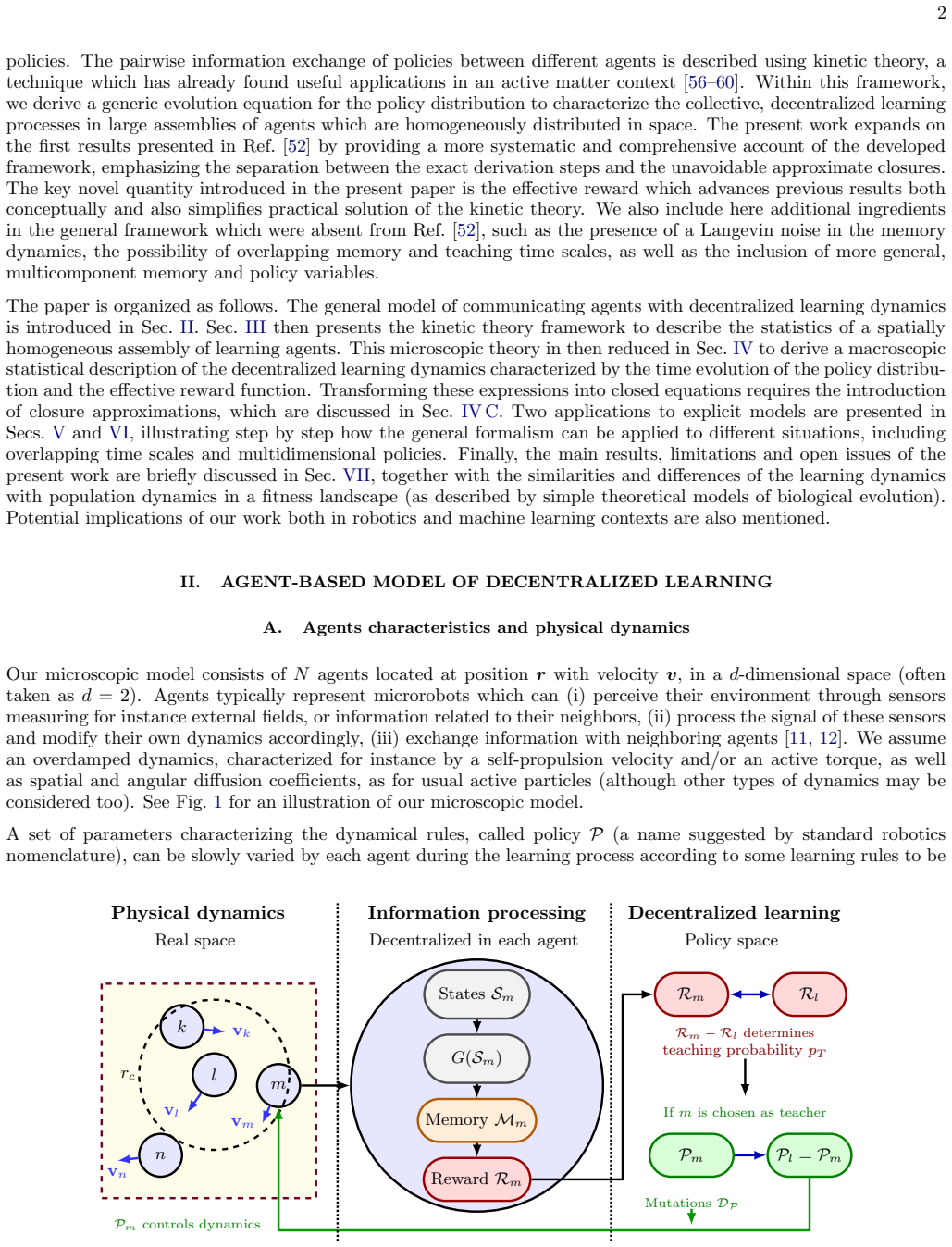
Effective reward governs collective policy evolution in agent populations

by Gerhard Jung, Johann Asnacios +3 more

Theory of collective learning in populations of adaptive agents

Microscopic agent details collapse into one function that alone sets how the population's policies change over time.

Figure from the paper full image
abstract click to expand
We investigate homogeneous populations of smart active agents that exchange information with their neighbors to perform a decentralized learning process aimed at achieving a prescribed macroscopic state. Such agents may, for example, represent simple microrobots. The exchanged information comprises tunable parameters governing the agent dynamics, referred to as the individual policy, together with an internal memory encoding previously visited states. This memory is used to evaluate a reward that quantifies the success of a policy to achieve the prescribed state. We extend the kinetic-theory description of collective learning in spatially homogeneous systems [Phys. Rev. Lett. 134, 248302 (2025)] and derive formal evolution equations for the distribution of policies across the population. A central outcome of our theory is the emergence of an effective reward function that fully determines the evolution of the policy distribution and encapsulates the microscopic details of the agents physical and memory dynamics. We obtain closed equations for the policy mean and variance which admit explicit time-dependent solutions under the assumption of Gaussian-distributed memories and polices. To illustrate the framework, we present a series of minimal microscopic models, considering both perfect and partial separation of physical, memory and policy exchange time scales, as well as models with one- and two-dimensional policies. The obtained theoretical results compare well with agent-based numerical simulations. The theory captures key aspects of collective learning, including the influence of population diversity and reward fluctuations on learning performance. Finally, we discuss potential applications to swarm robotics and machine learning, and highlight connections with classical models of biological evolution, including the Replicator equation and the Moran model.
0
0
quant-ph 2026-07-03

Gap closing creates resonance peak in quantum reservoirs

by Lixiang Ding, Xingze Qiu

Thermodynamics of Quantum Reservoir Computing

Transition frequencies align with the drive inside the critical region, raising both capacity and dissipation.

Figure from the paper full image
abstract click to expand
Quantum reservoir computing provides a framework for processing complex temporal data, yet its fundamental computational and energetic limits remain unresolved. Here, we establish a non-equilibrium thermodynamic framework that links the macroscopic predictive performance of driven open quantum systems to their microscopic energetic costs. By mapping the Holevo capacities onto the Bogoliubov-Kubo-Mori geometric manifold, we analytically prove that the computational peak within the quantum critical region originates from a strict spectral resonance: the closing of the energy gap forces the reservoir's transition frequencies to align with the chaotic drive. To evaluate the associated thermodynamic costs, we introduce quantum informational dissipation to quantify the non-predictive historical data structurally retained by the reservoir, deriving a generalized Landauer bound for continuous temporal processing. This reveals a fundamental thermodynamic trade-off: the critical resonance that unlocks optimal predictive capacity inherently maximizes informational dissipation and the irreversible work required for environmental erasure. Furthermore, coherence decomposition demonstrates that dynamic quantum coherences strictly amplify predictive capacity without demanding additional mechanical work. These findings establish the ultimate energetic limits of quantum learning devices, providing theoretical principles for designing energy-efficient quantum neuromorphic hardware.
0
0
cond-mat.stat-mech 2026-07-03

Attention memory yields nonlocal action recovered only at short memory

by Gunn Kim

Path-Measure Dynamics of Attention-Driven World Models: A Nonlocal Onsager--Machlup Approach

The local theory of the companion paper emerges as the leading term when memory time is much shorter than dynamical time.

abstract click to expand
Attention enables a world model to condition on its entire history, providing long-term memory that facilitates long-range predictions. While the local Onsager--Machlup theory in our companion paper assumes a temporally local predictive action, we investigate the conditions under which this locality holds. We derive the predictive path measure for latent dynamics that become non-Markovian due to attention-induced memory, demonstrating that this measure is the projection of a hidden linear Markov augmentation. Eliminating the auxiliary field results in a nonlocal Onsager--Machlup action, where memory manifests as a nonlocal quadratic form rather than a force. These kernels are completely monotone and exactly match a hidden Markov embedding with a finite relaxation spectrum; otherwise, the dynamics remain fundamentally nonlocal. By expanding the action in terms of the scale-separation parameter $\epsilon=\tau_{\text{mem}}/\tau_{\text{dyn}}$, we show that the leading order recovers the local action of the companion paper, establishing locality as the short-memory limit of a nonlocal theory. We verify the reversible sector of this expansion term by term against an exactly solvable vector linear model.
0
0
math-ph 2026-07-03

Yang-Baxter plus once-per-period rule yields integrable circuits for any geometry

by Miguel García Fernández, Chiara Paletta +1 more

Open-boundary integrable quantum circuits with different geometries

A mapping from transfer-matrix inhomogeneities produces time-periodic open circuits that stay integrable when each bulk gate is used exactly

Figure from the paper full image
abstract click to expand
We present a complete classification of integrable Yang-Baxter quantum circuits with open boundary conditions and arbitrary circuit geometries. Starting from the standard transfer-matrix construction with two types of staggered inhomogeneities, we derive a general mapping that determines the arrangement of circuit gates in terms of the inhomogeneities and the system size. We conjecture that time-periodic quantum circuits are integrable whenever the local bulk and boundary gates satisfy the Yang-Baxter equation and the same bulk gate is applied exactly once per period to every nearest-neighbor pair of spins. Our construction also provides an algorithm to detect Yang-Baxter integrability for circuits with arbitrary geometries. Furthermore, we introduce a third type of inhomogeneity, denoted by $\rho$, and demonstrate that the minimum possible circuit depth is four. We show that when these $\rho$-inhomogeneities are placed at the endpoints and in their immediate neighborhood, the resulting boundary gates can be interpreted as single gates acting on multiple sites. Our construction is fully general and applies to regular $R$-matrices, both of difference and non-difference type, together with their associated boundary matrices. As an application, we consider two-qubit gates corresponding to 6- and 8-vertex $R$-matrices of non-difference form satisfying the Yang-Baxter equation, and we construct the associated reflection matrices that generate integrable quantum circuits.
0
0
quant-ph 2026-07-03

Undamped modes survive in dissipative Heisenberg chains for any N>=3

by Chun Hei Leung

Undamped Modes in an N-Qubit Heisenberg Chain with Collective Dissipation

Collective jump operators leave a subspace of states oscillating without decay, independent of field and dissipation details.

abstract click to expand
We investigate the undamped behaviors in a spin-1/2 Heisenberg chain coupled with an environment via collective spin jump operators. Using the Bethe ansatz basis, we show that undamped modes exist for any chain length N >= 3. These modes remain robust against variations in the system parameters, including the specific form of the collective dissipation, and the external field. Exploiting the Bethe ansatz solution, we further characterize the number of undamped modes and their oscillation frequencies, uncovering long-lived coherent dynamics in open integrable quantum systems.
0
0
cond-mat.stat-mech 2026-07-03

Dissipation cuts sandpile avalanches to exponential tails on networks

by Komlan Fiagbe, Jean-François de Kemmeter +1 more

Sandpile Models on complex networks

Clustering still lowers the exponent and raises the chance of large cascades, showing topology survives dissipation.

Figure from the paper full image
abstract click to expand
We investigate the sandpile model on complex networks by developing a branching-process framework that explicitly incorporates dissipation during avalanche propagation. Unlike classical branching descriptions, which assume conservative transport and locally tree-like independence, the present approach introduces grain-loss effects directly into the offspring distribution, yielding generalized generating functions for dissipative avalanche dynamics. In the dissipative regime, avalanche-size distributions acquire exponential cutoffs while preserving topology-dependent scaling behavior. Numerical simulations confirm the theoretical predictions on sparse random networks and reveal systematic deviations in highly structured topologies. In particular, by using Holme-Kim clustered scale-free networks, we show that increasing clustering continuously lowers the avalanche exponent and enhances the probability of large cascades, demonstrating that short cycles generate strong correlations that invalidate the classical independent-branch approx imation. Surprisingly, trees also exhibit substantial deviations from power-law because low edge density and the abundance of leaves constrain avalanche propagation. These results show that dissipation, clustering, and sparse connectivity fundamentally reshape avalanche size distribution of the sandpile model on networks and establish quantitative limits for branching-process descriptions of avalanche dynamics.
0
0
quant-ph 2026-07-03

2D quantum Ising simulations match semi-classical bubble decay rates

by Luka Pavešić, Ian G. Moss +1 more

False vacuum decay in a two-dimensional quantum spin system

Extracted decay rate, wall tension and critical size agree with field theory, showing the nucleation picture holds in 2+1D.

Figure from the paper full image
abstract click to expand
False vacuum decay describes the relaxation of a metastable state through the nucleation and growth of bubbles of the stable phase. Despite describing a broad variety of phenomena across different fields, the quantum version of the nucleation theory has little experimental or numerical support. Testing its predictions is particularly important in two or more spatial dimensions, where bubble nucleation acquires its true geometrical nature. Here, we study false vacuum decay in the quantum Ising model in two dimensions. Through tree tensor network simulations we extract the decay rate, the effective interface tension and the critical bubble size. We compare them to new semi-classical field theory calculations, and find excellent agreement. These results provide numerical evidence that the critical-bubble picture survives in an interacting quantum spin system in 2+1 dimensions.
0
0
cond-mat.soft 2026-07-03

Curved walls make non-motile chiral particles accumulate at boundaries

by Alessandro Petrini, Raphaël Maire +2 more

Curvature-driven wall accumulation in chiral active particles

Straight channels keep density uniform; circular enclosures drive particles to the edge through curvature acting on tangential wall currents

Figure from the paper full image
abstract click to expand
We study a dilute system of non-motile chiral active particles confined in geometries ranging from straight channels to circular enclosures. Activity is introduced through chiral particle-wall interactions, modeled as tangential wall forces that generate the edge currents characteristic of chiral active matter. Remarkably, although the particles lack self-propulsion, these boundary currents induce density inhomogeneities. We show that boundary curvature drives a wall accumulation phenomenon: particles remain uniformly distributed in straight channels but accumulate near the boundaries of circular confinements. Numerical simulations and a hydrodynamic theory for the density and momentum fields consistently capture this curvature-induced wall-accumulation. These results identify boundary curvature as a fundamental control parameter for chiral edge transport and confinement-induced organization, with potential experimental relevance to spinning colloids and granular spinners.
0
0
cond-mat.stat-mech 2026-07-02

First passage time distributions derived for underdamped oscillators

by Aubin Archambault, Caroline Crauste-Thibierge +3 more

First passage time distribution in underdamped harmonic oscillators

Regime-specific approximations for different quality factors match numerical simulations of the dynamics

Figure from the paper full image
abstract click to expand
We derive the distribution of the first passage time $t_{fp}$ for the position $x$ of an underdamped harmonic oscillator to overcome a threshold $x_B$. As the $t_{fp}$ distribution depends on the oscillator quality factor $Q$ different approaches are used. At very large quality factor ($Q\gg 100$) and intermediate and long $t_{fp}$ the proof is based on an energy diffusion model, whereas at medium quality factor ($Q\sim 10$) the proof is based on the study of the eigenvalues of the Kramers linear differential operator with absorbing boundary conditions. For all $Q$ and short $t_{fp}$ we use a Hamiltonian approximation. The theoretical predictions are in excellent agreement with direct numerical simulations of underdamped oscillator dynamics. Finally we show that the mean of the trajectories ending at $t_{fp}$ presents a particular shape driven by a specific noise pattern.
1 0
0
cond-mat.stat-mech 2026-07-02

First passage time distribution derived for underdamped oscillator

by Aubin Archambault, Caroline Crauste-Thibierge +3 more

First passage time for an underdamped harmonic oscillator and application to the power of an information engine

The distribution matches micro-cantilever data and enables power calculations for information engines.

Figure from the paper full image
abstract click to expand
The distribution of the first passage time $t_{fp}$ for the position $x$ to overcome a threshold $x_B$ is calculated in an underdamped harmonic oscillator. The proof combines several approaches based on the determination of the eigenvalues of the Kramers differential operator for the intermediate and long time regimes and on a Hamiltonian approximation for the short times. The theoretical predictions are in excellent agreement with the results of an experiment on an underdamped micro-cantilever. The knowledge of the $t_{fp}$ distribution opens the way to several applications, among them the precise estimation of the power of information engines, which we have also experimentally checked.
0
0
quant-ph 2026-07-02

Rotated spin subsystems keep waiting times finite

by Tanbir Islam, Fernando Iemini

Controlling Waiting Time Statistics in Monitored Collective Spins: Mitigating Detector's Resolution Barrier in Measurement-Induced Phase Transitions

Partitioning into angle-θ subsystems overcomes detector timing limits in monitored spins while increasing entanglement saturation time.

Figure from the paper full image
abstract click to expand
In collective dissipative spin systems, the postselection barrier can be partially mitigated; however, a further obstacle may be posed by the finite temporal resolution of detectors. In this work, we investigate how initial-state inhomogeneities can control waiting-time statistics between quantum jumps, thereby mitigating the detector-resolution problem. We consider a collectively monitored spin model with a boundary time-crystalline phase, introducing inhomogeneity by partitioning the ensemble into two subsystems rotated by an angle $\theta$. We find that the measurement-induced phase transition survives under inhomogeneities, with different entanglement scaling regimes. The waiting time increases with $\theta$, scaling as $1/N$ but with a prefactor strongly enhanced by orders of magnitude, and in the anti-aligned limit $\theta = \pi$ it remains finite, fully resolving the resolution barrier. This mitigation, however, comes at a cost: the entanglement saturation time becomes significantly longer, partially reintroducing the postselection barrier. Our results highlight a trade-off between detector resolution and postselection overhead, with direct implications for the experimental observation of measurement-induced phenomena.
0
0
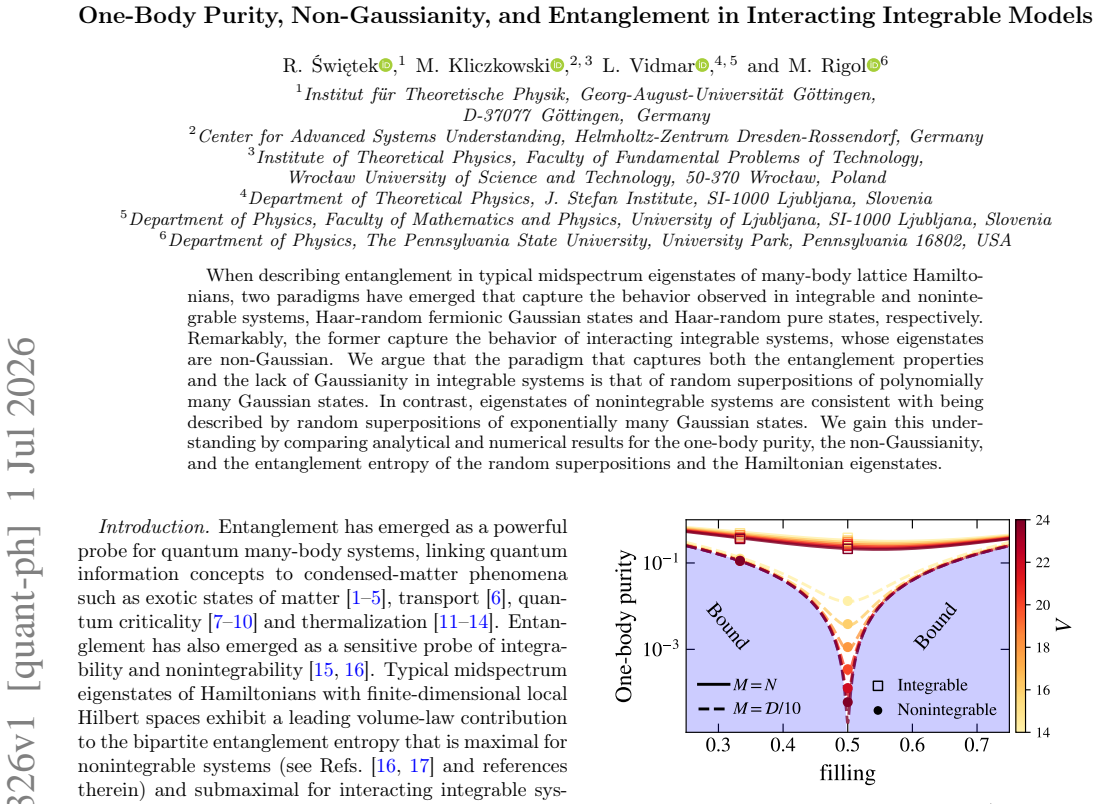
quant-ph 2026-07-02

Integrable eigenstates match superpositions of polynomially many Gaussians

by Rafa{l} Świętek, Maksymilian Kliczkowski +2 more

One-Body Purity, Non-Gaussianity, and Entanglement in Interacting Integrable Models

The construction reproduces their one-body purity, non-Gaussianity, and entanglement, while nonintegrable cases need exponentially many stat

Figure from the paper full image
abstract click to expand
When describing entanglement in typical midspectrum eigenstates of many-body lattice Hamiltonians, two paradigms have emerged that capture the behavior observed in integrable and nonintegrable systems, Haar-random fermionic Gaussian states and Haar-random pure states, respectively. Remarkably, the former capture the behavior of interacting integrable systems, whose eigenstates are non-Gaussian. We argue that the paradigm that captures both the entanglement properties and the lack of Gaussianity in integrable systems is that of random superpositions of polynomially many Gaussian states. In contrast, eigenstates of nonintegrable systems are consistent with being described by random superpositions of exponentially many Gaussian states. We gain this understanding by comparing analytical and numerical results for the one-body purity, the non-Gaussianity, and the entanglement entropy of the random superpositions and the Hamiltonian eigenstates.
0
0
cond-mat.stat-mech 2026-07-02

Ratchets simulate any active spin dynamics

by Charles Stahl, Ethan Lake +1 more

Brownian ratchets and pumps universally simulate many-body active dynamics

Temperature differences or periodic driving generate local active behavior with noise tunable to arbitrary weakness

Figure from the paper full image
abstract click to expand
Active systems can exhibit a broad range of phenomena forbidden in equilibrium. Their dynamics are often specified by abstract local update rules, and it is generally unclear when the same behavior can arise from physically natural driving. Here we show that two simple driving mechanisms can universally simulate any local active dynamics in spin systems. The first is the familiar setting of a time-periodic Hamiltonian coupled to a cold bath, which we call a "many-body Brownian pump." As a second mechanism, we promote the Brownian ratchet, traditionally a mechanism for transport, to a "many-body Brownian ratchet": a static Hamiltonian coupled to a hot bath and a cold bath, where the resulting steady heat current can be harnessed not only to drive transport but also to generate local active dynamics. Using probabilistic cellular automata as an explicit model, we prove that for any continuous-time (or discrete-time) local active dynamics, there is always a many-body Brownian ratchet (or pump) that approximates the dynamics, up to noise that can be made arbitrarily weak by tuning energy scales and other parameters. As a concrete demonstration, we construct a simple ferromagnetic Ising ratchet on a bilayer lattice. When the two layers are coupled to baths at different temperatures, this model serves as a robust classical memory even under a symmetry-breaking field, something impossible in equilibrium. More broadly, our work shows that ratchets can use steady heat currents to autonomously generate and stabilize novel collective behavior, realizing a new static setting for nonequilibrium many-body dynamics.
0
0
cond-mat.stat-mech 2026-07-02

Fuzzy sphere extracts extensive 3D CFT data at low cost

by Yin-Chen He, W. Zhu

A Fuzzy Sphere Journey in Critical Phenomena

The regularization links critical phenomena to noncommutative geometry and the quantum Hall effect via state-operator correspondence on S^2

abstract click to expand
This review discusses the recently proposed fuzzy sphere regularization for studying $2+1$D critical phenomena, particularly three-dimensional (3D) conformal field theory (CFT). The fuzzy sphere scheme not only offers remarkable efficiency in extracting extensive CFT data at low computational cost but also reveals unexpected connections among 3D CFT (critical phenomena), noncommutative geometry, and the quantum Hall effect. We introduce the fundamental ideas of fuzzy sphere regularization, emphasizing its role in demonstrating the state-operator correspondence of 3D CFTs on the $S^2 \times \mathbb{R}$ geometry. Additionally, we review key developments in this approach across various directions and outline potential future applications.
0
0
cond-mat.stat-mech 2026-07-02

Boundary order parameter decays with imaginary time via new exponent

by Yu-Rong Shu, Yuan-Biao Li +1 more

Universal Short-Imaginary-Time Quantum Critical Dynamics Near Boundaries

Scaling theory shows θ1 breaks quantum-classical mapping and θ1' changes sign between ordinary and special transitions

Figure from the paper full image
abstract click to expand
While imaginary-time evolution has long served as a standard paradigm for ground-state preparation in numerical simulations and quantum devices, its intrinsic dynamical properties has been largely overlooked. Here, we investigate the short-imaginary-time critical dynamics in quantum systems with boundaries. A universal scaling theory is developed and verified in the two-dimensional quantum Ising model, uncovering rich dynamic critical behaviors dictated by boundary universality classes. For ordered initial states, the boundary order parameter $M_s$ decays with imaginary time $\tau$ as $M_s \propto \tau^{-\beta_1/\nu z}$, where $\beta_1$ denotes the boundary order parameter exponent, and $\nu$ and $z$ correspond to the correlation length exponent and the dynamic exponent, respectively. For disordered initial states, the autocorrelation of the boundary order parameter is governed by a novel critical exponent $\theta_1$, which is closely related to the critical initial slip behavior of $M_s$ characterized by the corresponding exponent $\theta_1'$. In contrast to its positive bulk counterpart, the boundary initial-slip exponent $\theta_1'$ is negative for the ordinary transition while remaining positive for the special transition. Although the static universality classes of $d$-dimensional quantum phase transitions generally coincide with those of $(d+1)$-dimensional classical phase transitions, we show that $\theta_1$ does not follow this conventional quantum-classical mapping. We further discuss the implications of our results for more exotic forms of boundary criticality. Our findings provide new physical insights into boundary critical dynamics and offer a novel route for probing exotic boundary critical behaviors in quantum many-body systems.
1 0
0
cond-mat.stat-mech 2026-07-02

Minimal cell model produces three fluid phases

by R. V. Romanik, O. A. Dobush +3 more

Phase diagram of a double-occupancy cell model of a fluid with Curie-Weiss interaction

Local repulsion competing with long-range attraction creates single or double critical points, tricritical points, and a triple point depend

abstract click to expand
A double-occupancy cell model of a fluid with Curie-Weiss interaction is studied. First, we show that the model is isomorphic to the Blume-Capel model on a complete graph through a simple transformation from spin to occupancy variables. We then investigate its phase behavior within the grand-canonical ensemble using a combination of analytical and numerical methods. Despite its simplicity, the model exhibits a remarkably rich thermodynamic behavior depending on the ratio between the local repulsive and global attractive interactions. We identify regimes characterized by a single critical point, two distinct critical points, tricritical behavior, and triple-point formation. For sufficiently strong repulsion, the system possesses three fluid phases of different densities, leading to both gas-liquid and liquid-liquid coexistence. The locations of the critical, tricritical, and triple points are determined, and the corresponding phase diagrams are constructed. These results demonstrate that the competition between double-occupancy repulsion and long-range attraction is sufficient to generate complex phase behavior in a minimal multiple-occupancy lattice-gas model.
0
0
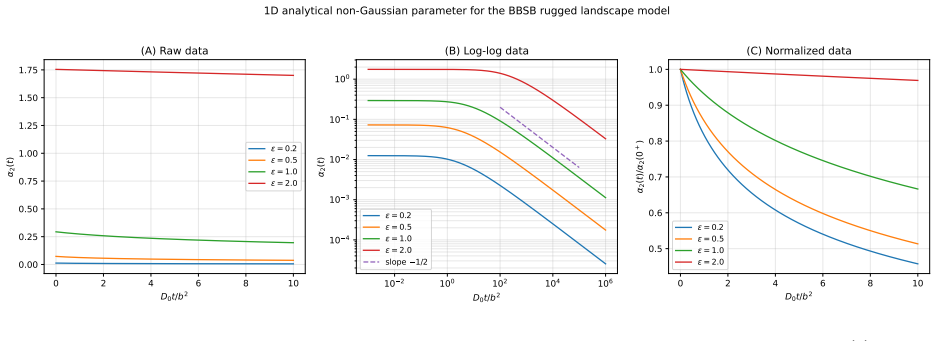
cond-mat.stat-mech 2026-07-02

Non-Gaussian diffusion relaxes as power law with dimension

by Bimman Bagchi

Power-Law Relaxation of Non-Gaussian Parameter and Self-Dynamic Structure Factor in Multidimensional Rugged Energy Landscapes

Mobility correlations in rugged landscapes produce t to the -1/2 decay in 1D and faster in higher dimensions.

Figure from the paper full image
abstract click to expand
Ruggedness of the underlying energy landscape gives rise to heterogeneous mobility and non-Gaussian diffusion. We develop a theoretical framework for tagged-particle diffusion in multidimensional rugged energy landscapes modeled as correlated quenched Gaussian random fields. Using the self-propagator and self-dynamic structure factor, we characterize finite-time diffusion beyond the effective diffusion coefficient. We determine the effects of dimensionality, spatial correlations, and initial preparation. By introducing a coarse-grained mobility field and a mobility-memory approximation, we relate the non-Gaussian parameter to the time correlation of the mobility sampled by the particle. In the homogenized diffusive regime, the mobility correlation decays algebraically, leading to long-time relaxation of the non-Gaussian parameter as $t^{-1/2}$ in one dimension, $(\ln t)/t$ in two dimensions, and $t^{-1}$ for $d>2$, with amplitudes that depend on dimensionality and the initial ensemble. Our results show that rugged energy landscapes leave distinct signatures in the effective diffusion coefficient, self-dynamic structure factor, and relaxation of non-Gaussian fluctuations.
0
0
cond-mat.stat-mech 2026-07-02

Distributions separate Timer

by Vikas, Rahul Marathe +1 more

Single-cell-level distributions and relationships can differentiate cell-division and growth models

Probability distributions of sizes and times also distinguish linear from exponential growth and hold under growth rate correlations across

Figure from the paper full image
abstract click to expand
Complex interactions among regulatory molecules determine the rules underlying cell growth and division in microbial cells. While the governing molecular network may not always be obvious, it is well known that correlations among certain physiological quantities measured in experiments, such as birth-size, division-size, division-time, and division-added-size, can differentiate among various cell-division models, such as Timer, Sizer, and Adder. Here we show that, apart from these correlations, which we extend for the case of stochastic single-cell growth and stochastic asymmetric partitioning, probability distributions of these quantities and statistical relationships between them can also be used to differentiate between these division models. Interestingly, we show that these quantities can not only differentiate the division models, but also distinguish among the single-cell growth paradigms, such as linear and exponential growth. We then demonstrate this differentiability among various division and growth models by comparing our analytical results with published experimental data. We further show that these results remain valid even when the growth rate of a cell is correlated with the growth rate of cells from previous generations in the lineage.
0
0
cond-mat.stat-mech 2026-07-02

Non-ideal equation of state fixes hard-disk cooling flow predictions

by Amit Kumar, Abhishek Dhar +1 more

Slow heat-driven flow in a gas of hard disks

Simulations match the extended one-dimensional isobaric theory in both dilute and finite-density regimes.

Figure from the paper full image
abstract click to expand
We study a slow heat-driven flow in a gas of elastically colliding hard disks confined to a long channel. The initial state consists of two regions with large temperature and density contrasts but nearly equal pressures, leading to a low-Mach-number, nearly isobaric evolution. In the dilute limit, the corresponding isobaric hydrodynamic theory reduces to a previously known ideal-gas description. We extend this theory to finite densities by incorporating a non-ideal equation of state of a hard-disk fluid, and solve the resulting one-dimensional equations numerically. Finite-density effects produce appreciable deviations from the ideal-gas prediction. We then test the theory directly against event-driven molecular dynamics simulations of hard disks and find very good agreement in both the dilute and finite-density regimes. The results provide, to our knowledge, the first particle-level test of isobaric gas dynamics of a strongly inhomogeneous cooling flow.
0
0
quant-ph 2026-07-02

Subsystem states and work stats both track Floquet heating regimes

by Feng-Li Lin, Ching-Yu Huang

Subsystem Thermalization and Work Statistical Characterizations of Floquet Dynamics

In a driven non-integrable Ising chain, reduced density matrices and work distributions identify the same crossover from infinite- to finite

Figure from the paper full image
abstract click to expand
We study Floquet thermalization in a periodically driven quantum non-integrable Ising chain by combining two operational diagnostics: subsystem thermalization and work statistics. For generic interacting Floquet systems, stroboscopic dynamics lead to heating toward an infinite-temperature state at low driving frequencies, to a prethermal state during the crossover regime, and then to a finite-temperature state at high driving frequencies. We show that reduced density matrices of small subsystems provide a precise measure of local equilibration and clearly resolve prethermal plateaus. In parallel, we analyze the statistics of work performed over a Floquet cycle using both the characteristic function of work with and without the two-point measurements, and the related fluctuation theorem, which captures coherent contributions and deviations from thermal equilibrium. By comparing these two diagnostics within the same Floquet setting, we demonstrate that work statistics encode the same dynamical crossover that governs subsystem thermalization. Our results establish a unified and experimentally accessible framework for characterizing Floquet thermalization, prethermal regimes, and coherent energy absorption in interacting quantum systems.
0
0
quant-ph 2026-07-02

Theorem flags Hamiltonian terms with no local qubit effect

by Manuel Allan L. Orongan, Lemuel John F. Sese +1 more

Coupling effect of nearest-neighbor interacting qubit chains to a single qubit system

Commutation test lets some terms be ignored without approximation; transverse field breaks the test and creates emergent coupling.

Figure from the paper full image
abstract click to expand
This study establishes a theorem that provides sufficient criteria for identifying terms in any time-independent Hamiltonian that have no influence on local dynamics, local observables, or any local phenomena, without any approximation. The usefulness of this theorem is demonstrated by predicting the behavior of three systems. The first system consists of multiple qubit chains with Ising interactions. The second system is formed by a single qubit chain, differentiated by the substitution of Dzyalonshinskii-Moriya (DM) interaction for the last Ising interaction. The predictions were verified by analytically deriving the reduced dynamics of both systems. A third system was also considered, namely, a short qubit chain with a transverse magnetic field on the intermediary environment qubit. This transverse magnetic field signals that the commutation relation required by our theorem no longer holds. The third system's local dynamics were also derived analytically, demonstrating that all Hamiltonian constituents contributed to the reduced dynamics. The physical consequences of our theorem's inapplicability were also explored using this third system by analyzing the entanglement dynamics between the qubits that do not directly interact. The results showed that the entanglement is caused by an \textit{emergent coupling} between the two non-directly interacting subsystems. This \textit{emergent coupling} arises from the non-commutativity of the intermediate interactions connecting the two subsystems. When searching for these \textit{emergent couplings}, our theorem can eliminate intermediate interactions that will not produce them.
0
0
q-bio.PE 2026-07-01

Senescence mortality matches multi-level selection patterns

by Ananda Shikhara Bhat, Hanna Kokko

Demographic senescence as multi-level selection in miniature

A two-level Moran process models both group competition and damage buildup, producing equivalent age-specific death rates through selective

Figure from the paper full image
abstract click to expand
Multi-level selection and senescence do not at first sight have much in common. Here, we demonstrate that the emergent mortality patterns generated by demographic senescence can be understood as the product of multi-level selection. We formulate a two-level Moran type process and use its scaling limits to illustrate that a simple mathematical framework that models multi-level selection in group-structured populations also models damage accumulation patterns and resultant mortality curves in ageing organisms. To verbally make the connection, observe that defectors spread within a group consisting of cooperators and defectors; when groups compete against each other, defector-rich groups suffer, and between-group selection causes such groups to be systematically under-represented. Exactly analogously, senescing individuals accumulate damage to physiological sub-systems, and `damage begets damage'; individuals who are more damaged are more likely to die, hence damage-rich individuals are systematically under-represented in later age classes. Thus, emergent senescence patterns in complex, integrated organisms are formally equivalent to the patterns generated by a within-generation multi-level selection process in which intra-organismal sub-systems play the role of particles, organisms play the role of collectives, and selective disappearance plays the role of group selection.
0
0
cond-mat.str-el 2026-07-01

Quantized entropy persists in toric code despite broken symmetry

by Haruki Watanabe

Phase distinction of Gibbs states without symmetry breaking: topological invariants of the 3D toric code

The 3D Z2 toric code keeps topological entanglement entropy at ln 2 at finite temperature, protected geometrically, and a new Wilson loop me

Figure from the paper full image
abstract click to expand
We study the finite-temperature topological order of the three-dimensional $\mathbb{Z}_2$ toric code in a generic magnetic field, where every higher-form symmetry is explicitly broken and can at most be emergent. We show perturbatively, and confirm by large-scale quantum Monte Carlo, that the topological entanglement entropy stays quantized at $\gamma = \ln 2$ throughout the topological phase -- at finite temperature and under the symmetry-breaking field alike -- and collapses to $0$ across the thermal transition, a quantization protected geometrically by the Bianchi identity rather than by any exact symmetry of the system. The plateau $\gamma = \ln 2$ is, however, not invariant under quasi-local channels: a constant-depth channel can generate this identical quantized value from a trivial product state. We therefore introduce the decoded Wilson-loop correlation $f_W$, which quantizes to $1$ in the topological phase and $0$ in the trivial phase as $L\to\infty$ and, unlike $\gamma$, is a quasi-local-channel invariant -- a robust topological invariant of the mixed state.
0
0
quant-ph 2026-07-01

Monitored jumps turn Ising work distributions Gaussian

by Manali Malakar, Alessandro Silva

Work Statistics Under Quantum-Jump and Quench Dynamics in Monitored Ising Chains

Stochastic detections drive comb-like statistics to Gaussian with narrowing tails; controlled jumps show light-cone-dependent energy increme

Figure from the paper full image
abstract click to expand
We investigate work statistics in monitored transverse-field Ising chains subject to both a quantum quench of the transverse field and either stochastic quantum jumps or controlled measurement sequences. For generalized measurements, we derive a trajectory-resolved generating function for work statistics in the two-point energy measurement scheme. Evaluating it using a fermionic Gaussian-state formalism, we show that, under stochastic jump dynamics, the work distribution crosses over from a comb-like structure to an essentially Gaussian form with shrinking sub-Gaussian tails, as the number of detection events grows. For controlled jump protocols, the energy added by each jump is constant when successive jumps are causally disconnected but decreases and then saturates when they lie within each other's light cone, yielding linear and sublinear growth of the average work, respectively. For monitored quenches, continuous observation washes out the fine structure of the isolated-quench distribution and again drives the statistics toward Gaussian behavior.
0
0
hep-lat 2026-07-01

Monte Carlo interpolation yields twisted Casimir difference of 0.327(2)

by José Matos

Monte Carlo reconstruction of symmetry-twisted partition function ratios: the critical 3D Ising

Interpolation between periodic and antiperiodic sectors reconstructs free energy ratios at criticality without derivatives or bulk subtracti

abstract click to expand
We introduce a Monte Carlo strategy for directly estimating partition function ratios between distinct global sectors of a lattice theory. It enlarges the configuration space to sample an interpolating family whose endpoints are the desired sectors, and uses flat histogram methods to reconstruct the corresponding free energy difference. Although the construction is more general, we focus here on the three-dimensional Ising model on the slab $\mathbb{R}^{2}\times S^{1}_{L_{z}}$ at the bulk critical point, comparing the untwisted periodic sector with the $\mathbb{Z}_{2}$-twisted antiperiodic sector. A large-volume and aspect ratio extrapolation gives the symmetry-twisted thermodynamic Casimir difference $\Delta_{\mathbb{Z}_{2}}=0.327(2)$ directly, without lattice derivatives or bulk subtractions. This provides an independent twisted sector probe of tensions observed in periodic sector thermodynamic Casimir observables. More generally, the method gives direct but selective numerical access to CFT compactification data, including estimates of the effective thermal screening scale and the $\mathbb{Z}_{2}$-odd sector energy gap on $T^{2}$.
0
0
cond-mat.str-el 2026-07-01

Dissipation splits the Mott transition into two critical points

by Oscar Bouverot-Dupuis, Alberto Rosso +1 more

Dissipation splits the Mott transition in one dimension

An intermediate dissipative phase appears between the Luttinger liquid and Mott insulator for bath exponents below 3/2

Figure from the paper full image
abstract click to expand
Understanding how dissipation modifies quantum phase transitions is a central challenge in many-body physics. A paradigmatic example is the one-dimensional Mott transition, which in isolated systems separates a conducting Luttinger liquid (LL) from a Mott insulator (MI). Here, we study the fate of this transition in the presence of dissipative baths locally coupled to the density. Using bosonisation and an exact integration of the bath degrees of freedom, we show that dissipation fundamentally reshapes the phase diagram for bath exponents $s<3/2$, where $s$ characterises the low-energy bath spectrum. Rather than undergoing a direct LL-MI transition, the system develops an intermediate dissipative phase (DP) that is compressible and gapless, yet has zero superfluid stiffness. As a result, the conventional Mott transition splits into two distinct critical phenomena: a Berezinskii-Kosterlitz-Thouless transition from the LL to the DP, followed by a new commensurate-incommensurate transition from the DP to the MI. We derive an effective field theory for the latter transition and characterize its universality. For $1<s<3/2$, the critical exponents vary continuously with the bath exponent as $\beta=\nu=1/z=s-1$, while for $s<1$ the transition is governed by $\beta=\nu=1/z=0$ and the doping vanishes sharper than any power law. State-of-the-art Monte Carlo simulations quantitatively support our predictions. These results demonstrate that dissipation can qualitatively alter the nature of the Mott transition and generate novel critical behaviour in strongly correlated one-dimensional systems.
0
0
cond-mat.stat-mech 2026-07-01

Analytic continuation yields solvable non-unitary conformal interfaces

by Qicheng Tang, Zixia Wei +1 more

Exactly solvable non-unitary conformal interfaces in unitary CFTs

SL(2,C) family from unitary lattice data obeys generalized Cardy condition and produces complex effective central charge.

Figure from the paper full image
abstract click to expand
We construct directly on the lattice a class of non-unitary interfaces that are both exactly conformal and exactly solvable, and establish their corresponding boundary and interface conformal field theory (CFT) descriptions. The construction is obtained by analytically continuing the scattering data of known exact unitary conformal interfaces on the lattice, yielding an $SL(2,\mathbb C)$-parametrized family, which is non-compact and breaks probability-current conservation. Exploiting the exact lattice-continuum correspondence, we derive the conformal boundary states in the folded picture. We show that a proper definition of the Hilbert space in the closed-string channel requires the incoming and outgoing boundary states to be specified independently by boundary data associated with a pair of dual biorthogonal bases, in close analogy with the right and left eigenvectors of a non-Hermitian Hamiltonian. This requirement determines a consistent CFT construction of non-unitary boundaries and interfaces, and leads to a non-unitary generalization of the conventional Cardy's condition for unitary boundary CFT. Beyond their formal construction, these non-unitary interfaces are shown to exhibit logarithmic entanglement scaling governed by an effective central charge that is generally complex. For the $SU(1,1)$ subclass, the effective central charge remains real but grows without bound as the transmission coefficient increases. This result is demonstrated through analytical and numerical lattice calculations, as well as an interface CFT analysis in the unfolded picture. Finally, we present a general CFT analysis of a class of global quantum quenches whose initial states are prepared with non-unitary boundaries. We relate their effective temperature to the conformal dimension of the boundary-condition-changing operators associated with non-unitary boundary conditions.
0
0
cond-mat.stat-mech 2026-07-01

Power-law contacts produce multifractal scaling in Hi-C maps

by Seong-Gyu Yang, Lucas Hedström +2 more

Multifractal Scaling in Hi-C Maps

Deriving tau(q) from empirical P(s) shows the large-q slope equals 2-gamma when gamma is below 1.

Figure from the paper full image
abstract click to expand
The three-dimensional organization of the genome exhibits rich, scale-dependent structure, as revealed by both chromosome contact maps (e.g., Hi-C maps) and chromatin density measured by microscopy. Recent studies have reported multifractal scaling in these data. Yet, the origin of this scaling behavior remains unclear: existing efforts describe it through postulated models. Here, we show that the multifractal structure of Hi-C maps is a direct consequence of the power-law contact probability $P(s)$, which is itself an empirical observable measured from Hi-C maps. Starting from $P(s)$ with a single exponent $\gamma$, we analytically derive the mass exponent $\tau(q)$, which characterizes how the $q$-th moment of contact density scales with box size $l$ used to coarse-grain the genomic coordinate. This multifractal behavior reflects the geometric competition between intra- and inter-segment contacts. We find that the slope of $\tau(q)$ at large $q$ is given by $2 -\gamma$ when $\gamma <1$, and by $1$ when $\gamma \geq 1$. We further show that this behavior is robust to noise and consistent across diverse organisms, indicating that it is a universal feature of chromatin organization. We extend our analysis into double-exponent $P(s)$, and show the $l$ dependence in multifractal behavior. Taken together, these results provide a physical explanation for multifractal scaling and establish a direct link between the multifractality in Hi-C maps and polymer contact statistics, with the large-$q$ slope of $\tau(q)$ mapping onto a known polymer contact exponent.
0
0
cond-mat.stat-mech 2026-07-01

Width asymmetry improves logical stochastic resonance and cuts bias cost

by Vipul Rai, Moupriya Das

Exploring the entropic asymmetry on logical stochastic resonance with energetically equivalent intrinsic outputs

Larger well-width differences raise peak success rates for OR and AND gates while reducing the energetic bias required.

Figure from the paper full image
abstract click to expand
Small-scale systems are inherently subject to environmental noise that can be harnessed constructively to realize reliable logic operations -- a phenomenon known as logical stochastic resonance (LSR), where a bistable system produces correct logical outputs within an optimal window of noise intensity. The Brownian dynamics governed by appropriate inputs inside a double-well potential, modeling the bistable system, mimic the logic operations. The two wells of this potential represent two distinct logical output states 0 and 1. Asymmetry in this potential is known to be essential for improving logical reliability. However, prior studies have focused on energetic asymmetry, characterized by unequal depths of the two wells of the potential. This left the role of the width asymmetry in the potential, unexplored. This latter class of asymmetry emerges due to the dissimilar widths of the two wells of the potential. It can be classified as the entropic asymmetry between the two logical output states. Here, we systematically investigate the effect of width or the entropic asymmetry in the system on the logical response for OR and AND gate operations. Unlike energetic asymmetry, width asymmetry preserves the energetic equivalence of the two intrinsic logical output states, making it a geometric effect. We find that increasing width asymmetry consistently improves the optimal P(logic), the quantifier measuring the successful logical outcome. Moreover, when it is combined with an energetic bias, it produces reliable logic gate operation at a significantly reduced energetic cost compared to the symmetric case. The requirement of this energy bias also diminishes gradually with the increasing degree of width asymmetry in the potential.
0
0
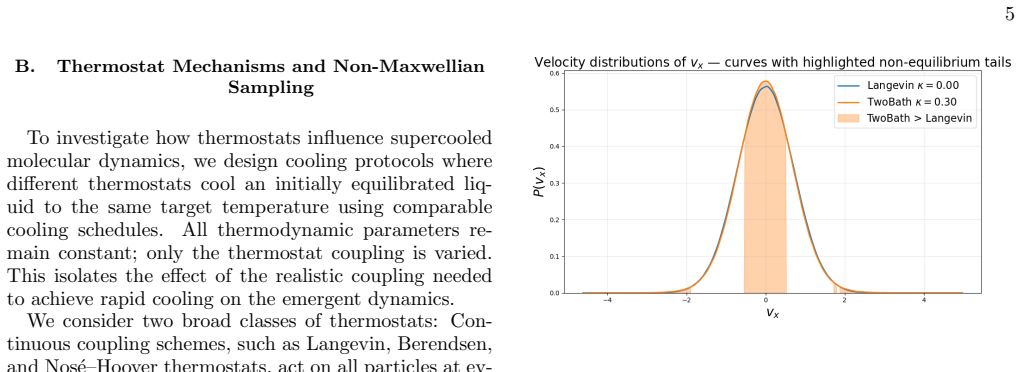
cond-mat.stat-mech 2026-07-01

Non-Maxwellian velocities persist in supercooled liquids

by Giorgi Tsereteli, Zohar Nussinov

Non-Maxwellian Velocity Statistics in Supercooled Liquids and Their Possible Relation to Super-Arrhenius Viscosity

Temperature fluctuations produce excess kurtosis that matches viscosity collapse across 45 glass formers and links to super-Arrhenius slowin

Figure from the paper full image
abstract click to expand
For particles of fixed mass, classical equilibrium statistical mechanics dictates a Maxwellian velocity distribution determined solely by the temperature, regardless of the interactions, density, or structure. Supercooled glass forming liquids realize long lived metastable states that evade equilibrium crystallization and may thus violate assumptions underlying Maxwellian statistics. We numerically demonstrate that supercooled liquids can exhibit persistent non-Maxwellian velocity distributions with deviations connected to their exceptionally slow super-Arrhenius relaxation. Our work is motivated by a general result establishing that long lived metastable states may exhibit finite width distributions of intensive variables. A distribution of temperatures implies non-Maxwellian velocity statistics. We test this prediction by introducing stochastic thermostats that generate stationary states while, unlike conventional thermostats, not imposing Maxwellian velocity distributions. Simulations with these thermostats yield long lived states that have, by comparison to Maxwellian velocity distributions, an excess kurtosis $0<\kappa\lesssim0.3$. Crystallization is strongly impeded with increasing $\kappa$. In a minimal description, temperature fluctuations are characterized by a dimensionless width $\overline{A}$ with $\kappa\simeq3\overline{A}^{2}$. The nearly constant $\overline{A}$ (of an average value $0.08$ and standard deviation $0.03$) found in viscosity data collapse across $45$ glass formers and in specific heat signatures is consistent with kurtosis found in our simulations. Long time non-Maxwellian velocity statistics may thus link slow relaxation, transport, and thermodynamic measurements. Independent of the tested theory, the stochastic thermostats that we introduce offer a molecular dynamics route to non-Maxwellian velocity statistics.
0
0
q-bio.PE 2026-07-01

Size-dependent dispersal creates four invasion growth regimes

by Ulysse Marquis

Invasion with size-dependent dispersion range

Main colony shifts from linear to blow-up expansion as range scales with size, but symmetry breaks in explicit models

Figure from the paper full image
abstract click to expand
The coalescing colony model provides a minimal framework for biological invasions with long-range dispersion. In its standard formulation, the dispersion range is assumed independent of the size of the invading population. Here, we relax this assumption and consider size-dependent dispersal: a main colony of linear size $r$ emits secondary colonies at distance $r^\mu$, with $0 \leq \mu \leq 1$. We derive the generalized dynamical equations for this extended model and map out the growth phase diagram for the leading order contribution. Depending on $\mu$, the main colony exhibits distinct regimes: linear expansion, power-law growth, exponential regime and finite-time blow-up. We confront these theoretical predictions with a spatially explicit physical model. While the coalescing colony approach correctly captures the scaling of the perimeter, it fails to predict the scaling of the volume. We trace this discrepancy to an effective breakdown of circular symmetry in the morphology of the main colony. Finally, we quantify temporal evolution of the population fraction residing outside of the main colony. The coalescing colony model predicts its decay to~$0$ like a power-law when~$\mu<1$, and a macroscopic amount of the population remains in the secondary colonies at~$\mu=1$. Simulations of the physical model reveal a persistent satellite population not captured by the theory at~$\mu>\mu^*\approx 0.7$. Broadly, our findings highlight how coupling dispersal range to population size fundamentally alters invasion dynamics, with implications for biological invasions, metastatic growth, and urban expansion.
0
0
hep-th 2026-07-01

Matrix model singularities vanish beyond double scaling

by Sumit R. Das, Shaun D. Hampton +2 more

Fate of "Space-like singularities" in c=1 Matrix Model

Quenches retaining non-linear terms cause phase space folds to proliferate then relax to equilibrium with universal power law.

abstract click to expand
A class of time dependent backgrounds in two dimensional String Theory leads to superluminal Liouville walls on the worldsheet. In the dual double scaled $c=1$ matrix model these backgrounds involve eigenvalues leaking out to infinity, and the collective field fluctuations become strongly coupled along space-like regions, resembling singularities. We realize these backgrounds as results of quantum quenches in the matrix model, retaining non-linear terms in the matrix potential, thus departing from a double scaling limit. Working in the fermion picture in a Thomas-Fermi approximation, we show that while the early time behavior of the phase space density near the maximum of the potential agrees with that obtained in the double scaled theory, at times of the order $(\log N)$ the effect of the IR wall becomes significant. At later times, with a characteristic winding time of order $(\log N)^2$, folds on the fermi surface proliferate and eventually cover the allowed region in phase space densely. Using action-angle variables, we show that the phase space density oscillates around a time independent and angle independent value rapidly at late times. A coarse-grained density in the angle space relaxes to a time independent equilibrium value as a power law with a universal exponent largely independent of the details of the initial state. Thus, the appearance of a space-like singularity is an artifact of the strict double scaling limit. We comment on the interpretation of the final state in String Theory.
0
0
cond-mat.soft 2026-07-01

Magnetic field turns active particles into drifters or diffusers

by Andrey A. Kuznetsov, Vittoria Sposini +2 more

Drift-diffusion interplay in active Brownian particles under orienting field

Uniform orienting field channels self-propulsion into either steady transport or enhanced spreading once rotational relaxation is complete.

Figure from the paper full image
abstract click to expand
Magnetic active particles offer a versatile route to externally controlled microscale transport by combining self-propulsion with field-tunable orientation, as realized in both synthetic and living magnetic microswimmers. Here, we develop a theoretical framework for three-dimensional active Brownian motion in a uniform magnetic field, incorporating coupled translational and rotational dynamics and providing analytical approximations for low-order displacement moments. At long times, the system dynamics reduces to a combination of enhanced diffusion and permanent drift absent in regular active Brownian particles. The field acts as an external controller, channeling activity toward one of these two types of motion. At intermediate time scales, the interplay between rotational noise, self-propulsion, and magnetic alignment results in pronounced non-Gaussian displacement statistics. First-passage properties exhibit strong field sensitivity, highlighting the potential of magnetic guidance to optimize search processes and targeted delivery in active matter systems. Theoretical predictions are validated by numerical simulations.
0
0
cond-mat.soft 2026-07-01

Chirality switching generates topological edge currents

by Yuta Kuroda, Ellen Meyberg +3 more

Designing topological edge currents in chiral active matter

A particle model produces currents along walls and phase interfaces that arise from topological domain differences.

Figure from the paper full image
abstract click to expand
Achieving robust functionality in active matter driven away from thermal equilibrium is a current theoretical and experimental challenge. Several recent studies have reported edge currents--persistent transport along walls and density inhomogeneities--in chiral active matter. Yet, the microscopic rules that render these edge currents robust with respect to the confinement geometry and defects remain elusive. Here, we introduce a simple particle model of two-dimensional chiral active swimmers that undergo chirality switching and demonstrate that the model exhibits robust edge currents, i.e., when a single particle is confined, edge currents arise regardless of the confinement geometry or the presence of defects. We also investigate the collective behavior of interacting particles in bulk and find that chirality switching induces phase separation accompanied by edge currents along interfaces. This phase separation is distinct from motility-induced phase separation and is qualitatively explained by an effective hydrodynamic theory derived via bottom-up coarse-graining. Furthermore, by analyzing the topological properties of the linearized hydrodynamic equations, we show that the edge currents in our system are genuine topological edge modes. Notably, phase separation induced by chirality switching can be regarded as the coexistence of two topologically distinct domains. Our results provide guidelines for designing robust edge currents in active matter systems.
0
0
physics.comp-ph 2026-07-01

Pairwise model learns committor functions for biomolecules

by Jintu Zhang, Zichang Jin +6 more

Navigating committor landscape of biomolecules with a general pairwise interaction model

The architecture captures detailed transition mechanisms in folding and binding without specialized prior knowledge.

Figure from the paper full image
abstract click to expand
Sampling rare conformation transitions between metastable states is a central challenge in atomistic simulations. While the committor function serve as an ideal reaction coordinate for driving enhanced sampling, their high-dimensional inputs and complex functional forms limit the efficacy of standard feedforward neural networks in modeling them. Inspired by recent breakthroughs in biomolecular structure prediction, we propose a novel committor learning framework grounded in the AlphaFold 3 paradigm. By integrating a lightweight, differentiable atom-level embedding with a simplified Pairformer architecture, our method inherently captures intricate dynamical features of diverse biosystems without requiring specialized prior knowledge. We demonstrate the superior expressiveness and accuracy of the proposed framework across multiple atomistic processes. For the folding of the chignolin mini-protein, our model reveals the finer-grained structure of its transition state ensemble (TSE) and a detailed bifurcated reaction mechanism. Furthermore, for calixarene host-guest systems, we develop a unified committor model that elucidates how ligand substituents regulate the ratio between distinct binding pathways, offering new perspectives for structure-based drug design.
0
0
cond-mat.dis-nn 2026-07-01

Quantum RFIM dynamics follows activated scaling ln τ ∼ ξ^Ψ

by Ivan Balog, Lovro Šaravanja +1 more

Activated dynamics in the quantum random field Ising model

Full frequency-dependent kernel in the renormalization-group flow converts the static zero-temperature fixed point into controlled activated

Figure from the paper full image
abstract click to expand
We study the critical dynamics of the quantum random-field Ising model using the nonperturbative functional renormalization group (NP-FRG). The static critical behavior is found to be controlled by the zero-temperature fixed point of the classical random-field Ising model, where both thermal and quantum fluctuations are dangerously irrelevant. Considering a family of quantum dynamical universality classes defined by a bare dynamical kernel $F_\Lambda(\omega)\sim |\omega|^\sigma$, we show how this fluctuationless fixed point nevertheless controls the quantum dynamics by computing the full Matsubara-frequency dependence of the running dynamical kernel $F_k(\omega)$. This is essential at zero temperature: a naive treatment of the dynamical kernel flow leads to a divergence at a finite length scale, resulting in apparent localization. In contrast, keeping the full frequency dependence of the dynamical kernel and choosing a regulator adapted to its running scale yields a controlled flow. The resulting dynamics is of activated form, with a relaxation time given by $\ln \tau \sim \xi^\Psi$. The exponent $\Psi$ is determined by the static RFIM fixed-point exponents and by $\sigma$. At finite temperature, the flow crosses over to the classical thermally activated scaling of the random-field Ising model. These results provide a quantitative field-theoretic realization of the heuristic activation scenario proposed earlier for the quantum random-field model and establish a framework for analyzing the dynamics of other disordered quantum systems that may exhibit similar tentative localization-like singularities.
0
0
cond-mat.stat-mech 2026-07-01

Box walls make reset correlations non-monotonic

by Gabriele de Mauro, Satya N. Majumdar +1 more

Effects of confinement in a Brownian gas with simultaneous stochastic resetting and dynamically emergent correlations

Normalized correlation overshoots the free value in hard confinement but rises steadily in soft confinement, controlled by the ratio of two

Figure from the paper full image
abstract click to expand
We study $N$ non-interacting Brownian particles in an external potential under simultaneous stochastic resetting to the origin. Although they do not interact directly, common resets generate strong dynamically emergent correlations (DEC). We analyze how confinement modifies these correlations and the nonequilibrium stationary state for $V(x)=\kappa |x|^\alpha$, $\alpha\geq0$, focusing mainly on two analytically tractable cases: harmonic confinement (HC), $\alpha=2$, and box confinement (BC), $\alpha\to\infty$. In both cases the stationary state is controlled by the competition between confinement and resetting lengths. We derive exact results for the stationary joint distribution, density, correlations, extreme value statistics (EVS), and gap statistics. While the density behaves similarly in HC and BC, the normalized correlation coefficient differs sharply. In BC it is non-monotonic and overshoots the unconfined value, as hard walls suppress decorrelating trajectories. In HC it instead increases monotonically toward the unconfined limit. For general $\alpha$, the behavior is monotonic for $0<\alpha<\alpha_c=1+\sqrt{5}$ and non-monotonic for $\alpha>\alpha_c$. The difference between HC and BC is also visible in edge observables. In HC, the maximum scales as $M_1=O(\sqrt{\ln N})$ and has a limiting distribution with bounded support and a shape transition controlled by the ratio of the two length scales. In BC, the maximum is at distance $O(1/N)$ from the boundary, as in equilibrium, but its fluctuations have a broad power-law tail with logarithmic corrections. The first gap shows a similar contrast: BC gives a smaller typical gap but stronger anomalous fluctuations than HC. Finally, we extend the EVS analysis to general $\alpha$ and identify, via simulations and scaling arguments, three universality classes: $0\leq\alpha\leq1$, $1<\alpha<\infty$, and the singular limit $\alpha\to\infty$.
0
0
math.PR 2026-07-01

Forest recursion yields limiting measure for multiscale Markov chains

by Diego Alberici, Davide Gabrielli +1 more

The Invariant Measure of Multiscale Markov Chains via Fast Arborescence Factorization

The stationary distribution in the large-N limit is built from effective dynamics on separated timescales via arborescence factorization.

Figure from the paper full image
abstract click to expand
We consider a family of continuous-time Markov chains with finite strongly connected transition graph and rates $\left(r_N\right)_{N>0}$ depending on a parameter $N$, so that, when $N$ is large, transitions may happen on different time scales. Under suitable general assumptions on the asymptotic behavior of the rates, we give a recursive characterization of the limiting invariant measure. The recursion is encoded in a forest structure equivalent to the one recently developed in the analysis of dynamical aspects of metastability \cite{BL,LX}. Our proof is based on a combinatorial representation of the invariant measure, given by the Markov chain tree theorem. Basic steps are the reduction of the chain by a trace process, the introduction of an effective dynamics, and a careful analysis of the set of relevant arborescences in the expansion. In particular we use a factorization of fast arborescences. As a byproduct we obtain properties of the arborescences of generalized star-delta reductions of weighted digraphs.
0
0
cond-mat.stat-mech 2026-07-01

Modulated polaron coupling turns drag negative above critical frequency

by Jacopo Romano, Andrea Gambassi

Self-propulsion of a polaron with an oscillating coupling to its quantum bath

An impurity in a quantum gas can accelerate on its own at low speeds when the coupling to the bath alternates in sign fast enough.

Figure from the paper full image
abstract click to expand
Motivated by the quest for active quantum matter, we investigate the dynamics of an impurity immersed in a quantum gas -- a polaron -- whose coupling to the surrounding medium is periodically modulated in time, alternating in sign. By integrating out the bath degrees of freedom, we derive an effective velocity-dependent drag force acting on the impurity. Above a critical modulation frequency, the corresponding drag coefficient becomes negative at low velocities, signaling the onset of self-propulsion. In the classical limit, we characterize this transition as a function of the modulation frequency and the bath chemical potential. We then compute the leading-order quantum corrections to the impurity dynamics and show that, while the transition remains robust, it can be suppressed by sufficiently precise measurements of the impurity position.
0
0
math-ph 2026-07-01

Algorithm yields modular transformations of TL characters at roots of unity

by Yacine Ikhlef

Non-invertible symmetries and modular invariance in lattice models

The procedure works for any 2d lattice model obeying Temperley-Lieb relations and produces explicit modular data from the module decompositi

abstract click to expand
We consider classical 2d lattice models with face interactions defined in terms of a fusion category. The symmetries of such models typically include an algebra of topological operators sitting on a closed path in the lattice. In the case when the face interactions obey the Temperley-Lieb (TL) relations, we present a generic algorithm to determine the decomposition of the transfer-matrix space of states as a direct sum of simple TL modules. We apply this approach to several examples, and analyse the action of topological operators. As an application, we compute the modular transformation of the irreducible TL characters at primitive roots of unity.
0
0
cond-mat.stat-mech 2026-07-01

Power-law fatigue rate sets boundary for task completion

by Shahar Hod

Quantitative description of cognitive fatigue in repetitive monotonous tasks

The inverse power law decay separates workers who all eventually finish from those some never do.

abstract click to expand
There is strong qualitative empirical evidence in the scientific literature that, due to cognitive fatigue, workers performing repetitive and monotonous tasks are characterized by a gradual deterioration in their performance abilities as the time-on-task increases, a phenomenon known as the vigilance decrement. Using a time-dependent Sisyphus random climb model, we provide a quantitative description of this intriguing phenomenon. In particular, we use analytical techniques in order to determine the success probability function $S(t;{\cal N})$ of Sisyphus workers, the time-dependent fraction of workers who succeed, after making $t$ repetitive operations or less, to complete their task by making ${\cal N}$ successful operations in a row without a single fault in between. It is explicitly shown that the functional behavior of the increasing-in-time one-operation tumble probability $1-s(t)$ of exhausted Sisyphus workers may have a dramatic effect on the probability of the workers to achieve their ultimate goal in repetitive monotonous processes. In particular, we prove that the Sisyphus random climb model with the inverse power law functional behavior $s(t)\sim t^{-1/{\cal N}}$ of the one-operation success probability marks the boundary between Sisyphus workers whose success functions $S[t;s(t),{\cal N}]$ approach $1$ asymptotically in time (implying that all the workers eventually complete their task) and Sisyphus workers whose success functions approach an asymptotic value which is less than $1$, in which case some of the exhausted Sisyphus workers never complete their task successfully.
0
0
cs.LG 2026-07-01

Statistical mechanics maps neural net learning to low-dimensional subspaces

by Robin Theriault

Explaining Machine Learning and Memorization with Statistical Mechanics

Analysis of DAM and RBM models shows why training stays low-dimensional and why adversarial examples succeed.

Figure from the paper full image
abstract click to expand
Artificial neural networks (NNs) and machine learning (ML) algorithms are poorly understood from a theoretical perspective, which makes it difficult to fully realize their potential and overcome their weaknesses. For instance, ML algorithms train NN weights by moving them along a low-dimensional subspace of their allowed values, but this implicitly low-dimensional learning structure is not properly exploited to improve training because its nature is not well understood. Moreover, trained NNs are easily confused by pervasive adversarial attacks whose theoretical underpinnings are still unclear. This thesis aims to improve our theoretical understanding of NNs and ML, with a particular focus on adversarial attacks and implicitly low-dimensional learning. For this purpose, we use mathematical tools from statistical mechanics to study different types of NNs and ways in which they can fit the data. In particular, we study two classes of models that fit the data with various degrees of learning and memorization: dense associative memory (DAM) and restricted Boltzmann machines (RBM). In the process, we investigate connections between different versions of these models that are useful to make analytical investigations more efficient.
0
0
physics.chem-ph 2026-06-30

openCOSMO-RS-Phi matches closed EoS accuracy with open parameters only

by Jan Markgraf, D. G. Lisboa Girardi +2 more

Extension of openCOSMO-RS Into a Full Open-Source Equation of State: Implementation, Parameterization, and Benchmarking

Pure-compound fits transfer to mixtures without binary parameters across 1800 substances

Figure from the paper full image
abstract click to expand
The COSMO-SAC-Phi model developed by Soares et al. extends the COSMO-SAC activity-coefficient framework into a full equation of state by explicitly accounting for pressure effects. In this approach, pure substances and mixtures are represented as pseudo-mixtures consisting of the actual number of moles and an additional pseudo-component that describes free volume, or holes. In this work, we implement this extension within the openCOSMO-RS framework and evaluate it using a large and diverse set of molecules and binary systems. The resulting equation of state includes an extensive open-source parameter set with around 1800 pure-component entries, made freely available to the academic community. The four pure-component parameters were fitted to vapor-pressure and liquid-molar volume data for each substance. Model performance was assessed against two benchmark equation-of-state databases, one for pure compounds and one for binary mixtures, without introducing any binary interaction parameters. The resulting openCOSMO-RS-Phi model reproduces the accuracy of the original COSMO-SAC-Phi formulation while providing a fully open-source and accessible implementation for the scientific community. Beyond its immediate utility, it also establishes a foundation for future development of predictive EoS for electrolyte solutions.
0
0
cond-mat.stat-mech 2026-06-30

GGE athermality becomes anomalously small at criticality

by Riccardo Senese, Bruno Bertini +2 more

Athermality of generalized Gibbs ensembles

Even at finite energy density the distance to the nearest thermal state drops and develops a singularity when the post-quench Hamiltonian is

Figure from the paper full image
abstract click to expand
Integrable quantum systems evolving from non-equilibrium initial states do not thermalize to conventional Gibbs ensembles (GE). Instead, at long times they relax to generalized Gibbs ensembles (GGEs), which incorporate the full set of local and quasi-local conserved quantities. While GGEs have been extensively studied in the literature, a quantitative characterization of how different they are from ordinary GEs is still lacking. In this work, we address this question by employing the concept of athermality, which we define within quantum resource theory as the relative entropy between a given state and the closest thermal state. We compute the athermality for several quantum quenches in paradigmatic integrable models, including the free XY spin chain, the interacting Lieb-Liniger model, the XXZ spin chain, and the harmonic chain. We find that often the athermality becomes anomalously small when the post-quench Hamiltonian is critical in its ground state, despite probing physics at a finite energy density. We also prove that it systematically develops a singularity at criticality, which is inherited from the entropy of the GGE.
0
0
quant-ph 2026-06-30

Channel weights switch quantum Brownian motion to Markovian

by Guglielmo Pellitteri, Vittorio Giovannetti +1 more

Controlling the non-Markovianity of quantum Brownian motion

Adjusting relative strengths of specific dissipation channels induces a transition from memoryful to memoryless dynamics.

Figure from the paper full image
abstract click to expand
We analyze the exact dynamics of a generalized quantum Brownian motion model, employing Gaussian master equation methods. We demonstrate that, by modulating the relative weights of specific interaction channels, we can control the degree of non-Markovianity of the system, and induce a transition from non-Markovian to Markovian regimes. The non-Markovianity of the evolution is formally characterized by leveraging the Gorini--Kossakowski--Sudarshan--Lindblad theorem and by employing quantitative measures of information backflow. Finally, we clarify the physical mechanism behind the phenomenology of this model, thereby providing a systematic platform for environment engineering through the strategic tuning of dissipation channels.
0
0
hep-th 2026-06-30

Rational CFTs stay real under complex continuation

by Yuma Furuta, Wataru Harada +2 more

Complex Conformal Manifolds

Analytic continuation of marginal couplings produces complex spectra but keeps rational points on the real axis, checked in free boson and I

Figure from the paper full image
abstract click to expand
Complex conformal field theories (CFTs) have recently emerged as essential frameworks for understanding non-Hermitian criticality, weakly first-order phase transitions, and walking renormalization group flows, while their general structures remain largely unknown. In this work, we propose a systematic construction of complex CFTs by analytically continuing exactly marginal couplings into the complex plane. This procedure applies uniformly to bulk, boundary, and defect deformations, preserving conformal symmetry while generically complexifying operator spectra and other universal data. Using the compact free boson as a solvable laboratory, we uncover the global structure of the complexified Gaussian conformal manifold. More generally, we demonstrate that genuinely complex rational CFTs do not exist: rational points remain confined to the real regime, providing a sharp distinction between real and complex theories. In the defect case, we investigate the one-parameter family of conformal defects in the Ising CFT and derive exact expressions for the defect spectrum, energy transmission coefficient, and effective central charge from analytic continuation. The theoretical predictions are precisely verified in non-Hermitian critical Ising and free fermion chains using bulk-defect correlators, entanglement entropy, and complex energy transport, providing concrete evidence for the complex defect conformal manifold. Finally, we study complex boundary renormalization-group flows through the AdS/BCFT correspondence. Our results establish complex conformal manifolds as a controlled bridge between solvable lattice models, complex CFTs, and holography, while providing stringent analytic benchmarks for the nonunitary conformal bootstrap.
0
0
quant-ph 2026-06-30

Static local Hamiltonians show random-matrix spectral ramp

by Matteo Ippoliti

Provable random-matrix spectral ramp in a static, geometrically local Hamiltonian

Embedding dual-unitary Floquet spectra via clock construction yields first proof of ramp in time-independent systems.

Figure from the paper full image
abstract click to expand
Quantum chaos is commonly associated with the emergence of random-matrix statistics in the spectra of quantum systems. A useful diagnostic is provided by the spectral form factor (SFF), which for random matrix ensembles displays a universal linear-growth regime (`ramp'). In the last decade, a landmark result by Bertini, Kos and Prosen (BKP) identified for the first time a class of geometrically local quantum dynamics of finite-dimensional particles where the SFF provably exhibits a random-matrix ramp: periodically driven (Floquet) qudit chains whose evolution is described by `dual-unitary' circuits. Here, building on the BKP result and on a recently proposed variant of the Feynman-Kitaev clock construction, we obtain a spectral ramp in a class of static, geometrically local Hamiltonians. Our strategy is to embed the Floquet quasienergy spectrum of a dual-unitary circuit into the energy spectrum of a static local Hamiltonian, and to prove that the latter's connected SFF inherits the BKP ramp within a symmetry sector. This is to our knowledge the first proof of a spectral ramp in a time-independent, geometrically local many-body system with finite local Hilbert space dimension.
0
0
cond-mat.stat-mech 2026-06-30

Genetic algorithm equals clipped gradient descent with Hessian-controlled noise

by Stephen Whitelam

Why can genetic algorithms work in high-dimensional search spaces?

Transverse fluctuations depend on effective rank of the loss Hessian, not parameter count, allowing scaling in high dimensions.

Figure from the paper full image
abstract click to expand
We show that the effective dynamics of the elitist $(1+M)$ genetic algorithm is, in the limit of small mutations, clipped gradient descent on the loss in the presence of anisotropic Gaussian white noise. In expectation, therefore, a simple mutation-selection genetic algorithm follows the gradient of the loss, without explicit calculation of gradients and without averaging over loss evaluations. The genetic algorithm is slower than gradient descent because of the noise that acts in directions transverse to the gradient. However, this slowdown is controlled not by the number of parameters of the search space but by the effective rank of the Hessian of the loss function. For the concentrated Hessian spectra observed in neural-network loss functions the effective rank can be far smaller than the number of parameters, which may explain why genetic algorithms can scale to large search spaces.
0
0
cond-mat.stat-mech 2026-06-30

RG flow sets universal scaling for work cumulants near criticality

by Yanbo Qiao, Ruohan Xu +1 more

A Field-Theoretic Framework for Work Statistics and Universal Scaling in Non-equilibrium Phase Transitions

Exponents for the n-th cumulant density arise from the dynamic RG flow of composite operators, with distinct forms for isolated and open sys

Figure from the paper full image
abstract click to expand
We develop a field-theoretic framework for work statistics in $O(N)$ models driven through criticality. By analyzing the dynamic renormalization group flow of composite power operators, we find the Kibble-Zurek scaling laws as a natural consequence of the flow, and we derive the scaling of work cumulants relevant to Kibble-Zurek scaling of topological defects from first principles, bypassing heuristic freeze-out argument. This yields the universal scaling $c_n \sim \tau_Q^{-\alpha_n}$ for the $n$-th work cumulant density: isolated quantum systems exhibit a scaling of $\alpha_n = p(d+nz)\nu/(1+pz\nu)$, whereas open quantum and classical systems undergo a dimensional collapse to $\alpha_n = pd\nu/(1+pz\nu)$. Validated by exact Gaussian solutions and numerical simulations, our theory establishes a foundation for general work statistics far from equilibrium, thereby bridging stochastic thermodynamics and the renormalization group theory.
0
0
cond-mat.stat-mech 2026-06-30

Virtual fields create tunable work quantities for free energy estimates

by Sangyun Lee, Christopher Jarzynski

Estimating Free Energy Differences with Virtually Escorted Trajectories

Infinitely many W_θ from unchanged trajectories allow selection of θ that reduces variance in ΔF calculations.

Figure from the paper full image
abstract click to expand
For a process in which a system is driven irreversibly from equilibrium state $A$ toward equilibrium state $B$, the free energy difference $\Delta F = F_B-F_A$ can be estimated using the work fluctuation theorem $\langle e^{-W/T}\rangle = e^{-\Delta F/T}$, where $W$ and $T$ denote work and temperature. The estimate often suffers from poor convergence with the number of trajectories used to calculate the average. Borrowing ideas from escorted free energy estimation, and from diffusion models of machine learning, we show how to construct infinitely many work-like quantities, $W_\theta$, that satisfy $\langle e^{-W_\theta/T}\rangle = e^{-\Delta F/T}$, for the same underlying dynamics. Our method involves a virtual control field ${\boldsymbol u}_\theta$ that does not modify these dynamics. We show how to choose parameter values $\theta$ to optimize convergence of the free energy estimate, for a fixed set of trajectories. We identify conditions under which our method provides a zero-variance estimator of $\Delta F$. We use numerical simulations of model systems to illustrate the gains in convergence that our method can achieve.
0
0
cond-mat.stat-mech 2026-06-30

Minimal subgraphs exactly capture secret storage survivability

by Vinko Zlatić

Robust secret storage in networks

The representation enables semi-local optimization without global network knowledge and maps to an effective spin Hamiltonian in a limit.

Figure from the paper full image
abstract click to expand
The problem of storing secure information on a network is studied. A formal framework for distributed secret storage is introduced, and possible applications in technological and social systems are discussed. The problem is formulated as the optimization of a robustness functional in which two competing requirements are balanced: survivability under network-degrading processes and resistance to adversarial compromise. An exact representation of survivability is derived in terms of minimal information-carrying subgraphs (MICS), which provide a reduced description of the reconstruction events relevant to the stored information. This representation is then used to construct semi-local optimization methods whose dynamics do not require global knowledge of the network structure. Finally, it is shown that, in a limiting case, the robustness functional can be mapped naturally to an effective spin Hamiltonian.
0
0
cond-mat.stat-mech 2026-06-30

Cloning searchers speeds up diffusive target finding

by Denis S. Grebenkov

Surviving the Attack of the Clones

A model shows that particles splitting on a catalytic surface increase searcher numbers and reduce the mean first-reaction time to a hidden

Figure from the paper full image
abstract click to expand
We consider a population dynamics model in which each diffusing particle that hits a catalytic surface can split into two independent copies (clones). The particles of such a growing-in-size population search in parallel for a hidden partially reactive target to trigger a reaction event (e.g., a viral attack). We investigate the statistics of the fastest first-reaction time (FRT) among all the particles. We establish a nonlinear integral equation for the survival probability and then analyze the associated probability density of the FRT and its moments. Lower and upper bounds on the mean FRT are then deduced in terms of the system parameters (target reactivity, catalytic rate, diffusivity, etc.). Because autocatalytic replication can rapidly increase the number of searchers, it can substantially accelerate the diffusive search. We solve the nonlinear equations numerically in a basic geometric setting and reveal advantages and limitations on the autocatalytic search.
0
0
cond-mat.str-el 2026-06-30

Ferrimagnetic phase stable until V reaches U/4

by R. R. Montenegro-Filho, D. R. B. Silva +2 more

Trimers in the Extended Hubbard Model

The Lieb phase in the trimer extended Hubbard model holds despite rising doublon density until phase separation at V ≳ U/4

Figure from the paper full image
abstract click to expand
The Lieb theorem is a cornerstone of quantum magnetism theory in condensed matter. In this work, we investigate the instability of the Lieb insulating ferrimagnetic phase in the extended Hubbard model on a trimer chain at half-filling, with one electron per site, under increasing the nearest-neighbor Coulomb coupling $V$. Our results show that despite a noticeable increase in doublon density with $V$, the ferrimagnetic insulating phase remains robust up to the phase separation (PS) line, which is observed at $V \gtrsim U/4$, where $U$ is the local Coulomb repulsion. Above the PS line, one of the coexisting phases is primarily populated by doublons on one of the two sublattices of the chain. This phase coexists with a metallic, unsaturated ferromagnetic phase for $U \gtrsim t$, and with a singlet phase for $U \lesssim t$, where $t$ is the intra-trimer hopping amplitude. We estimate the PS and the crossover lines with the help of density matrix renormalization group calculations.
1 0
0
cond-mat.stat-mech 2026-06-30

Active engine exceeds passive Carnot limit via shot noise

by Rita Majumdar, Costantino di Bello +3 more

Poisson-shot-noise hybrid machines: efficiency and quasistatic divergence

Brownian particle in passive and Poisson-shot-noise baths yields work-to-heat ratios above Carnot, corrected by quasistatic divergence to re

Figure from the paper full image
abstract click to expand
We study stochastic models of a microscopic active heat engine, comprised of an overdamped Brownian particle trapped in a harmonic potential, and in simultaneous contact with thermal (passive) and athermal (active) baths. The interaction with the active bath is modeled as a stochastic force described by Poisson shot-noise (PSN) having a specified amplitude distribution. With analytical calculations and numerical simulations, we study the thermodynamic performance of the machine to quasistatic cyclic protocols analogous to those running two-stroke and Stirling-like engines. For specific parameter ranges, the thermodynamic behavior is that of a $\textit{hybrid machine}$, simultaneously operating as a heat engine with respect to the passive/active baths and as a refrigerator with respect to the passive/active baths. Focusing on the parameter region where the overall performance is such of an engine, we show that the average total extracted work per cycle divided by average total heat intake from the cold baths per cycle may surpass the Carnot efficiency associated with the temperature of the passive baths. Applying the second law for active heat engines, we focus on a bona fide efficiency (bounded by Carnot's efficiency) that incorporates an information-theoretic metric $\mathcal{I}-$ which we call $\textit{quasistatic divergence}-$ quantifying how distinguishable are the engine's statistics in the quasistatic limit with respect to a continually changing equilibrium distribution. We analyze, with theory and numerical simulations, how the PSN shot rate and the degree of non-Gaussianity in the particle position distribution influence the efficiency of the engine, and explore the correlation between non-Gaussianity and efficiency. Our findings reveal optimal PSN shot rates maximizing the engine's efficiency and an intriguing non-bijective relation between efficiency and kurtosis
0
0
cond-mat.stat-mech 2026-06-30

Exhaustive thermodynamic scans force length to diverge as resolution improves

by Satori Tsuzuki

Finite-resolution exhaustive traversal of thermodynamic state spaces has divergent thermodynamic length

Covering a d-dimensional state space at ε-density requires length ~ε^{1-d}, so excess work or time must scale as ε^{2(1-d)}.

Figure from the paper full image
abstract click to expand
Continuous space-filling maps can be surjective onto higher-dimensional regions, but thermodynamic protocols are rectifiable finite-resolution paths. We study exhaustive traversal of a compact $d$-dimensional thermodynamic state-space window $(\mathcal{M},g)$ by curves $H_\varepsilon$ whose images are $\varepsilon$-dense in intrinsic distance. A standard covering/tube estimate gives $L_g[H_\varepsilon]\ge C_g\varepsilon^{1-d}-O(\varepsilon)$ for every regular $d>1$ window. The geometry is classical; the contribution is to turn it into an operational resource law for thermodynamic coverage. When the physical friction tensor $\zeta$ coincides with, or uniformly dominates, the coverage metric $g$, Cauchy--Schwarz for the quadratic slow-driving action gives $W_{\rm ex}^{(2)}\ge L_\zeta^2/\tau=\Omega(\varepsilon^{2(1-d)}/\tau)$. Equivalently, at fixed quadratic excess-work budget, maintaining slow driving requires $\tau=\Omega(\varepsilon^{2(1-d)})$. We derive microscopic friction metrics for a detailed-balance three-state Markov jump process, $\zeta_{ij}=(\beta/\gamma)(\pi_i\delta_{ij}-\pi_i\pi_j)$, and for an overdamped harmonic trap, $\mathrm d\ell_\zeta^2=\mu^{-1}\mathrm da^2+(4\beta\mu k^3)^{-1}\mathrm dk^2$. In the trap, a raster scan gives $L_\zeta\sim\Delta_g^{-1}$ and fixed-time $W_{\rm ex}^{(2)}\sim\Delta_g^{-2}$, while fixed dwell time shifts the cost to acquisition time. A laboratory or simulation floor cuts off the continuum divergence as $L_{\rm op}=\Theta(\max\{\varepsilon,\Delta_g\}^{1-d})$. Controlled singular response-proxy metrics diagnose critical prefactors and directional integrability, but are not physical friction tensors unless derived from microscopic dynamics. Morton/Z-order preserves the exponent while increasing locality-dependent amplitudes.
0
0
physics.flu-dyn 2026-06-29

Closed-form moments derived for stochastic advection equation

by Keiko Kircher, Cristian Proistosescu +1 more

Single-point statistical moments of the nonhomogeneous stochastic advection equation in the small correlation length limit

First four moments expressed using velocity correlation length and mean-profile derivatives, matching simulations

Figure from the paper full image
abstract click to expand
This paper presents the derivation of closed-form expressions of the single-point statistical moments of a solution to a nonhomogeneous stochastic advection equation with a linear relaxation. While analytical solutions exist for homogeneous systems, nonhomogeneous cases have traditionally relied on intensive numerical simulations. Here, we provide an analytical framework for calculating single-point statistical moments by first obtaining the solution to the stochastic advection equation via the method of characteristics, from which the moments are derived. Explicit, closed-form expressions for the first four moments are derived as functions of the characteristic length scale of the stochastic velocity field and the spatial derivatives of time-mean profile of the field. The analytical results are validated against numerical simulations, demonstrating excellent agreement across a range of physical parameters. The resulting theory acts as a generalized ``equation-of-state" style approach for predicting variability and non-Gaussian statistical behavior directly from the macroscopic mean state, providing applicability across transport systems with a wide range of time and length scales, including geology, hydrology, and atmospheric sciences.
0
0
physics.chem-ph 2026-06-29

Diffusion models read out alchemical free energies within 1 k_B T

by Wenjie Xi

Unsupervised Thermodynamics of Molecular Diffusion Models: Action-Operator Semantics and Auditable Free-Energy Readout

Action-operator framework extracts ΔF from endpoint ensembles even with no phase-space overlap

abstract click to expand
Diffusion models are increasingly utilized for modeling molecular structures and conformational ensembles, yet the thermodynamic meaning of their learned representations and scores remains elusive. To resolve this ambiguity, we introduce a mathematically consistent action-operator framework natively compatible with diffusion models. By defining a fixed molecular environment as a base action $S_0(x)$ and an alchemical perturbation as an operator $O(x)$, standard diffusion noising induces effective noised actions and operators whose gradients and alchemical derivatives are directly represented by the model's learned fields. This rigorous self-consistency enables a ``noisy operator bridge'' capable of reading out free-energy differences ($\Delta F$) from endpoint ensembles and per-frame evaluations. In controlled experiments on alanine dipeptide systems, we show that incorporating physical inductive biases enables partial recovery of the base action and perturbation operator. When applied to a challenging C6-H to C6-F ligand-pocket nonbonded perturbation (185L/IND) with negligible phase-space overlap, our supervised bridge estimates the alchemical $\Delta F$ within approximately $1\ k_\mathrm{B}T$ of a stable 19-state MBAR reference. Finally, we demonstrate that endpoint coordinates and binary labels alone are sufficient to partially recover the operator shape and a centered free-energy scale without any force or action supervision. This work provides a rigorous path toward transforming generative molecular diffusion models from black-box coordinate samplers into auditable thermodynamic estimators.
0
0
physics.bio-ph 2026-06-29

Subjective time scales with entropy

by José Weberszpil, Oscar Sotolongo-Costa

Entropic Time, Psychophysics, and Deformed Neural Dynamics: A Unified Physical Theory for Human Time Perception

Closed triplet of fractal dimension, derivative order and nonextensivity derives power-law time scaling and deformed neural firing without f

abstract click to expand
We present a unified physical theory demonstrating that human subjective time perception does not track geometric coordinate time $t$, but instead emerges from a local metric mutation driven by macroscopic physical entropy production. By establishing the Nonextensive Troika -- a closed, mutually dependent algebraic triplet linking the phase-space fractal dimension $D$, the conformable derivative order $\alpha$, and the Tsallis nonextensive parameter $q$ -- we eliminate independent phenomenological fitting constants. We prove that the local time metric inherently scales as $t^{\alpha}$, deriving the conformable operator as a necessary kinetic consequence. Furthermore, we derive the $q$-index from the equiprobable monofractal Tsallis entropy $S_q$. This structural closure unifies anomalous neural dissipative transport within a deformed leaky integrate-and-fire framework and analytically predicts macroscopic psychophysical response transitions, providing a clear thermodynamic basis for time dilation in psychedelic states (the REBUS model) and temporal compression during cognitive aging.
0
0
cond-mat.stat-mech 2026-06-29

Pseudo entropy sign marks same topological phase in SSH

by Pramod Kamal Kharel, Manghang Limbu +3 more

Pseudo entropy and topological phases of matter

Excess entropy stays non-positive within one phase under periodic boundaries and tracks Fisher zeros in quenches.

Figure from the paper full image
abstract click to expand
Entanglement entropy has proven to be a powerful probe of phenomena such as quantum chaos and phase transitions. Pseudo entropy is a recently proposed time-like generalization of an entanglement measure, motivated by de Sitter holography. In this work, we find that pseudo entropy can also serve as a novel probe for distinguishing topological phases of matter. For this, we consider the Su--Schrieffer--Heeger model as a representative example and investigate the averaged excess entropy $\Delta S_{12}$, defined as the difference between pseudo entropy and the average entanglement entropy, across the topological-to-trivial and trivial-to-topological phase transitions. When the two states are in the same phase, we find that $ \Delta S_{12}$ is non-positive under periodic boundary conditions, while for open boundary conditions, it is non-positive only when the system is sufficiently large. Moreover, we analyze ground-state quench protocols for topology-crossing quenches and find that the imaginary pseudo entropy tracks the critical times predicted by the Fisher zeros.
0
0
cond-mat.stat-mech 2026-06-29

Unshielded OPM gradiometer captures cardiac fields at 28 dB SNR

by Kushal Patel, Kesavaraja C +2 more

A Signal Analysis Framework for Unshielded Room-Temperature Magnetocardiography

WMSPCA filtering yields clinical-grade QRS and T-wave morphology at 16 chest sites in ordinary rooms.

Figure from the paper full image
abstract click to expand
Room-temperature, unshielded recording of cardiac magnetic signals has remained a significant challenge since the inception of magnetocardiography (MCG). In this work, we present an MCG system based on optically pumped magnetometers (OPMs) designed to operate in ambient magnetic environments and acquire adult human cardiac magnetic fields, without the need for active or passive shielding. The system operates in a gradiometer configuration, achieving background-noise cancellation with a common-mode rejection ratio (CMRR) of 31 dB and a gradient sensitivity of 314 $\mathrm{fT/cm/\sqrt{Hz}}$. MCG signals were acquired sequentially at 16 locations across the anterior thorax, and a comprehensive signal-analysis framework incorporating wavelet multiscale principal component analysis (WMSPCA) filtering and signal quality estimation (SQE) scoring was developed to enhance signal quality. This framework yielded a QRS complex signal-to-noise ratio (SNR) of $28.56 \pm 5.61$ dB across all measurement locations. These results demonstrate the feasibility of performing clinical-grade MCG in unshielded, real-world magnetic environments, with consistent morphological fidelity across the QRS complex and T-wave segments. This work represents a meaningful step toward the practical deployment of OPM-based MCG systems in hospital and point-of-care settings.
0
0
quant-ph 2026-06-29

Imaginary pseudo entropy marks forward versus backward quantum transitions

by Tatsuhiro Misumi

Imaginary pseudo entropy encodes temporal orientation

A replica interferometer turns its phase into an exact predictor of how well the two time directions can be told apart, which shrinks under

Figure from the paper full image
abstract click to expand
Pseudo entropy between quantum states at different times is generally complex, yet its imaginary part has lacked a bounded operational meaning. We show that a calibrated replica interferometer converts the pseudo-R\'enyi phase into a directly measurable record of transition orientation. Together with replica visibility, it exactly determines the trace distance between forward and backward ancilla outputs and hence the Helstrom-optimal single-shot success probability. At short times, the symmetrized covariance of the modular and physical Hamiltonians sets the initial distinguishability response. Under any common quantum channel, the corresponding orientation information can only decrease, with equality characterized by Petz recovery. Imaginary pseudo entropy therefore records a reversible distinction between temporal orientations, while coarse graining can make the loss of that record irreversible.
0
0
quant-ph 2026-06-29

Monitoring produces exact Scrooge equilibrium for any target state

by Yue Wu, Yuzhi Tong +2 more

Exact Hilbert-space ergodicity from continuous monitoring

A deformed unitary 1-design on the jump operators is the only requirement for the unique late-time trajectory distribution.

Figure from the paper full image
abstract click to expand
Quantum evolution is generally expected to drive a quantum many-body system toward equilibrium. This expectation is often justified by the Hilbert-space ergodicity of generic quantum dynamics, namely, the idea that pure-state evolution explores Hilbert space uniformly up to physical constraints. Such a statement can be made rigorous by requiring the associated state ensemble to form the Haar-random ensemble, or its more structured generalization, the Scrooge ensemble. In this Letter, we report the emergence of exact Hilbert-space ergodicity in a continuously monitored quantum many-body system. For any target density matrix $\sigma$, we construct a continuously monitored system for which we rigorously prove that the Scrooge ensemble of $\sigma$ is the unique late-time equilibrium distribution of quantum trajectories. Remarkably, this requires only that the jump operators in the monitoring form a deformed unitary 1-design, a seemingly much weaker condition than full ergodicity. We numerically demonstrate our predictions by simulating continuously monitored systems whose equilibrium states are thermal states. Our results establish a rigorous mechanism for the emergence of Hilbert-space ergodicity and provide a practical route for its investigation on quantum devices.
0
0
cond-mat.stat-mech 2026-06-29

Operational Loschmidt echo yields DQPTs despite noise in quenches

by S. Ansari, R. Jafari +2 more

Reply to Comment on "Scaling and universality at noisy quench dynamical quantum phase transitions"

This two-stage protocol using averaged probabilities and pure evolution differs from the Uhlmann-Bures fidelity, avoiding contradiction with

Figure from the paper full image
abstract click to expand
The Comment by J. Sirker [arXiv:2511.16509] raises an important issue concerning dynamical quantum phase transitions (DQPTs) in noisy and mixed-state dynamics, namely that the extension of the Loschmidt echo from pure to mixed states is not unique and different extensions preserve different physical properties. The Comment examines a noise-averaged mixed-state fidelity and shows that DQPTs cannot occur for any nonzero noise when the return rate is defined through the Uhlmann-Bures fidelity of the noise-averaged density matrix. This conclusion is valid for the mixed-state fidelity observable discussed in the Comment and is consistent with prior studies [https://doi.org/10.1103/PhysRevB.109.L180303, arXiv:2504.03005]. Our article [https://doi.org/10.1103/mkll-nd46] investigated a different operationally defined quantity: the logarithm of the Loschmidt echo obtained by first determining the noise-averaged excitation probabilities generated during the noisy ramp and then performing a coherent post-ramp evolution of a pure state constructed from these noise-averaged transition probabilities. As emphasized explicitly in our original publication, this observable is defined through an operational assumption and is not the same quantity as the mixed-state fidelity. The nonanalyticities reported in Ref. [https://doi.org/10.1103/mkll-nd46] therefore concern this two-stage operational protocol and should not be identified with zeros of the Uhlmann-Bures fidelity. There is therefore no direct contradiction between the theorem established for the Uhlmann-Bures return rate and the conclusions obtained for the different operational protocol studied in Ref. [https://doi.org/10.1103/mkll-nd46].
0
0
cond-mat.mes-hall 2026-06-29

Multi-site coupling extends topological transport in quasiperiodic rings

by Sridhar, Souvik Roy +1 more

Interplay of Electrode Coupling Engineering, Quasiperiodicity, and Magnetic Flux in Quantum Transport through a Su-Schrieffer-Heeger Ring

Asymmetric attachments create a phase where quasiperiodic disorder boosts charge and heat flow

Figure from the paper full image
abstract click to expand
We reveal that engineering electrode-coupling configurations can fundamentally reshape coherent transport phenomena in quasiperiodic quantum systems. Leveraging nonequilibrium Green's function theory, we systematically analyze charge and heat transport, as well as current fluctuations, in a magnetic-flux-threaded quasiperiodic Su-Schrieffer-Heeger ring with both symmetric and asymmetric multi-site reservoir couplings. Contrary to the conventional expectation that optimal transport is achieved near the homogeneous-hopping limit, our results reveal that multi-site lead coupling fundamentally reshapes the transport landscape, extending the regime of enhanced transport deep into the topological phase. Strikingly, asymmetric source-drain coupling induces a disorder-assisted conducting phase where quasiperiodic modulation enhances, rather than suppresses, charge and energy transport. Magnetic flux exerts a dual influence: it activates additional interference-mediated transmission channels that amplify transport while simultaneously suppressing the disorder-induced re-entrant conducting regime. Furthermore, we uncover a flux-driven migration of the optimal transport window with increasing disorder strength, shifting from the topological regime toward the trivial-hopping regime. This behavior highlights the intricate interplay among quasiperiodicity, dimerization, magnetic-flux-induced quantum interference, and the geometry of the system-reservoir coupling. Collectively, our findings position coupling engineering as a powerful paradigm for the rational control of nonequilibrium transport in quasiperiodic materials and chart a route toward quantum device configurations in which transport characteristics can be precisely tuned via the interplay of disorder, topology, and quantum interference.
0
0
cs.LG 2026-06-29

World models predict distributions over paths

by Gunn Kim

A Path-Space Formulation of Prediction in World Models: From a Single Action to Prediction, Planning, and Irreversibility

Attention learns to break time symmetry in proportion to data irreversibility, aiding forecasts of non-reversible processes.

Figure from the paper full image
abstract click to expand
We propose a path-space formulation of prediction in AI world models. Rather than sequences of one-step conditional distributions, we argue that a world model implicitly defines a probability measure over future trajectories. In the local regime where latent dynamics admit an effective Markovian description, this path measure takes the Onsager-Machlup form. Within this framework, prediction (most probable trajectory), planning (constrained optimization), and uncertainty (fluctuations) emerge as operations on a single action functional. We decompose the latent dynamics into reversible and irreversible components and introduce operational measures of entropy production from model rollouts. In controlled small-scale attention-based models, we find that attention asymmetry is acquired during training in proportion to the irreversibility of the data. Symmetrizing the learned attention suppresses entropy production and selectively degrades long-horizon prediction of irreversible dynamics while preserving relaxational prediction. These results suggest that irreversibility may serve as a computational resource for predictive world models. More generally, the fundamental predictive object is a distribution over future paths rather than states.
1 0

browse all of cond-mat.stat-mech → full archive · search · sub-categories