pith. sign in

physics.comp-ph

Computational Physics

All aspects of computational science applied to physics.

Top Pith
3
cond-mat.str-el 2026-05-18 2 theorems

Spin kernel computation shows warm-dense LSDA mismatch

by Pengcheng Hou, Zhiyi Li +2 more

Finite-Temperature Spin Exchange-Correlation Kernel of the Uniform Electron Gas

Long-wavelength limit of the finite-temperature spin XC kernel agrees with LSDA spin stiffness at low T but exposes a residual when warm and
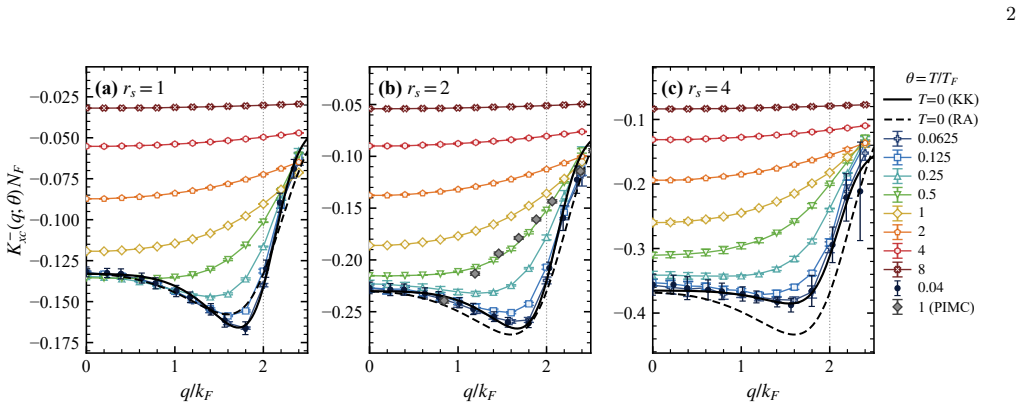
Figure from the paper full image
abstract click to expand
The finite-temperature spin response of the uniform electron gas (UEG) is a fundamental reference for spin-polarized and magnetized electron liquids, including warm dense matter (WDM), yet it remains far less constrained than charge response. Using variational diagrammatic Monte Carlo, we compute the static spin exchange--correlation (XC) kernel $K_{xc}(q;T)$ of the unpolarized UEG at metallic densities across the quantum-degenerate, warm-dense, and classical regimes. The kernel connects smoothly to zero-temperature spin-response parametrizations at low temperature, while heating suppresses the Fermi-surface-scale spin-correlation structure and weakens the XC-driven Stoner enhancement. Its long-wavelength limit provides a direct response test of the spin stiffness implied by thermal local-spin-density-approximation (LSDA) parametrizations, showing low-temperature consistency while exposing a resolved warm-dense residual in current LSDA parametrizations. In the classical regime, the spin XC kernel becomes nearly local on the Fermi-momentum scale, in sharp contrast to the corresponding charge XC kernel. These results provide a first-principles basis for finite-temperature spin-response theory and magnetized WDM modeling.
0
Top Pith
4
physics.chem-ph 2026-05-12 2 theorems

Constrained neural models clone density functionals self-consistently

by Sara Navarro-Rodríguez, Alec Wills +3 more

Constraint-aware functional cloning for stable and transferable machine-learned density functional theory

Molecular-only training data enables accurate reproduction of lattice constants and bulk moduli across metallic, covalent, ionic, oxide, and

Figure from the paper full image
abstract click to expand
We study a simple but useful test for neural exchange-correlation (XC) functionals: can a neural model reproduce an established XC functional when it is used self-consistently? We call this test functional cloning. The model is trained at the GGA level to reproduce a known semilocal functional, using either a constrained or an unconstrained architecture. The motivation is that an XC functional is not used on a fixed input. In a Kohn-Sham self-consistent-field calculation it contributes to the potential, and the resulting density is part of the outcome of the same calculation. A good pointwise fit to sampled density descriptors is therefore not by itself enough. Because the target functional is known, the error can be measured directly. We compare the clones on sampled descriptors, molecular total energies, energy differences, transfer between PySCF and SIESTA, and equations of state for crystalline solids. The constrained models reproduce the reference functional more accurately in molecular self-consistent calculations. They also give better initial parameters for later optimization against correlated molecular energies. An additional observation is that the constrained architecture already gives a reasonable solid-state baseline before cloning, as seen from randomly initialized constrained models. Clones trained only on molecular densities transfer well to solids, reproducing reference lattice constants and bulk moduli across metallic, covalent, ionic, oxide, and layered systems. Cross-code tests show that energy differences are relatively robust, while total energies depend strongly on whether the cloning descriptors come from all-electron or pseudopotential densities. These results make functional cloning a useful diagnostic before full self-consistent training of neural XC functionals.
0
Top Pith
1
cond-mat.dis-nn 2026-05-13 2 theorems

Two-layer nets cut critical slowing down to log scaling

by Luca Maria Del Bono, Giulio Biroli +2 more

The critical slowing down in diffusion models

Diffusion models for the O(n) model train in time that grows only logarithmically with size when locality is built into the architecture.

Figure from the paper full image
abstract click to expand
Computational sampling has been central to the sciences since the mid-20th century. While machine-learning-based approaches have recently enabled major advances, their behavior remains poorly understood, with limited theoretical control over when and why they succeed. Here we provide such insight for diffusion models-a class of generative schemes highly effective in practice-by analyzing their application to the $O(n)$ model of statistical field theory in the Gaussian limit $n \to \infty$. In this analytically tractable setting, we show that training a score model with a one-layer network architecture matching the exact solution exhibits a form of critical slowing down in parameter learning. This slowing down also impacts the generation process, indicating that the well-known difficulties of sampling near criticality persist even for learned generative models. To overcome this bottleneck, we demonstrate the power of combining architectural depth with physical locality. We find that using a two-layer architecture drastically reduces the critical slowing down, with the training time scaling logarithmically rather than quadratically with system size. By introducing a local score approximation we show that this acceleration in training time can be achieved without increasing the number of neural network parameters. Taken together, these results demonstrate that diffusion models can overcome the critical slowing down through appropriate architectural design, and establish a controlled framework for understanding and improving learned sampling methods in statistical physics and beyond.
0
0
cs.LG 2026-07-03

SOAP and SOAP-Muon beat Adam on ML interatomic potential training

by Gil Harari, Yoel Zimmermann +5 more

Beyond Adam: SOAP and Muon for Faster, Label-Efficient Training of Machine Learning Interatomic Potentials

Matrix optimizers reach higher accuracy in fewer steps, with largest gains under partial force labels.

Figure from the paper full image
abstract click to expand
Machine learning interatomic potentials (MLIPs) have become a hallmark of AI for scientific simulation. While efforts on new architectures and datasets have led to increasingly accurate and general models, the choice of optimizer for training has largely remained unexplored, defaulting to Adam and its variants in the community. Here, we implement and systematically compare a class of recently proposed matrix-structured optimizers, including Muon, SOAP, and the hybrid SOAP-Muon, for training NequIP and Allegro MLIP models. We find that these optimizers can substantially outperform Adam in both convergence speed and final accuracy. SOAP and SOAP-Muon emerge as robust and consistently strong methods, while Muon only provides partial gains relative to Adam. The improvements are particularly pronounced under partial force supervision. Our results indicate that optimizer choice is an overlooked yet impactful design axis for MLIPs.
0
0
cs.AI 2026-07-03

LLM pipeline writes physics paper after reproducing references

by Haonan Huang

Grounded autonomous research: a fault-tolerant LLM pipeline from corpus to manuscript in frontier computational physics

Agent maps 11,083 papers, calibrates on published results, runs new calculations, and produces manuscript with three findings.

Figure from the paper full image
abstract click to expand
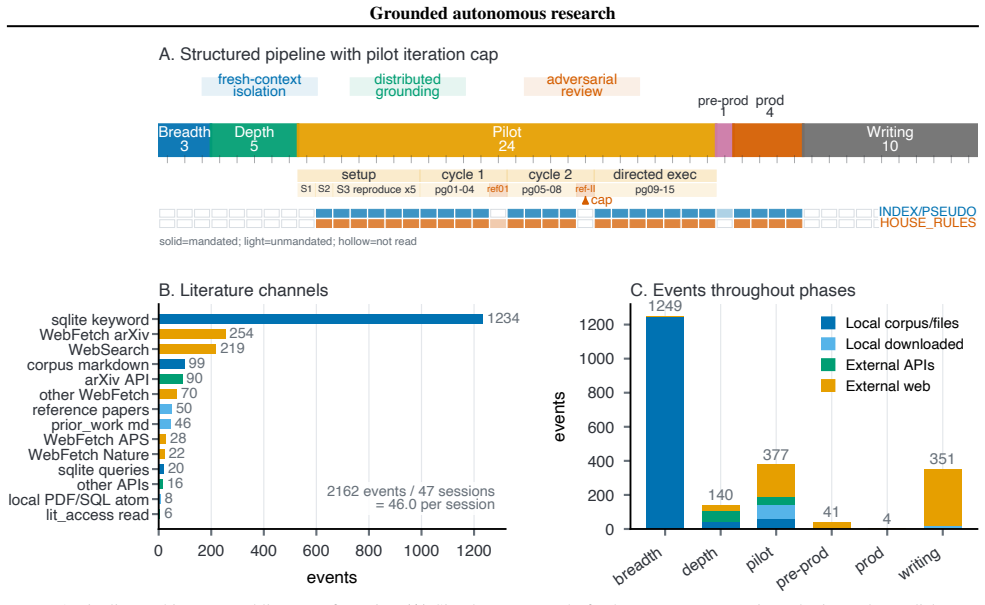
Autonomous-research agents have demonstrated end-to-end LLM automation in machine-learning sandboxes where execution provides calibration. Frontier physical science differs categorically: physical reasoning underlies every methodology choice, toolchains are often underdocumented, and calibration must come from external literature anchors - which unscaffolded agents cite but do not confront, hallucinating plausible, unverifiable results from internal priors. We present a pipeline that runs end-to-end from a corpus of 11,083 recent condensed-matter physics arXiv papers to a publication-grade manuscript with three substantive physics findings (here on altermagnetic piezomagnetism): the agent autonomously conceives a research direction by mapping the corpus, calibrates methodology by reproducing published references, conducts novel first-principles computations, and writes the manuscript - grounded in literature throughout, across 47 fresh-context sessions in six phases sharing only on-disk state, with 2,162 literature-consultation events. Fault tolerance emerges from redundancy: fresh-context isolation, distributed grounding, and adversarial review catch what any single session misses; pre- and post-pilot stages are fully autonomous, and pilot requires bounded human intervention only at reproduction failures - operational knowledge curation, not scientific direction. Two paired failure modes - a pre-architecture baseline and a no-pilot ablation - isolate structurally enforced numerical confrontation at calibration checkpoints as the operative grounding mechanism. The primitives, characterized failure modes, and quantified intervention pattern lay a foundation for autonomous research in high-stakes scientific domains beyond computational physics.
0
0
cond-mat.mtrl-sci 2026-07-03

Torched-TACAW scales EELS simulations to defective materials

by Martin Osmera, João Vaz +2 more

Efficient Large-Scale STEM-EELS Simulations With Torched-TACAW

Partitioning supercells and on-the-fly processing let TACAW handle thick samples with defects while keeping memory use tractable.

Figure from the paper full image
abstract click to expand
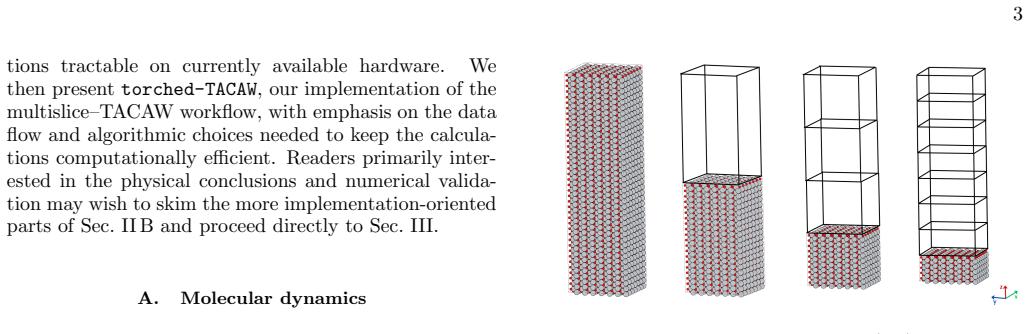
The time auto-correlation of auxiliary wave functions (TACAW) method enables efficient simulations of ultra-low-loss electron energy loss spectra (EELS) arising from vibrational and magnon excitations. In practical applications to realistic materials systems, however, TACAW calculations become challenging due to the large system sizes required for models containing defects, interfaces, impurities, or grain boundaries, as well as the substantial computational cost and data throughput associated with molecular dynamics and multislice calculations. Here we discuss a practical methodology for large-scale TACAW simulations and present torched-TACAW, a freely available implementation of the TACAW part of the described workflow for efficient STEM-EELS simulations. The overall approach combines molecular dynamics based on foundational machine-learned interatomic potentials, partitioning of elongated supercells, and on-the-fly processing of multislice outputs in order to enable near ab initio quality simulations with tractable memory use and data flow. Using rutile TiO2 as a model system, we analyze important numerical aspects of the method, including windowing and supercell partitioning, and demonstrate atomic-resolution STEM-EELS simulations for thick samples.
0
0
cs.LG 2026-07-03

DSGNAR hits 3e-16 error on PINN PDE problems

by Joseph Webb, Sadok Jerad +1 more

An Optimisation Framework for the Well-Conditioned Training of Physics-Informed Neural Networks

Doubly-sketched Gauss-Newton with adaptive ratio improves accuracy five to eight orders of magnitude over prior methods while staying faster

Figure from the paper full image
abstract click to expand
Physics-informed neural networks (PINNs) have emerged as a promising route to solve partial differential equations, yet they have struggled to reach the precision of classical solvers. The obstacle is increasingly understood to be one of optimisation, owing to the severely ill-conditioned loss landscape. We present $\textbf{DSGNAR}$: Doubly-Sketched Gauss-Newton with Adaptive Ratio, a scalable second-order optimisation framework that confronts this ill-conditioning and, in doing so, obtains unprecedented accuracy and speed. $\textbf{DSGNAR}$ couples a doubly-sketched Gauss-Newton model with a novel strategy that carefully controls both regularisation and step length. Across a suite of problems spanning nonlinear, chaotic, multi-scale, high-dimensional, and Navier-Stokes, the framework greatly improves on the state of the art: able to attain relative $\ell_2$ errors as low as $3\times10^{-16}$ in double precision, improve contemporary results by five orders of magnitude on the canonical Burgers' equation, and as much as eight orders on a high-dimensional Poisson problem, while remaining markedly faster. We further show that, in single precision, solutions at the limit of round-off error can be obtained very quickly: Burgers' equation to $\ell_2^{\text{rel}} = 4.75 \times 10^{-7}$ in under ten seconds. The framework is also robust to the choice of architecture, arithmetic precision, and initial hyperparameters. The code is available at https://www.github.com/wephy/physics-informed-neural-networks
0
0
cond-mat.mtrl-sci 2026-07-03

Hierarchical filters cut 894 predicted materials to 25 synthesis targets

by Yuqi An, Sihong Zhu +3 more

Predicting Novel Stable Materials for Experimental Synthesis

PBE phase diagrams, ML dynamical checks, and SCAN refinement prioritize candidates by accounting for competing phases and finite-temperature

Figure from the paper full image
abstract click to expand
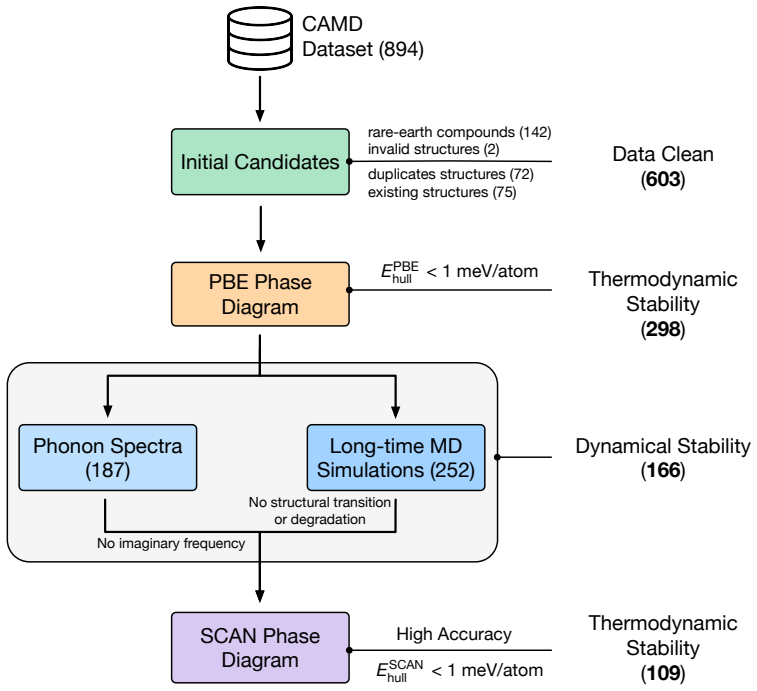
Machine-learning-accelerated materials discovery has yielded large numbers of computationally stable compounds, yet many remain experimentally unrealized, underscoring a persistent gap between prediction and synthesis. Here, we introduce a hierarchical screening framework that combines PBE-based thermodynamic stability, efficient dynamical-stability screening enabled by universal machine-learning interatomic potentials, and SCAN-based thermodynamic refinement. Applying this protocol to the 894 stable materials previously reported in Sci. Data 9, 302 (2022), we first curate 603 unique structures, of which only 298 remain thermodynamically stable on the complete PBE phase diagrams, demonstrating the critical role of competing phases in stability assessment. Dynamical screening then identifies 166 materials stable under both harmonic-phonon and finite-temperature molecular dynamics criteria, and SCAN phase diagrams further narrow this set to 109. Finally, by combining decomposition enthalpy with chemical-space completeness, we prioritize 25 candidates as high-confidence targets for experimental synthesis. This work provides a practical protocol for translating stability predictions into experimentally actionable synthesis targets, closing a key gap in machine-learning-driven materials discovery.
0
0
physics.comp-ph 2026-07-03

GPU solvers achieve whole-core reactor accuracy on unstructured meshes

by Kyung Min Kim, Jaeuk Im +2 more

Verification and Performance Assessment of NuDEAL, a GPU-Accelerated Deterministic Transport Framework on Unstructured Meshes

NuDEAL's three methods reach eigenvalue errors below 50 pcm with single-GPU runtimes matching large CPU clusters on C5G7 and advanced reacto

Figure from the paper full image
abstract click to expand
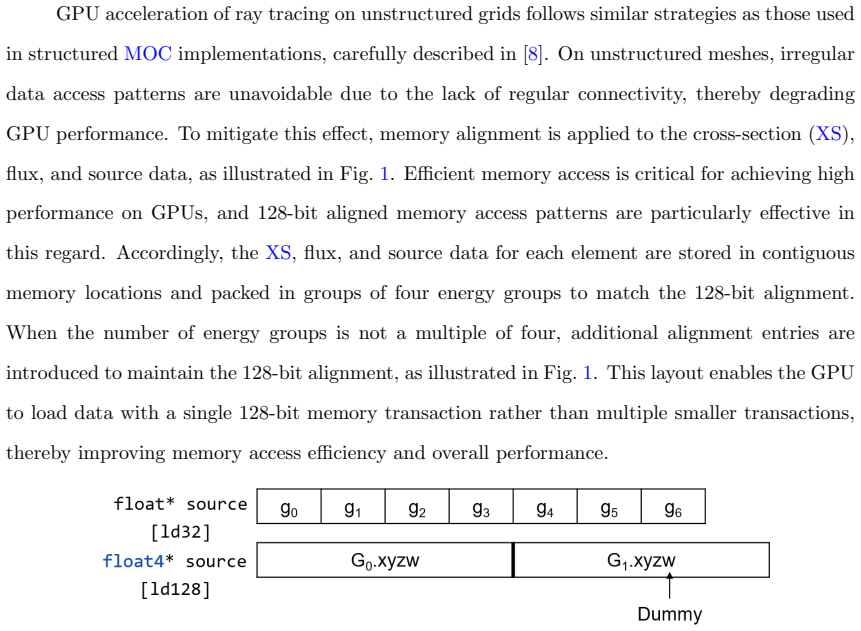
High-fidelity neutronic analyses of advanced reactors require deterministic transport solvers capable of handling complex unstructured geometries while maintaining computational efficiency. This work presents the development and verification of three GPU-accelerated deterministic solvers implemented within a unified framework, Neutronics using Deterministic Finite Element Algorithm (NuDEAL): the planar Method of Characteristics coupled with the Hybrid Finite Element Method (MOC/HFEM), the Discontinuous Galerkin Method of Characteristics (DGMOC), and the Discontinuous Finite Element discrete ordinate method (DFEM-SN). These solvers provide complementary capabilities for consistently solving the multigroup transport equation and can be selectively employed to balance accuracy, computational cost, and memory requirements for a given problem. All methods emphasize efficient GPU execution by leveraging memory alignment, compressed-flux storage, and sequential azimuthal sweeps. The solvers are validated on the C5G7 benchmark and applied to advanced reactor problems, including the ABTR, Empire microreactor, and MSRE. DFEM-SN achieved the highest accuracy, with eigenvalue errors below 50 pcm, while MOC/HFEM and DGMOC provided superior efficiency, with single-GPU runtimes comparable to those of large CPU clusters. The results demonstrate that deterministic GPU solvers on unstructured meshes can deliver both accuracy and scalability, enabling practical whole-core simulations for heterogeneous advanced reactors. The unified NuDEAL framework establishes a foundation for future extensions toward transient and multiphysics analyses on large-scale GPU architectures.
0
0
physics.comp-ph 2026-07-02

Soliton dynamics recovered from scattering data without equations

by Seth Minor, Vanja Dukic +1 more

Learning Effective Soliton Dynamics from Scattering Data

Weak-form identification inside the inverse scattering framework yields low-dimensional models that hold in perturbed regimes.

abstract click to expand
The inverse scattering transform (IST) provides the standard theoretical framework for deriving soliton dynamics. Traditionally, such derivations have been of an analytical, rather than data-driven, nature. In this paper, we combine the conceptual framework of the IST with weak-form system identification methods to discover effective soliton dynamics directly from observed scattering data, without assuming prior knowledge of the scattering equations. Our method avoids parameterizing solitary waves via ad hoc curve-fitting by working in the scattering domain, yielding interpretable low-dimensional models that remain valid in perturbed and near-integrable regimes. We demonstrate the performance of the proposed approach on synthetic and experimental data governed by shallow-water equations of Korteweg--de Vries-type and recover models that are consistent with canonical IST theory.
0
0
math.NA 2026-07-02

Macro-micro split reduces Monte Carlo variance in transport

by Caleb A. Shaw, Dmitriy Y. Anistratov

Hybrid Two-Level Transport Method with Solution Decomposition in Macro and Micro Components

P1 macro moments with exact closures plus MC micro component solved by fixed-point iteration for the steady-state Boltzmann equation.

Figure from the paper full image
abstract click to expand
This paper presents a new hybrid MC/deterministic method for solving the one-group steady-state Boltzmann transport equation based on decomposition of solution in macro and micro components. The macro component captures the large-scale structure of the solution. It is represented by angular moments of the high-order transport solution. The $P_1$ approximation is applied to define the macro component. The first two angular moments are obtained as a solution of hybrid low-order moment equations with exact closures. The equation for the micro component is solved using a MC simulation. The hybrid two-level system of equations for macro and micro components is solved by fixed-point iteration scheme. Numerical results are presented to demonstrate variance reduction of stochastic numerical solution and improvement in computational efficiency.
0
0
physics.comp-ph 2026-07-02

Sequential THM coupling matches analytical benchmarks

by J. Al Kubaisy, G. E. Hammond +5 more

Verification of a sequential thermo-poroelasticity formulation in PFLOTRAN

A non-iterative fixed-stress split solves flow and temperature first then mechanics, agreeing with solutions for pressure, temperature, and

abstract click to expand
We present the verification of a thermo--hydrologic--mechanical capability implemented within the PFLOTRAN framework, with emphasis on benchmark-based assessment of the THM implementation. The thermal--hydrologic (TH) equations for mass and energy balance are solved on control-volume blocks or Voronoi cells, while the quasi-static momentum balance is solved on an element-based dual mesh. The coupling is achieved using a strictly sequential, non-iterative fixed-stress split strategy in which the TH system is solved implicitly for pressure and temperature, followed by a mechanics update for the displacement unknowns. Several verification problems are set up against poroelastic and thermo-poroelastic benchmarks, demonstrating agreement with analytical or semi-analytical benchmark responses for pressure diffusion, the temperature field, and mechanical deformation. In addition, we propose a treatment for discontinuities (e.g., fractures) based on mapping between mechanical and flow degrees of freedom, and validate the approach by comparison to an analytical solution. This work establishes the basis for thermo-poroelastic coupling in PFLOTRAN and provides a solid modeling foundation for a range of applications (e.g., enhanced geothermal systems and other subsurface energy storage) involving coupled thermal--hydrologic--mechanical (THM) processes in geologic porous media.
0
0
physics.comp-ph 2026-07-02

Lanczos method reduces cost for nuclear QRPA strength functions

by Dong Min Roh, Chao Yang +2 more

Lanczos Method for QRPA Strength Functions in Atomic Nuclei

Single Krylov run matches GMRES accuracy for two nuclei over broad energy range

Figure from the paper full image
abstract click to expand
We present a symmetric Lanczos method for computing charge-changing QRPA strength functions in atomic nuclei. Starting from the finite-amplitude-method formulation of the QRPA linear-response problem, we derive equivalent spectral representations and, in the real case, a reduced eigenvalue problem involving the matrix products $MK$ and $KM$, where $M\equiv A+B$ and $K\equiv A-B$ are formed from the usual QRPA matrices $A$ and $B$. The resulting formulation enables a matrix-free Lanczos approximation of the Lorentzian-smeared strength function over a broad energy interval from a single Krylov run, in contrast to conventional frequency-by-frequency response calculations. Numerical tests for $^{112}$Sn and $^{150}$Nd first show that GMRES reproduces the converged iterative FAM strength profiles while requiring fewer iterations. Using GMRES as the frequency-by-frequency reference, we then show that the Lanczos approximation reproduces the same strength profiles with reduced overall cost. These results indicate that symmetric Lanczos projection provides an efficient and accurate approach for QRPA strength-function calculations when spectral information is required over an extended frequency range.
0
0
cond-mat.mtrl-sci 2026-07-02

Beam partitioning cuts memory use 5x in core-loss EELS simulations

by Philipp Pelz

The BiP-PRISM algorithm for fast and scalable core-loss STEM-EELS simulations

BiP-PRISM interpolates sparse matrices locally at atoms and removes per-scan propagation for full 4D maps on consumer GPUs.

Figure from the paper full image
abstract click to expand
Quantitative interpretation of atomic-resolution STEM-EELS requires dynamical simulation of the electron probe before and after core-loss transitions, which is computationally expensive. While the PRISM algorithm accelerates this by reusing scattering matrices, we introduce beam partitioning for both the probe-forming ($\mathcal{S}_1$) and detector-propagating ($\mathcal{S}_2$) PRISM matrices to further reduce computational and memory costs. Each matrix is calculated on a sparse set of parent beams and reconstructed via natural-neighbor interpolation locally at the ionized atom. A locality result demonstrates that the total error is governed entirely by this on-atom reconstruction error. The resulting BiP-PRISM algorithm removes per-scan exit wave propagation and significantly reduces memory requirements, enabling full-resolution elemental mapping, 4D cubes, and momentum-resolved qEELS on consumer-grade GPUs. We characterize the approximation's validity regime and demonstrate the simulation of a multimodal five-edge oxide-interface map and an FePt nanoparticle Fe-L map at 5x memory reduction, showing that the algorithm achieves high accuracy with significantly lower computational demands.
0
0
physics.comp-ph 2026-07-02

LSR-Net cuts RMSE three orders on spherical pattern dynamics

by Qian Serena Hou, Zecheng Gan

LSR-Net: Long-Short-Range Operator Learning for Pattern Dynamics on Manifolds

Decomposing operators into long-range Fourier and short-range geometric parts yields higher accuracy and stability than baseline models on m

Figure from the paper full image
abstract click to expand
We propose the Long-Short-Range Neural Network (LSR-Net), an extensible operator-learning framework for predicting pattern dynamics on planar domains, spherical surfaces, and general manifolds. The method decomposes the forward evolution operator into a long-range component, represented by a compact Fourier multiplier constructed via the Sum-of-Exponentials (SOE) approximation, and a short-range component adapted to the underlying geometry and its intrinsic symmetries. For general manifolds represented by irregularly sampled point clouds, the long-range component is implemented by Gaussian gridding onto an auxiliary regular grid, where the Fourier multiplier is efficiently applied in k-space using FFT and the result is interpolated back to the original sample points. We evaluate LSR-Net on several benchmark systems, including the Allen-Cahn, Cahn-Hilliard, Schnakenberg, and Turing systems, over planar domains, spherical surfaces, and a blob-shaped manifold. Numerical results demonstrate that LSR-Net consistently achieves higher accuracy and improved stability compared with baseline operator-learning models. In particular, for Allen-Cahn dynamics on the sphere, the RMSE is reduced by approximately three orders of magnitude compared with the Spherical Fourier Neural Operator (SFNO). Rotation and reflection equivariance tests further confirm that the learned operator is consistent with these geometric transformations. These results indicate that LSR-Net provides an effective and robust approach for learning pattern dynamics on complex geometries.
0
0
math.NA 2026-07-02

NSFD scheme keeps p-Laplacian solutions positive at large time steps

by Achraf Zinihi, Matthias Ehrhardt +1 more

A Nonstandard Finite Difference Scheme for a Nonlinear Parabolic Equation with p-Laplacian-Type Diffusion

Nonlinear denominator and nonlocal diffusion approximation prevent negative values and oscillations that appear in standard methods.

Figure from the paper full image
abstract click to expand
We propose and analyze a nonstandard finite difference (NSFD) scheme for nonlinear parabolic equations involving a p-Laplacian-type diffusion operator in one- and two-dimensional spatial domains. Following Mickens' design principles, the proposed discretization employs a nonlinear denominator function phi(.) together with a nonlocal approximation of the nonlinear diffusion term Delta_p, yielding a structure-preserving discrete model. The scheme is designed to retain key qualitative properties of the continuous problem, including positivity, boundedness, and stability, which may be lost by standard finite difference methods (FDMs). We establish the well-posedness of the continuous model, derive the NSFD scheme, and investigate its consistency, convergence, and local truncation error. Numerical experiments confirm the theoretical results and demonstrate that, unlike the standard explicit FDM, the proposed NSFD scheme avoids spurious oscillations and nonphysical negative solutions even for relatively large time-step sizes.
0
0
physics.bio-ph 2026-07-02

Vaccine optimization unnecessary when protection routes balance

by Mi Feng, Zhaohua Lin +2 more

When is vaccine prioritization worth optimizing?

Many allocation rules perform nearly as well when transmission blocking and direct protection are balanced, but the balance shifts as infect

Figure from the paper full image
abstract click to expand
Optimizing vaccine prioritization is often treated as the default policy response when vaccine supply is limited. Yet optimized prioritization carries administrative, ethical and communication costs, motivating an upstream question: whether differences among vaccine allocations can alter epidemic outcomes enough to make optimization epidemiologically necessary. We show that optimization is not always worth pursuing: in some regimes, vaccination markedly reduces epidemic burden, but many feasible allocation rules perform almost equally well, making the necessity of optimization low. We quantify this necessity as the range of epidemic outcomes generated by different allocations under fixed supply and show that it is governed by competition between vaccinating high-contact groups to slow transmission and vaccinating groups that benefit most directly: necessity is low when these protection routes are balanced and high when one dominates. Increasing transmission intensity changes this balance and drives a transition in the optimal allocation from transmission-focused prioritization toward direct protection. Different prevention objectives exhibit distinct transition thresholds, creating regimes in which optimizing one objective substantially compromises another, thereby revealing when the choice of prevention target matters most. This framework reframes vaccine prioritization as a prior decision problem, identifying when optimization is warranted, when simpler rules suffice, and when prevention goals conflict.
0
0
cs.CE 2026-07-02

Finite-volume bias stabilizes multi-resolution nets for long PDE forecasts

by Xin-Yang Liu, Xiantao Fan +1 more

A Multi-Resolution Finite-Volume Inspired Deep Learning Framework for Spatiotemporal Dynamics Prediction

MuRFiV keeps predictions accurate far into autoregressive rollouts where data-driven networks diverge on Burgers and Navier-Stokes systems.

Figure from the paper full image
abstract click to expand
Predicting complex spatiotemporal dynamics in physical processes often demands computationally expensive numerical methods or data-driven neural networks that suffer from high training costs, error accumulation, and limited generalizability to unseen parameters. An effective approach to address these challenges is leveraging physics priors in training neural networks, known as physics-informed deep learning (PiDL). In this work, we introduce the Multi-Resolution Finite-Volume-inspired network, MuRFiV, designed to capitalize on the conservative property of finite volume on the global scale and the expressive power of deep learning on the local scale. We demonstrate the effectiveness of MuRFiV on several spatio-temporal systems governed by partial differential equations (PDEs), including Burgers' equation, shallow water equations, and incompressible Navier-Stokes equations. By embedding PDE information into the deep learning architecture, MuRFiV achieves strong long-term prediction accuracy and remains stable over very long autoregressive rollouts, significantly outperforming data-driven neural network baselines. This result highlights the promise of combining multiresolution learning with finite-volume-inspired inductive bias for accurate and robust long-term prediction of complex dynamics.
0
0
physics.flu-dyn 2026-07-01

ALE mapping makes Boltzmann DG scheme obey geometric conservation on moving meshes

by Atakan Aygun, Onur Ata +2 more

A High-Order Arbitrary Lagrangian-Eulerian Discontinuous Galerkin Method for the Boltzmann Equation in Nearly Incompressible Flows

Added advection term from reference mapping enables accurate simulations of plunging airfoils and swimming fish.

Figure from the paper full image
abstract click to expand
We propose the arbitrary Lagrangian-Eulerian (ALE) form of the Galerkin-Boltzmann formulation for the simulation of nearly incompressible flows with moving boundaries. The continuous Boltzmann equations are mapped to a reference state to compensate the mesh motion with an advection term. The resulting system is discretized in space using the discontinuous Galerkin method on unstructured meshes. A semi-analytic Runge-Kutta time discretization is used to overcome the stiffness introduced by the continuous Boltzmann equations. The well-known geometric conservation law is shown to be satisfied by the time and space discretizations and consistent update of geometric factors of the discretization. The implementation is on the GPU accelerated kernel library libParanumal and validated by a free stream preservation and moving Taylor-Green vortex test cases. Then, the capabilities are shown using a plunging symmetric airfoil in two-dimensions and moving carangiform fish in three-dimensions using perfectly matched layers.
0
0
physics.comp-ph 2026-07-01

ML matches numerical accuracy for seismic waves at lower cost

by Óscar Rincón-Cardeño, Gregorio Pérez-Bernal +2 more

A Scoping Review of Physics Informed Machine Learning for Wave Propagation Modeling in Seismology

Review classifies applications to forward and inverse problems and distinguishes three ways physical knowledge enters the model.

abstract click to expand
\emph{Background:} Standard numerical methods accurately simulate seismic waves but are computationally expensive, particularly for inverse problems. Machine learning approaches have been proposed as alternatives that can reduce computational cost while maintaining acceptable physical accuracy. \emph{Objective:} To map how physics-informed machine learning methods have been applied to seismic wave propagation modeling based on partial differential equations. \emph{Methods:} A scoping review was conducted using the OpenAlex and Scopus databases. Selected studies were classified by problem type (forward or inverse) and machine learning strategy to identify research trends, methodological patterns, and gaps in the literature. \emph{Results:} Physics-informed machine learning has been applied to both forward modeling and inversion in seismology, often reaching accuracy comparable to standard numerical methods at lower computational cost. Application of three mechanisms for incorporating physical knowledge were identified: observational bias, inductive bias, and learning bias. To evaluate methodological reproducibility of a representative method, the original PINN framework was replicated in PyTorch, obtaining results consistent with and in most cases more accurate than those originally reported. From the reviewed literature, limitations remain in benchmarking consistency, training cost, and scalability to three-dimensional and experimentally validated problems. \emph{Conclusions:} Standard numerical methods remain the basis of seismological workflows, while physics-informed machine learning offers complementary approaches that are useful for inverse problems and surrogate modeling. Future work should focus on consistent benchmarking, hybrid formulations, and validation under realistic geophysical conditions.
0
0
math.NA 2026-07-01

GQL reformulation yields non-iterative PCP limiters for relativistic hydro

by Linfeng Xu, Shengrong Ding +1 more

GQL-Based Physical-Constraint-Preserving High-Order Finite Difference Schemes for Special Relativistic Hydrodynamics in Arbitrary Dimensions

Linear inequalities and small eigenvalue solves enforce positive density and subluminal velocity in high-order WENO schemes up to 3D

Figure from the paper full image
abstract click to expand
High-order accurate simulations of special relativistic hydrodynamics (RHD) are prone to numerical breakdown if intrinsic physical constraints (positive rest-mass density/pressure and subluminal velocity) are violated near strong discontinuities. In this work, we develop a robust and efficient physical-constraint-preserving (PCP) flux-limiting framework for high-order schemes, using finite-difference WENO as a representative example. By leveraging the geometric quasilinearization (GQL) representation, which equivalently reformulates the nonlinear RHD constraints into a family of linear inequalities, we integrate a Zalesak-type Flux-Corrected Transport (FCT) update into a scalar-style limiter that acts directly on conservative variables. A critical innovation is the explicit, non-iterative determination of limiting parameters via a rational stereographic parameterization of the GQL normal vector. This technique transforms the required worst-case minimization over auxiliary variables into a generalized Rayleigh-quotient formulation, allowing the optimal parameters to be obtained by solving small symmetric eigenvalue problems ($2\times2$ in 1D; $(d+1)\times(d+1)$ in $d$ dimensions). Relaxed variants are further introduced to reduce computational costs in multidimensions while retaining the PCP guarantee. Extensive numerical benchmarks ranging from 1D to 3D, including ultra-relativistic Riemann problems and astrophysical jets, demonstrate that the proposed method robustly enforces physical admissibility, sharply resolves discontinuities, and maintains design-order accuracy for smooth solutions.
0
0
physics.comp-ph 2026-07-01

Normalizing flow covers gas-surface scattering from thermal to hypersonic speeds

by Miklas Schütte, Stephen Hocker +4 more

Conditional Normalizing Flow for Gas-Surface Scattering from Thermal to Hypersonic Velocities

Trained on molecular dynamics data with a detailed balance constraint, the model handles multi-collision thermalization for VLEO aerodynamic

Figure from the paper full image
abstract click to expand
Accurate aerodynamic modeling of satellites in very low Earth orbit (VLEO) requires gas-surface interaction (GSI) models that capture the full velocity spectrum from thermal to orbital speeds. Atmospheric particles initially strike spacecraft surfaces at hypersonic velocities of 6 000 - 10 000 m/s. Due to surface roughness and complex geometries, especially within air-breathing electric propulsion (ABEP) intake systems, multiple collisions occur, progressively reducing the particle velocities. A recent machine learning framework for deriving scattering kernels from molecular dynamics (MD) simulations has shown promise, but remains limited to high-velocity single impacts and possibly violates fundamental equilibrium principles such as detailed balance. This work extends this machine learning based scattering kernel to cover the complete velocity range using conditional normalizing flows trained with physics-informed constraints, enabling accurate modeling of multi-bounce scenarios in realistic VLEO applications. We train a conditional Real-valued Non-Volume Preserving (cRealNVP) model on expanded molecular dynamics simulations covering velocities from thermal to hypersonic speeds, incorporating a detailed balance loss term. The resulting model demonstrates improved accuracy compared to previous approaches even in the original high-velocity regime, while successfully capturing thermal-velocity scattering. Quantitative assessment shows that thermalization is approximated within acceptable tolerances. This framework provides essential capabilities for accurate ABEP intake optimization and VLEO mission planning while offering a general methodology applicable to broader rarefied gas dynamics problems requiring thermodynamic consistency.
0
0
physics.comp-ph 2026-07-01

Pairwise model learns committor functions for biomolecules

by Jintu Zhang, Zichang Jin +6 more

Navigating committor landscape of biomolecules with a general pairwise interaction model

The architecture captures detailed transition mechanisms in folding and binding without specialized prior knowledge.

Figure from the paper full image
abstract click to expand
Sampling rare conformation transitions between metastable states is a central challenge in atomistic simulations. While the committor function serve as an ideal reaction coordinate for driving enhanced sampling, their high-dimensional inputs and complex functional forms limit the efficacy of standard feedforward neural networks in modeling them. Inspired by recent breakthroughs in biomolecular structure prediction, we propose a novel committor learning framework grounded in the AlphaFold 3 paradigm. By integrating a lightweight, differentiable atom-level embedding with a simplified Pairformer architecture, our method inherently captures intricate dynamical features of diverse biosystems without requiring specialized prior knowledge. We demonstrate the superior expressiveness and accuracy of the proposed framework across multiple atomistic processes. For the folding of the chignolin mini-protein, our model reveals the finer-grained structure of its transition state ensemble (TSE) and a detailed bifurcated reaction mechanism. Furthermore, for calixarene host-guest systems, we develop a unified committor model that elucidates how ligand substituents regulate the ratio between distinct binding pathways, offering new perspectives for structure-based drug design.
0
0
cond-mat.soft 2026-07-01

Solvent quality overrides topology in dilute polymer solutions

by Ashish Kumar Singh, Angelo Rosa

Mesoscopic simulations of linear and ring polymer solutions with explicit hydrodynamics under good and poor solvent conditions

Simulations of linear and ring chains show similar expansion, aggregation, and diffusion controlled mainly by good or poor solvent condition

Figure from the paper full image
abstract click to expand
We employ large-scale Dissipative Particle Dynamics simulations to investigate dilute solutions of linear polymers and unknotted, non-concatenated ring polymers in explicit solvent. By systematically varying solvent quality, we examine the interplay between hydrodynamic interactions, chain architecture, and intermolecular association. Under good solvent conditions, both linear and ring polymers remain expanded and well dispersed, displaying center-of-mass dynamics consistent with normal diffusion. In poor solvents, attractive polymer-polymer interactions drive the formation of irregular aggregates characterized by partial chain collapse, substantial interpenetration, and slower dynamics. Despite their different topologies, the two polymer architectures exhibit remarkably similar structural and dynamical responses across the solvent conditions considered. These results indicate that solvent quality largely determines the organization and transport properties of dilute polymer solutions, whereas topological effects remain comparatively weak in the investigated regime.
0
0
physics.app-ph 2026-07-01

MnSe monolayer combines compensated ferrimagnetism with three ferroic orders

by Zhuang Ma, Hongfei Liang +6 more

Fully compensated ferrimagnetic triferroics and multistate transport in hidden-phase wurtzite MnSe monolayer

The single-phase material enables giant multistate resistance changes via magnetic, electric, or strain control.

Figure from the paper full image
abstract click to expand
Fully compensated ferrimagnets (fFIMs) have attracted interest due to their compensated moments and nonrelativistic spin splitting across the Brillouin zone. Known fFIMs, however, are mostly restricted to complex three-dimensional (3D) systems or require external fields in two-dimensional (2D) heterostructures, leaving intrinsic fFIM monolayers unexplored. We identify a hidden-phase MnSe monolayer, derived from the (001) planes of wurtzite, as an intrinsic fFIM featuring inequivalent sublattices not linked by any symmetry. It is a unipolar magnetic semiconductor (UMS) with perpendicular magnetic anisotropy (528.60 * 10^-3 eV per unit cell) and simultaneously exhibits ferroelectricity (polarization 4.63 * 10^-10 C/m) and ferroelasticity (signal 61%), with barriers of 7.6 * 10^-3 and 0.10 eV/f.u., respectively, establishing a single-phase triferroic system. The ground fFIM UMS characteristics are robust against strain up to 3%. The In2Se3/MnSe heterostructure enables nonvolatile electrical control between semiconducting and metallic states. Constructed tunnel junctions exhibit giant tunneling magnetoresistance (2.98 * 10^5%), electroresistance (6.97 * 10^14%), elastoresistance (7.95 * 10^4%), and near-perfect spin filtering (~100%). Collectively, this spontaneous 2D fFIM with coexisting triferroic orders provides a promising platform for ultrahigh-density, low-power, and miniaturized memory devices.
0
0
cond-mat.mtrl-sci 2026-07-01

Side-chain length flips MOF-5 thermal expansion sign

by Wei Qiu, Penghua Ying

Side-Chain Tuning of Thermal-Expansion Crossover in Metal-Organic Frameworks

Chains of three or more carbons produce low-T expansion that switches to contraction at high T; concentration tunes the coefficient to negat

Figure from the paper full image
abstract click to expand
Achieving continuous control over macroscopic thermal expansion remains a fundamental challenge in solid-state physics. Using classical and path-integral molecular dynamics alongside lattice dynamics at near-\emph{ab initio} accuracy, we report an entropy-driven thermal-expansion crossover from positive (PTE) to negative thermal expansion (NTE) in alkoxy-functionalized MOF-5, an archetypal metal-organic framework (MOF). We demonstrate that this non-linear response is continuously tunable via the alkoxy side-chain length, quantified by the number of carbon atoms $n$ grafted onto the archetypal cubic MOF-5 framework: systems with short chains ($n \le 2$) exhibit monotonic NTE, whereas longer chains ($n \ge 3$) trigger a pronounced PTE-to-NTE crossover. At low temperatures, thermal activation of longer side chains opens additional conformational states and generates steric pressure inside the pore, driving positive expansion through a gain in side-chain conformational entropy. Conversely, at elevated temperatures, the side chains enhance transverse linker fluctuations and strengthen the string-tension mechanism associated with low-frequency framework modes, causing structural contraction favored by framework vibrational entropy. Finally, by varying the concentration of side-chain-functionalized linkers, the thermal expansion coefficient can be continuously regulated to realize negative, near-zero, and positive thermal expansion within selected temperature windows. These results establish side-chain engineering as a practical route for programming macroscopic thermodynamic responses in MOFs.
0
0
physics.comp-ph 2026-07-01

Constrained dynamics cuts multigrid iterations in P3M electrostatics

by Federica Troni, Violette Gontran +2 more

P3MaZe: a Mass-Zero constrained-dynamics formulation of particle-mesh electrostatics

P3MaZe treats long-range potential as zero-inertia auxiliary field and enforces discretized Poisson equation as holonomic constraint while m

Figure from the paper full image
abstract click to expand
We introduce P3MaZe, a real-space particle-mesh electrostatic method that combines the standard short-range/long-range decomposition of Particle-Particle Particle-Mesh (P3M) electrostatics with the Mass-Zero constrained dynamics (MaZe) framework. In this formulation, the smooth long-range electrostatic potential is represented on a mesh as a zero-inertia auxiliary field, while the discretized Poisson equation is enforced as a holonomic constraint during molecular dynamics. By retaining the standard P3M decomposition, P3MaZe preserves the systematic accuracy controls associated with the real-space cutoff, the Ewald splitting, the mesh spacing, and the charge-assignment procedure, while replacing the conventional multigrid Poisson solver by a constrained correction problem. The method is validated for molten NaCl and simple point-charge flexible water (SPC/Fw). Structural, translational, collective, and rotational dynamical observables are in quantitative agreement with those obtained with established electrostatic methods, including real-space P3M, and Ewald summation. The constrained formulation consistently requires fewer multigrid iterations than the corresponding real-space P3M solver while retaining the expected linear scaling with system size. These results establish P3MaZe as a promising new direction for scalable real-space electrostatics in large-scale molecular simulations.
0
0
quant-ph 2026-07-01

Green's function equations capture non-Markovian single-photon emission

by Hyunwoo Choi, Jisang Seo +4 more

Full-Wave Green's-Function Modeling of Collective Single-Photon Emission in Non-Markovian Open-System QED with Finite-Bandwidth Compensation of Dispersive Interactions

Closed dynamical equations track emitter populations and field amplitudes in complex structures without Markovian approximation.

Figure from the paper full image
abstract click to expand
This work presents a full-wave Green's function framework for modeling collective and coherent single-photon emission from multiple quantum emitters embedded in complex electromagnetic structures. Starting from a transverse modal completeness relation of modified Langevin noise formalism, we derive a closed set of coupled equations for population dynamics and frequency-resolved field amplitudes in the single-excitation regime. Since the electromagnetic reservoir is not traced out at the level of the dynamical amplitudes, the emitted single-photon dynamics can be modeled within the same closed set of equations without Markovian approximation in open and dissipative environments. We demonstrate that finite-bandwidth truncation of the spectral density leads to systematic deviations in coherent dispersive interactions, even when dissipative rates appear converged. To restore causal consistency, we introduce a counter-term compensation scheme that restores the missing dispersive contributions without modifying the retained non-Markovian memory kernel. To validate the scheme and demonstrate the practicality of the proposed framework, we present numerical examples ranging from benchmark configurations to a three-dimensional dispersive ring-resonator structure via finite element method. These capabilities provide a practical route for rigorously incorporating full-wave electromagnetic simulations into non-Markovian multi-emitter quantum electrodynamics, enabling predictive modeling of collective emission, coherent energy exchange, and single-photon radiation in realistic open structures.
0
0
physics.comp-ph 2026-07-01

Quantum framework defines relaxed quantities in incommensurate systems

by Mengfan Tu, Huajie Chen +1 more

Relaxation of Incommensurate Structures via Quantum Models

Displacement fields on configuration space plus reciprocal-space Hamiltonians produce well-defined energy, LDOS and forces via thermodynamic

Figure from the paper full image
abstract click to expand
Accurately modeling structural relaxation in incommensurate systems is intrinsically challenging due to the absence of global translational symmetry. In this work, we develop a variational quantum framework for structural relaxation in incommensurate Schr\"{o}dinger models, where displacement fields are formulated on the configuration space and the electronic Hamiltonian is represented in reciprocal space. This yields well-defined relaxed energy, local density of states, and forces through thermodynamic limits. We propose an anisotropic scattering-channel approximation, and prove exponential convergence of the approximate equilibria. Numerical experiments are performed to support the analysis and show that the model captures domain-wall formation and its impact on the electronic spectrum.
0
0
physics.plasm-ph 2026-06-30

Enhanced RPA-LDA matches proton stopping to NIST data from solids to plasmas

by Thomas A. Mehlhorn, Ming Feng Gu +1 more

An Enhanced RPA-LDA Model for Ion Stopping Power from Cold Matter to High-Energy Density Plasmas: A Unified, Open-Source Framework

Four corrections to the dielectric response yield agreement with cold-matter databases and sparse plasma measurements in one continuous fram

Figure from the paper full image
abstract click to expand
We present an enhanced random-phase-approximation--local-density-approximation (e-RPA-LDA) model for the stopping power of ions that is valid over a wide range of conditions, from cold solids through warm dense matter to high-energy-density plasmas. The electronic stopping is computed from the RPA dielectric response in the local-density approximation over an average-atom electron density obtained in a muffin-tin potential with the Flexible Atomic Code, augmented by four corrections to the earlier RPA-LDA model of Wang et al.: a strong-collision correction for large-momentum-transfer events, a static local-field correction for electron correlations, an electron-binding correction, and the higher-order Barkas and Bloch terms. The resulting proton stopping powers agree with the NIST PSTAR and IAEA databases across the periodic table and for compounds -- providing a physics-based alternative to semi-empirical codes such as SRIM -- and reproduce the limited published plasma data, including charged-particle transport-workshop benchmarks, time-dependent DFT calculations, and the first measurements of enhanced light-ion stopping in plasmas. We further extend the model to a complete total stopping power for protons and alpha particles by adding nuclear and ionic (elastic ion-ion) stopping to the electronic term, yielding a continuous, self-consistent description of energy deposition from cold matter to hot dense plasmas. Because the average-atom treatment includes contributions from all electrons -- unlike Kohn-Sham DFT -- while remaining computationally efficient and applicable to low- and high-Z targets at arbitrary temperature and degeneracy, the model is well suited to inertial fusion and high-energy-density science. The computational framework is available on GitHub (https://github.com/dedx-erpa/dedx), with tabulated stopping powers and ranges in the data/ subdirectory.
0
0
cond-mat.mtrl-sci 2026-06-30

Computed crystals depart from experimental structural memory

by Dan Nguyen, Karen Cao +4 more

Computed materials proposals depart from the structural memory of experimental discovery

82.9 percent of new formulas join old communities while AI and database proposals deviate farther than additional real structures.

Figure from the paper full image
abstract click to expand
Generative AI and high-throughput DFT pipelines propose millions of inorganic crystal structures, but lack a calibrated reference frame against experimentally realized chemistry. Here we embed 167,500 Inorganic Crystal Structure Database entries in a continuous structural-similarity space, partition it into graph communities, and replay them in time. Experimental discovery shows strong structural memory: 82.9% of new formulas enter pre-existing communities; new-community formation falls from 40.2% (1930s) to 2.6% (2010s). The communities are chemically meaningful, positively identifying nine textbook field-defining renaissances, including cuprates, colossal-magnetoresistance manganites, MAX phases, and Li-ion battery cathodes. Projecting GNoME, MatterGen-public, Materials Project, JARVIS-DFT, and Alexandria-PBE into frozen historical maps yields a cutoff-robust ordering: held-out ICSD > MatterGen > {GNoME ~ MP-theoretical} > JARVIS > Alexandria. Structural departure from experimental basins is not specific to generative AI but general across the tested computed sets. Combining structural proximity with reduced-formula precedent defines a historical synthesizability prior for triaging computed materials.
0
0
astro-ph.GA 2026-06-30

AMR solver resolves phase singularities in bosonic gravity

by Iván Álvarez-Rios

Time-dependent adaptive mesh refinement solver for the Gross-Pitaevskii-Poisson equations

The code preserves conservation laws and handles dynamical wave features across refinement levels in 3D tests.

Figure from the paper full image
abstract click to expand
This work presents a new numerical code for solving the time--dependent Gross--Pitaevskii--Poisson (GPP) system using adaptive mesh refinement (AMR). The code is designed to study the nonlinear dynamics of self--gravitating bosonic matter in three spatial dimensions under periodic boundary conditions. It combines high--order spatial discretization, explicit time integration, and dynamic refinement driven by the magnitude of the gravitational potential. The implementation is validated through a set of test problems in the nonlinear regime. These benchmarks demonstrate that the solver accurately preserves global conservation laws, resolves strong wave interference and phase singularities, and maintains consistency across refinement levels in highly dynamical scenarios.
0
0
astro-ph.GA 2026-06-30

Compressive tides and remnant heating reshape GC mass functions

by Pablo Contreras Guerra, Robert J. J. Grand +2 more

Introducing AuriGLOBES: the effect of compressive tides, compact object-induced mass loss, and size evolution on modelling globular clusters

Simulations show both effects are required to evolve initial Schechter distributions into the observed Milky Way/M31 globular cluster mass f

Figure from the paper full image
abstract click to expand
Globular clusters (GCs) are long time survivors of galaxy assembly and evolution yet their emergence from an initial cluster population is still poorly constrained. We present the Auriga GLOBular clustEr Simulations (AuriGLOBES) a physically motivated subgrid model for star cluster (SC) formation and evolution that includes enhanced mass loss from compact object remnants. With this model, implemented in the Auriga cosmological galaxy formation model, we run a suite of zoom-in cosmological simulations comprising 9 Milky Way mass and 5 lower mass galaxies. We demonstrate that our model produces plausible GC populations compared to the Milky Way/M31 systems and reproduces the empirical GC system mass -- halo mass relation within a 2$\sigma$ scatter. We show that the formation of SCs in tidally compressive, high-pressure gas in addition to enhanced mass loss from compact object remnants heating is required to capture the transformation of an initial Schechter mass function to the characteristic observed GC mass function in the Milky Way/M31 systems. The resulting GC populations show spatial and metallicity distributions qualitatively similar to the Milky Way/M31 systems, as well as a variety of age distributions that correlate with the star formation history of the simulated galaxies. However, the peak of the age distribution of Milky Way GCs is older than any of our simulated Milky Way-mass galaxies, which is attributed to unrepresented star formation and galaxy assembly histories. AuriGLOBES represents a reliable framework for the study of GC populations through cosmic history and a robust foundation for future applications for a model of stellar streams arising from GCs disruption.
0
0
physics.comp-ph 2026-06-30

SympNets provide non-linear control variate for δf PIC plasma simulations

by Victor Fournet, Martin Campos Pinto +2 more

Non-linear control variate in {δ}f particle-in-cell methods using symplectic neural networks

Neural networks approximate backward flow from particle trajectories to evolve bulk density and reduce variance in electrostatic plasma mode

Figure from the paper full image
abstract click to expand
We present a novel {\delta}f particle-in-cell (PIC) method for the kinetic simulation of electrostatic plasmas in which the bulk density, acting as a control variate, is evolved using symplectic neural networks (SympNets). The SympNets are used as an approximation of the backward flow and trained using the particle trajectories. We introduce a periodic variant of the SympNet architecture that encodes the spatial periodicity of the problem into the network itself. We validate the approach with numerical results in 1D1V and 3D3V for the Vlasov-Poisson system.
0
0
cond-mat.str-el 2026-06-30

Health-aware tuning beats human baselines for neural quantum states

by Jia-Qi Wang, Xiao-Qi Han +3 more

NQS-Agent: Health-Aware Agentic Hyperparameter Optimization for Neural-Network Quantum States

NQS-Agent monitors energy trajectories to stop unstable runs and rank architectures, yielding better results on the Heisenberg model.

Figure from the paper full image
abstract click to expand
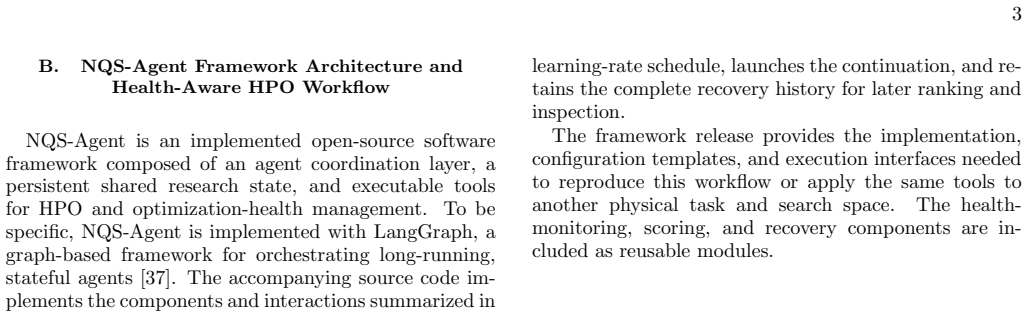
Neural-network quantum states (NQS) provide expressive variational representations for strongly correlated quantum many-body systems, but their practical accuracy depends sensitively on architecture-level hyperparameters and optimization schedules. Here we develop NQS-Agent, an implemented open-source software framework for health-aware hyperparameter optimization (HPO) in NQS calculations. Its workflow monitors energy trajectories, detects destructive optimization events, stops unstable calculations, modifies the learning-rate schedule, resumes optimization from safe checkpoints, and ranks candidates with an anomaly-aware score. We demonstrate the approach on a residual convolutional NQS for the square-lattice Heisenberg $J_1$-$J_2$ model, using architectures with parameter counts comparable to aCNN, a convolutional NQS architecture used here as a reference. The results show that NQS-Agent improves over the reported human-tuned aCNN baseline for the aCNN reference architecture and identifies a structurally distinct wide-and-shallow competitive candidate within the parameter-count-matched residual-CNN search space. These results show that the stability and recovery history of an optimization trajectory should be considered when assessing an NQS result. Health-aware HPO therefore provides a reproducible tuning protocol that goes beyond selecting a single lowest-energy calculation.
0
0
hep-ph 2026-06-30

Algorithm bounds each partial-fraction term to at most N denominators for N variables

by L. Fekésházy, A. Kardos

LinApart3: efficient algorithm for multivariate partial fraction decomposition with linear denominators

Method uses hyperplane geometry and linear algebra to avoid spurious poles and ordering dependence in multivariate cases.

Figure from the paper full image
abstract click to expand
We present LinApart3, an efficient multivariate partial fraction decomposition algorithm for rational functions with linear denominators. Our decomposition algorithm guarantees that each term contains at most as many distinct denominators from the original set as partial fraction variables, introduces no spurious singularities, is independent of variable ordering, and is insensitive to the presence of spectator variables. While general multivariate approaches based on Gr\"obner bases or Leinartas' method handle arbitrary polynomial denominators, they suffer from intermediate expression swell. LinApart3 replaces polynomial-ideal computations with linear algebra and residue extraction by exploiting the geometry of the hyperplane arrangement defined by the denominators, circumventing this issue just as LinApart did in the univariate case. Because the individual basis contributions are independent, the algorithm is moreover naturally parallelizable. To showcase the utility of our algorithm we implemented the algorithm both in Wolfram Mathematica and FORM.
0
0
math.OC 2026-06-30

Polynomial relaxation matches Ising one-flip minima one-to-one

by Debraj Banerjee, Santanu Mahapatra +1 more

Local-Minima-Preserving Continuous Relaxation of Ising Problems

The smooth version has exactly the same local minima as the discrete problem, letting gradient methods solve hard combinatorial instances.

Figure from the paper full image
abstract click to expand
The generalized Ising problem captures a broad spectrum of hard combinatorial problems, including MAX-CUT, Number Partitioning (NPP), and Maximum Independent Set. In this work, we consider the notion of one-flip local minima for this problem. We construct a polynomial relaxation and prove the landscape equivalence theorem: there exists a one-to-one correspondence between the local minima of the relaxation and the one-flip minima of the original Ising problem. This guarantee reduces the Ising problem to finding the local minima of a smooth function, allowing us to leverage gradient-based optimizers such as ADAM. We demonstrate that our method is scalable and it achieves strong performance across challenging benchmarks, including spin-glass models, MAX-CUT, and NPP.
0
0
physics.app-ph 2026-06-30

TDA extracts phase from saturated light scattering

by Timothy Holt, Maxim Goryachev +1 more

Probing Light-Matter Interaction with Topological Data Analysis

Scattering data analysis reveals symmetry classes and degrees of freedom without clean peaks or undistorted lineshapes.

Figure from the paper full image
abstract click to expand
We explore application of Topological Data Analysis to study light matter interaction through scattering response data in different dimensions. This method is robust against Fano resonance backgrounds in both strong and weak coupling regimes, maintaining accuracy even with reduced mode contrast, distorted lineshape, and the introduction of random trace noise. It scales to any number of interacting modes, reflecting the system's effective degrees of freedom. Crucially, TDA is not merely peak counting but reveals phase-encoded features in the scattering response and may be used even for a fully saturated amplitude response. The analysis is also applied to a three mode system with time reversal symmetry breaking, revealing change in apparent number of loops and voids in combined two way scattering data. This approach is demonstrated to differentiate the three Dyson ensembles through their topological complexity and probability density functions, enabling analysis of complex modal systems.
0
0
physics.comp-ph 2026-06-30

Neural net predicts relaxed structures in one forward pass

by Shaobo Yu, Haoting Zhang +6 more

High-order tensor neural network for iteration-free structure relaxation

Trained only on unrelaxed-relaxed pairs, the model skips iterations and force labels while matching DFT energies on crystals, layers, and ca

abstract click to expand
Structure relaxation is important for the discovery of new materials, yet conventional ab initio optimization remains a major bottleneck in high-throughput screening workflows. Machine learning potentials have accelerated relaxation by orders of magnitude, but they still rely on iterative optimization and high-quality DFT force labels. Here, we present HotRelax, a high-order tensor message-passing neural network for one-shot, end-to-end prediction of relaxed structures. Trained directly on paired unrelaxed and relaxed structures, HotRelax requires no DFT force labels and predicts relaxed structures in a single forward pass, without iterative inference or post-processing. Across five diverse datasets spanning 3D bulk crystals, 2D layered materials and catalysts, HotRelax shows strong performance relative to state-of-the-art end-to-end relaxation models, achieving lower prediction errors on several benchmarks while maintaining a compact model size and efficient inference. Extensive DFT calculations further show that the predicted structures are close in energy to their DFT-relaxed counterparts. When integrated into catalytic workflows, HotRelax also improves the accuracy and generalization of relaxed-state energy prediction models. Together, these results support HotRelax as an efficient and widely applicable framework for end-to-end structure relaxation, with strong potential to accelerate high-throughput materials discovery.
0
0
cs.LG 2026-06-30

Fusing 50 observations per dataset recovers governing PDEs

by Hao Xu, Siyu Lou +2 more

Joint discovery of governing partial differential equations from multi-source datasets by competitive optimization

Soft-competitive weighting of separate neural models extracts shared equations from heterogeneous sources and irregular domains

Figure from the paper full image
abstract click to expand
Discovering governing equations directly from observational data is a key step towards interpretable scientific machine learning. Current data-driven approaches typically operate on a single dataset, inherently limiting their performance when faced with restricted observations. In practice, multiple datasets are often available for the same physical system, distinguished only by distinct initial conditions or boundary configurations. Here, we present a competitive optimization framework designed to discover shared partial differential equations (PDEs) from multi-source datasets, termed MCO-PDE. The framework first trains independent neural surrogates for each data source, and then employs a soft-competitive weighting mechanism to dynamically assess dataset credibility and aggregate a consensus global coefficient. Integrated with a genetic algorithm for structural search, this approach simultaneously identifies the functional forms and parameters of the governing laws. We demonstrate that fusing as few as 50 observations per dataset across seven cases recovers canonical equations with high accuracy. The framework inherently handles two- and three-dimensional domains characterized by irregular boundaries and heterogeneous coefficients, and successfully extracts physically meaningful laws from real-world wave-tank experiments. Overall, this work establishes a promising route for automated scientific discovery via heterogeneous data fusion.
0
0
physics.flu-dyn 2026-06-30

Second-order UGKWP cuts mesh sensitivity in hypersonic cylinder flows

by Junzhe Cao, Rui Zhang +3 more

A second-order unified gas-kinetic wave-particle method with enhanced mesh independence for hypersonic flows

Updated particle sampling and flux terms deliver shear and heat-flux coefficients that stay stable on coarser grids than DSMC requires.

Figure from the paper full image
abstract click to expand
Benefiting from the direct modeling of physical laws in a discretized space and the automatic decomposition of the gas distribution function into hydrodynamic waves and particles, the UGKWP method offers significant advantages for multiscale flows such as hypersonic flows, plasma transport, and radiation transport. In this study, the particle sampling accuracy in the UGKWP method is improved from first order to second order, so that the second-order spatial and temporal accuracy is preserved across the full scheme. Specifically, the modifications include second-order particle sampling based on local macroscopic gradients, a weighted least-squares gradient reconstruction that incorporates wall values, a revised Venkatakrishnan limiter for highly stretched cells, and conservation corrections after particle sampling. Moreover, the first-order Chapman--Enskog term is considered in the free-transport part of the hydrodynamic wave flux, enabling better recovery of the GKS in the near-continuum regime. Based on these improvements, the mesh-independence behavior of the UGKWP method is notably enhanced, which is more consistent with the performance of the UGKS, validated by a detailed hypersonic cylinder flow test case. Furthermore, systematic comparisons with the single-scale DSMC method are performed for two-dimensional hypersonic flow over a cylinder and three-dimensional flow over a blunt cone. Wall pressure, shear stress, and heat flux coefficients (CP, CF, and CQ) are examined in the cylinder case, while the overall aerodynamic coefficients (CL, CD, and L/D) are assessed in the cone case. The multiscale UGKWP method exhibits significantly better mesh-independence performance than DSMC for mesh-sensitive quantities such as CF, CQ, CD, and L/D, which are critical for aerodynamic and thermal protection design of near-space hypersonic vehicles.
0
0
cs.LG 2026-06-30

Scale masks yield label-free atlases of physical structures

by Guang-Xing Li

ScaleAware-JEPA: Latent Representation for Discovery in Multiscale Physical Fields

By setting context to diffusion-scale components, the model recovers coherent morphology in turbulence and gas data without rules or labels.

Figure from the paper full image
abstract click to expand
Continuous physical fields represent a large fraction of data under scientific investigation. Their multiscale structures are central to discovery, yet useful coordinates are not known in advance. Standard self-supervised methods define context and targets in fixed image coordinates, posing a predictive task misaligned with fields organized across a continuous scale hierarchy. We introduce ScaleAware-JEPA, a framework that constructs dense, label-free latent coordinates for continuous scalar fields. Constrained Diffusion Decomposition (CDD) separates each field into pixel-registered scale components and provides the scale coordinates that define the masking geometry. The resulting JEPA objective predicts hidden structure with a context footprint tied to the diffusion scale of each component rather than to an arbitrary patch size. Across MHD turbulence, interstellar molecular gas and urban nighttime-light structure, the learned geometry maps back to coherent morphology, forming dense structural atlases without labels or predefined segmentation rules. By tying latent prediction to the scale hierarchy of a field, ScaleAware-JEPA constructs latent coordinates through which complex physical patterns can be inspected before their relevant structures have been prescribed. Code is available at https://github.com/gxli/SA-JEPA.
0
0
physics.comp-ph 2026-06-30

Explicit kernels speed PINN training 2-4x at floating-point AD accuracy

by Wenbo Cao, Zhe Lu +1 more

Verified residual-specific explicit derivative kernels for physics-informed learning and discretized PDE adjoints

Residual-specific derivatives match nested AD while cutting time and memory in physics-informed models and CFD adjoints.

abstract click to expand
Derivative computation is central to scientific computing, from space-time derivatives in physics-informed neural networks (PINNs) to residual Jacobian actions and discrete-adjoint operators in computational fluid dynamics (CFD). General-purpose automatic differentiation (AD) reduces implementation effort, but can incur substantial runtime and memory overhead for high-order residuals and complex discretized operators. Explicit derivative kernels can exploit problem-specific structure and provide efficient, controllable evaluations, but their use has been limited by derivation and implementation costs. This work revisits explicit differentiation (ED) as a residual-specific and verifiable route enabled by agent-assisted implementation and stringent numerical verification. For PINNs, we propose residual-specific partial-jet propagation, which makes the derivative-state closure of the target PDE residual explicit and realizes it through specialized layerwise kernels, rather than relying only on nested AD or a generic Taylor-mode transform. Relative to nested AD, the resulting ED kernels achieve floating-point-level agreement in residual and parameter-gradient evaluations and accelerate complete PINN training, often reaching 2-4x speedups while reducing peak GPU memory in most cases. For discretized PDE adjoints, we apply the same verification-driven strategy to a finite-volume CFD residual. The generated tangent-action and transpose-action kernels pass Taylor-remainder, inner-product, and reduced-gradient consistency checks, and are embedded into a GPU-resident discrete-adjoint workflow for freestream Mach-number and angle-of-attack inversion. These results suggest that verified explicit derivative kernels, supported by agent-assisted implementation, can serve as a practical, structure-aware complement to general-purpose AD for derivative-intensive scientific computing.
0
0
physics.comp-ph 2026-06-29

Latent interpolation raises crystal search success from 35% to 95%

by Kaixin Zheng, Wanjian Yin +2 more

Latent Genetic Algorithm for Crystal Structure Prediction

Genetic algorithm using vectors from universal potentials preserves motifs across mismatched cells and finds new superlattice periodicities.

Figure from the paper full image
abstract click to expand
Predicting crystal structures requires navigating rugged energy landscapes in which favorable local motifs must be inherited across candidates with incompatible cells, densities, and symmetries. Conventional real-space crossover often destroys these motifs when parent structures are geometrically mismatched. Here we show that latent representations learned by pretrained universal interatomic potentials can serve as continuous evolutionary coordinates for crystal structure prediction. In the Latent Genetic Algorithm (LGA), offspring are generated by inverse optimization of atomic positions and lattice vectors to match a target latent representation, which is constructed via interpolation of the parent latent vectors. LGA suppresses high-energy and short-contact offspring, increases the HfO$_2$ ground-state recovery rate from 20-35% to 60-95%, and enables a unified variable-supercell search over 16 perovskites with a nearly tenfold reduction in search cost. Applied to (PbTiO$_3$)$_n$/(PbZrO$_3$)$_n$ superlattices, LGA reveals $\sqrt{2} \times 3\sqrt{2} \times 1$ long-period ground-state structures characterized by a common in-plane finite-$q$ modulation $q{_\parallel} = (1/6,1/6)$ and layer-coupled sidebands. To our knowledge, this in-plane periodicity has not been reported in any related oxide perovskite superlattice studies. Altogether, LGA offers a powerful representation-guided paradigm for ground-state structure prediction and provides a practical, decoder-free route toward materials inverse design.
0
0
quant-ph 2026-06-29

Shadow tomography gives O(1) samples for long-range tensor network Hamiltonians

by Jiace Sun, Garnet Kin-Lic Chan

Shadow tomography for classical tensor network simulations

Adapting the estimators to classical tensor network contractions yields constant sample needs for fixed error on large systems.

Figure from the paper full image
abstract click to expand
Shadow tomography has appeared as a powerful tool for estimating observables on quantum computers from a small number of samples. We show that shadow-tomography-inspired ideas can offer similarly improved sample scaling for estimating observables on tensor network states on classical computers after proper adaptation. We develop strategies for both spin (bosonic) and fermionic systems, tailored to the contraction requirements of tensor networks, and generate scaling improvements of factors of $O(N)$ to $O(N^{3})$ (where $N$ is system size), depending on the specific task and system type. For the important and difficult task of evaluating the expectation value of long-range interacting Hamiltonians, we achieve the optimal $O(1)$ overall scaling (up to logarithmic factors) for an arbitrarily fixed relative Monte Carlo error in both spin and fermionic systems. Additionally, we show that shadow estimators offer more stable gradients of observables in variational optimization tasks than standard Monte Carlo estimators. We demonstrate practical advantage by simulating systems with long-range interactions, including the 2D long-range Heisenberg model and an ab-initio quantum chemistry Hamiltonian.
0
0
cond-mat.mtrl-sci 2026-06-29

Diamond dislocation loops form as first-order phase transition

by Xiaoya Chang, Arsalan Hashemi +4 more

A Ginzburg-Landau theory of intrinsic dislocation-loop formation in diamond with machine-learned atomistic simulations

Carbon interstitials aggregate into loops without nitrogen, with 98 percent of the drive from bond-energy reorganisation.

Figure from the paper full image
abstract click to expand
Defects limit the performance of diamond in electronics and quantum technologies, yet how they nucleate from migrating point defects is rarely described as a phase transition. Here we show that dislocation-loop formation in diamond is a \emph{first-order phase transition}. We build a Ginzburg-Landau theory of it whose order parameter -- the loop area -- and coefficients are fixed directly from quantum-mechanically accurate machine-learned atomistic simulations. From simulations at nanometre and nanosecond scales, we find that carbon self-interstitials aggregate, by diffusion-recombination and lattice exchange, into line-defect motifs that seed a prismatic $\tfrac{1}{2}\langle110\rangle$ dislocation loop and two platelet-like planar defects. We also characterize the dynamics of the transition with Kramers' rate theory. The transition is strongly first-order, driven overwhelmingly ($\approx98\%$) by bond-energy reorganisation rather than elastic relief. Because these defects form \emph{intrinsically} -- from carbon interstitials alone, without nitrogen -- our results offer a nitrogen-free pathway complementary to the nitrogen-mediated routes long debated for type-Ia diamond, and a transferable framework for irradiation-induced loops.
0
0
eess.SP 2026-06-29

MoM matches analytics on circular PEC cylinders

by Sabrina Saima

Two-Dimensional Method-of-Moments Analysis of TMz and TEz Scattering from PEC Cylinders

Pulse-basis discretization of EFIE and MFIE reproduces exact solutions for radii lambda and 2lambda before showing square-cylinder scatterin

Figure from the paper full image
abstract click to expand
This paper presents a two-dimensional method-of-moments (MoM) solver for electromagnetic scattering from infinitely long perfectly electrically conducting (PEC) cylinders. Both TMz and TEz polarizations are considered. Starting from the scalar Helmholtz equation, the electric field integral equation (EFIE) is derived for TMz scattering and the magnetic field integral equation (MFIE) is derived for TEz scattering. The induced surface current on the PEC boundary is expanded using pulse basis functions, and the boundary integral equations are discretized using point matching at the segment centers. Circular cylinders with radii $R = {\lambda}$ and $R = 2{\lambda}$ are used as validation cases because analytical series solutions are available. The MoM-computed surface currents, total near fields, scattered near fields, and field-error distributions are compared against the analytical solutions. After validation, the same solver is applied to a square PEC cylinder, for which no simple closed-form analytical solution is used. The results show strong agreement between the MoM and analytical circular-cylinder solutions and demonstrate the geometry-dependent scattering behavior of the square cylinder.
0
0
cs.LG 2026-06-29

MALOQ cuts training time over 30% for quantum Hamiltonians up to 100k atoms

by Manasa Kaniselvan, Alexander Maeder +3 more

MALOQ: Massively Accelerated Learning of Operators for Quantum Transport

Edge-wise graph distribution and custom kernels let equivariant models train on the biggest datasets and run inference on graphs of any size

Figure from the paper full image
abstract click to expand
Machine-learned (ML) operator models can be trained to predict density functional theory (DFT) Hamiltonian/density matrices at significantly reduced computational cost, thus extending electronic-structure calculations to previously unfeasible scales. Here, we introduce MALOQ (Massively Accelerated Learning of Operators for Quantum Transport), an application built to train on and predict electronic-structure matrices for systems made of few to 100k atoms, described by large basis sets, and covering a wide range of atomic elements. Based on a state-of-the-art, SO(2)-equivariant backbone architecture, MALOQ provides (i) custom data-processing kernels to handle high-rank Hamiltonian matrix data and (ii) a scalable edge-wise distribution of atomic graph(s). Trained on the largest molecular Hamiltonian datasets available today, it reduces time-per-epoch by over 30% compared to a molecule-wise-distributed framework, and enables inference on material graphs of arbitrary size. We demonstrate scalable training and inference for 3,000-12,000 atoms on the Alps supercomputer, up to 192 GPUs and 256 GPUs, respectively.
0
0
physics.comp-ph 2026-06-29

Unit-circle mapping closes moment hierarchies via pole reconstruction

by Yu Su, Yao Wang

Unit-Circle Moment Closure

Raw moments are sent to bounded values on the circle; higher moments follow from Takagi-Prony extraction of the generating function's poles

Figure from the paper full image
abstract click to expand
Moment closure is a central problem in reduced descriptions of stochastic, kinetic, and quantum dynamics, where equations for low-order observables are coupled to an unresolved hierarchy of higher-order moments. Existing closures usually impose a prescribed form on the distribution or directly truncate the hierarchy, which can become inaccurate or unstable for strongly non-Gaussian states. Here we introduce unit-circle moment closure, which recasts the problem as analytic continuation. Raw moments are mapped to bounded unit-circle moments, whose unresolved tail is reconstructed by a Takagi-Prony procedure from the effective pole structure of a mapped generating function. The resulting continuation yields stable higher-order moments without assuming a fixed distributional ansatz. Illustrative static and dynamical examples demonstrate accurate reconstruction of non-Gaussian distributions and stable evolution of moment hierarchies. Our approach provides a general perspective for moment closure based on analytic structure rather than direct truncation.
0
0
stat.ML 2026-06-29

Latent GP calibration achieves 95% coverage in aerodynamic uncertainty

by Geoffrey Davis, Ashwin Renganathan

A Bayesian latent Gaussian process framework for aerodynamic uncertainty quantification

Surrogate from low-fidelity data and sparse measurements places 94-96% of predictions inside true intervals even outside training range.

Figure from the paper full image
abstract click to expand
Predicting the aerodynamic performance (e.g. lift, drag, and moment coefficients) of an aircraft is challenging -- computational models are biased and direct simulations are prohibitive. A pragmatic way to overcome this limitation is by calibrating low-fidelity computational predictions with experimental measurements. This, however, requires calibrating against \emph{sparse} measurements contaminated with \emph{uncertainty} in both the control inputs and the measured aerodynamic response. We develop a methodology to address this problem based on Gaussian process surrogates and the classical Kennedy-O'Hagan calibration. A surrogate model learned on abundant-but-cheap low-fidelity data is calibrated with a sparse set of measurement data. Crucialy, we develop a Bayesian latent Gaussian process based approach that marginalizes the calibrated surrogate model over the input uncertainty, while also matching the marginal mean and variance of the measured output uncertainty. Once calibrated, our surrogate model predicts the uncertainty in aerodynamic coefficients with very high accuracy, including at extrapolative input settings. We validate our calibrated surrogate model predictions against measurement data with \emph{true} uncertainty intervals to demonstrate that the model places $94.2-95.8\%$ of its predictive samples inside the released $95\%$ truth intervals, with endpoint cumulative probabilities very close to the nominal 0.025 and 0.975 levels.
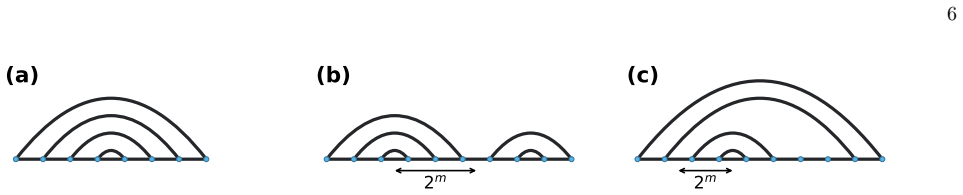
0
0
physics.plasm-ph 2026-06-29

Semi-implicit method advances stellarator MHD at large timesteps

by C. R. Sovinec, S. A. Patil +1 more

Semi-Implicit Stellarator Magnetohydrodynamics with Nodal Spectral Elements

Nodal spectral elements in the poloidal plane and Fourier in toroidal angle use a 3D ideal-MHD operator for non-axisymmetric simulations.

Figure from the paper full image
abstract click to expand
Nonlinear time-dependent computation of macroscale dynamics in stellarators is motivated by laboratory results showing the possibility of robust operation in conditions where magnetohydrodynamic (MHD) modes are linearly unstable. A new formulation of semi-implicit MHD computation for toroidally shaped magnetic confinement systems uses 2D nodal spectral elements over the poloidal plane and Fourier representation over a generalized toroidal angle. Geometric mappings and steady-state (equilibrium) fields are expanded in the same 3D representation as the time-evolved fields to model non-axisymmetric configurations. For accuracy at large timestep, the semi-implicit operator is based on the ideal-MHD energy integral using 3D pressure and magnetic fields. The nodal spectral elements allow numerical convergence through either h-refinement or p- refinement. Our implementation (NIMSTELL) with the continuous H1 expansion of magnetic-field components and diUusive divergence control is a generalization of the NIMROD code [JCOMP 195, 355]. The NIMSTELL implementation is verified linearly and nonlinearly on resonant ideal interchange, where convergence from the stable side results from the stabilization method used in NIMROD [JCOMP 319, 61]. Optionally, NIMSTELL may use an H(curl) representation for vector potential, and both magnetic representations are verified with respect to results from JOREK [Phys. Plasmas 29, 063901] on linear and nonlinear magnetic tearing in the W7-A rotating-ellipse configuration. Application of the existing vector-potential implementation to interchange shows that it needs a minimum level of electrical resistivity to avoid numerical noise for a given level of spatial resolution. Solving the algebraic systems from the implicit parts of the time advance is facilitated by including the Fourier components of stellarator mode families in each preconditioning operation.
0
0
physics.plasm-ph 2026-06-29

BIT1 extension scales PIC MC simulations to 800 GPUs with resilience

by Jeremy J. Williams, Stefan Costea +14 more

High-Performance Resilient Multi-GPU Hybrid Particle-in-Cell Monte Carlo Simulations at Scale

Hybrid MPI+OpenMP framework adds load balancing and ADIOS2 checkpointing for uniform and non-uniform loads on Frontier, MN5, and LUMI-G.

Figure from the paper full image
abstract click to expand
The increasing demand for high-performance computing in plasma physics has driven scalable and resilient simulation methods capable of efficiently exploiting modern multi-GPU architectures. This work extends a portable hybrid MPI+OpenMP implementation of BIT1, focusing on high-performance resilience for accelerated Particle-in-Cell (PIC) Monte Carlo (MC) simulations under both uniform and non-uniform load conditions. Scalable particle load balancing and robust checkpoint/restart mechanisms across Nvidia and AMD accelerators are integrated with standardized I/O using openPMD and ADIOS2. This leverages BP4 for high-performance file-based checkpointing and SST for in-memory data streaming, enabling efficient data movement, resilient large-scale execution, seamless continuation from existing checkpoints, and effective handling of computational and I/O workloads. Advanced HPC profiling and tracing tools, including Nvidia Nsight Systems and AMD ROC-Profiler with Perfetto, provide detailed insights into computation, communication, and system-level behavior for optimization. Performance results on Frontier (OLCF-5), MN5, and LUMI-G demonstrate strong and weak scaling up to 800 GPUs, validating the framework for large-scale PIC MC simulations, while in-situ analysis and visualization using scalable I/O further enhance scientific insight without interrupting multi-GPU execution on current and future exascale systems.
0
0
math.NA 2026-06-29

Sum-of-Gaussians factors fractional Fokker-Planck solutions into 1D heat kernels

by Shidong Jiang, Dong Wang +1 more

A fast sum-of-Gaussians algorithm for the high-dimensional fractional Fokker-Planck equation

Work and storage scale linearly with dimension up to 100000 while accuracy exceeds ten digits and M grows only logarithmically with toleranc

Figure from the paper full image
abstract click to expand
We present a fast, high-order algorithm for the free-space fractional Fokker-Planck equation (FFPE) in arbitrary spatial dimension. Its fundamental solution, corresponding to a Dirac-delta initial condition, is obtained from the explicit Fourier representation by applying a sum-of-Gaussians (SOG) approximation to the nonseparable stretched exponential, using its complete monotonicity as the Laplace transform of a one-sided $\alpha$-stable density. Each Gaussian term is an ordinary heat kernel and therefore factorizes across spatial coordinates. On a tensor-product grid, the separated form can be assembled in $O(MdN)$ work and storage, rather than forming all $O(N^d)$ grid values, where $M$ is the number of Gaussian terms and $N$ is the number of points per dimension. We prove an a~priori error estimate for the pure-fractional fundamental solution and give a parameter-selection procedure for prescribed accuracy over specified ranges of space and time. In numerical experiments the method achieves more than ten digits of relative accuracy, with $M$ growing only logarithmically in the inverse tolerance, and maintains this accuracy in dimensions up to $d=10^{5}$. This exceeds the dimensions reached in comparable radial-quadrature tests, where the integrand becomes increasingly oscillatory as the dimension grows. Because the method represents the fundamental solution as a separated sum of heat kernels, any initial datum given as a finite sum of tensor products can be evolved in closed form using only one-dimensional convolutions. This yields a computable class of high-dimensional solutions that is amenable to error analysis, and tensor neural networks provide one possible way to construct such separated representations for more general data.
0
0
hep-th 2026-06-29

SMaSH package keeps little group indices explicit in massive spinor helicity

by Aakash Kumar, Arnab Rudra +1 more

texttt{SMaSH} : Simplify Massive Spinor Helicity

The tool supplies three-point amplitudes and propagators for any masses and spins and automates high-energy limits, symmetries, and gauge ch

abstract click to expand
We present $\texttt{SMaSH}$, a $\texttt{Mathematica}$ package to do spinor helicity computations in four spacetime dimensions $\href{https://github.com/aakash-kmr/SMaSH}{\text{(github)}}$. It can handle massive spinor helicity computations with explicit little group indices which is a novel feature. It can also handle massless as well as off-shell spinor helicity variables. It is designed to compute perturbative computations; it comes with predefined three point amplitudes and propagators for any masses and spins (arXiv:1709.04891). It can implement the high energy limit over an expression, check the discrete $\tt{C,P,T}$ transformations, compute contact terms and impose gauge invariance for any scattering process. We have shown the usage of such functions for computing gauge invariant Weinberg minimal amplitudes (arXiv:2506:12431, arXiv:2504:06343). The package can also generate both real and complex numerical kinematics for any $n$-point scattering for arbitrary masses and energy scales by implementing the $\tt{RAMBO}$ algorithm. It is also rich with basic spinor helicity manipulations like Schouten simplification, Clifford algebra manipulation, conversion between spinor helicity and Lorentz vectors, derivative w.r.t. spinors and their scalars, helicity scaling etc.
0
0
physics.comp-ph 2026-06-29

Memory and stability outweigh gradient accuracy in solver benchmarks

by Andrin Rehmann, Heiko Zimmermann +1 more

Mosaic: A Benchmark Suite for Differentiable Physics Solvers

14 solvers tested across fluids, mechanics and heat show large cost gaps but similar optima when gradients work.

abstract click to expand
Differentiable partial differential equation (PDE) solvers underpin solver-in-the-loop ML training, gradient-based optimal control, and inverse problems, yet the practical cost of obtaining correct, usable gradients from a given solver on a given problem is largely undocumented. Integration effort, computational cost, gradient accuracy, and numerical conditioning vary widely across solvers and are discoverable only by trial and error. We introduce Mosaic, an extensible benchmarking framework for differentiable PDE solvers that standardizes access to solver gradients. Each solver is packaged as a containerized component (Tesseract) exposing a uniform gradient API regardless of language or automatic differentiation (AD) strategy, enabling researchers to evaluate, compare, and build on non-trivial physical solvers. Our evaluation of 14 solvers across fluid dynamics, structural mechanics, and heat transfer demonstrates that the benchmark surfaces practically relevant differences: order-of-magnitude variation in computational cost and Jacobian conditioning, alongside structural incompatibilities that eliminate solvers from realistic tasks entirely. Despite this variation, all solvers that produce gradients converge to similar optima, indicating that the practical barriers are memory limits, numerical stability, and setup compatibility rather than gradient accuracy alone. Mosaic is open-source and available at https://github.com/pasteurlabs/mosaic.
0
0
physics.soc-ph 2026-06-29

Measure reveals exploration-exploitation trade-off in conference contacts

by Gabriel Maurial, Elisa Klüger +1 more

Extracting behavioural properties from face-to-face interactions temporal networks: a measure of egonet persistency

NPC framework applied to face-to-face data shows consistent behavioural patterns with minimal demographic ties across events.

Figure from the paper full image
abstract click to expand
Understanding how individuals repeat social interactions over time is a central problem in the analysis of temporal networks. In social systems, repeated interactions shape processes such as information diffusion, collective coordination, and the emergence of social structure. Existing measures of egonet persistence often conflate genuine behavioural regularities with structural effects such as node degree, making it difficult to distinguish meaningful temporal correlations from random mixing. In this work, we introduce the Neighbourhood Persistency Criterion (NPC), a statistically grounded framework for quantifying egonet persistence across time. NPC combines classical similarity measures with tailored null models controlling for network topology and interaction weights. We apply this framework to high temporal resolution face-to-face interaction networks collected at four Computational Social Science conferences using the SocioPatterns platform. Our results reveal a common behavioural structure across events, characterised by an exploration$\unicode{x2013}$exploitation trade-off in social interactions. While many individuals alternate between both strategies, others exhibit stable interaction patterns throughout the event. Importantly, these behaviours show little systematic association with socio-demographic attributes, suggesting that interaction strategies are shaped primarily by contextual factors rather than stable individual traits. NPC thus provides a flexible and interpretable tool for studying egonet persistence in temporal networks and social systems.
0
0
math.NA 2026-06-29

Four-equation model admits unique pressure-temperature equilibrium

by Bennett Clayton, Joshua McConnell +1 more

Analysis, thermodynamics, and a numeric solver for a pressure-temperature equilibrium closure of the four-equation model

Analysis proves convex admissible set and supplies solver for multi-material hydrodynamics with general equations of state

Figure from the paper full image
abstract click to expand
We analyze an often used closure model for multi-material hydrodynamics where pressure temperature equilibrium (PTE) is assumed for every state; emphasis is placed on tabular equations of state. This multi-material model is often referred to as the four-equation model. The identification of the admissible set is presented and is proven to be convex, setting the foundation for development of invariant-domain methods for this model. A novel, robust, and efficient method is presented for solving the highly nonlinear system for the equilibrated pressure and temperature with an arbitrary number of materials. Additionally, we provide a detailed analysis of the thermodynamics of the mixture model for general equations of state and prove existence and uniqueness of the pressure-temperature equilibrium solution under some thermodynamic assumptions.
0
0
physics.flu-dyn 2026-06-29

Algorithm stitches Lagrangian and Eulerian interfaces for filament breakup

by Raaghav Ramani

Interface tracking with Microscale Topological Surgery for two-dimensional filament breakup

MTS achieves second-order convergence and optimal scaling while producing coherent droplet statistics in alternating-shear flows.

Figure from the paper full image
abstract click to expand
We design and implement a Microscale Topological Surgery (MTS) algorithm to detect and enforce topological transitions in two-dimensional tracked interfaces. The method combines classical Lagrangian tracking with an intermittent topological processor that: (i) constructs Eulerian snapshots from which an interface family with microscale-resolved topology is extracted, (ii) infers adjacency topology between dual Lagrangian and Eulerian interface families, and (iii) performs interface surgery to stitch the two families together across microscale defect regions. A novel long-time nonlinear alternating-shear flow is introduced, in which repeated stretching and folding generate rich multiscale interface dynamics with filamentation at microscales. Using the MTS algorithm and a posteriori geometric and material diagnostics, we compute and visualize microscale filament-breakup dynamics. Error analysis and scaling studies demonstrate second-order geometric convergence and optimal computational scaling of the MTS algorithm, with topology-processing costs comparable to those of the underlying Lagrangian evolution. Ensemble simulations generated by pseudo-random perturbations of the flow further reveal coherent droplet size distributions and statistically robust filament-breakup dynamics.
0
0
physics.chem-ph 2026-06-26

Strong pumping freezes upper polariton transport

by Xinwei Ji, Tao E. Li

Nonlinear Freezing of Vibrational Polariton Transport via Mesoscale Simulations

Pump breaks in-plane symmetry and funnels energy to the zero-velocity band edge.

Figure from the paper full image
abstract click to expand
Two-dimensional real-space imaging of vibrational polariton transport in planar Fabry--P\'erot microcavities is numerically simulated via the mesoscale cavity molecular dynamics approach, which self-consistently propagates $\sim\!2\times10^4$ realistic molecular simulation cells on a two-dimensional grid coupled to the same number of cavity modes. Beyond the well-known polariton ballistic-to-diffusive turnover in the linear response regime, these atomistic simulations reveal a nonlinear freezing mechanism of vibrational polariton transport, i.e., under strong pumping of the upper polariton, the initially ballistically propagating upper polariton completely freezes and localizes energy to molecules at specific locations. This mechanism originates from pump-induced breaking of the in-plane translation symmetry: significant molecular excitations at the pulse hot spot broaden the polariton density of states, thus funneling population to the $k_{\parallel}\rightarrow 0$ band edge with vanishing group velocities.
0
0
physics.comp-ph 2026-06-26

Complex orbitals needed for correct symmetry in magnetic fields

by Hugo {AA}ström, Susi Lehtola

Real Quantum Chemistry With Complex Orbitals

Real-valued calculations yield superpositions; the new mapping to complex eigenstates matches numerical references for atoms up to Z=18

abstract click to expand
We follow up our study of basis set truncation errors for atoms in magnetic fields [{\AA}str\"om and Lehtola, J. Phys. Chem. A, 2023, 127, 10872]. Our previous study employed an approximate real-valued model. In this work, we implement a scheme to allow the use of complex basis functions and the true, complex Hamiltonian with linear molecules in a parallel magnetic field within the usual real-basis machinery of quantum chemistry. Our method performs additional unitary transformations before and after a conventional Fock build, thus allowing the reuse of existing software methods and algorithms. We apply our approach to calculations on low-lying configurations of the atoms $Z \leq 18$ in static magnetic fields up to 0.6 $B_0$. The calculations employ the uncontracted aug-cc-pVTZ and the benchmarking quality AHGBSP3-9 Gaussian-type orbital basis sets. We compare total energies obtained with real and complex orbitals using these basis sets to fully numerical ones at the complete basis set limit. We see that the states of the real-valued Hamiltonian are superpositions of the true eigenstates that are correctly captured by the complex calculations. Our results show that the complex basis machinery is necessary for targeting states with the correct symmetry for the studied range of magnetic field strengths. The novel tool is key for future work where we aim to optimize basis sets for finite-field calculations.
0
0
physics.optics 2026-06-26

Neural networks recover modal coefficients for target near-fields

by Wannes Luts De Martelaere, Joeri Lenaerts +1 more

Neural Networks for Inverse Design of Cascaded-Mode Near-Field Landscapes

Trained models turn gradient optimization into a practical tool for designing longitudinal and lateral field profiles inside multimode waveg

Figure from the paper full image
abstract click to expand
Structuring optical near-fields is important for applications in microscopy and nanoparticle manipulation. Traditionally, near-fields are structured using antenna nanostructures that locally convert propagating far-fields into bound near-fields. Recently, a remote structuring approach was proposed using cascaded mode interference in a multimode waveguide. However, determining the complex coefficients of the optimal modal combination needed to obtain specific near-fields remains a challenge. We address this inverse design problem using artificial neural networks. We model the relationship between the design parameters and near-field landscapes using multilayer neural networks. After training, these networks are used for gradient-based optimization to reconstruct target near-field profiles. We implement this methodology to design longitudinal and lateral field variations. Our approach designs simple and complex longitudinal landscapes, demonstrating accurate prediction and flexibility. Lateral field reconstruction is more challenging but improved with training data selection and augmentation. This work establishes deep learning as an efficient and scalable framework for cascaded-mode near-field inverse design.
0
0
physics.comp-ph 2026-06-26

Superiorization cuts noise and dose versus feasibility-seeking alone

by Tobias Becher, Yair Censor +2 more

GPU-accelerated superiorization on constrained physical problems with SupPy

Open GPU-enabled Python toolbox improves three physics applications and works on infeasible constraint sets

Figure from the paper full image
abstract click to expand
The superiorization method (SM) is situated between feasibility-seeking and constrained optimization. Instead of aiming at the minimum of a given objective function over a constraint set, it seeks a feasible point at which the objective function value is reduced - though not necessarily minimal - rather than hard targets, or in which a mathematically optimal solution is not strictly required. While the method has been investigated for several applications in physics, its broader use has been limited, in part due to the lack of openly available software for researchers wishing to explore it. In this work we apply superiorization to three problems from applied physics: seismic image reconstruction, low-dose CT reconstruction and intensity-modulated radiotherapy treatment planning. These experiments are conducted with SupPy, an open-source modularized Python toolbox developed for this work, which supports execution of feasibility-seeking algorithms and their superiorized version on both the CPU and the GPU. In all three cases the superiorized algorithms achieve favorable results compared to feasibility-seeking alone, with reduced noise in the imaging examples and lowered body dose in the radiotherapy plans. For the radiotherapy case we further observe that superiorization produces clinically viable plans on infeasible constraint sets.
0
0
physics.flu-dyn 2026-06-26

Weight factors alter Earth reentry flows more than Mars

by Gibson De Marchi Poltronieri, Farney C. Moreira +1 more

Influence of Park's Two-Temperature Model Control Temperature on the Flow Properties in Hypersonic Reentry Conditions

Simulations show significant impact on FIRE II temperatures and heat flux but little on Mars Pathfinder.

Figure from the paper full image
abstract click to expand
Numerical simulations of reactive hypersonic flows under thermochemical non-equilibrium conditions are presented for the FIRE II and Mars Pathfinder capsules. An 11-species chemical model is employed to simulate Earth's atmosphere, while an 8-species chemical model simulates Mars' atmosphere. The current formulation uses Park's two-temperature model to account for the non-equilibrium phenomena. The present work analyzes the impact of different sets of weight factors used in Park's model to calculate the control temperature. The code used to simulate the hypersonic flow addressed in this work solves the Navier-Stokes equations for reacting gas flows. The findings are depicted in terms of the Mach number, temperature modes, and mass fraction distributions along the stagnation streamline in a region closer to the shock wave. The study also includes results regarding the stagnation point convective heat flux. The results presented are encouraging and show that the weight factors significantly impact the FIRE II test cases while having little impact on the Mars Pathfinder flows. In all cases, it is possible to observe some effect of the weight factor selection on property distributions. In summary, the weight factors influence the flow behavior with varying intensities depending on the flow conditions.
0
0
physics.comp-ph 2026-06-26

Python library designs constrained discrete filters automatically

by Z. Nikolaou, P. Domingo +2 more

pyDOF: a Python library for the design of discrete forward and inverse filters

Users set monotonicity, positivity and other rules; coefficients are written to plain text usable in any code.

Figure from the paper full image
abstract click to expand
In this work, we present pyDOF, a Python-based software library which provides a domain-specific framework for the design of symmetric, physical-space, forward as well as inverse discrete filters. pyDOF is based on a constrained optimisation framework developed in our previous work [1, 2]. This framework allows the user to impose a wide range of constraints on the discrete filter transfer-function such as monotonicity, positivity, value-fixing, gradient-smoothing etc. amongst many others. pyDOF additionally includes an adaptive filter stencil selection option, and a van Cittert-based inverse-filter design with a user-controlled reconstruction order. The filter coefficients are computed automatically, and saved to a plain text file which can be readily parsed by any programming language. pyDOF can be used to design a wide range of low-pass, high-pass, multi band-pass/band-stop etc. discrete filters. In addition, due to its generality and abstraction, pyDOF can be used to design specific filters for user-defined target filter transfer functions. Although developed primarily for application to computational fluid dynamics simulations, pyDOF can be used to design discrete filters for a wide range of signal processing applications.
0
0
hep-ph 2026-06-26

Chebyshev transport speeds Feynman DE solving

by Yuanche Liu, Yang Zhang

CHESS: CHEbyshev pSeudo-Spectral transport for Feynman integral differential equations

Package shows rapid node convergence, reference agreement, shorter times, and lower memory on largest multi-scale families.

Figure from the paper full image
abstract click to expand
We present CHESS (CHEbyshev pSeudo Spectrum), a Wolfram Language package for high-precision one-dimensional transport of {\epsilon}-factorized differential equations for Feynman master integrals. The solver works with the matrix obtained by pulling a differential one-form to a chosen path. This matrix may be supplied directly, or assembled from constant matrices and precomputed scalar pullbacks of the one-forms. The program combines Chebyshev-Lobatto spectral collocation, sparse matrix assembly, sequential propagation in the {\epsilon}-expansion, and residue-based regularization of spurious regular singular endpoints. Benchmarks for large multi-scale integral families show rapid node convergence and agreement with independent reference data where such data are available. In the fixed local-series comparison used here, the Chebyshev transports also give shorter wall times; the reported process-tree memory usage is comparable for the smaller parallel runs and lower for the largest benchmark system in that comparison.
2 0
0
cond-mat.mtrl-sci 2026-06-26

60° in-plane rotation reverses Chern number sign

by Xinyue Zhu, Yu Xie +4 more

Topological phase transition driven by in-plane spin rotation

Symmetry rules on Berry curvature let a kagome Chern insulator flip topology with tiny fields and no full reversal.

Figure from the paper full image
abstract click to expand
The intrinsic coupling between magnetism and nontrivial band topology in magnetic topological insulators makes external magnetic fields a powerful tool for manipulating topological states. However, conventional magnetic control mechanisms, such as driving magnetic phase transitions or fully reversing magnetization, typically demand large magnetic fields and lack continuous tunability. Here, we establish a symmetry framework for the reversible switching of topological states via continuous in-plane spin rotation, governed by magnetic point group constraints on the Berry curvature distribution. Using a two-dimensional kagome ferromagnetic Chern insulator as a prototype, we demonstrate that a 60{\deg}in-plane magnetization rotation reverses the sign of the Chern number, transitioning through a topologically trivial state. Crucially, micromagnetic simulations confirm that this spin-reorientation-driven switching operates under exceptionally small magnetic fields and on ultrafast timescales. This work provides a highly efficient, low-energy paradigm for the manipulation of topological states.
0
0
cond-mat.mtrl-sci 2026-06-25

Electron mobility exceeds hole mobility in Cr2O3

by Á. A. Carrasco Álvarez, S. Poncé

Challenging the p-type Paradigm: Intrinsic n-type Mobility in Antiferromagnetic Cr₂O₃

Ab initio calculations show the asymmetry arises from band structure, establishing intrinsic n-type character.

Figure from the paper full image
abstract click to expand
Chromium oxide (Cr$_2$O$_3$) is widely considered a $p$-type transparent conducting oxide despite ongoing debate regarding its intrinsic transport character. Here, we resolve this question by computing phonon-limited electron and hole mobilities using the ab initio Boltzmann transport equation. We find that electron mobility systematically exceeds hole mobility over a wide temperature range, demonstrating that Cr$_2$O$_3$ is intrinsically $n$-type. Analysis of scattering mechanisms reveals that scattering with phonons affects electrons and holes similarly, and that the mobility asymmetry originates from the electronic structure, namely the larger effective mass and multi-valley character of the valence band. The intrinsic $n$-type character, combined with moderate hole mobility, enables bipolar transport and revises the role of Cr$_2$O$_3$ in transparent electronics. Additionally, our results on mobility complement previous studies on defect formation indicating that the commonly observed $p$-type behavior is extrinsic. These insights provide a complete chemical-transport paradigm for Cr$_2$O$_3$, re-evaluating its role in functional transparent electronic and magneto-optoelectronic applications
0
0
physics.comp-ph 2026-06-25

One-parameter family of closures splits odd kinetic moments into boundary plus margin

by Somdeb Bandopadhyay

A one-parameter family of realizability-interior closures for odd-order kinetic moment systems

Normalized Schur ratios place Morin-McDonald at the arithmetic end; geometric end gains accuracy while all share a smaller equilibrium Jacob

Figure from the paper full image
abstract click to expand
Moment closures at odd truncation order present a fundamental difficulty: the standard Gramian closure saturates the realizability boundary, producing only weak hyperbolicity and failing to preserve Maxwellian equilibrium. We show that every odd-order closure for the one-dimensional kinetic equation decomposes into a boundary term, the Schur complement of the Hankel moment matrix, and a positive margin above it. An exact polynomial identity connects this margin to the eigenvalues of the flux Jacobian, reducing hyperbolicity to a root-splitting problem. A dimensional argument proves that no margin depending only on density, velocity, and temperature can produce a hyperbolic system for $M \geq 5$. A one-parameter family $C_{\eta,n}$, $\eta \in [0,1]$, built from normalized Schur-complement ratios, reveals that the Morin-McDonald closure is the arithmetic endpoint of this decomposition. The weighted AM-GM inequality makes the accuracy-robustness tradeoff precise: the geometric endpoint ($\eta = 0$) is 2-4\% more accurate on bimodal benchmarks, while the arithmetic endpoint ($\eta = 1$, Morin-McDonald) provides the most robust hyperbolicity profile. All members share the same equilibrium Jacobian, whose spectral radius is 13\% ($M = 5$) to 29\% ($M = 13$) smaller than Grad's closure, allowing larger CFL time steps. A linearized entropy exists at every tested order, and for a source-compatible choice of the symmetrizer weights, the BGK source dissipates it near equilibrium. A smooth nonlinear entropy exists for $M = 3$ but does not for $M = 5$ or $M = 7$ (certified by linear programming). The closure is validated on bimodal and Mott-Smith benchmarks, where the interpolated family achieves errors 10-40x smaller than the Gramian or Grad closures, and demonstrated in free-transport Riemann problems at $M = 5, 7, 9, 11$ and BGK Riemann problems at $M = 5$ and $9$.
0
0
math.NA 2026-06-25

Lifting turns Boltzmann collisions linear for tensor-train solver

by Kun Huang, Yingda Cheng +1 more

A fast scheme for the homogeneous Boltzmann equation based on lifting and tensor train approximation

Method reaches linear cost in velocity grid size when the distribution stays low-rank, with conservation restored by a correction step.

Figure from the paper full image
abstract click to expand
We propose a fast deterministic scheme for the space-homogeneous Boltzmann equation that exploits the low-rank structure of the velocity distribution. This paper consists of two independent contributions. The first is a \emph{lifting-projection (LP) scheme}, inspired by the approach in the recent theoretical breakthroughs \cite{guillen2025landau, imbert2026monotonicity, guillen2025landau2} on the well-posedness of the Landau and Boltzmann equations. In particular, the approach lifts the nonlinear 3D Boltzmann equation to the 6D linear Kac master equation, advanced over a single time step, and projected back to its marginal in 3D. The second contribution is a \emph{low-rank tensor method} for evaluating the collision operator, in which the lifted solution is represented in tensor train (TT) format and computed via a TT cross approximation algorithm with interpolation, complemented by a TT-friendly conservation correction that enforces conservation of mass, momentum, and energy. When the solution is low-rank in velocity, the method scales linearly in $n$ when cubic interpolation is used (and quadratic in $n$ when spectral interpolation is used), where $n$ is the number of grid points in each velocity direction. Therefore, our methods offer significant computational savings over existing deterministic solvers in such cases. Numerical experiments on 2D and 3D benchmarks, including the BKW exact solution and anisotropic initial data, confirm the computational scaling, the expected order of accuracy and verify the effectiveness of the conservation correction.
0
0
cond-mat.supr-con 2026-06-25

Defect spectrum shift creates vortex pinning force

by Haozhe Shi, Yuncheng Xie +3 more

First-Principles Quantum-Spectral framework for Elementary Vortex Pinning in superconductors

First-principles framework turns core-state reorganization into pinning energies that match STM data for FeSe vacancy.

abstract click to expand
The critical current of a type-II superconductor is controlled by vortex pinning, whose microscopic input is the elementary pinning force. Scanning tunneling spectroscopy has shown that a defect pins a vortex by reorganizing the Caroli-de Gennes-Matricon (CdGM) states in its core, but why this spectral reorganization amounts to a pinning force has lacked a quantum-mechanical, first-principles account. Here we establish a transferable first-principles computational framework for elementary vortex pinning, in which defect-resolved DFT/Wannier electronic structures are embedded into a finite-box projected Bogoliubov-de Gennes free-energy formalism to convert quasiparticle spectral reorganization into vortex-pinning energies and forces. Using this framework, we confirm that the defect-induced reorganization of the vortex-core spectrum is the microscopic origin of the elementary pinning force. The force is evaluated as a finite-box vortex-insertion free energy whose four-configuration subtraction isolates the meV-scale interaction from much larger backgrounds. With the superconducting gap scale and vortex-core profile fixed from experiments, the FeSe Fe-site vacancy reproduces the microscopic STM value together with the measured spectral reorganization. All five point defects in FeSe and FeTe pin attractively, with FeTe Te-site vacancy strongest. Elementary vortex pinning thereby becomes a computable electronic-structure quantity, opening the first-principles screening of point defects toward higher critical currents.
0
0
physics.comp-ph 2026-06-25

MC-PINNs recover thermal fields and relaxation times from sparse phonon BTE data

by Qingyi Lin (1), Chuang Zhang (2) +14 more

Monte Carlo Physics-informed Neural Networks for Inverse Multiscale Heat Conduction Problems via the Phonon Boltzmann Transport Equation

Mesh-free sampling handles diffusive to ballistic regimes and outperforms data-driven networks when measurements are limited

Figure from the paper full image
abstract click to expand
Inferring thermal fields and thermophysical properties from limited measurements is a fundamental challenge in micro- and nanoscale heat conduction, where the classical Fourier law breaks down and the phonon Boltzmann transport equation (BTE) is needed to capture non-diffusive transport effects. In this work, we extend Monte Carlo physics-informed neural networks (MC-PINNs), originally developed for forward phonon BTE problems [J. Comput. Phys. 542, 114364, 2025], to inverse multiscale heat conduction problems. Two representative classes of inverse problems are considered: (i) reconstructing the full thermal field from sparse interior temperature measurements when boundary conditions are unknown, and (ii) simultaneously inferring the unknown relaxation time together with the thermal field. Problem-specific MC-PINN architectures and training strategies are designed for each class. The mesh-free Monte Carlo sampling strategy enables a unified treatment across diffusive, transitional, and ballistic transport regimes without requiring a priori knowledge of the relaxation time. The proposed method is evaluated on quasi-one-dimensional, quasi-two-dimensional, and three-dimensional benchmark problems covering a wide range of Knudsen numbers, as well as on a realistic 3D fin field-effect transistor (FinFET) structure. Results demonstrate that MC-PINNs consistently outperform purely data-driven deep neural networks, particularly in the sparse-data regime, and can accurately infer spatially uniform relaxation times. For spatially varying relaxation times, the inferred distributions capture the dominant thermal response, and numerical simulations using the recovered parameters reproduce the macroscopic fields with good accuracy. These findings establish MC-PINNs as an effective and physically consistent framework for inverse thermal analysis at micro- and nanoscales.
0
0
cs.LG 2026-06-25

Gradient ILT recovers EUV mask permittivity for target wafer fields

by Vasiliy A. Es'kin, Egor V. Ivanov

Gradient-based inverse lithography for EUV masks via the waveguide method and a physics-informed neural operator

Differentiable waveguide models and WGNO enable optimization of 2D and 3D absorbers at 11.2 nm.

Figure from the paper full image
abstract click to expand
Gradient-based inverse lithography technology~(ILT) for extreme ultraviolet~(EUV) masks is presented. A novel framework treats the differentiable waveguide method and the recently proposed waveguide neural operator~(WGNO) as end-to-end physics engines, recovering the permittivity of the absorber of the mask through automatic differentiation of the full forward diffraction model. Numerical experiments on realistic 2D and 3D absorbers of the mask (TaBN, La, U) at $\lambda{=}11.2$~nm show that the considered ILT methods make it possible to obtain a mask structure that achieves the desired field on the wafer.
0
0
quant-ph 2026-06-25

Hyperbolic RNNs outperform Euclidean at Ising critical point

by H. L. Dao

Two-dimensional Hyperbolic RNN Neural Quantum State

The edge shows up where CFT physics is dual to hyperbolic Anti-de-Sitter geometry in 2D quantum systems.

Figure from the paper full image
abstract click to expand
In the first part of this work, we construct the first type of two-dimensional (2D) hyperbolic neural quantum state (NQS) in the form of the Lorentz 2DRNN (Recurrent Neural Network) and benchmark its performance against the Euclidean 2DRNN in the paradigmatic $N\times N$ 2D Transverse Field Ising Model (2DTFIM) setting with different lattice sizes up to $N=12$ and at different transverse magnetic field strengths. We find that hyperbolic Lorentz 2DRNN NQS definitively outperform Euclidean 2DRNN NQS when the system is at the phase transition point when the physics can be described by a conformal field theory (CFT), which is known to be dual to an Anti-de-Sitter (AdS) space whose spatial geometry is hyperbolic. In the second part of this work, we benchmark the performances of the recently introduced one-dimensional (1D) hyperbolic NQS including Poincar\'e RNN/GRU and Lorentz RNN/GRU against their Euclidean NQS versions in $N\times N$ 2DTFIM, which has to be converted to a one-dimensional setting to allow for the use of 1D NQS. The findings in this case extend our previous results that 1D hyperbolic NQS definitively outperform 1D Euclidean NQS, thanks to the combined effects of the hierarchical structure comprising the first and $N^{th}$ neighbor interactions present in the 1D system arising from the 2D lattice and the CFT physics at the critical point. While more studies with larger system sizes are required, our work serves as a proof-of-concept for the utility, effectiveness as well as the superior performances of one- and two-dimensional hyperbolic NQS ansatzes compared to the existing Euclidean NQS in many-body quantum physics systems, especially when these systems exhibit structural hierarchy or when they are at criticality, or a combination of both.
0
0
physics.optics 2026-06-25

Reformulated scattering speeds EUV lithography simulations

by Seungjin Lee, Werner Gillijns +1 more

Pseudo-spectral frequency-domain method with background field decomposition and Green's function preconditioner for electromagnetic scattering problem in EUV lithography

Background decomposition and Green's preconditioner yield significant speedup on mask geometries and mirror stacks.

Figure from the paper full image
abstract click to expand
We provide an accelerated computational framework to solve electromagnetic scattering problems in planarly layered media arising from extreme ultraviolet (EUV) lithography. To achieve this, we reformulate the EUV scattering problem into a scattering problem on a homogeneous background, in which the electromagnetic contribution of the layered media is captured by a recursively updated reflection of the layered stack. The system is numerically solved by employing the pseudo-spectral frequency-domain method paired with an iterative solver, whose iterative convergence is expedited by a free-space Green's function preconditioner. The proposed framework is evaluated on EUV mask geometries and multilayer mirror stacks, demonstrating a significant speedup over the conventional pseudo-spectral frequency-domain method.
0
0
cond-mat.mtrl-sci 2026-06-25

Reverse-mode AD makes KKR-CPA gradients independent of element count

by Kohei Ishii, Hisazumi Akai +3 more

A Differentiable DFT-Based Framework for Inverse Materials Design

Continuous composition variables can be optimized by gradient descent for any computable property across spaces with dozens of elements.

abstract click to expand
Discovering solid-state materials with target properties remains a central challenge in computational materials science. Existing approaches -- high-throughput screening, surrogate optimization, and generative models -- require extensive evaluations or training data and extrapolate poorly to unseen compositions. Here we develop a first-principles inverse-design framework, integrating reverse-mode automatic differentiation (AD) into KKR-CPA -- the Korringa--Kohn--Rostoker method with the coherent potential approximation -- where atomic compositions are continuous variables to be optimized. Reverse-mode AD yields gradients of objective functions with respect to composition at a cost independent of the number of candidate elements, enabling gradient-based optimization to identify materials from compositional spaces spanning dozens of elements. In this framework, any computable quantity can serve as the objective. We demonstrate this generality through two contrasting applications, magnetic alloys and half-metals, yielding candidates such as (Lu$_{0.553}$Yb$_{0.447}$)(Co$_{0.759}$Fe$_{0.241}$)$_2$Fe$_3$ and FeZr(Sb$_{0.94}$Te$_{0.06}$). Our framework offers a physically grounded route from a target property to the material that realizes it.
0
0
math-ph 2026-06-25

Split-field PMLs let PINNs solve open Maxwell problems uniformly

by XiaoDong Liu, Lingquan Li +2 more

Physics-Informed Neural Networks for the Time-Domain Maxwell Equations with Split-Field Perfectly Matched Layers

Same equations govern physical and absorbing regions, matching FDTD references on 1D and 2D pulse tests.

Figure from the paper full image
abstract click to expand
Physics informed neural networks (PINNs) incorporate Maxwell's equations, initial conditions, boundary conditions, and measurement data directly into the learning process, transforming the solution of partial differential equations into a constrained optimization problem. As such, PINNs are attracting increased attention in computational electromagnetics as an alternative to traditional time-domain solvers. This paper presents a PINN formulation for the time-domain Maxwell's equations incorporating split-field perfectly matched layers (PMLs). A key advantage of the split-field PML formulation is that the same governing equations can be applied in both the physical and PML regions, simplifying the PINN formulation and loss construction. The proposed approach is validated using one-dimensional and two-dimensional Gaussian pulse problems with PML. The PINN solutions show good agreement with analytical and finite-difference time-domain (FDTD) reference solutions, demonstrating the feasibility of combining PINNs with split-field PMLs for open-domain time-domain electromagnetic simulations.
0
0
physics.comp-ph 2026-06-25

CNN surrogate speeds up rock elastic moduli prediction

by Hanfeng Zhai, Rasool Ahmad +2 more

A convolutional neural network surrogate for hierarchical homogenization: fast elastic moduli prediction of digital rocks

Subcube predictions upscaled via homogenization match direct simulations across rock types at far lower cost.

Figure from the paper full image
abstract click to expand
Digital rock physics (DRP) aims to estimate effective rock properties (e.g., elastic moduli) directly from 3D micro-CT images. However, direct numerical simulations (DNS) on high-resolution large 3D scans are often computationally prohibitive and severely limit the application of DRP. To address this bottleneck, we combine a lightweight 3D convolutional neural network (CNN) with hierarchical homogenization (HHM) and apply it to determine effective elastic moduli. In this scheme, a large rock image is divided into subcubes. The CNN replaces costly DNS by directly predicting subcube elastic moduli, while HHM upscales subcube-level predictions to the full rock. Using a shared convolutional backbone, we systematically compare three training targets: (i) full anisotropic $6\times6$ stiffness tensors, (ii) isotropic bulk and shear moduli $(K, G)$, and (iii) Hashin--Shtrikman (HS)-normalized factors. Across multiple rock types, all three models agree well with DNS results while substantially reducing the computational cost. Moreover, training from scratch on each rock type is fast enough that transfer learning is unnecessary. Across all three targets, the accuracy is comparable. In our comparative study, the HS-normalized factor offers the best overall speed--accuracy trade-off while guaranteeing physical consistency, making it a convenient default. The isotropic $(K, G)$ target is a slightly more accurate alternative.
0
0
physics.comp-ph 2026-06-25

Neural surrogate corrects Boussinesq convection errors

by Nurshat Menglik, Alex Shao +1 more

A Neural Surrogate Approach for Simulating Natural Convection Problems

One evaluation on paired compressible data raises SSIM to near 1 and cuts MSE by up to three orders of magnitude.

Figure from the paper full image
abstract click to expand
This paper presents a neural surrogate approach for improving the accuracy of natural convection problems simulated with a Boussinesq flow model (incompressible flow with heat transfer). Our approach, based on Fourier neural operators, uses training data consisting of matched pairs of simulations run under the computationally cheaper yet less accurate Boussinesq flow model and a more computationally expensive and more accurate compressible flow model. In both cases, we implement our parallelized simulation codes based on an implicit monolithic mixed finite element method (FEM) approach using the open-source FEniCSx framework. Our implementations are validated against a commercial software package, COMSOL, as well as standard test problems from the literature. We include a careful discussion and analysis of data set generation and present learning results in two and three spatial dimensions. Using compressible flow results as high-fidelity reference solutions, our learning approach, with a single model evaluation per simulation, substantially improves the per-channel accuracy of Boussinesq predictions, with structural similarity (SSIM) close to unity across all flow variables and test distributions and corresponding mean-squared error reductions of one to nearly three orders of magnitude. All code and data is released as open-source.
0
0
physics.comp-ph 2026-06-24

Ionization halves peak temperature in sonoluminescence simulations

by Shihan Cheng, David A. B. Hyde

A Scalable Time-Based Molecular Dynamics Approach for Simulating Single-Bubble Sonoluminescence

New time-based molecular dynamics runs show ionization cuts maximum bubble temperature by a factor of two while thermal accommodation sets t

Figure from the paper full image
abstract click to expand
We present a scalable time-based molecular dynamics (TBMD) framework for simulating single-bubble sonoluminescence within a hybrid continuum-MD formulation. Unlike prior event-based approaches, which model gas dynamics through instantaneous hard-sphere collisions, the present method integrates continuous Lennard-Jones and damped shifted force Coulomb interactions at each timestep, enabling self-consistent tracking of ionization state and long-range electrostatics throughout the collapse. To bridge the gap between the physical particle count ($N_\mathrm{real}\sim 10^{10}$) and computationally tractable ensemble sizes, we introduce an ensemble particle (EP) scaling formalism that preserves temperature, pressure, and ionization statistics while reducing the simulated particle count by up to four orders of magnitude. Applying the framework to argon under standard single-bubble sonoluminescence driving conditions, we perform a systematic sweep over the ionization model and thermal accommodation coefficient $\alpha_t$, with ensemble sizes up to $N_\mathrm{ensem} = 10^8$ particles. The results establish that ionization is the dominant regulator of peak temperature, reducing $T_\mathrm{max}$ by approximately a factor of two relative to the non-ionizing baseline, while $\alpha_t$ primarily controls the spatially averaged temperature at the collapse minimum. Scalar observables at $N_\mathrm{ensem} = 10^8$, including peak temperature, minimum bubble radius, and maximum wall velocity, are assessed against prior studies to help validate the EP scaling formalism and our hybrid continuum-MD framework.
0
0
physics.comp-ph 2026-06-24

Augmented PAMC sets new records on 36 G-set Max-3-Cut instances

by Nikhat Khan, Ridge Redding +1 more

Leveraging Population Dynamics to Steer Efficient Search in Large-Scale Combinatorial Optimization

Stagnation feedback drives temperature resets and cluster moves that match or beat prior solvers on large instances while scaling to 100000-

Figure from the paper full image
abstract click to expand
Combinatorial optimization problems pose substantial computational challenges because their feasible solution spaces grow exponentially with problem size. This paper presents a GPU-accelerated augmented Population Annealing Monte Carlo (PAMC) framework for large-scale graph-partitioning problems, with emphasis on Max-Cut and Max-K-Cut. The proposed framework extends conventional PAMC by coupling population-based resampling with two stagnation-driven mechanisms: adaptive temperature control and energy-preserving nonlocal cluster moves. By using population-level optimization history as feedback, these mechanisms regulate the balance between exploration and refinement by reheating stalled populations and enabling collective transitions across locally confined regions of the solution space. Experiments on G-set benchmark instances show that the augmented PAMC framework achieves competitive or lower time-to-solution than reported state-of-the-art baselines on several large Max-Cut instances, while matching or improving solution quality under comparable runtime budgets. The solver also discovers a new best-known solution for the G63 Max-Cut instance and scales to a fully connected 100,000-spin Ising instance. For Max-3-Cut, the same framework establishes new best-known solutions on 36 G-set instances, demonstrating its applicability beyond binary Ising formulations. These results indicate that feedback-controlled population dynamics provide an effective and scalable strategy for steering stochastic search in large-scale combinatorial optimization.
0

browse all of physics.comp-ph → full archive · search · sub-categories