pith. sign in

physics.hist-ph

History and Philosophy of Physics

History and philosophy of all branches of physics, astrophysics, and cosmology, including appreciations of physicists.

0
astro-ph.SR 2026-07-03

Clavius report caps 1567 solar radius at modern value

by Hisashi Hayakawa, Mitsuru Sôma +5 more

Analyses on Christoph Clavius' Reports of Total Solar Eclipses in 1560 and 1567: Key References for the Centennial Variations of the Earth's Rotation Speed and the Solar Radius

Revised Delta T bounds from 1560 and 1567 eclipses exclude linear shrinkage but allow oscillations

Figure from the paper full image
abstract click to expand
Variations in solar radius (hereafter R_Sun) is a key reference for solar magnetic activity in time. The sunlight amount may have varied with R_Sun and had an effect on the Earth's climate in the past. Eclipse observations offer a unique opportunity to measure the absolute R_Sun value before modern direct observations. The scientific community has discussed a possible long-term R_Sun variability from 1715 onward. Prior to their coverage, Clavius' eclipse reports had been subjected to qualitative debates regarding the local eclipse visibility and a possible secular R_Sun trend. This study leverages the recent dramatic developments of lunar topography data and ephemeris data to provide an effective resolution of this debate. Clavius' eclipse reports described an explicit totality in 1560 at Coimbra and a "slender circle" around the eclipsing Moon in 1567 at Rome. Our study revised the {\Delta}T constraints of -492 s =< {\Delta}T =< 200 s in 1560 and 140 s =< {\Delta}T =< 151 s in 1567 to satisfy Clavius' descriptions, considering the lunar limb profile and assuming Auwers' canonical R_Sun. This study constrains the R_Sun margin of 1567, utilising three scenarios to interpret Clavius' account. The local totality requires an upper R_Sun limit of 1567 as R_Sun =< 696200 km in absolute size (959.92" in angular size), indicating no linear secular R_Sun shrinkage but possible R_Sun oscillations on a centennial timescale. Conversely, the annularity scenario is considered unlikely because it requires an R_Sun decrease of 7.5" within 3 centuries, even beyond the capacity of extreme shrinking-Sun hypotheses.
0
0
physics.hist-ph 2026-07-03

GRMHD models of Sgr A* carry problematic epistemic opacity

by Juliusz Doboszewski, Jamee Elder

Black Boxes in Black Hole Imaging

This signals limits in current model understanding and restricts machine learning uses in future observations.

abstract click to expand
We investigate the epistemic opacity of computer simulations and machine learning methods in the context of black hole imaging. We argue that there are forms of opacity-including opacity resulting from the use of machine learning-which do not need to affect the reliability of an inference when it is seen as a part of a broader inferential framework. We propose conditions under which that can plausibly be the case, and discuss how opaque methods can be useful in the context of the (next generation) Event Horizon Telescope. However, we also argue that at least one problematic form of opacity is currently present in black hole imaging: GRMHD models of Sagittarius A* are opaque. This form of opacity signals the limitations of current understanding of the models of this source, and constrains the potential uses of ML models in future observations.
0
0
physics.hist-ph 2026-07-02

1990s Soviet scientists got US career boost from expertise export

by Vitaly Pronskikh

Selling the Stock, Not the Cream: The Soviet \'Emigr\'e Career Premium of the 1990s

Market demand for transferred knowledge created a premium that closed by mid-2000s as it was absorbed into global science.

abstract click to expand
In the early-mid 1990s, scientists emigrating from the former Soviet Union to the United States -- especially physicists, engineers, chemists, and biologists -- frequently secured prestigious and visible positions, including professorships, named chairs, and laboratory leadership; comparable scientists arriving after about 2000 built more modest, less visible, and often non-academic careers. Against the common view that this reflects the people -- the elite having left first -- this article sets aside the thin apex of Nobel- and Fields-level \'emigr\'es and examines the larger cohort of capable but non-stellar scientists, showing that similar scientists fared differently by year of arrival. The explanation therefore lies in the structure of the receiving market, not primarily in individual ability. Reading premium appointments backward from later Nobel-level recognition risks survivorship bias: celebrated successes obscure the broader demand for Soviet scientific capital. I weigh four conditions that favoured the 1990s cohort and had largely closed by the mid-2000s: technology transfer and the export of a finite, distinctive stock of Soviet expertise that commanded a career premium; the favourable immigration regime created by the Soviet Scientists Immigration Act of 1992; the surge of U.S.-trained Chinese and Indian competitors; and the securitizing aftermath of 11~September 2001. All four mattered, but technology transfer and knowledge export were primary: their premium opened the window, and their depletion -- as exported knowledge was published and absorbed into global science -- removed the demand on which the other factors depended. A further cross-cutting mechanism, the cultural ``ghettoization'' of \'emigr\'es into co-national laboratory enclaves, capped their visibility and independent advancement. The imbalance between \'emigr\'e generations was structural, not personal.
0
0
quant-ph 2026-07-02

Pointers allow exact time despite bounded energy

by Ovidiu Cristinel Stoica

Exact quantum time compatible with positive energy

Internal records hide reversals, permitting irreversible change and a stationary universal wavefunction.

abstract click to expand
What would it be like to be in a superposition of yesterday, today, and tomorrow? This question may seem at best entertaining, but it is necessary, and exploring it allows us to understand how exact irreversible clocks and change are possible, despite the Unruh-Wald and Hegerfeldt-Ruijsenaars no-go theorems forbidding them. Unruh and Wald (1989) proved that if energy is bounded from below, no observable can increase monotonically with the Schr\"odinger time parameter t. Perfectly monotonic clocks and irreversible observable changes (Hegerfeldt-Ruijsenaars, 1980) seem impossible. From the perspective of the Schr\"odinger time, the world appears in a superposition of different intrinsic clock states indicating different times and opposite time directions. This seems to directly contradict our daily experiences of time and change. I show that there is no contradiction: from an intrinsic perspective of the world, sharp irreversible changes do happen, because the macroscopic pointer states resolve the superposition of different times. Large-scale time-reversing or discontinuous transitions are not internally observable in the records. From the intrinsic perspective, an unbounded intrinsic-time translation generator plays the role of the Hamiltonian, generating only forward time evolution with respect to the intrinsic time, but not to the Schr\"odinger parameter t, which is thus not justified to play the role of time. This allows sharp time observables even if the external Hamiltonian is bounded from below. In addition, this leads to a stationary wavefunction of the universe satisfying a Wheeler-DeWitt-type equation, without assuming gravity.
0
0
physics.hist-ph 2026-07-02

Category theory casts state spaces as arrows for constrained theories

by Sean Gryb, Karim P. Y. Thébault

Nomic Structure and Reduction

Symplectic reduction becomes arrow composition, yielding equivalence when reduced spaces match at regular nomic level.

Figure from the paper full image
abstract click to expand
The canonical formulation of physical theories with irregular nomic structure is as constrained Hamiltonian theories within which ill-posedness of the equations of motion is connected to a pernicious form of surplus representational capacity. Such theories can be converted into theories with regular nomic structure and a well-posed initial value problem via the process of symplectic reduction. We analyse, synthesise, and contrast different approaches to the presentation and analysis of constrained Hamiltonian theories, drawing upon recent work on formalisation of nomic structure on model spaces (Gryb and Th\'ebault 2024) and comparisons of theoretical structure and representational capacity via category theory (Bradley and Weatherall 2020; Bradley 2025b). We suggest that the case of irregular nomic structure is most naturally suited to a category theoretic presentation in which state spaces are arrows and symplectic reduction is arrow composition (Landsman 2005). Under this approach one obtains the natural results that theories with isomorphic state spaces are equivalent and theories whose reduced state spaces are isomorphic are equivalent at the level of the regular representations of their nomic structure. This analysis provides a suitable foundation for the case of quantization of theories with irregular nomic structure, which will be in a companion paper.
0
0
physics.hist-ph 2026-07-01

Quantum dynamics block spacetime emergence from non-spatiotemporal stuff

by Álvaro Mozota Frauca

The Dynamics of Quantum Gravity: the Missing Piece in the Spacetime Emergentist Account

Current theories leave their dynamical quantum aspects uninterpreted, so functionalism cannot reduce spacetime.

abstract click to expand
Quantum gravity suggests that spacetime may not be fundamental, and it has been argued that we can understand a theory without a fundamental spacetime if we are able to claim that spacetime `emerges' from some non-spatiotemporal entities. In this sense, strategies like functionalism have been deployed to claim that this emergence is possible and plausible, both in principle and in practice for current approaches to quantum gravity. In this article I argue that this analysis is incomplete, as it tends to overlook the way the dynamics of these theories is `quantum' in a way that differs from standard quantum theory. The challenge for the emergentist (and for the quantum gravity theorist) is to give an interpretation not only to the kinematical and classical aspects of these theories, but to the dynamical and quantum ones, and to show how the spacetime roles can be fulfilled, if possible at all. Therefore, I argue that some current approaches to quantum gravity seem to fail to provide meaningful theories, that spacetime functionalism is of no help, and that the position of the spacetime emergentists is weakened, as they lack any example of a successful reduction of spacetime to some truly quantum non-spatiotemporal stuff.
0
0
astro-ph.SR 2026-06-30

Ancient records of Theta Eridani brightness match a real binary transient

by Idel Waisberg, Boaz Katz

The forgotten bright star: Theta Eridani as a millenary stellar transient observed by Hipparchus, Ptolemy and al-Sufi

Orbital solution shows prior eccentricity near 0.6 drove a millenary common-envelope phase with Delta V of 2.7

Figure from the paper full image
abstract click to expand
Theta Eridani is a V=2.9 star that was nonetheless reported as one of the thirteen brightest stars in the night sky by both Ptolemy in his Almagest (137 AD) and by al-Sufi in his The Book of Fixed Stars (964 AD), in addition to being previously referred by Hipparchus (129 BC) as a particularly bright star. The discrepancy between its historical and modern visual magnitude $\Delta V \sim 2.7$ is the highest among the $\sim 1000$ stars in the Almagest. Theta Eridani is actually a triple star system, and here we combine interferometric data from VLTI/PIONIER and VLTI/GRAVITY, spectroscopic data from ESPaDOns and FEROS, and photometric data from TESS in order to solve for the orbital parameters, masses and radii of the close inner binary Theta Eridani Aa+Ab. We find that it is a tight eccentric binary ($a=0.083 \text{ au}$, $e=0.105$) of intermediate-mass stars ($M_{Aa}\simeq 2.3 M_{\odot}$, $M_{Ab}\simeq 2.2 M_{\odot}$) that are extended to $\sim 80\%$ of their Roche lobe radii ($R_{Aa}\simeq 4.3 R_{\odot}, R_{Ab} \simeq 4.0 R_{\odot}$), resulting in prominent ellipsoidal oscillations in the lightcurve. We also find that the primary is in a very special phase of its evolution in which it has just finished core hydrogen burning. The remarkable combination of orbital and stellar parameters hints that the historical brightening of Theta Eridani was due to a millenary transient phase powered by orbital energy extraction during a long-lived ``common envelope'' stage triggered by eccentric Roche lobe overflow in a previously more eccentric binary ($e\simeq0.6$). This strengthens the case that the apparent brightening was real and not due to an error by three different ancient observers, as has been commonly claimed in the past.
0
0
physics.hist-ph 2026-06-30

Naturalness tracks invariant maps from parameters to observables

by Stefano Profumo

What Naturalness Measures: Fine-Tuning and Informational Invariants in Cosmology and Dark Matter

The universality class stays fixed under reparametrization while numerical tuning changes; this holds uniformly for cosmological dark matter

abstract click to expand
Naturalness is commonly presented as an objective constraint on physical theories: a model requiring fine-tuning is judged implausible. This presentation conflates a representation-dependent quantity with an invariant one. A fine-tuning verdict depends on the choice of fundamental parameters, the prior, and the measure convention, so it does not by itself fix a feature of the world. Here, I argue that what is objective is structural: the universality class of the map from parameters to observables, invariant under admissible changes of parametrization and measure convention, and independent of any prior over parameter space; it constitutes an informational invariant. On this account naturalness is neither an aesthetic preference nor an objective probability, but a statement about the distinguishability geometry of the representations through which physics encodes observation. I trace the certainty of naturalness verdicts to a tradition, from Ockham through Dirac and Weinberg, in which parsimony and beauty are taken as guides to truth; modern naturalness inherits that tradition's authority without its successive justifications. The argument is developed in the gravitational and cosmological sector, where naturalness reasoning is sharpest and its effective-field-theory grounding is weakest. A uniform analysis across gravitational and particle dark matter candidates shows that fine-tuning tracks the analytic structure of the abundance map, not the nature of the candidate; that the resulting classification is invariant across measure conventions while the tuning number is not; and that this decomposition instantiates informational structural realism. I situate the position against the autonomy-of-scales account, which the argument largely accepts, and against the deflationary reading, which identifies the borrowed authority but discards the structural residue.
0
0
physics.hist-ph 2026-06-29

Cathetus rule locates sagittal images on chief ray

by Gavin R. Putland

The unreasonable effectiveness of the cathetus rule in ancient and modern optics

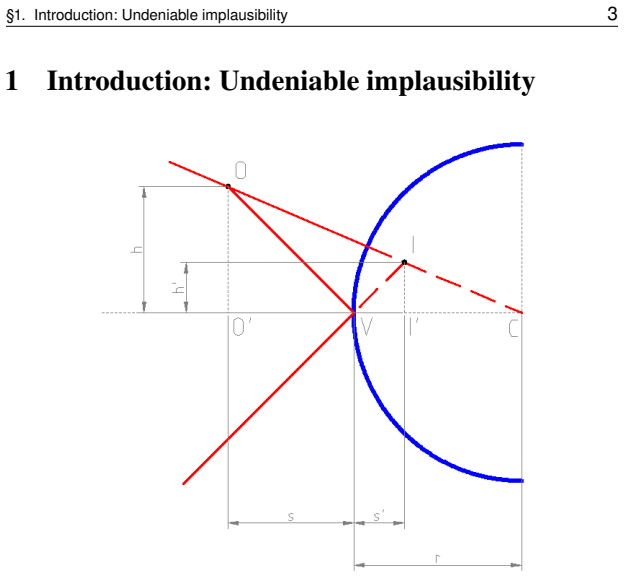
The ancient perpendicular rule, valid for sagittal focus, lets astigmatism be checked using only meridional rays through spherical surfaces.

Figure from the paper full image
abstract click to expand
The "cathetus rule" in optics alleges that the image of an object-point, formed by reflection or refraction at a surface, lies on the perpendicular ("cathetus") from the object-point to or through the surface. The first known statement of the rule, attributed to Euclid, was for a plane or spherical mirror. The rule was extended to refraction by Ptolemy.... Kepler was universally credited with the first disproof-and-salvage of the cathetus rule until 2018, when Benedetti's priority was exposed by Goulding. Kepler notwithstanding, the rule was reaffirmed by Tacquet for plane and spherical mirrors, except for the case in which the rays converge toward a point behind the eye; this became known as the "Barrovian case" because it troubled Barrow, in spite of his modern concept of an image. Barrow demolished the cathetus rule for the tangential image except in the paraxial limit, and Newton salvaged it for the sagittal image. The rule then seems to fade from history. But the rule is equivalent to the assumption that the image is stigmatic and the cathetus well defined. This narrow assumption is approximately true in the first-order (paraxial, "Gaussian") analysis of lenses and mirrors; and unacknowledged applications of the ancient rule can indeed be discerned in modern expositions of that subject. Moreover, the validity of the rule for the sagittal image fills a critical gap in meridional ray-tracing through spherical surfaces: by tracing the chief ray from an off-axis object-point, then applying the cathetus rule to the successive surfaces, one can locate successive sagittal image-points on the chief ray (produced rectilinearly through surfaces as necessary), and hence assess astigmatism to leading order, without tracing any rays outside the meridional plane.
0
0
gr-qc 2026-06-24

Spatiotemporal structures define diffeomorphism invariants

by Álvaro Mozota Frauca

Diffeomorphism-Invariant Quantities in Phase Space: More than Correlations

Correlations alone do not capture all invariants; space-time relations must be included to define the physical content.

abstract click to expand
A popular view in the foundations of diffeomorphism-invariant theories is that their physical content is encoded in correlations or `observables': a set of phase space functions that have vanishing Poisson brackets with the constraints related to diffeomorphisms. In this article I study the phase space structure of models with a temporal diffeomorphism invariance and prove a series of formal results that challenge this view in a few ways. First, I show how this view is not applicable to all the phase space trajectories of every diffeomorphism-invariant theory. Second, I show how correlations can be proved to be invariant only in a way that generalizes the standard definition of invariance and in a way that does not provide smooth phase space functions. Third, I prove that spatiotemporal relations are also invariant. Fourth, I prove that spatiotemporal structures are indispensable for defining the invariant content of diffeomorphism-invariant models. Finally, I comment that these results are expected to be generalizable for models invariant under $d$-dimensional diffeomorphisms, which represents a challenge for some views in the foundations of general relativity and quantum gravity.
0
0
math-ph 2026-06-23

Hadamard condition makes operator products well-defined on field observables

by Eleanor March

Why Hadamard states?

It supplies a necessary and sufficient criterion for the algebra to support Wick polynomials and stress-energy expectations rather than serv

abstract click to expand
In quantum field theory on curved spacetime, and in locally-covariant quantum field theory, the Hadamard condition is often presented as a necessary condition on 'physically reasonable' states of the quantum field, and plays a central role in many theoretical and foundational applications - ranging from proofs of the renormalizability of Wick polynomials to derivations of the Hawking temperature. Yet despite this, the philosophical and foundational underpinnings of the Hadamard condition remain murky. I critically discuss existing motivations for the Hadamard condition in the literature, before arguing in favour of an alternative justification for the Hadamard condition, according to which it is best understood as a necessary and sufficient condition for the existence of a well-defined operator product on a sufficiently large space of observables of the quantum field, satisfying a variety of further conditions (thus proving a converse to a result which was already discussed in this context). This clarifies the role and status of the Hadamard condition, including its relationship to the equivalence principle, to well-definedness of physical quantities such as Wick polynomials and the expectation value of the stress-energy operator, and the sense in which Hadamard states are 'vacuum-like'.
0
0
quant-ph 2026-06-22

Scattering reveals distinct channels for identical particle labels

by R. E. Kastner

The Physics Behind Symmetrization

This undercuts the assumption that same-type particle states must be symmetrized due to label redundancy.

Figure from the paper full image
abstract click to expand
It is often asserted that quantum states for same-type particles must be symmetrized due to ``label redundancy,'' i.e. the assumption that the permutations of labels in direct-product states do not reflect any real physical distinction and thus their permutations constitute an ``exchange degeneracy''. This assumption is directly challenged by the case of scattering of same-type particles such as electrons, which involves two physically distinct scattering channels effectively corresponding to permutation of the labels. I discuss this counterexample with critical attention to an extant portrayal in the literature that omits pertinent physical content. I further note ways in which the assumption that symmetrization must be universally imposed is not supported by actual calculations of particle interactions, nor by seemingly viable particle states based on preparations and outcomes.
1 0
0
physics.hist-ph 2026-06-22

Cosmology captures invariants in data across models

by Stefano Profumo

Cosmology as Representation: Informational Invariance and the Limits of Scientific Realism

Models refine shared informational structures rather than converging on a unique ontology

abstract click to expand
Modern cosmology is often taken to provide an increasingly accurate description of the universe's underlying ontology through progressively refined mathematical models. I challenge this interpretation by arguing that the empirical success of cosmology underdetermines not only ontology but also the mathematical and conceptual frameworks used to represent observational data. I propose instead that the objective content of cosmology is best identified with cross-representational informational invariants-features of observational structure that persist across empirically adequate descriptions. These invariants can be characterized in information-theoretic terms, including correlation structure, statistical distinguishability, and limits on accessible information, and formalized using tools such as the Fisher-Rao metric on model space. On this view, cosmological models are best understood as efficient encodings of observational structure rather than uniquely privileged descriptions of fundamental reality. Scientific progress, accordingly, consists not in convergence toward a fixed ontology, but in the progressive refinement of the informational structure accessible to observation.
1 0
0
quant-ph 2026-06-19

Spectrum-preserving flows derive Lax quantum dynamics

by Péter Szabó

Quantum Dynamics from Lax Pair Theory: A Reconstruction from Spectrum Preservation

One assumption on continuous observable flows yields Heisenberg and Schrödinger equations as theorems

abstract click to expand
We reconstruct unitary quantum dynamics from a minimal axiomatic foundation built on Hilbert-space observables and isospectral evolution. The only dynamical assumption is that physical time evolution is a continuous one-parameter flow of Hermitian observables that preserves their spectra, i.e. the possible outcomes of measurement. We show that this assumption is already sufficient to force the Lax form of quantum dynamics. The Heisenberg equation, the time-dependent and time-independent Schr\"odinger equations, conservation laws, and good quantum numbers then follow as theorems rather than postulates. In this formulation, Lax pair theory supplies the missing dynamical bridge between the measurement structure of a Hilbert space and standard quantum evolution: the Hamiltonian is not assumed, but emerges as the generator required for an isospectral observable flow.
0
0
physics.hist-ph 2026-06-17

Factorization and resummation made perturbative QCD quantitative

by R Keith Ellis

Perturbative QCD as a quantitative tool in the years 1976-2000

Review traces how these tools plus infrared safety enabled next-to-leading order predictions for beam collisions from 1976 to 2000.

Figure from the paper full image
abstract click to expand
This paper traces the development of precision QCD in the years 1976-2000.This is after the discovery of asymptotic freedom, and after the exploration of the simplest processes based on the operator product expansion. The new theoretical tools of factorization, infra-red safety andresummation, needed to make predictions for the colliding beam machines of this era, are described. The role of computer algebra and modern spinor techniques for the calculation of amplitudes and cross sections are briefly reviewed. A selection of important processes calculated at next-to-leading order (or in limited cases beyond next-to-leading order) is presented.
0
0
physics.soc-ph 2026-06-17

Daytime model at Zurich yields Yin-Yang symbol

by Frank Schweitzer

Making Sense of Symbols: Yin and Yang in Zurich

Excess daytime fraction traces the S-curve and connects ratios to the calendar.

Figure from the paper full image
abstract click to expand
The widely known Yin-Yang symbol (Taijitu) is based on nested circles of different radii whose areas are colored black and white such that the interface traces an $\mathcal{S}$-shaped curve. We address the question of how this symbol can be related to physical phenomena such as daytime and nighttime duration and the annual seasons. Using a simple dynamic model of daytime duration, we introduce the excess daytime fraction and reconstruct the symbol using the latitude of Zurich. In particular, we explain how the black and white areas are linked to the stability of Yin or Yang predominance. We further demonstrate that the Golden and Silver Ratios found in the geometry of the symbol carry meaning with respect to the Gregorian calendar. Finally, we construct an alternative Yin-Yang symbol using logarithmic spirals with the Golden Ratio as the growth parameter. The didactical quantitative derivation of the Yin-Yang symbol and its grounding in real-world observations can be regarded as a novel perspective on this iconic pattern.
0
0
gr-qc 2026-06-12

Quantum gravity must recover objective geometry measurement

by Matteo Tuveri

Beyond the Metric: Geometrical Measurability as a Constraint on Quantum Gravity

Recovering general relativity also requires physical conditions for stable devices, causal access, and record formation.

abstract click to expand
This paper develops an epistemological constraint on quantum gravity grounded in the empirical meaning of general relativity. The central claim is that a complete recovery of general relativity requires an effective metric, a continuum limit, or Einstein-like dynamics together with the physical conditions under which relational geometrical quantities can be objectively determined. These conditions concern the dynamical stability of measuring devices and reference systems, causal accessibility among physical systems, record formation, and invariance under admissible descriptions. In classical general relativity, they are usually implicit in the use of clocks, rods, light signals, freely falling bodies, detectors, and gauge-invariant observables. In quantum gravity, however, they become non-trivial because spacetime geometry may be emergent, effective, thermodynamic, relational, or frame-dependent. This claim is developed through four cases: Rindler horizons and the Unruh effect, black-hole thermodynamics and Jacobson's equation-of-state derivation, gravitational-wave detection, and Weyl and conformal gravity. The latter is discussed as a critical limiting case in which conformal invariance raises a sharp question about whether scale-dependent measurements of space and time can be physically fixed. Implications for quantum gravity are also discussed using emergent gravity and quantum reference frames as examples. The perspective developed in the study suggests a general epistemological constraint on quantum gravity: any viable approach must recover the physical possibility of objective geometrical measurement together with geometry itself.
0
0
astro-ph.IM 2026-06-10

Big Ear SETI surveys built archive of 40,000+ radio events

by Abel Méndez, Robert S. Dixon +1 more

The Ohio SETI Program -- The Last Decades

Three decades of consistent observations covered 70 percent of the sky and left most data unexamined for later analysis.

Figure from the paper full image
abstract click to expand
The Ohio State University Radio Observatory (OSURO), known as the Big Ear, played a pivotal role in both radio astronomy and the Search for Extraterrestrial Intelligence (SETI). Following the completion of the Ohio Sky Survey, the facility was repurposed in 1973 as the world's first full-time dedicated SETI observatory and operated continuously until its decommissioning in 1998. During this period, the Ohio SETI Program evolved from an 8-channel hydrogen-line receiver into increasingly sophisticated survey systems. Over three decades, these surveys covered approximately 70% of the radio sky using a largely consistent instrumental configuration, creating one of the most extensive long-term radio astronomy archives ever assembled. The program is best known for the detection of the Wow! Signal in 1977, but it also accumulated an archive of over 40,000 transient narrowband events, revealed unusual concentrations of radio bursts near the Galactic Center, and established one of the longest continuous radio monitoring records in astronomy. Following the closure of the Big Ear, its scientific legacy continued through Project Argus and, more recently, the Arecibo Wow! project. This paper provides an overview of the final decades of the Ohio SETI Program, including its instrumentation, survey strategies, scientific discoveries, and enduring impact on SETI, time-domain radio astronomy, and the preservation of historical astronomical data. Despite its scientific significance, most of the data collected by the Ohio SETI Program remains unexplored, leaving a unique archive available for future research.
0
0
physics.hist-ph 2026-06-10

Bertholon's device reaches corona in storms but tiny fair-weather currents

by Thierry Dufour

At the Origins of Electroculture: A Retrodictive Modelling of Bertholon's 18th-Century Electrovegetometer in the Pre-Corona Regime

Simulations limit normal-condition effects to millimetre-scale zones while making storm luminous reports consistent with physics.

Figure from the paper full image
abstract click to expand
Pierre-Nicolas Bertholon's 18th-century electrovegetometer was conceived to harness "atmospheric electricity" for plant growth, yet its physical capabilities have never been quantified within the context of today's understanding of the Earth's atmospheric electric system. This study addresses the lack of quantitative assessment of such historical "electroculture" device and its plausible influence on the near-canopy electrical environment. It aims to reinterpret Bertholon's apparatus using contemporary atmospheric electrodynamics, asking under which realistic fair-weather and storm-like conditions a purely passive collector-distributor could generate fields and ion fluxes of physical significance. A two-dimensional, quasi-steady ohmic model has been developed in which the atmosphere is a resistive column carrying the global conduction current, the metal structure is a floating conductor supported by leaky wooden insulators and space-charge and corona are excluded so that all results describe pre-onset upper bounds. The simulations show that in fair weather the single upper point and the lower multi-point crown of the electrovegetometer enhance the background field by two to three orders of magnitude, yet only within millimetric-centimetric regions around the tips and with total currents limited to the pA-nA/m^2 range. Under storm-like forcing, peak fields at the crown reach 100-1000 kV/m, approaching or exceeding empirical corona-onset thresholds, while remaining largely insensitive to uncertainties in apex angle or collector geometry as long as an elevated mast is present. These results make Bertholon's reports of luminous "aigrettes" physically plausible, but suggest that any fair-weather agronomic impact was subtle and highly localized and that modern "electroculture" claims require careful, coupled electrostatic and biological studies beyond the pre-corona regime.
0
0
physics.hist-ph 2026-06-10

Plasma farming revives 18th-century electricity ideas for crops

by Thierry Dufour

From Electroculture to Plasma Agriculture: A Three-Century Arc Bridging Bertholon's Legacy with Contemporary Farming Advances

Abbé Bertholon's vivifying electricity intuition gains a reproducible framework through cold-plasma methods for agriculture and safety.

Figure from the paper full image
abstract click to expand
This review traces the historical trajectory of electricity in agriculture, from the earliest observations of electrical phenomena to the emergence of cold plasmas. Looking back to Antiquity and then to the Enlightenment, it underlines Abb\'e Bertholon's 18th-century efforts to channel atmospheric electricity to stimulate crops, using devices such as the electro-v\'eg\'etom\`etre. Although these early electroculture experiments relied on neither quantitative dosimetry nor rigorous methodology, they foreshadowed the idea of a controlled transfer of electrical energy to plants. Then the review examines the historical development of galvanism, electrochemistry, and the physics of gaseous discharges throughout the 19th and 20th centuries, which collectively laid the foundations for contemporary cold-plasma technologies. In the 21st century, plasma agriculture has emerged as an interdisciplinary approach integrating electrical, chemical, radiative, thermal, and fluid-mechanical effects. Applications include seed treatment (preconditioning, seed priming), stimulation of plant growth, soil and water treatment, and decontamination of agri-food products. The review thus reassesses Abb\'e Bertholon's contributions as those of a methodological precursor and shows how his intuition of a "vivifying electricity" resonates with modern cold-plasma science. Finally, it argues that plasma agriculture can transform an Enlightenment intuition into a reproducible experimental framework for sustainable agriculture and food safety.
0
0
physics.hist-ph 2026-06-05

Sphere to plane shows Inonu contraction

by Ilmar Gahramanov

Erdal \.In\"on\"u at 100: From the Sphere to the Plane

The geometric transition introduces the physicist's key idea and its place in modern theory on the centennial of his birth.

abstract click to expand
On the centennial of Erdal \.In\"on\"u's birth, this article reflects on his scientific legacy and his role in shaping modern theoretical physics in T\"urkiye. We briefly discuss his life, scientific vision, and contributions to academic institutions, and then turn to his most celebrated scientific achievement: the \.In\"on\"u-Wigner contraction. Through the simple geometric example of a sphere becoming a plane, we present an accessible introduction to this important idea and its significance for modern physics.
0
0
physics.hist-ph 2026-06-02

Non-technical overview maps string theory ontology for philosophers

by Baptiste Le Bihan

String Theory for Metaphysicians

Metaphysicians receive a compass to the theory's conceptual commitments without math overload.

Figure from the paper full image
abstract click to expand
String theory is a minefield for philosophers in terms of conceptual difficulty and mathematical technicality. Presentations aimed at philosophers generally focus on providing precise and technical mathematical descriptions of toy models and inter-theoretical toy derivations to give an idea of what is at play in the field. This presentation takes the opposite approach, filtering out most mathematical considerations to provide an overview of the field, eyes on the ontology. The aim is to provide a compass for metaphysicians to find their way around string theory and the philosophy of string theory. The development of metaphysical arguments based on string theory against the fundamentality of spacetime is deferred to the next chapter.
0
0
physics.hist-ph 2026-06-02

Observer views count as fundamental in relativity

by Tao Wang, Yu Shi

Relativity from the Perspectives of Observers

Review separates coordinate systems from reference frames to show that early results hold and that observer dependence clarifies paradoxes f

abstract click to expand
This paper reviews the role of observers in the development of relativity theory, from special relativity to general relativity, emphasizing that observer-dependent descriptions are as fundamental as the covariance of physical laws. This paper reviews the role of observers in the development of relativity theory, from special relativity to general relativity, emphasizing that observer-dependent descriptions are as fundamental as the covariance of physical laws. After the introduction of a geometric framework for observers using timelike worldlines, Frenet-Serret formulas, projection operators, and the Frobenius condition for hypersurface-orthogonal families, the paper revisits key problems in early relativistic mechanics, such as the transformation of velocity and acceleration, the variational principle for particle motion, and the Ehrenfest paradox concerning rigid rotation. It shows that while early physicists often conflated coordinate systems with reference frames, their results remain valid because the underlying geometric objects are observer-independent. The historical analysis, from Einstein's 1905 work to the development of general relativity and later advances such as Hawking radiation, demonstrates that clarifying the concept of observers not only resolved paradoxes but also paved the way toward a field-theoretic formulation of gravity. The paper concludes that observer dependence, far from being a nuisance, is an essential ingredient for understanding spacetime physics.
0
0
physics.hist-ph 2026-06-01

Husserl ontology of physics replaces failed matter ontologies from QFT

by Jobst Landgrebe, Barry Smith

A Husserlian ontology of the science of physics

Mathematical symmetry attempts since 1939 cannot produce a coherent ontology of matter, so a framework including idealities used by physicis

Figure from the paper full image
abstract click to expand
Since 1939, when Wigner published his proposal to define particles via symmetries expressed as algebraic groups, we have seen a long stream of attempts to formulate an ontology of matter based on mathematics. It has become apparent that such attempts must fail, and more particularly that we cannot derive an ontology of matter from the Standard Model on the basis of quantum field theory. We briefly recapitulate the reasons for this and demonstrate how the philosophy of physics has become scholasticised through a series of vain attempts to obtain a coherent ontology of matter. Here we propose an alternative approach in the form of an ontology of the science of physics. It draws on a framework developed by Husserl which admits not only real material entities but also the idealities which physicists make use of in their thinking. We specify the upper level of this ontology, which addresses the way in which physicists use mathematics when conducting their enquiries. This ontology provides a new perspective concerning the dilemmas of modern physics, including the measurement problem.
0
0
math-ph 2026-06-01

Weyl uniqueness extends to Galilei and Carroll geometries

by Philip K. Schwartz, James Read +1 more

Weyl-type theorems in Galilei and Carroll geometry

Torsion-free connections compatible with the defined conformal structure are fixed by their projective structure alone.

abstract click to expand
A classic theorem of Weyl (1921) states that a Weyl metric -- a natural generalisation of a pseudo-Riemannian metric -- is uniquely determined by its conformal and projective structures (i.e. by its conformal structure and its set of unparametrised geodesics). An equivalent formulation of Weyl's result is that a torsion-free linear connection compatible with a pseudo-Riemannian conformal structure is uniquely determined by its projective structure. We discuss analogous results for suitably defined notions of conformal structure for Galilei and Carroll geometry, i.e. for spacetime geometries arising as the `non-relativistic' and `ultra-relativistic' limits of Lorentzian geometry.
0
0
quant-ph 2026-06-01

Three lines extend quantum theory to gravity and equilibrium

by Ricardo Muciño (Universidad Nacional Autónoma de México)

Topics on Foundations of Physics: From the quantum to the (semi) classical, gravity, thermodynamics, and (or beyond) our possible detections

Work motivated by time's flow organizes into detections, thermodynamic explanations, and self-consistent semiclassical models.

Figure from the paper full image
abstract click to expand
The work leading to this thesis focuses on assessing and extending quantum theories in order to explore and test their implications across various regimes -- including thermodynamics, semiclassical and quantum gravity scenarios, and the in principle detectable predictions of such theories. The general motivation stems from a basic desire to understand the world form its very foundations. For instance, how can we bridge the gap between what we observe or `perceive' and the fundamental quantum nature in our theories. In particular, this work originated from the search to a better understanding of the nature of time according to our physical theories and the common perception that it invariably `flows' to the future, or, in other words, why do we observe distinct natural processes evolving asymmetrically in time? These motivations led to three distinct, yet interconnected and successful, lines of research, presented here in three separate parts: I. On Possible Detections within Physical Theories; II. On Explaining the Approach to Thermodynamic Equilibrium; and III. Relativistic Collapse Theories and a Self-Consistent Model of Semiclassical Gravity.
0
0
physics.hist-ph 2026-05-29

Tychonic system had too many flaws to be credible

by Gabriele Vanin

The Tychonic system, an implausible theory

Analysis shows it never formed a viable third option in 16th-17th century astronomy debates.

Figure from the paper full image
abstract click to expand
Several scholars have accorded the Tychonic System a prominent place, considering it a credible alternative to the Ptolemaic and Copernican systems. In recent years, there have even been some enthusiastic contributions in support of Brahe, which have sought to show how his solutions were the most suitable for providing scientifics support to the new observations that were accumulating between the late 16th century and the mid-17th century. In this work, after analyzing these contributions, I proceed to demonstrate that the Tychonic system had so many critical points, many of which have not been adequately noted by historical criticism, that it did not deserve all the attention it received, neither at the time of its publication, nor in Galileo's time, nor in subsequent periods, because it never constituted a truly credible alternative, and that its reputation as the "third system of the world" is entirely undeserved.
0
0
physics.hist-ph 2026-05-29

Inner product step fixed credit for the Wheeler-DeWitt equation

by Alexander S. Blum, Dean Rickles +1 more

That Damned Equation. Rigour, Credit Attribution, and the Wheeler-DeWitt Equation 1962-1967

Archival records show the 1967 expression that allowed calculations, not the 1962 equation statement, was treated as the decisive rigorisati

abstract click to expand
The notion of rigour relevant to the practice of physics is an endogenous one. Theoretical physics has its own internal norms about mathematical practice and notions of legitimate derivations or formal objects. These norms are often implicit, local, and change in substantial ways over time. Moreover, norms of rigour in theoretical physics, at least in the mid-twentieth century, are primarily focused on the goal of removing barriers for concrete calculation and clear conceptualisation. Rather than pursuit of rigour for its own sake, or to achieve some `higher' standard of truth, theoretical physicists seek to `rigorise' initial, semi-formal constructions in order to render formally well-defined models with which they can make concrete contact with the world, through calculations of quantities of interest. In what follows we will support this thesis based upon a detailed historical case study of the development of and attribution of credit for the Wheeler-DeWitt equation in the period 1962-67. Drawing upon archival material and the published record we develop and defend the explanatory hypothesis that it was the rigorisation of the equation via the expression for the inner product that was the crucial step in the work of Wheeler and DeWitt rather than the statement of the equation itself.
0
0
physics.hist-ph 2026-05-25

Physical coherence criterion keeps time emergence viable in quantum gravity

by Eugene Y. S. Chua

Physical Coherence and Time's Emergence

It evaluates derivations on each program's own terms instead of ruling them out by prior definition.

abstract click to expand
It is often said that time vanishes in quantum gravity. One general approach to quantum gravity accepts this fundamental timelessness but seeks to derive time's emergence at a non-fundamental level. To better assess such approaches, I develop the criterion of physical coherence and situate it in context by applying it to two programs for time's emergence, drawing from recent works by Chua and Callender (2021) and Chua (2025): semiclassical time and thermal time. Unlike some recent arguments for the metaphysical incoherence of time's emergence, which rule out all claims of time's emergence 'from on high' once we've fixed a definition of metaphysical emergence, my criterion of physical coherence leaves open the possibility that some programs in quantum gravity may succeed on their own terms in providing a physically coherent derivation of time from no-time. This sets a challenge for proponents of time's emergence to clarify the conceptual foundations of their program, while at the same time acting as a litmus test for a program's success.
0
0
physics.hist-ph 2026-05-22 2 theorems

Diffeomorphisms restrict observables to global gauge views

by Álvaro Mozota Frauca

The Limitations of the Notion of `Observable' in Diffeomorphism-Invariant Models

Diffeomorphism invariance counts as gauge symmetry only globally, leaving correlation-based claims about physical content unsupported.

Figure from the paper full image
abstract click to expand
The application of the notion of `observable' from gauge theory to diffeomorphism-invariant theories -- most relevantly to general relativity -- has led to numerous conceptual and technical issues when interpreting classical theories with this symmetry and building quantum versions of them. In this article I distinguish between two senses of gauge transformation: local and global, and I argue that the notion of observable appears more naturally in the local sense of gauge transformation. Then, I argue that diffeomorphism invariance can be understood as a gauge symmetry only from a global point of view, and hence, that the concept of observable applies only in a restricted manner. This has the consequence that some popular claims in the literature, such as the claim that the physical content of diffeomorphism-invariant models is encoded in correlations, are unfounded.
0
0
cs.DL 2026-05-18 1 theorem

Planck essays retracted by modern rules on old reprints

by Yves Gingras, Mahdi Khelfaoui

The Curious Case of Max Planck retracted papers. When past scientific practices meet contemporary publishing norms

Circulation history shows 1940s republication was normal but now flagged as duplicate by digital copyright systems.

abstract click to expand
This article examines the case of two papers published in Naturwissenschaften by the physicist Max Planck that were retrospectively marked as retracted on Springer digital platform. Rather than originating in scientific fraud, these withdrawals appear to result from contemporary digitization and copyright-management procedures applied anachronistically to historical publications. Through an investigation of the circulation history of Planck 1940 and 1942 philosophical essays, the article shows that republication across multiple formats was a common and legitimate practice within the scientific publishing culture of the early 20th century. Such practices only became problematic with the later transformation of the scientific article into a countable and proprietary unit within systems of bibliometric evaluation and commercial academic publishing. This article argues that contemporary notions such as duplicate publication and self-plagiarism are historically situated categories that cannot be applied retrospectively without distorting the historical record. More broadly, the Planck case reveals how digital scholarly infrastructures controlled by large commercial publishers can limit the accessibility of the scientific past. Ironically, the original papers remain accessible today through the nonprofit digital platform Internet Archive rather than through the publisher that originally issued the journal.
0
0
quant-ph 2026-05-18 2 theorems

Uncertainty principle blocks Maxwell's demon

by R. E. Kastner

Maxwell's Demon

Heisenberg limits on the demon's measurements force an energy cost that upholds the second law.

Figure from the paper full image
abstract click to expand
This work provides an overview of key historical developments in the formulation of the Second Law of Thermodynamics, focusing on the notorious challenge of ``Maxwell's Demon'', a hypothetical creature who could presumably violate that law. It begins by recalling Maxwell's challenge and discussing the apparent loophole in the Second Law that appears to make such a violation possible. An alternative formulation of the Demon challenge by Szilard is considered, along with his attempted defeat of the Demon through reference to measurement. A similar effort by Brillouin is also analyzed. The proposal of Bennett to defeat the Demon through the requirement of memory erasure is critically discussed. Finally, it is proposed that the Second Law gains a firm foundation through neglected features of quantum theory. In particular, an application of the Heisenberg Uncertainty Principle is shown to decisively defeat the Demon, as well as to serve as justification for Landauer's Principle, albeit in terms distinct from the usual computational formulation.
0
0
quant-ph 2026-05-18 2 theorems

Norms of practice make quantum outcomes objective without ontology

by Richard Healey

Quantum Measurement without Ontology

They also ground non-quantum features in models, countering threats from no-go theorems on uniqueness.

abstract click to expand
Measurement is an important scientific activity. In most of science, including classical physics, is may be understood as a way of finding out about the physical world and representing the results numerically. No-go theorems show that measurement of quantum observables is not like that: the recorded outcome is typically created rather than revealed in a quantum measurement, in which case there is no objective fact about the observable's prior value. Other no-go theorems show that unitary quantum theory can generally neither explain nor even represent a unique recorded outcome, thereby threatening that outcome's objectivity. Methodological norms inherent in quantum physical practice nevertheless institute the objectivity, not only of unique recorded outcomes of quantum measurements, but also of non-quantum features of the world that physicists and other scientists take their models to represent.
0
0
physics.hist-ph 2026-05-13 Recognition

1923 Newtonian estimate gave 49 hours to the Moon

by Tina A. Harriott, Cherif F. Matta

On the Anticipation of Lunar Travel in the Early 20th Century: A Pedagogical Exercise

Basic gravity arguments produced a travel time within the same order as Apollo's 72-hour missions and outlined the main trajectory phases.

Figure from the paper full image
abstract click to expand
This article examines, from historical and pedagogical perspectives, Alphonse Berget's anticipation of Earth-Moon travel in Le Ciel (Larousse, 1923), decades before the beginning of the space age. The discussion is triggered by Le Ciel, a richly illustrated French popular science work, which has a devoted chapter examining lunar and interplanetary travel within a Newtonian framework. Although Berget's treatment was not developed in isolation and reflects a broader early 20th century context that included pioneers such as French aero-engineer Robert Esnault-Pelterie, the book provides a striking pedagogical synthesis of elementary celestial mechanics and scientific popularization. Unlike earlier fictional treatments such as Jules Verne's De la Terre a la Lune, Berget approached space travel using physical reasoning grounded in Newtonian gravitation. Using qualitative and semi-quantitative arguments based on the inverse-square law, he identified the principal phases of an Earth-Moon trajectory: escape from Earth, inertial translunar motion, transition through competing Earth-Moon gravitational fields, and final lunar capture and deceleration. His estimated Earth-Moon travel time of approximately 49 hours is of the same order of magnitude as Apollo mission transit times (approx. 72 h). We compare these early ideas with modern elementary concepts of astrodynamics, including restricted three-body trajectories, Lagrange-point dynamics, and distant retrograde orbits associated with the Artemis program. We also examine Berget's discussion of interplanetary travel, lunar landscapes, and human factors associated with prolonged voyages, including confinement, food supply, and travel duration. The analysis highlights the pedagogical value of historically grounded scientific reasoning underpinning spaceflight mechanics.
0
0
physics.hist-ph 2026-05-13 2 theorems

Causality split sharpens choice of math and stats methods

by Marzieh Asgari-Targhi, Amene Asgari-Targhi +2 more

Causality and Scientific Inquiry: Lessons from Space Physics and Medical Sciences

Space physics and medicine examples show why distinguishing mechanistic from difference-making views matters for reliable results.

abstract click to expand
Over the past two decades, the rapid surge in data-intensive computational techniques for statistical modeling may have had the effect of diminishing the use of applied mathematics in causal scientific inquiry. In this paper, co-authored by an astrophysicist, a mathematician, and philosophers, we assess the hazards of neglecting the branch of mathematics that constructs models to address causal questions in favor of statistical modeling alone. Causality is relevant in all branches of science and is often elucidated through applied mathematics. Here, we illuminate the idea with examples drawn from space physics and medical sciences. We examine causal questions to demonstrate how applied mathematical and statistical methods may differentiate between two fundamental facets of causality, i.e., mechanistic and difference-making. Understanding such foundational differences in causality may, in some cases, help explain discrepant or erroneous research results. Most importantly, understanding the relationship between causality and analytical approaches used in science has the potential to strengthen the rigor and reliability of scientific inquiry through optimal selection of mathematical and/or statistical methods.
0
0
physics.soc-ph 2026-05-12 Recognition

Physicists' survey finds narrow majorities on many big questions

by Niayesh Afshordi, Phil Halper +2 more

Big Mysteries Survey: Physicists' Views on Cosmology, Black Holes, Quantum Mechanics, and Quantum Gravity

Positions often called consensus in cosmology and quantum physics turn out to have only pluralities or slim majorities of support.

Figure from the paper full image
abstract click to expand
We present results from the Big Mysteries Survey, a large-scale survey conducted through the American Physical Society's Physics Magazine on foundational and controversial topics in contemporary physics. The survey provides a snapshot of physicists' views on issues in cosmology, black-hole physics, quantum mechanics, quantum gravity, and anthropic coincidences. A central finding is that several positions often described publicly as field-wide ``consensus'' views are, in practice, supported by much narrower majorities or by pluralities rather than majorities.
1 0
0
quant-ph 2026-05-11 Recognition

Depolarizing noise turns Spekkens contextuality classical after threshold

by Enrico Bozzetto, Jonte R. Hance

Classical Limit: Dissipation of Spekkens' Generalised Contextuality under Decoherence

Odd-dimensional stabilizer systems with magic states lose nonclassicality under sufficient decoherence, limiting quantum advantage.

abstract click to expand
Contextuality is considered as one of the most distinctive features of nonclassical systems. Here, we show that a Spekkens contextual system (which previous work has shown is a necessary condition for nonclassicality) formed of an odd-dimensional stabiliser system plus a magic state becomes noncontextual (a sufficient condition for classicality) under the action of a depolarising channel after a certain decoherence threshold. We show also that some quasiprobability representations are more effective than others in witnessing this transition from contextuality to noncontextuality. Given previous work has shown that magic states and Spekkens contextuality are both necessary for universal quantum computation, this result helps us understand the relationship between decoherence, Spekkens' generalised contextuality, and quantum advantage.
1 0
0
physics.hist-ph 2026-05-11 1 theorem

Physics rewards track transformations of viable theory sets

by James D. Wells

Polydoxon Transformations and Scientific Reward in Physics

Contributions that expand, contract, reconfigure or enable the space of empirically viable theories receive the largest honors.

abstract click to expand
We develop a descriptive account of scientific reward in physics based on the concept of the time-dependent Polydoxon, defined as the structured set of empirically viable theories at a given time. We argue that highly rewarded contributions, such as those recognized by major prizes and professional honors, can be systematically understood as those that transform this space. These transformations take the form of expansion (adding viable theories), contraction (eliminating viable theories), reconfiguration (illuminating deeper structures and relations within and between theories), and enabling moves (methodological or technological advances that enable future transformations). The analysis is further refined by emphasizing that reward correlates with the transformation's magnitude, assessed along dimensions of scope, centrality, depth, and future leverage. This framework reframes the analysis of rewarded achievement away from isolated theoretical successes and toward the dynamics of a landscape of viable theories, providing a more unified descriptive interpretation of rewarded scientific activity in physics across its diverse set of theoretical and experimental discoveries.
0
0
quant-ph 2026-05-11 2 theorems

Causal definition of decoherence selects histories without states

by Nick Ormrod, Tein van der Lugt +2 more

Decoherence without the state: A causal quantum Darwinist approach

By basing decoherence on information proliferation in unitary circuits, the state emerges from its time reverse to pick out consistent and a

Figure from the paper full image
abstract click to expand
The consistent histories formalism can be used to describe histories comprised of events across many systems, times, and places, plausibly rich enough to describe our experiences of the classical world; however, many consistent history sets are nonclassical and thus not obviously relevant to our experiences. Meanwhile, the program of environmentally induced decoherence identifies dynamically privileged classical degrees of freedom, but provides no general account of when or how many such degrees of freedom consistently combine to form histories. This work shows that the strengths of these two approaches can be combined by adopting a dynamics-first perspective on decoherence. Inspired by quantum causal models and quantum Darwinism, we define the process of decoherence in terms of the causal influences through unitary dynamics required for the proliferation of information about observables. We characterise decoherence as a property of the unitary dynamics, without presupposing the existence of any quantum state. Instead, we show that the state emerges from dual decoherence, related to decoherence by time-reversal of the unitary dynamics. Indeed, for any set of systems in an arbitrary unitary circuit, decoherence and its dual single out a privileged consistent history set -- and we demonstrate through examples that states emerge from dual decoherence while outcomes emerge from decoherence. Hence the idea that quantum states emerge from the process of decoherence turns out to be the key missing ingredient for unifying environmentally induced decoherence and consistent histories. Taking this idea ontologically seriously leads to a recently proposed causal interpretation of quantum theory or a dynamics-first version of the Everett interpretation. The causal approach also sheds light on the suppression of off-diagonal terms, time asymmetry, and robustness of the pointer basis.
0
0
physics.hist-ph 2026-05-06 1 theorem

Habicht 1914 notes tie relativity to Lorentz's moving-body problems

by Hector Giacomini

Conrad Habicht 1914 Manuscript on Special Relativity and Einstein 1907 Reframing of the 1905 Theory

The manuscript spends space on ether, Fizeau, Michelson-Morley and local time before reaching Einstein's postulates.

abstract click to expand
This note examines an apparently unpublished manuscript on special relativity written by Conrad Habicht in 1914 and made available online by the ETH-Bibliothek Z\"urich in December 2024. To the best of my knowledge, no study of its content has yet been published. Habicht was one of Einstein's closest companions during the Bern years. Between February 1902 and mid-1904 he shared with Einstein many occasions for discussion and companionship in Bern. After leaving the city, he remained in close contact with Einstein through visits, reciprocal stays, and a substantial correspondence extending from the years immediately following 1905 to the eve of the First World War. The manuscript offers a clear and pedagogical presentation of special relativity. Its historical interest lies in the structure of the exposition and in the memory of the theory that the text preserves. Habicht does not present special relativity as an isolated creation beginning from Einstein's 1905 paper alone. He devotes considerable space to the pre-Einsteinian problem situation: the classical principle of relativity, the ether, Fizeau's experiment, Michelson--Morley, Lorentz's theory, the contraction hypothesis, local time, and the privileged system of the stationary ether. Lorentz is treated as the central figure who brought the electrodynamics of moving bodies to its most acute form before Einstein's intervention. This note provides a qualitative description of the manuscript, with particular attention to its structure, its treatment of the relation between classical mechanics and electrodynamics, and the respective roles assigned to Lorentz, Michelson--Morley, Einstein, and Minkowski.
0
0
physics.soc-ph 2026-05-05

Vishap stone locations indicate unified society in 4000 BC Armenia

by Vahe Gurzadyan, Arsen Bobokhyan

Vishap epoch unitary society in Armenian Highlands, c. 4000 BC: data analysis consequences

Bimodal elevations and irrigation ties suggest one organized group ran a major water cult.

abstract click to expand
Vishaps -- dragon stones -- discovered in the Armenian Highlands convey a remarkable message about the spiritual and social character of their epoch, c. 4000 BC. The unexpected bimodal distribution of their elevations indicates the deliberate, labor-intensive placement of these massive stones -- some weighing up to 7--9 tons -- in locations where the period suitable for construction activities at high altitudes was extremely limited. Their positions, correlated with nodes of previously identified prehistoric irrigation systems, support the interpretation that they were dedicated to a cult of water. This evidence points to the existence of an organized and unified society capable of sustaining and maintaining such a resource-intensive cult.
0
0
quant-ph 2026-05-05 2 theorems

Classical action yields only semiclassical quantum solutions

by Gabor Vattay

Comment on `On computing quantum waves exactly from classical action'

Neglecting derivatives of probability density drops the quantum potential, turning exact claims into standard approximations.

abstract click to expand
A recent article by Lohmiller \& Slotine (Proc.\ R.\ Soc.\ A \textbf{482}: 20250413) claims that the Schr\"odinger equation can be solved exactly using only classical least action and classical fluid density, asserting that this formulation avoids semiclassical approximations. We show that their mathematical derivation contains a foundational error. By neglecting the spatial derivatives of the probability density amplitude, the authors inadvertently omit the quantum potential -- the term originally identified by Madelung and later emphasised by Bohm. Consequently, their proposed equivalence is not exact but rather constitutes the standard semiclassical approximation. We further demonstrate that each of the paper's illustrative examples either belongs to a class where the quantum potential vanishes identically due to the geometry of the problem, or recovers the correct quantum result by importing quantum eigenfunctions through the initial conditions, thereby concealing the error.
1 0
0
astro-ph.EP 2026-05-05

Fixed leap rules drift one day every 5,700 years

by Daniel Quigley

Mean tropical year length at arbitrary ecliptic longitude

Mean tropical year length varies by ecliptic longitude and shrinks over time, producing quadratic error no constant rule can avoid.

Figure from the paper full image
abstract click to expand
We compute the mean interval between successive returns of the apparent geocentric solar longitude $\lambda$ to a fixed value $L \in \{0^\circ, 45^\circ, 90^\circ, \ldots, 315^\circ\}$, averaged over a multi-millennium window; this gives eight ``mean years'' against which calendar leap rules can be tuned: four cardinal-point years (equinoxes and solstices); four cross-quarter years. The construction is built on Meeus's low-precision solar theory (Astronomical Algorithms, 2nd ed., 1998), itself a low-order truncation of Newcomb's Tables of the Sun re-expanded around J2000.0. Where Meeus presents polynomial coefficients without justification, we draw on Smart's Textbook on Spherical Astronomy (6th ed., revised by Green, 1977) for the underlying derivations. Numerical accuracy is validated against the cardinal-point intervals tabulated in Meeus, More Mathematical Morsels, 2002. We close with a derivation of the secular drift equation, showing that, regardless of how well a leap rule is tuned, the slow shrinkage of the tropical year produces a quadratic cumulative error that reaches one day in $\sim$5{,}700 years for any fixed intercalation rule.
0
0
cs.AI 2026-05-04

Quantum probability emerges as projection of contextual spacetime formation

by Song-Ju Kim

Spacetime Formation under Requirements: Contextual Realization and Form-Dependent Probability

When finite-state requirements cannot fit a single Boolean structure, the mismatch projects as interference and order effects.

Figure from the paper full image
abstract click to expand
Quantum cognition often explains order effects, contextuality, and violations of the law of total probability by replacing classical probability with quantum probability on a fixed event structure. This paper proposes a different interpretation: quantum probability is the fixed-spacetime projection of contextual spacetime formation under finite-state requirements. The framework begins not with time, space, objects, or probabilities, but with requirements such as finite representational capacity, single-state semantic stability, context-sensitive intervention, avoidance of explicit context labels, coherent world-formation, and intersubjective transformability. When these requirements cannot be realized within a single global Boolean event structure, the mismatch appears, under fixed-spacetime projection, as noncommutativity, interference, and quantum-like probability. Building on prior single-state approaches to contextuality, we reinterpret classical contextual bookkeeping cost as the fixed-spacetime shadow of contextual spacetime formation. Auxiliary memory or context labels in a classical representation correspond, in this account, to holonomy-like mismatch among locally Boolean logic-worlds. The interference term is the cross term generated when locally classical realization contributions are nontrivially glued and projected back into a fixed classical spacetime form. The result is a transcendental-operational realist account: objecthood, eventhood, probability, and spacetime are treated as forms of realization under requirements, while objectivity is defined by invariants preserved across observer- and history-dependent spacetime formations.
0
0
quant-ph 2026-05-04

Bell correlations are selection artefacts

by Huw Price

Bell Correlations and Selection Bias

The apparent conflict with relativity and realism in quantum experiments stems from how measurement data is chosen for analysis.

abstract click to expand
Selection artefacts are common in science. A method of selecting samples from a larger population may produce bias, in either direction. It may induce correlations between variables independent in the full population, or mask correlations between variables dependent in the full population. Here we propose a surprising application of these familiar ideas. We argue that they are relevant to puzzling correlations uncovered in quantum theory by John Stewart Bell (Bell 1964). In the light of Bell's work and subsequent experiments it is widely believed that the quantum world is 'nonlocal', in apparent tension with relativity. Many hold that the only alternative is to abandon 'realism', the view that there is an objective world independent of measurement. We propose instead that Bell correlations are selection artefacts, in tension neither with relativity nor realism.
0
0
physics.hist-ph 2026-05-01

Lorentz contraction is the only shape preserving cavity resonances

by Shiva Meucci

Lorentz-FitzGerald Contraction as the Unique Closure Condition for Moving Spherical-Harmonic Cavities

Phase must stay direction-independent inside a moving wave cavity, forcing the aspect ratio 1/γ and period stretch γ T₀.

abstract click to expand
We prove that the Lorentz--FitzGerald contraction is the unique deformation of a resonant cavity moving through a mechanical wave medium that preserves spherical-harmonic phase closure. For a cavity moving at speed $v = \beta c$ through a medium supporting nondispersive wave propagation at speed $c$, the round-trip phase of an internal ray at angle $\theta$ to the motion depends on the boundary radius $r(\theta)$ according to $\Phi(\theta) = 2k\,r(\theta)\sqrt{1-\beta^2\sin^2\theta}/(1-\beta^2)$. Requiring $\Phi(\theta)$ to be independent of $\theta$ -- the necessary condition for retaining a spherical-harmonic eigenstructure -- uniquely fixes the Lorentzian aspect ratio \[ \frac{a_\parallel}{a_\perp} = \frac{1}{\gamma} = \sqrt{1-\beta^2}. \] Substituting this unique boundary into the round-trip time yields the resonant period dilation $T = \gamma T_0$, without additional assumptions. Both results -- contraction and dilation -- follow from a single mechanical constraint: preservation of eigenstructure under motion. This is the missing uniqueness theorem of the constructive relativity program initiated by FitzGerald, Lorentz, and Heaviside: the proof that Lorentzian kinematics are not merely consistent with, but uniquely required by, phase closure in a mechanical wave medium.
0
0
physics.hist-ph 2026-04-30

Dingle's 1972 book claimed relativity is inconsistent

by Justo Pastor Lambare

On Dingle's rebuttal of the special theory of relativity

The argument turned on symmetric clock slowing and still appears in critiques today, but rests on a misstep in comparing times across frames

Figure from the paper full image
abstract click to expand
In his 1972 book Science At the Crossroads, Helbert Dingle attacked the consistency of special relativity through a fallacious argument championed by the crank community even to this day. Dingle's affair is a curious chapter in the history of physics and, more generally, science. We briefly review Dingle's case from a historical and didactic perspective.
0
0
physics.hist-ph 2026-04-28

Fermi's Varenna lectures trace path to quantum computers

by Vladislav Gavryusev, Massimo Inguscio

The Legacy of Enrico Fermi to Varenna

His advocacy for building computers instead of buying them prefigures today's quantum science and technologies.

abstract click to expand
The Varenna school is a hub where generations of physicists, including numerous Nobel laureates, have shaped the field, often through collaborative exchanges across political and cultural boundaries. We examine the scientific legacy of Enrico Fermi and its influence on modern atomic, molecular, and optical physics. Beginning with Fermi's 1954 lectures at the Varenna school, key developments are traced from high-energy physics to laser spectroscopy, precision metrology, and the control of ultracold atoms. Milestones such as Doppler-free spectroscopy, optical frequency combs, Bose-Einstein condensation, and degenerate Fermi gases are highlighted as turning points leading to quantum simulation and quantum computation. Fermi's early advocacy for building a computer, rather than buying it, can be viewed as a precursor to today's efforts in quantum science and technologies. This historical trajectory and legacy continues to inform current research in quantum matter and information science.
0
0
physics.hist-ph 2026-04-28

Neopositivism yields Clausius inequality

by Didier Lairez

The principles of neopositivism and the laws of thermodynamics

The second law and equilibrium attractor follow from the definition of information as non-redundant observational truth.

abstract click to expand
The second law of thermodynamics, which deals with irreversibility and makes the theory so special, is usually considered empirical. The definition of equilibrium as an attractor, on the other hand, requires a postulate. This article shows that both are actually already contained, even if hidden, in the fundamental principles of neopositivism, which are widely accepted in all fields of science. In particular, from the definition of information as a truth that can only come from an observation but cannot be redundant, we obtain Clausius' inequality.
0
0
astro-ph.SR 2026-04-28

1733 eclipse data sets solar radius at 696250 km

by Hisashi Hayakawa, Mitsuru Sôma +4 more

Analyses on Wassenius' Report for Total Solar Eclipse in 1733: Quantifications of the Solar Radius and the Earliest Reported Prominences

High-latitude prominences in the account confirm the year as a solar minimum and suggest polar rush activity.

Figure from the paper full image
abstract click to expand
Total solar eclipses (TSEs) offer a unique opportunity to observe the solar atmosphere, detect limb phenomena, and accurately measure the solar radius. Following the TSE in 1733, Wassenius first reported the existence of prominences to the scientific community. Wassenius' original manuscript is held in the Royal Academy Archives of Sweden; this study translates his report and documents the associated source materials and local eclipse visibility. The solar radius (R_Sun) during the TSE in 1733 are 696250 +/- 170 km and 959.99 +/- 0.24" in the absolute and apparent scales, respectively. This result contrasts with the modern standard (helioseismic) R_Sun of 695780 +/- 160 km and 959.34 +/- 0.22"; however, it is consistent with the solar radius recorded in 1715. The observed prominences are located at +23.5 +/- 22.5{\deg}, +66.5 +/- 22.5{\deg}, and -68.5 +/- 22.5{\deg} in the heliographic latitude. The appearance of prominences at such high latitudes contrasts with the sunspot butterfly diagram for 1725-1750, confirming 1733 as a solar minimum. These high-latitude prominences can potentially be attributed to the so-called 'polar rush' prominences that appear a few years after a solar minimum. If they are categorised as 'polar rush' prominences, the solar minimum must be re-dated to before 1733 May. Furthermore, the latitudes of at least two of the prominences reported by Wassenius enable their classification as quiescent prominences, suggesting the presence of a polarity inversion line in the polar regions in early 1733.
0
0
quant-ph 2026-04-24

Clock ambiguity reaches quantum evolution laws

by Ovidiu Cristinel Stoica

The clock ambiguity problem: extended or extinguished?

Any ideal clock uniformizes world spectra, leaving only Hilbert-space dimensions invariant and dooming purely relational fixes.

abstract click to expand
I show that the clock ambiguity cannot be solved by a purely relational condition like the noninteraction condition, and it is even stronger, extending to evolution laws. The ambiguity is solved by specifying the physical meaning of observables. Page and Wootters (1983) showed how time and dynamics can emerge from entanglement within a stationary quantum system containing a clock. The clock ambiguity problem is that, from a purely relational stance and without fixing a clock-world split, the emergence is ambiguous, resulting in any possible history (Albrecht 1995). I show that the ambiguity is stronger than previously recognized. Under the relational stance, it extends from histories to the evolution laws themselves. The spectrum of any ideal clock uniformizes the spectra of the world's evolution operators, leaving only the dimension of the Hilbert spaces as invariant information. Fixing the clock-world split can solve the ambiguity, but this would block spacetime symmetries. One might want to remove the ambiguity up to a unitary equivalence by imposing noninteraction, as in Marletto and Vedral (2017). But once the clock spectrum uniformizes the world spectrum, unitary equivalence becomes too coarse to distinguish any two possible world dynamics, which is the result proved here. Thus a purely relational condition such as noninteraction is insufficient. Nor can all different decompositions be regarded as equally valid perspectives, since then records would not be correlated with the events they record, and empirical knowledge would be impossible. The resolution is therefore not to embrace the ambiguity, but to recognize what a bare reading of the Page-Wootters structure omits: the physical meaning of the operators.
1 0
0
physics.hist-ph 2026-04-24

Reproducible experiments compute definite physical functions

by Isaac Pérez Castillo

Experiments, Computability, and the Existence of Physical Functions

Fixed protocols turn lab procedures into algorithmic maps from inputs to outputs, with finite precision handled by approximations.

abstract click to expand
Experimental science usually relies on laboratory procedures that, after finitely many steps, terminate with numerical reports on physical quantities. This paper argues that such procedures can be understood as algorithmic once the protocol, background conditions, and reporting rules are fixed. Assuming an explicit physical Church--Turing bridge principle, a reproducible experiment therefore computes a map from admissible inputs to outputs, and the corresponding function exists in the sense appropriate to those outputs. Furthermore, computable analysis allows us to explain why this conclusion is compatible with finite-precision measurement since in this case what matters is a systematic approximation to a requested accuracy, not the production of exact real numbers in a single step. Neither protocol dependence nor stochasticity undermines the existence claim. Rather, they specify which map is realized by a given protocol and what additional assumptions are required for stronger claims about a single protocol-independent quantity. The paper therefore separates three questions that are often conflated: whether the function exists, whether it is computable, and when results obtained under different protocols may be treated as measurements of the same quantity.
0
0
math-ph 2026-04-24

Oscillator eigenfunctions map to circles in lens space

by Alexander D. Popov

The Geometry Underlying the Quantum Harmonic Oscillator

In the complex representation each state ψ_n corresponds to Z_n-invariant motion along S¹ inside the reduced space S³/Z_n derived from C².

abstract click to expand
We consider two-dimensional harmonic oscillator in the complex Bargmann-Fock-Segal representation with $T^*{\mathbb R}^{2}={\mathbb C}^2$ as classical phase space. We show that the eigenfunctions $\psi_n$ of the quantum Hamiltonian correspond to complex radial coordinates in the reduced phase space ${\mathbb C}^2/{\mathbb Z}_n\subset{\mathbb C}^2$. They describe ${\mathbb Z}_n$-invariant motion of particle along a circle $S^1$ in lens space $S^3/{\mathbb Z}_n\subset{\mathbb C}^2/{\mathbb Z}_n$, where ${\mathbb Z}_n$ is the cyclic group of rotation by an angle $2\pi/n$ on the circle $S^1$, $n=1,2,...\,$. Thus the general solution of the Schr\"odinger equation carries information about an infinite number of admissible classical states $\psi_n$ that can be mapped to other states after lifting into the quantum bundle. We show that in the Kepler/hydrogen atom problem there is a similar correspondence between classical and quantum states.
0
0
physics.hist-ph 2026-04-21

Bayesian statistics justifies naturalness without aleatoric uncertainty

by Andrew Fowlie

It's all in your head -- fine-tuning arguments do not require aleatoric uncertainty

An automatic Occam's razor penalizes fine-tuned models in standard Bayesian calculations.

Figure from the paper full image
abstract click to expand
Prompted by misconceptions in the recent literature, we review the justifications for naturalness arguments and Occam's razor found in Bayesian statistics. We discuss the automatic Occam's razor that emerges in Bayesian formalism, bringing together points of view from diverse fields, including statistics, social sciences, physics and machine learning. In pedagogical calculations, we demonstrate that this automatic razor disfavors unnatural models in which predictions must be fine-tuned to agree with observation.
0
0
quant-ph 2026-04-21

Black hole paradoxes favor retrocausality for Wigner's Friend

by Emily Adlam

What Do Black Holes Teach Us About Wigner's Friend?

Analogies suggest intrinsic relationality resolves observer paradoxes better than emergent versions.

abstract click to expand
Recently, Hausmann and Renner have pointed out that several famous paradoxes relating to black holes have a similar character to various Extended Wigner's Friend paradoxes. In this paper I consider what the connection between these things could teach us about the Wigner's Friend scenarios. I argue that if we take the analogy between these cases seriously, the black hole paradoxes appear to favour a certain class of response to the Wigner's Friend scenario - specifically, those which posit intrinsic relationality, rather than effective and emergent relationality, and also those which posit some kind of retrocausality.
0
0
hep-ph 2026-04-20

Current name for neutrinoless double beta decay is accurate

by James M. Cline

"Neutrinoless double beta decay" is the correct name for neutrinoless double beta decay

The term precisely identifies the absence of neutrinos, a feature that outweighs calls to credit Majorana or reframe the process as matter

abstract click to expand
Recently arxiv:2604.12897 urged that the terminology "neutrinoless double beta decay" should be changed to "Majorana double beta decay" to properly give credit to Majorana, and to focus on the positive aspects of the phenomenon -- supposed creation of matter in the laboratory -- rather than the negative: absence of something, embarrassment over false claims of detection, and a "sociology of suspicion." I argue that the current terminology is more accurate and descriptive, and that the claimed reasons for its adoption are lacking in credibility.
0
0
physics.hist-ph 2026-04-17

Spacetime emerges from asymmetric projection of non-orientable pre-geometry

by Jonathon Sendall

The Metric Fossil: Emergent Spacetime from Asymmetric Projection

Time, matter, and gravity then appear as direct consequences of projection asymmetry and density rather than independent fundamentals

abstract click to expand
This paper develops a conditional framework for understanding the emergence of measurable physical structure from a pre-metric domain. Contemporary physics provides powerful and precise descriptions of relations among already-defined observables, yet offers comparatively little on the prior question of how observability, separability, and metric structure themselves arise. I propose that if three-dimensional spacetime is the result of an asymmetric projection from a non-orientable pre-geometric regime grounded in a minimal invariant, then a determinate and internally constrained set of consequences follows. These include: time reinterpreted as projection asymmetry rather than as a dimension or entropy gradient; matter as stabilised residue of projection rather than ontological primitive; quantum correlation as pre-separable unity dissolved by non-orientable topology; black holes as regimes of projection saturation rather than information sinks; dark matter as structured lag in the projection process rather than undetected particle species; and gravity as metric tension at sites of high projection density. The framework does not claim empirical confirmation. Its claim is that the proposal is internally coherent, structurally constrained, capable of generating non-trivial research directions, and that several phenomena currently treated as anomalous or paradoxical become expected consequences of the architecture rather than problems requiring additional postulates. An annex presents candidate formal objects and identifies research obligations for each consequence.
0
0
quant-ph 2026-04-16

Two contextuality definitions reconciled in classicality hierarchy

by Enrico Bozzetto, Jonte R. Hance

Warring Contextualities -- Provably Classical vs Provably Nonclassical

Kochen-Specker marks provable nonclassicality while Spekkens marks provable classicality, allowing direct comparison of results.

Figure from the paper full image
abstract click to expand
In the literature, there are two differing definitions of contextuality: Kochen and Specker's, and Spekkens' (or ``generalised''). However, researchers using one of these definitions rarely consider the other, meaning comparative analysis of these two notions is rare. In this paper, we advance the idea that Kochen-Specker contextuality provides a generalisation of the idea of system being fundamentally nonclassical, while Spekkens' noncontextuality provides a generalisation of the idea of a system being classical. This allows us to reconcile the two approaches, as different stages in a hierarchy of classicality/nonclassicality.
1 0
0
quant-ph 2026-04-15

This paper identifies a parallel between consciousness and quantum mechanics in…

by John B. DeBrota, Christian List

Consciousness, Quantum Mechanics, and the Limits of Scientific Objectivism

Consciousness and quantum mechanics each conflict with non-relationalism, non-fragmentation, and a single objective world under certain…

abstract click to expand
Consciousness and quantum mechanics are among the most puzzling phenomena studied in the sciences. Some scholars suggest they are related, though others think this claim commits a "minimization of mystery" fallacy. The aim of this programmatic paper is to draw attention to a less widely discussed parallel between consciousness and quantum mechanics: both challenge the classical objectivist worldview of science. Under certain assumptions, they are each in tension with a package of metaphysical theses -- "non-relationalism", "non-fragmentation", and "one world" -- that jointly make up that worldview. This points to three distinct non-objectivist responses: the "relationalist", "fragmentalist", and "many-subjective-worlds" ones. We will map out their pros and cons.
0
0
physics.hist-ph 2026-04-15

Calling it 'neutrinoless' hides matter creation physics

by Francesco Vissani

Defining Absence: The Origin of "Neutrinoless" and How it Obscures the Physics of Matter Creation

The term originated in 1953 and now defines experiments by absence, potentially distancing them from the search for new laws about matter.

Figure from the paper full image
abstract click to expand
The term 'neutrinoless' is a cornerstone of modern particle physics, yet it defines a fundamental process by what is missing rather than what is created. We trace the origins of this privative neologism to a 1953 experimental claim and show how a 'sociology of suspicion' transformed Ettore Majorana's affirmative ontology into an agnostic shorthand. By examining this linguistic shift, we argue that our current terminology may obscure the profound physical meaning of the search. Reclaiming the language of 'matter creation' is not merely a semantic choice, but a timely conceptual shift to bridge the gap between experimental caution and the radical character of the laws of nature we aim to uncover.
1 0
0
quant-ph 2026-04-15

Proposed EPR resolution narrows original argument

by Miko{l}aj Sienicki, Krzysztof Sienicki

Comment on arXiv:2604.09826: Discovery of the Solution to the "Einstein--Podolsky--Rosen Paradox"

Comment holds that alpha decay example replaces incompatible observables and locality with simpler correlated events.

abstract click to expand
Roman Schnabel's article argues that the Einstein-Podolsky-Rosen (EPR) paradox can be resolved by identifying a flaw in what the author calls the "EPR implication" and by using radioactive alpha decay as an example showing that predictability does not exclude genuine randomness. The paper is clearly written and addresses an important foundational question. In our view, however, its main conclusion does not follow. The article narrows the original EPR argument, attributes too much to Bell-inequality violations, and replaces the central EPR structure - which involves incompatible observables and locality-based reasoning - with a simpler case of correlated random events. The result is an interesting interpretive remark, but not, we think, a satisfactory scientific resolution of the EPR problem.
0
0
quant-ph 2026-04-14

Relational QM links collapse to reference self-description limits

by Emily Adlam

Why does the wavefunction 'collapse' in relational approaches to quantum mechanics?

A system interacting with its reference creates a necessary break in description, since the reference cannot describe itself.

abstract click to expand
I argue that there is a straightforward way to understand the occurrence of wavefunction collapses or 'quantum events' in relational approaches to quantum mechanics: we necessarily encounter a discontinuity in our description when a system interacts with the reference relative to which we are describing it, since the reference system cannot be described relative to itself. This makes it clear how recent concerns around quantum events in relational quantum mechanics should be resolved. However, the solution requires accepting that quantum mechanics is not a complete description of all physical facts, and moreover I argue that this is most likely inevitable if we want to be able to give a precise description of quantum events.
0
0
physics.hist-ph 2026-04-13

Vespucci's southern star sightings yield coherent identifications

by Davide Neri

Amerigo Vespucci and the discovery of the Southern Sky

Following his descriptions exactly produces probable matches and explains 16th-century map confusion.

Figure from the paper full image
abstract click to expand
During the voyages that led him to discover the new continent bearing his name, Amerigo Vespucci made interesting astronomical observations of the southern sky. In the past, his data have been interpreted with criteria that do not follow Vespucci's indications, resulting in identifications that are not credible or even leading to the assertion that the data themselves are incomprehensible. However, it is possible to construct a coherent picture of all the information, arriving at an identification that is in some cases very probable, in other cases almost certain, of the stars described by Vespucci. Analysis of documents shows that he made good-quality measurements, but his incomplete knowledge of ancient texts prevented him from distinguishing the new stars from the already known ones, giving rise to a period of confusion in 16th century celestial cartography.
0
0
quant-ph 2026-04-13

Quantum truth values hold only inside context-specific sublattices

by Vassilios Karakostas

Perspectivist Account of Truth-Theoretic Semantics in Quantum Mechanics

A perspectivist semantics meets Tarski's adequacy criterion by tying propositions to local objective states of affairs.

abstract click to expand
According to various no-go results in the foundations of quantum mechanics, for any system associated to a Hilbert space of dimension higher than two, it is not possible to assign definite truth values to all propositions pertaining to the system without generating a Kochen-Specker contradiction. In this respect, the Bub-Clifton uniqueness theorem is utilized for arguing that truth-value definiteness is consistently restored with respect to a determinate sublattice of propositions defined by the state of the quantum system concerned and a particular observable to be measured. On this basis, a perspectivist/contextual account of truth valuation in the quantum domain is produced that satisfies Tarski's criterion of material adequacy for a theory of truth. In light of the latter, perspectivist truth conforms to perspective or context-bound correspondence of a de re nature, designating locally an objectively existing state of affairs. Such an account derives by virtue of the microphysical nature of physical reality in displaying a context-dependence of facts; thus, it essentially opposes a non-perspectival, metaphysically fixed point of reference, or a panoptical standpoint from which to state all facts of nature.
0
0
quant-ph 2026-04-13 2 theorems

Flaw in EPR reasoning chain resolves the paradox

by Roman Schnabel

Discovery of the Solution to the "Einstein-Podolsky-Rosen Paradox"

The 1935 thought experiment correctly describes verified quantum correlations, but one step in its logic produces the apparent contradiction

abstract click to expand
In 1935, Albert Einstein, Boris Podolsky and Nathan Rosen (EPR) published a thought experiment that is entirely correct, has been demonstrated in real experiments, and is now the most famous in quantum physics. Their pioneering work described, for the first time, quantum correlations and can be regarded as a very early glimpse into today's 'deep' quantum technologies, by which I mean those that enhance functionality by making use of quantum correlations. However, their work also contains a paradox that Erwin Schroedinger had already recognised as such in 1935 and which has since been cemented by the so-called Bell experiments. Here, I am now able to pinpoint the origin of the paradox within the chain of reasoning, which ultimately resolves the paradox.
1 0
0
physics.hist-ph 2026-04-07 Recognition

Physical causal closure lives only in the Causal Stance

by Yoshiyuki Ohmura, Yasuo Kuniyoshi

Causal Stance

Separating it from physical determinism allows materialists to accept mental causation without contradiction.

abstract click to expand
What is the meaning of physical causal closure? Jaegwon Kim explicitly adopts a conception of causation according to which physical causation is effectively identified with deterministic physical lawfulness, and equates it with physical determinism. While this conception is internally coherent, it differs from currently dominant theories of causation. Physics and the theory of causation serve different descriptive purposes. In this study, we refer to them, respectively, as the Physical Stance and the Causal Stance. Within this framework, physical determinism belongs to the Physical Stance, and physical causal closure is defined only within the Causal Stance. Consequently, the two should not be equated. On this basis, this study reconstructs Davidson's anomalous monism as a materialist position that acknowledges mental causation without contradicting physical determinism. Furthermore, we propose a linguistic framework in which physical causal closure does not hold in the Causal Stance while physical determinism remains intact in the Physical Stance.
0
0
physics.hist-ph 2026-04-06 2 theorems

Life's fine-tuning overdetermined

by Alexey Burov, Alexei Tsvelik

Unreasonable Effectiveness of Physics in Biology

The joint a priori probability of all constraints is extremely low, especially in chemistry, extending Wigner's idea on physics laws.

Figure from the paper full image
abstract click to expand
We demonstrate that the system of fine-tuning constraints for life is, in a sense, overdetermined: the a priori probability of its feasibility is extremely low, especially in the chemical sector. This entails that the structure of the physical laws is even more "unreasonable" than Eugene Wigner envisaged.
0
0
astro-ph.IM 2026-04-03 1 theorem

Almagest dated to Hipparchan era by new method

by Carlos Baiget Orts

Speed-Error Cross-Correlation Dating of Ancient Star Catalogues, with Application to the Almagest

Cross-correlation of speeds and errors gives mostly pre-Christian dates, backing Hipparchus over Ptolemy as source.

Figure from the paper full image
abstract click to expand
We present SESCC (Speed-Error Signals Cross-Correlation), a method for dating ancient star catalogues from the cross-correlation between stellar proper-motion speeds and positional residuals. At the true epoch, residuals are independent of proper-motion speed; the epoch estimate is the trial date that minimises this cross-correlation. For ecliptic latitudes, SESCC applies the dot product between speeds and residuals across all catalogue stars without subset selection or linear modelling. For ecliptic longitudes, SESCC-pairs uses pairwise longitude differences between neighbouring stars, making the method immune to any global longitude offset by algebraic construction. Validated against Tycho Brahe (1547 CE, true ~1580 CE) and Ulugh Beg (1452 CE, true 1437 CE), and confirmed invariant under offsets of +-6 deg, the method is applied to the Almagest. Both coordinates yield bootstrap distributions with 74% pre-Christian minima, consistent with a Hipparchan origin and inconsistent with a Ptolemaic one. The near-absence of quarter-degree fractions in the Almagest longitudes, explained as the deterministic consequence of Ptolemy's precession correction, provides independent corroboration.
1 0
0
quant-ph 2026-03-30 2 theorems

Schrödinger equation derived from probability amplitude plus de Broglie relations

by Wenzhuo Zhang, Anatoly Svidzinsky

Derivation of the Schrodinger equation from fundamental principles

The standard quantum wave equation emerges once the wave function is taken as a probability amplitude and particle energy and momentum are 1

abstract click to expand
Schrodinger path to the quantum mechanical wave equation was heuristic and guided more by physical intuition than formal deduction. Here we derive the Schrodinger equation for the particle wave function, assuming that it has a meaning of the probability amplitude to find the particle at time t at point r and the relations E=hw, p=hk expressing particle energy and momentum in terms of the frequency and wave vector of the associated probability wave.
0
0
physics.hist-ph 2026-03-25 Recognition

Poincaré lecture reached print via three channels in 1904-1905

by Hector Giacomini

Henri Poincare Saint Louis Lecture of 1904: Early Publication and International Dissemination

First in a French review, then a math bulletin, and an English translation by January 1905.

abstract click to expand
Henri Poincare Saint Louis lecture, delivered on 24 September 1904 at the International Congress of Arts and Science, occupies a distinctive place in the pre history of twentieth century theoretical physics. In this text, Poincare formulated the principle of relativity in explicit and general terms, not as a narrow empirical rule limited to electrodynamics, but as one of the major guiding principles of mathematical physics. The lecture also offered a principle based conception of theory centered on invariance, least action, and general theoretical coherence. Although the conceptual importance of the Saint Louis lecture has long been recognized in the historiography of relativity, far less attention has been devoted to the material conditions under which it entered international circulation. This article examines the editorial, commercial, and institutional pathways through which the lecture was disseminated between late 1904 and early 1905. It reconstructs the three principal early publication channels of the text: its first printed appearance in La Revue des idees in November 1904, which inserted it into a commercially organized and interdisciplinary intellectual review; its republication in the Bulletin des sciences mathematiques in December 1904, which brought it into a widely distributed specialized mathematical network and later provided the standard reference most often used by historians; and its English translation in The Monist in January 1905, which extended its reach into a transatlantic forum devoted to philosophy, science, and the foundations of knowledge.
1 0
0
physics.soc-ph 2026-03-25 2 theorems

Tibetan calendar reforms span fixes to dynamical models

by Tsogtgerel Gantumur

Possible Reforms of the Tibetan Lunisolar Calendar

Deconstruction of the 67-to-65 month axiom reveals built-in robustness, supporting layered updates that keep traditional month and day 3

Figure from the paper full image
abstract click to expand
The family of Tibetan lunisolar calendars operates on a shared arithmetic axiom (67 lunar months = 65 solar months) that provides a rigid structure but causes observable seasonal drift. This study deconstructs the calendar through a progressive analytical sequence, first presenting it as an explicit computational procedure, then isolating its structural core of incidence rules and mean-motion models. This separation distinguishes structurally forced features from tradition-dependent ones, allowing inaccuracies to be rigorously decomposed into internal arithmetic drift, sidereal misalignment, and anomaly-phase defects. Crucially, computational analysis also reveals remarkable historical robustness: the discrete arithmetic of traditional day rules renders boundary tie-cases operationally absent, while large internal temporal buffers and the multi-hour inaccuracy of the classical lunar model insulated the calendar against geographic variation. On this basis, the paper develops a stratified reform space rather than a single replacement proposal. The resulting standards range from conservative rational repairs preserving traditional arithmetic to explicit astronomical reconstructions culminating in fully dynamical models of true solar and lunar motion. The guiding question is how far astronomical correction can be carried without discarding the Tibetan calendrical identity embodied in the structural rules for month and day labeling. Finally, calendric reform requires more than new formulas and constants; it demands precise numerical semantics. The proposed standards are thus formulated not merely as abstract models, but as executable, reproducible specifications suitable for implementation, validation, and long-term transmission across computational environments.
0
0
physics.hist-ph 2026-03-18 3 theorems

Projection turns omission into the route to scientific invariants

by Harry Sticker

Projection and Invariance in Scientific Explanation

Mapping systems to equivalence classes reveals patterns that complete descriptions would hide and explains why approximations persist.

abstract click to expand
Any representational enterprise must omit variation in order to function. NASA still uses Newtonian mechanics, though Einstein superseded Newton, and the standard picture of scientific progress cannot explain how. A description that omitted nothing would be identical to its subject and would explain nothing. This paper argues that omission is not a defect but the central structural feature of any enterprise that builds representations from incomplete information. The key concept is projection: a principled mapping from underlying complexity to a descriptive space that partitions states into equivalence classes, omits within-class variation, and makes patterns visible that would otherwise be lost. Projection is simultaneously revelatory and constitutive: it makes genuine invariants tractably accessible while bringing into being the concepts through which they become expressible. The paper distinguishes vertical cases, in which earlier projections survive as limiting cases of more refined successors with recoverable omission, from horizontal cases, in which omission is constitutive, and invariants are accessible only at the level of the projection that defines them. The framework accounts for persistent pluralism in mature sciences, treats the renormalization group as a systematic implementation of the invariant-tracking criterion, and defends a level-relative realism on which higher-level projections reveal genuine structural features of the world. The deepest claim is an inversion of the standard picture: perspectival structure is not a concession to complexity but the condition for invariant detection. A world rich in invariants cannot be exhausted by a single projection.
0
0
quant-ph 2026-03-09 2 theorems

Unique TPS fails as counterexample to emergence proof

by Ovidiu Cristinel Stoica

Comment on "On the emergence of preferred structures in quantum theory" by Soulas, Franzmann, and Di Biagio

Soulas et al.'s invariant structure cannot match time-evolving entanglement without extra inputs.

abstract click to expand
This reply is also a friendly introduction to the impossibility of emergence of preferred structures from the Hamiltonian $\mathsf{H}$ and the unit vector $|\psi\rangle$ only. The obstructions to emergence are illustrated on the concrete construction of a tensor product structure (TPS) from Soulas et al., 2025 (arXiv:2512.07468v2). Soulas et al. offer their TPS as a counterexample to the proof from Stoica, 2022a (arXiv:2102.08620) that structures constructed only from $\mathsf{H}$ and $|\psi\rangle$ either contradict physical observations or can't describe them unambiguously. Soulas et al.'s construction of a unique TPS can't be both invariant and compatible with physical observations, so it can't be a counterexample. Its incompatibility becomes visible by examining how the relation between $|\psi(t)\rangle$ and the TPS, encoding the entanglement, changes in time. Therefore their TPS doesn't refute, but confirms (Stoica, 2022a). Besides this, since Soulas et al.'s method to construct preferred structures consists of choosing their invariants, by the same logic one could claim as well that the masses of elementary particles emerge uniquely just by fixing their values by hand. Soulas et al.'s construction is concrete and can illustrate the major obstructions for emergent structures, confirming them despite doing the best possible to avoid them. This makes it an excellent pedagogical tool to illustrate the trilemma, but also the relational and structural aspects of quantum theory and its symmetries.
0
0
physics.hist-ph 2026-03-05 2 theorems

Local data cannot reveal if the universe had a beginning

by Daniel Linford

Observational Indistinguishability and the Beginning of the Universe

Extensions of Malament-Manchak theorems show that singular and beginningless models remain indistinguishable to observers in almost all spac

abstract click to expand
Can we infer whether all of physical reality began to exist? Several novel results are offered suggesting a negative verdict. First, a common strategy for defending a cosmic beginning involves showing that individual beginningless cosmological models are implausible. This strategy is shown to make an elementary error in confirmation theory. Second, two necessary (but not necessarily sufficient) conditions are offered for a cosmic beginning. Third, three extensions are offered to the Malament-Manchak theorems. The three extensions show that in almost all classical spacetimes, observers cannot collect sufficient data to determine whether the application conditions for the classic singularity theorems are satisfied or whether their spacetime satisfies the two necessary conditions for a cosmic beginning. Lastly, a reply is offered to the objection that the skeptical consequences of the three extensions can be overcome with induction. Importantly, all past singular dust FLRW spacetimes have observationally indistinguishable counterparts which, while sharing a number of important local properties, either do not include a singularity to the past of every point or else do not have the sort of time ordering intuitively required for a cosmic beginning.
0
0
physics.hist-ph 2026-03-02 Recognition

Kramers derived the Dirac equation at the same time as Dirac

by Volodimir Simulik, Denys I. Bondar

The Birth of Quantum Mechanics and the Dirac Equation

Reconstruction of his unpublished 1928 work plus two new modern derivations from Ehrenfest relations and hydrodynamics show multiple routes.

abstract click to expand
The year 2025 marked the centennial of quantum mechanics, inaugurated by Heisenberg's matrix formulation and the foundational contributions of Pauli, Schrodinger, and Dirac. Concurrently, 2026 marks the centennial of the Klein - Gordon equation, the second-order relativistic wave equation from which both the Schrodinger and Dirac equations were derived. This article supplements the recent review published in J.Phys. A: Math.Theor.,58 (2025) 053001 by providing a more detailed examination of the formative period 1925 - 1928, with particular attention to contributions that have received insufficient recognition in the standard narrative. We reconstruct Kramers' independent derivation of the Dirac equation - obtained essentially simultaneously with Dirac's own result yet unpublished for seven years - and discuss its relation to Van der Waerden's group-theoretical approach. The role of Charles Galton Darwin in elucidating the physical content of the Dirac equation is also highlighted. In addition, we present two modern derivations not catalogued in the earlier review: one based on Operational Dynamical Modeling, which deduces the Dirac equation from relativistic Ehrenfest relations and the canonical commutation algebra, and one rooted in the Madelung hydrodynamic formulation. Three broad periods of quantum theory development -- foundational, consolidation, and the modern era of quantum information -- are briefly surveyed.
0
0
gr-qc 2026-02-23 Recognition

Measured distances in gravitational systems grow with distance from center

by Maria I. R. Lourenço, Julian Barbour +1 more

The Emergence of Measured Geometry in Self-Gravitating Systems

Central configurations of N-body systems display systematic nearest-neighbor variations, showing geometry as an emergent property of the dyn

abstract click to expand
This work investigates the geometrical properties of self-gravitating $N$-body systems from the perspective established by Henri Poincar\'e and Albert Einstein concerning the operational nature of measured geometry. Utilizing recent numerical analyses of central configurations--special equilibrium solutions to the Newtonian $N$-body problem--we uncover systematic spatial variations in nearest-neighbor particle separations correlated with the radial distance from the system's center of mass. We argue that these variations reflect a context-dependent, emergent effective geometry shaped by gravitational interactions, in accordance with Poincar\'e's assertion that measured geometry depends on the forces influencing measuring devices, and Einstein's view that rods and clocks define physical geometry through their local dynamics. By revisiting these foundational insights within a modern computational framework, we provide evidence that geometry in self-gravitating Newtonian systems is not a fixed background, but an emergent construct arising from internal physical interactions.
0
0
physics.hist-ph 2026-02-20 2 theorems

Special sciences obey a causal second law of entropy

by Balazs Gyenis

The Causal Second Law

Robust causal regularities come with entropy that cannot decrease from cause to effect under standard physicalist assumptions.

Figure from the paper full image
abstract click to expand
I argue that if a special science satisfies certain key assumptions that are familiar from physicalist accounts of the special sciences and from physics, then its causal regularities have an associated notion of entropy, and that this causal entropy cannot decrease from a robust cause to its effect. Due to its analogy with the second laws of thermodynamics and statistical physics, I call the latter conclusion the causal second law. In this paper, I clarify the key assumptions, prove the causal second law, give sufficient conditions for causal entropy increase, relate the causal second law to statistical mechanics and thermodynamics, and argue that the reversibility objection does not threaten it. In addition, I claim that the causal second law is compatible with a non-metaphysical understanding of supervenience and the open systems view, argue that it does not imply a causal time arrow, reflect on relaxing the robustness condition, question whether it is necessary to invoke thermodynamics to show that special sciences' time arrows exist, and discuss a transition-relative-frequency-based, special-science-internal characterization of causal regularities.
0
0
quant-ph 2026-01-13 2 theorems

Bohmian mechanics shifts to practical hydrodynamic quantum tool

by A. S. Sanz

Bohmian mechanics: A legitimate hydrodynamic picture for quantum mechanics, and beyond

Practical uses since the late 1990s turn controversy into acceptance, supporting its place in basic courses and other fields.

Figure from the paper full image
abstract click to expand
Since its inception, Bohmian mechanics has been surrounded by a halo of controversy. Originally proposed to bypass the limitations imposed by von Neumann's theorem on the impossibility of hidden-variable models in quantum mechanics, it faced strong opposition from the outset. Over time, however, its use in tackling specific problems across various branches of physics has led to a gradual shift in attitude, turning the early resistance into a more moderate acceptance. A plausible explanation for this change may be that, since the late 1990s and early 2000s, Bohmian mechanics has been taking on a more operational and practical role. The original hidden-variable idea has gradually faded from its framework, giving way to a more pragmatic approach that treats it as a suitable analytical and computational tool. This discussion explores how and why such a shift in perspective has occurred and, therefore, answers questions such as whether Bohmian mechanics should be considered once and for all a legitimate quantum representation (i.e., worth being taught in elementary quantum mechanics courses) or, by extension, whether these ideas can be transferred to and benefit other fields. Here, the Schr\"odinger equation and several specific numerical examples are re-examined in the light of a less restrictive view than the standard one usually adopted in quantum mechanics.
0
0
gr-qc 2026-01-12 3 theorems

Causality is illusory and should be abandoned in fundamental physics

by Damiano Anselmi

On Causality and Predictivity

Sacrificing microcausality enables consistent quantum gravity, as cause-effect relations are statistical illusions at small scales.

Figure from the paper full image
abstract click to expand
Certain approaches to quantum gravity, such as the one based on the concept of purely virtual particles (fakeons), sacrifice the cause-effect relation at very small scales to reconcile renormalizability with unitarity. Other developments have also urged caution regarding the idea of causality as a fundamental principle. In this paper, we examine the problem from multiple perspectives, including locality and predictivity, and extend the existing skepticism in several directions. Emphasizing the impact of unruly "disruptors", we point out that the illusory arrow of time associated with causality and predictivity is inherently statistical. This renders the cause-effect relation strained at the microscopic level. We also show that causation is a borderline concept that demands belief in entities which can act on nature without being part of it. Ultimately, not only is renouncing microcausality a reasonable price to pay for a consistent and predictive theory of quantum gravity (as is the one based on the fakeon idea), but the very notion of causality is misleading. Resting as it does on metaphysical assumptions, it should therefore be abandoned in fundamental physics.
1 0

browse all of physics.hist-ph → full archive · search · sub-categories