Dissipation cuts sandpile avalanches to exponential tails on networks
Sandpile Models on complex networks
Clustering still lowers the exponent and raises the chance of large cascades, showing topology survives dissipation.
full image
Adaptation and Self-Organizing Systems
Adaptation, self-organizing systems, statistical physics, fluctuating systems, stochastic processes, interacting particle systems, machine learning
Sandpile Models on complex networks
Clustering still lowers the exponent and raises the chance of large cascades, showing topology survives dissipation.
full image
When is vaccine prioritization worth optimizing?
Many allocation rules perform nearly as well when transmission blocking and direct protection are balanced, but the balance shifts as infect
full image
Self-Organized Learning in Oscillatory Neural Networks with Memristive Signed Couplings
Circuit simulations show negative effective weights let phase-coded memories persist after training for denoising tasks.
full image
Synchronization and Swarming of Two-Mode Stochastic Oscillators
Distance-dependent coupling yields seven morphologies and Ω ∝ r^{-1/2} scaling that reveals composite vortex structure.
full image
The techniques preserve all Casimir invariants and recover states matching time-dependent simulations, including symmetry-broken ones.
full image
Pulses, waves, and cascades in collective migration dynamics
A minimal model shows how dependence on others produces fluctuations that mimic responses to disasters and conflicts.
full image
Bidirectional Autoregressive Latent Diffusion for Forward and Inverse Magnetohydrodynamics
Forward and backward flows provide a consistency metric for uncertainty in plasma field evolution.
Closed triplet of fractal dimension, derivative order and nonextensivity derives power-law time scaling and deformed neural firing without f
Drift Behavior in a Bounded-Confidence Opinion Model with Media Influence
An extended Deffuant-Weisbuch model shows a large cluster shifting toward one of two fixed media agents, with speed set by interaction param
full image
Maximum-entropy states match long-time flow topology but omit the concentrated vortices seen in simulations, underscoring the role of mixing
full image
Self-organized robustness in mean-field interacting systems
Meta-optimization in mean-field systems shapes interactions to encode slow and frequently perturbed modes when communication is limited.
full image
Human--LLM Collaboration Is Transforming Complexity Metrics in Scientific Texts
Millions of arXiv abstracts show sharper top-word replacement and weaker links between LLM style and vocabulary or law exponents once models
full image
Human adaptive variability stabilises collective traffic dynamics
Large experiments show speed-dependent driver adjustments suppress disturbances amplified by commercial cruise control, cutting emissions.
full image
Data-driven inference of Hopf normal form representations from oscillatory time series
Joint inference of states and parameters gives stable estimates of frequency and phase even far from bifurcation and under strong noise.
full image
External driving produces Taylor's law exponent 2 even without fast intrinsic dynamics or self-oscillation
full image
Surviving by Serving: Functional Relevance Drives Self-Organization in Complex Adaptive Systems
A minimal model shows agents persist when their outputs are used and adapt when ignored, forming chains and core-periphery structures withou
full image
Exact Solution of Granovetter's Threshold Model for a Finite Population
The closed expression for any finite N reveals how the critical window shrinks as N^{-1/2} or only as (ln N)^{-1} depending on the Beta shap
full image
An Isochron-Free Framework for Phase Reduction and Coupling Inference
Under amplitude stability the circle map closes and enables coupling inference without isochrons.
full image
Topology-Dependent Emergence of Polychronous Neuronal Groups: A Recurrence-Plot Characterization
Small-world topologies with higher clustering produce far more time-locked firing cascades than random graphs in neuron simulations.
full image
Dynamics and stability of inertial flexible chains under follower activity
Short chains stay periodic inside a mass-activity window while long chains lose circular stability outside it; simple formulas match simulat
full image
Characterizing some dynamical states in swarmalators system using recurrence analysis
The method resolves ambiguities left by standard order parameters and introduces a scalar for independent nodes.
full image
How Complexity Contributes to Learning Opacity in Machine Learning
Three properties of the learning process create sources of opacity that cannot be removed without changing how models learn.
Effective hyperuniformity in time-integrated stochastic Turing patterns
Number variance in large windows falls as 1/R toward a constant floor over ranges that expand near the instability, without fine-tuning.
full image
Deviance from a pink noise regime in the temporal organization of semantic relations in psychosis
Elevated DFA scaling exponents indicate departure from pink noise toward brown noise in patient transcripts.
full image
Emergent Culture in Minimal LLM Systems
Minimal collectives develop storage strategies and long-range coherence beyond message decay, without top-down design.
full image
Data-driven geometric phase in biological locomotion
Koopman autoencoder recovers limit cycles and perturbation sensitivities using only gauge theory, no mechanics needed.
full image
A Minimal Active-Particle Realization of Non-Hermitian Chern Bulk-Boundary Correspondence
A minimal Vicsek-Kuramoto system with phase lag produces chiral edge flows that match bulk topological predictions.
full image
Internal-state criticality in Bayesian-inverse-Bayesian inference
Rock-paper-scissors simulations show BIB stays in a robust power-law state across conditions by reconstructing the hypothesis boundary inter
full image
Van Hemmen interactions in a one-dimensional swarmalator model
Movement adds bursty async and glassy phase-wave states, with exact boundaries for balanced signs.
Artificial collectives of specialists and generalists excel at different tasks
Simulations find network structure and rationality limits decide which agent mix performs best on each task type.
full image
Optimal Order of Multi-Agent and General Many-Body Systems
Framework derives fragility, mobility, and an optimal synchronization level from two agent variables and a risk-appetite utility.
full image
Synchronization modes in bipartite oscillator networks
One population decouples into quasiperiodic motion at a shifted frequency while the other stays entrained, despite purely linear coupling.
full image
Thermodynamic Measure of Intelligence
Recursive self-simulation is necessary and nearly sufficient for high thermodynamic performance, unifying measures from matter to minds.
full image
Simulations show that making nodes more robust can also increase total blackouts through a new form of Braess's paradox.
full image
Sparse placements yield local communities while dense ones produce short paths and popular hubs, speeding simple contagions but broadening c
full image
Noise seeded oscillators: on the role of demographic fluctuations in a multi-populations model
In a neuronal interaction model, a fluctuating third population alters coherent oscillations triggered by finite-size demographic noise.
full image
External Entropy Production and Human Evolution toward Multi-body Life
Coupled model of brain and group growth ties 2.5-million-year expansion to multi-body life alongside internal entropy production.
full image
Attention as Frustrated Synchronization
Phase coupling with data-transition delays reaches 1.595 validation loss versus 1.611 on enwik8 and code
full image
Making Sense of Symbols: Yin and Yang in Zurich
Excess daytime fraction traces the S-curve and connects ratios to the calendar.
full image
Explosive Transitions in Complex Networks with Adaptive Competing Interactions
In Stuart-Landau oscillator networks, evolving attractive-repulsive links create sudden synchronization and block oscillation death across t
full image
A nonlinear theory for chemotactic fronts of mixed populations
Heterogeneity in diffusivity, consumption and sensitivity determines all possible density profile shapes in self-guided migration.
full image
Hebbian plasticity and firing-rate adaptation produce anticipatory shifts and speed-based integration in feedforward architectures.
full image
Compatibility of Higher-Order Slow-Manifold Reduction and Continuum Limits in Adaptive Networks
First-order vector field and nonpairwise triplet term match whether slow-manifold reduction precedes or follows the dense-graph limit.
full image
Multifractal human signals at the edge of life reveal a heart-brain anti-correlation
Multifractal widths in EEG narrow while those in ECG broaden, indicating decoupling rather than uniform decline in terminal patients.
full image
Attention by Synchronization in Coupled Oscillator Networks
Kuramoto-Lohe flow on the sphere produces a unique globally attractive fixed point whose cosine similarities replace softmax, competitive at
full image
Kuramoto Attention: Synchronizing Self-Attention on the Torus
Value update becomes exact coupling direction on toroidal phases, cutting bits per byte on CodeParrot and enwiki8 versus matched baselines
full image
Complexity synchronization as a diagnostic and control principle for adaptive systems
Correlation of scaling exponents across variables reveals subsystems that drive success and can be targeted for repair.
full image
Towards Critical Branching Mechanism in Recurrent Neural Networks
Larger models stay subcritical, yet a mixture of branching processes still accounts for their long-range temporal correlations.
full image
Stabilizing Role of Uninformed Participants in Collective Decision Making
They push observable group splits to higher conflicts without moving the structural threshold
full image
Self-propulsion in the 1D swarmalator model
Exact solutions exist for drifting clusters and split waves; chaos arises from basin reorganization among attractors.
full image
Coupling-split clusters in a swarmalator model with uniform coupling disorder
Uniform disorder partitions the population across zero coupling, with order parameter fixed by positive excess
full image
Zero-mean local feedback alone switches networks between pinned states and net positive drift even when every unit has the same intrinsic dr
full image
Causal graphs from longitudinal records let clinicians test intervention options and pick the one likely to produce the strongest long-term
full image
Characterizing and modeling the patterns of vehicle movement on road networks
Time-minimizing vehicles detour more at the start and end while following fast roads in the middle segment.
full image
Hidden periodicities allow the prediction of locked particle motions on quasicrystalline surfaces
Mean direction and speed follow lattice vectors from underlying periodic components even when trajectories stay nonperiodic.
full image
Network model selection: A review of methods
The classification is presented as the first step toward a unified optimal method that could identify mechanisms shaping real networks more
Synchronization of topological signals in higher-order adaptive multilayer network
Node and projected link signals in higher-order Kuramoto models synchronize only at stronger couplings when layers adapt through order param
full image
Designing Zero-Mean Feature Functions for Multimodal Distributions
New zero-mean functions built from distribution approximations combine with Stein controls to cut estimation error.
full image
Symmetry-based selection rules for higher-order interactions in coupled oscillators
Rules based only on oscillator velocity and interaction symmetries connect physical systems to phase models without explicit reduction.
full image
Cluster dynamics in a two-group Stuart-Landau model analyzed by the second-order phase reduction
It predicts bistability and three-cluster states forbidden by first-order theory, matching full simulations of Stuart-Landau oscillators.
full image
Constraint-Enhanced Physical Search through Correlation Matching
Tug-of-war model shows efficiency gains arise when temporal exploration aligns with constraint-induced spatial correlations rather than from
full image
Evolution of cooperation in two-level Prisoner's Dilemma
Between-group fission and extinction events counteract within-group defection, but only in local spatial settings.
full image
Self-Regulation through Communication in Evolved Neural Agents
In predator avoidance runs, 20 percent of perfect-fitness agents depend on hearing their own vocalizations to sustain flight, unlike those s
full image
Frustrated neurons: Energy landscapes and relaxation dynamics in repulsive phase oscillators
Zero-temperature dynamics suppress global synchrony but select low-energy torque-balanced configurations instead of ground states
full image
Evolved Collectives Combine Complex Internal Representations with Simple Outputs
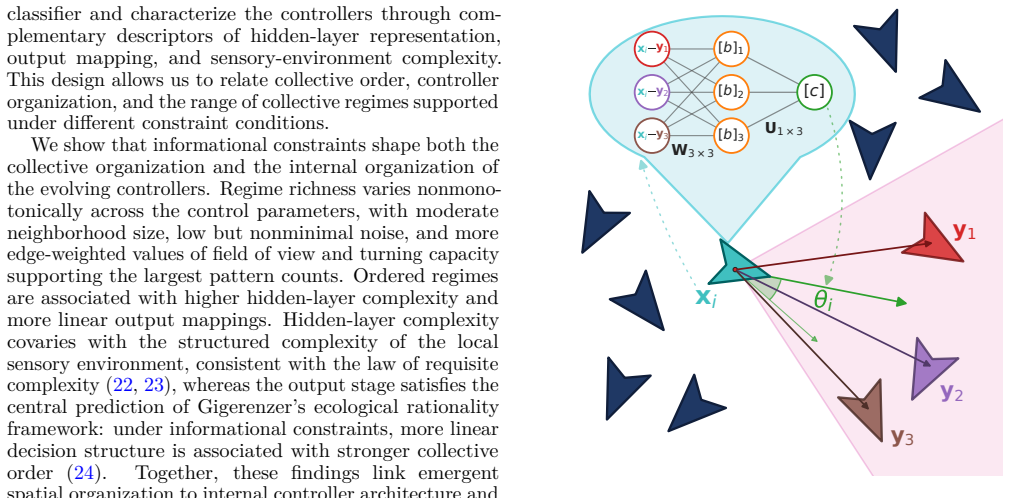
Under sensing and actuation limits, the most ordered collectives raise internal complexity while simplifying action mappings.
full image
Complexity Reveals the Microscopic Origins of Macroscopic Dynamics
Laplacian modes localize so collective transitions follow from local node behavior and couplings rather than global spectra.
full image
Social welfare optimisation under institutional reward and punishment
Rewards beat punishments for given budgets under explicit conditions derived for finite populations in social dilemmas
full image
Decomposition of Anomalous Diffusion in two-state random walks
Two-state models produce Noah and Moses effects on top of the Joseph effect from Levy walks alone via power-law switching times.
full image
Agnosiophobia in a virtual agent: behavioral and dynamical architecture in Lenia
By changing heading in information-free areas, the patterns treat morphology stability as a guiding constraint.
Method recovers accurate continuum models from multiple noisy stochastic trajectories of online-offline social activity, outperforming stand
full image
Common Noise-Induced Group-Level Synchronization Between Uncoupled Groups of Oscillators
Shared noise makes collective order parameters of separate groups synchronize even without inter-group coupling.
full image
A Multiscale Kinetic Framework for Image Segmentation: From Particle Systems to Continuum Models
Coupled rules in position and feature space scale to a first-order equation that drives particle optimisation for noisy images.
full image
Symbiosis as a systemic catalyst and the impossibility of coalitions in optimal networks
In anti-coordination games, global optima are strong equilibria, but coalitions are needed to escape suboptimal traps toward maximum resilie
Two silver particle systems under electric field show only one reaching high EPR while overall rate falls short of possible maximum
full image
Self-consistent analysis of the Kuramoto model with higher-order interactions
Self-consistent approximations on finite hypergraphs tie the critical triadic strength to dyadic-triadic structural overlap without all-to-a
full image
Memory Uncertainty Relation and Harmonic Memory in Random Recurrent Networks
An inequality gives the minimum memory capacity set by input-driven changes; harmonic memory reaches it and noise can exceed it under regula
full image
Learning Dynamic Stability Landscapes in Synchronization Networks
GNN encoder plus CNN decoder predicts per-node image targets, generalizing across sizes and to real power grids.
full image
Network Attractors driven by Time-Delay Plasticity
Activity-dependent axonal delay changes produce collective rhythms and explosive oscillations in phase oscillator models on brain data and环s
full image
A Utility-Driven Bounded-Confidence Model for Opinion Dynamics
A bounded-confidence model yields an SDE for mean opinion whose stationary distribution follows the utility landscape.
full image
GDP-driven heterogeneity produces on-off intermittency with power-law phase durations in chaotic models
full image