Feedback dynamics in matching networks drive behavioral differentiation despite overlapping objectives
Pith reviewed 2026-07-01 02:18 UTC · model grok-4.3
The pith
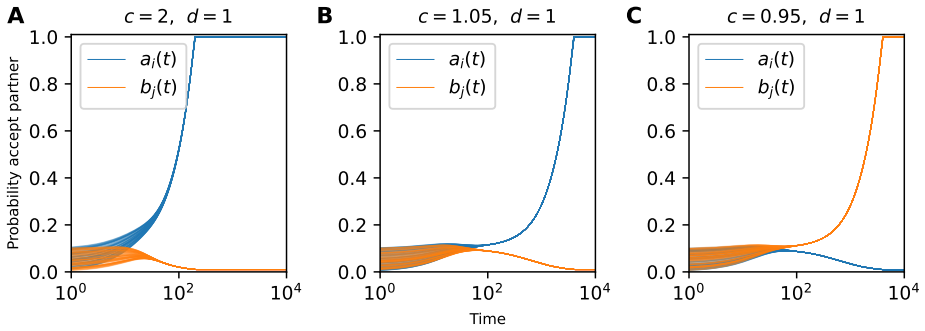
Feedback from repeated matching pushes one group to high selectivity and the other to low, even when their target rates overlap almost completely.
A machine-rendered reading of the paper's core claim, the machinery that carries it, and where it could break.
Core claim
When encounters are frequent enough, the adaptation dynamics converge to a unique equilibrium in which one group is highly selective and the other is non-selective; this qualitative split persists for heterogeneous populations whose target matching rates are drawn from overlapping, nearly indistinguishable distributions.
What carries the argument
The closed feedback loop in which one side's rise in selectivity reduces the other side's matching opportunities, prompting the second side to lower its selectivity threshold, which in turn increases opportunities for the first side.
If this is right
- Raising the encounter rate sharpens the selectivity split until one side rejects almost all offers and the other accepts almost all.
- The equilibrium split is insensitive to the precise initial selectivity values once encounters become frequent.
- Even small differences in the overlap of the two target-rate distributions do not eliminate the polarization.
- The same qualitative outcome appears in both analytic fixed-point analysis and numerical simulations of the adaptation rule.
Where Pith is reading between the lines
- The result suggests a simple way to test market interventions: artificially increasing encounter frequency should increase behavioral differentiation on real platforms.
- The mechanism could be checked in controlled experiments by giving participants explicit target rates and varying the rate at which they see potential matches.
- If the assumption of a fixed personal target is relaxed to allow targets that themselves adapt, the polarization might weaken or disappear.
Load-bearing premise
People change selectivity only in response to whether they are above or below their fixed personal target matching rate, and the resulting dynamics always reach one stable equilibrium rather than cycling or settling at multiple points.
What would settle it
A simulation or experiment that raises encounter frequency yet ends with both groups retaining similar, intermediate selectivity levels instead of splitting into high and low.
Figures


read the original abstract
Many bipartite social networks exhibit pronounced asymmetries in selectivity and matching opportunities: members of one side can afford to be highly selective, while members of the opposite side are forced to accept less desirable matches. While it is natural to try to explain this asymmetry in terms of the intrinsic characteristics of the two sides or other exogenous factors, here we show that such asymmetries can also emerge endogenously through a feedback process generated by the matching process itself: as one side becomes more selective, the other side is pushed to be less selective due to reduced matching opportunities, and vice versa. We develop a model in which individuals repeatedly form one-to-one matches across two groups and adapt their selectivity to achieve a target matching rate. Using both analytic and numerical methods, we show that when encounters are sufficiently frequent, the unique equilibrium is for one group to be highly selective and the other non-selective. This qualitative outcome holds even for heterogeneous groups with overlapping, almost indistinguishable distributions of target matching rates. The model makes several testable predictions, and it provides a mechanism for behavioral differentiation in repeated matching environments, with applications ranging from online dating to hiring and housing markets.
Editorial analysis
A structured set of objections, weighed in public.
Referee Report
Summary. The paper claims that in bipartite matching networks, individuals adapt their selectivity to achieve fixed personal target matching rates, generating a feedback process that produces a unique stable equilibrium with strong behavioral asymmetry (one group highly selective, the other non-selective) when encounter frequency exceeds a threshold. This outcome is shown via analytic fixed-point analysis and numerical integration of the dynamics, and it persists even for heterogeneous groups whose target matching rate distributions overlap almost completely.
Significance. If the central result holds, the work supplies a parsimonious endogenous mechanism for observed selectivity asymmetries in repeated matching markets (dating, hiring, housing) that does not require exogenous group differences. The model yields several testable predictions and isolates encounter frequency as the key control parameter driving differentiation.
major comments (2)
- [Abstract and §3] Abstract and §3 (model description): the uniqueness and stability of the equilibrium are asserted on the basis of analytic fixed-point analysis and numerical integration, yet the manuscript must supply the explicit derivation, including the fixed-point equation, Jacobian or Lyapunov stability argument, and handling of the heterogeneous case, so that readers can verify absence of post-hoc assumptions or parameter tuning.
- [Numerical results section] Numerical results section: convergence criteria, integration step size, and sensitivity to initial conditions or stochastic encounter realizations should be reported with quantitative error bounds; without these, it remains unclear whether the reported asymmetry is robust or an artifact of the simulation protocol.
minor comments (2)
- Define the precise functional form of the selectivity-update rule (e.g., continuous or discrete adjustment) and the distribution from which heterogeneous target rates are drawn; a short appendix tabulating parameter values used in all figures would improve reproducibility.
- Clarify whether the encounter-frequency threshold is derived endogenously or imposed exogenously; if the latter, state its value explicitly in the main text rather than only in figure captions.
Simulated Author's Rebuttal
We thank the referee for their constructive comments, which identify opportunities to strengthen the transparency of both the analytic and numerical components of the work. We address each point below and will incorporate the requested details in the revised manuscript.
read point-by-point responses
-
Referee: [Abstract and §3] Abstract and §3 (model description): the uniqueness and stability of the equilibrium are asserted on the basis of analytic fixed-point analysis and numerical integration, yet the manuscript must supply the explicit derivation, including the fixed-point equation, Jacobian or Lyapunov stability argument, and handling of the heterogeneous case, so that readers can verify absence of post-hoc assumptions or parameter tuning.
Authors: We agree that the explicit derivations are necessary for full verification. The revised Section 3 will present the fixed-point equation obtained by setting the time derivatives of selectivity to zero, the Jacobian matrix evaluated at the candidate equilibria for the homogeneous case, and the corresponding eigenvalue analysis establishing local stability. For the heterogeneous case we will derive the analogous fixed-point condition under the overlapping target-rate distributions and discuss why the asymmetric solution remains the unique stable attractor. These additions will be placed immediately after the model equations. revision: yes
-
Referee: [Numerical results section] Numerical results section: convergence criteria, integration step size, and sensitivity to initial conditions or stochastic encounter realizations should be reported with quantitative error bounds; without these, it remains unclear whether the reported asymmetry is robust or an artifact of the simulation protocol.
Authors: We will expand the numerical methods subsection to specify the Euler integration step size, the convergence tolerance (maximum change in selectivity vector per 100 steps), results of sweeps over a range of initial conditions, and quantitative error bounds obtained from 50 independent stochastic realizations (mean and standard deviation of the final selectivity values). These diagnostics will be reported both in the text and in a new supplementary table. revision: yes
Circularity Check
No significant circularity
full rationale
The paper constructs a dynamical model in which agents adjust selectivity parameters solely to meet fixed, exogenous target matching rates; the claimed asymmetry is then shown to be the unique stable fixed point of the resulting feedback equations when encounter frequency exceeds a threshold. Both the analytic fixed-point derivation and the numerical integration follow directly from the stated adaptation rule and the bipartite matching process without any parameter being fitted to the output asymmetry, without self-referential definitions of selectivity in terms of the equilibrium itself, and without load-bearing self-citations. The target distributions remain independent inputs, so the qualitative outcome is a genuine consequence of the model rather than a restatement of its assumptions.
Axiom & Free-Parameter Ledger
free parameters (2)
- target matching rate per individual
- encounter frequency threshold
axioms (1)
- domain assumption The adaptation dynamics converge to a unique stable equilibrium under high encounter frequency
Reference graph
Works this paper leans on
-
[1]
2021 Webinar on the Job Market for New Economics Ph.D.s (Part 1) , year =
2021
-
[2]
JOE Network , year =
-
[3]
Job Market Graphs: Job Openings for Economists , year =
-
[4]
Journal of Economic Theory , volume=
A search model of two-sided matching under nontransferable utility , author=. Journal of Economic Theory , volume=. 2003 , publisher=
2003
-
[5]
Journal of Political Economy , volume=
Unbalanced random matching markets: The stark effect of competition , author=. Journal of Political Economy , volume=. 2017 , publisher=
2017
-
[6]
Sex roles , volume=
Has dating become more egalitarian? A 35 year review using sex roles , author=. Sex roles , volume=. 2011 , publisher=
2011
-
[7]
Sex Roles , volume=
Young singles' contemporary dating scripts , author=. Sex Roles , volume=. 1993 , publisher=
1993
-
[8]
and Simon, William , title =
Gagnon, John H. and Simon, William , title =. 1973 , publisher =
1973
-
[9]
and Simon, William , title =
Gagnon, John H. and Simon, William , title =. Society , year =
-
[10]
Journal of evolutionary biology , volume=
Parental investment, sexual selection and sex ratios , author=. Journal of evolutionary biology , volume=. 2008 , publisher=
2008
-
[11]
Annual review of psychology , volume=
Mate preferences and their behavioral manifestations , author=. Annual review of psychology , volume=. 2019 , publisher=
2019
-
[12]
Nature communications , volume=
Coevolution of parental investment and sexually selected traits drives sex-role divergence , author=. Nature communications , volume=. 2016 , publisher=
2016
-
[13]
Philosophical Transactions of the Royal Society B: Biological Sciences , volume=
Positive feedback and alternative stable states in inbreeding, cooperation, sex roles and other evolutionary processes , author=. Philosophical Transactions of the Royal Society B: Biological Sciences , volume=
-
[14]
The Public and Online Dating in 2025 , year =
2025
-
[15]
Journal of Economic Theory , volume=
Stable marriages and search frictions , author=. Journal of Economic Theory , volume=. 2014 , publisher=
2014
-
[16]
2000 , publisher=
Equilibrium unemployment theory , author=. 2000 , publisher=
2000
-
[17]
1996 , publisher=
Projected dynamical systems and variational inequalities with applications , author=. 1996 , publisher=
1996
-
[18]
2013 , publisher=
Differential equations with discontinuous righthand sides: control systems , author=. 2013 , publisher=
2013
-
[19]
2022 , publisher=
Learning in the marriage market: The economics of dating , author=. 2022 , publisher=
2022
-
[20]
Handbook of the Economics of Matching , volume=
Matching with frictions , author=. Handbook of the Economics of Matching , volume=. 2025 , publisher=
2025
-
[21]
Journal of Economic Literature , volume=
Sorting through search and matching models in economics , author=. Journal of Economic Literature , volume=. 2017 , publisher=
2017
-
[22]
Frictional matching models , author=. Annu. Rev. Econ. , volume=. 2011 , publisher=
2011
-
[23]
Ecology letters , volume=
Predicting the direction of sexual selection , author=. Ecology letters , volume=. 2001 , publisher=
2001
-
[24]
Philosophical Transactions of the Royal Society of London
Why is mutual mate choice not the norm? Operational sex ratios, sex roles and the evolution of sexually dimorphic and monomorphic signalling , author=. Philosophical Transactions of the Royal Society of London. Series B: Biological Sciences , volume=. 2002 , publisher=
2002
-
[25]
Journal of sex research , volume=
Sexual double standards: A review and methodological critique of two decades of research , author=. Journal of sex research , volume=. 2003 , publisher=
2003
-
[26]
Behavioral Sciences , volume=
Sex differences in sexual motivation in humans and other mammals: The role of conscious and unconscious processes , author=. Behavioral Sciences , volume=. 2024 , publisher=
2024
-
[27]
Psychological science , volume=
Sex differences in mate preferences across 45 countries: A large-scale replication , author=. Psychological science , volume=. 2020 , publisher=
2020
-
[28]
2006 , publisher=
Adapting minds: Evolutionary psychology and the persistent quest for human nature , author=. 2006 , publisher=
2006
-
[29]
Studies in History and Philosophy of Science Part C: Studies in History and Philosophy of Biological and Biomedical Sciences , volume=
It takes two: sexual strategies and game theory , author=. Studies in History and Philosophy of Science Part C: Studies in History and Philosophy of Biological and Biomedical Sciences , volume=. 2010 , publisher=
2010
-
[30]
, author=
Gender differences in sexuality: a meta-analysis. , author=. Psychological bulletin , volume=. 1993 , publisher=
1993
-
[31]
Behavioral and Brain sciences , volume=
Sociosexuality from Argentina to Zimbabwe: A 48-nation study of sex, culture, and strategies of human mating , author=. Behavioral and Brain sciences , volume=. 2005 , publisher=
2005
-
[32]
2013 , url =
Jon Millward , title =. 2013 , url =
2013
-
[33]
, author=
Perceived proposer personality characteristics and gender differences in acceptance of casual sex offers. , author=. Journal of personality and social psychology , volume=. 2011 , publisher=
2011
-
[34]
Journal of Applied Social Psychology , volume=
The impact of AIDS on gender differences in willingness to engage in casual sex , author=. Journal of Applied Social Psychology , volume=. 1990 , publisher=
1990
-
[35]
The Journal of Social Psychology , pages=
Gender differences in receptivity to sexual invitations: two naturalistic replication studies , author=. The Journal of Social Psychology , pages=. 2024 , publisher=
2024
-
[36]
Psychological Inquiry , volume=
The ape that thought it was a peacock: Does evolutionary psychology exaggerate human sex differences? , author=. Psychological Inquiry , volume=. 2013 , publisher=
2013
-
[37]
Archives of sexual behavior , volume=
Effects of solicitor sex and attractiveness on receptivity to sexual offers: A field study , author=. Archives of sexual behavior , volume=. 2011 , publisher=
2011
-
[38]
Evolution and Human Behavior , volume=
Receptivity to sexual invitations from strangers of the opposite gender , author=. Evolution and Human Behavior , volume=. 2010 , publisher=
2010
-
[39]
Archives of sexual behavior , volume=
Gender differences and similarities in receptivity to sexual invitations: Effects of location and risk perception , author=. Archives of sexual behavior , volume=. 2015 , publisher=
2015
-
[40]
, author=
A meta-analytic review of research on gender differences in sexuality, 1993--2007. , author=. Psychological bulletin , volume=. 2010 , publisher=
1993
-
[41]
Psychology of Women Quarterly , volume=
Backlash from the bedroom: Stigma mediates gender differences in acceptance of casual sex offers , author=. Psychology of Women Quarterly , volume=. 2013 , publisher=
2013
-
[42]
Journal of Psychology & Human Sexuality , volume=
Gender differences in receptivity to sexual offers , author=. Journal of Psychology & Human Sexuality , volume=. 1989 , publisher=
1989
-
[43]
2016 , publisher=
The evolution of desire: Strategies of human mating , author=. 2016 , publisher=
2016
-
[44]
Journal of personality , volume=
Evolution, traits, and the stages of human courtship: Qualifying the parental investment model , author=. Journal of personality , volume=. 1990 , publisher=
1990
-
[45]
2016 IEEE/ACM International Conference on Advances in Social Networks Analysis and Mining (
A first look at user activity on tinder , author=. 2016 IEEE/ACM International Conference on Advances in Social Networks Analysis and Mining (. 2016 , organization=
2016
-
[46]
, author=
The origins of sex differences in human behavior: Evolved dispositions versus social roles. , author=. American psychologist , volume=. 1999 , publisher=
1999
-
[47]
Sexual selection and the descent of man , pages=
Parental investment and sexual selection , author=. Sexual selection and the descent of man , pages=. 1972 , publisher=
1972
-
[48]
The American mathematical monthly , volume=
College admissions and the stability of marriage , author=. The American mathematical monthly , volume=. 1962 , publisher=
1962
-
[49]
Handbook of game theory with economic applications , volume=
Two-sided matching , author=. Handbook of game theory with economic applications , volume=. 1992 , publisher=
1992
discussion (0)
Sign in with ORCID, Apple, or X to comment. Anyone can read and Pith papers without signing in.