pith. sign in

Pre-print review for science

Pith reads preprints, records what the machine reviewer saw, and leaves a trace authors and readers can challenge.

7
cs.SE 2026-07-01

Models reach 13.8% on executable state changes in Scratch tests

by Yufeng Lin, Jialu Zhang

ScratchWorld: Evaluating If World Models Compute Executable Consequences

Benchmark uses verified VM transitions to separate rule-following from copied persistent state.

Figure from the paper full image
abstract click to expand
World-model evaluations often score a predicted future by overlap with a target state or observation. In sparse-change worlds, this can turn copied persistent state into apparent accuracy. We introduce ScratchWorld, an offline diagnostic benchmark that treats Scratch projects as executable worlds and uses a pinned Scratch VM to produce replay-verified transitions, hidden variables, causal traces, and counterfactual outcomes. ScratchWorld evaluates next-state prediction, long-horizon tracking, causal event attribution, and counterfactual prediction; each replay-verified target can be presented under raw-program, structured-state, natural-language, or rendered input modalities, and our experiments use the structured-state condition. Its primary state metric is value-aware changed-field $F_1$, which gives credit only for the changed field and its executed value. In a 659-example release, seven prompted language/reasoning models reach at most 13.8% value-aware changed-field $F_1$ in a state-only partial-observation stress test. A same-instance copy diagnostic makes the overlap confound concrete: copying the input state reaches 98.0% implied full-state field accuracy and 0.0% changed-field $F_1$, with the largest inflation on real projects. Auxiliary diagnostics separate hidden-state rollout drift, intervention sensitivity, causal attribution, and perturbation robustness. Across these settings, models often react to actions or interventions without following the executable rule that determines the changed value.
4 0
8
hep-ph 2026-07-01

N3LO corrections to boosted WH production reach +2%

by Aude Gehrmann-De Ridder, Alexander Huss +6 more

Boosted Higgs-strahlung off a W boson at next-to-next-to-next-to-leading order in QCD

The shift typically exceeds the NNLO scale band while shrinking residual theory uncertainty below one percent

Figure from the paper full image
abstract click to expand
The production of a boosted Higgs boson in association with a charged weak ($W$) boson is a key process to scrutinize the electroweak symmetry breaking mechanism at hadron colliders. This reaction constitutes the dominant Higgs production channel at large transverse momentum, providing unique sensitivity to Higgs-boson interactions with other Standard Model particles as well as to physics beyond the Standard Model. In this Letter, we present the first fully differential calculation of this important scattering process at next-to-next-to-next-to-leading order (N$^3$LO) in perturbative Quantum Chromodynamics (QCD). We find that the N$^3$LO corrections, amounting to approximately $+2\%$ in the boosted regime, generally lie at the edge of or outside the standard scale variation band of the previous perturbative order. The residual dependence of the N$^3$LO prediction on perturbative scales is reduced to below the percent level, marking a milestone for the Higgs precision program.
0
1
cond-mat.mes-hall 2026-06-30

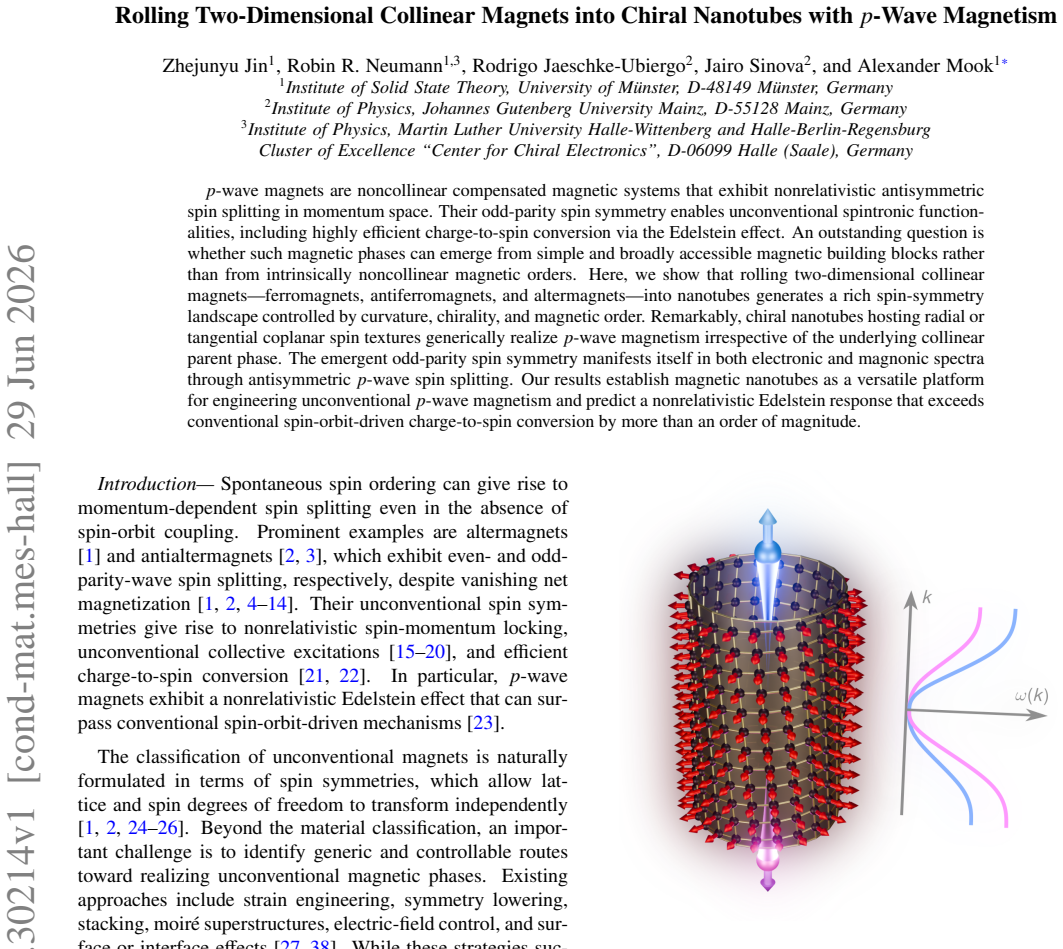
Chiral nanotubes realize p-wave magnetism from collinear parents

by Zhejunyu Jin, Robin R. Neumann +3 more

Rolling Two-Dimensional Collinear Magnets into Chiral Nanotubes with p-Wave Magnetism

Rolling 2D collinear magnets yields odd-parity spin symmetry and large nonrelativistic Edelstein response independent of the original order

Figure from the paper full image
abstract click to expand
$p$-wave magnets are noncollinear compensated magnetic systems that exhibit nonrelativistic antisymmetric spin splitting in momentum space. Their odd-parity spin symmetry enables unconventional spintronic functionalities, including highly efficient charge-to-spin conversion via the Edelstein effect. An outstanding question is whether such magnetic phases can emerge from simple and broadly accessible magnetic building blocks rather than from intrinsically noncollinear magnetic orders. Here, we show that rolling two-dimensional collinear magnets -- ferromagnets, antiferromagnets, and altermagnets -- into nanotubes generates a rich spin-symmetry landscape controlled by curvature, chirality, and magnetic order. Remarkably, chiral nanotubes hosting radial or tangential coplanar spin textures generically realize $p$-wave magnetism irrespective of the underlying collinear parent phase. The emergent odd-parity spin symmetry manifests itself in both electronic and magnonic spectra through antisymmetric $p$-wave spin splitting. Our results establish magnetic nanotubes as a versatile platform for engineering unconventional $p$-wave magnetism and predict a nonrelativistic Edelstein response that exceeds conventional spin-orbit-driven charge-to-spin conversion by more than an order of magnitude.
2 0
1
cs.RO 2026-06-29

Physics models cut table tennis ball prediction error by 59%

by Christian Conti (1), Bilan Yang (1) +10 more

Physics Models for Sim-to-Real Transfer in Professional-Level Robot Table Tennis

Aerodynamic, buckling, and residual-contact models enable RL policies that compete against professional players after sim-to-real transfer.

Figure from the paper full image
abstract click to expand
At competitive speeds and spins, a table tennis ball follows complex, counterintuitive trajectories that a robot must track and precisely counter within fractions of a second. Training a reinforcement learning policy capable of these skills is prohibitively expensive and dangerous in the real world, making high-fidelity simulation essential. Transferability of such policies, however, critically depends on how faithfully the simulation captures real-world dynamics - a requirement made even more stringent by the adversarial nature of the game, where any modeling inaccuracy becomes an exploitable weakness for the opponent. Prior state-of-the-art in robot table tennis generally focuses on a limited range of velocities and spins and fails to capture the richness of ball behaviors encountered in professional-level play. In this work, we present physics models for aerodynamic ball flight, ball-table contact, and ball-racket contact. that accurately capture the ball behavior over a vast range of speeds and spins relevant to the game. Specifically, we model drag and Magnus force coefficients as functions of Reynolds number and spin ratio in the aerodynamics equations. For the table contact model we model effects of ball buckling on the coefficient of restitution and incorporate residuals into the instantaneous point-contact models. For the racket contact model, we introduce a residual neural network component to complement coefficients related to normal and tangential coefficients of restitution as well as torsional spin damping. Evaluated on an unprecedentedly large dataset of competitive matches (277 games), the proposed models significantly reduces prediction errors (e.g., 59% median landing-position error reduction). The resulting models were used to train the RL policies for the first real-world robot table tennis AI agent capable of competing against professional players.
1 0
1
cs.RO 2026-06-29

Physics models transfer table tennis RL policies to real robot vs pros

by Christian Conti (1), Bilan Yang (1) +10 more

Physics Models for Sim-to-Real Transfer in Professional-Level Robot Table Tennis

Aerodynamics and contact models match professional speeds and spins, enabling the first sim-trained competitive agent.

Figure from the paper full image
abstract click to expand
At competitive speeds and spins, a table tennis ball follows complex, counterintuitive trajectories that a robot must track and precisely counter within fractions of a second. Training a reinforcement learning policy capable of these skills is prohibitively expensive and dangerous in the real world, making high-fidelity simulation essential. Transferability of such policies, however, critically depends on how faithfully the simulation captures real-world dynamics - a requirement made even more stringent by the adversarial nature of the game, where any modeling inaccuracy becomes an exploitable weakness for the opponent. Prior state-of-the-art in robot table tennis generally focuses on a limited range of velocities and spins and fails to capture the richness of ball behaviors encountered in professional-level play. In this work, we present physics models for aerodynamic ball flight, ball-table contact, and ball-racket contact. that accurately capture the ball behavior over a vast range of speeds and spins relevant to the game. Specifically, we model drag and Magnus force coefficients as functions of Reynolds number and spin ratio in the aerodynamics equations. For the table contact model we model effects of ball buckling on the coefficient of restitution and incorporate residuals into the instantaneous point-contact models. For the racket contact model, we introduce a residual neural network component to complement coefficients related to normal and tangential coefficients of restitution as well as torsional spin damping. Evaluated on an unprecedentedly large dataset of competitive matches (277 games), the proposed models significantly reduces prediction errors (e.g., 59% median landing-position error reduction). The resulting models were used to train the RL policies for the first real-world robot table tennis AI agent capable of competing against professional players.
1 0
5
q-fin.MF 2026-06-29

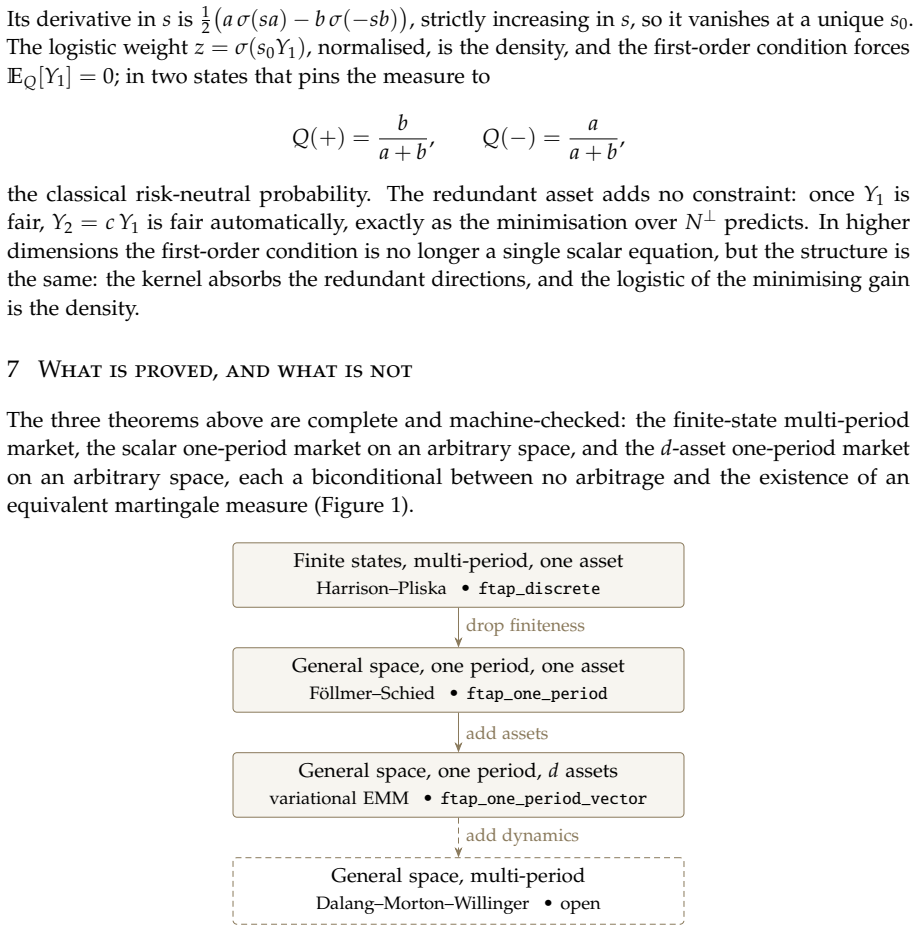
Lean 4 verifies arbitrage-free markets admit martingale measures

by Raphael Coelho

The Fundamental Theorem of Asset Pricing, Formalized in Lean 4

Explicit minimization of a convex potential replaces Hahn-Banach in the multi-asset one-period case.

Figure from the paper full image
abstract click to expand
The Fundamental Theorem of Asset Pricing states that a market is free of arbitrage exactly when it admits an equivalent martingale measure. We formalize it in Lean 4 over Mathlib in three settings: a finite-state market over a finite horizon (Harrison-Pliska), a one-period market on an arbitrary probability space with a single scalar return (Follmer-Schied), and a one-period market with finitely many assets. The finite case is the geometry of a separating hyperplane; the scalar one-period case is an elementary change of measure. In the $d$-asset case the equivalent martingale measure is constructed explicitly, as the minimiser of the smooth convex potential $\mathbb{E}[\log(1+e^{\langle\theta,Y\rangle})]$: absence of arbitrage is precisely coercivity of the potential, its first-order condition is the martingale property, and the minimiser's logistic weight is the density of the measure. The construction uses no Hahn-Banach theorem, no $L^0$-closedness argument, no measurable selection, and no non-redundancy hypothesis. To our knowledge this is the first machine-checked Fundamental Theorem of Asset Pricing in any proof assistant. The boundary is explicit: the general multi-period Dalang-Morton-Willinger theorem lies outside the development. Every theorem is sorry-free, each headline result's axioms are pinned to Mathlib's classical defaults by a build-enforced gate, and the whole is reproducible from a pinned toolchain.
0
5
math.LO 2026-06-29

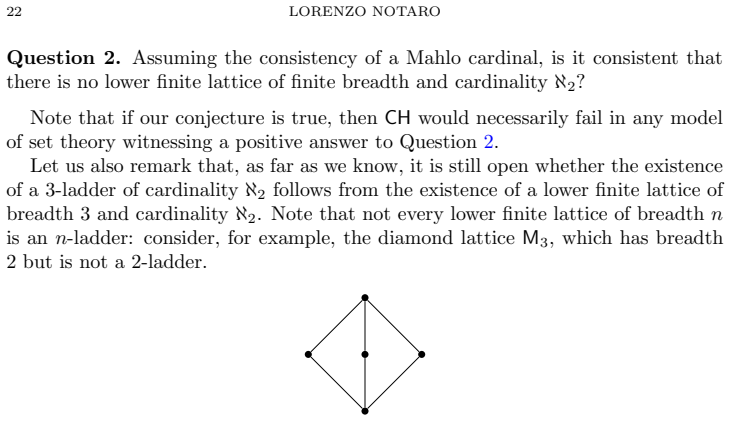
Nonexistence of 3-ladders at ℵ₂ matches Mahlo consistency

by Lorenzo Notaro

A solution to Ditor's problem

Ditor's 1984 question on whether the size bound ℵ_{n-1} is attained for n=3 is independent of ZFC.

Figure from the paper full image
abstract click to expand
We settle the long-standing open question whether there exists a $3$-ladder of cardinality $\aleph_2$. Given a positive integer $n$, an $n$-ladder is a lower finite lattice whose elements have at most $n$ lower covers. In 1984, Ditor proved that every $n$-ladder has cardinality at most $\aleph_{n-1}$, and that this cardinal bound is sharp for $n = 1,2$. He then raised the question of whether the bound is attained for $n\ge 3$ as well. An affirmative answer is known to be consistent with $\mathsf{ZFC}$. We prove, relative to the consistency of a Mahlo cardinal, that the question is independent of $\mathsf{ZFC}$. More precisely, we show that the nonexistence of a $3$-ladder of cardinality $\aleph_2$ is equiconsistent with a Mahlo cardinal.
0
4
physics.optics 2026-05-22 2 theorems

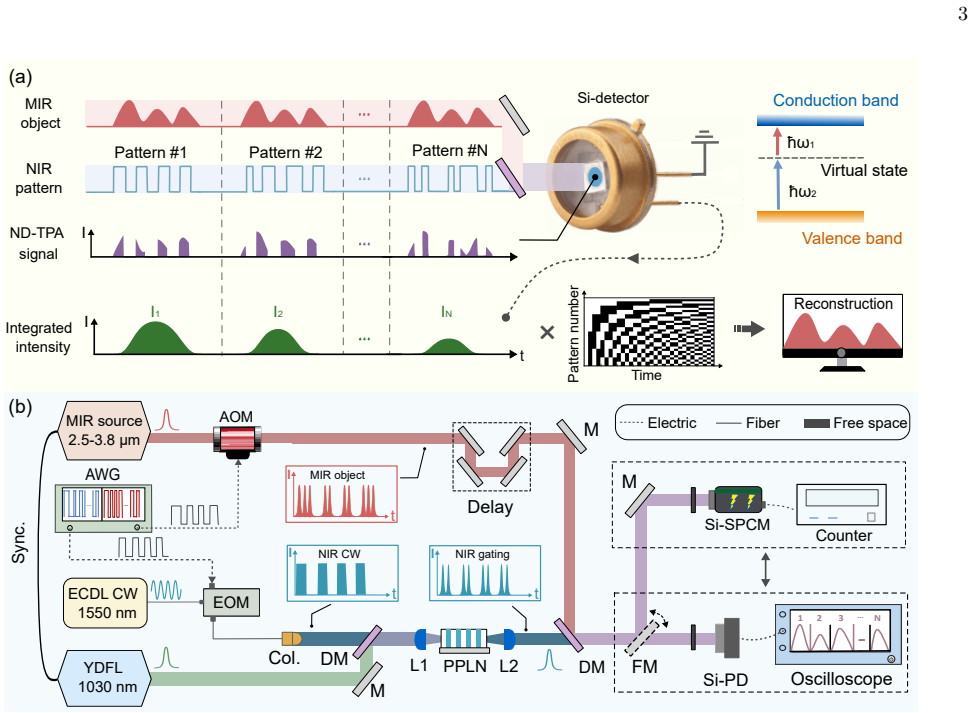
Two-photon absorption at silicon enables 40x bandwidth MIR ghost imaging

by Ziyu He, Kun Huang +4 more

Mid-infrared temporal ghost imaging via two-photon structured encoding

Compact system transfers near-IR modulation to mid-IR signals for high-sensitivity detection across 2.5-3.8 μm without crystals.

Figure from the paper full image
abstract click to expand
Temporal ghost imaging (TGI) enables ultrafast signal reconstruction beyond electronic bandwidth limits. Extending this concept to the mid-infrared (MIR) regime through nonlinear frequency conversion offers new opportunities for high-fidelity temporal detection, but remains constrained by stringent phase-matching condition, limited spectral coverage, and intricate optical alignment. Here, we propose and demonstrate a broadband MIR TGI system based on non-degenerate two-photon absorption. A temporally encoded near-infrared pump transfers structured modulation onto a MIR signal directly at a silicon detector, which facilitates concurrent modulation and detection without external nonlinear crystals. The reconstructed temporal waveforms exceed the detector bandwidth by more than fortyfold, achieve a detection sensitivity of 0.05 pJ/pulse, allow compressed sensing with 80\% fewer measurements, and support broadband operation across 2.5-3.8 $\mu$m. This compact, alignment-free, and room-temperature system establishes a practical route for fast and sensitive MIR time-domain analysis, holding great promise for applications in time-resolved molecular spectroscopy, high-precision infrared ranging, and high-speed free-space communication.
1 0
8
physics.bio-ph 2026-05-25 2 theorems

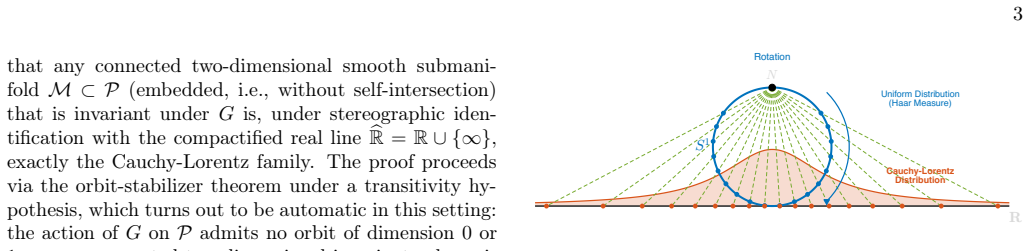
Lorentzian family is unique invariant under Riccati transport

by Hugues Berry (AISTROSIGHT), Leonardo Trujillo (AISTROSIGHT)

Geometric Origin of Exact Mean-Field Reductions: M{\"o}bius Symmetry and the Lorentzian Ansatz

Reformulating dynamics on the circle shows the Cauchy law is the sole rotation-invariant measure, unifying exact mean-field reductions.

Figure from the paper full image
abstract click to expand
Low-dimensional descriptions of large systems of coupled oscillators and spiking neurons rely heavily on the Lorentzian Ansatz. We show that its privileged role is geometric rather than heuristic: for the transport induced by Riccati dynamics, the Cauchy-Lorentz family indeed emerges as the unique connected two-dimensional family of continuous probability densities that is invariant under the induced projective transport. The key step of the demonstration is to reformulate the dynamics on the circle, where the problem reduces to the uniqueness of the rotation-invariant probability measure. Under stereographic projection, this yields the standard Cauchy law and, under the full projective action, the Lorentzian family. This result gives a unified geometric foundation for the Ott-Antonsen [Chaos 18, 037113 (2008)] and Montbri{\'o}-Paz{\'o}-Roxin [Phys. Rev. X 5, 021028 (2015)] reductions, explains the failure of Gaussian closures, and identifies the structural condition underlying exact two-parameter reductions.
0
1
cs.IT 2026-06-26

Multi-distribution functionals reduce to integrals of coincidence divergences

by Akshay Balsubramani

All you need is log

Monotonicity under data processing and additivity on independent products force every such functional to an integral over four strata

Figure from the paper full image
abstract click to expand
Comparing two probability distributions is a basic building block of statistics and machine learning, and the right family is well understood: the R\'enyi divergences of order $\alpha\in[0,\infty]$ are the unique family monotone under data processing and additive on independent products. Many problems instead compare more than two distributions at once -- multi-population fairness, multi-prior PAC-Bayes bounds, multi-hypothesis testing -- and the right multi-distribution generalization of the R\'enyi family has been an open question. We characterize it. Every functional of $W$-tuples of distributions that is monotone under data processing and additive on independent products is a positive integral of multi-way coincidence divergences $C_{\alpha}(\pi_1,\dots,\pi_W) := -\log\int \pi_1^{\alpha_1}\cdots\pi_W^{\alpha_W}$ (with $\sum_k \alpha_k = 1$) over a parameter space with four strata: the simplex interior; mixed-sign exponent cones (the analogue of R\'enyi orders $>1$); a tropical boundary at infinity carrying max-divergences; and pairwise Kullback-Leibler edges at the simplex vertices. Each stratum is necessary -- the destination of an explicit data-processing-monotone, product-additive divergence the others cannot reproduce -- and each is a clean limit of simplex-interior atoms. The same family arises from several independent routes -- the structural axioms, Kolmogorov-Nagumo means with R\'enyi's entropy axiomatics, classical entropy characterizations, multi-hypothesis testing error exponents, and a multi-lottery betting interpretation -- structural evidence that this is the canonical multi-distribution R\'enyi calculus rather than an artefact of any one axiomatic input. The two-prior case recovers the standard R\'enyi result; a worked $W=3$ instance, numerical verification, and a conditional extension round out the treatment.
1 0
1
cs.IT 2026-06-26

Axioms characterize all multi-distribution Renyi functionals

by Akshay Balsubramani

All you need is log

Monotonicity under data processing and additivity on products force every such functional to be an integral of coincidence divergences over

Figure from the paper full image
abstract click to expand
Comparing two probability distributions is a basic building block of statistics and machine learning, and the right family is well understood: the R\'enyi divergences of order $\alpha\in[0,\infty]$ are the unique family monotone under data processing and additive on independent products. Many problems instead compare more than two distributions at once -- multi-population fairness, multi-prior PAC-Bayes bounds, multi-hypothesis testing -- and the right multi-distribution generalization of the R\'enyi family has been an open question. We characterize it. Every functional of $W$-tuples of distributions that is monotone under data processing and additive on independent products is a positive integral of multi-way coincidence divergences $C_{\alpha}(\pi_1,\dots,\pi_W) := -\log\int \pi_1^{\alpha_1}\cdots\pi_W^{\alpha_W}$ (with $\sum_k \alpha_k = 1$) over a parameter space with four strata: the simplex interior; mixed-sign exponent cones (the analogue of R\'enyi orders $>1$); a tropical boundary at infinity carrying max-divergences; and pairwise Kullback-Leibler edges at the simplex vertices. Each stratum is necessary -- the destination of an explicit data-processing-monotone, product-additive divergence the others cannot reproduce -- and each is a clean limit of simplex-interior atoms. The same family arises from several independent routes -- the structural axioms, Kolmogorov-Nagumo means with R\'enyi's entropy axiomatics, classical entropy characterizations, multi-hypothesis testing error exponents, and a multi-lottery betting interpretation -- structural evidence that this is the canonical multi-distribution R\'enyi calculus rather than an artefact of any one axiomatic input. The two-prior case recovers the standard R\'enyi result; a worked $W=3$ instance, numerical verification, and a conditional extension round out the treatment.
1 0
5
math.CO 2026-06-23

Tree vs multipartite Ramsey numbers bounded by bipartite case

by Eric Li (Trinity College, University of Cambridge)

A Resolution of ErdH{o}s Problem 550 on Tree versus Complete Multipartite Ramsey Numbers

R(T, K_{m1..mk}) ≤ (k-1)(R(T, K_{m1 m2})-1) + m1 holds for all large trees T, resolving Erdős question 550.

abstract click to expand
We resolve Erd\H{o}s Problem 550, originally asked as question (2) of Erd\H{o}s, Faudree, Rousseau, and Schelp. Precisely, for fixed integers $k\geq 2$ and $1\leq m_1\leq \cdots \leq m_k$, we prove that, for every sufficiently large $n$ and every $n$-vertex tree $T$, $R(T,K_{m_1,\ldots,m_k}) \leq (k-1)(R(T,K_{m_1,m_2})-1)+m_1$. The proof combines a new off-Tur\'an tree-embedding theorem with a compactness-and-rounding theorem for represented bounded-rank hypergraph obstructions. The embedding theorem follows from Szemer\'edi regularity and a local regular-matching embedding lemma of Hladk\'y and Piguet. The compactness argument uses shadow hypergraphs to retain obstructions whose vertices escape along the limiting sequence.
0
1
cs.GR 2026-05-29

3D scene graph plans portraits before shutter click

by Ruixiang Jiang, Chang Wen Chen

Before the Shutter: Aesthetic and Actionable Portrait Photography Planning in 3D Scenes

Generates human pose, camera, and lighting setups that raters prefer over post-capture baselines while staying physically valid.

Figure from the paper full image
abstract click to expand
Portrait photography is largely decided before the shutter opens: the subject's pose, the camera configuration, and the lighting devices must be coordinated within the surrounding 3D scene. In contrast, most existing computational methods focus on post-production in 2D image space, such as retouching, relighting, or editing images that already exist; pre-capture photographic planning remains largely unexplored. We introduce 3D aesthetic portrait planning, the task of generating human pose, camera, lighting, and exposure plans that produce visually compelling portraits while satisfying geometric and photometric feasibility in a 3D scene. Our approach builds a Photographic Scene Graph that represents scene affordances, subject-scene relations, and portrait-relevant lighting structure. Built on this representation, we perform aesthetic-guided comparative planning over previous attempts and current viewfinder observations. Experiments across diverse indoor and outdoor scenes show that our method produces portraits preferred by human raters and MLLM evaluators over competitive baselines, while maintaining high physical plausibility. Together, our results suggest a path from post-capture correction toward pre-capture computational portrait planning. Project repository: https://github.com/songrise/Before-the-Shutter
0
5
cs.CR 2026-06-26

Reverse engineering finds six flaws in AirDrop and Quick Share

by Arash Ale Ebrahim, Nils Ole Tippenhauer

Protocol Prying: Systematic Vulnerability Research in the Apple AirDrop and Android Quick Share Proximity Transfer Protocols

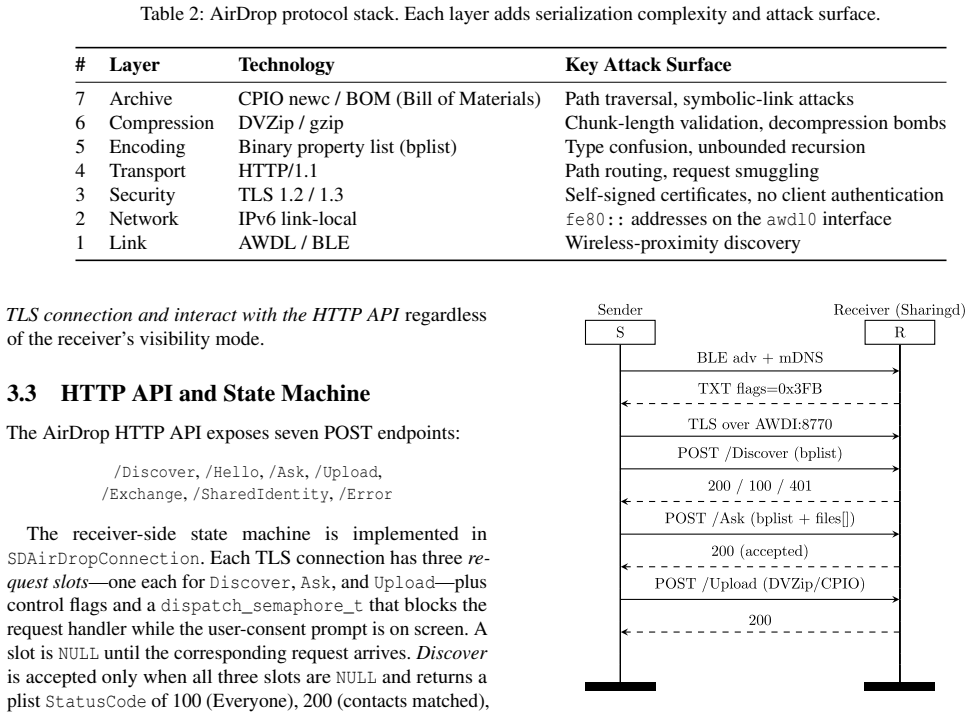
Protocols on over five billion devices accept complex untrusted data without pairing, exposing reachable denial-of-service and bypass paths.

Figure from the paper full image
abstract click to expand
Apple AirDrop and Google/Samsung Quick Share are proximity file-transfer protocols used by over five billion devices, yet their application-layer security properties remain largely unstudied because both stacks are proprietary and undocumented. Both protocols are reachable from wireless proximity without any prior pairing and process complex serialized content (binary plists, CPIO archives, Protocol Buffers, UKEY2 handshakes) inside privileged daemons, making them attractive zero-click targets across multiple operating systems. We perform the first cross-platform reverse engineering and protocol-aware fuzzing study of both stacks. We reconstruct AirDrop's seven-layer state machine and DVZip adaptive compression from binary analysis, build AIRFUZZ, a protocol-aware fuzzer that mutates pre-compression representations, and complement it with targeted hand-written analyses of Samsung's Quick Share service and Google's Quick Share for Windows. We discover six vulnerabilities (V1-V6): three pre-authentication issues in macOS/iOS AirDrop (V1: Swift fatalError DoS in the HTTP path router; V2: unbounded XML plist recursion in Foundation; V3: NULL dereference in Network.framework's HTTP/1.1 parser), two protocol-layer flaws in Samsung Quick Share (V4: pre-authentication OfflineFrame dispatch; V5: D2D encryption bypass for three frame types), and a heap use-after-free in Google Quick Share for Windows (V6) for which Google awarded a bounty. We responsibly disclosed all findings, and Apple, Samsung, and Google have acknowledged the reports.
0
5
astro-ph.GA 2026-06-24

Barred spiral galaxy found at z=5.102

by Xiaohan Wang, Fengwu Sun +22 more

A massive barred spiral galaxy at z = 5.102 discovered by JWST

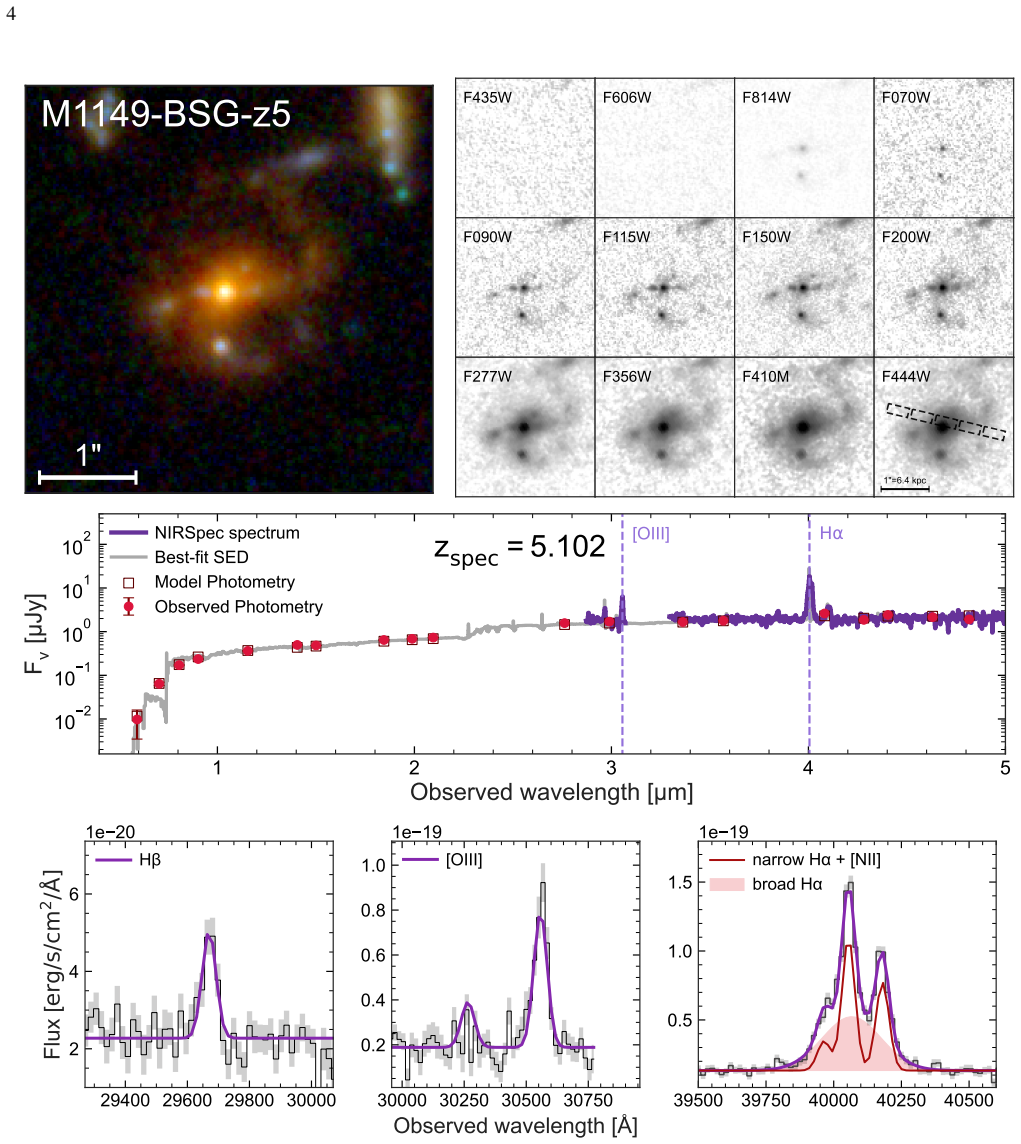
JWST imaging reveals a 4.5 kpc stellar bar and spiral arms in a massive disk galaxy only 1.2 billion years after the Big Bang.

Figure from the paper full image
abstract click to expand
We report M1149-BSG-z5, a barred spiral galaxy at $z = 5.102$, identified in the parallel field of MACS J1149+2223 with JWST and HST. M1149-BSG-z5 is the highest redshift barred galaxy candidate to date. Both isophote ellipse fitting and structural modeling support a stellar bar of length $a_\mathrm{bar} \approx 4.5$ kpc, and extended spiral arms peaking at $r \approx 5.5$ kpc. M1149-BSG-z5 is a massive main sequence star-forming galaxy, with a stellar mass of $10^{10.45}\rm M_\odot$ and a star-formation rate of $144\,\rm M_\odot/yr$. A concentrated bulge is embedded in an extended disk with a global S\'ersic index $n = 2.37$. With an effective radius of $R_{e} = 2.61\rm \ kpc$, M1149-BSG-z5 is larger than typical galaxies at $z \sim 5$ and comparable to barred galaxies at $2 < z < 4$. M1149-BSG-z5 also hosts a broad-line AGN, with a relatively low black-hole-to-stellar mass ratio of $\rm M_{\rm BH}/M_\ast\sim10^{-3}$. Its metal-enriched emission-line properties indicate that it is already chemically evolved. These properties imply M1149-BSG-z5 as an early-assembled and structurally evolved galaxy. We also find that M1149-BSG-z5 resides in an overdense region with a nearby companion galaxy, suggesting an interaction-driven bar formation mechanism. Its concentrated light, early assembly and main-sequence star formation also suggest baryon-dominated, gas-rich conditions, where gravitational instability can further accelerate the bar formation.
0
5
math.CO 2026-06-24

Obligatory finite triple systems exactly characterized

by Eric Li (Trinity College, University of Cambridge)

A Resolution of ErdH{o}s Problems 593 and 1177: Obligatory Triple Systems and Exact Spectra

Resolves Erdős 593 via generative class and bridge conditions; yields spectrum dichotomy for 1177.

Figure from the paper full image
abstract click to expand
We resolve Erd\H{o}s Problems #593 and #1177. Problem #593 asks which finite triple systems occur in every uncountably chromatic triple system; the answer is exactly the class generated from private-vertex expansions of finite bipartite graphs by finite disjoint unions and one-point amalgamations. Equivalently, after isolated vertices are removed, a finite triple system is obligatory precisely when it is linear, every hyperedge-node of its Levi graph has an incident bridge, and every Berge cycle is even. The proof uses an exact bridge-trace theorem for complete-rank one-apex sequence lifts. We also prove that, for every uncountable cardinal kappa, there is a linear triple system of chromatic number exactly kappa, with at most 2^{2^mu} vertices when kappa=mu^+. These two ingredients give a class-valued exact avoidance-spectrum dichotomy for every finite forbidden triple system. As a consequence, Erd\H{o}s Problem #1177 has truth values yes, no, and yes.
0
5
math.NT 2026-06-24

Erdős Problem 768 solved with exact constant 1/(2√log 2)

by Eric Li (Trinity College, University of Cambridge)

The Sylow Divisor Condition: a Resolution of ErdH{o}s Problem 768

The density of integers where every prime factor p has a divisor ≡1 mod p is exp(-(c+o(1))√logx loglogx) with c=1/(2√log2).

abstract click to expand
We resolve Erd\H{o}s Problem 768. Let $A(x)$ count the positive integers $n\le x$ such that, for every prime $p\mid n$, there is a divisor $d>1$ of $n$ with $d\equiv 1 \pmod p$. Erd\H{o}s asked whether $A(x)/x=\exp(-(c+o(1))\sqrt{\log x}\log\log x)$ for some constant $c>0$. We prove that this holds with $c=1/(2\sqrt{\log 2})$; equivalently, $\log(x/A(x))/(\sqrt{\log x}\log\log x)$ tends to $1/(2\sqrt{\log 2})$. The lower bound is obtained from primes in disjoint logarithmic intervals using a fourth-moment argument based on the multiplicative large sieve and a subset-product second moment. The upper bound uses canonical witness divisors, a deterministic compression map, an injective reconstruction theorem for its fibers, and growing divisor moments. Thus the paper determines the exact leading constant in Erd\H{o}s Problem 768.
0
5
math.NT 2026-06-25

S(x) exceeds x (log x)^R for every R as x grows

by Eric Li (Trinity College, University of Cambridge)

A resolution of ErdH{o}s Problem 1061 on the sum-of-divisors function

The count of pairs satisfying σ(a)+σ(b)=σ(a+b) with a+b≤x diverges faster than linear at every logarithmic scale.

abstract click to expand
We resolve Erd\H{o}s Problem 1061, the question whether the number \[ S(x)=\#\{(a,b)\in\mathbb{N}^2:a+b\le x, \ \sigma(a)+\sigma(b)=\sigma(a+b)\} \] of ordered solutions has a linear asymptotic $S(x)\sim cx$. In fact the opposite extreme holds at every fixed logarithmic scale: for every \(R>0\), \[ \lim_{x\to\infty}\frac{S(x)}{x(\log x)^R}=+\infty. \] The construction begins with three integers having the same abundancy index and reduces the divisor-sum identity to two equations in six primes. After a linear change of variables, these equations lie on a split quadric. A three-parameter rational ruling of the quadric supplies many affine systems of six linear forms. An exact lattice-index calculation, an elementary codimension-two parameter sieve, and Bienvenu's higher-dimensional Siegel--Walfisz theorem give prime points uniformly on these planes. Coprime multiplier amplification then yields the stated resolution.
0
3
math.CO 2026-06-23

Constructions beat Ahlswede-Khachatrian bound for d≥3

by Tuan Tran, Zixiang Xu

Beating the Ahlswede--Khachatrian bound for the ErdH{o}s--Frankl--Pach problem

The Mubayi-Zhao conjecture on maximum size of VC-dimension-d families is false for d≥3, with the optimum depending on both n and d.

abstract click to expand
In the 1980s, Erd\H{o}s and, independently, Frankl and Pach conjectured that, for sufficiently large $n$, every $(d+1)$-uniform family on $\{1,\ldots,n\}$ with VC-dimension $d$ has size at most $\binom{n-1}{d}$, the size of a star. Ahlswede and Khachatrian disproved this conjecture in 1997 by giving a family of size $\binom{n-1}{d}+\binom{n-4}{d-2}$. This value has since been widely believed to be best possible, and Mubayi and Zhao explicitly conjectured its optimality in 2007. Very recently, Wang, Xu and Zhang proved their conjecture for $d=2$ and $n\ge 7$, providing further support for this belief. Surprisingly, we show that the Mubayi-Zhao conjecture is false for every $d\ge 3$ by constructing families larger than the Ahlswede--Khachatrian bound. Our constructions suggest that the answer to the Erd\H{o}s--Frankl--Pach problem depends delicately on both $n$ and $d$.
1 0
1
hep-th 2026-06-23

AdS4 gluon correlators expand into flat-space amplitudes

by Humberto Gomez, Renann Lipinski Jusinskas +2 more

On the amplitude expansion of gluon correlators in textrm{AdS}₄

n-point correlators decompose over energy poles with flat-space residues; curvature effects come from lower-point merged data.

abstract click to expand
We show that tree-level gluon correlators in $\textrm{AdS}_4$ admit a natural expansion in terms of flat-space scattering amplitudes at all multiplicities. In particular, every $n$-point correlator can be decomposed into a sum over energy poles whose residues are flat-space amplitudes. The $n$-point amplitude encodes the flat-space limit while curvature corrections are captured by lower-point amplitudes with merged external data. The merging of external polarizations is recursively defined via an AdS analogue of the Berends-Giele currents, giving rise to all-multiplicity formulae which we verify against Feynman diagram computations up to five points. Crucially, our approach works at the level of full correlators rather than individual diagrams, providing an elegant and transparent alternative to conventional approaches for computing correlators in anti-de Sitter space.
2 0
4
cs.LG 2026-05-25 2 theorems

Low dimension suffices for near-max retrieval margins

by Kiril Bangachev, Guy Bresler +2 more

Is Dimensionality a Barrier for Retrieval Models?

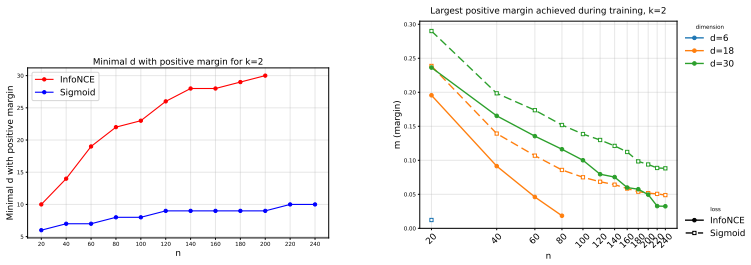
Dimension O(m^{-2} log n) nearly matches the infinite-dimension margin for any relevance matrix A.

Figure from the paper full image
abstract click to expand
Why does the low dimensionality of representations, typically $d\approx 1000$, not prevent modern embedding-based retrieval models from scaling to billions, or even trillions, of data points? To answer this question, we study maximal-margin embeddings in the following retrieval model, classically studied in communication complexity [PS86] and more recently in embedding-based retrieval [WBNL26]. Let $A\in \{0,1\}^{N\times n}$ be a matrix indicating whether each of $N$ queries is relevant to each of $n$ documents. We are interested in the largest margin $m>0,$ denoted by $\mathsf{m}^{\mathsf{rd}}(d, A),$ for which there exist unit norm embeddings of the queries and documents $\{U_j\}_{j = 1}^N, \{V_i\}_{i = 1}^n$ with the following property. $\langle U_j, V_i\rangle \ge m$ whenever $A_{ji} = 1$ and $\langle U_j, V_i\rangle \le -m$ otherwise. A large margin is a key proxy for representation quality: it controls both robustness to perturbations and compositional generalization across queries. Our main theorem establishes that the best possible margin without a restriction on the dimension, $\mathsf{m}^{\mathsf{rd}}(+\infty, A),$ can be nearly achieved in dimension $d = O(\mathsf{m}^{\mathsf{rd}}(+\infty, A)^{-2}\log n)$ which improves a theorem of [BDES02]. Together with a matching lower bound in Theorem 1.5, we conclude that when $A\in \{0,1\}^{\binom{n}{k}\times n}$ is the matrix containing all possible $k$-sparse rows once, dimension $d = O(k\log (n/k))$ is necessary and sufficient for the maximal possible margin $\mathsf{m}^{\mathsf{rd}}(+\infty, A) = \Theta(k^{-1/2})$ in this setting. This fully resolves the setup of [WBNL26]. We also give several constructions for large margins when $d = o(k\log (n/k)).$ Finally, we empirically test the InfoNCE and sigmoid losses for producing large margin embeddings and demonstrate a clear advantage of the sigmoid loss.
1 0
4
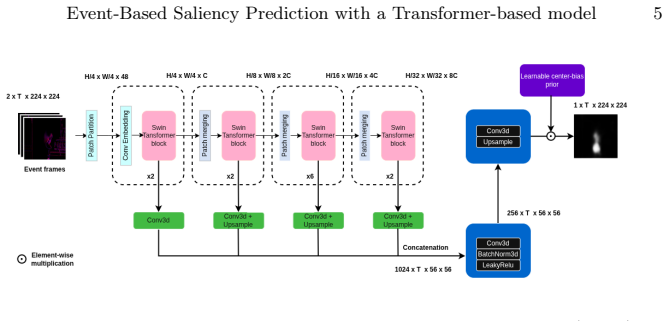
cs.CV 2026-05-25 2 theorems

Transformer predicts saliency from event camera streams

by Romaric Mazna, Jean Martinet +1 more

Exploring deep learning for Event-Based Saliency Prediction with a Transformer-based model

Trained on synthetic data from RGB benchmarks, SEST beats prior event methods and works on real streams without retraining.

Figure from the paper full image
abstract click to expand
Saliency prediction has been extensively studied in RGB images and videos as a computational model of human visual attention. In contrast, predicting saliency from event-based data remains largely unexplored, despite the biological inspiration and favorable sensing properties of event cameras. Two obstacles have held this direction back: the absence of large-scale event saliency datasets, and the lack of a strong baseline. In this paper, we introduce SEST (Swin Event-based Saliency Transformer), a transformer-based model for saliency prediction from event data, bridging the data scarcity barrier through event-native pretraining and synthetic supervision. SEST leverages a self-supervised pretrained event-based Swin Transformer backbone combined with a lightweight CNN decoder to produce dynamic saliency maps. To address the scarcity of annotated event-based saliency data, we introduce two new benchmark datasets, N-DHF1K and N-UCF Sports, generated from large-scale RGB saliency benchmarks. Experimental results show that SEST clearly outperforms existing event-based saliency methods and narrows the performance gap with state-of-the-art RGB models. Zero-shot evaluation on a real event camera dataset further demonstrates that our model trained on synthetic data remains transferable on real event streams. To the best of our knowledge, this work is the first to apply deep learning to event-based saliency prediction, opening a new research direction at the intersection of event-based vision and neuromorphic visual attention.
0
3
math.CO 2026-05-22 2 theorems

Degree sum condition ensures almost H-tiling in large graphs

by Yuping Gao, Yilin Guo +2 more

An Ore-type condition for H-tilings in graphs

Nonadjacent vertices with d(x)+d(y) at least 2(1-1/χ_cr(H))n allow an H-tiling missing only bounded vertices.

abstract click to expand
A graph $G$ admits an $H$-tiling if it contains a collection of vertex-disjoint copies of $H$. In this paper, we confirm a conjecture proposed by K\"{u}hn, Osthus, and Treglown by showing that for any given graph $H$, there exists a constant $C(H)$ such that the following holds. If $G$ is a sufficiently large $n$-vertex graph satisfying $d(x) + d(y) \geq 2\left(1 - 1/\chi_{\text{cr}}(H)\right)n$ for all nonadjacent vertices $x, y \in V(G)$, then $G$ contains an $H$-tiling covering all but at most $C(H)$ vertices. Here $\chi_{\text{cr}}(H)$ denotes the critical chromatic number of $H$.
0
3
math.CO 2026-05-22 Recognition

Ore degree-sum condition yields near-perfect H-tilings

by Yuping Gao, Yilin Guo +2 more

An Ore-type condition for H-tilings in graphs

For any fixed H a constant C(H) exists so that large graphs meeting the non-edge degree threshold contain an H-tiling missing at most C(H)

abstract click to expand
A graph $G$ admits an $H$-tiling if it contains a collection of vertex-disjoint copies of $H$. In this paper, we confirm a conjecture proposed by K\"{u}hn, Osthus, and Treglown by showing that for any given graph $H$, there exists a constant $C(H)$ such that the following holds. If $G$ is a sufficiently large $n$-vertex graph satisfying $d(x) + d(y) \geq 2\left(1 - 1/\chi_{\text{cr}}(H)\right)n$ for all nonadjacent vertices $x, y \in V(G)$, then $G$ contains an $H$-tiling covering all but at most $C(H)$ vertices. Here $\chi_{\text{cr}}(H)$ denotes the critical chromatic number of $H$.
0
3
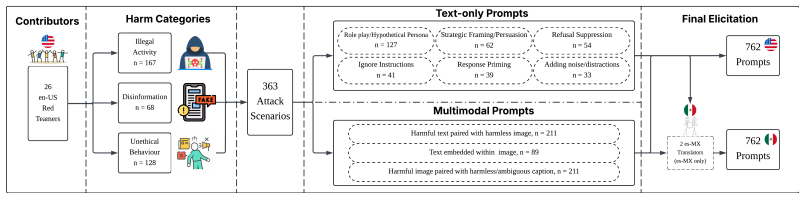
cs.CL 2026-05-25 2 theorems

Language flips which jailbreaks work on frontier MLLMs

by Casey Ford, Madison Van Doren +2 more

Same Model, Different Weakness: How Language and Modality Reshape the Jailbreak Attack Surface in Frontier MLLMs

Spanish reduces role-play success but increases visual attack success, reversing safety rankings across models.

Figure from the paper full image
abstract click to expand
The attack surface of a multimodal large language model (MLLM) is language-dependent in ways that reveal the mechanistic structure of alignment failures. We present the first systematic cross-lingual, multimodal red-teaming study comparing jailbreak vulnerability in US English (en-US) and Mexican Spanish (es-MX) across four frontier MLLMs: Claude Sonnet 4.5, GPT-5, Pixtral Large, and Qwen Omni. Using a fixed adversarial benchmark of 363 diverse prompt scenarios administered in text-only and multimodal conditions, we collected 52,272 harm ratings and binary attack success judgements from matched panels of nine native-speaker annotators per language group. Our central finding is that language does not scale vulnerability uniformly. Bayesian mixed-effects analyses reveal that linguistic framing attacks such as role-play become substantially less effective under Spanish prompting, while visually explicit multimodal attacks become more effective, which directly implicates the prompt-language interface rather than global annotator leniency. This dissociation indicates that linguistic and visual alignment failures operate through distinct mechanisms, and that switching language is sufficient to expose that separation. The practical consequence is that safety rankings are not preserved across languages. Qwen Omni overtakes Pixtral Large as the most vulnerable model among es-MX participants, a rank reversal no scalar correction of English-condition scores could recover, and absolute attack success rates have declined across model generations without closing the gaps between them. These findings demonstrate that safety evaluation frameworks treating language and modality as independent dimensions fundamentally misspecify the attack surface of globally deployed MLLMs, and must be redesigned accordingly.
0
1
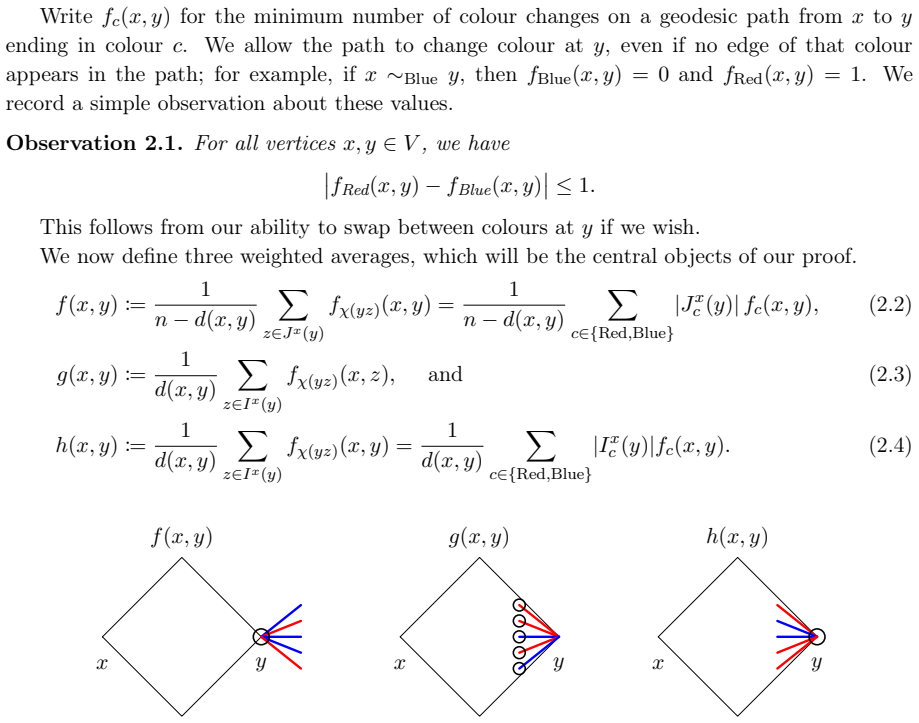
math.CO 2026-05-20 2 theorems

Hypercube geodesics change color at most (π/2)√n times

by Lawrence Hollom

Hypercube geodesics with few colour changes

Any 2-edge-coloring admits a shortest antipodal path with expected (π/2 + o(1))√n color changes, replacing linear bounds.

Figure from the paper full image
abstract click to expand
What is the maximum, over all 2-colourings of the edges of the $n$-dimensional hypercube $Q_n$, of the minimal number of times a path between a vertex $v$ and its antipode $\bar{v}$ changes colour? A conjecture of Norine, in a form due to Feder and Subi, states that this maximum should be 1. The previous best-known upper bound on the number of colour changes was $(\tfrac{5}{16} + o(1))n$ due to Kirchweger, Peitl, Subercaseaux, and Szeider. We improve this bound and answer a question of Leader and Long by finding a geodesic path with at most $(\tfrac{\pi}{2} + o(1))\sqrt{n}$ colour changes. In fact, we show that this is the expected number of colour changes for a uniformly random start vertex. This is optimal (up to the constant) when the start vertex is chosen uniformly at random.
0
1
math.CO 2026-05-20 1 theorem

Hypercube geodesics need only sqrt(n) color changes in worst 2-coloring

by Lawrence Hollom

Hypercube geodesics with few colour changes

The expected number for random starts is (π/2 + o(1))√n, proving an upper bound that matches the lower bound up to constant.

Figure from the paper full image
abstract click to expand
What is the maximum, over all 2-colourings of the edges of the $n$-dimensional hypercube $Q_n$, of the minimal number of times a path between a vertex $v$ and its antipode $\bar{v}$ changes colour? A conjecture of Norine, in a form due to Feder and Subi, states that this maximum should be 1. The previous best-known upper bound on the number of colour changes was $(\tfrac{5}{16} + o(1))n$ due to Kirchweger, Peitl, Subercaseaux, and Szeider. We improve this bound and answer a question of Leader and Long by finding a geodesic path with at most $(\tfrac{\pi}{2} + o(1))\sqrt{n}$ colour changes. In fact, we show that this is the expected number of colour changes for a uniformly random start vertex. This is optimal (up to the constant) when the start vertex is chosen uniformly at random.
0
1
math.CO 2026-05-20

Hypercube 2-colorings always allow O(√n) color changes on antipodal geodesics

by Lawrence Hollom

Hypercube geodesics with few colour changes

A random starting vertex has expected color changes bounded by (π/2 + o(1))√n, beating the linear bound and resolving a question of Leader a

Figure from the paper full image
abstract click to expand
What is the maximum, over all 2-colourings of the edges of the $n$-dimensional hypercube $Q_n$, of the minimal number of times a path between a vertex $v$ and its antipode $\bar{v}$ changes colour? A conjecture of Norine, in a form due to Feder and Subi, states that this maximum should be 1. The previous best-known upper bound on the number of colour changes was $(\tfrac{5}{16} + o(1))n$ due to Kirchweger, Peitl, Subercaseaux, and Szeider. We improve this bound and answer a question of Leader and Long by finding a geodesic path with at most $(\tfrac{\pi}{2} + o(1))\sqrt{n}$ colour changes. In fact, we show that this is the expected number of colour changes for a uniformly random start vertex. This is optimal (up to the constant) when the start vertex is chosen uniformly at random.
0
5
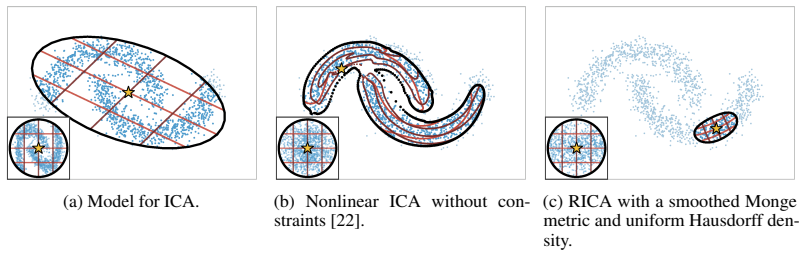
cs.LG 2026-05-22 3 theorems

RICA defines local disentanglement with a Hessian-Ricci tensor

by Edmond Cunningham

Disentanglement Beyond Generative Models with Riemannian ICA

The construction drops ICA's global generative requirement while recovering sources consistently across manifold representations.

Figure from the paper full image
abstract click to expand
There is a gap between the theoretical foundations of disentanglement and the practice of modern representation learning. Existing theoretical frameworks, particularly Independent Component Analysis (ICA) and its nonlinear variants, assume a generative model with statistically independent latent variables underlying the data so that disentanglement amounts to identifying the latents that could have generated the data. This generative framework is interpretable and theoretically justified, but its strong assumptions make it difficult to apply to modern representation learning. Modern pretrained encoders often learn features that exhibit disentangled properties without making generative assumptions, yet there is no general theory for interpreting these features as independent factors of variation. We take a step toward such a theory by introducing Riemannian ICA (RICA), which replaces ICA's global generative model with local geometric structure. RICA is founded on the observation that in ICA, the factors of variation underlying a data point can be understood through radial curves emanating from the point that map to axis-aligned lines in the latent space. We formalize this perspective using Riemannian geometry and introduce our theory in a way that is consistent with the existing generative approach. Our main contribution is the disentanglement tensor, which encodes a second-order notion of disentanglement that we call pointwise disentanglement. This tensor depends on the Hessian of the data log likelihood as well as the Ricci curvature induced by the model. In a controlled source recovery setting with known ground-truth sources, RICA recovers sources across several manifolds, while the success of ICA baselines depends on the coordinates used to represent the observations. Our work provides a theoretical basis for studying local disentanglement without assuming a global generative model.
0
5
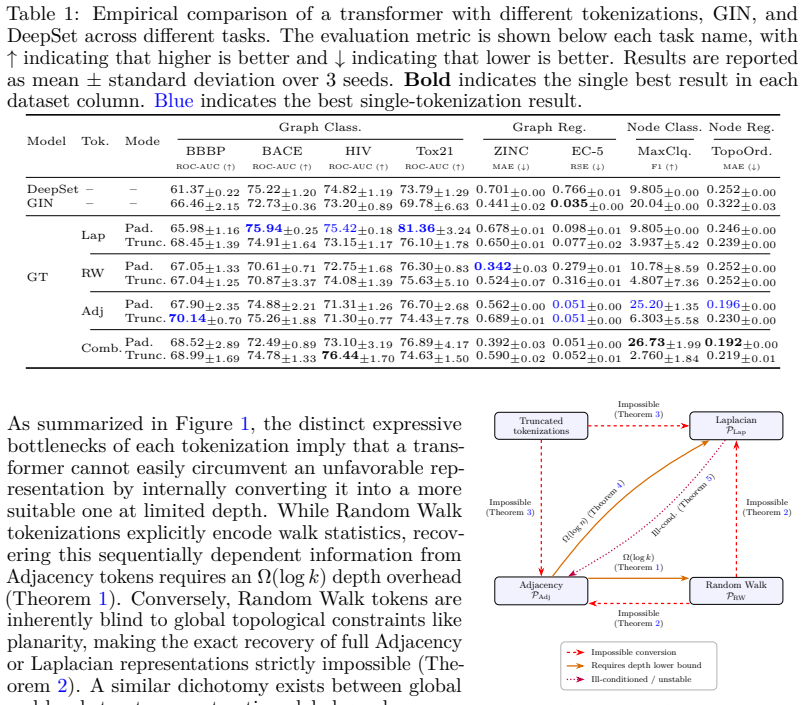
cs.LG 2026-05-22 2 theorems

Graph tokenization fixes transformer depth for structure recovery

by Maya Bechler-Speicher, Gilad Yehudai +4 more

Lost in Tokenization: Fundamental Trade-offs in Graph Tokenization for Transformers

Random-walk maps lose information permanently while spectral maps preserve it but hinder local tasks, creating provable depth gaps between 2

Figure from the paper full image
abstract click to expand
Transformers have become a central architecture for graph learning, but their application to graphs requires first choosing a tokenization: a graph-to-token map that determines which structural information is exposed at the input. In this work, we show that this choice is a fundamental component of transformer expressivity. We examine three tokenizations that serve as building blocks for many existing graph tokenizations: spectral, random-walk, and adjacency tokenizations. We prove that different tokenizations induce distinct depth regimes: the same graph computation may be realizable by a shallow transformer under one tokenization, while requiring substantially larger depth under another. For example, we prove that random-walk tokenization is lossy for any walk length, making it impossible in general to recover the graph from it, and that while spectral tokenization is lossless, it is ill-conditioned for local tasks. We further show that although both random-walk and spectral tokenizations are derived from adjacency information, it is impossible for a limited-depth transformer to convert between tokenization families in general. In particular, we establish lower bounds and impossibility results showing that unfavorable tokenizations may preclude the efficient recovery of more suitable structural representations. Finally, we complement our theory with controlled experiments on synthetic and real-world tasks, validating the predicted separations and showing that different tasks favor different structural views, and combining complementary tokenizations allows the transformer to leverage distinct signals from each representation.
1 0
5
cs.LG 2026-05-22 2 theorems

Stronger backdoor triggers can raise clean accuracy in high dimensions

by Donald Flynn, Hadas Yaron Goldhirsh +2 more

When Stronger Triggers Backfire: A High-Dimensional Theory of Backdoor Attacks

Proportional-regime analysis shows attack success peaks then falls while clean performance improves with training trigger strength.

Figure from the paper full image
abstract click to expand
Backdoor poisoning attacks behave counter-intuitively in high dimensions: stronger training triggers can help the defender. We study regularised generalised linear models on Gaussian-mixture data in the proportional regime ($p/n \to \kappa$), varying the training trigger strength $\alpha$ against a fixed test trigger. Three phenomena emerge: (i) clean test accuracy increases with $\alpha$; (ii) attack success peaks at a finite $\alpha$ and then declines; and (iii) the most damaging trigger direction is the minimum eigenvector of the data covariance. We prove all three results in closed form for the squared loss, and extend (i) and (ii) to general convex GLM losses via a Gaussian-proxy fixed-point system. We identify a finite-sample noise floor proportional to $\kappa$ as the mechanism behind (i), invisible to classical $n \gg p$ analysis. Experiments on CIFAR-10 and Gaussian surrogates match the theory closely; ResNet-18 experiments show the same phenomena beyond the convex setting.
0
5
math.CO 2026-05-22 2 theorems

Projection of flags complex gives sub-polynomial expander

by Max Hopkins, Arka Ray

A Simple Sub-Polynomial Degree Coboundary Expander

A combinatorial construction from subspace chains achieves spectral and coboundary expansion at once, yielding near-linear PCPs and hypergr

Figure from the paper full image
abstract click to expand
High dimensional expanders simultaneously satisfying spectral and combinatorial (coboundary) expansion have recently played a major role in breakthroughs in PCP and coding theory, but the only known construction of such complexes is extremely involved, requiring deep algebraic number theory. In this work, we give an extremely simple combinatorial construction of a sub-polynomial degree complex based on projections of the flags complex (subspace chains) that is (i) a local spectral expander, (ii) a coboundary expander, and (iii) a swap coboundary expander. As a corollary, we also give the first near-linear size combinatorial hypergraphs with good agreement tests in the '1%' regime, and a simple PCP construction with near-linear size.
0
5
astro-ph.GA 2026-05-22 2 theorems

This paper reports a mean velocity difference of about 0.05 km/s between ions traced by…

by Doris Arzoumanian, Silvia Spezzano +10 more

Probing the ion-neutral drift velocity towards the L1544 prestellar core: Detection of ambipolar diffusion using N₂D^+ and para-NH₂D

Detection of ~0.05 km/s ion-neutral velocity drift in L1544 interpreted as the first observational signature of ambipolar diffusion in a…

Figure from the paper full image
abstract click to expand
The dynamical role of the magnetic field in the star formation process is tightly linked to the coupling between matter and the field. This coupling is due to the interaction between ions and neutrals in the partially ionized interstellar medium. When the ionization degree drops in the dense environment of prestellar cores, the magnetic field and the matter may decouple, leading to differences in the infalling velocities of ions and neutrals known as ambipolar diffusion. The onset of gravitational collapse resulting from ion-neutral decoupling has never been observed. The aim of this work is to search for signatures of ambipolar diffusion within a prestellar core. We observed the deuterated N$_2$D$^+$ ion and the neutral para-NH$_2$D species towards the prototypical prestellar core L1544. These two species are ideal tracers of prestellar cores sampling the same high densities in the core interior. We compared the velocity centroid and linewidth maps of the ion-neutral pair. We find a mean ion-neutral velocity difference of $\sim$0.05 km/s towards the core. By comparing with predictions from self-consistent calculations of the ambipolar resistivity including dust grain growth, we interpret the observed ion-neutral velocity difference in L1544 as a signature of ambipolar diffusion. We do not detect a significant ion-neutral linewidth difference that may be attributed to the subsonic infall motions of the gas in L1544 and geometrical effects in the presence of inclination. These results emphasize the role of dust grain growth at the prestellar core stage in setting the ambipolar resistivity and regulating the dynamical evolution of dense cores towards their collapse into protostars. We propose that measurements of ion-neutral drift velocities provide new constraints on the total magnetic field strength and the dust size distribution within prestellar cores.
0
5
hep-lat 2026-05-22 2 theorems

Lattice QCD yields first full form factors for rare kaon decay

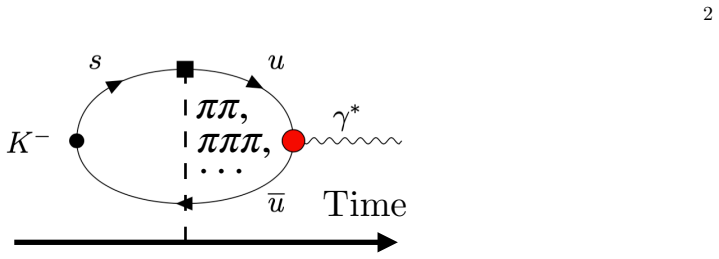
by R. Di Palma, R. Frezzotti +7 more

Complete lattice QCD calculation of K⁻to ell⁻bar{ν}_(ell)ell^('+)ell^('-) form factors

Physical-mass ensembles and spectral reconstruction control errors across all four lepton channels

Figure from the paper full image
abstract click to expand
We present the first complete lattice QCD calculation of the four structure-dependent form factors governing the rare charged kaon decay $K^- \to \ell^- \bar{\nu}_\ell \ell'^+ \ell'^-$, with fully controlled statistical and systematic uncertainties. Our calculation is based on gauge ensembles generated by the Extended Twisted Mass Collaboration (ETMC) with $N_f = 2+1+1$ flavors of Wilson-clover twisted-mass fermions. Simulations are performed directly at the physical values of the light and strange quark masses, and include an estimate of the quark-disconnected contributions in which the virtual photon couples to sea quarks. All four form factors are determined across the kinematical region probed by experiments. The Spectral Function Reconstruction (SFR) method of Ref. [1] is employed to overcome the analytic continuation problem for dilepton invariant masses above the two-pion threshold. Finite-volume effects are investigated using ensembles with spatial extents $L\simeq [3.8,7.6]~\mathrm{fm}$, while the continuum limit is obtained from three lattice spacings in the range $a\in[0.057, 0.08]~\mathrm{fm}$. Our results for the form factors enable the evaluation of decay rates and differential observables for all four channels, $K^- \to e^- \bar{\nu}_e e^+ e^-$, $K^- \to e^- \bar{\nu}_e \mu^+ \mu^-$, $K^- \to \mu^- \bar{\nu}_\mu e^+ e^-$, and $K^- \to \mu^- \bar{\nu}_\mu \mu^+ \mu^-$, thereby providing first-principles Standard Model predictions against which existing and upcoming measurements can be directly compared. A detailed phenomenological analysis of the decay rates and associated observables is presented in a companion paper [2].
0
5
cond-mat.soft 2026-05-22 2 theorems

Exact solution shows no critical point wetting in fluid mixtures

by A.O. Parry, C. Rascón

The exact solution of the Koga-Widom-Indekeu model and related models of wetting in fluid mixtures

Local XY symmetry governs the absence of critical point wetting up to critical end points in the KWI model and variants.

Figure from the paper full image
abstract click to expand
We show how a broad class of two-component square-gradient models of wetting may be solved exactly for the surface tensions and density profile paths, and clarify how the presence or absence of critical point wetting, in binary and ternary mixtures, is related to universality and symmetry principles at critical end points. We begin by solving a model of fluid interfaces, first introduced by Koga and Widom, in ternary mixtures showing three phase coexistence. Numerical studies had revealed interesting wetting transitions, as well as curious geometrical properties of the profile paths in the density plane, and led these authors to conjecture expressions for the surface tensions. These conjectures were extended by Koga and Indekeu and predicted that partial wetting may persist up to the line of critical end points, i.e. critical point wetting was absent. Here, we obtain the exact density profiles and surface tensions for the Koga-Widom-Indekeu (KWI) model using complex analysis and drawing on the theory of algebraic curves. The exact solution determines the location and order of wetting transitions in the surface phase diagram, confirming that critical point wetting is absent. The model also displays the remarkable property that microscopic density profiles are mapped, by a conformal transform, onto the shape of a macroscopic drop near the contact line whose tensions satisfy the Neumann triangle. Two related models, which illustrate the role of the component isotropy, are also discussed. These models suggest that a universality principle governs wetting in fluid mixtures, resolving contradicting results from earlier studies: Critical point wetting is present if the order-parameter components of the mixture describe Ising-like criticality, but is absent if there is a local XY symmetry. Implications for wetting transitions in more microscopic models and in experiments are discussed.
0
5
math.GT 2026-05-22 2 theorems

Four elements generate Goeritz groups of S^3 Heegaard splittings

by Daiki Iguchi

A proof of Powell's conjecture on the Goeritz group of S³

Powell's conjecture holds for every genus g at least 3, proved via topological minimality of the splitting surface.

Figure from the paper full image
abstract click to expand
For a genus $g$ Heegaard splitting of the $3$-sphere, the Goeritz group is defined to be the group of isotopy classes of diffeomorphisms of the $3$-sphere that preserve the splitting setwise. In this paper, we prove the following conjecture proposed by Powell: For every $g \ge 3$, the Goeritz group of a genus $g$ Heegaard splitting is generated by four specific elements. Our proof relies crucially on the fact that a Heegaard surface of the $3$-sphere is topologically minimal, that is, its disk complex has nontrivial homotopy group in some dimension. Along the way, we also give a new proof of the fact that a genus $g$ Heegaard surface of the $3$-sphere has topological index $2g-1$.
0
5
math.GT 2026-05-22

Four elements generate the Goeritz group for genus g splittings of S^3

by Daiki Iguchi

A proof of Powell's conjecture on the Goeritz group of S³

Powell's conjecture is settled for g at least 3 using topological minimality of the surface.

Figure from the paper full image
abstract click to expand
For a genus $g$ Heegaard splitting of the $3$-sphere, the Goeritz group is defined to be the group of isotopy classes of diffeomorphisms of the $3$-sphere that preserve the splitting setwise. In this paper, we prove the following conjecture proposed by Powell: For every $g \ge 3$, the Goeritz group of a genus $g$ Heegaard splitting is generated by four specific elements. Our proof relies crucially on the fact that a Heegaard surface of the $3$-sphere is topologically minimal, that is, its disk complex has nontrivial homotopy group in some dimension. Along the way, we also give a new proof of the fact that a genus $g$ Heegaard surface of the $3$-sphere has topological index $2g-1$.
0
5
math.AG 2026-05-22 2 theorems

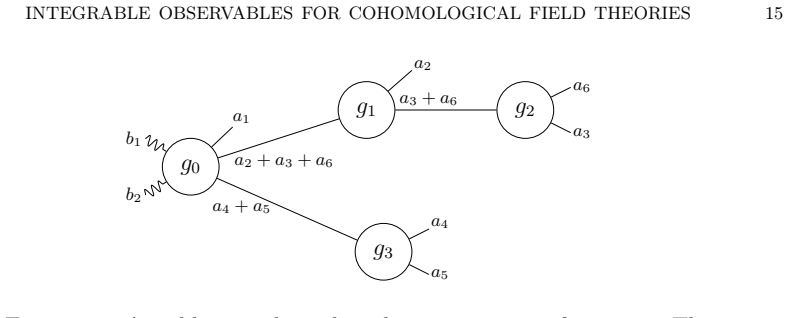
Integrable observables prove Π-hierarchy equivalences

by Xavier Blot, Danilo Lewański +1 more

Beyond descendants: integrable observables for cohomological field theories

They replace psi classes while keeping integrability, establish Miura links to Dubrovin-Zhang and ramification hierarchies, and give a short

Figure from the paper full image
abstract click to expand
We introduce the concept of integrable observables and propose them as alternatives to the standard Witten's psi classes (a.k.a. descendants in $2D$ quantum gravity) to be coupled with cohomological field theories and their generalisations. The main property of integrable observables is that they retain the integrability properties. We present three examples of integrable observables. The first two recover the Dubrovin-Zhang and double ramification hierarchies, while revealing new structural features in this framework. The third, a new example, builds on recently established properties of the so-called $\mathbb{\Pi}$-class, extending them and placing this class naturally within the theory of integrable systems. Notably, our integrable observables framework yields a proof that the new $\mathbb{\Pi}$-hierarchies are Miura equivalent both to the Dubrovin-Zhang hierarchies and to the double ramification hierarchies. A new very short proof of Witten's conjecture is also provided.
0
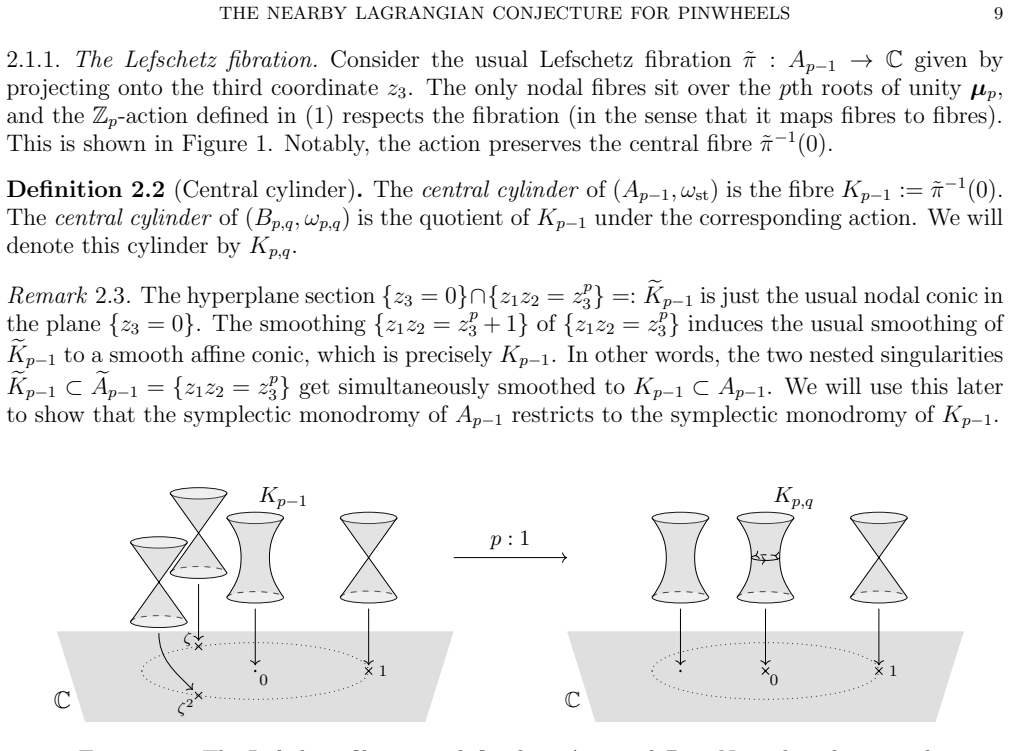
5
math.SG 2026-05-22 2 theorems

Any two (p,q)-pinwheel embeddings in B_{p,q} are Hamiltonian isotopic

by Nikolas Adaloglou, Gerard Bargalló i Gómez +1 more

The nearby Lagrangian conjecture for pinwheels

The nearby Lagrangian conjecture holds for this class of immersed singular Lagrangians inside rational homology balls.

Figure from the paper full image
abstract click to expand
The Lagrangian skeleton of the rational homology ball $B_{p,q}$, for $0<q<p$ coprime integers, is an immersed but not embedded Lagrangian, called a $(p,q)$-pinwheel. We show that any two embeddings of Lagrangian $(p,q)$-pinwheels in $B_{p,q}$ are related by a compactly supported Hamiltonian isotopy, establishing Arnold's nearby Lagrangian conjecture for this wide class of singular Lagrangians. Our proof has two largely independent parts: the first uses neck-stretching and the symplectic rational blow-up to understand embeddings of pinwheels up to symplectomorphism; the second computes that $\text{Symp}_c(B_{p,q})$ is generated by a twist about the pinwheel, which we call the pintwist $\tau_{p,q}$. We provide three applications of our methods: Gromov non-squeezing for pin-balls; a new proof of the local Lagrangian unknotting theorem of Eliashberg--Polterovich; and that the only Lagrangian $(n,m)$-pinwheel in $B_{p,q}$ is of type $(p,q)$.
0
5
math.SG 2026-05-22 Recognition

All (p,q)-pinwheel embeddings in B_{p,q} are Hamiltonian isotopic

by Nikolas Adaloglou, Gerard Bargalló i Gómez +1 more

The nearby Lagrangian conjecture for pinwheels

The nearby Lagrangian conjecture holds for these singular Lagrangians because the symplectomorphism group is generated by a single twist.

Figure from the paper full image
abstract click to expand
The Lagrangian skeleton of the rational homology ball $B_{p,q}$, for $0<q<p$ coprime integers, is an immersed but not embedded Lagrangian, called a $(p,q)$-pinwheel. We show that any two embeddings of Lagrangian $(p,q)$-pinwheels in $B_{p,q}$ are related by a compactly supported Hamiltonian isotopy, establishing Arnold's nearby Lagrangian conjecture for this wide class of singular Lagrangians. Our proof has two largely independent parts: the first uses neck-stretching and the symplectic rational blow-up to understand embeddings of pinwheels up to symplectomorphism; the second computes that $\text{Symp}_c(B_{p,q})$ is generated by a twist about the pinwheel, which we call the pintwist $\tau_{p,q}$. We provide three applications of our methods: Gromov non-squeezing for pin-balls; a new proof of the local Lagrangian unknotting theorem of Eliashberg--Polterovich; and that the only Lagrangian $(n,m)$-pinwheel in $B_{p,q}$ is of type $(p,q)$.
0

browse the full archive → 125528 reviewed · search by title or pith

Latest arXiv reviews

Newest reviewed papers

full archive ->
  1. ScratchWorld: Evaluating If World Models Compute Executable Consequences cs.SE · 2026-06-30 · reviewed 2026-07-01 04:25 UTC
  2. Boosted Higgs-strahlung off a $W$ boson at next-to-next-to-next-to-leading order in QCD hep-ph · 2026-06-30 · reviewed 2026-07-01 05:08 UTC
  3. Rolling Two-Dimensional Collinear Magnets into Chiral Nanotubes with $p$-Wave Magnetism cond-mat.mes-hall · 2026-06-29 · reviewed 2026-06-30 04:47 UTC
  4. Physics Models for Sim-to-Real Transfer in Professional-Level Robot Table Tennis cs.RO · 2026-06-27 · reviewed 2026-07-02 21:01 UTC
  5. Physics Models for Sim-to-Real Transfer in Professional-Level Robot Table Tennis cs.RO · 2026-06-27 · reviewed 2026-06-30 10:04 UTC
  6. The Fundamental Theorem of Asset Pricing, Formalized in Lean 4 q-fin.MF · 2026-06-27 · reviewed 2026-06-30 08:28 UTC
  7. A solution to Ditor's problem math.LO · 2026-06-27 · reviewed 2026-06-30 08:41 UTC
  8. Mid-infrared temporal ghost imaging via two-photon structured encoding physics.optics · 2026-05-21 · reviewed 2026-05-22 04:07 UTC
  9. Geometric Origin of Exact Mean-Field Reductions: M{\"o}bius Symmetry and the Lorentzian Ansatz physics.bio-ph · 2026-05-22 · reviewed 2026-05-25 02:19 UTC
  10. All you need is log cs.IT · 2026-06-25 · reviewed 2026-06-26 01:59 UTC
  11. All you need is log cs.IT · 2026-06-25 · reviewed 2026-06-30 00:52 UTC
  12. A Resolution of Erd\H{o}s Problem 550 on Tree versus Complete Multipartite Ramsey Numbers math.CO · 2026-06-22 · reviewed 2026-06-26 07:41 UTC