Pore-scale distribution and transport of active particles in a two-dimensional lattice
Pith reviewed 2026-07-03 04:59 UTC · model grok-4.3
The pith
Active microswimmers in a pillar lattice form polarization defects at moderate flows that split the system into upstream and downstream swimming regions.
A machine-rendered reading of the paper's core claim, the machinery that carries it, and where it could break.
Core claim
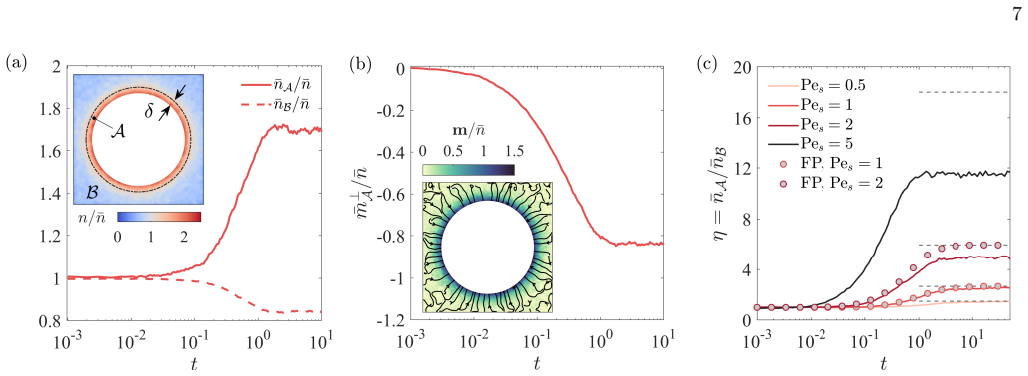
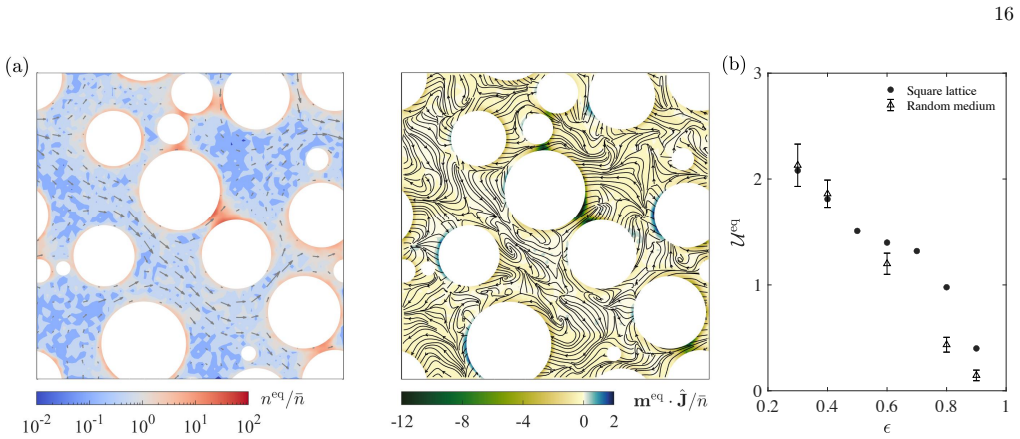
In the absence of flow, self-propulsion drives particle accumulation and radial polarization at the pillar surfaces. In the presence of a background flow, particles preferentially accumulate in the wake of pillars and exhibit upstream polarization near their surface. At moderate flow strengths, topological defects nucleate in the polarization field. These defects are of purely kinematic origin and mark the transition from global upstream swimming at low flow strengths to the coexistence of upstream and downstream swimming regions in the lattice at high flow strengths.
What carries the argument
Topological defects that nucleate in the polarization field and arise from the kinematics of flow interacting with self-propulsion.
If this is right
- Particles accumulate preferentially in the wakes of pillars once a background flow is applied.
- Near pillar surfaces the particles maintain upstream polarization across a range of flow strengths.
- The lattice geometry isolates the kinematic mechanism that produces mixed swimming directions at high flow.
- The same setup supplies a controlled test bed for active transport through structured microfluidic channels.
Where Pith is reading between the lines
- The kinematic defects identified here may appear in any periodic obstacle array whenever flow and self-propulsion compete, even without explicit hydrodynamics.
- Device designers could exploit the flow-strength threshold to sort or concentrate microswimmers by directing them into upstream or downstream channels.
- Similar polarization patterns could govern bacterial navigation through soil pores or filter beds where obstacle spacing is comparable to swimmer length.
Load-bearing premise
The slender point-particle model together with Brownian Dynamics simulations is sufficient to capture the essential distribution and polarization behavior of real microswimmers without requiring explicit hydrodynamic interactions or finite-size effects.
What would settle it
Direct imaging of the polarization field in an experiment with real microswimmers in an identical pillar lattice at moderate flow strengths showing no nucleation of topological defects.
Figures






read the original abstract
Suspensions of motile microswimmers such as bacteria and other active colloids frequently encounter porous environments where obstacles and complex shear flows strongly influence their dynamics. Here, we study the distribution and transport of a dilute suspension of active particles in a square lattice of pillars, which serves as a model porous medium. The microswimmers are modeled as slender point particles, and Brownian Dynamics simulations are performed to determine how their number density and polarization fields change with systematic variations in the medium porosity, polydispersity, flow strength, and self-propulsion strength. We find that in the absence of flow, self-propulsion drives particle accumulation and radial polarization at the pillar surfaces. In the presence of a background flow, particles preferentially accumulate in the wake of pillars and exhibit upstream polarization near their surface, consistent with experimental observations. At moderate flow strengths, topological defects nucleate in the polarization field. These defects are of purely kinematic origin and mark the transition from global upstream swimming at low flow strengths to the coexistence of upstream and downstream swimming regions in the lattice at high flow strengths. The structured lattice studied here provides a controlled framework for isolating the physical mechanisms governing active transport in complex geometries, with direct relevance to transport in structured microfluidic settings.
Editorial analysis
A structured set of objections, weighed in public.
Referee Report
Summary. The manuscript uses Brownian Dynamics simulations of dilute suspensions of slender point-like active particles in a square lattice of pillars as a model porous medium. It reports how number density and polarization fields respond to variations in porosity, polydispersity, flow strength, and self-propulsion strength. Without flow, particles accumulate at pillar surfaces with radial polarization; with background flow, they accumulate in pillar wakes with upstream polarization near surfaces (consistent with experiments). At moderate flow strengths, topological defects nucleate in the polarization field; these are stated to be of purely kinematic origin and to mark the transition from global upstream swimming to coexistence of upstream and downstream regions.
Significance. If the kinematic attribution of defects holds beyond the specific model, the work supplies a controlled numerical framework for isolating mechanisms of active transport in structured geometries, with direct relevance to microfluidic applications. The simulation approach allows systematic parameter variation, but the absence of quantitative metrics, error estimates, or convergence data limits the strength of the reported transitions.
major comments (2)
- [Abstract] Abstract: The claim that topological defects 'are of purely kinematic origin' is load-bearing for the interpretation of the upstream-to-coexistence transition. Because the model evolves polarization solely via self-propulsion direction, advection, and rotational diffusion (with no explicit hydrodynamic interactions or finite-size effects), defects appear by construction as kinematic features; a sensitivity test or discussion showing that omitted hydrodynamics would not alter nucleation sites or the flow-strength threshold is required to support generality.
- [Results] Results (qualitative descriptions throughout): The abstract and main findings state simulation outcomes on defect nucleation and the upstream/downstream transition without supplying quantitative data (e.g., defect densities, polarization magnitudes, specific flow-strength thresholds), error estimates, or convergence checks with respect to time step, particle number, or lattice size. This prevents assessment of the robustness of the reported transition.
minor comments (2)
- [Abstract] The statement of consistency with experimental observations lacks citations to specific experiments or a direct side-by-side comparison (e.g., a figure or table).
- [Methods] Notation for polarization field and defect identification should be defined explicitly in the methods section for reproducibility.
Simulated Author's Rebuttal
We thank the referee for the careful reading and constructive feedback on our manuscript. We address the two major comments point by point below, indicating where revisions will be made.
read point-by-point responses
-
Referee: [Abstract] Abstract: The claim that topological defects 'are of purely kinematic origin' is load-bearing for the interpretation of the upstream-to-coexistence transition. Because the model evolves polarization solely via self-propulsion direction, advection, and rotational diffusion (with no explicit hydrodynamic interactions or finite-size effects), defects appear by construction as kinematic features; a sensitivity test or discussion showing that omitted hydrodynamics would not alter nucleation sites or the flow-strength threshold is required to support generality.
Authors: We agree that the kinematic character of the defects follows directly from the model equations, which include only self-propulsion, advection, and rotational diffusion. This choice was deliberate to isolate purely kinematic mechanisms in a dilute point-particle limit. We will add a new paragraph in the discussion section that explicitly states the model assumptions, explains why hydrodynamic interactions are expected to be perturbative in the dilute regime studied, and notes that the nucleation sites and transition threshold are tied to the advection–diffusion balance. A full hydrodynamic sensitivity study lies outside the present scope but is identified as future work. revision: partial
-
Referee: [Results] Results (qualitative descriptions throughout): The abstract and main findings state simulation outcomes on defect nucleation and the upstream/downstream transition without supplying quantitative data (e.g., defect densities, polarization magnitudes, specific flow-strength thresholds), error estimates, or convergence checks with respect to time step, particle number, or lattice size. This prevents assessment of the robustness of the reported transition.
Authors: We acknowledge that the manuscript currently emphasizes qualitative field visualizations. In the revised version we will add quantitative measures: defect number density versus dimensionless flow strength (with error bars from ensemble runs), spatially averaged polarization magnitude in upstream and downstream regions, and the precise flow-strength value at which defects first appear. Convergence data with respect to time step, particle number, and lattice size will be included in the Methods or Supplementary Material, together with the number of independent realizations used for statistics. revision: yes
Circularity Check
No circularity: simulation results from explicit kinematic model
full rationale
The paper reports Brownian Dynamics simulations of a slender point-particle model whose polarization evolves under self-propulsion, advection, and rotational diffusion. The statement that defects are 'of purely kinematic origin' follows from running those equations numerically; it does not reduce any fitted parameter or self-cited theorem back to the target claim by construction. No equations are presented that equate a derived quantity to an input fit, and the work cites external experiments for consistency rather than relying on self-citation chains. The study is therefore self-contained numerical exploration, not an analytic derivation that collapses to its own inputs.
Axiom & Free-Parameter Ledger
axioms (1)
- domain assumption Brownian Dynamics simulations of slender point particles capture the distribution and polarization of active microswimmers in a porous lattice
Reference graph
Works this paper leans on
-
[1]
anchoring
Note thata ∗ 1 ≥1 anda ∗ 2 ≤1, so one pillar is larger and the other smaller than in the monodisperse case (unit radius). The boundary layer thicknesses corresponding to each pillar are also then rescaled asδ 1 =δa ∗ 1, δ 2 =δa ∗ 2, whereδis defined for a pillar of unit radius in Eq. (12). Results from a typical BD simulations performed in this dimensionl...
-
[2]
along the positive or the negativex-axis
Solution in the limitκ→0 One can gain insights into this mechanism by studying a 1D system where the particles have only two possible orientations viz. along the positive or the negativex-axis. In the absence of translational diffusion, i.e., whenκ→0, Eqs. (6)–(7) reduce to the wave equation for the number density,∂ 2 t n(r, t) =c 2∂2 xn(r, t). Here,c= Pe...
-
[3]
strength
Features of the oscillations The formation and propagation of a depleted region near a boundary is also observed in BD simulations in a periodic lattice (Fig. 11). At short times, particle accumulation on a pillar increases the surface number density,η. Higher Pes produces stronger accumulation, leaving behind a more pronounced depleted region. When the d...
-
[4]
In this asymptotic limit, the modified Bessel functions in Eq. (11a) for the particle density outside of an isolated pillar can expanded as Taylor series to yield the approximation neq(r) n∞ ≈1 + e(1−r)/δr−1/2 1− δ 8r +O(δ 2) δ 1 + 3δ 8 +O(δ 2) + δ2 κ2 1 + 7δ 8 +O(δ 2) .(D2) Thus, for large activity, the number density of particles at the pillar surface,n...
-
[5]
Bechinger, R
C. Bechinger, R. D. Leonardo, H. L¨ owen, C. Reichhardt, G. Volpe, and G. Volpe, Active particles in complex and crowded environments, Rev. Mod. Phys.88, 045006 (2016). 22
2016
-
[6]
J. C. Conrad and R. Poling-Skutvik, Confined flow: Consequences and implications for bacteria and biofilms, Annu. Rev. Chem. Biomol. Eng.9, 175 (2018)
2018
-
[7]
J. D. Wheeler, E. Secchi, R. Rusconi, and R. Stocker, Not just going with the flow: The effects of fluid flow on bacteria and plankton, Annu. Rev. Cell Devel. Bio.35, 213 (2019)
2019
-
[8]
G. Li, J. Bensson, L. Nisimova, D. Munger, P. Mahautmr, J. X. Tang, M. R. Maxey, and Y. V. Brun, Accumulation of swimming bacteria near a solid surface, Phys. Rev. E84, 041932 (2011)
2011
-
[9]
Th´ ery, Y
A. Th´ ery, Y. Wang, M. Dvoriashyna, C. Eloy, F. Elias, and E. Lauga, Rebound and scattering of motileChlamydomonas algae in confined chambers, Soft Matter17, 4857 (2021)
2021
-
[10]
R. Mok, J. Dunkel, and V. Kantsler, Geometric control of bacterial surface accumulation, Phys. Rev. E99, 052607 (2019)
2019
-
[11]
Yan and J
W. Yan and J. F. Brady, The force on a boundary in active matter, J. Fluid Mech.785, R1 (2015)
2015
-
[12]
Ezhilan and D
B. Ezhilan and D. Saintillan, Transport of a dilute active suspension in pressure-driven channel flow, J. Fluid Mech.777, 482 (2015)
2015
-
[13]
Ezhilan, R
B. Ezhilan, R. Alonso-Matilla, and D. Saintillan, On the distribution and swim pressure of run-and-tumble particles in confinement, J. Fluid Mech.781, R4 (2015)
2015
-
[14]
Rothschild, Non-random distribution of bull spermatozoa in a drop of sperm suspension, Nature198, 1221 (1963)
L. Rothschild, Non-random distribution of bull spermatozoa in a drop of sperm suspension, Nature198, 1221 (1963)
1963
-
[15]
T. J. Pedley and J. O. Kessler, Hydrodynamic phenomena in suspensions of swimming microorganisms, Annu. Rev. Fluid Mech.24, 313 (1992)
1992
-
[16]
Lauga, Bacterial hydrodynamics, Annu
E. Lauga, Bacterial hydrodynamics, Annu. Rev. Fluid Mech.48, 105 (2016)
2016
-
[17]
Saintillan and M
D. Saintillan and M. J. Shelley, Active suspensions and their nonlinear models, C. R. Physique14, 497 (2013)
2013
-
[18]
Saintillan, Rheology of active fluids, Annu
D. Saintillan, Rheology of active fluids, Annu. Rev. Fluid Mech.50, 563 (2018)
2018
-
[19]
A. P. Berke, L. Turner, H. C. Berg, and E. Lauga, Hydrodynamic attraction of swimming microorganisms by surfaces, Phys. Rev. Lett.101, 038102 (2008)
2008
-
[20]
Sipos, K
O. Sipos, K. Nagy, R. Di Leonardo, and P. Galajda, Hydrodynamic trapping of swimming bacteria by convex walls, Phys. Rev. Lett.114, 258104 (2015)
2015
-
[21]
Takagi, J
D. Takagi, J. Palacci, A. B. Braunschweig, M. J. Shelley, and J. Zhang, Hydrodynamic capture of microswimmers into sphere-bound orbits, Soft Matter10, 1784 (2014)
2014
-
[22]
S. E. Spagnolie, G. R. Moreno-Flores, D. Bartolo, and E. Lauga, Geometric capture and escape of a microswimmer colliding with an obstacle, Soft Matter11, 3396 (2015)
2015
-
[23]
Secchi, A
E. Secchi, A. Vitale, G. L. Mi˜ no, V. Kantsler, L. Eberl, R. Rusconi, and R. Stocker, The effect of flow on swimming bacteria controls the initial colonization of curved surfaces, Nat. Comm.11, 2851 (2020)
2020
-
[24]
G. L. Mi˜ no, M. Baabour, R. Chertcoff, G. Gutkind, E. Cl´ ement, H. Auradou, and I. Ippolito,E coliaccumulation behind an obstacle, Adv. Microbiol.08, 451 (2018)
2018
-
[25]
M. Lee, C. Lohrmann, K. Szuttor, H. Auradou, and C. Holm, The influence of motility on bacterial accumulation in a microporous channel, Soft Matter17, 893 (2021)
2021
-
[26]
Leighton and A
D. Leighton and A. Acrivos, The shear-induced migration of particles in concentrated suspensions, J. Fluid Mech.181, 415–439 (1987)
1987
-
[27]
Frank, D
M. Frank, D. Anderson, E. R. Weeks, and J. F. Morris, Particle migration in pressure-driven flow of a Brownian suspension, J. Fluid Mech.493, 363 (2003)
2003
-
[28]
Rusconi, J
R. Rusconi, J. S. Guasto, and R. Stocker, Bacterial transport suppressed by fluid shear, Nat. Phys.10, 212 (2014)
2014
-
[29]
J. Hill, O. Kalkanci, J. L. McMurry, and H. Koser, Hydrodynamic surface interactions enableEscherichia colito seek efficient routes to swim upstream, Phys. Rev. Lett.98, 068101 (2007)
2007
-
[30]
A. J. T. M. Mathijssen, N. Figueroa-Morales, G. Junot, E. Cl´ ement, A. Lindner, and A. Z¨ ottl, Oscillatory surface rheotaxis of swimmingE. colibacteria, Nat. Comm.10, 3434 (2019)
2019
-
[31]
G. B. Jeffery, The motion of ellipsoidal particles immersed in a viscous fluid, Proc. Roy. Soc. London. A102, 161 (1922)
1922
-
[32]
F. P. Bretherton, The motion of rigid particles in a shear flow at low Reynolds number, J. Fluid Mech.14, 284 (1962)
1962
-
[33]
Junot, N
G. Junot, N. Figueroa-Morales, T. Darnige, A. Lindner, R. Soto, H. Auradou, and E. Cl´ ement, Swimming bacteria in Poiseuille flow: The quest for active Bretherton-Jeffery trajectories, Europhys. Lett.126, 126 (2019)
2019
-
[34]
Kaya and H
T. Kaya and H. Koser, Direct upstream motility inEscherichia coli, Biophys. J.102, 1514 (2012)
2012
-
[35]
Palacci, S
J. Palacci, S. Sacanna, A. Abramian, J. Barral, K. Hanson, A. Y. Grosberg, D. J. Pine, and P. M. Chaikin, Artificial rheotaxis, Sci. Adv.1, e1400214 (2015)
2015
-
[36]
Sharan, Z
P. Sharan, Z. Xiao, V. Mancuso, W. E. Uspal, and J. Simmchen, Upstream rheotaxis of catalytic Janus spheres, ACS Nano 16, 4599 (2022)
2022
-
[37]
Creppy, E
A. Creppy, E. Cl´ ement, C. Douarche, M. V. D’Angelo, and H. Auradou, Effect of motility on the transport of bacteria populations through a porous medium, Phys. Rev. Fluids4, 013102 (2019)
2019
-
[38]
D. B. Amchin, J. A. Ott, T. Bhattacharjee, and S. S. Datta, Influence of confinement on the spreading of bacterial populations, PLOS Comp. Bio.18, e1010063 (2022)
2022
- [39]
-
[40]
Zeitz, K
M. Zeitz, K. Wolff, and H. Stark, Active Brownian particles moving in a random Lorentz gas, Eur. Phys. J. E40, 23 (2017)
2017
-
[41]
Brun-Cosme-Bruny, E
M. Brun-Cosme-Bruny, E. Bertin, B. Coasne, P. Peyla, and S. Rafa¨ ı, Effective diffusivity of microswimmers in a crowded environment, J. Chem. Phys.150, 104901 (2019)
2019
-
[42]
Dehkharghani, N
A. Dehkharghani, N. Waisbord, and J. S. Guasto, Self-transport of swimming bacteria is impaired by porous microstructure, Comm. Phys.6, 18 (2023). 23
2023
-
[43]
Alonso-Matilla, B
R. Alonso-Matilla, B. Chakrabarti, and D. Saintillan, Transport and dispersion of active particles in periodic porous media, Phys. Rev. Fluids4, 043101 (2019)
2019
-
[44]
Peng and J
Z. Peng and J. F. Brady, Upstream swimming and Taylor dispersion of active Brownian particles, Phys. Rev. Fluids5, 073102 (2020)
2020
-
[45]
Saintillan, Dispersion of run-and-tumble microswimmers through disordered media, Phys
D. Saintillan, Dispersion of run-and-tumble microswimmers through disordered media, Phys. Rev. E.108, 064608 (2023)
2023
-
[46]
H. H. Mattingly, Coarse-graining bacterial diffusion in disordered media to surface states, Proc. Natl. Acad. Sci. USA122, e2407313122 (2025)
2025
-
[47]
Reichhardt and C
C. Reichhardt and C. J. O. Reichhardt, Clogging, dynamics, and reentrant fluid for active matter on periodic substrates, Phys. Rev. E103, 062603 (2021)
2021
-
[48]
Das and R
S. Das and R. Chelakkot, Morphological transitions of active Brownian particle aggregates on porous walls, Soft Matter 16, 7250 (2020)
2020
-
[49]
Chen and J.-L
H. Chen and J.-L. Thiffeault, Shape matters: a Brownian microswimmer in a channel, J. Fluid Mech.916, A15 (2021)
2021
-
[50]
Saintillan and M
D. Saintillan and M. J. Shelley, Instabilities and pattern formation in active particle suspensions: Kinetic theory and continuum simulations, Phys. Rev. Lett.100, 178103 (2008)
2008
-
[51]
Subramanian and D
G. Subramanian and D. L. Koch, Critical bacterial concentration for the onset of collective swimming, J. Fluid Mech.632, 359 (2009)
2009
-
[52]
R. N. Bearon and A. L. Hazel, The trapping in high-shear regions of slender bacteria undergoing chemotaxis in a channel, J. Fluid Mech.771, R3 (2015)
2015
-
[53]
Vennamneni, S
L. Vennamneni, S. Nambiar, and G. Subramanian, Shear-induced migration of microswimmers in pressure-driven channel flow, J. Fluid Mech.890, A15 (2020)
2020
-
[54]
A. R. Dulaney and J. F. Brady, Waves in active matter: The transition from ballistic to diffusive behavior, Phys. Rev. E 101, 052609 (2020)
2020
-
[55]
Kurzthaler, C
C. Kurzthaler, C. Devailly, J. Arlt, T. Franosch, W. C. K. Poon, V. A. Martinez, and A. T. Brown, Probing the spatiotem- poral dynamics of catalytic Janus particles with single-particle tracking and differential dynamic microscopy, Phys. Rev. Lett.121, 078001 (2018)
2018
-
[56]
R. A. Simha and S. Ramaswamy, Hydrodynamic fluctuations and instabilities in ordered suspensions of self-propelled particles, Phys. Rev. Lett.89, 058101 (2002)
2002
-
[57]
Baskaran and M
A. Baskaran and M. C. Marchetti, Hydrodynamics of self-propelled hard rods, Phys. Rev. E77, 011920 (2008)
2008
-
[58]
Lefauve and D
A. Lefauve and D. Saintillan, Globally aligned states and hydrodynamic traffic jams in confined suspensions of active asymmetric particles, Phys. Rev. E89, 021002 (2014)
2014
-
[59]
S. C. Takatori, R. De Dier, J. Vermant, and J. F. Brady, Acoustic trapping of active matter, Nat. Comm.7, 10694 (2016)
2016
-
[60]
Geyer, A
D. Geyer, A. Morin, and D. Bartolo, Sounds and hydrodynamics of polar active fluids, Nat. Mater.17, 789 (2018)
2018
-
[61]
C. M. Kjeldbjerg and J. F. Brady, Partitioning of active particles into porous media, Soft Matter18, 2757 (2022)
2022
-
[62]
Doi and S
M. Doi and S. F. Edwards,The Theory of Polymer Dynamics(Oxford Science Publications, 1986)
1986
-
[63]
Saintillan and M
D. Saintillan and M. J. Shelley, Instabilities, pattern formation, and mixing in active suspensions, Phys. Fluids20, 123304 (2008)
2008
-
[64]
M. C. Marchetti, J. F. Joanny, S. Ramaswamy, T. B. Liverpool, J. Prost, M. Rao, and R. A. Simha, Hydrodynamics of soft active matter, Rev. Mod. Phys.85, 1143 (2013)
2013
-
[65]
Brenner and D
H. Brenner and D. Edwards,Macrotransport Processes(Butterworth-Heinemann, 1993)
1993
-
[66]
Barnett, B
A. Barnett, B. Wu, and S. Veerapaneni, Spectrally accurate quadratures for evaluation of layer potentials close to the boundary for the 2D Stokes and Laplace equations, SIAM J. Sci. Comp.37, B519 (2015)
2015
-
[67]
A. H. Barnett, G. R. Marple, S. Veerapaneni, and L. Zhao, A unified integral equation scheme for doubly periodic Laplace and Stokes boundary value problems in two dimensions, Commun. Pure Appl. Math.71, 2334 (2018)
2018
-
[68]
M. T. Barry, R. Rusconi, J. S. Guasto, and R. Stocker, Shear-induced orientational dynamics and spatial heterogeneity in suspensions of motile phytoplankton, J. R. Soc. Interface12, 20150791 (2015)
2015
-
[69]
Shankar, A
S. Shankar, A. Souslov, M. J. Bowick, M. C. Marchetti, and V. Vitelli, Topological active matter, Nat. Rev. Phys.4, 380 (2022)
2022
-
[70]
Angheluta, A
L. Angheluta, A. L˚ ang, E. L˚ ang, and S. O. Bøe, Full-integer topological defects in polar active matter: From collective migration to tissue patterning, Annu. Rev. Condens. Matter Phys.17, 305 (2026)
2026
-
[71]
Kruse, J
K. Kruse, J. F. Joanny, F. J¨ ulicher, J. Prost, and K. Sekimoto, Asters, vortices, and rotating spirals in active gels of polar filaments, Phys. Rev. Lett.92, 078101 (2004)
2004
-
[72]
Sangani and A
A. Sangani and A. Acrivos, Slow flow past periodic arrays of cylinders with application to heat transfer, Int. J. Multiph. Flow8, 193 (1982)
1982
-
[73]
Wioland, F
H. Wioland, F. G. Woodhouse, J. Dunkel, J. O. Kessler, and R. E. Goldstein, Confinement stabilizes a bacterial suspension into a spiral vortex, Phys. Rev. Lett.110, 268102 (2013)
2013
-
[74]
Saintillan and M
D. Saintillan and M. J. Shelley, Orientational order and instabilities in suspensions of self-locomoting rods, Phys. Rev. Lett.99, 058102 (2007)
2007
-
[75]
Alert, J
R. Alert, J. Casademunt, and J.-F. Joanny, Active turbulence, Annu. Rev. Condens. Matter Phys.13, 143 (2022)
2022
-
[76]
ten Hagen, R
B. ten Hagen, R. Wittkowski, and H. L¨ owen, Brownian dynamics of a self-propelled particle in shear flow, Phys. Rev. E 84, 031105 (2011)
2011
-
[77]
Sandoval and A
M. Sandoval and A. Jimenez, Two-dimensional motion of Brownian swimmers in linear flows, J. Bio. Phys.42, 199 (2016)
2016
-
[78]
Greengard and M
L. Greengard and M. C. Kropinski, Integral equation methods for Stokes flow in doubly-periodic domains, J. Eng. Math. 48, 157 (2004)
2004
discussion (0)
Sign in with ORCID, Apple, or X to comment. Anyone can read and Pith papers without signing in.