pith. sign in

cs.LG

Machine Learning

Papers on all aspects of machine learning research (supervised, unsupervised, reinforcement learning, bandit problems, and so on) including also robustness, explanation, fairness, and methodology. cs.LG is also an appropriate primary category for applications of machine learning methods.

Top Pith
4
cs.LG 2026-05-25 2 theorems

Low dimension suffices for near-max retrieval margins

by Kiril Bangachev, Guy Bresler +2 more

Is Dimensionality a Barrier for Retrieval Models?

Dimension O(m^{-2} log n) nearly matches the infinite-dimension margin for any relevance matrix A.
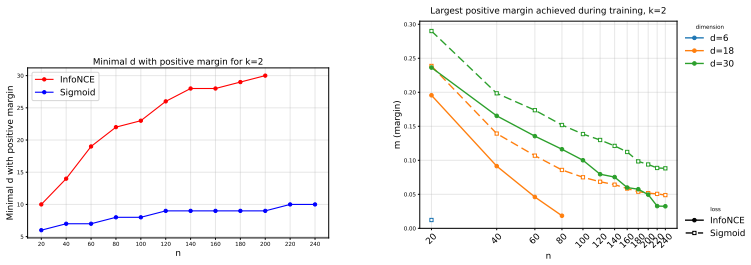
Figure from the paper full image
abstract click to expand
Why does the low dimensionality of representations, typically $d\approx 1000$, not prevent modern embedding-based retrieval models from scaling to billions, or even trillions, of data points? To answer this question, we study maximal-margin embeddings in the following retrieval model, classically studied in communication complexity [PS86] and more recently in embedding-based retrieval [WBNL26]. Let $A\in \{0,1\}^{N\times n}$ be a matrix indicating whether each of $N$ queries is relevant to each of $n$ documents. We are interested in the largest margin $m>0,$ denoted by $\mathsf{m}^{\mathsf{rd}}(d, A),$ for which there exist unit norm embeddings of the queries and documents $\{U_j\}_{j = 1}^N, \{V_i\}_{i = 1}^n$ with the following property. $\langle U_j, V_i\rangle \ge m$ whenever $A_{ji} = 1$ and $\langle U_j, V_i\rangle \le -m$ otherwise. A large margin is a key proxy for representation quality: it controls both robustness to perturbations and compositional generalization across queries. Our main theorem establishes that the best possible margin without a restriction on the dimension, $\mathsf{m}^{\mathsf{rd}}(+\infty, A),$ can be nearly achieved in dimension $d = O(\mathsf{m}^{\mathsf{rd}}(+\infty, A)^{-2}\log n)$ which improves a theorem of [BDES02]. Together with a matching lower bound in Theorem 1.5, we conclude that when $A\in \{0,1\}^{\binom{n}{k}\times n}$ is the matrix containing all possible $k$-sparse rows once, dimension $d = O(k\log (n/k))$ is necessary and sufficient for the maximal possible margin $\mathsf{m}^{\mathsf{rd}}(+\infty, A) = \Theta(k^{-1/2})$ in this setting. This fully resolves the setup of [WBNL26]. We also give several constructions for large margins when $d = o(k\log (n/k)).$ Finally, we empirically test the InfoNCE and sigmoid losses for producing large margin embeddings and demonstrate a clear advantage of the sigmoid loss.
1 0
Top Pith
5
cs.LG 2026-05-22 3 theorems

RICA defines local disentanglement with a Hessian-Ricci tensor

by Edmond Cunningham

Disentanglement Beyond Generative Models with Riemannian ICA

The construction drops ICA's global generative requirement while recovering sources consistently across manifold representations.

Figure from the paper full image
abstract click to expand
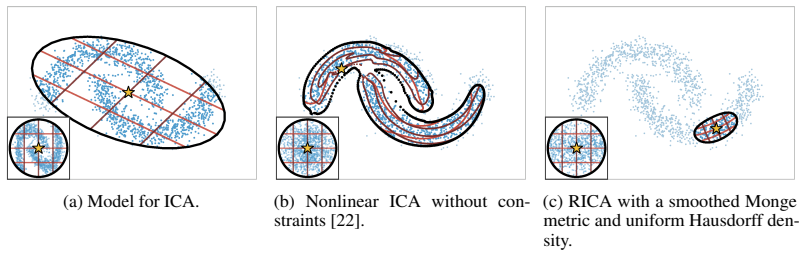
There is a gap between the theoretical foundations of disentanglement and the practice of modern representation learning. Existing theoretical frameworks, particularly Independent Component Analysis (ICA) and its nonlinear variants, assume a generative model with statistically independent latent variables underlying the data so that disentanglement amounts to identifying the latents that could have generated the data. This generative framework is interpretable and theoretically justified, but its strong assumptions make it difficult to apply to modern representation learning. Modern pretrained encoders often learn features that exhibit disentangled properties without making generative assumptions, yet there is no general theory for interpreting these features as independent factors of variation. We take a step toward such a theory by introducing Riemannian ICA (RICA), which replaces ICA's global generative model with local geometric structure. RICA is founded on the observation that in ICA, the factors of variation underlying a data point can be understood through radial curves emanating from the point that map to axis-aligned lines in the latent space. We formalize this perspective using Riemannian geometry and introduce our theory in a way that is consistent with the existing generative approach. Our main contribution is the disentanglement tensor, which encodes a second-order notion of disentanglement that we call pointwise disentanglement. This tensor depends on the Hessian of the data log likelihood as well as the Ricci curvature induced by the model. In a controlled source recovery setting with known ground-truth sources, RICA recovers sources across several manifolds, while the success of ICA baselines depends on the coordinates used to represent the observations. Our work provides a theoretical basis for studying local disentanglement without assuming a global generative model.
0
Top Pith
5
cs.LG 2026-05-22 2 theorems

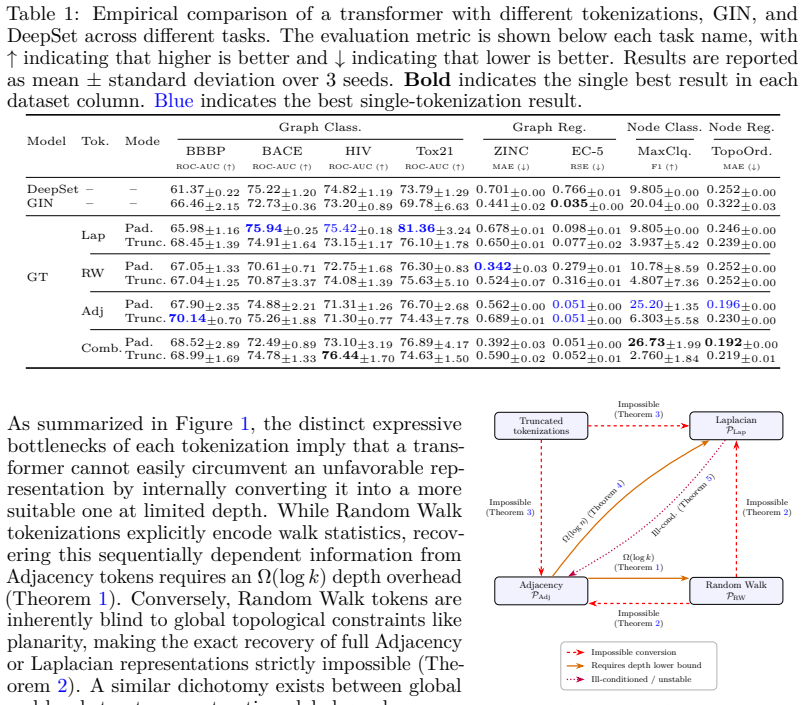
Graph tokenization fixes transformer depth for structure recovery

by Maya Bechler-Speicher, Gilad Yehudai +4 more

Lost in Tokenization: Fundamental Trade-offs in Graph Tokenization for Transformers

Random-walk maps lose information permanently while spectral maps preserve it but hinder local tasks, creating provable depth gaps between 2

Figure from the paper full image
abstract click to expand
Transformers have become a central architecture for graph learning, but their application to graphs requires first choosing a tokenization: a graph-to-token map that determines which structural information is exposed at the input. In this work, we show that this choice is a fundamental component of transformer expressivity. We examine three tokenizations that serve as building blocks for many existing graph tokenizations: spectral, random-walk, and adjacency tokenizations. We prove that different tokenizations induce distinct depth regimes: the same graph computation may be realizable by a shallow transformer under one tokenization, while requiring substantially larger depth under another. For example, we prove that random-walk tokenization is lossy for any walk length, making it impossible in general to recover the graph from it, and that while spectral tokenization is lossless, it is ill-conditioned for local tasks. We further show that although both random-walk and spectral tokenizations are derived from adjacency information, it is impossible for a limited-depth transformer to convert between tokenization families in general. In particular, we establish lower bounds and impossibility results showing that unfavorable tokenizations may preclude the efficient recovery of more suitable structural representations. Finally, we complement our theory with controlled experiments on synthetic and real-world tasks, validating the predicted separations and showing that different tasks favor different structural views, and combining complementary tokenizations allows the transformer to leverage distinct signals from each representation.
1 0
0
cs.CL 2026-07-03

Testbed shows unlearning often misses the parameters holding data

by Matteo Boglioni, Thibault Rousset +3 more

LACUNA: A Testbed for Evaluating Localization Precision for LLM Unlearning

LACUNA places PII in known weights so researchers can measure whether methods erase knowledge at the source or only change outputs.

Figure from the paper full image
abstract click to expand
LLMs memorize sensitive training data, including personally identifiable information (PII), creating a pressing need for reliable post hoc removal methods. Unlearning has emerged as a promising solution, with state-of-the-art(SOTA) methods often following a localize-first, unlearn-second paradigm that targets specific model parameters. However, existing benchmarks evaluate unlearning solely at the output level, leaving open the question of whether unlearning truly erases knowledge from a model's parameters or merely obfuscates it, a concern reinforced by the success of resurfacing attacks. To bridge this gap, we introduce LACUNA: the first unlearning testbed with ground-truth parameter-level localization. LACUNA injects PII of synthetic individuals into predefined parameters of 1B and 7B OLMo-based models via masked continual pretraining, enabling direct evaluation of whether unlearning targets the weights responsible for knowledge storage. We use LACUNA to benchmark current SOTA unlearning methods and find that, despite strong output-level performance, existing methods are highly imprecise and susceptible to resurfacing attacks. We further show that when localization is successful, even a simple gradient-based unlearning method achieves strong erasure and robustness to resurfacing attacks, highlighting the importance of precise unlearning. We release LACUNA to complement behavioral evaluations and drive further advances in robust, localization-based unlearning.
0
0
cs.LG 2026-07-03

Compile fuzzy functions into 23 MB weights

by Wentao Zhang, Liliana Hotsko +4 more

Program-as-Weights: A Programming Paradigm for Fuzzy Functions

A 0.6B interpreter running compiler-generated LoRA adapters matches a 32B model on fuzzy text tasks at 1/50th the memory, entirely offline.

Figure from the paper full image
abstract click to expand
Many everyday programming tasks resist clean rule-based implementation, such as alerting on important log lines, repairing malformed JSON, or ranking search results by intent, and are increasingly outsourced to large language model APIs at the cost of locality, reproducibility, and price. We propose fuzzy-function programming: compiling such a function from a natural-language specification into a compact, locally-executable neural artifact. We instantiate this paradigm with Program-as-Weights (PAW), in which a 4B compiler trained on FuzzyBench, a 10M-example dataset we release, emits parameter-efficient adapters for a frozen, lightweight interpreter. A 0.6B Qwen3 interpreter executing PAW programs matches the performance of direct prompting of Qwen3-32B, while using roughly one fiftieth of the inference memory and running at 30 tokens/s on a MacBook M3. PAW reframes the foundation model from a per-input problem solver into a tool builder: invoked once per function definition, it produces a small reusable artifact whose subsequent calls per function application are cheap and offline.
0
0
cs.AI 2026-07-03

Simple threshold monitor matches advanced LLM safety checks

by Mona Schirmer, Metod Jazbec +4 more

Online Safety Monitoring for LLMs

Risk-calibrated thresholding on external verifier signals performs competitively on reasoning and red teaming tasks.

Figure from the paper full image
abstract click to expand
Despite alignment training, LLMs remain prone to generating unsafe outputs at deployment time. Monitoring outputs online and raising an alarm when safety can no longer be assumed is therefore critical. We study a simple real-time monitor that turns a verifier signal from an external model into an alarm decision by thresholding, with the threshold calibrated via risk control. In experiments on mathematical reasoning and red teaming datasets, we show that this simple design is competitive with more advanced monitors based on sequential hypothesis testing.
0
0
cs.AI 2026-07-03

Social context produces 40% public-private split in LLM agents

by Arman Ghaffarizadeh, Danyal Mohaddes +2 more

What LLM Agents Say When No One Is Watching: Social Structure and Latent Objective Emergence in Multi-Agent Debates

Dual-channel tests show relational pressures create decision divergence absent from isolated prompts

Figure from the paper full image
abstract click to expand
LLM agents will increasingly act in socially structured settings where role, audience, and relational context can shape what is advantageous or costly to say. We study whether such social structure, without any explicit objective in the prompt, changes what an agent expresses publicly relative to an off-the-record (OTR) channel elicited under the same condition. We introduce a dual-channel debate framework in which agents produce public utterances that enter the shared history alongside OTR responses that are recorded but never shown to the other participant. Across 10 models, 3 scenarios, and 5 variations within each scenario, alignment-inducing settings produce systematic public-OTR divergence in the targeted agent, with its decision divergence rising from a $\sim$3% baseline to roughly 40%. The effect is consistent across four aggregate analyses: stance, semantic similarity, natural language inference, and survey responses. In some cases, the OTR response explicitly attributes public accommodation to relational pressures, such as career risk or sponsorship obligation. The findings suggest that agent evaluation should extend beyond explicit goals and detect emergent objectives. We present a dual-channel evaluation framework and complementary behavioral measures that operationalize this assessment.
0
0
cs.LG 2026-07-03

DemoPSD reduces leakage in LLM self-distillation via adaptive barycenters

by Yunhe Li, Hao Shi +6 more

DemoPSD: Disagreement-Modulated Policy Self-Distillation

Blending teacher and student distributions by per-token disagreement preserves exploration and improves cross-domain performance on scientif

Figure from the paper full image
abstract click to expand
On-policy self-distillation (OPSD) has emerged as a practical method for training large language models (LLMs) to reason, where a single model acts as both the teacher and the student with different levels of information access. However, recent studies have found that the teacher's dense token-level supervision, conditioned on privileged information, can lead to overfitting to in-domain patterns, suppress exploration, and hurt cross-domain generalization, while also introducing a more fundamental issue: *privileged information leakage*, where the student encodes answer-dependent shortcuts that are unavailable at test time. We introduce **DemoPSD**, a novel framework that resolves such problems through the idea of *selective adoption of teacher guidance*. Instead of fitting the full teacher distribution, DemoPSD steers the student toward a *reverse-KL barycenter target*, a weighted geometric combination of the teacher and student distributions, that naturally balances learning from the teacher with preserving the student's own reasoning capacity. We measure the difference between their distributions and use such a discrepancy to adaptively control the blending at each token position. We provably show that DemoPSD achieves **(1)** *leakage attenuation*, i.e., effective mitigation of privileged information leakage; and **(2)** *exploration preservation*, i.e., preservation of exploration capacity under dense token-level distillation. Extensive experiments on SciKnowEval across four scientific fields show that DemoPSD outperforms both GRPO and SDPO while maintaining higher training entropy and robustly generalizing to out-of-distribution GPQA benchmarks.
0
0
cs.LG 2026-07-03

SOAP and SOAP-Muon beat Adam on ML interatomic potential training

by Gil Harari, Yoel Zimmermann +5 more

Beyond Adam: SOAP and Muon for Faster, Label-Efficient Training of Machine Learning Interatomic Potentials

Matrix optimizers reach higher accuracy in fewer steps, with largest gains under partial force labels.

Figure from the paper full image
abstract click to expand
Machine learning interatomic potentials (MLIPs) have become a hallmark of AI for scientific simulation. While efforts on new architectures and datasets have led to increasingly accurate and general models, the choice of optimizer for training has largely remained unexplored, defaulting to Adam and its variants in the community. Here, we implement and systematically compare a class of recently proposed matrix-structured optimizers, including Muon, SOAP, and the hybrid SOAP-Muon, for training NequIP and Allegro MLIP models. We find that these optimizers can substantially outperform Adam in both convergence speed and final accuracy. SOAP and SOAP-Muon emerge as robust and consistently strong methods, while Muon only provides partial gains relative to Adam. The improvements are particularly pronounced under partial force supervision. Our results indicate that optimizer choice is an overlooked yet impactful design axis for MLIPs.
0
0
cs.RO 2026-07-03

Behavior latents add independent speed and safety control to traffic sims

by Juanwu Lu, Junyu Zhu +1 more

Controllable Sim Agents with Behavior Latents

CNeVA matches top imitation models on Waymo data while enabling monotone per-channel steering without reward hacks.

Figure from the paper full image
abstract click to expand
Realistic traffic simulation requires agents that imitate logged behavior and can also be steered along interpretable axes. Such controllability enables engineers to isolate variables, reproduce specific edge cases, and test autonomous systems without real-world risk. We introduce Controllable Neural Variational Agents (CNeVA), a controllable simulated-agent framework that learns to infer a per-agent Gaussian behavior latent from per-channel discounted returns via a closed-form conjugate variational update, conditioning a rectified-flow trajectory generator trained on a mixed channel-mask curriculum for classifier-free guidance. To tackle scarcity in reward signals, we propose soft eligibility gates that replace hard binary thresholds with smooth exponential decay, preserving the gradient signal for near-threshold agents. On the Waymo Open Motion Dataset, CNeVA attains competitive realism on the benchmark while exposing per-channel controllability that the higher-ranked imitation models lack. Speed- and acceleration-based steering produces monotone responses without stall-induced reward hacking. Safety controllability is monotone and substantial with the introduction of soft eligibility. We manage to achieve steerable map compliance under a context-residual return measure. Furthermore, our experiment demonstrates that steering metrics must be read alongside physical-plausibility guardrails to avoid reward-hacking confounds.
0
0
cs.CV 2026-07-03

Rotation fixes one codebook for all DiT steps

by Donghyun Lee, Jitesh Chavan +6 more

OrbitQuant: Data-Agnostic Quantization for Image and Video Diffusion Transformers

A randomized permuted block-Hadamard transform creates a data-independent basis that serves every timestep and modality.

Figure from the paper full image
abstract click to expand
Diffusion transformers (DiTs) achieve state-of-the-art image and video generation, but their multi-step sampling and growing parameter count make inference expensive. Post-training quantization (PTQ) is the natural remedy, yet DiT activations shift across timesteps, prompts, and guidance branches, forcing prior methods to re-fit calibration data for every new checkpoint or modality. We present OrbitQuant, a data-agnostic weight-activation quantizer that bypasses range estimation by quantizing in a normalized, rotated basis. In this basis, a randomized permuted block-Hadamard (RPBH) rotation concentrates each coordinate around one fixed, known marginal regardless of the input, so a single Lloyd-Max codebook serves all timesteps, prompts, and layers of a given input dimension. We extend the same quantizer to weight rows offline, absorbing the rotation into the weights so that it cancels inside each linear layer and only a forward rotation on the activations remains at runtime. The same recipe transfers from image to video with no per-modality tuning. Across FLUX.1, Z-Image-Turbo, Wan 2.1, and CogVideoX, it sets the state of the art for PTQ at several low-bit settings. It also pushes PTQ of image diffusion transformers to W2A4 with usable generation quality.
0
0
cs.LG 2026-07-03

Neuron activations select data for label-free LLM self-distillation

by Zhuowei Chen, Xiang Lorraine Li

Neuron-Aware Data Selection for Annotation-Free LLM Self-Distillation

The approach raises specialized-task accuracy while avoiding the out-of-domain drop and calibration problems of earlier output-only methods.

Figure from the paper full image
abstract click to expand
Post-training large language models (LLMs) without real-world interaction feedback or human-labeled supervision remains challenging, particularly in specialized domains where expert annotations are costly to obtain. Recent annotation-free self-evolution methods address this by using the model's own outputs as supervision signals, constructing a teacher via additional context and aggregating predictions across multiple rollouts through majority voting to produce pseudo-labels. However, these approaches are not without drawbacks: SFT- and GRPO-based variants suffer out-of-domain performance degradation, while reward-based on-policy RL inflates calibration error. In this paper, we propose Neuron On-Policy Self-Distillation (Neuron-OPSD), a data-centric framework for annotation-free self-distillation that leverages internal neuron activations to guide both training-data selection and teacher context construction. The model is then trained via on-policy distillation from the teacher distribution, requiring no ground-truth labels at any stage. Across specialized-domain benchmarks, Neuron-OPSD improves in-domain task performance while preserving cross-domain generalization and mitigating calibration collapse over prior annotation-free baselines. This framework is particularly relevant to settings where online interaction or external supervision is costly or infeasible, and is conceptually distinct from offline RL approaches that rely on logged, reward-labeled trajectories.
0
0
cs.LG 2026-07-03

MIM pre-training resists non-IID data better than contrastive learning

by Xuanyu Chen, Nan Yang +2 more

Understanding the Robustness of Distributed Self-Supervised Learning Frameworks Against Non-IID Data

Theoretical analysis shows decentralized SSL robustness grows with network connectivity, placing federated learning on equal footing.

Figure from the paper full image
abstract click to expand
Recent research has introduced distributed self-supervised learning (D-SSL) approaches to leverage vast amounts of unlabeled decentralized data. However, D-SSL faces the critical challenge of data heterogeneity, and there is limited theoretical understanding of how different D-SSL frameworks respond to this challenge. To fill this gap, we present a rigorous theoretical analysis of the robustness of D-SSL frameworks under non-IID (non-independent and identically distributed) settings. Our results show that pre-training with Masked Image Modeling (MIM) is inherently more robust to heterogeneous data than Contrastive Learning (CL), and that the robustness of decentralized SSL increases with average network connectivity, implying that federated learning (FL) is no less robust than decentralized learning (DecL). These findings provide a solid theoretical foundation for guiding the design of future D-SSL algorithms. To further illustrate the practical implications of our theory, we introduce MAR loss, a refinement of the MIM objective with local-to-global alignment regularization. Extensive experiments across model architectures and distributed settings validate our theoretical insights, and additionally confirm the effectiveness of MAR loss as an application of our analysis.
0
0
quant-ph 2026-07-03

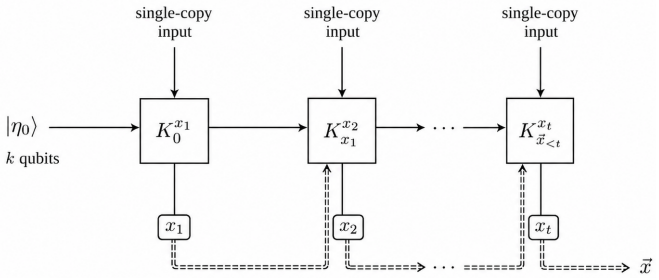
k-qubit memory forces Θ(n-k) samples for stabilizer testing

by Srinivasan Arunachalam, Louis Schatzki

Optimal Stabilizer Testing and Learning with Limited Quantum Memory

The usual constant-copy tester vanishes; learning costs Θ(n²/k) non-adaptively, so testing and learning match when memory is fractional

Figure from the paper full image
abstract click to expand
We study stabilizer state testing and learning with limited coherent quantum memory. Here an algorithm sequentially receives copies of an unknown $n$-qubit state, but may keep only $k$ qubits of coherent quantum memory between measurements. With unrestricted memory, seminal work of Gross, Nezami and Walter showed how to test $n$-qubit stabilizer states using $6$ copies, which is dimension independent, unlike the learning complexity of $\Theta(n)$. We show that this testing-vs-learning separation is lost under memory constraints. More concretely we show that (1) The sample complexity of testing stabilizer states in the $k$-qubit memory framework is $\Theta(n-k)$. Our upper bound goes via a novel connection to the hidden shift problem and the lower bound is proven using a novel approach to average case bounds on likelihood ratios via combinatorics of the stochastic orthogonal group. (2) The sample complexity of learning stabilizer states with $k$ qubits of memory, in the non-adaptive framework, is $\Theta(n^2/k)$. As a further application of our techniques, we prove an exponential lower bound for purity testing even when the memory may be left coherent throughout the protocol. Our main results identify coherent quantum memory as the resource enabling the usual separation between stabilizer testing and learning. In particular, even with $k=0.99n$ qubits of memory, there is no constant-copy stabilizer tester; furthermore for $k=cn$ qubits of memory (for $0< c < 1$), stabilizer testing is as hard as learning, with both requiring $\Theta(n)$ copies.
0
0
cs.LG 2026-07-03

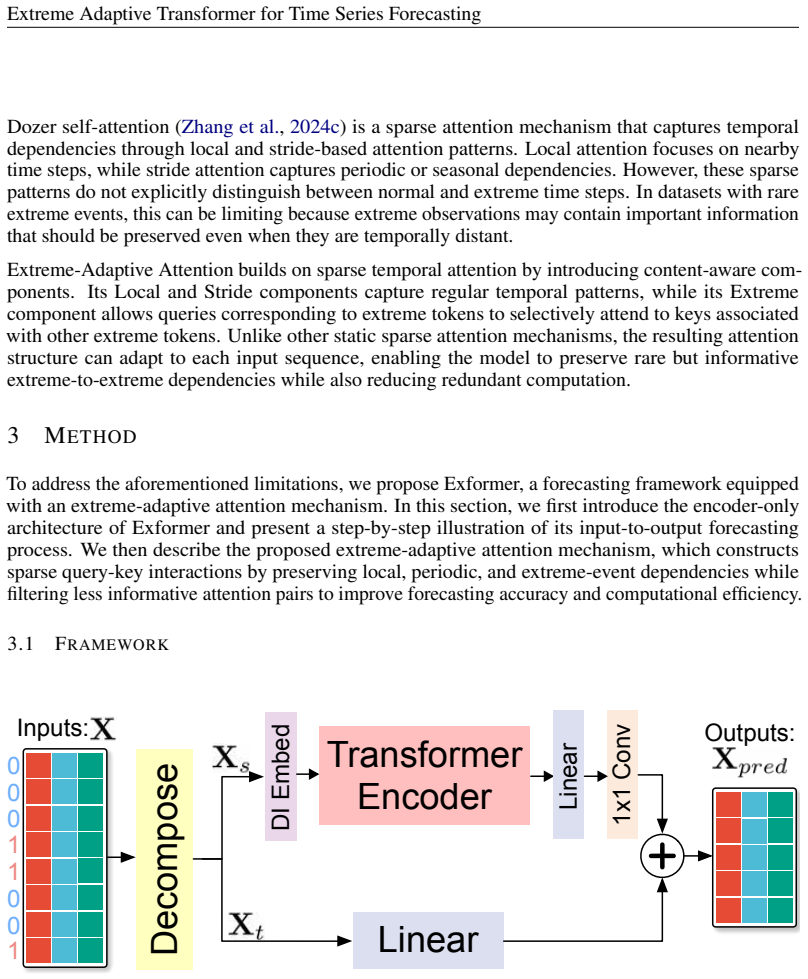
Extreme attention improves streamflow forecasts

by Sanjeev Shrestha, Hui Liu +1 more

Extreme Adaptive Transformer for Time Series Forecasting

An added attention component for rare peaks yields better 3-day predictions than standard transformers on four hydrologic datasets.

Figure from the paper full image
abstract click to expand
Time series forecasting remains challenging when the underlying data contain rare but critical extreme events. This issue is particularly important in hydrologic forecasting, where streamflow distributions are often highly skewed and extreme peaks can have substantial impacts on flood monitoring, water resource management, and early warning systems. Although Transformer-based forecasting models have achieved strong performance by modeling long-range temporal dependencies, they typically treat all time points uniformly and may therefore underrepresent rare extreme patterns. In this paper, we propose the Extreme-Adaptive Transformer (Exformer), a forecasting framework designed to explicitly model temporal dependencies involving both normal and extreme events. Exformer introduces an extreme-adaptive attention mechanism composed of three sparse components: Local, Stride, and Extreme. The Local and Stride components capture short-term and periodic temporal dependencies, respectively, while the Extreme component selectively models event-aware dependencies between normal and extreme streamflow patterns. Experiments on four real-world hydrologic streamflow datasets show that Exformer achieves superior 3-day forecasting performance compared with state-of-the-art baselines. Our findings demonstrate that explicitly incorporating extreme-aware attention improves the forecasting capacity of Transformer models on imbalanced time series with rare but consequential events.
0
0
cs.LG 2026-07-03

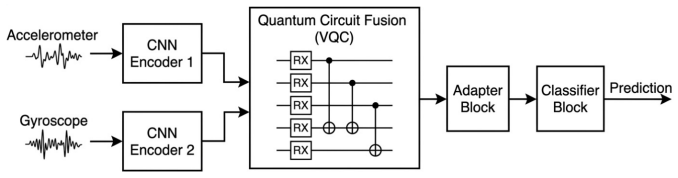
Quantum circuit fuses sensors with 72 params in federated learning

by Quoc Bao Phan, Tuy Tan Nguyen

QFedAgent: Quantum-Enhanced Personalized Federated Learning for Multi-Agent Activity Recognition

Replaces 33K classical parameters yet reaches 97.7% accuracy on non-IID wearable activity data.

Figure from the paper full image
abstract click to expand
Federated learning (FL) enables collaborative model training across distributed devices without sharing raw data, making it suitable for privacy-sensitive robotic sensing applications. However, multi-agent systems generate heterogeneous and non-independent and identically distributed (non-IID) multimodal sensor streams that degrade conventional FL algorithms, while classical fusion modules introduce substantial parameter overhead and communication cost. This paper proposes QFedAgent, a hybrid quantum-classical personalized FL framework for multi-agent activity recognition. The approach integrates a variational quantum circuit fusion module that models accelerometer--gyroscope interactions through quantum state encoding and entanglement, requiring only 72 quantum rotation parameters versus 33K in classical multi-layer perceptron-based fusion, achieving approximately 10x total parameter reduction. Experiments on the OPPORTUNITY dataset under subject-based non-IID partitions demonstrate 97.7% mean test accuracy, confirming that parameter-efficient quantum fusion remains competitive with conventional federated baselines.
0
0
cs.LG 2026-07-03

Neuron activations select stronger few-shot samples for LLMs

by Zhuowei Chen, Liwei Chen +3 more

Neuron-Aware Active Few-Shot Learning for LLMs

By tracking internal patterns for diversity and low consensus, NeuFS cuts annotation cost while beating output-entropy and embedding baselin

Figure from the paper full image
abstract click to expand
Active Few-Shot Learning (AFSL) adapts LLMs to specialized domains by identifying the most valuable unlabeled samples for annotation and use as few-shot demonstrations, effectively reducing human annotation costs while promoting high performance. However, existing methods typically rely on output-level signals for sample identification, such as predictive entropy or semantic similarities with test-time data based on external embeddings, which often overlook models' internal dynamics, which could pinpoint specific knowledge gaps. To bridge this gap, we propose NeuFS, a Neuron-Aware Active Few-Shot Learning framework that shifts the selection paradigm from output-level proxies to models' internal dynamics. NeuFS utilizes neuron activation patterns to represent sample directly, and includes a dual-criteria selection strategy that: (1) ensures few-shot sample diversity with neuron patterns for broader example coverage, while (2) prioritizing on identifying informative and challenging few-shot samples LLMs tend to hallucinate by quantifying neuron consensus. Experiments on three datasets demonstrate that NeuFS excels in both reasoning and text classification tasks, outperforming existing AFSL baselines. Ablation studies further highlight that internal neuron activations provide a more principled and effective selection signal than external embeddings, validating the superiority of the proposed NeuFS.
0
0
cs.RO 2026-07-03

Model learns intent-driven camera poses from passive video

by Boyang Sun, Jiajie Li +7 more

LIME: Learning Intent-aware Camera Motion from Egocentric Video

LIME mines language intents and view gains from egocentric recordings to train robots on choosing next viewpoints.

Figure from the paper full image
abstract click to expand
Autonomous robots often need to move their camera before they can act: to inspect an object, reveal an occluded region, or obtain a view that responds to a user's intent. While vision-language navigation translates instructions to base motion and vision-language-action policies map instructions to manipulation actions, language-conditioned camera motion remains comparatively underexplored as a first-class action. We formulate language-conditioned camera motion generation: given a current RGB observation and a free-form natural-language intent, predict a relative target camera pose for the next observation. This task is inherently non-trivial: viewpoint changes are driven by latent perceptual intentions, and a valid motion may operate at different semantic granularity, from entering a room to looking around a corner, inspecting a visible object, or revealing an occluded detail. To model this structure, we mine multi-intention camera-motion supervision from egocentric video, pairing plausible intents and observation-gain descriptions with relative SE(3) target poses. We propose LIME, a vision-language camera-motion generator that combines an auto-regressive observation-gain output with a continuous flow-matching pose head. This design lets the model jointly predict what the next view should reveal while representing multi-hypothesis target views. Across experiments and downstream robotic tasks, we show that LIME can learn to actively choose camera poses from passive human video, turning ordinary egocentric recordings into supervision for intent-aware active perception.
0
0
cond-mat.quant-gas 2026-07-03

Package merges ML detection with BEC image analysis

by M. Doris, S. Guo +6 more

Q-GAIN: A Python Package for Machine Learning and Physically Informed Analysis Applications

Q-GAIN supplies modular tools for classification and object detection, shown on solitons and vortices in cold-atom data.

Figure from the paper full image
abstract click to expand
Here we describe the quantum gas analysis and inference (Q-GAIN) Python package, which enables rapid deployment of machine learning (ML) and physics-informed analysis techniques for cold-atom experiments. Out of the box, Q-GAIN implements classification, object detection, and physics-informed metrics for feature detection in images of atomic Bose-Einstein condensates (BECs). Q-GAIN encourages a natural, module-based workflow: starting with data loading and preprocessing, followed by ML-based feature identification, and ending with conventional analysis techniques. We demonstrate this modularity by configuring Q-GAIN for three ML tasks. First, we demonstrate the basic workflow of the Q-GAIN framework by implementing the standard task of classifying handwritten digits from the MNIST dataset. Then, we re-implement our earlier soliton detection (SolDet) package in the Q-GAIN framework, enabling the detection and analysis of solitonic excitations in time-of-flight data. Finally, we develop an object-detection tool that identifies quantized vortices in images of ring-shaped BECs.
0
0
cs.CV 2026-07-03

Object LeJEPA beats image LeJEPA on four tasks with 10-100% COCO

by Jakob Geusen, Ender Konukoglu

Object-centric LeJEPA

Fixed SAM masks let the distributional objective align objects instead of scenes, raising tracking, classification, segmentation and re-iden

Figure from the paper full image
abstract click to expand
Image encoders trained with LeJEPA can deliver strong features for downstream tasks, but, like other image-level self-supervised methods, typically require large training datasets. Aligning representations at the level of objects rather than whole scenes promises greater data efficiency, but doing this in a completely self-supervised way, effectively jointly partitioning a scene and representing its objects, is unstable: the two are locked in a cyclic dependency, partitioning requires meaningful representations, while meaningful representations require consistent partitioning. We sidestep this instability by taking object masks as given during training, using cheap, off-the-shelf SAM proposals. We extend LeJEPA - whose distributional anti-collapse objective ports naturally from whole images to variable-sized sets of objects - to align object-centric representations rather than whole images. An additional instance-separating loss, which treats other objects in the same scene as negatives, further boosts downstream performance. Across two model scales and 10-100% of COCO, object-level LeJEPA outperforms image-level LeJEPA on tracking (DAVIS), classification (ImageNet-1k), segmentation (ADE20k), and re-identification (NAVI).
0
0
cs.AI 2026-07-03

Adapted RFM finds refusal subspaces in seconds

by Thomas Winninger

Fast Multi-dimensional Refusal Subspaces via RFM-AGOP

The method works on both reasoning and non-reasoning models and beats alternatives on ablation tests.

abstract click to expand
Steering and monitoring activations in Large Language Models (LLMs) are increasingly used for both safety and interpretability. Early work assumed behaviours are encoded along single linear directions, but recent findings suggest complex behaviours, such as the refusal to answer harmful queries, live in multi-dimensional subspaces. However, existing methods for extracting these subspaces are computationally expensive, which becomes prohibitive on reasoning models who produce long reasoning traces. By adapting the Recursive Feature Machine (RFM) algorithm -- which can be computed efficiently -- with a probe-informed initialization, we are able to identify the multi-dimensional refusal subspace in seconds, on reasoning (Qwen 3) and non-reasoning (Qwen 2.5) models. While RFM allows for faster subspace identification, it also showed better performances on the ablation task than its alternatives. More work is planned to better understand the relations between subspaces found by different methods. If confirmed, RFM could be a cheap and scalable complement to existing subspace-extraction methods in LLMs.
0
0
cs.DC 2026-07-03

Models predict LLM power and latency on new GPUs with 3-14% error

by Mauricio Fadel Argerich, Jonathan Fürst +1 more

WattGPU: Predicting Inference Power and Latency on Unseen GPUs and LLMs

Public metadata alone enables matching models to hardware without profiling and halves to quarters baseline errors in server scenarios.

Figure from the paper full image
abstract click to expand
Large Language Model (LLM) inference workloads are a rapidly growing contributor to data center energy consumption. Optimizing these deployments requires matching specific LLMs to the most efficient GPUs, but operators currently lack the tools to do so without exhaustively profiling each combination. While some predictive models exist, they still require profiling data and struggle to generalize to hardware unseen during training. To address this, we introduce \textit{WattGPU}, featuring two predictive models for mean GPU power draw and Inter-Token Latency (ITL). Our approach leverages only publicly available LLM metadata and GPU specifications, eliminating the need for hardware access or profiling while enabling generalization to unseen NVIDIA server-grade GPUs and LLMs. We evaluate our models using rigorous leave-one-GPU-out and leave-one-LLM-out cross-validation on a dataset of 42 open-source LLMs (0.1B--27B parameters) and 8 GPUs under both offline and server scenarios. The mean power draw model achieves a median absolute percentage error of $\leq3.4\%$ for offline and $\leq13.5\%$ for server scenarios on unseen GPUs, while the latency model achieves $\leq8.5\%$ in server mode, both maintaining strong GPU ranking correlations for server scenarios (Kendall $\tau\geq0.76$). Compared to standard physically grounded baselines -- Load-Scaled Thermal Design Power (TDP) for power draw and roofline for latency -- our models reduce median absolute percentage error by approximately 4$\times$ on unseen LLM-GPU combinations for server scenarios or approximately 2$\times$ for completely unseen GPUs. WattGPU's data and code are publicly available at https://github.com/maufadel/wattgpu.
0
0
cs.LG 2026-07-03

Modular RL recombines code modules to solve problems sampling misses

by Juliette Decugis, Fabian Gloeckle +3 more

DecompRL: Solving Harder Problems by Learning Modular Code Generation

Decomposing into sub-functions creates up to k^n candidates while cutting GPU token cost by about 50 times.

abstract click to expand
How can Large Language Models (LLMs) solve problems they currently cannot? Repeated sampling scales test-time compute but GPU cost grows linearly with attempts, while reinforcement learning (RL) with verifiable rewards improves single-attempt accuracy at the expense of sample diversity. Both strategies ultimately fail when the base policy has near-zero probability of producing a correct solution: no amount of sampling or gradient signal can overcome a search space that is simply too large. We take a different approach: rather than sampling harder, we make the task easier by decomposing problems into smaller, independently solvable sub-functions whose implementations can be recombined. Since off-the-shelf models are not trained for this modular generation, we introduce DecompRL, an RL algorithm that explicitly learns to decompose and implement hierarchical code structures. Recombining $k$ implementations of $n$ modules yields up to $k^{n}$ candidate solutions, shifting the bottleneck from GPU inference to cheap CPU evaluation and cutting GPU token cost by $\sim$50$\times$. On LiveCodeBench and CodeContests (Qwen~2.5~7B, Code World Model~32B), DecompRL outperforms standard and diversity-optimized RL baselines beyond $10^5$ tokens per problem, solving problems that standard generation cannot reach.
0
0
cs.IR 2026-07-03

Agentic reranking lifts Earth data search MRR by 28%

by Minghan Yu, Youran Sun +3 more

Bringing Agentic Search to Earth Observation Data Discovery

Zero-shot LLM stage added to neural-BM25 fusion improves retrieval without extra training on NASA EO queries.

Figure from the paper full image
abstract click to expand
NASA and its data centers hold thousands of geoscience datasets and tools like Worldview, Giovanni, the Science Discovery Engine, and Harmony. Finding the right one is hard even for domain experts. We present an agentic search system, deployed as a public service for the geoscience community, that takes a natural-language research query and returns the matching datasets and tools. We demonstrate that, in the era of large language models, the latent value of knowledge graphs (KGs) can be substantially amplified through agentic search. From the NASA Earth Observation Knowledge Graph (NASA EO-KG) we derive NASA-EO-Bench, an open benchmark of 47k query-dataset pairs (21k task-based queries). A neural scorer fine-tuned on NASA-EO-Bench beats cosine and BM25 baselines. Further combining it with BM25 via score fusion raises both Recall@10 (R@10) and MRR by over 5x. On top of this supervised pipeline, we add a zero-shot agentic reranking stage that, without any additional training, lifts MRR by 28% on a stratified N=200 subset, showing that LLM reasoning is complementary to supervised retrieval.
0
0
cs.CV 2026-07-03

ViTs gain complexity by specializing layers while keeping tokens linked

by Kaustubh Kapil, Kishor P. Upla

Transformer Geometry Observatory TGO-II: Representational Similarity Observatory

CKA, SVCCA and dimensionality measures show manifold expansion without loss of token interactions across training.

Figure from the paper full image
abstract click to expand
While Vision Transformers have achieved remarkable success across computer vision and language applications, the geometric evolution of their internal representations throughout training remains insufficiently understood. Existing analyses primarily focus on attention mechanisms and downstream performance, leaving the evolution of representation geometry largely unexplored. In this work, we present Transformer Geometry Observatory-II (TGO-II), a representation geometry analysis framework designed to investigate how Transformer representations evolve during supervised training. TGO-II analyzes Vision Transformer (ViT-Small/16) representations using Centered Kernel Alignment (CKA), Singular Vector Canonical Correlation Analysis (SVCCA), Two-Nearest Neighbor Intrinsic Dimensionality (TwoNN-ID), and token covariance analysis. Our experiments reveal three key observations. First, both CKA and SVCCA progressively decrease throughout training, indicating increasing representational specialization across Transformer layers. Second, intrinsic dimensionality consistently increases before stabilizing, suggesting progressive expansion of the representation manifold into a larger set of locally accessible degrees of freedom. Third, token covariance and coupling analyses demonstrate that strong token interaction structure persists throughout training, challenging the hypothesis that increasing representational complexity arises primarily from progressive token independence. These findings suggest that representation complexity and layer specialization emerge simultaneously during training. Manifold expansion appears to occur without token decoupling. Together, these observations motivate a new hypothesis in which Vision Transformers increase representational complexity through progressively richer transformations while preserving strong token interaction structure during learning.
0
0
stat.ML 2026-07-03

LLM personas split into frame-stable aggregates and frame-sensitive geometry

by Yuan Yuan

The Dual Nature of LLM Persona: Aggregated Tendencies and Frame-Dependent Geometry

Aggregate trait scores resist frame changes while correlation structure drops 42% on mismatch and recovers with alignment.

Figure from the paper full image
abstract click to expand
Evaluations of LLM personas via psychometric questionnaires typically rely on aggregate scores, discarding within-instance correlation structure. We test whether this geometric structure is intrinsic or frame-dependent. Constructing within-instance correlation matrices from IPIP-50 responses, we analyze geometry on SPD manifolds under manipulated question orderings in GPT-4o simulating American and Chinese-American personas. We find that persona expression comprises two dissociable components: aggregated features (Big Five scores) degrade under randomization (21% drop) but are frame-robust; geometric features (SPD manifold) collapse under frame misalignment (42% drop) but recover substantially (to 84%) under shared frames, surpassing aggregated features (76%). This collapse-recovery pattern reveals that persona geometry is not intrinsic but a frame-dependent coordination pattern encoding information invisible to aggregation. Our findings establish a dual-nature framework for LLM personas, frame-dependent geometry versus frame-robust aggregates, necessitating frame-aware evaluation and challenging static trait conceptions.
0
0
quant-ph 2026-07-03

Bounded gate stabilizes quantum fast-weight programmers

by Kuo-Chung Peng, Jiun-Cheng Jiang +9 more

Stable Self-Modulating Quantum Fast-Weight Programmers with Bounded Memory Gates

Tanh on old-state memory removes divergence in long sequences and improves robustness on forecasting tasks.

Figure from the paper full image
abstract click to expand
Quantum Fast-Weight Programmers (QFWPs) store temporal information in dynamically programmed variational-circuit parameters rather than in nonlinear recurrent hidden states, offering a practical route to quantum sequence modeling. Self-Modulating QFWP improves this framework by using input-dependent gates for both new fast-weight updates and the accumulated fast-weight state, but its unbounded old-state multiplier can diverge in long-sequence regimes. We propose a bounded old-state modulation rule that applies a sign-preserving tanh gate only to the recurrent memory branch while leaving the additive update and new-update modulation unchanged. We evaluate standard QFWP, full Self-Modulating QFWP, Only-New, and Only-Old variants on two CUDA-Q quantum-dynamics forecasting tasks and on Milan SMS telecommunication activity prediction. The quantum-dynamics results show that old-state modulation is the most consistent source of improvement over Standard QFWP, and that bounding the old-state gate removes long-sequence divergence while improving aggregate robustness. On Milan SMS forecasting, the original unbounded Self-Modulating QFWP converges across the tested grid and shows its clearest gains at longer input windows, with behavior close to the Only-Old ablation. These findings identify accumulated-memory modulation as the key mechanism of Self-Modulating QFWP and bounded old-state gating as a targeted stabilization strategy.
0
0
cs.LG 2026-07-03

Self-gating attention reduces forecasting to linear time complexity

by Dezheng Wang, Tong Chen +4 more

Self-Gating Attention for Efficient Time Series Forecasting

Shared learnable matrix plus residual replaces query-key projections while matching accuracy on nine real-world datasets.

Figure from the paper full image
abstract click to expand
Transformer architectures have shown strong potential in time series forecasting, where multi-head self-attention is widely used to capture temporal dependencies across historical timestamps. However, standard self-attention has quadratic time and memory complexity with respect to the look-back length. This cost may limit its use in resource-constrained or high-throughput forecasting systems, where fast and memory-efficient inference is important. Through qualitative and quantitative analyses, we observe that self-attention maps in time series forecasting often contain redundant patterns across different timestamps. This phenomenon can be related to the repeated temporal patterns and relatively stable temporal correlations in many real-world time series. Motivated by this observation, we propose Self-Gating Attention (SGA), a plug-and-play attention mechanism that represents the attention score with a shared learnable matrix and an input-dependent residual component. The shared matrix captures common attention patterns, while the residual component captures input-dependent variations. In this way, SGA avoids the query and key projections used in standard attention score computation, leading to linear time and score-matrix memory complexity with respect to the look-back length. We integrate SGA into several forecasting backbones and compare it with standard self-attention and lightweight attention variants on nine publicly available real-world datasets covering electricity, finance, weather, medical monitoring, human activity, and climate records. The results show that SGA improves inference efficiency on public benchmarks while maintaining competitive forecasting performance against state-of-the-art attention mechanisms. These benchmark results provide deployment-oriented evidence.
0
0
cs.DB 2026-07-03

HNSW searches gain worst-case correctness via spanner bounds

by Minghao Li, Raghav Mittal +4 more

HNSW with Accuracy Guarantees Using Graph Spanners -- A Technical Report

A lightweight statistical check triggers exact fallback only when the heuristic result may be unreliable, preserving average speed.

Figure from the paper full image
abstract click to expand
Hierarchical Navigable Small World (HNSW) graphs serve as the industry standard due to their logarithmic complexity and strong empirical performance. However, HNSW relies on greedy graph traversal, a heuristic that provides no theoretical guarantees of correctness. In this paper, we propose a novel "Certify-then-Rectify" framework that bridges the gap between the speed of heuristic search and the rigor of exact retrieval. Rather than discarding HNSW, our approach first employs a distribution-free statistical certifier to dynamically evaluate the quality of a standard HNSW search with minimal overhead. If certification indicates that the retrieved neighbors are of low quality, the framework safely escalates to a rigorous exact recovery algorithm. To make this exact recovery computationally feasible, we reinterpret the HNSW graph as a geometric spanner and utilize Extreme Value Theory to stochastically estimate its maximum empirical stretch factor. This allows us to mathematically bound the maximum distance of true nearest neighbors. Extensive evaluations on benchmark datasets demonstrate that our tiered framework delivers the average-case speed of HNSW while ensuring the worst-case correctness of exact search and outperforming other applicable approaches.
0
0
cs.CL 2026-07-03

Directed types lift position-shift accuracy 30 points over undirected algebra

by Zichao Wei

On the Role of Directionality in Structural Generalization

CCG parser beats prior best on SLOG directional tests; larger encoders then close the recursion gap by addressing a separate weakness.

Figure from the paper full image
abstract click to expand
Several SLOG test categories explicitly involve directional distinctions (modifier position shifts, argument extraction positions), yet AM-Parser, the previous SOTA, uses an AM algebra whose operations do not encode direction. We redesign the symbolic backend around CCG directed types (deterministic CKY + single linear decoder, 30K learnable parameters). Under the same BERT-base encoder, the system achieves 75.9$\pm$6.4% LF exact match, surpassing AM-Parser (70.8$\pm$4.3%). Per SLOG's own category groupings, gains are highly directional: the CCG system outperforms AM-Parser on all 5 position-shift categories (+29.9pp), while AM-Parser outperforms on all 6 recursive-depth categories. Replacing the encoder with DeBERTa-v3-large yields 90.7$\pm$4.9%, with the largest encoder gains in recursive-depth categories, complementary to directionality's gains. Directional representations shift the bottleneck from the symbolic layer (AM-Parser's 0% category ceiling) to the neural layer, which improves with encoder upgrades.
0
0
cs.LG 2026-07-03

Trust-region method scales neural quantum states to 1.5B parameters

by Juan Agustín Duque, Sergio García Heredia +5 more

One More Time: Revisiting Neural Quantum States from a Reinforcement Learning Perspective

PWO reframes energy minimization as policy gradient to improve stability over Adam and earlier optimizers on spin lattices.

Figure from the paper full image
abstract click to expand
Neural quantum states (NQS) provide a flexible and scalable framework for approximating quantum many-body wavefunctions. Among NQS parameterizations, autoregressive models are especially attractive because they enable exact, independent sampling from the Born distribution, avoiding the autocorrelation and mixing issues of Markov chain methods. Yet their optimization remains comparatively underexplored: Adam is a scalable method but ignores function space geometry, while stochastic reconfiguration is principled but costly and numerically fragile in large models. To address this gap, we show that variational energy minimization can be viewed as an advantage policy-gradient problem over the Born distribution, motivating trust-region optimization for NQS training. We introduce Proximal Wavefunction Optimization (PWO), a principled trust-region algorithm that clips probability-ratio changes in the amplitude channel and phase increments in the phase channel. PWO avoids explicit matrix inversion, reuses samples across multiple updates, and combines the scalability of first-order optimization with theoretical guarantees. Across Ising and frustrated $J_1$-$J_2$ one- and two-dimensional spin systems, PWO improves stability and wall-clock convergence over Adam, minSR, and SPRING. Finally, we fine-tune a $1.5$B-parameter RWKV-7 model, demonstrating NQS optimization at a scale over three orders of magnitude beyond prior work.
0
0
cs.LG 2026-07-03

Distribution rewards improve FID scores on generative models

by Ruihang Li, Mengde Xu +5 more

Optimizing Visual Generative Models via Distribution-wise Rewards

Evaluating full sample distributions rather than individuals cuts FID-50K from 8.30 to 5.77 on SiT while preserving diversity.

Figure from the paper full image
abstract click to expand
Conventional reinforcement learning strategies for visual generation typically employ sample-wise reward functions, yet this practice frequently results in reward hacking that degrades image diversity and introduces visual anomalies. To address these limitations, we present a novel framework that finetunes generative models using distribution-wise rewards, ensuring better alignment with real-world data distributions. Unlike rewards that evaluate samples individually, distribution-wise reward accounts for the data distribution of the samples, mitigating the mode collapse problem that occurs when all samples optimize towards the same direction independently. To overcome the prohibitive computational cost of estimating these rewards, we introduce a subset-replace strategy that efficiently provides reward signals by updating only a small subset of a generated reference set. Additionally, we apply RL to optimize post-hoc model merging coefficients, potentially mitigating the train-inference inconsistency caused by introducing stochastic differential equation (SDE) in regular RL practices. Extensive experiments show our approach significantly improves FID-50K across various base models, from 8.30 to 5.77 for SiT and from 3.74 to 3.52 for EDM2. Qualitative evaluation also confirms that our method enhances perceptual quality while preserving sample diversity.
0
0
cs.LG 2026-07-03

Symmetric pessimism generalizes better than mild asymmetric pessimism

by Max Weltevrede, Matthijs T.J. Spaan +1 more

Generalization in offline RL: The structure is more important than the amount of pessimism

In contextual MDPs, matching the optimal solution's symmetries matters more than how conservative the value function is.

Figure from the paper full image
abstract click to expand
While pessimism counteracts overestimation bias in offline reinforcement learning (RL), being overly conservative has been associated with hindering certain forms of generalization. However, in this paper we demonstrate that being overly pessimistic does not inherently prevent optimal generalization in contextual MDPs (CMDPs). Instead, we argue successful generalization depends not on the amount of pessimism, but whether the pessimistic structure respects the underlying symmetries of the optimal solution. We prove that a mildly pessimistic, non-symmetric value function can generalize worse than an overly pessimistic, symmetric one. In offline RL, the structure of the pessimism is determined by the structure of the dataset coverage. As such, enforcing a symmetric value function can be non-trivial, and might require techniques such as data augmentation (DA). Inspired by our theoretical results, we argue that DA can best be applied through a consistency loss during policy extraction, rather than the common practice of (regular) offline training on an augmented dataset. This is empirically validated using IQL and CQL on a rotationally symmetric reacher environment.
0
0
cs.NE 2026-07-03

Single dendritic compartment embeds LMS for in-context learning

by Juwei Shen, Yujie Wu +1 more

Dendritic In-Context Learning in a Single-Layer Spiking Neural Network

Subthreshold dynamics match leaky online Widrow-Hoff updates, allowing stable ICL in one layer without plasticity or depth.

Figure from the paper full image
abstract click to expand
In-context learning (ICL) operates via implicit gradient descent embedded in the forward pass of modern AI architectures -- Transformers, Mamba, state-space models, and MLPs. Capturing this capability in biologically plausible Spiking Neural Networks (SNNs) has remained an open challenge: existing SNNs fail the Garg-2022 benchmark at non-trivial task dimensions. We trace this failure to a structural assumption: prior SNN designs route adaptation through inference-time synaptic plasticity, viewing the dendritic compartment as a passive conduit for error or teacher signals. We challenge this assumption. The subthreshold dynamics of a single dendritic compartment already implement a complete online learning algorithm. By treating the compartment as the computational substrate rather than a passive conduit, we propose DendriCL -- a single-layer compartmental spiking architecture whose apical recurrence is structurally identical to leaky online Widrow-Hoff LMS. This dynamics-only update collapses the architectural depth required for general-purpose ICL to a single layer. DendriCL is uniquely seed-stable at super-dimensional Garg-2022 ICL -- where dense Transformers exhibit grokking-style instability and fail past moderate task dimension -- and a linear probe recovers the reference online-LMS trajectory directly from the apical membrane at R^2 = 0.93, showing the algorithm is structurally embedded in the dynamics rather than implicitly discovered during training. Taken together, ICL requires neither attention, depth, nor inference-time plasticity: a single compartment with online-LMS dynamics is sufficient.
0
0
cs.LG 2026-07-03

Granularity hierarchy reveals mixing rule gain at one level only

by Ziyun Qiao, Yue Min +2 more

HERMES: A Multi-Granularity Labeling Substrate for Pre-training Data Mixtures

Equal coverage rule boosts 16-task average by 0.0253 at one prefix length but loses edge when pools shrink 5x.

Figure from the paper full image
abstract click to expand
Most data-mixing methods assume the corpus has already been partitioned into groups, and the choice of those groups determines what a mixer can express. Existing labels, including provenance, topic or format taxonomies, and flat embedding clusters, commit to one semantic axis at one granularity; changing the resolution rebuilds the labels. We argue the bottleneck is the label system, not the mixer, and provide a hierarchical one. HERMES is a data-derived labeling substrate: a Learned Semantic Transform followed by 3-stage residual vector quantization annotates each document once into a coarse-to-fine code whose prefix length controls granularity up to approximately 130k cells. At coarse granularity HERMES sits at a plateau with KMeans-family methods on standard clustering metrics, so the contribution is the substrate, not the clusterer. On 1B-parameter, 25B-token pre-training, the hierarchy exposes an interaction fixed-granularity pipelines cannot test: at one prefix length, a combined Stage-2 rule contrast, equal-subbucket coverage versus size-proportional within-bucket quality top-30%, lifts a 16-task capability macro-average by +0.0253; at the next finer level, the same rule loses its measurable edge as candidate pools contract approximately 5x. HERMES reframes data mixture design from choosing among fixed label sets to navigating a reusable, data-derived granularity hierarchy.
0
0
math.ST 2026-07-03

AEW achieves T log(M)/(n+1) excess risk in expectation

by Mikael M{o}ller H{o}gsgaard, Patrick Rebeschini +1 more

Aggregation with Exponential Weights is Optimal in Expectation

The bound holds for large constant temperatures on bounded Lipschitz strongly convex losses without Bernstein assumptions

Figure from the paper full image
abstract click to expand
The aggregation with exponential weights (AEW) estimator is not fully understood in the basic setting of model selection aggregation with squared loss. In particular, whether it is minimax-rate optimal in expectation for large enough fixed temperatures and under random design has been an open problem since its introduction, which was explicitly posed by Lecu\'{e} and Mendelson (2013). In this paper, we settle this problem by showing that \emph{without} requiring a Bernstein-type assumption, the AEW indeed achieves the excess risk $T \log (M) / (n+1)$ in expectation, whenever the temperature $T$ satisfies $(L^2/T)\exp(B/T)\leq \mu /2$. Here, the number of dictionary elements is $M$, the estimator has observed $n$ i.i.d. samples from any distribution, and the loss is assumed to be bounded by $B$, $L$-Lipschitz continuous and $\mu$-strongly convex. For squared loss, we show that $T\geq 4 b^2$ suffices when the predictions and labels are $[0,b]$-valued. Because AEW is known to be suboptimal in expectation for temperatures below some constant, this shows that AEW has a sharp phase transition when the temperature is large enough but constant, as conjectured by Lecu\'{e} and Mendelson.
0
0
cs.AI 2026-07-03

Reference subtraction purifies self-distillation for long-CoT models

by Zhanming Shen, Jintao Tong +10 more

Purified OPSD: On-Policy Self-Distillation Without Losing How to Think

Isolating question-conditioned corrections via reference-only teachers and PMI improves four models on two datasets without losing natural r

Figure from the paper full image
abstract click to expand
On-policy self-distillation (OPSD) has emerged as a promising paradigm for improving LLM reasoning, where a privileged teacher with access to reference solutions provides token-level supervision on the student's own generated trajectories. However, we find that OPSD consistently fails on long chain-of-thought (long-CoT) reasoning models, yielding at best marginal gains while destabilizing the reflective reasoning capability these models depend on. Through a novel decomposition of the teacher's supervision signal, we identify the root cause: the teacher's supervision is dominated by a reference-induced component that drives rote memorization of reference-specific shortcuts, while the question-conditioned, inference-transferable component is ignored or actively opposed. Based on this diagnosis, we propose a two-step solution. First, we construct a reference-only teacher (the same model conditioned on the reference without the question) to isolate the non-transferable component of the supervision signal; the residual after subtracting this component captures the question-conditioned, inference-transferable correction. Second, we use pointwise mutual information (PMI) as the mechanism to transform this residual into a well-formed PMI target distribution that the student can directly distill from, filtering out the reference-induced shortcut. Experiments on four long-CoT models across two datasets demonstrate consistent improvements over both the base model and standard OPSD, while preserving the models' natural epistemic behavior throughout training.
0
0
stat.ML 2026-07-03

Additive MLP-GNN separates chemical and structural solubility drivers

by Sampreeti Bhattacharya, Arkaprava Roy

An Additive MLP-GNN Framework for Characterizing Chemical and Structural Contributions to Aqueous Solubility

MLP and GNN branches stay separate until the final step, enabling direct inspection of each contribution after pretraining on larger data.

Figure from the paper full image
abstract click to expand
Aqueous solubility is a key property in early-stage drug discovery, but most predictive models merge physicochemical descriptors and molecular graph information into a single representation, obscuring whether a prediction is driven by global chemistry, molecular structure, or both. We present an additive deep-learning framework that keeps these two sources of information separate throughout training: physicochemical descriptors are encoded by a multilayer perceptron (the chemical branch) and molecular graph topology by a graph neural network (the structural branch), with the two outputs combined only at the prediction stage through an additive model with an optional multiplicative interaction. This design provides a direct decomposition of chemical and structural components that can be examined separately after training. Furthermore, pretraining on the larger AqSolDB dataset and fine-tuning on the smaller BigSolDB2 dataset substantially improve accuracy and reduce run-to-run variations, indicating generalizability of the learned features from the data-rich settings. We further interpret the fitted model using best linear projections of the branch outputs, molecule-level embedding summaries across solubility classes, and atom-level GNNExplainer masks aggregated over functional groups. These analyses show that the chemical branch aligns with familiar physicochemical descriptors, while the structural branch captures graph-topological and functional-group patterns associated with solubility. Across both datasets, the framework attains competitive predictive performance while making the distinct roles of chemical and structural information more transparent.
0
0
stat.ML 2026-07-03

Policy-coupled coverage optimizes counterfactual prediction sets

by Yurui Zheng, Ying Jin

Prediction Sets for Counterfactual Decisions: Coverage, Optimality, and Conformal Prediction

Equivalence to risk-averse optimization produces explicit optimal sets and a conformal method with finite-sample coverage guarantees.

Figure from the paper full image
abstract click to expand
Predictions are increasingly used to guide high-stakes decisions, from treatment selection to policy making. To ensure reliability with imperfect predictions, uncertainty quantification methods such as conformal prediction build prediction sets with coverage guarantees. However, statistical validity alone does not immediately determine the decisions to take, nor the optimality thereof. This gap is especially delicate in counterfactual settings where the outcome that materializes depends on the action taken, so uncertainty cannot be specified independently of the decision rule. We develop a decision-theoretic framework for uncertainty-informed counterfactual decisions. We identify a novel notion of \emph{policy-coupled coverage} -- namely, coverage of the realized outcome under the action induced by the prediction sets themselves -- as the optimal and lossless interface between uncertainty and action. It plays three roles. First, it justifies acting via a natural max-min rule as minimax-optimal under distributional ambiguity. Second, optimizing prediction sets under policy-coupled coverage is equivalent both to a stronger universal-coverage formulation and to the direct risk-averse optimization over policies and utility certificates; this equivalence yields the explicit form of the population-optimal prediction sets. Third, it admits a two-stage procedure, Policy-Coupled Risk-Averse Conformal Prediction (PC-RACP), that approximates these optimal sets with rigorous finite-sample coverage. Simulations and a real email-marketing experiment confirm that PC-RACP delivers higher utility than existing approaches while maintaining valid coverage, and that ignoring the counterfactual structure of the decision problem is suboptimal for both validity and utility.
0
0
cs.LG 2026-07-03

Integral decomposition gives neural operators built-in spatial explanations

by Mojgan Alishiri, Amirhossein Arzani

Self-explainable Operator Learning for Discovering Spatial Patterns in Functional Data

Localized contributions from input subdomains directly link regions to output patterns in blood-flow and aerodynamics problems.

Figure from the paper full image
abstract click to expand
Operator learning has emerged as a powerful tool for modeling complex physical systems in functional spaces. However, their neural network-based architectures make them opaque models, obscuring the reasoning behind their predictions. In this work, we introduce a self-explainable operator learning framework that overcomes this challenge by reformulating operator learning as a linear combination of generalized functional linear models expressed through integral equations. Exploiting the additive decomposability of these integral equations, we divide the input domain into subdomains and compute localized integrals to evaluate the contribution of each region to the final prediction. This decomposition enables direct interpretability where the model explains both inputs and outputs by linking specific input regions to corresponding output patterns, thereby revealing which spatial features drive predictions. We demonstrate the framework on function-to-scalar and function-to-function mappings in fluid flow problems involving blood flow and unsteady aerodynamics. The results show that the operator most often prioritizes regions with strong feature gradients, providing physically meaningful insight into the model's decision-making process. Comparisons with established post-hoc explainability methods demonstrate qualitative agreement while highlighting the key advantage of the proposed approach: explainability is embedded directly within the operator structure itself and does not require an external tool. Therefore, our framework provides a mathematically transparent and physically interpretable approach to uncover relationships within data, fostering trust in machine learning for scientific applications by enabling more informed data-driven analysis of physical systems.
0
0
eess.SP 2026-07-03

FFT preconditioning reduces neural feature error up to 50 percent

by Preston Pitzer, Anish Pradhan +1 more

Fourier Preconditioning for Neural Feature Learning

For stationary signals the transform packs dependence into dominant modes, cutting truncation error without extra training cost.

Figure from the paper full image
abstract click to expand
Mutual information (MI)-inspired feature learning techniques are capable of generating low-dimensional embeddings that retain nonlinear dependence structures, but direct estimations of MI suffer from noisy probability distribution estimates in the low-data regime. The H-Score objective, computed from second-order statistics, provides a practical proxy metric for training feature extraction networks. We prove that H-Score is invariant to invertible transformations in the unrestricted functional setting, but becomes sensitive to input basis rotations under constrained approximation classes. Consequently, we study unitary preconditioning for H-Score networks and show that selecting an appropriate basis rotation reduces finite-width truncation error by concentrating predictive dependence into fewer dominant modes. We identify the fast Fourier transform (FFT) as an effective data-independent, low-cost preconditioner for approximately stationary processes, where spectral structure induces concentration of the cross-covariance singular value spectrum. We introduce training-free metrics based on spectral entropy and cumulative dependence energy to quantify basis suitability and predict downstream inference gains prior to network training. Experiments across eight multivariate datasets demonstrate that FFT preconditioning is particularly useful in resource-constrained regimes, achieving up to 50% normalized mean squared error (NMSE) reduction, while the proposed metrics correlate with observed performance gains and correctly identify cases where spectral preconditioning is detrimental.
0
0
cs.LG 2026-07-03

Marginal policy matches T^{1/2-1/(2p)} regret lower bound under degeneracy

by Jiawei Zhang

Online Resource Allocation with Continuous Random Consumption: Regret under Degeneracy

The exponent p on size-weighted mass near cutoffs sets the regret rate for continuous online allocation without non-degenerate fluids.

abstract click to expand
We study online resource allocation when both rewards and consumption sizes may be continuously distributed. Requests arrive sequentially and must be accepted or rejected irrevocably under fixed resource capacities. Each request belongs to one of finitely many observable types; conditional on an observable request type, both the reward and the scalar size are random, and the realized size scales a fixed type-specific resource-consumption vector. The model allows the deterministic fluid relaxation to be degenerate. We show that additive regret is governed by the size-weighted mass of requests whose value-to-size ratios lie near the active acceptance cutoffs. We formalize this quantity through an active weighted-mass exponent p. When p > 1, this cutoff mass is thin, and the problem is genuinely hard: every online policy must incur regret of order at least $T^{1/2 - 1/(2p)}$, and this holds for every p > 1. A sample-path marginal policy matches this lower bound up to polylogarithmic factors; and when p = 1, so that the mass grows linearly near the cutoff, it attains $O((\log T)^2)$ regret. For example, if the size and the value-to-size ratio are independent and uniformly distributed, then p = 1; if instead the size and the reward are independent and uniformly distributed, then p = 2. Thus the policy achieves $o(\sqrt{T})$ regret throughout this regularity class without any fluid non-degeneracy assumption, allowing both primal degeneracy and dual non-uniqueness.
0
0
cs.LG 2026-07-03

DSGNAR hits 3e-16 error on PINN PDE problems

by Joseph Webb, Sadok Jerad +1 more

An Optimisation Framework for the Well-Conditioned Training of Physics-Informed Neural Networks

Doubly-sketched Gauss-Newton with adaptive ratio improves accuracy five to eight orders of magnitude over prior methods while staying faster

Figure from the paper full image
abstract click to expand
Physics-informed neural networks (PINNs) have emerged as a promising route to solve partial differential equations, yet they have struggled to reach the precision of classical solvers. The obstacle is increasingly understood to be one of optimisation, owing to the severely ill-conditioned loss landscape. We present $\textbf{DSGNAR}$: Doubly-Sketched Gauss-Newton with Adaptive Ratio, a scalable second-order optimisation framework that confronts this ill-conditioning and, in doing so, obtains unprecedented accuracy and speed. $\textbf{DSGNAR}$ couples a doubly-sketched Gauss-Newton model with a novel strategy that carefully controls both regularisation and step length. Across a suite of problems spanning nonlinear, chaotic, multi-scale, high-dimensional, and Navier-Stokes, the framework greatly improves on the state of the art: able to attain relative $\ell_2$ errors as low as $3\times10^{-16}$ in double precision, improve contemporary results by five orders of magnitude on the canonical Burgers' equation, and as much as eight orders on a high-dimensional Poisson problem, while remaining markedly faster. We further show that, in single precision, solutions at the limit of round-off error can be obtained very quickly: Burgers' equation to $\ell_2^{\text{rel}} = 4.75 \times 10^{-7}$ in under ten seconds. The framework is also robust to the choice of architecture, arithmetic precision, and initial hyperparameters. The code is available at https://www.github.com/wephy/physics-informed-neural-networks
0
0
cs.LG 2026-07-03

Coded computing reduces privacy leakage in distributed ML

by Xavier Martínez-Luaña, Alba Gude-Santos +2 more

Privacy-Preserving and Verifiable Approximate Distributed Coded Computing

GPBACC plus aggregation and group testing limits leaks and isolates adversaries across federated and decentralized settings.

Figure from the paper full image
abstract click to expand
Distributed machine learning enables collaborative model training without centralizing data, but it also exposes learning processes to privacy leakage and malicious manipulation. Existing defenses typically address these threats in isolation and are often tailored to specific learning paradigms or model architectures, limiting their applicability in realistic deployments. In particular, federated learning and decentralized learning exhibit distinct adversarial surfaces that are rarely addressed within a unified framework. In this paper, we present a model-agnostic framework for adversary-resistant distributed learning that jointly addresses privacy preservation and malicious behavior across both federated and decentralized settings. Our approach combines paradigm-specific defense mechanisms with GPBACC, a privacy-enhancing coded computing technique applicable to arbitrary machine learning models. For federated learning, we integrate robust aggregation strategies to mitigate the impact of malicious participants, while for decentralized learning we employ approximate decode-and-compare and group testing techniques to enable lightweight verification and adversary isolation without relying on a trusted aggregator. Crucially, we evaluate the proposed framework through an explicit, attack-driven analysis. We implement representative privacy attacks and malicious behaviors, and empirically demonstrate that the combination of GPBACC with robust aggregation and verification mechanisms significantly reduces privacy leakage and improves resilience against active adversaries. These results suggest that privacy-enhancing coded computing, when combined with appropriate adversary-resistance strategies, provides a practical and deployable foundation for secure distributed machine learning.
0
0
cs.LG 2026-07-03

LoRA rank masking calibrates uncertainty in LLMs

by Jijie Zhang, Zhe Ren +2 more

Bayesian Sparse Low-Rank Adaptation for Large Language Model Uncertainty Estimation

Stochastic masking shifts Bayesian uncertainty estimation to the lightweight adapter ranks, keeping reasoning accuracy intact.

Figure from the paper full image
abstract click to expand
Large language models (LLMs) exhibit remarkable reasoning capabilities, but their task-specific fine-tuning is notoriously plagued by overconfidence, severely hindering trustworthy deployment. We propose Data-Adaptive Lower-Rank Adaptation (DALorRA), a simple and effective variational Bayesian sparse framework that shifts the paradigm of uncertainty quantification from the dense parameter space to the lightweight rank level of low-rank adaptation (LoRA). With the insight that LoRA essentially aggregates multiple rank-one components that may provide superfluous model capacity, DALorRA imposes stochastic masking on rank dimensions, enabling Bayesian regularization of model capacity during training and ensemble-like calibration during inference. Extensive experiments demonstrate DALorRA's excellent calibration of LLMs without compromising reasoning accuracy.
0
0
cs.AI 2026-07-03

Models pass easy clinical items at 80-90% but critical ones at 32-42%

by Samiha A. Ismail, Fan X. Chen +1 more

A rubric-based controlled comparison of frontier language models on expert-authored clinical reasoning tasks

In five expert scenarios, 52% of weight-5 criteria were missed by every tested frontier model.

abstract click to expand
Multiple-choice medical benchmarks are increasingly saturated, and recent rubric-based evaluations such as HealthBench have shown that open-ended clinical performance is far from solved - its "Hard" subset top score remains 32%. We present a small, deliberately difficult evaluation dataset of five clinician-authored clinical scenarios spanning four specialties (anaesthesia, internal/family medicine, emergency medicine, and obstetrics), each accompanied by an atomic, weighted, MECE rubric (25-62 criteria per task; 184 criteria total) authored from a clinician-drafted golden answer. We evaluate three frontier models: GPT 5.4, Claude Opus 4.7, and Gemini 3.1 Pro. Mean rubric pass rates were 0.47 (Claude), 0.39 (GPT), and 0.37 (Gemini). The central finding is an inversion of clinical priority: the highest-weighted (weight-5, critical) criteria passed at only 32.4-41.7%, while low-stakes weight-1 criteria passed at 80-90%. 56 of 108 critical (weight-5) criteria (52%) were satisfied by no model. Three LLM autoraters reproduced expert met/not-met labels on 92.8-94.7% of 552 graded criteria. We position this as a methods-and-preliminary-findings contribution: the five tasks demonstrate a scalable, defensible pipeline ready to develop into a large-scale benchmark.
0
0
cs.LG 2026-07-03

Dynamic graphs boost INR classification by 10%

by Di Wu, Huan Liu +4 more

Dynamic Neural Graph Encoding of Inference Processes in Deep Weight Space

Encoding weights as evolving graphs preserves layer-by-layer computation order and raises accuracy over prior static methods.

Figure from the paper full image
abstract click to expand
The rapid advancements in using neural networks as implicit data representations have attracted significant interest in developing machine learning methods that analyze and process the weight spaces of other neural networks. However, efficiently handling these highdimensional weight spaces remains challenging. Existing methods often overlook the sequential nature of layer-by-layer processing in neural network inference. In this work, we propose a novel approach using dynamic graphs to represent neural network parameters, capturing the temporal dynamics of inference. Our Dynamic Neural Graph Encoder (DNG-Encoder) processes these graphs, preserving the sequential nature of neural processing. Additionally, we also leverage DNG-Encoder to develop INR2JLS (Implicit Neural Representation to Joint Latent Space) for facilitate downstream applications, such as classifying Implicit Neural Representations (INRs). Our approach demonstrates significant improvements across multiple tasks, surpassing the state-of-the-art INR classification accuracy by approximately 10% on the CIFAR-100-INR.
0
0
cs.DS 2026-07-03

Multi-secretary regret lower bound hits (log T)^2 for gapped uniforms

by Jiawei Zhang

Tight Lower Bounds for the Multi-Secretary Problem via Bellman Certificates

Mixture of two separated distributions at critical capacity forces quadratic-log gap to offline optimum.

abstract click to expand
This paper studies additive regret in the multi-secretary problem, defined as the gap between the expected offline prophet reward and the reward of the best online policy. Prior work established \(O(\log T)\) regret for bounded-density distributions with connected support and \(O((\log T)^2)\) upper bounds for bounded-density distributions with support gaps. It was unknown whether the extra logarithmic factor is necessary even in the one-resource model. We prove that it is necessary. For a mixture of two separated uniform distributions at the critical capacity, the optimal regret grows at least on the order of \((\log T)^2\). Thus the existing \(O((\log T)^2)\) upper bounds for bounded-density gapped instances, including those implied by network revenue management models with continuous rewards, are tight in this simplest specialization. The same framework also yields a matching lower bound for gapped distributions whose gap-facing densities vanish near the support edges; this companion result is given in the appendix. The proofs use Bellman certificates: feasible solutions to a relaxation of the exact Bellman recursion. This framework converts lower bounds into explicit certificate constructions and identifies why support gaps permit larger regret.
0
0
cs.LG 2026-07-03

Stacking ensemble flags early Alzheimer's from ADNI records

by Debopriya Ghosh

Predicting Early Stages Of Alzheimer's Disease And Identifying Key Biomarkers Using Deep Artificial Neural Network And Ensemble Of Machine Learning Methodologies

After fixing missing values and imbalance, the model ranks biomarkers while comparing classifiers on standard accuracy measures.

Figure from the paper full image
abstract click to expand
Alzheimers disease (AD) is a brain disorder that develops slowly and mainly affects memory, thinking, language, and daily activities. It is one of the most common causes of dementia and creates many difficulties for patients as well as their families. In the early stage, the symptoms are often mild and may look like normal ageing. For this reason, many people are diagnosed late, when the disease has already progressed. At present, there is no complete cure for AD. Still, early detection can help doctors manage the condition better and take suitable steps at the right time. In this study, a machine learning model is proposed to detect the early stages of Alzheimers disease using clinical details, neuropsychological test scores, and neuroimaging-related measures. The data used in this work is collected from the Alzheimers Disease Neuroimaging Initiative (ADNI). As the dataset has missing values, iterative imputation is applied to fill them. The dataset also has class imbalance, which is handled using Borderline SVM-SMOTE. After that, feature selection is carried out using wrapper-based and embedded methods so that only important features are used for training. The selected features are divided into training and testing sets, and feature scaling is applied. A stacking ensemble model is developed using Logistic Regression, Extra Trees, Bagging KNN, and LightGBM as base classifiers. Along with this, an artificial neural network is also trained on the same dataset. The performance of these models is compared using precision, recall, F1-score, and AUC-ROC. This study aims to find the best classifier and also identify important biomarkers that may help in the early diagnosis of Alzheimers disease.
0
0
cs.LG 2026-07-03

Pre-training boosts CLMs' awareness of molecular structures

by Anna Karnysheva, Dietrich Klakow +1 more

Probing Chemical Language Models: Effects of Pre-training and Fine-tuning

Upper layers improve most; fine-tuning then adjusts task-relevant substructures per chemical rules.

Figure from the paper full image
abstract click to expand
Chemical language models (CLMs) are trained with linearized representations such as SMILES, yet it remains unclear which chemically meaningful substructures they encode. To foster a better understanding of CLMs, we conduct a systematic study and probe for 78 molecular substructures across eight pre-trained and six randomly initialized models. We furthermore study how fine-tuning on chemical downstream tasks affects the learned representations of molecular substructures. Our results show that pre-training generally improves molecular structure awareness of CLMs, particularly in the upper layers. Moreover, randomly initialized models already encode ring structures well in the first layer. Our analysis on two chemical downstream tasks further reveals that, interestingly, fine-tuning affects task-relevant molecular substructures more than others, indicating that the changes in the representations follow chemical theory.
0
0
cs.LG 2026-07-03

Learned time change improves diffusion sampling quality

by Yilie Huang, Wenpin Tang +1 more

ART for Diffusion Sampling: Continuous-Time Control and Actor-Critic Learning

ART-RL optimizes a sampling-clock speed via actor-critic RL to produce timestep grids that beat fixed schedules at the same budget and trans

Figure from the paper full image
abstract click to expand
We study timestep allocation for score-based diffusion sampling, where a learned reverse-time dynamics is discretized on a finite grid. Uniform and hand-crafted schedules are standard choices, but they rely on fixed prescriptions and can therefore be suboptimal. To address this limitation, we propose Adaptive Reparameterized Time (ART), a continuous-time control formulation that learns a time change by treating the speed of the sampling clock as the control, so that a uniform grid on the learned clock induces adaptive timesteps in the original diffusion time. Based on a leading-order Euler error surrogate, ART provides a principled objective for allocating timesteps along the sampling trajectory. To solve this deterministic control problem, we introduce ART-RL, an auxiliary randomized formulation with Gaussian policies that turns schedule learning into a continuous-time reinforcement learning problem. We prove that the randomized ART-RL formulation is equivalent to ART at the optimizer level, in the sense that its optimal Gaussian policy recovers the optimal ART time-warping rate through its mean. We further establish policy evaluation and policy improvement characterizations and derive trajectory-based moment identities that yield implementable actor--critic updates for learning the schedule. Across experiments ranging from controlled low-dimensional settings to image generation, ART-RL can be plugged into existing diffusion samplers by changing only the timestep grid, consistently improving sample quality over strong baseline schedules at matched budgets while leaving the rest of the sampling pipeline unchanged. The learned schedules also exhibit broad generalization, transferring without retraining across sampling budgets, datasets, solvers, pipelines, and representation spaces.
0
0
cs.CV 2026-07-03

Synthetic pipeline boosts real archival film restoration

by Miko{l}aj Jastrzębski, Dawid Glinkowski +4 more

AbsoluteDegradation: A Physics-Inspired Synthetic Film-Degradation Pipeline and Archival Film Restoration Benchmark

Models trained on the modular physics-based degradations generalize better to actual footage and the 81k-frame benchmark reveals current fai

Figure from the paper full image
abstract click to expand
Restoring archival film remains a fundamentally challenging problem due to the absence of paired training data and the lack of standardized evaluation benchmarks. Pristine versions of deteriorated footage are physically unrecoverable, requiring supervised methods to rely on synthetic data that often fail to capture the complex, temporally coherent nature of real film degradation. At the same time, existing real-world datasets are limited in scale, quality, and accessibility, hindering reliable evaluation and fair comparison across methods. We address both limitations with AbsoluteDegradation, a physics-inspired, modular pipeline for synthesizing realistic film degradations, and a new large-scale archival benchmark. The proposed pipeline models the analog-to-digital process as a structured composition of artifact families, incorporating signal-dependent grain, parametric scratches, and temporally coherent camera motion, enabling controlled generation of diverse degradation regimes. In parallel, we introduce a curated dataset of 81,576 high-resolution frames sourced from real archival footage, designed for consistent evaluation under real-world conditions. Together, these contributions provide a unified framework for training and benchmarking restoration models. Extensive experiments across multiple architectures show that models trained with AbsoluteDegradation generalize better to real-world footage, while the proposed benchmark reveals systematic failure modes of current methods. We hope this work establishes a foundation for reproducible and domain-authentic evaluation in archival film restoration.
0
0
eess.IV 2026-07-03

Deep learning matches experts in penis MRI segmentation for 34k scans

by Jan Ernsting, Gunnar Paul Kordes +6 more

Population-Scale Segmentation of Penile Tissue in DIXON MRI using Deep Learning for Quantitative Phenotyping in Male Reproductive Health

Observer-level accuracy enables automated penile tissue volumetry in 34,412 UK Biobank participants.

Figure from the paper full image
abstract click to expand
Penile measurement is clinically relevant across male reproductive and urogenital health, including conditions such as micropenis, congenital and endocrine disorders, and sexual or urinary dysfunction. However, quantitative assessment of penile size has relied mainly on external length or circumference measurements, which are difficult to standardize, sensitive to measurement conditions, and unable to capture the internal portion of the penis. MRI enables volumetric assessment of the whole penis in vivo, but automated segmentation has not previously been established at population scale. Automated whole-organ volumetry would enable high-throughput phenotyping for multi-omics and clinical studies of male reproductive disease. Here, we present a deep learning framework for whole-penis segmentation in multi-channel DIXON MRI. Using a newly curated expert-annotated training dataset ($n = 145$ subjects; $13,050$ annotated slices) and a double-annotated independent test benchmark ($n = 24$ subjects; $2,160$ double-annotated slices), we optimized a 3D nnU-Net architecture. The model achieved a 5-fold cross-validation Dice score of $0.90$ and performed at observer-level accuracy on the independent test set (Dice: $0.92$; Hausdorff distance: $3.58$). We deployed the model in $34,412$ UK Biobank participants, enabling automated quantification of total penile tissue, including both external and internal components. Longitudinal evaluation in 2,282 men demonstrated high inter-session reproducibility ($r = 0.87$). This framework establishes a reproducible and population-scalable method for MRI-based assessment of penile anatomy and provides an open technical resource for future studies in urological imaging and male reproductive health. The trained model weights will be publicly released.
0
0
cs.LG 2026-07-03

Conformal prediction flags 15 percent of samples but detects zero traction incidents

by Varshith Roy Kotla

Predictive Conformal Slip Monitoring: An Empirical Evaluation of Rolling Split Conformal Prediction for Pre-Incident Traction Loss Detection

Evaluation across 19 drivers shows the rolling-volatility method matches a simple threshold while violating its core exchangeability assumpt

abstract click to expand
Conventional traction control architectures intervene only after the adhesion limit of a tire has already been breached. This paper investigates whether Rolling Split Conformal Prediction , monitoring the volatility of non-conformity residuals from a per-driver Random Forest model of expected slip behavior , can serve as a statistically grounded pre-incident warning signal, ahead of gross traction loss. Unlike an earlier internal draft of this work, the evaluation reported here corrects a confound in the slip proxy (vehicle speed is included as an explicit model feature, not left implicit in the target's denominator), uses every racing lap for each driver rather than only the fastest lap, and is scored against real, timestamped incident labels extracted from FIA Race Control Messages and track-limits lap deletions rather than narrated post-hoc. The result is negative: across 19 drivers and 55,563 test-phase telemetry samples, the rolling-volatility detector achieves a mean precision of essentially 0.0 and mean recall of 0.0 against 14 ground-truth incidents, while flagging on average 15.3% of all samples as anomalous , too high a false-alarm rate for any early-warning use. A static 95th-percentile threshold baseline performs no better in any way that would justify the added complexity of the conformal-volatility formulation. Residual autocorrelation diagnostics show the split-conformal exchangeability assumption is violated for every driver (Ljung-Box p < 0.001, n = 19/19), which is one plausible driver of the high false-alarm rate. We report this as a methodologically rigorous negative finding, diagnose its likely causes, and outline what a genuinely predictive version of this approach would require.
0
0
cs.LG 2026-07-03

Bias modeling recovers true top-k from LLM judges

by Jian Xu, Delu Zeng +2 more

Ask the Right Comparison:Bias-Aware Bayesian Active Top-k Ranking with LLM Judges

Explicit verbosity and position covariates plus targeted queries correct naive aggregation on real LLM benchmarks.

Figure from the paper full image
abstract click to expand
Large language models (LLMs) are increasingly used as cheap, scalable judges that compare candidate outputs pairwise -- to rank responses, select models, or triage papers. Yet LLM judges are both noisy and systematically biased: they favor verbose or well-formatted answers and exhibit position effects, so simply aggregating their votes recovers a ranking of presentation, not of true quality. We study the practical goal of identifying the \topk{} items under a fixed comparison budget, and make two contributions. First, we cast judging as Bayesian inference over latent quality with explicit, judge-specific bias covariates (verbosity, position), regularized by a shrinkage prior so that the data decide which biases a given judge actually exhibits. Second, we introduce a \topk-aware active acquisition rule that chooses the next comparison to maximally reduce uncertainty about \topk{} \emph{membership}, rather than about the full ranking. On a controlled benchmark with known ground-truth quality, judged by sixteen real LLMs spanning open and proprietary families (Llama, Qwen, Phi-4, GPT-4o-mini/5.1/5.5, Gemini, DeepSeek, and Claude Haiku/Sonnet/Opus), naive aggregation plateaus at a wrong \topk{} on biased judges regardless of budget, while our bias-aware model recovers it; \topk-aware acquisition reaches this ceiling with far fewer comparisons than round-robin or a global-uncertainty (D-optimal) rule. Bias is real but heterogeneous and capability-dependent: cheap and mid-tier judges carry a strong verbosity bias that our model corrects (lifting recall from $\sim$$0.5$--$0.6$ to $0.84$--$1.0$), whereas the frontier judges we tested show little bias and already rank accurately, so bias-aware modeling changes little there.
0
0
q-bio.QM 2026-07-03

Graph-structured kernels improve omics classification

by Yue Zhang, Nandini Amit Gadhia +2 more

Structured Gaussian Processes for Uncertainty-Aware Classification of High-Dimensional, Small-Sampled Omics Data

Pathway propagation inside Gaussian process kernels captures both measurements and topology while reporting prediction confidence on small m

Figure from the paper full image
abstract click to expand
Classifying heterogeneous omics data remains a fundamental challenge in computational biology, particularly in high-dimensional, small-sample settings where nonlinear interactions dominate and class imbalance further complicates reliable prediction of minority phenotypes. While traditional kernel methods rely on feature abundance, they fail to leverage the known interaction landscapes of biological systems. In this work, we propose a structured Gaussian process classification framework that integrates graph-encoded biological pathways directly into the kernel construction. By propagating information along known interaction networks and combining this with abundance-derived features, the resulting classifier captures both quantitative measurements and topological context. We benchmark our proposed methodology on three publicly available gut and fecal microbiome datasets. To address severe class imbalance, we evaluate complementary strategies, including data-level resampling, threshold calibration, and confusion-matrix-based adjustments, and report minority-class performance alongside accuracy. The hybrid approach yields a performance gain over unstructured baselines and matches the performance of established benchmarks for similar datasets. Furthermore, the probabilistic nature of the framework naturally provides calibrated predictive uncertainty, enabling robust differentiation between confident predictions and ambiguous samples.
0
0
cs.CV 2026-07-03

Windowed batch multiplication speeds large-kernel convolutions

by Wan Song, Wei Zhou +5 more

WBMM: Windowed Batch Matrix Multiplication for Efficient Large Receptive Field Convolution

By partitioning inputs into windows and using bias tables for weights, it turns irregular memory access into regular batched matrix multipli

Figure from the paper full image
abstract click to expand
Large kernel depthwise convolutions achieve strong performance but suffer from significant degradation as kernel size grows due to irregular memory access from gather-based computation; while Large Kernel Acceleration (LKA) helps on small feature maps, it becomes counterproductive on large feature maps, even slower than non-accelerated implementations. We propose Windowed Batch Matrix Multiplication (WBMM), which partitions input into contiguous windows and indexes a compact relative position bias table to construct weight matrices, enabling regular memory access via batched matrix multiplication. This yields a unique property: WBMM's throughput improves with larger windows, opposite to depthwise convolutions that degrade with larger kernels. Operator-level benchmarks show WBMM with 14x14 windows outperforms 5x5 depthwise convolution baselines in speed while providing a 7.8x larger per-layer receptive field. Combined with inter-block cross-window communication and hierarchical window reparameterization, WBMM achieves comparable or higher accuracy on ImageNet-1K, COCO, and ADE20K with 1.31-1.88x training speedup, and demonstrates consistent advantages across GPU, CPU, and edge devices without requiring specialized acceleration kernels. Our code is available at http://github.com/wansong-s/WBMM
0
0
cs.LG 2026-07-03

Time-increment FNO beats full-state baseline on convection

by Chelsea Maria John, Thibaut Lunet +4 more

Fourier Neural Operators for Rayleigh-B\'enard Convection

Compact 314k-parameter model runs in 7 ms and generalizes to finer meshes, yet accuracy stays bounded by training resolution.

abstract click to expand
We propose an improved Fourier Neural Operator (FNO) for modeling two-dimensional Rayleigh-B\'enard convection by predicting time increments instead of full solutions, achieving higher accuracy than a standard FNO baseline. The resulting model is compact (314k parameters, 1.26 MB) and fast (7 ms inference), while maintaining similar accuracy as demonstrated in previous benchmarks. We show that although FNOs generalize to finer meshes, accuracy remains limited by the resolution of the training data.
0
0
cs.AI 2026-07-03

Surprise chunking sustains video predictions to 250 timesteps

by Tomoshi Iiyama, Masahiro Suzuki +1 more

SUNTA: Hierarchical Video Prediction with Surprise-based Chunking

Hierarchical models set boundaries by internal inconsistency and keep accuracy where fixed-chunk baselines collapse after 10 steps.

Figure from the paper full image
abstract click to expand
Hierarchical state-space models (HSSMs) offer a promising approach to long-horizon prediction by segmenting sequences into temporal chunks. However, their performance hinges on how chunk boundaries are determined. While prior HSSMs typically rely on fixed-length chunking or similarity-based boundary detection, these methods often misalign with the intrinsic temporal structure of the data. We argue that chunking should instead be driven by prediction errors, which more directly indicate when longer-range context becomes necessary. Nevertheless, integrating surprise-based chunking into HSSMs introduces critical challenges, including hierarchical collapse during end-to-end training and the absence of surprise signals during open-loop prediction. To address these issues, we propose Surprise-based Nested Temporal Abstraction (SUNTA), a method that employs a decoupled training strategy to preserve surprise signals and uses internal inconsistency as a top-down surprise metric to determine chunk boundaries within imagined rollouts. Experiments on video prediction tasks in 2D and 3D environments demonstrate that SUNTA outperforms baselines, uniquely maintaining accurate predictions over 250 timesteps, whereas all baselines degrade within the first 10 timesteps.
0
0
cs.CL 2026-07-03

0.8B open model tops safety benchmarks at 90.9 F1

by Navaneeth Sangameswaran, Preetham S +1 more

HaloGuard 1.0: An Open Weights Constitutional Classifier for Multilingual AI Safety

HaloGuard 1.0 beats 27B baselines on seven prompt-safety tests while holding low error rates across 46 languages.

Figure from the paper full image
abstract click to expand
We present HaloGuard 1.0, an open-weights implementation of the constitutional-classifier paradigm for input safety. It achieves state-of-the-art performance on English and multilingual prompt-safety benchmarks at roughly one-tenth the model size of current leading open guard models. The safety constitution is the organising structure of the corpus: a natural-language constitution of 46 policies and 2,940 subcategories drives synthetic data generation, with exhaustive one-to-one paired counterfactuals that hold topic and vocabulary fixed while flipping intent, a two-tier harmless design that separately targets boundary and baseline false positives (FPs), and balanced multilingual materialisation across 46 languages that treats language as a surface form appearing on both sides of the boundary rather than as an adversarial signal. Across seven prompt-safety benchmarks, HaloGuard 1.0-0.8B attains the best average F1 (90.9) of any open guard we evaluate, outperforming baselines up to 27B parameters (over 30 times larger) while holding false-positive rate (FPR) to 4.3 and false-negative rate (FNR) to 9.5. The HaloGuard 1.0-4B variant reaches average F1 of 92.1 and FPR of 3.5, spending its extra capacity on precision rather than recall. A structured adjudication of the remaining failures indicates that most apparent missed-harm cases are benchmark mislabels rather than genuine model misses. An always-on adversarial red-teaming protocol continuously hardens the guard against both content-level and agentic attacks. We release the models as open weights.
0
0
cs.AI 2026-07-03

State rewards for evidence actions beat answer-only RL

by Ya Gao, Pekka Marttinen

Evidence-State Rewards for Long-Context Reasoning

Maven credits add, link and drop moves by how they change an editable memory, yielding sufficient evidence with fewer distractors.

Figure from the paper full image
abstract click to expand
Long-context reasoning requires models to locate, revise, and synthesize evidence distributed across lengthy inputs. Existing long-context RL methods usually reward final answers or static evidence extraction, offering little feedback on how intermediate actions change the model's evidence state. We propose Maven, a reinforcement learning framework with an editable evidence memory. Maven defines an answer-conditioned evidence-state value and rewards action-level state transitions: add actions are credited by marginal gain and hindsight contribution, link actions by evidence synergy, and drop actions by improved answer support after removing misleading evidence. These rewards are assigned to the corresponding action spans in GRPO. Across Llama and Qwen models on LongBench v2, LongReason, and RULER, Maven outperforms outcome-only RL and evidence-identification baselines, producing more sufficient evidence sets and lower distractor retention. Our results show that long-context RL benefits from optimizing stateful evidence navigation rather than one-shot evidence extraction.
0
0
cs.LG 2026-07-03

kNN on LLM activations matches fine-tuned guardrails at 10x speed

by Mahmoud Abdelfattah, Hamid Nasiri +1 more

kNNGuard: Turning LLM Hidden Activations into a Training-Free Configurable Guardrail

A 50-prompt bank and multi-layer nearest-neighbor search classify unsafe inputs without any model training or slow inference.

Figure from the paper full image
abstract click to expand
Large language models (LLMs) are increasingly deployed in domains requiring guardrails to detect unsafe, off-topic, or adversarial prompts. Existing guardrails predominately rely on fine-tuning to build classifiers, which often suffer from low generalization and high inference latency. We present kNNGuard, a training-free guardrail that utilizes the activation space of an off-the-shelf LLM. Given a small bank of 50 safe and unsafe prompts, kNNGuard extracts hidden activations and performs multi-layer kNN fusing activation-space and embedding-space scores for classification. Across six domains spanning topical and security prompts, kNNGuard achieves competitive or superior F1 compared to fine-tuned state-of-the-art guardrails while running 2.7x faster than the best comparable guardrail, and 10x faster than a fine-tuned safety classifier without gradient updates or fine-tuning. Domain adaptation requires only updating the labeled bank, which can be constructed in under 10 seconds and several orders of magnitude faster than established guardrails. We also analyze the impact of system prompts, layer selection, and integration into production LLM pipelines as a configurable, low-latency guardrail.
0
0
cs.LG 2026-07-03

Hyperbolic GNN captures hierarchical brain patterns in depression EEG

by Yang Li, Pan Hu +4 more

SA-HGNN: Sample-Adaptive Hyperbolic Graph Neural Network for EEG-Based Depression Recognition

Sample-adaptive graphs and hyperbolic convolutions model connectivity hierarchies that Euclidean networks miss, improving accuracy on public

Figure from the paper full image
abstract click to expand
Graph Neural Networks (GNNs) have been widely used to capture spatial functional connectivity patterns to improve electroencephalography (EEG)-based depression recognition performance. However, the functional connectivity of brain networks in patients with depression exhibits an inherent hierarchical structure, making it difficult to capture accurate connection patterns. To address these issues, this paper proposes a novel model named Sample-Adaptive Hyperbolic Graph Neural Network (SA-HGNN), which aims to accurately extract the authentic hierarchical structure of depression-affected brain networks. Specifically, the proposed model comprises three core modules. First, a Sample-Adaptive Graph Construction module dynamically constructs personalized brain network topologies to capture more complex spatial relationships within the brain network. Second, hyperbolic graph convolution is employed to overcome the representation bottlenecks of Euclidean space, leveraging hyperbolic geometry to precisely capture latent hierarchical relationships within the brain network. Finally, an Attention Pooling module adaptively filters out highly redundant noise channels in EEG signals, effectively mitigating the interference of inherent noise on the authentic hierarchical topology. Extensive experiments on public EEG datasets demonstrate the superior performance of our method across resting-state and task-related paradigms, validating its robustness to noise and efficacy in capturing abnormal functional connectivity patterns in brain networks of patients with depression.
0
0
cs.LG 2026-07-03

Stricter splits expose hidden failures in spatial data

by Prathamesh Patil, Arpit Jain +1 more

Beyond the Performance Illusion: Structure-Aware Stratified Partitioning and Curriculum Distributionally Robust Optimization for Spatially Correlated Domains

Structure-aware partitioning and curriculum robust training cut leakage and improve calibration on correlated domains.

Figure from the paper full image
abstract click to expand
Performance evaluation in AI systems commonly assumes that random dataset splits produce independent and identically distributed (i.i.d.) subsets. We show that this assumption often breaks down in spatiotemporally correlated domains such as aerial surveillance, precision agriculture, and medical imaging, leading to two systematic failures: data leakage, where correlated samples span training and validation splits and inflate performance estimates, and hidden stratification, where errors on minority subpopulations are obscured by aggregate metrics. To address these issues, we propose a unified evaluation and training framework for spatially correlated data. We introduce Structure-Aware Stratified Partitioning (SASP), which constructs validation splits that reduce spatiotemporal leakage while preserving meaningful class balance, and Curriculum Distributionally Robust Optimization (CDRO), a curriculum-based relaxation of distributionally robust training that stabilizes optimization under these stricter splits. Across multiple benchmarks, this combination yields consistently improved generalization, more reliable confidence calibration, and exposes failure modes that remain hidden under conventional random-split evaluation.
0
0
cs.LG 2026-07-03

Online algorithm learns any LDS with O(k) parameters

by Yuval Ran-Milo, Angelos Assos +1 more

A Memory Efficient Unified Algorithm for Online Learning of Linear Dynamical Systems

It delivers sublinear regret when instability is limited to k modes and proves fewer filters cannot work.

abstract click to expand
Motivated by the challenge of stabilizing a general unknown linear dynamical system (LDS) from observations, we study the natural prerequisite of online prediction. Our goal is to achieve sublinear regret with a memory footprint that adapts to the intrinsic complexity of the dynamics rather than the full hidden -- state dimension. We focus on the practically central regime of systems with low instability complexity -- eigenvalues outside the real stable interval that do not decay rapidly, together with non-semisimple modes-potentially embedded in an otherwise stable real spectrum of much higher dimension; we write $k$ for this count. This regime is the primary setting in which stabilization is plausible: we show that many systems with high instability complexity cannot be stabilized without exponentially large controls. Thus, prediction is meaningful for stabilization precisely when the instability complexity is small. Within this regime, we introduce a unified online algorithm that handles every LDS (including non-diagonalizable systems with complex or exploding modes) with a learnable parameter count of $\widetilde{O}(k)$. Finally, we prove a lower bound showing that $k$ is a valid complexity measure: any filter-based predictor needs at least $k$ filters. Experiments corroborate our theory: on a high-dimensional system, our predictor sharply outperforms prior methods at an equal parameter budget.
0
0
cs.LG 2026-07-03

Haar wavelet t-test outperforms anomaly detection benchmarks

by Emanuele Mele, Massimo Cafaro +2 more

Fast and Accurate Anomaly Detection in Time Series

Unsupervised detector beats state-of-the-art on 343 datasets by testing wavelet coefficients without labels or tuning.

Figure from the paper full image
abstract click to expand
Anomaly detection is a critical and evolving field in Machine Learning, with applications targeting different domains such as cybersecurity, finance, healthcare, manufacturing and IoT (Internet of Things) systems. Traditionally, anomaly detection algorithms have been designed using both supervised and unsupervised learning paradigms. The fundamental challenge in real-world anomaly detection scenarios is related to the inherent class imbalance (anomalies are typically rare) and, for supervised methods, to the scarcity of labelled anomalous data. Indeed, labelling is both expensive and time-consuming. Conversely unsupervised methods do not require labelling, but may suffer from high false positive rates when deployed in safety-critical applications. In this work we introduce a novel unsupervised algorithm for anomaly detection in time series based on the Haar discrete wavelet and a suitably designed $t$-test. We establish the theoretical foundation of the proposed $t$-test and, through extensive experimentation across 343 datasets, demonstrate that our algorithm outperforms state-of-the-art unsupervised and self-supervised benchmarks.
0
0
cs.RO 2026-07-03

One RL policy tracks trajectories on two different boats after simulation training

by Ruiheng Jiang, Thomas Bi +2 more

Cross-Platform Control for Autonomous Surface Vehicles via Adaptive Reinforcement Learning

Adaptive method with latent dynamics inference cuts position error up to 58% versus non-adaptive baselines on real platforms.

Figure from the paper full image
abstract click to expand
Autonomous surface vehicles vary widely in hydrodynamic and actuation characteristics, yet most controllers are designed for single-platform deployment. We present an adaptive reinforcement learning approach for trajectory tracking that enables zero-shot cross-platform deployment using a single policy. Since the deployment platform's dynamics are unknown to the policy, we address cross-platform generalization with the standard partial-observability approach of conditioning on interaction history, employing a teacher-student architecture in which a learned module infers a latent representation of the platform dynamics. The policy is trained in simulation under randomized vessel dynamics and is deployed zero-shot to two real-world platforms without any fine-tuning, despite relying on a simple analytical dynamics model rather than a high-fidelity hydrodynamic simulator. In real-world experiments on two different platforms, the adaptive policy outperforms non-adaptive learning-based baselines by up to 58% in position mean absolute error while approaching the tracking accuracy of a platform-specific tuned controller.
0
0
stat.ML 2026-07-03

Shallow network optimum recovered by one linear solve

by Matej Benko, Pierre Bousquet +2 more

Born Discrete, Made Smooth: Variational Formulation of Shallow Neural Networks

A continuum variational problem on parameter densities turns training convex and yields the minimizer directly from a linear system with exp

Figure from the paper full image
abstract click to expand
Although neural networks are remarkably effective, their underlying optimization principles remain theoretically elusive, often characterized by non-convex landscapes and stochastic heuristics. In this work, we propose a paradigm shift by replacing the discrete training problem of shallow neural networks with a well-posed continuum variational surrogate. We identify a family of $\lambda$-convex functionals over parameter densities in weighted Sobolev spaces and prove that these variational problems are globally well-posed, stable, and exhibit unexpected almost $C^3$ regularity. Unlike existing Wasserstein-based or Mean-Field approaches, which often face limited regularity and discretization challenges, our formulation provides direct access to elliptic regularity and convex analysis. This allows us to prove that the optimal parameter density can be obtained by solving a single linear system, bypassing iterative optimization entirely. We establish explicit generalization error controls at a rate of $1/\alpha$ relative to the regularization parameter, and prove that finite-width networks of size $N$ achieve the continuum optimum at an $O(1/N)$ rate. This perspective bridges the gap between the Neural Tangent Kernel (NTK) and feature-learning regimes, providing a principled framework for understanding over-parameterization through the lens of variational calculus.
0
0
cs.DS 2026-07-03

Sampling estimates silhouette of k-clustering to additive O(ε) error

by Ilie Sarpe, Federico Altieri +3 more

Scalable and Distributed Silhouette Approximation

The first provable method needs only O(nkε^{-2}ln(nk/δ)) distances and extends to constant-round MapReduce and MPC implementations.

Figure from the paper full image
abstract click to expand
The silhouette is one of the most widely used measures to assess the quality of a $k$-clustering of a dataset of $n$ elements. Its evaluation requires no information beyond the clustering assignment. In addition, the silhouette is extremely easy to interpret, providing a score to measure the quality of a clustering as a whole or for each element. The exact computation of the: (i) silhouette of each element of a dataset; and (ii) the global silhouette of the clustering; require $\Theta(n^2)$ distance calculations, under general metrics. The quadratic complexity $\Theta(n^2)$ is extremely prohibitive, especially on massive modern datasets. Surprisingly, existing approximate methods using $O(n^2)$ distance calculations are heuristics not offering provable and controllable guarantees on the quality of their results. We introduce the first rigorous and efficient algorithms to estimate: (i) the (local) silhouette of each element of a dataset; and (ii) the (global) silhouette; of any metric $k$-clustering. Our methods, based on sampling, perform $O(nk\varepsilon^{-2}\ln (nk/\delta))$ distance computations, and provide estimates with additive error $O(\varepsilon)$ with probability at least $1-\delta$. That is, parameters $\varepsilon$ and $\delta$ in $(0,1)$ control the trade-off between accuracy and efficiency. We also introduce a scalable and distributed design of our methods for the MapReduce and Massively Parallel Computing (MPC) frameworks. Our distributed algorithms use a constant number of rounds and sublinear local memory. Finally, we perform extensive experiments against state-of-the-art approaches. The results show that our new techniques yield the best trade-off between accuracy and efficiency for both local and global silhouette estimation. In addition, our methods scale efficiently to massive datasets for which an exact computation of the silhouette is not practical.
0
0
cs.LG 2026-07-03

Liquid states disentangle engine degradation from conditions

by Weizhi Nie, Weijie Wang +1 more

Liquid Latent State Dynamics for Interpretable Turbofan Degradation Modeling

The model lowers sensor forecast RMSE to 0.2266 and raises degradation-state correlation to 0.596 on C-MAPSS data.

Figure from the paper full image
abstract click to expand
Multivariate time-series models for prognostics are often evaluated by point prediction accuracy, yet their internal states rarely expose a coherent degradation process. We study liquid neural networks as latent dynamics models for aircraft engine health monitoring on the C-MAPSS benchmark. The proposed model encodes a history window into a latent state, evolves that state with a liquid transition model, and decodes future sensor observations. To separate health evolution from operating-condition variation, the latent state is factorized into degradation and condition components. Remaining useful life, monotonic risk, and latent-consistency losses supervise the degradation component, while condition prediction and decorrelation losses discourage operating-condition leakage. Across FD001--FD004, the full disentangled model improves overall sensor forecasting RMSE from 0.2438 for a GRU baseline to 0.2266, with the largest gains on the multi-condition subsets FD002 and FD004. The learned degradation state also forms a clearer temporal degradation axis, reaching an average state-speed Spearman correlation of 0.5960. Direct remaining-useful-life regression remains stronger for the GRU baseline, indicating that the proposed representation is currently more effective as an interpretable world model for degradation dynamics than as a calibrated lifetime regressor. These results suggest that liquid latent dynamics can bridge predictive maintenance forecasting and inspectable health-state modeling.
0
0
cs.LG 2026-07-03

Newer lightweight CNNs deliver selective gains only

by Tasnim Shahriar

Do Newer Lightweight CNNs Perform Better Under Resource Constraints? A Controlled Multigenerational Study of Architecture, Initialization, Training Budget, and Efficiency

Fixed-protocol tests on CIFAR and Tiny ImageNet place EfficientNet-B0 on every Pareto frontier and show MobileNetV3-Small beating its succes

Figure from the paper full image
abstract click to expand
Newer lightweight convolutional neural networks are often presented as improving predictive performance and deployment efficiency, but such claims require controlled evaluation. This study compares nine lightweight CNN model packages across CIFAR-10, CIFAR-100, and Tiny ImageNet under a shared downstream protocol. We report top-1 accuracy, macro F1, top-5 accuracy, parameter count, FP32 storage, GMACs, batch-size-1 latency on an NVIDIA L4 and AMD Ryzen 5 5500U CPU, peak PyTorch CUDA allocated tensor memory, and point estimate Pareto frontiers. EfficientNetV2-S achieves the highest observed top-1 accuracy on CIFAR-10 and CIFAR-100 at 97.57% and 86.98%, while RepViT-M1.0 leads Tiny ImageNet at 79.87%. EfficientNet-B0 remains within 0.22, 0.85, and 1.79 percentage points of the best result on the three datasets while using approximately 79% fewer parameters and 86% fewer GMACs than EfficientNetV2-S. It also appears on every evaluated accuracy and resource Pareto frontier, making it the most consistently competitive intermediate-budget option. MobileNetV3-Small has the lowest GMAC count, is the fastest model under both CPU thread settings, and records higher observed accuracy than MobileNetV4-Conv-S on all three datasets. Under random initialization, it leads MobileNetV4-Conv-S by 2.55, 1.76, and 0.99 points, with paired test-set intervals excluding zero for the fixed trained models. EfficientNet-B0 remains 3.29, 10.10, and 17.54 points below its pretrained counterpart after 100 epochs of scratch training, despite requiring about five times the recorded training time. SqueezeNet1.1 has the fewest parameters and lowest peak CUDA allocation, but substantially weaker accuracy. Latency rankings differ sharply between the L4 and CPU environments, showing that GMACs alone do not predict measured inference performance. Overall, newer designs provide selective rather than universal gains
0
0
cs.CV 2026-07-03

VLMs lose up to 34 percent on pixelated medical images

by Sofiane Ouaari, Kevin Vorwalder +1 more

Assessing VLM Reliability for Medical Image Quality Evaluation Under Corruption and Bias

Benchmark across 16 models and seven modalities links image degradation and metadata to quality-score shifts.

abstract click to expand
Vision-Language Models (VLMs) are increasingly applied in medical tasks such as pathology description, report generation, and visual question answering. Medical Image Quality Assessment (MIQA) supports diagnostic accuracy and patient safety by determining whether images meet the standards required for clinical decision-making. Automating MIQA with VLMs may reduce workload, but their behavior under real-world conditions, where images may be degraded or textual context may affect judgments, should be further explored before deployment. We benchmark VLMs on medical image quality using the MediMeta-C dataset zero-shot across seven corruption types and five severity levels. We evaluate sensitivity to degradation patterns, the effect of corruptions on embedding geometry, and whether textual attributes (demographics, expertise, infrastructure, institution) alter scores. Across 16 VLMs and seven modalities, pixelation produced the largest score reductions (mean -20.58%, up to -34.4% for OCT), whereas brightness had limited effect (-0.81%). Embedding displacement was associated with score changes. Same-family models showed correlations of 0.67-0.83; some produced increases up to +31% for corrupted mammography. Textual attributes affected scores: institutional prestige raised them +17.15%, and equipment age lowered them -14.7%. The largest changes were +95.62% (InternVL-8B) and -37.7% (MedGemma). Current VLMs show limitations for medical image quality assessment. Pixelation, a privacy-preserving transformation, reduces performance, indicating a trade-off between patient privacy and reliability. Sensitivity to contextual metadata indicates limited objectivity and marks metadata as a privacy and bias source. Privacy protection and objective quality assessment are related requirements for use.
0
0
cs.CL 2026-07-03

JSON graph scorer stays invariant under identifier swaps

by Jan Drchal

Object Aligner: A Configurable JSON Schema Similarity Score for Graphs, Applied to LLM Prompt Optimization

Object Aligner approximates bijections with color refinement so LLM outputs can be scored without label sensitivity

Figure from the paper full image
abstract click to expand
Large language models (LLMs) are often asked to produce JSON conforming to a fixed schema, powering information extraction, tool calling, agentic planning, and knowledge-graph construction. Measuring how closely an output matches a gold reference is essential yet surprisingly hard: exact match is brittle, text similarity ignores structure, and an LLM judge is expensive, opaque, and non-deterministic. We address this with Object Aligner (OA), an open-source Python library that scores two JSON objects deterministically by recursively aligning their trees (the Hungarian algorithm for unordered collections, sequence alignment for ordered ones) and awarding partial credit at the granularity the schema declares. The Object Aligner is configured entirely through a set of JSON Schema extensions, so adapting it to a new task involves annotating a schema rather than writing code. Complex structured data, however, are rarely flat trees: records may form graphs or hypergraphs keyed by arbitrary identifiers, breaking the assumptions of prior similarity metrics. Our central contribution, referential alignment, closes this gap by inferring a bijection between gold and candidate identifiers and scoring every reference through it, so the score is invariant to relabeling. Since recovering this bijection exactly is graph isomorphism, the Object Aligner approximates it with Weisfeiler-Leman color refinement. An order-sensitive sequence regime targets ranking and planning. Since the same alignment localizes every mismatch, the Object Aligner emits ranked repair suggestions at no extra cost. Used as a reward inside the GEPA prompt optimizer, Object Aligner helps or stays neutral across all datasets.
0
0
cs.LG 2026-07-03

Foundation models beat baselines on low-voltage peak forecasts

by Benedikt Kaas, Manuel Treutlein +6 more

Probabilistic Low-Voltage Peak Load Forecasting with Time Series Foundation Models Evaluated on Application-Oriented Metrics

Chronos-2 leads on 200 real feeders; new metric links accuracy directly to grid cost versus failure-risk trade-offs

Figure from the paper full image
abstract click to expand
Low-voltage load forecasting is an important component in current and future energy systems with a high degree of electrification and decentralized generation. However, current forecasting methods require significant manual effort, often lack uncertainty estimation and proper peak prediction, and they are often not adequately evaluated in terms of grid requirements. In the present study, we provide an extensive evaluation of short-term net load forecasts of 200 real-world low-voltage feeders with a focus on the rapidly evolving time series foundation models. Our study compares Chronos-Bolt, Chronos-2 and TabPFN-TS to six baseline models and demonstrates superior performance, in particular for Chronos-2. An ablation study, in which weather covariates are omitted, shows that time series foundation models adapt to increased uncertainty, despite the importance of weather information. A novel application-oriented metric links the model's forecasting capabilities in peak prediction to the trade-off in grid asset planning and operation between cost reduction and minimizing the risk of failure.
0
0
cs.CL 2026-07-03

TTS systems neutralize Assamese vowel contrasts in one-third of cases

by Sneha Ray Barman, Neeraj Kumar Sharma +1 more

Towards a Phonology-Informed Evaluation of Multilingual TTS

A classifier trained on human speech flags when synthesized output loses the ATR distinctions that mark grammatical forms.

Figure from the paper full image
abstract click to expand
Neural TTS systems can sound natural across languages, but naturalness does not guarantee the preservation of sound contrasts that distinguish words from their grammatical forms. Standard metrics like MOS do not test for this. We propose a classifier-based framework that audits TTS output against language-specific phonological patterns using human speech as a benchmark. Testing Assamese advanced tongue root (ATR) vowel harmony with Meta's MMS TTS, we show that a classifier trained on human speech transfers to synthesized speech with minimal loss. The faithfulness audit reveals that [+ATR] mid vowels are realized as [-ATR] in 1/3 tokens despite an underlying [+ATR] specification, a bias absent in human speech. At the word level, predicted ATR labels classify harmony more accurately than transcription labels, indicating a gap between intended and produced phonology. The framework offers task-specific diagnostics and generalizes to other phonological contrasts with measurable acoustic cues.
1 0
0
stat.ML 2026-07-03

Autorelevance function recovers lag structure in time series forecasts

by Julian Cardenas, Jamie Arjona +1 more

Autorelevance function and other feature relevance measures for univariate time series

Shapley-based measures with one-step forecast replacement for missing lags identify expected patterns across ARMA and neural models.

abstract click to expand
We propose a model agnostic methodology to measure lag relevance in machine learning forecasting models applied to univariate time series. Particularly, we are working in the context of time series using the frameworks of Ghost variables and Shapley values, together with additive importance measures, to introduce the auto-relevance and partial auto-relevance functions as the lag importance values. Additionally, we propose a novel method to replace absent features in coalition based methods with a one step forecast from the same model. We evaluate these proposals under different simulations and real data cases. This combined framework perspective is particularly suitable for time series. In addition, to show our discoveries we use a pull of models from the seasonal ARMA family and recurrent neural networks. We found that the calculated relevance measures successfully demonstrate the expected lag structure in almost all cases.
0
0
cs.LG 2026-07-03

A/B testing picks worse algorithms than offline methods

by Koki Konishi, Masataka Ushiku +1 more

A More Accurate Algorithm Comparison through A/B Testing using Offline Evaluation Methods

Sample mean lacks positive correlation that cuts critical errors; new stepwise estimator matches accuracy with half the data

Figure from the paper full image
abstract click to expand
A/B testing is the gold standard for selecting the better algorithm in online services. While offline evaluation has attracted attention as a safer alternative due to the high experimental costs and the potential risk of degrading user experience and revenue in A/B testing, it is widely recognized that the estimation accuracy of offline evaluation is substantially lower. As a result, final selection decisions are typically made through A/B testing. Contrary to this conventional view, we reveal a counterintuitive phenomenon in which A/B testing can produce a higher algorithm selection error rate than offline evaluation. This occurs because the sample mean estimator used in A/B testing does not induce positive correlation, which is crucial for reducing critical selection errors, namely underestimating the truly superior algorithm and overestimating the truly inferior one. In contrast, offline evaluation methods unintentionally generate this beneficial correlation by relying on shared offline data when estimating and comparing the performance of multiple algorithms. Building on this insight, we propose an estimator that intentionally induces positive correlation to improve algorithm selection in A/B testing. The key idea is to introduce a hypothetical middle algorithm and to estimate the performance difference between algorithms A, M, and B in a stepwise manner using shared data at each step. This approach enables the application of offline evaluation techniques in each step, thereby inducing positive correlation and reducing critical selection errors. Furthermore, we derive the optimal middle algorithm regarding the resulting variance and analyze its advantages over existing methods through bias-variance analysis. Experiments on real-world data demonstrate that our estimator achieves the same selection error rate as existing approaches while using only one half of the A/B testing data.
0
0
stat.ML 2026-07-03

K-means centers from MCAR data converge at √n rate

by Xin Guan

Statistical Properties of k-means Clustering for Data Missing Completely at Random

Recovery of the true centers holds under a missing-probability and separation condition, provided centers differ in every dimension.

Figure from the paper full image
abstract click to expand
The classical $k$-means clustering cannot be directly used to incomplete data, and existing $k$-means-based clustering for missing data primarily focus on improving the practical accuracy of clustering, whereas most of them lack theoretical guarantees in the asymptotic sense. In this paper, we investigate the statistical properties of $k$-means clustering in the presence of missing data. We first establish the $\sqrt{n}$-excess risk bound and prove the consistency of the estimated cluster centers under general missing mechanisms. For the Missing Completely at Random (MCAR) mechanism, we further derive the $\sqrt{n}$-convergence rate and asymptotic normality of the estimated cluster centers. Moreover, we study in what cases the cluster centers estimated by incomplete data converge to the true cluster centers of original fully observed data, and give a sufficient condition about the missing probability and the separation among true clusters. These results provide a theoretical guarantee for missing-data-$k$-means. Notably, our analysis reveal that under MCAR mechanism, both achieving the $\sqrt{n}$-rate and converging to the true cluster centers require $k$ true centers to be distinct in every dimension, highlighting the significant challenges of application in high-dimensional regimes. Finally, we conduct numerical simulations on synthetic incomplete datasets to support our theoretical analysis results.
0
0
cs.LG 2026-07-03

Hybrid quantum nets gain 15 points on spam via transfer learning

by Giacomo Cappiello, Filippo Caruso +2 more

Hybrid quantum-classical neural network for sentiment analysis

They match classical models on COVID-19 tweet sentiment but show stronger generalization to SMS spam detection.

abstract click to expand
Quantum machine learning has recently emerged as a promising paradigm that leverages the expressive power of quantum circuits to address complex learning tasks. In this work, we investigate the applicability of hybrid quantum-classical neural networks to sentiment analysis, a central problem in natural language processing. We focus on a dataset of tweets related to COVID-19, where the textual content is vectorized using TF-IDF and fed into both classical feedforward networks and hybrid architectures incorporating parameterized quantum circuits. Our results show that hybrid models can achieve accuracy comparable to the classical baseline, while exhibiting distinct learning dynamics, especially in terms of validation loss and accuracy, that suggest a richer representational capacity. Moreover, when applying transfer learning to an SMS spam classification task, the hybrid models consistently outperform the classical counterpart, achieving an accuracy increase of 15 percentage points (from 66% to 81%) on the spam class, demonstrating enhanced generalization. These findings highlight the feasibility of employing QML for natural language processing and point toward the potential advantages of hybrid models as quantum hardware continues to advance.
0
0
cs.LG 2026-07-03

Co-ablation recovers hidden backup heads in transformer circuits

by Zhiren Gong, Zihao Zeng +2 more

Conditional Co-Ablation: Recovering Self-Repair Backups in Transformer Circuits

Scoring the growth in ablation effect after primary removal exposes repair components missed by isolated-unit tests.

Figure from the paper full image
abstract click to expand
Mechanistic interpretability often relies on component-level interventions to discover how a model produces a behavior. This guides attribution, capability knockout, and model pruning downstream to operate by scoring each unit by the effect of ablation in isolation. Such first-order scoring is natural when component importance is additive, but becomes misleading when a transformer self-repairs: after a primary component is removed, a dormant backup can take over, muting the primary's measured effect while the backup itself appears irrelevant on the intact model. We recast this failure as a recovery task, conditional circuit completion, and introduce Conditional Co-Ablation (CoAx), a label-free, output-grounded score that asks how much each remaining unit's ablation effect grows once a primary set has been removed. This conditional growth exposes the second-order interaction that single-unit scores discard. On the GPT-2-small IOI circuit, CoAx raises backup-head recovery from 0.33 to 0.91 ROC-AUC, outperforming all baselines, including self-repair-aware gradient scores (best 0.82); counterfactual patching verifies that the recovered heads causally carry the repair. The same label-free procedure transfers to induction across eight models. Beyond discovery, the recovered backups correct self-repair-masked attribution, identify the components required for capability knockout, and yield repair-aware structured pruning scaling from 124M to 7B. Component importance is therefore not merely an isolated-unit property: in robust circuits, the components that matter can become visible only under the interventions that make them necessary.
0

browse all of cs.LG → full archive · search · sub-categories