pith. sign in

cond-mat.soft

Soft Condensed Matter

Membranes, polymers, liquid crystals, glasses, colloids, granular matter

Top Pith
5
cond-mat.soft 2026-05-22 2 theorems

Exact solution shows no critical point wetting in fluid mixtures

by A.O. Parry, C. Rascón

The exact solution of the Koga-Widom-Indekeu model and related models of wetting in fluid mixtures

Local XY symmetry governs the absence of critical point wetting up to critical end points in the KWI model and variants.

Figure from the paper full image
abstract click to expand
We show how a broad class of two-component square-gradient models of wetting may be solved exactly for the surface tensions and density profile paths, and clarify how the presence or absence of critical point wetting, in binary and ternary mixtures, is related to universality and symmetry principles at critical end points. We begin by solving a model of fluid interfaces, first introduced by Koga and Widom, in ternary mixtures showing three phase coexistence. Numerical studies had revealed interesting wetting transitions, as well as curious geometrical properties of the profile paths in the density plane, and led these authors to conjecture expressions for the surface tensions. These conjectures were extended by Koga and Indekeu and predicted that partial wetting may persist up to the line of critical end points, i.e. critical point wetting was absent. Here, we obtain the exact density profiles and surface tensions for the Koga-Widom-Indekeu (KWI) model using complex analysis and drawing on the theory of algebraic curves. The exact solution determines the location and order of wetting transitions in the surface phase diagram, confirming that critical point wetting is absent. The model also displays the remarkable property that microscopic density profiles are mapped, by a conformal transform, onto the shape of a macroscopic drop near the contact line whose tensions satisfy the Neumann triangle. Two related models, which illustrate the role of the component isotropy, are also discussed. These models suggest that a universality principle governs wetting in fluid mixtures, resolving contradicting results from earlier studies: Critical point wetting is present if the order-parameter components of the mixture describe Ising-like criticality, but is absent if there is a local XY symmetry. Implications for wetting transitions in more microscopic models and in experiments are discussed.
0
Top Pith
3
cond-mat.soft 2026-05-15 2 theorems

Chemical-potential theories embed as slow manifolds in McRD systems

by Daniel Zhou, Erwin Frey

Duality Between Chemical Potential Dynamics and Reaction-Diffusion Systems

The duality equates Maxwell construction with turnover balance and yields exact traveling-wave speeds for nonreciprocal models.

Figure from the paper full image
abstract click to expand
Pattern formation in soft, active, and biological matter is described by two ostensibly distinct continuum frameworks: phase-field theories driven by chemical-potential gradients, and mass-conserving reaction-diffusion (McRD) dynamics governed by local interconversion kinetics. Here we establish a constructive, equation-level duality valid in the nonlinear, far-from-equilibrium regime. McRD is the broader class: every chemical-potential theory with conserved order parameters embeds as the slow dynamics on an attracting manifold of an McRD system; conversely, every McRD with attractive nullcline admits an exact chemical-potential representation in the fast-interconversion limit, with the constitutive relation set by the nullcline. The construction resolves the generic non-invertibility of the chemical-potential as a function of density in phase-separating regimes by embedding it as an attracting manifold in an extended two-field description with conserved total density. Gradient stiffness maps faithfully onto an intrinsic reaction-diffusion length set by the auxiliary field, yielding a diagonal-diffusion normal form whose interface profile matches the original Cahn-Hilliard model by construction. The duality yields an explicit dictionary for phase coexistence: the Maxwell equal-area construction is exactly equivalent to the reactive turnover-balance condition. It extends to weakly nonconservative dynamics, unifying reaction-arrested coarsening and mesa splitting, and to multicomponent theories with broken Maxwell symmetry. As a concrete payoff, the dual sharp-interface picture yields a closed-form velocity law for traveling waves in nonreciprocal Cahn-Hilliard dynamics, in quantitative agreement with simulations.
0
Top Pith
2
cond-mat.soft 2026-05-14 2 theorems

Variational principle predicts delay before viscoelastic cracks start

by Giuseppe Carbonea, Cosimo Mandriotab +3 more

Theory of fracture initiation and propagation in viscoelastic media

Path-independent J-integral for time-varying loads gives generalized Griffith criterion and matches measured initiation times.

Figure from the paper full image
abstract click to expand
Crack initiation and propagation are fundamental problems in materials science, often leading to catastrophic failure. While fracture in elastic solids occurs instantaneously above a critical load, viscoelastic materials may sustain high loads for a finite time before cracks start to propagate. This phenomenon, known as delayed fracture, has been widely observed experimentally but is still only partially understood theoretically. In this study, we present a rigorous framework based on the Lagrange--d'Alembert principle of virtual work (PVW) to predict both the viscoelastic delay time and the subsequent crack evolution under arbitrary loading histories. We derive how the delay time depends on the applied remote load and validate the theory through quantitative comparison with experiments, using directly measured delay times together with DMA-based viscoelastic characterization of the material. Very good agreement is obtained over a broad range of loading and delay times. Our results also show that crack propagation starts at finite speed and that load-dependent steady-state conditions are soon established. Finite element analyses further support the proposed framework and clarify the role of finite-ranged adhesion forces at fixed adhesion energy, showing that shorter interaction ranges yield results in quantitative agreement with theory. We also present, for the first time, a rigorous J-integral formulation valid for linear viscoelastic solids under arbitrary, time-varying loading histories. The result restores path independence and yields a generalized Griffith criterion that naturally predicts delayed fracture initiation in non-conservative materials. Remarkably, fracture initiation can be described without specifying the detailed stress distribution within the process zone, as long as it remains small relative to the crack length.
0
0
cond-mat.soft 2026-07-03

Active particles gain polarity on spheres via host scars

by Giulia Janzen, D. A. Matoz-Fernandez

Curvature-induced host-mediated polarization of active particles

Non-aligning Brownian particles develop shared direction when their motion creates channeling scars in the passive medium on curved surfaces

Figure from the paper full image
abstract click to expand
Polar collective motion commonly arises from alignment interactions, particle anisotropy, or an imposed directional bias. Here we identify a distinct route to polar order that does not rely on alignment interactions between the active particles. We show that non-aligning active Brownian particles embedded in a dense passive medium can develop polar coherence when confined to a compact curved surface. Persistent active motion redistributes stress through the host and creates passive-depleted regions. When the stress-spreading length becomes comparable to the sphere radius, these regions merge into elongated scars that channel active motion and, through feedback with the active flux, promote a common direction of motion. Removing the passive host suppresses polar coherence even though the active particles continue to cluster on the same sphere. Our results establish an environment-mediated route to collective polarity in which symmetry breaking emerges from the coupling between active motion, passive stress redistribution, and compact geometry.
0
0
cond-mat.soft 2026-07-03

Hydrodynamics classifies new nonequilibrium universality classes

by Patrick Jentsch, Chiu Fan Lee

Hydrodynamics, Renormalization Group, and Universality Classes Far from Equilibrium

Symmetry-based theories and RG analysis reveal scaling behaviors absent in equilibrium, applying to active and living systems.

Figure from the paper full image
abstract click to expand
Universality is one of the central organising principles of modern physics, explaining why systems with vastly different microscopic constituents can exhibit identical large-scale behaviour. While the classification of equilibrium critical phenomena through hydrodynamics and the renormalization group (RG) is now well established, our understanding of universality far from equilibrium remains far less developed. In recent years, however, rapid progress - driven in large part by developments in active and living matter - has uncovered a growing range of genuinely nonequilibrium universality classes (UCs) with no equilibrium counterparts. In this review, we present a pedagogical and unified introduction to hydrodynamic and RG approaches to nonequilibrium many-body systems. We first show how hydrodynamic theories can be systematically constructed from symmetry and conservation laws alone. We then introduce perturbative dynamic RG methods and demonstrate how hydrodynamic theories are organised into distinct UCs according to their scaling behaviour. Building on these foundations, we review the diverse nonequilibrium UCs uncovered since 2015, while emphasizing the conceptual connections and unifying physical principles underlying their emergence. We conclude by discussing open theoretical and experimental challenges for the field.
0
0
cond-mat.soft 2026-07-03

Single-molecule rotations rebuild loss spectra in glassy polystyrene

by Siyang Wang, Jaladhar Mahato +1 more

From microscopic fluctuations to susceptibility spectra: single-molecule relaxation in glassy media

Purely thermal data from individual probes yields the susceptibility normally measured with external fields near the glass transition.

Figure from the paper full image
abstract click to expand
Single-molecule (SM) rotational dynamics of fluorescent probes in polystyrene near the glass transition temperature ($T_g$) are investigated over long times to reconstruct susceptibility spectra. The loss spectrum, commonly recorded using external field-driven (frequency-domain) spectroscopy, such as dielectric spectroscopy, is reconstructed from purely thermal SM rotational fluctuations. The results reproduce time-temperature superposition typically seen in dielectric spectroscopy for materials near $T_g$ and show that the ensemble spectrum is comprised of individual molecular responses to distinct environments.
0
0
cond-mat.stat-mech 2026-07-03

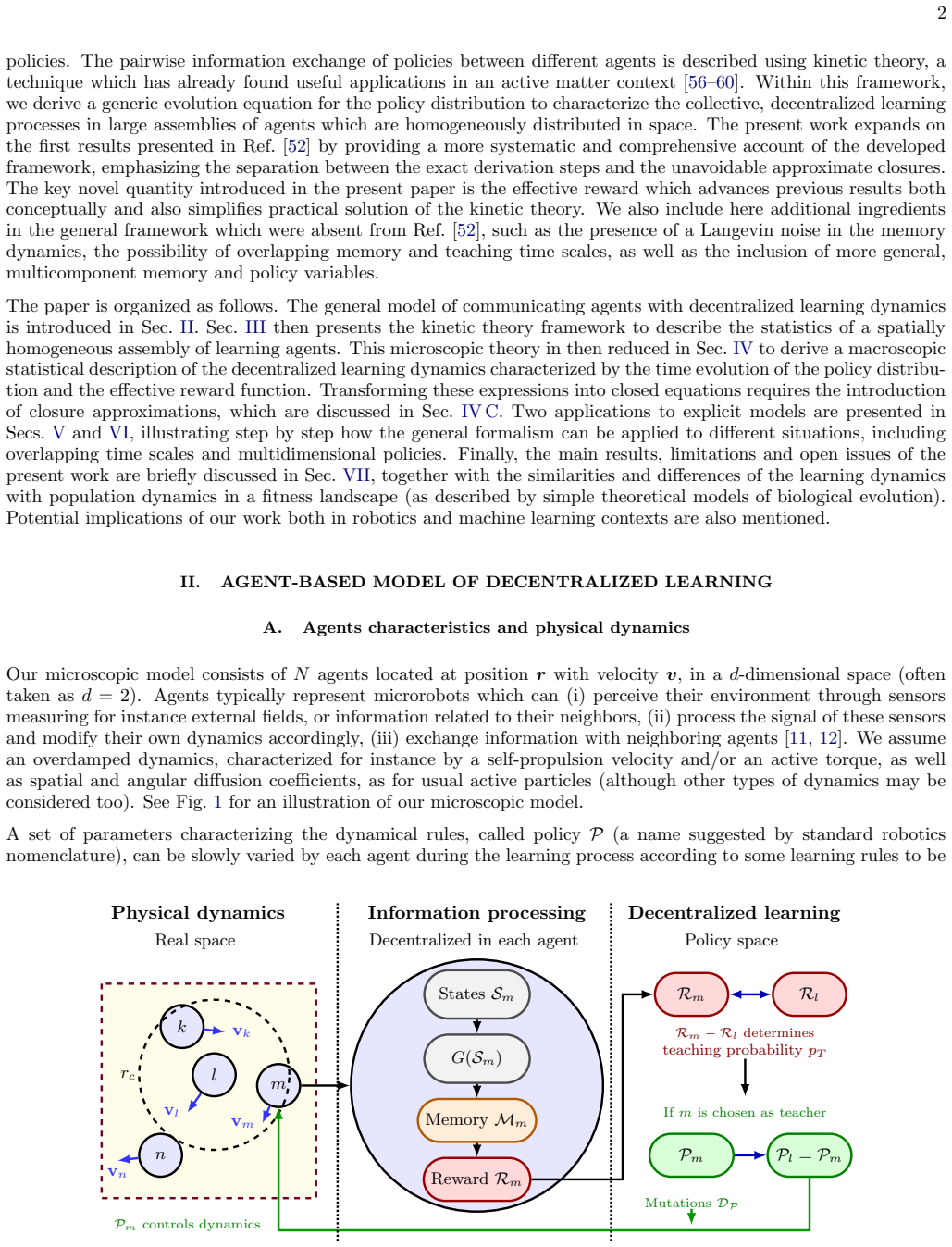
Effective reward governs collective policy evolution in agent populations

by Gerhard Jung, Johann Asnacios +3 more

Theory of collective learning in populations of adaptive agents

Microscopic agent details collapse into one function that alone sets how the population's policies change over time.

Figure from the paper full image
abstract click to expand
We investigate homogeneous populations of smart active agents that exchange information with their neighbors to perform a decentralized learning process aimed at achieving a prescribed macroscopic state. Such agents may, for example, represent simple microrobots. The exchanged information comprises tunable parameters governing the agent dynamics, referred to as the individual policy, together with an internal memory encoding previously visited states. This memory is used to evaluate a reward that quantifies the success of a policy to achieve the prescribed state. We extend the kinetic-theory description of collective learning in spatially homogeneous systems [Phys. Rev. Lett. 134, 248302 (2025)] and derive formal evolution equations for the distribution of policies across the population. A central outcome of our theory is the emergence of an effective reward function that fully determines the evolution of the policy distribution and encapsulates the microscopic details of the agents physical and memory dynamics. We obtain closed equations for the policy mean and variance which admit explicit time-dependent solutions under the assumption of Gaussian-distributed memories and polices. To illustrate the framework, we present a series of minimal microscopic models, considering both perfect and partial separation of physical, memory and policy exchange time scales, as well as models with one- and two-dimensional policies. The obtained theoretical results compare well with agent-based numerical simulations. The theory captures key aspects of collective learning, including the influence of population diversity and reward fluctuations on learning performance. Finally, we discuss potential applications to swarm robotics and machine learning, and highlight connections with classical models of biological evolution, including the Replicator equation and the Moran model.
0
0
cond-mat.soft 2026-07-03

Polarization defects split active swimmers into upstream and downstream regions

by Akhil Varma, David Saintillan

Pore-scale distribution and transport of active particles in a two-dimensional lattice

Kinematic defects nucleate at moderate flows in a pillar lattice, producing coexistence of swimming directions at higher flows

Figure from the paper full image
abstract click to expand
Suspensions of motile microswimmers such as bacteria and other active colloids frequently encounter porous environments where obstacles and complex shear flows strongly influence their dynamics. Here, we study the distribution and transport of a dilute suspension of active particles in a square lattice of pillars, which serves as a model porous medium. The microswimmers are modeled as slender point particles, and Brownian Dynamics simulations are performed to determine how their number density and polarization fields change with systematic variations in the medium porosity, polydispersity, flow strength, and self-propulsion strength. We find that in the absence of flow, self-propulsion drives particle accumulation and radial polarization at the pillar surfaces. In the presence of a background flow, particles preferentially accumulate in the wake of pillars and exhibit upstream polarization near their surface, consistent with experimental observations. At moderate flow strengths, topological defects nucleate in the polarization field. These defects are of purely kinematic origin and mark the transition from global upstream swimming at low flow strengths to the coexistence of upstream and downstream swimming regions in the lattice at high flow strengths. The structured lattice studied here provides a controlled framework for isolating the physical mechanisms governing active transport in complex geometries, with direct relevance to transport in structured microfluidic settings.
0
0
cond-mat.soft 2026-07-03

Curved walls make non-motile chiral particles accumulate at boundaries

by Alessandro Petrini, Raphaël Maire +2 more

Curvature-driven wall accumulation in chiral active particles

Straight channels keep density uniform; circular enclosures drive particles to the edge through curvature acting on tangential wall currents

Figure from the paper full image
abstract click to expand
We study a dilute system of non-motile chiral active particles confined in geometries ranging from straight channels to circular enclosures. Activity is introduced through chiral particle-wall interactions, modeled as tangential wall forces that generate the edge currents characteristic of chiral active matter. Remarkably, although the particles lack self-propulsion, these boundary currents induce density inhomogeneities. We show that boundary curvature drives a wall accumulation phenomenon: particles remain uniformly distributed in straight channels but accumulate near the boundaries of circular confinements. Numerical simulations and a hydrodynamic theory for the density and momentum fields consistently capture this curvature-induced wall-accumulation. These results identify boundary curvature as a fundamental control parameter for chiral edge transport and confinement-induced organization, with potential experimental relevance to spinning colloids and granular spinners.
0
0
cond-mat.soft 2026-07-03

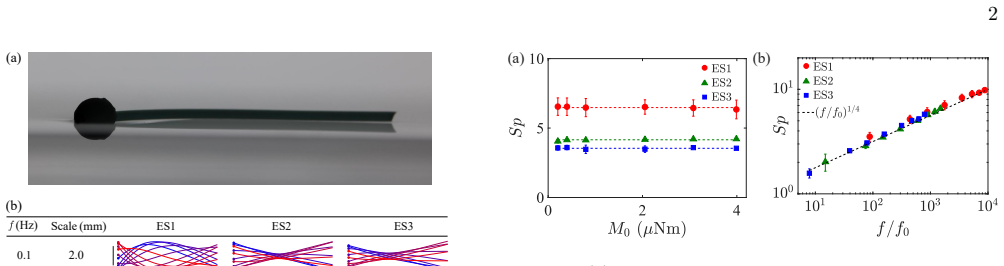
Nonreciprocity creates unidirectional waves in active filaments

by Sami C. Al-Izzi, Jack Binysh +3 more

Tuning nonlinear waves in nonreciprocal active filaments

Coupling to inertia or pre-stress amplifies and directs curvature changes, tunable by environmental dissipation.

Figure from the paper full image
abstract click to expand
The instabilities of slender structures power biological locomotion across scales, and offer a compelling method to actuate soft robots. Nonreciprocal elastic solids have been found to amplify flexural waves in one direction only, but design principles to tune and stabilize these waves are missing. Here we develop a geometrically exact theory of nonreciprocal filaments and provide simulations that capture their post-instability nonlinear dynamics. We find that nonreciprocity, when coupled to inertia or pre-stress, amplifies and advects curvature variations. The resulting one-way patterns of shape morphing can then be selected via dissipative interactions with the environment. Our work offers a continuum-based strategy for how internal stresses can drive active unidirectional waves without need for additional degrees of freedom.
0
0
cond-mat.soft 2026-07-02

Mutual info shows optimal microswimmer mixing at finite squirmer strength

by Yihong Shi, Yuto Hosaka +2 more

Mixing induced by microswimmers as probed by mutual information

Disorder boosts efficiency while aggregation hinders it; pushers outperform pullers at fixed energy cost.

Figure from the paper full image
abstract click to expand
We investigate fluid mixing induced by microswimmers using mutual information as a global, information-theoretic measure of mixing efficiency. For a two-dimensional squirmer model in a confined domain, we compute numerically the swimmer-generated flows and solve the advection-diffusion equation for the transport of tracer particles in the fluid. We show that the spatial distribution of swimmers strongly affects mixing, which is suppressed by swimmer aggregation and enhanced by positional and orientational disorder. At fixed energy dissipation, mixing efficiency depends non-monotonically on the squirmer parameter, with an optimal finite value arising from the balance between swimmer translation and dipolar flow generation. When hydrodynamic interactions are included, pushers outperform pullers. The mutual information as a function of time decays in three stages: an initial diffusion-dominated stage, an intermediate advection enhanced regime, and a final relaxation stage controlled by system size. Our results demonstrate that mutual information, previously validated as a measure of mixing efficiency only in simplified model systems, can equally be used in complex flows. Its application reveals that mixing by microswimmers is subject to a trade-off between the generation of strong shear flows and achieving optimal dispersion across the fluid domain.
0
0
cond-mat.soft 2026-07-02

Magnetic filament speed peaks at EH length ratio of order one

by Sohum Kapadia, Julien Chopin +1 more

Elasto-Hydrodynamic Propulsion of a Magnetically Actuated Filament

Speed varies non-monotonically and is largest when swimmer length matches the scale set by elasticity and viscosity.

Figure from the paper full image
abstract click to expand
We investigate the low-Reynolds-number propulsion of a slender elastic filament with a dipolar magnetic head actuated by an oscillating field in a viscous fluid by studying its strokes and net forward motion. To capture these dynamics, we employ an elasto-hydrodynamic (EH) framework that couples Euler-Bernoulli beam mechanics with resistive force theory. Unlike prescribed-kinematics models, filament shapes here emerge self-consistently from the actuation and the force and torque boundary conditions (BCs). We demonstrate that viscous boundary contributions are crucial for quantitative agreement and show that the swimming dynamics are governed by the EH length and a magneto-viscous-elastic stroke amplitude introduced here. The swimming speed is non-monotonic with increasing ratio of the swimmer length to the EH length, and is shown to reach a maximum when the swimmer length is on the order of the EH length. We further discuss the analytical limit in which the tail BCs can be described as free, and the limitations that arise when viscous contributions to the BCs are ignored.
0
0
physics.geo-ph 2026-07-02

Stress cycles fail fault gouge at most frequencies except mid-range

by Pritom Sarma, Einat Aharonov +2 more

How effective normal stress oscillations advance failure in fault gouge: frequency dependence, non-failure window, and the role of dilation

Models reveal a non-failure window at 30-200 Hz where neither low-frequency ratcheting nor high-frequency dynamic dilation occurs.

Figure from the paper full image
abstract click to expand
Cyclic pore-pressure or normal stress variations arise both in relation to natural earthquakes and in engineered subsurface systems, yet their effect on fault stability remains poorly constrained at the grain scale. Here we numerically model, using a coupled Discrete Element--fluid dynamics model, the response of a sheared, fluid-saturated or dry, gouge-filled fault to effective normal stress oscillations over a wide frequency range (0.5-10000 Hz). The effective normal stress is oscillated either by cycling the pore-pressure or by directly cycling the normal stress, while keeping the stress state below the Mohr-Coulomb threshold measured in continuous loading. Despite this sub-critical loading, we observe failure across most frequencies, with a non-monotonic frequency dependence. A distinct non-failure window emerges at intermediate frequencies (30-200 Hz), bounded by failure at both lower and higher frequencies; the system exhibits four regimes from cyclic failure-and-arrest to continuous sliding. Pore-pressure and normal stress oscillations produce the same regime structure, confirming that they act as equivalent forcings via Terzaghi's principle, with fluid coupling adding only a delay due to dilatant hardening. Sub-critical failure arises from dilation-induced strength deterioration via two mechanisms: (i) low-frequency cycles allow sufficient time for shear-driven ratcheting dilation, while (ii) high-frequency cycles induce dynamic dilation (acoustic fluidization) via amplified seepage forces, stress gradients and inertial forces. The intermediate non-failure window represents the gap between these mechanisms. These results identify frequency as a controlling parameter for failure in granular materials, with implications for dynamic earthquake triggering and cyclic injection protocols.
0
0
cond-mat.soft 2026-07-02

Diffuse fronts enhance phoretic removal from dead-end pores

by Amir A. Pahlavan

Diffusiophoretic transport of colloids and emulsions in complex environments

Cross-streamline migration in flowing pathways also shifts breakthrough and dispersion by orders of magnitude.

Figure from the paper full image
abstract click to expand
Chemical gradients are ubiquitous in porous and crowded environments, including soils, filters, fabrics, tissues, hydrogels, biofilms and living cells. They arise from displacement fronts, dissolution and precipitation, ion exchange, metabolism, root exudation, evaporation, gas dissolution, freeze--thaw cycles and externally imposed chemical treatments. These gradients can drive colloids, macromolecules and emulsion droplets by diffusiophoresis, while simultaneously driving diffusioosmotic flows along confining surfaces. Classical models of colloid transport in porous media emphasize hydrodynamic dispersion, surface interactions, straining, deposition, detachment and filtration. This chapter places diffusiophoresis within that broader transport framework and reviews how porous media generate, stretch, disperse and sustain the solute gradients that drive phoretic motion. We first discuss sources of chemical gradients and the distinction between spreading and mixing, then summarize classical colloid transport, the minimal physicochemical model for diffusiophoresis and diffusioosmosis, and the experimental platforms used to study these effects. Particular emphasis is placed on recent results showing that diffuse solute fronts can enhance phoretic removal from dead-end pores by prolonging the duration of forcing, and that cross-streamline migration within flowing pathways can change macroscopic breakthrough and dispersion by orders of magnitude. We close by discussing emulsion droplets, multiphase flows, confined and living media, and open problems, including the transition from algebraic mixing in two-dimensional micromodels to chaotic mixing in three-dimensional porous media.
0
0
cond-mat.stat-mech 2026-07-02

Minimal cell model produces three fluid phases

by R. V. Romanik, O. A. Dobush +3 more

Phase diagram of a double-occupancy cell model of a fluid with Curie-Weiss interaction

Local repulsion competing with long-range attraction creates single or double critical points, tricritical points, and a triple point depend

abstract click to expand
A double-occupancy cell model of a fluid with Curie-Weiss interaction is studied. First, we show that the model is isomorphic to the Blume-Capel model on a complete graph through a simple transformation from spin to occupancy variables. We then investigate its phase behavior within the grand-canonical ensemble using a combination of analytical and numerical methods. Despite its simplicity, the model exhibits a remarkably rich thermodynamic behavior depending on the ratio between the local repulsive and global attractive interactions. We identify regimes characterized by a single critical point, two distinct critical points, tricritical behavior, and triple-point formation. For sufficiently strong repulsion, the system possesses three fluid phases of different densities, leading to both gas-liquid and liquid-liquid coexistence. The locations of the critical, tricritical, and triple points are determined, and the corresponding phase diagrams are constructed. These results demonstrate that the competition between double-occupancy repulsion and long-range attraction is sufficient to generate complex phase behavior in a minimal multiple-occupancy lattice-gas model.
0
0
cond-mat.soft 2026-07-02

Micelle chain expulsion barrier scales linearly with block length

by Shuang Yuan, Jiajia Zhou

Single Chain Expulsion from Diblock Copolymer Micelles with Dense Corona

Two-dimensional energy maps show every path funnels into one channel whose barriers stay nearly constant despite broad stretch distributions

Figure from the paper full image
abstract click to expand
We use self-consistent field theory to investigate the free energy landscape for single-chain expulsion from a diblock copolymer micelle with a dense corona. Using the distance from the micelle center-of-mass to the hydrophilic-hydrophobic junction of the chain as the reaction coordinate, we compute the free energy landscape for chain exchange. Our results show that the expulsion free energy barrier scales linearly with both the hydrophobic block length and the solvent selectivity, consistent with recent experiments. To accurately resolve chain conformation, we introduce a second reaction coordinate: the distance between the junction and the free end of the hydrophobic block, and construct a two-dimensional free energy surface. Using the string method to identify the minimum energy path, we find that all pathways converge to a nearly degenerate reaction channel, irrespective of the initial path. Within this channel, the end-to-end distance of the hydrophobic block exhibits a broad distribution, yet the corresponding expulsion barriers remain nearly indistinguishable. Together, these findings establish a continuum-level theoretical foundation for understanding the hyperstretching mechanism and the transition state ensemble in micellar chain exchange.
0
0
cond-mat.soft 2026-07-02

Compressibility alters normal stresses but not shear in soft solids

by Valentina Balbi, Griffen Small

The Role of Compressibility in Modified Quasi-Linear Viscoelasticity: A Comparison of Simple Shear and Torsion

In the modified quasi-linear viscoelastic model, volume changes couple to shear relaxation and modify the Poynting effect differently in she

Figure from the paper full image
abstract click to expand
We investigate the role of compressibility in the modified quasi-linear viscoelastic (MQLV) constitutive framework for soft solids at finite strain, where shear and bulk responses are governed by distinct relaxation functions. Analytical and semi-analytical results are derived for simple shear and torsion, under incompressible and slightly compressible assumptions. We show that compressibility affects the response only when volume changes occur: under isochoric deformations, the bulk contribution vanishes, while even small deviations from isochoricity significantly alter the normal response. Shear stress and torque are largely insensitive to compressibility, whereas normal stress and axial force exhibit pronounced sensitivity due to the coupling between shear and bulk relaxation. We further demonstrate that volumetric effects interact with the Poynting effect: in simple shear they oppose each other, reducing relaxation, while in torsion they reinforce each other, enhancing it. These trends agree with brain tissue experiments but reveal limitations of the slightly compressible model for highly compressible materials, such as agarose gels. Overall, the results emphasise the importance of accounting for compressibility in modelling normal stress responses and motivate the development of fully compressible formulations and numerical implementations.
0
0
cond-mat.soft 2026-07-02

Standing waves stable above flexoelectric threshold

by E.S. Pikina, E.I. Kats +2 more

Pattern formation in nonlinear dynamics of nematic liquid crystals above the flexoelectric instability threshold

Simulations find one-dimensional standing waves resist transverse perturbations while traveling waves decay in nematics under alternating fi

Figure from the paper full image
abstract click to expand
For many decades, researchers have been studying various types of electro-hydrodynamic instabilities in liquid crystals. A significant amount of experimental data has been collected, however, the theoretical interpretations of the results typically rely on linear analysis. In response to this limitation, we investigate the nonlinear stage of the flexoelectric instability in nematics, focusing on liquid crystals with a negative anisotropy in their dielectric permittivity and electrical conductivity. We base our analysis on a comprehensive set of nonlinear electro-hydrodynamic equations for these nematics influenced by an external alternating electric field. The equations predict an instability that is driven by the flexoelectric effect. In order to examine the peculiarities of this phenomenon, we use a model that was proposed in our previous publications, Refs. [1,2], which allows us to perform numerical simulation of nonlinear dynamics. We examine patterns that are formed above the instability threshold. Through numerical simulations, we have identified static and dynamic patterns that occur over a timescale that is much longer than the period of the external electric field. The static patterns are one-dimensional structures and dynamic patterns are standing or traveling one-dimensional waves. The type of the realized pattern depends on the material and experimentally controlled parameters. We found that the standing waves are stable with respect to small transverse perturbations, whereas the propagating waves are unstable. We present a Ginzburg-Landau-like phenomenology that applies near the instability threshold. This approach allows us to rationalize our numerical findings with a few parameters.
0
0
cond-mat.stat-mech 2026-07-02

Distributions separate Timer

by Vikas, Rahul Marathe +1 more

Single-cell-level distributions and relationships can differentiate cell-division and growth models

Probability distributions of sizes and times also distinguish linear from exponential growth and hold under growth rate correlations across

Figure from the paper full image
abstract click to expand
Complex interactions among regulatory molecules determine the rules underlying cell growth and division in microbial cells. While the governing molecular network may not always be obvious, it is well known that correlations among certain physiological quantities measured in experiments, such as birth-size, division-size, division-time, and division-added-size, can differentiate among various cell-division models, such as Timer, Sizer, and Adder. Here we show that, apart from these correlations, which we extend for the case of stochastic single-cell growth and stochastic asymmetric partitioning, probability distributions of these quantities and statistical relationships between them can also be used to differentiate between these division models. Interestingly, we show that these quantities can not only differentiate the division models, but also distinguish among the single-cell growth paradigms, such as linear and exponential growth. We then demonstrate this differentiability among various division and growth models by comparing our analytical results with published experimental data. We further show that these results remain valid even when the growth rate of a cell is correlated with the growth rate of cells from previous generations in the lineage.
0
0
physics.bio-ph 2026-07-02

Bilayer model shows edge matching peaks in fluid-like cell sheets

by Troy Singletary, Andrea James +1 more

A bilayer cellular Potts model of epithelial docking

Matching across layers is highest above shape index 4.6 and at balanced coupling; stronger adhesion traps the system in worse states.

Figure from the paper full image
abstract click to expand
Fusion of two epithelial cell sheets brought together in a bilayer configuration is a common step in animal morphogenesis, yet, in contrast to other epithelial fusion processes such as wound healing in a monolayer of cells, it has not been a strong focus of modeling efforts. Here we consider a preliminary stage of bilayer fusion, recently termed "docking." In multiple instances of docking that span apical and basal varieties, cells appear to have a tendency to remodel so as to co-localize their bilateral junctions (match their edges) across the bilayer. Motivated by this observation, we introduce a bilayer cellular Potts model that couples two standard 2D area- and perimeter-elasticity models via short-range, out-of-plane interactions between cell edges. The new coupling involves a single adjustable parameter that minimally models the combined effect of dynamic cytoskeletal protrusions, cadherins, and other potential edge-associated adhesion molecules. Our model predicts that bilayer edge matching is maximized when the two monolayers are in their fluid-like regimes (average cell shape index greater than 4.6 in our implementation), and when the bilayer coupling strength strikes a balance between in-plane and out-of-plane energy scales. At higher coupling strengths, the system tends to get stuck in metastable states with sub-optimal edge matching. Exploration of the mechanisms of edge matching reveals that pairs and quadruplets of coordinated T1 transitions play a particularly important role. We also find numerous examples of emergent features we term "domain walls" - branching or unbranching curves that cross no matched edges, but that separate regions of nearly complete matching. These domain walls can be both system spanning and long lived. Finally, we extend our model to crudely account for bending of the two sheets, and study the distributions of docking front speeds that result.
0
0
physics.soc-ph 2026-07-01

Swarm agents form quantized differential vortices via position-oscillation feedback

by Szabolcs Vitus, Ferenc Járai-Szabó

Synchronization and Swarming of Two-Mode Stochastic Oscillators

Distance-dependent coupling yields seven morphologies and Ω ∝ r^{-1/2} scaling that reveals composite vortex structure.

Figure from the paper full image
abstract click to expand
Synchronization and swarming are canonical manifestations of self-organization, observable across scales from cellular processes to animal flocks. This study investigates the collective dynamics of a novel agent-based model where individuals exhibit both spatial mobility and internal, two-mode stochastic oscillatory states. By introducing a local, distance-dependent coupling between the agents' spatial configuration and their internal state transitions, we establish a mutual feedback loop that drives complex pattern formation. Through large-scale numerical simulations, we identify seven distinct morphological configurations, ranging from stationary \textit{Filled-disk} states to highly disordered \textit{Intense-motion} regimes. By performing a rigorous quantitative analysis of the rotational energy and radial dispersion, we transcend simple morphological classification and demonstrate that the system organizes into discrete, quantized topological attractors. We derive a macroscopic scaling law, $\Omega \propto r^{-1/2}$, which proves that the emerging rotating states are not rigid-body rotations, but rather composite differential vortex structures characterized by spontaneous chiral symmetry breaking. Our results suggest that these stable, quantized dynamical states are fundamental features of systems governed by bidirectional spatial-phase feedback, offering a robust framework for designing autonomous, decentralized robotic swarms.
0
0
cond-mat.stat-mech 2026-07-01

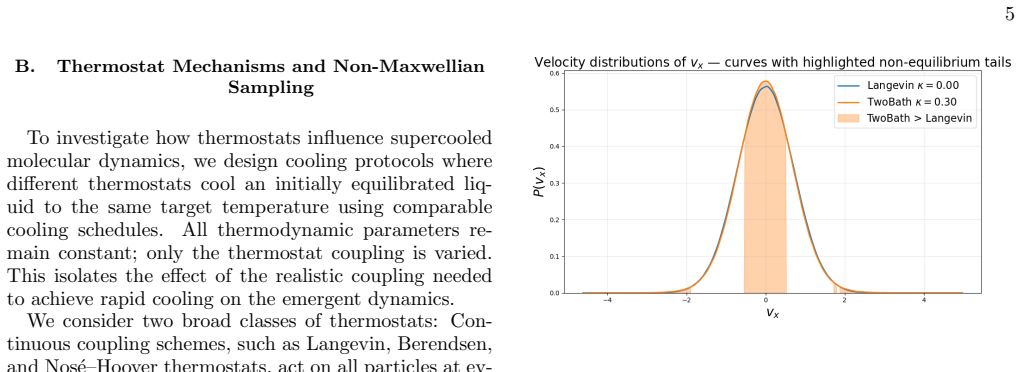
Non-Maxwellian velocities persist in supercooled liquids

by Giorgi Tsereteli, Zohar Nussinov

Non-Maxwellian Velocity Statistics in Supercooled Liquids and Their Possible Relation to Super-Arrhenius Viscosity

Temperature fluctuations produce excess kurtosis that matches viscosity collapse across 45 glass formers and links to super-Arrhenius slowin

Figure from the paper full image
abstract click to expand
For particles of fixed mass, classical equilibrium statistical mechanics dictates a Maxwellian velocity distribution determined solely by the temperature, regardless of the interactions, density, or structure. Supercooled glass forming liquids realize long lived metastable states that evade equilibrium crystallization and may thus violate assumptions underlying Maxwellian statistics. We numerically demonstrate that supercooled liquids can exhibit persistent non-Maxwellian velocity distributions with deviations connected to their exceptionally slow super-Arrhenius relaxation. Our work is motivated by a general result establishing that long lived metastable states may exhibit finite width distributions of intensive variables. A distribution of temperatures implies non-Maxwellian velocity statistics. We test this prediction by introducing stochastic thermostats that generate stationary states while, unlike conventional thermostats, not imposing Maxwellian velocity distributions. Simulations with these thermostats yield long lived states that have, by comparison to Maxwellian velocity distributions, an excess kurtosis $0<\kappa\lesssim0.3$. Crystallization is strongly impeded with increasing $\kappa$. In a minimal description, temperature fluctuations are characterized by a dimensionless width $\overline{A}$ with $\kappa\simeq3\overline{A}^{2}$. The nearly constant $\overline{A}$ (of an average value $0.08$ and standard deviation $0.03$) found in viscosity data collapse across $45$ glass formers and in specific heat signatures is consistent with kurtosis found in our simulations. Long time non-Maxwellian velocity statistics may thus link slow relaxation, transport, and thermodynamic measurements. Independent of the tested theory, the stochastic thermostats that we introduce offer a molecular dynamics route to non-Maxwellian velocity statistics.
0
0
cond-mat.soft 2026-07-01

Magnetic field turns active particles into drifters or diffusers

by Andrey A. Kuznetsov, Vittoria Sposini +2 more

Drift-diffusion interplay in active Brownian particles under orienting field

Uniform orienting field channels self-propulsion into either steady transport or enhanced spreading once rotational relaxation is complete.

Figure from the paper full image
abstract click to expand
Magnetic active particles offer a versatile route to externally controlled microscale transport by combining self-propulsion with field-tunable orientation, as realized in both synthetic and living magnetic microswimmers. Here, we develop a theoretical framework for three-dimensional active Brownian motion in a uniform magnetic field, incorporating coupled translational and rotational dynamics and providing analytical approximations for low-order displacement moments. At long times, the system dynamics reduces to a combination of enhanced diffusion and permanent drift absent in regular active Brownian particles. The field acts as an external controller, channeling activity toward one of these two types of motion. At intermediate time scales, the interplay between rotational noise, self-propulsion, and magnetic alignment results in pronounced non-Gaussian displacement statistics. First-passage properties exhibit strong field sensitivity, highlighting the potential of magnetic guidance to optimize search processes and targeted delivery in active matter systems. Theoretical predictions are validated by numerical simulations.
0
0
cond-mat.soft 2026-07-01

Self-generated field in polymer gradients boosts particle speed

by Max Huisman, Ali Azadbakht +2 more

Self-Generated Electric Fields in Polyelectrolyte Gradients Increase Microparticle Transport

Charge separation under diffusion creates an electric field that raises microparticle phoretic velocity, observed in experiments.

abstract click to expand
There are many situations in nature and industry where small particles are exposed to gradients of charged polymers, such as enzymes in biological gradients of DNA or RNA, virus particles in respiratory droplets, and colloidal particles in stratifying paint layers. Here, we study the phoretic propulsion of charged microparticles in a polyelectrolyte gradient. We theoretically predict the emergence of a macroscopic electric field from charge-separation dynamics in a polyelectrolyte gradient under a continuous diffusive driving force. We confirm the presence of this self-generated electric field experimentally and show that it significantly increases the phoretic velocity of the microparticles. Finally, for high molecular weight polyelectrolytes we observe that propulsion becomes gradient-independent, consistent with diffusiophoretic predictions for asymmetric electrolytes. Our results show that self-generated electric fields in polyelectrolyte gradients can enhance microparticle transport, with potential applicability wherever charged species of different mobility are continuously driven out of equilibrium.
0
0
cond-mat.soft 2026-07-01

Chirality switching generates topological edge currents

by Yuta Kuroda, Ellen Meyberg +3 more

Designing topological edge currents in chiral active matter

A particle model produces currents along walls and phase interfaces that arise from topological domain differences.

Figure from the paper full image
abstract click to expand
Achieving robust functionality in active matter driven away from thermal equilibrium is a current theoretical and experimental challenge. Several recent studies have reported edge currents--persistent transport along walls and density inhomogeneities--in chiral active matter. Yet, the microscopic rules that render these edge currents robust with respect to the confinement geometry and defects remain elusive. Here, we introduce a simple particle model of two-dimensional chiral active swimmers that undergo chirality switching and demonstrate that the model exhibits robust edge currents, i.e., when a single particle is confined, edge currents arise regardless of the confinement geometry or the presence of defects. We also investigate the collective behavior of interacting particles in bulk and find that chirality switching induces phase separation accompanied by edge currents along interfaces. This phase separation is distinct from motility-induced phase separation and is qualitatively explained by an effective hydrodynamic theory derived via bottom-up coarse-graining. Furthermore, by analyzing the topological properties of the linearized hydrodynamic equations, we show that the edge currents in our system are genuine topological edge modes. Notably, phase separation induced by chirality switching can be regarded as the coexistence of two topologically distinct domains. Our results provide guidelines for designing robust edge currents in active matter systems.
0
0
cond-mat.soft 2026-07-01

Spanning tree of strong bonds prevents monomer depletion

by Tighe McAsey, Sushrut Tadwalkar +2 more

Optimal interactions for addressable self-assembly

Assembly always proceeds downhill without traps when strong interactions form a cycle-free network on the target structure.

Figure from the paper full image
abstract click to expand
Addressable self-assembly asks that each building block assemble into a particular location in a target structure. Although particles may all be distinct, achieving high yield is a challenge because of monomer depletion: more target structures can nucleate than there are building blocks for, so they form partial fragments which cannot complete growth. We ask how to design the interactions between building blocks to achieve the highest yield in a given time. Using reaction equations describing all the intermediate steps of assembly, combined with numerical optimization, we show that the optimal interactions are such that (i) all bonds are either very strong or very weak, and (ii) the strong bonds form a spanning tree of the target structure. We then prove that when interactions form a spanning tree, monomer depletion cannot occur: assembly can always proceed downhill in energy space, with no kinetic traps. This result is a combinatorial property of the underlying interaction graph, and does not depend on the particular model for the kinetics. It suggests a robust design principle: create a network of strong interactions that has no loops, and make all other interactions much weaker. We validate this principle in numerical simulations of larger structures, and we further show that spanning trees that are more compact have typically better yield. Our results suggest a new framework for understanding monomer depletion and addressable self-assembly, which may be applied to DNA nanotechnology and which may give insight into the assembly pathways of certain multiprotein complexes.
0
0
cond-mat.soft 2026-07-01

Source-driven droplets form compressive rims at diffusion fronts

by Avraham Moriel, Howard A. Stone

Nonlinear diffusion and compressive rims in source-driven biopolymer condensates

Coupling thermodynamics to viscoelastic flow predicts the rim structure and matches nucleolar features.

Figure from the paper full image
abstract click to expand
Many subcellular condensates continuously produce biopolymers. Coupling Flory-Huggins thermodynamics to two-fluid viscoelasticity, we probe the diffusion of such source-driven polymeric droplets, and identify a universal structural compressive rim at their diffusion front. Integrating analytical scaling laws, numerical simulations, and experimental data, we show that this framework captures key structural and dynamic characteristics of the nucleolus, demonstrating the role of polymer diffusion in non-equilibrium biological transport.
0
0
cond-mat.soft 2026-07-01

Solvent quality overrides topology in dilute polymer solutions

by Ashish Kumar Singh, Angelo Rosa

Mesoscopic simulations of linear and ring polymer solutions with explicit hydrodynamics under good and poor solvent conditions

Simulations of linear and ring chains show similar expansion, aggregation, and diffusion controlled mainly by good or poor solvent condition

Figure from the paper full image
abstract click to expand
We employ large-scale Dissipative Particle Dynamics simulations to investigate dilute solutions of linear polymers and unknotted, non-concatenated ring polymers in explicit solvent. By systematically varying solvent quality, we examine the interplay between hydrodynamic interactions, chain architecture, and intermolecular association. Under good solvent conditions, both linear and ring polymers remain expanded and well dispersed, displaying center-of-mass dynamics consistent with normal diffusion. In poor solvents, attractive polymer-polymer interactions drive the formation of irregular aggregates characterized by partial chain collapse, substantial interpenetration, and slower dynamics. Despite their different topologies, the two polymer architectures exhibit remarkably similar structural and dynamical responses across the solvent conditions considered. These results indicate that solvent quality largely determines the organization and transport properties of dilute polymer solutions, whereas topological effects remain comparatively weak in the investigated regime.
0
0
cond-mat.soft 2026-07-01

Hinge-arm design sets energy barriers and state separations

by Andreas Ehrmann, Marija Krstić +2 more

Designing bistable nanostructures for target behavior

Barriers and metastable distances are programmable; transition-state location and full profile shape are not, under current constraints.

Figure from the paper full image
abstract click to expand
Many biological machines function through controlled conformational transitions, yet designing synthetic nanostructures with prescribed dynamical behavior remains a major challenge. Here, we develop a modular inverse-design framework for bistable nanostructures whose function is controlled by an energy profile along a geometric reaction coordinate. Inspired by proteins with rigid domains connected by flexible hinges, we introduce a hinge-arm paradigm in which a small bistable hinge controls the energetics of a conformational transition, while rigid arms map this transition onto the separation between external binding sites. Specifically, we ask which features of a target energy profile can be programmed under different design constraints. We find that the energy barriers and the binding-site separations in the two metastable states can be readily designed, while controlling the location of the transition state or the full shape of the energy profile requires additional design freedom. Using a differentiable design framework, we find that some optimized solutions are numerically inexact but still display the functional behavior for which the target profile was selected, emphasizing the importance of function-based evaluation criteria. These results establish a practical hierarchy of designability for bistable nanostructures and provide a route toward synthetic nanomachines that couple conformational transitions to target behavior.
0
0
physics.flu-dyn 2026-07-01

Polymers damp turbulence vortices from small scales to large

by Yusuke Koide, Susumu Goto

Lagrangian velocity statistics of homogeneous isotropic turbulence in dilute polymer solutions

This scale progression weakens Lagrangian velocity spectra first at high frequencies and lengthens the integral timescale.

Figure from the paper full image
abstract click to expand
We conduct direct numerical simulations of homogeneous isotropic turbulence in dilute polymer solutions to investigate the Lagrangian velocity statistics. We show how polymers modulate the power spectral density of the Lagrangian velocity and the Lagrangian integral timescale by varying the Reynolds number, forcing method, and polymer relaxation time. As the polymer relaxation time increases, the attenuation of the power spectral density extends successively from high to low frequencies, and the Lagrangian integral timescale increases. To clarify the mechanism underlying the modulation of the Lagrangian velocity statistics, we decompose the Lagrangian velocity into the contributions from vortices at different length scales. Using this scale-decomposition analysis, we demonstrate that the observed modulation of the Lagrangian velocity statistics results from polymer-induced suppression of vortices that proceeds from smaller to larger scales.
0
0
cond-mat.soft 2026-07-01

Three-species model links micellar relaxation to shear bands

by Rongxin Lu, Jiwei Jia +1 more

Beyond binary scission: a generalized three-species cascade breakage model for wormlike micellar solutions

Cascade breakage connects short-fragment relaxation to gel-network recovery, producing three-mode response and stress plateau.

Figure from the paper full image
abstract click to expand
Wormlike micellar fluids exhibit complex rheological behavior driven by the continuous breakage and recombination of self-assembled micellar networks. Existing two-species models provide a coarse binary representation of the micellar population, limiting their ability to resolve intermediate structural states and broad relaxation spectra. To address this limitation, we develop a three-species cascade breakage model consisting of gel-network, long chains, and short chains. By introducing an intermediate micellar state, the model links the rapid relaxation of short fragments to the slow recovery of the gel-network within a unified kinetic framework. This additional structural pathway gives rise to a three-mode viscoelastic response, improves the high-frequency description of the dynamic moduli, and produces a non-monotone constitutive curve that evolves into a stress plateau with coexisting shear bands in Couette flow. This cascade mechanism also governs the transient response, including stress overshoot, hysteresis, and multistep relaxation after shear cessation. Overall, the proposed three-species model provides a physically interpretable framework for worm-like micellar shear banding, capturing the connection between cascade microstructural evolution, broad relaxation dynamics, and macroscopic flow localization.
0
0
cond-mat.soft 2026-07-01

Density-nematic coupling can destabilize semiflexible nematics

by Longyu Qing, Jorge Viñals

Self-consistent field theory of semiflexible nematics: Density-nematic coupling, anisotropic elasticity, and defect core sizes

The critical ratio of excluded-volume to orientational strength sets the stability limit, while elastic anisotropy fixes defect core sizes.

Figure from the paper full image
abstract click to expand
The linear response of wormlike chains in the nematic phase is studied by self-consistent field theory. The model Hamiltonian incorporates Maier--Saupe orientational interactions together with an isotropic excluded volume interaction. The latter models implicitly solvent mediated chain interactions, as appropriate for a lyotropic nematic. An effective free energy description for uniform nematic states is constructed in terms of the chain segment density and uniaxial nematic order parameter, providing a unified framework for density--degree of order coupling, isotropic-nematic coexistence, and the limit of stability of the nematic phase. Our results show that strong density--nematic degree of order coupling can destabilize the nematic state. The location of the instability depends on the ratio of excluded volume and nematic interaction, $u_0/u_2$. In contrast, director distortions couple to density and nematic order variations only at higher order, remaining effectively decoupled in the linear response regime. The Frank elastic constants and the correlation lengths are obtained from a linear response analysis based on the self-consistent field theory free energy. Increasing flexibility strongly suppresses twist and bend elasticity while affecting splay elasticity comparatively weakly, leading to a crossover from bend-dominated to splay-dominated elasticity. The correlation lengths and Frank elastic anisotropy obtained from the linear response analysis explain well director profiles around a +1/2 disclination core, including the core size. The latter is proportional to the equilibrium correlation length, in agreement with Landau--de Gennes scaling.
0
0
cond-mat.soft 2026-06-30

Deep indentation yields tip-independent parabolic force law

by Mohammad Shojaeifard, Zhenwei Ma +3 more

Deep Indentation of Hyperelastic Materials Reveals Tip Independent Parabolic Force Depth Response via Strain Energy Delocalization

Strain energy spreads over a volume scaling with depth cubed, producing F proportional to D squared for both flat and spherical indenters.

abstract click to expand
Indentation is a practical route for probing soft materials when standard tests are difficult, destructive, or cannot be performed in situ. Conventional indentation is usually interpreted in the shallow-depth regime, where the indentation depth D is small compared with the indenter radius R. In this limit, the response is controlled by local contact geometry and primarily identifies the small-strain Young's modulus E. Here, we show that at deep indentation, D >> R, flat and spherical indenters converge to the same parabolic force-depth law, F = beta E D^2. The coefficient beta is independent of indenter radius and tip shape, only mildly affected by interfacial friction, and controlled by the hyperelastic strain-stiffening response. Finite-element simulations show that this scaling arises from strain-energy delocalization: the region where SED/mu > 0.01 expands into a spheroidal domain whose size scales with D. The activated volume therefore scales as D^3, giving stored elastic energy U ~ E D^3 and force F = dU/dD ~ E D^2. Far from contact, the strain-energy-density fields collapse toward the Boussinesq far-field solution when distances are normalized by a = sqrt(F/E), which scales as D in the deep-indentation regime. These results provide a mechanistic basis for tip-shape independence and link beta to the Ogden strain-stiffening parameter alpha, enabling hyperelastic parameter extraction from deep-indentation data.
0
0
cond-mat.soft 2026-06-30

Hydration alters photoelastic particle calibration

by Brandon Hayes, Krishnaroop Chaudhuri +7 more

Rheological and Photoelastic Response of Hydrated Soft Granular Particles

New techniques quantify fluid-induced changes so stress measurements remain accurate in 2D granular suspensions.

Figure from the paper full image
abstract click to expand
Photoelasticity is a qualitative and quantitative optical technique to image internal stress distributions in transparent materials. In the past few decades, discrete photoelastic particles have been used as a proxy for dry granular materials in both static, quasistatic, and dynamic analogue experiments. The technique allows the visualization of force chains, determination of the location and magnitude of contact forces, and outputs a stress tensor for each particle with shear and normal stress components. To date, little to no work has investigated photoelastic suspensions, where photoelastic granular particles are immersed in a fluid medium, despite its relevance in industrial and natural applications. The introduction of a fluid phase yields additional considerations in the rheological and photoelastic behavior of our proxy particles. In this manuscript, we summarize the state-of-the-art in resolving forces in immersed photoelastic granular materials. We introduce characterization techniques to probe changes in rheological and optical properties of hydrated photoelastic particles, and we report considerations for use of photoelastic particles in immersion-based experiments. We intend for this work to provide the leading framework to study the hydrodynamic interactions in 2D systems of photoelastic particles immersed in a fluid medium.
0
0
cond-mat.soft 2026-06-30

Friction slope at chemical edge sets tactile accuracy

by Kayla A. Hepler, Leanne Ton +1 more

Role of Single Chemical Heterogeneities in Generating Anisotropic Tactile Sensitivity and Soft Sliding Friction Phenomena

Soft-probe tests show humans detect a boundary better in the direction where friction force changes sharply rather than where materials diff

abstract click to expand
Physical heterogeneities in the context of sliding friction, such as a human finger exploring an object, have been well studied, yet the behavior of chemical heterogeneities in mesoscale soft sliding remains underexplored, despite the similar prevalence of chemical and physical variations in real systems. Here, we experimentally characterized the friction of a planar soft elastic probe sliding across a single chemical heterogeneity that was formed at the interface of two silanes on silicon wafers. By constructing phase maps across multiple loads and velocities, we quantified the occurrence of several frictional phenomena at and around the chemical edge, including stiction spike formation, edge slope direction, baseline shifts, and baseline drift, and quantified their sliding direction-dependent formation. We found that chemical heterogeneities made by more disparate materials (butyl- and aminopropyl-terminated) exhibited several phenomena that were more often direction-independent compared to chemical heterogeneities formed from more similar materials (butyl- and hexyl-terminated). We attributed this directional asymmetry to elastic body effects. In subsequent human testing (n=36), we observed that humans also exhibited directional-dependent accuracy (66.7% versus 38.9%) on one pair (butyl- and hexyl-terminated) but not the other (77.8% versus 75%), which in the context of our phase maps, suggests that the slope of the friction force when sliding over a chemical edge is important for generating a clear edge of a tactile feature, rather than the differences in simple material properties or other friction phenomena.
0
0
cond-mat.soft 2026-06-30

Kirigami cuts program LCE mechanics through molecular coupling

by M. Strugaru, M. Ly +3 more

Scale-coupling from kirigami cuts controls emergent mechanics in liquid crystal elastomers

Patterns in responsive sheets harness strain to control anisotropy and phase changes, unlocking grippers and morphing forms.

Figure from the paper full image
abstract click to expand
Conventional materials derive their properties from microscopic composition and arrangement, whereas mechanical metamaterials are defined by mesoscopic structure rather than constituent material. Bridging these paradigms, using macroscopic geometric alterations to orchestrate microscopic degrees of freedom and program mechanics, remains a central challenge. Here, we demonstrate that cuts in anisotropic, responsive solids provide such a connection. Using liquid crystal elastomer (LCE) sheets with kirigami patterns, we reveal that engineering strain through cuts harnesses molecular anisotropy to control emergent mechanics. Similarly, the interplay between cut patterns and the molecular phase transition of LCEs enables soft robotics functionalities such as supersoft grippers with remote actuation and architectures that reversibly morph under temperature variations, behaviors inaccessible to conventional kirigami or LCE sheets alone. LCE kirigami thus establish a new class of multiscale metamaterials in which geometry governs access to microscopic degrees of freedom, to program macroscopic function.
0
0
cond-mat.soft 2026-06-30

Vertex model stress tensor has freedom in tension distribution

by Paulo C. Godolphim, Leonardo G. Brunnet +1 more

Stress tensor field and mesoscopic stresses in the vertex model for tissues

Microscopic derivation links VM forces to mesoscopic stresses and recovers prior expressions as special cases

Figure from the paper full image
abstract click to expand
Mechanical stresses are fundamental regulators in biological tissues, where the vertex model (VM) is pivotal for theoretical and force-inference studies. Yet, no uniform expression for the stress tensor exists for the VM. Here we provide a microscopic derivation of it, linking mesoscopic stresses to the VM forces. The stress field presents a freedom on how tensions are distributed across cells, which allows previous expressions to emerge as particular realizations of the field and suggests a link between mesoscopic stresses and cytoskeletal force-transmission architectures in real cells.
0
0
q-bio.SC 2026-06-30

Clathrin coats develop stiffness and memory from growth conditions

by Johannes H. H. Dreckhoff, Ulrich S. Schwarz +2 more

Pathway variability, coat stiffening and mechanical adaptation during clathrin-mediated endocytosis

Simulations reveal how emergent properties create two gates that decide flat, stalled or closed fates and match experiments without fitting.

abstract click to expand
Clathrin assemblies in cells can persist as flat plaques, abort after partial invagination, or close into clathrin-coated vesicles, but the determinants of these different fates remain unresolved. To investigate the stochastic and complex dynamics of clathrin assemblies, we have developed a kinetic Monte Carlo simulation framework that couples individual clathrin agents to an adaptive continuum membrane. In this hybrid discrete-continuum description, the effective coat bending rigidity and the preferred coat curvature emerge during growth, rather than being prescribed as material parameters. Once connected, curved lattices stiffen from molecular bending modes to coat-level rigidities, because curvature changes require increased stretching or compression, while newly incorporated triskelia hardcode a history-dependent preferred curvature. An analytical theory for non-Euclidean elasticity identifies the relevant internal variables and predicts growth laws that are validated by the simulations. The same microscopic assembly rules yield flat, stalled, and closed coats through two sequential gates in the effective membrane-coat energy landscape. Comparisons with experimentally observed coat geometries and nanodissection-induced curvature changes agree with our theoretical predictions without any fitting parameters. The clathrin coat thus emerges as an adaptive assembly with prestress and memory, whose fate and material parameters reflect the environment in which it has been growing.
0
0
cond-mat.soft 2026-06-30

Tumors lose symmetry via buckling and cell-death volume loss

by Luise Zieger, Min Wu +3 more

A phase-field model for viscoelastic compressible tumor growth

Phase-field simulations show stationary symmetric tumors become unstable in 2D and 3D when nutrient gradients drive differential growth and

Figure from the paper full image
abstract click to expand
It is well known that growing tumors generate and respond to stress in their local microenvironment. Tissue re-arrangements can relax these mechanical stresses and make the tissue more fluid-like. Further, intricate coupling between mechanotransduction and biochemical signaling leads to complex patterns of growth. To predict the outcomes of these nonlinear interactions, we develop a phase-field model to simulate tumors growing into a surrounding medium taking into account their elastic and viscous properties as well as their compressibilities. We couple continuum modeling of the viscoelastic mechanics to the concentration of a diffusible growth-promoting nutrient in a mass conservative way. The phase-field method is a stable and flexible way to describe the dynamics of arbitrarily shaped tumors. We demonstrate convergence of the phase-field model to a sharp interface model in radially symmetric geometries and can observe progression to stationary tumors. However, our results show that these stationary symmetric tumors are subject to symmetry-breaking instabilities in 2D and 3D driven by two primary mechanisms: (i) elastic buckling instabiliies due to differential growth induced by the nutrient gradient and (ii) instabilities generated by apoptosis-related volumetric loss. Further, tissue fluidity and compressibility can lead to changes in tumor topologies. Our modeling framework provides a robust methodology for investigating how tissue mechanics and growth factor signaling influence the progression and invasive potential of solid tumors.
0
0
physics.flu-dyn 2026-06-30

Diffusion model reconstructs bubble velocities from liquid data

by Hridey Narula, Tianyi Li +3 more

Gappy Reconstruction of Bubbly Flows by Guided Diffusion Models

Training on 2D slices from 3D simulations enables realistic reconstructions inside bubbles guided by surrounding flow.

Figure from the paper full image
abstract click to expand
Experiments in multiphase flows are often limited in their ability to simultaneously obtain velocity measurements in different phases. At the same time, flow reconstruction from phase-limited measurements is a challenging problem due to the substantially different velocity statistics across the phases. We address this problem for buoyancy-driven bubbly flows in the pseudo-turbulence regime by using a guided diffusion model. We train the model using two-dimensional slices of the velocity field extracted from fully resolved three-dimensional direct numerical simulations. The model generates physically realistic velocity fields both unconditionally and when conditioned on the surrounding liquid flow. The reconstructed bubble-phase velocity field accurately reproduces key statistical features of the flow. We further show that a simple patching procedure for adjacent two-dimensional slices enables a reasonable reconstruction of the three-dimensional flow inside a bubble. These results establish the potential of diffusion models to serve as generative priors for three-dimensional turbulent multiphase flows, opening a route toward the reconstruction of unobserved or experimentally inaccessible velocity fields from sparse, partial, or phase-limited measurements.
1 0
0
cond-mat.stat-mech 2026-06-30

Active engine exceeds passive Carnot limit via shot noise

by Rita Majumdar, Costantino di Bello +3 more

Poisson-shot-noise hybrid machines: efficiency and quasistatic divergence

Brownian particle in passive and Poisson-shot-noise baths yields work-to-heat ratios above Carnot, corrected by quasistatic divergence to re

Figure from the paper full image
abstract click to expand
We study stochastic models of a microscopic active heat engine, comprised of an overdamped Brownian particle trapped in a harmonic potential, and in simultaneous contact with thermal (passive) and athermal (active) baths. The interaction with the active bath is modeled as a stochastic force described by Poisson shot-noise (PSN) having a specified amplitude distribution. With analytical calculations and numerical simulations, we study the thermodynamic performance of the machine to quasistatic cyclic protocols analogous to those running two-stroke and Stirling-like engines. For specific parameter ranges, the thermodynamic behavior is that of a $\textit{hybrid machine}$, simultaneously operating as a heat engine with respect to the passive/active baths and as a refrigerator with respect to the passive/active baths. Focusing on the parameter region where the overall performance is such of an engine, we show that the average total extracted work per cycle divided by average total heat intake from the cold baths per cycle may surpass the Carnot efficiency associated with the temperature of the passive baths. Applying the second law for active heat engines, we focus on a bona fide efficiency (bounded by Carnot's efficiency) that incorporates an information-theoretic metric $\mathcal{I}-$ which we call $\textit{quasistatic divergence}-$ quantifying how distinguishable are the engine's statistics in the quasistatic limit with respect to a continually changing equilibrium distribution. We analyze, with theory and numerical simulations, how the PSN shot rate and the degree of non-Gaussianity in the particle position distribution influence the efficiency of the engine, and explore the correlation between non-Gaussianity and efficiency. Our findings reveal optimal PSN shot rates maximizing the engine's efficiency and an intriguing non-bijective relation between efficiency and kurtosis
0
0
cond-mat.soft 2026-06-29

Anchored magnetic bot chains buckle into sustained flagellar beating

by Francisca Guzmán-Lastra, Daniel Hernández +3 more

Emergence of beating in a magnetic flagellum consisting of active bots

Stress from self-propulsion overcomes dipole stiffness, producing Hopf-bifurcation oscillations in macroscopic chains.

Figure from the paper full image
abstract click to expand
We investigate the emergence of flagellar beating in chains of magnetic self--propelled particles (MSPPs) built from centimeter--scale vibrating robots (Hexbugs) with embedded neodymium dipoles. When one end of the chain is anchored and self--propulsion is activated, longitudinal stress accumulates along the chain until it overcomes the magnetic bending stiffness, triggering a buckling instability that drives sustained flagellar beating. Using a combination of experiments and numerical simulations, we identify three distinct dynamical regimes straight chain, stable flagellar beating, and fission governed by the competition between active force, chain length, and magnetic bending stiffness. The onset of beating requires a seed misalignment set by the balance between magnetic torques and rotational noise, and we show that the transition corresponds to a supercritical Hopf bifurcation. A kinematic model reproduces the observed orientation dynamics with excellent agreement. The magnetic bending stiffness, which arises directly from dipole--dipole interactions, is fully tunable via dipole strength and chain length, offering independent experimental control over both activity and rigidity. Our results establish a macroscopic platform for studying force-induced buckling and self--oscillations in active filaments, with direct connections to flagellar motion in biological and synthetic microswimmers.
0
0
physics.bio-ph 2026-06-29

Bacterial flows order independently of cell polarity

by Yuhao Wang, Premkumar Leishangthem +3 more

Flow-polarity decoupling and universal mobility enhancement in dense bacterial active fluids with mesoscale order

Near-field interactions break the force-dipole alignment, so total active forcing no longer follows cell direction and mobility increases un

Figure from the paper full image
abstract click to expand
Active fluids consisting of living cells or synthetic microswimmers display rich emergent behavior and nonequilibrium mechanical properties, which not only shed light on various biological processes but also inform the engineering of autonomous fluidics and self-driven materials. The individual behavior of microswimmers and their interaction with self-generated mesoscale solvent flows underlie the emergent properties of active fluids. Here we studied the microscopic dynamics in dense 3D bacterial active fluids by simultaneous imaging of cell body, flagella, and flow field. A surprising finding is that the polarity of cells was randomly distributed in mesoscale flow regimes, and yet the system displays mesoscale order in the self-generated solvent flows. Despite the apparent flow-polarity decoupling, the motion of cells relative to local solvent flows predominantly navigated upstream, with the self-advection speed universally enhanced by a flow-controlled constant. Numerical modeling with full hydrodynamic interactions reveals that the observed flow-polarity decoupling arises from the breakdown of the commonly held force-dipole assumption for anisotropic microswimmers: in the presence of flow gradient and near-field hydrodynamic interactions, the direction of total active forcing exerted by a swimming bacterium to the surrounding fluid no longer aligns with its polarity. The simulations suggest that near-field interactions serve as a new type of emergent, configuration-dependent active forcing, which profoundly impact self-organization and transport in dense bacterial suspensions. Taken together, our work establishes fundamental knowledge for faithfully understanding the collective behavior of dense polar active fluids.
0
0
cond-mat.soft 2026-06-29

Void geometry inside grains cuts packing shear modulus by 90%

by Liuchi Li, Konstantinos Karapiperis

Geometry-mediated shear softening in dense ordered granular packings

Dense ordered granular packings soften under shear when grains contain controlled voids, without needing auxetic behavior.

Figure from the paper full image
abstract click to expand
Shearing a packing of solid granular grains can be difficult, especially when the solid fraction is high and the boundary confinement is strong. It was recently shown that embedding voids in grains can make a packing easier to shear when such voids make the grains auxetic. Here, we use finite element simulation to show that auxeticity is not a necessary condition even in a seemingly very constrained setting: shearing dense and ordered granular packings under a constant solid fraction. More specifically, by controlling the geometry of a void embedded in a grain, we induce an apparent elastic anisotropy and softening of the grain under shear, which collectively leads to a significant reduction -- up to 90\% -- of the apparent shear modulus of a packing of these grains. Complementary analysis shows that this reduction correlates well with a decrease in contact-force anisotropy, and is insensitive to system size and contact friction variation. Our results highlight how grain-scale geometry, mediated by multi-body contact mechanics, modulates macroscopic system-scale elasticity, providing a minimal design mechanism towards targeted collective mechanical properties of soft granular metamaterials.
0
0
cond-mat.stat-mech 2026-06-29

Out-of-phase drives create paired triangular crystals

by C. Reichhardt, C.J.O. Reichhardt

Phase Time Crystals and Pairing in Binary Active Chiral Systems

Binary particles with repulsive interactions form bound pairs on a lattice when density and orbit radius are tuned appropriately.

Figure from the paper full image
abstract click to expand
We introduce a class of dynamic systems we call phase time crystals consisting of a binary assembly of particles with intermediate or long-range repulsive interactions that are subjected to a circular drive of uniform chirality in which each particle species is out of phase from the other by 180 degrees. As a function of the particle density and orbit radius, this system can organize into a rich variety of dynamical crystalline states, including one in which the out of phase particles form bound pairs that assemble into a triangular lattice. We also find stripe phases, overlapping packed crystals, disordered or phase glass states with no diffusion, mixed fluids, and different types of phase-separated states. We show that these states are robust against the addition of thermal fluctuations, and that the paired crystal can melt into a paired fluid. If the drive on each particle species is of opposite chirality, the system forms stripes and packed lattices, but no paired crystal is present. We demonstrate that by modifying the nature of the chiral driving, it is possible to realize numerous kinds of active molecular lattices, including dynamic square spin ice geometries and higher-order complex structures.
1 0
0
cond-mat.stat-mech 2026-06-29

Energy recuperation powers ultrafast transport even in free Brownian particles

by Mateusz WIśniewski, Jakub Spiechowicz

Ultrafast directed transport via energy recuperation in non-Markovian systems

Memory in non-Markovian baths lets particles recover energy and cross periodic barriers near free speed.

Figure from the paper full image
abstract click to expand
A recent pioneering experiment [Nat. Commun. 16, 10114 (2025)] demonstrated that a driven overdamped colloidal particle in a harmonic trap immersed in a viscoelastic fluid can recuperate energy dissipated into the surrounding bath and convert it into useful work. In this article we considerably extend the original predictions. In particular, we show that energy recuperation is a generic feature of non-Markovian systems both in and out of equilibrium, even as simple as a free Brownian particle. Moreover, we demonstrate that inertia alone, even in the strong damping regime, can lead to this effect despite the absence of any external forcing. These results suggest that energy recuperation can be ubiquitous in nature and it may be the modus operandi of various phenomena in setups with memory. We show that this novel mechanism of energy recovery is the source of memory-induced ultrafast directed transport of a particle in a periodic potential in which it almost attains its top speed corresponding to the system with no energy barriers. Our results may answer from the fundamental point of view the question why the cytosol, the intracellular fluid in biological cells, is viscoelastic.
0
0
cond-mat.dis-nn 2026-06-29

Classical waves form distinct disorder class unlike electronic models

by Stefano Mossa, Giancarlo Ruocco +1 more

Classical versus quantum Anderson localization in disordered systems

Acoustic sum rule correlates matrix elements and restricts localization to band edges in 3D systems

Figure from the paper full image
abstract click to expand
We investigate Anderson localization in three-dimensional disordered systems by comparing scalar classical waves with mass and force-constant disorder to electronic tight-binding models with diagonal and off-diagonal disorder. We show that the commonly employed mapping between classical-wave localization and the electronic Anderson model with diagonal disorder is not mathematically justified. Instead, the correct modulus-type formulation reveals that classical-wave systems constitute a distinct constrained disorder class, in which the acoustic sum rule correlates diagonal and off-diagonal matrix elements and prevents any direct correspondence with the standard electronic disorder models. Within a unified eigenvalue framework, we determine localization phase diagrams for all four disorder classes using complementary spectral, eigenvector, and level-statistics diagnostics. We find that classical-wave systems share a key qualitative feature with electronic off-diagonal disorder: localized states occur only near a band edge, while extended states persist in the central part of the spectrum even at strong disorder. At the same time, the acoustic sum rule produces localization topologies that differ fundamentally from both diagonal- and off-diagonal-disorder electronic systems. In particular, for mass disorder we obtain a phase diagram that differs qualitatively from previous results based on the conventional potential-type approach and reveals an extended localized regime near the upper band edge. Our results establish a unified perspective on localization in quantum and classical wave systems and provide new insight into the conditions under which Anderson localization may occur in three-dimensional photonic and acoustic media.
0
0
physics.bio-ph 2026-06-29

Compressible turbulence caps Allee strength before extinction

by Jonathan Bauermann, Roberto Benzi +2 more

The Allee Effect in Compressible Flows

In thin ocean layers, flow sinks and sources drive microbial populations extinct once Allee strength exceeds a value set by turbulence stati

Figure from the paper full image
abstract click to expand
Microbes in marine environments are often confined to thin near-surface layers while being advected by turbulent flows. Because such constrained advection generates an effectively compressible flow, reproduction and transport interact in a nontrivial way. Here, we focus on populations whose growth is governed by an Allee effect and show that sinks and sources, generated by the compressible flow, have dramatic consequences for the survival of such species. We derive analytical expressions for the carrying capacity as a function of the Allee strength in the limit of small and large Damk\"ohler number, which measures the product of the large eddy turnover time and the organism growth rate. Numerical simulations reveal how these two limits connect. In the limit of small Damk\"ohler number, we find a maximal Allee strength, set by the statistics of the compressible flow, that leads to species extinction in fully developed turbulence.
0
0
cond-mat.soft 2026-06-29

Universal excess entropy functional for inhomogeneous fluids

by Matthias Schmidt

Entropy density functional theory for inhomogeneous fluids

Joint metadensity principle bypasses two-body density for arbitrary pairwise systems.

abstract click to expand
We present an exact variational scheme for the physics of inhomogeneous classical fluids in thermal equilibrium. A joint metadensity minimization principle is proven for the one-body density and the global interparticle distance distribution. The theory bypasses the inhomogeneous two-body density and thus remains computationally simple. A universal excess entropy functional accounts for all many-body correlations in arbitrary pairwise interacting systems. The framework is relevant for neural functional machine learning, for soft matter design, and for predicting structural correlation functions via entropic test-particle and meta-Ornstein-Zernike routes.
0
0
cond-mat.soft 2026-06-29

Bubble film drainage is universal across electrolytes

by Afsal Chakkam Palliyalil, Gaurav Tomar +1 more

Universality of Bubble Coalescence in Electrolytic Media

Thickness and time rescaling collapses all data to one curve, showing electrolytes only adjust the speed of the three-regime sequence

Figure from the paper full image
abstract click to expand
Bubble coalescence phenomenon in electrolytic media finds applications in technologies from mineral flotation to electrochemical energy conversion. However, the underlying governing physics still remains unresolved, with longstanding disagreement over the extent to which Marangoni stresses affect the coalescence time by modulating the interfacial mobility. Here, we show that the thin film morphology governs drainage more strongly than the interfacial boundary conditions. We demonstrate experimentally that thin film drainage during bubble coalescence proceeds through three distinct regimes. An initial visco-capillary stage that exhibits a power-law thinning, followed by an exponential decrease in film thickness with time induced by rim stabilisation. The final regime is governed by disjoining pressure and is marked by an exponential relaxation of the film to the equilibrium thickness. We show that, irrespective of the electrolyte type and concentration, film evolution exhibits universal behavior by collapsing onto a single curve when rescaled with the characteristic film thickness and time scale, demonstrating that electrolyte effects act only to renormalize timescales rather than alter the underlying dynamics.
0
0
cond-mat.soft 2026-06-29

Lower porosity traps more gas over repeated injections

by Haiyi Zhong, Jieting Long +3 more

Porosity Effects on Cyclic Gas Invasion and Trapping in Deformable Porous Media

Soft-particle experiments show entry pressure and final trapped amounts both rise as initial pores tighten while patterns shift with cycles.

abstract click to expand
Fluid transport in deformable porous media is central to many biophysical and geophysical processes. While extensive studies exist, how porosity governs fluid behaviour in deformable systems during cyclic injection remains elusive. Here, we investigate gas-liquid multiphase flow in a quasi-2D Hele-Shaw cell packed with soft hydrogel particles at different initial porosities. Alternative gas and water injection experiments, combined with high-resolution imaging and continuous pressure monitoring, are used to quantify gas dynamics and pressure evolution. Results show that the gas entry pressure increases as porosity decreases, consistent with a Young-Laplace estimation based on effective pore-throat width. After entry, invasion shifts from cavity-dominated expansion in high porosity packings to localised pore invasion in low porosity packings, with a mixed cavity-fingering regime at intermediate porosity. Pressure fluctuations are linked to pore-scale gas escape and internal gas redistribution. Low porosity packings produce frequent small-amplitude pressure drops, whereas higher porosity packings produce more discrete pressure relaxations. Across cycles, the decreasing mean pressure suggests preferential-pathway reuse and reduced local capillary constraints. Residual gas saturation increases systematically with injection cycles and reaches higher terminal values as porosity decreases. Specific interfacial length increases as available pore space decreases and follows a power-law relationship with gas cluster size, with scaling exponent decreases as porosity decreases and cycling progresses. Together, these results demonstrate that gas trapping in deformable porous media depends on both initial packing structure and cyclically evolving gas-solid interactions. This study provides insights for interpreting porosity-dependent trapping and reinvasion during repeated gas injection.
0
0
cond-mat.stat-mech 2026-06-26

Reactive and proactive terms both pin XY spins to lattice directions

by Gabriele Bandini, Asja Jelic +1 more

Proactivity and pinning in the non-reciprocal XY model with vision anisotropy

Langevin decomposition shows each contribution drives global orientational pinning for multiple vision kernels on the square lattice.

Figure from the paper full image
abstract click to expand
We study a non-reciprocal XY model on a square lattice, in which spins interact with their nearest neighbors through vision-induced anisotropic interaction. Such anisotropy breaks rotational symmetry and leads to the pinning of the spin orientation along preferred lattice directions. We systematically characterize this phenomenon for different interaction kernels, including modulated, sinusoidal, von Mises, and hard vision-cone couplings, and for two classes of microscopic update rules: Glauber and Langevin dynamics. A central result of this work is the identification and detailed analysis of two distinct contributions that naturally arise in the Langevin formulation, which we refer to as the reactive and the proactive term. We derive the corresponding equations governing both local fluctuations and the global orientation, and use them to characterize the mechanisms responsible for directional pinning. We show that both reactive and proactive contributions can generate global pinning, whereas their role in determining local pinning depends on the specific interaction kernel and may differ qualitatively. Our analysis clarifies the distinction between local and global pinning, explains the emergence of preferred lattice directions in the different models considered, and reconciles apparent discrepancies reported in previous studies. More generally, it provides a microscopic framework for understanding lattice-induced orientational selection in non-reciprocal XY models.
0
0
cond-mat.soft 2026-06-26

Weak flow rotates dielectric axes in dipolar suspensions

by Pramodt Srinivasula

Weak-Flow Induced Dielectric Axes Rotation in Dipolar Suspensions

Linear off-diagonal permittivity terms exceed higher-order diagonal corrections under planar shear.

Figure from the paper full image
abstract click to expand
Conventional rheodielectric studies of dipolar suspensions primarily examine flow-induced variations in the principal permittivity components. In contrast, an asymptotic solution of the perturbed Fokker--Planck equation for orientable Brownian dipoles under weak flow predicts the emergence of off-diagonal permittivity components that are linear in the relative flow strength. For planar shear flow, these terms exceed the corresponding higher-order diagonal corrections, leading to a rotation of the principal dielectric axes. This previously unrecognized rheodielectric response suggests new possibilities for flow-controlled dielectric and electro-optical functionalities.
0
0
cond-mat.soft 2026-06-26

Light switching alone drives active droplet division

by Zi Lin, Thomas Beneyton +6 more

Light-driven active phase separation and droplet division

In DNA coacervates, continuous azobenzene isomerization under independent wavelengths generates budding and division without chemical fuels.

Figure from the paper full image
abstract click to expand
Phase separation organizes matter across scales, yet how it operates under sustained energy input remains poorly understood. Experimental approaches to driven phase separation have largely relied on chemically fueled systems, in which reaction fluxes are intrinsically coupled to fuel consumption and reaction-network complexity. Here we show that continuous molecular switching alone is sufficient to generate active phase behavior in a minimal two-phase system. Using light-responsive DNA-azobenzene coacervates confined in microfluidic droplets, we modulate intermolecular interactions with spatiotemporal precision and quantitatively track phase separation dynamics under illumination. Light-driven azobenzene isomerization controls both thermodynamics and kinetics, setting phase boundaries and regulating dissolution and nucleation rates. Under single-wavelength illumination that couples forward and backward isomerization into a dynamic photostationary state, coarsening is arrested and micron-sized coacervates are stabilized. When the two photoisomerization pathways are driven independently, spatially unbalanced reaction fluxes generate sustained interfacial instabilities, including surface undulations, budding, and division. These behaviors arise from a physical coupling between reaction kinetics and phase separation, without chemical fuels or biochemical regulation. Our results show that non-equilibrium phase behavior is governed by how opposing reaction fluxes are imposed, establishing reversible molecular switching as a minimal route to active materials from equilibrium building blocks.
0
0
cond-mat.soft 2026-06-26

Vapor-guided droplets align nanowires to boost transistor current 40%

by Robert Malinowski, Alessandro Rossi +9 more

Organic Semiconductor Alignment via Confinement in Vapor-Guided Droplets

Internal flows in confined microliter droplets yield directionally ordered films on curved surfaces as well.

Figure from the paper full image
abstract click to expand
Organic semiconductors are lightweight, solution-processable materials with strong potential for printed and flexible electronics, from deformable displays to wearable sensors. Despite significant advances in materials synthesis and manufacturing, controlling molecular and mesoscale alignment during deposition remains a central challenge, as film morphology critically governs charge transport and device performance. Here, we demonstrate that flows developing within the intrinsically confined volume of microliter vapor-guided droplets can be harnessed to produce highly aligned organic semiconductor films. As droplets move in response to an external vapor source, internal flows align organic semiconducting nanowires within the droplet prior to deposition, yielding films with pronounced directional order. Organic field-effect transistors fabricated with this approach exhibit approximately 40% enhancement in saturation current relative to spin-coated controls. Beyond improved device performance, the contactless and compact nature of our method enables the deposition and alignment of organic semiconductors on curved and flexible surfaces. More broadly, vapor-guided droplets offer a scalable framework for the confinement-induced alignment of functional soft materials, with potential for integration into existing additive manufacturing platforms for flexible electronics and beyond.
0
0
cond-mat.soft 2026-06-26

Coarse-grained proteins need internal friction to match dynamics

by Carlos Monago, J. A. de la Torre +2 more

Unraveling Internal Friction in a Coarse-Grained Protein Model

Hydrodynamic couplings alone miss dissipation from hidden atomic motions inside each bead

Figure from the paper full image
abstract click to expand
Understanding the dynamic behavior of complex biomolecules requires simplified models that not only make computations feasible but also reveal fundamental mechanisms. Coarse-graining (CG) achieves this by grouping atoms into beads, whose stochastic dynamics can be derived using the Mori-Zwanzig formalism, capturing both reversible and irreversible interactions. In liquid, the dissipative bead-bead interactions have so far been restricted to hydrodynamic couplings. However, friction does not only arises from the solvent but notably, from the internal degrees of freedom missing in the CG beads. This leads to an additional ''internal friction'' whose relevance is studied in this contribution. By comparing with all-atom molecular dynamics (MD), we neatly show that in order to accurately reproduce the dynamics of a globular protein in water using a coarse-grained (CG) model, not only a precise determination of elastic couplings and the Stokesian self-friction of each bead is required. Critically, the inclusion of internal friction between beads is also necessary for a faithful representation of protein dynamics. We propose to optimize the parameters of the CG model through a self-averaging method that integrates the CG dynamics with an evolution equation for the CG parameters. This approach ensures that selected quantities, such as the radial distribution function and the time correlation of bead velocities, match the corresponding MD values.
0
0
cond-mat.stat-mech 2026-06-26

Odd mobility creates handed correlations in two-temperature dimer

by Iman Abdoli, Hartmut Löwen

Odd transport in a two-temperature Brownian dimer

Exact solution shows boosted conductance between reservoirs while net heat current and dissipation stay unchanged on reversal.

Figure from the paper full image
abstract click to expand
We investigate a two-temperature Brownian dimer with odd mobility, characterized by antisymmetric transport coefficients, as a controlled paradigm for odd nonequilibrium dynamics. The system is made of two harmonically confined particles coupled by an elastic spring and connected to reservoirs at different temperatures. Odd mobility converts conservative forces into transverse motion, linking heat exchange to circulating probability currents without requiring external torques, spatial anisotropy, or nonconservative driving. Our exact solution shows that odd mobility creates handed correlations between the two particles while leaving the individual particle distributions isotropic. These correlations arise only when temperature imbalance, elastic coupling, and odd mobility act together, and their handedness reverses when the odd response is reversed. The steady probability current contains two distinct parts: the ordinary irreversible current of a two-temperature dimer and an additional handed contribution generated by odd mobility. When projected onto the motion of each particle, this handed contribution becomes a pair of counter-rotating circulating currents inside the traps. Based on the currents we compute the heat transfer and entropy production analytically. We show that odd mobility enhances thermal conductance between the reservoirs, while the net heat current and total dissipation remain unchanged under reversal of the odd handedness.
0
0
cond-mat.soft 2026-06-26

Elongated cells switch tissues between two solids

by Shao-Zhen Lin, Jean-François Rupprecht

Solid-to-solid transition in dense assemblies of elongated cells

Intrinsic shape preference keeps yield stress and shear rigidity finite on both sides of the transition

Figure from the paper full image
abstract click to expand
Cell shapes in confluent tissues range from nearly isotropic epithelial morphologies to highly elongated endothelial ones. In standard vertex models, tissue rigidity is controlled by a target shape index; increasing this index drives cell elongation and ultimate tissue fluidization. Here, we consider the case where cell elongation emerges autonomously by assigning an intrinsic, passive elastic preference for anisotropic shape. This distinction reverses the usual expectation: cell elongation does not fluidize the tissue, but drives a solid-to-solid transition from an ordered isotropic solid to a disordered anisotropic solid, with finite yield stress and shear rigidity on either side of the transition. These results decouple cell shape from tissue rheology and caution against inferring fluid-like mechanics from elongated cell morphologies alone.
0
0
cond-mat.soft 2026-06-26

Continuity at gel point forces symmetric relaxation dynamics

by Yogesh M Joshi

Analysing gelation transition through fractional viscoelasticity and Mittag-Leffler-Prabhakar function

Enforcing smooth moduli crossing makes hyper-scaling between exponents a required outcome of the transition

Figure from the paper full image
abstract click to expand
The gelation transition, a process that transforms a flowable liquid into an elastic solid, is a present in variety of systems, from colloidal to polymeric. During the gelation transition, a system passes through a critical gel state characterized by scale-free power-law viscoelasticity. Interestingly, the fractional calculus provides a natural mathematical language for such power-law viscoelasticity. In this work, we develop physically constrained fractional viscoelastic models as well as those based on the three-parameter Mittag-Leffler-Prabhakar function for both, the pre-gel state and the post-gel regimes, ensuring consistency with the conventional scaling relations in each regime. While the fractional pre-gel model is observed to be valid only for a restricted subset of parameter values, the Prabhakar function-based model rigorously removes this limitation. We enforce continuity of the dynamic moduli and their derivatives across the critical gel point, which universally imposes a symmetry in the relaxation dynamics on either side of the critical gel state. Such enforcement further validates the hyper-scaling relation connecting the critical exponents, making it a theoretical necessity rather than an empirical coincidence. We validate the proposed models against time- and frequency-domain experimental data. A model-agnostic, frequency-independent rheological fingerprint of the critical gel state, uniquely determined by two critical exponents, is also identified.
0
0
cond-mat.soft 2026-06-26

Solid adsorption resolves surfactant contact-angle mismatch

by Parvathy K. Kannan, Kazi T. Iqbal +6 more

Solid adsorption: the missing mechanism for surfactant contact lines -- a phase-field approach

Phase-field model with wall adsorption produces greater hydrophilicity at every initial angle, matching experimental trends.

Figure from the paper full image
abstract click to expand
We develop a thermodynamically consistent phase-field model for soluble surfactants in two-phase flows, incorporating both interfacial and solid surface adsorption. The model is derived via variational principles consistent with the second law of thermodynamics, resulting in modified free energies and boundary conditions that capture surfactant transport, adsorption, and wetting dynamics. A key contribution of this work is the inclusion of surfactant adsorption on solid walls, which leads to qualitative agreement with experimental observations: unlike prior numerical studies that predicted hydrophilic surfaces becoming more hydrophilic and hydrophobic surfaces more hydrophobic, our model shows a shift toward increased hydrophilicity across all contact angles-consistent with experimental trends. Our results establish that solid adsorption provides the missing mechanism required for predictive modelling of surfactant-laden contact line dynamics.
0
0
cond-mat.soft 2026-06-26

Bimodal van Hove shows sodium hops in silicate melts

by Kumpei Shiraishi, Rikuta Nozawa +1 more

Dynamic heterogeneity in sodium silicate melts via machine-learning potential

Discrete jumps let alkali ions move independently of the slow silicate network on nanosecond scales

Figure from the paper full image
abstract click to expand
We present a comprehensive characterisation of dynamic heterogeneity in sodium silicate melts using molecular dynamics simulation with machine-learning potentials. By studying sodium disilicate, tetrasilicate, and hexasilicate melts across a range of temperatures, mean squared displacement and a time-correlation function computed up to the nanosecond timescale provide a detailed account of how spatial mobility disparities emerge in a realistic multicomponent oxide glass. Within these timescales, the self-part of the van Hove function for sodium displays a bimodality, demonstrating that alkali transport is mediated by discrete displacement events consistent with a hopping mechanism. This distinct hopping allows sodium ions to decouple from the sluggish relaxation of the silicate matrix. Furthermore, evaluation of the non-Gaussian parameter reveals that, although all constituent species exhibit dynamic heterogeneity, the non-Gaussian behaviour is most pronounced for oxygen atoms. This trend reflects the intermittency of structural rearrangements, where framework atoms undergo rare and stochastic events compared to the frequent displacements of mobile ions. Our findings elucidate the microscopic mechanism of ion transport and its connection to dynamic heterogeneity in silicate melts, offering a new avenue to study fundamental glassy physics in realistic vitreous materials.
0
0
astro-ph.EP 2026-06-26

Larger dust aggregates bounce more readily in disk collisions

by Sota Arakawa, Haruto Oshiro +2 more

A semi-analytic model of the bouncing barrier for protoplanetary dust aggregates

Semi-analytic model splits collisions into compression and bond-fracture phases, matches simulations and observed size-velocity ranges

Figure from the paper full image
abstract click to expand
Collisional bouncing limits the growth of dust aggregates in protoplanetary disks, but its dependence on aggregate size, collision velocity, and filling factor remains poorly understood. Here we develop a semi-analytic model for the sticking probability of colliding dust aggregates. We divide each aggregate collision into two phases: a compression phase and a separation phase. The compression phase is described with an elastoplastic contact model, which determines the maximum contact radius and repulsive energy after compression. The separation phase is treated as fracture of a stochastic network of interparticle bonds, whose fracture energy is evaluated using weakest-link statistics. The model naturally predicts that larger aggregates bounce more readily because larger contact regions are more likely to contain weak bonds. Comparison with distinct element method simulations shows that the model reproduces the simulated sticking--bouncing boundary. Furthermore, applying the calibrated model to moderately porous aggregates inferred from ALMA observations of protoplanetary disks, we find that the predicted bouncing barrier passes through the observationally inferred size--velocity range. Thus, our semi-analytic model provides a useful framework for predicting the collisional evolution of protoplanetary dust aggregates.
0
0
cond-mat.soft 2026-06-25

Vesicle solid domains roll, crumple then smooth with rising inflation

by Geunwoong Jeon, Anthony N. A. Prempeh +2 more

Frustrated shapes of solid domains in fluid membrane vesicles: From rolls and folds to crumples and wrinkles

Simulations show the sequence is set by two membrane tension scales and matches phase-separated lipid experiments

Figure from the paper full image
abstract click to expand
Fluid-solid composite vesicles, comprising 2D solid domains integrated into a topologically-closed fluid bilayer membrane, exhibit complex morphologies arising from the geometric frustration between spherical closure of the membrane and 2D solid elasticity. This scenario is distinct from the better studied case of multi-fluid domain vesicles. Here, we study the elastic energies and shape equilibria of a closed vesicle membrane containing a single, flexible circular solid domain using discrete finite-element (Surface Evolver) simulations, determining the key physical and mechanical parameters to govern shape selection. While we find that the 2D solid (shear) elasticity has minimal impact on the highly-under inflated morphologies, the geometrically non-linear resistance of the solid to Gaussian curvature substantially impacts the shape and elastic patterns form for inflated vesicles, by an amount that it grows with ratio of vesicle size to the elastic thickness of solid. For sufficiently large (thin) vesicles we characterize a generic sequence of ground state patterns of solid shape with increasing inflation: from cylindrical rolls and isometric folds to spatially complex patterns of crumples and wrinkles and ultimately to smooth caps. This sequence of non-isometric patterns at high-inflation is shown to be governed by the same far-from-threshold mechanics used to describe similar shape transitions in microscopic sheets on curved liquid interfaces, establishing that inflated shapes are governed by two basic mechanical scales of membrane tension. We find our predictions for highly-anisotropic shape equilibria of fluid-solid composite vesicles closely match experimentally observed shapes of giant unilamellar vesicles of phase-separated DPPC and DOPC.
0
0
physics.flu-dyn 2026-06-25

Fusion and recovery of droplets obey separate mechanisms

by Mohammad Moein Naderi, Zhangli Peng +1 more

Droplet Fusion as a Relaxation Process: Comparison with Shape Recovery of Newtonian and Viscoelastic Droplets

Fusion proceeds via localized neck growth and bridge expansion while recovery follows global exponential decay; viscoelasticity adds a disti

Figure from the paper full image
abstract click to expand
Biomolecular condensates formed by phase separation often exhibit viscoelastic behavior, yet their shape recovery and fusion dynamics are frequently interpreted using purely viscous models. Here, we develop a unified theoretical and computational framework to quantify how viscoelasticity governs these two processes. We combine analytical theory for small-deformation shape recovery with axisymmetric finite-element simulations based on the Oldroyd-B constitutive model to systematically investigate both shape recovery and droplet fusion under comparable conditions. Our results show that, although both processes are driven by capillary forces, they are fundamentally distinct in their underlying physics. Shape recovery is governed by global viscocapillary relaxation of a single connected interface and follows single- or multi-exponential decay depending on the relative magnitude of the viscocapillary timescale and the stress relaxation time. In contrast, droplet fusion is intrinsically a multistage process involving localized curvature-driven neck formation, rapid bridge expansion, and a transition to global relaxation. We demonstrate that viscoelasticity introduces an additional intrinsic timescale that governs the competition between capillary driving and stress relaxation, characterized by the Deborah number. This leads to enhanced intermediate-stage fusion dynamics and modified relaxation behavior compared to Newtonian droplets. Furthermore, we show that the presence of an exterior fluid introduces additional hydrodynamic dissipation, significantly slowing the fusion process. Finally, we compare the computationally predicted droplet fusion in the Newtonian and viscoelastic cases with a stretched-exponential empirical formula. Deviations observed in viscoelastic regimes highlight the limitations of purely viscous descriptions and the need for models incorporating stress relaxation.
0
0
cond-mat.soft 2026-06-25

Odd diffusion emerges in 3D isotropic media at second order

by Viola Zixin Zhao, Andres Franco Valiente +1 more

Odd Diffusion in Three-Dimensional Isotropic Media

Symmetry allows transverse currents in multicomponent systems, producing vorticity without external torques or preferred directions.

Figure from the paper full image
abstract click to expand
Odd diffusion is a hallmark of chiral active matter, generating currents transverse to density gradients. Existing theories rely on a linear antisymmetric transport coefficient that exists only in two dimensions, raising the question of whether odd diffusion can occur in isotropic three-dimensional systems. Here we show that such transport is possible through a nonlinear constitutive law. Symmetry considerations reveal that the three-dimensional Levi-Civita tensor permits a leading order isotropic odd current at second order in the density gradient expansion and only in multicomponent systems. The resulting transport generates boundary-driven rotational currents, finite vorticity, and enstrophy despite the absence of external torques or preferred directions. We show how such a constitutive law derives from a microscopic model of particles interacting through nonreciprocal three-body forces using the Dean--Kawasaki coarse-graining procedure. These results establish a minimal framework for odd transport in isotropic three dimensions.
0
0
cond-mat.mtrl-sci 2026-06-25

Interfaces and directional forces control order in organic semiconductors

by Belinda J. Boehm, Huong T.L. Nguyen +1 more

The interplay of interfaces, supramolecular assembly, and electronics in organic semiconductors

Review shows symmetry breaking at boundaries can be used to direct assembly and tune charge transport and light emission.

Figure from the paper full image
abstract click to expand
Organic semiconductors, which include a diverse range of carbon-based small molecules and polymers with interesting optoelectronic properties, offer many advantages over conventional inorganic semiconductors such as silicon and are growing in importance in electronic applications. Although these materials are now the basis of a lucrative industry in electronic displays, many promising applications such as photovoltaics remain largely untapped. One major impediment to more rapid development and widespread adoption of organic semiconductor technologies is that device performance is not easily predicted from the chemical structure of the constituent molecules. Fundamentally, this is because organic semiconductor molecules, unlike inorganic materials, interact by weak non-covalent forces, resulting in significant structural disorder that can strongly impact electronic properties. Nevertheless, directional forces between generally anisotropic organic-semiconductor molecules, combined with translational symmetry breaking at interfaces, can be exploited to control supramolecular order and consequent electronic properties in these materials. This review surveys recent advances in understanding of supramolecular assembly at organic-semiconductor interfaces and its impact on device properties in a number of applications, including transistors, light-emitting diodes, and photovoltaics. Recent progress and challenges in computer simulations of supramolecular assembly and orientational anisotropy at these interfaces is also addressed.
0
0
cond-mat.soft 2026-06-25

Asymmetric propulsion angles turn robot dimers into spinners or circlers

by Priyanka, Nitin Kumar +1 more

Asymmetry-Induced Chiral Dynamics in Coupled Self-Propelled Robots: Spinning and Circular Motion

Fixed angles relative to the connecting spring select among run-and-tumble, circular, and pure spinning regimes controlled by stiffness and

Figure from the paper full image
abstract click to expand
Motivated by the chiral motility of microswimmers, we investigate how geometric asymmetry in a system of two self-propelled active Brownian robots coupled by a spring gives rise to rich collective dynamics. We demonstrate that asymmetry in the propulsion directions of the robots generates net torques that induce persistent rotational motion. Depending on the choice of propulsion angles $\alpha_1$ and $\alpha_2$, the system exhibits three distinct dynamical regimes -- run-and-tumble motion, circular trajectories, and spinning -- with the geometric configuration primarily determining the realized regime. We further show that spring stiffness and rotational noise act as additional tuning parameters governing the stability of these regimes. These results demonstrate how the interplay of mechanical coupling and activity produces diverse self-organized dynamics in simple robotic dimers, providing a bridge between artificial active systems and biological microswimmers such as bacteria, Chlamydomonas reinhardtii, and spermatozoa.
0
0
cond-mat.soft 2026-06-25

Few bath modes fit micellar nonlinear microrheology data

by Pierre Champagnac, Clemens Bechinger +4 more

Bath-modes quantitatively capture the nonlinear microrheology of micellar solutions

Reduced Gaussian modes reproduce many experiments with one unchanged parameter set and extend to dumbbells

Figure from the paper full image
abstract click to expand
Active microrheology experiments, in which a probe is driven through a complex fluid, often exhibit nonlinear responses that cannot be captured by generalized Langevin equations. Models that couple the probe to a Gaussian field reproduce such nonlinear effects qualitatively, but their large number of parameters hinders direct comparison with experiments. Here, we restrict these models to a small number of field modes and demonstrate that this reduced description quantitatively reproduces a broad range of active microrheology experiments in a micellar solution using a single set of parameters. We further show that the same framework extends naturally to multi-probe systems, such as colloidal dumbbells.
0
0
cond-mat.soft 2026-06-25

Reduced model matches colloidal cluster tension tests

by Yanhui Yang, Jiawei Kang +2 more

Mechanical response of quasi-two-dimensional colloidal clusters under uniaxial tension

A 7-DOF spring-mass simulation reproduces experimental stress-strain curves and particle configurations up to fracture.

Figure from the paper full image
abstract click to expand
Despite extensive studies of equilibrium conformations of colloidal clusters, little is known about their mechanical response. Here, we investigate the tensile behavior of a quasi-two-dimensional colloidal cluster subjected to uniaxial tension up to fracture. The sample is a ribbon-shaped assembly of 16 colloidal beads bound by short-range depletion attraction. Using multiple optical tweezers, we clamp the cluster at both ends and perform a tensile test along its long axis. Combining video microscopy with particle tracking, we measure the tensile stress, strain, and particle configurations during deformation. We observe diverse mechanical response behaviors, including elastic, plastic, and soft-mode deformation, with fracture occurring at a strain near 10\%. To explain these behaviors, we construct a spring-mass frame model with breakable elastic bonds. We perform canonical Monte Carlo simulations on the full model with 32 degrees of freedom and compute the statistical distributions of mechanical observables using a simplified model with only 7 degrees of freedom. Both the simulations and the theoretical calculations accurately reproduce the experimental stress--strain curves. Moreover, the configuration distributions predicted by the simplified model agree well with both experiment and simulation in the elastic and soft-mode regimes, with only minor discrepancies in the plastic regime. This work demonstrates that the simplified spring-mass model captures the essential physics governing the rich tensile response behavior of the colloidal cluster.
0
0
cond-mat.soft 2026-06-25

Modulated tweezers lock colloidal rings to discrete speeds and directions

by Muyang Huang, Pik-Yin Lai +1 more

Mode-locking in a colloidal ring driven by power-modulated optical tweezers

Power modulation creates a synthetic lattice whose square symmetry produces velocity and direction plateaus in colloidal clusters.

Figure from the paper full image
abstract click to expand
Particles and clusters moving across real-space periodic potentials can become locked to discrete directions or orientations due to competing symmetries. Here, we demonstrate an analogous locking phenomenon within a synthetic frequency space. We drive ring-shaped colloidal clusters using a circular optical tweezer array, where power modulation of the traps generates coexisting, distinct potential waves. Relative displacements between the cluster and these waves trace zigzag trajectories across a synthetic two-dimensional lattice, mirroring directionally locked motion in real-space periodic potentials. By tuning the relative wave amplitudes, both the cluster's direction in synthetic space and its velocity in real space exhibit discrete plateaus, both governed by square-lattice symmetry. Furthermore, the formation of superlattices between the particles and potential wave minima mirrors the characteristic features of kinetically locked two-dimensional clusters, demonstrating the capability to explore driven cluster dynamics within higher-dimensional potentials using lower-dimensional setups. Our findings establish new strategies for controlling transport of particle clusters via power-modulated laser tweezers.
0
0
cond-mat.soft 2026-06-25

Defects suppress t ln t super-diffusion of active particles in liquid crystals

by Ritik Rajak, Manish Agarwal +2 more

Suppression of Active Super-Diffusion: Impact of String Defects and Canted Multi-Domains

String defects and canted domains introduce a mass gap or scattering that eliminates the Goldstone-mode correction while local step statisti

Figure from the paper full image
abstract click to expand
We investigate the transport dynamics of an active Brownian particle (ABP) traversing a complex, non-Newtonian liquid crystal (LC) matrix. Employing the Generalized Lebwohl-Lasher (GLL) model, we systematically vary higher-order orientational interactions to stabilize three distinct host environments: isotropic, uniform nematic, and structurally frustrated canted phases. Modeling the coupled system via off-lattice over-damped Langevin dynamics, the resulting trajectories are characterized by evaluating their step-size distributions (SSDs), mean-square displacements (MSDs), and Hurst exponents. In the uniform nematic phase, the anisotropic matrix elastically channels the ABP, producing a left-skewed exponential SSD and persistent ballistic motion parallel to the director $\hat{\mathbf{n}}$. Similarly, transverse transport obeys a Rayleigh distribution and acquires a prominent $t \ln t$ super-diffusive correction-an explicit signature of the particle coupling to the host's gapless transverse Goldstone modes, as predicted by Toner et al. [Phys. Rev. E {\bf 93}, 062610 (2016)]. Crucially, we reveal that this active super-diffusion is systematically suppressed when the long-range Goldstone fluctuations are disrupted by topological defects. This breakdown manifests both macroscopically within the fractured, multi-domain canted phase due to a structural mass gap, and locally in the unfrustrated nematic phase through scattering by vortex disclination lines. Consequently, while the local SSDs qualitatively mirror the ideal nematic state, the transverse $t \ln t$ scaling vanishes in the presence of these structural constraints. Our findings demonstrate that tuning the background defect architecture of a complex fluid can fundamentally alter the transport universality class of active matter, offering a novel paradigm for controlling microscopic mobility.
0
0
cond-mat.soft 2026-06-24

Method maps refractive index profiles in nanoconfined fluids

by Lauriane Pierrot Deseilligny, Susan Perkin

Optical mapping of phases and phase boundaries in nanoconfined fluids

SFB interferometry reveals phase boundaries and tracks meniscus changes down to 80 nm in evaporating droplets.

Figure from the paper full image
abstract click to expand
In confined space, deviations from bulk structure and properties are expected due to additional thermodynamic variables. In particular, composition variations arising from surface interactions may lead to additional phases and altered phase transitions. Here, we introduce a non-invasive method for nanoscale composition mapping in confined liquids using the surface force balance (SFB). The method extends conventional SFB analysis from apex measurements to spatially resolved reconstruction of refractive index profiles within confined fluids. When multiple phases are present, the refractive index profiles provide direct access to the position and geometry of the nanoconfined fluid interfaces. We describe the interferogram analysis in detail and establish its range of validity through two model scenarios. First, measurements in air demonstrate the precision of the method and allow detection of a nanometric wetting capillary. Second, we analyse dynamic evaporation of a confined heptane droplet down to 0.1 pL volume. The method provides a time-resolved reconstruction of the meniscus geometry throughout the evaporation process. Although evaporation continuously drives the system out of equilibrium, the meniscus remains well described by a catenoidal geometry down to heights of approximately 80 nm. At smaller separations, systematic deviations from the catenoidal profile emerge, indicating a crossover from a surface tension-dominated regime to a confinement-dominated regime. Overall, we demonstrate composition profiling as a framework to analyse confinement-induced composition variations and to quantify interfacial thermodynamic effects at the nanoscale.
0
0
cond-mat.soft 2026-06-24

Front velocity in TPD glasses varies over 10x with substrate temperature

by Diane M. Walters, Ranko Richert +1 more

Thermal stability of vapor-deposited stable glasses of an organic semiconductor

Vapor-deposited films lose stability via fronts whose speed depends on deposition temperature while activation energy remains fixed, separat

Figure from the paper full image
abstract click to expand
Vapor-deposited organic glasses can show enhanced kinetic stability relative to liquid-cooled glasses. When such stable glasses of model glassformers are annealed above the glass transition temperature Tg, they lose their thermal stability and transform into the supercooled liquid via constant velocity propagating fronts. In this work, we show that vapor-deposited glasses of an organic semiconductor, N,N-bis(3-methylphenyl)-N,N-diphenylbenzidine (TPD), also transform via propagating fronts. Using spectroscopic ellipsometry and a new high-throughput annealing protocol, we measure transformation front velocities for TPD glasses prepared with substrate temperatures (TSubstrate) from 0.63 to 0.96 Tg, at many different annealing temperatures. We observe that the front velocity varies by over an order of magnitude with TSubstrate, while the activation energy remains constant. Using dielectric spectroscopy, we measure the structural relaxation time of supercooled TPD. We find that the mobility of the liquid and the structure of the glass are independent factors in controlling the thermal stability of TPD films. In comparison to model glassformers, the transformation fronts of TPD have similar velocities and a similar dependence on TSubstrate, suggesting universal behavior. These results may aid in designing active layers in organic electronic devices with improved thermal stability.
0
0
cond-mat.soft 2026-06-24

Slower deposition boosts 2-ethyl-1-hexanol glass stability 1000-fold

by M. Tylinski, M. S. Beasley +3 more

Limited surface mobility inhibits stable glass formation for 2-ethyl-1-hexanol

Experiments tie the gain to limited surface mobility compared with molecules such as ethylcyclohexane that form stable glasses readily.

Figure from the paper full image
abstract click to expand
Previous work has shown that vapor-deposition can prepare organic glasses with extremely high kinetic stabilities and other properties that would be expected from liquid-cooled glasses only after aging for thousands of years or more. However, recent reports have shown that some molecules form vapor-deposited glasses with only limited kinetic stability when prepared using conditions expected to yield a stable glass. In this work, we vapor deposit glasses of 2-ethyl-1-hexanol over a wide range of deposition rates and test several hypotheses for why this molecule does not form highly stable glasses under normal deposition conditions. The kinetic stability of 2-ethyl-1-hexanol glasses is found to be highly dependent on the deposition rate. For deposition at Tsubstrate = 0.90 Tg, the kinetic stability increases by 3 orders of magnitude (as measured by isothermal transformation times) when the deposition rate is decreased from 0.2 nm/s to 0.005 nm/s. We also find that, for the same preparation time, a vapor-deposited glass has much more kinetic stability than an aged liquid-cooled glass. Our results support the hypothesis that the formation of highly stable 2-ethyl-1-hexanol glasses is inhibited by limited surface mobility. We compare our deposition rate experiments to similar ones performed with ethylcyclohexane (which readily forms glasses of high kinetic stability); we estimate that the surface mobility of 2-ethyl-1-hexanol is more than 4 orders of magnitude less than that of ethylcyclohexane at 0.85 Tg.
0
0
cond-mat.soft 2026-06-24

Inertia sets stability of periodic orbits in active chains

by Sattwik Sadhu, Nitin Kriplani +1 more

Dynamics and stability of inertial flexible chains under follower activity

Short chains stay periodic inside a mass-activity window while long chains lose circular stability outside it; simple formulas match simulat

Figure from the paper full image
abstract click to expand
The dynamics of flexible polymers and chains under follower activity is known to produce diverse nonequilibrium states. A prominent feature of such systems is the emergence of periodic motion arising from the coupling between internal activity and chain conformation. Recently, it has been shown that flexible and extensible chains of active particles exhibit rich dynamical patterns in the overdamped limit, where inertia is negligible. Here, we study the complex dynamics of a flexible and extensible chain of active particles under follower activity when inertia is significant. Using numerical simulations, we quantify the chain dynamics as a function of chain length ($N$), segment mass, and activity. To rationalize the numerical results, we develop theoretical descriptions in the limit of short chains ($N=3$) and long chains ($N \gg 1$). In both these limits, we derive approximate expressions for the bond lengths and bond angles along the contour, which show excellent agreement with the numerical results. In addition, for short chains, we derive the stability conditions for a periodic motion as a function of segment mass and activity. For long chains ($N\gg1$) we identify parameter regime in which the circular, periodic solution becomes structurally unstable. Our theoretical and numerical analysis provides insights into the emergence of ordered and periodic behaviour in active chains.
0
0
physics.bio-ph 2026-06-24

Intelligent active particles form swarms and predator-prey groups

by Priyanka Iyer, Segun Goh +1 more

Emergent Self-Organisation of Intelligent Active Particles

Non-reciprocal sensing and fluid interactions generate flocks and complex navigation from local rules alone.

Figure from the paper full image
abstract click to expand
Intelligent active particles are characterized by self-propulsion, directional sensing of their environment, information processing, decision making and goal-oriented self-steering. This implies, in particular, the prevalence of non-reciprocal interactions, and the importance of information propagation through agent groups. Examples include biological systems (cells, insects, birds, fish, pedestrians) as well as engineered systems (nano- and microbots). As many agents move in an aqueous medium, hydrodynamic interactions strongly affect the dynamics. The emergent dynamics includes the formation of swarms and flocks, predator-prey behavior, and the navigation in complex environments.
0
0
physics.flu-dyn 2026-06-24

Localized cooling found at liquid-nitrogen contact line

by Shione Fujiwara, Yasuhiro Egami +2 more

Temperature distribution measurement on three-phase contact line in liquid nitrogen using two-color temperature-sensitive paint

Two-color paint measurements show temperature minimum tied to phase change, with gas temperatures rising at higher heat fluxes.

Figure from the paper full image
abstract click to expand
Cryogenic phase-change phenomena play an important role in a wide range of engineering applications, including cryogenic cooling systems, superconducting technologies, and space propulsion systems. In particular, the three-phase contact line is recognized as a key region governing evaporation and heat transfer. However, direct measurements of temperature distributions near cryogenic three-phase contact lines remain limited because conventional infrared thermography becomes increasingly difficult at extremely low temperatures. In this study, a two-color temperature-sensitive paint (2C-TSP) technique was applied to visualize the temperature field around a liquid-nitrogen three-phase contact line. A temperature-sensitive dye and a temperature-insensitive reference dye were incorporated into a single coating, enabling robust temperature measurements based on luminescence intensity ratios by compensating for changes in optical intensity caused by refraction and reflection at the liquid-gas interface. Temperature distributions were measured under three heating conditions with heat fluxes of 110, 430, and 900 W/m2. The measured temperature fields revealed a localized temperature minimum at the observed three-phase contact line, suggesting localized cooling associated with phase change. Quantitative analysis showed that the average temperature in the liquid region remained nearly constant, whereas the temperature in the gas region increased with increasing heat flux. These observations reveal a non-uniform thermal structure around the cryogenic three-phase contact line. The present results demonstrate that 2C-TSP is a promising technique for direct visualization of temperature fields around cryogenic three-phase contact lines and provides new insights into phase-change phenomena in liquid nitrogen.
0
0
physics.bio-ph 2026-06-24

Crimped fibrils let tendons stretch farther without high strain

by Zoe C. Godard, Sarah L. Waters +1 more

Uniaxial poroelastic tendon model with crimped fibre recruitment

A poroelastic model shows gradual fibril recruitment slows relaxation on unloading and produces load-dependent hysteresis.

Figure from the paper full image
abstract click to expand
Fibre recruitment plays an important role in tendon and other biological soft tissue mechanics. Due to their large water content, a popular modelling approach for tendons is poroelasticity. Within this framework some tendon studies have included fibres, though none have included crimped fibre recruitment. We present a one dimensional poroelastic model in which the solid skeleton is composed of a soft neo-Hookean background matrix and crimped fibrils which do not bear load (FIB model). As the tissue is stretched, fibrils are straightened and contribute to load bearing. The fibre-reinforced tissue is compared to a tissue with a purely neo-Hookean (NH) skeleton in response to a uniaxial constant applied load (loading) and release of the load (unloading). The system dynamics are governed by a diffusion equation where the diffusion coefficient depends on stiffness. Within tendon parameter ranges, the FIB model is softer than the NH model, and so approaches steady state more slowly during loading. The presence of crimped fibrils allows the tendon to stretch further without excessively straining the fibrils or the NCM, providing a natural protection mechanism for the tendon's structural components to load, in agreement with experiments. During unloading, the FIB model is much slower to relax as the tissue softens due to fibril re-crimping. This asymmetry in loading and unloading manifests as a hysteresis loop in the stress-strain curve averaged over the tendon. The hysteresis is reduced with increasing applied load. The inclusion of fibrils allows for clearer biological interpretation and potential comparison to data. While the stress law employed in this study is bespoke for the application at hand by accounting for crimp and fibril recruitment, other fibril constitutive laws can readily be considered and incorporated into this framework.
0
0
cond-mat.dis-nn 2026-06-24

Topological defects mark plastic sites in glasses

by Arabinda Bera, Peter Schall +3 more

The Physics of Topological Defects in Glasses

Invariants in modes and displacements correlate with soft spots and shear bands, offering a new view of amorphous yielding.

Figure from the paper full image
abstract click to expand
Topological defects play a central role in the mechanical behavior of crystalline materials, yet their relevance to amorphous solids has only recently begun to emerge. Over the last few years, theoretical, computational, and experimental studies have revealed the presence of well-defined topological invariants in vibrational eigenmodes, non-affine displacement fields, and deformation-induced vector fields of glasses. These defects have been shown to correlate strongly with soft spots, localized plastic rearrangements, yielding, and shear-band formation, suggesting a new perspective on the microscopic origins of plasticity in disordered materials. In this review, we provide a comprehensive overview of recent developments in the rapidly growing field of topological defects in glasses. We discuss the underlying theoretical concepts, including Burgers vectors, non-affine plasticity, vibrational modes, and topological invariants, and review recent numerical and experimental advances. Finally, we assess the current achievements, limitations, and open questions, and discuss future directions toward a unified topological description of plasticity and mechanical failure in amorphous solids.
0
0
cond-mat.soft 2026-06-24

Curvature induces smectic-C order in locked rods on sphere

by Jonathan Washburn, Hartmut Löwen +1 more

Curvature-induced smectic-C order of tangentially anchored hard spherocylinders on a sphere with a rigidly locked director field

Geometric predictions fix smectic window from 45° to 58.3° and are confirmed by parameter-free simulations.

Figure from the paper full image
abstract click to expand
We study the strict locked-orientation limit of hard spherocylinders on a sphere, in which the rod axes are rigidly locked to a prescribed tangential director field and cannot reorient. Because the bulk hard-rod phase diagram contains no smectic-C phase, any coherent tilt isolates a geometric curvature mechanism rather than a finite-stiffness equilibrium effect. A ratio-symmetric recognition cost fixes the layer spacing at the bulk close-contact value and yields a hierarchy of geometric statements: the lower edge of the smectic-area window at $45^\circ$ follows from reciprocal symmetry; the upper edge at $58.3^\circ$ is a falsifiable channel-saturation hypothesis; the smectic-A to smectic-C boundary is a closed-form prediction; and the rod tilt angle is set by the rod-to-radius ratio, modulated by a chirality envelope peaking near $24^\circ$. Locked-orientation Monte Carlo across fifteen geometries confirms these predictions with no fitted elastic constants: the smectic area peaks at $55^\circ$, and a coherent smectic-C window is detected.
0

browse all of cond-mat.soft → full archive · search · sub-categories