Barred spiral galaxy found at z=5.102
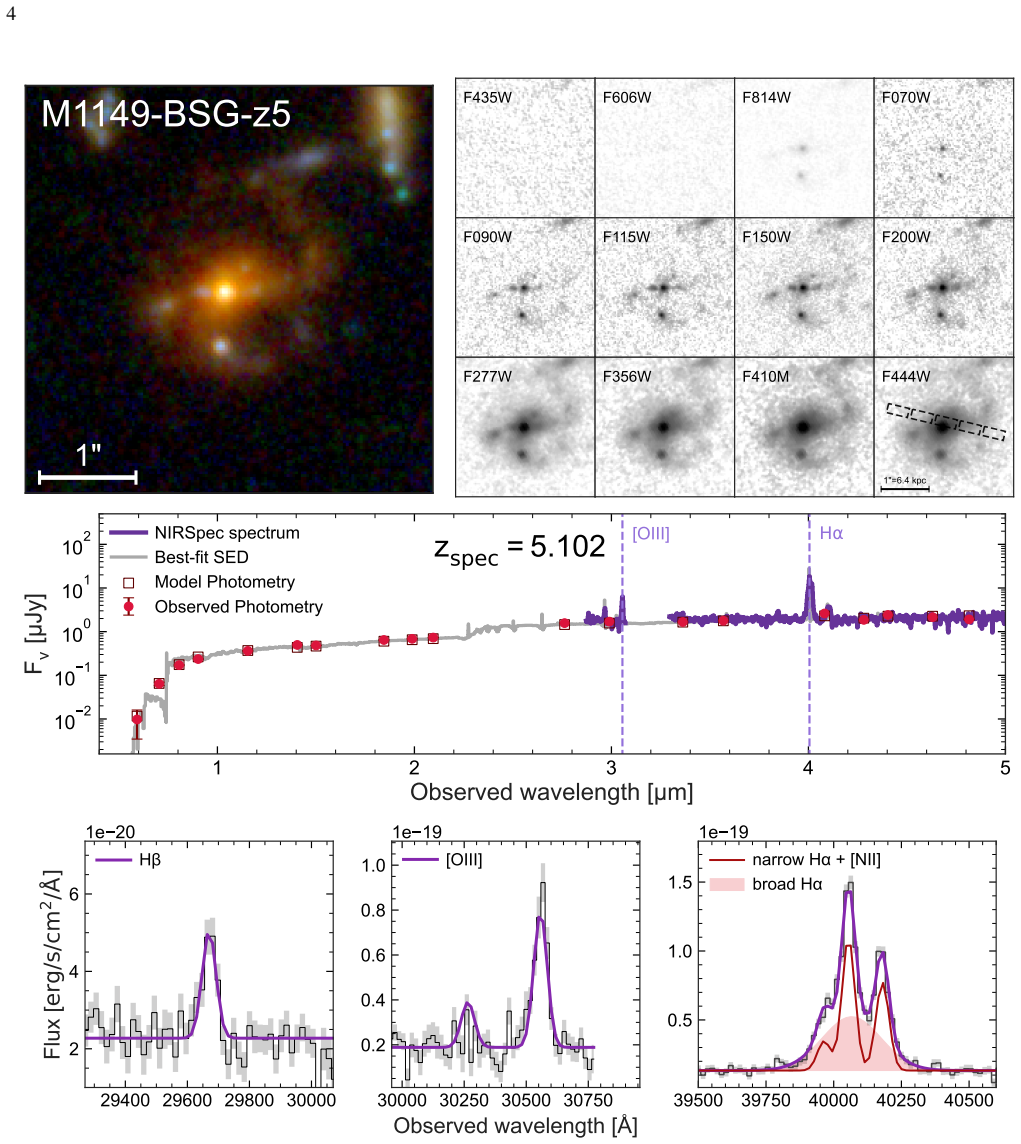
A massive barred spiral galaxy at z = 5.102 discovered by JWST
JWST imaging reveals a 4.5 kpc stellar bar and spiral arms in a massive disk galaxy only 1.2 billion years after the Big Bang.
full image
Astrophysics of Galaxies
Phenomena pertaining to galaxies or the Milky Way. Star clusters, HII regions and planetary nebulae, the interstellar medium, atomic and molecular clouds, dust. Stellar populations. Galactic structure, formation, dynamics. Galactic nuclei, bulges, disks, halo. Active Galactic Nuclei, supermassive black holes, quasars. Gravitational lens systems. The Milky Way and its contents
A massive barred spiral galaxy at z = 5.102 discovered by JWST
JWST imaging reveals a 4.5 kpc stellar bar and spiral arms in a massive disk galaxy only 1.2 billion years after the Big Bang.
full image
Detection of ~0.05 km/s ion-neutral velocity drift in L1544 interpreted as the first observational signature of ambipolar diffusion in aโฆ
full image
The Splashback Mass Function of Galaxy Clusters from Photometric Data
SDSS photometry locates cluster edges and produces abundances matching simulations at high masses.
full image
The Merger-Driven Origin of the Vast Extended Stellar Disc Around the Andromeda Galaxy
N-body model shows 2-4 Gyr event heats and warps the progenitor disc with inclination falling at larger radii
full image
The Road to Identifying the Earliest Radio-Powerful AGN with the SKA
Fine sampling from 50 MHz to 15 GHz overcomes biases that hide the predicted population of early radio-powerful sources.
full image
Assessing Ultra-Cool Dwarf Contamination in Photometrically Selected High-Redshift Galaxy Samples
FC-ENZO finds similar fractions across HST, Roman and JWST fields but most interlopers sit at the faintest magnitudes.
full image
L1506C modeling shows evolved dust grains are needed in densest regions, implying early evolution in star formation.
full image
Indicatives of Early Stages of Star Formation in the Universe
Four matching metallicity peaks in clusters and clouds from z=0.2 to 5.9 are reproduced when each stage produces that fixed GC mass total.
The VLA-COSMOS 3 GHz Large Project: Polarised source counts and catalogue
Upper limit below 2 per square degree shows SKA-era work needs far deeper data to detect this population.
full image
Resolved HI and Environmental Dynamics
Reaching 10^18 cm^{-2} sensitivity at kiloparsec scales across clusters, groups and filaments.
full image
CO clouds and 3D dust maps yield distances accurate to roughly 5-10 percent for objects in the galactic plane.
full image
Combined photometry shows a 1.6 Jupiter-mass planet around a K dwarf at 4.8 AU projected separation along the Galactic plane.
Post-starburst Galaxies with Active Galactic Nucleus: Properties and Evolutionary Sequences
Age and kinematic profiles link RPSBs to later AGN activity while high-mass central PSBs follow mergers; AGN feedback is not required for qu
full image
Periodic Radio Technosignature Search toward 3I/ATLAS with FAST
FAST telescope search using signal decomposition sets upper limit of 0.146 watts on artificial periodic emissions
full image
Radiative filtering unifies broad-line phenomenology in active galactic nuclei
The product of intrinsic ionizing output and transmission explains why lines vanish at both low and high accretion and unifies multiple obse
full image
Fractional-Dimension Gravity and the Milky Way Galaxy
A radially changing fractional space dimension matches Gaia DR3 velocities across the full observed range.
full image
IRIS: Deciphering Spectral-Line Imagery of the Galactic Center by Machine-Learning on Simulations
Trained only on simulations, the model produces new projections of the Central Molecular Zone from SEDIGISM observations.
full image
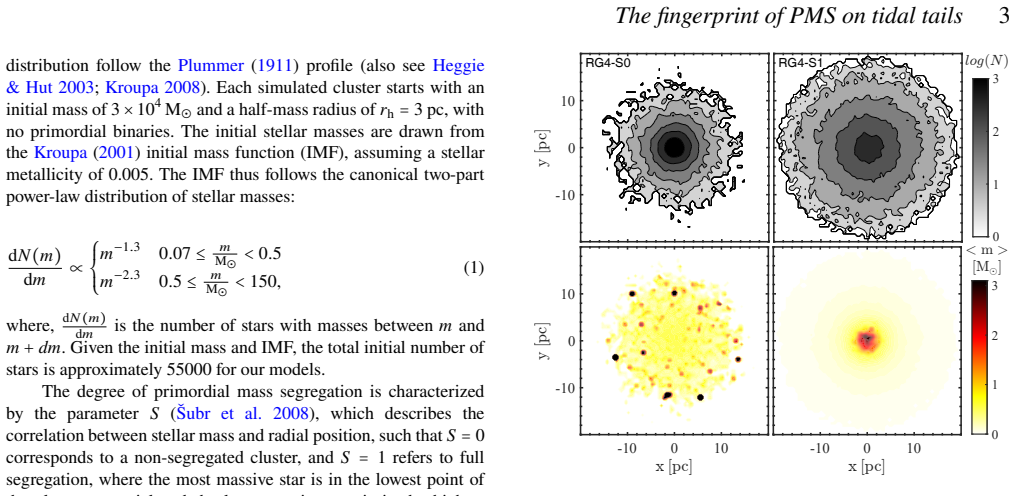
The fingerprint of primordial mass segregation on the tidal tails of star clusters
Simulations show segregated clusters form longer, unified tails early on, with the signal weakening at later times.
full image
Extreme outflow velocities and weak UV emission lines indicate quasars shedding their dust cocoons
Six objects with 0.16c blueshifted BALs and weak UV lines fit low-inclination disc winds where dust shatters during emergence.
full image
No evidence of vorticity production from initially irrotational turbulent gravitational collapse
Simulations show all vorticity traces to initial conditions, with none generated by the gravitational collapse itself.
full image
SZ-selected sample reaches median redshift 0.73 and mass 1.65e14 solar masses with 4.5 clusters per square degree
full image
Nondetection in Orion disk d203-506 places excited column density at or below thermochemical expectations when excitation matches CH+ and CH
full image
Lensed JWST data show sources below M_UV=-17 provide over half the luminosity density and 64% of ionizing photons.
full image
Smoking-gun evidence for hierarchical black-hole mergers
Peak-by-peak match in 259 events shows high-spin black holes form via successive mergers rather than isolated processes.
full image
Measurements in 714 local stars show clearer old-young separations in [X/O] than in traditional [X/Fe] trends for several elements.
full image
Bar-driven secular evolution largely complete in a disk galaxy 7.6 billion years ago
JWST finds bar-driven secular evolution largely finished when the universe was less than half its current age
Observations favor supernova shells over magnetic forces, implying a bubbly disk when viewed face-on.
full image
Projection-Enhanced Disk Breaks: Evidence from Deep Photometric Decomposition
Projection effects raise the apparent contrast of downbending breaks when disks are viewed sideways, producing a higher fraction than seen i
full image
Minimum ionising output sustained 1500 years favors faint AGN or TDE remnant disc over faded AGN for the 10^6 solar-mass black hole
full image
Kolmogorov turbulence across multi-fractal gas in Polaris Flare
Mapping shows the apparent break at 0.5 pc comes from projection and density changes, not a shift in turbulent regime
full image
High-sensitivity telescopes will support deep observations feeding tests of gravity, nano-Hz waves and nuclear matter.
full image
The age of the Universe from a large sample of the oldest Galactic stars
Large spectroscopic sample yields age consistent with 13.6 Gyr Lambda-CDM but inconsistent with 12.9 Gyr pre-recombination Hubble-tension mo
full image
SPHEREx 0.75 to 5 ฮผm Spectra for a Sequence of Nearby Brown Dwarfs
SPHEREx data on 37 nearby objects show clear preference for low k_zz over strong mixing despite offsets near CO features.
full image
Six-component decomposition shows bar, nuclear and thin discs formed in place while bulge and thick disc were accreted
full image
Optically Selected Superthin Galaxies Remain Thin in the Near-infrared
Axis ratios remain constant while sizes shrink, showing no thick old-star disk and favoring low-density halo environments.
full image
Exploring the synergies of [O\,II]ฮป 3727 with MUSE spectroscopy in PHANGS H II regions
A catalog of 604 nebulae recovers calibration offsets yet shows consistent radial trends and identifies [S III]/[S II] as a cleaner ionizati
full image
3D models of Type Ia ejecta colliding with a main-sequence star reproduce some remnant shapes but fall short on the large velocity differenc
Multiwavelength periodic microlensing signatures of macrolensed supermassive binary black holes
Equal-mass pairs vary at half the orbital period while low-mass-ratio pairs follow the full period, with larger amplitudes at shorter wavele
Cosmic Magnetism Science with the SKA
Planned observations will test how magnetism shapes structure formation at scales from planets to the Universe.
full image
Direct VLBI evidence for a buried AGN in the triple-merger LIRG UGC 2369S
Compact source with high brightness temperature and flat spectrum confirms obscured nucleus in triple-merger LIRG
full image
Probing the Parsec-Scale Dynamical Structure of Ionized Gas in Radio-Quiet AGN with SKA
Beam size alters the mix of jets, outflows and star formation sampled, so SKA can map each at its native scale
full image
Synchrotron and free-free mapping with simulated REACH observations between 50-170 MHz
Joint fitting recovers synchrotron maps across the sky at 50-170 MHz while free-free recovery stays limited.
full image
OCCAM X. Neutron Capture Abundances with Keck/HIRES & Magellan/MIKE
Second-peak s-process and r-process abundances lack the steep radial slopes of alpha and iron-peak elements in 18 open clusters.
full image
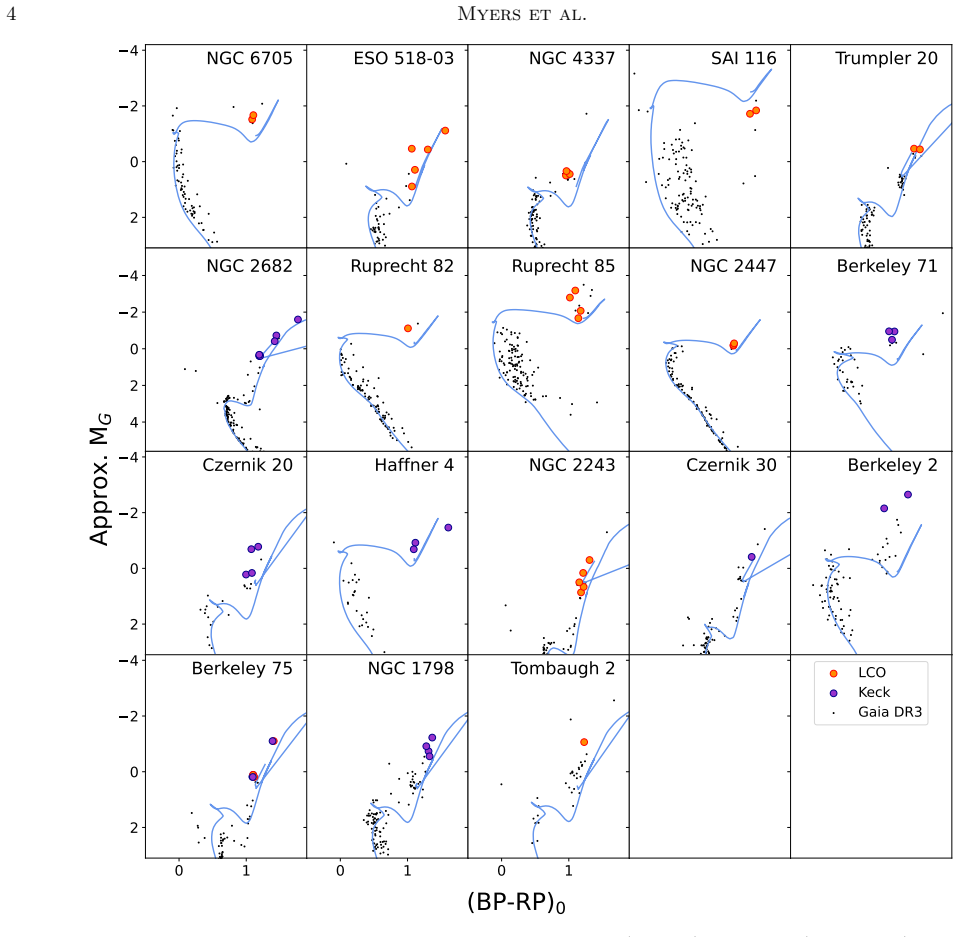
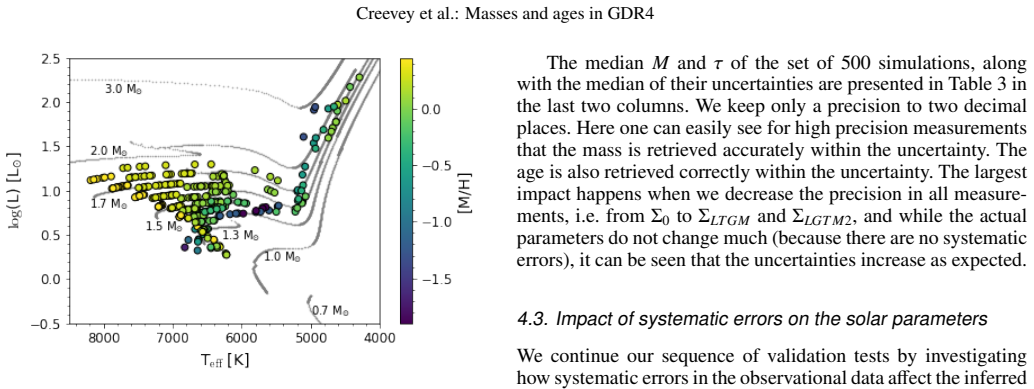
FLAME combines analytical luminosity-radius steps with Bayesian or minimization fitting on Gaia data to produce the estimates.
full image
Multi-object near-IR spectroscopy on the ELT enables time-delay measurements for many more active galactic nuclei, supporting geometric dist
The evolution of high-z proto-star clusters into local globular clusters
Multiple-population systems survive strong early tides and match Galactic GC properties after 12 Gyr.
full image
Prospects for Panspermia via Interstellar Objects like 3I/ATLAS
JWST data on 3I/ATLAS shows ice allows low-rate survival, though directed planting fails due to destructive impact energies.
full image
JWST spectroscopy, lensing, and archaeology together shrink the allowed properties of Population III stars and ready the field for detection
full image
Far-infrared observations of dust in Lyฮฑ emitters at z=2-6
Far-IR stacking of 4000 LAEs finds non-zero escape fractions even in AGN-hosting systems, implying clumpy dust allows ionizing photons to le
full image
SchwarMAX: a GPU-friendly Schwarzschild orbit-superposition modelling framework
SchwarMAX builds full Schwarzschild models in one second on A100, enabling MCMC fits that match input profiles from N-body mocks.
full image
The Quiescent Sloshing Core of Abell 496 with XRISM
Bulk velocity 69 km/s and dispersion 78 km/s indicate a dynamically quiet ICM despite prior cold fronts and radio activity.
full image
Trends with accretion rate survive only when samples are matched on luminosity, pointing to radiation pressure rather than black hole mass.
full image
The Stellar "Snake"-V: the census within 3 kpc in the Solar Neighborhood
Catalogue of 802489 stars in coherent 9D associations offers foundation for studying Milky Way star formation hierarchies.
full image
Spectroscopy of 11 candidates finds pairs including one at z~3.1 and shows how photometric redshifts cut contamination
full image
JWST data show they are compact with little wavelength variation yet retain more residual disturbances than passive galaxies at high mass an
full image
Spectroscopic sample shows they comprise under 3% of AGNs at z=1.9-2.5, milder than photometric surveys reported.
full image
FIRE simulations find inward migrators gain eccentricity while some stars cool to circular orbits; overall migration is rarely cold.
full image
COSMOS-Web: does halo mass alone shape the clustering of star-forming and quiescent galaxies?
COSMOS-Web data show 0.5-1 dex excess persists from z=5 with conformity to z=2, so halo mass alone does not set clustering.
full image
Spatially resolved maps show disturbed motions and recent gas exchange, making the group a local template for rapid galaxy assembly.
full image
First views of gas structures around early quasars less than 600 million years after the Big Bang.
full image
AGN Feeding & Feedback Over the Galactic Scales
Reaching sensitivities of 10^19 cm^-2 in HI at arcsecond scales to link nuclear episodes with galactic star formation.
full image
Larger distance aligns the candidate explosive event with Orion BN/KL energetics at an older dynamical age near 3500 years.
full image
Simulations tuned to commissioning data and reflectance measurements quantify reflection artifacts in the camera.
full image
Uncovering neutral Hydrogen clouds in Radio Galaxies in the SKA era
Milliarcsecond resolution will track atomic gas from nuclei to jet-ISM sites in molecular-rich AGN.
full image
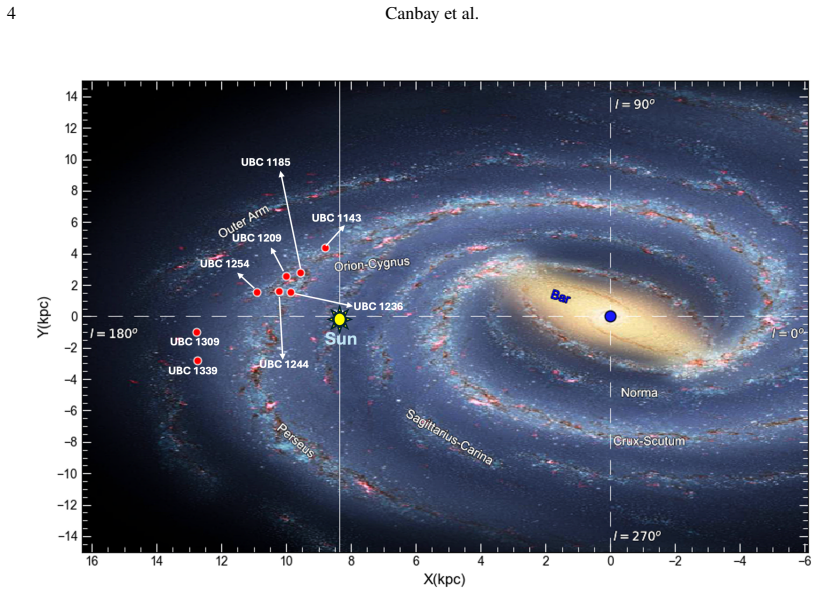
Chemo-dynamical Analysis of Eight UBC Open Clusters
Orbital tracing of distant open clusters finds modest displacements, pointing to mild redistribution in the thin disk.
full image
Fueling and feedback mechanisms at the nodes of the cosmic web
The resulting kinematics and star-formation maps would show which processes quench galaxies as protoclusters become virialized clusters.
full image
17 members average 3 percent solar metallicity near an absorber with first-star-like carbon and silicon ratios.
Ultralight dark matter mixed with primordial black holes
Continuum background effect dominates while discrete fluctuations take 10 billion years to act on galactic halos.
Feasibility study shows ELT instrument maps population properties in early passive galaxies out to twice the effective radius.
full image
Bayesian analysis of multiple molecular lines shows radial and azimuthal changes in density, temperature, and cosmic-ray ionization.
full image
Electron Densities of Typical Low-Mass Galaxies at z~2-7 from Stacked JWST/NIRSpec Spectra
Low-mass galaxies average 381 cm^{-3} at z=5-7 versus 100-150 cm^{-3} at z=2-5, measured via [SII] ratios.
full image
Tracing Cold Gas in Absorption Across Cosmic Time with the SKA
Wide frequency coverage and sensitivity enable atomic and molecular gas studies at every cosmic epoch.
full image
The FAST All Sky HI Survey DR2: the FASHI Catalog and the HI Mass Function
Parameters are log M* = 9.89, alpha = -1.31; cosmic HI density is 4.71e-4 from 109000 sources.
A generalized linear matrix method for normal modes in collisionless stellar disks
Boundary-integral terms keep matrix size fixed while computing m=2 modes for Kuzmin-Toomre models to 0.003 accuracy and allowing softening.
full image
The metallicities of little red dot host galaxies: LRDs are metal poor, but not pristine
The 0.6 dex spread holds from z=2 to 7 and challenges pristine-gas models for these compact high-redshift sources.
full image
Classification shows how different techniques affect conclusions on filament orientations relative to magnetic fields in the interstellar me
full image
A simulation-based analytic model of radio galaxies II: self-consistent radiative losses
Self-consistent inverse-Compton drain on the CMB makes sources fainter in radio and X-ray than loss-free models predict.
full image
Unveiling the properties of galaxy cores excavated by supermassive black hole binaries with SHARP
SHARP-VESPER and MICADO enable detection of black hole binary signatures up to reionization and in smaller galaxies to complement gravitatio
full image
Boosting Water Maser Studies in AGN with the SKA
Unprecedented sensitivity enables statistical samples and luminosity functions at higher redshifts.
full image
GSED: The Galactic Stellar Extinction Database
Query service returns corrected E(B-V), Gaia colour excess and A_V from homogenized stellar data
full image