pith. sign in

math.AP

Analysis of PDEs

Existence and uniqueness, boundary conditions, linear and non-linear operators, stability, soliton theory, integrable PDE's, conservation laws, qualitative dynamics

Top Pith
5
math.PR 2026-05-21

Shifted variables close uniform chaos propagation for second-order CBO

by Seung-Yeal Ha, Franca Hoffmann +1 more

Uniform-in-time propagation of chaos for Second-Order Consensus-Based Optimization

Translation-mode separation yields integrable coupling and Monte Carlo rates that hold for all time.

abstract click to expand
We study second-order Consensus-Based Optimization (CBO), a derivative-free global optimization algorithm in which the consensus force and the multiplicative exploratory noise act on particle velocities. We prove quantitative uniform-in-time propagation of chaos for the unmodified second-order CBO dynamics, together with an almost uniform-in-time stability estimate for the microscopic particle system. The proof is not a direct adaptation of the first-order CBO argument. Although both first- and second-order CBO have multiplicative noise that degenerates near consensus and a shift-invariant weighted interaction, the kinetic model has an additional structural obstruction: the consensus mechanism and the stochastic forcing act only on the velocity variable, while the position variable evolves by transport. Thus spatial concentration has to be recovered indirectly through velocity dissipation. Moreover, the shift-invariant interaction leaves a translation mode that is not directly damped by the consensus force, so a standard synchronous coupling in the Euclidean phase-space distance does not close uniformly in time. The main idea of the paper is to introduce shifted internal variables that separate the contracting fluctuation modes from the undamped translation mode. In these variables we build a Lyapunov functional with a position-velocity cross term and prove exponential decay of centered moments. This decay is the mechanism that makes the time-dependent coupling coefficient integrable. Combining it with uniform-in-time raw moment bounds, concentration inequalities, stability estimates for the weighted mean, and a Monte Carlo estimate, we obtain the classical Monte Carlo rate for propagation of chaos uniformly in time. The system-to-system stability estimate avoids the sampling error and yields the faster rate \(O(J^{-q})\).
0
Top Pith
1
math.AP 2026-05-21 1 theorem

Analyticity sets exact uniqueness threshold in Calderón problems

by Thierry Daudé, Alberto Enciso +3 more

A Sharp Regularity Threshold for Uniqueness in Riemannian Calder\'on-type Problems

Uniqueness holds for analytic metrics but fails densely in every non-analytic Gevrey class for both fixed-potential and fixed-frequency data

abstract click to expand
We prove a sharp regularity threshold for uniqueness in two anisotropic Calder\'on-type inverse problems in dimension $n\ge 3$. The main setting is the Riemannian Schr\"odinger problem with fixed scalar potential: for a prescribed nonconstant analytic function $V$, we study whether the Dirichlet-to-Neumann map of $-\Delta_g+V$ on a domain $\Omega\subset\mathbb{R}^n$ determines the unknown metric $g$. The natural gauge is the group of boundary-fixing diffeomorphisms preserving $V$. We show that, while analytic metrics are uniquely determined modulo this gauge by a minor adaptation of the Lassas--Uhlmann reconstruction theorem, uniqueness fails densely in every non-analytic Gevrey class $G^\sigma$, $\sigma>1$. In fact, our counterexamples are not isometric in the sense that they are not connected by the pushforward of any diffeomorphism of $\overline\Omega$. We also prove the analogous sharp threshold for the anisotropic Calder\'on problem at fixed nonzero frequency, thereby upgrading the previously known finite-regularity counterexamples to Gevrey and $C^\infty$ regularity. The two constructions use different scalar mechanisms: for fixed potentials, the nonconstant potential itself provides a local coordinate, while at nonzero frequency one uses a compactly supported prescribed-Jacobian lemma in Gevrey spaces. Thus analyticity is the exact threshold for uniqueness in both problems.
0
Top Pith
4
math.AP 2026-05-19 2 theorems

Time-periodic weak solutions exist for nonlinear fluid-plate system

by Claudiu Mîndrilă

Time-periodic solutions for viscous fluids interacting with nonlinear Koiter plates

Nonlinear Koiter energy forces single Leray-Schauder argument on the coupled Galerkin system in periodic channels.

Figure from the paper full image
abstract click to expand
We prove the existence of time-periodic weak solutions for a fluid-structure interaction system coupling the incompressible Navier-Stokes equations in a three-dimensional moving domain with a nonlinear Koiter plate equation on its upper boundary. The lateral boundary is space-periodic, a natural setting for flow in pipes and channels of periodic cross-section driven by a time-periodic pressure gradient, and the fluid satisfies a no-slip coupling condition at the moving interface. The elastic energy of the plate is governed by the nonlinear Koiter model, which yields an $H^2$-coercive operator and accounts for both membrane and bending effects. To the best of our knowledge, this is the first result on time-periodic weak solutions for a fluid-structure interaction system with a \emph{nonlinear} elastic energy. The main novelty, compared to our earlier works on the linear case -- a linear elastic plate and a linear Koiter shell respectively -- is the replacement of a two-stage fixed-point procedure -- a Leray-Schauder argument at the discrete level followed by a set-valued Kakutani-Glicksberg-Fan argument at the continuous level -- by a \emph{single} Leray-Schauder fixed point applied directly to the fully coupled Galerkin system. This reduction is not merely a simplification: the nonlinearity of the Koiter energy destroys the convexity of the solution map on which Kakutani-Fan relies, making the two-stage approach of~\cite{Claudiu22} unavailable and the single fixed point the only viable strategy.
0
0
math.AP 2026-07-03

Self-similar wave solutions stay stable forward in time

by Akansha Sanwal, Birgit Schörkhuber +1 more

Stability of global self-similar solutions to the cubic wave equation and the wave maps equation

Small perturbations of special scaling-invariant solutions to supercritical wave equations remain bounded for all future time, proven via gl

abstract click to expand
We study the long-time stability of global self-similar solutions to two energy supercritical nonlinear wave equations, namely, the cubic nonlinear wave equation in $6$ dimensions and the corotational wave maps equation in $4$ dimensions. We prove the stability of self-similar solutions under perturbations that are small in the critical Sobolev spaces. The proof is based on Strichartz estimates for wave equations with potentials in similarity variables.
0
0
math.AP 2026-07-03

Jastrow factor raises wave function regularity order from 1 to 2

by Virginie Ehrlacher

Cut-off Jastrow Factors and Spectral Barron Regularity of Coulombic Electronic Wave Functions

The quotient after cut-off Jastrow extraction gains one full order in spectral Barron spaces for Coulombic eigenfunctions.

abstract click to expand
We study the spectral Barron regularity of Coulombic electronic eigenfunctions after extraction of a cut-off Jastrow factor. Let \(H=-\Delta+V\) be an \(N\)-electron Coulomb Hamiltonian with clamped nuclei, and let \(\psi\) be an eigenfunction associated with a discrete eigenvalue below the bottom of the essential spectrum. For the cut-off Jastrow factor \(F_{\rm cut}\) of Fournais--Hoffmann-Ostenhof--Hoffmann-Ostenhof--S\o rensen, we set \[ \phi=e^{-F_{\rm cut}}\psi . \] Whereas the original wave function satisfies the sharp global threshold \(\psi\in \mathcal B_{\rm sp}^s(\mathbb R^{3N})\) for every \(0\leq s<1\), we prove that the Jastrow quotient gains one full order: \[ \phi\in \mathcal B_{\rm sp}^s(\mathbb R^{3N}) \qquad \text{for every } 0\le s<2 . \] The endpoint \(s=2\) is shown to be natural through an explicit hydrogen-like eigenfunction. The many-body proof is a global Fourier-side resolvent argument. After conjugation by the cut-off Jastrow factor, the Coulomb singularities are converted into localized angular coefficient blocks with admissible Fourier-control measures. Low frequencies are controlled by the a priori \(H^1\)-bound, while high frequencies are recovered by a Neumann fixed-point argument using the resolvent multiplier and annular estimates for the coefficient measures.
0
0
math.AP 2026-07-03

Geodesic equation on Hermitian manifolds gains C^{1,1} solutions

by Mathew George

Regularity of a Geodesic equation in the space of mixed Volume Forms on Hermitian Manifolds

Under ellipticity on manifolds with balanced metrics the result also yields unique C^{1,1} solutions to the Donaldson equation.

abstract click to expand
We prove regularity of a fully nonlinear equation that arises from the study of geodesics in the space of mixed volume forms on Hermitian manifolds admitting a balanced metric. Under conditions for ellipticity, we prove that this degenerate equation has a $C^{1,1}$ solution on Hermitian manifolds. We derive uniform Laplacian estimates for the perturbed equation, and also construct explicit subsolutions. In particular, this shows the existence of a unique $C^{1,1}$ solution to the Donaldson equation on Hermitian manifolds.
0
0
math.DG 2026-07-03

Clifford torus is Willmore for every Berger sphere parameter

by Caio B. Rodrigues

Bifurcations of the Clifford Torus as Willmore Surfaces in Berger Spheres

Morse index estimates along the family detect bifurcation points that produce new symmetric Willmore tori.

Figure from the paper full image
abstract click to expand
The Clifford torus in a Berger sphere with parameter $\tau$ is a critical point of the Willmore functional for every $\tau>0$, yielding a smooth path of Willmore surfaces. By estimating the Morse index along this path, we apply bifurcation theory to produce new symmetric Willmore tori emerging from the Clifford torus.
0
0
math.AP 2026-07-03

First existence and uniqueness for quasilinear Allen-Cahn systems

by Harald Garcke, Tim Laux +1 more

Weak and strong solutions for a class of quasilinear Allen--Cahn systems

Local strong solutions via maximal regularity and global weak solutions via higher integrability hold despite non-convex gradient energies.

abstract click to expand
We consider a quasilinear Allen--Cahn system which arises when the gradient energy term in the Ginzburg--Landau energy also contains zero order terms. Such systems offer significant advantages in applications, since surface tensions and mobilities can be easily calibrated. The analysis for these systems is highly challenging, partly due to the fact that the gradient term in the energy is non-convex and since gradient terms appear quadratically in the weak formulation. This explains why an existence theory has been lacking for nearly thirty years. In this paper, we give the first existence and uniqueness results for such systems. Firstly, we prove existence and uniqueness of local-in-time strong solutions using the theory of maximal regularity. Here, non-standard techniques have to be applied due to the fact that linear constraints on the solution are involved and due to nonlinear boundary conditions. Secondly, using a minimizing movement approach we show the existence of global-in-time weak solutions. Here, the main difficulty arises from the fact that the underlying energy is not $\lambda$-convex. We overcome this issue by proving higher integrability of the gradient of the solution, first showing that solutions are bounded and then using an approach by Giaquinta and Modica. This finally allows us to pass to the limit in the time-discrete approximation. Using the de Giorgi interpolation technique, we are also able to show a sharp energy decay property despite the lack of convexity of the energy.
0
0
math.AP 2026-07-03

Cartan equations hold for C^0 ∩ H^{1/2} coframes

by Isaac Newell, Luc Nguyen

Cartan's and Gauss's equations and rigidity theorems for isometric embeddings in low Sobolev regularity

The Gauss curvature identity then applies to isometric embeddings down to W^{1+2/3,3} regularity and yields convexity statements for nonnega

abstract click to expand
Let $\{\eta^i\}_{i=1}^2$ be a an orthonormal coframe on a domain $U$ on a smooth surface $(\Sigma,g)$. When $\eta^i$ is smooth, it is well-known that there is a unique connection 1-form $\omega$ verifying Cartan's first structural equations $d\eta^i = (*\eta^i) \wedge \omega$, and Cartan's second structural equation $d\omega = K_g dvol_g$. We prove that this statement remains valid when the frame is $C^0 \cap H^{\frac12}$, where the structural equations are understood in the sense of distributions. From this, we deduce that the Gauss equation $\mathrm{Det}\, D^2 f = K_g (1+|Df|^2)^2$ holds for every graphical representation $f$ of an isometric embedding of regularity $C^1 \cap W^{1+\frac23,3}$ or $c^{1,\frac12} \cap BV^2$. As an application, we prove regularity and convexity results for isometric embeddings of closed surfaces and convex caps with $K_g \geq 0$.
0
0
math.DG 2026-07-03

Intrinsic Brown-York mass expands to ADM mass plus shape correction

by Jiangcheng You

Intrinsic Brown--York Type Mass at Infinity in Four Dimensions

For large convex hypersurfaces the boundary term converges to ADM mass; the correction vanishes for nearly round surfaces under decay compat

abstract click to expand
We study a Brown--York type mass for closed hypersurfaces in four-dimensional asymptotically flat manifolds. The reference mean curvature is defined intrinsically as the trace of the positive solution of the contracted Gauss equation. For large uniformly convex hypersurfaces with controlled scale, we derive an expansion consisting of a boundary term converging to the ADM mass and a shape-dependent correction. For the four-dimensional analogue of the nearly round surfaces of Shi--Wang--Wu, this correction vanishes under a natural decay compatibility condition.
0
0
math.AP 2026-07-03

Fractional Dirichlet solutions split into regular and d^a-singular parts

by Gerd Grubb

The structure of solution spaces for fractional-order operators, with gradient estimates

Direct-sum decomposition on C^{1+τ} domains yields gradient estimates in Sobolev and Hölder spaces when a exceeds 1/2

abstract click to expand
The solution space of the homogeneous Dirichlet problem for the fractional Laplacian $(-\Delta )^{a}$ ($0<a<1$) or a pseudodifferential generalization $P$, on a bounded open set $\Omega \subset R^n$ with $C^{1+\tau }$-boundary, $$ Pu=f \text{ on }\Omega ,\quad u=0 \text{ on }R^n\setminus \Omega , $$ is analysed in detail. It is shown, both for solutions in Sobolev spaces of Bessel-potential type $H_q^t$ and in H\"older-Zygmund spaces $C_*^t$, that the solution space for $f$ of regularity $s\in [0,\tau -2a)$ is the direct sum of a component $\dot H_q^{2a+s}(\bar\Omega)$ resp. $\dot C_*^{2a+s}(\bar\Omega)$ with full regularity $2a+s$ and a component of the form $d^a$ times a lifting of boundary values by Poisson operators. Here $d(x)=dist(x,\partial\Omega )$. This extends to non-smooth problems results known in the $C^\infty $ setting. The knowledge is used to establish gradient estimates for $a>1/2$, e.g. estimating $d^{1-a+s}\nabla (u/d^a)$ in terms of norms of $f$ and $u$, both in $H_q^t$-spaces and $C_*^t$-spaces. This is entirely new in the case of Bessel-potential spaces; it extends previous results by Fall and Jarohs in H\"older spaces. A new tool is introduced: $\dot H^{s+t}_q(\bar\Omega)\subset d^s\dot H^{t}_q(\bar\Omega)$ holds for $s,t\ge 0$ with $s+t<1+\tau $.
0
0
math.AP 2026-07-03

Half-slope invariant extends coagulation-fragmentation existence to m=1

by Truong-Son P. Van

A convexity-type invariant for the critical coagulation--fragmentation Hamilton--Jacobi equation

The convexity bound propagates through the viscous scheme, confirming the mass threshold at unity.

abstract click to expand
We study the critical coagulation--fragmentation equation with multiplicative coagulation kernel \(a(s,\hat s)=s\hat s\) and constant fragmentation kernel \(b(s,\hat s)=1\). Under the Bernstein transform, mass-conserving solutions correspond to solutions of a singular Hamilton--Jacobi equation studied by Tran and Van (Comm.Pure Appl.Math.75 (2022), no.6, 1292--1331). Through this correspondence they proved that mass-conserving solutions are unique on the full critical range \(0<m\le1\), but could establish their existence only for \(0<m<\tfrac12\). We identify a one-sided, convexity-type invariant that holds for Bernstein-transform data and is propagated by their viscous scheme as a genuine maximum-principle bound. We call it the half-slope invariant. It sharpens the curvature barrier and thereby extends mass-conserving existence to the entire critical range \(0<m\le1\). Hence \(m=1\) is the critical mass, confirming the threshold predicted by Vigil and Ziff (J.Colloid Interface Sci.133 (1989), no.1, 257--264). The same invariant appears in the radial partial-mass formulation of the two-dimensional Keller--Segel equation, whose critical mass is \(8\pi\).
0
0
math.AP 2026-07-03

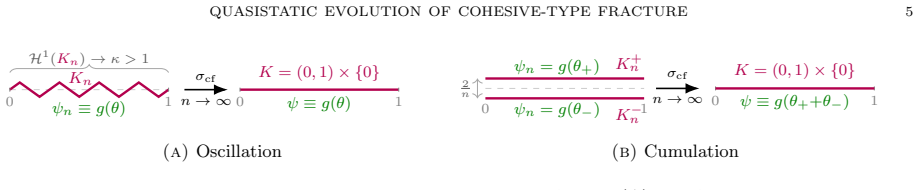
Existence of stable quasistatic evolutions shown for cohesive fracture

by Vito Crismale, Manuel Friedrich

Quasistatic evolution of cohesive-type fracture

Concave energies with activation thresholds permit unprescribed paths in any dimension via new convergence of memory variables.

Figure from the paper full image
abstract click to expand
We prove the existence of globally stable quasistatic evolutions for a cohesive fracture model with unprescribed crack path and without any topological restriction, in arbitrary dimension. The surface energy density is assumed to be concave and to exhibit an activation threshold, modeling depinning effects and fracture process zones in quasi-brittle materials. We devise a new notion of convergence for memory variables supported on evolving crack sets, inspired by $\sigma$-convergence in brittle fracture, guaranteeing compactness and lower semicontinuity properties. In contrast to the brittle case, global stability is not preserved under passage to the limit because of oscillation and branching phenomena in the approximating cracks. To overcome this difficulty, we deviate from the classical scheme for proving energetic solutions by first proving the energy balance and convergence of the surface energies, and only afterwards recovering the global stability condition.
0
0
math.AP 2026-07-03

Quintic NLS on torus globally well-posed for s > 1/3

by Benjamin Dodson

Global well--posedness for the mass--critical nonlinear Schr{\"o}dinger equation on mathbb{T}

Improves prior threshold from s > 2/5 for the mass-critical equation on the circle.

abstract click to expand
We prove a global well--posedness result for the quintic NLS on $\mathbb{T}$ for initial data in $H^{s}(\mathbb{T})$, $s > 1/3$. This improves the previous best bound of $s > 2/5$.
0
0
math.DG 2026-07-03

STCMC foliations arise as flow limits near AdS-Schwarzschild

by Jacopo Tenan

Foliations by constant spacetime mean curvature surfaces for asymptotically hyperboloidal initial data sets

Volume-preserving spacetime mean curvature flow from a known CMC foliation produces the surfaces and a center-of-mass definition for hyperbo

abstract click to expand
We construct an exhaustive family of constant spacetime mean curvature (STCMC) surfaces for initial data sets close to the anti-de Sitter-Schwarzschild hyperboloid. In particular, we obtain such a foliation as the long time limit of the volume preserving spacetime mean curvature flow starting from the constant mean curvature foliation constructed by Neves-Tian (Geom. Funct. Anal., 2009). As an application, inspired by the definition of STCMC center of mass for initial data sets proposed in the asymptotically Euclidean setting by Cederbaum-Sakovich (Calc. Var. PDE, 2021), we study the center of mass of an asymptotically hyperboloidal initial data set.
0
0
math.AP 2026-07-03

Optimal insulation leaves boundary uncovered at low mass

by Francesco Della Pietra, Francescantonio Oliva

Optimal insulation and concentration breaking for nonlinear Robin boundary value problems

Gamma-limit analysis shows the best fixed-mass distribution concentrates rather than spreads evenly on connected boundaries.

abstract click to expand
We consider an optimal insulation problem for a bounded domain in $\mathbb{R}^N$ driven by the $p$-Laplace operator ($p>1$). We model the convective heat transfer between the body and the environment, which corresponds, before insulation, to a nonlinear Robin boundary value problem. Assuming the body is surrounded by a thin layer of insulating material of size $\varepsilon^{\frac{1}{p-1}}$, we compute the $\Gamma$-limit of the governing energy functional as $\varepsilon \to 0^+$. Furthermore, we study the optimization of the heat content among all possible distributions of the insulating material with a fixed total mass. Finally, we highlight a concentration breaking phenomenon. Under a suitable non-degeneracy condition, if the boundary of the domain is connected or the external temperature profile is constant, the optimal insulating layer fails to cover the entire boundary whenever the total mass is sufficiently small. This is shown to be optimal: an explicit example provides that a disconnected boundary can trigger an anomalous double-phase transition, causing the insulation to fracture again even at intermediate mass regimes.
0
0
math.AP 2026-07-03

Liouville theorems for half-space quasilinear elliptic equations

by J. M. do Ó, R. F. Freire +1 more

Liouville-type theorems and existence of solutions for quasilinear elliptic problems

A new weighted embedding supports both nonexistence results and fibering-based existence proofs.

Figure from the paper full image
abstract click to expand
This study establishes Liouville-type theorems for indefinite quasilinear elliptic equations in the upper half-space. Additionally, we demonstrate the existence of solutions for this class of problems using the fibering method. Our approach relies on a novel weighted Sobolev embedding developed for the upper half-space.
0
0
math.AP 2026-07-03

Limit erases potential well effect in p-Laplacian solutions

by Debajyoti Choudhuri, Vikas Jaiswal

A topological approach to an elliptic problem

As parameter blows up to infinity, solutions satisfy equation without the well, using topological approach.

abstract click to expand
In this paper, we study an elliptic problem involving a $p$-Laplacian operator and a potential well which is driven by a critical and singular nonlinearity. Under the limiting case of a parameter blowing up to $\infty$ yields solutions to a different problem where the effect of the potential well becomes negligible.
0
0
math.AP 2026-07-03

Stokes waves' 3D spectrum described near McLean resonant curves

by Massimiliano Berti, Alberto Maspero +1 more

McLean resonances and 3d spectral instability of Stokes waves

Benjamin-Feir and high-frequency instabilities share a resonant origin in deep-water gravity waves.

Figure from the paper full image
abstract click to expand
The spectral instability of traveling periodic water waves has been investigated for more than sixty years, since the seminal discovery of Benjamin and Feir. Despite an extensive literature, no rigorous theory has been available for arbitrary three-dimensional -- longitudinal and transverse -- perturbations. We establish the first rigorous description of the $3d $ unstable spectrum of small-amplitude gravity Stokes waves in deep water in a full neighborhood of the McLean resonant curves. Our results reveal that the Benjamin-Feir instability and the first longitudinal high-frequency isola originate from the same resonant interaction, hidden in the purely longitudinal setting. The dominant instabilities emerge for Fourier-Bloch parameters near the origin, corresponding to the $3d $ Benjamin-Feir modulational instability. Our approach provides quantitative bounds for the real parts of the unstable eigenvalues and establishes a computable necessary and sufficient criterion for the onset of instability near arbitrary high-frequency McLean curves. These results are enabled by three key innovations: ($i$) a Kato perturbative analysis allowing Lipschitz-type singularities of the linearized operator with respect to the Fourier-Bloch parameters; ($ii$) a polar-analytic KAM-type decoupling isolating the unstable eigenvalue pairs near the origin; and ($iii$) an analytic continuation argument in full neighborhoods of the McLean curves. A primary challenge is to establish fine regularity properties for the Dirichlet-Neumann operator conjugated via the Fourier-Bloch transform.
0
0
math.AP 2026-07-03

Late scalar observation uniquely recovers Caputo order

by Niyaz Tokmagambetov

Late-Time Fractional-Order Identification in Caputo Diffusion Equation

Monotonicity from Mittag-Leffler expansion gives uniqueness from one measurement and a log-ratio estimator from two.

abstract click to expand
We study late-time identification of the Caputo order in a linear diffusion equation generated by a strictly positive self-adjoint operator with compact resolvent. For signed scalar observations \(M_\alpha(t)=\sum_n a_nE_{\alpha,1}(-\lambda_nt^\alpha)\) satisfying \(\sum_n|a_n|/\lambda_n<\infty\), we show that, after eigenspace grouping, every nontrivial observation has a finite first nonzero resolvent moment \(S_m=\sum_n a_n/\lambda_n^m\). A uniform differentiated large-argument expansion of the Mittag-Leffler factor yields eventual strict monotonicity of \(\alpha\mapsto M_\alpha(t)\) on admissible intervals avoiding the zeros of \(1/\Gamma(1-m\alpha)\), hence uniqueness from one sufficiently late scalar measurement. For two measurements, \(M_\alpha(\rho t)/M_\alpha(t)=\rho^{-m\alpha}(1+O(t^{-\alpha_0}))\), giving a log-ratio estimator with asymptotic-bias and relative-noise error bounds. For bounded observations, \(S_m=\langle\mathcal A^{-m}\varphi,h\rangle\); for a finite rod, the leading point-sensor condition is \((\mathcal A^{-1}\varphi)(x_*)\ne0\). Counterexamples show the sharpness of the exclusions and noise interpretation.
0
0
math.AP 2026-07-03

Saturated feedback yields semi-uniform stability for passive systems

by Swann Marx (LS2N, Nantes Univ - ECN)

Semi-uniform stability estimates for impedance passive systems with saturated feedback *

Fractional regularity is preserved in interpolation spaces, enabling observability-based ISS estimates with disturbances.

Figure from the paper full image
abstract click to expand
This article investigates the long-time behavior of (possibly infinite-dimensional) impedance passive systems under saturated output feedback and external disturbances. We assume that, in the absence of saturation and disturbances, the underlying linear output feedback exponentially stabilizes the system. Our main contribution is to show that fractional Sobolev regularity of the free output is preserved by the nonlinear feedback. More precisely, if the initial condition belongs to a suitable interpolation space associated with the linear closed-loop generator, then both the output and the state of the nonlinear closed-loop system inherit the corresponding fractional regularity. This regularity is sufficiently weak to be shared by the linear and nonlinear closed-loop systems, thereby avoiding the identification of the nonlinear generator domain. Combining this regularity result with observability estimates for the linear system yields a characterization of the asymptotic behavior of the nonlinear closed-loop system in the presence of disturbances. In particular, under the impedance passivity framework and exact observability and regularity assumptions, we establish a semi-uniform input-tostate stability property. The theory is illustrated by a multidimensional wave equation with nonlinear boundary damping.
0
0
math.AP 2026-07-03

Blow-up only if supremum norm diverges in triangular diffusion systems

by Alexandre Bertolino (LJLL, DMA)

Refined blow-up criteria and global solutions for triangular cross-diffusion systems

Refined Lp criterion gives weaker condition than Sobolev, proving global solutions for two-species logistic models in d at most 2.

abstract click to expand
We study the Cauchy problem associated with a class of triangular cross-diffusion systems of Shigesada-Kawasaki-Teramoto type. We develop a self-contained well-posedness theory in C 0 ([0, T ]; H s (T d )) based on regularity estimates for scalar Kolmogorov equations. The diffusion coefficient of each species depends only on species of lower index, yielding a hierarchical structure that allows for refined blow-up criteria. Finite-time singularities can occur only through the divergence of the L $\infty$ (T d ) norm of the solution. Assuming polynomial growth of the nonlinearities, this criterion is refined to an L p -based blow-up condition for some finite exponent p, yielding a substantially weaker obstruction to global existence than classical Sobolev blow-up criteria. The proof is achieved through refined tame estimates for composition in Sobolev spaces. As an application, we prove global existence of non-negative strong solutions for two-species systems with logistic-type reaction terms in dimensions d $\le$ 2.
0
0
math.AP 2026-07-03

Global existence holds for degenerate 3D Keller-Segel with small data

by Pierre Gilles Lemarié-Rieusset (LaMME)

A short note on maximal regularity for the heat kernel in Besov spaces and a degenerate 3D Keller-Segel system

Small initial values in a critical Lorentz space suffice when heat-kernel estimates in Besov spaces survive the degeneracy.

abstract click to expand
We prove global existence for a degenerate Keller-Segel equation with small initial values in a critical Lorentz space.
0
0
math.AP 2026-07-03

Local linking theorem gives two solutions for relativistic equations

by Manuel Garzón, Salvador López-Martínez

A Local Linking Theorem for Relativistic Action Functionals

An analogue of the Brezis-Nirenberg result for Szulkin functionals from action principles proves multiplicity for the Lorentz force and mean

Figure from the paper full image
abstract click to expand
We establish an analogue of the Brezis-Nirenberg local linking theorem for a class of Szulkin-type functionals arising from relativistic action principles. In this framework, compactness of Palais-Smale sequences is formulated with respect to a topology induced by the effective domain of the functional, replacing the classical strong Palais-Smale condition. The proof combines the original construction of the min-max geometry, based on a negative gradient flow, with the Ekeland-Lasry regularization. The main difficulty is that the regularized functional is naturally associated with the strong topology of the underlying functional space, whereas compactness for the original functional is formulated in the topology induced by the effective domain. We overcome this obstacle through a new perturbative construction that recovers the required min-max structure. We apply our abstract multiplicity result to two representative relativistic models: the Lorentz force equation, describing the dynamics of a charged particle in an electromagnetic field, and the Dirichlet problem for the prescribed mean curvature operator in Minkowski space. As a consequence, under natural assumptions, each problem admits at least two non-constant solutions.
0
0
math.AP 2026-07-03

Two solitons remain stable near elliptic Kepler orbits in Hartree equation

by Yutong Wu

Finite-time stability of two-soliton solutions of the Hartree equation with elliptic trajectories

Finite-time stability holds when centers track classical two-body elliptic paths in the 3D gravitational model

abstract click to expand
We prove the finite-time stability of two-soliton solutions of the three-dimensional gravitational Hartree equation whose centers remain close to an elliptic solution of the Kepler two-body problem.
0
0
math.AP 2026-07-03

Camassa-Holm equation with noise has global H1 martingale solutions

by Wei Luo, Zhaoyang Yin +1 more

Global Existence of Weak Martingale Solutions to the Camassa-Holm Equation with Linear Multiplicative Noise

Viscous Galerkin approximations converge via tightness and Girsanov estimates to weak solutions on the periodic domain.

abstract click to expand
In this paper, we consider the global existence and properties of $H^1$ martingale solution to the Camassa-Holm equation with linear multiplicative noise under periodic boundary conditions. The solution is obtained as limit of regular viscous approximate solutions to parabolic SPDEs, which are constructed using the Galerkin approximations ans the stochastic compactness method. The proof of convergence to a solution argues via tightness of the laws of the viscous approximations and Skorokhod-Jakubowski a.s. representations of random variables in quasi-Polish spaces. In particular, by means of the Girsanov-type transform for regular viscous approximations and the convergence of Skorokhod-Jakubowski representations, we are able to establish the one-sided supernorm estimate and space-time higher regularity of the first-order spatial derivative, and large-time behavior of the weak martingale solution in the stochastic framework.
0
0
math.AP 2026-07-03

Existence of weak solutions shown for surface Beris-Edwards model

by Gonzalo A. Benavides, Ricardo H. Nochetto +1 more

Existence of weak solutions of the surface Beris-Edwards model

Proof on C^{2,1} closed hypersurfaces in 2D and 3D uses eigenfunction-based Galerkin approximations.

abstract click to expand
We prove the existence of weak solutions to the surface Beris-Edwards model for nematic liquid crystals posed on a $d$-dimensional ($d \in \{2,3\}$) closed hypersurface of class $C^{2,1}$. This thermodynamically consistent model, recently introduced by Bouck, Nochetto and Yushutin (2024), couples the incompressible tangent Navier-Stokes equations with a kinematic equation for the Q-tensor field that encodes the orientation of the liquid crystal particles with a general state of orientational order. Extending ideas by Abels, Dolzmann and Liu (2014) and Guill\'en-Gonz\'alez and Rodr\'iguez-Bellido (2015) for the Beris-Edwards model in flat domains, we design a Faedo-Galerkin scheme based upon eigenfunctions of an appropriate tangent Stokes operator and tensor-valued Laplace-Beltrami operator and recover a weak solution via standard compactness arguments.
0
0
math.AP 2026-07-03

Stochastic Camassa-Holm has almost surely continuous solution map

by Wei Luo, Zhaoyang Yin +1 more

Invariant Measure of the Camassa-Holm Equation with Linear Multiplicative Noise

This property establishes existence and non-uniqueness of an invariant measure for the equation.

abstract click to expand
In this paper, we prove that the solution map of Camassa-Holm equation with linear multiplicative noise $$ \left\{ \begin{array}{l} {\rm d}u+(u\partial_xu+\partial_xP[u])\,{\rm d}t=\beta u\,{\rm d}W, u(0,x)=u_0(x), P[u]=(1-\partial_x^2)^{-1}\left(u^2+\frac 1 2(\partial_x u)^2\right) \end{array} \right. $$ depends almost surely continuously on the deterministic initial data in $H^s$ for $s>3/2$. Furthermore, we prove the existence and non-uniqueness of an invariant measure for the Camassa-Holm equation with linear multiplicative noise.
0
0
math.AP 2026-07-03

Navier-Stokes blowup forces divergence of directional Besov integrals

by Wei Luo, Zhanyang Yin +1 more

On the Critical One Components Regularity for the 3-D Navier-Stokes System in L^p_T(dot{B}^(frac 1 2+frac 2 p)_(2,infty)) spaces

For any direction, the time integral of the projected velocity in Ḃ^{1/2+2/p}_{2,∞} must blow up if the solution becomes singular.

abstract click to expand
We consider the conditional regularity of the mild solution $v$ of the $3-D$ incompressible Navier-Stokes equations with initial data $v_0\in \dot{H}^{\frac 1 2}$ and vorticity $\Omega_0\in L^{r_0}$ for some $r_0\in (1,2)$. We prove that if the solution associated with initial data $v_0$ blows up at a finite time $T^\ast$, then for any $2<p<\infty$, and any unit vectors $e$ in $\mathbb{R}^3$, the integral $$\int_0^{T^\ast}\left\Vert (v(t)|e)_{\mathbb{R}^3}\right\Vert_{\dot{B}^{\frac 1 2+\frac 2 p}_{2,\infty}}^p{\rm d}t$$ blows up at $T^\ast$. The conclusion improves the recent results in Chemin et al. (Arch Ration Mech Anal 224(3):871-905, 2017) and Han et al. (Arch. Rational Mech. Anal. 231:939-970, 2019).
0
0
math.AP 2026-07-02

Small data yield t^{-1/2} decay for NLS with non-generic potentials up to exp(1/ε²) time

by Neba Polneau

Long time behavior of small solutions of NLS with non-generic potentials in one dimension

Solutions maintain sharp L^∞ decay without symmetry assumptions on V by handling resonance with a modified transform and new restriction ine

abstract click to expand
We consider the one-dimensional cubic nonlinear Schr\"odinger equation with a non-generic real-valued external potential $V$. We prove almost global-in-time quantitative bounds for small solutions. More precisely, small initial data of size $\varepsilon$ in a weighted Sobolev space give rise to solutions with the sharp decay rate $t^{-1/2}$ in $L^{\infty}_x$ up to time $\exp(\frac{1}{c\varepsilon^{2}})$. The main novelty of our result is that no additional symmetry assumption is imposed on $V$. First, we use a modification of the standard distorted Fourier transform basis to resolve the possible discontinuity at zero energy due to the presence of a resonance. Then, following the work of Chen and Pusateri, we use smoothing estimates in the setting of non-generic potentials to analyze the low frequency structure of the (modified) nonlinear spectral distribution. A key novel ingredient is a Fourier restriction type inequality that handles low frequency contributions not amenable to the approach of Chen and Pusateri, and which is central to establishing the quantitative bounds.
0
0
math-ph 2026-07-02

Near-resonant terms accumulate to power-law growth in dispersive waves

by P.Yu. Astafieva, O.M. Kiselev

Small Denominators and Subresonant Accumulation in Weakly Nonlinear Dispersive Dynamics

Detunings shrinking as n to a power let infinite families contribute t to a fractional power instead of remaining bounded.

Figure from the paper full image
abstract click to expand
We study a small-denominator mechanism in weakly nonlinear dispersive dynamics. After Fourier decomposition, a nonlinear dispersive equation becomes an infinite system of weakly coupled oscillators. Higher-order correction terms may then contain infinite families of nonresonant Fourier interactions whose detunings tend to zero. Such families do not produce exact secular terms, but their accumulated contribution may grow as a power of time. We call this effect subresonant accumulation. The rigorous part of the paper is the analysis of a model forced oscillator and of an abstract subresonant Duhamel sum. If the detuning and coefficients have the form $\Delta_n\sim c n^{-p}$ and $B_n\sim b n^{-\kappa}$, then the accumulated contribution grows as $t^{1-\alpha}$, where $\alpha=(\kappa-1)/p$. We then show how this mechanism appears in a quartic Fourier family for the Klein--Gordon dispersion law. For the full nonlinear partial differential equation we formulate a conditional approximation result: provided that all remaining resonant and almost resonant interactions are controlled, the subresonant term gives the leading long-time correction.
0
0
math.DG 2026-07-02

Berwald manifolds with circle-preserving maps must be Riemannian

by Zohreh Fathi, Sajjad Lakzian

The rigidity of conformal circle-preserving transformations on Berwaldian manifolds

Complete Berwaldian structures with nontrivial conformal circle preservers reduce to Riemannian manifolds when flag curvature is nonvanishin

abstract click to expand
We prove that a complete Berwaldian manifold $\left(M,F\right)$ admitting a nontrivial conformal circle preserving transformation (\cpt for short) must be Riemannian, provided that it has a dense subset on which no flag curvature vanishes (in particular, if $(M,F)$ has positive or negative flag curvature).
0
0
math.AP 2026-07-02

Biofilm-fluid-nutrient system has global weak solutions

by Azhar Alhammali, Mohamed Majdoub

Well-Posedness of a Coupled Brinkman--Biofilm--Nutrient System with Volume-Fraction Constraints

Existence of solutions proved for constrained volume-fraction model in porous media using fixed-point methods

abstract click to expand
We investigate a coupled system of partial differential equations modeling the interaction between Brinkman flow, biofilm evolution, and nutrient transport in a porous medium. The model captures the mutual influence between the fluid velocity and the biofilm through drag and diffusion coefficients that depend on the local biofilm volume fraction. A hard constraint on the admissible range of the biofilm fraction is incorporated through the subdifferential of an indicator functional, which leads naturally to an evolution variational inequality formulation for the biofilm dynamics. Assuming standard coercivity, ellipticity, and growth conditions on the model coefficients and reaction terms, we prove the global-in-time existence of weak solutions. The analysis relies on a decomposition of the system into three interconnected subproblems: the Brinkman equation with a fixed biofilm profile, the constrained biofilm evolution treated through maximal monotone operator theory, and the nutrient equation viewed as a semilinear parabolic problem. These components are then coupled through a Leray--Schauder type fixed-point argument, with the passage to the limit justified by Aubin--Lions and Simon compactness results. We further establish the nonnegativity of the nutrient concentration under a natural quasi-positivity assumption on the reaction term. Finally, we provide conditional uniqueness results for weak solutions in two spatial dimensions under additional smallness assumptions.
0
0
math.AP 2026-07-02

Chern-Simons mean-field blowups are locally unique

by Zetao Cheng, Haoyu Li +1 more

Local Uniqueness and Non-degeneracy of Blow Up Solutions To A Chern-Simons System

Precise asymptotics extract curvature to prove uniqueness and non-degeneracy of solutions and linearizations.

abstract click to expand
In this paper, we study blowup solutions of an important class of Chern-Simons systems. We first show that when blowup of mean-field type occurs, the corresponding blowup solution is unique under natural geometric assumptions. We also establish the non-degeneracy of the linearized system around these blowup solutions. To prove these main results, we carry out a precise blowup analysis, so that the asymptotic description of the solutions reveals the curvature information needed for the uniqueness and non-degeneracy results. Compared with related work on similar problems, our estimates are more delicate and technically involved.
0
0
math.AP 2026-07-02

Any domain's Dirichlet gaps sum to at least a Bessel constant

by Yanyang Li, Quanyu Tang +1 more

The Ashbaugh--Benguria reciprocal-gap conjecture for Dirichlet eigenvalues

The inequality holds with equality exactly for balls, settling the reciprocal-gap conjecture in all dimensions.

abstract click to expand
We prove the Ashbaugh--Benguria reciprocal-gap conjecture for the Dirichlet Laplacian in every dimension $N\ge2$. Specifically, if $\Omega\subset\mathbb R^N$ is a bounded domain and $$ 0<\lambda_1(\Omega)<\lambda_2(\Omega)\le\lambda_3(\Omega)\le\cdots $$ are its Dirichlet eigenvalues, then $$ \sum_{i=1}^{N} \frac{\lambda_1(\Omega)} {\lambda_{i+1}(\Omega)-\lambda_1(\Omega)} \ge \frac{N}{j_{N/2,1}^2/j_{N/2-1,1}^2-1}, $$ where $j_{\mu,1}$ denotes the first positive zero of the Bessel function $J_\mu$ of the first kind of order $\mu$. We also characterize the equality case: equality holds precisely when $\Omega$ agrees with a Euclidean ball up to a set of Sobolev $H^1$-capacity zero. In particular, among bounded Lipschitz domains, equality holds if and only if $\Omega$ is a Euclidean ball.
0
0
math.AP 2026-07-02

Dissipative solutions exist for any L2 data in Hasegawa-Mima equation

by Michele Gorini

Weak and dissipative solutions for the Hasegawa-Mima equation

Velocity form allows Lions-style weak solutions on the torus and bounded C1 domains with no extra density assumptions.

abstract click to expand
We consider the Hasegawa-Mima equation in its ``Euler-like'' velocity form: \[\partial_t(u-\Delta^{-1}u)+(u\cdot\nabla)u-u^\perp\log n_0=0,\] $n_0$ being the time-independent function appearing in the particle count $n=n_0e^{\frac{e\varphi}{T}}$, and $u$ being the drift velocity $\nabla^\perp\varphi=-\nabla\varphi\times\hat z$. Adapting the notion from Lions' book on the Euler equations, we prove the existence of dissipative solutions for this equation for any $L^2$ divergence free initial condition $w\in L^2(D)$, for $D=\mathbb T^2$ and $D\subset\mathbb R^2$ a bounded $\mathcal{C}^1$ domain.
0
0
math.AP 2026-07-02

Divergence formula derived in nD spherical coordinates

by Bernd Rummler, Gudrun Thäter

Explicit formulas for gradients and the divergence in n-dimensional spherical coordinates

Using the known Laplacian and coordinate transformations, the expressions support checks of Stokes eigenfunctions on balls and annuli.

Figure from the paper full image
abstract click to expand
We use the Laplacian in n-dimensional spherical coordinates (n>1) to write the divergence of a vector field defined on radially symmetric domains in the context of vector calculus. We apply straightforward equations of vector calculus with the nabla operator and the transformation matrices from Cartesian to spherical polar coordinates. One needs the divergence of a vector field e.g. to prove that vector fields are eigenfunctions of the Stokes operator on n-dimensional annuli and balls. Our divergence formula in partial derivatives in n-dimensional spherical polar coordinates is an important step in a future verification of further Stokes eigenfunctions on those domains.
0
0
math.OC 2026-07-02

Speed limits cut emissions more than routing changes

by Marc-André Bach, Simone Göttlich +1 more

Influence of Routing and Speed Limits on Optimal Solutions in Traffic Emission Modeling

On a modeled network, speed-limit policies alone outperform routing strategies for both lower pollution and higher flow; combined control is

Figure from the paper full image
abstract click to expand
We investigate the influence of routing strategies and speed limit policies on optimal solutions in traffic emission models. Building on a first-order macroscopic traffic model coupled with an advection-diffusion model, we formulate single- and multi-objective optimization problems to simultaneously maximize traffic efficiency and minimize air pollution. We compare three control scenarios: optimizing only the routing strategy, optimizing only the speed limit policy, and optimizing both simultaneously. Numerical experiments on a small road network demonstrate that speed limit policies consistently achieve larger reductions in emissions and greater gains in traffic efficiency than routing strategies. Multi-objective optimization reveals the trade-off between the two goals and confirms that including speed limits in the control set yields Pareto-optimal solutions that are strictly superior to those obtained by routing control only. Our results provide quantitative guidance for traffic management seeking to balance mobility and environmental objectives.
0
0
math.AP 2026-07-02

MHD free boundary develops self-intersection at finite time with H^3 control

by Tao Luo, Siqi Yang

Low-regularity a priori estimates, blow-up criterion, and self-intersection singularities for free-boundary ideal magnetohydrodynamics with surface tension

Estimates hold in general domains and a criterion separates topological contact from regularity loss.

Figure from the paper full image
abstract click to expand
We study the three-dimensional incompressible free-boundary ideal magnetohydrodynamic (MHD) equations with surface tension and a closed free surface. Our first result establishes $H^3$ a priori estimates in general bounded domains, without graph structure, periodicity, or simple connectedness; in particular, for surface-tension ideal MHD in general domains this lowers the previously available threshold from $H^6$. Compared with the free-boundary problem for incompressible Euler equations, the feature is that the Lorentz force enters the elliptic pressure estimates, and the frozen-in magnetic field must preserve the tangential boundary constraint. Using these estimates, we prove a refined finite-time blow-up criterion for $H^3$ solutions that separates topological self-intersection, loss of boundary regularity, blow-up of the normal velocity, and interior MHD blow-up. The interior condition has an intrinsic magnetic-field asymmetry: besides $\|\nabla u\|_{L^\infty}$ and $\|\nabla h\|_{L^\infty}$, with $u$ and $h$ denoting the velocity and magnetic field, respectively, it requires the additional control of $\|\nabla^2 h\|_{L^2}$, a quantity arising from the Lorentz-force contribution to the pressure estimates and having no velocity analogue. Finally, we construct regular initial data whose solutions develop finite-time boundary self-intersection while the Sobolev regularity and curvature remain controlled up to the contact time. Thus, neither surface tension nor the ideal magnetic coupling precludes topological self-intersection of the free boundary.
0
0
math.AP 2026-07-02

PDE solutions are multi-layer distributions on the unit sphere

by David Lee

A generalized Liouville theorem via division

For symbols vanishing to order N exactly on S^{d-1}, u solves P(i∇)u=0 iff its Fourier transform is a multi-layer distribution of order at m

abstract click to expand
W}e study the equation $P(i\nabla)u=0$ on $\mathbb{R}^d$ for a class of admissible symbols $P$ whose zero set is the unit sphere $S^{d-1}$ and which vanish there to some finite order. Working in the framework of Lizorkin distributions, and hence without any boundedness or decay hypothesis on $u$, we give a complete classification of the solutions: $u$ solves $P(i\nabla)u=0$ if and only if $\hat{u}$ is a multi-layer distribution on $S^{d-1}$ of order at most $N$. Alternatively, $u$ solves $P(i\nabla)u=0$ if and only if $(1+\Delta)^{N+1}u=0$ if $P$ satisfies a flatness condition. The proof recasts the equation as a division problem and combines the order of vanishing of $P$ with the structure theorem for distributions. This unifies and extends known Helmholtz-type rigidity results, which correspond to a simple zero on the sphere, to symbols with zeros of arbitrary finite order.
0
0
math.DG 2026-07-02

Two definitions of fractional s-mass agree for codim-2 currents

by Michele Caselli, Mattia Freguglia +1 more

Another look at a notion of fractional mass in codimension two

Energy minimization with Jacobian constraint yields the same values as weak linking, plus equi-coercivity and Gamma-convergence

abstract click to expand
We study a notion of fractional $s$-mass for codimension-two currents on closed Riemannian manifolds, defined via energy minimization with a prescribed Jacobian constraint. We prove equi-coercivity and $\Gamma$-convergence, with respect to the flat topology, of the $s$-mass on general codimension-two currents. We also prove several additional results for fixed $s$. We establish improved regularity for $s$-harmonic maps that are minimizing among competitors with vanishing Jacobian and show that their singular set has Minkowski dimension at most $n-3$. Moreover, we show that the $s$-mass defined via weak linking, as recently introduced by the authors, agrees with the prescribed Jacobian formulation used here, clarifying the extent to which the $s$-mass depends, or ultimately does not depend, on the way singularities are prescribed.
0
0
math.AP 2026-07-02

Heat energy map is C∞ smooth near identity perturbation

by Luca Di Persio, Riccardo Molinarolo

Shape analysis in Schauder spaces of the energy of heat problems in perturbed annular domains

Domain-to-energy map for Dirichlet and Neumann heat problems stays infinitely differentiable for small inner-boundary changes in an annulus.

Figure from the paper full image
abstract click to expand
This paper is devoted to the shape analysis of the energy of boundary value problems for the heat equation in a bounded perforated domain $\Omega^o \setminus \overline{\Omega^i[\phi]}$ of $\mathbb{R}^n$, where the outer boundary is fixed, and the inner boundary is given by a $C^{1,\alpha}$-perturbation $\phi$ of the boundary of a reference cavity. Under standard Dirichlet or Neumann boundary conditions, we prove that, in a suitable neighborhood of the identity $\phi_0$, the domain-to-energy map is of class $C^{\infty}$. The proof is based on the construction of a global diffeomorphism, smoothly depending on $\phi$, from the reference annulus onto the perturbed one, on a decomposition of the fixed domain into regions near, intermediate to, and far from the cavity, and on the smooth dependence of the layer heat potentials upon support perturbations.
0
0
math.PR 2026-07-02

Brownian motion constructed in Minkowski normed spaces

by Shin-ichi Ohta, Marco Rehmeier +1 more

Brownian motion in Minkowski normed spaces

Marginals match the fundamental solution of the nonlinear Finsler heat equation via a singular McKean-Vlasov SDE with proven pathwise unique

abstract click to expand
A Minkowski normed space is the Euclidean space equipped with a (possibly asymmetric) uniformly convex and smooth norm, forming a particular class of Finsler manifolds. We construct a stochastic process with one-dimensional time marginal densities given by the fundamental solution to the nonlinear Finsler heat equation in Minkowski normed spaces. This process is constructed as a solution to a singular McKean--Vlasov stochastic differential equation and constitutes a nonlinear Markov process in the sense of McKean. Furthermore, we show that solutions to this stochastic differential equation are pathwise unique, and thus probabilistically strong solutions, though the equation has singular coefficients beyond the subcritical regime. Since our construction is a natural extension of the construction of standard Brownian motion from the standard heat kernel, we call this process \emph{Brownian motion in Minkowski normed spaces.} To the best of our knowledge, this is the first construction of stochastic processes associated with nonlinear heat equation in Finslerian spaces.
0
0
math.AP 2026-07-02

Filtering yields well-posed FLM extending XMHD with electric field

by Nicolas Besse, Christophe Cheverry (IRMAR)

The Fast Limit Model Associated With The Euler-Maxwell-Two-Fluid System

Unprepared data creates E via resonances that exchanges energy with fluid and magnetic variables

Figure from the paper full image
abstract click to expand
The filtering method applied at the level of the Euler-Maxwell-Two-Fluid system produces a Fast Limit Model (FLM) which captures up to the electron depth essential features of plasma dynamics. In the case of prepared data, the discussion reduces to the eXtended MagnetoHydroDynamic (XMHD) framework of physicists, which involves the density __, the velocity u and the magnetic field B as state variables. By contrast, for unprepared data, an electric field E is created by resonances, and it participates to the time evolution. It turns out that FLM is a well-posed system on (__, u, E, B), extending XMHD, and implying a mechanism of interactions between (__, u, B) and E which can convert a part of the energy carried by (__, u, B) into electric energy.
0
0
math.AP 2026-07-02

Three unknowns recovered simultaneously from partial Stokes-Darcy data

by Yu Jia, Huanzhao Ren +2 more

Simultaneous Reconstruction of Multiple Unknowns in Stokes-Darcy System from Partial Boundary Data

Global uniqueness for viscosity, interface and embedded object via interior transmission construction that separates singularities.

Figure from the paper full image
abstract click to expand
This paper studies an inverse boundary value problem for a coupled Stokes-Darcy system modeling fluid-porous medium interaction, with an unknown solid object embedded in the free-flow region. We simultaneously recover the viscosity coefficient $\mu$, the interface $\Gamma$, and the internal object $D$ from localized boundary Cauchy data. A novel method based on the construction of an interior transmission problem is introduced, which can amplify the singularity of solutions. We establish a global uniqueness theorem, showing that all three unknowns are uniquely determined by the boundary measurements.
0
0
math.AP 2026-07-02

Measure solutions show asynchronous exponential growth

by Christian Düll, József Z. Farkas +2 more

Asynchronous exponential growth for structured population models in measure space

Classical convergence to a one-dimensional attractor extends to Radon measures under flat metric when conditions hold.

abstract click to expand
This paper studies the asymptotic behaviour of a structured population model on the space of nonnegative Radon measures. Such formulations naturally arise when solutions develop concentration phenomena or when the population is represented by discrete cohorts. Asynchronous exponential convergence of measure solutions towards a one-dimensional global attractor is established. While such results are classical in the $L^1$ setting, their extension to measure spaces requires different compactness and spectral arguments. We identify conditions under which the classical asymptotic behaviour persists in the space of Radon measures endowed with the flat metric, thereby extending the theory of asynchronous exponential growth beyond the classical $L^1$ framework.
0
0
math.AP 2026-07-02

Schrödinger minima on graphs converge to Wasserstein distance

by Juliane Krautz, Jan-F. Pietschman

The Schr\"odinger problem on metric graphs

Dynamic problem values approach the squared Wasserstein distance and solutions tend to geodesics as regularization vanishes.

Figure from the paper full image
abstract click to expand
We study the Schr\"odinger problem on metric graphs and its different formulations. Starting from a static version, we introduce an equivalent reformulation as entropic optimal transport and show $\Gamma$-convergence towards static optimal transport. We then rigorously derive a Benamou-Brenier type dynamic version of the Schr\"odinger problem, thereby extending known results from ${\rm RCD}^*(K,N)$-spaces. With this equivalence at hand, we conclude that the minimum values of the dynamic Schr\"odinger problem converge towards the squared Wasserstein distance, and minimizers converge to Wasserstein geodesics. We also extend the dynamic formulation to a more general class of initial and final data and show existence of solutions in this setting using the direct method. Lastly, we illustrate our analytical findings by a numerical investigation.
0
0
math.AP 2026-07-02

Density and boundary derivatives recovered from partial Cauchy data

by Yu Jia, Chengyu Wu +1 more

Inverse Density Problem for Linear Elasticity: Uniqueness from Local Measurements on a Partially Accessible Boundary

In linear elasticity, local measurements on an accessible boundary portion fix ρ and its derivatives; analytic cases reveal internal objects

abstract click to expand
We consider the inverse boundary value problem in an elasticity system. It is proved that the density function $\rho$ and its derivatives at the boundary can be uniquely determined from the local Cauchy data. Furthermore, if the density function is analytic, we can uniquely determine the internal buried objects, as well as the unknown boundary and the boundary conditions imposed on it. Our methods mainly based on a precise characterization for the principal part of the difference between a special first-order singular solution and the fundamental solution in the $H^m$ norm, and the blow-up property for the boundary Sobolev norms of the volume potential corresponding to the fundamental solution.
0
0
math.AP 2026-07-02

p-Laplace solutions monotone in cylinder axis for any p>1

by Luigi Montoro, Luigi Muglia +2 more

Monotonicity of non-negative solutions of quasilinear elliptic equations in a cylindrical domain

Monotonicity follows when the right-hand side is positive and locally Lipschitz, implying one-dimensional Allen-Cahn solutions.

abstract click to expand
We consider weak solutions to $p$-Laplace equations in cylindrical domains under mixed homogeneous Dirichlet-Neumann boundary conditions. We assume that the right-hand side is positive and locally Lipschitz continuous and we prove that any positive solution is monotone increasing in the $x_N$ direction for any $p>1$. As an application we prove that solutions to Allen-Cahn type equations are one-dimensional as well as a Liouville type result for Lane-Emden type equations.
0
0
math.AP 2026-07-02

Unique mass-preserving solutions for nonlinear kinetic Fokker-Planck

by Zimo Hao, Zhengyan Wu +1 more

Kinetic Fokker-Planck Equations with Nonlinear Diffusion

A parameter-dependent smoothing estimate provides the compactness needed for existence and uniqueness under a mass-critical condition.

abstract click to expand
We study existence, regularity, and uniqueness for the nonlinear kinetic Fokker--Planck equation $$ \partial_t f=\Delta_v\Psi(f)-v\cdot\nabla_x f, \qquad f|_{t=0}=f_0, $$ on $\mathbb R^{2d}$. In the model case $\Psi(r)=r^s$, this equation couples nonlinear fast-diffusion/porous-medium type diffusion with kinetic transport. A distinctive feature is that the diffusion acts only in the velocity variable $v$, so that compactness in the spatial variable $x$ cannot be obtained from standard elliptic estimates and must instead be recovered through the hypoelliptic structure. Under general structural assumptions on $\Psi$, including the fast-diffusion powers $\Psi(r)=r^s$ with $s\in(0,1)$, we construct nonnegative weak solutions and prove quantitative anisotropic Besov regularity estimates. Under an additional mass-critical growth condition on the fast-diffusion side, the constructed weak solution preserves mass, admits a renormalized kinetic formulation, and is unique in the $L^1$-class of mass-preserving renormalized kinetic solutions. In the power-law case $\Psi(r)=r^s$, this condition is precisely $s\ge 1-1/d$ when $d\ge2$, while in dimension $d=1$ the whole fast-diffusion range $s\in(0,1)$ is covered. The main analytic ingredient is a parameter-dependent smoothing estimate for the kinetic semigroup generated by $$ \Psi'(\zeta)\Delta_v - v\cdot\nabla_x , $$ which quantitatively tracks the dependence on the kinetic level $\zeta$. Combined with the kinetic formulation, this estimate yields compactness in both spatial and velocity variables for the nonlinear hypoelliptic problem. As an application, we also obtain martingale-problem solutions to the associated distributional-density dependent stochastic differential equation.
0
0
math.AP 2026-07-02

Small vorticity-to-tension ratio forces drops into oblate symmetry

by Pietro Baldi, Domenico Angelo La Manna +1 more

A rigidity result for the 3D capillary liquid drop with constant vorticity

When squared vorticity over capillarity stays below a threshold, every close-to-sphere solution must be the known axisymmetric oblate sphero

abstract click to expand
We consider the free boundary problem for the Euler equations of fluid dynamics governing the motion of a 3D liquid drop with capillarity $\sigma_0$ and nearly spherical shape, under the assumption of constant vorticity $(0, 0, \alpha_0)$. First we study the compatibility of the constant vorticity condition with the evolution in time of the system, showing that, for $\alpha_0 \neq 0$, any smooth solution with convex domain must satisfy a strong geometrical constraint on the shape of the fluid domain, and that the constant vorticity condition (unlike in the irrotational case $\alpha_0 = 0$) does not define an invariant set for the time evolution of the system. Then we focus on the time-independent solutions of the problem and we prove a new rigidity result: starting without assuming any symmetry condition, we show that, if the ratio $\alpha_0^2/\sigma_0$ is not too large, then any nearly spherical solution has necessarily cylindrical symmetry, and therefore it is the unique axisymmetric solution already known in literature, the fluid domain is close, but not equal, to a ball, more precisely it is an oblate spheroid, flattened at the poles and bulged at the equator, and each fluid particle moves along a horizontal, circular trajectory with constant angular velocity. To the best of our knowledge, this is the first result for the capillary liquid drop with constant vorticity obtained without assuming cylindrical symmetry.
0
0
math.AP 2026-07-02

Bilinear transport game reduces to Nash equilibrium over couplings

by Rene Cabrera, Edward Huynh

A minimax Bilinear Transport Problem and Nash-Monge-Kantorovich Maps

Below a critical strength the minimax problem yields Monge maps given by gradients of convex functions, recovering classical optimal-transpo

Figure from the paper full image
abstract click to expand
We study a min-max bilinear transport problem arising from a two-player zero-sum game with quadratic kinetic and interaction costs. Starting from a dynamic path space formulation, we establish existence of minimax and maximin plans and prove a minimax theorem. We show that the equilibrium induces a finite-dimensional stationary problem via an endpoint cost on transport plans, which is well defined below a critical interaction strength and yields a Nash equilibrium over couplings. In the quadratic interaction case, we derive an explicit endpoint cost and a dual formulation. The resulting Nash-Monge-Kantorovich (NMK) plans admit Monge solutions, recovering classical structures in optimal transport, with optimal maps given by gradients of convex or concave functions when they exist. Our analysis highlights duality and cyclical (anti-)monotonicity for nonstandard costs and links the equilibrium maps to coupled nonlinear PDEs, bridging optimal transport, zero-sum games, and Monge-Ampere-type equations.
0
0
q-bio.PE 2026-07-01

Senescence mortality matches multi-level selection patterns

by Ananda Shikhara Bhat, Hanna Kokko

Demographic senescence as multi-level selection in miniature

A two-level Moran process models both group competition and damage buildup, producing equivalent age-specific death rates through selective

Figure from the paper full image
abstract click to expand
Multi-level selection and senescence do not at first sight have much in common. Here, we demonstrate that the emergent mortality patterns generated by demographic senescence can be understood as the product of multi-level selection. We formulate a two-level Moran type process and use its scaling limits to illustrate that a simple mathematical framework that models multi-level selection in group-structured populations also models damage accumulation patterns and resultant mortality curves in ageing organisms. To verbally make the connection, observe that defectors spread within a group consisting of cooperators and defectors; when groups compete against each other, defector-rich groups suffer, and between-group selection causes such groups to be systematically under-represented. Exactly analogously, senescing individuals accumulate damage to physiological sub-systems, and `damage begets damage'; individuals who are more damaged are more likely to die, hence damage-rich individuals are systematically under-represented in later age classes. Thus, emergent senescence patterns in complex, integrated organisms are formally equivalent to the patterns generated by a within-generation multi-level selection process in which intra-organismal sub-systems play the role of particles, organisms play the role of collectives, and selective disappearance plays the role of group selection.
0
0
math.AP 2026-07-01

Tropical support constraint shrinks PINN search space for nonlinear DEs

by Carla Valencia-Negrete, Cristhian Garay-Lopez +2 more

Tropical Geometry as a Restricted Architecture for Physics-Informed Neural Networks: Applications in Nonlinear Fluid-Structure Examples

Embedding the exact monomial support from tropical valuation accelerates convergence on Van der Pol and Burgers equations where standard PIN

Figure from the paper full image
abstract click to expand
Nonlinear algebraic (polynomial) differential equations that govern fluid-structure interactions, such as those modeling vortex-induced vibrations, and shock waves, often lack analytical solutions, creating significant challenges to efficient prediction and control. While Physics-Informed Neural Networks (PINNs) offer a mesh-free numerical alternative, they frequently suffer from convergence stagnation when optimizing over chaotic landscapes or stiff singularities. This paper introduces a hybrid methodology that integrates tropical differential algebraic geometry with deep learning. Using tropical algebra, we algorithmically determine a hard constraint, which we use to restrict the neural network's hypothesis space to the exact support of the valid formal power series solution. We establish a theoretical Valuation-Support equivalence between classical Briot-Bouquet indicial analysis and the fundamental theorem of tropical differential algebraic geometry, proving that tropical methods accurately identify singularity structures. Numerical experiments on the Van der Pol and Burgers' equations demonstrate that embedding these tropical constraints directly into the network architecture drastically reduces the search space, overcoming optimization stagnation and improving both accuracy and convergence speed in non-homogeneous physical regimes.
0
0
math.AP 2026-07-01

Onsager energy equality holds for Nernst-Planck-Euler under Besov velocity

by Ruimeng Hu, Quyuan Lin +1 more

Onsager-Type Energy Equality and Prodi--Serrin Uniqueness for Nernst--Planck Fluid Systems

Critical Besov regularity plus vanishing dyadic flux recovers the kinetic-electrostatic balance; the same velocity class yields uniqueness f

abstract click to expand
We study weak solutions of electrodiffusion systems coupling the Nernst--Planck equations with fluid models. First, for the three-dimensional Nernst--Planck--Euler system, we establish an Onsager-type criterion for the validity of the coupled kinetic-electrostatic energy balance. The energy equality is shown to hold for weak solutions whose velocity satisfies critical Besov regularity and a vanishing dyadic flux condition. Furthermore, assuming the corresponding Onsager-type regularity for the ionic concentrations, we also prove parabolic regularity, preservation of non-negativity of the concentrations, and the associated charge-density energy identity. Second, for the three-dimensional Nernst--Planck--Navier--Stokes system, we prove a Prodi--Serrin-type uniqueness criterion for Leray--Hopf solutions: uniqueness in the Leray--Hopf class holds whenever the velocity field lies in the Ladyzhenskaya--Prodi--Serrin class $L^p_tL^q_x$ with $2/p+3/q=1$ and $q>3$. These results extend energy-equality and weak--strong uniqueness principles from incompressible fluid dynamics to electrodiffusion models involving convection, diffusion, and self-consistent electrostatic forcing.
0
0
math.AP 2026-07-01

Minimizing scheme converges for contact-angle curvature flow

by Tokuhiro Eto, Jiwoong Jang

Convergence of a minimizing movement scheme for contact-angle mean curvature flow in a smooth bounded domain

C1 nondegenerate angle data on any smooth domain suffices for local uniform convergence to the viscosity solution.

abstract click to expand
This paper studies a Chambolle-type minimizing movement scheme for mean curvature flow with prescribed contact angle in a smooth bounded domain. The scheme is based on the capillary functional and the geodesic signed distance relative to the container, and yields a time-discrete level-set approximation. The main result asserts that, for every $C^1$ boundary function prescribing a strictly nondegenerate contact angle, the approximate solutions converge locally uniformly to the unique viscosity solution of the corresponding level-set mean curvature equation with oblique derivative boundary condition. This improves a previous convergence theorem, where the container was assumed to be convex and a curvature-type condition relating the tangential derivative of the prescribed contact-angle function to the principal curvatures of the container boundary was imposed. The main new ingredient is a uniform Lipschitz estimate for the solutions of the variational problems defining the scheme. This estimate is derived by applying a Bernstein-type argument to a suitable weighted gradient, rather than to the gradient itself, which rules out boundary maxima without relying on the previous curvature-type condition.
0
0
math.OC 2026-07-01

GBH equation not globally controllable but allows local steady-state steering

by Aman Patel, Mohmedmunavvar Mubarak Bapu +1 more

Approximate Controllability of the generalized Burgers-Huxley equation in one dimension

Steering succeeds only within connected components of the steady-state set using localized interior control in one dimension.

abstract click to expand
The generalized Burgers-Huxley (GBH) equation is a prototype model that describes the interplay among reaction, convection, and diffusion. In this article, we explore the controllability of this model by means of an interior control supported in an arbitrary non-empty open subset of the domain. We establish that the GBH equation is not globally approximately controllable in a given time. However, it is possible to steer the system from any steady state to an arbitrarily small neighborhood of another steady state in some suitable time by means of a localized interior control, provided that both steady states lie in the same connected component of the set of steady states.
0
0
math.AP 2026-07-01

L2 convergence of RHS yields H4 solutions for non-Fredholm operators with drift

by Vitali Vougalter

Solvability in the sense of sequences for certain non-Fredholm operators with a drift and Laplace and bi-Laplace operators

The transport term regularizes solutions on the real line or periodic intervals under technical assumptions.

abstract click to expand
We study the solvability of some linear nonhomogeneous elliptic problems and establish that under certain technical assumptions the convergence in $L^2$ of their right-hand sides yields the existence and the convergence in $H^4$ of the solutions. The equations contain fourth order differential operators with or without the Fredholm property, in particular the second and the fourth derivative operators, on the whole real line or on a finite interval with periodic boundary conditions. We establish that the transport term involved in these problems provides the regularization of the solutions.
0
0
math.AP 2026-07-01

Nonlinear velocity diffusion yields solutions and diffusive limits for Fokker-Planck equat

by Emeric Bouin, Jean Dolbeault +1 more

Nonlinear kinetic Fokker-Planck equations: existence and diffusion limits

Existence holds in Lebesgue spaces together with entropy bounds, and the diffusive scaling limit is analyzed.

abstract click to expand
In this paper, we focus on a new type of non-linear kinetic Fokker-Planck equation where the non-linearity comes from a non-linear diffusion in the velocity variable. The existence of solutions in suitable Lebesgue spaces is proved, together with important entropy estimates on these solutions. We then study the diffusive limit of such equation.
0
0
math.AP 2026-07-01

Fractional Navier-Stokes flows must match their far-field velocity

by Changzhi Liu, Wenke Tan

Liouville theorems for the fractional Navier-Stokes equations with arbitrary asymptotic state at infinity

Refined L^p bounds prove that 3D stationary solutions equal any prescribed nonzero constant at infinity for s at least 1/2.

abstract click to expand
We mainly consider a Liouville-type problem for the three dimensional stationary fractional Navier-Stokes equations with arbitrary asymptotic state $u_\infty$ at infinity. When $u_\infty\neq 0$ and $\frac{1}{2}\leq s<1$, we prove a complete Liouville theorem by establishing some refined $L^p$ estimates for the velocity without relying on perturbation arguments. These new estimates are stronger than the $L^3$ estimates obtained by the classical perturbation framework, we thus can take $u$ as a test function and give a direct and simple proof of Liouville theorem while avoiding some technical fractional calculus. When $u_\infty\neq 0, s=\frac{1}{2}$ or $u_\infty=0,\frac{1}{2}\leq s\leq\frac{5}{6}$, we also prove a complete Liouville theorem by using frequency localization to overcome the obstacles coming from the non-local effects of $(-\Delta)^s$. We wish to emphasize that our method dealing with the case of $u_\infty=0$ is also applicable to dimension $n$ with $n\geq 2$ and $\frac{1}{2}\leq s\leq \frac{n+2}{6}$.
0
0
math.AP 2026-07-01

Perturbed obstacle cross-sections approach ellipsoids at large scales

by Simon Eberle, Anthony Salib +2 more

ACF Almost Monotonicity at Infinity with Applications to Perturbed Global Solutions

New almost monotonicity formula for ACF functional shows C2 closeness in dimensions 3 and higher around regular points far out.

abstract click to expand
We study the large-scale behavior of the coincidence set of perturbations of global solutions to the classical obstacle problem in $\mathbb{R}^n\setminus B_1$, with blow-down invariant in the $e_n$ direction. In dimensions $n\geq 3$, we prove that, locally around regular points sufficiently far out, the cross-sections of $\{u=0\}$ perpendicular to $e_n$ are $C^2$ perturbations of ellipsoids. The main ingredient is a new large-scale almost monotonicity formula for the Alt--Caffarelli--Friedman functional. In contrast with the classical small-scale perturbative theory, our argument exploits the stability of the obstacle problem together with the fact that local perturbations vanish under blow-down. The method provides a model mechanism for controlling errors at infinity in stable free boundary problems.
0
0
math.AP 2026-07-01

Neumann Ornstein-Uhlenbeck semigroup on trees is Markovian with Gaussian invariant

by Sahiba Arora, Marjeta Kramar Fijavž +2 more

Ornstein--Uhlenbeck semigroup on rooted trees

Form methods on rooted metric trees yield a Markovian Neumann realization whose unique invariant is the Gaussian measure, plus spectral redu

Figure from the paper full image
abstract click to expand
We study Ornstein--Uhlenbeck operators on rooted metric trees equipped with a Gaussian-type measure. Using form methods, we construct Dirichlet and Neumann realisations corresponding, respectively, to killing and reflection at the root. The associated semigroups are symmetric, analytic and positivity preserving; the Dirichlet semigroup is sub-Markovian, while the Neumann semigroup is Markovian and admits the Gaussian measure as its unique invariant measure up to scalar multiples. We prove compactness of the resolvent and derive linear eigenvalue asymptotics. For regular rooted trees, we adapt the Naimark--Solomyak decomposition to the Gaussian weighted setting, reducing the operators to one-dimensional half-line problems and obtaining refined spectral localisation and lower bounds.
0
0
math.AP 2026-07-01

Non-radial Hénon solutions exist near even exponents

by Qinfeng Jiang, Jingang Xiong

Existence of non-radial entire solutions for the H\'enon equation beyond even exponents

Existence holds for α near but not equal to each α_k=2(k-1) for even k, showing the set of admissible exponents is not discrete.

Figure from the paper full image
abstract click to expand
This paper is concerned with the existence of non-radial positive classical solutions for the critical H\'enon equation \[ -\Delta u=|x|^\alpha u^{\frac{N+2+2\alpha}{N-2}} \qquad \text{in }\mathbb R^N, \] where \(\alpha>0\) and \(N\ge3\), satisfying the Newtonian-type decay condition at infinity. Gladiali, Grossi and Neves (2013) proved existence for the discrete sequence $\alpha_k=2(k-1)$, $k\in\mathbb N$, and conjectured that non-radial solutions may exist only at these special values. We disprove this conjecture by establishing existence for a continuum of exponents near each \(\alpha_k\): for every even $k>\frac{N-2}{2}$, non-radial solutions persist for parameters \(\alpha\) close to, and different from, \(\alpha_k\). We recast the problem as a semilinear elliptic equation with Sobolev-supercritical exponent on the cylinder via the Emden--Fowler change of variables. Our argument is formulated directly on the cylindrical domain, thereby streamlining the characterization of the kernel of the linearized operator via P\"oschl--Teller spectral theory, avoiding the ball-exhaustion technique employed in the original work, and allowing us to compute the bifurcation slope and verify the non-verticality condition.
0
0
math.AP 2026-07-01

Variation index fixes Fujita critical exponent

by Vishvesh Kumar, Mohamed Majdoub

Fujita-type blow-up for inhomogeneous semilinear heat equations with regularly varying forcing

Global solutions to the inhomogeneous semilinear heat equation fail below the threshold set by how the forcing mass grows at large distances

abstract click to expand
We develop a unified framework for Fujita-type blow-up of solutions to the inhomogeneous semilinear heat equation $$\partial_tu-\Delta u=|u|^p+\mathbf{w}(x), \qquad (t,x)\in(0,\infty)\times\mathbb{R}^N, \qquad u(0, \cdot)=u_0.$$ The classical integrability assumptions on the forcing term are replaced by quantitative regular variation properties of its spatial mass $$F(R)=\int\limits_{|x|\le R}\mathbf{w}(x)\,dx.$$ Using techniques from regular variation theory together with the Mitidieri--Pohozaev test-function method, we establish sharp Fujita-type nonexistence results and identify the critical exponent in terms of the variation index of $F$. We prove that global solutions do not exist in the subcritical range and obtain critical-case blow-up under suitable slowly varying corrections. The regular variation framework further shows the optimality of the underlying mass condition, extends naturally to anisotropic settings through operator regular variation, and yields sufficient blow-up criteria for sign-changing forcings via the Gaussian-Laplace transform. The approach also applies to space-time dependent forcings, Riesz-potential type forcings, and equations involving the fractional Laplacian, providing a unified description of blow-up thresholds beyond the classical Fujita theory.
0
0
math.NA 2026-07-01

Kernel of V-line tensor transforms characterized inside disk

by Rahul Bhardwaj, Madhu Gupta

V-Line Tensor Tomography in a Disk: Theoretical and Numerical Reconstruction

Decomposition yields explicit inversion formula; numerical tests recover vectors and 2-tensors with noise.

Figure from the paper full image
abstract click to expand
In this article, we investigate V-line transforms for symmetric $m$-tensor fields whose support lies inside a disk of radius $R$ and centered at the origin. We provide an explicit characterization of the kernel of the V-line transforms acting on a symmetric $m$-tensor field and derive a new inversion formula using a decomposition result. In addition, we present a comprehensive numerical verification and validation of the inversion algorithms for these V-line transforms for vector fields and symmetric $2$-tensor fields, which were recently developed in \cite{bhardwaj_2024,bhardwaj2025tensor}. The reconstruction results obtained for various phantoms demonstrate the effectiveness and robustness of the proposed numerical methods, including in the presence of noise.
0
0
math.AP 2026-07-01

Comparison principle established for doubly nonlinear fractional parabolic PDEs

by Michael Strunk

A comparison principle for a class of doubly nonlinear parabolic fractional partial differential equations

One solution time-independent outside the domain yields uniqueness for the Cauchy-Dirichlet problem.

abstract click to expand
In this paper, we establish a comparison principle for non-negative weak solutions to a class of doubly nonlinear parabolic fractional partial differential equations within a space-time cylinder $\Omega_T=\Omega\times(0,T)\subset\mathbb{R}^{n+1}$. For the two solutions considered, we assume that at least one of them is time-independent outside the spatial domain, i.e. in $\Omega^{c}=\mathbb{R}^n\setminus\Omega$. As an application of this result, we readily infer the uniqueness of a non-negative weak solution to the corresponding Cauchy-Dirichlet problem.
0
0
math.AP 2026-07-01

Fisher-KPP level sets follow eigenvalue and initial decay rate

by Xing Liang, Linfeng Xu +1 more

Spreading speeds for Fisher-KPP equations with slowly decaying initial data in an almost periodic setting

In almost periodic media the front position is fixed by the linearization's generalized principal eigenvalue together with how fast the star

abstract click to expand
This paper investigates the long-times behavior of the Fisher-KPP equation with slowly decaying initial data in an almost periodic medium. We mainly focus on two classes of initial data: exponentially decaying initial data and inital data that decay more slowly than any exponential function. Employing the Hamilton-Jacobi approach, we provide a unified framwork for analyzing the Cauchy problem with initial data in both cases. We demonstrate that the level sets of the solution can be estimated by the generalized principal eigenvalue of the linearized operator and the decay rate of the initial data.
0
0
math.AP 2026-07-01

Stokes operator works with power weights outside Muckenhoupt class

by Erik S. Heidrich

The Stokes Operator with Power Weights Outside the Muckenhoupt Class

Resolvent estimates on the half-space yield analytic semigroups and angle-zero H∞-calculus even for non-standard weights.

abstract click to expand
In this paper, we prove estimates for the Stokes resolvent problem with no-slip boundary conditions on the half space in weighted $L^p$-spaces. The weights we consider are power weights both inside and outside the Muckenhoupt range. Our estimates imply that the corresponding Stokes operator is the generator of a bounded analytic $C_0$-semigroup. We furthermore show that it admits a bounded $H^\infty$-calculus of angle $0.$ This results seems to be new even within the Muckenhoupt range.
0
0
math.PR 2026-07-01

Divergence-free drifts yield infinitely many SDE solutions

by Huaxiang Lü

Non-Uniqueness for Nonlinear Fokker--Planck Equations and Their Associated Distribution-Dependent SDEs

Nonlinear Fokker-Planck equations admit multiple stationary probability solutions at the critical regularity threshold

Figure from the paper full image
abstract click to expand
In this paper, we study distribution-dependent stochastic differential equations on the domain $\mathcal O=\mathbb T^d$ or $\mathbb R^d$, $d\geq 2$, of the form \begin{align*} {\rm d}X_t = v(t,X_t,\rho_t)\,{\rm d}t + \sqrt{2}\, \sigma(t,X_t,\rho_t)\,{\rm d}W_t, \qquad \rho_t:=\frac{{\rm d}\mu_t}{{\rm d}x}, \end{align*} where $\mu_t=\operatorname{Law}(X_t)$. Our main construction is carried out at the level of the associated nonlinear Fokker--Planck equations. We first build non-unique probability solutions to these PDEs and then use the superposition principle to obtain non-unique martingale solutions to the corresponding DDSDEs. We establish two main non-uniqueness results concerning stationary states, both on the torus and in the whole space, under the corresponding structural assumptions. First, we construct a divergence-free drift $v\in C_tL^{d-}$ such that the DDSDE admits \emph{infinitely many} distinct solutions starting from the stationary initial density. This result lies at the natural critical regularity threshold: in several models, well-posedness is expected for drifts in $C_tL^{d+}$. Second, for $d\geq 3$ and every prescribed $N\in\mathbb{N}$, we construct a divergence-free drift for which the DDSDE admits at least $N$ distinct stationary martingale solutions. The resulting multiplicity of equilibrium states is reminiscent of multistability and phase-transition phenomena in physical systems.
0
0
math.AP 2026-07-01

Fractional moisture equation solved explicitly with new Mittag-Leffler function

by Erkinjon Karimov, Shokhzodbek Khasanov

Generalization of Hallaire-Luikov Moisture Transfer Equation: Direct Problem with the psi-Prabhakar Operator

Existence, uniqueness and stability proved for the ψ-Prabhakar version of the Hallaire-Luikov model via series solution.

abstract click to expand
This paper focuses on the analysis of an initial-boundary value (direct) problem for the Hallaire-Luikov moisture transfer equation involving the $\psi$-Prabhakar integral-differential operator of fractional order. We establish the existence, uniqueness, and stability of the solution to the formulated problem. To construct the solution, we employ the method of separation of variables and the method of successive approximations (iteration method), and obtain the solution to the considered problem in an explicit form. Furthermore, the solution is expressed in terms of a novel quadrivariate Mittag-Leffler-type function. An a priori estimate for the problem is also established.
0
0
math.AP 2026-07-01

Pleijel bound holds for p-Laplacian nodal domains

by Vladimir Bobkov

On Pleijel-type nodal domain bounds for the p-Laplacian

Cogenus eigenvalues satisfy an asymptotic upper limit on the number of domains as their index grows large

Figure from the paper full image
abstract click to expand
We provide an upper estimate \`a la Pleijel on the asymptotic number of nodal domains for eigenfunctions corresponding to the cogenus eigenvalues $\{\lambda_k(p;\Omega)\}$ of the $p$-Laplacian in a bounded domain $\Omega$, and identify regimes when the number of nodal domains of the $k$-th eigenfunction is less than $k$ as $k \to +\infty$. As auxiliary results, which also have independent interest, we provide a useful characterization of the cogenus eigenvalues implying their continuity with respect to $p$, justify the Weyl law, and prove the inequality $\lambda_2(p;B) \leq \dots \leq \lambda_{N+1}(p;B) \leq \lambda_\ominus(p)$ in an $N$-dimensional ball $B$, where $\lambda_\ominus(p)$ is an eigenvalue whose eigenfunction has a central section of $B$ as its nodal set.
0
0
math.AP 2026-07-01

Comparison principle for unbounded viscosity solutions on Wasserstein spaces

by Charles Bertucci (CEREMADE), Pierre-Louis Lions (CdF (institution) +1 more

Non-linear Stegall's lemma and general Hamilton-Jacobi-Bellman equations on Wasserstein spaces

Extending Stegall's lemma yields uniqueness for Hamilton-Jacobi-Bellman equations whose state is a probability measure.

abstract click to expand
We present a comparison principle for unbounded viscosity solutions to Hamilton-Jacobi equations on Wasserstein spaces of probability measures over $R^d$ . In addition to the use of standard techniques of viscosity solutions, our approach requires a key extension on Wasserstein spaces of a result of perturbed optimization on Banach spaces due to Stegall.
0
0
math.AP 2026-07-01

Bubble collapses in finite time forming splash singularity

by Yoshikazu Giga, Zhongyang Gu

On existence of a collapsed bubble with surface tension in viscous incompressible fluid

Viscous incompressible fluid with surface tension allows finite-time collapse where the boundary touches itself but curvatures stay bounded.

Figure from the paper full image
abstract click to expand
We consider the one-phase free boundary problem for the incompressible Navier-Stokes equations in $\mathbb{R}^d$ ($d\ge2$). The surface tension is taken into account. The initial domain, which is the outside of a bubble, is an exterior domain. We prove that there exists a bubble evolving by this free boundary problem which collapses in a finite time without blowing up of principal curvatures of its boundary. In other words, what is called a splash singularity is formed in a finite time. This type of result is also valid for a bounded initial domain. To construct such an example, we introduce the notion of a domain with $\delta$-wing which is a flat Riemannian manifold that is not embedded in $\mathbb{R}^d$, but it covers the $\delta$-neighborhood of the original domain whose boundary is self-intersected.
0
0
math.AP 2026-07-01

Antisymmetric branches are exact BICs in nonlinear metascreens

by Habib Ammari, Yu Gao

Nonlinear subwavelength resonances and bound states in the continuum in metascreens

Reflection symmetry separates resonance branches so that antisymmetric ones do not radiate even after the cubic nonlinearity is turned on.

Figure from the paper full image
abstract click to expand
This paper establishes a mathematical framework for nonlinear subwavelength resonances and bound states in the continuum (BIC) in an acoustic metascreen with a cubic Kerr nonlinearity. We first use the quasiperiodic Dirichlet-to-Neumann operator to reduce the open resonance problem to an interior nonlinear variational problem. We then decompose the function space in which the variational problem is posed as the direct sum of two spaces and project the variational problem onto these two subspaces. Solving the projected equations successively yields a finite-dimensional nonlinear resonance equation with controlled remainders. We next apply the implicit function theorem near simple capacitance modes. This proves the existence and asymptotic expansions of linear subwavelength resonance branches and their small-amplitude nonlinear continuations. Finally, reflection symmetry gives a classification of the subwavelength branches. We characterize the symmetric resonance branches and prove that antisymmetric branches are exact BICs in both the linear problem and the nonlinear problem.
0
0
math.AP 2026-07-01

Sphere NLS ill-posed below s=1-2/(α-1) for α≥3

by Sijie Qian, Yilin Song +2 more

Generic ill-posedness for Schr\"odinger equation with power-type nonlinearity on mathbb{S}²

Norm inflation occurs for s below the scaling-critical index when α≥3 and matches it exactly for α≥5

Figure from the paper full image
abstract click to expand
In this article, we investigate the local well-posedness of the nonlinear Schr\"odinger equation on the two-dimensional sphere $\mathbb{S}^2$: \begin{align*} i\partial_tu+\Delta_{g}u=F(u). \end{align*} The nonlinearity $F(u)$ is assumed to be gauge-invariant. More presicely, there exists a function $V\in C^\infty(\mathbb{C},\mathbb{R})$ such that $F=\frac{\partial V}{\partial \bar{z}}$. Moreover, $V(z)$ obeys \begin{equation}\label{H-11} V(e^{i\theta}z)=V(z),\,\,\theta\in\Bbb R,\,\,z\in\Bbb C, |\partial_z^{k_1}\partial_{\bar{z}}^{k_2}V(z)|\leq C_{k_1,k_2}(1+|z|)^{1+\alpha-k_1-k_2},\tag{H-1} \end{equation} for some $\alpha\geq3.$ The main contribution of this paper is the new lower bound of threshold of local well-posedness $s_c(\mathbb{S}^2,\alpha)$. Specifically, under assumption \eqref{H-11}, we prove that for $\alpha \geq 3$, the equation is ill-posed in $H^s(\mathbb{S}^2)$ with $s < 1 - \frac{2}{\alpha-1}$ in the sense that the norm inflation occurs. Combined with the well-posedness in Yang [Sci. China Math. 58 (2015), 1023-1046], the exact threshold $s_c(\mathbb{S}^2,\alpha)$ for $\alpha\geq5$ is $1-\frac{2}{\alpha-1}$, which matches the scaling-critical regularity as the Euclidean setting. Moreover, for $\alpha \in [3, \frac{11}{3})$, we show that the solution map is not uniformly continuous in the range $0 < s < \frac14$ for the power-type nonlinearity $F(u)=|u|^{\alpha-1}u$, which lies strictly above the scaling-invariant threshold. This provides a new characterization of the ill-posedness regime for all $\alpha \geq 3$, extending an earlier result of Burq-G\'erard-Tzvetkov [Math. Res. Lett. 9 (2002), 323-335]. Our result can also be regarded as a Schr\"odinger counterpart of Xia [Int. Math. Res. Not. (2021), 15533-15554].
0
0
math.AP 2026-07-01

Finite group actions force (n-2)-dimensional singular sets

by Howen Chuah

Group Theoretic Constructions of Singular Set in a Long Range Segregation Model

Explicit constructions show singularities arise on free boundaries of long-range segregation models in every dimension.

Figure from the paper full image
abstract click to expand
In this paper, we construct several explicit examples of singular sets of Hausdorff dimension $(n-2)$ in $\mathbb{R}^n$ on free boundaries for an elliptic system modeling long range segregation. The system has been previously studied by Caffarelli, Patrizi and Quitalo in \cite{CL2} for the regularity of the free boundary in dimension two, and by the author and Torres in \cite{ChPaTo26_2} for the partial regularity in higher dimensions. However, the dimension of the singular set is unknown, and no concrete examples of singular set are known in the literature due to the nonlocal nature of the elliptic system. In this paper, we overcome this difficulty by rigidity and finite group action. As a byproduct of our result, we see that singular points can exist for the model in any dimensions. We also show that our method can be applied to the study of the singular set in the adjacent model. Finally, we also discuss some related open problems for future studies.
0
0
math.PR 2026-07-01

Stochastic KdV well-posed in H^s for all s ≥ 0

by Jie Chen, Fan Gu

The well-posedness of stochastic Korteweg--de Vries equations revisited

New solution space removes extra noise restrictions and yields global solutions from the L^2 conservation law alone.

abstract click to expand
In this paper, we propose a new view, which leads to almost sure well-posedness in $H^{s}(\mathbb{R}), s\geq 0$, for studying stochastic KdV equations. Different from \cite{de1999white} or \cite{kdvmuti}, by introducing a solution space inspired by \cite{guo2009global}, we prove the local well-posedness result only under natural $H^s(\mathbb{R}), s\geq 0$ conditions parallel to deterministic KdV equations. Furthermore, just basing on the $L_x^2$ conservation law of KdV equations, we extend the solution to a global one. The well-posedness frame obtained in this paper not only reduces several restrictions of the noise kernel, but may also have crucial values when one deals with dynamical problems of stochastic KdV equations.
0
0
math.AP 2026-07-01

Dual minimax formulas give real levels for non-selfadjoint pencils

by Yavdat Il'yasov, Nur Valeev

Cone Minimax Principles for Non-Selfadjoint Operator Pencils

Sup-inf and inf-sup principles on admissible cone pairs match principal spectral values even when the weight operator is singular.

abstract click to expand
We propose a variational approach to principal spectral values of non-selfadjoint operator pencils $\mathcal L u=\lambda\mathcal G u$, where the weight operator $\mathcal G$ may be singular. The aim is to obtain Rayleigh-type minimax formulas for selected real spectral levels in settings where the standard selfadjoint variational theory is unavailable and positivity-based methods may not apply directly. The construction is based on the extended two-variable Rayleigh quotient \[ \mathcal R(u,v) = \frac{\langle \mathcal L u,v\rangle} {(\mathcal G u,v)_H},\] defined on admissible cone pairs. It leads to dual sup-inf and inf-sup principal levels, cone quasi-eigenvalues, and corresponding trapping and saddle-point principles. The resulting minimax formulas characterize selected real cone levels of non-selfadjoint operator pencils and identify them with principal spectral values whenever positive right-left eigenpairs exist, including cases with non-invertible operators and singular weights. We prove that these formulas are stable under finite-dimensional approximation. Thus the classical idea of approximating spectral data by finite-dimensional variational problems acquires an analogue for non-selfadjoint operator pencils in an ordered cone setting. The method also yields a posteriori spectral certificates, one-sided perturbation bounds, and approximation estimates. Elliptic examples illustrate both the scope of the method and the sharpness of the estimates.
0
0
gr-qc 2026-07-01

Minkowski spacetime stable in null gauge for small data

by Jonathan Luk, Sung-Jin Oh +1 more

Stability of the Minkowski spacetime in Newman-Unti gauge

r^p estimates on Weyl components plus transport equations from the central axis prove global stability even with weak decay to flat space.

Figure from the paper full image
abstract click to expand
We prove small-data global stability of the Minkowski solution to Einstein's equations in a centre-normalised outgoing null-geodesic gauge. Our scheme involves first using the $r^p$-estimates of Dafermos-Rodnianski to control certain components of the Weyl tensor which satisfy a decoupled tensorial wave equation. Having established this control, all remaining geometric quantities are controlled by transport equations, taking initial conditions at a regular central axis. This method establishes global stability for initial data which decay only weakly to flat space and can establish additional asymptotic control when the data are assumed to have more structure.
0
0
math.MG 2026-06-30

Discrete Sobolev space on snowtrees equals continuous version for any partition

by Efstathios-Konstantinos Chrontsios-Garitsis, Vyron Vellis

Sobolev spaces on snowtrees

The quantitative match holds for every partition and all 1<p<∞, even when the trees are ordinary geodesics.

Figure from the paper full image
abstract click to expand
We introduce a discrete-energy Sobolev space $\mathcal{W}^{1,p}_{\mathscr V}(T)$ on Ahlfors regular snowtrees, a class of metric trees where every arc is a snowflake of the same type. Our main result shows that, for every partition $\mathscr V$ and every $1<p<\infty$, this discrete space coincides quantitatively with the Korevaar--Schoen space on $T$. This fact and the independence of the space on the particular partition used to define $\mathcal{W}^{1,p}_{\mathscr V}(T)$ are both novel even for the class of geodesic trees. We also determine the critical Korevaar-Schoen exponent for Ahlfors regular snowtrees and prove capacity attainment and upper estimates, which reveal the appropriate walk dimension needed for the corresponding probabilistic profile on these trees.
0

browse all of math.AP → full archive · search · sub-categories