pith. sign in

cond-mat.mtrl-sci

Materials Science

Techniques, synthesis, characterization, structure. Structural phase transitions, mechanical properties, phonons. Defects, adsorbates, interfaces

Top Pith
1
cond-mat.mes-hall 2026-06-30

Chiral nanotubes realize p-wave magnetism from collinear parents

by Zhejunyu Jin, Robin R. Neumann +3 more

Rolling Two-Dimensional Collinear Magnets into Chiral Nanotubes with p-Wave Magnetism

Rolling 2D collinear magnets yields odd-parity spin symmetry and large nonrelativistic Edelstein response independent of the original order
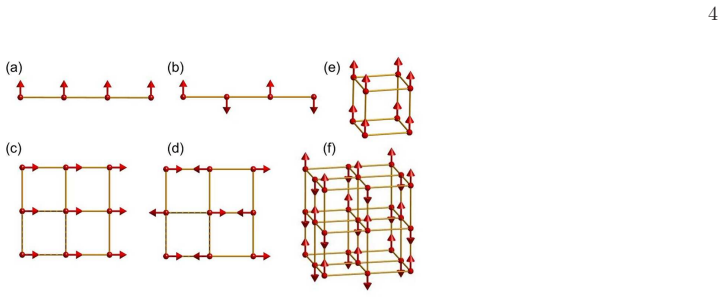
Figure from the paper full image
abstract click to expand
$p$-wave magnets are noncollinear compensated magnetic systems that exhibit nonrelativistic antisymmetric spin splitting in momentum space. Their odd-parity spin symmetry enables unconventional spintronic functionalities, including highly efficient charge-to-spin conversion via the Edelstein effect. An outstanding question is whether such magnetic phases can emerge from simple and broadly accessible magnetic building blocks rather than from intrinsically noncollinear magnetic orders. Here, we show that rolling two-dimensional collinear magnets -- ferromagnets, antiferromagnets, and altermagnets -- into nanotubes generates a rich spin-symmetry landscape controlled by curvature, chirality, and magnetic order. Remarkably, chiral nanotubes hosting radial or tangential coplanar spin textures generically realize $p$-wave magnetism irrespective of the underlying collinear parent phase. The emergent odd-parity spin symmetry manifests itself in both electronic and magnonic spectra through antisymmetric $p$-wave spin splitting. Our results establish magnetic nanotubes as a versatile platform for engineering unconventional $p$-wave magnetism and predict a nonrelativistic Edelstein response that exceeds conventional spin-orbit-driven charge-to-spin conversion by more than an order of magnitude.
2 0
Top Pith
5
cond-mat.mtrl-sci 2026-05-20 2 theorems

47 K temperature drop localized at dislocation cores

by Ruilin Mao, Bingyao Liu +8 more

Nanoscale Thermal Imaging of Dislocation-Mediated Heat Transport

Nanoscale maps reveal core-concentrated resistance over 5 nm scales rather than uniform spread in a SrTiO3 grain boundary.

abstract click to expand
Dislocations in crystalline materials are widely exploited to tailor the thermal conductivity of semiconductors and thermoelectrics, yet a critical gap persists: direct measurement of local thermal resistance at individual buried dislocations, along with its spatial extent, remains elusive due to the limitations of conventional thermal probes. Here, we use in situ scanning transmission electron microscopy-electron energy-loss spectroscopy to map nanoscale temperature distributions across a low-angle SrTiO3 grain boundary with periodic dislocation arrays. Our results reveal a temperature drop of 47 K across the dislocation array. The associated temperature-field distortions are concentrated near the dislocation cores, consistent with stronger local thermal resistance at these discrete sites rather than a uniformly distributed resistance along the array. We further identify a distinct two-scale heat transport characteristic near the dislocation array: core-dominated effects over approximately 4.8-6.2 nm and extended inter-core influences over approximately 10.3-14.3 nm. Atomic-scale structural and vibrational analyses further reveal core-associated atomic reconstruction and localized optical-phonon perturbations, providing a microscopic basis for the stronger local thermal resistance inferred near dislocation cores. These findings quantitatively resolve spatial heterogeneity of dislocation-mediated heat transport, uncover its atomic-scale mechanism, and provide a quantitative basis for defect engineering, guiding the design of high-performance thermoelectrics, semiconductors, high-temperature structural alloys, and other functional crystalline materials.
0
Top Pith
5
cond-mat.mes-hall 2026-05-19 2 theorems

AI robotic lab creates graphene and atomically thin transistors

by Lihan Shi, Zhaoyi Joy Zheng +15 more

Qumus: Realization of An Embodied AI Quantum Material Experimentalist

Qumus completes the first autonomous AI fabrication of vdW-stacked nanodevices with error correction in a closed physical loop.

Figure from the paper full image
abstract click to expand
While modern Large Language Models (LLMs) and agentic artificial intelligence (AI) have demonstrated transformative capabilities in digital domains, the realization of embodied AI capable of real-world scientific discovery remains a difficult frontier. The advancements are hindered by the inherent complexity of integrating high-level reasoning, multimodal information processing and real-time physical execution. Here we introduce Qumus, the first AI quantum materials experimentalist. Physically embodied within a robotic mini-laboratory, Qumus is an intelligent, multimodal, and multi-agent system designed for the creation and nano-processing of atomically thin two-dimensional (2D) materials and stacked van der Waals (vdW) structures. Qumus autonomously navigates the full scientific cycle, from hypothesis generation and protocol planning to multi-step experimental execution, result analysis and reporting, acting as an experimentalist. Markedly, the system has achieved, for the first time, the AI-creation of graphene, as well as the first AI-fabrication of complex nanodevices including atomically thin field-effect transistors via vdW stacking. Qumus excels at these tasks by demonstrating autonomous error correction and closed-loop experimentation. Our results establish a generalizable framework for self-improving embodied AI systems that learn directly from the quantum world, opening a pathway toward accelerated discovery in quantum materials, electronics and beyond.
0
0
cond-mat.mes-hall 2026-07-03

Orbital Hall conductivity set by Bloch geometry

by Min Ju Park, Jongjun M. Lee +1 more

Intrinsic orbital Hall effect in a nonuniform electric field

Nonuniform field response matches charge Hall terms using orbital Berry curvature and quantum metric.

Figure from the paper full image
abstract click to expand
Geometric analysis of electronic Bloch states offers a universal framework for understanding electronic properties, yet its role in the transport of orbital angular momentum remains unexplored. In this work, we establish an analytic connection between orbital angular momentum transport and the geometric properties of Bloch wave functions in electronic systems. Focusing on the intrinsic orbital Hall effect in the dc limit under a spatially nonuniform electric field, we show that its conductivity can be expressed in terms of universal geometric quantities, such as the orbital Berry curvature and quantum metric. This formulation provides a term-by-term correspondence with the geometric description of intrinsic charge Hall transport established in previous studies. Using a tight-binding model, we further illustrate that the higher-order orbital Hall response can exhibit enhanced sensitivity to the orientation of an anisotropic sample. Our work deepens the understanding of diverse intrinsic transverse transport phenomena and the role of quantum geometry in electronic systems.
0
0
cond-mat.mtrl-sci 2026-07-03

Langevin thermostat succeeds in H-AdResS where Nosé-Hoover fails

by Hari Haran Sudhakar (1), Alessandra Serva (1 +10 more

Bottlenecks in Hamiltonian-Adaptive Resolution Simulation Method for Modeling Interfaces

Short-range electrostatic models also produce non-physical results at interfaces, requiring specific setup choices for reliable modeling.

Figure from the paper full image
abstract click to expand
The Hamiltonian-Adaptive Resolution Simulation (H-AdResS) method allows to combine atomistic and particle-based coarse-grained models in a single simulation box, which makes it very attractive to model systems containing interfaces or reactive regions surrounded by an interacting environment. In our previous work [arXiv:2604.21867], we implemented H-AdResS in LAMMPS 2023 and extended its use to interfaces, focusing on MOF/CO$_2$ interfaces as an example. We found that, despite its advantages, using this method properly for this kind of systems is not trivial. In this work, an in-depth analysis of the impact of the choice of thermostatting schemes and long-range electrostatics models is presented. Even though its Hamiltonian formulation enables performing H-AdResS simulations within constant temperatures ensembles, not every thermostat is appropriate. We demonstrate that Langevin thermostat is a reliable choice for this method, while Nos\'e-Hoover results in artifacts. In addition, we show that using short-range models such as the Damped Shifted Force method for electrostatics, a popular choice for H-AdResS simulations, can lead to non-physical results when modeling interfaces. The need of capping strategies to deal with discontinuities in forces and energies arising from abrupt changes in resolution is also discussed. Finally, the impossibility of changing the definition of the H-AdResS Hamiltonian to include a gradual interpolation of the bonded degrees of freedom is discussed. We hope that this contribution helps the reader to appropriately set up H-AdResS simulations and to assess if this method can be used to accurately model their system of interest.
0
0
cs.AI 2026-07-03

LLM pipeline writes physics paper after reproducing references

by Haonan Huang

Grounded autonomous research: a fault-tolerant LLM pipeline from corpus to manuscript in frontier computational physics

Agent maps 11,083 papers, calibrates on published results, runs new calculations, and produces manuscript with three findings.

Figure from the paper full image
abstract click to expand
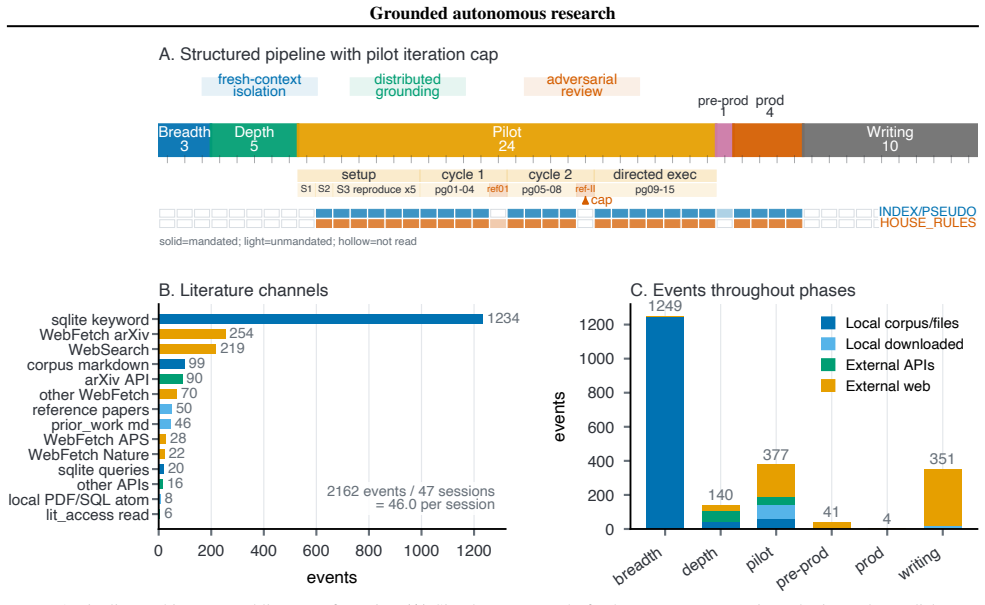
Autonomous-research agents have demonstrated end-to-end LLM automation in machine-learning sandboxes where execution provides calibration. Frontier physical science differs categorically: physical reasoning underlies every methodology choice, toolchains are often underdocumented, and calibration must come from external literature anchors - which unscaffolded agents cite but do not confront, hallucinating plausible, unverifiable results from internal priors. We present a pipeline that runs end-to-end from a corpus of 11,083 recent condensed-matter physics arXiv papers to a publication-grade manuscript with three substantive physics findings (here on altermagnetic piezomagnetism): the agent autonomously conceives a research direction by mapping the corpus, calibrates methodology by reproducing published references, conducts novel first-principles computations, and writes the manuscript - grounded in literature throughout, across 47 fresh-context sessions in six phases sharing only on-disk state, with 2,162 literature-consultation events. Fault tolerance emerges from redundancy: fresh-context isolation, distributed grounding, and adversarial review catch what any single session misses; pre- and post-pilot stages are fully autonomous, and pilot requires bounded human intervention only at reproduction failures - operational knowledge curation, not scientific direction. Two paired failure modes - a pre-architecture baseline and a no-pilot ablation - isolate structurally enforced numerical confrontation at calibration checkpoints as the operative grounding mechanism. The primitives, characterized failure modes, and quantified intervention pattern lay a foundation for autonomous research in high-stakes scientific domains beyond computational physics.
0
0
physics.chem-ph 2026-07-03

Itinerant oscillator model decodes EIS spectra of concentrated electrolytes

by Connie J. Fairchild, Stephen J. Cox +2 more

Molecular interpretability of the bulk electrochemical impedance of concentrated electrolytes

MD simulations of ionic liquids show the approach captures timescale separation for beta-relaxation without concentration assumptions.

Figure from the paper full image
abstract click to expand
Electrochemical impedance spectroscopy (EIS) is a widely used technique to understand time-dependent response and relaxation under applied voltage. While these spectra contain a wealth of information, major gaps in our understanding can hinder our ability to interpret EIS spectra in terms of microscopic chemical mechanisms. We propose an alternative approach to common empirical fitting procedures for describing the contribution of the bulk electrolyte to the EIS spectrum. This new approach is rooted in determining the moments of the frequency-dependent conductivity, with molecular interpretability provided by a generalized Langevin equation description of an effective single particle dynamics; the `itinerant oscillator' (IO) model. In contrast to a Debye--Falkenhagen description, the IO model makes no assumptions regarding the concentration of the electrolyte, a fact we demonstrate by analysing molecular dynamics simulations of a room-temperature ionic liquid. By analysing the memory function from simulation within the framework provided by the IO model, we reveal the importance of capturing the separation of timescales within the memory function for describing the temperature dependent $\beta$-relaxation process. We go on to show how our impedance model directly reports on this distribution of timescales while retaining the simplicity of commonly employed workflows.
0
0
cond-mat.mtrl-sci 2026-07-03

FePd films shift from mixed to pure Néel domain walls with depth

by Annika Stellhorn, Alicia Backs +12 more

From Bloch to N\'eel: Anisotropy-dependent Domain-Wall Character in FePd Thin Films

Higher anisotropy produces a depth transition linked to L10 order, while lower anisotropy yields only Néel walls throughout.

Figure from the paper full image
abstract click to expand
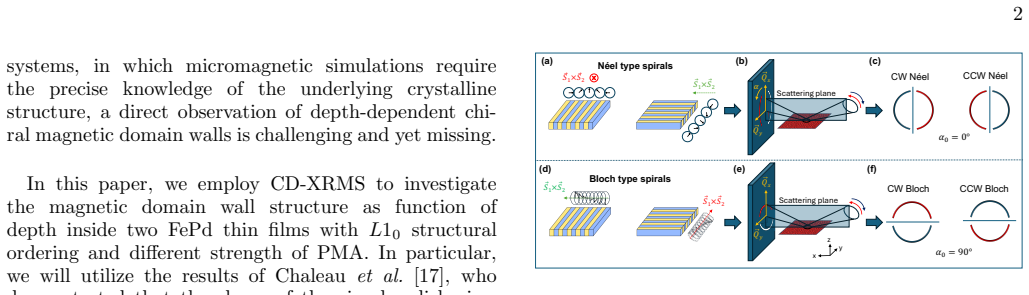
We report an experimental investigation of the depth-dependent domain wall formation in L1$_0$-FePd thin films with high perpendicular magnetic anisotropy. Using circular dichroism X-ray resonant magnetic scattering (CD-XRMS) as a function of the incident X-ray angle, we explore the depth evolution of chiral spin textures in two samples with different strengths of magnetocrystalline anisotropy. Combined with CD-STXM, CD-ptychography, and macroscopic characterization of the structural order, magnetic properties, and surface morphology, we relate these observations to differences in the long-range order of the L1$_0$ phase of FePd. One FePd thin film with very high magnetocrystalline anisotropy, characterized by $Q_{PMA}=1.8$, exhibits an unexpectedly large N\'eel contribution. Angular-dependent CD-XRMS directly reveals a smooth transition from a hybrid Bloch-N\'eel chirality within the upper FePd layer towards a purely N\'eel-type structure at the lower FePd interface. In the second FePd sample, despite a still relatively large $Q_{PMA}=1.45$, the domain walls were found to be purely N\'eel type. These results indicate a crucial role of the long-range structural order in determining the formation of the magnetic structure.
0
0
cond-mat.mtrl-sci 2026-07-03

Interface strain sets limits on Ta resonator quality factors

by Moritz Singer, Harsh Gupta +4 more

Interfacial Strain and Structural Defects Govern the Performance of Tantalum Superconducting Waveguide Resonators

Different seed layers produce varying microstrain that correlates with internal Q despite matching bulk properties such as transition temper

Figure from the paper full image
abstract click to expand
Tantalum (Ta) is a promising material for reaching long coherence times in superconducting qubits. A detailed understanding of the underlying structure-property relationship remains elusive though. In the present study, we sputter-deposited 200 nm thick Ta films on high-resistivity silicon (100) substrates at temperatures ranging from T = 20{\deg}C to 600{\deg}C, as well as on different seed layers (Nb, TiN and TaN). Alpha-Ta thin films were readily obtained at temperatures above 500{\deg}C and on all seed layers. The films were characterized in terms of surface morphology, residual-resistance ratio, crystal phase composition and superconducting transition temperature, as well as RF-performance using coplanar waveguide resonators. Internal quality factors of up to 1.5 million were measured at 100 mK in the single-photon regime. Despite similar bulk material properties, alpha-Ta films on different seed layers exhibit markedly different RF-performance, which we attribute to dissimilar strain and structural defects at the substrate-metal interfaces. Williamson-Hall analysis of XRD data reveals a clear correlation between decreasing microstrain and increasing quality factor. Cross-sectional HR-TEM further supports this interpretation by directly resolving interfacial disorder. Our results highlight the critical role of interface engineering in optimizing superconducting thin films for low-loss quantum computing circuitry.
0
0
cond-mat.mtrl-sci 2026-07-03

Torched-TACAW scales EELS simulations to defective materials

by Martin Osmera, João Vaz +2 more

Efficient Large-Scale STEM-EELS Simulations With Torched-TACAW

Partitioning supercells and on-the-fly processing let TACAW handle thick samples with defects while keeping memory use tractable.

Figure from the paper full image
abstract click to expand
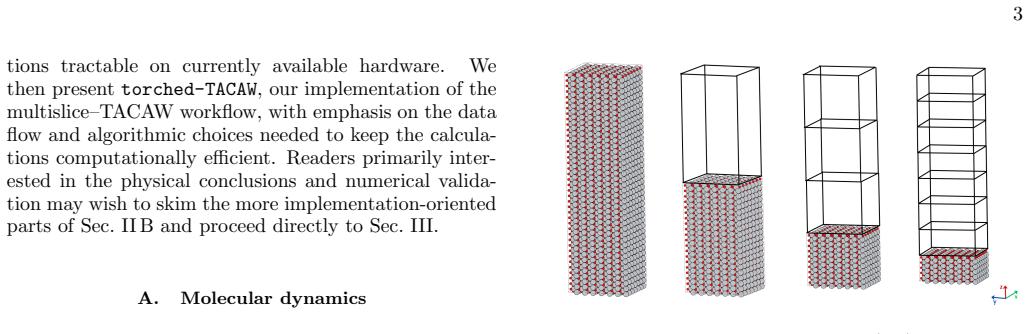
The time auto-correlation of auxiliary wave functions (TACAW) method enables efficient simulations of ultra-low-loss electron energy loss spectra (EELS) arising from vibrational and magnon excitations. In practical applications to realistic materials systems, however, TACAW calculations become challenging due to the large system sizes required for models containing defects, interfaces, impurities, or grain boundaries, as well as the substantial computational cost and data throughput associated with molecular dynamics and multislice calculations. Here we discuss a practical methodology for large-scale TACAW simulations and present torched-TACAW, a freely available implementation of the TACAW part of the described workflow for efficient STEM-EELS simulations. The overall approach combines molecular dynamics based on foundational machine-learned interatomic potentials, partitioning of elongated supercells, and on-the-fly processing of multislice outputs in order to enable near ab initio quality simulations with tractable memory use and data flow. Using rutile TiO2 as a model system, we analyze important numerical aspects of the method, including windowing and supercell partitioning, and demonstrate atomic-resolution STEM-EELS simulations for thick samples.
0
0
cond-mat.mtrl-sci 2026-07-03

Spin fluctuations accelerate demagnetization in oxide superlattices

by Yu-Han Gao, Wen-Xiao Shi +11 more

Ultrafast Demagnetization Governed by Spin Fluctuations in CaRuO₃/SrTiO₃ Superlattice

Gradient magnetism bypasses specific heat divergence, letting fluctuation-enhanced scattering set the rate and enabling tunable spintronic d

abstract click to expand
For ultrafast magnetization switching devices, critical slowing down in conventional ferromagnets near their Curie temperature constitutes a key challenge that must be overcome. In contrast to this typical behavior, we observe an anomalous acceleration of demagnetization in CaRuO$_{3}$/SrTiO$_{3}$ superlattices, a moderately correlated weak itinerant ferromagnet. The demagnetization rate increases with rising temperature, pump fluence, and applied magnetic field. To explain these anomalous phenomena, we develop a phenomenological model integrating the three-temperature model with self-consistent renormalization theory. Because the intrinsic gradient magnetism of the superlattice suppresses the typical divergence of specific heat, the conventional thermodynamic bottleneck is bypassed. Our model reveals that this decoupling enables the ultrafast dynamics to be predominantly governed by the spin-fluctuation-driven enhancement of the electron-spin scattering vertex. Our work demonstrates how spatial inhomogeneity can decouple macroscopic thermodynamic singularities from microscopic scattering processes, offering a new paradigm for manipulating ultrafast spin dynamics in correlated quantum materials. The pronounced sensitivity of the demagnetization rate to external parameters further suggests the potential for designing highly tunable ultrafast spintronic devices that leverage enhanced fluctuations near the magnetic instability.
0
0
cond-mat.mtrl-sci 2026-07-03

Gradient optimization designs SRO in alloys to hit target stiffness

by Tiancheng Ding, Conrard Giresse Tetsassi Feugmo

Differentiable inverse design of short-range order in high-entropy alloys: from target sro to target property

Method scales to large cells and matches real CoCrNi simulations within 6% on most stiffness targets.

Figure from the paper full image
abstract click to expand
Short-range order (SRO) governs the mechanical response of multi-principal-element alloys, but designing an alloy for a target property usually means solving two disconnected problems: building a structure matching a desired SRO pattern, then separately checking its property, with no shared optimization. This work replaces the standard random-swap search (reverse Monte Carlo) with a gradient-based approach: atom occupancy is treated as continuous rather than fixed, so the whole process can be tuned using gradient descent, the same method used to train neural networks. This builder matches random-swap accuracy on small systems, but is six times faster and eight times more accurate on large 4000-atom systems, and scales smoothly to alloys with many elements without extra bookkeeping. A physics-based correction term, adapted from prior two-element work and extended here to many elements, keeps designed structures thermodynamically realistic rather than just numerically matching the target SRO pattern. A small neural network then predicts mechanical properties directly from composition and SRO statistics, closing the loop from target property back to structure. Tested on nine face-centered-cubic and body-centered-cubic alloys, the pipeline captured SRO-driven stiffness changes from -20% to +57%, and cell-size checks showed at least 864 atoms are needed to get the direction and size of these changes right, since the commonly used 108-atom cells can mislead. Against real simulations for a cobalt-chromium-nickel alloy, the method matched three of four target stiffness values within 6%. The method is released as an open-source Python package, anisro, offering a practical route to gradient-based, property-driven alloy design.
0
0
cond-mat.mtrl-sci 2026-07-03

New setup merges 2D spectroscopy with back-focal-plane microscopy

by Trideep Kawde, Pavel Trofimov +4 more

Coherent two-dimensional electronic spectroscopy integrated with confocal back focal plane microscopy

Angle control and real-space imaging support coherent measurements on WSe2 with 20 fs pulses.

Figure from the paper full image
abstract click to expand
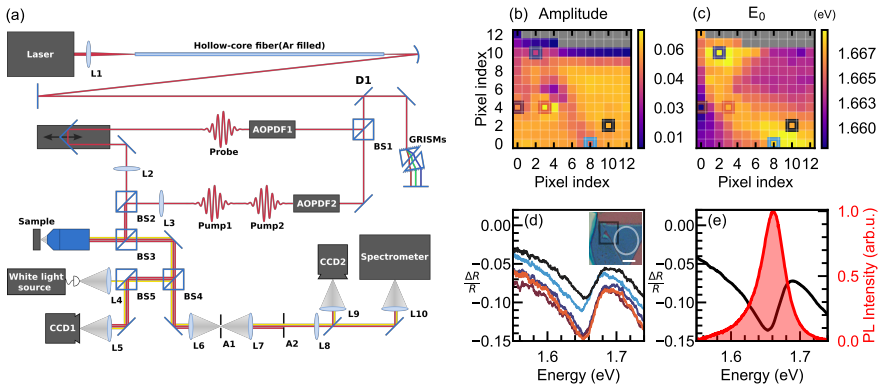
We introduce a setup for coherent two-dimensional electronic spectroscopy in the pump-probe reflection geometry that is integrated with a confocal back focal plane imaging microscope. The angle-resolved capability is utilized to control pump and probe wavevectors, while real space imaging enables co-localization of the collection spots for linear and ultrafast experiments. Compression of pulses down to 20 fs is achieved. We demonstrate the capabilities of this approach on an exfoliated WSe$_2$ monolayer on Si/SiO$_2$. The setup is suited to investigate excitons and exciton-polaritons in 2D Materials and their heterostructures.
0
0
cond-mat.mes-hall 2026-07-03

Quantum confinement drives exponential resistivity rise in ultra-thin films

by Alessio Zaccone

Electrical transport in ultra-thin films: from Fuchs-Sondheimer to quantum-confinement

Classical scattering models fail at few-nanometer scales, so a new theory unifies them with quantum effects for nanoelectronics.

Figure from the paper full image
abstract click to expand
Ultra-thin films are fundamental components of modern nanoelectronics, where reducing thickness to the few-nanometer scale leads to a dramatic increase in electrical resistivity. For decades, this behavior has been interpreted in terms of classical size effects, primarily surface scattering within the Fuchs--Sondheimer theory and grain-boundary scattering in the Mayadas--Shatzkes model. While these approaches successfully describe transport when the film thickness is comparable to the electronic mean free path, growing experimental evidence indicates that they become insufficient under extreme confinement. This review discusses the crossover from classical scattering to a quantum-confinement regime in which the electronic states available for transport are fundamentally restructured by finite size. We review the recently proposed reciprocal-space confinement theory, which predicts an exponential increase of resistivity with decreasing thickness at the nanoscale, and discuss how it can be combined with classical surface-scattering models to provide a unified description of ultra-thin metallic and semiconducting films. Finally, we summarize recent experimental evidence supporting this picture and discuss its implications for future nanoelectronic devices, nanoscale interconnects, and quantum transport under extreme spatial confinement.
0
0
cond-mat.str-el 2026-07-03

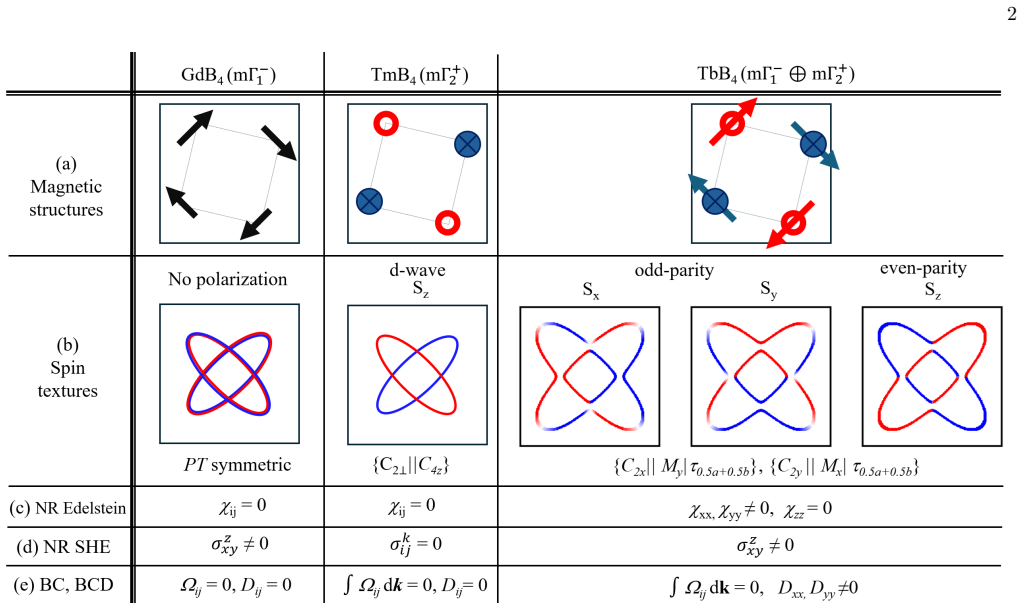
TbB4 non-coplanar order mixes odd- and even-parity spin textures

by Dong-Choon Ryu, Jae-Ho Han +2 more

Unconventional Mixed-Parity Magnetism in Rare-Earth Tetraborides

Scalar spin chirality produces p- and f-wave in-plane components with d-wave out-of-plane character in this compensated magnet.

Figure from the paper full image
abstract click to expand
Altermagnetism has advanced the study of compensated magnets by revealing non-relativistic spin splitting, traditionally classified into strictly even- or odd-parity spin textures. Here, we unveil a fundamentally different regime: component-resolved mixed-parity spin splitting in a fully three-dimensional compensated magnet. Using first-principles calculations, tight-binding and $\mathbf{k} \cdot \mathbf{p}$ models, along with spin-group symmetry analysis, we demonstrate that the non-coplanar ground state of $\mathrm{TbB}_4$ enforces a unique momentum-space spin texture. The in-plane spin components exhibit odd-parity $p$- and $f$-wave-like textures, whereas the out-of-plane component retains an even-parity $d$-wave altermagnetic character. Crucially, the coexistence of the in-plane odd-parity textures is driven not by relativistic spin-orbit coupling, but by a staggered Berry phase arising from the inherent scalar spin chirality. This mixed-parity structure dictates distinct transport fingerprints, including bulk non-relativistic Edelstein and spin Hall responses, as well as a symmetry-allowed Berry curvature dipole. These results establish the rare-earth tetraborides as a robust platform for engineering complex spin-charge conversion phenomena.
0
0
cond-mat.str-el 2026-07-03

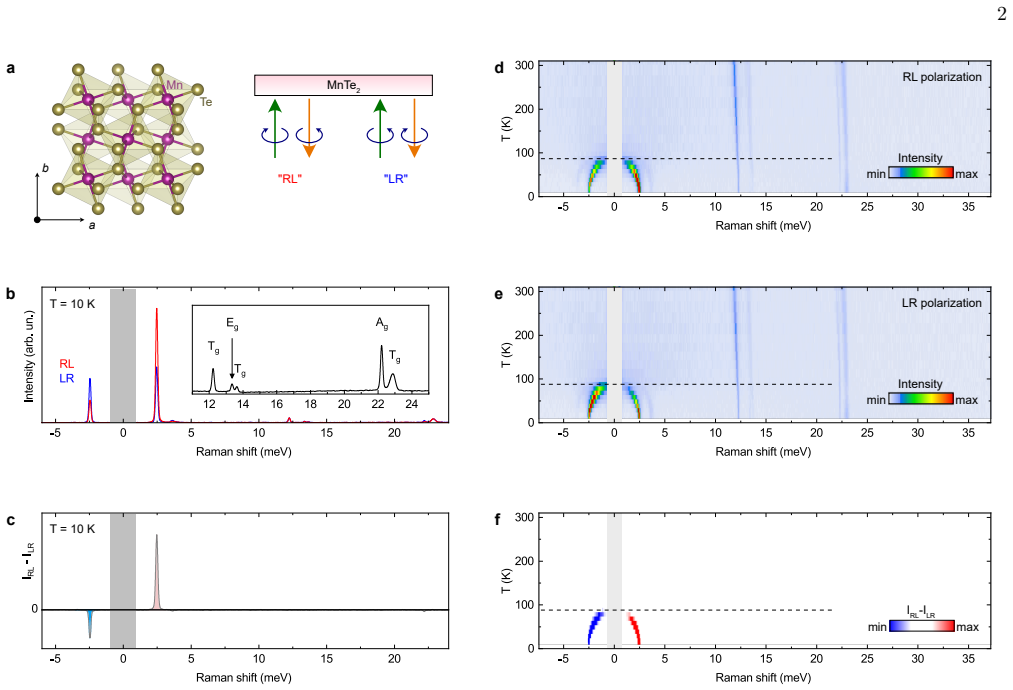
Raman detects chiral magnons with plaid splitting in MnTe2

by Dirk Wulferding, Daehyeon An +9 more

Plaid-Like Spin Splitting and Chirality of Magnon Bands in Antiferromagnetic MnTe₂

Helicity imbalance and reduced symmetry show momentum-dependent magnon handedness that matches altermagnetic patterns.

Figure from the paper full image
abstract click to expand
Altermagnets constitute an emerging class of magnetic materials that combine compensated antiferromagnetic order with spin-split excitations arising from crystalline symmetries. Despite strong theoretical interest, their experimental identification remains challenging. Here, we demonstrate that helicity- and angle-resolved Raman scattering measurements reveal reduced rotational symmetries of magnons and a pronounced imbalance between left- and right-circular polarization channels, indicating momentum-dependent magnon handedness. First-principles DFT+$U$ calculations combined with linear spin-wave theory uncover a characteristic plaid-like spin-splitting structure in momentum space. The resulting magnon spin textures are dictated by the unconventional sublattice symmetries of MnTe$_2$ and closely emulate those of altermagnetic electronic bands. Our work provides evidence of chiral spin-wave excitations unique to this non-coplanar antiferromagnet.
0
0
cond-mat.mtrl-sci 2026-07-03

CrSBr channels coherent polaritons only along a-axis

by Paritosh Malik, Dogyun Ko +12 more

Anisotropic nanoscale coherent polariton transport in CrSBr

Crystal symmetry blocks transport along the perpendicular direction, mapped at nanoscale with electron excitation.

abstract click to expand
In a combined experimental and theoretical study, we demonstrate anisotropic polariton transport on the nanoscale in the van der Waals antiferromagnet CrSBr. While effective cavity-polariton formation emerges via the self-hybridization of ultra-high oscillator strength excitons with a thin slab photonic mode, the absence of external mirrors facilitates spectroscopic investigation of these polaritons via cathodoluminescence (CL) on length scales determined by the electron wavelength. This direct access allows us to perform precise charting of the polariton landscape with nanometric resolution, and to probe polariton interference phenomena. The main finding of the work highlights that the coherent polariton transport follows the $C_{2v}$ symmetry of CrSBr, allowing exclusive transport along the crystallographic a-axis, while no coherent feature is found along the b-axis direction. Our work sets the foundation to use CL spectroscopy in cavity-polaritonics in more advanced landscapes, such as photonic crystals or optical lattices, and establishes the technique as a powerful tool to probe anisotropic expansion and relaxation phenomena on the nanoscale
0
0
cond-mat.mtrl-sci 2026-07-03

Ag atoms in Ga2O2 sheet trigger eight-order conductivity jump for NO

by Afreen Anamul Haque, Aniket Singha

Transition-Metal Tailored Ga₂O₂ Monolayer: From Room-Temperature Gas Sensing to Chemical Scavenging

The same substitution keeps reusable detection of O2 and NO2 while other metals tune capture or sensing of additional gases.

Figure from the paper full image
abstract click to expand
Pristine $Ga_{2}O_{2}$ monolayers suffer from poor sensitivity and weak molecular capture, limiting their application in toxic gas detection and environmental detoxification. Here, we employ first-principles density functional theory (DFT) calculations to investigate the gas sensing and scavenging properties of $Ga_{2}O_{2}$ monolayers substitutionally tailored via seven transition-metals (TM): Pd, Zn, Zr, Mo, Ag, Ti, and Pt. All TM-substituted monolayers exhibit negative formation and binding energies, negligible lattice distortion, and structural stability in molecular dynamics simulations. Performance evaluation against eight toxic industrial and three environmental gases reveals functionalities ranging from selective, reusable room-temperature sensing to permanent molecular capture. Ag substitution exhibits exceptional selectivity for $NO$ with moderate adsorption strength (~-0.83eV), an up to eight-order-of-magnitude conductivity enhancement, besides facilitating reusable $O_2$ and $NO_2$ detection. Additionally, Pd-, Zn-, Zr-, and Mo substitutions tune selectivity toward $NO$, $NO_2$, $CO_2$, $CO$, and $O_2$. Coming to applications towards toxic gas capture, Zr- and Mo-substituted systems selectively scavenge oxidizing gases, whereas Ti and Pt act as universal scavengers. Further analysis reveals that Pd- and Ag-substituted monolayers remain selective for $NO$, while Zn substitution favors $NO_2$ detection even in ambient atmospheric conditions. Thus, these tailored $Ga_{2}O_{2}$ monolayers offer a practical platform for atmospheric monitoring and detoxification.
0
0
cond-mat.mtrl-sci 2026-07-03

HVAF spraying yields thick NiTi coatings with shape memory

by Sneha Samal, Shrikant Joshi +8 more

HVAF Spraying of NiTi Coatings: Microstructure, Phase Transformation and Shape Memory Behavior

Coatings 100-300 micrometers thick transform martensitically after annealing and actuate in bending while bonding strongly to steel.

Figure from the paper full image
abstract click to expand
Depositing various coatings on surface of engineering components with the aim to improve their performance concerning wear, corrosion, friction and thermal protection is already a standard practice. Depositing metallic NiTi shape memory alloy coatings may be a viable alternative for hard ceramic coatings. NiTi coatings offer additional benefits originating from unique functional thermomechanical properties. However, fabrication of thick NiTi coatings turned out to be difficult. Standard electroplating and laser cladding methods are not suitable for NiTi the most widely used plasma spray methods tend to produce chemically inhomogeneous coatings that do not transform martensitically, cold sprayed NiTi coatings suffer from poor adhesion to the substrates. In this work we report on first ever successful fabrication of thick NiTi coatings (100-300 um) that display functional thermomechanical properties and simultaneously show very good adherence to the substrate. We used high velocity air fuel thermal spray method to fabricate NiTi coatings deposited on mild steel using four different sets of processing parameters. Chemical composition, porosity, microstructure, phase transformation and functional thermomechanical properties of the NiTi coatings were evaluated. Although the coatings contain inhomogeneous microstructure, voids, oxide particles, high density of dislocation defects and internal stress, they undergo martensitic transformation upon cooling and or mechanical loading. As sprayed NiTi coatings need to be annealed to display functional thermomechanical properties. Despite their limited tensile strength, the coatings displayed thermal actuation in 3 point bending tests and shape memory effects in nanoindentation and scratch tests.
0
0
cond-mat.mtrl-sci 2026-07-03

Oxygen ions carry 90% of circular phonon angular momentum in STO

by Roman Mankowsky, Serhane Zerdane +10 more

Quantifying angular momentum of coherently driven circular phonons

X-ray diffraction quantifies ionic motions and shows charge imbalance that produces THz-induced magnetism

Figure from the paper full image
abstract click to expand
The use of intense terahertz (THz) pulses to manipulate low-energy excitations offers a powerful approach for ultrafast control of electronic and magnetic properties in materials. Theory suggests that circular ionic motions driven by THz fields carry angular momentum, potentially generating internal magnetic fields. Recent experiments in nonmagnetic SrTiO3 (STO) have hinted at such THz-induced fields, but their origin remains debated. Here, we employ ultrafast x-ray diffraction to resolve the time-dependent ionic trajectories in STO following excitation by circularly polarized THz pulses. Our analysis reveals that oxygen ions, despite their lower mass, contribute around 90% of the phonon angular momentum. The resulting imbalance between the negatively and positively charged ions provides a clear explanation for the mechanism behind induced magnetism in STO. This work further provides the first quantitative measurement of circular ionic motions and their angular momentum and establishes a general methodology for the investigation of angular momentum transfer in solids, paving the way for new strategies to control topological phonon transport and phonon-driven magnetism in quantum materials.
0
0
cond-mat.mtrl-sci 2026-07-03

Vacancy type in CaO flips with oxygen richness and forms stable complexes

by Yunhwa Jo, Minseok Choi

Density functional study of native point defects in CaO

Calculations show complexes survive annealing and match several experimental optical peaks.

Figure from the paper full image
abstract click to expand
We investigate the structural, electronic, and optical properties of native point defects in CaO using first-principles density-functional calculations. Oxygen vacancies are favored under O-poor conditions, whereas calcium vacancies dominate under O-rich conditions. Calculated migration barriers and binding energies indicate that vacancy complexes are thermodynamically stable and can survive high-temperature annealing. Optical transition energies, evaluated using the Franck-Condon framework, suggest that several experimentally observed absorption and emission peaks can be attributed to negatively charged vacancy complexes as well as isolated oxygen vacancies.
0
0
cond-mat.mtrl-sci 2026-07-03

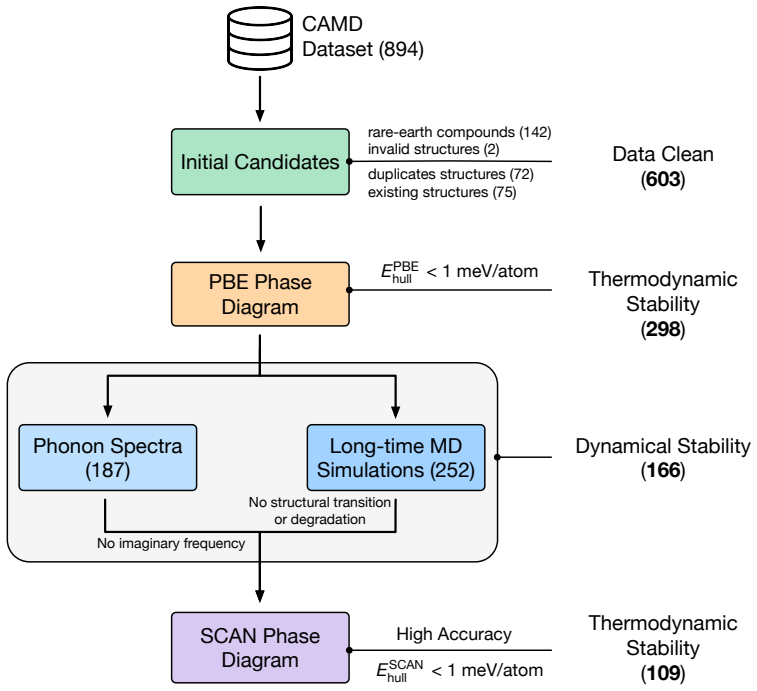
Hierarchical filters cut 894 predicted materials to 25 synthesis targets

by Yuqi An, Sihong Zhu +3 more

Predicting Novel Stable Materials for Experimental Synthesis

PBE phase diagrams, ML dynamical checks, and SCAN refinement prioritize candidates by accounting for competing phases and finite-temperature

Figure from the paper full image
abstract click to expand
Machine-learning-accelerated materials discovery has yielded large numbers of computationally stable compounds, yet many remain experimentally unrealized, underscoring a persistent gap between prediction and synthesis. Here, we introduce a hierarchical screening framework that combines PBE-based thermodynamic stability, efficient dynamical-stability screening enabled by universal machine-learning interatomic potentials, and SCAN-based thermodynamic refinement. Applying this protocol to the 894 stable materials previously reported in Sci. Data 9, 302 (2022), we first curate 603 unique structures, of which only 298 remain thermodynamically stable on the complete PBE phase diagrams, demonstrating the critical role of competing phases in stability assessment. Dynamical screening then identifies 166 materials stable under both harmonic-phonon and finite-temperature molecular dynamics criteria, and SCAN phase diagrams further narrow this set to 109. Finally, by combining decomposition enthalpy with chemical-space completeness, we prioritize 25 candidates as high-confidence targets for experimental synthesis. This work provides a practical protocol for translating stability predictions into experimentally actionable synthesis targets, closing a key gap in machine-learning-driven materials discovery.
0
0
cond-mat.mtrl-sci 2026-07-03

DMC reveals 60 meV registry energy spread in InSe bilayers

by Jeonghwan Ahn, Abdulgani Annaberdiyev +3 more

Many-body benchmarking of DFT local-registry energetics in bilayer InSe

DFT keeps three stackings within 1.5 meV while many-body calculations separate them by tens of meV, showing interface motif is not enough.

Figure from the paper full image
abstract click to expand
Density functional theory (DFT) is widely used to model twisted bilayers, but the accuracy of the local stacking energetics underlying such models remains uncertain. Here, we benchmark the local-registry landscape of bilayer InSe using diffusion quantum Monte Carlo (DMC). DFT predicts that AB, AAr, and ABr stackings, which share the same interfacial Se registry, are nearly degenerate within 1.5 meV/f.u. and exhibit nearly indistinguishable DFT charge-density responses. DMC instead separates these stackings by 8(5) and 41(4) meV/f.u., while the energy difference between the most stable and least stable registries reaches 60(7) meV/f.u.. These large energy separations show that the stacking energetics are not determined by the interfacial atomic motif alone but depend on the full registry and its associated many-body electronic response. More broadly, these results show that DFT-based moir\'e models can substantially underestimate local stacking-energy corrugation, with direct consequences for predicted structural relaxation, domain formation, and electronic reconstruction in twisted layered materials.
0
0
cond-mat.mtrl-sci 2026-07-03

Short phonon lifetimes cause low thermal conductivity in lithium niobate

by Wenjiang Zhou, Fuwei Yang +5 more

Intrinsically low thermal conductivity of stoichiometric lithium niobate:Experimental measurement and microscopic origin

Values are orders of magnitude below silicon; conductivity halves at 10 nm film thickness due to strong anharmonicity.

abstract click to expand
With the rapid development of integrated electro-optic and nonlinear optical devices based on lithium niobate (LiNbO$_3$, LN), thermal management is becoming a critical area of focus. However, experimental measurement of thermal transport in stoichiometric LiNbO$_3$ (sLN) remains scarce, and the intrinsic microscopic mechanisms remain to be established. Here, we combine the laser pump-probe technique of frequency-domain thermoreflectance (FDTR) with state-of-the-art machine-learned atomistic simulations to comprehensively investigate thermal transport in sLN. The measured and simulated room-temperature thermal conductivity ($\kappa$) values of sLN agree well, which are orders-of-magnitude lower than that of many classic and emerging semiconductors such as silicon. Furthermore, the temperature-dependent $\kappa$ exhibits a $T^{-\alpha}$ scaling with $\alpha$ near unity, suggesting that thermal transport is dominated by intrinsic phonon-phonon scattering. By comparing sLN with cubic boron arsenide (cBAs) which serves as an ultrahigh-$\kappa$ benchmark, we reveal that harmonic properties are not responsible for the low $\kappa$ of sLN, which feature phonon heat capacity and group velocities that are either higher than or comparable to those in cBAs. Instead, the low $\kappa$ originates from substantially stronger anharmonicity and larger scattering phase space. These two factors collectively suppress phonon lifetimes by 1-2 orders of magnitude, leading to a maximum phonon mean free path of approximately 140 nm. As a result, notable size effects emerge in thin-film sLN below 1 $\mu$m, with $\kappa$ dropping to half the bulk value at 10 nm. Altogether, our findings establish a fundamental understanding of thermal transport in sLN and provide atomistic insights for thermal management in advanced lithium niobate technologies.
0
0
cond-mat.mtrl-sci 2026-07-03

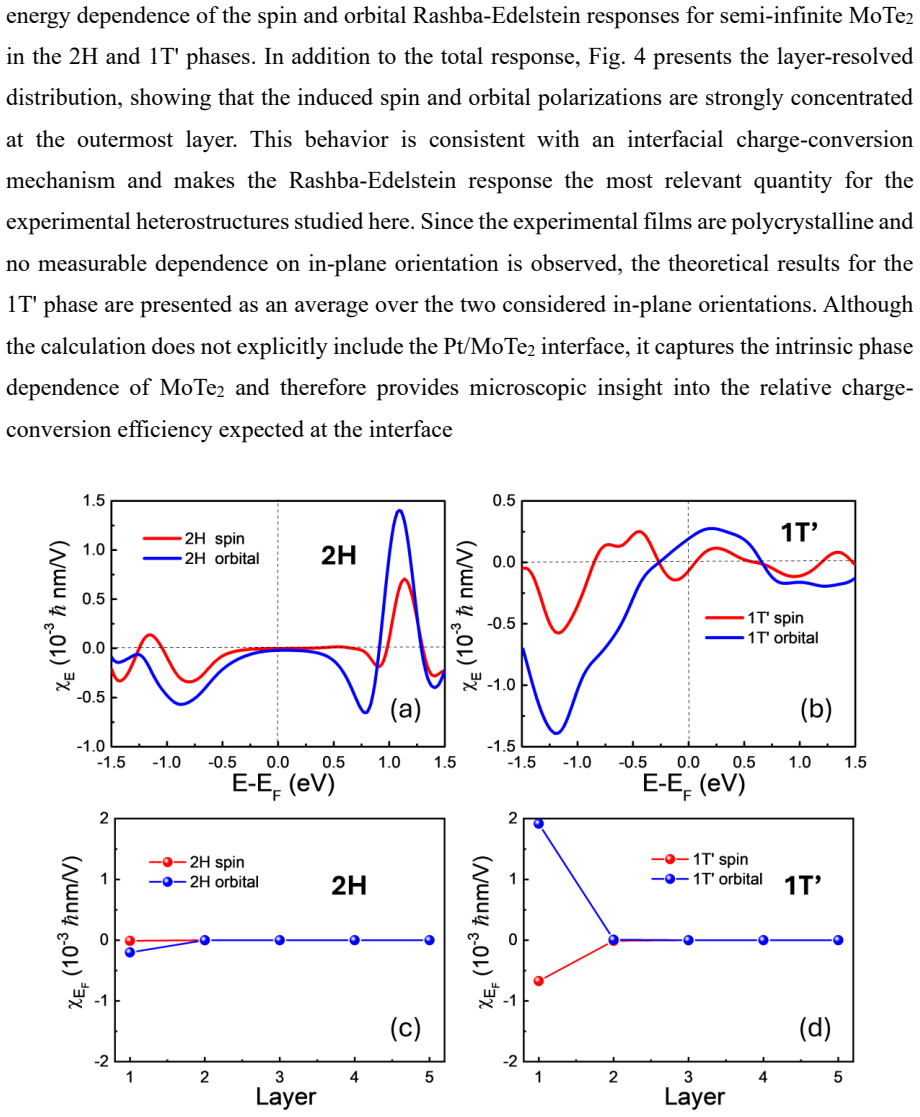
MoTe2 films convert charge orbitally only below 4.5 nm

by J. L. Costa, E. Santos +8 more

Phase-selective orbital-charge conversion in MoTe₂

Metallic 1T' phase enables orbital Rashba-Edelstein response while thicker 2H films show none, per spin-pumping and calculations.

Figure from the paper full image
abstract click to expand
Two-dimensional transition metal dichalcogenides (TMDs) have emerged as promising materials for spin--orbitronics owing to their strong spin--orbit coupling and rich electronic phases. However, their orbital transport properties remain largely unexplored. Here, we demonstrate that the orbitronic response of $\mathrm{MoTe_2}$ is governed by a thickness-driven structural phase transition. RF-sputtered $\mathrm{MoTe_2}$ thin films exhibit a crossover at a critical thickness of approximately $4.5\,\mathrm{nm}$, stabilizing in the metallic $1T^\prime$ phase below this threshold and in the semiconducting $2H$ phase above it. Raman spectroscopy and scanning tunneling spectroscopy (STS) confirm the structural and electronic transition, revealing gapless behavior in ultrathin films and a finite band gap in thicker samples. Spin-pumping measurements detect an additional transverse charge-conversion signal exclusively in metallic $1T^\prime$-$\mathrm{MoTe_2}$, in agreement with first-principles calculations that identify a dominant orbital Rashba--Edelstein response as the underlying conversion mechanism.
0
0
cond-mat.mtrl-sci 2026-07-02

Vitriflow calibrates melt-quench settings from material descriptors

by Jonathon Cottom, Robin Delhomme +1 more

Vitriflow: calibrated amorphous structure ensembles from melt-quench simulation

The framework replaces ad-hoc choices with an explicit chain of stability checks, descriptor calibration, screening, and convergence tests.

Figure from the paper full image
abstract click to expand
Melt--quench molecular dynamics is widely used to construct amorphous materials models, but the resulting ensemble is defined by choices that are often made implicitly: numerical settings, melt temperature, liquid-hold time, quench rate, system size, and post-generation screening. We introduce vitriflow, a computational materials methodology that turns these choices into an explicit decision chain. The framework couples numerical stability, descriptor-based protocol calibration, user-defined artefact screening, and statistical convergence of the generated analysis ensemble in a material-specific descriptor space. We demonstrate the approach for a-SiO$_2$, a-Si$_3$N$_4$, and a-Sm$_2$O$_3$, which respectively test tetrahedral network fidelity, MG2 $\rightarrow$ PBE $\rightarrow$ HSE06 DFT refinement of a heteropolar nitride, and amorphous/crystal discrimination in a mixed-coordination rare-earth oxide. vitriflow separates defect-free from oxygen-bridge-defective silica, quantifies DFT-refinement response in a common a-Si$_3$N$_4$ structural population, and removes recrystallised Sm$_2$O$_3$ structures without imposing fixed coordination. The result is a reproducible route for generating amorphous ensembles whose numerical settings, thermal protocol, screening actions, and statistical precision are selected from the materials question rather than assumed a priori.
0
0
cond-mat.mtrl-sci 2026-07-02

Magnon-phonon coupling drives inertial magnetization

by Caleb Webb, Ling Gan +1 more

Microscopic origins of inertial magnetization dynamics

Coherent lattice interactions produce picosecond nutation and explain variations via substrate-dependent phonon damping.

Figure from the paper full image
abstract click to expand
Ultrafast experiments have uncovered inertial magnetization dynamics in ferromagnets, but their microscopic origin remains elusive. Using a non-Markovian quantum master equation we show that inertial dynamics arise from coherent interactions with optical phonons in the lattice. The fast optical frequency explains the nutation observed on picosecond timescales and accounts for variations between experiments through substrate-dependent phonon damping. By establishing magnon{phonon coupling as the microscopic basis of inertial magnetization, our results open new pathways for tailoring ultrafast spin dynamics and controlling magnetic states at terahertz frequencies.
0
0
cs.AI 2026-07-02

Constraint programming cuts lab experiment time while respecting instrument limits

by Austin McDannald, Julia Tisaranni +1 more

Optimal Resource Utilization for Autonomous Laboratory Orchestrators

Optimal schedules are generated first, then executed reliably via status dependencies on a multi-instrument MOF synthesis platform.

abstract click to expand
In autonomous laboratories, AI agents suggest the next batch of experiments to do. However, planning and executing those tasks taking full advantage of the available resources is a completely different question. This can be challenging when dealing with real-world hardware constraints, especially so when there are multiple instruments with different capacities and throughputs. Here we demonstrate a 2-step method to address resource utilization for our autonomous platform for metal-organic framework synthesis. First, we use constraint programming to find optimal schedules. This finds schedules that minimizes the total time while still satisfying the limitations and capacities of the hardware. Secondly, we use a system of status dependencies for each task, which allows for the robust execution of the optimal schedules.
0
0
cond-mat.mtrl-sci 2026-07-02

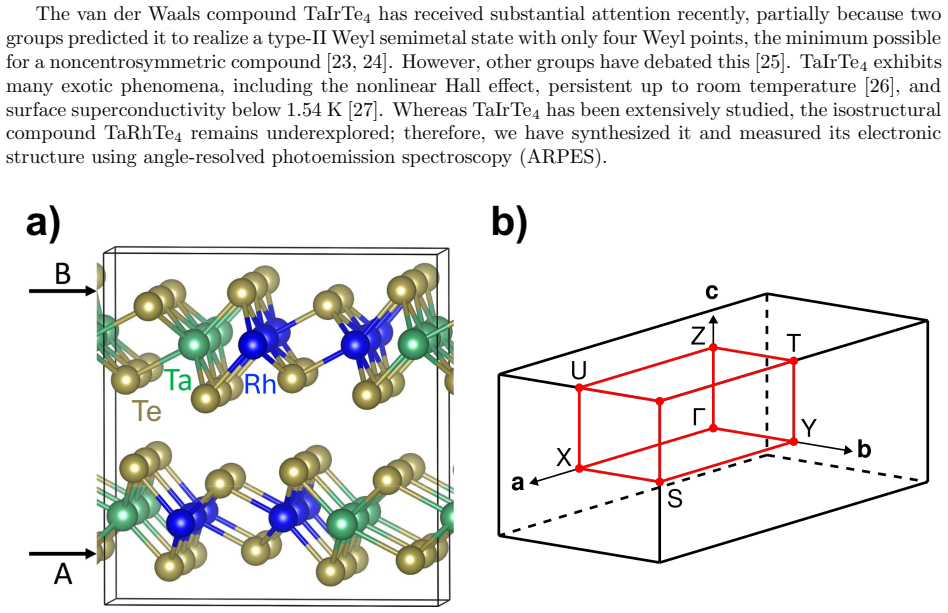
Flat bands observed near chemical potential in TaRhTe4

by Harry Rankin, Tyler J. Slade +8 more

Observation of Flat Bands in Type-II Weyl Semimetal TaRhTe₄

ARPES data shows dispersionless bands in bulk type-II Weyl semimetal not predicted by DFT, enabling study of topology-flat band coexistence.

Figure from the paper full image
abstract click to expand
Flat bands have been theoretically predicted for decades but have only recently been realized in quantum materials such as magic-angle twisted bilayer graphene, kagome and Lieb lattices, and rare-earth metal compounds. To date, only twisted layered materials have enabled tuning of flat-band energies near the electronic chemical potential, thereby influencing transport and thermodynamic properties. Here, we report the presence of flat bands near the chemical potential in bulk TaRhTe$_{4}$, a noncentrosymmetric van-der Waals type-II Weyl semimetal. Flat bands are rarely observed in Weyl semimetals, particularly in nonmagnetic bulk systems, and the observed flat bands were not predicted by density functional theory calculations. TaRhTe$_{4}$ therefore provides a platform in which nontrivial topology coexists with flat bands near the Fermi level, as evidenced by our angle-resolved photoemission spectroscopy measurements.
0
0
cond-mat.mtrl-sci 2026-07-02

Electric fields reshape GaN defect barriers nonlinearly

by Farshid Reza, Hamdy Arkoub +3 more

Electric-field effects on defect migration energetics in GaN

Anisotropic changes from charge redistribution replace simple linear bias and matter for high-field device reliability.

Figure from the paper full image
abstract click to expand
A predictive understanding of defect transport in GaN under operating electric fields is critical for assessing device reliability in high-power and radiation environments. In this work, a ReaxFF reactive force field for GaN is developed using a density-functional-theory training set that includes structural, thermodynamic, and defect properties. The force field yields various properties such as lattice parameters, cohesive energies, and defect formation and migration energies in close agreement with prior first-principles and experimental results. Under externally applied electric fields, we find that migration barriers can be strongly modulated, with changes that depend on defect type and field orientation. Notably, the electric fields do not simply linearly bias defect motion in GaN, but can anisotropically modify migration barriers through charge-lattice coupling, leading to nonlinear transport behavior. The response arises from field-induced partial charge redistribution and local lattice distortion. These results demonstrate that electric fields can complexly modify the defect migration landscape, providing new insight into defect transport in GaN under high-field conditions.
0
0
cond-mat.mtrl-sci 2026-07-02

Skyrmion scattering sets Hall conductivities at all couplings

by Arijit Mandal, Hareram Swain +2 more

Topological Hall effect due to electron-skyrmion scattering

The Lippmann-Schwinger method finds resonances and minima that make both topological and spin Hall responses vary sharply with electron ener

Figure from the paper full image
abstract click to expand
Electron scattering from chiral spin textures such as skyrmions is fundamental to the understanding of transport in more complex systems, including skyrmion crystals. Most of the previous studies have focused on the weak-coupling regime, where the exchange interaction is small compared with the electron energy. Real materials, however, often lie in the strong-coupling regime, which exhibits qualitatively different behavior. Using the Lippmann-Schwinger equation and Green's function formalism, valid for all coupling strengths, we uncover several new features in the scattering cross section, including Ramsauer-Townsend minima, pronounced intermediate-coupling resonances, and Landau-level resonances for skyrmions with larger winding numbers. These features strongly influence the topological and spin Hall conductivities, which depend sensitively on the incident electron energy. Our work provides important insights into the Hall transport in collective chiral spin textures such as the skyrmion crystal.
0
0
cond-mat.mtrl-sci 2026-07-02

Diamond diode hits record 116 kA/cm² current density

by Harshad Surdi, Gabriel Munro-Ludders +10 more

Diamond Diode for Extreme Venus Environments

Compact 50-micron structure carries 1.3 A at low resistance for extreme-environment power electronics.

abstract click to expand
A diamond Schottky PIN diode (SPIND) with the highest reported current density to date of ~116 kA/cm2 is demonstrated carrying a total current of ~1.3 A through a 50 micron wide pseudo-vertical diode structure. The diamond SPIND also provides a maximum power handling capacity of 1.85 MW/cm2 and a low specific on-resistance Ron,S of 0.05 mOhm-cm2 at a forward bias of ~16 V. The diamond SPIN diode also shows excellent rectification characteristics with a current on-off ratio of ~6e12. An analytical model including thermionic emission and space charge limited current is presented together with Silvaco ATLAS TCAD simulations, to accurately reproduce the experimental J-V characteristics using multiple single trap levels and other physical models emulating a real device. Theoretical analysis from the analytical models in conjunction with ATLAS simulations shows that further improvement in the device turn on voltage and Ron,S can be achieved by reducing the defect density and contact resistance in order to approach the ultimate performance in the Mott-Gurney space charge limited current regime
0
0
math-ph 2026-07-02

Length scale ratio governs trapping or cloaking by point pins

by E. Alevras, Th. Zisis +1 more

Scattering, Trapping and Cloaking-Type Effects of Plane Waves by Point Scatterers in Strain Gradient Elasticity

Anomalous dispersion creates sharp localized resonances while normal dispersion weakens them to cloaking-type behavior.

Figure from the paper full image
abstract click to expand
Wave scattering by localized constraints in microstructured solids is strongly influenced by the interplay of material length scales, dispersion and geometry. This work investigates plane-strain scattering of time-harmonic P and SV waves by clusters of rigid point constraints embedded in an infinite strain gradient elastic medium. A closed-form dynamic Green's tensor is derived for the plane-strain problem. Unlike the classical elastodynamic Green's tensor, the strain gradient Green's tensor remains bounded at the source, enabling point constraints to be introduced directly through superposition of fundamental solutions. The multiple-scattering problem is reduced to a finite-dimensional algebraic system for the pin reaction amplitudes. A frequency-domain procedure is developed to identify resonance-like amplification and trapping. Candidate resonant frequencies are associated with local minima of the Green matrix determinant, while higher-order curvature criteria distinguish trapping-dominated resonances from non-localized scattering responses. The results show that the response is governed primarily by the ratio of the microinertial and energetic strain gradient lengths. In the anomalous dispersion regime, sharp resonances produce strong displacement localization, including perimeter-localized trapping modes in dense circular arrays. In the normal dispersion regime, these resonances are strongly attenuated and the pins behave as weak scatterers, producing a cloaking-type response in which the incident field is only weakly perturbed. The influence of Poisson's ratio, incidence angle and compound pin configurations is also examined, demonstrating how intrinsic material lengths and geometric arrangement can be used to tune scattering, trapping and wave-screening mechanisms in microstructured elastic media.
0
0
cond-mat.mtrl-sci 2026-07-02

Radial band gap collapse creates discontinuous ion tracks in alumina

by Roman Voronkov, Danil Zainutdinov +2 more

Effect of radially heterogeneous band gap collapse on formation of swift heavy ion tracks in Al2O3

Spatially varying metallization within 2 nm of a 700 MeV Bi path lowers outer-shell heating and sharpens broken damage sequences in all crys

Figure from the paper full image
abstract click to expand
We estimate the effects of radial heterogeneity in the collapse of the electronic band gap on the damage in Al2O3 after impact of a swift heavy ion decelerated in the electronic stopping regime. The Monte Carlo code TREKIS describes the initial excitation of the electronic and ionic systems following the ion passage, while the density functional theory based molecular dynamics traces changes in the band structure in the ion track. This combination of methods enables us to compute the profile of energy transferred to the lattice by the time of relaxation of the electronic excitation, accounting for the induced spatial inhomogeneity of the band structure around the ion trajectory. We demonstrate that impact of a 700 MeV Bi ion induces a transient metal-semiconductor heterojunction in Al2O3: the metallization (the band gap collapse) occurs within a radius of about 2 nm from the ion trajectory. The band gap shrinks at distances of about 3-5 nm, while it remains almost unaffected at radii larger than 5 nm. Using this data, we estimate the atomic heating depending on the degree of band gap reduction at different radii from the ion trajectory. This approach refines the damage modeling, producing more pronounced discontinuous damage patterns along the ion path for all crystallographic directions compared to the model that assumes all the energy accumulated in the electron-hole ensemble is delivered to the atoms.
0
0
cond-mat.mtrl-sci 2026-07-02

ML genetic algorithm predicts exact La5CoPb2 structure from composition

by Ling Tang, Weiyi Xia +3 more

Complex crystal structure prediction using ML-enhanced multi-minima iterative genetic algorithm

The method locates the orthorhombic ground state in an immiscible ternary system and matches x-ray results without using structural database

abstract click to expand
Current machine learning (ML) approaches for materials discovery rely heavily on known structural databases, limiting their ability to identify entirely novel structure types. In this work, we develop a multi-minima iterative genetic algorithm (MMIGA) that integrates an artificial-neural-network machine learning (ANN-ML) interatomic potential with an iterative, metadynamics-inspired penalty scheme. We demonstrate the robustness of this method on a complex ternary La-Co-Pb system, characterized by Co-Pb immiscibility and an intricate energy landscape. The ML-enhanced MMIGA successfully predicts the ground-state Pbam structure of the recently synthesized La4Co4Pb antagonistic-pair-phase, a novel structure missed by previous database-reliant ML predictions, while also identifying multiple metastable competing phases. Additionally, we challenged the MMIGA method to predict the structure of La5CoPb2 antagonistic-pair-phase, a new compound discovered during earlier attempts to synthesize the predicted phase La3CoPb. With only knowledge of the composition, our MMIGA approach successfully predicts the orthorhombic structure of La5CoPb2, producing an exact match with the structure independently determined by x-ray diffraction. By efficiently mapping both global minimum and relevant competing metastable states, this approach provides critical theoretical insights into phase selection for novel quantum and magnetic materials.
0
0
cond-mat.mtrl-sci 2026-07-02

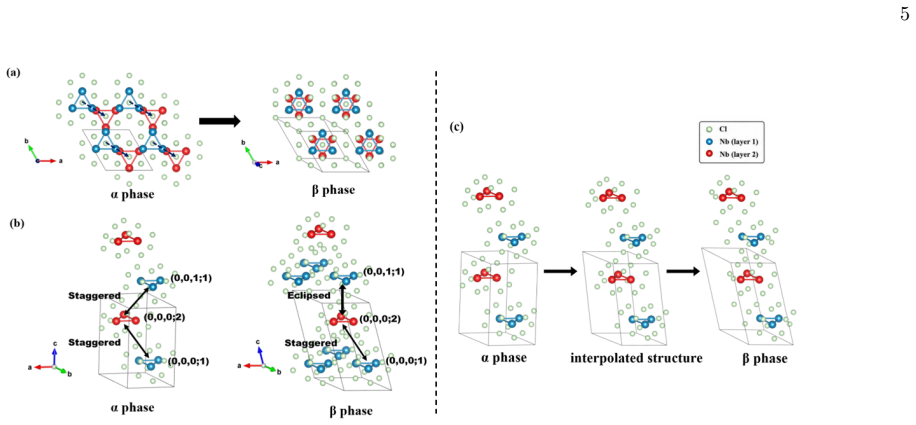
Polarization switch reverses spin splitting in 2D ferrimagnets

by Peibo Xu, Yixuan Che +3 more

Geometry-Driven Magnetoelectric Coupling in Two-Dimensional Compensated Ferrimagnets

Geometry in bilayer kagome lattices interlocks polarization with distortions to flip global spin states without stray fields.

Figure from the paper full image
abstract click to expand
The magnetoelectric coupling in compensated magnets enables stray-field-free manipulation of spin-splitting, holding great promise for spintronics, but inherently hindered by the symmetry mismatch between spatial-inversion-broken ferroelectricity and time-reversal-broken spin states. Here, based on a symmetry-decoupled analysis of magnetoelectric coupling in compensated magnets, we establish a geometry-driven spin-ferroelectric coupling mechanism in bilayer breathing kagome lattices. Within this geometric framework interlocking the out-of-plane electric polarization with cooperative intralayer structural distortions, we demonstrate that polarization switching drives a deterministic reversal of the global spin splitting. First-principles calculations on a prototype bilayer Nb3Cl8 successfully validate this mechanism, demonstrating the switching of spin-splitting states through an energetically feasible, asynchronous layer-by-layer transition pathway. Our proposed coupling originates from lattice geometry and structural symmetry, establishing a unique route toward switchable spin splitting in compensated ferrimagnets.
0
0
cond-mat.mtrl-sci 2026-07-02

Same nanotube moves charge better on hBN than on SiO2

by Yuanjia Liu, Taiki Inoue +1 more

Substrate-dependent electrical transport in individual single-walled carbon nanotubes grown across SiO₂ and hexagonal boron nitride

Within-tube measurements find higher mobility on boron nitride while activation energy stays unchanged at 15-20 meV.

abstract click to expand
The electronic transport properties of carbon nanotubes (CNTs) are strongly affected by their surrounding environment, making the underlying substrate a critical factor for device performance. Here, we demonstrate enhanced carrier transport of individual single-walled CNTs on hexagonal boron nitride (hBN) by directly comparing CNT channels on SiO$_2$ and hBN within the same nanotube. This within-tube comparison removes tube-to-tube variability in chirality, diameter, and defect density, allowing the intrinsic substrate effect to be evaluated more reliably. The CNTs were synthesized using gas flow-directed growth, which yields long, well-aligned CNTs without transfer processes, allowing a single nanotube to extend across different substrate regions. Multichannel field-effect transistors fabricated along an individual CNT exhibit clear ambipolar characteristics. CNT channels on hBN consistently exhibit higher field-effect mobility than those on SiO$_2$. In contrast, temperature-dependent transport near the charge neutrality point exhibits thermally activated behavior with similar activation energies (15-20 meV) on both substrates, indicating that the intrinsic small bandgap of CNTs is largely unaffected by the substrate. These results provide direct evidence that hBN enhances low-field carrier transport in CNTs and establish a foundation for the fabrication of high-performance electronics based on hBN-supported CNTs.
0
0
cond-mat.mtrl-sci 2026-07-02

Calculations show stronger spin splitting in NEA perovskites

by Tetsuya Furukawa, Kazushi Nakano +4 more

First-principles calculations of spin-split bands in chiral hybrid organic-inorganic perovskites (R/S-PEA)PbI₃ and (R/S-NEA)PbI₃

Larger SOC gaps and band crossings produce the difference even when linear-in-k coefficients are similar.

Figure from the paper full image
abstract click to expand
Chiral hybrid organic-inorganic perovskites provide a promising platform for investigating the physics of chirality-driven spin-split bands because they combine robust molecular chirality with strong spin-orbit coupling from heavy inorganic ions. First-principles calculations including spin-orbit coupling are performed for the one-dimensional chiral perovskites ($R$/$S$-PEA)PbI$_3$ and ($R$/$S$-NEA)PbI$_3$ to compare their spin-split band structures and to identify the factors controlling their differences. In ($R$/$S$-PEA)PbI$_3$, the lowest conduction bands predominantly consist of Pb orbitals, whereas in ($R$/$S$-NEA)PbI$_3$, they are formed by hybridization between Pb orbitals and the lowest unoccupied molecular orbital of NEA. Both compounds exhibit pronounced spin splitting near the valence-band maximum and conduction-band minimum. The effective spin splitting of the edges of the valence bands is stronger in ($R$/$S$-NEA)PbI$_3$, despite similar linear-in-$k$ splitting coefficients near the relevant high-symmetry points. This enhancement originates from larger gaps induced by spin-orbit coupling at high-symmetry points and band (anti)crossings in the multiband structure. For a given molecular handedness, the PEA- and NEA-based compounds exhibit opposite spin textures, consistent with the opposite chiral distortions of the [PbI$_6$]$^{4-}$ octahedra and with the previously observed opposite signs of circular dichroism. Group-theoretical analysis for the nonsymmorphic space group $P2_12_12_1$ further accounts for band sticking, symmetry-enforced degeneracies, and the disappearance of spin polarization at specific Brillouin-zone-boundary points. These results provide a solid foundation for future studies of chirality-dependent electromagnetic responses, including circular dichroism, in chiral hybrid organic-inorganic perovskites.
0
0
cs.AI 2026-07-02

Graph RL model raises traceable hypothesis quality 40-65%

by Subhadeep Pal, Shashwat Sourav +2 more

Graph-Native Reinforcement Learning Enables Traceable Scientific Hypothesis Generation through Conceptual Recombination

Phased graph reasoning lets users inspect causal steps and yields higher semantic diversity on open-ended materials questions.

Figure from the paper full image
abstract click to expand
Accelerating materials discovery requires AI systems that can generate scientifically valid hypotheses through multi-step, domain-grounded reasoning. Standard large language models often produce fluent but weakly traceable responses to open-ended materials design problems, making it difficult to determine whether final answers are supported by coherent intermediate reasoning. We develop Graph-PRefLexOR, a family of graph-native reasoning models fine-tuned with Group Relative Policy Optimization (GRPO) to organize reasoning into explicit phases for mechanism exploration, graph construction, pattern extraction, and hypothesis synthesis. This design links neural language generation with symbolic relational structure, enabling causal connections to be constructed, inspected, and reused. On 100 open-ended questions from materials science and mechanics literature, Graph-PRefLexOR achieves 40-65% improvements over corresponding base models, with the largest gains in reasoning traceability. Embedding analyses show broader semantic exploration and approximately 2-3 times greater semantic diversity than baselines. Semantic backtracking and layer-wise hidden-state analyses further show stronger alignment between structured reasoning and final answers. Finally, test-time graph expansion reveals that additional compute primarily increases long-range conceptual recombination within a bounded semantic space, rather than simply expanding semantic coverage. These results establish graph-native reinforcement learning as a pathway toward interpretable AI systems for scientific hypothesis generation in materials design and other scientific applications.
0
0
cond-mat.mtrl-sci 2026-07-02

Stepped interfaces enable BCC plastic flow in Cr-Ni eutectic

by Arkajit Ghosh, Mustafa Tobah +3 more

Strengthening and interface-mediated plastic co-deformation in an ultrafine Cr-Ni eutectic: A nanomechanical investigation

Nanoscale structure and local chemistry allow room-temperature co-deformation at high stresses without cracking.

Figure from the paper full image
abstract click to expand
Ultrafine eutectic heterostructures provide a stringent test of plasticity in high-strength materials, where deformation must be accommodated through interfaces and strain gradients. Room temperature ductility is typically limited by premature fracture of the hard phase, leaving open the fundamental questions regarding the interface spacing, atomic structure and local chemistry that enable plastic co-deformation. Here we address this question using a model system of Cr-Ni binary alloy, processed via electron-beam powder bed fusion that produces a lamellar eutectic microstructure of Cr-rich BCC and Ni-rich FCC phases, with an average interlamellar spacing of ~450 nm. Atomic-resolution STEM revealed a stepped semi-coherent FCC/BCC interface with the Kurdjumov-Sachs orientation relationship and Ni-enrichment confined to a few atomic planes on the BCC side. In situ micro-scale compression and tension tests in SEM demonstrate high flow stresses coupled with large plastic strains without cracking, indicating stable accommodation of plastic incompatibility. Correlative TEM/HR-STEM establishes a deformation sequence: initial plasticity is dominated by strain-gradient driven dislocation accumulation in the FCC lamellae adjacent to interfaces, followed by deformation twinning in FCC and local interfacial shear and reorientation. The BCC phase subsequently develops a high density of mobile dislocations. Atomistic modeling has been employed to understand the influence of the FCC/BCC interface atomic structure and chemistry on the slip activation in the hard phase. These findings show that nanoscale confinement, stepped K-S interfacial structure, and interfacial chemistry collectively promote dislocation glide in a hard phase below its monolithic brittle to ductile transition temperature, and plastic codeformation at high flow strengths.
0
0
cond-mat.mtrl-sci 2026-07-02

Hg3AsSe4I monolayer splits water using polarization and Rashba effect

by Xinfeng Chen, Wenchao Shan +2 more

Two-dimensional vertically polarized Hg3AsSe4I monolayer for efficient photocatalytic water-splitting: promoting carrier separation by intrinsic electric field and Rashba effect

Stable vertical polarization and large Rashba splitting enable efficient photo-carrier separation for visible-light photocatalysis.

Figure from the paper full image
abstract click to expand
Efficient separation of photo-excited electron-hole pairs is essential for developing the high performance photocatalysts towards light-driven water-splitting applications. To this end, pho tocatalytic performances of two-dimensional (2D) semiconducting ferroelectric (FE) materials with out-of-plane polarizations have been extensively explored. However, out-of-plane polarizations in 2D FE materials are susceptible to the critical thickness limitation and can be easily compensated by surface adsorbates. On the other hand, 2D vertically polarized materials with stable and ir reversible out-of-plane polarizations may overcome the critical thickness limitation, enabling the practical advantage for spatial separation of photo-excited electron-hole pairs during the photo catalytic reactions. In the current work, 2D vertically polarized Hg3AsSe4I, an experimentally synthesized van der Waals (vdW) layered material, has been systematically investigated as a high performance 2D photocatalyst. Owing to its semiconducting band gap suitable for visible-light absorption, high carrier mobility, and desirable band edge alignment ideally matching water reduc tion and oxidation potentials, Hg3AsSe4I monolayer fulfills both optical and electronic prerequisites for photocatalytic water-splitting reactions. Besides the stable vertical polarization able to persist in Hg3AsSe4I monolayer, the dual mechanism for efficient separation of photo-excited carriers has also been demonstrated. Rashba spin-orbit coupling (SOC) of large strength emerges within 2D Hg3AsSe4I, splitting the band edges into spin-resolved band branches with unique spin-momentum locking characters.........
0
0
cond-mat.mtrl-sci 2026-07-02

Tantalum cap reduces non-TLS losses in vanadium resonators

by Y. Fujita, Y. Urade +5 more

Vanadium superconducting microwave resonators on silicon wafers

Niobium buffers increase losses despite better crystal uniformity, implicating surface oxides or hydrides.

Figure from the paper full image
abstract click to expand
Understanding the correlation between material properties and microwave losses in superconducting films is a crucial subject for developing low-loss materials for quantum circuits. We focus on vanadium (V) as a novel material for superconducting quantum devices and discuss loss in V films in relation to their structural properties. Using a sputtering method, we grow four V-film structures on (001)-oriented Si wafers, employing Nb and Ta as the buffer and capping layer materials, respectively: Nb/V/Ta, Nb/V, V/Ta, and V. X-ray diffraction and atomic force microscopy reveal that the V films grown on the Nb buffer layers have higher uniformity of lattice orientation and smaller grain size than that directly grown on the Si wafer. Coplanar waveguide resonators are fabricated from the four V-film structures, and averaged photon number ($\langle n_{\rm ph} \rangle$) dependences of internal quality factor ($Q_{\rm int}$) are obtained by performing microwave measurements. By analyzing the obtained $Q_{\rm int}$ vs $\langle n_{\rm ph} \rangle$, it is found that loss at the V surface is dominated by $\langle n_{\rm ph} \rangle$-independent non-two-level-system (non-TLS) losses, which can be mitigated by introducing the Ta capping layer. Furthermore, the V films on the Nb buffer layers exhibit lower $Q_{\rm int}$ in the $\langle n_{\rm ph} \rangle$ range from 10$^{0}$ to 10$^{6}$ and higher non-TLS loss than that directly grown on Si wafers, even though the former has higher lattice-orientation uniformity than the latter. Origins of these trends might be relevant to V oxides, of which presence at surfaces and grain boundaries in bulk regions in the V resonators is suggested by energy dispersive X-ray spectroscopy and X-ray photoelectron spectroscopy, and/or V hydrides.
0
0
cond-mat.mtrl-sci 2026-07-02

Diamond shares coherent interface with clathrate via stacking fault

by Eva Pospíšilová, Marek Mihalkovič

Prediction of coherent interfaces between diamond and clathrate structures

Transitional (3x3) dimer layer on diamond (111) removes 11 percent misfit and yields stable multicomponent films near melting point.

Figure from the paper full image
abstract click to expand
Diamond (or its binary zincblende variant)-type structure can form coherent interface with clathrate type II via the common transitional layer known previously as a $(3\times 3)$-dimer-stacking fault (DS) reconstruction of the (111)-diamond surface. The generic $\sim 11\%$ lattice misfit can be eliminated in multicomponent heterostructures such as Ge(diamond)/CsSn(clathrate) or InN(zincblende)/Ge(clathrate). Interface models subjected to ab-initio molecular dynamics annealing are stable up to the temperatures approaching melting point of the constituent systems, and in some studied cases the diamond/clathrate bonding is stronger than the intra-clathrate bonding, as evidenced by simulated crack experiments. Composition-calibrated lattice-matching can stabilize even metastable clathrates as epitaxially grown films on the diamond/zincblende substrate.
0
0
cond-mat.mtrl-sci 2026-07-02

Beam partitioning cuts memory use 5x in core-loss EELS simulations

by Philipp Pelz

The BiP-PRISM algorithm for fast and scalable core-loss STEM-EELS simulations

BiP-PRISM interpolates sparse matrices locally at atoms and removes per-scan propagation for full 4D maps on consumer GPUs.

Figure from the paper full image
abstract click to expand
Quantitative interpretation of atomic-resolution STEM-EELS requires dynamical simulation of the electron probe before and after core-loss transitions, which is computationally expensive. While the PRISM algorithm accelerates this by reusing scattering matrices, we introduce beam partitioning for both the probe-forming ($\mathcal{S}_1$) and detector-propagating ($\mathcal{S}_2$) PRISM matrices to further reduce computational and memory costs. Each matrix is calculated on a sparse set of parent beams and reconstructed via natural-neighbor interpolation locally at the ionized atom. A locality result demonstrates that the total error is governed entirely by this on-atom reconstruction error. The resulting BiP-PRISM algorithm removes per-scan exit wave propagation and significantly reduces memory requirements, enabling full-resolution elemental mapping, 4D cubes, and momentum-resolved qEELS on consumer-grade GPUs. We characterize the approximation's validity regime and demonstrate the simulation of a multimodal five-edge oxide-interface map and an FePt nanoparticle Fe-L map at 5x memory reduction, showing that the algorithm achieves high accuracy with significantly lower computational demands.
0
0
cond-mat.mtrl-sci 2026-07-02

ACE potentials reach near-DFT accuracy on BCC screw dislocations

by Lei Zhang, Francesco Maresca

Atomic Cluster Expansion Potentials for Screw Dislocations in BCC Refractory Metals

Models for V, Nb, Ta, Mo and W improve core structure and Peierls barriers over prior potentials; kink-pair enthalpies become accessible for

Figure from the paper full image
abstract click to expand
Accurate atomistic modeling of screw dislocations in body-centered cubic (bcc) metals remains challenging because their plasticity is governed by a complex dislocation glide behavior due to their compact three-fold symmetric core structure and a strongly temperature-dependent flow stress induced by the large Peierls barrier. In the context of group 6 (V, Nb, Ta) and group 5 (Mo, W) refractory metals (RMs), both classical interatomic potentials and some machine learning potentials consistently fail to reproduce density functional theory (DFT) Peierls barriers and the glide plane. Here, we developed an array of atomic cluster expansion (ACE) potentials for these RMs by extending an existing DFT database. The developed ACE potentials significantly improve the description of screw dislocation properties, achieving near-DFT accuracy for Mo and W and substantial improvement for V, Nb, and Ta. The results show that transferability to screw dislocation behavior depends sensitively on both database composition and element-specific energetics, and that achieving a single-humped Peierls barrier alone is not a sufficient validation metric for accurate prediction of dislocation glide. For Nb, Mo, and W, the developed ACE models also enable reliable calculation of kink-pair activation enthalpies, which are well described by both Kocks' law and a line-tension model.
0
0
physics.optics 2026-07-02

s-SNOM maps mode losses in WS2 waveguides from 800 to 1400 nm

by Zara S. Taylor, Luke M. Hallacy +8 more

Near-Field Characterisation of Guided Modes in WS2 Nanobeams and Quasi-Bulk Crystals

Cavity imaging bounds extinction while near-field probes show dispersion trends and interference artefacts that shift indices by up to 0.25

Figure from the paper full image
abstract click to expand
The exceptionally high in-plane refractive index, low sub-bandgap absorption, and strong optical anisotropy of WS2 make it a promising material platform for next-generation integrated circuits for nanophotonics. Its layered van der Waals structure further enables heterogeneous integration with silicon photonics and emerging two-dimensional optoelectronic materials. However, despite increasing interest in the waveguiding properties of WS2, experimental studies of wavelength-dependent modal confinement and attenuation remain limited. Additionally, though the extinction coefficient of WS2 is expected to be near-negligible beneath the bandgap, reported values span orders of magnitude, leading to large uncertainty in predicted modal decay lengths and wafer-scale integration feasibility. To resolve these ambiguities we perform hyperspectral cavity-enhanced imaging, determining high-resolution upper and lower bounds on the extinction coefficient of WS2 within the visible-NIR edge. We further employ scattering-type scanning near-field optical microscopy (s-SNOM) to probe TE0, TM0, and higher-order modes in both quasi-bulk and nanobeam WS2 waveguides across the 800-1400 nm spectral range, enabling identification of mode-specific trends in wavevector dispersion and loss. This work simultaneously assesses s-SNOM as a probe of waveguide performance, and we find that while absolute loss values depend on measurement geometry, s-SNOM reliably captures relative modal trends and provides upper bounds on propagation loss, supporting its use as a diagnostic tool for anisotropic waveguides. We further identify significant artefacts in nanobeam measurements arising from transverse interference and spatial sampling effects when the structure size approaches the excitation wavelength, which can shift extracted effective indices by up to 0.25.
0
0
physics.ins-det 2026-07-02

Collimated setup enables in-situ polarization tuning for magneto-IR

by Zeping Shi, Wenbin Wu +15 more

In-Situ Polarimetry in Collimated Magneto-Infrared Spectroscopy System

Achieves 0.0033% noise and 40:1 extinction while switching between linear, circular, and elliptical states without breaking vacuum.

abstract click to expand
Magneto-infrared spectroscopy under strong magnetic fields provides a powerful probe of Landau quantization and field-induced collective excitations, yet its full potential has long been constrained by the lack of in-situ polarization control, because the highly divergent infrared beam propagating through narrow light tubes undergoes multiple wall reflections, leading to severe polarization degradation. Here we report a collimated magneto-infrared spectroscopy system that integrates continuous in-situ polarimetry. The system employs incident and exit collimation chambers forming a Kepler type optical architecture, which converts the large-aperture FTIR output into a low-divergence beam and strongly suppresses multi-reflection trajectories inside long gold-plated light tubes, thereby enhancing both optical throughput and polarization fidelity. A remotely controlled polarization module, consisting of an automated linear polarizer and a switchable Fresnel rhomb positioned entirely outside the high-field region, enables continuous in-situ tuning between linear, circular, and arbitrary elliptical polarization states without thermal cycling, manual realignment, or breaking vacuum. Interchangeable compact focusing modules further support Faraday and Voigt geometries in both transmission and reflection experiments within a 50 mm magnet bore, providing efficient beam focusing and signal collection while maintaining polarization fidelity. The setup achieves a minimum root-mean-square noise of 0.0033%, an average noise of 0.0082%, and a linear polarization extinction ratio up to 40:1. We demonstrate the capability through continuous in-situ linear polarimetry and broadband circular polarimetry in the magneto-infrared spectroscopy of various single crystals. This platform establishes a robust experimental framework for in-situ polarization-resolved magneto-infrared spectroscopy.
0
0
cond-mat.mes-hall 2026-07-02

SQUID oscillations confirm facet-selective supercurrent in ZrTe5

by Prasanna Rout, Ankit Khola +10 more

Facet-selective ballistic supercurrent in a weak topological insulator

Josephson junctions on weak topological insulator exhibit ballistic transport confined to specific crystal facets linked to gapless surface

abstract click to expand
Topological superconductivity is widely pursued by inducing superconducting correlations in topologically protected boundary states. In two dimensions, this strategy has been realized using one-dimensional topological edge modes, but in three-dimensional crystals, spatially separated surface supercurrents confined to selected facets have not yet been achieved. Here we demonstrate facet-selective ballistic supercurrent in Josephson junctions based on the weak topological insulator ZrTe<sub>5</sub>. Superconducting quantum interferometry reveals SQUID-like critical current oscillations with flux-quantum periodicity, establishing that the supercurrent is spatially concentrated on specific crystallographic facets that host gapless topological surface states. Rotating the magnetic field yields markedly distinct interference patterns, linking the supercurrent distribution to the underlying bulk topology. The exponential temperature dependence of the critical current and triangular interference lobes provide signatures of ballistic transport due to high-transmission topological channels. These results establish weak topological insulators as a platform for facet-resolved superconducting devices and higher-order topological superconductivity.
0
0
cond-mat.mes-hall 2026-07-02

Charge current through chiral bridge creates internal field for spin selectivity

by Subhajit Sarkar, Oliver L. A. Monti +1 more

Spinterface-like mechanism of the chirality-induced spin selectivity in donor chiral-bridge acceptor complexes

Model shows tens-of-percent polarization arises from donor electron acting as localized moment at the interface.

Figure from the paper full image
abstract click to expand
The chirality-induced spin selectivity (CISS) effect has been invoked to explain recent reports of differences in the time-resolved EPR signals between chiral and achiral molecules. However, the microscopic origin of these differences and their connection to CISS remains contested, particularly since these systems lack a metal interface. Here we introduce an intramolecular spinterface-like mechanism that naturally arises within donor-chiral bridge-acceptor (D--$\chi$B--A) complexes and quantitatively reproduces experimentally reported observed spin polarization in time-resolved EPR studies. In our two-electron Lindblad model, the photoexcited charge-transfer electron traversing the chiral bridge exchanges with the residual donor electron, which acts as a localized magnetic moment analogous to an induced magnetic moment on an electrode surface. The resulting through-bridge charge current produces an effective solenoidal field at the donor--bridge interface, breaking spin degeneracy and directional symmetry, thus enabling spin-selective transport without invoking intrinsic spin-orbit coupling on the bridge. We show that the interplay between this current-induced field, donor thermalization (which breaks time-reversal symmetry), and bridge spin mixing yields tens-of-percent polarization over realistic experimental conditions and charge-transfer time scales, matching reported CISS signatures in triads and DNA hairpins. By explicitly resolving the dependence on solenoidal coupling strength, temperature, and spin-mixing rates, the model identifies the regime in which internal spinterfaces can generate robust CISS-like spin filtering. These findings demonstrate that CISS-like signals in isolated D--$\chi$B--A complexes are fully compatible with a spinterface mechanism, providing a unified conceptual framework for interpreting both device-based and molecule-internal CISS platforms.
0
0
physics.optics 2026-07-02

Broad pulse lets crystal pick its own SHG wavelength

by Niklas Dömer, Tobias Hehemann +4 more

Self-selected phase-matched second harmonic generation in nonlinear optical materials: from phenomenon to applications

Self-selection of the phase-matching component turns second-harmonic generation into a direct probe of refractive-index dispersion for mater

Figure from the paper full image
abstract click to expand
Self-selected phase-matched second harmonic generation is introduced as an all-optical probe of refractive-index dispersion in birefringent nonlinear optical materials. Rather than requiring wavelength or angular tuning, the exposure with a spectrally broad, intense ultrashort pulse allows the material to self-select the fundamental spectral component that satisfies the type-I noncritical phase-matching condition. This produces a narrow peak in the second harmonic spectrum whose position is governed by the refractive indices and is therefore highly sensitive to material parameters that affect the optical dispersion. We demonstrate the application of this phenomenon for the optical inspection of stoichiometry and temperature gradients in technologically relevant lithium niobate, as well as composition inhomogeneities in newly grown lithium niobate-tantalate solid solutions. These results establish self-selected phase-matched second harmonic generation as a rapid, non-contact method for inspecting nonlinear optical materials, with potential relevance for bulk crystals, wafers, and thin-film platforms.
0
0
cond-mat.mtrl-sci 2026-07-02

Pulse delay controls magnetic domain patterns

by Sheng Li, Dinar Khusyainov +8 more

Double-pulse control of all optical magnetization reversal in Tb/Co multilayers

In Tb/Co multilayers, timing the second laser pulse alters anisotropy recovery to shape the switched regions after reversal.

Figure from the paper full image
abstract click to expand
Recent experiments have shown that femtosecond laser pulse with a Gaussian intensity profile can induce magnetization reversal in Tb/Co multilayers with a ring-shaped switching pattern within the laser-irradiated area. Here, we investigate the ultrafast magnetization dynamics leading to such a ring-shaped switching by using double-pulse laser excitation. The laser pulses cause heat-induced quenching and subsequent recovery of the magnetic anisotropy in the multilayers and drive the precessional magnetization switching in the magnetic multilayers. By adjusting the delay between the two pump pulses, we demonstrate that the recovery process can be manipulated and show, experimentally and numerically, that this allows control over the final magnetic domain pattern.
0
0
cond-mat.mtrl-sci 2026-07-02

Coupling to phase field crystal misses dislocation topology

by Aymane Graini, Jorge Viñals +1 more

On the limits of the energetic coupling between field dislocation mechanics and phase field crystal

L2 penalty senses only compatible distortion, so topology info and elastic boundary conditions are lost or transmitted diffusively

Figure from the paper full image
abstract click to expand
This paper investigates the energetic coupling between Field Dislocation Mechanics (FDM) and the Phase Field Crystal (PFC) model proposed in Phys. Rev. B 102, 064109, 2020. While FDM correctly solves the initial boundary value problem of a continuum body with dislocation fields, PFC captures the underlying crystallographic structure. The coupling, which penalizes the $L^2$ distance between elastic distortion from FDM and configurational distortion from PFC in the $L^2$ sense, had been proposed to reconcile dislocation mechanics with crystallography in a single continuum framework. Variational analysis reveals that the coupling term acts as a divergence-driven forcing in the phase-field evolution that matches only the compatible (curl-free) parts of the distortion fields. Consequently, its contributions are insensitive to the incompatible (divergence-free) elastic distortion carrying all the information on dislocation topology. Furthermore, the nature of the configurational distortion causes mechanical boundary conditions to be transmitted diffusively from FDM to PFC rather than elastically. Numerical simulations demonstrate that this coupling cannot prevent the unnatural core spreading in FDM. Finally, it is shown that even in the most general case, an energetic coupling suffers from the same drawbacks, which limits its ability to integrate dislocation mechanics with crystallography.
0
0
cond-mat.mtrl-sci 2026-07-02

Vacuum protocol grows single-layer MOF on inert graphite

by Chuyu Song, Yifei Feng +2 more

In vacuo synthesis of single-layer Ni3(HITP)2 on HOPG surface using metallo-organic precursor

The method produces continuous Ni3(HITP)2 with 30-degree alignment and avoids metal-substrate screening of quantum phases.

abstract click to expand
Single-layer conjugated metal-organic frameworks (SL c-MOFs) are predicated theoretically to host rich quantum phases. To date, however, the experimental synthesis has largely resulted in SL c-MOFs on metal substrates, whose intrinsic properties are strongly screened due to substrate hybridization. To overcome this obstacle, here we develop a method to grow clean SL c-MOF Ni3(HITP)2 on a chemically inert substrate of highly oriented pyrolytic graphite (HOPG). By means of an ultra-high vacuum based multi-step protocol using nickel acetylacetonate [Ni(acac)2] precursor, we obtain continuous single-layer Ni3(HITP)2. Scanning tunneling microscopy reveals a well-defined hexagonal framework with a uniform azimuthal orientation rotated by approximately 30 degrees with respect to the underlying graphite lattice. Furthermore, we control the growth of bilayer Ni3(HITP)2 which features an unusual AA stacking configuration. This work establishes metallo-organic chemistry as an efficient route for integrating 2D c-MOFs onto inert substrates, which opens a new avenue for exploring the exotic quantum properties of SL c-MOFs.
0
0
cond-mat.mtrl-sci 2026-07-02

Phonon and spin entropy drive 90 K transition in Nb3Cl8

by Chenjie Zhu, Shuai Zhang +4 more

Entropy-Driven Structural Phase Transition in Nb₃Cl₈ via Density Functional Theory and an Effective Model

Free-energy calculations show softer vibrations plus paramagnetic disorder stabilize the high-temperature alpha phase while dimerization que

Figure from the paper full image
abstract click to expand
As a prototypical flat-band cluster Mott insulator on an effective triangular lattice, Nb$_3$Cl$_8$ is a potential candidate for hosting a quantum spin liquid (QSL) state. Nevertheless, a first-order structural phase transition around 90K transforms the high-temperature paramagnetic $\alpha$ phase into the low-temperature nonmagnetic $\beta$ phase, suppressing the candidate QSL regime of the $\alpha$ phase. To clarify the microscopic origin of this transition, we combine first-principles calculations with an extended Hubbard model to construct a unified free-energy framework. This framework reveals that the transition is jointly driven by phonon and spin entropy: the $\alpha$ phase is stabilized by softer phonons and larger paramagnetic spin entropy, whereas the $\beta$ phase is favored by interlayer dimerization, which hardens the phonons and quenches the spin entropy through singlet formation. Furthermore, by evaluating the pressure-dependent generalized enthalpy, we provide a thermodynamic explanation for the suppression of the transition under c-axis uniaxial pressure, where stabilizing the $\alpha$ phase may allow the candidate QSL regime of the $\alpha$ phase to be explored at low temperatures.
0
0
cond-mat.mtrl-sci 2026-07-02

ACE potential models niobium at near-DFT accuracy in large simulations

by Aleksei Egorov, Ralf Drautz +1 more

A general-purpose atomic cluster expansion interatomic potential for niobium

Trained on thousands of DFT structures, the potential handles phonons, dislocations and million-atom fracture runs.

Figure from the paper full image
abstract click to expand
Niobium, a body-centered cubic transition metal, poses a challenge for interatomic potentials, which struggle to capture its properties, such as phonons, high-pressure behavior, energy barriers to dislocation glide, and others. To tackle this challenge, we constructed a general-purpose atomic cluster expansion (ACE) potential for niobium. We trained our ACE on thousands of density functional theory (DFT) structures spanning a diversity of local environments. We validated it across a range of properties and compared it with existing empirical and machine learning (ML) potentials, including a novel universal ML potential. The resulting ACE balances accuracy, efficiency, and robustness, enabling large-scale exploration of niobium with near-DFT precision. Finally, our ACE held its own in a stringent test: a near-million-atom molecular dynamics simulation of fracture
0
0
cond-mat.str-el 2026-07-02

2D magnetic order appears in 3D perovskite at 4.4 K

by Bocheng Yu, Otkur Omar +13 more

Strongly frustrated 2D magnetism in a 3D hexagonal perovskite

Manganese moments lock into 120° pattern within planes but remain disordered along the stacking axis, yielding high frustration.

Figure from the paper full image
abstract click to expand
Exotic quantum phenomena are often found to occur in spin systems that exhibit low-dimensional magnetism. By combining nuclear magnetic resonance, neutron scattering, and muon-spin spectroscopy ($\mu$SR) techniques, we report a rare instance of strongly frustrated two-dimensional (2D) magnetism in a three-dimensional (3D) hexagonal perovskite. Here, Ba$_2$La$_2$MnTe$_2$O$_{12}$, a triangular-lattice magnet, is shown to undergo a magnetic transition at $T_\mathrm{N} \approx$ 4.4 K, below which the manganese moments form a 120$^{\circ}$ AFM order within the $ab$-plane, while staying disordered along the $c$-axis. This exotic ground state, which exhibits ideal 2D magnetism, is highly consistent with the persistently strong spin fluctuations and the large internal field distributions revealed by zero-field $\mu$SR. Further, the 2D magnetism also leads to a significant frustration, much larger than that of most known magnetically-ordered frustrated systems. Our work on Ba$_2$La$_2$MnTe$_2$O$_{12}$ not only challenges the interpretations of magnetic order in other 3D hexagonal perovskites, but it also provides insight into how the dimensionality affects the exotic magnetic states.
0
0
cond-mat.mtrl-sci 2026-07-02

Giant-spin model explains g~4 ESR peak via double-quantum transitions

by A.B. Drovosekov, M.Yu. Dmitrieva +3 more

Effect of granules anisotropy on "double quantum" magnetic resonance excitation in nanogranular composites

Peak intensity tracks granule moment and anisotropy across concentrations and annealing, showing surface origin of the anisotropy.

Figure from the paper full image
abstract click to expand
Films of metal-insulator nanogranular composites (CoFeB)x(Al2O3)100-x with different contents of the metal ferromagnetic (FM) phase CoFeB (x ~ 15-50 at.%) are investigated by the method of electron spin resonance (ESR) in a wide range of frequencies (f = 7-80 GHz) and temperatures (T = 4.2-300 K). Besides the conventional FM resonance signal, the experimental spectra demonstrate an additional absorption peak with a double effective g-factor g ~ 4 which is explained within the quantum mechanical "giant spin" model by excitation of "double quantum" transitions in FM granules CoFeB. According to the theory, the intensity of this "double quantum" peak is a complex function of frequency and temperature, including as parameters the granule magnetic moment and anisotropy. Experimentally, the size and anisotropy of the granules can be varied either changing the nominal FM phase content x in the composites or annealing the samples at different temperatures. Here we study the effects of concentration x and thermal annealing of (CoFeB)x(Al2O3)100-x films on their ESR spectral parameters. The observed behavior of the "double quantum" peak intensity is well explained within the considered "giant spin" theoretical concept. In conclusion, we demonstrate the correlation between the size of FM granules in nanocomposites and their anisotropy, indicating the surface origin of this anisotropy.
0
0
cond-mat.mtrl-sci 2026-07-02

Doping activates atom-specific spin channels in altermagnet

by Liu Yang, Yuan-Yuan Jiang +7 more

Atom-selective spin-polarized transport in a charge-ordered altermagnet

In α-Fe₂PO₅, electron doping uses Fe³⁺ channels and hole doping Fe²⁺ channels with opposite spins, yielding compensated current and large ju

abstract click to expand
Altermagnets provide a promising platform for spin-polarized transport without net magnetization, but their transport properties are usually discussed in terms of momentum-space spin splitting. Here, using first-principles calculations and quantum transport simulations, we show that the charge-ordered altermagnet $\alpha$-Fe$_2$PO$_5$ exhibits a distinct form of real-space spin selectivity despite weak altermagnetic spin splitting near the Fermi level. The charge order creates inequivalent Fe$^{2+}$ and Fe$^{3+}$ sites within each sublattice, while the puckered C-type antiferromagnetic stacking suppresses inter-sublattice transport. As a result, electron and hole doping activate spin-polarized transport predominantly through Fe$^{3+}$- and Fe$^{2+}$-based channels, respectively. These atom-selective channels carry opposite spin polarizations on the two antiferromagnetic sublattices, giving rise to a globally compensated charge current with hidden N\'eel spin character. We further propose an all-in-one $\alpha$-Fe$_2$PO$_5$ tunnel junction, where matching or mismatching atom-selective conduction channels yields orders-of-magnitude conductance modulation. Our findings establish a real-space design principle for atomically controlled spin functionality and spintronic devices.
0
0
cond-mat.mtrl-sci 2026-07-02

Angle sum sets anomalous Nernst conductivity size

by Meng Lyu, Junyan Liu +9 more

Modulation of the Nernst Thermoelectrics by Regulating the Anomalous Hall and Nernst Angles

Aligning Nernst and Hall angle signs in iron-doped Co3Sn2S2 raises the effect, confirmed by T ln T scaling from 40 to 140 K.

Figure from the paper full image
abstract click to expand
The large anomalous Nernst effect in magnetic Weyl semimetals is one of the most intriguing transport phenomena, which draws significant attention for its potential applications in topological thermoelectrics. Despite frequent reports of substantial anomalous Nernst conductivity (ANC), methods to optimize Nernst thermoelectrics remain limited. Our research reveals that the magnitude of the ANC is directly related to the sum of the anomalous Nernst and Hall angles. While the sign of the anomalous Hall angle is relatively stable in a certain material, the sign of the anomalous Nernst angle can be intrinsically tuned. Therefore, the ANC can be effectively optimized by regulating these angles to work in concert. This finding is verified by experimental modulation from iron-doped magnetic topological material Co3Sn2S2. Additionally, we observed a robust TlnT scaling law of the ANC over the temperature range of 40 to 140 K in all studied samples, suggesting an intrinsic origin of the ANC. Considering the common opposite sign of the anomalous Nernst and Hall angles in many magnetic topological materials, our research offers an applicable scheme for optimizing the Nernst thermoelectrics.
0
0
cond-mat.mes-hall 2026-07-02

Anomalous Hall angle reaches 25 degrees via resistivity-conductivity tuning

by Jinying Yang, Yanxing Shang +15 more

Modulation of anomalous Hall angle in a magnetic topological semimetal

Fe-doped Co3Sn2S2 devices attain 7028 μΩcm/T sensitivity and 23.5 nT/Hz0.5 detectability at 1 Hz.

Figure from the paper full image
abstract click to expand
The anomalous Hall angle ({\theta}A) is a measure of the efficiency of converting a longitudinal driving current to a transverse spin-polarized Hall current. For anomalous Hall sensing, a large anomalous Hall angle can improve the sensitivity of magnetic field detection. However, modulation of this angle is challenging and magnetic materials typically have low angles of 0.1 to 3{\deg}. Here, we report modulation of the anomalous Hall angle in the magnetic Weyl semimetal Co3Sn2S2. We propose that the angle parameter tan{\theta}A can be formulated as a function of the product of electrical resistivity and anomalous Hall conductivity. Our scheme was utilized to demonstrate the modulation of tan{\theta}A up to a magnitude of 0.46, corresponding to an angle of around 25{\deg}. Microfabricated anomalous Hall devices using Fe-doped Co3Sn2S2 single-crystalline nanoflakes exhibit a high Hall sensitivity of 7028 {\mu}{\Omega}ucm/T and a magnetic field detectability of 23.5 nT/Hz0.5 at 1 Hz.
0
0
cond-mat.mtrl-sci 2026-07-01

Grain-boundary network drives bulk dealloying below parting limit

by Weiyue Zhou, Hooman Gholamzadeh +10 more

Anomalous bulk dealloying below the parting limit

Diffusion-induced recrystallization lets molten salt infiltrate and selectively dissolve low-concentration alloys throughout their volume.

abstract click to expand
Dealloying has been extensively studied both as a corrosion degradation mechanism in structural materials, including those used in nuclear, aerospace, or marine environments, and as a versatile method to fabricate porous materials for catalysts and other functional applications. Classical dealloying theory in aqueous environments predicts a critical reactive-element concentration (parting limit) for continuous selective dissolution at temperatures where bulk diffusion does not dominate; this threshold is commonly reported around 50~60 at.%. Yet recent studies show that molten salt environments can generate extensive bulk dealloying below this threshold. Despite the importance of this anomalous dealloying behavior in many energy systems and electrochemical applications, its fundamental origin remains elusive. Here, we address this critical gap, revealing a grain boundary (GB)-assisted bulk dealloying mechanism. Using three-dimensional (3D) reconstruction of the dealloyed regions correlated with crystallographic and elemental analyses, we directly map the 3D GB-void architecture and reveal that diffusion-induced recrystallization (DIR) generates a high-density GB network, which then promotes molten-salt infiltration and can drive bulk dealloying far-below the conventionally reported parting limit, producing a distinctive morphology reminiscent of discontinuous precipitation (DP). Understanding this dynamic GB-void interplay is crucial for the prediction and control of dealloying in complex electrochemical environments.
0
0
cond-mat.mtrl-sci 2026-07-01

Dominant-pair model yields continuous phase maps for alloys

by Dennis Boakye, Chuang Deng

Dominant-pair free energies predict phase selection in high-entropy alloys

Reducing B2 ordering to a pseudo-binary Bragg-Williams free energy produces stability predictions versus composition and temperature that be

Figure from the paper full image
abstract click to expand
Phase selection in multicomponent alloys is governed by the competition between entropic stabilization of disordered solutions and enthalpic driving forces for chemical ordering. However, widely used parametric criteria reduce it to a single scalar, carrying no explicit free energy for any competing ordered phase. Herein, we develop a thermodynamic framework based on the semi-empirical macroscopic atom model and the Dinsdale lattice stability database to fill this gap. We show that a dominant-pair mechanism, in which the Al-transition-metal interaction family dominates the ordering enthalpy, enables the complex multicomponent B2-ordering problem to be reduced to an effective pseudo-binary system with an analytically evaluated Bragg-Williams free energy. Combined with a minimum-free-energy classifier, the framework predicts the lowest-energy phase as a function of composition and temperature. This provides continuous phase stability maps rather than the single-value predictions of conventional descriptors. Demonstrated on high-entropy alloys using a dataset of 269 experimentally characterized samples, the model outperforms widely used phase-selection criteria in the class-balanced macro-F1 metric and achieves 77.9% on the well-posed three-class task, outperforming the valence electron concentration criterion. The model is general by construction and computationally efficient for predicting phase stability in multicomponent alloys over a broad range of compositions and temperatures.
0
0
cond-mat.mtrl-sci 2026-07-01

Strain alters ordering in icosahedral NiPt nanoalloys but not octahedral ones

by Yue Wang, Zibo Chen +3 more

Structure-Dependent Chemical Order Modification in Strained Alloy Nanoparticles

Icosahedra redistribute nickel to the surface under tension while truncated octahedra remain stable due to fewer undercoordinated sites.

Figure from the paper full image
abstract click to expand
Alloy nanoparticles (nanoalloys) exhibit tuneable physicochemical properties that depend sensitively on their atomic arrangement, making control over chemical ordering a central challenge in nanomaterials design. While most theoretical studies consider nanoalloys in vacuum, practical systems are typically supported, where strong cluster-substrate interactions can introduce significant lattice strain. Here, we investigate strain as a control parameter for chemical ordering in bimetallic nanoalloys using atomistic molecular dynamics and Monte Carlo simulations. By imposing controlled tensile and compressive strain through an implicit anchored interface, we systematically probe the response of NiPt nanoparticles with distinct structural motifs. For truncated octahedral particles, we find that chemical ordering and segregation behaviour remain remarkably robust even under large strains, indicating that intrinsic thermodynamic preferences dominate. In contrast, icosahedral nanoparticles exhibit pronounced strain-induced chemical redistribution, with a significant increase in surface Ni concentration under tensile strain. This behaviour is attributed to the combined effects of intrinsic geometric frustration and a high fraction of undercoordinated sites in icosahedral structures. Our results demonstrate that strain can selectively modulate chemical ordering in nanoalloys in a structure-dependent manner, establishing a general framework for understanding strain-induced chemical ordering in nanoalloys.
0
0
cond-mat.mtrl-sci 2026-07-01

Disordered skyrmions produce Hall plateau in YMn6Sn6 below 0.5 T

by Sambit Jena, Nastaran Salehi +6 more

Topological Hall plateau in quasi-2D kagome magnet YMn₆Sn₆

Uniform scalar spin chirality creates constant Berry curvature, with response set by Hund coupling and chemical potential near Dirac points.

Figure from the paper full image
abstract click to expand
We examine the impact of the Dzyaloshinskii-Moriya interaction (DMI) in kagome magnets and show that a predominantly planar DMI together with ferromagnetic exchange stabilizes a disordered skyrmion phase in quasi-two-dimensional (2D) YMn$_6$Sn$_6$. Within an ab initio framework combining density functional theory and spin-dynamics simulations, we generate realistic spin textures of disordered skyrmion and find that this phase persists for $B_{ext} < 0.5$ T, with a decreasing skyrmion size as magnetic field increases. We demonstrate the emergence of topological Hall plateau in the range $-0.5 \leq B_{ext} < 0.5$ T, driven by nearly uniform scalar spin chirality and the resulting constant real-space Berry curvature. This response is anti-symmetric with magnetic field while magnitude and sign of these plateau are determined by a complex interplay between Hund's coupling strength and chemical potential signifying the role of Dirac points and van Hove singularities. In addition, we reveal topological magnon excitations in the disordered skyrmion phase of quasi-2D YMn$_6$Sn$_6$.
0
0
cond-mat.mes-hall 2026-07-01

DF-TEM extracts 3D atomic shifts from twisted bilayers

by Pankaj Kumar, Michel Bosman +5 more

Untangling 3D atomic reconstruction in twisted bilayer 2D crystals via dark field transmission electron microscopy

Stacking-to-intensity relation gives displacements and spacing where no prior 3D method existed.

Figure from the paper full image
abstract click to expand
Reconstruction of the atomic crystal structure in twisted 2D materials has been demonstrated to be responsible for multiple exciting phenomena in van der Waals heterostructures, from the appearance of flat bands in twisted bilayer graphene to Wigner crystallization in transition metal dichalcogenides (TMDs). However, there are still no experimental methods for accessing the 3D atomic distributions nor models that describe the exact atomic shifts in such reconstructed structures, which significantly impedes the development of the field. Dark field (DF) transmission electron microscopy (TEM) has been conventionally employed to visualize the local in-plane atomic displacements. Here we expand this method to obtain a full description of the reconstructed atomic systems and demonstrate the quantitative relations between the local stacking and the intensity in the DF image. We show how local 3D atomic displacements and the interlayer distance can be extracted from a DF image.
0
0
cond-mat.mtrl-sci 2026-07-01

GaOx ion exchange yields 16% efficient CuInSe2 cell at 552 mV VOC

by Francesco Lodola, Zhuangyi Zhou +11 more

What enables GaOx as hole transport layer for a 16 percent 1.0 eV CuInSe2 Bottom Cells with VOC above 550 mV?

The partly crystalline layer forms during absorber deposition, passivates the back contact, and works without added copper or sodium.

abstract click to expand
Among the highly efficient photovoltaic technologies, that do not rely on epitaxy, only chalcopyrites have a bandgap tunable down to 1.00 eV, the ideal for tandem applications. This is obtained with a pure CuInSe2 absorber without Ga. GaOx has been shown to be an efficient hole transport layer that prevents recombination at the metallic back contact. On the other hand, GaOx has proven detrimental, when it forms on In containing transparent back contacts in bifacial solar cells. Here, we investigate the conditions that make the GaOx layer conductive. We employ a GaOx hole transport layer that is formed through ion exchange during co-evaporation of the low band gap absorber layer. We find that no additional Cu is needed, and that Na is not necessary for a conductive GaOx. Nor did we find a systematic influence of oxygen flow during the sputtering process of the oxide layer. The GaOx layer is partly crystalline. The optimized passivating hole transport layer enables a CuInSe2 bottom solar cell, without any addition of Ag or heavy alkalis, with an active area efficiency above 16% and a record-certified open-circuit voltage VOC of 552meV
0
0
cond-mat.mtrl-sci 2026-07-01

Interface widens skyrmion stability range in heterostructure

by Sina Mehboodi, Victor Ukleev +8 more

Proximity-Induced Skyrmion Stabilization at the Cu2OSeO3/Bi2Se3 Interface

Proximity coupling produces a distinct interfacial skyrmion phase stable across broader fields than bulk, detected via split resonances and

Figure from the paper full image
abstract click to expand
We investigate proximity-induced magnetic interactions at the interface between the topological insulator Bi2Se3 and the chiral magnetic insulator Cu2OSeO3, with particular focus on the low temperature skyrmion phase. Broadband ferromagnetic resonance spectroscopy reveals enhanced stability of noncollinear spin textures in the Cu2OSeO3/Bi2Se3 heterostructure compared with bare Cu2OSeO3. In addition to an extra resonance mode in the tilted conical phase that is absent in bare Cu2OSeO3, field cycling resolves two counterclockwise skyrmion resonance branches separated by approximately 238 MHz, consistent with the coexistence of a bulk skyrmion lattice and an interfacial skyrmion phase stabilized by proximity-induced exchange coupling and enhanced interfacial Dzyaloshinskii-Moriya interactions. The finite frequency separation indicates that the two skyrmion phases occupy distinct magnetic energy landscapes while retaining similar resonance character. Resonant elastic x-ray scattering measurements further confirm that the interfacial skyrmion phase spans a broader magnetic-field range than the bulk phase, demonstrating enhanced stability and ordering of topological spin textures at the interface. These findings establish interface engineering as a promising route for extending the stability regime of skyrmion and tilted-conical phases in topological-magnetic heterostructures.
0
0
cond-mat.mtrl-sci 2026-07-01

Bichromatic drive yields giant perpendicular polarization in 2D magnets

by Mohsen Yarmohammadi, Daegeun Jo +4 more

Giant perpendicular Edelstein polarization in 2D compensated magnets via bichromatic Floquet driving

Two-frequency light breaks rotational symmetry to produce 0.5-1.5 μ_B Edelstein responses usable for memory writing.

Figure from the paper full image
abstract click to expand
While unconventional $p$-wave magnets can generate nonrelativistic Edelstein polarizations, spin-group symmetries strictly forbid these responses in unconventional magnets with higher-order harmonics, such as $d$-wave altermagnets. Here, we demonstrate that combining Rashba spin-orbit coupling with bichromatic Floquet driving activates giant perpendicular Edelstein polarizations (PEPs) across 2D altermagnets and broader classes of unconventional spin-polarized magnets -- a feat monochromatic driving cannot achieve. By dynamically breaking two-fold rotational symmetry, the two-frequency drive (including bilinear, bicircular, and circular-linear configurations) induces a stray-field-free in-plane Zeeman-like field that generates orbitally dominated PEPs (0.5--1.5 $\mu_{\rm B}$). This massive response is governed by universal selection rules tied to the system's magnetic parity and the second beam's harmonics. These emergent PEPs provide a powerful mechanism for perpendicular memory writing.
0
0
cond-mat.soft 2026-07-01

Spanning tree of strong bonds prevents monomer depletion

by Tighe McAsey, Sushrut Tadwalkar +2 more

Optimal interactions for addressable self-assembly

Assembly always proceeds downhill without traps when strong interactions form a cycle-free network on the target structure.

Figure from the paper full image
abstract click to expand
Addressable self-assembly asks that each building block assemble into a particular location in a target structure. Although particles may all be distinct, achieving high yield is a challenge because of monomer depletion: more target structures can nucleate than there are building blocks for, so they form partial fragments which cannot complete growth. We ask how to design the interactions between building blocks to achieve the highest yield in a given time. Using reaction equations describing all the intermediate steps of assembly, combined with numerical optimization, we show that the optimal interactions are such that (i) all bonds are either very strong or very weak, and (ii) the strong bonds form a spanning tree of the target structure. We then prove that when interactions form a spanning tree, monomer depletion cannot occur: assembly can always proceed downhill in energy space, with no kinetic traps. This result is a combinatorial property of the underlying interaction graph, and does not depend on the particular model for the kinetics. It suggests a robust design principle: create a network of strong interactions that has no loops, and make all other interactions much weaker. We validate this principle in numerical simulations of larger structures, and we further show that spanning trees that are more compact have typically better yield. Our results suggest a new framework for understanding monomer depletion and addressable self-assembly, which may be applied to DNA nanotechnology and which may give insight into the assembly pathways of certain multiprotein complexes.
0
0
cond-mat.mtrl-sci 2026-07-01

Surface metrics rank SOFC electrode interfaces

by Guido Violano, Luciano Afferrante

A technical report on the surface-energy and morphology-based screening for electrode/electrolyte interface compatibility in SOFC/ReSOC materials

Contact angle and roughness data identify pairs with high adhesion and suitable topography before electrochemical tests.

Figure from the paper full image
abstract click to expand
The performance and durability of solid oxide fuel cells and reversible solid oxide cells are strongly affected by the electrode-electrolyte interface, where charge transfer, ionic transport, adhesion, morphology and thermomechanical stability interact. Early-stage compatibility screening is usually based on electrochemical or compositional criteria, whereas surface-related descriptors are rarely included in a unified framework. This work proposes a surface-based methodology to assess the expected compatibility of candidate electrode-electrolyte pairings. Contact-angle measurements with water and glycerol are used to determine total, dispersive and polar surface free energy components through the Owens-Wendt-Rabel-Kaelble method. Confocal topography is used to extract ISO 25178 roughness parameters, including average roughness, peak-to-valley height, valley depth, skewness, kurtosis and surface slope. A compatibility matrix is constructed by combining energetic affinity and morphological suitability, with emphasis on the electrolyte surface, since the electrode is deposited directly onto the electrolyte substrate. The results indicate that the most promising interfaces are not necessarily those with the highest surface free energy, but those combining high adhesion work, low interfacial energy and a substrate morphology suitable for continuous electrode deposition. The proposed approach provides a rational pre-electrochemical screening tool to prioritize electrode-electrolyte combinations for subsequent validation by electrochemical impedance spectroscopy, area specific resistance, electrical contact resistance, microstructural analysis and durability testing. Although it does not replace electrochemical characterization, it offers a physically grounded way to connect surface chemistry, topography and interface formation in solid oxide cell materials.
0
0
cond-mat.soft 2026-07-01

Source-driven droplets form compressive rims at diffusion fronts

by Avraham Moriel, Howard A. Stone

Nonlinear diffusion and compressive rims in source-driven biopolymer condensates

Coupling thermodynamics to viscoelastic flow predicts the rim structure and matches nucleolar features.

Figure from the paper full image
abstract click to expand
Many subcellular condensates continuously produce biopolymers. Coupling Flory-Huggins thermodynamics to two-fluid viscoelasticity, we probe the diffusion of such source-driven polymeric droplets, and identify a universal structural compressive rim at their diffusion front. Integrating analytical scaling laws, numerical simulations, and experimental data, we show that this framework captures key structural and dynamic characteristics of the nucleolus, demonstrating the role of polymer diffusion in non-equilibrium biological transport.
0
0
cond-mat.mtrl-sci 2026-07-01

0.1 Ti doping lifts LLZO conductivity by ten times

by Neha, A. V. Deshpande +2 more

Optimizing Ti substitution for the enhanced densification, ionic conductivity, and microstructure of garnet-type Li₇La₃Zr₂O₁₂ solid electrolytes

Optimal sample reaches 8.08×10^{-5} S/cm with 0.37 eV barrier, supporting use in all-solid-state batteries.

Figure from the paper full image
abstract click to expand
Garnet-type lithium lanthanum zirconium oxide Li$_7$La$_3$Zr$_2$O$_{12}$ (LLZO) is a favorable solid electrolyte for all-solid-state Li-ion batteries due to its wide electrochemical stability, compatible ionic conductivity, and good safety. However, further improvement in ionic conductivity is required for its practical applications. In this work, titanium (Ti) is doped into LLZO to enhance its Li-ion transport properties and structural stability. The series Li$_7$La$_3$Zr$_{2-x}$Ti$_x$O$_{12}$ has been successfully synthesized using conventional solid-state reaction method. The content of Ti has been varied from 0 to 0.20 atoms per formula unit (a.p.f.u). The conducting cubic phase has been confirmed by the X-ray diffraction technique (XRD). Scanning electron microscopy (SEM) and energy dispersive spectroscopy (EDS) have been used for structural analysis, and elemental distribution. Density measurements have been carried out for all the samples. Electrochemical impedance spectroscopy revealed that the high ionic conductivity of $8.08\times 10^{-5}$ Scm$^{-1}$ is offered by the Li$_7$La$_3$Zr$_{1.9}$Ti$_{0.1}$O$_{12}$ sample, which has the lowest activation energy of 0.37 eV. The DC polarization analysis verified that the main contribution to conductivity in the 0.10 Ti sample comes from ions. A one order of magnitude increase in room temperature ionic conductivity is observed for the 0.10 Ti sample, making it a strong candidate for solid electrolyte applications.
0
0
physics.chem-ph 2026-07-01

Contrastive term fixes sampling failure in ML potentials

by Dimitrios Tzivrailis, Georgios Sotiropoulos +2 more

Contrastive Regularization of Machine Learning Potentials

MSE accuracy on DFT points does not guarantee correct distributions; a post-training correction using the model's own bad samples restores D

Figure from the paper full image
abstract click to expand
Machine learning interatomic potentials are trained to predict energies and forces but built to be sampled: their purpose is to drive molecular simulations whose observables average over the equilibrium distribution the potential defines. They exemplify a broader AI problem -- learned regressors deployed as generators -- where pointwise accuracy does not guarantee a correct distribution. We show that potentials trained by standard Mean Squared Error (MSE) minimization on Density Functional Theory (DFT) data can reach chemical accuracy on held-out data, yet still fail as samplers: their trajectories drift into spurious low-energy minima and return thermodynamic observables that depart sharply from the reference. To correct this, we introduce Contrastive Regularized MSE (CRMSE), a post-training step that augments the MSE with a contrastive term derived from the Kullback--Leibler divergence between the potential's implicit Boltzmann distribution and the target. The network serves as its own energy-based model: persistent Langevin chains expose the configurations it drifts into and raise their energy, adding no new ab initio data. On the ethanol and aspirin molecules of the MD17 dataset, CRMSE confines the sampler to the physical basin and recovers the energy distribution, interatomic-distance distributions, and dihedral free-energy profiles to near-quantitative agreement with DFT, while preserving force accuracy and keeping energy errors within chemical accuracy; it remains effective when the training set is sharply reduced. That MSE training fails this way on MD17 -- one of the most widely used benchmarks -- while a minimal contrastive correction repairs it suggests that reliable sampling depends less on data volume than on training the model against the distribution it produces: distribution-level training is not a refinement of regression accuracy, but a distinct requirement.
0
0
cond-mat.str-el 2026-07-01

Fourier transform of neutron data maps local magnon modes in real space

by Shin-ichi Shamoto, Yukio Yasui +5 more

Local magnon modes studied by dynamic magnetic pair-density function analysis

Reveals energy-dependent sign changes in spin-pair correlations even without periodicity

Figure from the paper full image
abstract click to expand
The dynamic magnetic pair-density function (DymPDF) $D_{\rm M}(r, E)$ is obtained via the Fourier transform of the dynamic magnetic structure factor, $S_{\rm M}(Q, E)$, which is measured using nonpolarized inelastic neutron scattering. While there is a long history of magnetic excitation studies with $S_{\rm M}(Q, E)$, there are no reports on $D_{\rm M}(r, E)$. In this study, we examine simple magnet models and representative magnet examples, such as FeTiO$_{3}$ and YBa$_{2}$Cu$_{3}$O$_{6}$, to investigate the real-space dynamics of $D_{\rm M}(r, E)$. We derive the $D_{\rm M}(r, E)$ equations for simple magnet models in a low energy limit. By comparing these equations to the simulations, we demonstrate the characteristic energy dependence of real-space local magnon modes, including the transition of the magnon mode from acoustic to optical. Our novel analysis reveals the local magnon modes accompanied by a sign change in each spin-pair correlation at a given energy in nanoscale real space even under non-periodic conditions. This method is unique for studying local magnetic dynamics.
0
0
cond-mat.mtrl-sci 2026-07-01

Amorphous InZnO films block copper from silicon for 20 hours at 200°C

by Stefanie Frick (1), Reyu Sakakibara (2) +21 more

Accelerated development of amorphous InZnO thin films as transparent conductive Cu diffusion barriers

This allows copper to replace silver in solar cell contacts without damaging the silicon absorber.

abstract click to expand
In light of the increasing supply chain concerns regarding silver for solar cell metallization, the replacement of the silver contacts by copper is desirable. As copper diffuses readily in silicon, deposition of an additional diffusion barrier to protect the respective absorber material stacks is required. We investigate multifunctional layers of transparent conductive oxides (TCOs) from the In-Zn-O system to serve as front electrode and Cu diffusion barrier coating, focusing on purely amorphous layers without grain boundaries to impede copper diffusion. We employ a 2D combinatorial approach to simultaneously screen the Zn/(In+Zn) ratio and the oxygen content in a single materials library deposited by magnetron sputtering without intentional substrate heating. Cu diffusion barrier performance was evaluated by depositing Cu on top of intentionally ultrathin In-Zn-O libraries of 7 nm on silicon wafers and annealing them at temperatures of 200-450{\deg}C. Both the formation of copper silicides, as well as the silicon photoluminescence signal were monitored. The first was detected only after the crystallization of the In-Zn-O films and required annealing temperatures of 450{\deg}C and above. Even for extended dwell times of 20 h at a relevant process temperature of 200{\deg}C, we find no evidence of Cu ingress for most of our fabricated In-Zn-O compositions, whereas Si/Cu stacks without In-Zn-O barriers showed a reduction of their photo-luminescence intensity already after less than 1 h. These results suggest thin amorphous In-Zn-O films with an optimal Zn/(In+Zn) ratio of ~0.12 and intermediate oxygen deficiency as effective transparent conductive Cu diffusion barriers for solar cell applications.
0
0
cond-mat.mtrl-sci 2026-07-01

Current shifts polycrystalline NiCo2O4 from semiconducting to metallic resistivity

by Shiho Sugiyama, Masaaki Tanaka +1 more

Spin-related transport in a polycrystalline NiCo2O4 film: Drastic current-induced change in resistivity-temperature characteristics via spin injection

Spin injection at grain boundaries raises local Curie temperature and improves alignment, producing the change.

Figure from the paper full image
abstract click to expand
We have studied spin-related transport in a polycrystalline NiCo2O4 (NCO) film on a MgAl2O4/Si(001) substrate, motivated by potential applications of the theoretical half-metallicity of NCO to Si-based high-performance spin-transport devices. Our approach is to systematically measure and analyze the temperature dependence of the film's resistivity ($\rho-T$) with various in-plane currents (100 nA$-$1 mA) and temperatures (4$-$290 K). With increasing current, the $\rho-T$ curve changes drastically from semiconducting ($d\rho/dT<0$) to non-monotonic and eventually toward metallic ($d\rho/dT>0$). A distinctive feature is that the single NCO film exhibits a $\rho-T$ characteristic of polycrystalline defective NCO at 100 nA, whereas it exhibits a $\rho-T$ characteristic of epitaxial less-defective NCO over a wide temperature range at 1 mA. This current-induced evolution of $\rho-T$ reflects the enhancement of the Curie temperature of defective regions near grain boundaries, accompanied by enhanced spin alignment there. We proposed a spin-related transport model that extends conventional hopping conduction models by incorporating the temperature- and current-dependent degree of spin alignment, as well as its spatial dependence inherent to polycrystalline NCO. This model comprehensively explains the interplay between the spin-alignment profile and transport mechanism. The analysis reveals that spin injection from grain bodies to grain boundaries enhances the spin alignment there and strengthens double-exchange interactions, facilitating conduction. This phenomenon strongly depends on both temperature and current. Our findings provide evidence of spin-polarized electrons inside the grain bodies, highlighting the potential of our polycrystalline NCO film as an efficient spin source. The present model is further supported by current$-$voltage and magnetoresistance features.
0
0
cond-mat.str-el 2026-07-01

Ground doublet hopping yields isotropic exchange in rare-earth magnets

by Kotaro Shimizu, Esteban Agustin Ghioldi +2 more

Design Principles for Quasi-Isotropic Exchange in Rare-Earth Quantum Magnets

Design principle selects maximal angular momentum character perpendicular to the ligand plane to suppress anisotropy.

abstract click to expand
Rare-earth quantum materials provide a promising platform for emergent phenomena ranging from quantum spin liquids with long-range entanglement to topological magnetic textures. However, the strong spin-orbit coupling that stabilizes their low-energy pseudospin degrees of freedom also tends to generate strongly anisotropic exchange interactions, complicating the realization of quasi-isotropic Heisenberg magnetism. Here we investigate the microscopic origin of superexchange in $\mathrm{Ce}^{3+}$- and $\mathrm{Yb}^{3+}$-based insulators with edge-sharing octahedral geometry. Using degenerate perturbation theory for a multiorbital Hubbard model, we show that isotropic exchange originates predominantly from virtual hopping within the ground-state Kramers doublet, whereas anisotropic interactions arise primarily from processes involving excited multiplets. This leads to a simple orbital design principle: quasi-isotropic exchange is promoted when the ground-state doublet has a strong maximal-angular-momentum character with respect to the quantization axis perpendicular to the superexchange plane spanned by rare-earth and ligand ions. We demonstrate this mechanism for both ideal and distorted geometries and show that it is broadly consistent with experimentally studied Yb-based insulators. Our results establish a practical framework for engineering quasi-isotropic interactions in rare-earth quantum materials.
0
0
cond-mat.mtrl-sci 2026-07-01

MBE optimization reaches 105,000 cm²/Vs hole mobility in shallow Ge wells

by J.T. Dong, J.P. Thompson +3 more

Growth optimization of shallow Ge quantum wells grown by molecular beam epitaxy

Record value for shallow MBE-grown samples traced to lower interface roughness after temperature tuning.

Figure from the paper full image
abstract click to expand
Shallow strained Ge quantum wells have gained recent attention for realizing scalable, high-performance hybrid superconductor/semiconductor-based qubits. Epitaxial superconducting contacts can improve the quality and consistency of the superconductor/semiconductor interface. The growth of Ge quantum wells by molecular beam epitaxy is then motivating due to the relative ease of integration with epitaxial superconductor growth. However, the performance of Ge quantum wells grown by molecular beam epitaxy (MBE) has been limited. To improve the properties of MBE-grown Ge quantum wells, the growth conditions were systematically optimized. Thick buffer layers are utilized to eliminate certain defects, and an optimal growth temperature is found. A peak hole mobility of 105,000 cm\textsuperscript{2}/Vs at 2 K is obtained in a 22-nm deep Ge quantum well, demonstrating that the Ge quantum wells grown in this study represent the highest mobilities for shallow MBE-grown samples. Mobility modeling indicates that the increase in mobility due to growth temperature optimization are likely due to a reduction in interface roughness scattering, and further improvements in mobility are expected through improved surface passivation.
0
0
cond-mat.mtrl-sci 2026-07-01

GNBs divide grains into distinct elastic strain domains

by Aditya Shukla, Nikolas Mavrikakis +1 more

Geometrically necessary boundaries accommodate the residual elastic strain in cold-rolled Fe-3%Si

3D X-ray maps show boundaries carry long-range residual strain in cold-rolled Fe-3%Si while cells form inside uniform regions

Figure from the paper full image
abstract click to expand
The relationship between plastic deformation accommodation structures and residual elastic strain fields in deformed metals is poorly understood at the intragranular scale, largely because no experimental technique has provided simultaneous, three-dimensional, bulk-sensitive access to both fields at the length scale of dislocation boundaries. Here we use dark-field X-ray microscopy (DFXM) to map intragranular misorientation and residual elastic strain simultaneously in three dimensions within a grain of 50% cold-rolled Fe 3%Si alloy. We resolve geometrically necessary boundaries (GNBs) and incidental dislocation boundary (IDB) cell structures in the bulk non-destructively. Correlating the elastic strain field with the segmented plastically deformed substructure reveals that GNBs act as the primary carriers and distributors of long range residual elastic strain. GNBs separate subdomains of distinct mean d-spacing, across the grain volume. The plastic misorientation associated with IDBs and dislocation cells develops within GNB-delimited subdomains that carry comparatively similar values of elastic strain. This supports a mechanistic picture in which GNBs accommodate nearly all the long-range residual elastic strain in the deformed state, while plastic slip propagates into GNB interiors to organize into IDB cells with similar strain levels. The three-dimensional misorientation and strain gradients quantified here provide direct experimental input for recovery and recrystallization modelling in ferritic steels, such as electrical steels.
0
0
cond-mat.mtrl-sci 2026-07-01

Pb level alone closes bulk gap at 40-50% in MnBiTe crystals

by T. P. Makarova, D. A. Estyunin +8 more

Tuning topological phase and Dirac point position via Pb and Sb substitution in Mn_(1-x)Pb_(x)(Bi_(1-y)Sb_(y))₂Te₄

Sb co-substitution sets Dirac point energy separately from the topological transition driven by Pb.

Figure from the paper full image
abstract click to expand
This study presents a systematic investigation of Mn$_{1-x}$Pb$_{x}$(Bi$_{1-y}$Sb$_{y}$)$_{2}$Te$_{4}$ crystals over a wide range of concentrations (x = 10-60%, y = 5-60%). It was found that the value of the bulk band gap is determined exclusively by the Pb concentration and it closes at Pb 40-50 %, which corresponds to a topological phase transition. The position of the Dirac point is determined by the Pb/Sb ratio, rather than the absolute Sb content. The magnetic properties depend on the dilution of the Mn sublattice by Pb and are weakly sensitive to Sb. We show that the simultaneous substitution of Mn and Bi allows independent control of the topological phase and the position of the Fermi level.
0

browse all of cond-mat.mtrl-sci → full archive · search · sub-categories