Shadow tomography for classical tensor network simulations
Pith reviewed 2026-06-30 07:57 UTC · model grok-4.3
The pith
Shadow tomography adapted to tensor networks reduces sample needs for long-range observables to constant scaling.
A machine-rendered reading of the paper's core claim, the machinery that carries it, and where it could break.
Core claim
By tailoring shadow estimators to the contraction requirements of tensor networks, expectation values of observables including long-range Hamiltonians can be estimated with sample complexity independent of system size (up to logs) for fixed relative error, in both bosonic and fermionic cases, while the contractions themselves remain efficient.
What carries the argument
Shadow estimators adapted via tensor network contractions for spin and fermionic systems.
If this is right
- Observable estimation gains sample factors of O(N) to O(N^3) depending on task and system type.
- Long-range Hamiltonian expectations reach O(1) overall scaling up to logs for fixed relative error.
- Variational optimization gradients become more stable than those from standard Monte Carlo estimators.
- Practical simulations become feasible for 2D long-range Heisenberg models and ab-initio quantum chemistry Hamiltonians.
Where Pith is reading between the lines
- Tensor network simulations could now tackle interaction ranges that sampling costs previously ruled out.
- The same estimator adaptation might transfer to other classical many-body methods that rely on Monte Carlo sampling.
- More stable gradients could shorten the number of steps needed to reach convergence in variational tensor network algorithms.
Load-bearing premise
The tensor network contractions needed to apply the shadow estimators remain computationally cheap enough not to cancel out the sample complexity gains for the system sizes and interaction ranges considered.
What would settle it
A numerical test on increasing system sizes where the number of samples required to hold relative Monte Carlo error fixed grows with N, or where the contraction cost for the shadow estimators exceeds the sample savings.
Figures


read the original abstract
Shadow tomography has appeared as a powerful tool for estimating observables on quantum computers from a small number of samples. We show that shadow-tomography-inspired ideas can offer similarly improved sample scaling for estimating observables on tensor network states on classical computers after proper adaptation. We develop strategies for both spin (bosonic) and fermionic systems, tailored to the contraction requirements of tensor networks, and generate scaling improvements of factors of $O(N)$ to $O(N^{3})$ (where $N$ is system size), depending on the specific task and system type. For the important and difficult task of evaluating the expectation value of long-range interacting Hamiltonians, we achieve the optimal $O(1)$ overall scaling (up to logarithmic factors) for an arbitrarily fixed relative Monte Carlo error in both spin and fermionic systems. Additionally, we show that shadow estimators offer more stable gradients of observables in variational optimization tasks than standard Monte Carlo estimators. We demonstrate practical advantage by simulating systems with long-range interactions, including the 2D long-range Heisenberg model and an ab-initio quantum chemistry Hamiltonian.
Editorial analysis
A structured set of objections, weighed in public.
Referee Report
Summary. The manuscript adapts shadow tomography techniques to classical tensor network (TN) simulations of quantum spin and fermionic systems. It claims that tailored shadow estimators yield sample-complexity improvements of O(N) to O(N^3) over standard Monte Carlo sampling, with the key result that expectation values of long-range Hamiltonians can be estimated to fixed relative error with optimal O(1) overall scaling (up to logarithmic factors) in both spin and fermionic cases. The work further asserts that shadow estimators produce more stable gradients than standard Monte Carlo in variational TN optimization and demonstrates the approach on the 2D long-range Heisenberg model and an ab-initio quantum chemistry Hamiltonian.
Significance. If the contraction-cost analysis holds, the result would be significant for TN simulations of long-range systems, where standard sampling costs scale poorly with interaction range. Achieving O(1) sample scaling while preserving efficient TN contractions would directly address a practical bottleneck in variational Monte Carlo and related methods. The explicit strategies for both bosonic and fermionic cases, together with the gradient-stability claim and numerical demonstrations, would strengthen the case for broader adoption of randomized measurement ideas in classical TN workflows.
major comments (2)
- [§IV] §IV (contraction complexity for long-range operators): The O(1) overall scaling claim for long-range Hamiltonians is load-bearing on the assertion that TN contraction of the adapted shadow estimators remains subdominant and does not grow with N or interaction range. The manuscript must supply explicit bounds (including any auxiliary indices or bond-dimension overhead introduced by the randomized measurement protocol or fermionic parity handling) showing that per-sample cost stays O(poly(log N)) or better; without this, the net complexity could revert to worse than linear in N.
- [§III.B] §III.B (fermionic adaptation): The fermionic shadow estimator construction relies on a specific mapping to TN contractions; the error analysis and variance bound must be shown to remain independent of the range of the Hamiltonian after this mapping, otherwise the claimed O(1) scaling for fermionic long-range systems is not supported.
minor comments (2)
- Notation for the shadow channel and the TN contraction order should be unified between the spin and fermionic sections to avoid reader confusion when comparing the two cases.
- Figure 3 (gradient stability comparison): axis labels and error-bar definitions are not fully specified in the caption; clarify whether the plotted quantity is the variance of the gradient estimator or its bias.
Simulated Author's Rebuttal
We thank the referee for their careful reading and constructive comments on the manuscript. We address each major comment below and will revise the manuscript to incorporate additional explicit analysis where needed to strengthen the claims.
read point-by-point responses
-
Referee: [§IV] §IV (contraction complexity for long-range operators): The O(1) overall scaling claim for long-range Hamiltonians is load-bearing on the assertion that TN contraction of the adapted shadow estimators remains subdominant and does not grow with N or interaction range. The manuscript must supply explicit bounds (including any auxiliary indices or bond-dimension overhead introduced by the randomized measurement protocol or fermionic parity handling) showing that per-sample cost stays O(poly(log N)) or better; without this, the net complexity could revert to worse than linear in N.
Authors: We agree that more explicit bounds would strengthen the presentation. Section IV already argues that the adapted shadow estimators map to TN contractions whose cost depends only on the bond dimension and local support after randomization, remaining independent of interaction range. To address the concern directly, we will add a new paragraph with rigorous bounds (including overhead from auxiliary indices and fermionic parity) demonstrating per-sample contraction cost O(poly(log N)) independent of N and range. This confirms the overall O(1) scaling claim. revision: yes
-
Referee: [§III.B] §III.B (fermionic adaptation): The fermionic shadow estimator construction relies on a specific mapping to TN contractions; the error analysis and variance bound must be shown to remain independent of the range of the Hamiltonian after this mapping, otherwise the claimed O(1) scaling for fermionic long-range systems is not supported.
Authors: We thank the referee for this observation. The fermionic construction in §III.B employs a parity-adapted mapping under which the shadow variance bound depends on the shadow norm of the observable rather than its spatial range; this ensures independence from Hamiltonian range by design. We will revise §III.B to include an expanded derivation (e.g., an additional lemma) explicitly showing that both the error analysis and variance bound remain range-independent after the mapping, thereby supporting the O(1) scaling for fermionic long-range cases. revision: yes
Circularity Check
No circularity: scaling claims derive from explicit adaptation of shadow estimators to TN contractions, not from self-definition or fitted inputs
full rationale
The paper develops new strategies for adapting shadow tomography to tensor network contractions for both spin and fermionic systems, deriving O(N) to O(N^3) sample improvements and O(1) overall scaling for long-range Hamiltonians directly from the contraction requirements and Monte Carlo variance analysis. No equations reduce a claimed prediction to a fitted parameter by construction, no uniqueness theorems are imported from self-citations as load-bearing, and no ansatz is smuggled via prior work. The derivation remains self-contained against external benchmarks of shadow tomography and TN contraction costs.
Axiom & Free-Parameter Ledger
Reference graph
Works this paper leans on
-
[1]
quantum measurement
Qubit/spin (bosonic) k-RDM by Pauli shadow We first consider evaluating thek-RDM (assumekis O(1)) for qubit/spin systems. On quantum computers, this can be efficiently computed by the Pauli shadow method, which involves two steps: (1) choose a unitary 4 TABLE I. Computational scaling of two observable evaluation tasks for qubit/spin (bosonic) and fermioni...
-
[2]
Fermionick-RDM by rainbow-basis shadow The Pauli shadow does not naively work for the fermionick-RDM, as the fermionic operators become non-local after Jordan-Wigner transformation, resulting in exponential variance (this can be reduced to a polynomial scaling using the Bravyi-Kitaev encoding [48] or an advanced encoding based on ternary trees [49], but s...
-
[3]
rainbows
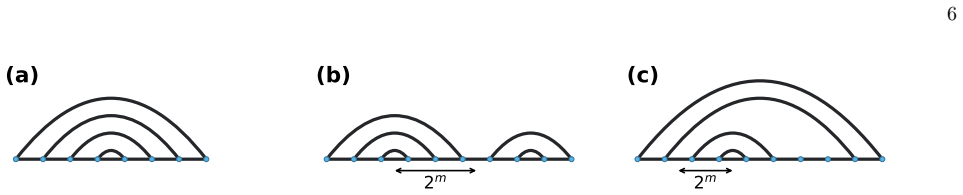
For a fixed Majorana flavor pattern, the 2-RDM Majorana strings can be written asγ a,pa γb,pb γc,pc γd,pd with site indicesa < b < c < d. We consider two grouping strategies: grouping operators with the same a+bandc+d; and operators with the samea+dand b+c(see Fig. 1 (b) and (c)). Since each group contains two “rainbows”, we must ensure that the rainbows ...
-
[4]
triply-efficient shadow tomography
Fermionick-RDM by Bell-sampling shadow Another way to implement fermionic shadows (but which is not limited to fermionic shadows) on quantum computers is to perform a joint measurement on two replicas of a given quantum state. [41, 42] With some auxiliary (ancilla) stateσthat has the same size asρ, Bell FIG. 2. Schematic illustration of fermionick-RDM mea...
-
[5]
This reuse is exact in 1D tensor network algorithms, and is approximate for higher-dimensional contractions
Environment reuse strategy A common trick in tensor network algorithms is to reuse the environment for multiple contractions. This reuse is exact in 1D tensor network algorithms, and is approximate for higher-dimensional contractions. For any given scalar-output tensor network contraction, one can effectively construct all the local environments (e.g. aro...
-
[6]
This is the main target of variational Monte Carlo
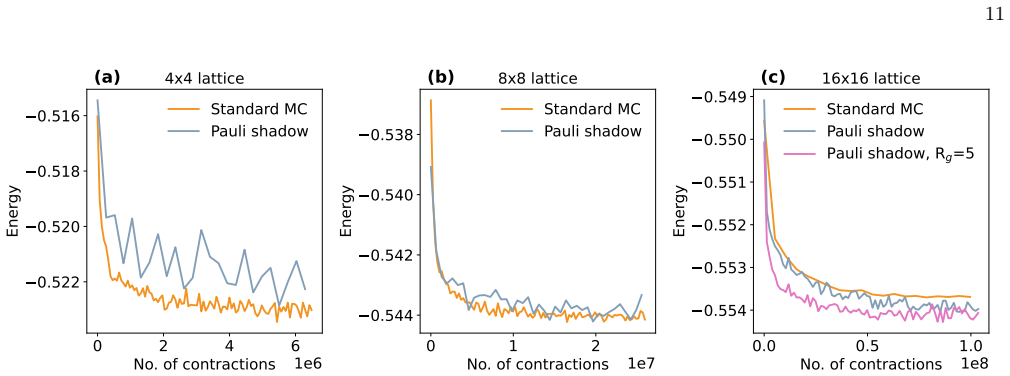
Variational ground state simulation One of the most important applications of evaluating expectation values of Hamiltonians is in variational ground state simulation. This is the main target of variational Monte Carlo. However, an additional 8 consideration when comparing the shadow tomography approaches with standard variational Monte Carlo is the zero-v...
-
[7]
effective variance
Stability of the gradient estimator We next discuss a different stability property of the gradient estimator in the variational optimization: the shadow gradient estimator has a bounded variance if the gradient of the parameterized state itself∂θ|ψ(θ)⟩has a bounded norm, while the standard MC estimator does not have such an upper bound, and thus can suffe...
-
[8]
J. I. Cirac, D. Pérez-García, N. Schuch, and F. Verstraete, Matrix product states and projected entangled pair states: Concepts, symmetries, theorems, Rev. Mod. Phys.93, 045003 (2021)
2021
-
[9]
Orús, A practical introduction to tensor networks: Matrix product states and projected entangled pair states, Annals of Physics349, 117 (2014)
R. Orús, A practical introduction to tensor networks: Matrix product states and projected entangled pair states, Annals of Physics349, 117 (2014)
2014
-
[10]
Schollwöck, The density-matrix renormalization group, Rev
U. Schollwöck, The density-matrix renormalization group, Rev. Mod. Phys.77, 259 (2005)
2005
-
[11]
U.Schollwöck,Thedensity-matrixrenormalizationgroup in the age of matrix product states, Annals of Physics 326, 96 (2011), january 2011 Special Issue
2011
-
[12]
F. Verstraete, V. Murg, and J. Cirac, Matrix product states, projected entangled pair states, and variational renormalization group methods for quantum spin systems, Advances in Physics57, 143 (2008), https://doi.org/10.1080/14789940801912366
-
[13]
Orús, Tensor networks for complex quantum systems, Nature Reviews Physics1, 538 (2019)
R. Orús, Tensor networks for complex quantum systems, Nature Reviews Physics1, 538 (2019)
2019
-
[14]
W.-Y. Liu, H. Zhai, R. Peng, Z.-C. Gu, and G. K.-L. Chan, Accurate simulation of the hubbard model with finite fermionic projected entangled pair states, Physical Review Letters134, 256502 (2025)
2025
-
[15]
H. C. Jiang, Z. Y. Weng, and T. Xiang, Accurate determination of tensor network state of quantum lattice models in two dimensions, Phys. Rev. Lett.101, 090603 (2008)
2008
-
[16]
H. H. Zhao, Z. Y. Xie, Q. N. Chen, Z. C. Wei, J. W. Cai, and T. Xiang, Renormalization of tensor-network states, Phys. Rev. B81, 174411 (2010)
2010
-
[17]
S. R. White and A. E. Feiguin, Real-time evolution using the density matrix renormalization group, Phys. Rev. Lett.93, 076401 (2004)
2004
-
[18]
Vidal, Efficient simulation of one-dimensional quantum many-body systems, Physical review letters93, 040502 (2004)
G. Vidal, Efficient simulation of one-dimensional quantum many-body systems, Physical review letters93, 040502 (2004)
2004
-
[19]
G. K.-L. Chan and S. Sharma, The density matrix renormalization group in quantum chemistry, Annual Review of Physical Chemistry62, 465 (2011)
2011
-
[20]
Baiardi and M
A. Baiardi and M. Reiher, The density matrix renormalization group in chemistry and molecular physics: Recent developments and new challenges, The Journal of Chemical Physics152(2020)
2020
-
[21]
M. M. Rams, P. Czarnik, and L. Cincio, Precise extrapolation of the correlation function asymptotics in uniform tensor network states with application to the bose-hubbard and xxz models, Phys. Rev. X8, 041033 (2018)
2018
-
[22]
J. Zhao, M. Song, Y. Qi, J. Rong, and Z. Y. Meng, Finite- temperature critical behaviors in 2d long-range quantum heisenberg model, npj Quantum Materials8, 59 (2023)
2023
-
[23]
S.Keller, M.Dolfi, M.Troyer,andM.Reiher,Anefficient matrix product operator representation of the quantum chemical hamiltonian, The Journal of chemical physics 143(2015)
2015
-
[24]
Nishino and K
T. Nishino and K. Okunishi, Corner transfer matrix renormalization group method, Journal of the Physical Society of Japan65, 891 (1996)
1996
-
[25]
Jordan, R
J. Jordan, R. Orús, G. Vidal, F. Verstraete, and J. I. Cirac, Classical simulation of infinite-size quantum lattice systems in two spatial dimensions, Phys. Rev. Lett.101, 250602 (2008)
2008
-
[26]
Lubasch, J
M. Lubasch, J. I. Cirac, and M.-C. Banuls, Unifying projected entangled pair state contractions, New Journal of Physics16, 033014 (2014)
2014
-
[27]
Y. Wang, Y. E. Zhang, F. Pan, and P. Zhang, Tensor network message passing, Phys. Rev. Lett.132, 117401 (2024)
2024
-
[28]
S.-J. Ran, E. Tirrito, C. Peng, X. Chen, L. Tagliacozzo, G. Su, and M. Lewenstein,Tensor network contractions: methods and applications to quantum many-body systems (Springer Nature, 2020)
2020
-
[29]
A. W. Sandvik and G. Vidal, Variational quantum monte carlo simulations with tensor-network states, Phys. Rev. Lett.99, 220602 (2007)
2007
-
[30]
L. Wang, I. Pižorn, and F. Verstraete, Monte carlo simulation with tensor network states, Phys. Rev. B83, 134421 (2011)
2011
-
[31]
Liu, S.-J
W.-Y. Liu, S.-J. Dong, Y.-J. Han, G.-C. Guo, and L. He, Gradient optimization of finite projected entangled pair states, Phys. Rev. B95, 195154 (2017)
2017
-
[32]
S. Aaronson, Shadow tomography of quantum states, SIAM Journal on Computing49, STOC18 (2020), https://doi.org/10.1137/18M120275X
-
[33]
Aaronson and G
S. Aaronson and G. N. Rothblum, Gentle measurement of quantum states and differential privacy, inProceedings of the 51st Annual ACM SIGACT Symposium on Theory of Computing(2019) pp. 322–333
2019
-
[34]
Kunjummen, M
J. Kunjummen, M. C. Tran, D. Carney, and J. M. Taylor, Shadow process tomography of quantum channels, Phys. Rev. A107, 042403 (2023)
2023
-
[35]
Huang, R
H.-Y. Huang, R. Kueng, and J. Preskill, Predicting many properties of a quantum system from very few measurements, Nature Physics16, 1050 (2020)
2020
-
[36]
Elben, S
A. Elben, S. T. Flammia, H.-Y. Huang, R. Kueng, J. Preskill, B. Vermersch, and P. Zoller, The randomized measurement toolbox, Nature Reviews Physics5, 9 13 (2023)
2023
-
[37]
Bertoni, J
C. Bertoni, J. Haferkamp, M. Hinsche, M. Ioannou, J. Eisert, and H. Pashayan, Shallow shadows: Expectation estimation using low-depth random Clifford circuits, Phys. Rev. Lett.133, 020602 (2024)
2024
-
[38]
A. Zhao, N. C. Rubin, and A. Miyake, Fermionic partial tomography via classical shadows, Phys. Rev. Lett.127, 110504 (2021)
2021
-
[39]
K. Wan, W. J. Huggins, J. Lee, and R. Babbush, Matchgate shadows for fermionic quantum simulation, Communications in Mathematical Physics404, 629 (2023)
2023
-
[40]
Heyraud, H
V. Heyraud, H. Chomet, and J. Tilly, Unified framework for matchgate classical shadows, npj Quantum Information11, 65 (2025)
2025
-
[41]
Hadfield, S
C. Hadfield, S. Bravyi, R. Raymond, and A. Mezzacapo, Measurements of quantum Hamiltonians with locally-biased classical shadows, Communications in Mathematical Physics391, 951 (2022)
2022
-
[42]
Huang, R
H.-Y. Huang, R. Kueng, and J. Preskill, Efficient estimation of Pauli observables by derandomization, Phys. Rev. Lett.127, 030503 (2021)
2021
-
[43]
H.-Y. Hu, S. Choi, and Y.-Z. You, Classical shadow tomography with locally scrambled quantum dynamics, Phys. Rev. Res.5, 023027 (2023)
2023
-
[44]
A. A. Akhtar, H.-Y. Hu, and Y.-Z. You, Scalable and Flexible Classical Shadow Tomography with Tensor Networks, Quantum7, 1026 (2023)
2023
-
[45]
Verteletskyi, T.-C
V. Verteletskyi, T.-C. Yen, and A. F. Izmaylov, Measurement optimization in the variational quantum eigensolver using a minimum clique cover, The Journal of Chemical Physics152, 124114 (2020)
2020
-
[46]
T.-C. Yen, V. Verteletskyi, and A. F. Izmaylov, Measuringallcompatibleoperatorsinoneseriesofsingle- qubit measurements using unitary transformations, Journal of Chemical Theory and Computation16, 2400 (2020)
2020
-
[47]
W. J. Huggins, J. R. McClean, N. C. Rubin, Z. Jiang, N. Wiebe, K. B. Whaley, and R. Babbush, Efficient and noise resilient measurements for quantum chemistry on near-term quantum computers, npj Quantum Information7, 23 (2021)
2021
-
[48]
Hangleiter and M
D. Hangleiter and M. J. Gullans, Bell sampling from quantum circuits, Phys. Rev. Lett.133, 020601 (2024)
2024
-
[49]
R. King, D. Gosset, R. Kothari, and R. Babbush, Triply efficient shadow tomography, PRX Quantum6, 010336 (2025)
2025
-
[50]
P. S. Tarabunga and Y.-M. Ding, Bell sampling in quantum monte carlo simulations, Phys. Rev. Lett.135, 200403 (2025)
2025
-
[51]
Feldman, A
N. Feldman, A. Kshetrimayum, J. Eisert, and M.Goldstein,Entanglementestimationintensornetwork states via sampling, PRX Quantum3, 030312 (2022)
2022
-
[52]
Becca and S
F. Becca and S. Sorella,Quantum Monte Carlo approaches for correlated systems(Cambridge University Press, 2017)
2017
-
[53]
G. K. Chan, A. Keselman, N. Nakatani, Z. Li, and S. R. White, Matrix product operators, matrix product states, and ab initio density matrix renormalization group algorithms, The Journal of chemical physics145 (2016)
2016
-
[54]
M. J. O’Rourke and G. K.-L. Chan, Simplified and improved approach to tensor network operators in two dimensions, Physical Review B101, 205142 (2020)
2020
-
[55]
S. B. Bravyi and A. Y. Kitaev, Fermionic quantum computation, Annals of Physics298, 210 (2002)
2002
-
[56]
Jiang, A
Z. Jiang, A. Kalev, W. Mruczkiewicz, and H. Neven, Optimal fermion-to-qubit mapping via ternary trees with applications to reduced quantum states learning, Quantum4, 276 (2020)
2020
-
[57]
The⊗ i+j=r |bell⟩ij notation indicates that the fermionic operators are applied in pairs, i.e.⊗ i+j=r 1√ 2(1 + eiϕa† i a† j)|vac⟩or⊗ i+j=r 1√ 2(a† i +e iϕa† j)|vac⟩
-
[58]
F. L. Visconti, Hilbert–schmidt norm estimates for fermionic reduced density matrices: Fla visconti, in Annales Henri Poincaré(Springer, 2026) pp. 1–24
2026
-
[59]
Assaraf and M
R. Assaraf and M. Caffarel, Zero-variance principle for monte carloalgorithms, Phys. Rev.Lett.83,4682 (1999)
1999
-
[60]
S. Pathak and L. K. Wagner, A light weight regularization for wave function parameter gradients in quantum monte carlo, AIP Advances10, 085213 (2020), https://pubs.aip.org/aip/adv/article- pdf/doi/10.1063/5.0004008/9048174/085213_1_online.pdf
work page doi:10.1063/5.0004008/9048174/085213_1_online.pdf 2020
- [61]
-
[62]
Motta, D
M. Motta, D. M. Ceperley, G. K.-L. Chan, J. A. Gomez, E. Gull, S. Guo, C. A. Jiménez-Hoyos, T. N. Lan, J. Li, F. Ma, A. J. Millis, N. V. Prokof’ev, U. Ray, G. E. Scuseria, S. Sorella, E. M. Stoudenmire, Q. Sun, I. S. Tupitsyn, S. R. White, D. Zgid, and S. Zhang (Simons Collaboration on the Many-Electron Problem), Towards the solution of the many-electron ...
2017
-
[63]
Liu, S.-J
W.-Y. Liu, S.-J. Du, R. Peng, J. Gray, and G. K.-L. Chan, Tensor network computations that capture strict variationality, volume law behavior, and the efficient representation of neural network states, Phys. Rev. Lett. 133, 260404 (2024). VI. APPENDIX A. 2RDM estimation using the rainbow-basis shadow The grouping argument in this Appendix is stated for a ...
2024
discussion (0)
Sign in with ORCID, Apple, or X to comment. Anyone can read and Pith papers without signing in.