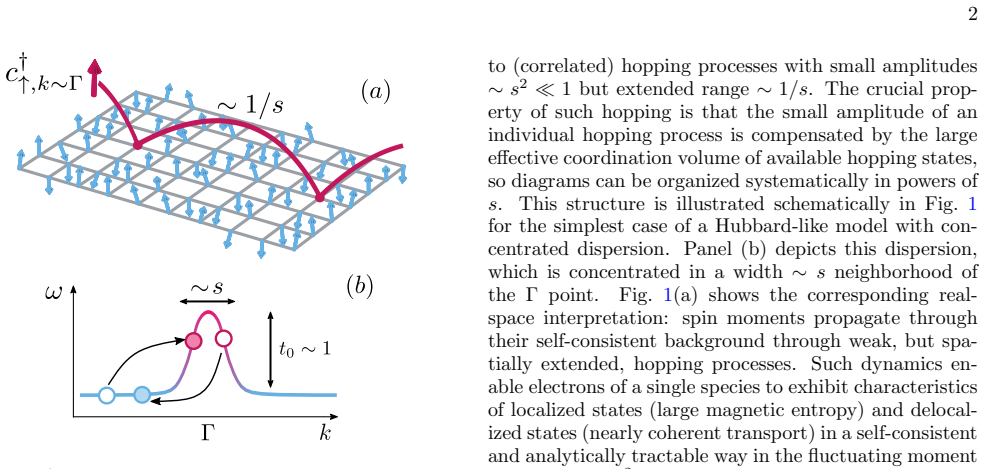
We introduce a systematic expansion tailored to systems with strong local interactions and capable of computing response functions, including finite DC transport, analytically. The expansion is controlled by a small parameter $s^2$ that measures the area of the momentum space region where kinematics of the theory is concentrated. In real space, this corresponds to single-particle or correlated hopping terms with amplitudes that decay over a length scale $1/s$ and scale in magnitude as $s^2$ in two dimensions. In the limit $s^2\ll 1$, long, self-avoiding tunneling paths dominate over paths revisiting the same site. This enables systematic controlled calculations of various physical quantities. We illustrate the method with three applications. (i) A Hubbard model with concentrated dispersion: we analytically obtain spectral broadening which scales as $s^2$ and identify a high-temperature bad metal with $T$-linear resistivity coexisting with parametrically long-lived quasiparticles, as well as an intermediate-temperature "thermal FL*" with a small hole pocket that coexists with thermally disordered fluctuating local moments, all within a single controlled framework. (ii) A correlated-hopping model with interesting electron-trion dynamics. (iii) A model of Chern bands with concentrated Berry curvature, motivated by twisted bilayer graphene, which realizes a Mott semimetal where we compute the broadening for the electron and trion spectral functions. At the end, we discuss how our approach paves the way to addressing various challenging questions in strongly correlated systems and outline its various generalizations.
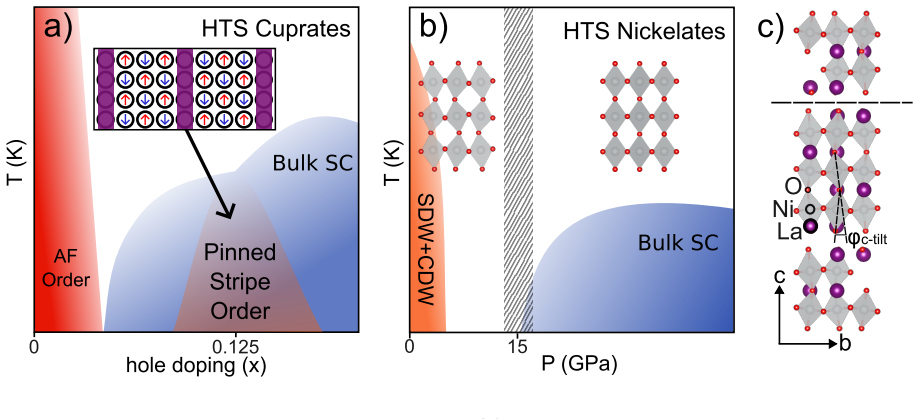
Since the discovery of high-temperature superconductivity in nickelate superconductors, it is an open question how closely the superconducting state resembles that of cuprate superconductors. One salient feature of the phase diagram of the high-temperature cuprate superconductors is stripe order. Despite their prevalence, real-space imaging has been limited to the charge sector. Here we use spin-polarised scanning tunnelling microscopy to visualize the local magnetic and charge distribution emerging due to a stripe order in the trilayer nickelate La$_4$Ni$_3$O$_{10}$. The stripe order exhibits a four unit cell periodicity, closely resembling that seen in cuprates, and opens a near-complete $\sim66\mathrm{meV}$ gap at the Fermi level. Crucially, discrete phase slips can be triggered by tunneling electrons above a $\sim 20\mathrm{meV}$ threshold, allowing imaging of stripe dynamics at the atomic scale. These results highlight the importance of correlation physics driving stripe-like orders in lanthanum nickelates with striking similarities to the cuprates.
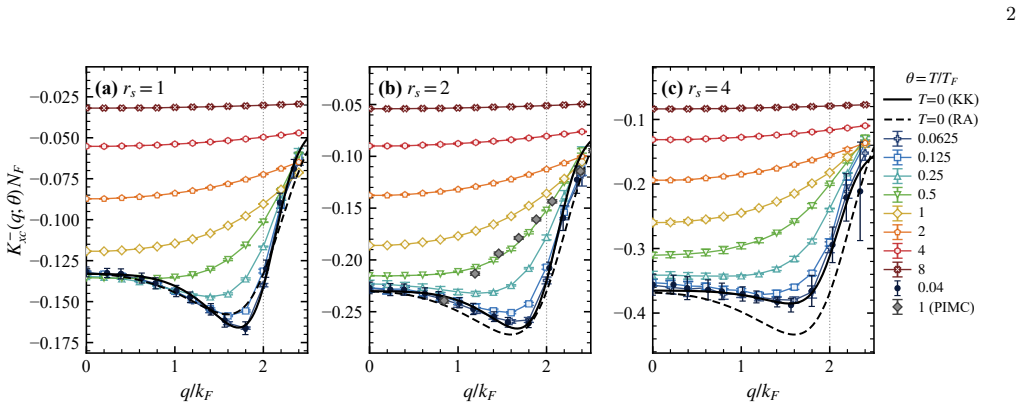
The finite-temperature spin response of the uniform electron gas (UEG) is a fundamental reference for spin-polarized and magnetized electron liquids, including warm dense matter (WDM), yet it remains far less constrained than charge response. Using variational diagrammatic Monte Carlo, we compute the static spin exchange--correlation (XC) kernel $K_{xc}(q;T)$ of the unpolarized UEG at metallic densities across the quantum-degenerate, warm-dense, and classical regimes. The kernel connects smoothly to zero-temperature spin-response parametrizations at low temperature, while heating suppresses the Fermi-surface-scale spin-correlation structure and weakens the XC-driven Stoner enhancement. Its long-wavelength limit provides a direct response test of the spin stiffness implied by thermal local-spin-density-approximation (LSDA) parametrizations, showing low-temperature consistency while exposing a resolved warm-dense residual in current LSDA parametrizations. In the classical regime, the spin XC kernel becomes nearly local on the Fermi-momentum scale, in sharp contrast to the corresponding charge XC kernel. These results provide a first-principles basis for finite-temperature spin-response theory and magnetized WDM modeling.
We develop a quantitative theory for the emergence of quantum many-body chaos as integrability is broken via a tunable parameter. In a circuit model of free fermions, 'doped' with a tunable density of integrability-breaking gates, we uncover the microscopic mechanisms underpinning the crossover from early-time integrable behaviour to late-time chaos through the lens of the out-of-time-ordered correlators (OTOCs). The integrability-breaking gates act as local, in spacetime, hotspots which locally amplify the OTOCs such that an accumulation of them eventually leads to fully-developed chaos. We identify the explicit characteristic time and length scales governing this crossover, as well as the dependence of the chaotic OTOC characteristics -- such as the butterfly velocity and front broadening -- on the integrability-breaking parameter.
The dynamics of a quantum system encode signatures of whether the underlying Hamiltonian is integrable or chaotic, giving rise to the concept of quantum information scrambling through the properties of the resulting dynamical states or operators. We introduce an information-theoretic framework based on the Haar-averaged sum of total correlations (aSTC), together with average genuine multipartite entanglement generated dynamically from initially fully separable states, as robust probes of quantum information scrambling. Using the long-range quantum XYZ spin model in transverse and longitudinal magnetic fields, whose integrable limit is the nearest-neighbor transverse XY model, we demonstrate that the long-time average and, more importantly, the temporal fluctuations of the aSTC provide a faithful and system-size-independent signature of integrable and chaotic dynamics, similar to the conventional measure of scrambling, out-of-time-ordered correlator (OTOC). When the system is in contact with the thermal reservoir and system-bath coupling follows Markovianity, we find that the fluctuations of the aSTC and OTOC continue to distinguish integrable and chaotic dynamics only at intermediate times. However, we observe that in the non-Markovian domain, information backflow restores the scrambling dynamics, enabling the aSTC to retain its distinguishing power even at long times. Interestingly, we exhibit that, under Markovian amplitude damping and non-Markovian dephasing noise, the temporal fluctuations of the aSTC can discriminate between integrability and non-integrability in the weak Markovian regime, even when OTOC fails to do so.
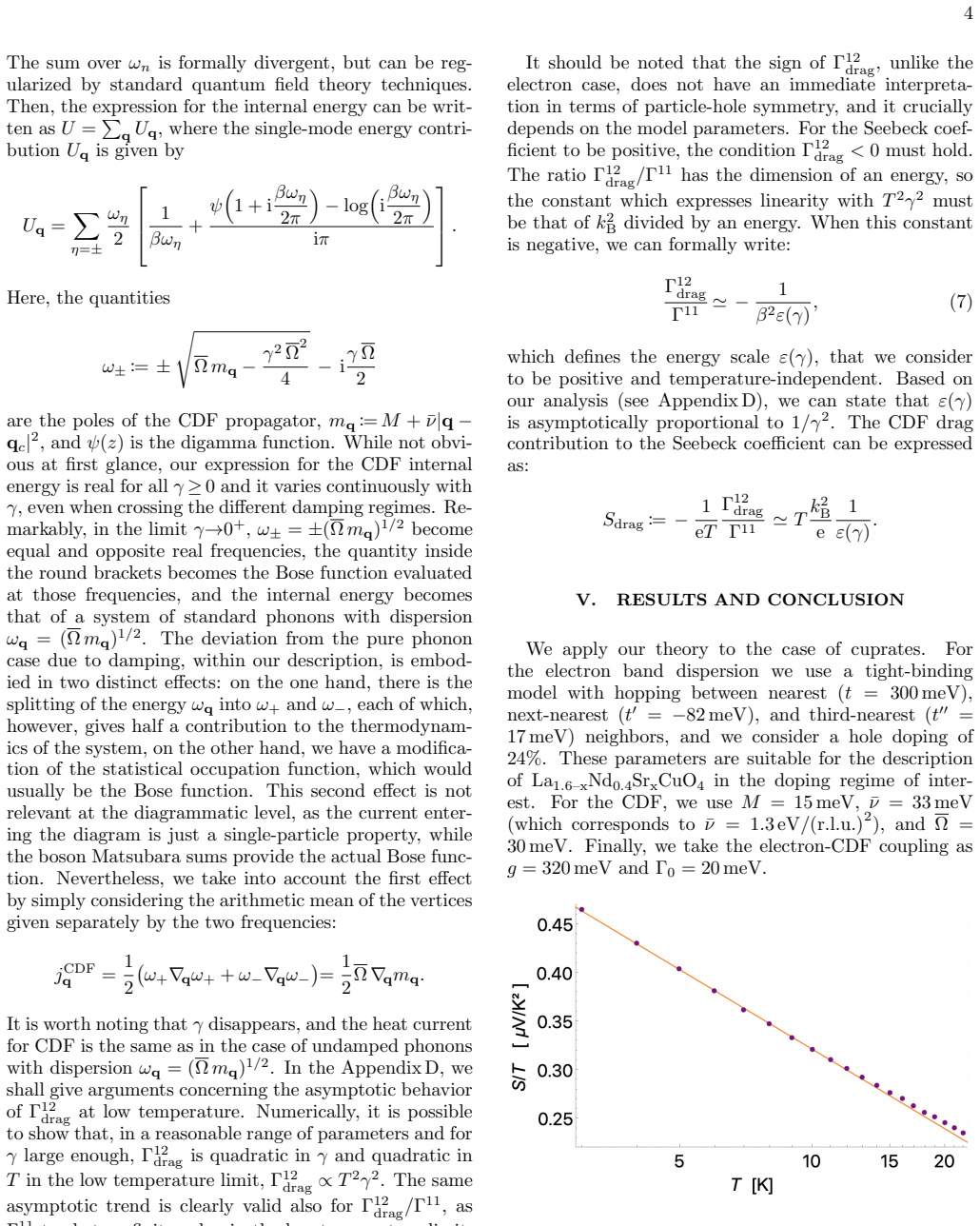
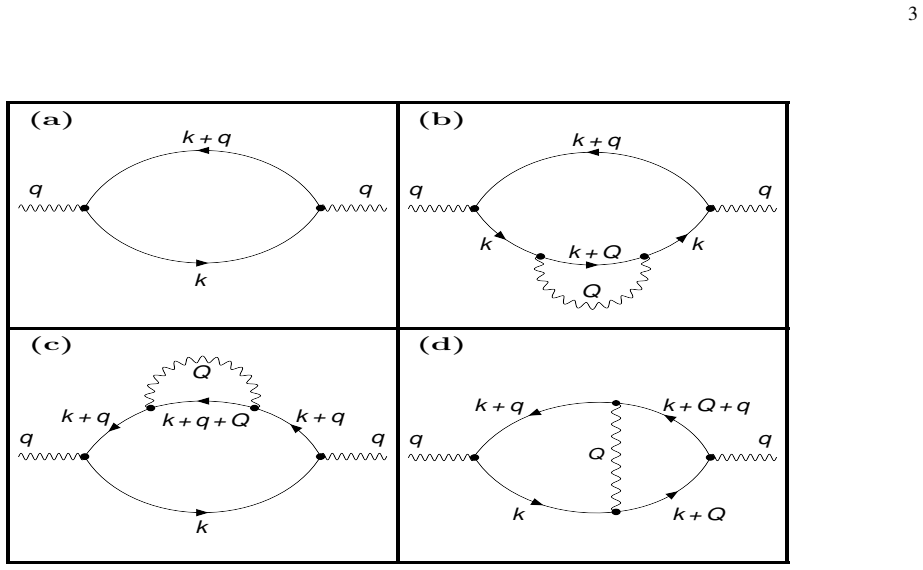
Inspired by the observation of a Seebeck coefficient ratio that exhibits a seemingly logarithmic divergence at low temperature in high-temperature superconducting cuprates, we show that a mechanisms similar to the standard phonon drag can give rise to anomalies in the thermopower of a metal, if the dragged collective mode is overdamped, with a damping coefficient that increases with lowering the temperature. Our finding adds a piece to the puzzle of the strange-metal behavior observed in many different systems and supports our proposal that overdamped charge density fluctuations can be responsible of such a behavior in high-temperature superconducting cuprates.
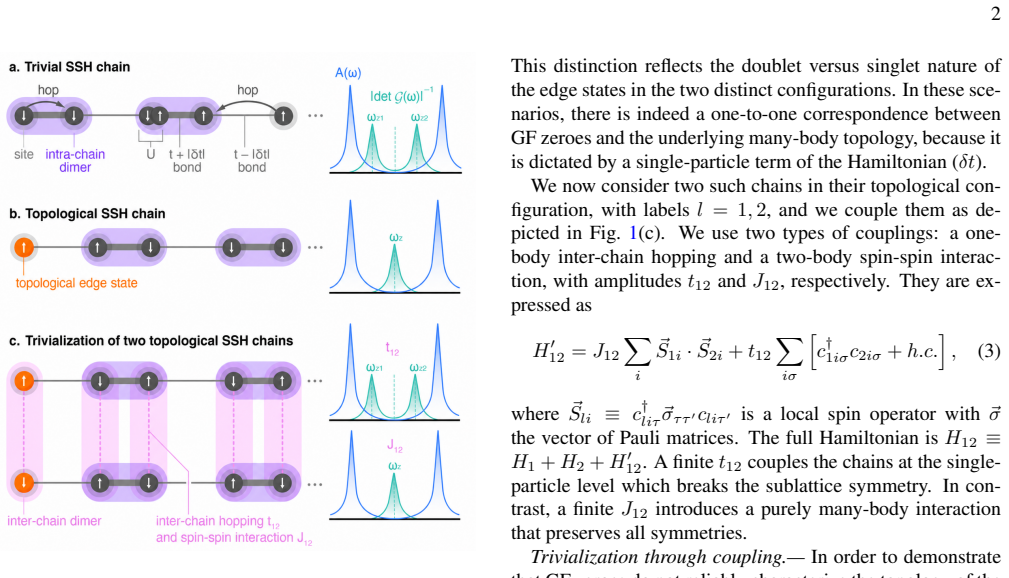
We show that topological invariants constructed from single-particle Green's functions (GFs) cannot reliably diagnose the topology of interacting many-body states. Using coupled interacting SSH chains as a minimal example, we demonstrate that a spin-spin interaction can trivialize the many-body ground state without affecting the GF topological invariant. This breakdown originates from the GF's inability to probe electronic excitations in the Fock sectors responsible for the topological degeneracy. Consequently, GF zeroes are not associated with physical topological quasiparticles and cannot generally characterize interacting topological phases.
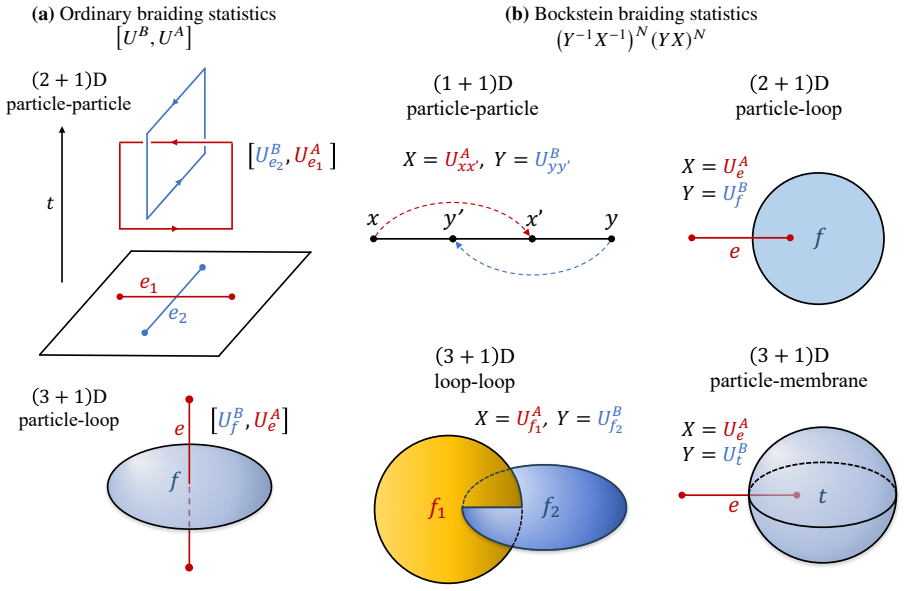
Braiding statistics, from the Aharonov-Bohm phase to anyons in fractional quantum Hall systems, play a central role in quantum physics. For $p$- and $q$-dimensional excitations in $d$ spatial dimensions, ordinary braiding requires $p+q=d-2$. In a field-theoretic description of $\mathbb Z_N$ excitations, ordinary braiding is described by the linking response $(2\pi i/N)\int A_{d-p}\cup B_{d-q}$, where $A_{d-p}$ and $B_{d-q}$ are background fields coupled to the two excitation types. In this work, we identify new mutual statistics in the adjacent case $p+q=d-1$. For two invertible excitations obeying $\mathbb Z_N$ fusion, one can choose local creation operators $X$ and $Y$ whose supports have a staggered one-dimensional overlap. The closed unitary process $W_N(X,Y)=(Y^{-1}X^{-1})^N(YX)^N$ measures the resulting mutual statistic. Its field-theory description is $(2\pi i/N)\int A_{d-p}\cup\beta_N B_{d-q}$, where $\beta_N$ is the Bockstein operation; we therefore call the invariant Bockstein braiding statistics. The construction yields particle-particle statistics in one dimension, particle-loop statistics in two dimensions, and loop-loop or particle-membrane statistics in three dimensions. Nontrivial Bockstein braiding statistics obstructs simultaneous condensation of the two $\mathbb Z_N$ excitations. It also rules out a fully symmetric gapped phase for systems with the corresponding mixed anomaly and implies symmetry fractionalization when one of the $\mathbb Z_N$ symmetries is broken.
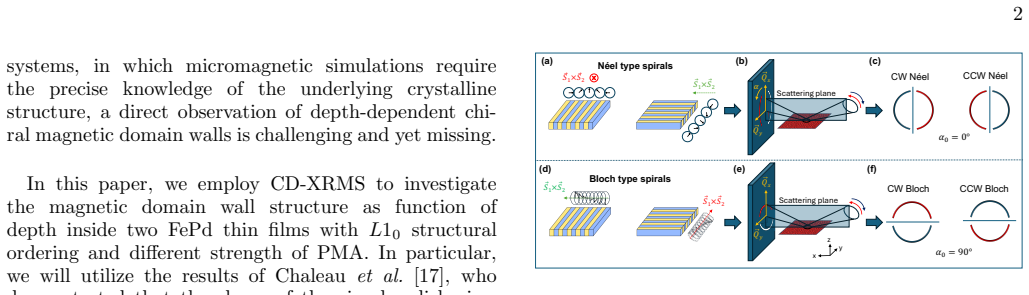
We report an experimental investigation of the depth-dependent domain wall formation in L1$_0$-FePd thin films with high perpendicular magnetic anisotropy. Using circular dichroism X-ray resonant magnetic scattering (CD-XRMS) as a function of the incident X-ray angle, we explore the depth evolution of chiral spin textures in two samples with different strengths of magnetocrystalline anisotropy. Combined with CD-STXM, CD-ptychography, and macroscopic characterization of the structural order, magnetic properties, and surface morphology, we relate these observations to differences in the long-range order of the L1$_0$ phase of FePd. One FePd thin film with very high magnetocrystalline anisotropy, characterized by $Q_{PMA}=1.8$, exhibits an unexpectedly large N\'eel contribution. Angular-dependent CD-XRMS directly reveals a smooth transition from a hybrid Bloch-N\'eel chirality within the upper FePd layer towards a purely N\'eel-type structure at the lower FePd interface. In the second FePd sample, despite a still relatively large $Q_{PMA}=1.45$, the domain walls were found to be purely N\'eel type. These results indicate a crucial role of the long-range structural order in determining the formation of the magnetic structure.
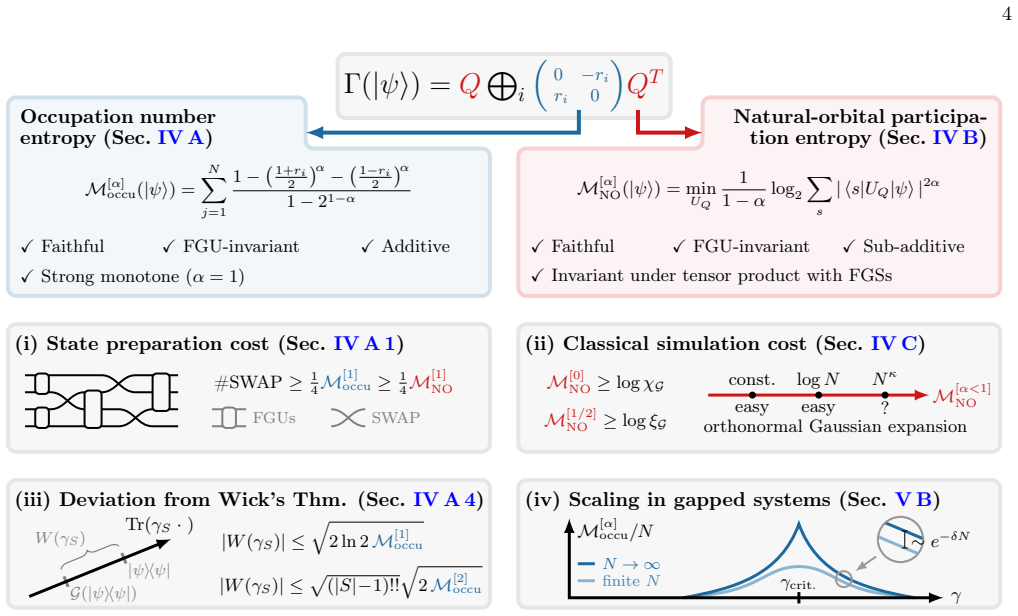
Fermionic non-Gaussianity, or fermionic magic, is a key resource underlying the computational complexity of fermionic quantum systems, yet tractable and operationally meaningful ways to quantify it remain limited. We address this challenge by developing a convex resource theory of fermionic non-Gaussianity and introducing two families of computable measures for pure fermionic states, both derived from the Williamson normal form of the covariance matrix. The first family, occupation number entropies, is defined as the Tsallis-$\alpha$ entropy of the occupation numbers. We prove that one member of this family is monotonic under Gaussian protocols, establishing it as a computable convex resource monotone. It consequently lower bounds the number of non-Gaussian gates needed for state preparation. The second family, natural-orbital participation entropies, is given by the R\'enyi-$\alpha$ entropy of the squared amplitudes of the state in the natural-orbital basis, defined by the eigenvectors of the covariance matrix. These measures quantify state compressibility in this basis and thus upper bound the classical simulation cost in an orthonormal Gaussian basis. We analyze both families for stabilizer and translation-invariant states, where they simplify and reveal additional structure. We further study representative examples, including random SWAP-doped matchgate circuits and the bond-modulated XXZ model, highlighting the role of non-Gaussianity in many-body phenomena. Our work establishes a resource-theoretic framework for computable fermionic non-Gaussianity that unifies notions arising across quantum information, condensed-matter physics, and quantum chemistry, opening new directions for studying the complexity of quantum many-body systems and providing practical tools to assess the classical simulability of fermionic states relevant for quantum advantage.
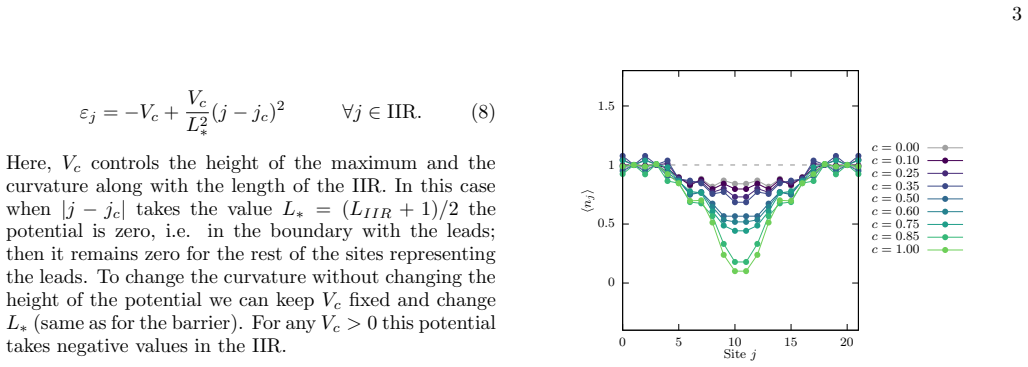
Using the density matrix renormalization group (DMRG) combined with the correction-vector method, we investigate the competition between an harmonic potential and repulsive interactions in a one-dimensional fermionic system. The parabolic confinement induces spatial inhomogeneity, and by tuning its curvature one can continuously interpolate between a potential well--relevant for cold-atom setups--and a quantum barrier, as realized in mesoscopic systems such as quantum point contacts. We analyze how the ground-state particle distribution evolves with the strength and sign of the confining potential and how the confinement reshapes the spectral weight of the local density of states (LDOS) at the center of the chain. In the barrier regime, a localized peak emerges in the electron part of the spectrum ($\omega >0$) as a direct consequence of the potential. In contrast, in the well configuration and for weak interactions, a localized feature persists but shifts to the hole sector ($\omega <0$). However, for stronger interactions, the LDOS no longer displays clear signatures of the external potential, indicating that correlations dominate over single-particle confinement.
We study the impact of the many-body effects on the phonon spectral function of Holstein polaron in one-dimension in the antiadiabatic regime by incorporating the contributions from the electron self-energy and vertex corrections within a weak-coupling approach that respects the charge-conserving Ward identity. We find that while the polaronic spectral weight is suppressed due to contribution from the electron self-energy, on the other hand, the same is enhanced due to contribution from the vertex corrections. While strength of both the contributions increases with increasing the wave vector ($\q$) of phonons, they nearly cancel each other for the small-$\q$ modes so that the polaronic spectral weight is weakly affected due to the many-body effects. For the large-$\q$ modes near the zone boundary, the net many-body correction is dominated by the contribution of the electron self-energy which increases faster in comparison to that of the vertex corrections with increasing the wave vector thereby resulting in a significant suppression of the polaronic spectral weight. We find that while the weak-coupling perturbative approach provides a reliable estimation of the impact of the many-body effects deep inside the antiadibatic regime, the renormalization of quasiparticle spectrum must be taken into account for an accurate estimation when the phonon energy approaches the electronic bandwidth.
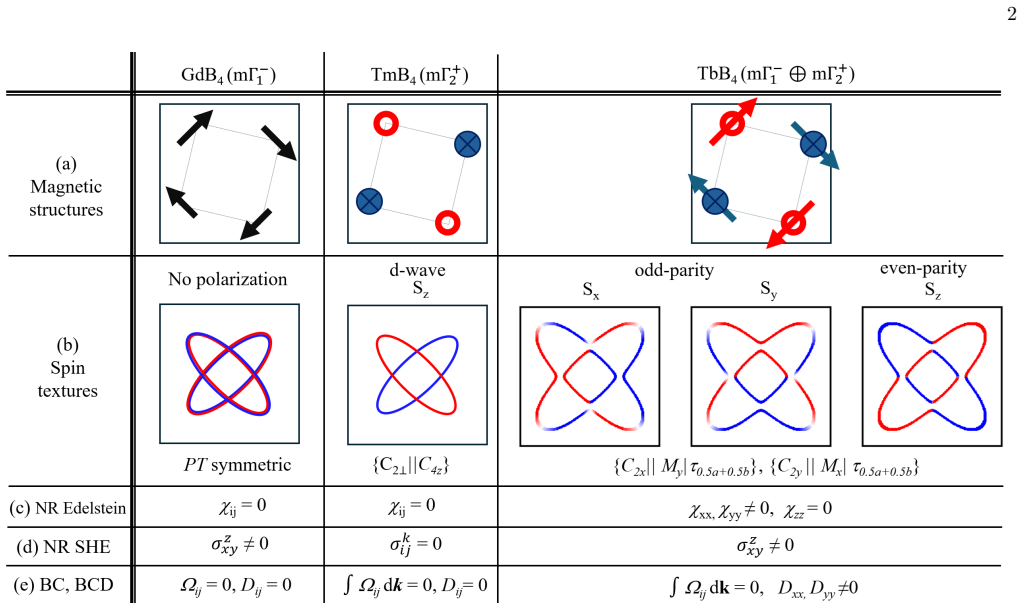
Altermagnetism has advanced the study of compensated magnets by revealing non-relativistic spin splitting, traditionally classified into strictly even- or odd-parity spin textures. Here, we unveil a fundamentally different regime: component-resolved mixed-parity spin splitting in a fully three-dimensional compensated magnet. Using first-principles calculations, tight-binding and $\mathbf{k} \cdot \mathbf{p}$ models, along with spin-group symmetry analysis, we demonstrate that the non-coplanar ground state of $\mathrm{TbB}_4$ enforces a unique momentum-space spin texture. The in-plane spin components exhibit odd-parity $p$- and $f$-wave-like textures, whereas the out-of-plane component retains an even-parity $d$-wave altermagnetic character. Crucially, the coexistence of the in-plane odd-parity textures is driven not by relativistic spin-orbit coupling, but by a staggered Berry phase arising from the inherent scalar spin chirality. This mixed-parity structure dictates distinct transport fingerprints, including bulk non-relativistic Edelstein and spin Hall responses, as well as a symmetry-allowed Berry curvature dipole. These results establish the rare-earth tetraborides as a robust platform for engineering complex spin-charge conversion phenomena.
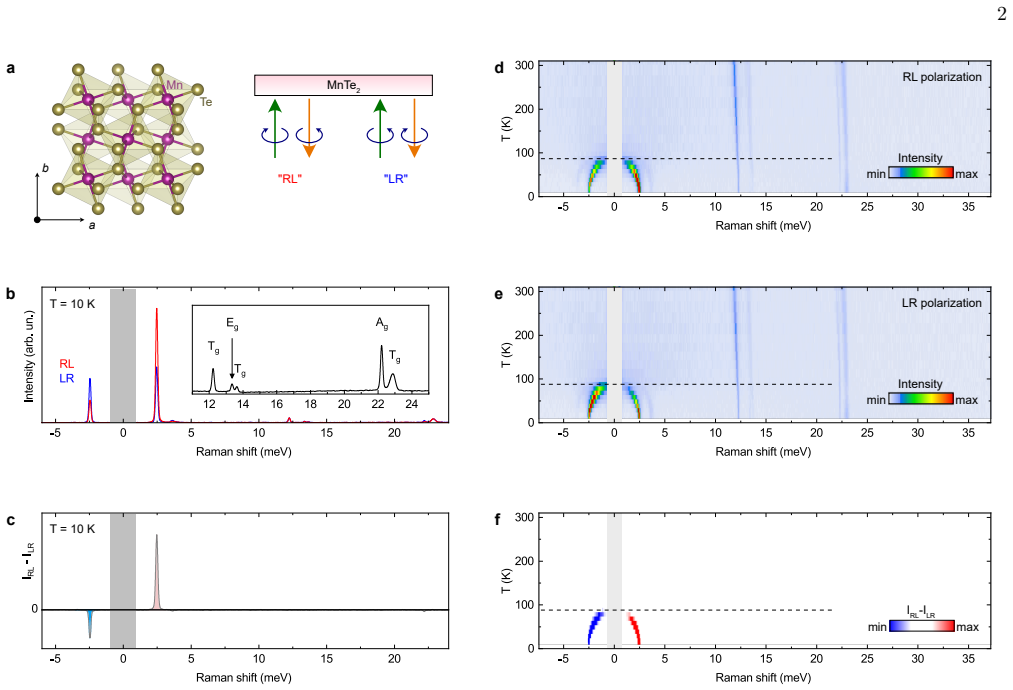
Altermagnets constitute an emerging class of magnetic materials that combine compensated antiferromagnetic order with spin-split excitations arising from crystalline symmetries. Despite strong theoretical interest, their experimental identification remains challenging. Here, we demonstrate that helicity- and angle-resolved Raman scattering measurements reveal reduced rotational symmetries of magnons and a pronounced imbalance between left- and right-circular polarization channels, indicating momentum-dependent magnon handedness. First-principles DFT+$U$ calculations combined with linear spin-wave theory uncover a characteristic plaid-like spin-splitting structure in momentum space. The resulting magnon spin textures are dictated by the unconventional sublattice symmetries of MnTe$_2$ and closely emulate those of altermagnetic electronic bands. Our work provides evidence of chiral spin-wave excitations unique to this non-coplanar antiferromagnet.
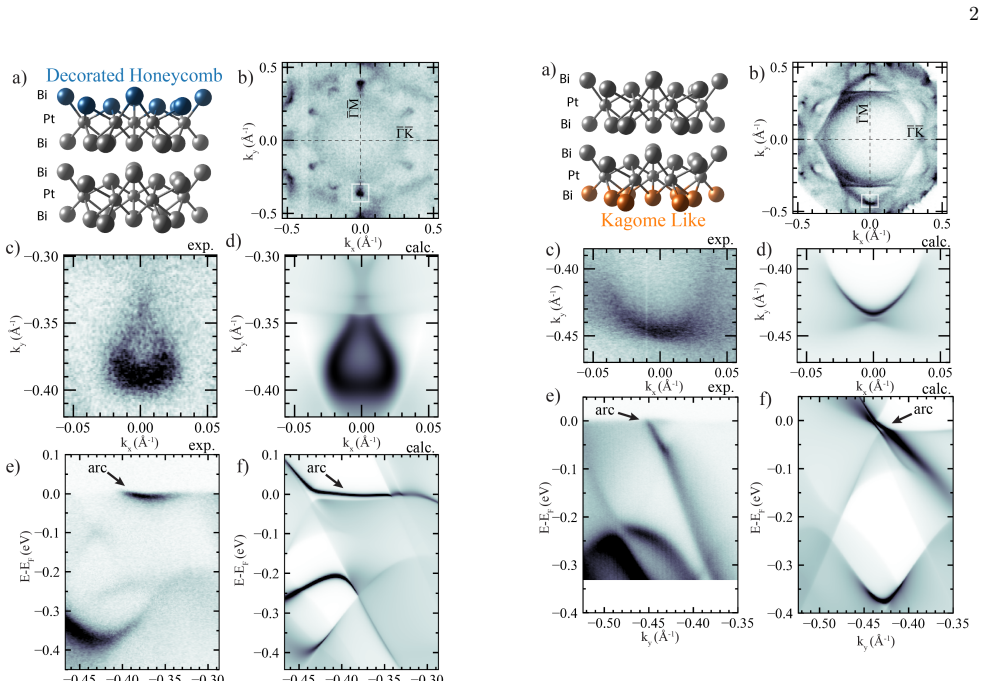
Layered PtBi$_2$ is a candidate for topological superconductivity arising in Fermi-arc surface states. Using spin- and angle-resolved photoemission spectroscopy, we demonstrate that the Fermi arcs in PtBi$_2$ are singly degenerate and spin-polarized, which establishes their nontrivial topology and constitutes a necessary condition for topological superconductivity. We further uncover a pronounced surface-termination dependence of the Fermi-arc dispersion, yielding either nearly flat or approximately linear bands in agreement with first-principles calculations. Together, the observed spin polarization and termination-dependent bandwidth of the Fermi-arc surface states identify key ingredients underlying the potential emergence of topological superconductivity in PtBi$_2$.
The use of intense terahertz (THz) pulses to manipulate low-energy excitations offers a powerful approach for ultrafast control of electronic and magnetic properties in materials. Theory suggests that circular ionic motions driven by THz fields carry angular momentum, potentially generating internal magnetic fields. Recent experiments in nonmagnetic SrTiO3 (STO) have hinted at such THz-induced fields, but their origin remains debated. Here, we employ ultrafast x-ray diffraction to resolve the time-dependent ionic trajectories in STO following excitation by circularly polarized THz pulses. Our analysis reveals that oxygen ions, despite their lower mass, contribute around 90% of the phonon angular momentum. The resulting imbalance between the negatively and positively charged ions provides a clear explanation for the mechanism behind induced magnetism in STO. This work further provides the first quantitative measurement of circular ionic motions and their angular momentum and establishes a general methodology for the investigation of angular momentum transfer in solids, paving the way for new strategies to control topological phonon transport and phonon-driven magnetism in quantum materials.
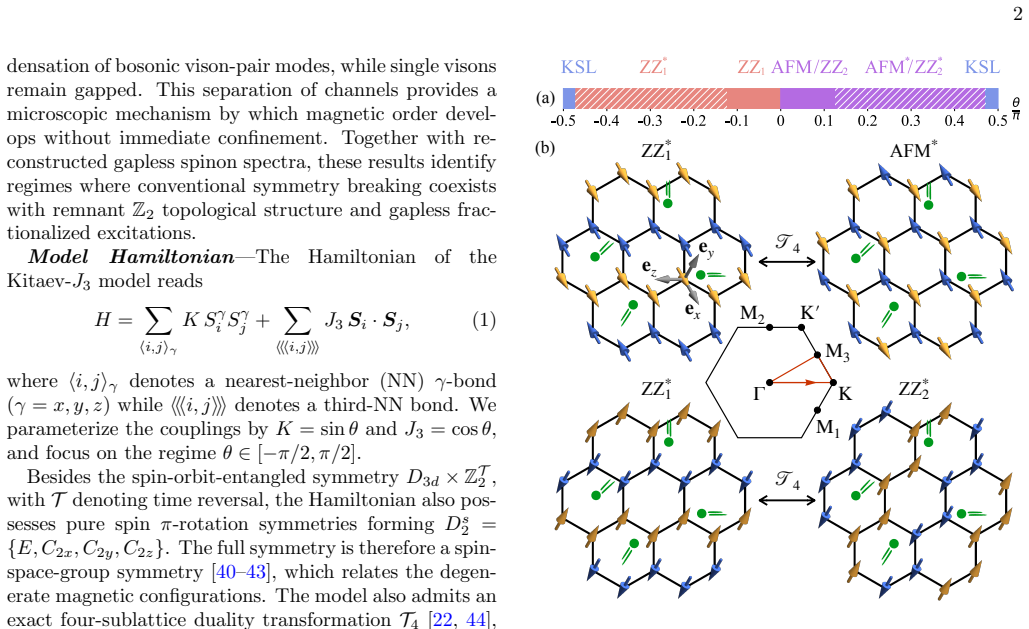
We investigate the Kitaev-$J_3$ honeycomb model using variational Monte Carlo calculations combined with a vison-quasiparticle analysis of the parent Kitaev spin liquid (KSL). We provide evidence for deconfined magnetic phases in which zigzag or antiferromagnetic order coexists with remnant $\mathbb{Z}_2$ topological structure inherited from the KSL. The optimized variational wave functions retain multiple linearly independent topological sectors on a torus, whereas those of conventional ordered phases collapse to a single sector. The vison-quasiparticle analysis shows that magnetic order naturally arises from vison-pair condensation while single visons remain gapped, yielding a microscopic mechanism for magnetic ordering without immediate confinement. The resulting phases further host gapless spinons with multiple Majorana cones, offering a possible microscopic scenario for the anomalous low-temperature longitudinal thermal transport reported in magnetically ordered Kitaev materials such as Na$_2$Co$_2$TeO$_6$. Our results reveal a microscopic route to fractionalized magnetism beyond the conventional dichotomy between magnetic order and spin-liquid behavior.
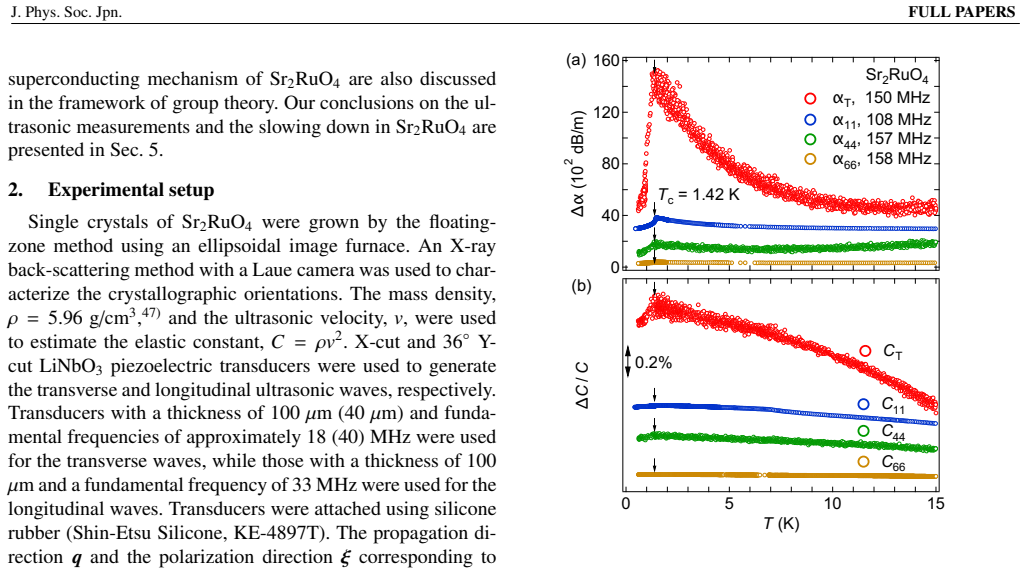
We performed ultrasonic measurements on the unconventional superconductor Sr$_2$RuO$_4$ to investigate the dynamical properties of the electronic states near its superconducting transition temperature, $T_\mathrm{c} = 1.4$ K. We observed an increase in the in-plane transverse ultrasonic attenuation coefficient as the temperature approached $T_\mathrm{c}$. The ultrasonic attenuation exhibited a Landau-Khalatnikov-type ultrasonic frequency dependence with a typical relaxation time of approximately $10^{-10}$ s. Under an applied magnetic field of 10 T, the superconducting transition was suppressed. However, the ultrasonic attenuation coefficient exhibited an increase down to low temperatures, indicating the slowing down of fluctuations associated with multipole degrees of freedom. Based on group-theoretical considerations, we propose that the electric hexadecapole plays a crucial role in the slowing down. Furthermore, we discuss the relationship between multi-component superconducting order parameters and multipole degrees of freedom.
The quantum Kramers-Wannier (KW) duality is a fundamental transformation mapping short-range entangled (SRE) states to long-range entangled (LRE) states. While spatially local unitary circuits require linear-in-system-size depth to implement this duality, the ultimate speed limit for purely unitary circuits equipped with nonlocal connectivity remains an open question. Here, we explicitly construct logarithmic depth, spatially nonlocal unitary circuits that realize the exact $\mathbb{Z}_2$ KW dualities in both one and two spatial dimensions. We further generalize the construction to arbitrary $\mathbb{Z}_n$ KW dualities. Unlike algorithms tailored to prepare specific target states, our circuits implement complete duality maps. Within the symmetric (charge-neutral) sector, these dualities exactly transform arbitrary non-fixed-point SRE states into their corresponding LRE duals. Consequently, our results establish an efficient, purely coherent pathway for exploring phase transitions and topological dualities on modern quantum platforms.
The nonlinear Hall effect in quantum materials has attracted broad interest, yet most existing studies focus on the weak-field, perturbative regime. Here we develop a nonperturbative approach based on nonequilibrium steady-state Green's functions for dc-field-driven lattice systems, with dissipation and interactions incorporated through self-energies beyond the constant relaxation-time approximation and interband transitions treated alongside their intraband counterparts. Applied to a two-band semimetal model, our approach provides direct access to the strong-field Hall response beyond the nonperturbative crossover where the edge of the nonequilibrium distribution reaches Berry-curvature hot spots, a regime in which constant relaxation-time estimates and Berry curvature dipole calculations become unreliable. We further demonstrate that interaction and electron-phonon self-energies within dynamical mean-field theory can substantially change the Hall signal. Our framework enables quantitative simulations of nonequilibrium nonlinear Hall phenomena and provides guidance for strong-field transport experiments.
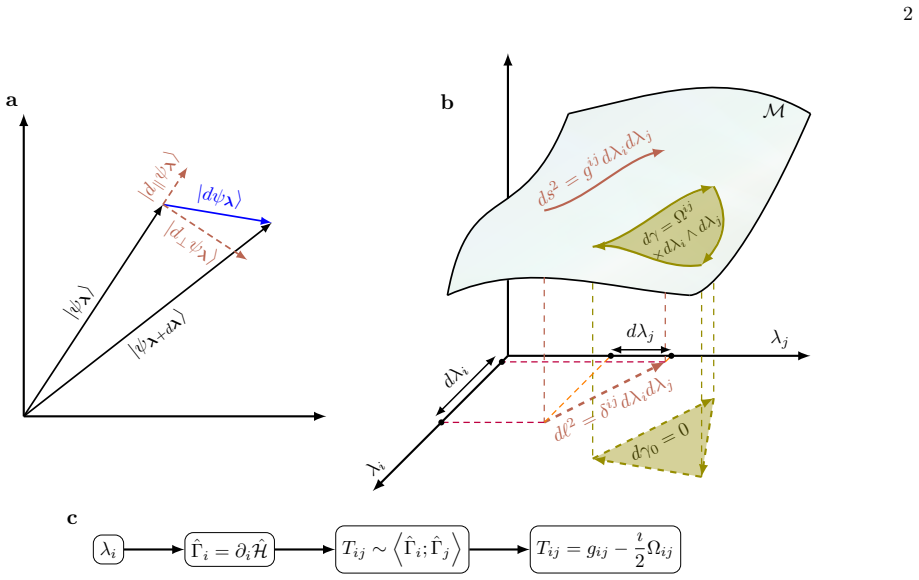
Quantum geometry characterizes the variation of electron wavefunctions in solids along a parameter space. Conventionally, crystal momentum is chosen as the parameter, since it couples to electromagnetic fields, offering an interpretation of quantum geometry in terms of dipole matrix elements, polarization fluctuations, and optical responses. However, Bloch momentum is not the only possible parameter space in which a wavefunction can evolve. In this work, we show that quantum geometry can be extended beyond the bare Bloch-band geometry to manifolds whose adiabatic parameters represent deformations of the ground state, including collective bosonic fluctuations, external fields, or structural distortions. We show that the generalized quantum geometric tensor is encoded by correlations of interacting vertices, conjugate to the deformation parameters. By way of illustration, we briefly discuss the application of these extended geometric concepts to manifolds generated by Hubbard-Stratonovich bosonic fields, or Jahn-Teller configurational spaces. The formulation presented here is framed by general manifolds, which extend quantum geometry to generic structural, collective, and interactive many-body systems.
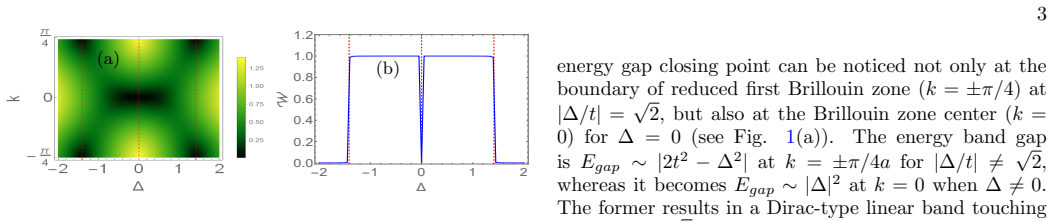
We investigate analytically and numerically the tunneling-induced hybridization and coherent dynamics of Jackiw-Rebbi (JR) zero modes in a modified Su-Schrieffer-Heeger (SSH) model. Unlike the conventional SSH model, this modified system possess two bulk gap closing points, namely, the quadratic-type gap closing point at $k=0$ and the Dirac-type gap closing point at $k=\pm\pi/4a$. While the quadratic point does not support a topological domain wall due to the absence of mass inversion, the low-energy Dirac theory around $k=\pm\pi/4a$ predicts an effective mass that changes sign at two spatially separated interfaces under a kink profile, generating a pair of JR bound states localized at those interfaces. We show that finite overlap between the JR zero modes lifts the zero-energy degeneracy through quantum tunneling, producing symmetric-antisymmetric hybridized states analogous to a quantum mechanical double-well system. An effective two-level description reveals coherent oscillations of the occupation probability between the two JR modes, accompanied by periodic transfer of sublattice polarization between the (A,C) and (B,D) sectors. The oscillation period is governed by the hybridization gap, providing a tunable route for controlling topological bound states. Our results establish a unified framework connecting JR zero modes, quantum tunneling, and coherent dynamics in modified SSH systems, offering a promising platform for controllable topological quantum-state transfer in engineered lattice structures.
Chiral spin liquids carry a hidden bookkeeping problem: the integer Chern number of their fractionalized spinons, the level of the emergent Chern--Simons gauge field, and the fractional spin response actually measured in experiment or simulation are related but distinct quantities, and the literature routinely conflates them. Here we resolve this by deriving the exact parity-odd determinant of a gapped Dirac cone on a spatial cylinder, resummed to all orders in the compact holonomy rather than truncated at leading order. The result proves that finite-circumference corrections to the topological response are strictly exponential, with no universal $1/L$ term, and fixes the precise map from microscopic spinon Chern number to physical spin Hall conductance. We validate this chain of reasoning on the kagome lattice at three independent levels: an exact parton band-structure calculation ($C=-1$, converging exponentially over cylinders four to twelve sites wide), and an interacting density-matrix renormalization group flux pump ($\nu_s=-0.500\pm0.011$) that agrees with the analytic prediction without any adjustable parameter. Together, these results turn a one-loop anomaly calculation into a quantitatively verified bridge between microscopic topology and observable fractional response.
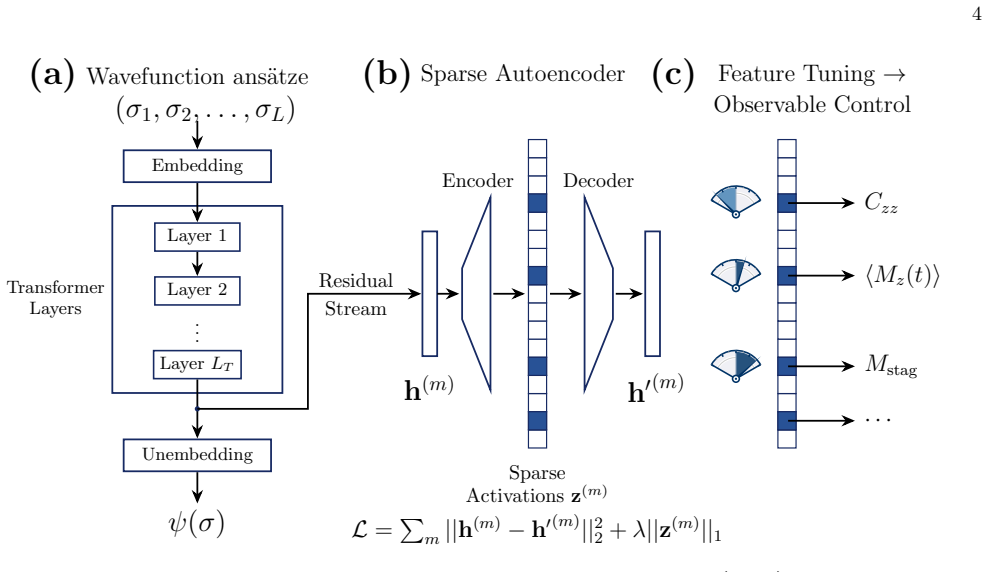
Neural Quantum States (NQS) are a remarkably expressive class of variational ans\"atze for quantum many-body wavefunctions, yet little is understood about their internal mechanisms: trained on variational objectives alone, how do NQS accurately capture physical observables that they have never been explicitly optimized for? In this work, we present a systematic approach to analyze the internal activations of NQS using sparse autoencoders. We extract features from the residual stream and demonstrate that these features strongly correlate with physical observables such as order parameters, staggered magnetization, and half-chain correlators, across both ground state representation and real-time dynamics. Remarkably, the discovery of these features is entirely unsupervised, with no physical labels provided. We further establish that such features causally affect the corresponding observables predicted by NQS, by showing that targeted, post-training intervention on a \textit{single} feature smoothly and monotonically steers the corresponding observable, while leaving the variational energy nearly unchanged. These results demonstrate that NQS are not merely functional approximators, but encode rich, interpretable internal representations of physical information. Our approach provides both a diagnostic and an intervention tool for NQS, and serves as a foundation for using mechanistic interpretability towards more reliable, transparent NQS.
Quantum entanglement plays a leading role in modern understanding of physical systems, from quantum phases of matter to quantum gravity. In quantum information theory, one seeks operationally meaningful quantifiers of entanglement, which for large quantum systems are notoriously difficult to evaluate due to the lack of computationally efficient algorithms. In this Letter, we show that for large random induced mixed states the logarithmic negativity, an efficiently computable entanglement measure, generically coincides with the exact entanglement cost under positive-partial-transpose-preserving operations, thereby acquiring a precise operational interpretation. Our results establish logarithmic negativity as an exact characterization of entanglement in generic many-body states and provide a tractable route for quantifying entanglement in complex quantum systems.
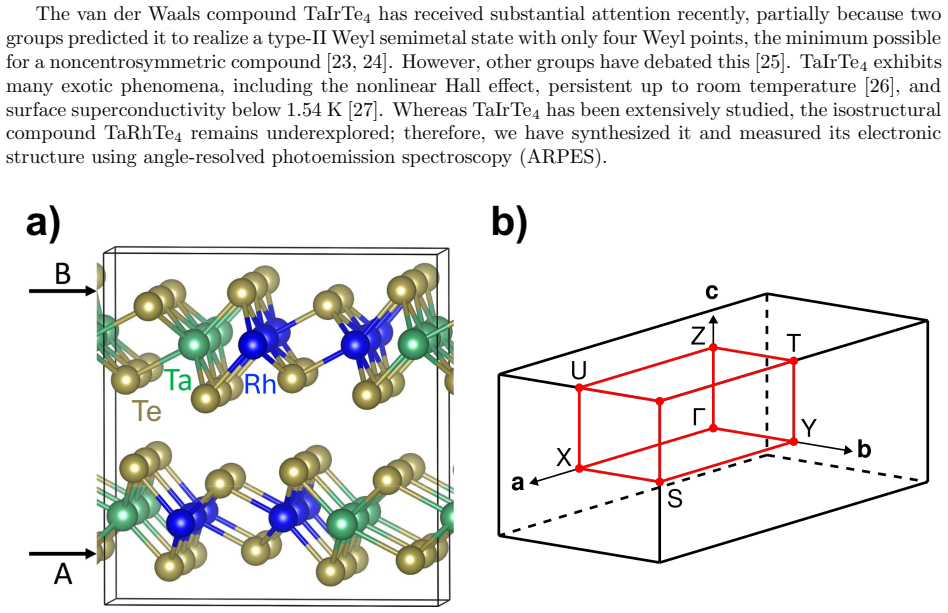
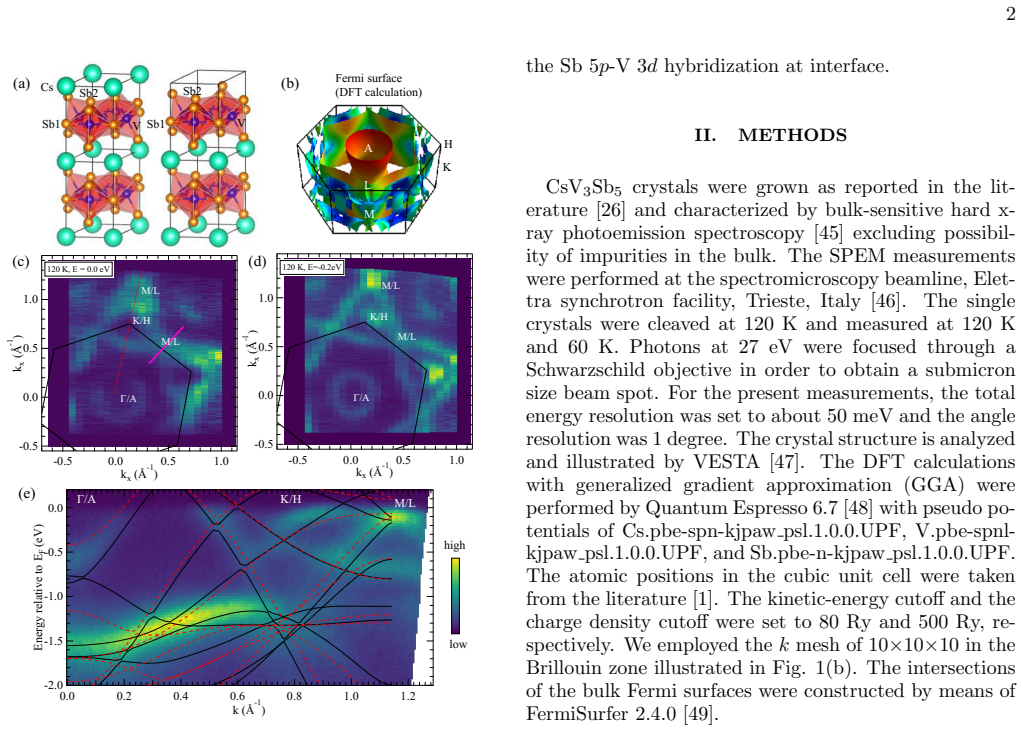
Flat bands have been theoretically predicted for decades but have only recently been realized in quantum materials such as magic-angle twisted bilayer graphene, kagome and Lieb lattices, and rare-earth metal compounds. To date, only twisted layered materials have enabled tuning of flat-band energies near the electronic chemical potential, thereby influencing transport and thermodynamic properties. Here, we report the presence of flat bands near the chemical potential in bulk TaRhTe$_{4}$, a noncentrosymmetric van-der Waals type-II Weyl semimetal. Flat bands are rarely observed in Weyl semimetals, particularly in nonmagnetic bulk systems, and the observed flat bands were not predicted by density functional theory calculations. TaRhTe$_{4}$ therefore provides a platform in which nontrivial topology coexists with flat bands near the Fermi level, as evidenced by our angle-resolved photoemission spectroscopy measurements.
The regularization links critical phenomena to noncommutative geometry and the quantum Hall effect via state-operator correspondence on S^2
abstractclick to expand
This review discusses the recently proposed fuzzy sphere regularization for studying $2+1$D critical phenomena, particularly three-dimensional (3D) conformal field theory (CFT). The fuzzy sphere scheme not only offers remarkable efficiency in extracting extensive CFT data at low computational cost but also reveals unexpected connections among 3D CFT (critical phenomena), noncommutative geometry, and the quantum Hall effect. We introduce the fundamental ideas of fuzzy sphere regularization, emphasizing its role in demonstrating the state-operator correspondence of 3D CFTs on the $S^2 \times \mathbb{R}$ geometry. Additionally, we review key developments in this approach across various directions and outline potential future applications.
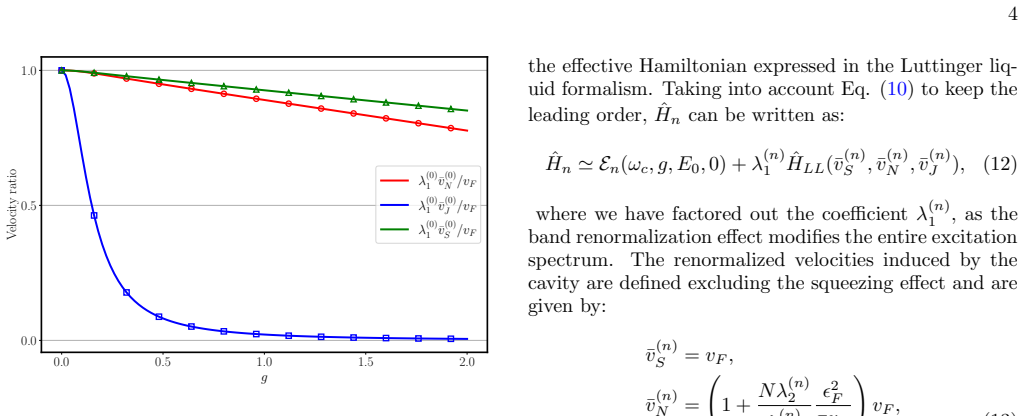
We study a one-dimensional electronic chain coupled to a homogeneous quantized vacuum field and electron-electron interactions. In the absence of the latter, we derive a low-energy effective description in the presence of light-matter coupling, which we identify as a strange Luttinger liquid. Although it retains a formal resemblance to conventional Luttinger liquid theory, the coupling to the quantum field qualitatively modifies the low-energy sector and breaks the standard velocity relation underlying Luttinger universality. For finite electron-electron interactions, we recover a phase diagram featuring several phases as a function of interaction strength and hopping amplitude, including a phase hosting Majorana-like zero modes. Using exact diagonalization, we compute observables that characterize the phase boundaries and show that the cavity field significantly shifts them. We also study the fate of Majorana-like states under the influence of the cavity field, highlighting their modification by light-matter coupling. Finally, we investigate whether the strange Luttinger liquid description identified in the noninteracting regime continues to hold when electron-electron interactions are introduced.
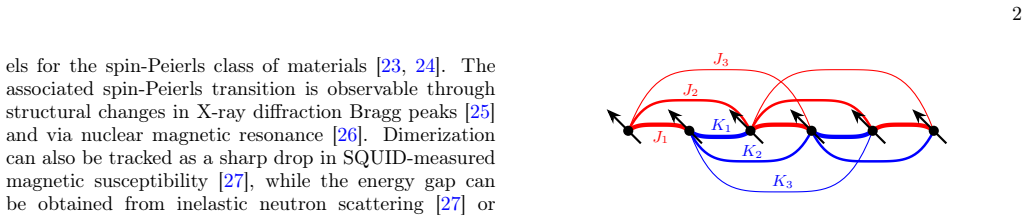
Interacting spin chains and ladders are known to support a plethora of quantum phases with complex ground-state phase diagrams. In this work, we study a large family of such models and determine precise, explicit conditions under which an exact dimer state is guaranteed to be the ground state. These general conditions are validated for various generalizations of the Majumdar-Ghosh model using exact diagonalization. Our results provide exact reference points in the phase diagrams of a wide class of spin chains and ladders, including those with anisotropic and arbitrary-range interactions.
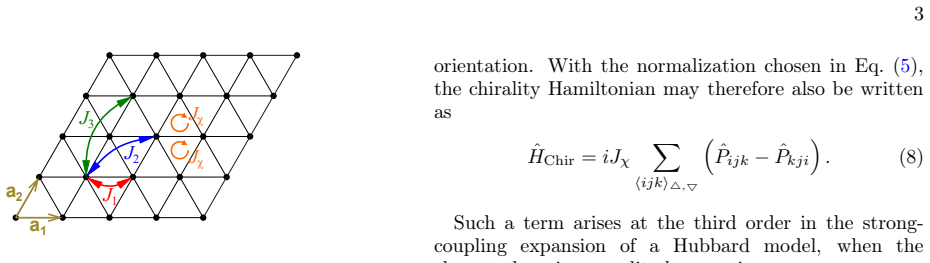
We study one- and two-magnon excitations above the fully polarized state of the spin-$1/2$ triangular-lattice $J_1$-$J_2$-$J_3$ Heisenberg model with an additional uniform scalar-chirality interaction. In the one-magnon sector of the Heisenberg model, we identify two special minimum manifolds by rewriting the dispersion in complete-square form. The scalar-chirality term cancels exactly in this sector, leaving the one-magnon dispersion and the single-magnon instability unchanged. In contrast, it survives in the two-magnon sector as an oriented interaction between neighboring flipped spins. Using symmetry-adapted triangular-lattice harmonics, we derive finite-dimensional gap equations at the $\Gamma$ point in the symmetry-resolved $\mathsf{A_1}$ and $\mathsf{E_2}$-type partial-wave channels. The chirality coupling splits the two opposite relative-motion chiralities in the $\mathsf{E_2}$-type sector, thereby selectively enhancing one two-magnon bound-state channel. Exact diagonalization confirms this mechanism and reveals enhanced binding, as well as additional bound states at $M$ and at incommensurate total momenta. Our results identify scalar chirality as an efficient microscopic mechanism for strengthening two-magnon binding without shifting the one-magnon spectrum, and provide a route toward high-field spin-nematic and multipolar instabilities.
Moir\'e superlattices host narrow minibands whose bandwidth governs correlated and topological phases. Here, we demonstrate that the bandwidth also sets the critical current for the onset of out-of-equilibrium transport. In bilayer graphene aligned to hexagonal boron nitride, we explore the high-current transport regime as we continuously flatten the valence miniband using an out-of-plane displacement field. We observe a significant reduction in the critical current, which is captured by a minimal analytical model and corresponds to the calculated narrowing of the miniband. Moreover, by comparing distinct moir\'e platforms, we show that the scaling between critical current and bandwidth is a universal feature of graphene superlattices. Our results reveal a direct link between miniband dispersion and high-current transport, and establish this regime as a fast and accessible electrical probe of bandwidth evolution.
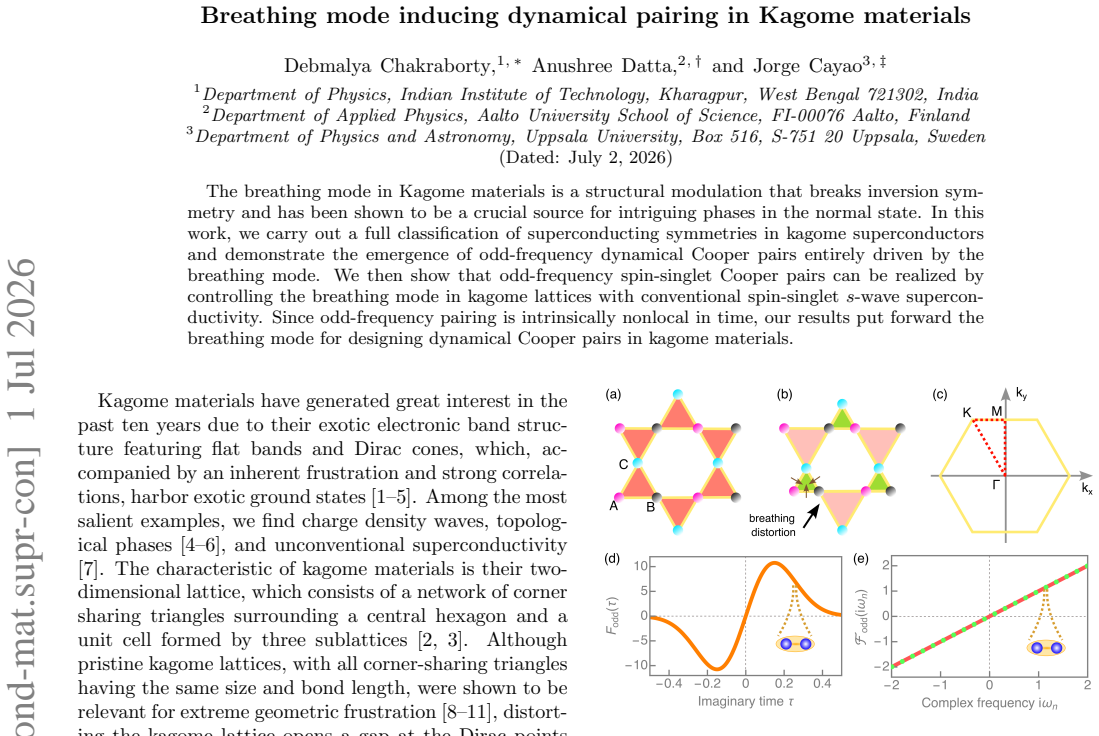
The breathing mode in Kagome materials is a structural modulation that breaks inversion symmetry and has been shown to be a crucial source for intriguing phases in the normal state. In this work, we carry out a full classification of superconducting symmetries in kagome superconductors and demonstrate the emergence of odd-frequency dynamical Cooper pairs entirely driven by the breathing mode. We then show that odd-frequency spin-singlet Cooper pairs can be realized by controlling the breathing mode in kagome lattices with conventional spin-singlet $s$-wave superconductivity. Since odd-frequency pairing is intrinsically nonlocal in time, our results put forward the breathing mode for designing dynamical Cooper pairs in kagome materials.
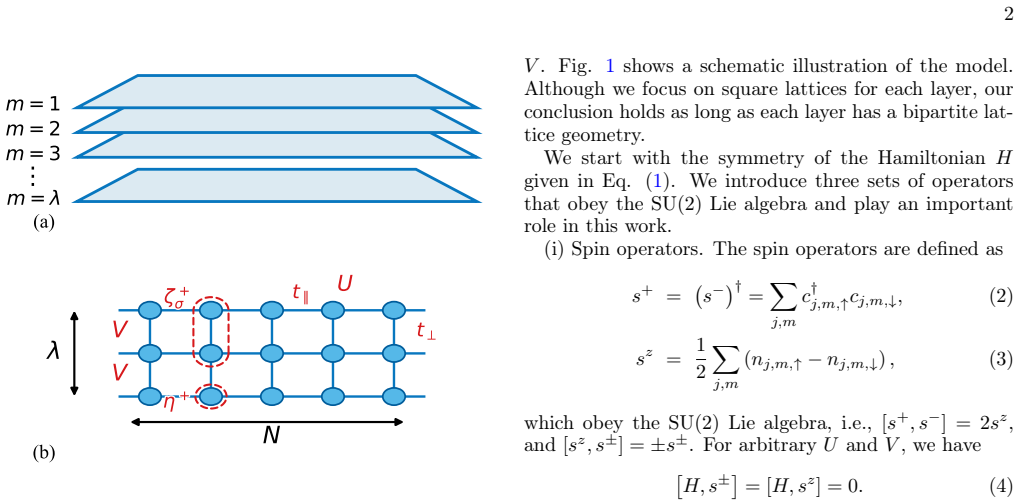
$\eta$-pairing symmetry generalizes the pairing mechanisms in superconductivity but is broken in the presence of interlayer interactions. In this work, we extend this approach to triplet pairs. We propose interlayer triplet-pairing operators for the multi-layer extended Hubbard model. We find that a set of exact condensate-pair eigenstates can be constructed, which exhibit off-diagonal long-range order. In contrast to the $\eta$-pairing mechanism, this originates from restricted spectrum generating algebra and is only available for bilayer and trilayer systems in the presence of interlayer Hubbard interactions. Nevertheless, the system also retains the original on-site $\eta$-pairing symmetry in the absence of interlayer interactions. Consequently, both singlet and triplet pairs coexist in the eigenstates of the multi-layer Hubbard model. We employ quench dynamics to demonstrate the results through numerical simulations. Our findings open avenues for the study of exact condensate-pair states in strongly correlated systems.
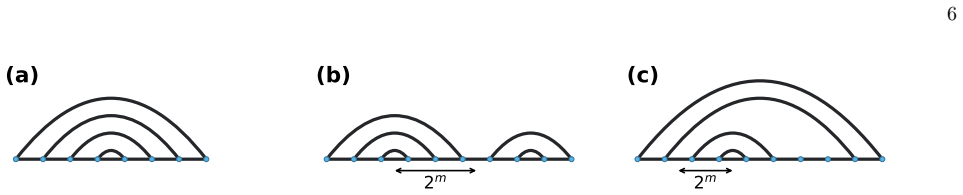
Understanding quantum materials at meso and even macroscopic scales requires tight-binding calculations on system sizes where explicit matrix representations become prohibitively costly. This represents a major bottleneck to rationalize phenomena in moir\'e and super-moir\'e heterostructures and quasicrystals. Here, we present a unified tensor-network methodology to solve tight-binding problems at exceptionally large scales, by mapping a system of $N = 2^L$ sites onto a many-body problem of $L$ pseudospin sites, which is subsequently solved with tensor network algorithms. For Hamiltonians with compressible real-space structure, the tensor network bond dimension remains modest, typically of order a few tens, independent of $N$.Tensor network representations of arbitrary hopping functions including long-range, spatially modulated, and twisted-layer couplings are built with quantics tensor cross interpolation, and all physical observables are evaluated entirely with tensor network algebra without explicit matrix storage or diagonalization. We demonstrate applications to spectral functions, momentum-space spectra via the tensor-network quantum Fourier transform, real-space topological invariants, real-time dynamics, correlation induced symmetry breaking with self-consistent mean-field calculations, non-Hermitian phenomena, and excitonic many-body physics. Our methodology enables routinely solving systems with billions of sites, by leveraging the tensor network compressibility of real-space structures, and establishing a flexible framework to study quantum matter at ultra-large length scales. The methodology is implemented in the open-source Julia package TensorBinding.jl.
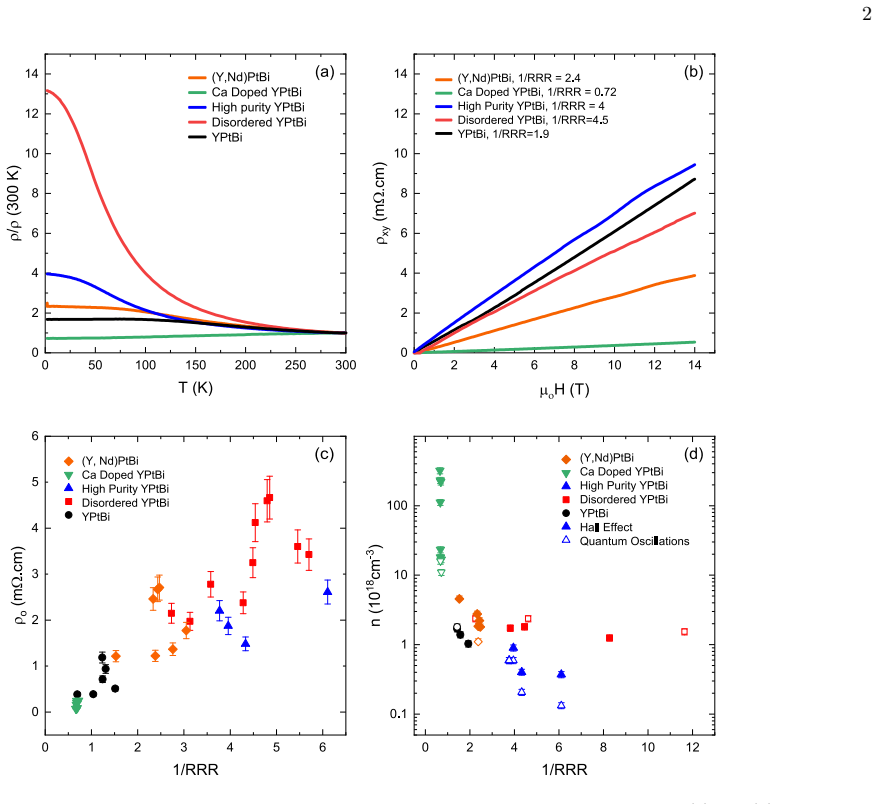
Cooper pairing in most of the known fermionic superfluids occurs via spin-1/2 quasiparticle interactions that lead to spin-singlet or spin-triplet pairing. In the topological semimetal YPtBi, strong spin-orbit coupling results in a band inversion between highly symmetric $s$- and $p$-like electronic bands and a degeneracy at the $\Gamma$ point that ensures the manifold of $j$=3/2 quasiparticle states thrive near the Fermi level, where superconducting pairing occurs. Here we study the effects of magnetic and nonmagnetic disorder and carrier density on this exotic superconducting pairing state. By varying levels of disorder and carrier densities by nearly two and three orders of magnitude, respectively, we show that the superconducting critical temperature of YPtBi has a remarkable robustness, with little variation across this span. Our results suggest that superconductivity in YPtBi may reside in a regime where phase stiffness, rather than pair formation, governs the transition temperature. The insensitivity of Cooper pairing to dramatic changes in quasiparticle environment in a $j$=3/2 superconductor highlights a new form of protection realized in topological high-spin superconductors.
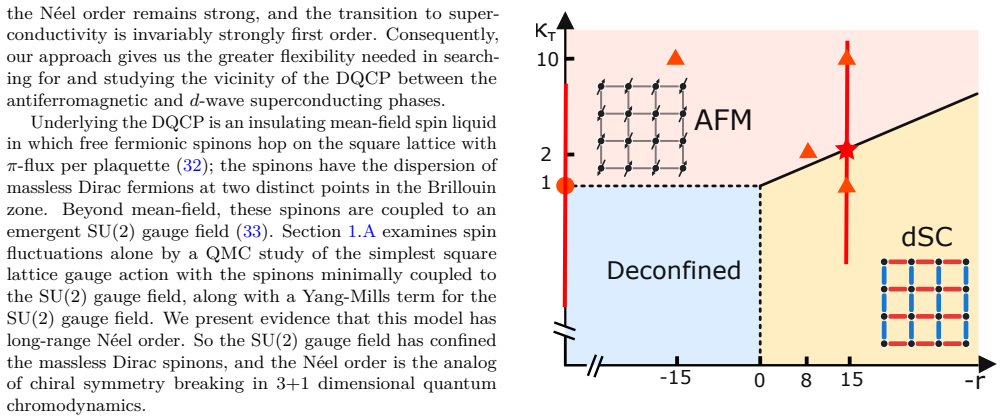
We present a quantum Monte Carlo study of the transition between the insulating N\'eel state and the nodal $d$-wave superconductor on the square lattice at half-filling. We access a regime of frustrated magnetic order without a sign problem using a parton representation of the electron in terms of fermionic spinons and bosonic chargons. Both partons move in a background $\pi$-flux (so the electron experiences no net flux) and are coupled to a quantum fluctuating SU(2) lattice gauge field. In contrast to earlier studies directly on the electronic degrees of freedom, we find evidence for a second-order deconfined quantum phase transition at which both the N\'eel and $d$-wave superconductivity orders vanish continuously. We compute correlators of the spinon-chargon composite with the same quantum numbers as the electron: we find a gapless Dirac dispersion inside the $d$-wave superconductor, turning into a gapped dispersion in the antiferromagnet.
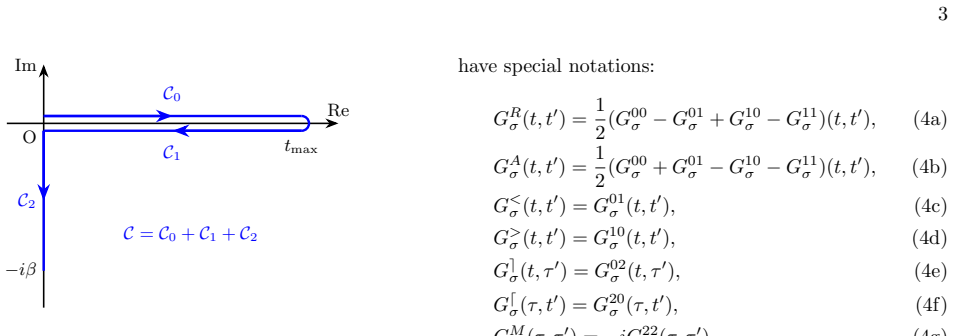
Simulating nonequilibrium quantum many-body systems remains a major challenge due to the exponential growth of the computational complexity with real time. Here we implement a nonequilibrium impurity solver based on the weak-coupling expansion and the tensor cross interpolation (TCI), and apply it to nonequilibrium dynamical mean-field theory (DMFT). The method approximates the integrands of the high-dimensional integrals arising in the weak-coupling expansion in a tensor-train form, enabling efficient evaluations without stochastic sampling and thereby mitigating the sign problem affecting continuous-time quantum Monte Carlo (CT-QMC) methods. Benchmark calculations for an exactly solvable nonequilibrium impurity model agree well with the exact results and reveal a low-rank structure of the integrands. When applied to interaction-quench problems in the half-filled Hubbard model, the method reproduces fast thermalization at a critical interaction strength with accuracy comparable to CT-QMC. Away from half filling, where the sign problem becomes even more severe, the present approach remains well controlled, revealing a crossover instead of a sharply defined fast thermalization point in the 3/4-filled case. The solver can also be applied to steady-state DMFT problems, yielding accurate spectral functions in the metallic regime without analytic continuation.
Achieves 0.0033% noise and 40:1 extinction while switching between linear, circular, and elliptical states without breaking vacuum.
abstractclick to expand
Magneto-infrared spectroscopy under strong magnetic fields provides a powerful probe of Landau quantization and field-induced collective excitations, yet its full potential has long been constrained by the lack of in-situ polarization control, because the highly divergent infrared beam propagating through narrow light tubes undergoes multiple wall reflections, leading to severe polarization degradation. Here we report a collimated magneto-infrared spectroscopy system that integrates continuous in-situ polarimetry. The system employs incident and exit collimation chambers forming a Kepler type optical architecture, which converts the large-aperture FTIR output into a low-divergence beam and strongly suppresses multi-reflection trajectories inside long gold-plated light tubes, thereby enhancing both optical throughput and polarization fidelity. A remotely controlled polarization module, consisting of an automated linear polarizer and a switchable Fresnel rhomb positioned entirely outside the high-field region, enables continuous in-situ tuning between linear, circular, and arbitrary elliptical polarization states without thermal cycling, manual realignment, or breaking vacuum. Interchangeable compact focusing modules further support Faraday and Voigt geometries in both transmission and reflection experiments within a 50 mm magnet bore, providing efficient beam focusing and signal collection while maintaining polarization fidelity. The setup achieves a minimum root-mean-square noise of 0.0033%, an average noise of 0.0082%, and a linear polarization extinction ratio up to 40:1. We demonstrate the capability through continuous in-situ linear polarimetry and broadband circular polarimetry in the magneto-infrared spectroscopy of various single crystals. This platform establishes a robust experimental framework for in-situ polarization-resolved magneto-infrared spectroscopy.
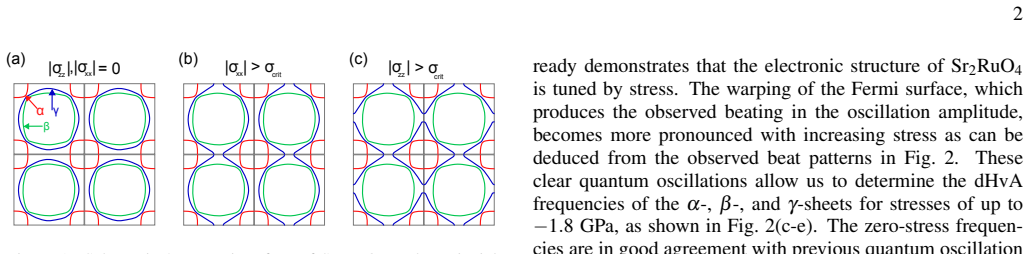
Uniaxial stress has now been widely used to study correlated electron materials. However, Fermi surface-resolved experimental data on the evolution of the electronic structure under piezoelectrically applied stress are sparse, with no reports of de Haas-van Alphen (dHvA) effects under uniaxial stress. Here we present dHvA measurements under $c$-axis uniaxial stress on the unconventional superconductor $\mathrm{Sr}_2\mathrm{RuO}_4$. This allows us to study the evolution of the electronic structure directly and to gain insight into the contradicting behavior of the predicted enhancement of the electronic density of states and the observed suppression of $T_\text{c}$. We are able to follow all Fermi surfaces for stress up to $-1.8$~GPa and find that the cross-sectional areas of the hole-like $\alpha$ sheet increase and electron-like $\beta$ sheet decrease. At the same time, the area of the electron-like $\gamma$ sheet increases. Therefore, in contrast to in-plane uniaxial stress, charge transfer is the mechanism for approaching the electron-to-hole Lifshitz transition and the associated Van Hove singularity. Additionally, we find that the effective masses on all three Fermi sheets are slightly enhanced as the Lifshitz transition is approached. We compare the dHvA results with quantum oscillations in the magnetostriction and band structure calculations, and find good agreement. At a more general level, our findings show that quantum oscillation measurements under uniaxial stress, combined with band-structure calculations, offer a promising new route for studying quantum materials.
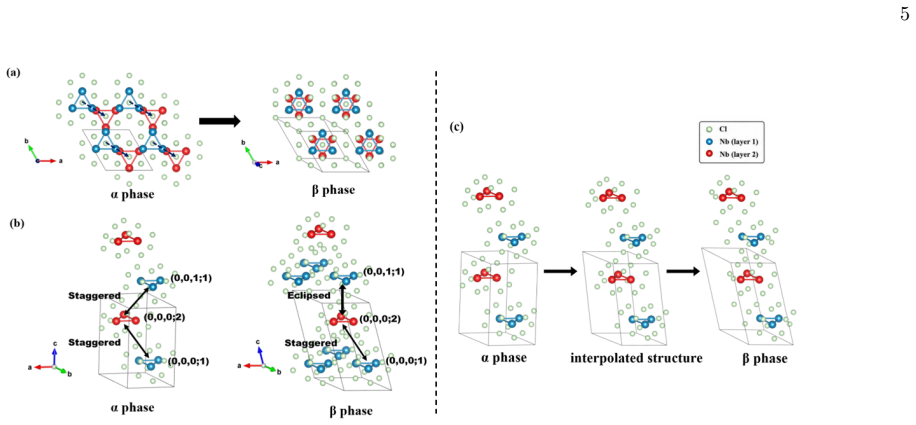
As a prototypical flat-band cluster Mott insulator on an effective triangular lattice, Nb$_3$Cl$_8$ is a potential candidate for hosting a quantum spin liquid (QSL) state. Nevertheless, a first-order structural phase transition around 90K transforms the high-temperature paramagnetic $\alpha$ phase into the low-temperature nonmagnetic $\beta$ phase, suppressing the candidate QSL regime of the $\alpha$ phase. To clarify the microscopic origin of this transition, we combine first-principles calculations with an extended Hubbard model to construct a unified free-energy framework. This framework reveals that the transition is jointly driven by phonon and spin entropy: the $\alpha$ phase is stabilized by softer phonons and larger paramagnetic spin entropy, whereas the $\beta$ phase is favored by interlayer dimerization, which hardens the phonons and quenches the spin entropy through singlet formation. Furthermore, by evaluating the pressure-dependent generalized enthalpy, we provide a thermodynamic explanation for the suppression of the transition under c-axis uniaxial pressure, where stabilizing the $\alpha$ phase may allow the candidate QSL regime of the $\alpha$ phase to be explored at low temperatures.
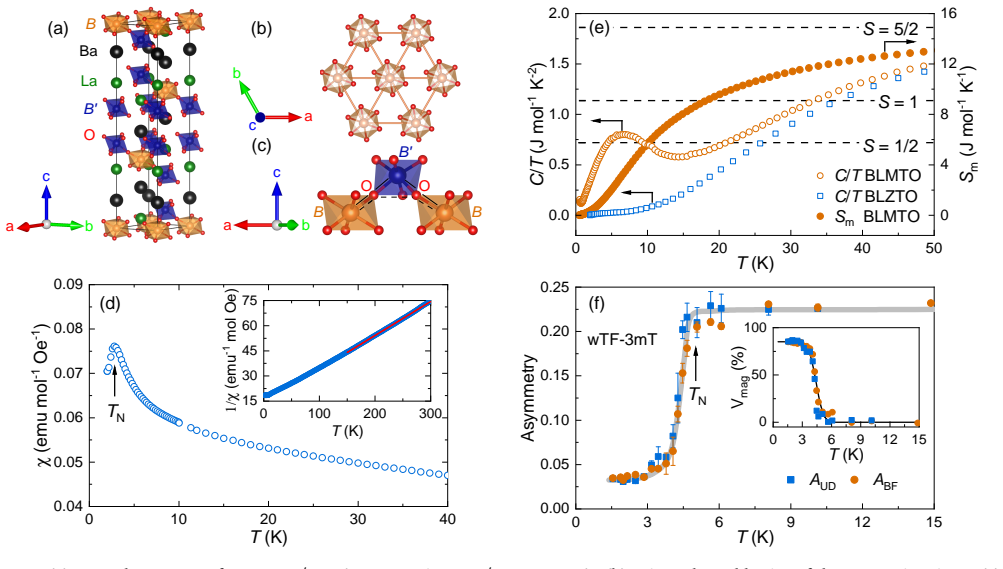
Exotic quantum phenomena are often found to occur in spin systems that exhibit low-dimensional magnetism. By combining nuclear magnetic resonance, neutron scattering, and muon-spin spectroscopy ($\mu$SR) techniques, we report a rare instance of strongly frustrated two-dimensional (2D) magnetism in a three-dimensional (3D) hexagonal perovskite. Here, Ba$_2$La$_2$MnTe$_2$O$_{12}$, a triangular-lattice magnet, is shown to undergo a magnetic transition at $T_\mathrm{N} \approx$ 4.4 K, below which the manganese moments form a 120$^{\circ}$ AFM order within the $ab$-plane, while staying disordered along the $c$-axis. This exotic ground state, which exhibits ideal 2D magnetism, is highly consistent with the persistently strong spin fluctuations and the large internal field distributions revealed by zero-field $\mu$SR. Further, the 2D magnetism also leads to a significant frustration, much larger than that of most known magnetically-ordered frustrated systems. Our work on Ba$_2$La$_2$MnTe$_2$O$_{12}$ not only challenges the interpretations of magnetic order in other 3D hexagonal perovskites, but it also provides insight into how the dimensionality affects the exotic magnetic states.
Structurally well-ordered NiS$_2$ nanocrystals with an average diameter of $27.0 \pm 6.5$ nm retain the bulk-like two-step antiferromagnetic transitions, as shown by magnetization and heat-capacity measurements. Below the lower transition, the nanocrystals exhibit a hysteretic ferromagnetic response with large coercivity, exchange bias, and a vertical loop shift after field cooling, whereas the $M$-$H$ response just above the transition is nearly linear. These features are best explained by uncompensated surface moments generated where the low-temperature antiferromagnetic order terminates at the nanocrystal surface. The absence of a clear additional bulk-like weak-ferromagnetic component constrains homogeneous-canting models and indirectly favors a domain-wall scenario for the weak ferromagnetism of bulk NiS$_2$.
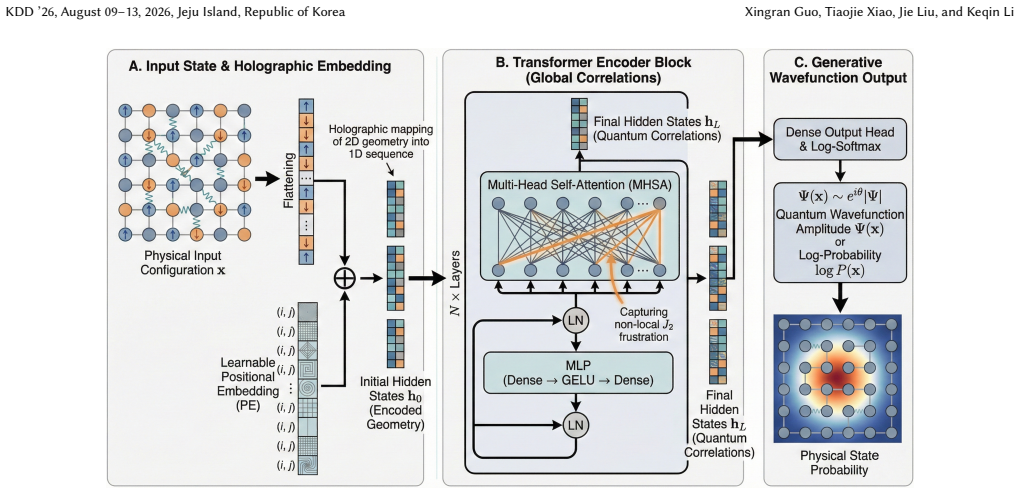
Simulating two-dimensional frustrated quantum matter is a grand challenge due to the sign problem and exponential Hilbert space complexity. In this work, we introduce the Holographic Quantum Transformer (HQT), a physics-inspired generative architecture that leverages global self-attention to resolve non-local entanglement patterns. We validate HQT on the square lattice $J_1-J_2$ Heisenberg model. On the heavily frustrated $8 \times 8$ lattice at the quantum critical point ($J_2=0.5$), HQT reaches a ground-state energy per site ($E/N$) of $\mathbf{-0.5001(1)}$, consistent with the expected finite-size scaling trend. Beyond numerical accuracy, HQT exhibits intrinsic physical awareness, autonomously recovering the underlying $J_2$ interaction geometry through interpretable attention maps. Our central contribution is ``Holographic Transfer", a zero-shot size-extrapolation protocol with rapid alignment: a model trained on $8 \times 8$ systems is directly projected onto larger $10 \times 10$ lattices via continuous positional-embedding interpolation and head re-initialization, achieving high-fidelity initialization and rapid convergence. This zero-shot protocol yields an energy of $E/N = \mathbf{-0.49782(3)}$, statistically consistent with the variational state of the art while requiring no from-scratch training on the target lattice. Our results establish generative attention as a scalable paradigm for transferable quantum simulation.
We study the finite-temperature topological order of the three-dimensional $\mathbb{Z}_2$ toric code in a generic magnetic field, where every higher-form symmetry is explicitly broken and can at most be emergent. We show perturbatively, and confirm by large-scale quantum Monte Carlo, that the topological entanglement entropy stays quantized at $\gamma = \ln 2$ throughout the topological phase -- at finite temperature and under the symmetry-breaking field alike -- and collapses to $0$ across the thermal transition, a quantization protected geometrically by the Bianchi identity rather than by any exact symmetry of the system. The plateau $\gamma = \ln 2$ is, however, not invariant under quasi-local channels: a constant-depth channel can generate this identical quantized value from a trivial product state. We therefore introduce the decoded Wilson-loop correlation $f_W$, which quantizes to $1$ in the topological phase and $0$ in the trivial phase as $L\to\infty$ and, unlike $\gamma$, is a quasi-local-channel invariant -- a robust topological invariant of the mixed state.
Understanding how dissipation modifies quantum phase transitions is a central challenge in many-body physics. A paradigmatic example is the one-dimensional Mott transition, which in isolated systems separates a conducting Luttinger liquid (LL) from a Mott insulator (MI). Here, we study the fate of this transition in the presence of dissipative baths locally coupled to the density. Using bosonisation and an exact integration of the bath degrees of freedom, we show that dissipation fundamentally reshapes the phase diagram for bath exponents $s<3/2$, where $s$ characterises the low-energy bath spectrum. Rather than undergoing a direct LL-MI transition, the system develops an intermediate dissipative phase (DP) that is compressible and gapless, yet has zero superfluid stiffness. As a result, the conventional Mott transition splits into two distinct critical phenomena: a Berezinskii-Kosterlitz-Thouless transition from the LL to the DP, followed by a new commensurate-incommensurate transition from the DP to the MI. We derive an effective field theory for the latter transition and characterize its universality. For $1<s<3/2$, the critical exponents vary continuously with the bath exponent as $\beta=\nu=1/z=s-1$, while for $s<1$ the transition is governed by $\beta=\nu=1/z=0$ and the doping vanishes sharper than any power law. State-of-the-art Monte Carlo simulations quantitatively support our predictions. These results demonstrate that dissipation can qualitatively alter the nature of the Mott transition and generate novel critical behaviour in strongly correlated one-dimensional systems.
Constant mode sector on the torus maps to a Harper-Hofstadter model that preserves the magnetic translation algebra when lattice sizes satis
abstractclick to expand
Maxwell-Chern-Simons (MCS) theory in $2+1$ dimensions provides a paradigmatic example of a topological gauge theory with both dynamical and topological degrees of freedom. Its Euclidean formulation suffers from a sign problem, making Hamiltonian numerical approaches particularly attractive. As a first step toward the non-perturbative Hamiltonian study of MCS theory, we investigate the constant mode sector on a spatial torus. Being analytically solvable in the continuum, it provides an ideal benchmark for understanding how the topological properties of the theory are encoded in a finite-dimensional lattice Hilbert space. We construct a finite-dimensional discretization of the torus of flat connections and show that the resulting lattice problem maps onto a generalized Harper-Hofstadter model with twisted boundary conditions. We identify the commensurability conditions under which the finite lattice exactly reproduces the magnetic translation algebra and the topological degeneracy of the continuum theory. A systematic analysis of gauge field truncation and its convergence toward the continuum limit is then presented.
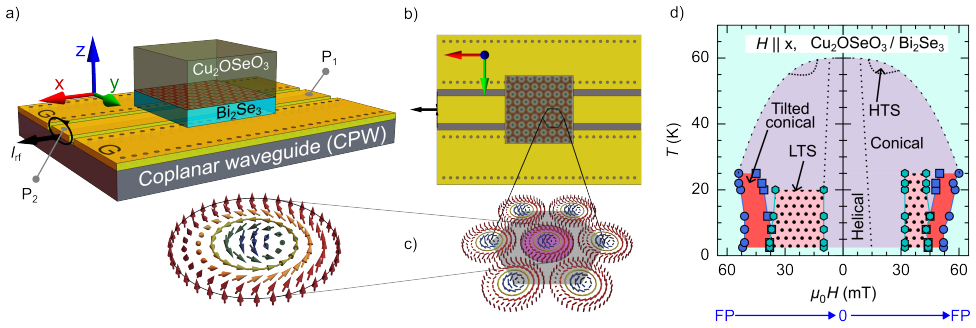
We investigate proximity-induced magnetic interactions at the interface between the topological insulator Bi2Se3 and the chiral magnetic insulator Cu2OSeO3, with particular focus on the low temperature skyrmion phase. Broadband ferromagnetic resonance spectroscopy reveals enhanced stability of noncollinear spin textures in the Cu2OSeO3/Bi2Se3 heterostructure compared with bare Cu2OSeO3. In addition to an extra resonance mode in the tilted conical phase that is absent in bare Cu2OSeO3, field cycling resolves two counterclockwise skyrmion resonance branches separated by approximately 238 MHz, consistent with the coexistence of a bulk skyrmion lattice and an interfacial skyrmion phase stabilized by proximity-induced exchange coupling and enhanced interfacial Dzyaloshinskii-Moriya interactions. The finite frequency separation indicates that the two skyrmion phases occupy distinct magnetic energy landscapes while retaining similar resonance character. Resonant elastic x-ray scattering measurements further confirm that the interfacial skyrmion phase spans a broader magnetic-field range than the bulk phase, demonstrating enhanced stability and ordering of topological spin textures at the interface. These findings establish interface engineering as a promising route for extending the stability regime of skyrmion and tilted-conical phases in topological-magnetic heterostructures.
While unconventional $p$-wave magnets can generate nonrelativistic Edelstein polarizations, spin-group symmetries strictly forbid these responses in unconventional magnets with higher-order harmonics, such as $d$-wave altermagnets. Here, we demonstrate that combining Rashba spin-orbit coupling with bichromatic Floquet driving activates giant perpendicular Edelstein polarizations (PEPs) across 2D altermagnets and broader classes of unconventional spin-polarized magnets -- a feat monochromatic driving cannot achieve. By dynamically breaking two-fold rotational symmetry, the two-frequency drive (including bilinear, bicircular, and circular-linear configurations) induces a stray-field-free in-plane Zeeman-like field that generates orbitally dominated PEPs (0.5--1.5 $\mu_{\rm B}$). This massive response is governed by universal selection rules tied to the system's magnetic parity and the second beam's harmonics. These emergent PEPs provide a powerful mechanism for perpendicular memory writing.
We propose an algebraic framework for the strange metal regime of strongly correlated electrons. We show that the exceptional superconformal algebra $D(2,1;\alpha)$ admits two distinct contractions of its conformal sector: one to a pair of canonical fermions, the underlying degrees of freedom of the Landau-Fermi liquid (LFL), and one to the algebra of Hubbard operators, which characterise a distinct metallic regime, the Hubbard-Fermi liquid (HFL). We argue that competition between these two metallic states drives the emergence of the strange metal as a $0+1$D superconformal bath. We analyse the resulting thermodynamics, and obtain a parameter-free prediction, $4\pi^2\gamma^{-1} =\chi_s^{-1} + \chi_c^{-1}$, relating the Sommerfeld coefficient to the static spin and charge susceptibilities. We further show that the LFL-HFL transition is discontinuous at low temperature, owing to a degeneracy at the emergence of the HFL, and map out the resulting phase diagram. We connect the framework to microscopic lattice models and to the phenomenology of correlated insulators.
The dynamic magnetic pair-density function (DymPDF) $D_{\rm M}(r, E)$ is obtained via the Fourier transform of the dynamic magnetic structure factor, $S_{\rm M}(Q, E)$, which is measured using nonpolarized inelastic neutron scattering. While there is a long history of magnetic excitation studies with $S_{\rm M}(Q, E)$, there are no reports on $D_{\rm M}(r, E)$. In this study, we examine simple magnet models and representative magnet examples, such as FeTiO$_{3}$ and YBa$_{2}$Cu$_{3}$O$_{6}$, to investigate the real-space dynamics of $D_{\rm M}(r, E)$. We derive the $D_{\rm M}(r, E)$ equations for simple magnet models in a low energy limit. By comparing these equations to the simulations, we demonstrate the characteristic energy dependence of real-space local magnon modes, including the transition of the magnon mode from acoustic to optical. Our novel analysis reveals the local magnon modes accompanied by a sign change in each spin-pair correlation at a given energy in nanoscale real space even under non-periodic conditions. This method is unique for studying local magnetic dynamics.
Design principle selects maximal angular momentum character perpendicular to the ligand plane to suppress anisotropy.
abstractclick to expand
Rare-earth quantum materials provide a promising platform for emergent phenomena ranging from quantum spin liquids with long-range entanglement to topological magnetic textures. However, the strong spin-orbit coupling that stabilizes their low-energy pseudospin degrees of freedom also tends to generate strongly anisotropic exchange interactions, complicating the realization of quasi-isotropic Heisenberg magnetism. Here we investigate the microscopic origin of superexchange in $\mathrm{Ce}^{3+}$- and $\mathrm{Yb}^{3+}$-based insulators with edge-sharing octahedral geometry. Using degenerate perturbation theory for a multiorbital Hubbard model, we show that isotropic exchange originates predominantly from virtual hopping within the ground-state Kramers doublet, whereas anisotropic interactions arise primarily from processes involving excited multiplets. This leads to a simple orbital design principle: quasi-isotropic exchange is promoted when the ground-state doublet has a strong maximal-angular-momentum character with respect to the quantization axis perpendicular to the superexchange plane spanned by rare-earth and ligand ions. We demonstrate this mechanism for both ideal and distorted geometries and show that it is broadly consistent with experimentally studied Yb-based insulators. Our results establish a practical framework for engineering quasi-isotropic interactions in rare-earth quantum materials.
We investigate the emergence of topological superconductivity at the two-dimensional heterostructure interface between a $p$-wave magnet (pWM) and an $s$-wave superconductor. By analyzing nodal gap closings, we identify seven distinct nodal topological phases, each characterized by the presence of Majorana zero-energy flat bands and quantized zero-bias conductance peaks. We demonstrate that the effective $p$-wave nature of the system gives rise to spin-triplet pairing correlations with even-frequency, odd-parity and odd-frequency, even-parity symmetries. Notably, the introduction of inter-orbital hopping induces an exotic orbital-singlet term characterized by simultaneous odd-parity and odd-frequency. Furthermore, we explore the transition from static phases to Floquet topological regimes through periodic driving. These driven phases host both zero and $\pi$ Majorana flat bands, with transport signatures governed by the Floquet sum rule. Most significantly, we show that periodic driving fundamentally reshapes the topological and superconducting landscape by generating multiple nodal points that support higher winding numbers and multiple Majorana flat bands, while the emergent Floquet degree of freedom doubles the number of symmetry-allowed Cooper-pair correlations. The first class of correlations is hosted by the even-Floquet sectors and has a direct counterpart in the static limit. In contrast, the second is a distinct Floquet-generated class that confines to the odd-Floquet sectors, representing a fundamentally nonequilibrium pairing channel that cannot exist in static systems. Finally, we demonstrate the robustness of these topological modes against strong disorder, confirming their potential for stable fault-tolerant applications.
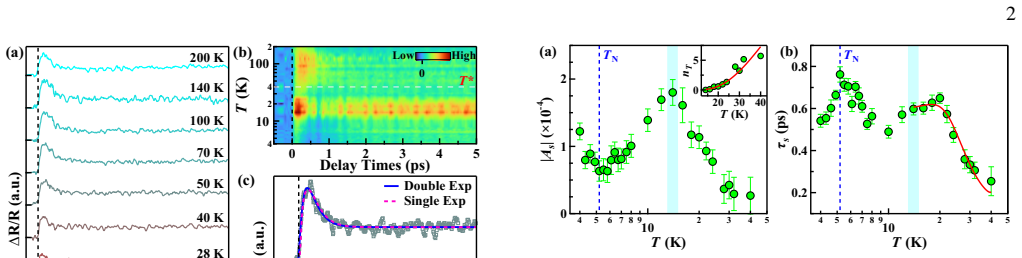
The emergence of heavy quasiparticles in a Kondo lattice is usually viewed as the formation of a low-energy hybridization gap. Whether this gap represents a rigid electronic structure or a fragile many-body state that can be dynamically reconfigured remains a central question for heavy-fermion systems near magnetic order, quantum criticality, and unconventional superconductivity. Here we use femtosecond pump-probe reflectivity to interrogate this problem in the weakly hybridized Kondo-lattice compound CePt$_2$In$_7$. At low fluence, a slow quasiparticle relaxation channel emerges below $T^* \sim$ 40 K and follows a Rothwarf-Taylor bottleneck response with a low-energy recombination scale 2$\Delta \approx$ 7.4 meV. Coherent optical phonons, independently identified by Raman spectroscopy, act as an internal lattice thermometer and rule out large quasi-equilibrium lattice heating as the origin of the nonlinear electronic response. The phonon-free electronic amplitude $A_{\rm elec}$ reveals a fluence-reversal fingerprint: with cooling from the hybridization-crossover regime, the response evolves from weak-linear behavior to Rothwarf-Taylor-like bottleneck suppression and finally to anomalous high-fluence enhancement at the lowest temperatures. This reversal cannot be accounted for by a rigid fixed-gap bottleneck alone and instead identifies an ultrafast optical signature of photoinduced redistribution of a fragile Kondo-hybridized electronic response.
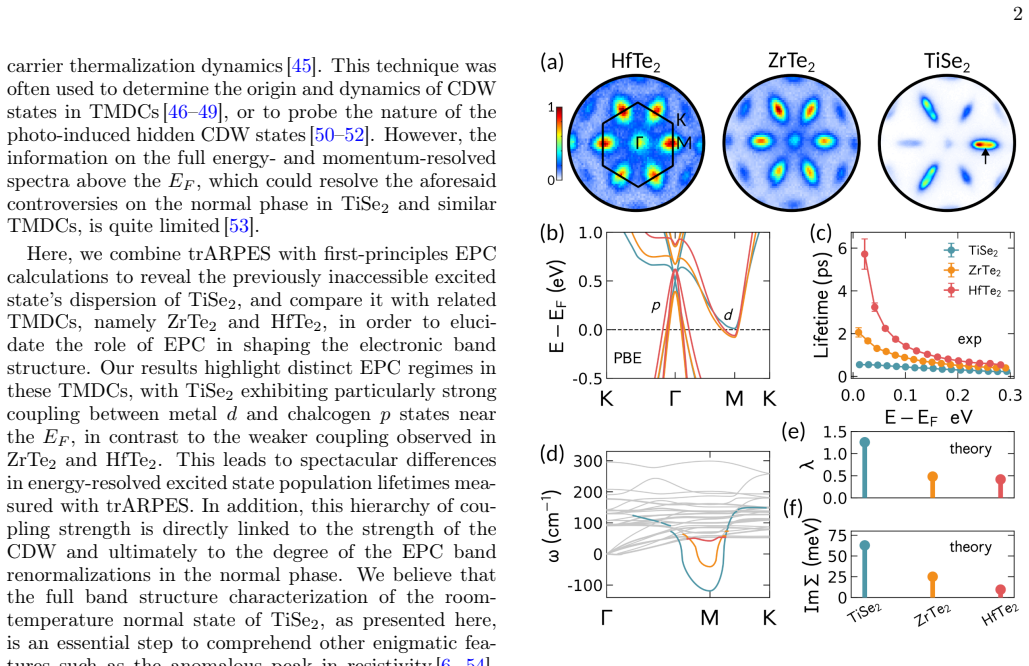
To comprehend quantum ordered states, such as charge density waves (CDW), in layered transition metal dichalcogenides (TMDCs), it is essential to uncover their underlying normal states. Here, we use time- and angle-resolved extreme ultraviolet photoemission spectroscopy and ab initio electron-phonon calculations to perform excited state band mapping of three prototypical 1T TMDCs, i.e., TiSe$_2$, HfTe$_2$, and ZrTe$_2$, at room temperature. The results reveal the profound impact of strong electron-phonon-induced thermal fluctuations on the normal-phase electronic structure. Specifically, in the moderate electron-phonon coupling regime, as in HfTe$_2$ and ZrTe$_2$, thermal fluctuations only lead to small spectral broadening and band renormalization. In the strongly coupled case, exemplified by TiSe$_2$, we observe soft-phonon-induced, momentum-dependent suppression of spectral weight, i.e., pseudogaps - extending up to 1 eV above the Fermi level. Our work establishes the normal phase of TiSe$_2$ as a phonon-induced pseudogap phase governed by strong CDW fluctuations, thereby uncovering previously missing aspects of the TiSe$_2$ phase diagram, with broader implications for other TMDCs in the strong electron-phonon coupling regime.
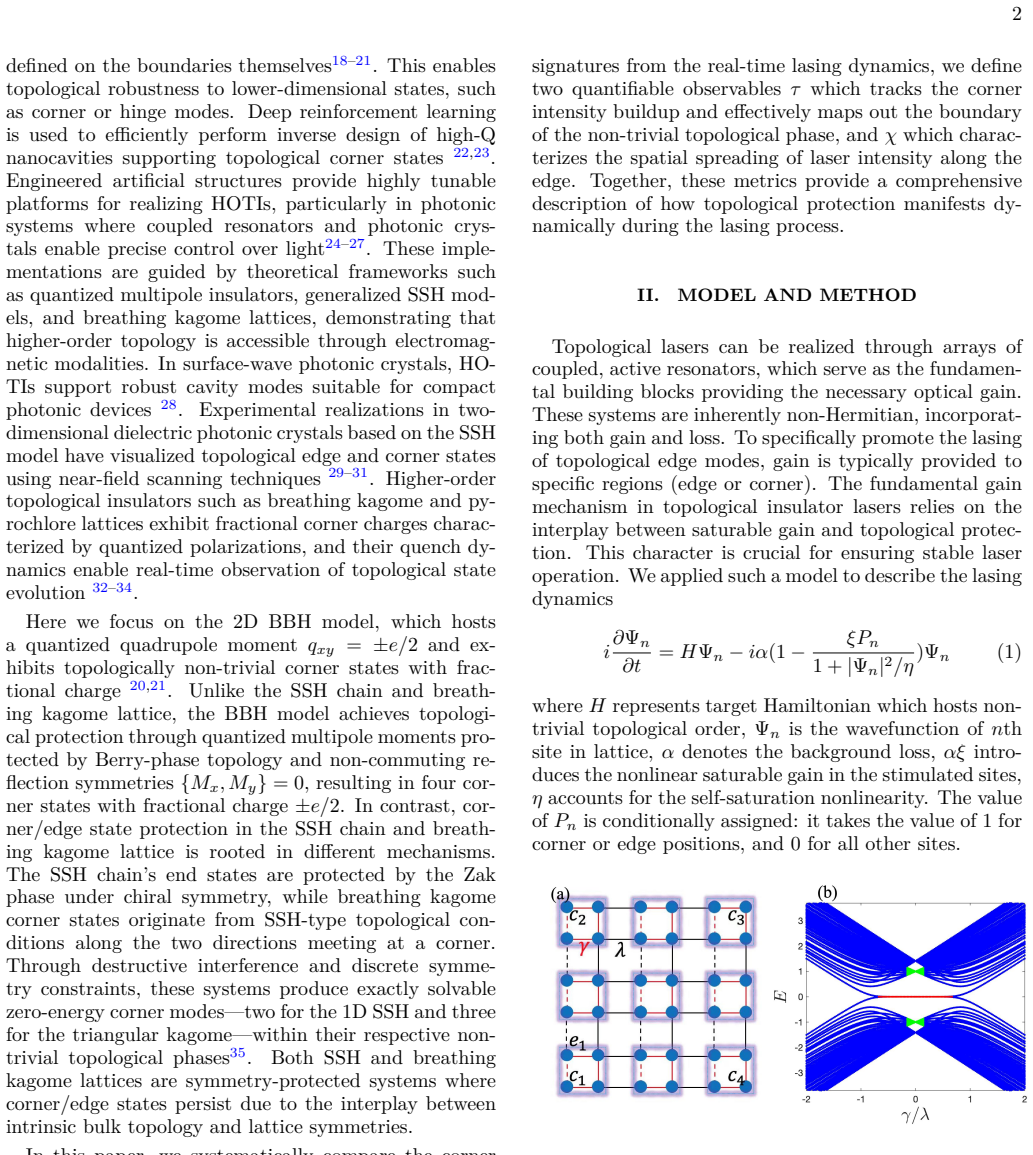
Two-dimensional higher-order topological insulators (HOTIs), characterized by distinctive one-dimensional edge states and zero-dimensional corner states, provide an ideal platform for developing higher-order topological lasers. In this work, we systematically investigate the two-dimensional Benalcazar-Bernevig-Hughes (BBH) model, which hosts quantized quadrupole moments and topologically protected corner and edge states. By confining the lasing mode to selected topological corner or edge states under controlled gain, we demonstrate that the stable light excitation achieved after long-time evolution is predominantly determined by the topological properties of the model Hamiltonian. To characterize the system's topological features, we introduce several diagnostic ratios: the corner decay ratio $\tau_{1}$ and edge-to-corner ratio $\tau_{2}$ quantify the localization degree and spatial extent of corner states, respectively, while the inter-corner transfer ratio $\chi$ measures the intensity transfer efficiency mediated by coherent edge-state dynamics. The abrupt changes in $\tau_{1}$ and $\tau_{2}$ as functions of the hopping parameter $\gamma/\lambda$ directly reveal topological phase transitions, providing a comprehensive toolkit for extracting topological signatures from the system's dynamical evolution. Additionally, modulating the lattice site parity enables flexible tuning of corner state localization positions, offering insights for device engineering. Our calculations reveal that achieving bistability between corner states and edge states is relatively challenging.
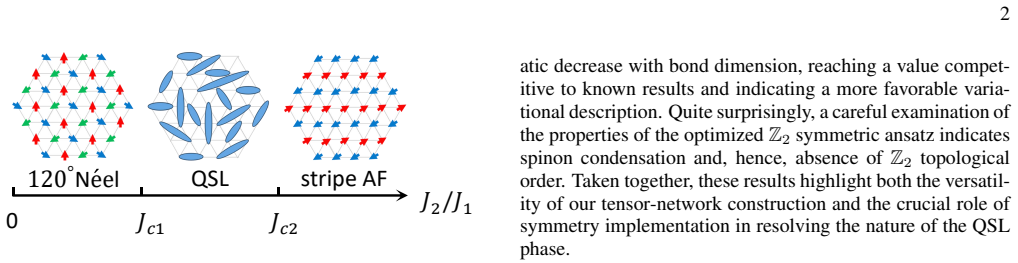
The nature of the quantum spin liquid (QSL) phase in the frustrated $J_1$-$J_2$ Heisenberg model on the triangular lattice remains an open and actively debated problem. In this work, we employ the infinite projected entangled-pair state (PEPS) to systematically investigate the model under different symmetry constraints. Our simulations reveal a direct transition from the $120^\circ$ N\'eel state to a putative QSL at $J_2/J_1\approx 0.08$, signaled by the collapse of magnetic order. We further show that, through either an appropriate unitary rotation or spontaneous spin long-range order, the stripe antiferromagnetic phase can also be accurately captured within the infinite PEPS framework. A central focus of our study is the role played by the PEPS symmetry in approximating the QSL ground-state sandwiched between the two magnetic phases. We first found that a fully-symmetric topological $\mathbb{Z}_2$ Resonating Valence Bond state, which can be written as a simple PEPS with bond dimension $D=3$, exhibits a reasonably good variational energy. Motivated by this finding, we have further constructed generic $\mathbb{Z}_2$-symmetric PEPS of larger bond dimension (up to $D=7$). We found that, under wavefunction optimization, spinons condense and, simultaneously, topological vison excitations get confined, hence precluding $\mathbb{Z}_2$ topological order. This strongly indicates the gapless (or critical) nature of the QSL phase, which is most naturally consistent with a U(1) Dirac spin liquid scenario.
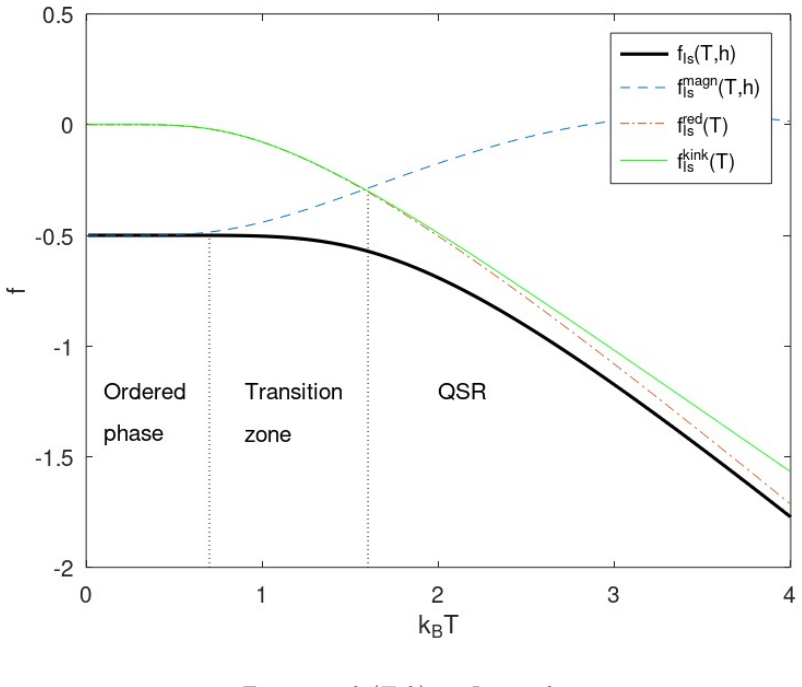
Studying the ordered phases and quantum supercritical low-temperature regime at the vicinity of the deconfinement transition point in 1D easy-axis XXZ ferromagnet, we suggest their interpretations according to the corresponding dominant lowest-energy excitations. We show, that the two ordered phases are governed by magnons, while the quantum supercritical regime is governed by kinks. Within this framework the Ising model is treated in detail.
Doping of transition metal oxides such as CaFe$_3$O$_5$ offers a controlled way to tune the interplay of charge, spin, and lattice degrees of freedom, yet local-probe studies remain difficult because strong correlations and dynamic charge-spin fluctuations obscure fine spectroscopic features in powder samples. Here, we employ quantum magnetometry based on nitrogen-vacancy (NV) centers in nanodiamonds impressed into an Mn-doped CaFe$_3$O$_5$ powder pellet to probe static and dynamic magnetic fields at the nanoscale across the weak ferromagnetic transition. The splitting and broadening of the optically detected magnetic resonance (ODMR) spectra exhibit an order-parameter-like increase by ~ 15 MHz upon cooling below the critical temperature, T$_{\rm c}$. Concomitantly, the spin-lattice relaxation rate, 1/T$_1$, exhibits a pronounced, divergence-like enhancement at T$_{\rm c}$, increasing by about one order of magnitude from its high-temperature value. Moreover, detailed lineshape fits of ODMR spectra together with the stretched-exponential NV magnetization recovery curves corroborate the proposed electronic phase segregation in charge-ordered and charge-averaged phases at the nanometric scales. The presented study demonstrates the viability of using nanodiamonds as a platform for nanoscale magnetic probing of strongly correlated matter, including phenomena such as electronic phase separation.
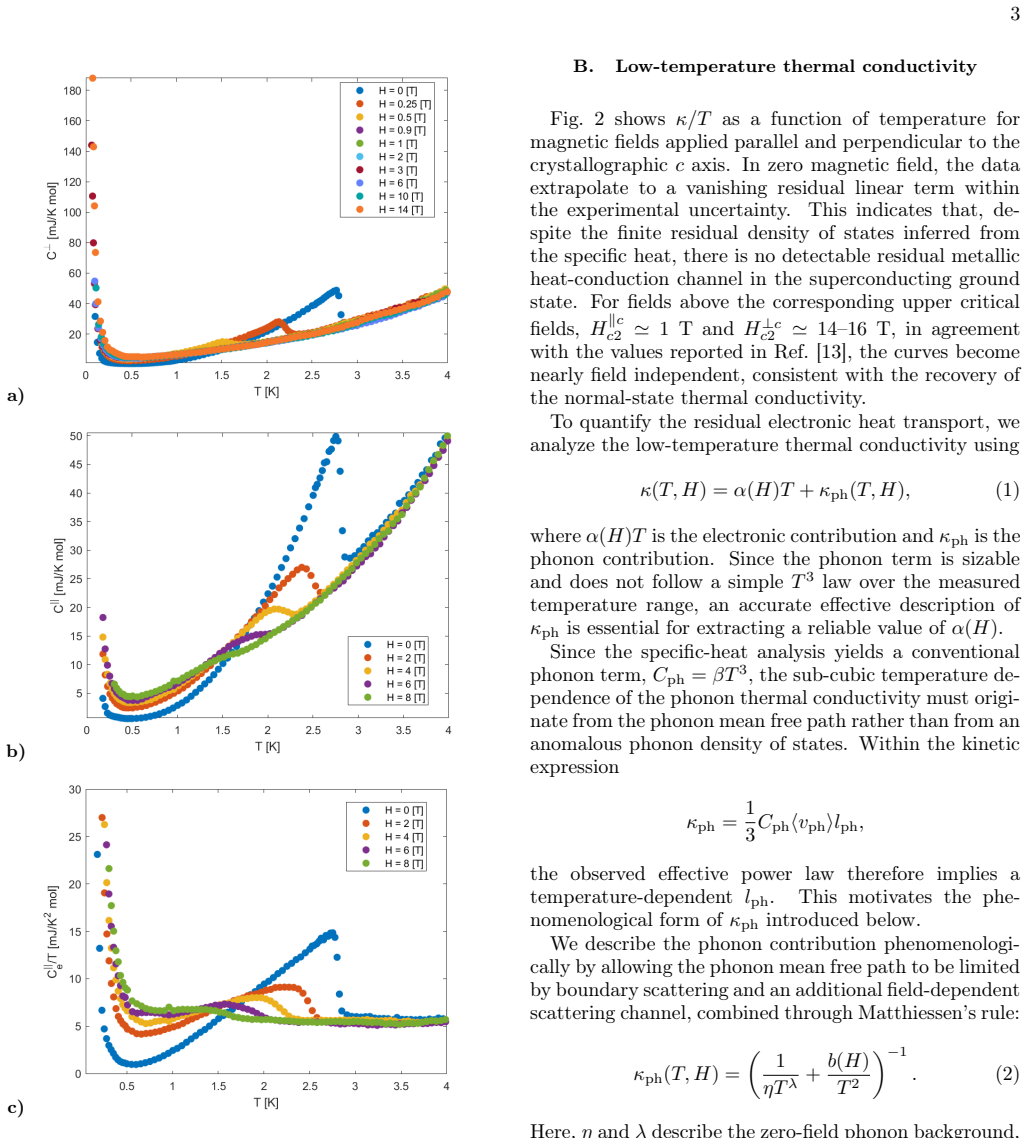
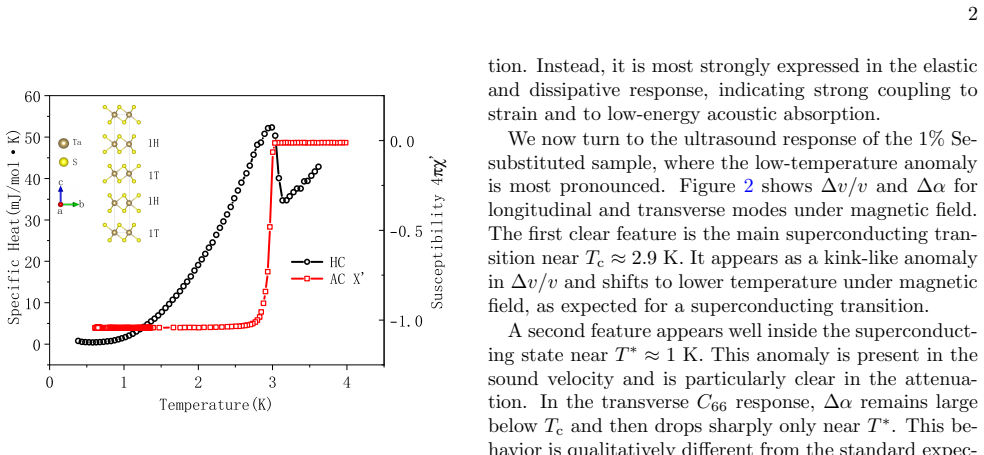
We investigate the low-energy excitation spectrum of the van der Waals heterostructure superconductor 4Hb-TaS$_2$ using ultra-low-temperature specific-heat and thermal-conductivity measurements with magnetic fields applied parallel and perpendicular to the crystallographic $c$ axis. The specific heat is broadly consistent with a nodeless superconducting gap, but retains a finite residual linear contribution, indicating a small residual low-energy density of states in the superconducting state. In addition, a pronounced upturn appears below approximately 0.3K. Its weak magnetic-field dependence, together with the absence of a corresponding feature in thermal transport, supports an interpretation in terms of localized degrees of freedom, most likely a nuclear Schottky contribution. In contrast to the finite residual thermodynamic density of states, the thermal conductivity extrapolates to a vanishing zero-field electronic linear term within experimental uncertainty for both field orientations. Thus, the residual low-energy states do not form a detectable itinerant heat-conduction channel. In finite magnetic field, the electronic heat transport grows rapidly. For out-of-plane fields, this response is broadly consistent with previous thermal-conductivity measurements and with the behavior commonly associated with multigap nodeless superconductivity. The even steeper increase observed for in-plane fields suggests that the field-induced quasiparticle response of 4Hb-TaS$_2$ is more complicated than the standard multigap picture alone.
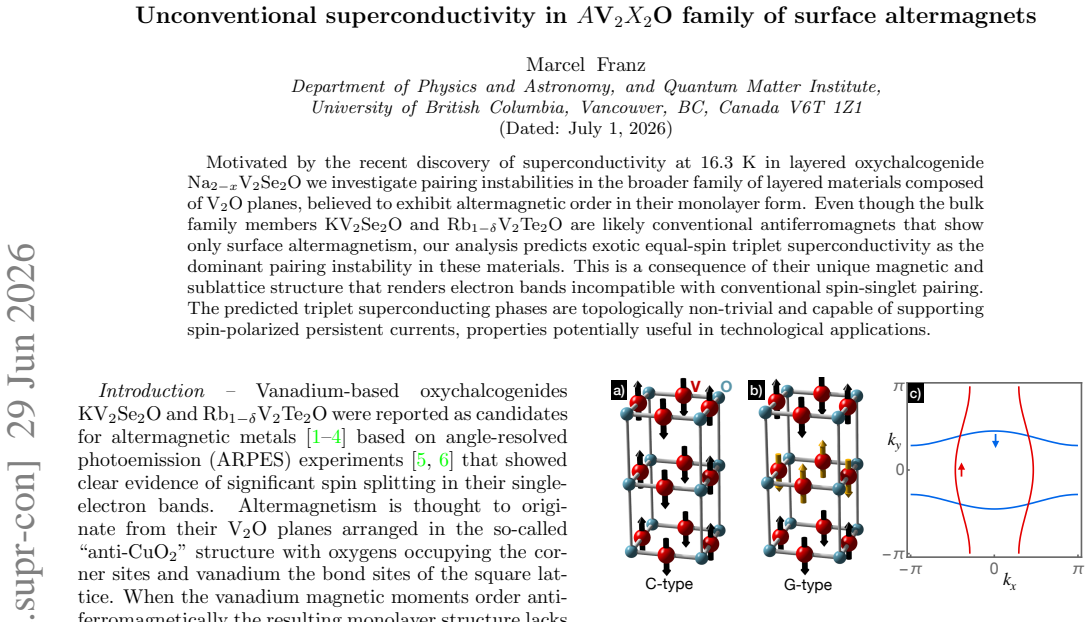
Motivated by the recent discovery of superconductivity at 16.3 K in layered oxychalcogenide Na$_{2-x}$V$_2$Se$_2$O we investigate pairing instabilities in the broader family of layered materials composed of V$_2$O planes, believed to exhibit altermagnetic order in their monolayer form. Even though the bulk family members KV$_2$Se$_2$O and Rb$_{1-\delta}$V$_{2}$Te$_{2}$O are likely conventional antiferromagnets that show only surface altermagnetism, our analysis predicts exotic equal-spin triplet superconductivity as the dominant pairing instability in these materials. This is a consequence of their unique magnetic and sublattice structure that renders electron bands incompatible with conventional spin-singlet pairing. The predicted triplet superconducting phases are topologically non-trivial and capable of supporting spin-polarized persistent currents, properties potentially useful in technological applications.
Collective light-matter phenomena such as Dicke superradiance are often described as a collection of effective spins coupled homogeneously to a bosonic mode, giving rise to a collective bright mode with enhanced light-matter coupling. In fermionic systems, Pauli exclusion and Fermi-surface structure can significantly modify this picture, while randomness in the atom-light couplings raises the question of whether disorder promotes or suppresses collective behavior. Here, we study a cavity model in which fermionic particles couple to a photonic mode through a random all-to-all interaction matrix with tunable mean and variance. Combining numerical mean-field methods, analytic stability analysis and random-matrix predictions, and benchmarks against exact diagonalization, we characterize both the onset and structure of the superradiant phase. While mean coupling and disorder variance contribute in the same way to the onset, they lead to drastically different behavior within the condensed phase. Uniform coupling supports a single bright collective fermionic mode with conventional Dicke-like scaling of the cavity field. Disorder, instead, gives rise to a qualitatively different collective regime in which many grey fermionic states participate coherently, producing a parametrically enhanced scaling of the condensate with system size. Our results reveal a mechanism through which disorder can, perhaps counterintuitively, promote collective light-matter phenomena.
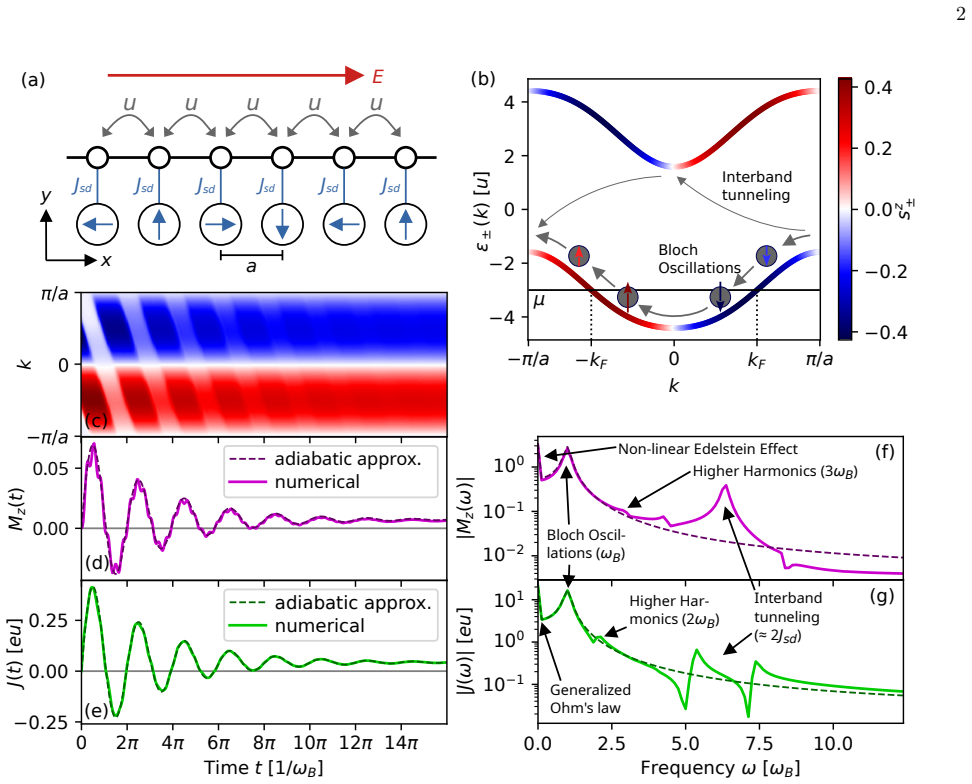
Bloch oscillations (BOs) are a quantum phenomenon in which electrons subjected to an electric field in a periodic potential exhibit an oscillating current without a net drift. In real conductors, scattering reduces the coherence required for BOs driving the system toward a steady state with a DC current. While previous studies have focused on charge transport, charge carriers also possess spin, raising the question of whether BOs can emerge in magnetic observables. Here, we show that the magnetization of odd-wave magnets can undergo BOs before relaxing to the steady-state Edelstein value, a phenomenon we term $\textit{magnetic}$ BOs. Using analytical and numerical methods, we demonstrate this effect in a minimal one-dimensional model of a p-wave magnet and generalize it to two dimensions. Our analysis further reveals that the Edelstein magnetization is generically nonlinear in the applied electric field. Finally, we argue that magnetic BOs can be detected in materials through higher-harmonic generation in THz sub-cycle lightwave spectroscopy. Magnetic BOs provide a genuine non-equilibrium signature of spin-charge coupling in unconventional magnets.
Complex conformal field theories (CFTs) have recently emerged as essential frameworks for understanding non-Hermitian criticality, weakly first-order phase transitions, and walking renormalization group flows, while their general structures remain largely unknown. In this work, we propose a systematic construction of complex CFTs by analytically continuing exactly marginal couplings into the complex plane. This procedure applies uniformly to bulk, boundary, and defect deformations, preserving conformal symmetry while generically complexifying operator spectra and other universal data. Using the compact free boson as a solvable laboratory, we uncover the global structure of the complexified Gaussian conformal manifold. More generally, we demonstrate that genuinely complex rational CFTs do not exist: rational points remain confined to the real regime, providing a sharp distinction between real and complex theories. In the defect case, we investigate the one-parameter family of conformal defects in the Ising CFT and derive exact expressions for the defect spectrum, energy transmission coefficient, and effective central charge from analytic continuation. The theoretical predictions are precisely verified in non-Hermitian critical Ising and free fermion chains using bulk-defect correlators, entanglement entropy, and complex energy transport, providing concrete evidence for the complex defect conformal manifold. Finally, we study complex boundary renormalization-group flows through the AdS/BCFT correspondence. Our results establish complex conformal manifolds as a controlled bridge between solvable lattice models, complex CFTs, and holography, while providing stringent analytic benchmarks for the nonunitary conformal bootstrap.
One of the long-standing and only partially solved problems of theoretical condensed matter physics and mathematical physics is to demonstrate that ground states of some of the versions of the Hubbard model can exhibit a ferromagnetic ordering. It has long been speculated that the opportunity crucial for the occurrence of ferromagnetism is the structure of the lattice on which the Hubbard model is formulated \cite{TasakiMB}. As a consequence, while on simple cubic lattices no ferromagnetic ordering seems to be possible, it can naturally arise, even for low densities of magnetic moment carriers, on so-called frustrated lattices.
We investigate the problem of ground state ferromagnetic ordering with the use of the formula for ground-state energy of interacting fermions as the first term of `density expansion', proven rigorously by Lieb, Seiringer and Solovej \cite{fermi exact} in continuum and by Giuliani \cite{hub exact} for the simple cubic lattice. Assuming that analogous expansion holds also for certain another lattices we apply this formula to five frustrated lattices -- among them to the face-centered cubic one. The hypothesis is confirmed: most of examined models formulated on frustrated lattices do indeed have ferromagnetic ground states already for densities being moderate or even low. Although the approach adopted cannot be treated as a rigorous proof that the ground state is ferromagnetic, the results obtained here strongly indicate that it can be the case. Moreover, as in some cases FM occurs at low densities, one can hope that it would be possible to prove convergence of the density expansion and prove rigorously the occurrence of `wealthy ferromagnetism' in these cases.
We study finite-size properties of Schulz-Shastry-Luttinger liquids to reveal anyonic signatures, realized as low-energy excitations on top of the helical ground state in saturated spin-1/2 zigzag chains. The model features asymmetric and marginal couplings of density and phase gradients and belongs to the Schulz-Shastry class. We investigate periodic and Dirichlet boundary conditions and discuss its diagonalization as well as its stability. Although Dirichlet boundary conditions require a fine-tuning of coupling constants and universal parameters, only their magnitude is restricted for cyclic systems. We derive boundary characteristic quantities like Friedel oscillations and persistent currents. Finally, we discuss the bulk and boundary behavior of the longitudinal spin correlations including subleading corrections.
We report low-temperature ultrasound measurements on single crystals of the layered van der Waals superconductor 4Hb-TaS$_2$. Specific heat and ac magnetic susceptibility show a sharp bulk superconducting transition at $T_{\rm c}\approx 2.9$~K. Ultrasound measurements reveal an additional anomaly deep inside the superconducting state near $T^{*}\approx 1$~K. The most direct signature is observed in the relative ultrasonic attenuation change $\Delta\alpha$: instead of being rapidly suppressed at $T_{\rm c}$, $\Delta\alpha$ remains large throughout the intermediate superconducting regime and drops strongly only near $T^{*}$. This loss of acoustic dissipation is accompanied by a pronounced anomaly in the relative sound velocity change $\Delta v/v$, indicating strong coupling to the lattice. The low-temperature anomaly is rapidly suppressed by magnetic field and by Se substitution, suggesting a possible superconducting origin of the anomaly. We speculate that this feature may be related to induced superconductivity in the 1T layers.
We consider a junction consisting of an extended one-dimensional Kitaev chain which incorporates both time-reversal symmetry (TRS) breaking and long-range interaction, sandwiched between two metallic leads from two sides. In this hybrid device, we study electrical transport under voltage bias for varying strength of the TRS breaking phase. We compare the transport characteristics of long-range type Kitaev chain with that of the short-range Kitaev chain as the strength of the TRS breaking phase varies. We find that the TRS breaking modifies the density of states and localisation/delocalisation property of the eigenstates which in turn affect the transport characteristics. Moreover, we find that the impact of the TRS breaking is not identical for the long-range Kitaev chain and its short-range counterpart. Therefore, noticeable differences in the transport properties can be observed due to the interplay between the TRS breaking and the range of interaction.
Neural-network quantum states (NQS) provide expressive variational representations for strongly correlated quantum many-body systems, but their practical accuracy depends sensitively on architecture-level hyperparameters and optimization schedules. Here we develop NQS-Agent, an implemented open-source software framework for health-aware hyperparameter optimization (HPO) in NQS calculations. Its workflow monitors energy trajectories, detects destructive optimization events, stops unstable calculations, modifies the learning-rate schedule, resumes optimization from safe checkpoints, and ranks candidates with an anomaly-aware score. We demonstrate the approach on a residual convolutional NQS for the square-lattice Heisenberg $J_1$-$J_2$ model, using architectures with parameter counts comparable to aCNN, a convolutional NQS architecture used here as a reference. The results show that NQS-Agent improves over the reported human-tuned aCNN baseline for the aCNN reference architecture and identifies a structurally distinct wide-and-shallow competitive candidate within the parameter-count-matched residual-CNN search space. These results show that the stability and recovery history of an optimization trajectory should be considered when assessing an NQS result. Health-aware HPO therefore provides a reproducible tuning protocol that goes beyond selecting a single lowest-energy calculation.
Quantum entanglement is one of the most intriguing features of quantum mechanics. To investigate the entanglement between two excitons in a biexciton, an experimental technique called density matrix spectroscopy (DMS) has recently been developed. DMS combines stimulated emission tomography and pump-probe techniques to obtain a time-resolved density matrix of the polarization state of a photon pair emitted from the biexciton. The reconstructed density matrix is expected to encode information about the biexciton state and its entanglement dynamics, but the precise nature of this connection has remained unclear. In this paper, we derive an analytical relationship between the density matrix obtained by DMS and the biexciton state. In addition, we perform numerical simulations to compare the entanglement dynamics obtained by DMS with the biexciton's entanglement dynamics in a two-dimensional electron-hole system using an extended ionic Hubbard model. We find that DMS can partially capture the entanglement in the biexciton, in particular, the dynamics of the difference $S_{\mathrm{bi}} - S_k$, where $S_{\mathrm{bi}}$ is the entanglement entropy of the biexciton and $S_k$ is the entanglement in terms of the wavevectors of the excitons that constitute the biexciton. These results demonstrate the validity of DMS for obtaining information about the entanglement dynamics of the biexciton.
The Lieb theorem is a cornerstone of quantum magnetism theory in condensed matter. In this work, we investigate the instability of the Lieb insulating ferrimagnetic phase in the extended Hubbard model on a trimer chain at half-filling, with one electron per site, under increasing the nearest-neighbor Coulomb coupling $V$. Our results show that despite a noticeable increase in doublon density with $V$, the ferrimagnetic insulating phase remains robust up to the phase separation (PS) line, which is observed at $V \gtrsim U/4$, where $U$ is the local Coulomb repulsion. Above the PS line, one of the coexisting phases is primarily populated by doublons on one of the two sublattices of the chain. This phase coexists with a metallic, unsaturated ferromagnetic phase for $U \gtrsim t$, and with a singlet phase for $U \lesssim t$, where $t$ is the intra-trimer hopping amplitude. We estimate the PS and the crossover lines with the help of density matrix renormalization group calculations.
Understanding the geometry of quantum Hall systems is a central challenge in modern condensed matter physics. We introduce a framework for probing the geometric structure of quantum Hall droplets by engineering the geometry of a dichroic probe and identifying the onset of "perfect elliptic dichroism", a regime in which the system responds exclusively to an elliptically polarized drive of a given chirality. This phenomenon provides a direct diagnostic of the droplet's intrinsic metric, and we show that it extends naturally to ideal Chern bands, where holomorphicity of the occupied states guarantees the vanishing of one chiral absorption rate with a quantized response for the other. In lattice realizations, such as the Harper-Hofstadter model, finite lattice-spacing corrections break the exact continuum metric description and give rise to a renormalized, emergent Landau-orbit metric; the probe ellipticity at which perfect dichroism is achieved then shifts accordingly, offering a direct spectroscopic window onto this lattice-induced geometric renormalization. Our results illuminate the rich geometric structure of quantum Hall phases and offer concrete pathways for observing these effects in quantum-engineered platforms.
Hall viscosity characterizes the geometric response of a quantum Hall droplet to deformations of the underlying metric, yet it has remained difficult to measure directly. We propose a spectroscopic probe based on circular dichroism, using chiral metric-sensitive drives -- implemented as rotating quadrupolar ("saddle") perturbations -- that effectively modulate the metric and couple to the generators of area-preserving deformations. The resulting dichroic signal directly measures the Hall viscosity, while frequency-resolved spectroscopy disentangles it from other excitations. A local formulation further enables spatially resolved markers of Hall viscosity applicable to both continuum and lattice systems. Our results open a direct route to measuring Hall viscosity in quantum-engineered platforms such as cold atoms in optical lattices.
Electronic structures of Cs- and Sb-terminated surfaces of a kagome superconductor CsV$_3$Sb$_5$ have been elucidated by means of scanning photoemission microscopy (SPEM). The observed band structure of the Cs-terminated surface is rather close to that of the bulk while that of the Sb-terminated one is substantially modified around K/H point of the Brillouin zone. While the contrast between the Cs- and Sb-terminated regions is reduced below the charge density wave transition temperature, the Sb 5$p$ band of Cs-terminated region exhibits electronic inhomogeneity which slightly increases below it. The inhomogeneity of the Sb 5$p$ band would be related to disorders of the out-of-plane Sb and relevant for the band folding along $\Gamma$-A with the charge density wave. The SPEM results suggest that the less inhomogeneous Cs termination is more suitable for interface of kagome superconductors. However, the inhomogeneity of Cs termination, which is significant at $\Gamma$/A, noticeable at K/H, and negligible at M/L, is expected to affect the Sb 5$p$-V 3$d$ hybridization at the interface.
The low-pressure phase diagram of La$_3$Ni$_2$O$_7$ provides an important reference for understanding its pressure-induced high-temperature superconductivity. While the spin-density-wave transition at $T_{\text{SDW}}\approx150$ K is increasingly well established, the origin of the second density-wave transition at $T_{\text{DW}}\approx130$ K has remained unresolved. Here, we perform unrestricted Hartree-Fock calculations to investigate the potential origin of the second transition. {Within the orthorhombic phase, the degeneracy between possible ordering wavevectors at $\boldsymbol{Q}_{Y}=(0,\pi)$ and at $\boldsymbol{Q}_{X}=(\pi,0)$ is lifted and the electronic system} develops a double-stripe spin-density wave with ordering vector $\boldsymbol{Q}_{Y}=(0,\pi)$. We identify that the pure double stripe spin state is unstable in La$_3$Ni$_2$O$_7$ towards a commensurate charge-density wave instability, which favors a spin-modulated double stripe order with intertwined charge and spin instabilities and establish the hierarchy of ordered states in La$_3$Ni$_2$O$_7$, providing an important link between its ambient-pressure and superconducting high-pressure phases. We further discuss our results in the context of available experimental literature and propose further experimental tests to elucidate the origin of the SDW/DW states in this system.
The pairing mechanism of the bilayer nickelates La$_3$Ni$_2$O$_7$ remains a hotly-debated open question. Existing strong-coupling theories are divided into class favoring intralayer d-wave pairing and that favoring interlayer s-wave pairing, with the latter further divided into $d_{z^2}$ orbital dominated mechanism driven by orbital hybridization and $d_{x^2-y^2}$ orbital dominated mechanism driven by Hund's rule. Recent angle-resolved-photoemission-spectrum (ARPES) and scanning-tunneling-microscope (STM) combinedly reveal a nodeless full pairing gap with low anisotropy, supporting the s-wave pairing. Here we propose that the pairing gap along the Brillouin zone (BZ) diagonal can serve as a useful probe of pairing mechanism. Symmetry analysis suggests that orbital hybridization vanishes along the BZ diagonal, rendering that the pairing gaps on the $\gamma$- and $\alpha/\beta$- pockets reflect the $d_{z^2}$- and $d_{x^2-y^2}$- orbital pairing strength respectively. Under the $d_{z^2}$ orbital dominated pairing mechanism driven by orbital hybridization, gap nodes are inevitable on the $\alpha$- and $\beta$- pockets along the BZ diagonal, which conflicts with the full gap revealed by ARPES and the U-shaped dI/dV curve observed by STM. The Hund's rule driven pairing mechanism instead leads to a full pairing gap, which well fits the ARPES and STM results. Furthermore, through a random-phase-approximation based calculation, we show that the weak-coupling theory, which tends to yield a $d_{z^2}$-orbital dominated pairing, also leads to nodes or near-nodes on the $\alpha$- and $\beta$- pockets along the BZ diagonal, conflicting with experiments. This analysis clarifies the dominant role of $d_{x^2-y^2}$ orbital in the pairing and establishes the Hund's rule driven pairing mechanism as the most relevant one in La$_3$Ni$_2$O$_7$.
Based on a recent experiment in high-quality GaAs quantum wells [Phys. Rev. Lett. 127, 056801 (2021)], we present a microscopic study of the energy gap in two-dimensional electron gases at filling factor $\nu=1/3$, explicitly incorporating both finite layer thickness and disorder effects. The finite layer thickness is modeled by solving the Poisson-Schr\"odinger equations for the experimental devices, yielding the electron wave functions in the perpendicular direction. Using these and the disorder energy extracted from the experiment, we estimate the charge gap and the mobility gap at $\nu=1/3$ in the weakly disordered lowest Landau level. Remarkably, both gaps show good quantitative agreement with the activation gap measured from the experiment in narrow quantum wells. Our results also indicate the potential need of incorporating higher subbands to make accurate theoretical predictions of the energy gap in wide quantum wells.
An attempt is made to give a brief but coherent account of the situation of the theoretical ideas in addressing the mechanism of superconductivity in cuprate high-Tc superconductors. Specifically, the idea of superconductivity from repulsive interactions is discussed as it is gaining ground since the `consensus' paper was written in 2015\cite{kei}. The challenges it faces is also discussed. Three main schools of thought are presented, and an experimental result of 2022 pertaining to Anderson's super-exchange mechanism is also discussed. An updated list of Anderson's ``dogmas" is also presented, as after year 2000, many other universally applicable experimental facts has been discovered. The ``dogmas" are universal facts which are distilled from a variety of complex experimental results, and highlights the key findings that seems to be central to the mechanism of superconductivity in cuprates. These are discussed as a commemoration of 40 years of high-Tc cuprate research.
We investigate the ground states of the $S = 1/2$ staircase $J$-$Q_3$ model in the maximally anisotropic limit by employing projector quantum Monte Carlo simulations. To overcome boundary-induced finite-size ambiguities inherent in the study of spatially modulated structures, we implement a $45^{\circ}$ tilted periodic boundary condition that eliminates intermediate phases and provides direct access to winding-sector transitions of the system. By defining a domain wall density to quantify the spatial modulation of the helical valence bond phase, we perform thermodynamic extrapolations and demonstrate that both the domain wall density and the characteristic wavevector evolve continuously with the coupling ratio, exhibiting no commensurate lock-in behavior. Our results establish that the helical valence bond phase is a genuine two-dimensional incommensurate phase with long-range bond-bond order in the thermodynamic limit, clarifying that winding-sector transitions are finite-size effects enforced by boundary commensurability. Furthermore, we determine the phase transition point between columnar valence bond solid phase and helical valence bond phase to be $g_c = 0.046(2)$.
C-type altermagnetic and G-type antiferromagnetic configurations coexist with nearly identical spin-split bands.
abstractclick to expand
Altermagnetism is an emerging class of magnetic order characterized by momentum-dependent spin-split electronic structures despite vanishing net magnetization. Although momentum-space signatures consistent with altermagnetism have been reported in a growing number of materials, their relationship to the underlying real-space magnetic configurations remains incompletely understood, because similar spin-split electronic structures can arise from distinct magnetic orders. In the candidate d-wave altermagnet KV2Se2O, the magnetic origin of the observed momentum-dependent spin splitting has remained controversial. Here, we employ spin-polarized scanning tunnelling microscopy combined with magnetic-field-dependent quasiparticle interference imaging to determine the magnetic configuration of KV2Se2O at the atomic scale. Spin-resolved quasiparticle interference reveals a checkerboard-like antiparallel spin texture within the V2O layer and determines its interlayer spin arrangement across unit-cell step edges. Remarkably, we identify both C-type and G-type magnetic configurations, both of which generate similar spin-split electronic structures at the single-layer level but correspond to d-wave altermagnetic and conventional antiferromagnetic orders, respectively. These observations reveal a complex magnetic landscape arising from nearly degenerate magnetic states. Our results establish a direct connection between momentum-space spin splitting and real-space magnetic order, providing a framework for identifying the microscopic origin of spin-split electronic structures in altermagnetic materials.
Shadow tomography has appeared as a powerful tool for estimating observables on quantum computers from a small number of samples. We show that shadow-tomography-inspired ideas can offer similarly improved sample scaling for estimating observables on tensor network states on classical computers after proper adaptation. We develop strategies for both spin (bosonic) and fermionic systems, tailored to the contraction requirements of tensor networks, and generate scaling improvements of factors of $O(N)$ to $O(N^{3})$ (where $N$ is system size), depending on the specific task and system type. For the important and difficult task of evaluating the expectation value of long-range interacting Hamiltonians, we achieve the optimal $O(1)$ overall scaling (up to logarithmic factors) for an arbitrarily fixed relative Monte Carlo error in both spin and fermionic systems. Additionally, we show that shadow estimators offer more stable gradients of observables in variational optimization tasks than standard Monte Carlo estimators. We demonstrate practical advantage by simulating systems with long-range interactions, including the 2D long-range Heisenberg model and an ab-initio quantum chemistry Hamiltonian.