Beyond the HOM Dip: A Multi-Metric Module for Teaching Two-Mode Quantum Optical Interference
Pith reviewed 2026-06-29 13:41 UTC · model grok-4.3
The pith
Different metrics on the same beam-splitter output favor different light sources depending on the goal.
A machine-rendered reading of the paper's core claim, the machinery that carries it, and where it could break.
Core claim
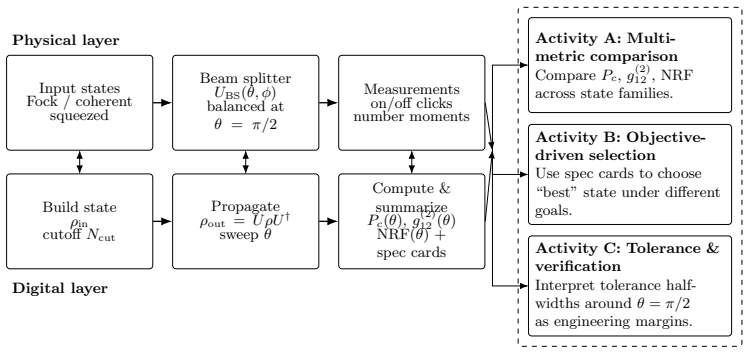
A common beam-splitter sweep shows that different metrics probe different statistical properties of the same output state and can therefore support different source choices depending on the physical objective. The three metrics are on/off coincidence probability Pc, cross-correlation g(2)12, and noise-reduction factor NRF; the four input families are Fock, superposition, coherent, and squeezed light.
What carries the argument
The beam-splitter sweep that simultaneously tracks Pc, g(2)12, and NRF across the four input families.
If this is right
- Students learn that interference quality is not a single observable but depends on which statistic is measured.
- Source selection for two-mode tasks can change once more than one metric is considered.
- The same experimental sweep transfers reasoning from the HOM dip to other photonic benchmarking questions.
- Specification tables and the shared simulator make the metric dependence visible without altering the apparatus.
Where Pith is reading between the lines
- Real experiments might improve by matching the metric to the downstream task rather than defaulting to coincidence counts.
- Adding more metrics or input states to the sweep could expose further reversals in source preference.
- The approach offers a template for teaching other single-benchmark effects in quantum optics by introducing controlled metric variation.
Load-bearing premise
That comparing the three metrics across the four input families will address the challenges of treating interference quality as a single observable and improve transfer to broader photonic benchmarking questions.
What would settle it
If the three metrics produced identical rankings of the four input families for every beam-splitter reflectivity, the claim that they probe different statistical properties would not hold.
Figures

read the original abstract
The Hong--Ou--Mandel (HOM) effect is often introduced through a single benchmark: coincidence suppression for \(\ket{1}\otimes\ket{1}\) at a balanced beam splitter. We present a classroom-oriented instructional module that broadens this treatment by comparing three output metrics -- on/off coincidence probability \(P_c\), cross-correlation \(g^{(2)}_{12}\), and noise-reduction factor NRF -- across four input families: Fock, superposition, coherent, and squeezed light. The module targets three instructional challenges in upper-division quantum optics: treating interference quality as a single observable, weakly connecting quantum--classical distinctions to output statistics, and limiting transfer from two-mode HOM reasoning to broader photonic benchmarking questions. A common beam-splitter sweep shows that different metrics probe different statistical properties of the same output state and can therefore support different source choices depending on the physical objective. The module combines a Jupyter/QuTiP simulator, guided activities, specification-style summary tables, and a grading rubric for use in a single upper-division or early graduate class meeting.
Editorial analysis
A structured set of objections, weighed in public.
Referee Report
Summary. The paper presents a classroom module extending the standard Hong-Ou-Mandel treatment by comparing three output metrics (on/off coincidence probability Pc, cross-correlation g^{(2)}_{12}, and noise-reduction factor NRF) across four input families (Fock, superposition, coherent, and squeezed states) via a common beam-splitter sweep. The module includes a Jupyter/QuTiP simulator, guided activities, summary tables, and a grading rubric, with the goal of addressing three instructional challenges: treating interference quality as a single observable, weakly connecting quantum-classical distinctions to statistics, and limited transfer to broader photonic benchmarking.
Significance. If the module functions as described, the explicit demonstration that the three metrics respond differently to identical output states for the four input families would help students recognize that metric choice depends on physical objective, supporting better source selection in experiments. The open QuTiP implementation is a clear strength, as it allows direct verification of the metric distinctions without relying on unstated modeling assumptions.
major comments (1)
- [Abstract] Abstract: The manuscript states that the module targets and addresses three specific instructional challenges, yet provides no student evaluation data, pre/post assessments, learning outcome measures, or comparisons against existing HOM teaching approaches; the claims about instructional impact therefore rest entirely on the design description.
minor comments (1)
- The abstract refers to 'specification-style summary tables' but the manuscript would benefit from an explicit example table (or reference to its location) showing metric values across inputs to make the central demonstration immediately accessible to readers.
Simulated Author's Rebuttal
We thank the referee for the careful review and the identification of this important point regarding the scope of the claims. We respond to the major comment below.
read point-by-point responses
-
Referee: [Abstract] Abstract: The manuscript states that the module targets and addresses three specific instructional challenges, yet provides no student evaluation data, pre/post assessments, learning outcome measures, or comparisons against existing HOM teaching approaches; the claims about instructional impact therefore rest entirely on the design description.
Authors: We agree that the manuscript contains no student evaluation data, pre/post assessments, learning outcome measures, or direct comparisons to other HOM teaching approaches. The paper is a description of a pedagogical module, including its simulator, activities, tables, and rubric, motivated by the three instructional challenges. The language in the abstract uses "targets" to indicate design intent rather than measured outcomes; however, to prevent any ambiguity about instructional impact, we will revise the abstract and the opening of the introduction to state explicitly that the module is designed to target these challenges on the basis of its structure and that no empirical assessment of learning gains is reported. This change will align the claims with the actual content of the work. revision: yes
Circularity Check
No significant circularity; descriptive educational module with no derivations or self-referential predictions
full rationale
The manuscript presents an instructional module that demonstrates, via a QuTiP-based beam-splitter sweep, how three output metrics (Pc, g(2)12, NRF) respond differently to the same state for four input families. No equations are derived, no parameters are fitted to data and then relabeled as predictions, and no load-bearing claims rest on self-citations or uniqueness theorems. The central demonstration is directly executable from the supplied simulator notebook and therefore independent of any internal modeling assumption that would reduce to the paper's own inputs. The paper is self-contained as a descriptive teaching resource.
Axiom & Free-Parameter Ledger
Reference graph
Works this paper leans on
-
[1]
Singh and E
C. Singh and E. Marshman. Review of student difficulties in upper-level quantum mechanics. Phys. Rev. Phys. Educ. Res., 11(2):020117, 2015
2015
-
[2]
Baily and N
C. Baily and N. D. Finkelstein. Teaching and understanding of quantum interpretations in modern physics courses.Phys. Rev. Phys. Educ. Res., 6(1), 2010
2010
-
[3]
Bouchee, L
T. Bouchee, L. de Putter-Smits, M. Thurlings, and B. Pepin. Towards a better understanding of conceptual difficulties in introductory quantum physics courses.Stud. Sci. Educ., 58(2):183– 202, 2022
2022
-
[4]
Passante, P
G. Passante, P. J. Emigh, and P. S. Shaffer. Student ability to distinguish between su- perposition states and mixed states in quantum mechanics.Phys. Rev. Phys. Educ. Res., 11(2):020135, 2015
2015
-
[5]
C. Singh. Interactive learning tutorials on quantum mechanics.Am. J. Phys., 76(4):400–405, April 2008
2008
-
[6]
P. D. Justice, E. Marshman, and C. Singh. A framework for understanding the impact of integrating conceptual and quantitative reasoning in a quantum optics tutorial on students’ conceptual understanding.Educ. Sci., 15(10):1314, 2025
2025
-
[7]
C. K. Hong, Z. Y. Ou, and L. Mandel. Measurement of subpicosecond time intervals between two photons by interference.Phys. Rev. Lett., 59(18):2044–2046, 1987
2044
-
[8]
J. L. O’Brien, A. Furusawa, and J. Vuˇ ckoviˇ c. Photonic quantum technologies.Nat. Photonics, 3(12):687–695, 2009. 16
2009
-
[9]
C. S. Hamilton, R. Kruse, L. Sansoni, S. Barkhofen, C. Silberhorn, and I. Jex. Gaussian boson sampling.Phys. Rev. Lett., 119(17):170501, 2017
2017
-
[10]
Brecht, D
B. Brecht, D. V. Reddy, C. Silberhorn, and M. G. Raymer. Photon temporal modes: A complete framework for quantum information science.Phys. Rev. X., 5(4), 2015
2015
-
[11]
Carvioto-Lagos, G
J. Carvioto-Lagos, G. Armendariz P, V. Vel´ azquez, E. L´ opez-Moreno, M. Grether, and E. J. Galvez. The hong–ou–mandel interferometer in the undergraduate laboratory.Eur. J. Phys., 33(6):1843–1850, 2012
2012
-
[12]
Bonilla-Licea, D
M. Bonilla-Licea, D. Bonilla-Licea, M. Bonilla-Estrada, A. Soria-L´ opez, and C. J. Mart´ ınez- Garc´ ıa. A primer on quantum mechanics for electrical engineers.IEEE Access, 12:114658– 114669, 2024
2024
-
[13]
Asfaw et al
A. Asfaw et al. Building a quantum engineering undergraduate program.IEEE Trans. Educ., 65(2):220–242
-
[14]
C. C. Gerry and P. L. Knight.Introductory Quantum Optics. Cambridge University Press, Cambridge, England
-
[15]
Mariia Mykhailova and Krysta M. Svore. Teaching quantum computing through a practi- cal software-driven approach: Experience report. InProceedings of the 51st ACM Technical Symposium on Computer Science Education, pages 1019–1025, New York, NY, USA, 2020. Association for Computing Machinery
2020
-
[16]
Deslauriers and C
L. Deslauriers and C. Wieman. Learning and retention of quantum concepts with different teaching methods.Phys. Rev. Spec. Top. - Phys. Educ. Res., 7(1), 2011
2011
-
[17]
Krijtenburg-Lewerissa, H
K. Krijtenburg-Lewerissa, H. J. Pol, and A. Brinkman. Insights into teaching quantum mechanics in secondary and lower undergraduate education.Phys. Rev. Phys. Educ. Res., 13(1):010109, 2017
2017
-
[18]
M¨ uller and H
R. M¨ uller and H. Wiesner. Teaching quantum mechanics on an introductory level.Am. J. Phys., 70:200–209, 2002
2002
-
[19]
C. H. Holbrow, E. Galvez, and M. E. Parks. Photon quantum mechanics and beam splitters. Am. J. Phys., 70(3):260–265, 2002
2002
-
[20]
N. S. DiBrita and E. J. Galvez. An easier-to-align Hong?Ou?Mandel interference demonstra- tion.Am. J. Phys., 91(4):307–315, 2023
2023
-
[21]
S. B. McKagan, K. K. Perkins, M. Dubson, C. Malley, S. Reid, R. LeMaster, and C. E. Wieman. Developing and researching PhET simulations for teaching quantum mechanics. 17 Am. J. Phys., 76(4):406–417, 2008
2008
-
[22]
Bjurlin and T
C. Bjurlin and T. Chmiel. A versatile Hong–Ou–Mandel interference experiment in optical fiber for the undergraduate laboratory.Am. J. Phys., 93(2):180–186, 2025
2025
-
[23]
Folkers, C
B. Folkers, C. Castenmiller, A. Brinkman, and K. Stadermann. An analysis of demonstration materials in quantum physics education.EPJ Quantum Technol., 2026
2026
-
[24]
K. Aga. Comfort in active learning spaces ? students? perceptions and preferences.Eur. J. Eng. Educ., 49(4):785–806, 2024
2024
-
[25]
Borish and H
V. Borish and H. J. Lewandowski. Implementation and goals of quantum optics experiments in undergraduate instructional labs.Phys. Rev. Phys. Educ. Res., 19(1), 2023
2023
-
[26]
C. H. Crouch and E. Mazur. Peer instruction: Ten years of experience and results.Am. J. Phys., 69(9):970–977, 2001. 18 SUPPLEMENTARY MATERIAL This Supplementary Material is organized to support both rapid instructional adop- tion and deeper technical inspection. It contains extended mathematical details, simulator setup guidance, an instructor implementat...
2001
-
[27]
select the Fock and coherent input families,
-
[28]
sweepθthrough the balanced point,
-
[29]
compareP c(θ),g (2) 12 (θ), and NRF(θ),
-
[30]
inspect the specification-style summaries,
-
[31]
then add the superposition and squeezed inputs. For first-time users, the most important interpretation step is to compare how thesame beam splitter sweep supportsdifferentjudgments depending on which output metric is taken as primary. This is the central instructional idea of the module. S3. Instructor implementation guide This module is intended for upp...
-
[32]
warmup prediction or pre-prompt (5 minutes)
-
[33]
short instructor framing of Fock and coherent inputs at the balanced beam splitter (10 minutes)
-
[34]
Activity A, multi-metric HOM comparison (15 minutes)
-
[35]
Activity B, metric-driven state selection with specification tables (10 minutes)
-
[36]
Activity C, robustness and transfer (5 minutes)
-
[37]
wrap-up and concept check (5 minutes). Minimum viable implementation.If time is limited, the module can be reduced to: •one brief prediction prompt, •one simulator sweep comparing Fock and coherent inputs, •one specification-table decision task, •one short transfer question. This compressed implementation still supports LG1–LG3 and introduces the central ...
-
[38]
minimize coincidence probability atθ=π/2,
-
[39]
minimize NRF near the balanced operating point,
-
[40]
For each choice, justify your selection using at least one metric and one trade-off relative to another state family
maximize tolerance half-width for a chosen threshold. For each choice, justify your selection using at least one metric and one trade-off relative to another state family. Expected student deliverable.A short objective-by-objective state selection with explicit metric-based justification. Suggested timing.10 minutes. Activity C: robustness and transfer (B...
-
[41]
larger systems are more complicated
Identify a technological application for which the squeezed input would be preferred over the Fock input, and one for which it would not. CC3 (LG4, LG5).The specification table reports a tolerance half-width of ∆θ= 0.15 rad for a stated NRF threshold. A fabrication process produces beam splitters withθ= π/2±0.20 rad. Does this source meet the specificatio...
discussion (0)
Sign in with ORCID, Apple, or X to comment. Anyone can read and Pith papers without signing in.