pith. sign in

astro-ph.EP

Earth and Planetary Astrophysics

Interplanetary medium, planetary physics, planetary astrobiology, extrasolar planets, comets, asteroids, meteorites. Structure and formation of the solar system

Top Pith
4
astro-ph.EP 2026-05-19 2 theorems

Aurora drives 40x propadiene enrichment in Jupiter's north

by James A. Sinclair, Thomas K. Greathouse +9 more

Detection of propadiene (CH₂CCH₂), propene (C₃H₆) and non-detection of propane (C₃H₈) in Jupiter's northern polar stratosphere

High-resolution infrared observations reveal concentrations inside the northern auroral region that current photochemical models cannot yet

Figure from the paper full image
abstract click to expand
We report the first detection of stratospheric propadiene (CH$_2$CCH$_2$) and propene (C$_3$H$_6$) at Jupiter's mid-to-high northern latitudes using IRTF-TEXES measurements recorded on March 5-6, 2025. Using radiative transfer software to quantitatively test for the presence of propadiene and propene, we report a $>$12-$\sigma$ detection of propadiene and a $>$17-$\sigma$ detection of propene inside Jupiter's northern auroral region (henceforth 'NAR'), where the species are most concentrated. For example, at 62$^\circ$N inside Jupiter's NAR, we derive a 1-mbar propadiene abundance of 2.0 $\pm$ 0.2 ppbv, which is 40 $\pm$ 3 higher than abundances predicted by the Moses & Poppe (2017) photochemical model (henceforth 'MP17'), and significantly higher than the 1.2-ppbv upper limit abundance derived at 42$^\circ$N (the lowest latitude sampled by the observations). Similarly, we derive a 1-mbar propene abundance of 8.1 $\pm$ 0.5 ppbv at 62$^\circ$N inside Jupiter's NAR, which is 28 $\pm$ 2 higher than the MP17 predicted abundance and higher than the 6-ppbv 1-mbar upper limit abundance derived at 42$^\circ$N. The fact that propadiene and propene are most enriched inside Jupiter's NAR strongly suggests that perturbations to the chemistry by auroral-related heating and exogenous ions/electrons are responsible for their significant enrichment. Spectral features of propane (C$_3$H$_8$) were not detected at any of the locations sampled by the data: 3-$\sigma$ upper limits of 10 ppbv were derived at the 10-mbar level at 62$^\circ$N inside Jupiter's NAR. The non-detection of propane could, in part, be explained by the vertical sensitivity of its spectral features to deeper pressures, where there is negligible auroral-related heating. The results of this work advocate for development of ion-neutral chemistry models of Jupiter's polar stratosphere.
0
Top Pith
2
astro-ph.EP 2026-05-14 2 theorems

Bessel kernel resolves convergence in 2D disc gravity simulations

by S. Rendon Restrepo

Self-gravity in thin protoplanetary discs: 2. Numerical convergence solved and revealing the overestimation in mass of formed planets with softening

Small softening overestimates fragment masses by a factor of 2-3 while the new first-principles method produces bound planets at high resol

Figure from the paper full image
abstract click to expand
The Gravitational Instability (GI) is a leading theory for explaining early planet formation in massive discs. In the early 2010s, 3D SPH simulations of GI failed to converge, initially attributed to resolution-dependent viscosity but later appearing in 2D SPH and grid-based simulations, suggesting a numerical artifact inherent to the 2D approximation of gravity. Recently, we derived from first principles a much improved prescription for gravity in 2D discs (via a Bessel kernel). This prescription introduces a characteristic length below which gravity smoothly transitions from a 3D to a 2D scaling. This cannot be captured by standard smoothing length approaches, widely used in 2D simulations. We employ this new prescription to resolve the convergence issue of GI in 2D, and compare the outcomes of GI in runs using the Bessel kernel with those obtained using softening prescriptions at high resolution. We conducted numerical simulations with the FargoCPT code, where the Bessel prescription was implemented. The 2D Bessel formalism of gravity effectively resolves the convergence issues encountered in 2D simulations. When compared to simulations employing softened or unsoftened potentials, I observe that a small softening parameter tends to overestimate gravitational effects. This results in an artificially high number of fragments, leading to final fragment masses that are overestimated by a factor of 2-3. Conversely, employing large softening parameters inhibits gravitational effects. Although our analysis initially suggests that a softening parameter of 0.6 H might offer the best compromise, in reality, the resulting fragments fail to remain gravitationally bound-a behavior not observed when using the Bessel kernel. Our findings strongly suggest that the Bessel prescription should be adopted to ensure a consistent and accurate treatment of gravity in thin discs.
0
Top Pith
2
astro-ph.GA 2026-05-14

Hot cores near supernova retain standard molecular ratios

by Takashi Shimonishi, Hidetoshi Sano +2 more

Survival of Molecular Complexity under Recent Supernova Feedback: Detection of Hot Cores in RX J1713.7-3946

Column density ratios in RX J1713.7-3946 match typical star-forming regions, indicating recent exposure or magnetic shielding.

Figure from the paper full image
abstract click to expand
Protostellar cores located near supernova remnants are considered potential analogues of the birth environment of the solar system. However, the extent to which supernovae influence their chemical evolution remains unclear. We report the first detection of hot molecular cores in a supernova remnant using the Atacama Large Millimeter/submillimeter Array. The detected hot cores (HC1 and HC2) are located inside the X-ray shell of the young supernova remnant RX J1713.7-3946, and both sources are associated with Class I intermediate-mass protostars. This paper focuses on a detailed chemical analysis of HC1, in which a variety of carbon-, oxygen-, nitrogen-, sulfur-, and silicon-bearing species are detected. Excitation analyses indicate that HC1 harbors dense (~10^7 cm-3), compact (<500 au), and high-temperature (>100K) molecular gas. Despite being located within a supernova-feedback region, the column density ratios of complex organic molecules (HCOOCH3/CH3OH, CH3OCH3/CH3OH, and CH3CHO/CH3OH), a deuterated molecule (CH2DOH/CH3OH), and sulfur- and nitrogen-bearing species (OCS/CH3OH and C2H5CN/CH3CN) in HC1 are indistinguishable from those observed in hot cores/corinos in more typical star-forming environments. HC1 is located near the outer edge of the supernova shell, and the surrounding region has likely begun to be exposed to such a harsh environment only recently. The elapsed time since the onset of exposure to high-energy particles and photons may be too short for the chemical composition of the hot core to be significantly altered, and/or the hot-core region may be shielded by magnetic fields amplified by supernova feedback, which could suppress the penetration of enhanced cosmic rays.
0
0
astro-ph.IM 2026-07-03

Classical SNR mode approximates quantum optimum for planet nulling

by Yinzi Xin, Sebastiaan Haffert +2 more

Quantum-optimal coronagraphy with spatial mode sorting for direct exoplanet observations

The match holds to leading order in leakage, enabling optimal coronagraph designs for realistic stars and complex apertures at lambda/D scal

Figure from the paper full image
abstract click to expand
Conventional coronagraphs struggle to reach the theoretical limit of exoplanet detection at close separations to the star, particularly when the telescope has a complex aperture or when the star is partially resolved. Coronagraphy or nulling using spatial mode-sorting can reach the theoretical limit, but the optimal solution has so far only been calculated for an idealized unresolved star, whose signal lies entirely in the piston mode of the telescope. This work aims to enable the calculation of optimal nulling modes for realistic observational scenarios as a function of the size of the star and planet parameters, with the goal of improving coronagraphic performance at ~lambda/D working angles given partially resolved stars and complex telescope apertures. We perform numerical calculations using tools from quantum information theory and explore the behavior of optimal mode-sorting measurements. The optimal measurement for measuring a planet parameter is calculable from the density matrix describing the state of the system. The spatial mode that maximizes the classical signal-to-noise ratio is approximately quantum optimal to leading order in the stellar leakage and the planet flux ratio. We present optimal modes for measuring planets with known signals, and we characterize the tradeoffs inherent to coronagraphs targeting more than one planet location. Example coronagraph designs are presented for three cases of scientific interest: 1) the optimal extension of the fiber nuller architecture for detecting and spectrally characterizing planets across an arbitrary field-of-view using high-resolution spectroscopy, 2) following up planets detected by the visible coronagraph of the Habitable Worlds Observatory at more challenging infrared wavelengths, and 3) detecting and localizing planets at close working angles with the Planetary Camera and Spectrograph on the Extremely Large Telescope.
0
0
astro-ph.EP 2026-07-03

Warm Jupiter transits Sun-like star on 58-day eccentric orbit

by Ioannis Apergis, Daniel Bayliss +54 more

NGTS-39 b: A 58 d transiting warm Jupiter in an eccentric orbit

The 1.47 Jupiter-mass planet at 519 K fills a gap between hot and cold giants and shows signs of an outer companion.

Figure from the paper full image
abstract click to expand
We report the discovery and characterisation of NGTS-39 b (TIC 453147896 b), a warm Jupiter transiting a Sun-like star on a 58.2 day, eccentric (e = 0.386 +/- 0.019) orbit. NGTS-39 b was first identified from a TESS single-transit event, and subsequently confirmed with NGTS photometry and radial-velocity measurements from CORALIE and HARPS. The host star is a bright (Tmag = 11.02) F9 dwarf with an effective temperature of Teff = 6053 +67/-30 K. NGTS-39 b is a Jupiter-sized gas giant with a radius of 1.088 +/- 0.012 RJ and a mass of 1.467 +/- 0.081 MJ. Its equilibrium temperature is 519 +6/-5 K, placing it between short-period hot Jupiters and cold, Jupiter-like giants. The high orbital eccentricity and intermediate equilibrium temperature of NGTS-39 b make it a valuable test case for formation and migration models, particularly in the poorly sampled regime of long-period gas giants. The RV data show a linear trend of gamma dot = -17.75 m s^-1 yr^-1, which indicates the presence of an outer companion. The discovery of NGTS-39 b contributes to the small but growing population of transiting warm Jupiters with P > 50 days orbiting bright stars.
0
0
astro-ph.EP 2026-07-03

TESS detects first bound microlensing planet

by Mallory Harris (University of New Mexico), Diana Dragomir (University of New Mexico) +3 more

TESS's First Bound Microlensing Planet: A Binary Microlensing Event Revealing a Planetary Companion toward the Galactic Plane

Combined photometry shows a 1.6 Jupiter-mass planet around a K dwarf at 4.8 AU projected separation along the Galactic plane.

abstract click to expand
We report the discovery of Gaia23bra b, the first gravitationally bound microlensing planet detected by the Transiting Exoplanet Survey Satellite (TESS). Initially flagged as a single-lens event by the Gaia Science Alerts system, Gaia23bra was serendipitously observed by TESS over two consecutive sectors. During those TESS sectors, the light curve of the event displayed caustic-crossing features characteristic of a binary-lens event. Joint modeling of Gaia and TESS photometry with pyLIMA, supplemented by stellar parameter inference using pyLIMASS, suggests a K dwarf ($M_L = 0.79^{+0.19}_{-0.17}\,M_\odot$) hosting a Jovian planet with $M_P = 1.63_{-0.38}^{+0.42}\,M_{\rm Jup}$ at a projected separation of $a_{\perp,\min} \approx 4.8\,\mathrm{AU}$. This result underscores the synergy between high-cadence photometry and long-baseline monitoring for robust microlensing characterization. Its location along the Galactic Plane highlights TESS's unexpected capacity for microlensing science through its all-sky coverage and its potential to detect planets in regions beyond the Galactic Bulge.
0
0
astro-ph.EP 2026-07-03

Lunar longitude alters clock frequency shifts by separation

by Hongbin Zhang, Yanyue Gao +1 more

The influence of lunar tidal potential on clock frequencies at different positions on Earth

Calculations in the geocentric frame show that clocks at the same latitude but different longitudes experience changing tidal offsets as the

Figure from the paper full image
abstract click to expand
With the advancements in clock timing technology, increasingly smaller time differences can be distinguished. Therefore, it is critical to investigate the fractional frequency shift of clocks at different locations on Earth. In this paper, we study it systematically under the influence of a subtle lunar tidal potential based on a new method. Our calculations in the geocentric Fermi frame show that when two clocks are located at the same latitude, the longitude difference changes the fractional frequency shift between them. A similar phenomenon occurs when there is a difference in latitude between two clocks on the ground at the same longitude. Interestingly, when the Moon's longitude changes, the phase and amplitude of the lunar tidal fractional frequency shift between two clocks with the same longitude difference will change, while the change in the Moon's latitude only affects the amplitude of the fractional frequency shift of these two clocks. Our results provide useful information for the calibration and synchronization of clocks on Earth.
0
0
astro-ph.SR 2026-07-03

Sun's chemical differences mostly trace to galactic evolution

by Mia Babatsikos, Fan Liu +6 more

The Sun's chemical peculiarity: disentangling Galactic chemical evolution and planetary engulfment in solar twins

Bayesian separation of 79 solar twins attributes 62 percent of patterns to GCE, leaving 2-6 possible engulfment cases

Figure from the paper full image
abstract click to expand
Recent observational studies have suggested that the Sun may be chemically peculiar relative to the majority of solar twins. Here, we re-analyse high-resolution, high signal-to-noise spectra of 79 nearby solar twins using a differential spectroscopic approach and Bayesian framework to test whether the Sun's chemical peculiarity arises from Galactic chemical evolution (GCE) or planetary ingestion. Using the spectroscopic tool \texttt{Korg}, we obtain highly precise, validated atmospheric parameters and abundances for 18 elements, with an average abundance precision of 0.015\,dex (3.5\%). Employing an independent Bayesian indicator, we disentangle GCE and planetary engulfment signatures from other processes influencing stellar composition, including intrinsic abundance scatter. Our results indicate that the chemical peculiarity of the Sun relative to the average solar twin is largely driven by GCE effects, with 62.3$\pm$5.8\% of our sample exhibiting abundance patterns well-described by GCE trends. We further identify 2--6 solar twin candidates exhibiting chemical signatures consistent with planetary engulfment that warrant further investigation. These findings reinforce the importance of accounting for GCE effects when interpreting solar twin abundance patterns, and suggest that the Sun may not be chemically peculiar relative to the majority of solar twins.
0
0
astro-ph.IM 2026-07-03

No periodic radio signals detected from 3I/ATLAS

by Jian-Kang Li, Zhen-Zhao Tao +2 more

Periodic Radio Technosignature Search toward 3I/ATLAS with FAST

FAST telescope search using signal decomposition sets upper limit of 0.146 watts on artificial periodic emissions

Figure from the paper full image
abstract click to expand
3I/ATLAS, the third confirmed interstellar object discovered in the Solar System, provides a unique opportunity for targeted technosignature searches. We report a periodic radio technosignature search toward 3I/ATLAS using the Five-hundred-meter Aperture Spherical Telescope (FAST) L-band multibeam receiver. To search for periodically modulated signals and distinguish center-beam-dominated candidates from multibeam radio-frequency interference, we apply canonical polyadic decomposition (CPD) to the multibeam dynamic spectra. CPD factorizes the multibeam data tensor into a set of separable components, with associated time, frequency, and beam signatures. Candidate components are then selected through periodogram and autocorrelation diagnostics. We find no credible artificial periodic radio technosignature above 0.146 W is detected from the direction of 3I/ATLAS. This search expands the range of signal types explored for this target by including periodic modulated signal, and illustrates that CPD is a promising framework for multibeam periodic technosignature searches.
0
0
astro-ph.EP 2026-07-03

Innermost V1298 Tau planet denser than outermost at 3.4 sigma

by Hinna Shivkumar, Sérgio Gomes +10 more

CHEOPS observations of V1298 Tau: updated planetary densities and implications on the early evolution of the young system

CHEOPS radii plus TTV masses reveal density contrast and no resonance trapping in this 10-30 Myr system

Figure from the paper full image
abstract click to expand
The young (10-30 Myr) multi-planet system V1298 Tau presents a unique opportunity to probe the early formation and evolution of young systems. We present new CHEOPS observations of the three innermost planets, yielding high-precision planetary radii ($\sim$5-11 $R_\oplus$ ) and improving the radius ratios (Rp/Rs) by 30-71% compared to previous multiple TESS observations. Combined with refined period and mass determinations from transit-timing variation (TTV) measurements, we derive revised bulk densities (0.06-0.23 g/cm$^3$) for these planets. We find that the innermost planet c is denser compared to the outermost planet at the 3.4-$\sigma$ level, while the bulk densities of the three outermost planets are consistent within the reported uncertainties. These bulk densities suggest differing envelope mass fraction across the system, indicating differential atmospheric evolution in the young system. We further assess the early dynamical state of the V1298 Tau system and find that within the range of simulations performed we find no evidence for present-day mean-motion resonance trapping. As an independent diagnostic, we compute the forced eccentricities and low Normalized Angular Momentum Deficit (NAMD) exhibited by the system. Our simulations suggest that no past dynamical excitation is required to explain the present orbital architecture.
0
0
astro-ph.EP 2026-07-02

JWST detects methane on a white dwarf planet

by Ryan J. MacDonald, Christopher E. O'Connor +16 more

Aerosols and hydrocarbons in the atmosphere of a white dwarf planet

The spectrum indicates the planet was reheated by migration 3-5.5 billion years after the star became a white dwarf.

abstract click to expand
Most stars, including our Sun, will one day evolve into red giants and, subsequently, white dwarfs. Several planet candidates have recently been identified orbiting white dwarfs, demonstrating that planets can survive the stellar post-main-sequence stage intact. Little is known about the atmospheric composition of post-main-sequence planets, with the most evolved transiting planets with atmospheric detections to date orbiting subgiants. Here we report an atmospheric detection for the white dwarf planet WD 1856 b, achieved through transmission spectroscopy with the JWST NIRSpec PRISM. Our 0.5-5.0 $\mu$m spectrum reveals the presence of hydrocarbons (odds ratio of $167:1$ to $5377:1$, with $\mathrm{CH}_4$ preferred at $17:1$ to $30:1$), aerosols ($2 \times 10^5:1$ to $2 \times 10^6:1$), and thermal emission from the planetary nightside ($2 \times 10^{63}:1$ to $2 \times 10^{73}:1$). Our spectral analysis constrains WD 1856 b's mass to $4.3$ to $10.9 \mathrm{M}_J$, finds a carbon-enriched atmosphere (with a $\mathrm{CH}_4$ abundance of $\approx 7\%$), and an effective temperature exceeding the expected planetary equilibrium temperature ($390$ to $412 \, \mathrm{K}$ vs. $160 \, \mathrm{K}$). Based on cooling models, these results suggest that WD 1856 b underwent a migration-related reheating event $3.0$ to $5.5 \, \mathrm{Gyr}$ into the white dwarf phase, consistent with post-main-sequence tidal evolution to the present-day $0.02 \, \mathrm{au}$ circular orbit. Our results provide a window into the ultimate fate of giant planets orbiting stars with masses similar to our Sun.
0
0
astro-ph.EP 2026-07-02

Hot Neptune formed after losing 90% of its mass from Jovian start

by Grant C. Weldon, Samuel W. Yee +18 more

Discovery of an Inflated Hot Neptune and Its Formation from Jovian Mass Loss

Coupled modeling shows eccentric migration plus Roche lobe overflow can turn a cold Jupiter into the observed puffy 4-day planet on a polar

Figure from the paper full image
abstract click to expand
The production of Neptune-like planets with orbital periods of 3--6 days is challenging for conventional models of high-eccentricity migration. We present the discovery and characterization of TOI-2195~A~b, an inflated hot Neptune ($P = 4.16$ days, $m_p= 1.46M_{\rm Nep},\,R_p = 0.79R_{\rm J}$) orbiting an early K-type star with a wide binary companion at $\sim 600$~au. Detection of the Rossiter-McLaughlin effect at $\sim2.6\sigma$ confidence with Magellan/PFS reveals the planet is likely on a near-polar orbit with a sky-projected stellar obliquity $\lambda = {109^{+35}_{-53}} ^{\circ}$. We perform coupled dynamical and structural modeling that reproduces the observed characteristics of the system. We show that the planet may have originated as a cold, Jovian planet that was excited to high eccentricities via the stellar Eccentric Kozai-Lidov (EKL) mechanism, where it lost up to $\sim90\%$ of its mass via Roche lobe overflow during close periastron passages, enabling rapid tidal migration and radius inflation due to tidal heating. TOI-2195 A b provides a test for planetary migration theories, and our simulations suggest that puffy hot Neptunes originated as more massive Jovians that underwent mass loss during high-eccentricity migration.
0
0
astro-ph.EP 2026-07-02

TOI-2134 outer planet has 59-degree obliquity and eccentricity 0.31

by Federica Rescigno, Manu Stalport +29 more

Understanding eccentric temperate giants: an in-depth study of the architecture and stellar obliquity of the TOI-2134 system

New TESS sectors and 280 radial velocities fix the orbits of an inner mini-Neptune and outer eccentric sub-Saturn.

Figure from the paper full image
abstract click to expand
We revisit the TOI-2134 planetary system with three new high-cadence TESS sectors and 98 more spectra. This new analysis confirms the two orbiting planets by simultaneously modelling a total of eight sectors of corrected TESS photometry and 280 HARPS-N and SOPHIE radial velocities: an inner mini-Neptune in a near-circular $9.229198\pm0.000003$ days orbit, and an outer temperate sub-Saturn orbiting with a $95.852840\pm0.000042$ days period and eccentricity of $0.31\pm0.01$. The masses and radii of the planets were computed to be $9.37\pm0.54$ Me and $2.735\pm0.068$ Re for planet b, and $58.3\pm1.9$ Me and $7.35\pm0.18$ Re for planet c. The new data not only improves the detection significance and precisions on the planetary orbits, but also breaks the original multimodality in the eccentricity solution for the outer planet. We also detect a long-term trend in the radial velocity data, which we attribute to a stellar magnetic cycle. We investigate the spin-orbit alignment of the system via observations of the Rossiter-McLaughlin effect for TOI-2134~b with EXPRES and TOI-2134~c with PARAS-2. No RM effect was detected for planet b, but we find a 4.7$\sigma$ detection of a $59\pm31^{\circ}$ obliquity for planet c. Finally, we examine the architecture of the system, assess its completeness, investigate the planetary interior, and their suitability for follow-up atmospheric analysis.
0
0
astro-ph.EP 2026-07-02

Methane and CO2 detected in TOI-1231 b atmosphere

by Subhajit Sarkar, Nikku Madhusudhan +5 more

Transmission Spectrum of the Benchmark Temperate Exo-Neptune TOI-1231 b

Spectrum matches expectations for a deep hydrogen envelope on this benchmark temperate Neptune.

Figure from the paper full image
abstract click to expand
The JWST is revolutionizing our understanding of the temperate sub-Neptune population through atmospheric spectroscopy. The nature of these planets remains debated, as their bulk properties are compatible with a range of interior scenarios, including mini-Neptunes, hycean worlds, and gas dwarfs, with different predicted atmospheric compositions. While theoretical studies have predicted compositional diagnostics for shallow- versus deep-atmosphere scenarios, there is a critical need for empirical constraints for a temperate planet that is a priori known to possess a deep H$_2$-rich atmosphere. The temperate exo-Neptune TOI-1231 b provides one such benchmark target. In this work, we present the JWST near-infrared (0.65--5.2 $\mu$m) transmission spectrum of TOI-1231 b, observed with NIRISS single-object slitless spectroscopy and NIRSpec G395H, representing the first for a temperate exo-Neptune. The density of TOI-1231 b requires a thick H$_2$-rich atmosphere, making the planet a keystone reference case for testing mini-Neptune scenarios for sub-Neptunes. We report a strong detection of CH$_4$ ($\ln B = 54.5$-$69.6$) and moderate to strong evidence for CO$_2$ ($\ln B = 2.9$-$6.6$). We do not find significant evidence for any other prominent molecule, although we find high 95\% upper limits on the mixing ratios of NH$_3$ and CO, both of which are expected in deep H$_2$-rich atmospheres. We also do not find any significant evidence for sulfur-bearing species that have been inferred for some temperate sub-Neptunes. This composition is consistent with expectations for a temperate Neptune possessing a deep H$_2$-rich atmosphere with no distinct surface. We discuss the implications of our results for the characterization of temperate sub-Neptunes.
0
0
astro-ph.EP 2026-07-02

JWST retrievals fit VHS 1256 b to 1% with 79% cloud cover

by S. de Regt, N. Whiteford +4 more

Native-resolution retrievals of VHS 1256-1257 b spanning the JWST/NIRSpec wavelength range: Chemical composition of a partially cloudy atmosphere

Native-resolution spectra yield solar metallicity and C/O but depleted 18O, tracing formation while explaining high variability

Figure from the paper full image
abstract click to expand
The wide wavelength coverage and sensitivity offered by JWST enable detailed analyses of extrasolar atmospheres. At its highest resolution (R~2700), NIRSpec measures the absorption from atomic, molecular, and isotopic gases whose abundances reflect the chemical composition of accreted material, making them key tracers of the formation environment. Orbiting an inner M-dwarf binary at a wide separation, the planetary-mass companion VHS 1256 b is one of the most variable sub-stellar objects known, with flux variations of 10-30%. We analyse the 0.97-5.27 micron NIRSpec ERS spectra of VHS 1256 b, update the data reduction and employ petitRADTRANS for atmospheric retrievals at the native spectral resolution. We model a partially cloudy atmosphere in chemical disequilibrium and fit directly for the elemental and isotopic abundances. Our best-fitting model closely matches the observations, bringing the residuals down to ~1%. The results are cautiously interpreted as degeneracies can bias some parameter constraints, most notably the mass and radius. Still, the retrieval finds a partial cloud deck covering ~79% of the visible surface, with a clearer column dominating at short wavelengths. Small changes of 1-3% can account for the high observed variability. From the many detected gases, we infer a metallicity, C/O ratio, and 12C/13C ratio in line with a solar composition, while the 18O isotope appears depleted relative to the Sun and local ISM. The isotope abundances are significantly lower than previous studies suggested, underlining the importance of our updated spectra. The 18O-depletion defies our understanding of the likely top-down formation. Our interpretation of the retrieved composition is complicated further by the lack of host star abundances. Nevertheless, this study demonstrates the value of panchromatic, native-resolution retrievals for characterising complex extrasolar atmospheres.
0
0
astro-ph.EP 2026-07-02

MIRI spectrum shows excess absorption on TOI-270 d

by M{aa}ns Holmberg, Nikku Madhusudhan +4 more

The Mid-Infrared Transmission Spectrum of the Temperate Sub-Neptune TOI-270 d

First mid-IR transmission data for this temperate sub-Neptune indicate additional molecules beyond CH4 and CO2.

Figure from the paper full image
abstract click to expand
Observations of temperate sub-Neptunes with JWST have ushered in a new era for atmospheric characterization of small exoplanets. In particular, the MIRI instrument provides a unique opportunity to search for molecules that are not easily accessible in the near-infrared, as demonstrated by recent mid-infrared observations of K2-18 b. In this work, we present the first mid-infrared transmission spectrum of TOI-270 d observed using the JWST MIRI LRS (5-12 $\mu$m) instrument. By leveraging archival MIRI LRS data, we establish a new empirical relation between the detector settling timescale and the flux, which helps accurately model the spectral light curves and improve the precision of the transmission spectrum. We find that there is notable evidence of molecular features in the MIRI transmission spectrum of TOI-270 d, favouring the presence of atmospheric absorption at $\ln B$ = 2.8-5.3 when comparing physically plausible atmospheric models with and without molecular line absorption. The data show excess absorption beyond what could be attributed to CH$_4$ and CO$_2$ detected previously, in line with recent near-infrared results. Through an agnostic search for 203 species, we identify several candidate trace molecules, most of which are complex molecules, evaluate their physical plausibility, and compare them against inferences from near-infrared observations. We also compare the MIRI spectrum of TOI-270 d to that of K2-18 b and find that random or systematic noise is unlikely to explain these observations. Future follow-up observations are necessary to definitively identify the additional absorbers beyond CH$_4$ and CO$_2$. These observations demonstrate the unique capability of JWST MIRI for atmospheric characterisation of temperate sub-Neptunes.
0
0
astro-ph.EP 2026-07-02

Downwelling winds explain color changes in Jupiter's Oval BA

by Asier Anguiano-Arteaga, Santiago Pérez-Hoyos +2 more

Colour changes of Jupiter's Oval BA through microphysical modelling

Microphysical modeling links shifts in vertical transport to the half-year red-to-white transition without altering haze particles.

Figure from the paper full image
abstract click to expand
Jupiter's Oval BA undergoes recurrent colour changes whose physical origin remains uncertain. Radiative transfer retrievals indicate that these changes occur in the upper chromophore haze of the vortex annulus, around and above the 0.2-bar level, and are primarily associated with a decrease in optical depth, with no significant change in particle size or haze altitude. We apply a one-dimensional microphysical model to this haze layer, constrained by the retrieved aerosol properties of the red annulus in 2016 and the whiter annulus in 2020, and use it to reproduce the observed colour-change timescale of approximately 0.5 years. Our results indicate that this transition is best reproduced by changes in tropospheric vertical transport within a subsiding annulus, corresponding to preferred downwelling velocities of order $10^{-4}-10^{-3}$ m s$^{-1}$ at chromophore-bearing pressures. These small vertical velocities may help explain why no clear dynamical signature has yet been identified.
0
0
astro-ph.EP 2026-07-02

SKA-LOW to map lightning initiation with radio waves

by Brian M Hare, Sjoerd Bouma +16 more

Unveiling the Mysteries of Lightning: Exploring its fundamental Physical Processes with SKA-LOW

Wide bandwidth and sensitivity will capture the faint signals marking how flashes start and spread.

Figure from the paper full image
abstract click to expand
Lightning is a surprisingly poorly understood phenomena. It consists of a wide variety of complex processes such as initiation, propagation, connection to ground, even emission of high-energy radiation. However, due to the extreme challenges in observing lightning at fast time scales, small spatial scales, and behind obscuring clouds, these processes are not well understood. In the past, interferometers such as the LOFAR radio telescope have provided unique insight and discoveries into the physics of lightning. The new SKA-LOW being built in western Australia will provide unrivaled spectral bandwidth and sensitivity, which will be combined with high resolution resulting from large antenna baselines. We will use SKA-LOW to observe lightning in order to explore its fundamental plasma physics, such as how it initiates and propagates. SKA's high bandwidth will allow us to test how lightning emits VHF radiation, giving tremendous insight into precisely how the plasma behaves. SKA's sensitivity will allow us to explore extremely faint lightning processes, such as the very first radio emission from a lightning flash. Here, we detail the lightning physics that can be explored with SKA, as well as the observation strategy needed explore such physics.
0
0
astro-ph.EP 2026-07-02

Chain gives Mars clock-rate gap of 48 μs per day

by Hong-Bo Jin, Jinsong Ping +2 more

Relativistic Time Scales and Transformations in the Solar System

A documented sequence of 1PN transformations links barycentric and planetary times, matching published lunar and Mars offsets while keeping

Figure from the paper full image
abstract click to expand
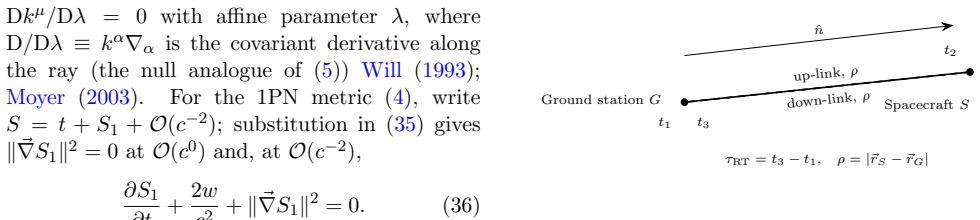
Each solar-system observable is characterised by celestial reference system (CRS) coordinate time, proper time on its world line, and the transformation between them. Ephemerides and Deep Space Network (DSN) tracking use the International Astronomical Union (IAU) barycentric and body-centric hierarchy, now extended to cislunar and Mars work. The IERS Conventions, Moyer radiometric models, and recent lunar-time papers distribute metric, scale, and tracking formulae across separate manuals. Merged Chang'e- or Tianwen-class data can acquire microsecond-level range and Doppler biases unless proper time $\tau$ is mapped consistently to barycentric and body-centric coordinate times. We present a unified 1PN documentation chain: tabulated harmonic Christoffel symbols through $\mathcal{O}(c^{-4})$, the barycentric-geocentric-terrestrial coordinate-time sequence, Fermi normal coordinates, null-geodesic observables, and a 1PN two-way range-rate expansion, applied in parallel to Mars (MCRS/MCG) and lunar (LCRS/TCL) body-centric systems. The chain yields a Mars areoid-geoid metric clock-rate difference of $\sim$48~$\mu$s\,day$^{-1}$ and lunar selenoid-geoid rates of $\sim$57.4-58.7~$\mu$s\,day$^{-1}$ consistent with published nested coefficients. Mars-range Shapiro-rate terms reach $10^{-12}$-$10^{-13}$. Multi-CRS consistency relies on documented transformation chains rather than a single master clock.
0
0
astro-ph.SR 2026-07-02

Brown dwarf spectra favor weak mixing Elf Owl models

by Zafar Rustamkulov, J. Kirkpatrick +22 more

SPHEREx 0.75 to 5 μm Spectra for a Sequence of Nearby Brown Dwarfs

SPHEREx data on 37 nearby objects show clear preference for low k_zz over strong mixing despite offsets near CO features.

Figure from the paper full image
abstract click to expand
The SPHEREx all-sky survey has now measured the R$\sim$40-100 infrared spectra of thousands of nearby brown dwarfs in the chemically rich 0.75-5 $\mu$m range. The survey's wide spectral coverage and high S/N permits flux measurements that capture several broadband molecular absorption features, and upwards of 80$\%$ of the total bolometric luminosity of most brown dwarfs. Atmospheric models are known to yield systematic disagreements in the inferred temperatures and radii of brown dwarfs, necessitating benchmarking against observations. In this work, we present SPHEREx spectra across a broad sequence of 37 nearby field brown dwarfs, ranging from L0 to Y4 ($\sim$2500-250 K) and compare them to theoretical expectations. We additionally compile spectra for separate low-gravity and low-metallicity objects, and show how they trend with constant spectral type. We fit the measured spectra to the well-known forward model grids Sonora Diamondback, Elf Owl, BT-Settl, ATMO2020 and ATMO2020++ and compare their goodness-of-fit as a function of wavelength, spectral type, and treatment of clouds and chemistry. We find that the models continue to struggle to simultaneously fit the J/H/K peaks and the 4 $\mu$m opacity window, especially in L/T transition objects. The largest deviations appear around the chemistry-sensitive CO$_2$ and CO features. Despite these offsets, the models broadly capture their trends across the L/T transition, with the observed sample of field dwarfs strongly preferring the weak vertical mixing ($k_\mathrm{zz}$ = 10$^4$ cm$^2$s$^{-1}$) Elf Owl models over strong mixing. The spectra shown here along with future SPHEREx data will help guide improvements to models.
0
0
physics.space-ph 2026-07-02

VLBI sessions refine deep space orbit tracking over two years

by Oliver James White, Guifre Molera Calves +3 more

VLBI Tracking of the JUICE Mission: Two Years of Cruise Phase Operations and Performance Analysis

More than 100 observations add geometric diversity for better position accuracy and spacecraft diagnostics during cruise.

Figure from the paper full image
abstract click to expand
The JUpiter ICy moons Explorer (JUICE) mission, launched by the European Space Agency (ESA) in April 2023, represents one of the most ambitious deep space exploration endeavours targeting Jupiter's icy moons. This paper presents results from the Very Long Baseline Interferometry (VLBI) radio telescope tracking conducted by the University of Tasmania during the first two years of JUICE's cruise phase operations. We have conducted over 100 tracking sessions capturing the spacecraft across different orbital regimes as JUICE progresses through its complex cruise trajectory towards Jupiter. Our analysis focuses on three key areas: Doppler residual characterisation, mission performance indicator extraction, and solar wind scintillation pattern analysis (including space weather forecasting). UTAS measurements demonstrate the enhanced capabilities that VLBI networks provide for deep space mission support, particularly for precision orbit determination and spacecraft health diagnosis. The results showcase the UTAS VLBI array as a valuable complement to traditional tracking infrastructure, offering Southern Hemisphere coverage and enhanced geometric diversity for deep space missions.
0
0
astro-ph.IM 2026-07-02

GPU speeds transit search by factor of 24

by QuanQuan Hu, Jian Ge +2 more

GTLS: A GPU-accelerated method for periodic transit detection

GTLS finishes a 3000-day curve in 138 seconds instead of 3289 while matching TLS precision and recall.

Figure from the paper full image
abstract click to expand
Computational efficiency is a critical requirement for transit searches in modern large-scale photometric surveys. We present Graphics Processing Units Transit Least Squares (GTLS), a GPU-accelerated implementation of the Transit Least Squares algorithm designed to reduce the computational cost of periodic transit detection while preserving TLS-like sensitivity to transit-shaped signals. GTLS parallelizes the dominant steps of the TLS search, including phase folding, transit-duration evaluation, moving-window depth estimation, and chi-squared calculation. Using Kepler-like long-cadence light curves and synthetic Kepler-like time series, we benchmark GTLS against the reference CPU implementation of TLS and the GPU-based BLS implementation in cuvarbase. On an AMD Ryzen 9 7950X CPU and an NVIDIA RTX 4090 GPU, GTLS processes a 3000-day synthetic light curve in approximately 138 seconds, compared with 3289 seconds for TLS. With two RTX 4090 GPUs, the runtime is reduced to approximately 79 seconds. In recovery tests, GTLS achieves detection performance statistically consistent with TLS, with a precision of 9.3 percent and recall of 79.4 percent, compared with 9.4 percent and 81.1 percent for TLS. These results demonstrate that GTLS enables efficient TLS-style searches for large photometric data sets from Kepler, TESS, PLATO, ET, and future missions. The source code is publicly available.
0
0
astro-ph.IM 2026-07-01

Constellation survey maps sub-Neptune atmospheres

by Luis Welbanks, Kylie E. Hall +11 more

Nautilus Space Observatory: Unveiling the Diversity and Origin of Sub-Neptunes with the Nautilus Space Observatory

Nautilus observatory would deliver first statistical view of the most common exoplanet class to test ocean and interior models.

Figure from the paper full image
abstract click to expand
Sub-Neptunes are the most common class of planets in the Galaxy, yet they have no Solar System analog and remain poorly understood as a population. JWST observations have revealed atmospheres spanning a wide range of metallicities, compositions, and cloud properties, driving active debates over whether warm sub-Neptunes harbor liquid water oceans beneath H2-rich envelopes, maintain stratified H2/H2O interiors, or have well-mixed, metal-rich envelopes. Open questions also remain over what physical processes drive transitions between hazy and clear atmospheres. These are intrinsically population-level questions that single-target observations, however deep, cannot resolve. Here we argue that a sub-Neptune population survey with the Nautilus Space Observatory, a proposed constellation of large-diameter space telescopes, would deliver the first statistical map of sub-Neptune atmospheric diversity, test competing classification schemes, identify habitable candidates, and serve as a pathfinder population for the eventual habitable-worlds search. These goals are achievable across the proposed mission classes for the constellation, and this architecture is uniquely well-matched to this science case since population-level questions demand sample size and a uniform observing strategy.
0
0
astro-ph.SR 2026-07-01

Gaia DR4 pipeline to give masses and ages for 500 million stars

by Orlagh L. Creevey, Laia Casamiquela +24 more

Stellar masses and ages in Gaia Data Release 4 from the Final Luminosity Age Mass Estimator algorithm

FLAME combines analytical luminosity-radius steps with Bayesian or minimization fitting on Gaia data to produce the estimates.

Figure from the paper full image
abstract click to expand
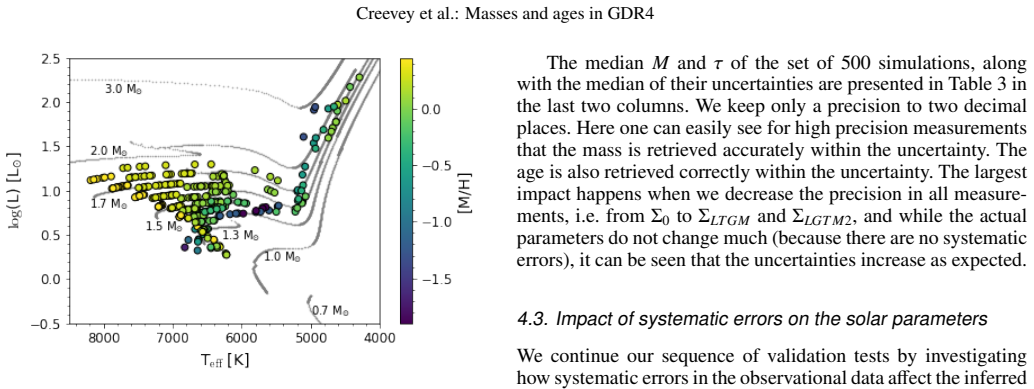
The masses and ages of stars are key quantities for understanding exoplanetary, stellar, and galactic evolution. In the context of Gaia, these parameters provide insights into the stellar populations, helping to trace the formation and history of the Galaxy. As part of the Gaia Data Processing and Analysis Consortium (DPAC), the Final Luminosity Age Mass Estimator (FLAME) pipeline processes Gaia data to derive stellar parameters comprising luminosities, radii, masses and ages. This paper discusses the methods and data used in FLAME for Gaia Data releases and the expected performances of FLAME for the 4th Gaia Data Release. FLAME comprises two main components: the first one, which is analytical, is used to estimate luminosity, radius, and radial velocity correction due to gravitational redshift by exploiting the atmospheric, astrometric, and photometric parameters produced within Gaia. The second is a model inference based on two main approaches: a classical minimization approach, and a Bayesian framework. It aims to derive mass, age, and evolutionary stage. The two step implementation offers flexibility in handling photometric properties that are prone to systematic errors. Tests with simulated data, the Sun, and well characterised samples of stars show that the methods in FLAME perform as expected, producing results in statistical agreement with the literature. We provide new stellar fundamental parameters for some high velocity stars, stars with very low mass companions, and a selection of stars in the Plato Field of View. In Gaia Data Release 4 approximately 500 million sources will have results from the pipeline. [abridged]
0
0
astro-ph.EP 2026-07-01

Microbes may survive galactic travel inside icy interstellar objects

by Shokhruz Kakharov, Abraham Loeb

Prospects for Panspermia via Interstellar Objects like 3I/ATLAS

JWST data on 3I/ATLAS shows ice allows low-rate survival, though directed planting fails due to destructive impact energies.

Figure from the paper full image
abstract click to expand
We study the feasibility of natural and directed panspermia via interstellar objects (ISOs) like 3I/ATLAS. The paper is organized around two questions. First, could natural panspermia occur if microbes or biomolecules survived inside shielded ice and were later exposed during perihelion and outbound activity? Second, could directed panspermia occur if a technological civilization planted life-bearing material inside or onto an icy ISO so that it later transported life through the Milky Way? We combine data on 3I/ATLAS with order-of-magnitude thermal, biological, and mission constraints. SPHEREx provides the volatile and organic context through CO$_2$, H$_2$O, CO, dust, and a broad C--H feature, while JWST/MIRI provides the first direct CH$_4$ detection in an interstellar object and confirms an unusual volatile inventory, including enhanced CO$_2$:H$_2$O and CH$_4$:H$_2$O ratios. We distinguish dormant interstellar cruise from active perihelion. Natural panspermia is plausible as microbes can survive or repair damage in ice films, veins, or frozen matrices at very low metabolic rates. Methane production is more nuanced. Frozen survival metabolism would require $\sim10^{14}$--$10^{15}$ kg of biomass to match the JWST CH$_4$ rates, but active methanogenic archaea in warm, liquid, substrate-rich settings can produce methane many orders of magnitude faster, reducing the required biomass in optimistic laboratory-rate comparisons. Directed panspermia faces a different challenge: a direct 60 km s$^{-1}$ impact releases $1.8\times10^9$ J kg$^{-1}$, hundreds of times the specific energy of TNT, and would destroy a biological capsule. 3I/ATLAS-like objects are therefore best treated as test cases for panspermia diagnostics rather than as evidence for life. Natural panspermia requires preservation plus a credible liquid-water or near-surface activation pathway.
0
0
astro-ph.SR 2026-07-01

Four white dwarfs show stable metal accretion over 18 years

by Laura K. Rogers, Michael M. Shara +13 more

Spectroscopic Monitoring of Metal Lines in Polluted White Dwarfs

Line strengths in most systems vary by less than 30 percent, implying steady rates across many diffusion cycles.

Figure from the paper full image
abstract click to expand
The disruption and accretion of planetary material onto white dwarfs is expected to be inherently dynamic and stochastic, potentially driving variability in the accretion rate and therefore the shape and depth of the photospheric metal absorption lines. This paper presents an 18-year optical spectroscopic monitoring campaign of five warm (11,000-23,000K) polluted white dwarfs with sinking timescales of days-months, observed using Magellan/MIKE and SALT/HRS to directly test this prediction. At four of the five systems, no statistically significant variability is detected over baselines of 15-18 years corresponding to hundreds to thousands of diffusion timescales, with inferred accretion rates stable to within 15-30% (1$\sigma$) showing remarkably stable accretion on decadal timescales. This implies that either the processes maintaining the accretion of the disrupted planetary material are stable on the same timescales, or that currently uncharacterized photospheric processes act to smooth observable abundance variations on these timescales. The one exception, WD 0106$-$328, shows statistically significant variability in the 4481A Mg II doublet from the ground-based data. Yet no significant equivalent width or abundance changes are seen between two Hubble Space Telescope ultraviolet spectra taken in 2016 and 2025, despite probing a larger set of transitions. This may imply that the ground-based observations witnessed a stochastic excursion from a stable baseline accretion rate, rather than a sustained change in the bulk accretion rate.
0
0
astro-ph.EP 2026-07-01

Three atmospheric classes trace giant-planet formation paths

by E. Pacetti, D. Turrini +14 more

Planet formation in chemically diverse and evolving discs II. Chemical fingerprints in planetary atmospheres

Distinct patterns in N/O*, C/O*, and S/N* separate gas-dominated, planetesimal-dominated, and drift-enhanced accretion in evolving discs.

Figure from the paper full image
abstract click to expand
Giant planets form in protoplanetary discs, where the coupled dynamical and chemical evolution of gas and solids determines the composition of the material they accrete. We investigate how planet formation and migration shape the primordial elemental makeup of giant-planet atmospheres. Our aim is to link atmospheric compositions to planets' formation pathways and the time-dependent chemical properties of their natal discs. We couple 1D models of viscously evolving discs - incorporating radial dust drift and volatile chemistry - with N-body simulations of planetesimals interacting with a growing and migrating giant planet. Four chemical scenarios and three representative grain sizes (0.1, 20, and 100 micron) are explored. We track the accretion of carbon, oxygen, nitrogen, and sulphur to derive atmospheric elemental ratios normalised to stellar values (* denotes stellar normalisation). We identify three atmospheric classes corresponding to distinct accretion regimes: gas-dominated, characterised by N/O* > C/O* > C/N* and unconstrained or substellar S/N* (near-stellar C/S*); planetesimal-dominated, showing N/O* < C/O* < C/N*, S/N* >= C/N*, and C/S* <= C/O*; and drift-enhanced, exhibiting N/O* < C/O* < C/N* and markedly superstellar volatile-to-refractory ratios. N/O*, C/N*, and S/N* vary systematically with migration extent, although degeneracies arise for planets forming beyond the CO and N2 snowlines; C/O* remains largely insensitive. Metallicity alone does not uniquely trace the solid-to-gas accretion balance in drift-dominated regimes. Variations in the disc's chemical state and dust size imprint distinctive volatile-ratio patterns across these classes, providing complementary constraints on disc properties. This multi-element framework establishes predictive trends to guide the interpretation of atmospheric spectra from facilities like JWST and Ariel.
0
0
astro-ph.EP 2026-07-01

Mass loss dominates orbits of planets around white dwarfs

by Richard J. Parker (1), Dimitri Veras (2) ((1) University of Sheffield +3 more

White dwarf planets in star clusters: gravitational scattering versus mass-loss effects

Cluster simulations find stellar evolution effects outweigh scattering regardless of density, yielding populations for Roman and JWST.

Figure from the paper full image
abstract click to expand
White dwarfs are unique laboratories for understanding the formation, evolution and survivability of planetary systems. Post-main sequence mass-loss will change planetary orbital properties and stir up debris discs, leading to the observed pollution of white dwarf atmospheres. However, to date, very few studies have investigated the impact of the stellar birth environment on white dwarf planetary systems. In this paper we simulate the evolution of giant planets around white dwarf progenitors from their formation in a star-forming region until 1Gyr, when the most massive stars ($>$2M$_\odot$) have left the main sequence. Our simulations self-consistently model $N$-body interactions between stars and planets while stars evolve into white dwarfs within the cluster lifetime. We find that although scattering interactions in dense star-forming regions create free-floating planets, and alter the orbital properties of up to 20 per cent of the surviving planets, the effects of mass-loss from the star dominate the dynamics. This behaviour is independent of the stellar density of the birth star-forming region, and largely independent of the initial planet orbital properties. Our simulations produce both captured planets around white dwarfs (potentially similar to WD 0806-661b), and triple systems with white dwarfs and planets (potentially similar to PSR B1620-26(AB)b), and our results yield a population synthesis of giant planets from 1 - 100au that may be relevant to Roman, Gaia and JWST observations.
0
0
hep-ph 2026-07-01

Radio ranges probe ultralight dark matter at 10^{-15} eV

by Jonas Frerick, Hyungjin Kim +1 more

Precision Solar System Dynamics for Ultralight Dark Matter Search

Current precision suffices if solar system density is 100000 times the local average, complementing pulsar timing.

Figure from the paper full image
abstract click to expand
Ultralight dark matter exhibits an order-one density fluctuation at the scale of its wavelength. This density fluctuation exists across the entire dark matter halo and interacts with stars and planets, perturbing their motion via gravitational interactions. We investigate the possibility of using precision solar system dynamics to search for ultralight dark matter. We examine this possibility with interplanetary radio range measurements. We show that the precision of current range measurements can probe ultralight dark matter at masses around $10^{-15}\,$eV, had its density in the solar system been $10^5$ larger than the so-called local dark matter density. This limit complements other constraints, such as the one from analyses of pulsar timing observations.
0
0
astro-ph.IM 2026-07-01

Dual UV channels measure exospheric Lyman-alpha at mission-required sensitivity

by Martin Sirk, Alex M. Zhang +14 more

Design and Performance of the Carruthers Geocoronal Imager

Lab tests confirm the narrow and wide field imagers meet accuracy goals for global and regional hydrogen structure studies.

abstract click to expand
The GeoCoronal Imager (GCI) onboard the Carruthers Geocorona Observatory is the primary scientific instrument of the mission. It is designed to measure far ultraviolet light at 121.6 nm (Lyman-alpha) emitted by hydrogen (H) atoms in Earth's exosphere with the sensitivity, accuracy and precision to meet the mission's scientific objectives regarding the nature of terrestrial exospheric structure and dynamics on both global and regional scales. The GCI is comprised of two co-aligned UV imaging systems. The Narrow Field Imager (NFI) acquires nearly continuous images of exospheric Lyman-alpha radiance near and above the Earth's limb at relatively high spatial and temporal resolution, while the Wide Field Imager (WFI) uses relatively higher optical sensitivity and a wider field of view to detect faint Lyman-alpha emission from the exosphere's outermost extent. Both imaging channels feature identical active pixel sensor cameras, gain-intensifiers, and 6-position optical filter wheels. This paper outlines the instrument design requirements, informed by mission science goals, as well as its performance as measured in the vacuum ultraviolet laboratory test and calibration.
0
0
astro-ph.EP 2026-07-01

No new Earth Trojans detected in L4 survey

by Junqiang Lu, Lulu Fan +17 more

Search for L4 Earth Trojan asteroids with the 2.5-meter Wide Field Survey Telescope

Wide search covering one-third of stable region sets tightest bound yet on objects larger than 500 meters.

Figure from the paper full image
abstract click to expand
Earth Trojan asteroids (ETAs) are a mysterious population, and dynamically stable ETAs, if primordial, could be "living fossils" of the early solar system. To date, there are only two known ETAs, but both are temporary ETAs. The aim of our survey is to discover new temporary or stable ETAs; in the absence of detections, we derive upper limits on the population of stable ETAs. We conducted the largest wide-area survey of the Earth's L4 Lagrange point region so far using the Wide Field Survey Telescope, covering about 236.74 deg^2, corresponding to 33.24% of the probability coverage for sky regions where dynamically stable L4 ETAs are likely to reside. No new ETAs were detected in our survey. We place a cumulative upper limit of N(H < 19.1) < 19 on the stable population of objects larger than ~520 m (for an assumed albedo of 0.15). This represents the most stringent constraint on the ETA population to date.
0
0
physics.space-ph 2026-07-01

Electron cooling sets ion regimes near comet nucleus

by Victor Steinwand, Peter Stephenson +4 more

Cometary ion dynamics at a weakly outgassing comet

The cooling exobase aligns with Rosetta density data and explains when ions co-move with neutrals.

Figure from the paper full image
abstract click to expand
The ESA/Rosetta mission escorted comet 67P/Churyumov-Gerasimenko for two years, exploring its plasma environment across diverse outgassing conditions. Plasma density observations from the Rosetta Plasma Consortium (RPC) are broadly categorized into two regimes for the ion dynamics, linked to the presence of a diamagnetic cavity at Rosetta's location. With a diamagnetic cavity present, ions detected by Rosetta are accelerated with respect to the neutral coma. Without a diamagnetic cavity present, at lower outgassing, and nearer the nucleus, ions co-move with the neutrals. We examine the transition between regimes following Rosetta's last detection of the cavity in February 2016. During this transition, global 3D plasma models of the cometary ionosphere underestimate plasma densities. To investigate this underestimation, we assess the sensitivity of cometary ion densities to different parameters using a 3D collisional ion test particle model, driven by electromagnetic fields from hybrid modeling. We show that considering cometary electron cooling is necessary to model cometary ion dynamics within 100 km of the surface. Electron temperatures derived from collisional electron modeling affect ion dynamics via the ambipolar electric field, increasing ion number densities. We further show that the cometary electron cooling exobase organizes Rosetta plasma density observations; different ion dynamics regimes are linked to the position of Rosetta relative to the exobase. These findings demonstrate that Rosetta was below this exobase for much of the post-perihelion period. They justify the absence of ion acceleration in plasma density assessments and the use of uniform electron-impact ionization frequencies between Rosetta and the surface during post-perihelion.
0
0
astro-ph.SR 2026-07-01

Stellar magnetism sets exoplanet space weather and detection noise

by E. Iş{i}k, A. Valio +11 more

Magnetic activity in cool stars: manifestations and relevance to exoplanets

Activity in cool stars defines planetary environments while creating the main variability that limits observations.

Figure from the paper full image
abstract click to expand
Understanding stellar magnetic activity is central to exoplanet science in two ways: it sets the dynamic astrospheric boundary condition governing planetary space environments, and it is the primary obstacle to exoplanet detection and characterisation, since magnetically driven variability imprints correlated quasi-periodic signals across detection time series. In cool stars, MHD-dynamo-generated fields emerge at the photosphere as bipolar regions, drive chromospheric and coronal heating, modulate irradiance and wind, and power flares and coronal mass ejections. Spatial scales range from individual flux tubes to global coronal configurations, and temporal scales from minutes to decades and beyond, requiring observational and theoretical tools of correspondingly wide scope. We review observational manifestations and physical models of magnetic activity in stars with outer convective envelopes, addressed to the exoplanet community. We develop the solar-stellar connection through the 'Sun in Time' framework and a sequence of solar analogues serving as evolutionary snapshots of a solar-mass star over several Gyr. We survey photospheric, chromospheric, and coronal activity diagnostics across timescales, together with forward-modelling tools translating surface field distributions into signals at or above the level of exoplanet detection. Empirical rotation-activity relationships and their physical interpretation are examined across all three atmospheric layers. Surface reconstruction techniques are assessed for their diagnostic reach and limitations. The evolution of magnetism in solar-like stars is discussed as context for habitability and as a window to other worlds. We close with an account of how stellar magnetism sculpts the astrospheric environment and affects close-in exoplanets, followed by a synthesis of outstanding issues and an outlook on future prospects.
0
0
astro-ph.IM 2026-07-01

Coupled coronagraph and fiber nuller reaches 3.5e-5 contrast at 6% off design

by Satoshi Itoh, Taro Matsuo +4 more

Combining a Diffraction-Limited Coronagraph with Fiber Nulling: A Demonstration of Serially Coupling Different Nullers

The second-stage nuller erases flat wavefront leaks from the first stage, improving performance by a factor of 20 for non-monochromatic ligh

Figure from the paper full image
abstract click to expand
We present experimental results of an efficient small-IWA ($\sim$1 $\lambda/D$) high contrast imaging approach realized by co-optimizing a coronagraph front-end with a fiber nulling 2nd stage. The setup includes the one-dimensional diffraction-limited coronagraph (1DDLC) and Parity Fiber Nuller (PFN). The 1DDLC has promising features (binary nuller, small inner working angles (IWAs)). Although the 1DDLC has the 2nd/4th-order sensitivity to spectral bandwidth and tilt aberrations, it outputs stellar leak due to wavelengths other than the design wavelength only as a flat wavefront on the Lyot-stop plane, preserving the same complex amplitude profile as an on-axis point source. The PFN after the 1DDLC erases the leak from the 1DDLC. For the wavelength 6% less than the coronagraph's design-center wavelength, we confirmed the contrast mitigation ability of $3.5\times10^{-5}$, which is about 1/20 times the value of the case with only 1DDLC, suggesting that the combined system works robustly against the broad spectral bandwidth. Future work needs to address the demonstration of the anticipated broadband robustness for the contrast level lower than about $10^{-5}$.
0
0
astro-ph.EP 2026-07-01

Stellar spots dominate AU Mic b transmission spectrum

by William C. Waalkes, Peter Gao +11 more

The HST/WFC3 Transmission Spectrum of AU Mic b Part I: An Atmosphere Obscured by Contamination and Systematics

The young planet's near-IR spectrum shows the transit light source effect overwhelming atmospheric signals, with data favoring a scale heigh

Figure from the paper full image
abstract click to expand
Young sub-Neptune progenitors around M dwarfs offer an excellent opportunity to probe the formation of their abundant, older cousins. At $\sim$20 Myr and only 9.7 pc away, AU Mic b is an ideal candidate for this effort, with its density and observations of escaping hydrogen pointing to a significant primordial atmosphere. Here we present the 0.8-1.6 $\micron$ transmission spectrum of AU Mic b observed with the Wide Field Camera 3 on the Hubble Space Telescope (HST). We find that HST experienced unstable scanning during its visits, resulting in a variable PSF that dramatically affects the orbit-to-orbit baseline of the observations. While we were able to somewhat mitigate this problem through spectral binning, the effects cannot be completely eliminated, limiting the precision of our results. Our data is further impacted by the intense magnetic activity of AU Mic, which introduced significant rotational variability along with spot crossings and the transit light source (TLS) effect into the light curves and spectrum, respectively. Through decomposition of the out-of-transit stellar SED, we are able to constrain AU Mic's photospheric and spot temperatures to 3891$\pm$37 and 3020$\pm$69 K, respectively, with a spot filling factor of $0.33\pm0.05$. Using Bayesian atmospheric retrievals, we show that the spectrum is dominated by the TLS effect with weak atmospheric constraints, with the data preferring a relatively small scale height of $<$185 km to 3$\sigma$. Extrapolation of our retrieved spectra shows that the TLS effect dominates over atmospheric features at optical and infrared wavelengths.
0
0
astro-ph.EP 2026-07-01

Collisions and evaporation diversify exoplanets without pure water worlds

by Yasuhiro Hasegawa, Renyu Hu +1 more

Formation and evolution pathways of planets. I. Comparison between theory and observations

Pre-loss properties match core accretion, producing eight classes from four evolutionary stages.

Figure from the paper full image
abstract click to expand
Discoveries of numerous exoplanets by various methods enable detailed characterization including bulk density. Formation and evolution pathways of planets can thus be probed in the mass-radius and mass-density diagrams. We develop a framework to identify dominant processes shaping parameter space in these diagrams by integrating previous studies. These include interior structure models, gas accretion/retention recipes, and photoevaporative and collisional mass losses. We find that the distribution of planets in the diagrams is diversified by two evolution processes: photoevaporative and collisional mass losses, and the properties of planets before experiencing these processes are consistent with predictions of standard core accretion. In particular, collisional mass growth and loss move planets to the parameter space, which is otherwise occupied by water-dominated (i.e., nearly pure water) planets, gathering non-necessity of invoking such planets. A potentially high abundance of water-rich planets are possible with the ice-to-rock ratio capped at $1/3$, similar to solar system comets. We propose a new classification scheme and apply to observed exoplanets. The classification scheme recovers four canonical planet types widely used in the literature and is expended to eight classes in total due to evolution processes. We divide formation and evolution pathways into four stages (core formation, gas accretion, collisional mass growth and loss, and photoevaporation) and trace how planets populate in the mass-radius and mass-density diagrams with time. We apply the framework to habitable zone planets and discuss possible predictions. This work emphasizes the importance of precise mass and radius measurements, especially for small-sized, potentially habitable planets.
0
0
cs.LG 2026-06-30

Normalizing flow learns posterior for cislunar angles-only orbit determination

by Walther Litteri, Massimiliano Vasile

Physics-informed Conditional Normalizing Flows for Angles-only Cislunar Orbit Determination

Trained on perturbed NRHO data, the model samples consistent state hypotheses that warm-start least-squares refinement.

abstract click to expand
Generative Astrodynamics is advanced in this work by extending generative modelling to an orbit determination problem in the cislunar environment. The task is formulated as conditional density estimation, aiming to infer the probability distribution of the initial state from angles-only measurements over short observation arcs. A normalising flow is trained on perturbed topocentric observations from Near Rectilinear Halo Orbits, enabling a flexible and potentially multimodal posterior representation. Given new measurements, the learned density is sampled to generate statistically consistent and physics-informed state hypotheses. These estimates are refined via nonlinear least-squares minimisation, providing a competitive warm start for classical algorithms.
0
0
astro-ph.EP 2026-06-30

Planet pair shows near-equal masses but disparate radii

by G. Mantovan, V. Nascimbeni +50 more

The GAPS programme at TNG ?. TOI-1533: a compact system hosting a super-Neptune-mass pair with disparate radii

The outer super-Neptune at ~40 Earth masses and inner sub-Neptune around TOI-1533 have a mass ratio of 0.8, unlike most hot Jupiters with co

Figure from the paper full image
abstract click to expand
The present-day architecture of planetary systems contains information about their formation and migration histories. The origin of hot Jupiters (HJs, P $\lesssim$ 10 d, $R_{\rm p} > 8 R_\oplus$) has long been a matter of debate. While most of them are found to be ``lonely'', there is a rare population of HJs hosting small companions on inner orbits (eight known as of May 2026). Their peculiar architecture suggests a gentle disc-migration mechanism. In this study, we present the discovery and characterisation of the multi-planet system TOI-1533, comprising an inner sub-Neptune (TOI-1533 b, $P_{\rm orb} = 3.63$ d, $R_{\rm p} = 3.15 R_\oplus$) and an outer hot giant planet (TOI-1533 c, $P_{\rm orb} = 8.06$ d, $R_{\rm p} > 7.5 R_\oplus$) with substantial H/He by mass ($\rho_{\rm p} < 0.48$ g cm$^{-3}$), both transiting an active K-dwarf star ($T_{\rm eff} \approx$ 5130 K; $V$ (mag) $\approx$ 11). Our joint modelling of stellar activity and planetary signals from radial velocities (HARPS-N) and transits (TESS) allows us to detect their Keplerian signals (approximately $10~\sigma$) and to isolate the stellar modulation. The inclusion of simultaneous photometry in the multi-dimensional Gaussian processes formalism was a fundamental addition to the spectroscopic activity indicators, enabling the disentanglement of stellar activity from planetary signals. The mass ratio of the two confirmed planets ($M_{\rm b} / M_{\rm c}$ about 0.8), together with the super-Neptune mass of the large outer companion ($M_{\rm c} \approx 40 M_\oplus$), makes this system unusual compared to the other few HJs with low-mass inner companions.
0
0
astro-ph.EP 2026-06-30

Reflected light from LTT-9779 b measured at 102 ppm

by F. Borsa

High-resolution detection of reflected light from the exo-Neptune LTT-9779 b

ESPRESSO cross-correlation yields geometric albedo 0.88, matching photometry and indicating a reflective atmosphere.

Figure from the paper full image
abstract click to expand
While high-resolution spectroscopy is routinely used to probe exoplanetary atmospheres, detecting reflected starlight remains highly challenging due to the extremely low planet-to-star optical flux ratios. We report the detection of reflected light from the ultra-hot exo-Neptune LTT-9779 b using high-resolution spectroscopy with ESPRESSO in its 4UT mode. By combining multiple epochs and applying a cross-correlation analysis with a theoretical reflection kernel, we were able to identify a faint signal matching the expected morphological and kinematic profile of the planetary reflection. This signature, whose presence has been detected at a signal-to-noise ratio of $\sim$5.4, exhibits a radial velocity semi-amplitude consistent with the expected orbital motion. We measured the planet-to-star flux ratio from the ratio of the equivalent widths of the planetary and stellar cross-correlation functions, finding $F_{\mathrm{p}}/F_\star = 102^{+29}_{-30}$ ppm for the ESPRESSO 380--770 nm wavelength range. Assuming a Lambertian phase function, this corresponds to a geometric albedo of $A_{\mathrm{g}} = 0.88 \pm 0.25$. The inferred albedo is consistent with previous space-based photometric measurements, suggesting a highly reflective atmosphere potentially dominated by scattering processes or high-altitude clouds. While we show that reflectivity is enhanced towards blue wavelengths, a detailed spectroscopic characterization of the planetary atmosphere from the reflected-light signal remains out of reach. This result highlights the scientific potential of future high-resolution spectrographs on extremely large telescopes, paving the way for systematic reflected-light detections across a broader exoplanet population, including cooler and smaller planets.
0
0
astro-ph.SR 2026-06-30

Review outlines methods to detect star-planet interactions amid stellar noise

by P. Figueira, H. Korhonen +9 more

Star-Planet Interactions: Observational Techniques and Methods

Radial velocities, photometry, spectral lines and radio data are examined for their ability to isolate planetary effects from stellar activi

Figure from the paper full image
abstract click to expand
This chapter summarizes the techniques and methods used to study star-planet interaction (SPI) from the observational point of view. SPI can produce a wide range of observational signatures, from localized stellar activity enhancements to changes in planetary atmospheric escape and transmission spectra. This chapter reviews the main observational techniques used to detect and characterize SPI, emphasizing the methodological challenges involved in separating planet-induced signals from intrinsic stellar variability. We discuss radial-velocity diagnostics, including cross-correlation, template matching, line-by-line methods, and activity indicators, highlighting their sensitivity to line-profile distortions and chromatic variability. We then review precision photometry as a tool to search for orbit-locked variability, flare modulation, and active-region occultations during planetary transits. Chromospheric diagnostics, including Ca II, Halpha, He I, and Na II lines, are presented as tracers of magnetic variability at different atmospheric heights and as potential probes of intermittent SPI signatures. We also discuss transmission spectroscopy as a complementary approach, since planetary atmospheric tracers such as H I Lyalpha, Balmer lines, C II, and He I can encode information about the stellar high-energy environment, stellar wind, and magnetic coupling. In addition, radio observations provide a promising avenue to probe magnetic SPI directly through coherent emission mechanisms. Finally, we examine time-series analysis techniques commonly employed in SPI searches, including generalized Lomb-Scargle periodograms, rolling periodograms, harmonic analyses, and bootstrap-based significance estimation. (abridged)
0
0
astro-ph.SR 2026-06-30

L2 brown dwarf found orbiting A0V star HIP 17453

by Marah Brinjikji, Adam J. Smith +27 more

The Companions to B and A Stars Snapshot (C-BASS) Survey: I. Discovery of a Young Brown Dwarf Companion to HIP 17453

The 53 Jupiter-mass object at 81 pc has mass ratio 0.024 and is suitable for benchmark atmospheric studies.

Figure from the paper full image
abstract click to expand
We report the detection of a new brown dwarf companion to HIP 17453 A, a chemically peculiar A0V star located at a distance of 81 pc. HIP 17453 A was observed with high-resolution adaptive optics imaging using the Near-Infrared Camera 2 on the Keck II telescope as part of the Companions to B and A Stars Snapshot (C-BASS) survey over a ten-year baseline, revealing the presence of a companion with proper motion consistent with the primary. We estimate the age of the HIP 17453 system as 280 $\pm$ 125 Myr, and with follow-up intermediate resolution (R~1800) spectroscopic observations with the Gemini Near Infra-Red Spectrograph (GNIRS) on the Gemini-North telescope, we found the spectrum of HIP 17453 B to be consistent with a spectral type of L2 $\pm$ 1. Through interpolation of Sonora Diamondback evolutionary models, we calculate an effective temperature of $1953^{+84}_{-78}$ K and mass of $53^{+10}_{-8}$ $M_{Jup}$ for HIP 17453 B, which corresponds to a mass ratio of $q = 0.024 \pm 0.004$ for the HIP 17453 system. With its intermediate mass and young age, HIP 17453 B joins a small set of benchmark brown dwarf companions around early-type stars that are suitable for follow-up atmospheric and evolutionary studies.
0
0
astro-ph.EP 2026-06-30

Giant planet hosts enriched in C O S Fe Ni

by E. Costa-Almeida, L. Ghezzi +3 more

Chemical Abundances of the Bioessential Elements C, O and S, and the Refractory Elements Fe and Ni, in Solar-type Exoplanet-hosting Stars from HARPS North and South

290-star sample finds higher abundances for all five elements when planets exceed 4 Earth radii in size.

Figure from the paper full image
abstract click to expand
We determined atmospheric and evolutionary parameters, along with chemical abundances of C, O, S, Fe, and Ni for 290 solar-type exoplanet hosting stars using high-resolution HARPS-North and HARPS-South spectra, and radii for 373 exoplanets using literature transit depths. We find that stars hosting giant exoplanets (R$_{\text{pl}}>4\ \text{R}_{\oplus}$) show enhanced [X/H] abundances compared to small exoplanet hosts for all elements analyzed. When considering only exoplanets with $P_{\text{orb}}\leq30$ days, there is a statistically significant anti-correlation between host star [Fe/H] and $P_{\text{orb}}$. However, [Fe/H] does not continue to decline as the orbital period increases, but rather rises again for exoplanets with larger orbital periods. Stars hosting only small exoplanets or hosting at least one sub-Saturn show significant differences between the populations of hot and warm exoplanets for all elements. In contrast, stars hosting at least one Jupiter-sized planet show no abundance differences. The host star C/O ratios obtained vary from 0.17 to 0.95, with giant exoplanet hosts exhibiting the lowest median C/O ratios (0.43$^{+0.02}_{-0.03}$), while the 3 -- 4 R$_\oplus$ sub-Neptune hosts in our sample exhibit the highest median C/O ratios (0.55$^{+0.05}_{-0.01}$). Our sample has 199 exoplanets with estimated masses and we find correlations between host star [O/H] and [S/H] and $\log(M_{\text{pl}}/\text{M}_\oplus)$. When segregating the sample into hot and warm exoplanet hosts, these trends are only found for warm exoplanets. Dividing the sample between low- (91 exoplanets) and high-[$\alpha$/Fe] (20 exoplanets) stars, there are trends between host star [O/H], [S/H], [Fe/H] and [Ni/H] and $\log(M_{\text{pl}}/\text{M}_\oplus)$ only for the low-[$\alpha$/Fe] sample.
0
0
astro-ph.EP 2026-06-30

Miscibility shields sub-Neptune hydrogen from early escape

by James G. Rogers, Hilke E. Schlichting

Testing the prevalence of hydrogen-silicate miscibility in young sub-Neptunes

Resupply from interiors delays contraction; 70-100 young planets needed to test how common it is.

Figure from the paper full image
abstract click to expand
Hydrogen-silicate miscibility can significantly alter the interior structure and thermal evolution of sub-Neptunes. We consider the interplay between this miscibility and stellar-driven atmospheric escape. We find that, for the first $\sim 100$ Myrs, sub-Neptunes store most of their hydrogen content within their miscible interiors, protecting it from escape. As hydrogen is removed from the top of the atmosphere, more hydrogen is exsolved from the miscible interior, resupplying the envelope mass and delaying the planet's contraction when compared with models that do not account for miscibility. Regardless of miscibility, atmospheric escape reproduces the young planet observations from TESS, and we highlight the emergence of the primordial Neptune desert at short orbital periods. We construct a population-level test for the prevalence of miscible sub-Neptunes which exploits their slower radial contraction. We find that $\sim 70-100$ observed young sub-Neptunes with ages $\lesssim 100$ Myrs are required to answer this question.
0
0
astro-ph.EP 2026-06-30

Python wrapper speeds exoplanet cloud simulations 3.8 times

by Wolf Cukier, Diana Powell +4 more

CARMApy: An Open-Source Python Framework for Simulating Microphysical Clouds in Planetary Atmospheres

CARMApy reproduces Fortran results for particle size distributions while adding multithreading and accessibility.

Figure from the paper full image
abstract click to expand
CARMApy is a new open-source python code that performs bin-scheme microphysical modeling of clouds in exoplanet atmospheres. It models key cloud properties such as particle size distributions and microphysical rates from first principles. The code is a wrapper of ExoCARMA, a well tested Fortran code with an almost half century long heritage. CARMApy includes the microphysical processes of homogeneous and heterogeneous nucleation, condensational growth, evaporation, coagulation, and vertical transport. CARMApy has 10 built-in default condensates and allows the user to specify additional condensates. In this work we describe CARMApy and the data products that it can generate, along with the history of its code heritage. We additionally compile a complete description of the theory and methods used in CARMA. Lastly we benchmark CARMApy and show that its results are consistent with previous versions of CARMA, while executing the code ~1.9 times faster single threaded ~3.8 times faster multithreaded.
0
0
astro-ph.EP 2026-06-30

Numerical derivatives create 1 m/s RV errors at SNR 100

by A. M. Silva, K. Al Moulla

The impact of numerical derivatives on radial velocity extraction

The bias shrinks below instrument floors above SNR 1000 and with many lines combined, but lingers at 12.5 cm/s in real templates from 78 spe

Figure from the paper full image
abstract click to expand
The radial velocity (RV) method is a widely used technique to infer planetary masses and orbital parameters. One of the most widely used methods to compute RVs is based on the alignment of a high-SNR, data driven, stellar model with individual observations, commonly referred to as template matching. Typically, the alignment is performed through a $\chi^2$ minimization, but some approaches rely on the derivative of the stellar template to do so, which is often the case in line-by-line methods. In this paper we aim to explore the limitation of derivative-based methods for RV extraction in the case of using low-SNR stellar models. We use simulated Gaussian profiles to investigate the effect of computing a numerical derivative of the stellar template, in comparison with the usage of an analytical profile. The impact on RV and associated uncertainty is then analyzed as a function of the signal-to-noise ratio (SNR) of the line. Then, using real observations we compare the residuals between a derivative-based RV extraction and a classical template matching implementation, as function of the SNR of the stellar template. We find that on simulated Gaussian profiles the usage of the numerical approach leads to a RV residual at the level of the meter per second, at a per-pixel SNR regime of 100. An increase of the SNR leads to a decrease of this impact, falling under the current noise-floor of state-of-the-art spectrographs at SNR>1000 for a single spectral line. The inclusion of multiple spectral lines in the simulations lead to an overall decrease of the contamination, across all SNR regimes. The application to a real dataset presents a decrease of the RV impact with the increase of the template's SNR, albeit still presenting a 12.5 cm/s difference when including 78 observations in the stellar template.
0
0
astro-ph.IM 2026-06-30

Nautilus time-series data can map starspots to calibrate exoplanet spectra

by Adina D. Feinstein, Jeff Valenti +10 more

Mapping Stellar Heterogeneities with the Nautilus Space Observatory

Two-generation program links spot-crossing events to heterogeneity properties so contamination becomes a known input rather than an error so

abstract click to expand
Stellar photospheric heterogeneities, such as starspots and faculae, are a fundamental limitation for exoplanet transmission spectroscopy. Inhomogeneous surfaces can imprint wavelength-dependent signals during transits that may mimic or mask atmospheric absorption features, especially for planets orbiting cool low-mass stars. Recent work has shown that the information content of transmission spectroscopy observations can be sufficient to correct for stellar contamination, but only if stellar photosphere and active-region models have adequate fidelity. This requires empirical benchmarking with observations that validate next-generation stellar models and identify which spectral diagnostics best encode heterogeneity properties as a function of spectral type, activity level, and time. We propose a two-generation Nautilus program that leverages the scalable architecture of the observatory concept. Generation 1 would use broad-wavelength time-series observations of transiting exoplanet systems to connect starspot-crossing events and out-of-transit variability to localized and disk-integrated heterogeneity properties. Generation 2 would use the optimized spectral diagnostics identified in Generation 1 to conduct slitless spectroscopic monitoring of large samples of GKM stars on different timescales. Generation 2 instrumentation would include activity tracers of both the photosphere and chromosphere. This program would provide the benchmark data and population-level framework needed to turn stellar contamination into a calibrated input for exoplanet atmospheric retrievals.
0
0
astro-ph.EP 2026-06-30

103P activity steeper before than after perihelion

by Joseph Murtagh, Megan E. Schwamb +23 more

Multi-year Ground-Based Survey Photometry of Active Comet 103P/Hartley 2 and Centaur (2060) Chiron: A Tale of Two Comets in the Pre-LSST Era

Multi-year photometry finds asymmetric slopes for 103P and 1.4-year exponential decay from Chiron's 2021 outburst.

Figure from the paper full image
abstract click to expand
Comets and Centaurs trace the evolution of trans-Neptunian objects (TNOs) into the inner solar system. Their activity reflects the interplay between volatile sublimation, dust dynamics, and ring scattering. Yet the long-term behavior of individual objects is less constrained. To probe this evolutionary transition, we use wide-field survey photometry from the Asteroid Terrestrial-impact Last Alert System, Zwicky Transient Facility, and Las Cumbres Observatory observations of the Jupiter-family comet (JFC) 103P/Hartley 2 during its 2023/24 apparition, and the Centaur (2060) Chiron across 2020-2025, including its 2021 outburst. For 103P, heliocentric activity slopes are asymmetric about perihelion, with a steep inbound index ($n_{r,\rm pre}=-3.48\pm0.08$) and flatter outbound value ($n_{r,\rm post}=-1.16\pm0.04$), consistent with enhanced relative dust contribution post-perihelion. Reduced brightness versus prior apparitions matches reported secular fading trends. Dust mass-loss rates are $\sim4$-16 kg s$^{-1}$ for assumed grain properties. Colors exhibit a blueward trend near perihelion, consistent with enhanced gas contamination of the $g$-band, with possible phase-dependent scattering. A periodogram recovers a $\sim18.7$ hr activity-linked period near perihelion. For Chiron, subtracting a quiescent baseline reveals exponential decay from the 2021 outburst on a $\sim1.4$ yr timescale. Seasonal phase curves flatten from $\beta_o=0.150\pm0.034$ mag deg$^{-1}$ in 2021 to $\lesssim0.09$ mag deg$^{-1}$ by 2023-2025, converging with quiescent behavior. Broad-band colors remain unchanged at ATLAS ($c-o$)=0.22$\pm$0.09 mag. This extended activity suggests a new epoch of persistent, low-level activity and/or evolving ring-scattering. These objects bracket the TNO-to-JFC evolutionary sequence, with 103P near the volatile-depleted end, and Chiron still volatile-rich and capable of episodic activity.
0
0
astro-ph.EP 2026-06-30

Vertical transport stabilizes CO snow lines against oscillation

by Alfie Robinson, James E. Owen +1 more

CO snow lines are stabilised by the vertical transport of volatiles

2D models yield two steady snow surfaces but no limit cycles, unlike earlier 1D predictions, because volatiles move up and down through the

Figure from the paper full image
abstract click to expand
Volatile evolution in protoplanetary discs determines the compositional evolution of forming planets. Below their sublimation temperatures, volatiles freeze out from the vapour phase onto dust grains in the disc and transition to being dynamically-coupled to the dust component as opposed to the gas. The boundary between the ice and vapour phases is referred to as the snow line, when thought of as the mid-plane radius at which the phase transition occurs, or the snow surface, when viewed as a 2D (radial and vertical) structure in the disc. We investigate whether the CO snow line (and therefore snow surface) is thermally unstable and therefore liable to changes in its location during disc evolution using the disc evolution code cuDisc, to which we have added an ice-vapour chemistry solver. We find that the instability does lead to there being two steady-state stable equilibrium solutions for the snow surface when including the vertical structure. However, in dynamically-evolving simulations, the disc does not enter a limit-cycle - as seen in previous 1D models - due to the shape of the 2D snow surface and the vertical transport of volatiles. We therefore expect that dynamically evolution of snow lines due to instability is limited to transient, stochastic events rather than oscillatory behaviour with a regular period. However, we also expect the snow surface to evolve substantially during the disc lifetime solely due to changes in the thermal structure driven by evolution of the dust spatial structure and grain-size distribution - this we will explore in future models.
0
0
astro-ph.SR 2026-06-30

FUV irradiation speeds accretion loss in Orion discs

by Rossella Anania, Andrew J. Winter +9 more

Far-ultraviolet flux distribution in Orion and its relation to stellar accretion

Ha detection fraction falls faster in high-flux regions, matching external photoevaporation models.

Figure from the paper full image
abstract click to expand
Orion is the closest region hosting active star formation and young OBA stars. Computing far-ultraviolet (FUV) fluxes at its stars is essential to connect stellar and protoplanetary disc properties to the environment. We (1) accurately estimated the FUV flux at a large sample of stars in Orion by statistically accounting for the uncertainty in parallax measurements, and (2) investigated the relation between stellar accretion and external FUV flux by comparing observations and disc evolution models. We selected a large stellar population in Orion, assigned sub-cluster memberships and used 2D dimensional sub-cluster geometry to infer 3D separations from OBA stars and compute the FUV flux at stellar positions. We studied the accretion luminosities Lacc inferred from Ha emission in Gaia XP spectra of Orion sources and determined their detection fraction as a function of age and FUV flux. We compared the results with population synthesis models of viscous discs experiencing external photoevaporation. We provided a publicly available table of FUV fluxes at ~8600 stars in Orion. Most of the stellar population is weakly irradiated <10^{2} G0, ~35% is intermediately irradiated 10^{2}-10^{4} G0, and ~5% has FUV fluxes >10^{4} G0. Gaia-based Lacc decreases with age, and Ha detection fraction declines more rapidly in regions with strong FUV fluxes than in regions exposed to weaker FUV fluxes, broadly consistent with the model. This may suggest that external photoevaporation efficiently depletes strongly FUV-irradiated accretion discs, but it is not sufficient to reliably confirm this conclusion. The provided tools for computing FUV fluxes at Orion stars will be essential for future observations aimed at assessing the role of external photoevaporation on discs. We encourage measurements of stellar and disc properties in Orion, covering FUV fluxes 1-10^5 G0.
0
0
astro-ph.SR 2026-06-30

Phase curve measures brown dwarf heat transport below 10%

by Daphne Broski-Laing, Yifan Zhou +11 more

Asymmetric nightside CO2 features, inefficient heat transport, and precise evolutionary constraints: Spectroscopic phase curves reveal the past and present of a white dwarf-brown dwarf binary

JWST spectroscopy of ZTFJ0038 separates components to show inefficient redistribution, CO2 nightside asymmetry, and 7.5-8.8 Gyr age.

Figure from the paper full image
abstract click to expand
We present the first JWST phase curve of a white dwarf-brown dwarf binary, a NIRSpec PRISM observation of ZTFJ0038+2030. Short-period white dwarf-brown dwarf binaries provide unique laboratories to probe substellar atmospheres. Tidal locking drives hot Jupiter-like atmospheric dynamics in the brown dwarf. The system's formation history offers a window into planetary systems around post-main-sequence stars. We obtain a full-orbit phase curve of ZTF0038, including a total eclipse of the white dwarf, which enables us to separate the two components' emission throughout the entire orbit, and we model the brown dwarf's phase-resolved emission spectra using substellar atmosphere forward models and atmospheric retrievals. The PRISM spectrum covers ~80% of the brown dwarf's bolometric emission, enabling a nearly model-independent energy balance calculation, which yields a day-to-nightside heat transport efficiency of <10%. Inefficient heat redistribution is further supported by the phase curve shape and the nightside spectrum closely resembling non-irradiated mid-to-late T dwarfs. The spectroscopic phase curves reveal a stark nightside asymmetry associated with a strong CO2 absorption feature at 4.2 um, while the retrieved abundances indicate a longitudinally homogeneous distribution of CO2 as well as all other key species detected in the atmosphere. The precise internal luminosity measurement of the brown dwarf informs both the age of the WD-BD system (7.5-8.8 Gyr) and indicates a low common-envelope ejection efficiency. These data illustrate the exquisite opportunity to probe the three-dimensional processes of substellar atmospheres, connect substellar and exoplanet atmospheres, and probe the evolution of post-main-sequence planetary systems using WD-BDs.
0
0
astro-ph.EP 2026-06-30

Two planets show the lowest densities for Jupiter-sized worlds

by Georgina Dransfield, Antoine C. Petit +46 more

ASTEP confirmation of a pair of long-period Jupiter-sized planets with extremely low densities transiting TOI-791

TTV analysis of TOI-791 b and c on 139- and 232-day orbits gives densities of 0.038 and 0.047 g/cm³.

Figure from the paper full image
abstract click to expand
Gas giant planets with periods $20~<~P~<~300~\rm days$ orbiting Sun-like stars are a relatively uncommon outcome of planetary formation, and key questions about the nature and formation of this sub-population remain unanswered. Theoretical models for the location of their formation (in- or ex-situ) and for their subsequent migration predict different outcomes in terms of planet masses and eccentricities, indicating that observations have a key role to play in disentangling their histories. In this work we present the discovery and confirmation of a pair of long-period Jupiter-sized planets transiting an F7 star: TOI-791 b is a $0.993\pm0.033\rm~R_{Jup}$ planet on a $139.29931_{-0.00012}^{+0.00011}~\rm day$ orbit, and TOI-791 c, a $1.155\pm0.040\rm ~R_{Jup}$ planet on a $232.01570_{-0.00071}^{+0.00067}~\rm day$ orbit. The two planets are within 0.07% of a second-order 5:3 period commensurability leading to transit timing variations (TTVs) of up to 50 minutes. We confirm their planetary nature using ground-based photometry, including multiple full detections of the $>11~\rm hr$ transits of both TOI-791 b and c from Antarctica with ASTEP, making these the longest-duration transits ever observed in their entirety from the ground. Our detailed analysis of the TTV signal allows us to measure dynamical masses for both planets, which yield densities of $\rho_{\rm b}=0.038\pm0.008 \rm ~g~cm^{-3}$ and $\rho_{\rm c}=0.047\pm0.006 \rm ~g~cm^{-3}$, indicating that TOI-791~b and c are two of the lowest density giant planets ever detected. While these measurements are robust, further follow-up is needed to fully characterise the TTV signal and the architecture of the system.
0
0
astro-ph.EP 2026-06-30

Uranus satellites show comet-like D/H

by Michael E. Brown, Matthew Belyakov +6 more

Deuterated water and the formation of the satellites of Uranus

High deuterium levels show the moons formed without incorporating much of the planet's material, favoring separate accretion sources.

Figure from the paper full image
abstract click to expand
The satellites of Uranus orbit in a low-eccentricity, equatorial plane that is tilted by 98 degrees relative to the solar system -- a geometry that mirrors Uranus's extreme axial tilt. Although a giant impact could have tipped Uranus, how the satellites came to share this orientation remains uncertain. Proposed formation pathways include primordial accretion followed by reorientation, formation from debris generated by the tilting impact, and reaccretion from a massive ring produced by the tidal disruption of passing bodies from the outer solar system. Current observations do not discriminate among these scenarios. Using the James Webb Space Telescope, we measured the deuterium-to-hydrogen (D/H) ration in the water ice of the five regular satellites of Uranus. We find an average D/H ratio of $2.1\pm 0.2 \times 10^{-4}$, nearly five times higher than that of Uranus and comparable to the values measured in comets. This enrichment is inconsistent with with any formation scenario in which substantial Uranian material was incorporated into the satellites, thereby excluding models that require significant mixing in an impact-derived vapor disk. The observed D/H ratios are instead compatible with models in which the satellites accreted from material that remained largely separate from Uranus, such as debris from a disrupted pre-existing satellite system or from a tidally captured outer solar system body. The innermost regular satellite, Miranda, exhibits a marginally elevated D/H ratio (2.8 $\sigma$ above the average of the other satellites), potentially indicating a distinct formation history or source of water and offering an important clue for distinguishing amount competing models.
0
0
astro-ph.EP 2026-06-30

Brown dwarf transits evolved star every 4.8 days

by Akanksha Khandelwal, Shubhendra Nath Das +43 more

TOI-6884b: A low-mass brown dwarf transiting a slightly evolved star

Ground-based data fix TESS period alias and measure mass at 26 Jupiter masses for rare system

Figure from the paper full image
abstract click to expand
We report the discovery of a low-mass transiting brown dwarf orbiting TOI-6884 (TIC~156514476, $T_{\rm mag}=11.4$) from NASA's \textit{Transiting Exoplanet Survey Satellite} (\textit{TESS}) mission. The \textit{TESS} light curves initially suggested an orbital period of $\sim$14.42~days; however, our high-precision ground-based radial velocity measurements and multi-epoch time-series photometry reveal this to be a harmonic alias. We determine the true orbital period to be $4.808264^{+0.000015}_{-0.000014}$~days and confirm the substellar nature of the companion. TOI-6884b has a mass of $26.32^{+0.98}_{-0.93}\,M_{\mathrm{J}}$, a radius of $0.927^{+0.51}_{-0.52}\,R_{\mathrm{J}}$, and resides on a nearly circular orbit ($e=0.067^{+0.010}_{-0.012}$). Its host star is a late F-type slightly evolved star with $M_\star = 1.410^{+0.075}_{-0.069}\,M_\odot$,\msun, $R_\star = 1.840^{+0.072}_{-0.073}\,R_\odot$, $\log{g} = 4.057^{+0.045}_{-0.039}$, $[{\rm Fe/H}] = 0.094^{+0.073}_{-0.068}$~dex, and $T_{\rm eff}=6330^{+180}_{-160}$,\mathrm{K}$. TOI-6884b is a key addition to the small population of well-characterized transiting brown dwarfs orbiting host stars that have evolved off the main sequence. The detection of such systems will contribute to our understanding of the dynamical histories and structural evolution of short-period substellar companions around evolved stars.
0
0
astro-ph.EP 2026-06-29

Interpolation choice biases RV measurements by up to 25 m/s

by A. M. Silva, D. Doshi +12 more

The impact of interpolation in high-resolution spectroscopy -- The overlooked role of interpolation in radial velocity extraction

Synthetic and real spectra show the effect peaks in low-SNR, small-BERV data but falls below 20 cm/s when observations span a wider velocity

Figure from the paper full image
abstract click to expand
We explore the impact of spectral interpolation in radial velocity (RV) time-series extracted through template-based methods. We build synthetic datasets with Gaussian profiles to evaluate flux residuals and line asymmetry that are a result from changing the sampling location of the lines. We generate synthetic spectra as a sum of Gaussian functions whose parameters were determined through an observed spectrum. The s-BART pipeline was applied to them, allowing to evaluate any biases in RV extraction introduced by its internal assumptions in line shape. Lastly, we apply the s-BART pipeline to ESPRESSO observations of four stars: two that use high-cadence observations over a single night, and two that have observations spread over multiple nights. When extracting RVs from stellar spectra, we change the interpolation algorithm, used in the process of constructing the stellar template and, afterwards, during RV extraction, comparing them with RVs extracted with a widely-used cubic-spline interpolation. We find that synthetic datasets reveal systematic biases with the largest peak-to-peak amplitudes reaching $\sim$ 20 m/s in low SNR cases, with the amplitude decreasing as the SNR of the spectra increases. In the extreme case of noise-free data, we still recover a systematic bias, albeit at the mm/s level, significantly smaller than the RV precision of state-of-the-art instruments. With real observations we find that those from high-cadence observations with small BERV variation are impacted by the choice of the interpolation algorithm. This impact is smaller in higher-SNR cases, where the peak-to-peak amplitude reaches $\sim$ 1 m/s. In the comparatively lower-SNR case we find peak-to-peak residuals as large as $\sim$ 25 m/s . In cases where the observations are spread over a larger BERV window, we find an upper limit of 20 cm/s of RV scatter for this systematic signal.
0
0
astro-ph.EP 2026-06-29

Algorithm selects 24 lines for 1.122 m/s RV precision

by Kanishk Pandey, Eric A. Ford +18 more

Improving the Precision of Line-by-Line Radial Velocities: A Data-Driven Iterative Algorithm for Spectral Line Selection

FLARES iteratively prunes lines on solar spectra to beat full lists and benchmarks while using far fewer measurements.

Figure from the paper full image
abstract click to expand
Independent analysis of individual spectral lines, or line-by-line (LBL) analyses, can improve upon standard cross-correlation function (CCF) methods for measuring radial velocities (RVs) because they preserve critical information about individual line shape changes that can be caused by stellar activity. In this work, we measure LBL RVs of 3,830 spectral lines across 383 days of NEID solar observations. Our LBL approach achieves an RV RMS of $2.012~\mathrm{m\,s^{-1}}$, which is slightly lower than the $2.129~\mathrm{m\,s^{-1}}$ achieved by a CCF approach using a shared line list. Then, we describe and benchmark several methods for selecting line lists based on line properties such as depth and intrinsic RV scatter. We find that these subsets have a lower RV RMS compared to either the full line list or random subsets of equal size. Motivated by these results, we present FLARES (Filtering Lines for Accurate Radial-velocity Exoplanet Search), an iterative line-selection algorithm. FLARES selects candidate spectral lines with extreme values of multiple line metrics and properties such as depth, signal-to-noise ratio, and detector position, and preferentially rejects lines whose removal produces the largest decrease in the weighted RV scatter. FLARES achieves an RV RMS of $1.122~\mathrm{m\,s^{-1}}$ using just 24 lines and performs better than the benchmark methods. We perform Monte Carlo simulations and show FLARES is robust and reproducible. Comparisons to alternative line lists chosen to have properties similar to the best FLARES-selected lines demonstrate that FLARES is successfully identifying line properties that lead to effective line lists for future extreme-precision RV measurements.
0
0
astro-ph.EP 2026-06-29

Giant planet atmospheres split into four temperature layers

by Henrik Melin

Giant Planet Atmospheres

Troposphere cools upward via convection while stratosphere warms from UV, with upper regions heated by EUV and aurora.

Figure from the paper full image
abstract click to expand
The giant planets, Jupiter, Saturn, Uranus, and Neptune, all have vibrant and dynamic atmospheres. The iconic belt--zone structure of Jupiter, together with the Great Red Spot, is instantly recognizable. Saturn, with its dramatic ring system and more muted atmosphere, is a formidable jewel in the Solar System. In the outer reaches, the pale blue Uranus and Neptune are found, worlds about which ultimately very little is known. The atmospheres of these planets are dominated by hydrogen and helium, and unlike the Earth, they do not have a solid surface. These differences generate inherently different types of atmospheres, but there are also similarities. For example, the condensation of water, which forms the familiar clouds on Earth, also occurs on the giant planets. Broadly speaking, the atmosphere can be divided into different regimes defined by their temperature gradients. In the troposphere, where weather occurs, the temperatures decrease as a function of increasing altitude as convection moves internal heat upward; the rising material expands and cools. Above this region lies the stratosphere, defined by a positive temperature gradient, where hydrocarbons are heated by ultraviolet radiation from the Sun (analogous to ozone heating in the terrestrial stratosphere), which also drives substantial photochemistry. This is followed by a mesosphere that cools as a function of altitude, a region that is ill-defined at the giant planets. Finally, the upper atmosphere connects to the space environment and is heated by both solar extreme ultraviolet light and auroral processes. The giant planets are energized both by internal heat and by solar heating. These energy inputs, along with the fast rotation rates of these planets, drive dynamics by establishing global circulation patterns and generating both waves and instabilities. [...]
0
0
astro-ph.EP 2026-06-29

Maximum-initial-mass problem yields full-throttle law matching min-time transfers

by Dario Izzo, Giacomo Acciarini

The Maximum Initial Mass

For fixed time and final state, the largest feasible initial mass produces the same steering as minimum-time solutions and enables smooth mu

abstract click to expand
We introduce the maximum-initial-mass problem as a standalone optimal-control formulation for low-thrust trajectory design and analyze its structure within Pontryagin's framework. For fixed transfer time and final state, the formulation seeks the largest initial mass from which the transfer is feasible, and its necessary conditions imply a full-throttle control law in the nondegenerate case together with the standard primer-vector steering direction. We then establish a correspondence between extremals of the maximum-initial-mass and minimum-time problems, showing that each minimum-time extremal induces a maximum-initial-mass extremal on the associated time interval, and conversely. This viewpoint also clarifies the role of the terminal Hamiltonian condition in indirect formulations of minimum-time problems, which we interpret as a gauge choice rather than an independent necessary condition in the setting considered. Finally, we show that the maximum-initial-mass framework provides a smooth and effective continuation strategy for multiple-revolution low-thrust transfers. Applied to a benchmark GTO-to-GEO transfer, the approach recovers the global minimum-time solution, reveals additional extremal branches, and makes explicit that some trajectories previously reported in the literature correspond to local maxima of transfer time along iso-M curves rather than to local minima.
0
0
nlin.CD 2026-06-29

Stable cycler subfamilies exist in every three-body family examined

by Shane D. Ross, Michael Roberts-Tsoukkas

Stable Families of Ballistic Prograde Cyclers in the Restricted Three-Body Problem

Linear stability to planar and out-of-plane motions arises via saddle-center birth at maximal Jacobi constant.

Figure from the paper full image
abstract click to expand
We report stable, ballistic cycler orbits in the circular restricted three-body problem: periodic trajectories that alternately undergo temporary capture about each primary. We construct continuous families of symmetric cyclers from intersections of the stable and unstable manifold tubes of the $L_1$ Lyapunov orbit and exhibit stable examples across more than two orders of magnitude in mass ratio, from the Sun--Jupiter regime to the equal-mass limit. Linear stability separates naturally into planar and out-of-plane components. The planar-stable branch of every computed family is created together with a hyperbolic branch in a saddle-center bifurcation of the return map at the family's maximal Jacobi constant, while out-of-plane instability occurs only through isolated parametric resonances. Every family examined contains a subfamily that is linearly stable to both planar and out-of-plane perturbations. We conjecture that saddle-center birth is universal among cycler families, implying that stable cyclers are a generic feature of the restricted three-body problem.
0
0
astro-ph.EP 2026-06-29

RV data shows 43% of Gaia substellar candidates are binaries

by D. Barbato, M. Pinamonti +23 more

The GAPS programme at TNG LXXV. Validating and confirming Gaia substellar astrometric candidates with HARPS-N

HARPS-N observations of 14 targets identify six close stellar pairs and confirm eight giant planets or brown dwarfs with masses 8-62 Jupiter

Figure from the paper full image
abstract click to expand
The astrometric measurements provided by the Gaia space mission represent a key advancement in the search and characterization of exoplanets, helping in particular to solve the mass degeneracy intrinsic to the radial velocity (RV) method. The fact that a fraction of astrophysical false positives contaminates the current catalog of astrometric candidate solutions requires an RV follow-up to validate and confirm such candidates. Within the GAPS programme, we have observed a selected sample of 14 stars having Gaia astrometric solutions compatible with the presence of a substellar companion. The immediate aim of this survey is to identify astrophysical false positives and provide the first RV validation and confirmation of the remaining candidates. We analysed data collected with the HARPS-N spectrograph to identify stellar binary systems from the spectral cross-correlation function profiles. The remaining astrometric candidates were characterized via Markov chain Monte Carlo analysis searching for the best-fit RV solution. Among the stars in our sample with astrometric candidate solutions, we identify 6 as originating from close binary companions mimicking the astrometric motion of distant substellar companions, from which we can estimate an updated value of $43_{-11}^{+13}\%$ for the binary contamination fraction in the Gaia DR3 catalog of astrometric candidates. We validate and confirm the remaining 8 solutions, corresponding to giant and brown dwarf companions with minimum masses between 8 and 62 $M_{\rm Jup}$ and semimajor axes between 0.76 and 1.42 au, providing the first RV characterization for 6 of these candidates and updated orbital solutions for 2 previously confirmed ones.
0
0
astro-ph.SR 2026-06-29

Sunspot contrasts rise 15% near limb unlike models

by A.G.M. Pietrow, S. Sumra +4 more

Center-to-limb variations of solar active regions: Observations of spots, faculae, and network in the 6173 AA\ continuum

After stray light correction, faculae and network peak at 4% and 2% excess near μ=0.3 while models from PHOENIX and ATLAS do not match.

Figure from the paper full image
abstract click to expand
Accurate modeling of stellar active regions (ARs) remains a major bottleneck for radial-velocity and transmission-spectroscopy studies aimed at finding Earth-like planets. While much effort has been devoted to AR modeling, their center-to-limb variations (CLV) have been largely overlooked. We take a step toward remedying this by measuring the CLV of the 6173 {\AA} continuum intensity for sunspots (the whole spot, and separate umbrae and penumbrae), faculae, network, and the quiet Sun using the Helioseismic and Magnetic Imager (HMI) onboard the Solar Dynamics Observatory (SDO). This study is based on four simple round $\alpha$-sunspots and their surroundings, as well as one strongly evolving region. After correcting for stray light, we find that relative to the quiet Sun, all components except for the umbra display reduced darkening towards the limb. Additionally, strongly evolving active regions do not appear to display significantly altered CLV profiles compared to stable active regions. Faculae and network show contrast enhancements that peak near $\mu \approx 0.3$ before declining toward the limb, reaching maxima of approximately 4% and 2% respectively in contrast excess relative to the quiet Sun, while the spot-to-quiet-Sun contrast rises to approximately 15% near the limb. For both types of AR, this change in CLV behavior near the limb is likely related to the three-dimensional structure of the active regions and the rapidly changing viewing geometry. This behavior is not captured by synthetic CLVs based on PHOENIX and ATLAS model atmospheres with solar values and a different effective temperature, underscoring the need for more realistic treatments of stellar activity.
0
0
astro-ph.IM 2026-06-29

Scalable telescope array targets exomoons via planet wobbles

by Kevin Wagner, Sumin Seung +14 more

A Scalable Path to Astrometric Exomoon Discoveries with the Nautilus Space Observatory

Staged campaign starts with nearest giant planets and expands as precision improves, running alongside planet imaging.

Figure from the paper full image
abstract click to expand
Moons orbiting exoplanets (exomoons) can be detected through the reflex motion they impart to their host planet, which is recoverable in relative star-planet astrometric time series. The signal grows with moon mass and orbital separation and decreases with distance, so the nearest and least massive imaged planets are the most favorable targets. Recovering small (<Earth-mass) moons requires continuous, long-baseline, high-precision monitoring that is only practical with a dedicated or nearly dedicated facility. Building on recent simulations of astrometric exomoon detection and of the resulting population yields, we argue that the scalable, replicable architecture of the Nautilus Space Observatory is uniquely suited to this problem, and we outline a staged campaign. In an initial phase, one or a few small apertures target the nearest imaged giant planets--a high-reward but low-probability search focused on the closest stars. As the array is built out, the astrometric noise floor decreases and the same technique extends the search to the nearest such systems among nearby stars of spectral type K and earlier. This would be performed in parallel with high-contrast imaging and spectral characterization of the host planets and in synergy with a companion starshade concept for imaging Earth-like planets around the same nearby stars. Nautilus thus provides a scalable path from the first detection of a nearby exomoon toward a systematic search for exomoons around the closest stars.
0
0
astro-ph.EP 2026-06-29

Reflective sails shorten Earth escape time and raise exit speed

by Shuyue Fu, Jinkai Zhang +3 more

Reflective-Sail Weak Stability Boundary Structure with the Locally Optimal Control Law

In the Sun-Earth PCR3BP, locally optimal sail control produces shorter flights and higher hyperbolic excess velocity than ballistic escapes.

abstract click to expand
Escaping from the Earth is the first step of interplanetary transfers. Traditional ballistic escape trajectories in the Sun-Earth circular restricted three-body problem face limitations in relatively long time of flight and low hyperbolic excess velocity. To augment the construction of escape trajectories from the Earth, this Note proposes the concept of reflective-sail weak stability boundary structures and accordingly constructs and analyzes escape trajectories from the Earth in the context of the Sun-Earth planar circular restricted three-body problem with a reflective sail. Using an ideal reflective sail, the locally optimal control law to maximize the time derivative of the Keplerian energy with respect to the Earth is adopted. Levi-Civita regularization about the Earth is derived to address the singularity caused by the Earth. The configurations of reflective-sail weak stability boundary structures are calculated to provide initial states for constructing escape trajectories and information about regions where escape is facilitated. Then, the escape trajectories using a reflective sail are constructed based on the proposed weak stability boundary structures. The escape performance, including time of flight and estimated hyperbolic excess velocity, is analyzed. Comparison with ballistic escape trajectories in the Sun-Earth PCR3BP is also performed, indicating improved escape performance characterized by shorter time of flight and higher hyperbolic excess velocity.
0
0
astro-ph.SR 2026-06-29

Projection drives MHD divergence errors to roundoff in particle runs

by Yusuke Tsukamoto

An Adjoint Projection Formulation for Enforcing the divergence-free Constraint in Smoothed Particle Magnetohydrodynamics

Energy-minimizing adjoint correction suppresses errors below cleaning levels at 1-10 percent added cost while keeping structures consistent.

Figure from the paper full image
abstract click to expand
We present a projection method for controlling numerical \(\nabla\cdot\B\) errors in smoothed particle magnetohydrodynamics (SPMHD). The method corrects the magnetic field after an MHD update by solving an elliptic projection problem constructed from the same discrete divergence operator used to measure the error. A key ingredient is to use the adjoint gradient associated with a volume-weighted metric. With this choice, the projection gives an energy-minimizing correction, does not increase the discrete magnetic energy, and leads to a symmetric positive semidefinite linear system that can be solved by the conjugate-gradient method without explicitly assembling the matrix. We test the method using two-dimensional Dedner-type divergence tests and three-dimensional magnetized collapse calculations. With sufficiently many iterations, the projection reduces the divergence error to the floating-point roundoff level in both test problems. In realistic collapse runs, practical stopping criteria designed to reduce the divergence error generated by the underlying SPMHD update suppress the normalized divergence error well below that obtained in the divergence-cleaning run, with a projection cost of only about \(1\)--\(10\%\) of the SPMHD update cost. The density and plasma-\(\beta\) structures remain consistent when the projection interval is varied, whereas the divergence-cleaning run shows quantitative differences. These results indicate that the projection method is a robust and attractive alternative to divergence cleaning for controlling \(\nabla\cdot\B\) errors in SPMHD and related particle or meshless MHD schemes.
0
0
astro-ph.IM 2026-06-29

Diamond detectors endure century-equivalent proton exposure

by Yoshiyuki Ando, Shutaro Ueda +14 more

Radiation tolerance of a diamond radiation detector for space use

X-ray spectroscopy stays stable after doses matching 10 to 100 years in orbit, supporting long-term particle monitoring from small satellite

Figure from the paper full image
abstract click to expand
We present a study of the radiation tolerance of two types of diamond radiation detectors for space use. We plan to launch a 3U-size CubeSat, KSAT3-X, developed by Kanazawa University in 2027. The KSAT3-X mission is aimed to observe inflows and outflows of charged particles such as electrons and protons, particularly in the 10 - 40 keV energy range, in the Earth's magnetosphere. As the mission instrument, we have developed two diamond radiation detectors. The first is composed of a microwave plasma chemical vapor deposition (MPCVD) diamond fabricated by Element Six, and the second is based on a MPCVD diamond produced in-house at Kanazawa University. We irradiate both diamonds with 100 MeV protons and evaluate their spectroscopic performance as an indicator of radiation tolerance using characteristic X-rays from radioisotope sources. We find no significant degradation in their spectroscopic performance up to at least the 10-year equivalent irradiation under the orbital environments of KSAT3-X. We additionally irradiate the Element Six diamond with 100 MeV protons up to the 100-year equivalent. As a result, no significant degradation in the spectroscopic performance is observed. These results indicate that the two diamond radiation detectors have sufficiently high radiation tolerance. We also discuss possible physical origins of the observed difference in the spectroscopic performance between the two detectors.
0
0
astro-ph.EP 2026-06-29

SKAO to survey cm emission from hundreds of planet-forming disks

by Antonio Garufi, Sebastián Pérez +22 more

Demographics of planet-forming disks with the SKAO

Centimeter observations will track how dust grows from microns into planetary cores.

Figure from the paper full image
abstract click to expand
Understanding how solid material in planet-forming disks evolves from micron-sized dust to planetary cores is a central challenge in modern astrophysics. This study has advanced dramatically in the past decade, largely driven by ALMA and high-contrast imaging facilities. However, major uncertainties remain regarding the presence, evolution, and role of centimeter-sized grains (the pebbles) in planet formation. The SKAO will fill this gap by enabling the first large-scale, high-resolution survey of disk emission at centimeter wavelengths. This chapter presents the scientific rationale and observational strategies to detect and characterize pebbles in the planet-forming disks of nearby star-forming regions. By resolving their spatial distribution, spectral properties, and evolutionary trends, SKA will offer essential constraints on dust growth and disk dynamics. This work provides observational strategies, target selection, and predictions on the detectability of hundreds of nearby disks. The chapter also explores SKA's potential to uncover the actual dust mass in disks, protoplanets and their circumplanetary disks, and other aspects of the planet formation. Together, these capabilities will establish SKAO as a cornerstone facility for planet formation science in the coming decade.
0
0
astro-ph.GA 2026-06-29

Isotopic differences survive from cloud filaments to disks

by Yoshiaki Misugi, Shu-ichiro Inutsuka +2 more

Formation of Isotopically Heterogeneous Molecular Cloud Cores in Filamentary Molecular Clouds

Simulations show initial variations reduced by a factor of 100 but still present at 1-10 percent levels in forming cores.

Figure from the paper full image
abstract click to expand
Meteorite analysis shows that the older solids of the solar system, such as the calcium-aluminum-rich inclusions (CAIs), have isotopic inhomogeneity. This indicates that the isotopic inhomogeneity could originate from parental molecular clouds. We investigate the evolution of the isotopically heterogeneous molecular cloud cores formed from filament fragmentation using the smoothed particle hydrodynamics method. We show that the effect of the variation of isotopic ratio along the minor axes of the filament is smaller than that along the longitudinal axis of the filament due to the filament geometry. Our results also suggest that isotopic inhomogeneities remain in the resulting cores, although the amounts of initial inhomogeneities are reduced by a factor of 100 from those over the initial filament length of 1 pc. This fraction corresponds to 1-10% of the maximum isotopic ratio that the core can acquire from the filament in each model. The origin of the isotopic inhomogeneity of the shells could be attributed to the initial difference in the center-of-mass of shells caused by the turbulent velocity field. Our model indicates that the isotopic inhomogeneity could survive even in the circumstellar disk.
0
0
astro-ph.EP 2026-06-29

Second isolated microlens falls inside Einstein Desert

by Yoon-Hyun Ryu, Andrew Gould +17 more

KMT-2025-BLG-2093: Free-Floating Planet Candidate Near the Shore of the Einstein Desert

KMT-2025-BLG-2093 shows θ_E of 13.1 μas, joining one prior case in the 9-25 μas interval between free-floating planets and larger objects.

Figure from the paper full image
abstract click to expand
We analyze KMT-2025-BLG-2093, with angular Einstein radius $\theta_{\rm E}=13.1\pm 2.8\,\mu{\rm as}$, which makes it the second isolated microlens that lies in the ``Einstein Desert'' ($9\,\mu{\rm as}<\theta_{\rm E}<25\,\mu{\rm as}$) between free-floating planets (FFPs) on one side and brown dwarfs and stars on the other. We discuss how its characteristics may give clues to future exploration of FFPs, especially in the era of satellite missions that have a major FFP focus, including Earth 2.0 and Roman.
0
0
astro-ph.EP 2026-06-26

Interstellar comet dust matches ISM

by Matthew Belyakov, Ian Wong +8 more

The Dust Mineralogy of Interstellar Comet 3I/ATLAS from JWST/MIRI Observations

JWST spectra show 3I/ATLAS dominated by amorphous silicates like transition disks and the interstellar medium.

Figure from the paper full image
abstract click to expand
We present the first spectroscopic mineralogical analysis of the dust coma of an interstellar object (ISO) from JWST mid-infrared spectroscopy of 3I/ATLAS (3I). 3I exhibits a strong 10-micron emissivity feature commonly seen on asteroids, comets, disks, and the interstellar medium. Characterization of this 10-micron emissivity maximum reveals that 3I's dust composition is dominated by amorphous silicates, and that 3I is unlike Solar System comets, which show significant crystalline silicate dust. Instead, 3I's dust composition is more similar to circumstellar transition disks and the interstellar medium. We suggest 3I may have formed in a distant part of its home system out of interstellar medium-like material, without substantial incorporation of silicates condensed near its host star, unlike the mixing scenarios commonly hypothesized for Solar System comets. Alternatively, 3I's original crystalline silicates may have been amorphized during its Gyr-long journey, although we find this alternative less likely due to 3I's mass loss rate and distinct 10 micron feature as opposed to observed Solar System comets.
0
0
astro-ph.EP 2026-06-26

Outer dust traps set water-poor chemistry in evolved disks

by Eshan Raul, Ke Zhang +26 more

Chemical Divergence and Water Depletion: Gas Properties of Evolved Upper Scorpius Disks Revealed by JWST/MIRI

Upper Scorpius JWST spectra show carbon molecules without water when strong outer traps are present, overriding inner-cavity expectations

Figure from the paper full image
abstract click to expand
Tracing the chemical evolution of protoplanetary disks over time requires observations of disks at different ages. However, most JWST/MIRI surveys published to date have targeted younger ($\sim$1-3 Myr) rather than older systems. We present the results of a JWST/MIRI MRS survey of the inner regions of 10 protoplanetary disks (ages $\sim$2-6 Myr, spectral types M0-M4.5) in the Upper Scorpius region previously characterized by the ALMA AGE-PRO large program. Using MCMC slab modeling, we fit to a wide variety of detected molecules, including H$_2$O, CO, C$_2$H$_2$, $^{13}$CCH$_2$, HCN, HC$_3$N, CO$_2$, $^{13}$CO$_2$, C$_2$H$_6$, C$_4$H$_2$, and OH, as well as C$_6$H$_6$, CH$_3$, and H$_2$ visually. We classify each disk along two independent axes-a Water Classification based on H$_2$O line luminosity (Water-Rich, Water-Poor, or Water-Absent) and a Chemotype based on the dominant non-water chemistry (Organic-Rich, CO$_2$-Dominated, or Molecule-Absent)-and find an unexpectedly high diversity of distinct chemical compositions within our population. We leverage the heterogeneity of detected molecules in our sample to present new characteristic "diagnostic" wavelength regions for most species. We find that carbon-based molecules consistently exhibit markedly lower excitation temperatures ($\lesssim$300 K) compared to younger ($\sim$1-3 Myr) star-forming regions ($\sim$600-1000 K), hinting at relatively colder molecular reservoirs. We also determine that Upper Scorpius disks show systematically lower water luminosities by factors of 10-1000. In particular, disks with strong carbon-based molecular features but no observed H$_2$O defy expectations of an inner-disk dust cavity or a low ($\lesssim3$) $R_{\rm gas}/R_{\rm dust}$ ratio, instead suggesting that the presence of a strong outer-disk dust trap largely controls the chemical outcome of the terrestrial planet-forming region.
0
0
astro-ph.EP 2026-06-26

Older disks show fading molecular lines and higher C/O ratios

by Chengyan Xie, Ilaria Pascucci +24 more

From Young to Older Disks: JWST/MIRI Evidence for Fading Molecular Emission and Hints for Elevated C/O in Upper Scorpius

JWST spectra of 5-10 Myr Upper Scorpius systems have lower line luminosities and elevated carbon-to-oxygen molecule ratios than 1-3 Myr disk

Figure from the paper full image
abstract click to expand
We present JWST/MIRI spectroscopy of 14 disks in the older (~5-10 Myr) Upper Scorpius (USco) association and use slab of gas in local thermal equilibrium to infer basic gas properties. We find that half of these disks are molecular rich, with detections of H$_2$O, CO$_2$, HCN, C$_2$H$_2$, and H$_2$, while the other half are molecular poor, showing no molecular emission other than H$_2$. We further combine this sample with 10 other USco disks from the AGE-PRO program and compare the combined older sample to young (~1-3 Myr) JDISCS Cycle~1 systems, which are analyzed in a similar manner. We find that USco disks have lower detection rates of major molecular species but a significantly higher detection rate of rarer C-bearing molecules such as C$_4$H$_2$. At a given accretion luminosity, molecular line luminosities are systematically lower in USco than in young disks, and the scaling relations with accretion luminosity differ between the two populations. Moreover, we find that about half of the older disks, preferentially the millimeter faint, and likely more compact disks, have observable mass ratios of C- to O-bearing molecules that are higher than the maximum values in the young sample. These results point to reduced inner-disk molecular gas masses, cooler emitting layers, and higher inner gas C/O ratios in older disks, the latter being consistent with pebble drift. Taken together, our findings provide evidence for chemical evolution of inner disk gas from young to older systems, with important implications for the accretion of primordial planetary atmospheres.
0
0
astro-ph.EP 2026-06-26

Below 17 km/s, mm meteoroids at Earth are mostly asteroidal

by Tam Do, Peter Brown +1 more

The Dynamical Origin of Millimetre-Sized Sporadic Meteoroids

Backward integrations of 386 observed bodies reveal a velocity threshold separating asteroidal from cometary sources for recent releases.

Figure from the paper full image
abstract click to expand
Determining the relative contributions of cometary and asteroidal sources to the sporadic meteoroid population remains a longstanding challenge, particularly because commonly used orbit-based classification criteria have not been rigorously validated for meteoroids. We evaluate the efficacy of several established orbit-based criteria for meteoroid classification. These include the Whipple $K$-criterion, Kres\'ak $Pe$-criterion, the Tisserand invariant with respect to Jupiter (T$_J$), and a recent classification based on aphelion distance proposed by Borovi\v{c}ka. Our validations suggest that $K$ and $Pe$ are most reliable at recovering whether a meteoroid was released from a cometary or asteroidal parent. We applied these criteria to a suite of 386 observed millimetre-sized meteoroids to try to constrain their original source populations. Our analysis used the observed orbit co-variances to backward integrate a suite of clones for each meteoroid to statistically evaluate their dynamical origin. We find that if meteoroids are released in the last ~150-200 kyr, there is a dividing velocity of below 17 km/s where meteoroids in the millimetre to centimetre size range impacting Earth are predominantly asteroidal in origin, independent of the orbital criteria used. Above 17 km/s, the fraction of dynamically cometary meteoroids increases, although a definitively cometary dominated population does not arise until velocities of 27 km/s or higher. For ages older than 200 kyr, lower velocity meteoroids at Earth in the mm-sized range may be a mix of either cometary or asteroidal.
0
0
astro-ph.EP 2026-06-26

Cavity size in circumbinary discs set by disc eccentricity and alignment

by Enrico Ragusa, Elliot Lynch +2 more

Revisiting the picture of circumbinary disc truncation

Analysis of 80 simulations shows truncation radius varies with instantaneous cavity properties, beyond binary parameters alone.

Figure from the paper full image
abstract click to expand
Circumbinary discs are observed to develop central cavities carved by the gravitational influence of the binary. Analytical estimates of cavity sizes predict truncation at $\sim 2 \textrm{--} 3$ binary separations, depending on the binary properties. However, numerical studies show only qualitative agreement with these predictions: cavity sizes often evolve on long timescales and can exceed substantially the analytically predicted values. In this work, we revise this paradigm, suggesting that tidal truncation in circumbinary discs responds to additional dynamical parameters that have so far been neglected. We analyse a suite of 80 numerical simulations of circumbinary discs to re-examine the physical mechanism responsible for cavity truncation and to provide a prescription for the cavity size independent of the state of evolution of the system. We find that truncation depends not only on the binary parameters $a_{\rm bin}$, $e_{\rm bin}$, and mass ratio $q$, but also on the instantaneous cavity eccentricity $e_{\rm cav}$ and the relative apsidal orientation $\varpi_{\rm bin}-\varpi_{\rm cav}$. These quantities jointly determine the pericentre of the innermost stable disc orbit $R_{\rm p}$, in a way that shares some similarities with orbital stability in the restricted three body problem. Hydrodynamical effects introduce secondary corrections, with the disc scale height $H$ and viscosity $\alpha$ mildly shifting the cavity edge relative to the purely gravitational prediction. We introduce a semi-analytical prescription that captures these dependences for $R_{\rm p}$ and cavity semi-major axis $a_{\rm cav}$. We conclude that cavity truncation for binaries with mass ratios $q>0.05$ is a process where the instantaneous orbital properties of the disc ($e_{\rm cav}$, $\varpi_{\rm cav}$) play a fundamental role and should be taken into account to accurately evaluate the truncation efficiency.
0
0
astro-ph.SR 2026-06-26

SKA to reveal hidden chemistry in planet-forming disk midplanes

by Linda Podio, Lisa Giani +39 more

Unveiling Complex Chemistry in Planet-forming Disks with the SKAO

Centimeter waves will show heavy molecules and prebiotic species where dust blocks shorter wavelengths

Figure from the paper full image
abstract click to expand
The chemical composition of planets is inherited from that of the natal protoplanetary disk at the time of planet formation. In recent years, we have made huge progress in characterizing disk chemistry. (Sub-)millimeter interferometers, such as ALMA, allowed us to detect emission lines from simple to complex organic molecules and to probe their radial and vertical distribution in disks. On the other hand, JWST has started to unveil the composition of disk ices, and line emission from the innermost disk regions. The advent of SKA will open new domains in the field, by observing emission lines from heavier molecules including heavy carbon chains and rings, and prebiotic molecules with peak emission in the cm range. Moreover, SKA will probe molecular emission from regions which are obscured by dust opacity at mm wavelengths, hence from the disk midplane, and often from the inner 30 au region. These observations will constrain the initial conditions for disk evolution and planet formation, allowing us to predict the chemical composition of the forming planets and their atmospheres. Comparison with forthcoming results on exoplanet atmospheres and on the chemistry of pristine bodies in the Solar System will provide new hints on the origin and evolution of planetary systems including our own.
0
0
astro-ph.SR 2026-06-26

iSEEDs framework extracts disk properties with machine learning

by Eleonora Bianchi

Astrochemical Study of Early Embedded Disks

The project combines astrochemistry and data techniques to measure masses and compositions for direct comparison with exoplanets.

Figure from the paper full image
abstract click to expand
The question of how our planet was formed and, more generally, how a planetary system forms is fundamental and has been addressed in a broad range of research domains. However, we still lack a comprehensive understanding of the basic aspects of the process of star and planet formation. In particular, the challenge of measuring the mass and chemical composition of young protostellar disks has, so far, hampered a meaningful comparison with observed exoplanet populations. This will become critical in the near future to interpret the results of European space missions, such as Ariel, which will yield a comprehensive inventory of exoplanetary masses and chemical compositions. Building on recent developments in astrochemistry and data science, this perspective explores future research avenues for the study of young planet-forming disks and introduces the project "Astrochemical Study of Early Embedded Disks" (iSEEDs). By integrating machine learning and data mining with astrochemistry, iSEEDs provides a robust framework to systematically extract the physical conditions and molecular abundances hidden within high-resolution datasets of protostellar environments.
0
0
astro-ph.EP 2026-06-26

MCMC samples now suffice for Bayesian RV model selection

by Ross S. Dobson, Vincent Van Eylen +2 more

Improving exoplanet mass characterisation with Bayesian model selection using the Learned Harmonic Mean Estimator

The learned harmonic mean estimator computes evidence without nested sampling, allowing system-specific choices that affect exoplanet mass e

Figure from the paper full image
abstract click to expand
Radial velocity (RV) analyses require modelling choices (such as eccentricity treatment, noise model, velocity trends, and number of planets) that can significantly affect derived planetary masses. Current practice often relies on information criteria to compare and select models, but these have known limitations: they lack the built-in Occam's razor of Bayesian model comparison, and they do not incorporate prior information. Computing the Bayesian evidence needed for Bayes factor model comparison has traditionally required dedicated algorithms such as nested sampling. The learned harmonic mean estimator (LHME) offers an alternative, estimating the Bayesian evidence directly from MCMC posterior samples, with less computational cost and with no modification to the fitting procedure. We present the first application of the LHME to RV model selection, fitting 18 model variants -- comparing circular and eccentric orbits, white noise and Gaussian Process noise models, and long-term velocity trends -- to six single-planet systems, and 72 variants to a seventh system for an $N$ versus $N+1$ planet model comparison. We find that no single model is universally preferred, reinforcing the need for model comparison to select the most appropriate model for a system, thereby ensuring robust mass characterisation. The LHME, implemented in the open-source harmonic package, makes rigorous Bayesian model comparison accessible to existing MCMC-based RV workflows, and we encourage its wider use for other model comparisons in astrophysics.
0
0
astro-ph.EP 2026-06-26

NIR cross-correlation detects H2O in HAT-P-57b and FeH in KELT-17b

by P. Meni-Gallardo, J. Orell-Miquel +7 more

Cross-correlation transmission spectroscopy of ultra-hot Jupiters WASP-189b, HAT-P-57b, KELT-17b, and KELT-21b with GIANO-B

3.8 sigma water and 5.3 sigma iron hydride signals appear in two of four ultra-hot Jupiters observed with GIANO-B

Figure from the paper full image
abstract click to expand
Since the discovery of the first exoplanet, significant efforts have been made to characterise their atmospheres. Ultra-hot Jupiters (UHJs) are of particular interest due to their extended and hot atmospheres. Although previous studies have focused on the detection of atomic species at optical wavelengths, near-infrared (NIR) observations offer the potential to detect molecules. In our study, we applied the cross-correlation technique to NIR transmission spectra from \giano. The analysis focuses on the search for H$_2$O, CO, CO$_2$, CH$_4$, HCN, and FeH molecular signals in the atmospheres of four UHJs: HAT-P-57 b, KELT-17 b, KELT-21 b, and WASP-189 b. For the first time, we report results on the NIR transmission spectra of KELT-17b, KELT-21b, and WASP-189b. We report a tentative detection ($3.8\sigma$) of H$_2$O in HAT-P-57 b and a detection ($5.3\sigma$) of FeH in KELT-17~b, which is the third FeH detection ever in a UHJ and with the lowest equilibrium temperature. No molecular signals were found in KELT-21b and WASP-189b, or for other molecules in HAT-P-57b and KELT-17b. The cross-correlation results for HAT-P-57 b, KELT-17 b, KELT-21 b, and WASP-189 b in transmission align with the species detected in the UHJ population. This work underscores the need for further observations to confirm and expand the transmission study of UHJs in the NIR, and the capabilities of high-resolution spectrographs on 4-m-class telescopes.
0
0
astro-ph.EP 2026-06-26

Pluto ice patterns indicate liquid N2 flow from basal melt

by S. Alan Stern, Orkan Umurhan +5 more

Evidence for possible N2 basal flow beneath Pluto northern Sputnik Planitia

Sharp boundaries in northern Sputnik Planitia may mark where melt sourced beneath the glacier reaches the surface and flows before refreezin

Figure from the paper full image
abstract click to expand
Sputnik Planitia (SP) on Pluto is a large, predominantly N2 ice-filled basin with a surface area of one million square kilometers; it is among the most spectacular surface features on the planet. The northern extent of SP displays a variety of geomorphological features that can be interpreted as evidence for convective flows in the basin-filling ice sheet. The complete lack of detected craters in SP argues that these processes are ongoing. The convection cells in northern SP also display sharp, darkened boundaries that are bordered by more diffuse, less darkened zones. We hypothesize that these patterns may be explained as evidence of the flow of liquid molecular nitrogen sourced from beneath the glacier. This hypothesis suggests that basal melt of the ice sheet occurs, that this melt reaches the surface before it freezes in transit upward through colder ice, and that the melt has sufficient time before it freezes during flow across the ice surface to fill topographic lows. Here we discuss the evidence on which we base these interpretations, constrain the required physical conditions to create them, and briefly discuss some of their implications.
0
0
astro-ph.EP 2026-06-26

Isolated brown dwarfs show star-like chemistry

by C. R. Malcolm, N. Grasser +10 more

The ESO SupJup Survey XI. Atmospheric properties of six isolated M- and L-type dwarfs with CRIRES+

Near-solar C/O and 12C/13C ratios at or above ISM levels support molecular cloud fragmentation as their origin.

Figure from the paper full image
abstract click to expand
The distinct formation pathways of brown dwarfs and giant exoplanets may be encoded in their atmospheric composition. We present atmospheric retrievals for six isolated brown dwarfs of spectral types M7-L2.5 from the ESO SupJup Survey, aiming to constrain their thermal structures, chemical compositions, and isotope ratios. We analyse CRIRES+ K-band spectra, coupling the radiative transfer code petitRADTRANS with the nested sampling algorithm PyMultiNest under both free and equilibrium chemistry frameworks. The L0 dwarf 2MASS J09532126-1014205 emerges as one of the fastest-rotating ultracool dwarfs known, with $v\sin i = 85.9\pm0.5$ km s$^{-1}$. H$_2$O is strongly detected in all six targets and $^{12}$CO in five, with a marginal $^{12}$CO detection in the ultra-fast L0 rotator consistent with severe rotational broadening. $^{13}$CO is significantly detected in DENIS J060852.8-275358 and tentatively in three further targets. Retrieved compositions are consistent with isolated brown dwarfs: near-solar C/O ratios ($0.51$-$0.63$), predominantly near-solar metallicities, and $^{12}$C/$^{13}$C ratios of ~91-155, at or above the local ISM value, with constraints for the two fastest rotators resting on the spectral fit but not corroborated by a $^{13}$CO cross-correlation peak. The M7 dwarf 2MASS J04341527+2250309 shows discrepant gravity and metallicity values between chemistry frameworks. Apparent H$_2^{18}$O constraints for two targets are found to be spurious, and their H$_2^{(16)}$O/H$_2^{18}$O ratios are presented as lower limits, demonstrating the importance of cross-correlation validation for minor species detections. The near-solar C/O ratios and metallicities, with $^{12}$C/$^{13}$C ratios at or above the ISM value, support a molecular cloud fragmentation origin for the sample. The agreement of $^{12}$C/$^{13}$C between chemistry frameworks supports the robustness of these ratios.
0
0
astro-ph.EP 2026-06-26

Lightweight Python package computes planetary positions analytically

by Ioannis Nasios

Solarsystem: A Validated Lightweight Python Package for Planetary Positions and Solar-Lunar Event Calculations

Validation shows mean deviations of 0.44 arcmin in longitude and 0.16 arcmin in latitude versus JPL data, without external files.

Figure from the paper full image
abstract click to expand
This paper presents solarsystem, a validated lightweight and dependency-free Python package for planetary positions and solar-lunar event calculations. The package provides heliocentric and geocentric positions for the major planets, selected dwarf planets, the Centaur Chiron, and the Moon, together with sunrise, sunset, moonrise, moonset, and lunar illumination calculations. Additional functionality includes coordinate transformations between commonly used astronomical reference systems. The implemented algorithms employ analytical models that avoid reliance on external ephemeris datasets, resulting in a portable and computationally efficient solution suitable for a broad range of astronomical applications. An optional precession correction model is included, enabling calculations either in a precession-corrected reference frame or in a fixed epoch framework, depending on user requirements. The numerical performance of solarsystem was evaluated against the JPL DE440 planetary ephemerides using the Skyfield framework as a reference. Validation experiments spanning multiple bodies and extended temporal intervals demonstrate good agreement with the reference ephemerides, with mean planetary longitude and latitude deviations of approximately 0.44 and 0.16 arcminutes, respectively. Additional validation of solar and lunar event calculations yielded timing differences of only a few minutes relative to the reference solutions, while lunar illumination estimates differed by approximately 0.2%. The package can be installed directly through PyPI while the source code, documentation, validation notebooks and example workflows are publicly available through the project repository in https://github.com/IoannisNasios/solarsystem.
0
0
astro-ph.GA 2026-06-26

Ice binding energies raise radical levels in space chemistry models

by Aneesa Ahmad (1), Catherine Walsh (1) +7 more

Theoretical determination of the binding energies of methanol and related species onto amorphous solid water ice

DFT results on water clusters plus updated rate factors show models are sensitive to surface methods and favor more COM precursors.

Figure from the paper full image
abstract click to expand
The formation and survival of complex organic molecules (COMs) in cold interstellar environments depends on their interactions with icy dust grain surfaces. Methanol, a key COM detected in cold cores and protoplanetary disks, is believed to form on amorphous solid water (ASW) through surface reactions and reside there until it is desorbed into the gas phase. We present a theoretical study of the binding energies (BEs) of methanol and its photolysis-derived species on ASW clusters by means of dispersion-corrected density functional theory (DFT) using a refined protocol implemented in the Binding Energy Evaluation Platform (BEEP). Molecules capable of hydrogen bonding, such as H2O, CH3OH, HCOOH, and OH, exhibit high BEs and broad BE distributions that reflect the structural heterogeneity of the ASW surface. In contrast, weakly interacting volatiles including CO, CO2, CH4, and CH3 display narrower distributions dominated by dispersion interactions. Open-shell radicals such as CH2OH and OH bind more strongly than HCO and CH3 due to their ability to form directional hydrogen bonds. Incorporation of our BEs into an astrochemical model, in conjunction with a recalculation of the pre-exponential factor using transition state theory, demonstrates the sensitivity of model results to the method of calculation of the grain-surface reaction rates. The new approach generally predicts a higher abundance of radicals on the ice that are key reactants for the formation of COMs when surface diffusion is assumed to be efficient. These findings emphasize the importance of incorporating BEs that have been determined in a self-consistent manner into astrochemical models, and provide reliable theoretical benchmarks for species with limited experimental data.
0

browse all of astro-ph.EP → full archive · search · sub-categories