pith. sign in

cs.SY

Systems and Control

cs.SY is an alias for eess.SY. This section includes theoretical and experimental research covering all facets of automatic control systems. The section is focused on methods of control system analysis and design using tools of modeling, simulation and optimization. Specific areas of research include nonlinear, distributed, adaptive, stochastic and robust control in addition to hybrid and discrete event systems. Application areas include automotive and aerospace control systems, network control, biological systems, multiagent and cooperative control, robotics, reinforcement learning, sensor networks, control of cyber-physical and energy-related systems, and control of computing systems.

Top Pith
2
eess.SY 2026-05-06

EV with rooftop PV and V2G saves up to EUR 2410 yearly

by Francesco Popolizio, Albert Škegro +3 more

Online Energy Management for Bidirectional EV Charging with Rooftop PV: An Aging-Aware MPC Approach

Aging-aware MPC optimizes bidirectional flows for arbitrage and self-consumption, beating unidirectional charging with only 1.27 percent额外电池
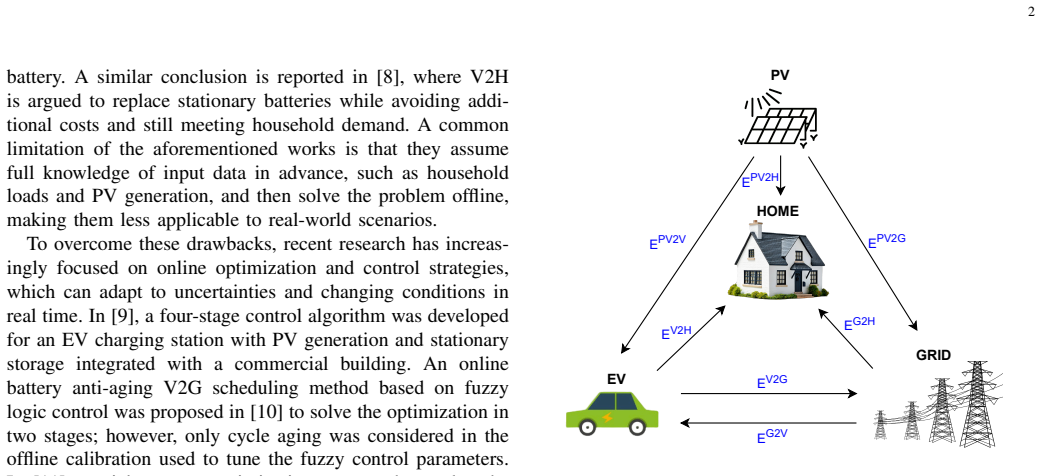
Figure from the paper full image
abstract click to expand
This paper investigates the economic impact of vehicle-home-grid integration in the presence of rooftop PV, by proposing an online, aging-aware energy management strategy for an electric vehicle (EV), a household, and the electrical grid. The model predictive control-based framework explicitly exploits vehicle-to-grid (V2G) and vehicle-to-home (V2H) operation to perform energy arbitrage, increase self-consumption, while respecting user-driven driving requirements. The framework optimizes power flows over a shrinking horizon using a detailed battery aging model that captures both calendar and cycle degradation, and a Transformer-based forecaster that provides short-term predictions of household load and solar irradiance. For a one-year horizon, the proposed strategy yields the lowest annual cost among all evaluated strategies. Adding PV increases the annual profit by EUR 1060.7 compared to operating without PV, and yields an economic gain of up to EUR 2410.5 over smart unidirectional charging, at the expense of only 1.27% extra battery degradation. Even in the least favorable case with no remuneration for V2G energy, bidirectional operation still delivers an economic gain of EUR 355.8 through V2H. Sensitivity analyses over V2G price ratio, EV battery size, household demand, and pickup time uncertainty confirm that these benefits persist across a wide range of scenarios and highlight the potential of EVs as active energy nodes, enabling sustainable energy management and cost-effective battery usage in real-world conditions.
0
0
eess.SY 2026-07-03

Sliding mode law docks 3D vehicles using range and sight angles

by Ram Milan Kumar Verma, Shashi Ranjan Kumar +1 more

Docking of Autonomous Vehicles with a Stationary Docking Station in 3D Space

Finite-time controller aligns orientation and brings speed to near zero for safe station approach.

Figure from the paper full image
abstract click to expand
In this letter, we present a strategy for autonomous docking of autonomous vehicles in three-dimensional space. Docking is a safety-critical task and requires expert piloting skills. Vehicles with autonomous docking capabilities are highly desirable in various applications, such as marine vehicle docking, aerial vehicle docking, spacecraft docking, and landing. To dock autonomously with the docking station, the vehicle must align itself to a specific desired orientation relative to the docking station and also reduce speed as it approaches. The vehicle achieves near-zero speed to dock successfully and safely without colliding with the docking station. Inspired by the philosophies from the guidance literature, we present a finite-time sliding mode-based strategy to achieve the same. The range and line-of-sight kinematics relations describing the motion of the vehicle with respect to the stationary docking station are used to steer the vehicle to achieve the desired orientation for docking. This docking strategy is validated in MATLAB\textsuperscript{\textregistered} simulations for various initial locations and orientations of both the vehicle and the docking station.
0
0
cs.RO 2026-07-03

QuadRocket achieves almost global trajectory tracking with adaptive control

by Pedro Santos, Joel Reis +2 more

QuadRocket: An Aerial Robotic Testbed for Adaptive Thrust-Vector Control of Rocket-Like Vehicles

The quadrotor-based rocket prototype models the vehicle as an axisymmetric body to enable disturbance rejection in thrust-vector control.

Figure from the paper full image
abstract click to expand
This paper presents QuadRocket, a quadrotor-based rocket prototype that provides a low-cost, low-risk platform for validating advanced thrust-vector control strategies for launch vehicle-type systems. The prototype consists of a cylindrical main body mounted on top of a quadrotor through a universal joint, forming a flying inverted pendulum with non-negligible inertia. For control design, the coupled system is modeled as a single axisymmetric rigid body actuated by a vectored force applied along its longitudinal axis. A reduced-attitude representation on the two sphere is adopted to explicitly exploit the vehicle's axial symmetry and to decouple yaw from the thrust-vector direction. On this model, we derive an adaptive backstepping controller that achieves almost global trajectory tracking in the presence of unknown constant disturbances, while a control-point transformation mitigates non minimum-phase behavior. The quadrotor is then treated as a thrust vector actuator, and a dynamic-surface-based attitude controller is designed to track the desired thrust-vector, accounting for actuation dynamics and avoiding explicit differentiation of virtual control signals. The complete architecture is evaluated in simulation and validated experimentally in an indoor motion-capture arena. Results demonstrate accurate trajectory tracking, effective disturbance compensation, and confirm the suitability of the QuadRocket as a versatile testbed for thrust-vector-controlled robotic vehicles.
0
0
eess.SY 2026-07-03

Torque tuning steers nonholonomic vehicle to source orbit

by Bo Wang

Nonholonomic Source Seeking by Torque Tuning: Local and Semi-Global Feedbacks

Two feedback laws achieve local and semi-global stability from scalar sensor data alone, without position or gradient information.

Figure from the paper full image
abstract click to expand
This paper studies source seeking for a torque-controlled nonholonomic vehicle with a laterally displaced scalar sensor. The vehicle has constant forward speed, while its yaw motion is controlled by torque input with unknown inertia and damping. The objective is to steer the vehicle to a source-centered circular motion so that the lateral sensor approaches the unknown source, without using position, heading, source-location, gradient, or source-value information. The proposed torque law combines a fast oscillatory component, which generates averaged steering through symmetric-product approximation, with a slowly tuned bias component, which selects the desired orbit. Two bias-tuning designs are developed. The first is an output-feedback design using only the scalar measurement; it applies a Lie-bracket extremum-seeking update and yields local practical stability. The second is a velocity-assisted design using forward-speed and yaw-rate measurements; it tunes the bias through the yaw-rate tracking error and yields a globally asymptotically stable averaged system, implying semi-global practical stability of the original system. Simulations illustrate the proposed designs.
0
0
eess.SY 2026-07-03

Decision Transformer cuts grid frequency error by 99 percent

by Mohamed Shamseldein

Generative Autonomous Grid Control: Integrating Decision Transformers with a Two-Stage Safety Stack

Offline sequence model plus two-stage safety stack achieves real-time control and 59.4 Hz nadir on 140-bus test system

Figure from the paper full image
abstract click to expand
The displacement of synchronous generation by inverter-based resources is accelerating power system frequency dynamics beyond the response capability of conventional automatic generation control. This paper presents Autonomous Grid Generation Control with Decision Transformers, a framework coupling an offline-trained Decision Transformer with a twostage symbolic safety stack for secondary frequency control. The Decision Transformer learns a conditional dispatch policy from offline supervisory control and data acquisition records via sequence modeling, eliminating online exploration risks. A Constraint Verification Unit provides sub-ten-millisecond algebraic screening using real-time power transfer distribution factors, while an aggregate digital twin performs swing-equation-based dynamic stability certification. Validated on the Northeast Power Coordinating Council 140-bus system under low-inertia conditions, the proposed controller reduces the area control error integral by over 99% relative to tuned automatic generation control, maintains a 59.4 Hz frequency nadir, and achieves inference latency of approximately 10 ms, well within real-time constraints. Comparative evaluation against a linear quadratic regulator baseline and structural analysis against conservative Q-learning demonstrate the advantages of the sequence-modeling formulation. Small-signal eigenvalue analysis characterizes the dominant 1.87 Hz electromechanical mode and confirms that the safety stack maintains stable operation across operating points. By falling back to tuned automatic generation control whenever proposals are rejected, the safety stack bounds worst-case performance to industry-standard levels in simulation.
0
0
eess.SY 2026-07-03

Optimal reliability threshold below P90 cuts reserve costs 14.5%

by Torine R. Herstad, Jalal Kazempour +2 more

Refinement of Reliability Grid Codes in the Provision of Ancillary Services

Bilevel model treats the threshold as a design variable and shows fixed P90 is not cost-minimizing for stochastic providers in Nordic FCR-D

Figure from the paper full image
abstract click to expand
Stochastic resources such as wind farms, electric vehicle aggregators, and demand-side assets are increasingly participating as reserve providers in ancillary service markets. To manage delivery uncertainty, system operators impose minimum reliability thresholds on such providers. Energinet, the Danish transmission system operator (TSO), has pioneered this approach through the P90 requirement, requiring stochastic providers to make accepted reserve capacity bids available with at least 90% probability. Yet this threshold is set by regulatory convention, not optimization: no existing framework treats it as a design variable or characterizes the cost-reliability trade-off it governs. This paper closes that gap. We develop a bilevel optimization framework in which the TSO in the upper level sets the reliability threshold endogenously while providers in the lower levels respond through reliability-constrained bidding, with chance constraints reformulated analytically using a Weibull tail distribution. Applied to the Nordic frequency containment reserve for disturbances (FCR-D) market, the cost-optimal threshold lies below P90 in the studied cases, with cost reductions by up to 14.5% relative to the fixed standard. Dynamic hourly thresholds yield a further reduction of up to 2.4%, suggesting efficiency gains may increase in larger and more diverse reserve markets.
0
0
eess.SY 2026-07-03

Two-layer flow preserves optimal agreement under safety constraints

by Zhanglin Shangguan, Wei Xiao +2 more

Reference-Governed Distributed Safe Gradient Flow for Safe Optimal Output Agreement of Multi-Agent Systems

Separates regulation from optimization to avoid altering the steady-state solution in nonlinear multi-agent systems.

Figure from the paper full image
abstract click to expand
This paper studies safe optimal output agreement for nonlinear multi-agent systems with output safety constraints. Existing safe feedback optimization methods often implement gradient-flow dynamics directly through the plant input, which may require high-order control barrier functions (HOCBFs). The resulting derivative-chain design is tuning-sensitive and can introduce additional equilibrium conditions that alter the steady-state optimal solution. We propose a reference-governed two-layer architecture that separates lower-layer output regulation from upper-layer distributed optimization. The upper layer filters the reference gradient flow through first-order control barrier function constraints, which are easier to tune and preserve the steady-state optimality structure of the original agreement problem. The lower layer uses an internal-model-based output regulator with a reference-dependent Lyapunov function, from which dynamic safety margins (DSMs) are constructed to certify transient output safety. We prove forward invariance, optimal-solution preservation under DSM-compatibility conditions, and convergence via a Lyapunov small-gain argument. Simulations validate safe convergence, show advantages over HOCBF-based feedback optimization, and demonstrate adaptive tangential objective shaping for escaping spurious equilibria induced by nonconvex obstacles.
0
0
eess.SY 2026-07-03

RBF activation function shapes robotic tracking performance

by Kimmo Paldanius, Gabriel da Silva Lima +1 more

Influence of Radial Basis Activation Functions on Intelligent Controller for Robotic Manipulators

Experiments on a manipulator show stability for all kernels but clear differences in adaptation and accuracy

Figure from the paper full image
abstract click to expand
This paper presents an intelligent control framework for trajectory tracking of robotic manipulators using radial basis function (RBF) neural networks for online disturbance estimation. The proposed control structure combines model-based nonlinear control with an adaptive neural approximator that compensates for parametric uncertainties, friction, and unmodeled dynamics. A Lyapunov-based adaptation law with projection guarantees boundedness of the closed-loop signals and convergence of the tracking error to a compact region. The primary objective of this work is to investigate how the choice of activation function within the RBF network influences transient behavior, steady-state accuracy, and control smoothness. The controller is implemented on a robotic manipulator. Experimental results demonstrate that although stability is preserved for all kernels, activation function selection significantly affects adaptation dynamics and practical tracking performance. These findings demonstrate that activation function selection acts as a structural design parameter in intelligent control, directly shaping adaptation dynamics and practical closed-loop performance.
0
0
cs.LG 2026-07-03

Learned time change improves diffusion sampling quality

by Yilie Huang, Wenpin Tang +1 more

ART for Diffusion Sampling: Continuous-Time Control and Actor-Critic Learning

ART-RL optimizes a sampling-clock speed via actor-critic RL to produce timestep grids that beat fixed schedules at the same budget and trans

Figure from the paper full image
abstract click to expand
We study timestep allocation for score-based diffusion sampling, where a learned reverse-time dynamics is discretized on a finite grid. Uniform and hand-crafted schedules are standard choices, but they rely on fixed prescriptions and can therefore be suboptimal. To address this limitation, we propose Adaptive Reparameterized Time (ART), a continuous-time control formulation that learns a time change by treating the speed of the sampling clock as the control, so that a uniform grid on the learned clock induces adaptive timesteps in the original diffusion time. Based on a leading-order Euler error surrogate, ART provides a principled objective for allocating timesteps along the sampling trajectory. To solve this deterministic control problem, we introduce ART-RL, an auxiliary randomized formulation with Gaussian policies that turns schedule learning into a continuous-time reinforcement learning problem. We prove that the randomized ART-RL formulation is equivalent to ART at the optimizer level, in the sense that its optimal Gaussian policy recovers the optimal ART time-warping rate through its mean. We further establish policy evaluation and policy improvement characterizations and derive trajectory-based moment identities that yield implementable actor--critic updates for learning the schedule. Across experiments ranging from controlled low-dimensional settings to image generation, ART-RL can be plugged into existing diffusion samplers by changing only the timestep grid, consistently improving sample quality over strong baseline schedules at matched budgets while leaving the rest of the sampling pipeline unchanged. The learned schedules also exhibit broad generalization, transferring without retraining across sampling budgets, datasets, solvers, pipelines, and representation spaces.
0
0
eess.SY 2026-07-03

Closed-form bounds certify safe approach to tumbling targets

by Omer Burak Iskender, Keck Voon Ling +2 more

Reachability-Based Safe-Start Regions for Approach to a Tumbling Target with Rotating LOS Constraints

Two conservative criteria run 250 times faster than Hamilton-Jacobi reachability while retaining 0.91 recall on 500 feasibility cases.

Figure from the paper full image
abstract click to expand
This paper presents a reachability-aware guidance architecture for autonomous approach to a tumbling, uncooperative target under a rotating line-of-sight (LOS) docking corridor. The LOS admissible set rotates with the target body frame, producing time-varying polyhedral constraints in the chaser's relative coordinates. A safe-start region is constructed via two conservative criteria: (i) directional per-constraint erosion, the margin consumed by rotation-induced drift before thrust can arrest it, and (ii) a synchronization range bound $r < 2a_{\max}/\omega_t^2$ ensuring the chaser can cancel the apparent rotational velocity without overshooting the hold point. Closed-loop guidance uses a receding-horizon MPC controller with Clohessy-Wiltshire-Hill (CWH) prediction dynamics and explicit LOS corridor constraints in the quadratic program. Truth propagation uses the exact discrete CWH state-transition matrix with sub-stepping, so feasibility claims are physically honest: no reference blending or state projection is applied. A three-regime tracking law manages the transition from long-range inertial approach to body-frame co-rotation and synchronized hold. The analytical safe-start region is benchmarked against four standard reachability engines (backward and forward polytopic reachable sets, Hamilton-Jacobi level sets, and closed-loop Monte Carlo): the closed-form criteria are 250x faster than Hamilton-Jacobi reachability while predicting closed-loop feasibility with precision 0.80 and recall 0.91 on a 500-case sweep. The residual 6% false-positive rate and the IoU gap against Hamilton-Jacobi quantify a structural property: the synchronization set (reach and co-rotate) is a strict subset of the positional reachable set, the gap widening with tumble rate. The analytical bound is thus a sound inner certificate for onboard go/no-go decisions where Hamilton-Jacobi is prohibitively expensive.
0
0
eess.SP 2026-07-03

Clustered THz HetNets outperform random models in coverage

by Hadeel Obaid

Coverage Analysis in Terahertz Clustered HetNets

Moderate spread of small base stations raises coverage probability when users cluster in hotspots.

Figure from the paper full image
abstract click to expand
Terahertz (THz) transmission technologies hold significant potential for enabling ultra-broadband, short-range communication in next-generation networks. Despite the vast bandwidth, THz signals suffer from limited transmission range and a feasible scenario is to deploy THz within clustered heterogeneous networks (HetNets) to enhance coverage. This paper investigates THz communication in clustered HetNets, leveraging stochastic geometry for performance analysis. Specifically, we consider two tiers of macro base stations (MBS) and small base stations (SBS). The MBS tier is modeled as a Poisson Point Process (PPP), and both the SBS tier and users are modeled as a Poisson Cluster Process (PCP) to capture user clustering and network hotspots. We derive the analytical expressions for user association probabilities, the Laplace transform of interference, and the coverage probability. The derived coverage probability is validated through Monte Carlo simulation. The numerical results show that the coverage in THz PCP-HetNets is higher than that achieved in THz PPP HetNets. In addition, a moderate spatial spread of SBSs is beneficial for coverage.
0
0
eess.SY 2026-07-03

Nominal controller stabilizes jumping PDEs with small mismatch

by Yihuai Zhang, Yidan Cao +2 more

Robust Stabilization of Linear Markov-Jumping Hyperbolic PDEs with Boundary Input Delay

Mode-independent Lyapunov analysis gives mean-square stability for Markov parameter jumps in 2x2 hyperbolic systems with boundary delay.

Figure from the paper full image
abstract click to expand
This paper studies the robust stabilization of 2 $\times$ 2 linear hyperbolic partial differential equations (PDEs) with Markov-jumping parameters and boundary input delay. The main challenge arises from the simultaneous presence of stochastic parameter variations and input delay, which complicates both the stability analysis and controller design. To address this issue, a nominal delay-compensating backstepping controller is first designed for a fixed nominal system. Applying the nominal transformation to the stochastic system yields a target system with additional perturbation terms induced by parameter mismatch. A mode-independent Lyapunov functional is then constructed to establish a pathwise exponential estimate, which directly implies mean-square exponential stability under an explicit small-mismatch condition. The proposed analysis provides a direct robustness certificate for nominal delay compensation without using mode-dependent Lyapunov functionals. Finally, we present simulation results and discuss how the conservative small-mismatch condition should be interpreted for the numerical example.
0
0
eess.SY 2026-07-03

Time margin unifies fault clearing time and load drift

by Marián Mešter

A Time-to-Boundary Margin for Transient Stability: Unifying Critical Clearing Time and Operating-Point Drift

The index equals critical clearing time on the single-machine model and reproduces it within 6 percent on the New England 39-bus system.

Figure from the paper full image
abstract click to expand
The loading margin to voltage collapse -- the distance in parameter space to the closest saddle-node bifurcation -- is a standard proximity index for voltage stability. This paper develops its transient-stability counterpart: a margin M that measures the time to the synchronism boundary rather than a distance, and that unifies two limits usually treated separately. The critical clearing time (CCT) is the fast, fixed-parameter limit; the slow drift of the operating point toward a static loadability limit is the other. M is defined as the first-passage time of the joint state-parameter motion to the survival boundary. We prove and verify that M equals the CCT exactly on the one-machine-infinite-bus reduction (deviation <= 0.01% across loadings on a published benchmark), establishing a certified single-machine pillar. Under operating-point drift, M yields an operational lead time before faults become unclearable; we take the 28 April 2025 Iberian blackout timeline as an illustrative time scale for the drift rate. On the New England 39-bus system, an independent benchmark, the single-machine-equivalent reduction reproduces the CCT within 1.8-6.0% (conservatively), and a critical slowing-down signature flags proximity to the boundary. For the multimachine case we characterize the limits explicitly: the transfer-conductance work is tightly boundable, while the controlling unstable equilibrium is the binding obstruction to a certified margin.
0
0
cs.LG 2026-07-03

Online algorithm learns any LDS with O(k) parameters

by Yuval Ran-Milo, Angelos Assos +1 more

A Memory Efficient Unified Algorithm for Online Learning of Linear Dynamical Systems

It delivers sublinear regret when instability is limited to k modes and proves fewer filters cannot work.

abstract click to expand
Motivated by the challenge of stabilizing a general unknown linear dynamical system (LDS) from observations, we study the natural prerequisite of online prediction. Our goal is to achieve sublinear regret with a memory footprint that adapts to the intrinsic complexity of the dynamics rather than the full hidden -- state dimension. We focus on the practically central regime of systems with low instability complexity -- eigenvalues outside the real stable interval that do not decay rapidly, together with non-semisimple modes-potentially embedded in an otherwise stable real spectrum of much higher dimension; we write $k$ for this count. This regime is the primary setting in which stabilization is plausible: we show that many systems with high instability complexity cannot be stabilized without exponentially large controls. Thus, prediction is meaningful for stabilization precisely when the instability complexity is small. Within this regime, we introduce a unified online algorithm that handles every LDS (including non-diagonalizable systems with complex or exploding modes) with a learnable parameter count of $\widetilde{O}(k)$. Finally, we prove a lower bound showing that $k$ is a valid complexity measure: any filter-based predictor needs at least $k$ filters. Experiments corroborate our theory: on a high-dimensional system, our predictor sharply outperforms prior methods at an equal parameter budget.
0
0
eess.SY 2026-07-03

Koopman operator linearizes nonlinear dynamics via observables

by Igor Mezić, Jorge Cortés +3 more

Koopman operator theory: fundamentals, control, and applications

Data-driven EDMD approximations come with error bounds and support input-driven control design including MPC.

Figure from the paper full image
abstract click to expand
The Koopman operator has gained considerable attention due to its ability to provide a global linear representation of highly complex dynamical systems. The operator describes nonlinear dynamics in a linear way through the lens of real- or complex-valued observable functions. Recently proposed data-driven techniques, like extended dynamic mode decomposition (EDMD), its kernelized variant, and machine-learning methods, can be used to generate finite-dimensional approximations accompanied by finite-data error bounds. In this tutorial paper, we provide a concise introduction into Koopman operator theory and its use in systems and control. A particular focus is put on data-driven surrogate models, their extension to systems with inputs, and controller design using Koopman operator theory. Moreover, we demonstrate the key techniques, i.e., EDMD and Koopman MPC. To this end, we provide simulation studies including source code on GitHub to enable the interested reader to experience the Koopman operator in systems and control step by step.
0
0
eess.SY 2026-07-03

Linear model matches low-speed ship maneuvers from real data

by Agnes N. Mwange, Taichi Kambara +3 more

Development and Identification of a Linear Low-Speed Ship Maneuvering Model from Full-Scale Data

State-space parameters identified via CMA-ES on full-scale trials reproduce observed trajectories.

Figure from the paper full image
abstract click to expand
Despite significant technological progress, the realization of fully autonomous berthing and unberthing remains a significant challenge. One of the primary obstacles is the complex, non-linear nature of low-speed ship dynamics, which are difficult to model and control and often necessitate equally complex maneuvering models and control systems. This study proposes a simplified approach to bridge this gap by modeling the ship dynamics in the form of a time-invariant, continuous-time linear state-space system. The model parameters are estimated through system identification using the Covariance Adaptation Strategy Evolution Strategy (CMA-ES) applied to full-scale maneuvering data. Validation results demonstrate a strong agreement between the model output and empirical data. This outcome demonstrates the significant potential of simplified models to effectively define the maneuvering motion of a ship at low speeds.
0
0
cs.LG 2026-07-03

CROF score selects world models for strong LunarLander control

by Nikolai Smolyanskiy

Predicting Closed-Loop Performance of Latent World Models: Offline Checkpoint Selection for MPC and Model-Based RL Under Non-Markovian Rewards in LunarLander

An offline metric using reward observability ranks checkpoints that beat model-free RL with 65 times less interaction data.

Figure from the paper full image
abstract click to expand
We study how to predict the downstream closed-loop performance of a learned latent world model from validation-time diagnostics alone. Choosing the right checkpoint from a world-model training run is difficult: validation loss and multi-step prediction RMSE keep improving long after closed-loop performance has collapsed. We present a suite of structural validation-time diagnostics drawn from optimal-control theory and apply them to Gymnasium's LunarLander v3, which features shaped rewards. We train an RSSM [5, 4] world model on it and treat per checkpoint CEM-MPC return as the oracle for closed-loop quality. By evaluating 40 metrics against this oracle, we find that the strongest single predictor is the Reward Observability Fraction (ROF), which measures the reward predictor's dependence on the observable subspace. We combine ROF with three structural regularizers into a single-number offline checkpoint selection score, the Composite Reward Observability Fraction (CROF). The CROF-selected world model trains a model-based A2C policy that beats a fairly evaluated model-free A2C baseline by ~24.5 return points while using ~65x fewer real-environment interactions, and the same world model also drives a strong zero-shot CEM-MPC policy. Code and data: https://github.com/nsmoly/LunarLander_RSSM.
0
0
eess.SY 2026-07-03

Dynamic phasors allow eigen analysis of subsynchronous oscillations

by Fiaz Hossain, Nilanjan Ray Chaudhuri +4 more

A Dynamic Phasor Framework for Analysis of Subsynchronous Oscillations in Multi-Machine Systems with IBRs and Large Loads

A mixed dq and pnz frame model supports root-cause studies and faster simulation of large systems with IBRs and big loads.

Figure from the paper full image
abstract click to expand
Although the electromagnetic transient (EMT) framework can capture subsynchronous oscillations (SSOs), it faces scalability issues for large-scale systems. Thus motivated, we propose a generalized dynamic phasor (DP) framework to analyze SSOs in multi-machine systems with inverter-based resources (IBRs) and large loads such as artificial intelligence data centers (AI DCs) under balanced and unbalanced conditions. The grid-following (GFL) and grid-forming (GFM) IBRs are modeled in their respective $dq$-frame DPs. In contrast, the detailed model of multi-mass turbine driven synchronous generators (SGs) along with dynamic transmission network models and loads are represented in $pnz$-frame DPs. The linearizability and time-invariance of the framework enable us to perform eigen decomposition, which is a powerful tool for root-cause analysis of SSO modes and the design of damping controllers. In addition, the DP modeling approach facilitates faster simulation of large-scale systems. The generalized framework is validated with EMTDC/PSCAD simulations using the IEEE first benchmark model for subsynchronous resonance and the modified IEEE 4-machine system. Several use cases are presented on the modified IEEE 68-bus system with two GFL IBRs to show the applicability of the framework. First, time- and frequency-domain analyses of the IBR-induced SSO mode are presented. Then, two solutions are proposed to damp the poorly damped SSO mode: (a) a decentralized controller is designed using particle swarm optimization, and (b) the control of one GFL IBR is replaced by GFM control. Finally, the impact of AI DC load on primary frequency response of the system and the multi-mass turbines of the SGs are studied.
0
0
eess.SY 2026-07-03

Network loading tightens droop-gain limits for grid stability

by Zhimeng Wang, Sushobhan Chatterjee +3 more

Decentralized Stability Certificates in IBR-Dominated Grids: The Role of the Network State

Higher reactive mismatches and line loading shrink the set of stabilizing local controller parameters.

Figure from the paper full image
abstract click to expand
Small-signal instabilities, such as unforced sub-synchronous oscillations (SSOs), are increasingly observed in inverter-based resource (IBR) dominated grids. While decentralized stability certificates offer a scalable means to avoid instability onset, they are typically derived under restrictive network-state assumptions--such as small angle differences or negligible voltage drops--that cannot capture how departures from these conditions affect system stability. In this paper, we develop a network model and a decentralized analysis framework that explicitly characterizes how reactive power mismatches, line loading, and inverter control parameters jointly determine small-signal stability. We show that increased steady-state reactive power mismatches and line loading lead to more stringent conditions on admissible inverter droop gains. These results make decentralized stability certificates explicitly network-state dependent, showing how network stress shrinks the set of stabilizing local controller parameters.
0
0
eess.SY 2026-07-03

One inverter control structure covers forming and following modes by parameter tuning

by Xiaoyang Wang, Xin Chen

A Unified Framework for Hybrid Grid-Forming and Grid-Following Inverter Control

Continuous adjustments replace discrete switches for smooth shifts across PQ, PV, Qf, Vf, and hybrid operation

Figure from the paper full image
abstract click to expand
This paper proposes a novel unified control framework for achieving hybrid grid-forming (GFM) and grid-following (GFL) inverter operation by integrating dispatchable virtual oscillator control with reference-following synchronization. The proposed inverter control method supports multiple operating modes within a unified structure, including voltage- and frequency-following (PQ mode), voltage-forming and frequency-following (PV mode), voltage-following and frequency-forming (Qf mode), voltage- and frequency-forming (Vf mode), and a hybrid mode with mixed GFM and GFL behaviors. In particular, the proposed method achieves smooth pre-synchronization and enables seamless transitions across a spectrum of inverter operating modes by tuning a small set of continuous control parameters, rather than relying on discrete controller switching. This framework provides a flexible and physically interpretable approach for adapting inverter dynamics to varying grid conditions and operational requirements. The small-signal stability and input-output frequency-domain characteristics are further analyzed under different control parameter settings. The effectiveness and robustness of the proposed unified control method are demonstrated through extensive electromagnetic transient (EMT) simulations and hardware-in-the-loop (HIL) experiments.
0
0
cs.LG 2026-07-02

Learned wind estimator cuts quadrotor tracking error 48%

by Abdullah Al Tasim, Wei Sun

Wind-Aware Reinforcement Learning Control of a Small Quadrotor Using Learned Onboard Wind Estimation in Simulated Atmospheric Turbulence

A reinforcement learning controller using an attention-based onboard estimator outperforms a wind-blind baseline across 4-12 m/s mean winds

abstract click to expand
Small multirotor aircraft are increasingly tasked with operations in the atmospheric boundary layer, where turbulent winds comparable to the vehicle's airspeed degrade trajectory tracking and can defeat conventional feedback control. This work illustrates a two-stage learning pipeline that first estimates the local wind from onboard kinematics and dynamics and then exploits that estimate inside a reinforcement learning (RL) flight controller. The wind estimator, an attention-augmented gated recurrent network trained on thousands of simulated flights through von Karman turbulence with power-law shear and veer, recovers the horizontal wind vector with a per-flight root-mean-square error of 0.40 m/s and a direction error of 3.2 degrees on unseen wind regimes, an accuracy near the floor imposed by unresolved turbulence, and generalizes to vertical ascent profiles with a skill score of 0.861 over a constant-wind reference. A proximal policy optimization controller receiving the frozen estimator's output reduces horizontal trajectory tracking error by 48% relative to a wind-blind proportional-derivative baseline across mean winds of 4 m/s to 12 m/s, winning on 100% of evaluation episodes. A three-way ablation decomposes this improvement into a kinematic component, available without wind information, and a wind-perception component; the perception share rises with wind speed, from small in light winds toward roughly half the total benefit in strong winds, consistent with the quadratic scaling of aerodynamic drag. The controller degrades gracefully on out-of-distribution winds of 13 m/s to 15 m/s, where the baseline fails catastrophically.
0
0
eess.SY 2026-07-02

Region graph transfers mode shape recognition across vehicles

by Tong Duy Son, Marc Brughmans +5 more

Robust and Explainable 3D Mode Shape Recognition Using Region-Aware Graph Neural Networks

Mapping models to shared structural regions lets AI work on new designs without identical meshes or retraining on full data.

Figure from the paper full image
abstract click to expand
Mode shape recognition is a fundamental task in automotive NVH development, yet it remains dependent on manual visual inspection by experienced engineers. Existing approaches based on engineering heuristics, Modal Assurance Criterion (MAC), or geometry-dependent AI representations often exhibit limited robustness across different vehicle architectures, finite element (FE) meshes, and experimental measurement layouts, restricting their industrial applicability. This paper presents a Canonical Engineering Graph Representation and region-aware graph learning framework for robust and explainable 3D mode shape recognition. Rather than learning directly from vehicle-specific FE meshes, heterogeneous FE models and experimental measurements are transformed into a common graph whose nodes represent semantically meaningful structural regions connected through engineering-informed relationships. Geometry-independent regional descriptors are combined with graph attention learning and region-aware pooling to capture structural interactions while preserving engineering semantics and enabling physically interpretable predictions. The resulting representation decouples engineering knowledge from numerical discretization, allowing transfer across different vehicle programs without requiring identical mesh topology or sensor configurations. The proposed framework is validated using FE and experimental datasets from four vehicle programs under severe label scarcity. Results demonstrate high classification accuracy, cross-vehicle transferability, and physically meaningful explanations by directly relating predictions to engineering-defined structural regions used in NVH analysis. Beyond mode shape recognition, the proposed Canonical Engineering Graph Representation provides a reusable engineering abstraction for trustworthy and transferable AI across heterogeneous simulation and experimental workflows.
0
0
eess.SY 2026-07-02

MPC value function certifies almost-sure RAS satisfaction

by Arash Bahari Kordabad, Satya Prakash Nayak +2 more

Context-Triggered Robust MPC for Temporal Logic Specifications

Robust constraints and local controller handle avoidance and stay; convex duality yields tractable quadratic and SOC programs for disturbed

Figure from the paper full image
abstract click to expand
We consider the problem of synthesizing robust feedback controllers for discrete-time linear systems that ensure the satisfaction of context-dependent linear temporal logic specifications in the presence of additive bounded disturbances. Building on existing results that reduce context-triggered temporal logic synthesis to the realization of context-dependent reach-avoid-stay (cRAS) objectives, we focus on the corresponding low-level control synthesis problem. We first employ certificate-based conditions for the almost-sure satisfaction of RAS specifications. Based on these conditions, we propose a switching control architecture that combines robust model predictive control (MPC) with a local invariant controller, and show that the resulting MPC value function serves as a reachability certificate while avoidance is enforced through robust constraints and the stay is enforced via the local controller. To obtain computationally tractable formulations for the resulting robust optimizations, we employ convex duality to reformulate the robust constraints into equivalent deterministic optimization problems, yielding convex quadratic and second-order cone programs for relevant geometric settings. The proposed framework is demonstrated on a robot navigation problem with context-triggered logical switches in both static and moving environments. The results show significantly larger feasible sets than Lyapunov-based approaches, while naturally accommodating dynamic environments and online task reconfiguration.
0
0
eess.SY 2026-07-02

MILP boosts lowest battery from 2.7% to 68.6% in 20-terminal network

by Pranay KC, Amin Taghieh +4 more

Optimal Reconfiguration of Distributed Battery Networks Under Connectivity and Energy Constraints

Algorithm with overlap correction and distance penalty manages energy under budget while cutting changes by 72%.

Figure from the paper full image
abstract click to expand
Networked battery systems arise in industrial automation, distributed energy applications, and multi-agent systems, where terminals consume energy locally and recharge only when connected to a source. Resource constraints often limit the number of simultaneous connections, requiring networks to be dynamically reconfigured to maintain system functionality. Managing such networks in dynamic environments is challenging, particularly when low-energy terminals must be prioritized for timely replenishment. This paper presents a battery-aware topology optimization algorithm that extends the GeoSteiner framework with a tailored Mixed-Integer Linear Program (MILP) formulation for Full Steiner Tree (FST) aggregation. The formulation minimizes network length while prioritizing low-battery terminals through a weighted objective subject to a global budget constraint, enabling partial network formation under realistic resource limits. An overlap-correction term is introduced that prevents double-counting when selected trees share terminals. To capture the network reconfiguration cost between time steps, a graph-distance metric penalizes frequent topology changes, resulting in 72.2% reduction compared to a baseline without penalty. Simulations on a 20-terminal network demonstrate battery levels are effectively managed as the lowest battery level improved from 2.7% to 68.6% over 30 iterations while maintaining the topology stability and budget utilization (92%). The framework offers a principled approach to designing energy-aware, adaptive connectivity in power-limited multi-agent systems.
0
0
cs.RO 2026-07-02

Flow matching safety guidance reaches 82.8% collision avoidance

by William English, Hao Zheng +1 more

Neuro-Symbolic Safety Guidance for Vision-Language-Action Models via Constrained Flow Matching

Predictive avoidance via constrained optimization during denoising improves task success by 19.8% over single-step methods.

Figure from the paper full image
abstract click to expand
Vision-Language-Action (VLA) models have demonstrated promising generalization capabilities across robotic manipulation tasks, yet their real-world deployment remains limited by the lack of effective safety measures. Specifically, existing safety measures only prevent collisions caused by the robot's next action. In this paper, we propose a neuro-symbolic safety guidance mechanism for flow matching based VLAs that enables predictive collision avoidance. Flow matching based VLAs determine the next actions by predicting a trajectory (a sequence of actions) through an iterative neural flow matching process. Our method formulates safety enforcement as a minimum-norm constrained optimization problem that corrects safety violations during the denoising process of noisy intermediate trajectory predictions. By analyzing predicted trajectories and applying corrections during iterative denoising, our approach anticipates collisions before they become unavoidable. This interleaving of symbolic constraint satisfaction with neural trajectory generation enables predictive collision avoidance rather than reactive intervention. On the SafeLIBERO benchmark, our method achieves 82.8% collision avoidance and 81.6% task success, a 6.3% and 19.8% improvement respectively over single-step methods, with the largest gains on long-horizon tasks where compounding distribution shift is most pronounced. Video demonstrations of our approach are included on our project page at https://willenglish.tech/SafetyGuidedFlowMatching/.
0
0
cs.CR 2026-07-02

ML surrogates recover CPS after memory corruption attacks

by Mohsen Salehi, Karthik Pattabiraman

Chameleon: Recovering Cyber-Physical Systems from Memory Corruption Attacks via ML Surrogates

Replaces vulnerable compartments with accurate models to keep robotic vehicles running safely with low overhead.

Figure from the paper full image
abstract click to expand
Cyber-physical systems (CPSs) are increasingly deployed in every aspect of our lives and can be compromised through memory corruption vulnerabilities, allowing attackers to hijack the control flow and take over the system. Existing techniques mostly focus on detecting such attacks but respond by terminating or halting execution upon attack detection, which is not acceptable in CPSs used in safety-critical tasks, as interrupted tasks can have catastrophic consequences. Other techniques replace compromised CPS components with simplified defaults that degrade system behavior, or reboot the system upon attack detection. We propose Chameleon, a novel framework for automatically recovering CPSs from memory corruption attacks using machine learning (ML)-based surrogates trained at compartment granularity that nearly replicate their original compartments' behavior but do not have the same memory corruption vulnerabilities. Upon attack detection, Chameleon replaces the compromised compartment with its trained surrogate. We implemented Chameleon using the LLVM compiler and evaluated its efficiency and effectiveness on seven different robotic vehicles (RVs), including simulated and real ones. We found that Chameleon can generate surrogates that closely approximate the original compartments (with an average R$^2$=0.96), successfully recover the system despite real-world memory corruption attacks unlike prior approaches, and complete their tasks while incurring low performance and memory overhead.
0
0
eess.SY 2026-07-02

Data refines probabilistic zonotopes for tighter reachability

by Amir Modares, Zhen Zhang +3 more

Reachability Analysis With Probabilistic Zonotopes: Learning Realized Disturbances and Refining Aleatory Uncertainty

Trajectory constraints shrink the model set and yield high-probability reachable sets with formal guarantees and less conservatism.

abstract click to expand
This paper develops a data-driven reachability framework for linear systems whose disturbances are modeled by probabilistic zonotopes (PZs), combining bounded deterministic and Gaussian stochastic components. In contrast to methods that require a precisely known disturbance model (either purely deterministic or purely stochastic), we assume only a conservative prior PZ and refine it from data. The framework separates two uncertainty sources: realized disturbances, which act along the collected trajectory and govern the size of the data-consistent model set, and aleatory disturbances, which enter as future additive uncertainty during reachable-set propagation; both shape the reachable sets, but through different mechanisms. Refinement exploits prior system knowledge together with trajectory-consistency constraints induced by the data, which impose affine couplings between deterministic and Gaussian latent variables. We accordingly develop a constrained-PZ calculus that absorbs the stochastic part of these constraints into an equivalent representation, removes infeasible latent directions, and reduces stochastic covariance, together with identification-aware fusion rules for combining heterogeneous constrained-PZ descriptions. The refined realized-disturbance proxies then serve as scenarios in a linear program that learns the smallest translated and scaled copy of the prior disturbance set that contains all proxy confidence sets while remaining nested in the prior. The resulting deterministic, high-probability reachable sets carry formal containment guarantees with substantially reduced conservatism, and numerical examples confirm that the pipeline tightens both the data-consistent model set and the propagated reachable sets.
0
0
eess.SY 2026-07-02

Repulsive cages trap hijacked agents using their own avoidance

by Luigi Petruzziello, Camilla Fioravanti +1 more

Distributed Containment of a Compromised Agent through Repulsive Cages

Defenders position themselves to shape a compromised target's safety responses, keeping it inside a safe region with sublinear regret for th

Figure from the paper full image
abstract click to expand
UAV swarms and cyber-physical multi-agent systems are increasingly deployed in safety-critical missions that require coordinated motion, distributed decision making, and autonomy. A major security risk arises when a legitimate agent is hijacked and driven by adversarial high-level commands. Rather than focusing on detection and isolation of malicious agents, we exploit a structural property common in autonomous platforms: low-level collision-avoidance modules are typically implemented as independent safety layers and may remain active even under high-level compromise. Building on this property, we propose a distributed containment framework that uses the compromised agent's uncompromised avoidance response as an indirect actuation channel. Defender agents select their geometric configuration to shape the repulsive field experienced by the target, with the goal of keeping it inside a prescribed admissible region and, when required, steering it toward a desired destination. The interaction is modeled as an online Stackelberg game in which defenders act as leaders and the adversary reacts by choosing the target command. Using support-function and normal-cone arguments, we derive an exact geometric characterization of robust one-step containment and introduce the notion of a repulsive cage. These results define a centralized Stackelberg oracle and motivate a fully distributed online approximation based on local communication and dynamic field estimation. We prove sublinear dynamic-regret bounds with respect to the centralized benchmark, quantifying the effect of network-induced estimation errors and temporal variability of the stage-wise optimum. Simulations validate the approach and corroborate the theory.
0
0
math.OC 2026-07-02

The paper develops an LMI-based convex program to approximate the infinite-horizon value…

by Huu-Thinh Do, Trung B. Tran +2 more

Computationally Efficient Near-Optimal Control for Current Ripple Reduction and Optimization of Three-Phase Motors via LMIs

LMI-based quadratic approximation of the value function via iterated Bellman inequalities yields a tractable offline convex program for…

Figure from the paper full image
abstract click to expand
The optimal control of three-phase permanent-magnet synchronous motors (PMSMs) is challenging due to their nonlinearity and the discrete nature of the control set. Existing approaches either rely on mixed-integer trajectory optimization or require computationally intensive value-iteration procedures. This paper proposes a Linear Matrix Inequality (LMI)-based method for approximating the infinite-horizon value function using a quadratic parameterization and iterated Bellman inequalities, yielding a tractable convex program. The computed function can be obtained efficiently offline and used online as a tail cost in a horizon-one optimal control law. Simulation results show that the proposed approach achieves a favorable trade-off between switching effort and current ripple, with performance comparable to that of finite-control-set MPC but with a significantly lower computational cost.
0
0
eess.SY 2026-07-02

The paper develops GPU-parallel methods to compute tight linearization error bounds for…

by Jeffrey Fang, Keyi Shen +2 more

GPU-Parallel Linearization Error Bounds for Real-Time Robust Optimal Control of Nonlinear and Neural Network Dynamics

Tight linearization bounds computed in parallel allow online optimization of feedback policies with formal guarantees up to 168 dimensions.

Figure from the paper full image
abstract click to expand
This paper studies real-time robust optimal control for uncertain nonlinear systems, where linear time-varying (LTV) approximations make planning tractable but require sound linearization error bounds (LEBs) to guarantee robust constraint satisfaction. We develop tight, differentiable, GPU-parallel LEBs for LTV approximations of nonlinear and neural network (NN) dynamics. For analytic dynamics, we introduce path-based Hessian bounds that are tighter than standard interval methods. For NN dynamics, we derive certified LEBs using NN verifier-generated affine relaxations and local Jacobian corrections. We adapt a GPU-parallel system-level synthesis LTV-based robust control solver to be compatible with these LEBs by extending it to handle right-invertible disturbance matrices and non-zero-centered disturbance sets for tight zonotopic uncertainty propagation. Our method, GPUSLS-LEO, enables online optimization of robust feedback policies that account for linearization error, producing tight, formally verified reachable tubes. On complex nonlinear and NN dynamics up to 168 state dimensions, our method can compute robust control policies on the GPU at rates up to 67 Hz, reducing solve times and conservativeness relative to baselines while preserving formal guarantees and real-time performance.
0
0
eess.SY 2026-07-02

Python framework unifies Taylor-model reachability for hybrid and stochastic systems

by Salma Iraky, Andrew Sogokon

TERA: A Unified Taylor Model Enabled Reachability Analysis Framework

TERA computes tight reachable-set over-approximations inside one open codebase that already covers ODEs, hybrid dynamics and continuous stoc

Figure from the paper full image
abstract click to expand
Reachability analysis of safety-critical systems requires computing rigorous enclosures of all possible state trajectories. Taylor Model (TM)-based methods have proved effective at mitigating the so-called wrapping effect which leads to overly conservative enclosures of reachable sets. However, existing tools are often hard to extend or focused on narrow system classes (e.g. deterministic systems modelled by ODEs, or hybrid systems). We develop TERA: a Python-native framework for TM-based reachability analysis of continuous, hybrid and stochastic systems within a single symbolic-numeric workflow. TERA is free and open-source, enabling rapid prototyping of reachability analysis techniques with rigorous enclosures. At present, our implementation is able to compute tight reachable set over-approximations for non-linear ODEs and hybrid systems on difficult benchmark problems, and already supports analysis of continuous-time stochastic systems. Our goal is to develop a robust open-source Python infrastructure for rigorous reachability analysis supporting a broad class of systems, including stochastic hybrid systems.
0
0
cs.SI 2026-07-02

LLM agent networks form with preferential attachment and possible weaker-model dominance

by Yiming Zhang, Vikram Krishnamurthy

Emergence of Preferential Attachment and Glass-Ceiling Effects in Autonomous Networks of LLMs

Prominent agents gain more links while weaker ones can reach central positions; mean-field model proves stable type equilibria.

Figure from the paper full image
abstract click to expand
We investigate the emergence of structural disparities in networks of collaborating large language model (LLM) agents. When LLM agents autonomously choose collaborators, the resulting communication network exhibits preferential-attachment dynamics: agents that are already prominent become increasingly likely to attract additional connections. In some cases, weaker LLM agents (agents with smaller base model or older version) can disproportionately occupy central and influential network positions relative to stronger LLM agents. We interpret this as a type-dependent glass-ceiling effect (GCE). We model the network of LLM agents as a time-evolving sequence of directed weighted graphs, where the vector-valued edge weights represent cumulative tokens exchanged, number of interaction rounds, and reasoning effort. Using a contraction mapping argument on the mean-field dynamics, we prove that the importance (centrality) of each agent type converges to a unique stable equilibrium. To ground the model in LLM decision mechanisms, we introduce a cross-attention-inspired utility for collaborator selection. This utility specifies the local connection dynamics and, together with the mean-field model, yields a predictive characterization of the limiting network structure and its type-dependent centrality gaps. To validate the theory, we develop an experimental testbed with 100 LLM agents. Our experiments show that autonomous network formation can generate persistent centrality disparities, with their magnitude and direction depending on model family, model size, system-prompt design, and task context. They further show that the effect of preferential attachment depends on its alignment with model capability: reinforcing it improves collective performance when stronger agents become central, whereas weakening it improves performance when network dynamics instead favor weaker agents.
0
0
eess.SY 2026-07-02

Real-time EV policy cuts transformer aging while meeting urgent deadlines

by B Hari Kiran Reddy

Deadline-Aware Electric Vehicles Charging with Distribution Transformer Overload Mitigation

Convex aging model and marginal-cost urgency index allocate scarce capacity without hard feasibility assumptions.

Figure from the paper full image
abstract click to expand
High adoption of electric vehicles (EVs) can overload distribution transformers when charging requests with heterogeneous departure deadlines compete for limited capacity. Most existing coordination schemes enforce hard deadlines and strict transformer limits, implicitly assuming feasibility and failing under severe congestion. We propose a deadline-aware EV charging framework that explicitly trades off transformer thermal aging and charging service quality under capacity-constrained operation. We model transformer stress using a convex aging proxy and soften charging deadlines via penalty-weighted unmet energy at departure. We further develop a low-complexity online charging policy that prioritizes EVs based on a marginal-cost-aware urgency index. We demonstrate through case studies under increasing EV penetration that the proposed approach reduces transformer aging while preferentially allocating limited capacity to time-critical EVs, closely approximating offline benchmark performance using only real-time information.
0
0
eess.SP 2026-07-02

Meta-transfer cuts mmWave beam parameters by 17x

by Ahmet Nuri Cevik, Sinem Coleri

Meta-Transfer Learning for mmWave Beam Alignment

Frozen backbone plus meta-learned adapters match full fine-tuning accuracy in new environments while using far fewer parameters and epochs.

Figure from the paper full image
abstract click to expand
Millimeter-wave (mmWave) beam alignment plays a critical role in next-generation wireless systems, yet its efficient implementation remains challenging. Meta-learning and transfer learning have been explored to enable deep learning-based beam prediction models to rapidly adapt to unseen environments; however, existing meta-learning approaches adapt the entire network and are trained from random initialization, leading to a large number of updated parameters and a high meta-training cost, while transfer learning approaches restrict adaptation to part of the network but do not exploit episodic meta-learning, which explicitly trains the model over multiple tasks, to optimize the adaptation process itself. To overcome these limitations, we propose MTL-BA, a meta-transfer learning framework for beam alignment in millimeter-wave multiple-input single-output (MISO) systems that freezes a pre-trained convolutional backbone and meta-learns only lightweight Scale-and-Shift (SS) adapters together with a classifier head. Warm-starting from the pre-trained model and restricting adaptation to the SS adapters and classifier head reduce both the adaptation cost and the meta-training budget without sacrificing prediction performance. Simulation results on the DeepMIMO ray-tracing dataset show that MTL-BA matches the accuracy and spectral efficiency of full fine-tuning across various SNR levels despite updating approximately $17\times$ fewer parameters than both full fine-tuning and Model-Agnostic Meta-Learning (MAML), outperforms last-layer fine-tuning while updating a comparable number of parameters, and approaches MAML's performance while requiring $60\%$ fewer meta-training epochs.
0
0
eess.SY 2026-07-02

Traffic complexity triggers measurable defensive shifts in driver speed and gaze

by Lukas Köning, Nataša Miličić +1 more

Investigating Driver Behavior in Complex Traffic Situations While Driving Partially Automated Vehicles

Real-world data from 20 drivers shows small but significant changes in braking, speed deviation, and eye movements as situations grow more c

Figure from the paper full image
abstract click to expand
Traffic complexity critically influences driver task demands in partially automated vehicles, yet subjective perception and its behavioral indicators remain underexplored in real-world settings. This paper analyzes driver behavior - vehicle interaction, glance patterns, and guiding fixation - across varying levels of subjective traffic complexity, using real-world data from 20 drivers in real urban traffic. Traffic complexity was determined by expert labeling and served as ground truth for vehicle data. Statistical analysis of 16 driver behavior metrics revealed small but significant trends with increasing complexity: deviation from speed limit increased, brake rate increased while braking intensity decreased, horizontal gaze dispersion and entropy widened, and guiding fixation rate decreased, indicating defensive adaptation and perceptual shifts. Contributions include real-world validation of gaze metrics and guiding fixation under subjective complexity, novel insights from gaze and guiding fixation entropy metrics, and the identification of promising indicators~(driven speed, brake rate, gaze yaw entropy, guiding fixation rate) for complexity-adaptive partially automated vehicles. While based on a limited urban sample and expert-labeled subjective complexity, the findings provide a foundation for combined complexity scores and their integration into complexity-adaptive, partially automated vehicles, boosting human-like automation and enhancing safety and predictability in the traffic system.
0
0
math.OC 2026-07-02

Universal inputs from prior knowledge guarantee LTI identification accuracy

by Amir Shakouri, Henk J. van Waarde +1 more

Experiment Design for Set-membership Identification: From Prior Knowledge to Universal Inputs

Design methods produce inputs that work for every system in the admissible parameter set and can require fewer samples than persistent excit

Figure from the paper full image
abstract click to expand
We consider the problem of designing input signals for an unknown linear time-invariant system in such a way that the resulting data, within a finite horizon, is suitable for identification with a desired accuracy. We consider both noise-free and noisy settings with $\ell_\infty$--bounded noise models. We will take into account general prior knowledge of the system parameters. Central in our study is the concept of universal inputs. An input is called universal for identification if, when applied to any system complying with the prior knowledge, it yields data suitable for accurate identification. We provide new methods for designing such universal inputs. Our results generalize the experiment design approach based on Willems et al.'s fundamental lemma that relies on persistently exciting inputs, and that is limited to prior knowledge on controllability. It turns out that for other types of prior knowledge, there exist universal inputs that outperform the persistently exciting ones, e.g., in terms of sample efficiency. Moreover, we investigate types of prior knowledge that enable experiment design for exact identification in the presence of noise.
0
0
cs.RO 2026-07-02

World models split into two spaces and link to robot actions in four ways

by Xiaoxiong Zhang, Xiong Zeng +1 more

From World Models to World Action Models: A Concise Tutorial for Robotics

Tutorial organizes predictive models by representation type and how forecasts become commands.

Figure from the paper full image
abstract click to expand
World models are increasingly used in embodied intelligence and generative simulation, yet their scope remains ambiguous across communities. This tutorial presents a design-space view of world models as action-conditioned predictive models that estimate the future evolution of task-relevant observations or states. We categorize existing methods into observation-space and state-space world models, comparing their trade-offs in visual fidelity, spatial structure, physical interpretability, and control usability. We further introduce world action models, which connect predicted futures with executable robot actions, and summarize four representative paradigms: imagine-then-execute, video-feature-conditioned action prediction, joint video-action modeling, and auxiliary video prediction for policy learning. The goal of this tutorial is to clarify the conceptual scope of world (action) models and provide a structured taxonomy for embodied prediction and control.
0
0
math.OC 2026-07-02

Reference shaping keeps sphere attitude tracking stable under moving constraints

by Pedro Santos, Joel Reis +2 more

Geometric Reduced-Attitude Tracking Under a Time-Varying Conic Constraint via Smooth Reference-Shaping

Smooth adjustment of desired direction lets the unconstrained geometric law run while meeting time-varying cone limits softly

Figure from the paper full image
abstract click to expand
This letter studies reduced-attitude tracking for a rigid body on the 2-sphere S2 under a time-varying conic constraint. Using a kinematic model on S2, we first propose a geometric tracking law that guarantees almostglobal asymptotic and regionally exponential convergence in the unconstrained case, where the angular velocity serves as the control input. We then introduce a smooth reference-shaping mechanism that adjusts the desired direction so that the reference provided to the controller satisfies the time-varying conic constraint while preserving the smoothness required by the tracking law. The resulting approach yields smooth continuous feedback and retains the stability guarantees of the unconstrained controller, albeit at the expense of enforcing a soft version of the original constraint. Simulation results illustrate the effectiveness of the method and highlight its suitability for applications where deterministic behavior, smooth control action, and strong stability guarantees are preferred over hard constraint satisfaction.
0
0
eess.SP 2026-07-02

Pacemaker RF signals track heart chamber volumes and valves

by A. Khaleghi, J. Bergsland +1 more

Assessing Cardiac Dynamics through RF Sensing for Hemodynamic Monitoring in Pacemakers

Temporal variations between RV-RA leads and subcutaneous receivers align with cardiac rhythm for real-time hemodynamic estimates.

abstract click to expand
This paper examines the use of radiofrequency (RF) channels for hemodynamic monitoring in cardiac pacemakers. It analyzes RF signal variations between intracardiac transceivers in the right ventricle (RV) and right atrium (RA), as well as subcutaneous receivers, to determine their correlation with cardiac dynamics. The study shows that temporal RF signal variations closely align with cardiac rhythm, allowing for the estimation of parameters such as chamber volume, valve behavior, and pressure changes. These results underscore the potential of RF-based sensing as a novel method for real-time cardiac monitoring in pacemaker systems.
0
0
cs.RO 2026-07-02

Distance-field conformal bound certifies trajectory safety uniformly

by Jaeuk Shin, Yoonseok Ra +1 more

From Prediction Uncertainty to Conformalized Distance Fields for Safe Motion Planning

Functional conformal prediction on the full field keeps safety guarantees independent of obstacle count and sampling method.

Figure from the paper full image
abstract click to expand
Safe motion planning in dynamic environments requires reasoning about the uncertainty in predicted obstacle motion without sacrificing real-time performance. Existing conformal approaches conformalize a scalar score that aggregates per-obstacle prediction errors, losing spatial coherence and scaling poorly with scene density. We instead conformalize the entire predicted distance field at once. This functional conformal prediction (FCP) framework yields a distribution-free, field-level lower bound, from which safety follows uniformly: any trajectory satisfying the resulting constraint is certified safe, independent of how the control space is sampled. The key enabler is that the residual distance field is empirically low-rank and approximately time-invariant, which makes the bound decomposable in coefficient space. An envelope is fitted offline via functional PCA and a Gaussian-mixture inductive conformal procedure, then refined online by a lightweight adaptive functional conformal (AFCP) update on a low-dimensional vector. This keeps the per-step cost largely insensitive to obstacle count and retains long-run field coverage under distribution shift. We embed the envelope as a tightened safety constraint in a sampling-based model predictive controller, FCP-MPC. On the ETH--UCY pedestrian benchmarks and a dense 3D quadrotor task with up to 280 dynamic obstacles, FCP-MPC attains a favorable balance of safety, feasibility, and efficiency, reaching goals where pointwise and egocentric conformal baselines become too conservative or too expensive, while keeping per-step computation far below online uncertainty-reasoning baselines.
0
0
cs.RO 2026-07-02

Vision-language models adapt robot positions for changing human groups

by Cong-Thanh Vu, Yen-Chen Liu

Adaptive Companionship for Group-Following Robots: Handling Dynamically Changing Group Formations

Tests across five scenarios report 15 percent higher success and 25 percent fewer collisions than prior methods

Figure from the paper full image
abstract click to expand
Accompanying a group of humans is an essential aspect of developing human-like social cognition in robots. However, human groups typically do not follow fixed formations, which poses significant challenges for robots in maintaining natural companionship behaviors. In this paper, we propose an adaptive group-accompaniment method for social robots based on Vision-Language Models (VLMs), leveraging their semantic reasoning capabilities to infer companion positions, maintain social distances, and understand group dynamics. The members of the group are first detected, and a perceptual module generates visual representations of the interaction group space as input to the VLM, which is then combined with a Model Predictive Path Integral (MPPI) controller to ensure stability and safety. Experimental evaluations across five scenarios show that the proposed method enables robots to accompany the group effectively, demonstrating a 15\% improvement in success rate and a 25\% reduction in collision rate compared to baseline approaches. Additionally, a user study indicates that the generated companionship behaviors are perceived as natural and socially appropriate.
0
0
eess.SY 2026-07-02

The paper introduces an online primal-dual algorithm that updates control policies for…

by Han Wang, Feiran Zhao +1 more

A Data-Enabled Primal-Dual Approach for Policy Learning with SDP Formulations

A primal-dual online framework updates policies from closed-loop data for SDP-based control synthesis in linear discrete-time systems, with…

Figure from the paper full image
abstract click to expand
This paper develops a data-enabled primal-dual framework for learning optimal control policies for unknown linear discrete-time systems from online data. The proposed approach views the data-dependent control synthesis problem as a time-varying semidefinite program (SDP) whose coefficients are recursively updated from online closed-loop measurements. Instead of repeatedly solving a full SDP as new data arrive, the policy is updated online through lightweight primal-dual iterations, each consisting of a linear equation solve and a projection onto the positive semidefinite cone. The framework applies to both direct and indirect data-driven formulations and covers a broad class of control objectives, including LQR, $H_\infty$ control, and safety-critical control. To characterize the coupling between online optimization and closed-loop data generation, we introduce two data-dependent quantities: the Sim-to-Real Gap, which measures the mismatch between noisy and noiseless data-induced SDPs, and the Difference-of-Signal, which measures the temporal variation of the SDP coefficients. Under persistency of excitation, suitable SDP regularity conditions, and sufficiently slow data variation, we establish a local linear tracking result up to residual terms governed by the latter two quantities. A global ergodic convergence bound is also derived for arbitrary initialization. Numerical examples on LQR, $H_\infty$ control, and safe exploration demonstrate that the proposed method can efficiently improve control performance from online data while accommodating SDP constraints beyond the well-explored LQR policy-gradient formulations.
0
0
eess.SY 2026-07-02

This paper describes a controller that combines feedback linearization with a…

by Gabriel da Silva Lima, Wallace Moreira Bessa

Learning-based control of a single-DOF Aero system

A Lyapunov-derived feedback linearization controller augmented with REINFORCE-with-baseline RL for online disturbance compensation…

Figure from the paper full image
abstract click to expand
This paper presents a learning-based control framework that integrates feedback linearization with reinforcement learning for the adaptive control of nonlinear mechatronic systems. The control law is derived using Lyapunov stability analysis, ensuring closed-loop stability in the presence of modeling uncertainties and external disturbances. Feedback linearization serves as the main control framework, while a reinforcement learning component estimates and compensates for unmodeled dynamics and disturbances online. The learning module is based on the REINFORCE-with-baseline algorithm, which improves learning efficiency by reducing the variance of policy-gradient estimates and enabling stable policy updates during adaptation. The proposed controller is evaluated on a single-degree-of-freedom rotor-based AERO system. Results from simulations demonstrate accurate trajectory tracking, fast adaptation, and strong robustness against parameter variations and external disturbances. Overall, the proposed approach combines the analytical guarantees of Lyapunov-based control with the adaptability of reinforcement learning, providing an effective solution for controlling nonlinear mechatronic systems.
0
0
eess.SY 2026-07-02

Mobility-first rule delivers 100% bus protection in EV-hydrogen hubs

by Yifan Wang

Mobility Safe Adaptive Reserve Certification for Electric Vehicle Hydrogen Bus and Building Resilience Hubs

It meets all commitments with zero shortfall while covering 20.5% of building demand across 66,816 outage tests.

Figure from the paper full image
abstract click to expand
Zero-emission mobility depots are becoming resilience assets because one site can host EV charging, hydrogen-bus operation, stationary conversion equipment, and nearby critical-building backup. The key question is not raw outage export capacity: hydrogen exported to buildings can strand buses, EV availability is stochastic, and building demand shifts seasonally. We introduce a mobility-safe reserve certification framework for a coupled EV, hydrogen-bus, and critical-building hub. It combines a physics-hybrid universal differential equation building-load twin, one-sided split conformal reserve calibration, adaptive conformal inference for seasonal drift, and a mobility-first scheduling rule that protects post-event bus service before assigning hydrogen to buildings. Evaluation uses 495,221 real EV charging sessions across eight regions, AC Transit GTFS-derived hydrogen-bus service days, and EnergyPlus 25.2 simulations under real TMY3 weather. Across 66,816 held-out outage scenarios, a mobility-blind hydrogen-export policy served 39.2\% of building demand but protected buses in 0\% of cases and caused a 426.7 kg mean bus-hydrogen shortfall. A nominal mean-resource promise delivered only 45.4\% of commitments. The certified mobility-first policy was the only tested policy to achieve 100\% commitment delivery, 100\% bus protection, and zero mean bus-hydrogen shortfall, while serving 20.5\% of critical-building demand. Under a summer-to-winter load shift, adaptive conformal inference raised late-period empirical coverage from 0.687 to 0.831 and reached 0.891 overall coverage against a 0.90 target with lower mean reserve than static split conformal. Across 12 building/seed drift runs, it kept low late-coverage variability and the lowest mean reserve. These results show that resilience value in shared zero-emission hubs depends on service-aware certification, not raw export capacity alone.
0
0
cs.RO 2026-07-02

Spatiotemporal tubes let robots follow demos on unknown dynamics

by Ratnangshu Das, Puneeth Shankar +3 more

Learning from Demonstration via Spatiotemporal Tubes for Unknown Euler-Lagrange Systems

Heteroscedastic GPs turn demonstrations into time-varying safety envelopes enforced by closed-form control without system identification.

Figure from the paper full image
abstract click to expand
We present STT-LfD, a unified Learning from Demonstration (LfD) framework that integrates motion learning with control for unknown Euler-Lagrange systems. Unlike traditional decoupled approaches that track a fixed reference, the proposed method treats demonstrations as a data-driven safety specification. Using heteroscedastic Gaussian Processes, STT-LfD learns Spatiotemporal Tubes (STTs) as an intent envelope that capture time-varying precision requirements of a task. A closed-form feedback controller then enforces these learned constraints while respecting actuator limits, without requiring explicit system identification. The approach preserves the temporal structure of demonstrations, remains computationally efficient, and avoids explicit system identification. Hardware experiments on a mobile robot and a 7-DOF manipulator show that it outperforms baselines in robustness to disturbances and computational speed.
0
0
cs.HC 2026-07-02

Treat autonomous AI like dogs to trace human responsibility

by Nathan G. Wood

AI, Trust, and Teaming: The Humans-as-Handlers Approach for Autonomous and Opaque AI Systems

The handler model replaces vague user labels with clear accountability for system outcomes.

abstract click to expand
Artificial intelligence (AI) is becoming ubiquitous, and across domains, increasingly autonomous systems are carrying out tasks which raise significant ethical and legal challenges which demonstrate a need for strong human-machine teams rooted in trust. In this article, I argue that within highly impactful areas (such as medicine or warfighting) there are grounds for us initially treating autonomous and opaque systems as relevantly analogous to dogs (or other animals with which we have close relationships). Under this analogy, humans making use of these systems are not to be viewed as "users" or "deployers" of these systems, but instead take the role of "handlers". This recasting of roles shifts the way we view humans, AI-enabled and autonomous systems, and the relations between them, and moreover clarifies the clear and traceable lines of responsibility humans have for the outcomes brought about when using these systems. In developing this point, I clarify that the machine-animal analogy does admit disanalogous elements, but that its touch-points ground it as a starting point. I then explore how we can divest the humans-as-handlers approach of those aspects of our relationships with animals which are unfitting for how we engage with and make use of autonomous and AI-enabled systems. I conclude by arguing that the trajectory of human-machine teamings for autonomous and AI-enabled systems should be a state where we authentically view these not as artifacts which we simply make use of, but as collaborators with which we pursue complex goals and carry out complex tasks.
0
0
econ.GN 2026-07-02

Optimistic inflow bias lowers reservoirs and raises hydro costs

by Arthur Brigatto, Alexandre Street +1 more

How optimistic inflow forecasts distort dispatch, prices, and contracts in hydro-dominated power systems: evidence from Brazil

Biased forecasts reduce water values, increase early discharge, and produce sharper price peaks plus higher operating costs in Brazil's syst

Figure from the paper full image
abstract click to expand
Centralized hydrothermal planning models determine generation schedules and electricity spot prices based on inflow forecasts in audited-cost power systems, such as those prevalent in Latin America, and provide operational benchmarks and decision support in hydro-dominated competitive electricity markets. Consequently, biased forecasts can propagate directly into both operational decisions and market outcomes. This paper studies how persistent optimistic inflow-forecast bias propagates through the Brazilian hydrothermal power system and market. For a stylized hydrothermal model, we show analytically that optimistic bias weakly reduces water values and weakly increases first-stage hydro discharge relative to the unbiased optimum, thereby lowering reservoir storage and postponing thermal commitment. Using official Brazilian planning and operational data, we provide empirical evidence consistent with this mechanism. We then conduct a controlled SDDP experiment to compare policies trained under biased and bias-corrected inflow-forecast processes, evaluating both under the same bias-corrected inflow scenarios. The policy trained under biased forecasts produces lower reservoir levels, delayed dry-season thermal dispatch, sharper spot-price peaks, higher reliability risk, and higher expected operating costs. Finally, we show that these distortions increase the price-quantity risk for hydropower producers and reduce their willingness to contract. The results indicate that inflow-forecast bias is not merely a statistical forecasting problem, but can be a source of operational inefficiency, reliability risk, and distorted market incentives in hydro-dominated power systems. We argue that the insights and policy implications drawn in this paper may be relevant beyond Brazil to other hydro-dominated systems and electricity markets that are increasingly reliant on energy storage.
0
0
cs.RO 2026-07-02

Conformal prediction supplies online bounds for safe robot control

by Wenhua Liu, Fan Zhang +1 more

Robust Operational Space Control with Conformal Disturbance Bounds for Safe Redundant Manipulation

An observer-based method estimates disturbances in task space and tightens safety margins from recent data without assuming a fixed bound.

Figure from the paper full image
abstract click to expand
Redundant robotic manipulators operating in constrained and human-interactive environments require accurate task-space tracking together with rigorous safety guarantees under dynamic uncertainties. Classical operational space computed torque controller (OSCTC) relies on accurate dynamic models and degrades in the presence of disturbances. In contrast, the data-driven paradigm of residual learning approximates disturbances as functions learned from full-state measurements, which are often noisy in practice, lack rigorous theoretical guarantees, and introduce additional design complexity. This paper proposes a robust OSCTC framework that integrates an extended state observer (ESO) with conformal prediction to combine model-based robustness and data-driven adaptability. The ESO estimates lumped disturbances directly in operational space without requiring full-state measurements as in residual learning, and a robust control barrier function (CBF) is constructed to enforce safety under uncertainty. However, robust CBFs require a known disturbance-variation bound to guarantee absolute safety, which often leads to conservatism in practice. To address this limitation, we further employ a sliding-window conformal prediction mechanism to estimate the bound online in a distribution-free manner, thereby achieving practical probabilistic safety guarantees. Experiments on a 7-DoF Franka Research 3 manipulator demonstrate millimeter-level tracking accuracy and real-time safe control at 1~kHz under various disturbances.
0
0
eess.SY 2026-07-02

New index measures AC voltage deviation from circular path

by J. Gutiérrez Florensa, L. Sigrist +2 more

Sinusoidality Index

The sinusoidality index uses vector trajectory geometry instead of frequency analysis to assess sinusoidality under periodic conditions.

Figure from the paper full image
abstract click to expand
Maintaining sinusoidal or near-sinusoidal operating conditions in electrical systems is essential, as is their accurate assessment. This letter proposes a novel metric, namely the sinusoidality index, which quantifies the instantaneous deviation of the trajectory of an ac voltage vector with respect to a circle under any periodic operating conditions. This metric differs from conventional Fourier-based estimations by accounting for the trajectory of the waveform rather than its spectral decomposition. A variety of examples illustrates the properties of the proposed metric and highlights insights that may not be captured by conventional approaches.
0
0
cs.CE 2026-07-02

Generalized method reaches 100% of Pareto region

by Achille Messac, Blayne Montaque

Generalized Normal Constraint (GNC): A Complete Geometric Generalization of the NNC Method

GNC captures the full admissible set for any number of objectives while NNC and NBI miss a factorial fraction.

abstract click to expand
This paper presents a comprehensive geometric and computational framework for the generation of the complete Pareto frontier. Several existing methods are structurally unable to capture the complete admissible Pareto region. These include widely used methods such as the weighted sum, compromise programming, the Normal Boundary Intersection (NBI) method, and the Normalized Normal Constraint (NNC) method. NNC and NBI, which share the same Pareto-generation grid construction, are structurally unable to capture 50% of the admissible Pareto region for tri-objective problems. More generally, for an n-objective problem, the admissible capture fraction decreases factorially as 1/(n-1)!, and the corresponding missed fraction increases to 1-1/(n-1)!. By contrast, the newly developed Generalized Normal Constraint (GNC) method introduced in this paper is structurally capable of capturing 100% of the admissible Pareto region. The proposed GNC method is formulated for general n-objective optimization problems and is developed through a unified geometric, mathematical, and computational framework supported by insightful examples. Multiobjective optimization plays an important role in a broad range of applications, including economics, product design, and engineering management. Accordingly, the ability of an optimization method to generate a representative subset spanning the complete Pareto frontier is of fundamental importance.
0
0
eess.SY 2026-07-02

Graph RL raises UAV maritime collection utility 106 percent

by Bohan Li, Min Ye +6 more

Queue-Aware Graph Reinforcement Learning for UAV-ISAC-Assisted Maritime Data Collection

Queue-weighted policy outperforms rate-driven baselines across sea states and traffic loads in simulations.

Figure from the paper full image
abstract click to expand
This paper studies high-altitude platform (HAP)-assisted sparse cooperative integrated sensing and communication (ISAC) for UAV-enabled ocean monitoring. A fleet of rotary-wing UAVs senses drifting buoys, collects their monitoring data, and reports local posterior estimates to a HAP that performs fusion and sparse cooperation control. The model explicitly accounts for a spatially correlated sea-patch field, patch-aware buoy dynamics, RCS- and clutter-aware echo sensing, fused posterior Cram\'er-Rao bounds (PCRBs), and propulsion-energy-limited UAV mobility. The long-horizon objective is cast as a queue-weighted buffered-collection Markov decision process rather than instantaneous throughput, where each buoy maintains a backlog of buffered observations. The resulting long-horizon design is formulated as a mixed discrete-continuous problem with sensing, communication, mobility, safety, buffered-collection, and onboard-energy constraints. To address the combinatorial association component without replacing learning by a deterministic optimizer, we propose a structured feasible-association graph-MARL framework. A heterogeneous graph encoder produces candidate-edge logits, and a masked sequential b-matching policy samples legal UAV-buoy associations while exactly satisfying UAV-load and buoy-cluster constraints. A MAPPO-style training procedure, an independent queue-state value critic, and a consistency-verification protocol are then specified to support reproducible training. Simulation results on congested maritime scenarios show that the proposed policy improves the cumulative queue-weighted collection utility by about 106\% over the rate-driven deterministic decoder, maintains a large margin across sea-state sweeps and medium-to-heavy traffic loads, and transfers to larger networks without fine-tuning.
0
0
eess.SY 2026-07-02

Predictive model cuts UAV terminal error by factor of 3

by Hamid Shiri, Mehdi Bennis

Communication-Aware and Safety-Aware UAV Control via Predictive Latent Models

Multi-step forecasts of motion, channel quality and collision risk let the controller adapt path and power ahead of time, shrinking outages

Figure from the paper full image
abstract click to expand
This article presents a communication-aware and risk-aware predictive latent control (CRPL) framework for unmanned aerial vehicle (UAV) systems operating under partial observability and uncertain environment dynamics. CRPL integrates a joint-embedding predictive architecture (JEPA) with probabilistic communication and safety constraints to jointly optimize UAV motion and transmission power. The learned latent model generates recursive multi-step rollouts, enabling the controller to anticipate future motion, channel degradation, and collision risk. These predictions are incorporated into a unified safety-aware optimization framework for proactive, energy-aware trajectory and communication adaptation. Simulation results show that CRPL closely approaches the performance of an oracle analytical predictive controller and outperforms reactive constrained and unconstrained baselines under limited bandwidth and dynamic uncertainty. In the bandwidth-limited regime, CRPL reduces terminal error, i.e., the final UAV-to-goal distance, by up to a factor of approximately $3$ and outage duration by up to approximately $18$, while also lowering communication energy and collision risk. These improvements are achieved with only a moderate motion-energy overhead, demonstrating a favorable trade-off among mobility effort, communication reliability, and operational safety.
0
0
eess.SY 2026-07-01

Coherent regions let linear regression parameterize IBR responses

by Gabriel Covarrubias Maureira, Balarko Chaudhuri +1 more

Parameterizing Operating-Point-Dependent IBR Using Coherent Operating Regions for Sub-synchronous Oscillation Analysis

SVD partitions operating space so models reconstruct system SSO dynamics without new scans.

Figure from the paper full image
abstract click to expand
Analysis of sub-synchronous oscillations (SSO) in IBR-dominated grids relies on frequency scan-based estimation of black-box IBR models at selected operating points. Since IBRs may operate over a wide range of operating conditions, frequency responses obtained at a limited number of operating points may not adequately represent the dynamics required for system-level SSO analysis. Accurate parameterization of operating-point-dependent IBR dynamics is challenging due to the heterogeneous dynamic behaviors that may arise across the operating space. This paper addresses this challenge by analytically characterizing the conditions that give rise to discontinuous and non-smooth variations in IBR dynamics. Leveraging these insights, a geometric representation based on singular value decomposition is used to identify coherent operating regions and partition the operating space into dynamically consistent regions. Within each region, the operating-point dependence of the IBR frequency response is accurately captured using simple linear regression. The proposed framework is validated on a modified IEEE 39-bus system. Results demonstrate that the parameterized IBR frequency responses accurately reconstruct system-level dynamics at the prevailing operating condition, enabling frequency-response and modal analysis without repeated system-level frequency scans.
0
0
eess.SY 2026-07-01

Unified model gives stability conditions for generators and inverters

by Debjyoti Chatterjee, Nathan Baeckeland +4 more

Small-signal Stability of a Unified Single-unit Infinite-bus Swing-equation Model for Generators and Inverters

Parametric necessary and sufficient conditions are derived for angle equilibria from a single swing-equation model.

Figure from the paper full image
abstract click to expand
We present a swing-equation model with generalized and equilibria-dependent inertia, damping, and synchronization constants for energy conversion interfaces with second-order active-power versus voltage-phasor-angle dynamics connected to an infinite bus. The model is unified in that prudent parameterization of the second-order angle-to-power transfer function aligns with reduced-order models for synchronous generators, grid-following inverters with fast frequency-response capability, and droop- and virtual synchronous generator-based grid-forming inverters. Parametric necessary and sufficient conditions to examine small-signal stability of angle equilibria are derived from the unified swing-equation model.
0
0
cs.RO 2026-07-01

Adaptive racing controller updates tire model and weights on the fly

by Nam T. Nguyen, Binh Nguyen +4 more

AD-MPCC: Adaptive Differentiable Model Predictive Contouring Control for Autonomous Racing

Differentiable MPCC plus real-time Pacejka estimation delivers faster laps and preserved safety on changing surfaces in simulation.

Figure from the paper full image
abstract click to expand
This paper presents Adaptive Differentiable Model Predictive Contouring Control (AD-MPCC), a framework for autonomous racing that integrates differentiable MPCC with online parameter estimation to handle varying road-surface conditions. For online parameter estimation, we leverage a parameterized Pacejka Magic Formula together with a regularized moving-horizon estimation scheme with exponentially decaying weights to capture road interactions and update parameters in real time. Furthermore, we propose a differentiable MPCC (Diff-MPCC) framework that enables optimal adjustment of objective weights based on predefined long-horizon performance costs. To implement Diff-MPCC for online objective weight adaptation, we propose a Pacejka-informed machine learning model that is trained in a supervised manner using data generated by Diff-MPCC to tune the objective weights. Simulation results demonstrate that AD-MPCC reliably ensures safety and achieves faster lap times compared to baseline controllers in both single-surface and multiple-surface scenarios.
0
0
eess.SY 2026-07-01

Decoder reconstructs full power grid state from few PMU sensors

by Andrea Pomarico, Alberto Berizzi +1 more

A Shallow Recurrent Decoder for Dynamic State Estimation with a Limited Number of PMUs in Power Systems

SHRED avoids physical models and maintains accuracy regardless of sensor placement on the IEEE 39-bus test case.

Figure from the paper full image
abstract click to expand
Dynamic State Estimation (DSE) will play a fundamental role in future power system operation by providing real-time estimates of the system state and enabling enhanced situational awareness. Existing DSE approaches are primarily based on Kalman filter variants or Machine Learning (ML) techniques. However, Kalman-based methods often suffer from high computational complexity, sensitivity to model inaccuracies, and performance degradation under strongly nonlinear operating conditions. Moreover, their effectiveness critically depends on the number and placement of measurements, since suboptimal PMU locations can reduce observability and even render state estimation infeasible. Machine learning approaches alleviate some of these limitations but typically require large amounts of training data and may struggle to generalize. To address these challenges, this paper proposes a SHallow REcurrent Decoder (SHRED) architecture for full-state reconstruction of power systems from sparse measurements. Unlike conventional model-based estimators, the proposed approach does not rely on an accurate physical model and is largely insensitive to PMU placement, making it particularly attractive for practical deployment in existing Wide Area Measurement Systems (WAMS). The method is validated on the IEEE 39-bus system under strongly nonlinear conditions, including short-circuit disturbances. The results demonstrate that SHRED can accurately reconstruct the complete system state using only a limited number of PMU measurements, consistently outperforming a state-of-the-art shallow decoder benchmark in sparse-measurement scenarios. Furthermore, the proposed framework exhibits strong robustness to measurement noise and maintains high reconstruction accuracy even under severe disturbances, highlighting its potential as a scalable and reliable alternative to conventional DSE techniques.
0
0
eess.SY 2026-07-01

CDRO framework for grid-interactive cooling that adapts ambiguity sets

by Jiachen Shen, Jian Shi +5 more

Grid-Interactive Thermal Management of AI Data Centers via Contextual Distributionally Robust Optimization

Adaptive Wasserstein radius lets cooling respond to grid signals while keeping thermal violations near zero under AI spikes.

Figure from the paper full image
abstract click to expand
Thermal management in AI data centers is increasingly challenged by bursty workloads and uncertain heat generation. To prevent thermal violations, existing cooling strategies either enforce conservative, rigid bounds that severely limit grid responsiveness, or rely on forecast-driven controllers that perform poorly under AI workload uncertainty and distribution shifts. To overcome the above challenges, this paper proposes a Contextual Distributionally Robust Optimization (CDRO) framework for grid-interactive cooling control. Unlike standard DRO with fixed ambiguity sets, the proposed approach dynamically adapts the Wasserstein radius using real-time AI and grid context. This safely shrinks uncertainty bounds during stable regimes, unlocking deep demand-side flexibility. Theoretically, we formulate the control as an infinite-dimensional inf-sup problem, derive an exact tractable reformulation for the Wasserstein worst-case expected-cost term, and then derive a tractable conservative deterministic counterpart for the Distributionally Robust Conditional Value at Risk (DR-CVaR) thermal safety constraint. Solved via a scalable nested Alternating Direction Method of Multipliers (ADMM) algorithm, the CDRO controller achieves near-zero thermal violations under extreme workload spikes in high-fidelity EnergyPlus co-simulations. Simultaneously, it reduces the operational cost premium of robustness by approximately 13.7 percentage points relative to standard Min-Max Model Predictive Control (MPC).
1 0
0
cs.IT 2026-07-01

Dual-regime chain yields optimal AoII push thresholds

by Ismail Cosandal, Sennur Ulukus +1 more

Dual-Regime Absorbing Markov Chain Theory in Remote Estimation: Age-Minimizing Push Policies

A new absorbing Markov construction gives exact SMDP parameters for multi-threshold policies that minimize weighted AoII cost plus energy un

Figure from the paper full image
abstract click to expand
For a remote estimation system, we study the optimization of age of incorrect information (AoII), which is a recently proposed semantic-aware information freshness metric. In particular, we assume an information source that observes a discrete-time finite-state Markov chain (DTMC), and occasionally transmits status update packets to a remote monitor which is tasked with remote estimation of the source. For the forward channel from the source to the monitor, we assume the channel delay to be modeled by a general discrete-time phase-type (DPH) distribution, whereas the reverse channel from the monitor to the source is assumed to be perfect, ensuring that the source has perfect information on the AoII and the remote estimate at the monitor, at all times. Push-based transmissions are initiated when AoII exceeds a threshold depending on the current estimation value, i.e., multi-threshold policy. In this very general setting, our goal is to minimize a weighted sum of the time average of a polynomial function of AoII, depending on the remote estimate, and energy consumption from transmissions. We formulate the problem as a semi-Markov decision process (SMDP) with the same state-space of the original DTMC to obtain the optimal multi-threshold policy, whereas the parameters of the SMDP are obtained by using a novel stochastic tool called dual-regime absorbing Markov chain (DR-AMC), and its corresponding absorption time distribution named as dual-regime DPH (DR-DPH). The proposed method is validated with numerical examples using comparisons against other policies obtained by exhaustive search, and also various benchmark policies.
0
0
eess.SY 2026-07-01

Adaptive control holds stability where RL fails under packet loss

by Moh Kamalul Wafi

On the Comparison of Reinforcement Learning and Adaptive Control for Linear Systems under Packet Loss and Uncertainty

AQC with acknowledgments and Lyapunov guarantees stays stable across uncertainty and switching; DDPG trained on nominal model does not.

Figure from the paper full image
abstract click to expand
This paper presents a comparative study between Adaptive Quantized Control (AQC) and Deep Deterministic Policy Gradient (DDPG) reinforcement learning for uncertain linear systems with input quantization over communication channels subject to packet loss. The considered setting also includes dynamic switching from a nominal unstable system to a more unstable one during operation. The AQC is designed for unknown system dynamics using acknowledgment messages to compensate for packet losses, whereas the DDPG controller is trained using the nominal system model without acknowledgment messages. Numerical results show that the DDPG controller achieves faster transient responses and improved damping within its training environment. However, under model uncertainty, packet loss, and dynamic switching, the AQC consistently demonstrates superior robustness owing to its rigorous Lyapunov stability guarantees. These results highlight the trade-off between data-driven performance and model-based robustness, and provide insight into the applicability of reinforcement learning and adaptive control for networked uncertain systems.
0
0
eess.SY 2026-07-01

Explicit conditions secure stability in grid-forming control

by Aizuo Chen, Xiangyu Meng +1 more

Stability and Droop Characteristics Analysis of Observer-Synchronized Grid-Forming Control

A reduced nonlinear model supplies almost global asymptotic stability and an exact power-frequency droop relation.

Figure from the paper full image
abstract click to expand
This paper analyzes the stability and droop characteristics of Observer-Synchronized grid-forming control. First, a second-order nonlinear autonomous model is derived under the quasi-steady-state assumption. Based on the derived model, the equilibrium points and nonlinear stability properties are investigated using the qualitative theory of differential equations. Explicit parameter conditions are obtained to guarantee almost global asymptotic stability of the desired equilibrium. Furthermore, an analytical expression of the nonlinear droop characteristic is derived to reveal the relationship between active power and frequency. The theoretical analysis is validated through electromagnetic transient simulations and experiments.
0
0
eess.SY 2026-07-01

AI chat converts plain questions into home energy physics runs

by Costas Mylonas, Titos Georgoulakis +1 more

A Conversational Agentic Interface to Physics-Based Household Digital Twins for Residential Energy Decision Support

Two-tier agentic system with digital twin reaches 95.6 percent end-to-end success on 45 varied residential prompts

Figure from the paper full image
abstract click to expand
Multiple actors around residential energy systems require accessible decision-support tools: homeowners and tenants for dwelling-level retrofit choices, consultants and municipal planners for building and district-level intervention assessment, and retailers and aggregators for estimating residential flexibility and coordinating distributed energy resources. However, existing pathways remain limited, since professional audits are costly and static, rule-of-thumb estimates lack household specificity, and high-fidelity simulation tools require specialized expertise. This paper presents a conversational agentic framework that makes physics-based household energy simulation accessible through natural language interaction. The proposed system integrates a Household Digital Twin (HDT), built on GridLAB-D and exposed through a REST-based microservices architecture, with a two-tier large language model (LLM) agentic layer that translates user requests into structured, schema-compliant simulation payloads. To improve reliability, the architecture combines intent routing, a domain-specific knowledge base, deterministic post-processing of simulation outputs, and tool-governed execution policies. The system is evaluated on a curated dataset of 45 prompts with increasing complexity, covering multiple households, seasons, and override scenarios. Results show 100% schema conformance, 96.1% field-level F1, 90.4% value accuracy, and a 95.6% end-to-end simulation success rate. The findings indicate that conversational agentic interfaces can substantially lower the usability barrier of physics-based household digital twins while preserving the reliability required for residential energy decision support.
0
0
eess.SY 2026-07-01

Techniques cut implant charger E-fields to 82 V/m

by Sam Boeckx, Pieterjan Polfliet +2 more

Electric Field Attenuation Techniques for Inductive Wireless Charging of Medical Implants

Dielectric shielding, split capacitors and coil arrays meet the 83 V/m limit at 6.78 MHz while keeping power transfer intact.

Figure from the paper full image
abstract click to expand
Inductive wireless charging of implantable medical devices necessitates careful control of magnetic and electric field emissions to meet strict safety regulations while delivering sufficient power. When designing a comfortable wireless charger that can operate over distances ranging to 10cm or more, it is difficult not to exceed the most stringent E-field limit of 83~V/m. This paper investigates electric field attenuation techniques for mid-range wireless power transfer at 6.78~MHz. Using \newacronym{fea}{FEA}{finite element analysis}\acrfull{fea} like Ansys \textregistered{} HFSS \texttrademark{}, three mitigation strategies are evaluated; (1) a high-permittivity dielectric shielding layer to absorb and redistribute electric fields, (2) multiple resonant tuning capacitors distributed along the transmitter coil to lower the voltage swing and confine high E-field regions, and (3) alternative coil-array transmitter topologies to spatially localize more confined E-fields. The results show that each technique significantly reduces the E-field magnitude without substantially affecting the H-field. Shielding the transmit coil attenuates the peak E-field from its initial 1416~V/m to 496~V/m, approximately a 65\% reduction. Distributing the tuning capacitance into sixteen smaller capacitors yields a drop from the 1416~V/m to 231~V/m, approximately a 84\% reduction. Both techniques preserve the required 8~A/m magnetic field. The third technique, a two-by-two coil array transmitter reduced the E-field from its 1416~V/m to 990~V/m (around 30\% reduction), though with a slight magnetic field redistribution. All three methods combined, the E-field was successfully attenuated to 82~V/m, just below the strictest limit, without compromising power transfer efficiency. This research demonstrates a feasible approach and framework to safely extend the application of wireless charging for medical implants.
0
0
eess.SY 2026-07-01

Multi-agent learning on Petri net graphs speeds dynamic factory scheduling

by Zhou He, Ning Li +3 more

Dynamic Scheduling for Flexible Manufacturing Systems Based on Multi-Agent Deep Reinforcement Learning and Petri Nets

Basis reachability graphs keep the state space small so reinforcement learning can adapt to order changes and machine failures without full

Figure from the paper full image
abstract click to expand
This paper investigates dynamic scheduling for flexible manufacturing systems (FMSs) subject to dynamic events, such as new order arrivals, temporary order cancellations, and machine failures. Traditional methods often face significant challenges in achieving real-time responsiveness under such conditions. To address this issue, the scheduling problem is formulated as a Markov decision process (MDP) with timed Petri nets, where the future evolution of the system depends exclusively on the current marking and the subsequently executed transitions, independent of historical trajectories. The state space and action space of the MDP are constructed using the notion of basis reachability graph (a compact state space representation) of Petri nets to alleviate the state explosion problem, thereby accelerating model training convergence. Meanwhile, a hierarchical dense reward function is constructed by integrating stepwise guidance with terminal evaluation. Then, a multi-agent proximal policy optimization algorithm is employed for model training under the centralized training and decentralized execution paradigm to improve scheduling efficiency. Numerical experiments are conducted involving typical dynamic events, and the results demonstrate that the proposed method can effectively handle dynamic events and achieve superior scheduling performance compared with conventional approaches.
0
0
eess.SY 2026-07-01

Reward allocation stabilizes coalitions in virtual power plants

by Carl von Holly-Ponientzietz, Saverio Bolognani +2 more

A Coalitional Stable and Fair Reward Allocation for Dynamic Virtual Power Plants

The mechanism satisfies stability, fairness and incentive rules so distributed resources outperform solo grid service provision.

Figure from the paper full image
abstract click to expand
This paper establishes crucial cooperation criteria for the operation of Dynamic Virtual Power Plants (DVPPs). We propose a control design and reward allocation mechanism to enable and incentivize Distributed Energy Resources (DERs) to provide dynamic ancillary services (DAS). Our results illustrate how the cooperative aggregation of heterogeneous DERs leverages technical complementarities to outperform standalone DAS provision. The proposed reward allocation fulfills critical game-theoretic criteria, including individual rationality, coalitional stability, incentive compatibility, optimality, fairness and ex-post consistency. The control design and reward allocation are validated using a case study based on the Finnish power grid.
0
0
eess.SY 2026-07-01

LLM proposes plant recovery actions checked by external validator

by Javal Vyas, Milapji Singh Gill +3 more

A Tutorial on Autonomous Fault-Tolerant Control Using Knowledge-Grounded LLM Agents

Knowledge-grounded proposals must pass symbolic or simulation checks before actuation to avoid shutdowns.

Figure from the paper full image
abstract click to expand
Fault recovery in process plants still relies heavily on plant operators, especially when faults fall outside predefined supervisory logic. Operators interpret alarms, procedures, P\&IDs, interlocks, and process trends, then decide how to move the plant to a safe operating mode without triggering a shutdown. This paper examines how Large Language Model (LLM) agents can support such recovery decisions. The proposed framework treats the LLM as a constrained supervisory planner. It uses plant-specific knowledge to propose recovery actions, and every proposal is checked by an external validator (symbolic or simulation-based) before actuation. The paper develops three design dimensions for applying the framework: the recovery patterns for which LLM agents are useful, the validation strategies that separate admissible from inadmissible proposals, and the deployment constraints imposed by latency, knowledge engineering, safety integration, and model lifecycle management. To make the framework directly usable, two openly available executable Python environments are provided. Both re-implement established case studies, a modular mixing module and a continuous stirred-tank reactor, extended with configurable faults and defined interfaces for custom recovery and validation methods.
0
0
eess.SY 2026-07-01

Knowledge graph and constrained LLM automate C&E specs

by Javal Vyas, Milapji Singh Gill +1 more

Automating Cause-Effect Specification with Knowledge Graphs and Large Language Models

Unified representation of process faults and mitigations yields verifiable safety rules and narratives with reduced manual effort.

Figure from the paper full image
abstract click to expand
Engineering specifications such as interlocks, alarm rationalization tables, and cause-and-effect (C&E) matrices remain central to process control and safety, yet their creation is still predominantly manual, document-driven, and prone to inconsistency. This paper presents a semantic-AI framework that automates the generation of C&E logic by combining a knowledge graph (KG) with a constrained large language model (LLM) layer. The KG builds on an established modular alignment ontology to represent process structure, operating modes, faults, symptoms, causes, and mitigation actions in a machine-interpretable form. The LLM then transforms this information into operator-ready safety narratives and Semantic Web Rule Language (SWRL) rules under strict ontology and vocabulary constraints, grounding the generated artifacts in the underlying semantic model. The workflow is demonstrated on a modular process plant, showing how engineering semantics, diagnostic relations, and machine-verifiable specifications can be generated from a unified knowledge representation with reduced manual effort.
0
0
eess.SY 2026-07-01

Invariant sampling restores conformal guarantees for dynamical systems

by Mohammadhossein Bakhtiaridoust, Dominik Baumann +1 more

Uncertainty Quantification via Invariant-Measure Conformal Prediction

Calibration on independent draws from the stationary distribution yields valid uncertainty bounds during deployment where trajectory data br

Figure from the paper full image
abstract click to expand
Uncertainty quantification for learned stochastic dynamical systems is essential in safety-critical tasks such as control and monitoring. Standard conformal prediction provides finite-sample coverage guarantees under exchangeability, but this assumption is typically violated in dynamical systems because trajectory data are temporally dependent, state distributions evolve, and recursive prediction errors accumulate. This paper proposes an invariant-measure conformal prediction (imCP) framework that calibrates uncertainty using independent samples from an invariant measure of the Markov process induced by the dynamics. This aligns calibration with the stationary operating regime and restores the statistical symmetry needed for rolling one-step split conformal guarantees. For recursive multi-step prediction, imCP combines conformal calibration with Lipschitz error propagation through the learned predictor to obtain explicit horizon-dependent bounds.These pre-deployment uncertainty tubes are suitable for rolling and receding-horizon applications, such as self-triggered control and fault detection, where uncertainty bounds must be computed before future residuals are observed. Numerical experiments show that imCP yields reliable bounds, while non-invariant calibration can become misaligned during deployment.
0
0
cs.AI 2026-07-01

Vertex-based method plans air traffic paths in 3.69 ms

by Yiyuan Zou, Wenying Lyu +1 more

Solution space path planning for supporting en-route air traffic control

Solution space approach with zone conflict detection aligns with controller decision logic in simulated en-route scenarios.

Figure from the paper full image
abstract click to expand
As technology advances, many path-planning algorithms have been proposed for Air Traffic Management, yet their operational adoption in tactical control remains limited, revealing a misalignment between algorithmic design priorities and air traffic controllers' needs. This underscores the need for decision-support solutions that are inherently interpretable, computationally efficient, and explicitly designed for human use. Focusing on this design challenge, this study develops a conflict-free path-planning algorithm for en-route Air Traffic Control (ATC) designed to be compatible with two guiding considerations: (1) the interpretability and flexibility offered by solution-space displays, which motivate constructing an algorithm that exposes all feasible safe actions and accommodates shifting optimization goals; and (2) the decision logic controllers naturally apply when enforcing operational constraints, such as separation standards, maneuverability limits, waypoint minimization, and routing practicality. Centered on these principles, the algorithm integrates three intent-based conflict detection methods -- distance-based, time-interval-based, and zone-based -- within a solution-space framework to identify conflict-free paths in computationally efficient ways. Additionally, vertex-based and edge-based search nodes are proposed for solution space path planning (SSPP), resulting in two variants -- SSPPV and SSPPE, respectively, which are evaluated in terms of computational speed and solution quality. Empirical results show that SSPPV paired with zone-based conflict detection achieves the best performance, computing paths in 3.69 ms on average in operational-relevant scenarios based on the Delta sector of the Maastricht Upper Area Control Centre (MUAC) using a 5 nmi grid.
0
0
eess.SY 2026-07-01

Surrogate yields finite-sample VaR bounds for trajectory certification

by Srimanta Santra, Oleksii Molodchyk +2 more

Fast Risk Certification of Candidate Trajectories under Uncertain Time-Varying Constraints

DKW inequality and union bound give conservative margins on a grid without assuming the shape of the violation distribution.

Figure from the paper full image
abstract click to expand
This paper studies the certification of a fixed candidate trajectory on a finite certification grid under parametric uncertainty. For each constraint-time pair, we define a scalar measure of constraint violation and aggregate the resulting pointwise chance constraints into a worst-case Value-at-Risk (VaR) margin. The goal is not to generate a new trajectory, but to assess online whether a trajectory produced by a planner or predictive controller is sufficiently safe on the certification grid. Direct evaluation requires repeated uncertainty propagation and is often too expensive for computationally demanding models. We therefore adopt an offline-online scheme: offline, a surrogate of the constraint violation map along the candidate trajectory is constructed using polynomial chaos expansion (PCE) when the uncertainty law is known, or kernel regression when only sampled input-output data are available; online, the surrogate is sampled to evaluate conservative VaR bounds at low computational cost. On the theoretical side, we derive a finite-sample upper bound for the grid-based VaR margin using empirical quantiles, the Dvoretzky-Kiefer-Wolfowitz (DKW) inequality, and a union bound over all constraint-time pairs, without assuming a parametric family for the underlying violation distribution. We also show how a uniform surrogate error bound transfers to the certified VaR margin. The approach is illustrated on a crystallization population balance model, where the surrogate-based risk estimates track direct Monte Carlo results while substantially reducing online evaluation time.
0
0
cs.OS 2026-07-01

GNSS pipeline timing becomes deterministic with logical time model

by Tejeswini Jayaramareddy, Hoeseok Yang +1 more

Ensuring Deterministic Timing in a Federated GNSS Correction Pipeline with Lingua Franca

Federated execution logs confirm interrupt cadence, ring-buffer evolution, packetization, and physical-logical jitter.

Figure from the paper full image
abstract click to expand
Embedded systems that combine hardware interrupts, buffering, and distributed communication are often perceived as inherently asynchronous and difficult to analyze. However, such systems can exhibit a deterministic timing structure when modeled using explicit logical-time semantics. This paper presents a Global Navigation Satellite System (GNSS) correction-data pipeline implemented as a federated Lingua Franca (LF) application. The federated LF program decomposes the end-to-end pipeline into reactors with explicit time semantics, including a time-triggered GNSS receiver, a UART interrupt stream derived from baud rate and First-In First-Out (FIFO) buffer characteristics, a periodic forwarding task, and downstream processing with jitter monitoring. Federated execution and runtime logs validate the analytically derived deterministic timing structure-including interrupt cadence, ring-buffer evolution, packetization behavior, and physical--logical jitter-yielding a reproducible and predictable timing profile.
0
0
eess.SP 2026-07-01

Denser antennas raise cell-free MIMO energy efficiency

by Ozan Alp Topal, Özlem Tuğfe Demir +1 more

Rethinking Energy Efficiency in Cell-Free Massive MIMO: The Role of Processing and Optical Fronthaul

Power model shows fronthaul and processing costs fall relative to performance when radio units spread more widely.

Figure from the paper full image
abstract click to expand
Cell-free massive MIMO promises uniformly high performance by combining densely distributed radio units, coherent transmission, and centralized processing. Unlike earlier radio generations, it depends on dense fronthaul connectivity and a virtualized cloud-RAN architecture. In this setting, energy use is no longer driven primarily by active radio components; instead, fronthaul and processing play a dominant role, calling for a fresh perspective on what defines energy efficiency. This work introduces a modular power model that captures the interplay between radios, fronthaul, and cloud processing. The analysis highlights how design choices, such as functional splits and precoding strategies, shape both fronthaul data load and total power consumption. Centralized precoding provides stronger performance with less resource utilization, while flexible activation of radios and processing elements avoids unnecessary overhead. Overall, the energy efficiency of cell-free massive MIMO grows as antennas are more densely distributed across the coverage area, particularly when combined with end-to-end resource allocation.
0
0
eess.SY 2026-07-01

Directed information rate must top unstable mode growth for stability

by Ming Li, Fan Liu +3 more

Sensing-Limited Control Under Non-Designable Observation Mechanisms

Necessary condition for mean-square observability in linear systems with fixed sensing mechanisms, holding even with disturbances.

Figure from the paper full image
abstract click to expand
We study the information-theoretic limits of controlling unstable linear systems through non-designable observation mechanisms. Unlike classical communication-constrained control, the information bottleneck lies in the observation mechanism rather than in a designable encoder-channel interface. For noiseless linear dynamics, we derive necessary conditions for mean-square observability and stabilizability, showing that the directed information rate from the unstable state process to the observation process must dominate the open-loop expansion rate of the unstable modes. We further show that this lower bound persists under additive process disturbances. In the Linear-Gaussian setting, although the unstable-state directed information rate remains intractable in closed form, we obtain an exact characterization of the full-state directed information rate, which upper-bounds the unstable-state quantity and yields computable necessary conditions. Under suitable posterior regularity conditions, we also establish sufficient conditions for asymptotic mean-square observability and, via certainty-equivalence control, asymptotic mean-square stabilizability. The key step is an entropy-to-error bridge: a strict surplus in directed information over the expansion rate forces posterior uncertainty to collapse and thereby drives the estimation error covariance to zero. These results identify a fundamental feasibility boundary for sensing-limited control and clarify how classical communication-based limits must be reinterpreted when the sensing interface is non-designable.
0
0
eess.SY 2026-07-01

Gains make decentralized estimator converge in mean square

by Xiaozheng Fu, Yan Chen +1 more

Continuous-Time Decentralized Online Estimation With Additive Noises

When measurement matrices and graph satisfy stochastic spatial-temporal persistence of excitation, proper gains yield mean-square convergenc

Figure from the paper full image
abstract click to expand
We study a decentralized online estimation problem with additive communication noises over the fixed digraph. Each node has a linear measurement of an unknown parameter with random measurement matrices and runs a continuous-time online estimation algorithm. We transform the convergence analysis of the algorithm into the stability analysis of the non-autonomous linear stochastic differential equation (SDE) with random time-varying coefficients, and develop the asymptotic stability by numerical approximation theory. Based on the stability results, we show that the algorithm gains can be properly designed to ensure mean square convergence if the measurement matrices and the communication graph satisfy the stochastic spatial-temporal persistence of excitation condition. Furthermore, a special case where the measurement matrices contain a Markov chain is investigated, and the theoretical results are demonstrated by a numerical example.
0
0
eess.SY 2026-07-01

Adapted framework unifies multi-energy systems case study descriptions

by Mathieu Vallee (DTCH), Eva Schischke +12 more

Standardizing case study descriptions for multi-energy systems and networks modeling

Cross-reviewed examples show it reduces ambiguity and supports direct comparison across research projects.

abstract click to expand
Research on Multi-Energy Systems (MES) often relies on case studies with divergent hypotheses and terminologies, limiting comparability and slowing progress. Discussions at the ECOS 2025 conference highlighted the need for standardized reference case studies to facilitate reuse and comparison. While frameworks like the IEC 62559 standard and the Open Energy Platform (OEP) exist, their adoption for MES remains fragmented. This heterogeneity hinders collaboration and replicability, motivating efforts towards a unified description framework tailored to MES. This paper aims to address this gap by evaluating existing approaches in order to promote a standardized description framework for MES case studies. The goal is to enhance comparability, streamline research, and make a first step towards defining reference case studies and benchmarks in the domain. The study adopts a collaborative approach: after analysing existing description frameworks and selecting the most suitable one, the co-authors describe their own case studies, followed by cross-reviews to assess completeness, clarity, and openness of data/models. The description framework is adapted to emphasizeMES-specific elements, such as system configuration and use case details. A checklist is developed to guide reviews. Preliminary results include a set of standardized case study descriptions and insights from cross-reviews on framework strengths/limitations. The diversity of case studies underscores the framework's flexibility, while feedback reveals opportunities for improvement and broader adoption. This work provides a foundation for standardized MES case study descriptions, fostering collaboration, comparability, and replicability. By reducing ambiguity and ensuring the availability of relevant information in a consistent format, it accelerates research and benchmarking in the field.
0
0
quant-ph 2026-07-01

Measurement feedback makes non-Markovian quantum equations stochastic

by H. I. Nurdin

Projection Operator Stochastic Equations for Non-Markovian Quantum Systems Under Continuous Measurement-Based Feedback

Projection operator equations for embedded systems keep their form but replace fixed terms with ones driven by the actual measurement record

Figure from the paper full image
abstract click to expand
Quantum Markov models have been successfully used to accurately model various physical quantum systems in fields such as quantum optics, optomechanics and superconducting circuits and they provide the basis for (measurement-based) quantum feedback control. However, the quantum Markov assumption is a strong one and it is not expected to hold for general quantum systems of interest. The projection operator approach is one approach that has been developed to model non-Markovian quantum systems by considering its embedding in a larger Markovian quantum system, but mainly in the context of quantum master equations for the dynamics of the unmonitored reduced quantum state of a quantum system. This approach was recently adapted for continuously measured non-Markovian quantum systems, which enables open-loop control but did not yet consider the presence of feedback of the stochastic measurement record, deriving non-Markovian SDEs for the evolution of the projected state of the Markovian embedding. This paper generalizes these stochastic equations to the setting of stochastic feedback based on the continuous-measurement record and shows that the equations take the same form but that previously deterministic terms become stochastic ones which depend on the measurement record, as would be intuitively expected. The stochastic equations are obtained for a generalized class of measurements that includes continuous (possibly adaptive) homodyne and photon counting measurements.
0
0
eess.SY 2026-07-01

Multi-agent LLMs recover power system models with 0.19% error

by Xinming Wang, Fan Tang +7 more

A Novel Method for Differential-Algebraic Dynamic Model Discovery in Power Systems: An LLM-Based Multi-Agent Collaborative Framework

Framework jointly finds differential and algebraic equations for generators and inverters, outperforming single-agent and symbolic baselines

Figure from the paper full image
abstract click to expand
With large-scale integration of emerging power electronic devices represented by grid-forming inverters, power system dynamics increasingly exhibit strong nonlinearity, multi-timescale coupling, and black-box control logic. These features hinder conventional parameter identification requiring known model structures and structure identification based on predefined function libraries, making complete differential-algebraic dynamic model recovery difficult under weak prior information. To address this challenge, this paper proposes an LLM-based multi-agent collaborative framework for differential-algebraic dynamic model discovery in power systems. It integrates heterogeneous exploratory agents, individual candidate model memories, parameter fitting and evaluation, and a coordinator agent. Under unified measurement-data constraints, agents generate candidate equation structures in parallel, while candidates are optimized, evaluated, retained, and summarized to provide closed-loop search guidance. The task is decomposed into differential equation structure discovery and algebraic closure discovery, enabling joint recovery of state dynamics, algebraic constraints, and key intermediate variables with incomplete prior information. Case studies on synchronous generators and grid-forming inverters show that the proposed method outperforms single-agent LLM-based discovery and conventional symbolic regression in reconstruction accuracy, generalization, search efficiency, and noise robustness. In the generator case, OOD MAPE reaches 0.19\%; in the inverter case, discovery time is reduced by 25.7\% compared with the single-agent LLM baseline.
0
0
eess.SY 2026-07-01

Covariance filter separates heatwave faults from other summer outages

by Andrea Mazza, Haoke Wu

Due-to-Heatwaves Faults in Urban Distribution System: An Identification Approach

Method applied to six years of city network data shows only a variable share of faults trace directly to extreme heat.

abstract click to expand
Distribution system faults occurring during heatwaves (HWs) are not all caused by the HW itself: concurrent factors such as asset ageing, mechanical defects, soil contamination, and operational constraints contribute independently. Hence, indiscriminately attributing all HW-period faults to thermal stress overestimates system vulnerability and misleads asset-management decisions. This paper proposes a systematic framework to identify and quantify the subset of summer faults directly attributable to HW occurrences (denoted Due-to-HW faults), by distinguishing them from Due-to-Others faults. HW events are first characterised through the Excess Heat Factor index. A covariance-based attribution criterion is then developed to distinguish faults whose occurrence is statistically consistent with HW-driven thermal mechanisms from those attributable to independent causes. Complementing the attribution framework, a time-delay model is introduced to estimate the lag between the beginning of a HW and fault occurrence by maximising the normalised covariance between hourly temperature series and shifted fault-duration series. Applied to six years of operational data from a real MV distribution network, the simulation results show that Due-to-HW faults constitute a significant yet variable proportion of total summer faults, underscoring the non-negligible impact of HW occurrences on summer fault statistics. Beyond documenting the deterioration of fault rate and Mean Time Between Failures across all seasons, the analysis confirms that Time-Between-Failures distributions depart significantly from the exponential assumption, with direct implications for the applicability of Poisson-based reliability models to distribution systems subject to recurrent HW stress.
0
0
cs.RO 2026-07-01

RBF network cuts quadrotor yaw error by 49 percent

by Amos Alwala, Gabriel da Silva Lima +1 more

Machine Learning-based Feedback Linearization Control of Quadrotor Subject to Unmodeled Dynamics

Online adaptation inside feedback linearization compensates air drag and disturbances with Lyapunov stability proof on Crazyflie flights.

Figure from the paper full image
abstract click to expand
The control of agile quadrotors in dynamic and uncertain environments remains an open area of investigation to this day, particularly when the complete system dynamics are partially known or highly nonlinear. This work introduces a novel machine learning-based feedback-linearization control framework that employs a Gaussian Radial Basis Function (RBF) neural network (NN) to model and compensate for unmodeled dynamics in real time. The proposed controller leverages the universal approximation capability of RBF networks to model nonlinearities and uncertainties. An online adaptation of the RBF NN updates the network's weights without prior training. The control law is derived using the Lyapunov stability theory, herein guaranteeing closed-loop stability and providing theoretical guarantee of asymptotic convergence of a trajectory tracking task. Gazebo simulation and real flight experiments are conducted using the Bitcraze's Crazyflie 2.1 quadrotor subject to unmodeled air drag, actuator dynamics, and external disturbance. Despite incomplete knowledge of prior dynamics and presence of external disturbance such as air drag and drift in state estimation, the proposed controller improves trajectory tracking with rapid convergence and reduction of position-norm and yaw orientation RMSE by more than $7.13\%$ and $49.27\%$ respectively compared to baseline feedback linearization controller.
0
0
eess.SY 2026-07-01

Hybrid architecture trades quantum speed for safety in cyber-physical systems

by Tamim Ahmed, Dacheng Shen +2 more

A Simplex-Inspired Architecture for Integrating Quantum Capabilities into Cyber-Physical Systems

A runtime monitor switches between quantum-assisted and classical models on a reactor benchmark to control the performance-safety balance.

Figure from the paper full image
abstract click to expand
Cyber-physical systems require accurate and reliable system models to ensure safe and efficient operation. Classical Gaussian Process Regression (GPR) provides uncertainty-aware predictions but suffers from high computational complexity, which limits its scalability in real-time applications. Quantum-assisted Gaussian process models reduce complexity in inference, but their practical use is constrained by noise and stability concerns in safety-critical environments. In this paper, we propose a hybrid classical-quantum system identification framework based on a Simplex architecture. The framework combines Quantum-Assisted Hilbert-Space Gaussian Process Regression (QA-HSGPR) as a high-performance module and classical GPR as a high-assurance module. A runtime monitor evaluates system safety and dynamically switches between the two models. Experiments on a Continuous Stirred-Tank Reactor benchmark demonstrate that the proposed framework enables a controllable trade-off between performance and safety for real-time cyber-physical systems.
0
0
eess.SY 2026-07-01

Neural operators speed event-triggered control of hyperbolic PDEs

by Yihuai Zhang, Jean Auriol +2 more

Event-Triggered Gain Scheduling of 2 x 2 Linear Hyperbolic PDEs via Neural Operators (Full Version)

By learning the map from coefficients to backstepping kernels, the method avoids solving kernel equations at each trigger while keeping stab

Figure from the paper full image
abstract click to expand
This paper introduces a new framework for event-triggered gain scheduling applied to linear hyperbolic Partial Differential Equations (PDEs) with time- and space-varying coefficients. The approach leverages neural operators to address the challenges of real-time control in such systems. At each triggering time, the control input is designed using the classical static backstepping control law, while the gains of the boundary controller are updated according to the triggering mechanism and the spatial variation of the coefficients. Neural operators are employed to learn the mapping between the system parameters in the PDEs and the corresponding backstepping kernels. By integrating neural operators into the event-triggered framework, we eliminate the need to repeatedly solve complex kernel equations at every triggering instant, thereby reducing computational overhead while ensuring closed-loop stability. The proposed method is validated through theoretical analysis and numerical simulations, demonstrating its effectiveness and strong potential for real-time control of time-varying hyperbolic PDE systems.
0

browse all of cs.SY → full archive · search · sub-categories