pith. sign in

cs.IT

Information Theory

Covers theoretical and experimental aspects of information theory and coding. Includes material in ACM Subject Class E.4 and intersects with H.1.1.

Top Pith
1
cs.IT 2026-06-26

Multi-distribution functionals reduce to integrals of coincidence divergences

by Akshay Balsubramani

All you need is log

Monotonicity under data processing and additivity on independent products force every such functional to an integral over four strata

Figure from the paper full image
abstract click to expand
Comparing two probability distributions is a basic building block of statistics and machine learning, and the right family is well understood: the R\'enyi divergences of order $\alpha\in[0,\infty]$ are the unique family monotone under data processing and additive on independent products. Many problems instead compare more than two distributions at once -- multi-population fairness, multi-prior PAC-Bayes bounds, multi-hypothesis testing -- and the right multi-distribution generalization of the R\'enyi family has been an open question. We characterize it. Every functional of $W$-tuples of distributions that is monotone under data processing and additive on independent products is a positive integral of multi-way coincidence divergences $C_{\alpha}(\pi_1,\dots,\pi_W) := -\log\int \pi_1^{\alpha_1}\cdots\pi_W^{\alpha_W}$ (with $\sum_k \alpha_k = 1$) over a parameter space with four strata: the simplex interior; mixed-sign exponent cones (the analogue of R\'enyi orders $>1$); a tropical boundary at infinity carrying max-divergences; and pairwise Kullback-Leibler edges at the simplex vertices. Each stratum is necessary -- the destination of an explicit data-processing-monotone, product-additive divergence the others cannot reproduce -- and each is a clean limit of simplex-interior atoms. The same family arises from several independent routes -- the structural axioms, Kolmogorov-Nagumo means with R\'enyi's entropy axiomatics, classical entropy characterizations, multi-hypothesis testing error exponents, and a multi-lottery betting interpretation -- structural evidence that this is the canonical multi-distribution R\'enyi calculus rather than an artefact of any one axiomatic input. The two-prior case recovers the standard R\'enyi result; a worked $W=3$ instance, numerical verification, and a conditional extension round out the treatment.
1 0
Top Pith
4
cs.CC 2026-05-21 2 theorems

Any sequence reduces to a poly-time random one in quasi-polynomial time

by Satyadev Nandakumar, Akhil S +1 more

Resource bounded Kuv{c}era-G\'{a}cs Theorems

The reduction uses only n plus little-o-n oracle bits and equates decompression ratios to Kolmogorov complexity rates.

abstract click to expand
The Ku\v{c}era--G\'{a}cs theorem is a fundamental result in algorithmic randomness. It states that every infinite sequence $X$ is Turing reducible to a Martin-L\"of random $R$. This paper studies resource-bounded analogues of the Ku\v{c}era-G\'acs Theorem, at the resource bounds of polynomial-time and finite-state computation. We prove a {quasi-polynomial-time}{ Ku\v{c}era-G\'acs Theorem}, showing that every infinite sequence $X$ is quasi-polynomial-time reducible to a \emph{polynomial-time random} sequence $R$. We also show that for any $X$, the oracle use of $R$ is $n+o(n)$ bits for obtaining the first $n$ bits of $X$. We then study the relationship between compressibility and Turing reductions, in the polynomial-time setting. We establish that $\rho^-_{\mathsf{poly}}(X) = K_{poly}(X)$, demonstrating that the lower polynomial-time Turing decompression ratio is precisely characterized by the polynomial-time Kolmogorov complexity rate. We note that this characterization fails for the polynomial-time dimension if one-way functions exist, resolving an open problem from Doty's work. We use these results to strengthen the {quasi-polynomial-time}{ Ku\v{c}era-G\'acs Theorem}. We show that every infinite sequence $X$ is quasi-polynomial-time reducible to a {polynomial-time random} sequence $R$, where the lower oracle use rate of the reduction is less than ${K}_{poly}(X)$. We also show that any sequence extracted from the (even larger) set of \emph{normal sequences} by a finite-state reduction must have a convergent asymptotic frequency for its symbols. Since sequences lacking this invariant property exist, they cannot be finite-state reduced from any normal sequence. Hence we show that the Ku\v{c}era-G\'acs theorem \emph{fails} for finite-state reductions.
0
Top Pith
5
math.NT 2026-05-21

Valuation bound decides QPP-interleaved Zadoff-Chu equivalence

by Yutong Zhang, Yaoran Yang

A Local Valuation Criterion for Quadratic-Permutation Interleaved Zadoff--Chu Sequences

The quadratic coefficient a must meet a prime-dependent valuation threshold at every p^α exactly dividing N.

abstract click to expand
Berggren and Popovi\'c introduced quadratic-permutation-polynomial interleaved Zadoff--Chu sequences and, from exhaustive data, conjectured that all normalized QPP-interleaved Zadoff--Chu sequences are inequivalent to ordinary Zadoff--Chu sequences precisely for prime-power lengths $N=p^n$ with $p>3$ and $n>1$. We give an exact local arithmetic criterion. For a normalized QPP $\pi_{a,b}(k)=ak^2+bk\pmod N$, the interleaved sequence is equivalent, under the standard five CAZAC-preserving operations, to a Zadoff--Chu sequence if and only if, for every prime power $p^\alpha\Vert N$, the valuation of $a$ satisfies \[ \nu_p(a)\ge \begin{cases} 0, & p=2,\ \alpha=1,\\ \alpha-1, & p=2,\ \alpha\ge2,\\ \alpha-1, & p=3,\\ \alpha, & p>3. \end{cases} \] The proof is based on a third finite-difference invariant of the lifted Zadoff--Chu phase, namely \[ \Delta^3\bigl((ak^2+bk+\varepsilon_N+2q)(ak^2+bk)\bigr) =12a(2ak+3a+b). \] As a consequence, the conjectured prime-power boundary is not correct: the exact non-vacuous condition for all nonzero normalized QPPs to be inequivalent to Zadoff--Chu sequences is that $N$ is odd, $9\nmid N$, and $p^2\mid N$ for at least one prime $p\ge5$. In particular, $N=75=3\cdot5^2$ is the smallest non-prime-power counterexample to the conjectured ``only if'' direction. A second corollary records the corresponding statement for irreducible QPPs.
0
0
quant-ph 2026-07-03

k-qubit memory forces Θ(n-k) samples for stabilizer testing

by Srinivasan Arunachalam, Louis Schatzki

Optimal Stabilizer Testing and Learning with Limited Quantum Memory

The usual constant-copy tester vanishes; learning costs Θ(n²/k) non-adaptively, so testing and learning match when memory is fractional

Figure from the paper full image
abstract click to expand
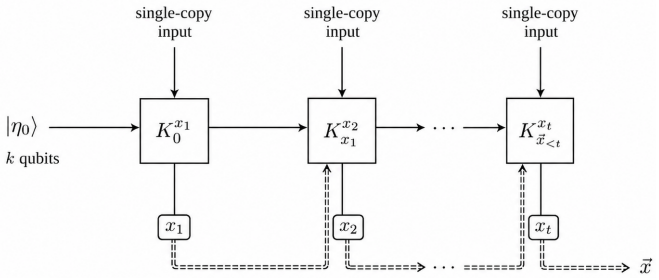
We study stabilizer state testing and learning with limited coherent quantum memory. Here an algorithm sequentially receives copies of an unknown $n$-qubit state, but may keep only $k$ qubits of coherent quantum memory between measurements. With unrestricted memory, seminal work of Gross, Nezami and Walter showed how to test $n$-qubit stabilizer states using $6$ copies, which is dimension independent, unlike the learning complexity of $\Theta(n)$. We show that this testing-vs-learning separation is lost under memory constraints. More concretely we show that (1) The sample complexity of testing stabilizer states in the $k$-qubit memory framework is $\Theta(n-k)$. Our upper bound goes via a novel connection to the hidden shift problem and the lower bound is proven using a novel approach to average case bounds on likelihood ratios via combinatorics of the stochastic orthogonal group. (2) The sample complexity of learning stabilizer states with $k$ qubits of memory, in the non-adaptive framework, is $\Theta(n^2/k)$. As a further application of our techniques, we prove an exponential lower bound for purity testing even when the memory may be left coherent throughout the protocol. Our main results identify coherent quantum memory as the resource enabling the usual separation between stabilizer testing and learning. In particular, even with $k=0.99n$ qubits of memory, there is no constant-copy stabilizer tester; furthermore for $k=cn$ qubits of memory (for $0< c < 1$), stabilizer testing is as hard as learning, with both requiring $\Theta(n)$ copies.
0
0
cs.IT 2026-07-03

Fixed sparse connections cut phase-shifter count by up to 62 percent

by Honghao Wang, Qingqing Wu +4 more

Ultra-Low-Cost Hybrid Beamforming: A New Static-Connection Architecture with Sparse Phase-Shifter Sharing

The architecture keeps beamforming performance close to full-PS sub-connected designs while lowering hardware needs in single- and multi-RF

Figure from the paper full image
abstract click to expand
Hybrid beamforming is a promising solution for high-frequency multi-antenna wireless systems, but its implementation is constrained by the cost and complexity of analog phase-shifter (PS) networks. Although sub-connected architectures simplify the analog network, their conventional realization still requires a dedicated PS for each antenna, causing considerable layout area, wiring, calibration, and control overheads. To address this issue, this paper proposes a novel static-connection architecture with sparse PSs for ultra-low-cost sub-connected hybrid beamforming, where antennas within each sub-array share a PS through an optimized fixed PS-to-antenna connection matrix. The proposed architecture preserves static connections while enabling dynamic beam control via adaptive PS phase-shift adjustments and digital precoding. For the single-radio-frequency (RF)-chain scenario, the sparse-PS connection design is transformed into an antenna-grouping problem, with analytically characterized structural properties and an efficient algorithm. For the multi-RF-chain scenario, we develop a quality-of-service (QoS)-majorization-minimization (MM) algorithm to handle the mixed discrete-continuous optimization problem. Numerical results demonstrate that the proposed architecture reduces the PS count while preserving most beamforming capability of the traditional full-PS sub-connected architecture. In particular, the proposed design achieves PS-count reductions of 37.5% and 62.5% in single-RF-chain and multi-RF-chain systems, respectively, while avoiding deep-null and grating-lobe degradations associated with deterministic connection schemes. These results provide engineering insights into static sparse-PS sharing: the key to hardware-efficient hybrid beamforming is not merely reducing the PS count, but also preserving essential analog-domain degrees of freedom through optimized PS connection topologies.
0
0
cs.IT 2026-07-03

Galois connections extend weight bounds from field codes to ring codes

by Yang Xu, Haibin Kan +1 more

Generalized Rank Weight and Extended Generalized Poset Weight Defined For Codes Over Rings: A Galois Connection Approach

Generalized rank weights over chain rings and poset weights over quasi-Frobenius rings inherit Singleton bounds and dualities.

abstract click to expand
In this paper, we study generalized rank weights (GRWs) and extended generalized poset weight (EGPWs) of codes over rings via a Galois connection approach. First, we show that various coding-theoretic properties related to generalized weights, including security drops of a code employed in wire-tap channel of type II, connections between generalized weights of a Gabidulin code and its associated Delsarte code, (generalized) Singleton bound, MDS discrepancy of a code, characterizations of MDS, near MDS, $i$-MDS, MRD, near MRD, $i$-MRD, (dually) quasi-MRD codes as well as evasive property of subspaces, can be reformulated in terms of Galois connections. Next, we study GRWs and rank profiles defined for modules over principal ideal rings, especially those over chain rings. Generalizing GRWs defined for vector spaces over fields, we establish a singleton bound and a Wei-type duality theorem, characterize MRD, near MRD and dually quasi-MRD codes and determine their GRWs; moreover, we characterize $i$-MRD codes and establish a scattered bound for $(h,h)$-evasive codes over chain rings, generalizing counterpart result established for vector space over finite fields. Finally, we propose and study EGPWs and extended poset profiles defined for modules with a composition series, which in fact form a Galois connection. Generalizing EGPWs defined for modules over finite Galois rings, we establish a Wei-type duality theorem for modules over arbitrary quasi-Frobenius rings, which unifies the two Wei-type duality theorems derived in both \cite{32} and \cite{33}.
0
0
cs.IT 2026-07-03

Weight distribution of RM(3,11) computed exactly

by Kirill Khoruzhii, Patrick Gelss +1 more

The Weight Distribution of the Third-Order Reed-Muller Code of Length 2048

The calculation over all 3.69 million cubic orbits also raises the covering radius lower bound to 408

Figure from the paper full image
abstract click to expand
We compute the weight distribution of the third-order Reed--Muller code RM(3,11) of length 2048. The weight enumerator is assembled from the coset weight enumerators of f+RM(2,10), evaluated for representatives of all 3691560 nonzero GL(10,2)-orbits of Boolean cubic forms in ten variables. The computation rests on a structural theorem: a nondegenerate Boolean cubic form admits a nondegenerate hyperplane restriction, except for a single orbit in each odd dimension. The same pass determines the second-order nonlinearity of every cubic form: the relative covering radius of RM(2,10) in RM(3,10) is 408, attained on 179 orbits. This raises the best known lower bound on the covering radius of RM(2,10) from 400 to 408. A complementary heuristic search shows that the relative covering radius of RM(6,10) in RM(7,10) is at most 32, improving the previous bound of 50.
0
0
cs.IT 2026-07-03

Generalized codes yield 267 new EA qubit codes

by Yang Li, Martianus Frederic Ezerman +3 more

Generalized Extended Codes with Applications in Entanglement-Assisted Qubit and Qutrit Codes

C(u,a) constructions give explicit control over hull dimension and dual distance, producing 236 confirmed improvements for lengths up to 40.

Figure from the paper full image
abstract click to expand
We prove that any generalized extended code is monomially equivalent to the Hermitian dual of a code which is closely related to a second kind of extended code of $\C^{\perp_{\rm H}}$. Every $[n+1,k+1]_{q^2}$ linear code $\D$ with $d(\D^{\perp_{\rm H}})>1$ is monomially equivalent to the generalized extended code $\C({\bf u},a)$ of an $[n,k]_{q^2}$ linear code $\C$ for a fixed $a\in\F_{q^2}^{*}$ and some ${\bf u}\in\F_{q^2}^{n}$. We then characterize the Hermitian hull and Hermitian dual distance of $\C({\bf u},a)$ in terms of the position of ${\bf u}$ relative to $\C+\C^{\perp_{\rm H}}$ and the interaction between ${\bf u}$ and the minimum weight codewords of $\C^{\perp_{\rm H}}$, respectively. We obtain explicit criteria to independently control the expected Hermitian hull dimension and Hermitian dual distance of $\C({\bf u},a)$. In particular, several conditions for simultaneously increasing the Hermitian hull dimension and the Hermitian dual distance of $\C({\bf u},a)$ are derived. Applying these results to the Hermitian construction for EAQECCs gives us $267$ new EA qubit codes of lengths $n \leq 40$ and $14$ new EA qutrit codes of lengths $n \leq 25$ compared to the best-known codes in Grassl's code tables and the imporvements recorded in very recent works in the literature. Among the new parameter sets, we confirm improvements for $236$ qubit and $8$ qutrit codes.
0
0
cs.IT 2026-07-03

79-fold latency cut for image tasks at 5.7% accuracy cost

by João Henrique Inacio de Souza, Mattia Merluzzi +3 more

Low-Latency Task-Oriented Image Transmission with Opportunistic Spectrum Access

Latent codes sent over idle channels replace full-image coding and still let the receiver finish the task quickly.

Figure from the paper full image
abstract click to expand
Communication systems designed for reliable data reconstruction, rather than task-oriented communication, typically rely on separate source and channel coding and incur high latency under limited spectrum availability and fading channels. To address this, we propose a transmission framework with opportunistic spectrum access, in which the transmitter sends discrete latent representations learned via a vector-quantized variational autoencoder (VQ-VAE) over idle licensed channels using standard digital modulation. The AI-powered receiver is still able to reconstruct task-related information from the heavily compressed data. We develop a cross-layer latency model that accounts for compression, block errors, retransmissions, and stochastic channel access. Results on latency-accuracy trade-offs show that the proposed scheme achieves at least 79- and 3.3-fold latency reductions with only 5.7% and 2.4% drops in classification accuracy compared to benchmarks using conventional source and channel coding. The framework enables low-latency communication and reliable task execution even under limited spectrum availability and challenging channel conditions.
0
0
math-ph 2026-07-03

r-deformed Rényi entropy gives tighter Tsallis bound on density operators

by Srikrishna Maity, Shigeru Furuichi +1 more

r-deformed α-z-R\'enyi relative entropy

The three-parameter family lies below an existing upper bound whenever both are applied to quantum states.

Figure from the paper full image
abstract click to expand
In this article, we consider the $r$-logarithm for defining three-parameter family of R\'{e}nyi relative entropies that are generalization of the $\alpha$-$z$-R\'{e}nyi relative entropies. All the members of $r$-deformed $\alpha$-$z$-R\'{e}nyi relative entropies satisfy the necessary axioms to be a divergence. We expose the range of parameters $\alpha$, $z$ and $r$ for which the data processing inequality holds. We also establish that $r$-deformed $\alpha$-$z$-R\'{e}nyi relative entropy is an upper bound of the Tsallis relative entropy. Now, we have two upper bounds of the Tsallis relative entropy, which are $r$-deformed $\alpha$-$z$-R\'{e}nyi relative entropy and the other one, which is discussed in literature. We investigate the order relationship between these two upper bounds of the Tsallis relative entropy. We observe that our new upper bound is more tighter when applicable to the density operators.
0
0
cs.LG 2026-07-03

Expander SAEs cut decoder storage 293x at 84% dense fidelity

by Rodrigo Mendoza-Smith

Expander Sparse Autoencoders: Parameter-Efficient Dictionaries for Mechanistic Interpretability

A left-d-regular expander mask reduces learned decoder values from mn to dn while preserving most reconstruction quality in language-model S

Figure from the paper full image
abstract click to expand
Sparse autoencoders (SAEs) decompose internal activations of neural networks into sparse linear combinations of learned features by fitting an overcomplete dictionary $\mathbf{W}\in\mathbb{R}^{m\times n}$ with $m<n$, and inferring a sparse code $\mathbf{x}\in\mathbb{R}^n$ from $\mathbf{h}\approx\mathbf{W}\mathbf{x}$. This inference problem closely resembles the canonical setup of compressed sensing, but dense decoders requires $O(mn)$ learned values, which becomes costly at large feature counts. We introduce Expander SAEs: TopK SAEs whose decoder and tied encoder are supported on a left-$d$-regular expander mask with $d\ll m$, learning only $dn$ decoder values while keeping the sparse-coding problem $(m,n,k)$ fixed. The same structure reduces storage and turns the matching-pursuit correlation step $\mathbf{W}^\top \mathbf{r}$ in OMP into an $O(dn)$ gather-and-reduce operation. Our experiments show that across Pythia-70M/160M, Qwen2.5-3B, and Llama-3.2-1B residual-stream activations, varying $d$ traces a consistent storage--fidelity frontier, and that at the most compressed modern-LM setting, Qwen2.5-3B with $d=7$ uses $293\times$ fewer learned decoder values than the full dense decoder while retaining $84$% of dense CE-loss recovered. Control experiments show that the improved storage--fidelity tradeoff is driven by sparse, diverse decoder support structure rather than by fewer learned decoder values, and that when sparse and dense decoders are compared at matched parameter count, part of the remaining gap comes from encoder amortisation. On the theoretical side, we show that expansion and column flatness are sufficient for identifiability of noiseless $k$-sparse codes, and we derive complementary sufficient conditions under which OMP recovers the support exactly.
0
0
cs.IT 2026-07-03

Minimal generators built from minimum-degree polynomials for constacyclic codes

by Vaishali Singh, Sucheta Dutt +1 more

On the structure of constacyclic codes over finite chain rings

The construction works for arbitrary lengths over any finite chain ring and yields the code rank plus exact conditions for MHDR and MDS via

abstract click to expand
In the present paper, we provide an explicit construction for generators of a $\lambda$-constacyclic code $\mathcal{C}$ of arbitrary length $\ell$ over a finite chain ring(FCR) $\mathcal{R}$ in terms of certain minimum degree polynomials of the ring $\mathcal{R}[x]/ \langle x^{\ell}-\lambda \rangle$. Moreover, the proposed construction achieves the minimum possible number of generators. We prove certain properties of this set of generators, using which we obtain a minimal spanning set of $\mathcal{C}$. We also obtain that the rank of $\mathcal{C}$ is $\ell-n_0$, where $n_0$ is the degree of the minimal degree polynomial in $\mathcal{C}$. Finally, we derive necessary and sufficient conditions under which an arbitrary length $\lambda$-constacyclic code $\mathcal{C}$ over $\mathcal{R}$ is Maximum Hamming Distance with respect to Rank(MHDR) as well as Maximum Distance Separable(MDS) in terms of a torsion code of $\mathcal{C}$ over the residue field $\mathbb{F}_q$ of $\mathcal{R}$. We further determine the exact values for $n_0$ for which $\mathcal{C}$ over $\mathcal{R}$ is MHDR.
0
0
cs.CC 2026-07-03

Clause substitution creates local blind spot in K-SAT

by Wen Fang, Xianxian Li +4 more

Self-Referential K-SAT and the Finite Analogue of G\"odel's Incompleteness Theorem

Indistinguishable SAT/UNSAT pairs force wide clauses in Resolution and push proof size toward 2^N.

abstract click to expand
Self-reference and solution independence are core properties underlying intractability. This paper establishes a finite combinatorial analogue of G\"odel's incompleteness theorems within Boolean $K$-SAT. While standard random $K$-SAT has assignment correlations that disrupt solution independence, we resolve this via a logarithmic-width ensemble ($K = O(\log N)$). Here, satisfying assignments converge to a Poisson distribution, letting unsatisfiable and uniquely satisfiable formulas coexist. By executing a single-clause substitution conditioned on the unique solution, we construct structurally irreducible SAT/UNSAT pairs that are indistinguishable via local evaluation. Using algorithmic information theory and Shannon channels, we prove that deductive pipelines restricted to a sublinear window suffer from an informational blind spot, forcing a descriptive lower bound of $K(\mathcal{A}) \geq \Omega(N^{1-\delta})$. This deficit forces any Resolution refutation of the UNSAT instance to utilize wide clauses ($w(\pi) \geq \Omega(N^{1-\delta})$), triggering an exponential proof-tree explosion ($S(\phi) \geq \exp(\Omega(N^{1-2\delta}))$). As $\delta \rightarrow 0^+$, this bound converges to the worst-case $2^N$ threshold, reframing the Strong Exponential Time Hypothesis (SETH) as a direct projection of G\"odel incompleteness onto finite computation. We diagnose the decades-long stagnation in complexity theory. Transitioning from Turing's class separation to a G\"odelian paradigm of instance indistinguishability, we introduce a multi-dimensional comparative framework that contrasts these two historical lineages across distinct perspectives. The self-referential hardness exhibits physical invariance: it precludes quantum shortcuts due to the necessity of global semantic analysis and delineates a scaling bottleneck for machine learning architectures operating on lossy, local compression.
0
0
quant-ph 2026-07-03

Quantum leakage sets universal upper bound on inference accuracy

by Farhad Farokhi, Shuixin Xiao

An Information-Theoretic Principle for Optimal Quantum Encoding: Tight Frames and Equiangular Ensembles

Maximal leakage from classical data to encoding limits any quantum task, with tight frames optimal in small dimensions.

abstract click to expand
Optimal encoding of classical data for quantum-assisted statistical inference is investigated from an information-theoretic perspective. We prove that the accuracy of any quantum-computing inference procedure is upper bounded by the maximal quantum leakage from the classical data through its quantum encoding, establishing leakage as a universal, task-agnostic quality measure for encoders. This demonstrates that the maximal quantum leakage is a universal measure of the quality of the encoding strategy for statistical inference as it only depends on the quantum encoding of the data and not the inference task itself. The optimal universal encoding strategy, i.e., an encoding strategy that maximizes the maximal quantum leakage, is proved to be attained by pure states. When there are enough qubits, basis encoding is proved to be universally optimal. However, when the dimension of the system is small, phase encoding is optimal. For the latter, any tight frame, any ensemble whose average state is the maximally mixed state, is in fact optimal. Within tight frames, equiangular tight frames (ETFs) are distinguished as the uniquely symmetric optimal encodings, i.e., they saturate the Welch lower bound on pairwise overlaps and possess a self-referential optimal measurement. Prominent special cases are the qubit trine, the regular simplex, and symmetric informationally complete positive operator-valued measures (SIC-POVMs), for which the ETF structure and explicit codeword constructions are provided. Numerical examples are presented to validate the theoretical predictions.
0
0
cs.CR 2026-07-02

All-out attack optimal for withholding blocks in PPS pools

by Mustafa Doger, Sennur Ulukus

All-out Attack: Optimal Block Withholding Under Pay-Per-Share Scheme

Under pay-per-share, attackers gain α/(1-α) after adjustment while operators pay for shares without blocks.

Figure from the paper full image
abstract click to expand
Classical Block Withholding (BWH) attacks have been extensively studied in block-dependent reward schemes, where pool members are compensated upon a block discovery within the pool. However, most contemporary mining pools operate under share-based scheme wherein participants are paid immediately upon submission of valid shares. In this paper, we analyze BWH under Pay-Per-Share (PPS) and Full-PPS (FPPS) schemes for Nakamoto-style blockchains and prove that these mechanisms are not incentive compatible -- contrary to claims in prior literature. Under PPS/FPPS, the optimal strategy for a BWH attacker is the All-out Attack (AoA): the adversary allocates its entire hashpower toward the victim pool, submitting only partial Proof-of-Work shares (pPoW) while withholding all valid blocks, i.e., full Proof-of-Work (fPoW). Under AoA, prior to the first difficulty adjustment, the adversary incurs negligible loss due to the withheld fPoWs. After the first difficulty adjustment, which reduces block difficulty, the adversary generates more pPoWs per unit time, achieving a relative gain of $\frac{\alpha}{1-\alpha}$ compared to pre-adjustment rates, where $\alpha$ is the fraction of adversarial hashpower. Moreover, per unit time and per unit hashpower, all honest miners benefit at the same rate as the adversary. In contrast, the victim pool operator incurs losses: it pays the attacker out-of-pocket for pPoW submissions but receives no fPoW compensation in return. Finally, advanced variants of BWH, such as Fork After Withholding (FAW), do not yield additional profit to the attacker.
0
0
cs.LG 2026-07-02

Projected quantum kernels cut regret via dimensionality reduction

by Yuqi Huang, Vincent Y. F. Tan +1 more

Balancing Expressivity and Learnability in Quantum Kernel Bandit Optimization

Approximations preserve quantum properties while yielding regret bounds that improve sample efficiency and lower overhead in GP bandit optim

Figure from the paper full image
abstract click to expand
We investigate Gaussian process (GP) bandit optimization with quantum kernels, assuming the mean reward function lies in the reproducing kernel Hilbert space (RKHS) induced by the quantum kernel. This setting is motivated by NISQ-era tasks such as quantum control, state preparation and variational quantum algorithms. While quantum kernels can offer a `quantum advantage' via domain-specific inductive biases, na\"{i}vely using full, high-dimensional kernels increases model complexity and information gain, leading to higher cumulative regret and poor learnability. To address this, we propose projected quantum kernels and classical kernel approximation techniques that reduce feature dimensionality while preserving key quantum properties. Using these approximate kernels, we develop misspecified GP bandit algorithms and derive regret bounds that characterize the trade-off between approximation error and information gain. The regret bounds provide principled guidance for selecting the optimal model complexity. Empirically, our methods outperform full quantum kernels in sample efficiency, while substantially reducing computational overhead, enabling scalable GP optimization for quantum-native applications.
0
0
stat.ML 2026-07-02

Refined assumption gives dichotomy counts for low-dimensional data

by Konstantin Häberle, Helmut Bölcskei

Function-Counting Theory for Low-Dimensional Data Structures

Extending Cover's counting theory shows how manifold structure shapes classification capacity and generalization.

Figure from the paper full image
abstract click to expand
The success of deep learning models in classification and regression is widely attributed to the low-dimensional structure that real-world data tend to exhibit, despite their high-dimensional representation. This work attempts to provide a mathematical framework for binary classification on low-dimensional data, building on Cover's (1965) function-counting theory. With our framework, we aim to address the question of how the low-dimensional structure of the data affects the classification capabilities of learning models. Cover's theory relies on a general position assumption that blinds it to the underlying data structure. We refine this assumption to account for the low-dimensionality of the data and derive dichotomy counts that reflect the data structure. We further extend Cover's separation capacity and problem of generalization to the low-dimensional setting, enabling the impact of the underlying data structure on both to be analyzed.
0
0
cs.IT 2026-07-02

Beam-SINR field forecasts suffice for all rate decisions

by Zhihan Zeng, Kaihe Wang +2 more

QuaMoE-DRF: Proactive Beam and Rate Adaptation via Multimodal Dynamic Radio Map Forecasting in ISAC Networks

Multimodal model predicts the field from geometry and motion to raise effective rate 5.67 percent and cut outage 8.35 percent on urban bench

Figure from the paper full image
abstract click to expand
Static radio maps provide location-dependent propagation priors, but they cannot capture short-term blockage caused by moving objects. Direct sensing-assisted beam prediction is also limited because a beam index discards SINR margins, MCS thresholds, BS alternatives, and communication-equivalent neighboring beams. This paper proposes QuaMoE-DRF, a quality-aware multimodal dynamic radio map forecasting framework for proactive beam and rate adaptation in ISAC networks. Its core representation is a future beam-SINR field. We show that the full multi-BS beam-SINR field is sufficient for finite-codebook threshold-rate BS, beam, MCS, goodput, and outage decisions. For tractability, the implemented model learns a compact reference-BS local field, complemented by BS-level supervision, joint BS--beam supervision, and latent network context; we also clarify that this compact projection alone is not sufficient for BS association. QuaMoE-DRF fuses static geometry, event-like motion observations, structured sensing states, and wireless history through a quality-aware mixture-of-experts module motivated by inverse-variance fusion under heteroscedastic modality errors. It jointly predicts communication-oriented map channels and proactive BS, beam, and MCS decisions. On a dynamic multi-BS and multi-UE urban benchmark, QuaMoE-DRF achieves 402.5 Mbps effective rate, 0.0417 outage probability, and 0.1836 map RMSE, improving the effective rate by 5.67% and reducing outage by 8.35% over the strongest completed effective-rate baseline. The current validation uses labels from a compact blockage/path-loss simulator, with ray tracing used only for calibration and sanity checking.
0
0
eess.SP 2026-07-02

MiLAC compression cuts estimation complexity 1540 times

by Qiaosen Zhang, Matteo Nerini +1 more

Channel Estimation and Beamforming for Microwave Linear Analog Computers (MiLACs)-Aided Multiuser MISO Systems

Rank-deficient correlations let limited-RF-chain multiuser beamforming match digital performance

Figure from the paper full image
abstract click to expand
Microwave linear analog computers (MiLACs) have recently gained attention for future gigantic multiple-input multiple-output (MIMO) systems by enabling beamforming with greatly reduced hardware and computational cost. However, channel estimation for MiLAC-aided multiuser systems remains an open problem. Conventional channel estimation requires many radio-frequency (RF) chains to access full-dimensional received signals, followed by massive digital processing, which undermines the advantages of MiLAC-aided systems in reducing the number of RF chains and computational complexity. In this paper, we propose computationally efficient channel estimation and beamforming schemes for MiLAC-aided multiuser multiple-input single-output (MU-MISO) systems with a limited number of RF chains. We consider the general case where different user groups experience different channel correlation matrices. By exploiting the rank deficiency of these matrices, the proposed schemes use MiLAC to compress the full-dimensional received signals in the analog domain, making them compatible with the available RF chains while preserving the essential channel information. Then, in the digital domain, only low-dimensional channel estimation is performed based on these compressed observations, substantially reducing computational cost. We further show how regularized zero-forcing beamforming (R-ZFBF) can be efficiently realized from the low-dimensional channel estimates through a cascade of two MiLACs, which offers greater computational flexibility than a single MiLAC. Numerical results show that the proposed schemes reduce computational complexity up to $1540\times$ and $16108\times$, for channel estimation and beamforming, respectively, while achieving performance comparable to digital baselines.
0
0
cs.IT 2026-07-02

Flexible metasurface shape cuts CRB in ISAC systems

by Maoyuan Wang, Qian Zhang +4 more

DRL-Based Joint Beamforming and Surface Shape Optimization for Flexible Intelligent Metasurface-Aided ISAC Systems

DRL jointly tunes beamforming and surface geometry to improve sensing while preserving communication quality.

Figure from the paper full image
abstract click to expand
Integrated sensing and communication (ISAC) unifies high-precision sensing and wireless data transmission. In this paper, we investigate the design of ISAC systems enabled by flexible intelligent metasurface (FIM) and aim to minimize the Cram\'er-Rao bound (CRB) with quality of service (QoS) constraints using deep reinforcement learning (DRL). Specifically, we formulate the joint design of beamforming matrix and FIMs surface shape to reduce the CRB subject to transmit power, QoS and the FIMs surface shape constraints. However, the non-convex formulation makes optimization problem difficult to solve. To tackle this issue, we develop a deep deterministic policy gradient (DDPG) actor critic DRL scheme for the joint design, guided by a constraint aware reward to progressively improve sensing performance. Numerical results demonstrate that jointly optimizing the beamforming matrix and the FIMs surface shape substantially decreases CRB while ensuring communication quality compared with existing rigid arrays.
0
0
cs.IT 2026-07-02

Outage probabilities derived for ISAC over Rician channels

by Marziyeh Soltani, Mahtab Mirmohseni +2 more

Fundamental Limits of Random Downlink Integrated Sensing and Communication over Rician Channels

SJB and LB schemes yield expressions and scaling laws showing K-factor impacts communication more than sensing.

Figure from the paper full image
abstract click to expand
This paper studies the stochastic performance of a downlink multiple-input multiple-output integrated sensing and communication (ISAC) system over Rician fading channels. Rician fading is important in line-of-sight (LoS)-dominated deployments, where a deterministic propagation component can strongly affect sensing and communication reliability. The base station (BS) simultaneously serves a user and senses a target. The BS-user channel contains LoS and non-line-of-sight components. The user LoS angle may be fixed or random, and the target angle may follow an arbitrary distribution potentially correlated with the user angle. Compared with Rayleigh fading, the deterministic LoS component introduces angle-dependent terms and leads to generally independent but non-identically distributed random vectors, requiring new analysis. We analyze two beamforming strategies: subspace joint beamforming (SJB), optimal for the shared waveform structure, and linear beamforming (LB), a practical alternative using separate sensing and communication beamformers. For both schemes, we derive communication outage probability (OP) and sensing OP based on the Cramer--Rao bound (CRB). We also identify special cases with simpler expressions. For LB, we derive upper and lower bounds on sensing OP and a tractable approximation. We characterize large-system and high-power scaling laws. LB without dirty paper coding (DPC) is interference-limited at high power due to radar self-interference. Results show the Rician K-factor affects communication more strongly than sensing, with non-monotonic behavior across regimes. LB with DPC achieves the best overall performance in strong LoS environments and is the only scheme achieving ultra-high communication reliability in Rayleigh fading, while SJB provides a robust lower-complexity alternative across operating conditions.
0
0
cs.IT 2026-07-02

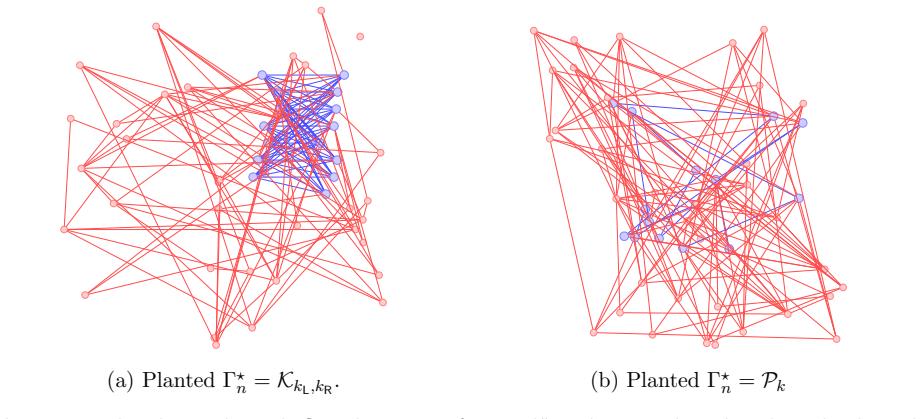
Planted subgraph recovery threshold set by minimal max density

by Wasim Huleihel

Recovery of Planted Subgraphs

The smallest balanced induced subgraph's densest part determines when exact recovery from a random graph becomes possible with high probabil

Figure from the paper full image
abstract click to expand
Understanding the fundamental limits of recovering planted subgraphs in random graphs is a central challenge in high-dimensional statistics and theoretical computer science. While existing work has largely focused on special subgraph families such as cliques, bicliques, or dense blocks, the exact recovery of a general planted subgraph in Erd\H{o}s--R\'enyi random graphs remains poorly understood. In this paper, we study the exact recovery of an arbitrary planted subgraph $\Gamma = \Gamma_n$ embedded in a dense Erd\H{o}s--R\'enyi random graph $\mathcal{G}(n,q_n)$, where edges within $\Gamma$ are present independently with probability $p_n > q_n$. Our main results identify sharp conditions under which exact recovery is possible with high probability, and we establish matching lower bounds showing the necessity of these conditions. The resulting statistical threshold is characterized by a new graph-theoretic quantity, which we term the \emph{minimal maximum subgraph density}. This quantity is defined as the maximum subgraph density of the smallest induced balanced subgraph of $\Gamma$. We then turn to the problem of recovery under polynomial-time constraints. We propose a computationally efficient recovery algorithm that applies to arbitrary planted subgraphs and analyze its performance in terms of certain spectral properties of the adjacency matrix. In addition, we derive computational lower bounds for recovery using the low-degree polynomial framework, establishing regimes where recovery is statistically possible but computationally hard. Finally, we consider several extensions of our setting, including recovery in semi-random models and weaker notions of recovery.
0
0
stat.ML 2026-07-02

Surrogate variable enables explicit process noise modeling in Kalman filters

by Shilei Li, Dawei Shi +2 more

Hierarchical Variational Kalman Filtering

Reformulated inference cuts iterations and supports higher-order trackers that become zero-phase over full history.

Figure from the paper full image
abstract click to expand
Traditional variational Kalman filtering with unknown noise statistics suffers from inconsistent process covariance estimation and slow convergence speed, limiting its practical utility. To address these issues, we introduce a surrogate variable representing the process-noise-free state, which enables explicit modeling and inference of process noise statistics. In addition, we reformulate the conventional coordinate ascent variation inference (CAVI) as a marginalized maximum a posteriori problem, followed by a single-step hyperparameter fitting. This reformulation obviates the need for multiple inner iterations inherent to CAVI and decouples the design of the covariance tracking filters. Consequently, this architecture permits the deployment of higher-order filters for covariance tracking and enables sliding-window hyperparameter estimation. Notably, when this window encompasses all historical data, the covariance tracking estimator intrinsically operates as a zero-phase filter. Numerical simulations validate the theoretical framework, demonstrating the enhanced convergence speed and superior estimation accuracy compared with existing methods.
0
0
cs.IT 2026-07-02

Bounds close at high SNR for MIMO phase-modulated channels

by Hengyu Cui, Ru-Han Chen +4 more

Performance Evaluation of A Certain Transceiver Architecture for Multiple-Input Multiple-Output Phase-Modulated Channels

Row-echelon transform yields scalar annulus sub-channels whose capacity is bracketed tightly by geometry and entropy-power arguments.

abstract click to expand
For multiple-input multiple-output (MIMO) channels with phase modulation, we recently proposed a method of unitarily transforming the channel matrix into a certain row-echelon form, by which the original MIMO channel can be converted into a certain number of scalar sub-channels with two phase inputs, thereby forming an annulus constellation geometry, and corrupted by both the additive white Gaussian noise and weak self-interference. In this paper, several bounds are derived to evaluate the fundamental limit of such a specific transceiver architecture. Two upper bounds are obtained by upper-bounding the capacity of a scalar channel with an annulus support constraint from the perspective of the convex geometry, while a lower bound is obtained by the standard entropy power inequality. Numerical results show that the gaps between these bounds are small at high signal-to-noise ratios for the MIMO phase-modulated channels over the Rayleigh fading and the single-input multiple-output symbiotic communication system assisted by a reconfigurable intelligent surface.
0
0
cs.IT 2026-07-01

Agentic AI loop boosts UAV wireless power path efficiency

by Feibo Jiang, Li Dong +4 more

SLM, LLM or Agentic AI? Toward Intelligent UAV-Enabled WPT Systems in Low-Altitude Economy Networks

Four agents generate, optimize, evaluate and reflect on routes to raise energy transfer performance over single models.

Figure from the paper full image
abstract click to expand
Unmanned Aerial Vehicles (UAVs) have become key enabling platforms for low-altitude economic networks, yet achieving efficient and adaptive optimization under resource-constrained and dynamic environments remains challenging. This paper investigates language models for UAV-enabled Wireless Power Transfer (WPT) systems. First, a lightweight Small Language Model (SLM)-based solution is developed using a pre-trained BERT backbone, enhanced UAV embeddings and contextual features, a geometry-aware path decoder, and ensemble inference to achieve low complexity, low latency, and high energy efficiency. Second, an Agentic AI-based framework is designed to exploit the reasoning and interactive capabilities of Large Language Models (LLMs). It integrates four collaborative agents-Initializer, Actor, Critic, and Reflector-to form a closed loop of generation, optimization, evaluation, and reflection for iterative UAV path and energy optimization. Finally, simulations compare the SLM-, LLM-, and Agentic AI-based approaches.
0
0
cs.AI 2026-07-01

Memory architecture beats channel capacity in LLM language invention

by Yashar Talebirad, Eden Redman +2 more

From Signals to Structure: How Memory Architecture Drives Language Emergence in LLM Agents

Notebook-equipped agents reach stable coordination at high capacities; stateless agents collapse once vocabulary exceeds context limits.

Figure from the paper full image
abstract click to expand
How do two agents invent a shared language from scratch? In a Lewis signaling game, a sender and receiver must coordinate on a code using only their interaction history. We study five memory architectures across varying channel configurations with LLM agents and find that memory architecture matters more than channel capacity. Agents with a persistent private notebook benefit from surplus channel capacity and avoid the high-capacity collapse seen in stateless agents, achieving the most reliable coordination ($0.867 \pm 0.023$ at capacity = 25). Stateless agents peak at moderate capacity and then degrade as the vocabulary grows beyond what a rolling context window can track The notebook externalizes learned conventions, freeing agents from having to re-derive codes each round. An information bottleneck-inspired argument predicts an optimal capacity equal to the number of objects. Instead, the bottleneck (capacity = 8) proves to be a fragility point, and surplus capacity is generally better. We show that channel capacity alone cannot predict coordination; memory architecture determines whether agents turn interaction history into stable conventions, and both dimensions are needed to understand how signals become language.
0
0
math.ST 2026-07-01

Full token observation lowers sample needs for watermark proportion estimates

by Shuwen Chai, Qiaosen Wang

Sample Complexities of Estimating Gumbel--Max Watermark Proportions with and without Reduction to Pivotal Statistics

Pivotal reduction to a scalar raises the number of tokens required, with matching bounds in each regime.

abstract click to expand
Watermarking promises statistical traceability of large language model (LLM) uses, but real documents rarely arrive as purely human-written or purely LLM-generated. This motivates a quantitative question beyond detection: what proportion of a document is generated from a pre-specified watermarked LLM? We study this watermark proportion estimation problem under the Gumbel--max watermarking mechanism, treating the next-token prediction distributions as unknown and arbitrary nuisance parameters subject to a non-degeneracy condition. We compare two observation regimes: in the full observation regime, the estimator observes the pseudorandom vector and the selected token at each position; in the more prevalent setting of pivotal reduction, it observes only a scalar pivot, which follows a one-dimensional Uniform--Beta mixture distribution. Under pivotal reduction, we develop a Laguerre-polynomial estimator and establish a matching information-theoretic lower bound for the sample complexity. For full observation, we introduce an event-counting estimator and show a matching lower bound, yielding a substantially smaller sample complexity. As our results imply, although reducing to pivotal statistics is an elegant and prevalent choice, it is not always sample-efficient for estimating the proportion of watermarks.
0
0
cs.IT 2026-07-01

Linear constraints shift guesswork exponent by ρ(1-R)

by Hassan Tavakoli

Guesswork Under Linear Constraints: Exact Exponent for Coset Decoding

The exact rate for the ρ-th moment of coset rank equals the unconstrained value minus ρ times one minus the code rate.

abstract click to expand
We establish the exact exponential growth rate of the $\rho$-th moment of the constrained guesswork $G_{\mathrm{coset}}$ -- the rank of the true noise vector within its syndrome coset of a random binary linear code under i.i.d.\ Bernoulli$(p)$ noise: \( \lim_{n\to\infty} \frac{1}{n}\log_2\Eb\!\left[G_{\mathrm{coset}}^{\rho}\right] = \rho\,h_{\frac{1}{1+\rho}}(p)\;+\;\rho(R-1), \, \rho>0, \) where $h_\alpha(p)$ is the binary R\'{e}nyi entropy and $R=k/n$ is the code rate. The exponent shifts down by exactly $\rho(1-R)$ relative to the unconstrained Ar{\i}kan--Merhav exponent, with each of the $n(1-R)$ parity checks contributing equally. Finite-length simulations confirm convergence from below. We further establish: (i)~a transfer theorem expressing the partition-function exponent in terms of an arbitrary weight-enumerator growth rate $g(\delta)$; (ii)~the exact exponent for $L_n$-list (``$k$-th'') constrained guesswork; and (iii)~a sharp second-order refinement of order $\rho\log_2 n$. Beyond the binary i.i.d.\ setting, we prove a universality theorem: for any code ensemble $\mathcal{E}$ whose weight enumerator concentrates at rate $g_{\mathcal{E}}(\delta)$, the guesswork exponent equals $(1+\rho)\psi_{1/(1+\rho)}(g_{\mathcal{E}})-\rho\,\psi_1(g_{\mathcal{E}})$, where $\psi_\alpha(g)=\sup_\delta[g(\delta)+\alpha\ell(\delta)]$. As concrete applications, we instantiate this theorem for the $q$-ary extension, $\Lambda_q(\rho)=\rho\,h^{(q)}_{1/(1+\rho)}(P)+\rho(R-1)\log_2 q$, and for Gallager's regular LDPC ensemble, obtaining a closed-form guesswork exponent via an exact finite-length identity for the ensemble-average weight enumerator.
0
0
cs.IT 2026-07-01

DFDD lowers error floors in RIS differential detection

by Jiawei Qiu, Harry Leib

Decision Feedback Differential Detection for Reconfigurable Intelligent Surfaces

The scheme keeps error rates falling at high SNR where standard differential receivers plateau in varying channels

Figure from the paper full image
abstract click to expand
This work considers a Differential Reflecting Modulation (DRM) scheme for Reconfigurable Intelligent Surfaces (RIS) not requiring channel state information (CSI). When operating over time-varying fading channels, such schemes with Conventional Differential Demodulation (CDD) receivers experience high error floors and performance degradation. To address these issues, we propose a Decision Feedback Differential Detection (DFDD) technique for DRM. We explore the application of DFDD for RIS DRM and conduct extensive Monte-Carlo simulations to analyze performance. Results demonstrate the viability of our DFDD technique across various RIS scenarios and highlight the importance of proper parameter selection to achieve good performance. The DFDD scheme is also compared with uncoded and Differential Space-Time Modulation (DSTM) coded DRM using CDD based receivers. We observe that at low SNR, the DFDD scheme performs almost as well as the DRM with CDD scheme, but worse than the DSTM coded DRM. As the SNR increases however, both CDD-detected systems encounter high error floors while the error rate of DFDD based scheme continues to improve until it reaches a relatively low error floor. It is shown that the chief merits of employing DFDD receivers in such RIS systems is the low error floors they provide over time varying fading channels, albeit at expense of a small increased complexity.
0
0
cs.IT 2026-07-01

Dual-regime chain yields optimal AoII push thresholds

by Ismail Cosandal, Sennur Ulukus +1 more

Dual-Regime Absorbing Markov Chain Theory in Remote Estimation: Age-Minimizing Push Policies

A new absorbing Markov construction gives exact SMDP parameters for multi-threshold policies that minimize weighted AoII cost plus energy un

Figure from the paper full image
abstract click to expand
For a remote estimation system, we study the optimization of age of incorrect information (AoII), which is a recently proposed semantic-aware information freshness metric. In particular, we assume an information source that observes a discrete-time finite-state Markov chain (DTMC), and occasionally transmits status update packets to a remote monitor which is tasked with remote estimation of the source. For the forward channel from the source to the monitor, we assume the channel delay to be modeled by a general discrete-time phase-type (DPH) distribution, whereas the reverse channel from the monitor to the source is assumed to be perfect, ensuring that the source has perfect information on the AoII and the remote estimate at the monitor, at all times. Push-based transmissions are initiated when AoII exceeds a threshold depending on the current estimation value, i.e., multi-threshold policy. In this very general setting, our goal is to minimize a weighted sum of the time average of a polynomial function of AoII, depending on the remote estimate, and energy consumption from transmissions. We formulate the problem as a semi-Markov decision process (SMDP) with the same state-space of the original DTMC to obtain the optimal multi-threshold policy, whereas the parameters of the SMDP are obtained by using a novel stochastic tool called dual-regime absorbing Markov chain (DR-AMC), and its corresponding absorption time distribution named as dual-regime DPH (DR-DPH). The proposed method is validated with numerical examples using comparisons against other policies obtained by exhaustive search, and also various benchmark policies.
0
0
quant-ph 2026-07-01

Coupled CSS codes hit quantum erasure hashing bound via BP

by Kenta Kasai

Spatially Coupled MacKay-Neal/Hsu-Anastasopoulos CSS Codes Achieve the Quantum-Erasure Hashing Bound by Seeded BP Decoding

Density evolution shows seeded decoding reaches the design-rate limit for equal-rate MN/HA families.

Figure from the paper full image
abstract click to expand
In classical sparse-graph coding, spatial coupling is a mechanism by which belief-propagation (BP) decoding attains the maximum-a-posteriori (MAP) or area-threshold performance of the uncoupled system. Since MacKay-Neal/Hsu-Anastasopoulos (MN/HA) punctured sparse ensembles achieve capacity under MAP decoding, it is natural to ask whether spatially coupled MN/HA-type Calderbank-Shor-Steane (CSS) codes can reach the hashing bound on the quantum erasure channel under seeded BP decoding. We answer this question at the density evolution (DE) level for hard-erasure CSS decoding. On an erased coordinate, the two binary Pauli components remain unresolved, equivalently the erased qubit is represented by the four Pauli possibilities. We first define the CSS ensemble through sparse punctured matrices and the corresponding dense parity-check matrices. For fixed finite Z-side, X-side, and check degrees, we then derive a five-message uncoupled DE recursion, decompose it into Z-side and X-side constituent systems, and define the two constituent potentials. Applying the coupled-vector potential method to the two constituents separately proves that seeded BP decoding on the resulting finite-degree factor graphs reaches the smaller of the Z-side degree ratio and the X-side complementary degree ratio. In the X/Z equal-rate specialization, where the Z-side and X-side constituent design rates are equal, this BP threshold is the hashing-bound channel parameter determined by the design rate. Thus the paper gives a DE-level proof that seeded BP decoding with finite-degree factor graphs achieves the hashing bound for the X/Z equal-rate family. Finite-length BP concentration, block-error convergence, and a finite-code realization of the ideal DE seed are separate questions.
0
0
cs.NI 2026-07-01

Relay extracts semantic meaning from latent codes without source data

by Yalin E. Sagduyu, Tugba Erpek +2 more

Semantic Leakage and Privacy Preservation in Relay-Assisted Semantic Communications

This exposes a privacy flaw in semantic comms; adversarial training widens the accuracy gap at the relay while preserving receiver performan

Figure from the paper full image
abstract click to expand
Semantic communication (SemCom) has emerged as a promising paradigm in which the transmission of task-relevant information is prioritized over raw data, enabling efficient and robust communication under resource and channel constraints. In this paper, the privacy implications of relay-assisted SemCom systems are studied, where the intermediate relay node operates directly on learned latent representations. It is shown that the relay, even without access to source data, can reliably infer semantic meaning and reconstruct signals with performance comparable to that of the legitimate receiver, revealing a fundamental privacy vulnerability of semantic representations. To address this issue, an iterative adversarial training framework is proposed in which a strong, adaptively trained eavesdropper at the relay is explicitly accounted for. The proposed approach alternates between optimizing the relay's eavesdropping function and the legitimate system, resulting in representations that preserve semantic decoding performance at the intended receiver while degrading semantic inference at the relay. The semantic accuracy gap between the legitimate receiver and the eavesdropper is significantly enlarged across channel conditions. Importantly, this protection is achieved in a stealthy manner, with high reconstruction fidelity maintained while semantic leakage is selectively suppressed.
0
0
eess.SP 2026-07-01

WAX adaptation enables complexity-performance trade-offs in gigantic MIMO

by Juan Vidal Alegría, Joao Vieira +1 more

Trade-Offs in Decentralized Gigantic MIMO with Hard-Boundary Constraints

Non-cooperating modules with hard boundaries allow practical scaling of 6G antenna arrays.

Figure from the paper full image
abstract click to expand
To maintain the antenna apertures offered by 5G massive MIMO systems operating at the sub-6GHz band, known as FR1, 6G base stations (BSs) using the upper-mid band, FR3, should increase the number of antennas by a factor 4-8, giving rise to gigantic MIMO. This poses challenges in terms of processing complexity and interconnection bandwidth. The WAX framework, previously introduced for exploring trade-offs in decentralized architectures, may offer the flexibility needed to tackle these challenges. However, no results have been established on the applicability of this framework in the presence of hard-boundary constraints. The current work explores gigantic MIMO implementations based on a novel adaptation of the WAX framework, where the decentralized processing is performed by non-cooperating hardware modules. These modules may be implemented through state-of-the-art massive MIMO baseband units (BBUs). The results show the potential of the proposed framework towards exploiting trade-offs between complexity and performance in practical gigantic MIMO implementations.
0
0
cs.IT 2026-07-01

GLBP tracks unresolved measurements at O(m n 2^n) cost

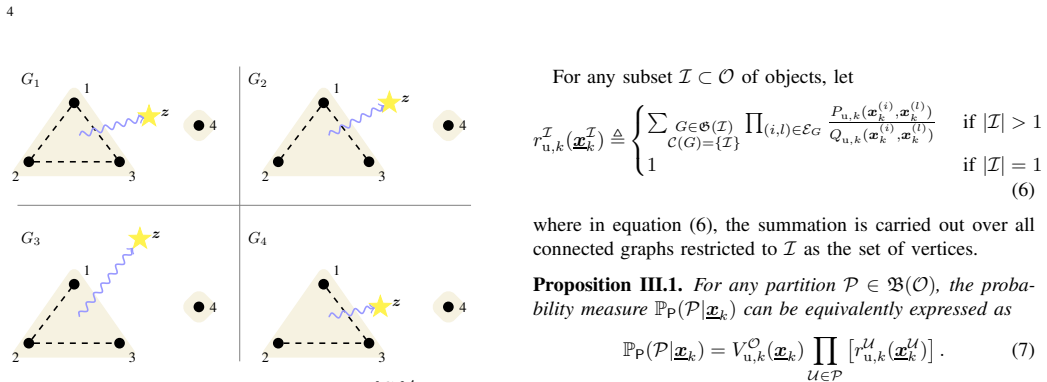
by Augustin A. Saucan, Florian Meyer +1 more

Gaussian Belief Propagation for Tracking With Unresolved Measurements

The algorithm approximates exact marginalization over object partitions while using only a fraction of the computation required by direct en

Figure from the paper full image
abstract click to expand
Unresolved measurements occur in many inference problems where two or more hidden processes may, at times, jointly generate a single measurement. For instance, such phenomena are encountered in multiobject tracking owing to the limited resolution capabilities of practical sensors; or in camera-aided autonomous driving due to shadowing or occlusions. Substantial performance degradation, such as track losses, are incurred when unresolved measurements are not accounted for. In this paper, we address multiobject tracking under a generalized unresolved measurement model, where any subset of objects may generate a single unresolved measurement according to a probabilistic model. Our innovation lies both in modeling and algorithm-design directions. First, we develop a probability distribution for object partitions based on a model of pairwise coupling of objects and subsequently a probability distribution for object-to-measurement association variables. This generic model incorporates sensor resolution capabilities, sensor detection, and sensor noise characteristics for object groups. Second, a generic Loopy Belief Propagation (LBP) method as well as a specialized Gaussian-LBP (GLBP) algorithm are proposed that perform object state inference under the aforementioned model. In contrast to direct marginalization methods, which involve a computational complexity of $O(m^n)$, for $m$ measurements and $n$ objects, the proposed GLBP algorithm achieves a computational complexity on the order of $O(m n 2^{n})$. Numerical results demonstrate the effectiveness of our proposed GLBP, with estimation performance that closely matches that of exact marginalization for only a fraction of the computational resources.
0
0
cs.CR 2026-07-01

Restricted errors and code equivalence yield post-quantum signatures

by Sarah Arpin, Jason T. LeGrow +2 more

Digital signature schemes based on code equivalence and syndrome decoding from restricted errors

Review explains how sigma protocols for two coding problems become non-interactive signatures via Fiat-Shamir.

Figure from the paper full image
abstract click to expand
Digital signature schemes are an important cryptographic tool to ensure data authenticity and integrity in many applications that must be resilient to attacks, including those facilitated by quantum computers. We consider the two digital signature schemes based on error-correcting codes that are second-round candidates in NIST's call for Additional Signature Schemes, which is part of the Post-Quantum Cryptography Standardization Process. Specifically, we provide an overview of the Codes and Restricted Objects Signature Scheme (CROSS) and the Linear Equivalence Signature Scheme (LESS). We describe their underlying problems of syndrome decoding from restricted errors and code equivalence. We review sigma protocols and how they can be transformed into digital signature schemes via the Fiat-Shamir transform. Finally, we explain how this procedure yields code-based digital signatures believed to be post-quantum secure.
0
0
cs.IT 2026-07-01

Rotatable antennas raise ISAC sensing echo power

by Qingjie Wu, Beixiong Zheng +2 more

Antenna Orientation Optimization for Rotatable Antenna-Enabled ISAC Systems

Per-antenna orientation optimization with alternating algorithm outperforms fixed and array-wise schemes while meeting rate constraints.

Figure from the paper full image
abstract click to expand
Non-fixed flexible antenna architectures, such as fluid antenna system (FAS), movable antenna (MA), and pinching antenna, have garnered significant interest in recent years. In this paper, we deploy a rotatable antenna (RA) array at the base station (BS) to improve the integrated sensing and communication (ISAC) performance by exploiting the additional spatial degrees of freedom (DoFs) introduced by antenna rotation. To enhance the sensing performance over an extended region containing a potential target while meeting the communication requirements of multiple users, we aim to maximize the minimum echo signal power within the sensing region, subject to required minimum communication rates of the users. For the special case of a single user and a point target, we show that the optimal orientation of all RAs is identical when both the communication user and the sensing target are located in the far-field region, and then derive a closed-form solution for the optimal RA pointing vector. For the general multi-user and extended-target case, we propose an alternating optimization (AO) algorithm that alternately optimizes the transmit beamforming for communication, the covariance matrix of the probing signal, and the pointing vectors of the RAs in an iterative manner. Simulation results demonstrate that the proposed RA-enabled ISAC system can significantly outperform various benchmark schemes, including systems with array-wise rotation optimization and fixed antenna orientation.
0
0
quant-ph 2026-07-01

Postselection fully mitigates erasure errors below 3% check rate

by Sam J. Griffiths, Jamie Friel +1 more

The limits of erasure-based postselection for quantum error mitigation

Dual-rail systems with postselection surpass single-rail noise limits at kiloquop scales in simulations.

Figure from the paper full image
abstract click to expand
In both classical and quantum error correction, heralded erasures are known to be easier to tolerate than unheralded general stochastic errors. Whilst an established benefit of loss-dominant quantum architectures such as photonic qubits, this fact has received renewed interest, with a pivot towards reconstructing other architectures to be erasure-dominant, such as dual-rail transmons. This work investigates exploiting these 'erasure qubits' in the near term by using postselection as a technique for error mitigation, wherein circuit shots detecting any erased qubits are discarded from the computational ensemble and repeated. Firstly, we outline a numerical framework for representing circuit-level erasure noise and present 'erado', an open-source library capable of simulating erasure noise and postselection. Secondly, we investigate the effects of both erasure noise and noise in the erasure checks themselves on the quantum Fourier transform (QFT), in the additional presence of gate depolarising noise. A worked example is provided of postselection fully mitigating against the erasure channel for erasure check error rates less than 3.0%. We also show how a postselected dual-rail system can surpass a fundamental noise floor at the kiloquop scale where a comparable single-rail system cannot, justifying this approach in the NISQ regime before (and, perhaps, combined with) the practical arrival of QEC.
0
0
cs.IT 2026-07-01

Gaussian signals near capacity in quantized MIMO ISAC

by Hossein Atrsaei, Mireille Sarkiss +1 more

Fundamental Limits of Quantized MIMO ISAC under Gaussian Signaling

Bounds tighten at low SNR and saturate at high SNR; LMMSE saturates based on spatial combining ratio.

Figure from the paper full image
abstract click to expand
We study a quantized multiple-input multiple-output (MIMO) integrated sensing and communication (ISAC) system in which the communication and sensing receivers each apply analog spatial combining followed by scalar subtractive dithered quantization. This quantization model leads to an additive effective-noise representation with non-Gaussian noise. We derive upper and lower bounds on the capacity of this channel. Numerical results show that these bounds are tight at low signal-to-noise ratios (SNR) and saturate at high SNR due to finite-resolution quantization. They also show that, despite the effective noise being non-Gaussian, independent and identically distributed (i.i.d.) isotropic Gaussian signaling achieves rates close to capacity. Focusing on i.i.d. Gaussian signaling, this paper also presents a closed-form expression for the linear minimum mean-squared error (LMMSE) achieved under a Kronecker sensing-channel model. Numerical results show that the LMMSE also saturates at high SNR, where the saturation level increases as the spatial combining ratio decreases, and for combining ratios below one, saturation occurs even without quantization.
0
0
cs.IT 2026-07-01

Even-order self-dual cyclic codes meet square-root distance bounds

by Bofeng Huang, Jingwei Zhang +1 more

Self-Dual Cyclic Codes with Improved Minimum Distance Estimates via Extending the Chen-Ding Construction

Extension of Chen-Ding method determines exact parameters via zero segments and gives refined choices for larger distances.

abstract click to expand
Self-dual cyclic codes have garnered significant interest owing to their rich algebraic structures and wide-ranging applicability. Their construction and the establishment of lower bounds on their minimum distances are fundamental problems in coding theory. Chen and Ding laid an important foundation for the construction of self-dual cyclic codes in the case where the multiplicative order of $q$ module $n$, denoted by $\operatorname{ord}_n(q)$, is odd. Building on their work, we extend the investigation to the case of even order $\operatorname{ord}_n(q)$ and demonstrate that the minimum distances of the resulting self-dual cyclic codes satisfy square-root lower bounds. By examining the consecutive zero segments in the defining set of the dual code, we determine the exact parameters of Euclidean self-dual cyclic codes with even $\operatorname{ord}_n(q)$ and Hermitian self-dual cyclic codes with odd $\operatorname{ord}_n(q)$. Furthermore, for Euclidean self-dual cyclic codes with odd $\operatorname{ord}_n(q)$ and Hermitian self-dual cyclic codes with even $\operatorname{ord}_n(q)$, we introduce a refined parameter selection that leads to larger minimum distances with the same code length and dimension. This approach also yields tighter lower bounds for several families of self-dual cyclic codes. This work enriches the theory of self-dual cyclic codes and offers new insights into estimating lower bounds on their minimum distances.
0
0
cs.IT 2026-07-01

Dual-agent learning tunes RIS phases and power for mobile tracking

by George Stamatelis, Hui Chen +2 more

Active Sensing for RIS-Aided Tracking and Power Control: A Hybrid Neuroevolution and Supervised Learning Approach

Hybrid neuroevolution and supervised training lets the system handle discrete phases and one-bit feedback while beating Kalman and particle

Figure from the paper full image
abstract click to expand
This paper studies energy efficient tracking of power-limited mobile users with the assistance of a Reconfigurable Intelligent Surface (RIS). Since localization pilot transmissions dominate the energy budget of power-constrained devices, we introduce a low-overhead feedback link from the Base Station (BS) to the user to enable dynamic uplink power control. To navigate the discrete and decentralized nature of this active sensing problem, we propose a novel Dual-Agent (DA) deep learning framework that jointly optimizes the discrete RIS phase profiles and the UE's transmit power in real time. Specifically, our approach employs a hybrid training methodology integrating the neuroevolution paradigm with supervised learning, effectively overcoming the non-differentiability of discrete phase responses from the RIS unit elements and the strict information bottleneck of single-bit feedback messages for pilot power control. The proposed DA active sensing framework can be applied with both single- and multi-antenna BSs, the latter with only minor modifications in the structure of one NN: an additional output branch with appropriate structure is included for the latter case to select a valid digital combiner from a finite set. Extensive numerical simulations demonstrate that the proposed scheme achieves highly accurate and robust tracking across diverse target motion models, outperforming extended Kalman and particle filters, as well as, machine learning-based trackers. Furthermore, in static localization, it is shown to significantly outperform traditional fingerprinting schemes, deep reinforcement learning baselines, and standard backpropagation-based estimators.
0
0
cs.IT 2026-07-01

Improved GA cuts fluid antenna sidelobes by 4.45 dB

by Haoyu Liang, Zhentian Zhang +4 more

Peak Sidelobe Suppression in Planar Fluid Antenna Array

Port activation search in reconfigurable arrays lowers the highest sidelobe while keeping main beam width steady.

Figure from the paper full image
abstract click to expand
Fluid antenna systems (FAS) have emerged as a promising technology for next-generation wireless communications, offering inherent reconfigurability and spatial adaptability. A distinctive and practically consequential property of fluid antenna arrays (FAAs) is their geometric diversity: by dynamically activating different subsets of spatially distributed ports across a dense discrete grid, a FAA can reconfigure its effective aperture geometry on demand, thereby unlocking unprecedented spatial degrees of freedom for radiation pattern synthesis. Exploiting such geometric flexibility, this paper investigates peak sidelobe level (PSLL) minimization in sparse planar FAAs through enhanced heuristic optimization. Specifically, an improved genetic algorithm (IGA) is proposed to determine the optimal port activation pattern that minimizes the PSLL under strict sparsity constraints. The proposed IGA incorporates tournament selection, adaptive operator probabilities, a hybrid crossover scheme, multi-point mutation, and an elite-pool preservation strategy to improve both convergence speed and solution quality. Simulation results demonstrate that the IGA significantly outperforms the canonical GA (CGA) in convergence behavior and final PSLL performance, achieving a 4.45 dB reduction in sidelobe levels while maintaining a comparable mainlobe width.
0
0
cs.IT 2026-07-01

1D-CNN Reconstructs Fluid Antenna Channels to Lower AUD Errors

by Haoyu Liang, Zhentian Zhang +3 more

Fluid-Antenna-Aided Active User Detection With 1D-CNN Channel Reconstruction for Unsourced Random Access

The network learns full channel vectors from partial observations, cutting detection error rates versus fixed-antenna baselines.

Figure from the paper full image
abstract click to expand
In this paper, we investigate the application of fluid antenna systems (FAS) for active user detection (AUD) in unsourced random access (URA). A channel reconstruction method based on a one-dimensional convolutional neural network (1D-CNN) is proposed to effectively learn the nonlinear mapping from partial channel observations to the full channel vector. Furthermore, the reconstructed channel information is exploited to improve AUD performance via port selection. Simulation results demonstrate that the proposed 1D-CNN channel reconstructor significantly outperforms traditional methods under varying pilot lengths, achieving superior normalized mean squared error (NMSE) performance. Additionally, the reconstructed channel substantially reduces the AUD error rate compared with conventional approaches relying on traditional antenna configurations.
0
0
stat.ML 2026-06-30

Extended counting theory identifies scattering network design factors

by Konstantin Häberle, Helmut Bölcskei

Separation Capacity of Scattering Networks

The number of binary label assignments realizable by a scattering network is controlled by its wavelet, layer, and pooling choices.

Figure from the paper full image
abstract click to expand
In this paper, we attempt to enhance the theoretical understanding of convolutional neural networks (CNNs) as feature extractors in classification tasks by analyzing them through the lens of Cover's function-counting theory. Specifically, our focus lies on the notion of separation capacity, a combinatorial quantity derived from counting the number of realizable dichotomies (i.e., binary label assignments). Our contributions are threefold. First, we extend Cover's framework by establishing a conceptually insightful and practically useful formulation for the separation capacity. Second, leveraging this formulation, we identify the factors governing the separation capacity of feature extractors that employ a specific CNN architecture, so-called scattering networks, in terms of their network building blocks. Third, we provide practical insights for scattering network design.
1 0
0
cs.IT 2026-06-30

Belief in age and state guides which sensor to query

by Ismail Cosandal, Sennur Ulukus +1 more

When and Which Sensor to Observe? Timely Tracking of a Joint Markov Source

Model predictive control on the joint distribution cuts weighted age of incorrect information plus sampling costs over delayed erasure links

Figure from the paper full image
abstract click to expand
We investigate the problem of remote estimation (at a monitor) of a discrete-time joint Markov process with individual components which can be observed with dedicated sensors. At a given time slot, the monitor has the option of staying idle or sending a pull request to one of the sensors to obtain a partial state value, while the sensors are assumed to have heterogeneous sampling costs. Our goal is to develop a monitor pull policy, i.e., determining when and towards which sensor to send a pull request, in order to minimize a weighted sum of average age of incorrect information (AoII), or in short age, and sampling costs. As the communication model, we assume an erasure channel with a fixed one-slot delay from each sensor to the monitor. In this setting, the monitor does not perfectly know either the state of the process or the age, at any given time. We first obtain a sufficient statistic, namely belief, representing the joint distribution of the age and the current state of the observed process, by using the history of all pull requests and observations. Then, we formulate the optimization problem as a continuous state-space Markov decision process (MDP), namely belief-MDP, for the solution of which we propose two model predictive control (MPC) methods, namely MPC without terminal costs (MPC-WTC), and reinforcement learning MPC (RL-MPC). The effectiveness of the proposed methods is validated by numerical examples.
0
0
cs.NI 2026-06-30

Low-power trigger selectively backdoors one semantic transmitter

by Yalin E. Sagduyu, Tugba Erpek +2 more

Wireless Backdoor Attack and Defense for Semantic Communications over Multiple Access Channel

Adversary contaminates training with waveform to alter inference for one user while sparing the other in multiple access semantic system.

Figure from the paper full image
abstract click to expand
Semantic communication (SemCom) aims to preserve semantic meaning and task-oriented information beyond conventional message recovery over wireless channels. The adoption of SemCom in shared-access wireless networks introduces new vulnerabilities for multi-user semantic inference. This paper considers a SemCom system for two transmitters communicating with a common receiver over a multiple access channel. Each transmitter maps source information into latent semantic representations, while the receiver jointly reconstructs and classifies the semantic information for both transmitters. A selective over-the-air backdoor (Trojan) attack is presented in which an adversary transmits a low-power trigger waveform over the air and injects it into the shared received signal during training. By transmitting the trigger again during testing, this stealthy, low-power attack selectively manipulates the semantic inference for one transmitter while minimally affecting the inference of the other transmitter. To mitigate this vulnerability, a trigger-aware defense mechanism is developed to preserve correct semantic labels under trigger-contaminated wireless observations. The results demonstrate both the vulnerability of shared-access SemCom systems to selective over-the-air backdoor attacks and the effectiveness of trigger-aware robust training for semantic protection.
0
0
cs.IT 2026-06-30

Semantic noise blocks eavesdroppers while preserving image quality

by Xue Han, Biqian Feng +6 more

Semantic Noise Aided Secure Image Transmission over MIMO Fading Channels

A network generates noise from the legitimate user's channel to interfere only with the eavesdropper over MIMO links.

Figure from the paper full image
abstract click to expand
Existing semantic communications have exhibited satisfactory performance in many tasks, but secure image transmission remains insufficiently explored. We propose a novel secure image semantic communication (SISC) framework over multiple-input multiple-output (MIMO) fading channels. To ensure high-quality image reconstruction for the legitimate semantic user (SU) and simultaneously interfere with the eavesdropper (Eve), we design a semantic noise generation (SNG) network. This network generates a beneficial semantic noise map based on both the source features and the SU channel state information (CSI). An efficient channel estimation enhanced network is incorporated to obtain the accurate CSI and enhance the system performance. Furthermore, to improve the secure image reconstruction quality, we develop an efficient transceiver beamformer optimization algorithm, where the formulated problem is solved using the constrained stochastic successive convex approximation method. In the proposed SISC framework, semantic noise generation and beamforming optimization work together to ensure secure and high-quality image transmission. Numerical results demonstrate that the proposed semantic noise aided transmission scheme effectively protects image information from leakage to Eve while maintaining high-fidelity image reconstruction at SU.
0
0
cs.IT 2026-06-30

World model jointly optimizes unmanned sensing and decisions

by Xue Han, Yongpeng Wu +7 more

Towards World Model-Empowered Integrated Sensing, Communication, and Decision for Complex Unmanned Systems

Hybrid latent space captures environment, channels, and mobility to enable proactive SCD scheduling.

Figure from the paper full image
abstract click to expand
Complex unmanned systems comprising satellites, unmanned aerial vehicles (UAVs), unmanned ground vehicles (UGVs), and quadruped robots are increasingly deployed to perform large-scale sensing and autonomous operations. We propose a world model-empowered sensing, communication, decision (SCD) integration framework for complex unmanned communication networks. The proposed architecture establishes a closed-loop system where a unified world model jointly optimizes time-sensitive sensing, wireless communication, and intelligent decision-making. To regulate sensing freshness and reduce redundant data generation, we propose a time-sensitive age of information (AoI)-driven sensing mechanism that dynamically schedules sensing updates based on task urgency and predictive uncertainty. Furthermore, a predictive world model is developed to jointly represent environmental dynamics, wireless channel evolution, and agent mobility within a hybrid deterministic-stochastic latent space. This enables proactive communication scheduling and decision evaluation via latent rollout. To support large-scale heterogeneous coordination, a multi-granularity knowledge graph is further designed to organize cross-population relationships among satellites, UAVs, UGVs, and ground agents. Numerical results demonstrate that the proposed SCD framework outperforms conventional systems, highlighting the significant potential of world models for supporting unmanned systems.
0
0
cs.IT 2026-06-30

f-Divergence bound is tight for binary sparse frequency estimation

by Yijun Fan, Fangwei Ye +1 more

Lossy Compression for Sparse Aggregation

Covering-plus-sketching compression achieves the bound exactly when each coordinate is binary, but a gap remains for larger alphabets.

Figure from the paper full image
abstract click to expand
We consider the problem of transmitting sparse local updates to the server in a distributed learning system. Specifically, the system consists of $n$ clients, each possessing a $k$-sparse $d$-dimensional local model, and a central server responsible for aggregating the clients' models into a global model. The goal is to characterize the tradeoff between the communication cost in the transmission from the clients to the server and the accuracy in aggregating the global model. We propose a compression scheme for sparse local models by concatenating a covering method and a sketching method. We also present a converse based on f-divergence, which strengthens the conventional Fano-type lower bounds. The proposed lower bound is tight for the frequency estimation case, that is, each coordinate takes values in a binary alphabet. For general alphabets, the proposed achievable schemes remain suboptimal relative to the converse bounds, indicating that a complete characterization of the communication-accuracy tradeoff requires further investigation.
0
0
cs.IT 2026-06-30

Preprocessing optimization secures THz-MIMO links in simulations

by Rebekka Schulz, Robert F.H. Fischer

Preprocessing for Physical-Layer Security in Wireless THz-Communication

Variants that balance receiver error and secrecy rates deliver both reliability and security over THz channels.

Figure from the paper full image
abstract click to expand
In this paper, the usage of preprocessing to achieve physical-layer security in a wireless THz-MIMO scenario is investigated. The goal is a reliable and secure communication. Optimization of the preprocessing is done either based on the error performance or the transmission rate. For both criteria, we present a variant that is based only on the legitimate receiver or also includes the eavesdropper. For each variant, linear and lattice-reduction-aided approaches are considered. Numerical simulations are used to assess the resulting secrecy rates and error ratios. A comparison between all variants is compiled and the possible trade-offs are discussed.
0
0
cs.AI 2026-06-30

Sequential test stops AI fairness audits once evidence is clear

by Ioannis Pitsiorlas, Martha V. Sourla +1 more

Sequential Fairness Auditing with Limited Output Access

Auditors update a likelihood ratio after each query and halt when compliance or violation is supported, cutting unnecessary model interactio

Figure from the paper full image
abstract click to expand
External evaluations are becoming increasingly central to the governance of AI systems. In practice, however, independent auditors often have limited access to deployed models and must rely on query-based interactions. Most existing fairness evaluation methods assume static datasets and fixed-sample statistical tests, making them poorly suited to real-world auditing scenarios in which evidence must be collected sequentially under query constraints. In this work, we formulate fairness auditing as a tolerance-aware sequential hypothesis-testing problem under limited model output access. We develop a sequential generalized likelihood-ratio framework that allows auditors to accumulate evidence from a finite audit pool and stop once sufficient support for compliance or violation has been obtained. The framework is instantiated for decision-based Statistical Parity and Equal Opportunity audits, and extended to score- and logit-based proxy audits when richer observables are available. Our results show that both the fairness metric and the level of model access significantly affect audit efficiency, and that the benefits of richer output information are not uniform across auditing settings. In particular, richer outputs can substantially reduce the number of queries required for some fairness metrics and operating regimes, while offering limited gains in near-threshold cases. This work provides a practical statistical framework for sequential fairness auditing under realistic deployment constraints.
0
0
cs.IT 2026-06-30

Only trivial code achieves MDS symbol-pair distance

by Payel Chandra, Kalyan Hansda

On symbol-pair distance of repeated-root constacyclic codes of length 4p^s over mathbb{F}_(p^m)+umathbb{F}_(p^m)+u²mathbb{F}_(p^m)

Distances for repeated-root constacyclic codes of length 4p^s over R3 are explicit when Δ is non-square and via decompositions when square.

abstract click to expand
This paper completely determines the symbol-pair distance distributions of all repeated-root $\Delta$-constacyclic codes of length $4p^{s}$ over the finite commutative chain ring $R_{3}=\mathbb{F}_{p^{m}}[u]/\langle u^{3}\rangle$, where $p^{m}\equiv1 \pmod 4$. The distance characterization is explicitly classified according to the quadratic character of the shift unit $\Delta \in R_{3}^{*}$. When $\Delta$ is a non-square unit, the exact symbol-pair distances are established across all eight distinct ideal classifications of the ambient ring. Conversely, when $\Delta$ is a square unit, the distance profiles are derived by evaluating direct sum decompositions and local ring reductions. By evaluating the symbol-pair singleton bound, we prove that only the trivial ideal $\mathcal{C}=\langle1\rangle$ achieves maximum distance separability (MDS) , as structural constraints rule out any non-trivial MDS configurations. Finally, computational examples of length 20 over $\mathbb{F}_{5}+u\mathbb{F}_{5}+u^{2}\mathbb{F}_{5}$ are provided to validate the derived distance formulas.
0
0
cs.IT 2026-06-30

SDP voting method recovers binary signals below m=k limit

by Ece Abay, Burhan Gulbahar +1 more

Binary Signal Recovery in Undersampling: Iterative SDP with Majority Voting and Successive Interference Cancellation

For n=100-144, complexity budget of 2 times 10 to the 10 yields exact recovery at m/k ratios down to 0.4 as sparsity falls to 0.1

Figure from the paper full image
abstract click to expand
Binary compressive sensing (BCS) seeks to recover a $k$-sparse binary vector of length $n$ from $m$ linear measurements. Classical CS guarantees break down for $m < k$ and convex/greedy BCS algorithms with random Gaussian sensing matrices perform poorly. We introduce ISDP-MVSIC, which combines randomized semidefinite programming (SDP) sampling, majority voting (MV) and successive interference cancellation (SIC) across $L \ll n$ stages, wrapped in a residual-cost driven retry loop. The method exposes a tunable complexity--performance trade-off: for $n=100, 144$, raising the worst-case complexity $\mathcal{C}_{max}$ from $7.9 \times 10^9$ to $2.0 \times 10^{10}$ enables empirical exact recovery over $m/k \in [0.4,5.0]$ as the sparsity ratio $s=k/n$ decreases from $0.5$ to $0.1$, by practically targeting the undersampled regime.
0
0
cs.CL 2026-06-30

Measures track directed semantic influence in dialogue

by Leonardo S. Goodall, Andrea I. Luppi +1 more

Information Dynamics of Language Communication

LLM-based transfer entropy and decomposition quantify who shapes language and how sources combine across exchanges.

Figure from the paper full image
abstract click to expand
Quantifying how meaning propagates through communicative exchanges remains underdeveloped in computational linguistics. Here we introduce an information-theoretic framework that quantifies the directed flow of semantic content between interlocutors and decomposes multi-source contributions into redundant, unique, and synergistic components. Our approach leverages large language models as probabilistic estimators of natural language to compute two measures: semantic transfer entropy (STE), which captures directed predictive influence between speakers, and semantic partial information decomposition (SPID), which resolves how multiple sources jointly shape a target's language. Across four experiments we show that the framework detects reduced information flow in cognitively rigid dialogue, captures the dominant role of persuaders in shaping discourse, distinguishes high- from low-quality psychotherapy by the directionality of therapist-client information exchange, and reveals synergistic premise contributions in argumentative essays. This framework opens new avenues for studying information dynamics in digital discourse, pedagogical interactions, clinical dialogues, and any domain in which the structure of linguistic exchange is of research relevance.
0
0
cs.IT 2026-06-30

Measurements train models to pick optimal beams without full search

by Kristian Drizari, Konstantinos Maliatsos +4 more

Measurement-Driven Learning-Based Beam Selection for Hybrid Beamforming at 26.5 GHz

26.5 GHz indoor tests cut beam overhead while matching exhaustive SNR performance for hybrid systems.

Figure from the paper full image
abstract click to expand
This paper investigates learning-assisted transmit beam selection for indoor millimeter-wave (mmWave) systems operating with hybrid beamforming and joint transmission. A synchronized SDR-based testbed at 26.5 GHz band is deployed to collect wideband channel measurements in a realistic office corridor environment. Using the measurement dataset, beam selection is formulated as a supervised learning problem aiming to approximate the SNR-optimal beam obtained through exhaustive sweeping. Two complementary approaches are examined: a geometry-driven Deep Neural Network (DNN) that predicts the optimal beam from spatial features, and a pilots-only method that infers suitable beams using a limited number of sounded pilot beams without positional information. Experimental results demonstrate high prediction accuracy and significant reduction in beam search overhead compared to exhaustive sweeping, highlighting the effectiveness of measurement-driven learning for practical indoor mmWave beam management.
0
0
math.ST 2026-06-30

Frank-Wolfe computes optimal e-values for non-convex voting tests

by Adrienne Tuynman, Timothée Mathieu

Optimal Posterior E-values with Non-Convex Parameter Sets with Applications to Voting Systems

Enables early stopping in sequential polls for Condorcet, Borda and Schulze systems while preserving validity.

Figure from the paper full image
abstract click to expand
We are interested in conducting political polls sequentially, so that one can stop acquiring data as soon as possible while safely yielding statistically significant results. Building off e-values, which have recently become a useful tool to create sequential testing methods, we develop a theory of posterior optimal e-values. We use voting as a convenient example on which to illustrate our method. First, we design statistical tests for Condorcet and Borda voting system, and also for Schulze voting system which we are the first to tackle statistically. Then, we study the construction of optimal sequential e-values in the deceptively simple setting of multivariate Bernoulli data, with general composite null and alternative hypothesis sets $\mathcal{H}_0$ and $\mathcal{H}_1$. We give a way to compute these e-values using an efficient Frank-Wolfe algorithm, giving a pretty general way to compute Reverse Information Projections, even when $\mathcal{H}_0$ corresponds to a non-convex parameter set. Finally, we illustrate the efficiency, both in terms of power and sample size of our method. We compare with state of the art in both simulated and real data experiments, with application to French 2022 presidential election data.
0
0
cs.IT 2026-06-30

Fluid antennas cut error in 1000-user unsourced ISAC

by Jingyuan Xu, Zhentian Zhang +3 more

Fluid Antenna-assisted Unsourced ISAC Massive Access

Repositioning ports at each user reconfigures channels to lower interference and deliver 40 dB gain over TDMA in finite-blocklength uplink.

Figure from the paper full image
abstract click to expand
Unsourced integrated sensing and communication (UNISAC) has emerged as a promising paradigm for supporting massive connectivity in 6G networks. However, existing approaches predominantly rely on fixed-position antennas at the base station (BS) and user equipment (UE). In uplink transmission with huge access density and limited resource budgets (i.e., finite blocklength, FBL), the fixed arrays are constrained by their physical aperture and static spatial sampling, which lead to severe multi-user interference and an unavoidable pilot collision error floor. To conquer the bottleneck derived from fixed-position physical constraint and utilize the abundant spatial diversity within compact space, this paper proposes a novel unsourced ISAC framework incorporating a fluid antenna system (FAS) at the user side. The proposed scheme exploits the positional flexibility of FAS to reconfigure the channel environment by continuously adjusting antenna ports in the spatial domain. Numerical results demonstrate that the proposed FAS-aided approach significantly reduces the per-user probability of error (PUPE) and enhances angle-of-arrival (AOA) sensing accuracy. Specifically, the proposed scheme provides a 40 dB capacity gain over traditional TDMA at 1000 active users. It should be noted that the FAS considered in this paper is only deployed at the transmitter. In our future work, we will try deploying FAS at both the transmitter and receiver.
0
0
cs.IT 2026-06-30

Vectorial dual-bent functions yield asymptotically optimal codebooks

by Yadi Wei, Jiaxin Wang +2 more

New families of asymptotically optimal codebooks from vectorial dual-bent functions

New families from these functions approach the Welch bound with explicit amplitude distributions and some small alphabets.

abstract click to expand
Codebooks with small maximum cross-correlation amplitudes play an important role in many applications, such as code division multiple access (CDMA) communication systems, multiple-input multiple-output (MIMO) communications, compressed sensing, and coding theory. In this paper, by using vectorial dual-bent functions, we construct several families of codebooks that asymptotically achieve the Welch bound. The maximum cross-correlation amplitudes and the distributions of the cross-correlation amplitudes of the constructed codebooks are explicitly determined. Furthermore, these codebooks have new parameters, and some of them have very small alphabet sizes.
0
0
cs.IT 2026-06-30

Diffusion model beats LSTM on LEO satellite traffic forecasts

by Shaoyou Ao, Yong Niu +3 more

LEOSTP: A Spatio-Temporal Traffic Prediction Framework for LEO Satellite Networks

LEOSTP adds geographic population and POI data to a diffusion-Transformer pipeline and records lower error than ARIMA, SVR, LSTM and Transfo

Figure from the paper full image
abstract click to expand
With the evolution of next-generation mobile communication networks and the commercial boom of Low Earth Orbit (LEO) satellites, globally covered satellite networks are gradually becoming a crucial infrastructure for massive user access and seamless connectivity. Accurate traffic prediction is crucial for maintaining the quality of service (QoS) and resource allocation efficiency in satellite networks. However, existing methods struggle to effectively address the three major challenges of LEO networks: highly complex temporal dynamics caused by satellite cross-regional movement, multivariate dependencies in multi-satellite collaboration, and strong spatial heterogeneity driven by user distribution, human activity intensity, and local geographic environments. In this article, we propose a LEO Satellite Traffic Predictor (LEOSTP) framework, a diffusion model-based end-to-end model that forecasts future satellite traffic by jointly leveraging historical traffic patterns and contextual characteristics of the corresponding service regions. The framework consists of two core modules: 1) The general traffic feature extractor module combines the diffusion process with a Transformer architecture to model the multi-scale temporal features of the traffic itself. 2) The external condition encoder module integrates geographic semantic information such as population distribution, point-of-interest (POI) distribution, and local time into the prediction process through a Transformer-based encoder. In this way, the model captures the deep correlation between the external environment and traffic dynamics. Experimental results based on large-scale simulated constellation data show that LEOSTP significantly outperforms traditional statistical models such as ARIMA and SVR, and classical sequence models including LSTM and Transformer, in prediction accuracy.
0
0
cs.IT 2026-06-29

DCC limits cause over 4x daily swings in vehicle update age

by Yousef AlSaqabi

Age of Information Under DCC Rate Constraints for V2I Broadcast Along Urban Corridors

Hyperbolic density dependence dominates AoI along urban corridors; cooperative upstream estimates cut it by up to 66 percent

Figure from the paper full image
abstract click to expand
ETSI Decentralized Congestion Control (DCC) limits roadside unit (RSU) broadcast rates based on channel load, yet its impact on age of information (AoI) for vehicle-to-infrastructure updates remains uncharacterized under real traffic. We derive the AoI of DCC-constrained V2I broadcast, revealing a hyperbolic density dependence that induces diurnal AoI variation exceeding 4 times on a four-RSU corridor, with the DCC target CBR parameter as the dominant control. We propose a cooperative policy exploiting upstream spatial traffic correlation to improve channel load estimation, with a safeguard ensuring non-negative gains. Evaluated on a 5-day, 762,050-vehicle trace from Kuwait City, the policy reduces corridor AoI by 5% at moderate and up to 66% at conservative DCC settings.
0
0
cs.IT 2026-06-29

Binary latents reach optimal neural compression rates

by Ezgi Ozyilkan, Sharang M. Sriramu +3 more

SoftBinary Coding: A New Information-Theoretic Neural Compression Paradigm

Stochastic binary space plus fast channel simulation avoids mismatch and bias, proves rate optimality, and beats TCQ on Gaussian vector quan

Figure from the paper full image
abstract click to expand
Neural compression is currently dominated by Nonlinear Transform Coding (NTC), which maps data to real-valued latents via continuous transforms. Despite its success, NTC suffers from train-test mismatch due to non-differentiable quantization, a ``smoothness bias" inherent in continuous transforms that precludes optimality for certain sources, and a loss of ``shaping gain" due to the complexity of including high-dimensional vector quantization. We propose SoftBinary Coding (SBC), an end-to-end learning paradigm that bypasses these limitations by using a stochastic binary latent space. In the spirit of vector quantization, SBC employs discrete representations and compresses them through a novel fast binary channel simulation scheme, for which we provide a proof of rate optimality. Experimental gains on information-theoretic sources provide both theoretical and practical closure to NTC's limitations, establishing discrete binary structures as a viable path toward reaching optimal rate--distortion bounds. Surprisingly, SBC also achieves state-of-the-art performance on vector quantization of i.i.d. sources, exceeding Trellis Coded Quantization of the Gaussian source.
0
0
cs.IT 2026-06-29

Ergodicity equates time averages to ensemble averages in LEO satellite networks

by Chang-Sik Choi, Francois Baccelli

Dynamical System Characterization of Heterogeneous Walker Satellite Networks: An Orbit-Aware Stochastic Geometry Perspective

Rational independence of rotation speeds allows computing downlink SINR coverage and throughput from the invariant measure for typical recei

Figure from the paper full image
abstract click to expand
Heterogeneous and in particular multi-altitude low Earth orbit (LEO) satellite constellations exhibit complex spatial and temporal structures, which require new modeling tools for their performance analysis. In this paper, we develop an orbit-aware stochastic geometry framework modeling today's LEO satellites on various orbits and various altitudes. In particular, we characterize such a system as the superposition of multiple Walker point processes and formulate it as a dynamical system determined by an initial condition and the rotation speeds of satellites and Earth. We show that when the speeds are rationally commensurable, the proposed satellite system is periodic. Then, we show that the system is ergodic when the speeds are rationally independent, establishing a theoretical link between time averages of the system and the expectation of it under the invariant measure. We derive the nearest-satellite distance distribution of a typical receiver at a given latitude and analyze the signal to interference-plus-noise ratio (SINR) coverage probability of the typical receiver. We then derive the ergodic throughput of the downlink communication to the typical receiver. Overall, the proposed framework offers a rigorous and tractable tool for analyzing downlink performance in Walker-type heterogeneous LEO satellite networks.
0
0
eess.SY 2026-06-29

Directional error made unbounded for eavesdroppers via subspace exclusion

by Zhongyao Hu, Jason J. R. Liu +3 more

Privacy-Aware State Estimation: From Coarse to Precise Privacy Protection

Precise privacy in state estimation is obtained by ensuring unstable direction components lie outside the observable subspace.

Figure from the paper full image
abstract click to expand
This paper addresses the problem of achieving both coarse and precise privacy in state estimation. Coarse privacy forces the eavesdropper's total mean-square error (MSE) to infinity, but errors along certain confidential directions may remain bounded. This motivates precise privacy, which additionally drives the MSE along any prescribed direction to infinity. For coarse privacy, an analytical transformation is established, preserving the user's optimality and driving the eavesdropper's total MSE to infinity at a polynomial-exponential rate. A stochastic intermittent encryption scheme is further developed, and an explicit lower bound on the encryption probability is derived to guarantee divergence. For precise privacy, by analyzing the behavior of the Riccati equation on the unobservable subspace, we prove that the eavesdropper's directional MSE becomes unbounded if and only if the direction's unstable component lies outside the observable subspace. Finally, a systematic method is proposed to exclude target vectors from the observable subspace, forcing the directional MSE to infinity.
0
0
eess.SP 2026-06-29

Neural augmentation repairs LLRs from any MIMO-OFDM receiver

by Ory Eger, Nir Shlezinger

Neural Augmentation of MIMO-OFDM Receivers for Universal LLR Reconstruction

The compact network improves soft outputs for decoding without needing to know the source of impairment or detector type.

Figure from the paper full image
abstract click to expand
The growing demands for higher throughput and cost-efficient wireless communications drive the need for receivers that are both simple to deploy and robust to hardware impairments and nonlinear environments. While classical model-based receivers and recently proposed deep neural network ( DNN) architectures provide complementary benefits, they either rely on simplified linear Gaussian assumptions, require considerable computational resources, or are tailored for a given setting and modulation. In this work, we propose a compact and modular DNN augmentation that universally refines the soft outputs of existing receivers (model-based or data-driven), addressing two distinct operating regimes: structurally incomplete soft information arising from reduced-complexity detectors, and degraded soft outputs caused by hardware impairments and synchronization errors. A key property of the proposed framework is its task-agnostic nature: operating without any knowledge of the specific source of unreliability, it produces well-calibrated log-likelihood ratios (LLRs) suitable for channel decoding. Our design leverages an element-wise scaled convolutional neural network tailored to perform learned interference cancellation across users and neighboring subcarriers, combined with a training algorithm that encourages accurate LLR s for soft channel decoding. Numerical results demonstrate that the proposed augmentation consistently improves diverse receiver algorithms in challenging channel conditions while incurring minimal overhead.
0
0
cs.IT 2026-06-29

MIMO-OWC capacity bounds coincide at high SNR

by Sufang Yang, Liang Xia +8 more

Capacity Bounds and High-SNR Characterization for MIMO-OWC Channels Under Average-Power Constraint

Nonnegative basis pursuit reduces the problem to image-vector distributions and yields asymptotically tight bounds for any antenna ratio.

Figure from the paper full image
abstract click to expand
This paper investigates the capacity of multipleinput multiple-output (MIMO) optical wireless communication (OWC) channels under a total average-power constraint. Since different nonnegative input vectors can be mapped to the same image vector and thus induce the same output distribution, we formulate a nonnegative basis pursuit (NN-BP) problem to identify the minimum-l1-norm input vector for each image vector. Based on the NN-BP characterization, we derive an equivalent expression for the channel capacity in terms of the image-vector distribution. We then establish computable lower and upper capacity bounds for both nT >= nR and nT < nR cases, and prove that the proposed bounds are asymptotically tight in the high signal-to-noise ratio (SNR) regime. Numerical results for indoor and outdoor OWC scenarios demonstrate that the proposed bounds improve upon existing ones and close the constant gap in the high-SNR regime.
0
0
cs.IT 2026-06-29

Fairness method raises weak-user rates in uplink NOMA-ISAC

by Yaxuan Luo

Proportional-Fair Joint User Grouping and Power Allocation for Uplink NOMA-ISAC

PF-JUGPA improves equity and weak-user throughput by weighting allocations against historical service, at modest total-rate cost.

Figure from the paper full image
abstract click to expand
This letter addresses long-term fairness in uplink non-orthogonal multiple access integrated sensing and communication (NOMA-ISAC) systems. Existing resource allocation schemes that maximize instantaneous sum rate often favor strong users, leaving historically underserved users with poor long-term throughput. We propose PF-JUGPA, a proportional-fair scheduling based joint user grouping and power allocation method. PF-JUGPA first pre-selects users via a PF metric combining instantaneous rate proxies and historical averages, then performs fairness-aware grouping and power allocation by maximizing a weighted sum rate whose weights are inversely proportional to historical service rates. Simulation results show that PF-JUGPA significantly improves the Jain fairness index and weak-user average rates with only a modest sum-rate loss compared to sum-rate-oriented and round-robin baselines. The findings confirm that embedding long-term service history into both scheduling and resource allocation yields an effective throughput--fairness--sensing tradeoff in uplink NOMA-ISAC.
0
0
cs.IT 2026-06-29

Trained network matches Bayes-GAMP for arbitrary nonlinear models

by Tomoharu Furudoi, Takumi Takahashi +1 more

State-Evolution-based Score Matching for Generalized Approximate Message Passing

State-evolution score matching lets GAMP use a neural denoiser that needs only forward mapping evaluations and reaches exact asymptotic perf

Figure from the paper full image
abstract click to expand
Generalized approximate message passing (GAMP) equipped with minimum mean-square error (MMSE) denoisers, commonly referred to as Bayes-GAMP, is a powerful framework for solving inverse problems described by generalized linear models (GLMs) with arbitrary component-wise nonlinearities in the observation process. However, despite its theoretical tractability and rigorously established asymptotic optimality, the range of practical observation models for which Bayes-GAMP admits a closed-form implementation remains severely limited, particularly in complex-valued settings. This limitation largely stems from the restrictive requirement that the corresponding output denoiser, given by a conditional expectation, admit a closed-form expression. To overcome this limitation, we propose a principled approach that enables the implementation of Bayes-GAMP for complex-valued models with \emph{virtually arbitrary} nonlinear observation mappings. Specifically, within a score-matching framework, we train a neural network to emulate the output denoiser using training data generated from a characterization of the message dynamics based on state evolution (SE). Notably, the proposed approach requires neither explicit evaluation of the denoiser nor knowledge of an explicit functional form of the nonlinear mapping; it requires only access to forward evaluations of the mapping during offline training. We show that, under ideal training conditions, GAMP with the trained network replacing the analytically intractable denoiser asymptotically matches the performance of Bayes-GAMP with the exact denoiser.
0
0
cs.LG 2026-06-29

Abstention budget turns polynomial error decay exponential in Bayesian arm ID

by Yuqi Huang, Yunlong Hou +1 more

Bayesian Best-Arm Identification with Abstention: A Polynomial-to-Exponential Phase Transition

Any positive α yields error exponent exp(-α²T/8κ_ν²) after large T then small α for Gaussian priors and rewards.

Figure from the paper full image
abstract click to expand
We study the Bayesian fixed-budget best-arm identification problem in which a learner can abstain from making a terminal recommendation. Subject to an abstention budget $\alpha$, we analyze the probability of undetected error--the risk of recommending a suboptimal arm without abstaining. Our central finding is that abstention induces a phase transition: without abstention, the error probability decays polynomially in the sampling budget $T$; in contrast, introducing any small positive abstention budget shifts this to an exponential decay. For Gaussian priors and rewards, in the regime $T\to\infty$ followed by $\alpha\downarrow0$, we establish exact matching information-theoretic lower bounds and algorithmic upper bounds on the optimal error exponent, which takes the form $\exp(-\frac{\alpha^{2}T}{8\kappa_{\nu}^{2}})$. The hardness parameter $\kappa_{\nu}$ represents the prior density of the top-two gap at zero, highlighting that nearly tied instances drive the fundamental error. We introduce an adaptive algorithm, PGWS, that successfully achieves this optimal exponent by expending its abstention budget on statistically ambiguous instances. We further demonstrate that this polynomial-to-exponential improvement is exclusively a Bayesian phenomenon--in the frequentist setting, abstention only affects lower-order exponent terms. We also extend our results beyond the Gaussian model.
0
0
cs.IT 2026-06-29

Geometric mean is the only combinator satisfying four coherence axioms

by Brian Keith-Norambuena

An Information-Geometric Justification for Composite Coherence in Event-Based Narrative Extraction

It produces an additive cost split on the embedding-topic product manifold and induces a well-defined product distance.

Figure from the paper full image
abstract click to expand
Graph-based narrative extraction relies on a coherence function to score transitions between events, but the coherence metrics in current use are defined operationally and lack an information-theoretic foundation. We study the composite metric $C=\sqrt{A\cdot T}$, where $A$ is the angular similarity of document embeddings and $T=1-d_{\mathrm{JS}}$ is a topic proximity from the Jensen-Shannon distance of soft memberships, and give it an information-geometric reading together with an axiomatic characterization of the geometric-mean combinator. On the product manifold $\mathbb{S}^{d-1}\times\Delta^{K-1}$, the negative log-coherence decomposes additively into an angular and a topic cost. Because the Riemannian metric tensor induced by the Jensen-Shannon distance on the simplex is proportional to the Fisher information matrix, the topic component is locally consistent with the Fisher-Rao metric singled out by Chentsov's theorem. Within the compensability spectrum of combinators, the geometric mean is the unique one consistent with four natural axioms (a boundary/veto condition, symmetry, log-additivity, normalization), and the construction motivates a proper product metric $d_\times$. Experiments on four corpora, three embedding families, and three topic models are consistent with the framework: the Fisher identity holds ($R\ge0.99$), the geometric mean tracks $d_\times$ closely ($\rho=0.999$), and a downstream LLM-as-judge check finds it is not dominated by any alternative combinator or single-channel baseline. Sweeping the spectrum, the bottleneck-coherence gap between extracted and random storylines splits into a symmetric component, maximized at the geometric mean across five corpora, and a displacement term; a cross-modal image-narrative case study reproduces the effect. These results justify the composite coherence metric and articulate when the geometric mean is the natural choice.
0
0
cs.IT 2026-06-29

Altitude degrades UAV sensing but rate coverage rebounds

by Kaushlendra Pandey, Nithin V Sabu +1 more

Modeling and Analysis of Sensing Assisted UAV Networks for Urban Vehicular Communications

In urban vehicle networks, higher UAVs shrink sensing range due to blockages yet rate coverage drops then rises with height.

Figure from the paper full image
abstract click to expand
Urban vehicular networks (VNs) demand seamless connectivity and situational awareness within road-constrained environments, motivating the deployment of unmanned aerial vehicles (UAVs) platforms capable of simultaneously sensing vehicles and establishing communication with them. In this paper, we present a sensing-assisted UAV network that provides connectivity to the vehicles in an urban area. The road network of the urban area is modeled as Manhattan Poisson line process (MPLP), and the random location of vehicles on each road is modeled as one dimensional Poisson point processes (PPPs). UAVs are distributed in the urban area at a fixed altitude and provide connectivity after sensing the vehicles. Their locations are modeled as a two-dimensional homogeneous PPP. Combined with the fixed altitude, this results in a three-dimensional spatial configuration. We incorporate an elevation dependent blockage model and define the sensing radius based on detection probability (DP), showing that it is jointly limited by signal strength and blockage effects. We derive the DP and characterize the typical UAV's sensing region within the reliability requirements. We also derive the Laplace transform (LT) of aggregate interference accounting for directional patterns and sensing-driven activity, and analyze the resulting coverage probability (CP). Finally, we obtain the rate coverage (RC) of sensed vehicles falling within the UAV's sensing zone. Numerical results shows that increasing altitude degrades sensing and coverage performance, whereas RC exhibits a non-monotonic trend, first decreasing and then increasing with altitude.
0
0
cs.IT 2026-06-29

Probabilistic model derives ICL performance for parametric distributions

by Zhenyu Liu, Huaze Tang +1 more

A Theoretical Interpretation of In-Context Learning via Probabilistic Modeling

Shows how demonstration count, model sensitivity, and demo-query similarity control accuracy via explicit formulas

Figure from the paper full image
abstract click to expand
In-context learning (ICL) is an emerging paradigm that employs the semantic information inherent in large language models (LLMs) for generating answers to user queries. While the remarkable performance of ICL has been widely known, a general modeling and a rigorous theoretical analysis of this paradigm are still lacking. This work presents a probabilistic model for ICL and derives the performance of ICL for both general parametric distributions and exponential families. Based on the derived results, the work explains the impact of multiple factors such as the number of demonstrations, the sensitivity of the probabilistic model to the variation of its parameters, as well as the similarity between the demonstrations and the query on the performance of ICL.
0
0
cs.IT 2026-06-29

K-mass-point inputs near capacity for dithered K-level quantizers

by Hossein Atrsaei, Mireille Sarkiss +1 more

Channel Capacity under the Subtractive Dithered Quantization Model

Upper bound from Gaussian entropy maximization approximates the rate well at moderate SNR under average and peak power limits.

Figure from the paper full image
abstract click to expand
We study the capacity of an additive white Gaussian noise (AWGN) channel followed by a subtractive dithered uniform quantizer. Under the Schuchman conditions and with negligible overload probability, the system admits an additive-noise representation in which the effective noise is the sum of Gaussian and uniform components. Capacity bounds are derived for this model when inputs are subject to an average-power constraint as well as a peak-amplitude constraint, where the latter accounts for the limited quantizer dynamic range. Specifically, a computable lower bound is obtained based on the entropy power inequality (EPI), using the maximum-entropy input under the above constraints. Tighter numerical lower bounds are derived using discrete input constellations with finite mass points. Finally, an upper bound is obtained by exploiting the fact that Gaussian distributions maximize entropy under a variance constraint. Numerical results show that, for a K-level quantizer, discrete constellations with K mass points already achieve near-optimal rates among the tested families. Moreover, our upper bound is close to the lower bounds in the moderate-SNR regime; it thus represents a good and simple capacity approximation in this regime.
1 0
0
cs.IT 2026-06-29

Salami-slicing trellis nears capacity for DNA sync errors

by Tsung-Han Wu, Joseph Swernofsky +1 more

Salami Slicing Trellis for Synchronization Errors in DNA Coding

Decision-feedback decoder alternates strand-wise posteriors with cross-strand polar decoding to handle insertions, deletions and substitutio

Figure from the paper full image
abstract click to expand
On top of substitution errors, DNA storage channels suffer from both insertions and deletions at the same time. It is therefore important to develop error-correcting codes with efficient encoders and decoders that can combat all three types of noise. This paper introduces the salami-slicing trellis, a decision-feedback trellis that computes bitwise posterior probabilities along each strand and is coupled with polar codes across strands. The decoder alternates between advancing the trellises by one position and polar-decoding the resulting cross-strand slice, feeding the decoded bits back to the trellises for the next position. Simulations suggest that the resulting coding scheme approaches the conjectured capacity of the substitution-insertion-deletion channel.
0
0
cs.IT 2026-06-29

Brownian bridge diffusion recovers bits after jamming suppression

by Honghan She, Yufan Cheng +4 more

Brownian Bridge Diffusion-Based Joint Channel Estimation and Data Detection for Jamming-Resilient Receivers

The receiver first removes jamming in the time-frequency domain then models signal evolution for joint channel and data recovery with fewer

Figure from the paper full image
abstract click to expand
In next-generation wireless networks, the growing density of devices and limited spectrum resources pose severe jamming challenges to fragile legitimate communication links in the wireless electromagnetic environment. Crucially, when jamming overlaps with pilot and data symbols in both time and frequency domains, it inflicts a severe bottleneck on receiver-side joint estimation and detection. Existing schemes often lack an effective framework to combat such jamming contamination, thereby failing to guarantee reliable transmission. To address this issue, we propose a Brownian bridge diffusion-based joint channel estimation and data detection framework (BBD-JCED) for jamming-resilient receivers. Specifically, the proposed framework comprises two core modules: the first extracts jamming features in the short-time Fourier transform (STFT) domain and suppresses jamming samples, thereby improving the signal-to-jamming-plus-noise ratio (SJNR) of the received signal; the second introduces a Brownian bridge diffusion (BBD) process to model the evolution of the suppressed signal and the encoded bits in the presence of channel estimation errors, thereby enabling enhanced joint channel estimation and data detection. To alleviate the computational burden of the BBD process in the second module, we further derive a fast ordinary differential equation (ODE) solver that enables its low-complexity iterative evolution. Finally, we design a multi-module training algorithm to improve the data recovery capability of the proposed framework. Simulation results demonstrate that the proposed framework achieves superior bit recovery performance compared with baseline schemes while maintaining a lower number of model parameters and competitive computational complexity.
0
0
cs.IT 2026-06-29

Row-matching optimizes MSR code conversion

by Yumeng Yang, Han Cai +2 more

Convertible Codes: MSR-to-MSR Conversion with Optimal Access and Bandwidth

Explicit schemes reach lowest access and bandwidth costs when merging same-code regenerating systems in most regimes.

Figure from the paper full image
abstract click to expand
In this paper, we study convertible codes in the merge regime and focus on the minimum storage regenerating (MSR) setting, where both the initial codes and the final code admit optimal single-node repair. We propose explicit MSR-to-MSR conversion schemes and analyze their performance in terms of access cost and conversion bandwidth. We first construct convertible MSR codes in the irregular setting, where the $m$ initial codes may have different parameters, achieving optimal access cost. We further consider the practically important same-code setting, where all initial codewords are drawn from the same MSR code. By introducing a row-matching technique, we obtain constructions simultaneously achieving optimal access cost and conversion bandwidth in most parameter regimes.
0
0
cs.LG 2026-06-29

Fisher info regimes raise entropy in temporal graph predictions

by Aniq Ur Rahman

Estimation--Prediction Tradeoff in Causal Probabilistic Temporal Graphs

Making individual edge predictions harder even with perfect causal parameters recovered, so accuracy alone does not confirm learning the mec

Figure from the paper full image
abstract click to expand
Temporal link prediction is usually evaluated by predictive performance on unseen edges, but in probabilistic temporal graphs this criterion can conflate model error with irreducible uncertainty. We study this issue by characterising an inherent estimation--prediction tradeoff in binary logistic models where regimes that maximise Fisher information and improve parameter recoverability are also those with the highest entropy, making individual predictions intrinsically harder even under perfect parameter recovery. We propose a probabilistic causal framework for generating temporal graphs with transient edges and known ground-truth causal structure, allowing temporal link prediction to be evaluated jointly with causal parameter recovery. For the proposed binary logistic parametrisation, we derive the Cram\'{e}r--Rao bound and validate the tradeoff between parameter estimation error and irreducible predictive loss. Our results show that predictive accuracy alone may not reflect whether a model has learned the underlying causal mechanism, motivating benchmarks that distinguish reducible model error from intrinsic process uncertainty.
0
0
math.NT 2026-06-29

All 3691560 nonzero cubic Boolean orbits in 10 variables listed

by Kirill Khoruzhii, Patrick Gelss +1 more

Classification of Boolean Cubic Forms in Ten Variables

Each orbit comes with a short representative, stabilizer size, alternating rank, and a fast equivalence test; trilinear forms are classified

Figure from the paper full image
abstract click to expand
We classify Boolean cubic forms in ten variables up to GL(10,2)-equivalence. The catalog contains all 3691560 nonzero orbits. For every orbit we provide a representative with small monomial count, the stabilizer order, and the alternating rank together with an explicit decomposition. The classification is obtained by rank-stratified enumeration. We verify completeness by the Burnside orbit count and independently by the orbit--stabilizer identity. We also provide a fast, complete GL(10,2)-invariant. By polarization, this gives the first complete classification of alternating trilinear forms in dimension 10 over GF(2).
0
0
cs.IT 2026-06-29

AGP ordering optimizes error pattern testing in GRAND decoding

by Li Wan, Wenyi Zhang

Performance Analysis and Optimal Design of ORB-Type GRAND Algorithms

RS-ORBGRAND reaches within 0.1 dB of ML bound for BCH(127,113) at 10^{-6} BLER

Figure from the paper full image
abstract click to expand
Guessing Random Additive Noise Decoding (GRAND) performs decoding by sequentially guessing channel error patterns (EPs). Ordered Reliability Bits GRAND (ORBGRAND) is a notable instance suitable for efficient implementation, as it schedules EPs solely according to the ranking of soft channel outputs. In this paper, we generalize this principle to a broader class of GRAND algorithms whose testing order depends only on reliability ranking, referred to as ORB-type GRAND. We develop a unified analytical framework based on a key quantity termed the average guessing posterior (AGP), which captures the effectiveness of each EP and reduces decoding into an ordering problem over the EP space. For random code ensembles, we derive exact expressions for the block error rate (BLER), stopping-time distribution, and average number of tests under a fixed test budget. The analysis separates target-miss and target-preemption errors and shows that ordering EPs by non-increasing AGP is optimal over the EP set under consideration. For fixed linear block codes, we derive the BLER expression that isolates the code-dependent target-preemption term and characterize this term through higher-order weight relationships of codeword tuples, with a computable first-order upper bound as a useful special case. Guided by these insights, we formulate ReShuffled-ORBGRAND (RS-ORBGRAND) as an offline AGP-based reshuffling scheme. Numerical results for the Bose--Chaudhuri--Hocquenghem (BCH)$(127,113)$ code show that RS-ORBGRAND consistently improves existing ORB-type GRAND algorithms and lies within $0.1$~dB of a maximum-likelihood decoding lower-bound benchmark at a BLER of $10^{-6}$.
0
0
eess.SP 2026-06-29

Con-focusing outperforms focusing in near-field MIMO

by Marouan Mizmizi, Sanzhar Yergaliev

From Focusing to Con-Focusing: Optimal Power Transfer in Line-of-Sight Near-Field MIMO

Steering both apertures to an equal-angle point reaches the rank-one power bound without channel knowledge

Figure from the paper full image
abstract click to expand
Beamfocusing is the established near-field strategy for a large array serving a single-antenna user. We consider the single-user line-of-sight MIMO link, free of multipath, in which the user, too, carries an extended aperture, and show that the focusing prescription inverts: beyond a modest Fresnel number, focusing on the user is outperformed by far-field steering. Under fully analog, unit-modulus beamforming, we derive closed-form power gains for focusing (each aperture phase-matched to the other's center) and for steering (a planar phase ramp) in the Fresnel regime, and prove that their comparison is governed by two dimensionless quantities: the link Fresnel number, the product of the two aperture lengths normalized by wavelength and link distance, and the aperture ratio, irrespective of how many elements discretize the apertures. For equal apertures the two gains cross exactly once, at the universal value 1.947; beyond it, focusing loses ten dB per decade of Fresnel number, and the advantage celebrated in the MISO literature survives only as the receive aperture vanishes. We then derive the strategy that is order-optimal at every Fresnel number, con-focusing: both apertures aim at the common point from which they subtend equal angles. It attains the rank-one eigenbound in leading constant, needs no channel knowledge, degenerates to plain steering for equal apertures, and is acquirable within one beam-refinement round with no geometry exchange between the terminals.
0
0
cs.IT 2026-06-29

Codeword rearrangement lifts privacy in Hamming-coded queries

by Borzoo Rassouli, Morteza Varasteh

Differential Privacy over Hamming Codes

Optimal mapping over BSC improves differential privacy without extra noise or higher error rates.

abstract click to expand
We consider the transmission of the outputs of counting queries over a binary symmetric channel (BSC), where Hamming codes are employed as the channel encoder. Since the channel is inherently noisy, this transmission already provides a degree of privacy protection ``for free'', albeit at the cost of reduced utility in the form of decoding errors. A natural question is whether this privacy can be further improved (i) without any additional real-time obfuscation of the data, such as injecting artificial noise prior to transmission, and (ii) without increasing the end-to-end error probability. In this work, we answer this question in the affirmative by deriving an optimal codeword arrangement that strictly improves differential privacy guarantees while incurring no real-time computational overhead and no degradation in utility.
0
0
cs.IT 2026-06-29

s-Plateaued Partitions Generate Many p-ary Functions

by Jiaxin Wang, Yadi Wei +3 more

Constructions and Characterizations of s-Plateaued Partitions

Balanced preimage selection on vector-space partitions over F_p produces families of s-plateaued functions and characterizes symmetric cases

abstract click to expand
Bent partitions play a significant role in constructing bent functions and have rich connections with coding theory and combinatorics. In this paper, we introduce $s$-plateaued partitions, which generalize the bent partitions. Let $\Gamma=\{A_{i}, 1 \leq i \leq K\}$ be a partition of $V_{n}^{(p)}$, where $V_{n}^{(p)}$ is an $n$-dimensional vector space over the prime field $\mathbb{F}_{p}$ and $p \mid K$. Then $\Gamma$ is called an $s$-plateaued partition of $V_{n}^{(p)}$ of depth $K$ if each $p$-ary function $f: V_{n}^{(p)} \rightarrow \mathbb{F}_{p}$ for which every $j \in \mathbb{F}_{p}$ has exactly $\frac{K}{p}$ of sets $A_{i}$ in $\Gamma$ in its preimage set, is a $p$-ary $s$-plateaued function. By using an $s$-plateaued partition, a large number of $p$-ary $s$-plateaued functions, vectorial $s$-plateaued functions and generalized $s$-plateaued functions can be constructed. In particular, $0$-plateaued partitions are just bent partitions. In general, $s$-plateaued partitions are much more complicated than bent partitions. We analyze the possible cardinality of $A_{i}$ of an $s$-plateaued partition. We give some explicit constructions of $s$-plateaued partitions for which any generated $p$-ary $s$-plateaued function has no nonzero linear structure. We give a characterization of an $s$-plateaued partition $\Gamma=\{A_{i}, 1 \leq i \leq K\}$, where $p$ is odd, $K \geq 5$ and $-A_{i}=A_{i}, 1 \leq i \leq K$. Based on which, we show that if $p \geq 5$, then the preimage set partition of a $p$-ary $s$-plateaued function $f: V_{n}^{(p)} \rightarrow \mathbb{F}_{p}$ with $f(x)=f(-x)$ is an $s$-plateaued partition if and only if $f$ is of $(p-1)$-form, where $n+s$ is even.When $s=0$, we partially address an open problem on whether a bent partition $\Gamma$ of $V_{n}^{(p)}$ of depth $p^{\frac{n}{2}}$ must be obtained from spreads.
0

browse all of cs.IT → full archive · search · sub-categories