pith. sign in

cs.CL

Computation and Language

Covers natural language processing. Roughly includes material in ACM Subject Class I.2.7. Note that work on artificial languages (programming languages, logics, formal systems) that does not explicitly address natural-language issues broadly construed (natural-language processing, computational linguistics, speech, text retrieval, etc.) is not appropriate for this area.

Top Pith
3
cs.CL 2026-05-25 2 theorems

Language flips which jailbreaks work on frontier MLLMs

by Casey Ford, Madison Van Doren +2 more

Same Model, Different Weakness: How Language and Modality Reshape the Jailbreak Attack Surface in Frontier MLLMs

Spanish reduces role-play success but increases visual attack success, reversing safety rankings across models.
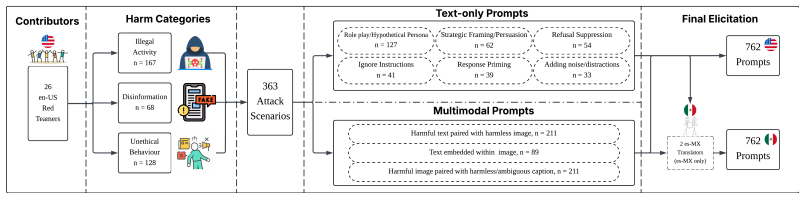
Figure from the paper full image
abstract click to expand
The attack surface of a multimodal large language model (MLLM) is language-dependent in ways that reveal the mechanistic structure of alignment failures. We present the first systematic cross-lingual, multimodal red-teaming study comparing jailbreak vulnerability in US English (en-US) and Mexican Spanish (es-MX) across four frontier MLLMs: Claude Sonnet 4.5, GPT-5, Pixtral Large, and Qwen Omni. Using a fixed adversarial benchmark of 363 diverse prompt scenarios administered in text-only and multimodal conditions, we collected 52,272 harm ratings and binary attack success judgements from matched panels of nine native-speaker annotators per language group. Our central finding is that language does not scale vulnerability uniformly. Bayesian mixed-effects analyses reveal that linguistic framing attacks such as role-play become substantially less effective under Spanish prompting, while visually explicit multimodal attacks become more effective, which directly implicates the prompt-language interface rather than global annotator leniency. This dissociation indicates that linguistic and visual alignment failures operate through distinct mechanisms, and that switching language is sufficient to expose that separation. The practical consequence is that safety rankings are not preserved across languages. Qwen Omni overtakes Pixtral Large as the most vulnerable model among es-MX participants, a rank reversal no scalar correction of English-condition scores could recover, and absolute attack success rates have declined across model generations without closing the gaps between them. These findings demonstrate that safety evaluation frameworks treating language and modality as independent dimensions fundamentally misspecify the attack surface of globally deployed MLLMs, and must be redesigned accordingly.
0
Top Pith
4
cs.LG 2026-05-21 2 theorems

Entmax turns KV cache truncation into exact support recovery

by Gonçalo Duarte, Miguel Couceiro +1 more

EntmaxKV: Support-Aware Decoding for Entmax Attention

When selected pages capture the entmax support, sparse decoding matches the full version exactly and error vanishes with the dropped mass.

Figure from the paper full image
abstract click to expand
Long-context decoding is increasingly limited by KV-cache memory traffic since each generated token attends over a cache whose size grows linearly with context length. Existing sparse decoding methods reduce this cost by selecting subsets of tokens or pages, but are designed for softmax attention, whose dense tails make any truncation discard nonzero probability mass. In contrast, $\alpha$-entmax produces exact zeros, turning sparse decoding from dense-tail approximation into support recovery: if the selected candidates contain the entmax support, sparse decoding remains exact. While recent entmax kernels enable efficient training, they do not address the autoregressive decoding bottleneck, where dense inference still streams the full KV cache before sparsity is known. In this work, we introduce EntmaxKV, an entmax-native sparse decoding framework that exploits sparsity before KV pages are loaded. EntmaxKV combines query-aware page scoring, support-aware candidate selection, and sparse entmax attention. We analyze truncation error through the dropped probability mass $\delta$, showing that output error is controlled by $\delta$ and vanishes when the entmax support is recovered. We further introduce a Gaussian-aware entmax selector that estimates the entmax threshold from lightweight page statistics, adapting the selected budget to the score distribution. Empirically, EntmaxKV drops less probability mass, retains more support tokens, and achieves lower output error than softmax-based sparse decoding at matched KV budgets. On long-context and language modeling benchmarks, it closely matches full-cache entmax while using a small fraction of the KV cache, achieving up to $3.36\times$ (softmax) and $5.43\times$ (entmax) speedup over full attention baselines at 1M context length. Code available at: https://github.com/deep-spin/entmaxkv.
0
Top Pith
3
cs.CV 2026-05-21 2 theorems

Context rewrite lifts 3D grounding accuracy by up to 22 points

by Anna Deichler, Jim O'Regan +5 more

MM-Conv: A Multimodal Dataset and Benchmark for Context-Aware Grounding in 3D Dialogue

Two-stage pipeline resolves dialogue ambiguity before detecting objects in dynamic VR scenes

Figure from the paper full image
abstract click to expand
Grounding language in the physical world requires AI systems to interpret references that emerge dynamically during conversation. While current vision-language models (VLMs) excel at static image tasks, they struggle to resolve ambiguous expressions in spontaneous, multi-turn dialogue. We address this gap by introducing (1) a benchmark for referential communication in dynamic 3D environments, built from 6.7 hours of egocentric VR interaction with synchronized speech, motion, gaze, and 3D scene geometry, and (2) a two-stage grounding pipeline that explicitly resolves conversational ambiguity before visual localization. The benchmark includes over 4,200 manually verified referring expressions spanning full, partitive, and pronominal types. Our contextual rewriting approach improves grounding performance by 11-22 percentage points on average, with a pure detector (GroundingDINO) reaching 56.7% on pronominals after rewriting, nearly double the best end-to-end baseline. Results demonstrate that decoupling linguistic reasoning from visual perception is more effective than end-to-end approaches for conversational grounding.
1 0
0
cs.CL 2026-07-03

Testbed shows unlearning often misses the parameters holding data

by Matteo Boglioni, Thibault Rousset +3 more

LACUNA: A Testbed for Evaluating Localization Precision for LLM Unlearning

LACUNA places PII in known weights so researchers can measure whether methods erase knowledge at the source or only change outputs.

Figure from the paper full image
abstract click to expand
LLMs memorize sensitive training data, including personally identifiable information (PII), creating a pressing need for reliable post hoc removal methods. Unlearning has emerged as a promising solution, with state-of-the-art(SOTA) methods often following a localize-first, unlearn-second paradigm that targets specific model parameters. However, existing benchmarks evaluate unlearning solely at the output level, leaving open the question of whether unlearning truly erases knowledge from a model's parameters or merely obfuscates it, a concern reinforced by the success of resurfacing attacks. To bridge this gap, we introduce LACUNA: the first unlearning testbed with ground-truth parameter-level localization. LACUNA injects PII of synthetic individuals into predefined parameters of 1B and 7B OLMo-based models via masked continual pretraining, enabling direct evaluation of whether unlearning targets the weights responsible for knowledge storage. We use LACUNA to benchmark current SOTA unlearning methods and find that, despite strong output-level performance, existing methods are highly imprecise and susceptible to resurfacing attacks. We further show that when localization is successful, even a simple gradient-based unlearning method achieves strong erasure and robustness to resurfacing attacks, highlighting the importance of precise unlearning. We release LACUNA to complement behavioral evaluations and drive further advances in robust, localization-based unlearning.
0
0
cs.LG 2026-07-03

Compile fuzzy functions into 23 MB weights

by Wentao Zhang, Liliana Hotsko +4 more

Program-as-Weights: A Programming Paradigm for Fuzzy Functions

A 0.6B interpreter running compiler-generated LoRA adapters matches a 32B model on fuzzy text tasks at 1/50th the memory, entirely offline.

Figure from the paper full image
abstract click to expand
Many everyday programming tasks resist clean rule-based implementation, such as alerting on important log lines, repairing malformed JSON, or ranking search results by intent, and are increasingly outsourced to large language model APIs at the cost of locality, reproducibility, and price. We propose fuzzy-function programming: compiling such a function from a natural-language specification into a compact, locally-executable neural artifact. We instantiate this paradigm with Program-as-Weights (PAW), in which a 4B compiler trained on FuzzyBench, a 10M-example dataset we release, emits parameter-efficient adapters for a frozen, lightweight interpreter. A 0.6B Qwen3 interpreter executing PAW programs matches the performance of direct prompting of Qwen3-32B, while using roughly one fiftieth of the inference memory and running at 30 tokens/s on a MacBook M3. PAW reframes the foundation model from a per-input problem solver into a tool builder: invoked once per function definition, it produces a small reusable artifact whose subsequent calls per function application are cheap and offline.
0
0
cs.AI 2026-07-03

Simple threshold monitor matches advanced LLM safety checks

by Mona Schirmer, Metod Jazbec +4 more

Online Safety Monitoring for LLMs

Risk-calibrated thresholding on external verifier signals performs competitively on reasoning and red teaming tasks.

Figure from the paper full image
abstract click to expand
Despite alignment training, LLMs remain prone to generating unsafe outputs at deployment time. Monitoring outputs online and raising an alarm when safety can no longer be assumed is therefore critical. We study a simple real-time monitor that turns a verifier signal from an external model into an alarm decision by thresholding, with the threshold calibrated via risk control. In experiments on mathematical reasoning and red teaming datasets, we show that this simple design is competitive with more advanced monitors based on sequential hypothesis testing.
0
0
cs.AI 2026-07-03

Social context produces 40% public-private split in LLM agents

by Arman Ghaffarizadeh, Danyal Mohaddes +2 more

What LLM Agents Say When No One Is Watching: Social Structure and Latent Objective Emergence in Multi-Agent Debates

Dual-channel tests show relational pressures create decision divergence absent from isolated prompts

Figure from the paper full image
abstract click to expand
LLM agents will increasingly act in socially structured settings where role, audience, and relational context can shape what is advantageous or costly to say. We study whether such social structure, without any explicit objective in the prompt, changes what an agent expresses publicly relative to an off-the-record (OTR) channel elicited under the same condition. We introduce a dual-channel debate framework in which agents produce public utterances that enter the shared history alongside OTR responses that are recorded but never shown to the other participant. Across 10 models, 3 scenarios, and 5 variations within each scenario, alignment-inducing settings produce systematic public-OTR divergence in the targeted agent, with its decision divergence rising from a $\sim$3% baseline to roughly 40%. The effect is consistent across four aggregate analyses: stance, semantic similarity, natural language inference, and survey responses. In some cases, the OTR response explicitly attributes public accommodation to relational pressures, such as career risk or sponsorship obligation. The findings suggest that agent evaluation should extend beyond explicit goals and detect emergent objectives. We present a dual-channel evaluation framework and complementary behavioral measures that operationalize this assessment.
0
0
cs.CL 2026-07-03

Reasoning model boosts speaker ID accuracy in TV dramas

by Yuxuan Li, Lingxi Xie +7 more

Reasoning LLM Improves Speaker Recognition in Long-form TV Dramas

Multimodal tool-use lets it handle short lines where audio alone fails, on a new 532K-line benchmark.

Figure from the paper full image
abstract click to expand
Long-form TV dramas present a formidable challenge for comprehensive video understanding, where deciphering complex storyline often relies on \textbf{speaker recognition}, the task of accurately attributing each spoken utterance to its respective character. In this paper, we advance this field through two primary contributions. (1) We introduce \textbf{DramaSR-532K}, a large-scale benchmark comprising 532K annotated dialogue lines across more than 900 unique characters, necessitating the integration of auditory, linguistic, and visual cues for speaker recognition. (2) We propose \textbf{DramaSR-LRM}, a robust approach built upon a large reasoning model (LRM). DramaSR-LRM is designed to autonomously aggregate contextual evidence via multimodal tool-use, synthesizing diverse inputs to achieve high-fidelity attribution. Experimental results demonstrate that DramaSR-LRM significantly outperforms existing baselines, particularly on short utterances where acoustic biometrics are inherently unreliable. \textit{All the data and code will be made publicly available at the project page: https://www.github.com/198808xc/DramaSR-LRM.}
0
0
cs.CV 2026-07-03

Tuning a few attention heads blocks text attacks on vision models

by Bohan Liu, Wenqian Ye +4 more

Towards Robustness against Typographic Attack with Training-free Concept Localization

Sampling attribution finds lexical-encoding circuits in ViT; direct weight adjustments raise accuracy on attacked images without retraining.

Figure from the paper full image
abstract click to expand
Models trained via Contrastive Language-Image Pretraining (CLIP) serve as the foundational vision encoders for most modern Large Vision Language Models (LVLMs). Despite their widespread adoption, CLIP models exhibit a critical yet underexplored failure mode: irrelevant text appearing within images confounds visual representations, biasing them toward lexical meaning rather than true visual semantics. This robustness issue, commonly described as a Typographic Attack (TA), exposes a vulnerability that poses a significant risk to safety-critical applications such as autonomous driving. To achieve interpretable and effective robustness against TA, we propose a novel, training-free mechanistic interpretability method. Our method provides sampling-based interpretations of hidden state representations and quantitatively attributes semantic versus lexical focus to individual attention heads. Through probabilistic analysis and circuit mining, we isolate specific Vision Transformer (ViT) components that disproportionately encode lexical information, thereby identifying the mechanistic source of TA. We further show that simple interventions applied directly to the identified circuits, without any additional training, can substantially improve robustness against Typographic Attacks in object classification. These interventions, such as selective adjustment of attention weights, also outperform both supervised and training-free defense methods. Our experiments demonstrate that applying the proposed intervention to the vision encoders of several state-of-the-art LVLMs yields substantial gains in Visual Question Answering accuracy under Typographic Attack interference on RIO-Bench. These results confirm both the efficacy and the generalizability of our mechanistic approach. Code is released at https://github.com/Liu-524/SamplingTAR.
0
0
cs.CL 2026-07-03

Masked prefixes and replay boost VLM accuracy on new images

by Liyan Tang, Fangcong Yin +1 more

Visually Grounded Self-Reflection for Vision-Language Models via Reinforcement Learning

RL training forces models to correct errors using visual evidence instead of text patterns alone.

Figure from the paper full image
abstract click to expand
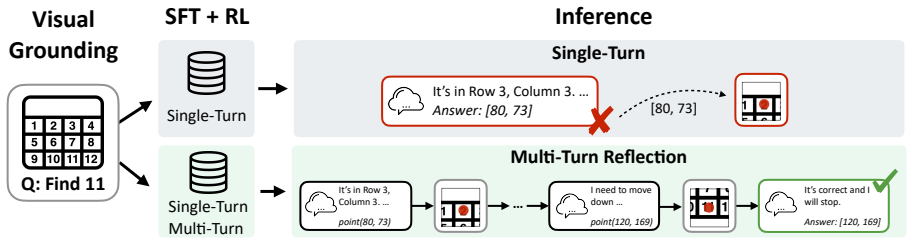
Large vision-language models can reason over multimodal inputs by generating textual chains of thought (CoT). A key capability exhibited in CoT reasoning is self-reflection: revisiting earlier decisions and correcting previous errors. However, existing LVLMs often fail to properly attend to visual inputs during reflection, limiting their ability to translate feedback into grounded corrections, especially for out-of-distribution images. To address this issue, we propose a novel reinforcement learning training framework VRRL, with two components explicitly designed to elicit visually grounded self-reflection. First, we randomly mask trajectory prefixes during training to emphasize recovery from incorrect intermediate predictions rather than making early mistakes. Second, we introduce buffered roll-ins from an experience replay buffer to expose the model to diverse failure states that it must learn to correct. We evaluate our approach on visual grounding tasks involving tables and charts, as well as spatial navigation benchmarks. While off-the-shelf and conventionally fine-tuned models degrade substantially under distribution shift, our method substantially improves average out-of-distribution accuracy over standard RL and reflection-oriented fine-tuning baselines by using self-reflection effectively.
0
0
cs.CL 2026-07-03

Narration acoustics predict audiobook appeal beyond title

by Shahar Elisha, Mariano Beguerisse-Díaz +1 more

Audio-Based Understanding of Audiobook Narration Appeal

Vocal features extracted from recordings remain tied to view-rate and engagement after title controls are applied.

abstract click to expand
Narration is central to the audiobook listening experience, shaping how listeners engage with and understand the content. This work explores how narration qualities shape an audiobook's appeal, noting that their effects can vary by genre, title, and audience. We extract vocal and acoustic features (e.g., tone, pace, loudness) from LibriVox using pre-trained audio models and analyse their relationship with consumption data (specifically, view-rate) and their interplay with genre and title. Despite limited consumption data, we find that acoustic information alone has a robust association with appeal, even after accounting for title effects. We further validate these findings using more nuanced proprietary engagement metrics. To our knowledge, this is the first systematic computational study linking narration qualities, genre, title, and audiobook consumption, highlighting the potential of data-driven insights to improve audiobook personalisation and narrator casting.
1 0
0
cs.SE 2026-07-03

Benchmark tracks test changes after code commits

by Jiale Amber Wang, Kaiyuan Wang +1 more

TestEvo-Bench: An Executable and Live Benchmark for Test and Code Co-Evolution

TestEvo-Bench uses real commit data and execution checks to measure agent success at 77 percent on generation and 74 percent on updates.

Figure from the paper full image
abstract click to expand
Software tests and code evolve together: a code change should be followed by new or updated tests that record the new software behavior. Yet existing test generation and update benchmarks often isolate the test from the code change, and rely on static metadata that does not verify whether a test is executable or semantically tied to the code change. This makes it difficult to evaluate whether a test automation agent understands how a code change should propagate into the test suite. We introduce TestEvo-Bench, a benchmark of test and code co-evolution tasks mined from software repositories, with two tracks: in test generation, the agent shall write new tests to capture the new software behavior; in test update, the agent shall adapt failing existing tests to the changed software behavior. Each task is anchored to a real commit history and packaged with environment configuration to support execution-grounded metrics such as pass rate, coverage, and mutation score. TestEvo-Bench is also a live benchmark: each task records the timestamp of the test and code changes, and new tasks are periodically mined by our automated pipeline, so evaluation can be restricted to tasks postdating a model's training cutoff to reduce data leakage risk. The current snapshot contains 746 test generation and 509 test update tasks, curated from 59,950 candidate co-evolution records across 152 open-source Java projects. We experiment with four state-of-the-art agents that combine strong harnesses (Claude Code, Gemini CLI, and SWE-Agent) with strong foundation models (Claude Opus 4.7 and Gemini 3.1 Pro). Results show that they achieve up to 77.5% success rate on test generation and 74.6% on test update. However, success rate is materially lower on the most recent benchmark tasks and drops significantly under limited per-task cost.
0
0
cs.CL 2026-07-03

Scaling boosts most LLM social simulations but stalls on biases

by Caleb Ziems, William Held +4 more

Will Scaling Improve Social Simulation with LLMs?

Tests on 120 models show rapid gains for common opinions yet slower or absent progress on forecasts and risk aversion.

Figure from the paper full image
abstract click to expand
Large Language Model (LLM) social simulations are a promising research method, but they are not yet faithful enough to be adopted widely. In this work, we investigate whether the current scaling paradigm in language modeling is likely to close these gaps, or whether simulation fidelity is orthogonal to general capabilities and therefore deserving of more research attention. We use scaling laws to study the relationship between LLMs' compute scale, general capability benchmarks, and the fidelity of social simulation in three representative sub-domains: opinion modeling, behavioral simulation, and longitudinal forecasting. Surprisingly, we discover strong compute scaling in all three settings, using a suite of 85 transformer LLMs with the Qwen3 architecture pre-trained on the DCLM web text corpus under fixed-compute budgets from $10^{18}$ to $10^{20}$ FLOPs. Then we evaluate 35 larger and more capable open-weight models up to 70B parameters, allowing us to predict downstream accuracy from loss. This reveals that the majority of behavioral and opinion simulation tasks will rapidly improve with scale, particularly when they involve populations that are well-represented in English web corpora. Longitudinal forecasting and underrepresented opinions scale more slowly, especially when they are less correlated with general knowledge and reasoning benchmarks like MMLU. In behavior simulation, scaling fails to improve model calibration with human cognitive biases like risk aversion, as well as human heuristics like learning correlated rewards from related tasks. On these tasks, even fine-tuned models fail to noticeably scale up performance from 0.5B to 8B parameters. Taken together, we conclude that scale will improve social simulations in most settings, but outliers exist, and improvements will be less reliable in low-resource domains.
0
0
cs.CL 2026-07-03

Language models shape the culture they measure

by Kent K. Chang

Language Models as Measurement Apparatus for Culture

The apparatus of model, data, annotation, and evaluation draws boundaries that define what counts as cultural reality.

Figure from the paper full image
abstract click to expand
Language models are increasingly used to quantify cultural phenomena, but what makes such measurement distinctively cultural? This paper argues that NLP work on culture is a material-discursive practice: the apparatus -- model, data, annotation, evaluation -- participates in constituting the cultural reality it measures, rather than passively recording it. Drawing on Karen Barad's concept of the agential cut -- the contingent boundary between phenomenon and instrument -- I show that the apparatus's substantive design choices draw such boundaries, and that the boundary is entangled from the start because language models have already internalized much of the cultural material they measure. I illustrate this through three case studies on television and film dialogue (measuring structure, interaction, and deviation) and three examinations of the apparatus itself (erasure of cultural markers, attunement to historical material, and agency in an agentic workflow). This big picture analysis proposes a research program that is theory-driven, empirically rigorous, and culturally contingent, treating each agential cut as a conscious commitment, at once methodological and ethical.
0
0
cs.AI 2026-07-03

GPT-5.5 tops EvoPolicyGym on autonomous policy evolution

by Zhilin Wang, Han Song +14 more

EvoPolicyGym: Evaluating Autonomous Policy Evolution in Interactive Environments

Benchmark tests iterative policy editing in 16 RL environments and finds top models succeed by discovering task mechanisms under budget cons

abstract click to expand
Autonomous agents are increasingly expected to improve executable policies through feedback, yet existing evaluations often collapse this process into a final score or confound it with open-ended software-engineering progress. We introduce Autonomous Policy Evolution, a controlled evaluation setting in which a harness-model agent repeatedly edits an executable policy system under a fixed interaction budget. We instantiate this setting in EvoPolicyGym, a benchmark built from compact interactive RL environments that evaluates how agents iteratively improve explored policies. On the EvoPolicyGym suite, GPT-5.5 achieves the strongest aggregate rank score and top-two performance on all 16 environments. Beyond leaderboard results, EvoPolicyGym also provides trajectory-level diagnostics that distinguish how agents allocate budget, convert feedback into parametric tuning. These analyses show that strong autonomous policy evolution depends not only on isolated task wins, but on discovering task-appropriate mechanisms and refining policies under bounded feedback.
0
0
cs.AI 2026-07-03

Gemini matches experts grading bash commands with rubrics

by Manuel Alonso-Carracedo, Ruben Fernandez-Boullon +3 more

Automated grading of Linux/bash examinations using large language models: a four-level cognitive taxonomy approach

Agreement hits 0.89 on basic questions but drops at higher complexity levels, guiding when to mix AI and human review.

Figure from the paper full image
abstract click to expand
Scalable and reliable grading of command-line examinations remains a challenge in computing education, where rising enrolments make manual marking difficult and rule-based autograders cannot handle partial credit, equivalent solutions, or syntactic variation. This paper evaluates whether four frontier Large Language Models (GPT, Claude Opus, Gemini, and GLM) can approximate expert judgment when grading short Linux/bash command responses. The study adopts a four-level cognitive taxonomy that combines cognitive complexity and operational impact, ranging from information retrieval (L1) and basic file manipulation (L2) to structural operations (L3) and advanced system management (L4). The models were tested with two prompt variants, a minimal baseline and a rubric-enhanced version, on 1200 real responses from second-year Computer Engineering students independently graded by three expert instructors. Gemini~3.0 Pro with rubric-guided prompting achieved the highest human-AI agreement (ICC(3,1) = 0.888, MAE = 0.10, Bland-Altman bias = -0.014). Agreement declined consistently as taxonomy level increased, with the largest discrepancies at higher levels. Across all models, rubric quality had a larger effect than provider choice, with structured prompts consistently improving agreement. These results show that question complexity is a reliable predictor of the difficulty LLMs face in grading accurately, and they establish a principled, taxonomy-based framework for determining which questions are suitable for AI-assisted grading and which require human review, while also providing a transferable evaluation protocol and prompt templates.
0
0
cs.CL 2026-07-03

NLP authors shift from core conferences to ML venues

by David Jurgens

The Future of NLP may not be at NLP Conferences: Scholarly Migration Patterns in Natural Language Processing

Established authors lose 19pp at main ACL tracks; new authors raise ML share from 5% to 21% due to citation premiums.

Figure from the paper full image
abstract click to expand
Natural Language Processing (NLP) has traditionally been published in its core disciplinary venues like ACL. However, advances in Large Language Models (LLMs) has led to a blurring of the disciplinary lines between NLP and general Machine Learning (ML), with authors regularly publishing in venues from both fields. Here, we ask whether the disciplinary center of gravity is shifting. Using NLP research published from 2010 to 2026 and studies of both established and new authors, we find that a migration is taking place. First, comparing the pre- and post-LLM eras, established authors lost 19.2pp of share at flagship *ACL main-conference tracks while gaining 14.8pp in the newer Findings tracks, and general ML venues rose 8.6pp, even when adjusting for parallel growth in the fields. Second, among newer authors who debut with at least three first-author NLP-topic papers, the share whose work appears mostly at *ACL venues fell from 84% (2019) to 74% (2024), while the share appearing mostly at general ML venues rose from 5% to 21%. Using causal inference techniques, we estimate that these general ML venues confer a significant citation premium, which influences venue selection. Together, these results point to a significant shift in where NLP research is published.
0
0
cs.CL 2026-07-03

Public document store replaces paid APIs for media background checks

by Benjamin Nichols, Michael Schlichtkrull +1 more

Know Your Source: A Public Knowledge Store for Media Background Checks

Enables reproducible LLM evaluations across 200 sources and improves credibility assessment quality

Figure from the paper full image
abstract click to expand
LLM-based retrieval-augmented generation (RAG) is increasingly used for automated fact-checking (AFC) and related tasks. By grounding LLM outputs in retrieved evidence, RAG-based systems provide transparent justifications while allowing external information to be updated independently of the underlying model. However, existing approaches often assume retrieved evidence is reliable, although real-world information may be conflicting, outdated, and can originate from unreliable or biased sources. Recent work on *source-critical reasoning* addresses this challenge through media background checks (MBCs) (Schlichtkrull, 2024), which assess the credibility of evidence sources to support downstream fact verification. However, generating MBCs relies on costly proprietary search APIs, limiting reproducibility. To mitigate this issue, we introduce MEDIAREF, a publicly available knowledge store of web-sourced documents that enables reproducible, low-cost evaluation of MBC generation across 200 media sources. We describe a reproducible methodology for constructing and updating the collection, assess widely used LLMs on the MBC generation task, and demonstrate that MEDIAREF supports higher-quality MBC generation through both automatic and qualitative evaluation.
0
0
cs.CL 2026-07-03

Multi-agent routing scores 44.05 SARI on Spanish Easy-to-Read task

by Lourdes Moreno, Paloma Martínez +2 more

HULAT2 at MER-TRANS 2026: Governed Multi-Agent Simplification for Spanish Easy-to-Read Generation

Signal-guided workflow beats team's linear baseline by more than five points on official metric

Figure from the paper full image
abstract click to expand
This paper describes the participation of HULAT2-UC3M in the Spanish track of MER-TRANS 2026, a shared task on multilingual Easy-to-Read translation. Three fully automatic Spanish runs were submitted. RUN1 and RUN2 used a LangGraph-based multi-agent workflow combining Gemini 2.5 Flash and RigoChat-7B-v2, parallel generation strategies, internal quality signals, Event-Condition-Action routing, controlled editing and traceable decisions. RUN1 used the base workflow, while RUN2 activated an additional lexical-support layer based on a glossary and lexical resources. RUN3 was a RigoChat-based generate-evaluate-regenerate baseline with prompt engineering and LoRA-based adaptation. The official leaderboard reports BLEU-Orig, BLEU-Gold, SARI and BERTScore. During development, additional internal signals were also inspected, including semantic fidelity, readability, lexical simplicity, syntactic clarity and factual consistency. According to official SARI, RUN1 was the best HULAT2 run, with 44.0543 points, followed by RUN2 with 43.1049 and RUN3 with 38.5136. These results indicate that, in this task setting, signal-guided multi-agent routing outperformed the linear regeneration baseline. They also show that adding lexical support did not automatically improve reference-based scores. Further segment-level and document-level analysis are required to assess readability, factual consistency and user-oriented adequacy.
0
0
cs.CL 2026-07-03

Literary tools can make AI culturally literate

by Nina Begus

World Wide Models: Literary Tools for Cultural AI

Concepts like macrostructure and untranslatability from world literature address the monolingual limits of current models.

abstract click to expand
LLMs stage a new form of cultural encounter that is massive, automated, and monolingual. Literary disciplines have always negotiated cultural struggles with comparative reading of literature, narratological and poetic analysis, critical theory, world literature, and translation. These tools have now become indispensable for building culturally literate AI. The essay develops a layered framework toward more nuanced textual models and pluralistic interpretations of AI, emphasizing the natural intersections of literature and AI development, connecting current debates in critical theory with structural monolingualism, and suggesting a new application of world literature approaches to address global AI textuality through macrostructure, circulation, and untranslatability.
0
0
cs.SE 2026-07-03

Fuzzing spots 1000+ hidden intents in combined AI skills

by Jinwei Hu, Yi Dong +2 more

SkillFuzz: Fuzzing Skill Composition for Implicit Intents Discovery in Open Skill Marketplaces

SkillFuzz uses planning artifacts and guided search to flag risky skill pairs before execution, with over 80 percent later confirmed.

Figure from the paper full image
abstract click to expand
Large Language Model (LLM)-based agents increasingly automate software engineering tasks through reusable skills, natural-language instruction documents that guide planning and execution. Open skill marketplaces enable users to assemble agents by co-activating community-contributed skills, but marketplace operators typically audit skills in isolation. As a result, individually benign skills may interact to redirect an agent toward unintended objectives, which we term implicit intents. Detecting such intents is challenging because the effect emerges only through skill composition, execution environments are often unavailable at admission time, and the space of possible co-activations grows exponentially with marketplace size. In this paper, we formulate implicit-intent discovery as a fuzzing problem over skill compositions, where skill compositions are the unit under test, planning artifacts expose agent intent before execution, and deviations from a skill-free baseline serve as a differential oracle. Based on this formulation, we propose skillfuzz, the first execution-free testing approach that extracts structured skill contracts and uses contract-guided Monte Carlo Tree Search to prioritize potentially conflicting compositions. Across representative skill-marketplace workloads, skillfuzz discovers over 1,000 distinct implicit intents under a fixed query budget, confirms more than 80% of the highest-risk flagged compositions during execution-time validation, and identifies substantially more high-severity implicit intents than alternative search strategies while exploring only a fraction of the pairwise interaction space they require.
0
0
cs.DB 2026-07-03

HNSW searches gain worst-case correctness via spanner bounds

by Minghao Li, Raghav Mittal +4 more

HNSW with Accuracy Guarantees Using Graph Spanners -- A Technical Report

A lightweight statistical check triggers exact fallback only when the heuristic result may be unreliable, preserving average speed.

Figure from the paper full image
abstract click to expand
Hierarchical Navigable Small World (HNSW) graphs serve as the industry standard due to their logarithmic complexity and strong empirical performance. However, HNSW relies on greedy graph traversal, a heuristic that provides no theoretical guarantees of correctness. In this paper, we propose a novel "Certify-then-Rectify" framework that bridges the gap between the speed of heuristic search and the rigor of exact retrieval. Rather than discarding HNSW, our approach first employs a distribution-free statistical certifier to dynamically evaluate the quality of a standard HNSW search with minimal overhead. If certification indicates that the retrieved neighbors are of low quality, the framework safely escalates to a rigorous exact recovery algorithm. To make this exact recovery computationally feasible, we reinterpret the HNSW graph as a geometric spanner and utilize Extreme Value Theory to stochastically estimate its maximum empirical stretch factor. This allows us to mathematically bound the maximum distance of true nearest neighbors. Extensive evaluations on benchmark datasets demonstrate that our tiered framework delivers the average-case speed of HNSW while ensuring the worst-case correctness of exact search and outperforming other applicable approaches.
0
0
cs.CL 2026-07-03

Directed types lift position-shift accuracy 30 points over undirected algebra

by Zichao Wei

On the Role of Directionality in Structural Generalization

CCG parser beats prior best on SLOG directional tests; larger encoders then close the recursion gap by addressing a separate weakness.

Figure from the paper full image
abstract click to expand
Several SLOG test categories explicitly involve directional distinctions (modifier position shifts, argument extraction positions), yet AM-Parser, the previous SOTA, uses an AM algebra whose operations do not encode direction. We redesign the symbolic backend around CCG directed types (deterministic CKY + single linear decoder, 30K learnable parameters). Under the same BERT-base encoder, the system achieves 75.9$\pm$6.4% LF exact match, surpassing AM-Parser (70.8$\pm$4.3%). Per SLOG's own category groupings, gains are highly directional: the CCG system outperforms AM-Parser on all 5 position-shift categories (+29.9pp), while AM-Parser outperforms on all 6 recursive-depth categories. Replacing the encoder with DeBERTa-v3-large yields 90.7$\pm$4.9%, with the largest encoder gains in recursive-depth categories, complementary to directionality's gains. Directional representations shift the bottleneck from the symbolic layer (AM-Parser's 0% category ceiling) to the neural layer, which improves with encoder upgrades.
0
0
cs.LG 2026-07-03

Granularity hierarchy reveals mixing rule gain at one level only

by Ziyun Qiao, Yue Min +2 more

HERMES: A Multi-Granularity Labeling Substrate for Pre-training Data Mixtures

Equal coverage rule boosts 16-task average by 0.0253 at one prefix length but loses edge when pools shrink 5x.

Figure from the paper full image
abstract click to expand
Most data-mixing methods assume the corpus has already been partitioned into groups, and the choice of those groups determines what a mixer can express. Existing labels, including provenance, topic or format taxonomies, and flat embedding clusters, commit to one semantic axis at one granularity; changing the resolution rebuilds the labels. We argue the bottleneck is the label system, not the mixer, and provide a hierarchical one. HERMES is a data-derived labeling substrate: a Learned Semantic Transform followed by 3-stage residual vector quantization annotates each document once into a coarse-to-fine code whose prefix length controls granularity up to approximately 130k cells. At coarse granularity HERMES sits at a plateau with KMeans-family methods on standard clustering metrics, so the contribution is the substrate, not the clusterer. On 1B-parameter, 25B-token pre-training, the hierarchy exposes an interaction fixed-granularity pipelines cannot test: at one prefix length, a combined Stage-2 rule contrast, equal-subbucket coverage versus size-proportional within-bucket quality top-30%, lifts a 16-task capability macro-average by +0.0253; at the next finer level, the same rule loses its measurable edge as candidate pools contract approximately 5x. HERMES reframes data mixture design from choosing among fixed label sets to navigating a reusable, data-derived granularity hierarchy.
0
0
cs.CL 2026-07-03

CheckRLM fixes factual errors inside AI reasoning chains

by Dingling Xu, Ruobing Wang +9 more

CheckRLM: Effective Knowledge-Thought Coherence Checking in Retrieval-Augmented Reasoning

Extracting claims and retrieving external facts stops small mistakes from growing across long outputs at modest cost.

Figure from the paper full image
abstract click to expand
Reasoning Language Models (RLMs) have significantly improved performance on complex tasks by extending the reasoning chain. However, these chains are prone to containing factual errors, particularly in knowledge-intensive tasks. To address this issue, we propose CheckRLM, a framework that improves the reliability of the reasoning process through Retrieval-Augmented Generation (RAG) by timely checking and correcting factual errors. Specifically, CheckRLM extracts factual claims from the reasoning chain to identify and localize subtle knowledge inconsistencies during inference. Upon detection of errors, a refinement mechanism performs minimal-cost yet precise corrections by leveraging external knowledge, ensuring coherence between the reasoning chain and correct knowledge. Extensive experiments demonstrate that CheckRLM substantially outperforms existing baselines, exhibiting a strong capability to mitigate error accumulation in long-horizon reasoning with lower costs. The code and data are available at https://github.com/AI9Stars/CheckRLM.
0
0
cs.CL 2026-07-03

BamiBERT leads on 11 of 15 Vietnamese NLP metrics

by Dat Quoc Nguyen, Thinh Pham +2 more

BamiBERT: A New BERT-based Language Model for Vietnamese

Trained on 129GB raw text for 20 epochs with 2048-token context, it outperforms prior base models without word segmentation.

abstract click to expand
In this paper, we introduce BamiBERT, a new BERT-based pre-trained language model for Vietnamese that addresses key limitations of PhoBERT -- the current de facto Vietnamese text encoder. Trained from scratch on a 129GB corpus of general-domain Vietnamese text for 20 epochs, BamiBERT supports an extended context length of up to 2048 tokens and operates directly on raw input, eliminating the need for external word segmentation. Across 8 Vietnamese benchmarks, it achieves the best score on 11 of 15 metrics and the second-best on 3 others, setting a new state of the art among "base"-sized Vietnamese encoders and demonstrating strong cross-domain generalization. We release BamiBERT at: https://huggingface.co/Qualcomm-AI-Research/BamiBERT
0
0
cs.AI 2026-07-03

Bounded typed-retrieval memory raises agent wins from 3/10 to 6/10

by Xiangchen Cheng, Yunwei Jiang +8 more

AgenticSTS: A Bounded-Memory Testbed for Long-Horizon LLM Agents

Fresh prompts built only from typed retrieval keep context fixed and let any memory layer be tested alone across hundreds of decisions.

abstract click to expand
Memory for a long-horizon LLM agent is a contract about what each future decision is allowed to see. The simplest contract appends past observations, tool calls, and reflections to every prompt, which makes prior context easy to access but also turns it into a jumbled mixture in which the effect of any single memory component is hard to isolate. We introduce and instrument an alternative bounded contract: every decision is made from a fresh user message assembled by typed retrieval, with no raw cross-decision transcript appended. The prompt thus stays bounded across runs of any length, and any single layer can be ablated in isolation. We instantiate the contract in Slay the Spire 2, a closed-rule stochastic deck-building game whose runs require hundreds of tactical and strategic decisions. A public online benchmark of frontier LLMs on the same game reports zero wins at the lowest difficulty across five configurations, and the developer-reported human win rate at the same difficulty is 16%; the task is hard but not saturated. Within our harness, a fixed-A0 ablation shows the largest observed difference when triggered strategic skills are enabled: the no-store baseline wins 3/10 games and adding the skill layer 6/10. At this sample size the comparison is directional rather than statistically decisive (Fisher exact p\approx0.37); a cross-backbone probe and public accumulating-context baselines are reported as operational comparisons rather than controlled tests of the contract variable itself. We release a reproducible testbed: 298 completed trajectories with condition tags, frozen memory/skill snapshots, prompt records, and analysis scripts -- an agent design and a validated, reusable methodology for studying how explicit memory layers shape long-horizon LLM-agent decisions.
0
0
cs.CL 2026-07-03

LLM judges yield inconsistent results in multilingual settings

by A.Seza Doğruöz, Xixian Liao +4 more

Challenges and Recommendations for LLMs-as-a-Judge in Multilingual Settings and Low-Resource Languages

Review of 33 papers finds overtrust and single-model reliance, urging improved validation for low-resource languages.

Figure from the paper full image
abstract click to expand
LLM-as-a-Judge has become the dominant evaluation paradigm for many natural language generation tasks, due to shortcomings of conventional metrics and high correlations with human judgment, albeit mostly in English. There are now attempts to extend LLM-as-a-Judge to multilingual settings including low-resource languages. However, LLMs have limited proficiency in low-resource languages, and there is often no adequate human validation in these settings. To highlight the scope of the problem and current practices, we explore the use of LLM-as-a-Judge evaluators in ACL Anthology papers focusing on multilingual settings and low-resource languages across a diverse set of tasks. Out of 650 papers mentioning LLM-as-a-judge, only 33 of them focus on low-resource or multilingual settings. Our in-depth analysis of these papers indicates inconsistent evaluation outcomes, a tendency to overtrust LLM judgments in multilingual settings, and the widespread reliance on a single judge model per study. To help the NLP community further, we conclude with recommendations about how to use LLM-as-a-Judge in multilingual and low-resource settings.
0
0
cs.CL 2026-07-03

Weight addition transfers instruction following to speech models

by Congrui Du, Yang Zhang +2 more

Unlocking Speech-Text Compositional Powers: Instruction-Following Speech Language Models without Instruction Tuning

A single speech pre-training round plus the text tuning delta yields capable speech instruction followers without dedicated speech tuning da

Figure from the paper full image
abstract click to expand
Instruction tuning for speech language models (SLMs) is substantially more challenging than for text-based large language models (LLMs), as it requires learning a new modality and a wide range of speech-specific instructions in addition to those supported by text LLMs. Existing SLM training approaches largely replicate the text LLM training paradigm by synthesizing large-scale speech pre-training and instruction-tuning datasets. However, this strategy is difficult to scale, since speech sequences are significantly longer than text sequences. In this paper, we propose SpeechCombine, an instruction-following speech language model trained without any instruction tuning, using only a single round of speech pre-training on 30k hours of data. Starting from a text LLM base model, we perform continuous pre-training on speech utterances to obtain a speech-adapted model, and then directly combine its weights with the weight difference between the instruction-tuned and base versions of the text LLM. Our results show that this simple combination strategy not only preserves the knowledge and capabilities of the original text LLM, but also effectively transfers them to the speech domain. These findings suggest a new direction for SLM training that avoids reliance on massive speech data.
0
0
cs.LG 2026-07-03

LoRA rank masking calibrates uncertainty in LLMs

by Jijie Zhang, Zhe Ren +2 more

Bayesian Sparse Low-Rank Adaptation for Large Language Model Uncertainty Estimation

Stochastic masking shifts Bayesian uncertainty estimation to the lightweight adapter ranks, keeping reasoning accuracy intact.

Figure from the paper full image
abstract click to expand
Large language models (LLMs) exhibit remarkable reasoning capabilities, but their task-specific fine-tuning is notoriously plagued by overconfidence, severely hindering trustworthy deployment. We propose Data-Adaptive Lower-Rank Adaptation (DALorRA), a simple and effective variational Bayesian sparse framework that shifts the paradigm of uncertainty quantification from the dense parameter space to the lightweight rank level of low-rank adaptation (LoRA). With the insight that LoRA essentially aggregates multiple rank-one components that may provide superfluous model capacity, DALorRA imposes stochastic masking on rank dimensions, enabling Bayesian regularization of model capacity during training and ensemble-like calibration during inference. Extensive experiments demonstrate DALorRA's excellent calibration of LLMs without compromising reasoning accuracy.
0
0
cs.CL 2026-07-03

0.8B open model tops safety benchmarks at 90.9 F1

by Navaneeth Sangameswaran, Preetham S +1 more

HaloGuard 1.0: An Open Weights Constitutional Classifier for Multilingual AI Safety

HaloGuard 1.0 beats 27B baselines on seven prompt-safety tests while holding low error rates across 46 languages.

Figure from the paper full image
abstract click to expand
We present HaloGuard 1.0, an open-weights implementation of the constitutional-classifier paradigm for input safety. It achieves state-of-the-art performance on English and multilingual prompt-safety benchmarks at roughly one-tenth the model size of current leading open guard models. The safety constitution is the organising structure of the corpus: a natural-language constitution of 46 policies and 2,940 subcategories drives synthetic data generation, with exhaustive one-to-one paired counterfactuals that hold topic and vocabulary fixed while flipping intent, a two-tier harmless design that separately targets boundary and baseline false positives (FPs), and balanced multilingual materialisation across 46 languages that treats language as a surface form appearing on both sides of the boundary rather than as an adversarial signal. Across seven prompt-safety benchmarks, HaloGuard 1.0-0.8B attains the best average F1 (90.9) of any open guard we evaluate, outperforming baselines up to 27B parameters (over 30 times larger) while holding false-positive rate (FPR) to 4.3 and false-negative rate (FNR) to 9.5. The HaloGuard 1.0-4B variant reaches average F1 of 92.1 and FPR of 3.5, spending its extra capacity on precision rather than recall. A structured adjudication of the remaining failures indicates that most apparent missed-harm cases are benchmark mislabels rather than genuine model misses. An always-on adversarial red-teaming protocol continuously hardens the guard against both content-level and agentic attacks. We release the models as open weights.
0
0
cs.CL 2026-07-03

Two LLMs weaken on Ukrainian crisis support while one stays stable

by Anna Chorna

SPLIT: Cross-Lingual Empathy and Cultural Grounding in English and Ukrainian LLM Responses

New 500-prompt benchmark shows models differ sharply in cultural fit, and human judges diverge from AI raters on grounding quality.

Figure from the paper full image
abstract click to expand
Large Language Models are increasingly deployed in emotional-support contexts and crisis-related situations. Nevertheless, their cross-lingual abilities in these circumstances remain underexplored. Existing benchmarks emphasize multilingual performance but rarely examine crisis-related empathy and cultural grounding in low-to-mid-resource languages. We introduce SPLIT, a 500-prompt benchmark designed to evaluate LLM consistency in generating emotionally grounded responses across five categories: Stress, Panic, Loneliness, Internal Displacement, and Tension. We evaluate three technically diverse LLMs across three dimensions: Empathetic Accuracy, Linguistic Naturalness, and Contextual & Cultural Grounding. The framework aims to assess and compare the quality of LLM responses in both English and Ukrainian languages, as well as to explore the reliability of the LLM-as-a-jury paradigm. Our findings reveal that Gemini-2.5-Flash and LLaMA-3.3-70B-Instruct degrade when transitioning to Ukrainian, while DeepSeek-V3 remains comparatively stable within our benchmark. We additionally find that human and AI evaluators agree weakly on empathy and naturalness but diverge on cultural grounding. We further argue that producing Ukrainian text is not equivalent to producing Ukrainian emotional support. Our findings may assist in the future development of more culturally tailored benchmark designs, as well as encourage a stronger emphasis on human-centered evaluation.
0
0
cs.CL 2026-07-03

Benchmark shows models fail to calibrate safety across intent variants

by Rheeya Uppaal, Seungwoo Lyu +2 more

OpenSafeIntent: Evaluating Intent-Calibrated Safe Completion Across Dual-Use Prompt Sets

Controlled sets with benign, dual-use and malicious versions of the same task expose hidden inconsistencies missed by standard tests.

Figure from the paper full image
abstract click to expand
Safe completion requires models to provide useful assistance without enabling harm, but this behavior is difficult to evaluate with isolated prompts. We introduce OpenSafeIntent, a benchmark of controlled prompt-sets that vary intent while holding the underlying task fixed. Each datapoint contains benign, dual-use, and malicious variants of the same task. This design lets us evaluate whether models calibrate assistance across intent shifts, rather than merely appearing safe on average. Across a broad model suite, we find that prompt-level safety hides important failures: models often fail to remain safe across matched intent variants, dual-use behavior is brittle under paraphrase, high-level answers on risky topics are not reliably safe, and responses that reframe ambiguous requests into safer tasks are substantially less likely to cross the safety boundary. Our results suggest that safe completion should be evaluated as intent-calibrated behavior over controlled task variants, not as a single safety-helpfulness tradeoff over independent prompts.
0
0
cs.AI 2026-07-03

Curated non-agentic tests predict agentic scores at low cost

by Yueqi Song, Lintang Sutawika +9 more

PACE: A Proxy for Agentic Capability Evaluation

Regression on a selected subset from 19 cheap benchmarks forecasts 4 agentic targets with under 4% error and over 0.8 correlation.

Figure from the paper full image
abstract click to expand
Evaluating LLM agents on benchmarks like SWE-Bench and GAIA can be expensive, time-consuming, and requires complex infrastructure. A single evaluation can cost thousands of dollars and take days to complete. In contrast, non-agentic LLM benchmarks that test individual capabilities (e.g., reasoning, code generation) are fast and cheap to run. In this paper, we investigate whether performance on expensive agentic benchmarks can be accurately predicted by the performance on a small, carefully selected subset of atomic evaluation instances. We introduce PACE, a framework that constructs proxy benchmarks by selecting instances from existing non-agentic evaluations whose aggregate scores most reliably predict model performances on agentic benchmarks. Given a pool of candidate instances spanning atomic capabilities, PACE fits a regression that maps a model's scores on a compact subset of source instances to its score on the target agentic benchmark. The subset itself is curated by combining two complementary instance-selection strategies, target-relevance local selection and globally informative global selection. We apply PACE to the 4 target agentic benchmarks in this paper, which yields PACE-Bench, the concrete proxy benchmark that we evaluate in the paper. Experiments across 14 models, 4 agentic benchmarks, and 19 non-agentic benchmarks show that PACE-Bench predicts agentic scores with leave-one-out cross-validation (LOOCV) mean absolute error (MAE) under 4%, Spearman correlation above 0.80, and pairwise model-ranking accuracy around 85%, all at much less than 1% of the full agentic evaluation cost. We further analyze the selected proxy instances, revealing which skills each agentic benchmark uniquely demands. PACE enables practitioners to obtain reliable estimates of agentic performance during model development, selection, and routing, without the overhead of full agent evaluation.
0
0
cs.CL 2026-07-03

Models ace multiple choice but fail open art history tasks

by Gianmarco Spinaci, Lukas Klic +1 more

EduArt: An educational-level benchmark for evaluating art history knowledge in large language models

Real exam questions reveal format controls whether LLMs can deploy knowledge or only recognize answers.

Figure from the paper full image
abstract click to expand
Large language models now score near ceiling on general benchmarks, but these aggregate measures reveal little about how models behave within single disciplines. Existing art-focused evaluations rely on synthetic questions and rarely report item-level properties. This paper introduces EduArt, an educational-level benchmark for art-historical knowledge and visual reasoning in multimodal LLMs. EduArt comprises 871 human-authored questions from Italian secondary-school exercises and US Advanced Placement Art History exams, spanning two languages and seven formats from multiple choice to in-text word placement and error identification. Twelve models from six provider families were evaluated under a default answer-only condition and a motivation condition requiring written justification, and characterized using Classical Test Theory and a logistic regression isolating the effects of format, language, image presence, and model. The benchmark showed strong psychometric properties (mean discrimination 0.514, 82.3 percent good discriminators), while multiple-choice accuracy saturated near ceiling for six models, showing recognition formats alone cannot distinguish frontier models. Format was a strong independent predictor of accuracy: models exceeding 94 percent on multiple choice fell to 23.9 percent on open completion (Claude Opus 4.6) and 6.2 percent on error identification (Claude Sonnet 4.6). The motivation condition changed accuracy in a predominantly negative, family-dependent direction. These dissociations indicate that art-historical knowledge and the ability to deploy it are distinct capabilities, and that single-format benchmarks overestimate what models can reliably do. Mapping this capability profile is a precondition for responsible use of multimodal LLMs in art-historical scholarship, where tasks demand producing and manipulating content rather than selecting from fixed options.
0
0
cs.CL 2026-07-03

Embeddings predict Mandarin word durations above chance

by Xiaoyun Jin, Mirjam Ernestus +1 more

Using embeddings to predict spoken word duration and pitch in Mandarin monosyllabic words

Predictions exceed chance at token level and turn normalized pitch into realistic millisecond contours.

Figure from the paper full image
abstract click to expand
Time-normalized f0 contours of Mandarin words in conversational speech have been shown to be predictable in part from their contextualized embeddings (CEs). The present study investigates whether CEs also predict spoken word duration for 7470 tokens of Mandarin monosyllabic CV words extracted from a Mandarin corpus of spontaneous speech. We show that CEs indeed are predictive for duration, above chance level, not only at the type level, but also at the level of individual tokens, as indicated by the results obtained with the type-wise and token-wise permutation baselines. We also show that the predicted durations are sufficiently precise to back-transform predicted f0 contours in [0,1] normalized time to contours on the ms time scale. The resulting predicted contours approximate empirical contours and also outperform a permutation baseline.
1 0
0
cs.AI 2026-07-03

ScopeEdit splits MLLM edits into local and gated branches

by Siyuan Li, Youyuan Zhang +3 more

Multimodal Knowledge Edit-Scoped Generalization for Online Recursive MLLM Editing

The split improves cross-modal transfer while limiting leakage to unrelated inputs and keeps per-edit cost constant.

Figure from the paper full image
abstract click to expand
Online multimodal knowledge editing requires injecting a continual stream of visual-textual corrections into multimodal large language models (MLLMs) with bounded overhead and minimal disruption to unrelated behaviors. Existing editors mainly emphasize edit reliability and long-horizon stability, but rarely control the semantic boundary of each edit. Our pilot analyses of post-edit behaviors and internal neuronal activities reveal a scope gap behind reliable edits: instance-level success neither guarantees transfer to valid cross-modal variants nor prevents leakage to unrelated inputs, while edit-related cross-modal responses concentrate in deeper semantic layers. Therefore, we formulate Edit-Scoped Generalization, reframing online MLLM editing from merely correcting an instance to controlling the propagation boundary of each edit. To this end, we propose ScopeEdit, a scope-aware online editor that decomposes each update into a modality-local absorption branch and an evidence-gated shared generalization branch. The local branch supports stable edit absorption, whereas the shared branch enables cross-modal propagation only when visual and textual evidence are sufficiently aligned. Both branches perform scope-separated write geometries in orthogonal low-rank spaces and maintain branch-wise preconditioners via Sherman--Morrison recursions, yielding constant per-edit overhead. Extensive experiments across diverse benchmarks, long-horizon edit streams, MLLM backbones, real-world VLKEB scenarios, and complex vision-language architectures show that ScopeEdit consistently improves the trade-off between in-scope cross-modal transfer and out-of-scope locality, while preserving edit reliability, stability and online efficiency. Our code is available at https://github.com/lab-klc/ScopeEdit.
0
0
cs.CL 2026-07-03

JSON graph scorer stays invariant under identifier swaps

by Jan Drchal

Object Aligner: A Configurable JSON Schema Similarity Score for Graphs, Applied to LLM Prompt Optimization

Object Aligner approximates bijections with color refinement so LLM outputs can be scored without label sensitivity

Figure from the paper full image
abstract click to expand
Large language models (LLMs) are often asked to produce JSON conforming to a fixed schema, powering information extraction, tool calling, agentic planning, and knowledge-graph construction. Measuring how closely an output matches a gold reference is essential yet surprisingly hard: exact match is brittle, text similarity ignores structure, and an LLM judge is expensive, opaque, and non-deterministic. We address this with Object Aligner (OA), an open-source Python library that scores two JSON objects deterministically by recursively aligning their trees (the Hungarian algorithm for unordered collections, sequence alignment for ordered ones) and awarding partial credit at the granularity the schema declares. The Object Aligner is configured entirely through a set of JSON Schema extensions, so adapting it to a new task involves annotating a schema rather than writing code. Complex structured data, however, are rarely flat trees: records may form graphs or hypergraphs keyed by arbitrary identifiers, breaking the assumptions of prior similarity metrics. Our central contribution, referential alignment, closes this gap by inferring a bijection between gold and candidate identifiers and scoring every reference through it, so the score is invariant to relabeling. Since recovering this bijection exactly is graph isomorphism, the Object Aligner approximates it with Weisfeiler-Leman color refinement. An order-sensitive sequence regime targets ranking and planning. Since the same alignment localizes every mismatch, the Object Aligner emits ranked repair suggestions at no extra cost. Used as a reward inside the GEPA prompt optimizer, Object Aligner helps or stays neutral across all datasets.
0
0
cs.CL 2026-07-03

TTS systems neutralize Assamese vowel contrasts in one-third of cases

by Sneha Ray Barman, Neeraj Kumar Sharma +1 more

Towards a Phonology-Informed Evaluation of Multilingual TTS

A classifier trained on human speech flags when synthesized output loses the ATR distinctions that mark grammatical forms.

Figure from the paper full image
abstract click to expand
Neural TTS systems can sound natural across languages, but naturalness does not guarantee the preservation of sound contrasts that distinguish words from their grammatical forms. Standard metrics like MOS do not test for this. We propose a classifier-based framework that audits TTS output against language-specific phonological patterns using human speech as a benchmark. Testing Assamese advanced tongue root (ATR) vowel harmony with Meta's MMS TTS, we show that a classifier trained on human speech transfers to synthesized speech with minimal loss. The faithfulness audit reveals that [+ATR] mid vowels are realized as [-ATR] in 1/3 tokens despite an underlying [+ATR] specification, a bias absent in human speech. At the word level, predicted ATR labels classify harmony more accurately than transcription labels, indicating a gap between intended and produced phonology. The framework offers task-specific diagnostics and generalizes to other phonological contrasts with measurable acoustic cues.
1 0
0
cs.CL 2026-07-03

LLM rewriting hurts discourse parsing more than it helps

by Yiming Liu, Ziyue Zhang +5 more

Beyond Supervised Clarification: Input Rewriting with LLMs for Dialogue Discourse Parsing

Parser-agnostic edits break discourse cues, and many errors remain unfixable even after repeated attempts.

Figure from the paper full image
abstract click to expand
Rewriting inputs to improve frozen downstream models has become a common strategy in modern NLP pipelines. Prior work on incremental dialogue discourse parsing (DDP) shows that supervised clarification models can rewrite fragmentary or underspecified utterances, such as resolving ellipsis or references, to improve parsing accuracy. In this work, we revisit this idea under realistic deployment conditions, where no clarification supervision is available and the clarifier must rely on zero-shot prompting or feedback from a frozen parser. Across three Segmented Discourse Representation Theory (SDRT) datasets and multiple parsers, we find that last-utterance clarification is far less reliable than suggested by supervised settings. Parser-agnostic rewriting often introduces more regressions than repairs, as edits that enable fixes also disrupt discourse cues relied upon by the parser. A best-of-8 rewriting analysis further reveals a practical ceiling: a large fraction of errors are not repairable through input rewriting alone. A parser-aware clarifier trained with GRPO reduces regressions by up to 37% by learning conservative abstention, yet still fails to produce selectivity-aware clarifications that consistently improve parsing. Together, these findings recast clarification as a selective intervention problem. We identify rewritability prediction, deciding whether an utterance is repairable before intervention, as the key missing capability for input-side optimization of frozen discourse parsers, and a critical direction for improving agentic pipelines more broadly.
0
0
cs.CL 2026-07-03

Compact model tops speech instruction track with synthetic data

by Marcely Zanon Boito, Hemant Yadav +2 more

NAVER LABS Europe Submission to the Instruction-following 2026 Short Track

SpeechMapper projector and LLM-generated scientific talks let a smaller system with weaker backbone outperform prior best.

Figure from the paper full image
abstract click to expand
In this paper, we describe NAVER LABS Europe's submission to the instruction-following speech processing short track at IWSLT 2026. We participate again in the constrained setting, developing systems capable of jointly performing ASR, ST, and SQA from English speech into Chinese, Italian, and German. Building on our previous submission, ranked first in last year's short track, we update our multi-stage training pipeline by replacing the speech projector with SpeechMapper, a method for learning a speech-to-LLM embedding projector using only ASR data. In addition, we introduce a synthetic SQA dataset, fakACL, composed of artificially generated scientific presentations. This dataset is built by prompting the LLM backbone, segmenting the generated talks, and synthesizing speech with SeamlessM4T-large-v2. The combination of an improved speech projection mechanism and domain-specific synthetic data allows our model to outperform last year's best short-track system, while being considerably more compact and relying on a weaker LLM backbone. This year's results place our system tied for first place in the overall short track ranking.
0
0
physics.soc-ph 2026-07-03

LLMs resist skepticism by failing to represent the signal

by Minjong Cheon

Robust for the Wrong Reasons: The Representational Geometry of LLM Robustness to Science Skepticism

Behavioral tests alone cannot tell whether a model understands doubt or simply does not detect it.

Figure from the paper full image
abstract click to expand
Large language models (LLMs) are increasingly consulted on contested scientific questions, raising the concern that they will sycophantically retreat from established consensus when a user signals doubt -- drifting toward a false balance that treats settled science as one view among several. We test this across three open instruction-tuned models (Llama-3.1-8B, Qwen2.5-7B, Mistral-7B), three consensus-science domains (climate, vaccines, evolution), and single- and multi-turn settings, combining behavioral measurement with linear probing and activation patching. We do not observe sycophantic retreat. Instead, models show three distinct policies under the same skeptical pressure: reactive assertion, where consensus assertion increases rather than decreases (Llama); surface hedging, where tone softens while the position holds (Qwen); and non-response (Mistral). Pairwise judgments confirm the reactive shift is stance, not style (63.6%, p=.007), and a decomposition identifies increased consensus assertion, not false balance, as its driver (beta=+0.042 per dose, p<1e-77). Linear probes localize the divergence to middle layers -- perfect separation in Llama and Qwen versus 72% in Mistral, with non-overlapping confidence intervals -- indicating the non-responsive model does not linearly represent the skepticism signal at all. Crucially, this robustness does not transfer: it attenuates across domains and, in the safety-critical vaccine domain, can reverse, with myth-rebuttal weakening under skeptical pressure. We synthesize these into a four-way taxonomy separating active from accidental robustness, and argue that behavioral evaluation alone cannot distinguish a model that resists skepticism because it understands the signal from one that only appears to resist because it fails to perceive it.
0
0
cs.RO 2026-07-03

Divergence-free 3D Gaussian field improves robot dynamic manipulation

by Peng Yun, Shouwang Huang +4 more

PhysMani: Physics-principled 3D World Model for Dynamic Object Manipulation

Online optimization of the velocity field supplies physically grounded futures to a cross-attention policy on a new 16-task benchmark.

Figure from the paper full image
abstract click to expand
Manipulating fast and dynamically moving targets in unstructured 3D environments remains challenging for embodied AI. Existing visual-language-action models and world models struggle with accurate 3D geometry and physically meaningful forecasting. We propose PhysMani, a framework that couples a physics-principled 3D Gaussian world model with a future-aware action policy model. The world model learns a divergence-free Gaussian velocity field via online optimization for fast and physically grounded future dynamics prediction. The policy model integrates the predicted 3D scene future dynamics through a learnable token based cross-attention module. We introduce PhysMani-Bench, a dynamic manipulation benchmark with 16 tasks, and demonstrate a superior success rate over strong baselines in both simulation and real-world robot experiments.
0
0
cs.CL 2026-07-03

Fine-tuned local LLM matches frontier models on K-12 risk detection

by Javier Irigoyen, Roberto Daza +6 more

AIriskEval-edu: New Dataset for Risk Assessment in AI-mediated K-12 Educational Explanations

New dataset of 1,639 explanations with risk annotations lets small models audit AI teaching content privately.

Figure from the paper full image
abstract click to expand
This work introduces AIriskEval-edu-db2, a new dataset designed to train and evaluate auditors based on LLMs for an explainable pedagogical risk assessment in instructional content for grades K-12. The dataset comprises 1,639 explanations from 170 curated ScienceQA questions, covering science, language arts, and social sciences. For each question, the dataset includes an explanation written by a human teacher alongside 11 explanations generated by LLM-simulated teacher profiles associated with distinct pedagogical risks. We propose a comprehensive risk rubric aligned with established educational standards that covers five complementary dimensions: factual precision, depth and completeness, focus and relevance, student-level appropriateness, and ideological bias. A key contribution is the addition of 785 explanations with structured explainability annotations, including risk localization and risk description. The annotations are produced through a semi-automatic process with expert teacher validation. Finally, we present validation experiments comparing state-of-the-art proprietary models with a lightweight local Llama 3.1 8B model in both the pedagogical risk detection and the explainability assessment. These experiments evaluate whether supervised fine-tuning on AIriskEval-edu-db2 enables a locally deployable model to approach or outperform stronger frontier models while preserving privacy in educational auditing and assessment tasks.
0
0
cs.CL 2026-07-03

SFT and RL train Turkish reasoning traces into 27B model

by Baran Bingol, Bahaeddin Turkoglu

TUDUM: A Turkish-Thinking Reasoning Pipeline for Qwen3.5-27B

Visible <think> block becomes consistently Turkish after supervised fine-tuning on 16k examples, with RL recovering some math accuracy but n

Figure from the paper full image
abstract click to expand
This paper presents TUDUM (T\"urk\c{c}e D\"u\c{s}\"unen \"Uretken Model), a project pipeline for adapting a Qwen-family 27B thinking model toward Turkish reasoning. The central problem is not only to answer Turkish prompts in Turkish, but to make the explicit reasoning trace itself Turkish. A thinking model may translate a Turkish prompt into an English-centered internal or visible scratchpad, solve the problem mostly in English, and only localize the final answer. TUDUM instead treats the generated <think>...</think> block as a trainable behavior. The pipeline starts from the project base checkpoint unsloth/Qwen3.5-27B, applies supervised fine-tuning (SFT) on 15,991 Turkish reasoning examples using LoRA adapters, and then applies GRPO-family reinforcement learning on a proxy-filtered Turkish mathematics environment. The results are mixed. SFT made the model shorter and more consistently Turkish in its reasoning behavior, with large reductions in average response length and thinking exhaustion, but reduced benchmark accuracy. RL recovered some mathematical performance, especially AIME24 at the best early checkpoint, yet did not uniformly improve all benchmarks and did not exceed the base model on the reported Macro-6 average. The contribution is therefore best framed as a technically honest Turkish-thinking reasoning pipeline and evaluation, not as a claim of state-of-the-art Turkish reasoning. The released step-50 model is publicly available.
0
0
cs.CL 2026-07-03

Grammar fixes short functional links in all languages

by Kim Gerdes (LISN, Qatent +1 more

The Grammar Does the Work: Functional vs. Lexical Dependency Length Minimization Across Universal Dependencies

Lexical dependencies average longer and vary with word order while functional ones stay near distance 1.71 across 122 languages.

Figure from the paper full image
abstract click to expand
Dependency length minimization (DLM) is a well-documented processing universal, but previous studies report a single mean dependency distance (MDD) per language, obscuring variation across syntactic relation types. We analyze 122 languages in UD and SUD (version 2.17), showing that DLM operates on two distinct levels. Grammar-driven optimization targets functional dependencies (det, case, aux), which are universally short (mean 1.71, $\sigma$ = 0.33) and invariant across typologically diverse languages. Processing-driven optimization operates on lexical dependencies (nsubj, obj, obl), which are longer (mean 2.87), highly variable ($\sigma$ = 0.63), and constrained by word-order typology. This asymmetry holds in SUD despite reversed head direction (r = 0.92). We conclude that ''the grammar does the work'' of minimization by scaffolding sentences with local functional attachments, leaving processing pressures to determine the ordering of lexical heads.
1 0
0
cs.AI 2026-07-03

AUF training lifts drafter emitted length from 2.40 to 2.61

by Tianjian Yang, Meng Li

Spec-AUF: Accept-Until-Fail Training under Train-Inference Misalignment for Masked Block Drafters

Truncating loss support at the first predicted failure aligns training with inference acceptance without changing the model or pipeline.

Figure from the paper full image
abstract click to expand
Speculative decoding accelerates autoregressive generation by drafting a block of tokens that the target model verifies left-to-right, committing only the longest accepted prefix. Block (DLM-style) drafters predict the whole block in parallel, which is fast but trained with a full-block cross-entropy that supervises every position against the gold continuation -- even though inference discards every token after the first rejection. Recent acceptance-aware objectives patch this by reweighting the full-block loss; we instead use teacher-forced learning as a motivation for how supervision should concentrate on the accepted prefix. A mask-only block drafter has no input-side channel for gold-prefix conditioning, so AUF approximates that prefix-sensitive supervision on the loss side by keeping the cross-entropy support only through the drafter's first predicted failure. AUF is a single, detached change to the CE support -- no auxiliary objective, no verifier rollouts, and no change to the inference pipeline or the exactness contract. Within fixed drafter backbones and serving settings on Qwen3-8B, AUF raises the DFlash drafter's average emitted length $\tau$, averaged over six benchmarks, from 2.40 to 2.61, with a gain on every benchmark, and transfers to Domino's two-branch head (2.56 to 2.68). Two findings sharpen the picture: the decay-only baseline reaches higher token accuracy on the shared block mask yet decodes worse, and on DFlash, once AUF truncates the support, the standard exponential position-decay weighting becomes empirically inert.
0
0
cs.CL 2026-07-03

Pair programming agents raise code artifact success rates

by Junhao Chen, Xiang Li +10 more

PairCoder++: Pair Programming as a Universal Paradigm for Verified Code-Driven Multimodal and Structured-Artifact Generation

Driver and Navigator roles using compiler and renderer feedback lift Blender executability from 0.20 to 0.78 and TikZ rates by 10-30 points.

Figure from the paper full image
abstract click to expand
Code is the medium through which large language models generate structured artifacts: charts, scientific figures, vector graphics, CAD models, 3D scenes, and hardware designs are all produced by writing programs. In this regime single pass inference is brittle, because the compiler, renderer, or simulator that decides whether the artifact exists is invisible to the model. We present PairCoder, which grounds review in the toolchain and realizes it as two agent pair programming: a Driver agent writes the program, a Navigator agent reviews it against verification evidence (diagnostics, execution results, and renderings of the current artifact beside the target), and the two switch roles when errors persist. Across 17 public benchmarks and seven models from three vendors, PairCoder improves essentially every benchmark whose artifact is verifiable, on full official metric suites rather than execution alone (for example, Blender scene executability 0.20 to 0.78; TikZ compile rate up 10 to 30 points on every model), at 2.9 to 9.2 times single model cost (about 7 times overall). The improvements concentrate where the toolchain provides an informative oracle and the baseline leaves headroom, and the method ties or mildly regresses where the oracle is weak; we frame pair programming as a reliable recipe for verified code driven generation.
0
0
cs.AI 2026-07-03

Evolved rubrics reveal agent skill failures missed by accuracy checks

by Jiayin Zhu, Kelong Mao +5 more

SkillCoach: Self-Evolving Rubrics for Evaluating and Enhancing Agentic Skill-Use

SkillCoach evaluates process quality separately from task success to better train and assess reusable skills in LLM agents.

abstract click to expand
Skills are becoming a reusable operational layer for LLM agents, encoding SOPs, domain rules, tool workflows, scripts, and validation routines. In realistic skill repositories, overlapping skills make reliable skill-use difficult. Final verifier success is too coarse for both evaluation and training, since an agent may pass through trial and error while selecting distractor skills, skipping required steps, composing workflows incorrectly or omitting final checks. We introduce SkillCoach, a self-evolving rubric framework for evaluating and enhancing agentic skill-use. SkillCoach derives skill-grounded process rubrics from real rollouts and evaluates trajectories along four dimensions: skill selection, skill following, skill composition, and skill-grounded reflection. It keeps the external verifier as a separate outcome signal, allowing process quality to be distinguished from accidental task success. The evolved rubrics further serve as process supervision for selecting high-quality training trajectories. Experiments show that evolved rubrics substantially improve evaluation quality, expose failures hidden by final accuracy, and provide stronger supervision signals than outcome-only filtering for enhancing agentic skill-use.
0
0
cs.AI 2026-07-03

English-only safety leaves LLMs open to low-resource language attacks

by Joshua Adrian Cahyono

Safety Targeted Embedding Exploit via Refinement

A gradient-guided method translates refusal words into low-resource languages, achieving up to 96.7% attack success on benchmarks and transf

Figure from the paper full image
abstract click to expand
Safety training for large language models (LLMs) is conducted predominantly in English, leaving uncertain how well safety mechanisms generalize to low-resource languages and mixed-language code-switching. We show that this creates an epistemic gap in which models confidently generate harmful responses for inputs that fall outside the distribution of their safety training. To study this phenomenon, we introduce STEER (Safety Targeted Embedding Exploit via Refinement), a gradient-guided attack that identifies words contributing most strongly to the model's refusal behavior and iteratively translates them into low-resource languages to suppress refusal while preserving harmful intent. Across six open-source 8B-parameter models, STEER achieves attack success rates of up to 93.0% on JailbreakBench and 96.7% on AdvBench, outperforming random code-switching and Greedy Coordinate Gradient (GCG). The resulting prompts also transfer to GPT-4o-mini, achieving a 35.5% attack success rate without requiring access to the target model, suggesting that the underlying weakness is not specific to a single architecture. These findings demonstrate that safety mechanisms aligned primarily on English cannot be assumed to generalize across multilingual inputs. We argue that improving multilingual safety requires broader coverage during alignment and mechanisms that explicitly detect and abstain on out-of-distribution inputs.
0
0
cs.IR 2026-07-03

Cluster chunking shows no gain over basic methods on thesis RAG

by Valentin J. J. Kreileder, Johannes Reisinger +1 more

Evaluating Chunking Strategies for Retrieval-Augmented Generation on Academic Texts

Tests find fixed-size and recursive splitting match or exceed semantic clustering when RAGAs scores answers from academic documents.

Figure from the paper full image
abstract click to expand
Retrieval-Augmented Generation (RAG) systems use the question-answering capabilities of Large Language Models (LLMs) to access information outside their parameters. We evaluate if cluster-based semantic chunking improves retrieval and answer quality compared to fixed-size and recursive chunking evaluating on long, structured academic theses using the Retrieval Augmented Generation Assessment (RAGAs) framework. RAGAs based faithfulness shows limited reliability in this setup. Performance on fixed versus document specific questions varied substantially, likely related to the formatting of documents and preprocessing. Under the tested configuration, cluster-based chunking did not outperform simpler strategies.
0
0
cs.DL 2026-07-03

LIS research methods differ by country but converge over 30 years

by Chengzhi Zhang, Liang Tian

Non-synchronism in Global Usage of Research Methods in Library and Information Science from 1990 to 2019

Analysis of 5,281 papers from 81 countries shows unique national profiles narrowing over time.

Figure from the paper full image
abstract click to expand
The global development of Library and Information Science (LIS) is influenced by various factors such as the economy, society, culture, discipline, tradition, and more. Consequently, the research methods of LIS vary greatly among countries. To better understand these differences, we conducted a study of 5,281 research papers from 81 countries published in internationally representative journals over the past thirty years. We manually annotated the research methods used in some articles through content analysis, and subsequently developed and trained a deep learning model for automatic classification of research methods. Using this method, we conducted a comparative analysis of the usage of research methods in different countries. Our findings reveal that there are differences in the research methods used across countries, with each country having its unique research profile and distribution of research methods. Even when investigating the same topic, research methods can differ between countries. Our study also uncovers that there are differences between the national and international distribution of research methods, these differences have decreased over the past 30 years. By highlighting the characteristics of discipline development in various countries from the perspective of research methods, our study can help guide discipline development at the national level. This study provides insights into the usage trends of research methods across different countries and highlights the unique characteristics of discipline development in each country. This information can be valuable in promoting collaboration and understanding between countries and in guiding discipline development at the national level.
0
0
cs.AI 2026-07-03

LLMs top out at 82.7% on aviation benchmark vs expert 95%

by Alex Brooker, Tim Hughes

Pre-Flight: A Benchmark for Evaluating Large Language Models on Aviation Operational Knowledge

Gap persists as scores rise only gradually from 75% in early 2025.

Figure from the paper full image
abstract click to expand
Large language models (LLMs) are increasingly proposed for aviation business operations, from documentation and training generation to customer facing assistants. General purpose benchmarks do not measure whether a model reasons safely and correctly about aviation specific operational knowledge, and the high stakes, regulated nature of the domain makes that gap consequential. We present Pre-Flight, an open source benchmark of 300 multiple choice questions drawn from international standards and airport ground operations material, covering international airport ground operations, ICAO and US FAA regulations, aviation general knowledge and complex operational scenarios. Questions were authored and reviewed by practitioners with experience in air traffic management, ground operations and commercial flying. We evaluate a range of contemporary commercial and open weight models using the Inspect evaluation framework, scoring by accuracy under a standard multiple choice protocol, and we maintain the leaderboard on a rolling basis as new models are released. Against an informal expert reference of around 95%, obtained from a low sample quiz of aviation professionals at a conference, even the strongest model evaluated (released in 2026) reaches 82.7%, having improved only gradually from roughly 75% in early 2025. A substantial and persistent gap below expert level reliability therefore remains. We release the dataset, the evaluation harness and the results, and the benchmark is available within the community evaluations package distributed with inspect_evals. We argue that domain specific evaluation of this kind is a necessary precondition for responsible deployment of generative AI in non safety critical aviation operations.
0
0
cs.DL 2026-07-03

Women pick interviews, men theory in LIS research methods

by Chengzhi Zhang, Siqi Wei +2 more

Gender Differences in Research Topic and Method Selection in Library and Information Science: Perspectives from Three Top Journals

Study of three journals shows method choices differ by gender even across same topics, suggesting design influences.

abstract click to expand
Research in the social sciences has shown that there are gender differences in the selection of research methods, with women often opting for qualitative methods while men prefer quantitative methods. However, it is important to consider that research methods are generally chosen based on the research topic. To figure out the influence of gender on research method selection, a study was conducted in the field of Library and Information Science, using a more fine-grained method classification system and an automatic classification model called CogFT, which is based on full-text cognition. The findings showed that women tend to use Interview while men prefer Theoretical approach, across a range of topics. The study offers insights into the specific research design processes that contribute to gender differences in method selection and suggests ways to promoting gender inclusivity and equality in academia by considering research method use and guidance.
0
0
eess.AS 2026-07-03

PLC models adapt using only received audio packets

by Yehoshua Dissen, Joseph Keshet

Self-Supervised Test-Time Tuning for Packet Loss Concealment

Self-supervised synthetic masking on arrived signals improves concealment of true losses without extra data or model changes.

Figure from the paper full image
abstract click to expand
Packet loss concealment (PLC) reconstructs audio packets that are missing at the receiver, usually with a trained model whose parameters remain fixed at deployment time. This treats the PLC model as static, even though each call or recording exposes signal-specific information through the packets that did arrive. We present TTT-PLC, a self-supervised test-time tuning framework that adapts existing PLC models using only those received packets. The method creates supervision by synthetically masking portions of the available signal, training the model to conceal them with its native PLC objective, and then using the adapted model to reconstruct the true packet losses. No clean reference signal, external adaptation data, or architectural modification is required. We study TTT-PLC in two deployment settings. In the non-causal setting, the received file is available before reconstruction, allowing repeated self-supervised adaptation passes and providing a per-file adaptation ceiling. In the causal setting, audio is streamed without revising emitted samples; adaptation is performed only on completed past blocks, and updated parameters affect only future audio. We instantiate the framework on two public PLC backbones, FRN, a recurrent full-band speech PLC model, and PARCnet, a hybrid autoregressive-neural model for networked music. Across these settings, the results show that pretrained PLC systems do not need to be treated as fixed at inference time, the still-observed portions of a lossy signal can provide an effective training signal for improving concealment on that same signal.
0
0
cs.CL 2026-07-03

Steering vectors show clear limits on multi-trait preference alignment

by Melanie Subbiah, Zara Hall +1 more

On the Limits of Steering Vectors for Preference-Aligned Generation

Effectiveness varies by trait, drops when transferred to new tasks, and falls further with added vectors.

Figure from the paper full image
abstract click to expand
Steering vectors have emerged as a promising approach to controlled text generation, offering interpretable, training-free mechanisms for shaping model outputs. However, their practical generality remains poorly understood. We study the limits of steering vector generalization along three dimensions: trait expressibility, task transfer, and multi-trait composition. Using the PLUME writing personalization benchmark, we extract steering vectors for a range of preferences and evaluate them on summarization and email-writing tasks across two open-source models (Qwen2.5-7B-Instruct and Llama3.1-8B-Instruct). We find that steering effectiveness varies substantially across traits. We further show that steering effectiveness can degrade when vectors extracted from positive and negative style examples are transferred to downstream writing personalization tasks. Finally, we compare common methods for composing multiple steering vectors and find that all methods suffer significant drops in trait expression as more vectors are added, with a tradeoff between coherence and expressibility that requires per-setting hyperparameter tuning. Taken together, our results suggest that steering vectors face meaningful limits as a general-purpose tool for preference alignment.
0
0
cs.LG 2026-07-03

Single molecular edit sharply drops LLM performance

by Jiatong Li, Weida Wang +5 more

Do LLMs Truly Generalize in the Molecular Domain? A Perturbation-Based Analysis

Perturbation tests reveal narrow trust regions around training examples, with in-context tuning offering only partial relief.

Figure from the paper full image
abstract click to expand
Large Language Models (LLMs) have recently shown promise in molecular discovery, yet a gap remains between their probabilistic nature over discrete sequential tokens and the rigid topological constraints of chemical space. This raises the question of whether molecular LLMs can generalize beyond the local neighborhoods induced by their sequence-based representations. To systematically investigate this question, we introduce a Molecular Perturbation framework that generates syntax-valid structural variants of training molecules under controlled Graph Edit Distance (GED) to probe the manifold regularity of molecular LLMs. Our analysis shows that even a single edit can cause substantial performance drops on common molecular tasks, revealing a narrow local trust region and fragile sensitivity to structural changes. Since similar molecules tend to exhibit similar properties, In-Context Tuning (ICT), which anchors predictions on structurally similar molecules, offers a natural way to mitigate such fragility. Our experiments also examine whether ICT confers robustness under controlled structural perturbations, and the results suggest that it can partially expand the local trust region and offer a promising direction for stabilizing molecular LLMs against structural variation.
0
0
cs.CL 2026-07-03

PartRep keeps repetition gains at 59% of full KV cache cost

by Andikawati P Widjaja, Yongjun Kim +2 more

PARTREP: Learning What to Repeat for Decoder-only LLMs

A lightweight gate on early hidden states selects only high-NLL tokens to repeat, matching full-prompt benefits across eight benchmarks at l

Figure from the paper full image
abstract click to expand
While decoder-only LLMs excel at a vast array of natural language tasks, it suffers from an asymmetric information flow induced by causal attention: later tokens are richer in contextual grounding than earlier ones. A simple and effective remedy is prompt repetition -- just appending a second copy of prompt before generation can redistribute grounding across positions and improve reasoning performance. However, full repetition of the original prompt doubles the KV cache footprint and quadruples attention cost during prefill, making it impractical for long-context settings. We propose PartRep, a selective augmentation method that appends only the most informative tokens -- rather than the entire prompt. We use token-wise negative log-likelihood (NLL) as a selection signal, motivated by the hypothesis that less predictable tokens are less recoverable from surrounding context and therefore benefit more from late-position repetition. To avoid the heavy cost of a full forward pass for scoring, we train a lightweight gate that predicts high-NLL tokens from early-layer hidden states, enabling token selection during mid-prefill via early exit. Across eight benchmarks (including MMLU, GSM8K, and RULER) and three model families (Qwen2.5, Llama3.2, Gemma4), PartRep retains most of the gains of full repetition while using only 59.4\% of its KV cache and 79.0\% of its prefill FLOPs.
0
0
cs.AI 2026-07-03

Diffusion language models track hidden denoising time

by Maximo Rulli (1), Thomas Fontanari (1) +12 more

Subliminal Clocks: Latent Time Modelling in Diffusion Language Models

Probes read the internal timestep signal and steering along it alters output confidence and entropy.

Figure from the paper full image
abstract click to expand
Diffusion Language Models (DLMs) have recently emerged as a promising alternative to autoregressive models. Unlike standard diffusion-based approaches, DLMs are not explicitly conditioned on a timestep, raising a natural question: do these models internally represent denoising progress, and how is such information used downstream? In this work, we show that DLMs do in fact encode a latent representation related to the diffusion timestep within their residual streams. We find that this signal can be reliably extracted using probes across layers, indicating that denoising progress is decodable from internal activations. We further demonstrate that steering the model along a low-dimensional subspace associated with the inferred timestep allows us to systematically modulate its notion of denoising progress, leading to predictable changes in model confidence and entropy. Finally, we analyse the geometry of the identified representation, showing that it exhibits structured and interpretable properties in activation space, and shedding light on how such a signal is processed by these models.
0
0
cs.LG 2026-07-03

Denser self-distillation increases forgetting in continual training

by Meng Wang, Haohan Zhao +8 more

Denser neq Better: Limits of On-Policy Self-Distillation for Continual Post-Training

SDPO shows more drift and collapse than GRPO, suggesting on-policy data alone is not enough to stabilize post-training.

Figure from the paper full image
abstract click to expand
Continual post-training enables foundation models to acquire new knowledge while preserving existing capabilities. Recent work suggests that on-policy learning can mitigate forgetting, with on-policy self-distillation emerging as a particularly attractive approach. In this work, we revisit this optimistic view through self-distillation policy optimization (SDPO). Our experiments show that SDPO can accelerate in-domain specialization when teacher signals are stable and well aligned, but it struggles to generalize to out-of-distribution scenarios. In continual post-training, SDPO exhibits stronger forgetting and can even collapse, whereas on-policy reinforcement learning methods such as GRPO adapt more conservatively and better preserve prior capabilities. Further analyses reveal that denser self-distillation induces larger drift in both parameter space and response space, and can amplify high-frequency formatting artifacts through a self-reinforcing teacher--student loop. These findings suggest that on-policy data alone is insufficient for continual learning. Dense self-distillation can accelerate specialization when teacher targets are stable and token-level supervision is reliable, but it should not be treated as a default stabilizer for continual post-training. Our code is available at https://github.com/Moenupa/SDPO-CL.
0
0
cs.CL 2026-07-03

Interleaving speech and text lifts ASR entity accuracy on 38k hours

by Ruchao Fan, Yiming Wang +11 more

Rethinking Speech-LLM Integration for ASR: Effective Joint Speech-Text Training by Interleaving

The method matches real domain text performance without synthetic pairs while keeping language model generation behavior.

Figure from the paper full image
abstract click to expand
Speech-LLM integration has shown promising results by leveraging extensive textual pretraining, yet its specific benefits for automatic speech recognition (ASR) remain unclear. We observe that as supervised ASR training data increases, the contribution of LLM priors becomes less evident, and simple speech-text joint training under-utilizes textual knowledge. We therefore propose Joint Speech-Text Interleaved Pretraining (JSTIP), an ASR-oriented pretraining strategy that constructs word-level and segment-level interleaved speech-text sequences within aligned pairs for speech-LLM architectures that accept continuous inputs. Experiments on 38k hours of ASR data show consistent entity accuracy improvement compared to ASR-only and joint speech-text training baselines. JSTIP achieves on-par entity recognition performance using domain transcription text compared to synthetic speech-text pairs, simplifying domain adaptation. Benefiting from textual pretraining and domain text data, JSTIP is competitive with open-source ASR and Speech-LLM systems in medical entity recognition. The zero-shot speech question answering behaviors further suggest that interleaving reduces the speech-text modality gap and preserves the LLM generative prior, which is likely the reason for the entity improvements on the ASR task.
0
0
cs.CV 2026-07-03

Captioning models filter UI noise better than pixel diffs

by Licheng Zhang, Bach Le +2 more

Beyond Pixel Diffs: Benchmarking Image Change Captioning for Web UI Visual Regression Testing

Benchmark shows trained methods already ignore rendering artifacts more selectively than traditional comparisons in web testing pipelines.

Figure from the paper full image
abstract click to expand
Visual regression testing (VRT) is a standard quality assurance step in modern software release pipelines. On every change, it re-renders user interface (UI) screenshots, compares each one against an approved baseline image, and routes any detected difference to a human reviewer who decides whether it is an intended update or an unintended regression. A widely used approach, especially in open-source and continuous-integration pipelines, is pixel-level comparison, which is semantically blind and treats rendering noise and genuine defects identically, producing large volumes of false positives that force developers and testers to spend substantial time and effort manually reviewing flagged differences at every release cycle. Industry tools apply machine learning to VRT, but lack public evaluation. More critically, no dataset or benchmark exists to support natural language descriptions of UI changes, a capability that tells testers what changed in words instead of leaving them to interpret a binary flag or a highlighted region. To address the gap, we propose a new task, Web UI Image Change Captioning (WUICC), which sits at the intersection of VRT and image difference captioning (IDC), and release WUICC-bench, its first dataset and benchmark for the task. We evaluate eleven representative IDC methods, together with two zero-shot general-purpose LLMs. We find that: (1) these methods tend to struggle in the Web UI domain due to its layout diversity, dense text, and fine-grained changes, and (2) yet the trained methods already suppress non-meaningful visual noise far more selectively than the pixel-level comparison VRT relies on, providing a solid foundation for future domain-specific research.
0
0
cs.CL 2026-07-03

Fixed-seed extra generations follow a scaling law but lose to new seeds at large budgets

by Xu Guo, Jian Tong +2 more

When Does Generating More Help? Disentangling Fixed-Source Synthesis from Source Expansion in Synthetic Data Scaling

The law fitted on low budgets predicts high-budget results, yet source expansion is preferable when total samples are matched at scale.

Figure from the paper full image
abstract click to expand
Synthetic data can be scaled along two routes: Source Expansion (SE), which enlarges the source by adding seed materials or generators, and Fixed-Source Synthesis (FSS), which holds the source fixed and scales the generation budget. Existing scaling studies typically expand the source as the data grows, conflating SE with FSS and leaving FSS underexplored. We isolate FSS by holding the seed-question pool and teacher model fixed, varying only the per-question response budget under Rejection Sampling (RS). We adapt the rectified scaling law to FSS, deriving it from how repeated sampling covers a fixed source. Empirically, the derived form, fit on low budgets, predicts performance at the held-out highest budget for every evaluated teacher--student pair. At matched total-sample budgets, SE and FSS are comparable at small budgets; at large budgets, adding seed questions outperforms spending the same budget on more responses. Within FSS, however, neither synthesizing additional questions from the existing seeds nor varying the synthesis protocol outperforms plain RS at matched budgets. FSS is thus a bounded scaling axis and a controlled setting for comparing synthesis protocols. We will release our code and data to facilitate further research.
0
0
cs.AI 2026-07-03

Goggles edits gradients to make models treat documents as fiction

by Joshua Penman

Epistemic Goggles: A Pretrained Module that Induces an Epistemic Frame via Gradient Editing

A one-time trained module achieves 91 percent correct identification and resists reversal by later training.

Figure from the paper full image
abstract click to expand
Finetuning a language model on documents that are explicitly annotated as fictional results in a model that still actually believes the documents' core claims, an effect known as Negation Neglect. In our evaluations, models trained on documents prefixed and suffixed with such annotations correctly identify the relevant claims as fictional only about 9% of the time. To address this, we introduce Goggles, a learned module that intervenes on the finetuning gradient rather than the data. During supervised finetuning, a Goggles module edits the gradients an LLM LoRA receives, imparting a chosen epistemic frame (the stance the model takes toward the nature of what it reads) to whatever the documents teach. A Goggles instance is trained once for a given base model, frame, and LoRA configuration, then applied frozen to documents it was never trained on. Trained through Goggles on those same documents, now carrying no fictional annotation, the model flags the content as fictional roughly 91% of the time, while preserving capability (GPQA and TruthfulQA match or exceed baseline). The same architecture supports other frames: a Goggles instance can be trained to treat documents as "part of an AI safety evaluation by Redwood Research" rather than simply as fiction. The imparted frame persists under continued finetuning that pushes back toward the claim, where prior interventions revert. Goggles suggests a path toward training language models on known-misaligned data without absorbing the behaviors that data demonstrates.
0
0
cs.DB 2026-07-03

Benchmark tests data agents across 15 domains with skill labels

by Zhaoyan Sun, Shan Zhong +11 more

AgenticDataBench: A Comprehensive Benchmark for Data Agents

AgenticDataBench draws real tasks and clustered skills from Stack Overflow to measure agent performance at fine granularity.

Figure from the paper full image
abstract click to expand
Data science aims to derive actionable insights from heterogeneous raw data, unlocking the value of the massive amounts of data generated in modern society. Automating this process is essential to reducing labor-intensive efforts for data scientists and enabling scalable data-driven applications. Recently, large language model (LLM)-based data agents have emerged as a promising solution to automate data science workflows. However, the field lacks comprehensive benchmarks to rigorously evaluate these agents across diverse scenarios with fine-grained granularity. To address this gap, we propose AgenticDataBench, a comprehensive benchmark featuring realistic tasks spanning diverse domains with fine-grained ground-truth labels. This enables evaluations to capture the diversity and complexity of data science workflows and the detailed performance of agents. First, to cover diverse domains, we collect real datasets and tasks from 15 vertical domains, including 5 real-world B2B use cases from a leading fintech company. Second, to remove redundancy in real-world tasks and generate high-quality tasks for domains lacking real data, we introduce data science skills, recurring data-centric operational patterns, and quantify benchmark coverage by the number of skills included. Representative skills are extracted from large-scale task solutions on Stack Overflow using skill-aligned hierarchical clustering. Third, for real-world business tasks, we select task-solution pairs that maximize diversity in skill composition, ensuring broad coverage of practical scenarios. Fourth, to generate realistic tasks for devise domains without real tasks, we propose a systematic LLM-based task generation approach to create workflows and tasks based on these skills. Finally, we evaluate state-of-the-art data agents using our annotated benchmark and open-sourced testbed, providing detailed skill-level insights.
0
0
cs.CL 2026-07-03

ProWAFT reduces fault-tolerance cost in FPGA CNN accelerators

by Xinxin Chen, Haoran Qiao +4 more

ProWAFT: A ROMA-LPD Instance for Workload-Aware and Dynamic Fault Tolerance in FPGA-Based CNN Accelerators

Selective TMR on critical partitions via partial reconfiguration outperforms static and reactive methods on composite latency-energy-reliabi

Figure from the paper full image
abstract click to expand
SRAM-based FPGAs provide an attractive platform for energy- and latency-constrained CNN inference at the network edge, yet transient faults can lead to silent errors that compromise reliability. Always-on redundancy (e.g., full TMR) improves correctness but incurs substantial performance and energy overhead, while reactive recovery may introduce unacceptable latency on the critical path. We propose \textbf{ProWAFT}, a proactive workload-aware fault-tolerance framework for FPGA-based CNN accelerators that uses partial reconfiguration to selectively apply TMR across reconfigurable partitions. ProWAFT quantifies workload criticality, models fault propagation and reconfiguration overhead, and selects configurations that minimize a composite objective over latency, energy, and reliability risk. Implemented on a Xilinx Zynq UltraScale+ ZCU104 platform with six reconfigurable regions and evaluated on a 500-task trace derived from ResNet-18, MobileNetV2, and EfficientNet-Lite under time-varying SEU injection, ProWAFT achieves lower composite cost than static TMR and reactive reconfiguration while maintaining high task success rate and near-baseline throughput with low online decision overhead.
0
0
cs.LG 2026-07-03

Text messages make LLM agents converge on outputs

by Zewen Liu

BOUNDARY_SYNC: Measuring Communication-Induced Representational Coupling in Multi-Agent LLM Systems

New protocol finds communication cuts divergence by roughly 20 percent in controlled GPT-4o tests.

Figure from the paper full image
abstract click to expand
As large language models (LLMs) are deployed as communicating agents, does inter-agent communication cause outputs to converge? We introduce BOUNDARY_SYNC, a protocol measuring representational coupling via the Coupling Amplification Factor (CAF = JSD_cond / JSD_baseline), where CAF < 1 indicates homogenization and CAF > 1 indicates diversification. In controlled GPT-4o experiments (N=30, ~9,900 API calls), we measure coupling in text and image communication. Key findings: (1) text communication causes significant homogenization (CAF=0.803 [0.740, 0.873], d=1.30, p<0.001), confirmed by no-communication ablation and prompt-perturbation controls; (2) image communication also homogenizes under within-modality baselines (CAF=0.834 [0.811, 0.858]), with comparable proportional effect; (3) group size moderates coupling direction -- K=5 produces homogenization while K=3 yields CAF > 1.0 (point estimates 1.14 and 1.06, CI pending), suggesting a directional shift toward diversification; (4) cross-model replication shows extreme variation (CAF 0.034-0.803), with DeepSeek dominated by format artifacts; (5) coupling is stateless -- driven by prompt context rather than cumulative updating, with continuous consensus producing monotonic convergence. These results establish LLM agent coupling as real, measurable, and controllable at the prompt level, with direct implications for multi-agent system design.
0
0
cs.AI 2026-07-03

LLM plans verified by world model cut cloud recovery time over 40%

by Junyan Tan, Haoran Lin +5 more

Safe and Adaptive Cloud Healing: Verifying LLM-Generated Recovery Plans with a Neural-Symbolic World Model

PASE generates recovery plans from semantic primitives, simulates them for safety, and adapts prompts with DRL to handle unknown faults fast

Figure from the paper full image
abstract click to expand
As the scale and complexity of cloud-based AI systems continue to escalate, ensuring service reliability through rapid fault detection and adaptive recovery has become a critical challenge. While existing approaches integrate Large Language Models (LLMs) for semantic understanding and Deep Reinforcement Learning (DRL) for policy optimization, they often rely on sequential, loosely coupled architectures that underutilize the generative and reasoning capabilities of LLMs. In this paper, we propose a paradigm shift with PASE, a Planning-Aware Semantic self-healing engine, a novel fault self-healing framework that reconceptualizes recovery as a neuro-symbolic program synthesis task. PASE employs an LLM as a core Plan Synthesis Engine to generate structured recovery plans from a library of semantic primitives. A Neural-Symbolic World Model verifies plan feasibility through simulation, while a Meta-Prompt Optimizer, trained via DRL, learns to generate optimal prompts that guide the LLM's planning process. This tight reason-plan-verify-adapt loop enables dynamic, context-aware recovery strategy generation beyond predefined action spaces. Experiments on a real-world cloud fault injection dataset demonstrate that PASE significantly outperforms state-of-the-art methods, reducing average system recovery time by over 40% and improving fault detection accuracy in unknown fault scenarios. Our framework advances autonomous system management by unifying LLM-based reasoning with model-assisted verification and meta-learned guidance.
0
0
cs.LO 2026-07-03

LLMs invent predicates to boost ILP success from 0% to 58%

by Tingting Yu, Pei-Cing Huang +3 more

ADVENT: LLM-Driven Automatic Predicate Invention for ILP

Automatic creation of reusable rules via LLM and Prolog loop enables cross-task learning on relational data.

Figure from the paper full image
abstract click to expand
Predicate invention (PI), the creation of new predicates to extend the hypothesis space, remains a critical bottleneck in Inductive Logic Programming (ILP). Existing methods rely on domain expertise and produce semantically opaque predicates, hindering adaptation to unfamiliar domains and cross-task reuse. We present ADVENT, an LLM-driven PI mechanism for ILP. ADVENT pairs LLM abductive generation with Prolog deductive verification, forming an iterative loop in which concrete execution results guide the LLM to refine candidate predicates. The mechanism leverages Large Language Models to identify implicit patterns in structured relational data and invent auxiliary predicates with meaningful names and definitions. Invented predicates and learned rules accumulate in a knowledge pool for cross-task reuse. Experiments on nine poker-hand concepts across seven LLMs show that LLM-driven PI achieves 58% success rate where ILP alone fails entirely, formal verification raises this to 80%, and the knowledge pool yields gains up to +31 percentage points, while producing human-interpretable rules. These results suggest that ADVENT offers a promising direction for automating predicate invention and enabling cross-task knowledge reuse in ILP.
0
0
cs.CL 2026-07-03

APV framework improves LLMs' detection of teaching intent

by Minghao Chen, Ruihan Zhou +4 more

Beyond Skepticism: Evaluating LLMs Pedagogical Intent Reasoning with the Adaptive Pedagogical Vigilance Framework

It separates pedagogical content from exposure content more accurately than baselines and matches human ratings at r=0.958.

Figure from the paper full image
abstract click to expand
The capacity of Large Language Models (LLMs) to reason about pedagogical intent within instructional communication remains underexplored, particularly in educational domains such as translation pedagogy. To address this, we propose the \textbf{Adaptive Pedagogical Vigilance (APV)} framework, a novel computational formalism that reframes communicative vigilance as an adaptive mechanism for optimizing learning through intent inference. APV formalizes the problem via a Bayesian Pedagogical Intent Inference Engine (PIIE), which models how instructors select content to maximize pedagogical utility and how vigilant learners should inversely reason about latent instructional configurations -- encompassing genre, stance, and incentives. We evaluate APV through a three-tier hierarchy: distinguishing instructional genre, reasoning about structured pedagogical setups, and generalizing to authentic educational discourse. Experiments on leading LLMs (e.g., GPT-4o, Claude 3.5) show that APV substantially improves model vigilance. It achieves the strongest discrimination between pedagogical and exposure-based content, correlates highly with human judgments ($r=0.958$), and maintains robust performance on naturalistic data where baseline methods degrade. This work establishes a unified framework for assessing and enhancing LLMs' understanding of pedagogical motives, advancing the development of more reliable AI-assisted learning systems.
0
0
cs.CL 2026-07-03

Q-learning selects persuasion tactics that raise evacuation success

by Tianyi Zhang, Mousumi Das +3 more

DiPS: Dialogue Policy Selection for High-Stakes Persuasion Agents

DiPS critic picks policies from recent utterances and beats zero-shot LLMs in simulated and real fire-rescue talks

Figure from the paper full image
abstract click to expand
Large Language Models (LLMs) often struggle with persuasion in high-stakes scenarios. People's individual personalities and concerns require tailored strategies rather than a one-size-fits-all approach. To address this challenge, we focus on a fire-rescue scenario in which an operator must persuade a resident to evacuate as a high-stakes persuasion domain and propose Dialogue Policy Selection (DiPS), a Q-learning framework to dynamically select persuasion strategies adapted to the evolving conversational context. Specifically, we train a critic, trained to maximize the chance of evacuation success, to select a persuasion policy at each turn based on the resident's recent utterances.We then evaluate DiPS against multiple baselines in both simulated and real human interactions. We find that DiPS achieves higher evacuation success than a zero-shot LLM and generic RAG-augmented approach.
0
0
cs.CL 2026-07-02

LM retriever matches dense methods at million-token scale

by Siddharth Gollapudi, Nilesh Gupta +2 more

Can Language Models Actually Retrieve In-Context? Drowning in Documents at Million Token Scale

Length-aware softmax and sparse attention let a 0.6B model equal or beat vector retrieval on MS MARCO, NQ and triple scores on LIMIT.

Figure from the paper full image
abstract click to expand
Language models (LMs) raise an intriguing alternative to vector-based retrieval: conditioning on an in-context corpus and directly generating a relevant answer. However, prior work has largely focused on proprietary systems or the smaller-scale reranking task, leaving corpus-scale in-context retrieval largely unexplored. In this work, we present the first systematic study of in-context retrieval on two scales practical retrievers demand: million-token corpora and length-generalization far beyond training-time sizes. We first introduce BlockSearch, a 0.6B LM retriever whose architectural and training modifications improve over prior LM baselines and length-generalize up to 10 times beyond its training regime. Nevertheless, retrieval still collapses under more extreme extrapolation. We trace this failure to an attention dilution effect: as the corpus grows, irrelevant documents dominate the softmax denominator, reducing the normalized mass on the gold document even when its pre-softmax score stays high. Motivated by this analysis, we introduce length-aware adjustments to the attention softmax and document-level sparse attention. With these modifications, at the million-token scale, our model matches dense retrieval on widely studied benchmarks (e.g, MS MARCO and NQ), while outperforming the concurrent model MSA despite being 7 times smaller. Furthermore, it significantly outperforms dense retrieval on tasks requiring entirely different notions of similarity, such as LIMIT, achieving a 3 times higher score. Together, our results position in-context retrieval a promising alternative to classical retrieval while emphasizing attention control under extreme context growth as a new challenge.
0
0
cs.LG 2026-07-02

Multi-head memory raises retention from 30% to 74% at 896K tokens

by Jiatong Li, Samuel Yeh +1 more

Multi-Head Recurrent Memory Agents

Architectural split into shielded heads prevents overwriting and lifts accuracy on long contexts without training or extra tokens.

Figure from the paper full image
abstract click to expand
Recurrent memory agents extend LLMs to arbitrarily long contexts by iteratively consolidating input into a fixed-size memory window. Despite their scalability, these agents exhibit a well-documented reliability problem: end-to-end performance degrades systematically as context length grows. We diagnose this failure by decomposing performance into two factors--memory capture and memory retention--and quantitatively confirm that retention is the dominant bottleneck. Retention collapses because existing designs maintain memory as a monolithic text block, forcing every update to risk overwriting previously retained content. Motivated by this diagnosis, we propose Multi-Head Recurrent Memory (MHM), a general, training-free framework that partitions memory into independent heads governed by a stage-wise select-then-update strategy. At each step, exactly one head is selected for update while the remaining heads are structurally shielded from overwriting, shifting the burden of retention from model behavior to architectural design. As a lightweight instantiation, we introduce Least-Recently-Updated MHM (MHM-LRU), which guarantees uniform head utilization with zero additional token overhead. Extensive experiments on long-context benchmarks show that MHM-LRU substantially improves both retention and end-to-end accuracy across the 100K--1M token range, where baselines degrade sharply. On RULER-HQA at 896K tokens, MHM-LRU improves the memory retention rate from less than 30% to 73.96%. These gains generalize across model families, scales, and task types, positioning architectural optimization as a practical and cost-efficient path toward reliable long-context recurrent memory.
0
0
cs.CL 2026-07-02

Contest cuts language model BPB by 13.6 percent

by Prashanna Mani Paudel, Shivanand Venkanna Sheshappanavar

Parameter Golf: What Really Works?

Analysis of 1,430 submissions shows most techniques lose effect in competition, isolating only a few reliable gains.

Figure from the paper full image
abstract click to expand
How far can a language model improve under a strict artifact budget? Parameter Golf posed this question as an open community challenge in which participants trained the best language model, with the complete artifact (training code + compressed weights) required to fit within 16 MB and be trained in under ten minutes on 8xH100 SXM GPUs. Quality was measured in bits-per-byte (BPB), the average number of bits required to encode each byte of unseen text. We analyze 2,037 pull requests and 1,430 clean scored submissions from the contest, build a taxonomy of 84 optimization techniques, and measure each technique's contribution to BPB. The verified leaderboard score dropped from 1.2244 to 1.058 BPB across three phases -- a 13.6% reduction, despite individual techniques rarely improving BPB by more than 1%. We show that most gains in techniques shrink across competitive submissions, isolating the few methods that improve performance across stacks.
0
0
cs.CL 2026-07-02

Mamba matches Conformer on South African ASR with less compute

by Jesujoba O. Alabi, Julian Herreilers +2 more

From Monolingual to Multilingual: Evaluating Mamba for ASR in South African Languages

Multilingual training improves results further while language embeddings aid cross-corpus robustness but not in-domain accuracy.

Figure from the paper full image
abstract click to expand
Recent advances in automatic speech recognition (ASR) have explored different sequence models, including Conformer-based models and newer state space models such as Mamba. Although prior work has evaluated these architectures in multiple languages, their effectiveness in African languages remains underexplored. In this work, we evaluate Mamba for ASR on seven South African languages. In monolingual experiments, each model is trained on 50 hours of speech per language, and we compare Mamba to a Conformer baseline of similar parameter scale. Mamba achieves similar recognition accuracy to Conformer while using fewer computational resources and training faster. We further evaluate generalization in this setting and find that both models struggle to generalize to speech that is much longer than what they were trained on. We then study multilingual ASR using Mamba models, where the baseline is pooling all languages together. On top of this, we tested three extensions: training with language-family information by adding both language and language-family embeddings as biases to the downsampled acoustic representations, and multitask learning with a CTC ASR objective and a language identification (LID) head. We find that multilingual training consistently improves performance over monolingual training. However, adding explicit language information does not improve in-domain performance but does improve cross-corpus robustness. We conducted ablation studies in low-resource multilingual settings using 5-hour and 10-hour per-language training data, where we observed gains from using language embeddings and further demonstrated that removing or altering them hurt model performance. Lastly, we analysed these embeddings and find that they do not capture linguistic similarity in a typological sense, but instead act as task-specific control vectors.
0
0
cs.CL 2026-07-02

Joint prediction improves political scale accuracy

by Anna Golub, Sebastian Padó

Comparing Architectures for Supervised Political Scaling

Experiments find that predicting ideological positions together beats separate predictions and bridges classification with regression.

Figure from the paper full image
abstract click to expand
Text scaling, the task of positioning political actors on an ideological scale, is a fundamental task in political analysis. To ease the need for manual analysis, various NLP methods have been proposed for this task, including classification- and regression-based approaches, showing successes as well as limitations. The goal of our paper is to consolidate the state of the art in this area. We ask two questions: (a) Can the performance of scaling methods be improved by predicting scales not individually but jointly? (b) Is there a middle ground between classification and regression?
0
0
cs.CL 2026-07-02

Layered framework cuts LLM resume hallucinations to 0.04-0.24 per document

by Shashank Indukuri, Adarsh Agrawal

Grounded Optimization: A Layered Engineering Framework for Reducing LLM Hallucination in Automated Personal Document Rewriting

Prompt grounding alone reaches zero detections at low temperature; full layers maintain low rates across models and temperatures.

Figure from the paper full image
abstract click to expand
Large language models (LLMs) are increasingly applied to resume optimization for applicant tracking systems, introducing hallucination failures distinct from general text generation: anachronistic technology injection, cross-domain terminology contamination, structural mutation, and content fabrication. We present Grounded Optimization, a five-layer framework combining temporal context validation, deterministic contamination detection, structural invariant enforcement, prompt-level grounding, and an evaluator agent. In ablation experiments across three LLMs, four temperature settings, and six layer configurations on 25 synthetic resumes spanning 14 industries, undefended baselines produce 2.48-5.36 detected hallucinations per resume. Among detectors independent of the active defenses, temporal hallucinations are reduced by 50-95% across all conditions; overall detected hallucination rate falls to 0.04-0.24. Prompt-level grounding alone achieves zero detected hallucinations at low temperature with a capable instruction-following model; higher temperatures and weaker models reveal the need for the deterministic layers as a complement. We release the contamination taxonomy, evaluation code, and raw data.
0
0
cs.LG 2026-07-02

Moderate pruning preserves MoE reliability in biomedicine

by Atsuki Yamaguchi, Szymon Palucha +3 more

On the Utility and Factual Reliability of Pruned Mixture-of-Experts Models in the Biomedical Domain

Utility and reliability hold at moderate ratios but degrade rapidly outside the domain or at extremes, making utility checks alone insuffici

Figure from the paper full image
abstract click to expand
Mixture-of-Experts (MoE) models offer inference speedups via selective activation but impose substantial memory requirements because the whole network must remain loaded. Structured expert pruning is a practical approach for reducing deployment costs in resource-constrained settings. However, prior studies primarily evaluate benchmark utility, leaving the effect of pruning on factual reliability underexplored, particularly in high-stakes domains such as biomedicine. In this paper, we investigate how domain-specific expert pruning affects both utility and reliability. We assess four MoE models, six pruning methods, and multiple pruning ratios across generation and classification tasks under in-domain (biomedical) and cross-domain settings. Results reveal that moderate pruning preserves in-domain utility without immediate reliability decline, although hallucination risks increase at extreme pruning ratios. When shifting to the general domain, both utility and reliability degrade rapidly. These findings indicate that safe compression depends heavily on the task and domain. Evaluating pruned MoE models solely on utility is inadequate for high-stakes deployment without reliability assessment.
0
0
cs.CL 2026-07-02

Step-level rewards lift medical LLM accuracy 9 percent

by Zhiyun Zhang, Liwen Sun +2 more

FaithMed: Training LLMs For Faithful Evidence-Based Medical Reasoning

FaithMed applies clinician rubrics at each reasoning step inside reinforcement learning, beating outcome-only training on seven benchmarks.

Figure from the paper full image
abstract click to expand
Faithful reasoning is essential in medicine, where clinical decisions require transparent justification grounded in reliable evidence. Current medical LLMs either lack active access to evidence or use retrieved evidence without supervising how it should be appraised and applied during reasoning. To address this, we formalize evidence-based medicine principles as process-level criteria and introduce FaithMed, a framework that combines clinician-designed, automatically refined rubrics with reinforcement learning using step-level process reward assignment and advantage grouping. Across seven medical benchmarks, FaithMed improves over agentic-search baselines (+9% on average) and outcome-only RL (+5.8%), while raising average evidence-based medicine rubric scores over agentic-search Qwen3 baselines (+15.5%). This work demonstrates that explicit step-level supervision can improve both task success and the faithfulness of the reasoning process. Code is available at https://github.com/cxcscmu/FaithMed.
0
0
cs.CL 2026-07-02

Benchmark shows 91% of CoT gains rely on domain knowledge

by Samir Abdaljalil, Erchin Serpedin +1 more

IsoSci: A Benchmark of Isomorphic Cross-Domain Science Problems for Evaluating Reasoning versus Knowledge Retrieval in LLMs

Isomorphic problem pairs reveal reasoning improvements are mostly knowledge-dependent rather than structure-invariant.

abstract click to expand
We introduce ISOSCI, a benchmark of isomorphic cross-domain science problem pairs that separates reasoning ability from domain knowledge retrieval in LLM evaluation. Each pair shares identical logical structure but requires different domain-specific knowledge, enabling controlled attribution of reasoning-mode gains. Across five model pairs spanning four model families, we find that 91.3% of reasoning-mode gains are knowledge-dependent rather than structure-invariant (63/69 gains; Wilson 95% CI [82.3%, 96.0%]), directly challenging the assumption that chain-of-thought reasoning improves short-horizon procedural scientific problem-solving. Reasoning toggles on highly capable models provide less than 5 percentage points accuracy gain across all domains, and a reasoning-specialized model (o3-mini) that outperforms its standard counterpart on GPQA Diamond (+19.2 percentage points) underperforms on ISOSCI (-24.7 percentage points), showing that benchmark choice determines conclusions about reasoning utility. We release ISOSCI at https://huggingface.co/datasets/isosci/isosci
0

browse all of cs.CL → full archive · search · sub-categories