pith. sign in

cs.SC

Symbolic Computation

Roughly includes material in ACM Subject Class I.1.

0
cs.SC 2026-07-03

Montes algorithm reaches near-optimal complexity via approximate roots

by Poteaux Adrien, Weimann Martin

Local polynomial factorisation: improving the Montes algorithm

When residual characteristic is zero or high, approximate roots cut factorization cost by the discriminant valuation factor.

abstract click to expand
We improve significantly the Nart-Montes algorithm for factoring polynomials over a complete discrete valuation ring $\mathbb{A}$. Our first contribution is to extend the Hensel lemma in the context of generalised Newton polygons, from which we derive a new divide and conquer strategy. Also, if $\mathbb{A}$ has residual characteristic zero or high enough, we prove that approximate roots are convenient representatives of types, leading finally to an almost optimal complexity both for irreducibility and factorisation issues, plus the cost of factorisations above the residue field. For instance, to compute an OM-factorisation of $F\in\mathbb{A}[x]$, we improve the complexity by a factor $\delta$, the discriminant valuation of $F$.
0
0
cs.SC 2026-07-03

Symmetry breaking gains vary strongly with solver choice

by Madalina Erascu, Johannes Middeke

When Algebraic Symmetry Breaking Meets Solvers: An Experimental Study

Bin-packing tests show quadratic breakers boost some solvers but linearization and large sets hurt others overall.

Figure from the paper full image
abstract click to expand
We present an experimental evaluation of automatically generated polynomial symmetry breaking constraints for integer linear programs. Starting from the method that we introduced at the International Symposium on Symbolic and Algebraic Computation (ISSAC) 2026, we compare solver native quadratic handling, solver-internal reformulation, and explicit linearization on near half-capacity bin-packing benchmarks. Experiments with several mathematical programming solvers and satisfiability modulo theory solvers show that the effectiveness of polynomial symmetry breaking is strongly solver-dependent. Compact quadratic breaker families can improve performance, whereas linearization, large breaker sets, or solver reformulations may offset these gains through increased model size or less favorable search behavior. These results suggest that automatically generated symmetry breakers should be evaluated in a solver-aware manner rather than treated as solver-independent additions to a model.
0
0
cs.SC 2026-07-02

Skew polynomial multiplication over finite fields costs ilde O(d^{\omega-1}n)

by Ke Ye, Yichuan Cao +1 more

Complexity of Low-Degree Skew Polynomial Multiplication over Finite Fields

A reduction to split algebras yields the conjectured complexity and meets the known lower bound for d less than n.

abstract click to expand
In this note, we study the complexity of multiplication in skew polynomial rings over finite fields. We prove that the product of two elements in $\mathbb{F}_{q^n}[x;\sigma]$ of degree at most $d < n$ can be computed using $\widetilde O(d^{\omega_K-1}n)$ arithmetic operations over $\mathbb{F}_q$, where $\sigma$ is the $q$-Frobenius automorphism. This matches the conjectural upper bound of Caruso--Le Borgne~[ISSAC'17] and is quasi-optimal in view of the lower bound of Chen--Ye [ISSAC'24]. The proof reduces the finite-field case to the split algebra case using the equivariant multiplication theory of Couveignes--Ezome~[J.~Algebra, 2023], and then applies existing fast algorithms.
0
0
cs.SC 2026-07-02

Deterministic algorithm finds normal bases in near-quadratic time

by Mark Giesbrecht, Armin Jamshidpey +1 more

Fast Deterministic Normal Bases and Circulant Polynomial Determinants

A circulant determinant of degree at most n(n-1) marks all bad parameters, enabling a fully deterministic search at the stated cost.

abstract click to expand
Let $\mathsf{E}=\mathbb F_q[x]/(\Gamma)$ be an algebraic extension of degree $n$ over the finite field $\mathbb F_q$, given by a $\Gamma\in\mathbb F_q[x]$ monic and irreducible. It is classical that any such $\mathsf{E}$ contains an element $\beta\in\mathsf{E}$ that is normal over $\mathbb F_q$, i.e., the conjugates $\beta,\beta^q,\ldots,\beta^{q^{n-1}}$ form an $\mathbb F_q$-basis of $\mathsf{E}$. In this paper we give a deterministic algorithm which finds such a normal element using $O_\epsilon((n^2\log q)^{1+\epsilon})+O\,\tilde{}\,(n\log^2 q)$ bit operations, for any $\epsilon>0$. The algorithm works by showing that, for a parameter $t\in\mathbb F_q$, the element $\beta_t=(\theta-t)^{-1}$ is normal except for at most $n(n-1)$ values of $t$. This is established by constructing a "cleared Moore" circulant matrix over $\mathbb F_{q^n}[\mathcal T]$, whose determinant degree at most $n(n-1)$, such that $\beta_t$ is normal if and only the determinant is non-zero at $t\in\mathbb F_q$. For faster computation over the base field, we replace this by an equivalent trace Gram circulant matrix over $\mathbb F_q[\mathcal T]$. A main algorithmic contribution is a fast determinant algorithm for circulant matrices of polynomials, which uses triangular set projection and modular composition techniques to achieve a near-linear cost. Given an $n\times n$ circulant matrix over $\mathbb F_q[t]$ whose entries have degree at most $m>0$, we show how to compute its determinant deterministically with $O_\epsilon((nm\log q)^{1+\epsilon})$ bit operations. We complete the solution by showing how to extend this to finite fields of size less than $n(n-1)$, through an embedding in a low-degree extension field, at poly-logarithmic additional cost.
0
0
cs.AI 2026-07-01

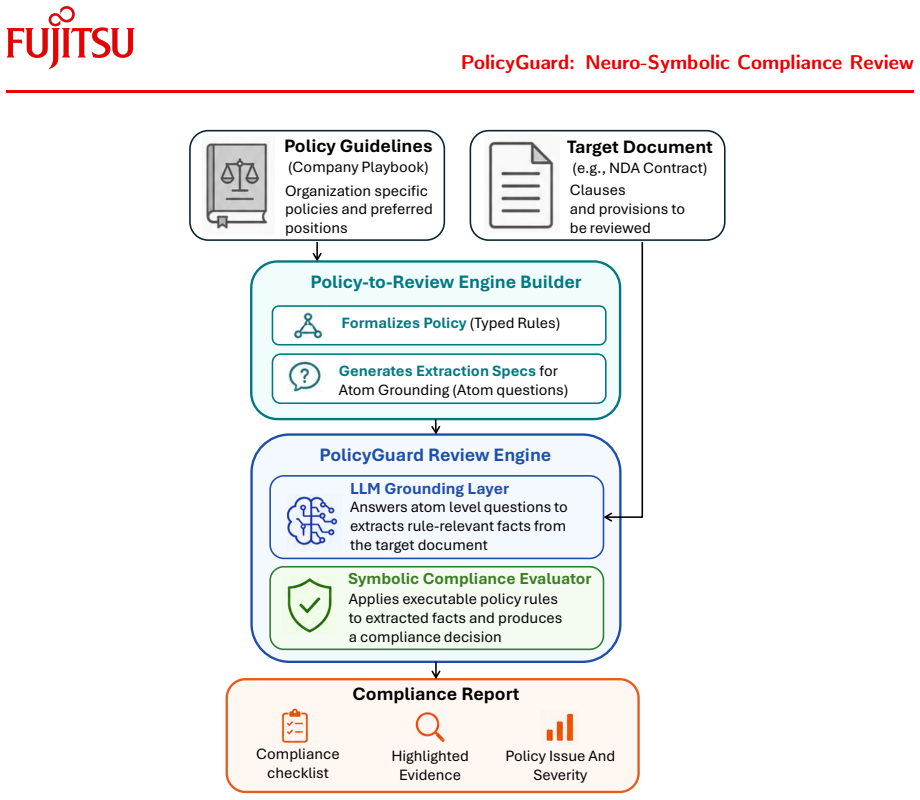
PolicyGuard turns policies into symbolic rules and LLM questions for compliance checks

by Sameer Malik, Ayush Singh +1 more

PolicyGuard: From Organizational Policies to Neuro-SymbolicCompliance Review Engines

Separating formal logic from local document interpretation makes reviews inspectable, updatable, and testable on tasks like NDA clause evalu

Figure from the paper full image
abstract click to expand
Policy-grounded document review requires determining whether a target document complies with organization-specific policies, guidelines, or playbooks. While large language models can assist with policy interpretation and document analysis, end-to-end prompting leaves the applied policy logic implicit, making compliance decisions difficult to inspect, update, and test. We present PolicyGuard, a neuro-symbolic framework for policy-grounded document compliance review. PolicyGuard converts organizational policy guidance into an executable review engine consisting of typed relational logic rules and atom-level extraction questions. During review, LLMs answer these local questions using retrieved document evidence, and a symbolic evaluator applies the formal rules to detect non-compliance. We instantiate and evaluate PolicyGuard on company-specific NDA compliance review, where contract clauses must be checked against organization-specific negotiation policies. By separating policy formalization, local document interpretation, and symbolic compliance evaluation, PolicyGuard makes document review more explicit, maintainable, and systematically testable.
0
0
cs.SC 2026-06-29

ACT-Up adds event-driven contextual memory without losing prototyping speed

by Robert Thomson, Christian Lebiere

Rapid Prototyping of Event-Driven Contextual Memory in the ACT-Up Cognitive Architecture

Theory-neutral working memory and AI-assisted experiment generation from paper methods lower the barrier for new users.

Figure from the paper full image
abstract click to expand
The present paper describes an implementation of contextual memory and a basic event-handler for the ACT-Up cognitive architecture which maintains its scalability and appropriateness for rapid-prototyping while adding essential features and lowering the barrier to entry for new users. This includes describing a theory-neutral implementation of working memory and spreading activation, in addition to a basic associative learning mechanism. An example of rapid prototyping for algorithm development is presented using the serial memory task described in Klein, Addis, and Kahana (2005). This study describes how contiguity effects change across sequential list presentations across three serial and free recall conditions. We further describe how to use generative AI and the event handler to automatically create cognitive experiments directly from the Methods section of research papers.
0
0
math.NT 2026-06-26

Deterministic algorithm finds two generators for number field ideals

by Qi Cheng

Deterministic and Efficient Ideal Arithmetic via Two-Element Representations

It runs in polynomial time whenever the ideal norm is coprime to the index, covering every ideal in monogenic fields.

abstract click to expand
Given an ideal in a number field, it is desirable in many situations to find two elements that generate the ideal over the ring of the integers of the field. Existing algorithms are either randomized, or impractical at cryptographic sizes. In the paper, we present a deterministic polynomial time algorithm to find the two-element representation of an ideal. For a monic irreducible integral polynomial \( f(x) \), let \( K=\Q[x]/(f) \) be the number field, and \( O_K \) be the integral closure. Our algorithm works when the norm of the input ideal is co-prime to the index \( [O_K:\Z[x]/f] \). In particular, it handles all ideals for monogenic \( f(x) \), a class that includes the cyclotomic polynomials widely used in lattice based cryptography. A key technical ingredient in our result is a generalized version of Dedekind criterion.
0
0
math.NT 2026-06-25

Any nonnegative integer is triangular plus pentagonal plus heptagonal

by Yichuan Cao, Dakai Guo +3 more

Every Nonnegative Integer Is a Sum of a Triangular, a Pentagonal, and a Heptagonal Number

The explicit three-term sum settles the OEIS A287616 conjecture for all nonnegative integers.

abstract click to expand
In this paper, it is proved that any nonnegative integer can be written in the following form $$ x(x+1)/2 + y(3y+1)/2 + z(5z+1)/2, \qquad x,y,z \in \mathbb{N}. $$ This settles the conjecture recorded as OEIS A287616. All parts of the proof have been formalized in Lean 4, with the exception of two results: one externally cited theorem and one statement verified by symbolic computation. Both the natural-language proof and the Lean formalization were generated by the MechMath Agent Team developed by the authors.
0
0
cs.SC 2026-06-24

Cylindrical decomposition computes exact program output distributions

by Fredrik Dahlqvist, Mohamed Hamza Bandukara +1 more

Exact Evaluation of Probabilistic Programs with Cylindrical Algebraic Decomposition

Small sensor programs with random inputs obtain precise probability calculations by decomposing the input space into integrable cells.

Figure from the paper full image
abstract click to expand
We present a method for computing the exact output distribution of small programs with random inputs. Specifically, we are interested in inline programs manipulating sensor data such as \eg GPS or inertial measurement sensors whose inputs have a known or well-modelled distribution. These programs typically only include relatively few variables, arithmetic operations, square roots and if-else statements. This small syntax allows us to recast the problem of computing the exact output distribution as a cylindrical algebraic decomposition problem followed by symbolic and/or numerical integration. We present this method in detail and show with two prototypes that it can successfully be applied to benchmarks from the literature on floating-point arithmetic and small programs from open-source sensor libraries.
0
0
cs.CL 2026-06-24

Memory edits replace retraining for knowledge changes

by Peiran Li

Towards Version-aware Operations and Transaction Memories for Multi-layer MeMo

Version-aware layers turn replace and rollback into ordered MeMo primitive transactions on sequences and tokens.

abstract click to expand
MeMo proposes language models with explicit multi-layer correlation matrix memories (CMMs), where memorization, retrieval, and forgetting are architectural operations. This paper asks how such memories can reduce the need for retraining when knowledge changes. For changes expressible as MeMo memory associations, the model's accessible knowledge can be updated by editing explicit memories rather than retraining the whole model. We propose a version-aware operation layer in which high-level operations such as replace, obsolete, keep-history, rollback, and trace are compiled into MeMo-native primitive calls over sequences and tokens. The key observation is that a version-aware operation is rarely a single MeMo association. It is an ordered transaction of primitive edits, for example forgetting one sequence-token chain, memorizing another, preserving a historical chain, and recording an inverse program. The framework introduces two auxiliary CMMs: a Version CMM (V-CMM) for mapping version transitions to transaction handles, and a Transaction CMM (T-CMM) for storing reusable change contents and inverse programs. It supports both direct sequence-level edits and structured diff-level inputs, and outlines an evaluation route for update success, rollback, traceability, locality, and transaction reuse.
0
0
cs.LG 2026-06-23

LoadKAN matches black-box accuracy while showing mobility effects

by Jinhao Li, Hao Wang

Interpretable Kolmogorov-Arnold Network with Feature-Isolated Temporal Attention Mechanism for Electricity Load Forecasting

Attention isolates features for KAN to expose mobility-load links in three U.S. markets

Figure from the paper full image
abstract click to expand
Accurate electricity load forecasting is a crucial prerequisite for stable power system operations. While prevalent deep learning models present competitive performance, they often operate as black boxes and lack interpretability. While the Kolmogorov-Arnold network (KAN) has emerged as a promising alternative because of its learnable activation function design, its direct application to time-series forecasting faces challenges in modeling complex temporal data patterns. Also, simple integration into existing architectures, such as serving as replacement of neural modules, cannot fully leverage KAN's interpretability strengths. To address these gaps, this study develops LoadKAN, a novel hybrid and interpretable framework for load forecasting that synergistically combines a specifically-designed feature-isolated temporal attention mechanism with a KAN module. The attention stage aims to extract temporal dynamics from each input feature independently, such as historical load and human mobility, providing distilled feature representations to the KAN module for interpretable predictions. When evaluated on datasets from three representative U.S. electricity markets, our LoadKAN remains highly competitive when compared to extensively-tuned, state-of-the-art, black-box deep learning benchmarks. More importantly, LoadKAN's interpretability enables a granular analysis of the learned non-linear relationships between six distinct mobility patterns and electricity load. Through KAN-learned activation functions, our quantitative sensitivity analyses on mobility features reveal complex and market-specific dependencies. These findings further demonstrate the ability of our LoadKAN to generate insights often obscured by opaque black-box neural forecasting models.
0
0
math.RA 2026-06-23

Explicit inverse and determinant formulas derived for 7D geometric algebras

by K. S. Abdulkhaev, D. S. Shirokov

Explicit Formula for Inverse and Determinant in Geometric Algebras over Odd-dimensional Vector Spaces

Basis conjugation operations produce closed-form expressions for all odd-dimensional cases by reduction to the even case.

Figure from the paper full image
abstract click to expand
In this paper, we present explicit formulas for the inverse and determinant in geometric (Clifford) algebras over vector spaces of dimension $n=7$. The derivation of these formulas is made possible by generalizing the concept of conjugation to basis conjugation operations. We further develop a general method for constructing such formulas over odd-dimensional spaces from the known even-dimensional case. To validate computational utility of the results, we provide a numerical implementation of the formulas. The code implementation is available at the repository github.com/kamranuz/clifford_7d. These formulas extend previous results for lower dimensions and offer new insights for applications in mathematical physics and computational geometry.
0
0
cs.LG 2026-06-23

EML trees approximate any W^{k,∞} function

by Joe Germany, Elie Abdo +1 more

EML Trees Are Universal Approximators

Tree compositions of the exp-minus-log function match functions with bounded weak derivatives up to order k to any accuracy.

Figure from the paper full image
abstract click to expand
The recently introduced EML (Exp-Minus-Log) function acts as continuous analogue of NAND gates, providing a compositional building block capable of representing elementary functions. In this work, we study the expressive power of tree-structured compositions of EML functions. We show that such trees enjoy a universal approximation property for functions in $W^{k, \infty}$ for $k \in \mathbb N$, drawing on classical neural network approximation arguments while exploiting the ability to explicitly construct EML trees that mimic polynomial representations. We further propose a learning algorithm for EML-type trees equipped with fitting parameters, and demonstrate its feasibility in practical optimization problems. Our results establish EML trees as a theoretically grounded framework for function approximation.
0
0
math.NT 2026-06-23

New method lists primes to N in N (log log N) time

by David Harvey

Faster enumeration of primes

First speedup by a positive power of log N over the Eratosthenes sieve via fast polynomial arithmetic over finite fields.

Figure from the paper full image
abstract click to expand
We describe several new algorithms for finding all prime numbers up to a given bound $N$, achieving the first ever speedup by a positive power of $\log N$ over the ancient sieve of Eratosthenes. The fastest version, which is not fully rigorous, runs in \[ N (\log \log N)^{1+o(1)} \] bit operations when analysed in the multitape Turing model. This improves on the best existing algorithms due to Pritchard (1981), Atkin--Bernstein (2004) and Sergeev (2016) by a factor of almost $\log N$. We also present a rigorous randomised (Las Vegas) variant that is slower by a factor of $(\log \log N)^{1+o(1)}$, and a rigorous deterministic variant that is slower by a factor of $(\log N)^{1/2+o(1)}$. The new algorithms make heavy use of fast polynomial arithmetic over finite fields, and also involve ideas from the theory of error-correcting codes.
0
0
cs.CV 2026-06-22

Neuro-symbolic method stays accurate as spatial views multiply

by Danial Kamali, Tanawan Premsri +4 more

SATURN: Symbolic Spatial Reasoning for Multi-Perspective Grounding

SATURN builds approximate 3D scenes and applies soft predicates to handle changing perspectives, gaining 14 points over baselines on MindCub

Figure from the paper full image
abstract click to expand
Vision-Language Models (VLMs) remain unreliable when spatial reasoning requires composing relations whose meanings depend on frames of reference. Existing neuro-symbolic methods make reasoning more explicit, but often depend on brittle geometric procedures and hard decisions over noisy perception. We propose SATURN, a neuro-symbolic framework for perspective-aware compositional spatial reasoning. SATURN reconstructs an approximate 3D scene, derives soft perspective-aware spatial predicates, and composes them with a training-free Pythonic symbolic executor, separating perception from reasoning while preserving uncertainty through multi-hop inference. We also introduce 3D FORCE, a diagnostic benchmark that controls reasoning depth, view, and perspective composition across spatial arrangement grounding (SAG) and referring expression grounding (REF). On 3D FORCE, VLMs and spatially trained models degrade sharply as depth and perspective complexity increase, whereas SATURN remains stable and outperforms strong baselines. On the real-world MindCube benchmark, SATURN achieves 78.57% overall accuracy, outperforming the strongest baseline by 14 pp.
0
0
cs.AI 2026-06-22

90% of LLM fallacy explanations verify formally

by Pei-Cing Huang, Chienyu Liu +4 more

ForEx: A Formal Verification Framework for Explainable Reasoning in Logical Fallacy Detection and Annotation

ForEx translates model rationales into Lean4 and shows formal success and human agreement are largely independent.

Figure from the paper full image
abstract click to expand
Current evaluations of Large Language Models (LLMs) on logical fallacy detection focus on predicted labels, but do not establish whether those labels are supported by the reasoning the models provide. We propose ForEx (Formal Verification for Explainable Reasoning), a framework that translates LLM-generated explanations into Lean4 and verifies whether the translated rationale is derivable under encoded premises, not the logical validity of the original natural language argument. To distinguish prediction outcomes from the formal status of the supporting reasoning, we introduce the LLM Argument Verification Matrix, which separates label consistency from formal verification status. Experiments on LOGIC-Climate show that over 90% of LLM outputs can be translated into formal reasoning chains that pass verification, while agreement with human annotations remains around 20%. These results expose a systematic gap between formal derivability and label agreement, a distinction invisible to prediction-based metrics. ForEx moves LLM evaluation beyond label correctness toward machine-checkable analysis of formalized reasoning chains.
0
0
cs.LG 2026-06-19

One fixed ReLU RNN approximates every continuous function via longer runs

by Valentin Abadie, Clemens Hutter +1 more

Recurrent neural networks approximate continuous functions

Accuracy is gained by extending runtime of the same network rather than changing its weights or size, matching polynomial rates.

Figure from the paper full image
abstract click to expand
Classical approximation theorems ask for a new neural network whenever the target accuracy is improved. This paper studies the opposite possibility: can the network be chosen once and for all, and can accuracy be bought only by letting it run longer? We prove that this is possible for every continuous function on [-1,1]. More precisely, each such function is uniformly approximated by the time evolution of a single ReLU recurrent neural network with fixed weights and fixed hidden dimension. The mechanism behind the construction is a new intermediate model, the Turing machine with neural units (TMNU). This model retains the algorithmic freedom needed to implement polynomial approximation schemes, while remaining rigid enough to be simulated by RNNs with explicit bounds on hidden dimension and weight magnitude. The resulting convergence rates reflect the underlying polynomial approximation rates. We complement the construction with minimax lower bounds showing that runtime is not merely a proof artifact, but an unavoidable resource in this fixed-network approximation paradigm.
0
0
cs.SC 2026-06-12

Catalog collects fast matrix multiplication to 32x32x32

by Benoit Chatain Lacelle

A catalog of fast matrix multiplication algorithms with frontier-closure search

Frontier-closure search recombines schemes across five number fields without rediscovering core bilinear products.

Figure from the paper full image
abstract click to expand
The 2022--2026 burst of activity in small-format matrix multiplication (AlphaTensor 2022, AlphaEvolve 2025, Schwartz--Zwecher 2025) has produced striking individual results but scattered them across different fields, attribution conventions, and serialisation formats. A complementary line of work -- Perminov's open-source flip-graph framework~\cite{perminov2026fast,perminov2025fast} -- instead drives existing construction methods, notably flip-graph and \emph{meta-flip-graph} search, at scale across large format spaces, discovering many new low-rank schemes (including ternary-integer ones) that further enrich the landscape this catalog must unify. We present a unified, machine-checkable catalog covering shapes up to \nmpshape{32}{32}{32} over \Rationals, \Integers, \Reals, \Complex, and \Ftwo, with a separate axis for commutative algorithms (Waksman 1970, Makarov 1986, Rosowski 2019). Derivation over this catalog is performed by a \emph{frontier-closure search} that recombines catalog entries by axis-flip, Kronecker, axis concatenation, serendipitous products, recombination-with-allocation (with optional output peeling and pair fusion), and downward projection. A central methodological point is the \emph{non-overlap property}: our recombination does not, and cannot, rediscover the shared bilinear products that hand-crafted constructions (Strassen, Laderman, Smirnov, AlphaTensor) are built around. This draws a clean line between the ``find a cleverer bilinear core'' and ``compose known cores'' axes of progress, and resolves several attribution puzzles in the literature. We refresh the DIS09 comparison tables, split per field and with a commutative column, and provide the tooling to regenerate them automatically as the catalog evolves.
0
0
cs.SC 2026-06-11

Sparse polynomial GCD over finite fields is NP-hard

by Ruichen Qiu, Yichuan Cao +3 more

Output-sensitive Sparse Polynomial GCD over Finite Fields is NP-hard

No randomized algorithm runs in time polynomial in input and output sizes unless NP is contained in BPP.

abstract click to expand
In this paper, we prove that output-sensitive sparse polynomial GCD computation over finite fields is NP-hard under BPP many-one reduction. More precisely, for two sparse univariate polynomials $f,g$ with finite field coefficients, there exists no randomized algorithm to compute $\mathrm{gcd}(f,g)$, which is polynomial-time in the sizes of $f,g,\gcd(f,g)$ under the standard complexity assumption $\mathrm{NP}\nsubseteq\mathrm{BPP}$. This settles the open problem posed as Challenge 5 in The Sparsity Challenges in the finite field setting. Furthermore, we show that the Roots of Unity Detection problem over finite fields is NP-hard; that is, determining whether the GCD of a sparse univariate polynomial and $x^n - 1$ has nonzero degree is NP-hard.
0
0
cs.SC 2026-06-11

Sparse polynomial divisibility over finite fields is CoNP-hard

by Yichuan Cao, Ruichen Qiu +3 more

Sparse Polynomial Divisibility Test over Finite Field is CoNP-hard

Proves non-divisibility is NP-hard via BPP reductions, resolving open complexity question for exact tests.

abstract click to expand
In this paper, we show that deciding whether a sparse polynomial does not divide another sparse polynomial exactly over finite fields is NP-hard under BPP many-one reductions. Equivalently, the sparse polynomial divisibility test over finite fields is CoNP-hard. This resolves the long-standing open problem concerning the computational complexity of the divisibility test for sparse polynomials in the setting of finite fields.
0
0
cs.SC 2026-06-11

Sparse integer polynomial multiplication reaches quasi-linear time

by Qiao-Long Huang, Yichuan Cao +2 more

Quasi-linear Time Multiplication of Sparse Polynomials with Integer Coefficients

Reduction to an existing modular black-box interpolation routine delivers the bound after a prior claim is disproved by counterexample.

abstract click to expand
Sparse polynomial multiplication is a fundamental problem in computer algebra and the theory of computation, and the development of a quasi-linear time output-sensitive multiplication algorithm has been posed as an open challenge. In this paper, a counterexample is provided to a previously claimed solution to this open problem for integer coefficients. By employing the existing quasi-linear modular-black-box interpolation algorithm, we are able to provide an algorithm with quasi-linear bit complexity for the integer coefficients setting. Furthermore, in the case of coefficients over a finite field, we obtain an algorithm whose bit complexity is linear in the number of terms, the logarithm of the degree, and the logarithm of the size of the finite field.
0
0
cs.LG 2026-06-09

Phase diagram sorts equation discovery by structural and coefficient complexity

by Siyu Lou, Hao Xu +7 more

Data-driven discovery of governing differential equations across physical systems

REO framework isolates persistent problems that determine which governing laws can be recovered from data.

Figure from the paper full image
abstract click to expand
Differential equations play a critical role in scientific discovery because they provide a mathematical framework to describe the behaviour of physical phenomena. As a promising alternative to traditional first principles, data-driven differential equation discovery has attracted increasing attention for its ability to infer governing laws directly from experimental or simulated data, especially when the underlying physics is unclear. However, the field has expanded rapidly along diverse methodological directions, particularly with the emergence of AI-based approaches, and still lacks a clear organizing perspective. In this Review, we propose a problem-oriented perspective on data-driven differential equation discovery. We first introduce a two-dimensional phase diagram of equation discoverability, where discovery problems are organized according to structural complexity and coefficient complexity. This phase diagram shows how the field has moved from the discovery of sparse equations with simple coefficients toward more complex governing laws with richer structures and more flexible parameterizations. It also clarifies why different methodological families succeed or fail in different problem settings. We then present the representation-evaluation-optimization (REO) framework as a fundamental abstraction of the discovery process. By identifying the core problems of equation discovery that persist across algorithmic variations, REO shifts the discussion from individual algorithms to the fundamental principles that determine discoverability. We connect these perspectives to applications across physics and adjacent sciences, and argue that the next challenge is not merely recovering equations, but using them to revise existing theories, distil mechanisms and form new scientific concepts.
0
0
cs.PL 2026-06-08

Compiled interpreter supplies gradients to any program it runs

by Lucas Sheneman

Compile Once, Differentiate Everywhere: A Differentiable Meta-Circular Interpreter

One frozen Scheme evaluator lets LLM-proposed code structures receive exact parameter calibration against data.

Figure from the paper full image
abstract click to expand
The boundary between program execution and gradient-based optimization has long limited the use of code itself as a learnable scientific model. We present a compiler that translates a self-hosting subset of Scheme into differentiable computation graphs for autograd backends. Because the subset can compile its own evaluator, this yields differentiable meta-circular interpretation (DMCI): a compiled Scheme interpreter executes programs supplied as data, while reverse-mode autodiff propagates gradients to continuous constants embedded in those programs. The interpreter is compiled once, so new programs inherit differentiability without recompilation or custom gradient machinery, while retaining closures, recursion, and data structures. We prove that gradients through the compiled interpreter are correct almost everywhere and show that they match direct compilation to numerical precision across 171 recursive and higher-order program-seed pairs. We then use DMCI for program-and-parameter co-search, where a large language model proposes Scheme programs and exact gradients calibrate their continuous parameters through a single frozen interpreter. This enables OpenEvolve-style program search in which an outer loop proposes discrete program structures and DMCI supplies exact gradient-based calibration of each candidate's continuous parameters. On battery capacity-fade data, the search recovers a knee-like degradation structure and improves held-out extrapolation over hand-crafted baselines on the harder early-extrapolation split, matching them on the later split. On a high-dimensional El Nino inverse problem, DMCI optimizes an interpreted Kalman-filter likelihood where gradient-free search fails. These results extend symbolic regression and neurosymbolic search from closed-form expressions to executable, stateful programs, making model-generated code directly optimizable against data.
0
0
cs.IT 2026-06-08

Entropy rule beats classics on random polynomial systems

by Uzma Shafiq, Matthew England +2 more

Letting Homogeneity Entropy Select S-Pairs in Buchberger's Algorithm

It cuts the number of S-pairs processed for controlled random inputs, while classical heuristics win on the PHCpack real-world collection.

Figure from the paper full image
abstract click to expand
We present a novel S-pair selection strategy called Homogeneity Entropy, for deciding the sequence of S-polynomials to construct in Buchberger's algorithm to compute a Groebner basis. The strategy uses an information theoretic measure derived from the distribution of degrees among the monomials of the S-polynomial: a very different approach to the classical heuristics such as Degree, Normal and Sugar, or indeed the more recent machine learning approaches to the problem. We implement this strategy and evaluate it on two different datasets: (1) variations of randomly generated polynomial systems with controlled numbers of variables, degrees, and densities; and (2) the PHCpack benchmark dataset sourced from real world problems. The Homogeneity Entropy strategy significantly outperforms classical strategies on random polynomial datasets, but on the PHCpack dataset the classical strategies perform better. This suggests the right strategy varies with the shape of the data and we explore this in several experiments. The new strategy offers practically meaningful gains on certain distributions, and represents the first use of such information-theoretic guidance in the optimisation of symbolic computation algorithms.
0
0
cs.NE 2026-06-08

Solver finds exact symbolic answers from equations alone

by Sergei Garmaev, Vinay Sharma +1 more

A Data-Free Symbolic Regression Approach for Solving Equations

Optimization over symbolic models uses only the governing equation and boundary conditions to match analytical solutions for algebraic and d

Figure from the paper full image
abstract click to expand
Many equations arising in science currently cannot be solved by available analytical techniques and are therefore solved numerically, without yielding explicit symbolic expressions. Existing symbolic regression approaches can recover symbolic expressions, but require training data obtained from the underlying process, rather than the governing equation alone. We propose the Symbolic Equation Solver (SES), a framework that formulates equation solving as an optimization problem over differentiable symbolic models. SES constructs its objective from the equation together with initial or boundary conditions, eliminating the need for paired input-output data. The learned model is expressed in explicit symbolic form, enabling further analysis. We evaluate SES on representative algebraic and differential equations, including a system of algebraic equations, an equation with transcendental terms, an ordinary differential equation, and partial differential equations with different initial or boundary conditions. Across these settings, SES recovers compact symbolic expressions that match the corresponding analytical solutions.
0
0
cs.DC 2026-06-05

GPU Newton iteration divides integers at 2^15-2^18 bits near model optimum

by Martin B. Marchioro, Aske N. Raahauge +3 more

On GPU Implementation for Multi-Precision Integer Division

Implementation using shifted-inverse iteration and prefix sums reaches performance close to a multiplication-only cost model on CUDA hardwar

Figure from the paper full image
abstract click to expand
This paper presents the issues arising in implementing a fast integer division algorithm on general purpose GPUs. The algorithm uses a Newton iteration based on the shifted inverse operation, keeping all arithmetic in the integer domain and relying on data-parallel operators. The principal contribution is an efficient GPU/CUDA implementation for integer precisions from $2^{15}$ to $2^{18}$ -- sizes not supported by \cgbn{} division. We propose algorithmic refinements, define a cost model in terms of multiplications, build on prefix sums and previous work on multi-precision multiplication, and present an evaluation showing near-optimal performance relative to the model for the target precision.
0
0
cs.LG 2026-06-05

Mixture messages equip belief propagation with exact SE(3) equivariance

by Zehua Cheng, Wei Dai +1 more

Equivariant Neural Belief Propagation

Gaussian-mixture messages that transform under rotations and translations deliver fast accurate inference on molecules and robots where stan

Figure from the paper full image
abstract click to expand
Probabilistic inference over spatially embedded variables requires beliefs that respect $SE(3)$ symmetry, yet existing equivariant networks produce only scalars and vectors -- not the rank-2 precision tensors needed for anisotropic uncertainty, and single-component messages collapse multi-modal energy landscapes to physically meaningless averages. We introduce Equivariant Neural Belief Propagation (ENBP), a factor-graph framework whose messages are equivariant Gaussian mixture models with sufficient statistics that transform exactly under $SE(3)$. Rank-2 precision matrices are synthesised via equivariant outer products, ingested through differentiable spectral decomposition, and kept tractable by a greedy KL-based mixture reduction that provably commutes with $SE(3)$. On GEOM-QM9 and GEOM-Drugs, ENBP achieves 98.9% conformational coverage at 0.090 $\mathring{A}$ error with sub-second latency -- over $100\times$ faster than diffusion baselines at higher accuracy. On multi-body robotic inference, vanilla loopy BP diverges at 15+ agents while ENBP converges with near-zero collision rates and machine-precision equivariance error (${\sim}10^{-7}$ vs.\ $10^{-1}$ for augmented baselines).
0
0
cs.SC 2026-06-05

Certificate proves Vasc inequality holds for n=9 positives

by Dakai Guo, Ruichen Qiu +2 more

A Finite Certificate for the Positive n=9 Vasc Inequality

It covers every one of the 40320 sorted cones with verified Polya and AM-GM multipliers.

abstract click to expand
We prove the positive-real $n=9$ case of the Vasc cyclic inequality. The proof was obtained with human-guided assistance from the AI agent MechMath Agent Team: the human-readable part reduces the rational inequality to a homogeneous polynomial inequality, fixes a cyclic maximum, and parametrizes each sorted fixed-maximum cone by cumulative gaps; the finite part is a certificate covering all $8!=40320$ sorted cones. MechMath Agent Team generated the certificate verification workflow through Python tool calls, including the case split, verification programs, and terminal classifications. The published certificate has $36815$ coefficient leaves, $2236$ ordinary Polya multiplier leaves, and $1269$ AM-GM midpoint overlay leaves. Human authors audited the mathematical reductions and verification logic, and a separate artifact contains the certificate, an independent verifier, and a from-source rebuild route.
0
0
cs.LG 2026-06-04

Graph transformer restores variable elimination for graphical inference

by Zehua Cheng, Wei Dai +1 more

In-Context Graphical Inference

Mimics exact sequential structure to cut error in half on standard cases and succeed where belief propagation fails on frustrated graphs.

Figure from the paper full image
abstract click to expand
Marginal inference in discrete graphical models forces a choice between exactness and scalability: exact algorithms are intractable for high-treewidth graphs, while iterative approximations (Belief Propagation, variational methods) sacrifice convergence guarantees on frustrated topologies. We argue that this dichotomy stems from a mismatched inductive bias: iterative methods abandon the sequential elimination structure that makes exact inference correct. We introduce In-Context Graphical Inference (ICG-I), an autoregressive Graph Transformer that restores this structure by mimicking Variable Elimination with learned, Tensor- Train-compressed intermediate factors, paired with a Dirichlet output layer and Weighted Conformal Prediction for calibrated, distribution-free coverage guarantees under topological shift. We prove that TT compression errors propagate at most lincarly through the autoregressive chain, that the Dirichlet-Multinomial loss is a proper scoring rule, and that WCP maintains coverage with a quantifiable degradation under estimated density ratios. We conducted intensive experiments to evaluate ICG-I and achieved state-of-the-art performance across all benchmarks. ICG-I reduces MAE from 0.041 (best baseline) to 0.020 on standard instances and achieves 0.048 on N=500 frustrated spin glasses where BP diverges entirely.
0
0
cs.CL 2026-06-04

LLM reasoning chains repaired by infilling logical bridges

by Zehua Cheng, Wei Dai +2 more

Imbuing Large Language Models with Bidirectional Logic for Robust Chain Repair

Prefix-suffix-middle training with symbolic verification reaches state-of-the-art results while cutting token use 31 percent.

Figure from the paper full image
abstract click to expand
Autoregressive chain-of-thought (CoT) reasoning in large language models (LLMs) is fundamentally forward-directed: each step conditions only on prior tokens. This unidirectional inductive bias renders even capable models susceptible to error snowballing, wherein a single logical or arithmetic mistake in an early step irreversibly corrupts the entire reasoning chain. We introduce Teleological Reasoning Infilling (\TRI{}), a training framework that endows decoder-only transformers with a native \emph{goal-conditioned bridging} capability. The key insight is to reframe erroneous reasoning segments as fill-in-the-middle (FIM) tasks: given a verified prefix premise $P$, a verified downstream milestone $S$, and the original query $Q$, the model must synthesise the logical bridge $M$ that connects $P$ to $S$ rigorously and completely. To achieve this with standard causal architectures, we introduce a Prefix-Suffix-Middle (PSM) sequence rearrangement with three non-overlapping sentinel tokens, enabling $M$ to attend to both $P$ and $S$ without any structural modification to the self-attention mechanism. Training proceeds in two stages: (i) Supervised Fine-Tuning (SFT) on symbolically verified $(P, S, M)$ triples extracted from formal mathematics corpora, and (ii) Direct Preference Optimisation (DPO) with a deterministic symbolic verifier (Lean 4 / Python) as the sole reward oracle, eliminating LLM-judge sycophancy. At inference, TRI operates as a surgical repair module within a dual-system loop: a causal draft model generates an initial trace, the verifier pinpoints failures, and TRI infills only the damaged segment, leaving verified sections intact. Comprehensive experiments on three benchmarks demonstrate that TRI achieves state-of-the-art performance across all tasks, while reducing per-problem token expenditure by 31.2%.
0
0
math.NT 2026-06-04

Algorithm finds integer points near curves faster for rounding

by Nicolas Brisebarre, Guillaume Hanrot

Integer points close to a transcendental curve: an algorithmic approach

Bombieri-Pila and Coppersmith techniques cut the cost of building correctly rounded math libraries for binary128.

abstract click to expand
In this article, we propose an algorithmic approach to determine the integer points located near a transcendental curve. This approach is closely related to a celebrated work by Bombieri and Pila and to the so-called Coppersmith's method. We establish the underlying theoretical foundations, prove the algorithms, study their complexity and present practical experiments; we also compare our approach with previously existing ones. From a practical point of view, we focus on an instance of our general problem, called the Table Maker's Dilemma, whose solving makes it possible to evaluate a given function with correct rounding. Our experiments show a significant speedup. In particular, our results show that the development of a correctly rounded mathematical library for the binary128 format is now possible at a much smaller cost than with previously existing approaches.
0
0
cs.AI 2026-06-03

Symbolic graphs lift LLM financial audit accuracy to 82%

by Yan Wang, Xuguang Ai +8 more

AUDITFLOW: Executable Symbolic Environments for Structured Financial Reporting Verification

AuditFlow pairs adaptive multi-agent search with deterministic checks on US-GAAP and XBRL graphs, beating baselines by 15 points.

Figure from the paper full image
abstract click to expand
Structured financial audit verification is difficult for language-model agents because correctness depends on structured evidence rather than text alone. A model must link reported facts to taxonomy concepts, traverse calculation or dimensional relations, and recompute expected values before applying an audit rule. We propose AuditFlow, a graph-grounded multi-agent framework that separates adaptive search from deterministic verification. AuditFlow builds a symbolic environment from a static US-GAAP taxonomy graph and a dynamic XBRL filing graph, and exposes it through typed tools for fact retrieval, taxonomy traversal, numerical checking, and rule evaluation. Two junior auditors inspect each case from regulatory and evidentiary views, while a senior auditor resolves disagreements and can request further investigation. The final reports are fused through evidential aggregation to produce an audit verdict, expected value, evidence trail, and trustworthiness score. On a FinAuditing-derived FinMR sample, AuditFlow reaches 82.09% joint audit accuracy under GPT-5.5, outperforming the strongest baseline by 14.93 points. Removing deterministic checks drops accuracy to 17.91%, showing that the symbolic environment performs the verification step that the model cannot reliably replace.
0
0
cs.SC 2026-06-02

Improved ranks found for 207 matrix multiplication formats

by A. I. Perminov

Meta Flip Graph meets Serendipitous Product: new Fast Matrix Multiplication results

Meta flip graph plus serendipitous product yields 23 new schemes with exponent below log base 2 of 7.

Figure from the paper full image
abstract click to expand
This paper presents new results for fast matrix multiplication in small formats obtained by combining the meta flip graph framework with the serendipitous product construction. The framework has been extended to support all 680 rectangular formats with dimensions up to $16 \times 16 \times 16$. Compared to the previous state of the art, ranks are improved for 207 formats. For 84 formats, ternary schemes are found where previously only integer or rational coefficients were known. Additionally, 23 new schemes with asymptotic exponent $\omega < \log_2 7$ are discovered, bringing the total number of such schemes to 52. The overall distribution of coefficient types across all investigated formats is 375 ternary, 18 integer, and 287 rational. All code and discovered schemes are available as open source.
0
0
cs.SC 2026-06-01

Cofactor-free lift factors X^n-1 over Z_p^e at O(m^2) per layer

by Yongchao Wang, Yang Ding +2 more

Explicit Factorization of X^n-1 over mathbb{Z}_(p^e) via Cofactor-Free Single-Seed Hensel Lifting

One cached inverse from F_p replaces cofactor updates, yielding total cost O(n + m^3 log p + e m^2) and 445x speedup

Figure from the paper full image
abstract click to expand
We present a complete framework for the explicit factorization of $X^n-1$ over integer residue rings $\mathbb{Z}_{p^e}$ for arbitrary $n$ with $\gcd(n, p)=1$. Classical approaches face fundamental bottlenecks: polynomial Hensel lifting requires updating global cofactors (scaling with $n$), while direct multivariate Newton--Hensel iteration on the factor coefficients requires Jacobian inversion (scaling exponentially as $O(p^{(m-1)^2})$ per layer due to zero-divisors, where $m$ is the coset dimension). Our framework eliminates both bottlenecks through three contributions: (1)~the \emph{Ideal Derivation Modulo Principle}, which characterizes all factor coefficients as roots of a multivariate Dickson polynomial ideal derived via modular remainder extraction; (2)~a \emph{cofactor-free Hensel lift} that elevates a single seed factor from $\mathbb{F}_p$ to $\mathbb{Z}_{p^e}$ using a cached polynomial inverse computed once over $\mathbb{F}_p$; and (3)~a \emph{dual-track coefficient reconstruction} mechanism that recovers all remaining factors from the lifted seed's trace array via MED-based coset dispatch, with Newton--Girard inversion as the primary path and quotient-ring Gaussian elimination as an unconditional fallback when $p \leq m$. Empirical evaluation confirms the theoretical grand total algebraic complexity of $O(n + m^3 \log p + e \cdot m^2)$ for explicitly factoring $X^n-1$ over $\mathbb{Z}_{p^e}$, validating the near-constant per-layer lifting cost $O(m^2)$ to depths exceeding $e = 1000$. The framework yields speedups of $445\times$ (including runtime auto-seeding overhead) over SageMath's C-backed FLINT/Pari engine and $33.5\times$ over the V1 scalar lift.
0
0
cs.NE 2026-05-28

Hyperparameter tuning boosts recombination CGP performance

by Duy Long Tran, Anja Jankovic +3 more

Improving Evaluation of Recombination-based Cartesian Genetic Programming

Optimizing parameters for subgraph crossover and discrete phenotypic recombination yields gains on SRBench where mutation was long preferred

Figure from the paper full image
abstract click to expand
Cartesian Genetic Programming has traditionally been using mutation as its main and often sole genetic operator to drive evolutionary search. Despite advancements in recent years, recombinationbased approaches have long been avoided, due to apparent lack of performance gains. This study examines two recently suggested recombination-based operators, subgraph crossover and discrete phenotypic recombination on SRBench, a benchmarking platform for symbolic regression. Using the implementations provided in the TinyverseGP framework, we perform hyperparameter optimisation of the respective representations with these two operators. Our work demonstrates that hyperparameter optimisation can lead to improvements in performance for recombination-based Cartesian Genetic Programming.
0
0
math.AG 2026-05-28

Indicial polynomials extend b-functions to singular varieties in D-modules

by Toshinori Oaku

Indicial polynomials and b-functions of D-modules along arbitrary varieties and their computation

They support inverse image calculations by embeddings where b-functions may not exist and are easier to compute.

abstract click to expand
We define an indicial polynomial of a $D$-module along an arbitrary subvariety as a generalization of both the classical indicial polynomial for a single linear differential equation and the Bernstein-Sato polynomial of a variety defined by Budur-Mustata-Saito. An indicial polynomial is also a generalization of the $b$-function of a $D$-module along a submanifold and can be used in the computation of the $D$-module theoretic inverse image by the embedding instead of the $b$-function. We consider properties of indicial polynomials and relations with $b$-functions. An indicial polynomial may exist even if the $b$-function does not, and gives the set of the roots of the $b$-function if it exists. Computation of an indicial polynomial is easier than the $b$-function and naturally includes the case with parameters.
0
0
cs.AI 2026-05-27

Defeasible calculus resolves norm conflicts to constrain AI plans

by Taylor Olson, Roberto Salas-Damian +1 more

Reasoning and Planning with Dynamically Changing Norms

Dynamically changing norms serve as guardrails in dialogue tasks, backed by proofs and agent experiments.

Figure from the paper full image
abstract click to expand
To safely interact with humans, AI agents must both know our norms and consider them during planning. However, such norm-guided planning has been less explored, only within communities of artificial agents, and has ignored the dynamic nature of norms. This paper instead presents an approach to guiding planning with dynamically changing norms in a human-AI setting. We contribute a defeasible calculus for resolving normative conflicts and an approach to using such dynamically changing norms as guard rails on plans. We theoretically demonstrate our approach with formal proofs and empirically with an AI agent, SocialBot, on a natural language dialogue task.
0
0
cs.SC 2026-05-26

Softened logic yields verifiable LLM reasoning chains

by Rui Wang, Zeming Wei +2 more

Symbolic-Neural Soft-Logic Reasoning: Towards Robust and Verifiable Thinking Chains via Cooperative Evolution

SSR relaxes determinism between neural generation and symbolic checks to improve robustness while retaining formal verifiability.

Figure from the paper full image
abstract click to expand
Large Language Models (LLMs) have demonstrated impressive progress in complex reasoning tasks, largely driven by the Chain-of-Thought (CoT) paradigm, which decomposes difficult problems into intermediate steps. However, CoT reasoning remains fundamentally constrained by the probabilistic nature of neural generation, leading to unfaithful reasoning chains that undermine reliability. Neuro-symbolic approaches attempt to address these issues by combining LLMs with symbolic solvers, yet they face persistent challenges, including hallucinated translations, the mismatch between natural language and formal logic, and the limited enhancement of the LLM's intrinsic reasoning ability. To overcome these limitations, we propose Symbolic-Neural Soft-Logic Reasoning (SSR), a unified framework that integrates LLMs with symbolic reasoning and improves robustness by relaxing strict logical determinism while preserving verifiability. Our approach improves reasoning performance, automatically generates verifiable and human-like logical thinking chains for training and fine-tuning, and facilitates cross-disciplinary applications such as AI for mathematics. Experiments across multiple models and benchmarks demonstrate that SSR consistently outperforms existing reasoning frameworks, highlighting its effectiveness in enhancing both the robustness and interpretability of LLM reasoning.
0
0
cs.CR 2026-05-26

Tool migrates 94 percent of eBPF programs to Rust with formal proof

by Vishnu Asutosh Dasu, Monika Santra +4 more

Heimdall: Formally Verified Automated Migration of Legacy eBPF Programs to Rust

Heimdall repairs LLM translations and uses symbolic execution plus Z3 to confirm that each Rust version matches the original C behavior.

Figure from the paper full image
abstract click to expand
Extended Berkeley Packet Filter (eBPF) programs are kernel extensions used for networking, observability, and security enforcement in the Linux kernel. The in-kernel eBPF verifier checks low-level memory safety and termination on eBPF programs, but it does not enforce many higher-level source-level properties, such as initialization discipline, schema consistency, or error handling. We document six classes of source-level bugs that compile, pass the kernel verifier, and can silently corrupt data, leak previously traced events to userspace, or yield incorrect enforcement outcomes. Among these, we identify previously unreported information leaks in ten open-source eBPF programs whose ring-buffer or stack-resident event records carry fully decodable prior traced events, including user-identifying paths and recurring kernel-text return addresses sufficient to recover the KASLR slide on every event, into userspace. To harden such verifier-accepted buggy programs and support safe migration, we present Heimdall, an automated pipeline that uses large language models to translate legacy libbpf C programs to Aya Rust. Heimdall iteratively repairs compilation and kernel-verifier failures, rejects unsafe escape hatches in Rust-Aya with a static analysis safety engine, and proves per-program equivalence to the original via symbolic execution and Z3-based equivalence checking. Across 102 eBPF programs, Heimdall produces 96 formally proven-equivalent translations (94.1%). Heimdall is the first system to automate memory-safe-language migration of production eBPF programs with per-program formal guarantees that the migration preserves observable behavior.
0
0
eess.IV 2026-05-26

Graph method achieves 6 dB CT gain with 92k parameters

by Veera Varuni Radhakrishnan, Chinthaka Dinesh +1 more

Parameter-Efficient CT Reconstruction via Deep Graph Laplacian Regularization

Deep GLR uses 1000 samples and three small CNNs for efficient low-dose reconstruction on LoDoPaB-CT benchmark.

Figure from the paper full image
abstract click to expand
Low-dose computed tomography (LDCT) reconstruction faces a critical tradeoff between reconstruction quality and resource requirements. While recent deep learning methods achieve state-of-the-art performance, they typically rely on over 500,000 parameters trained on large-scale datasets exceeding 35,000 scans. This work investigates whether graph-based regularization can provide meaningful noise reduction under strict resource constraints. We propose Deep Graph Laplacian Regularization (Deep GLR), integrating quadratic graph regularization into a Proximal Forward-Backward Splitting optimization framework with three lightweight CNN modules. Evaluated on the LoDoPaB-CT benchmark, Deep GLR achieves 30.70 dB PSNR, representing a 6.33 dB improvement over filtered backprojection, while using only 91,848 parameters trained on 1000 samples (2.8\% of standard training set). Compared to benchmark methods, this represents 5.8 times better parameter efficiency and 30 times better data efficiency per dB improvement. The learned graph bandwidth parameter ($\epsilon$=1.25) converges to interpretable values, suggesting the method captures meaningful image priors rather than overfitting. While a 13 dB gap remains versus state-of-the-art methods, results demonstrate that graph-based regularization provides a favorable efficiency-quality tradeoff for resource-constrained medical imaging scenarios.
0
0
cs.GR 2026-05-22 Recognition

JOIN and UNION operators make IPC simulation extensible at competitive speed

by Xuan Tang, Kemeng Huang +3 more

YASPS: A Symbolic Framework for Extensible, High-Performance IPC Simulation

A symbolic relational representation lets new energies and bodies be added with little code change while automatically generating fast GPU-8

Figure from the paper full image
abstract click to expand
Incremental Potential Contact (IPC) enables robust, contact-rich simulation by casting elasticity and contact as a single energy minimization problem, but high-performance IPC pipelines are typically built from specialized kernels and assembly logic tied to fixed energies, primitive types, and parameterizations, making extensions costly and combinatorial. We present YASPS, a GPU-oriented framework that removes this extensibility bottleneck by making structure explicit in a differentiable intermediate representation. YASPS introduces two first-class relational operators: JOIN, which composes dependent quantities across user-declared relations (e.g., element-to-vertex connectivity), and UNION, which represents alternative parameterizations within a relation (e.g., mixing free vertices with affine-body or other parameterizations without fragmenting the program). Because JOIN and UNION are part of the symbolic program, YASPS differentiates through them using dedicated rules and an efficient second-order procedure that reuses intermediate Jacobians and reduces Hessian-projection cost. From the same relational description, YASPS derives the global gradient/Hessian sparsity and block layout, enabling structure-aware block-sparse storage and compression, and JIT-compiles CUDA kernels for evaluation, derivatives, assembly, and solving. Across IPC-style examples, including layered cloth-on-bunny, mixed rigid/deformable bunnies, and a caged deformation model, YASPS supports rapid front-end extensions with minimal back-end changes while achieving competitive end-to-end performance; its Hessian compression yields near 10x faster CG iterations in our benchmarks.
0
0
cs.SC 2026-05-22 Recognition

Algorithm reduces composable polynomials to polynomial-time solving

by Thi Xuan Vu

A Symbolic Homotopy Algorithm for Solving Composable Polynomial Systems

By rewriting each equation as a composition with shared inner polynomials, the method computes all isolated regular solutions with cost that

abstract click to expand
We study the problem of computing the isolated regular solutions of a system \((f_1,\ldots,f_n)\) of \(n\) polynomial equations in \(n\) variables \((X_1, \dots, X_n)\) over a field of characteristic zero \(k\). We focus on systems with a \emph{composable structure}, where each polynomial \(f_i\) can be expressed as a composition \( f_i = h_i(g_1,\dots,g_n)\). Exploiting this structure allows us to reduce the original system to one in the \(g_j\) variables, thereby significantly improving the efficiency of symbolic solution algorithms. We present a probabilistic algorithm that computes all isolated regular solutions, with arithmetic complexity being polynomial in the input size and in the number of solutions. A first important application is when \(f_1, \dots, f_n\) belong to the subring \(k[g_1, \dots, g_n]\), where \(g_1, \dots, g_n\) are algebraically independent polynomials in \(k[X_1, \dots, X_n]\). Another important application is to systems of invariant polynomials under finite reflection groups, since by the Chevalley-Shephard-Todd theorem their invariant rings are polynomial algebras. Typical examples include the symmetric groups \(S_n\), the hyperoctahedral groups \(B_n\), the dihedral groups \(I_2(m)\), and the exceptional finite reflection groups \(E_6, E_7, E_8, F_4, H_3, H_4\).
0
0
cs.LG 2026-05-22 Recognition

Compiler turns programs into exact neural modules

by Lucas Sheneman

The Neural Compiler: Program-to-Network Translation for Hybrid Scientific Machine Learning

Known physics encoded precisely so hybrid models recover constants with 1-4 parameters instead of thousands.

Figure from the paper full image
abstract click to expand
Scientific machine learning often requires combining known physics with unknown parameters or correction terms learned from data. Existing approaches either ignore known structure, encode it as a soft penalty, or require hand-written PyTorch code for each equation. We present The Neural Compiler, a system that translates programs written in a first-order Scheme-like expression language into frozen, differentiable PyTorch modules. These modules match the source program to floating-point precision and provide gradients through autograd. In hybrid models, the compiled module encodes known physics exactly while learned components model the unknown remainder. We evaluate the compiler across six experiment domains: Feynman physics equations, Lotka-Volterra dynamics, a damped pendulum, a one-dimensional heat equation, three-dimensional vector mechanics, and compositional generalization. Compiled modules match hand-coded PyTorch implementations numerically for single equations, showing no accuracy loss from compilation. With only 1 to 4 trainable parameters, compiled models recover physical constants to less than 1 percent error in most cases, while standard PINN baselines with more than 8500 parameters show 7 to 93 percent error. Compiled modules also compose with zero error, while neural approximations can accumulate large errors in deep composition chains. The main value of the compiler is not improved accuracy over hand-coded equations, but systematic composability: it generates correct, differentiable modules from symbolic specifications without rewriting each equation by hand. The system supports 51 primitive operations, including vector and matrix algebra, enabling PDE discretizations and hybrid scientific models. This string-in, module-out interface also provides a natural target for large language models that translate scientific descriptions into executable differentiable modules.
0
0
physics.flu-dyn 2026-05-20 1 theorem

Data-driven method yields soil flow functions that beat classic model on 249 samples

by Hao Xu, Jinshen Sun +2 more

Graph-based automated discovery of concise soil hydraulic functions from data: beyond the Mualem - van Genuchten model

Graph search finds explicit retention and conductivity expressions more accurate than Mualem-van Genuchten across diverse soils.

Figure from the paper full image
abstract click to expand
Soil hydraulic functions are fundamental to modelling water flow and transport in vadose-zone hydrology and are central to a wide range of hydrological and geoscientific applications. Yet in practice, these functions are still predominantly specified through expert-designed empirical formulations, such as the Mualem-van Genuchten (MvG) model. Although such models have proved highly influential, their derivation relies on predefined functional assumptions that make it difficult to simultaneously achieve accuracy, compactness, and robustness across diverse soil textures. Here we present a graph-based automated model discovery framework for discovering explicit soil hydraulic functions directly from experimental data. Applied to the original datasets used in the development of the MvG model, the method identifies a concise soil water retention function and its associated unsaturated hydraulic conductivity function whose mathematical structure differs fundamentally from classical empirical forms. Across 249 real soil samples spanning diverse textural classes, the discovered functions achieve more accurate predictions of unsaturated hydraulic conductivity than the MvG model. The fitted parameters also exhibit correlations with soil physical properties. This work demonstrates that data-driven model discovery can move beyond traditional empirical derivation and provide a promising route for developing accurate and explicit constitutive models.
0
0
cs.SC 2026-05-19 Recognition

Algorithm produces certificates for univariate quadratic modules

by Jose Abel Castellanos-Joo, Deepak Kapur

Computing Certificates in Archimedean Univariate Saturated Quadratic Modules

It rewrites non-negative polynomials against natural generators then converts back using the Basic Lemma, succeeding where RealCertify fails

abstract click to expand
A new symbolic algorithm to compute sums of squares multipliers (certificates) to witness the membership of non-negative univariate polynomials in a saturated univariate quadratic module is presented. Certificates are first computed in terms of natural generators introduced by Kuhlmann and Marshall for an Archimedean saturated quadratic module; natural generators can be easily read-off from a semialgebraic set. In the univariate case, an Archimedean quadratic module is also a preordering since it is closed under multiplication; certificates have different representations when a polynomial is viewed as a member in a quadratic module versus in a preordering An algorithm is given to compute certificates of natural generators in terms of the original generators; it uses a construction introduced by Kuhlmann, Marshall, and Schwartz known as the ``Basic Lemma'', which splits the non-negative factors of generators. To compute a quadratic module certificate, certificates of products of natural generators are computed using a detailed case analysis based on the types of natural generators. An implementation of the algorithms proposed in Maple is also discussed. The certificates obtained using this implementation are compared with those generated by RealCertify. We discuss examples where RealCertify is unable to find certificates while the proposed method is successful.
0
0
cs.LG 2026-05-19 Recognition

Readable programs match deep RL on job scheduling benchmarks

by Chengpeng Hu, Yingqian Zhang +1 more

Scheduling That Speaks: An Interpretable Programmatic Reinforcement Learning Framework

ProRL discovers editable scheduling strategies via local search and Bayesian optimization that work well even with 100 training episodes.

Figure from the paper full image
abstract click to expand
Deep reinforcement learning (DRL) has recently emerged as a promising approach to solve combinatorial optimization problems such as job shop scheduling. However, the policies learned by DRL are typically represented by deep neural networks (DNNs), whose opaque neural architectures and non-interpretable policy decisions can lead to critical trust and usability concerns for human decision makers. In addition, the computational requirements of DNNs can further hinder practical deployment in resource constrained environments. In this work, we propose ProRL, a novel interpretable programmatic reinforcement learning framework that achieves high-performance scheduling with human-readable and editable programmatic policies (i.e., programs). We first introduce a domain-specific language for scheduling (DSL-S) to represent scheduling strategies as structured programs. ProRL then explores the program space defined by DSL-S using local search to identify incomplete programs, which are subsequently completed by learning their parameters via Bayesian optimization. ProRL learns which scheduling heuristic rules to select, and hence, it naturally incorporates existing heuristics already used in industrial scenarios. Experiments on widely used benchmark instances demonstrate the strong performance of ProRL against existing heuristics and DRL baselines. Furthermore, ProRL performs well under strongly constrained computational resources, such as training with only 100 episodes. Our code is available at https://github.com/HcPlu/ProRL.
0
0
cs.SC 2026-05-19

Critical-point method samples semi-algebraic components at cubic cost

by Jérémy Berthomieu (PolSys), Edern Gillot (PolSys) +1 more

Computing points in connected components defined by a real inequation: algorithms, complexity and implementations, Part I

Reduces one-inequality connectivity queries to zero-dimensional polynomial solves with explicit bit bounds

Figure from the paper full image
abstract click to expand
We consider the problem of computing sample points in each connected component of a semi-algebraic set defined by the non-vanishing or the positivity of an n-variate polynomial of degree d, with rational coefficients of bit size bounded by $\tau$. Such a problem is a basic routine in effective real algebraic geometry, used in higher-level algorithms for solving polynomial systems over the reals and finds many applications in sciences. We design a probabilistic algorithm for solving this problem, which is based on reductions to different routines for solving zero-dimensional polynomial systems. It assumes that the input polynomial satisfies sufficiently generic properties (namely, smoothness of its defining hypersurface). This is done through the computations of critical points of well-chosen maps to capture the connected components of the semi-algebraic set under study. We derive a bit complexity estimate for the cost of this algorithm, which is, in terms of the B{\'e}zout bound d(d -1)^{n-1}, essentially cubic for obtaining parametrisations of the sought-for real points. Moreover, we also consider the case of obtaining rational approximations of those points, which are precise enough to lie in the same connected components as their exact counterparts, which yields a cost that is essentially quartic in the B{\'e}zout bound. In these complexity estimates, we take into account the degree structure of the input polynomial and its partial derivatives, allowing for a more refined bit complexity when the partial derivative of the input polynomial have degree lower than expected. We also analyse the probability of success of those algorithms. We report on practical experiments, benchmarking with random dense input polynomials as well as polynomials coming from applications, which were out of reach of the state-of-the-art implementations, and hence illustrate the practical efficiency of these new algorithms.
0
0
cs.CR 2026-05-18 2 theorems

Toom-4 outperforms Karatsuba in specific incomplete-NTT ranges

by Sakura Oku, Momonari Kudo

Explicit cost analysis of Toom-4 multiplication for incomplete NTT in lattice-based cryptography

Addition-chain counts produce a cost model that locates the exact degrees and moduli where the hybrid strategy wins, confirmed by experiment

abstract click to expand
Polynomial multiplication is fundamental in lattice-based cryptography. While the Number Theoretic Transform (NTT) enables fast multiplication, it imposes constraints on the modulus of the coefficient field. Hafiz et al. (2025) addressed this limitation by analyzing the incomplete NTT, which combines a truncated NTT with conventional multiplication methods In this work, we revisit Toom-4 multiplication in the context of incomplete NTT. Although Toom-4 is asymptotically faster than Karatsuba, its precise cost has not been expressed in a form compatible with the incomplete NTT framework. We present a concrete Toom-4 implementation and derive explicit operation counts that separate additions/subtractions and multiplications over the coefficient field. Our analysis based on addition chains yields a simple cost model for incomplete NTT. Using this model, we analyze hybrid strategies combining Toom-4, Karatsuba, and incomplete NTT. We identify parameter ranges where Toom-4 is advantageous and validate the predicted behavior experimentally.
0
0
cs.SC 2026-05-13 2 theorems

Neural pre-extraction recovers 36 of 75 complex symbolic equations

by Zhiming Yu, Wangtao Lu +1 more

FePySR: A Neural Feature Extraction Framework for Efficient and Scalable Symbolic Regression

FePySR extracts candidate features first then searches, succeeding on 24 biological ODEs where PySR finds none.

Figure from the paper full image
abstract click to expand
A fundamental challenge in symbolic regression (SR) is efficiently recovering complex mathematical expressions from observational data. Although this problem is NP-hard, many expressions of practical interest decompose naturally into combinations of nonlinear feature modules, concentrating structural complexity into a small number of reusable components. Here, we introduce FePySR, a two-stage framework that reduces the SR search space by extracting valid features prior to equation search. FePySR first employs a heterogeneous neural network to constrain observational data to a set of candidate expressions, then performs structural optimization within this refined expression space using PySR. Across five standard benchmarks, FePySR outperforms state-of-the-art methods by achieving higher equation recovery rates. On a set of 75 highly complex synthesized equations, FePySR recovers 36 equations, while producing substantially smaller mean squared errors on the remaining unrecovered cases, with reduced computation time compared to PySR. FePySR's first stage also maintains consistent performance under varying numbers of selected top features and increasing levels of noise in the observational data. Applied to ordinary differential equations governing biological systems, FePySR successfully identifies governing equations in 24 out of 100 tests where PySR recovers none. Taken together, FePySR is a generalizable framework that can enhance the SR solvers, enabling the efficient and reliable recovery of symbolic expressions across scientific domains.
0
0
quant-ph 2026-05-12 2 theorems

Framework generates conjectures on QAOA parameters from graph invariants

by Sean Feeney, Pooja Rao +6 more

SCALAR: A Neurosymbolic Framework for Automated Conjecture and Reasoning in Quantum Circuit Analysis

It recovers periodicity constraints and parameter transfer effects while linking graph features to optimization landscapes on instances up

Figure from the paper full image
abstract click to expand
In this paper, we present SCALAR (Symbolic Conjecture and LLM-Assisted Reasoning), a neurosymbolic framework for automated conjecture generation in quantum circuit analysis built on top of the CUDA-Q open source framework. The system integrates quantum simulation, symbolic conjecture generation, and LLM-based interpretation. We evaluate SCALAR on 82 MaxCut instances from the MQLib benchmark dataset and extend the analysis to 2,000 randomly generated graphs across four topologies: regular, Erdos-Renyi, Barabasi-Albert, and Watts-Strogatz. The framework generates conjectured bounds relating optimal QAOA parameters to graph invariants, including known relationships such as periodicity constraints on the phase separation parameter $\gamma$. SCALAR also recovers previously reported parameter transfer phenomena across structurally similar instances. Additionally, the system identifies correlations between graph structural features and optimization landscape properties, which we characterize through invariant-based descriptors. Using CUDA-Q tensor network simulator, we scale experiments to instances of up to 77 qubits. We discuss the accuracy, generality, and limitations of the generated conjectures, including sensitivity to graph class and quantum circuit depth.
0
0
cs.LG 2026-05-11 2 theorems

AutoSINDy recovers true dynamics in 92.8 percent of noisy trials

by Mohammad Amin Basiri, Charles Nicholson

Discovery of Nonlinear Dynamics with Automated Basis Function Generation

Hybrid method auto-generates and curates basis libraries from symbolic regression then applies SINDy for higher accuracy and lower model

Figure from the paper full image
abstract click to expand
Discovering governing equations from observational data remains a fundamental challenge in scientific modeling, particularly when the underlying mathematical structure is unknown. Traditional sparse identification methods like SINDy excel at discovering parsimonious models but require researchers to specify candidate basis functions a priori, a limitation that often leads to model failure when critical terms are omitted or when systems exhibit unconventional dynamics. Purely symbolic regression approaches offer unlimited flexibility but struggle with noise sensitivity and frequently produce overly complex, unstable equations. We present AutoSINDy, a hybrid Discovery-then-Solve framework that combines the exploratory power of symbolic regression with the robust sparsity-promoting capabilities of SINDy. Our method operates in three stages: (1) PySR-based symbolic regression discovers candidate functional forms from bootstrapped data chunks; (2) a curation pipeline decomposes, expands, and filters these expressions using collinearity analysis to construct a minimal yet comprehensive library; and (3) SINDy identifies sparse governing equations from this custom-tailored library. Extensive experiments across canonical nonlinear systems demonstrate that AutoSINDy consistently recovers ground-truth equations even under high observational noise, achieving a ground-truth recovery rate of 92.8% across all trials. Compared with standard SINDy using enriched libraries and standalone symbolic regression, AutoSINDy achieves higher predictive accuracy, superior generalization to unseen trajectories, and substantially lower symbolic complexity.
0
0
math.AC 2026-05-11 2 theorems

Polynomial matrix equals Smith form when minors generate unit ideal

by Dong Lu, Yuanyuan Ruan +2 more

Matrix equivalence to Smith normal form: new theoretical results for multivariate polynomial matrices

The condition confirms a 1978 conjecture for broad classes and extends further through polynomial ring automorphisms

abstract click to expand
This paper investigates the Smith normal form equivalence problem for multivariate polynomial matrices. Using methods from matrix theory and polynomial ideal theory, we prove that Frost and Storey's 1978 conjecture holds for a broad class of matrices: such a matrix is equivalent to its Smith normal form if and only if its reduced minors of each order generate the unit ideal. Moreover, by extending the original matrix class via automorphisms of the polynomial ring, we show that our framework applies in a substantially more general setting.
0
0
cs.DS 2026-05-11 Recognition

Algorithm computes Hermite form of relation lattices at matrix mult cost

by George Labahn, Arne Storjohann

Computing bases in Hermite normal form of lattices of integer relations

When the input matrix is square the procedure returns the standard Hermite normal form using time comparable to a constant number of matrix

Figure from the paper full image
abstract click to expand
Given a full column rank $M \in \Z^{\ell \times m}$ and an $F \in \Z^{n \times m}$ we present an algorithm to compute the $n \times n$ basis in Hermite form of the integer lattice comprised of all rows $p \in \Z^{1 \times n}$ such that $pF \in \Z^{1 \times m}$ is in the integer lattice generated by the rows of $M$. The algorithm is randomized of the Las Vegas type, that is, it can fail with probability at most $1/2$, but if fail is not returned it guarantees to produce the correct result. When $M$ is square and $F=I_m$, then the computed basis is the Hermite normal form of $M$, and the algorithm uses about the same number of bit operations as required to multiply together two matrices of the same dimension and size of entries as $M$.
0
0
cs.AI 2026-05-11 2 theorems

LLM multi-agent system recovers ODEs more accurately

by Sum Kyun Song, Bong Gyun Shin +1 more

Discovering Ordinary Differential Equations with LLM-Based Qualitative and Quantitative Evaluation

By adding domain-knowledge plausibility checks to numerical fitting, the method attains higher success rates and better term recovery on the

Figure from the paper full image
abstract click to expand
Discovering governing differential equations from observational data is a fundamental challenge in scientific machine learning. Existing symbolic regression approaches rely primarily on quantitative metrics; however, real-world differential equation modeling also requires incorporating domain knowledge to ensure physical plausibility. To address this gap, we propose DoLQ, a method for discovering ordinary differential equations with LLM-based qualitative and quantitative evaluation. DoLQ employs a multi-agent architecture: a Sampler Agent proposes dynamic system candidates, a Parameter Optimizer refines equations for accuracy, and a Scientist Agent leverages an LLM to conduct both qualitative and quantitative evaluations and synthesize their results to iteratively guide the search. Experiments on multi-dimensional ordinary differential equation benchmarks demonstrate that DoLQ achieves superior performance compared to existing methods, not only attaining higher success rates but also more accurately recovering the correct symbolic terms of ground truth equations. Our code is available at https://github.com/Bon99yun/DoLQ.
0
0
cs.SC 2026-05-11 1 theorem

Right-hand side regularity fixes ODE solving difficulty

by Olivier Bournez, Alonso Núñez

Relating the Computational and Logical Difficulty of Solving ODEs: From Polynomial to Discontinuous Right-Hand Sides

It assigns each initial value problem to one precise stratum from polynomial-time solutions to transfinite computation.

abstract click to expand
When a computer algebra system fails to solve an Ordinary Differential Equation, is this a limitation of its implementation, or a genuine computational barrier? Three traditions bear on the question. Modern computer algebra algorithms can be extremely efficient: Newton-type methods solve polynomial ODEs over $\mathbb{Q}[[X]]$ in quasi-linear time. Analog models of computation has shown that polynomial ODEs and Turing machines are two presentations of the same phenomenon, with solution length acting as time and precision as space. Computable analysis shows that ODEs can be intrinsically hard -- undecidable, even $\mathsf{PSPACE}$-complete, over compact domains. Comparing these traditions is natural and necessary, yet such comparisons routinely reduce to comparisons of encodings rather than of underlying algorithmic content. We argue that reverse mathematics provides a representation-invariant lens in which algorithmic content is compared directly. We prove that every level of the Big Five hierarchy is inhabited by a natural statement from classical ODE theory, as an exact equivalence: the regularity of $f$ is an intrinsic algorithmic invariant placing the initial value problem $y'(t)=f(t,y(t))$, $y(t_0)=y_0$, into one of several computational strata, ranging from polynomial-time solvability to transfinite computation. The resulting stratification acts as a practical diagnostic common to the three traditions. By abstracting from representation, it separates fundamental barriers from the technical shortcomings of symbolic solvers, the artefacts of analog encodings, and the effectivity constraints of computable analysis, identifying the intrinsic parameters (length bounds, radii of convergence, moduli of continuity) under which feasibility is restored.
0
0
cs.SC 2026-05-07

Logarithms triple the fraction of integrable expressions

by Harry Desmond

Exhaustive Symbolic Integration: Integration by Differentiation and the Landscape of Symbolic Integrability

Exhaustive search up to given complexity shows integrability depends strongly on operator basis and uncovers integrals missed by major CAS

Figure from the paper full image
abstract click to expand
We introduce Exhaustive Symbolic Integration (ESI), a method that enumerates all symbolic functions up to a given complexity $k$ within a specified operator basis and determines which admit closed-form antiderivatives within the same class. This allows us to compute the "integrability fraction" $\rho(k)$ (the fraction of functions whose derivatives lie within the same class), which we do for five operator bases including combinations of rational functions, powers, exponentials, logarithms and trigonometric functions. We find that $\rho(k)$ declines at high complexity and that the operator basis has a dramatic effect -- in particular, adding the logarithm boosts $\rho(k)$ by a factor of $\sim$3 and produces or exacerbates a clear peak at $k=6$. We also deploy ESI as a novel integration algorithm, identifying three integrals that resist SymPy, Mathematica, RUBI, FriCAS, Maxima and Giac under all tested strategies. When an antiderivative can be found by multiple methods, ESI often returns the simplest form. These results reveal that the landscape of symbolic integrability is shaped primarily by the choice of operators, and that exhaustive enumeration can systematically discover integrable forms -- including novel ones -- that elude computer albegra systems.
0
0
cs.AI 2026-05-07

Model learns rules zero-shot by encoding literals statistically

by Yin Jun Phua

A Foundation Model for Zero-Shot Logical Rule Induction

Statistical features like class rates and co-occurrence let it apply to new predicates without retraining.

Figure from the paper full image
abstract click to expand
Inductive Logic Programming (ILP) learns interpretable logical rules from data. Existing methods are transductive: their learned parameters are bound to specific predicates and require retraining for each new task. We introduce Neural Rule Inducer (NRI), a pretrained model for zero-shot rule induction. Rather than encoding literal identities, NRI represents literals using domain-agnostic statistical properties such as class-conditional rates, entropy, and co-occurrence, which generalize across variable identities and counts without retraining. The model consists of a statistical encoder and a parallel slot-based decoder. Parallel decoding preserves the permutation invariance of logical disjunction; an autoregressive decoder would instead impose an arbitrary clause order. Product T-norm relaxation makes rule execution differentiable, allowing end-to-end training on prediction accuracy alone. We evaluate NRI on rule recovery, robustness to label noise and spurious correlations, and zero-shot transfer to real-world benchmarks, and we believe this work opens up the possibility of foundation models for symbolic reasoning. Code and the reference checkpoint are available at https://github.com/phuayj/neural-rule-inducer.
0
0
cs.SC 2026-05-07

Minimum adapted CAD exists for class of sets in R^3

by Lucas Michel

On Minimum CADs for Algebraic Sets in Dimension Three

The class includes every algebraic set and gives the first existence result for a non-trivial collection beyond two dimensions

abstract click to expand
Cylindrical Algebraic Decomposition (CAD) algorithms typically produce a decomposition adapted to a finite family of semi-algebraic sets $\mathcal{F}$ (i.e. every member of $\mathcal{F}$ is a union of cells). Different algorithms may produce different outputs, and introduce unnecessary cell divisions. Recent work by Michel, Mathonet, and Z\'ena\"idi in ISSAC 2024 formalised this issue by studying the refinement order on the set of all CADs adapted to $\mathcal{F}$ and analysing the existence of a minimum (coarsest) adapted CAD. It was shown that such a minimum adapted CAD always exists for subsets of $\mathbb{R}$ and $\mathbb{R}^2$, but not of $\mathbb{R}^n$ ($n \geqslant 3$) in general. It is natural to seek natural classes of subsets of $\mathbb{R}^n$ that admit a minimum adapted CAD. In this paper, we identify a class of subsets of $\mathbb{R}^3$ that contains all algebraic sets for which minimum adapted CADs do exist. This provides the first positive existence theorem for minimum CAD for a non-trivial class of sets.
0
0
cs.LG 2026-05-07

Model finds human-like programs for jazz chords

by Zeng Ren, Maddy Bowers +2 more

Library learning with e-graphs on jazz harmony

Library learning on e-graphs refactors progressions over basic relations to produce concise explanations that match expert analyses.

Figure from the paper full image
abstract click to expand
Humans can acquire a highly structured intuitive understanding of musical patterns, yet these patterns often require multiple iterations of reflection and re-listening to internalize fully. To capture such an internalization process, we present a computational model for the learning of jazz harmonic patterns based on library learning. Given a corpus of harmonic progressions, our model searches over a space of programs composed of primitive harmonic relations in order to discover concise generative explanations of the corpus. The model first enumerates possible programs for each piece, and then jointly learns a library of harmonic patterns and refactored programs. To efficiently navigate the vast joint space of programs and libraries, we integrate deductive parsing with library learning on e-graphs. We explore how well our model captures aspects of human musical pattern learning by evaluating the intuitiveness of both programs and libraries, as well as similarities to human-written harmonic derivations.
1 0
0
cs.AI 2026-05-06

Deep Transformers match explicit reasoning without steps

by Enrico Vompa, Tanel Tammet

The Scaling Properties of Implicit Deductive Reasoning in Transformers

Bidirectional masks let implicit deduction over Horn clauses reach CoT levels for given widths and topologies, but not for deeper problems.

Figure from the paper full image
abstract click to expand
We investigate the scaling properties of implicit deductive reasoning over Horn clauses in depth-bounded Transformers. By systematically decorrelating provability from spurious features and enforcing algorithmic alignment, we find that in sufficiently deep models with a bidirectional prefix mask, implicit reasoning approaches explicit CoT performance across graph topologies and problem widths, though CoT remains necessary for depth extrapolation.
0
0
cs.CR 2026-05-06 Recognition

Zorya detects seven bugs in real-world Go binaries

by Karolina Gorna, Nicolas Iooss +3 more

From TinyGo to gc Compiler: Extending Zorya's Concolic Framework to Real-World Go Binaries

Extending concolic analysis to multi-threaded gc-compiled code reveals silent integer overflows missed by other tools.

Figure from the paper full image
abstract click to expand
Zorya is a concolic execution framework that lifts compiled binaries to Ghidra's P-Code intermediate representation and uses the Z3 SMT solver to detect vulnerabilities by reasoning over both concrete and symbolic values. Previous versions supported only single-threaded TinyGo binaries. In this paper, we extend Zorya to multi-threaded binaries produced by Go's standard gc compiler. This is achieved by restoring OS thread states from gdb dumps, neutralizing runtime preemption, and introducing overlay path analysis with copy-on-write semantics to detect silent vulnerabilities on untaken branches. We rigorously assess Zorya on 11 real-world vulnerabilities from production Go projects such as Kubernetes, Go-Ethereum, and CoreDNS. Our evaluation shows that Zorya detects seven bugs at the binary level, including a silent integer overflow detects no other evaluated tool finds without a manually written oracle.
0
0
cs.SC 2026-05-06

LCM-lattice density in random monomial ideals jumps at sharp thresholds

by Fatemeh Mohammadi, Sonja Petrović +1 more

Asymptotic properties of random monomial ideals

Data separate low-density Taylor regimes from high-density redundant ones by narrow transition windows whose location depends on generator

Figure from the paper full image
abstract click to expand
This paper focuses on asymptotic properties of random monomial ideals through a statistical viewpoint. It extends the study of redundancy in monomial ideals by analyzing the poset density of the LCM-lattice. We explore how this density behaves across random algebraic models and structured networks. Experimental data reveal that the LCM-lattice exhibits sharp threshold behavior rather than changing smoothly. We observe a strong negative correlation between the number of generators and LCM-lattice density, abruptly separating three distinct regimes: a low-density Taylor-like regime, a high-density redundant regime, and a narrow transition window. We show that increasing the generator degree causes this density drop to occur at lower probability thresholds. We conclude by conjecturing that for equigenerated squarefree ideals, the LCM-lattice density undergoes a sharp phase transition, analogous to the emergence of giant components in hypergraphs. This suggests that the classical, ideal-by-ideal role of the LCM-lattice as a combinatorial invariant also admits a statistical/asymptotic counterpart: in natural random families, redundancy and resolution-complexity indicators concentrate into distinct typical regimes separated by a narrow transition window.
0
0
cs.SC 2026-05-01

Order-3 Möbius map splits cube-root integrals into elementary and elliptic pieces

by Sam Blake

A Generalisation of Goursat's Algorithm for Integration in Finite Terms

Two eigencomponents reduce to rational curves and integrate elementarily; the third stays on y³ = x(x-K) and is generically transcendental.

abstract click to expand
We give a self-contained, modern exposition of \'Edouard Goursat's 1887 theorem on pseudo-elliptic integrals -- those integrals of the form $\int F(t)\,\d t/\sqrt{R(t)}$ with $R$ a cubic or quartic polynomial that, despite living on a genus-$1$ algebraic curve, admit elementary antiderivatives. After reviewing integration in finite terms and Liouville's theorem, we present Goursat's two main theorems with proofs phrased in the language of M\"obius automorphisms of the underlying hyperelliptic curve. We then develop a cube-root analog: for integrals of the form $\int F(t)\,\d t/\sqrt[3]{R(t)}$ with $R$ cubic, an order-$3$ M\"obius substitution cyclically permuting the roots of $R$ induces an eigendecomposition into three pieces. Two of the three eigenpieces (eigenvalues $1$ and $\omega^2$, where $\omega = e^{2\pi i/3}$) descend through a chain of substitutions to genus-$0$ curves and yield elementary antiderivatives; the middle eigenpiece (eigenvalue $\omega$) descends only to the genus-$1$ curve $y^3 = x(x-K)$ and is generically transcendental.
0
0
math.CA 2026-04-30

Orthogonal polynomial series recurrences are operator fractions

by Alexandre Benoit, Nicolas Brisebarre +1 more

Fractions of Recurrence Operators for Generalized Fourier Series in Classical Orthogonal Polynomials

Interpreting coefficient recurrences as numerators in noncommutative rings unifies algorithms for solving differential equations.

Figure from the paper full image
abstract click to expand
We consider series expansions in bases of classical orthogonal polynomials. When such a series solves a linear differential equation with polynomial coefficients, its coefficients satisfy a linear recurrence equation. We interpret this equation as the numerator of a fraction of linear recurrence operators. This interpretation lets us give a simple and unified view of previous algorithms computing these recurrences, with a noncommutative Euclidean algorithm as the algorithmic engine. Finally, we demonstrate the effectiveness of our approach on various examples.
0
0
cs.AI 2026-04-30

Neuro-symbolic agents synthesize rules for novel task combinations

by Mahnoor Shahid, Hannes Rothe

AGEL-Comp: A Neuro-Symbolic Framework for Compositional Generalization in Interactive Agents

Dynamic causal graphs, logic induction, and neural verification together let the framework outperform language models on interactive tasks.

Figure from the paper full image
abstract click to expand
Large Language Model (LLM)-based agents exhibit systemic failures in compositional generalization, limiting their robustness in interactive environments. This work introduces AGEL-Comp, a neuro-symbolic AI agent architecture designed to address this challenge by grounding actions of the agent. AGEL-Comp integrates three core innovations: (1) a dynamic Causal Program Graph (CPG) as a world model, representing procedural and causal knowledge as a directed hypergraph; (2) an Inductive Logic Programming (ILP) engine that synthesizes new Horn clauses from experiential feedback, grounding symbolic knowledge through interaction; and (3) a hybrid reasoning core where an LLM proposes a set of candidate sub-goals that are verified for logical consistency by a Neural Theorem Prover (NTP). Together, these components operationalize a deduction--abduction learning cycle: enabling the agent to deduce plans and abductively expand its symbolic world model, while a neural adaptation phase keeps its reasoning engine aligned with new knowledge. We propose an evaluation protocol within the \texttt{Retro Quest} simulation environment to probe for compositional generalization scenarios to evaluate our AGEL agent. Our findings clearly indicate the better performance of our AGEL model over pure LLM-based models. Our framework presents a principled path toward agents that build an explicit, interpretable, and compositionally structured understanding of their world.
0
0
cs.SC 2026-04-30

Complex quantifier elimination reduced to real methods

by Nicolas Faro{ss}, Thomas Sturm

Pseudo-Complex Quantifier Elimination

Formulas with imaginary units and conjugates are translated to real problems, solved, and reinterpreted back into the complex language.

Figure from the paper full image
abstract click to expand
We describe the design of a quantifier elimination framework for the complex numbers in the language of ordered rings supplemented with symbols for the imaginary unit, real parts, imaginary parts, and conjugates. Technically, we use a reduction to real quantifier elimination followed by a heuristic reinterpretation of the results within our complex framework. We present computational examples using a prototypical implementation of our approach in our Python-based open-source system Logic1.
0
0
cs.SC 2026-04-29

Haskell package manipulates tree and graph algebras symbolically

by Eugen Bronasco, Jean-Luc Falcone +1 more

Arboretum.hs: Symbolic manipulation for algebras of graphs

Arboretum.hs follows mathematical definitions directly to enable flexible extensions and compile-time safety for algebraic combinatorics.

Figure from the paper full image
abstract click to expand
We design the Arboretum$.$hs package for symbolic computations with algebras of trees and more general graphs in Haskell. Thanks to the declarative nature of functional programming, the package's implementation closely follows mathematical definitions, making the code intuitive and transparent for users working with algebraic and combinatorial structures. To assist with current mathematical research, Arboretum$.$hs supports experimentation by facilitating the introduction of new algebraic operations, as well as providing functionality for rendering trees and forests through LaTeX integration. Compared to recent imperative implementations in languages such as Julia or Python, Arboretum$.$hs offers greater flexibility for manipulating and extending tree-based structures. Its use of Haskell enables safe programming and strong compile-time guarantees, serving both as a practical computational tool and a foundation for further research in algebraic combinatorics, beyond the setting of trees usually considered in the implementation of Butcher series, which are a fundamental tool for the analysis of numerical integrators.
0
0
cs.SC 2026-04-28

Hybrid method gives complete check for quantum circuit equivalence

by Wei-Jia Huang, Christophe Chareton +5 more

Equivalence Checking of Quantum Circuits via Path-Sum and Weighted Model Counting

Path-sum reductions plus weighted model counting decide equivalence up to global phase without full simulation.

Figure from the paper full image
abstract click to expand
Equivalence checking of quantum circuits is a central verification task in quantum computing, ensuring the correctness of circuit optimizations, hardware mappings, and compilation pipelines. Among the primary symbolic methods for this purpose, the path-sum formalism provides a compact representation with powerful reduction rules that yield a canonical form for the classically simulable Clifford fragment, but confluence fails beyond the Clifford fragment. We introduce a new weighted model counting (WMC) encoding for path-sums and combine it with the existing path-sum reductions to obtain a verifier that is both complete and efficient. Our method applies reductions whenever possible and invokes the WMC-based decision procedure on the residual path-sum, yielding a complete semantic check up to a global phase. We implement the approach and evaluate it on standard benchmarks. Results show that the hybrid method outperforms either component in isolation and competes with state-of-the-art tools.
0
0
cs.AI 2026-04-28

Super-DeepG refines linear relaxation and Lipschitz techniques to certify neural network…

by Noémie Cohen, Mélanie Ducoffe (Airbus CR&T) +3 more

Certified geometric robustness -- Super-DeepG

It tightens linear relaxation bounds and Lipschitz constants on GPU to beat earlier verifiers on image rotation, scaling, and shear.

Figure from the paper full image
abstract click to expand
Safety-critical applications are required to perform as expected in normal operations. Image processing functions are often required to be insensitive to small geometric perturbations such as rotation, scaling, shearing or translation. This paper addresses the formal verification of neural networks against geometric perturbations on their image dataset. Our method Super-DeepG improves the reasoning used in linear relaxation techniques and Lipschitz optimization, and provides an implementation that leverages GPU hardware. By doing so, Super-DeepG achieves both precision and computational efficiency of robustness certification, to an extent that outperforms prior work. Super-DeepG is shared as an open-source tool on GitHub.
0
0
cs.CL 2026-04-28

Context filters on facts lift medical QA accuracy by 1.4 points

by Yao Wang, Zixu Geng +1 more

Quantum Knowledge Graph: Modeling Context-Dependent Triplet Validity

A diabetes graph annotated with patient-group constraints outperforms both ordinary graphs and no-validator baselines in an LLM pipeline.

Figure from the paper full image
abstract click to expand
Knowledge graphs (KGs) are increasingly used to support large lan guage model (LLM) reasoning, but standard triplet-based KGs treat each relation as globally valid. In many settings, whether a relation should count as evidence depends on the context. We therefore formulate triplet validity as a triplet-specific function of context and refer to this formulation as a Quantum Knowledge Graph (QKG). We instantiate QKG in medicine using a diabetes-centered PrimeKG subgraph, whose 68,651 context-sensitive relations are further annotated with patient-group-specific constraints. We evaluate it in a reasoner--validator pipeline for medical question answering on a KG-grounded subset of MedReason containing 2,788 questions. With Haiku-4.5 as both the Reasoner and the Validator, KG-backed validation significantly improves over a no-validator baseline ($+0.61$ pp), and QKG with context matching yields the largest gain, outperforming both KG validation without context matching ($+0.79$ pp) and the no-validator baseline ($+1.40$ pp; paired McNemar, all $p<0.05$). Under a stronger validator (Qwen-3.6-Plus), the raw QKG gain over the no-validator baseline grows from $+1.40$ pp to $+5.96$ pp; the context-matching gap is non-significant ($p=0.73$) on the raw set but becomes borderline significant ($p=0.05$) after adjustment for knowledge leakage and suspicious questions, consistent with a benchmark-gold ceiling rather than a QKG limitation. Taken together, the results support the view that the value of a KG in LLM-based clinical reasoning lies not merely in storing medically related facts, but in representing whether those facts are applicable to the specific patient context. For reproducibility and further research, we release the curated QKG datasets and source code.\footnote{https://github.com/HKAI-Sci/QKG}
0
0
math-ph 2026-04-27

EML operator carries abelian group and inverse structure

by Tomasz Stachowiak

Algebraic structure behind Odrzywo{l}ek's EML operator

Recursive use generates all transcendental elementary functions as a binary tree and yields distinct families.

abstract click to expand
The binary EML operator yields all (transcendental) elementary functions by recursive application, or a binary tree. The structure of the operator itself carries two distinct ingredients: that of an abelian group, and of functional inverse, which reveal a constructive path to many distinct functional families.
1 0
0
cs.SC 2026-04-27

CAD quantifier elimination enhanced for multiple equational constraints

by James H. Davenport, Matthew England +1 more

Enhanced CAD-Based Quantifier Elimination With Multiple Equational Constraints

Partitions parameter space to report finite or infinite unknowns with expressions and reduces projection more under conditions

abstract click to expand
This paper presents two enhancements to cylindrical algebraic decomposition (CAD) based quantifier elimination (QE) for cases in which multiple equational constraints are present in the given input formula $\phi^*$. The first enhancement provides more detail in the output when there is a conceptual partition of the set of variables of $\phi^*$ into parameters and unknowns. In such cases, we describe how to partition the parameter space so that: (1) in each open set of the partition the number $\nu$ of associated unknowns is a finite constant or is infinite; and (2) for each such open set for which $\nu$ is finite, an expression for the unknowns in terms of the parameters is provided. The second enhancement is an efficiency gain achievable in certain situations. Indeed, when certain conditions are met, the second CAD equational projection step can be reduced more significantly than is supported by the prior existing theory. Relevant theorems and worked examples for both enhancements are provided. Application areas include approximation theory, cuspidal manipulator classification, and biological/chemical systems.
0
0
cs.NE 2026-04-27

Architecture Swings Symbolic Regression Recovery From 0 to 100%

by Chakshu Gupta, Theodore J. LaGrow

Architecture-Induced Recoverability Bias in Differentiable Symbolic Regression

Same target, same grammar, different neural routing: recovery flips from zero to perfect, and validation selection fixes the blind spots.

Figure from the paper full image
abstract click to expand
Symbolic regression aims to recover closed-form expressions from numerical data, but in differentiable symbolic regression the recovered expression depends not only on the grammar but also on the fixed architecture through which variables are routed during training. This is relevant to signal-processing settings in which closed-form models and interpretable nonlinear structure are useful. This architecture-specific effect has rarely been isolated directly, because existing comparisons often vary architecture together with operator family, grammar, or search procedure. Three depth-3 architectures are compared across twenty-four operator--shape--leaf combinations, holding operator family, grammar, and training protocol fixed as far as possible while varying the variable-routing architecture. Recovery changes from $0/64$ to $64/64$ trials on the same target under an architecture-plus-native-training-protocol comparison. The best architecture on one target is the worst on another, and trees with two equal-depth subtrees fail in every configuration tested ($0/3{,}776$). As a proof-of-concept mitigation, a small architecture set is trained and the hardened expression with the lowest held-out RMSE is selected. On the jointly-run subset, this improves recovery from $34.4\%$ for the only architecture present in all three configurations to $50.1\%$. On a Shockley diode target, the validation selector recovers cases missed by that baseline architecture, which by itself recovers $0/32$ seeds. Since the jointly-run subset contains only three configurations, the selector result is evidence that validation-based architecture selection is promising, not a complete benchmark. These results support treating architecture as a measurable design variable that should be reported, stress-tested, and selected using held-out validation rather than fixed a priori.
0
0
cs.SE 2026-04-27

Binary analysis infers test equivalence classes from legacy firmware

by Marco De Luca, Domenico Francesco De Angelis +3 more

Inferring Equivalence Classes from Legacy Undocumented Embedded Binaries for ISO 26262-Compliant Testing

Control-flow reconstruction and symbolic execution group paths by matching observable outputs, enabling ISO 26262 testing without source or

Figure from the paper full image
abstract click to expand
Equivalence class partitioning is a well-established test design technique mandated by safety standards such as ISO~26262 for systematic testing of safety software. In industrial practice, however, its application to legacy undocumented embedded firmware is often hindered by incomplete or outdated functional specifications. This paper proposes a binary-level methodology for inferring output-oriented equivalence classes directly from compiled firmware, without relying on source-level annotations or external documentation. The approach combines control-flow reconstruction and guided symbolic execution to analyze individual functions and group execution paths according to indistinguishable observable behavior, including return values and output parameters. An optional post-processing step produces human-readable representations to support comprehension and documentation. The methodology is evaluated in an industrial automotive context through a practitioner-based study assessing correctness and interpretability. Results indicate strong alignment with expert expectations and a positive perception of readability and usefulness for supporting function understanding and test design. These findings demonstrate the feasibility and practical relevance of binary-level equivalence class inference for systematic testing of legacy undocumented safety-embedded software.
0
0
cs.SC 2026-04-27

Probabilistic model recognizes goals via hierarchical task networks

by Chenyuan Zhang, Katherine Ip +3 more

A Probabilistic Framework for Hierarchical Goal Recognition

Three-stage generative model with HTN planner yields posteriors over goals and outperforms prior HTN recognizers on benchmarks.

Figure from the paper full image
abstract click to expand
Goal recognition aims to infer an agent's goal from observations of its behaviour. In realistic settings, recognition can benefit from exploiting hierarchical task structure and reasoning under uncertainty. Planning-based goal recognition has made substantial progress over the past decade, but to the best of our knowledge no existing approach jointly integrates hierarchical task structure with probabilistic inference. In this paper, we introduce the first planning-based probabilistic framework for hierarchical goal recognition over Hierarchical Task Networks (HTNs). We instantiate the framework by exploiting an HTN planner with a three-stage generative model for likelihood estimation, yielding posterior distributions over goal hypotheses. Empirical results show improved recognition performance over the existing HTN-based recognizer on HTN benchmarks. Overall, the framework lays a foundation for probabilistic goal recognition grounded in hierarchical planning structure, moving goal recognition toward more practical settings.
0
0
cs.LO 2026-04-24

One MaxSAT solver handles 11 optimization problem types

by Yuxin Zhao, Han Huang +1 more

A general optimization solver based on OP-to-MaxSAT reduction

Automated OP-to-MaxSAT reduction lets GORED produce comparable solutions without specialized algorithms for each type.

abstract click to expand
Optimization problems are fundamental in diverse fields, such as engineering, economics, and scientific computing. However, current algorithms are mostly designed for specific problem types and exhibit limited generality in solving multiple types of optimization problems. To enhance generality, we propose an automated reduction method named OP-to-MaxSAT reduction and a general optimization solver based on OP-to-MaxSAT reduction (GORED). GORED unifies the solving of multiple types of optimization problems by reducing the problems from optimization problems to MaxSAT instances in polynomial time and solving them using the state-of-the-art MaxSAT solver. The generality and solution quality of GORED are validated through experiments on 136 instances across 11 types of optimization problems. Experimental results demonstrate that GORED not only successfully solves a wide range of optimization problems but also yields solutions comparable in quality to those from existing methods, with no statistically significant differences observed. By introducing automated reduction, this work shifts the paradigm of optimization solvers from designing specialized algorithms for each problem type to employing a single algorithm for diverse problems. As a result, advances in this single algorithm can now drive progress in a wide range of optimization problems across various domains.
0
0
cs.SE 2026-04-21

Cutoff theorem bounds verification search for DSLTrans properties

by Levi Lucio

Tractable Verification of Model Transformations: A Cutoff-Theorem Approach for DSLTrans

Positive existence and traceability properties become fully checkable with a finite model size bound in a defined language fragment.

Figure from the paper full image
abstract click to expand
Model transformations are central to MDE, but formal verification is difficult because mainstream transformation languages are undecidable. DSLTrans was designed to be Turing-incomplete to improve verifiability, yet earlier verification based on path-condition enumeration still suffered exponential blow-up and did not scale to realistic cases. We present a tractable verification workflow for DSLTrans and formalize when it is complete. The method combines three contributions: (i) a Cutoff Theorem proving that bounded model checking is complete for a precise DSLTrans fragment and positive existence/traceability properties, turning an infinite search into a finite computable bound; (ii) composable, soundness-preserving optimizations (per-class bounds, CEGAR-based fragment verification, and trace-aware dependency analysis) that reduce SMT encoding size; and (iii) a Z3-based implementation evaluated on realistic transformations from the ATL Zoo and related benchmarks. On 29 concrete transformations and 899 properties spanning compiler lowering, schema translation, behavioral modeling, graph mapping, and stress tests, 552 properties are proved, 345 produce concrete counterexamples (including intentional negative and boundary cases), and only 2 remain undecided within timeout. For properties beyond the tractability budget, we introduce tractability-driven refinement (precondition specialization, postcondition decomposition, and transformation instrumentation), achieving up to 112x speedup while eliminating spurious counterexamples. The workflow is supported by a web IDE and a concrete execution engine for runtime validation.
0
0
cs.LO 2026-04-20

Hybrid method yields tightening lower bounds on stochastic satisfaction

by Xiakun Li, Hao Wu +3 more

Solving Stochastic Constraints by Oracle-based Gradient Descent and Interval Arithmetic

Stochastic gradient descent proposes parameter candidates while interval arithmetic certifies sound and improving probability bounds

abstract click to expand
Stochastic constraints, which incorporate both deterministic parameters and random variables, extend classical deterministic constraints by explicitly accounting for uncertainty. These constraints are increasingly prevalent in data science, artificial intelligence, and bioinformatics; however, solving them requires addressing quantitative satisfaction problems that remain a significant challenge in computer science. In this paper, we propose a novel framework for deciding deterministic parameters that maximize the satisfaction probability. Our approach features a unique synergy between stochastic optimization and symbolic techniques: at the high level, it employs \emph{oracle-based stochastic gradient descent} to identify high-quality parameter candidates, while at the low level, it utilizes \emph{interval arithmetic} to compute rigorously certified lower bounds. This framework produces a sequence of sound and increasingly tight lower bounds for the true maximum satisfaction probability, supported by a high-probability convergence guarantee. We demonstrate the effectiveness and efficiency of our approach through its application to Stochastic Satisfiability Modulo Theories (SSMT) problems and a stochastic trajectory planning task.
0
0
cs.LG 2026-04-20

The paper introduces Latent Grammar Flow

by Karin Yu, Eleni Chatzi +1 more

Neuro-Symbolic ODE Discovery with Latent Grammar Flow

Latent Grammar Flow discovers ODEs by placing grammar-based equation representations in a discrete latent space, using a behavioral loss to…

Figure from the paper full image
abstract click to expand
Understanding natural and engineered systems often relies on symbolic formulations, such as differential equations, which provide interpretability and transferability beyond black-box models. We introduce Latent Grammar Flow (LGF), a neuro-symbolic generative framework for discovering ordinary differential equations from data. LGF embeds equations as grammar-based representations into a discrete latent space and forces semantically similar equations to be positioned closer together with a behavioural loss. Then, a discrete flow model guides the sampling process to recursively generate candidate equations that best fit the observed data. Domain knowledge and constraints, such as stability, can be either embedded into the rules or used as conditional predictors.
0
0
cs.CR 2026-04-17

Graded checks find protocol failures missed by binary verification

by Murat Moran

Graded Symbolic Verification with a Fuzzy Dolev-Yao Attacker Model

A fuzzy Dolev-Yao model with continuous knowledge grades shows how cumulative noisy leaks can break protocols like NSL that pass crisp tests

abstract click to expand
Classical symbolic protocol verification under Dolev--Yao uses binary attacker knowledge (known/unknown). This abstraction misses cumulative side-channel settings, where repeated noisy observations progressively improve attacker knowledge. We model this process with a graded attacker view \(\mu_K\in[0,1]\), product T-norm leak updates, and finite-grid explicit-state execution in Modified Murphi. The method is optimised with exact concept-lattice attribute reducts and exposes threshold-driven safe-to-fail transitions that are not represented in corresponding binary runs under the same bounded assumptions. Executed results on symmetric and asymmetric protocols, including Needham--Schroeder--Lowe (NSL), show that baseline models passing under crisp semantics can fail once cumulative side-channel leakage is enabled.
0

browse all of cs.SC → full archive · search · sub-categories