Covers models of computation, complexity classes, structural complexity, complexity tradeoffs, upper and lower bounds. Roughly includes material in ACM Subject Classes F.1 (computation by abstract devices), F.2.3 (tradeoffs among complexity measures), and F.4.3 (formal languages), although some material in formal languages may be more appropriate for Logic in Computer Science. Some material in F.2.1 and F.2.2, may also be appropriate here, but is more likely to have Data Structures and Algorithms as the primary subject area.
High dimensional expanders simultaneously satisfying spectral and combinatorial (coboundary) expansion have recently played a major role in breakthroughs in PCP and coding theory, but the only known construction of such complexes is extremely involved, requiring deep algebraic number theory. In this work, we give an extremely simple combinatorial construction of a sub-polynomial degree complex based on projections of the flags complex (subspace chains) that is (i) a local spectral expander, (ii) a coboundary expander, and (iii) a swap coboundary expander. As a corollary, we also give the first near-linear size combinatorial hypergraphs with good agreement tests in the '1%' regime, and a simple PCP construction with near-linear size.
The reduction uses only n plus little-o-n oracle bits and equates decompression ratios to Kolmogorov complexity rates.
abstractclick to expand
The Ku\v{c}era--G\'{a}cs theorem is a fundamental result in algorithmic randomness. It states that every infinite sequence $X$ is Turing reducible to a Martin-L\"of random $R$. This paper studies resource-bounded analogues of the Ku\v{c}era-G\'acs Theorem, at the resource bounds of polynomial-time and finite-state computation.
We prove a {quasi-polynomial-time}{ Ku\v{c}era-G\'acs Theorem}, showing that every infinite sequence $X$ is quasi-polynomial-time reducible to a \emph{polynomial-time random} sequence $R$. We also show that for any $X$, the oracle use of $R$ is $n+o(n)$ bits for obtaining the first $n$ bits of $X$.
We then study the relationship between compressibility and Turing reductions, in the polynomial-time setting. We establish that $\rho^-_{\mathsf{poly}}(X) = K_{poly}(X)$, demonstrating that the lower polynomial-time Turing decompression ratio is precisely characterized by the polynomial-time Kolmogorov complexity rate. We note that this characterization fails for the polynomial-time dimension if one-way functions exist, resolving an open problem from Doty's work.
We use these results to strengthen the {quasi-polynomial-time}{ Ku\v{c}era-G\'acs Theorem}. We show that every infinite sequence $X$ is quasi-polynomial-time reducible to a {polynomial-time random} sequence $R$, where the lower oracle use rate of the reduction is less than ${K}_{poly}(X)$.
We also show that any sequence extracted from the (even larger) set of \emph{normal sequences} by a finite-state reduction must have a convergent asymptotic frequency for its symbols. Since sequences lacking this invariant property exist, they cannot be finite-state reduced from any normal sequence. Hence we show that the Ku\v{c}era-G\'acs theorem \emph{fails} for finite-state reductions.
Entanglement and interference are among the most fundamental properties of quantum mechanics. In this work, we investigate the role and power of interference in the context of detecting entanglement. We do so from a computational complexity lens by proving that unentanglement gives no additional power to stoquastic Merlin-Arthur verification. For every polynomial number of provers $k=k(n)$, \[
\text{StoqMa}(k)=\text{StoqMa} . \] Conceptually, the proof separates the role of entanglement from the role of interference: once destructive interference is ruled out by stoquasticity, the product-state constraint can be absorbed into a polynomially larger one-witness stoquastic verification.
The main analytic ingredient is a positive, value-based de Finetti theorem for separately symmetric extensions. If $M$ is an entrywise nonnegative positive semidefinite contraction on $A_1\otimes\cdots\otimes A_k$, then the nonnegative product value of $M$ is approximated to additive error $\epsilon$ by the largest eigenvalue of \[
\Pi_R^{<k}
(M_{A_{1,1}\cdots A_{k-1,1}A_k}\otimes I)
\Pi_R^{<k},
\qquad
R=O\!\left(\frac{k^2\sum_i\log\dim A_i}{\epsilon^3}\right), \] where $\Pi_R^{<k}$ is the operator on $A_1^{\otimes R} \otimes \cdots \otimes A_{k-1}^{\otimes R} \otimes A_k$ projecting to the subspace $\mathrm{Sym}^R(A_1) \otimes \cdots \otimes \mathrm{Sym}^{R}(A_{k-1}) \otimes A_k$.
The spectral relaxation is then realized as an actual one-witness stoquastic verifier. After replacing the uniform permutation averages in the symmetric projectors by inverse-polynomially close dyadic inverse-invariant averages. Consequently, \[
\text{StoqMa}(k)=\text{StoqMa}\subseteq\text{AM}\cap\text{PP}\subseteq\text{PSPACE} . \] The positive de Finetti theorem is isolated as a standalone technique and may be useful in other nonnegative tensor-optimization and stoquastic-verification settings.
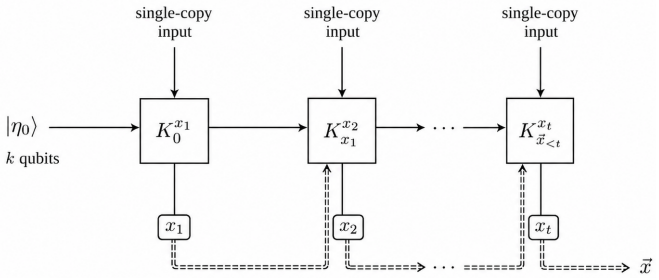
We study stabilizer state testing and learning with limited coherent quantum memory. Here an algorithm sequentially receives copies of an unknown $n$-qubit state, but may keep only $k$ qubits of coherent quantum memory between measurements. With unrestricted memory, seminal work of Gross, Nezami and Walter showed how to test $n$-qubit stabilizer states using $6$ copies, which is dimension independent, unlike the learning complexity of $\Theta(n)$. We show that this testing-vs-learning separation is lost under memory constraints. More concretely we show that
(1) The sample complexity of testing stabilizer states in the $k$-qubit memory framework is $\Theta(n-k)$. Our upper bound goes via a novel connection to the hidden shift problem and the lower bound is proven using a novel approach to average case bounds on likelihood ratios via combinatorics of the stochastic orthogonal group.
(2) The sample complexity of learning stabilizer states with $k$ qubits of memory, in the non-adaptive framework, is $\Theta(n^2/k)$.
As a further application of our techniques, we prove an exponential lower bound for purity testing even when the memory may be left coherent throughout the protocol. Our main results identify coherent quantum memory as the resource enabling the usual separation between stabilizer testing and learning. In particular, even with $k=0.99n$ qubits of memory, there is no constant-copy stabilizer tester; furthermore for $k=cn$ qubits of memory (for $0< c < 1$), stabilizer testing is as hard as learning, with both requiring $\Theta(n)$ copies.
Generalized ranks control arithmetic circuit complexity in constant multilinearity and recover Strassen's bilinear result.
abstractclick to expand
Strassen's theory of bilinear complexity provides a mathematical characterization of the arithmetic complexity of primitives such as matrix multiplication via the rank of tensors. However, the connection to tensor rank is known to break down in higher degrees of multilinearity.
In this work, we highlight an unexplored connection between a generalized notion of tensor rank, which can be defined in Naslund's framework of partition ranks (JCTA 2020), and multiplicative complexity. These partition ranks allow us to control the multiplicative complexity, and thus arithmetic complexity, in any constant degree of multilinearity from below, while recovering Strassen's seminal characterization in the bilinear case. This enables novel potential applications of the rank-based approaches to problems in fine-grained algorithms and complexity, such as the hyperclique conjecture of Lincoln-Williams-Vassilevska Williams (SODA 2018). Moreover, we exhibit connections to established notions of rank, such as tensor slice rank (in the sense of Tao and Sawin), as well as its symmetric variant. For computing the latter symmetric variant, we point out a simple NP-hardness proof, contrasting the rather involved NP-hardness proof for ordinary, non-symmetric tensor slice rank by Bl\"aser et al. (SODA 2021).
Indistinguishable SAT/UNSAT pairs force wide clauses in Resolution and push proof size toward 2^N.
abstractclick to expand
Self-reference and solution independence are core properties underlying intractability. This paper establishes a finite combinatorial analogue of G\"odel's incompleteness theorems within Boolean $K$-SAT. While standard random $K$-SAT has assignment correlations that disrupt solution independence, we resolve this via a logarithmic-width ensemble ($K = O(\log N)$). Here, satisfying assignments converge to a Poisson distribution, letting unsatisfiable and uniquely satisfiable formulas coexist. By executing a single-clause substitution conditioned on the unique solution, we construct structurally irreducible SAT/UNSAT pairs that are indistinguishable via local evaluation.
Using algorithmic information theory and Shannon channels, we prove that deductive pipelines restricted to a sublinear window suffer from an informational blind spot, forcing a descriptive lower bound of $K(\mathcal{A}) \geq \Omega(N^{1-\delta})$. This deficit forces any Resolution refutation of the UNSAT instance to utilize wide clauses ($w(\pi) \geq \Omega(N^{1-\delta})$), triggering an exponential proof-tree explosion ($S(\phi) \geq \exp(\Omega(N^{1-2\delta}))$). As $\delta \rightarrow 0^+$, this bound converges to the worst-case $2^N$ threshold, reframing the Strong Exponential Time Hypothesis (SETH) as a direct projection of G\"odel incompleteness onto finite computation.
We diagnose the decades-long stagnation in complexity theory. Transitioning from Turing's class separation to a G\"odelian paradigm of instance indistinguishability, we introduce a multi-dimensional comparative framework that contrasts these two historical lineages across distinct perspectives. The self-referential hardness exhibits physical invariance: it precludes quantum shortcuts due to the necessity of global semantic analysis and delineates a scaling bottleneck for machine learning architectures operating on lossy, local compression.
This is more samples than needed for monotone distributions but far less than the quadratic cost of naive reduction to monotone case.
abstractclick to expand
We initiate the study of *unate distributions* over $\{\pm1\}^n$ -- a natural analogue of unate Boolean functions -- by considering two basic testing problems that parallel well-studied questions for monotone distributions:
- Uniformity Testing of Unate Distributions: We show that $\widetilde{\Theta}(n^{3/2})$ samples are sufficient and necessary, in contrast to the $\widetilde{\Theta}(n)$ sample complexity of the analogous problem for monotone distributions (Rubinfeld and Servedio, STOC 2005; Adamaszek, Czumaj, and Sohler, SODA 2010).
- Unateness Testing of Arbitrary Distributions: We give a tester that uses $\widetilde{O}(n^{3/2})$ conditional samples in the subcube conditional model. On the other hand, every tester that draws conditional samples in a similar fashion, namely from $O(1)$-dimensional subcubes, must have an $\widetilde{\Omega}(n^{2/3})$ complexity. In the same model, the complexity of monotonicity testing was recently shown to be $\widetilde{\Theta}(n)$ (Chakrabarty et al., STOC 2025).
Our algorithms for both problems significantly outperform the naive approach of reducing to the monotone case, which would incur $\Omega(n^2)$ sample complexity. Our uniformity tester relies on a subroutine that "weakly" learns the hidden orientations of a unate distribution, together with a new correlation bound for these estimates. Both tools may be of independent interest in studying monotonicity and unateness over $\{\pm1\}^n$.
This moves the Cobham-Edmonds thesis from a claim of practical utility to one backed by the same style of justification used for computabili
abstractclick to expand
While the Church-Turing thesis asserts that effective calculability explicates to sets decidable by a Turing machine, the Cobham-Edmonds thesis asserts that feasible computation explicates to the complexity class $\mathsf{P}$, those decidable by a polynomial-time bounded Turing machine. The Church-Turing thesis has been placed under rigorous scrutiny and has several convincing arguments in its favor, but the Cobham-Edmonds thesis has not undergone a similar examination. Many of the arguments in its favor simply suggest that $\mathsf{P}$ is a useful assumption, rather than a necessary target. This paper presents analogous arguments in favor of the Cobham-Edmonds thesis.
A circulant determinant of degree at most n(n-1) marks all bad parameters, enabling a fully deterministic search at the stated cost.
abstractclick to expand
Let $\mathsf{E}=\mathbb F_q[x]/(\Gamma)$ be an algebraic extension of degree $n$ over the finite field $\mathbb F_q$, given by a $\Gamma\in\mathbb F_q[x]$ monic and irreducible. It is classical that any such $\mathsf{E}$ contains an element $\beta\in\mathsf{E}$ that is normal over $\mathbb F_q$, i.e., the conjugates $\beta,\beta^q,\ldots,\beta^{q^{n-1}}$ form an $\mathbb F_q$-basis of $\mathsf{E}$. In this paper we give a deterministic algorithm which finds such a normal element using $O_\epsilon((n^2\log q)^{1+\epsilon})+O\,\tilde{}\,(n\log^2 q)$ bit operations, for any $\epsilon>0$.
The algorithm works by showing that, for a parameter $t\in\mathbb F_q$, the element $\beta_t=(\theta-t)^{-1}$ is normal except for at most $n(n-1)$ values of $t$. This is established by constructing a "cleared Moore" circulant matrix over $\mathbb F_{q^n}[\mathcal T]$, whose determinant degree at most $n(n-1)$, such that $\beta_t$ is normal if and only the determinant is non-zero at $t\in\mathbb F_q$. For faster computation over the base field, we replace this by an equivalent trace Gram circulant matrix over $\mathbb F_q[\mathcal T]$.
A main algorithmic contribution is a fast determinant algorithm for circulant matrices of polynomials, which uses triangular set projection and modular composition techniques to achieve a near-linear cost. Given an $n\times n$ circulant matrix over $\mathbb F_q[t]$ whose entries have degree at most $m>0$, we show how to compute its determinant deterministically with $O_\epsilon((nm\log q)^{1+\epsilon})$ bit operations. We complete the solution by showing how to extend this to finite fields of size less than $n(n-1)$, through an embedding in a low-degree extension field, at poly-logarithmic additional cost.
New NP-completeness result on planar subdivisions completes the map for all minor-free and H-free classes.
abstractclick to expand
The Chromatic Sum problem asks, given a graph $G$ and an integer $k$, whether $G$ admits a colouring $c$ with sum $\sum_{v\in V}c(v) \leq k$. We study the complexity of Chromatic Sum on graph classes defined by some set of forbidden graphs. First, we show that three known frameworks fully classify the complexity of Chromatic Sum on $HH$-minor-free graphs and $HH$-topological-minor-free graphs for any set of graphs $HH$, and on $HH$-subgraph-free graphs for any finite set of graphs $HH$. To show this, we prove a new NP-completeness result for Chromatic Sum on certain subdivisions of planar subcubic graphs. Next, we consider other containment relations. We formalise a novel framework of problems that are NP-complete for planar graphs as well as for graphs of bounded independence number. For every problem in this framework, we obtain an almost complete complexity classification on $H$-induced-minor-free graphs, $H$-induced-topological-minor-free graphs, and $H$-free graphs for every graph $H$. We show that Chromatic Sum belongs to this framework, as do several other problems. We also define a more fine-grained framework for the induced subgraph relation. We apply this to obtain a complete complexity classification for Chromatic Sum on $H$-free graphs, as well as for several other problems. We justify the choice of this framework by proving that Chromatic Sum is NP-complete for graphs of clique-width at most $3$. This result complements a known polynomial-time result for graphs of clique-width at most $2$.
Nearly matches the existing n^{O(1/log log n)} approximation and holds even with a provided 4-sequence.
abstractclick to expand
For every $\varepsilon > 0$, Max Independent Set admits a polynomial-time $n^\varepsilon$-approximation algorithm on $n$-vertex graphs of effectively bounded twin-width [Berg\'e et al., STACS '23]. The approximation factor actually obtained is more precisely $n^{O(1/ \log \log n)}$. Prior to the current paper, no approximation hardness was known for this problem, and the existence of a polynomial-time approximation scheme (PTAS) was repeatedly raised as an open question. We answer this question in a strong sense: We show that there is a constant $\gamma > 0$ such that a polynomial-time $n^{\gamma/ (\log \log n)^2}$-approximation algorithm for Max Independent Set on graphs of twin-width at most 4 would refute the Exponential-Time Hypothesis (ETH). This lower bound further holds if a 4-sequence is provided as part of the input. We show the same hardness of approximation for Min Coloring, which also has a nearly matching $n^{O(1/ \log \log n)}$-approximation algorithm on graphs of effectively bounded twin-width.
We also clarify the parameterized complexity of $k$-Independent Set on graphs of bounded radius-$r$ merge-width when the range of $r$ is limited. There is a fixed-parameter tractable algorithm for $k$-Independent Set on graphs given with radius-$2^{O(k^2)}$ merge sequences of bounded width [Dreier and Toru\'nczyk, STOC '25]. We complement this result by showing that $k$-Independent Set is W[1]-hard on graphs given with radius-$o(k)$ merge sequences of bounded width. We further show that this result also holds for $k$-Dominating Set.
Two-way deterministic versions place the same problems in P while nondeterministic versions remain in ELEMENTARY.
abstractclick to expand
A two-dimensional automaton is able to move its input head through its input word in four directions: upward, downward, leftward, and rightward. If we prevent the input head from moving upward, then we obtain a three-way two-dimensional automaton; preventing both upward and leftward movements results in a two-way two-dimensional automaton. While much is known about the decidability and complexity properties of the two-dimensional automaton model, the unary variant of this model is less studied.
We show that the universality, equivalence, and inclusion problems for unary three-way deterministic two-dimensional automata are coNP-hard, while for the corresponding two-way model, the universality, equivalence, inclusion, and disjointness problems are in P. We further show that the universality, equivalence, and inclusion problems for unary two-way nondeterministic two-dimensional automata are coNP-hard and in ELEMENTARY; and the disjointness problem for the same model is NL-hard and in ELEMENTARY. Finally, we establish the decidability of a bounded variant of the universality problem for unary three-way nondeterministic two-dimensional automata, and show that this variant problem is coNP-complete.
Intuitionistic modal logics (IMLs) comprise many systems: from constructive modal logics such as CK and Wijesekera's CCDL to Fischer Servi/Simpson's IK, as well as some recently introduced variants. All of them are characterized by bi-relational semantics and have complete axiomatisations. However, from the perspective of proof theory and complexity, there are strong differences: while for constructive modal logics simple Gentzen calculi suffice, for IK more complex calculi, based on nested or labelled sequents, are needed. As a consequence, the decision problem for constructive modal logics has a PSPACE upper bound, whereas for IK is not known and it is even conjectured to be non-elementary. We study here the proof theory and complexity of FIK, a natural intuitionistic modal logic recently introduced. FIK is strictly in between CCDL and IK, yet it has the same forcing conditions as IK. We define a "shallow" sequent calculus for FIK which is a nested sequent calculus where sequents have at most one level of nesting. We prove its syntactic completeness by showing the admissibility of cut. By means of this calculus we show that decision problem for FIK is in EXPSPACE, whence significantly lower than the complexity conjectured for IK.
Jerrum and Meeks (TOCT, JCSS 2015) introduced the counting problems $\text{IndSub}(\Phi)$ for fixed graph properties $\Phi$: Given an input graph $G$ and $k\in\mathbb N$, count the $k$-vertex subsets $S \subseteq V(G)$ such that the induced subgraph $G[S]$ satisfies $\Phi$. For recursively enumerable $\Phi$, it is known that $\text{IndSub}(\Phi)$ is either #W[1]-hard or fixed-parameter tractable. A direct classification depending on $\Phi$ however still remains open.
In particular, the status was open for the property of graphs without nontrivial automorphisms, also mentioned in a very recent survey on parameterized counting by Roth (Comput.~Sci.~Rev.~2026). This is a natural property that evades all currently known techniques for proving #W[1]-hardness, including a general toolkit based on Fourier analysis that was very recently introduced by Curticapean and Neuen (SODA~2025). In this paper, we show that counting induced $k$-vertex graphs without nontrivial automorphisms is #W[1]-hard by constructing ``clique scaffolds'', i.e., problem-specific restrictions of the property that enable a reduction from the $k$-clique problem. More generally, we show that for every finite group $Q$, counting $k$-vertex induced subgraphs with automorphism group $Q$ is #W[1]-hard.
gam(x) measures runtime of near-shortest descriptions and can exceed polynomial bounds even when KC is low, with a conditional separation fr
abstractclick to expand
In cryptographic practice, where protocols impose strict time bounds, implementations demand predictable resource usage, and real-world systems require immediate verification for security and usability, a short key or certificate is useful only if it can be expanded or verified within a bounded time; otherwise a compact representation that requires superpolynomial work to expand offers no operational guarantee within a bounded-time protocol. This paper formalises that gap by introducing \emph{witness complexity} \(\gam(x)\), the minimum running time over near-shortest descriptions of a string on a universal Turing machine. \(\gam\) differs from Shannon entropy and Kolmogorov complexity \(\KC\): low \(\KC\) can coexist with high \(\gam\). We prove invariance up to polynomial factors; a conditional separation (assuming \(\PneqNP\)). An unconditional lower bound from incomputability of \(\KC\); a biconditional characterisation of \(\PeqNP\) via the class-relative variant \(\gP\); and polynomial-time tractability for structured \(\classNP\) families. Part II develops companion measures and shows an unconditional gap between grammar size and derivation cost, positioning \(\gam\) as a metric for the usability of keys and certificates.
Abstract memory hierarchy shows per-access costs scale as N to the 1/4 for common apps, distinguishing power-law from exponential miss ratio
abstractclick to expand
Time complexity typically assumes $O(1)$ cost per data access. This paper presents an analysis based on an abstract memory hierarchy. For a common class of applications, it shows that the data-access cost scales with the fourth root of data size, that is, as data size $N$ increases, the cost of each access increases at the rate of $N^\frac{1}{4}$.
While the analysis does not predict performance, it predicts scalability. Specifically, the paper provides a precise analysis that shows the constant-factor difference between cases where the miss ratio follows a power law versus an exponential decay.
A central challenge in quantum algorithms and cryptography is reasoning about algorithms with oracle access to a random group element (e.g. a random function, permutation, or unitary). Can we efficiently simulate such algorithms? Can we determine what they know after t queries? A classical tool for this is lazy sampling: the oracle does not commit to the full group element upfront, but rather samples partial information about it on the fly. We study a quantum analog of lazy sampling: compressed oracles (or recording oracles). These are quantum data structures that allow on-the-fly simulation for quantum queries, originally introduced by Zhandry (CRYPTO '19) for random functions, and generalized to unitaries by Ma-Huang (STOC '25) and permutations by Carolan (STOC '26), and used to great effect in security proofs and lower bounds due to their interpretability.
We define and analyze a general-purpose and interpretable path-recording oracle, derived from first principles, that perfectly simulates random elements of any closed subgroup of $U(N)$. Our oracle stores, in superposition, t input-output pairs, with updates described in terms of the commutant of the group's tensor power representation. This transparently records the information the algorithm has learned. Our oracle builds on recent work of Grinko-Yoshida (QIP '26), who gave a different general-purpose compressed oracle without clear interpretability.
One interesting application of our path-recording is allowing direct comparisons between compressed oracles of different groups, giving a new technique for proving pseudorandomness results. For example, comparing $S_N$ and $U(N)$ yields what is arguably the simplest construction to date of pseudorandom unitaries: the product PC of a pseudorandom permutation and a random Clifford, improving on the prior PFC construction (Metger-Poremba-Sinha-Yuen, FOCS '24; Ma-Huang, STOC '25).
Boolean networks are finite discrete nonlinear systems whose long-term behaviour is organised by fixed-point and cyclic attractors. Detecting such recurrent states is important in applications ranging from gene regulation and neural computation to complex-network models, but the computational boundary between tractable and intractable attractor analysis is still not fully understood. We study that boundary from the perspective of local logical rules. We consider Boolean networks under parallel update whose coordinate functions are given by circuits over a fixed finite basis of a closed Boolean-function class, and ask whether the network has a cyclic attractor of prescribed exact period $k$. For every fixed $k\ge 2$, we obtain a complete complexity dichotomy over Post's lattice. The problem is $\mathrm{NP}$-complete whenever the local rule class contains majority-like self-dual rules or one of the two mixed conjunctive-disjunctive monotone families. In all remaining Post classes it is polynomial-time solvable, with affine rules and pure conjunctive or pure disjunctive rules with constants providing the boundary tractable cases. The results show that exact attractor detection is governed not only by the network architecture but also by the logical mechanism of local update: affine and one-sided rules preserve algebraic or order structure, whereas majority-like and mixed monotone rules can encode global Boolean consistency constraints.
All eight variants show the split, with hardness even on acyclic automata.
abstractclick to expand
Vector Addition System with States (VASS) are a ubiquitous model of infinite-state systems consisting of a set of non-negative counters which can be incremented and decremented. It is known that the reachability problem for VASS is Ackermann-complete. Because of this huge complexity, various over-approximations of VASS have been studied in the literature. One such over-approximation is continuous VASS (CVASS), in which the counters are (non-negative) rational numbers and whenever a vector is added to the current counter values, it is first scaled with an arbitrarily chosen rational factor between zero and one. It is known that the reachability problem for CVASS is $\mathsf{NP}$-complete.
In this paper, we initiate the study of fixed-dimensional CVASS, i.e., CVASS with a fixed number of counters. We study both the reachability and coverability problems, under both unary and binary encodings as well as over both the non-negative and the rational semantics. This gives rise to a collection of eight different problems. As our main result, we prove a complexity dichotomy for all of these eight problems when the transition vectors are over the rationals: For dimension 1, all of the eight problems are in $\mathsf{AC}^1$, whereas for any dimension at least 2, all of the eight problems are $\mathsf{NP}$-complete. Furthermore, the hardness holds even when the underlying automaton is acyclic. To achieve this result, we present a new technique called the Egyptian prime fractions technique.
Finally, we also study these problems when the transition vectors are over the integers. Except for dimension 2, we classify the complexity of these problems over the non-negative semantics: For dimension 1, all of the problems are in $\mathsf{AC}^1$, whereas for dimensions 3 and above, all of the problems are $\mathsf{NP}$-complete.
We study Turn-Based Deterministic Forward Games (TBDFGs), the subclass of turn-based deterministic zero-sum games in which no directed cycle contains actions controlled by both players. This forward condition is strictly weaker than acyclicity: recurrent behavior may be arbitrarily rich within one player's states, while mixed-player feedback cycles are excluded. Our main contribution separates two algorithmic consequences of this structure. First, we analyze the simple strategy-iteration method of [11,14], a generic method for TBSGs whose execution neither tests for nor uses the TBDFG property. We prove that this structure-oblivious algorithm nevertheless has a strongly polynomial guarantee on every TBDFG. In particular, it terminates after at most $O(n^6m^4\log^4 n)$ simplex pivot steps. Thus, the forward property acts as a structural certificate for convergence even when the algorithm is not informed that the input has this property. Second, when the TBDFG structure is known in advance, a backward SCC propagation algorithm is proposed that solves a sequence of deterministic-MDP subproblems and improves the bound to $O(n^3m^2\log^2 n)$ simplex pivot steps. Together, these results show that forward structure both regularizes the convergence of a general strategy-iteration method and supports a sharper structure-aware algorithm.
Local-to-global method proves the result whenever links satisfy it, plus a weaker version for any expanding complex.
abstractclick to expand
The KKL Theorem, a seminal result in boolean function analysis, characterizes the structure of low-influence (non-expanding) functions on the hypercube. While recent years have seen breakthrough results across a variety of areas relying on analogs of the KKL Theorem beyond the cube (e.g., on product spaces, Grassmann graphs), further progress has been inhibited by our poor understanding of the phenomenon across more general domains. Motivated in this context, Bafna, Hopkins, Kaufman, and Lovett (STOC 2022) and Gur, Lifshitz, and Liu (STOC 2022) proved a generalized KKL-type Theorem for spectral high dimensional expanders (HDX). Their results, however, remain highly restricted due to strong quantitative expansion requirements on the underlying complex.
In this work, we introduce a simple local-to-global method for analyzing low influence functions on simplicial complexes. Using this method we prove a local-to-global KKL-type Theorem: any simplicial complex whose links satisfy a KKL-Theorem also satisfies such a result globally. Building on Gotlib and Kaufman (RANDOM 2023), we also prove a weaker dimension-dependent KKL-type Theorem for simplicial complexes with any non-trivial (two-sided) expansion. As concrete applications of our framework, we give the first characterization of non-expanding functions on `combinatorial' HDX such as dense clique complexes and a corresponding Kruskal-Katona Theorem, as well as a small-set expansion theorem for the Ramanujan Complexes of Lubotzky, Samuels, and Vishne (EJC '05).
We study the computational complexity of several counting problems on graphs. Each of these problems consists of counting orderings of the vertices or edges with adjacency constraints. We show $\#P$-completeness for all of them via a common new technique. Given a counting function $C$ of interest, we define a parameterized family of instances $G_q$, where the parameter $q$ controls the amplification of a simple gadget. After multiplying by an explicit factor $f(q)$, we show that the values of $f(q) \cdot C(G_q)$, for positive integers $q$, agree with a rational function in $q$ whose numerator and denominator can be interpolated in polynomial time. We then recover a $\#P$-hard function by evaluating this rational function symbolically at a limiting value $L \in \mathbb{Q} \cup \{\infty, -\infty\}$. With this methodology, we show $\#P$-completeness for the following counting problems: (a) successive vertex orderings of bipartite graphs, (b) st-numberings of graphs, (c) shellings of bipartite graphs, (d) linear extensions of N-free posets of height $3$, and (e) linear extensions of posets of height $2$. Result (d) settles a conjecture of Felsner and Manneville (2015). Although result (e) was first proved by Dittmer and Pak (2018), we include an alternative proof, using our technique, that does not rely on the result of Brightwell and Winkler (1991) about the hardness of counting linear extensions for general posets.
This paper explores the hardness of two popular recreational chess puzzles: The Knight's Tour and the Knight Exchange (Swap). The problem of finding a Knight's Tour is known to be NP-hard for any chessboard with holes and constant-time decidable for rectangular chessboards, so a natural direction is to explore the hardness of the problem for intermediate chessboard restrictions. In this paper, we show that Knight's Tour is NP-hard for connected boards. We also give a short polynomial-time reduction between the two problems, showing that the optimality version of Knight Exchange is NP-hard.
Quoridor is a popular award-winning board game whose computational complexity, listed among the open problems of the Demaine-Hearn survey, remained open for nearly two decades. It was settled only recently, via a reduction from the formula game $G_{pos}$ tailored to Quoridor. We give a shorter and more general proof: a single reduction from Reisch's planar graph-Hex, in which wall placement encodes the path-connection structure of Hex. The same construction settles three closely related games -- Maze Attack and Pinko Pallino with no change, and Blockade with only minor adaptations -- showing that all four are PSPACE-complete, the latter three for the first time. More generally, our reduction shows that any race-and-wall game is PSPACE-complete.
Two theorems reduce verification to known logical barriers, forcing tradeoffs in soundness, completeness or tractability.
abstractclick to expand
This article establishes the foundational mathematical limits of Artificial General Intelligence (AGI) safety, proving that the core barrier is not the impossibility of an aligned state, but its structural unverifiability. We formalize this boundary through two central impossibility results: the Unverifiability Theorem of Alignment and the Theorem of Finite Structural Unverifiability of AGI Alignment. We ground this boundary at Trakhtenbrot's Wall, demonstrating that contemporary engineering defenses relying on finite hardware or halting architectures fail to escape logical obstructions. This failure manifests as an inescapable triad of containment failures: open domains yield fundamental undecidability (Rice and G\"odel); universal finite verification collapses into algorithmic incomputability (Trakhtenbrot); and particular bounded environments trap the supervisor within intractable bounds in the worst case. As a direct structural corollary of these results, we derive the Soundness--Completeness--Tractability Trilemma, establishing that the mutual incompatibility of these three properties is a necessary consequence of descriptive complexity rather than an empirical anomaly. Finally, we map these theoretical bounds onto practical AI engineering, demonstrating that modern containment strategies are not temporary patches, but mandatory sacrifices of logical expressivity required to secure decidable fragments of safety.
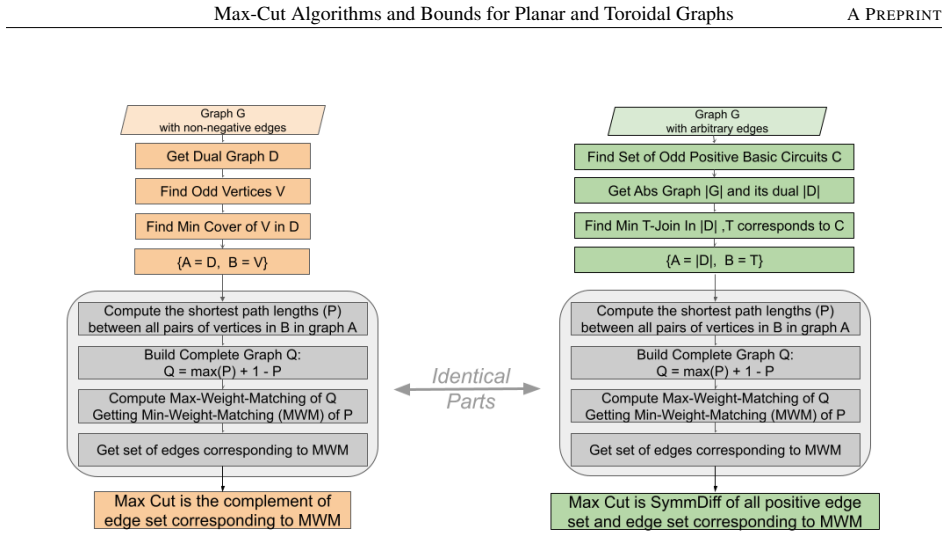
We demonstrate that the problem of finding the maximum cut of a planar graph with arbitrary weights can be easily mapped to a minimum T-join problem in the absolute dual graph - the dual graph with absolute weights, as opposed to the known mapping to a maximum T-join problem with an empty set in the dual graph. By enabling the use of the shortest paths, this approach allows for the straightforward adaptation of the first efficient Max-Cut algorithm, designed by Hadlock in 1975 for planar graphs with non-negative weights, to handle the general case of planar graphs with arbitrary weights. Furthermore, we prove that applying a planar Max-Cut algorithm to a higher genus graph, such as a toroidal graph, while disregarding its topology, provides an upper bound for its maximum cut. Employing this methodology, we derive upper bounds for the maximum cut across all toroidal graphs within the GSet benchmark. We report that the known maximum cut values for part of those GSet toroidal problems including the three largest instances, which were previously documented in the literature, are the maximum possible because they match their upper bound values. Additionally, we introduce a novel heuristic algorithm for finding Max-Cut of toroidal graphs, which is based on the planar graph algorithm. Applying this algorithm to all seventeen toroidal Max-Cut problems in the GSet benchmark successfully reproduces all the best-known results, and for problem #62, it yields a new, previously unknown best Max-Cut value.
We introduce a new family of propositional proof systems, denoted <EF, R>, for an arbitrary TFNP search problem $R$. Informally, a refutation of a CNF formula $F$ in <EF, R> is given by a polynomial-time reduction from the false-clause search problem $Search_F$ to $R$, combined with an Extended Frege proof that the reduction is correct. These are motivated in two ways:
1. They are the propositional translations of witnessing theorems in bounded arithmetic, by which proofs of $\forall \Sigma^b_1$ formulas $\phi$ in a theory $T$ imply algorithms solving the search problem for $\phi$ in a TFNP class corresponding to $T$.
2. They are a white-box analogue of the characterizations of proof systems using decision tree reductions to black-box TFNP problems.
We consider the proof system <EF, Iter>, where Iter is a complete problem for PLS. We prove that <EF, Iter> is polynomially equivalent to the sequent calculus $G_1$, and also to the implicit Resolution proof system [EF, Resolution]. Hence $G_1$ and [EF, Resolution] are equivalent, which is the first characterization of an implicit proof system by a classical proof system beyond the work of Wang.
We also consider <EF, R> for general TFNP relations $R$. We observe that if EF can prove that a search problem $R$ is in FP, then <EF, R> is polynomially equivalent to EF. This contrasts to our above result, which shows that Extended-Frege provable reductions to $Iter$, a problem widely believed not to be in FP, yields a proof system ($G_1$) that is believed to be stronger than Extended Frege.
Finally, we show that for any proof system $P$ which is sufficiently strong, there is a polynomial-time computable search problem $R_P \in $ FP such that <EF, $R_P$> is polynomially equivalent to $P$. Letting $P =$ [EF, Resolution] and combining our two results shows that <EF, Iter> is polynomially equivalent to <EF, $R_{[EF, Resolution]}$>.
First Word-RAM speedups for All-Edges Sparse Triangle, Monochromatic Triangle, and Exact Triangle via circuit and communication techniques.
abstractclick to expand
For several well-studied triangle detection problems in the literature, the trivial enumeration algorithms are known to be optimal (up to the exponent) assuming popular fine-grained conjectures. For example, All-Edges Sparse Triangle and Sparse Monochromatic Triangle where each node has degree $n^{\delta}$ for some $\delta < 1$, and the Exact Triangle where edges have arbitrary weights, all have this property under the 3SUM Conjecture. However, as there are slightly nontrivial algorithms for 3SUM, it is natural to wonder if the trivial algorithm for these tricky triangle tasks might also be improved.
Applying a variety of techniques from randomized algorithms, circuit complexity, and communication complexity, we present the first improvements over the trivial algorithms for each of these problems in the Word RAM model. Moreover, our algorithms can be implemented with only polysize $AC0$ operations on words. Extending our techniques, we also show how to solve the notorious 4-cycle detection problem on $n$-node graphs in $o(n^2)$ time, in a Word-RAM model with word size $w > \omega(\log^2 n)$. Along the way, we show how to sort $n$ items over a universe of size $2^u$ using only $AC0$ word operations in $O(n u \log n)/w$ time.
Produces constant-depth circuit list containing every factor in poly(n, s^d) time over large or zero characteristic fields
abstractclick to expand
We study factoring algorithms for general sparse polynomials and sparse polynomials of bounded individual degree and prove the following results.
1. We give a deterministic polynomial-time algorithm which takes as input an $n$-variate $s$-sparse polynomial $f$ of bounded individual degree $d$ and outputs a list of circuits which contains all factors of $f$, although there might be additional spurious circuits in the list. The algorithm runs in time $\operatorname{poly}(n, s^d)$. Additionally, every circuit in the list has constant depth. Our algorithm works over all fields of characteristic 0 or sufficiently large characteristic.
Our result generalizes a recent result of Chuyoon and Shpilka that gives a $\operatorname{poly}(n, s^d)$-time algorithm for recovering all sparse factors of $f$ (without spurious factors). As a corollary, we can also recover all factors of $f$ in time $\operatorname{poly}(n, s^{d^2 \log n})$, and recover the algorithmic result of Bhargava, Saraf and Volkovich and its improvement by Chuyoon and Shpilka. Both the above consequences follow from known interpolation and divisibility testing techniques.
2. We give a deterministic quasipolynomial-time algorithm which takes as input a general $n$-variate $s$-sparse polynomial $f$ of (unbounded) individual degree $D$ and outputs a list of polynomials which contains all factors of $f$ that have bounded individual degree $d$. The algorithm runs in time $\operatorname{poly}(D^{d \log s}, s^{d^2 \log n})$ and works over arbitrary fields. The list may again contain spurious elements. Our result strengthens results of Dutta, Sinhababu and Thierauf and Kumar, Ramanathan and Saptharishi which give algorithms to recover all factors of $f$ of bounded total degree.
A consequence of our algorithm is a new upper bound on the total number of bounded individual degree factors of a sparse polynomial.
Extending Impagliazzo's classification with an orthogonal observational axis produces unconditional collapses that separate what parties can
abstractclick to expand
Impagliazzo's five worlds classify computational assumptions along a single axis, the existence of cryptographic primitives. All five worlds implicitly assume that every party, including the adversary, observes the full input, that the observer is always $O_{top}$. This assumption is so natural that it is never stated. This work makes it explicit and relaxes it by introducing a second, orthogonal axis, the observational axis, defined by the observer hierarchy introduced in previous work. Relaxing the assumption reveals structural phenomena, such as the collapse $P^{O_{prof}} = NP^{O_{prof}} \subset P$, that the five-world framework cannot express. We prove that this collapse holds unconditionally in all five worlds, showing that observational blindness and computational hardness are independent. We define the Observer World $W_O$, classify all world-observer pairs, identify the labeled cells (a)--(d), and introduce a parametric family $W_O^{\varepsilon}$ modelling partial violations of observational invariants. The framework also interfaces with physical information limits, including thermodynamic, quantum, and cosmological bounds.
Determining whether predicting two-dimensional sandpiles lies in $\mathbf{NC}$ or is $\mathbf{P}$-complete has been open for decades. Moore and Nilsson proved $\mathbf{P}$-completeness for the three dimensional case by encoding Boolean circuits into sandpiles, but this method fails in two dimension due to the impossibility of crossing gates.
In this work, we study the existence of crossing gates on non-uniform and weighted grids. We establish an equivalence between uniform weighted crossing gates and a class of simple non-uniform crossing gates, which we call primal. We also exhibit a crossing gate that inherently requires more than one crossing, rather than a single crossing as in standard constructions. Finally, we show that the equivalence between uniform weighted and primal crossings breaks down in more general settings.
In the past literature, families of two-way finite automata and pushdown automata having limited state complexity (i.e., the total number of inner states) and stack-state complexity (i.e., the total number of inner states multiplied by the total number of strings "pushable" to a stack), have been studied in direct connection to (mainstream) space-bounded complexity classes equipped with Karp-Lipton style advice of limited size when all inputs given to the automata have bounded length. Here, we acknowledge two major factors -- size and ceiling -- of such families, which have a significant impact on the complexity of finite and pushdown automata families, where the "size" refers to (stack-)state complexity and the "ceiling" refers to an input's length bound. In this line of study, we further explore those effects caused by different sizes and ceilings.
Downward self-reducibility produces circuit identities that support the black-box test over fields with mild constraints.
abstractclick to expand
The Hamiltonian Cycle polynomial, denoted as $HC_n$, is defined to be the sum of the weighted Hamiltonian Cycles in an $n$-vertex complete digraph, with vertices labeled $1$ to $n$ and edges weighted by formal variables $x_{i,j}$. Valiant (STOC 1979) studied the Permanent and $HC$, defined as the family $\{HC_n | \ n \geq 1\}$, and showed both families are VNP-complete, the former over any field of characteristic other than $2$, and the latter over any field. Since its introduction, $HC$ has been studied from the perspective of lower bounds by Jerrum-Snir (JACM 1982), determinantal complexity by Huttenhain-Ikenmeyer (LAA 2016), and its relation to the Permanent by Goulden-Jackson (EJC 1981) and Grochow (ToC 2017). Its VNP-completeness over any field has been used in Malod (CCC 2007), Grochow-Mulmuley-Qiao (ICALP 2016) and Hrubes (ToCT, 2016).
The Equivalence Testing problem for a polynomial $f(\mathbf{x})$ (ET for $f$) is as follows: Given $g(\mathbf{x}) \in \mathbb{F}[\mathbf{x}]$ as a black box, decide if there exists $A \in \mathrm{GL}_{|\mathbf{x}|}(\mathbb{F})$ such that $g = f(A\mathbf{x})$. Kayal (STOC 2012) gave a randomised polynomial time ET algorithm for the Permanent. In this work, we give a randomised polynomial time ET algorithm for $HC$ with mild constraints on the field. We show that, like the Permanent polynomial, the symmetries of $HC_n$ are generated by permutation and scaling matrices over large enough fields. We also show that $HC_n$ is not characterised by its symmetries, unlike the Permanent polynomial, Mulmuley-Sohoni (SIAM J. Computing, 2001). Nevertheless, like the Permanent polynomial, $HC_n$ is downward self-reducible, Zhang-Bai (TCS 2011), implying $HC_n$ is characterised by circuit identities and an efficient algorithm to test if a given circuit $\mathrm{C}$ computes $HC_n$. We also get a Flip theorem for $HC_n$ as a result of its circuit identities.
In this paper, we formulate a scenario that an agent can never be sure that another agent can uniquely determine the state of a finite-state automaton based on its observations to the automaton at the current and any past time as the property of order-2 bygone-state opacity. Based on our concurrent composition and the classical observer, we derive a tool to verify this property in doubly exponential time. The interest of this result lies in that we extend inference of finite automata from a single agent to two ordered agents.
Polynomial spaces of symmetric circuit size n^Θ(k) distinguish non-isomorphic graphs exactly as Θ(k)-WL does.
abstractclick to expand
We introduce an approach to distinguishing isomorphism types of graphs based on vector spaces of polynomials that are set-wise invariant under permutations ("separating modules," which are representations of the symmetric group), inspired by the Geometric Complexity Theory approach to separating complexity classes (Mulmuley & Sohoni, SIAM J. Comput., 2001). We characterize the power of this method for distinguishing non-isomorphic graphs under several different complexity measures:
- We show that separating modules of "support-degree" $k$ (each monomial touches at most $k$ vertices) are equivalent to the counts of $O(k)$-vertex subgraphs. This is strictly weaker than $O(k)$-dimensional Weisfeiler--Leman (F\"urer, ICALP '01).
- We show that separating modules of symmetric circuit size $n^{\Theta(k)}$ are equivalent to $\Theta(k)$-WL. This generalizes and strengthens a result of Dawar & Wilsenach (CSL '18; ICALP '20; ACM Trans. Comput. Log., 2022; Theory Comput., 2025): they proved one direction of this equivalence for invariant polynomials; we generalize to separating modules and prove both directions.
- When considering only the multiplicities of separating modules (as was proposed in GCT by Mulmuley & Sohoni, ibid., rather than the polynomials themselves), we show that two graphs are separated by multiplicities if and only if their automorphism groups have different cycle indices.
The latter result is notable in the analogy with GCT, as it is the only result we are aware of in which the multiplicity approach to separating isomorphism types of objects has been given an "intrinsic" characterization in terms of the objects themselves. We use this to show that for graphs, multiplicity obstructions are stronger than occurrence obstructions. We also connect invariant polynomials to the Graph Reconstruction Conjectures and Forman's "invariants of finite type" (Adv. Math., 2004).
We consider the problem of estimating the fidelity of an unknown quantum state to a known reference state to within additive error $\varepsilon$. We show that the sample complexity is $O(r^2/\varepsilon^2)$ with optimal $\varepsilon$-dependence when the reference state is of rank $r$, improving the previous best $O(r^2\log^2(1/\varepsilon)/\varepsilon^4)$ due to Utsumi, Nakata, Wang, and Takagi (QIP 2026). We also provide a lower bound of $\Omega(r/\varepsilon^2)$, improving the previous best $\Omega(r/\varepsilon+1/\varepsilon^2)$, with implications to quantum query complexity. Moreover, we further consider the case where the unknown state is of rank at most $r$ while the reference state can be arbitrary, for which the sample complexity is shown to be $O(r^2/\varepsilon^4)$. As an application, we present an approach to tolerant quantum state certification, generalizing the exact certification studied in B\u{a}descu, O'Donnell, and Wright (STOC 2019).
Small-symmetry resolution forms strict hierarchies that beat plain resolution and separate from constant-depth Frege
abstractclick to expand
Resolution with symmetries is a natural extension of the Resolution proof system that allows to use symmetries of the formula to simplify the proof. Symmetries can be global (applied to the whole input formula), local (applied to a subformula), or dynamic (applied to newly derived clauses as well). The framework of Resolution with (global) symmetries was introduced by Krishnamurthy (1985) and further extended by Arai and Urquhart (2000) to local symmetries. Later, Szeider (2005) generalized this approach to homomorphisms and introduced the notion of Resolution with dynamic symmetries. While proving superpolynomial proof-size lower bounds for Resolution with dynamic symmetries remains an open problem already for two decades, the power of proof systems with global and local symmetries is well studied: exponential lower bounds have been proven for these proof systems, as well as exponential separations between all of them. However, these systems are too general to reflect practical applications since it is computationally too hard to find and efficiently exploit arbitrary symmetries.
In this work, we introduce the notion of small symmetries: symmetries that can operate on a limited number of variables at the same time. Resolution with small symmetries gives hopes both for practical applications and for theoretical study of dynamic symmetries. We show that proof systems with both local and global small symmetries form strict hierarchies w.r.t. the size of symmetries. We prove exponential separations between proof systems with symmetries of different sizes and types. It turns out that even lower levels of these hierarchies are exponentially separated from Resolution and stronger proof systems, such as constant-depth Frege. As a byproduct of our constructions, we obtain an exponential separation between the classical systems SRCI and SRII that was not known before.
Several fundamental problems in computational geometry admit algorithms with running time $f(d) \cdot n^{2-\Theta(1/d)}$ for $n$ points in $d$ dimensions, making them among the most prominent examples of barely subquadratic computation. Notable members of this class include Furthest Pair, Bichromatic Closest Pair, (Bichromatic) Maximum Innter Product, and Hopcroft's Problem. Chen [Theory Comput. 2020] proved that, assuming the Strong Exponential Time Hypothesis (SETH), these problems require $n^{2-o(1)}$ time when the dimension satisfies $d=2^{\Theta(\log^* n)}$. We extend this lower bound to all efficiently constructible dimensions $d=\omega(1)$. Thus, assuming SETH, the dependence of the best known algorithms on the dimension is essentially unavoidable. The proof utilizes techniques in OpenAI's recent disproof of the Erdos unit distance conjecture.
The proof was initially discovered by ChatGPT 5.5 Pro. The authors have validated and substantially edited the proof to improve the presentation.
A point-line construction over the reals achieves constant randomized complexity but linear deterministic complexity even with equality orac
abstractclick to expand
We construct a point-line incidence problem over the reals whose randomized communication complexity is constant, but whose deterministic communication complexity is linear even when the players have access to an equality oracle. This is the strongest possible separation between these two measures, and it improves on an earlier $O(1)$-versus-$\Omega(\sqrt{n})$ separation of G\"o\"os, Harms, and Riazanov.
Because point-line incidence problems have constant sign rank, our construction also bears on a question of Harms and Zamaraev, who asked whether constant sign rank together with constant randomized communication complexity forces constant equality-oracle complexity. This was already refuted by G\"o\"os, Harms, Imbach, and Sokolov with a logarithmic lower bound; our example improves the separation to linear, which is optimal.
The proof draws on a construction in the recent disproof of the sum-product conjecture over the reals by Bloom, Sawin, Schildkraut, and Zhelezov, using totally real number fields of large degree and small discriminant.
Intractability of polynomial-system feasibility transfers to hardness of permanent evaluation without constants.
abstractclick to expand
We study the logical relation of the P-NP separation conjecture in the Blum-Shub-Smale-model over the complex numbers with the P-NP separation conjecture in Valiant's algebraic model. This amounts to comparing Hilbert's Nullstellensatz Problem, that is, deciding feasibility of a given system of polynomial equations over the complex numbers, with the problem of evaluating the permanent of a given complex matrix. We compare the respective uniform models of computations and prove that $P_C\ne NP_C$ in the Blum-Shub-Smale-model over $C$ implies the separation $VP^0(u)\ne VNP^0(u)$ of the uniform versions of Valiant's constant-free complexity classes over $C$. For the nonuniform models we show the analogous implication: the separation $P^0_C(nu)\ne NP^0_C(nu)$ of the nonuniform, constant-free Blum-Shub-Smale classes over $C$ implies the separation $VP^0\ne VNP^0$ of Valiant's constant-free complexity classes over $C$. In the reverse direction, we conjecture that $VNP_C\not\subseteq\overline{VP}_C$ implies that $P_C(nu)\ne NP_C(nu)$.
A polynomial-time Turing-machine algorithm decides whether a polynomial is close to a sum of squares and finds an epsilon-close one when it
abstractclick to expand
In this paper, we analyze the bit complexity of deciding whether a given polynomial can be represented as a sum of squares of polynomials. We show that the weak membership problem for the sum-of-squares cone lies in $\mathrm{P}$. Furthermore, we give a polynomial-time algorithm which computes, for a given polynomial and positive parameter $\epsilon$, an $\epsilon$-relaxed closest sum-of-squares polynomial.
Algorithm nearly matches the 1985 lower bound and resolves the open parallel-complexity question.
abstractclick to expand
We settle the classic question of the parallel complexity of computing a matroid basis, as first posed in the seminal work of Karp, Upfal, and Wigderson (FOCS 1985, JCSS 1988). Our algorithm runs in $O(n^{1/3}\log^{1/3}n)$ rounds, matching the lower bound of KUW up to a $\log^{2/3}(n)$ factor.
For many information processing tasks, de Finetti-style theorems can often simplify the analysis in worst-case input scenarios for which the task exhibits some permutation-invariance symmetry, as they can allow for a reduction from an analysis on worst-case inputs to that of i.i.d. inputs. If further information is available on the inputs, it might be advantageous to reflect this information in the de Finetti reduction. In our work, we focus on a form of such constraint, based on the type of the input. This allows us to obtain a conceptually simple proof of a new de Finetti reduction for classical probability distributions, derived from elementary properties from the method of types. We apply our constrained de Finetti reduction to the compression of quantum interactive communication protocols with classical inputs, and prove that the prior-free quantum information cost equals the worst-case input amortized quantum communication cost.
Rates just above list-decoding capacity give uniform intersections with all radius-ρ balls and all rectangles.
abstractclick to expand
We prove that random linear codes have nearly optimal discrepancy properties in a broad range of regimes. Our main results are two general theorems: one controlling all translates of a fixed test, and another controlling large families of Fourier-pseudorandom tests. Two motivating applications follow.
First, random linear codes match unstructured random codes for list-decoding from errors above capacity. If $C\subseteq\mathbb F_q^n$ is a random linear code of rate $1-\frac1n\log_q |B_\rho|+\epsilon$, where $B_\rho$ is a radius-$\rho$ Hamming ball, then with high probability $$ |C\cap B|=(1\pm o(1))\frac{|C||B|}{q^n} $$ simultaneously for all radius-$\rho$ Hamming balls $B\subseteq\mathbb F_q^n$. This extends the classical result that such codes have covering radius at most $\rho n$ whp (Blinovsky, 1987).
Second, over prime fields, random linear codes match unstructured random codes for zero-error list-recovery above capacity. For prime $q>2$ and $2\le \ell\le q-1$, a random linear code of rate $1-\log_q\ell+\epsilon$ satisfies, with high probability, $$ |C\cap S|=(1\pm o(1))\frac{|C|\ell^n}{q^n} $$ simultaneously for all rectangles $S=S_1\times\cdots\times S_n$ with $|S_i|=\ell$. As a consequence, there are abundant $n$-party linear ramp secret sharing schemes over $\mathbb F_q$ with privacy threshold about $n/(2\log q)$ and reconstruction threshold about $5n/(2\log q)$, resilient to balanced local leakage; prior existence results required thresholds above $n/2$ even in this case.
The translate result, hence the list-decoding application, holds over arbitrary finite fields, even growing with $n$. The list-recovery and leakage applications hold over prime fields under moderate growth, e.g. $q\le n^{1/5-o(1)}$. The proofs use a refined second-moment analysis tracking intersection sizes as random generators are added to $C$.
We establish that the two-dimensional ray tracing problem with thin lenses and plane mirrors is Turing-complete, thereby resolving an open question posed by Reif et al. in 1994 as to whether three-dimensional space is necessary for computational universality in optical systems. To this end, we consider the standard approximation of reflection and refraction, namely the ABCD model for paraxial optics, which describes ray propagation through lenses (refraction) via a 2 x 2 matrix, combined with the geometric reflection model for plane mirrors.
In the absence of mirrors, two-dimensional ray tracing using any combination of lenses in this ABCD matrix model can be described by a single 2 x 2 matrix-vector product, where the matrix has real entries and determinant 1. Conversely, we show that any such matrix with determinant 1 can be represented as a composition of exactly three appropriately spaced thin lenses. When mirrors are combined with lenses, the ray tracing problem can be described by a flowchart using only two variables, which establishes Turing computability for rational-valued inputs, spaces and matrix entries. Building on this observation, we present a construction of ray tracing that simulates a reversible Turing machine.
We begin with a restricted version of the reversible flowchart problem, in which only two variables and certain linear functions are permitted. We prove that this restricted variant is Turing-complete. We then show that such a flowchart admits a geometric realization using lenses and mirrors in our model, thereby establishing the main result: Turing-completeness of the two-dimensional ray tracing problem with ABCD-model lenses and mirrors.
Upper and lower bounds agree in the small-error limit, giving the exact leading-order certification cost.
abstractclick to expand
Wang~\cite{Wang2026} introduced the Stochastic-Oracle Turing Machine (SOTM) framework and defined token complexity as the minimum expected cost of interacting with a stochastic oracle needed to attain a specified solution quality for a task. This paper develops an analogous notion for certifying the reliability of a stochastic oracle on a given domain. Certification token complexity is the minimum expected token cost required, with controlled error probability, to distinguish oracles that meet a target reliability level from those that fall below a lower reliability threshold.
We construct an SPRT-based certification SOTM that queries the oracle, computes binary correctness scores, and stops when the accumulated log-likelihood evidence crosses a decision threshold. The SOTM halts almost surely, satisfies the desired two-sided error guarantee over the reliability regions to be certified, and yields an explicit upper bound on certification token complexity in terms of the reliability thresholds, the error bound, and the expected per-turn token cost. We then establish a matching information-theoretic lower bound: even with adaptive queries, every error-bounded certification SOTM must incur the same leading-order expected token cost as the SPRT-based construction as the prescribed error bound tends to zero. Together, these bounds characterize the leading-order certification token complexity in the small-error regime.
A coordination-cost framework quantifies the extra classical resources needed when no single noncontextual model fits the entire collection.
abstractclick to expand
Classical simulations of quantum correlations can fail because no low-communication local hidden-variable model exists, or because no single noncontextual hidden state can explain all compatible measurement contexts. This manuscript studies a third regime: genuine global Kochen-Specker contextuality, where local subsystems are noncontextual and the tested multipartite blocks are generalized-Bell-local, but the whole empirical model admits no global noncontextual hidden-variable explanation. We propose a coordination-cost framework in which communication, memory, and local computation are treated as different ways for a classical simulator to maintain a global classical explanation from locally available information. We introduce coordination bits, global contextual covering numbers, scaling laws for task families, and an abstract lifting theorem showing how classical simulation lower bounds for KS-contextual seed families can be transferred to genuinely global-KS models. As worked examples, we analyze a polarization-path Hardy obstruction and postselected KCBS-type tasks.
The Block Decomposition Method (BDM) was introduced as an alternative to popular lossless compression methods such as LZW for estimating algorithmic complexity from the principles of algorithmic probability and classical information theory. It extends the Coding Theorem Method (CTM) from small objects to larger ones by combining local estimates of algorithmic complexity with a global account of repetition based on Shannon entropy. Here, we introduce a version of BDM in which dependencies between blocks are utilized to reduce the length of the description based on reusable program code in the decomposition of an object, and on conditional descriptions capable of accounting for shared structure between observations. We formalize this allocation of descriptive resources as algorithmic attention. Repeated or related components need not be described independently, and the resulting reduction in description length is governed by the amount of shared algorithmic information. We formulate this extension as a reuse optimization problem, show that exact optimization is NP-hard, derive conditions under which it improves upon independent descriptions, relate the achievable gains to algorithmic mutual information, prove the relationship with the previous BDM version, and provide a roadmap for its implementation using CTM-derived complexity and conditional complexity estimates.
Classical algorithms need k to the power Omega(log k) near distance 1/2
abstractclick to expand
We establish the first super-polynomial quantum advantage for the tolerant junta testing problem in the adaptive setting. Specifically, we show that within a certain parameter regime, tolerant $k$-junta testing with high precision can be solved using $\mathrm{poly}(k)$ quantum queries, whereas any classical algorithm requires at least $k^{\Omega(\log k)}$ queries.
The problem of tolerant $k$-junta testing is as follows: given parameters $(k, \epsilon_1, \epsilon_2)$, with $0\le \epsilon_1<\epsilon_2 \le 1/2$, and black-box access to a Boolean function $f$ (defined on $n$ variables), distinguish whether $f$ is $\epsilon_1$-close to some $k$-junta or $\epsilon_2$-far from every $k$-junta.
We show the quantum advantage for a range of parameters close to $1/2$, for example, $\epsilon_1 = 1/2-1/k$ and $\epsilon_2 = 1/2-1/(2k^2)$. The (non-adaptive) quantum tester we use was given by a recent work of Bao, Liu, Yao, Ye, and Zhang (SOSA 2026). We slightly adapt their analysis to show that it holds in the above parameter regime. On the other hand, our classical lower bound requires substantial new ideas. Inspired by the lower bound techniques of Chen and Patel (FOCS 2023), we introduce a new hard distribution of ``yes'' instances (i.e., instances with distance at most $\epsilon_1$ to $k$-juntas) that is based on planting an ``approximate-junta'' as follows: we randomly pick $k$ out of $n$ coordinates, and for each fixing of the $k$ coordinates, the $2^{n-k}$ values in the restricted subcube are drawn randomly except for the set of points in an error-correcting code on which we place the same random bit. We show that this distribution is much closer to $k$-juntas than the uniform distribution, but on the other hand, they are indistinguishable with respect to any classical algorithm making $k^{o(\log k)}$ queries.
The minimum distance problem (MDP) for low-density parity-check (LDPC) codes is a central problem in coding theory and is closely related to the analysis of low-weight codewords and error-floor behavior. Although the unrestricted MDP is computationally intractable, its complexity under degree constraints that commonly occur in LDPC code design has remained less clear. In this paper, we study the MDP for left regular and biregular Tanner graphs. We prove that the problem is $\mathrm{NP}$-complete and $\mathrm{W}[1]$-complete for $J$-left regular Tanner graphs for every fixed $J\geq 3$, and also for $(3,3)$-regular bipartite graphs. We further establish $\mathrm{W}[1]$-completeness for $(J,K)$-regular instances for every fixed $J,K\geq 3$. The reductions are based on a degree-preserving transformation framework consisting of hyperedge decomposition, check node splitting, and controlled variable replication. These transformations transfer hardness between different degree distributions while preserving explicit bijections among nonzero codewords, even covers, and nonempty $(a,0)$-trapping sets. The results delineate the computational limits of exact LDPC code analysis under natural regularity constraints.
This paper studies learning-augmented online weighted vertex cover with advice and a parameter $\lambda \in (0,1)$. We consider two graph cases: bipartite graphs and general graphs. In both settings, the online algorithm must maintain a feasible vertex cover under irrevocable decisions. We show that these problems admit the same robustness--consistency tradeoffs as learning-augmented ski rental. For the bipartite graph model, we give a randomized algorithm that is $\frac{1}{1-e^{-\lambda}}$-robust and $\frac{\lambda}{1-e^{-\lambda}}$-consistent. For the general graph model, we give a deterministic algorithm that is $(1+\frac{1}{\lambda})$-robust and $(1+\lambda)$-consistent. We prove that the tradeoffs above are optimal in both settings. We also validate the proposed algorithms through experiments on synthetic and real-world datasets.
We show that every language in PSPACE decidable by a Turing machine in time $T(n)=n^{O(\log n)}$ admits a doubly efficient interactive proof system: the prover runs in time polynomial in T(n), and the verifier runs in time polynomial in n. This extends the best previously known regime for such proof systems from $T(n)=n^{O(\sqrt{\log n / \log\log n})}$, established by Berger, Goyal, Hong, and Kalai (FOCS 2025), to $T(n)=n^{O(\log n)}$.
Beyond improving the range of T, our protocol is substantially simpler than previous doubly efficient proofs for time-bounded PSPACE. Earlier constructions proceed indirectly: they first build batch interactive proofs and then invoke them as a black box to obtain doubly efficient protocols. In contrast, we give a direct construction. This not only simplifies the proof but also points to a more promising route for future improvements.
The decision problem stays hard for connected regular graphs of odd order with independence number three.
abstractclick to expand
A graph $G$ is conformable if it admits a proper $(\Delta(G)+1)$-coloring in which, among the $\Delta(G)+1$ color classes including the empty ones, at most $\sum_{v\in V(G)}(\Delta(G)-d_G(v))$ have parity different from that of $|V(G)|$. The complexity of deciding conformability was left open in recent work, and positive results for several graph classes had suggested that the problem might be polynomial-time solvable. We settle the general problem by proving that Conformability is NP-complete. Hardness holds even for connected regular graphs $G$ of odd order with independence number $\alpha(G)=3$ and maximum degree $\Delta(G)\ge |V(G)|/2$. In particular, NP-completeness persists when every color class is forced to have the parity of the order. The reduction starts from perfect triangle packing in graphs of clique number three, regularizes the source graph while preserving the relevant triangle packings, and then takes the complement. In the complement, conformable color classes correspond to odd cliques of the regularized graph; $K_4$-freeness restricts these cliques to singletons or triangles, and the number of available colors forces exactly the required number of disjoint triangles.
Explicit construction reaches this size, matches the information-theoretic upper bound up to lower-order terms, and tightens kernelization b
abstractclick to expand
A family of permutations of $[n]$ is called setwise distinguishable if for every permutation in the family there exists a subset of $[n]$ whose image under this permutation differs from its image under any other permutation in the family. We prove that there exists a setwise distinguishable family of $2^{(2-o(1)) \cdot n}$ permutations of $[n]$. The result is optimal up to the $o(1)$ term in the exponent and is achieved through an explicit construction. As an application, we obtain nearly tight conditional lower bounds on the kernelization complexity of graph coloring problems parameterized by the vertex-deletion distance to split graphs. This improves a result of Jansen and Kratsch (Inf. Comput., 2013).
The labelled reachability problem for undirected graphs with edges labelled by elements of a monoid $M$ (more generally, groupoids or magmas) captures the classes $\sf{L}$ and $\sf{NL}$. Given a graph $G(V, E)$ labelled by $\phi~\colon E \to M$, $s,t \in V$ and an accepting subset $F \subseteq M$, the problem asks to test whether there is a walk $P$ from $s$ to $t$ in $G$ where $\phi(P) \in F$. Ramaswamy et al. (2019) studied the variant where the accepting element is part of the input for aperiodic monoids and groups. Motivated by the success in designing space-bounded algorithms for the undirected graph reachability problem, we study the labelled reachability problem when the accepting set is also fixed. This reveals finer complexity bounds and dichotomies for the problem based on the monoid and the accepting set. Previous results imply that the problem is in $\sf{L}$ for any finite accepting subset when $M$ is a group or belongs to $\sf{DA}$.
We prove the following (for finite monoids): 1) For any monoid $M$, the problem is in $\sf{L}$ when the accepting element is the identity of $M$. If the accepting element is an idempotent, under suitable constraints, the problem is $\sf{NL}$-hard. 2) For any commutative monoid $M$, the problem is in $\sf{L}$ for all $F \subseteq M$. 3) For any $\mathcal{L}(\mathcal{R})$-commutative union-of-groups (UoG) monoid $M$, the problem is in $\sf{L}$ for all $F\subseteq M$. We show deterministic logspace algorithms for UoG monoids that are neither $\mathcal{L}$-commutative nor $\mathcal{R}$-commutative, under certain constraints. 4) For the monoids $\sf{BA_2}$ and $\sf{U}$, we show a dichotomy: for all $F \subseteq M$, the problem is either $\sf{NL}$-complete or in $\sf{L}$.
Our results exploit the connection between Green's relations in the UoG monoids and the properties of the product graph (a graph introduced by Ramaswamy et al. (2019)).
The interface between the quantum and the classical is an intriguing and, at times, hotly contested subject of ongoing research. The quantum regime is characterized by interference, made possible by the superposition principle, while such phenomena are absent in macroscopic, everyday experience. Here, we investigate the link of this absence (or, as we will argue, unobservability) to computational complexity. We show how the assumption that quantum systems cannot solve NP-complete problems efficiently implies that certain formally valid quantum measurements on finite-dimensional systems are unperformable. We study several consequences of this restriction. First, Pauli matrices in an inconveniently transformed basis are a simple example of unobservables. Furthermore, some quantum states are not connected by any physically realizable time evolution. Finally there are quantum states whose coherence cannot be observed, i.e. superpositions of pure quantum states which are indistinguishable from mixtures. We discuss the connection of this phenomenon to the presence of superselection sectors. Our results suggest that the apparent classicality of macroscopic systems may be partly due to limitations on measurements and time evolutions imposed by computational complexity.
Robust implications hold only for a narrow new class of function pairs; most pairs admit oracles where the lower equals P but the higher doe
abstractclick to expand
Ambiguity-bounded versions of $\mathrm{NP}$, denoted $\mathrm{UP}_{\leq f(n)}$, bound by $f(n)$ the number of accepting paths the nondeterministic polynomial-time Turing machine can have on inputs of length $n$. Such classes range from Valiant's completely unambiguous ($f(n)=1$) class $\mathrm{UP}$ to $\mathrm{NP}$ itself, where there is no bound or, equivalently, there is the toothless exponential bound ($f(n) = 2^{n^{O(1)}}$).
This paper seeks to understand which of these classes stand and fall together as to whether they equal deterministic polynomial time. Informally put, what ranges of ambiguities have linked fates? That is, for which pairs of nondecreasing functions, $(f_1 ,f_2)$, satisfying $(\forall n)[f_1(n) \leq f_2(n)]$, does it hold that $\mathrm{P} = \mathrm{UP}_{\leq f_1(n)} \implies \mathrm{P} = \mathrm{UP}_{\leq f_2(n)}$. More particularly, for which pairs does that hold robustly, i.e., it holds in the real world and every relativized world? And for which pairs does that implication fail to hold robustly, i.e., there is an oracle $A$ such that $\mathrm{P}^A = \mathrm{UP}_{\leq f_1(n)}^A \subsetneq \mathrm{UP}_{\leq f_2(n)}^A$?
The only previously known positive result is Watanabe's 1988 result that $ \mathrm{P} = \mathrm{UP}_{\leq 1} \implies (\forall k \geq 1)[\mathrm{P} = \mathrm{UP}_{\leq k}]$, which even holds robustly. His result, though lovely, applies only to constant-bounded ambiguities. As our positive result, we present a new class of cases (Theorem 3.8) that apply (and even robustly apply) at greater ambiguity levels. To give our class of cases, we leverage two approaches: a novel path-poisoning approach that works even on superconstant ambiguities (Theorem 3.5) and a new application of the power of padding (Theorems 3.3/3.4). As negative results, we show that for essentially all other cases, no linkage holds robustly.
Exact computation of optimal contraction sequences is also FPT when parameterized by vertex integrity.
abstractclick to expand
Twin-width is a graph parameter that has become central to explaining the fixed-parameter tractability of first-order model checking across many graph classes. Despite its algorithmic importance, computing twin-width remains poorly understood: even recognizing graphs of twin-width at most four is NP-hard, and no fixed-parameter approximations parameterized by twin-width itself are known. A recent approach towards breaking this barrier focuses on first developing fixed-parameter algorithms for computing or approximating twin-width under parameterizations distinct from twin-width.
Our first result establishes that approximating twin-width is fixed-parameter tractable when parameterized by treedepth, thereby breaking the long-standing barrier that all previous tractable parameterizations were based on deletion distance. The proof proceeds via oriented twin-width, yielding the first constructive evidence that this variant may be easier to handle algorithmically. As our second main result, we show that computing twin-width exactly is fixed-parameter tractable with respect to vertex integrity. This constitutes the first non-trivial parameterized algorithm for computing optimal contraction sequences.
A formal explanation certifies a prediction with a subset-minimal sufficient reason. Under incremental disclosure, however, evidence arrives field by field, and a normally sufficient reason can be overturned by later information. We study the smallest reason core that remains sufficient under all admissible later disclosures; its size is the robustness radius. We compile a defeasible classifier into an explicit boundary atlas of entry anchors and exit defeaters, and chart the complexity of auditing it (all statements are in the atlas size). Prediction and standing anchors are read by polynomial-time scans of the atlas, without iterative fixpoint computation; a reason's defeater frontier is obtained by scanning and subset-minimizing the defeaters above it. But verifying that a reason core is robust is coNP-complete, and deciding whether a robust core of size at most theta exists is $\Sigma_2^p$-complete -- a four-cell P / coNP-complete / NP-complete / $\Sigma_2^p$-complete landscape, with the accepted (A(t)=1) case reaching the second level of the polynomial hierarchy. The decision version of minimal certified disclosure is NP-complete; its optimization version is fixed-parameter tractable in the number of excluded worlds without defeaters, with the general-defeater case open. On exact audits of depth-limited decision trees over standard tabular datasets under a deliberately small Boolean abstraction, the governing parameters fall in a small-parameter regime (robust cores in the low single digits), so exact robust auditing is tractable in these audited cubes; on adversarial instances built from our reductions the hardness bites, with robust cores of size Theta(n). To our knowledge this is the first $\Sigma_2^p$-complete audit query for disclosure-robust formal explanations.
This paper studies the computational complexity of verification problems for Binarized Neural Networks (BNNs), where activations (and sometimes weights) are binary. We analyze two problems: satisfiability and robustness under uniform image occlusion. We show that BNN satisfiability is NP-complete via a reduction from Boolean satisfiability problem (SAT), and that uniform occlusion induces a piecewise-constant structure in the network output, enabling a polynomial-time robustness-checking algorithm.
Decomposition into integer factors and characteristic vectors extend prior Z^n results to this class
abstractclick to expand
A recent line of work motivated by cryptographic applications has studied the complexity of the Lattice Isomorphism Problem (LIP). In this work, we study LIP on self-dual lattices $\cal{L} \subset \mathbb{R}^n$, which appear naturally in many applications. Our main results are a $2^{n/2 + o(n)}$-time randomized algorithm for LIP and a $\mathsf{coNP}$ protocol for LIP on a broad class of self-dual lattices. These results extend recent work on ZLIP, the problem of deciding whether a lattice is isomorphic to $\mathbb{Z}^n$. In particular, the former result extends the $2^{n/2 + o(n)}$-time algorithms for ZLIP of Bennett, Ganju, Peetathawachai, and Stephens-Davidowitz (Eurocrypt, 2023) and of Ducas (Des. Codes Cryptogr., 2024). The latter result extends the $\mathrm{ZLIP} \in \mathsf{coNP}$ result of Hunkenschr\"{o}der (Math. Prog. Series A, 2024).
Our results leverage two key structural properties of self-dual lattices $\cal{L} \subset \mathbb{R}^n$: (1) every such lattice $\cal{L}$ is isomorphic to $\cal{L}_0 \oplus \mathbb{Z}^r$ for some self-dual lattice $\cal{L}_0$ with $\lambda_1(\cal{L}_0)^2 \geq 2$, and (2) every such lattice $\cal{L}$ has \emph{characteristic vectors}, i.e., there exist vectors $\mathbf{w} \in \cal{L}$ such that for every $\mathbf{v} \in \cal{L}$, $\langle\mathbf{v}, \mathbf{w}\rangle \equiv \langle\mathbf{v}, \mathbf{v}\rangle \pmod{2}$. Our results use a line of work by Elkies and Gaulter on lattices with long shortest characteristic vectors, and can be strengthened assuming a positive answer to a related question of Elkies (Math. Res. Lett., 1995).
We also study Permutation Code Equivalence (PCE) on self-dual codes, and we observe that similar structural properties imply a polynomial-time algorithm for PCE on certain such codes. This gives a natural class of codes with large hull for which PCE is easy.
Functions computable at depth n+1 constant width require w^d = Omega(2^n) at depth d, ruling out polynomial width below depth n/log n.
abstractclick to expand
We study the role of depth in ReLU networks with discrete (Boolean) inputs and real-valued outputs, complementing two established lines of work. For Boolean inputs, striking depth separation results were proven for $\mathsf{AC}^0$ but with threshold ($\mathsf{TC}^0$) or ReLU gates depth separation is only established for depth two vs. three. On the other hand, for {\em real-valued} functions and ReLU networks, Telgarsky's (2016) constructed a simple one variable class of functions which establishes separation at higher depths. In this paper we are interested to establish an all-depths depth separation for ReLU networks on $\{0,1\}^n$. We do so by exhibiting an explicit family of functions computable exactly by a ReLU network of depth $n+1$ and constant width, such that any ReLU network of depth $d$ and width $w$ computing the function exactly must satisfy $w^d = \Omega(2^n)$; in particular, no network of depth $d = o(n/\log n)$ can compute it with width polynomial in $n$. We note that our lower bound relies on \emph{exact, infinite-accuracy} computation as an exponential precision truncation of the output is computable by a polynomial-size $\mathsf{TC}^0$ circuit.
Path-cut formulation with root-linear polymatroid approximation preserves s1-s2 reachability while destroying s1-t reachability.
abstractclick to expand
We study a directed version of the three-terminal reachability-preserving minimum edge cut problem. Given a directed graph $G=(V,A)$ with arc costs and terminals $s_1,s_2,t$, the one-way directed RPMEC problem asks for a minimum-cost set of arcs whose deletion preserves the reachability $s_1\leadsto s_2$ while destroying the reachability $s_1\leadsto t$. We first give a path--cut formulation in terms of a rooted directed cut function. Using a root-linear approximation for the associated polymatroid, we obtain an $O(\sqrt r)$-approximation, where $r$ is the number of relevant vertices with positive singleton cut value. In particular this gives an $O(\sqrt n)$-approximation in general directed graphs. For acyclic directed graphs, we give an additional singleton-length algorithm and obtain an $O(\min\{\sqrt r,h\})$ guarantee, where $h$ is the maximum number of relevant vertices on an $s_1$-$s_2$ path. Finally, we prove that directed planar RPMEC is NP-hard, even on acyclic planar digraphs with nonnegative costs, by reducing from independent set on cubic planar graphs through a finite-bimodal directed node-cut construction and a planar node-to-edge split.
Montanaro's polynomial representation expresses amplitudes of quantum circuits over the gates $H$, $Z$, $CZ$, and $CCZ$ as normalized gaps of degree-three polynomials over $\mathbb{F}_2$. The normalization is governed by the circuit width $w(f)$, the minimum number of qubits in any circuit realizing a polynomial $f$. Thus, efficient width minimization would give an approximate-counting route toward a combinatorial characterization of $BQP$. We study the computational complexity of this parameter. For degree-three polynomials with no constant term, deciding whether $w(f)\le k$ is $NP$-complete, resolving Montanaro's open question. We also prove $NP$-hardness of approximation within any factor $49/48-\epsilon$, and show via a twin-copy construction that the exact and approximation hardness results also hold for degree-two polynomials. Under the Exponential Time Hypothesis, the exact problem admits no $2^{o(n)}$-time algorithm when $k=\Theta(n)$. Complementing these hardness results, we give a nondeterministic polynomial-time search algorithm using $2\log_2\binom{n}{k}=O(k\log(en/k))$ witness bits, and a constructive fixed-parameter algorithm parameterized by $k$ with running time $k^{6k+o(k)}n+O(m)$.
Truncate-shift circuits evaluate gate-by-gate into EPAD formulas, yielding hardness via characteristic functions of PSPACE languages.
abstractclick to expand
We prove that satisfiability for existential Presburger arithmetic with divisibility is PSPACE-hard. The proof introduces truncate-shift arithmetic circuits, a uniform arithmetic circuit model with Boolean inputs, addition, multiplication, truncation modulo powers of two, and binary shifts. These circuits compute exactly the FPSPACE functions, and they can be evaluated gate by gate by functional EPAD formulas. Applying this evaluation to characteristic functions of PSPACE languages gives the lower bound for EPAD formula satisfiability.
We also study the normalization step that replaces a divisibility atom by a finite disjunction of affine equations when the quotient is forced to range over a finite set. The lower bound already holds for a polynomial-time recognizable fragment we call merge-absorptive. In it, this simplification can remove all divisibility atoms. Nevertheless, the replacement process can force equations with exponentially many coefficient bits.
The bound of (n-1) squared over 4e is the first superlinear lower bound known for an explicit family and nearly matches the quadratic upper
abstractclick to expand
The border determinantal complexity $\dcb(f)$ of a polynomial $f$ is the least $m$ such that $f$ is a limit of determinants of $m\times m$ matrices of affine-linear forms. We prove that for every $n\ge3$, over $\CC$, \[
\dcb\Big(\sum_{i=1}^n x_i^n\Big)\ \ge\ \frac{(n-1)^2}{4e},
\qquad
\sdcb\Big(\sum_{i=1}^n x_i^n\Big)\ \ge\ \frac{(n-1)^2}{2e} \] in the ordinary and symmetric models respectively; both match the known $O(n^2)$ upper bounds up to the constant. To our knowledge these are the first border determinantal lower bounds for an explicit family that are superlinear in the number of variables: the known quadratic border bound for the permanent reads the \emph{dimension} of the dual variety and is linear in its number of variables, whereas we transfer the dual \emph{degree}. The proof has two ingredients. The first is an unconditional bound on the slot-$(n-2)$ conormal multidegree of the multiplicity-one Gauss-graph cycle of an arbitrary affine-linear determinant -- singular, reducible, and non-reduced fibers allowed -- by a multihomogeneous B\'ezout count of a lifted kernel incidence. The second is a specialization argument: along any degeneration $\det A_c\to\sum_ix_i^n$, the flat limit of these Gauss-graph cycles contains the conormal variety of the Fermat cone with positive coefficient. A cone-shift identity converts that conormal multidegree into the classical dual degree $n(n-1)^{n-2}$ of the smooth Fermat hypersurface, and an $(n-1)$-st root yields the quadratic bound. The exact lower bounds of the author's companion manuscripts follow as corollaries.
One algorithm learns any VC class across all bounded-time processes with regret governed by Kolmogorov complexity.
abstractclick to expand
Understanding the minimal assumptions necessary for generalization is the fundamental question in learning theory. Unfortunately, most results rely heavily on independence (or some proxy thereof) of the data-generating process, while results for strongly dependent data are far more limited. Towards addressing this gap, we introduce the framework of simulatable processes, where the learner has access to a simulator that approximates the distribution generating the data (which may be an arbitrarily complex and dependent process). Surprisingly, given access to such a simulator, we show that we can recover the same learning guarantees as in the classical setting with independent data, namely, error bounds that depend on the VC dimension. Further, we use this framework to study the power of conditional sampling and show strict statistical and computational advantages in this setting. As a highlight of our framework, we exhibit a single algorithm that simultaneously learns any given VC class under all processes samplable in bounded polynomial time, with regret controlled by the time-bounded Kolmogorov complexity of the process. This provides a significant conceptual broadening of the classical PAC model.
For general max-k-XORSAT with $k \geq 3$, no polynomial-time algorithm can do substantially better than random guessing on worst-case instances unless $\mathsf{P} = \mathsf{NP}$: approximating beyond the random-assignment value of $1/2$ is $\mathsf{NP}$-hard. The picture changes when each variable appears in at most $D$ constraints. In that bounded-degree setting, polynomial-time algorithms can provably beat the random baseline by an additive amount of order $1/\sqrt{D}$. For Boolean instances, this scaling is known to be optimal: the matching hardness result is due to Trevisan, while the corresponding algorithmic guarantee was established by Barak et al. Whether the same holds over general finite fields, and what it implies for quantum algorithms, has not been established. We make this connection explicit and extend the hardness to max-E$k$-LINSAT$(q,r)$ with bounded degree $D$ and over arbitrary finite fields $\mathbb{F}_q$, proving that it is $\mathsf{NP}$-hard to exceed $r/q + \mathcal{O}_{q,r}(1/\sqrt{D})$. These results provide the complexity-theoretic benchmark for the bounded-degree instances targeted by decoded quantum interferometry (DQI), QAOA, and classical heuristics. Any quantum advantage on bounded-degree instances is therefore confined to the constant prefactor. We further show that in the context of DQI and on $(k,D)$-regular instances, this prefactor is sensitive to the nature of the decoder: DQI with classical decoders faces an information-theoretic $1/\sqrt{D \log D}$ barrier that prevents it from matching the hardness scaling, while DQI with quantum decoders is compatible with the $1/\sqrt{D}$ scaling -- identifying quantum decoding as the key ingredient for matching the complexity-theoretic scaling with DQI.
A size-s proof yields an ≈-chain of length at most s^O(1) where each step deletes gates and adds at most seven new ones.
abstractclick to expand
Inspired by a statement about Extended Frege proof systems by Jain and Jin (FOCS 2022) we prove that:
- there is a p-time binary relation $\approx$ between circuits that implies their logical equivalence,
- the relation $\approx$ implies that each of the two circuits can be rewritten into the other one by possibly deleting some gates and adding at most seven new gates,
- if the equivalence $C \equiv D$ has a size $s$ proof in an Extended Frege or a Circuit Frege proof system then there is a chain of circuits $E_i$ $$ C = E_0 \approx \dots \approx E_t = D $$ with $t \le s^{O(1)}$.
In this work we settle the complexity of three sketching problems. (i) We show that sketching vertex neighborhood sizes in graphs requires $\Omega(n^2)$ bits, standing in sharp contrast to the $\tilde{O}(n)$ complexity of sketching edge cuts. (ii) We obtain tight lower and upper bounds of $\tilde{\Theta}(n^2)$ for sketching coverage functions with additive and multiplicative errors. (iii) We prove an $\Omega(n^2)$ lower bound for sketching Random Utility Models under the $\ell_\infty$-norm, improving upon the previous $\Omega(n \log n)$ bound and matching a known upper bound to within logarithmic factors.
These bounds are obtained through a connection with the problem of sketching the intersection profile of a distribution $D$ on $2^{[n]}$. Specifically, we seek a succinct data structure that, for any query set $S \subseteq [n]$, approximates the quantity $\Pr_{T \sim D}[T \cap S \neq \varnothing]$ to within a small constant additive error. One can obtain lower bounds for this latter problem directly from known results about the itemset frequency estimation problem in databases for which tight bounds are known. As an additional contribution, we also provide an alternative proof for the intersection profile sketching lower bound, in the setting in which the accuracy parameter is constant. This proof relies solely on elementary probability avoiding the heavier machinery used in previous proofs.
AI-augmented computing delegates natural language queries, code generation requests, and other open-ended tasks to a cluster of AI models that processes queries and generates responses. This paradigm introduces a resource dimension that neither classical time nor space complexity captures: the cost of sending queries to and receiving responses from such a cluster. We introduce token complexity, a formal resource measure defined as the minimum expected token cost to achieve a specified level of output quality on a task, and develop a taxonomy classifying AI systems by the strength of their probabilistic properties.
We develop token complexity within the framework of AI-Oracle Turing machines, in which a probabilistic Turing machine interacts with a stochastic oracle via dedicated query and response tapes. We prove basic theorems establishing that token complexity behaves as expected: monotonicity (higher quality costs more tokens), convexity (quality improvements become progressively more expensive), price sensitivity (small price changes produce bounded cost changes), and price-relativity of task ordering (the token complexity ordering of tasks can reverse depending on the query-to-response cost ratio). We prove that the complexity frontier, defined as the set of all feasible resource bounds in tokens, time, and space, is non-empty, upward-closed, and convex.
Razborov and Rudich (JCSS'97) observed that all known lower-bound proofs follow a certain pattern: when showing that a function $F$ is hard, along the way the proof provides us with a distinguisher, namely, an efficient algorithm which can distinguish easy functions from random functions. They called such lower-bound proofs natural proofs. They then showed a natural-proofs barrier: under standard cryptographic assumptions, natural proofs cannot show superpolynomial lower-bounds against Boolean circuits.
Along similar lines it can be shown that under a suitable cryptographic assumption, natural proofs cannot significantly improve the current state-of-the-art lower bound against constant depth circuits (AC0). The state of the art, using H\r{a}stad's Switching Lemma (SL), is $2^{n^{1/(d-1)}}$ for depth-$d$ circuits, and (conditionally) no natural proof can prove lower bounds of $2^{n^{c/d}}$ for some large constant $c$.
In this paper we revisit the natural-proofs barrier from an $\textit{unconditional}$ perspective. We focus on AC0-natural proofs, i.e. proofs whose distinguishers are computable by AC0 circuits. Razborov and Rudich observed that lower bounds based on SL are AC0-natural. We show that this is true for most known lower-bound techniques against constant-depth circuits.
We then establish an unconditional barrier for such proofs. By localizing the Trevisan--Xue pseudorandom generator, we are able to show that no AC0-natural proof can prove a lower bound greater than $2^{n^{7/(d-5)}}$ against depth-$d$ circuits. This is in the same quantitative regime as the SL frontier which instead has $1/(d-1)$ in the power of $n$.
The proof has a striking self-referential aspect: the proof of security of the Trevisan--Xue generator crucially relies on SL, and so SL has been used to show that AC0-natural proofs, such as SL itself, cannot prove AC0 lower bounds better than that of SL.
Enterprise security was built to govern data boundaries: the protected surface was data at rest and in transit, and the controls -- access control, data-loss prevention, perimeter inspection -- governed crossings of that boundary. Production AI agents dissolve this assumption. An agent reads context, calls tools, invokes connectors, and modifies systems of record on an enterprise's behalf, so risk moves inside the workflow, into sequences of individually-permitted actions that may transform a business process no one authorized. Existing policy engines do not extend to this regime: they evaluate request-time decisions against atomic principals, where agentic systems require stateful evaluation against composite principals whose authority attenuates through delegation chains.
We present a reference architecture for the runtime governance of production agents, built from four composable primitives: a five-plane decomposition (a reasoning plane that adjudicates intent, and four enforcement planes -- network, identity, endpoint, data -- that realize the decision), stop-anywhere mediation, composite principals with capability attenuation, and audit as a structured evidence substrate. We define a taxonomy of six interruption primitives that generalize allow and deny, state and argue for four correctness invariants, and demonstrate the foreclosure of seven production-agent threats across five concrete workflows. A reference implementation of the policy-engine core supplies measured evidence: attenuation correctness and evidence reconstructability hold on every trial, adjudication runs in single-digit microseconds, and the audit substrate's tamper-evidence behaves exactly as designed. We are explicit about scope: the architecture governs delegated action, not model behavior, and a full-system evaluation against a live agent benchmark is the invited next step.
No randomized algorithm runs in time polynomial in input and output sizes unless NP is contained in BPP.
abstractclick to expand
In this paper, we prove that output-sensitive sparse polynomial GCD computation over finite fields is NP-hard under BPP many-one reduction. More precisely, for two sparse univariate polynomials $f,g$ with finite field coefficients, there exists no randomized algorithm to compute $\mathrm{gcd}(f,g)$, which is polynomial-time in the sizes of $f,g,\gcd(f,g)$ under the standard complexity assumption $\mathrm{NP}\nsubseteq\mathrm{BPP}$. This settles the open problem posed as Challenge 5 in The Sparsity Challenges in the finite field setting. Furthermore, we show that the Roots of Unity Detection problem over finite fields is NP-hard; that is, determining whether the GCD of a sparse univariate polynomial and $x^n - 1$ has nonzero degree is NP-hard.
Proves non-divisibility is NP-hard via BPP reductions, resolving open complexity question for exact tests.
abstractclick to expand
In this paper, we show that deciding whether a sparse polynomial does not divide another sparse polynomial exactly over finite fields is NP-hard under BPP many-one reductions. Equivalently, the sparse polynomial divisibility test over finite fields is CoNP-hard. This resolves the long-standing open problem concerning the computational complexity of the divisibility test for sparse polynomials in the setting of finite fields.
Reduction to an existing modular black-box interpolation routine delivers the bound after a prior claim is disproved by counterexample.
abstractclick to expand
Sparse polynomial multiplication is a fundamental problem in computer algebra and the theory of computation, and the development of a quasi-linear time output-sensitive multiplication algorithm has been posed as an open challenge. In this paper, a counterexample is provided to a previously claimed solution to this open problem for integer coefficients. By employing the existing quasi-linear modular-black-box interpolation algorithm, we are able to provide an algorithm with quasi-linear bit complexity for the integer coefficients setting. Furthermore, in the case of coefficients over a finite field, we obtain an algorithm whose bit complexity is linear in the number of terms, the logarithm of the degree, and the logarithm of the size of the finite field.
The language extends rules with embedding operations, recovers GNNs in fragments, and links full power to FOCQ logic.
abstractclick to expand
The conventional approach to deep learning over relational databases applies neural models, such as Graph Neural Networks (GNNs), to a graph representation of the database. Recent approaches instead operate on databases directly, associating tuples with embeddings and extending query mechanisms to jointly process embeddings and relational content. Inspired by these developments, we introduce Neuro-Relational Programs (NRPs), a declarative query language for relational databases whose facts carry numeric vector embeddings. NRPs extend Datalog-style rules with operations that combine, aggregate, and transform embeddings, thereby interleaving relational reasoning and learnable neural components within a single formalism. This yields a general approach to neural computation over relational data: an NRP can be read both as a query plan with trainable components and as a neural architecture with relational structure built in.
Natural syntactic fragments of NRPs recover existing architectures and query formalisms. Zero-ary NRPs correspond to non-adaptive query algorithms; monadic NRPs generalize GNN-style message passing and precisely capture Deep Homomorphism Networks, a connection that we extend to frontier-guarded NRPs over databases with row-ids. We characterize the expressive power of unrestricted NRPs with ReLU-FFN transformations by FOCQ, an extension of first-order logic with counting interpreted over real-weighted structures, yielding a precise connection with uniform TC$^0$ over ordered databases. Together, these results establish NRPs as a broad declarative framework for querying and neural computation over relational data.
Polynomial-time algorithm separates target from protected terminals while preserving their connection on general graphs.
abstractclick to expand
We study the undirected three-terminal reachability-preserving minimum edge cut problem. The input is an undirected graph $G=(V,E)$ with nonnegative edge costs, two protected terminals $s_1,s_2$, and a target terminal $t$. The goal is to remove a minimum-cost edge set so that $t$ is disconnected from the protected terminals while $s_1$ and $s_2$ remain connected. This problem captures a basic tension between separation and connectivity preservation. Prior work on connectivity-preserving cuts established polynomial-time solvability for some special cases, such as planar edge-cut instances, and strong hardness for node-cut variants, but a general-graph approximation guarantee for the undirected three-terminal edge-cut version does not appear to have been known. We give a polynomial-time $O(\sqrt n)$-approximation algorithm in this paper. This is the first known approximation algorithm for the problem
The construction recovers prior bounds up to constants and proves N_p(f) grows like I(f) log I(f).
abstractclick to expand
We study the query complexity of Boolean functions $f: \{0, 1\}^n \rightarrow \{0, 1\}$ in the noisy query model introduced by Feige, Raghavan, Peleg and Upfal [SICOMP 1994]. In this model, an algorithm can adaptively query the bits of an input vector, but each query result is independently flipped with constant probability $p \in (0, 1/2)$; repeated queries are allowed. The noisy query complexity $\mathsf{N}_p(f)$ of a function $f$ is defined as the minimum expected number of queries needed to compute $f(x)$ with error probability at most $1/3$, for the worst case input $x$.
We prove a general lower bound on $\mathsf{N}_p(f)$ based on degree statistics of certain subgraphs of the Boolean hypercube. This is the first general lower bound beyond those implied by the simple observation that $\mathsf{N}_p(f)$ is lower bounded by the randomized query complexity. We show that this recovers (up to a constant factor) most previously known lower bounds on the noisy query complexity of Boolean functions, providing a unified framework for understanding these results and simplifying the proofs in several cases. Furthermore, this resolves in the affirmative an open problem of Gu, Li and Xu [COLT 2025] that $\mathsf{N}_p(f) = \Omega(\mathsf{I}(f) \log \mathsf{I}(f))$, where $\mathsf{I}(f)$ denotes the total influence of $f$. We also apply our general lower bound to obtain tight bounds on the noisy query complexity for several new functions.
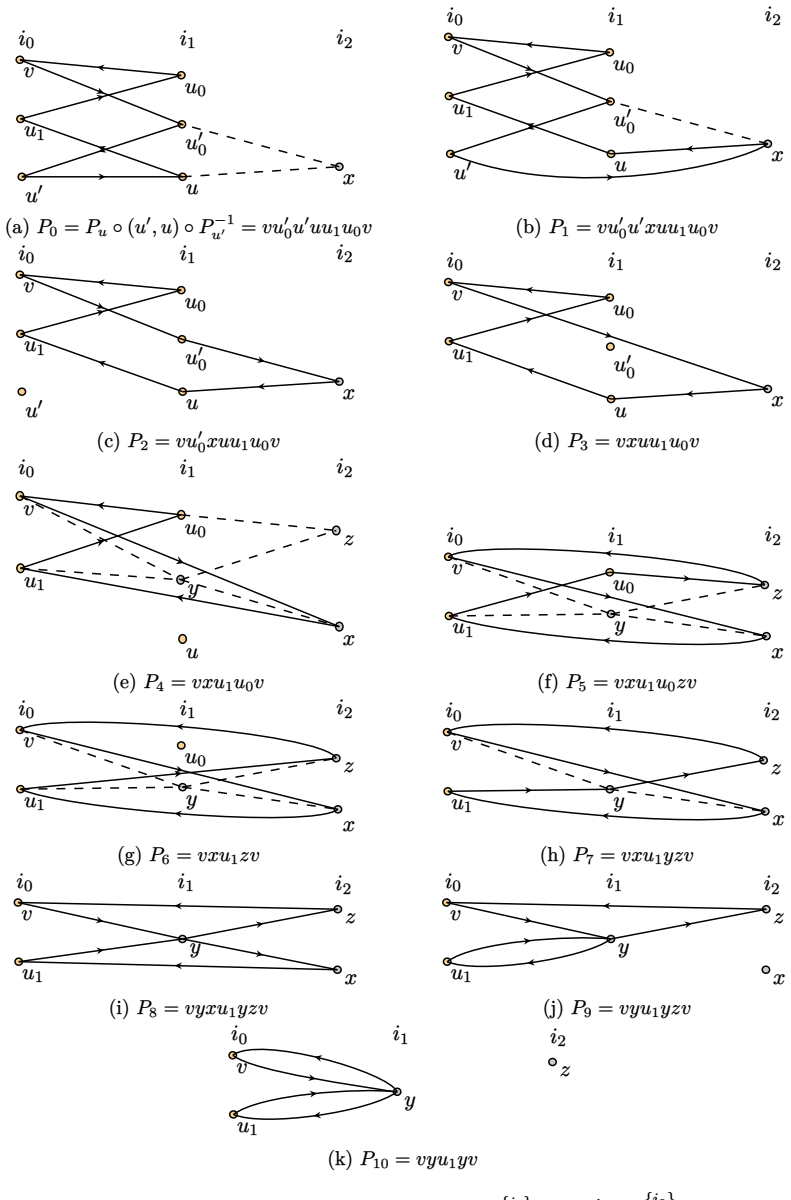 full image