Hierarchical Navigable Small World (HNSW) graphs serve as the industry standard due to their logarithmic complexity and strong empirical performance. However, HNSW relies on greedy graph traversal, a heuristic that provides no theoretical guarantees of correctness. In this paper, we propose a novel "Certify-then-Rectify" framework that bridges the gap between the speed of heuristic search and the rigor of exact retrieval. Rather than discarding HNSW, our approach first employs a distribution-free statistical certifier to dynamically evaluate the quality of a standard HNSW search with minimal overhead. If certification indicates that the retrieved neighbors are of low quality, the framework safely escalates to a rigorous exact recovery algorithm. To make this exact recovery computationally feasible, we reinterpret the HNSW graph as a geometric spanner and utilize Extreme Value Theory to stochastically estimate its maximum empirical stretch factor. This allows us to mathematically bound the maximum distance of true nearest neighbors. Extensive evaluations on benchmark datasets demonstrate that our tiered framework delivers the average-case speed of HNSW while ensuring the worst-case correctness of exact search and outperforming other applicable approaches.
This work introduces AIriskEval-edu-db2, a new dataset designed to train and evaluate auditors based on LLMs for an explainable pedagogical risk assessment in instructional content for grades K-12. The dataset comprises 1,639 explanations from 170 curated ScienceQA questions, covering science, language arts, and social sciences. For each question, the dataset includes an explanation written by a human teacher alongside 11 explanations generated by LLM-simulated teacher profiles associated with distinct pedagogical risks. We propose a comprehensive risk rubric aligned with established educational standards that covers five complementary dimensions: factual precision, depth and completeness, focus and relevance, student-level appropriateness, and ideological bias. A key contribution is the addition of 785 explanations with structured explainability annotations, including risk localization and risk description. The annotations are produced through a semi-automatic process with expert teacher validation. Finally, we present validation experiments comparing state-of-the-art proprietary models with a lightweight local Llama 3.1 8B model in both the pedagogical risk detection and the explainability assessment. These experiments evaluate whether supervised fine-tuning on AIriskEval-edu-db2 enables a locally deployable model to approach or outperform stronger frontier models while preserving privacy in educational auditing and assessment tasks.
Data science aims to derive actionable insights from heterogeneous raw data, unlocking the value of the massive amounts of data generated in modern society. Automating this process is essential to reducing labor-intensive efforts for data scientists and enabling scalable data-driven applications. Recently, large language model (LLM)-based data agents have emerged as a promising solution to automate data science workflows. However, the field lacks comprehensive benchmarks to rigorously evaluate these agents across diverse scenarios with fine-grained granularity. To address this gap, we propose AgenticDataBench, a comprehensive benchmark featuring realistic tasks spanning diverse domains with fine-grained ground-truth labels. This enables evaluations to capture the diversity and complexity of data science workflows and the detailed performance of agents. First, to cover diverse domains, we collect real datasets and tasks from 15 vertical domains, including 5 real-world B2B use cases from a leading fintech company. Second, to remove redundancy in real-world tasks and generate high-quality tasks for domains lacking real data, we introduce data science skills, recurring data-centric operational patterns, and quantify benchmark coverage by the number of skills included. Representative skills are extracted from large-scale task solutions on Stack Overflow using skill-aligned hierarchical clustering. Third, for real-world business tasks, we select task-solution pairs that maximize diversity in skill composition, ensuring broad coverage of practical scenarios. Fourth, to generate realistic tasks for devise domains without real tasks, we propose a systematic LLM-based task generation approach to create workflows and tasks based on these skills. Finally, we evaluate state-of-the-art data agents using our annotated benchmark and open-sourced testbed, providing detailed skill-level insights.
CityGML, the OGC standard for modeling, storage, and exchange of semantic 3D city models, describes urban objects with detailed semantics, geometry, and topology. Yet this richness is difficult to query directly: CityGML's XML encoding is designed for exchange rather than analysis, and relational mappings expose it through schemas requiring expert knowledge. We present pykci (Python Knowledge Graph for Cities), an open-source system that transforms CityGML 2.0 datasets into a compact urban knowledge graph in Neo4j and makes it queryable in natural language. The graph schema covers all thematic feature modules of CityGML 2.0 across all levels of detail and is spatially indexed with an R-tree for efficient geometric retrieval. A complete end-to-end Python pipeline ingests CityGML datasets into the knowledge graph, exports them to OGC 3D Tiles for interactive visualization, and supports lossless round-trip export of all content back to CityGML. For querying, the graph is paired with a large language model through a model-agnostic text-to-Cypher mechanism: the graph schema is supplied as context, and the model translates natural-language questions into Cypher queries executed against the graph. We evaluate both a locally running open-weight model, which keeps sensitive city data on-premise, and a state-of-the-art commercial model for the most demanding spatial and semantic queries. Answers are grounded in exact city data rather than the model's parametric memory, reducing hallucination and providing auditable provenance for every response. We demonstrate the system on open-government CityGML LoD2 datasets from Hamburg, Germany, including complex semantic and spatial queries such as identifying roof surfaces suitable for greening. pykci enables urban planners, GIS practitioners, and citizens to interact with semantic 3D city models without expertise in query languages and database schemas.
Rankings derived from weighted scoring functions are widely used in settings such as university rankings and employment candidate evaluations. Since ranking weights are often chosen by organizations or analysts, ranking stability asks whether a reported ranking persists under reasonable weight changes. Prior work on stable rankings formalizes this idea through volume-based stability, which measures the fraction of the weight space that induces the target ranking exactly.
This exact-match requirement can be too blunt: once a perturbed weight vector produces a different ranking, exact stability gives it no credit, whether the change replaces the top-ranked item or only swaps two nearly tied lower-ranked items. We propose general stability, a distance-based generalization that aggregates ranking regions according to a user-defined distance from the target ranking. This lets users specify which ranking changes matter in the application, while recovering exact stability as a special case.
Our algorithmic focus is stability computation: given a reported or user-specified ranking and a distance function, estimate its general-stability score. We give a two-dimensional sweep algorithm and an unbiased multidimensional sampler that extend exact-stability methods, and analyze why sampling can scale poorly as the dimension grows. Motivated by this scaling challenge, we identify quasiconvex distance functions as a tractable subclass and introduce Conv-SC, which reduces stability computation for this subclass to convex-volume approximation, where randomized polynomial-time methods are available. Experiments on eight real datasets and generated instances show that distance-sensitive stability gives informative real-data results, that our estimators are accurate and practical, and that Conv-SC improves scaling with dimension for quasiconvex distance functions.
Semantic query processing engines execute semantic operators, whose behavior is specified by natural-language intents, via model inference over multimodal data. Most existing optimizers optimize the operators at the granularity of monolithic implementations -- such as LLMs and embedding models -- forcing a trade-off between expensive model calls and cheaper alternatives that fail to capture intent-dependent semantics. We present CADENZA, a semantic operator optimizer that compiles an intent into decomposed steps, selects concrete physical implementations for each step, and tunes their parameters under user-specified quality-latency-cost preferences. In this demonstration, users interact with CADENZA through a web interface over multimodal databases, exploring how an intent is decomposed into alternative plans, how each plan is optimized, and how different preferences yield different winning plans.
Filter-and-refine spatial joins have always avoided touching exact geometry for certified candidate pairs, but the field never modeled the decompression cost of the pairs that survive the filter. When geometry is stored in a compressed, progressively-decodable multiresolution codec, the join's true cost is bytes decoded. We study provably-exact polygon intersection joins over a Douglas-Peucker level-of-detail (LOD) ladder, certified by a two-sided Hausdorff-margin test, and make two contributions. First, a reproducible mechanism and harness: on real U.S. Census TIGER water polygons, our progressive certificate join returns the exact join result while decoding 3.4-16.8x (median 5.9x) fewer vertices than naive decompress-then-refine, and about 4.9x fewer than the single-approximation multi-step baseline of Brinkhoff et al. (1994), with zero correctness violations (set-equality against a full-precision oracle) across 31 workloads. Second, a characterization we call the decode-work law: decode work is governed by each pair's signed-clearance margin -- how close it is to the predicate-flip boundary -- independent of object size, because the certificate descends the ladder only until its resolution beats the margin. The law is clean on controlled geometry (held-out R2=0.87, size-independent) and directional on real data (R2 ~= 0.55). We are explicit about what does not hold: a near-boundary-vertex predictor is the wrong model (we pre-registered one and rejected it), a selectivity regime forecaster did not materialize, and the worst case is the trivial Omega(v) read bound on adversarially interleaved boundaries. We contribute the mechanism, budget-honest decode accounting, and an open harness; we do not claim a new index.
Estimating the number of distinct combinations in multi-attribute GROUP-BY queries remains a significant yet underexplored challenge. Current cardinality estimation techniques primarily focus on SPJ queries (i.e., selections, projections, and joins) and neglect GROUP-BY operations; meanwhile, distinct value estimation research has mainly targeted the single-attribute setting. Although sampling-based methods, including recent approaches with learned models, can theoretically support multi-attribute estimation, their practical effectiveness remains unclear. A comprehensive empirical evaluation is thus lacking to address whether joint distribution information from samples alone is sufficient for accurate multi-attribute estimation, whether existing methods fully exploit single-attribute information and can be further optimized, and whether filtered GROUP-BY queries can be accurately estimated. To this end, we propose a specialized workload generator for multi-attribute GROUP-BY queries and generate both filtered and non-filtered queries over four real-world datasets. By evaluating existing methods across synthetic workloads and the multi-table TPC-H benchmark, we analyze the sources of GROUP-BY cardinality estimation errors and their impact on PostgreSQL's plan selection, offering key recommendations for future estimator design.
Modern data lakes contain heterogeneous tables whose task-relevant information is often scattered across different schemas, sources, and naming conventions. Table union search (TUS) retrieves tables that can be reliably unioned with a query table, supporting data discovery, enrichment, and downstream analytics. Although learning-based TUS methods improve table- or column-level representations, they still follow an encode-search-refine pipeline: candidate retrieval is followed by query-candidate matching or reranking, making quality dependent on candidate-pool recall and incurring growing latency and storage costs as the data lake scales. We propose GenTUS, a generative retrieval framework that reformulates TUS as constrained generation over discrete semantic table identifiers. Instead of searching and reranking an explicit candidate pool, GenTUS assigns candidate tables compact unionability-aware identifiers and trains a generator to produce the identifiers of unionable tables directly from the query. At query time, constrained decoding ensures that generated identifiers correspond to valid data-lake tables and returns them as ranked retrieval results. Experiments on seven public TUS benchmarks show that GenTUS achieves the best overall retrieval quality, with an average rank of 1.05 compared to 2.57 for the strongest baseline, while substantially reducing online latency, retrieval-artifact storage, and incremental update cost.
Large language models (LLMs) are increasingly used to generate queries, invoke tools, and construct analytical workflows. Although recent advances have substantially improved workflow generation and execution, the semantic information required to operationalize analytical concepts often lies beyond what is explicitly represented in database schemas and data values. We present a cross-domain formative study of operationalization failures in agent-generated analytical workflows. Across 236 analytical intents spanning finance, human resources, and public safety domains, we identify 153 recurring failures despite successful workflow generation and execution. Our analysis reveals five recurring classes of failures: comparative grounding, process reasoning, quantitative reasoning, role confusion, and policy grounding. These findings suggest a semantic gap between user-level analytical concepts and the information available to workflow-generation systems. More broadly, they raise questions about the admissibility of analytical operations and suggest that future agentic data systems may require richer semantic representations to bridge the gap between analytical intent and executable computation.
Filtered Vector Search (FVS), which combines vector embedding similarity with structured metadata predicates, has emerged as a core requirement in RAG and production retrieval systems. ACORN-1, the representative In-filtering algorithm that reuses an existing HNSW index, substantially reduces latency at low selectivity but suffers connectivity instability below 5% selectivity and recall collapse below 1%. We propose RACORN-1, an in-place extension of ACORN-1 that resolves this collapse via (i) Adaptive Search Fallback (ASF) -- repurposing filter-failing nodes as transient bridges to detour around severed paths; bridge and two-hop candidate selection uses stride sampling for spatial diversity. While filter-first ACORN-family methods have a structural recall trade-off relative to distance-first HNSW, RACORN-1 improves the trade-off curve via ASF, minimizing recall loss while substantially reducing latency. Across three 1M-scale and one 40M-scale dataset, RACORN-1 delivers approximately 9-26x latency reduction over HNSW in the sweet spot (1%-0.3%), and recovers ACORN-1's recall collapse from 0.45-0.72 (1%) and 0.03-0.10 (0.3%) to 0.70-0.96 and 0.77-0.98 respectively. For the extreme-low-selectivity regime where linear scan can outperform graph search, we combine RACORN-1 with (ii) Adaptive Exact Fallback (AEF) in a variant RACORN-1+, achieving recall 1.00 with 20-75x speedup at 1M <=0.1% and 13x speedup at 40M 0.01%. Under a Negative Correlation evaluation (K-means clusters), where ACORN-1 collapses (recall 0.08-0.41), RACORN-1 maintains recall 0.80-0.98 with a 5-9x latency advantage over HNSW. Together, RACORN-1 and RACORN-1+ form an ACORN-1-compatible mechanism robust to both extreme-low-selectivity and adversarial query-filter correlation.
Enterprise AI agents are useful for internal analysis, audit, compliance review, and operational investigation, but they create a difficult authorization problem. A manager or data owner may approve a business task, while the agent later generates open-ended SQL below the application layer. Existing systems help identify agents, delegate authority, govern data products, or enforce database policy, but they do not directly turn an approved enterprise task into a bounded database execution context. SessionBound fills this gap. It turns approved enterprise tasks into short-lived, budgeted, and auditable database sessions for AI agents. A control plane defines task templates, accepts task applications, records approvals, assigns budgets, and issues signed task tokens. A database runtime, SessionBoundDB, binds a token to a session and enforces safe views, row scope, denied fields, operation limits, query budgets, disclosure budgets, and receipts. The database does not rely on an LLM to decide whether a query is safe. The agent may generate SQL freely, but each attempt must stay inside the approved boundary. A PostgreSQL prototype passed a 24-scenario validation suite. Microbenchmarks show p50 SessionBound execution around 1.4--1.5 ms versus raw PostgreSQL p50 around 0.052--0.074 ms on small synthetic queries: high relative overhead, but low absolute latency.
Graph approximate-nearest-neighbor (ANN) indexes (HNSW, DiskANN/Vamana) lose recall under insert/delete churn, because deletions orphan the greedy-search paths that route through removed nodes. Production systems restore navigability by repairing the graph on a fixed schedule (consolidate every X operations). We ask whether triggering local edge repair on a measured navigability-degradation signal, rather than a blind clock, spends a fixed repair budget better. On two real ANN datasets (SIFT-128 and Fashion-MNIST-784) under a controlled bursty churn stream, and comparing repair policies at matched amortized repair budget (equal consolidation count), signal-triggered repair Pareto-dominates fixed-cadence repair. The gain is concentrated on worst-case (tail) recall at scarce budget: at roughly one consolidation it improves the minimum recall@10 by +0.014 (SIFT) to +0.050 (Fashion-MNIST) across four stream seeds, with 95% confidence intervals excluding zero, while the mean-recall gain is small (<0.005). The advantage follows a clean drift-severity gradient -- larger for sparser, more fragile graphs -- and fades to parity when the index is robust or budget is ample. A cheap probe-recall signal is a valid, leading indicator of true recall (Spearman rho ~= 0.95). We contribute the mechanism, a budget-matched evaluation protocol that separates repair scheduling from repair spend, and an open, reproducible churn-repair harness. We deliberately do not claim a mean-recall improvement or a new index; a recall-versus-repair-cost bound and data-distribution-drift coupling are left as future work.
Vector databases have become a fundamental component for high-dimensional vector retrieval in artificial intelligence applications. Recent research has focused on filtered approximate nearest neighbor search (filtered ANN), which involves retrieving the nearest vectors that satisfy a given attribute-based filter. However, existing filters are generally limited to numerical range constraints or categorical existence checks, which restricts their applicability in more complex, real-world scenarios. In this paper, we investigate filtered ANN using graph range filters, where the retrieved vectors must be within a specified distance from the query node in a predefined filter graph. To address this problem, we propose DLH, a Distance-aware Labeling index with Hashing compression. DLH creates distance-aware labeling sets to enable efficient graph range filters via the simplified set intersection operations. Large labeling sets are further compressed into Bloom filters to improve query efficiency in DLH. Furthermore, recognizing that the query node is always involved in in-range queries of the graph range filters, we enhance DLH by memoizing the intermediate hashing index for the query node, yielding an optimized version called DLH-M. Experimental evaluations on diverse datasets demonstrate that DLH and DLH-M improve throughput by up to 70.3%, and could maintain recall rates over 98.5% with limited extra storage, validating the practical availability of the proposed solution.
Public lithium-ion battery datasets are increasingly used for state-of-health estimation, remaining-useful-life prediction, anomaly detection, electrochemical diagnostics, second-life analytics, and battery safety research. However, these datasets vary substantially in chemistry, modality, scale, label quality, sequence structure, access status, and preprocessing complexity. These differences directly affect whether a dataset is feasible for near-term hybrid quantum-classical machine-learning workflows.
This paper presents IonSense-QKG, a quantum-readiness metadata framework for lithium-ion battery dataset discovery. Starting from the EV-Battery-IonSense index, the proposed framework enriches public battery dataset records with quantum-relevant metadata, including task type, sensing modality, chemistry, label availability, sequence type, preprocessing requirements, candidate quantum encodings, estimated qubit range, and NISQ feasibility. A transparent Quantum Readiness Score is introduced to rank datasets as candidate resources for future hybrid quantum-classical battery benchmarks. The score is intended as a dataset-selection heuristic, not as evidence of quantum advantage.
The framework demonstrates query-based discovery over enriched metadata to identify datasets suitable for compact quantum feature maps, quantum time-series workflows, limited-label anomaly detection, and future battery-health benchmarking. The released artifact includes metadata tables, scoring scripts, robustness checks, link-checking utilities, and SQL-style query examples. IonSense-QKG positions dataset selection as a data-management problem and provides a reproducible foundation for data-centric quantum battery analytics.
Analyzing temporal graphs can reveal valuable insights that are typically hidden in static graphs. Unfortunately, existing graph storage systems either lack native temporal support or suffer from high latency when querying temporal graphs. This paper presents TVA, a new temporal graph storage system designed for efficient temporal query processing. First, TVA introduces a specialized multi-version storage architecture that separates version metadata from actual data, i.e., the property values associated with different versions of vertices and edges. This architecture enables efficient version retrieval for a vertex or edge by quickly locating valid version metadata and directly dereferencing it to access the corresponding property values. Second, we design tailored data structures, namely the temporal table and enhanced hopscotch-based hashing, to compactly organize the version metadata of adjacent vertices and edges, thus reducing random I/O for metadata lookups during the neighborhood scan initiated from a vertex. Finally, to further accelerate neighborhood scans over multiple vertices, we propose a version-kipping strategy that reuses temporal information obtained from prior scans, thereby avoiding redundant metadata lookups across scans. Empirical evaluations demonstrate that TVA achieves up to 9.9x lower temporal query latency and 2.2x lower storage overhead compared to state-of-the-art temporal graph storage systems.
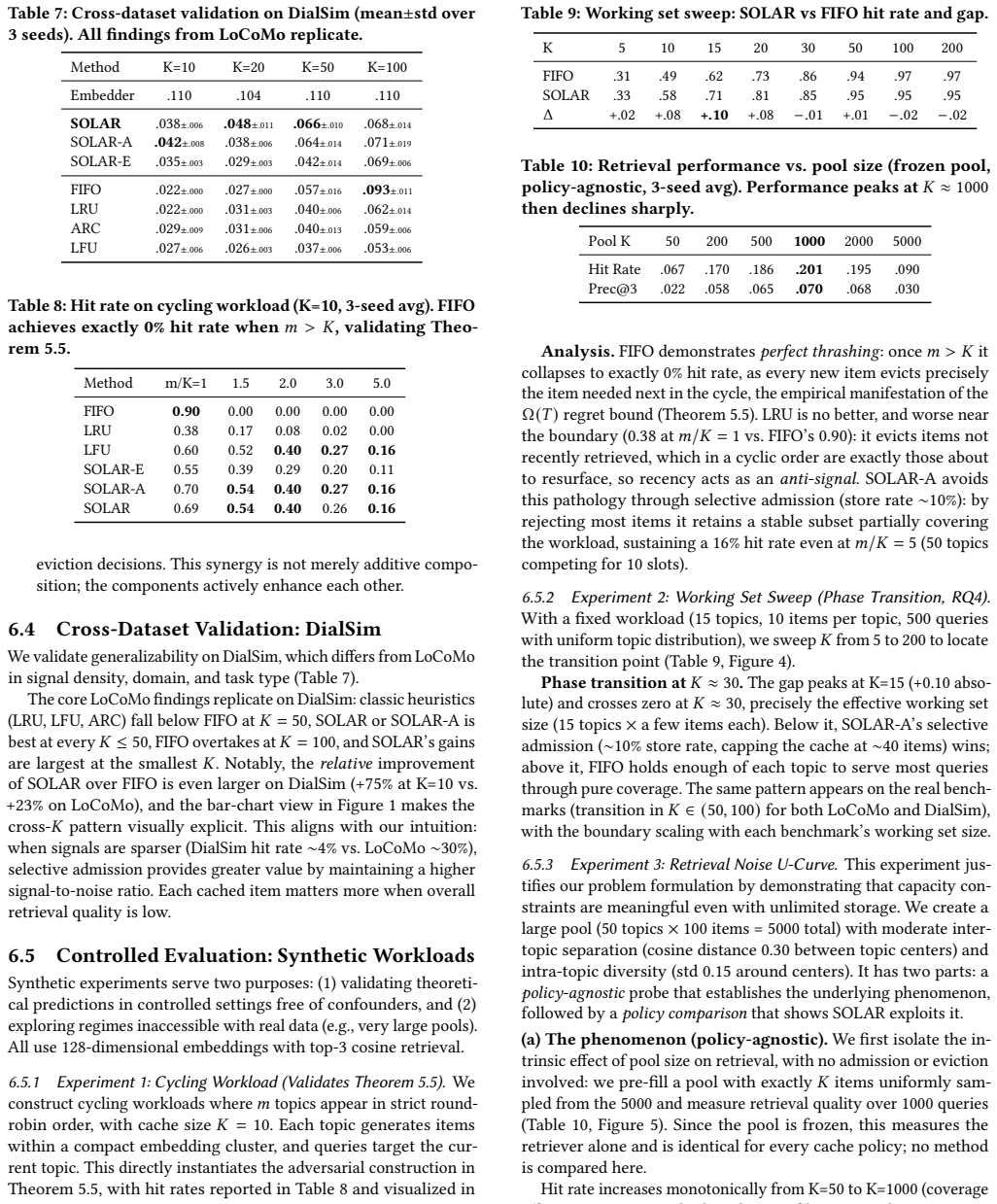
LLM agents increasingly rely on retrieval buffers to store and reuse past experience, yet the cache management policies governing these buffers remain largely ad-hoc. We formalize this as an online semantic cache replacement problem with switching costs, where items are matched by embedding similarity and hit quality is continuous rather than binary. Through experiments on two datasets from MemoryBench-Full (LoCoMo, DialSim) with 8 replacement policies, we reveal a surprising finding: classic heuristics (LRU, LFU) \emph{consistently underperform} the naive FIFO baseline on semantic workloads, due to the absence of temporal locality and frequency concentration. We propose SOLAR, a learning-augmented framework that derives modification timing from regret accumulation (achieving $\sim$17\% modification rate) and content selection from Bayesian online learning over implicit retrieval feedback. We prove SOLAR achieves a constant competitive ratio $\leq 3$, independent of cache size and horizon (vs.\ $\Omega(K)$ for FIFO), and eviction regret $O(\sqrt{KT\log T})$, matching the $\Omega(\sqrt{KT})$ lower bound up to logarithmic factors. Experiments demonstrate 5--75\% relative improvement over FIFO at tight cache sizes, with a clearly characterized phase transition at the working set boundary. Synthetic experiments with 5000-item pools further reveal an inverted-U relationship between pool size and retrieval quality, justifying capacity constraints as a retrieval noise phenomenon rather than a storage limitation.
Many modern AI workflows, ranging from LLM post-training pipelines to agentic reasoning tasks, can be expressed as declarative queries whose expensive predicate is evaluated by a large model or reward function. We propose a query-centric formulation of these workflows and show that classical database techniques, namely approximate query processing (AQP) and proxy-model (PM) based filtering, can substantially reduce the number of expensive model invocations without requiring changes to the underlying models or pipelines. Our first strategy treats the workflow as an online aggregation problem: it progressively samples records, maintains a running aggregate estimate with a confidence interval, and terminates early once the interval stabilizes, accepting the estimate when it falls within a user-specified error bound. Our second strategy trains a lightweight, CPU-resident decision tree on a small set of oracle-labeled examples and uses it to pre-filter records whose outcome can be predicted with high confidence, routing only uncertain records to the expensive model. We evaluate both strategies on TPC-DS aggregate queries and on real LLM post-training pipelines including math reasoning, general instruction following, and code generation. On TPC-DS, Strategy AQP keeps aggregate error under 10% while reaching its adaptive stopping point at 10-15% of oracle calls under balanced distributions, an 85-90% reduction, and Strategy PM reduces oracle calls by 60-70%. On LLM pipelines, Strategy AQP reaches its adaptive stopping point at 20-50% of oracle calls with less than 5% accuracy loss on the structured math and code tasks; open-ended instruction following, scored by a reward model, shows a larger but bounded reduction. Strategy PM reduces reward-model scoring time by up to 19x on structured tasks with less than 10% accuracy loss.
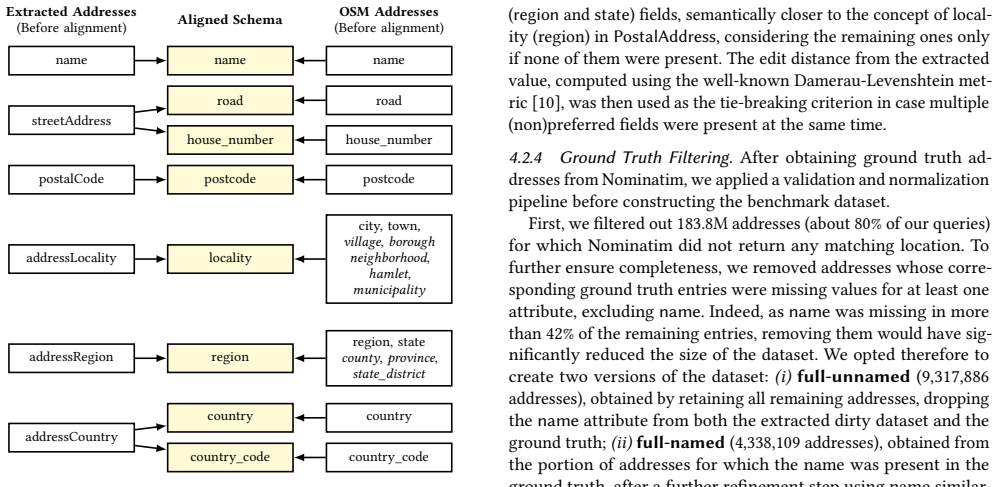
There has been extensive research on automating and scaling data cleaning, i.e., the detection and correction of erroneous values in tabular data. Yet, existing approaches often perform well only within controlled environments. One of the major bottlenecks in data cleaning research is the lack of real-world datasets. In this paper, we address this gap by providing a large, dirty dataset with postal entries and their corresponding ground truth. We discuss the design decisions and challenges for obtaining the dataset. We demonstrate the limitations of existing cleaning approaches when faced with our proposed datasets and derive guidelines for future research.
Language model systems built around proprietary APIs often operate on a token-based cost model. This becomes prohibitively expensive in the context of large databases, where LM-enhanced relational operators can incur costs exceeding $10,000 for a single set of experiments, hindering thorough research and practical deployment. In this paper, we demonstrate that quantized, open-weight models running locally on just 16GB of VRAM can match or exceed the accuracy of closed-source counterparts at lower latency and a fraction of the price, challenging the prevailing assumption that closed-source LM APIs are necessary for effective LM-database integration. We present and analyze the key system optimizations required to efficiently deploy these open-weight models within an LM-DB system. By integrating these local models into the BlendSQL v0.1.0 framework, we demonstrate a 390x reduction in overall costs and 3.8x reduction in latency compared to a proprietary LM API. We make our code available at https://github.com/CapitalOne-Research/play-by-the-type-rules/tree/main/sembench.
Real-world data analysis is a multi-step process over heterogeneous inputs rather than merely producing a final answer. A practical system should autonomously organize multi-step workflows, execute generated code in a sandboxed and controllable environment, and remain inspectable through visible action traces and intermediate artifacts. Existing LLM-based analysis tools, however, often emphasize isolated subtasks, leaving limited support for complete execution-grounded workflows.
We present DA-Studio (Data Analysis Studio), an interactive web-based demo system for end-to-end data analysis that is autonomous, sandboxed, and inspectable. DA-Studio integrates an action-structured analysis backend, a sandboxed execution workspace, and a browser interface for task setup, streamed action traces, artifact preview, code editing and rerunning, and report export. Through iterative action generation, code execution, and feedback incorporation, it incrementally constructs executable analysis steps from raw files and natural-language requests while exposing intermediate results and artifacts throughout the process.
Improving the reliability of large language models (LLMs) at inference time is a central challenge in structured reasoning tasks such as Text-to-SQL. Common test-time inference strategies, including Best-of-N sampling and Majority Voting, rely on heuristic signals such as execution success or output frequency, which provide limited semantic discrimination across candidate outputs. In this work, we study Outcome Reward Models (ORMs) as learned semantic scoring functions for test-time verification in Text-to-SQL. While ORMs have been previously explored for test-time scaling and alignment, their application to structured query generation remains underexplored. We introduce GradeSQL, a scalable framework for training task-specific ORMs via automated candidate generation and execution-based labeling, enabling verifier training without manual annotation. We integrate ORMs into a verification-driven Best-of-N pipeline and evaluate our approach on the BIRD and Spider benchmarks across multiple open-source LLM families. ORM-based selection consistently outperforms execution-based Best-of-N and Majority Voting, with gains of up to +4.33% on BIRD and +2.10% on Spider. We further show that ORMs scale effectively with larger candidate sets and yield stronger improvements on complex queries. Overall, our results demonstrate that ORM-based verification provides a simple, effective, and scalable alternative to heuristic test-time selection strategies for Text-to-SQL. Code datasets and models are publicly available.
Data integration combines heterogeneous data sets into a single, coherent representation. Data integration involves a sequence of interdependent tasks including schema matching, value normalization, entity blocking, entity matching, and data fusion. Existing benchmarks either evaluate these steps in isolation or cover only incomplete versions of the data integration pipeline, omitting specific steps. The lack of public end-to-end data integration benchmarks hinders research on data integration methods that address the integration process as a whole. This paper fills this gap by introducing the Mannheim Data Integration Benchmark (MaDI-Bench), the first benchmark for the end-to-end integration of relational tables covering all steps of the integration process. MaDI-Bench contributes (i) a set of base end-to-end data integration tasks spanning several application domains, each requiring the full schema matching, value normalization, entity matching, and conflict resolution pipeline; and (ii) a generic method for deriving task variants that mitigates rapid benchmark saturation as data integration systems advance. We validate the benchmark using human-engineered pipelines, a best-of-breed pipeline, and an LLM-based pipeline. The validation demonstrates the utility of the benchmark for measuring the step-wise as well as the end-to-end performance of data integration pipelines. All benchmark artifacts are available for public download.
Vector search has become a core component of modern multimodal retrieval systems. Among existing methods, inverted file (IVF)-based methods are widely adopted due to their scalability, efficient updates, and hardware friendliness. However, they are fundamentally limited by coarse-grained execution: each query typically probes many clusters and exhaustively scans all vectors within them, resulting in high query latency. Prior works mitigate this using pruning strategies, but they often incur substantial extra pruning overhead, lack cluster-level pruning, and compromise update efficiency due to heavy maintenance of pruning metadata.
This paper proposes CLIP, a lightweight cosine-law-based pruning technique that supports both inter- and intra-cluster pruning, substantially reducing unnecessary cluster and vector accesses with negligible overhead. First, CLIP exploits the monotonicity of cosine-law-based lower bounds, enabling eliminating an undesirable cluster in O(1) time and filtering batches of irrelevant vectors in logarithmic time in the list size, with a tight analytical guarantee. Second, building on this, we develop two IVF variants: IVF-CLIP, which integrates CLIP into IVFFlat, and HIVF-CLIP, which extends it with a hierarchical structure for adaptive sub-cluster probing. Third, for dynamic workloads, we present LSM-IVF, an LSM-inspired design that supports fast updates by deferring index maintenance to background compaction, and enables efficient queries via CLIP-based optimizations that eliminate costly level-by-level searches. Extensive experiments show that CLIP variants achieve up to 78% pruning and 69% higher efficiency over static IVF baselines, while LSM-IVF improves throughput by up to 141% over dynamic IVF baselines with comparable update efficiency.
The database community has repeatedly advanced the state of the art by recognizing that new workloads demand new system architectures. We argue that long-horizon agentic tasks -- code generation, scientific discovery, hardware design -- are such a workload. These agents explore: they generate artifacts, execute tools, observe failures, branch, and repair over hundreds of steps. This search produces a structured object we call an experience graph: executable artifacts, tool outputs, rewards, sibling comparisons, and causal lineage. Yet existing agent frameworks treat this experience as disposable state -- JSON checkpoints and session logs that cannot be recovered after a crash, queried across users, or materialized into training data. We propose Trellis: a data foundation that treats the experience graph as first-class, governed, queryable database state. The core insight is that search over experience graphs is a database access pattern. Frontier selection is a query, cross-session reuse is vector-seeded graph retrieval, training-data extraction is a materialized view, and reconstructing what an agent knew at any past step is a time-travel query. When the database owns the experience graph, agents become stateless compute, and crash recovery, horizontal scaling, and a closed-loop training flywheel emerge as architectural byproducts. We ground the design in KernelEvolve, a production accelerator-kernel optimizer at Meta, where cross-session reuse reaches a target speedup roughly 10x faster at 52% lower token cost. More broadly, Trellis turns inference-time search from disposable computation into a durable institutional asset: logs made databases reliable; experience graphs may make agents cumulative.
Long-term conversational agents need to remember and query cross-session, multi-typed information with complex correlations. Existing agent memory systems rely on heterogeneous vector and graph databases, which fragment memory information and cause high cross-database I/O latency. For retrieval, common RAG-style methods tend to introduce noise, miss correlated clues, and lack token budget control, degrading LLM accuracy and efficiency.
We propose Mandol, an agglomerative memory system that consolidates fragmented memory representations and storage into a unified memory-native architecture. Its core components include: (1) a hierarchical memory model that organizes memory into a basic layer representing raw memory information and a high-level abstract layer that agglomerates basic memories into traceable abstract memories, both uniformly represented as structured semantic graphs; (2) an agglomerative semantic data structure combining SemanticMap and SemanticGraph, which natively fuses key-value, vector, and graph structures and provides unified hybrid retrieval operators to eliminate cross-database I/O; and (3) a quantitative query mechanism with query-adaptive routing, quantitative denoising and conflict resolution, and token-constrained context generation, all without involving LLMs during retrieval. Experiments on two widely used long-term conversation benchmarks, LoCoMo and LongMemEval, show that Mandol achieves the best overall accuracy among representative agent memory systems. For performance comparison, Mandol also obtains a 5.4x retrieval speedup and a 4.8x insertion speedup under 10 QPS concurrent load, while still maintaining low latency on consumer-grade hardware.
Organizations that cannot send data to a cloud API increasingly ask: how good is Text-to-SQL if the model must run on-premises on open weights, and which popular accuracy "recipes" are worth their compute? We answer with an honest, fully reproducible benchmark on the BIRD development split (n=1534, Execution Accuracy), evaluating three open model families across two generations -- Qwen2.5-Coder (7B/14B/32B), CodeLlama-Instruct (7B/13B/34B), and Llama-3.x (8B, 70B) -- under one matched protocol, ablating a model-agnostic recipe (schema linking, self-correction, self-consistency) component by component, with every difference tested by the paired McNemar test. Four findings stand out. (i) Generation matters more than raw size, and the recipe is family-robust: Qwen2.5-Coder dominates the older CodeLlama at matched size (39.1 vs 20.9 at 7B), but a modern non-Qwen model (Llama-3.3-70B, 49.2 on a matched serving) is competitive, so CodeLlama's weakness reflects its 2023 generation, not "non-Qwen = weak". (ii) Self-correction is a robust, near-free win, significant on all three families where there is room to improve. (iii) Schema linking does not help, and a stronger linker does not rescue it: a retrieval/embedding linker with 96.5% gold-table recall is statistically indistinguishable from no linking, ruling out the "weak lexical strawman" objection across three families. (iv) Self-consistency is poor value (+0.13 pp for ~5x tokens, not significant). We report real per-stage cost ($/1k queries) and release all code, predictions, and summaries; archived code and data: https://doi.org/10.5281/zenodo.20952794
Driver decision making in the dilemma zone at signalized intersections is safety critical, as vehicles approaching a yellow signal must decide whether to stop or proceed within limited time and distance margins. Accurate prediction of both stop-go decisions and decision timing is important for adaptive signal control, advanced driver assistance systems, and human-centered intelligent transportation applications. However, dilemma zone behavior is strongly driver dependent. Similar approach trajectories may lead to different decisions across drivers because of differences in risk preference, braking habit, and decision threshold. Existing personalized models often rely on handcrafted scalar descriptors, which provide useful but limited summaries of individual behavior. This paper proposes VISTA-DZ, a semantic-profile-conditioned framework for personalized stop-go and decision-time prediction. Historical trajectories are converted into visual representations, interpreted by a vision-language model to generate behavioral profiles, and encoded as semantic embeddings to condition a dual-output prediction network. The final model combines a bidirectional GRU encoder, driver-conditioned multi-head cross-attention, and Feature-wise Linear Modulation for temporal evidence selection and feature adaptation. Experiments on the SDZ dataset and a newly collected FDZ dataset show that VISTA-DZ outperforms trajectory-only and handcrafted personalization baselines, achieving 93.26% in-domain simulation accuracy and 90.22% mean accuracy across 20 held-out simulation drivers. Cross-domain results further show feasible zero-shot simulation-to-real transfer and better real-world generalization when simulation data are combined with limited field data.
Integrating unstructured data into relational database systems is increasingly important as demand grows for natural language querying and analysis. A semantic join, joining two tables under a natural-language predicate, can be evaluated with a large language model (LLM), but comparing every pair of tuples requires O(M x N) LLM invocations and is cost-prohibitive at scale. Existing systems reduce this cost but typically commit to a single fixed strategy (e.g., embedding similarity or one batched scheme) regardless of the data or the join predicate. We propose an LLM-agent-based decision pipeline that optimizes semantic joins by matching the execution strategy to the characteristics of the underlying tables. An LLM advisor routes each join to one of two strategies: a Cluster Join, which prunes candidates via unsupervised embedding clustering and sample-based filtering, or a Classifier strategy for predicates that reduce to a shared discrete label set. Across three diverse datasets (IMDb reviews, email contradictions, and Stack Overflow tags), the advisor consistently identifies the optimal execution strategy for each workload. This dynamic routing proves decisive: it outperforms adaptive block join (ABJ) by 20-33 F1 points across all datasets while consuming fewer tokens on two of the three, and achieves higher F1 scores than featurized-decomposition join (FDJ) at one to two orders of magnitude lower token cost.
Large Language Models (LLMs) are increasingly used as assistants across the software development lifecycle, yet their ability to reason about software architecture remains largely unmeasured. Architectural decision-making depends on quality attribute trade-offs, design patterns, and system-level constraints, none of which are exercised by benchmarks that target syntactic or algorithmic tasks. We introduce SAKE (Software Architectural Knowledge Evaluation), a standardized and reproducible benchmark for assessing software architectural knowledge in LLMs. SAKE comprises 2154 expert-curated multiple-choice questions, each with four options, stratified across eight architectural categories and four context-length levels. We evaluate 11 proprietary and open-weight models in zero-shot and five-shot settings. Overall accuracy is high, but performance varies markedly across categories, revealing competency gaps in areas central to professional practice. SAKE, its evaluation scripts, and all results are released as open source to give the community a baseline for tracking architectural reasoning in LLMs.
The design and governance of enterprise data warehouses constitute foundational decisions in modern data-driven organisations, with long-term impact for analytical capability, operational agility, and regulatory compliance. This paper presents a structured comparative analysis of three prevailing data warehousing methodologies: the Inmon approach, the Kimball approach, and Data Vault. The paper first establishes the technical foundations common to all three enterprise frameworks, in particular the distinction between Online Transaction Processing (OLTP) and Online Analytical Processing (OLAP) systems, the principles of relational normalisation, and the core techniques of entity-relationship and dimensional data modelling. The comparative analysis examines each methodology across a set of dimensions including architectural philosophy, modelling technique, scalability, agility, query performance, audit capability, and suitability for different organisational profiles. Findings indicate that no single methodology is universally optimal; rather, the appropriate choice is contingent on an organisation's scale, regulatory environment, analytical maturity, and tolerance for upfront architectural investment. This paper concludes with a synthesis of decision criteria to guide practitioners and researchers in selecting the methodology most aligned with their strategic objectives.
Semantic query processing engines (SQPEs) extend relational query processing with semantic operators that are executed via model inference over unstructured data. Optimizing such queries is inherently multi-objective: model inference dominates latency and monetary cost, and outputs are stochastic and backend-dependent, so quality must be optimized alongside efficiency. Existing SQPE optimizers do not expose each semantic operator instance's intermediate task outputs as a relational optimization object, leaving optimization unable to filter, reorder, route, threshold, or jointly tune them. We present CADENZA, which compiles each semantic operator instance--a template bound to a natural-language intent--into an intent-specific plan space of typed task DAGs and selects an executable plan under user-specified quality-latency-cost trade-offs. CADENZA introduces task-extended relational algebra (TxRA), a conservative extension of relational algebra with task-specific operators. The logical planner synthesizes seed TxRA plans, applies structural rewrites whose safety conditions are checked from operator dependencies, and enumerates semantics-guided alternatives from alternative-generation templates. The physical planner compiles each task-specific operator into a router over heterogeneous backends and jointly tunes routing cutpoints, backend parameters, and relational thresholds with Bayesian optimization. On SemBench, CADENZA improves the scenario-level averages of quality, latency, and cost by up to +0.49, 165.7x, and 310.3x, respectively, relative to state-of-the-art.
Subgraph isomorphism counting is a fundamental problem in graph analytics, which aims to find the number of subgraph isomorphisms of a query graph in a data graph. The candidate tree-based framework provides a promising foundation for subgraph counting tasks, offering a unified counting paradigm that can be extended beyond tree patterns. However, supporting subgraph isomorphism within this framework remains challenging, as it requires handling both the non-tree edge constraint and the injective mapping constraint. Although existing solutions employ sampling or learning techniques to address these constraints in this framework, they still either suffer from inherent sampling failures or rely heavily on supervision. In this paper, we propose ASC, an algebraic subgraph counting approach built on the candidate tree-based counting framework. In our method, the non-tree edge constraint is directly incorporated into the candidate tree-based counting process through a matrix-based computation method, enabling subgraph homomorphism counting with high accuracy in polynomial time. Based on the resulting subgraph homomorphism count, we further apply a local sampling method to address the injective mapping constraint, thereby obtaining the final subgraph isomorphism count. Extensive experiments show that ASC can achieve substantially better and more stable performance over the baselines across various datasets, while scaling to billion-edge graphs. Most impressively, as a non-learning method, ASC can even achieve more than an order of magnitude higher average accuracy than the state-of-the-art learning-based method FlowSC with similar efficiency. This paper is the full version of the work accepted at SIGMOD 2027. The code is available at https://github.com/EricaGuoQiuyu/AlgebraicSubgraphCounting.
Tabular foundation models cannot reason about data produced by running systems without access to the rules that govern them. We make this statement falsifiable. The \emph{Operational Turing Test} (OTT) constructs pairs of legal and rule-violating database states whose $1$- and $2$-way column-value marginals match to a total variation of $<0.02$; Le~Cam's lemma then bounds any values-only classifier at $\geq0.49$ Bayes error. Three values-only baselines (XGBoost, TabICL, TabPFN) hit the bound exactly (accuracy $0.50$, pre-registered two one-sided tests (TOST) $p<0.002$), raw row-level access does not help, exposing relational value consistency closes most of the gap, and only a classifier fed by seven executable rule-derived audits reaches $1.00$ classification accuracy. In three matched $100$-state frontier large-language-model (LLM) runs, models given the schema, trigger source, rule tables, and state files classify at most $2/50$ legal states as LEGAL; GPT-5.5 accepts $0/50$ legal states even with higher reasoning effort and a Structured Query Language (SQL) executor. The access-ladder pattern also appears on a second schema with structurally distinct rule families (banking ledger: cross-row balance, cumulative aggregate). The barrier is identifiability, not capacity: scale, data, and richer features cannot cross it without operational grounding.
We introduce GRAB, a constructor-encoder-bridge pipeline for table question answering. Our method lifts relational data into an heterogeneous graph, encodes it via message passing, and transfers the signals to an LLM through a small set of query-conditioned latent tokens. This provides the LLM with a compact, task-relevant structural representation together with the flattened text. Crucially, the LLM remains strictly frozen to preserve its general reasoning capabilities; we train only the lightweight graph encoder and latent bridge (91M parameters), allowing the entire pipeline to be trained efficiently. Our pipeline significantly improves performance on relational Question Answering, with the largest gains in demanding multi-table settings, offering an efficient, principled way to connect relational deep learning with LLMs.
Recent progress in Text-to-SQL has been driven by stronger language models and prompting strategies, yet performance on real enterprise benchmarks such as Spider 2.0 and BIRD remains far below that on classical academic datasets. We argue that the main bottleneck is no longer reasoning, but database representation. Real databases contain repeated audit columns, large groups of similar tables, opaque identifiers whose meanings are stored only in documentation, and extensive data dictionaries with little query-relevant information. Existing query-aware methods, including schema linking and retrieval-based schema selection, filter this raw context but still operate on redundant and verbose representations. We reformulate the problem as database context compression, a query-agnostic transformation that rewrites schemas, semantic descriptions, and external documentation into a compact representation. We formalize this transformation with the SGCF (Support-Gain Component Factorization) principle, which unifies repeated column extraction, isomorphic table templating, semantic componentization, and evidence purification under a single coverage objective. Based on SGCF, we propose DBCC, a database-side middleware that performs offline structural and semantic compression together with lightweight online evidence purification. DBCC is model-agnostic and can be integrated into existing Text-to-SQL pipelines. On Spider 2.0-Snow and BIRD, DBCC reduces input context by up to two orders of magnitude (from 2.6M to 34.7K tokens on the largest Spider 2.0-Snow subset), improves schema-linking strict recall from 0% to 56.5% under DeepSeek-V3.2 (63.1% under Claude Opus 4.7), and consistently increases end-to-end execution accuracy by 1.8-1.9% over three recent Text-to-SQL systems. Our code is open-sourced at https://github.com/MrBlankness/SchemaCompression.
Data fusion, also known as truth discovery, is a data integration problem that aims to determine the correct value or set of values for each attribute of an object when presented with potentially conflicting values from multiple sources. Data fusion tasks belong to two main categories: single-truth scenarios, where each attribute has only one correct value, and multi-truth scenarios, where multiple values can be valid simultaneously. This paper investigates the use of Large Language Models (LLMs) in data fusion tasks for tabular data. Various prompting strategies, encompassing both single-truth and multi-truth scenarios, are investigated empirically. Domain-dependent, domain-independent, zero-shot and one-shot prompts are evaluated on three different benchmark datasets. Experimental results demonstrate that LLM-based approaches outperform traditional unsupervised truth discovery methods, such as DART and LTM, across all datasets. The codebase of this study has been made publicly available on GitHub.
A stash is a storage medium such as Dynamic Random Access Memory (DRAM), Solid State Disk (SSD), Hard Disk Drive (HDD), or Non-Volatile Memory (NVM). This paper presents a disaggregated transactional key-value (KV) store, DiStash, that governs KVs cross pools of stash types. It enables an application to use a single transaction to read and write different copies of one or more key-value pair across the different pools of stashes. It simplifies the application logic by (a) preventing undesirable race conditions that may cause copies of data across different stash pools to reflect different values and/or (b) failures that may result in loss of key-value pairs. A configuration of DiStash may use a pool of stashes as either ephemeral or durable storage. The application dictates whether the content of its participating stashes are inclusive (replicated) or exclusive (tiered). We implement a DiStash by extending FoundationDB. We quantify the tradeoffs with its design decisions using microbenchmarks and eBay's production workload. We open source our implementation at https://github.com/ebay-USC/DiStash.
In recent decades, driven by rapid data growth, organisations have faced the need to restructure their storage frameworks to efficiently handle queries requested by employees through available enterprise applications. Investigating this need involves examining the classic approaches of William H. Inmon, widely known as the father of Data Warehousing, and Ralph Kimball. Although both shared the same core concerns, Kimball later suggested an alternative architecture focused primarily on user needs. According to Ariyachandra and Watson, Inmon's "hub-and-spoke" architecture and Kimball's data bus framework featuring conformed dimensions stand out among alternative approaches. A comparison across these architectures highlights four key aspects: Information Quality, System Quality, Individual Impacts, and Organisational Impacts. Although Kimball and Inmon proposed contrasting solutions, they did not view each other as rivals. For instance, in one of the editions of the book "The Data Warehouse Toolkit", published by Kimball in 1996, the back cover features a note by Inmon stating that it is "one of the definitive books of our industry. If you take time to read only one professional book, make it this book.
Entity Matching (EM) is a core operation in the data integration pipeline, where records from different sources are compared to determine whether they refer to the same real-world entity. Recent work has incorporated domain information and low-resource learning techniques to better adapt EM systems to realistic settings. While these approaches have demonstrated strong performance, it remains unclear how they behave under varying data constraints and levels of supervision in practice. In this paper, we investigate a state-of-the-art method for low-resource, domain-aware EM--BEACON--and study how its performance is affected by different algorithmic choices and data availability conditions. We conduct a series of targeted experiments to evaluate these variations, providing deeper insight into the role of distribution alignment and the behavior of the BEACON framework.
Cloud database systems cannot rely on instance-local disks for write-ahead logging (WAL) durability, forcing WAL onto remote storage. Existing options are unsatisfying: remote block storage like EBS is easy to adopt but adds substantial write latency and cost, while object storage offers excellent durability and low storage cost but is impractical for OLTP due to high latency and per-append cost. Many cloud-native databases, therefore, depend on purpose-built logging backends, which are typically proprietary and tightly coupled to engine-specific replication and recovery protocols, limiting reuse. We present BtrLog, a reusable cloud logging service that combines low-latency durable appends with low-cost archival for the common single-writer architecture. BtrLog replicates log records across a quorum of SSD-backed log nodes in a single network round trip, reducing sensitivity to stragglers in commit latency. To minimize storage cost, log nodes archive records to object storage as large segments, which are written asynchronously and off the latency-critical write path. In our evaluation, BtrLog achieves lower latency than EBS and enables higher end-to-end transaction throughput when integrated into a DBMS.
The diverse formats of CSV and Parquet files in data lakes pose a significant challenge to traditional ETL, which relies on data engineers to pre-define a target database schema and build a complex pipeline for data integration. Moreover, with this approach, the integrated data often cannot support various analytical needs, as the predefined schema does not necessarily satisfy the table format or join relationships required to answer unforeseen queries. To address this, we propose EcoTable, the first natural language-based data integration framework. Given a set of user-specified natural language queries, EcoTable automatically integrates the tables into a form that adequately supports the corresponding SQL queries. EcoTable achieves this by leveraging the semantic understanding and complex reasoning capabilities of LLMs. Moreover, EcoTable addresses the scalability and cost issues introduced by expensive LLM inferences with a set of novel ideas. First, EcoTable introduces a graph to represent the overall search space, where nodes represent tables and edges carry weights indicating join likelihood produced by a lightweight deep learning model. On top of this graph data structure, EcoTable designs three components to achieve our goal: (1) the table identification layer aims to identify relevant tables via a two-stage schema linking based on user queries; (2) the graph-based validation layer aims to discover significant join paths, including necessary data transformations and bridging tables, by modeling the problem as Steiner tree searches; and (3) the table transformation layer generates transformation code to implement the joins using LLMs. We construct 4 real-world benchmark datasets with more than 200 queries. Extensive experiments demonstrate that EcoTable outperforms the state-of-the-art baselines, increasing accuracy by more than 30% and cutting LLM invocation costs by 5 times.
Spatial pattern matching is the process of matching query entities and constraints with database entities and relations. It has many applications, including similar region search, housing market search, landmark search, and road network matching. To our knowledge, all existing spatial pattern matching approaches frame the problem in a 2 dimensional space, where entities lie in a cartesian plane and relationships defined between them are contained in 2 dimensions. However, this problem framing has significant limitations when searching for real world entities that have height in addition to position. To address this limitation, we extend spatial pattern matching to 3 dimensions and provide a generalized definition of the problem. We describe a subgraph matching algorithm capable of resolving 3D spatial patterns over distance relations and release two 3D spatial pattern matching datasets, one synthetic and one containing real 3D building data from the city of Hamburg, Germany. We test our subgraph matching algorithm on both datasets and present results as a baseline for future methods to build upon.
With the growing adoption of Confidential Computing, running databases in confidential virtual machines (CVMs) such as AMD SEV-SNP has become an attractive way to protect sensitive cloud data with minimal changes to legacy DBMSs. However, analytical queries in such CVMs often suffer substantial overhead, and prior database work has largely stopped at benchmarking these slowdowns rather than optimizing them. We show that this problem stems from a hardware-software mismatch: query optimizers still rely on KVM-oriented (non-encrypted VM) cost assumptions that no longer hold in CVMs. To address this, we propose a lightweight CVM-aware cost calibration. It models two dominant sources of optimizer-facing overhead: data movement and RMP-related translation using simple physical proxies already available to the optimizer. Experiments show that the calibration significantly narrows the KVM/CVM performance gap, recovering up to 48 percent performance and even outperforming the KVM baseline on some workloads.
Causality and view consistency on transaction orders match standard graph acyclicity and verify five protocols.
abstractclick to expand
We present CV-rules, an alternative characterization of serializability in which a transaction order constructed by a protocol satisfies two per-read conditions, C-rule (Causality) and V-rule (View Consistency), that constrain the reads-from relation and competing writers. While classical Multi-Version Serialization Graph (MVSG) reasoning characterizes serializability via its acyclicity, our approach requires explicit order construction, enabling direct proofs that build on the protocol's own mechanisms. We prove that CV-rules, serializability, and MVSG acyclicity are all equivalent. Moreover, the C/V separation reveals that serializability is polynomial-time decidable for any fixed bound on the width of the order forced by C-rule. We verify five protocols: Two-Phase Locking, Multi-Version Timestamp Ordering, Serial Safety Net (SSN), Aria, and SnapChain. For SSN and Aria, whose original papers defined only certification conditions, we identify explicit transaction orders arising from their mechanisms; we also prove that Aria's unique-write constraint is unnecessary for serializability. SnapChain, in contrast, is designed directly from CV-rules, enforcing V-rule by construction. All results except the complexity bounds are mechanized in Lean with no additional axioms and no admitted goals.
Reliable analytics and machine-learning pipelines depend on clean tabular data, yet production tables often contain missing values, typographical errors, inconsistent formats, violated dependencies, unit mismatches, and ambiguous categorical values. Existing cleaning systems make different trade-offs. Constraint-based systems need experts to specify rules. Learning-based systems need labels or retraining. Recent LLM-based cleaners reduce setup effort, but many call an LLM on rows, cells, or repeated workflow steps, so their cost grows with table size and with every recurring batch.
We present TabClean, a model-training-free system that compiles LLM reasoning into reusable guarded cleaning programs. Given a dirty table and a small annotated development set, TabClean profiles table evidence, diagnoses repair mechanisms, synthesizes executable Python transformations, validates candidates with cell-level feedback, and commits the best program for reuse on schema-compatible batches. The key abstraction is an evidence-backed guarded repair clause. A deterministic transformation may fire only when its dirty pattern, target-negative condition, evidence support, and scope constraints are satisfied. Across six benchmarks, TabClean achieves high precision, improves F1 over representative rule-based, learning-based, and LLM-based baselines on five datasets, and substantially reduces recurring runtime and API cost by replacing repeated LLM inference with deterministic program execution.
Memory for large language model (LLM) agents has rapidly evolved from simple retrieval-augmented mechanisms into a data management system that supports persistent information storage, retrieval, update, consolidation, and dynamic lifecycle governance throughout agent execution. Despite this evolution, existing evaluations still benchmark agent memory mainly through end-to-end task success metrics (e.g., F1, BLEU), while treating the underlying system as a monolithic black box. As a result, critical system-level concerns, including operational costs, architectural trade-offs across memory modules, and robustness under dynamic knowledge updates, remain insufficiently explored. In this paper, we present a systematic experimental study of agent memory from a data management perspective. We propose an analytical framework that decomposes agent memory into four core modules: memory representation and storage, extraction, retrieval and routing, and maintenance. Under this framework, we evaluate 12 representative memory systems and two reference baselines across five benchmark workloads spanning 11 datasets. Our extensive end-to-end evaluation shows that no single architecture dominates across all scenarios; instead, effectiveness depends heavily on how well the memory structure aligns with the workload bottleneck. Furthermore, through fine-grained ablation studies, we quantify their individual effects on representation fidelity, retrieval precision, update correctness, and long-horizon stability. Finally, we reveal cost-performance trade-offs under realistic workloads, showing localized maintenance is more cost-efficient than global reorganization. Based on these findings, we identify promising directions towards building truly agent-native memory systems. The code is publicly available at https://github.com/OpenDataBox/MemoryData.
Time-series, geospatial, and ontology systems each maintain a hierarchy -- day <= month <= year, zip <= city, is-a / part-of -- and each indexes it in a separate silo. We observe these are all subsumption posets, with one recurring workload: order testing (is x under y?) and hierarchical roll-up (aggregate a measure over everything under y). We present OEH, a single declarable index that, by a cheap structural probe, encodes a hierarchy as a nested-set order-embedding (trees) or a chain decomposition (low-width DAGs), and answers both subsumption and index-resident monoid roll-up from one structure. On five real hierarchies -- Gene Ontology, NCBI Taxonomy (1.3M), GeoNames (330k), a 2.6M-node calendar, and git commit DAGs -- OEH on trees matches a 2-hop index on query latency using about half the space and building 6--7x faster, and adds roll-up that 2-hop cannot. Its roll-up matches TimescaleDB's continuous aggregates exactly and in the same latency regime, while also answering subsumption. On high-width DAGs the chain index is declined and 2-hop dominates. Order-embedding is classical; our contribution is the unification and the structure-selected index over subsumption and index-resident roll-up.
We describe how we extended Presto to be GPU-aware. We focus on two critical challenges: efficiently moving data from storage to GPU operators, and enabling data exchange between operators without leaving GPU memory even when a query is distributed. To guide our design, we conducted a series of initial experiments in which we executed queries derived from the TPC-H benchmark on a multi-GPU cluster using NVIDIA's C++ cuDF data-frame library, and measured how different architectures and configurations influenced performance. We show how these insights inform our extensions to Presto, detailing the architectural changes required to integrate GPU execution into the existing Presto framework. Our initial evaluation demonstrates substantial cost/performance (up to 6x) improvements over CPU Presto on standard analytical benchmarks. Our code is available as part of open-source Presto/Velox, and we have started to use it to run customer production workloads.
Adding limited inequality and a constant marker to UCQs captures minimally complete query abstractions and ties sound ones to maximum recove
abstractclick to expand
In ontology-based data access (OBDA), multiple data sources are integrated via mappings to an ontology. We consider an OBDA setting based on existential rules and the certain answer semantics. We address the recent issue of query abstraction, which consists of abstracting data queries by translating them to the ontology layer. Since a perfect abstraction may not exist, the notions of minimally complete and maximally sound abstractions have been introduced.
We study abstractions within an extension of UCQs with a limited form of inequality and a special predicate marking database constants. While this extension does not lead to an increased complexity of the problems of interest, it is able to express minimally complete abstractions, hence perfect abstractions when they exist. We also characterize maximally sound abstractions by making a new connection with the notion of maximum recovery stemming from data exchange.
Spectral filtering recently delivered substantial pruning for \emph{static} subgraph matching: Laplacian interlacing rejects candidates whose neighborhoods cannot host the query. We study whether such aggregate structural tests can accelerate \emph{continuous} subgraph matching (CSM) over dynamic graphs, and answer in three parts. First, lazily maintained spectral bounds are infeasible exactly where spectral pruning has value: we characterize the tightest safe rule over a formalized perturbation relaxation and show that even it loses essentially all pruning power within four touching updates. Second, exact maintenance is affordable when selective: pruning utility and recomputation cost are anti-correlated across vertices -- hubs provably never prune -- so recomputing small-neighborhood spectra on touch sustains exact local spectra at microseconds per update, complete by construction. Third, integrated into a decoupled CSM benchmark against an identical-minus-spectra control, the tests remove up to $51\%$ of candidates or safely skip up to $47\%$ of update enumerations, yet enumeration intermediates remain unchanged -- beyond the gates' skipped first-level bindings, typically zero -- across two engines, four real graphs, two stream types, and $77$ solved queries; a constructed radius-stratified workload confirms the instrument detects the exception when one exists ($-99.9\%$ intermediates, $748\times$ faster). Aggregate tests accelerate what scales with candidate sets -- construction, list scans -- never adjacency-guided exploration. We distill an intermediate-invariance methodology for evaluating CSM filters and release a reusable dynamic local-spectra index.
We consider an oracle that processes a limited batch of records at a time and clusters those that refer to the same real-world entity. We study how to interrogate such an oracle to resolve entities in a dataset whose size is far larger than a single batch, and where no batch is guaranteed to contain all records of any given entity. We aim at a pay-as-you-go approach, to have full control over the costs (the number of oracle consults), while achieving the highest possible recall at every step. We formally cast this problem as batched entity resolution, prove that selecting optimal batches is NP-hard, and provide an optimal solution under a natural condition on entity sizes. Finally, we evaluate our approach on six datasets and show its superiority over state-of-the-art baselines.
Approximate Nearest Neighbor Search (ANNS) is a core primitive for unstructured data retrieval. Real-world applications--such as temporal databases, financial data analysis, and retrieval-augmented generation--often require hybrid queries whose valid objects are constrained by continuous interval attributes, such as lifespans or price ranges. We study Interval-Predicate ANNS (IPANNS), where validity is determined by a predicate between an object interval and a query interval. Existing range-filtering ANNS (RFANNS) methods are designed for single-dimensional scalar filters, but interval predicates such as containment and overlap rely on two coupled endpoint constraints. Treating endpoints as independent scalar attributes can incur large intersection overhead, while containment-specific methods lack a generalized indexing abstraction. In this paper, we propose the Unified Dominance Graph (UDG), a graph-indexing framework for the closed two-bound conjunctive fragment of IPANNS. For a chosen interval predicate, UDG maps object and query endpoints into a normalized two-dimensional dominance space and builds a dominance-labeled graph over the transformed coordinates. Containment, overlap, and other supported endpoint-bound predicates therefore reuse the same construction and search algorithms after semantic mapping, while each UDG instance remains tied to its selected predicate. UDG compresses query-state-specific proximity graphs into one compact index. To improve graph search under restrictive interval filters, we add validity-preserving patch edges that provide routing choices when few objects remain valid. Extensive evaluations on standard benchmarks and real-world datasets show that UDG achieves stable query performance across multiple interval relations and workloads, significantly outperforming existing hybrid search baselines while maintaining low indexing overhead.
Compatibility relations and fixpoint semantics handle recursion from generated bindings while matching standard SPARQL complexity.
abstractclick to expand
We extend SPARQL with a generative query construct, called \tx{GenOp}, whose evaluation calls a language model and produces typed solution mappings. We define the semantics of the GenOp in the query in a way that maintains the fixed-dataset assumption, on which formal semantics of SPARQL build, and extend solution mappings with values generated by the language model. We formalize the semantics of the extended language over these mappings using a compatibility relation that generalizes equality and supports similarity-based matching between RDF terms and generated values. We analyze the semantic consequences of generative query patterns, focusing on mapping-level recursion induced by the reuse of generated bindings. Under deterministic bounded generation and finite candidate coverage assumptions, we characterize acyclic and stratified fragments with fixpoint semantics, establish algebraic equivalence and semantics-preserving rewrite rules, and provide an executable evaluation method; and we show that data and combined complexity coincide with those of standard SPARQL.
Paired original and counterfactual databases show accuracy gaps that widen with join and temporal queries
abstractclick to expand
Large language models (LLMs) are increasingly used to answer natural-language questions over structured data. However, when a table contains familiar real-world facts, it is unclear whether the model answers by reading the provided data or by recalling knowledge learned during pretraining. This distinction is important for database applications, where the provided tables should be the source of truth. In this paper, we introduce ContraTable, a paired original-counterfactual benchmark for evaluating whether LLMs ground their answers in relational tables. We build the benchmark with two aligned versions: an original database with real-world facts and a counterfactual database that preserves the same schemas, identifiers, and relationships while changing selected country, club, and player attributes. We design 214 matched questions across three levels: single-table lookup, multi-table lookup, and multi-table temporal reasoning. Experiments on commercial closed-source and open-source models show that strong instruction-tuned models can often handle direct lookup, but their reliability drops as questions require joins, comparison, and temporal reasoning. The gap between original and counterfactual accuracy reveals that models may fall back on prior knowledge when table evidence conflicts with familiar facts. These results suggest that table-QA evaluation should measure not only accuracy, but also faithfulness to the provided database.
Text-to-SQL enables users to access relational databases via natural language, but real-world settings remain challenging due to coordinated reasoning over complex database environments. Existing systems often use multi-stage pipelines or reasoning models specialized for individual stages. However, fixed pipelines rely on predefined stage orders, limiting their adaptivity to query demands and intermediate evidence. Recent orchestration-based methods provide flexibility by composing specialized modules for each query, but typical plan-then-execute approaches still commit to a complete workflow before execution and cannot adapt to intermediate artifacts and feedback.
In this paper, we propose SQLConductor, a step-wise orchestration learning framework for Text-to-SQL. SQLConductor formulates Text-to-SQL subtasks as specialized actions for workflow composition and trains a policy model to select the next action based on intermediate artifacts and feedback. To learn this policy, SQLConductor introduces Search-to-Policy Learning, which uses Monte Carlo Tree Search to explore candidate workflows and stability estimation to identify robust supervision. The policy model is trained with Stability-weighted Supervised Fine-tuning to prioritize high-quality orchestration patterns and further enhanced through Curriculum Reinforcement Learning. This transforms offline workflow search into a deployable policy for step-wise orchestration at inference time. Experiments on BIRD-Dev and out-of-distribution datasets show that SQLConductor achieves superior execution accuracy and strong generalization, reaching 73.2% EX on BIRD-Dev with a compact orchestration policy coordinating frozen larger action models, outperforming prior methods that directly train comparable or larger Text-to-SQL backbones. Further analyses show that the learned policy adapts orchestration to diverse query demands.
A major shortcoming of the recently standardized graph query languages GQL and SQL/PGQ is their lack of compositionality. Given the importance of these languages in querying knowledge graphs, we address this shortcoming and propose both theoretical solutions and a path to adding them to the new standards. The highlight of the non-compositionality problem is that while both GQL and SQL/PGQ can express graph reachability and all first-order queries, they fall short of the problems in NLOGSPACE. In view of the completeness of reachability for NLOGSPACE under first-order reductions, this is extremely counterintuitive. The issue is well recognized by the standards committee that has been searching for language extensions to fill the gaps at the level of some specific inexpressible queries.
We address the issue in a systematic way and propose a language that fills expressivity gaps by allowing full compositionality between graph patterns and relational queries. It does so by using two key components: a cleaned up definition of regular path queries with variables and data value comparisons, and a fully compositional graph-to-graph language #Datalog with complete support for constructing new graph elements from nodes, edges, lists of nodes and edges, and even entire paths. We show that the resulting language addresses the issues facing the standards committee, and propose a concrete addition to GQL and SQL/PGQ that incorporates its main features.
The query optimizer is a fundamental component of database management systems that determines the most efficient execution strategy for a given query by evaluating alternative query plans. Among its tasks, join optimization plays a central role, as the order of joins in multi-table queries can significantly affect execution performance. However, due to the inherent complexity of join optimization, logical bugs are inevitable and often difficult to detect. While existing fuzzing tools have shown notable success in uncovering crash- and performance-related errors, effectively identifying logical bugs -- cases in which the system produces incorrect query results -- remains largely unresolved.
In this paper, we propose a metamorphic testing approach to detect DBMS bugs related to INNER JOIN optimization through the lens of set theory. For each testing case, equivalent queries are generated based on a basic set operation -- intersection -- and three semantics-preserving transformation rules, i.e., symmetric join transformation, asymmetric difference transformation, and symmetric difference transformation, are introduced. These rules rewrite a simple NATURAL/INNER JOIN query into a more complex, yet semantically equivalent, form. We implement this design in JoinEquiv, which serves as a testing oracle to systematically uncover logical inconsistencies in DBMS query processing by comparing the results of original and transformed queries. Using JoinEquiv, we uncovered 29 previously unknown issues in mainstream DBMSs (MySQL, TiDB, DuckDB, and Percona), and 27 of them were officially confirmed. JoinEquiv reveals deep logical flaws in DBMS optimizers and executors, underscoring its value in enhancing DBMS robustness.
Modern data systems increasingly expose multi-modal large language models as semantic operators: SQL operators, including filters and joins, whose predicates are defined by a natural-language instruction. Query optimization in these systems still rests on the same foundations as in traditional databases$\unicode{x2013}$plan enumeration and cost models$\unicode{x2013}$yet faces new challenges, e.g., a larger plan space and the lack of efficient cardinality estimates. The elevated per-tuple costs of semantic operators make bad plan choices worse by orders of magnitude. Therefore, precise$\unicode{x2013}$but also fast and cheap$\unicode{x2013}$cardinality estimates for semantic filters and joins are of high importance for optimizing query plans that include semantic operators.
In this paper, we introduce SemCEB, the first benchmark for cardinality estimation over semantic operators, based on a real-world dataset of (semi-)structured text and images with 102 hand-curated, diverse queries spanning a wide range of selectivities, assessing cardinality estimation for semantic filters and joins in isolation. We evaluate sampling-based algorithms and Semantic Histograms, a state-of-the-art cardinality estimation algorithm for semantic operators, with respect to their accuracy, cost, latency, and memory overhead. We show that, while sampling is robust across different predicate categories, it does not scale and comes with high costs. Our adaptation of Semantic Histograms, on the other hand, is limited in its applicability, and its performance appears sensitive to the predicate category.
There have been many recent improvements in the ability of Large Language Models (LLMs) to perform complex tasks and answer domain-specific questions through techniques like Retrieval Augmented Generation (RAG). However, reasoning abilities of LLMs, including spatial reasoning abilities, are still lacking. Spatial reasoning is a key component required to answer questions in a variety of domains that are grounded in the physical world, including urban planning, civil engineering, travel, and many others. To advance the development of LLMs and facilitate an impact in these domains, new research techniques must be developed to enable LLMs to reason over spatial data, which is commonly stored in the form of a graph. In this paper we outline the challenges associated with spatial reasoning through LLMs and envision a future in which search engines integrate with LLMs to answer complex spatial questions through graph-enhanced reasoning.
Indexes for large collections of intervals are common in temporal databases, where each record has a lifespan, or validity interval. Despite their conceptual differences, we demonstrate that interval indexes can be captured by some corner structure in a 2D space. This representation facilitates the optimization of query processing by identifying nodes that must contain query results versus nodes that may contain results. In addition, we explore the assumption that intervals arrive in order of increasing ending time (IET) to develop disk-based indexes that have compact size, efficient insertions, and fast query processing. Specifically, we first develop CEB, an index in the corner space defined by the interval center and endpoint. Our second contribution is TIDE, which organizes intervals by their duration and endpoint. CEB and TIDE adopt a two-layer architecture, where the leaf nodes of a top tree (ordering intervals by their center or duration) correspond to the root nodes of bottom trees, ordering intervals by their endpoints. Both top and bottom trees are append-only B+-trees to facilitate fast insertions. CEB and TIDE outperform state-of-the-art competitors in terms of index size and insertion speed. In addition, TIDE is always faster in query processing, sometimes by orders of magnitude.
We introduce VISTA Architect, a database-oriented AI architecture for integrating large language models (LLMs) with longitudinal electronic health records (EHRs). At ingestion, it transforms complex clinical documentation into a persistent, provenance-linked knowledge graph, eliminating repeated reprocessing of raw records at query time. The architecture has two layers: a source-faithful MEDS Graph preserving granular EHR structure with full provenance, and a clinically abstracted Timeline Object Architecture (TOA) that uses graph-guided LLM extraction to synthesize a concise timeline of deduplicated, temporally coherent clinical events. This addresses key limitations of direct long-context prompting and retrieval-augmented generation (RAG), which often miss temporal relationships and incur high cost and latency from repeated raw-text processing. By precomputing clinical synthesis once, downstream queries access an organized patient state and traverse to source documentation only when detailed verification is needed.
We demonstrate the system in multidisciplinary thoracic oncology tumor boards at Stanford Medicine, where precise reconstruction of patient histories is critical. Across 1,180 patients, VISTA Architect achieved 96.4% accuracy (mean 9.75/10) on 15 tumor board-salient variables (17,700 evaluations; 95% CI 96.1-96.7%), surpassing a matched BM25 RAG baseline and recent benchmarks for LLM-based clinical extraction. An agentic interface reduced preparation for a 30-patient held-out cohort to about 2.2 minutes without sacrificing accuracy. While configured here for thoracic oncology, the modular design adapts to other specialties through customizable event definitions, episode structures, and agentic tools; validation beyond thoracic oncology remains future work.
Decision-making in real-world settings rarely follows a fixed script. Instead, it unfolds as a dynamic reasoning process in which the appropriate course of action evolves as new context and data become available. Traditional Business Process Management systems provide rigor, determinism, and auditability, yet they generally struggle to adapt their execution at runtime. Conversely, agentic systems based on Large Language Models (LLMs) bring flexibility to decision-making, but they are inherently opaque, often unreliable, and suffer from significant scalability constraints when operating over large datasets. To combine these complementary paradigms, we introduce VADAOrchestra, a neurosymbolic framework that models complex workflows as evolving reasoning processes. The framework adopts a hybrid approach: given a user query and a collection of data sources, an LLM-based orchestrator incrementally plans and adapts the workflow. This is encoded as a logic program in a fragment of Datalog+/- where predicates correspond to tool invocations and rules represent both predefined domain dependencies and logic constructs synthesized on demand to manipulate intermediate results. All logical inference tasks are then executed by a state-of-the-art Datalog+/- symbolic engine. This approach provides a verifiable reasoning trace, supporting the auditability and reproducibility of the entire process. Furthermore, by decoupling high-level orchestration from symbolic inference, it addresses scalability concerns, enabling complex reasoning over large datasets through targeted data querying. We evaluate VADAOrchestra on real-world financial use cases, demonstrating faithfulness, scalability, and explainability compared to standard agentic architectures.
A columnar scan that decompresses, filters, and aggregates should be limited only by memory bandwidth (the roofline floor T >= BytesRead/beta), yet real kernels are often compute-bound and leave bandwidth idle. We give a predictive answer to when a scan is bandwidth-bound. Across encodings, predicate selectivities, and two very different machines, a decoder's value throughput T_dec (values decoded per second) is essentially independent of bit-width b: it is set by the decode layout/strategy, not by how many bits each value occupies. Hence the achieved bandwidth fraction obeys a one-parameter law, f = min(1, T_dec * b / (8*beta)), with the compute-to-bandwidth ridge at b* = 8*beta/T_dec. Fitting one T_dec per strategy reproduces measured bandwidth fractions with median error 0.027 on x86/AVX2 and 0.003 on a held-out Apple M4/NEON machine, and the ridge b* shifts correctly with each machine's bandwidth. Inserting FastLanes' reported decode throughput into the law reproduces its "decode is free at three bits" headline as the large-T_dec limit, unifying our portable decoder and hand-tuned state of the art in one curve. We add two crossovers, validated on both machines: branch-free predicate evaluation beats branchy in a mid-selectivity band (the sigma(1-sigma) misprediction parabola), and zone-map skipping is clustering-gated rather than selectivity-gated. We release the micro-benchmark, the correctness oracle, and a one-command reproduction. This is a baseline and a model, not a faster kernel: our portable C decoders reach ~2 values/cycle, far below hand-tuned SOTA, and the law holds precisely because it is parameterized by the measured T_dec.
A recent Nature Medicine study reports that general-purpose frontier LLMs outperform specialized retrieval-augmented clinical tools on medical benchmarks, and that retrieval can hurt strong models. We ask the natural follow-up: does structured knowledge-graph (KG) grounding change this, and when does grounding help at all? We contribute two results. First, a reproduction: the study's headline HealthBench score (~88) is the Consensus variant, not full HealthBench, where frontier models and ideal completions both score ~46-47 under a physician-calibrated grader (agreement 82.5%); we reproduce GPT-5.2 Consensus =90.9 and flag a score-deflating grader bug. Second, a knowledge-boundary result. Using a graph+vector engine (samyama-graph) over the public biomedical KG PrimeKG, neither naive triple retrieval nor an agentic natural-language-to-Cypher loop (82% successful queries) improves MedQA across a weak-to-strong model ladder (all |Delta| <= 3.4). On a synthetic counterfactual KG, and on a hybrid benchmark mixing known and novel facts, the identical pipeline lifts out-of-training accuracy from chance to ~100% (+68 to +79) while adding nothing on known facts (a no-LLM arm answers both). Across three regimes (no-knowledge, graph-aided, hybrid), grounding helps only insofar as the decisive fact lies outside the model's training -- public-KG facts are redundant, private and novel data are where it pays -- matching the study's institutional-data caveat.
Learned indexes have shown attractive space-time trade-offs in main-memory settings, yet a principled I/O cost model for their disk-resident deployments is still missing, which is a prerequisite for index tuning and query optimization. The practically employed page buffer makes the problem even harder: under typical cache policies, many of the logical page references issued by the index are served by the buffer rather than reaching disk, so the effective physical I/O depends jointly on the workload, the cache policy, and the index configuration. In this paper, we propose CAM, the \textit{first} cache-aware I/O cost model for learned indexes that takes practical cache eviction policies into consideration. CAM is not tied to a particular learned index design: it estimates page access distributions without full trace replay for mainstream learned index designs, and then combines them with I/O cost models to estimate effective physical I/Os. This formulation enables principled knob tuning by explicitly modeling the trade-off between index footprint and buffer capacity. We instantiate CAM for disk-based PGM-index and RMI, and further apply the same modeling principle to learned-index-based joins through a hybrid strategy that adaptively chooses point or range probes based on local key density. Extensive experiments on real benchmarks show that CAM provides \textit{accurate and efficient} I/O estimation across diverse workloads: CAM-guided tuning improves PGM throughput by \textbf{1.17$\times$} over multicriteria PGM tuning and improves RMI throughput by \textbf{1.66$\times$} over CDFShop with I/O-related considerations. For learned-index-based joins, our hybrid strategy improves end-to-end performance by up to \textbf{8.8$\times$} over disk-based index nested-loop join.
Data systems are evolving from information infrastructure into decision infrastructure. Yet responsibility mechanisms have not kept pace: an output can be accurate or efficient while still lacking sufficient support, satisfied constraints, and actionability for responsible use. We propose RAIDS (Responsible and Intelligent Data System), a vision for data systems as responsible intelligent infrastructure. RAIDS treats responsibility not as post-hoc metadata, but as execution semantics for holistic data-to-decision and data mining pipelines. Its core abstraction is an operator-level responsibility contract: each operator exposes an output together with support, constraint, and actionability state under an explicit responsibility context, and these contracts compose across pipelines. These states capture whether an output is grounded, whether execution satisfies relevant limits, and which action modes are permissible. We introduce responsibility preservation as the organizing systems objective: responsibility state should remain sufficient as execution proceeds, or the system should repair, replan, escalate, refuse, or otherwise change course. We outline a BlueSky research agenda for RAIDS, spanning responsibility-preserving execution, responsibility-aware optimization, provenance, oversight, and evaluation.
Long-term records of the Martian atmosphere based on general circulation models and reanalysis of atmospheric state variables are important to understand the diurnal, seasonal, and climatological changes of the planet. Atmospheric dynamics of the Martian atmosphere are strongly influenced by the characterization of dust lifting, solar insolation, and spatial variations in topography. We present ARCO-Mars, a unified Analysis-Ready Cloud-Optimized dataset providing integrated access to three independent Mars atmospheric reanalysis products: EMARS, MACDA, and OpenMARS spanning over Mars Years 24-35. These reanalyses assimilate thermal infrared retrievals from the MGS/TES, ODY/THEMIS, and MRO/MCS instruments, providing both two and three-dimensional surface and atmospheric state variables, including temperature, winds, surface pressure, and dust optical depth. The dataset is stored in Zarr v3 format and hosted on HuggingFace, enabling efficient cloud-based access without requiring local storage of the full archive. We compare the state variables between the three reanalysis products to identify systematic differences, attributed to differences in data assimilation and general circulation models. ARCO-Mars provides a community resource for Mars atmospheric science, numerical weather prediction validation, and machine learning applications, including weather forecasting and data assimilation.
Generating accurate and informative column descriptions (e.g. "membership status of customers" for the column name "cust_mem") is essential for a wide range of downstream NLP tasks on tabular data, including NL2SQL, table question answering, and entity linking. This problem arises in enterprises, domain sciences, government data portals, and so on. Despite its importance, most real-world datasets suffer from missing or cryptic documentation, often due to abbreviated column names or domain-specific jargon. Existing approaches largely rely on single-prompt large language models (LLMs), which struggle with three key issues: (i) inconsistent or incorrect handling of abbreviations, (ii) hallucinated or incomplete descriptions, and (iii) redundancy or vagueness that hinders downstream performance. We present TACO, a task-aware framework for automatic column description generation using LLMs. TACO introduces a three-step pipeline: (1) abbreviation expansion, which standardizes column names; (2) description generation, which produces initial semantic descriptions enriched with synonyms and search-oriented keywords; and (3) description revision, which refines these outputs using simulated downstream tasks. In addition, we investigate human-in-the-loop extensions and release new evaluation datasets for entity linking and schema enrichment. Extensive experiments across public and proprietary datasets show that TACO consistently outperforms existing methods, improving downstream task performance by up to 32%.
Relational Deep Learning (RDL) models multi-tabular databases as temporal heterogeneous graphs for end-to-end representation learning. While RDL is evolving rapidly, existing approaches face significant generalization obstacles. They are either schema-specific, requiring training from scratch for every new database, or they rely on monolithic architectures that entangle feature encoding with graph message-passing. Analyzing these limitations, we establish four core pillars for building foundational relational models: semantic granularity, structural topology, temporal causality, and unified optimization.
Addressing these pillars, we propose a modular approach that decouples row encoding from graph message-passing. We introduce the Universal Row Encoder, a transformer-based module that integrates raw cell data with schema metadata$-$including column semantics, table names, and global distribution statistics$-$to produce table-width invariant row embeddings. By explicitly feeding global statistics to an intra-row self-attention mechanism, the encoder natively contextualizes unseen features and handles sparse data. Serving as a flexible "backend" for any downstream graph architecture, our pretrained encoder enhances cross-database knowledge transfer on the established RelBench benchmarks while improving learning convergence and memory footprint.
Wildfire research, modeling, and education require geospatial data from multiple sources that vary in formats, coordinate systems, spatial resolutions, and temporal cadences. This preprocessing burden limits reproducible reuse. We present FireDataForge, an open-source Python framework that automates retrieval and harmonization of 11 wildfire-related sources spanning fire behavior, weather, land cover, vegetation, elevation, built environment, wildland-urban interface, fire history, and satellite imagery. Given an MTBS Event ID, FireDataForge retrieves relevant datasets, aligns them to a common grid, and outputs analysis-ready NumPy arrays with embedded metadata. Batch processing of historical fires demonstrates support for fire behavior simulation, educational visualization, machine learning, and AI-assisted wildfire analysis.
Trust in the application of generative Artificial Intelligence (AI) relies on well-governed measurable evidence of performance and safety. In practice, however, evaluation data is often fragmented across systems, inconsistently structured and difficult to compare. We introduce the Generative Responsible AI Data Evaluation Schema (GRAIDES) as a lightweight open-source data model for centralising AI observability across popular vendors. Practical blueprints for code, architecture and statistical evaluation are shared as guidance about how to approach generative system assurance at the organisational level. Illustrative case study results are reported from Westminster City Council's AI catalogue with a focus on measuring human-model alignment including detecting systematic disagreement between evaluators. By framing evaluations as a data modelling problem, GRAIDES provides a practical pathway toward more consistent and reproducible benchmarking, tuning and assurance activities for generative AI systems.
Heuristic query rewriting has long complemented cost-based optimization to improve performance. Such rewrites transform SQL queries into semantically equivalent forms that are easier or faster to execute. Examples are standardizing expressions, eliminating redundancy, propagating constants, pushing down selections and projections, unnesting queries, and utilizing constraints. Modern DBMSs implement hundreds to thousands of such rules, but maintaining them is notoriously difficult. The interactions among rules are complex, and their static nature and application order prevent adaptation to specific query and database characteristics. Recent approaches that use large language models (LLMs) for query rewriting show promise but face challenges regarding the large search space, reliable query verification, and exploitation of metadata. We present ReSequel, an outer optimization layer on top of existing DBMSs to rewrite SQL queries using LLMs. ReSequel leverages catalog and statistical metadata to infer template-specific rules that guide the LLM toward effective query transformations. We generate, verify, and rank rewritten query variants on sampled data to ensure result correctness and runtime improvements. Our experiments cover eight benchmarks: JOB, TPC-H, Stats(-CEB), Public BI, IMDB, DSB, and StackOverflow; multiple DBMSs: PostgreSQL, MySQL, and DuckDB; as well as LLM-based query rewriting baselines. ReSequel yields workload-level speedups of up to 16x over native DBMSs and 22x over LLM-based systems, with individual queries exceeding 600x, across eight benchmarks and three DBMSs.
When a cache miss fetches from cloud object storage, the bill is per GET request and per byte of egress, not latency. Classic caching minimizes the miss rate, the wrong objective: a rarely but expensively fetched object can cost thousands of times more dollars than a frequently but cheaply fetched one. Generalized-caching theory bounds the miss-cost objective, but no reported benchmark measures how far deployed heuristics sit from the dollar-optimal offline policy on real cloud prices. We supply that reference. For uniform-size page caches with heterogeneous miss costs the offline dollar-optimum is exact in polynomial time via an integral interval linear program -- validated against brute force; variable sizes are NP-hard, so we extend the flow-based offline bound from the hit-ratio objective to dollars (cost-FOO), tight to about four percent. Against this reference we find: (i) a heterogeneity-regret law -- LRU's dollar-regret rises with miss-cost dispersion (Spearman 0.87) while cost-aware GreedyDual cuts it to roughly a tenth; (ii) a contention frontier -- GreedyDual's residual regret collapses to near zero exactly when the budget fits the expensive working set, and is the open slice otherwise; and (iii) a closed-form crossover s* = GET_fee/egress_rate (about 4 KB on S3, 330 B on GCS) that predicts which deployments need dollar-aware caching. On real memcache and CDN traces the price vector alone moves the workload across s*, shifting the regime as predicted. The artifact is a reproducible billing-faithful benchmark; heuristics and bounds it builds on are prior work, credited.
Multimodal foundation models have advanced rapidly thanks to large optical benchmarks, but comparable resources for synthetic aperture radar (SAR) remain limited. Existing SAR--optical datasets largely rely on low-resolution, intensity-only Ground Range Detected~(GRD) products and do not preserve complex-valued SAR measurements or native acquisition geometry, which restricts physically grounded multimodal learning. In particular, large-scale public datasets combining very-high-resolution (VHR) SAR SLC, aligned optical imagery, and natural-language descriptions are still lacking. We present a VHR SAR--optical--text dataset built from open-access Umbra spotlight acquisitions distributed as Sensor Independent Complex Data (SICD). From around 2,500 worldwide scenes (VV/HH, 20cm--2m native resolution), we standardize all SAR data to an 80cm slant-range grid via band-limited FFT resampling and tile the imagery into 1024 by 1024 patches. For each SAR patch, we retrieve a high-resolution optical tile and warp it into the SAR grid using local coordinate correspondences for local pixel-level alignment. We further generate three caption variants (SHORT/MID/LONG) per sample to support vision--language training and evaluation. Our dataset contains 119,566 triplets (complex and amplitude slant-range SAR patch, aligned optical patch, natural-language description) covering 257 locations across 72 countries and a broad range of land types and infrastructures. We release fixed train/validation/test splits and the full preprocessing and baseline code to enable reproducible benchmarks for multimodal alignment on cross-modal retrieval and conditional generation in native SAR geometry. The dataset is publicly available on the Hugging Face Hub at https://huggingface.co/datasets/ONERA/SARLO-80.
Machine learning models have been shown to exhibit discriminatory outcomes or degraded performance for individuals at the intersection of multiple sensitive attributes, such as race and gender. This stems in part from two interrelated challenges: the lack of principled measures for quantifying bias (potentially intersectional), and insufficient representation of intersectional subgroups in training data. We extend a recent bias mitigation framework to incorporate coverage constraints that enforce sufficient representation across groups, including intersectional subgroups. Since achieving exactly zero bias for all groups may not be data efficient (meaning it may require large amounts of data), our solution trades small approximation errors in bias for greater data efficiency while satisfying coverage constraints. We also formulate bias mitigation as an integer linear program that optimizes over all mitigation strategies, and characterize the price of fairness, the minimum data modification cost, as a function of fairness tolerance. This is essential both for legal compliance, where regulations may mandate specific fairness thresholds, and for data governance, enabling practitioners to make informed trade-offs between bias reduction and data modification (particularly, data purchasing) costs. We evaluate our techniques on publicly available datasets, demonstrating that bias mitigation via our framework preserves predictive accuracy across multiple classifiers, and that coverage constraints, while motivated by statistical considerations, are essential for preserving downstream ML performance.
Data videos integrate dynamic charts, voice narration, and synchronized animations to communicate data insights as temporal narratives, making them an effective medium for improving data consumption efficiency in the data management lifecycle. However, producing high-quality data videos requires expertise spanning data analysis, narrative design, and video production. Existing approaches fall short: static visualization tools (e.g., BI dashboards) lack narrative logic and animation; authoring tools require users to pre-prepare visualizations rather than working from raw data; pixel-level video generation models cannot guarantee data fidelity or provenance. We demonstrate DataMagic, an end-to-end interactive system that transforms raw tabular data and natural language queries into narrative data-insight videos. To ensure data fidelity, DataMagic introduces the declarative specification DVSpec, which binds visual and animation elements to underlying data fields through data-driven semantic references. To address the combinatorial explosion of the design space, DataMagic adopts a Generate-then-Orchestrate multi-agent architecture that generates candidate scenes in parallel and then optimizes narrative coherence through global orchestration. Leveraging DVSpec's decoupling of logic and rendering, the system further supports three interaction modes and structured provenance-based data Q&A, transforming one-way videos into explorable interactive data interfaces. Evaluation on 109 real-world samples validates the effectiveness of the DataMagic. Homepage: https://datamagic-home.github.io/
Database configuration tuning is critical for workload performance, but practical tuning on real deployments remains difficult. Existing automatic tuners mostly formulate tuning as iterative search over DBMS knob values. This formulation often incurs high execution cost, depends on predefined DBMS-only search spaces, and provides limited support for using runtime feedback to diagnose bottlenecks and safely apply configuration changes on real servers.
To address these limitations, we propose AgenticDB, an agentic framework for database workload reconfiguration. AgenticDB implements a context-grounded harness that interacts with the target database environment by proposing DBMS- and OS-level changes, applying them under safety constraints, observing workload performance and runtime states, and using execution feedback to guide subsequent decisions. This runtime interaction enables AgenticDB to diagnose bottlenecks, explore a broader DBMS- and OS-level reconfiguration space, avoid unsafe or unsupported actions, and accumulate experience within and across reconfiguration tasks. As a result, AgenticDB turns database tuning into a self-refining reconfiguration process in which runtime feedback iteratively improves later decisions.
We conduct extensive experiments on MySQL and PostgreSQL using YCSB, Sysbench, and TPC-H workloads. The results show that AgenticDB achieves the best final performance on all evaluated workloads, improving over the strongest baseline by 118.1% on average and reducing aggregate time-to-best by 22.6%. The results also demonstrate that its OS-level action space, robust execution lifecycle, and memory-enhanced planning contribute to more effective and practical database reconfiguration.
Machine learning models are predominantly evaluated through predictive performance metrics such as ranking quality, prediction error, or classification accuracy. While these metrics effectively quantify how closely predictions match the ground truth, they do not assess whether model outputs respect predefined logical or domain-specific constraints. In high-stakes applications, including healthcare, finance, and autonomous systems, logical consistency can be as critical as predictive accuracy, yet no standard metric captures this dimension. We introduce the Rule Violation Score (RVS), a complementary evaluation metric that quantifies the extent to which a predictive model respects a given set of logical rules, independently of predictive accuracy. RVS treats hard rules (strict constraints) and soft rules (statistical regularities) differently, can be evaluated on any dataset and on any predictive model expressed over a relational vocabulary, and can be computed using SQL queries that are automatically generated for Horn rules. Beyond evaluating models, RVS can also evaluate the logical consistency of training datasets and help identify poorly defined rules. We evaluate RVS on three benchmarks covering knowledge graph link prediction and relational regression, including rule-based, embedding-based, and neuro-symbolic predictive models. Our results demonstrate that two models achieving comparable predictive accuracy can exhibit substantially different levels of logical compliance, revealing differences in model behavior that standard metrics fail to capture.
When network links were slow, cloud and distributed database systems could rely on generic kernel abstractions and treat network communication as a black box. With today's fast cloud networks, this approach breaks down: database performance becomes limited by the CPU overhead of the kernel TCP stack. Replacing TCP with user-space UDP can reduce this overhead, but it requires reimplementing essential guarantees, such as reliability and ordering. To solve this conundrum, database systems should no longer treat networking as a black box but co-design it with database operations. We propose the bi-channel paradigm for database systems, which separates communication into two channels: A high-performance data path for latency- and bandwidth-sensitive operations, and a reliable control path for coordination and recovery. We implement the paradigm by combining user-space UDP and kernel-based TCP, though other stack combinations are possible. This design exploits modern NIC capabilities while preserving TCP's reliability. We demonstrate the paradigm's efficiency and simplicity in two representative settings: a distributed shuffle saturating 200 Gbit/s with three CPU cores, and a replicated key-value store processing millions of messages per second.