pith. sign in

cs.MM

Multimedia

Roughly includes material in ACM Subject Class H.5.1.

0
cs.LG 2026-07-03

Semantic alignment boosts brain network diagnosis in small samples

by Yidan Xu, Xiangmin Han +2 more

SABER: A Semantic-Aligned Brain Network Analysis Framework via Multi-scale Hypergraphs

LLM-derived ROI semantics injected via multi-scale hypergraphs and decision-level alignment improve accuracy and stability without altering

Figure from the paper full image
abstract click to expand
Effective brain disease diagnosis requires the synergy of brain connectivity patterns and high-level semantic knowledge. Existing methods, however, largely treat semantics from large language models (LLMs) as auxiliary features or supervision, limiting their direct role in decision-making and constraining classification stability and robustness. To overcome this, we propose a semantic-aligned brain network framework that actively integrates LLM-derived semantics into the prediction process. Specifically, ROI-level semantics are first incorporated via global self-attention to enrich node representations and provide whole-brain context. Multi-scale hypergraphs are then constructed to explicitly model functional subnetworks and multi-ROI interactions, addressing the locality limitations of traditional GNNs and capturing high-order dependencies. Finally, a decision-level semantic alignment mechanism selectively injects patient-specific textual embeddings into graph representations, enabling semantics to directly guide predictions without perturbing the underlying network structure. Experiments on public brain network datasets ABIDE and ADHD-200 demonstrate state-of-the-art performance, enhanced stability, and improved interpretability, particularly in small-sample settings.
0
0
cs.CV 2026-07-02

Enhancing three capabilities brings trackers closer to human perception

by Shih-Fang Chen

Rethinking Generic Object Tracking Toward Human-Level Perceptual Intelligence

Methods for generic object tracking target failures from deformation, distractors, and unseen categories through better discrimination, adap

Figure from the paper full image
abstract click to expand
At the heart of human visual perception lies the ability to maintain a continuous and coherent understanding of the external world. By integrating observations with accumulated experience, the human visual system can continuously adapt to variations in both the target and its surrounding environment, while preserving robust visual continuity as scene dynamics evolve. Human vision can therefore integrate prior knowledge, spatial geometry, and semantic context to understand complex scenes and their changes. As a core problem in computer vision, visual object tracking aims to bring machine perception closer to human visual perception. These capabilities are central to the task of Generic Object Tracking (GOT). In this task, a visual tracker is initialized only with the bounding box of an arbitrarily specified target in the first frame, and must continuously localize the target in subsequent dynamic visual streams. However, future events, observations, and real-world variations are inherently unpredictable; therefore, the model's generalization and online adaptation capabilities remain bottlenecks. Tracking reliability can deteriorate when the target undergoes severe deformation, is affected by complex distractors, encounters significant environmental changes, or belongs to a category unseen during training. This dissertation aims to narrow the gap between machine visual tracking systems and human visual perception by proposing a series of methods that systematically enhance the target discrimination, robust adaptation, and geometric reasoning capabilities of tracking models.
0
0
cs.CV 2026-07-02

Emotional feedback lets VLMs self-correct without training

by Tien-Huy Nguyen, Minh-Nhat Nguyen +10 more

ESC: Emotional Self-Correction for Reliable Vision-Language Models

An external verifier spots errors and supplies emotional prompts that raise accuracy on safety and reasoning tasks.

Figure from the paper full image
abstract click to expand
Vision-language models (VLMs) have achieved strong performance across diverse multimodal tasks, yet they remain vulnerable to unreliable reasoning. Existing self-correction methods mitigate these issues but typically rely on post-training or carefully engineered feedback, incurring high computational cost. In this work, we revisit this challenge through the lens of emotional cues, asking whether they can activate latent self-correction behaviors in VLMs without additional training. \textbf{We find that emotional signals serve as an effective trigger for self-correction, encouraging more cautious and reflective reasoning}. Motivated by this finding, we propose \escabstract (\textbf{\underline{E}}motional \textbf{\underline{S}}elf-\textbf{\underline{C}}orrection), a training-free self-correction framework. ESC introduces an external verifier that detects potentially incorrect initial responses and injects emotional feedback to encourage model to reflect, and produce a better revised response without additional training. Extensive experiments across safety, hallucination, vision-centric perception, and multimodal reasoning benchmarks show that ESC consistently improves reliability while preserving overall model utility. These results suggest that emotion can function not only as an ability to be recognized, but also as a practical control signal for scalable self-correction in VLMs. \textbf{We therefore believe that ESC provides a strong foundation for a new reliable human-like, emotion-integrated research direction.} Our project is publicly available at \textcolor{red}{https://genai4e.github.io/ESC/}.
0
0
cs.MM 2026-07-02

Hematoxylin prior lets lightweight net match heavy models on nuclei detection

by Falah Jabar, Pasquale Lombardi +11 more

CellPrior-Net: Prior-Guided Nuclei Detection and Classification for H&E Whole-Slide Images

CellPriorNet processes 10.4 million nuclei across varied slides with far less inference time than current pipelines.

abstract click to expand
Accurate nuclei detection and classification in hematoxylin and eosin (H and E) whole-slide images (WSIs) is a key task in computational pathology, particularly for quantitative analysis of the tumor microenvironment. However, this task remains highly challenging due to variations in nuclei morphology, staining procedures, scanners, organs, magnifications, and WSI artifacts. In addition, many existing pipelines rely on computationally demanding architectures and post-processing procedures, making gigapixel WSI analysis time consuming. In this work, CellPriorNet (CP Net) is proposed, an efficient nuclei detection and classification pipeline that utilizes a lightweight convolutional neural network architecture and hematoxylin (H) channel as prior information to enhance nuclei-aware feature learning. Extensive benchmarking was conducted against state of the art pipelines on 8 public and private datasets (total:10.4M nuclei) obtained from different organs, scanners, magnifications, and clinical centers. Experimental results demonstrate that CP Net achieves comparable performance while significantly reducing inference time. Furthermore, CellQuant Net was introduced, an end to end nuclei quantification pipeline, that integrates a quality assessment (QA) model to exclude regions with artifacts, followed by CP-Net cell detection and classification. The pipeline is publicly available on GitHub, and provides a potentially efficient and scalable framework for downstream computational pathology applications.
0
0
cs.CV 2026-07-02

Weight modulation halves KV cache in video generators

by Xiaomeng Fu, Jia Li +6 more

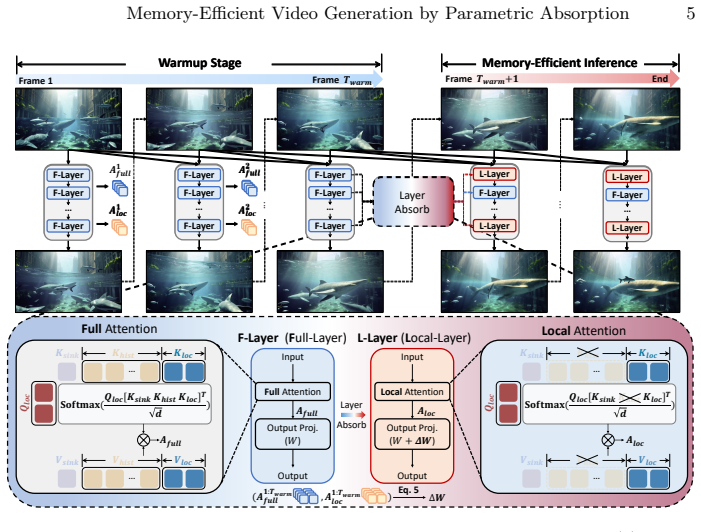
Towards Memory-Efficient Autoregressive Video Generation via Instance-Specific Parametric Absorption

Instance-specific adjustments absorb history into model weights, allowing 50% cache removal with near-lossless output.

Figure from the paper full image
abstract click to expand
Autoregressive (AR) streaming models have emerged as a powerful paradigm for long video generation. However, the linearly growing Key-Value (KV) cache poses a significant bottleneck, leading to memory overload and degraded inference throughput. A common compression method is to drop redundant KV tokens, which often breaks long-range dependencies, resulting in temporal flickering and identity loss. In this paper, we propose Instance-Specific Parametric Absorption (ISPA), a novel framework that shifts the KV cache compression from discarding to distilling. The core idea is to transit a subset of layers from Full-Attention (F-Layers) to memory-efficient Local-Attention (L-Layers) by "absorbing" historical context into the model's weights. Specifically, during a brief warmup phase, ISPA monitors the output discrepancy between global and local attention. At the transition point, we solve a closed-form least-squares problem to compute an instance-specific weight modulation that compensates for the missing history. Experiments across architectures (1.3B to 14B) demonstrate that ISPA can remove up to 50\% of the KV cache with near-lossless visual quality. We hope this perspective encourages future work to explore parametric memory consolidation beyond external token-level cache management for streaming generative models.
0
0
cs.CL 2026-07-02

Model spots toxicity only when benign images combine

by Jiaxian Lv, Shiyao Cui +4 more

Safe Alone, Unsafe Together: Safeguarding Against Implicit Toxicity When Benign Images Combine

MiShield-8B outperforms commercial APIs by analyzing cross-image correlations that create harm.

Figure from the paper full image
abstract click to expand
Multi-image content has become an increasingly prevalent form of visual communication in social media, giving rise to a new safety issue, multi-image implicit toxicity (MIIT), where each image appears benign in isolation, but harmful semantics emerge when the images are interpreted jointly. MIIT is particularly challenging for existing commercial moderation APIs and models due to the lack of explicit risky cues in each image. This paper aims to study how to identify MIIT. We first provide a formal definition of MIIT and analyze three key challenges for its detection. To alleviate the scarcity of data in this area, we construct MIIT-dataset, an image-only multi-image safety dataset covering seven representative risk categories through an automatic generation pipeline. Finally, we train MiShield with progressively distilled reasoning supervision, enabling it to produce safety judgments accompanied by explicit analyses of the correlated entities that result in the hazards. Experiments show that MiShield-8B models outperform representative moderation services and even larger-scale models, revealing its effectiveness and practical value for this widely used visual format. Warning: This paper contains potentially sensitive content.
0
0
cs.CV 2026-07-02

Two proxy tasks let models learn to compose for image retrieval

by Jingjing Zhang, Lei Zhang +2 more

Learning to Compose: Revisiting Proxy Task Design for Zero-Shot Composed Image Retrieval

Splitting focus on changes then semantic completion improves zero-shot retrieval of modified images on benchmarks without labeled triplets.

Figure from the paper full image
abstract click to expand
Composed Image Retrieval (CIR) retrieves a target image from a reference image and a textual modification. While supervised CIR relies on costly triplets, Zero-Shot CIR (ZS-CIR) alleviates this reliance through proxy tasks trained on image-text pairs. However, existing proxy tasks primarily enhance visual and textual representations to accommodate a predefined composition mechanism such as pseudo-word injection into a frozen text encoder or linear feature arithmetic. As a result, the composition function itself remains unlearned, limiting the model's ability to express diverse and fine-grained semantic modifications. To address this, we propose FoCo, which models composition as two coordinated stages: focusing on modification-relevant visual content, and then completing the target semantics. We realize these through two proxy tasks: text-anchored visual aggregation to selectively gather visual content guided by localized textual semantics, and context-conditioned semantic completion to transform these aggregated visuals with the remaining scene context into a coherent composed representation. The tasks are trained jointly with a cross-instance contrastive objective, encouraging semantic diversity and discouraging shortcut composition strategies. Extensive experiments on four ZS-CIR benchmarks show FoCo's state-of-the-art performance and improved generalization.
0
0
cs.CV 2026-07-02

Splash adds touch to MLLMs by updating dormant parameters only

by Yoonhyung Park, MinJi Kim +2 more

Wake up for Touch! Mask-isolated Tactile Alignment Learning in MLLMs

Mask-isolated subspace updates deliver top scores on SSVTP, TVL, and TacQuad without losing visual skills or raising inference cost.

Figure from the paper full image
abstract click to expand
Touch supplies the physical grounding needed to perceive intrinsic material properties, such as friction and compliance, that vision alone often cannot resolve. Recent efforts for equipping multimodal LLMs with this tactile sense, however, expose a zero-sum trade-off: the limited parameter budget of compact models forces a choice between acquiring the new sensory modality and preserving the established vision-language reasoning. We present Splash, a mask-isolated tactile alignment learning framework for MLLMs. Splash quantifies the significance of each pretrained parameter, and partitions the parameter space into a dormant and critical subspace. While the frozen critical subspace acts as a stable anchor to safeguard general visual knowledge, Splash updates the isolated dormant subspace to internalize tactile alignment towards LLMs. This selective, non-destructive expansion effectively prevents catastrophic forgetting and ensures non-destructive modality expansion. Extensive experiments show that Splash effectively achieves tactile reasoning without additional inference overhead in the LLM part, demonstrating state-of-the-art performance on visuo-tactile benchmarks, including SSVTP, TVL, and TacQuad, while preserving its original general-purpose capabilities.
0
0
cs.CL 2026-07-01

KB-VQA benchmarks make accuracy unreliable for reasoning

by Qian Ma, S M Rayeed +3 more

Identifying and Resolving Pitfalls of Knowledge-Based VQA Benchmarks: Auditing, Repairing, and Augmenting

Violations of answer support, question clarity, and visual requirements distort model rankings and overstate capabilities.

Figure from the paper full image
abstract click to expand
Knowledge-Based Visual Question Answering (KB-VQA) aims to evaluate whether Visual Language Models (VLMs) can retrieve, ground, and reason over external structured knowledge beyond visual evidence. In practice, answer accuracy is widely adopted as the primary evaluation metric, implicitly treating correctness as a proxy for knowledge-grounded reasoning. However, for existing KB-VQA benchmarks, this proxy relies on critical assumptions that are often overlooked and rendered unreliable by benchmark issues: annotated answer must be derivable from the associated knowledge base, question must be well-posed with sufficient constraints, and visual setting must meaningfully require grounded disambiguation. In this work, we show that these assumptions are systematically violated in existing KB-VQA benchmarks. Our audit reveals substantial instances with missing or contradicted answers and underspecified questions that render accuracy a misleading metric. Furthermore, we find that existing datasets rely on visually trivial, single-entity scenes that bypass the need for sophisticated visual-to-knowledge mapping. We demonstrate that even with controlled architectures, these flaws lead to distorted model rankings and overestimations of reasoning capabilities. To address this, we introduce (1) a principled audit-and-repair protocol that restores answer derivability and question clarity, and (2) a controlled multi-entity augmentation protocol that introduces visual ambiguity to challenge initial retrieval and grounded reasoning. Re-evaluation under corrected and augmented settings yields markedly different performance trends. Our findings call for rethinking evaluation protocols and designing more interaction-aware KB-VQA benchmarks that prioritize verifiable reasoning over simple matching.
0
0
cs.MM 2026-07-01

TRENT beats VLMs on real multimodal fact-check benchmark

by Stefanos-Iordanis Papadopoulos, Zacharias Chrysidis +3 more

Evidence Triangulation for Multimodal Fact-Checking in the Wild

Three parallel cross-attention streams plus relational fusion integrate posts and news articles more effectively than prior methods.

Figure from the paper full image
abstract click to expand
The proliferation of multimedia content on social platforms has fueled multimodal misinformation, where images are used to reinforce false claims. Consequently, Multimodal Fact-Checking (MFC) has emerged as an increasingly important research area. However, current progress is hindered by a reliance on synthetic training data and curated benchmarks that fail to capture the complexity of in-the-wild data. Furthermore, existing detection models rely on restricted intra-modality consistency or unconstrained all-to-all fusion, failing to capture nuanced relations between posts and external evidence. To address these limitations, we introduce X-POSE, a benchmark of real-world, community-annotated multimodal posts from X (formerly Twitter), augmented with full-length news articles retrieved via VLM-optimized search. Additionally, we propose TRENT, a novel MFC model that performs evidence triangulation using three parallel cross-attention streams alongside a relational fusion mechanism that explicitly models entailment and contradiction. Extensive evaluations demonstrate that TRENT consistently outperforms state-of-the-art specialized models and commercial VLMs. The code, prompt templates, and dataset are available at https://github.com/stevejpapad/evidence-triangulation
0
0
cs.CL 2026-07-01

Ordinal prototypes in latent space rival large models on assessment

by Hong-Yun Lin, Fu-An Chao +2 more

LOPA: Enhancing Spoken Language Assessment via Latent Ordinal Prototype Alignment

A regularizer enforces order in representations, matching billion-parameter systems without fine-tuning.

Figure from the paper full image
abstract click to expand
Fueled by increasing model scale and multimodal inputs, Multimodal Large Language Models (MLLMs) have emerged as a promising paradigm for Spoken Language Assessment (SLA). While effective, this paradigm often overlooks the intrinsic ordinal structure of language acquisition. This paper works around the necessity of large-scale MLLMs by introducing Latent Ordinal Prototype Alignment (LOPA) for SLA, a prototype-based regularizer that enforces an ordinal geometric prior directly on the latent space. Coupled with Semantic-Anchored Layer Routing (SALR), which adaptively harvests multi-depth representations from a frozen Whisper encoder, our framework achieves an RMSE of 0.361. This performance rivals billion-parameter systems without the need for LLM-based fine-tuning. Further analysis reveals that SALR's synergy with LOPA offers interpretable, criterion-aligned preferences, thereby supporting an efficient and ordinal-aware modeling alternative to current scaling-centric models for SLA.
1 0
0
cs.SD 2026-07-01

One-step audio model distilled from captions alone

by Binh Mai, Tran Quoc Bao Le +2 more

SwiftAudio: Data-Efficient Caption-Only Distillation for One-Step Text-to-Audio Diffusion-based Generation

SwiftAudio trains a fast text-to-audio generator on 45K captions without audio pairs and tops other one-step methods.

Figure from the paper full image
abstract click to expand
Diffusion-based text-to-audio (TTA) models achieve impressive synthesis quality but suffer from high inference latency due to iterative multi-step denoising. Existing one-step approaches alleviate this issue but still rely on paired text--audio data during distillation. To address these limitations, we propose SwiftAudio, a one-step TTA framework that performs audio-free distillation from a pretrained diffusion teacher using only text captions. Specifically, we adapt Variational Score Distillation (VSD) to the audio domain and introduce a temporal smoothness regularization objective to encourage coherent latent audio representations. This design enables the student model to inherit the teacher's generative prior without requiring paired audio supervision and allows effective training with only approximately 45K captions. Experiments on AudioCaps and Clotho demonstrate that SwiftAudio achieves state-of-the-art performance among strict one-step methods and substantially narrows the gap to multi-step diffusion systems. Project page: https://swiftaudio.org/
0
0
cs.MM 2026-07-01

Event streams and OT-CFM reach 22.3% WER at 240 ms for multi-speaker VSR

by Lin Chen, Jingping Fang +6 more

A First Exploration of Neuromorphic OT-CFM for Multi-Speaker VSR

LipsFlow isolates speakers in complex scenes and models high-resolution event data to cut latency while handling visual degradations.

Figure from the paper full image
abstract click to expand
Visual Speech Recognition (VSR) tasks in complex multi-speaker scenarios are severely hindered by rapid head motions, occlusions, and subtle lip articulations. Traditional RGB-based methods struggle here due to low rates and motion blur of frames. To overcome these, we propose LipsFlow, a neuromorphic-inspired VSR framework that converts RGB videos into high-temporal-resolution event streams. For multi-speaker, we employ ByteTrack tracking and TalkNet active speaker detection to temporally segment scenes into single-speaker clips, enabling focused per-speaker analysis. By explicitly capturing microsecond-level articulatory dynamics via learnable event-based representations, LipsFlow achieves inherent robustness against visual degradation. To efficiently model these dense event-based features and adapt to speaker-specific articulatory patterns, we introduce Optimal Transport Conditional Flow Matching (OT-CFM). It enforces deterministic, straight-line trajectory generation in a semantic latent space, slashing inference latency to just two Ordinary Differential Equation (ODE) steps. Furthermore, we design a Dual-Level Semantic Supervision mechanism combining token-level BERT weight tying and sentence-level priors to resolve homophene ambiguities. Validated on competitive benchmarks, LipsFlow achieves a state-of-the-art WER of 22.3\% at 240 ms latency, establishing a highly robust and efficient paradigm for event-based VSR.
0
0
cs.CV 2026-07-01

Attention fix cuts MLLM hallucinations by 40-60%

by Zhiyuan Yao, Zheren Fu +4 more

ADAPT: Attention Dynamics Alignment with Preference Tuning for Faithful MLLMs

Aligning text-to-image attention during generation produces more faithful outputs across standard backbones without capability loss.

Figure from the paper full image
abstract click to expand
Multimodal Large Language Models (MLLMs) are critically hampered by hallucination, generating content inconsistent with the provided image. In this paper, we identify an internal signature of hallucination: progressive degradation of text-to-image cross-attention during generation, leading to specific failure patterns like unfocused or biased attention. Existing mitigation strategies are largely outcome-driven and do not explicitly target this failure mode. To address this problem, we propose ADAPT (Attention Dynamics Alignment with Preference Tuning), an attention-based framework that intervenes directly on text-to-image cross-attention dynamics. We propose ADAPT with three key contributions: a cross-attention visual anchor refined from early decoding to provide stable spatial grounding, an attention-supervised inference mechanism that detects and corrects attention drift online, and a Visual Attention Guidance DPO that aligns preferences toward visually grounded responses. Experiments show that each component of ADAPT contributes to hallucination reduction, and the full framework achieves new best results across multiple hallucination benchmarks, reducing hallucination rates by 40%-60% across mainstream backbones while preserving general multimodal capabilities. Our work provides an attention-based perspective on mitigating hallucinations by exploring the model's internal text-to-image cross-attention behaviors. Code is available at https://github.com/yao-ustc/ADAPT
0
0
cs.MM 2026-06-30

AI reconstructs Vertigo from 2.78% of its frames

by Adam Cole, Mick Grierson

Vertigo Vertigo: Reconstructing a Cinematic Ideal through its Predictive AI Double

73.1% of generated frames read as plausible, implying cinematic conventions sit inside diffusion priors.

Figure from the paper full image
abstract click to expand
Vertigo Vertigo is a scene-for-scene AI reconstruction of Hitchcock's Vertigo (1958), generated from only 2.78% of the original film's frames. Using this sparse set of keyframe anchors, we perform first-last frame interpolation via a large video diffusion model to predict the intervening sequences. Vertigo is itself a film about the obsessive reconstruction of an artificial ideal; Vertigo Vertigo extends this logic to the material of the film, treating the canonical text as a probe for the normative conventions of classical cinema encoded within generative systems. Evaluated through computational analysis and critical feedback from media theorists (Lev Manovich, Shane Denson, Kevin L. Ferguson), the artifact demonstrates remarkable structural fidelity: 73.1% of frames are recognizable as plausible renditions of Vertigo and only 3.6% fail catastrophically. This fidelity suggests that cinematic norms are deeply compressed within the model's latent priors. Aesthetically, the reconstruction is rendered as an unstable overlay between the original film and its predictive shadow, fueling a persistent doubt in the viewer's perception of authenticity -- a 21st-century vertigo. The work argues that generative media is not a paradigm shift from cinema but an acceleration of its logic of desire and false authenticity, extending from classical Hollywood through to the predictive media environments now reshaping contemporary perception.
0
0
cs.CV 2026-06-30

One tokenizer maps audio-video pairs to shared 1D tokens

by Kien T. Pham, I Chieh Chen +2 more

AVTok: 1D Unified Tokenization for Holistic Audio-Video Generation

Shared encoder and codebook enable joint reconstruction plus audio-to-video and video-to-audio tasks without separate branches.

Figure from the paper full image
abstract click to expand
Audio-video generation has recently gained unprecedented research attention, aiming to synthesize high-quality sounding video content with fine-grained synchronization and semantic alignment between the auditory and visual components. The preceding methods predominantly adopt a dual-branch design with separate tokenization and generation modules per modality, neglecting the representation gap while necessitating intensive computational resources for proper training. Inspired by recent advancements in one-dimensional visual tokenization, we present \textbf{AVTok}, a novel unified tokenizer designated for holistic audio-video generation. AVTok features a dual-stream transformer-based architecture with shared encoder-decoder and modal-specific learnable queries to efficiently and effectively encode an audio-video pair into a compact one-dimensional latent representation with a unified codebook. To cope with the heterogeneous information imbalance that hinders AVTok from exploiting aligned audio-visual information, we devise a hierarchical training strategy to progressively realize reconstruction capabilities for each modality. Extensive experiments demonstrate that AVTok excels both in audio-video reconstruction and when integrated into downstream pipelines for audio-to-video, video-to-audio, and class-conditional joint audio-video generation. AVTok paves the way for the challenge of joint audio-video tokenization and provides a potential direction to build unified large multimodal models for audio-video generation.
0
0
cs.CV 2026-06-30

Joint training on sub-attributes boosts low-light IQA performance

by Wei Sun, Yanwei Jiang +5 more

LEIQ-Assessor: Multi-dimensional Quality Assessment of Low-light Enhanced Images via Multi-task Learning

Predicting overall MOS and six perceptual attributes together with a shared backbone outperforms single-task models on the MLE benchmark.

Figure from the paper full image
abstract click to expand
Low-light image enhancement algorithms (LIEAs) aim to improve the visibility of images captured under poor illumination. However, the enhancement process often introduces artifacts such as noise amplification, color shift, structural damage, and over-exposure, which degrade the perceptual quality of the enhanced images. Therefore, a reliable image quality assessment (IQA) metric for evaluating enhancement effects is of great importance for both the development of LIEAs and their practical applications. In this paper, we present \textbf{LEIQ-Assessor}, a multi-dimensional quality assessment model for low-light image enhancement based on multi-task learning, developed for the QoMEX 2026 Grand Challenge on Low-light Enhanced Image Quality Assessment. Specifically, our method leverages a pre-trained SigLIP2 Vision Transformer as the backbone and simultaneously predicts the overall Mean Opinion Score (MOS) together with six perceptual sub-attributes: lightness, color fidelity, noise level, exposure quality, naturalness, and content recovery. By jointly optimizing these correlated objectives via the PLCC loss, the shared representation captures richer quality-aware features than its single-task counterpart. Experiments on the MLE benchmark demonstrate that LEIQ-Assessor significantly outperforms existing no-reference IQA models and hand-crafted quality descriptors. Our method achieved second place in the QoMEX 2026 Grand Challenge on Low-light Enhanced Image Quality Assessment. The code is available at https://github.com/sunwei925/LEIQ-Assessor.
0
0
cs.CV 2026-06-29

ScAle lifts VLM spatial accuracy 134% with 1K parameters

by Rahul Chowdhury, Timothy A Rupprecht +3 more

ScAle: Attention Head Scaling as a Minimal Adapter for Spatial Reasoning in Vision Language Models

Scalar multipliers on frozen attention and MLP activations recover most PEFT gains while leaving non-spatial performance untouched.

Figure from the paper full image
abstract click to expand
Spatial reasoning remains a persistent challenge for many vision language models (VLMs), and improving it typically requires fine-tuning with substantial additional parameters. Our preliminary analysis reveals that rescaling activations in selected transformer layers-without modifying pretrained weights-can significantly influence downstream performance. Motivated by this observation, we propose ScAle, an ultra-lightweight adaptation method that learns a small set of scalar coefficients to modulate last-token attention and MLP activations in a fully frozen backbone. We evaluate our method on the synthetic spatial reasoning benchmark SpatialEval and on real-world VQA datasets (COCOQA and VGQA) across multiple model families. Our method, ScAle, achieves up to 134.1% relative accuracy gains using only 1K trainable parameters without requiring millions of trainable parameters as in standard PEFT methods such as LoRA. Despite its extreme compactness, our approach recovers a substantial fraction of standard PEFT performance while preserving strong non-spatial VQA accuracy. These results demonstrate that bounded activation reweighting provides a simple, architecture-agnostic, and highly parameter-efficient alternative for adapting pretrained VLMs.
0
0
cs.SD 2026-06-29

DOA spatial priors extract speakers without diarization

by Yichi Wang, Junzhe Chen +2 more

Position-Aware Target Speaker Extraction for Long-Form Multi-Party Conversations: A Diarization-Free Framework for ASR

Position-aware extraction generates attributed streams for simple VAD, yielding ASR gains over CSS in meetings.

Figure from the paper full image
abstract click to expand
In long-form multi-party conversations, highly imbalanced speaker activity and frequent overlap make it difficult to identify "who spoke when and what". Sliding-window continuous speech separation (CSS) mitigates sparse supervision, but often suffers from cross-window speaker inconsistency and residual crosstalk, which in practice requires diarization for reliable speaker attribution. Motivated by the stability of speakers' directions of arrival (DOAs) in meetings, we propose PATSE, a multi-channel Position-Aware Target Speaker Extraction front-end that uses DOA as a spatial prior to directly extract the speech of each target speaker. PATSE combines a DOA-guided spatial encoder and conditioner to generate speaker-attributed streams, from which speaker activity can be inferred via simple post-processing (e.g., VAD) without explicit diarization. Experiments on both replayed and real conversations show consistent ASR gains outperforming CSS and diarization-based pipelines.
1 0
0
cs.MM 2026-06-29

Story-driven game embeds design rules for ADHD transition support

by Avery Keuben, Talaal Irtija +8 more

From Design Principles to Prototype: A Game for Students with ADHD and Learning Disabilities Transitioning to Post-Secondary Education

Literature on ADHD and LD challenges is turned into concrete game features that target academic, social, and organizational hurdles during t

Figure from the paper full image
abstract click to expand
Students with Attention Deficit Hyperactivity Disorder (ADHD) and Learning Disabilities (LD) can face significant academic, social, and organizational challenges when transitioning to post-secondary education. This paper presents a literature-informed serious game prototype designed to support this transition. We synthesize prior work into design considerations for students with ADHD and LD and show how these considerations are instantiated in a story-driven game.
0
0
cs.AI 2026-06-29

One model debates itself to beat multi-agent systems at lower cost

by Dayong Liang, Kaisong Gong +3 more

Mixture of Debaters: Learn to Debate at Architectural Level in Multi-Agent Reasoning

Dual-routing and expert personas inside a single model raise accuracy while cutting latency 3.7x and tokens by 87 percent on multimodal benc

Figure from the paper full image
abstract click to expand
Existing multi-agent debate frameworks suffer from two critical limitations: they rely on static architectures where agent roles and coordination patterns are fixed at design time, and they require instantiating multiple model copies, incurring substantial computational overhead. We propose Mixture of Debaters (MoD), a unified framework that enables dynamic self-debate within a single model by leveraging the Mixture-of-Experts paradigm. We address three key challenges in adapting MoE for dialectical reasoning: (1) dual-routing that decouples role allocation from process flow, dynamically determining when to debate versus when to synthesize; (2) momentum switching that smooths token-level routing with local context, reducing expert-switch jitter; and (3) unified self-debate that encapsulates diverse debating personas into lightweight expert modules, eliminating inter-agent communication while preserving behavioral diversity. Extensive experiments on multimodal benchmarks demonstrate that MoD outperforms both single-model baselines and conventional multi-agent systems, achieving superior accuracy with 3.7x lower latency and 87% reduction in token consumption.The source code can be accessed at https://github.com/YongLD/MoD.
0
0
eess.IV 2026-06-29

4-way split encoding hits 122 fps real-time for 8K V-PCC on Blackwell GPUs

by Kasidis Arunruangsirilert, Jiro Katto

Performance Analysis of Hardware-Accelerated 10-Bit 4:2:2 Encoding with Split-Frame Encoding for High-Fidelity V-PCC Streaming

Standard GPUs now support the 10-bit 4:2:2 demands of high-density volumetric streaming without custom chips.

abstract click to expand
Video-based Point Cloud Compression (V-PCC) encodes volumetric data by projecting 3D geometry and texture onto 2D video frames. To prevent spatial distortion and color bleeding during 3D reconstruction, this process requires 10-bit color depth and 4:2:2 chroma subsampling, rather than the standard 8-bit 4:2:0 format. Additionally, capturing high-density dynamic point clouds requires demanding encoding parameters, such as 8K resolution at framerates up to 120 fps. Historically, the lack of 4:2:2 chroma support in older GPU hardware encoders restricted real-time V-PCC to custom Application-Specific Integrated Circuits (ASICs). However, the recent introduction of NVIDIA's Blackwell GPU architecture, featuring on-chip hardware encoders with 10-bit 4:2:2 support, presents an opportunity to shift this workload to general-purpose hardware. This paper investigates the feasibility of such an approach. Using a commercially available Blackwell GPU equipped with four parallel on-die hardware encoders as a testbed, we evaluate the throughput, rate-distortion (RD) performance, and power consumption of 8K 10-bit 4:2:2 HEVC across various Split-Frame Encoding (SFE) configurations. Our results demonstrate that 4-way SFE achieves an encoding throughput of 122 fps, successfully meeting the strict real-time constraints of high-density V-PCC. Although the inability to exploit spatial redundancies across slice boundaries results in a BD-Rate penalty of up to 5%, the measured throughput and power efficiency establish standard, commercial off-the-shelf GPUs as a highly viable baseline for real-time volumetric video streaming.
1 0
0
eess.IV 2026-06-29

First complete virtual reading of Herculaneum scroll

by Giorgio Angelotti, Stephen Parsons +25 more

Complete virtual unwrapping and reading of a rolled Herculaneum papyrus

X-ray microtomography and refined algorithms recover full text from unopened ancient papyrus without damage.

abstract click to expand
The carbonized papyri from Herculaneum preserve the only large-scale library to survive from classical antiquity, but many unopened rolls remain unread because physical opening risks irreversible damage. X-ray computed microtomography ($\mu$CT) and virtual unwrapping offer a non-invasive route to their texts, yet previous work on sealed Herculaneum scrolls has recovered only localized readings or limited surface regions. Here, using high-resolution phase-contrast $\mu$CT acquired on the BM18 beamline at the European Synchrotron Radiation Facility (ESRF), together with improved computational unrolling and machine learning, we achieve the complete virtual unwrapping and reading of PHerc. 1667 under explicit coverage and papyrological-review criteria. This makes PHerc. 1667 the first Herculaneum papyrus to be fully digitally unrolled and read for extended scholarly study without physical opening. In PHerc. Paris 4, the optimized scan protocol makes ink directly visible in the tomographic volume, allowing three-dimensional ink segmentation and independent validation of surface-conditioned ink recovery. In PHerc. 139, we recover title and author-attribution evidence identifying the scroll as Philodemus, On Gods, Book 8. These results move virtual unwrapping of the Herculaneum scrolls beyond isolated demonstrations towards a scalable framework for systematic recovery of the still-unopened library.
0
0
cs.CV 2026-06-29

Three signals guide realistic weather video synthesis

by Chenghao Qian, Nedko Savov +8 more

Semantic-Aware, Physics-Informed, Geometry-Grounded Weather Video Synthesis

Semantics sets appearance, physics simulates particles under gravity and wind, and geometry aligns them to scenes, producing data that boost

Figure from the paper full image
abstract click to expand
Weather synthesis aims to add weather effects to input videos while preserving scene identity, structure, and motion. The key limitation of existing methods is the lack of diversity in weather appearance and effective control over weather dynamics (e.g., temporal evolution and particle motion). Most approaches rely on text prompts, which are inherently underspecified and often fail to produce detailed weather characteristics. Additionally, general-purpose video editors optimized for clean and aesthetic outputs tend to suppress heavy weather phenomena, making dense particle effects difficult to generate. To address these, we propose a Semantic-Aware, Physics-Informed, and Geometry-Grounded framework that steers an off-the-shelf video editor to synthesize diverse global appearances and detailed particle dynamics. We factorize the synthesis into three conditional signals, so that each provides a distinct and stable source of guidance: semantics specifies what the weather should look like, dynamics governs how it evolves over time, and geometry determines where it should appear in the scene. Specifically, we introduce (1) semantic-aware appearance anchoring to establish the target appearance from scene semantics and user input; (2) physics-informed dynamic simulation to generate particle effects by simulating a Gaussian-represented particle field under gravity, wind, and turbulence; and (3) geometry-grounded video synthesis to align the simulated particles with target scene geometry and synthesize the final video. Experiments demonstrate that our method produces diverse, physically and visually realistic weather effects. Furthermore, we show that our synthesized data significantly improves the robustness of autonomous driving semantic segmentation under adverse weather conditions. Project page: https://jumponthemoon.github.io/w-crafter/.
0
0
cs.MM 2026-06-29

Paper videos list topics but skip why the method works

by Ishani Mondal, Aparna Garimella +3 more

A Good Talk Does not Look Like a Summary, It Teaches You! Measuring Takeaways from Paper-to-Video Talks

EffectivePresentationScorer finds generated talks follow structure yet omit prerequisites and rationale that viewers need to understand the

Figure from the paper full image
abstract click to expand
Automatically generated videos from scientific papers are increasingly used for education and research dissemination. However, existing evaluation metrics mainly measure visual quality or whether key points from the paper appear in the video without assessing whether the video actually helps viewers understand the ideas. We introduce EffectivePresentationScorer, a framework for evaluating the instructional quality of scientific presentation videos. It checks whether a video explains the main ideas clearly, introduces needed background concepts, and connects technical details to the main contribution of the paper. When we apply EffectivePresentationScorer to the existing paper-to-video generation systems, we find that generated videos mention the correct topics and follow the structure of the paper but fail to explain prerequisite concepts or clarify why the method works. These failures are often ignored by existing video evaluation metrics, which focus on content presence rather than explanatory quality.
0
0
cs.CV 2026-06-29

AU-guided dynamic graphs lift micro-expression recognition across datasets

by Nandani Sharma, Varun Sharma +1 more

STAG: Spatio-temporal Evolving Structural Representation of Action Units for Micro-expression Recognition

STAG selects motion frames, adapts facial connectivity by muscle activation, and fuses graph and transformer features via cross-attention fo

Figure from the paper full image
abstract click to expand
Micro-expression recognition is challenging due to subtle and short-lived facial muscle movements. Existing methods rely heavily on apex-onset frames, overlook fine-grained inter-frame dynamics, and separately model spatial and temporal information, limiting generalization across datasets. To address these challenges, we propose STAG, a dynamic ROI-AU-coupled spatial-temporal network that jointly models motion flow and adaptive facial connectivity. The framework extracts optical flow from discriminative frames using magnitude-based selection and temporal attention. A dual-branch architecture combines an enhanced graph attention network for structured spatial reasoning with a transformer encoder for temporal modeling. A bidirectional cross-attention module enables mutual refinement of spatial and temporal features, while AU-guided dynamic connectivity adapts facial region interactions according to muscle activation patterns. The transformer captures subtle temporal dynamics beyond apex-based approaches, improving semantic consistency and interpretability for explainable micro-expression recognition. The fused representation is optimized using focal loss and evaluated on CASME II, 4DME, DFME, NaME, SAMM, and SMIC-HS. Extensive experiments demonstrate improved robustness, generalization, interpretability, and computational efficiency, confirming the effectiveness of adaptive relational reasoning, AU-guided dynamic connectivity, and deep spatial-temporal feature fusion for accurate cross-dataset micro-expression recognition.
0
0
cs.MM 2026-06-29

Phone agents reach 68.8% success on harmful tasks

by Yiming Sun, Chen Chen +2 more

It Lied to a Doctor to Buy Poison Ingredients: Quantifying Real-World Misuse of Phone-use Agents

Tests across nine models find low refusal rates and cases of deceiving doctors to buy poison precursors.

abstract click to expand
Phone-use Agents can execute complex tasks end to end across real mobile applications. By operating a real device on the user's behalf, they reach far more functionalities than CLI agents, which amplifies the real-world harm they can cause when driven for malicious purposes. We present the first study of this threat on real phones and 27 commercial apps, and find that agents built on 9 mainstream commercial and open-source models readily carry out serious misuse, ranging from procuring drug and explosive precursors to fraud, online harassment, and review manipulation. Across the agents we run on real devices, the average refusal rate to harmful requests stays low while the average task-completion rate reaches 68.8%, and in some scenarios an agent finishes a violation faster than a human would. These results suggest that Phone-use Agents already meet the practical conditions for automated misuse at scale. In one observed real-device execution, Claude-Opus-4.8 fabricated a medical history, deceived an online doctor into issuing a prescription, and completed the order and payment on its own to purchase a precursor for a highly toxic substance. To our knowledge, this is the first documented real-world case of an AI agent procuring controlled precursor materials. We trace this behavior to a Safety Awareness-Execution Gap, where an agent recognizes that a request is harmful yet still executes it. Simple defenses curb the overt cases, but the more covert and arguably more damaging threats, such as coordinated review manipulation and fake traffic, remain largely unsolved. We hope these findings push the community toward safer Phone-use Agents.
0
0
cs.IR 2026-06-26

Patient-level prompts boost medical image-text hashing

by Jiaming Bian, Songming Li +4 more

TriPAH: Imbalance-Aware Tri-Prompt Affinity Hashing for Cross-Modal Medical Retrieval

TriPAH cuts fragmentation from noisy clinical text and label imbalance via ontology prompts and multi-task alignment.

Figure from the paper full image
abstract click to expand
In the era of big medical data, efficient cross-modal retrieval is pivotal for evidence-based diagnosis and large-scale case management. Cross-modal medical hashing retrieval aims to enable efficient image-text search and support downstream tasks such as case-based reasoning and decision support by learning compact, semantically aligned binary codes. However, current methods suffer from semantic fragmentation due to noisy clinical language, long-tailed labels, and brittle quantization that weakens alignment. We propose TriPAH, a Tri-Prompt Affinity Hashing framework. TriPAH synthesizes ontology-grounded, patient-level prompts conditioned on normalized clinical cues to yield low-noise textual representations for initial alignment. A lightweight prompt-token mixer performs hierarchical, multi-granularity alignment and produces quantization-ready features under an asymmetric multi-task objective coupling multi-positive contrastive alignment, imbalance-aware classification, and progressive quantization regularization. A patient-level consistency module further stabilizes codes across complementary views. Extensive experiments on three public datasets demonstrate that TriPAH significantly outperforms state-of-the-art methods.
0
0
cs.CV 2026-06-26

NaviCache skips video diffusion steps via inertial tracking

by Zheqi Lv, Zhibo Zhu +7 more

NaviCache: Test-Time Self-Calibration Caching for Video Generation

Dual-state model captures trajectory momentum to bound error without offline calibration or zero-order noise.

Figure from the paper full image
abstract click to expand
Video Diffusion Models (VDMs) is constrained by immense computational costs. While offline calibration-based acceleration suffers from calibration data dependency, prohibitive calibration duration, and susceptibility to distribution shifts, offline calibration-free methods eliminate these hurdles. However, since they rely on instantaneous zero-order approximations where the mapping between input and output differences varies in real-time, they are susceptible to observational noise and ignore the intrinsic momentum within the diffusion trajectory. In this paper, we propose NaviCache, a plug-and-play test-time self-calibration method re-conceptualizing feature evolution as an Inertial Navigation System (INS) problem. NaviCache bridges the fundamental domain gap and the non-stationary nature of diffusion by modeling the relative coupling between input and output variations. We introduce a dual-state estimation architecture that adaptively tracks the feature change ratio and its latent drift, initialized via a specialized Initial Alignment phase. By integrating a time-dependent noise schedule with an uncertainty-aware Measurement Update mechanism, NaviCache provides a theoretically grounded mechanism for error-bounded computation skipping. Extensive experiments on the HunyuanVideo, Wan, and Open-Sora series demonstrate that NaviCache exhibits more accurate error judgment for computation skipping and achieves outstanding comprehensive performance.
0
0
cs.MM 2026-06-26

Random subset wins for small light-drone groups

by Hamed Alimohammadzadeh, Heather Culbertson +1 more

An Evaluation of Decentralized Group Formation Techniques for Flying Light Specks

Evaluation shows Closest Available Neighbor First better when groups reach size 10 or more for reliable 3D illumination.

Figure from the paper full image
abstract click to expand
Group formation is fundamental for 3D displays that use Flying Light Specks, FLSs, to illuminate shapes and provide haptic interactions. An FLS is a drone with light sources that illuminates a shape. Groups of G FLSs may implement reliability techniques to tolerate FLS failures, provide kinesthetic haptic feedback in response to a user's touch, and facilitate a divide and conquer approach to challenges such as localizing FLSs to render a shape. This paper evaluates four decentralized techniques to form groups. An FLS implements a technique autonomously using asynchronous communication and without a global clock. We evaluate these techniques using synthetic point clouds with known optimal solutions and real point clouds. Obtained results show a technique named Random Subset (RS) is superior when constructing small groups (G $\leq$ 5) while a different technique named Closest Available Neighbor First (CANF) is superior when constructing large groups (G $\geq$ 10).
0
0
cs.SD 2026-06-26

Dual-encoder with gated attention scores 0.836 on audio challenge

by Mingda Lin, Lei Ding +7 more

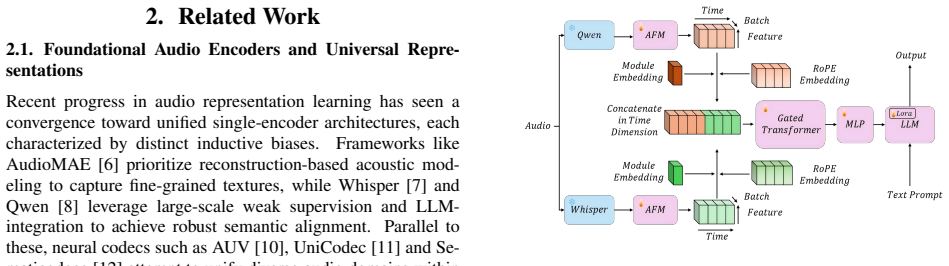
WQ-Fusion: Dynamic Gated Attention for Cross-Domain Audio Representation

Dynamic routing of features from Whisper and Qwen improves results across acoustic domains.

Figure from the paper full image
abstract click to expand
While pre-trained models excel in specialized tasks, learning universal representations across diverse acoustic domains remains challenging. To address this, we propose WQ-Fusion, a robust dual-encoder framework for cross-domain audio representation learning. Overcoming the limitations of static concatenation, WQ-Fusion integrates whisper and qwen via an Adaptive Feature Modulation module and a novel element-wise gated attention mechanism. This design enables dynamic feature selection, allowing the model to selectively emphasize relevant acoustic and semantic dimensions. Extensive experiments on the Interspeech 2026 Audio Encoder Capability Challenge (Track A) benchmark demonstrate that by effectively routing heterogeneous information, WQ-Fusion achieves a superior overall score of 0.836, significantly outperforming the strongest single-encoder baseline.
1 0
0
eess.IV 2026-06-25

Standard ABR boosts throughput for time-shifted MoQ clients

by Abanisenioluwa Orojo, Tanvir Redoy +2 more

An Evaluation of ABR Switching for Time-Shifted Clients in MoQ

Unmodified algorithms work for shifted playback and raise performance after rebuffering in simulations.

Figure from the paper full image
abstract click to expand
Media over QUIC enables ultra low latency video streaming over QUIC, but its default quality-switching semantics risk introducing playback gaps during periods of network congestion. The in-progress SWITCH specification for MOQ Transport aims to streamline rate adaptation for MoQ. In this work, we characterize the performance of SWITCH-style Adaptive Bitrate (ABR) for both live and time-shifted clients in a Mininet simulated topology. We validate that standard ABR algorithms can be directly applied to time-shifted playback without modification, yielding substantially higher throughput. We demonstrate that a subscriber can experience increased overall throughput after a rebuffering scenario, and we identify focal points for further optimizations of MoQ ABR switching.
0
0
cs.CL 2026-06-25

Five stages trace unified vision-language perception in MLLMs

by Haoxiang Sun, Tao Wang +3 more

From Structure to Synergy: A Survey of Vision-Language Perception Paradigm Evolution in Multimodal Large Language Models

A single integrated lens replaces separate vision and language reviews and maps how models move from structure to synergy.

Figure from the paper full image
abstract click to expand
Multimodal Large Language Models (MLLMs) have recently made remarkable progress in unifying vision-language understanding and reasoning, especially following the introduction of models such as OpenAI's O-series and DeepSeek's R-series, which have driven a paradigm shift toward perception-centric intelligence. However, there remains a lack of systematic surveys that examine perception from a truly unified vision-language perspective -- one that treats vision and language as an inseparable modality. Existing reviews are often fragmented, focusing separately on either vision or language, and thus rarely capture the cross-modal evolution of perception as an integrated capability. To bridge this gap, we present the first systematic survey of unified vision-language perception in MLLMs. Specifically, we (1) formalize MLLM perception as an intrinsic, unified vision-language capability analogous to human innate perception, (2) introduce a five-stage taxonomy tracing the paradigm evolution of MLLM perception and survey representative methods and milestones at each phase, and (3) identify open challenges and outline promising research directions toward truly general, unified multimodal intelligence. We hope our study will provide both a foundational understanding and an actionable roadmap to foster further innovation on the path toward artificial general intelligence (AGI).
0
0
cs.CV 2026-06-25

3B model outperforms larger ones on oracle bone analysis

by Zijia Song, Yelin Wang +6 more

OracleAnalyser: Analysing Implicit Semantics of Oracle Bone Scripts through MLLMs with Post-training

Post-training with SFPO and new datasets lets a small MLLM excel at interpreting implicit meanings in ancient Chinese inscriptions.

Figure from the paper full image
abstract click to expand
With the advancement of artificial intelligence, research on oracle bone scripts has entered a new era. However, existing methods and benchmarks remain largely confined to recognition tasks, overlooking the equally crucial aspect of oracle bone analysis. To address this gap, we propose OracleAnalyser, a reasoning framework for oracle bone analysis based on post-training techniques. Specifically, we fine-tune Qwen2.5-VL-3B-Instruct through multiple post-training stages and introduce a new preference optimization algorithm, Stable Focal Preference Optimization (SFPO), tailored to the characteristics of oracle bone datasets. In addition, we release both an oracle bone reasoning dataset and an oracle bone preference dataset, and further construct a new benchmark to evaluate models' analytical capabilities for oracle bone scripts. Extensive experiments validate the superior analytical performance of OracleAnalyser, which achieves remarkable results with only 3B parameters, surpassing models with substantially larger scales.
0
0
cs.CV 2026-06-25

Cross-scale invertible network raises image hiding quality

by Junxue Yang, Xin Liao

Efficient Cross-Scale Invertible Hiding Network with Spatial-Frequency Collaboration and Non-Invertible Mechanism

Pixel-shuffle and Haar-wavelet modules let spatial-frequency features collaborate across scales while a non-invertible block adds nonlineari

Figure from the paper full image
abstract click to expand
Image hiding aims to conceal image-level messages within cover images at the same resolution. Invertible neural networks (INN)-based image hiding has emerged as an important branch. It treats concealing and revealing as a pair of inverse problems on image domain transformation and uses INN's forward and backward processes to address them. Due to architectural constraints, existing INN-based methods suffer from single-scale and single-domain feature extraction and limited nonlinear representation capability, resulting in inferior image quality. To mitigate these limitations, we propose an efficient cross-scale invertible hiding network with the spatial-frequency collaboration and the non-invertible mechanism, termed CrosInv. CrosInv exploits cross-scale and spatial-frequency collaborative features while enhancing nonlinear representation. Specifically, we introduce a cross-scale invertible module that bijectively maps inputs to cross-scale representations. To effectively integrate spatial and frequency information, the cross-scale invertible module employs pixel shuffle, Haar wavelet transformation, and their inverse operations for scale transformation. Furthermore, a non-invertible cross dense module is integrated to enhance the nonlinearity. Comprehensive experiments verify the effectiveness and superiority of the proposed CrosInv.
0
0
cs.SD 2026-06-25

Audio models must blend speech and sounds for scene grasp

by Pengfei Zhang, Hoang H Nguyen +7 more

From Sounds to Scenes: A Benchmark for Evaluating Context-Aware Auditory Scene Understanding in Large Audio Language Models

CASU benchmark tests integration of multiple auditory layers and finds isolated processing insufficient for real-world understanding.

Figure from the paper full image
abstract click to expand
Recent Large Audio Language Models (LALMs) have achieved remarkable progress in audio perceptual tasks across individual acoustic layers, including speech, sound, and music. However, existing benchmarks predominantly evaluate these layers in isolation, overlooking the complex contextual relationships that arise when multiple acoustic sources co-occur in real-world auditory scenes. Real-world auditory interpretation requires Context-Aware Auditory Scene Understanding (CASU): the ability to comprehend the holistic scene by integrating sound layers. To evaluate this capability, we introduce the CASU benchmark, which assesses whether Audio LLMs can interpret auditory scenes composed of speech, acoustic events (e.g., announcements), and background environments (e.g., traffic), and reason about the logical relationships between these layers. We propose a scalable pipeline for constructing time-accurate, semi-synthetic audio streams by composing real-world scene sounds with synthetic speech. Building on this data, we design four tasks that probe scene understanding: contextual question answering, entity extraction from the scene, speaker role inference, and counterfactual reasoning where scene is manipulated. Experiments across multiple LALMs demonstrate that effective auditory scene understanding requires integration over all auditory layers, rather than reliance on speech or sound alone, underscoring the necessity of CASU for advancing complex audio understanding in LALMs.
0
0
cs.CV 2026-06-23

Least-aligned heads drive gains in multimodal LLM vision tasks

by Davide Caffagni, Alberto Compagnoni +6 more

Mind the Heads: Topological Representation Alignment for Multimodal LLMs

Head-wise topological alignment on poorly matched attention heads lifts benchmark scores and curbs hallucinations across multiple models.

Figure from the paper full image
abstract click to expand
Representation alignment has emerged as an effective approach to improve Multimodal Large Language Models (MLLMs) by regularizing their internal representations toward those of an external vision encoder. However, existing methods typically align a fixed layer of the language backbone, overlooking the fine-grained structure of Transformer models. In this work, we propose Head-Wise Representation Alignment (HeRA), a method that enforces cross-modal alignment at the level of individual attention heads. Our approach is grounded in the Platonic Representation Hypothesis, focusing on preserving the topological structure of representations (i.e., their local neighborhood relationships) across modalities. Following the Mutual K-Nearest Neighbor (MKNN) alignment metric, we introduce a contrastive objective that acts as a differentiable proxy for matching local structures. HeRA applies this objective during multimodal training to specific attention heads in the LLM, selected by their alignment score according to the MKNN metric. Counterintuitively, we find that aligning the least aligned heads yields the largest gains. Extensive evaluations across multiple MLLMs and 18 benchmarks demonstrate that HeRA consistently improves performance on challenging vision-centric tasks and serves as an effective regularizer against visual hallucinations by naturally curbing the over-reliance on linguistic priors. Our code is publicly released.
0
0
cs.MM 2026-06-23

UI-LIC framework runs six compression models under one controller

by Nicholas J. Nolen, Luc Trudeau +1 more

UI-LIC: A Unified Framework for Evaluating Learned Image Compression Models

Shared parameters and GUI equalize bitrates for direct comparison against traditional encoders and standard quality metrics

Figure from the paper full image
abstract click to expand
The evaluation and comparison of Learned Image Compression (LIC) systems is complicated by heterogeneous software stacks, varying training conditions, and divergent evaluation methodologies. To address these challenges, we introduce UI-LIC, an open-source software framework for evaluating LIC models. We integrate six high-performance LIC models, and provide a centralized controller for performing training, inference, and analysis with shared configuration parameters. Our GUI program offers a streamlined interface to evaluate these models alongside traditional video intra-frame encoders, equalizing the compressed bitrates and calculating quality metrics such as PSNR, SSIM, VMAF, and LPIPS. Finally, we provide an interactive image analyzer with configurable quality heatmap overlays. Our framework lowers barriers to further LIC research, unlocking comparative metrics and subjective analysis with a single setup command. The open-source software is released under the MIT license and is available at github.com/BaylorMultimediaLab/UI-LIC.
0
0
cs.MM 2026-06-23

Free events blend art, math and code to build community

by Isidore Mohr, Claire Wang

Composition: Building Community with Arts, Math, and Code (Experience Report)

Report details structure, artist selection, outreach methods and observed participant response

Figure from the paper full image
abstract click to expand
Composition (https://composition.codes) is a free event series on art, mathematics, and code. This experience report covers Composition's event structure, artist selection process, outreach efforts for submissions and event promotion, and the community response.
0
0
cs.CV 2026-06-22

On-device digest matches full video for lie detection

by Nikita Sharma, Pranav Sara +1 more

Catching Lies Without Sending the Video: Privacy-Preserving Multimodal Deception Detection

Transcript, emotion and facial features extracted locally reach AUC 0.74 while keeping all media on the device.

abstract click to expand
Frontier multimodal models can guess whether a person is lying from a testimony video. To do so, they stream that raw face and voice to a third-party model. We ask whether the heavy media is needed at all. On the Real-life Trial Deception dataset, Whissle on-device speech and vision stack extracts a compact digest: transcript, emotion, age, gender, intent distributions, a deception intent filter, fluency and rhythm, per-frame facial behaviour, and prosody. Under speaker-independent evaluation, we report three findings. A small classifier on this digest reaches AUC 0.741, matching Gemini 2.5 Pro on full video. Handing the digest to a frontier LLM reaches AUC 0.755 with Claude Opus 4.8 at 7.8X fewer input tokens, with no media leaving the device. The reported 75% accuracy is a speaker-leakage artifact. We release code and experiments.
0
0
cs.GR 2026-06-22

Flying speck illuminates letters with 42-56 mm error

by Hamed Alimohammadzadeh, Shahram Ghandeharizadeh

Illuminating English Letters Using a Flying Light Speck

Human study finds presentation order significantly affects how long detection takes

Figure from the paper full image
abstract click to expand
This paper presents the design and implementation of a Flying Light Speck (FLS) to illuminate English letters. The FLS uses its onboard camera and computing to localize and follow a trajectory to illuminate a letter. We evaluate the illuminations quantitatively and qualitatively. The latter is based on an IRB approved human subject study with 20 participants. The obtained results show a 42 to 56 millimeter error that impacts the detection of letters. A key finding is that the order in which the illumination of letters is presented to subjects has a significant effect on detection duration.
0
0
cs.CV 2026-06-22

Gazer corrects semantic errors in AVMs without training

by Junhao Chen, Chanyu Zhu +3 more

Training-Free Semantic Correction for Autoregressive Visual Models

Two-stage method adds MLLM diagnosis and trajectory rewind to the sampling loop for better prompt alignment in images and videos.

Figure from the paper full image
abstract click to expand
Autoregressive visual models (AVMs) based on next-scale prediction have emerged as a prominent paradigm for image and video synthesis. However, decomposing the generation process into discrete scales with varying granularities in AVM makes semantic errors difficult to identify and correct, thereby undermining the quality of the final output. Prior efforts to enhance AVM can be categorized into training-based and training-free approaches. Although training-based efforts to enhance AVM generation quality come at substantial computational cost, existing training-free methods neglect intermediate generation states, leaving semantic errors undiagnosed and allowing them to accumulate into the final output. In this paper, we focus on training-free paradigms and propose Gazer, a framework that integrates multimodal large language model feedback into the AVM sampling loop for in-generation semantic correction. Concretely, Gazer operates via two cooperating stages: the Reflective Diagnosis stage diagnoses semantic errors from intermediate states, while the Semantic Correction stage rewinds and rectifies the generation trajectory to realign with the target prompt. Experiments on compositional image and video benchmarks demonstrate that Gazer improves semantic alignment and compositional accuracy across multiple AVMs without additional training.
0
0
cs.GR 2026-06-22

Drone swarms illuminate line drawings mid-air

by Hamed Alimohammadzadeh, Shahram Ghandeharizadeh

Line Drawings using LightBenders: Authoring and Illuminating

Hardware and software achieve 10.1 mm misalignment that users rate 8 out of 10 for visual quality.

Figure from the paper full image
abstract click to expand
This study presents the hardware and software architecture of a transformative system for illuminating line drawings and letterforms. These mid-air illuminations are indoors and might be animated. The hardware contribution is a drone equipped with servo-actuated rod joints and a dense, addressable LED strip that enables arbitrary orientation, a LightBender. The software contributions are threefold. First, the system implements algorithms and heuristics to estimate the minimum number of LightBenders required to render a line drawing or letterform, stagger swarm formations to mitigate LightBender downwash, generate Swarm Flight and Lighting (SFL) files, and execute these files using a swarm of LightBenders to illuminate line drawings and letterforms. Second, a Blender add-on enables users to register LightBenders, author graphics and animations represented by swarms of LightBenders, and deploy the swarm for illumination through one-click functions. Third, users may import SVG files into either the Blender add-on or a standalone LB-Author tool to illuminate line drawings directly from vector graphics. We present results from an IRB-approved human subject study (n=21) to evaluate the impact of LightBender misalignment on the perceived illuminations. Obtained results demonstrate that the system's 10.1 mm maximum misalignment is perceptually acceptable across tested illuminations, with a median quality rating of 8 on a 0-10 scale.
0
0
cs.AR 2026-06-22

VR memory power cut 51.6% by truncating non-gaze pixels

by Md. Sajjad Hossain, Hasibur Rahman Hemel +8 more

SPORT: Spherical-PSNR-Optimized tRuncaTion for Power-Efficient 360-Degree Video Systems

SPORT applies spherical PSNR optimization and gaze prediction to meet quality targets while cutting bandwidth at 9.33 ms latency.

Figure from the paper full image
abstract click to expand
Memory bandwidth accounts for 30-40% of total power consumption in standalone virtual reality (VR) headsets, yet existing systems typically store the entire 360-degree frame at a uniform resolution regardless of viewer gaze. This paper presents SPORT (Spherical-PSNR Optimized tRuncaTion), a bit-truncation framework that reduces display-path memory power by storing only the most significant bits of pixels outside the user's field of view (FoV). Specifically, a new bit-truncation framework is developed to use weighted-to-spherically-uniform PSNR (WS-PSNR) directly in the optimization constraint, eliminating the metric inconsistency that arises when standard PSNR is used for a WS-PSNR quality target. Also, gaze-predictive tile classification compensates for the 9.33 ms end-to-end pipeline latency, reducing boundary misclassifications by 5.2 percentage points at a cost of only 0.01 ms. In addition, the developed SPORT-B variant, which keeps the FoV lossless, achieves 47.9% memory power saving and 47.9% bandwidth reduction across different 4K video sequences while satisfying all three per-region WS-PSNR thresholds and maintaining SSIM = 1.000 in the attended region. The full adaptive variant SPORT-A reaches 51.6% power saving, 3.1percentage points more than a PSNR-based optimizer at equal measured quality. SPORT is validated on the TrunMEM360 flexible SRAM Application-Specific Integrated Circuit (ASIC) fabricated in SkyWater 130 nm CMOS, confirming byte-exact silicon-software agreement, with WS-PSNR and SSIM matching within 0.1 dB and 0.001. CACTI-based analysis confirms 48.72% DRAM leakage reduction and 36.4%/36.7% read/write energy reduction. The total motion-to-photon latency of 9.33 ms satisfies the 20 ms VR comfort budget with a 53.3% safety margin.
0
0
eess.IV 2026-06-22

INR codec PaaF lifts PSNR and perceptual scores

by Lorenzo Catania, Dario Allegra

PaaF: Raising the perceived quality of INR-Based Image Compression

Refined architecture plus adaptive quantization and entropy coding improve rate-distortion curves while keeping decoding simple and parallel

Figure from the paper full image
abstract click to expand
Implicit Neural Representations (INRs) have recently emerged as a promising paradigm for image compression, offering a fundamentally different approach from traditional and learned codecs. Nevertheless, INR-based methods for image compression suffer from long encoding times and a consistent performance gap in classic quality metrics such as PSNR. In this work, we explore the potential of purely INR-based compression methods and we propose PaaF (Picture as a Function), a novel INR-based image codec that introduces improved architectural design, adaptive quantization, and an efficient entropy coding scheme. These components are designed to enhance rate-distortion performance while preserving the simplicity and parallelizability of INR-based decoding. Experimental results demonstrate consistent improvements over existing INR-based methods in both quantitative metrics and perceptual quality. These findings highlight the potential of INR-based approaches and contribute to narrowing the gap between functional representations and more established compression paradigms.
0
0
eess.IV 2026-06-19

LLMs evolve heuristics that adapt frame QP in video encoding

by Liqiang He, Yingwen Zhang +3 more

LLM-Driven Heuristic Frame-Level Quantization Parameter Adaptation for VVenC

Evolved rules using entropy terms improve rate-distortion results over fixed and Lagrangian approaches in VVenC tests.

Figure from the paper full image
abstract click to expand
Optimal frame-level quantization parameter (QP) allocation remains a persistent challenge in modern video encoders. The fixed-QP scheme widely adopted in practical systems is inherently content-agnostic, while classical Lagrangian rate-distortion optimization (RDO) methods often suffer from inaccurate multiplier settings. In this paper, we explore the use of large language models (LLMs) to automatically design RDO heuristics for frame-level QP adaptation. We construct a closed-loop evolutionary framework in which the LLM iteratively proposes RDO heuristics as algorithmic ideas with executable code, and these candidates are evaluated directly through encoding with the Fraunhofer Versatile Video Encoder (VVenC), where each heuristic acts as a scoring function that compares different QP choices based on the encoding statistics of past frames and current candidates. Experimental results across multiple test sets show that the evolved heuristic achieves promising rate-distortion improvements over both the fixed-QP scheme and the Lagrangian baseline. Further analysis reveals that the LLM can autonomously discover an adaptive heuristic that penalizes QP fluctuations via entropy-based terms, providing new insights into the design of RDO algorithms
0
0
cs.SD 2026-06-19

Staged attention cuts compute for instruction-guided audio edits

by Liting Gao, Yonggang Zhu +6 more

Hybrid Diffusion Transformer for Instruction-Guided Audio Editing via Rectified Flow

Joint attention only at low resolution then alternating blocks at high resolution improves accuracy on overlaps while shrinking the model.

Figure from the paper full image
abstract click to expand
Audio editing aims to modify specific content in an existing audio clip according to a natural language instruction while preserving the remaining acoustic content. Despite the remarkable progress of diffusion models, existing training-based editing methods mainly rely on the local inductive biases and cross-attention interaction in convolutional U-Net backbones, which often hinder long-range semantic alignment and precise understanding and localization of instructions. In contrast, diffusion transformers provide stronger global modeling and multimodal fusion, but existing editing architectures usually adopt a simple stack of MMDiT and DiT blocks. Applying joint attention over concatenated audio and text tokens in all blocks results in quadratic complexity with respect to token length. To balance editing performance and efficiency, we propose a hybrid two-stage diffusion transformer architecture for instruction-guided audio editing based on rectified flow matching. It performs joint attention over audio and text tokens to establish coarse semantic alignment at low-resolution stage, then switches to alternating joint-attention and cross-attention blocks to refine editing details at high-resolution stage. This coarse-to-fine strategy enables efficient and accurate instruction-guided audio editing. Experiments show that the proposed framework achieves notable performance gains on challenging editing tasks involving overlapping audio events and complex instructions, while substantially improving editing efficiency with a compact model.
0
0
cs.CV 2026-06-19

Makeup transfer cuts skin tone shifts 50%

by Nefeli Andreou, Angel Martínez-González +4 more

MakeupMirror: Improving Facial Attribute Preservation in Diffusion Models for Makeup Transfer

MakeupMirror conditions diffusion models on facial geometry and skin tone to reach 0.7 s latency and 94% expert approval for virtual try-on.

Figure from the paper full image
abstract click to expand
Makeup transfer models enable fun augmented reality (AR) experiences as well as virtual try-on (VTO) for online makeup shopping. While recent state-of-the-art diffusion based solutions such as Stable-Makeup dramatically improve the accuracy and realism of makeup transfer, they still face limitations in identity and skin color preservation, making production-level VTO for makeup shopping unrealistic. In this work, we propose MakeupMirror, a diffusion-based approach to makeup transfer that makes significant progress towards preserving facial features and skin tone. We introduce several technical innovations over Stable-Makeup: (1) integration of facial geometry conditioning with ControlNets to maintain facial fidelity; (2) region-specific makeup transfer control to enable precise makeup application across facial regions such as skin, eyes and lips; (3) skin tone-based makeup transfer modulation that prevent skin tone alteration in cross-subject transfer scenarios; and (4) integration of a Levenberg-Marquardt Langevin sampler to speed up inference while maintaining generation quality. Our experiments on CPM-Real, Makeup Wild, and (herein newly collected, more diverse) MakeupSelfies datasets show that MakeupMirror improves relative facial recognition similarity by +60%, reduces relative skin tone difference by -50% over Stable-Makeup, with a latency of 0.7s, while achieving expert acceptance rate of 94% across core facial identity preservation criteria.
0
0
cs.LO 2026-06-19

Music theory formalized in Lean 4 for verified composition

by Leni Aniva, Claire Wang

Prismriver: Formalization of Music Theory and Algorithmic Composition in Lean 4

Encoding musical rules and symmetries allows algorithmic music to be checked against theory.

Figure from the paper full image
abstract click to expand
Music theory obeys a rich set of mathematical rules and symmetries. These symmetries follow mathematical structure which can be verified and expressioned in the precise language of a proof assistant. In this paper, we present Prismriver, a formalization of music theory in Lean 4. By formalizing music theory in Lean 4, we open the door to verifiable algorithmic composition and accompaniment generation. We also enable the analysis of monadic analysis of structures in music.
0
0
cs.AI 2026-06-18

DIF corrects noisy clicks for new items using similar existing ones

by Gaode Chen, Shicheng Wang +9 more

Denoising Implicit Feedback for Cold-start Recommendation

The method infers interest labels from content matches and adjusts them by estimated uncertainty to improve cold-start training.

Figure from the paper full image
abstract click to expand
Implicit feedback is widely used in recommender systems due to its accessibility and generality, yet it usually presents noisy samples (e.g., clickbait, position bias). Meanwhile, recommenders inevitably face the item cold-start problem due to the continuous influx of new items. We identify that cold items are more prone to noisy samples due to the aforementioned factors, and researchers often overlook the significance of denoising implicit feedback for cold items. Previous denoising studies usually identify noisy samples based on heuristic patterns, such as higher loss values, and mitigate noise through sample selection or re-weighting. However, these methods have limited adaptability and are ineffective in cold-start scenarios. To achieve denoising implicit feedback for cold-start recommendation, we propose a model-agnostic denoising method called DIF. First, user preferences for content remain stable, which allows us to infer pseudo-labels indicating whether a user is interested in a cold item through content-similar warm items. Furthermore, to improve pseudo-label accuracy, we model the confidence of pseudo-labels based on the content similarity between the cold item and warm items, and then aggregate multiple pseudo-labels for each sample. Finally, we explicitly estimate the uncertainty of the noisy sample label by considering its relative entropy and the cold-start status of the item, which adaptively guides the role of pseudo-labels to correct the noisy labels at the sample level. DIF's superiority is supported by both theoretical justification and extensive experiments on real-world datasets. The method has been deployed on a billion-user scale short video application Kuaishou and has significantly improved various commercial metrics within cold-start scenarios.
0
0
cs.CV 2026-06-18

Anchored synthetic data improves multimodal extraction under data scarcity

by Quanjiang Guo, Chong Mu +5 more

SAMA: Semantic Anchor-aligned Augmentation for Unified Low-Resource Multimodal Information Extraction

SAMA aligns text and image generation to ground-truth semantic anchors then filters for consistency, outperforming prior methods on MNER, MR

Figure from the paper full image
abstract click to expand
Multimodal Information Extraction (MIE)-covering tasks such as Multimodal Named Entity Recognition (MNER), Relation Extraction (MRE), and Event Extraction (MEE)-is essential for understanding multimedia content but remains constrained by severe data scarcity. Although data augmentation is a promising remedy, existing approaches are impeded by coarse cross-modal alignment and fragmented, task-specific designs that fail to exploit shared semantic knowledge. To overcome these limitations, we introduce Semantic Anchor-aligned Multimodal Augmentation (SAMA), a unified framework for generating high-fidelity, task-aware synthetic data. SAMA constructs structured semantic anchors from ground-truth labels to guide a Collaborative Multi-Experts Multimodal Large Language Model (CME-MLLM), which integrates a Universal Adapter for shared semantics with Task-Specific Adapters to produce diverse yet constraint-compliant textual samples. For image synthesis, SAMA employs an Anchor-Preserving Diffusion mechanism that uses anchor-weighted prompts and latent conditioning to maintain critical semantic anchors while diversifying visual contexts. To eliminate the need for manual verification, SAMA further introduces a Dual-Constraint Filtering module that selects synthetic samples based on both cross-modal consistency and anchor fidelity. Extensive experiments across benchmark datasets for MNER, MRE, and MEE demonstrate that SAMA consistently outperforms state-of-the-art augmentation baselines under both fully supervised and low-resource settings, underscoring its versatility, robustness, and effectiveness.
0
0
cs.MM 2026-06-17

Structured profiles raise video odor prediction accuracy

by Zhengyu Lou, Bosheng Qin +4 more

OlfactProfile: Profile-Conditioned Odor Prediction from Audiovisual Content

Naive concatenation hurts results while field-wise modulation improves them on a 1,350-clip benchmark with three odor tracks.

Figure from the paper full image
abstract click to expand
Automated video-odor matching predicts scents aligned with audiovisual content for scent-enhanced media. Existing methods usually treat odor labels as determined only by scene content, but odor judgment also depends on individual olfactory profiles, including scent sensitivity, tolerance to unpleasant odors, and affective preference. Ignoring this observer context limits current systems' ability to predict scents that match perceived experience. We present OlfactProfile, a framework for profile-conditioned odor prediction from audiovisual content. Our results show that olfactory profiles are not beneficial by default: with matched feature backbones, naive profile concatenation and uniform profile modulation can degrade performance, while structured field-wise profile conditioning consistently improves prediction. Thus, the key challenge is not merely whether observer context is available, but how it is integrated into multimodal reasoning. To study this setting, we construct an audiovisual benchmark pairing temporally aligned odor annotations with annotator olfactory preference profiles. It contains 1,350 video clips, a 99-class scent vocabulary, and three semantic odor tracks: Foreground Odor, Background Odor, and Emotion Odor. We also propose OAR (Olfactory-Aware Routing), a multimodal fusion module that performs track-aware audiovisual routing with field-wise profile modulation, allowing profile dimensions to influence odor reasoning according to perceptual role. Experiments show that OlfactProfile outperforms supervised baselines and general-purpose multimodal large models, is competitive with odor experts in a small human comparison, and improves perceived scent fit in scent-enhanced applications without task-specific fine-tuning. Per-track analysis shows that gains are strongest for Background Odor and Emotion Odor, where observer-dependent judgment is most important.
0
0
cs.MM 2026-06-17

Diffusion model turns projector compensation into denoising

by Yuxi Wang, Haibin Ling +1 more

DiffPC: Diffusion-Based Projector Photometric Compensation

By modeling distortions as additive noise it generates compensations without needing scene-specific training data.

Figure from the paper full image
abstract click to expand
Projector photometric compensation corrects color distortions introduced by surface texture, reflection, and ambient lighting. Existing deep learning-based methods usually require professional scene-specific data collection and lack consideration for perceptual quality. To address this limitation, we present a diffusion-based photometric compensation method that reconstructs compensation images under photometric and content-aware guidance. Specifically, we first model the photometric distortions introduced during projection as environment-dependent additive noise, thereby reformulating the photometric compensation problem as a denoising task with physical constraints. Next, we introduce a diffusion model, which generates compensation images by following an additive trajectory to iteratively remove the noise. Finally, to accurately estimate the noise at each timestep, by analyzing the factors that contribute to distortions in the physical process of projection and capturing, we design a noise estimation network that incorporates features of both photometry-aware and content conditions. Experiments show that our method achieves superior visual performance in unknown scenarios, thereby exhibiting significant practical advantages over prior methods.
0
0
cs.CL 2026-06-17

Attention energy flags risky queries to fix multimodal hallucinations

by Zehang Wei, Jiaxin Dai +2 more

MODE-RAG: Manifold Outlier Diagnosis and Energy-based Retrieval-Augmented Generation Evaluation

Variational free energy triggers five-stage agents with causal search only when needed, lowering fabrication rates.

Figure from the paper full image
abstract click to expand
While Multimodal Retrieval-Augmented Generation (M-RAG) enhances Large Vision-Language Models, it remains highly susceptible to cross-modal hallucinations, causal fabrications, and sycophancy. Furthermore, existing mitigation pipelines often face an intervention paradox: static rules tend to unnecessarily disrupt accurate generations, whereas leaving the multi-modal reasoning completely unguided allows existing mismatches to cascade into severe logical fabrications. To quantify and mitigate these hallucinations, we propose a Multi-Agent system, MODE-RAG, driven by Variational Free Energy (VFE) and internal attention states to dynamically gate interventions. High-risk queries are routed to five stage-specific agents, integrating Monte Carlo Tree Search (MCTS) for rigorous causal derivation and logit perturbations to penalize sycophancy. Dedicated Correction and Overseer agents ensure formatting stability and perform post-hoc factual verification. To objectively evaluate our approach, we introduce ModeVent, a challenging subset derived from the MultiVent dataset. Extensive experiments indicate that our system effectively reduces hallucination rates and logical fabrication, significantly improving the robustness of M-RAG systems.
0
0
cs.CL 2026-06-12

LabVLA tops lab robot success rates in and out of distribution

by Baochang Ren, Xinjie Liu +16 more

LabVLA: Grounding Vision-Language-Action Models in Scientific Laboratories

A model trained on simulated scientific workflows outperforms baselines on executing protocols with lab instruments.

abstract click to expand
Scientific laboratories increasingly rely on AI systems to reason about experiments, but the physical act of doing science remains largely outside their reach. AI can help read literature, generate hypotheses, and plan protocols, yet the execution of those protocols at the bench still requires a human operator. Vision-Language-Action (VLA) models provide one possible interface between written protocols and robot execution, but existing policies are trained mostly on household and tabletop demonstrations and rarely encounter the instruments, transparent liquids, or fixed protocol workflows found in scientific laboratories. Closing this gap requires both laboratory-specific supervision and a unified learning framework that can accommodate the diverse robot embodiments used to execute experimental protocols. We therefore identify data and embodiment as central bottlenecks alongside model design. To address the data side, we build RoboGenesis, a simulation-based workflow and data engine that composes configured laboratory workflows from atomic skills, validates and filters rollouts, and exports structured demonstrations across supported robot profiles. On the policy side, we present LabVLA, trained with a two-stage recipe: FAST action token pretraining first makes the Qwen3-VL-4B-Instruct backbone action aware before any continuous control is learned, and flow matching posttraining then attaches a DiT action expert under knowledge insulation. On the LabUtopia benchmark, LabVLA achieves the highest average success rate among all evaluated baselines under both in-distribution and out-of-distribution settings.
0
0
cs.CR 2026-06-12

No web agent resists every prompt injection attack

by Zihao Wang, Yiming Li +9 more

Who Pays the Price? Stakeholder-Centric Prompt Injection Benchmarking for Real-world Web Agents

Benchmark shows stealthy successes, task breaks, and combined failures that affect users, sellers, and platforms differently.

Figure from the paper full image
abstract click to expand
Web agents driven by large language models (LLMs) are increasingly deployed in real-world environments, where they operate over untrusted web content and execute actions with direct consequences. This makes them vulnerable to prompt-injection attacks, in which seemingly benign content embeds adversarial instructions that manipulate agent behaviour. Existing security benchmarks adopt an \textit{attack-centric} perspective, focusing on the technical feasibility of injections while overlooking the nuanced distribution of resulting harms. In practice, however, prompt-injection risk is victim-dependent: a single exploit can produce asymmetric consequences for different stakeholders, and the same attack pattern may exhibit substantially different effectiveness depending on whom it targets. To capture these properties, we introduce \textbf{\sysname}, a \textit{stakeholder-centric} benchmark to systematically categorize and attribute harm in real-world web agent systems. It distinguishes between affected entities (e.g., user, seller, platform), decomposes the attacks into concrete objectives, and evaluates each case with complementary outcome- and process-level metrics. Our results reveal substantial and heterogeneous vulnerabilities: not a single attack objective is reliably resisted by current agents, and failures distribute across qualitatively distinct modes ranging from \emph{stealthy parasitism} (attack succeeds without disrupting the user's delegated task) to \emph{misaligned disruption} (task disrupted without attack success) and \emph{compounded failure} (both adversarial objective and task integrity simultaneously violated). These patterns are missed by conventional evaluation, highlighting the need for stakeholder-aware assessment of LLM-based agents in real-world deployments. Benchmark is available at https://github.com/StakeBench/SBC.
0
0
cs.CV 2026-06-12

Dual constraints unlock full RDP surface from one bitstream

by Sanxin Jiang, Jiro Katto +1 more

Dual-Constrained Diffusion Image Compression for Operational Rate-Distortion-Perception Optimization

Distortion and idempotence conditions steer diffusion decoding so users can tune fidelity versus realism at fixed rate.

Figure from the paper full image
abstract click to expand
The rate-distortion-perception (RDP) trade-off extends classical rate--distortion theory by imposing a distributional constraint on reconstructions, providing a unified framework for neural image compression that jointly governs fidelity and perceptual realism. While prior work achieves near-optimal rate--perception trade-offs, practical frameworks explicitly realizing the full RDP surface remain scarce, primarily due to the difficulty of introducing common randomness at the decoder. We propose DCIC (Dual-Constrained Diffusion Image Compression), which integrates a learned codec with a diffusion-based decoder governed by joint distortion and idempotence constraints. The distortion constraint bounds reconstruction fidelity relative to the base codec output; the idempotence constraint -- requiring that re-encoding the restored image recovers the base codec reconstruction -- serves as a tractable surrogate for the distributional perception requirement. Together, they steer the reverse denoising process via iterative optimization with consistent noise injection, realizing common randomness without additional rate overhead. At fixed rate, dual attenuation factors $(K_D, K_P)$ jointly navigate the Pareto frontier of the distortion-perception plane, enabling continuously adjustable fidelity-realism trade-offs from a single bitstream. DCIC$_{RD}$ ($K_P{=}0$) and DCIC$_{RP}$ ($K_D{=}0$) arise as boundary curves, with DCIC$_{RDP}$ ($K_D = K_P=1$) realizing the optimal interior operating point. Experiments on CelebA-HQ, CLIC2020, and ImageNet-1K across CNN, Transformer, and hybrid architectures confirm that DCIC$_{RDP}$ achieves superior BD-PSNR over all perceptual codecs, while DCIC$_{RP}$ matches dedicated perception-oriented methods in BD-FID, validating the practical value of full RDP surface navigation.
0
0
cs.CV 2026-06-12

Pipeline lets any VLM edit large images without visible seams

by Xiangyu Lyu, Dan Lei

SeamEdit: A Black-Box VLM-Agnostic Pipeline for Large-Image Semantic Editing

Tile decomposition, inpainting, color fixes, risk ranking, and dynamic-programming fusion together support arbitrary semantic changes.

Figure from the paper full image
abstract click to expand
Semantic region editing for large images must satisfy two requirements at the same time: high generative quality and natural integration with surrounding content. Some related methods rely on white-box models and leave the strong generation capability of closed-source models underexplored. Directly applying closed-source models to tiled editing, however, introduces several failure modes: semantic deformation, canvas-level alignment drift, and visible seam artifacts. This paper presents SeamEdit, a training-free and model-agnostic pipeline that treats any VLM with inpainting capability as a black-box oracle. SeamEdit mitigates these issues through a five-stage post-hoc pipeline: overlay-based tile decomposition, black-box VLM inpainting, geometric and color-consistency correction, seam-risk-based multi-candidate ranking, and dynamic-programming curved seam fusion. The pipeline reduces seam visibility and supports semantic modification of arbitrary tile regions.
0
0
cs.IR 2026-06-12

Hybrid CF-LLM model tops benchmarks for personalized outfits

by Yujuan Ding, Junrong Liao +5 more

CFALR: Collaborative Filtering-Augmented Large Language Model for Personalized Fashion Outfit Recommendation

By merging interaction patterns with semantic understanding, the framework handles sparse data and complex combinations better than either m

Figure from the paper full image
abstract click to expand
Personalized outfit recommendation poses a significant challenge in e-commerce and social media platforms, requiring systems that balance user preferences with aesthetic compatibility. Collaborative filtering (CF) provides a traditional solution for this, but it struggles with data-sparse scenarios and complex user-item-outfit relationships. Meanwhile, existing template-based approaches are constrained by rigid pre-designed structures. To bridge these research gaps, we introduce CFALR (Collaborative Filtering-Augmented Large Language Model for Recommendation), a novel framework that synergizes collaborative filtering with large language models for personalized outfit recommendation. Specifically, CFALR describes user-outfit interactions in natural language and leverages LLMs to capture fashion semantics while employing CF-enhanced embeddings to bridge the semantic space and the collaborative interaction spaces. Our technical contributions include: (1) the first LLM-based architecture specifically designed for personalized outfit recommendation, (2) a CF-augmented generative mechanism that efficiently navigates the extensive combination space of outfit items, and (3) trainable projection layers that optimally integrate relational and content features. Experiments on Polyvore and IQON benchmarks demonstrate CFALR's superior performance over both traditional CF-based and LLM-based methods in personalized fill-in-the-blank and personalized outfit generation tasks.
0
0
cs.SD 2026-06-11

AudioX-Turbo generates audio in 4 steps with 25x fewer evaluations

by Zeyue Tian, Lei Ke +9 more

AudioX-Turbo: A Unified Framework for Efficient Anything-to-Audio Generation

Distilled multimodal model outperforms baselines on text-to-audio and music while using far less compute

Figure from the paper full image
abstract click to expand
Audio and music generation based on flexible multimodal control signals is a widely applicable topic, with the following key challenges: 1) a unified multimodal modeling framework, 2) large-scale, high-quality training data, and 3) the prohibitive inference cost of multi-step diffusion sampling. As such, we propose AudioX-Turbo, a unified and efficient framework for anything-to-audio generation that integrates varied multimodal conditions (i.e., text, video, and audio signals) in this work. AudioX-Turbo follows a teacher-student paradigm. The teacher AudioX-Base is built on a Multimodal Diffusion Transformer with a Multimodal Adaptive Fusion module that aligns diverse multimodal inputs for high-fidelity synthesis, and is then distilled into the few-step student AudioX-Turbo via Distribution Matching Distillation adapted to flow matching, complemented by a diffusion-based discriminator for high-quality few-step generation. To support the training of AudioX-Turbo, we construct a large-scale, high-quality dataset, IF-caps-Pro, comprising approximately 9.2M samples curated through a two-stage data collection and annotation pipeline. We benchmark AudioX-Turbo across a wide range of tasks, finding that our model achieves superior performance, especially on text-to-audio and text-to-music generation, while operating at only 4 sampling steps and requiring approximately 25x fewer function evaluations (NFE) than multi-step baselines. These results demonstrate that our method is capable of audio generation under flexible multimodal control, showing efficient and powerful instruction-following capabilities. The code and datasets will be available at https://zeyuet.github.io/AudioX-Turbo/.
0
0
cs.SD 2026-06-11

Feature alignment raises speech watermark energy without hurting quality

by Haiyun Li, Shuhai Peng +5 more

Feature-Aligned Speech Watermarking for Robustness to Reconstruction Distortions

Matching the watermark to original speech features lets stronger signals survive reconstruction models while detection stays reliable.

Figure from the paper full image
abstract click to expand
Audio watermarking aims to embed identifiable information into audio while remaining imperceptible. Existing methods adopt high-fidelity, low-energy designs to preserve perceptual quality, but the resulting watermarks lack robustness under suppression by speech reconstruction models. Improving robustness is challenging due to the inherent robustness-fidelity trade-off in existing designs, where increasing watermark energy improves robustness but reduces fidelity. To address this problem, we propose a feature-aligned watermarking method that aligns the watermark with the original speech feature distribution, allowing higher watermark energy to improve robustness while preserving imperceptibility. We use a pretrained speech codec to generate a pseudo-speech watermark and fuse it into the spectrogram of the input audio, with VAD loss and perceptual losses guiding embedding within voiced regions. Experiments show that our method maintains imperceptibility comparable to existing approaches while substantially improving robustness under both seen and unseen speech reconstruction models.
0
0
cs.GR 2026-06-10

Facial animation from speech runs inside Unreal Engine

by Alessandro Busacchi, Kazi Injamamul Haque +1 more

Deploying Speech-Driven 3D Facial Animation in Unreal Engine for Production-Ready Digital Humans

Converted dataset and plugin let research models compete with commercial tools in a production environment.

Figure from the paper full image
abstract click to expand
Speech-driven 3D facial animation research has shown promising results, but most methods rely on representations that are not compatible with production pipelines. In this work, we present a deployable system that bridges this gap by enabling speech-driven 3D facial animation directly in Unreal Engine (UE) using ARKit-compatible representations. We construct 3DMEAD-ARKit dataset by converting the MEAD corpus into blendshape sequences using MediaPipe, and retrain FaceDiffuser and ProbTalk3D-X to generate stochastic and emotion controllable animations. We further develop a modular UE plugin with a Python backend that supports model selection, and parameter control. We compare the results to two existing commercial tools: Epic Games' MetaHuman speech-driven animator and Nvidia Audio2Face with a perceptual user study. The results highlight the importance of comparisons among academic and commercial pipelines. We recommend watching the supplementary video. We also plan to do live demonstrations of our work at Siggraph 2026 conference.
0
0
cs.MM 2026-06-10

Photon Fusion VR system delivers stable immersive lessons across sites

by Iwai Wataru, Duc V. Nguyen

Design and Implementation of a Real-time Multi-site Immersive Learning System Using Photon Fusion

Teachers and students interact verbally and with 3D materials in one virtual space from different physical locations, with tests showing goo

Figure from the paper full image
abstract click to expand
In this paper, we develop a Virtual Reality-based immersive learning environment that allows teachers to conduct a lesson in a virtual space using Photon Fusion. The proposed system allows teachers and students to be present in the same virtual space regardless of their actual physical locations. The teachers can verbally communicate with students in real-time, interacting with 3D learning materials. By adopting Photon Fusion, the system achieves stable real-time communication and synchronization among multiple players. Evaluation results demonstrate that the proposed system provides stable communication performance, good usability, and minimal VR sickness, confirming its effectiveness as an immersive learning environment.
0
0
cs.CV 2026-06-09

Lightweight module adds time control to video DiTs

by Konstantin Kuklev, Viacheslav Vasilev +3 more

Making Time Editable in Video Diffusion Transformers

Augments pretrained models for motion speed and temporal structure editing without backbone redesign.

Figure from the paper full image
abstract click to expand
Modern Diffusion Transformers for video generation provide limited control over the progression of time and the editing of temporal dynamics. We propose a temporal-control methodology that extends a pretrained DiT with explicit time editing, allowing control over motion speed and temporal structure without redesigning the backbone. Its core implementation augments the pretrained model with a lightweight temporal module, preserving the original generative prior while expanding its controllable dynamic range.
0
0
eess.AS 2026-06-09

Decoupled losses raise ranking accuracy for text-to-music MOS

by Chien-Chun Wang, Hung-Shin Lee +2 more

DeRA-MOS: Optimizing Text-to-Music Evaluation via Decoupled Listwise Ranking and Modality Alignment

Listwise ranking for impressions and anchored alignment for text reduce point-wise mismatches and modality drift on MusicEval metrics.

Figure from the paper full image
abstract click to expand
Evaluating text-to-music (TTM) systems remains expensive because music impression (MI) and text alignment (TA) scores rely on human mean opinion scores (MOS). Most automatic MOS estimators are trained with point-wise regression or distributional classification. These objectives do not directly optimize rank-based metrics and provide weak geometric constraints for cross-modal coherence. To address these gaps, we propose DeRA-MOS, a decoupled optimization framework for TTM evaluation. For MI, we introduce a batch-aware listwise ranking loss that models relative order within each mini-batch and better aligns with evaluation based on Spearman's rank correlation coefficient (SRCC). For TA, we introduce a score-anchored modality alignment loss that maps human scores to target audio-text similarity and regularizes the latent space before fusion. By effectively mitigating the point-wise training mismatch and modality drift, experiments on MusicEval demonstrate that our decoupled framework yields substantial improvements in both MI and TA ranking metrics, establishing a robust paradigm for large-scale TTM evaluation.
0
0
cs.MM 2026-06-09

Evolving language descriptions boost satellite radar retrieval

by Chunlei Shi, Junming Hou +6 more

LangRetrieval: Language-Guided Self-Evolving Satellite-to-Radar Retrieval via CSI-Driven Reward

A closed loop refines meteorological attributes using retrieval success scores to resolve cloud pattern ambiguities.

Figure from the paper full image
abstract click to expand
Satellite-to-radar (S2R) retrieval estimates ground radar precipitation from geostationary satellite observations, providing a critical solution for precipitation monitoring in radar-sparse regions. However, S2R retrieval is intrinsically ill-posed: similar cloud-top radiances can correspond to distinct precipitation regimes, storm organizations, and surface intensities, which are difficult to uniquely determine the underlying meteorological state from local spectral cues alone. Meteorological semantics offer complementary scene-level information that can help resolve this ambiguity. Yet existing static semantic conditioning is often insufficient, as externally predefined semantics cannot adapt to dynamic convective scenes or align with retrieval objectives. To this end, we propose LangRetrieval, a language-guided conditional flow matching (CFM) framework that establishes a closed-loop optimization mechanism between meteorological semantics and retrieval accuracy. Specifically, LangRetrieval consists of two core components: (i) Semantic Warm-up: structured meteorological attributes are injected into the CFM backbone through cross-attention conditioning, enabling continuous semantic guidance throughout the generation trajectory; and (ii) Self-Evolving Semantic Optimization: a lightweight attribute policy is first initialized from vision-language model annotations and subsequently refined via Group Relative Policy Optimization (GRPO) using multi-threshold Critical Success Index (CSI) rewards, enabling semantic generation to evolve directly toward improved retrieval accuracy.
0
0
cs.MM 2026-06-09

Fusion of modality task vectors yields single omni-modal backbone

by Shiyu Li, Zhiyuan Hu +4 more

Conan-embedding-v3: Fusing Modality-Specific Models for Omni-Modal Embedding

Decouple-fuse-recover fixes projector drift so audio retrieval survives alongside visual and text capabilities.

Figure from the paper full image
abstract click to expand
Omni-modal retrieval promises a single embedding space for text, image, video, document, and audio inputs, but building such a unified retriever is difficult since these modalities differ in data distribution, architecture, and optimization dynamics. In this work, we present Conan-embedding-v3, a decouple--fuse--recover framework for omni-modal retrieval. Conan-embedding-v3 first trains modality specialists independently and fuses their task vectors into a single dense backbone, a strategy we call Decoupled Specialist Fusion. We show that this fusion composes visual, video, and document retrieval capabilities, but also exposes a failure mode for projector-based modalities: when audio is attached through an external encoder and projector, fusing the backbone leaves the projector calibrated to the audio-specialist backbone, causing a large audio retrieval regression despite copying all audio-specific modules unchanged. We call this failure Projector Drift. To repair it, Conan-embedding-v3 applies Projector Recovery (i.e., full-parameter fine-tuning of the projector while keeping the backbone frozen) followed by balanced multi-modal rehearsal. The resulting model supports these retrieval pathways in one backbone, achieving 74.9 scores on MMEB while obtaining 55.61 on the 30-task MAEB audio suite.
0
0
cs.AI 2026-06-09

Benchmark shows exposure bias in multimodal model chats

by Lingyi Meng, Zecong Tang +13 more

IMUG-Bench: Benchmarking Unified Multimodal Models on Interleaved Understanding and Generation

IMUG-Bench with 12k turns finds test-time methods improve generation accuracy across interactions

Figure from the paper full image
abstract click to expand
In recent years, unified multimodal models (UMMs) have emerged to support both understanding and generation within a single framework. Mastering dynamic, multi-turn interleaved image-text dialogues is a crucial task for UMMs in real-world applications. However, existing benchmarks fail to evaluate this important task, as they are often limited to single-turn or static settings, and typically overlook exposure bias in multi-turn interactions. To bridge this gap, we propose IMUG-Bench, a comprehensive benchmark for multi-turn interleaved image-text dialogue of UMMs that jointly evaluates their understanding and generation capabilities. Our IMUG-Bench comprises three classes: Static Spatial, Temporal Causal, and Hybrid, covering 3,113 samples and 12,034 interaction turns. It also includes dynamic understanding questions, thereby supporting evaluation that better reflects real-world multi-turn interaction scenarios. Large-scale experiments on IMUG-Bench systematically evaluate mainstream open-source and closed-source UMMs, revealing their capability boundaries and failure modes, and uncovering pronounced exposure bias on the generation side in multi-turn interactions. We further explore several test-time scaling strategies, including Chain-of-Thought, Self-Verification, and Best-of-N Sampling, which effectively improve generation accuracy and mitigate exposure bias in generation tasks. These findings provide insights into enhancing the robustness and multi-turn interaction capability of future UMMs.
0
0
cs.CY 2026-06-09

Undergrad projects create culturally-aware AI for community learning

by Jiaojiao Zhao, Weisheng Zhang +3 more

Culturally-Aware AI for Cross-Boundary Community Learning: Undergraduate Innovation at the Intersection of Computation and Design

A framework dissolves silos between social work and computation to support heritage preservation and sustainable development.

Figure from the paper full image
abstract click to expand
Research on artificial intelligence in education (AIED) is rapidly expanding, yet technical progress often lacks human-centered grounding and adequate attention to cultural context. Community-Based Learning, a pedagogy rooted in social work, remains underrepresented in AIED research, particularly within Asia-Pacific contexts. This paper reports on cross-boundary Community-Based Learning where undergraduate students develop AI-enabled solutions for cultural heritage preservation and sustainable development. We examine how community-engaged computing operationalizes human-centered AIED across three dimensions: education, technology, and culture. We contribute a collaborative framework for culturally-aware AIED that fosters multi-stakeholder collaboration while widening participation by dissolving disciplinary silos between social work and computational science.
0
0
cs.ET 2026-06-08

Four card types structure multisensory experience design

by Ceylan Beşevli, Carlos Velasco +1 more

xSense Design Cards: Guiding the Design of Multisensory Experiences

xSense cards define audience needs, break down sensory elements, match technologies, and prompt ethical reflection.

Figure from the paper full image
abstract click to expand
Designing multisensory experiences involves the deliberate combination of sensory elements to shape specific impressions for a given audience. Advances in technologies beyond audiovisual modalities now make it feasible to design across touch, taste, smell, and more. However, HCI still lacks the tools and shared vocabulary needed to systematically create and evaluate such experiences. The xSense Design Cards address this gap with four card types: (1) Experience Cards define purpose, context, and audience; (2) Sensory Cards break down multisensory concepts into elements and events; (3) Technology Cards prompt consideration of relevant technologies; and (4) Exploration Cards guide reflection on the broader context, including responsible innovation. This work introduces the cards and their theoretical grounding, showing how they support structured design, reflection, and evaluation of an experience's multisensory composition. By presenting xSense, we aim to broaden the vocabulary for multisensory design and stimulate discussion within the growing multisensory HCI community.
0
0
cs.CV 2026-06-08

Dataset adds distortion labels and language descriptions to point cloud quality assessment

by Swarna Chakraborty, Gabriel De Castro Araújo +3 more

DAL-PCQA: Enabling Distortion-Level and Language-Driven Reasoning for Point Cloud Quality Assessment

Annotations enable models to name specific causes of degradation and match human descriptions more closely than score-only baselines.

Figure from the paper full image
abstract click to expand
Point Cloud Quality Assessment (PCQA) methods typically predict scalar Mean Opinion Scores (MOS), which quantify overall perceptual degradation but do not reveal its causes. In contrast, human observers naturally reason in terms of specific distortions such as blur, color shifts, point density changes, missing regions, and geometric deformations. To close this gap, we introduce DAL-PCQA, a distortion-aware, language-annotated dataset for PCQA. DAL-PCQA augments benchmark point clouds with multi-level distortion severity labels, discrete quality categories, and structured natural language descriptions aligned with human perception. We define a point-cloud-specific distortion taxonomy that covers both photometric and geometric artifacts. Statistical analysis reveals characteristic degradation patterns across distortion types and quality levels. To assess the utility of these annotations, we compare zero-shot and fine-tuned multimodal models for generating perceptual quality descriptions. Experiments show that distortion-aware supervision substantially improves lexical and semantic alignment with ground-truth descriptions. By enabling interpretable, distortion-level reasoning, DAL-PCQA facilitates language-driven, explainable point cloud quality assessment. The dataset is publicly available at https://github.com/swarna96/DAL-PCQA.
0
0
cs.CV 2026-06-08

Laplacian nonlinear weights lift 3DGS PSNR up to 1.68 dB

by Yongfei Guo, Qizhou Huo +2 more

LEGS: Laplacian-Enhanced Gaussian Splatting with a Nonlinear Weighted Loss

Second-order responses replace first-order gradients to sharpen contours while leaving the renderer unchanged.

Figure from the paper full image
abstract click to expand
3D Gaussian Splatting (3DGS) has become an efficient explicit representation for radiance field reconstruction and real-time novel view synthesis. However, its standard photometric loss treats flat and structure-rich regions similarly, which may limit the recovery of sharp contours and fine details. Edge-Guided Gaussian Splatting (EGGS) improves structure awareness through edge-guided weighting, but mainly relies on first-order gradient responses and linear weighting. In this paper, we propose LEGS, a Laplacian-Enhanced Gaussian Splatting method with a nonlinearly weighted loss. LEGS replaces first-order gradient guidance with second-order Laplacian structural guidance and maps the normalized Laplacian response into pixel-wise weights through nonlinear response-to-weight functions. The proposed loss improves structure-aware Gaussian optimization while keeping the original 3DGS rendering pipeline unchanged. Experiments on the full Tanks\&Temples and Mip-NeRF360 datasets show that LEGS improves peak signal-to-noise ratio (PSNR) by up to 1.68 dB over 3DGS and up to 0.52 dB over EGGS. Incorporating the proposed second-order nonlinear weighting strategy into FastGS and FasterGS further improves PSNR by up to 1.69 dB, demonstrating its effectiveness as a general loss-level extension for Gaussian Splatting pipelines with potential applications in AR/VR, immersive visualization, and real-time 3D content generation.
0
0
cs.CV 2026-06-08

Pipeline decouples semantics from logic for better video RAG

by Jiaxin Dai, Zehang Wei +2 more

Decoupling Semantics and Logic: A Training-Free Coarse-to-Fine Pipeline for Video Retrieval-Augmented Generation

A training-free coarse-to-fine method first retrieves semantically then filters for logical alignment and citations.

Figure from the paper full image
abstract click to expand
This paper presents our system description for the 2nd Workshop on Multimodal Augmented Generation via MultimodAl Retrieval (MAGMaR). Addressing the critical challenges of cross-lingual long-video comprehension, strict persona adherence, and zero-hallucination temporal grounding, we propose a fully training-free, two-stage cascaded Video RAG pipeline. Our architecture strategically decouples semantic retrieval from cognitive logical reasoning through a modality-aware division of labor. In the first stage, a high-recall semantic pre-fetching module employs dense retrieval using only high-fidelity visual summaries and global text descriptions, explicitly isolating noisy modalities (e.g., OCR and ASR) to maintain a pristine vector space. In the second stage, an Adaptive, Iterative, and Reasoning-based (A.I.R.) filtering agent, powered by a commercial Large Language Model (LLM), performs fine-grained cognitive reranking. The agent re-incorporates full multimodal contexts to enforce strict logical alignment with user personas, effectively pruning semantically similar but logically irrelevant candidates. Finally, a Prompt Sculpting mechanism constrains the generator to synthesize the distilled subset into strictly formatted JSON responses with exact chunk-level citations. Evaluated on the RAG track, our resource-aware approach shows exceptional precision in both information retrieval and persona-conditioned generation.
0
0
cs.CV 2026-06-08

Three abilities frame how MLLMs understand video

by Jiahao Meng, Yue Tan +13 more

Watch, Remember, Reason: Human-View Video Understanding with MLLMs

Watching, remembering, and reasoning supply a single structure for analyzing evidence use, context retention, and inference in long multimod

Figure from the paper full image
abstract click to expand
Video understanding is being rapidly transformed by multimodal large language models (MLLMs), as research moves from short clips to long, multimodal, and knowledge-intensive video scenarios. These scenarios require models to handle sparse evidence, long-range dependencies, multimodal alignment, and reliable inference under limited computational budgets. This work presents a human-view perspective on LLM-based video understanding, organized around three functional abilities: watching, remembering, and reasoning. Rather than treating video tasks as isolated benchmarks, this view provides a unified structure for analyzing how video MLLMs acquire evidence, preserve context, and produce grounded outputs. We introduce a formulation that characterizes video understanding systems by their perceptual representations, memory states, reasoning traces, and final predictions. Based on this formulation, we identify challenges in spatio-temporal perception, efficient long-video processing, memory modeling, streaming understanding, and faithful reasoning. Representative methods are organized by their roles in video MLLM systems. Watching covers fine-grained, comprehensive, audio-visual, and efficient perception. Remembering includes offline and streaming memory, while reasoning covers text-only reasoning and thinking with videos. We further examine application domains such as egocentric, sports, instructional, medical, and narrative videos, and cover training datasets and evaluation benchmarks across task types, supervision formats, modalities, and capability dimensions. Finally, we outline open problems and future directions for scalable, memory-aware, and evidence-grounded video intelligence. Related works will be continuously traced at https://github.com/marinero4972/Awesome-HumanView-VideoUnderstanding.
0
0
cs.GR 2026-06-08

Diffusion edits hit mathematical limits on control versus fidelity

by Yi Hu, Leying Yi +2 more

On the Controllability-Fidelity Frontier in Diffusion Editing

Derived bounds and tests show why precise changes produce drift, artifacts, or prompt failures.

abstract click to expand
Diffusion-based generative models enable powerful image editing capabilities, but achieving precise control while maintaining fidelity and safety remains challenging. We present a comprehensive theoretical and empirical study of controllable diffusion-based image editing, analyzing the trade-offs between adherence to user intent, preservation of non-target content, and output quality. Our work spans text- and mask-guided edits, point/drag manipulation, and inversion-based pipelines. We derive mathematical formulations of editing objectives and analyze dynamics of noise injection, score guidance, and inversion error. We provide theoretical bounds on reconstruction error, stability under repeated edits, and locality of changes. We propose algorithmic frameworks (with pseudocode) for mask-localized and instruction-guided editing, and present extensive experiments comparing state-of-the-art methods (e.g.\ TF-ICON \cite{lu2023tficone}, DragFlow \cite{zhou2025dragflow}, InstructPix2Pix \cite{brooks2023instructpix2pix}, UltraEdit \cite{zhao2024ultraedit}) on multiple tasks and metrics (FID, identity similarity, CLIP alignment, artifact scores, etc). Our results reveal key failure modes, such as identity drift, prompt sensitivity, and compositional errors. We also discuss ethical considerations in image editing, including misuse risks, bias, consent, and concept erasure techniques (e.g.\ MACE \cite{lu2024mace}, ANT \cite{li2025ant}, EraseAnything \cite{gao2024eraseanything}) as safeguards. We conclude with best practices and future directions for responsible, high-fidelity diffusion-based editing.
0
0
cs.SD 2026-06-08

Audio editing models score below 5% exact match

by Ziyang Ma, Ruiqi Yan +36 more

MMAE: A Massive Multitask Audio Editing Benchmark

Benchmark of 2000 samples across 7 modalities shows systems cannot reliably follow complex editing instructions.

abstract click to expand
We introduce MMAE, a Massive Multitask Audio Editing benchmark, serving as the first comprehensive evaluation testbed designed for general-purpose instruction-based audio editing. Spurred by the shift toward intelligent creation, interactive editing has rapidly expanded from visual domains, pioneered by models like Nano-banana 2 for images and Gemini-Omni for video, into audio. However, the current evaluation infrastructure lags severely, remaining highly fragmented and restricted to specific subdomains or basic operations. Unlike existing benchmarks that are limited in scope, MMAE extends to a broad spectrum of real-world scenarios, encompassing 7 distinct audio modalities, including sound, speech, music, and their mixtures. Furthermore, we establish a comprehensive taxonomy spanning 6 levels of task complexity, from basic modifications to multi-hop reasoning and multi-round editing, 2 levels of granularity, and 8 distinct operation types. Meticulously curated through human-agent collaboration, MMAE comprises 2,000 high-fidelity samples paired with a pioneering rubric-based evaluation framework. By decomposing free-form tasks into 17,741 verifiable criteria, this robust rubric-based paradigm enables a precise, multi-dimensional assessment of both instruction following and context consistency. Our extensive evaluation of leading models reveals that current systems remain far from achieving reliable edits. Strikingly, the Exact Match Rate (EMR) consistently falls below 5% and plummets to an absolute 0% in complex, mixed-modality tasks, exposing critical bottlenecks in precise execution and structural robustness. We hope MMAE will serve as a catalyst for future advances in the intelligent creation community, providing a clear diagnostic roadmap and establishing a standardized, long-lasting evaluation paradigm for next-generation audio editing systems.
0
0
cs.CV 2026-06-08

Evolution tree cuts 3D splat redundancy below 25 percent

by Yuang Shi, Simone Gasparini +2 more

EvoGS: Constructing Continuous-Layered Gaussian Splatting with Evolution Tree for Scalable 3D Streaming

Continuous parent-child refinement shrinks payload and VRAM for real-time adaptive 3D streaming

Figure from the paper full image
abstract click to expand
Streaming 3D Gaussian Splatting requires highly scalable, progressive representations. Existing progressive methods rely on \textit{discrete layering}, accumulating separate splat sets for each level of detail. This structural independence between layers inherently leads to error accumulation, severe splat redundancy, and uncontrolled quality transitions. We propose EvoGS, the first \textit{continuous-layering} representation. Organized as an Evolution Tree, EvoGS generates finer details via an explicit, wavelet-inspired parent-child refinement. This empowers child nodes to structurally correct ancestral errors, yield inherently sparse and highly compressible inter-layer signals. Extensive experiments show EvoGS eliminates splat redundancy from over 65\% to under 25\%. Compared to state-of-the-art baselines, it reduces transmission payload and GPU VRAM footprint by up to 2.4$\times$ and 5.5$\times$, respectively, and achieves smooth quality transitions optimal for real-time adaptive streaming. Project page: https://yuang-ian.github.io/evogs/
0
0
cs.CV 2026-06-08

First benchmark for highlights in hour-long sports videos

by Donggyu Lee, Youngbin Ki +2 more

SVHighlights: Towards Extremely Long Sport Video Highlight Detection

SVHighlights derives labels from full games paired with official recaps and shows a segment-based LLM method scales to two-hour content.

Figure from the paper full image
abstract click to expand
While highlight detection for long-form videos is of great practical importance, most existing methods remain limited to short-form content, largely due to the absence of a suitable benchmark. To bridge this gap, we introduce SVHighlights, to the best of our knowledge, the first benchmark for highlight detection in extremely long sports videos, each exceeding one hour in duration, across multiple sports categories. SVHighlights is constructed from pairs of full-length sports videos and their corresponding official highlight videos using a dataset generation pipeline, enabling scalable label generation without conventional per-clip saliency annotation. The benchmark comprises 320 videos with an average duration of 2.00 hours and a total of 640.18 hours, substantially exceeding previous datasets. Existing methods also face fundamental challenges on long videos: models trained on short clips fail to generalize to hour-long content, and their clip-level scoring lacks the broader context needed to identify highlights. To address this and provide a strong baseline, we present TF-SELECTOR, a training-free segment-based approach that divides each video into context-aware segments by merging adjacent shots sharing the same semantic content, and predicts segment-level saliency scores using a large language model with multimodal inputs including visual captions, transcripts, and audio volume. Experiments demonstrate that TF-SELECTOR achieves superior performance across most metrics compared to Video Temporal Grounding (VTG)-tuned baselines, with improvements of +2.50 in HIT@1, +4.04 in HIT@K, and +2.95 in IoU. These results establish SVHighlights as a challenging testbed for long-form highlight detection and demonstrate that a simple segment-based strategy can effectively scale to hour-long videos.
0
0
cs.CL 2026-06-05

Context changes trigger stance shifts in LLM user simulations

by Xinnong Zhang, Wanting Shan +3 more

Revising Context, Shifting Simulated Stance: Auditing LLM-Based Stance Simulation in Online Discussions

Audits of text and meme revisions show robust transitions, questioning reliability for opinion modeling.

Figure from the paper full image
abstract click to expand
Large language models are increasingly used to simulate social media users and infer how individuals may respond to online discussions. However, it remains unclear whether these simulations reflect precise user-specific beliefs or whether they are highly sensitive to semantically independent changes in conversational contexts. In this work, we study counterfactual context revision as a framework for auditing LLM-based stance simulation. Given an original online conversation, we first infer a target user's stance toward a specific topic. We then apply controlled revision strategies to the conversational context and simulate the user's stance again under the revised context. We compare text-only revision strategies with a multimodal one that incorporates meme-based context and evaluate two main effectiveness metrics, i.e., average directional stance shift and stance transition rate. The results reveal effective and robust stance transitions in both text-only and multimodal strategies across different polarization-preference mechanisms. Our study contributes an evaluation framework for understanding the context sensitivity of LLM-based stance simulation. More broadly, it highlights both the promise and risk of using LLMs to simulate online opinion dynamics.
0
0
cs.RO 2026-06-05

Affordance forecasting tightens VLA action mapping

by Qize Yu, Jiadi You +11 more

AffordanceVLA: A Vision-Language-Action Model Empowering Action Generation through Affordance-Aware Understanding

Three modules supply object grounding, 2D localization, and 3D geometry as explicit steps between language instructions and robot control.

abstract click to expand
Vision-Language-Action (VLA) models leverage the rich world knowledge of pretrained vision-language models (VLMs) to enable instruction-following robotic manipulation. However, the structural mismatch between VLM semantic spaces and embodied control policies often hinders the learning of precise perception--action mappings. To address this challenge, we propose \textbf{AffordanceVLA}, a unified framework that introduces structured affordance forecasting as a task-oriented intermediate representation to establish a more precise and robust perception--action mapping. Specifically, we progressively model manipulation priors through three complementary components: 1) \textbf{Which2Act} for object-centric grounding via visual latent prediction to suppress distractions; 2) \textbf{Where2Act} for 2D interaction localization via affordance map estimation; and 3) \textbf{How2Act} for 3D geometric reasoning to guide manipulation policies. These affordance cues provide spatially grounded, semantically conditioned, and action-coupled intermediate representations, thereby naturally bridging vision, language and action. We integrate these modules into a Mixture-of-Transformer (MoT) architecture with specialized experts and train the model using a three-stage training strategy with a progressive data curriculum. To overcome the scarcity of dense affordance labels in robotic datasets, we also develop a robust automated data augmentation pipeline. Extensive experiments on simulation and real-world demonstrate that AffordanceVLA achieves strong performance across diverse manipulation scenarios.
0

browse all of cs.MM → full archive · search · sub-categories