pith. sign in

cs.IR

Information Retrieval

Covers indexing, dictionaries, retrieval, content and analysis. Roughly includes material in ACM Subject Classes H.3.0, H.3.1, H.3.2, H.3.3, and H.3.4.

Top Pith
4
cs.LG 2026-05-25 2 theorems

Low dimension suffices for near-max retrieval margins

by Kiril Bangachev, Guy Bresler +2 more

Is Dimensionality a Barrier for Retrieval Models?

Dimension O(m^{-2} log n) nearly matches the infinite-dimension margin for any relevance matrix A.
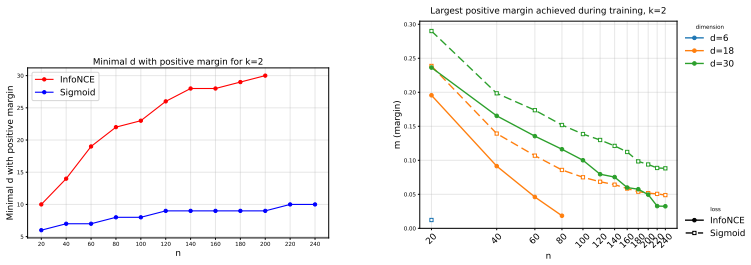
Figure from the paper full image
abstract click to expand
Why does the low dimensionality of representations, typically $d\approx 1000$, not prevent modern embedding-based retrieval models from scaling to billions, or even trillions, of data points? To answer this question, we study maximal-margin embeddings in the following retrieval model, classically studied in communication complexity [PS86] and more recently in embedding-based retrieval [WBNL26]. Let $A\in \{0,1\}^{N\times n}$ be a matrix indicating whether each of $N$ queries is relevant to each of $n$ documents. We are interested in the largest margin $m>0,$ denoted by $\mathsf{m}^{\mathsf{rd}}(d, A),$ for which there exist unit norm embeddings of the queries and documents $\{U_j\}_{j = 1}^N, \{V_i\}_{i = 1}^n$ with the following property. $\langle U_j, V_i\rangle \ge m$ whenever $A_{ji} = 1$ and $\langle U_j, V_i\rangle \le -m$ otherwise. A large margin is a key proxy for representation quality: it controls both robustness to perturbations and compositional generalization across queries. Our main theorem establishes that the best possible margin without a restriction on the dimension, $\mathsf{m}^{\mathsf{rd}}(+\infty, A),$ can be nearly achieved in dimension $d = O(\mathsf{m}^{\mathsf{rd}}(+\infty, A)^{-2}\log n)$ which improves a theorem of [BDES02]. Together with a matching lower bound in Theorem 1.5, we conclude that when $A\in \{0,1\}^{\binom{n}{k}\times n}$ is the matrix containing all possible $k$-sparse rows once, dimension $d = O(k\log (n/k))$ is necessary and sufficient for the maximal possible margin $\mathsf{m}^{\mathsf{rd}}(+\infty, A) = \Theta(k^{-1/2})$ in this setting. This fully resolves the setup of [WBNL26]. We also give several constructions for large margins when $d = o(k\log (n/k)).$ Finally, we empirically test the InfoNCE and sigmoid losses for producing large margin embeddings and demonstrate a clear advantage of the sigmoid loss.
1 0
Top Pith
1
cs.MA 2026-05-06

Multi-agent AI lifts tool execution success 87.5 points in machining

by Danny Hoang, Ryan Matthiessen +6 more

Physics-Grounded Multi-Agent Architecture for Traceable, Risk-Aware Human-AI Decision Support in Manufacturing

By routing tasks to specialized agents and verifying against physics models, the system generates auditable plans that simulations indicate

Figure from the paper full image
abstract click to expand
High-precision CNC machining of free-form aerospace components requires bounded compensations informed by inspection, simulation, and process knowledge. Off-the-shelf large language model (LLM) assistants can generate text, but they do not reliably execute risk-constrained multi-step numerical workflows or provide auditable provenance for high-stakes decisions. We present multi-agent knowledge analysis (MAKA), a human-in-the-loop decision-support architecture that separates intent routing, tools-only quantitative analysis, knowledge graph retrieval, and critic-based verification that enforces physical plausibility, safety bounds, and provenance completeness before recommendations are surfaced for human approval. MAKA is instantiated on a Ti-6Al-4V rotor blade machining testbed by fusing virtual-machining path-tracking error fields, cutting-force and deflection simulations, and scan-based 3D inspection deviation maps from 16 blades. The analysis decomposes deviation into an evidence-linked pathing component, a drift-based wear proxy capturing systematic evolution across parts, a residual systematic compliance term, and a variability proxy for instability-aware escalation. In a three-level tool-orchestration benchmark (single-step through $\geq$3-step stateful sequences), MAKA improves successful tool execution by up to 87.5 percentage points relative to an unstructured single-model interaction pattern with identical tool access. Digital twin what-if studies show MAKA can coordinate traceable compensation candidates that reduce predicted surface deviation from order $10^{-2}$in to approximately $\pm 10^{-3}$in over most of the blade within the simulation environment, providing a pre-deployment verification signal for risk-aware human decision-making.
0
0
cs.IR 2026-07-03

Agentic reranking lifts Earth data search MRR by 28%

by Minghan Yu, Youran Sun +3 more

Bringing Agentic Search to Earth Observation Data Discovery

Zero-shot LLM stage added to neural-BM25 fusion improves retrieval without extra training on NASA EO queries.

Figure from the paper full image
abstract click to expand
NASA and its data centers hold thousands of geoscience datasets and tools like Worldview, Giovanni, the Science Discovery Engine, and Harmony. Finding the right one is hard even for domain experts. We present an agentic search system, deployed as a public service for the geoscience community, that takes a natural-language research query and returns the matching datasets and tools. We demonstrate that, in the era of large language models, the latent value of knowledge graphs (KGs) can be substantially amplified through agentic search. From the NASA Earth Observation Knowledge Graph (NASA EO-KG) we derive NASA-EO-Bench, an open benchmark of 47k query-dataset pairs (21k task-based queries). A neural scorer fine-tuned on NASA-EO-Bench beats cosine and BM25 baselines. Further combining it with BM25 via score fusion raises both Recall@10 (R@10) and MRR by over 5x. On top of this supervised pipeline, we add a zero-shot agentic reranking stage that, without any additional training, lifts MRR by 28% on a stratified N=200 subset, showing that LLM reasoning is complementary to supervised retrieval.
0
0
cs.DB 2026-07-03

HNSW searches gain worst-case correctness via spanner bounds

by Minghao Li, Raghav Mittal +4 more

HNSW with Accuracy Guarantees Using Graph Spanners -- A Technical Report

A lightweight statistical check triggers exact fallback only when the heuristic result may be unreliable, preserving average speed.

Figure from the paper full image
abstract click to expand
Hierarchical Navigable Small World (HNSW) graphs serve as the industry standard due to their logarithmic complexity and strong empirical performance. However, HNSW relies on greedy graph traversal, a heuristic that provides no theoretical guarantees of correctness. In this paper, we propose a novel "Certify-then-Rectify" framework that bridges the gap between the speed of heuristic search and the rigor of exact retrieval. Rather than discarding HNSW, our approach first employs a distribution-free statistical certifier to dynamically evaluate the quality of a standard HNSW search with minimal overhead. If certification indicates that the retrieved neighbors are of low quality, the framework safely escalates to a rigorous exact recovery algorithm. To make this exact recovery computationally feasible, we reinterpret the HNSW graph as a geometric spanner and utilize Extreme Value Theory to stochastically estimate its maximum empirical stretch factor. This allows us to mathematically bound the maximum distance of true nearest neighbors. Extensive evaluations on benchmark datasets demonstrate that our tiered framework delivers the average-case speed of HNSW while ensuring the worst-case correctness of exact search and outperforming other applicable approaches.
0
0
cs.IR 2026-07-03

Planning over fold-in MDPs beats static top-K retrieval

by Mikhail Trapeznikov, Maksim Utushkin

Planning over Matrix-Factorization MDPs for Candidate Generation

One lookahead step on matrix-factorization state updates improves recommendations on multiple datasets without retraining.

Figure from the paper full image
abstract click to expand
For a recommender service, we view the customer journey as a chain of item recommendations: a useful item changes the user's state and therefore what should be retrieved next. Standard matrix-factorization retrieval ignores this -- it builds one user vector and returns the top-$K$ items by a static score, treating them as independent. We ask a narrow question: when is it worth planning over the user-state dynamics that fold-in induces? To answer it we propose casting top-$K$ retrieval as an MDP over the implicit-ALS posterior $(A^{-1},u)$, where an action is an item and the transition is a closed-form rank-one fold-in, and the trajectory reward combines a relevance similarity with a posterior-alignment term. Under the same fixed embeddings we compare static retrieval, one-step planning, and horizon-$K$ MCTS across five datasets and two protocols: a per-user leave-last-$n$ split and a stricter global time split. Dynamics-aware planning tends to overcome static retrieval on all datasets under leave-last-$n$, and the gains hold on MovieLens-1M and the VK-LSVD slices under the global time split. A single step of lookahead already captures most of the gain, so the lightweight planning layer turns static top-$K$ scoring into a short decision and improves retrieval over fixed collaborative-filtering embeddings, with no retraining and no change to the representation. These gains depend on measuring relevance with cosine rather than inner-product similarity, which is otherwise entangled with item popularity.
0
0
cs.IR 2026-07-03

Cluster chunking shows no gain over basic methods on thesis RAG

by Valentin J. J. Kreileder, Johannes Reisinger +1 more

Evaluating Chunking Strategies for Retrieval-Augmented Generation on Academic Texts

Tests find fixed-size and recursive splitting match or exceed semantic clustering when RAGAs scores answers from academic documents.

Figure from the paper full image
abstract click to expand
Retrieval-Augmented Generation (RAG) systems use the question-answering capabilities of Large Language Models (LLMs) to access information outside their parameters. We evaluate if cluster-based semantic chunking improves retrieval and answer quality compared to fixed-size and recursive chunking evaluating on long, structured academic theses using the Retrieval Augmented Generation Assessment (RAGAs) framework. RAGAs based faithfulness shows limited reliability in this setup. Performance on fixed versus document specific questions varied substantially, likely related to the formatting of documents and preprocessing. Under the tested configuration, cluster-based chunking did not outperform simpler strategies.
0
0
cs.IR 2026-07-02

User search history resolves ambiguous product queries better than population data

by Rachith Aiyappa, Ishita Khan +5 more

IntentTune: Using user demand and personalization to resolve "unknown" query intents for e-commerce search

Real-world experiments show prior queries outperform aggregates and static profiles when inferring gender, age, category and size intent.

Figure from the paper full image
abstract click to expand
Understanding user intent is fundamental to delivering relevant search results in e-commerce. However, substantial fraction of real-world queries are under-specified (e.g., "watch" or "shirt"), lacking explicit attributes such as gender or age group. This ambiguity poses a significant challenge for query intent detection models in e-commerce search systems, which must accurately infer latent user intent (e.g., age, gender) to support effective downstream retrieval. We introduce IntentTune, a framework for resolving ambiguous or under-specified query intents by leveraging either (1) user-specific behavioral signals including search history, browsing activity, and profile attributes or (2) population-level demand patterns aggregated across all users. Through experiments on real-world e-commerce data, we first demonstrate that population-level demand patterns alone are insufficient to reliably infer intent in under-specified queries. We then demonstrate that user-specific behavioral signals -- particularly prior search queries -- outperform both population-level statistics and static profile information for inferring gender, age group, product category, and size intent from underspecified queries.
0
0
cs.IR 2026-07-02

Multiplex graphs align users on facets to fix sparse LLM data

by Yangtian Zhang, Leyao Wang +4 more

CoPersona: Collaborative Persona Graphs for Robust LLM Personalization

CoPersona decomposes histories and borrows peer signals at the facet level to handle uneven coverage and improve personalization.

Figure from the paper full image
abstract click to expand
Real-world LLM personalization is often constrained by sparse and skewed user histories: most users provide only a handful of interactions, while even frequent users' logs capture an incomplete and biased view of their preferences. As a result, weakly observed user attributes are difficult to infer, leading to brittle personalization when test-time requests shift toward under-supported facets. Motivated by this limitation, we present CoPersona, a graph-based collaborative personalization framework that completes sparse user profiles by borrowing signals from behaviorally similar peers. However, directly transferring signals is difficult because uneven facet coverage introduces bias into interaction histories, obscuring user similarity in the unstructured global space. To address this issue, CoPersona decomposes interaction histories into multiple facet-level representations and explicitly models peer-to-peer, facet-level alignment through a multiplex persona graph. To effectively leverage peer information at inference time, we employ a dual-branch architecture that combines non-parametric peer retrieval with parametric graph reasoning. Experiments across multiple domains and model scales demonstrate consistent improvements over strong baselines, validating CoPersona as an effective approach for robust LLM personalization.
0
0
cs.IR 2026-07-02

Bi-level search plus LLMs yields clearer recommender explanations

by Longfeng Wu, Yao Zhou +6 more

Bi-NAS: Towards Effective and Personalized Explanation for Recommender Systems via Bi-Level Neural Architecture Search

Architecture optimization at two levels combined with zero-shot prompts aligns user preferences to item attributes on four datasets.

Figure from the paper full image
abstract click to expand
Recommender systems are vital in helping users navigate vast amounts of information, offering personalized suggestions and effective explanations for these recommendations. While previous efforts have attempted to provide such explanations, evaluating their effectiveness across various scenarios remains a challenge. Enhancing these explanations is essential for improving user engagement, trust, and decision-making. To facilitate effective explanations within the recommender system, we propose a Bi-level Neural Architecture Search (Bi-NAS) framework to optimize explanations. This approach simultaneously refines cross-attention mechanisms and feature interaction functions by exploring both intra-layer and inter-layer design spaces. Furthermore, we integrate Large Language Models (LLMs) to enhance explanation generation, leveraging zero-shot prompting to produce more effective and personalized justifications. By aligning user feature preferences with item quality scores, our approach ensures that explanations reflect both user intent and item attributes, improving transparency and reasoning depth. Extensive evaluations on four real-world datasets demonstrate that Bi-NAS not only boosts recommendation accuracy but also significantly improves the effectiveness of explanations for recommender systems, providing users with clear and reliable insights into the suggestions they receive.
0
0
cs.IR 2026-07-02

Diffusion re-ranker reaches AR accuracy at 2.4-3.5x speed

by Zhuoxuan Zhang, Kangqi Ni +12 more

Diffusion-GR2: Diffusion Generative Reasoning Re-ranker

Three-stage training closes validity and distribution gaps so block-parallel decoding matches autoregressive performance on Amazon Beauty.

abstract click to expand
Generative reasoning re-rankers achieve strong recommendation accuracy by emitting a chain-of-thought before re-ordering a candidate list, but they are slow at inference: an autoregressive (AR) decoder spends one sequential forward pass per reasoning token, and the reasoning trace far exceeds the ranking it produces. To reduce this cost, block-diffusion language models decode many positions in parallel over a few denoising steps and are substantially faster, yet naively converting an AR re-ranker into one opens two accuracy gaps: (1) a structural gap: answer positions are denoised in parallel and scored independently, so the decoder emits invalid rankings (duplicated, dropped, or out-of-set identifiers) that AR avoids through left-to-right masking; and (2) a distributional gap: fine-tuning the converted model on fixed teacher trajectories is off-policy relative to its own decoding at inference, leaving a residual accuracy gap. To close both gaps while keeping the speedup, we propose \textbf{Diffusion-GR2}, a recipe that converts our AR reasoning re-ranker (GR2) into a block-diffusion re-ranker. First, conversion fine-tuning (CFT) adapts the AR-initialized diffusion model to denoise the answer into a valid permutation on its own, without an external constrained decoder. Next, on-policy distillation (OPD) then supervises the model on its own decoded trajectories with dense per-token targets from the AR teacher. Finally, we apply a reinforcement-learning (RL) stage against a re-ranking reward on top of OPD's on-policy policy. Experiments on Amazon Beauty demonstrate that Diffusion-GR2 recovers to near-parity with the AR re-ranker, while block-parallel decoding raises decode throughput by $2.4$--$3.5\times$ at the model's reasoning output length. Ablations show that CFT recovers most of the conversion gap, and that on-policy distillation further closes it to the AR reference.
0
0
cs.IR 2026-07-02

Trie plans shorten pipeline experiments by 26%

by Irene Anu, Craig Macdonald

Trie-based Experiment Plans for Efficient IR Pipeline Experiments

A data structure shares early retrieval results across variant pipelines, cutting total evaluation time on MSMARCO v2 while keeping effectiv

Figure from the paper full image
abstract click to expand
Search engines are often formulated as cascading pipelines, where successive stages combine the results of different retrievers, and iteratively refine the ranking of candidate documents to obtain a final ranking, which can be presented to a user, or provided as context to an LLM. Such pipelines can be complex to evaluate in an end-to-end manner, necessitating measurement of Recall of early stages, and Precision of later stages, which are often interchangeable. PyTerrier is ideal for building and evaluating cascading retrieval pipelines, due to its declarative nature for pipeline construction and wide ecosystem of retrievers and rerankers. However, comparative evaluation of pipelines can be expensive due to repeated components. In this work, we describe the use of a trie data structure to formulate an experiment plan for comparative pipeline experiments that enhances experiment efficiency compared to a sequential "linear" plan. Empirically, on a demonstration experiment involving BM25, MonoT5 and DuoT5 on MSMARCO v2, we observe a 26% reduction in experiment duration. Finally, we report on a user study of undergraduate and postgraduate research students' use of the experiment plans.
0
0
cs.IR 2026-07-02

Five tasks benchmark sycophancy from agent memory

by Zhishang Xiang, Zerui Chen +6 more

MemSyco-Bench: Benchmarking Sycophancy in Agent Memory

The benchmark checks if agents over-align with users via memory instead of using facts or evidence.

Figure from the paper full image
abstract click to expand
Memory has emerged as a cornerstone of modern LLM-based agents, supporting their evolution from single-turn assistants to long-term collaborators. However, memory is not always beneficial: retrieved memories often induce a critical issue of sycophancy, causing agents to over-align with the user at the cost of factual accuracy or objective reasoning. Despite this emerging risk, existing memory benchmarks primarily evaluate whether memories are correctly stored, retrieved, or updated, while overlooking how retrieved memories influence downstream reasoning and decision-making. To bridge this gap, we propose MemSyco-Bench, a comprehensive benchmark for evaluating memory-induced sycophancy in agent systems. MemSyco-Bench measures when memory should influence a decision and how valid memory should be used. Specifically, it covers five tasks that assess whether agents can reject memory as factual evidence, respect its applicable scope, resolve conflicts between memory and objective evidence, track memory updates, and use valid memory for personalization. All related resources are collected for the community at https://github.com/XMUDeepLIT/MemSyco-Bench.
0
0
cs.IR 2026-07-02

Historical user summaries lift LLM search judge alignment by 5%

by Ali Vardasbi, Gustavo Penha +4 more

As It Was: Aligning LLM Search Evaluation with Historical User Preferences

QRI cards from past interactions raise correlation with user preferences and A/B winners while cutting errors on ambiguous cases.

Figure from the paper full image
abstract click to expand
Large-scale search systems evolve faster than human quality assurance can scale, especially for long-tail intents and multilingual queries. LLM-as-a-judge approaches provide a scalable alternative for evaluating the relevance of search engine result pages (SERPs), but judgments based solely on semantic similarity or world knowledge can drift from actual user preferences, particularly for ambiguous queries. We introduce a behavior-grounded LLM judge that augments each SERP item with a lightweight and auditable behavioral prior in the form of a Query-Relevance-Impressions (QRI) card. Each card summarizes how users have historically interacted with similar queries and results, providing compact empirical evidence that the judge can cite to resolve ambiguity and make more consistent relevance judgments while still relying on semantic reasoning. In a large-scale music search evaluation at Spotify, using relevance estimates derived from historical user interactions across 6,000 recomposed SERPs, the behavior-grounded judge achieves stronger alignment with user preferences, improving Spearman rank correlation by approximately 5% overall and yielding a 91% relative improvement on disagreement cases. On a multilingual human-judged dataset spanning five languages, grounding further increases correlation with human relevance judgments by 15%. Importantly, when evaluated against outcomes from a live A/B test, the grounded judge shows consistently higher alignment with the observed winning model. While absolute alignment remains moderate, these findings demonstrate that lightweight behavioral grounding can improve the reliability and practical usefulness of LLM-based evaluation in real-world search systems.
0
0
cs.DB 2026-07-02

Adaptive bridges restore recall at 0.3% selectivity in vector search

by Yoonseok Kim, Gyusik Choe

RACORN-1: Adaptive Recall-Preserving Speedup for Low-Selectivity Filtered Vector Search

RACORN-1 recovers 0.77-0.98 recall and cuts latency 9-26x versus HNSW by reusing filter-failing nodes as bridges

Figure from the paper full image
abstract click to expand
Filtered Vector Search (FVS), which combines vector embedding similarity with structured metadata predicates, has emerged as a core requirement in RAG and production retrieval systems. ACORN-1, the representative In-filtering algorithm that reuses an existing HNSW index, substantially reduces latency at low selectivity but suffers connectivity instability below 5% selectivity and recall collapse below 1%. We propose RACORN-1, an in-place extension of ACORN-1 that resolves this collapse via (i) Adaptive Search Fallback (ASF) -- repurposing filter-failing nodes as transient bridges to detour around severed paths; bridge and two-hop candidate selection uses stride sampling for spatial diversity. While filter-first ACORN-family methods have a structural recall trade-off relative to distance-first HNSW, RACORN-1 improves the trade-off curve via ASF, minimizing recall loss while substantially reducing latency. Across three 1M-scale and one 40M-scale dataset, RACORN-1 delivers approximately 9-26x latency reduction over HNSW in the sweet spot (1%-0.3%), and recovers ACORN-1's recall collapse from 0.45-0.72 (1%) and 0.03-0.10 (0.3%) to 0.70-0.96 and 0.77-0.98 respectively. For the extreme-low-selectivity regime where linear scan can outperform graph search, we combine RACORN-1 with (ii) Adaptive Exact Fallback (AEF) in a variant RACORN-1+, achieving recall 1.00 with 20-75x speedup at 1M <=0.1% and 13x speedup at 40M 0.01%. Under a Negative Correlation evaluation (K-means clusters), where ACORN-1 collapses (recall 0.08-0.41), RACORN-1 maintains recall 0.80-0.98 with a 5-9x latency advantage over HNSW. Together, RACORN-1 and RACORN-1+ form an ACORN-1-compatible mechanism robust to both extreme-low-selectivity and adversarial query-filter correlation.
0
0
cs.DB 2026-07-02

Signal repair beats fixed schedule on ANN graph tail recall

by Madhulatha Mandarapu, Sandeep Kunkunuru

When to Repair a Graph ANN Index: Navigability-Signal-Triggered Local Repair Protects Tail Recall Under Bursty Churn

At matched repair budget, triggering fixes on probe signal raises minimum recall@10 by 1.4 to 5 percent under bursty churn.

Figure from the paper full image
abstract click to expand
Graph approximate-nearest-neighbor (ANN) indexes (HNSW, DiskANN/Vamana) lose recall under insert/delete churn, because deletions orphan the greedy-search paths that route through removed nodes. Production systems restore navigability by repairing the graph on a fixed schedule (consolidate every X operations). We ask whether triggering local edge repair on a measured navigability-degradation signal, rather than a blind clock, spends a fixed repair budget better. On two real ANN datasets (SIFT-128 and Fashion-MNIST-784) under a controlled bursty churn stream, and comparing repair policies at matched amortized repair budget (equal consolidation count), signal-triggered repair Pareto-dominates fixed-cadence repair. The gain is concentrated on worst-case (tail) recall at scarce budget: at roughly one consolidation it improves the minimum recall@10 by +0.014 (SIFT) to +0.050 (Fashion-MNIST) across four stream seeds, with 95% confidence intervals excluding zero, while the mean-recall gain is small (<0.005). The advantage follows a clean drift-severity gradient -- larger for sparser, more fragile graphs -- and fades to parity when the index is robust or budget is ample. A cheap probe-recall signal is a valid, leading indicator of true recall (Spearman rho ~= 0.95). We contribute the mechanism, a budget-matched evaluation protocol that separates repair scheduling from repair spend, and an open, reproducible churn-repair harness. We deliberately do not claim a mean-recall improvement or a new index; a recall-versus-repair-cost bound and data-distribution-drift coupling are left as future work.
0
0
cs.CL 2026-07-02

Answer-in-context predicts RAG F1 better than recall

by Ananto Nayan Bala

What Survives Into Context: A Diagnostic for Budget-Constrained Multi-Hop RAG and When Submodular Evidence Packing Improves It

The diagnostic tracks whether gold answers survive into the packed reader context and shows when submodular packing raises accuracy at fixed

Figure from the paper full image
abstract click to expand
Retrieval-augmented generation (RAG) under a fixed reader-context budget forces a selection problem: of the evidence retrieved, only a fraction can be shown to the reader. We argue that document recall -- the standard retrieval metric -- is the wrong quantity to optimize in this regime, and we make two contributions. First, as a general contribution, we introduce answer-in-context, a diagnostic that measures whether a gold answer survives as a contiguous span in the packed reader context (not the retrieved set). It predicts answer F1 better than recall (r=0.39-0.55 vs. about 0.31), separates answer quality roughly five-fold (0.60 vs. 0.12 on HotpotQA), and carries information beyond retrieval: it adds Delta R squared=0.17 over recall and shows a 4.6x EM gap even among questions where all gold was retrieved. We also confirm it interventionally: on 2WikiMultiHopQA a packing change that raises coverage but not answer-in-context yields no accuracy gain. Second, as a conditional contribution, we cast reader-context construction as budgeted monotone submodular maximization and build a packer that jointly optimizes relevance, query coverage, representativeness, and diversity. On HotpotQA with a 160-token budget and a 3B reader it beats a strong focused heuristic, MMR, and naive packing -- by up to +5.1 F1 at equal-or-lower token cost, across three seeds. Crucially, we map the scope of this win honestly: it requires the conjunction of (i) multi-hop complementary structure, (ii) retrieval that surfaces the evidence, (iii) a binding but not extreme budget, and (iv) a reader weak enough that evidence density, not reading capacity, is the bottleneck. A quantization-controlled reader-scale ladder (3B to 7B to 14B) shows the edge over the heuristic is absorbed by 7B and significantly reverses by 14B, while the diagnostic explains every boundary with a single variable.
0
0
cs.CL 2026-07-02

Explicit workflows raise literature search Hit@5 from 58 to 77

by Jisen Li (1, 2) +15 more

Multi-Turn Agentic Scientific Literature Search via Workflow Induction

PaperPilot induces editable DAGs of search operators to refine evolving queries across turns

Figure from the paper full image
abstract click to expand
Scientific literature search often requires more than retrieving papers from a single query: users' intents are underspecified, preference-dependent, and evolve through interaction. Existing search agents typically rely on fixed pipelines or implicit language-only reasoning, making their search strategies difficult to control, inspect, and refine. We introduce PaperPilot, a multi-turn literature search agent that frames scientific search as workflow induction. Given an anchor paper and a user query, PaperPilot constructs an executable DAG of paper-search operators, including keyword search, citation expansion, filtering, scoring, reranking, and evidence extraction. User feedback is then used to refine both the query and the workflow itself. We train PaperPilot with supervised workflow imitation and preference optimization over controlled workflow corruptions. Experiments show that PaperPilot-9B improves over the base Qwen3.5-9B toolset agent under multi-turn interaction, increasing Hit@5 from 58.0 to 77.0, MRR from 47.5 to 59.4, and nDCG@10 from 26.8 to 32.5, while reducing workflow execution errors from 9.5% to 0%. These results show that explicit, editable search workflows provide an effective and controllable interface for aligning literature search agents with complex scientific intent.
0
0
cs.IR 2026-07-02

Logical query trees boost RAG on uncertain reasoning tasks

by Ganlin Xu, Linghao Zhang +8 more

When RAG Meets Query Planning: Logical Query Trees for Resolving Exploratory Reasoning Problems

Decomposing problems into optimized trees with dynamic programming enables parallel execution that outperforms iteration and graph-based met

Figure from the paper full image
abstract click to expand
Retrieval-Augmented Generation (RAG) effectively grounds large language models (LLMs) in external knowledge but struggles with \textbf{exploratory reasoning problems (ERPs)} that are the complex queries involving high uncertainty and ambiguity. Resolving ERPs requires complex reasoning with unclear paths, tending to result in retrieval noise and error accumulation. Furthermore, the absence of an end-to-end planning mechanism makes it difficult to generate effective trajectories for ERPs. Motivated by database query planning, we introduce \emph{PlanRAG}, an RAG framework that models ERPs of natural language as \textbf{logical query trees (LQTs)}. However, translating ERPs into LQTs is non-trivial due to representation and optimization gaps between structured SQL and unstructured natural language, making it highly challenging to construct high-quality LQTs. To address these problems, we first decompose ERPs into atomic queries and then organize them into LQTs using dynamic programming guided by a cost model involving multiple complementary dimensions. Finally, we execute iterative aggregation, rewriting, retrieval, and generation over LQTs, processing nodes concurrently and propagating intermediate results upward, with further parallelization across multiple threads for efficiency. Our experimental results show that PlanRAG outperforms state-of-the-art iteration-based and graph-based RAG systems on our newly constructed dataset, \textbf{WikiWeb-ERP}, thereby providing a new formulation for optimizing natural language queries. Our source code and dataset are available at https://anonymous.4open.science/r/PlanRAG-main-B2C8/.
0
0
cs.IR 2026-07-02

LLM clustering samples hard negatives for two-tower retrieval

by Ivan Ji, Liuyi Hu +5 more

Real-Time Hard Negative Sampling via LLM-based Clustering for Large-Scale Two-Tower Retrieval

The method draws challenging negatives from media clusters in real time and beats standard batch sampling at large scale.

abstract click to expand
The two-tower model has been widely used for large-scale recommendation systems, particularly in the retrieval stage. Industry standards for training two-tower models typically involve in-batch and/or out-of-batch negative sampling. However, these methods often produce easy negatives that models can quickly learn, failing to sufficiently challenge the model. To address this issue, a novel self-supervised hard negative sampling technique is proposed that leverages a large language model (LLM) to generate hard negatives from the same cluster during model training. By utilizing the LLM to learn media representations, the proposed approach ensures that the generated negatives are more challenging and informative. This real-time sampling framework is designed for seamless integration into production models, capable of handling billions of training data points with minimal computational complexity. Experiments on public datasets, along with deployment to a large-scale online system, demonstrate that the proposed negative sampling technique outperforms widely used industry methods. Furthermore, analysis in industrial applications reveals that this sampling method can help break inherent feedback loops in recommendations and significantly reduce popularity bias.
0
0
cs.IR 2026-07-02

Attribute kernels enable data-efficient cross-modal hashing

by Runhao Li, Xiaoxu Ma +6 more

Attribute-Prompted Kernel Hashing for Unsupervised Data-Efficient Cross-Modal Retrieval

Prompt optimization and kernel smoothing align modalities in Hamming space, generalizing from few seen pairs to unseen categories.

Figure from the paper full image
abstract click to expand
Unsupervised cross-modal hashing enables efficient retrieval of semantically related instances across different modalities without requiring manual semantic annotation. However, existing unsupervised methods rely heavily on large-scale image-text pairs. Collecting such data can be costly, particularly in scenarios where well-aligned pairs are scarce due to privacy and specialized constraints. More critically, existing methods tend to overfit to seen training data, restricting their generalization performance on unseen categories that the constrained training data cannot cover. To address these limitations, we propose Attribute-Prompted Kernel Hashing (APKH), a novel data-efficient approach that constructs a compact, modality-aligned Hamming space driven by the generalized attribute priors of vision-language foundation models. Specifically, APKH introduces two core modules: Context-optimized Attribute Kernel Mapping (CAKM) and Kernel-Smoothed Contrastive Alignment (KSCA). CAKM formulates cross-modal alignment through hyperspherical Radial Basis Function kernel mapping, optimizing dynamic attribute kernels via prompt learning to capture modality-invariant semantics. Furthermore, KSCA extends conventional point-to-point contrastive learning by modeling limited paired data as continuous kernel distributions. This explicit smoothing of the modality gap alleviates overfitting to sparse pairwise correlations. Extensive experiments demonstrate that APKH outperforms state-of-the-art hashing methods in the challenging cross-modal retrieval tasks from seen to unseen categories under data-constrained scenarios.
0
0
cs.CV 2026-07-02

Two proxy tasks let models learn to compose for image retrieval

by Jingjing Zhang, Lei Zhang +2 more

Learning to Compose: Revisiting Proxy Task Design for Zero-Shot Composed Image Retrieval

Splitting focus on changes then semantic completion improves zero-shot retrieval of modified images on benchmarks without labeled triplets.

Figure from the paper full image
abstract click to expand
Composed Image Retrieval (CIR) retrieves a target image from a reference image and a textual modification. While supervised CIR relies on costly triplets, Zero-Shot CIR (ZS-CIR) alleviates this reliance through proxy tasks trained on image-text pairs. However, existing proxy tasks primarily enhance visual and textual representations to accommodate a predefined composition mechanism such as pseudo-word injection into a frozen text encoder or linear feature arithmetic. As a result, the composition function itself remains unlearned, limiting the model's ability to express diverse and fine-grained semantic modifications. To address this, we propose FoCo, which models composition as two coordinated stages: focusing on modification-relevant visual content, and then completing the target semantics. We realize these through two proxy tasks: text-anchored visual aggregation to selectively gather visual content guided by localized textual semantics, and context-conditioned semantic completion to transform these aggregated visuals with the remaining scene context into a coherent composed representation. The tasks are trained jointly with a cross-instance contrastive objective, encouraging semantic diversity and discouraging shortcut composition strategies. Extensive experiments on four ZS-CIR benchmarks show FoCo's state-of-the-art performance and improved generalization.
0
0
cs.CR 2026-07-02

Queries reveal which embedding model runs behind an IR API

by Cedric Fitiavana Raelijohn, Sébastien Gambs +1 more

Embedding Inference Attack

Black-box attacks identify the model from unordered document sets even when a reranker is present.

Figure from the paper full image
abstract click to expand
Embedding models are essential components of modern Information Retrieval (IR) systems, yet they are typically hidden behind APIs. Recent works have shown that dense IR system can lead to security vulnerabilities such as embedding inversion attacks. However, such attacks usually require that the attacker knows the embedding model for the attack to be applicable. In this paper, we study IR systems under a black-box setting in which the adversary observes only the unordered set of retrieved documents, without ranking or similarity scores. We demonstrate that in such contexts, tailored queries allow an adversary to identify which embedding model is in use from a set of known model candidate, which we coin as an embedding inference attack (EIA). We also show that certain queries remain discriminative even when the system includes a reranker as a potential defense mechanism. We further validate our method on a real Retrieval-Augmented Generation (RAG) system, in which the tailored queries bypass the LLM's tendency to reject inputs it does not recognize as well-formed questions. Finally, we propose and evaluate other mitigation strategies such as similarity thresholds.
0
0
cs.CL 2026-07-01

KB-VQA benchmarks make accuracy unreliable for reasoning

by Qian Ma, S M Rayeed +3 more

Identifying and Resolving Pitfalls of Knowledge-Based VQA Benchmarks: Auditing, Repairing, and Augmenting

Violations of answer support, question clarity, and visual requirements distort model rankings and overstate capabilities.

Figure from the paper full image
abstract click to expand
Knowledge-Based Visual Question Answering (KB-VQA) aims to evaluate whether Visual Language Models (VLMs) can retrieve, ground, and reason over external structured knowledge beyond visual evidence. In practice, answer accuracy is widely adopted as the primary evaluation metric, implicitly treating correctness as a proxy for knowledge-grounded reasoning. However, for existing KB-VQA benchmarks, this proxy relies on critical assumptions that are often overlooked and rendered unreliable by benchmark issues: annotated answer must be derivable from the associated knowledge base, question must be well-posed with sufficient constraints, and visual setting must meaningfully require grounded disambiguation. In this work, we show that these assumptions are systematically violated in existing KB-VQA benchmarks. Our audit reveals substantial instances with missing or contradicted answers and underspecified questions that render accuracy a misleading metric. Furthermore, we find that existing datasets rely on visually trivial, single-entity scenes that bypass the need for sophisticated visual-to-knowledge mapping. We demonstrate that even with controlled architectures, these flaws lead to distorted model rankings and overestimations of reasoning capabilities. To address this, we introduce (1) a principled audit-and-repair protocol that restores answer derivability and question clarity, and (2) a controlled multi-entity augmentation protocol that introduces visual ambiguity to challenge initial retrieval and grounded reasoning. Re-evaluation under corrected and augmented settings yields markedly different performance trends. Our findings call for rethinking evaluation protocols and designing more interaction-aware KB-VQA benchmarks that prioritize verifiable reasoning over simple matching.
0
0
cs.IR 2026-07-01

GR2 raises re-ranking R@1 by 18.7% on industrial traffic

by Yufei Li, Zaiwei Zhang +67 more

GR2 Technical Report

Semantic ID training, distilled reasoning, and conditional-reward RL target the final stage of recommendation systems.

abstract click to expand
Industrial recommendation systems serve billions of users through a multi-stage funnel -- retrieval, early-stage ranking, and re-ranking -- where the final re-ranking step disproportionately shapes user engagement and downstream performance, particularly for carousel and grid display formats. Despite growing enthusiasm for Large Language Models (LLMs) in recommendation, three gaps hinder industrial adoption: (1) most efforts target retrieval and ranking, leaving re-ranking -- the stage closest to the final user experience -- largely underexplored; (2) LLMs are typically deployed zero-shot or via supervised fine-tuning, underutilizing the reasoning capabilities unlocked by reinforcement learning (RL) on verifiable rewards; (3) deployed catalogs index billions of items with non-semantic identifiers that lie outside any base-LLM vocabulary. We present GR2 (Generative Reasoning Re-Ranker), an end-to-end framework that combines (i) mid-training on semantic IDs produced by a tokenizer with >=99% uniqueness, (ii) reasoning-trace distilled from a stronger teacher via targeted prompting and rejection sampling, and (iii) RL with verifiable rewards purpose-built for re-ranking. To make GR2 resource-viable, we further (iv) introduce a context compressor that amortizes training cost, On-Policy Distillation (OPD) as a scalable alternative to SFT -- which we find collapses at industrial scale -- and reasoning distillation for low-latency serving. GR2 delivers +18.7% R@1, +7.1% R@3, and +9.6% N@3 over legacy baselines on industrial-scale traffic. We further find that reward design is critical in re-ranking: LLMs often hack rewards by preserving the incoming order or exploiting position bias, motivating conditional verifiable rewards as essential industrial components.
0
0
cs.IR 2026-07-01

Tool cuts freeway network prep effort to one-third

by Drew Miller, Cathy Wu

An Open-Source Tool for Reproducible Freeway Network Extraction from OpenStreetMap

Extracts from OpenStreetMap, resolves interchange and ramp issues, and validates against imagery across 360 miles in California.

Figure from the paper full image
abstract click to expand
Freeway simulation is often difficult to deploy at scale not only because of model formulation, but because preparing road network inputs remains a manual, corridor-specific, and difficult-to-reproduce task. This paper presents an open-source tool that extracts freeway networks from OpenStreetMap (OSM) and converts them into a compact, station-referenced representation suitable for downstream freeway simulation. Unlike existing tools that primarily support arterial or general network conversion tasks, the proposed workflow is designed around the specific requirements of freeway traffic studies. The tool supports not only OSM data cleaning and conversion, but also the broader workflow required in practice: corridor-specific querying, visual inspection of extracted segments, extraction validation against OSM, and source-data validation against aerial imagery. A locally hosted frontend allows users to define corridor-specific queries, select endpoints visually, and inspect extracted segments. The extraction logic is designed to address several recurring challenges in freeway OSM data, including inconsistent route references, ambiguous path selection through interchanges, managed-lane interference, incomplete corridor capture from naive bounding-box queries, and inconsistent ramp classifications. The workflow was first tested on two prototype corridors, where the extract-first-then-validate approach proposed here required roughly one-third the analyst effort of manual ramp encoding from scratch. It was then deployed across 359.6 miles of freeway in Orange County, California, with total processing and validation averaging about 41 seconds per mile. This deployment also suggests that, in a well-mapped region, OSM is sufficiently accurate for many freeway traffic studies. Overall, the tool provides a more scalable and reproducible foundation for freeway network preparation.
0
0
cs.IR 2026-07-01

One model turns shopping intents into item actions via semantic IDs

by Jiacheng Chen, Tao Zhang +24 more

ShopX: A Foundation Model for Intent-to-Item Fulfillment in Agentic Shopping

ShopX removes separate retrieval steps and improves handling of complex requests in agentic workflows.

abstract click to expand
The wave of AI-native applications is moving shopping beyond page- and feed-based browsing toward intent-driven experiences orchestrated by LLM agents. A common design wraps an LLM around existing search and recommendation pipelines, forcing complex intents through low-bandwidth retrieval or ranking interfaces and leaving a gap between language understanding and item-space fulfillment. Generative recommendation gives LLMs a direct item-space interface through semantic IDs (SIDs), but existing models mainly generate candidates for retrieval rather than translate flexible intents into item-space outcomes. We propose ShopX to address this bottleneck by unifying intent understanding, execution planning, and flexible SID-native item-space operations into a single foundation model. We deploy ShopX in agentic shopping workflows through a model-native item-fulfillment framework with a serving harness that defines a model-facing action protocol and exposes support surfaces for context access, catalog grounding, and state management. Within this framework, ShopX plans and composes SID-based item-space operations such as SID beam-search retrieval, listwise ranking, or product bundling. This model-centric design reduces lossy hand-offs between agent orchestration and item-space execution. To build ShopX, we design semantically recoverable, LLM-operable SIDs and a training recipe that equips a general LLM for flexible multi-turn item-space fulfillment while retaining the knowledge and instruction-following abilities needed by a shopping agent. We evaluate the ShopX framework against tool-mediated agentic systems on single- and multi-turn fulfillment tasks derived from anonymized Taobao production logs, showing that model-native fulfillment improves overall framework behavior, especially on complex or ambiguous requests.
0
0
cs.IR 2026-07-01

New hashing method transfers semantics to binary codes with few pairs

by Runhao Li, Xiaoxu Ma +6 more

Unsupervised Data-Efficient Cross-Modal Retrieval with Global-Neighborhood Alignment Hashing

GNAH uses global and stochastic neighborhood alignment to keep retrieval performance while cutting required image-text pairs.

abstract click to expand
Compared to supervised cross-modal hashing (CMH), unsupervised CMH reduces the reliance on manual labeling by learning binary codes from unlabeled image-text pairs. However, existing unsupervised CMH methods often rely on large-scale image-text pairs, which are costly to collect. To address this limitation, we propose Global-Neighborhood Alignment Hashing (GNAH), a novel approach that preserves the semantic structure of vision-language foundation models within a compact binary Hamming space using only a limited number of image-text pairs. Specifically, GNAH captures global structural information from the continuous latent space and transfers it into the binary Hamming space through a Prototype-Anchored Global Alignment module. In addition, GNAH extends conventional pairwise contrastive learning by modeling stochastic neighborhood relationships via a Contrastive Stochastic Neighborhood Alignment module, thereby alleviating overfitting to sparse pairwise correlations. Extensive experiments demonstrate that GNAH consistently outperforms existing unsupervised cross-modal retrieval methods under data-constrained settings, offering a practical solution for real-world CMH applications.
2 0
0
cs.IR 2026-07-01

Reorganized KB lifts session RAG coverage to 58% with one retrieval

by Shivam Ratnakar, Yixuan Zhu +2 more

One Retrieval to Cover Them All: Co-occurrence-Aware Knowledge Base Reorganization for Session-Level RAG

Co-occurrence clustering improves coverage by 17 points and shrinks the knowledge base to one fifth its size.

Figure from the paper full image
abstract click to expand
RAG systems retrieve documents optimized for answering one query at a time. Yet enterprise users arrive with sessions, that is, coherent episodes of related questions that span semantically distant parts of the knowledge base. We show that a single retrieval call over a standard knowledge base covers only 41% of a user's session-level information need. To close this gap, we reorganize the KB offline using co-occurrence-aware clustering and expand retrieval candidates through cluster neighborhoods at query time. On WixQA (6,221 enterprise support articles), our method raises single-query session coverage to 58% (+17% absolute; 95% CI: [14.1, 20.4]), reduces retrieval calls to 70% coverage by 34%, and compresses the KB to 20% of its original size, all consistently across four embedding models and six functional domains. We argue that session-level coverage, not single-query recall, should be the primary metric for enterprise RAG evaluation.
0
0
cs.DL 2026-07-01

LIS research shifted from theory to interviews over 31 years

by Chengzhi Zhang, Liang Tian +1 more

Usage frequency and application variety of research methods in library and information science: Continuous investigation from 1991 to 2021

Analysis of 26,000 articles finds move to empirical methods and user-centered topics with changing method-topic links.

Figure from the paper full image
abstract click to expand
The present study analyzed over 26,000 research articles published between 1991 and 2021 in twenty-one major LIS (Library and Information Science) journals, using the machine learning (ML) approach to categorize the research methods used by LIS scholars. The findings of this study are significant. Firstly, there has been a shift in the research strategy from conceptual research (e.g., "Theoretical approach") to empirical research (e.g., "Interview") in LIS investigations over the past 31 years. Secondly, the research topics explored by LIS scholars during this period have moved from system-centered issues (e.g., "Information retrieval/models and algorithms") to user-centered topics (e.g., "Information services "). Thirdly, the study revealed dynamic and revealing relationships between the 18 research topics identified in the study and the 16 research methods commonly adopted in the LIS field. These dynamic relationships can be visualized by year and longitudinally via an interactive map created in this study.
0
0
cs.CL 2026-07-01

Concatenating paper, image and audio text boosts keyword extraction

by Jingyu Zhang, Xinyi Yan +3 more

Building a Multimodal Dataset of Academic Paper for Keyword Extraction

Experiments on a new 1000-paper dataset show gains when models receive text from all three channels together rather than the document text a

abstract click to expand
Up to this point, keyword extraction task typically relies solely on textual data. Neglecting visual details and audio features from image and audio modalities leads to deficiencies in information richness and overlooks potential correlations, thereby constraining the model's ability to learn representations of the data and the accuracy of model predictions. Furthermore, the currently available multimodal datasets for keyword extraction task are particularly scarce, further hindering the progress of research on multimodal keyword extraction task. Therefore, this study constructs a multimodal dataset of academic paper consisting of 1000 samples, with each sample containing paper text, images, audios and keywords. Based on unsupervised and supervised methods of keyword extraction, experiments are conducted using textual data from papers, as well as text extracted from images and audio. The aim is to investigate the differences in performance in keyword extraction task with respect to different modal information and the fusion of multimodal information. The experimental results indicate that text from different modalities exhibits distinct characteristics in the model. The concatenation of paper text, image text and audio text can effectively enhance the keyword extraction performance of academic papers.
0
0
cs.CL 2026-07-01

Mixed teams produce more novel NLP papers than industrial-only teams

by Ziling Chen, Chengzhi Zhang +4 more

Exploring the relationship between team institutional composition and novelty in academic papers based on fine-grained knowledge entities

Entity-combination analysis shows mixed academic-industrial groups lead on method-metric novelty while industrial groups lead on method-tool

Figure from the paper full image
abstract click to expand
The composition of author teams is an important factor influencing the novelty of academic papers. However, existing studies have paid limited attention to the role of institutional composition, and most novelty measures remain at a general level, making it difficult to explain the specific sources and types of novelty in papers. Taking the field of natural language processing as an example, this study investigates the relationship between team institutional composition and the fine-grained novelty of academic papers. Author teams are classified into three types: academic institutions, industrial institutions, and mixed academic and industrial institutions. Four types of fine-grained knowledge entities are extracted from full-text papers, including methods, datasets, tools, and metrics. The novelty of papers is then measured based on entity combinations, and pairwise combinations of different entity types are further analyzed to examine their contributions to novel papers. The results show that, in the field of natural language processing, collaboration between industrial and academic institutions is more likely to produce novel papers than purely industrial collaboration. From the perspective of fine-grained knowledge entities, mixed academic and industrial teams pay more attention to the novelty of method-metric combinations, whereas industrial teams pay more attention to the novelty of method-tool combinations. This study reveals the relationship between institutional team composition and paper novelty through fine-grained novelty measurement, providing useful evidence for improving paper quality and promoting industry-academia-research collaboration.
0
0
cs.IR 2026-07-01

Single transformer generates Netflix homepages with 0.24% engagement lift

by Lequn Wang, Jiangwei Pan +2 more

GenPage: Towards End-to-End Generative Homepage Construction at Netflix

The model replaces the multi-stage recommender, raises the core metric 0.24 percent, and cuts latency 20 percent in live tests.

Figure from the paper full image
abstract click to expand
We present GenPage, an end-to-end generative approach to Netflix homepage construction that replaces the traditional multi-stage recommender stack with a single transformer. GenPage treats the user and request context as a prompt, and autoregressively generates the entire structured, multi-row homepage as the response. We adapt the LLM training recipe: pretraining on production pages, followed by post-training via weighted binary classification (WBC) or reinforcement learning (RL). For industry-scale deployment, we introduce techniques addressing cold start, model freshness, business-rule enforcement, and serving efficiency. In online A/B tests against a mature, highly optimized production homepage recommender, the WBC variant of GenPage delivered a +0.24% lift on the core user engagement metric we use for launch decisions (p < 0.001), while reducing end-to-end serving latency by 20%. Offline, two findings stand out: enriching the prompt yields a larger improvement than scaling model capacity in our current regime, and RL post-training increases homepage diversity even though diversity is not part of the objective.
0
0
cs.IR 2026-07-01

Learnable masking of non-key nodes aligns graph embeddings for GraphRAG

by Bao Long Nguyen Huu, Atsushi Hashimoto

AGE: Adaptive-masking for Graph Embedding in Graph Retrieval-Augmented Generation

AGE trains a Transformer to predict surrounding nodes while skipping dominant ones, closing the gap with text encoders and lifting accuracy

Figure from the paper full image
abstract click to expand
GraphRAG is an extension of retrieval-augmented generation (RAG) that supports large language models (LLMs) by referring to graph-structured data as external knowledge. While this technique ideally captures intricate relationships, it often struggles with graph representations for LLMs, particularly for frozen LLMs, due to the misalignment between graph-based and text-based latent features. We tackle this issue by introducing the {\it Adaptive-masking for Graph Embedding (AGE)}. AGE employs a Transformer in a mask-based self-supervised learning (SSL) approach. We designed the architecture similar to text embedding encoders, addressing the latent feature misalignment. In contrast to natural language texts, graphs are concise representations, and there exist {\it key nodes} that hold dominant contextual information, which are challenging to predict from their surroundings. Masking such key nodes leads to inefficiency in the SSL process. Therefore, AGE focuses on predicting nodes apart from key nodes, utilizing a learnable node sampler. Our experimental results indicate that AGE significantly improves approaches using non-parametric search component in GraphQA tasks, achieving superior accuracy across four benchmark datasets with distinct characteristics.
0
0
cs.IR 2026-06-30

IR should adopt critical theories to define societal good

by Bhaskar Mitra

Towards Critical IR Theories and Practices

Nondomination as explicit goal supplies the theoretical base Belkin and Robertson urged for limiting contradictory research.

abstract click to expand
Belkin and Robertson urged us, half a century ago, to develop a theoretical foundation for understanding what constitutes societal good that can inform information retrieval (IR) research and serve as a basis for determining when we should limit our scientific inquiry in the face of demands that are contradictory to societal good. In this article, I argue that to achieve this, IR should embrace critical theories and practices in our work, and shift away from the dominant liberal frame through which much of the IR community today view societal concerns in context of our research. Unlike the liberal frame, the critical frame explicitly adopts nondomination as its stated goal which can clarify our conceptualization of societal good within the field, provide necessary theoretical underpinning that Belkin and Robertson urged the community to develop, and serve as a basis for critical appraisals of our progress in enacting desired societal change.
0
0
cs.HC 2026-06-30

User-chosen documents set poles for narrative globe projection

by Brian Keith-Norambuena, Fausto German +1 more

Information Terra: A Narrative-Anchored Semantic-First Projection of Document Embeddings

Latitude tracks geodesic progress between endpoints while longitude shows thematic deviation in the embedding space

Figure from the paper full image
abstract click to expand
We introduce Information Terra, a narrative-anchored semantic-first projection that places a document corpus on an Earth-like globe whose poles are two user-chosen endpoint documents and whose prime meridian is the great-circle geodesic between them on the embedding hypersphere -- so latitude encodes narrative progress and longitude thematic deviation. Land features are recovered from document density via kernel density estimation and labeled by theme. A narrative trail built from the underlying narrative coherence graph, and constrained to be monotone in geodesic progress, provides a readable storyline. The projection's axes are semantically grounded in the user's chosen narrative endpoints, and the globe metaphor affords rotation and antipodal reading. We demonstrate the method on a 540-article Cuban Protests corpus, showing a storyline from Obama's 2016 visit to the 2021 International Aid during the protests.
0
0
cs.CL 2026-06-30

Randomizing field order in training cuts order-change penalty from 7.4 to 0.2 nDCG points

by Aivin V. Solatorio, Olivier Dupriez +1 more

Field Order Should Not Matter: Permutation-Invariant Embedding Model Fine-Tuning for Structured Metadata Retrieval

Standard fine-tuning makes retrieval depend on serialization order; PI-FT binds meaning to labels instead and works on a new 15-language ben

Figure from the paper full image
abstract click to expand
We study retrieval over catalogs of structured metadata, where each record is a small schema whose fields answer different kinds of query. Embedding a record with a text encoder first serializes its fields into a string, which forces a choice of field order. We show this choice, usually treated as an implementation detail, silently controls retrieval quality once the encoder is fine-tuned. A standard fine-tune loses 7.4 nDCG@10 points when the index is rebuilt under a different field order, because it reads absolute position instead of the field labels. We propose permutation-invariant fine-tuning ($\textbf{PI-FT}$), which serializes each record under a freshly sampled field order with random field dropout, so meaning binds to the labels rather than to position. The change is about two lines in the data loader; it costs negligible in-distribution accuracy and cuts the order-change penalty to 0.2 points. We study this in the discovery of development statistics, a catalog of nearly 10,000 indicators that should be searchable in many languages by a model small enough to self-host. As AI assistants and agents increasingly mediate access to public data and statistics, this retrieval step decides whether an answer is grounded in the right indicator or series, making discoverability a precondition for disseminating data through AI. Because usage logs cannot provide training signal for indicators no one has searched, we generate the queries instead. $\textbf{DevDataBench}$ is a fully LLM-generated benchmark of grounded, facet-targeted queries across 15 languages, covering every indicator for both training and evaluation. A fine-tuned 118M-parameter CPU encoder outperforms every zero-shot baseline, including $\texttt{text-embedding-3-large}$ (0.707 vs.\ 0.556 nDCG@10), with the largest gains in low-resource languages. We release the benchmark, pipeline, models, and a reusable PI-FT framework.
0
0
cs.AI 2026-06-30

Neural ODEs forecast Alzheimer's biomarker changes from irregular visits

by Yujee Song, Seunghun Baek +2 more

ENC-ODE: Event-level Neurodegenerative Modeling in Continuous Time with Neural ODEs

Diagnosis-conditioned dynamics and target attention aggregate full event history to improve predictions on sparse ADNI data.

Figure from the paper full image
abstract click to expand
Accurately predicting the temporal evolution of clinical biomarkers is crucial for the early diagnosis and management of neurodegenerative diseases such as Alzheimer's disease. However, this relies on longitudinal data to capture biomarker changes over time, which is often sparse and irregular due to the high cost, labor-intensive nature, and patient burden. To address these challenges, we propose ENC-ODE, an Event-level Neurodegenerative modeling in Continuous time with neural Ordinary Differential Equations. ENC-ODE predicts future biomarker evolution by modeling clinical events through diagnosis-conditioned continuous dynamics. A target-conditioned attention mechanism weights and aggregates event-level predictions for the target time and modality without history compression. Extensive experiments on Alzheimer's Disease Neuroimaging Initiative (ADNI) dataset demonstrate that ENC-ODE outperforms representative sequence models while offering a scalable and neuroscientifically grounded solution for clinical support. The code is available at https://github.com/JardinDelSol/enc-ode.
0
0
cs.DL 2026-06-30

Mistral hits 90.5% accuracy on UKRI grant topic classification

by Xingran Ruan, Angelo Salatino +5 more

Research Entity Extraction and Topic Detection from UKRI Grant Proposals

Outperforms DSIT-Taxonomies pipeline on 42 proposals and offers a secure route to scan funding data for emerging areas.

Figure from the paper full image
abstract click to expand
This paper presents preliminary findings from a UKRI-funded Metascience project comparing three LLM-based approaches, GPT-4o, Mistral, and a bespoke algorithm, DSIT-Taxonomies, for extracting and classifying research entities from funding proposals. Our project "Tracking Stars and Unicorns" aims to identify early signals of emerging research areas to inform public investment. Our methodology employed a three-stage pipeline, leveraging Mistral for primary entity extraction and mapping against the OpenAlex Topics taxonomy. We evaluated our approach across 42 proposals' abstracts from different areas and observed that Mistral and GPT-4o produce comparable, high-quality entity sets with significant semantic overlap, outperforming the fragmented DSIT-Taxonomies approach. Crucially, the Mistral-based approach achieved superior topic classification accuracy (90.5%) compared to the full DSIT-Taxonomies pipeline (71.4%). We conclude that Mistral offers a high-performance, operationally efficient, and secure solution for large-scale analysis of sensitive grant data.
0
0
cs.LG 2026-06-30

Semantic gate turns spreading activation into query-aware graph retrieval

by Illia Makarov, Mykola Glybovets

Query-Aware Spreading Activation for Multi-Hop Retrieval over Knowledge Graphs

Fixed-step propagation inside the database matches complex solvers on multi-hop QA while cutting latency and memory use.

Figure from the paper full image
abstract click to expand
Retrieval-augmented generation built on knowledge graphs (Graph RAG) outperforms flat passage retrieval on multi-hop question answering by leveraging graph structure. In most existing systems, however, the question only sets the seed nodes; the subsequent traversal becomes "query-blind", depending solely on the graph structure. The exception is QAFD-RAG, which implements query-aware traversal via a flow-diffusion solver with combined edge re-weighting. This architecture requires loading the full graph into Python memory and an iterative solver with a variable number of iterations complicating integration with the graph database. We propose a spreading-activation method that achieves the same query-aware traversal with a single per-step semantic gate: the step weight is the cosine similarity between the candidate entity's description and the question, and the number of iterations is fixed. The whole retrieval procedure - seed mapping, propagation, top-K selection and context assembly - is expressed as a single Cypher query executed in one round-trip to Neo4j; the graph never leaves the database. On MuSiQue our method matches QAFD-RAG by exact match (32.80 vs 33.50) and outperforms the strongest purely-structural baseline in our comparison, HippoRAG, by 5.3 EM and 3.4 F1; on 2WikiMultiHopQA HippoRAG and QAFD-RAG retain an advantage due to their phrase-node architectures. An ablation with the gate disabled confirms that the gate is the source of a simultaneous F1 gain of 3.6 to 7.4 points and a retrieval-latency reduction by a factor of 1.5 to 4.9.
0
0
cs.CL 2026-06-30

Token co-occurrence graphs cut RAG indexing time while raising multi-hop QA scores

by Gianluca Bonifazi, Christopher Buratti +6 more

Efficient Retrieval-Augmented Generation via Token Co-occurrence Graphs

TIGRAG builds graphs from sliding-window statistics and uses iterative entity expansion to beat dense and LLM-graph baselines on retrieval a

Figure from the paper full image
abstract click to expand
Retrieval-Augmented Generation (RAG) mitigates hallucinations in Large Language Models (LLMs) by grounding the generation process on external knowledge. However, standard RAG approaches struggle with multi-hop reasoning. While recent graph-based RAG methods improve the retrieval of interconnected chunks, they often rely on computationally expensive and error-prone LLM-based extraction pipelines. To address these issues, we propose TIGRAG (Token-Induced GraphRAG), an efficient graph-augmented RAG framework based on a token co-occurrence Knowledge Graph. TIGRAG directly models topological relationships between tokens using sliding-window co-occurrence statistics, thus enabling scalable graph construction. During inference, it combines graph-based semantic expansion and neural reranking to retrieve interconnected evidence for multi-hop reasoning. Specifically, it introduces an iterative entity-driven retrieval strategy that progressively expands the query using bridging entities extracted from previously retrieved contexts. We evaluated TIGRAG on three widely adopted multi-hop Question Answering (QA) benchmarks. Experimental results demonstrated that our framework consistently outperforms dense retrieval and graph-based RAG methods in both retrieval and downstream QA tasks, while substantially reducing indexing time, inference latency, and prompt footprint.
0
0
cs.IR 2026-06-30

Mobile Wikipedia views track same-day tourism demand

by Lucas Eustache, Paul Favier

Behind the Content: Wikipedia Mobile Views and Tourism Activity

Pageviews from phones on city pages align with hotel bookings and attraction attendance in France while desktop traffic does not.

Figure from the paper full image
abstract click to expand
This study examines whether open digital traces can provide interpretable, high-frequency indicators of local tourism activity. We argue that the device composition of Wikipedia attention helps distinguish situated information use from remote planning: mobile pageviews are more likely to reflect on-site, contemporaneous information needs, whereas desktop pageviews capture temporally diffuse interest. Linking daily Accor hotel room-nights to Wikipedia city-page traffic for 704 French communes from 2018 to 2025, we find that mobile pageviews are positively associated with same-day hotel demand and dominate desktop traffic in joint specifications. The relationship is stronger in leisure-oriented destinations and in places with higher Wikipedia visibility. A micro-validation using daily attendance at six cultural attractions in Orl{\'e}ans shows the same pattern: mobile pageviews predict same-day gate counts, while surrounding leads and lags are close to zero. The findings position mobile Wikipedia traffic as a transparent, replicable nowcasting signal for tourism activity.
0
0
cs.IR 2026-06-30

State reuse enables infinite-depth retrieval without latency growth

by Linxiao Che, Shanshan Huang +7 more

From Extraction to Navigation: Progressive Retrieval with Indirectly Infinite Depth

Goal-aware navigation and recursive state evolution overcome search drift in billion-scale recommenders while keeping precision high.

Figure from the paper full image
abstract click to expand
Modern large-scale recommender retrieval is shifting from static similarity matching to dynamic item space navigation, framing retrieval as iterative goal-driven graph traversal. Conventional item-to-item (i2i) methods fall into the "interest tunnel" and fail to excavate deep user interests, while existing index-based retrieval suffers from persistent "search drift", caused by static entry nodes and fixed graph topologies unable to track shifting real-time user intent. To resolve the above defects, we present IID-Nav, a framework modeling retrieval as stateful autonomous graph exploration with three core contributions: (1) A goal-aware navigation policy substituting passive neighborhood expansion with active intent routing supervised by a target discriminator; (2) A recursive state evolution mechanism supporting Indirectly Infinite Depth (IID) via cross-request state reuse, which enables logical unlimited-depth graph traversal without linearly rising inference latency; (3) A trajectory-aligned training paradigm equipped with graph hard negative sampling to stabilize optimization over full navigation paths. Evaluations on billion-level industrial datasets show IID-Nav surpasses mainstream retrieval baselines under strict latency budgets. Empirical results verify that our method alleviates search drift remarkably and retains high precision for deep retrieval paths, offering an efficient, robust retrieval solution for industrial recommendation systems.
0
0
cs.IR 2026-06-30

Calibrated probabilities set per-query retrieval budgets in RAG

by Zhe Dong (1), Fang Qin (2) +4 more

Know Before You Fetch: Calibrated Retrieval-Budget Allocation for Retrieval-Augmented Generation

Out-of-fold calibration turns log-probabilities into correctness estimates that improve graded decisions on TriviaQA, NQ and MS MARCO.

Figure from the paper full image
abstract click to expand
Retrieval-augmented generation (RAG) typically retrieves a fixed number of passages for every query. This is wasteful when the reader already knows the answer, and it can be harmful when irrelevant or partially relevant passages distract the reader. We formulate adaptive RAG as calibrated retrieval-budget allocation: given a query, decide whether to answer closed-book, retrieve a compact context (k=1), retrieve a full context (k=5), or abstain. The contribution is a probability interface rather than a new raw uncertainty signal. We calibrate sequence log-probability and prefix-logit uncertainty signals into probabilities of correctness, then use these probabilities for graded context selection, selective abstention, and explicit latency/token trade-offs. Across core QA experiments on TriviaQA, Natural Questions, and MS MARCO, with auxiliary PopQA motivation and Qwen/Llama family checks, diagnostic out-of-fold calibration improves probability quality dramatically: for sequence log-probability, ECE drops from 0.275 to 0.062 on TriviaQA, 0.643 to 0.009 on NQ, and 0.711 to 0.031 on MS MARCO. Graded retrieval improves full-context and passage-budget frontiers for both our signal and TARG-style prefix entropy/margin, while retrieval-call AUC remains essentially tied with binary gating because k=1 is still a retrieval call. Held-out train/validation/test threshold experiments report deployable operating points. At matched-accuracy frontier operating points, a measured cost model reveals that gating is not universally faster: it increases latency by about 27% on Qwen3-8B but saves about 8% on Qwen3-32B. These results support a nuanced view of adaptive RAG: calibrated confidence is best understood as a reusable interface for allocating retrieval budget under task and system constraints.
0
0
cs.IR 2026-06-30

Retrieval misses most cold-start items before LLM reranking can help

by Zhe Dong (1), Fang Qin (2) +4 more

Diagnosing and Mitigating Retrieval Bottlenecks in LLM-Based Cold-Start Recommendation

Standard retrievers include the target in only 5-23% of realistic pools, and LLMs fail to beat baselines even when the item is present.

Figure from the paper full image
abstract click to expand
Large language models (LLMs) are increasingly used as rerankers in recommender systems, with the expectation that semantic understanding will help in cold-start and long-tail regimes. We test this assumption with a five-domain benchmark that explicitly separates reranking quality from retrieval coverage. In a positive-controlled regime where the gold item is guaranteed present, calibrated LLM rerankers fail to consistently outperform strong collaborative and content baselines under natural traffic, and within-family scaling from Qwen3-8B to Qwen3-32B narrows but does not close the gap on most domains. In a retrieval-realistic regime where the gold item is not injected, the bottleneck is more severe: standard single retrievers place the gold item in a 200-item pool only 4.6-22.9% of the time, largely because 32-91% of cold-start targets are brand-new items with no training interactions. We introduce LHF, a validation-trained learned hybrid fusion layer over a multi-retriever union pool, as a retrieval-side realizability baseline. LHF is the only combiner we test that beats every single retriever on all five domains and recovers 17-61% of oracle coverage headroom on content-rich domains, but only 5-7% on collaboratively strong domains. End-to-end experiments reveal the remaining mismatch: learned non-LLM ranking exploits the LHF pool, while prompt-level LLM reranking often degrades it. LLMs exhibit pockets of semantic cold-start advantage, especially in text-rich domains when the item is already present, but this advantage is largely unreachable in current retrieve-then-rerank pipelines. We release the benchmark protocol, splits, prompts, evaluation tooling, and archived reproducibility artifacts: data at https://doi.org/10.5281/zenodo.20991039 and code at https://doi.org/10.5281/zenodo.20993306.
0
0
cs.IR 2026-06-30

Partial-order sequences from ranking scores lift watch time

by Linxiao Che, Yijia Sun +6 more

POEM: Partial-Order Enhanced Real-Time Sequential Modeling for Recommendation

Dynamic grouping of CTR and duration predictions captures instant shifts and raises per-user watch time by 0.2 percent on Kuaishou pages.

Figure from the paper full image
abstract click to expand
Real-time recommendation systems suffer from the dynamic drift of user interests and varying contextual conditions. Conventional sequential recommendation models only exploit static historical click sequences, which fail to capture instant preference changes and overlook structured signals hidden within the multi-stage ranking pipeline of industrial recommendation systems. To tackle these limitations, we propose POEM (Partial-Order Enhanced Modeling), a new real-time sequential modeling framework built upon intrinsic partial-order relations from the recommendation cascade. POEM takes real-time multi-task ranking scores (including predicted CTR and predicted watch duration) generated by upstream ranking modules as supervision to construct dynamic partial-order sequences, supporting fine-grained real-time interest modeling and consistent optimization between system ranking targets and user behavioral patterns. We summarize our core contributions as three aspects: (1) a partial-order guided sequence construction paradigm, which enriches vanilla chronological sequences via dynamic grouping and sampling conditioned on real-time ranking scores to reassess user interests per request; (2) a multi-objective score fusion module that unifies heterogeneous ranking signals into a compact quintuple representation with normalized rank-aware weighting; (3) a hierarchical sample learning strategy, which adopts system-favored high-ranked items and user positive feedback (e.g., long-duration watched videos) as positive instances, paired with graph-mined hard negatives and a margin-based pairwise loss for robust training. Fully deployed on Kuaishou online traffic, POEM achieves significant online gains: average per-user watch time lifts by 0.249% on the KS Single Page and 0.213% on the KS Lite Page.
0
0
cs.IR 2026-06-30

Automated benchmark rates math retrievers without experts

by Nikolay Georgiev, Maria Drencheva +4 more

SABER-Math: Automated Benchmark for Information Retrieval Evaluation in Mathematics

SABER-Math uses LLMs on 283K problems to show embeddings beat baselines but falter on algebra and calculus

Figure from the paper full image
abstract click to expand
As agentic AI systems tackle more complex mathematical tasks, they increasingly rely on information retrieval (IR) to search problem databases, theorem libraries, and educational resources. However, choosing the right retriever remains difficult, as it is infeasible to directly isolate its effect on downstream performance. On the other hand, existing retrieval-specific benchmarks often fail to capture fine-grained mathematical relevance, penalizing relevant documents. We address this gap by introducing SABER-Math, the first fully automated benchmark for evaluating mathematical IR without expert annotation. Starting from 283K high-school-level math problems with solutions, SABER-Math builds challenging reranking tasks in three steps: (i) first, LLMs extract concise solution summaries and mathematical topics for each problem; (ii) then, per-query relevant documents are discovered using ontology topic-based and lexical solutions-summary-based similarities, and (iii) finally, a Swiss-style LLM preference tournament produces fine-grained relevance ratings for the documents. We evaluate lexical retrievers, specialized mathematical retrieval systems, and recent embedding models. We find that while modern embedding models substantially outperform classical and math-specific baselines, even the strongest systems struggle in symbol-heavy domains like Algebra and Calculus. Importantly, we show that general-purpose IR benchmarks such as MTEB do not reliably predict mathematical performance, especially for recent embedding models, highlighting the need for math-specific retrieval benchmarks.
0
0
cs.CL 2026-06-30

Direct use dominates algorithm mentions in NLP papers

by Yuzhuo Wang, Yi Xiang +1 more

Exploring Motivations for Algorithm Mention in the Domain of Natural Language Processing: A Deep Learning Approach

Full-text analysis shows improvement rarest, use replacing description over time, and machine learning algorithms cited differently than gra

abstract click to expand
With the rise of data-intensive science, algorithms have become central to scientific research. In academic papers, algorithms are mentioned for different purposes, such as describing, using, comparing, or improving methods for specific research tasks. Identifying these purposes can reveal relationships among algorithms and help assess their roles and value. Taking natural language processing (NLP) as an example, this study proposes a sentence-level framework for identifying, analyzing, and tracing the evolution of motivations for mentioning algorithms. We first identify algorithm entities and algorithm-related sentences from full-text papers through manual annotation and machine learning. We then classify mention motivations using pretrained models and data augmentation, and analyze their distribution and temporal evolution. The results show that deep learning models trained with augmented data outperform traditional machine learning models in motivation classification. In NLP papers, more than half of algorithm-related sentences express direct use, whereas improvement is the least frequent motivation. The diversity of motivations has increased over time. For specific algorithm categories, grammar-based algorithms are more often mentioned for description, while machine learning algorithms are more often mentioned for use. Over time, use motivations have gradually replaced description motivations across different algorithms, and the number of motivation types associated with individual algorithms has declined significantly. This study reveals how authors mention algorithm entities in academic writing and provides a basis for future research on algorithm relationship identification and algorithm impact evaluation.
0
0
cs.CL 2026-06-30

Pre-trained models like BERT now lead NLP impact rankings

by Heng Zhang, Chengzhi Zhang +1 more

Revealing the Technology Development of Natural Language Processing: A Scientific Entity-Centric Perspective

Z-scores from entity networks in 21st-century papers show methods dominate and new tech spreads faster than before.

Figure from the paper full image
abstract click to expand
Most studies on technology development have been conducted from a thematic perspective, but the topics are coarse-grained and insufficient to accurately represent technology. The development of automatic entity recognition techniques makes it possible to extract technology-related entities on a large scale. Thus, we perform a more accurate analysis of technology development from an entity-centric perspective. To begin with, we extract technology-related entities such as methods, datasets, metrics, and tools in articles on Natural Language Processing (NLP), and we apply a semi-automatic approach to normalize the entities. Subsequently, we calculate the z-scores of entities based on their co-occurrence networks to measure their impact. We then analyze the development trends of new technologies in the NLP domain since the beginning of the 21st century. The findings of this paper include three aspects: Firstly, the continued increase in the average number of entities per paper implies a growing burden on researchers to acquire relevant technical background knowledge. However, the emergence of pre-trained language models has injected new vitality into the technological innovation of the NLP domain. Secondly, Methods dominate among the 179 high-impact entities. An analysis of the z-score trend about the top 10 entities reveals that pre-trained language models, exemplified by BERT and Transformer, have become mainstream in recent years. Unlike the trend of the other eight method entities, the impact of Wikipedia dataset and BLEU metric has continued to rise in the long term. Thirdly, in recent years, there has been a remarkable surge in popularity for new high-impact technologies than ever before, and their acceptance by researchers has accelerated at an unprecedented speed. Our study provides a new perspective on analyzing technology development in a specific domain.
0
0
cs.DB 2026-06-30

Mandol unifies agent memory for top accuracy and 5.4x speedup

by Yuhan Zhang (1), Zhiyuan Guo (1) +6 more

Mandol: An Agglomerative Agent Memory System for Long-Term Conversations

Agglomerative graph replaces separate databases to cut I/O latency and retrieval noise in long conversations.

Figure from the paper full image
abstract click to expand
Long-term conversational agents need to remember and query cross-session, multi-typed information with complex correlations. Existing agent memory systems rely on heterogeneous vector and graph databases, which fragment memory information and cause high cross-database I/O latency. For retrieval, common RAG-style methods tend to introduce noise, miss correlated clues, and lack token budget control, degrading LLM accuracy and efficiency. We propose Mandol, an agglomerative memory system that consolidates fragmented memory representations and storage into a unified memory-native architecture. Its core components include: (1) a hierarchical memory model that organizes memory into a basic layer representing raw memory information and a high-level abstract layer that agglomerates basic memories into traceable abstract memories, both uniformly represented as structured semantic graphs; (2) an agglomerative semantic data structure combining SemanticMap and SemanticGraph, which natively fuses key-value, vector, and graph structures and provides unified hybrid retrieval operators to eliminate cross-database I/O; and (3) a quantitative query mechanism with query-adaptive routing, quantitative denoising and conflict resolution, and token-constrained context generation, all without involving LLMs during retrieval. Experiments on two widely used long-term conversation benchmarks, LoCoMo and LongMemEval, show that Mandol achieves the best overall accuracy among representative agent memory systems. For performance comparison, Mandol also obtains a 5.4x retrieval speedup and a 4.8x insertion speedup under 10 QPS concurrent load, while still maintaining low latency on consumer-grade hardware.
0
0
cs.IR 2026-06-30

Popularity rules beat personalization for LLM agents

by Daming Li, Simeng Han +1 more

Do Recommendation Algorithms Work When Users Are LLM Agents? A Case Study on Moltbook

On Moltbook, simple co-occurrence and vote-count methods predict agent forum engagement better than any user-modeling approach.

Figure from the paper full image
abstract click to expand
Large language model (LLM) agents are increasingly populating web platforms, raising a fundamental question for recommender systems: do algorithms designed for human users still work when users are LLM agents that may not have well-defined content consumption preferences? We study this question by formulating a forum recommendation problem on Moltbook, a large-scale social media platform exclusively for autonomous AI agents running on the OpenClaw framework. We evaluate eight recommendation methods spanning simple heuristic rules, matrix factorization, ItemKNN, graph-based, and sequential models on the task of predicting which forums an agent will engage with next. We find that simple popularity-based rules or item-side collaborative filtering leveraging the co-occurrence structure and a vote count feature outperform techniques that explicitly learn a user representation. The static agent persona descriptions, the closest analog to a preference profile, fail to add value in predicting engagement. This suggests that for AI agent users, recommendation may collapse from personalization to structural pattern matching. We show multiple lines of evidence that AI agents' content consumption behaviors differ from human users, providing a new angle for studying agent societies and designing robust recommendation algorithms as agents increasingly populate the web.
0
0
cs.IR 2026-06-30

Context growth makes LLMs quit or hedge in long searches

by Shijie Xia, Yikun Wang +2 more

Diagnosing and Mitigating Context Rot in Long-horizon Search

Tests on four models show rot worsens with length; pruning and filtering cut the problem.

abstract click to expand
Extensive context has become the norm as Large Language Models (LLMs) are increasingly deployed in long-horizon tasks. The concern that increasing context length degrades model capabilities, known as context rot, has become a central issue for these applications. In this paper, we focus on deep search scenarios, aiming to investigate the rot phenomenon and its mitigation strategies. By evaluating four flagship open-source models across three benchmarks, we reveal a prevalent but unnoticed rot phenomenon: extensive context causes models to directly give up or prematurely provide uncertain answers, and this issue is exacerbated as the context grows. Through pruning experiments, we demonstrate the relationship between the accumulated context and the rot phenomenon. Furthermore, we investigate mitigating this issue through context management and post-hoc rejection sampling. For context management, we systematically evaluate seven different methods across three categories, based on performance, cost, and impact on context rot, providing clear guidance for strategy selection and usage. For rejection sampling, we develop a rot-aware filtering strategy and demonstrate its effectiveness across three aggregation methods. Finally, we show that these two approaches can be combined for further performance improvements.
0
0
cs.IR 2026-06-30

Query encoder tuning beats generator fine-tuning in telecom QA

by Heshan Fernando, Quan Xiao +2 more

ARMOR: Adaptive Retriever Optimization for Low-Resource Telecom Question Answering

In settings with fragmented technical evidence, adapting only the retriever side lifts both retrieval accuracy and answer quality.

Figure from the paper full image
abstract click to expand
Telecom question answering (QA) is a challenging setting for retrieval-augmented generation (RAG): evidence is fragmented across standards, papers, encyclopedic resources, and web documents, and answers often hinge on technical tables, equations, and specialized protocol language. In low-resource subdomains, generator fine-tuning can over-specialize and degrade general capability, making query-side retriever adaptation an attractive alternative. To this end, we ask whether a fixed-generator, query-adapted RAG system can outperform generator-side adaptation, and which retriever objectives best support that setting. We motivate retrieval, rather than generator fine-tuning, as the adaptation target through a capacity comparison: under bounded-parameter and soft-retrieval assumptions, query-encoder tuning can have a smaller estimation term than supervised fine-tuning when its effective dimension is smaller. We identify two particularly relevant objectives -- the latent-document RAG likelihood, which optimizes generation utility, and the InfoNCE contrastive objective, which improves semantic retrieval geometry -- and leverage them jointly through a retriever optimization method targeting downstream QA performance in the telecom domain. Specifically, we introduce ARMOR, Adaptive Regularized Mixture Optimization for Retrievers, which learns separate temperatures for the RAG retrieval distribution and InfoNCE softmax and regularizes the adapted query encoder toward the frozen base query encoder. Across telecom-specific retrieval and generative QA benchmarks, we show that ARMOR improves evidence retrieval and answer generation in several in-domain settings. Code is available at https://github.com/heshandevaka/ARMOR.git.
0
0
cs.IR 2026-06-29

Local retrieval matches cloud quality up to 1M documents

by Saber Zerhoudi, Adam Roegiest +2 more

As We May Search

Experiments show dense methods keep 91 percent nDCG on consumer hardware while keeping sensitive files private.

Figure from the paper full image
abstract click to expand
The sensitive information in personal documents, legal files, and medical records is among the most valuable things to search, yet current retrieval-augmented generation systems still require sending content to remote servers. We propose local-first IR, a design philosophy where indexes, models, and inference reside on user devices, treating remote services as optional. This paper makes four contributions: (1) a framework organizing retrieval architectures along three dimensions: privacy and control, capability, and accessibility, (2) experiments on consumer hardware across five benchmarks, scaling from 1K to 1M documents with dense retrieval, BM25, and hybrid fusion. Dense retrieval keeps over 91% nDCG@10 up to 100K documents, with approximate HNSW indexes extending this to 1M with only 2% quality loss; a 7B local language model reaches within 4 points of a cloud baseline on answer quality, (3) competing perspectives for and against local-first IR, informed by experimental evidence, and (4) a research agenda identifying open problems. The real tradeoff is scope rather than quality: what matters is what you can search, not how well you can search it.
0
0
cs.IR 2026-06-29

RAG enrichment reduces accuracy in most cases

by Saber Zerhoudi, Michael Granitzer +1 more

Metadata, Structure, or Strategy? A Decomposition of RAG Context Enrichment

Tests across benchmarks show that whether models can use added information matters more than how much is added

Figure from the paper full image
abstract click to expand
Retrieval-augmented generation (RAG) systems increasingly enrich retrieved passages by attaching quality metadata, structuring them into explicit records, and adopting multi-hop retrieval strategies that accumulate evidence across steps. These changes assume that richer context yields better answers, yet existing evaluations cannot test this because they vary all three factors at once. We isolate each factor in a controlled experiment across six benchmarks, four models from three families, and five enrichment levels, totaling over 24,000 evaluated responses. The assumption does not hold. Most enrichment reduces accuracy. Models prompted to use confidence scores comply correctly yet produce worse answers, a gap between utilization and accuracy that no prior work has measured. What determines answer quality is not how much metadata the context carries but whether the model can act on it for the given task. When metadata and retrieval strategy are aligned with model capabilities, a smaller model outperforms a frontier model by 19 F1 points. These findings motivate a processability hierarchy that predicts, from pre-training properties alone, which metadata a model can productively use, reframing RAG design as a question of model-context alignment rather than metadata accumulation.
0
0
cs.CL 2026-06-29

Two benchmarks released for maternal-health RAG evaluation

by Yi Ren

mamabench and mamaretrieval: Benchmarks for Evaluating Medical Retrieval-Augmented Generation in Maternal, Neonatal, and Reproductive Health

mamabench supplies 25,949 QA items and mamaretrieval supplies 3,185 graded queries over 63k guideline chunks, both drawn from expert sources

abstract click to expand
Medical question-answering benchmarks rarely cover the maternal, neonatal, child, and reproductive-health questions a nurse-midwife asks, and, to our knowledge, no public chunk-level relevance benchmark exists for maternal-health guideline retrieval. We release two benchmarks that fill these gaps. mamabench is a scope-filtered QA set of 25,949 items assembled from seven existing expert-authored sources across multiple-choice, short-answer, and rubric-graded tracks; to help users calibrate the LLM judge that scores the rubric track, we re-scope HealthBench's physician-labelled meta-evaluation to the domain. mamaretrieval pairs 3,185 clinical queries with graded (0-6) relevance labels over a 63,650-chunk maternal-health guideline corpus, using a decomposed rubric that distinguishes a chunk that answers a query from one merely on its topic. Three decisions shape both: assemble and filter expert sources rather than author questions, grade relevance rather than binarise it, and measure and disclose the limits of the labels -- scope-classifier agreement, a frontier-judge check, and a pooling-completeness audit -- rather than treat them as an oracle. A companion paper uses the benchmarks to evaluate a deployed on-device assistant; both are released openly for research.
0
0
cs.IR 2026-06-29

Recommender embeddings contain recoverable hierarchical structure

by Yagel Alfasi, Eden Rzezak +1 more

Monosemanticity in Recommender Systems

Matryoshka sparse autoencoders applied to matrix factorization on fashion data reveal gender-linked factors for intervention.

Figure from the paper full image
abstract click to expand
Latent factor models such as matrix factorization are widely used in recommender systems, yet the learned embedding dimensions typically lack explicit semantic interpretation. This opacity limits transparency, explainability, and principled intervention in recommendation behavior. While sparse autoencoders (SAEs) have recently been used to extract monosemantic features from dense neural representations, standard SAEs suffer from scaling pathologies including feature splitting, feature absorption, and feature composition, which degrade interpretability as dictionary size increases. In this work, we investigate whether hierarchical sparse representations can reveal interpretable structure in collaborative filtering embeddings. We train a large-scale matrix factorization recommender system on the Amazon Fashion dataset and apply a Matryoshka Sparse Autoencoder (MSAE) to the learned embeddings. We analyze the resulting latent features through metadata alignment and LLM-generated labeling to assess semantic coherence and disentanglement. Finally, we show an intervention on a subset of gender associated latent neurons that emerged from the analysis. Our findings suggest that collaborative filtering embeddings contain recoverable hierarchical structure, and that Matryoshka training provides a principled mechanism for exposing interpretable latent factors in interaction-driven recommendation models.
0
0
cs.IR 2026-06-29

Coverage optimization lifts RAG accuracy on complex queries

by Bingxue Zhang, Jianying Jia +1 more

Covering the Unseen: Information Demand Coverage Optimization for Retrieval-Augmented Generation

By matching selected passages to a multi-dimensional demand distribution instead of a single query embedding, exact match scores rise 6.5-7.

Figure from the paper full image
abstract click to expand
Retrieval-augmented generation (RAG) typically treats context selection as ranking chunks against a single query embedding. This assumption breaks down for complex queries, such as multi-hop or ambiguous questions, where top-k selection tends to over-cover one semantic aspect while ignoring critical sub-questions. We propose GeoRAG, which recasts context selection as Information Demand Coverage Optimization. GeoRAG builds a multi-dimensional demand distribution through diverse sub-query generation and reverse-validation weighting, then selects context by minimizing the Sinkhorn-Wasserstein distance between this demand distribution and the coverage of the selected set. The resulting demand-weighted facility-location objective is monotone submodular, giving a $1-1/e$ greedy guarantee, which we approximate with a Sinkhorn-based marginal-gain surrogate. The method is unsupervised, training-free, and retrieval-agnostic. We further show that single-point, query-proximity scorers cannot cover multi-modal demands, exposing a structural limit of ranking-based selection. On six open-domain QA benchmarks, GeoRAG improves exact match (EM) by +6.5 to +7.5 points over top-k truncation (up to +9.7 on HotpotQA and ASQA) and outperforms strong baselines including MMR, DPP, BGE-Reranker, SMART-RAG, and AdaGReS, with stable gains across context budgets and sub-query generators.
0
0
cs.IT 2026-06-29

Geometric mean is the only combinator satisfying four coherence axioms

by Brian Keith-Norambuena

An Information-Geometric Justification for Composite Coherence in Event-Based Narrative Extraction

It produces an additive cost split on the embedding-topic product manifold and induces a well-defined product distance.

Figure from the paper full image
abstract click to expand
Graph-based narrative extraction relies on a coherence function to score transitions between events, but the coherence metrics in current use are defined operationally and lack an information-theoretic foundation. We study the composite metric $C=\sqrt{A\cdot T}$, where $A$ is the angular similarity of document embeddings and $T=1-d_{\mathrm{JS}}$ is a topic proximity from the Jensen-Shannon distance of soft memberships, and give it an information-geometric reading together with an axiomatic characterization of the geometric-mean combinator. On the product manifold $\mathbb{S}^{d-1}\times\Delta^{K-1}$, the negative log-coherence decomposes additively into an angular and a topic cost. Because the Riemannian metric tensor induced by the Jensen-Shannon distance on the simplex is proportional to the Fisher information matrix, the topic component is locally consistent with the Fisher-Rao metric singled out by Chentsov's theorem. Within the compensability spectrum of combinators, the geometric mean is the unique one consistent with four natural axioms (a boundary/veto condition, symmetry, log-additivity, normalization), and the construction motivates a proper product metric $d_\times$. Experiments on four corpora, three embedding families, and three topic models are consistent with the framework: the Fisher identity holds ($R\ge0.99$), the geometric mean tracks $d_\times$ closely ($\rho=0.999$), and a downstream LLM-as-judge check finds it is not dominated by any alternative combinator or single-channel baseline. Sweeping the spectrum, the bottleneck-coherence gap between extracted and random storylines splits into a symmetric component, maximized at the geometric mean across five corpora, and a displacement term; a cross-modal image-narrative case study reproduces the effect. These results justify the composite coherence metric and articulate when the geometric mean is the natural choice.
0
0
cs.CL 2026-06-29

Three signals split RAG answers into 57.6% and 0% exact match

by Ansh Kamthan

AB-RAG: Adaptive Budgeted Retrieval-Augmented Generation for Reliable Question Answering

AB-RAG forms a confidence score from certainty, agreement and variance to decide when to stop retrieving and when to trust the answer.

Figure from the paper full image
abstract click to expand
Retrieval-Augmented Generation (RAG) has become the standard way to ground large language models in external knowledge, yet most systems retrieve a fixed number of passages for every question regardless of its difficulty. This wastes computation on easy questions, starves hard ones, and gives no signal for when a generated answer can be trusted. With a growing share of question answering systems built on top of commercial language model APIs, a method that can decide how much to retrieve, and how far to trust its own answers, without retraining the underlying model, is of clear practical value. This paper presents AB-RAG (Adaptive Budgeted Retrieval-Augmented Generation), a training-free and backbone-agnostic framework that generates an answer, estimates its confidence from a combination of three signals, and then decides whether to stop or to retrieve more evidence, subject to a fixed retrieval budget. The estimator combines the model's own certainty, the agreement between the answer and the evidence, and the variance of the retrieval scores. For models that expose token probabilities the certainty signal is read directly; for closed APIs it is approximated by self-consistency, so the method works without access to model internals. Across three backbones and two datasets, the central result is that the confidence estimate reliably separates correct from incorrect answers on every backbone, reaching a clean split of 57.6% against 0% Exact Match between high- and low-confidence answers on a factoid dataset. The adaptive policy improves accuracy on capable backbones, and the study reports its negative and nuanced findings honestly, including a confidence signal that proved unsuitable for short answers and a retrieval signal whose sign was found and corrected through measurement. The entire study was carried out on a single consumer laptop with only a few dollars of API spend.
0
0
cs.IR 2026-06-29

RL method injects fake profiles to worsen recommender unfairness

by Yanan Wang, Yong Ge

Fairness Attacks on Recommender Systems

Graph encoder and RNN policies select items and genders so injected data shifts fairness metrics on real datasets and multiple models.

Figure from the paper full image
abstract click to expand
The unfairness of recommender systems has become a topic of concern due to its significant social and ethical implications. Although existing works have shown the effectiveness of attacks on the performance of recommender systems (e.g., promotion and demotion attack), the study of fairness attacks on recommender systems remains largely under-explored. To this end, we propose a novel structure-aware reinforcement learning-based fairness attack method designed to exacerbate the unfairness of target recommender systems. Specifically, we first employ a graph-based structure encoder to model the structural dependencies among the generated fake user-item interactions and the original user-item interactions. Then, we model the sequential dependency of the injected fake items using a recurrent neural network. Based on the learned structure-aware and sequence-aware representations of the fake user and item, the item selection policy attentively decides the next injected fake item. Since the target recommender system may employ fairness-aware training and leverage the user's sensitive attribute information, such as gender, we further designed a gender selection policy to decide the gender of the entire fake user profile. Both the item selection and gender selection policy are learned jointly in our proposed method. Finally, experimental results on four types of target recommendation models and two real-world datasets demonstrate the effectiveness of the proposed attack method in exacerbating the unfairness of recommender systems.
0
0
cs.CL 2026-06-29

LLMs hold clinical evidence grades internally but state them at chance

by Soroosh Tayebi Arasteh

The strength of clinical evidence is recoverable from language model representations but not from their stated grades

Linear probes recover the signal at 71.8 AUROC while explicit answers drop 25 points lower across 22 models

Figure from the paper full image
abstract click to expand
Large language models (LLMs) increasingly summarize clinical evidence, where a claim's weight depends on how strongly it is supported. Yet these models convey confidence poorly, and properties they never state, such as truth, are often readable from their activations. Whether a clinical model registers evidence strength, distinct from truth, and states it when asked is untested, and any such signal could be lexical. We compiled 45,134 clinical claims from six public sources, harmonized 20,611 into a four-level evidence grade under three independent frameworks, and tested 22 local, open-weight LLMs from several developers (0.6-70 billion parameters; general, medical, and reasoning), with lexical, truth, and cross-framework controls. A linear estimator recovered the grade in every model (median AUROC 71.8), yet decodability did not rise with scale and was weakest in reasoning models. The grade the models stated fell to chance, 25-27 percentage points below the estimator. The recoverable signal was largely lexical and did not transfer across topics or frameworks, yet it was distinct from factual truth and still flagged weakly supported claims (AUROC 69.2). Clinical LLMs thus carry an ordered evidence-strength signal they do not express, so their stated grades fail to convey a claim's support even when it is recoverable from their representations and text.
0
0
cs.IR 2026-06-29

Humans pick nuggets, LLMs match them in new eval workflow

by Laura Dietz

Human-in-the-Loop Nugget Annotation for Accountable LLM-as-a-Judge Evaluations

Prototype divides labor so humans decide what matters and machines handle volume while preserving oversight.

Figure from the paper full image
abstract click to expand
Evaluating AI/Agentic system outputs reliably requires human judgment, but how one incorporates the human determines whether one gets a real quality signal or expensive theater. The common approaches either accidentally anchor human experts (leading to rubber-stamping) or leave them unsupported in high-variance labeling tasks. We present a prototype annotation tool that implements a different division of labor: humans identify what information matters (nuggets), while LLMs handle high-volume matching of nuggets to system outputs. This plays to each party's strengths while maintaining genuine human oversight. We describe the three-phase workflow, key design decisions, and how exported nugget banks integrate with automated judges.
0
0
cs.LG 2026-06-29

Supervised routers beat zero-shot on multi-agent benchmark

by Ananto Nayan Bala, Faisal Muhammad Shah

Multi-Agent Routing as Set-Valued Prediction: A WildChat Benchmark and Cost-Aware Evaluation

Fine-tuned encoders and a weighted layer improve both set accuracy and cost-controlled utility for prompts that need several agents from a 1

Figure from the paper full image
abstract click to expand
Tool and agent routing from natural-language prompts is naturally a set-valued prediction problem: a single query may require multiple agents, while over-selection increases execution cost. The benchmark introduced here is derived from WildChat and contains 3,000 prompts over a fixed 12-agent catalog, with AI-assisted heuristic labels under a fixed schema and controlled rebalancing for multi-label evaluation. The evaluation protocol combines set-level metrics (Precision, Recall, F1, Jaccard, and Exact Match), latency, an execution-oriented capability-coverage simulation, and a constrained weighted-routing setting based on ordinal agent-cost tiers. Compared methods include nearest-neighbor matching, linear multilabel classification, dependency-aware baselines, a fine-tuned encoder, deterministic weighted post-scoring via Weighted Agent Routing (WAR), and a zero-shot LLM baseline. Results show that supervised routers substantially outperform nearest-neighbor and zero-shot LLM routing. The fine-tuned encoder achieves the strongest unconstrained set accuracy, while the linear multilabel model provides the strongest practical baseline. In the constrained setting, the weighted routing layer improves utility when applied on top of strong supervised scorers, with the largest gain observed for Encoder+WAR. Overall, the benchmark and evaluation protocol support reproducible study of accuracy-cost trade-offs in fixed-catalog multi-agent routing.
0
0
cs.IR 2026-06-29

Multimodal graph RAG outperforms baselines on long VQA

by Yi-Cheng Wang, Chu-Song Chen

Multimodal Graph RAG for Long-range Visually Rich Document Understanding

The method summarizes global visual-text knowledge to answer questions needing entire documents, beating page-retrieval approaches.

Figure from the paper full image
abstract click to expand
Multimodal large language models (MLLMs) are widely applied to visual document understanding. However, comprehending long documents remains an issue by the limited context window. Though recent multimodal retrieval-augmented generation (MMRAG) can address this challenge by retrieving relevant pages. It still struggles with the visual question answering (VQA) requiring holistic comprehension of a document. To cope with this, knowledge graph (KG) that summarizes global knowledge of a document can provide an effective solution. However, most existing LLM-based KG construction methods handle only the language modality, leaving the automatic creation of multimodal KGs (MMKGs) for visually rich documents largely unexplored. In this paper, we introduce a multimodal graph-based RAG approach to tackle this problem. Existing LLM-based KG methods evaluate the QA performance relying on indirect evidence such as comprehensiveness, diversity, empowerment, and so on. The lack of annotated datasets for comprehensive document-level VQA poses a significant challenge to effective model evaluation. To overcome this limitation, we also introduce a new benchmark, DLVQA (document-level VQA), which provides reference summaries and corresponding supporting facts for global document-level questions. Experimental results show that our approach outperforms existing MMRAG or KG-based approaches on multi-hop QA/VQA benchmarks and DLVQA.
0
0
cs.IR 2026-06-29

Static prompts match FACTER repair loop in constrained ranking

by Oscar Miró López-Feliu, Daimy van Loo +3 more

Reproducing FACTER: Fairness via Conformal Thresholding and Prompt Repair

Reproduction shows iterative prompt repair adds limited benefit over static fairness instructions when candidate sets are fixed.

Figure from the paper full image
abstract click to expand
Fayyazi et al. (2025) recently proposed FACTER, a model-agnostic framework designed to jointly enforce fairness and statistical coverage in LLM-based recommendation through conformal thresholding and iterative prompt repair. In this work, we conduct a reproducibility study of the FACTER framework across diverse architectures and dataset sparsity levels, evaluating both the original open-ended generation task and a constrained re-ranking extension. Under the strict reproduction, we observe a divergence in recommendation utility, which we trace to underspecified target-set evaluation in the original study. We then use the constrained re-ranking setting to evaluate FACTER when the candidate set is fixed, and introduce a static Fair Zero-Shot baseline to isolate the contribution of the iterative prompt repair loop. Our analysis shows that FACTER consistently reduces adaptive-threshold violation counts, but that these reductions are not consistently reflected under the fixed threshold or in global fairness metrics. In the constrained ranking setting, static fairness instructions achieve comparable semantic-parity outcomes to FACTER's dynamic repair loop, suggesting that the additional online repair mechanism provides limited benefit in this formulation. All code and reproduction artifacts are available at https://github.com/oscar-omlf/facter-repr.
0
0
cs.IR 2026-06-29

Agent calibrates retrieval-reasoning boundaries for multi-hop QA gains

by Sheng Zhang, Junyi Li +7 more

R²-Searcher: Calibrating Retrieval and Reasoning Boundaries for Agentic Search

Token-guided evidence extraction and post-retrieval reflection create a self-improving loop that raises accuracy on seven complex benchmarks

Figure from the paper full image
abstract click to expand
Recent search agents for multi-hop reasoning often fail by either retrieving incomplete evidence or reasoning over irrelevant portions of the retrieved content, leading to a retrieval-reasoning boundary shift. We propose R$^2$-Searcher, a novel framework that explicitly explores and calibrates the retrieval and reasoning boundaries via fine-grained, query-token-guided evidence modeling and post-retrieval reflection. Specifically, R$^2$-Searcher: (1) constructs fine-grained reasoning contexts by extracting precise facts from retrieved content based on query token semantics (e.g., subjects, actions, temporal markers, and degree modifiers), thereby guiding the attention of search agent; (2) introduces a retrieval reflection mechanism that evaluates and corrects boundary deviations after each retrieval step, guiding the generation of improved queries grounded in the extracted reasoning contexts; and (3) employs an end-to-end reasoning-reflection-guided reinforcement learning algorithm, R$^2$PO, which jointly optimizes both boundaries through a tree-based exploration of reasoning regions and reflections. Our method significantly enhances the quality of both retrieval and reasoning, establishing an iterative loop where retrieval and reasoning mutually enhance each other. Extensive experiments on seven complex multi-hop QA benchmarks demonstrate that R$^2$-Searcher significantly outperforms state-of-the-art agentic search methods in answer accuracy and retrieval-reasoning quality. Ablation studies further confirm the critical role of retrieval-reasoning boundary calibration.
0
0
cs.IR 2026-06-29

Multi-sequence model separates user interests to reduce noise

by Zikun Cui, Renzhi Wu +11 more

CMSL: Constructive Multi-Sequence Learning for Recommendation Systems

CMSL builds coherent thematic strands from history instead of ingesting one noisy chronological list.

abstract click to expand
Sequence learning has emerged as the promising paradigm in recommendation systems, surpassing traditional Deep Learning Recommendation Models (DLRM) by capturing the temporal nuances of user behavior. However, current state-of-the-art architectures operate under a limiting analogy: they treat user history as a monolithic chronological sequence like a sentence in a Large Language Model (LLM). We observe a fundamental divergence between natural language and recommendation data: unlike the linear, logical flow of text, user history is inherently multi-faceted. A user's journey is a fragmented reflection of diverse interests, resulting in much weaker coherence between items than is found in LLM training data. This lack of structural unity leads to context pollution. In single-sequence modeling, unrelated behaviors compete for the same attention budget. This "noisy" signal dilutes the model's focus, effectively capping its ability to discern high-intent patterns from background activity. To address this, we propose Constructive Multi-Sequence Learning (CMSL), a paradigm shift from passive sequence ingestion to active "context engineering" that constructs multiple coherent sequences in latent space. CMSL leverages a learnable Sequence Construction Module to disentangle user history into "pure" thematic strands, followed by a linear attention mechanism to efficiently model these strands at scale. CMSL has been deployed across ranking and retrieval tasks and across four major surfaces at Meta.
0
0
cs.HC 2026-06-29

Spatial context makes LLM explanations more helpful for document layouts

by Wei Liu, John Wenskovitch +2 more

Context-Aware Explanations for Spatialized Document Layouts

CAPE generates natural-language descriptions grounded in layout patterns such as clusters and outliers, rated more helpful than content-only

Figure from the paper full image
abstract click to expand
Spatialized document layouts are widely used for exploratory analysis of text corpora, but interpreting the spatial organization of documents and the relationships between regions remains challenging. Existing approaches primarily summarize document content or explain how layouts are generated, providing limited support for understanding spatial relationships within the layout itself. We present CAPE, a context-aware explanation framework that generates natural-language explanations grounded in both document semantics and layout-derived spatial context. CAPE identifies salient spatial patterns (e.g., clusters, subgroups, outliers, and bridging documents) and constructs multi-level contextual representations to guide LLM-based explanation generation. It supports both AI-guided overview and user-driven exploration, with explanations available at multiple levels of detail. We demonstrate CAPE on news and scholarly document layouts and evaluate it in a controlled user study against keyword-based and content-only LLM baselines. Our results suggest that spatially grounded explanations are perceived as more helpful than content-only baselines for interpreting the spatial organization of document layouts.
0
0
cs.DB 2026-06-29

LLMs solve data fusion tasks more accurately than DART and LTM

by Hira Beril Kucuk, Norman W Paton +2 more

Single and Multi Truth Data Fusion using Large Language Models

Experiments on three benchmarks show prompting strategies handle single and multi-truth conflicts better than traditional unsupervised metho

Figure from the paper full image
abstract click to expand
Data fusion, also known as truth discovery, is a data integration problem that aims to determine the correct value or set of values for each attribute of an object when presented with potentially conflicting values from multiple sources. Data fusion tasks belong to two main categories: single-truth scenarios, where each attribute has only one correct value, and multi-truth scenarios, where multiple values can be valid simultaneously. This paper investigates the use of Large Language Models (LLMs) in data fusion tasks for tabular data. Various prompting strategies, encompassing both single-truth and multi-truth scenarios, are investigated empirically. Domain-dependent, domain-independent, zero-shot and one-shot prompts are evaluated on three different benchmark datasets. Experimental results demonstrate that LLM-based approaches outperform traditional unsupervised truth discovery methods, such as DART and LTM, across all datasets. The codebase of this study has been made publicly available on GitHub.
0
0
cs.IR 2026-06-29

Neighbor swaps raise revenue 2% while obeying constraints

by Svetlana Shirokovskikh, Anastasiia Soboleva +4 more

Fast and Feasible: Permutation-based Constrained Reranking for Revenue Maximization

PermR recovers 63% of the optimal reranking gain inside production latency on 56 million queries.

Figure from the paper full image
abstract click to expand
Search and recommender systems have produced highly relevant search results. A natural next step in the development of such systems in e-commerce is to rerank these results to increase the platform's revenue from paid promotion products. However, maximizing revenue alone may degrade the user experience by reducing relevance or increasing fraud risk. To avoid this, we state the reranking problem as an integer linear program ($ILP$) that maximizes revenue subject to per-query constraints on other metrics, e.g., relevance. Since solving $ILP$ exactly for every query is slow for deployment to the online service, we propose a lightweight permutation-based reranking approximation algorithm PermR. At each step, the algorithm selects a pair of neighboring items and swaps them to either improve the objective or repair a violated constraint. We evaluate PermR across multiple categories of a large classified platform in offline and online settings. PermR achieves about 63\% of the ILP revenue improvement, within production latency limits, preserving all constraints. In a 14-day online A/B test over 56 million search queries, PermR increased revenue by $2$\%.
0
0
cs.IR 2026-06-29

Semantic chunk groups explain dense rankings where words fall short

by Hyunkyu Kim, Yeeun Yoo +1 more

Listwise Explanation of Embedding-Based Rankings via Semantic Chunk Grouping

ChunkGroupSHAP masks shared semantic clusters across documents to align listwise attributions with the granularity of embedding rankers.

Figure from the paper full image
abstract click to expand
Dense embedding rankers score documents through contextual sentence- and passage-level representations. Yet many listwise explanation methods still attribute rankings to isolated words. This feature-unit mismatch leaves word-level features too fragmented for dense semantic ranking. We introduce ChunkGroupSHAP, a listwise Shapley method that clusters semantically related chunks into shared cross-document features. Masking a group perturbs all documents with related evidence, attributing rankings at a granularity closer to dense representations while preserving the listwise setup. Our findings across MS MARCO, FinanceBench, AILACaseDocs, and FinQA with E5 rankers and BM25 show that the best explanation unit is setting-dependent: word features for lexical BM25, corpus-level groups for dense rankers, and query-local grouping for heterogeneous web retrieval. Feature units should thus follow both the ranker's representational granularity and the structure of the retrieved corpus.
0
0
cs.CR 2026-06-29

Cell-keyed residuals raise alignment attack cost by factor C

by Sergey Kurilenko

SHARD: cell-keyed residual splitting for alignment-resistant private dense retrieval

Splitting embeddings lets a public prefix drive lookup while C private cells each require their own key, scaling attacker effort with C.

Figure from the paper full image
abstract click to expand
Dense embeddings underpin semantic search and retrieval-augmented generation, yet a leaked vector store hands much of the underlying text back. Modern inversion and alignment attacks share one weakness: the protected store is a single global geometry, and any single geometry can be aligned to a known one - a secret global rotation included, since orthogonal Procrustes recovers it from about subspace-dimension known-plaintext pairs. We introduce SHARD, a retrieval-preserving embedding transform that removes that weak axis. The centred embedding is rotated and split into a short public prefix (driving stage-1 retrieval) and a private residual sharded into C cells, each rotated under a separate secret key; the residual is reranked under CKKS, where the keys cancel and the inner product stays exact. One parameter C spans the global-linear baseline (C=1) to per-document micro-keys (C=N), making the keyed residual a cancellable template - revocable, renewable, unlinkable - for text embeddings, the first such scheme for dense retrieval. On five encoders: full-dimensional reranking returns the raw-space nDCG@10 that half-SVD truncation gives up; recovering the cell-keyed residual under a diffuse known-plaintext leak costs about C times more anchors (median 200 to 102,400 at C=256) for a few encrypted residual queries and the short public prefix leaks far less neighbour structure, with a micro-key limit driving residual leakage to zero. The barrier holds against learned-linear, non-linear and unsupervised aligners, and where a matched-utility noise defence de-anonymises almost every probe, SHARD de-anonymises none. Limits: within a cell similarities survive, a targeted attacker on one victim's cell needs only about d_priv anchors, and an overlapping reference corpus still leaks through the public prefix. SHARD is an attack-aware geometric defence, not a cryptographic guarantee.
0
0
cs.IR 2026-06-29

Off-the-shelf LLMs hit 70% top-10 journal recommendation accuracy

by Yanglin Yan, Zicheng Xie +3 more

An LLM-Powered Semantic Alignment Framework for Journal Recommendation

Semantic matching of article content to journal scopes works without training data or historical records on a 23k-article statistics dataset

Figure from the paper full image
abstract click to expand
Journal recommendation is an important task in scholarly information systems. Existing approaches typically rely on supervised learning models, manually engineered features, or historical interaction data, which may limit their generalizability and interpretability. We propose an LLM-powered semantic alignment framework that formulates journal recommendation as a semantic matching problem between manuscript content and journal scope descriptions. The framework enables large language models (LLMs) to infer journal suitability directly from article titles, abstracts, keywords, and candidate journal information without task-specific training. Experiments are conducted using DeepSeek-V3 on a dataset of 23,609 articles from 49 journals in statistics and related fields. The proposed framework achieves Top-3, Top-5, and Top-10 accuracies of 40.23\%, 53.67\%, and 70.05\%, respectively. Additional analyses show that incorporating reference information generally improves recommendation performance and that recommendations remain highly stable across repeated runs, with an average Top-5 Jaccard similarity of 84\%. The framework also generates interpretable reasoning outputs that provide insights into the recommendation process. These findings demonstrate the potential of LLMs as a training-free and scalable paradigm for journal recommendation and scholarly decision support.
0
0
cs.IR 2026-06-29

Decision Transformer replaces RL for landing page choice

by Fan Li, Chang Meng +7 more

From Bootstrapping to Sequence Modeling: A Unified Generative Framework for Personalized Landing-Page Modeling

GLAN adds L-RTG inter-day guidance and HRM session decomposition to handle non-Markovian behaviors and delayed rewards, lifting DAU and life

Figure from the paper full image
abstract click to expand
Modern online platforms increasingly adopt multi-page architectures to accommodate diverse user needs. On these platforms, page navigation (the process of directing users to specific functional pages upon app entry) serves as a critical gateway that shapes user's first impression and significantly influences subsequent engagement. To optimize this process, Kuaishou formulated the task of Personalized Landing Page Modeling (PLPM) and proposed KLAN, a reinforcement learning framework built upon Conservative Q-Learning (CQL). However, CQL-based approaches suffer from two fundamental limitations: (1) the Markov assumption fails to capture the strong non-Markovian temporal dependencies inherent in real-world user behaviors, and (2) TD learning with bootstrapping incurs severe cumulative errors and credit assignment difficulties under delayed rewards, particularly in long-horizon settings where users enter the app multiple times daily. To address these limitations, we propose GLAN (Generative Landing-page Adaptive Navigator), a sequence modeling framework built on Decision Transformer to tackle PLPM from a unified global-local perspective. Specifically, GLAN incorporates two key modules. First, we design the L-RTG module that captures users' inter-day consumption dynamics to provide accurate global guidance for all page assignments within a day. Furthermore, we propose the HRM module that decomposes session-level feedback into fine-grained signals, enabling precise local supervision for each page assignment. Extensive online experiments conducted on the Kuaishou platform demonstrate the effectiveness of GLAN, achieving +0.158\% and +0.108\% improvements on Daily Active Users (DAU) and user Lifetime (LT) respectively.
0
0
cs.IR 2026-06-29

Directed semantic flow avoids black holes in RAG retrieval

by Houyuan Qin, Rong Wu +5 more

SemFlowRAG: Directed Semantic Flow from Abstraction to Evidence for Complex Reasoning

A gradient graph with abstractness-based direction guides evidence from concepts to documents for better complex QA performance.

Figure from the paper full image
abstract click to expand
Retrieval-Augmented Generation (RAG) enhanced by Knowledge Graphs has shown promise in complex multi-hop reasoning tasks. However, existing graph-based retrieval methods typically rely on flat, undirected topologies. During the retrieval process, the probability flow often gets trapped in high-degree abstract concept nodes which we define as ``probability black holes'', leading to semantic drift and noise accumulation. To address this, we propose SemFlowRAG, a framework that reconstructs the flat retrieval space into a corpus-adaptive semantic gradient graph. This data-driven self-organization enables a hierarchical structure to emerge naturally from the data distribution, capturing the intrinsic semantic granularity of the corpus to suppress structural noise. By quantifying the semantic abstractness of entities through the embedding variance of their associated passages, we transform static undirected edges into directed semantic constraints. Furthermore, we design an abstractness-guided directed PageRank algorithm that forces the retrieval trajectory to follow a ``high-to-low semantic abstractness'' gradient. This mechanism ensures layer-by-layer evidence convergence, smoothly guiding the retrieval process from abstract concepts to specific document evidence. Extensive experiments on complex QA datasets demonstrate that SemFlowRAG effectively mitigates the ``probability black holes'' issue, outperforming existing baselines in both retrieval and downstream reasoning performance.
0
0
cs.IR 2026-06-29

One LLM model traces full accuracy-compute frontier under any budget

by Yuhang Chen, Jinhao Duan +12 more

End-to-End Dynamic Sparsity for Resource-Adaptive LLM Inference

L2A uses budget-aware gates for layer, head, and token sparsity, staying within 0.6% of dense at 34% sparsity on Llama and Qwen.

abstract click to expand
Large Language Models (LLMs) inference is typically deployed under a static resource assumption, where models execute a fixed computational graph regardless of the runtime environment. However, real-world cloud infrastructure is inherently dynamic, characterized by fluctuating availability (e.g., spot instance preemption) and tiered Quality-of-Service requirements. In such volatile settings, static models are inflexible: they either crash under resource constraints or waste compute on redundant operations. To bridge this gap, we propose Learning to Allocate (L2A), an end-to-end framework for resource-adaptive inference. Unlike prior methods that condition only on input difficulty, we formulate inference as a constrained allocation problem conditioned on both the input and the runtime resource budget itself. We introduce lightweight, budget-conditioned and input-aware gating networks integrated into the LLM. These gates are trained via a unified objective that jointly optimizes task performance, logical consistency, and resource costs along three axes matching how real-world dynamics manifest: layer skipping for memory and depth pressure, head pruning for throughput contention, and reasoning-token reduction for latency tightening. This lets the model learn a budget-aware policy beyond input difficulty alone: it adaptively configures its computational footprint with respect to real-time resource dynamics, maximizing reasoning depth when resources permit while enforcing strict frugality when budgets tighten. A single L2A model traces the entire compute-accuracy Pareto frontier on Llama-3-8B and Qwen-3-4B: at up to 34% realized layer sparsity, it stays within 0.6% of the dense baseline on GSM8K, with the same gap holding zero-shot on out-of-distribution tasks, while every static or heuristic baseline requires a separately tuned model and still drops by 5-10% at comparable inference time.
0
0
cs.IR 2026-06-29

Asymmetric context enables KV-cached parallel decoding in dLLMs

by Yuhang Chen, Xianfeng Wu +12 more

Bifocal Diffusion Language Models: Asymmetric Bidirectional Context for Parallel Generation

R2LM pairs causal left attention with reverse Mamba right context for 2-13x throughput gains over bidirectional models.

abstract click to expand
Discrete diffusion language models (dLLMs) recover masked tokens in parallel, offering significant speedups over autoregressive (AR) generation. However, such promising frameworks face a fundamental architectural design dilemma: \ding{182} Adopting bidirectional attention achieves strong generation quality by allowing each position to access the full context, but is inherently incompatible with KV caching, limiting inference throughput in batch-serving scenarios; \ding{183} Conversely, causal attention enables efficient cached inference but loses all right-side context, substantially degrading generation quality. This paper introduces Bifocal dLLMs, a new paradigm that resolves this dilemma through \emph{asymmetric bidirectional context}. Analogous to bifocal lenses, we instantiate the paradigm as \textbf{R2LM} (Right-to-Left Mamba), which combines two complementary mechanisms: $a$) standard causal attention providing precise left-context with full KV cache compatibility, while $b$) a lightweight reverse Mamba SSM sidecar supplying compressed right-side context without breaking cacheability. Comprehensive experiments on continued pretraining of Qwen3-1.7B with 60B tokens demonstrate that R2LM achieves $2.4\times$ to $12.9\times$ higher throughput than bidirectional dLLMs and $1.9\times$ to $2.9\times$ speedup over AR baselines in batch serving through parallel decoding with KV caching, while exceeding the causal baseline on most benchmarks and surpassing the bidirectional dLLM on average.
0
0
cs.IR 2026-06-29

Intuition embedding from top-K sets guides LLM recommendation reasoning

by Chang Liu, Yimeng Bai +5 more

Intuition-Guided Latent Reasoning for LLM-Based Recommendation

Initializing hidden-state reasoning with a preference-aligned candidate embedding produces more accurate preference trajectories.

Figure from the paper full image
abstract click to expand
Large Language Models (LLMs) have demonstrated impressive reasoning capabilities in complex problem-solving tasks, motivating their use for preference reasoning in recommender systems. Latent reasoning, which operates in continuous hidden spaces rather than discrete tokens, has recently emerged as a promising paradigm for LLM-based recommendation. However, existing methods often start from unconstrained reasoning points, where hidden representations are misaligned with target item embeddings, leading to suboptimal reasoning trajectories. Inspired by cognitive neuroscience, which suggests that human multi-step reasoning is guided by intuition as a latent prior, we propose \emph{IntuRec}, a two-stage framework that anchors latent reasoning with \emph{recommendation intuition}. In the extraction stage, the LLM-based recommender generates a top-$K$ candidate set based on users' histories as the source of intuition. In the injection stage, the candidate set is transformed into a preference-aligned intuition embedding using self- and cross-attention mechanisms, which initializes the reasoning start point and guides subsequent latent reasoning. By providing a semantically grounded starting point, IntuRec efficiently explores the preference space along more accurate reasoning trajectories. Extensive experiments on multiple real-world datasets demonstrate that IntuRec consistently outperforms state-of-the-art baselines. We release our code at https://github.com/Ten-Mao/IntuRec.
0
0
cs.AI 2026-06-29

DysLexLens turns noisy forum posts into dyslexia-AI insights

by Dana Rezazadegan, Atie Kia +7 more

DysLexLens: A Low-Resource LLM Framework for Analysing Dyslexic Learners Insights from Online Forums

Dictionary filtering and knowledge-graph reasoning create verifiable answers from low-resource Reddit data on dyslexic learners.

Figure from the paper full image
abstract click to expand
Dyslexic learners increasingly use artificial intelligence (AI) tools to support reading, writing, organisation, and study-related tasks. However, their lived experiences with these tools remain largely underexamined. This paper proposes DysLexLens, a low-resource LLM framework, designed to analyse dyslexic learners experience with AI through online forum discussions. DysLexLens is designed as an end-to-end, evidence-traceable architecture which transforms noisy social media posts into a dictionary-driven corpora, provides knowledge-graph (KG)-based question reasoning, generates verifiable query responses, and enables response evaluation through quantitative and human-grounded assessment. DysLexLens has four key features. First, it employs a dictionary-driven filtering method to construct a more focused Reddit corpus on dyslexia and AI, filtering out noisy and weakly related posts to improve the relevance of data collected from low-resource forum contexts. Second, it integrates LLM-assisted semantic analysis with KG-based query reasoning to uncover meaningful patterns. Third, it has quantitative evaluation metrics (RAGAS and Query Robustness) to measure LLM-generated response performance. Fourth, it provides structured qualitative validation guidelines for assessing response quality, with a specific focus on hallucination and evidence alignment. We demonstrate the effectiveness of DysLexLens using dyslexia-related Reddit forum data and 30 questions. The results show its potential generalisability to other low-resource forum data contexts. DysLexLens, sample data, questions and evaluation results are available at Github to support reproducibility.
0
0
cs.IR 2026-06-26

Enron collection adds sensitivity labels for privacy-aware search

by Jack McKechnie, Graham McDonald +1 more

A Sensitivity-Aware Test Collection for Search Among Personal Information

150 queries and 11k assessments support systems that retrieve relevant emails without revealing private content

Figure from the paper full image
abstract click to expand
Traditional search tasks aim to satisfy user information needs by returning a subset of a collection of documents, ranked by the documents' relevance to a user query. However, some collections that contain useful information also contain sensitive personal information. Recently, there has been increasing interest in the development of Sensitivity-Aware Search (SAS) retrieval models to provide users with effective retrieval results without revealing such sensitive information. To develop such systems, test collections containing both sensitive and non-sensitive information, a set of queries, and query-document relevance assessments are required. The Enron email corpus contains real business-related emails, where some emails also contain sensitive personal information. However, the original Enron collection does not contain queries or query-relevance assessments. To this end, we crowdsource 150 query formulations for 50 different topics and 11,471 query-relevance assessments for a subset of the Enron documents that have been manually labelled for sensitivity. We follow best practices for using large language models (LLMs) in Information Retrieval evaluation to extend the collection further with additional LLM judged query-relevance assessments and sensitivity labels. We present baseline performances for relevance, sensitivity classification, and sensitivity-aware search on the collection. We make the collection available, including through the popular ir_datasets package, and provide pre-built sparse and dense indices on Huggingface to facilitate easy experimentation.
0

browse all of cs.IR → full archive · search · sub-categories