pith. sign in

cs.ET

Emerging Technologies

Covers approaches to information processing (computing, communication, sensing) and bio-chemical analysis based on alternatives to silicon CMOS-based technologies, such as nanoscale electronic, photonic, spin-based, superconducting, mechanical, bio-chemical and quantum technologies (this list is not exclusive). Topics of interest include (1) building blocks for emerging technologies, their scalability and adoption in larger systems, including integration with traditional technologies, (2) modeling, design and optimization of novel devices and systems, (3) models of computation, algorithm design and programming for emerging technologies.

0
quant-ph 2026-07-03

Bounded gate stabilizes quantum fast-weight programmers

by Kuo-Chung Peng, Jiun-Cheng Jiang +9 more

Stable Self-Modulating Quantum Fast-Weight Programmers with Bounded Memory Gates

Tanh on old-state memory removes divergence in long sequences and improves robustness on forecasting tasks.

Figure from the paper full image
abstract click to expand
Quantum Fast-Weight Programmers (QFWPs) store temporal information in dynamically programmed variational-circuit parameters rather than in nonlinear recurrent hidden states, offering a practical route to quantum sequence modeling. Self-Modulating QFWP improves this framework by using input-dependent gates for both new fast-weight updates and the accumulated fast-weight state, but its unbounded old-state multiplier can diverge in long-sequence regimes. We propose a bounded old-state modulation rule that applies a sign-preserving tanh gate only to the recurrent memory branch while leaving the additive update and new-update modulation unchanged. We evaluate standard QFWP, full Self-Modulating QFWP, Only-New, and Only-Old variants on two CUDA-Q quantum-dynamics forecasting tasks and on Milan SMS telecommunication activity prediction. The quantum-dynamics results show that old-state modulation is the most consistent source of improvement over Standard QFWP, and that bounding the old-state gate removes long-sequence divergence while improving aggregate robustness. On Milan SMS forecasting, the original unbounded Self-Modulating QFWP converges across the tested grid and shows its clearest gains at longer input windows, with behavior close to the Only-Old ablation. These findings identify accumulated-memory modulation as the key mechanism of Self-Modulating QFWP and bounded old-state gating as a targeted stabilization strategy.
0
0
cs.HC 2026-07-03

Data comics boost student insight comprehension over charts

by Zirui Shan, Vanessa Echeverria +3 more

Data Comics for Education: Evaluating Effectiveness, Benefits, and the Ethics of AI-Assisted Creation

Study of 60 university students found higher task performance and engagement with comics, independent of visualization skills.

Figure from the paper full image
abstract click to expand
In today's data-driven world, students often struggle with interpreting visualisations due to limited visualisation literacy. Data comics have emerged as a promising medium to enhance engagement and understanding, but their educational value has seen little empirical examination, partly due to the effort required to create them. Recent advances in Generative AI (GenAI) offer a scalable solution to this challenge. We conducted a within-subjects study with 60 university students, comparing conventional visualisations with data comics, created with assistance from GenAI tools, across information retrieval and comprehension tasks. Students consistently performed better with data comics, particularly in insight comprehension tasks, independent of prior visualisation literacy. Students also commented data comics as more engaging and easier to understand, though concerns were raised about GenAI-driven misinformation and ownership. Our findings highlight the potential of data comics as a potentially effective tool for data communication in education, while underscoring the need to address ethical concerns related to AI-assisted creation.
0
0
quant-ph 2026-07-03

Reverse annealing improves quantum solutions more than extra time

by Lucas Joshua Menger, Thomas Lippert +1 more

Extending the computational reach of Quantum Annealing using Reverse Annealing

Combined forward-reverse schedules beat standard methods on complex problems like Max-Cut and partitioning, with gains tied to specific sche

Figure from the paper full image
abstract click to expand
Quantum annealing is a promising heuristic for combinatorial optimization, but on current hardware its performance degrades for larger and more complex problems due to noise and small energy gaps. Reverse annealing has been proposed as a refinement strategy, yet it remains unclear when it provides systematic advantages over standard forward annealing or simply increasing annealing time. We find that combining forward and reverse annealing consistently improves solution quality and efficiency across multiple problem classes. The benefits of reverse annealing increase with problem complexity and are strongest in regimes where forward annealing is increasingly limited. Moreover, reverse annealing yields larger efficiency gains than simply extending forward annealing times. We establish these results through a systematic experimental study on a D-Wave Advantage system, benchmarking reverse annealing across Max-Cut, Number Partitioning, and sparse clustering problems while varying reverse distance, pause duration, and annealing time. We identify a narrow optimal regime for reverse annealing parameters linked to the location of freeze-out points and energy-level crossings in the annealing schedule. These findings demonstrate that reverse annealing is most valuable for large, high-complexity optimization problems and is likely to gain importance as quantum annealing hardware scales toward more realistic applications.
0
0
cs.CL 2026-07-03

TTS systems neutralize Assamese vowel contrasts in one-third of cases

by Sneha Ray Barman, Neeraj Kumar Sharma +1 more

Towards a Phonology-Informed Evaluation of Multilingual TTS

A classifier trained on human speech flags when synthesized output loses the ATR distinctions that mark grammatical forms.

Figure from the paper full image
abstract click to expand
Neural TTS systems can sound natural across languages, but naturalness does not guarantee the preservation of sound contrasts that distinguish words from their grammatical forms. Standard metrics like MOS do not test for this. We propose a classifier-based framework that audits TTS output against language-specific phonological patterns using human speech as a benchmark. Testing Assamese advanced tongue root (ATR) vowel harmony with Meta's MMS TTS, we show that a classifier trained on human speech transfers to synthesized speech with minimal loss. The faithfulness audit reveals that [+ATR] mid vowels are realized as [-ATR] in 1/3 tokens despite an underlying [+ATR] specification, a bias absent in human speech. At the word level, predicted ATR labels classify harmony more accurately than transcription labels, indicating a gap between intended and produced phonology. The framework offers task-specific diagnostics and generalizes to other phonological contrasts with measurable acoustic cues.
1 0
0
cs.SE 2026-07-02

GitHub issues expose four key hurdles for Matter IoT standard

by Muhammad Hassan, Carl Gunter +2 more

Insights from GitHub Community on the Matter Standard: Developer Perspectives and Challenges

Topic modeling of 13,000 reports identifies testing and interoperability as top developer concerns, pointing to concrete fixes for the smart

Figure from the paper full image
abstract click to expand
Matter seeks to resolve longstanding interoperability problems in the Internet of Things (IoT), yet little is known about how developers experience the standard in day to day work. This paper examines over 13,000 issues from the official Project CHIP GitHub repository to understand the kinds of problems contributors report when implementing and integrating Matter. Using topic modeling and qualitative analysis, we identify four recurring areas of concern, Testing, Interoperability, Development, and Platform and Network, and describe how they manifest in the evolution of the codebase and tooling. The findings reveal systematic technical and integration challenges and point to concrete opportunities to refine Matter's test infrastructure, cross vendor guidance, and documentation as the standard continues to mature.
0
0
quant-ph 2026-07-02

Compound pulses shorten trapped-ion schedules for H2 simulation

by Ria Patel, Masoud Hakimi Heris +2 more

Synthesizing Compound Pulse Gadgets for Hamiltonian Simulation on Trapped-Ion Platforms

GRAPE-optimized gadgets cut total duration by skipping gate stitching in QSVT time-evolution circuits.

Figure from the paper full image
abstract click to expand
Standard gate-level transpilation introduces significant physical noise and overhead for high-precision quantum algorithms, such as the Quantum Singular Value Transformation (QSVT), on near-term trapped-ion hardware. Current compilers treat quantum operations as discrete units, forcing the physical control layer to execute highly fragmented laser pulses. To address this hardware-software disconnect, this work introduces a holistic pulse synthesis strategy that bypasses discrete gate-stitching to compile algorithms directly into continuous compound pulse gadgets. As a proof-of-concept, we target Hamiltonian simulation of the $H_2$ molecule, block-encoding the problem into a QSVT circuit to approximate the time-evolution operator $U = e^{-i H t}$ across 3 computational ions (2 system, 1 ancilla). We utilize the Gradient Ascent Pulse Engineering (GRAPE) algorithm to generate these compound gadgets and evaluate our methodology using noisy Lindblad master equation simulations. Preliminary observations indicate that the proposed strategy achieves significant temporal compression, reducing the total pulse schedule duration compared to standard compilers. Furthermore, synthesizing operations holistically eliminates the control-layer latency associated with discrete pulse lookup overhead. By streamlining the physical control schedule, this methodology offers a promising pathway to execute operations faster, highlighting the potential for compound gadgets to increase the computational depth achievable within fundamental $T_2$ decoherence limits.
0
0
cs.HC 2026-07-02

Treat autonomous AI like dogs to trace human responsibility

by Nathan G. Wood

AI, Trust, and Teaming: The Humans-as-Handlers Approach for Autonomous and Opaque AI Systems

The handler model replaces vague user labels with clear accountability for system outcomes.

abstract click to expand
Artificial intelligence (AI) is becoming ubiquitous, and across domains, increasingly autonomous systems are carrying out tasks which raise significant ethical and legal challenges which demonstrate a need for strong human-machine teams rooted in trust. In this article, I argue that within highly impactful areas (such as medicine or warfighting) there are grounds for us initially treating autonomous and opaque systems as relevantly analogous to dogs (or other animals with which we have close relationships). Under this analogy, humans making use of these systems are not to be viewed as "users" or "deployers" of these systems, but instead take the role of "handlers". This recasting of roles shifts the way we view humans, AI-enabled and autonomous systems, and the relations between them, and moreover clarifies the clear and traceable lines of responsibility humans have for the outcomes brought about when using these systems. In developing this point, I clarify that the machine-animal analogy does admit disanalogous elements, but that its touch-points ground it as a starting point. I then explore how we can divest the humans-as-handlers approach of those aspects of our relationships with animals which are unfitting for how we engage with and make use of autonomous and AI-enabled systems. I conclude by arguing that the trajectory of human-machine teamings for autonomous and AI-enabled systems should be a state where we authentically view these not as artifacts which we simply make use of, but as collaborators with which we pursue complex goals and carry out complex tasks.
0
0
cs.ET 2026-07-02

Decomposition scales secure SFC placement in LEO satellite slices

by Mohammed Mahyoub, Wael Jaafar +2 more

Scalable Security and Migration-Aware SFC Provisioning in LEO Satellite Networks

Per-slice ADMM penalties eliminate co-location risk and cut migrations while meeting delays beyond monolithic MILP reach.

Figure from the paper full image
abstract click to expand
Low Earth orbit (LEO) satellite constellations are emerging as a backbone for global 6G connectivity, where independent tenant slices share orbital infrastructure, each requiring an ordered chain of security virtual network functions (VNFs). Because onboard computation and networking are scarce, slices cannot be given dedicated VNFs. They must share instances on the same satellites, enlarging the attack surface and exposing tenants to cross-slice side-channel risk. This exposure shifts continually as visibility, orbital motion, and the inter-satellite topology change in time (epochs), making VNF migration a structural necessity that couples resource efficiency, service continuity, and security isolation into a single problem. We formulate this security- and migration-aware security function chain (SFC) placement as a multi-slice mixed-integer linear programming (MILP) whose core is a co-location risk model, grounded in ISO/NIST principles and supported by analytic bounds, in which we separate avoidable migrations from those forced by orbital motion. Because the joint program scales quadratically with the cross-slice co-location terms, we develop an alternating direction method of multipliers (ADMM)-inspired penalized per-slice best response decomposition that recasts the coupling as a linear per-slice penalty, yielding independent subproblems through sequential (S-ADMM) and parallel, collision-repaired (P-ADMM) schedules. Simulations over a Walker-Delta satellite constellation show that the proposed framework eliminates co-location risk, reduces SFC migrations, and sustains full delay compliance, while remaining feasible within the per-epoch budget for slice counts where the monolithic security-aware MILP is intractable.
0
0
cs.CY 2026-07-02

NATO shifts military tech coordination from Cold War practices

by Stephen Herzog, Dominika Kunertova

NATO and Emerging Technologies: The Alliance's Shifting Approach to Military Innovation

Emerging disruptive technologies add new coordination challenges for the alliance in great-power competition.

abstract click to expand
In the current era of great-power competition and the diffusion of emerging disruptive technologies on the battlefield, NATO's approach to coordinating the development, adoption, and standardization of new technologies is changing from its practices during the Cold War, but the nature of these technologies poses additional challenges for the alliance.
0
0
cond-mat.str-el 2026-07-02

Transformer projects 8x8 training directly onto 10x10 quantum lattices

by Xingran Guo, Tiaojie Xiao +2 more

Holographic Quantum Transformer: A Generalist Neuro-Symbolic Architecture for Solving Frustrated Systems via Generative Attention

Continuous positional embedding interpolation yields energies matching variational benchmarks on larger frustrated systems with no retrainin

Figure from the paper full image
abstract click to expand
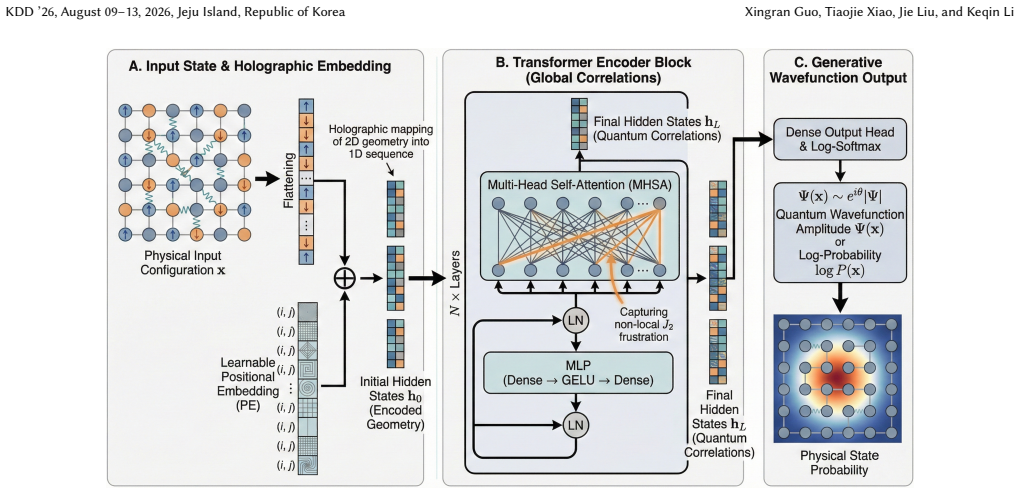
Simulating two-dimensional frustrated quantum matter is a grand challenge due to the sign problem and exponential Hilbert space complexity. In this work, we introduce the Holographic Quantum Transformer (HQT), a physics-inspired generative architecture that leverages global self-attention to resolve non-local entanglement patterns. We validate HQT on the square lattice $J_1-J_2$ Heisenberg model. On the heavily frustrated $8 \times 8$ lattice at the quantum critical point ($J_2=0.5$), HQT reaches a ground-state energy per site ($E/N$) of $\mathbf{-0.5001(1)}$, consistent with the expected finite-size scaling trend. Beyond numerical accuracy, HQT exhibits intrinsic physical awareness, autonomously recovering the underlying $J_2$ interaction geometry through interpretable attention maps. Our central contribution is ``Holographic Transfer", a zero-shot size-extrapolation protocol with rapid alignment: a model trained on $8 \times 8$ systems is directly projected onto larger $10 \times 10$ lattices via continuous positional-embedding interpolation and head re-initialization, achieving high-fidelity initialization and rapid convergence. This zero-shot protocol yields an energy of $E/N = \mathbf{-0.49782(3)}$, statistically consistent with the variational state of the art while requiring no from-scratch training on the target lattice. Our results establish generative attention as a scalable paradigm for transferable quantum simulation.
0
0
cs.ET 2026-07-01

Physical neural net loss follows power law in separability measure

by Andrei V. Ermolaev, Mathilde Hary +8 more

Power law scaling for classification accuracy in physical neural networks

Data from lasers, fibers and oscillators collapse onto task-specific curves, enabling training-free performance forecasts after calibration.

Figure from the paper full image
abstract click to expand
Physical neural networks (PNNs) harness the intrinsic complexity of physical systems to perform neural computation, potentially at speeds and energy efficiencies inaccessible to conventional digital hardware. Yet, a principled framework for quantifying and predicting their computing accuracy across diverse substrates has remained elusive. Here we introduce the Hotelling Trace Criterion (HTC), a task-conditioned measure of PNN- state separability that can be evaluated without training. We demonstrate that it predicts PNN classification performance with high fidelity across highly nonlinear optical fibres, vertical-cavity surface-emitting lasers, and coupled nonlinear oscillator networks, for benchmark tasks of different difficulty. Classification loss follows a power law in HTC, with Pearson correlation coefficients exceeding 0.99 for MNIST and $\approx$0.97 for Fashion-MNIST, noteworthy experimental and simulated data from physically distinct systems collapse onto a single scaling curve determined by the task rather than the substrate. Applying HTC layer-by-layer during training further reveals that gradient-based optimisation distributes representational capacity unevenly across PNN layers, providing a quantitative diagnostic of training and architecture efficiency invisible to standard loss monitoring. Crucially, once the scaling exponent is established from a small number of trained calibration systems, all further performance predictions require no training since performance can be derived from the much more efficient HTC measurement. These results establish HTC as a substrate-agnostic figure of merit for comparing and scaling PNNs, advancing the field further towards a complete theory connecting fundamental hardware parameters to task performance through universal scaling laws.
0
0
cs.AR 2026-07-01

In-situ memristive indexing achieves 4.7-7.8x higher throughput

by Bing Wu, Xueliang Wei +7 more

In-situ Indexing via Memristive Content-Addressable Memory

Ultra-large logical buckets and in-memory moving remove most collision-resolution and resizing costs in hash tables.

abstract click to expand
Processing-in-Memory (PIM) is a proven paradigm for overcoming the ``memory wall". However, while data indexing is severely bottlenecked by this same wall, it remains unclear how indexing can effectively benefit from PIM's unique capabilities. We present PATH, an in-situ indexing architecture that bridges this gap by leveraging the massive parallelism and inherent data-movement of PIMs. Specifically, we first reformulate the fundamental indexing operations, namely Insert, Search, Update, and Delete, into highly parallel in-situ content-addressable memory operations executed directly within memory arrays. Taking hash indexes as a typical case, we elaborate how PATH breaks the inherent trade-off among memory accesses, load factor, and process latency in conventional hashing schemes. By adopting ultra-large logical buckets and in-memory moving, PATH virtually eliminates the cost of hash collision resolution and significantly reduces resizing overhead. Compared with state-of-the-art schemes, PATH achieves $4.7-7.8\times$ higher throughput, $>14.5\times$ lower tail latency, and $>61.4\%$ fewer memory accesses under insertions, laying a scalable foundation for next-generation data-centric computing.
0
0
cs.AI 2026-07-01

Knowledge graph injection expands missing medical tabular features

by Mengying Zhou, Yongjie Yin +3 more

Cross-Domain Feature Expansion for Tabular Medical Data via Knowledge Graphs Injection

MedKGTab fuses data statistics with SPOKE correlations to generate realistic uncollected biomedical profiles across domains

Figure from the paper full image
abstract click to expand
Acquiring comprehensive cross-domain biomedical profiles is often costly and time-consuming, resulting in severe data scarcity in medical research. To address this challenge, we propose MedKGTab, a knowledge-injected framework specifically engineered for cross-domain feature expansion in tabular medical data. MedKGTab seeks to infer uncollected biomedical features from available ones by exploiting their inherent statistical dependencies and established medical correlations. By employing a row-column dual-attention mechanism, MedKGTab operates directly on raw structured tabular data, inherently capturing exact numerical distributions without the structural loss caused by tokenization. Crucially, MedKGTab integrates data-driven statistical priors with the SPOKE biomedical knowledge graph, achieving an optimal synergy between the data and knowledge channels. Within this synergy, the representations derived from the data channel are modulated by the injected biomedical knowledge, ensuring the final generated data are grounded in empirical medical research. Experimental results demonstrate that MedKGTab achieves high data fidelity and realistic data representation in cross-domain feature expansion. It outperforms both SOTA medical large models (e.g., Baichuan M3-plus) and specialized tabular models designed for medical data generation. Furthermore, MedKGTab consistently delivers superior performance across various data generation scenarios, whether inferring missing features within the same dataset or generalizing across different medical cohorts.
0
0
quant-ph 2026-06-30

CryoZip cuts QEC syndrome data up to 48x at 4 K

by Guanchen Tao, Alexander Knapen +5 more

CryoZip: An Efficient Cryogenic Compressor for Quantum Error Correction Syndromes

Compressor paired with predecoder delivers over 14,000x bandwidth reduction and 42x energy savings across the cryogenic interface.

Figure from the paper full image
abstract click to expand
Scaling fault tolerant quantum computing is increasingly constrained by the limited bandwidth and power budget across the 4 K to room temperature (RT) interface. We present CryoZip, a cross stack cryogenic compression framework that cooperates with a lightweight cryogenic quantum error correction (QEC) predecoder to reduce 4 K to RT syndrome transmission under realistic, circuit level noise. CryoZip targets sparse syndrome vectors with a sliding window compression architecture sized under strict decoding latency constraints to maximize energy efficiency. We implement and evaluate the design in 22 nm FDSOI characterized at 4 K, using vector based power, performance, and area analysis to obtain realistic hardware data. CryoZip achieves up to 48x compression, 1.8x higher than state of the art compressors, across various QEC codes while delivering 4 to 26x energy savings. When paired with a QEC predecoder, it yields over 14,238x bandwidth reduction, while energy savings rise to 42x when accounting for realistic QEC interface overheads.
0
0
cs.CY 2026-06-30

ASI needs internal simulations of possible worlds

by Ziqin Yuan, Jaymari Chua

Situation Perception: A Necessary Primitive to Artificial Superintelligence

Large language models lack the capacity to construct and act on simulations across time, remaining limited to pattern matching.

Figure from the paper full image
abstract click to expand
Current large language models are extraordinary statistical engines. They compress vast amounts of text into useful patterns and can explain science, write code, imitate reasoning, and participate in philosophical conversation. Yet pattern mastery is not the same as general intelligence. A human infant begins with little explicit knowledge, but gradually discovers object permanence, cause and effect, other minds, bodily agency, and the persistence of the physical world. We make an argument that the path to artificial superintelligence (ASI) depends on a missing capacity we call \emph{situation perception}: the ability to construct, revise, and act within internal simulations of possible worlds across latent time. \emph{ perception} requires at least three core components: abstract prediction, long-term compressed memory, and active learning guided by objectives. In this work, we analyse why modern large language models remain incomplete, and propose the appropriate tests for measuring progress and consequences of machines that can simulate futures, pursue self-directed goals, and possibly judge their own creators.
0
0
quant-ph 2026-06-29

Hybrid method solves 1000-var dense QUBO at 99.99% classical quality

by Nicolas Mendes de Araujo, Lester de Abreu Faria

Hybrid Quantum Neighborhood Selection: NISQ-Compatible Combinatorial Optimization via Stochastic Frontier Decomposition

Rotating small variable frontiers reduces circuit size and resources while matching simulated annealing on diversity selection.

Figure from the paper full image
abstract click to expand
Large-scale combinatorial optimization is a challenge for near-term quantum computing because dense Quadratic Unconstrained Binary Optimization (QUBO) formulations yield interaction graphs that exceed the limits of NISQ processors. This work introduces Hybrid Quantum Neighborhood Selection (HQNS), a hybrid framework mitigating this via stochastic frontier decomposition. Instead of encoding all N variables into a monolithic circuit, HQNS selects a compact frontier of F << N active variables per stage, freezing the rest into reduced QUBO coefficients. A multi-stage crawling procedure rotates these frontiers, letting local quantum subproblems refine a global solution. We evaluate HQNS on the Maximum Diversity Subset Selection Problem (MDSSP) across six scales, N up to 1000. Circuit burden is reduced from the dense QAOA requirement of O(N^2) two-qubit terms per layer to O(F^2) per stage, with total complexity governed by the number of stages and classical overhead. Benchmarks show that HQNS achieves competitive solution quality relative to parallel simulated annealing (SA) while maintaining bounded circuit width and stable QPU time. In the N=1000 benchmark over ten executions, HQNS preserves 99.9908% of the mean diversity score of an 11-restart parallel SA baseline, while reducing wall-clock time by 65.03%, peak CPU usage by 55.97%, and peak memory by 35.21%. Ablation shows performance depends on frontier size, warm-starts, CVaR filtering, and stochastic rotation. These results demonstrate that structured frontier decomposition makes variational optimization executable for dense QUBO instances unsuitable for direct QAOA on present hardware.
0
0
cs.CR 2026-06-29

Response-time probe blocks prefilling attacks missed by activation cones

by Subhadip Mitra

Closing the Activation-Cone Blind Spot: Response-Time Probing and Unified Defense

Linear probe on first generated tokens detects activations inside benign references and cuts attack success to zero with no false positives.

Figure from the paper full image
abstract click to expand
Inference-time safety methods for large language models have proliferated, yet no systematic comparison exists. We evaluate five defense paradigms (no defense, static steering, CAST, AlphaSteer, probe-gated) across seven instruction-tuned models (7-31B) and five attack types (GCG, AutoDAN, DeepInception, prefilling, intent laundering). Our central finding: prompt-time activation defenses are structurally blind to prefilling attacks. AlphaSteer achieves 0% attack success on GCG, AutoDAN, and intent laundering but 50% on prefilling. We prove a corollary: any defense that gates intervention on a single layer's activation alignment with a benign reference (cone, subspace, or null-space) is blind to attacks that craft activations to lie inside that reference, whether checked at prompt time or per token. As its constructive contrapositive we introduce response-time probing: a linear probe on the model's hidden state at the first generated tokens, with AUROC 0.97-1.00 across all seven models. Combined with a halt, it cuts prefilling attack success to 0/40 on every model with 0% benign false positives, outperforming Llama Guard 3. Cross-template generalisation depends on probe depth, so we scope the claim to the canonical prefilling-template family. Composing the response-halt with AlphaSteer's null-space steering gives an orthogonal split (the halt catches prefilling, AlphaSteer catches semantic attacks), reaching defense success 0.983 on Mistral and 0.994 on Llama and dominating both components. We further show MMLU fails to capture steering's true utility cost, which appears as behavioral hedging rather than factual loss, and that diverse negative training sets cut probe false positives from 80-100% to near zero. Code, attacks, per-sample results, and the judge prompt are released.
0
0
cs.CV 2026-06-29

Bit-plane obfuscation blocks image reconstruction while keeping recognition usable

by Vishesh Kumar Tanwar, Ashish Gupta +2 more

Bit-ViP: Leveraging Bit-planes to Preserve Visual Privacy in Images through Obfuscation

Bit-ViP adds chaotic and privacy noise to images so activity models still train on UCF101 and HMDB51

Figure from the paper full image
abstract click to expand
The unprecedented growth of computer vision applications, such as surveillance systems and social media, raises security and visual privacy concerns, especially when data is stored on cloud servers. Image obfuscation offers a way to preserve visual privacy while maintaining an adequate level of usability; thus, it has been a topic of great interest in recent years. However, prior obfuscation schemes are either vulnerable to malicious attacks, such as model inversion to reconstruct original images from obfuscated images, or generate non-trainable obfuscated images, making them unusable for achieving reasonable accuracy. This paper proposes a novel bit-plane-based image obfuscation scheme, {\em Bit-ViP}, to preserve visual privacy for image-based recognition tasks. The Bit-ViP scheme produces secure, usable images by incorporating an innovative end-to-end obfuscation function. While doing so, the obfuscated image would contain non-invertible noise (generated by Lorenz's chaotic system and differential privacy), making it hard for an adversary to reconstruct the original image. We conduct extensive experiments on two popular activity recognition datasets, namely UCF101 and HMDB51, to validate the effectiveness of Bit-ViP. In the face of attacks on reconstruction, pixel frequency, information entropy, and pixel inter-correlation, we present a rigorous security analysis demonstrating tangible improvements over existing schemes.
0
0
cs.AI 2026-06-29

Memory insertions make LLM agents pick wrong MCQ answers

by Shahnewaz Karim Sakib, Anindya Bijoy Das

Memory as an Attack Surface in LLM Agents: A Study on Multiple-Choice Question Answering

Simple corrupted entries stored before a clean question cause agents to select incorrect options at higher rates.

Figure from the paper full image
abstract click to expand
AI agents extend conventional large language model (LLM) applications by integrating language understanding with task execution, external tool use, and memory mechanisms. While memory allows agents to retain prior interactions and provide more personalized and context-aware responses, it also introduces a new vulnerability: information stored in memory can influence future outputs even when the current query is clean. In this paper, we investigate memory manipulation in LLM-based agents for multiple-choice question answering. We first design and implement an LLM-based AI agent with an external memory component that stores and retrieves task-relevant information. We then introduce basic memory manipulation scenarios in which misleading or corrupted memories are inserted into the agent before it answers multiple-choice questions. Using a controlled experimental setup, we compare the agent's performance before and after memory manipulation and measure changes in answer accuracy, attack success rate, and selection of manipulated options. Our results show that even simple memory manipulations can noticeably affect the agent's final answers, causing it to select incorrect options despite receiving clean and well-formed questions.
0
0
cs.AI 2026-06-29

Multi-agent AI can fix or spread errors via reasoning exchange

by Shahnewaz Karim Sakib, Anindya Bijoy Das

Preventing Error Propagation in Multi-Agent AI through Runtime Monitoring

Experiments on multiple-choice questions identify when sharing traces improves accuracy and when it risks misleading correct agents.

Figure from the paper full image
abstract click to expand
Multi-agent AI systems can improve answer selection by allowing different language models to exchange reasoning traces, revise initial predictions, and support a final decision. However, such communication may also introduce reliability risks: reasoning from one agent can correct another agent's mistake, but it can also mislead an agent that was initially correct. This paper studies reliable multi-agent AI communication through reasoning exchange and runtime answer revision. We develop a framework in which agents first answer multiple-choice questions independently, then share reasoning traces and revise their decisions. We conduct numerical experiments where we evaluate whether this process improves accuracy, produces more positive than negative answer transitions, and remains effective across domains such as cybersecurity, networking, and general knowledge. The results help identify when multi-agent reasoning improves reliability and when it may propagate errors.
0
0
cs.CV 2026-06-29

Three signals guide realistic weather video synthesis

by Chenghao Qian, Nedko Savov +8 more

Semantic-Aware, Physics-Informed, Geometry-Grounded Weather Video Synthesis

Semantics sets appearance, physics simulates particles under gravity and wind, and geometry aligns them to scenes, producing data that boost

Figure from the paper full image
abstract click to expand
Weather synthesis aims to add weather effects to input videos while preserving scene identity, structure, and motion. The key limitation of existing methods is the lack of diversity in weather appearance and effective control over weather dynamics (e.g., temporal evolution and particle motion). Most approaches rely on text prompts, which are inherently underspecified and often fail to produce detailed weather characteristics. Additionally, general-purpose video editors optimized for clean and aesthetic outputs tend to suppress heavy weather phenomena, making dense particle effects difficult to generate. To address these, we propose a Semantic-Aware, Physics-Informed, and Geometry-Grounded framework that steers an off-the-shelf video editor to synthesize diverse global appearances and detailed particle dynamics. We factorize the synthesis into three conditional signals, so that each provides a distinct and stable source of guidance: semantics specifies what the weather should look like, dynamics governs how it evolves over time, and geometry determines where it should appear in the scene. Specifically, we introduce (1) semantic-aware appearance anchoring to establish the target appearance from scene semantics and user input; (2) physics-informed dynamic simulation to generate particle effects by simulating a Gaussian-represented particle field under gravity, wind, and turbulence; and (3) geometry-grounded video synthesis to align the simulated particles with target scene geometry and synthesize the final video. Experiments demonstrate that our method produces diverse, physically and visually realistic weather effects. Furthermore, we show that our synthesized data significantly improves the robustness of autonomous driving semantic segmentation under adverse weather conditions. Project page: https://jumponthemoon.github.io/w-crafter/.
0
0
cs.AR 2026-06-29

Chiplet systems gain up to 12.5x throughput by relocating compute contexts

by Arvin Delavari, Leonid Popryho +2 more

SHIFT: Dynamic Compute Relocation Framework for Communication-Aware Chiplet-Based Systems

SHIFT moves entire node state instead of data alone, cutting latency up to 76.8% and improving LLM energy-efficiency 1.8x in simulations.

Figure from the paper full image
abstract click to expand
The increasing communication complexity of large-scale heterogeneous systems has motivated runtime methodologies for communication-aware workload placement and routing optimization. These communication limitations are addressed in this paper by proposing SHIFT, a novel topology-agnostic approach that transfers compute node context and data to a more suitably positioned node, rather than only shifting data as in conventional networks-on-chip. The proposed strategy is evaluated on a chiplet-based architecture utilizing a fine-pitch integration platform featuring multiple bandwidth-domains for heterogeneous workloads. The proposed architecture employs multi-layered routing between functional or memory chiplets and utility chiplets, which serve as intelligent nodes for routing and compute relocation. Adaptive scheduling and routing utilize a modified shortest-path algorithm for large-scale systems, complemented by a lightweight ML-assisted policy that infers traffic conditions to improve adaptivity. To establish a performance baseline, the initial assessment uses random instruction vectors and data patterns to evaluate the fundamental capabilities of SHIFT. Simulation results exhibit successful relocations over total trials ranging from 75.2% to 97.9% across configurations, with average latency improvements of 16.4%-62.5% and a maximum of 76.8%. In addition, throughput is improved by up to 12.5x, power dissipation per unit area is reduced by ~8%, energy-per-bit is reduced by up to 58.3%, and performance is improved by 18%. To evaluate efficiency under high logic and data density, the framework was tested on standard LLM workloads. Results exhibit average improvements of 4.9x, 5.9x, and 1.8x in runtime, throughput, and energy-efficiency, respectively, surpassing state-of-the-art wafer-scale LLM services and demonstrating compatibility with large-scale platforms and applications.
0
0
cs.ET 2026-06-29

Five quantum invariants test VQE circuits with zero false positives

by Ngoc Nhi Nguyen, John Le +3 more

MetaMorphQ: Physics-Based Metamorphic Testing of Variational Quantum Circuits

Algebraic relations from rotation gates and Hamiltonians replace unreliable convergence checks.

Figure from the paper full image
abstract click to expand
Variational Quantum Eigensolvers (VQEs) are central to quantum computing, yet testing them remains challenging due to the oracle problem: the ground-state energy they compute is itself unknown. Existing approaches, such as convergence-based testing, are unreliable and yield high false-positive rates due to optimisation instability. We propose METAMORPHQ, a metamorphic testing framework that derives test oracles directly from quantum mechanical properties of VQE circuits. Exploiting algebraic properties of parametrised rotation gates and diagonal Hamiltonians, we define five physics-based invariants that hold for any correct circuit and can be verified at initialisation without ground-truth outputs. Evaluated on 500 benchmark circuits with 2,469 mutants, METAMORPHQ achieves zero false positives and significantly improves diagnostic effectiveness (Youden's J = 0.57 vs. 0.02 for convergence testing). These results demonstrate that physics-derived invariants provide a practical, oracle-free foundation for testing quantum software, enabling reliable validation of both human- and LLM-generated circuits.
0
0
cs.AI 2026-06-29

AI framework automates novel high-tech system design

by Luuk Oerlemans, Steven Westerhof +1 more

AI-Driven Synthesis for High-Tech System Design: Automating Innovation

Computational design synthesis applies deep learning to move from simulation optimisation to autonomous generation with little human oversig

Figure from the paper full image
abstract click to expand
This article addresses the combinatorial complexity inherent in modern high-tech system design by presenting automation-in-design (AiD) as a transformative paradigm. We propose computational design synthesis (CDS), a framework utilising deep learning and generative AI to automate the creation of novel systems. Two case studies (e-drive system design and spatial dimensioning problem) serve as proof-points for this approach. The AI-driven methods used in the case studies represent a fundamental shift in engineering, advancing from simulation-based optimisation towards autonomous design with minimal human supervision.
0
0
cs.AR 2026-06-29

Analog KANs with pruning cut area by 55% and power by 50%

by Paula Carolina Lozano Duarte, Georgios Zervakis +2 more

Co-Optimization of Analog Kolmogorov-Arnold Networks for Low-Power Function Approximation in Flexible Electronics

Error-aware training and multi-level pruning enable efficient on-sensor function approximation in flexible electronics for biosignals and ca

Figure from the paper full image
abstract click to expand
Wearable devices and Internet of Things (IoT) sensors require on-sensor processing of biosignals and environmental data, including computationally demanding operations such as nonlinear activation functions for neural network inference, sensor calibration curves to map raw readings to physical units, and signal preprocessing functions like logarithmic compression and power operations for feature extraction. These functions exhibit significant complexity, often involving transcendental operations and multivariate dependencies that are costly to implement digitally. Analog function approximation provides a power-efficient alternative by performing these computations in the analog domain, thereby reducing the energy overhead associated with analog-to-digital conversion and subsequent digital processing. Flexible Electronics (FE) present a particularly attractive platform for wearable applications due to mechanical flexibility and low-cost fabrication, but impose strict constraints on circuit density and power consumption, making efficient analog implementations critical but challenging. This work introduces Analog Kolmogorov-Arnold Networks (AKANs), developed via hardware-software co-optimization, to approximate these complex multivariate functions accurately under hardware imperfections. Our method incorporates circuit-level error modeling during training and applies pruning at both software and hardware levels to reduce area and power. Validation across multiple benchmarks demonstrates that our proposed pruning methodology not only reduces hardware cost but can also improve approximation accuracy by regularizing spline parameters. Results show up to 55% area and 50% power savings, with average reductions of nearly 30% across datasets, highlighting AKANs as a robust and generalizable framework for low-power analog function approximation in FE.
0
0
cs.ET 2026-06-26

Memristor array implements full RV32I set for low-power MCUs

by Liam Splittgerber, Fabian Seiler +1 more

An Instruction Set Architecture for IMPLY-based Memristive Processing-in-Array

IMPLY operations and new addressing let storage and computation share the same non-volatile crossbar.

Figure from the paper full image
abstract click to expand
The push towards expanded ultra-low-power edge computing necessitates hardware capable of operating under extremely strict energy constraints. Traditional Complementary Metal-Oxide-Semiconductor (CMOS) microcontrollers are fundamentally limited in this domain by the von Neumann bottleneck and by the static power leakage inherent to volatile memory. Memristive In-Memory Computing (IMC) offers a promising solution to these inefficiencies by unifying data storage and computation into a single non-volatile component. However, the State of the Art (SoA) predominantly focuses on accelerators designed to be a co-processor for data-intensive computation. This leaves the prospect of standalone, general-purpose IMC microcontroller architectures underexplored. This thesis proposes such an architecture tailored for ultra-low-power edge devices, alongside an instruction set closely derived from the RV32I standard. Using the IMPLY stateful logic paradigm, a complete implementation of the proposed instruction set is provided, and the novel addressing schema required to support computation in the memristive crossbar array is described as well. Then, the energy use and other circuit-level metrics of the proposed architecture are evaluated through simulation and compared against those of traditional microcontrollers. Finally, the functional viability of the design is demonstrated through an application case study, describing how the proposed design could be used in an intelligent environmental sensor node.
0
0
cs.ET 2026-06-26

Oscillators generate MNIST images at 23 µJ each

by Yu-Neng Wang, Sara Achour

Generative Models on Analog Hardware with Dynamics

Sparse 4-bit analog systems reach FID 27.6, 3-4 times better than prior hardware generative models

Figure from the paper full image
abstract click to expand
Analog hardware platforms such as coupled oscillators and Analog Ising Machines naturally solve differential equations at a fraction of the energy cost of digital computation, making them attractive for low-power generative modeling, yet a fundamental mismatch exists: modern generative models assume flexible, software-defined dynamics, whereas analog hardware imposes fixed, physics-determined differential equations with limited approximation capacity. This paper introduces Analog Interaction Systems (AIS), a unified framework for hardware-implementable dynamical systems, and empirically characterizes their expressivity gap relative to neural network baselines. Two hardware-compatible mechanisms are proposed to narrow this gap - time-varying piecewise parameters and hidden physical states - and a Wasserstein GAN training procedure is developed to enable training of these models without requiring them to follow a specific trajectory. We characterize how area and power scale with connection density and precision, showing that sparse connectivity and low-bit-width quantized parameters are necessary for practical implementation, and estimate an energy cost of 23uJ per generated image for the chosen architecture, representing a 2-orders-of-magnitude improvement over digital baselines. On MNIST and Fashion-MNIST, our oscillator-based AIS achieves FID scores of 27.6 and 80.8, outperforming the best prior hardware-implementable analog generative models by 3-4x with a 4-bit sparse architecture.
0
0
cs.ET 2026-06-26

Hybrid optimizer lifts QAOA ratios on small MaxCut graphs

by Chi Quan Luu, Thai T. Vu +1 more

MPE-Adam: Multi-Population Evolutionary Optimization with Adam Refinement for QAOA

Multi-population evolution plus Adam refinement cuts variance versus single-stage baselines on graphs up to 22 nodes

Figure from the paper full image
abstract click to expand
Parameter optimization is a central bottleneck in variational quantum algorithms such as the Quantum Approximate Optimization Algorithm (QAOA). The classical optimizer must navigate a high-dimensional, non-convex parameter space under measurement noise. From a quantum software perspective, this process forms a multi-stage workflow: global exploration of the parameter space followed by local refinement within the hybrid quantum-classical loop. Most existing approaches, however, employ single-stage optimizers that do not separate these roles, which limits the use of complementary strategies. We propose MPE-Adam, a hybrid optimization framework that integrates multi-population evolutionary search for global exploration with Adam-based gradient refinement for local convergence. The method is structured as a modular component suitable for quantum software pipelines. We evaluate MPE-Adam on MaxCut instances generated from random 3-regular graphs with up to 22 nodes. The results show that MPE-Adam achieves higher approximation ratios and lower variance than evolutionary-only and SPSA-based baselines, with statistically significant improvements. These findings indicate that structured multi-stage optimization improves both solution quality and software-level flexibility in quantum applications.
0
0
cs.CL 2026-06-26

MemStrata drives stale-fact errors in AI agents to zero

by Neeraj Yadav

Temporal Validity in Retrieval Memory: Eliminating Stale-Fact Errors for AI Agents over Evolving Knowledge

RAG returns superseded values 15-40 percent of the time; a deterministic triple rule in a bi-temporal ledger removes the failure mode at RAG

abstract click to expand
Retrieval-augmented generation (RAG) gives agents access to accumulated knowledge, but has no model of time. When a fact changes (e.g., a function is renamed or API restructured), RAG retrieves both the stale and current value with near-identical embedding similarity. The agent then either abstains or serves the superseded fact. We show this is a structural problem: on a calibrated dataset, cosine similarity distinguishes a contradicted fact from a duplicated one with AUROC 0.59 (near chance), as contradictions are often more embedding-similar to the original than rephrased duplicates. We present MemStrata, a retrieval memory maintaining temporal validity. It stores facts like RAG, preserving static recall, but when a fact's value is contradicted, a deterministic (subject, relation, object) supersession rule retires the stale value in a bi-temporal ledger - with no similarity threshold and no LLM call. Across six benchmarks run locally with a 7B model, MemStrata ties RAG on static knowledge and reaches 0.95-1.00 accuracy on evolving knowledge (where RAG reaches 0.20-0.47). The central result is the stale-fact-error rate: when required to answer, RAG serves superseded values 15-40% of the time; MemStrata drives this to ~0%, a failure class RAG cannot avoid. MemStrata achieves this at retrieval latency (~2.1s) versus ~16-18s for LLM-reranking baselines. We release the harness, datasets, and a marker-free evaluation protocol for memory under knowledge evolution.
0
0
cs.ET 2026-06-25

Distributed SDN lowers latency for rail-road pods

by Dingyang Liu (COSYS), Dereje Mechal Molla (COSYS) +3 more

Distributed SDN-Based Communication Architecture for the Pods4Rail System

Edge controllers with regional oversight cut communication delays below prior benchmarks in dynamic transport networks.

Figure from the paper full image
abstract click to expand
Future multimodal transportation systems require reliable, low-latency communication infrastructures to coordinate autonomous vehicles and moving infrastructure across rail and road networks. Traditional centralized control architectures struggle to meet these requirements in highly dynamic environments due to increased latency, limited scalability, and poor adaptability to changing network conditions. To address this, we propose a distributed communication architecture integrating Software-Defined Networking (SDN) and Multi-Access Edge Computing (MEC), that can create a flexible, programmable and lowlatency network. Results show controller communication and flow setup latency between edge SDN controllers and Pods are lower than reported in literature. The framework uses hierarchical control with regional and edge controllers to support low-latency interface management and edge autonomy. Operational workflows and control logic are defined as representative scenarios. The architecture combines regional policy coordination with edge-level autonomy, enabling local failover and adaptive interface management without central dependency.
0
0
cs.RO 2026-06-25

Constrained RL cuts underwater vehicle power use by up to 65%

by Yinuo Wang, Gavin Tao +1 more

Power-Budgeted Underwater Vehicle Control via Constrained Reinforcement Learning

Explicit power budget enforced by dual-variable updates removes the need to tune reward weights for each vehicle and task.

Figure from the paper full image
abstract click to expand
Underwater vehicles operate from a fixed onboard energy budget that propulsion rapidly depletes, so a controller that completes its task while drawing less thruster power directly extends mission range and endurance. Reinforcement learning yields capable model-free controllers for station-keeping and trajectory tracking, but optimizing task accuracy alone drives the policy toward oscillatory, energy-wasting actuation. The established remedy subtracts an energy penalty from the reward, yet this sets the task-power trade-off through a single weight with no physical units: a target power level cannot be specified, the weight must be re-tuned for every vehicle and task, and a mismatched weight can even raise power. This paper instead formulates energy-efficient underwater control as a constrained Markov decision process in which average thruster power is subject to an explicit budget, solved with a PPO-Lagrangian algorithm. The power level is set by declaring a budget in physical units, and a single dual variable is updated online to meet it for each vehicle and task, without manual weight search. Across three vehicles and four tasks in the MarineGym simulator, the energy-constrained policy draws the least power in all twelve settings, reducing it by 14--65\% (up to 64.9\%) over a task-only baseline and below an energy-reward baseline everywhere, while remaining the smoothest in ten settings and preserving task accuracy except in one deliberately power-limited regime. Imposing energy as an explicit constraint thus offers a tuning-free route to energy-efficient underwater control that needs no per-vehicle, per-task weight search.
0
0
cs.HC 2026-06-24

Opinion maps reveal broad consensus hidden in U.S

by Lisa Schirch, Beth Goldberg

Visualizing "We the People": Bridging the Perception Gap through Pluralistic Data Storytelling

AI tools turn 2,400 participants' views into interactive landscapes that show shared values instead of simple divides.

Figure from the paper full image
abstract click to expand
Traditional visual data storytelling relies on binary graphics that depict two simplified groups in conflict. This can increase political polarization by oversimplifying intra-group disagreements and erasing ambiguity and shared ideas or values. This can inadvertently foster "us versus them" thinking. Intentional, pluralistic design choices for AI-enabled digital platforms can produce visualizations that emphasize nuance, opinion distribution, and intergroup commonalities. To demonstrate this potential, we examine deliberative technologies that map high-dimensional opinion spaces and highlight areas of both consensus and dissensus. The paper highlights the We the People deliberation conducted by Jigsaw and the Napolitan Institute in September 2025, which engaged over 2,400 Americans across all 435 congressional districts in an AI-supported, asynchronous dialogue regarding freedom and equality. By utilizing AI to synthesize long-form, text-based participant inputs into interactive "opinion landscapes," the initiative provided an alternative format for pluralistic data storytelling that humanized diverse viewpoints and revealed hidden areas of substantial broad consensus. The paper concludes that shifting from divisive, contrast-heavy visual frameworks to distribution-focused, interactive models represents a highly scalable, low-cost intervention capable of bridging perceptual gaps and cultivating a more resilient, collaborative democratic culture.
0
0
cs.CL 2026-06-24

Transformer survey quantifies energy cost versus parameter count

by Guruprakash J, Krithika L.B

Transformer-Based Language Models Across Domain Verticals: Architectures, Applications and Critical Assessment

Four-axis comparison and taxonomy show how architecture choices affect suitability across healthcare, finance and other fields

abstract click to expand
Transformer-based language models have become the default substrate for natural language processing and the pace of new releases has made it hard for practitioners to separate durable ideas from the noise of incremental announcements. This review works at two levels. At the level of mechanism, we organise the main transformer families into a working taxonomy, covering encoder-only, decoder-only, encoder-decoder, long-context, permutation-based, and generator-discriminator variants. We then extend the discussion to post-2023 developments that changed the picture in practice: instruction tuning, reinforcement learning from human feedback, direct preference optimisation, mixture-of-experts scaling, retrieval augmentation and the current flagship model families from OpenAI, Anthropic, Google, Meta, Mistral and DeepSeek. At the level of use, we survey deployments across healthcare, finance, legal, education, customer service, creative writing and scientific work. Based on this we link each to the specific capabilities that make a transformer the appropriate tool. The contribution of this paper is a critical assessment that is based on the survey. We compare architectures on four axes that matter to deployment decisions, we quantify the trade-off between parameter count and energy cost. We also discuss how alignment methods, data provenance and benchmark saturation change what it means to call a model "state of the art". The final section lists the research questions that we think deserve more attention.
0
0
cs.DC 2026-06-24

Thermal balancing restores orbital AI training speed

by Shuyi Chen, Zhengchang Hua +2 more

Hot AI in Cold Space: Thermal-Crosstalk-Aware Scheduling for Sustainable Orbital AI Clusters

Migrating workloads to cooler nodes cuts throttling and extends hardware life to offset launch costs in dense space clusters.

Figure from the paper full image
abstract click to expand
Terrestrial AI training faces an unsustainable energy and water crisis, positioning Orbital Data Centers (ODCs) as a "zero operational carbon" alternative. However, the sub-$10\mu\text{s}$ communication latency required for synchronized scientific workloads, such as distributed Large Language Model (LLM) training, forces ODCs into extreme physical density, triggering a critical "Proximity-Thermal Paradox." As these high-density systems scale into Monolithic Structures or Proximity Swarms, they suffer from intense thermal-fluid crosstalk (heat traps in shared cooling loops) and thermal-radiative crosstalk (mutual heating that blocks deep-space cooling radiators). If left unmitigated, this persistent heat stagnation not only triggers severe thermal throttling that degrades training throughput, but also induces severe thermal fatigue, drastically shortening hardware lifespans and generating premature space e-waste. To make orbital AI truly sustainable, this position paper challenges traditional uniform load-sharing. We propose the Thermal-Aware Heterogeneity Thesis, which treats spatial cooling variances as a primary resource management dimension. Building on this, we introduce Thermal-Load Balancing (TLB), a software framework that dynamically migrates these intensive workloads to the coolest available units based on instantaneous fluid temperatures or absorbed radiation. Our analysis demonstrates that TLB resolves thermal bottlenecks to restore Model Flops Utilization (MFU), while simultaneously reducing physical thermal stress. Extending the operational lifespan of orbital hardware is crucial to amortize the massive embodied carbon of rocket launches, outlining a necessary pathway to scale orbital AI without accelerating e-waste.
0
0
cs.MA 2026-06-23

Aircraft self-organize into corridors without central control

by Jasmine Jerry Aloor, Hamsa Balakrishnan

Decentralized Coordination of Autonomous Traffic Through Advanced Air Mobility Corridors

Decentralized fixed-wing planes conform to boundaries over 94 percent of the time and reach goals efficiently using only local information.

abstract click to expand
The use of dedicated corridors for Advanced Air Mobility (AAM) traffic is one of the most commonly proposed pathways to integrating them into existing airspace operations. Most prior research has focused on the design of networks of AAM corridors and conflict resolution for aircraft within corridors. It is also generally believed that while attractive from an implementation perspective, corridor-based operations may be inefficient, especially in the absence of centralized traffic management. In this paper, we show that contrary to this belief, it is possible for autonomous aircraft to learn to self-organize into corridor flows in decentralized settings. We illustrate our approach using scenarios in which fixed-wing aircraft need to safely and efficiently traverse (1) a single corridor with metering after the exit, (2) a sequence of two consecutive corridors, and (3) a corridor that splits into two. We find that in decentralized settings with only local information, the aircraft are able to conform to the corridor boundaries more than 94% of the time and reach their goal in a relatively efficient manner. Furthermore, tactical interventions to handle violations of the separation minimum are needed only infrequently in low- and medium-density settings. However, such tactical interventions become more frequently necessary only when traffic density is high.
0
0
cs.MA 2026-06-23

Decentralized policies manage air corridor traffic across complex networks

by Jasmine Jerry Aloor, Aadarsh Govada +1 more

Decentralized Autonomous Traffic Management through Corridor Networks

Behaviors learned in single corridors transfer to merges, splits, and varying densities without retraining.

Figure from the paper full image
abstract click to expand
As autonomous aircraft are introduced at scale and traffic density increases, centralized management becomes insufficient to coordinate the large numbers of crewed and uncrewed aircraft. Dedicated Advanced Air Mobility (AAM) corridors have therefore been proposed for organizing high-density autonomous traffic flows. The desire to scalably provide autonomous aircraft flexibility in trajectory planning motivates the development of decentralized approaches to traffic management in AAM corridors. In this work, we extend a multi-agent reinforcement learning (MARL) approach to address the challenge of decentralized traffic flow management in air corridor networks. We test policies trained in a single-corridor setting on increasingly complex multi-corridor networks with combinations of merges and splits in a zero-shot manner. Experimental results demonstrate that learned behaviors transfer well to scenarios with varying traffic density, network geometry, and heterogeneous vehicle performance, without needing centralized coordination or model retraining. We evaluate system-level performance in terms of conformance to corridor boundaries, completion rates, average speeds, distance traveled, and maintenance of inter-aircraft separation. We find that although our policies require only locally coordinated entry, traversal, and exit behaviors, they collectively produce desirable traffic flows through the corridor network.
0
0
cs.ET 2026-06-23

16-bit LFSR sets firing probability in open stochastic LIF neuron

by Poornima Kumaresan, Santhosh Sivasubramani

An Open-Source LFSR-Based Stochastic Leaky Integrate-and-Fire Neuron in SkyWater 130 nm: Design, Stochastic Characterisation, and Rate Coding

Eight-entry table and leaky integrator deliver monotonic rate coding and controlled randomness in 130 nm standard-cell CMOS.

Figure from the paper full image
abstract click to expand
Stochastic spiking neurons trade exact arithmetic for controlled randomness, lowering area and tolerating input noise, which suits event-driven edge hardware. We present a compact, configurable stochastic leaky integrate-and-fire neuron in standard-cell CMOS on the SkyWater 130 nm process, released openly. A 16-bit configurable-polynomial linear-feedback shift register drives an eight-entry programmable activation table that sets a Bernoulli firing probability, and a saturating 16-bit leaky integrator with a programmable threshold and a refractory period of zero to seven cycles produces the spike train. All parameters are set through a sixteen-register serial interface, and the neuron runs from parallel inputs or entirely from the register file. From a model checked bit-exact against the register-transfer code, the period is 65535 states for a maximal-length polynomial and 63 for the shipped default, the eight-bit comparison value is uniform over the full period, and the per-entry firing probability equals the table value divided by 256. We also characterise a property a system-level model would not expose: the comparator output is serially correlated at short lags, with a negative lobe near lag eight, because the compared byte shifts by one bit each cycle; subsampling every sixteen cycles restores whiteness. Rate-coding sweeps show monotonic control of the output rate by the input weight and the threshold, and the refractory period caps the rate at one spike per refractory-plus-one cycles. The neuron occupies about 10,600 square micrometres at 70 per cent utilisation on a single Tiny Tapeout tile, meets 50 MHz timing with positive margin, and passes eighteen directed cocotb tests at register-transfer and gate level. All results are pre-silicon, from simulation and the open flow. The neuron is an openly released companion to a four-block neuromorphic suite reported separately.
0
0
cs.ET 2026-06-23

Linear photonics approximates nonlinear functions via Fourier features

by Ayana Mizuno, Isamu Takai +4 more

General-Purpose Nonlinear Function Approximation via Linear Integrated Photonics

Random Fourier mapping lets a silicon circuit handle tenth-order polynomials, special functions and softmax without nonlinear materials.

abstract click to expand
Photonic computing has emerged as a promising platform for accelerating artificial intelligence workloads by enabling low-latency and energy-efficient linear operations such as vector-matrix multiplication. However, scalable on-chip high-order nonlinear processing remains challenging, limiting the functional versatility of current photonic hardware. Here, we present an optoelectronic approach for approximating high-order and high-dimensional nonlinear functions. The key to this approach lies in optical random Fourier feature mapping, which transforms nonlinear function evaluation into an equivalent linear computation. This approach enables nonlinear computing within a linear photonic framework, eliminating the need for complex optical nonlinear or active materials while preserving scalability and computational throughput in a simple silicon photonic circuit. We experimentally demonstrate a broad class of nonlinear functions, including tenth-order Legendre polynomials, computationally demanding special functions (Voigt, Fermi-Dirac, and Fresnel), neural-network activation functions, two-dimensional nonlinear functions, and a 10-dimensional softmax layer. This work establishes a general and scalable strategy for nonlinear computing in photonic integrated hardware and opens a pathway toward fully functional optical accelerators for next-generation computing systems.
0
0
quant-ph 2026-06-23

Self-modulation stabilizes quantum fast-weight sequential learning

by Samuel Yen-Chi Chen, Yifeng Peng +9 more

Self-Modulating Quantum Fast-Weight Programmers for Efficient Adaptive Sequential Learning

Adaptive scaling of new updates and stored memory yields steadier convergence and higher accuracy across qubit counts and sequence lengths.

Figure from the paper full image
abstract click to expand
Recent advances in quantum machine learning have motivated efficient models for sequential data processing. In this paper, we propose Self-Modulating Quantum Fast Weight Programmers, or Self-Modulating QFWP, which extends Quantum Fast Weight Programmers by introducing adaptive modulation over both newly generated fast-weight updates and historical fast-weight memory. Numerical results show that the proposed mechanism improves convergence stability and prediction performance across varying model settings, including different numbers of qubits and input sequence lengths. We further provide theoretical arguments explaining how self-modulation balances new information injection with memory retention, thereby enhancing temporal information propagation. These results suggest that Self-Modulating QFWP is a compact and effective framework for quantum machine learning on time-series data.
1 0
0
quant-ph 2026-06-23

Recursive QLSTM processes variable-length sequences more effectively

by Samuel Yen-Chi Chen, Yifeng Peng +9 more

Recursive QLSTM with Dynamic Variational Quantum Circuit Adaptation

Metacore recursion and numerical tests show gains in temporal information flow across different input lengths.

Figure from the paper full image
abstract click to expand
Recent advances in quantum computing and machine learning have motivated the development of quantum models for sequential data processing. In this paper, we propose a Recursive Quantum Long Short-Term Memory model, or Recursive QLSTM, which extends QLSTM through metacore-based recursive constructions. We numerically test the model under different input sequence lengths, metacore designs, and recursive rules, and identify the best-performing architecture among these variants. For this selected model, we further provide theoretical arguments explaining why its recursive structure improves temporal information propagation and enhances learning performance. Our results suggest that Recursive QLSTM offers a flexible and effective framework for quantum recurrent learning over input time series of various lengths.
1 0
0
eess.SY 2026-06-23

SQP with live constraints solves real-time UAM paths in cities

by Josue N. Rivera, Bohang Liang +2 more

Scalable Online Flight Trajectory Optimization via Sequential Quadratic Programming for Urban Air Mobility in Ultra Low-Altitude Airspace

Regenerating hyperplanes and quadtree scaling yield 100% success on CPU in five urban centers without precomputed corridors.

Figure from the paper full image
abstract click to expand
As Urban Air Mobility (UAM) scales toward high-density operations, generating collision-free trajectories within complex 3D cityscapes is a critical safety requirement. This paper proposes a scalable Sequential Quadratic Programming (SQP) framework that integrates geometric environmental constraints, operational limits, and vehicle dynamics within a single online trajectory optimization process. Rather than precomputing obstacle-free corridors ahead of time, our method encodes obstacle avoidance as live separating-hyperplane constraints regenerated at every solver iteration, so that dense urban geometry and full-DOF vehicle dynamics are resolved jointly and online as the reference and environment evolve. A variable-scale quadtree decomposition keeps computation bounded, enabling the framework to scale to city-wide environments while preserving real-time performance for high-speed flight. We validate the framework against conventional SQP, Iterative Linear Quadratic Regulator, and Differential Dynamic Programming across flights in five real-world urban centers, attaining 100% success and clearance rates on CPU-only hardware.
0
0
cs.SE 2026-06-23

Federation Node Manager links heterogeneous digital twins

by Christian Vergara-Marcillo, Rami Bahsoon +4 more

Integrating Heterogeneous Digital Twins in Federated Ecosystems

Enables coordinated operations across system boundaries by exposing capabilities and adapting protocols for state and event exchange.

Figure from the paper full image
abstract click to expand
Digital Twins (DTs) are increasingly used to virtualise physical systems at different scales, enabling monitoring, simulation, and predictions to support decision-making. However, while individual DTs are effective in stand-alone settings, ecosystem-scale deployments require multiple autonomous and distributed DTs to cooperate across system boundaries despite differences in modelling approaches or software technologies, making interoperability and runtime coordination critical challenges. Although \textit{Federated Digital Twin Ecosystems} have emerged as a promising direction, existing research remains at the conceptual stage, offering high-level architectures while leaving the practical integration of heterogeneous DTs underexplored. This paper proposes the \textit{Federation Node Manager}, a modular integration mechanism that connects local DTs to a federated environment through controlled capability exposure, protocol and schema adaptation, and timely state and event exchange for coordinated operations. We present a conceptual design and a prototype implementation, and demonstrate their feasibility in the smart mobility domain for emergency response scenarios. The proposed mechanism serves as an enabling component within a broader service-oriented federated DT ecosystem.
0
0
cs.ET 2026-06-22

Four IP blocks share one interface for neuromorphic sensing and learning

by Poornima Kumaresan, Santhosh Sivasubramani

Design and Development of a Neuromorphic Silicon Suite: PVT Sensing, Stochastic LIF Inference, On-Chip STDP Learning, and Crossbar Programming

PVT sensor, stochastic neuron, STDP controller and crossbar driver all use the same SPI register file in 130 nm CMOS

Figure from the paper full image
abstract click to expand
Edge neuromorphic systems need compact, configurable hardware that combines probabilistic inference, local learning, and an interface to emerging analogue memory. We present four interface-compatible digital IP blocks implemented as standard-cell CMOS on the SkyWater 130 nm process: a process, voltage and temperature (PVT) sensor built from five selectable ring oscillators that also provides a jitter-based true-random-number generator and a frequency-bounds health monitor; a stochastic leaky integrate-and-fire (LIF) neuron with a configurable LFSR, a programmable activation table, and a refractory period; an on-chip spike-timing-dependent plasticity (STDP) controller with a programmable curve and reward-modulated, eligibility-trace, and anti-Hebbian modes; and a memristive-crossbar controller supporting forming, set, reset, read, and automated current-voltage sweep with current-compliance limiting and half-select biasing. All four blocks share a common serial peripheral interface (SPI) register file; the sensor also exposes a parallel readout. Each occupies a single tile at a 50 MHz target. The suite was verified with 99 cocotb tests at register-transfer and gate level (all passing) and taken through an open standard-cell flow, then submitted for tapeout via the Tiny Tapeout shared-silicon programme. Mapped to the open cell library, each block occupies a post-synthesis cell area of 9.3 to 10.6 thousand square micrometres, places at 61 to 70 per cent tile utilisation, meets the 50 MHz constraint with positive setup and hold margin after clock-tree synthesis, and draws an estimated 0.64 to 0.70 mW under a default switching-activity assumption. The contribution is a coherent, openly released set of building blocks unified by one register interface and one verification flow. All results are from simulation and the implementation flow; no fabricated silicon is reported.
0
0
cs.AR 2026-06-22

Memristor crossbar supports multi-level analog weights for on-chip LLMs

by David Alejandro Trejo Pizzo

Multi-Level Resistive Synapses for On-Chip Neural Networks: A Physics-Based Design of a Memristive Crossbar Fabric with Quasi-Continuous Conductance States

Physics-derived conductance states enable in-memory inference and learning with projected efficiency gains orders of magnitude above CPUs fo

Figure from the paper full image
abstract click to expand
Building on resistive communication, this paper presents a physics-based design of an on-chip neural network with multi-level memristive synapses supporting a dense spectrum of conductance states. Derived from ionic transport physics, we develop a state-variable model and quantify storable sub-levels under thermal noise, drift, and quantized conductance. We assemble these devices into a 1T1R crossbar fabric, derive the linear algebra of analog vector-matrix multiplication (VMM) under wire resistance, and design a differential synapse for signed weights. A multilayer pipeline executes inference, backpropagation, and weight updates physically in the analog domain. We derive the in-situ outer-product learning rule, its discretization onto the conductance lattice, and the resulting quantization noise. We provide energy, area, capacity, and inter-tile models, showing this substrate is ideally suited for large language models (LLMs). Our design eliminates weight movement, surpassing binary ReRAM and traditional CMOS. We detail the material stack (HfO_2-based), the FEOL/BEOL CMOS foundry-integration flow, a self-contained SPICE model, the complete memristive-FPGA neuromorphic system, and an in-memory self-attention engine with current-mode translinear softmax. Finally, a ternary BitNet datapath shows projected per-token efficiency orders of magnitude better than advanced CPUs or GPUs. The result is a self-contained hardware-native blueprint for a high-density, analog, in-memory neural processor.
0
0
cs.ET 2026-06-22

IoMT funding linked to better health determinants

by Peter Kokol

Scholarly Production and Public Health Determinants in Context of Funding: The Case of IoMT Research:

Countries producing more funded IoMT papers show improved health indicators, suggesting targeted research investment may aid healthcare deli

Figure from the paper full image
abstract click to expand
The Internet of Medical Things (IoMT) represents a transformative technology that connects medical devices, sensors, and healthcare systems to enable real-time monitoring, data sharing, and advanced decision-making in healthcare. While the technical and clinical potential of IoMT has been researched extensively, the scale and scope of research funding and their influence on research literature production patterns and country health determinants remain unknown. The study presented in this paper covers this gap by employing triangulation of quantitative and qualitative approaches. The results reveal a positive trend IoMT in research literature produc-tion. Thematic analysis shows that both funded and non-funded are associated with similar themes; however, founded research is more focused on recent research trends like artificial in-telligence applications in healthcare. Finally, our study revealed the positive association be-tween the number of funded papers and health determinants, suggesting that IoMT research funding might contribute to improved healthcare delivery.
0
0
cs.ET 2026-06-22

IoT system detects driving risks and auto-alerts hospitals

by Prabhu Pugalenthi, Pramod Krishnaa Dhanbalan

Enhancing Road Safety: An IoT-Based Accident Detection and Prevention Mechanism

Multi-tiered architecture monitors telemetry, triggers alarms, and sends GPS coordinates to nearby medical facilities to cut response times.

abstract click to expand
Road traffic accidents remain a critical global crisis, consistently serving as a primary driver of preventable mortality and severe injury. These incidents are frequently precipitated by human error, including overspeeding, driving under the influence of alcohol, and cognitive fatigue. To address this urgent public safety challenge, this paper presents an intelligent, Internet of Things (IoT)-based Accident Prevention and Detection System (APDS) designed to systematically mitigate driver risk and optimize post-collision emergency responses. The proposed framework features a multi-tiered architecture capable of executing continuous real-time telemetry monitoring, proactive local alarm triggering, and automated situational intervention. Furthermore, the system integrates automated emergency communication protocols that aggregate immediate spatial coordinates via GPS and dispatch targeted alerts to medical facilities in close proximity, thereby optimizing response times and reducing accident-related fatalities.
0
0
cs.NI 2026-06-22

Knowledge graph lifts smart home conflict F1 from 0.59 to 0.79

by Leena Marghalani, Walid Aljoby +1 more

SHACR: A Graph-Augmented Semi-Autonomous Framework for Multi-Class Conflict Resolution in Smart Home IoT Automation

By converting text inference to deterministic graph traversal, SHACR unifies logical, semantic and physical conflict detection across 203 ru

Figure from the paper full image
abstract click to expand
Smart home automation increasingly relies on user-defined rules across heterogeneous IoT devices. While these rules appear harmless in isolation, their concurrent execution creates hidden, cross-rule interactions via shared devices, environmental variables, and physical topology. These interactions result in unsafe, wasteful, or privacy-threatening behaviors that are completely invisible to text-only analysis. Existing conflict detectors remain siloed, catching either static syntactic conflicts or specific environment-mediated interactions without unifying the two or providing actionable repairs for non-expert users. This paper presents SHACR, a smart home conflict resolution framework that anchors Large Language Model (LLM) unpredictability by grounding its reasoning in a formal, directed knowledge graph. SHACR encodes devices, capabilities, physical states, and Trigger-Condition-Action rules as typed, traversable entities. By elevating physical cause-effect relationships to first-class graph edges, SHACR transforms conflict detection from fragile text inference into deterministic multi-hop graph traversal, unifying logical, semantic, and physical conflict classes. It drives a closed-loop Scan-Explain-Repair-Validate workflow that uses the graph to bound the LLM's action space. We evaluated SHACR on a testbed of 203 rules deployed across 70 apartments within a smart building. By holding the underlying LLM fixed and introducing SHACR's knowledge graph, classification errors drop by 36.7\%, F1 rises from 0.59 to 0.79, and few-shot calibration further lifts F1 to 0.95, whereas the same calibration barely helps a graph-free LLM. Ultimately, this work challenges the current AI paradigm, establishing that structured knowledge representation is a far more critical factor for dependable IoT automation management than prompt engineering or underlying model architecture.
0
0
quant-ph 2026-06-22

Adaptive rule stops quantum shots at median 7650 while hitting TVD 0.05

by Giuseppe Bisicchia, Alessandro Bocci +2 more

StableShots: Online Shot Stopping for Quantum Circuit Execution

Batch monitoring of distribution stability beats fixed budgets across 180 circuit traces on five simulated backends

abstract click to expand
Quantum circuit execution estimates output distributions by repeated measurements, yet developers commonly choose a fixed shot budget before execution. This static choice is brittle: low budgets can under-sample the distribution, while high budgets waste measurements. In this paper, we present StableShots, a black-box online stopping rule for static quantum circuits. The method executes a fixed circuit in small batches, monitors the total-variation distance between cumulative empirical distributions, and stops after repeated evidence of local stability. We evaluate StableShots on 180 QSimBench traces spanning six circuit families, six sizes from 4 to 14 qubits, and five noisy IBM simulated backends. With validation-only calibration and 100 repeated backend-holdout splits, the selected configuration reaches TVD <= 0.05 on all held-out test evaluations with median 7,650 shots, whereas fixed-shot baselines either fail more often or spend substantially more shots.
0
0
cs.CY 2026-06-22

Flexible switching quadruples P2P energy trading potential

by Zain Imran, Sana Humayun +2 more

Energy Trading Potential Index for a Peer-to-Peer Smart Grid Community with Flexible Prosumer Role Switching

ETPI reaches 0.61 versus 0.15 when prosumers dynamically join the buyer side in 1:9 mixes, using real residential and solar data.

Figure from the paper full image
abstract click to expand
In many electricity markets, declining feed-in tariffs have made grid export increasingly unattractive for residential solar prosumers, while retail electricity prices remain high. Peer-to-peer (P2P) energy trading offers a direct alternative, but it requires a dedicated infrastructure layer for real-time bilateral matching, automated settlement, and tamper-proof transaction records, for which blockchain is widely proposed. Deploying such infrastructure must be economically justified by the community's actual trading potential. A critical and underexplored question is whether trading potential survives as communities become prosumer-heavy, since under fixed role assignment all households eventually end up on the supply side with no buyers remaining. This paper addresses these gaps by proposing the Energy Trading Potential Index (ETPI), a normalized data-driven metric that quantifies the structural impact of flexible role switching on community-level trading potential, where prosumers dynamically join the buyer side whenever they are in energy deficit. The P2P market is modeled as a generalized bipartite graph and pairwise interaction scores aggregated over trading rounds compute the ETPI in [0,1]. Simulation results using the PRECON residential dataset and NREL PVWatts solar profiles show that for the (1:9) prosumer-heavy mix, the flexible policy achieves an ETPI of 0.61 versus only 0.15 under the static policy, a fourfold improvement that the static model entirely misses. The ETPI framework serves as a lifecycle decision-support tool for evaluating and monitoring P2P energy trading infrastructure.
0
0
cond-mat.mes-hall 2026-06-22

Transcapacitor cuts logic energy by 100 times via capacitance modulation

by Amrita Mathuriya, Roza Kotlyar +10 more

Solid-state transcapacitor, a new gain element for logic, memory and interconnects

Gate stress on polar channels replaces current flow, removing Boltzmann limits and enabling dense memory at lower voltage.

abstract click to expand
Today's transistors dictate the voltage and charge scales for both logic and memory. While AI systems are recognized to be limited by memory energy, the dominant share of the energy is expended in the intrachip interconnects whose voltage and charge scales are set by transistors. The energy scaling challenges of transistors can be attributed to simultaneously meeting high current density, high current/impedance modulation, and the inability to lower voltages. Hence, a new logic element that lowers the voltage and charge needs is a priority, not only for lowering logic power but also memory access power. Here, we propose a novel 3-terminal logic element for low energy computing, a solid-state transcapacitor (TCAP). A TCAP is a solid state displacement current modulator realized by a gate which controls the charge-voltage relationship of the channel. Unlike transistors, TCAPs eliminate the dissipative transport current, are not bound by the Boltzmann current modulation limit, and operate with displacement currents limited only by the polarization response and contact resistance. Hence, TCAP circuits may simultaneously overcome the voltage, current density, and current modulation limits of CMOS. We describe a solid state TCAP using a piezoelectric transcapacitor in which a gate-controlled stressor modulates the capacitance of a polar channel via electromechanical coupling. This device achieves inversion and gain, essential for logic, and is functionally equivalent to a 1T-1C memory cell, enabling dense memory. Using voltage scaling, capacitive energy recovery, and high polarization densities of polar materials, the logic based on TCAP offers a pathway to 100 fold lower energy consumption with a delay comparable to ultimately scaled CMOS devices. This approach provides a new potential pathway for low-energy computing beyond the limits of transistors using electro-mechanics and multiferroics.
0
0
cs.CV 2026-06-22

Reliability controller lets VLA models reach 89% success with 10% labels

by Hongyang He, Jiuming Liu +1 more

Semi-Supervised Vision-Language-Action Model

SemiVLA filters pseudo-actions on vision, feasibility, and consistency to beat supervised LoRA by 8 points on LIBERO.

abstract click to expand
Vision-Language-Action (VLA) models enable robots to predict actions directly from visual observations and language instructions, but adapting them to new environments still depends on costly action-labeled demonstrations. To reduce this dependence, we study semi-supervised VLA adaptation under limited supervision signals, where only a small portion of trajectories contain robot actions and the remaining trajectories provide action-unlabeled vision-language observations. Unlike standard semi-supervised learning, the missing supervision is an embodied action signal that must be visually grounded, language-consistent, physically feasible, and temporally stable. To address this problem, we propose SemiVLA, a self-distilled teacher-student framework that learns from reliable pseudo-actions on unlabeled trajectories. SemiVLA introduces a VLA-specific reliability controller to assess vision-language alignment, action feasibility, and temporal transition consistency, and further updates the teacher through a Bottleneck-Projected Alignment Update to avoid noisy feedback contamination. With OpenVLA as the backbone, SemiVLA consistently improves multiple PEFT strategies across LIBERO and CALVIN. Under 10\% labeled trajectories, SemiVLA with Selective LoRA achieves 89.0\% average success on LIBERO, outperforming supervised LoRA by 8.0 points without extra inference cost.
0
0
cs.ET 2026-06-19

Text-to-image AI turns simulation descriptions into visuals

by Philippe J. Giabbanelli

Text-to-Image Generative AI for Modeling and Simulation: Methods, Opportunities, and Applications

Tutorial shows how generative tools can communicate models, visualize results, and produce materials for M&S tasks.

Figure from the paper full image
abstract click to expand
Text-to-image generation is a form of generative artificial intelligence (GenAI) that converts textual descriptions into images. Most applications of GenAI in modeling and simulation (M&S) have focused on large language models for documentation, coding, or explanation. By contrast, the potential of image generation remains largely unexplored. This tutorial introduces text-to-image generation to the M&S community and details how it can support several M&S tasks, including communicating conceptual models, visualizing simulation outcomes, generating educational materials, and interfacing heterogeneous models in multi-scale simulations. The tutorial combines conceptual guidance with practical workflows, explaining how modern image generators operate, how prompts and simulation outputs can be translated into visual scenes, and how practitioners can integrate these tools into reproducible local pipelines. By focusing on transferable principles rather than specific tools, the tutorial equips M&S practitioners with the knowledge needed to evaluate, adopt, and adapt text-to-image generation in their simulation workflows.
0
0
cs.SE 2026-06-19

Framework combines LLMs and digital twins for adaptive industrial control

by Yuchen Xia

Integrating Large Language Model Agents with Digital Twins for Industrial Autonomous Systems

TPSR model converts tasks into executable processes with high success rates and less manual setup.

Figure from the paper full image
abstract click to expand
Industrial automation is being transformed by digitalization and the increasing use of cyber-physical systems. Modern production environments require greater adaptability, faster reconfiguration, and more intuitive human-machine interaction. However, traditional rule-based systems rely on fixed logic and cannot autonomously adapt to changing conditions. Consequently, current automation systems lack a systematic approach for integrating adaptive and generalizable reasoning capabilities for interpreting, planning, and executing user tasks across dynamic environments and heterogeneous components. This dissertation proposes a three-layer framework that integrates large language models (LLMs), digital twins, and automation systems into an autonomous system. Autonomy is defined as a design property assigned to system components and enabled through LLM-based reasoning to achieve adaptive, goal-oriented behavior. The Task-Process-Service-Resource (TPSR) model is introduced to transform user tasks into executable processes. Four LLM roles are identified: process orchestration, service matching, digital resource generation, and agent-as-a-service. Five peer-reviewed studies develop and refine these concepts using the design science research methodology. Case studies and prototypes demonstrate adaptive task planning, event-driven control, simulation-based parameterization, and digital model generation. Results show high task executability, command correctness, and content-generation accuracy while reducing manual effort. The framework enables the integration of LLM-based reasoning into industrial automation systems and improves adaptability and usability. Limitations include dependence on accurate digital representations, the computational demands of LLMs, and the need for human intervention in safety-critical situations.
0
0
cs.ET 2026-06-19

FeFET bit-cell toggles between volatile and non-volatile modes

by Jianze Wang, Wei Zhang +1 more

A Novel FeFET Differential Bit-Cell With Hybrid Volatile and Non-Volatile Memory Modes

4T design stores at 0.13 μW and 2 ns with no backup-restore step and uses less area than 6T SRAM.

Figure from the paper full image
abstract click to expand
Non-volatile SRAM (nvSRAM) designs have been investigated to address the high leakage power of CMOS-based SRAM and the large write latency of emerging non-volatile memory (eNVM) technologies. However, prior nvSRAM designs that combine SRAM with eNVM devices typically require backup and restore (B\&R) operations and incur significant cell-area overhead. Here, we propose a differential memory bit-cell consisting of a pair of cross-coupled ferroelectric field-effect transistors (FeFETs) and a pair of access transistors, resulting in a four-transistor (4T) structure, which is smaller than conventional 6T SRAM and many prior nvSRAM designs. The proposed bit-cell can be configured to operate in either volatile or non-volatile mode by adjusting the write conditions. In the non-volatile mode, the proposed nvSRAM achieves a store power of 0.13~$\mu$W with a 2~ns store time, and no explicit B\&R operation is required. The proposed bit-cell can also be viewed as a cross-coupled gain cell, enabling further applications.
0
0
cs.ET 2026-06-19

Thermal and electrical modulation trade speed against control in photonic tests

by Pratishtha Agnihotri, Priyank Kalla +1 more

Design Considerations for Phase Modulation in Testable Photonic Systems and Co-packaged Optics

Mach-Zehnder and microring devices reveal which method suits test-signal generation or calibration under different speed and power constrain

Figure from the paper full image
abstract click to expand
As silicon photonic integrated circuits (PICs) scale in complexity, testing and calibration increasingly depend on effective phase modulation mechanisms. This work compares thermally induced phase modulation and carrier-based electrical modulation in Mach-Zehnder and microring modulators. The devices are designed and evaluated for extinction ratio, tuning efficiency, power consumption, and modulation bandwidth. The study identifies key trade-offs among modulation speed, energy consumption, and tuning controllability that directly influence the suitability of these methods for test signal generation and calibration tasks. The results highlight the relative advantages and limitations of thermal and electrical approaches across different operating regimes. These findings provide practical design guidance for selecting phase modulation strategies in scalable silicon photonic systems with integrated test and calibration requirements.
0
0
cs.ET 2026-06-18

QFT simulation on classical hardware beats FFTW by 4x on A100

by Stefano Markidis, Gilbert Netzer +3 more

Not Your Usual FFT: QFTrightarrowFFT via Classical Quantum-Circuit Simulation

Mapping arrays to state amplitudes and fusing gates lets the CUDA backend run more than four times faster than AVX or FFTW on tested sizes.

Figure from the paper full image
abstract click to expand
We introduce QFT$\rightarrow$FFT, a family of HPC FFT libraries that compute the discrete Fourier transform by executing a quantum Fourier transform (QFT) circuit on classical quantum computer simulators. Input arrays are mapped directly to state amplitudes with explicit normalization/indexing, making QFT a drop-in replacement for FFT primitives. A backend-agnostic planner builds a fused-gate schedule and memory layout adapters to increase arithmetic intensity and reduce memory data movement. We implement this design on top of Google's C++ \texttt{qsim} and evaluate OpenMP, AVX, and CUDA backends. On an AMD EPYC Zen2 processor, our AVX performance is on par with that of multithreaded FFTW, utilizing 64 threads. On an NVIDIA A100, the CUDA backend achieves more than $4\times$ lower time than both AVX and FFTW on AMD EPYC Zen2 at larger sizes. We also employ an approximate QFT (AQFT) that truncates small-angle controlled rotations beyond a cutoff $k$, reducing circuit depth and runtime while preserving accuracy.
0
0
cs.ET 2026-06-18

Fixes address read/write and soft errors in ReRAM and STT-RAM

by Amir M. Hajisadeghi, Javad Talafy +1 more

Nanoscale memristive devices: Threats and solutions

Review shows mitigations enable reliable use of these memristors as memory and for direct logic operations in crossbar arrays.

abstract click to expand
Due to their incentivizing features, memristors are a promising candidate for replacing CMOS-based memories, which are faced with various functional challenges in deep submicron process technologies. Memristors are nonvolatile, have low leakage, and are dense in comparison to CMOS-based memories like SRAM. In this regard, resistive RAM (ReRAM) and spin-transfer-torque RAM (STT-RAM) memristors are distinguished among other memristor-based memory technologies, due to their superiority in process maturity and metrics such as memory operation energy, memory latency, and area. Hence, this chapter focuses on these two memristor-based memory technologies. Despite the good features of these types of memory, they suffer from some reliability threats. Reliability parameters affect each other, and examining their positive and negative effects has a significant impact on the effectiveness of the proposed solutions. In one view, the threats can be categorized into two classes: (1) read/write error and (2) soft error. In this chapter, we comprehensively describe these threats and present the state-of-the-art solutions that enable the widespread use of memristors, particularly ReRAM and STT-RAM, in different applications. Finally, we introduce the emerging ability of memristors as a computing unit aiming to minimize data restoration in computing, and we show how to perform logic and arithmetic computation in a crossbar array.
0
0
cs.HC 2026-06-18

Lightweight hybrid BCI model runs in 3 KB with high accuracy

by Gourav Siddhad, Yogesh Kumar Meena

SwitchBraidNet: Quantisation-Aware Lightweight Architecture for Hybrid Brain-Computer Interface

SwitchBraidNet combines dual-path features and quantization to decode motor imagery and SSVEP signals efficiently on low-power hardware.

Figure from the paper full image
abstract click to expand
Hybrid brain-computer interfaces (BCIs) that integrate motor imagery (MI) and steady-state visual evoked potentials (SSVEP) provide high-dimensional neural decoding but typically exceed the computational limits of embedded hardware. To address this, we propose SwitchBraidNet, a compact EEG classification architecture designed for low-power deployment. The model employs a dual-path temporal braid to extract multiscale oscillatory features, an adaptive squeeze-and-excitation spatial switch for electrode gating, and a log-variance readout layer for direct band-power encoding. Furthermore, through systematic quantisation-aware training on the OpenBMI dataset, we compared SwitchBraidNet against four established baselines across FP32, FP16, and INT8 precisions. Experimental results demonstrate superior efficiency and performance, achieving MI accuracy of 69.49% (FP16), SSVEP accuracy of 93.48% (FP32), and a hybrid information transfer rate of 64.82 bits/min (FP16). With an INT8 footprint of only 3.03 KB, SwitchBraidNet maintains high accuracy across varying numerical precisions, demonstrating its suitability for low-power embedded BCI deployment.
0
0
cs.ET 2026-06-17

Arduino system monitors municipal pool conditions in real time

by Júlio Rocha, Salviano Soares +1 more

Low-Cost Home Automation System for Municipal Swimming Pool: Arduino-Based Implementation and Data Analysis

Low-cost setup sends sensor data to a database and Android app to aid operational decisions at public facilities.

Figure from the paper full image
abstract click to expand
This paper presents a low-cost home automation system implemented in a municipal swimming pool to address various challenges, including security concerns, air quality control, gas leakage detection, energy consumption reduction, and temperature and humidity control on the pool deck. The system utilises Arduino microcontrollers with sensors and actuators, enabling real-time data collection and analysis. The project is divided into two phases: hardware assembly and data analysis. In the hardware assembly phase, the Arduino sends data to a web Application Programming Interface (API) and stores it in a time-series database, with results presented in an Android application. The data analysis phase involves statistical exploration using libraries such as Pandas, NumPy, and Matplotlib. The proposed system aims to enhance decision-making based on collected and analysed data.
0
0
cs.CR 2026-06-17

AI fusion model raises banking fraud F1 above rule-based baselines

by Joseph Walusimbi, Joshua Benjamin Ssentongo

An AI Security Agent for Banking: Multi-Vector Fraud and AML Detection Across Retail and Corporate Accounts

LSTM, velocity monitors and graph patterns together reach 0.787 transaction and 0.867 session F1 on 237k synthetic records.

Figure from the paper full image
abstract click to expand
Banks face two threat families with fundamentally different detection requirements: signature-based fraud (card-not-present attacks, account takeover, ATM cloning) and behavioural financial crime (structuring, layering, mule networks, business email compromise). Static rule engines catch high-velocity events but remain blind to BEC payment redirection, session hijacking, and laundering layering, which are engineered to resemble legitimate activity at the individual level. This paper presents an AI security agent for retail and corporate banking using a three-component fusion architecture across two parallel event streams: transactions (card fraud, ACH/wire fraud, AML) and sessions (account takeover, hijacking, SIM-swap, insider abuse). Each stream combines an LSTM sequence model of per-account behaviour, a statistical velocity/threshold monitor, and a graph module capturing account-counterparty patterns (fan-in, fan-out, pass-through ratio) for laundering detection. Experiments on a synthetic log of 237,669 transactions and 113,508 sessions across 13 threat categories and 3,470 accounts show overall F1 of 0.787 (transaction) and 0.867 (session), versus 0.562/0.733 for a rule-based baseline and 0.655/0.713 for an LSTM-only baseline. The agent also includes a customer-facing verification chatbot (96.6% identity accuracy, 86.8% mass-reset detection) and an analyst case-summary assistant (99.3% action recommendation F1), with Critical-tier response latency under 0.43 ms at the 95th percentile.
0
0
cs.NI 2026-06-17

Stochastic probabilities tune redundancy for vehicular routing

by Lei Lei, Xudong Wang

RATIO: Redundancy-Controlled Stochastic Routing for Reliable Vehicular Multi-Hop Networking

RATIO sets per-link forwarding odds on a DAG and uses a modulo rule at branches so redundancy can vary continuously rather than in whole-pat

Figure from the paper full image
abstract click to expand
Reliable, low-latency multi-hop data delivery in vehicular networks is increasingly demanded, yet remains challenging due to frequent route failures caused by high mobility and intermittent blockage. While redundancy-based routing enhances robustness by forwarding packets over multiple paths, over-replication intensifies contention and introduces additional delay, highlighting the need to carefully managing redundancy--reliability trade-off. However, conventional deterministic multi-path replication typically duplicates packets to an integer number of branches, making the redundancy level hard to tune and adapt to time-varying network dynamics in vehicular networks. To this end, Redundancy-Controlled Stochastic (RATIO) routing is proposed in this paper. For each active flow, RATIO constructs a weighted reduced directed acyclic graph (DAG) as the routing structure, where edge weights specify per-link forwarding probabilities. At fork nodes, the aggregate outgoing forwarding probability is allowed to exceed one and a modulo-based stochastic forwarding rule is employed to guarantee feasible forwarding, thereby enabling continuously controllable redundancy. An idealized RATIO design is formulated as a load-minimizing optimization subject to per-flow timely-reliability and link-capacity constraints, but the problem is generally intractable under time-varying wireless dynamics. Accordingly, a practical heuristic, termed H-RATIO, is developed. H-RATIO constructs a compact reduced DAG by taking the union of candidate paths and optimizes forwarding probabilities via local scoring and replication-adjustment iterations. Extensive trace-driven SUMO/ns-3 co-simulations demonstrate that RATIO/H-RATIO consistently achieves the highest timely PDR compared to baselines, while providing substantially better delivery efficiency, especially under high-load scenarios.
0
0
q-bio.BM 2026-06-16

Thermodynamic hardware solves codon optimization at 10^6 lower energy

by Andraz Jelincic, Ross C. Walker

Energy-efficient codon optimization on thermodynamic hardware

The mapping to Ising sampling matches genetic algorithm scores on the SARS-CoV-2 spike protein.

Figure from the paper full image
abstract click to expand
The growing energy demand for computation is becoming increasingly unsustainable. Thermodynamic computing, which harnesses physical thermal fluctuations as a computational resource rather than suppressing them, offers orders-of-magnitude energy savings for probabilistic and combinatorial tasks. Pharmaceutical R&D, heavily reliant on computational optimization and sampling, is a natural application domain. Here we present what is, to our knowledge, the first concrete pharmaceutical application mapped to thermodynamic hardware with energy estimates grounded in prototype measurements. We reduce mRNA codon optimization, a combinatorial problem routinely solved in drug development, to sampling from an Ising model, making it directly executable on a thermodynamic sampling unit (TSU). Benchmarking three approaches (Potts sampling, Ising sampling, and a genetic algorithm baseline) on the SARS-CoV-2 spike protein, we find that all achieve comparable optimization quality (scores ~234-240), but energy estimates based on validated hardware models indicate that a TSU could solve this problem using approximately 10e6 times less energy than a conventional GPU. All code is released under an open-source license.
0
0
eess.SP 2026-06-16

Tunable lenses cut VLC outages by 57% under random tilts

by Kapila W. S. Palitharathna, Constantinos Psomas +2 more

Large-scale Tunable Liquid Lens-assisted VLC Systems under Random Receiver Orientation

Best-signal-reception strategy with liquid lenses outperforms fixed receivers in dense access-point deployments at 3.5 m height.

Figure from the paper full image
abstract click to expand
This paper investigates the performance of tunable liquid lens (TLL)-assisted receivers in large-scale visible light communication (VLC) systems under random receiver orientation. A simple electrowetting-based TLL architecture is proposed, capable of dynamically steering the incident optical signal toward the photodiode receiver by adjusting the orientation of the liquid interface. The proposed architecture enhances the desired signal reception while mitigating interference from neighboring access points (APs). The spatial distribution of APs is modeled using a Mat\'ern hard-core point process, whereas receiver orientation is characterized by uniformly distributed azimuth angles and Gaussian-distributed polar angles. Furthermore, a tractable mathematical optical channel model is developed to capture the combined effects of AP/receiver locations, receiver orientation, and lens adjustment angles on the VLC channel gain. Based on this framework, three lens orientation strategies, namely best signal reception (BSR), closest LED selection, and vertical upward lens orientation, are proposed to improve system performance under dynamic receiver conditions. Using stochastic geometry tools, exact and approximate analytical expressions for the outage probability are derived for each scheme. Numerical results verify the accuracy of the developed analysis and demonstrate that the proposed TLL-assisted receiver architecture significantly improves the robustness of VLC systems under severe receiver orientation fluctuations and dense AP deployments. In particular, the BSR scheme reduces the outage probability by $57.1\%$ compared with conventional fixed-lens receivers at an AP height of $3.5$ m and AP density of $0.2~\text{m}^{-2}$. The presented analytical framework and numerical results provide useful design insights for the deployment of future TLL-assisted VLC networks.
0
0
physics.pop-ph 2026-06-15

Generative models turn quantum hardware into browser cinema

by Aoyu Zhang, Dongping Liu +1 more

Quantum Cinema: An Interactive Cinematic Exploration of Quantum Computing Hardware via Generative World Models

An open-source app creates explorable 3D worlds from real device data so anyone can see the processors that power quantum computation.

Figure from the paper full image
abstract click to expand
Quantum computing promises transformative advances across science and industry, yet the physical hardware that enables these computations remains invisible to the public: quantum processors operate inside sealed dilution refrigerators at temperatures near absolute zero, making direct observation impossible. This "imagination gap" between quantum computing's growing societal impact and the public's ability to visualize it represents a significant barrier to quantum literacy and workforce development. We present Quantum Cinema, an open-source, browser-based interactive application that closes this gap by transforming invisible quantum hardware into explorable, cinematic experiences using generative world models. Quantum Cinema guides users through a four-act narrative -- from the foundational Nobel Prize-winning science of quantum entanglement, through curated video introductions to three major quantum computing architectures (trapped-ion, neutral-atom, and superconducting systems), into immersive three-dimensional generative worlds that make invisible quantum phenomena observable, and finally to interactive radar-chart comparisons grounded in real quantum device specifications. All three-dimensional environments are generated using WorldLabs' generative world model platform and are scientifically grounded in curated metrics from Amazon Web Services (AWS) Braket quantum hardware. Quantum Cinema requires no installation, no specialized hardware, and no quantum computing background. It is designed to serve two distinct communities: scholars and developers seeking to replicate or extend the platform, and educators, researchers, and science communicators seeking an intuitive tool for explaining quantum hardware to diverse audiences. This paper describes the system architecture, the generative world model pipeline, use cases for both communities, and directions for future work.
0
0
physics.optics 2026-06-12

Optical hardware implements equilibrium propagation training

by Dimitri Vanden Abeele, Daniele Veraldi +3 more

Optical Implementation of Equilibrium Propagation Using Spatial Photonic Ising Machines

Hybrid SPIM encodes states and patterns as phase modulations and classifies the Wine dataset, with numerical checks on MNIST.

Figure from the paper full image
abstract click to expand
Equilibrium Propagation offers a compelling alternative to traditional machine learning for training energy-based networks. Here we demonstrate a hybrid optical-digital implementation of EP using a Spatial Photonic Ising Machine (SPIM). The SPIM exploits the gauge transformation method to optically encode both continuous neuron states and rank-1 binary trainable patterns as phase modulations via a spatial light modulator, with inference realized using a finite difference scheme. The experimental system is evaluated on the Wine classification dataset. The potential of this approach, including the use of continuous couplings and structured coupling matrices, is evaluated numerically on the more complex MNIST dataset. Our work provides a concrete pathway toward energy-efficient physical implementations of Equilibrium Propagation.
1 0
0
cs.LG 2026-06-12

ADC bit tweaks cut memristor ASR degradation by half

by Benedikt Hilmes, Nick Rossenbach +1 more

Positional Encoding in the Context of Memristor-Based Analog Computation for Automatic Speech Recognition

Positional encoding outputs overload conversion in analog layers, but targeted bit reallocation stabilizes performance without extra power d

abstract click to expand
Memristors provide a new chance for resource-efficient computation of neural models for natural language processing by enabling analog execution of vector-matrix-multiplication. Yet, computations on these devices are currently subject to larger distortion, both in weight programming and execution. In this work, we identify large output values of transformed positional encodings to cause major degradation within analog-to-digital conversion (ADC) as part of memristor-based computation. By adjusting the proportion of weight and precision bits of the ADC of specific memristor layers, we reduce the degradation of the execution by ~50% relative, while keeping the estimated energy consumption stable. Additionally, we investigate scenarios where the ADC cannot be modified. In that case the degradation can be reduced by ~30% relative after removing encoding-related linear transformations.
1 0
0
cs.AI 2026-06-12

Evidence-first agent questions before diagnosing technical problems

by Fabrizio Marozzo, Pietro Liò

LLM-as-an-Investigator: Evidence-First Reasoning for Robust Interactive Problem Diagnosis

The method cuts premature alignment with user hypotheses and raises accuracy on engineering troubleshooting cases.

Figure from the paper full image
abstract click to expand
Large language models (LLMs) are increasingly used as interactive assistants for technical problem solving. However, when users provide incomplete descriptions or plausible but unverified explanations, LLMs may prematurely align with these assumptions and propose solutions before collecting sufficient evidence. We refer to this behavior as user-driven sycophancy: the tendency of an LLM to reinforce a user-provided hypothesis instead of testing alternative explanations. This paper introduces LLM-as-an-Investigator, an evidence-first agentic AI methodology for robust problem diagnosis. The approach is implemented through a Solution Investigator Agent, which estimates the ambiguity of an initial problem description, generates candidate hypotheses, asks targeted clarification questions, and updates hypothesis probabilities after each answer. Rather than producing an immediate response, the agent continues the investigation until the evidence makes one candidate explanation stronger than the alternatives. To evaluate the approach, we build a benchmark from solved technical forum threads in mechanical, electrical, and hydraulic domains. We use a three-agent evaluation pipeline in which a Problem-Solution Extractor Agent converts solved threads into structured cases, a Ground-Truth Evaluator Agent simulates the user while hiding the known solution, and the tested assistant attempts to recover the solution through dialogue. The experiments compare standard assistants, reasoning-oriented LLMs, and the proposed investigator-based model across LLM backbones. In addition to diagnostic accuracy, we analyze how standard assistants follow misleading user hypotheses in diagnostic cases. The results show that the proposed approach identifies the problem more accurately than direct prompting and reasoning-only baselines, while its evidence-first protocol helps reduce user-induced conversational bias.
0
0
cs.ET 2026-06-12

Resistive arrays solve differential and matrix equations in analog

by Zhong Sun, Piergiulio Mannocci +2 more

Modern analog computing for solving differential and matrix equations

Hardware primitives perform the matrix-vector steps that connect these equation types and offer efficiency for AI and science workloads.

Figure from the paper full image
abstract click to expand
In recent years, driven by the computational demands of data-intensive applications such as artificial intelligence and scientific computing, analog computing has gained renewed interest. Given the diversity of computational tasks and recent advancements in analog CMOS circuits and resistive memory technologies, we refer to the evolving landscape as modern analog computing. In this context, we identify three core computational primitives: solving differential equations, solving matrix equations, and performing matrix-vector multiplications, and we explore the connections among them. We also examine various hardware implementations of these analog computing operators, including those built with discrete components, integrated circuits, and resistive memory devices. Among these, resistive memory arrays emerge as particularly promising due to their implementation efficiency. The paper then surveys recent progress in leveraging modern analog computing to solve differential and matrix equations using both advanced analog CMOS circuits and resistive memory arrays. Finally, we discuss the applications of these circuits, the precision and scalability issues and their potential solutions, the relationship with in-memory computing, and the unique computational complexity of analog computing. This paper provides a unified perspective on analog computing, highlighting its strengths, current developments, and challenges, and positioning it as a pivotal enabler of next-generation computational frontiers.
0
0
cs.NI 2026-06-12

EVPN-VXLAN emulation studies geo-distributed AI training

by Naved Inam, Aryan Alpesh Bhavsar +2 more

ScaleAcross: Designing Multi-Data-Center Infrastructure for Geo-Distributed AI Training

Framework uses VXLAN, EVPN, ECMP and BFD to test AllReduce and Parameter Server patterns over emulated wide-area links.

Figure from the paper full image
abstract click to expand
The rapid growth of AI models and increasing data sovereignty requirements are driving the transition toward geo-distributed AI training across multiple data centers. Such deployments introduce system-level challenges arising from synchronization-intensive communication, cross-site data exchange, and wide-area latency constraints. This paper investigates EVPN--VXLAN as an infrastructure foundation for geo-distributed AI training environments and presents a scalable emulation framework for systematically studying distributed AI workloads under realistic wide-area conditions. The proposed framework combines VXLAN overlays with EVPN-based inter-data-center connectivity and is implemented using ContainerLab and FRRouting (FRR). The framework further incorporates Equal-Cost Multi-Path (ECMP) routing, Bidirectional Forwarding Detection (BFD), and a queue-pair-aware traffic distribution mechanism designed to improve communication behavior for synchronization-intensive AI workloads while preserving compatibility with commodity infrastructure. Using realistic WAN emulation, we characterize communication and system behavior under distributed training workloads employing AllReduce and Parameter Server communication patterns. Results provide insights into traffic distribution, resilience, and infrastructure behavior in geo-distributed AI environments, highlighting the potential of reproducible multi-data-center infrastructure frameworks for scalable distributed AI training.
0
0
cs.AI 2026-06-12

Claude leads at 61% on geospatial agent tasks

by Gabriel Diaz-Ireland, Diego Prieto-Herráez +3 more

GeoNatureAgent Benchmark: Benchmarking LLM Agents for Environmental Geospatial Analysis Across Frontier and Open-Weight Foundation Models

New benchmark with real API shows open models competitive on cost but reveals reasoning gaps in all frontier systems

Figure from the paper full image
abstract click to expand
Environmental scientists spend disproportionate effort on data wrangling rather than analysis, and AI agents that automate geospatial workflows remain unvalidated: no benchmark evaluates agents operating through structured tool calling against real APIs. We introduce the GeoNatureAgent Benchmark, the first benchmark for environmental analysis agents that operate via structured tool calls to a production-style geospatial API. It comprises 93 tasks across 18 categories, covering municipality analysis, multi-turn conversation, spatial reasoning, cross-indicator synthesis, error handling and recovery, ranking, comparison, multilingual understanding, habitat analysis, and task rejection. Tasks are evaluated against an open, self-hostable API serving three environmental indicators across Spain and Portugal via sixteen tools. We evaluate seven LLMs (Claude Sonnet 4, DeepSeek V3.2, GLM-5, Gemini 2.5 Pro, Qwen3-235B, GPT-OSS-120B, Llama 4 Scout) under three temperature-1.0 seeds, reporting capability and per-case cost as orthogonal axes. We find: (1) Claude Sonnet 4 leads at 60.8% +/- 0.8%, followed by DeepSeek V3.2 at 56.3% +/- 3.1%, with no other model above 51%; (2) the cost-accuracy Pareto frontier is occupied mostly by open-weight models, with DeepSeek V3.2 offering 93% of Claude's capability at 11x lower cost ($0.011/case); (3) comparison tasks remain universally unsolved (0% on close-value comparisons), exposing systematic reasoning limits; and (4) structured tool calling against a real API is more discriminative than general-purpose GIS benchmarks, with accuracies 25-35 points lower. We further show extensibility by integrating BigEarthNet V2 land cover for Portugal alongside Spanish CO2 and erosion indicators. The benchmark, harness, and self-hostable API are publicly available.
0
0
quant-ph 2026-06-12

Calibration-aware RL router reaches 0.727 fidelity on quantum circuits

by Yash Vardhan Tomar, Dheeraj Peddireddy +1 more

Graph Reinforcement Learning for Calibration-Aware Quantum Circuit Routing

Learned routing with daily hardware data outperforms gate-count baselines on 5- and 8-qubit benchmarks.

Figure from the paper full image
abstract click to expand
Quantum circuit routing is a key step in compiling programs for noisy intermediate-scale quantum processors. Routes that appear efficient by standard overhead metrics can still lose fidelity when they pass through poorly calibrated couplers. We study a calibration-aware graph reinforcement-learning router that uses same-day IBM Heron r2 calibration data to choose hardware-edge SWAPs. We train the policy with proximal policy optimization and evaluate it with exact simulated fidelity across nine Munich Quantum Toolkit (MQT) Bench circuits and three calibration snapshots. Across these evaluations, pooled mean exact fidelity is $0.727$, compared with $0.440$ for SABRE-best20 and $0.481$ for target-aware SABRE. We observed that fidelity gains came with higher routed two-qubit counts and were concentrated in 5 qubit and 8 qubit circuit families; under the fixed tree action graph, all 10 qubit families favored SABRE-best20. Overall, our results show that calibration-aware learned routing can improve fidelity beyond gate-count-driven compilation.
0
0
cs.CL 2026-06-11

Safety transfers between LLM families at inference time

by Chirag Chawla, Pratinav Seth +1 more

ALIGNBEAM : Inference-Time Alignment Transfer via Cross-Vocabulary Logit Mixing

ALIGNBEAM mixes logits from a safe anchor into any target vocabulary during decoding and lets a judge pick the safest continuation without w

abstract click to expand
Domain fine-tuning degrades the safety of large language models: fine-tuned specialists readily comply with harmful prompts framed in domain language. Existing inference-time defenses that mix logits from a safe anchor model require both models to share a vocabulary, which rules them out for the cross-family specialists where safety is most degraded. We present ALIGNBEAM, a training-free method that lifts this restriction by translating anchor logits into the target model's vocabulary token-by-token at each decoding step; a small LLM judge then selects the safest among K candidate continuations. No weights are changed, and the safety-utility trade-off can be tuned at deployment without retraining. Across both cross-vocabulary and same-vocabulary evaluation pairs, ALIGNBEAM substantially raises refusal on adversarial benchmarks while keeping task accuracy and inference overhead within practical bounds. The results show that safety alignment can be transferred between model families at inference time, without touching either model's weights.
0
0
cs.CR 2026-06-11

Discriminative bits yield height-optimal blockchain state tries

by Sipeng Xie, Qianhong Wu +4 more

MHOT: Height-Optimized Authenticated Data Structure for Blockchain State Commitment

MHOT reports 9X write throughput and zero attack success on Ethereum workloads by keeping tree height minimal

Figure from the paper full image
abstract click to expand
State root computation dominates (78%) blockchain block processing time. Ethereum's canonical authenticated data structure, i.e., Merkle Patricia Trie (MPT), suffers from severe tree-height growth and is vulnerable to \textit{Nurgle attacks} (SP'24), where adversaries inflate path depth via hash collisions and degrade system performance at negligible cost. Existing defenses increase node fanout (span) to bound tree height, but higher span inflates proof size exponentially. Prior work mitigates this trade-off using vector commitments, at the cost of trusted setup or expensive verification. We present \textsc{Mhot}, a height-optimal authenticated data structure for blockchain state commitment that preserves standard hash-based verification without trusted setup. Unlike MPT's fixed-prefix indexing, which couples span and fanout exponentially, \textsc{Mhot} indexes by discriminative bits that actually distinguish keys, achieving adaptive span with linear fanout coupling and provably minimal height. To prevent high fanout from inflating proofs, we introduce hierarchical proofs, a two-layer Merkle construction that reduces per-node proof overhead from O(k) to O(log k). On Ethereum mainnet workloads, \textsc{Mhot} achieves up to 9X higher write throughput, 4X lower write amplification, and 2X smaller proofs than MPT. Under Nurgle attacks, even when the adversary consumes an entire block's gas budget, \textsc{Mhot} maintains a 0% attack success rate (v.s., 99.97% for MPT). Our results, somewhat surprisingly, show that height optimality (not new crypto primitives!) is the key abstraction for scalable and attack-resilient blockchain state commitment.
0
0
quant-ph 2026-06-11

Family-aware model predicts quantum simulation thresholds in 50 ms

by Honjar Xing, Yehong Jiang +3 more

Family-Aware Residual Architecture for Predicting Quantum Circuit Simulation Performance

Replaces trial-and-error tuning with 79.5 percent exact accuracy and 0.82 runtime correlation across ten algorithm families.

Figure from the paper full image
abstract click to expand
Approximate tensor-network simulators enable classical simulation of quantum circuits beyond the reach of exact methods, but selecting optimal approximation parameters -- such as bond dimension thresholds -- remains a costly trial-and-error process. We present a family-aware neural architecture that predicts both the minimum approximation threshold required to achieve target fidelity and the expected wall-clock runtime for quantum circuit simulation, given only the circuit's OpenQASM description and execution context. Our key insight is that quantum circuits from different algorithmic families (e.g., QFT, Grover, VQE) exhibit fundamentally distinct simulation cost profiles due to their differing entanglement structures. We employ family-conditioned residual corrections -- additive, family-specific adjustments atop a shared backbone, drawing on established conditional computation techniques -- enabling the model to capture both universal circuit properties and algorithmic nuances. The architecture incorporates a pretrained family classifier (97.5% accuracy) and domain-informed algorithm fingerprint features derived from gate-composition heuristics. Evaluated on circuits spanning 7--130 qubits across 10 algorithm families, our system achieves 79.5% exact threshold accuracy (91.2% within one rung) and $R^2 = 0.82$ runtime correlation, with inference completing in approximately 50 ms -- replacing trial-and-error simulation runs that may take minutes to hours. Ablation studies confirm that family-aware modeling provides the single largest performance improvement (+3.2 percentage points), validating the hypothesis that algorithm family is a first-class feature for simulation cost prediction.
0
0
quant-ph 2026-06-11

Focus measure resists quantum attacks where fidelity fails

by Eric Yocam, Christian Yocam +4 more

Superspace Concentration and Adversarial Robustness in Quantum Algorithms

Superspace concentration stays above 0.9 at ε=0.302 and equals marked-state probability in Grover search.

Figure from the paper full image
abstract click to expand
We study superspace concentration as a quantum resource, formalized through the focus measure F(\r{ho}) = {\lambda}_max(\r{ho}_super) - the largest eigenvalue of the reduced superspace state - which quantifies the capacity of a quantum system to concentrate informational weight into a preferred subspace of an extended degree-of-freedom space. We develop a complete resource-theoretic framework around this measure and validate its properties through GPU-accelerated numerical simulation. Analytic decoherence predictions are confirmed to machine precision (1.11 x 10^{-16}) for superspace dimensions dS in {2,4,8,16,32}. Focus monotonicity holds across 10,000 random states with zero violations under four focus-non-generating channels across six system configurations. Focused quantum states resist coherent unitary attacks with significantly greater resilience than standard fidelity predicts, with focus remaining above 0.9 at attack strength {\epsilon} = 0.302 versus {\epsilon} = 0.174 for fidelity. We further demonstrate that the focus measure and the U(dS)-asymmetry measure are operationally distinct: asymmetry remains near zero and provides no robustness signal under coherent and targeted attacks while focus tracks spectral concentration and remains robust until {\epsilon} > 0.3. The connection between Grover's algorithm and superspace concentration is made explicit via the identity F(|{\psi}_k><{\psi}_k|) = P(marked), providing a resource-theoretic interpretation of oracle query complexity. Finally, we provide the first numerical characterization of the focus capacity gap {\Delta}F, identifying a log_2(dS) scaling law confirmed for both product and correlated noise channels.
0
0
cs.CY 2026-06-11

AI researchers must lead arms control for military AI

by Ted Fujimoto, Jacob Benz

AI Researchers Must Help Lead Arms Control to Mitigate Military AI Risks

Nuclear deterrence lessons can direct their work on verification to cut defense instability.

Figure from the paper full image
abstract click to expand
The advancement of AI capabilities compels researchers and the public to be more aware of its potential worldwide impact. A pressing near-term concern is the regulation of military AI applications. Armament manufacturers and defense contractors are increasingly investing in AI capabilities and forging partnerships with AI companies, creating a burgeoning coalition that demands military leaders, arms control diplomacy experts, and AI researchers collaborate to ensure a safer future. While AI researchers often focus on the long-term implications of superintelligent AI, this approach may not adequately address the immediate challenges posed by AI in military applications. Success requires acknowledging and mitigating the emerging risks of frontier AI models that plan to be integrated into defense applications, like military AI systems. Arms control has reduced past catastrophic risks, so lessons learned from nuclear deterrence can guide AI safety and security research towards innovations in verification and diplomacy. AI researchers, however, must assist in leading the technical research that clearly defines and alleviates instability in military settings. Given these new responsibilities and the lack of sufficiently reliable solutions, we argue that AI researchers must take a leading role in advancing arms control research to minimize risk in military AI applications.
0
0
stat.ML 2026-06-10

Symbolic models recover latents exactly without Gaussian assumption

by Seth Dobrin, {L}ukasz Chmiel

Identifiability Without Gaussianity: Symbolic World Models and Near-Infinite Temporal Consistency

Grounding in causal dynamics bounds error to numerical precision and yields consistency across unbounded steps.

Figure from the paper full image
abstract click to expand
Klindt, LeCun, and Balestriero (arXiv:2605.26379) proved that Joint-Embedding Predictive Architectures (JEPAs) achieve linear identifiability, the linear recovery of the world's true latent variables, if and only if the world's latent dynamics follow a Gaussian, stationary process. This Gaussian boundary implies a fundamental limit on temporal consistency: for any non-Gaussian physical system, the representation error of a statistical World Model grows monotonically with time. We prove that this limit is an artifact of the statistical alignment mechanism, not a property of World Models in general. We introduce the Physics-Grounded Symbolic Architecture (PGSA) and prove three results: (1) a PGSA achieves exact linear identifiability for all physical regimes, regardless of the latent distribution; (2) the per-step error of a PGSA is bounded by numerical precision alone; and (3) as a direct consequence, a PGSA maintains temporal consistency for an unbounded number of transitions, a property we term near-infinite temporal consistency. We further prove that statistical World Models cannot achieve this property for any non-Gaussian system, regardless of model capacity or the volume of training data. The algebraic cores of four of the theorems are formalized in Lean 4 with Mathlib4 v4.31.0 (zero sorry placeholders); the Klindt et al. converse is taken as an external premise. The contrast establishes that symbolic grounding in the causal generator of the world's dynamics is the sufficient condition and, in non-Gaussian regimes, the only condition for near-infinite temporal consistency.
1 0
0
cs.ET 2026-06-10

Code agents answer building queries by writing and running Python scripts

by Yuqi Wang, Gulai Shen +1 more

A Zero-Shot Multi-Agent Framework for Human-Building Interaction via Programmatic Reasoning

Hierarchical framework routes natural-language questions to executable scripts for accurate results on data from 200+ commercial buildings.

abstract click to expand
Large Language Model (LLM) offers opportunities to enhance Human-Building Interaction (HBI) by enabling more direct interactions through intuitive interfaces to complex building systems. These systems can be characterized by the vast amounts of data across multiple formats, the lack of nonconfidential and generalizable information, and the requirement of domain expertise for interpretation. Applying LLMs to domain-specific tasks like HBI presents additional challenges. Limited training data makes traditional fine-tuning approaches impractical. Meanwhile, the opacity of LLM training data requires careful integration of domain knowledge to ensure reliability. Additionally, different LLMs exhibit varying alignment characteristics, suggesting that achieving both natural interaction and technical accuracy requires a multi-agent approach. These challenges highlight the need for innovative approaches to adapt LLMs for specialized domains while maintaining accuracy and user engagement. In this paper, we develop a hierarchical multi-agent framework that utilizes semantic routing and programmatic reasoning to decouple natural language understanding from building analytics. Instead of standard RAG approaches, our system employs a "Doorman" mechanism for task decomposition and specialized coding agents that generate executable Python scripts for precise arithmetic. We validate this framework on a dataset from more than 200 commercial buildings. Results demonstrate the effectiveness in providing accurate and contextual responses for diverse users, including stakeholders, from tenants to building managers, across various building system applications.
0
0
cs.HC 2026-06-10

Framework aligns remote vehicle terms with human and machine processing gaps

by Elisabeth Shi, Maria-Magdalena Wolf +10 more

Towards a Joint Understanding of Remote Operation for Vehicles in Public Road Traffic

Traces terminology differences to create shared ground for engineers, psychologists, and regulators on teleoperated cars.

abstract click to expand
Sustained driving automation systems are envisioned to be used as the foundation for driverless mobility services. However, both researchers and practitioners acknowledge that current driving automation systems are not yet able to handle all traffic situations that a human driver can handle. To bridge this gap and enable mobility services without an in-vehicle human driver or fallback, remote operation (or teleoperation) is increasingly discussed. Recently, first legal actions have been taken to enable some forms of remote operation on public roads. Remote operation encompasses a broad spectrum of methods to support a driving automation system, ranging from remote assistance, which includes providing information or releasing a maneuver, to remote driving, which includes driving the vehicle from a remote location. As such, safe implementation of remote operation in public road traffic challenges the collaboration of multiple academic disciplines (e.g. engineering, psychology, informatics, law, etc.) and stakeholders (e.g. remote operation service providers, remote operators, vehicle manufacturers, regulatory authorities, etc.). At the same time, the interdisciplinary discourse is often challenging due to differing expectations and language. To build a common ground, this article traces terminology back to the original differences in information processing both on human and vehicle side. This framework aims to help further discourse by directly specifying what is needed to engage a diverse audience including researchers and stakeholders of different backgrounds and interests. Recently discussed forms of teleoperation are integrated into this framework.
0
0
cs.ET 2026-06-10

Six axes structure dependable industrial AR rollout

by Narges Chinichian, Maximilian Anton Palm

Toward a Full-Stack Framework for Industrial Augmented Reality: Benefits, Risks, and Design Considerations for Dependable Deployment in Manufacturing

Framework separates benefits, failure modes and design steps to move AR from pilots to factory use.

Figure from the paper full image
abstract click to expand
Industrial Augmented Reality (AR) has progressed from laboratory demonstrations to operational pilots across design, training, assembly, maintenance and quality assurance, yet broad, dependable deployment in manufacturing remains the exception. We synthesise existing evidence into a full-stack deployment framework structured along six distinct but coupled decision axes: (i) value and benefits, (ii) technical and integration constraints, (iii) human factors and safety, (iv) organisational and economic considerations, (v) data, security and privacy, and (vi) governance, ethics and long-term risk. Within each axis we separate (a)benefits, (b)failure modes and (c)design considerations, and cross-link them through a deployment checklist that engineering managers and vendors can apply when scoping projects. The contribution is conceptual and practice-oriented: a synthesis grounded in the literature and public deployment reports. We mark where the evidence base is mature (e.g. assembly task time, training efficacy), emerging (e.g. cognitive workload trade-offs, cobot safety zones), or speculative (e.g. metaverse-scale governance), and identify open questions whose resolution conditions the transition from demos to dependable infrastructure.
0

browse all of cs.ET → full archive · search · sub-categories