pith. sign in

math.AG

Algebraic Geometry

Algebraic varieties, stacks, sheaves, schemes, moduli spaces, complex geometry, quantum cohomology

Top Pith
5
math.AG 2026-05-22 2 theorems

Integrable observables prove Π-hierarchy equivalences

by Xavier Blot, Danilo Lewański +1 more

Beyond descendants: integrable observables for cohomological field theories

They replace psi classes while keeping integrability, establish Miura links to Dubrovin-Zhang and ramification hierarchies, and give a short
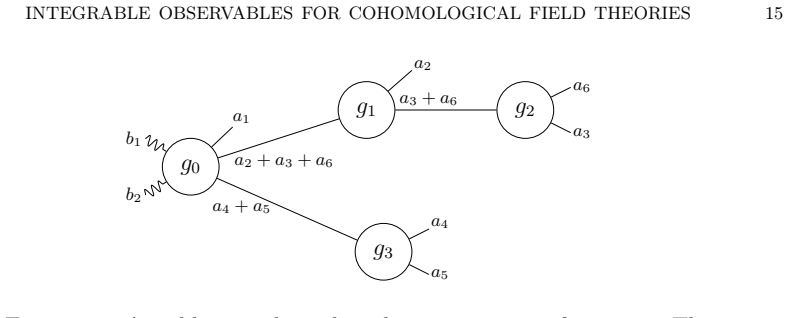
Figure from the paper full image
abstract click to expand
We introduce the concept of integrable observables and propose them as alternatives to the standard Witten's psi classes (a.k.a. descendants in $2D$ quantum gravity) to be coupled with cohomological field theories and their generalisations. The main property of integrable observables is that they retain the integrability properties. We present three examples of integrable observables. The first two recover the Dubrovin-Zhang and double ramification hierarchies, while revealing new structural features in this framework. The third, a new example, builds on recently established properties of the so-called $\mathbb{\Pi}$-class, extending them and placing this class naturally within the theory of integrable systems. Notably, our integrable observables framework yields a proof that the new $\mathbb{\Pi}$-hierarchies are Miura equivalent both to the Dubrovin-Zhang hierarchies and to the double ramification hierarchies. A new very short proof of Witten's conjecture is also provided.
0
Top Pith
5
math.SG 2026-05-22 Recognition

All (p,q)-pinwheel embeddings in B_{p,q} are Hamiltonian isotopic

by Nikolas Adaloglou, Gerard Bargalló i Gómez +1 more

The nearby Lagrangian conjecture for pinwheels

The nearby Lagrangian conjecture holds for these singular Lagrangians because the symplectomorphism group is generated by a single twist.

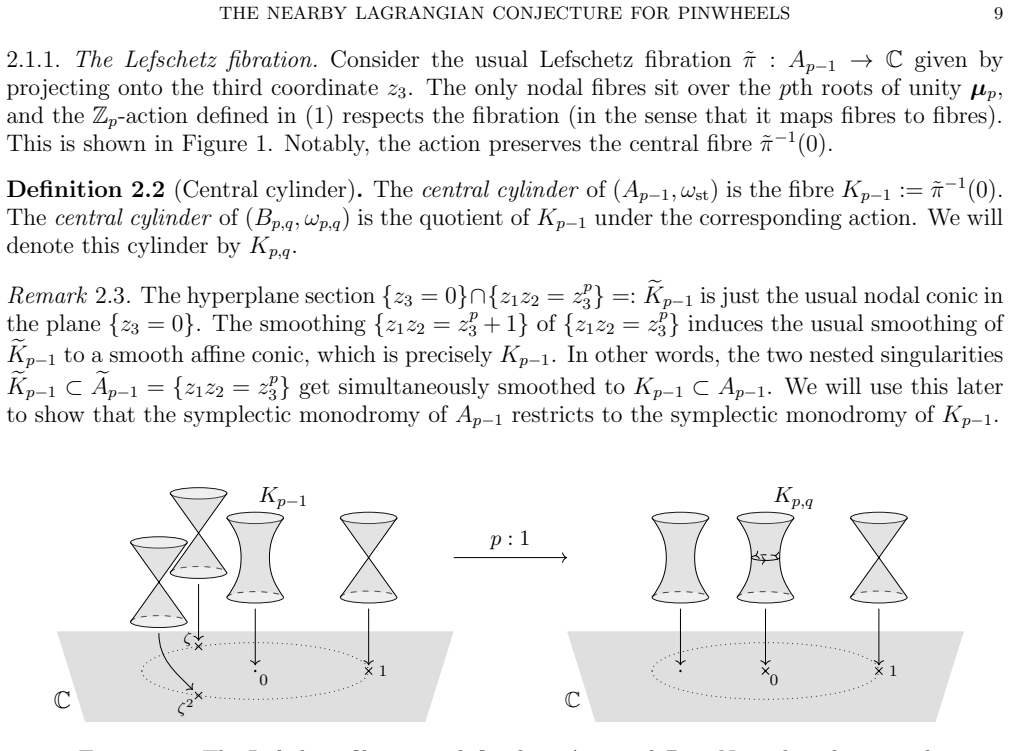
Figure from the paper full image
abstract click to expand
The Lagrangian skeleton of the rational homology ball $B_{p,q}$, for $0<q<p$ coprime integers, is an immersed but not embedded Lagrangian, called a $(p,q)$-pinwheel. We show that any two embeddings of Lagrangian $(p,q)$-pinwheels in $B_{p,q}$ are related by a compactly supported Hamiltonian isotopy, establishing Arnold's nearby Lagrangian conjecture for this wide class of singular Lagrangians. Our proof has two largely independent parts: the first uses neck-stretching and the symplectic rational blow-up to understand embeddings of pinwheels up to symplectomorphism; the second computes that $\text{Symp}_c(B_{p,q})$ is generated by a twist about the pinwheel, which we call the pintwist $\tau_{p,q}$. We provide three applications of our methods: Gromov non-squeezing for pin-balls; a new proof of the local Lagrangian unknotting theorem of Eliashberg--Polterovich; and that the only Lagrangian $(n,m)$-pinwheel in $B_{p,q}$ is of type $(p,q)$.
0
Top Pith
2
math.AG 2026-05-21 2 theorems

Tame sheaves arise from étale data plus local tame sections

by Alberto Merici, Kay Rülling +1 more

A construction of tame sheaves and tame de Rham--Witt cohomology

The construction yields a comparison of tame syntomic cohomology with the Nygaard filtration on the tame de Rham-Witt complex.

abstract click to expand
In this article, we consider an algebraic version of the tame site of a pair $(X,\widetilde{X})$. With this definition, we provide a general machinery to construct a tame sheaf from the data of an \'etale sheaf on $X$ and a family of local tame sections. We apply this construction to the big de Rham--Witt sheaves with tame sections defined by log poles and, over a field, to reciprocity sheaves, and deduce some consequences. As an application, we compare tame syntomic cohomology with the Nygaard filtration on the tame de Rham--Witt complex.
1 0
0
math.AG 2026-07-03

New K3 surfaces detect Gushel-Mukai categorical degeneration

by Ziqi Liu

Bridgeland-Enriques general K3 surfaces

Degree-10 Bridgeland-Enriques general K3 surfaces track degeneration of special threefolds via stability on Enriques categories.

abstract click to expand
This article introduces a notion of Bridgeland-Enriques general K3 surfaces motivated by the study of Enriques categories over K3 surfaces and the invariant Bridgeland stability conditions. The family of Bridgeland-Enriques general K3 surfaces of degree 10 detects a categorical degeneration of special Gushel-Mukai threefolds. Also, the families of Bridgeland-Enriques general K3 surfaces with higher degrees are closely related to Hodge-special Gushel-Mukai fourfolds and double EPW sextics.
0
0
math.AG 2026-07-03

Tautological ring of compact type moduli is not Gorenstein

by Samir Canning, Hannah Larson +1 more

The Gorenstein property and Pixton's conjecture for compact type moduli

This holds for g at least 2 and 2g plus n at least 12, even in the first cases where 3-spin relations are complete.

Figure from the paper full image
abstract click to expand
We show that the tautological ring of $\mathcal{M}_{g,n}^{\mathrm{ct}}$ is not Gorenstein for $g\geq 2$ and $2g+n\geq 12$. We prove new cases of Pixton's conjecture that the $3$-spin relations are a complete set of relations for the tautological ring, including $\mathcal{M}_{6}^{\mathrm{ct}}$, $\mathcal{M}_{5,2}^{\mathrm{ct}}$, and $\mathcal{M}_7^{\mathrm{ct}}$. These are the first known cases where Pixton's conjecture is true, but the tautological ring is not Gorenstein. These results are also a key ingredient in recent work on non-tautological cycles on the moduli space of principally polarized abelian varieties.
0
0
math.AG 2026-07-03

Hurwitz spaces always admit simple-type components for base genus 2 or higher

by Ciro Ciliberto, Andreas Leopold Knutsen +1 more

Components of simple and non--simple type of Hurwitz schemes

Necessary and sufficient numerical conditions decide exactly when non-simple components appear instead.

abstract click to expand
Let $\mathcal{H}_{g \to b,d; \mathbf{e}}$, with $\mathbf{e}=(e_1,\ldots, e_n)$, be the Hurwitz space, parametrizing all morphisms $\pi: C\to B$ of degree $d$, with $n$ points $x_1,\ldots, x_n\in C$ of ramification order $e_1,\ldots, e_n$ respectively, and where $C$ and $B$ are smooth, irreducible, projective curves of genera $g$ and $b$ respectively. In this paper we study the question of when there exist components of $\mathcal{H}_{g \to b,d; \mathbf{e}}$ whose members $\pi: C \to B$ all factor through an intermediate curve, in which case we say that these components are \emph{of non--simple type}. We give necessary and sufficient conditions for the existence of components of non--simple type. Then we prove that for $b\geq 2$ there are always components of simple type, and for $b\in \{0,1\}$ there are such components under suitable sufficient conditions. However there are easy examples for $b\in \{0,1\}$ in which there are never components of simple type.
0
0
math.AG 2026-07-03

Quasi-F-splitting for all e implies numerical log canonicity

by Kenta Sato, Shunsuke Takagi +1 more

Quasi-F-splitting versus log canonicity

The implication holds in all dimensions, with a converse and classification in dimension two when the Gorenstein index avoids multiples of p

abstract click to expand
In this paper, we investigate the relationship between quasi-$F$-splitting and log canonicity. We show that if a numerically $\mathbb{Q}$-Gorenstein normal singularity is quasi-$F^e$-split for every $e\geq 1$, then it is numerically log canonical. In dimension two, we prove the converse under the condition that the Gorenstein index is not divisible by the characteristic $p$. We also classify two-dimensional quasi-$F$-split normal singularities.
0
0
math.AG 2026-07-03

Bombieri-Lang conjecture holds for varieties with maps to abelian varieties

by Junyi Xie

Recent progress on the geometric Bombieri--Lang conjecture

Xie-Yuan and Gao turn high-height points into entire curves on complex fibers over function fields.

abstract click to expand
We survey recent progress on the geometric Bombieri--Lang conjecture over function fields of characteristic zero. We discuss recent work of Xie--Yuan and Guoquan Gao, which together proves the conjecture for varieties admitting finite morphisms to abelian varieties. The guiding idea, developed in joint work with Xinyi Yuan, is that Vojta's dictionary can be made concrete in this setting: from rational points of large height one constructs entire curves on complex fibers.
0
0
math.NT 2026-07-03

Algorithms compute Schottky groups uniformizing hyperelliptic Mumford curves

by Enis Kaya, Marc Masdeu +2 more

Algorithms for hyperelliptic Mumford Curves p-adic Uniformization, p-adic integrals and p-adic heights

The groups enable explicit p-adic Abelian integrals and Schneider heights via theta functions.

Figure from the paper full image
abstract click to expand
Mumford curves generalize the Tate uniformization of elliptic curves with split multiplicative reduction and provide p-adic analogues of the uniformization of Riemann surfaces. In this paper, we present several algorithms for hyperelliptic Mumford curves. For a given hyperelliptic Mumford curve $X$ defined over a finite extension of the field of p-adic numbers for some $p\neq 2$, we first describe how to compute a p-adic Schottky group W that uniformizes X; this is based on our extension to Kadziela's approximation theorem. As applications, we explain how to use this uniformization in order to compute p-adic Abelian integrals and $p$-adic Schneider heights on X; the latter uses Werner's formula expressing the p-part of the Schneider height in terms of theta functions. We illustrate our algorithms with numerical examples computed using the computer algebra system SageMath.
0
0
math.AG 2026-07-03

Parabolic Grassmann bundles over curves have explicit nef and Mori cones

by Ashima Bansal, Shivam Vats

Positive Cones of Parabolic Grassmann Bundle over a curve

The Neron-Severi group and the three positive cones are computed for these bundles and for fiber products of two of them.

abstract click to expand
In this article, we define the parabolic Grassmann bundle associated to a parabolic vector bundle over a smooth projective variety, generalizing the construction of parabolic projective bundles developed in \cite{BL}. We determine its N\'eron--Severi group and compute its nef, pseudoeffective, and Mori cones over smooth projective curves. We also compute the corresponding cones for the fiber product of two parabolic Grassmann bundles over a smooth projective curve.
0
0
math.AG 2026-07-03

Sixth pluricanonical map is generically finite when P2 >= 2

by Tianyue Zhang

On generic finiteness of pluricanonical maps of threefolds of general type

The bound is optimal; any multiple of 38K_X or higher is generically finite on all minimal threefolds of general type.

abstract click to expand
We prove that $|6K_X|$ defines a generically finite map for all minimal 3-folds $X$ of general type with $P_2(X)\geq 2$, which is optimal. We also prove that $|nK_X|$ defines a generically finite map for all minimal 3-folds $X$ of general type when $n\geq 38$. The essential technical ingredients of this paper are a new generic finiteness criterion for surfaces and an effective comparison inequality under a special resolution.
0
0
math.AG 2026-07-03

Torsor local triviality lifts from special to relative curve

by Margot Bruneaux, Federico Scavia

Comb smoothing and local triviality of homogeneous spaces over a relative curve

This holds when the isogeny kernel is étale or the residue field is large and produces local-global principles over Henselian DVRs.

abstract click to expand
Let $R$ be a Henselian local ring, let $\kappa$ be the residue field of $R$, let $C$ be a smooth projective curve over $R$ with geometrically connected fibers, let $G$ be a reductive $C$-group with isotrivial radical torus $\mathrm{rad}(G)$, and let $E\to C$ be a $G$-torsor. We show that, if either the kernel of the central isogeny $G^{\mathrm{sc}}\times_C \mathrm{rad}(G)\to G$ is \'etale over $C$ or $\kappa$ is large, the Zariski-local triviality of $E_\kappa\to C_\kappa$ implies the Zariski-local triviality of $E\to C$. We also prove an averaged form of this result, assuming only that $\mathrm{rad}(G)$ is isotrivial, as well as a variant for projective homogeneous spaces under no restrictions on $G$. As consequences, we obtain a local-global principle for torsors over function fields of curves over Henselian discrete valuation rings, strengthening work of Gille--Parimala--Suresh, a Henselian version of a theorem of Drinfeld--Simpson, and an injectivity result for the Brauer--Azumaya group of $C$ not covered by earlier work of Colliot-Th\'el\`ene--Ojanguren--Parimala. Our proofs are geometric and rely on compactifications of torsors and on a relative and arithmetic version of the comb smoothing technique, which we develop in detail, building on work of Koll\'ar and Graber--Harris--Starr.
0
0
math.AG 2026-07-03

Nine-line pair counters generalized Terao conjecture

by Alexandru Dimca, Piotr Pokora

A nine-line counterexample to a conjecture on the minimal degree of Jacobian relations

Arrangements with identical lattices have mdr values 4 and 5, so one falls below the conjectured d/2 bound for degree 9.

abstract click to expand
We construct two arrangements of nine lines in the complex projective plane with isomorphic intersection lattices but with different minimal degrees of Jacobian relations. The common weak combinatorics is \[ (n_2,n_3,n_4)=(9,7,1), \] so the example is not the classical Ziegler-Yuzvinsky pair, whose weak combinatorics is $(n_{2},n_{3}) = (18,6)$. For the two defining equations $f$ and $g$ we prove \[ {\rm mdr}(f)=4,\qquad {\rm mdr}(g)=5. \] Since the degree is $d=9$, the first equality gives ${\rm mdr}(f)<d/2$. Hence the pair gives a counterexample to the Generalized Terao Conjecture.
0
0
math.AG 2026-07-03

Petersen graph describes monodromy of 27 lines on Clebsch surface

by Tathagata Basak

Petersen graph and monodromy of the 27 lines on the Clebsch surface

Ten explicit generators of the orbifold fundamental group induce the E6 Weyl group action through computed permutations.

Figure from the paper full image
abstract click to expand
Let $G$ be the orbifold fundamental group of the moduli space of smooth cubic surfaces $\mathcal{M}_{\mathsf{sm}}$ in $\mathbb{P}^3_{\mathbb{C}}$ with base point at the Clebsch surface $X_{\mathbf{1}}$. The image of the monodromy action $G \to \lbrace \text{Permutations of $27$ lines on $X_{\mathbf{1}}$} \rbrace$ is famously the Weyl group of type $E_6$. Here we give a description of this monodromy action in terms of the Petersen graph by working out the action of ten explicit generators of $G$ by elementary calculation. These ten generators were found in joint work with Allcock and Looijenga while studying the description of $\mathcal{M}_{\mathsf{sm}}$ as a discriminant complement in a complex $4$-ball quotient.
0
0
math.AG 2026-07-03

Gm tensor with mod-2 motivic cohomology is free on (2,1) generator

by Tom Bachmann, Robert Burklund +2 more

Motivic Hochschild homology of mod 2 motivic cohomology over algebraically closed fields

The computation over complex numbers yields a motivic analog of Bökstedt periodicity via tau comparisons and power operation relations.

abstract click to expand
We compute the tensor of the multiplicative group scheme with the mod-$2$ motivic cohomology spectrum in normed motivic spectra over the complex numbers, and find that the resulting algebra is free on a generator in bidegree (2,1). This gives a motivic analog of B\"okstedt periodicity. The proof proceeds by comparing the tau-inverted and tau-reduced forms of the tensor. After inverting tau, the calculation reduces to classical B{\"o}kstedt periodicity via Betti realization. The reduction modulo tau is governed by a comparison between normed algebra structures and derived algebra structures on cellular modules over motivic cohomology mod tau. This comparison produces divided power operations and leads to mixed Cartan and Adem relations intertwining normed and topological power operations. A key input is a detailed analysis of motivic extended powers of spheres and their tau-torsion structure. In contrast with the corresponding simplicial-circle calculation due to Dundas-Hill-Ormsby-{\O}stv{\ae}r, the large families of tau-torsion classes disappear for the Gm-tensor, leaving a considerably more rigid algebraic structure.
0
0
math.AG 2026-07-03

Tangential arcs yield codimension formula for foliated discrepancies

by Maurício Corrêa

Foliated and Mather-Jacobian discrepancies via tangential arcs

The formula equates cylinder codimensions with discrepancies and supplies a criterion for log canonicity on threefolds.

abstract click to expand
This article develops a tangential arc-space approach to foliated discrepancies for logarithmic simple co-rank one foliations on threefolds, relative to a fixed invariant normal-crossing separatrix divisor. In the non-resonant logarithmic case, reduced tangential arcs centred on the prescribed tangential locus are shown to be confined to this divisor. The tangential sector is therefore represented, at the reduced arc level, by the normalised separatrix-conductor system. Foliated adjunction transfers the discrepancy calculus to ordinary adjunction pairs on the normalised branches and conductors. Applying the arc-space theorem of Ein-Musta\c{t}\u{a}--Yasuda on these strata, this yields a tangential codimension formula identifying logarithmic codimensions of toroidal tangential divisorial cylinders with the corresponding tangential discrepancies. The resulting theory gives a toroidal tangential inversion of adjunction, a branch--conductor description of the tangential non-lc and non-klt loci, a cylinder criterion for tangential log canonicity, lower semicontinuity of the toroidal tangential minimal log discrepancy, and a relative Mather--Jacobian refinement for the canonical image separatrix system.
0
0
math.AC 2026-07-03

Gorenstein algebra nonsmoothable despite smoothable first quotient

by Ruoyu Wu

Existence of a Nonsmoothable Local Gorenstein Algebra with Smoothable Q(0)

Examples of length 31 in embedding dimension 14 show that Q(0) smoothability does not imply full algebra smoothability over any algebraicall

abstract click to expand
We prove that there exists a local Artinian Gorenstein algebra \(A\) which is not smoothable, although the first symmetric quotient \(Q_A(0)\) in the symmetric decomposition of the associated graded algebra is smoothable. The proof uses divided-power inverse systems and gives such algebras of length \(31\) and embedding dimension \(14\) over every algebraically closed field.
0
0
math.KT 2026-07-02

GL_n(Q) map equates cone complex to K-theory Gersten complex

by Peter Xu

A note on polyhedral cones and toric polylogarithms

The equivariant isomorphism connects sphere homology from simplicial cones to trace-fixed Milnor K-theory structures over the rationals.

abstract click to expand
We extend some methods of our previous work on special elements in Milnor K-theory of algebraic tori, exhibiting in particular a $\mathrm{GL}_n(\mathbb{Q})$-equivariant isomorphism between a chain complex of simplicial cones, computing the homology of $S^{n-1}$, and the trace-fixed part of the weight-n Gersten complex for the Milnor K- theory of $\mathbb{G}_m^n$ over $\mathbb{Q}$. Via a relationship between graded pieces of algebras of cones and Steinberg modules, this refines a result of Charlton-Radchenko-Rudenko.
0
0
math.AG 2026-07-02

Cubical cycle complexes compute motivic cohomology over Dedekind bases

by Peter Xu

A note on cubical Bloch--Levine cycle complexes

The simplicial-cubical comparison holds over any DVR, giving an explicit cubical model for smooth schemes.

abstract click to expand
We check that Levine's simplicial--cubical comparison argument for Bloch's cycle complexes also works over an arbitrary DVR. As a result, the sheaf of cubical Bloch cycle complexes computes motivic cohomology for smooth schemes over Dedekind bases.
0
0
math.AG 2026-07-02

p-adic integrals settle χ-independence for K3 moduli

by Michael Groechenig, Dimitri Wyss +1 more

chi-independence for K3-surfaces via p-adic integration

Reducing to local fields and matching BPS traces to Hasse integrals proves the conjecture for sheaves on K3 surfaces and related moduli spac

Figure from the paper full image
abstract click to expand
This article provides a proof of a previously unknown case of Toda's $\chi$-independence conjecture by reduction to non-archimedean local fields. Our strategy is based on a novel comparison of Frobenius-traces for BPS sheaves on moduli spaces of objects in 2-Calabi-Yau categories and the integral of the complex-exponentiated Hasse invariant of the obstruction gerbe. This result applies to many cases of interest, including Nakajima quiver varieties, moduli of Higgs bundles and moduli of sheaves on K3 surfaces. Along the way, we describe the local structure of these moduli stacks and spaces over a base of large mixed characteristic.
0
0
math.AG 2026-07-02

Rational curves with secants hit bounded general points

by Alessio Cela, Carl Lian

Interpolation for rational curves with secants

Maximum number read from normal and tangent bundles on the blowup of P^r, valid in any characteristic.

abstract click to expand
In arbitrary characteristic, we determine the maximum number of general points through which a rational curve of degree $d$ in $\mathbb{P}^r$ passes, subject to an additional secancy condition along a linear space. We consider the cases both where the points on the curve are unprescribed and prescribed, which amount to the determination of the normal and restricted tangent bundles of a general rational curve in $\mathsf{Bl}_{\mathbb{P}^s}\mathbb{P}^r$, respectively. In the appendix, we enumerate the interpolating curves in the case of prescribed points on the curve.
0
0
math.DG 2026-07-02

Local third Chern class defined via algebraic data at point singularities

by Xuemiao Chen

Point Singularities and Local Third Chern Classes for Rank-Two Torsion-free Sheaves on Threefolds

It is deformation invariant, matches K-theoretic charge, and recovers boundary topology for rank-two sheaves on threefolds.

abstract click to expand
In this paper, motivated by singularity formation in gauge theory, we study the local third Chern class contribution carried by isolated point singularities of rank-two torsion-free sheaves on complex threefolds. In the local rank-two setting considered here, the invariant is defined in terms of finite-length local algebraic data at the singular point. We prove that it can be computed from data on the total family; in particular, it is deformation invariant. We also prove that its parity recovers a topological invariant of the underlying smooth complex rank-two vector bundle on the boundary sphere. We then give a relative K-theoretic interpretation: a self-dual complex naturally associated with the sheaf defines a local $K$-theoretic charge, and this charge is equal to the local third Chern class. For rank-two reflexive sheaves, we relate the same invariant to several classical algebraic quantities, including the Fitting scheme and the Buchsbaum-Rim multiplicity. We also discuss applications to the boundary of moduli spaces of Hermitian-Yang-Mills connections.
0
0
math.AG 2026-07-02

Hecke operators establish chi-independence of BPS cohomology

by Ben Davison, Lucien Hennecart +3 more

Hecke operators on symplectic surfaces and chi-independence

Proves Toda conjecture for one-dimensional sheaves on quasi-projective symplectic surfaces and links BPS Lie algebra to tautological classes

abstract click to expand
We prove Toda's chi-independence conjecture for the BPS cohomology of moduli spaces of one-dimensional sheaves on quasi-projective symplectic surfaces, relative to the Chow variety. We also identify the BPS Lie algebra associated with one-dimensional Mukai vectors with the subspace of tautological classes, giving an extension of Markman's tautological generation theorem from primitive to arbitrary Mukai vectors. The main structure input is a bialgebra structure on the cohomological Hall algebra of coherent sheaves on a quasi-projective symplectic variety S. The coproduct is obtained, by dimensional reduction, from a factorization coproduct for 3d cohomological Hall algebras, and gives rise to a global BPS Lie algebra attached to the stack of coherent sheaves on S. The link between this structure and the applications to chi-independence and tautological generation is provided by Hecke operators on BPS cohomology, which modify one-dimensional sheaves by zero-dimensional quotients. To make this construction work, we prove that there is an identification between the affinized BPS cohomology of the semistable locus and the primitive part of the coproduct on the entire moduli stack
0
0
math.AG 2026-07-02

Sheared Witt vectors provide decompletion of p-typical Witt vectors

by Bhargav Bhatt, Akhil Mathew +1 more

Sheared Witt Vectors

Exposition of the Drinfeld-Lau construction applies on rings whose reductions are perfect F_p-algebras.

abstract click to expand
V. Drinfeld and E. Lau introduced a ``decompletion'' of the ring of $p$-typical Witt vectors, following earlier work of T. Zink. The goal of this paper is to offer an exposition of this construction, which we call the sheared Witt vectors, on the category of rings $R$ whose reduction is a perfect $\mathbb{F}_p$-algebra.
0
0
math.AG 2026-07-02

Tropical loop of loops bounds Prym-Brill-Noether dimensions

by David Jensen

Prym-Brill-Noether Theory for General Covers

A complete description for double covers of this tropical curve lifts to disprove a prior conjecture on algebraic dimensions.

Figure from the paper full image
abstract click to expand
We bound the dimension of the Prym-Brill-Noether variety for an open subset of the moduli space of \'{e}tale double covers of k-elliptic curves. We also obtain new bounds on the dimension of the Prym-Brill-Noether variety for general \'{e}tale double covers of k-gonal curves, disproving a conjecture of Creech, Len, Ritter, and Wu, and provide a new conjecture for its dimension. To do this, we completely describe the Prym-Brill-Noether variety of a double cover of a certain tropical curve known as the loop of loops. We use the combinatorics of Coxeter groups to establish several topological properties of these tropical Prym-Brill-Noether varieties, and prove a lifting result when the edge lengths are generic.
0
0
math.AG 2026-07-02

Tautological ring organizes intersections on moduli space of curves

by Hannah Larson

An introduction to the intersection theory of the moduli space of curves

Survey reviews open questions on whether it generates the full Chow ring

abstract click to expand
We introduce the intersection theory of the moduli space of curves and its tautological ring. We survey open questions about the tautological ring and sketch techniques for proving the Chow ring is or is not generated by tautological classes.
0
0
math.AG 2026-07-02

Two invariants match on every Fano manifold

by Jihao Liu, Sheng Qin

An equivariant fixed-level Demailly identity for Fano manifolds

The fixed-level equivariant Tian's alpha invariant equals the fixed-level equivariant global log canonical threshold in full generality.

abstract click to expand
Jin and Rubinstein asked whether the fixed-level equivariant Tian's alpha invariant equals the fixed-level equivariant global log canonical threshold, and proved this equality for toric varieties. In this paper we provide a positive answer to Jin and Rubinstein's question in full generality. The main result of this paper was obtained by Chatgpt 5.5 pro, and the Danus system based on the Rethlas system.
0
0
math.AG 2026-07-02

Aut groups of non-normal rigid affine surfaces are finite-dimensional

by Ivan Beldiev, Alexander Perepechko

Automorphism groups of non-normal rigid affine surfaces are finite-dimensional

The group is finite-dimensional precisely when the surface has no non-trivial additive group action, extending the normal case.

abstract click to expand
It was recently established by Perepechko and Zaidenberg that the automorphism group of a normal affine surface is finite-dimensional if and only if the surface admits no non-trivial action of the additive group of the base field. We extend this result to non-normal affine surfaces.
0
0
math.RT 2026-07-02

Affine Hecke subalgebra carries canonical basis labeled by Weyl cosets

by Jonathan Gruber

Pseudo-centralizers in affine Hecke algebras

In types A_n, B_2 and G_2 the v-deformed Fomin-Stanley algebra is indexed by cosets of the finite Weyl group inside the affine Weyl group

Figure from the paper full image
abstract click to expand
We introduce and study a subalgebra $\mathcal{B}$ of the affine Hecke algebra, which arises from a centralizer construction in the double affine Hecke algebra, and which may be regarded as a $v$-deformation of the affine Fomin-Stanley subalgebra introduced by Lam as a combinatorial model for the affine Grassmannian homology ring. In types $\mathsf{A}_n$ and $\mathsf{B}_2$ and $\mathsf{G}_2$, we show that $\mathcal{B}_\mathrm{aff}$ admits a canonical basis indexed by the cosets of the finite Weyl group in the affine Weyl group. We also discuss conjectural positivity properties of the canonical basis and explain how it can be used to study the center of the affine Hecke algebra.
0
0
math.RT 2026-07-02

Reductive monoids classified over arbitrary base schemes

by Jingren Chi, Simon Jacques

Reductive monoids over general base

Classification theorem extends field results to general schemes and yields integral models plus orbit descriptions.

abstract click to expand
We develop a theory of affine algebraic monoids over general base schemes whose unit groups are split reductive groups. Our main result is a classification theorem for such objects, generalizing works of Vinberg and Rittatore over a field. As applications, we obtain combinatorial descriptions and normality properties of orbit closures, prove a Steinberg-type theorem on adjoint quotients of reductive monoids over general base schemes, and construct finite type integral models of the Vinberg monoids. A main tool in our construction is Lusztig's theory of modified quantum groups and their canonical bases.
0
0
math.AG 2026-07-01

K3 surfaces are generalized Nikulin iff NS holds E7(-2) primitively

by Chiara Camere, Alice Garbagnati +2 more

Generalized Nikulin surfaces and irreducible symplectic fourfolds

The lattice condition determines which K3 surfaces arise as fixed loci from symplectic involutions on K3^[2]-type fourfolds, with matching t

abstract click to expand
A Nikulin surface is the minimal resolution of the quotient of a $K3$ surface $S$ by a symplectic involution $\iota_S$. Equivalently, it is the $2$-dimensional component of the fixed locus of the involution induced by $\iota_S$ on the Hilbert scheme $S^{[2]}$. We study $K3$ surfaces $F$ that are the $2$-dimensional component of the fixed locus of a symplectic involution $\iota$ on hyper-K\"ahler manifolds $X$ of $K3^{[2]}$-type; we call them generalized Nikulin surfaces. We show that a projective $K3$ surface is a generalized Nikulin surface if and only if its N\'eron-Severi lattice contains primitively the lattice $E_7(-2)$. Moreover, we show that the transcendental lattices $T_F$ and $T_{\widetilde{X/ \iota}}$, where $\widetilde{X/ \iota}$ is the terminalization of the quotient $X/\iota$, are Hodge isometric. Finally, we describe projective models of generalized Nikulin surfaces of small degrees.
0
0
math.RT 2026-07-01

Central isogenies generalize Steinberg on centralizer components

by Sean Cotner

Central isogenies and conjugacy classes in reductive groups

The extension accounts for non-reduced centralizers of unipotents when the universal cover is not étale and yields multiplicity formulas for

abstract click to expand
Steinberg described the group of components of the centralizer of a semisimple element of a connected semisimple algebraic group $G$ as a subgroup of the fundamental group of $G$. We show that this description can be generalized to explain the fact that centralizers of unipotent elements can fail to be reduced when the universal cover of $G$ is not \'etale. As applications, we compute generic multiplicities in the special fibers of moduli spaces of L-parameters and universal deformation rings, and we show there is no Springer isomorphism for $\mathrm{PGL}_p$ in characteristic $p$.
0
0
math.AG 2026-07-01

Hyperplane constraint yields prime ideals for Segre degeneracy loci

by Colin Alstad, Timothy Duff +1 more

Segre-Determinantal Loci and the Image Variety for Three Flatland Cameras

Maximal minors generate the ideals and form a universal Gröbner basis.

abstract click to expand
Motivated by applications of algebraic geometry to reconstruction problems in computer vision, we initiate a study of the equations of degeneracy loci associated with linearly dependent points on Segre varieties. When these points are constrained to lie on a common hyperplane, we prove that the vanishing ideals of these loci are prime, Cohen-Macaulay, and generated by the natural maximal minors, and that these minors form a universal Gr\"{o}bner basis.
0
0
math.AG 2026-07-01

Primes p ≤ (k+1)/2 divide minimal algebraic multiples of θ_k

by Philip Engel, Stefan Schreieder

On the degree of subvarieties on abelian varieties

This forces the smallest such multiples to grow exponentially with k on very general principally polarized abelian varieties.

abstract click to expand
Let $(X,\Theta)$ be a very general principally polarized abelian variety of dimension $g$, and consider the minimal cohomology class $\theta_k=[\Theta]^k/k!$ for $k<g$. We show that the minimal positive multiple of $\theta_k$ which is algebraic is divisible by all primes $p\leq (k+1)/2$. In particular, these minimal multiples grow exponentially with $k$. Our main result follows from [EGFS25] together with a new combinatorial result about $\mathbb F_p$-solutions of certain graphic matroids in their own Albanese graphs.
0
0
math.NT 2026-07-01

Hyperelliptic families y²=x^d+αx+t are generically ordinary for large p

by Hui June Zhu

Construction of Generically Ordinary Families of Hyperelliptic Curves

The property holds for every g≥2 and nonzero α at all p larger than an explicit bound depending on d

abstract click to expand
Katz conjectured in a 2018 lecture that the family of curves $y^2=x^d-dx+t$ over the $t$-line is generically ordinary for all sufficiently large primes $p$. We prove that, for every $g\ge 2$ and every nonzero algebraic integer $\alpha$, the genus-$g$ families $C_\alpha: y^2=x^d+\alpha x+t$ where $d\in\{2g+1, 2g+2\}$ are generically ordinary at every prime $p>P^+(d)$, provided that $\alpha$ is nonzero modulo every prime above $p$. The bound $P^+(d)=d^2-4d+2$ if $d$ is odd, and $P^+(d)=(d^2-3d+2)/2$ if $d$ is even.
0
0
math.AG 2026-07-01

Bounds limit conics in defect-3 arrangements

by Artur Bromboszcz

On homological properties of conic-line arrangements with simple singularities

Restrictions from classical inequalities separate low-degree cases and classify Ziegler pairs up to total degree 6

Figure from the paper full image
abstract click to expand
We study arrangements of smooth conics and lines in the complex projective plane whose singularities are limited to nodes, tacnodes, and ordinary triple points. The first part of the paper gives numerical restrictions for plus-one generated conic arrangements with defect $\nu(C)=3$ and explains how these restrictions interact with B\'ezout's theorem, the Dimca--Sernesi bound for the minimal degree of a Jacobian syzygy, and Hirzebruch-type inequalities. In particular, the possible numbers of conics are bounded, and the exceptional low-degree cases are separated from those that remain open. The second part concerns arrangements of total degree at most $6$. We identify the weak and strong Ziegler pairs occurring in the database recorded in the Appendix.
0
0
math.DG 2026-07-01

Left-invariant complex structures force nilpotent groups to be C^n

by Keizo Hasegawa, Sönke Rollenske +3 more

Biholomorphism type of left-invariant complex structures on nilpotent Lie groups

A simply connected nilpotent Lie group of dimension 2n with such a structure is biholomorphic to complex n-space.

abstract click to expand
In this note we prove a conjecture by Hasegawa stating that a simply connected, nilpotent Lie group of dimension $2n$ endowed with a left-invariant complex structure is biholomorphic to $\mathbb{C}^n$.
0
0
math.AG 2026-07-01

Non-top holomorphic forms constructed on orthogonal modular varieties

by Shuji Horinaga, Shouhei Ma

Holomorphic differential forms on some orthogonal modular varieties

Even lattices of signature (2,n) for n≥25 with n≡1,3 mod 8 and discriminant -2 now have forms in many degrees via the Arthur multiplicity fo

abstract click to expand
We construct holomorphic differential forms of many degrees, including the minimum possible one, on the modular varieties associated to the even lattices of signature $(2, n)$ with $n\equiv 1, 3$ mod $8$ and discriminant $-2$ in the range $n\geq 25$. This is the first example of holomorphic differential forms of non-top degree on orthogonal modular varieties. The proof uses the Arthur multiplicity formula in the theory of automorphic representations.
0
0
math.DG 2026-07-01

Analytic construction yields nowhere-vanishing harmonic 1-forms on real loci

by Shih-Kai Chiu, Daniel Platt +1 more

Nowhere-vanishing harmonic 1-forms on real loci of K3-fibred Calabi-Yau 3-folds

The forms supply input for the Joyce-Karigiannis method, producing new compact 7-manifolds with G2 holonomy.

abstract click to expand
We develop an analytic construction of nowhere-vanishing harmonic $1$-forms on real loci of K3-fibred Calabi-Yau $3$-folds with collapsing Ricci-flat K\"ahler metrics. We apply our construction to examples whose real loci have connected components diffeomorphic to $S^1\times S^2$ and to both trivial and nontrivial mapping tori. As an application, we produce examples of compact $7$-manifold with holonomy $G_2$ via the Joyce-Karigiannis construction.
0
0
math.AG 2026-07-01

Threefold canonical degree at most 72 when p_g exceeds 243

by Jiabin Du, Yong Hu

On the canonical degree of a Gorenstein minimal threefold of general type

Equality holds only if the Albanese fibre is a surface of general type with p_g=3, q=0, K_F²=36 and map degree 36.

abstract click to expand
Let $X$ be a Gorenstein minimal $3$-fold of general type whose canonical map is generically finite. We prove that if $p_g(X)> 243$, then the degree of the canonical map is at most $72$. Moreover, equality holds only if the general fibre $F$ of the Albanese morphism of $X$ is a smooth minimal surface of general type satisfying $p_g(F)=3,q(F)=0$ and $K_F^2=36$, and the canonical map of $F$ has degree $36$. This result improves the lower bound on $p_g(X)$ previously obtained by Jin-Xing Cai~\cite{Cai08}. As a consequence, we show that if the canonical degree is bigger than $64$, then the general fibre of the Albanese morphism of $X$ is a surface with irregularity zero.
0
0
math.AG 2026-07-01

Parabolic Higgs spaces compactify symplectic leaves of meromorphic Hitchin systems

by Jia Choon Lee, Sukjoo Lee

Symplectic leaves of meromorphic Hitchin systems

The same spaces resolve the normalized closures and extend the restricted Hitchin map to an integrable system.

abstract click to expand
The moduli space of meromorphic Higgs bundles admits a Poisson structure due to the independent work of Bottacin and Markman. In this paper, we revisit the symplectic leaves of this Poisson structure for the tame case. We study the partial compactification of the restricted Hitchin map on the symplectic leaves to an algebraically completely integrable system. In particular, we show that such a partial compactification is realized by the moduli spaces of $\vec{\xi}$-parabolic Higgs bundles. These same moduli spaces also provide a symplectic resolution of the normalization of the closure of the corresponding symplectic leaves. Finally, we discuss connectedness results for the corresponding Betti moduli spaces under the tame non-abelian Hodge correspondence.
0
0
math.AG 2026-07-01

Tame affine Springer fibers admit pavings in mixed characteristic

by Jingren Chi

Equivalued affine springer fibers in mixed characteristic

The pavings consist of perfections of iterated affine space bundles over smooth Hessenberg varieties.

abstract click to expand
We study Witt-vector affine Springer fibers for tame equi-valued conjugacy classes in tamely ramified groups. Similar to the approach of Goresky-Kottwitz-MacPherson in the equal characteristic setting, we show that they admit pavings by perfections of iterated affine space bundles over smooth Hessenberg varieties. Along the way we prove a version of the Chevalley restriction theorem for the dual of Lie algebras.
0
0
math.RT 2026-07-01

Kottwitz-Viehmann varieties geometrize orbital integrals

by Jingren Chi

An overview of the geometry of Kottwitz-Viehmann varieties

Overview explains the geometry and supplies an explicit SL3 case for reductive groups over local fields.

abstract click to expand
This is an update of an expository article on the geometrization of orbital integrals of spherical Hecke functions on reductive groups over non-archimedean local fields, appeared in Proceedings of ICCM 2019. Compared to the published version, we add a last section on an example in SL3 case.
0
0
math.AG 2026-07-01

Fano geometry lets local node smoothings lift independently

by Rodolfo Aguilar

Log Conifold Transitions

Boundary del Pezzo surfaces make deformation theory unobstructed for log conifold transitions in index-two pairs

abstract click to expand
We define log conifold transitions for Fano threefold pairs of index two and study their deformation theory. Relying on the recent solution to the relative Clemens conjectures in this setting, we construct rational curves with normal bundle $\OO(-1)\oplus \OO(-1)$ by blowing up anchored points on the boundary divisor. Contracting these curves yields a singular space with ordinary double points. We prove that local smoothings of the nodes can be lifted to global first-order deformations, and that the global deformation theory of both the log resolution space and the singular log pair is unconditionally unobstructed. Crucially, the geometry of the boundary del Pezzo surface guarantees this unobstructedness. Furthermore, unlike the classical Calabi-Yau case, the underlying Fano geometry forces the vanishing of global topological balancing conditions, allowing local first-order smoothings of the nodes to be lifted independently. As applications, we construct new non-K\"ahler threefolds via smoothings, we analyze the effective geometry of the smoothed threefolds by determining their Picard groups and proving the persistence of free curves. Finally, we study the Hodge theory of these non-K\"ahler threefolds.
0
0
math.AG 2026-06-30

Generalized canonical bundle formula holds without nef assumption

by Kenta Hashizume

Addendum: On generalized canonical bundle formula and boundedness of complements in complex analytic setting

Extends to complex analytic lc-trivial fibrations and records the algebraic case

abstract click to expand
We establish the generalized canonical bundle formula for generalized lc-trivial fibrations without the assumption on the nef part in the complex analytic setting. We also record the corresponding algebraic statement.
0
0
math.AG 2026-06-30

Pascal construction specializes to Burkhardt quartic

by Tomasz Szemberg, Justyna Szpond

From a Pascal construction to the Burkhardt quartic

Twenty residual planes match half the Jacobi planes on the quartic, with incidence from the directed graph on five vertices.

abstract click to expand
We continue the study of Pascal-type residual constructions in projective four-space. Starting from two $k$-tuples of hyperplanes in $\mathbb P^4$ such that the $k$ diagonal intersection planes are contained in a hyperplane, one obtains a residual hypersurface of degree $k-1$ containing the remaining $k^2-k$ planes. In this work we consider the case $k=5$, where the twenty residual planes are contained in a quartic threefold. A balanced specialization of this construction is projectively equivalent to the celebrated Burkhardt quartic. In this model the twenty residual planes form one half of the forty Jacobi planes on the Burkhardt quartic. We reveal their incidence structure as governed by the directed complete graph on five vertices. The forty nodes naturally forced by these planes split as $30+10$, and the Burkhardt specialization adds five further nodes. We also write down the complementary twenty Jacobi planes explicitly and describe all forty Steiner hyperplanes in Pascal coordinates.
0
0
math.AG 2026-06-30

Kapustin-Witten moduli on surfaces carry (-2)-shifted pretwistor structure

by Jacob Kryczka, Yuuji Tanaka +1 more

Lagrangian correspondences of nonabelian Hodge type and shifted twistor structures

The Deligne-Hitchin-Simpson stack on a projective variety X admits a canonical 2(1 - dim X) shifted pretwistor structure over the complex pr

abstract click to expand
Classical nonabelian Hodge theory identifies Dolbeault and de Rham moduli spaces by providing a real-analytic isomorphism. In this paper, motivated by the Kapustin--Witten theory, we study this correspondence in the more general framework of perfect complexes on proper varieties, paying special attention to the surface case. We establish a Lagrangian correspondence which relates the shifted symplectic geometries by Pantev--To\"en--Vaqui\'e--Vezzosi (PTVV) between the derived stacks of flat and Higgs perfect complexes. We investigate the existence of derived twistor structures of hyperk\"ahler type on the moduli stack of perfect complexes endowed with $\lambda$-connections by Deligne--Hitchin--Simpson. We establish a version of the AKSZ/PTVV transgression, Lagrangian intersection, and (hyperk\"ahler) symplectic reduction theorems in this context. Moreover, we prove that the derived Riemann--Hilbert correspondence of Porta and Holstein--Porta, which states an equivalence of derived analytic stacks of perfect complexes on $X_{\mathrm{Betti}}$ and $X_{\mathrm{DR}}$, is compatible with the natural shifted--symplectic structures. We then study the relation between the shifted (pre-)twistor structures and the shifted symplectic forms on the fibers, and prove that the analytic Deligne--Hitchin--Simpson moduli stack on a smooth projective variety $X$ has a canonical $2(1-\dim X)$ shifted pretwistor structure over $\mathbb{P}^1_{\mathbb{C}}$, a result which has been anticipated for some time. In particular, the moduli stack of solutions to the Kapustin--Witten equations modulo gauge equivalence on a smooth proper complex algebraic surface exibits a $(-2)$-shifted (pre)twistor structure as a family over $\mathbb{P}^1_{\mathbb{C}}$.
0
0
math.AG 2026-06-30

Evaluation fibers of rational curves on del Pezzo manifolds are irreducible

by Ari Krishna

Pointed Evaluation Fibers of Rational Curves on del Pezzo Manifolds

One-pointed fibers stay irreducible in every degree; two-pointed fibers do so when the anticanonical class is very ample.

abstract click to expand
Let $X$ be a Picard-rank-one del Pezzo manifold of dimension $n\geq 4$ over an algebraically closed field of characteristic zero. Okamura proved that the unpointed Kontsevich spaces $\overline{M}_{0,0}(X,d)$ are irreducible of the expected dimension for every $d\geq 1$. We refine this result by studying pointed evaluation fibers. First, we prove that for every $d\geq 1$, the one-pointed evaluation morphism $\overline{M}_{0,1}(X,d)\to X$ has geometrically irreducible generic fiber. Second, in the very ample cases $H^n=3,4,5$, we prove that for every $d\geq 2$, the two-pointed evaluation morphism $\overline{M}_{0,2}(X,d)\to X\times X$ has geometrically irreducible generic fiber.
0
0
math.AG 2026-06-30

Non-rational components of point Hilbert schemes reach n=10

by Ruoyu Wu

A One-Variable Frame Construction For Irrational Components of Hilbert Schemes of Points

One-variable construction with local cohomology lowers the threshold from 12 over characteristic zero.

abstract click to expand
Farkas, Pandharipande, and Sammartano constructed non-rational irreducible components of Hilbert schemes of points in affine space $\mathbb{A}^n$ for all $n \geq 12$. Their construction starts from Hilbert schemes of curves in $\mathbb{P}^3$, adjoins two auxiliary variables in order to apply Jelisiejew's TNT frame construction, and then doubles the number of variables. We give a one-variable variant of the construction. The new input is a local-cohomology replacement for the depth-three step in Jelisiejew's negative tangent computation. It uses the vanishing of the low-degree Hartshorne--Rao module for the complete $g^3_9$ curve source. As a consequence, over a field of characteristic zero, $\operatorname{Hilb}(\mathbb{A}^n)$ has non-rational irreducible components for all $n \geq 10$.
0
0
cs.DM 2026-06-30

Tropical polynomials coordinate multisets of any n points in r dimensions

by Susumu Kubo

Stable complete coordinates for multisets of points via basic r-symmetric tropical polynomials

Binomial(n+r,r) basic r-symmetric ones of degree at most n separate all S_n orbits and form a bi-Lipschitz map.

abstract click to expand
A multiset of $n$ unordered points in $\mathbb{R}^r$ -- a point cloud, or, for $r=2$, a persistence barcode of birth-death pairs -- is a point of the orbit space $\mathbb{R}^{nr}/S_n$ for the symmetric group $S_n$ permuting the rows of an $n \times r$ matrix; a separating family of invariants on this space is exactly a complete set of permutation-independent coordinates. We provide one that is explicit, small, and stable, in the max-plus (tropical) setting: for all $n \geq 1$ and $r \geq 1$, the $\binom{n+r}{r}$ basic $r$-symmetric tropical polynomials, of degree at most $n$, separate the orbits of $S_n$ on $\mathbb{R}^{nr}$. This settles in full a problem left open in [Kubo, J. Pure Appl. Algebra 223 (2019) 72-85], where separation was known only for $r=2$ and special cases of $r \geq 3$, and yields a family far smaller and of lower degree than the general separating sets from Derksen's recent theory of tropical invariants for permutation actions ($nr + (nr)!/n!$ invariants of degree $O(n^2 r^2)$). The proof is elementary and constructive: the basic values are identified with a transportation problem, and the multiset is recovered from the dual by an explicit algorithm. We further show the coordinate map is a bi-Lipschitz embedding for all $n$ and $r$, being an injective max filter bank (via the bi-Lipschitz theory of max filtering), with an explicit Lipschitz constant for the forward bound and a fully explicit, dimension-free distortion when $r=1$. Finally we determine when the pairwise values suffice (exactly $n \leq 3$) and show that invariants on at least three columns and of degree less than $n$ are necessary in general, the obstruction being a standard non-uniqueness configuration from discrete tomography.
0
0
math.AG 2026-06-30

Nested Hilbert scheme pushforward equals constant twist of lower virtual sheaf

by Felix Minddal

Virtual K-theoretic invariants of the nested Hilbert scheme on mathbb{C}²

Localization identifies the twist with the equivariant Euler characteristic of a tautological class, producing a closed formula for the full

abstract click to expand
We construct a nested version of the non-commutative Hilbert scheme and embed the nested Hilbert scheme of points on $\mathbb{C}^n$ as the commutativity locus. In the $\mathbb{C}^2$-case, we exhibit this locus as the zero locus of two different sections of bundles and use this description to equip the nested Hilbert scheme of points with a perfect obstruction theory equivalent to that of Gholampour, Sheshmani and Yau. We study the torus equivariant pushforward of the virtual structure sheaf under the map of nested Hilbert schemes forgetting the largest subscheme of the nesting. Using a map of the bundles on the non-commutative Hilbert scheme, we prove that this pushforward is a twist of the virtual structure sheaf on the lower level. Using localization, we show that the twist is by a constant class with values corresponding to the equivariant Euler characteristic of a tautological class of the Hilbert scheme of points. From this, we derive a closed formula for the multivariate generating series of the equivariant virtual Euler characteristic of the nested Hilbert scheme of points.
0
0
math.AG 2026-06-30

Volume asymptotics determine divisorial spectrum

by Nivaldo Grulha

On the Divisorial Geometry of Volume Asymptotics of Sublevel Sets

Sublevel-set volumes recover the actual poles of the local zeta function together with their multiplicities

abstract click to expand
The real log canonical threshold (RLCT) is a central invariant in birational geometry and singularity theory, measuring the complexity of a singularity through discrepancy and valuation data on a log resolution. Beyond this algebro-geometric definition, it also admits a metric interpretation, reflecting how neighbourhoods of the singular locus degenerate at small scales. In this work, we investigate these degenerations via sublevel sets associated with an analytic ideal. We show that the asymptotic behaviour of their volume determines the \emph{visible} intrinsic divisorial spectrum (i.e.\ the set of actual poles of the local zeta function), a finite set contained in the resolution-dependent set of multiplicity ratios of any log resolution. Conversely, this intrinsic spectrum, together with its multiplicities and coefficients, can be recovered from the volume function through a finite reconstruction procedure. We also describe intrinsic interpretations in terms of arc spaces: the divisorial exponents appear both as ratios of vanishing orders along generic arcs and as asymptotic codimension growth rates of divisorial cylinders. Taken together, these results show that certain divisorial invariants admit a metric realisation through the asymptotic behaviour of sublevel-set volumes, and that the birational structure of an analytic singularity can be reconstructed from the geometry of its infinitesimal neighbourhoods.
0
0
math.AG 2026-06-30

Toric line bundles meet Property N_p above curve intersection bound

by Lei Song, Huanqi Wen

On Property N_p of line bundles on smooth projective toric varieties

When the variety satisfies unimodularity and stratification conditions, the bound n-1+p on invariant curves is sufficient.

abstract click to expand
We establish a criterion for Property $N_p$ for line bundles on a class of smooth projective toric varieties. More precisely, we prove that if a smooth projective toric variety $X$ of dimension $n\ge2$ satisfies the uniform unimodularity condition and the Thomsen stratification intersection-number condition, then any line bundle $L$ on $X$ with $L\cdot C\ge n-1+p$ for every $T$-invariant curve $C$ satisfies Property $N_p$. We also show that these two conditions hold for several families of toric varieties and are preserved under finite products.
0
0
math.AG 2026-06-30

Springer's odd degree theorem holds over LG rings

by Philippe Gille (ICJ, AGL +2 more

Quadratic Spaces and Orthogonal Groups over semilocal Rings

Norm principles of Scharlau and Knebusch also extend to quadratic forms over semilocal rings, yielding results on spin group cohomology.

abstract click to expand
We prove Springer's Odd Degree Theorem for quadratic forms over LG rings, and Scharlau's and Knebusch's norm principles for quadratic forms over semilocal rings. We present applications to the flat cohomology of spin groups and {\'e}tale norm groups.
0
0
math.AG 2026-06-30

Conjecture for Calabi-Yau holds if true on hyperkähler factors

by Bastien Philippe (IECL)

A note on the transcendental basepoint-free conjecture for Calabi-Yau manifolds

The result reduces the transcendental basepoint-free question on Calabi-Yau manifolds to their hyperkähler pieces via the Beauville-Bogomolo

abstract click to expand
In this note, we prove that the transcendental basepoint-free conjecture for Calabi-Yau manifolds holds if it holds for its hyperk{\"a}hler factors in its Beauville-Bogomolov decomposition. Based on a contraction theorem due to Bakker and Lehn, we show that the conjecture holds for a big and nef class $\alpha$ on a hyperk{\"a}hler manifold under a mild condition on the dimension of the space generated by classes of rational curves on which $\alpha$ vanishes.
0
0
math.AG 2026-06-30

Explicit bounds make first and second secant varieties projectively normal

by Doyoung Choi, Jinhyung Park

Effective results on projective normality of the first and second secant varieties

For embeddings by a positive line bundle the paper gives concrete thresholds that guarantee projective normality and ideal generation by cub

abstract click to expand
In joint work with Lacini and Sheridan, we proved that the first and second secant varieties of a smooth projective complex variety embedded by the complete linear system of a sufficiently positive line bundle are projectively normal. The purpose of this paper is to establish effective results on how positive the embedding line bundle must be for this result to hold. We also provide effective conditions under which the defining ideal of the first secant variety is generated by cubics, and furthermore, generated by $3 \times 3$-minors of a matrix of linear forms. The latter result gives an effective version of a theorem of Agostini and the second author.
0
0
math.AG 2026-06-30

Transverse log field detects weighted homogeneous singularities

by Jihao Liu, Xiping Zhang

Criteria of isolated weighted homogeneous hypersurface singularities using Logarithmic vector fields

For reduced isolated hypersurface germs, this holds after a coordinate change and is equivalent to an ambient holomorphic field with nondege

abstract click to expand
We prove a conjecture of da Silva Machado and Seade that characterizes weighted homogeneous isolated hypersurface singularities through the existence of a logarithmic vector field transverse to the link. For a reduced isolated hypersurface germ $(D,0)$ in $\C^{n+1}$ with $n\ge2$, or with $n=1$ and $D$ irreducible, we prove that weighted homogeneity is equivalent to the existence, in suitable coordinates, of a logarithmic vector field everywhere transverse in the real-Euclidean sense to all small links. We also prove the equivalent formulation that $(D,0)$ admits an ambient holomorphic vector field tangent to $D$ that has a non-degenerate isolated singularity at $0$. We further show that the transversality condition must be read after allowing a coordinate change: there exists a weighted homogeneous germ admitting no logarithmic field transverse to the standard round links in certain linear coordinates. The main result of this paper was obtained by the Rethlas system.
0
0
math.AG 2026-06-30

Log vector fields detect weighted homogeneity of hypersurface germs

by Jihao Liu, Xiping Zhang

A Criteria of Weighted Homogeneity via Logarithmic Vector Fields

Existence of a non-degenerate logarithmic field on an isolated germ decides whether the singularity is weighted homogeneous.

abstract click to expand
Recently in [6] the authors proposed a conjecture that the homogeneity of an isolated hypersurface germ can be detected by the existence of non-degenerate holomorphic logarithmic vector fields. In this paper we prove this conjecture affirmatively.
0
0
math.AG 2026-06-30

Finite quotients link positive cones to original variety

by Ashima Bansal, Indranil Biswas +1 more

On positive cones of finite quotients of a normal variety

Numerical groups and positivity structures of quotients connect to those of the base normal projective variety via the quotient map.

abstract click to expand
We study the positivity properties of finite flat quotients of a normal projective variety. The numerical groups and the positive cones of these quotient varieties are related to those of the original variety.
1 0
0
math.CV 2026-06-30

Lelong number sets of positive currents are analytic of dim at most 1

by Tien-Cuong Dinh, Viet-Anh Nguyen

Siu's analyticity theorem for positive pluriharmonic currents

On projective manifolds this gives a decomposition of ddc-closed (1,1)-currents into curves plus remainder and places classes in the effecti

abstract click to expand
Let $T$ be a positive $\ddc$-closed current of bidimension $(1,1)$ on a projective manifold $X$ of dimension $n.$ We show that for every $c > 0$ the set of points of $X$ where the Lelong number of $T$ is larger or equal to $c$ is an analytic subset of dimension at most $1$ of $X.$ Moreover, the following Siu decomposition holds $$T=\sum_{i\in I} \lambda_i[V_i] +T_0,$$ where $\{V_i\}_{i\in I}$ is a (possibly empty) finite or countable family of compact analytic curves in $X,$ $\lambda_i\in\mathbb{R}^+,$ and $T_0$ is a positive $\ddc$-closed current of bidimension $(1,1)$ on $X$ whose Lelong number vanishes outside a finite or countable set. As a consequence, the cohomology class of every positive $\ddc$-closed current of bidimension $(1, 1)$ on $X,$ which does not give mass to any proper analytic set, belongs to the Poincar\'e dual of the effective cone of $H^{1,1}(X,\mathbb{R}).$
0
0
math.AG 2026-06-29

Chow rings of curve moduli spaces are tautological in known cases

by Hannah Larson

Chow rings, cohomology rings, and point counts of moduli spaces of curves

Survey relates when Chow rings, cohomology and finite-field point counts are simple for M_g,n and bar M_g,n.

abstract click to expand
In this expository article, we present on state-of-the art results regarding three closely related invariants of moduli spaces of curves: their Chow rings, cohomology rings, and point counts over finite fields. We study the moduli space $\mathcal{M}_{g,n}$, parameterizing smooth genus $g$ curves with $n$ marked points, as well as its compactification by stable curves $\overline{\mathcal{M}}_{g,n}$. After explaining the relationship between these different invariants, we survey what is know regarding the following related questions: When are the Chow rings tautological? When are the cohomology groups tautological? And when are the point counts over fields of size $q$ given by a polynomial in $q$?
0
0
math.RT 2026-06-29

Quantum Langlands functor built via Whittaker coefficients in Betti setting

by Ekaterina Bogdanova

Quantum Betti geometric Langlands functor

The functor respects 2-Fourier-Mukai equivalence between gerbe 2-stacks for the center and the dual fundamental group.

abstract click to expand
We construct the quantum geometric Langlands functor in the Betti setting via Whittaker coefficients. We show that the functor is compatible with the 2-Fourier-Mukai equivalence between sheaves of categories over 2-stacks $\operatorname{Ge}_{Z_G}$ and $\operatorname{Ge}_{\pi_1(\check{G})}$, which classify gerbes on $X$ with respect to the center $Z_G$ of $G$ and algebraic fundamental group $\pi_1(\check{G})$ of $\check{G}$.
0
0
math.AG 2026-06-29

Blow-up modifications define virtual cycles on degeneracy loci

by Emilio Dominguez, Amin Gholampour

Virtual cycles of 3-term complexes and the Hilbert schemes of surfaces

The cycles satisfy Thom-Porteous and wall-crossing formulas and strengthen results on Hilbert schemes for curve counting and Vafa-Witten the

abstract click to expand
Given a 3-term perfect complex E over a quasi-projective variety X and a nonnegative integer r, we define two virtual cycles and their refinements supported over the r-th degeneracy loci of E. This is done by modifying the complex E after pulling it back to certain blow ups of X. We establish several Thom-Porteous, comparison, duality and wall-crossing formulas for these virtual cycles. We apply this construction to perfect complexes arising from the universal objects over the Picard variety and the Hilbert schemes of non-singular complex projective surfaces. We recover, reprove and strengthen some of the known results involving the reduced cycles and the virtual cycles of the Hilbert schemes related to the curve counting theory and Vafa-Witten theory, respectively. In the case of elliptic surfaces, we provide an explicit calculation generalizing that of Seiberg-Witten invariants.
0
0
math.NT 2026-06-29

Anabelomorphic p-adic fields share Langlands parameter stacks

by Kirti Joshi

The Categorical Local Langlands Correspondence and Anabelomorphy

If two p-adic fields have isomorphic absolute Galois groups, their Fargues-Scholze stacks match, and the link holds for split tori.

abstract click to expand
Let $G/\mathbb{Q}_p$ be a connected, split, reductive group over $\mathbb{Q}_p$. In this paper I show that if $K$ and $L$ are anabelomorphic $p$-adic fields i.e. $K$ and $L$ have topologically isomorphic absolute Galois groups, then the stacks of Langlands parameters (for the fields $K$ and $L$) considered in [Fargues and Scholze, 2024], are also isomorphic (Theorem 2.2.1). This leads to Conjecture 3.3.1 which provides a precise relationship between the main conjecture of [Fargues and Scholze, 2024] and anabelomorphy of $p$-adic fields considered in [Joshi, 2020a]. I establish my conjecture for a split torus in Theorem 4.1.
0
0
math.DS 2026-06-29

Orbit graphs and pullback drops close degree equations

by Tomoyuki Takenawa

Degree growth, orbit graphs, and functoriality for birational dynamical systems

Two families of relations from singularity patterns and non-functorial pullbacks produce closed linear recurrences for birational degree seq

Figure from the paper full image
abstract click to expand
The purpose of this paper is to give a natural divisor-theoretic formulation of the counting method introduced by Halburd for computing degree growth, in a form applicable to birational dynamical systems on varieties of arbitrary dimension. Instead of counting only preimages of special values, we follow time-indexed divisorial conditions through singularity patterns. These conditions are recorded on normalized finite-window orbit graphs, where the relevant multiplicities are realized as divisorial valuations of pullbacks of time-indexed divisors. This construction explains how the elementary computations appearing in singularity patterns can be interpreted as degree relations on a single normal variety. We then show that further relations arise from the failure of functoriality of pullbacks: when the center of a divisor enters the relevant indeterminacy locus, a degree-drop divisor appears. Under suitable finite-type assumptions, the two kinds of relations lead to closed linear difference systems governing degree sequences. Several examples, including higher-dimensional ones, demonstrate that the two mechanisms are complementary and that their combination determines the degree growth in cases where either mechanism alone is insufficient.
0
0
math.AC 2026-06-29

Epsilon multiplicity takes transcendental values

by Sudipta Das, Stephen Landsittel +1 more

Transcendental Epsilon Multiplicity via Divisor Volumes

One-ideal formula reduces it to logs whose algebraic combination is transcendental by Baker's theorem.

abstract click to expand
We prove that epsilon multiplicity can take transcendental values. The main structural result is a one-ideal formula for section rings: under natural positivity hypotheses, the epsilon multiplicity of an ideal generated in one degree is equal to an integral of a divisor-volume function. This formula transports an asymptotic colength invariant of ideals to the geometry and arithmetic of divisor volumes. To produce a transcendental value, we combine the formula with a shifted projective-bundle construction inspired by Borntr\"ager and Nickel. The shift places the construction in the positivity range required by the one-ideal formula while preserving the underlying disk geometry of the volume computation. Reversing the order of integration reduces the resulting integral to three integrals of rational functions. Their arctangent terms cancel exactly, whereas the remaining real logarithms form an explicit algebraic linear combination whose value is positive. Baker's theorem then implies transcendence. Consequently, there exists a homogeneous ideal in a normal standard graded domain whose epsilon multiplicity is transcendental.
0
0
math.AG 2026-06-29

Varieties over non-closed fields can carry nontrivial unramified cohomology

by Wenhao Li

On computation of unramified cohomology over non-closed fields

Examples exist when the base field has bounded cohomological dimension or when the variety is a conic bundle over a rational surface in char

abstract click to expand
We give examples of varieties $X$ defined over a non-algebraically closed field $k$ with nontrivial unramified cohomology, in the case when the field $k$ is of bounded cohomological dimension, or the variety $X$ is a conic bundle over a rational surface and $k$ is an arbitrary field of characteristic different from $2$.
0
0
math.NT 2026-06-29

Grand orbit representatives dense on every abelian variety

by Kaiwen Lu

On Dense Orbit Transversality for Endomorphisms of Abelian Varieties

The density holds for arbitrary abelian varieties, removing the geometric simplicity requirement from earlier results.

abstract click to expand
Let $X/K$ be a smooth projective variety defined over a number field and $f:X\to X$ be a morphism defined over $K$. Assuming there exists a point in $X(K)$ whose $f$-orbit is Zariski dense in $X$ and up to replacing $K$ by a finite extension, Pasten and Silverman studied the distribution of grand $(f,K)$-orbits and proved that many sets of representatives of grand $(f,K)$-orbits on various classes of varieties are Zariski dense. In particular, they showed that if $X$ is a geometrically simple abelian variety, then all such sets of representatives are Zariski dense. We demonstrate the existence of a dense set of representatives for maps on all abelian varieties.
0
0
math.AG 2026-06-29

Birational localization fully faithful only for dimension zero

by David Kumallagov

Dimension filtrations in birational localisation

Transitions between bounded-dimension versions have infinite fibers on endomorphism sets once n exceeds zero.

abstract click to expand
Let \(S_b\) be the class of birational morphisms between smooth varieties over a field \(F\), and let \(L_n=S_b^{-1}d_{\leq n}\Sm(F)\). Kahn and Sujatha asked whether the natural functor \(L_n\to S_b^{-1}\Sm(F)\) is fully faithful. We prove that it is fully faithful exactly for \(n=0\). More strongly, for every \(n\geq1\) and every \(N\geq n+1\), the transition functor \(L_n\to L_N\) has an infinite fibre on an endomorphism set. The proof identifies a sharp dimension threshold: if \(\dim X+r\leq n\), then \(X\times\mathbb A^r\to X\) is invertible in \(L_n\) precisely when \(\dim X+r\leq n-1\). We also give proper and projective analogues.
0
0
math.AG 2026-06-29

Stable curve hyperelliptic iff involution quotient is rational tree

by Max Schwegele

Hyperelliptic Stable Curves

The test works in every characteristic, identifies the points of the hyperelliptic moduli stack, and extends to flat families over Z[1/2].

abstract click to expand
We provide an intrinsic characterization of hyperelliptic stable curves of genus $g \geq 2$, independent of admissible covers or auxiliary moduli data. A stable curve is hyperelliptic if it admits an involution yielding a rational tree quotient, subject to a characteristic-dependent condition. By analyzing the action of this involution on the nodes and decomposing the curve based on its connectivity, we obtain an explicit structural description of hyperellipticity and prove that the hyperelliptic involution is unique. Furthermore, we explain the connection to the very ampleness of the dualizing sheaf. This framework applies in arbitrary characteristic, explicitly capturing the divergent geometric and combinatorial behavior in characteristic 2. We verify that this formulation precisely captures the geometric points of the moduli stack of hyperelliptic stable curves $\overline{\mathcal{H}}_g$, defined as the scheme-theoretic closure of the smooth hyperelliptic locus $\mathcal{H}_g$ within the moduli stack of stable curves $\overline{\mathcal{M}}_g$. Extending this definition to flat families yields an explicit modular description of $\overline{\mathcal{H}}_g$ over $\operatorname{Spec} \mathbb{Z}[1/2]$.
0
0
math.NT 2026-06-29

g point counts determine zeta function when q large relative to g

by Shiva Chidambaram, Timo Keller

Point counts of abelian varieties over finite fields determining their zeta function

The first g values of #A(F_{q^i}) recover the full characteristic polynomial of Frobenius for sufficiently large q.

abstract click to expand
Let $A$ be an abelian variety of dimension $g$ over a finite field $\mathbf{F}_q$. We show that if $q$ is sufficiently large relative to $g$, the $g$ point counts $\#A(\mathbf{F}_{q^i})$ for $1 \leq i \leq g$ determine the zeta function of $A$, equivalently the characteristic polynomial of its Frobenius endomorphism, and hence the isogeny class of $A$. This count is best possible for $g=2$ and $g=4$, but not in general: for $g=3$ two point counts already determine the zeta function, whereas a single count never does. The proof combines the functional equation of the $L$-polynomial with Newton's identities and an inductive error analysis that controls the power sums of the inverse Frobenius eigenvalues with enough precision to recover them, as integers, by rounding.
0
0
math.AG 2026-06-29

Langlands equivalence extended to type A singular curves

by Yukinobu Toda

The Dolbeault geometric Langlands correspondence for type A groups beyond the elliptic locus

Dolbeault version holds for GL_r and SL_r/PGL_r on Hitchin base locus with at worst type A singularities.

Figure from the paper full image
abstract click to expand
In this paper, we prove a Dolbeault geometric Langlands equivalence for $\GL_r$ and for the Langlands dual pair $\SL_r/\PGL_r$ over an open locus of the Hitchin base which strictly contains the elliptic locus. This open locus contains the points corresponding to spectral curves with at worst type $A$ singularities, without any restriction on the number of irreducible components. The Dolbeault geometric Langlands equivalence considered here is the one formulated in our previous work with Tudor P\u{a}durariu, which links categorical Donaldson--Thomas theory with the geometric Langlands correspondence. It relates coherent sheaves on moduli stacks of semistable Higgs bundles to the limit category associated with the full moduli stack of Higgs bundles. The use of limit categories is essential beyond the elliptic locus, where the full Higgs moduli stack is no longer quasi-compact and contains infinitely many Harder--Narasimhan strata. The key step is to prove the Whittaker normalization conjecture over the locus of spectral curves with type $A$ singularities, following and extending the strategy developed in the author's proof of the $\GL_2$ case over the reduced spectral curve locus. As a consequence, we also obtain the Dolbeault geometric Langlands conjecture for $\SL_2/\PGL_2$ over the reduced spectral curve locus.
0
0
math.AG 2026-06-29

Ulrich bundles yield semistable syzygy bundles for large twists

by Soham Mondal

Semistability of Syzygy Bundles Associated to Ulrich Bundles on Projective Varieties of Arbitrary Dimension

On any smooth projective variety of dimension three or higher, twisting an Ulrich bundle E makes its syzygy bundle S_E(m) slope semistable o

abstract click to expand
Let $X$ be a smooth irreducible projective variety of dimension $n\ge 3$ over an algebraically closed field of characteristic zero, polarized by a very ample line bundle $\OO_X(1)$. Let $\E$ be an Ulrich bundle on $X$. We prove that there exists an explicitly computable integer $M\gg 0$ such that for every $m\ge M$ the global syzygy bundle $S_{\E(m)}$ is slope semistable with respect to $\OO_X(1)$. This confirms Conjecture~3.11 of Mir\'o-Roig.
0
0
math.NT 2026-06-29

Perfectoid geometry builds mod p reps from Galois data for quadratic extensions

by Christophe Breuil, Florian Herzig +5 more

To be or not to be local

The construction yields an infinite-dimensional representation of the upper-triangular subgroup hoped to recover the supersingular subquotie

abstract click to expand
Let $p$ be a prime number and $K$ a finite unramified extension of $\mathbf{Q}_p$. For a smooth representation $\pi$ of $\mathrm{GL}_2(K)$ occurring in some Hecke eigenspace of the mod $p$ cohomology of a Shimura curve, we explore different strategies (inspired by the case $K=\mathbf{Q}_p$) to attack the locality question: does $\pi$ depend only on the underlying $2$-dimensional representation $\overline{\rho}$ of ${\rm Gal}(\overline K/K)$? In particular when $[K:\mathbf{Q}_p]=2$, crucially using perfectoid geometry, we associate to $\overline{\rho}$ an infinite-dimensional mod $p$ smooth representation of $\begin{pmatrix}K^\times&K\\0&1\end{pmatrix}$ which we hope is the restriction to $\begin{pmatrix}K^\times&K\\0&1\end{pmatrix}$ of the (irreducible) supersingular subquotient of $\pi$.
0
0
math.AG 2026-06-29

Log Kodaira dimension equals Iitaka dimension for curve complements

by Hideo Kojima

Curves on irrational ruled surfaces whose complements are of non-general type

On irrational ruled surfaces the equality restricts the curves when the dimension is low and determines the fibration type when it equals on

abstract click to expand
Let $B$ be a curve on an irrational ruled surface $X$. We prove that the logarithmic Kodaira dimension of $X-B$ equals the Iitaka dimension of $K_X+B$ and give a rough configuration of $B$ when the logarithmic Kodaira dimension of $X - B$ is less than two. Next, we study the logarithmic multicanonical system of $X-B$ when the logarithmic Kodaira dimension of $X - B$ equals one and prove that its logarithmic $m$-canonical system gives either a $\mathbb{P}^1$-fibration or an elliptic fibration if $m \geq 12$.
0
0
math.AG 2026-06-29

Two singularity types only for 2D slowness surfaces

by Antonio Cocan, Maarten V. de Hoop +3 more

Classification of singularities of planar slowness surfaces

Transversal self-intersections or concentric circle-ellipse tangencies exhaust the possibilities for elastic wave propagation in the plane.

abstract click to expand
Slowness surfaces are algebraic varieties arising from propagation of elastic waves. In dimensions $2$, we completely classify the types of singularities slowness surfaces can have. The two types of possible singularities are a transversal self-intersection and a tangential singularity produced by a concentric circle and ellipse that are tangent to each other. To interpret these results analytically, in the case that the slowness surface has transversal self-intersections, we show that the principal symbol of the elastic wave operator is locally smoothly diagonalizable.
0
0
math.SG 2026-06-29

Stronger Steenrod link sharpens quantum connection singularity

by Dan Pomerleano, Paul Seidel

The quantum connection and its mod p reduction

Refined comparison of mod p approaches yields precise data at infinity for monotone symplectic manifolds.

abstract click to expand
Recent progress on the structure of the quantum connection for monotone symplectic manifolds has used two approaches, which share the common feature of reducing to mod $p$ coefficients. We refine and compare those approaches. In particular, we establish a relation with quantum Steenrod operations which is stronger than that in Chen's work, leading to more precise information about the singularity at $\infty$ of the quantum connection. For the version of the connection relative to a smooth anticanonical divisor, we draw attention to the implications of the categorical mod $p$ Fontaine-Laffaille structure established by Petrov-Vaintrob-Vologodsky.
0
0
hep-th 2026-06-29

Orbifold consistency on brane bricks recovers Calabi-Yau condition

by Juno Kwon, Rak-Kyeong Seong

Abelian Orbifolds for Brane Brick Models

Requiring preserved closed paths for J- and E-terms in the orbifolded model automatically enforces the needed geometric condition and suppli

abstract click to expand
We present a systematic procedure for constructing brane brick models corresponding to abelian orbifolds of toric Calabi-Yau 4-folds, extending the orbifold construction beyond the well-studied case of abelian orbifolds of C^4. Given a parent brane brick model corresponding to a toric Calabi-Yau 4-fold M, we show that the action of an abelian orbifold group Gamma on the generators of M induces an action on the chiral and Fermi fields as well as the J- and E-terms of the associated 2d (0,2) supersymmetric gauge theory. The requirement that the orbifolded brane brick model remains consistent with the closed paths associated with the J- and E-terms, together with the chiral cycles formed by their products, precisely reproduces the Calabi-Yau condition on the orbifold action. This procedure yields an explicit formula for the J- and E-terms of the orbifolded brane brick model in terms of those of the parent theory. We apply our construction to the brane brick models corresponding to Q^{1,1,1} and D_3, and present the resulting families of 2d (0,2) quiver gauge theories. We also present explicit expressions for generating functions that count distinct abelian orbifolds of Q^{1,1,1} and D_3.
0
0
math.AG 2026-06-29

Explicit conditions make Severi-Brauer blow-ups del Pezzo surfaces

by Jack Ritschel

General position on Severi--Brauer surfaces

The arithmetic and geometric conditions on the points generalize the classical general position requirement over any base field.

Figure from the paper full image
abstract click to expand
The blowing-up of the projective plane at a finite set of points yields a del Pezzo surface if and only if the points lie in general position. In this note, we generalize this result to Severi--Brauer surfaces over arbitrary ground fields. Using Galois descent, intersection theory and combinatorial arguments, we provide explicit arithmetic and geometric conditions on the centre of the blowing-up.
0

browse all of math.AG → full archive · search · sub-categories