REVIEW 2 major objections 2 minor 44 references
RATIO routing assigns per-link forwarding probabilities on a reduced DAG to control redundancy continuously instead of by integer duplication.
Reviewed by Pith at T0; open to challenge. T0 means a machine referee read the full paper against a public rubric. the ladder, T0–T4 →
T0 review · grok-4.3
2026-06-26 22:50 UTC pith:YAGQTGIW
load-bearing objection RATIO's modulo stochastic rule on reduced DAGs gives continuous redundancy control, but the heuristic's distance to the idealized optimum stays unquantified. the 2 major comments →
RATIO: Redundancy-Controlled Stochastic Routing for Reliable Vehicular Multi-Hop Networking
The pith
A machine-rendered reading of the paper's core claim, the machinery that carries it, and where it could break.
Core claim
For each active flow RATIO constructs a weighted reduced directed acyclic graph whose edge weights are per-link forwarding probabilities. At fork nodes the aggregate outgoing probability is permitted to exceed one and a modulo-based stochastic forwarding rule guarantees that each packet is sent exactly once while realizing the intended redundancy. The design is first posed as a load-minimizing optimization subject to timely-reliability and link-capacity constraints; because the full problem is intractable under dynamic wireless conditions, the practical H-RATIO heuristic solves it approximately by successive local scoring and replication-adjustment iterations on a compact DAG formed from the
What carries the argument
Weighted reduced DAG whose edges carry forwarding probabilities together with the modulo-based stochastic forwarding rule at fork nodes
Load-bearing premise
The local scoring and replication-adjustment iterations in H-RATIO keep the chosen forwarding probabilities close to the global load-minimizing optimum even when wireless channels and vehicle positions change over time.
What would settle it
A SUMO/ns-3 trace in which channel coherence time is shortened to a few hundred milliseconds and H-RATIO timely PDR falls below that of a deterministic multi-path baseline would falsify the central claim.
If this is right
- Timely packet delivery ratio exceeds that of conventional deterministic replication schemes.
- Transmission overhead drops especially under high offered load because redundancy is not forced to integer multiples of whole paths.
- Forwarding decisions remain feasible at every node while the total load stays within link capacities.
- Redundancy level can be varied continuously rather than in discrete steps, allowing adaptation to instantaneous network state.
Where Pith is reading between the lines
- The same probability-based control could be tested in other mobile ad-hoc settings such as drone swarms where topology changes are also rapid.
- Adding explicit prediction of link quality into the local scoring step might reduce the gap between the heuristic and the idealized optimum.
- Running the method on hardware testbeds with real 802.11p radios would show how closely the simulated efficiency gains survive hardware timing and interference effects.
Editorial analysis
A structured set of objections, weighed in public.
Referee Report
Summary. The paper proposes RATIO, a stochastic multi-hop routing scheme for vehicular networks that builds a weighted reduced DAG with per-link forwarding probabilities and employs a modulo-based stochastic rule at forks to enable continuously tunable redundancy (aggregate probability >1). An idealized formulation minimizes load subject to timely-reliability and capacity constraints, but is intractable under dynamics; the practical H-RATIO heuristic uses local scoring and replication-adjustment iterations on the union of candidate paths. Trace-driven SUMO/ns-3 co-simulations are reported to show RATIO/H-RATIO attaining the highest timely PDR and superior delivery efficiency versus baselines, especially under high load.
Significance. If the central claim holds, the work would demonstrate a practical method for continuously controllable redundancy that improves the reliability-efficiency trade-off in highly dynamic vehicular settings relative to deterministic replication. The stochastic forwarding rule and reduced-DAG construction are technically interesting contributions to the routing literature.
major comments (2)
- [H-RATIO heuristic description] The transition from the idealized load-minimizing optimization to the H-RATIO heuristic (the section describing local scoring and replication-adjustment iterations) asserts that the heuristic produces forwarding probabilities close to the optimum under time-varying conditions, yet provides neither approximation bounds nor direct empirical comparisons (e.g., on frozen network snapshots) between heuristic outputs and solutions of the idealized problem. This assumption is load-bearing for interpreting the simulation gains as evidence for the stochastic redundancy-control mechanism itself.
- [Evaluation / simulation results] The evaluation section reports that RATIO/H-RATIO consistently achieves the highest timely PDR and substantially better delivery efficiency, but supplies no information on baseline definitions, whether heuristic parameters were tuned on the same traces used for evaluation, statistical significance tests, or error bars across runs. These omissions directly affect the strength of the empirical support for the central performance claim.
minor comments (2)
- [RATIO design] The definition and motivation of the modulo-based stochastic forwarding rule would benefit from an explicit small example showing how aggregate probability >1 is realized without violating per-link feasibility.
- [Notation and formulation] Notation for the per-link forwarding probabilities and the reduced DAG construction could be made more uniform between the idealized formulation and the H-RATIO description.
Simulated Author's Rebuttal
We thank the referee for the constructive feedback. We address each major comment below, providing clarifications and committing to revisions that strengthen the manuscript.
read point-by-point responses
-
Referee: [H-RATIO heuristic description] The transition from the idealized load-minimizing optimization to the H-RATIO heuristic (the section describing local scoring and replication-adjustment iterations) asserts that the heuristic produces forwarding probabilities close to the optimum under time-varying conditions, yet provides neither approximation bounds nor direct empirical comparisons (e.g., on frozen network snapshots) between heuristic outputs and solutions of the idealized problem. This assumption is load-bearing for interpreting the simulation gains as evidence for the stochastic redundancy-control mechanism itself.
Authors: We agree that the manuscript lacks both approximation bounds and direct empirical comparisons between H-RATIO and the idealized formulation. Deriving theoretical bounds remains challenging given the dynamic setting, but we will add empirical comparisons on frozen network snapshots in the revision. This will involve extracting static instances from the traces, solving the idealized optimization on those snapshots, and reporting the resulting probability and load differences relative to H-RATIO outputs. revision: yes
-
Referee: [Evaluation / simulation results] The evaluation section reports that RATIO/H-RATIO consistently achieves the highest timely PDR and substantially better delivery efficiency, but supplies no information on baseline definitions, whether heuristic parameters were tuned on the same traces used for evaluation, statistical significance tests, or error bars across runs. These omissions directly affect the strength of the empirical support for the central performance claim.
Authors: We will revise the evaluation section to supply the missing details: explicit definitions and citations for all baselines, confirmation that H-RATIO parameters were tuned on a disjoint validation trace set, results of statistical significance tests (e.g., paired t-tests) against baselines, and error bars showing standard deviation over ten independent runs with varied random seeds. revision: yes
Circularity Check
No circularity: idealized optimization acknowledged intractable; heuristic validated on external traces
full rationale
The derivation proceeds from an explicit idealized load-minimizing optimization (intractable under time-varying dynamics) to a local-iteration heuristic H-RATIO whose outputs are then evaluated on independent SUMO/ns-3 trace-driven simulations. No equation equates a claimed performance quantity to a fitted parameter from the same data, no self-citation supplies a load-bearing uniqueness theorem or ansatz, and the simulation results are not statistically forced by construction. The central claim therefore remains externally falsifiable and does not reduce to its own inputs.
Axiom & Free-Parameter Ledger
free parameters (1)
- per-link forwarding probabilities
axioms (1)
- domain assumption A reduced directed acyclic graph can be constructed as the union of candidate paths that captures relevant routing options under vehicular mobility.
invented entities (1)
-
modulo-based stochastic forwarding rule
no independent evidence
read the original abstract
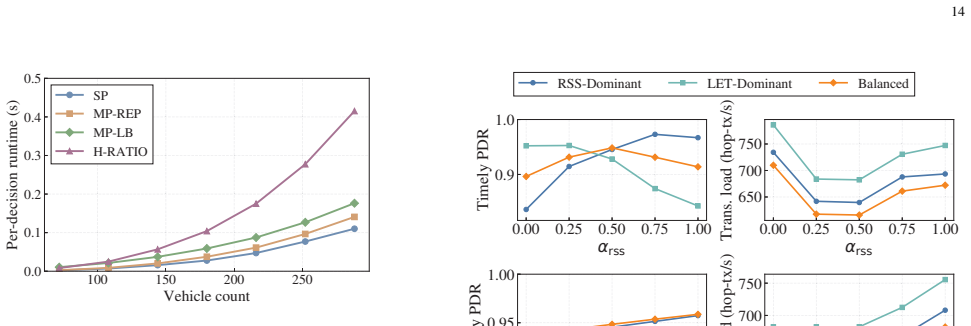
Reliable, low-latency multi-hop data delivery in vehicular networks is increasingly demanded, yet remains challenging due to frequent route failures caused by high mobility and intermittent blockage. While redundancy-based routing enhances robustness by forwarding packets over multiple paths, over-replication intensifies contention and introduces additional delay, highlighting the need to carefully managing redundancy--reliability trade-off. However, conventional deterministic multi-path replication typically duplicates packets to an integer number of branches, making the redundancy level hard to tune and adapt to time-varying network dynamics in vehicular networks. To this end, Redundancy-Controlled Stochastic (RATIO) routing is proposed in this paper. For each active flow, RATIO constructs a weighted reduced directed acyclic graph (DAG) as the routing structure, where edge weights specify per-link forwarding probabilities. At fork nodes, the aggregate outgoing forwarding probability is allowed to exceed one and a modulo-based stochastic forwarding rule is employed to guarantee feasible forwarding, thereby enabling continuously controllable redundancy. An idealized RATIO design is formulated as a load-minimizing optimization subject to per-flow timely-reliability and link-capacity constraints, but the problem is generally intractable under time-varying wireless dynamics. Accordingly, a practical heuristic, termed H-RATIO, is developed. H-RATIO constructs a compact reduced DAG by taking the union of candidate paths and optimizes forwarding probabilities via local scoring and replication-adjustment iterations. Extensive trace-driven SUMO/ns-3 co-simulations demonstrate that RATIO/H-RATIO consistently achieves the highest timely PDR compared to baselines, while providing substantially better delivery efficiency, especially under high-load scenarios.
Figures




Reference graph
Works this paper leans on
-
[1]
A tutorial survey on vehicular ad hoc networks,
H. Hartenstein and K. P . Laberteaux, “A tutorial survey on vehicular ad hoc networks,” IEEE Communications Magazine, vol. 46, no. 6, pp. 164–171, 2008
2008
-
[2]
A comprehensive survey on vehicular ad hoc network,
S. Al-Sultan, M. M. Al-Doori, H. M. Al-Bayatti, and H. Zedan, “A comprehensive survey on vehicular ad hoc network,” Journal of Network and Computer Applica- tions, vol. 37, pp. 380–392, 2014
2014
-
[3]
A comprehensive survey on vehicular ad hoc networks (V ANETs),
M. A. Al-shareeda, M. A. Alazzawi, M. Anbar, S. Man- ickam, and A. K. Al-Ani, “A comprehensive survey on vehicular ad hoc networks (V ANETs),” in Proceedings of International Conference on Advanced Computer Ap- plications (ACA) , 2021, pp. 156–160
2021
-
[4]
Mesh architec- ture for efficient integrated access and backhaul network- ing,
B. Zhai, M. Y u, A. Tang, and X. Wang, “Mesh architec- ture for efficient integrated access and backhaul network- ing,” in Proceedings of IEEE Wireless Communications and Networking Conference (WCNC) , 2020, pp. 1–6
2020
-
[5]
Scheduling and power control for con- nectivity enhancement in multi-hop I2V/V2V networks,
B. L. Nguyen, D. T. Ngo, M. N. Dao, V . N. Q. Bao, and H. L. Vu, “Scheduling and power control for con- nectivity enhancement in multi-hop I2V/V2V networks,” IEEE Transactions on Intelligent Transportation Systems, vol. 23, no. 8, pp. 10 322–10 332, 2022
2022
-
[6]
Latency and reliability of mmWave multi-hop V2V communications under relay selections,
Z. Li, L. Xiang, X. Ge, G. Mao, and H.-C. Chao, “Latency and reliability of mmWave multi-hop V2V communications under relay selections,” IEEE Transac- tions on V ehicle T echnology, vol. 69, no. 9, pp. 9807– 9821, 2020
2020
-
[7]
Routing in vehicular ad hoc net- works: A survey,
F. Li and Y . Wang, “Routing in vehicular ad hoc net- works: A survey,” IEEE V ehicular T echnology Magazine, vol. 2, no. 2, pp. 12–22, 2007
2007
-
[8]
Route stability based QoS routing in mobile ad hoc networks,
N. Sarma and S. Nandi, “Route stability based QoS routing in mobile ad hoc networks,” Wireless Personal Communications, vol. 54, no. 1, pp. 203–224, Mar. 2009
2009
-
[9]
A survey of routing protocols based on link-stability in mobile ad hoc net- works,
A. Moussaoui and A. Boukeream, “A survey of routing protocols based on link-stability in mobile ad hoc net- works,” Journal of Network and Computer Applications , vol. 47, pp. 1–10, 2015
2015
-
[10]
On-demand multipath distance vector routing in ad hoc networks,
M. K. Marina and S. R. Das, “On-demand multipath distance vector routing in ad hoc networks,” in Proceed- ings of International Conference on Network Protocols (ICNP), Nov. 2001, pp. 14–23
2001
-
[11]
ExOR: opportunistic multi- hop routing for wireless networks,
S. Biswas and R. Morris, “ExOR: opportunistic multi- hop routing for wireless networks,” in Proceedings of the ACM Conference on Applications, T echnologies, Archi- tectures, and Protocols for Computer Communications (SIGCOMM), 2005, pp. 133–144
2005
-
[12]
QoS issues in ad hoc wireless networks,
S. Chakrabarti and A. Mishra, “QoS issues in ad hoc wireless networks,” IEEE Communications Magazine , vol. 39, no. 2, pp. 142–148, 2001
2001
-
[13]
A survey of QoS routing solutions for mobile ad hoc networks,
L. Hanzo and R. Tafazolli, “A survey of QoS routing solutions for mobile ad hoc networks,” IEEE Commu- nications Surveys & Tutorials , vol. 9, no. 2, pp. 50–70, 2007
2007
-
[14]
Routing protocols in ad hoc networks: A survey,
A. Boukerche, B. Turgut, N. A ydin, M. Z. Ahmad, L. B¨ ol¨ oni, and D. Turgut, “Routing protocols in ad hoc networks: A survey,” Computer Networks, vol. 55, no. 13, pp. 3032–3080, 2011
2011
-
[15]
On-demand QoS routing in multihop mobile networks,
C. Lin, “On-demand QoS routing in multihop mobile networks,” in Proceedings of IEEE International Confer- ence on Computer Communications (INFOCOM) , 2001, pp. 1735–1744
2001
-
[16]
QoS-aware routing based on bandwidth estimation for mobile ad hoc networks,
L. Chen and W . Heinzelman, “QoS-aware routing based on bandwidth estimation for mobile ad hoc networks,” IEEE Journal on Selected Areas in Communications , vol. 23, no. 3, pp. 561–572, 2005
2005
-
[17]
Mobility and QoS aware anycast routing in mobile ad hoc networks,
P . Basarkod and S. Manvi, “Mobility and QoS aware anycast routing in mobile ad hoc networks,” Computers & Electrical Engineering , vol. 48, pp. 86–99, 2015
2015
-
[18]
On SDN-driven network optimization and QoS aware routing using multiple paths,
M. Bagaa, D. L. C. Dutra, T. Taleb, and K. Samdanis, “On SDN-driven network optimization and QoS aware routing using multiple paths,” IEEE Transactions on Wireless Communications, vol. 19, no. 7, pp. 4700–4714, 2020
2020
-
[19]
QoS multicast routing utilizing cross-layer design for IoT-enabled MANET in RIS- aided cell-free massive MIMO,
T.-N. Tran and B. An, “QoS multicast routing utilizing cross-layer design for IoT-enabled MANET in RIS- aided cell-free massive MIMO,” IEEE Internet of Things Journal, vol. 11, no. 7, pp. 11 876–11 893, 2024
2024
-
[20]
QoS-aware routing protocol for cognitive radio ad hoc networks,
R. N. Raj, A. Nayak, and M. Sathish Kumar, “QoS-aware routing protocol for cognitive radio ad hoc networks,” Ad Hoc Networks , vol. 113, p. 102386, 2021
2021
-
[21]
A QoS-adaptive routing scheme for Urban- MANETs,
Q. V . Khanh, V . A. Dang, Q. N. Minh, and D. C. Nguyen, “A QoS-adaptive routing scheme for Urban- MANETs,” IEEE Sensors Journal , vol. 25, no. 13, pp. 26 001–26 008, 2025
2025
-
[22]
Ad hoc on-demand distance vector (AODV) routing,
C. E. Perkins, E. M. Belding-Royer, and S. R. Das, “Ad hoc on-demand distance vector (AODV) routing,” IETF, Tech. Rep. RFC 3561, 2003
2003
-
[23]
The dy- 19 namic source routing protocol (DSR) for mobile ad hoc networks for IPv4,
D. B. Johnson, D. A. Maltz, and Y .-C. Hu, “The dy- 19 namic source routing protocol (DSR) for mobile ad hoc networks for IPv4,” RFC 4728, Feb. 2007
2007
-
[24]
Optimized link state routin g protocol (OLSR),
T. Clausen and P . Jacquet, “Optimized link state routin g protocol (OLSR),” IETF, Tech. Rep. RFC 3626, 2003
2003
-
[25]
Intersection-based geographical routing protocol for V ANETs: A proposal and analysis,
H. Saleet, R. Langar, K. Naik, R. Boutaba, A. Nayak, and N. Goel, “Intersection-based geographical routing protocol for V ANETs: A proposal and analysis,” IEEE Transactions on V ehicular T echnology, vol. 60, no. 9, pp. 4560–4574, 2011
2011
-
[26]
GROOV: A geographic routing over V ANETs and its performance evaluation,
S. K. Dhurandher, M. S. Obaidat, D. Bhardwaj, and A. Garg, “GROOV: A geographic routing over V ANETs and its performance evaluation,” in Preceedings of IEEE Global Communications Conference (GLOBE- COM), 2012, pp. 1670–1675
2012
-
[27]
Geographic routing protocols for vehicular ad hoc networks (V ANETs): A survey,
S. Boussoufa-Lahlah, F. Semchedine, and L. Bouallouche-Medjkoune, “Geographic routing protocols for vehicular ad hoc networks (V ANETs): A survey,” V ehicular Communications, vol. 11, pp. 20–31, 2018
2018
-
[28]
PGRP: Predictive geo- graphic routing protocol for vanets,
R. Karimi and S. Shokrollahi, “PGRP: Predictive geo- graphic routing protocol for vanets,” Computer Networks, vol. 141, pp. 67–81, 2018
2018
-
[29]
GPSR: greedy perimeter state- less routing for wireless networks,
B. Karp and H. T. Kung, “GPSR: greedy perimeter state- less routing for wireless networks,” in Proceedings of the ACM International Conference on Mobile Computing and Networking (MobiCom) , 2000, pp. 243–254
2000
-
[30]
TGRV: A trust-based geographic routing protocol for V ANETs,
S. Shokrollahi and M. Dehghan, “TGRV: A trust-based geographic routing protocol for V ANETs,” Ad Hoc Net- works, vol. 140, p. 103062, 2023
2023
-
[31]
Link stability based optimized routing framework for software defined vehicular networks,
K. L. K. Sudheera, M. Ma, and P . H. J. Chong, “Link stability based optimized routing framework for software defined vehicular networks,” IEEE Transactions on V e- hicular T echnology, vol. 68, no. 3, pp. 2934–2945, 2019
2019
-
[32]
New routing method based on sticky bacteria algorithm and link stability for V ANET,
J. Zhang, L. Zhang, D. gan Zhang, T. Zhang, S. Wang, and C. hui Zou, “New routing method based on sticky bacteria algorithm and link stability for V ANET,” Ad Hoc Networks, vol. 166, p. 103682, 2025
2025
-
[33]
Driving path stability in V ANETs,
M. Laroui, A. Sellami, B. Nour, H. Moungla, H. Afifi, and S. B. Hacene, “Driving path stability in V ANETs,” in Proceedings of IEEE Global Communications Confer- ence (GLOBECOM) , 2018, pp. 1–6
2018
-
[34]
Predictive hybrid routing with multi objective optimiza- tion model for opportunistic routing for V ANET,
A. H. Abbas, A. J. Ahmed, S. A. Rashid, N. F. Abdulsat- tar, M. H. Hassan, M. A. Jubair, and M. I. Habelalmateen, “Predictive hybrid routing with multi objective optimiza- tion model for opportunistic routing for V ANET,” in Proceedings of International Conference on Engineering T echnology and its Applications (IICETA) , 2022, pp. 470–476
2022
-
[35]
Epidemic routing for partiall y connected ad hoc networks,
A. V ahdat and D. Becker, “Epidemic routing for partiall y connected ad hoc networks,” Duke University, Tech. Rep., 2000
2000
-
[36]
MORE: A network coding approach to opportunis- tic routing,
S. Chachulski, M. Jennings, S. Katti, and D. Katabi, “MORE: A network coding approach to opportunis- tic routing,” Tech. Rep. MIT-CSAIL-TR-2006-049, Jun. 2006
2006
-
[37]
A survey on opportunistic routing in wireless communication networks,
N. Chakchouk, “A survey on opportunistic routing in wireless communication networks,” IEEE Communica- tions Surveys & Tutorials , vol. 17, no. 4, pp. 2214–2241, 2015
2015
-
[38]
Optimization driven multipath routing for the video transmission in the V ANET,
S. More and U. L. Naik, “Optimization driven multipath routing for the video transmission in the V ANET,” in Proceedings of IEEE Global Conference on Wireless Computing and Networking (GCWCN) , 2018, pp. 6–10
2018
-
[39]
Optimal multipath routing for video transmission in V ANETs,
S. More and U. Naik, “Optimal multipath routing for video transmission in V ANETs,” Wireless Personal Com- munications, vol. 116, no. 1, pp. 805–827, Aug. 2020
2020
-
[40]
Multi-path routing protocol for the video service in UA V-assisted V ANETs,
C. Zhao, Q. Zeng, Y . Tang, and B. Y ang, “Multi-path routing protocol for the video service in UA V-assisted V ANETs,” in Proceedings of IEEE V ehicular T echnology Conference (VTC) , 2021, pp. 1–5
2021
-
[41]
Boucheron, G
S. Boucheron, G. Lugosi, and P . Massart, Concentration Inequalities: A Nonasymptotic Theory of Independence . Oxford University Press, 2013
2013
-
[42]
Microscopic traffic simu- lation using SUMO,
P . A. L´ opez, M. Behrisch, L. Bieker-Walz, J. Erdmann, Y .-P . Fl¨ otter¨ od, R. Hilbrich, L. L¨ ucken, J. Rummel, P . Wagner, and E. Wießner, “Microscopic traffic simu- lation using SUMO,” in Proceedings of the 21st IEEE International Conference on Intelligent Transportation Systems (ITSC) . IEEE, 2018
2018
-
[43]
G. F. Riley and T. R. Henderson, The ns-3 Network Simulator, K. Wehrle, M. G¨ unes ¸, and J. Gross, Eds. Berlin, Heidelberg: Springer, 2010
2010
-
[44]
Rep., 2010
IEEE, “IEEE Std 802.11p-2010: IEEE standard for infor- mation technology—telecommunications and informa- tion exchange between systems—local and metropolitan area networks—specific requirements—part 11: Wireless LAN medium access control (MAC) and physical layer (PHY) specifications amendment 6: Wireless access in vehicular environments,” Tech. Rep., 2010
2010
discussion (0)
Sign in with ORCID, Apple, or X to comment. Anyone can read and Pith papers without signing in.