pith. sign in

math.MP

Mathematical Physics

math.MP is an alias for math-ph. Articles in this category focus on areas of research that illustrate the application of mathematics to problems in physics, develop mathematical methods for such applications, or provide mathematically rigorous formulations of existing physical theories. Submissions to math-ph should be of interest to both physically oriented mathematicians and mathematically oriented physicists; submissions which are primarily of interest to theoretical physicists or to mathematicians should probably be directed to the respective physics/math categories

Top Pith
5
math.AG 2026-05-22 2 theorems

Integrable observables prove Π-hierarchy equivalences

by Xavier Blot, Danilo Lewański +1 more

Beyond descendants: integrable observables for cohomological field theories

They replace psi classes while keeping integrability, establish Miura links to Dubrovin-Zhang and ramification hierarchies, and give a short
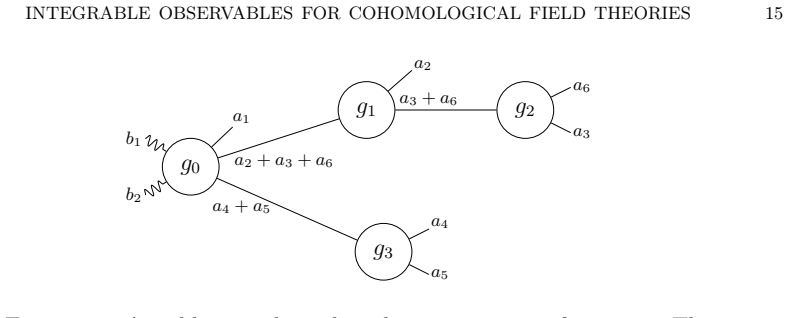
Figure from the paper full image
abstract click to expand
We introduce the concept of integrable observables and propose them as alternatives to the standard Witten's psi classes (a.k.a. descendants in $2D$ quantum gravity) to be coupled with cohomological field theories and their generalisations. The main property of integrable observables is that they retain the integrability properties. We present three examples of integrable observables. The first two recover the Dubrovin-Zhang and double ramification hierarchies, while revealing new structural features in this framework. The third, a new example, builds on recently established properties of the so-called $\mathbb{\Pi}$-class, extending them and placing this class naturally within the theory of integrable systems. Notably, our integrable observables framework yields a proof that the new $\mathbb{\Pi}$-hierarchies are Miura equivalent both to the Dubrovin-Zhang hierarchies and to the double ramification hierarchies. A new very short proof of Witten's conjecture is also provided.
0
Top Pith
5
nlin.SI 2026-05-21 2 theorems

Polynomial Hamiltonians yield meromorphic solutions only for degrees 3,4,5,7

by Marta Dell'Atti, Thomas Kecker

Modified Painlev\'e systems with meromorphic solutions for polynomial Hamiltonians of all degrees

Twelve standard forms are obtained, including new quartic and quintic examples, for use in the Painlevé equivalence problem.

abstract click to expand
We review non-autonomous Hamiltonian systems, polynomial in two dependent variables, with the property that all of their solutions are meromorphic functions in the complex plane. These are related to known Hamiltonian systems with the Painlev\'e property, for which the solutions are single-valued outside a set of fixed singularities. Our systems are equivalent to them in the absence of fixed singularities, and give modified Painlev\'e equations otherwise. Using the geometric approach by computing the Okamoto's spaces of initial conditions for certain Hamiltonian systems with general coefficient functions, we obtain differential constraints on these functions for the systems to have only meromorphic solutions. Guided by the Newton polygon of the Hamiltonian function, we obtain all such systems with polynomial Hamiltonian of degree three, four, five, and seven, up to affine equivalence in the dependent variables, while there are none for degree six or degree higher than seven. We thus obtain a list of 12 standard polynomial Hamiltonians that can serve as reference for the Painlev\'e equivalence problem. This list contains also some new Hamiltonians not previously written down, such as quartic Hamiltonians for Painlev\'e I and II, quartic Hamiltonians for the modified Painlev\'e III and V equations, a quintic Hamiltonian for Painlev\'e IV and quintic and septic Hamiltonians for a modified Painlev\'e VI equation.
0
Top Pith
5
quant-ph 2026-05-20

Trace equals one iff quantum marginals have Markov completion

by Steffen Lauritzen, Piotr Zwiernik

The Markov Marginal Problem for Density Operators

For chordal graphs the noncommutative junction-tree formula T(R) produces a valid state exactly when its trace is one, and it is then the un

abstract click to expand
We study when local reduced density operators, viewed as quantum marginals, can be assembled into a global quantum state with a prescribed Markov structure. The starting point is a canonical logarithmic construction $T(\mathcal R)$, the noncommutative analogue of the junction-tree formula for decomposable graphical models. Unlike in the classical case, this formal construction may fail: noncommutativity can prevent it from being a normalized state with the prescribed marginals. We prove that this obstruction is captured exactly by a trace condition. For two overlapping marginals, and for clique marginals on a chordal graph, the condition ${\rm Tr}(T(\mathcal R))=1$ is equivalent to the existence of a quantum Markov completion. When it exists, the completion is unique, equal to $T(\mathcal R)$, and selected by the maximum entropy principle. In the two-clique case, we also give an equivalent conditional reconstruction characterization: the two natural one-sided sandwich reconstructions agree if and only if the trace condition holds. We introduce the global quantum information $g{\rm I}(\mathcal{G})_\rho$ associated with a chordal graph $\mathcal{G}$ and show that it is a relative-entropy discrepancy from $\rho$ to the logarithmic candidate, with a trace correction when the candidate is not normalized. We also prove an intersection property for strictly positive quantum conditional independence. Three-qubit Pauli examples illustrate how the quantum obstructions are real: local consistency, feasibility, Markov feasibility, and maximum entropy can all separate.
0
0
math.PR 2026-07-03

Subcritical percolation gives spin mixing time log N / lambda

by Alexandre Stauffer, Oskar Vavtar

Mixing times of spin systems on dynamical percolation

When edge flips are slow the combined chain equilibrates in time proportional to log of system size divided by the flip rate.

abstract click to expand
We study the mixing times of stochastic spin systems corresponding to nearest-neighbour Glauber dynamics on dynamical percolation, defined on $d$-dimensional torus of side-length $N$. In this model, the status of each edge (open or closed) updates independently at rate $\lambda>0$, according to $\mathrm{Ber}(p)$ samples. Simultaneously, the spin of each site updates at rate $1$ according to Glauber dynamics on the environment restricted to open edges. We show that for a relatively general class of nearest-neighbour systems, as long as $p<p_c(d)$, for any temperature, if $\lambda$ is sufficiently small, the mixing time is of order $\frac{\log N}{\lambda}$. This Markov chain is non-reversible, and the proof is obtained by developing a particular coupling that couples together local configurations whenever the environment behaves well.
0
0
math-ph 2026-07-03

Uniform local laws hold for any H0 and all λ in deformed Wigner model

by Giorgio Cipolloni, László Erdős +1 more

On a Rosenzweig-Porter-type model

The control on the inhomogeneous resolvent lets eigenvector localization and ETH be tracked continuously from isolated to mixed regimes.

Figure from the paper full image
abstract click to expand
We consider a very general Rosenzweig-Porter-type model, $H=H_0+\lambda W$, where $H_0$ is an arbitrary Hermitian matrix and $W$ is a standard Wigner matrix. We precisely trace the localization properties of the eigenvectors and the eigenstate thermalisation hypothesis (ETH) as the coupling constant $\lambda$ interpolates between the trivial $\lambda=0$ case and the fully mean field regime of large $\lambda$. Our results hold uniformly in $H_0$ and $\lambda$, substantially generalising all previous local laws on deformed Wigner matrices even in the mean field regime. Our proof precisely captures the deterministic approximation to the resolvent which exhibits a strongly inhomogeneous structure. As a byproduct, we conclude the emergence of a mobility edge and study the phenomenon of re-entrant localization.
0
0
math.PR 2026-07-03

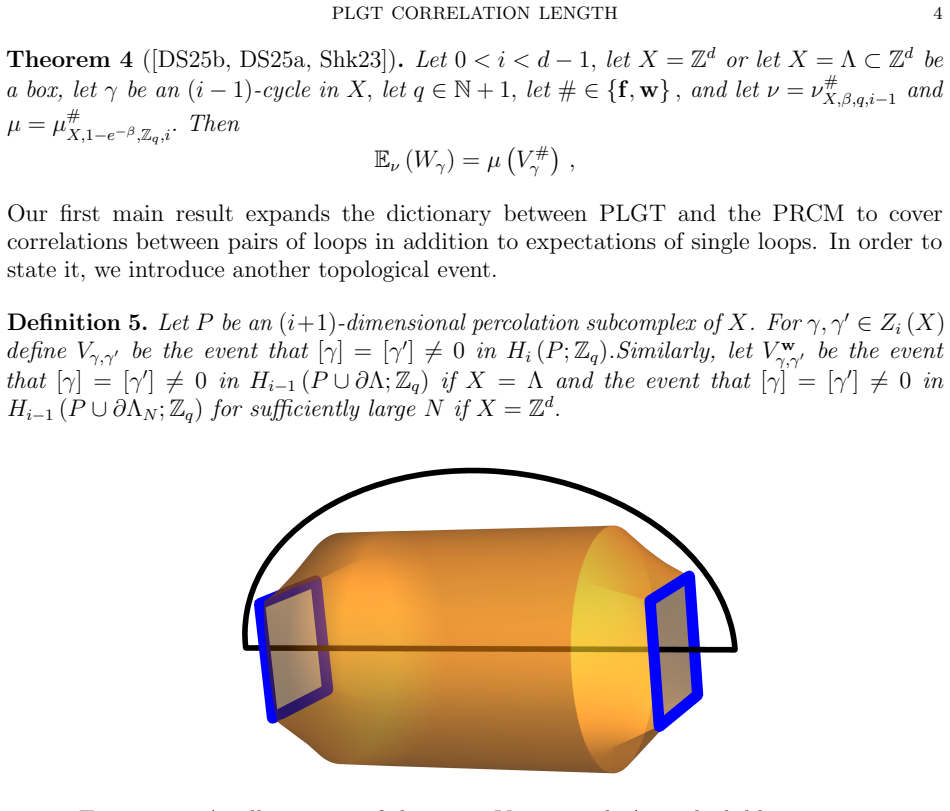
Formula equates Wilson loop correlations to topology in cluster model

by Paul Duncan, Benjamin Schweinhart

A Topological Formula for Potts Lattice Gauge Theory Correlations

The link yields equal correlation lengths across dual models and exponential decay away from criticality.

Figure from the paper full image
abstract click to expand
We exhibit a formula relating the correlation between Wilson loop variables in Potts lattice gauge theory to a topological quantity in the plaquette random cluster model. As applications we show that the correlation length of the model on $\mathbb{Z}^4$ with free boundary conditions equals that of the dual model with constant boundary conditions, we prove exponential decay of correlations between slowly growing Wilson loop variables for Ising lattice gauge theory on $\mathbb{Z}^3$ at all but the critical temperature, and we demonstrate that the correlation length is finite at sufficiently high or low temperatures in any dimension.
0
0
math.PR 2026-07-03

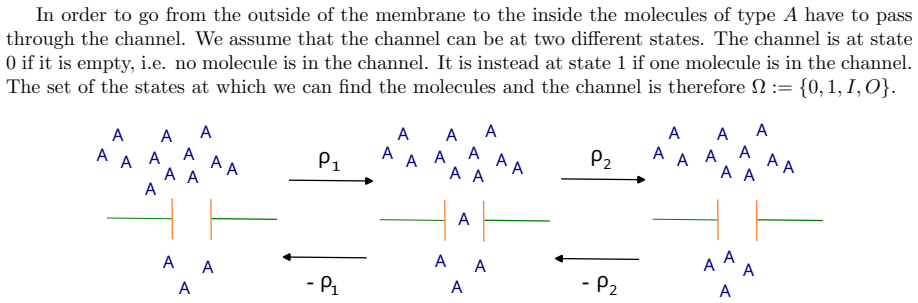
Sources and sinks turn chemical Markov chains into ergodic processes

by E. Franco, J. J. L. Velázquez

Flux solutions for stochastic chemical systems with sources and sinks

Augmented reaction networks converge to unique stationary measures that support sustained fluxes, allowing explicit computation of membrane

Figure from the paper full image
abstract click to expand
In this paper we study a class of stochastic chemical systems that, in general, do not satisfy the property of detailed balance nor the property of complex balance. These systems are obtained by adding sources and sinks to conservative chemical systems. This procedure is a way to define rigorously stochastic chemical systems in contact with reservoirs. We prove that these systems are non-explosive Markov chains and we prove that they converge to a steady state as time tends to infinity. The stationary solution are out of equilibrium solutions. We conclude the paper by applying our results in order to describe fluxes of molecules through some membrane channels.
0
0
math-ph 2026-07-03

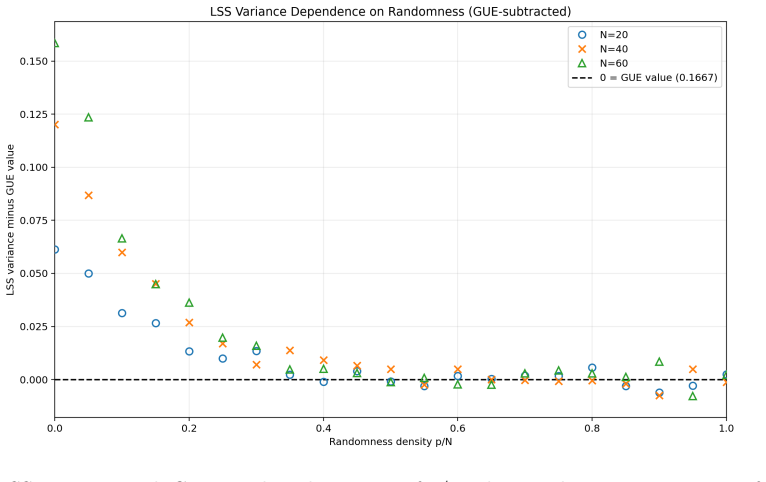
Quantum graph linear statistics match GOE/GUE variance on mesoscopic scales

by Anna Maltsev, Mohammed Osman

Mesoscopic Linear Statistics for Two Ensembles of Quantum Graphs

In the large-graph limit the variances coincide with the classical ensembles for both regular-graph sampling and Haar vertex sampling.

Figure from the paper full image
abstract click to expand
We study mesoscopic linear spectral statistics for two ensembles of random quantum graphs. These are defined by a discrete graph $G$ and a unitary-matrix-valued function $U(k)$ indexed by directed edges of $G$. The matrix function $U(k)$ is constructed from unitary matrices $U^{(v)}$ indexed by the neighbours of each vertex $v$. The first ensemble is obtained by sampling the underlying discrete graph uniformly from the set of $d$-regular graphs. The second ensemble is obtained by sampling $U^{(v)}$ uniformly from the Haar measure, independently for each vertex. We prove that the variance of a linear spectral statistic in the large graph limit on polynomial mesoscopic scales coincides with that of the Gaussian Orthogonal/Unitary Ensemble.
0
0
math.QA 2026-07-03

Unitriangular R-matrices conjugate via T-series and Theta series

by Huafeng Zhang

Unitriangular R-matrices of quantum affine algebras and Yangians via Theta series

The formula applies to any finite-dimensional representation and extends to the Yangian case.

abstract click to expand
The universal R-matrix of the quantum affine algebra associated to a finite-dimensional simple complex Lie algebra admits a Gauss decomposition into an uper unitriangular part, an abelian part, and a lower unitriangular part. In this paper, we provide a simple conjugation formula for the unitriangular R-matrices with one tensor factor evaluated at an arbitrary finite-dimensional representation of the quantum affine algebra. Our formula involves the T-series of Frenkel--Hernandez and the Theta series introduced in a previous work. We also extend our conjugation formula to the Yangian case, making use of associators for triple tensor product representations of shifted Yangians.
0
0
quant-ph 2026-07-03

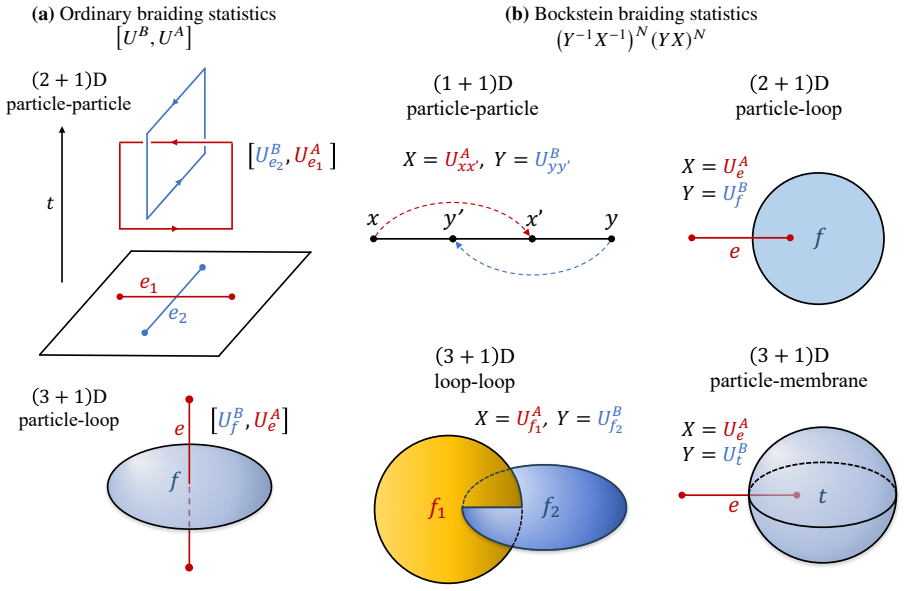
Bockstein braiding appears for Z_N excitations with p+q=d-1

by Po-Shen Hsin, Yu-An Chen

Bockstein braiding statistics

A unitary process on staggered operators measures statistics that block simultaneous condensation and symmetric gapped phases.

Figure from the paper full image
abstract click to expand
Braiding statistics, from the Aharonov-Bohm phase to anyons in fractional quantum Hall systems, play a central role in quantum physics. For $p$- and $q$-dimensional excitations in $d$ spatial dimensions, ordinary braiding requires $p+q=d-2$. In a field-theoretic description of $\mathbb Z_N$ excitations, ordinary braiding is described by the linking response $(2\pi i/N)\int A_{d-p}\cup B_{d-q}$, where $A_{d-p}$ and $B_{d-q}$ are background fields coupled to the two excitation types. In this work, we identify new mutual statistics in the adjacent case $p+q=d-1$. For two invertible excitations obeying $\mathbb Z_N$ fusion, one can choose local creation operators $X$ and $Y$ whose supports have a staggered one-dimensional overlap. The closed unitary process $W_N(X,Y)=(Y^{-1}X^{-1})^N(YX)^N$ measures the resulting mutual statistic. Its field-theory description is $(2\pi i/N)\int A_{d-p}\cup\beta_N B_{d-q}$, where $\beta_N$ is the Bockstein operation; we therefore call the invariant Bockstein braiding statistics. The construction yields particle-particle statistics in one dimension, particle-loop statistics in two dimensions, and loop-loop or particle-membrane statistics in three dimensions. Nontrivial Bockstein braiding statistics obstructs simultaneous condensation of the two $\mathbb Z_N$ excitations. It also rules out a fully symmetric gapped phase for systems with the corresponding mixed anomaly and implies symmetry fractionalization when one of the $\mathbb Z_N$ symmetries is broken.
0
0
math-ph 2026-07-03

Zero-mode covariance defines mean-field BEC ideal in resolvent algebra

by Yoshitsugu Sekine

Mean-Field Bose--Einstein Condensation and Condensate Ideals in the Resolvent Algebra

Selected condensed density with positive excess yields distinct representation data in nonregular quotients.

abstract click to expand
This paper studies the imperfect Bose gas after the Kac density law and the mean-field Euler equations have selected a condensed density with positive zero-mode excess. In this BEC regime the selected chemical potential cancels the mean-field shift, so the selected one-particle Hamiltonian is exactly the free one. The resulting zero-mode covariance defines a mean-field BEC ideal in the resolvent algebra, while the nonregular quotient and the direct-integral center record distinct representation-theoretic data. Occupation-number and Brownian-loop formulations recover the same density selection, excess density, ODLRO data, local tests, and the separation between finite-density BEC and Buchholz's stricter infinite-occupation proper-condensate criterion.
0
0
math.DG 2026-07-03

STCMC foliations arise as flow limits near AdS-Schwarzschild

by Jacopo Tenan

Foliations by constant spacetime mean curvature surfaces for asymptotically hyperboloidal initial data sets

Volume-preserving spacetime mean curvature flow from a known CMC foliation produces the surfaces and a center-of-mass definition for hyperbo

abstract click to expand
We construct an exhaustive family of constant spacetime mean curvature (STCMC) surfaces for initial data sets close to the anti-de Sitter-Schwarzschild hyperboloid. In particular, we obtain such a foliation as the long time limit of the volume preserving spacetime mean curvature flow starting from the constant mean curvature foliation constructed by Neves-Tian (Geom. Funct. Anal., 2009). As an application, inspired by the definition of STCMC center of mass for initial data sets proposed in the asymptotically Euclidean setting by Cederbaum-Sakovich (Calc. Var. PDE, 2021), we study the center of mass of an asymptotically hyperboloidal initial data set.
0
0
math.PR 2026-07-03

SK free energy variance grows as (1/6) log N at criticality

by Hang Du, Brice Huang

Fluctuations of the Sherrington--Kirkpatrick free energy at critical temperature

The centered free energy obeys a Gaussian CLT and the two-replica overlap scales as N to the minus two thirds.

abstract click to expand
We consider the Sherrington--Kirkpatrick spin glass model at the critical inverse temperature $\beta = 1$ with zero external field. We prove that the free energy $F_N = F_{N,\beta=1}$ of this model has variance \[ \mathrm{Var}(F_N) = \frac16 \log N + O(1)\,, \] confirming a physics prediction of Aspelmeier \cite{aspelmeier2008free}, and that the centered and scaled $F_N$ satisfies a Gaussian CLT. We also identify the critical two-replica overlap scale, proving \[ \mathbb{E} \langle R_{1,2}^2\rangle \asymp N^{-2/3}\,, \] as conjectured by Talagrand \cite{talagrand2011mean2}, together with a uniform exponential moment bound for $N^{1/3} |R_{1,2}|$. The key input is a comparison between the Ising and spherical SK partition functions $Z_N$ and $Z^{\mathrm{sp}}_N$: if $X_N = Z_N / Z^{\mathrm{sp}}_N$, then $X_N = 1 + o(1)$ in $L^2$. Thus $Z^{\mathrm{sp}}_N$ captures the diverging critical fluctuations of $Z_N$ and serves as a tractable reweighting variable for estimating overlap moments.
0
0
math.RT 2026-07-03

Subregular W-algebra at critical level is orbifold of W-superalgebra limit

by Thomas Creutzig, Xuanzhong Dai +1 more

Feigin-Semikhatov duality at the critical level

The duality persists at the limit and supplies block-wise equivalences inside the category of weight modules.

abstract click to expand
The Feigin-Semikhatov duality asserts that the Heisenberg cosets of the subregular $W$-algebra of $\mathfrak{sl}_n$ at level $k$ and the one of the principal $W$-superalgebra of $\mathfrak{sl}_{n|1}$ at level $\ell$ coincide when the levels satisfy the Feigin-Frenkel relation $(k+n)(\ell+n-1)=1$. A similar duality holds between the subregular $W$-algebra of $\mathfrak{so}_{2n+1}$ and the principal $W$-superalgebra of $\mathfrak{osp}_{2|2n}$. We study these dualities in the critical/large level limit. We describe the centerless subregular $W$-algebra at the critical level as an orbifold of the large level limit of the principal $W$-superalgebra times a lattice VOA. Our construction yields a functor between certain categories of the two involved vertex algebras. We show that in this set-up one in fact gets block-wise equivalences of categories. Studying the principal block of the large level limit of the principal $W$-superalgebra then gives us the structure of the principal blocks of the subregular $W$-algebras in the category of weight modules (which is much larger than the more common category of lower bounded modules).
0
0
math-ph 2026-07-03

Yang-Baxter plus once-per-period rule yields integrable circuits for any geometry

by Miguel García Fernández, Chiara Paletta +1 more

Open-boundary integrable quantum circuits with different geometries

A mapping from transfer-matrix inhomogeneities produces time-periodic open circuits that stay integrable when each bulk gate is used exactly

Figure from the paper full image
abstract click to expand
We present a complete classification of integrable Yang-Baxter quantum circuits with open boundary conditions and arbitrary circuit geometries. Starting from the standard transfer-matrix construction with two types of staggered inhomogeneities, we derive a general mapping that determines the arrangement of circuit gates in terms of the inhomogeneities and the system size. We conjecture that time-periodic quantum circuits are integrable whenever the local bulk and boundary gates satisfy the Yang-Baxter equation and the same bulk gate is applied exactly once per period to every nearest-neighbor pair of spins. Our construction also provides an algorithm to detect Yang-Baxter integrability for circuits with arbitrary geometries. Furthermore, we introduce a third type of inhomogeneity, denoted by $\rho$, and demonstrate that the minimum possible circuit depth is four. We show that when these $\rho$-inhomogeneities are placed at the endpoints and in their immediate neighborhood, the resulting boundary gates can be interpreted as single gates acting on multiple sites. Our construction is fully general and applies to regular $R$-matrices, both of difference and non-difference type, together with their associated boundary matrices. As an application, we consider two-qubit gates corresponding to 6- and 8-vertex $R$-matrices of non-difference form satisfying the Yang-Baxter equation, and we construct the associated reflection matrices that generate integrable quantum circuits.
0
0
math.CO 2026-07-03

Chord diagram crossings alone set weights for q-deformed planar maps

by Timothy Budd

Double-scaled SYK from boundary metrics of planar maps

At fixed perimeter the geodesic chord diagrams follow exactly the same distribution as in the double-scaled SYK model.

Figure from the paper full image
abstract click to expand
The enumeration of planar maps with control on the boundary metric, i.e. the pseudometric induced on the outer face of the map by its bulk graph distance metric, is a difficult problem in general. However, we show that for a family of bipartite planar map models with special q-deformed face weights that arise in the physics context of the double-scaled Sachdev-Ye-Kitaev model (DSSYK) the enumeration admits a very simple answer. Encoding the boundary metric of a bipartite planar map by its so-called geodesic chord diagram, we prove that the weighted enumeration depends only on the crossing number of the chord diagram. At fixed perimeter, the induced law of the geodesic chord diagram in these planar map models coincides exactly with the chord diagram representation of the DSSYK model.
0
0
hep-th 2026-07-03

Typicality bounds extend to Type II von Neumann factors

by Zhi-Wei Wang, Samuel L. Braunstein

Lubkin-Page typicality bounds for Type~II von~Neumann factors

Mutual information vanishes as O((dA dB/dE)^2) for Type II1 and gains entropy suppression for II∞ gravitational algebras.

abstract click to expand
Typicality arguments for emergent spacetime rely on the Lubkin-Page bounds, which show that generic quantum states have vanishing correlations between subsystems. These bounds assume a tensor-product Hilbert space (a Type~I von~Neumann algebra), but the observable algebras in quantum field theory and quantum gravity are generically Type~II or Type~III, raising the question of whether the bounds survive. We prove that they do for all Type~II von~Neumann factors. For the hyperfinite Type~II$_1$ factor with a tripartite decomposition $R \cong A \otimes B \otimes E$, the mutual information between subsystems $A$ and $B$ vanishes as $O((d_A d_B / d_E)^2)$ in finite-dimensional approximations, provided $d_A d_B \leq d_E$ (Theorem~1). For Type~II$_\infty$ factors, including the gravitational algebras constructed via the crossed-product method by Witten and by Chandrasekaran, Longo, Penington, and Witten, the bound acquires an additional exponential suppression controlled by the Bekenstein-Hawking entropy (Theorem~2). We identify the obstructions to extending the result to Type~III factors and discuss the open question of whether the commutant of the observable algebra can serve as a natural thermal bath that tightens the bound further.
0
0
math.AP 2026-07-03

Local linking theorem gives two solutions for relativistic equations

by Manuel Garzón, Salvador López-Martínez

A Local Linking Theorem for Relativistic Action Functionals

An analogue of the Brezis-Nirenberg result for Szulkin functionals from action principles proves multiplicity for the Lorentz force and mean

Figure from the paper full image
abstract click to expand
We establish an analogue of the Brezis-Nirenberg local linking theorem for a class of Szulkin-type functionals arising from relativistic action principles. In this framework, compactness of Palais-Smale sequences is formulated with respect to a topology induced by the effective domain of the functional, replacing the classical strong Palais-Smale condition. The proof combines the original construction of the min-max geometry, based on a negative gradient flow, with the Ekeland-Lasry regularization. The main difficulty is that the regularized functional is naturally associated with the strong topology of the underlying functional space, whereas compactness for the original functional is formulated in the topology induced by the effective domain. We overcome this obstacle through a new perturbative construction that recovers the required min-max structure. We apply our abstract multiplicity result to two representative relativistic models: the Lorentz force equation, describing the dynamics of a charged particle in an electromagnetic field, and the Dirichlet problem for the prescribed mean curvature operator in Minkowski space. As a consequence, under natural assumptions, each problem admits at least two non-constant solutions.
0
0
math-ph 2026-07-03

r-deformed Rényi entropy gives tighter Tsallis bound on density operators

by Srikrishna Maity, Shigeru Furuichi +1 more

r-deformed α-z-R\'enyi relative entropy

The three-parameter family lies below an existing upper bound whenever both are applied to quantum states.

Figure from the paper full image
abstract click to expand
In this article, we consider the $r$-logarithm for defining three-parameter family of R\'{e}nyi relative entropies that are generalization of the $\alpha$-$z$-R\'{e}nyi relative entropies. All the members of $r$-deformed $\alpha$-$z$-R\'{e}nyi relative entropies satisfy the necessary axioms to be a divergence. We expose the range of parameters $\alpha$, $z$ and $r$ for which the data processing inequality holds. We also establish that $r$-deformed $\alpha$-$z$-R\'{e}nyi relative entropy is an upper bound of the Tsallis relative entropy. Now, we have two upper bounds of the Tsallis relative entropy, which are $r$-deformed $\alpha$-$z$-R\'{e}nyi relative entropy and the other one, which is discussed in literature. We investigate the order relationship between these two upper bounds of the Tsallis relative entropy. We observe that our new upper bound is more tighter when applicable to the density operators.
0
0
quant-ph 2026-07-03

Quantum noncommutativity pins relative entropy as the sole additive measure

by Gilad Gour

Quantum Noncommutativity Uniquely Determines Relative Entropy

Any additive distinguishability quantity that matches optimal guessing odds must equal Umegaki relative entropy, a rigidity absent in classi

Figure from the paper full image
abstract click to expand
Quantum relative entropy is a core concept in physics, governing the limits of communication, thermodynamic irreversibility and quantum resource conversion. However, the requirement that physical processes cannot increase state distinguishability, the data-processing inequality, permits an infinite family of alternative divergence measures. Here we show that quantum relative entropy is uniquely selected by a sharper operational principle. We evaluate distinguishability through binary guessing games, in which an observer discriminates between pairs of quantum states using the optimal measurement. We prove that any additive measure that respects the odds revealed by these optimal measurements must coincide with the Umegaki relative entropy. This rigidity is a purely quantum phenomenon. Whereas classical theory permits a continuous family of valid divergence measures, including R\'enyi divergences, quantum noncommutativity. collapses this mathematical freedom. The result is exact, requiring neither a thermodynamic limit of infinitely many copies nor super-additivity assumptions for correlated states. It establishes quantum relative entropy not merely as an asymptotic quantity, but as the unique additive distinguishability measure compatible with single-shot quantum discrimination.
0
0
math.AP 2026-07-03

Existence of weak solutions shown for surface Beris-Edwards model

by Gonzalo A. Benavides, Ricardo H. Nochetto +1 more

Existence of weak solutions of the surface Beris-Edwards model

Proof on C^{2,1} closed hypersurfaces in 2D and 3D uses eigenfunction-based Galerkin approximations.

abstract click to expand
We prove the existence of weak solutions to the surface Beris-Edwards model for nematic liquid crystals posed on a $d$-dimensional ($d \in \{2,3\}$) closed hypersurface of class $C^{2,1}$. This thermodynamically consistent model, recently introduced by Bouck, Nochetto and Yushutin (2024), couples the incompressible tangent Navier-Stokes equations with a kinematic equation for the Q-tensor field that encodes the orientation of the liquid crystal particles with a general state of orientational order. Extending ideas by Abels, Dolzmann and Liu (2014) and Guill\'en-Gonz\'alez and Rodr\'iguez-Bellido (2015) for the Beris-Edwards model in flat domains, we design a Faedo-Galerkin scheme based upon eigenfunctions of an appropriate tangent Stokes operator and tensor-valued Laplace-Beltrami operator and recover a weak solution via standard compactness arguments.
0
0
nlin.SI 2026-07-02

Degenerate Lax pair still yields full KdV conservation hierarchy

by Jimmie Adriazola, Gino Biondini +2 more

Learning Lax Pairs: Revisiting the Classical Paradigm

A spectrally degenerate pair classified as fake generates every conserved quantity via its operator algebra, showing the true-fake split is

abstract click to expand
A Lax pair $(L,P)$ is sometimes thought of as a structural certificate, in that the spatial operator $L$ carries the spectral data of an integrable system, and its isospectral evolution under $\partial_t L = [L,P]$ encodes the nonlinear dynamics. Yet, experience shows that the correspondence between equations and Lax pairs is much more nuanced than this picture suggests. Equations can admit Lax pairs that fail to encode the expected integrable structure. This paper probes that anomalous corner of the Lax pair landscape through five case studies (the Euler top, the free Schr\"odinger equation, the inviscid Burgers equation, the shallow water system, and the Korteweg--de Vries equation), each illustrating a different way the link to integrability can be distorted. The approach combines analytical calculations with the Sparse Identification of Lax Operators (SILO) framework, which proved useful throughout, in some cases confirming the textbook pair and in others surfacing alternatives worth understanding on their own terms. The recurring lesson across the five cases is that compatibility underdetermines the Lax representation, so that anomalous pairs are regular features of the landscape rather than pathologies. Notably, we show that a spectrally degenerate Korteweg--de Vries Lax pair, classified as fake by standard criteria, still generates the full conservation hierarchy through its operator algebra, which shows that a blunt dichotomy between true and fake Lax pairs can be too reductive.
0
0
physics.plasm-ph 2026-07-02

Benjamin-Feir index marks non-Gaussian chorus waves above 0.5

by D.J. Ratliff, O. Allanson +4 more

Understanding Non-Gaussian Chorus Wave Statistics via the Benjamin-Feir Index

Model maps night and dawn sectors as primary sites and matches asymmetric spectra in probe data.

Figure from the paper full image
abstract click to expand
We derive an extended wave action model for equatorial chorus waves, identifying a wave activity index (a version of the Benjamin-Feir index, BFI) which indicates non-Gaussian frequency spectra emerge when BFI$>$0.5. Global maps of this index indicate the night and dawn sectors ($0<{\rm MLT}<9)$ of the magnetosphere as the primary region for non-Gaussian wave statistics to emerge. Comparisons with events measured by the Van Allen probe A demonstrate good qualitative agreement whilst identifying key aspects for model refinement. A key strength of our model that our work highlights is its ability to account for the asymmetric frequency spectra characteristic of non-Gaussian chorus. This work ultimately establishes the first wave activity index that distinguishes Gaussian and non-Gaussian wave scenarios from first principles, providing the groundwork for a threshold-based quantification for use in space weather modelling.
0
0
math-ph 2026-07-02

Near-resonant terms accumulate to power-law growth in dispersive waves

by P.Yu. Astafieva, O.M. Kiselev

Small Denominators and Subresonant Accumulation in Weakly Nonlinear Dispersive Dynamics

Detunings shrinking as n to a power let infinite families contribute t to a fractional power instead of remaining bounded.

Figure from the paper full image
abstract click to expand
We study a small-denominator mechanism in weakly nonlinear dispersive dynamics. After Fourier decomposition, a nonlinear dispersive equation becomes an infinite system of weakly coupled oscillators. Higher-order correction terms may then contain infinite families of nonresonant Fourier interactions whose detunings tend to zero. Such families do not produce exact secular terms, but their accumulated contribution may grow as a power of time. We call this effect subresonant accumulation. The rigorous part of the paper is the analysis of a model forced oscillator and of an abstract subresonant Duhamel sum. If the detuning and coefficients have the form $\Delta_n\sim c n^{-p}$ and $B_n\sim b n^{-\kappa}$, then the accumulated contribution grows as $t^{1-\alpha}$, where $\alpha=(\kappa-1)/p$. We then show how this mechanism appears in a quartic Fourier family for the Klein--Gordon dispersion law. For the full nonlinear partial differential equation we formulate a conditional approximation result: provided that all remaining resonant and almost resonant interactions are controlled, the subresonant term gives the leading long-time correction.
0
0
math-ph 2026-07-02

Ergodic MPS have unique parent Hamiltonians under injectivity

by Owen Ekblad, Eloy Moreno-Nadales +2 more

Parent Hamiltonians of Ergodic Matrix Product States

The thermodynamic limit of these statistically translation-invariant states is the sole frustration-free ground state of a parent Hamiltonia

Figure from the paper full image
abstract click to expand
Matrix product states (MPS) are quintessential examples of frustration-free gapped ground states of local interactions called parent Hamiltonians. In this work, we investigate parent Hamiltonians for a class of ergodic matrix product states (EMPS), which are MPS defined by site-dependent random tensors $\{X_j^{[k]}\}_{j=1}^D$ which are homogeneously distributed at every site $k$ in the spin chain. Here, the EMPS are not translation-invariant but rather statistically translation-invariant. Under a mild injectivity assumption, we show the thermodynamic limit of an EMPS is the unique frustration-free ground state of a parent Hamiltonian on the whole spin chain, which, depending on the statistical properties of the EMPS, may or may not be finite-range. In contrast to the translation-invariant regime, these Hamiltonians need not be gapped. Nevertheless, applying the martingale method while keeping track of local statistics gives conditions for a gap, in addition to pointing towards why there need not be a gap in general. We include examples of EMPS both with and without spectral gaps to illustrate our results.
0
0
hep-th 2026-07-02

Closed manifold data fixes unitary QFTs uniquely

by Jacob McNamara, Zhencheng Wang

Wormholes as red herrings: reflection positivity and the reconstruction of unitary quantum field theories

Reflection positivity turns the data into a full theory, showing factorization issues arise from missing charged states.

abstract click to expand
As Coleman famously argued, the apparent breakdown of partition-function factorization in quantum gravity associated with Euclidean wormholes is a red herring, arising from a hidden average over an ensemble of theories. We present a direct analog of Coleman's argument for the apparent breakdown of Hilbert-space factorization associated with spatial wormholes, i.e., Einstein--Rosen bridges. Our main result is the following reconstruction theorem for quantum field theories: unitary QFTs are determined, up to unitary isomorphism, by their closed-manifold partition functions; every reflection-positive partition function arises from a unitary quantum field theory; and the states prepared by manifolds span the space of invariant states under the reconstructed theory's symmetry group. Interpreting the result gravitationally, we conclude that any apparent breakdown of Hilbert-space factorization is a red herring, arising from restricting to an incomplete spectrum of charged states.
0
0
quant-ph 2026-07-02

Negativity equals entanglement cost for random mixed states

by Bowen Ouyang, Jonah Kudler-Flam

Logarithmic negativity typically equals exact entanglement cost

In large random induced states, this computable measure matches the exact cost under PPT-preserving operations.

Figure from the paper full image
abstract click to expand
Quantum entanglement plays a leading role in modern understanding of physical systems, from quantum phases of matter to quantum gravity. In quantum information theory, one seeks operationally meaningful quantifiers of entanglement, which for large quantum systems are notoriously difficult to evaluate due to the lack of computationally efficient algorithms. In this Letter, we show that for large random induced mixed states the logarithmic negativity, an efficiently computable entanglement measure, generically coincides with the exact entanglement cost under positive-partial-transpose-preserving operations, thereby acquiring a precise operational interpretation. Our results establish logarithmic negativity as an exact characterization of entanglement in generic many-body states and provide a tractable route for quantifying entanglement in complex quantum systems.
0
0
math-ph 2026-07-02

The authors introduce a classification scheme for topological phases using the topology…

by Giuseppe De Nittis, Santiago G. Rendel

A scheme for topological phases of the Weyl C^*-algebra

A classification scheme for topological phases is defined via homotopy classes of sections of pure-state fiber bundles over the Weyl…

abstract click to expand
In this work, we introduce a classification scheme for topological phases of matter based on the topology of the space of pure states of a model $C^*$-algebra. Under it, topological phases are described by homotopy classes of sections of certain fiber bundles of (pure) states. Applying this classification procedure on states of the Weyl $C^*$-algebra that are invariant under translations by a lattice, we recover the $K$-theoretic classification of gapped spectral projectors for topological insulators of types A and AI, thus essentially generalizing this notion.
0
0
quant-ph 2026-07-02

Levy theorem classifies continuous quantum trajectories

by Hans Maassen

Continuous Observation of Quantum Systems

Probabilistic proof via weak convergence of measures clarifies boundedness and supplies quantum-optics example

abstract click to expand
In a series of papers in the 1980's Alexander Holevo proved a classification theorem for continuous quantum measurement processes, or, as they would today be called, stationary quantum trajectories in continuous time. His main tools were functional analytic in character: starting from a Bochner-type inequality he employed dilation techniques for positive definite kernels. Here we give an alternative, more probabilistic proof: we use weak convergence of measures and employ Levy's Continuity Theorem. We clarify the boundedness conditions in Holevo's theorem, and supply a simple example from quantum optics.
0
0
math.AP 2026-07-02

Dissipative solutions exist for any L2 data in Hasegawa-Mima equation

by Michele Gorini

Weak and dissipative solutions for the Hasegawa-Mima equation

Velocity form allows Lions-style weak solutions on the torus and bounded C1 domains with no extra density assumptions.

abstract click to expand
We consider the Hasegawa-Mima equation in its ``Euler-like'' velocity form: \[\partial_t(u-\Delta^{-1}u)+(u\cdot\nabla)u-u^\perp\log n_0=0,\] $n_0$ being the time-independent function appearing in the particle count $n=n_0e^{\frac{e\varphi}{T}}$, and $u$ being the drift velocity $\nabla^\perp\varphi=-\nabla\varphi\times\hat z$. Adapting the notion from Lions' book on the Euler equations, we prove the existence of dissipative solutions for this equation for any $L^2$ divergence free initial condition $w\in L^2(D)$, for $D=\mathbb T^2$ and $D\subset\mathbb R^2$ a bounded $\mathcal{C}^1$ domain.
0
0
physics.comp-ph 2026-07-02

Lanczos method reduces cost for nuclear QRPA strength functions

by Dong Min Roh, Chao Yang +2 more

Lanczos Method for QRPA Strength Functions in Atomic Nuclei

Single Krylov run matches GMRES accuracy for two nuclei over broad energy range

Figure from the paper full image
abstract click to expand
We present a symmetric Lanczos method for computing charge-changing QRPA strength functions in atomic nuclei. Starting from the finite-amplitude-method formulation of the QRPA linear-response problem, we derive equivalent spectral representations and, in the real case, a reduced eigenvalue problem involving the matrix products $MK$ and $KM$, where $M\equiv A+B$ and $K\equiv A-B$ are formed from the usual QRPA matrices $A$ and $B$. The resulting formulation enables a matrix-free Lanczos approximation of the Lorentzian-smeared strength function over a broad energy interval from a single Krylov run, in contrast to conventional frequency-by-frequency response calculations. Numerical tests for $^{112}$Sn and $^{150}$Nd first show that GMRES reproduces the converged iterative FAM strength profiles while requiring fewer iterations. Using GMRES as the frequency-by-frequency reference, we then show that the Lanczos approximation reproduces the same strength profiles with reduced overall cost. These results indicate that symmetric Lanczos projection provides an efficient and accurate approach for QRPA strength-function calculations when spectral information is required over an extended frequency range.
0
0
hep-th 2026-07-02

Indecomposable multiplets give new N=4 Calogero models

by Sergey Fedoruk, Evgeny Ivanov +1 more

{cal N}{=}\,4 supersymmetric multiparticle systems based on indecomposable multiplets

Nonlinear (1,4,3)⊃+(4,4,0) supermultiplets produce OSp(4|2)-invariant U(2)-spin rational and hyperbolic systems

abstract click to expand
We construct new multiparticle models of $\mathcal{N}=4$ supersymmetric mechanics with spin degrees of freedom by employing nonlinear indecomposable supermultiplets ${\bf (1,4,3){\supset\hspace{-1.1em}+}(4,4,0)}$. These systems are proper deformations of those associated with the standard irreducible $d=1, \mathcal{N}=4$ multiplets. In this way we find a new $\mathcal{N}=4$ supersymmetric generalization of U$(2)$-spin rational Calogero system invariant under $d=1$ superconformal group OSp$(4|2)$. One more deformed model reproduces $\mathcal{N}=4$ supersymmetric U$(2)$-spin hyperbolic Calogero system, up to a shift of the Hamiltonian by some U$(1)$ generators.
0
0
math-ph 2026-07-02

Length scale ratio governs trapping or cloaking by point pins

by E. Alevras, Th. Zisis +1 more

Scattering, Trapping and Cloaking-Type Effects of Plane Waves by Point Scatterers in Strain Gradient Elasticity

Anomalous dispersion creates sharp localized resonances while normal dispersion weakens them to cloaking-type behavior.

Figure from the paper full image
abstract click to expand
Wave scattering by localized constraints in microstructured solids is strongly influenced by the interplay of material length scales, dispersion and geometry. This work investigates plane-strain scattering of time-harmonic P and SV waves by clusters of rigid point constraints embedded in an infinite strain gradient elastic medium. A closed-form dynamic Green's tensor is derived for the plane-strain problem. Unlike the classical elastodynamic Green's tensor, the strain gradient Green's tensor remains bounded at the source, enabling point constraints to be introduced directly through superposition of fundamental solutions. The multiple-scattering problem is reduced to a finite-dimensional algebraic system for the pin reaction amplitudes. A frequency-domain procedure is developed to identify resonance-like amplification and trapping. Candidate resonant frequencies are associated with local minima of the Green matrix determinant, while higher-order curvature criteria distinguish trapping-dominated resonances from non-localized scattering responses. The results show that the response is governed primarily by the ratio of the microinertial and energetic strain gradient lengths. In the anomalous dispersion regime, sharp resonances produce strong displacement localization, including perimeter-localized trapping modes in dense circular arrays. In the normal dispersion regime, these resonances are strongly attenuated and the pins behave as weak scatterers, producing a cloaking-type response in which the incident field is only weakly perturbed. The influence of Poisson's ratio, incidence angle and compound pin configurations is also examined, demonstrating how intrinsic material lengths and geometric arrangement can be used to tune scattering, trapping and wave-screening mechanisms in microstructured elastic media.
0
0
quant-ph 2026-07-02

Heun solutions connect linearly driven qubits to rotating-wave approximation

by Pietro Follia, Bassano Vacchini

Analytical connection between exact and approximate solutions of the periodically-driven two-level system starting from the Heun equation

Perturbative continued fractions recover RWA plus Stark and Bloch-Siegert shifts from the confluent Heun equation

Figure from the paper full image
abstract click to expand
We investigate and establish an analytic connection between the exact solutions describing the dynamics of a two-level system driven by periodic external fields, focusing on the cases of linear driving and the so-called rotating-wave approximation, or circular driving. In both cases, the exact solutions can be obtained by mapping the Schrodinger equation onto Heun equations: the confluent Heun equation for linear driving and the Heun equation for the rotating-wave case. In particular, we demonstrate a direct analytic connection between the exact solutions for linear driving and those for the rotating-wave case. This result is obtained by analyzing local solutions expressed in terms of hypergeometric functions, which, in the case of the confluent Heun equation, can be derived by considering path-multiplicative Floquet solutions involving a bilateral series. This series leads to two continued-fraction expansions that can be perturbatively solved by imposing a suitable consistency condition. The connection between the linear-driving and rotating-wave solutions is established through a perturbative procedure that allows us to recover not only the rotating-wave approximation itself, but also the correct Stark and Bloch-Siegert shifts, as well as the so-called high-frequency approximation.
0
0
math.DG 2026-07-02

Madelung map defines prequantum bundles for fluid group orbits

by Boris Khesin, Klas Modin

Madelung hydrodynamics and Poisson geometry of wave functions

The transform acts as a momentum map that links generic wave functions to coadjoint orbits on any oriented manifold and yields an infinite-d

Figure from the paper full image
abstract click to expand
We describe the Poisson geometry of the Madelung transform between quantum mechanics and hydrodynamics for generic wave functions. We prove that for arbitrary oriented manifolds this transform, being regarded as a momentum map, naturally defines prequantum bundles for coadjoint orbits of semidirect extensions of diffeomorphism groups. Furthermore, we show that the Madelung framework provides a natural infinite-dimensional version of the convexity results for Hamiltonian torus actions, thus giving a partial answer to Atiyah's question. In particular, for wave functions without zeros our results provide a K\"ahler map between the infinite-dimensional Fubini--Study and Fisher--Rao geometries, thus extending previous results to non-simply-connected manifolds. Furthermore, for wave functions with noncritical zeros, the Madelung transform is shown to be a symplectomorphism to the coadjoint orbits with Morse--Bott densities. The latter, in turn, furnishes a novel momentum map point of view on the Wallstrom quantization condition for the hydrodynamical form of quantum mechanics. We also comment on the relation between the Madelung setting and the Marsden--Weinstein symplectic structures on knots and membranes.
0
0
hep-th 2026-07-02

Monodromy orbits equate Stokes constants across D-brane charges

by Gengbei Guo, Jiashen Chen +1 more

Modular resurgence of topological string

A few known values generate infinitely many others that reproduce the full BPS spectrum.

Figure from the paper full image
abstract click to expand
Topological string free energy has a rich collection of non-perturbative contributions which are labeled by D-brane charge vectors, and the associated Stokes constants are conjectured to coincide with BPS or DT invariants, i.e. D-brane multiplicities. In this paper, we provide additional evidence to this conjecture by studying modular properties of non-perturbative contributions. We argue using resurgence theory that non-perturbative contributions form orbits of local monodromy group induced by singular points inside a stability chamber, and that the associated Stokes constants must be the same across the orbits. In some examples, this allows generation of infinitely many Stokes constants, which reproduce the entire BPS spectrum. In addition, following [DK26], we also show that generators of Stokes transformations of non-holomorphic partition function satisfy Lie brackets of the Kontsevich-Soibelman Lie algebra, making it possible to identify the global Stokes transformation with the Kontsevich-Soibelman wall-crossing invariant.
0
0
math.PR 2026-07-02

Perturbations preserve infinite clusters in tree percolation

by Mirmukhsin Makhmudov, Ville Suomala

On perturbations that preserve the connectivity properties in tree percolations

Mild distance-dependent factors leave the existence or absence of infinite clusters unchanged under minimal assumptions on the base model

abstract click to expand
We consider a general bond percolation on an infinite locally finite tree, where the edge retention probabilities $p_e$ are replaced by $\min\{1,q_{|e|}p_e\}$, where $\{q_n\}_{n\ge 1}$ is a sequence of positive perturbation factors and $|e|$ denotes the distance between the edge $e$ and the root. If the original percolation model admits infinite clusters, it is of interest to investigate under which perturbations $0<q_n\le 1$ this connectivity property is preserved. Conversely, if the original percolation does not admit infinite clusters, we are led to study the stability of such a property under perturbations satisfying $q_n\ge 1$. In both cases, under minimal assumptions on the original model, we show that the percolative behaviour is stable against certain quantitative non-trivial perturbations. We also discuss an application of our results to the Erd\H{o}s similarity conjecture for Cantor sets.
0
0
math-ph 2026-07-02

Symmetry and range assumptions dropped from Bose gas proofs

by Lukas Reichmann, Arnaud Triay

On the spherical symmetry and finite-range assumptions of the interaction potential in the low energy study of dilute Bose gases

Bose-Einstein condensation and Bogoliubov spectrum convergence hold for general potentials in the Gross-Pitaevskii regime on the torus.

abstract click to expand
We consider a Bose gas on the three-dimensional torus in the Gross--Pitaevskii regime and explain how to remove the assumptions of radiality and compact support on the interaction potential in the proof of Bose--Einstein condensation and convergence of the excitation spectrum to Bogoliubov's prediction. In particular, we sketch the proof of [50].
0
0
cond-mat.soft 2026-07-02

Compressibility alters normal stresses but not shear in soft solids

by Valentina Balbi, Griffen Small

The Role of Compressibility in Modified Quasi-Linear Viscoelasticity: A Comparison of Simple Shear and Torsion

In the modified quasi-linear viscoelastic model, volume changes couple to shear relaxation and modify the Poynting effect differently in she

Figure from the paper full image
abstract click to expand
We investigate the role of compressibility in the modified quasi-linear viscoelastic (MQLV) constitutive framework for soft solids at finite strain, where shear and bulk responses are governed by distinct relaxation functions. Analytical and semi-analytical results are derived for simple shear and torsion, under incompressible and slightly compressible assumptions. We show that compressibility affects the response only when volume changes occur: under isochoric deformations, the bulk contribution vanishes, while even small deviations from isochoricity significantly alter the normal response. Shear stress and torque are largely insensitive to compressibility, whereas normal stress and axial force exhibit pronounced sensitivity due to the coupling between shear and bulk relaxation. We further demonstrate that volumetric effects interact with the Poynting effect: in simple shear they oppose each other, reducing relaxation, while in torsion they reinforce each other, enhancing it. These trends agree with brain tissue experiments but reveal limitations of the slightly compressible model for highly compressible materials, such as agarose gels. Overall, the results emphasise the importance of accounting for compressibility in modelling normal stress responses and motivate the development of fully compressible formulations and numerical implementations.
0
0
quant-ph 2026-07-02

All three-qubit nonlocality paradoxes via parity proofs classified

by Nadish de Silva, Santanil Jana +1 more

Three-qubit nonlocality paradoxes: beyond GHZ

Enumeration shows far more structures than earlier work assumed and breaks the regularity conditions used in all prior constructions.

Figure from the paper full image
abstract click to expand
Quantum nonlocality paradoxes, such as that of GHZ, provide maximally sharp logical obstructions to classical probabilistic models of quantum correlations. They are key resources in a broad variety of information-theoretic tasks that exhibit unconditional quantum advantage. For example, in nonlocal games, which are communication tasks that serve as core technical tools in recent landmark results in quantum computational complexity theory. Their role in establishing quantum advantage motivated their study by Abramsky et al. who introduced an infinite family of three-qubit paradoxes exhibiting novel conditional structure. This was later extended by de Silva et al. into a full classification program. In this work, we completely classify all three-qubit nonlocality paradoxes established via a biconditional parity proof; this is a very large class of paradoxes that encompasses all earlier-known examples. We do this by introducing a suite of new structural and combinatorial techniques. We find that the landscape of nonlocality paradoxes is far richer than previously understood, violating regularity conditions underlying all prior constructions.
0
0
math.RA 2026-07-02

Block doubling on graphs creates high-corank Kac-Moody algebras

by Simon Beaudoin, Quentin Bonnefoy +3 more

On a new class of high-corank Kac-Moody algebras

Recursive families show exponential corank growth and link it to the multiplicity of adjacency eigenvalue 2.

Figure from the paper full image
abstract click to expand
We present recursive constructions of several families of generalized Cartan matrices associated with Kac-Moody algebras, whose sizes and coranks grow exponentially. The constructions are encoded by connected multigraphs and by block-doubling operations on their associated symmetric generalized Cartan matrices. Equivalently, the corank problem is translated into a spectral graph-theoretic problem: the corank of $2\mathrm{Id}-\operatorname{Adj}(G)$ is the multiplicity of the adjacency eigenvalue $2$. We give two explicit recursive families, compute their spectra and coranks, and emphasize the difference between absolute exponential growth and relative asymptotic density. The resulting algebras are typically indefinite and singular of corank larger than one, and therefore contain several independent central directions and several isotropic radical directions in the root lattice. We also discuss alternative constructions and possible applications to the algebraic structures appearing in gravity, supergravity, string/M-theory and related generalized symmetry problems.
0
0
physics.hist-ph 2026-07-02

Category theory casts state spaces as arrows for constrained theories

by Sean Gryb, Karim P. Y. Thébault

Nomic Structure and Reduction

Symplectic reduction becomes arrow composition, yielding equivalence when reduced spaces match at regular nomic level.

Figure from the paper full image
abstract click to expand
The canonical formulation of physical theories with irregular nomic structure is as constrained Hamiltonian theories within which ill-posedness of the equations of motion is connected to a pernicious form of surplus representational capacity. Such theories can be converted into theories with regular nomic structure and a well-posed initial value problem via the process of symplectic reduction. We analyse, synthesise, and contrast different approaches to the presentation and analysis of constrained Hamiltonian theories, drawing upon recent work on formalisation of nomic structure on model spaces (Gryb and Th\'ebault 2024) and comparisons of theoretical structure and representational capacity via category theory (Bradley and Weatherall 2020; Bradley 2025b). We suggest that the case of irregular nomic structure is most naturally suited to a category theoretic presentation in which state spaces are arrows and symplectic reduction is arrow composition (Landsman 2005). Under this approach one obtains the natural results that theories with isomorphic state spaces are equivalent and theories whose reduced state spaces are isomorphic are equivalent at the level of the regular representations of their nomic structure. This analysis provides a suitable foundation for the case of quantization of theories with irregular nomic structure, which will be in a companion paper.
0
0
math-ph 2026-07-02

Vortex time averages are radial for almost every start

by Emanuele Caglioti, Marco Cecchini

Time Averages for the Vortex Model and Stroboscopic Ergodic Averages

Proved for three equal vortices via integrability; for larger numbers the claim reduces to rotation-angle ergodicity along single trajectori

Figure from the paper full image
abstract click to expand
We consider the vortex model on the plane, focusing on the case of vortices with the same sign and, for simplicity, assuming all vortices possess equal circulation. In particular we are interested at the time average of the vorticity density, i.e. the empirical measure associated to the vortices. We conjecture that, for a.e. initial data, the time average of the empirical density is radial. We prove the result for N=3 vortices by exploiting the integrability of the system. For N > 3 vortices we motivate the conjecture by transforming the problem into the independence of ergodic stroboscopic averages from initial data along a single trajectory, when using a suitable rotation angle as the independent variable instead of the time variable.
0
0
math-ph 2026-07-02

Resonant scattering proven for arbitrary deformation between barriers

by A.L Delitsyn

On the Application of Poincare-Steklov Operators to the Problem of Resonant Scattering in a Cylinder

Poincare-Steklov operators turn the scattering problem into an eigenvalue problem that locates the resonant frequencies.

abstract click to expand
The resonant nature of scattering in a waveguide with two barriers is proven in the case of a sufficiently arbitrary deformation of the region between the barriers. The problem is considered as an interior boundary value problem with boundary conditions defined by a Poincare-Steklov operator. A spectral problem is considered whose eigenvalue determines the resonant scattering frequency.
1 0
0
nlin.SI 2026-07-02

Yangian doubles yield off-shell Bethe vectors

by A. Liashyk, S. Pakuliak +1 more

Yangian Doubles and off-Shell Bethe Vectors

The vectors satisfy properties used to derive recurrence relations and confirm eigenvalues in related ggo-invariant models.

abstract click to expand
Off-shell Bethe vectors for a generic $\fg$ invariant integrable model are constructed through the currents of the Yangian doubles of the classical series. These off-shell Bethe vectors are shown to satisfy the defining properties which were used in \cite{LPR-RR} to prove the rectangular recurrence relations and verify the eigenvalue property of the on-shell Bethe vectors in $\ggo$-invariant integrable models.
0
0
math.PR 2026-07-02

Second-order stats variance scales with ball volume in point processes

by Fabio Frommer, Martin Hanke

(Non-)Hyperuniformity of Second Order Statistics of Point Processes

Both determinantal and Gibbs examples show fluctuations proportional to volume rather than slower, even when first-order counts are hyperuni

abstract click to expand
We investigate statistical properties of certain stationary point processes, namely determinantal processes with projection kernels and Gibbs point processes with superstable pair interactions. These are examples of hyperuniform and non-hyperuniform stationary point processes, respectively. We are interested in the variance of their second order statistics within a ball around the origin, and we study the asymptotic growth of this variance as the radius of the ball goes to infinity. It is shown that, generically, for both types of processes the variance is asymptotically proportional to the volume of the ball. In other words: the second order statistics of these point processes behave non-hyperuniform. For Gibbs processes with superstable interactions these results have an interesting application to the so-called inverse Henderson problem of statistical mechanics. We also show that the structure factor (respectively the Bartlett spectral measure) of these Gibbs processes is strictly positive, while it is positive except for a simple zero at the origin for the determinantal processes.
0
0
math.DS 2026-07-02

Relativistic Kepler problem has periodic orbits at every negative energy

by Alberto Boscaggin, Guglielmo Feltrin +1 more

Periodic orbits with prescribed negative energy for relativistic Keplerian problems

Penalization plus blow-up analysis restores compactness for the critical singularity in all dimensions N≥2

abstract click to expand
Using a variational approach, we study the existence of periodic solutions with prescribed energy for the relativistic equation \begin{equation*} \dfrac{\mathrm{d}}{\mathrm{d}t}\left(\dfrac{m\dot x}{\sqrt{1-|\dot{x}|^{2}/c^{2}}}\right) = -\alpha \frac{x}{|x|^{3}} + \nabla W(x), \qquad x\in\mathbb{R}^{N}\setminus\{0\}, \end{equation*} where $W$ is a lower-order perturbation of the Kepler potential. The main difficulty stems from the fact that the Kepler singularity is critical for the associated Maupertuis functional, lying exactly at the boundary between the weak force and strong force regimes. To overcome the resulting lack of compactness, we use a penalization procedure and develop a suitable min-max scheme combined with a blow-up analysis of near-collision critical sequences. As a consequence, we establish the existence of periodic solutions on prescribed negative energy levels, obtaining non-perturbative results in every dimension $N\geq 2$.
0
0
quant-ph 2026-07-02

4D oscillator recovers Wallis product via Gamma ratios

by Bin Ye, Ruitao Chen +1 more

Wallis Products from the Four-Dimensional Singular Harmonic Oscillator

Odd angular parameters yield the standard infinite product while even ones give the reciprocal form

abstract click to expand
We present a variational derivation of the Wallis product and its reciprocal from the four-dimensional singular harmonic oscillator. The inverse-square interaction is absorbed into an effective angular parameter $\nu$, so that the lowest exact energy in a fixed sector is $E_{4d,\mathrm{exact}}=\hbar\omega(\nu+2)$. Motivated by the radial Kustaanheimo--Stiefel relation $r=\rho^2$ between the four-dimensional oscillator and the three-dimensional Coulomb problem, we use the quartic trial family $R_a(\rho)=N\rho^\nu e^{-a\rho^4}$. The minimized variational energy yields an accuracy ratio governed by adjacent Gamma functions. In the large-$\nu$ semiclassical limit, this ratio approaches unity. Restricting $\nu$ to the odd sequence $\nu=2n-1$ gives the standard Wallis product, whereas the even sequence $\nu=2n$ gives its reciprocal form. The Coulomb-dual interpretation further relates the two branches to integer and half-integer effective angular sectors in the dual Coulomb/MICZ description. The result shows that Wallis-type infinite products persist under an inverse-square deformation of the oscillator and arise from a common Gamma-function structure in radial variational dynamics.
0
0
math.PR 2026-07-02

Random lattices produce Poisson-Dirichlet weights on near-shortest vectors for c>1

by Masahiro Kaminaga

Thermal Concentration and Poisson--Dirichlet Edge Statistics for Random--Lattice Gibbs Ensembles

Primitive directions concentrate thermally at the visibility threshold c=gamma^{-2} in the high-temperature regime.

abstract click to expand
We study Gibbs measures on high--dimensional Haar--random unimodular lattices, where the energy of a lattice vector is its squared Euclidean norm. The random lattice is viewed as quenched geometric disorder, and $c>0$ denotes the scaled inverse temperature. We first analyze the edge window of vectors whose length is within the factor $e^{a/n}$ of the shortest length, with fixed $a$ as $n\to\infty$. For the full sign--class Gibbs ensemble, we prove a Poisson point process limit theorem for the Gibbs mass of this window. The mass vanishes in probability for $0<c\le1$, while for $c>1$ it has a nontrivial Poisson limit, and the ranked Gibbs weights converge to the Poisson--Dirichlet distribution with parameter $1/c$. We then pass to a primitive--direction Gibbs ensemble and consider a fixed approximation factor $\gamma>1$. For this modified ensemble, we prove a weighted moment formula and a quenched thermal concentration result in the high--temperature range $0<c<1$. This yields the primitive fixed--factor visibility curve $c=\gamma^{-2}$ for approximate shortest directions. More precisely, the primitive Gibbs mass of the fixed--factor window tends to zero for $c<\gamma^{-2}$, to one for $\gamma^{-2}<c<1$, and to $1/2$ at the critical boundary $c=\gamma^{-2}$. Thus the fixed--factor theorem is a visibility statement for an idealized primitive target measure, not for the original full lattice Gibbs measure. The results provide a random--lattice thermodynamic reference model for Gibbs targets related to approximate shortest vectors, without implying an efficient algorithm for the shortest vector problem.
0
0
quant-ph 2026-07-02

Spin symmetry maps Dirac equation to shape-invariant Schrödinger problem

by Camila C. Soares, Luis B. Castro +1 more

Scattering, bound states, and resonances in the one-dimensional Dirac equation via supersymmetric quantum mechanics

Closed-form transmission follows from supersymmetric factorization, with bound states read from the amplitude poles.

Figure from the paper full image
abstract click to expand
We develop a unified treatment of scattering and discrete spectra for the one-dimensional Dirac equation with scalar and vector interactions. Under the spin-symmetry condition, the coupled first-order Dirac system maps exactly onto an effective Sturm--Liouville (Schr\"o\-din\-ger-like) problem for a single spinor component. This mapping provides a convenient framework for analyzing transmission, reflection, and analytic continuation. As an explicit application, we consider effective interactions of hyperbolic P\"oschl--Teller type and exploit supersymmetric quantum mechanics and shape invariance to obtain a closed-form expression for the transmission probability. The bound-state spectrum is then recovered from the poles of the analytically continued transmission amplitude, reproducing known results and offering a unified description of scattering and bound states. For the barrier configuration, we briefly comment on the resulting pole pattern in the complex momentum plane and its connection with resonance and quasi-normal-mode behavior. Moreover, we use the chiral transformation to relate the spin- and pseudospin-symmetry sectors and translate results between them without repeating the full derivation.
0
0
quant-ph 2026-07-01

Condensation imprints cusp on atom arrival times

by Mathieu Beau, Timothey Szczepanski

A universal time-of-arrival signature of Bose--Einstein condensation

The one-sided slope ratio equals the specific-heat jump and is universal in the ideal-gas far-field limit.

Figure from the paper full image
abstract click to expand
We show that Bose--Einstein condensation produces a cusp in the time-of-arrival (TOA) statistics of a harmonically trapped gas released into free fall. In the semiclassical long time-of-flight regime, with $\epsilon=\sigma_V/\sqrt{2gH}\ll1$, both the mean and standard deviation of the arrival time distribution, which are governed by the longitudinal velocity variance, remain continuous, but acquire a cusp whose one-sided slope ratio is universal within the ideal-gas far-field limit, $\mathcal{R}_\infty=2.5556\ldots$, and equals the trapped-gas specific-heat ratio $C(Tc^-)/C(Tc^+)$. Finite atom number rounds the cusp and weak interactions perturb it only weakly, leaving a measurable time-domain signature of condensation.
0
0
hep-th 2026-07-01

Four-derivative theory stays unitary via hidden ghost parity

by Sam Bateman, Neil Turok

Escape from Ostrogradsky via Hidden Ghost Parity

Embedding the model in a two-field O(1,1) theory reveals a symmetry that keeps tree-level probabilities positive.

abstract click to expand
We present a counterexample to Ostrogradsky's famous "no go" theorem as usually interpreted in quantum field theory (QFT), namely a four-derivative, UV-complete QFT with a consistent perturbative expansion which describes high energy scattering processes. We carefully quantize the theory on an $\textit{indefinite}$ space of states - a Krein space - using covariant methods which ensure perturbative causality and unitarity (in the form of the optical theorem) to all orders. We generalize the Born rule to Krein spaces and prove that all tree level transition probabilities are positive in spite of the presence of ghosts. A key role in the proof is played by a hidden "ghost parity" symmetry which becomes explicit when the theory is embedded in a two-derivative, two-field $O(1,1)$-symmetric perturbative field theory.
0
0
hep-th 2026-07-01

Elliptic kernels prove Seiberg dualities as residue identities

by Alessio Fontanarossa, Fabrizio Nieri +1 more

Localization, Factorization and Dualities for Elliptic Kernels

4d N=1 theories on cylinder geometries give theta-function kernels whose residues match dual theories of different ranks.

abstract click to expand
We study the exact partition function of 4d $\mathcal N=1$ supersymmetric gauge theories on a torus times a cylinder $\mathrm{Cyl}=I\times S^1$, where $I$ is a finite interval carrying two boundary components. Each endpoint supports an independent Dirichlet or Robin-like boundary polarization, so that the partition function is a boundary-to-boundary elliptic kernel. We construct the rigid supersymmetric geometry, determine the BPS locus, and compute the chiral-multiplet 1-loop determinants for the four possible boundary polarizations via equivariant localization. The resulting elementary building blocks are theta functions dressed by cubic phases. We then prove rank-changing Seiberg-type dualities as identities of Jeffrey--Kirwan residues of these elliptic kernels. We also discuss factorization into holomorphic-block cap wavefunctions represented by elliptic Gamma functions, dimensional reductions to three and two dimensions, complete-intersection gauged linear sigma models, and elliptic kernels for 4d $\mathcal N=4$ super Yang--Mills and the Klebanov--Witten theory, useful for holographic applications.
0
0
gr-qc 2026-07-01

Gravitational wave turns static charge field into electromagnetic radiator

by Vladimir Epp, Konstantin Osetrin +1 more

Electromagnetic radiation from a point-like charge in a weak gravitational wave: a Shapiro-delay-motivated approach

The initially Coulomb field becomes time-dependent and radiates with an angular pattern derived from first-order potentials for any polariza

Figure from the paper full image
abstract click to expand
We investigate the field of a point-like electric charge freely falling in a gravitational wave. In the presence of a gravitational wave, the initially static Coulomb field of the charge becomes time-dependent and generates corresponding radiation. The gravitational wave is treated as a weak perturbation of the Minkowski metric. The electromagnetic four-potential of the charge is sought as a solution to Maxwell's equations in the gravitational wave metric, to first order in perturbation theory. The potentials of the point charge are found in quadratures throughout the space. To regularize the potentials, an approach motivated by the Shapiro effect for the time delay of radiation in a gravitational field is used. The potentials of the charge in the far zone are calculated explicitly for a monochromatic, arbitrarily polarized gravitational wave. The angular distribution of the electromagnetic radiation induced by the gravitational wave is obtained.
0
0
quant-ph 2026-07-01

Thermometer model gives unique contact temperature to any quantum state

by Alain Joye, Marco Merkli

The contact temperature of arbitrary quantum states

It finds the single β where heat flow stops upon coupling, working for arbitrary finite-dimensional states.

Figure from the paper full image
abstract click to expand
An intuitive scheme to assign a temperature to an arbitrary state of a quantum system is to investigate the heat flow resulting from the coupling to a thermometer. We introduce a simple model of a universal thermometer with the following property. When it is prepared in a Gibbs equilibrium state at inverse temperature $\beta\in\mathbb R$ and brought into thermal contact with a system in any state, the heat flow between the system and thermometer vanishes for a unique value of $\beta$. We call this value the contact temperature $\beta_{\rm op}\in\mathbb R$ of the system state. The thermometer is universal in that it yields a unique contact temperature for arbitrary states of finite dimensional quantum systems.
0
0
math-ph 2026-07-01

Quantum Stokes matrices quantize Riemann-Hilbert-Birkhoff map

by Xiaomeng Xu

Quantum Stokes matrices and quantum Riemann-Hilbert-Birkhoff maps

Exchange relations turn them into an associative algebra homomorphism for systems with poles of order p+1.

Figure from the paper full image
abstract click to expand
In this paper, we introduce quantum Stokes matrices for a noncommutative version of meromorphic linear systems of ordinary differential equations with a pole of order $p+1$. We prove that these quantum Stokes matrices satisfy natural quantum exchange relations. These relations allow us to interpret the quantum Stokes matrices as an associative algebra homomorphism, which may be viewed as a deformation quantization of the Riemann-Hilbert-Birkhoff map, regarded as a Poisson map, for meromorphic connections with a pole of order $p+1$.
0
0
math-ph 2026-07-01

BGK kinetics gives viscous nematic constitutive equations

by P. E. Farrell, J. Málek +2 more

Kinetic derivation of thermal viscous models for nematic liquid crystal dynamics

Time scale separation and entropy maximization produce explicit stress and flux relations for compressible and incompressible cases.

Figure from the paper full image
abstract click to expand
We develop a macroscopic thermodynamic theory of nematic liquid crystals starting from a kinetic theory of ordered fluids with a collision operator of Bhatnagar-Gross-Krook (BGK) type. The kinetic description incorporates mean-field alignment interactions through a Vlasov potential and relies on a separation of time scales, with orientational relaxation occurring on a faster time scale than translational momentum relaxation. At the continuum level, we establish the balance equations for mass, linear and angular momentum, energy, and entropy. Using the zeroth and first order Chapman-Enskog expansions, we derive a constitutive equation for the Helmholtz free energy and identify the associated structural form of the entropy production rate. We then exploit additional information from the kinetic description to determine a constitutive relation for the entropy production rate itself. Finally, by applying the constrained maximisation procedure of Rajagopal and Srinivasa, we obtain constitutive equations for the Cauchy stress and couple-stress tensors, as well as for the energy and entropy fluxes. In this way we generalise the recent inviscid kinetic theory of Farrell, Russo, and Zerbinati to account for viscous, thermal, and spin-diffusive effects, using the simplest BGK-type approximation of the collision operator. Both compressible and incompressible variants of the theory are presented.
0
0
math-ph 2026-07-01

Serre relations in Yangian doubles rewritten as quadratic commutation relations

by A. Liashyk, S. Pakuliak +1 more

Serre Relations in Yangian Doubles

Analytical properties of current products in highest weight representations enable the rewrite for classical series.

abstract click to expand
Following the approach of B.~Enriquez~\cite{E} we exhibit the analytical properties of the products of the currents in the Yangian doubles restricted to the category of the highest weight representations. We will demonstrate that the Serre relations for the simple root currents in the Drinfeld's 'new' realization of the Yangian doubles \cite{Dnew,KhT-DY,LP1} can be reformulated as quadratic commutation relations between composed currents for the Yangian doubles associated with Lie algebras of the classical series.
1 0
0
math-ph 2026-07-01

Collaboration delivers first rigorous proof of hydrogen molecule stability

by Jean-Marc Richard

Stability of the Hydrogen Molecule and Related Issues

Review traces the proof for few-charge Coulomb systems and links it to quark-model applications for exotic hadrons

Figure from the paper full image
abstract click to expand
We review the collaboration that led to the first rigorous proof of the stability of the hydrogen molecule within quantum mechanics and discuss several related issues concerning few-charge systems. Particular emphasis is placed on the role of symmetry breaking, the stability domains of Coulombic few-body systems, and some applications to exotic hadrons in the quark model.
0
0
quant-ph 2026-07-01

Uncertainty bound recasts wave-particle duality as one inequality

by Shengjun Wu

Wave-particle duality as an uncertainty relation for the average confidence width

Average confidence width product bounded by c with π/e ≤ c ≤ 1.217; optimum is sub-Gaussian, not Gaussian

Figure from the paper full image
abstract click to expand
We introduce the average confidence width $\Delta_a x=\int_0^1 \Delta_c x (\theta_x) d \theta_x$: the confidence width $\Delta_c x(\theta_x)$ -- the smallest position interval carrying a fraction $\theta_x$ of the probability -- averaged over all levels. It is the first moment of the decreasing rearrangement of $|\psi|^2$, an $L^1$ mean-absolute-deviation measure of localization, so the product $\Delta_{a} x\,\Delta_{a} p$ is dilation invariant and obeys $\Delta_{a} x\,\Delta_{a} p\ge c\,\hbar$. Reading $1/\Delta_{a} x$ as a particle character and $1/\Delta_{a} p$ as a wave character, this lower bound on combined spread is identically an upper bound on combined particle-and-wave character: uncertainty and wave-particle duality are two faces of one inequality. A mean-entropy argument with the Bialynicki-Birula-Mycielski relation gives the rigorous $c\ge\pi/e$, while the achievable constant $c^\ast$ is set by the ground state of the Fourier-invariant operator $|x|+|p|$, $c^\ast\le E_0^2\approx 1.217$. Hence $\pi/e\le c^\ast\le E_0^2<4/\pi$: the optimal state is sub-Gaussian, so the Gaussian -- optimal for the Heisenberg and entropic relations -- is not the duality optimum.
0
0
cond-mat.mes-hall 2026-07-01

Hodge decomposition gives smooth Berry proxy for topological transport

by Zhi-Wei Wang, Samuel L. Braunstein

Hodge Topology of Semiclassical Transport: A Coordinate-Free Geometric Framework for the Anomalous Hall Effect and Non-Linear Berry Dipole

The approach partitions linear response into Fermi-sea and Fermi-surface parts and removes Dirac-string singularities for any Chern number.

Figure from the paper full image
abstract click to expand
We establish a coordinate-free differential geometric framework for anomalous transport in topological bands using the Hodge-de Rham decomposition of the Brillouin zone. Standard formulations face mathematical singularities (Dirac strings) when using the quantum Berry connection in bands with non-zero Chern numbers. Applying this decomposition to the Berry curvature 2-form isolates the quantized topological monopole flux from a globally smooth geometric 1-form proxy potential, $\mathcal{A}$. Substituting this regularized potential into semiclassical transport integrals yields distinct analytical advantages. For linear transverse transport, our cohomological decomposition enables an exact geometric derivation of Haldane's insight via the co-area formula, partitioning the response into a continuous Fermi sea topological background and a localized Fermi surface geometric line integral. For non-linear transport, this globally smooth proxy unifies the geometric description, reproducing the high numerical stability of scalar integration-by-parts techniques directly from its exact sector, accommodating arbitrary Chern numbers. By enforcing the continuous Coulomb-Hodge gauge ($\delta \mathcal{A} = 0$) alongside vanishing harmonic holonomies over fundamental 1-cycles ($\oint_{\gamma_i} \mathcal{A} = 0$), we map the Hodge potential $\mathcal{A}$ to the Maximally Localized Wannier Function (MLWF) gauge in trivial bands, providing a non-singular computational proxy for topologically obstructed bands. Finally, we analytically demonstrate that solving the Hodge Laplacian for $\mathcal{A}$ zeroes the macroscopic Brillouin zone average (uniform $\mathbf{R}=0$ zero-mode) topological divergence, yielding a mathematically consistent covariant formulation that matches the algorithmic robustness of standard methods against discrete $\mathbf{k}$-grid noise.
0
0
math.AP 2026-07-01

Fractional moisture equation solved explicitly with new Mittag-Leffler function

by Erkinjon Karimov, Shokhzodbek Khasanov

Generalization of Hallaire-Luikov Moisture Transfer Equation: Direct Problem with the psi-Prabhakar Operator

Existence, uniqueness and stability proved for the ψ-Prabhakar version of the Hallaire-Luikov model via series solution.

abstract click to expand
This paper focuses on the analysis of an initial-boundary value (direct) problem for the Hallaire-Luikov moisture transfer equation involving the $\psi$-Prabhakar integral-differential operator of fractional order. We establish the existence, uniqueness, and stability of the solution to the formulated problem. To construct the solution, we employ the method of separation of variables and the method of successive approximations (iteration method), and obtain the solution to the considered problem in an explicit form. Furthermore, the solution is expressed in terms of a novel quadrivariate Mittag-Leffler-type function. An a priori estimate for the problem is also established.
0
0
quant-ph 2026-07-01

Measurement feedback makes non-Markovian quantum equations stochastic

by H. I. Nurdin

Projection Operator Stochastic Equations for Non-Markovian Quantum Systems Under Continuous Measurement-Based Feedback

Projection operator equations for embedded systems keep their form but replace fixed terms with ones driven by the actual measurement record

Figure from the paper full image
abstract click to expand
Quantum Markov models have been successfully used to accurately model various physical quantum systems in fields such as quantum optics, optomechanics and superconducting circuits and they provide the basis for (measurement-based) quantum feedback control. However, the quantum Markov assumption is a strong one and it is not expected to hold for general quantum systems of interest. The projection operator approach is one approach that has been developed to model non-Markovian quantum systems by considering its embedding in a larger Markovian quantum system, but mainly in the context of quantum master equations for the dynamics of the unmonitored reduced quantum state of a quantum system. This approach was recently adapted for continuously measured non-Markovian quantum systems, which enables open-loop control but did not yet consider the presence of feedback of the stochastic measurement record, deriving non-Markovian SDEs for the evolution of the projected state of the Markovian embedding. This paper generalizes these stochastic equations to the setting of stochastic feedback based on the continuous-measurement record and shows that the equations take the same form but that previously deterministic terms become stochastic ones which depend on the measurement record, as would be intuitively expected. The stochastic equations are obtained for a generalized class of measurements that includes continuous (possibly adaptive) homodyne and photon counting measurements.
0
0
math-ph 2026-07-01

Algorithm yields modular transformations of TL characters at roots of unity

by Yacine Ikhlef

Non-invertible symmetries and modular invariance in lattice models

The procedure works for any 2d lattice model obeying Temperley-Lieb relations and produces explicit modular data from the module decompositi

abstract click to expand
We consider classical 2d lattice models with face interactions defined in terms of a fusion category. The symmetries of such models typically include an algebra of topological operators sitting on a closed path in the lattice. In the case when the face interactions obey the Temperley-Lieb (TL) relations, we present a generic algorithm to determine the decomposition of the transfer-matrix space of states as a direct sum of simple TL modules. We apply this approach to several examples, and analyse the action of topological operators. As an application, we compute the modular transformation of the irreducible TL characters at primitive roots of unity.
0
0
math-ph 2026-07-01

Boundaries split field theory state space into tangent-bundle sectors

by Silvester G.A. Borsboom

Boundaries in the Instantaneous Formulation of Field Theories

Electromagnetism's physical boundary symmetry group equals the global gauge group even when all sectors are included simultaneously.

abstract click to expand
We study boundary conditions in GiMmsy's covariant and instantaneous formulations of classical field theories and show that the instantaneous state space in the presence of a constant Dirichlet boundary condition is a tangent bundle to the configuration space of fields satisfying said condition. We then study the instantaneous state space when only the velocity of the field is required to vanish at the boundary and show that this results in a sector structure, where each sector is a tangent bundle labeled by the configuration at the boundary. Taking the Legendre transform of this sectored state space yields a sectored phase space with leafwise canonical Poisson structures. We apply this to Yang-Mills theory with spatial boundary conditions and relate our results to flux superselection sectors. The sector-moving gauge transformations are not Hamiltonian because of the lack of a boundary momentum, prompting us to propose a novel definition of the asymptotic or boundary symmetry group as the quotient of the boundary-preserving Hamiltonian transformations by the trivial ones. The physical boundary symmetry group of electromagnetism is then shown to be a copy of the global gauge group even when all sectors are considered simultaneously. Conditions are discussed under which the same holds for non-Abelian Yang-Mills theory.
0
0
quant-ph 2026-07-01

New Rényi functional from quantum surprisal cumulants

by Atirat Meunson, Tanapat Deesuwan

Cumulant-based quantum relative R\'enyi functional

Defined via the cumulant-generating function, it reduces to the classical case for alpha>1 and vanishes exactly when states commute at alpha

Figure from the paper full image
abstract click to expand
We introduce a new cumulant-based quantum relative R\'enyi functional as a candidate quantum R\'enyi divergence, derived from the cumulant-generating function (CGF) of the quantum relative surprisal operator and extending the classical connection between R\'enyi divergence and statistical cumulants to the quantum setting. Unlike the Petz and sandwiched quantum R\'enyi divergences, the proposed construction is motivated by statistical structure rather than operator-algebraic or operational principles. The functional naturally admits a path-integral-like representation through the Lie-Trotter product expansion, providing a trajectory-based interpretation of quantum divergence in Hilbert space. On its natural non-regularized domain for $\alpha>1$ under the support condition $\operatorname{supp}(\rho)\subseteq\operatorname{supp}(\sigma)$, we establish several fundamental properties, including positivity, reduction to the classical case, additivity, unitary invariance, continuity, and monotonicity with respect to the Renyi parameter $\alpha$. Whether the functional satisfies the quantum data-processing inequality (QDPI) under arbitrary CPTP maps remains open. To extend the analysis beyond the studied regime, we introduce a regularized version of the functional and study its behavior at $\alpha=0$. We show that the resulting relative quantumness quantity vanishes if and only if the underlying states commute, yielding a necessary and sufficient characterization of non-commutativity. For commutativity-preserving (CoP) channels, we further conjecture a QDPI-type monotonicity relation for this quantity. Extensive numerical simulations provide strong evidence in support of this conjecture, with no violations observed for the CoP channels considered in this work.
0
0
math.AP 2026-07-01

Dual minimax formulas give real levels for non-selfadjoint pencils

by Yavdat Il'yasov, Nur Valeev

Cone Minimax Principles for Non-Selfadjoint Operator Pencils

Sup-inf and inf-sup principles on admissible cone pairs match principal spectral values even when the weight operator is singular.

abstract click to expand
We propose a variational approach to principal spectral values of non-selfadjoint operator pencils $\mathcal L u=\lambda\mathcal G u$, where the weight operator $\mathcal G$ may be singular. The aim is to obtain Rayleigh-type minimax formulas for selected real spectral levels in settings where the standard selfadjoint variational theory is unavailable and positivity-based methods may not apply directly. The construction is based on the extended two-variable Rayleigh quotient \[ \mathcal R(u,v) = \frac{\langle \mathcal L u,v\rangle} {(\mathcal G u,v)_H},\] defined on admissible cone pairs. It leads to dual sup-inf and inf-sup principal levels, cone quasi-eigenvalues, and corresponding trapping and saddle-point principles. The resulting minimax formulas characterize selected real cone levels of non-selfadjoint operator pencils and identify them with principal spectral values whenever positive right-left eigenpairs exist, including cases with non-invertible operators and singular weights. We prove that these formulas are stable under finite-dimensional approximation. Thus the classical idea of approximating spectral data by finite-dimensional variational problems acquires an analogue for non-selfadjoint operator pencils in an ordered cone setting. The method also yields a posteriori spectral certificates, one-sided perturbation bounds, and approximation estimates. Elliptic examples illustrate both the scope of the method and the sharpness of the estimates.
0
0
gr-qc 2026-07-01

Minkowski spacetime stable in null gauge for small data

by Jonathan Luk, Sung-Jin Oh +1 more

Stability of the Minkowski spacetime in Newman-Unti gauge

r^p estimates on Weyl components plus transport equations from the central axis prove global stability even with weak decay to flat space.

Figure from the paper full image
abstract click to expand
We prove small-data global stability of the Minkowski solution to Einstein's equations in a centre-normalised outgoing null-geodesic gauge. Our scheme involves first using the $r^p$-estimates of Dafermos-Rodnianski to control certain components of the Weyl tensor which satisfy a decoupled tensorial wave equation. Having established this control, all remaining geometric quantities are controlled by transport equations, taking initial conditions at a regular central axis. This method establishes global stability for initial data which decay only weakly to flat space and can establish additional asymptotic control when the data are assumed to have more structure.
0
0
math.AG 2026-07-01

Fano geometry lets local node smoothings lift independently

by Rodolfo Aguilar

Log Conifold Transitions

Boundary del Pezzo surfaces make deformation theory unobstructed for log conifold transitions in index-two pairs

abstract click to expand
We define log conifold transitions for Fano threefold pairs of index two and study their deformation theory. Relying on the recent solution to the relative Clemens conjectures in this setting, we construct rational curves with normal bundle $\OO(-1)\oplus \OO(-1)$ by blowing up anchored points on the boundary divisor. Contracting these curves yields a singular space with ordinary double points. We prove that local smoothings of the nodes can be lifted to global first-order deformations, and that the global deformation theory of both the log resolution space and the singular log pair is unconditionally unobstructed. Crucially, the geometry of the boundary del Pezzo surface guarantees this unobstructedness. Furthermore, unlike the classical Calabi-Yau case, the underlying Fano geometry forces the vanishing of global topological balancing conditions, allowing local first-order smoothings of the nodes to be lifted independently. As applications, we construct new non-K\"ahler threefolds via smoothings, we analyze the effective geometry of the smoothed threefolds by determining their Picard groups and proving the persistence of free curves. Finally, we study the Hodge theory of these non-K\"ahler threefolds.
0
0
gr-qc 2026-07-01

Palatini-Cartan gravity equations recovered via multisymplectic geometry

by Jasel Berra-Montiel, Iván Cortes-Cruz +1 more

Geometric formulation for Palatini-Cartan gravity

The approach also builds momentum maps for gauge symmetries and performs a space-time split to the Hamiltonian picture.

abstract click to expand
Motivated by the increasing efforts to understand the covariant structure of physical models associated with General Relativity using different kinds of geometric frameworks, in this article we analyze the four-dimensional Palatini-Cartan model for gravity, which is a well-known generalization of General Relativity, from the perspective of various geometric-covariant formalisms for classical field theory. At the Lagrangian level, we do not only recover the correct field equations of the theory, which are equivalent to the torsion-free condition and the Einstein equations, but we also study the gauge symmetries of the model in order to construct the Lagrangian momentum map associated with the action of the gauge symmetry group on the configuration space of the system and, consequently, its corresponding Noether currents. Within the multisymplectic approach, we analyze the action of the gauge symmetry group on the multi-momenta phase space of the model, and we also introduce the induced momentum map that allows us to recover the admissible Cauchy data of the system. Further, we also apply the algorithm to treat singular systems within the polysymplectic framework, in which, in order to obtain the correct field equations of the model, we introduce a non-trivial Dirac-Poisson bracket characterized by the generalized Moore-Penrose inverse of the matrix induced by the second class constraints of the system. Finally, using the multisymplectic framework as a starting point, we perform the space plus time decomposition of the system to recover the instantaneous Lagrangian and the extended Hamiltonian of the theory, as well as the gauge structure that characterize the Palatini-Cartan model for gravity within the instantaneous Dirac-Hamiltonian formalism.
0
0
math.SP 2026-07-01

Zero LE yields capacity convergence along rational frequency sequences

by Burak Hatinoğlu, Svetlana Jitomirskaya

Capacity and measure approximations for Schr\"{o}dinger operators

For continuous potentials the logarithmic capacity of phase-union spectra at rationals approaches that of the irrational quasiperiodic spect

abstract click to expand
We prove that logarithmic capacity convergence for phase-union spectra of quasi-periodic Schr\"{o}dinger operators in the zero Lyapunov exponent regime is robust, requiring only continuity of the potential. Let $S^+(p/q)$ denote the union, over the phase, of the spectra at rational frequency $p/q$. We show that if the Lyapunov exponent vanishes on the spectrum $\Sigma(\alpha)$ at an irrational frequency $\alpha$, then for every sequence $p_n/q_n\to\alpha$, the logarithmic capacities $Cap(S^+(p_n/q_n))\longrightarrow Cap(\Sigma(\alpha)).$ We also prove convergence of the corresponding harmonic measures. As a consequence, the equilibrium measures of $S^+(p_n/q_n)$ converge in the weak$^*$ topology to the density of states measure of the quasi-periodic Schr\"odinger operator. We extend these results to multi-frequency Schr\"odinger operators and prove analogous convergence theorems, for logarithmic capacity, harmonic measure, and equilibrium measure, for ergodic Schr\"odinger operators in a general setting where the almost sure spectrum is approximated in the Hausdorff metric by union spectra of periodic operators. This abstract formulation applies, in particular, to uniformly almost periodic potentials along sequences of almost periods. We also provide counterexamples when the limiting frequency is rational.
0
0
gr-qc 2026-07-01

Taub and Kantowski-Sachs wave functions are modified Bessel functions

by Jasel Berra-Montiel, Alberto Molgado +1 more

Phase space quantization of anisotropic cosmologies: Taub and Kantowski-Sachs models

Phase space deformation quantization recovers exact states without factor ordering ambiguities.

abstract click to expand
We introduce an explicit construction of the non-diagonal and diagonal Wigner distributions for the homogeneous but anisotropic Taub and Kantowski-Sachs cosmological models within the framework of phase space deformation quantization. Conventional canonical quantization of these models via the Wheeler-DeWitt equation is inherently plagued by factor ordering ambiguities. To circumvent these issues, we employ the totally symmetric Weyl quantization map and the Moyal star product. By means of a canonical separation of the Hamiltonian constraint, we are able to resolve the formal convergence problems typically associated with the star product. Furthermore, to establish a rigorous connection with conventional quantum cosmology, we calculate the standard wave functions directly from the diagonal Wigner distributions, recovering the exact physical states in terms of modified Bessel functions in both cases.
0
0
math-ph 2026-06-30

Homotopies from RG flow and gauge changes link BV actions with same effective physics

by Branislav Jurčo, Ján Pulmann +1 more

Homotopies in Batalin-Vilkovisky Formalism

Field redefinitions induced by these homotopies build spans of master actions whose extracted effective actions are isomorphic.

abstract click to expand
We review the notion of homotopy of quantum master actions in geometric Batalin-Vilkovisky formalism. Then we construct new examples of such homotopies, coming from renormalization group flow and non-infinitesimal changes of gauge fixing. Finally, we use the field redefinitions given by these homotopies to construct spans of quantum master actions with isomorphic effective actions.
0
0
quant-ph 2026-06-30

Closed expressions found for all moments of the Page curve

by Gero von Gersdorff

Revisiting the Page curve and its moments. A combinatorial approach

A symmetric-group character calculation replaces random-matrix methods and yields entropy moments by differentiation.

Figure from the paper full image
abstract click to expand
We revisit the calculation of the von Neumann (or "entanglement") entropy of a subsystem of a pure quantum state, under the assumption that the latter is drawn at random from a uniform distribution on the full Hilbert space. We derive simple and closed expressions for all power moments, from which the moments of the entropy can be computed by simple differentiation. Our approach (different from the usual one based on random matrix theory and Laguerre polynomials) makes use of Schur-Weyl duality and the character theory of the symmetric group $S_N$ . The paper is self-contained, providing all the necessary mathematical background.
0
0
math-ph 2026-06-30

Any conformal net yields Cardy CFTs on Minkowski space

by Bin Gui

Minkowskian open/closed conformal field theory possibly without vacuum: the Cardy case

The axioms alone produce closed and open string theories plus three duality relations that realize modular invariance and the Cardy conditio

Figure from the paper full image
abstract click to expand
For any conformal net, not necessarily rational, we construct the associated Cardy-type conformal field theory on the Minkowski spacetimes $(\mathbb R/2\pi\mathbb Z)\times\mathbb R$ for closed strings and $[0,\pi]\times\mathbb R$ for open strings within the framework of algebraic quantum field theory. In addition to verifying some of their basic properties, we prove three forms of Haag duality for multi-double-cones and boundary intervals, interpreted respectively as the Minkowskian versions of modular invariance, the Cardy consistency condition, and the Morita equivalence of boundary field algebras.
0
0
math.DG 2026-06-30

Harmonic Weyl component forces 4D electrostatic systems into warped product form

by Robson Lousa

Four-dimensional electrostatic system with harmonic (anti-)self-dual Weyl tensor

Collinearity of electric field with lapse gradient plus harmonicity of one self-dual Weyl part yields local conformally flat geometry with c

abstract click to expand
We investigate four-dimensional electrostatic systems arising as spatial factors of static Einstein--Maxwell spacetimes with cosmological constant. Assuming that the electric field is everywhere collinear with the gradient of the lapse function, we prove that the harmonicity of one of the (anti-)self-dual components of the Weyl tensor imposes strong rigidity on the underlying geometry. More precisely, we show that the gradient of the lapse function is an eigenvector of the Ricci tensor and that the regular level sets of the lapse function are totally umbilic with constant mean curvature. As a consequence, the manifold is locally conformally flat and admits a local warped product structure with one-dimensional base and three-dimensional fiber of constant curvature.
0
0
math.NA 2026-06-30

Four steps recover exact alignments in matrix Lie groups

by Congzhou M Sha

Vector alignment in matrix Lie groups

Pseudoinverse, log, projection, and exp are exact without noise for GL(n), SO(n), SL(n) and others; Newton fix improves noisy cases.

Figure from the paper full image
abstract click to expand
The difference in gauge between two observers of the same physical system can be thought of as a group element acting on their common vector representations. Recovering that group element from a finite, noisy list of paired observations may be of use in both theory and experiment. The Kabsch and Horn algorithms efficiently align point clouds in $\mathbb R^3$, reconciling rotated frames of reference in Galilean relativity (i.e. $SO(3)$). In a previous work, we proposed an alternative Lie algebra method which extends to the Lorentz group $SO(3,1)_+$, and putatively to all Lie groups. In this work, we report the explicit formulae for applying the Lie algebra method to the classical matrix Lie groups (general linear $GL(n)$, special linear $SL(n)$, special orthogonal $SO(n)$, unitary $U(n)$, indefinite special orthogonal $SO(p,q)$, symplectic $Sp(n)$, spin $Spin(n)$, special Euclidean $SE(n)$) over both the real and complex fields. The four steps (pseudoinverse, matrix logarithm, projection onto the Lie algebra, matrix exponential) are exact in the noiseless case. The only group-dependent step is the projection, which we show produces the unique least squares-optimal element of the Lie algebra whenever its image lies in $\mathfrak g$ and its residual is orthogonal to $\mathfrak g$. Additionally, the Lie algebra method is optimal only to leading order for noisy data, so we refine it with a Newton-style correction. This correction matches the Lie algebra method in the noiseless case and direct least squares optimization in the noisy case, with performance between that of the Lie algebra method without correction and naive least squares optimization. The projections, their optimality, and the identity underlying the correction are formally proven in Lean~4.31.0 (with Mathlib 4.31.0), and numerical experiments are benchmarked in Julia.
0
0
hep-ph 2026-06-30

Unitarity regularizes divergences via polynomial roots in double Compton scattering

by Shanmuka Shivashankara, Isra Gashi

Regularized Compton double scattering via unitarity

The procedure yields finite cross-sections and electron-polarization correlations analogous to Young's diffraction experiment.

Figure from the paper full image
abstract click to expand
When two initially entangled photons each undergo Compton scattering, the scattered electrons become correlated. However, the final reduced density matrix of one scattered pair is not influenced by the other scattered pair due to unitarity. Herein, we keep unitarity up to tree level for Compton double scattering and obtain different results than recent literature. The initial four particles, where the initial photons are entangled, are written as a superposition of two states with a relative phase. The final density matrix has two area divergences that are regularized with unitarity. The regularization procedure, i.e. solving for the roots of a polynomial that represents the probability for no scattering, suggests a novel definition of the scattering cross-section. Vieta's formulas relate these divergences to finite cross-sections. For an initial pure state, the formulas for the final density matrix and the correlation of final electronic polarizations are given. The correlation implies double scattering is analogous to Young's diffraction experiment. The two initial superposed states are the circular apertures while the Feynman amplitudes are the interfering complex light fields.
0
0
math.AG 2026-06-30

Kapustin-Witten moduli on surfaces carry (-2)-shifted pretwistor structure

by Jacob Kryczka, Yuuji Tanaka +1 more

Lagrangian correspondences of nonabelian Hodge type and shifted twistor structures

The Deligne-Hitchin-Simpson stack on a projective variety X admits a canonical 2(1 - dim X) shifted pretwistor structure over the complex pr

abstract click to expand
Classical nonabelian Hodge theory identifies Dolbeault and de Rham moduli spaces by providing a real-analytic isomorphism. In this paper, motivated by the Kapustin--Witten theory, we study this correspondence in the more general framework of perfect complexes on proper varieties, paying special attention to the surface case. We establish a Lagrangian correspondence which relates the shifted symplectic geometries by Pantev--To\"en--Vaqui\'e--Vezzosi (PTVV) between the derived stacks of flat and Higgs perfect complexes. We investigate the existence of derived twistor structures of hyperk\"ahler type on the moduli stack of perfect complexes endowed with $\lambda$-connections by Deligne--Hitchin--Simpson. We establish a version of the AKSZ/PTVV transgression, Lagrangian intersection, and (hyperk\"ahler) symplectic reduction theorems in this context. Moreover, we prove that the derived Riemann--Hilbert correspondence of Porta and Holstein--Porta, which states an equivalence of derived analytic stacks of perfect complexes on $X_{\mathrm{Betti}}$ and $X_{\mathrm{DR}}$, is compatible with the natural shifted--symplectic structures. We then study the relation between the shifted (pre-)twistor structures and the shifted symplectic forms on the fibers, and prove that the analytic Deligne--Hitchin--Simpson moduli stack on a smooth projective variety $X$ has a canonical $2(1-\dim X)$ shifted pretwistor structure over $\mathbb{P}^1_{\mathbb{C}}$, a result which has been anticipated for some time. In particular, the moduli stack of solutions to the Kapustin--Witten equations modulo gauge equivalence on a smooth proper complex algebraic surface exibits a $(-2)$-shifted (pre)twistor structure as a family over $\mathbb{P}^1_{\mathbb{C}}$.
0
0
hep-th 2026-06-30

Poisson brackets in L∞ algebras equal the Peierls formula

by Vinícius Bernardes, Theodore Erler +2 more

Poisson bracket and L_infty algebras

The proposed symplectic structure on the algebra makes the bracket computable directly, including in p-adic string theory.

Figure from the paper full image
abstract click to expand
We describe the Poisson bracket of a Lagrangian field theory expressed in the framework of $L_\infty$ algebras. We show that the recently proposed symplectic structure implies that the associated Poisson bracket can be computed through the Peierls formula. We consider Poisson brackets in $p$-adic string theory, where interesting complications arise. In addition we give an elegant interpretation of the inverse relation between the Poisson bracket and symplectic structure in the language of homological algebra, extending some ideas in the mathematical physics literature.
0

browse all of math.MP → full archive · search · sub-categories