pith. sign in

math.SG

Symplectic Geometry

Hamiltonian systems, symplectic flows, classical integrable systems

Top Pith
5
math.SG 2026-05-22 Recognition

All (p,q)-pinwheel embeddings in B_{p,q} are Hamiltonian isotopic

by Nikolas Adaloglou, Gerard Bargalló i Gómez +1 more

The nearby Lagrangian conjecture for pinwheels

The nearby Lagrangian conjecture holds for these singular Lagrangians because the symplectomorphism group is generated by a single twist.
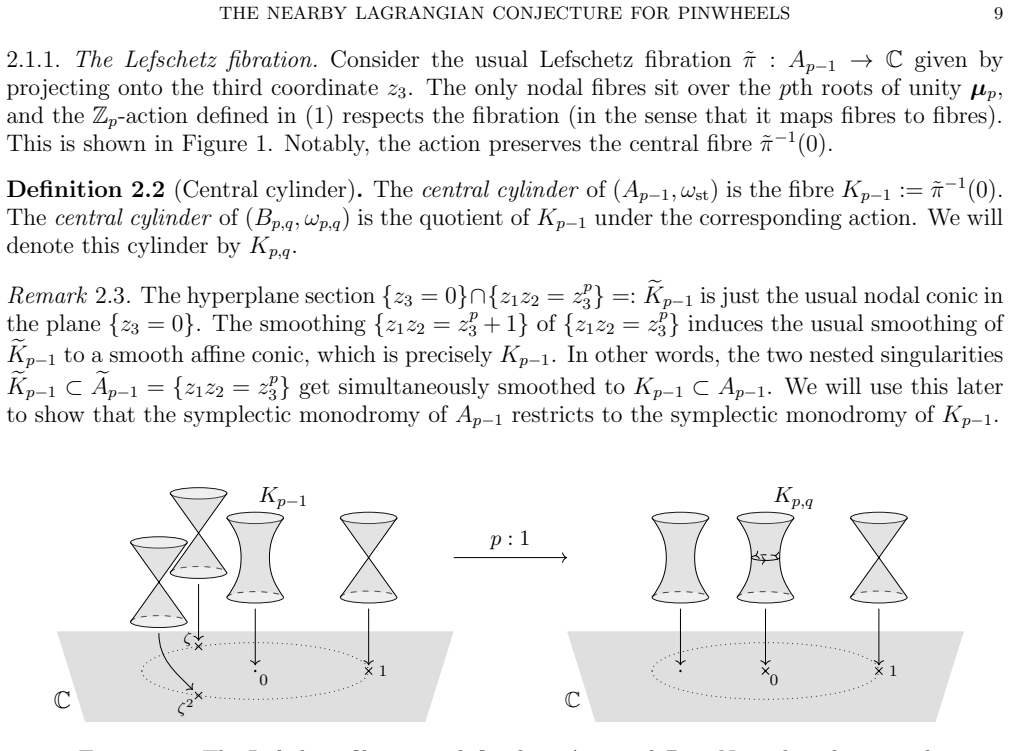
Figure from the paper full image
abstract click to expand
The Lagrangian skeleton of the rational homology ball $B_{p,q}$, for $0<q<p$ coprime integers, is an immersed but not embedded Lagrangian, called a $(p,q)$-pinwheel. We show that any two embeddings of Lagrangian $(p,q)$-pinwheels in $B_{p,q}$ are related by a compactly supported Hamiltonian isotopy, establishing Arnold's nearby Lagrangian conjecture for this wide class of singular Lagrangians. Our proof has two largely independent parts: the first uses neck-stretching and the symplectic rational blow-up to understand embeddings of pinwheels up to symplectomorphism; the second computes that $\text{Symp}_c(B_{p,q})$ is generated by a twist about the pinwheel, which we call the pintwist $\tau_{p,q}$. We provide three applications of our methods: Gromov non-squeezing for pin-balls; a new proof of the local Lagrangian unknotting theorem of Eliashberg--Polterovich; and that the only Lagrangian $(n,m)$-pinwheel in $B_{p,q}$ is of type $(p,q)$.
0
Top Pith
5
math.GT 2026-05-14 2 theorems

Brieskorn spheres block rational homology ball fillings

by Antonio Alfieri, Alberto Cavallo +1 more

Brieskorn spheres and rational homology ball symplectic fillings

Correction-term and torsion obstructions rule out such fillings for all n=3 cases and most higher-n cases, confirming Gompf conjectures.

Figure from the paper full image
abstract click to expand
Given a canonically oriented Brieskorn sphere $Y=\Sigma(a_1,...,a_n)$, we confirm some statements conjectured by Gompf. More specifically, we obstruct the existence of rational homology ball symplectic fillings for any contact structure on $-Y$ if $n=3$, and when there is no half convex Giroux torsion for $n>3$. Furthermore, we show that the same result holds for the Milnor fillable structure on $Y$ with the possible exception of $\Sigma(3,4,5),$ $\Sigma(2,5,7)$ and $\Sigma(2,3,6k+1)$ for $k\geq1$. Along the way, we determine every canonically oriented Brieskorn sphere with vanishing correction term carrying at most two fillable structures, up to isotopy.
2 0
0
math.GT 2026-07-03

Cusp singularity links admit infinitely many distinct minimal symplectic fillings

by Naohiko Kasuya, Takahiro Oba

Every cusp singularity link admits infinitely many strong symplectic fillings

The result covers cusp, exceptional unimodal, and hyperbolic Brieskorn cases, with fillings pairwise non-diffeomorphic and inequivalent unde

abstract click to expand
In this paper, we show that if the link of an isolated complex surface singularity is either a $Sol^3$-manifold or an $\widetilde{SL}(2;\mathbb{R})$-manifold with its canonical contact structure, then it admits infinitely many strong symplectic fillings that are pairwise non-diffeomorphic and not related by a sequence of blow-ups or blow-downs. As a consequence, the link of any cusp singularity, exceptional unimodal singularity, or hyperbolic Brieskorn singularity admits infinitely many pairwise non-diffeomorphic minimal strong symplectic fillings.
0
0
math.SG 2026-07-03

Kuranishi chart categories satisfy higher cocycle conditions automatically

by Taesu Kim

Kuranishi chart categories and higher cocycle conditions

A homotopy-theoretic property ensures the condition holds, relaxing rigid requirements in Kuranishi spaces.

abstract click to expand
Given an $L_\infty$-Kuranishi space introduced in \cite{Kim1}, we propose a notion called the Kuranishi chart category. Using the nerve of this category, together with a choice of atlas and a simplicial description of the covering of the underlying topological space, we formulate a higher homotopical version of the bundle-component cocycle condition. We show that this condition is always satisfied, by virtue of a property of the higher homotopy theory of $L_\infty[1]$-morphisms developed in \cite{Kim2}, concerning quasi-isomorphisms. As a consequence, the rigid cocycle condition of Fukaya-Oh-Ohta-Ono Kuranishi spaces is replaced by more flexible, homotopy-theoretic compatibility.
0
0
math.AT 2026-07-02

Unit sheaf endomorphisms recover the E∞-Thom spectrum

by Kenneth Blakey, Liam Keenan

A homotopy coherent Pontryagin-Thom isomorphism

This supplies an E∞-ring lift of the Pontryagin-Thom isomorphism between geometric cobordism cohomology and the associated Thom spectrum.

abstract click to expand
Classically, the Pontryagin-Thom isomorphism asserts that the multiplicative cohomology theory given by (structured) geometric cobordism is isomorphic to the cohomology theory determined by an associated Thom spectrum. We construct a presentably symmetric monoidal stable $\infty$-category of homotopy invariant sheaves with transfers on smooth manifolds whose unit is precisely (structured) geometric cobordism. We show the endomorphism ring of the unit sheaf can be canonically identified with the associated $\mathbb{E}_\infty$-Thom ring spectrum, i.e., we provide an $\mathbb{E}_\infty$-lift of the Pontryagin-Thom isomorphism.
0
0
math.SG 2026-07-02

L∞-Kuranishi spaces form category embedding smooth manifolds

by Taesu Kim

Categorical structures of Kuranishi spaces with L_(infty)[1]-algebras

Replacing tangent-bundle conditions with quasi-isomorphisms of L∞[1]-structures yields the categorical structure.

abstract click to expand
We introduce $L_{\infty}$-Kuranishi spaces by associating, to each chart, $L_{\infty}[1]$-algebras defined on open neighborhoods of points in the zero locus of the Kuranishi section. We show that these objects collectively form a category into which the category of smooth manifolds naturally embeds. Some notions in \cite{FOOO1} are modified to achieve the desired categorical structures; for instance, the tangent bundle condition for chart embeddings is replaced by a quasi-isomorphism condition for the $L_{\infty}[1]$-structures.
0
0
math.SG 2026-07-02

Homology gives sharp lower bound on closed Reeb orbits

by Miguel Abreu, Leonardo Macarini

Multiplicity of closed Reeb orbits on contact manifolds with periodic equivariant symplectic homology

On manifolds with periodic positive equivariant symplectic homology, the minimal count r_M is reached exactly when the form is lacunary.

abstract click to expand
We consider closed contact manifolds $(M,\xi)$ with periodic positive equivariant symplectic homology. This is a very large class of contact manifolds and, to the best of our knowledge, includes all currently known examples admitting Reeb flows with finitely many closed orbits for which equivariant symplectic homology is a well-defined invariant. Under weak and homologically natural index assumptions on a non-degenerate contact form $\alpha$ on $M$, we establish a sharp lower bound $r_M$ for the number of simple closed Reeb orbits of $\alpha$. Moreover, we show that this bound is attained if and only if $\alpha$ is lacunary, i.e., the Conley-Zehnder indices of all closed orbits have the same parity. The bound $r_M$ admits a clean dynamical characterization: whenever a non-degenerate lacunary contact form exists on $M$, $r_M$ equals the number of its simple closed Reeb orbits and is therefore independent of the choice of such a form. In particular, in the lacunary case $r_M$ is a contact invariant completely determined by the positive equivariant symplectic homology. We compute $r_M$ for a broad class of examples, including several prequantizations of symplectic orbifolds, and show that in this case $r_M = \dim H_*(M/S^1;\mathbb{Q})$, thereby giving a topological characterization of this invariant. Motivated by these results, we conjecture that any contact form with finitely many closed Reeb orbits is necessarily non-degenerate and lacunary, and that the underlying contact manifold is a prequantization of this type.
0
0
math.DG 2026-07-02

Madelung map defines prequantum bundles for fluid group orbits

by Boris Khesin, Klas Modin

Madelung hydrodynamics and Poisson geometry of wave functions

The transform acts as a momentum map that links generic wave functions to coadjoint orbits on any oriented manifold and yields an infinite-d

Figure from the paper full image
abstract click to expand
We describe the Poisson geometry of the Madelung transform between quantum mechanics and hydrodynamics for generic wave functions. We prove that for arbitrary oriented manifolds this transform, being regarded as a momentum map, naturally defines prequantum bundles for coadjoint orbits of semidirect extensions of diffeomorphism groups. Furthermore, we show that the Madelung framework provides a natural infinite-dimensional version of the convexity results for Hamiltonian torus actions, thus giving a partial answer to Atiyah's question. In particular, for wave functions without zeros our results provide a K\"ahler map between the infinite-dimensional Fubini--Study and Fisher--Rao geometries, thus extending previous results to non-simply-connected manifolds. Furthermore, for wave functions with noncritical zeros, the Madelung transform is shown to be a symplectomorphism to the coadjoint orbits with Morse--Bott densities. The latter, in turn, furnishes a novel momentum map point of view on the Wallstrom quantization condition for the hydrodynamical form of quantum mechanics. We also comment on the relation between the Madelung setting and the Marsden--Weinstein symplectic structures on knots and membranes.
0
0
math.SG 2026-07-02

k-colorable skeleton reduces to one-skeleton in tall T-spaces

by Yichen Liu

Tall Complexity One Spaces with k-colorable Skeleton

When partitioned into subsets with injective orbital moment maps, full non-generic orbit data is determined by low-dimensional orbits.

abstract click to expand
Tall complexity one $T$-spaces are Hamiltonian $T$-spaces $(M,\omega,\Phi)$ such that $\frac{1}{2}\dim M -\dim T=1$ and the symplectic quotient at each moment value is a surface. The skeleton of a complexity one $T$-space is an important invariant in the classification and encodes the information about non-generic orbits. In this paper, we study properties of the skeleton of a compact, connected tall complexity one $T$-spaces. We prove that when the skeleton is $k$-colorable, i.e., when it can be partitioned into $k$ closed and open subsets such that the orbital moment map is injective on each of them, its information can be recovered by the one-skeleton (the set of non-generic orbits whose dimension is at most one). We also prove that for any cloesd and open subset of the skeleton on which the orbital moment map is injective, one can construct a symplectic toric $(T\times S^1)$-manifold whose underlying complexity one $T$-space has the skeleton isomorphic to this subset.
0
0
math.RT 2026-07-01

Fukaya category uniquely deforms NilHecke algebra under Z2 grading

by Jasper van de Kreeke

Fukaya categories of Coulomb branches as unique deformations

Removing the matter divisor from horizontal Hilbert schemes reduces their Fukaya category to the single Z^2-graded deformation of the NilHec

Figure from the paper full image
abstract click to expand
The symplectic geometry of Coulomb branches is complicated and it is particularly difficult to determine their Fukaya categories. Relative Fukaya categories present an approach to circumvent these difficulties by first computing the Fukaya category of the complement of a divisor and then solving a deformation problem. In this paper, we apply this approach to the specific case of horizontal Hilbert schemes by removing their matter divisor and narrowing down the set of possible deformations through an additional $ \mathbb{Z}^2 $-grading. We utilize an existing description of the Fukaya category after removal of the matter divisor, in particular we use a specific generating Lagrangian and the identification between its endomorphism algebra and the NilHecke algebra. The core of this paper consists of solving the deformation problem, after which we recover the result of Aganagic et al.
0
0
math-ph 2026-07-01

Quantum Stokes matrices quantize Riemann-Hilbert-Birkhoff map

by Xiaomeng Xu

Quantum Stokes matrices and quantum Riemann-Hilbert-Birkhoff maps

Exchange relations turn them into an associative algebra homomorphism for systems with poles of order p+1.

Figure from the paper full image
abstract click to expand
In this paper, we introduce quantum Stokes matrices for a noncommutative version of meromorphic linear systems of ordinary differential equations with a pole of order $p+1$. We prove that these quantum Stokes matrices satisfy natural quantum exchange relations. These relations allow us to interpret the quantum Stokes matrices as an associative algebra homomorphism, which may be viewed as a deformation quantization of the Riemann-Hilbert-Birkhoff map, regarded as a Poisson map, for meromorphic connections with a pole of order $p+1$.
0
0
math.SG 2026-07-01

Z_d-equivariant Rabinowitz Floer homology matches quantum homology of base

by Hanwool Bae, Jungsoo Kang +1 more

Rabinowitz Floer homology for Legendrian submanifolds in prequantization bundles

The isomorphism computes quantum rings for spheres in quadrics and flag manifolds and yields vanishing and filling obstructions.

Figure from the paper full image
abstract click to expand
Let $Y$ be a prequantization bundle over an integral symplectic manifold $(\Sigma,\omega)$. Let $L$ be a closed monotone Lagrangian submanifold that admits a Legendrian lift $\mathcal{L}$ in $Y$. Under the assumption that the minimal Maslov number $N_L$ of $L$ is greater than 2, we define the Rabinowitz Floer homology of $\mathcal{L}$. We then establish an isomorphism between the $\mathbb{Z}_d$-equivariant Rabinowitz Floer homology of $\mathcal{L}$ and the quantum homology of $L$, where $d$ is the degree of the covering map $\mathcal{L}\to L$. Under a more restrictive condition on $N_L$, we show that this map is a ring isomorphism. Using this isomorphism, we compute the quantum homology ring of Lagrangian spheres in quadrics and two-step flag manifolds. Furthermore, we investigate the implications of the quantum invertibility of $\omega$ for the vanishing of the quantum homology of $L$ and the obstructions to topologically simple fillings of $\mathcal{L}$. We also show that if $(\Sigma,\omega)$ admits a polarization and $L$ is disjoint from the Lagrangian trace, the quantum homology of $L$ vanishes.
0
0
math-ph 2026-06-30

Homotopies from RG flow and gauge changes link BV actions with same effective physics

by Branislav Jurčo, Ján Pulmann +1 more

Homotopies in Batalin-Vilkovisky Formalism

Field redefinitions induced by these homotopies build spans of master actions whose extracted effective actions are isomorphic.

abstract click to expand
We review the notion of homotopy of quantum master actions in geometric Batalin-Vilkovisky formalism. Then we construct new examples of such homotopies, coming from renormalization group flow and non-infinitesimal changes of gauge fixing. Finally, we use the field redefinitions given by these homotopies to construct spans of quantum master actions with isomorphic effective actions.
0
0
math.SG 2026-06-29

3D left-invariant affine connections fully classified

by T. Aït Aissa, S. El Bourkadi +1 more

Three-Dimensional Real Affine Lie Groups

Decomposition into 2D plus 1D parts reduces the problem, quadratic solutions give all isomorphism classes and their properties.

abstract click to expand
We classify all left-invariant real affine connections in dimension three. Our approach reduces the three-dimensional problem to a two-dimensional one by decomposing each left-invariant affine connection into a two-dimensional part and an additional one-dimensional component. After characterizing all possible two-dimensional left-invariant affine connections, we return to the three-dimensional setting to obtain a simplified description of all three-dimensional left-invariant affine connections. We then explicitly solve the resulting simplified quadratic equations and perform a refined analysis up to isomorphism, leading to a complete classification. Furthermore, we determine several geometric and algebraic properties of these structures, including the Novikov, associative, radiant, and bi-symmetric conditions, as well as geodesic completeness.
0
0
math.AT 2026-06-29

Model extends A_infty homotopies to L_infty[1] with simplex filling

by Taesu Kim

Homotopy models for L_(infty)[1]-algebras in higher degrees

The framework proves that simplices whose vertices are quasi-isomorphisms admit fillings, supplying higher homotopies for L_infty[1]-morphis

abstract click to expand
We propose a model of higher homotopy theory of $L_{\infty}[1]$-morphisms as a natural generalization of the $A_{\infty}$-homotopies defined by Fukaya-Oh-Ohta-Ono \cite{FOOO1}. Within this framework, we show that a filling condition holds for simplices whose vertices are assigned quasi-isomorphisms.
2 0
0
math.SG 2026-06-29

Fixed dim and Euler char limit cobordism classes of GKM3 spaces

by Panagiotis Konstantis, Silvia Sabatini +1 more

Finiteness and boundedness of positive monotone Hamiltonian GKM₃ spaces

Moment images fit in bounded boxes and Chern numbers are controlled, giving volume bounds.

Figure from the paper full image
abstract click to expand
In this paper, we establish three finiteness and boundedness theorems for compact positive monotone symplectic manifolds endowed with special actions, called GKM$_3$, which generalize smooth toric varieties. Specifically, we prove that, for fixed dimension and Euler characteristic, there are only finitely many complex cobordism classes of such spaces. Moreover, modulo lattice transformations, the moment map image can be embedded into a box of explicitly bounded size, and all Chern numbers satisfy quantitative bounds. In particular, this yields a bound on the volume of the underlying symplectic manifold, analogous to the one obtained by Koll\'{a}r-Miyaoka-Mori for Fano varieties.
0
0
math.DG 2026-06-29

Lagrangian flow converges to special spheres but curvature blows up

by Ping-Hung Lee, Chung-Jun Tsai

Infinite-Time Singularities with Vanishing Mean Curvature for Lagrangian Mean Curvature Flow in Gibbons--Hawking Spaces

Mean curvature vanishes uniformly while log of max second fundamental form grows like sqrt(t) in Gibbons-Hawking spaces

abstract click to expand
We construct infinite-time singularities with vanishing mean curvature for Lagrangian mean curvature flow in Gibbons--Hawking spaces. We consider circle-invariant Lagrangian $2$-spheres whose quotient curves are concave and are $C^2$-close to a collection of consecutive collinear segments. We prove that the corresponding flow exists smoothly for all time and converges to the associated $A_{n-1}$-chain of special Lagrangian spheres. Although the mean curvature converges uniformly to zero, the second fundamental form becomes unbounded. More precisely, $\log\max |A(\,\cdot\,,t)|$ is comparable to $\sqrt{t}$ as $t\to\infty$. The proof is based on a one-parameter family of barrier curves and a detailed analysis of their asymptotics. In this way, we refine the infinite-time convergence picture arising in the work of Lotay and Oliveira by proving curvature blow-up and estimating its rate in this semi-stable case.
0
0
math.SG 2026-06-29

Infinite ECH capacities obstruct Anosov flows in four dimensions

by Gabriel Beiner

Infinite ECH Capacities and Anosov Flows

Cotangent disk bundles over genus-at-least-two surfaces cannot carry Reeb or Hamiltonian Anosov flows, settling Herman's 1998 question in 4D

Figure from the paper full image
abstract click to expand
This article relates the theory of embedded contact homology (ECH) with the dynamics of Anosov flows. We show that in many cases the ECH capacities of a symplectic 4-manifold are infinite, including cotangent disk bundles over closed oriented surfaces of genus at least two. We prove that ECH obstructs Reeb Anosov and Hamiltonian Anosov flows, addressing the four-dimensional case of a question posed by Herman in 1998. Further, we obtain Floer-theoretic obstructions to a 3-manifold admitting any Anosov flow. As an application, we give new constraints on the existence of embedded Lagrangians of genus at least two in symplectic 4-manifolds. In an appendix, some related results in all dimensions are proved for capacities constructed from rational symplectic field theory.
0
0
math.SG 2026-06-29

Contact structure encodes dissipation in dynamics

by Javier Pérez Álvarez

Some geometric perspectives on Contact Hamiltonian Dynamics

The symplectic cover relates contact manifolds to symplectic ones so the Reeb vector field captures non-conservative effects and extends cla

abstract click to expand
This article presents a unified overview of contact Hamiltonian geometry as a natural framework for the description of dissipative and non-conservative systems. Starting from the symplectic cover of a contact manifold, we clarify the structural relation between contact and symplectic dynamics and show how dissipation is geometrically encoded through the contact structure and the Reeb vector field. Following the introduction, which provides a guided overview of the subject through key references, a dedicated section illustrates the scope of the theory through applications ranging from thermodynamics, statistical mechanics, and integrable and KAM systems to field theories, quantum and Lie systems, optimal control, control theory, and economic models, where dissipation, constraints, and optimization play a central role. The subsequent sections review and adapt classical constructions of geometric mechanics, such as integrability, Hamilton--Jacobi theory, symmetries, and reduction, to the contact setting. Particular emphasis is placed on recent developments in contact reduction, Dirac structures, and constrained systems. The article also surveys emerging approaches to the geometric quantization of contact manifolds and discusses how ideas from generalized geometry provide a unifying perspective for symplectic, contact, and related frameworks.
0
0
math.SG 2026-06-29

Stronger Steenrod link sharpens quantum connection singularity

by Dan Pomerleano, Paul Seidel

The quantum connection and its mod p reduction

Refined comparison of mod p approaches yields precise data at infinity for monotone symplectic manifolds.

abstract click to expand
Recent progress on the structure of the quantum connection for monotone symplectic manifolds has used two approaches, which share the common feature of reducing to mod $p$ coefficients. We refine and compare those approaches. In particular, we establish a relation with quantum Steenrod operations which is stronger than that in Chen's work, leading to more precise information about the singularity at $\infty$ of the quantum connection. For the version of the connection relative to a smooth anticanonical divisor, we draw attention to the implications of the categorical mod $p$ Fontaine-Laffaille structure established by Petrov-Vaintrob-Vologodsky.
0
0
math.SG 2026-06-29

Perturbation theorem yields compact smooth manifolds from Fredholm zeros

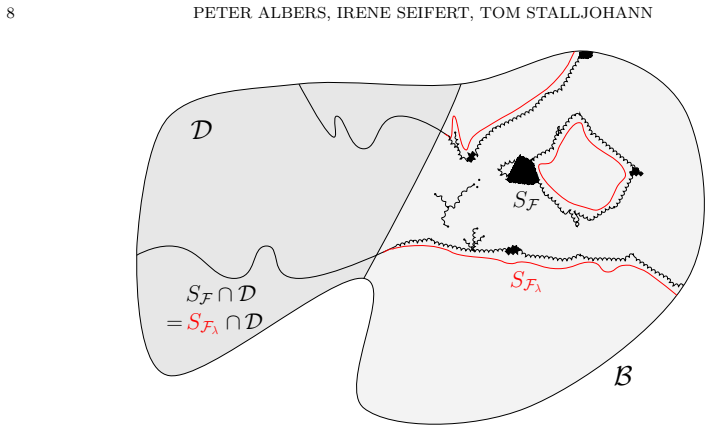
by Peter Albers, Irene Seifert +1 more

An Abstract Perturbation Theorem for Compact Moduli Spaces

Nearby perturbed manifold stays compact and fixed on already transverse parts, enabling cobordism arguments in symplectic geometry.

Figure from the paper full image
abstract click to expand
Given a compact zero set of a Fredholm section, our theorem guarantees the existence of a perturbed compact smooth manifold nearby, leaving the original zero set unaltered wherever transversality is already achieved. Such abstract perturbations allow for typical cobordism arguments. We illustrate this by re-proving a well-known theorem of Schwarz asserting the existence of critical points of the Hamiltonian action functional of different action values on symplectically aspherical manifolds.
0
0
math.DG 2026-06-26

Fixed Lie algebroid yields relative Godbillon-Vey classes

by Shuhei Yonehara

Godbillon-Vey classes of Lie subalgebroids

The construction extends the secondary class to subalgebroids without extra regularity assumptions.

abstract click to expand
The Godbillon-Vey class is a secondary characteristic class which is defined for regular foliations and have been studied extensively. On the other hand, extending the Godbillon-Vey class to singular foliations is difficult, and a complete result has not yet been obtained. In this paper, we address this problem by focusing on a geometric object called a Lie algebroid on a manifold. More precisely, we fix a Lie algebroid and relatively define the Godbillon-Vey class for its Lie subalgebroids, and study their properties. We also present several examples.
0
0
math.DG 2026-06-26

Nontrivial homotopy classes force periodic geodesics on half-Lie groups

by Martin Bauer, Levin Maier

On Periodic Geodesics of Half-Lie Groups

Results extend the classical finite-dimensional existence theorems to Hilbert half-Lie groups with strong right-invariant metrics.

abstract click to expand
A central program in infinite-dimensional Riemannian geometry is to understand which classical finite-dimensional principles remain valid beyond finite dimensions. In this article, we study the existence of periodic geodesics on Hilbert half-Lie groups equipped with strong right-invariant Riemannian metrics. Building on recently established completeness results for this class of infinite-dimensional manifolds, we prove that every nontrivial free homotopy class contains a periodic geodesic whenever the fundamental group is nontrivial. We further establish a Lyusternik-Fet type theorem in this setting. Assuming a Palais-Smale condition modulo right translations and the existence of a nontrivial higher homotopy group, we prove the existence of a nonconstant contractible periodic geodesic. Thus, as in the finite-dimensional setting, both first and higher homotopy information continue to force the existence of periodic geodesics in infinite dimensions. In addition, we describe a reduction principle based on compact finite-dimensional totally geodesic submanifolds and apply our results to groups of Sobolev diffeomorphisms equipped with right-invariant Sobolev metrics.
0
0
math.SG 2026-06-26

C^3 has uncountably many complex contact structures

by Ali M. Elgindi

New constructions relating Real and Complex Contact Structure

Wedge construction from transverse real contacts on embedded 3-manifolds produces them, with dual hedge extraction.

abstract click to expand
We establish new connections between real and complex contact geometry via embeddings of 3-manifolds into $\C^3$. We introduce a new \emph{contact wedge} construction combining two transverse real contact structures to make a new \emph{complex contact} structure, subject to obstructions measured by the Nijenhuis tensor and Dolbeault cohomology. Dually, we form a \emph{hedge} construction which extracts real contact structures from complex ones. Applying these tools, we prove that $\C^3$ admits uncountably many complex contact structures.
0
0
math-ph 2026-06-24

Symmetry reduces even Painlevé IV hierarchy to Flaschka-Newell Painlevé II

by Mohamad Alameddine, Olivier Marchal

A symmetry reduction of the Painlev\'{e} IV hierarchy to the Flaschka-Newell Painlev\'{e} II hierarchy

The map Ψ(−λ)=σ₁Ψ(λ)σ₁ cuts the isomonodromic problem to an invariant submanifold whose dynamics and Hamiltonians match the target hierarchy

abstract click to expand
We study the isomonodromic deformation problem associated with rank-two meromorphic connections on the Riemann sphere having one regular singularity and one irregular singularity of even order at infinity, corresponding to the even Painlev\'{e} IV hierarchy. We show that the symmetry $\Psi(-\lambda)= \sigma_1 \Psi(\lambda) \sigma_1$ defines an invariant submanifold whose induced isomonodromic dynamics coincides with the Flaschka-Newell Painlev\'{e} II hierarchy. Under this identification, the corresponding Lax matrices, Darboux coordinates and Hamiltonian structures can be matched explicitly. In particular, the Hamiltonians of the first members of the Flaschka-Newell hierarchy are recovered from the even Painlev\'{e} IV hierarchy. This provides a geometric interpretation of the Flaschka-Newell hierarchy as a symmetry reduction of an isomonodromic deformation problem, complementing its classical description as a similarity reduction of the modified Korteweg-de Vries hierarchy.
0
0
math.DG 2026-06-24

Off-diagonal expansion holds for indicator-symbol Toeplitz kernels

by Razvan Apredoaei

Asymptotics for Toeplitz operators with symbol an indicator function

This allows extending trace asymptotics of polynomials and Weyl laws to non-compact symplectic manifolds of bounded geometry.

abstract click to expand
We prove an off-diagonal expansion of the kernel of the Toeplitz operator whose symbol is the indicator function of a compact domain with smooth boundary in a complete symplectic manifold of bounded geometry. Using our approach, we extend two results to the non-compact setting: the first concerns the asymptotics of the trace of polynomials in this operator, and the second establishes a Weyl law for this Toeplitz operator.
0
0
math.SG 2026-06-24

Biquadratic equations compute all 4D p-adic normal forms

by Luis Crespo, Álvaro Pelayo

p-adic integrable systems: from biquadratic equations to local models

Solving these equations yields local models for every integrable system in dimension 4 and applies directly to angular-momentum examples.

Figure from the paper full image
abstract click to expand
Let $p$ be a prime number and $n$ a positive integer. The study of normal forms of $p$-adic analytic integrable systems $F=(f_1,\ldots,f_n):(M,\omega)\to(\mathbb{Q}_p)^n$ is essential to understand their geometrical and dynamical properties. Even though in some cases, such as dimension $4$, there is a classification of the local normal forms, it can be a challenge to determine them explicitly. Our goal in this paper is to introduce techniques to compute information about these local normal forms. We then explain how this is useful for instance to study the $p$-coupled angular momentum. The techniques we introduce cover all cases in dimension $4$ and require solving biquadratic equations. Along the way we define two new notions: almost eigenvectors and aligned symplectic coordinates. They are useful to prove our results but also of independent interest. The proofs use our previous classification of normal forms and rely on a combination of analytic estimates and Galois theory of $p$-adic extension fields. However, the statements of the main results are essentially self-contained and do not require prior knowledge of $p$-adic integrable systems or $p$-adic symplectic geometry.
0
0
math.SG 2026-06-24

Mirror isomorphism equates brane endomorphism algebras on A_n resolutions

by Yat-Hin Suen, Yutung Yau

Brane quantization of A_n-resolutions

Wall-crossing glues quantum tori to show Hom spaces match between A-brane and B-brane sides for each level k.

Figure from the paper full image
abstract click to expand
We extend the study of brane quantization via SYZ mirror symmetry to the setting of singular fibers, building on recent joint work with Chan, Leung, and Li in the semi-flat case. We consider a crepant resolution $X\to\mathbb{C}^2/\mathbb{Z}_{n+1}$ of the $A_n$-singularity, whose mirror $\check{X}$ is also realized as a resolution of $\mathbb{C}^2/\mathbb{Z}_{n+1}$. For each level $k\in\mathbb{Z}_{>0}$, we construct a space filling coisotropic A-brane $\mathcal{B}_{cc}^{(k)}$ of $(X,k\omega)$ and determine its mirror B-brane $\check{\mathcal{B}}_{cc}^{(k)}$ via fiberwise geometric quantization. We then define the endomorphism algebra $Hom_A(\mathcal{B}_{cc}^{(k)},\mathcal{B}_{cc}^{(k)})$ by gluing analytic quantum tori using wall-crossing formulas and establish a mirror isomorphism $Hom_A(\mathcal{B}_{cc}^{(k)},\mathcal{B}_{cc}^{(k)})\cong Hom_B(\check{\mathcal{B}}_{cc}^{(k)},\check{\mathcal{B}}_{cc}^{(k)})$.
0
0
math.SG 2026-06-23

Non-Kähler manifold mixes HLC and non-HLC symplectic forms in one component

by Richard Hind, Adriano Tomassini

Symplectic non-K\"ahler manifolds with and without the Hard Lefschetz Condition

After blowup along tori the condition holds for all nonzero parameters but fails at the central value.

abstract click to expand
In this paper we construct compact manifolds without K\"ahler structures that admit both a symplectic form satisfying the Hard Lefschetz Condition (HLC) and another symplectic form that does not. Our construction builds upon the orbifold introduced by Fern\'andez and Mu\~noz and its symplectic resolution studied by Cavalcanti, Fern\'andez, and Mu\~noz. By considering a one-parameter family of symplectic forms on the orbifold, we show that the corresponding resolved manifolds fail to satisfy the HLC for all parameters. However, after performing a suitable symplectic blowup along a union of tori, we obtain a family of symplectic manifolds for which the HLC holds for all non-zero parameters but fails at the central parameter. As a consequence, we exhibit a smooth manifold with no K\"ahler structure whose space of symplectic forms contains both HLC and non-HLC structures in the same connected component. This provides new examples of the subtle interplay between symplectic topology and the Hard Lefschetz property.
0
0
math-ph 2026-06-23

BV formalism captured by quantum odd symplectic category

by Pavol Ševera

Forms, half-densities, and the quantum odd symplectic category in the BV formalism

Review shows how forms and half-densities become the data of the odd quantization functor.

abstract click to expand
This note is a detailed review of the geometry behind the Batalin-Vilkovisky formalism and how it fits into the framework of the quantum odd symplectic category and the odd quantization functor.
0
0
math.SG 2026-06-23

Strong Arnold chord conjecture holds for convex domains in R^4

by Dylan Cant

The strong Arnol'd chord conjecture for the boundary of a uniformly convex domain in mathbb{R}⁴

A general length bound for chords of E3 Legendrians on Liouville boundaries, using capacity growth and ellipsoid embeddings, establishes the

Figure from the paper full image
abstract click to expand
Following the idea of Jungsoo Kang and Jun Zhang, we prove the strong Arnol'd chord conjecture for the boundary of a uniformly convex domain in $\mathbb{R}^{4}$, using an ellipsoid embedding construction due to Oliver Edtmair. We prove a general structural result for Legendrians $L$ which are eventually equivariantly essential (E3), in the sense that the $k$th Gutt-Hutchings capacity $c_{k}(D^{*}TL)$ is infinite for $k$ large enough. We show that any E3 Legendrian in the boundary of a Liouville domain $\Omega$ bounds a chord of length at most $\liminf c_{k}(\Omega)/k$.
0
0
math.SG 2026-06-22

S1-central extensions deform cotangent groupoids by reduction

by Dadi Ni, Kaichuan Qi

Affine deformations of cotangent groupoids

The reduced symplectic form is multiplicative magnetic and yields nontrivial deformations of stacks and gerbes in the Kac-Moody case.

abstract click to expand
We study affine deformations of the cotangent groupoid $T^*\mathcal{G} \rightrightarrows A^*$, governed by a one-form $\gamma\in\Omega^1(\mathcal G^{(2)})$, and characterize the conditions on $\gamma$ under which this construction is valid. We show that these deformations arise naturally from $\mathbb{S}^1$-central extensions of Lie groupoids via symplectic reduction, and identify the reduced symplectic form as a multiplicative magnetic form. In particular, for Kac-Moody extensions, this construction yields nontrivial deformations of quotient stacks and $\mathbb{S}^1$-gerbes.
0
0
math.SG 2026-06-22

Shifted symplectic structures lift through fibrations on derived stacks

by Mehmet F{i}rat Ar{i}kan, Kadri İlker Berktav +1 more

Shifted Symplectic Fibrations and Derived Thurston Theorem

When the base has a shifted symplectic structure, the total space inherits a compatible one via the fibration data.

abstract click to expand
In classical symplectic geometry, under mild conditions, Thurston proved that one can construct a compatible symplectic form on the total space of a symplectic fibration with a connected symplectic base. Here we prove a derived symplectic analog of this result. More precisely, we show that if a morphism $\pi: X \rightarrow S$ of derived stacks has a shifted symplectic fibration structure and the target stack $S$ admits a shifted symplectic structure, then, under certain conditions, one can construct a shifted symplectic structure on the source stack $X$, compatible with $\pi$ in a sense similar to the classical case. In this derived context, an affine model construction for shifted symplectic fibrations is also developed. Along the way, we present numerous examples of shifted symplectic fibrations and provide applications of the derived Thurston theorem.
0
0
math.DS 2026-06-19

Coarsely minimal Reeb flows rigidify to negative curvature geodesics

by Barney Bramham, Jacobus S. de Pooter

Rigidity of coarsely minimal Reeb flows

Flows meeting the new definition plus a divergence condition become orbitally equivalent to geodesic flows on negatively curved manifolds, e

abstract click to expand
We introduce the notion of a coarsely minimal Reeb flow, generalizing the notion of minimal geodesic flow, and prove the following rigidity theorem: That a coarsely minimal Reeb flow satisfying a divergence property is orbitally equivalent to the geodesic flow of a Riemannian metric of negative sectional curvature. Without the divergence assumption, we obtain an orbital semi-equivalence. This extends a rigidity result for geodesic flows of negatively curved Riemannian metrics which is due to Gromov. We use Floer homology and Morse's hyperbolic `stability' Lemma.
0
0
math.SG 2026-06-19

Fourier-Helgason transform is infinite-time limit of quantum geodesic transform

by Ana Cristina Ferreira, Joachim Hilgert +2 more

Fourier-Helgason transform as infinite geodesic time limit in geometric quantization

Lifting the geodesic flow on the cotangent bundle to a unitary parallel transport recovers the transform at infinite time, up to a c-functio

abstract click to expand
The Fourier-Helgason (FH) transform for a noncompact symmetric space $G/K$ establishes the direct integral decomposition of the unitary representation of $G$ on $L^2(G/K)$ into irreducible principal series representations. By applying techniques of geometric quantization to the symplectic manifold $T^*(G/K),$ Lisiecki in 1987 gave a geometric interpretation of the FH transform in the case when $G$ is complex. He defined for general $G$ a ''horizontal'' polarization on $T^*(G/K)$ and showed that, for complex $G$, the Blattner-Kostant-Sternberg (BKS) pairing between the Schr\"odinger vertical polarization Hilbert space, $L^2(G/K)$, and the Hilbert space of horizontally polarized functions coincides with the FH transform. However, in the same paper, Lisiecki showed that for noncomplex Lie groups the BKS pairing is nonequivalent to the FH transform and nonunitary in general. In the present paper, we resolve this discrepancy between the FH transform and geometric quantization in the case when $G$ is not complex. First, we show that the horizontal polarization is the infinite-time limit of the push-forward of the vertical polarization with respect to the geodesic flow for a $G$-invariant Riemannian metric. Then we lift the geodesic flow to an intertwining unitary parallel transport on the quantum bundle that we call quantum geodesic transform (QGT). Finally we show that the QGT has a well-defined limit, as the geodesic time goes to infinity, and that it is equal, up to the phase of the Harish-Chandra $c$-function and an irrelevant multiplicative constant, to the FH transform.
0
0
math.SG 2026-06-19

Toric domain Lagrangian capacity equals its diagonal

by Shah Faisal, Yin Li

Lagrangian capacity and chain level string topology

Equality holds in every dimension and settles the ellipsoid conjecture via equivariant chain-level string topology.

Figure from the paper full image
abstract click to expand
We derive upper bounds for the Lagrangian capacities of Liouville domains with finite Gutt--Hutchings capacities and show that the Lagrangian capacity of a convex or concave toric domain of arbitrary dimension equals its diagonal. In particular, this completely settles the conjecture of Cieliebak-Mohnke on the Lagrangian capacity of ellipsoids. Our proof is based on an $S^1$-equivariant variant of the techniques of Fukaya and Irie, and does not use holomorphic curves with local tangency constraints, which would inevitably cause transversality issues. Moreover, we show that any extremal Lagrangian torus in an $n$-dimensional ellipsoid must lie on the boundary. Applications of our results and techniques include new upper bounds on the Lagrangian width for aspherical Lagrangians in Liouville manifolds and the first computations of the Lagrangian capacities for many non-subcritical Weinstein domains in dimensions 4 and 6.
1 0
0
math.SG 2026-06-18

Persistent entropy equals barcode entropy for Hamiltonian maps

by Wenmin Gong

Persistent Entropy of Floer Persistence Barcodes

The linear growth rate of Shannon entropy on finite bar lengths matches the exponential count of long bars, yielding equal invariants on clo

abstract click to expand
Floer persistence barcodes provide a quantitative way to encode action-filtered Floer homology. Inspired by the Shannon entropy of persistence barcodes in topological data analysis, we introduce a Floer-theoretic entropy invariant, called \textit{persistent entropy}, which measures the asymptotic linear growth rate, under iteration, of the Shannon entropy determined by the distribution of finite bar lengths. This is complementary to the barcode entropy of \c{C}ineli--Ginzburg--G\"{u}rel, which records the exponential growth rate of the number of not-too-short bars. We prove that, for Hamiltonian diffeomorphisms, the relative and absolute persistent entropies coincide with the corresponding barcode entropies. For Liouville domains, we prove general comparison inequalities and a subexponential length-growth criterion which gives equality beyond the case of vanishing symplectic homology. We also compute the persistent entropy of cotangent disk bundles of negatively curved manifolds and relate it to the topological entropy of the geodesic flow. In addition, we prove Hofer-stability estimates for finite-level Shannon entropy and derive flexibility and rigidity-type questions for barcode and persistent entropies of Reeb flows.
0
0
math.SG 2026-06-16

Symplectic cohomology computed over Novikov ring for balls in CP^n

by Adi Dickstein, Yaniv Ganor

Relative symplectic cohomology in complex projective spaces

The groups yield new estimates on the energy needed to displace ball boundaries.

Figure from the paper full image
abstract click to expand
Relative symplectic cohomology is an invariant of compact subsets of a closed symplectic manifold, introduced by Varolgunes. There are many examples of computations of this invariant over the Novikov field, but the collection of computed examples over the Novikov ring is still quite limited. One reason for this is that such computations require determining the relevant Floer complexes for Hamiltonians that are not necessarily $C^2$-small Morse functions. In this work, we present a computation of relative symplectic cohomology over the Novikov ring for balls and their complements in $\mathbb{C}P^n$. Our computation relies on explicit descriptions of Floer complexes, in the Morse--Bott setting with cascades, for J-shaped Hamiltonians on $\mathbb{C}P^n$. This allows us to deduce new estimates for the stable displacement energy of the boundaries of balls in $\mathbb{C}P^n$.
0
0
math.SG 2026-06-12

One negative mean index orbit forces infinitely many Reeb orbits

by Erman Cineli, Viktor L. Ginzburg +1 more

Filtered Symplectic Homology and Closed Reeb Orbits

Non-degenerate flows on star-shaped domains cannot have only finitely many prime closed orbits once such an orbit appears.

abstract click to expand
We further explore connections between the symplectic homology persistence module and the properties of closed Reeb orbits for star-shaped domains in higher dimensions. Our first result is that the sequence of $S^1$-equivariant spectral invariants over a field of positive characteristic is bounded from above, in contrast with the case of characteristic zero. We also prove that the dimension of the filtered symplectic homology is bounded as a function of the action whenever the flow is a pseudo-rotation, i.e., it has finitely many prime closed orbits. Finally, we show that a non-degenerate Reeb flow has infinitely many prime closed orbits whenever it has one closed orbit with negative mean index.
0
0
math.SG 2026-06-12

Non-vanishing potential ensures Maslov-2 disks in every isotopy

by Hang Yuan

Existence of pseudo-holomorphic disks via non-archimedean disk potentials

A generalized non-archimedean disk potential proves existence of holomorphic disks for any isotopy and tame almost complex structure.

abstract click to expand
We show that if a graded monotone Lagrangian $L_0$ has a non-vanishing disk potential, then for every smooth isotopy $\{L_s\}_{s\in[0,1]}$ of Lagrangians starting from it and for every tame almost complex structure $J$, each $L_s$ bounds a $J$-holomorphic disk of Maslov index two. The main input is a non-archimedean analytic potential function, defined as an invariant up to analytic isomorphisms, generalizing the classical disk potential of a monotone Lagrangian. The techniques are inspired by recent developments in the Strominger-Yau-Zaslow mirror construction via family Floer theory and non-archimedean geometry. We also discuss applications such as recovering a simple case of Audin's conjecture.
0
0
math.SG 2026-06-12

Retrograde orbit bounds disk-like section below critical energy

by Lei Liu, Pedro A. S. Salomão

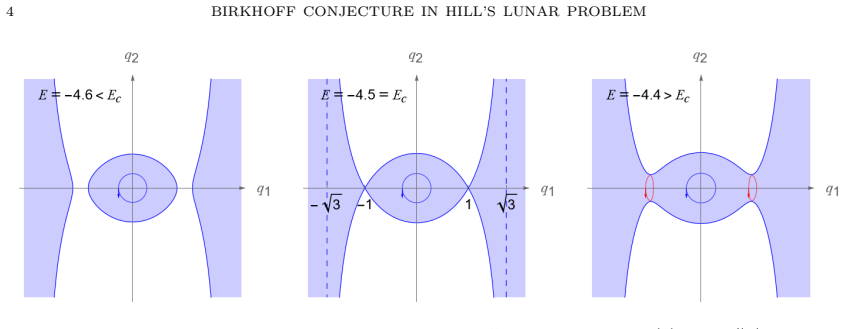
Birkhoff conjecture and finite energy foliations in Hill's lunar problem

This settles Birkhoff conjecture for Hill's lunar problem and produces infinitely many periodic orbits through foliations above the threshol

Figure from the paper full image
abstract click to expand
We prove Birkhoff's retrograde orbit conjecture in Hill's lunar problem by showing that the retrograde orbit bounds a disk-like global surface of section for every energy below the critical value. We also obtain a global description of the dynamics through the critical energy level by constructing finite energy foliations for energies slightly above it. The binding of these foliations consists of the retrograde orbit together with the Lyapunov orbits near the critical points. As a consequence, there exist infinitely many periodic orbits and infinitely many trajectories asymptotic to the Lyapunov orbits. The proof combines pseudo-holomorphic curve techniques with a new convexity theorem for Hill's lunar problem. More precisely, we construct an explicit global symplectic change of coordinates under which the bounded regularized component becomes strictly convex up to the critical energy level. This convexity implies strong dynamical consequences, including lower bounds for the Conley-Zehnder indices of periodic orbits, and allows the application of the Hofer-Wysocki-Zehnder theory of finite energy foliations. As a result, we obtain disk-like global surfaces of section below the critical level and $2-3-2$ foliations for energies slightly above it.
0
0
math.SG 2026-06-11

Mutations on toric diagrams realize all perfect classes for CP2 blowups

by Nicki Magill

Quadrilateral mutations and symplectic embeddings

A geometric-algebraic dictionary gives explicit sequences for every (p,q)-perfect class and new ellipsoid embeddings.

Figure from the paper full image
abstract click to expand
We study the relationship between almost toric base diagrams, perfect exceptional classes, and optimal ellipsoid embeddings for $H_b=\mathbb{CP}^2_1 \# \overline{\mathbb{CP}\!}\,{}^2_b$ and $P_b=S^2_1\times S^2_b$. Starting from a quadrilateral almost toric base diagram with one Delzant corner, we encode the three non-Delzant corners by a recursive triple. We show that every quadrilateral obtained via a well-defined sequence of mutations from the initial diagrams is encoded by a recursive triple in the same way. Moreover, geometric mutation of these diagrams corresponds to algebraic mutation of the associated triples. These algebraic mutations are the recursive operations used to generate the $(p,q)$-perfect classes for $H$. We apply this dictionary to realize every $(p,q)$-perfect class for $H$ by an explicit sequence of almost toric mutations for suitable values of $b$. We also prove the analogous realization result for triples of quasi-perfect classes for $P$, showing that these classes are in fact $(p,q)$-perfect. Finally, we apply these results to ellipsoid embedding problems, including visible embeddings, visible obstructions, and ATF-visible staircases.
0
0
math.CV 2026-06-11

Bundle data fixes symplectic leaves of Poisson three-folds

by Eric Boulter

Poisson three-folds constructed from co-Higgs bundles on Hopf surfaces

Classification of rank-2 co-Higgs bundles on Hopf surfaces yields explicit leaf descriptions for the associated three-folds.

abstract click to expand
This paper extends a previous work in which the rank-2 co-Higgs bundles on a Hopf surface are classified based on the data of the underlying vector bundle. The aim of the paper is to study the Poisson 3-folds that can be constructed from these co-Higgs bundles by describing their symplectic leaves.
0
0
math.SG 2026-06-11

Injective quantum cohomology map forces split generation of Fukaya category

by M. Abouzaid, K. Fukaya +3 more

Quantum cohomology and split generation in Lagrangian Floer theory

When the map to Hochschild cohomology is injective, every other Lagrangian with a weak bounding cochain is split-generated and homologies ma

Figure from the paper full image
abstract click to expand
Given a finite collection of Lagrangian submanifolds $\mathscr L$ in a compact symplectic manifold $X$, we construct a cyclic, filtered, strictly unital curved $A_{\infty}$ category $\mathcal L$ and develop Floer theory of closed-open maps and open-closed maps. Using them, we prove that, whenever the map from the quantum cohomology of $X$ to the Hochschild cohomology of the Fukaya category $\mathcal L$ with objects $\mathscr L$ is injective, the following consequences follow: (1) any other Lagrangian submanifold equipped with a weak bounding cochain lies in the category split-generated by $\mathscr L$, and (2) the Hochschild homology and cohomology of the Fukaya category are isomorphic to quantum cohomology. In the exact case a similar result was obtained in [Ab]. We also provide some applications.
0
0
math-ph 2026-06-10

Contact Tulczyjew morphism generates Herglotz equations on skew algebroids

by Leonardo Colombo, Manuel de León

Contact Tulczyjew Geometry for Continuous and Discrete Dissipative Dynamics on Skew Algebroids

Adding the Euler vector field term to the standard morphism produces implicit dissipative dynamics both continuously and discretely.

abstract click to expand
We develop a contact Tulczyjew formalism for dissipative dynamics on skew algebroids. Starting from the Tulczyjew morphism of an skew algebroid, we identify its contact extension in a local line-bundle trivialization. The local representative is obtained by adding to the ordinary Tulczyjew morphism the Euler vector field contribution on $E^*$. This gives an intrinsic explanation of the contact term appearing in the local contact Tulczyjew morphism. For a contact generating object, the construction produces an implicit dissipative dynamics on the contact phase side. In local coordinates, the matching condition gives the Euler-Lagrange-Herglotz equations on the skew algebroid. In the hyperregular case, the corresponding contact Hamiltonian equations are recovered by Legendre transformation. We also develop the discrete counterpart of the construction. After fixing a discrete admissibility relation, a discrete contact generating object defines a discrete contact Tulczyjew relation on the contact phase space. Discrete Herglotz extremals are obtained by matching consecutive contact momenta, with the usual conormal interpretation in the constrained case. In the regular tangent-bundle case, this recovers standard contact variational integrators, while in the singular or skew algebroid setting the same construction remains meaningful as an implicit discrete relation rather than an a priori update map.
0
0
math.SG 2026-06-09

Barcode entropy of symplectic cohomology bounded below by Reeb entropy

by Jonghyeon Ahn

A lower bound for relative symplectic cohomology barcode entropy

The exponential growth of long bars in SH_M(K) is at least the topological entropy of the Reeb flow on any hyperbolic invariant set.

abstract click to expand
In this paper, we continue to study the barcode entropy of relative symplectic cohomology $SH_M(K)$ of a Liouville domain $K$ embedded in a symplectic manifold $M$. This barcode entropy measures the exponential growth rate of the number of not-too-short bars in the persistence module $SH_M(K)$. We prove that this Floer-theoretic invariant admits a nontrivial lower bound in terms of the topological entropy of the Reeb flow on $\partial K$ when the Reeb flow possesses a hyperbolic invariant set. More precisely, we show that the barcode entropy of $SH_M(K)$ is bounded below by the topological entropy of the Reeb flow restricted to a hyperbolic invariant set.
0
0
math.SG 2026-06-09

Rigid Y-trees glue to J-holomorphic discs at small heights

by Erkao Bao, Ke Zhu

From Morse Trees to J-Holomorphic Discs -- Rigid Y-Graphs

Each transversely cut-out Y-graph yields at least one disc with boundary on height-ε Lagrangians in the cotangent bundle.

abstract click to expand
The correspondence between Morse flow trees and $J$-holomorphic discs was established by Fukaya--Oh and Ekholm. We revisit this correspondence and present an alternative approach, designed to generalize naturally to the equivariant setting and to certain Morse graph configurations. The central ingredient is a gluing construction that produces $J$-holomorphic discs from Morse flow trees. A well-known difficulty is that this gluing is of Morse--Bott type, equivalently, in an appropriate Fredholm framework, pieces to be glued together are obstructed. We resolve this via the obstruction bundle gluing technique of Hutchings--Taubes. Given a rigid, transversely cut-out Y-shaped Morse flow tree, we show that for every sufficiently small $\epsilon > 0$ there exists at least one corresponding $J$-holomorphic discs in the cotangent bundle, with boundaries inside corresponding Lagrangian submanifolds of height $\epsilon$. This is the first paper in a series; subsequent work will extend the result to all ribbon trees and to moduli spaces of all dimensions and establish the injectivity and surjectivity of the correspondence.
0
0
math.AG 2026-06-08

Cluster algebras yield infinitely many Newton-Okounkov polytopes

by Yunhyung Cho, MyungHo Kim +2 more

Newton--Okounkov bodies of partial flag varieties via cluster algebras

For simply laced partial flags with infinite-type cluster algebras, any very ample bundle produces nonequivalent polytopes up to affine maps

Figure from the paper full image
abstract click to expand
We construct Newton--Okounkov polytopes of Schubert varieties in partial flag varieties of arbitrary type using the cluster structure on a unipotent cell. When the governing cluster algebra is of infinite type, we prove that for any very ample homogeneous line bundle over a simply laced partial flag variety, the resulting family of Newton--Okounkov polytopes contains infinitely many pairwise nonequivalent polytopes up to integral affine transformation. As an application to symplectic geometry, we construct infinitely many distinct monotone Lagrangian tori in a broad class of simply laced partial flag varieties.
0
0
math.AG 2026-06-08

CEI satisfies BCOV anomaly equations for Calabi-Yau threefolds

by Yefeng Shen, Junwu Tu

B-model Categorical Enumerative Invariants and holomorphic anomaly equations

The generating function built from derived-category invariants obeys the Bershadsky-Cecotti-Ooguri-Vafa equations via Givental quantization.

abstract click to expand
In this paper, we study the B-model categorical enumerative invariants (CEI) associated with derived categories of coherent sheaves on smooth projective Calabi-Yau $3$-folds. We first prove the analogs of the dilaton, string, and divisor equations of CEI in a general context. Then we use these equations and the Givental quantization formula to prove that the B-model CEI for any miniversal family of smooth projective Calabi-Yau $3$-folds satisfies the holomorphic anomaly equations introduced by Bershadsky-Cecotti-Ooguri-Vafa. This provides strong evidence that CEI may be taken as a rigorous mathematical definition of the B-model topological string partition function.
0
0
math.AG 2026-06-08

Seshadri constants equal lattice width for generalized permutohedra

by Atsushi Ito

Seshadri constants and Gromov widths of toric varieties associated with generalized permutohedra

Toric varieties with these polytopes have both invariants matching a combinatorial lattice measure, with formula via submodular function.

Figure from the paper full image
abstract click to expand
In this paper, we study the Seshadri constants and Gromov widths of polarized toric varieties whose moment polytopes are generalized permutohedra. We show that both invariants coincide with the lattice width of the moment polytope, and provide an explicit formula for them in terms of the defining submodular function.
0
0
math.DG 2026-06-05

Exact count of surfaces yields K-contact non-Sasakian 5-manifolds

by Vicente Muñoz, Juan Rojo

On the construction of K-contact non-Sasakian Smale-Barden manifolds

Determining N for the isotropy locus clarifies constructions of Smale-Barden manifolds with these structures.

abstract click to expand
In the breakthrough paper \cite{Mu-jems}, it is constructed the first example of a simply connected compact $5$-manifold (aka.\ Smale-Barden manifold) which admits a K-contact structure but does not carry a Sasakian structure. In this work we clarify some aspects of the construction of \cite{Mu-jems}, determining explicitly the number $N$ of symplectic surfaces needed to have an isotropy locus that produce a $5$-manifold that is K-contact but not Sasakian. Also, in order to analyse the geography problem of determining which Smale-Barden manifolds admit K-contact but not Sasakian structures, we refine and generalize the constructions of symplectic surfaces in a symplectic $4$-manifold with transversal intersections giving rise to such manifolds.
0
0
math.SG 2026-06-04

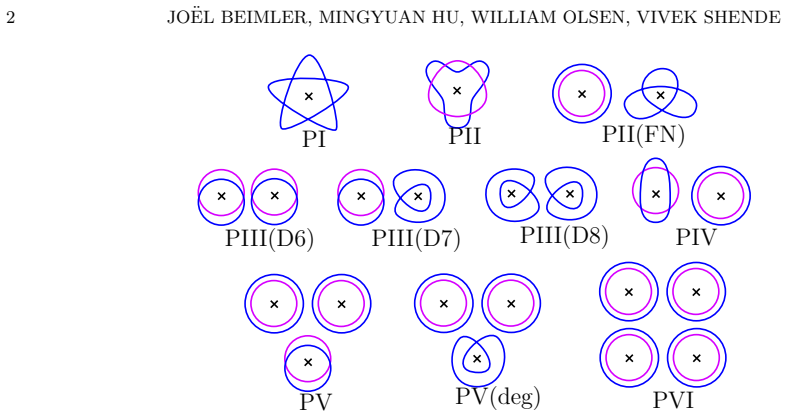
Fukaya category matches coherent sheaves for local-system moduli

by Joël Beimler, Mingyuan Hu +2 more

Mirror symmetry for the Painlev\'e character varieties

The equivalence holds for four-manifolds arising from irregular rank-two local systems on the projective line.

Figure from the paper full image
abstract click to expand
We establish a homological mirror theorem for the 4-manifolds arising as moduli of (irregular) rank two local systems on the projective line. Specifically, we prove that the Fukaya category of a moduli of such local systems with generic microlocal monodromy at punctures is equivalent to the category of coherent sheaves on the minimal resolution of the corresponding moduli of local systems with trivial microlocal monodromy.
0
0
math.AG 2026-06-03

Bondal conjecture holds for five-dimensional Fano manifolds

by Stéphane Druel, Jorge Vitório Pereira +2 more

Bondal's conjecture in dimension five

First proof gives lower bounds on degeneracy loci of Poisson structures, plus partial results in odd dimensions.

abstract click to expand
Bondal's conjecture in Poisson geometry gives lower bounds on the degeneracy loci of Poisson Fano manifolds, where the rank of the Poisson structure drops. By work of several authors, it was previously known to hold for Fano manifolds of dimension at most four. We give the first proof of this conjecture for Fano manifolds of dimension five, and partial results for Fano manifolds of all odd dimensions. The proof uses: (i) an algebraic integrability criterion for codimension-one foliations on weak Fano manifolds, extending a previous result of the first author; (ii) the "modular residues" of Poisson structures introduced by Gualtieri and the third author; and (iii) a cohomological constraint on invariant subvarieties for Pfaff fields, extending earlier results of Esteves--Kleiman to the case in which the Pfaff distribution on the subvariety admits a closed strongly directed positive current.
0
0
math-ph 2026-06-03

BF theory on BG encodes continuous symmetries via Lagrangian boundaries

by Hao Xu

Classical Symmetry TFTs for Continuous Symmetries via Higher Symplectic Geometry

The (n+1)-dimensional bulk for G-actions on n-dimensional sigma models is the AKSZ theory on T^*[n](BG), with gauging realized by domain wal

abstract click to expand
We propose a shifted-symplectic formulation of a classical continuous analogue of the symmetry TFT paradigm. Let $G$ be an algebraic or Lie group acting by topological defects on an $n$-dimensional classical topological sigma model with target an $(n-1)$-shifted symplectic derived stack $(X,\omega)$ via the AKSZ construction. We argue that the corresponding $(n+1)$-dimensional bulk theory should be the AKSZ theory with target the shifted cotangent stack $T^*[n] (\mathrm B G)$, equivalently the $(n+1)$-dimensional BF theory for $G$. We characterize the Dirichlet and Neumann boundary conditions, and more general topological boundaries, in terms of shifted Lagrangians in $T^*[n] (\mathrm B G)$. We realize the gauging of the $G$-symmetry in the original theory as inserting a topological domain wall between the corresponding topological boundaries in the BF bulk, and introduce the notion of Hamiltonian reduction, syplectic reduction, and Lagrangian reduction in the shifted symplectic setting. We also discuss prequantum refinements of continuous SymTFTs. In this refinement, higher gerbes on $\mathrm B G$ encode classical analogues of 't Hooft anomaly data by decorating the shifted cotangent bulk and its Lagrangian boundary conditions. Finally, in dimension three we compare the infinitesimal BF model $\mathrm B(\mathfrak g\ltimes\mathfrak g^\vee)$ with the factorizable double $\mathrm B(\mathfrak g\oplus \mathfrak g)$. The resulting topological boundaries are described by Lagrangian Lie subalgebras, and the factorizable case relates the SymTFT dictionary to $r$-matrices and Belavin--Drinfeld data.
0
0
math.SG 2026-06-02

All normalized capacities coincide on S1-invariant domains

by Arthur Melo, Vinicius G. B. Ramos +1 more

Symplectic capacities of S¹-invariant dynamically convex domains in mathbb{R}⁴

Dynamically convex sets in R^4 preserved by Hamiltonian circle actions isotopic to the Hopf action have a single capacity value.

abstract click to expand
In this paper, we prove that all normalized symplectic capacities agree for dynamically convex domains in $\mathbb{C}^2$ that are invariant under any Hamiltonian $S^1$-action isotopic to the Hopf diagonal action. We also give necessary and sufficient conditions for $S^1$-invariant domains to be dynamically convex.
0
0
math.SG 2026-06-02

Lagrangian homotopy spheres differ by Hopf multiple

by Daniel Alvarez-Gavela

Framed bordism of Lagrangian homotopy spheres via generating functions

Their classes in the quotient of homotopy sphere groups must be a multiple of the stable Hopf map, forcing 2-torsion and standardness in dim

abstract click to expand
This note combines a result of B\"okstedt and Waldhausen concerning the so-called derivative map on tubes with the existence theorem for generating functions of tube type for nearby Lagrangian homotopy spheres due to Abouzaid, Courte, Guillermou and Kragh to obtain a restriction on the smooth structure of nearby Lagrangian homotopy spheres. Concretely, if a homotopy $n$-sphere $L$ admits a Lagrangian embedding in the cotangent bundle of some other homotopy $n$-sphere $M$, then the difference $[L]-[M]$ in $\theta_n/bP_{n+1}$ is a multiple of the Hopf element $\eta \in \pi^1_s$. In particular it follows that $[L]-[M]$ is 2-torsion in $\theta_n/bP_{n+1}$, hence if $n$ is even then $L\# L$ is diffeomorphic to $M \# M$. As another application, if a homotopy $8$-sphere $L$ admits a Lagrangian embedding in $T^*S^8$, then $L$ is diffeomorphic to $S^8$. The results presented in this note are subsumed by a joint work with Abouzaid, Courte and Kragh which treats the general case in which $M$ is an arbitrary smooth manifold. When $M$ is a homotopy sphere the situation is significantly simpler and the purpose of this note is to give a concise exposition of the main result in this special case.
0
0
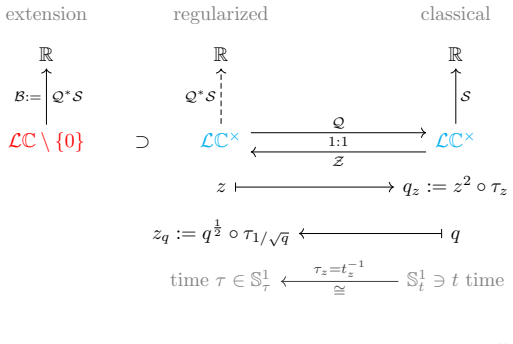
math.SG 2026-06-02

Collisions regularized for variational detection of periodic orbits

by Urs Frauenfelder, Joa Weber

Towards a Floer theory for Mars I -- Twisted Zeeman systems

In time-periodic Zeeman systems modeling electron-proton interactions, non-local setups find collisional solutions after handling singularit

Figure from the paper full image
abstract click to expand
In this article we study periodic orbits of an electron attracted by a proton subject to Lorentz, electric, and Euler forces where each of them is allowed to depend periodically on time. This setup is motivated by the elliptic restricted three-body-problem where the Lorentz force corresponds to Coriolis force, the Coulomb force is replaced by the gravitational force, and the electric force of an external source is a combination of centrifugal forces and gravitational forces of other bodies. This is a singular version of a Euler-Hamilton system as discussed in [FW26b]. The singularity is due to collisions of the electron with the proton, respectively of two masses. Due to the possibility of collisions this problem has to be regularized. We show how periodic collisional solutions of this problem can be detected variationally in a non-local Lagrangian setup as well as in a non-local Hamiltonian setup.
0
0
math.SG 2026-06-01

Poisson C∞-rings correspond to Lie-Rinehart algebras

by Eugene Lerman, Ruben Louis

Lie-Rinehart and Poisson algebras over C^infty-rings

Kähler differentials receive the Lie structure and free rings receive the Poisson bracket, recovering functions on dual Lie algebroid bundle

abstract click to expand
We define the analogue of Lie-Rinehart algebras over $C^\infty$-rings. We show that given a Poisson $C^\infty$-ring $\mathcal{A}$ its module $\Omega_{\mathcal{A}}^{1}$ of $C^\infty$-K\"{a}hler differentials is (part of) a Lie-Rinehart algebra. Conversely, given a Lie-Rinehart algebra $\mathcal{M} \xrightarrow{\rho} C^\infty\mathrm{Der}(\mathcal{A})$ over a $C^\infty$-ring $\mathcal{A}$, there is a natural Poisson bracket on the $C^\infty$-ring $\mathcal{F}(\mathcal{M})$ associated with the $\mathcal{A}$-module $\mathcal{M}$ (the $C^\infty$-ring analogue of an $\mathcal{A}$-algebra freely generated by the module $\mathcal{M}$). In the case where $\mathcal{A}$ is the $C^\infty$-ring of smooth functions on a manifold $M$ and $\mathcal{M}$ is the module $\Gamma(E)$ of sections of a Lie algebroid $E \to M$, the $C^\infty$-ring $\mathcal{F}(\Gamma(E))$ is the ring of functions $C^\infty(E^\vee)$ on the total space of the vector bundle $E^\vee \to M$ dual to the vector bundle $E$.
0
0
math.SG 2026-06-01

Kei operation yields bi-invariant metric on transvection group

by Urs Frauenfelder, Lei Zhao

The kei word metric on the transvection group and its unit ball

The unit ball is described explicitly for this metric in the symplectic setting.

abstract click to expand
We define a bi-invariant word metric on a group using keis. We discuss whether such a word metric is trivial or non-trivial in various examples coming from group theory, dynamical systems, as well as complex and symplectic geometry.
0
0
math.SG 2026-06-01

Three invariants classify Legendrian generating functions

by Sylvain Courte, Vivek Shende

A topological classification of generating functions

A Gauss map trivialization, cohomotopy sheaf, and J-homomorphism identification determine them up to stabilization and diffeomorphism.

Figure from the paper full image
abstract click to expand
From a generating function for a Legendrian in a $1$-jet bundle, we may extract the following topological information: (1) a trivialization of the stable Gauss map, (2) the sheaf of sub-level-set stable cohomotopies, and (3) an identification of the microlocalization of the latter with the J-homomorphism image of the former. Here we show that in fact (1), (2), (3) completely classify generating functions up to the classical equivalence relations of stabilization and fiberwise diffeomorphism.
0
0
math.SG 2026-06-01

Weinstein manifolds deform to cotangent buildings

by Daniel Álvarez-Gavela, Yakov Eliashberg +1 more

Weinstein manifolds as cotangent buildings

Cotangent buildings enable top-down analysis with control over block interactions in any Weinstein manifold.

abstract click to expand
We introduce the framework of cotangent buildings to complement and refine that of Weinstein handlebodies. While Weinstein handlebodies are suitable for a ``bottom-up" analysis of the Weinstein structure, cotangent buildings also enable a ``top down" analysis. Further, cotangent buildings include a precise control over the interaction of any subcollection of the various building blocks, each of which is modeled on the cotangent bundle of a manifold with corners. Our main result is that any Weinstein manifold is Weinstein homotopic to one admitting the structure of a cotangent building.
0
0
math.SG 2026-05-28

Quartic threefolds are symplectically irrational

by Jiaji Cai

The quartic threefold is symplectically irrational

Eigenvalue multiplicities from their big quantum cohomology block any link to projective space via blow-ups or deformations.

abstract click to expand
We prove that smooth quartic threefolds are symplectically irrational: they cannot be related to projective space by a sequence of symplectic blow-ups, blow-downs, and deformations. This recovers the classical irrationality theorem of Iskovskikh-Manin. The obstruction is constructed from big quantum cohomology, using the multiplicities of eigenvalues of quantum multiplication by the Euler vector field. To prove its invariance, we establish a decomposition theorem for quantum cohomology under symplectic blow-ups, following the work of Iritani.
0
0
math.SG 2026-05-28

Lagrangian morphisms correspond to Dirac structures in Courant algebroids

by Daniel Álvarez, Henrique Bursztyn +1 more

Shifted lagrangian structures in Poisson geometry

This identifies multiplicative D-valued moment maps integrating quasi-Poisson manifolds and unifies classical Poisson constructions.

Figure from the paper full image
abstract click to expand
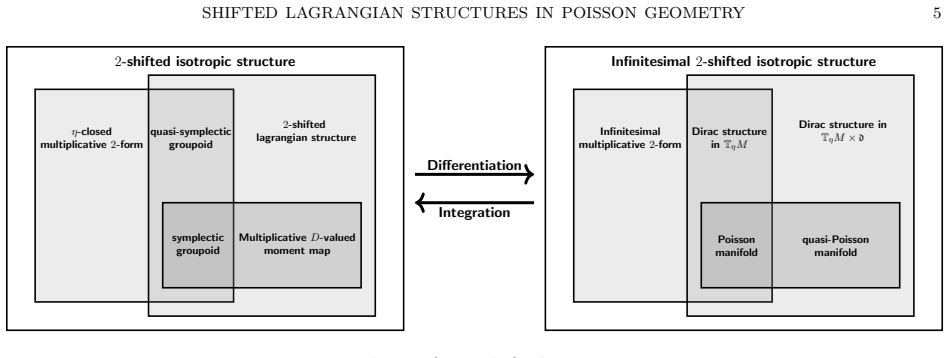
This paper develops new aspects of the interplay between shifted symplectic geometry and classical Poisson geometry, focusing on lagrangian morphisms into 2-shifted symplectic groups. We establish a Lie-type correspondence between such morphisms and Dirac structures in transitive Courant algebroids given by the product of an exact Courant algebroid and a quadratic Lie algebra. As a key application, we identify the global objects integrating quasi-Poisson manifolds, which we call multiplicative D-valued moment maps; this extends the integration of Poisson manifolds to symplectic groupoids and the lifting of Poisson actions to multiplicative hamiltonian actions. We devise systematic constructions of quasi-symplectic groupoids via fibred products of 2-shifted lagrangians, extending classical reduction procedures. This places known constructions, such as the integrations of Poisson homogeneous spaces and Poisson quotients, into a broader, conceptual framework, while yielding new examples.
0
0
math.SG 2026-05-27

Weighted constants give ellipsoid fillings of CP2 at every post-Fibonacci step

by Jonathan David Evans

Weighted Seshadri constants and ellipsoid embeddings

Seshadri numbers computed on blow-ups construct the exceptional steps of the McDuff-Schlenk staircase and extra ellipsoid embeddings.

Figure from the paper full image
abstract click to expand
We explore Seshadri constants associated to weighted blow-ups of complex projective varieties and demonstrate how to use this notion to construct symplectic embeddings of ellipsoids. We illustrate the utility of this point of view by providing constructions of full fillings of $\mathbb{CP}^2$ by ellipsoids corresponding to all of the exceptional (post-Fibonacci) steps of the McDuff--Schlenk staircase and some non-obvious embeddings of ellipsoids in ellipsoids.
0
0
math.GT 2026-05-27

Eight moves connect all diagrams of the same contact manifold

by Marc Kegel, Eric Stenhede +1 more

A contact version of Kirby's theorem

Lantern and chain operations complete the contact Kirby calculus, recovering d3-invariance diagrammatically.

Figure from the paper full image
abstract click to expand
A theorem of Ding and Geiges states that every closed, connected contact $3$-manifold can be obtained from the standard tight contact $3$-sphere by contact $(\pm1)$-surgery along a Legendrian link. The literature also contains some examples of contact Kirby moves, i.e. explicit operations on front projections of Legendrian surgery links that change the surgery link but preserve the contactomorphism type of the surgered manifold. Among the most commonly used are cancelling pairs and contact handle slides; however, these moves alone are not sufficient to relate all contact surgery diagrams of contactomorphic contact manifolds. In this article, we introduce two new families of contact Kirby moves, called lantern moves and chain moves, and use them to give a complete set of contact Kirby moves. More precisely, we show that two contact surgery diagrams represent contactomorphic contact manifolds if and only if they are related by a sequence of planar isotopies, Legendrian Reidemeister moves, insertions or removals of standard cancelling pairs, the two standard contact handle slides, the standard lantern move, and the standard chain move. All these moves are explicit diagrammatic operations in the front projection. The proof follows an approach initiated by Avdek through his ribbon-move framework, which is rooted in the Giroux correspondence, and combines it with a presentation by Gervais of the mapping class group. We also discuss several consequences of the main theorem, illustrating the effectiveness of the contact Kirby calculus by recovering the invariance of Gompf's $d_3$-invariant purely diagrammatically and by deriving the topological Kirby theorem from contact-geometric methods.
0
0
math.SG 2026-05-27

Open Gromov-Witten invariants defined for general Lagrangians

by Amanda Hirschi, Kai Hugtenburg

Open Gromov-Witten invariants in genus zero and Lagrangian cobordisms

The invariants satisfy the open WDVV relations and remain unchanged under Hamiltonian isotopy and for cobordant Lagrangians.

abstract click to expand
We construct open Gromov-Witten invariants in genus zero for arbitrary closed symplectic manifolds and embedded relatively spin Lagrangians, which are weakly unobstructed by a bounding cochain. This uses the foundational work of \cite{HH25,HH26} and the algebraic framework of \cite{ST21}. We prove the open WDVV relations and show that these invariants are independent of the choice of almost complex structure and under Hamiltonian isotopy. We also prove a relation between open Gromov-Witten invariants of cobordant Lagrangians.
0
0
math.AT 2026-05-27

Morse flow categories match exit path categories

by Colin Fourel

Morse flow categories as exit path categories

On a closed manifold the category built from critical points and trajectories is equivalent to the infinity-category of exit paths in the st

Figure from the paper full image
abstract click to expand
We prove that the topological flow category $\mathcal{M}$ arising from a Morse-Smale pair $(f,\xi)$ on a smooth closed manifold $X$ is equivalent, as an $\infty$-category, to Lurie's $\infty$-category $\mathrm{Sing}_A(X)$ of exit paths in $X$ with respect to the stratification by the stable manifolds of $\xi$. The objects of $\mathcal{M}$ are the critical points of $f$, and for every pair of critical points, the space of morphisms of $\mathcal{M}$ between these is the space of possibly broken trajectories of $\xi$ connecting them; it can be identified up to homotopy with the space of unbroken ones. The latter maps naturally to the space of exit paths connecting these critical points; we prove this map to be a weak homotopy equivalence. Then, we combine these ingredients with several others to construct a zigzag of equivalences between the homotopy coherent nerve of $\mathcal{M}$, denoted $\mathcal{N}(\mathcal{M})$, and $\mathrm{Sing}_A(X)$. The $n$-simplices of $\mathcal{N}(\mathcal{M})$ are homotopy coherent diagrams of $n$ composable morphisms of $\mathcal{M}$; we introduce the notion of unbroken diagram, yielding an $\infty$-subcategory of $\mathcal{N}(\mathcal{M})$, which we refer to as the flow coherent nerve of $\mathcal{M}$. The simplices of the latter give rise to stratified maps out of a family of stratified cubes, into $X$. We organize this family into a functor from the category of finite ordered sequences of critical points, to the category of $A$-stratified topological spaces, and we prove a comparison result with the usual stratified geometric realization functor. We finally use a theorem of Tanaka that associates a functor of $\infty$-categories to a map a semi-simplicial sets satisfying some conditions. Our theorem has implications regarding constructible sheaves and the description of homotopy types in terms of flow categories.
1 0
0
math.SG 2026-05-26

Barcode entropy coincides with topological entropy in low dimensions

by Erman Cineli, Viktor L. Ginzburg +2 more

Topics in Symplectic Dynamics: Barcode Entropy

The quantity is the growth rate of long bars in Floer or symplectic homology persistence modules for Hamiltonian diffeomorphisms and Reeb fl

Figure from the paper full image
abstract click to expand
Barcode entropy is an invariant of a Hamiltonian system -- a Hamiltonian diffeomorphism or a Reeb flow -- measuring its Morse or Floer theoretic complexity at a small scale. More specifically, it is the exponential growth rate of the number of not-too-short bars in the Floer or symplectic homology persistence module. Barcode entropy is closely related to topological entropy, even though they originate in different contexts, and in low dimensions they coincide. In these notes, we study barcode entropy and related invariants in various settings and explore their connections with pure dynamics features and, in particular, topological entropy. The methods build on techniques from symplectic topology and Floer theory, dynamical systems, and smooth integral geometry. We also touch upon some other applications of the machinery we develop. These notes are based on the mini-course given by the second author at the CIME summer school "Symplectic Dynamics and Topology" (Cetraro, Italy, June 16-20, 2025).
1 0
0
math.CV 2026-05-26

C¹ convex sets isotope to smooth strictly pseudoconvex closures

by Stefan Nemirovski, Josias Reppekus +1 more

Hulls and boundaries in mathbb{C}^n

The isotopy through polynomially or rationally convex sets reaches a smooth boundary while preserving convexity.

abstract click to expand
The paper is concerned with the boundary behaviour of polynomially and rationally convex hulls in pseudoconvex domains in $\mathbb{C}^n$. As an application, it is shown that every connected polynomially or rationally convex compact set with $C^1$ boundary is isotopic to the closure of a smoothly bounded strictly pseudoconvex domain that is also polynomially or rationally convex.
0
0
math.SG 2026-05-25

Ball embeddings in CP² match point configs below capacity sum 1

by Sílvia Anjos, Jarek Kędra +1 more

Embedding more than 8 symplectic balls in mathbb{C}P²

The embedding space has the homotopy type of the space of n distinct points provided the capacities add to less than 1.

abstract click to expand
We prove that the space of symplectic embeddings of $n\geq 1$ standard balls into the standard complex projective plane $\mathbb{C}\mathrm{P}^2$, normalized so that a line has symplectic area $1$, is homotopy equivalent to the configuration space of $n$ points in $\mathbb{C}\mathrm{P}^2$, provided that the sum of the ball capacities is strictly less than $1$. Our techniques further suggest that, for $n=9$, there are infinitely many homotopy types of spaces of symplectic ball embeddings, depending on the ball capacities. Moreover, for each $n\geq 5$, we exhibit capacities for which the embedding spaces are not simply connected, in contrast with the case $n \leq 4$. As an application, we show that, for $n\geq 9$ equal balls of capacity $c<1/n$, the symplectomorphism group of the blow-up has the homotopy type of the stabilizer of $n$ distinct points in $\mathbb{C}\mathrm{P}^2$.
0
0
math.SG 2026-05-25 Recognition

Multi-valued Morse category equivalent to vector bundles on CP^2

by Hayato Nakanishi, Yat-Hin Suen

Multi-valued Morse homotopy for the SYZ mirror of the complex projective plane

The equivalence supplies a mirror description of global sections of the tangent bundle via Lagrangian multi-sections.

Figure from the paper full image
abstract click to expand
We propose a definition of the category $\mathit{Mo}^{\mathrm{mult}}(P)$ of multi-valued Morse homotopy on $P$ consisting of multi-valued functions associated to Lagrangian multi-sections. We then show that a full subcategory $\mathit{Mo}^{\mathrm{mult}}_{\mathcal{E}}(P)$ of $\mathit{Mo}^{\mathrm{mult}}(P)$ is $A_\infty$-equivalent to a full subcategory $\mathit{DG}_{\mathcal{E}}^{\mathrm{vect}}(\mathbb{C}P^2)$ of the category $\mathit{DG}^{\mathrm{vect}}(\mathbb{C}P^2)$ consisting of holomorphic vector bundles over the complex projective plane $\mathbb{C}P^2$. As an application, we study the mirror description for global sections of the holomorphic tangent bundle over $\mathbb{C}P^2$.
0
0
math.RT 2026-05-25 2 theorems

Double quasi-Poisson brackets induce Poisson structures on BCD varieties

by Semeon Arthamonov, Maxime Fairon

Quasi-Poisson varieties from double quasi-Poisson algebras in types B,C,D

A compatible involutive anti-automorphism upgrades the construction from type A to types B, C, D over any semisimple base and produces the 1

Figure from the paper full image
abstract click to expand
Double (quasi-)Poisson brackets were introduced on associative algebras by Van den Bergh to induce a (quasi-)Poisson structure on their representation spaces naturally equipped with a $\mathrm{GL}$-action (type $\mathtt{A}$). If there exists a compatible involutive anti-automorphism on the underlying associative algebras, Olshanski and Safonkin proved that this construction can be upgraded to induce a Poisson structure on twisted representation spaces (types $\mathtt{B},\mathtt{C},\mathtt{D}$). We provide an analogous result for double quasi-Poisson brackets, and over an arbitrary semisimple base. We also apply our theory to quivers in order to understand the Poisson structure on twisted (localised multiplicative) quiver varieties. The formalism permits that different vertices are assigned different types. As a first application, we recover the framework of Massuyeau and Turaev for Hopf algebras with a Fox pairing, which induces in particular the Poisson structure of character varieties for the orthogonal or symplectic groups. As a second application, we introduce a modified Kontsevich system.
0
0
math.AG 2026-05-22 Recognition

Factor-compatible small covers yield projective quotients of curve products

by Suyoung Choi

Symplectic and projective small covers over products of polygons

The mod 2 cohomology ring fixes the Hodge diamond of each resulting model.

abstract click to expand
We study symplectic and projective structures on small covers over products of polygons. We introduce the factor-compatible class for small covers over products of polygons and prove that every factor-compatible small cover admits a smooth projective model as a finite quotient of a product of curves. Furthermore, we show that the graded mod~$2$ cohomology ring determines the Hodge diamond of the associated projective model. We also prove that every factor-compatible small cover admits an iterated equivariant bundle structure.
0
0
math.DG 2026-05-22

Lie algebra duals desingularize iff they contain a large abelian ideal

by Shane Rankin

Algebroid Desingularizable Poisson Structures

The KKS structure on g* admits a symplectic algebroid resolution exactly when g has an abelian ideal of dimension dim(g) minus r, with 2r th

abstract click to expand
We introduce algebroid desingularizable Poisson manifolds, a class of Poisson manifolds induced by symplectic Lie algebroids with almost-injective anchors, generalizing structures including log-symplectic, $b^m$-symplectic, $E$-symplectic manifolds, and hypersurface algebroids. We give an infinitesimal obstruction to the existence of such an algebroid for a general Poisson manifold, and then characterize the linear case by showing that the dual of a real finite-dimensional Lie algebra, equipped with the KKS Poisson structure is desingularizable if and only if it possesses an abelian ideal of dimension $\dim(\mathfrak{g})-r$, where $2r$ is the maximal coadjoint orbit dimension.
0
0
math.RT 2026-05-22 2 theorems

Categorical Lusztig cycles form silting collections in weave sheaves

by Roger Casals, Merlin Christ

Categorical Lusztig cycles and weave schobers

Demazure weaves carry perverse sheaves whose global sections host these cycles as collections that tilt under mutations.

Figure from the paper full image
abstract click to expand
We establish the foundations of categorical weave calculus, developing the diagrammatic calculus of weaves and braid varieties within the study of Calabi-Yau triangulated categories and cluster tilting theory. This is achieved by associating a perverse sheaf of triangulated categories to each Demazure weave. A central contribution is the construction and study of the categorical Lusztig cycles and their duals, which we show form simple-minded and silting collections in the category of global sections of such a sheaf of categories. These categorical collections are built using the diagrammatics of weaves and we study their behavior under changes of weaves. For instance, we show that they undergo tilts under weave mutations. En route, we develop the study of categorical weighted braid words, as canonical rigid filtered dg modules over derived preprojective algebras, and the categorical incarnation of the tropical Lusztig rules, as a gluing mechanism for such filtered objects. Appendix A contains homological results, providing a novel construction of simple-minded and silting collections from full exceptional collections, and characterizing when these arise from a highest weight structure on an abelian category.
0
0
math.SG 2026-05-21 2 theorems

Twisted primitive cohomology vanishes on flat symplectic manifolds

by Hao Zhuang

A Serre type vanishing property of the twisted primitive cohomology

The proof requires symplectic flatness and shows why that condition is essential when adapting complex geometry vanishing results to the sym

abstract click to expand
We prove a Serre type vanishing property for the twisted primitive cohomology of a symplectic manifold. It is based on Tseng and Zhou's vanishing property under the symplectic flatness. These vanishing properties emphasizes the necessity of the symplectic flatness when generalizing certain results from the sheaf cohomology in complex geometry to the primitive cohomology in symplectic geometry.
0
0
math.GT 2026-05-21 2 theorems

Flow loop counts match BPS q-series for braid-homogeneous knots

by Sunghyuk Park

Flow loops and quantum groups

The dynamical series built from Morse flows on fibered knot complements equals the quantum-group BPS series for every braid-homogeneous case

Figure from the paper full image
abstract click to expand
This paper connects two seemingly different ways of studying knots: quantum group invariants and the dynamics of Morse flows. For fibered knots, we define a two-variable series invariant by counting Morse flow loops in the complement. This dynamical series is conjectured to agree with the BPS $q$-series of the knot complement, which arises from Verma modules for quantum groups and encodes all colored Jones polynomials. We prove this correspondence for all braid-homogeneous knots.
0
0
math.SG 2026-05-21 1 theorem

Toda Fukaya category mirrors coherent sheaves on dual centralizer

by Xin Jin, Zhiwei Yun

Mirror Symmetry of the Affine Toda Systems

Equivalence realizes geometric Langlands for the projective line with mild wild ramification at zero and infinity.

Figure from the paper full image
abstract click to expand
For a complex reductive group $G$, we prove a homological mirror symmetry between the wrapped Fukaya category of the affine Toda system for $G$ and coherent sheaves on the regular centralizer group scheme for the Langlands dual group $G^\vee$. This can be interpreted as a geometric Langlands equivalence for $\mathbb{P}^1$ with mildest wild ramification at $0$ and $\infty$.
0
0
math.GT 2026-05-21 2 theorems

Legendrian surgery computes Gompf θ-invariant of canonical contacts

by Mohan Bhupal, Burak Ozbagci

The Gompf θ-Invariant of Canonical Contact Structures via Legendrian Surgery

Closed-form continued fraction expression for Seifert cases and recursive tree formula show the structure minimizes the invariant and rule o

abstract click to expand
Let $\Gamma$ be a minimal connected negative-definite plumbing tree with all vertices of genus zero, and let $Y_\Gamma$ be the oriented link of the corresponding normal complex surface singularity, equipped with its canonical contact structure $\xi_{\rm can}$. We give an explicit Legendrian surgery description of $\xi_{\rm can}$, showing that it is the unique consistent diagram-realizable contact structure on $Y_\Gamma$, up to isomorphism. We then derive a closed-form formula for Gompf's $\theta$-invariant of $\xi_{\rm can}$ in the Seifert fibered case, expressed purely in terms of the Hirzebruch--Jung continued fraction expansions of the normalized Seifert invariants, and prove a recursive leaf-to-root formula for arbitrary plumbing trees. The Seifert formula recovers previously known formulas for lens spaces, dihedral manifolds, and small Seifert fibered spaces with complementary legs, and agrees with the N\'emethi--Nicolaescu expression via the classical Hirzebruch--Zagier identity. As a final application we show that $\xi_{\rm can}$ strictly minimizes $\theta$ among all diagram-realizable contact structures on $Y_\Gamma$, and we use this to rule out symplectic rational homology ball fillings for a large class of Stein fillable contact rational homology $3$-spheres.
0
0
math.AG 2026-05-20 1 theorem

Hyperbolic sphere moduli volumes follow non-linear recursion

by Michele Ancona (UniCA, LJAD) +1 more

A recursion for the volume of the moduli space of hyperbolic spheres

The relation extends Zograf's cusp formula to cases with conical points or geodesic boundaries.

abstract click to expand
We prove the existence of a non-linear recursive relation for the volume of the moduli space of hyperbolic spheres with conical points or geodesic boundaries. This relation generalizes a result by Zograf, where the same was derived for cusps.
0

browse all of math.SG → full archive · search · sub-categories