Mesoscopic Linear Statistics for Two Ensembles of Quantum Graphs
Pith reviewed 2026-07-03 03:44 UTC · model grok-4.3
The pith
The variance of linear spectral statistics on quantum graphs matches the Gaussian Orthogonal and Unitary Ensembles in the large-graph limit on polynomial mesoscopic scales.
A machine-rendered reading of the paper's core claim, the machinery that carries it, and where it could break.
Core claim
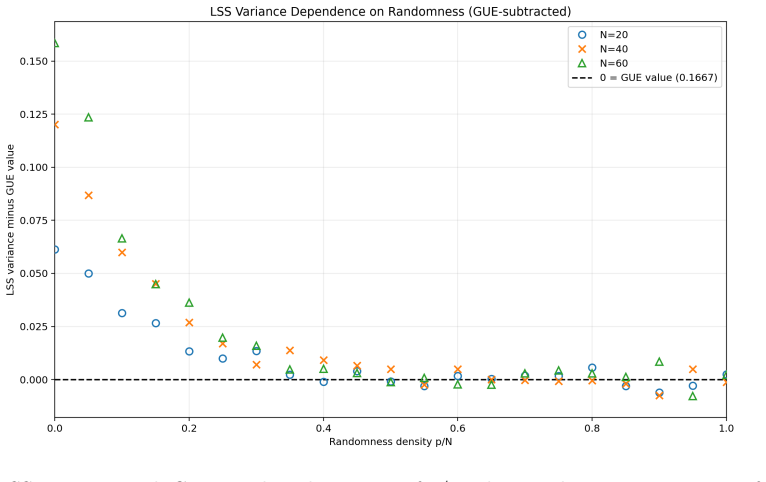
We prove that the variance of a linear spectral statistic in the large graph limit on polynomial mesoscopic scales coincides with that of the Gaussian Orthogonal/Unitary Ensemble for both the ensemble obtained by uniform sampling of d-regular graphs and the ensemble obtained by independent Haar sampling of the vertex unitaries.
What carries the argument
The unitary-matrix-valued function U(k) constructed from the vertex unitaries U^(v) indexed by neighbors of each vertex, together with uniform sampling of d-regular graphs or independent Haar sampling of the U^(v).
If this is right
- Linear spectral statistics of these quantum graphs exhibit the same mesoscopic variance as classical random matrix ensembles.
- The coincidence holds for both the graph-sampling ensemble and the matrix-sampling ensemble.
- No extra conditions on the underlying graphs or matrices are required beyond the uniform or Haar sampling.
- The result applies specifically on polynomial mesoscopic scales in the large-graph limit.
Where Pith is reading between the lines
- The same variance formula might extend to other linear statistics not explicitly treated, such as those involving higher moments.
- Similar mesoscopic behavior could appear in quantum graphs with different degree distributions if the construction of U(k) is preserved.
- The proof technique might adapt to show convergence of the full distribution, not just the variance, for these ensembles.
Load-bearing premise
The specific way U(k) is built from the vertex unitaries together with the uniform sampling of d-regular graphs or Haar matrices allows the large-graph limit to be taken on polynomial mesoscopic scales without further restrictions.
What would settle it
Compute the variance of a linear spectral statistic for a sequence of growing d-regular graphs or Haar-sampled vertex matrices and observe that it deviates from the GOE or GUE formula on polynomial mesoscopic scales.
Figures
read the original abstract
We study mesoscopic linear spectral statistics for two ensembles of random quantum graphs. These are defined by a discrete graph $G$ and a unitary-matrix-valued function $U(k)$ indexed by directed edges of $G$. The matrix function $U(k)$ is constructed from unitary matrices $U^{(v)}$ indexed by the neighbours of each vertex $v$. The first ensemble is obtained by sampling the underlying discrete graph uniformly from the set of $d$-regular graphs. The second ensemble is obtained by sampling $U^{(v)}$ uniformly from the Haar measure, independently for each vertex. We prove that the variance of a linear spectral statistic in the large graph limit on polynomial mesoscopic scales coincides with that of the Gaussian Orthogonal/Unitary Ensemble.
Editorial analysis
A structured set of objections, weighed in public.
Referee Report
Summary. The paper defines two ensembles of random quantum graphs via a discrete graph G and a unitary-matrix-valued function U(k) constructed from vertex unitaries U^(v). The first ensemble samples d-regular graphs uniformly; the second samples the U^(v) from Haar measure independently per vertex. It proves that, in the large-graph limit on polynomial mesoscopic scales, the variance of linear spectral statistics coincides with the corresponding variance in the GOE/GUE.
Significance. If the central variance-coincidence result holds, the work supplies a concrete mesoscopic universality statement for quantum-graph ensembles, extending RMT-type variance formulas beyond the microscopic scale. The explicit construction of U(k) from local unitaries and the two sampling procedures are presented as enabling the polynomial-scale limit without additional restrictions.
minor comments (1)
- The abstract states the variance coincidence but does not indicate the precise form of the test function or the error term in the large-graph limit; a brief statement of the admissible class of linear statistics would improve clarity.
Simulated Author's Rebuttal
We thank the referee for their summary of the manuscript. The description accurately captures the two ensembles, the construction of U(k), and the main result on mesoscopic variance coincidence with GOE/GUE. No specific major comments appear in the report, so we have no point-by-point items to address. We remain available to provide additional clarification on the proof if the referee has questions about particular steps.
Circularity Check
No significant circularity identified
full rationale
The paper claims to prove that the variance of linear spectral statistics for two quantum-graph ensembles coincides with GOE/GUE on polynomial mesoscopic scales. The construction of U(k) from vertex unitaries, uniform sampling of d-regular graphs, and Haar sampling of U^(v) are presented as independent inputs that enable the large-graph limit. No quoted equations, self-citations, or ansatzes reduce the claimed variance result to a fitted quantity or prior self-result by construction. The derivation is therefore self-contained against external benchmarks.
Axiom & Free-Parameter Ledger
Reference graph
Works this paper leans on
-
[1]
Aharonov, A
D. Aharonov, A. Ambainis, J. Kempe, and U. V. Vazirani. Quantum walks on graphs. In Proceedings of the Thirty-Third Annual ACM Symposium on Theory of Computing, STOC ’01, pages 50–59, New York, NY, USA, 2001. Association for Computing Machinery
2001
-
[2]
E. A. Bender and E. R. Canfield. The asymptotic number of non-negative integer matrices with given row and column sums.Journal of Combinatorial Theory, Series A, 24:296-307, 1978
1978
-
[3]
Berkolaiko and J
G. Berkolaiko and J. P. Keating. Two-point spectral correlations for star graphs.Journal of Physics A: Mathematical and General, 32(45):7827–7841, 1999
1999
-
[4]
M. V. Berry and M. Tabor. Level clustering in the regular spectrum.Proceedings of the Royal Society of London. A. Mathematical and Physical Sciences, 356(1686):375–394, 1977
1977
-
[5]
Bohigas, M
O. Bohigas, M. J. Giannoni and C. Schmit. Characterization of chaotic quantum spectra and universality of level fluctuation laws.Physical Review Letters, 52(1), 1984
1984
-
[6]
Bollob´ as A probabilistic proof of an asymptotic formula for the number of labelled regular graphs.European Journal of Combinatorics, 1(4):311-316, 1980
B. Bollob´ as A probabilistic proof of an asymptotic formula for the number of labelled regular graphs.European Journal of Combinatorics, 1(4):311-316, 1980
1980
-
[7]
Bolte and S
J. Bolte and S. Endres. The trace formula for quantum graphs with general self-adjoint boundary conditions.Annales Henri Poincar´ e, 10:189–223, 2009. 20
2009
-
[8]
Broder and E
A. Broder and E. Shamir. On the second eigenvalue of random regular graphs.28th Annual Symposium on Foundations of Computer Science, 286-294, 1987
1987
-
[9]
Chabanol
M.-L. Chabanol. Three-point correlations for quantum star graphs.Journal of Physics A: Mathematical and Theoretical, 40(45):13535–13544, 2007
2007
-
[10]
Dozier and J
B. Dozier and J. Sapir, Simple versus nonsimple loops on random regular graphs.Journal of Graph Theory, 105(4):562-579, 2024
2024
-
[11]
Duits and K
M. Duits and K. Johansson. On mesoscopic equilibrium for linear statistics in dyson’s brownian motion.Memoirs of the American Mathematical Society, 255(1222), 2018
2018
-
[12]
Garmo The asymptotic distribution of long cycles in random regular graphs.Random Structures and Algorithms, 15(1):43-92, 1999
H. Garmo The asymptotic distribution of long cycles in random regular graphs.Random Structures and Algorithms, 15(1):43-92, 1999
1999
-
[13]
J. M. Harrsion, U. Smilansky and B. Winn Quantum graphs where back-scattering is forbidden. Journal of Physics A; Mathematical and Theoretical, 40(47):14181, 2007
2007
-
[14]
O. Hul, S. Bauch, P. Pakonski, N. Savytskyy, K. ˙Zyczkowski, and L. Sirko. Experimental simulation of quantum graphs by microwave networks.Physical Review E, 69:056205, 2004
2004
-
[15]
Johansson
K. Johansson. On fluctuations of eigenvalues of random hermitian matrices.Duke Mathematical Journal, 91(1):151–204, 1998
1998
-
[16]
A. Joye. Unitary and open scattering quantum walks on graphs.arXiv:2409.08428, 2024
work page internal anchor Pith review Pith/arXiv arXiv 2024
-
[17]
Kostrykin and R
V. Kostrykin and R. Schrader. Kirchhoff’s rule for quantum wires.Journal of Physics A: Mathematical and General, 32(4):595–630, 1999
1999
-
[18]
Kottos and H
T. Kottos and H. Schanz. Quantum graphs: a model for quantum chaos.Physica E: Low- dimensional Systems and Nanostructures, 9(3):523–530, 2001
2001
-
[19]
Kottos and U
T. Kottos and U. Smilansky. Quantum chaos on graphs.Physical Review Letters, 79:4794–4797, 1997
1997
-
[20]
Kottos and U
T. Kottos and U. Smilansky. Periodic orbit theory and spectral statistics for quantum graphs. Annals of Physics, 274:76–124, 1999
1999
-
[21]
Kuchment
P. Kuchment. Quantum graphs: an introduction and a brief survey. InAnalysis on Graphs and Its Applications, volume 77 ofProceedings of Symposia in Pure Mathematics, pages 291–314. American Mathematical Society, Providence, RI, 2008
2008
-
[22]
B. Landon and P. Sosoe. Almost-optimal bulk regularity conditions in the clt for wigner matrices.arXiv:2204.03419, 2022
-
[23]
Li and Y
Y. Li and Y. Xu. On fluctuations of global and mesoscopic linear statistics of generalized wigner matrices.Bernoulli, 27(2):1057–1076, 2021
2021
-
[24]
Mesoscopic linear statistics of Wigner matrices
A. Lodhia and N. J. Simm. Mesoscopic linear statistics of wigner matrices.arXiv preprint arXiv:1503.03533, 2015. 21
work page internal anchor Pith review Pith/arXiv arXiv 2015
-
[25]
Lytova and L
A. Lytova and L. Pastur. Central limit theorem for linear eigenvalue statistics of random matrices with independent entries.Annals of Probability, 37(5):1778–1840, 2009
2009
-
[26]
A. O. Munagi. Combinatorial identities for restricted set partitions.Discrete Mathematics, 339(4):1306–1314, 2016
2016
-
[27]
Z. Rudnick. GOE statistics on the moduli space of surfaces of large genus.Geometric and Functional Analysis, 33(6):1581–1607, 2023
2023
-
[28]
Shcherbina
M. Shcherbina. Fluctuations of linear eigenvalue statistics ofβmatrix models in the multi-cut regime.Journal of Statistical Physics, 151:1004–1034, 2013
2013
-
[29]
N. C. Wormald. Models of random regular graphs. inSurveys in Combinatorics, Cambridge University Press, 239-298, 1999. 22
1999
discussion (0)
Sign in with ORCID, Apple, or X to comment. Anyone can read and Pith papers without signing in.