pith. sign in

math.PR

Probability

Theory and applications of probability and stochastic processes: e.g. central limit theorems, large deviations, stochastic differential equations, models from statistical mechanics, queuing theory

Top Pith
1
cs.IT 2026-06-26

Multi-distribution functionals reduce to integrals of coincidence divergences

by Akshay Balsubramani

All you need is log

Monotonicity under data processing and additivity on independent products force every such functional to an integral over four strata

Figure from the paper full image
abstract click to expand
Comparing two probability distributions is a basic building block of statistics and machine learning, and the right family is well understood: the R\'enyi divergences of order $\alpha\in[0,\infty]$ are the unique family monotone under data processing and additive on independent products. Many problems instead compare more than two distributions at once -- multi-population fairness, multi-prior PAC-Bayes bounds, multi-hypothesis testing -- and the right multi-distribution generalization of the R\'enyi family has been an open question. We characterize it. Every functional of $W$-tuples of distributions that is monotone under data processing and additive on independent products is a positive integral of multi-way coincidence divergences $C_{\alpha}(\pi_1,\dots,\pi_W) := -\log\int \pi_1^{\alpha_1}\cdots\pi_W^{\alpha_W}$ (with $\sum_k \alpha_k = 1$) over a parameter space with four strata: the simplex interior; mixed-sign exponent cones (the analogue of R\'enyi orders $>1$); a tropical boundary at infinity carrying max-divergences; and pairwise Kullback-Leibler edges at the simplex vertices. Each stratum is necessary -- the destination of an explicit data-processing-monotone, product-additive divergence the others cannot reproduce -- and each is a clean limit of simplex-interior atoms. The same family arises from several independent routes -- the structural axioms, Kolmogorov-Nagumo means with R\'enyi's entropy axiomatics, classical entropy characterizations, multi-hypothesis testing error exponents, and a multi-lottery betting interpretation -- structural evidence that this is the canonical multi-distribution R\'enyi calculus rather than an artefact of any one axiomatic input. The two-prior case recovers the standard R\'enyi result; a worked $W=3$ instance, numerical verification, and a conditional extension round out the treatment.
1 0
Top Pith
5
math.PR 2026-05-21

Shifted variables close uniform chaos propagation for second-order CBO

by Seung-Yeal Ha, Franca Hoffmann +1 more

Uniform-in-time propagation of chaos for Second-Order Consensus-Based Optimization

Translation-mode separation yields integrable coupling and Monte Carlo rates that hold for all time.

abstract click to expand
We study second-order Consensus-Based Optimization (CBO), a derivative-free global optimization algorithm in which the consensus force and the multiplicative exploratory noise act on particle velocities. We prove quantitative uniform-in-time propagation of chaos for the unmodified second-order CBO dynamics, together with an almost uniform-in-time stability estimate for the microscopic particle system. The proof is not a direct adaptation of the first-order CBO argument. Although both first- and second-order CBO have multiplicative noise that degenerates near consensus and a shift-invariant weighted interaction, the kinetic model has an additional structural obstruction: the consensus mechanism and the stochastic forcing act only on the velocity variable, while the position variable evolves by transport. Thus spatial concentration has to be recovered indirectly through velocity dissipation. Moreover, the shift-invariant interaction leaves a translation mode that is not directly damped by the consensus force, so a standard synchronous coupling in the Euclidean phase-space distance does not close uniformly in time. The main idea of the paper is to introduce shifted internal variables that separate the contracting fluctuation modes from the undamped translation mode. In these variables we build a Lyapunov functional with a position-velocity cross term and prove exponential decay of centered moments. This decay is the mechanism that makes the time-dependent coupling coefficient integrable. Combining it with uniform-in-time raw moment bounds, concentration inequalities, stability estimates for the weighted mean, and a Monte Carlo estimate, we obtain the classical Monte Carlo rate for propagation of chaos uniformly in time. The system-to-system stability estimate avoids the sampling error and yields the faster rate \(O(J^{-q})\).
0
Top Pith
2
math.PR 2026-05-21 2 theorems

Gaussian fields with origin singularity show universal persistence

by Naomi Feldheim, Ohad Feldheim +1 more

Persistence and entropic repulsion of stationary Gaussian fields with spectral singularity at the origin

Log-asymptotics and conditioned profiles depend only on alpha and d through Riesz kernel capacity

abstract click to expand
We compute the exact log-asymptotics of the persistence probability, and determine the entropic repulsion profile conditioned on persistence, for general $d$-dimensional stationary Gaussian fields with spectral singularity at the origin of order $\alpha \in [0,d)$. Under mild regularity conditions these are shown to be universal, depending only on $\alpha$ and $d$, and to have explicit formulations in terms of the capacity and equilibrium potential of the $\alpha$-Riesz kernel. This generalises a result of Bolthausen, Deuschel and Zeitouni on the Gaussian free field to a wide class of Gaussian fields with spectral singularity.
1 0
0
math.CA 2026-07-03

Normalizing series to probabilities turns quotient signs into moment checks

by Zakaria Derbazi

A Probabilistic Sign Rule for Quotients of Positive Series and Integral Transforms

The rule reduces monotonicity and log-convexity of hypergeometric and Stieltjes quotients to kernel monotonicity and covariance signs.

abstract click to expand
This paper develops a probabilistic sign rule for quotients of functions represented by positive series or integrals. For a function in this class, normalising the summand function in the series case or the integrand function in the integral case induces a probability law under which parameter log-derivatives of the function are expressed as moments of kernels, the log-derivatives of the same summand or integrand function with respect to the same parameters. The resulting moment identities reduce quotient monotonicity, log-supermodularity, and log-convexity to sign criteria based on kernel monotonicity, stochastic ordering of the induced laws, and covariance or variance identities. The criteria are applied to generalised hypergeometric, Stieltjes-transform, and Prabhakar quotients, yielding new Tur\'an inequalities, two-sided Stieltjes bounds, and a local failure threshold for a monotonicity conjecture for the zero-balanced Gauss function.
0
0
math.PR 2026-07-03

Almost supermartingales obey Olivier's convergence rate

by Patrick L. Combettes, Javier I. Madariaga

Almost Supermartingale Extensions of Olivier's Theorem

The extension supplies explicit rates for stochastic iterative processes once the almost supermartingale and summability conditions hold.

abstract click to expand
Olivier's 1827 theorem provides a rate of convergence to zero of the general term of a decreasing summable sequence of positive reals. We derive stochastic extensions of this result in the context of almost supermartingales. The results are applied to the analysis of stochastic iterative processes.
0
0
math.PR 2026-07-03

Subcritical percolation gives spin mixing time log N / lambda

by Alexandre Stauffer, Oskar Vavtar

Mixing times of spin systems on dynamical percolation

When edge flips are slow the combined chain equilibrates in time proportional to log of system size divided by the flip rate.

abstract click to expand
We study the mixing times of stochastic spin systems corresponding to nearest-neighbour Glauber dynamics on dynamical percolation, defined on $d$-dimensional torus of side-length $N$. In this model, the status of each edge (open or closed) updates independently at rate $\lambda>0$, according to $\mathrm{Ber}(p)$ samples. Simultaneously, the spin of each site updates at rate $1$ according to Glauber dynamics on the environment restricted to open edges. We show that for a relatively general class of nearest-neighbour systems, as long as $p<p_c(d)$, for any temperature, if $\lambda$ is sufficiently small, the mixing time is of order $\frac{\log N}{\lambda}$. This Markov chain is non-reversible, and the proof is obtained by developing a particular coupling that couples together local configurations whenever the environment behaves well.
0
0
math-ph 2026-07-03

Uniform local laws hold for any H0 and all λ in deformed Wigner model

by Giorgio Cipolloni, László Erdős +1 more

On a Rosenzweig-Porter-type model

The control on the inhomogeneous resolvent lets eigenvector localization and ETH be tracked continuously from isolated to mixed regimes.

Figure from the paper full image
abstract click to expand
We consider a very general Rosenzweig-Porter-type model, $H=H_0+\lambda W$, where $H_0$ is an arbitrary Hermitian matrix and $W$ is a standard Wigner matrix. We precisely trace the localization properties of the eigenvectors and the eigenstate thermalisation hypothesis (ETH) as the coupling constant $\lambda$ interpolates between the trivial $\lambda=0$ case and the fully mean field regime of large $\lambda$. Our results hold uniformly in $H_0$ and $\lambda$, substantially generalising all previous local laws on deformed Wigner matrices even in the mean field regime. Our proof precisely captures the deterministic approximation to the resolvent which exhibits a strongly inhomogeneous structure. As a byproduct, we conclude the emergence of a mobility edge and study the phenomenon of re-entrant localization.
0
0
math.PR 2026-07-03

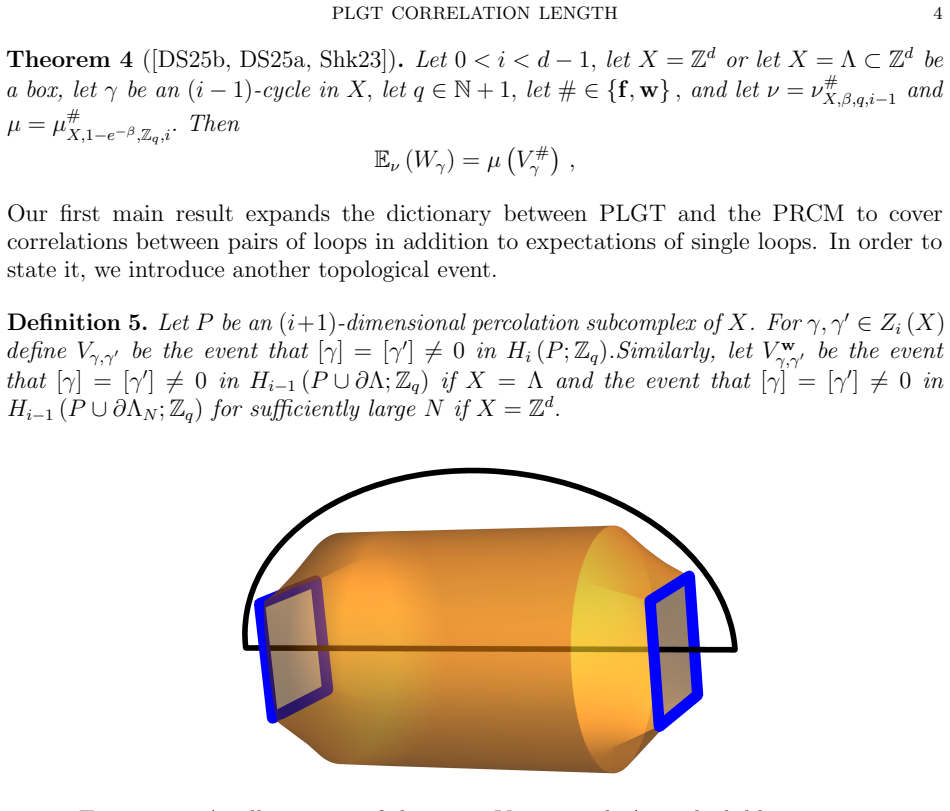
Formula equates Wilson loop correlations to topology in cluster model

by Paul Duncan, Benjamin Schweinhart

A Topological Formula for Potts Lattice Gauge Theory Correlations

The link yields equal correlation lengths across dual models and exponential decay away from criticality.

Figure from the paper full image
abstract click to expand
We exhibit a formula relating the correlation between Wilson loop variables in Potts lattice gauge theory to a topological quantity in the plaquette random cluster model. As applications we show that the correlation length of the model on $\mathbb{Z}^4$ with free boundary conditions equals that of the dual model with constant boundary conditions, we prove exponential decay of correlations between slowly growing Wilson loop variables for Ising lattice gauge theory on $\mathbb{Z}^3$ at all but the critical temperature, and we demonstrate that the correlation length is finite at sufficiently high or low temperatures in any dimension.
0
0
math.PR 2026-07-03

Chord-swap chain mixes in polynomial time for fixed genus

by Renan Gross, An{j̣ela Šarković

Polynomial mixing for polygonal side matchings

Genus-preserving swaps connect all diagrams of a given genus and reach uniform distribution after polynomially many steps.

Figure from the paper full image
abstract click to expand
We introduce a natural Markov chain on chord diagrams, which, at every step, selects two random chords and swaps them if doing so preserves the diagram's genus. This generalizes the chord swap chain on the Catalan structure of non-intersecting chord diagrams. We show that for fixed genus, the chain mixes in polynomial time.
0
0
math.PR 2026-07-03

Competition alters random walk range fluctuations

by Maxence Baccara

On the range of competing random walks

A central limit theorem for sites visited exclusively by one of N walks includes an explicit correction from the others when d/β is between

abstract click to expand
We consider $N$ independent random walks $X^1,\dots,X^N$ in the lattice $\mathbb{Z}^d$ and prove limit theorems for the competitive range $\mathcal{R}_n^k$ of the $k$-th random walk $X^k$, which corresponds to the number of distinct sites that it has discovered before any of the other $X^\ell$, $\ell\ne k$, up to time $n$. This is a natural object to study foraging mechanisms in population ecology, in which context it is also natural to ask how the effect of competition for the access to resources affects the number of resources consumed by each individual. We work with random walks in the domain of attraction of a $\beta$-stable law and focus on the regime $d/\beta\in[1,3/2)$, in which classical results for the range show that the fluctuations are described by the renormalized self-intersection local time of the limiting process. We establish a central limit theorem in which a competition term emerges, thus answering the two previous questions we asked. We end the paper with a brief discussion on the remaining regimes $d/\beta\ge3/2$, in which the fluctuations are Gaussian and are not affected by the competition, and $d/\beta<1$ in which no strong law of large numbers holds and we expect the effect of the competition to strongly affect the first-order asymptotics.
0
0
math.PR 2026-07-03

Sources and sinks turn chemical Markov chains into ergodic processes

by E. Franco, J. J. L. Velázquez

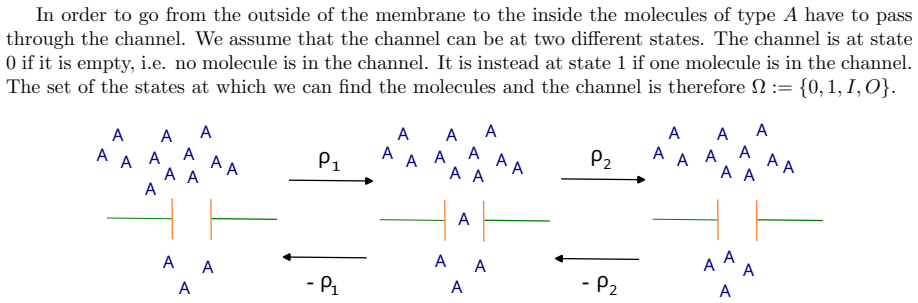
Flux solutions for stochastic chemical systems with sources and sinks

Augmented reaction networks converge to unique stationary measures that support sustained fluxes, allowing explicit computation of membrane

Figure from the paper full image
abstract click to expand
In this paper we study a class of stochastic chemical systems that, in general, do not satisfy the property of detailed balance nor the property of complex balance. These systems are obtained by adding sources and sinks to conservative chemical systems. This procedure is a way to define rigorously stochastic chemical systems in contact with reservoirs. We prove that these systems are non-explosive Markov chains and we prove that they converge to a steady state as time tends to infinity. The stationary solution are out of equilibrium solutions. We conclude the paper by applying our results in order to describe fluxes of molecules through some membrane channels.
0
0
math.NA 2026-07-03

Nonlinear drift yields reverse generative PDE beyond score matching

by Horacio Tettamanti, Michael Herty

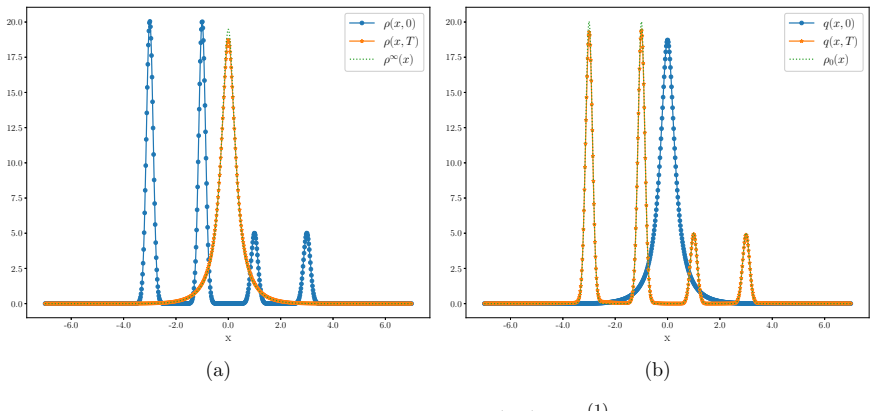
A PDE-Based Framework for Generative Modeling Beyond Classical Score-Based Diffusion

A superlinear term in the Fokker-Planck forward process creates condensation from which a stabilized reverse equation recovers the original

Figure from the paper full image
abstract click to expand
We introduce an alternative generative framework based on a nonlinear modification of the classical Ornstein--Uhlenbeck dynamics. The proposed dynamics admits both a microscopic description through an interacting particle system and, in the mean-field limit, a macroscopic formulation given by a nonlinear Fokker--Planck equation with a superlinear drift term. We show that, for suitable choices of the model parameters and sufficiently large initial mass, the forward dynamics exhibits condensation phenomena by proving the loss of $L^2$ regularity of the solution in finite time. Building upon this formulation, we derive a stabilized reverse-time partial differential equation that reconstructs the initial distribution from the asymptotic state of the forward dynamics, thereby extending the generative paradigm beyond the classical score-based framework. Furthermore, we introduce numerical discretizations of both the forward and reverse processes that accurately capture the asymptotic behavior of the continuous model while successfully reconstructing the initial distribution. Numerical experiments in one and two spatial dimensions validate the proposed methodology and illustrate its application to density filtering through successive iterations of the generative process.
0
0
math.PR 2026-07-03

BK equality holds exactly when witnesses are disjoint

by Raphaël Cerf, Pierre Tesio

The case of equality in BK

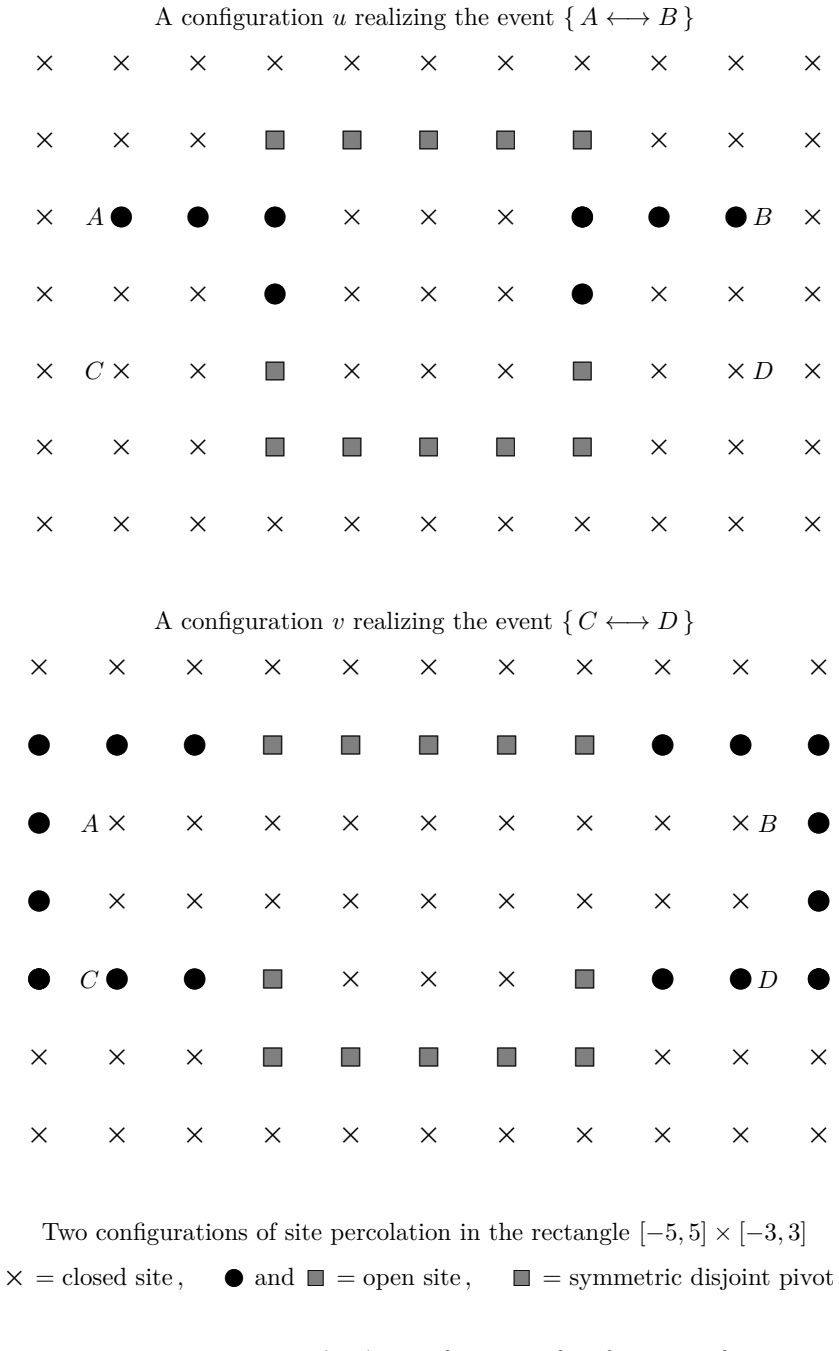
P(A ∘ B) equals P(A)P(B) for increasing events iff every configuration pair admits separate witnesses.

Figure from the paper full image
abstract click to expand
We characterize the pairs of increasing events $A,B$ for which there is equality in the BK inequality. Namely, we show that $P(A\circ B)=P(A)P(B)$ if and only if all the configurations in $A\times B$ admit disjoint witnesses for $A$ and $B$. We discuss the strengthened BK inequality, and we provide a new simplified proof of this inequality.
0
0
math.PR 2026-07-03

SK free energy variance grows as (1/6) log N at criticality

by Hang Du, Brice Huang

Fluctuations of the Sherrington--Kirkpatrick free energy at critical temperature

The centered free energy obeys a Gaussian CLT and the two-replica overlap scales as N to the minus two thirds.

abstract click to expand
We consider the Sherrington--Kirkpatrick spin glass model at the critical inverse temperature $\beta = 1$ with zero external field. We prove that the free energy $F_N = F_{N,\beta=1}$ of this model has variance \[ \mathrm{Var}(F_N) = \frac16 \log N + O(1)\,, \] confirming a physics prediction of Aspelmeier \cite{aspelmeier2008free}, and that the centered and scaled $F_N$ satisfies a Gaussian CLT. We also identify the critical two-replica overlap scale, proving \[ \mathbb{E} \langle R_{1,2}^2\rangle \asymp N^{-2/3}\,, \] as conjectured by Talagrand \cite{talagrand2011mean2}, together with a uniform exponential moment bound for $N^{1/3} |R_{1,2}|$. The key input is a comparison between the Ising and spherical SK partition functions $Z_N$ and $Z^{\mathrm{sp}}_N$: if $X_N = Z_N / Z^{\mathrm{sp}}_N$, then $X_N = 1 + o(1)$ in $L^2$. Thus $Z^{\mathrm{sp}}_N$ captures the diverging critical fluctuations of $Z_N$ and serves as a tractable reweighting variable for estimating overlap moments.
0
0
math.ST 2026-07-03

Weaker matrix condition extends simplex volume theorems to AR(1) models

by Shan Xizheng, Li Yanpeng

A note on "The volume of random simplices from elliptical distributions in high dimension"

Central and stable limits for log-volumes of high-dimensional random simplices now hold under relaxed assumptions on the population matrix.

abstract click to expand
Recent work by Gusakova et al. (Stochastic Process. Appl. 164 (2023) 357-382) has shown a central and a stable limit theorem for the logarithmic volume of random simplices and random convex bodies under an elliptical framework in the high dimensional regime, that is, if p and n tend to infinity in such a way that the ratio tends to \gamma within (0,1). A technical condition (Equation (2.6) of Assumption (B) therein) requires that the population matrix AA* is close in Frobenius norm to a multiple of the identity matrix, which is rather restrictive and rules out various settings for statistical application, such as spiked models and dependent structure models. In this note we offer a general relaxation of this condition, which arrives at a reasonable condition and covers numerous scenarios, as well as consequences for the volume of general random simplices and random convex bodies. In particular, our results covers the Toeplitz/AR(1) covariance structures studied by Jiang and Pham (Ann. Stat. 53 (2025) 907-928), giving a concrete application of our theorem to high-dimensional dependent covariance models.
0
0
math.DG 2026-07-03

Brownian loop mass asymptotes to (1/2) log g for large genus

by Jiankun Hou, Yunhui Wu

The total mass of Brownian loop measure of Riemann surfaces for large genus

When end lengths squared remain o(g), the expected total mass on non-peripheral classes converges to a κ-dependent function diverging as log

Figure from the paper full image
abstract click to expand
Let $\mathcal{M}_{g,n}(\mathbf{L})$ be the moduli space of hyperbolic surfaces of genus $g$ with $n \geq 0$ hyperbolic ends of widths $\mathbf{L} \in \mathbb{R}_{\geq 0}^n$. We regard the total mass $|\mu_X^\kappa|$ of the Brownian loop measure with the killing rate $\kappa$ as a random variable on $\mathcal{M}_{g,n}(\mathbf{L})$. Under the condition $|\mathbf{L}|^2 =o(g)$ as $g \to \infty$, we obtain the following two main results: $(1)$ For any $\kappa > 0$, the expected value of $|\mu_X^\kappa|$ on all non-peripheral homotopy classes over $\mathcal{M}_{g,n}(\mathbf{L})$ converges to an explicit function of $\kappa$, which blows up at the rate $ \log \left(\frac{1}{\kappa}\right)$ as $\kappa \to 0^+$. $(2)$ For $\kappa=0$, over $\mathcal{M}_{g,n}(\mathbf{L})$ the expected value of $|\mu_X|$ on homotopy classes of (iterates of) all non-peripheral simple closed geodesics is asymptotically $\frac{1}{2} \log g$.
0
0
math.PR 2026-07-03

Shifted Schur measure lifts to two colors with independent volumes

by S.-J. Lee

A Two-Color Lift of the Shifted t-Schur Measure

At t=-q an intermediate partition separates |μ| and |λ|−|μ| into independent random variables while yielding an explicit Markov kernel and P

abstract click to expand
At the specialization $t=-q$, $q\geq0$, the shifted $t$-Schur function associated with the modified odd Greaves--Jing--Zhu operator is $Q_\lambda[X+qX]$. Instead of merging the two alphabets $X$ and $qX$, we insert an intermediate strict partition between the two corresponding half-vertex operators. This gives a two-color lift of the shifted Schur measure on pairs $\mu\subseteq\lambda$ with weight \[ Q_\mu(qX)Q_{\lambda/\mu}(X)P_\lambda(Y). \] We compute the normalization and both marginals, identify an explicit Markov transition kernel, prove a semigroup property, and show that the two color volumes $|\mu|$ and $|\lambda|-|\mu|$ are independent. We also realize the model as a two-time shifted Schur process and write its Pfaffian correlation kernel in Vuleti\'c's convention. Rectangular specializations give closed formulas and Gaussian limits for the color volumes.
0
0
math.PR 2026-07-03

Critical branching process with immigration returns to zero infinitely often

by Simon Irons, Jonathan Jordan

Critical branching processes in random environment with immigration and an application to randomised reproducing graphs

Null recurrence holds with no stationary distribution under natural integrability assumptions on offspring and immigration.

abstract click to expand
We study branching processes in an i.i.d.\ random environment with immigration in the critical regime, where the underlying offspring mechanism satisfies the critical condition that the log of the average population growth, across environments, and before immigration, is zero. In this setting environmental fluctuations are balanced on average, and the long-term behaviour is determined by the interaction between these fluctuations and the immigration sequence. While recurrence and transience criteria for critical BPREI were established by Bauernschubert (2014), the possibility of null recurrence remained unresolved. We show that, under natural integrability assumptions on the offspring and immigration distributions, a critical BPREI is null recurrent. In particular, the process returns to zero infinitely often but admits no stationary distribution. Our results close a gap in the classification of the critical regime and provide a structural understanding of the balance between environmental variability and immigration. As an application, we resolve the open critical case of the Randomised Reproducing Graph (`RRG') model introduced by Jordan (2011), showing that in the critical regime the proportion of vertices of a fixed degree admits no limiting distribution.
0
0
math.PR 2026-07-03

Geometric graphs indistinguishable from random above (nh(p))^3 dims

by Hang Du, Cheng Mao +3 more

Resolution of the Detection Threshold Conjecture for Random Geometric Graphs in the d>n Regime

Proves conjecture by showing total variation distance to Erdős–Rényi vanishes when d ≫ (nh(p))^3 and d > n.

abstract click to expand
A random geometric graph (RGG) is generated by first sampling latent points $x_1,\ldots,x_n$ independently and uniformly from the unit sphere in $\mathbb{R}^d$, and then connecting each pair $(i,j)$ if $\langle x_i,x_j\rangle$ exceeds some threshold $\tau$. We study the sharp detection threshold -- the largest dimension at which the RGG can be statistically distinguished from the Erd\H{o}s--R\'enyi graph with the same edge density $p$. This threshold is conjectured to be $d \asymp (nh(p))^3$, where $h(p)=p \log \frac{1}{p} + (1-p) \log \frac{1}{1-p}$ is the binary entropy function. Previous works proved this conjecture for dense graphs with constant $p$ and, up to polylogarithmic factors, very sparse graphs with $p=\Theta(1/n)$. In this paper, we prove that detection is impossible when $d\gg (nh(p))^3$ and $d\ge (1+\epsilon) n$ for any constant $\epsilon>0$, thereby resolving the conjecture in the regime $p\gtrsim n^{-2/3}/\log n$ and improving upon the state of the art in the regime $1/n \ll p \ll n^{-2/3}/\log n$. The key to our proof is a sharp analysis of the posterior distribution of the latent points given the observed graph, obtained through an information-theoretic comparison argument combined with strong log-concavity.
0
0
math.CO 2026-07-03

Chord diagram crossings alone set weights for q-deformed planar maps

by Timothy Budd

Double-scaled SYK from boundary metrics of planar maps

At fixed perimeter the geodesic chord diagrams follow exactly the same distribution as in the double-scaled SYK model.

Figure from the paper full image
abstract click to expand
The enumeration of planar maps with control on the boundary metric, i.e. the pseudometric induced on the outer face of the map by its bulk graph distance metric, is a difficult problem in general. However, we show that for a family of bipartite planar map models with special q-deformed face weights that arise in the physics context of the double-scaled Sachdev-Ye-Kitaev model (DSSYK) the enumeration admits a very simple answer. Encoding the boundary metric of a bipartite planar map by its so-called geodesic chord diagram, we prove that the weighted enumeration depends only on the crossing number of the chord diagram. At fixed perimeter, the induced law of the geodesic chord diagram in these planar map models coincides exactly with the chord diagram representation of the DSSYK model.
0
0
math.PR 2026-07-03

Partition counts fluctuate as OU process or M/M/∞ queue

by Jaime Garza, Yizao Wang

Second-order fluctuations for a phase transition in random partitions

Second-order limits for Chinese restaurant process show the switch at j_n scaling like n to the power α/(1+α).

abstract click to expand
In a recent paper, Banderier et al. (2024) investigated the limiting behavior of component counts of random partitions induced by the Chinese restaurant process with parameter $\alpha\in(0,1)$ and $\theta>-\alpha$. Let $C_j(n)$ denote the number of components of size $j$ of a partition of $\{1,\ldots,n\}$ and consider $j=j_n\to\infty$ as $n\to\infty$. They revealed a phase transition in the first-order limit behavior of $C_{j_n}(n)$, where the critical regime corresponds to $j_n\sim rn^{\alpha/(1+\alpha)}$ for some $r>0$. A natural next question is to understand the corresponding second-order fluctuations. We establish second-order limit theorems in both the subcritical ($j_n\ll n^{\alpha/(1+\alpha)}$) and critical regimes for the counting process $(C_{j_n}(n(1+t/j_n)_+))_{t\in\mathbb R}$. In the subcritical regime, after appropriate normalization, the limit is a stationary Ornstein--Uhlenbeck Gaussian process, whereas in the critical regime the limit is a stationary $M/M/\infty$ queue. We also establish a more refined point-process convergence in the critical regime. In fact, we establish second-order limit theorems for the more general Karlin infinite urn model, and then adapt the analysis to the Chinese restaurant process.
0
0
math.PR 2026-07-03

Coupling shows critical Lévy trees converge locally to Kesten tree

by Romain Abraham (IDP), Jean-François Delmas (CERMICS UMR 9032)

Coupling some conditioned L{\'e}vy trees with the Kesten tree

A direct link to a truncated Kesten tree proves the limit for trees conditioned on height, maximal size or total mass.

Figure from the paper full image
abstract click to expand
We consider locally compact L{\'e}vy trees conditioned to be large, with respect to different criterion: its height, its maximal ''size'' vertex and its total ''mass''. In the critical case, we provide a coupling with a truncated Kesten tree which then allows to directly prove the local convergence in distribution of the conditioned L{\'e}vy tree to be large towards the Kesten tree. We also consider the sub-critical and super-critical cases. In the former case the results can be partial, due to a possible condensation phenomenon which is outside the mathematical framework used in this paper.
0
0
cs.LG 2026-07-03

Diffusion models traced from classical sampling to modern samplers

by Jianfeng Lu

A Mathematical Introduction to Diffusion Models

Notes layer full proofs of basics, simplified estimates, and advanced theorem roadmaps for readers who know probability but not SDEs.

abstract click to expand
These notes give a proof-oriented introduction to diffusion models from the viewpoint of sampling, tracing a single arc from classical sampling dynamics to modern diffusion samplers, their error analysis, and inference-time control. Throughout, the material is layered into core definitions and identities proved in full, representative estimates proved under simplifying assumptions, and research-level theorems stated with a proof roadmap. The intended audience is beginning graduate students with a background in probability but no prior exposure to stochastic differential equations, stochastic numerics, or diffusion models.
0
0
math.AP 2026-07-03

Camassa-Holm equation with noise has global H1 martingale solutions

by Wei Luo, Zhaoyang Yin +1 more

Global Existence of Weak Martingale Solutions to the Camassa-Holm Equation with Linear Multiplicative Noise

Viscous Galerkin approximations converge via tightness and Girsanov estimates to weak solutions on the periodic domain.

abstract click to expand
In this paper, we consider the global existence and properties of $H^1$ martingale solution to the Camassa-Holm equation with linear multiplicative noise under periodic boundary conditions. The solution is obtained as limit of regular viscous approximate solutions to parabolic SPDEs, which are constructed using the Galerkin approximations ans the stochastic compactness method. The proof of convergence to a solution argues via tightness of the laws of the viscous approximations and Skorokhod-Jakubowski a.s. representations of random variables in quasi-Polish spaces. In particular, by means of the Girsanov-type transform for regular viscous approximations and the convergence of Skorokhod-Jakubowski representations, we are able to establish the one-sided supernorm estimate and space-time higher regularity of the first-order spatial derivative, and large-time behavior of the weak martingale solution in the stochastic framework.
0
0
math.PR 2026-07-03

Non-gradient Kawasaki dynamics converge quadratically

by Chenlin Gu, Baige Zhou

Quadratic fluctuations of speed-change Kawasaki dynamics

Weak convergence of the quadratic field and equilibrium fluctuation now hold without the gradient assumption.

abstract click to expand
For the speed-change Kawasaki dynamics, we study the weak convergence of its quadratic field, and derive the equilibrium fluctuation. This extends the result of Gon{\c{c}}alves and Jara [ALEA, Lat. Am. J. Probab. Math. Stat. 16, 605-632 (2019)] to the non-gradient case.
0
0
math.AP 2026-07-03

Stochastic Camassa-Holm has almost surely continuous solution map

by Wei Luo, Zhaoyang Yin +1 more

Invariant Measure of the Camassa-Holm Equation with Linear Multiplicative Noise

This property establishes existence and non-uniqueness of an invariant measure for the equation.

abstract click to expand
In this paper, we prove that the solution map of Camassa-Holm equation with linear multiplicative noise $$ \left\{ \begin{array}{l} {\rm d}u+(u\partial_xu+\partial_xP[u])\,{\rm d}t=\beta u\,{\rm d}W, u(0,x)=u_0(x), P[u]=(1-\partial_x^2)^{-1}\left(u^2+\frac 1 2(\partial_x u)^2\right) \end{array} \right. $$ depends almost surely continuously on the deterministic initial data in $H^s$ for $s>3/2$. Furthermore, we prove the existence and non-uniqueness of an invariant measure for the Camassa-Holm equation with linear multiplicative noise.
0
0
math.OC 2026-07-02

Mean field limit reduces large multi-agent RL to single-agent problems

by René Carmona, Mathieu Laurière

Mean Field Reinforcement Learning

Representative agents with common noise enable dynamic programming and analysis of Q-learning for populations too large for direct treatment

Figure from the paper full image
abstract click to expand
This monograph provides an introduction to mean field reinforcement learning through the lens of Markov decision processes arising from large-population stochastic control with mean field interactions and common noise. Starting from the connection between multi-agent reinforcement learning and mean field control, it develops the probabilistic, mathematical, and control-theoretic framework needed to formulate representative-agent learning problems, analyze their relationship with finite-population systems, and study both general and linear-quadratic models. The presentation includes dynamic programming principles, propagation-of-chaos limits, and theoretical analyses of tabular Q-learning and policy-gradient methods. It also discusses numerical implementations, including tabular schemes and deep reinforcement learning methods such as deep deterministic policy gradient. The goal is to give readers a coherent bridge between mean field control theory and reinforcement learning methodology, emphasizing the mathematical structure of the problems and the design of tractable learning approaches for large stochastic populations.
0
0
math.PR 2026-07-02

Explicit formulas for two multi-draw coupon collector problems

by Aristides V. Doumas, S. Spektor

Two Multi--Draw Coupon Collector models with different retention rules

Means, fourth-order asymptotics, variance ~ π²N²/(6d²), and Gumbel limits are derived for both retention rules, with DNA storage coverage es

Figure from the paper full image
abstract click to expand
In this paper we study two variants of the generalized coupon collector's problem, where our collector receives at each run d distinct coupons and keeps all the new observed coupons (Problem I), while he chooses the least--collected coupon at each run (Problem II). In both cases we derive explicit formulae for the average of the random variable denoting the number of trials for a complete set of N different types of coupons, which are uniformly distributed. In both cases we present the asymptotic expansion up to the fourth term including the corresponding error term. Then, for both problems we derive the full asymptotic expansion as N\rightarrow \infty. We further obtain the leading-order behaviour of the variance, showing that in both problems \mathrm{Var}\sim \frac{\pi^2}{6}\frac{N^2}{d^2}, and we establish a rate of convergence to the limiting law. Our analysis is based on the N{\o}rlund--Rice integral method applied to an alternating binomial sum and classical tools from asymptotic analysis. The leading asymptotic term for Problem II was obtained by W. Xu and A. K. Tang [\textit{J. Appl. Probab.} \textbf{48} (2011), 1081--1094]. Finally, for both problems, we derive the limiting distribution under the appropriate normalization. As expected, the limit is standard Gumbel; however, the normalization differs between Problems I and II. As an application, we show that Problem~I describes exactly the sequencing-coverage process in combinatorial motif-based DNA data storage, and our expansions yield closed-form coverage estimates for that setting.
0
0
physics.soc-ph 2026-07-02

Quantum density matrices model opinion ambivalence and order effects

by Weiqi Chu

A quantum model of opinion dynamics on networks

The model reduces to the classical Friedkin-Johnsen model under product approximation; coherence decays exponentially independent of network

Figure from the paper full image
abstract click to expand
Classical models of opinion dynamics represent individual opinions as scalar or vector values governed by the classical probability theory, either as deterministic quantities or random variables. This framework does not account for empirically observed phenomena such as cognitive ambivalence (where an individual simultaneously holds conflicting views) and order effects (where survey responses depend on the order in which questions are asked). We propose a quantum model of opinion dynamics in which each agent's cognitive state is represented by a density matrix that encodes both the expressed opinion and cognitive ambivalence. Survey questions become non-commuting self-adjoint operators, which provides a principled explanation for order effects. Our model also identifies quantities without classical counterparts, including quantum coherence and pairwise opinion covariances. Under a product state approximation, the quantum model reduces to the classical Friedkin--Johnsen opinion model. We test the framework on synthetic and real-world networks and observe that pairwise correlations follow network-dependent transient dynamics but converge to the same steady state regardless of the network, and that quantum coherence decays exponentially at a rate independent of the network.
0
0
econ.TH 2026-07-02

Multivariate certainty equivalents reduce to mixtures of entropic projections

by Mark Whitmeyer

Multidimensional Risk Made Easy

Law-invariance, monotonicity under vector dominance, and background-risk invariance force this exact structure.

abstract click to expand
Suppose we want to assign a certainty equivalent--one number--to a multivariate risk. Which such assignments are law-invariant, monotone with respect to vector stochastic dominance, and invariant to independent background risk? I show that every such certainty equivalent is a positive mixture of scalar entropic certainty equivalents applied to positive projections of the vector risk. The same representation yields a robust-order characterization: unanimity across such certainty equivalents is equivalent, up to closure, to dominance after adding independent multidimensional background risk. In a social-welfare specialization, the corresponding shadow valuations are welfare weights.
0
0
cs.CR 2026-07-02

All-out attack optimal for withholding blocks in PPS pools

by Mustafa Doger, Sennur Ulukus

All-out Attack: Optimal Block Withholding Under Pay-Per-Share Scheme

Under pay-per-share, attackers gain α/(1-α) after adjustment while operators pay for shares without blocks.

Figure from the paper full image
abstract click to expand
Classical Block Withholding (BWH) attacks have been extensively studied in block-dependent reward schemes, where pool members are compensated upon a block discovery within the pool. However, most contemporary mining pools operate under share-based scheme wherein participants are paid immediately upon submission of valid shares. In this paper, we analyze BWH under Pay-Per-Share (PPS) and Full-PPS (FPPS) schemes for Nakamoto-style blockchains and prove that these mechanisms are not incentive compatible -- contrary to claims in prior literature. Under PPS/FPPS, the optimal strategy for a BWH attacker is the All-out Attack (AoA): the adversary allocates its entire hashpower toward the victim pool, submitting only partial Proof-of-Work shares (pPoW) while withholding all valid blocks, i.e., full Proof-of-Work (fPoW). Under AoA, prior to the first difficulty adjustment, the adversary incurs negligible loss due to the withheld fPoWs. After the first difficulty adjustment, which reduces block difficulty, the adversary generates more pPoWs per unit time, achieving a relative gain of $\frac{\alpha}{1-\alpha}$ compared to pre-adjustment rates, where $\alpha$ is the fraction of adversarial hashpower. Moreover, per unit time and per unit hashpower, all honest miners benefit at the same rate as the adversary. In contrast, the victim pool operator incurs losses: it pays the attacker out-of-pocket for pPoW submissions but receives no fPoW compensation in return. Finally, advanced variants of BWH, such as Fork After Withholding (FAW), do not yield additional profit to the attacker.
0
0
math.NT 2026-07-02

ERH bounds elliptic curve rank gains in p-cyclic extensions

by Daniel Keliher, Sun Woo Park

Distribution of Selmer ranks in prime cyclic extensions

Distribution of Selmer ranks also controls average point counts on superelliptic curves over the same fields.

abstract click to expand
Using modifications to work of Klagsbrun, Mazur, and Rubin, we study (assuming the Extended Riemann Hypothesis) the distribution of Selmer ranks of twist families of some given even-dimensional Galois modules satisfying some mild technical conditions. As a corollary, we study the probability with which a fixed elliptic curve gains (or does not gain) rank in $p$-cyclic extensions, obtaining bounds for this distribution. Likewise, for some superelliptic curves $C$, we bound the average size of $C(L)$ as $L$ ranges over $p$-cyclic extensions over a number field $K$ containing primitive $p$-th roots of unity. Lastly, we study the probability with which a fixed hyperelliptic curve gains (or does not gain) rank in quadratic extensions, also obtaining bounds for this distribution. In all three cases, the extensions under consideration are ordered by the product of ramified primes.
0
0
math.PR 2026-07-02

Expected load gap on cycles stays order sqrt(n)

by Dean Kraizberg, Ron Peretz

Sharp Bounds for Dynamic Averaging on Cycles

Dynamic averaging by random edge selection and averaging proves upper and lower bounds matching at sqrt scale.

abstract click to expand
We study a dynamic averaging process on the cycle \(C_n\). At each discrete time, an edge is chosen uniformly at random, one unit of load is introduced, and the two endpoint loads are replaced by their common average after the new unit has been added. Starting from the zero configuration, we prove that the expected gap between the largest and smallest loads is \(O(\sqrt n)\), uniformly in time. Building on the lower-bound argument of Alistarh, Nadiradze, and Sabour for the expected square of the gap, we further show that the expected gap is \(\Omega(\sqrt n)\) in the long run. This confirms their conjecture that the expected gap is of order \(\sqrt n\).
0
0
cs.IT 2026-07-02

Planted subgraph recovery threshold set by minimal max density

by Wasim Huleihel

Recovery of Planted Subgraphs

The smallest balanced induced subgraph's densest part determines when exact recovery from a random graph becomes possible with high probabil

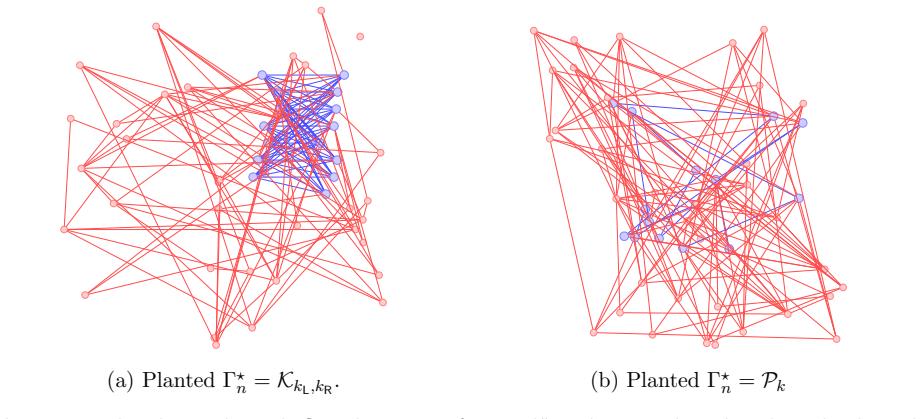
Figure from the paper full image
abstract click to expand
Understanding the fundamental limits of recovering planted subgraphs in random graphs is a central challenge in high-dimensional statistics and theoretical computer science. While existing work has largely focused on special subgraph families such as cliques, bicliques, or dense blocks, the exact recovery of a general planted subgraph in Erd\H{o}s--R\'enyi random graphs remains poorly understood. In this paper, we study the exact recovery of an arbitrary planted subgraph $\Gamma = \Gamma_n$ embedded in a dense Erd\H{o}s--R\'enyi random graph $\mathcal{G}(n,q_n)$, where edges within $\Gamma$ are present independently with probability $p_n > q_n$. Our main results identify sharp conditions under which exact recovery is possible with high probability, and we establish matching lower bounds showing the necessity of these conditions. The resulting statistical threshold is characterized by a new graph-theoretic quantity, which we term the \emph{minimal maximum subgraph density}. This quantity is defined as the maximum subgraph density of the smallest induced balanced subgraph of $\Gamma$. We then turn to the problem of recovery under polynomial-time constraints. We propose a computationally efficient recovery algorithm that applies to arbitrary planted subgraphs and analyze its performance in terms of certain spectral properties of the adjacency matrix. In addition, we derive computational lower bounds for recovery using the low-degree polynomial framework, establishing regimes where recovery is statistically possible but computationally hard. Finally, we consider several extensions of our setting, including recovery in semi-random models and weaker notions of recovery.
0
0
math.PR 2026-07-02

Perturbations preserve infinite clusters in tree percolation

by Mirmukhsin Makhmudov, Ville Suomala

On perturbations that preserve the connectivity properties in tree percolations

Mild distance-dependent factors leave the existence or absence of infinite clusters unchanged under minimal assumptions on the base model

abstract click to expand
We consider a general bond percolation on an infinite locally finite tree, where the edge retention probabilities $p_e$ are replaced by $\min\{1,q_{|e|}p_e\}$, where $\{q_n\}_{n\ge 1}$ is a sequence of positive perturbation factors and $|e|$ denotes the distance between the edge $e$ and the root. If the original percolation model admits infinite clusters, it is of interest to investigate under which perturbations $0<q_n\le 1$ this connectivity property is preserved. Conversely, if the original percolation does not admit infinite clusters, we are led to study the stability of such a property under perturbations satisfying $q_n\ge 1$. In both cases, under minimal assumptions on the original model, we show that the percolative behaviour is stable against certain quantitative non-trivial perturbations. We also discuss an application of our results to the Erd\H{o}s similarity conjecture for Cantor sets.
0
0
math.PR 2026-07-02

Non-symmetric forms need distinct energy integral analysis

by Kazuhiro Kuwae, Takumu Ooi +2 more

Energy integrals and asymmetric co-potentials for closed forms

Measures of finite energy integrals and co-potentials differ from symmetric cases across three comparison views.

abstract click to expand
We investigate the class of measures of finite energy integrals and the behavior of potentials and co-potentials associated with non-symmetric closed forms. In particular, we compare these objects with their symmetric counterparts from three viewpoints: a non-symmetric version of Stollmann--Voigt's inequality, non-symmetric perturbations of symmetric forms, and closed forms associated with non-symmetric jump-type forms. Our results indicate that measures of finite energy integrals, potentials, and co-potentials behave differently in the non-symmetric setting, requiring more delicate analysis than in the symmetric case.
0
0
math.PR 2026-07-02

Brownian motion constructed in Minkowski normed spaces

by Shin-ichi Ohta, Marco Rehmeier +1 more

Brownian motion in Minkowski normed spaces

Marginals match the fundamental solution of the nonlinear Finsler heat equation via a singular McKean-Vlasov SDE with proven pathwise unique

abstract click to expand
A Minkowski normed space is the Euclidean space equipped with a (possibly asymmetric) uniformly convex and smooth norm, forming a particular class of Finsler manifolds. We construct a stochastic process with one-dimensional time marginal densities given by the fundamental solution to the nonlinear Finsler heat equation in Minkowski normed spaces. This process is constructed as a solution to a singular McKean--Vlasov stochastic differential equation and constitutes a nonlinear Markov process in the sense of McKean. Furthermore, we show that solutions to this stochastic differential equation are pathwise unique, and thus probabilistically strong solutions, though the equation has singular coefficients beyond the subcritical regime. Since our construction is a natural extension of the construction of standard Brownian motion from the standard heat kernel, we call this process \emph{Brownian motion in Minkowski normed spaces.} To the best of our knowledge, this is the first construction of stochastic processes associated with nonlinear heat equation in Finslerian spaces.
0
0
math.OC 2026-07-02

Optimal relaxed controls exist for reflected mean-field SDEs with jumps

by Wenrui Lu, Kai Wang

Optimal control problem for reflected McKean--Vlasov stochastic differential equations with Poisson jumps

Moment estimates and tightness via the Skorokhod map establish existence, with strict controls under the Roxin condition.

abstract click to expand
In this paper, we consider the optimal relaxed control problem for a class of one-dimensional reflected McKean--Vlasov stochastic differential equations with Poisson jumps. Due to the presence of the jump term, the state process generally belongs to the Skorokhod space $D([0,T],\Rp)$, which makes the proof of tightness and the passage to the limit more complicated. Under Lipschitz conditions and suitable growth conditions, we establish uniform moment estimates for the state process and the reflecting process. Then, by using Aldous' tightness criterion, the continuity of the Skorokhod map, and the stability results for stochastic integrals, we prove the existence of an optimal relaxed control. Furthermore, under the Roxin convexity condition, we prove the existence of a strict optimal control. In the general case, we show that relaxed controls can be approximated by a sequence of strict controls.
0
0
math.PR 2026-07-02

Exit times in large birth-death processes converge to Poisson

by Pierre Collet (CPHT), Servet Martínez (UCHILE) +2 more

Threatening excursions in large population quasi-stationary birth and death systems. On a question of Antonio Galves

Rescaled threatening excursions from equilibrium form a Poisson point process on the clumping scale before absorption occurs.

abstract click to expand
We consider time continuous multispecies birth and death processes in a regime of large populations. The jump rates depend on a large scaling parameter K modeling the charge capacity. When K tends to infinity, the process is close (in finite time) to a dynamical system containing a non zero global attracting equilibrium and zero as unstable equilibrium. For each fixed K, extinction in finite time occurs almost surely and a quasi-stationary distribution occurs naturally in the study of the statistics over times scales which are large but smaller than the extinction time scale. Before this catastrophic event the process makes many unsuccessful large deviations attempts with time scales corresponding to how far it deviates from the quasi-equilibrium. The paper concerns the statistical description of these typical trajectories starting from the quasi-stationary distribution until extinction. An unusual mixing property yields large time scale behavior for the process starting from a fixed state. We give a precise statistical description of the successive exit times of the process rescaled by K from a neighborhood of the equilibrium of the dynamical system in a clumping time scale and prove their asymptotic Poisson distribution. We also give a precise description of the asymptotic distribution of the successive records until extinction.
0
0
math.PR 2026-07-02

Largest component ~ c ε^{-2} log(ε³ n) in subcritical PA

by Yiming Chen

Sharp Asymptotics for the Largest Component in the Subcritical Regime of Preferential Attachment Without Vertex Growth

The constant c is 2(α+2)/(α+1) when m equals m_c times (1-ε) and ε³n tends to infinity.

abstract click to expand
We study the size of the largest component in Pittel's preferential attachment process without vertex growth. Starting from the empty graph on a fixed vertex set $[n]$, edges are added one by one with probabilities proportional to $(d_u+\alpha)(d_v+\alpha)$, where $d_u$ and $d_v$ are the current degrees of $u$ and $v$, and $\alpha>0$. Let $L_1$ denote the size of the largest component, and set $m_c:=\frac{\alpha n}{2(\alpha+1)}.$ We prove that if $m=m_c(1-\varepsilon), \varepsilon=\varepsilon(n)\to0, \varepsilon^3 n\to\infty,$ then \[ L_1=(1+o_p(1))\frac{2(\alpha+2)}{\alpha+1}\varepsilon^{-2}\log(\varepsilon^3 n) \] for every fixed $\alpha>0$. More generally, the same asymptotic holds whenever $\alpha=\alpha(n)\to a\in(0,\infty]$. In particular, the constant $2(\alpha+2)/(\alpha+1)$ converges to the Erd\H{o}s--R\'enyi value $2$ as $\alpha\to\infty$. Moreover, if $m=\left\lfloor \frac n2(1-\varepsilon)\right\rfloor$ and $\alpha\varepsilon\to\infty$, then \[ L_1=(2+o_p(1))\varepsilon^{-2}\log(\varepsilon^3 n). \] The subcritical asymptotics for \(L_1\) resolve the problem left open by Janson and Warnke. The upper bound argument relies on the observation that, after conditioning on the degree sequence, the graph can be treated through the corresponding configuration model, the lower bound follows from tree component asymptotics and a second moment argument.
0
0
math.NT 2026-07-02

Average character sum over smooth numbers is o(sqrt count)

by Seth Hardy, Max Wenqiang Xu

Character sums over smooth numbers

Holds for y between (log x)^6 and x^{1/(32 log log x)} when q exceeds x^{1+ε}

abstract click to expand
Let $\Psi (x,y)$ denote the count of $y$-smooth numbers below $x$ and $P(n)$ denote the largest prime factor of $n$. We show that \[ \frac{1}{\varphi(q)} \sum_{\chi \bmod q} \Bigl| \sum_{\substack{n \leq x \\ P(n) \leq y}} \chi(n) \Bigr| = o \Bigl( \sqrt{\Psi(x,y)} \Bigr), \] whenever $(\log x)^6 \leq y \leq x^{\frac{1}{32 \log \log x}}$ and $q \geq x^{1 + \varepsilon}$ for some small quantifiable $\varepsilon > 0$. The saving is substantial when $\varepsilon$ is fixed away from zero, and we prove similar results for continuous characters and completely multiplicative twists of these sums.
0
0
math.PR 2026-07-02

Second-order stats variance scales with ball volume in point processes

by Fabio Frommer, Martin Hanke

(Non-)Hyperuniformity of Second Order Statistics of Point Processes

Both determinantal and Gibbs examples show fluctuations proportional to volume rather than slower, even when first-order counts are hyperuni

abstract click to expand
We investigate statistical properties of certain stationary point processes, namely determinantal processes with projection kernels and Gibbs point processes with superstable pair interactions. These are examples of hyperuniform and non-hyperuniform stationary point processes, respectively. We are interested in the variance of their second order statistics within a ball around the origin, and we study the asymptotic growth of this variance as the radius of the ball goes to infinity. It is shown that, generically, for both types of processes the variance is asymptotically proportional to the volume of the ball. In other words: the second order statistics of these point processes behave non-hyperuniform. For Gibbs processes with superstable interactions these results have an interesting application to the so-called inverse Henderson problem of statistical mechanics. We also show that the structure factor (respectively the Bartlett spectral measure) of these Gibbs processes is strictly positive, while it is positive except for a simple zero at the origin for the determinantal processes.
0
0
stat.CO 2026-07-02

MCMC proposals achieve near dimension-independent variance

by P. Dobson, J.M. Sanz-Serna +1 more

Optimal scaling of MCMC algorithms: exploiting the symmetry of the Metropolis-Hastings formula

Symmetry in the acceptance rule lets gradient-based proposals use variance O(1/d^μ) with μ arbitrarily small instead of the MALA rate of 1/3

Figure from the paper full image
abstract click to expand
We present a simple, yet general approach to study the scaling properties as the dimensionality of Metropolised MCMC sampling algorithms increases. The study relies ultimately on the symmetry of the Metropolis-Hastings formula. Our findings contain, as particular cases, many known results for the Random Walk Metropolis, MALA and other algorithms. In addition, they provide, in an easy way, new optimal scaling results for a variety of proposal mechanisms, including implicit proposals and proposals generated with the help of differential equation integrators. The analysis applies to targets that are products of a given, not necessarily univariate distribution, and also to cases where the different terms in the product are scaled differently. We show how to construct gradient-based MALA-like proposals where the variance of the proposal as the dimension $d$ increases may be taken as $O(1/d^\mu)$, with $\mu>0$ arbitrarily small, to be compared with the values $\mu = 1$ for Random Walk Metropolis and $\mu=1/3$ for MALA.
0
0
math.FA 2026-07-02

No constant bounds convex-hull representations for Weibull(r) processes

by Xuanang Hu, Hanchao Wang

Failure of Convex-Hull Bounds under Log-Convex Tails

For r in (0,1) the L_log(k+2) norms of auxiliary vectors cannot be controlled uniformly by the expected supremum, even with arbitrary choice

abstract click to expand
Fix $0<r<1$, and let $X_1,X_2,\dots$ be independent symmetric Weibull$(r)$ random variables, that is, \[ \textsf{P}(|X_i|>t)=e^{-t^r},\qquad t\ge 0. \] We prove that there is no constant $C_r$, depending only on $r$, with the following universal property: for every finite set $T\subset \R^N$ there exists a sequence $(y_k)_{k\ge 1}\subset \R^N$ such that \[ T-T\subset conv\{y_k:k\ge 1\}, \qquad \|X_{y_k}\|_{L_{\log(k+2)}}\le C_r\,\bx(T) \quad (k\ge 1), \] where $X_t=\sum_i t_i X_i$ and $\bx(T)=\textsf{E}\sup_{t\in T}X_t$. This gives a negative answer to a question of Lata{\l}a concerning the validity of convex-hull bounds for canonical Weibull processes. In fact, the failure persists even when the auxiliary vectors appearing in the convex hull are allowed to be arbitrary.
0
0
math.PR 2026-07-02

Bernoulli matrix corank at least k has prob (1-p)^{kn} for k=O(sqrt(log n))

by Zeyan Song, Hanchao Wang

Rank deficiency of Bernoulli random matrices for growing corank

The exact tail probability is derived when the deficiency grows slowly with dimension.

abstract click to expand
Let A be an n x n Bernoulli random matrix whose entries are i.i.d. Bernoulli(p) random variables. In this paper, we determine the probability that the corank of A is at least k when k is of order O(sqrt(log n)): P(corank A >= k) = (1-p+o_n(1))^(kn).
0
0
math.AP 2026-07-02

Unique mass-preserving solutions for nonlinear kinetic Fokker-Planck

by Zimo Hao, Zhengyan Wu +1 more

Kinetic Fokker-Planck Equations with Nonlinear Diffusion

A parameter-dependent smoothing estimate provides the compactness needed for existence and uniqueness under a mass-critical condition.

abstract click to expand
We study existence, regularity, and uniqueness for the nonlinear kinetic Fokker--Planck equation $$ \partial_t f=\Delta_v\Psi(f)-v\cdot\nabla_x f, \qquad f|_{t=0}=f_0, $$ on $\mathbb R^{2d}$. In the model case $\Psi(r)=r^s$, this equation couples nonlinear fast-diffusion/porous-medium type diffusion with kinetic transport. A distinctive feature is that the diffusion acts only in the velocity variable $v$, so that compactness in the spatial variable $x$ cannot be obtained from standard elliptic estimates and must instead be recovered through the hypoelliptic structure. Under general structural assumptions on $\Psi$, including the fast-diffusion powers $\Psi(r)=r^s$ with $s\in(0,1)$, we construct nonnegative weak solutions and prove quantitative anisotropic Besov regularity estimates. Under an additional mass-critical growth condition on the fast-diffusion side, the constructed weak solution preserves mass, admits a renormalized kinetic formulation, and is unique in the $L^1$-class of mass-preserving renormalized kinetic solutions. In the power-law case $\Psi(r)=r^s$, this condition is precisely $s\ge 1-1/d$ when $d\ge2$, while in dimension $d=1$ the whole fast-diffusion range $s\in(0,1)$ is covered. The main analytic ingredient is a parameter-dependent smoothing estimate for the kinetic semigroup generated by $$ \Psi'(\zeta)\Delta_v - v\cdot\nabla_x , $$ which quantitatively tracks the dependence on the kinetic level $\zeta$. Combined with the kinetic formulation, this estimate yields compactness in both spatial and velocity variables for the nonlinear hypoelliptic problem. As an application, we also obtain martingale-problem solutions to the associated distributional-density dependent stochastic differential equation.
0
0
math.ST 2026-07-02

Three-stage estimator consistent for hybrid Lévy switching SDEs

by Yuzhong Cheng

Ergodicity and High-Frequency Inference for Hybrid Switching L\'{e}vy-Driven Stochastic Differential Equations

Joint normality couples drift and scale via third moment of Lévy noise while switching rates stay uncorrelated

Figure from the paper full image
abstract click to expand
Hybrid switching L\'evy-driven stochastic differential equations with pure-jump noise and state-dependent switching rates are studied under high-frequency observation. A three-stage inference procedure is proposed for the drift, scale, and switching-rate parameters, combining a staged Gaussian quasi-likelihood with an intensity-type contrast. Checkable sufficient conditions for weighted exponential ergodicity are established for the hybrid process; the proof does not rely on Brownian smoothing, but uses a fixed skeleton-chain argument combining small-jump accessibility and regime connectivity. Under ergodicity and the high-frequency sampling scheme, consistency, joint asymptotic normality, and a polynomial-type large deviation inequality are proved for the full estimator. The joint limit exhibits a transparent covariance structure: the drift and scale blocks are coupled through the third moment of the driving L\'evy noise, whereas the switching-rate block is asymptotically uncorrelated with the continuous-coefficient blocks. Numerical experiments for models driven by normal inverse Gaussian noise illustrate the finite-sample behavior of the proposed estimators.
0
0
math.PR 2026-07-02

Random lattices produce Poisson-Dirichlet weights on near-shortest vectors for c>1

by Masahiro Kaminaga

Thermal Concentration and Poisson--Dirichlet Edge Statistics for Random--Lattice Gibbs Ensembles

Primitive directions concentrate thermally at the visibility threshold c=gamma^{-2} in the high-temperature regime.

abstract click to expand
We study Gibbs measures on high--dimensional Haar--random unimodular lattices, where the energy of a lattice vector is its squared Euclidean norm. The random lattice is viewed as quenched geometric disorder, and $c>0$ denotes the scaled inverse temperature. We first analyze the edge window of vectors whose length is within the factor $e^{a/n}$ of the shortest length, with fixed $a$ as $n\to\infty$. For the full sign--class Gibbs ensemble, we prove a Poisson point process limit theorem for the Gibbs mass of this window. The mass vanishes in probability for $0<c\le1$, while for $c>1$ it has a nontrivial Poisson limit, and the ranked Gibbs weights converge to the Poisson--Dirichlet distribution with parameter $1/c$. We then pass to a primitive--direction Gibbs ensemble and consider a fixed approximation factor $\gamma>1$. For this modified ensemble, we prove a weighted moment formula and a quenched thermal concentration result in the high--temperature range $0<c<1$. This yields the primitive fixed--factor visibility curve $c=\gamma^{-2}$ for approximate shortest directions. More precisely, the primitive Gibbs mass of the fixed--factor window tends to zero for $c<\gamma^{-2}$, to one for $\gamma^{-2}<c<1$, and to $1/2$ at the critical boundary $c=\gamma^{-2}$. Thus the fixed--factor theorem is a visibility statement for an idealized primitive target measure, not for the original full lattice Gibbs measure. The results provide a random--lattice thermodynamic reference model for Gibbs targets related to approximate shortest vectors, without implying an efficient algorithm for the shortest vector problem.
0
0
q-bio.PE 2026-07-01

Senescence mortality matches multi-level selection patterns

by Ananda Shikhara Bhat, Hanna Kokko

Demographic senescence as multi-level selection in miniature

A two-level Moran process models both group competition and damage buildup, producing equivalent age-specific death rates through selective

Figure from the paper full image
abstract click to expand
Multi-level selection and senescence do not at first sight have much in common. Here, we demonstrate that the emergent mortality patterns generated by demographic senescence can be understood as the product of multi-level selection. We formulate a two-level Moran type process and use its scaling limits to illustrate that a simple mathematical framework that models multi-level selection in group-structured populations also models damage accumulation patterns and resultant mortality curves in ageing organisms. To verbally make the connection, observe that defectors spread within a group consisting of cooperators and defectors; when groups compete against each other, defector-rich groups suffer, and between-group selection causes such groups to be systematically under-represented. Exactly analogously, senescing individuals accumulate damage to physiological sub-systems, and `damage begets damage'; individuals who are more damaged are more likely to die, hence damage-rich individuals are systematically under-represented in later age classes. Thus, emergent senescence patterns in complex, integrated organisms are formally equivalent to the patterns generated by a within-generation multi-level selection process in which intra-organismal sub-systems play the role of particles, organisms play the role of collectives, and selective disappearance plays the role of group selection.
0
0
stat.AP 2026-07-01

CTMC-Krylov and QBD recursions compute waiting times in dynamic-priority queues

by M. Abdullah Khokhar, Malgorzata M. O'Reilly +1 more

Waiting time analysis in a finite-capacity multi-server systems with dynamic priorities, dynamically evolving customer types, and abandonment

Finite multi-server systems with evolving customer types and abandonment admit both approximate and exact distribution analysis.

Figure from the paper full image
abstract click to expand
In many service systems, an estimation of customers' waiting times for the service can assist in decision making focused on enhancing the operational efficiency, improving the customers' experience, and ensuring efficient resource allocation. In this paper, we study the customers' waiting times in a finite-capacity service system with a finite number of parallel servers and a shared waiting area. We consider two customer types, Type 1 and Type 2, with dynamic admission priorities, dynamically evolving customer type, and abandonment. We model the system under such assumptions using a continuous-time Markov chain (CTMC) and develop a methodology based on Krylov subspace approximation methods to evaluate the conditional waiting time distributions of Type 1 and Type 2 customers in the system. This methodology (CTMC-Krylov) offers a scalable computational approach that is well suited for analysing large complex systems. Next, we model this system using a quasi-birth-and-death (QBD) process and derive analytical expressions building on matrix-analytic methods to evaluate the conditional and long-run waiting time distributions using recursion. We illustrate the practical applicability of our models in a hospital system through a suite of numerical examples based on a large dataset obtained from a tertiary referral hospital in Australia, considering two types of patients, complex (Type 1) and other (Type 2).
0
0
math.OC 2026-07-01

No constant learning rate guarantees monotone descent in adversarial least squares

by Fabrizzio Sabelli

Homogenization of ell₂-Adversarial Training in High-Dimensions: Exact Dynamics under Stochastic Gradient Descent

High-dimensional ODE analysis shows adversarial risk requires adaptive stepsizes unlike standard least squares.

Figure from the paper full image
abstract click to expand
We develop a framework for analyzing the learning dynamics of $\ell_2$-adversarial training of single-index models on Gaussian mixtures in the high-dimensional limit under streaming stochastic gradient descent (SGD). We derive deterministic equivalents for a broad class of statistics of the SGD iterates, including the adversarial risk and distance to adversarial optimality, in terms of the solution to a system of ODEs. We use them to study two idealized learning rate schedules: the Polyak stepsize and exact line search. In the case of $\ell_2$-adversarial least squares with a single class, we show that, unlike noiseless standard least squares, no constant learning rate guarantees monotone descent of SGD towards a minimizer of the adversarial risk. We identify anisotropic covariance and a mismatch in ridge parameters as the main sources of suboptimality of exact line search relative to the Polyak stepsize. We also introduce a stochastic differential equation (SDE), called adversarial homogenized SGD, that captures the evolution of statistics of the iterates of SGD. For $\ell_2$-adversarial least squares, using this SDE, we show the evolution of the risk is equivalent, up to dimension-free constants, to that of SGD on standard least squares with an adaptive learning rate and adaptive $\ell_2$-regularization. When the dynamics converge, the limiting adversarial risk and SGD iterate are determined by a fixed-point equation, with the limiting iterate being equivalent to the solution of a ridge regression problem whose regularization parameter is the limiting effective regularization of SGD.
0
0
cs.IT 2026-07-01

Linear constraints shift guesswork exponent by ρ(1-R)

by Hassan Tavakoli

Guesswork Under Linear Constraints: Exact Exponent for Coset Decoding

The exact rate for the ρ-th moment of coset rank equals the unconstrained value minus ρ times one minus the code rate.

abstract click to expand
We establish the exact exponential growth rate of the $\rho$-th moment of the constrained guesswork $G_{\mathrm{coset}}$ -- the rank of the true noise vector within its syndrome coset of a random binary linear code under i.i.d.\ Bernoulli$(p)$ noise: \( \lim_{n\to\infty} \frac{1}{n}\log_2\Eb\!\left[G_{\mathrm{coset}}^{\rho}\right] = \rho\,h_{\frac{1}{1+\rho}}(p)\;+\;\rho(R-1), \, \rho>0, \) where $h_\alpha(p)$ is the binary R\'{e}nyi entropy and $R=k/n$ is the code rate. The exponent shifts down by exactly $\rho(1-R)$ relative to the unconstrained Ar{\i}kan--Merhav exponent, with each of the $n(1-R)$ parity checks contributing equally. Finite-length simulations confirm convergence from below. We further establish: (i)~a transfer theorem expressing the partition-function exponent in terms of an arbitrary weight-enumerator growth rate $g(\delta)$; (ii)~the exact exponent for $L_n$-list (``$k$-th'') constrained guesswork; and (iii)~a sharp second-order refinement of order $\rho\log_2 n$. Beyond the binary i.i.d.\ setting, we prove a universality theorem: for any code ensemble $\mathcal{E}$ whose weight enumerator concentrates at rate $g_{\mathcal{E}}(\delta)$, the guesswork exponent equals $(1+\rho)\psi_{1/(1+\rho)}(g_{\mathcal{E}})-\rho\,\psi_1(g_{\mathcal{E}})$, where $\psi_\alpha(g)=\sup_\delta[g(\delta)+\alpha\ell(\delta)]$. As concrete applications, we instantiate this theorem for the $q$-ary extension, $\Lambda_q(\rho)=\rho\,h^{(q)}_{1/(1+\rho)}(P)+\rho(R-1)\log_2 q$, and for Gallager's regular LDPC ensemble, obtaining a closed-form guesswork exponent via an exact finite-length identity for the ensemble-average weight enumerator.
0
0
math.PR 2026-07-01

SVGD particles stay close to mean-field limit for all time

by Krishnakumar Balasubramanian, Sayan Banerjee +1 more

Uniform-in-time Propagation-of-Chaos for Stein Variational Gradient Descent

Cutoff and moment-closure arguments give log or N^{-1/2} rates that hold uniformly rather than only at short times.

abstract click to expand
We study uniform-in-time propagation-of-chaos for continuous-time Stein Variational Gradient Descent (SVGD). Classical finite-time propagation-of-chaos estimates for mean-field systems typically deteriorate rapidly with time and therefore do not directly explain the long-time relation between the finite-particle system and its mean-field limit. We obtain two complementary classes of uniform-in-time propagation-of-chaos results. For broad distributional metrics, we introduce a cutoff strategy which combines finite-time propagation-of-chaos estimates up to an $N$-dependent horizon with independent quantitative long-time convergence estimates for the finite-particle and mean-field SVGD flows. This yields uniform-in-averaging-time propagation-of-chaos bounds in Langevin kernel Stein discrepancy, Wasserstein-1 distance, and Wasserstein-2 distance, with logarithmic or iterated-logarithmic rates depending on the metric, target and kernel class. We also develop a finite-dimensional theory for matrix-valued finite-rank kernels. For Gaussian targets with bilinear kernels, the SVGD dynamics close exactly on first and second moments, yielding genuine uniform-in-physical-time parametric propagation-of-chaos rates in finite-dimensional Stein-feature metrics. We then prove a conjugacy principle showing that these feature-level estimates transfer to conjugate target-kernel pairs under orientation-preserving diffeomorphisms, thereby extending the theory to broad classes of nonlinear, including multimodal, targets. Together, these results highlight the contrast between generic distributional metrics, for which our general approach yields logarithmic rates, and closed finite-dimensional Stein observables, for which parametric $N^{-1/2}$ propagation-of-chaos rates persist uniformly in time.
0
0
math.PR 2026-07-01

Positive jumps make reciprocal exponential functional moment-indeterminate

by Martin Minchev

On a moment determinacy conjecture of Bertoin and Yor

Proof of Bertoin-Yor conjecture shows any positive jumps yield a subdensity that fails the Krein criterion for X_ξ.

Figure from the paper full image
abstract click to expand
Let $\xi$ be an unkilled real-valued L\'evy process which drifts to $+\infty$ and has positive exponential moments of all orders, and define $I_\xi=\int_0^\infty e^{-\xi_t},dt$, and its reciprocal $X_\xi=1/I_\xi$. Bertoin and Yor proved that $X_\xi$ is moment-determinate when $\xi$ has no positive jumps, and conjectured that this condition is also necessary. We prove the latter. The proof is based on a lower bound near zero for the law of $I_\xi$. We show that a group of sufficiently many positive jumps near the origin puts $I_\xi$ on a suitable small scale. The first selected jump time is used as a one-dimensional smooth coordinate, yielding an absolutely continuous subcomponent of the law of $I_\xi$. After the change of variables, the resulting subdensity of $X_\xi$ satisfies a Krein moment indeterminacy criterion.
0
0
math.CO 2026-07-01

Covariance bounds degree-weighted Fourier overlap for monotone functions

by Fan Chang, Hong Liu +1 more

The sharp diagonal spectral correlation inequality on the discrete cube

The inequality Cov(f,g) ≥ 4 ∑ |S| ˆf(S)² ˆg(S)² holds with equality only for disjoint supports, common dictatorships, or the AND-OR pair.

abstract click to expand
We prove the sharp diagonal spectral correlation conjecture of Friedgut, Kahn, Kalai and Keller, proposed in their Fourier-analytic approach to Chv\'atal's conjecture. For every pair of increasing Boolean functions $f,g:\{0,1\}^n\to\{0,1\}$, $$\mathrm{Cov}(f,g)\ge4\sum_{\varnothing\ne S\subseteq[n]}|S|\hat{f}(S)^2\hat{g}(S)^2.$$ Thus covariance controls the degree-weighted collision of the two nonconstant Fourier spectra, giving a sharp Fourier strengthening of the Harris--Kleitman inequality. The theorem also implies the unweighted diagonal conjecture of Friedgut--Kahn--Kalai--Keller for an increasing family and a maximal intersecting family. The factor $4$ is optimal, and we determine all equality cases. Apart from pairs whose relevant coordinate sets are disjoint, equality occurs only for a common dictatorship and, up to relabelling coordinates and interchanging $f$ and $g$, for the two-coordinate AND-OR pair $(f,g)=(x_i x_j,\,x_i\vee x_j).$ The main novelty is a correlated four-restriction induction and a sharp endpoint convolution inequality. The usual two-restriction induction behind Harris--Kleitman sees only the parallel restricted pairs and loses the mixed Fourier information needed to control the degree-weighted diagonal spectral energy. We instead couple the four codimension-one restricted pairs with correlation $1/2$; this precise correlation extracts the missing degree-weighted energy as a nonnegative square.
0
0
cs.DS 2026-07-01

Monotone array completes in (1/2+o(1))n log n steps

by Vishesh Jain, Dylan King +1 more

The online monotone array completion problem

Matching bounds show optimal play halves coupon-collector time; with-replacement version reaches O(n sqrt(log n))

Figure from the paper full image
abstract click to expand
Consider the following online filling game. An array of length $n$ is initially empty. At each time step one observes an independent sample from $\mathrm{Unif}[0,1]$ and must either discard it or place it irrevocably into an empty position of the array, while preserving the constraint that the occupied entries are non-decreasing from left to right. Among all possible strategies, what is the optimal expected time required to fill the array? Let $v_n$ denote this optimal expected completion time. Our main result determines $v_n$ up to lower-order terms: \[ v_n=\left(\frac12+o(1)\right)n\log n. \] More precisely, no strategy, even if randomized and adaptive, can have expected completion time below $\left(\frac12-o(1)\right)n\log n$, while we provide an explicit deterministic strategy whose expected completion time is at most $\left(\frac12+o(1)\right)n\log n$. For comparison, the natural coupon-collector strategy, which partitions $[0,1]$ into $n$ equal intervals and reserves one array position for each interval, has expected completion time $(1+o(1))n\log n$. We also consider a with-replacement version of the game, in which previously placed entries may be overwritten. For this variant, we give a deterministic strategy with expected completion time $O(n\sqrt{\log n})$, thereby establishing a separation between the two models.
0
0
math.ST 2026-07-01

Moment estimator consistent and normal for dynamic graph models

by Diego Garlaschelli, Michel Mandjes +2 more

Analysis of a maximum-entropy based estimator for dynamic random graph models

Maximum-entropy distributions on graph trajectories admit a moment-based estimator whose consistency, normality, and covariance are derived

Figure from the paper full image
abstract click to expand
We study dynamic random graphs in which the set of nodes is fixed, but edges evolve over time according to an underlying stochastic mechanism. Using a maximum-entropy approach, we define a probability distribution on graph trajectories that is consistent with observed constraints, capturing the inherent uncertainty in partially observed networks. We introduce a moment-based estimator for the parameters of this distribution and establish its statistical properties, such as consistency and asymptotic normality, with explicit formulas for the covariance structure. Numerical experiments demonstrate the estimator's accuracy and robustness across various dynamic network scenarios. Our framework bridges probabilistic modeling and statistical inference in time-varying networks, providing practical tools for understanding and predicting complex edge dynamics.
0
0
stat.ME 2026-07-01

Projection yields consistent payment estimators from macro insurance data

by Martin Bladt, Marcus Christiansen

Payment Process Estimation in Aggregated Insurance Models

Inverse-probability weighting recovers state-specific cumulative payments under truncation and censoring

Figure from the paper full image
abstract click to expand
Insurance payments may depend on latent micro states although only macro states and realized payments are observed. We study a sojourn-payment model for such aggregated multi-state systems under left-truncation and right-censoring. Starting from a micro-to-macro projection, we establish strong consistency and weak convergence for inverse-probability-weighted estimators of state-specific cumulative payment processes.
0
0
math.CA 2026-07-01

Beckmann boundary obeys Talagrand inequality on the cube

by Paata Ivanisvili, Xinyuan Xie +1 more

A Beckmann boundary form of Talagrand's conjecture on the discrete cube

New nonlocal measure is smaller than or equal to edge boundaries yet satisfies the variance times sqrt(log term) lower bound for every nonco

Figure from the paper full image
abstract click to expand
We introduce the Beckmann boundary of a Boolean function \[ \mathsf{B}(f)=\inf_{\operatorname{div} V=Lf}\mathbb E\|V(x)\|_2. \] Here \[ L=\sum_iD_i,\qquad D_i f(x)=\frac{f(x)-f(x^{\oplus i})}{2}, \] and $\operatorname{div} V(x)=\sum_i (V_{i}(x)-V_{i}(x^{\oplus i}))$. This nonlocal quantity is no larger than the usual two-sided, one-sided, colored, optimized colored, or optimized fractional colored boundaries. Nevertheless, every nonconstant Boolean $f$ satisfies \[ \mathsf{B}(f)\gtrsim \operatorname{Var}(f) \sqrt{\log\!\left(1+\frac{1}{\sum_i\operatorname{Inf}_i(f)^2}\right)}. \] We also prove strong one-sided fractional spectral estimates. If $A\subset\{-1,1\}^n$ and \[ h_{A}(x)=\#\{i:x\in A,\ x^{\oplus i}\notin A\}, \] then, for $0<\alpha<1$, \[ \sum_{S\ne\varnothing}|S|^\alpha\widehat{\mathbf 1_{A}}(S)^2 \lesssim_\alpha \mathbb E\omega_\alpha(h_{A}), \] where $\omega_\alpha(m)=\sqrt m$ for $\alpha<1/2$, $\omega_{1/2}(m)=\sqrt m\log(e+m)$, and $\omega_\alpha(m)=m^\alpha$ for $\alpha>1/2$. These profiles are sharp, up to $\alpha$-dependent constants, for majority. We also show that the comparison is genuinely nonreversible: an explicit quotient-cube family makes the optimized fractional, and hence optimized colored, boundary exceed $\mathsf{B}$ by a factor $\gtrsim\sqrt{\log n}$. We further obtain a driftless Bernstein-multiplier inequality.
0
0
math.PR 2026-07-01

Graph geometry and dependence set empirical rates

by Mengsi Gao, Demian Pouzo

Coupling and Maximal Inequalities for Graph-Dependent Empirical Processes

Maximal inequalities show convergence speed depends on function-class complexity, graph growth, and how fast dependence fades with distance.

abstract click to expand
We develop maximal inequalities for empirical processes indexed by graph-dependent observations. Our bounds separate the complexity of the indexing class from two features specific to graph dependence: the geometry of the underlying graph and the cost of coupling graph-separated blocks to independent copies. The coupling construction combines a novel graph-adapted dependence coefficient with a coloring of a block partition. We specialize the results to graphs with polynomial and exponential growth and to directed dyadic graphs. We then derive Glivenko--Cantelli results and characterize the associated effective sample size. A central implication is that graph-dependent empirical processes need not exhibit a generic root-$n$ rate: convergence is jointly determined by function-class complexity, graph geometry, and the decay of dependence with graph distance. Finally, we apply the results to obtain uniform laws of large numbers for network autoregressive models, nonlinear local-propagation models, and treatment-interference settings.
0
0
math.CO 2026-07-01

No ideal color wheel exists on any finite graph

by Tejo Madhavarapu, T. Kyle Petersen +1 more

Is There An Ideal Color Wheel?

Blending from neighbors forces all colors identical in any connected structure.

Figure from the paper full image
abstract click to expand
The familiar color wheel is a disk divided into six sectors, colored red, orange, yellow, green, blue, and purple, in circular order. Three of the colors can be obtained by blending the colors in the two neighboring sectors. One might wonder: is there a color wheel in which all six of the sections have this property, without all the sections being the same color? We show that the answer is no, not just for the 6-cycle but for any finite connected graph; indeed, for any finite, strongly connected, edge-weighted digraph. The result generalizes the ``harmonic lemma" for graphs, replacing the well-behaved averaging function by paint blending, about which almost nothing is assumed. Our proof makes use of a Markov chain stopping rule.
0
0
math.AP 2026-07-01

Neumann Ornstein-Uhlenbeck semigroup on trees is Markovian with Gaussian invariant

by Sahiba Arora, Marjeta Kramar Fijavž +2 more

Ornstein--Uhlenbeck semigroup on rooted trees

Form methods on rooted metric trees yield a Markovian Neumann realization whose unique invariant is the Gaussian measure, plus spectral redu

Figure from the paper full image
abstract click to expand
We study Ornstein--Uhlenbeck operators on rooted metric trees equipped with a Gaussian-type measure. Using form methods, we construct Dirichlet and Neumann realisations corresponding, respectively, to killing and reflection at the root. The associated semigroups are symmetric, analytic and positivity preserving; the Dirichlet semigroup is sub-Markovian, while the Neumann semigroup is Markovian and admits the Gaussian measure as its unique invariant measure up to scalar multiples. We prove compactness of the resolvent and derive linear eigenvalue asymptotics. For regular rooted trees, we adapt the Naimark--Solomyak decomposition to the Gaussian weighted setting, reducing the operators to one-dimensional half-line problems and obtaining refined spectral localisation and lower bounds.
0
0
math.PR 2026-07-01

Forest recursion yields limiting measure for multiscale Markov chains

by Diego Alberici, Davide Gabrielli +1 more

The Invariant Measure of Multiscale Markov Chains via Fast Arborescence Factorization

The stationary distribution in the large-N limit is built from effective dynamics on separated timescales via arborescence factorization.

Figure from the paper full image
abstract click to expand
We consider a family of continuous-time Markov chains with finite strongly connected transition graph and rates $\left(r_N\right)_{N>0}$ depending on a parameter $N$, so that, when $N$ is large, transitions may happen on different time scales. Under suitable general assumptions on the asymptotic behavior of the rates, we give a recursive characterization of the limiting invariant measure. The recursion is encoded in a forest structure equivalent to the one recently developed in the analysis of dynamical aspects of metastability \cite{BL,LX}. Our proof is based on a combinatorial representation of the invariant measure, given by the Markov chain tree theorem. Basic steps are the reduction of the chain by a trace process, the introduction of an effective dynamics, and a careful analysis of the set of relevant arborescences in the expansion. In particular we use a factorization of fast arborescences. As a byproduct we obtain properties of the arborescences of generalized star-delta reductions of weighted digraphs.
0
0
math.PR 2026-07-01

Free SDEs gain global well-posedness under local Lipschitz conditions

by Jiaxin Wei, Zhi Yin

Well-posedness and stationary distribution of free stochastic differential equations

Local operator Lipschitz and Lyapunov conditions ensure unique solutions and stationary distributions in noncommutative probability spaces.

abstract click to expand
This paper studies free stochastic differential equations driven by free Brownian motion. Under local operator Lipschitz and Lyapunov-type conditions on the coefficients, we prove the global well-posedness of solutions in the noncommutative probability setting using free It\^o calculus. We further establish the existence and uniqueness of stationary solutions under appropriate dissipativity conditions. Our results extend classical theory to the free probability framework.
0
0
math.PR 2026-07-01

Divergence-free drifts yield infinitely many SDE solutions

by Huaxiang Lü

Non-Uniqueness for Nonlinear Fokker--Planck Equations and Their Associated Distribution-Dependent SDEs

Nonlinear Fokker-Planck equations admit multiple stationary probability solutions at the critical regularity threshold

Figure from the paper full image
abstract click to expand
In this paper, we study distribution-dependent stochastic differential equations on the domain $\mathcal O=\mathbb T^d$ or $\mathbb R^d$, $d\geq 2$, of the form \begin{align*} {\rm d}X_t = v(t,X_t,\rho_t)\,{\rm d}t + \sqrt{2}\, \sigma(t,X_t,\rho_t)\,{\rm d}W_t, \qquad \rho_t:=\frac{{\rm d}\mu_t}{{\rm d}x}, \end{align*} where $\mu_t=\operatorname{Law}(X_t)$. Our main construction is carried out at the level of the associated nonlinear Fokker--Planck equations. We first build non-unique probability solutions to these PDEs and then use the superposition principle to obtain non-unique martingale solutions to the corresponding DDSDEs. We establish two main non-uniqueness results concerning stationary states, both on the torus and in the whole space, under the corresponding structural assumptions. First, we construct a divergence-free drift $v\in C_tL^{d-}$ such that the DDSDE admits \emph{infinitely many} distinct solutions starting from the stationary initial density. This result lies at the natural critical regularity threshold: in several models, well-posedness is expected for drifts in $C_tL^{d+}$. Second, for $d\geq 3$ and every prescribed $N\in\mathbb{N}$, we construct a divergence-free drift for which the DDSDE admits at least $N$ distinct stationary martingale solutions. The resulting multiplicity of equilibrium states is reminiscent of multistability and phase-transition phenomena in physical systems.
0
0
eess.SP 2026-07-01

Von Mises parameters plug directly into radar trackers

by Vinay Kulkarni, V. V. Reddy

Von Mises Based Uncertainty Quantification for Closely Spaced Automotive Radar Targets

Ensemble outputs mean angle and concentration that supply closed-form likelihoods for association without extra approximations.

Figure from the paper full image
abstract click to expand
This work investigates uncertainty-aware deep learning approaches for direction of arrival (DOA) estimation in automotive radar, focusing on probabilistic modeling and downstream integration. A circular-statistics-based von Mises (VM) ensemble (ENS) is compared with an evidential deep learning (EDL) framework based on a normal inverse gamma formulation, yielding a Student t predictive distribution in the Euclidean domain. The ENS framework produces angular predictions parameterized by (mu, kappa), enabling interpretable uncertainty aligned with directional geometry. Performance is evaluated under in distribution and multiple out-of-distribution conditions using risk coverage and ROC or AUROC analyses. Results indicate that ENS achieves lower uncertainty under nominal conditions and exhibits stronger sensitivity to severe perturbations, whereas EDL provides smoother uncertainty variation and slightly improved ranking consistency. Importantly, the ENS representation enables direct probabilistic integration into association modules via closed form VM likelihoods, facilitating a unified detection tracking pipeline. These findings highlight a trade-off between geometric consistency and statistical generality in uncertainty-aware DOA estimation.
0
0
math.PR 2026-07-01

Multi-time renewal chains solved via lattice convolution and power series

by Leonidas Kordalis, Samis Trevezas

Discrete time-multidimensional renewal theory and applications

The algebraic approach supplies explicit equations, FFT computation, proportional-growth limit theorems, and an exact estimator for multivar

Figure from the paper full image
abstract click to expand
We develop a discrete-time renewal framework in which renewal events evolve along multiple time coordinates and the sojourn mechanism is described by a general distribution on the multi-index lattice. The resulting processes, called multi-time renewal chains, are studied through multi-index convolution and the associated algebra of multivariate formal power series. This algebraic formulation gives explicit representations for multi-time renewal equations, constructive coefficient formulas, and practical inversion schemes. For computation, we combine FFT-based multidimensional convolution with Newton-type reciprocal iteration to evaluate renewal quantities on large grids. For asymptotics, we prove strong laws and central limit theorems under proportional growth of the observation horizon, including a general central limit theorem for additive functionals and a Gaussian limit for the renewal counting process in directions with a unique rate-determining coordinate. We also study fixed-horizon observations: the terminal age vector induces a genuinely multivariate right-censoring mechanism, leading to an exact nonparametric maximum likelihood estimator and its asymptotic normality. Applications include a binomial--multiset identity, two-attribute warranty evaluation, alternating-renewal availability computation, and discretization-based approximations of continuous-time bivariate renewal and availability models.
0
0
math.OC 2026-07-01

RVI algorithms for ergodic diffusion control converge exponentially

by Sumith Reddy Anugu, Guodong Pang

Exponential rate of convergence of relative value iteration algorithms for ergodic controls of diffusions

Discrete recursive systems contract in a weighted semi-norm under uniform exponential stability, for both standard and risk-sensitive costs.

abstract click to expand
In this paper, we investigate the rate of convergence of the relative value iteration (RVI) algorithms for diffusions in $\mathbb{R}^d$ under both the conventional ergodic cost (CEC) and ergodic risk-sensitive cost (ERSC) criteria, and under the uniform exponential stability condition. The existing RVI algorithms for the CEC and ERSC problems solve the associated initial value Hamilton-Jacobi-Bellman type equations whose solutions are shown to converge asymptotically to the corresponding optimal values. However, the rates of convergence for such algorithms have remained open. This paper proposes discrete-time implementations for the RVI algorithms based on slight modifications of the associated PDEs, and proves that the rates of convergence of these RVI algorithms are exponential under a weighted sup-norm. These implementations have discrete-time iterates that can be explicitly expressed as recursive systems. The difference between these iterates and the desired value function in the CEC case can then be expressed in terms of the associated Markov kernels. Similarly, this can be done for the logarithms of the corresponding iterates and desired value function in the ERSC case in terms of the associated Markov kernels for the extended diffusion. As a result, we are able to prove the desirable contraction properties in order to establish the exponential rate of convergence by making use of a weighted semi-norm in which Markov kernel acts a contraction.
0
0
math.PR 2026-07-01

Uniform maximizes every binomial moment of sibling coupon empty spaces

by Christopher D. Long

Radial Transform Extremality for the Siblings of the Coupon Collector

Along rays from uniform, the PGF of U_j^N decreases for z>1, increasing for z<1 and peaking binomial moments at equal probabilities.

abstract click to expand
In the siblings version of the coupon collector, a main collector stops when every coupon type has appeared once. Duplicates are passed successively to siblings, and $U_j^N$ denotes the number of empty spaces in the $j$th collector's album at the main completion time. We prove finite-$N$ radial transform strengthenings of the uniform-probability extremality principle. For every $N\ge2$, every $j\ge2$, every positive nonuniform probability vector $p$, and the ray $p(\theta)=u+\theta(p-u)$ from the uniform vector $u$, the full probability generating function $\mathbb{E}_{p(\theta)}z^{U_j^N}$ is strictly decreasing in $\theta$ for $z>1$ and strictly increasing in $\theta$ for $0<z<1$. Thus the same full PGF has opposite radial monotonicity on the two sides of $z=1$, the left side giving a radial Laplace-transform order. At the coefficient level, along every nonconstant ray from the uniform vector, uniform probabilities maximize every binomial moment of $U_j^N$, equivalently giving a finite absolutely-monotone/binomial-transform order. The proof of the right-PGF and binomial-moment theorem is exact and finite-dimensional. It uses Poissonization, a marked Poissonized PGF identity, a normalized alternating subset expansion, and a positive-kernel radial derivative formula obtained from a local cumulative-polynomial dissipation lemma. The Laplace-transform theorem follows from a separate Gamma-mixture race representation.
0
0
cs.LG 2026-07-01

Flow matching adapts AI generation for probabilistic seismic inversion

by Baldur Paulwitz, Stefan Buske

Probabilistic Inversion with Flow Matching

The technique produces ensembles of velocity models consistent with seismic data, enabling direct uncertainty quantification.

Figure from the paper full image
abstract click to expand
We demonstrate the application of Flow Matching, a technique originating from generative Artificial Intelligence, to probabilistic inversion in geophysical settings, such as seismic Full-Waveform inversion. We adapt the well-established mathematical theory of Flow Matching from generative Artificial Intelligence to the context of probabilistic inversion. We evaluate the approach with two case studies: a simple 2D velocity model to illustrate the general features of the method, and the OpenFWI dataset to show its capabilities for probabilistic inversion of more complex seismic velocity models.
0
0
math.PR 2026-07-01

Averaged kernels produce heat kernel lower bounds for jump processes

by Zhen-Qing Chen, Jun Kigami

Heat kernel lower bound estimates for symmetric pure jump processes via averaged jump kernels

The estimates work on volume-doubling spaces even with degenerate kernels and give bounds for Brownian traces on Sierpinski gaskets.

Figure from the paper full image
abstract click to expand
We derive a heat kernel lower bound estimate for symmetric pure jump processes on general volume doubling metric measure spaces with possible degenerate and/or singular jump kernels using averaged jump kernels. As an application, the main result of this paper is applied to derive a lower bound estimate for the transition density function of the trace of Brownian motions on Sierpinski gaskets on the bottom of the Sierpinski gasket.
0
0
math.PR 2026-07-01

Delta sensitivities computed via density and Malliavin methods

by Fred Espen Benth, Olfa Draouil +1 more

Efficient Computation Of Sensitivities For Derivatives In Energy Markets

Correlated stochastic price and volume processes yield formulas for energy derivative hedging without needing densities in every case.

abstract click to expand
In this study, we develop a stochastic framework for computing Delta sensitivities in energy markets, where both prices and traded volumes are modeled as correlated stochastic processes. Within this framework, we analyze two complementary approaches for sensitivity analysis: the density method, which is applicable when the density of the underlying process is known, and the Malliavin calculus method, which does not require any explicit knowledge of the density and relies only on the dynamics of the processes. We present illustrative examples for both methods. For the density-based approach, we consider Ornstein-Uhlenbeck and CARMA processes to model prices and energy volumes. For the Malliavin calculus approach, we study Ornstein-Uhlenbeck processes, jump diffusion driven by a compound Poisson process, time-changed Brownian motion processes subordinated by an inverse Gaussian (IG) process, as well as Ornstein-Uhlenbeck processes driven by a normal inverse Gaussian (NIG) process. We provide some numerical examples illustrating the implementation of the proposed formulas and demonstrating a close agreement between the resulting delta estimates.
0
0
math.PR 2026-07-01

Stochastic KdV well-posed in H^s for all s ≥ 0

by Jie Chen, Fan Gu

The well-posedness of stochastic Korteweg--de Vries equations revisited

New solution space removes extra noise restrictions and yields global solutions from the L^2 conservation law alone.

abstract click to expand
In this paper, we propose a new view, which leads to almost sure well-posedness in $H^{s}(\mathbb{R}), s\geq 0$, for studying stochastic KdV equations. Different from \cite{de1999white} or \cite{kdvmuti}, by introducing a solution space inspired by \cite{guo2009global}, we prove the local well-posedness result only under natural $H^s(\mathbb{R}), s\geq 0$ conditions parallel to deterministic KdV equations. Furthermore, just basing on the $L_x^2$ conservation law of KdV equations, we extend the solution to a global one. The well-posedness frame obtained in this paper not only reduces several restrictions of the noise kernel, but may also have crucial values when one deals with dynamical problems of stochastic KdV equations.
0
0
q-bio.PE 2026-07-01

Mutation induces effective mortality threshold for population persistence

by Phil. Pollett

Persistence, Thresholds, and Trait Composition in a Regulated Mutation-Selection Model

In two-trait regulated models this sets survival conditions, with initial composition mattering when inheritance dominates mutation.

Figure from the paper full image
abstract click to expand
We study a population model in which individuals carry one of two traits and evolve under mutation, selection, and density-dependent regulation. A deterministic large-population limit yields a nonlinear system coupling logistic growth with mutation-selection dynamics. We identify threshold conditions governing extinction, persistence, and long-term trait composition. In particular, mutation induces an effective mortality rate that determines whether the population can be sustained. When inheritance dominates mutation, a second threshold emerges: population establishment depends on initial trait composition as well as overall growth rates. Although extinction ultimately occurs, the system typically exhibits long-lived quasi-equilibrium behaviour. A diffusion approximation provides a tractable description of this, and reveals a transition in the sign of trait correlations. The model thus illustrates how mutation, selection, and resource limitation jointly shape both ecological persistence and evolutionary outcomes.
0
0
math.PR 2026-07-01

LST expressions derived for costs in LD-QBD level sets

by M. Abdullah Khokhar, Malgorzata M. O'Reilly +1 more

Level-dependent quasi-birth-and-death processes: Application to cost analysis of multi-server systems

Analytical forms and algorithms allow exact computation of cost distributions and sensitivities for multi-server systems with redirection, t

abstract click to expand
Analysing costs is crucial for optimising the operational efficiency and resource allocation in systems evolving under uncertainty. In this paper, we study the distribution of costs associated with the evolution of level-dependent quasi-birth-and-death (LD-QBD) processes, which are useful in modelling many multi-server systems. We derive analytical expressions for the Laplace-Stieltjes transforms (LSTs) of the distribution of total costs accumulated during the times the LD-QBD processes spend in a specified set of levels. We present algorithms for the numerical evaluation of these LSTs. We also give memory efficient versions of the algorithms and discuss their algorithmic complexity. To assess the robustness of the distribution of costs with respect to model parameters, we develop algorithms for the sensitivity analysis of the corresponding LSTs. To illustrate the application potential of our results, we construct LD-QBD example models for a finite capacity multi-server queueing systems with admissions policies including redirection, preemptive transfer, and guard-channel threshold. The analysis is based on a large dataset obtained from a tertiary referral hospital in Australia. We compute the long-run performance measures, the distribution of time until some number of beds become available following congestion, and the distribution of the associated costs. We present valuable insights into how the system behaves under the various policies. We also perform the sensitivity analysis of the distribution of costs with respect to model parameters.
0
0
math.CO 2026-07-01

Random partition settles Tokushige r-wise conjecture

by Yongjiang Wu, Lihua Feng

Random partition for Tokushige's r-wise intersecting conjecture

Method collapses any family to an exact problem on at most r coordinates under the weaker p_{r+1} threshold.

abstract click to expand
Let $r\ge 3$ and let $1>p_1\ge p_2\ge\cdots\ge p_n>0$. Let $\mu_{\mathbf p}$ denote the product measure on $2^{[n]}$ where each coordinate $i$ is included independently with probability $p_i$. A family $\mathcal A\subseteq 2^{[n]}$ is $r$-wise intersecting if $A_1\cap\cdots\cap A_r\neq\emptyset$ for all $A_1,\ldots,A_r\in\mathcal A$. In 2022, Tokushige proved that if $p_2<\frac{r-1}{r}$, then every $r$-wise intersecting family $\mathcal{A}\subseteq 2^{[n]}$ satisfies $\mu_{\mathbf p}(\mathcal{A})\le p_1$, with equality only for stars centred at coordinates of maximum probability. He conjectured that the hypothesis $p_2<\frac{r-1}{r}$ can be replaced by $p_{r+1}<\frac{r-1}{r}$. In this paper, we prove this conjecture in full. The key novelty is the introduction of a new random partition method, which reduces the problem to at most $r$ coordinates and solves it exactly, thereby fully covering all cases with multiple supercritical coordinates.
0
0
math.ST 2026-07-01

Two-stage method estimates parameters and Lévy densities in switching jumps

by Yuzhong Cheng

Two-stage semiparametric inference for regime-switching jump diffusions with unknown L\'evy densities

Small increments estimate the parametric continuous part while large residuals recover the unknown jump densities per regime.

Figure from the paper full image
abstract click to expand
We study high-frequency semiparametric inference for ergodic regime-switching jump diffusions whose continuous coefficients are parametric and whose regime-wise L\'evy densities are unknown. The motivation is that jumps contaminate increments while their law is itself unknown, making likelihood-based inference circular in switching models. We propose a two-stage procedure. First, small increments are used in a truncated Gaussian quasi-likelihood to estimate the drift and diffusion parameters. Second, large drift-corrected residuals are sorted by regime and smoothed with a kernel, with normalization by empirical regime exposure time, to estimate the L\'evy intensity densities on compact sets away from zero. We establish consistency and mixed-rate asymptotic normality for the quasi-maximum likelihood estimator, and derive \(L^2(B)\)-convergence rates for the exposure-normalized residual density estimator. Simulations for switching Ornstein--Uhlenbeck models illustrate the finite-sample performance of the method.
0
0
math.PR 2026-07-01

Inhomogeneous Diophantine approximations obey central limit theorem

by Songzi Li

The invariance principle for inhomogeneous Diophantine approximations

Normalized errors converge to Gaussian and processes converge to Brownian motion once mixing on affine lattices is used.

abstract click to expand
We establish the central limit theorem and the invariance principle for the inhomogeneous Diophantine approximations. The proof employs the cumulant method, which was developed by Bj\"orklund and Gorodnik to prove the central limit theorem in the homogeneous setting. Our approach also relies on the effective mixing of expanding translates for high-order correlations on the affine lattice space, extending the previous result by Kim.
0
0
math.DS 2026-07-01

Shortest encounters between map trajectories follow extreme value laws

by Romain Aimino, Théophile Caby +2 more

Distributional results for the shortest distance between trajectories of different dynamics

The limit distribution is set by trajectory lengths, measure co-dimensions, and an extremal index for strongly mixing maps.

abstract click to expand
We establish Extreme Value Distributions for the closest encounter between trajectories generated by different maps defined in the same reference phase space. For a class of strongly mixing maps, we show that the limit distribution depends on the length of the different trajectories and the co-dimension of the associated invariant measures. It is also modulated by an Extremal Index, that informs on the tendency of nearby points to diverge along with the evolution of their respective dynamics, serving as an indicator of their compatibility. We give a formula for this quantity for a class of chaotic maps of the interval and for the co-dimension in the case when the respective measures admit densities with isolated zeros and singularities. We present diverse examples of systems satisfying these assumptions and compute the different parameters modulating the limit distribution.
0
0
math.PR 2026-06-30

Poisson measures for refracted Lévy given by scale functions

by Noah Beelders, Lewis Ramsden +1 more

Poissonian potential measures for refracted-reflected L\'evy processes

The results provide closed-form expressions when observation rates differ across time periods for such processes.

abstract click to expand
In this paper we study the potential measures and the Laplace transforms of the occupation times of a refracted-reflected spectrally negative L\'evy process when the process is observed at the arrival epochs of two independent Poisson processes. In this case, the rates of observing the underlying process differ in time which deviates from the classical theory of Poissonian observations. Explicit expressions for the so-called Poissonian potential measures and the Poissonian occupation times are derived in terms of (known) scale functions. Other fluctuation identities are also derived.
0

browse all of math.PR → full archive · search · sub-categories