pith. sign in

math.MG

Metric Geometry

Euclidean, hyperbolic, discrete, convex, coarse geometry, comparisons in Riemannian geometry, symmetric spaces

Top Pith
3
math.MG 2026-05-18

Polyhedron immerses flat Klein bottle in 3-space

by Stepan Paul

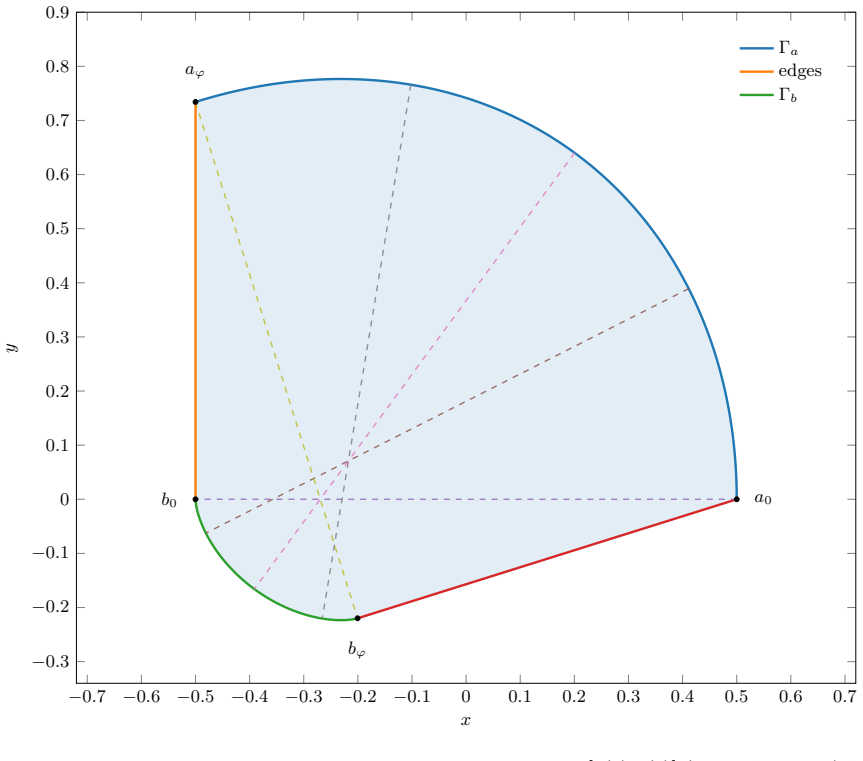
An immersed flat polyhedral Klein bottle

Zero defect at every vertex and embedded stars produce the first explicit piecewise isometric example

Figure from the paper full image
abstract click to expand
We present a polyhedral surface in Euclidean 3-space with the topology of a Klein bottle such that every vertex has zero angle defect and the star of every vertex is embedded. From the perspective of metric geometry, the polyhedron can be viewed as the image of a piecewise smooth isometric immersion of a flat Klein bottle. It is apparently the first such explicit example.
0
Top Pith
2
math.MG 2026-05-18 2 theorems

Coarea formula holds for maps from Heisenberg group to R^{2n}

by Gioacchino Antonelli, Robert Young

Area of H\"older curves and coarea formula on the Heisenberg group

A new integral for the area of half-Holder curves makes this work even for the simplest vector-valued case.

abstract click to expand
We prove the coarea formula for Lipschitz maps from the subriemannian $n$th Heisenberg group $\mathbb H_n$ to $\mathbb R^{2n}$. Our result is new even when $n=1$ and provides the simplest vector-valued instance of the coarea formula in subriemannian geometry. This answers a question left open in the works of Magnani, Kozhevnikov, Magnani--Stepanov--Trevisan, and Julia--Nicolussi Golo--Vittone. The main difficulty of the proof is that a fiber of a $C^1_{\mathrm{H}}$ map $f: \mathbb H_n\to \mathbb R^{2n}$ is typically an unrectifiable curve. Its measure depends on the symplectic area of its projection to $\mathbb R^{2n}$. A bound on this area would imply the coarea formula, but examples of Kozhevnikov show that this area can be infinite or undefined. To overcome this, we introduce an integral that we use to define both the symplectic area of $\frac{1}{2}$--H\"older curves in $\mathbb R^{2n}$ and the symplectic area of projections of vertical curves in $\mathbb H_n$. Then, we give a geometric condition for this integral to converge. This yields, in addition, new results on the existence of the signed area of $\tfrac12$--H\"older planar curves that may be of independent interest. Finally, we use $\beta$--number estimates from the F\"assler--Orponen Dorronsoro Theorem to show that this geometric condition holds for almost every fiber.
0
0
cs.CG 2026-07-03

Piecewise rational cap volumes give exact ham-sandwich algorithms

by Marie-Charlotte Brandenburg, Jesús A. De Loera +1 more

From Ham-Sandwich to Centerpoints: Semialgebraic Algorithms for Cutting Polytopal Measures

For polytopal measures the cap-volume function is piecewise rational, turning prescribed-proportion cuts into polynomial-time semialgebraic

abstract click to expand
We design exact algorithms for the ham-sandwich and centerpoint theorems for polytopal measures. Our key observation is that the cap-volume function of such a measure, i.e., the volume cut off by a halfspace, is piecewise rational on a natural decomposition of the space of oriented hyperplanes. This lets us recast prescribed-proportion cutting problems as semialgebraic feasibility problems. For fixed ambient dimension, this yields polynomial-time algorithms to decide the existence of cuts, describe the full solution set, and sample or enumerate solutions. We extend this framework to the center transversal theorem, showing that spaces of deep affine flats are semialgebraic, which holds for centerpoints. We further show that the set of centerpoints of a convex polytope coincides with its floating body at level $1/(d+1)$, a useful semialgebraic description.
0
0
math.MG 2026-07-03

Minkowski theory resolves Pólya-Szegő capacity conjecture

by Qiushuang Liu, Jie Xiao +3 more

A Minkowski Theory for the Exterior Capacitary Volumes and A Resolution of the P\'olya-Szeg\"o Conjecture

Exterior capacitary volumes satisfy volume-like inequalities that confirm the ball extremizes electrostatic capacity among convex bodies.

abstract click to expand
This paper establishes a unified Minkowski theory for exterior p-capacitary volumes and resolves the classical P\'olya-Szeg\"o conjecture on the electrostatic capacity of convex bodies.
0
0
math.MG 2026-07-03

Bounded words give all half-spaces for Dirichlet cells

by Reymond Akpanya, Alice C. Niemeyer +1 more

An algorithmic approach for computing fundamental domains of crystallographic groups

This turns computation of fundamental domains for infinite crystal symmetry groups into a finite enumeration.

Figure from the paper full image
abstract click to expand
A crystallographic group is a discrete subgroup of the Euclidean group $\operatorname{E}(n)$ that has a compact fundamental domain. Since such a crystallographic group $\Gamma$ is infinite, computing fundamental domains of $\Gamma$ is algorithmically challenging. We address this difficulty by targeting the computation of Dirichlet cells that can form fundamental domains of $\Gamma$. We show that the half-spaces defining such a Dirichlet cell can be derived from elements of $\Gamma$ acting on $\mathbb{R}^n$ that can be expressed as words of bounded length in a suitable generating set. Based on these results, we design an algorithm for the computation of fundamental domains of crystallographic groups and exploit it to study the construction of topological interlocking assemblies.
0
0
math.CO 2026-07-02

Hypercube sumsets obey |A1+⋯+An| ≥ product of sizes to power 1/p

by Felipe Gonçalves, Danylo Radchenko

Sharp Lower Bounds for Sumsets in Hypercubes

The exponent p = n log(m+1)/log(nm+1) is optimal for subsets of {0..m}^d and resolves a long-standing conjecture.

Figure from the paper full image
abstract click to expand
We prove a sharp lower bound for the cardinality of sumsets of subsets of $\mathbb{Z}^d$ confined to a hypercube, resolving in strong form a conjecture that was made explicit by Becker, Ivanisvili, Krachun and Madrid and had circulated in the folklore of the field for some time. Specifically, for sets $A_j\subseteq \{0,1,2,\dots,m\}^d$ we show that \[|A_1+\dots+A_n|\;\geq\; (|A_1|\cdots|A_n|)^{1/p},\qquad p=\frac{n\log(m+1)}{\log(nm+1)},\] with the exponent best possible. The only previously known sharp cases were $A_j\subseteq \{0,1\}^d$, for all $n\ge1$, and $A_j\subseteq \{0,1,2\}^d$ for $n=2$. We also prove a sharp inequality in the case when $A_j\subseteq\{0,1,\dots,m_j\}^d$ for different $m_j$. We obtain the above inequality as a corollary of a stronger result on sup-convolution of functions on $\mathbb{Z}^d$, whose proof is based on a novel mixed volume representation of a lattice path norm, together with a sharp one-dimensional functional inequality.
0
0
math.DG 2026-07-02

Berwald manifolds with circle-preserving maps must be Riemannian

by Zohreh Fathi, Sajjad Lakzian

The rigidity of conformal circle-preserving transformations on Berwaldian manifolds

Complete Berwaldian structures with nontrivial conformal circle preservers reduce to Riemannian manifolds when flag curvature is nonvanishin

abstract click to expand
We prove that a complete Berwaldian manifold $\left(M,F\right)$ admitting a nontrivial conformal circle preserving transformation (\cpt for short) must be Riemannian, provided that it has a dense subset on which no flag curvature vanishes (in particular, if $(M,F)$ has positive or negative flag curvature).
0
0
math.GR 2026-07-02

The paper proves that for any bounded-degree graph allowing a certain group quasi-action

by Robin Tucker-Drob

Obstructions to coarse universality for finitely generated groups

No countable family of bounded-degree graphs admitting finitely cobounded coarse quasi-actions contains every finitely generated group as a…

abstract click to expand
We prove that, for every bounded-degree graph $\Lambda$ admitting a finitely cobounded coarse quasi-action by a group, there is a finitely generated group which does not coarsely embed into $\Lambda$. More generally, for every countable family $(\Lambda_i)$ of such graphs, there is a finitely generated group that does not coarsely embed into any $\Lambda_i$. This resolves two conjectures of Simon Thomas: neither a universal Cayley graph nor a universal quasi-isometry class of finitely generated groups exists. As another consequence, we show that no locally compact second countable group coarsely contains every finitely generated group. The proof uses an exponential upper bound on the number of finite graphs admitting an $(L,M)$-regular map into $\Lambda$, together with a superexponential supply of high-girth $3$-regular graphs, yielding a sequence of finite high-girth obstruction graphs. A graphical small-cancellation labeling, using a variation of Osajda's labeling theorem following Esperet and Giocanti, then realizes this sequence isometrically inside the Cayley graph of a finitely generated group.
0
0
math.PR 2026-07-02

Perturbations preserve infinite clusters in tree percolation

by Mirmukhsin Makhmudov, Ville Suomala

On perturbations that preserve the connectivity properties in tree percolations

Mild distance-dependent factors leave the existence or absence of infinite clusters unchanged under minimal assumptions on the base model

abstract click to expand
We consider a general bond percolation on an infinite locally finite tree, where the edge retention probabilities $p_e$ are replaced by $\min\{1,q_{|e|}p_e\}$, where $\{q_n\}_{n\ge 1}$ is a sequence of positive perturbation factors and $|e|$ denotes the distance between the edge $e$ and the root. If the original percolation model admits infinite clusters, it is of interest to investigate under which perturbations $0<q_n\le 1$ this connectivity property is preserved. Conversely, if the original percolation does not admit infinite clusters, we are led to study the stability of such a property under perturbations satisfying $q_n\ge 1$. In both cases, under minimal assumptions on the original model, we show that the percolative behaviour is stable against certain quantitative non-trivial perturbations. We also discuss an application of our results to the Erd\H{o}s similarity conjecture for Cantor sets.
0
0
math.MG 2026-07-02

n-flake dusts in the plane lack Minkowski measurability

by Uta Freiberg, Jonas Lippold

The regular n-flake dust in mathbb{R}² is not Minkowski measurable

Lattice-type self-similar sets fail to have a well-defined Minkowski content because their tubular volumes oscillate without limit.

Figure from the paper full image
abstract click to expand
A long-standing conjecture of Lapidus asserts that under certain conditions a self-similar fractal set is not Minkowski measurable if and only if it is of lattice-type. For self-similar sets in $\mathbb{R}$, the Lapidus conjecture has been confirmed. However, in higher dimensions, it remains unclear whether all lattice-type self-similar sets are not Minkowski measurable. This work presents families of lattice-type subsets in $\mathbb{R}^2$ that are not Minkowski measurable, hence providing further support for the conjecture.
0
0
math.MG 2026-07-02

L_p Brunn-Minkowski holds with exponent 1/q for dual quermassintegrals

by Xiaojuan Chen, Shengyu Tang +1 more

L_p Brunn-Minkowski inequality for weighted dual quermassintegrals

The concavity exponent improves to 1/q from 1/n when the weight satisfies t ↦ log φ(e^t) concave.

abstract click to expand
We investigate the $L_p$ Brunn-Minkowski inequality for dual quermassintegrals in weighted measure spaces, which is a special class of rotationally invariant measures proposed by Cordero-Erausquin and Rotem [Ann. Probab., {\bf 51} (2023)]. Specifically, the weighted dual quermassintegral is defined by integrating the radial density $|x|^{q-n}\phi(|x|)$ for $q\in(0,n]$, where $\phi$ is a positive radially non-increasing weight, it recovers the classical dual quermassintegral when $\phi\equiv1$. For $p\geq1$, we prove the $L_p$ Brunn-Minkowski inequality with concavity exponent $1/q$ under the condition that $t\mapsto\log\phi(e^t)$ is concave, which is exactly the natural convexity condition from Cordero-Erausquin and Rotem's paper in general, improving the exponent $1/n$. For $p\in(0,1)$, we obtain the result with exponent $p/q$ under more strictly weight assumptions, together with explicit lower bounds for the admissible range of $p$.
0
0
math.MG 2026-06-30

Constant-width bodies on spheres stay between two positive ratios

by Abigail Hall, Andriy Prymak +1 more

On the spherical Blaschke-Lebesgue problem

For any fixed w not π/2 the relative effective radius is trapped between explicit bounds strictly above zero and below one as dimension grow

Figure from the paper full image
abstract click to expand
The Blaschke-Lebesgue theorem states that the Reuleaux triangle has the smallest area among planar convex bodies of a fixed constant width. We study how small bodies of constant width can be on the unit sphere $\mathbb S^n$ when $n$ is large. For a spherical convex body $K\subset \mathbb S^n$ of constant width $w\in(0,\pi)$, its relative effective radius is \[ \left(\frac{\mu_n(K)}{\mu_n(\mathbb B^n(w/2))}\right)^{1/n}, \] where $\mu_n$ is the spherical $n$-measure and $\mathbb B^n(w/2)$ is a geodesic ball of radius $w/2$. Let $\sigma_n(w)$ be the infimum of the relative effective radius over all spherical bodies of constant width $w$. Define $\underline{\sigma}(w)=\liminf_{n\to\infty}\sigma_n(w)$ and $\overline{\sigma}(w)=\limsup_{n\to\infty}\sigma_n(w)$. For each fixed $w\in(0,\pi)\setminus\{\pi/2\}$, we prove non-trivial bounds \[ 0<\sigma_{\ell}(w)\le \underline{\sigma}(w)\le \overline{\sigma}(w)\le \sigma_u(w)<1, \] where $\sigma_\ell(w)$ and $\sigma_u(w)$ are defined in terms of $w$ either explicitly or through a root of a quartic equation. The upper bounds are obtained by constructing small spherical bodies of constant width: for $w<\pi/2$ by a spherical version of the recent Arman-Bondarenko-Nazarov-Prymak-Radchenko Euclidean construction, and for $w>\pi/2$ by spherical duality. The lower bounds are obtained by generalizing ideas from Schramm's argument for illumination of Euclidean bodies of constant width.
0
0
math.MG 2026-06-30

Perimetric contractions limit fixed points to one or two

by Mujahid Abbas, Alemayehu G. Negash +1 more

Perimetric Contractions and Their Iterates in Complete b-Metric Spaces

In b-metric spaces, MCPT iterates act as graphic contractions when s q^n <1, or form one 2-cycle when the orbit exists.

abstract click to expand
In this paper, we systematically investigate the structural and operator-theoretic properties of mappings contracting perimeters of triangles (MCPTs) within the generalized topological framework of complete $b$-metric spaces with coefficient $s \geq 1$. Extending recent foundational advancements from classical metric spaces, we explore the architectural interplay between multi-point perimetric constraints and path-wise orbital stability under two distinct structural scenarios. First, assuming the minimal exclusion of periodic orbits of prime period two, we prove that the higher-order iterates $f^{n}$ of an MCPT behave as graphic contractions for all indices satisfying the condition $sq^{n} < 1$. This classifies the operator as a weakly Picard operator and yields a unified existence and cardinality theorem establishing that the fixed-point set satisfies $1 \leq |\mathrm{Fix}(f)| \leq 2$. Second, in the alternative configuration where the operator does possess a periodic orbit of prime period two, we resolve a significant structural gap under the parameter condition $sq^{2} < 1$. We demonstrate that the higher even iterates $f^{2n}$ collapse into continuous graphic contractions, proving that the mapping possesses exactly two periodic points which form a single, isolated 2-cycle. Throughout our proofs, we rigorously navigate the analytical challenges arising from the potential simultaneous non-continuity of the $b$-metric function by relying strictly on sequential tracking inequalities. Finally, we present concrete analytical examples, including a shift map on a discrete metric space, to show that the class of MCPTs is strictly larger than the class of graphic contractions, thereby demonstrating the sharpness and optimality of the obtained parameter conditions.
0
0
math.MG 2026-06-30

Discrete Sobolev space on snowtrees equals continuous version for any partition

by Efstathios-Konstantinos Chrontsios-Garitsis, Vyron Vellis

Sobolev spaces on snowtrees

The quantitative match holds for every partition and all 1<p<∞, even when the trees are ordinary geodesics.

Figure from the paper full image
abstract click to expand
We introduce a discrete-energy Sobolev space $\mathcal{W}^{1,p}_{\mathscr V}(T)$ on Ahlfors regular snowtrees, a class of metric trees where every arc is a snowflake of the same type. Our main result shows that, for every partition $\mathscr V$ and every $1<p<\infty$, this discrete space coincides quantitatively with the Korevaar--Schoen space on $T$. This fact and the independence of the space on the particular partition used to define $\mathcal{W}^{1,p}_{\mathscr V}(T)$ are both novel even for the class of geodesic trees. We also determine the critical Korevaar-Schoen exponent for Ahlfors regular snowtrees and prove capacity attainment and upper estimates, which reveal the appropriate walk dimension needed for the corresponding probabilistic profile on these trees.
0
0
math.MG 2026-06-30

Random convex hull peelings converge to Poisson limit

by Alexander Marynych, Mykyta Sadok

Peelings and Wrappings of Families of Convex Sets with Applications to Strongly Convex Sets Generated by Random Samples

For strictly convex regular bodies, m-point and recursive peelings of the polar bodies match the limiting Poisson object in distribution.

abstract click to expand
We introduce and study peeling and wrapping operations for families of compact convex sets. The two peeling procedures considered in the paper are the $m$-point peeling, obtained by intersecting the convex hulls remaining after all possible deletions of $m$ members of the family, and the recursive convex hull peeling, obtained by repeatedly removing the contributing sets, that is, those members whose deletion strictly changes the convex hull. Using polarity, we also introduce the dual wrapping operations for intersections of convex sets. The deterministic part of the paper develops the geometric framework needed for these constructions. In particular, we study contributing sets under general position assumptions, explain the role of compactness of convex hulls of subfamilies, and prove continuity results for both peeling procedures with respect to a suitable vague convergence of locally finite point measures on the space of compact convex sets. The probabilistic part applies this framework to $K$-hulls generated by random samples from a convex body $K$. Assuming that $K$ is strictly convex and regular, we prove that the m-point and recursive peelings of the polar bodies associated with the random $K$-hulls converge in distribution to the corresponding peelings of the limiting Poisson object. By polarity, this also yields distributional convergence of the associated wrapping operations for the rescaled random sets themselves.
0
0
math.MG 2026-06-30

Complete classification of measure-valued valuations on star bodies

by Jorge S. Ibáñez-Marcos, Monika Ludwig +2 more

Measure-valued valuations on star bodies

Weak-star continuous ones on star bodies in R^n get full description with rotation-equivariant integral reps and dual area measure char.

abstract click to expand
A complete classification of weak$^*$~continuous, measure-valued valuations is established on star bodies in $\R^n$. Consequences are an integral representation of rotation equivariant, measure-valued valuations and a characterization of dual area measures.
0
0
math.MG 2026-06-30

Perelman-Pukhov quotients bounded below i+1

by Bernardo González Merino, Beatriz Marín Gimeno +1 more

On the Perelman-Pukhov quotient of successive radii: better and asymptotically optimal bounds

The ratio of outer to inner successive radii is strictly less than i+1 for listed (n,i) pairs and has the right order when i is n minus cons

abstract click to expand
Perel'man in 1987 and independently Pukhov in 1979 proved that the quotient between the $(n-i+1)$-th successive outer radius and the $i$-th successive inner radius of a convex body in $n$-dimensions is not larger than $i+1$. Apart from the solved cases by Jung 1901 $(i=1)$ and Steinhagen 1921 $(i=n)$, only Perel'man (1987, $n=3$, $i=2$) and Gonz\'alez Merino (2017, $n\geq 4$, $i=2$ and $i=n-1$) provided small improvements that beat this bound. In this paper, we obtain sharper inequalities using relations between these inner and outer measures with the diameter and minimal width. We improve the current bounds in the following cases: $i=3$ when $4\leq n \leq 8$, $i=4$ when $n=5$, $6$, $i=5$ when $n=6$, $i=6$ when $n=7$, and for every $i\geq n-\Theta(\log n)$. Notably, our bounds provide the right order in $n$ when $i=n-m$, with $m$ constant and $n$ arbitrarily large. Additionally, we improve the case $n=5$, $i=3$ even further by refining an idea of Perel'man and using the optimal lower bound of the inradius in terms of the circumradius and the diameter in 3-space (see [7]).
0
0
cs.DM 2026-06-30

Tropical polynomials coordinate multisets of any n points in r dimensions

by Susumu Kubo

Stable complete coordinates for multisets of points via basic r-symmetric tropical polynomials

Binomial(n+r,r) basic r-symmetric ones of degree at most n separate all S_n orbits and form a bi-Lipschitz map.

abstract click to expand
A multiset of $n$ unordered points in $\mathbb{R}^r$ -- a point cloud, or, for $r=2$, a persistence barcode of birth-death pairs -- is a point of the orbit space $\mathbb{R}^{nr}/S_n$ for the symmetric group $S_n$ permuting the rows of an $n \times r$ matrix; a separating family of invariants on this space is exactly a complete set of permutation-independent coordinates. We provide one that is explicit, small, and stable, in the max-plus (tropical) setting: for all $n \geq 1$ and $r \geq 1$, the $\binom{n+r}{r}$ basic $r$-symmetric tropical polynomials, of degree at most $n$, separate the orbits of $S_n$ on $\mathbb{R}^{nr}$. This settles in full a problem left open in [Kubo, J. Pure Appl. Algebra 223 (2019) 72-85], where separation was known only for $r=2$ and special cases of $r \geq 3$, and yields a family far smaller and of lower degree than the general separating sets from Derksen's recent theory of tropical invariants for permutation actions ($nr + (nr)!/n!$ invariants of degree $O(n^2 r^2)$). The proof is elementary and constructive: the basic values are identified with a transportation problem, and the multiset is recovered from the dual by an explicit algorithm. We further show the coordinate map is a bi-Lipschitz embedding for all $n$ and $r$, being an injective max filter bank (via the bi-Lipschitz theory of max filtering), with an explicit Lipschitz constant for the forward bound and a fully explicit, dimension-free distortion when $r=1$. Finally we determine when the pairwise values suffice (exactly $n \leq 3$) and show that invariants on at least three columns and of degree less than $n$ are necessary in general, the obstruction being a standard non-uniqueness configuration from discrete tomography.
0
0
math.CA 2026-06-30

Plane set has visible parts 3/2-dimensional in all directions

by Tuomas Orponen

Planar sets with large visible parts

Construction disproves visibility conjecture, and 3/2 is maximal

abstract click to expand
I construct a compact subset of the plane whose visible parts are $\tfrac{3}{2}$-dimensional in all directions. This disproves the visibility conjecture. The value $\tfrac{3}{2}$ cannot be increased, as shown in recent collaboration with A. Rutar.
0
0
math.FA 2026-06-30

Square-root metric on circle functions is bi-invariant and complete

by Gangsong Leng, Lecheng Yang

A square-root complex inequality and its induced metric structure

It induces the L2 topology; on tori the exponent 1/2 is optimal with explicit geodesics and dimension n+1

abstract click to expand
Let $(\Omega,\mu)$ be a finite measure space with $M=\mu(\Omega)>0$. We investigate the integral form, stability, and metric geometry associated with a square-root complex. After proving the inequality and determining all equality cases, we analyze its phase stability near the intersection of the two branches of the equality set. In general phase directions, the quadratic term is precisely a Cauchy--Schwarz deficit; along the corresponding degenerate cone, the leading term is of fourth order and is strictly positive. A symmetric two-point example shows that the exponent four is unavoidable in any uniform distance-stability estimate. Finally, on the group of measurable circle-valued functions, we introduce the LY-metric \[ d_\mu(f,g)=\left|M-\int_\Omega f\overline g\,d\mu\right|^{1/2}. \] We prove that this metric is bi-invariant and complete, and that it induces the same topology as the $L^2$ metric. On finite-dimensional tori, we establish the optimality of the exponent $1/2$, derive explicit formulas for the intrinsic distance and geodesics, describe the anisotropic geometry and volume growth of small metric balls, and show that the Hausdorff dimension is $n+1$.
0
0
math.CO 2026-06-29

Balla conjecture holds for two new angles but fails infinitely often

by Chuanyuan Ge, Shiping Liu

New bounds for equiangular lines and Balla's conjecture

The spectral bound on equiangular lines in dimension d is confirmed for α=1/(1+2√3) and √5-2 yet violated by constructions for infinitely ma

abstract click to expand
Let $N_{\alpha}(d)$ denote the maximum number of equiangular lines in $\mathbb{R}^d$ with common angle $\arccos(\alpha)$. Balla conjectured that, if the spectral radius order $\kappa_{\frac{1-\alpha}{2\alpha}}$ of $\frac{1-\alpha}{2\alpha}$ is finite, then $$N_{\alpha}(d)\leq \max\left\{\frac{(1-\alpha^2)(1-2\alpha^2)}{2\alpha^4},\left\lfloor\frac{\kappa_{\frac{1-\alpha}{2\alpha}}(d-1)}{\kappa_{\frac{1-\alpha}{2\alpha}}-1}\right\rfloor\right\},$$ for any $d\geq 1$. The conjecture has previously been verified only for $\alpha\in\left\{\frac{1}{3},\frac{1}{5},\frac{1}{1+2\sqrt{2}}\right\}$. In this paper, we prove that this conjecture holds for $\alpha=\frac{1}{1+2\sqrt{3}}$ and $\alpha=\sqrt{5}-2$. On the other hand, we show that Balla's conjecture fails for infinitely many $\alpha$.
0
0
math.MG 2026-06-29

Hyperbolic surfaces filled by O(g/ln g) systoles

by Olivier Mathieu

Filling surfaces with very few systoles

Construction reaches the lower bound on shortest geodesics needed to cover high-genus surfaces.

abstract click to expand
In the paper we describe hyperbolic surfaces filled by their systoles, where the total number of systoles is in $O(\frac{g}{\ln \,g})$, that is equivalent to the lower bound of Anderson, Parlier and Pittet \cite{APP}. Various papers \cite{SS}\cite{FB20}\cite{Sanki}\cite{ IM}\cite{ Mathieu} have investigated the same question, and the best previously known upper bounds where in $o(\frac{g}{{\sqrt{\ln \,g}}})$. Surprizingly the present approach is, in our opinion, much simpler than the methods of earlier papers.
0
0
math.MG 2026-06-29

Marstrand theorem fails for Assouad spectrum

by Kenneth J. Falconer, Jonathan M. Fraser +1 more

On the Marstrand projection theorem for the Assouad spectrum

The Assouad spectrum of projections of planar sets varies almost surely, unlike their constant Hausdorff dimension.

abstract click to expand
Marstrand's projection theorem states that the Hausdorff dimension of the orthogonal projection of a Borel set in the plane onto lines is constant almost surely. This property extends to other notions of dimension, such as box and packing dimensions, but does not hold for the Assouad dimension. In this paper, we show that Marstrand's projection theorem also fails for the quasi-Assouad dimension and the Assouad spectrum, which interpolates between the upper box and quasi-Assouad dimensions. Additionally, we establish an almost sure lower bound for the Assouad spectrum of the projections using capacity-theoretic dimension profiles, and an almost sure upper bound for projections of bounded planar sets via an incidence geometry-inspired tube-counting argument. As an application, for a parametrised family of homogeneous self-similar sets, we obtain an almost sure upper bound for the Assouad spectrum which beats the trivial upper bound coming from the upper box dimension.
0
0
math.MG 2026-06-29

Reduced body area exceeds πΔ²/4 bound

by Scott Duke Kominers

A reduced planar body with area greater than πDelta²/4

Explicit construction yields area 0.786215 for thickness 1, larger than π/4 and disproving the conjectured maximum.

Figure from the paper full image
abstract click to expand
We construct a reduced planar convex body $R$ with thickness $\Delta(R)=1$ and \[\operatorname{area}(R)=0.786215\ldots>0.785398\ldots=\frac{\pi}{4}.\] Thus $R$ is a counterexample to Lassak's conjectured upper bound $\operatorname{area}\le(\pi/4)\Delta^2$ for planar reduced bodies. The construction is given by an explicit support function, and the proofs use only elementary support-function, width, area, and contact-point computations.
0
0
math.MG 2026-06-29

Entropy convexity at Wasserstein barycenters forces Hilbertian norms

by Bang-Xian Han, Deng-Yu Liu

Wasserstein Barycenter Convexity Detects Hilbertian Geometry

In finite dimensions the inequality holds for arbitrary finite measures only when the norm comes from an inner product, unlike curvature con

abstract click to expand
We prove that convexity of the Boltzmann entropy at Wasserstein barycenters is strong enough to distinguish Hilbert spaces from general Banach spaces. Thus Wasserstein barycenters provide an intrinsic optimal-transport test for Hilbertian geometry. More precisely, we show that if a finite-dimensional normed vector space, equipped with Lebesgue measure, satisfies the Wasserstein Jensen's inequality for the entropy at barycenters of arbitrary finite families of probability measures, then its norm must be induced by an inner product. This contrasts sharply with a well-known result: every finite-dimensional normed vector space satisfies the nonnegative Ricci curvature condition in the sense of Lott--Sturm--Villani, whereas barycenter convexity excludes all non-Hilbertian norms. As a consequence, smooth reversible Finsler manifolds satisfying the corresponding barycentric curvature-dimension condition have Riemannian tangent norms. The proof does not assume strict convexity of the norm. Its two main ingredients are a rank-one polarization argument, which yields the dual parallelogram identity in the strictly convex case, and a maximal-face trapping argument, which rules out flat faces of the unit ball.
0
0
math.MG 2026-06-29

ℓ1 sparsifiers for matrices need only O(n/ε² log(1/ε)) rows

by Victor Reis, Thomas Rothvoss

Linear-size ell₁ sparsifiers

The new bound replaces the prior log n factor with log(1/ε) and gives linear-size zonotope approximations.

abstract click to expand
We prove that for any matrix $A \in \mathbb{R}^{m \times n}$ and any $\varepsilon \in (0, 1/2]$ there is a diagonal matrix $D \in \mathbb{R}_{\geq 0}^{m \times m}$ with at most $O(\frac{n}{\varepsilon^2} \log(\frac{1}{\varepsilon}))$ nonzero entries so that \[(1-\varepsilon) \|Ax\|_1 \leq \|DAx\|_1 \leq (1+\varepsilon)\|Ax\|_1 \quad \forall x \in \mathbb{R}^n.\]In particular, for any zonotope $Z \subseteq \mathbb{R}^{n}$ there exists a zonotope $Z' \subseteq \mathbb{R}^{n}$ generated by at most $O(\frac{n}{\varepsilon^2} \log(\frac{1}{\varepsilon}))$ segments so that $(1-\varepsilon) Z \subseteq Z' \subseteq (1+\varepsilon) Z$. Previously, the best known bound was $O(\frac{n}{\varepsilon^2} \log n)$ due to Talagrand (1990).
0
0
math.GR 2026-06-29

Thick building groups satisfy Howe-Moore property

by Andreas Thom

On the Howe--Moore property for automorphism groups of buildings

Weakly mixing unitary representations vanish at infinity for large thickness, implying character rigidity for associated lattices.

abstract click to expand
Let \(G<Aut(X)\) be a totally disconnected locally compact group acting strongly transitively on a locally finite building \(X\) of finite-rank and minimal non-spherical type. For sufficiently large thickness, every weakly mixing strongly continuous unitary representation of \(G\) is \(C_0\). Consequently, if \(G\) has no non-trivial finite-dimensional unitary representations, then \(G\) has the Howe--Moore property. More concretely, this applies to rank-three compact-hyperbolic crystallographic types of thickness \(q+1\) for \(q\geq 19379\), if there are no compact quotients. As an application, we prove that the corresponding Caprace--R\'emy Kac--Moody lattices in these types, which are known to be finitely presented simple and Kazhdan, are character-rigid: their extremal characters are only the regular and the trivial character. Consequently they also have no non-trivial invariant random subgroups.
0
0
math.MG 2026-06-29

p-walk dimension above p forces zero modulus on all curves

by Aobo Chen

Walk dimension and vanishing curve modulus in metric measure spaces

Holds in regular local p-Dirichlet spaces with p-Poincaré inequality and rules out minimal conformal dimension for Ahlfors-regular spaces wi

abstract click to expand
We prove that, on a regular local $p$-Dirichlet space supporting a $p$-Poincar\'e inequality, if the $p$-walk dimension is strictly greater than $p$, then every curve family has zero $p$-modulus. As a consequence, we show that no Ahlfors-regular metric space equipped with a sub-Gaussian heat kernel is minimal for its Ahlfors-regular conformal dimension.
0
0
math.MG 2026-06-29

Coarse structures match certain ideals in metric classes semilattice

by Vladimir Manuilov

On ideals in the semilattice of coarse equivalence classes of metrics

Inverse maps let coarse structures be recovered from ideals and extend uniform Roe algebras to all ideals

abstract click to expand
For a Hausdorff topology on the set of ideals of the semilattice $M(X)$ of coarse equivalence classes of metrics on a set $X$, the space $I(M(X))$ of ideals is the closure of the set of principal ideals, thus allowing to view non-principal ideals as generalizations of coarse equivalence classes of metrics. Some ideals arise from coarse structures on $X$. We define a map $\Phi$ from $I(M(X))$ to the set $CS(X)$ of coarse structures on $X$, and a map $\Psi$ backwards, and show that $\Psi\circ\Phi$ is the identity map, thus allowing to identify coarse structures with some ideals of $M(X)$. We show that there are ideals that do not come from $CS(X)$. For any ideal $F$ we define the generalized uniform Roe algebra as the direct limit $C^*$-algebra of the uniform Roe algebras for the equivalence classes of metrics in the ideal, and show that it coincides with the uniform Roe algebra of $\Phi(F)$.
0
0
math.MG 2026-06-29

Nil geometry yields cylinder analogue of Pappus hexagon theorem

by Jenő Szirmai

Cylinder-like Pappus's hexagon theorem in Nil geometry

Relations satisfied by geodesic cylinders produce the same incidence configuration as the classical theorem.

Figure from the paper full image
abstract click to expand
In this paper we deal with Nil geometry, in whose projective model the geodesic curves are helix-like and fit onto geodesic Nil cylinders of revolution with fibrum axes. In this paper we investigate relations for geodesic cylinders and thus also geodesic curves, which lead to an analogous result to Pappus's hexagon theorem and provide important information about the structure of the considered space.
0
0
math.MG 2026-06-26

Normed-plane ball intersections minus one ball are contractible

by D. A. Ilyukhin

A problem of intersection of balls in normed space

Removing a large closed ball from a finite intersection of small open balls yields a contractible set in any 2D normed space.

abstract click to expand
This paper investigates the topological properties of intersections of balls in finite-dimensional normed spaces - a problem that naturally arises when constructing covers for estimating the Gromov-Hausdorff distance. We study the topology of a set obtained by removing a large closed ball from a finite intersection of small open balls. It is proved that in an arbitrary normed plane, such a set is always contractible, provided that it is non-empty.
0
0
math.CO 2026-06-26

Any fixed pattern appears superlinearly often in planar point sets

by Shubhrajit Bhattacharya, Ritesh Goenka

Congruent copies of finite patterns in planar point sets

n-point sets can be built to contain n^{1+δ} congruent copies of S for δ>0 depending only on S, answering Brass-Pach in strong form.

abstract click to expand
Given a finite nonempty planar point set $S$, what is the maximum number of congruent copies of $S$ contained in a set of $n$ points in the Euclidean plane? Building on OpenAI's recent breakthrough on the unit distance problem, we construct planar sets consisting of $n$ points that contain $\Omega_S(n^{1+\delta_S})$ congruent copies of $S$, for some positive constant $\delta_S$ depending only on $S$. This answers a question of Brass and Pach in a strong form, and makes progress on questions posed by Erd\H{o}s and Purdy, and \'Abrego and Fern\'andez-Merchant. Our proof uses the number field construction from Sawin's quantitative refinement of OpenAI's result and consequently yields an explicit choice for $\delta_S$ for each fixed $S$.
0
0
math.MG 2026-06-26

New proof pins down which regular polygons compass and straightedge can build

by J. Mainik

Theorem of Wantzel

The argument confirms that only n of the form 2^m times distinct Fermat primes permit a finite construction sequence.

abstract click to expand
In 1796, Gauss succeeded in solving the problem of constructing the regular 17-gon with compass and straightedge. Later he proved that, using a compass and straightedge, it is possible to construct the regular polygons with $n=2^m n_1\cdots n_l$ sides if $n_1,\cdots, n_l$ are different prime numbers of the form $n_k=2^{2^{\nu_k}}+1$. Gauss also knew that only these regular polygons can be constructed but did not prove it.\linebreak P. Wantzel completed the result of Gauss and proved it in 1837. The present paper provides a new proof for Wantzel's theorem.
0
0
math.FA 2026-06-26

Duality preserves Morse critical groups for ratio convex functions

by Dong Zhang

Hidden critical and Morse equivalence behind duality: Theory and Applications

Polarity dual keeps sublevel homotopy, critical groups, and handle decompositions unchanged for RC functions and yields a decomposition-free

Figure from the paper full image
abstract click to expand
The aim of this paper is to establish critical duality theory for ratios of nonnegative homogeneous convex functions (shorten for RC functions) and differences of convex functions (abbreviated as DC functions) on Banach spaces. Specifically, we establish a series of duality results on critical point theory and Morse theory for RC functions, including the homotopy type of sublevel sets, the Morse critical points and their Rothe critical groups, Lagrange critical points and their multiplicities, Lusternik-Schnirelman min-max critical values, Poincare polynomials, as well as the structure of handlebody decompositions, all of which are proved to be preserved under polarity dual. Moreover, we obtain the first critical duality theory of DC functions which does not depend on the DC decomposition. This answers a question left open from the work of Toland on DC functions and the work of Le-Pham on DC programming. We apply these results to provide a reformulation of the graph Cheeger constant using zonotopes; we introduce the contact data which serves as a geometric characterization of Lagrange criticality; and we show that the eigenproblems for 1-Laplacian and $\infty$-Laplacian on hypergraphs are equivalent to the contact problems of zonotopes, which indeed establishes a new characterization of zonotopes. We also prove a duality equivalence for certain nonlinear eigenvalue problems and bifurcation problems. Our study here reveals an intricate interaction of critical point theory with other fields such as convex analysis, combinatorial geometry, and nonlinear eigenproblems on graphs.
0
0
math.MG 2026-06-25

Lower bounds proven for non-central sections of isotropic convex bodies

by Jacek Jakimiuk, Daniel Murawski +1 more

Lower bounds on non-central sections of isotropic convex bodies

The bounds hold uniformly for every symmetric isotropic body when distance is at most sqrt(3) L_K and become tight as dimension grows.

abstract click to expand
For fixed $t_0 \in [0,\sqrt{3}]$ we give asymptotically sharp lower bounds on the quantity $L_K \text{vol}_{d-1}(K \cap H)$, where $H$ is a hyperplane at distance $t_0 L_K$ from the origin, $K$ is any symmetric isotropic convex body in $\mathbb{R}^d$, and $L_K$ stands for the isotropic constant of $K$.
0
0
math.PR 2026-06-25

Hyperbolic Poisson-Voronoi tessellations have closed-form face densities

by Matteo D'Achille, Christoph Thäle

Face volume densities of positive-intensity and ideal Poisson--Voronoi tessellations in hyperbolic spaces

Explicit formulas cover every k-volume density in any dimension and the zero-intensity ideal case.

Figure from the paper full image
abstract click to expand
We determine analytically for all $k\in\{0,1,\ldots,d-1\}$ the $k$-volume densities of a Poisson--Voronoi tessellation of intensity $\lambda>0$ in the $d$-dimensional hyperbolic space of constant curvature $-1$. This largely extends previous results of Isokawa in dimensions two and three. As applications, we provide closed form expressions for all face volume densities and all typical face volumes of the ideal Poisson--Voronoi tessellation (IPVT), which is the low-intensity limit as $\lambda\downarrow0$ of the hyperbolic Poisson--Voronoi tessellation. As a main tool we develop a new Blaschke--Petkantschin--type formula in hyperbolic space.
0
0
math-ph 2026-06-25

Axioms force spacetime interval to quadratic form without light

by Deon Nicholas

Homogeneity, Isotropy, and Determinism Force a Quadratic Spacetime Interval: A Derivation of Relativity Without Light

Homogeneity, isotropy and determinism of inertial motion suffice to derive the quadratic interval.

abstract click to expand
We show that a few physical principles -- smoothness, homogeneity, isotropy, and the determinism of inertial motion -- force the invariant interval governing the geometry of spacetime to reduce to a quadratic form, without presupposing the existence of light or electromagnetic phenomena. Formalizing these as axioms about an "invariant interval" function $D:\mathbb{R}^n\to\mathbb{R}$ ($n\geq 3$), we find that smoothness and homogeneity force $D$ to be homogeneous of degree $p > 0$; determinism -- that an inertial worldline be uniquely fixed by its initial point and direction -- makes its geodesics straight lines; and isotropy -- that the isometry group act transitively on each level set, with the stabilizer of a reference direction reversing every transverse direction -- forces $D(v) = C\,(v^T S v)^{p/2}$ for a nondegenerate symmetric matrix $S$ and $p > 0$, with $p = 2$ (so that $D$ is exactly quadratic) when $S$ is indefinite. Thus the only admissible invariant intervals are powers of nondegenerate quadratic forms. The signature of $S$ is otherwise free: the definite case is Euclidean geometry and the indefinite case includes both Minkowski and ultrahyperbolic geometries, the two cases distinguished by the absence or presence of a null cone.
0
0
math.DG 2026-06-25

Connection towers build Sasaki metrics on higher tangent bundles

by Margarida Camarinha, Jacob R. Goodman

Connection Towers and Sasaki Metrics on Higher-Order Tangent Bundles

Levi-Civita connection lifts through the tower to define metrics whose geodesics relate to the base manifold.

abstract click to expand
Higher-order tangent bundles possess a rich tower of fibrations, suggesting the existence of geometric structures compatible with their iterated bundle structure. In this paper, we introduce the notion of a connection tower on a higher-order tangent bundle and study the geometric structures induced by such towers. In particular, we show that connection towers determine natural multiconnections, adapted splittings of the tangent bundle, and canonical vector bundle structures on higher-order tangent bundles. We then construct a specific connection tower induced by the Levi-Civita connection of a Riemannian manifold. This construction extends the classical Dombrowski connection map on the tangent bundle and leads naturally to a family of higher-order Sasaki metrics. We study the associated lifts of vector fields and derive explicit Lie bracket formulas for these lifts, together with structural identities for the induced multiconnection. Finally, we determine the Levi-Civita connection of the higher-order Sasaki metrics and derive explicit geodesic equations on the second- and third-order tangent bundles. We also obtain characterization results relating geodesics of the higher-order Sasaki metrics to geodesics on the base manifold.
0
0
cs.CG 2026-06-25

Delaunay refinement contracts meshes faster than subdivision

by Raphaël Tinarrage

Sharp approximate Carath\'eodory theorem and application to iterated Delaunay refinement

Dimension-dependent Carathéodory theorem supplies explicit bounds showing stronger diameter decrease under iterated refinement.

abstract click to expand
We analyze the decrease of simplex diameters under iterated refinement of spherical Delaunay complexes. Unlike in ordinary subdivision, the refined Delaunay complex need not be a subdivision of the previous one, so mesh contraction is not automatic. We derive explicit contraction bounds for several families of Steiner points, including Delaunay analogues of barycentric and edgewise subdivision. The proof reduces the problem to sharp covering estimates for Euclidean simplices. These estimates are obtained through a strengthening of Maurey's empirical method via pivotal sampling and a dimension-dependent version of the approximate Carath\'eodory theorem. Theoretical results and numerical experiments show that Delaunay refinements achieve stronger contraction than their subdivision counterparts.
0
0
math.MG 2026-06-25

Non-mixed Hodge-Riemann relations hold in degree 1 for product

by Semyon Alesker

Towards Hodge-Riemann relations for non-Archimedean analogs of valuations on convex sets

The relations are shown equivalently in codegree 1 for the convolution on the non-Archimedean valuation space.

abstract click to expand
In [8], a non-Archimedean analogue of the space of translation-invariant even valuations on convex sets was introduced. In [7], motivated by a further analogy with the classical theory, this space was equipped with two multiplicative structures, the product and the convolution. Both structures satisfy Poincare duality and the (non-mixed) hard Lefschetz theorem. In this paper, we formulate a conjecture concerning a more general mixed versions of the hard Lefschetz theorem and the Hodge-Riemann relations. We prove the non-mixed Hodge-Riemann relations in degree 1 for the product and, equivalently, in codegree 1 for the convolution.
0
0
math.DG 2026-06-25

Nonnegative curvature equals matrix displacement convexity of entropy tensor

by Jordan Serres (SU, LPSM)

Alexandrov spaces with non negative curvature and displacement convexity of the entropy tensor

The smooth-manifold equivalence extends to Alexandrov spaces once a suitable parallel trivialisation is constructed.

abstract click to expand
On a smooth Riemannian manifold, Aishwarya, Rotem and Shenfeld characterised nonnegative sectional curvature as the matrix displacement convexity of an entropy tensor, the Lagrangian, matrix-valued refinement of Shenfeld's entropy matrix. In order to extend the entropy tensor to a finite-dimensional Alexandrov space of curvature bounded below, we construct a parallel trivialisation satisfying both the cocycle property and the second variation formula. The construction is strongly inspired by Petrunin's synthetic parallel transport. The entropy tensor defined is taken in block-diagonal form; on smooth manifolds the resulting convexity property still characterises nonnegative sectional curvature exactly. We show that the smooth equivalence persists synthetically: an Alexandrov space has nonnegative curvature if and only if its entropy tensor is matrix displacement convex.
0
0
math.MG 2026-06-25

Angle variation in square spiral yields golden ratio exactly

by Arjen Toni Dijksman (ESPCI Paris)

The Angular Seed Power Map: A Constructive Approach to Recursive Scaling Spirals

Projecting a seed angle onto a circle and scaling squares recursively produces alignments that satisfy the defining equations for known alge

Figure from the paper full image
abstract click to expand
We present the ''Power Spiral Map'', a continuous angular evolution of the linear coordinate grid established in our previous work. While that previous Power Map utilized a seed value translating along a horizontal axis, this work builds upon a seed angle ($\theta$) projected onto a unit diameter circle. This operation controls two coupled geometric behaviors: an internal area-preserving partition of unity within a reference square (cos 2 $\theta$ + sin 2 $\theta$ = 1) and an external recursive scaling mechanism (sec $\theta$ and cos $\theta$) that dictates the expansion or contraction of successive generations of squares unfolding as a spiral in the 2D plane. We demonstrate that continuous variation of this angular parameter generates discrete geometric alignments that yield polynomial identities, with examples of the Golden Ratio ($\Phi$) and the Plastic Ratio ($\psi$) defined through purely planar intersections.
0
0
math.AP 2026-06-25

Lp centro-sectional Minkowski problem solved for p>1 and q>0

by Karoly J. Boroczky, Jiaqian Liu +1 more

The Lp centro-sectional Minkowski problem

Existence, regularity and uniqueness proved, plus new inequalities when p is large.

abstract click to expand
As part of Lutwak's broadening of the Brunn-Minkowski theory, and extending the notion of affine quermassintegrals and dual curvature measure discussed by Milman, Yehudayoff and Huang, Lutwak, Yang and Zhang, centro-sectional measures with real parameter q have been recently introduced by Cai, Leng, Wu, Xi. In this paper, we introduce the Lp cross sectional Minkowski problem analogously to the Lp dual Minkowski problem formulated by Lutwak, Yang and Zhang. We solve the Lp dual Minkowski problem for p>1 and q>0, discuss the regularity and uniqueness of the solution, and prove Lp Brunn-Minkowski-type inequalities when $p$ is relatively large.
0
0
math.MG 2026-06-24

Simple irreversible Finsler geometry recovered stably from travel times

by Maarten V. de Hoop, Joonas Ilmavirta +2 more

Stable recovery of a simple irreversible Finsler geometry from travel time data

Travel time data determines the geometry uniquely with Lipschitz stability if it is simple, using an adapted distance measure for irreversib

abstract click to expand
We show that a simple irreversible Finsler geometry can be recovered uniquely and Lipschitz-stably from its travel time data. We introduce and use a version of Gromov--Hausdorff distance adapted to irreversible metric spaces. In contrast to reversible (e.g. Riemannian) geometry, even the question of stability becomes ill-defined without simplicity.
0
0
math.NT 2026-06-24

Striped Wang tiles realize any quadratic irrational density pair

by Jarkko Kari, Sébastien Labbé +1 more

An aperiodic set of Wang tiles for every quadratic irrational

Finite aperiodic sets exist whose only valid tilings have prescribed densities α and β from the same quadratic field.

Figure from the paper full image
abstract click to expand
We propose a sufficient condition for the non-periodicity of a set of Wang tiles. It applies to sets of Wang tiles whose tiles have vertical or horizontal stripes. The proof is based on a geometric argument involving a quadrilateral circumscribed to a parabola from which we conclude the irrationality of the densities of the vertical and horizontal stripes. We apply the sufficient condition to propose new proofs of non-periodicity of known sets of Wang tiles, including an encoding of Penrose tilings into 24 Wang tiles and the family of metallic mean Wang tiles. Conversely, for every pair $(\alpha,\beta)\in[0,1]^2$ of irrational numbers in the same quadratic number field, we construct a finite aperiodic set of Wang tiles with stripes that admits a valid tiling whose density of vertical stripes is $\alpha$ and density of horizontal stripes is $\beta$.
0
0
math.DG 2026-06-24

Complete curvature-bounded spaces satisfy Sobolev-to-Lipschitz at infinity

by Emanuele Caputo, Nicola Cavallucci +1 more

Sobolev-to-Lipschitz property of geodesically complete spaces with curvature bounded from above

Every W^{1,∞} map gains a Lipschitz representative with matching constant, which implies the infinity Poincaré inequality on these spaces.

abstract click to expand
We prove that every length space with curvature bounded from above that is geodesically complete has the Sobolev-to-Lipschitz property with exponent infinity. That is, every Sobolev map in the $W^{1,\infty}$-space has a Lipschitz representative so that the Lipschitz constant coincides with the infinity energy of the map. The proof is geometric and relies on arbitrarily small perturbations of geodesics to a curve that has zero length on the singular set. The motivation is to develop the analytic theory of such spaces; in particular, our result implies that GCBA spaces satisfy the infinity Poincar\'e inequality and an essential assumption in the theory of Lipschitz-Volume rigidity.
0
0
math.MG 2026-06-23

Ingleton ratio infimum equals 16/27 on 4x4 positive definite matrices

by Tobias Boege, Ludovick Bouthat

Sharp Inequalities for Products of Principal Minors of Positive Definite Matrices

Closed-form optimization over the positive definite cone settles a prior conjecture and reveals non-polyhedral structure for n at least 4

Figure from the paper full image
abstract click to expand
We study sharp inequalities for ratios of products of principal minors of real positive definite matrices. Our main result gives a closed-form solution to a family of nonconvex optimization problems over the positive definite cone. As a special case, we prove that the infimum of the Ingleton ratio over $4\times 4$ positive definite matrices is $16/27$, confirming a conjecture of Hall and Johnson. We also show that the cone of absolutely bounded ratios of products of principal minors is not polyhedral for $n\ge 4$, and that it is not semialgebraic over $\mathbb{Q}$.
0
0
math.DS 2026-06-23

Explicit families interpolate Sierpiński to Rauzy and Apollonian gaskets

by Bernat Espigule

Explicit interpolations among the Sierpi\'nski, Rauzy, and Apollonian gaskets

Two one-parameter deformations supply maps, approximants and embeddings that compare projective, affine and conformal triangular fractals.

Figure from the paper full image
abstract click to expand
We study two explicit one-parameter families organized around the affine Sierpi\'nski gasket. The first is an affine-projective interpolation from the Sierpi\'nski gasket to the Rauzy gasket: the first-level hole is fixed throughout the family, the symbolic quotient remains the classical Sierpi\'nski quotient, the associated three-dimensional stack is homeomorphic to $S\times[0,1]$, and the constant-address cells display a transition from uniform contraction to the non-uniform projective scaling of the Rauzy endpoint. The second is a M\"obius deformation from the Sierpi\'nski gasket to the equilateral Apollonian gasket: for every hyperbolic parameter the maps form a conformal iterated function system on a common disk, vary continuously on compact subintervals away from the parabolic endpoint, and admit an exact variational formula for the Hausdorff dimension. At the parabolic endpoint we give an explicit boundary-normalized Apollonian model whose distinguished side is the segment $[0,1]$; in this normalization two endpoint branches are $z/(z+1)$ and $1/(2-z)$, the same fractional transformations that occur on the distinguished Rauzy side. This yields a canonical Rauzy-Apollonian homeomorphism fixing the common side pointwise. The constructions provide an exact framework for comparing projective, affine, and conformal triangular fractals through explicit maps, finite-level approximants, and three-dimensional embeddings.
0
0
math.MG 2026-06-23

Equality cases for Ulam segment bounds fully characterized in any dimension

by Dragomir Grozev, Nikolai Nikolov

On Ulam's Segment Motion Problem

Paper identifies all position pairs where trajectory length meets the displacement sum or the direction-angle bound.

abstract click to expand
We study extremal rigid motions of a unit segment in $\mathbb{R}^d$, $d\ge 2$. Given two prescribed positions of a unit segment, we consider continuous motions transforming the initial position into the final one and investigate the total length of the trajectories traced by its endpoints. This minimization problem was posed by Ulam~\cite{Ulam1960} and solved by Gurevich~\cite{Gurevich1977} and Dubovitskii~\cite{Dubovitskii1976}. Two natural lower bounds are given by the sum of the endpoint displacements and by the angle between the initial and final directions of the segment. We characterize all pairs of segment positions for which either of these lower bounds is attained. In arbitrary dimension, we obtain complete characterizations of the equality cases for both the endpoint-displacement bound and the angular bound.
0
0
math.MG 2026-06-23

Two-mode split yields square-root stability for multi-marginal maps

by Bang-Xian Han, Zhuo-Nan Zhu

Two-mode stability for multi-marginal optimal transport maps

Internal relative modes controlled quadratically by Kantorovich defect give optimal 1/4-Holder estimates under general perturbations and 1/2

abstract click to expand
We establish a two-mode stability theory for Monge solutions of the multi-marginal optimal transport problem with barycentric quadratic cost. The associated tuple of maps splits into an external barycentric mode and internal relative modes. A quadratic lower bound for the Kantorovich defect controls the internal modes and yields a square-root estimate without invoking any two-marginal map-stability theorem. The external mode is the optimal transport map from the fixed source to the Wasserstein barycenter. Combining the resulting two-mode estimate with M\'erigot's sharp theorem gives a $\frac{1}{4}$-H\"older estimate for general perturbations, while barycenter-preserving perturbations satisfy a $\frac{1}{2}$-H\"older estimate. We prove that both exponents and the dependence on the weights are optimal. We also examine the scope of such decomposition beyond the barycentric cost: collective-coordinate perturbations and uniformly concave costs of the sum retain the two-mode estimate, whereas the analyses of graph interactions, hedonic costs, and translation-invariant costs identify the two possible obstructions -- loss of relative coercivity and lack of stability for the remaining external modes.
0
0
math.FA 2026-06-23

BV notions coincide isometrically in metric spaces

by Luigi Ambrosio, Enrico Pasqualetto +1 more

On the equivalence of BV notions in metric measure spaces

Relaxation and curve-testing definitions give identical spaces and seminorms once the space is locally complete.

abstract click to expand
The aim of the paper is to compare in detail several notions of $BV$ space of functions of bounded variation in metric measure spaces $({\rm X},\mathsf{d},\mathfrak{m})$. Informally, they can be grouped in two classes, either by a relaxation procedure starting from a class of nicer functions (and with different notions of pseudo-gradient in the relaxation procedure) or by requiring good behaviour along a rich class of absolutely continuous curves. In the second approach, richness can be understood according to the notion of approximation modulus of [O. Martio, Adv. Calc. Var., 9 (2016)] or according to the notion of test plan introduced in [L. Ambrosio, N. Gigli, and G. Savar\'{e}, Invent. Math., 195 (2014)]. Extending [L. Ambrosio and S. Di Marino, J. Funct. Anal., 266 (2014)], we prove that all these approaches are isometrically equivalent in any locally complete metric measure space.
0
0
math.MG 2026-06-23

Weak quadruple condition implies integer dimension in curved spaces

by Bang-Xian Han, Liming Yin

Weak Quadruple Comparison and Structure Theory Beyond Alexandrov Geometry

Finite-dimensional S-concave Busemann concave spaces become rectifiable with dense manifold parts under the new four-point comparison.

abstract click to expand
We introduce a new four-point comparison principle, called the weak quadruple condition, for non-Riemannian spaces with synthetic non-negative curvature. This condition is satisfied by classical Alexandrov spaces with non-negative curvature and also by many spaces which may not be infinitesimally Hilbert, including $S$-concave Busemann concave spaces. Using this comparison principle, we develop a non-symmetric strainer theory in the setting of finite-dimensional $S$-concave Busemann concave spaces. We show these spaces have constant integer dimension, satisfy the measure contraction property, are rectifiable, and admit unique Banach tangent cones almost everywhere. We further prove that such spaces contain an open dense topological manifold part of full measure. Finally, we establish Hausdorff dimension estimates for the singular strata and construct natural measure-theoretic stratifications of these spaces. Our framework includes Alexandrov spaces with non-negative curvature as a special case, and provides useful tools for studying Finslerian metric spaces whose tangent cones need not be metric cones and angles need not be symmetric.
0
0
math.MG 2026-06-22

No ten lines in 3D can all have pairwise distance one

by Roland Höfer

At most nine lines in Euclidean three-space have pairwise distance one

A computer-free proof shows the maximum is nine by ruling out every configuration of ten lines at mutual distance one.

Figure from the paper full image
abstract click to expand
J.E. Littlewood posed the question of how many infinite circular cylinders of unit radius can be arranged so that each touches all the others. We give a computer-free proof that one cannot find ten such cylinders. This improves a known result, namely that there are no eleven such cylinders, which was obtained making partial use of computer verification.
0
0
math.DG 2026-06-22

Wasserstein spaces rigid iff base has no Euclidean de Rham factor

by David Lenze

Rigidity of Wasserstein spaces over Riemannian manifolds

The L2 Wasserstein space encodes the isometry type of the Riemannian manifold exactly when there are no flat factors.

abstract click to expand
We show that L2 Wasserstein spaces over Riemannian manifolds are isometrically rigid if and only if their underlying Riemannian manifolds do not admit a Euclidean de Rham factor. We further show that, unless the manifold is isometric to the real line, every isometry of the Wasserstein space is shape-preserving in the sense of Kloeckner. Finally, we demonstrate that two such Wasserstein spaces are isometric if and only if their underlying Riemannian manifolds are isometric.
0
0
math.DG 2026-06-22

Illumination body volume asymptotics extend to Ricci-bounded manifolds

by Rotem Assouline, Carsten Schütt +1 more

Illumination bodies on Riemannian manifolds

The Euclidean power-law in delta persists when a lower Ricci bound controls geodesic volume distortion.

Figure from the paper full image
abstract click to expand
We prove a generalization of Werner's asymptotic formula for the volume of the illumination body of a convex body, which holds on Riemannian manifolds with Ricci curvature bounded from below. The $\delta$-illumination body of a subset of a Riemannian manifold is defined to be the set of all points such that the union of all minimizing geodesic segments joining the point to the set has volume at most $\delta$.
0
0
math.MG 2026-06-19

Polynomial simple valuations on polygons get full description

by Askold Khovanskii, Valentina Kiritchenko +1 more

Polynomial valuations on plane polygons

Starting from all simple valuations and isolating translation invariance produces the polynomial case as a direct generalization.

Figure from the paper full image
abstract click to expand
Scissors congruence problems involving translations have prompted the study of translation invariant simple valuations. We review this classical theory from a naive and consistent viewpoint: starting from a description of all simple valuations on polygons, we characterize the effect of translation invariance. A description of all polynomial simple valuations is obtained as a bi-product of the adopted approach and as a direct generalization of the translation invariant theory; it appears to be new.
0
0
math.DS 2026-06-18

Renormalisation computes exact diffraction for monotile tilings

by Michael Baake, Franz Gähler +3 more

Renormalisation techniques for inflation systems and some of their applications

Iteration of the renormalisation map turns erratic window covariograms into precise diffraction patterns and spectral tests.

Figure from the paper full image
abstract click to expand
Exact renormalisation techniques are important and powerful, particularly for inflation-generated systems. We review recent results in this direction. We recall the necessary notions for inflation systems and show the renormalisation principle, which allows us to obtain exact values of highly erratic functions, such as window covariograms. We apply these techniques to compute the diffraction pattern of the new monotile tilings with arbitrary precision. We also recall a recent invariant for system with pure-point spectrum, the orbit separation dimension, and its relation to renormalisation. Lastly, we recall results beyond the pure-point spectrum setting and show how renormalisation and Lyapunov exponents can be used to exclude the presence of absolutely continuous part of the spectra.
0
0
math.MG 2026-06-18

Rank-one cometric update preconditions manifold tracking

by Jacob R. Goodman, Hajg Jasa

Riemannian Metric Preconditioning for Trajectory Tracking

Connection-difference term added to PD control improves performance when path follows the chosen vector field

Figure from the paper full image
abstract click to expand
We introduce a rank-one Riemannian cometric update inducing a modification of the Riemannian metric that makes specific directions of motion cheaper to travel along. We establish basic completeness properties of this reward metric, and give an explicit characterization of its Levi--Civita connection. We propose a preconditioned trajectory-tracking strategy by adding the connection-difference term to a standard intrinsic PD control, and illustrate the construction on a connection control-affine system on the Special Euclidean group with a maze navigation experiment. When the nominal trajectory is an integral curve of the vector field used to define the reward metric, our methodology improves the overall tracking, which is demonstrated through simulation results.
0
0
math.MG 2026-06-18

Generalized Sasaki metric on second-order bundle yields quintics

by Margarida Camarinha, Jacob R. Goodman

A Generalized Sasaki Metric on the Second-Order Tangent Bundle

The metric turns jet-constrained problems into quintic trajectories and cuts actuator cost on the rotation group.

Figure from the paper full image
abstract click to expand
This paper constructs a connection map on the second-order tangent bundle induced by a linear connection on the base manifold and uses it to define a generalized Sasaki metric. The associated geodesic equations are derived, and jet-constrained variational problems are shown to yield Riemannian quintics in tension. The construction is then specialized to rigid body attitude dynamics with first-order actuator dynamics, producing an intrinsic higher-order trajectory model on the rotation group. Numerical simulations compare quintics in tension with Riemannian cubics as nominal trajectories and show modest reductions in actuator-relevant cost with comparable tracking performance.
0
0
math.DG 2026-06-17

Lower bound links timelike curve length to time separation and curvature

by Darius Erös, Felix Rott +1 more

Total curvature and length estimates for timelike curves in Lorentzian length spaces

In Lorentzian length spaces with upper curvature bounds, the estimate depends solely on endpoint time separation and the curve's total curva

Figure from the paper full image
abstract click to expand
We introduce and study a synthetic notion of timelike total curvature for curves in Lorentzian length spaces with upper curvature bounds. In particular, we prove that our notion agrees with its smooth counterpart, and we show that timelike curves of finite total curvature are rectifiable. As the main application, we provide a sharp lower bound for the length of timelike curves solely in terms of the time separation between their endpoints and their total curvature.
0
0
math.MG 2026-06-17

Constructive proof gives AC curves between any L^p densities

by Pietro Aldrigo

Absolutely continuous curves in spaces of compactly supported densities

The curves exist in the complete metric space of bounded-support L^p measures for every p from 1 to infinity.

abstract click to expand
We give a constructive proof for existence of absolutely continuous curves connecting each pair $\mu,\nu \in \mathrm{PL}_\infty^p(\mathbb{R}^n)$, for every $1\leq p\leq \infty$, where $(\mathrm{PL}_\infty^p(\mathbb{R}^n),\mathfrak{d}_\infty^p)$ is the complete metric space of absolutely continuous measures with density in $L^p(\mathbb{R}^n)$ and bounded support introduced in [1].
0
0
math.CO 2026-06-17

Bounded-length cycles imply coarse Menger property

by Sandra Albrechtsen

A coarse Menger theorem for hyperbolic graphs, finitely presented groups, and more

Graphs whose cycles sum from a fixed length bound have far paths or small ball separators between any two sets.

Figure from the paper full image
abstract click to expand
Menger's theorem is one of the most fundamental results in graph theory. It states that if a graph $G$ does not contain $k$ disjoint paths between two given sets $X$ and $Y$ of vertices in $G$, then there is a set of at most $k-1$ vertices that intersects every path between $X$ and $Y$. Nguyen, Scott, and Seymour gave a counterexample to the conjectured natural coarse variant in which the paths are required to be pairwise at distance at least $d$, and, conversely, there is a set of at most $k-1$ bounded-radius balls intersecting every path between $X$ and $Y$. In other words, the coarse Menger property does not hold in general. We prove that graphs whose cycles space is generated by cycles of bounded length do have the coarse Menger property. As a corollary, we show that many natural graphs and geodesic metric spaces have the coarse Menger property. These include hyperbolic graphs, Cayley graphs of finitely presented groups, planar graphs with bounded face size, and complete Riemannian planes.
0
0
math.GR 2026-06-16

Property A holds exactly when rescaled Lipschitz free space is ℓ₁

by Chris Gartland, Ignacio Vergara +1 more

L₁ Actions and Embeddings of Property A Spaces

The equivalence produces proper affine actions on ℓ₁ for such groups and equates coarse embeddability into L₁ with the existence of proper a

abstract click to expand
We provide several new characterizations of Property A for bounded degree graphs. In particular, we show that $(X,d)$ has Property A if and only if there is a proper gauge $\omega$ such that the Lipschitz free space $\operatorname{LF}(X,\omega\circ d)$ is isomorphic to $\ell_1$. As a consequence, all finitely generated groups with Property A admit proper uniformly Lipschitz affine actions on $\ell_1$. Moreover, for groups with finite Nagata dimension, we obtain actions with compression exponent 1. This result applies to higher rank lattices, such as $\operatorname{SL}(3,\mathbb{Z})$. We also show that a countable discrete group coarsely embeds into $L_1$ if and only if it admits a proper uniformly Lipschitz affine action on a subspace of $L_1$.
0
0
math.CO 2026-06-15

Filtered order complexes match manifold homology except at top dimension

by Yoh Kitajima

Filtered order complexes and magnitude homology of finite graded posets

In graded posets that subdivide closed manifolds the lower-dimensional groups agree while the top group is free abelian; shellable cases sta

Figure from the paper full image
abstract click to expand
In this paper, we study the family of subcomplexes of the order complexes of finite graded posets, defined via its rank function. We address three main topics. (1) We describe the general topological properties of these subcomplexes in relation to magnitude homology of graded posets. (2) For posets whose order complexes are simplicial subdivisions of closed manifolds, we show that the homology groups of these subcomplexes agree with that of the undelying manifold except for the top dimension, where it is a nontrivial free abelian group. (3) For shellable graded posets, we prove that each of the subcomplexes are also shellable. Moreover, in the case of geometric semilattices, we show that each subcomplexes are homotopy equivalent to a nontrivial wedge sums of spheres of the same dimension.
0
0
math.MG 2026-06-15

Beta numbers match theta numbers on LLC manifolds

by Guy C. David, Vyron Vellis

Flatness, Menger curvature, and parametrization

Finite Menger energy then produces C^{1,α} manifolds above the threshold m(m+2), which is shown to be sharp by explicit counterexamples.

Figure from the paper full image
abstract click to expand
We show that on linearly locally contractible (LLC) manifolds, the beta numbers (which describe unilateral flatness) are comparable to the theta numbers (which describe bilateral flatness), quantitatively. As an application, we show that if $M\subset\mathbb{R}^n$ is a compact LLC $m$-manifold with finite Menger $p$-energy for some $p>m(m+2)$, then $M$ is in fact a $C^{1,\alpha}$ manifold. We also show that the bound $m(m+2)$ is critical by constructing, for each $n\geq 3$, an LLC $n$-sphere in $\mathbb{R}^{n+1}$ that has finite Menger $p$-energy for every $p<m(m+2)$ but is not even quasisymmetrically equivalent to the standard $n$-sphere.
0
0
math.DG 2026-06-12

Two comparison conditions equip Busemann G-spaces with Finsler metrics

by Tadashi Fujioka, Shijie Gu

Finsler structure of Busemann G-spaces

Generalized Alexandrov and CAT bounds suffice for a differentiable DC atlas with continuous Finsler metric.

Figure from the paper full image
abstract click to expand
We provide two sufficient conditions for a Busemann G-space to admit a differentiable DC atlas with a continuous Finsler metric, from the viewpoint of comparison geometry. These results generalize previous work on G-spaces with Riemannian curvature bounds, namely the Alexandrov and CAT conditions, to the Finsler setting.
1 0
0
math.MG 2026-06-12

Lattice sphere packings reach density c n² 2^{-n}

by Guillaume Aubrun

Sphere Packings in Higher Dimension (after Boaz Klartag)

Klartag's proof uses random lattices followed by controlled ellipsoid growth to improve the high-dimensional lower bound.

abstract click to expand
Let $\delta_n^L$ be the maximal density of a lattice sphere packing in the $n$-dimensional Euclidean space. We explain how Boaz Klartag proved the inequality $\delta_n^L \geq c n^2 2^{-n}$ where $c>0$ is a universal constant. In higher dimension, even for non-lattice sphere packings, this new lower bound is a substantial improvement. Klartag's proof uses the probabilistic method in two different ways. The first, very standard, relies on the statistical properties of a uniformly chosen random lattice. The second, completely new, studies the stochastic evolution of an ellipsoid constrained to contain non nonzero lattice points in the interior.
0
0
math.MG 2026-06-12

Two sources' Euclidean distances matched by planar graph metric

by Itai Benjamini

Euclidean vs Graph Metric: The Fixed-Source Problem

Bounded-degree unit-edge graph on 10-net approximates both distances up to fixed additive constant

Figure from the paper full image
abstract click to expand
We prove that two fixed sources in the Euclidean plane can be realized by a bounded-degree planar unit-edge graph on a 10-net, with graph distance from each source agreeing with Euclidean distance up to a universal additive constant. We ask whether the analogous statement holds for three non-collinear sources, and prove a logarithmic obstruction for large ordered source sets in the coordinate-planar setting.
0
0
math.CA 2026-06-12

Quantified flat parts obstruct three Fourier problems

by Jonathan M. Fraser

Quantitative flatness and obstructions in Fourier analysis

A framework detects flatness in measures to prove negative results for restriction, improving, and decay estimates.

abstract click to expand
Three important problems in Fourier analysis are the Fourier restriction problem, the $L^p$-improving problem, and the Fourier decay problem. Positive results for any of these problems require a quantitative understanding of various geometric properties of the given measure, including curvature and arithmetic resonance. In this paper we establish a unified framework for providing negative results for all three problems (that is, we provide explicit obstructions to a measure satisfying certain Fourier restriction, $L^p$-improving, or Fourier decay estimates) by quantifying flat parts of the measure in the spirit of the well-known Knapp examples from harmonic analysis. Our main interest is in the application of these abstract results in various concrete settings where we use analytic and fractal geometric concepts to force `flatness'. Our framework applies generally and this allows us to unify and extend various parts of the literature. Some representative applications include: (i) we bound the Fourier dimension of the surface measure on a compact $C^2$ surface of arbitrary dimension above by the smallest ambient rank of a point on the surface; (ii) we prove that the Fourier dimension of a smooth curve in $\mathbb{R}^d$ is at most $4/(d+1)$ and so such curves cannot be Salem for $d \geq 4$ with analogous results for higher dimensional submanifolds; (iii) we obtain explicit upper bounds for the Fourier dimension of the Patterson-Sullivan measure for parabolic Kleinian group actions, as well as ergodic measures on self-affine sets; (iv) we establish novel connections between Fourier restriction/decay and a priori unrelated concepts in fractal geometry including the Assouad spectrum of projections and slices, and a strong form of tube-nullity. We establish several auxiliary results along the way, including a precise characterisation of L^2-flattening in terms of the Fourier spectrum.
0
0
math.MG 2026-06-11

Sparsity measure and sparse ends are quasi-isometry invariants

by William Geller, Michal Misiurewicz

Sparse metric spaces and sparse ends

For metric spaces that thin out at infinity, the new constructions depend only on large-scale structure.

abstract click to expand
We study metric spaces that in some sense thin out at infinity. We define and investigate a measure of sparsity that is a quasi-isometry invariant, and introduce an analogue of topological ends for sparse spaces that is also invariant under quasi-isometries. We study some 51F30examples arising in various contexts.
0
0
math.DG 2026-06-11

Volume expansion bound forces past incompleteness

by Fabio Cavalletti, Andrea Mondino

A singularity theorem in terms of asymptotic expansion

Under the strong energy condition, a positive lower bound on asymptotic invariants yields an explicit upper bound on time to the chronologic

abstract click to expand
We prove a singularity theorem in which the classical focusing hypothesis of Hawking--Penrose theory is replaced by a condition on asymptotic volume growth. Under the strong energy condition, we introduce asymptotic volume-expansion invariants associated with a compact Cauchy hypersurface and show that a uniform positive lower bound on these invariants implies past timelike geodesic incompleteness. More precisely, we obtain an explicit upper bound on the time-separation from the hypersurface to its chronological past. The theorem extends to globally hyperbolic Lorentzian length spaces satisfying the synthetic strong energy condition $\mathsf{TCD}^e_p(0,N)$, yielding an inextendibility result valid without any smoothness or differentiability assumption. We also prove an area comparison theorem for equidistant hypersurfaces and a volume singularity theorem based on related asymptotic expansion invariants.
0
0
math.MG 2026-06-11

Magnitude turns cell point patterns into interaction features

by Julia Sollberger, Joshua Bull +2 more

Magnitude-Based Features for Multispecies Spatial Data

Global and local vectors from metric-space invariants separate simulation outcomes and flag key immune roles in cancer tissue.

Figure from the paper full image
abstract click to expand
Multispecies spatial data arise in many applications where interactions between different entities are central to system behaviour, including biomedical imaging, geospatial analysis, and species ecology. Despite their importance, relatively few quantitative tools exist to capture such interactions. In this work, we propose magnitude-based features for the analysis of multispecies spatial data. Magnitude is a real-valued invariant of finite metric spaces that can be interpreted as an effective number of points, incorporating both spatial configuration and scale. We develop global and local magnitude feature vectors and demonstrate their utility on synthetic tumour microenvironment data, and in tissue microarray data from human colorectal cancer samples. Locally, the method identifies distinct neighbourhood types and reveals spatial heterogeneity; in the model, this includes radial patterns associated with different qualitative outcomes of the simulations, while in the real-world data it reflects the importance of tertiary lymphoid structure-like interactions between B and T cell populations. Globally, the approach recovers known classifications of long-term simulation outcomes across parameter regimes in synthetic data, and suggests important roles for CD4+ T cells and CD163+ macrophages in distinguishing patients with favourable Crohn's like reactions from unfavourable diffuse immune infiltration. Together, these results suggest that magnitude-based features provide a powerful and flexible tool for the analysis of multispecies spatial data.
0
0
math.FA 2026-06-11

Nagata dimension at most d yields R^d atlases for affine approximation

by Mingu Jung, Colin Petitjean +2 more

Affine Approximation in Finite Nagata Dimension and Applications to Lipschitz-free spaces

Lipschitz maps into any Banach space become uniformly approximable by C^1 maps, producing ACUG structures and property (V*) for free spaces.

abstract click to expand
We show that if $M$ is a metric space of Nagata dimension at most $d$, then there exists an atlas on $M$ modeled on $\mathbb R^d$ such that every Lipschitz map $f:M\to Y$ (with values in an arbitrary Banach space $Y$) can be uniformly approximated by maps that are affine, and thus $\mathcal{C}^1$-smooth, with respect to this atlas. The construction relies on random metric partitions and stochastic retractions inside Lipschitz-free spaces. As an application, we introduce approximate continuous upper gradient $X$-structures (ACUG $X$-structures) on metric spaces and prove that every space of finite Nagata dimension carries an ACUG structure modeled on a superreflexive Banach space. Finally, adapting a proof due to Bourgain, we show that if $M$ has an ACUG superreflexive-structure, then the Lipschitz-free space $\mathcal{F}(M)$ has Pelczy\'nski's property (V*). In particular, at least in the compact case, our result recovers all previously known examples of metric spaces $M$ for which $\mathcal{F}(M)$ has property (V*).
0
0
quant-ph 2026-06-10

Handbook classifies error-correcting codes by symbols used

by Victor V. Albert, Philippe Faist

Handbook of Error-Correcting Codes

It catalogues relations to lattices, designs, groups and phases of matter for tracing new connections.

Figure from the paper full image
abstract click to expand
Barcode scans, clear phone calls, reliable data storage, satellite communication, and large-scale quantum computation are all made possible by error correction. We present a handbook version of The Error Correction Zoo, a curated reference of methods for protecting classical or quantum information from errors during storage and transmission. The handbook includes descriptions of these error-correcting codes and a classification according to the symbols they use. It also catalogues relations among codes and related objects such as sphere packings, lattices, designs, groups, and classical and quantum phases of matter. The collection is intended both as a rigorous reference and as a practical aid for tracing the web of code relationships and uncovering new connections.
2 0
0
math.PR 2026-06-10

CD manifold admits no Lipschitz map pushing Gaussian forward

by William Dudarov, Dan Mikulincer

Geometric obstructions to Lipschitz transport between weighted Hessian CD(kappa,infty) manifolds

The two-dimensional construction shows curvature bounds alone do not force existence of such transport maps.

Figure from the paper full image
abstract click to expand
We construct a weighted Riemannian manifold $(\mathbb R^2,g,\mu)$ satisfying $\mathrm{CD}(1/2,\infty)$, the curvature-dimension condition, with the following property: if $\gamma$ denotes a centered Gaussian measure on $\mathbb R^2$, then there is no Lipschitz map $T:(\mathbb R^2,\|\cdot\|) \to (\mathbb R^2,g)$ satisfying $T_\#\gamma=\mu$. Building on this, we prove a Weyl-type asymptotic law for the eigenvalues of the weighted Laplacian $-\Delta_{g,\mu}$ and show that they are asymptotically negligible when compared to the eigenvalues of $-\Delta_{\gamma}$. These results give strong counterexamples to two questions of E. Milman and complement the recent counterexample of Aryan.
0
0
math.PR 2026-06-10

Brownian sphere admits no nontrivial quasisymmetric automorphisms a.s

by Jason Miller, Yi Tian

Quasisymmetric rigidity of the Brownian sphere

Independent copies are almost surely not equivalent either, so the metric fixes the conformal structure with probability one.

Figure from the paper full image
abstract click to expand
The Brownian sphere, also known as the Brownian map, is a canonical random metric measure space homeomorphic to the two-dimensional sphere $\mathbf S^2$. It can be interpreted as the uniform measure on surfaces homeomorphic to $\mathbf S^2$, in the sense that it arises as the scaling limit of many natural models of random planar maps chosen uniformly from a given class. It is also equivalent to the $\sqrt{8/3}$-Liouville quantum gravity sphere. We prove that the Brownian sphere is quasisymmetrically rigid, meaning that, almost surely, it has no nontrivial quasisymmetric automorphisms. We also show that two independent Brownian spheres are almost surely not quasisymmetrically equivalent. Our argument also gives a new proof that the conformal structure of the Brownian sphere is almost surely determined by its metric structure.
0
0
math.AT 2026-06-10

Weighted topologies interpolate between Hausdorff and final on Ran spaces

by Sylvain Douteau, Marie Labeye

Old and new structures on Ran spaces: Length structures, completeness, and conicality

They equip the final topology with a complete uniformity and yield conical stratification when the base is Riemannian.

Figure from the paper full image
abstract click to expand
We study topologies on Ran spaces. In the literature, two distinct topologies frequently appear: the Hausdorff topology, and a finer one constructed as a colimit, that we call the final topology. In this work, given a metric space $M$, we construct new metric topologies on $\mathrm{Ran}(M)$, called weighted topologies. They interpolate between the Hausdorff and final topologies, the later being recovered as a limit in the category of spaces. This structure equips the final topology with a uniformity, which we show to be complete. Finally we study the Ran spaces as stratified spaces. We show that, whenever $M$ is a Riemannian manifold, the weighted topologies are conically stratified, while the final topology is only so in a weak sense.
0
0
math.MG 2026-06-10

Distance to convex hull stays fixed under n-1 Minkowski averages

by Peter van Hintum

The sharp threshold for Hausdorff convexification under Minkowski addition

In dimensions n at least 3 a compact set can keep its distance to the convex hull constant until the nth average, with an explicit bound sho

Figure from the paper full image
abstract click to expand
The Dyn-Farkhi conjecture asserts that the square of the Hausdorff distance from a compact set to its convex hull is subadditive with respect to Minkowski addition. The conjecture is elementary in dimension 1, was recently proved by Meyer in dimension 2, and was disproved in dimensions $n\geq3$ by Fradelizi, Madiman, Marsiglietti, and Zvavitch. The symmetric case $A=B$, however, remained open. We show that the conjecture already fails in this restricted setting. More precisely, for every $n\geq3$, we construct a compact set $A\subset\mathbb{R}^n$ such that $$d(A(k))=d(A)>0$$ for every $1\leq k\leq n-1$, where $d(X)$ is the Hausdorff distance from $X$ to its convex hull and $A(k):=\frac1k (A+\dots+A)$ is the $k$-fold iterated Minkowski average of $A$. We also prove that the threshold $k=n$ is sharp: for every nonempty compact $A\subset\mathbb{R}^n$ with $n\geq 2$, we have $$d(A(n))\leq \left(1-\frac{n-1}{n(2n-1)}\right)d(A).$$
0

browse all of math.MG → full archive · search · sub-categories