The formula applies to any finite-dimensional representation and extends to the Yangian case.
abstractclick to expand
The universal R-matrix of the quantum affine algebra associated to a finite-dimensional simple complex Lie algebra admits a Gauss decomposition into an uper unitriangular part, an abelian part, and a lower unitriangular part. In this paper, we provide a simple conjugation formula for the unitriangular R-matrices with one tensor factor evaluated at an arbitrary finite-dimensional representation of the quantum affine algebra. Our formula involves the T-series of Frenkel--Hernandez and the Theta series introduced in a previous work.
We also extend our conjugation formula to the Yangian case, making use of associators for triple tensor product representations of shifted Yangians.
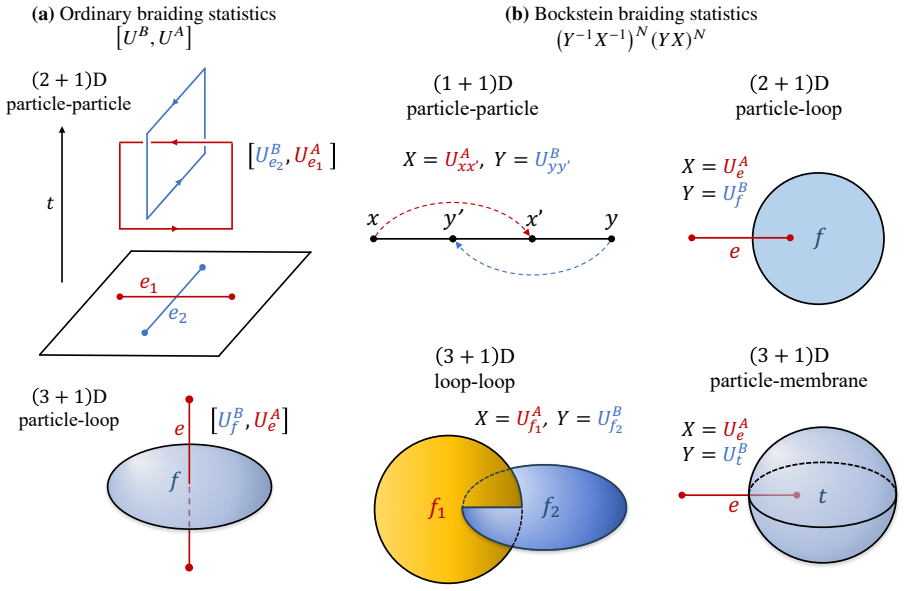
Braiding statistics, from the Aharonov-Bohm phase to anyons in fractional quantum Hall systems, play a central role in quantum physics. For $p$- and $q$-dimensional excitations in $d$ spatial dimensions, ordinary braiding requires $p+q=d-2$. In a field-theoretic description of $\mathbb Z_N$ excitations, ordinary braiding is described by the linking response $(2\pi i/N)\int A_{d-p}\cup B_{d-q}$, where $A_{d-p}$ and $B_{d-q}$ are background fields coupled to the two excitation types. In this work, we identify new mutual statistics in the adjacent case $p+q=d-1$. For two invertible excitations obeying $\mathbb Z_N$ fusion, one can choose local creation operators $X$ and $Y$ whose supports have a staggered one-dimensional overlap. The closed unitary process $W_N(X,Y)=(Y^{-1}X^{-1})^N(YX)^N$ measures the resulting mutual statistic. Its field-theory description is $(2\pi i/N)\int A_{d-p}\cup\beta_N B_{d-q}$, where $\beta_N$ is the Bockstein operation; we therefore call the invariant Bockstein braiding statistics. The construction yields particle-particle statistics in one dimension, particle-loop statistics in two dimensions, and loop-loop or particle-membrane statistics in three dimensions. Nontrivial Bockstein braiding statistics obstructs simultaneous condensation of the two $\mathbb Z_N$ excitations. It also rules out a fully symmetric gapped phase for systems with the corresponding mixed anomaly and implies symmetry fractionalization when one of the $\mathbb Z_N$ symmetries is broken.
The duality persists at the limit and supplies block-wise equivalences inside the category of weight modules.
abstractclick to expand
The Feigin-Semikhatov duality asserts that the Heisenberg cosets of the subregular $W$-algebra of $\mathfrak{sl}_n$ at level $k$ and the one of the principal $W$-superalgebra of $\mathfrak{sl}_{n|1}$ at level $\ell$ coincide when the levels satisfy the Feigin-Frenkel relation $(k+n)(\ell+n-1)=1$. A similar duality holds between the subregular $W$-algebra of $\mathfrak{so}_{2n+1}$ and the principal $W$-superalgebra of $\mathfrak{osp}_{2|2n}$.
We study these dualities in the critical/large level limit.
We describe the centerless subregular $W$-algebra at the critical level as an orbifold of the large level limit of the principal $W$-superalgebra times a lattice VOA. Our construction yields a functor between certain categories of the two involved vertex algebras. We show that in this set-up one in fact gets block-wise equivalences of categories. Studying the principal block of the large level limit of the principal $W$-superalgebra then gives us the structure of the principal blocks of the subregular $W$-algebras in the category of weight modules (which is much larger than the more common category of lower bounded modules).
For sets larger than one element the resulting invariant separates virtual knots and links that share the same Jones polynomial.
abstractclick to expand
We introduce a generalization of the Jones polynomial for classical and virtual knots and links using colorings by a permutation $\sigma:X\to X$ of a finite set $X$. For $X=\{1\}$ and for classical knots, the invariant is equivalent to the usual Jones polynomial; for $X$ with cardinality greater than 1 the invariant expresses distinct information from the Jones polynomial or virtual knots and for classical and virtual links. We establish some properties of the new invariants and compute the polynomials for classical and virtual knots and links of small crossing number for a few small permutations.
It yields GL_N-equivariant transposed Poisson brackets on representation algebras and on their invariant rings via the trace map.
abstractclick to expand
We introduce double transposed Poisson algebras, a noncommutative analogue of the transposed Poisson algebras of Bai, Bai, Guo and Wu that is compatible with the Kontsevich--Rosenberg principle. We first consider a simplified version which we call id-adapted double transposed Poisson algebras and then explore the general definition. We prove that every such structure on a unital associative algebra $\mathbb{A}$ is governed by a single derivation $\mathbb{A}\to\mathbb{A}\otimes\operatorname{S}(\mathbb{A}/[\mathbb{A},\mathbb{A}])$. Furthermore, this induces a $\operatorname{GL}_N$-equivariant transposed Poisson structure on each representation algebra $\mathbb{A}_N=\Bbbk[\operatorname{Rep}_N(\mathbb{A})]$. We also define $H_0$-transposed Poisson structures, the transposed counterpart of Crawley-Boevey's $H_0$-Poisson structures, and use the trace map to obtain a transposed Poisson structure on the ring of $\operatorname{GL}_N$-invariants $\mathbb{A}_N^{\operatorname{GL}_N}$.
Analytical properties of current products in highest weight representations enable the rewrite for classical series.
abstractclick to expand
Following the approach of B.~Enriquez~\cite{E} we exhibit the analytical properties of the products of the currents
in the Yangian doubles restricted to the category of the highest weight representations. We will demonstrate that the Serre relations for the simple root currents in the Drinfeld's 'new' realization of the Yangian doubles \cite{Dnew,KhT-DY,LP1} can be reformulated as quadratic commutation relations between composed currents for the Yangian doubles associated with Lie algebras of the classical series.
For any conformal net, not necessarily rational, we construct the associated Cardy-type conformal field theory on the Minkowski spacetimes $(\mathbb R/2\pi\mathbb Z)\times\mathbb R$ for closed strings and $[0,\pi]\times\mathbb R$ for open strings within the framework of algebraic quantum field theory. In addition to verifying some of their basic properties, we prove three forms of Haag duality for multi-double-cones and boundary intervals, interpreted respectively as the Minkowskian versions of modular invariance, the Cardy consistency condition, and the Morita equivalence of boundary field algebras.
The structures generalize transmutation and bosonization from Hopf algebras and relate representation categories while preserving tensor pro
abstractclick to expand
We introduce and develop the theory of braided cogroupoids, a class of algebraic structures generalizing cogroupoids in a braided setting. We show that braided cogroupoids induce monoidal equivalences between the associated comodule categories, and we generalize Majid's transmutation and bosonization of braided Hopf algebras to the cogroupoid setting. Several examples are studied in detail, including the braided $SL_{n}$ cogroupoid and the braided bilinear cogroupoid.
The recently introduced formalism of chiral cluster seeds replaces quantum cluster variables with deformed vertex operators. In this framework, a decorated quiver associated with a seed encodes the operator product expansions of the corresponding vertex operators. This formalism is applied to several $(q,t)$-deformed W-algebras, including $\mathcal{W}_{\mathfrak{q},\mathfrak{t}}(\mathfrak{gl}(N|M))$, $U_q(\widehat{\mathfrak{sl}}_2)$, and the deformed Bershadsky--Polyakov algebra. In particular, it is shown that different free field realizations of the currents are related by mutations of the associated chiral cluster seed.
The second part of the paper introduces a $(q,t)$-deformation of the subregular W-algebras, denoted by $\mathcal{W}_{\mathfrak{q},\mathfrak{t}}^{\text{sub}}(\mathfrak{sl}(N))$. All free field realizations obtainable through seed mutations are described. An embedding of $\mathcal{W}_{\mathfrak{q},\mathfrak{t}}^{\text{sub}}(\mathfrak{sl}(N))$ into the free field realization of $\mathcal{W}_{\mathfrak{q},\mathfrak{t}}(\mathfrak{sl}(N))$ tensored with a rank-two Heisenberg algebra is constructed. This embedding may be viewed as a deformed analogue of inverse quantum Hamiltonian reduction. The relation between the subregular algebras and $\mathcal{W}_{\mathfrak{q},\mathfrak{t}}(\mathfrak{gl}(1|N))$ is also discussed.
We establish handle attachment formulas for the Khovanov skein lasagna module with 1-dimensional inputs over $\mathbb{Q}$, defined recently by Ren, Wedrich, Willis, Zhang, and the second author. For a $4$-manifold built out of $1$- and $2$-handles, the invariant can be computed in terms of a cabled colimit of Rozansky-Willis homologies, modulo a new relation which we call the lasso relation. We then present some explicit calculations for disk bundles over $S^{2}$, as well as a partial vanishing result for $4$-manifolds of the form $\Sigma_{g}\times D^{2}$, $g\geq 1$.
For every n the completed algebra of type (C_n^∨,C_n) is the universal deformation of the quantum torus crossed with the C_n Weyl group.
abstractclick to expand
We study the double affine Hecke algebra (DAHA) of type $(C_n^\vee,C_n)$ from the perspective of deformation theory. First, we provide a zeros-and-residues realization of this algebra, extending the construction of Ginzburg, Kapranov, and Vasserot to the non-reduced affine root system setting. Specializing the parameters of the DAHA to the base point gives the crossed product of a quantum torus algebra with the finite Weyl group of type $C_n$. We then show that for all $n$, the completed DAHA is the formal universal deformation of this crossed product algebra, extending Oblomkov's result for $n=1$. Our proof explicitly identifies the completed DAHA with the undeformed crossed product algebra equipped with a formal star product.
The framework proves that simplices whose vertices are quasi-isomorphisms admit fillings, supplying higher homotopies for L_infty[1]-morphis
abstractclick to expand
We propose a model of higher homotopy theory of $L_{\infty}[1]$-morphisms as a natural generalization of the $A_{\infty}$-homotopies defined by Fukaya-Oh-Ohta-Ono \cite{FOOO1}. Within this framework, we show that a filling condition holds for simplices whose vertices are assigned quasi-isomorphisms.
Fermionic topological orders can host 't Hooft anomalies with no bosonic counterpart. We identify a new sixteen-fold family of (2+1)D fermionic topological orders, forming a fermionic analogue of Kitaev's sixteen-fold way. This family is distinguished by the mod 16 't Hooft anomaly of a $\mathbb{Z}_2$ one-form symmetry, generated in each theory by a single nontrivial $\mathbb{Z}_2$ anyon. This intrinsically fermionic anomaly permits anyon spins that are forbidden in bosonic phases; the simplest new example is an Abelian fermionic topological order containing a single $\mathbb{Z}_2$ Abelian anyon of spin 1/8. Each theory can be realized as the gapped boundary of a (3+1)D fermionic symmetry-protected topological (SPT) phase protected by the $\mathbb{Z}_2$ one-form symmetry, which acquires a $\mathbb{Z}_{16}$ classification once the spacetime spin structure is twisted by the one-form symmetry. We realize these phases microscopically via lattice models built from Walker-Wang models coupled to local fermions.
The Signed Particle Formulation provides a particle-based interpretation of quantum mechanics in phase space, where quantum dynamics are represented through the creation and evolution of signed particles. A central computational challenge in this framework is the evaluation of the Wigner kernel, which generally involves highly oscillatory integrals and can become computationally demanding in time-dependent simulations. This paper proposes an analytical approximation of the Wigner kernel for one-dimensional single body quantum systems by exploiting a series-based representation of the potential function. The resulting expression provides an efficient way to approximate the Wigner kernel and the associated Gamma function, which governs the particle-generation process in the Signed Particle Formulation framework. The proposed approximation is evaluated for several Gaussian-based potential profiles, including single, double, triple, and quadruple Gaussian potentials. Numerical comparisons between the approximated and directly computed Wigner kernels and Gamma functions show that the proposed method captures the main behavior of the exact quantities while significantly reducing the computational cost. These results indicate that the proposed approximation can serve as an efficient computational component for scalable Signed Particle Formulation based quantum simulations.
Quillen equivalence with Poisson cooperad comodules transfers the operations, extending the rational homotopy type.
abstractclick to expand
We show that the category of lax involutive $n$-Frobenius algebras is Quillen equivalent to the category of right comodules of the $n$-Poisson cooperad. It follows in particular, that the cohomology of a parallelized $n$-manifold is naturally endowed with a homotopy involutive $n$-Frobenius structure extending the rational homotopy type of $M$, solving a long-standing question.
The identification for quantum symmetric pairs now covers non-standard cases and non-reduced root systems, with a conjecture supplied for th
abstractclick to expand
We identify the zonal and character spherical functions for quantum symmetric pairs with the symmetric Koornwinder--Macdonald polynomials. To this end, the methods of Letzter's 2004 paper are translated to modern conventions and right coideal subalgebras, and extended to non-standard cases and cases with non-reduced restricted root systems. For the last elusive Satake type, FII, a conjecture is provided.
The coproduct stays an algebra map into the Takeuchi product while the product relaxes to a normalized 3-cocycle, supporting explicit constr
abstractclick to expand
We introduce coquasi-bialgebroids over a noncommutative base algebra. Using Takeuchi's \(\times_B\)-coalgebra formalism, we require the coproduct to remain an algebra map into the Takeuchi product, while the product is associative only up to an invertible normalized \(3\)-cocycle. This gives a bialgebroid analogue of coquasi-bialgebras and provides a natural framework for cocycle-twisted bialgebroid constructions.
We develop the basic theory and prove a twisting theorem by convolution-invertible \(2\)-cochains. As a main class of examples, we construct coquasi Connes--Moscovici-type bialgebroids on \(B\otimes H\otimes B\), where \(H\) is a coquasi-bialgebra measuring an algebra \(B\), with twisting data \(\gamma:H\otimes H\to B\). We also give finite-group examples arising from a subgroup \(G\subseteq X\) and a choice of transversal. Finally, under finite projectivity assumptions, we describe the dual quasi-bialgebroid construction and its relation to Drinfeld-type twisting.
Obstructions reduce to de Rham cohomology for affine symplectic varieties and prove rigidity of boundary Virasoro minimal models.
abstractclick to expand
We give an operadic approach to deformation quantization of vertex Poisson algebras, a chiral analogue of the traditional problem of deformation quantization of Poisson algebras. Our main result is an order-by-order deformation-obstruction theory for such quantizations, controlled by the chiral analogue of Poisson cohomology. In the special case of chiral quantizations of affine symplectic varieties, quantizations of the vertex Poisson algebras of functions on their arc spaces, we prove that this deformation-obstruction theory is controlled by their de Rham cohomology. As another application, we prove that the boundary Virasoro minimal models are rigid under deformations.
An explicit construction shows they are residually finite and Hopfian, with free solutions having solvable word problem.
abstractclick to expand
We offer a workable construction of the free right nilpotent skew braces of arbitrary class which allows us to prove (among many other things) that this free object has free additive/multiplicative groups, and that it must also be residually finite and Hopfian. We introduce the class of right nilpotent solutions, which correspond to right nilpotent skew braces. As a consequence of our construction, the free solutions in this class have a solvable Word Problem, and every law holding for finite solutions of the previous type also holds for every solution of the same type.
In the remainder of the paper, we present further explicit realizations of free objects and explore their consequences. Among these are free two-sided skew braces of abelian type (with an abelian multiplicative group) and free centrally nilpotent skew braces of class 2.
Optimal maps injective on generators and their compositions solve the twin problem for Coxeter groups and Hecke monoids.
abstractclick to expand
Motivated by the twin homomorphism problem for Coxeter groups and the corresponding Hecke monoids, we find a large class of its solutions originating from standard homomorphisms of Artin monoids and their compositions. These homomorphisms are expected to be injective when they are optimal and injective on generators, which generalizes the homogeneous homomorphisms and the famous Tits conjecture settled by Crisp and Paris. We classify disjoint standard homomorphisms and conjecture the complete classification when the domain is of rank two.
We consider the problem of distinguishing sets of quantum product states with local operations and classical communication (LOCC). Recent work has used graph theory to identify sets of product states distinguishable with one-way LOCC. We extend these efforts to full two-way LOCC, with the first significant analysis of the set of graphs corresponding to bipartite product states that can be distinguished with two-way protocols after finitely many steps. We derive basic closure properties of the set of distinguishable graphs and identify some classes of graphs that guarantee local distinguishability and some graphs that do not. We also include several examples and forward-looking comments.
Many arithmetic sums over function fields can be expressed in terms of $H_i(B_n, V^{\otimes n})$ for some braided vector space $V$, and a vanishing line for these homology groups gives power-savings cancellation for the arithmetic sum. We prove an explicit vanishing line for $H_i(B_n,V^{\otimes n})$ depending only on the homology up to some finite $n$. Moreover, as the range of $n$ increases, the slope of the resulting vanishing line converges to the optimal slope. We also apply our methods to two different families of arithmetic sums. Firstly, we prove an upper bound for the bias of higher order Gauss sums over function fields, extending Patterson's conjecture beyond the cubic and quartic cases over number fields, and we conjecture this bound is sharp for orders that are prime powers. Secondly, we show that over Galois $G$-extensions, almost all character sums exhibit near square-root cancellation.
The connection at odd order roots of unity also reaches the non-commutative Springer resolution.
abstractclick to expand
The category of Harish-Chandra bimodules for quantum groups was first appeared in the works about topological quantum field theory of surfaces. In this paper, we study this category when the quantum parameter q is an odd order root of unity. We relate the category to the category of affine Soergel bimodules and to non-commutative Springer resolution.
Construction supplies graphs whose integrals match given MZVs and determines integer weights for combinations yielding normalized values of
abstractclick to expand
The primary aim of this paper is to provide an explicit construction of Kontsevich graphs whose integrals give certain multiple zeta values. Furthermore, by using this construction, we explicitly determine the weights of $\mathbb{Z}$-linear combinations of graphs whose integrals yield normalized multiple zeta values of a given weight. The methods employed in this paper are based on those introduced by Ritland, and our results provide a refinement of his results.
Hypertoric (or toric hyperk\"ahler) varieties are a class of symplectic singularities and their resolutions, obtained as Hamiltonian reductions of a symplectic vector space acted on by a torus. In physics, they appear as Higgs (and Coulomb) branches of 3d $\mathcal{N}=4$ supersymmetric quantum field theories with abelian gauge group.
In this work, we construct an $\hbar$-adic (in the sense of microlocalisation) sheaf of vertex operator superalgebras over a given smooth hypertoric variety. Its global sections give the $A$-twisted boundary of the corresponding 3d gauge theory. We use this to prove that the associated affine variety of this hypertoric vertex operator superalgebra recovers the singular hypertoric variety. This proves the 3d Higgs branch conjecture for a large class of boundary vertex operator superalgebras. In particular, these vertex operator superalgebras are quasi-lisse.
This is in contrast to the (purely even) hypertoric vertex operator superalgebras (and their $\hbar$-adic localisations) constructed previously by Kuwabara as global sections of sheaves on families of universal Poisson deformations of the hypertoric varieties. These are generally not quasi-lisse. We show that the vertex operator superalgebras defined in this paper are (fermionic) simple-current extensions of those defined by Kuwabara, and investigate the consequences for symplectic duality and characters. We observe that the latter are upgraded from partial (or false) theta functions to quasimodular forms.
Let $\Sigma$ be a surface of genus $g$ with zero or one boundary component and $n$ marked points, and $H$ a finite-dimensional factorizable ribbon Hopf algebra. We compute the central extension of the mapping class group of $\Sigma$, associated to the projective representation defined from the stated skein algebra of $\Sigma$ and $H$. Our proof is purely two-dimensional, and makes no use of TQFT arguments.
Review shows how forms and half-densities become the data of the odd quantization functor.
abstractclick to expand
This note is a detailed review of the geometry behind the Batalin-Vilkovisky formalism and how it fits into the framework of the quantum odd symplectic category and the odd quantization functor.
Given a quiver Q with gauge dimension $\bf v$ and framing dimension $\bf w$, one can define the extended quiver variety $\widetilde{\mathcal M}(\mathbf v,\mathbf w)$, which is a smooth family of deformations of the Nakajima quiver variety $\mathcal M(\mathbf v,\mathbf w)$. In this paper we discuss two vertex algebras which chiralize the geometry $\widetilde{\mathcal M}(\mathbf v,\mathbf w)$. We construct a sheaf of $\hbar$-adic vertex superalgebras $\mathscr D^{\mathrm{ch}}_{\widetilde{\mathcal M}(\mathbf v,\mathbf w),\hbar}$ on $\widetilde{\mathcal M}(\mathbf v,\mathbf w)$ which quantizes the jet bundle of $\widetilde{\mathcal M}(\mathbf v,\mathbf w)$, and define a vertex algebra $\mathsf D^{\mathrm{ch}}(\widetilde{\mathcal M}(\mathbf v,\mathbf w))$ to be the $\hbar=1$ specialization of the $\mathbb C^{\times}$-finite part of the vector space of global sections $\Gamma(\widetilde{\mathcal M}(\mathbf v,\mathbf w), \mathscr D^{\mathrm{ch}}_{\widetilde{\mathcal M}(\mathbf v,\mathbf w),\hbar})$. We define another vertex superalgebra $\mathcal V(\mathbf v,\mathbf w)$ by BRST reduction of the tensor product of the $\beta\gamma bc$-system and Heisenberg VOA associated to the quiver Q, and show that there exists a natural vertex superalgebra map from $\mathcal V(\mathbf v,\mathbf w)$ to $\mathsf D^{\mathrm{ch}}(\widetilde{\mathcal M}(\mathbf v,\mathbf w))$. Under certain technical assumptions, we prove that the negative degree BRST cohomologies of the tensor product of $\beta\gamma bc$-systems and Heisenberg VOA associated to the quiver Q are zero, and under stronger assumptions, that the aforementioned vertex superalgebra map is injective.
Physically, the vertex superalgebra $\mathcal V(\mathbf v,\mathbf w)$ is closely related to the boundary VOA of the H-twisted 3D $\mathcal N=4$ quiver gauge theory associated to the quiver Q with gauge and framing dimension vectors $\bf v$ and $\bf w$.
We review the construction of a pseudo-braided category structure on the $C_1$-cofinite module category of a vertex operator algebra using conformal blocks and analytic continuation along paths in configuration spaces. In the rational $C_2$-cofinite case, the pseudo-braided category is represented by tensor products and becomes a balanced braided tensor category. We then compute all four-point conformal blocks of the Virasoro vertex operator algebra of central charge $1/2$ in terms of hypergeometric functions. We explain how analytic continuation of these blocks determines the braiding and associator, and identify the resulting module category with the Tambara--Yamagami category over $\mathbb{Z}_2$ as a balanced braided tensor category.
Integral non-degenerate ones whose simple objects have dimensions 1 or p^k arise from finite groups.
abstractclick to expand
We show that an integral non-degenerate fusion category $\mathcal{C}$ is group-theoretical if the Frobenius-Perron dimensions of its simple objects are either 1 or powers of a prime $p$.
H(W1, W2) matches prior logarithmic and dual-product constructions and yields finite fusion rules under C1-cofiniteness.
abstractclick to expand
Let $V$ be a vertex operator algebra, and let $W^1$ and $W^2$ be restricted $V$-modules. We construct a generalized $V$-module $\mathcal{H}(W^1, W^2)$ characterized by canonical universal properties. We show that, under suitable hypotheses, $ \mathcal{H}(W^1, W^2)$ realizes the internal Hom object in the tensor category of restricted $V$-modules. Although our construction differs from Li's, we show that it agrees with the natural logarithmic generalization of Li's module $\Delta(W^1, W^2)$. We further establish a canonical isomorphism between $\mathcal{H} \big(W^1,(W^2 )^\prime \big)$ and the $P(z_0)$-dual product $ W^1 \pzbox_{P(z_0)} W^2 $ recently constructed by Du and Huang. Under the $C_1$-cofiniteness condition, we investigate finiteness properties of $ \mathcal H(W^1, W^2)$. As applications, we obtain a natural isomorphism between $ \mathcal H(W^1, W^2)'$ and $ W^1 \boxtimes (W^2)'$, and prove the finiteness of the corresponding fusion rules.
The notions extend classical paths and receive explicit formulas in the classical, trivial, and complete cases.
abstractclick to expand
We introduce notions of path indicators and path correspondences for finite quantum graphs, study their basic properties, and compute them explicitly for classical graphs, trivial graphs, and complete quantum graphs.
Hochschild invariants admit the structure; the Getzler-Gauss-Manin connection is flat up to chain homotopy on periodic cyclic chains.
abstractclick to expand
We establish the calculus structure on Hochschild invariants of open-closed homotopy algebras. We further define the Getzler-Gauss-Manin connection and show that it is flat up to chain homotopy on the open-closed periodic cyclic chain complex.
In classical and most exceptional types, this holds whenever the p-character lies in a unique sheet or the module is invariant under twistin
abstractclick to expand
We study the modules of minimal dimension for reduced enveloping algebras of Lie algebras of reductive algebraic groups using the theory of modular finite $W$-algebras. First of all we consider the case where the $p$-character lies in a unique sheet, and demonstrate that in classical cases and in most exceptional cases all minimal modules are parabolically induced from a Levi subalgebra and a rigid $p$-character. Secondly we consider the minimal modules which are invariant under twisting by the component group, showing that in classical cases and in most exceptional cases these are also parabolically induced from a Levi subalgebra and a rigid $p$-character.
Method computes Ext groups for many modules over finite general linear groups beyond the prior ℓ-1 limit.
abstractclick to expand
Let $G = \mathbf{GL}_d(\mathbb{F})$ be the general linear group over a field of cardinal $q$, and let $\mathbb{k}$ be a field of positive characteristic which does not divide $q(q-1)$. Building on the works of Cline, Parshall, and Scott, we show how to compute Ext-groups between $\mathbb{k}G$-modules using the quantum Schur algebra. The main novelty is our ability to compute these Ext-groups in higher degree than what was done before. More precisely, let $\ell$ be the order of $q$ in $\mathbb{k}$. In previous work, this method enabled the computation of the cohomology groups $H^*(\mathbf{GL}_d,M)$ in degree $*\leq \ell-1$. We show that for a lot of modules $M$, we can compute these cohomology groups in higher degree, with an example where we can compute until degree $3(\ell-1)$. We also show some new result on Ext-groups between modules over the quantum Schur algebra along the way.
The construction of relations among relations is one ingredient in the Groebner-like basis construction of the maximal ideal of the universal vertex operator algebra $V^k_{\mathfrak g}$ for affine Lie algebras. For affine Lie algebras of type $C_n^{(1)}$, such combinatorially parametrized relations among relations were constructed in earlier work for level $2$ standard modules \cite{PS3}, and for $C_2^{(1)}$-standard modules at higher levels \cite{S}. This article presents two further examples in which the same counting method can be carried out. The first treats $C_n^{(1)}$-standard modules at the fixed level $k=5$, with $n$ arbitrary. The second treats $C_3^{(1)}$-standard modules for arbitrary level $k$. In both cases the calculation compares the number of required relations among relations in a trapezoid of the array of negative root vectors with the corresponding representation-theoretic dimension.
Flag complexes on representation strata realize PBW elements and their restrictions give the change-of-basis multiplicities in the quantized
abstractclick to expand
In this paper, we study the transition matrix between the PBW basis and the canonical basis for the negative part of the quantized enveloping algebra of the Kronecker quiver from a geometric viewpoint. Building on Lusztig's geometric construction of the canonical basis, we construct sheaf-complex realizations of PBW basis elements by means of flag sheaf complexes over the strata $X(\alpha,m)$ of representation varieties. Our first goal is to give a geometric description of the simple constituents appearing in the restrictions of these flag sheaf complexes to the strata $X(\alpha,m)$. This allows us to compare the PBW-type sheaf complexes with the simple perverse sheaves $IC(X(\alpha),L_\chi)$ arising in Lusztig's construction. Using this description together with a purity result for the relevant $\mathbb{F}_q$-structures, we obtain another proof that the elements defined by Lusztig's perverse sheaves indeed form a basis of the composition algebra.Our second goal is to make the transition coefficients between the PBW basis and the canonical basis geometrically explicit. More precisely, we show that these coefficients are governed by the multiplicities of local systems in the restrictions of intersection cohomology complexes to smaller strata. As a consequence, the transition matrix from the canonical basis to the PBW basis is upper triangular with diagonal entries equal to $1$, and its coefficients admit a direct geometric interpretation. In particular, in the Kronecker quiver case we recover the triangularity of the transition matrix and obtain positivity properties of the corresponding coefficient polynomials.
Weighted projective lines yield the twisted versions for valued star-shaped graphs, including Drinfeld new presentation of affine cases.
abstractclick to expand
Twisted quantum loop algebras are a generalization of twisted quantum affine algebras in Drinfeld new presentation. The Hall algebras of Geigle--Lenzing's weighted projective lines are used to realize (untwisted) quantum loop algebras of simply-laced type associated to star-shaped graphs by Schiffmann and Dou--Jiang--Xiao. In this paper, we use the semi-derived Ringel-Hall algebras of more general weighted projective lines to realize the twisted quantum loop algebras associated to the valued star-shaped graphs, including the twisted quantum affine algebras in Drinfeld new presentation.
For C2-cofinite vertex operator algebras, with injectivity when weights are separated modulo Z.
abstractclick to expand
We study the space of one-point functions on the torus for a possibly nonrational $C_2$-cofinite vertex operator algebra $V$ by relating it to a trace object of the subcategory of projective objects in the representation category of $V$. We identify the dual of the trace space with symmetric functions on the endomorphism algebra $E$ of a projective generator. Motivated by the Gainutdinov-Runkel conjecture, recently established using different methods by Gui and Zhang, we present a complementary representation-theoretic approach based on Arike-Nagatomo pseudo-traces. In this framework, we prove surjectivity of the Gainutdinov-Runkel map from symmetric functions on $E$ to one-point functions. Under the additional assumption of separated conformal weights modulo $\mathbb{Z}$, we also prove injectivity, using projective-cover techniques inspired by Huang.
We use a family of Rogers--Ramanujan-type combinatorial identities of Dousse--Konan involving coloured partitions to prove classical freeness of the simple vertex operator algebras based on $\widehat{\mathfrak{sl}}_n$ at level $1$. These identities are used to produce Gr\"obner bases for the relevant arc algebras.
We establish a new connection between supersymmetric theories and scattering amplitudes. We show that the Coon amplitude coincides with the 3d $\mathcal{N}=2$ half-index of the XYZ model with nontrivial boundary conditions. Our 3d theory, intrinsically defined in the UV, flows to a sigma model in the IR whose partition function is the Veneziano amplitude. Crossing symmetry is realized as a consequence of 3d $\mathcal{N}=2$ mirror symmetry between XYZ and SQED. We use this correspondence to construct a meromorphic modification of the Coon amplitude by promoting the long-standing dressing factor $\mathfrak{q}^{ST}$ responsible for a branch cut to an elliptic completion thereof. This illustrates that one does not have to give up single-valuedness to achieve positivity at the physical poles.
Non-coassociative bimonoids with codivisions admit twists that produce new right and left structures, including fresh examples from the 7-sp
abstractclick to expand
In this paper, we develop a general theory of twist deformations for Hopf coquasigroups in a symmetric monoidal category. To this end, we first introduce and study non-coassociative bimonoids endowed with left and right codivisions, and establish their connection with left and right Hopf coquasigroups. Next, motivated by the classical theory of Drinfeld twists for Hopf algebras, we define twists for non-coassociative bimonoids and prove that they induce deformations of Hopf coquasigroup structures through suitable modifications of the coproduct. In particular, we obtain explicit deformation procedures for right and left Hopf coquasigroups and analyze the corresponding antipodes. Finally, we apply the general theory to construct nontrivial examples arising from Hopf coquasigroups associated with the sphere ${\sf S}^7$, obtaining new examples of twisted Hopf coquasigroups that are neither commutative nor cocommutative.
For linear, cyclotomic and quadratic alphabets the result is polynomial in μ and preserves the Hopf algebra from the shuffle product.
abstractclick to expand
The analytic integration of single-scale Feynman integrals emerging in perturbative calculations in quantum field theories can be performed within special classes of functions, which appear as consecutive generalizations of the polylogarithm in form of Kummer-Poincar\'e iterative integrals over special alphabets and extensions thereof. These are the polylogarithms, Nielsen integrals, the iterated integrals over linear denominator terms, cyclotomic letters, letters induced by quadratic forms, and square-root valued letters. These integrals are solutions of first-order factorizing differential equations. They are related to specific nested sums via the Mellin transform and their expansions around $x=0$. We construct the $\mu$-extensions of these iterated integrals and the associated nested sums. We present closed form solutions or provide algorithms in the case of more involved cases to derive the respective $\mu$-extensions and study the algebras of the $\mu$-extended function spaces. Except for the case of square-root valued alphabets, the $\mu$-extension maps into the same function space polynomially in $\mu$. This is also the case for the associated nested sums. For square-root valued alphabets or sums containing central binomials, the $\mu$-extension leads to higher transcendental functions. In all other cases the $\mu$-extension preserves the Hopf algebra structure implied by the (quasi)shuffle product, by supplementing $\mu$ to the ground field.
We extend the dendroidal Rezk nerve to the setting of relative $\infty$-operads. Our main theorem relates it to localization of $\infty$-operads, generalizing a theorem of Mazel-Gee. By exploiting the relation, we obtain a surprisingly effective tool to prove localization results in operadic contexts. As applications, we obtain a number of new results on operadic localizations, including a generalization of Willwacher's recent result on cyclic operads and operadic modules, and a description of locally constant factorization algebras on spheres in terms of discrete geometry.
Fixed points under an O(2) action on 2-vector spaces recover the module categories of C*, W*, and H*-algebras via different choices of G.
abstractclick to expand
Finite-dimensional operator algebras can be viewed as $\mathrm{C}^*$, $\mathrm{W}^*$, or $\mathrm{H}^*$-algebras, leading to different notions for their categories of modules and correspondence 2-categories. In this article, we show how these differences can be understood systematically using the notion of $G$-dagger category from arXiv:2403.01651 for different subgroups $G\leq O(2)$. To do so, we first introduce $G$-Hermitian $2$-vector spaces using fixed points of a certain $O(2)$-action on $2\mathsf{Vect}$. We then propose criteria for when such pairings are `positive', generalizing the passage from Hermitian vector spaces to Hilbert spaces. Finally, we outline an inductive approach to defining higher Hilbert spaces in arbitrary dimension, suggesting an extension of these ideas beyond the 2-categorical setting.
The framework supplies computable formulas, a Hochschild relation for circle products, and finiteness at generic parameters.
abstractclick to expand
We propose a model-independent axiomatic framework for the derived skein theory of oriented 3-manifolds with coefficients in a ribbon tensor category, especially focusing on the case where the input category is the category of finite-dimensional representations of a quantum group with quantum parameter not a root of unity. The axioms are designed so that the 0th homology recovers the ordinary skein module and gluing is governed by a bar construction. We establish several relationships between the derived skein theory and the ordinary skein theory. We show that this framework yields computable formulas in terms of ordinary internal skein modules and internal skein algebras. We also prove a Hochschild formula for Sigma x S^1. We give the first computations of derived skein modules and establish finiteness properties for generic parameters using deformation quantization methods.
The construction yields representation-valued invariants and four new polynomials that strengthen the biquandle counting invariant for class
abstractclick to expand
We define an infinite family of quiver representation-valued invariants of classical and virtual knots associated to a choice of data vector consisting of a biquandle, abelian group, set of biquandle arrows weights with values in the abelian group, coefficient ring and set of biquandle endomorphisms. As an application we extract four new polynomial invariants as decategorifications. We provide examples to show that these invariants are proper enhancements of the biquandle counting invariant and biquandle coloring quiver.
Modified path coalgebra carries the structure precisely when the quiver is generalized Hopf and vertex coalgebras form a cosemisimple coquas
abstractclick to expand
In this paper, we develop a quiver approach to coquasi-Hopf algebras with the dual Chevalley property. We introduce a modified generalized path coalgebra $\Bbbk(\mathrm{Q},\mathcal{S})$ associated with a given quiver $\mathrm{Q}$ and a collection of simple coalgebras $\mathcal{S}=\{C_i\mid i\in \mathrm{Q}_0\}$ indexed by the vertices of $\mathrm{Q}$, such that its link quiver coincides with $\mathrm{Q}$. We prove that such a coalgebra admits a graded coquasi-Hopf algebra structure with the dual Chevalley property if and only if $\mathrm{Q}$ is a generalized Hopf quiver and $\bigoplus_{i\in \mathrm{Q}_0}C_i$ forms a cosemisimple coquasi-Hopf algebra. Moreover, we provide a classification of these coquasi-Hopf algebra structures. We then study the link-indecomposable components of a coquasi-Hopf algebra with the dual Chevalley property, and give the generalized dual Gabriel's theorem for such coquasi-Hopf algebras. As an application, we apply the quiver method to classify finite integral tensor categories with the Chevalley property of finite representation type. We also give structural characterizations of coradically graded coquasi-Hopf algebras of tame corepresentation type. Furthermore, we investigate finite braided integral tensor categories with the Chevalley property via the quiver approach.
In quantum image processing, a fundamental step is encoding classical image data into quantum states. This can be achieved using methods such as Flexible Representation of Quantum Images (FRQI), Quantum Probability Image Encoding (QPIE), and Novel Enhanced Quantum Representation (NEQR). However, on real quantum hardware, these encodings can quickly lead to circuits with many gates, large circuit depth, and high qubit usage, which is a problem for Noisy Intermediate-Scale Quantum (NISQ) devices. In this work, we investigate whether low-rank state approximation, formulated via Schmidt decomposition, can help reduce this complexity. The method keeps only the most significant parts of a quantum state's entanglement structure, making state preparation more efficient while preserving most of the image information. We compare the three encoding techniques in their original form and with low-rank approximation, evaluating metrics such as circuit depth, CNOT count, MSE, and visual quality of reconstructed images. The results reveal meaningful trade-offs between accuracy and resource efficiency, with the FRQI model achieving a 97 percent reduction in circuit depth while maintaining a near-perfect reconstruction (MSE of about 0.27). This demonstrates the potential of low-rank techniques for advancing practical quantum image processing on near-term hardware.
For any binary quadratic operad the two classes coincide exactly via the Manin black product with the commutative operad.
abstractclick to expand
We study a categorical approach to the concept of varieties of chiral algebras. We prove that the class of chiral algebras in the variety defined by a binary quadratic operad Var, whose conformal structure is abelian, coincides with the class of differential algebras in the variety defined by the Manin black product of the operads Var and Com, where Com is the operad of associative commutative algebras.
Even Clifford algebras match PBW deformations of Zhang twists of Veronese subalgebras for Koszul algebras with normal regular elements.
abstractclick to expand
The category of noncommutative quadratic quadric hypersurfaces, ${\tt Quad}\text{-}{\tt QHS}$, consists of pairs $(A, f)$, where $A$ is a quadratic algebra and $f \in A$ is a nonzero degree $2$ element. We associate to such $(A, f)$ a pair $(\bar{A}^!, f^!)$, and show that this association makes ${\tt Quad}\text{-}{\tt QHS}$ into a category with duality. We construct a faithful functor from the category of graded modules over $\bar{A}^!$ to the homotopy category of curved DG modules over a canonical curved DG algebra $(A \otimes \bar{A}^!, d, f \otimes f^!)$. If $A$ satisfies the left strong rank condition and $f \in A$ is not a right zero divisor, we show that the restriction of our functor to a natural full subcategory of the category of graded modules over $\bar{A}^!$ is valued in a stable category of noncommutative matrix factorizations of $f$. When $A$ is Koszul of finite global dimension and $f \in A$ is normal and regular, we prove that the even Clifford algebra, $\bar{A}^![(f^!)^{-1}]_0$, is isomorphic to a canonical PBW-deformation of a Zhang twist of the $2$-Veronese subalgebra of the Koszul dual $A^!$. Finally, we study several classes of Artin-Schelter regular algebras to illustrate our results.
The correspondence on quantum homogeneous spaces yields explicit calculi and shows classical dimension for antiholomorphic cases on projecti
abstractclick to expand
We develop the theory of first- and higher-order codifferential calculi over coalgebras $C$ over fields $k$ with characteristic $\mathrm{char}(k)\neq 2$. For a given first-order codifferential calculus, we introduce its maximal prolongation by means of an explicit construction that associates to it a differential graded coalgebra, satisfying a universal property. For module coalgebras over a Hopf algebra $U$, we introduce the notion of an equivariant codifferential calculus. If $C$ is of the form $U\otimes_H k$ for a Hopf algebra $U$ and a right coideal subalgebra $H$ such that $U$ is faithfully flat as a left- and right $H$-module, we show that equivariant first-order codifferential calculi correspond to certain right coideals $T\subseteq \ker(\varepsilon\colon C\rightarrow k)$ called quantum tangent spaces. If $H$ is a sub bialgebra and the right $C$-coaction on $T$ is trivial, then the maximal prolongation is described in terms of a quadratic coalgebra. We further relate codifferential calculi to differential calculi and Cartan pairs over the dual algebra $C^\ast$, or more generally subalgebras thereof. We explicitly compute codifferential calculi on the coalgebra pre duals of the Podle\'s sphere and the quantized projective spaces. As an application, we give a new proof that the antiholomorphic Heckenberger--Kolb calculi on quantized projective spaces have classical dimension.
Modulated circulant matrices form a special class of N-parametric circulant matrices, recently introduced in the literature, with a structured spectral decomposition based on a Vandermonde type basis. Motivated by this definition, in this work we define the Modulated Quantum Fourier Transform (MQFT), a quantum primitive tailored to this matrix family.
It sends their representables to the empty presheaf, makes Day convolution cartesian, and collapses linear logic to classical logic.
abstractclick to expand
The centre comonad model provided the first concrete cohesive linear $\infty$-topos, settling an open problem of Schreiber. However, the model is degenerate: the quantum modality annihilates all non-commutative algebras, and the associated linear logic collapses to classical cartesian logic. In this paper we give a complete mathematical diagnosis of this degeneracy. We prove that the centre comonad sends the representable sheaf of a simple non-commutative algebra to the empty presheaf, and that the state space of any such algebra is empty. We then prove that the Day convolution on the classical core is cartesian, forcing the Seely isomorphism to hold trivially and collapsing the linear logic. We isolate the structural reason behind this collapse: whenever the opposite of the classical core is monoidally equivalent to a cartesian monoidal category, any coreflective precomposition comonad will exhibit the same degeneracy. We conclude that a non-degenerate quantum modality must be constructed without precomposition, and we briefly discuss possible directions.
Quasi-triangular bialgebras share the same braided cohomology when related by braided Morita equivalence, provided a condition that always h
abstractclick to expand
We introduce the braided cochain complex and the braided cohomology of braided coalgebras in linear monoidal categories, and compare the braided cohomology of braided coalgebras living in different linear monoidal categories using relative morphisms. The symmetric cohomology was introduced for groups by Staic, and was generalized to cocommutative Hopf algebras by Shiba, Sanada, and the second author. This cohomology involves degreewise actions of the symmetric groups on a cochain complex, which come from the usual symmetric monoidal structure on the category of modules. We generalize this framework by dealing with arbitrary linear monoidal categories, and by replacing symmetries with braidings defined merely on an object. We first give a convenient description of relative morphisms, and apply this result to prove that the braided cochain complex of quasi-triangular bialgebras is a braided Morita invariant under a certain condition, which is automatically satisfied in the finite-dimensional case.
Non-degenerate bilinear form plus merger of P+, P- and I_max make the quotient transitive, with gamma equaling Frobenius-Perron dimension fo
abstractclick to expand
Let $H$ be a finite-dimensional, non-semisimple Hopf algebra over an algebraically closed field $\mathbf{k}$. This paper investigates the asymptotic behavior of the core of left $H$-modules through the lens of the gamma invariant $\gamma_{\mathfrak{X}}$ relative to a representation ideal $I_{\mathfrak{X}}$. We establish an equivalent characterization for the quotient of the Green ring $R_{\mathfrak{X}}$ to be a transitive fusion ring, demonstrating that transitivity is synonymous with the non-degeneracy of a naturally induced bilinear form and the collapse of the ideals $P_{+}$, $P_{-}$ and $I_{\operatorname{max}}$ into a single ideal. Furthermore, we prove that the Green ring exhibits the structure of a representation ring in the sense of Benson, provided that the square of the antipode is an inner automorphism and the equality $I_{\operatorname{max}}=I_{\operatorname{proj}}$ holds. As an explicit application of these frameworks, we analyze the Drinfeld double $D(H_4)$ of the Sweedler algebra, identifying an infinite family of distinct representation ideals and proving that the maximal gamma invariant $\gamma_{\operatorname{max}}$ induces a genuine ring homomorphism. Finally, for Hopf algebras of finite representation type under the assumption $P_{+} = P_{-} = I_{\operatorname{max}}$, we show that $\gamma_{\operatorname{max}}$ coincides precisely with the Frobenius--Perron dimension, and we explicitly compute the gamma invariants for the standard basis elements of the Green ring of the Taft algebra $H_n(q)$.
Rigidity theorem shows its polynomial irreps match those of Y(gl_n) exactly, opening combinatorial representation theory for current algebra
abstractclick to expand
We introduce a quantum deformation $\mathbf{U}(\mathfrak{gl}_n[t])$ of the universal enveloping algebra of the current algebra $\mathfrak{gl}_n[t]$, realized as a parabolic subalgebra of quantum affine $\mathfrak{gl}_n$. Unlike the Yangian -- the standard quantization of the current algebra -- our algebra admits a canonical basis. We give a BLM-type realization of $\mathbf{U}(\mathfrak{gl}_n[t])$ via certain subalgebras of affine quantum Schur algebras, and then construct canonical bases for the modified quantum current algebra $\dot{\mathbf{U}}(\mathfrak{gl}_n[t])$ and for its finite dimensional irreducible graded modules. Moreover, we prove a rigidity theorem: every finite dimensional polynomial irreducible module for quantum affine $\mathfrak{gl}_n$ remains irreducible when restricted to ${\bf U}_{\mathbf v}(\frak{gl}_n[t])$ (the specialization of ${\bf U}(\frak{gl}_n[t])$ at a non-root-of-unity complex number ${\mathbf v}$); conversely, every finite dimensional polynomial irreducible ${\bf U}_{\mathbf v}(\frak{gl}_n[t])$-module extends uniquely to a polynomial irreducible module for quantum affine $\mathfrak{gl}_n$. Consequently, the finite dimensional polynomial irreducible modules of ${\bf U}_{\mathbf v}(\frak{gl}_n[t])$ are in bijection with those of the Yangian $Y(\mathfrak{gl}_n)$. This provides the first example of a quantum current algebra with a well-developed canonical basis theory, providing new combinatorial approaches to the representation theory of current algebras.
Closed two-letter relations and recursive systems reduce words using quantum or Stirling-type coefficients.
abstractclick to expand
We develop an explicit PBW normal ordering theory for the $26$ double extension regular algebras of type $(14641)$ in the Zhang-Zhang classification. With respect to the order $x_1\prec x_2\prec y_1\prec y_2$, we obtain closed two-letter formulas for the internal relations and recursive coefficient systems for mixed words, products of PBW monomials, powers of normal blocks, and noncommutative multinomial expressions. The internal coefficients are mostly quantum or skew-commutative, while the Jordan families produce Lah-Whitney, hence Stirling-type, triangular arrays. The symbolic reductions are supported by a SageMath implementation included as an ancillary file.
The unique extension holds inside generalized modules without assuming abelianness or compactness, supporting applications to VOA extensions
abstractclick to expand
It was recently shown by Huang that the category of $C_1$-cofinite modules for any vertex operator algebra $V$ admits a natural braided monoidal structure. Here, we show that this structure extends uniquely to a vertex algebraically natural braided monoidal structure on the completion of the category of $C_1$-cofinite $V$-modules under filtered colimits, within the ambient category of all generalized $V$-modules. A critical point here is that we do not assume the category of $C_1$-cofinite $V$-modules is abelian or that $C_1$-cofinite modules are compact in the cocompletion, since these properties are not known to hold in general. Our results have many applications in the representation theory of vertex operator algebra extensions, since many vertex operator algebras can be realized as objects in the filtered colimit completion of the category of $C_1$-cofinite modules for a vertex operator subalgebra. Generalizing from the specific vertex algebraic setting, we also establish existence and uniqueness for extensions of monoidal structures along a dense inclusion $\mathscr{C}_0 \to \mathscr{C}$ from an abstract, essentially small monoidal category into a well-structured cocomplete target.
Given a 3-manifold $M$ with a network of line and point defects in its boundary, we define the skein module of this configuration, generalizing the well-studied case of 3-manifolds which only admit point defects in the boundary. We prove that when all defects are labelled by semisimple data, our skein module is isomorphic to the state space of $\partial M$ in the defect version of the Reshetikhin-Turaev TQFT constructed by Carqueville-Runkel-Schaumann. Our defect skein modules follow naturally by globalizing the graphical calculus of module categories and functors thereof, and generalize the possible defect data considered in the defect TQFT beyond the semisimple case.
We give an alternative presentation of the small version of the reflection equation algebra associated to $GL_N$ at both odd and even roots of unity, and use our presentation to classify its irreducible representations. We then describe a family of algebras generalizing the small reflection equation algebra, and consider their application to the study of module categories over $U_q(sl_N)$ fusion categories.
G-equivariantization of G-crossed category matches Rep of A^G as balanced W*-tensor categories for any finite faithful action.
abstractclick to expand
Let $\mathcal{A}$ be a (not necessarily rational) conformal net with a faithful action of a finite group $G$. Let $\text{Rep}^G(\mathcal{A})$ be the $G$-crossed balanced $\mathrm{W}^*$-tensor category of $G$-twisted representations of $\mathcal{A}$ as introduced in arXiv:2606.03623. We show that there is an equivalence of balanced $\mathrm{W}^*$-tensor categories $(\text{Rep}^G(\mathcal{A}))^G\cong \text{Rep}(\mathcal{A}^G)$ between the $G$-equivariantization of $\text{Rep}^G(\mathcal{A})$ and the category of representations of the fixed-points conformal net $\mathcal{A}^G$. This generalizes to the non-rational case the equivalence of braided tensor categories $(\text{Rep}^G(\mathcal{A}))^G\cong \text{Rep}(\mathcal{A}^G)$ for $\mathcal{A}$ rational appearing (in the language of localized endomorphisms) in arXiv:math/0403322, and it also includes the balances.
We construct an explicit equivariant quantum Satake map for Grassmannians, which enables us to express their torus-equivariant quantum cohomology in terms of that of projective space. We then consider the exterior algebra of the latter, which admits a canonical identification with a Clifford algebra. We describe the resulting action in several complementary ways: first, from a geometric perspective via push-pull maps, and second, in terms of the shuffle product, which also arises in the simplest cohomological Hall algebra associated with the $A_1$-quiver. Exploiting the Clifford algebra structure, we derive new recurrence relations among equivariant Gromov-Witten invariants, yielding a new method for their computation in terms of Wick's Theorem. As an application, we provide combinatorial proofs of Graham positivity for both equivariant quantum Pieri rules, and in one case extend these results to quantum triple Schubert calculus.
We investigate the strong identity condition (SIC) for almost-canonically seminormed rings, a class of topological graded rings that includes enveloping algebras of vertex operator algebras. This condition was introduced in the algebro-geometric theory of conformal blocks, where it governs the smoothing of nodal curves.
To understand the representation-theoretic meaning of SIC, we develop the representation theory of almost-canonically seminormed rings, including Zhu-type algebras, induced modules, rationality conditions, tensor product compatibility, and an end formula for the mode transition algebra. Our main result characterizes the strong identity condition in terms of orthogonal expansions, projectivity of canonical modules, and Morita-type equivalences induced by Zhu-type algebras.
As an application, we show that for vertex operator algebras of CFT type, the smoothing property is equivalent to the Zhu algebra inducing a Morita-type equivalence with the category of admissible modules. Consequently, the strong identity condition identifies the precise representation-theoretic obstruction to extending algebraic smoothing beyond the semisimple setting. We further illustrate the theory through explicit examples, including the Weyl algebra and several irrational vertex operator algebras where the strong identity condition fails.
The theorem recovers the free bc-βγ system and chiral de Rham complex, with N=2 and N=4 versions for special targets.
abstractclick to expand
We construct $N=1$ supersymmetric (SUSY) vertex algebras from supersymmetric enhancements of Costello--Gwilliam factorization algebras on super Riemann surfaces. Introducing SUSY factorization algebras defined on embedded SUSY disks together with natural symmetry conditions, we prove a SUSY analogue of the Costello--Gwilliam extraction theorem. As an application, we study the holomorphic sigma model in the BV formalism. For a linear target, we obtain the free $bc$-$\beta\gamma$ system and recover its structure as a SUSY vertex algebra. For general complex targets, we describe the descent of the theory under coordinate changes and identify the resulting SUSY vertex algebra with the chiral de Rham complex. We further show that Ricci-flat K\"ahler and hyperk\"ahler targets give rise to $N=2$ and $N=4$ supersymmetric enhancements introduced by Ben-Zvi--Heluani--Szczesny.
A QFT is said to be relative if it lives at the boundary of a topological QFT in one higher dimension. We develop a general framework for working with noninvertible symmetries of relative theories in two spacetime dimensions, extending several well-known results for absolute QFTs. We emphasize various new features which arise in the relative setting, including the role of topological surfaces of the bulk, and the appearance of hypergroups and certain generalizations of tube algebras known as dome algebras. Our formalism is particularly well-suited for studying rational chiral algebras, where it predicts that finite symmetries are in explicit one-to-one correspondence with conformal embeddings of finite index.
We describe several implications of our framework for absolute theories. First, we explain how to "glue" together symmetries of the left- and right-moving chiral algebras of a 2D CFT to produce topological line defects of the full theory. Second, we derive a precise correspondence between boundary conditions of a 2D CFT and symmetries of its chiral algebra. This correspondence has several structural corollaries: in diagonal rational CFTs, we demonstrate that the topological line defects of the theory act transitively on its boundary conditions, and further that the identity Cardy state has the smallest $g$-function amongst all boundary conditions, including those which only preserve Virasoro symmetry.
We conclude by illustrating our results in a variety of examples. For instance, we show that, if there exists a rational chiral algebra with central charge $c=8$ whose modular tensor category is the Drinfeld center of the Haagerup fusion category, then it must arise as the fixed points of a rank-2 hypergroup acting on the $SU(3)_1\otimes (E_{6})_1$ chiral algebra.
All inner-faithful examples arise as quotients of the universal coacting Hopf algebra, giving a complete list of group gradings on two- and
abstractclick to expand
We classify the cocommutative Hopf algebras which coact inner-faithfully on (one-parameter) skew polynomial rings $A_q(n) = \Bbbk \langle x_1,\dots,x_n \rangle/(x_j x_i - q x_i x_j \mid i < j)$ for $n = 2$ and $3$. As a direct corollary, we obtain a classification of group gradings on two- and three-variable skew polynomial rings, recovering a result of Crawford in the two-variable case. Our results are achieved via Manin's universal coacting Hopf algebra construction, often denoted $\underline{\operatorname{aut}}(A_q(n))$, by classifying all its cocommutative quotients. We therefore also give an explicit presentation of $\underline{\operatorname{aut}}(A_q(n))$ for arbitrary $q \in \Bbbk^*$ and $n \in \mathbb{N}$.
Parabolic induction from Heisenberg subalgebras gives new irreducible families, with quantum versions over U_q(A_1^{(1)}) not arising from c
abstractclick to expand
The goals of the paper are 3-fold. First, we revisit the construction of imaginary Whittaker modules over untwisted affine Kac-Moody Lie algebras. These modules are obtained using the parabolic induction from irreducible Whittaker modules over the associated Heisenberg Lie algebras. We show that the infinite support condition for Whittaker functions on Heisenberg Lie algebras is essential for irreducibility: when the support is finite the modules becomes reducible, yielding infinite chains of submodules. We establish the irreducibility criterion for the induced modules over affine Lie algebras and construct a large family of such modules. In particular, we obtain a class of irreducible modules on which the derivation acts neither semisimply nor freely. Second, we consider quantum analogs of imaginary Whittaker modules and establish irreducibility for a family of such modules. Finally, we prove the irreducibility of a certain class of modules over $\mathcal{U}_q(A_1^{(1)})$, which are not quantum deformations of irreducible modules for the affine Kac-Moody Lie algebra $A_1^{(1)}$. Our results can be potentially extended to all types of untwisted quantum affine algebras, providing a pathway toward their classification.
The full center arises by adjoining the Witt vectors of length n to the p-center, and this yields an isomorphism from first Hochschild cohom
abstractclick to expand
Let $A$ be either a classical generalized Weyl algebra (also known as a noncommutative deformation of type A Kleinian singularity) or the enveloping algebra $U(\mathfrak{sl}_{2})$ over $\mathbb{Z}/p^n\mathbb{Z}.$ In this paper we compute the center and derivations of $A.$ More specifically, we show that the center of $U(\mathfrak{sl}_2)$ is generated by the Casimir element over the ring of the Witt vectors (of length $n$) of its $p$-center. Our description of derivations of $A$ implies that if the ground ring is a field $k$ of characteristic $p>2,$ then the restriction homomorphism $HH^1_{k}(A)\to Der_{k}(Z(A), Z(A))$ from the first Hochschild cohomology of $A$ to $k$-derivations of the center is an isomorphism.
Let $\mathcal{A}$ be a (not necessarily rational) conformal net with an action of a discrete group $G$. We show that the category $\text{Rep}^G(\mathcal{A})$ of $G$-twisted representations of $\mathcal{A}$ is canonically a $G$-crossed balanced $\mathrm{W}^*$-tensor category. This extends the results of M\"uger arXiv:math/0403322, in the language of localized endomorphisms, that $\text{Rep}^G(\mathcal{A})$ is a $G$-crossed braided tensor category.
Extension yields Plancherel theorem, Moyal identity, inversion formula and uncertainty bounds in the quantum group setting.
abstractclick to expand
This paper extends the short-time Fourier transform (STFT), a fundamental tool in time-frequency analysis, to the quantum group setting of unimodular Kac algebras. For a unimodular Kac algebra \mathbb{G}, we introduce a time-frequency shift operator that combines left translation and modulation operators. Using a window vector in the Hilbert space L^2(\mathbb{G}), we define the corresponding STFT and establish its essential analytic properties, including a Plancherel theorem, the Moyal identity, an inversion formula, and a fundamental identity. Furthermore, we explore the projective corepresentation structure of the time-frequency shift operator, and prove that its reflected version induces a continuous projective left representation of the dual quantum group of the quantum double. Finally, we derive the covariance principle and several uncertainty principles.
The (n+1)-dimensional bulk for G-actions on n-dimensional sigma models is the AKSZ theory on T^*[n](BG), with gauging realized by domain wal
abstractclick to expand
We propose a shifted-symplectic formulation of a classical continuous analogue of the symmetry TFT paradigm. Let $G$ be an algebraic or Lie group acting by topological defects on an $n$-dimensional classical topological sigma model with target an $(n-1)$-shifted symplectic derived stack $(X,\omega)$ via the AKSZ construction. We argue that the corresponding $(n+1)$-dimensional bulk theory should be the AKSZ theory with target the shifted cotangent stack $T^*[n] (\mathrm B G)$, equivalently the $(n+1)$-dimensional BF theory for $G$. We characterize the Dirichlet and Neumann boundary conditions, and more general topological boundaries, in terms of shifted Lagrangians in $T^*[n] (\mathrm B G)$. We realize the gauging of the $G$-symmetry in the original theory as inserting a topological domain wall between the corresponding topological boundaries in the BF bulk, and introduce the notion of Hamiltonian reduction, syplectic reduction, and Lagrangian reduction in the shifted symplectic setting. We also discuss prequantum refinements of continuous SymTFTs. In this refinement, higher gerbes on $\mathrm B G$ encode classical analogues of 't Hooft anomaly data by decorating the shifted cotangent bulk and its Lagrangian boundary conditions. Finally, in dimension three we compare the infinitesimal BF model $\mathrm B(\mathfrak g\ltimes\mathfrak g^\vee)$ with the factorizable double $\mathrm B(\mathfrak g\oplus \mathfrak g)$. The resulting topological boundaries are described by Lagrangian Lie subalgebras, and the factorizable case relates the SymTFT dictionary to $r$-matrices and Belavin--Drinfeld data.
The match gives a direct test for purity and shows the maps converge in quantum distance to positive matrix measures on the circle as system
abstractclick to expand
We study pure unital completely positive maps on the finite Toeplitz operator system $ T_{d}$ of $d \times d$ Toeplitz matrices. Our first main result gives an explicit characterization of pure UCP maps from $T_{d}$ to $M_n$ in terms of positive $n\times n$ matrix-valued trigonometric polynomials of degree at most $d-1$. This characterization provides a checkable criterion for deciding when a given UCP map is pure. As a first application, we show that every pure UCP map from $ T_{d}$ to $M_n$ admits a unique UCP extension to the generated $C^*$-algebra. As a second application, we prove that, for each fixed $n$, the space of pure UCP maps from $T_{d}$ to $M_n$, equipped with the matricial Connes distance, converges in the Gromov--Hausdorff sense to the space of normalized positive $n\times n$ matrix-valued Borel measures on the unit circle, equipped with the matricial Monge--Kantorovich distance.
New construction equates characters of twisted and untwisted quantum affine modules and defines twisted toroidal algebras for quivers with a
abstractclick to expand
Using our new notion of folding shuffle algebras, we prove a conjecture of Hernandez on the equality between certain $q$-characters of quantum untwisted affine algebra modules and their twisted counterparts. We generalize this result to the setting of arbitrary quivers with automorphisms, in particular by defining and describing twisted quantum toroidal algebras.
The centre functor yields a comonad whose coalgebras are classical field theories and enables a synthetic no-cloning theorem.
abstractclick to expand
We construct a cohesive $\infty$-topos $\mathbf{H}_{\mathbb{Q}}$ equipped with a \emph{quantum modality} -- an idempotent product-preserving comonad $Q^{\diamond}$ with right adjoint $Q_{\bullet}$ satisfying the Beck--Chevalley compatibility conditions with the cohesive structure $(\Pi,\flat,\sharp)$. The model is the functor $\infty$-topos $\operatorname{Fun}(\mathbf{C}^{*}\mathbf{Alg}_{\mathrm{fd}},\; \mathbf{H}_{\mathrm{sm}})$, where $\mathbf{H}_{\mathrm{sm}}$ is the smooth cohesive $\infty$-topos and $\mathbf{C}^{*}\mathbf{Alg}_{\mathrm{fd}}$ is the category of finite-dimensional $C^{*}$-algebras with centre-preserving $*$-homomorphisms. Cohesion is lifted pointwise from $\mathbf{H}_{\mathrm{sm}}$; the quantum comonad is precomposition with the centre functor. We endow the topos with the Day convolution monoidal structure $\otimes_{\mathrm{Day}}$ induced by the tensor product of $C^{*}$-algebras and prove that $Q^{\diamond}$ is a strong monoidal comonad. The category of $Q^{\diamond}$-coalgebras is equivalent, via Gelfand duality, to the topos $\operatorname{Fun}(\mathbf{FinSet}^{\mathrm{op}},\mathbf{H}_{\mathrm{sm}})$ of discrete classical field theories. The comonad is interpreted as decoherence. This yields a cohesive linear $\infty$-topos in which the cartesian linear-logic structure degenerates, while the Day convolution provides a non-degenerate affine model of multiplicative intuitionistic linear logic. We also prove a synthetic no-cloning theorem and discuss the limits of the centre modality for representing quantum channels. This work provides the first rigorous instance of the cohesive linear framework and settles the open problem of finding a concrete model for cohesive linear homotopy type theory.
The tensor structure on fundamental crystals for any simple complex Lie algebra is captured by a finite set of algebraic relations.
abstractclick to expand
We give generators and relations for the monoidal categories of crystals generated by the fundamental crystals of a simple complex Lie algebra. We also spell out several small-rank examples.
Let $\Gamma$ be an additive abelian group equipped with a commutative factor $\omega$. We describe the simple Lie colour algebras and the associated untwisted affine Lie colour algebras graded by $\Gamma$, which fulfil the Cartan-Weyl paradigm. The quantised universal enveloping algebras of these (affine) Lie colour algebras are constructed, which are colour analogues of the Drinfeld-Jimbo quantum groups including the latter as the special case of trivial $\Gamma$. We develop the quasi-triangular Hopf colour algebraic structure of these ``colour quantum groups'', which has immediate applications in areas such as knot theory and statistical mechanics.
We consider the skein algebra of an unpunctured marked surface. Thurston previously constructed its band basis topologically. We show that this band basis coincides with the common triangular basis, which is a Kazhdan-Lusztig type basis for quantum cluster algebras analogous to the dual canonical basis of quantum groups. Our result confirms a conjecture of Thurston. It also provides new cases for the existence of the common triangular basis. In addition, we discover a phenomenon where certain unknots are arranged in configurations resembling beads on a necklace.
In semistrict monoidal 2-categories special Frobenius structure promotes coherent duals and proves all such algebras rigid in 2Vect.
abstractclick to expand
We explicitly construct dual bimodules in a semistrict monoidal 2-category, using Frobenius algebra structure. The main result shows that a coherent dual of the underlying object can be promoted to a coherent dual of the bimodule, with zigzag 2-isomorphisms additionally require special Frobenius structures. We also prove that every special Frobenius algebra in $\mathbf{2Vect}$ is rigid, via a categorified Casimir object argument, and discuss the relationship between the Frobenius, rigid, special Frobenius, and separable algebra hierarchies.