pith. sign in

math.GR

Group Theory

Finite groups, topological groups, representation theory, cohomology, classification and structure

Top Pith
5
math.CO 2026-05-21

Odd type D Weyl groups have exactly 2^r-1 rational elements

by Yutong Zhang, Yaoran Yang

Rational Weyl group elements of odd type D

They consist of the longest element plus two signed cyclic elements for each nonempty index subset, forming two Boolean halves in the graph.

Figure from the paper full image
abstract click to expand
Voloshyn introduced rational Weyl group elements in connection with rational normal forms on complex reductive groups and conjectured that, in type $D_r$ with $r$ odd, their number is $2^r-1$. We prove a stronger structural statement. For $r\geq 5$ odd, the rational Weyl group elements in $W(D_r)$ are exactly the longest element $w_0$ together with two explicitly described signed cyclic elements $c_I$ and $d_I$ for every non-empty subset $I\subseteq\{1,\ldots,r-1\}$. Consequently the rationality graph $\Gamma(D_r)$ is two explicitly labelled Boolean-type halves glued at $w_0$, its number of vertices is $2^r-1$, and its only vertices of valency one are $c_{\{1\}}$ and $d_{\{1\}}$. The proof combines an acyclic two-level description of the rationality graphs $\Gamma(c_I)$ with a rigidity argument for all one-step rational descents from $w_0$. The latter uses Voloshyn's descent lemma, while all type-$D$ exclusions are given by explicit loops or two-cycles in the root-poset rationality graph.
0
Top Pith
5
math.RA 2026-05-19 2 theorems

2-generated Monster type axial algebras fully classified

by Clara Franchi, Mario Mainardis +2 more

The Classification of the 2-generated Primitive Axial Algebras of Monster Type

Case analysis on parameters, subalgebras, axets and dimensions completes the list with explicit bases and products

abstract click to expand
Axial algebras of Monster type are a class of commutative algebras generated by special idempotents called axes. Some motivating examples of these algebras are the Griess algebra and the Norton-Sakuma algebras, relating to the Monster simple group. A long standing open problem is to classify the 2-generated axial algebras of Monster type. A huge milestone was accomplished by Yabe leading, with additional cases completed by Franchi, Mainardis, and McInroy, to the classification in the symmetric case. In this paper, we complete the classification. To do so, we split the proof into multiple cases: dealing with certain parameters, subalgebras, axets, and axial dimensions. Furthermore, we provide a basis, multiplication and information of the algebras in the classification; consolidating existing results on these algebras into one place.
1 0
Top Pith
3
math.LO 2026-05-15 2 theorems

Modal group theory under homomorphisms equals true arithmetic

by Wojciech Aleksander Wo{l}oszyn

Modal group theory: homomorphisms

For finitely presented groups the Gödel numbers of true modal sentences match those of true arithmetic up to computable mapping.

abstract click to expand
I investigate modal group theory for arbitrary homomorphisms. Possibility is interpreted by the existence of a group homomorphism out of the given group, so the semantics is governed by the possibility of collapse: elements may be identified, parameters may be killed, and new relations may hold in the target. I show that the modal language nevertheless expresses cyclic subgroup membership, subgroup generation by a fixed finite tuple, cyclicity, finite generation by a fixed number of elements, and torsion. I use these definability results to interpret arithmetic, and prove that, as sets of Goedel numbers, the homomorphic modal theory of finitely presented groups is computably isomorphic to true arithmetic. I also analyze propositional modal validities: sentential validities are exactly S5, the trivial group has exact parameter-validities S5, and uniformly prime-indivisible groups have exact parameter-validities S4.2.
0
0
math.OA 2026-07-03

All invariant subalgebras in lattice Poisson boundaries are crossed products

by Shuoxing Zhou

On invariant subalgebras of noncommutative Poisson boundaries for higher rank lattices

They arise exactly from larger parabolic quotients and normal subgroups of the lattice.

abstract click to expand
Let $G$ be a real connected semisimple Lie group with trivial center, no non-trivial compact factors, and all simple factors of real rank at least two. Let $\Gamma<G$ be an irreducible lattice, let $P<G$ be a minimal parabolic subgroup, and consider the crossed product $L^\infty(G/P,\nu_P)\rtimes \Gamma$. We prove that every $\Gamma$-invariant von Neumann subalgebra of $L^\infty(G/P,\nu_P)\rtimes \Gamma$ is of the form $L^\infty(G/Q,\nu_Q)\rtimes \Lambda$, where $P\leq Q\leq G$ and $\Lambda\lhd\Gamma$. This confirms a conjecture of Amrutam--Hartman.
0
0
math.GR 2026-07-03

Subgroups realize every growth rate in [0

by Rémi Coulon, Michail Louvaris +2 more

On the growth spectrum of hyperbolic groups

Convex-cocompact actions on hyperbolic spaces make the set of achievable exponential growth rates fill the complete interval up to the group

abstract click to expand
We study the growth spectrum of groups acting on hyperbolic spaces, i.e.\ the set of exponential growth rates achieved by subgroups. For a finitely generated free group or a surface group acting convex-cocompactly on a proper geodesic hyperbolic metric space, we prove that the growth spectrum is the full interval $[0, \omega_G]$. For any hyperbolic group, we prove that the growth spectrum contains a large interval $[0, \omega_{\mathcal{F}}]$ where $\omega_{\mathcal{F}} \geq \omega_G / 2$, with strict inequality when the action is divergent. In the case of the Cayley graph of a free group, we also present an approach via the non-backtracking matrix of the configuration model, connecting the density of growth rates to a spectral concentration result for random graphs.
0
0
math.MG 2026-07-03

Bounded words give all half-spaces for Dirichlet cells

by Reymond Akpanya, Alice C. Niemeyer +1 more

An algorithmic approach for computing fundamental domains of crystallographic groups

This turns computation of fundamental domains for infinite crystal symmetry groups into a finite enumeration.

Figure from the paper full image
abstract click to expand
A crystallographic group is a discrete subgroup of the Euclidean group $\operatorname{E}(n)$ that has a compact fundamental domain. Since such a crystallographic group $\Gamma$ is infinite, computing fundamental domains of $\Gamma$ is algorithmically challenging. We address this difficulty by targeting the computation of Dirichlet cells that can form fundamental domains of $\Gamma$. We show that the half-spaces defining such a Dirichlet cell can be derived from elements of $\Gamma$ acting on $\mathbb{R}^n$ that can be expressed as words of bounded length in a suitable generating set. Based on these results, we design an algorithm for the computation of fundamental domains of crystallographic groups and exploit it to study the construction of topological interlocking assemblies.
0
0
math.GT 2026-07-03

BCJ map injects abelian cycles in Torelli homology up to degree g-2

by Andrei Vladimirov

Torsion in the homology of the Torelli group and the Birman-Craggs-Johnson homomorphism

The induced map stays injective on subgroups generated by disjoint separating twists when the homological degree is at most g minus 2.

Figure from the paper full image
abstract click to expand
The Birman-Craggs-Johnson homomorphism is a homomorphism $\sigma \colon \mathcal{I}_g \to \mathbb{B}_3'$ from the Torelli group to a certain $\mathbb{Z}/2\mathbb{Z}$-vector space of Boolean polynomials. In 1983, Johnson computed $H_1(\mathcal{I}_g)$ for $g \geq 3$ and showed, in particular, that the induced homomorphism on $H_1(\mathcal{I}_g)$ is injective when restricted to the subgroup generated by Dehn twists about separating simple closed curves. In this paper, we extend Johnson's result to higher homology groups. Given any collection of pairwise disjoint separating simple closed curves on $\Sigma_g$, the corresponding Dehn twists pairwise commute and determine a homology class in $H_k(\mathcal{I}_g)$ called an abelian cycle. We prove that the pushforward homomorphism restricted to the subgroup of $H_k(\mathcal{I}_g)$ generated by such abelian cycles is injective for $k \leq g-2$.
0
0
math.GR 2026-07-03

GNNs on finite graphs predict infinite group growth

by Tal Weissblat

From Finite Cayley Graphs to Growth of Infinite Groups

Trained only on finite Cayley graphs, models generalize to truncated graphs of Heisenberg, free abelian and other infinite groups.

abstract click to expand
Graph neural networks (GNNs) have recently been shown to learn algebraic properties of finite groups from their Cayley graphs [1,2]. In this work, we investigate whether such models generalize to infinite finitely generated groups. Motivated by Gromov's theorem [3], a GNN is trained and validated exclusively on finite complete and truncated Cayley graphs, and then evaluated, without retraining, on truncated Cayley graphs of unseen infinite groups. The evaluation includes free abelian groups of various ranks, the discrete Heisenberg group, the infinite dihedral group, free groups, and direct products with both infinite abelian and finite groups. The results show strong generalization across these families, suggesting that finite Cayley graphs encode sufficient local geometric information to transfer to the infinite setting. Overall, this provides evidence that GNNs trained solely on finite groups can capture geometric features related to the growth of infinite finitely generated groups.
0
0
math.GR 2026-07-03

T(G) formula for prime-power groups confirms 2008 conjecture

by Thomas Breuer, László Héthelyi +2 more

On the total character of a finite group

The total degree equals an explicit expression parallel to Hall's class number formula.

abstract click to expand
The total character $\tau_G$ of a finite group $G$ is the sum of all irreducible complex characters of $G$, and the total degree of $G$ is $T(G) := \tau_G(1)$. A proper subgroup $H$ of $G$ is rich if $\tau_G$ is ''contained'' in the permutation character $(1_H)^G$. In the first part of this paper, we investigate rich subgroups whose index is a product of two primes. We also consider rich subgroups of symmetric and alternating groups. In the second part we establish a formula for $T(G)$ in the case where the order of $G$ is a prime power. This result is analogous to a formula for the class number of $G$ proved by P. Hall, and it confirms a conjecture by Heffernan and MacHale from 2008. In the last part of the paper, we investigate finite groups $G$ where $T(G)$ is small, in a certain sense.
0
0
math.GR 2026-07-03

Even Coxeter system has minimal growth rate

by Véra Bossart, Michelle Bucher

Exponential growth rates of even Coxeter groups

For any even Coxeter group the even presentation grows slowest among all generating systems.

abstract click to expand
Let $W$ be an even Coxeter group. We prove that among all Coxeter systems generating $W$ the unique even Coxeter system realizes the minimal exponential growth. Our proof relies on comparing the exponential growth rates in the explicit algorithm of Mihalik which from any Coxeter system of an even Coxeter group eventually produces the unique even one. The main new ingredient is that blow downs along pseudo-transpositions do not increase the exponential growth rate.
0
0
math.GR 2026-07-03

Stable subgroups have regular geodesic languages

by Kaitlin Ragosta

Growth rates, stable subgroups, and regular languages

Their growth series are therefore rational and often strictly slower than the ambient group.

abstract click to expand
We show that the language of geodesic words representing elements of a stable subgroup $H$ of a group $G$ with finite generating set $A$ is regular, and that there is a sublanguage which bijects $H$. Consequently, the growth function of $H$ with respect to $A$ is rational, and in many cases, one can deduce a growth rate gap between $H$ and $G$. In particular, this applies to convex cocompact subgroups of $\mathrm{Out}(F_n)$, handlebody groups, and Torelli groups of surfaces of sufficient complexity. We also provide an example of a finitely presented, relatively hyperbolic, and Morse local-to-global group which contains a stable subgroup with unsolvable membership problem, answering a question of Cordes, Russell, Spriano, and Zalloum.
0
0
math.GT 2026-07-03

Augmented racks constructed for reflection group braid spaces

by Tathagata Basak

Fundamental racks of braid spaces of complex reflection groups

The construction yields representations of the orbifold fundamental group on rack space cohomology.

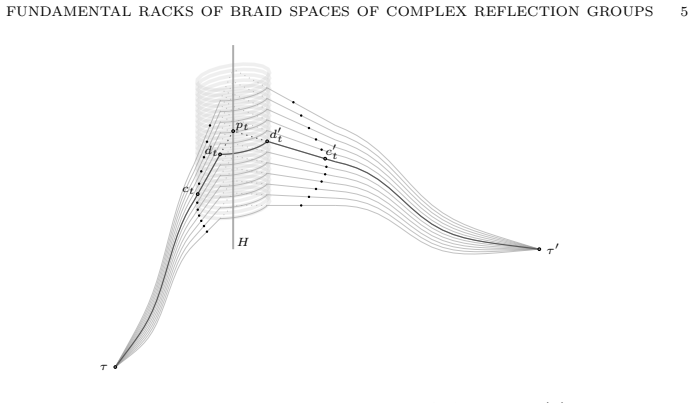
Figure from the paper full image
abstract click to expand
Let $\Gamma$ be a complex reflection group acting on the complex affine or hyperbolic space $X$ with the set of reflecting hyperplanes $\mathcal{H}$. We define an augmented rack $(G, \mathcal{K}, p)$ associated to the orbifold fundamental group $G := \pi_1^{\operatorname{orb}}( \Gamma \backslash (X - \mathcal{H}))$ which plays the role of the fundamental rack of a framed link complement as defined by Fenn and Rourke. This yields representations of the orbifold fundamental group $G$ on the cohomology of the associated rack space.
0
0
math.CO 2026-07-03

No taiko product structure meets both no-fold and triple-girth conditions

by Henry Shin

A global girth obstruction for Garg--Mineyev taiko product structures

High middle-link girth forces a rectangle decomposition that drops at least one horizontal girth below 6, closing the Garg-Mineyev route for

Figure from the paper full image
abstract click to expand
Mineyev's taiko construction, in Garg--Mineyev's finite support-size formulation, gives a concrete route from finite support data to zero divisors and units in group rings of torsion-free CAT(0) groups over $\mathbb{F}_2$. We prove that this triple-girth product-structure route is globally closed: no product structure, even or odd, with support sizes $m,n\ge2$ admits a coherent orientation for which the no-fold and triple-girth conditions both hold. Consequently the Garg--Mineyev triple-girth product-structure assembly route produces neither zero-divisor nor unit counterexamples over $\mathbb{F}_2$ for any such support-size pair. The obstruction is structural, not a bounded-search artifact. High middle-link girth forces signed colors into a balanced near-disjoint rectangle decomposition of the board, with the single odd defect omitted. The product identity, pressure inequalities, Fisher inequalities, and a dual Fisher bound force the middle link to have girth $4$ or $6$; in the girth-six case, the minimum of the two horizontal-link girths is at most $5$. This dichotomy rules out every triple-girth branch. A weighted dual Fisher inequality and an exact finite certificate sharpen the frontier: if the middle link has girth $6$, the horizontal girth is at most $4$, and characteristic-two affine-plane constructions attain equality. Thus the Garg--Mineyev finite failures reflect a structural barrier in the taiko geometry itself. The finite certificate is used only for this sharper frontier, not for the no-$T_4$ obstruction.
0
0
math.GR 2026-07-03

p-rational characters above principal Sylow character force normality

by Silvio Dolfi, Pham Huu Tiep +1 more

Degrees of p-rational characters and normality of Sylow p-subgroups

Extending Itô-Michler, the p'-degree condition on this restricted set suffices to prove the Sylow p-subgroup is normal, including the strong

abstract click to expand
Several refinements of (the normality part of) the celebrated It\^o--Michler theorem were obtained during the last two decades, in which the condition of having $p'$-degree, for a fixed prime $p$, is imposed only on some subsets of complex irreducible characters of a finite group $G$. We prove further extensions of these results, where this condition is now imposed on the irreducible characters which lie above the principal character of a Sylow $p$-subgroup and are either $p$-rational, or strongly real when $p=2$.
0
0
math.GT 2026-07-03

Large-girth Artin groups bar hyperbolic 3-manifold groups

by Thomas Koberda

Right-angled Artin groups of large girth and finite volume hyperbolic 3--manifold groups

Right-angled Artin groups on graphs without cycles shorter than five cannot contain fundamental groups of finite volume hyperbolic 3-manifol

abstract click to expand
Let $\Gamma$ be a finite simplicial graph of girth at least five. In this short note, we give a proof that if $M$ is a finite volume hyperbolic $3$--manifold, then the right-angled Artin group $A(\Gamma)$ cannot contain $\pi_1(M)$ as a subgroup; the argument is elementary, modulo the resolution of the Virtual Fibering Conjecture and a splitting theorem due to Belegradek. In particular, if $C_n$ denotes the $n$--cycle then $A(C_n)$ cannot contain a finite volume hyperbolic $3$--manifold group for any $n\geq 3$, thus answering a question of A.~Reid.
0
0
math.GR 2026-07-02

Polish group homomorphisms to residually finite groups have open kernels

by Gregory R. Conner, Samuel M. Corson +1 more

Homomorphisms from topological groups to inverse limits

A theorem on maps to inverse limits of torsion groups implies this continuity result and ties the Grigorchuk group to measurable cardinals.

abstract click to expand
We prove a general theorem giving constraints on maps from certain topological groups to inverse limits of bounded torsion groups. From this we obtain some automatic continuity and ultraproduct results. For example, every homomorphism from a Polish group to a countable torsion-free residually finite group has open kernel. Also, the Grigorchuk group is a homomorphic image of a nonprincipal ultraproduct of groups if and only if there exists a measurable cardinal.
0
0
math.GR 2026-07-02

This paper shows that homeomorphism groups of countable Stone spaces fall into exactly…

by George Domat, Hannah Hoganson +1 more

Coarse geometry of homeomorphism groups: Classifying countable Stone spaces

The three boundedness classes of homeomorphism groups of countable Stone spaces are exactly the coarse equivalence classes, with the middle…

Figure from the paper full image
abstract click to expand
Towards developing the tools of geometric group theory for non-locally compact topological groups, we give one of the first complete classifications of a family of such groups up to coarse equivalence, and when possible, up to quasi-isometry. In a previous paper, we placed the homeomorphism groups of countable Stone spaces into three classes: coarsely bounded, unbounded yet generated by a coarsely bounded set, and unbounded but not generated by any coarsely bounded set. Now we show that these are the coarse equivalence classes: Any two groups within one of these classes are in fact coarsely equivalent. Furthermore, we show that groups in the second class are quasi-isometric to the Hamming cube, the space comprising infinite binary sequences with finitely many nonzero entries equipped with the Hamming distance. As part of the proof, we show that infinite Hamming graphs over finite alphabets are all bi-Lipschitz equivalent.
0
0
math.GR 2026-07-02

Pro-2 Demushkin groups have A3-formal cochain algebras

by Ambrus Pál, Gereon Quick

A₃-formality for pro-2 Demushkin groups

Explicit computation of the obstruction class via their classification confirms the weak formality over F2.

abstract click to expand
We study a weak form of formality for differential graded algebras, called $A_3$-formality, and show that the differential graded $\mathbb{F}_2$-algebras of continuous cochains of all pro-$2$ Demushkin groups are $A_3$-formal. We prove this result by an explicit computation of the Benson--Krause--Schwede canonical class using the classification of pro-$2$ Demushkin groups by Demushkin, Serre, and Labute. Compared to the case of odd primes, the new idea is to interpret the data of the canonical class as defining systems of higher Massey products.
0
0
math.GR 2026-07-02

The paper proves that for any bounded-degree graph allowing a certain group quasi-action

by Robin Tucker-Drob

Obstructions to coarse universality for finitely generated groups

No countable family of bounded-degree graphs admitting finitely cobounded coarse quasi-actions contains every finitely generated group as a…

abstract click to expand
We prove that, for every bounded-degree graph $\Lambda$ admitting a finitely cobounded coarse quasi-action by a group, there is a finitely generated group which does not coarsely embed into $\Lambda$. More generally, for every countable family $(\Lambda_i)$ of such graphs, there is a finitely generated group that does not coarsely embed into any $\Lambda_i$. This resolves two conjectures of Simon Thomas: neither a universal Cayley graph nor a universal quasi-isometry class of finitely generated groups exists. As another consequence, we show that no locally compact second countable group coarsely contains every finitely generated group. The proof uses an exponential upper bound on the number of finite graphs admitting an $(L,M)$-regular map into $\Lambda$, together with a superexponential supply of high-girth $3$-regular graphs, yielding a sequence of finite high-girth obstruction graphs. A graphical small-cancellation labeling, using a variation of Osajda's labeling theorem following Esperet and Giocanti, then realizes this sequence isometrically inside the Cayley graph of a finitely generated group.
0
0
math.GR 2026-07-02

Nilpotent groups have cyclic escape property

by Michael Björklund, Alexander Fish

Directional expansion in ergodic actions of countable groups

This forces directional expansivity in all their totally ergodic actions, while free groups of rank two or more lack the property.

abstract click to expand
We study directional expansion for probability-measure-preserving actions of countable groups through a representation-theoretic group property, the cyclic escape property. An infinite countable group has the cyclic escape property if every totally ergodic unitary representation has arbitrarily small fixed-vector projections along infinite cyclic subgroups. This property implies directional expansivity for all totally ergodic actions. We prove that all infinite finitely generated nilpotent groups have the cyclic escape property, and conjecture the same for all infinite finitely generated polycyclic groups. We also prove the cyclic escape property for higher-rank simple lattices whose finite-dimensional unitary representations all have finite image; in particular, for $SL_n(\mathbb Z)$, $PSL_n(\mathbb Z)$, and $PGL_n(\mathbb Z)$, $n\geq 3$. By contrast, free groups of rank at least two do not have the cyclic escape property. The proofs exhibit two independent mechanisms: central spectral structure in nilpotent groups and stationary character rigidity in higher-rank lattices.
0
0
math.GT 2026-07-02

Chain map sends quandle homology into relative group homology

by Ayumu Inoue

Quandle homology and relative group homology

The map produces new cocycles and corresponds to triangulations of Seifert surfaces for links.

Figure from the paper full image
abstract click to expand
We introduce a chain map from quandle homology to relative group homology, and construct several quandle cocycles through the chain map. We also relate this chain map to triangulations of Seifert (hyper)surfaces of 1- and 2-dimensional links.
0
0
math.DS 2026-07-02

Lattices in p-adic groups act finitely below rank dimension

by Segev Gonen Cohen

Actions of lattices in S-arithmetic groups on manifolds

Any C1 action on a compact manifold must be finite if dimension is less than the group's rank, extending to S-arithmetic cases.

abstract click to expand
We prove that an action by $C^1$ diffeomorphisms of a lattice in a simple $p$-adic group on a compact manifold is finite, provided the dimension is less than the rank. We extend this statement to lattices in totally disconnected $S$-arithmetic groups, where the critical dimension is the maximal rank of the simple factors. This uses the machinery developed by Brown, Fisher, and Hurtado.
0
0
math.GT 2026-07-02

Schottky spaces are simply connected at twice the group rank

by Donggyun Seo

The topology of Schottky spaces in higher dimensions

Loops in the dense open set contract through degenerates, so all same-rank groups become quasiconformally isotopic

abstract click to expand
The marked Schottky space records, up to conjugacy, all actions of a free group of fixed rank as a Schottky group on hyperbolic space of fixed dimension. In dimension three it is the classical Schottky space covering the moduli space of Riemann surfaces, studied complex-analytically. In higher dimensions each generator gains a rotational parameter, a special orthogonal transformation of the directions normal to its axis, with no classical analogue. Our main theorem treats the borderline dimension, twice the rank: there a dense open part of the space has fundamental group a product of cyclic groups of order two, one per generator, yet the whole space is simply connected, since each such loop contracts through the most degenerate configurations. As a consequence, any two Schottky groups of the same rank in this borderline dimension are quasiconformally isotopic, partially answering a question of Kapovich. We also show that a rotationally symmetric core is a strong deformation retract in every dimension, that this dense open part is homotopy equivalent to a product of special orthogonal groups, and that the analogous locus one dimension below has two connected components.
0
0
math.GR 2026-07-01

Algorithm decides conjugacy of parabolic subgroups in Dyer groups

by María Cumplido, Marina Salamero +2 more

Parabolic subgroups of Dyer groups

Ribbons describe every conjugating element and confirm the ribbon conjecture while proving intersections remain parabolic.

Figure from the paper full image
abstract click to expand
For all Dyer groups, we find an algorithm to determine when two parabolic subgroups are conjugate. Given two conjugate standard parabolic subgroup, we fully describe the conjugating elements in terms of ribbons, showing that the ribbon conjecture holds true. In particular we give a description of the normaliser of a parabolic subgroup using ribbons. We prove the standardisation property for parabolic subgroups and deduce that an arbitrary intersection of parabolic subgroups is a parabolic subgroup.
0
0
math.GR 2026-07-01

L2-Betti numbers of kernels define a Thurston norm on group cohomology

by Andrei Jaikin-Zapirain, Monika Kudlinska +1 more

Thurston norm, polytopes and splitting complexity

The assignment extends to a seminorm induced by a polytope; for free-by-cyclic groups it yields a combinatorial description and an algorithm

abstract click to expand
We show that if $G$ is a finitely generated torsion-free group satisfying the Strong Atiyah Conjecture with vanishing first $L^{2}$-Betti number, then the map that assigns to each surjective integral character the first $L^2$-Betti number of the kernel extends to a seminorm on the first cohomology group of $G$ with real coefficients. We call this seminorm the Thurston norm. Moreover, we show that this norm is induced by a polytope in the first homology group with real coefficients. We also generalize this result to higher $L^{2}$-Betti numbers of the kernels, thereby confirming a conjecture of Friedl, L\"uck and Tillmann. In the case where $G$ is either a free-by-cyclic group or the fundamental group of an admissible $3$-manifold, we show that the Thurston norm of $G$ admits a combinatorial interpretation that relates it to the splitting complexity of the character. This confirms a conjecture of Gardam and Kielak. As an application, we show that there exists an algorithm to compute the Bieri--Neumann--Strebel invariant of free-by-cyclic groups, and discuss connections to the isomorphism problem in free-by-cyclic groups.
0
0
math.GR 2026-07-01

PSL_2(R) action on discrete subgroups is concretely classifiable

by George Peterzil

Classification of Fuchsian groups with torsion

Extends surface classification to orbifolds with torsion and yields homogeneity for certain ergodic actions.

abstract click to expand
In their recent paper, Bergfalk and Smythe prove that the isometry equivalence relation on hyperbolic surfaces with finitely-generated fundamental group is concretely classifiable, and ask whether the same result holds true for 2-dimensional hyperbolic orbifolds, or equivalently, whether the action of $\text{PSL}_2(\mathbb{R})$ on its space of finitely-generated discrete subgroups is concretely classifiable. In this note we answer this question in the affirmative. We then use the result to prove that a nonsingular ergodic $\text{PSL}_2(\mathbb{R})$-space with nonelementary finitely-generated stabilizers is homogeneous, in similarity with a result of Stuck-Zimmer for lattices in semisimple lie groups. The main ingredients of our proof are Selberg's lemma and a result of Greenberg on commensurators.
0
0
math.RT 2026-07-01

Regular unipotents map to explicit SL_2 modules under GL_3 reps

by Dibyendu Biswas

Image of Regular Unipotent under a Representation of GL₃(mathbb{C})

Image under any irreducible polynomial representation decomposes as SL_2 module with Jordan form.

Figure from the paper full image
abstract click to expand
We study the image of a regular unipotent element under any finite-dimensional irreducible polynomial representations of $\mathrm{GL}_3(\mathbb{C})$. This problem is equivalent to decomposing certain compositions of irreducible representations as $\mathrm{SL}_2(\mathbb{C})$-modules. We give an explicit decomposition of this finding, its Jordan decomposition.
0
0
math.AT 2026-07-01

Manifolds with vanishing L2-Betti numbers avoid virtual circle fibering

by Sam Hughes, Ian Leary +1 more

Some closed manifolds that do not fibre over the circle

Examples in dimensions three and higher show residual torsionfree nilpotence is insufficient for virtual algebraic fibering.

abstract click to expand
We construct closed manifolds with vanishing L^2-Betti numbers over every field) which do not virtually fibre over the circle. The class of fundamental groups that occurs is the largest possible, and in many cases the dimension may be taken to be six. We construct aspherical closed manifolds with residually (torsionfree and nilpotent) fundamental groups in all dimensions at least three whose L^2-Betti numbers vanish (over every field) and which do not virtually fibre over the circle. In particular this implies that in Kielak's Theorem about virtually algebraic fibring for RFRS-groups one cannot weaken the condition RFRS to residually (torsionfree and nilpotent.
0
0
math.GR 2026-07-01

Generic free subgroups of Urysohn isometries satisfy NSS

by Víctor Hugo Yañez

Generic dense free subgroups of the isometry group of the Urysohn space are NSS

Non-trivial elements achieve maximal displacement of 1 under iteration for comeager many such subgroups.

abstract click to expand
The isometry group of the bounded Urysohn space, $G = \mathrm{Iso}(\U{1})$ is a central object in the study of Polish groups and topological dynamics. It is known that generic sequences in $G$ generate algebraically free dense subgroups. In this paper, we show that such generic free subgroups exhibit strong geometric rigidity. Specifically, we prove that for a comeager set of sequences generating dense free subgroups $F\leq G$, every non-trivial element $h\in F$ acts with maximal metric displacement, satisfying $\sup_{n\in \N} d(h^n(x),x) = 1$ for every $x \in \U{1}$. As a consequence, these generic subgroups satisfy the \emph{no small subgroup} ($\nss$) property. We note that the method naturally extends to the full isometry group $\mathrm{Iso}(\mathbb{U})$ of the classical Urysohn space.
0
0
math.AP 2026-07-01

Finite group actions force (n-2)-dimensional singular sets

by Howen Chuah

Group Theoretic Constructions of Singular Set in a Long Range Segregation Model

Explicit constructions show singularities arise on free boundaries of long-range segregation models in every dimension.

Figure from the paper full image
abstract click to expand
In this paper, we construct several explicit examples of singular sets of Hausdorff dimension $(n-2)$ in $\mathbb{R}^n$ on free boundaries for an elliptic system modeling long range segregation. The system has been previously studied by Caffarelli, Patrizi and Quitalo in \cite{CL2} for the regularity of the free boundary in dimension two, and by the author and Torres in \cite{ChPaTo26_2} for the partial regularity in higher dimensions. However, the dimension of the singular set is unknown, and no concrete examples of singular set are known in the literature due to the nonlocal nature of the elliptic system. In this paper, we overcome this difficulty by rigidity and finite group action. As a byproduct of our result, we see that singular points can exist for the model in any dimensions. We also show that our method can be applied to the study of the singular set in the adjacent model. Finally, we also discuss some related open problems for future studies.
0
0
math.GR 2026-06-30

Isomorphic even Artin groups of FC type share p-parts of defining graphs

by Marcos Escartín Ferrer, Giorgio Leoni +1 more

Cohomology rings and p-local behavior of even Artin groups

For every prime p the p-parts match, extending right-angled rigidity via cohomology and pro-p computations.

abstract click to expand
We generalize to certain families of even Artin groups several classical results on right-angled Artin groups. In particular, we compute the cohomology ring, describe the pro-$p$ completion, and determine the $p$-Zassenhaus restricted Lie algebra in the FC case. As a by-product, we prove a rigidity result that implies that if two even Artin groups of FC type are isomorphic, then for every prime $p$, the $p$-parts of their defining graphs are isomorphic.
0
0
math.CO 2026-06-30

p-groups always admit a permutation keeping a_i b products distinct for k < p

by Zhi-Wei Sun, Lilu Zhao

Exterior Algebra and an Extension of the Feng-Sun-Xiang Theorem in p-groups

Extends the Feng-Sun-Xiang result from abelian p-groups to all groups of prime-power order.

abstract click to expand
Let $G$ be a finite group with $|G|=p^m$ where $p$ is a prime and $m$ is a positive integer. Let $k<p$. Let $a_1,\ldots,a_k\in G$ be pairwise distinct and let $b_1,\ldots,b_k\in G$. Then there exists a permutation $\sigma$ on $1,\ldots,k$ such that $a_1b_{\sigma(1)},\ldots,a_kb_{\sigma(k)}$ are pairwise distinct. This extends a theorem of Feng, Sun and Xiang, who proved that the conclusion holds in abelian $p$-groups.
0
0
math.GR 2026-06-30

Skew braces satisfy Schur-Zassenhaus for Hall ideals

by M. Ferrara, M. Trombetti

The Schur--Zassenhaus Theorem and Sylow's Third Theorem for Finite Skew Braces

Hall ideals admit sub-skew brace complements and Sylow p-subbraces number 1 mod p

abstract click to expand
In this short note we establish the Schur--Zassenhaus Theorem and Sylow's Third Theorem for finite skew braces. More precisely, we prove that every Hall ideal of a finite skew brace admits a sub-skew brace complement, and more generally that every left ideal whose order is coprime to that of the Hall ideal can be embedded in such a complement. Using similar ideas we show that every left ideal of prime-power order is contained in a Sylow sub-skew brace. Finally, we prove that the number of Sylow $p$-sub-skew braces is congruent to $1$ modulo $p$, and provide examples showing that the corresponding containment property fails for arbitrary sub-skew braces.
0
0
math.GR 2026-06-30

Submonoids of FIM(1) satisfy FP₂ exactly when finitely presented

by Carl-Fredrik Nyberg-Brodda

On homological finiteness properties and free inverse monoids

A criterion based on idempotent lattice actions proves the equivalence for finitely generated cases and shows free inverse monoids lack FP₂.

Figure from the paper full image
abstract click to expand
We construct a simple and useful sufficient condition, based on actions on a lattice of idempotents, for monoids admitting homomorphisms to the monogenic free inverse monoid $\mathrm{FIM}(1)$ to not be of type $\mathrm{FP}_2$. This recovers a result of Gray and Steinberg that free inverse monoids are not of type $\mathrm{FP}_2$. The same technique is then used to show that a finitely generated submonoid of $\mathrm{FIM}(1)$ is of type $\mathrm{FP}_2$ if and only if it is finitely presented, answering a question of Cho & Ru\v{s}kuc.
0
0
math.GR 2026-06-30

Locally finite groups make every bijective CA reversible

by Jiang Yang

A Reversibility Characterization of Locally Finite Groups by Cellular Automata

A group admits a non-reversible bijective cellular automaton over some alphabet precisely when it fails to be locally finite.

abstract click to expand
For cellular automata over finite alphabets, bijectivity already implies reversibility. Over infinite alphabets this implication may fail, and the remaining obstruction in the periodic case was recorded by Ceccherini-Silberstein and Coornaert as Open Problem 2 in \emph{Cellular Automata and Groups}. We prove an exact group-theoretic characterization. A group $G$ is locally finite if and only if, over every alphabet, every bijective cellular automaton $A^G\to A^G$ is reversible. Equivalently, if $G$ is not locally finite, then for every infinite alphabet $A$ there exists a bijective cellular automaton $A^G\to A^G$ whose inverse is not a cellular automaton. The counterexample is already obtained on a countable alphabet. Its local rule has a rank track, a direction track and a binary data track; the forward map is triangular along finite directed chains of arbitrary length, so its inverse is defined pointwise but has no uniform finite memory. As a consequence, Open Problem 2 has an affirmative answer, and the periodicity hypothesis is unnecessary for the negative direction.
0
0
math.GR 2026-06-30

Order and class sizes determine alternating and symmetric groups

by Ilya Gorshkov, Andrey V. Vasil'ev

Characterization of the alternating and symmetric groups by the order and conjugacy class sizes

Any finite group matching an alternating or symmetric group on these two invariants must be isomorphic to it, completing the case for all si

abstract click to expand
We prove that an arbitrary finite group $G$ having the same order and same set of conjugacy class sizes as an alternating or symmetric group $S$ must be isomorphic to $S$. From this and previously known results it follows that the same holds true for every simple group $S$.
0
0
math.CO 2026-06-30

Every finite group arises as aut group of embedded d-regular graphs

by Reymond Akpanya, Tom Goertzen +1 more

Strong Embeddings of Regular Graphs with Prescribed Automorphism Groups

The graphs exist for any degree d at least 3 and can be chosen with arbitrarily large genus while keeping the group exact.

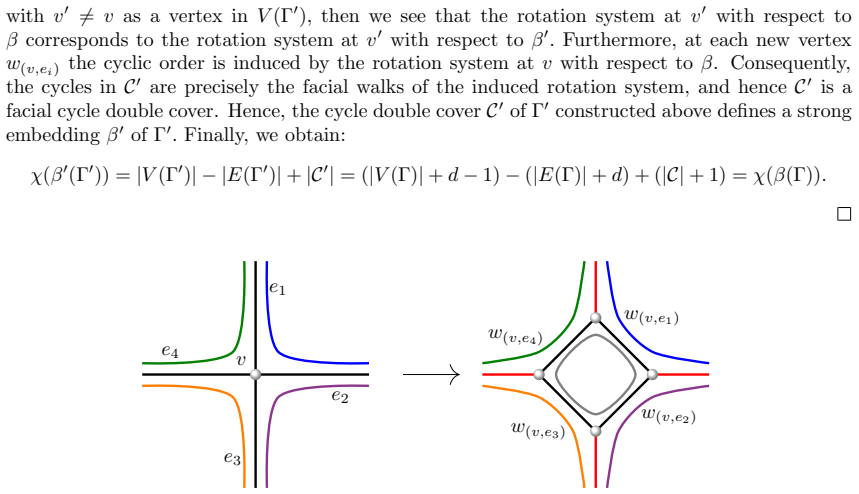
Figure from the paper full image
abstract click to expand
A classical theorem of Frucht states that every finite group occurs as the automorphism group of a finite graph. We prove an embedded analogue for regular graphs of arbitrary degree. In particular, we show that for every $d\geq 3$ and every finite group $G$, there exists a $d$-regular graph $\Gamma$ with a strong embedding $\beta$ such that $\mathrm{Aut}(\Gamma) \cong \mathrm{Aut}(\beta(\Gamma)) \cong G.$ Further, we prove that for every such $d$ and $G$ there exists a sequence of $d$-regular graphs with corresponding strong embeddings whose genera form an unbounded sequence and whose automorphism groups are isomorphic to $G$. Along the way, we identify an oversight in Sabidussi's classical construction of regular graphs with prescribed automorphism group. We give an alternative construction that corrects this issue and strengthens Sabidussi's result by producing an automorphism group-invariant proper $d$-edge-colouring.
0
0
math.GR 2026-06-29

Ten isomorphism classes of skew left braces on infinite dihedral group

by Akihide Hanaki, Yuto Sakata +1 more

Classification of skew left braces with additive group isomorphic to the infinite dihedral group

Enumeration fixes the additive group and finds exactly ten compatible multiplicative structures up to isomorphism.

abstract click to expand
We classify all skew left braces with additive group isomorphic to the infinite dihedral group. There are ten isomorphism classes.
0
0
math.GR 2026-06-29

Finite graph of conjugacy separable groups yields conjugacy separable fundamental group

by Sheila Campos Chagas

The Fundamental group of a finite graph of conjugacy separable groups with finite edge groups is conjugacy separable

The result holds whenever edge groups are finite, answering a question of Minasyan.

abstract click to expand
The main objective of this paper is to give a positive answer to the natural question proposed by Ashot Minasyan: Is the fundamental group of finite graph of conjugacy separable groups with finite edge groups conjugacy separable?
0
0
math.GR 2026-06-29

Binomial cup1 dgas yield pronilpotent groups matching pi1 R-completions

by Richard D. Porter, Alexander I. Suciu

Groups associated to 1-minimal models for binomial cup₁-algebras

The group depends only on the 1-quasi-isomorphism type of the algebra and recovers the known completion of the fundamental group for spaces.

abstract click to expand
We give an explicit, cochain-level algebraic model for the pronilpotent completion of a group with finitely generated first cohomology. To each binomial $\cup_1$-dga $(A,d_A)$ over $R=\mathbb{Z}$ or $\mathbb{F}_p$ ($p$ prime) -- a differential graded algebra endowed with a Steenrod $\cup_1$-product and a compatible binomial operation -- we associate a pronilpotent group $G(A)$ that depends only on the 1-quasi-isomorphism type of $A$, provided $H^0(A)=R$ and $H^1(A)$ is a finitely generated free $R$-module. This group arises functorially from the 1-minimal model of $A$, which is unique up to isomorphism. When $A=C^*(X;R)$ is the cochain algebra of a connected CW-complex $X$ with $H^1(X;R)$ finitely generated, the group $G(A)$ recovers the Bousfield--Kan $R$-completion of $\pi_1(X)$ when $R=\mathbb{F}_p$, and its pro-torsion-free-nilpotent completion when $R=\mathbb{Z}$. Moreover, the group $G(A)$ comes equipped with a natural inverse system $\{G_n(A)\}_{n\ge 1}$ whose structure maps $G_{n+1}(A)\to G_n(A)$ are surjective. If $A=C^*(X;R)$, then $G_n(A)$ is the quotient of $\pi_1(X)$ by the $(n+1)$th term of the fastest descending central series whose successive quotients are free $R$-modules. We give a purely algebraic necessary and sufficient criterion that, given an isomorphism $G_n(A)\cong G_n(B)$, determines whether $G_{n+1}(A)\cong G_{n+1}(B)$, and we illustrate the use of this criterion with examples distinguishing spaces with isomorphic cohomology rings.
0
0
math.GR 2026-06-29

Coxeter groups realize Salem growth rates in every even degree at least 4

by Mingyu Oh

Strongly Primitive Salem Growth Polynomials for Right-Angled Coxeter Groups

Infinitely many K_{2d+1}-free graphs give irreducible Salem reciprocal-radius polynomials of degree 2d for each d >= 2.

abstract click to expand
We study standard spherical growth rates of right-angled Coxeter groups through the clique polynomial of the defining graph. We prove that every even degree at least four occurs as the degree of a strongly primitive Salem growth rate: for each $d \geq 2$, there are infinitely many connected $K_{2d+1}$-free defining graphs whose full reciprocal-radius polynomial is an irreducible Salem polynomial of degree $2d$. We also prove independence-polynomial obstructions for prescribed Salem polynomials, including a sharp first-coefficient bound $a_1 \leq -5$, and apply them to Lehmer's polynomial and its suspension multiples.
0
0
math.GR 2026-06-29

Digroups split into groups and set-like objects via pretorsion theory

by Alberto Facchini, Carmelo Antonio Finocchiaro

Digroups, their canonical pretorsion theory, and diheaps

Torsion-free digroups are exactly the groups while torsion digroups match non-empty sets, and heaps extend to diheaps.

abstract click to expand
In the category of digroups there is a natural pretorsion theory in which the torsion-free digroups are all groups, and torsion digroups form a category isomorphic to the category of non-empty sets. It is also possible to extend the theory of heaps from groups to digroups. The corresponding notion is that of a diheap.
0
0
math.GR 2026-06-29

Solvable semi-rational groups restrict their prime graphs

by Irene Crispi, Sara C. Debon +3 more

The Gruenberg-Kegel graph of finite solvable groups that are character-quadratic or semi-rational

Disconnected cases are fully classified and small graphs are limited to twenty examples with most realized.

abstract click to expand
A finite group $G$ is said to be semi-rational if the set of generators of each cyclic subgroup of $G$ is contained in at most two $G$-conjugacy classes. This is equivalent to the following condition: for every column of the character table of $G$, the values appearing in the column are contained in a quadratic extension of the field of rational numbers (possibly a different one for each column). When the analogous condition holds for the rows, that is, when the field of values of every irreducible character is contained in a quadratic extension of the rationals, we say that the group is character-quadratic (these groups are often called quadratic rational in the literature). We obtain several results concerning the structure of the Gruenberg-Kegel graph of a finite solvable group that is either character-quadratic or semi-rational. More precisely, we first provide a complete classification of such graphs in the disconnected case. Also, we prove that if the graph has at most three vertices and the group is nontrivial, then it belongs to an explicit list of $20$ graphs (in the semi-rational case, this result is proved under the additional assumption that the order of the group is not divisible by $17$), and all of them are realizable except perhaps one. Finally, we show that if the graph has four vertices, then it must have at least four edges.
0
0
math.GR 2026-06-29

Centralizer subgroup of dilations equals positive reals group

by Swarup Bhowmik, Deblina Das

A structure theorem for centralizers of dilations in QI(mathbb{R}₊)

Asymptotic invariant at infinity selects exactly the multiplicative positive reals inside QI of the positive line.

abstract click to expand
We study centralizers of dilations in the quasi-isometry group of the positive real line. We introduce an asymptotic invariant defined via coarsely dense sequences at infinity and establish a rigidity theorem for quasi-isometries that coarsely commute with a dilation. As an application, we identify the subgroup of the centralizer consisting of elements with non-empty asymptotic invariant and prove that it is naturally isomorphic to the multiplicative group of positive real numbers.
0
0
math.GR 2026-06-29

Enumeration counts nonisomorphic doppelsemigroups up to order 5

by Volodymyr M. Gavrylkiv

Note on the number of doppelsemigroups of small order

Programs in GAP, Python and C++ list all distinct structures with two associative operations for small sizes.

abstract click to expand
We study doppelsemigroups, i.e., algebraic structures equip\-ped with two associative binary operations satisfying a specified system of axioms. We investigate duality and isomorphisms of doppelsemigroups and examine the relationships between commutative, abelian, strong, and rectangular doppelsemigroups. Several examples are constructed, including nontrivial iso-opposite doppelsemigroups, noncommutative iso-dual doppelsemigroups, nonabelian iso-cross-dual doppelsemigroups, and nonstrong rectangular iso-opposite doppelsemigroups. Furthermore, we refine the complete classification of nonisomorphic doppelsemigroups of order~3. Finally, we present computer-assisted calculations yielding the numbers of all pairwise nonisomorphic doppelsemigroups and strong doppelsemigroups of orders up to~$5$, as well as all pairwise nonisomorphic commutative, abelian, and rectangular doppelsemigroups of orders up to~$6$, obtained using \texttt{GAP}, \texttt{Python}, and \texttt{C++}.
0
0
math.CO 2026-06-29

Cayley codes reduce to connected graphs while keeping rate and distance

by Vishnuram Arumugam, Cheryl E. Praeger +1 more

Structure of Cayley Codes

Any Cayley code embeds into a direct sum of symmetric ones from normal edge-transitive graphs, simplifying their study.

abstract click to expand
Cayley codes, introduced by Kaufman and Wigderson, are linear codes constructed from a Cayley graph and a smaller linear code. We explore general properties of the class of Cayley codes for finite groups. In particular we give a reduction to Cayley codes for connected Cayley graphs that maintains code properties such as rate, minimum distance and symmetry. Also, for a given Cayley code, we identify a family of symmetric Cayley codes, each associated with a normal edge-transitive Cayley graph, such that the given Cayley code embeds into the direct sum of the symmetric Cayley codes. We analyse several families of examples, in particular studying the behaviour of the Cayley code construction under forming direct products and cartesian products of Cayley graphs, and we pose a number of open questions.
0
0
math.GR 2026-06-29

Dominions of D_n and C_n equal regular idempotent subsemigroups

by Halima H. Assiri, Jehan A. Albar (King Abdulaziz University)

On the Dominions of Certain Semigroups of Transformations

O_n is closed in T_n and explicit formulas count elements plus idempotents of each dominion.

abstract click to expand
In the full transformation semigroup $T_n$ on a finite chain $X_n$, let $D_n=\{\alpha \in T_n:(\forall x \in X_n) \ x\alpha \leq x\}$ be the subsemigroup of all order-decreasing maps of $T_n$, and let $O_n=\{\alpha \in T_n:(\forall x ,y\in X_n) \ x \leq y \Rightarrow x\alpha \leq y\alpha\}$ be the subsemigroup of all order-preserving maps of $T_n$. The Catalan monoid $C_n$ is a semigroup of all order-decreasing and order-preserving full transformations of $X_n$. In this paper, it is shown that $O_n$ is closed in $T_n$. Also, the dominion of $D_n$ and the dominion of $C_n$ in $T_n$, denoted by $Dom_{T_n}(D_n)$ and $Dom_{T_n}(C_n)$, are characterized, and it is shown that they are regular idempotent-generated subsemigroups of $T_n$. Moreover, a formula for the number of their elements and their idempotents is given.
0
0
math.GR 2026-06-29

Ideal chain conditions imply finite generation for soluble skew braces

by Massimiliano Di Matteo, Ramón Esteban-Romero +2 more

Chain conditions on skew braces and solutions of the Yang-Baxter Equation

This extends classical group theorems to the skew braces that encode non-degenerate solutions of the Yang-Baxter equation.

abstract click to expand
Classical works of Hall and McLain show that solubility and local nilpotency play a key role in deriving finite generation in groups from maximal or minimal conditions on normal subgroups. In this work, brace-theoretical analogues of Hall's and McLain's results are analysed for skew braces satisfying the maximal or minimal condition on ideals. We also introduce finiteness and chain conditions on non-degenerate set-theoretic solutions of the Yang-Baxter equation, and their impact on associated structure and permutation skew braces of solutions is also described.
0
0
math.AT 2026-06-29

Generalized Euler characteristics interpreted via Morava E-theories

by Gijs Heuts, Irakli Patchkoria

Chromatic Euler characteristics and duality for infinite groups

For infinite groups with finite proper universal spaces, a new duality on equivariant spectra implies vanishing results for generalized Farr

abstract click to expand
We study a family of generalizations of the notion of Euler characteristic of discrete groups (or of orbifolds, depending on one's perspective) indexed on the natural numbers. For $n=0$, this is the classical orbifold Euler characteristic as studied by Wall and Serre, whereas for $n \geq 1$ and finite groups, this is the chromatic cardinality as studied by Ben-Moshe--Carmeli--Schlank--Yanovski. For general $n$, we show that our generalized Euler characteristic admits a natural interpretation in terms of the Morava $E$-theories. Our work involves showing that the generalized cohomology of infinite groups $G$ with finite universal space for proper actions $\underline{E}G$ has a good theory of duality, as expressed by a new duality functor on the category of proper $G$-equivariant spectra. In particular, for such groups we prove the vanishing of Klein's generalized Farrell--Tate cohomology with $T(n)$-local coefficients. We compute our generalized orbifold Euler characteristics in a large number of examples. This includes many mapping class groups, where the classical calculation is a result of Harer--Zagier, and many arithmetic groups, whose classical orbifold Euler characteristics were computed by Harder.
0
0
math.GR 2026-06-29

Monolithic groups sectionally indecomposable when socle non-abelian or p-group condition

by Andrea Lucchini, Nowras Otmen

Sectionally indecomposable groups

The criterion classifies groups that cannot split as sections across direct-product factors and covers all solvable monolithic primitive cas

abstract click to expand
We introduce the notion of sectional indecomposability and study it for finite groups: a group $H$ is sectionally indecomposable if, whenever $H$ is a section of a direct product $A \times B$, then $H$ is already a section of $A$ or of $B$. We show that the study of sectionally indecomposable finite groups reduces to the monolithic case. Our main result is a complete characterisation of sectional indecomposability for monolithic primitive groups: such a group $G$ with $N = \mathrm{soc}(G)$ is sectionally indecomposable if and only if either $N$ is non-abelian, or $N$ is a $p$-group and $O_{p'}(G/N) \neq 1$. The proof relies on the introduction of the notion of an $H$-Frattini module and on the theory of the universal $p$-Frattini cover, together with a result of Griess--Schmid. As a corollary, every monolithic primitive solvable group is sectionally indecomposable. We also discuss the non-primitive case, which appears significantly harder, and highlight open questions concerning monolithic $p$-groups.
0
0
math.GR 2026-06-29

Scale of (P)-closed groups read from local diagrams

by Marcus Chijoff, Michal Ferov +1 more

The Scale of (P)-closed Groups Acting On Trees

The diagrams also identify unimodular and uniscalar cases, answering Weigel's question.

Figure from the paper full image
abstract click to expand
Reid--Smith parametrised ($P$)-closed groups acting on trees using graph-based combinatorial structures known as local action diagrams. Properties of the acting (topological) group, such as being locally compact, compactly generated, discrete or simple, are reflected in its local action diagram. In this article, we describe the translations of ($P$)-closed groups and their axes in terms of local action diagrams. As applications, we determine the scale function of ($P$)-closed groups and characterise unimodular as well as uniscalar ($P$)-closed groups. The latter provides one possible answer to a question of Thomas Weigel.
0
0
math.GR 2026-06-29

Thick building groups satisfy Howe-Moore property

by Andreas Thom

On the Howe--Moore property for automorphism groups of buildings

Weakly mixing unitary representations vanish at infinity for large thickness, implying character rigidity for associated lattices.

abstract click to expand
Let \(G<Aut(X)\) be a totally disconnected locally compact group acting strongly transitively on a locally finite building \(X\) of finite-rank and minimal non-spherical type. For sufficiently large thickness, every weakly mixing strongly continuous unitary representation of \(G\) is \(C_0\). Consequently, if \(G\) has no non-trivial finite-dimensional unitary representations, then \(G\) has the Howe--Moore property. More concretely, this applies to rank-three compact-hyperbolic crystallographic types of thickness \(q+1\) for \(q\geq 19379\), if there are no compact quotients. As an application, we prove that the corresponding Caprace--R\'emy Kac--Moody lattices in these types, which are known to be finitely presented simple and Kazhdan, are character-rigid: their extremal characters are only the regular and the trivial character. Consequently they also have no non-trivial invariant random subgroups.
0
0
math.GR 2026-06-29

Finite groups bound prime class sizes by composite ones

by Vittorio Bagnara, Víctor Sotomayor

The number of composite class sizes in finite groups

When at least three composite conjugacy class sizes exist, their number is at least as large as the number of prime ones.

abstract click to expand
We consider finite groups with at least three conjugacy class sizes that are composite numbers and we prove that, in that situation, the number of prime class sizes is bounded by the number of composite class sizes. The analogous result for (non-)prime-power class sizes is also addressed.
0
0
math.GR 2026-06-29

PL homeomorphism groups with n-power slopes are diagram groups

by Daniel S. Farley

Diagram groups and groups of piecewise linear homeomorphisms of the line with global fixed points

The match is obtained by reading n-ary expansions of the fixed points; rationality of those points decides finite generation and type F infi

Figure from the paper full image
abstract click to expand
Assume $n \geq 2$ and $\ell = (r_{1}, \ldots, r_{k}) \in [0,1]^{k}$ is an increasing sequence of real numbers. Let $G_{n,\ell}$ denote the group of orientation-preserving piecewise linear homeomorphisms $h$ of $I = [r_{1}, r_{k}]$ such that: (i) $h'(x)$ is a power of $n$ where it is defined; (ii) if $h'(x)$ is undefined, then $x$ is an $n$-adic rational number, (iii) $h$ fixes each entry of $\ell$, and (iv) $h(\mathbb{Z}[1/n] \cap I) = \mathbb{Z}[1/n] \cap I$. We prove that $G_{n,\ell}$ is a diagram group $D(\mathcal{P}_{n,\ell}, \omega_{n,\ell})$ for all integers $n \geq 2$ and for all finite sequences $\ell$. The semigroup presentation $\mathcal{P}_{n,\ell}$ and the word $\omega_{n,\ell}$ can be computed from the $n$-ary expansions of the numbers $r_{i}$. If all entries in $\ell$ are rational, then $G_{n,\ell}$ has type $F_{\infty}$. Otherwise, $G_{n,\ell}$ is not finitely generated.
0
0
math.GR 2026-06-29

Lie endomorphisms shadow iff differentials hyperbolic

by Dekui Peng

Shadowing and Hyperbolicity for Endomorphisms of Locally Compact Groups

Equivalence also makes expansiveness and Anosov properties coincide for automorphisms, while all tdlc endomorphisms shadow.

abstract click to expand
We study the shadowing property for continuous endomorphisms of locally compact groups, using the left uniformity. For Lie groups we obtain a complete infinitesimal characterization: an endomorphism has shadowing if and only if its differential is hyperbolic. As consequences, positively expansive Lie group endomorphisms are automatically topologically expanding, and for Lie group automorphisms, expansiveness, shadowing, two-sided shadowing and being topologically Anosov are equivalent. We also show that, for connected semisimple Lie groups, shadowing endomorphisms are precisely nilpotent endomorphisms. In contrast, for totally disconnected locally compact groups, shadowing is automatic: every continuous endomorphism has shadowing. The proof uses Willis' tidy-above decomposition for endomorphisms. This yields, in the totally disconnected case, that topological expansion is equivalent to positive expansiveness and that being topologically Anosov is equivalent to expansiveness. We also discuss connections with group shifts and derive a compactness consequence for topologically mixing automorphisms.
0
0
math.GR 2026-06-26

Amalgamated products preserve Zassenhaus Lie algebras under retract condition

by Giorgio Leoni, Conchita Martínez-Pérez +1 more

Generalising a Theorem of Lichtman

The equality generalizes Lichtman's free-product theorem and yields residual nilpotence for groups amalgamated along retracts.

abstract click to expand
We show that under a suitable additional hypothesis the restricted Zassenhaus $\F_p$-Lie algebra or the rational Magnus Lie algebra of a free amalgamated product is the free amalgamated product of the corresponding Lie algebras of the factors. This generalises a Theorem of A.I.\,Lichtman, who proved the analoguous statement for free products. Our conditions include the case when the amalgamated product is a retract in both factors. As a by-product, we show that a free product of residually torsion free nilpotent groups amalgamated along retracts is also residually torsion free nilpotent and obtain also some results on cohomological completeness. In the final sections we apply our main results to two recently raised open questions.
0
0
math.GR 2026-06-26

Odd-order groups lift R**-sequenceability from quotients under cycle index bound

by Adrián Pastine, María Valentina Soldera Ruiz

On R-sequenceability of odd ordered groups

The Quotient-Normal Gadget theorem yields R-sequenceability for all groups coprime to 30 and many nilpotent groups coprime to 6.

Figure from the paper full image
abstract click to expand
We study the $R$-sequenceability of finite groups of odd order. Building on the classical theory of $R^*$-sequences and orthomorphisms, we explore two tools: the notion of $R^{**}$-sequenceability, a strengthening of $R^*$-sequenceability tailored for inductive arguments over normal subgroups with cyclic quotients, and the \textit{odd cycle index} $\tau(G)$, which measures how many orthomorphisms are required to generate a full cycle together with an involution. Our main result is a Quotient-Normal Gadget theorem, which shows that if $G$ has a normal subgroup $N$ such that $G/N$ is $R^{**}$-sequenceable and $\tau(N) \leq |G/N| - 3$, then $G$ itself is $R^{**}$-sequenceable. We prove that $\tau(G) = 2$ for cyclic groups of order coprime with $3$, and establish an inductive bound $\tau(G) \leq \max\{\tau(N), \tau(G/N)\}$ for odd ordered groups with a normal subgroup $N$. As consequences, we show that every group whose order is coprime with $30$ is $R$-sequenceable, and that every nilpotent group whose order is coprime with $6$ and not a power of $5$ is $R$-sequenceable. These results extend prior work on abelian groups to broad families of non-abelian groups.
0
0
math.OA 2026-06-26

Kleppner's condition decides selflessness of twisted C*-algebras

by Tron Omland

Selflessness for twisted group C*-algebras of amenable groups and their inclusions

For amenable virtually nilpotent groups the algebra is selfless exactly when the pair meets the condition; same for inclusions under the rel

abstract click to expand
For a discrete amenable group $G$ with a two-cocycle $\sigma$ we first record a few results on when the twisted group $C^*$-algebra $C^*_r(G,\sigma)$ is selfless, in the sense of Robert. In particular, for an infinite finitely generated virtually nilpotent $G$, this holds exactly when $(G,\sigma)$ satisfies Kleppner's condition. For the larger class of FC-hypercentral groups the same holds modulo $\mathcal{Z}$-stability, equivalently finite nuclear dimension. Further, using the relative Kleppner condition we obtain corresponding selflessness results for inclusions $C^*_r(H,\sigma')\subseteq C^*_r(G,\sigma)$, when $H$ is a normal subgroup of $G$. For amenable $G$ such an inclusion is selfless precisely when $C^*_r(H,\sigma')$ is selfless and $(H\leq G,\sigma)$ satisfies the relative Kleppner condition. Thus, for an infinite finitely generated virtually nilpotent $G$, selflessness of the inclusion $C^*_r(H,\sigma')\subseteq C^*_r(G,\sigma)$ is equivalent to the relative Kleppner condition.
0
0
math.AC 2026-06-26

Strong C-semigroups with fixed multiplicities form a tree with a maximal element

by I. García-Marco, R. Tapia-Ramos +1 more

A note on strong affine semigroups

The family organizes hierarchically, is finite for some multiplicity sets, and admits an explicit enumeration algorithm up to any chosen gen

Figure from the paper full image
abstract click to expand
This work introduces and studies strong affine semigroups, extending the notion of strong numerical semigroups to the higher-dimensional setting. We show that non-numerical strong affine semigroups present structural differences with respect to strong numerical semigroups. Special attention is devoted to strong $\mathcal C$-semigroups. We prove that the family of strong $\mathcal C$-semigroups with a given set of multiplicities $E$ admits a maximal element and has a tree structure. We characterize when this family is finite and provide an algorithm to compute all such semigroups up to a fixed genus. We also introduce the notion of special strong affine semigroups and obtain refined versions of several previous results. Finally, we study toric ideals arising from strong affine semigroups, determining their indispensable monomials and Betti elements for several families.
0
0
math.GR 2026-06-26

Commensurators of rigid hyperbolic groups have bounded average distortion

by Nir Lazarovich, Suraj Krishna M S +1 more

Average Distortion of Commensurators of Hyperbolic Groups

The bound holds precisely when the group is geometrically rigid and residually finite, controlling metric stretching on average.

Figure from the paper full image
abstract click to expand
We prove that commensurators of a geometrically rigid residually finite hyperbolic group have bounded average distortion.
0
0
math.GT 2026-06-26

Virtual Dehn fillings distinguish Gromov-Thurston homotopy types

by Alessandro Sisto, Gabriele Viaggi

Distinguishing Gromov-Thurston manifolds using algebraic Dehn fillings

Algebraic criteria derived from relatively hyperbolic group fillings separate these manifolds by homotopy type.

abstract click to expand
We develop criteria to distinguish the homotopy types of Gromov-Thurston manifolds. Our approach is based on a description of their fundamental groups as virtual Dehn fillings of relatively hyperbolic groups.
0
0
math.GR 2026-06-26

At most three primes in character degrees force solvability

by Dongfang Yang

On prime divisors of character degrees and codegrees

A bound on the distinct primes dividing degrees or codegrees of a finite group implies the group must be solvable.

abstract click to expand
Let $G$ be a finite group, and let $\mathrm{Irr}(G)$ denote the set of irreducible complex characters of $G$. For $\epsilon\in \{ \pm \}$, we define $\mathrm{cd}_{\epsilon}(G)=\{ \chi_{\epsilon}(1)\mid \chi\in \mathrm{Irr}(G) \}$, where $\chi_{+}(1)=\chi(1)$ denotes the degree of $\chi$, $\chi_{-}(1)=|G:\ker(\chi)|/\chi(1)$ denotes the codegree of $\chi$. Further, let $\omega_{\epsilon}(G)=\{ \pi(n)\mid n\in \mathrm{cd}_{\epsilon}(G) \}$, where $\pi(n)$ stands for the set of prime divisors of $n$. We established that if $|\omega_{\epsilon}(G)|\leq 3$, then $G$ is solvable. Additionally, a generalization of this result is obtained in the case when $\epsilon=+$.
0
0
math.GR 2026-06-26

Free right nilpotent skew braces have free groups

by Eric Jespers, Thomas Letourmy +3 more

Free Skew Braces and Free Solutions of the Yang--Baxter Equation

An explicit construction shows they are residually finite and Hopfian, with free solutions having solvable word problem.

abstract click to expand
We offer a workable construction of the free right nilpotent skew braces of arbitrary class which allows us to prove (among many other things) that this free object has free additive/multiplicative groups, and that it must also be residually finite and Hopfian. We introduce the class of right nilpotent solutions, which correspond to right nilpotent skew braces. As a consequence of our construction, the free solutions in this class have a solvable Word Problem, and every law holding for finite solutions of the previous type also holds for every solution of the same type. In the remainder of the paper, we present further explicit realizations of free objects and explore their consequences. Among these are free two-sided skew braces of abelian type (with an abelian multiplicative group) and free centrally nilpotent skew braces of class 2.
0
0
math.GR 2026-06-26

Infinite counterexamples to Camina group question

by Yu Zeng

An infinite family of counterexamples to a question of Camina

Non-nilpotent groups with trivial center match nilpotent ones in conjugacy class sizes for infinitely many cases without special primes.

abstract click to expand
A.R. Camina and R.D. Camina posed in [CC06] the following question: Suppose there are two finite groups, one nilpotent and the other non-nilpotent, and the two groups share identical sets of conjugacy class sizes; must the non-nilpotent group possess a non-trivial center? Recently, W. Zhou [Zho25] gave a negative answer via a subtle and elegant construction of concrete counterexamples. Nevertheless, his approach relies on the existence of Sophie Germain primes, and thus fails to yield infinitely many counterexamples unconditionally. In the present paper, we construct an infinite family of counterexamples to Camina's question.
0
0
math.RA 2026-06-26

E8 Lie algebras over rings include non-graded isomorphic forms

by Seidon Alsaody, Jari Desmet

Groups of type E₈ over rings via TKK-algebras and their extremal elements

An E7-torsor over the scheme of extremal pairs parametrizes graded classes and is non-trivial, unlike the field case.

abstract click to expand
Over any commutative ring containing $\tfrac16$, we study Lie algebras $L$ of type $\mathrm{E}_8$ that arise from the Tits--Kantor--Koecher (TKK) construction on a Brown algebra, and their twisted forms. We construct a smooth scheme $\mathbf{Y}$ of pairs of extremal elements in $L$. When $L$ arises from the TKK-construction, we express the automorphism group, of type $\mathrm{E}_8$, as an $\mathrm{E}_7$-torsor over $\mathbf{Y}$. We show that twisting by this torsor produces the graded isomorphism classes of those algebras isomorphic to $L$, and parametrize these classes by using $\mathbf{Y}$. We show that this torsor is non-trivial, yielding isomorphic Lie algebras of type $\mathrm{E}_8$ that are not graded isomorphic, as opposed to the behaviour over fields.
0
0
math.GR 2026-06-26

Baumslag-Gersten group representation by germs fails to be faithful

by Carl-Fredrik Nyberg-Brodda

The Baumslag-Gersten group and a problem of Olshanskii

The map from the one-relator group to germs of continuous functions has a non-trivial kernel, answering Olshanskii negatively.

abstract click to expand
We prove that a certain representation of the Baumslag-Gersten one-relator group $\mathrm{BG}(1,2)$ by germs of continuous functions is not faithful. This gives a negative answer to a problem of A. Yu. Olshanskii from 2010 (Problem 17.99 in the Kourovka Notebook).
1 0
0
math.CO 2026-06-26

Covering theory of skew morphisms classifies maps on semidihedral groups

by Kan Hu, Tao Qiu

Classification of regular Cayley maps of skew-type three on semidihedral groups

The kernel index defines skew-type three, yielding a full enumeration of regular Cayley maps for these groups.

abstract click to expand
It is well known that every regular Cayley map $M = \CM(G,X,p)$ on a finite group $G$ with respect to an inverse-closed generating set $X$ of $G$ and a specified cyclic permutation $p$ on $X$ corresponds to a skew morphism $\varphi$ on $G$ such that the restriction of $\varphi$ to $X$ is $p$. The skew-type of the map $M$ is defined as the index $[G:\Ker \varphi]$, which equals the number of distinct values in $\mathbb{Z}_{|\varphi|}$ taken by the associated power function $\pi$ of the skew morphism $\varphi$. In this paper, we develop a covering theory of skew morphisms and as an application we provide a classification of regular Cayley maps of skew-type three on the semidihedral groups.
0
0
math.GR 2026-06-25

Skew left braces obey Grün's lemma and Baer's theorem

by A. Ballester-Bolinches, R. Esteban-Romero +2 more

Analogues of Gr\"un's lemma and Baer's theorem for skew left braces

Classical results on centres and central series extend to infinite skew left braces through their trifactorised groups.

abstract click to expand
We prove in this paper some analogues of the well-known group-theoretical Gr\"un's lemma, stating that in a perfect group the first and the second centre coincide, and Baer's theorem, stating that if the quotient by the nth centre of a group is finite, then so is the $(n + 1)$th term of the lower central series, in the scope of nfinite slew left braces. These results represent significant improvements over previous work. The trifactorised group associated with a skew left brace will be crucial for our proofs.
0
0
math.GR 2026-06-25

Automorphism groups of D5 Artin group and center quotient identified

by Luis Paris, Ignat Soroko

Automorphisms of the Artin group of type D₅

Result completes the classification for every spherical type Dn case by handling the last open n=5 instance.

Figure from the paper full image
abstract click to expand
For the Artin group of type $D_5$, we determine its automorphism group and the automorphism group of its quotient by the center. This settles the only remaining case, $n=5$, in the classification of automorphisms of Artin groups of spherical type $D_n$.
0
0
cs.LG 2026-06-25

GNNs recover algebraic properties from Cayley graphs

by Tal Weissblat

A General Framework for Learning Algebraic Properties from Cayley Graphs using Graph Neural Networks

One shared model distinguishes abelianity, nilpotency and solvability without property-specific changes.

abstract click to expand
A Graph Neural Network (GNN) framework for predicting the solvability of finite groups from their Cayley graph representations was introduced in [1]. In the present work, we generalize this approach and develop a property-independent framework for learning algebraic properties of finite groups directly from Cayley graphs. As representative case studies, we consider abelianity, nilpotency, and solvability. Using a common GNN architecture and training pipeline, we investigate the extent to which algebraic structure can be recovered from graph-based representations alone. Results on a collection of finite groups drawn from several families demonstrate that the framework successfully learns and distinguishes multiple algebraic properties from their associated Cayley graphs. These findings suggest that substantial algebraic information is encoded in graph representations and can be extracted through GNNs. More broadly, the proposed framework provides a proof of concept for applying graph representation learning to the study of algebraic properties of finite groups.
1 0
0
math.GR 2026-06-25

Action with strong domain makes group Sigma invariants dense or empty

by Peio Ardaiz Galé, Marcos Escartín Ferrer +1 more

Actions with a strong fundamental domain and Sigma invariants of groups

Such actions imply the invariants are empty or dense in the character sphere when stabilizers meet the conditions.

Figure from the paper full image
abstract click to expand
We show that if a group $G$ acts on a contractible $CW$-complex with a contractible strong fundamental domain and the stabilizers of the action satisfy certain properties, then the homological Sigma invariants of the group are either empty or dense in the character sphere. This was known for several families of groups like right-angled Artin groups and pure symmetric automorphisms of free groups. We also exhibit some applications including the generalization of the previous fact to pure symmetric automorphisms of right-angled Artin groups.
0
0
math.GR 2026-06-25

Canonical presentations label finite solvable groups uniquely

by Santiago Barrera Acevedo, Heiko Dietrich +1 more

Computing canonical labellings of finite solvable groups

Two groups receive the same presentation exactly when they are isomorphic, together with an explicit isomorphism map between them.

Figure from the paper full image
abstract click to expand
We define a canonical labelling function on the class of finite solvable groups so that two such groups $G$ and $H$ are isomorphic if and only if can$(G)=$can$(H)$. Specifically, can$(G)$ is a group presentation that describes a group isomorphic to $G$, and our description explains how to construct an isomorphism $G\to$can$(G)$. Our approach is motivated by O'Brien's (1993) canonical presentations for finite $p$-groups and utilises ideas from group cohomology first described by Robinson (1982) and automorphism group algorithms developed by Smith (1994), Holt (2001), and others. We also discuss a proof-of-concept implementation for the computer algebra system GAP and comment on the major bottlenecks and open research questions.
0
0
math.GR 2026-06-25

Non-proper actions yield polynomial homological Dehn functions

by Roman Sauer, Jannis Weis

Polynomial homological Dehn functions from non-proper actions

A homological algebra framework establishes the bounds and a combination theorem for groups.

abstract click to expand
We establish a homological algebra framework for proving polynomiality of higher homological Dehn functions of groups. As an application, we show a combination theorem for polynomial Dehn functions, which is reminiscent of a theorem of Brown for finiteness properties.
0
0
math.GR 2026-06-25

Sylow p-subgroups of multiplicative group are Sylow p-subbraces

by Gülin Ercan, Şükran Gül +2 more

Sylow theory and the nilpotency class of left nilpotent skew braces

Holds for every finite left nilpotent skew brace and removes the solvability assumption used in prior work.

abstract click to expand
Let $X$ be a finite left nilpotent skew brace and let $p$ be a prime dividing $|X|$. We show that every Sylow $p$-subgroup of the multiplicative group $(X,\cdot)$ is a Sylow $p$-subbrace of $X$, and that every $p$-subbrace of $X$ is contained in some Sylow $p$-subbrace. This extends a recent result of Caranti, Del Corso, Di Matteo, Ferrara, and Trombetti by removing the solvability assumption. As an application, we obtain an upper bound for the left nilpotency class of $X$ in terms of the left nilpotency classes of its Sylow $p$-subbraces.
2 0
0
math.RT 2026-06-25

G wr PT_n monoid algebra has global dimension n-1

by Itamar Stein

The representation theory of the wreath product of a finite group with the monoid of all partial functions on a finite set as an EI-category algebra

Quiver follows from multiplicities of simple G-modules in tensor products via the Ehresmann EI-category.

abstract click to expand
Let $G$ be a finite group. We provide a description of the ordinary quiver of the complex monoid algebra of the wreath product $G \wr \mathrm{PT}_n$, where $\mathrm{PT}_n$ denotes the monoid of all partial functions on an $n$-element set. This description depends on the multiplicities of simple $G$-modules appearing in the decomposition of tensor products of simple $G$-modules. We also prove that the global dimension of this algebra is $n-1$. Both results are obtained by analyzing the associated Ehresmann EI-category related to the monoid. Finally, we describe the quiver of the algebra of the wreath product of $G$ with the submonoid of all order-preserving partial functions.
0
0
math.GT 2026-06-25

Abelian cosets are conjugacy distinguished in 3-manifold groups

by David Futer, Emily Hamilton +1 more

Conjugacy Distinguished Cosets in Hyperbolic 3-Manifold Groups

Finite-volume hyperbolic manifold groups have the property that cosets of abelian subgroups are closed under conjugation in the profinite to

Figure from the paper full image
abstract click to expand
A subset $S$ of a group $G$ is \emph{conjugacy distinguished} if the union of all conjugates of $S$ is closed in the profinite topology on $G$. We prove that if $M = \mathbb{H}^3/\Gamma$ is a hyperbolic $3$-manifold of finite volume, $g \in \Gamma$, and $H$ is an abelian subgroup of $\Gamma$, then the coset $gH$ is conjugacy distinguished in $\Gamma$. A subset $S \subset G$ is \emph{conjugacy distinguished from a class of subgroups} if, for every $K$ in the class that is disjoint from the union of conjugates of $S$, there exists a homomorphism $\varphi \colon G \rightarrow F$, where $F$ is a finite group, such that $\varphi(K)$ is disjoint from the union of conjugates of $\varphi(S)$. In previous work, we proved that if $M = \mathbb{H}^3/\Gamma$ is a hyperbolic $3$-manifold of finite volume, then a coset of a maximal parabolic subgroup with cusp $C$ is conjugacy distinguished from the class of maximal parabolic subgroups of $\Gamma$ with cusps distinct from $C$. We extend this result by proving that a coset of a loxodromic subgroup is conjugacy distinguished from the class of maximal parabolic subgroups of $\Gamma$.
0
0
math.GR 2026-06-24

Definition proposed for representations of skew left braces

by A Ballester-Bolinches, R. Esteban-Romero +1 more

Representations of finite skew braces

Trifactorised groups associated with the braces are shown to play a fundamental role

abstract click to expand
One of the classical open problems in the theory of skew left braces is the study of their representation theory. We propose in this paper a definition of representation of a skew left brace and study its properties. Representations of the trifactorised groups associated with skew left braces play a fundamental role.
0

browse all of math.GR → full archive · search · sub-categories