For a genus $g$ Heegaard splitting of the $3$-sphere, the Goeritz group is defined to be the group of isotopy classes of diffeomorphisms of the $3$-sphere that preserve the splitting setwise. In this paper, we prove the following conjecture proposed by Powell: For every $g \ge 3$, the Goeritz group of a genus $g$ Heegaard splitting is generated by four specific elements. Our proof relies crucially on the fact that a Heegaard surface of the $3$-sphere is topologically minimal, that is, its disk complex has nontrivial homotopy group in some dimension. Along the way, we also give a new proof of the fact that a genus $g$ Heegaard surface of the $3$-sphere has topological index $2g-1$.
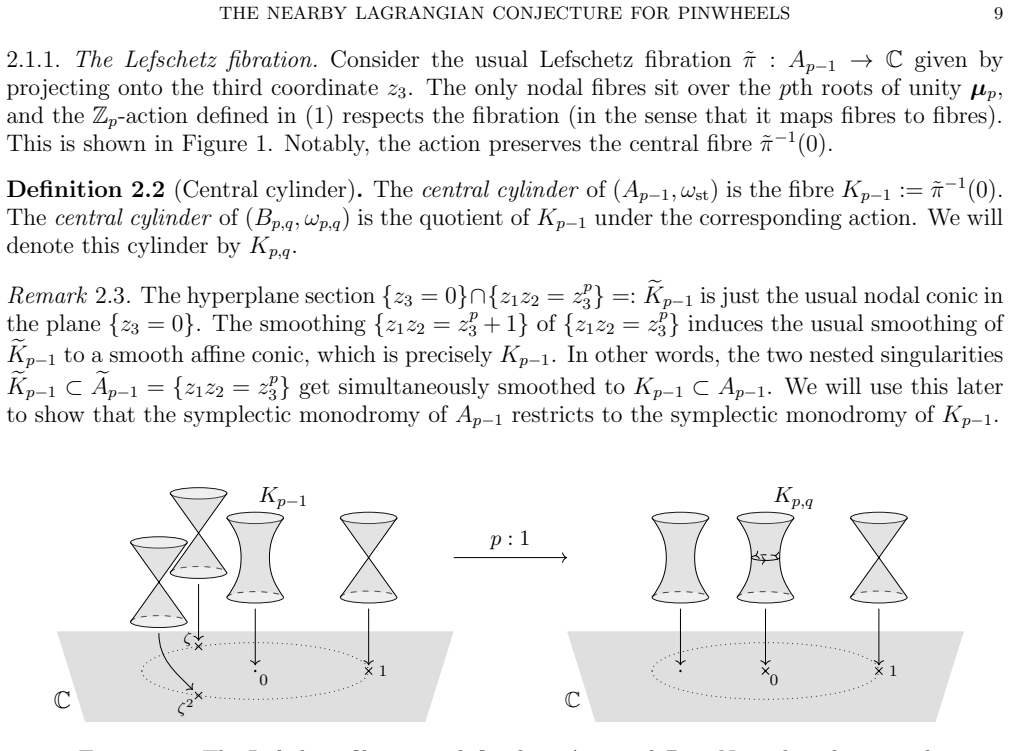
The Lagrangian skeleton of the rational homology ball $B_{p,q}$, for $0<q<p$ coprime integers, is an immersed but not embedded Lagrangian, called a $(p,q)$-pinwheel. We show that any two embeddings of Lagrangian $(p,q)$-pinwheels in $B_{p,q}$ are related by a compactly supported Hamiltonian isotopy, establishing Arnold's nearby Lagrangian conjecture for this wide class of singular Lagrangians. Our proof has two largely independent parts: the first uses neck-stretching and the symplectic rational blow-up to understand embeddings of pinwheels up to symplectomorphism; the second computes that $\text{Symp}_c(B_{p,q})$ is generated by a twist about the pinwheel, which we call the pintwist $\tau_{p,q}$. We provide three applications of our methods: Gromov non-squeezing for pin-balls; a new proof of the local Lagrangian unknotting theorem of Eliashberg--Polterovich; and that the only Lagrangian $(n,m)$-pinwheel in $B_{p,q}$ is of type $(p,q)$.
Given a canonically oriented Brieskorn sphere $Y=\Sigma(a_1,...,a_n)$, we confirm some statements conjectured by Gompf. More specifically, we obstruct the existence of rational homology ball symplectic fillings for any contact structure on $-Y$ if $n=3$, and when there is no half convex Giroux torsion for $n>3$. Furthermore, we show that the same result holds for the Milnor fillable structure on $Y$ with the possible exception of $\Sigma(3,4,5),$ $\Sigma(2,5,7)$ and $\Sigma(2,3,6k+1)$ for $k\geq1$. Along the way, we determine every canonically oriented Brieskorn sphere with vanishing correction term carrying at most two fillable structures, up to isotopy.
The relative inner automorphism group defines connectedness and shows connected maps are quotients; the relative transvection group supplies
abstractclick to expand
This paper introduces relative versions of the inner automorphism group and the transvection group associated with surjective quandle homomorphisms.By using the relative inner automorphism group, we define a notion of \emph{connectedness} for surjective homomorphisms. We characterize connected homomorphisms algebraically as quotient maps, and use the relative transvection group to establish a maximal \emph{connected-covering} factorization for arbitrary surjections. Finally, we study surjective homomorphisms for which the relative inner automorphism group acts $2$-transitively on each fiber. Under this assumption, we classify the possible quandle structures of the finite fibers.
The Birman-Craggs-Johnson homomorphism is a homomorphism $\sigma \colon \mathcal{I}_g \to \mathbb{B}_3'$ from the Torelli group to a certain $\mathbb{Z}/2\mathbb{Z}$-vector space of Boolean polynomials. In 1983, Johnson computed $H_1(\mathcal{I}_g)$ for $g \geq 3$ and showed, in particular, that the induced homomorphism on $H_1(\mathcal{I}_g)$ is injective when restricted to the subgroup generated by Dehn twists about separating simple closed curves. In this paper, we extend Johnson's result to higher homology groups. Given any collection of pairwise disjoint separating simple closed curves on $\Sigma_g$, the corresponding Dehn twists pairwise commute and determine a homology class in $H_k(\mathcal{I}_g)$ called an abelian cycle. We prove that the pushforward homomorphism restricted to the subgroup of $H_k(\mathcal{I}_g)$ generated by such abelian cycles is injective for $k \leq g-2$.
The Hom-Karakurt-Lidman condition extends to positive and negative 1/m surgeries, giving lower bounds on Betti numbers of cobordisms between
abstractclick to expand
For knot surgery in $S^3$, Heegaard Floer homology provides an obstruction due to Hom--Karakurt--Lidman. We extend this obstruction to all integer homology spheres $Y$, for both positive and negative 1/m surgeries. This is used to test infinitely many small Seifert fibered examples and hyperbolic examples. Moreover, we deduce a lower bound on the $b_2(W)$ of smooth cobordism between a pair of integer homology spheres.
The result covers cusp, exceptional unimodal, and hyperbolic Brieskorn cases, with fillings pairwise non-diffeomorphic and inequivalent unde
abstractclick to expand
In this paper, we show that if the link of an isolated complex surface singularity is either a $Sol^3$-manifold or an $\widetilde{SL}(2;\mathbb{R})$-manifold with its canonical contact structure, then it admits infinitely many strong symplectic fillings that are pairwise non-diffeomorphic and not related by a sequence of blow-ups or blow-downs. As a consequence, the link of any cusp singularity, exceptional unimodal singularity, or hyperbolic Brieskorn singularity admits infinitely many pairwise non-diffeomorphic minimal strong symplectic fillings.
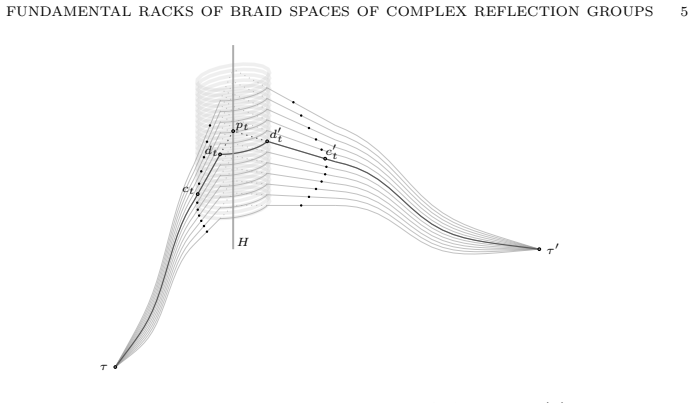
Let $\Gamma$ be a complex reflection group acting on the complex affine or hyperbolic space $X$ with the set of reflecting hyperplanes $\mathcal{H}$. We define an augmented rack $(G, \mathcal{K}, p)$ associated to the orbifold fundamental group $G := \pi_1^{\operatorname{orb}}( \Gamma \backslash (X - \mathcal{H}))$ which plays the role of the fundamental rack of a framed link complement as defined by Fenn and Rourke. This yields representations of the orbifold fundamental group $G$ on the cohomology of the associated rack space.
Given a pseudo-Anosov flow $\phi$ on a closed atoroidal $3$--manifold $M$ and a closed surface $S$ almost transverse to $\phi$, we give a homological characterization of when $S$ can be completed to an almost transverse depth one lamination or foliation whose set of compact leaves is $S$. As a consequence, we show that the cone of classes in $H^1(M\backslash \!\! \backslash S)$ that are positive on the closed orbits of $\phi$, when nonempty, is an entire foliation cone of $M\backslash \!\! \backslash S$.
Right-angled Artin groups on graphs without cycles shorter than five cannot contain fundamental groups of finite volume hyperbolic 3-manifol
abstractclick to expand
Let $\Gamma$ be a finite simplicial graph of girth at least five. In this short note, we give a proof that if $M$ is a finite volume hyperbolic $3$--manifold, then the right-angled Artin group $A(\Gamma)$ cannot contain $\pi_1(M)$ as a subgroup; the argument is elementary, modulo the resolution of the Virtual Fibering Conjecture and a splitting theorem due to Belegradek. In particular, if $C_n$ denotes the $n$--cycle then $A(C_n)$ cannot contain a finite volume hyperbolic $3$--manifold group for any $n\geq 3$, thus answering a question of A.~Reid.
A cube of resolutions from possibly nonorientable 2D cobordisms produces doubly- and triply-graded groups whose Euler characteristics match
abstractclick to expand
We construct doubly- and triply-graded Penrose-type homologies for ribbon graphs. The construction is a TQFT-valued cube of resolutions built from two-dimensional cobordisms, which may be nonorientable. Their Euler characteristics recover specializations of some Penrose polynomials; in particular, the four color case comes with a refinement of the classical Penrose criterion.
Enumeration adds two new nabla-Y families and one example with Colin de Verdière invariant 6
abstractclick to expand
We present a list of 3028 obstructions to knotless embedding. We survey recent work in this area including: 1) A bibliography of graphs proven to be intrinsically knotted without relying on computers; 2) An updated listing of obstructions in $\nabla\mathrm{Y}$ families including two new large families; 3) Connections with the Colin de Verdi\`ere's invariant including a new obstruction with $\mu = 6$; and 4) Connectivity of obstructions and their structure near vertices of degree three or four. We address questions raised in earlier work, (re)state several conjectures, and propose new questions.
For sets larger than one element the resulting invariant separates virtual knots and links that share the same Jones polynomial.
abstractclick to expand
We introduce a generalization of the Jones polynomial for classical and virtual knots and links using colorings by a permutation $\sigma:X\to X$ of a finite set $X$. For $X=\{1\}$ and for classical knots, the invariant is equivalent to the usual Jones polynomial; for $X$ with cardinality greater than 1 the invariant expresses distinct information from the Jones polynomial or virtual knots and for classical and virtual links. We establish some properties of the new invariants and compute the polynomials for classical and virtual knots and links of small crossing number for a few small permutations.
The finite-case result extends: triangulations with a common subdivision also share a common stellar subdivision when complexes may be infin
abstractclick to expand
Alexander's conjecture states that for every two finite triangulations of the same topological space, if they have a common subdivision, then they have a common stellar subdivision. We generalize the recent result of Adiprasito and Pak, who resolved Alexander's conjecture for finite simplicial complexes, to infinite simplicial complexes.
Towards developing the tools of geometric group theory for non-locally compact topological groups, we give one of the first complete classifications of a family of such groups up to coarse equivalence, and when possible, up to quasi-isometry. In a previous paper, we placed the homeomorphism groups of countable Stone spaces into three classes: coarsely bounded, unbounded yet generated by a coarsely bounded set, and unbounded but not generated by any coarsely bounded set. Now we show that these are the coarse equivalence classes: Any two groups within one of these classes are in fact coarsely equivalent.
Furthermore, we show that groups in the second class are quasi-isometric to the Hamming cube, the space comprising infinite binary sequences with finitely many nonzero entries equipped with the Hamming distance. As part of the proof, we show that infinite Hamming graphs over finite alphabets are all bi-Lipschitz equivalent.
Vineyards, or time-varying families of persistence diagrams, are widely used in topological data analysis (TDA) pipelines to track how topological features change and evolve as a parameter varies. When the parameter traces a closed loop, a vineyard can exhibit monodromy: diagram points permute over the course of a full traversal, which obstructs feature tracking and can complicate downstream analysis of such data. Chambers et al. considered the periodic vineyards that arise from the radial persistence transform, which maps the manifold to a family of persistence diagrams, where each diagram fixes a base point and considers the filtration that is based on Euclidean distance to that point, and showed that monodromy and knotting can occur. Other recent work by Arya et al. considers geometric conditions that exclude monodromy in two dimensions, in an effort to better understand when this effect happens. That said, understanding when and why monodromy occurs is a fundamental open problem with direct practical consequences for many data analysis pipelines.
In this work, we study this question for 1-manifolds in $\mathbb{R}^2$, using a surprising connection with tools from singularity theory, and provide a classification for the causes of monodromy in vineyards. More precisely, we prove that the vineyard of a sufficiently small loop $\gamma$ cannot exhibit monodromy unless it contains a specific singularity of the distance function. The central geometric object in our analysis is the symmetry set, which is the locus of centers of spheres tangent in more than one point to the manifold; this object classifies singularities of the distance function, and in our setting, dictates precisely when monodromy occurs. This characterization opens the door to the development of algorithmic criteria for detecting and utilizing (or avoiding) monodromy in TDA pipelines.
The mapping class group of a $3$-dimensional handlebody of genus $g$, denoted by $\mathcal{M}(V_g)$, is a fundamental object of study in geometric topology. Building upon the initial generators introduced by Suzuki and their explicit formulation by Takahashi, Wajnryb established that $\mathcal{M}(V_g)$ is generated by exactly five elements for $g \ge 2$. Motivated by recent minimality results in related subgroups we investigate further reductions to this generating set. Through the use of the relations in Wajnryb's presentation, we show that for $g \geq 5$, the handlebody group $\mathcal{M}(V_g)$ is generated by three elements, and for $g \geq 3$, $\mathcal{M}(V_g)$ is generated by four elements, reducing Wajnryb's generating set of five elements by two and one respectively.
We describe a dense subset of the Gromov boundary of the grand arc graph of an infinite-type surface as a space of geodesic laminations, analogous to Klarreich's description of the Gromov boundary of the curve complex. After showing that the grand arc graph satisfies a bounded geodesic image theorem, we also prove that the boundary is not compact.
We introduce a chain map from quandle homology to relative group homology, and construct several quandle cocycles through the chain map. We also relate this chain map to triangulations of Seifert (hyper)surfaces of 1- and 2-dimensional links.
Any C1 action on a compact manifold must be finite if dimension is less than the group's rank, extending to S-arithmetic cases.
abstractclick to expand
We prove that an action by $C^1$ diffeomorphisms of a lattice in a simple $p$-adic group on a compact manifold is finite, provided the dimension is less than the rank. We extend this statement to lattices in totally disconnected $S$-arithmetic groups, where the critical dimension is the maximal rank of the simple factors. This uses the machinery developed by Brown, Fisher, and Hurtado.
Loops in the dense open set contract through degenerates, so all same-rank groups become quasiconformally isotopic
abstractclick to expand
The marked Schottky space records, up to conjugacy, all actions of a free group of fixed rank as a Schottky group on hyperbolic space of fixed dimension. In dimension three it is the classical Schottky space covering the moduli space of Riemann surfaces, studied complex-analytically. In higher dimensions each generator gains a rotational parameter, a special orthogonal transformation of the directions normal to its axis, with no classical analogue. Our main theorem treats the borderline dimension, twice the rank: there a dense open part of the space has fundamental group a product of cyclic groups of order two, one per generator, yet the whole space is simply connected, since each such loop contracts through the most degenerate configurations. As a consequence, any two Schottky groups of the same rank in this borderline dimension are quasiconformally isotopic, partially answering a question of Kapovich. We also show that a rotationally symmetric core is a strong deformation retract in every dimension, that this dense open part is homotopy equivalent to a product of special orthogonal groups, and that the analogous locus one dimension below has two connected components.
Compact cases are Poincaré duality complexes with Spivak tangent fibration matching the dualizing sheaf, and conical singularities force top
abstractclick to expand
We study homology manifolds through the eyes of the six functor formalism of spectral sheaves on locally compact Hausdorff spaces. As main results, we characterize cohomologically smooth objects by adapting an argument of Scholze, deduce that any hypercomplete locally compact ANR homology manifold is cohomologically smooth, show that compact ANR homology manifolds $X$ are Poincar\'e duality complexes whose Spivak tangent fibration identifies with the dualizing sheaf of $X$, and prove a generalization of Wilder's monotone mapping theorem about cell-like maps. Moreover, we introduce the notion of homotopy manifolds for which we prove an unstable analog of Wilder's orientability conjecture and show that hypercomplete ANR homology manifolds are homotopy manifolds. As a consequence, we show that for a compact $d$-dimensional ANR homology manifold, the Spivak tangent fibration of its associated Poincar\'e duality complex canonically destabilizes to a pointed $S^d$-fibration. Finally, we introduce homotopy manifolds with conical singularities, a generalization of Cohen's triangulated homotopy manifolds, and show that such objects are in fact topological manifolds, generalizing a result of Siebenmann.
Along the way, we obtain comparisons between sheaf and singular cohomology and between the shape and the weak homotopy type of a topological space, explore the relation between various notions of cohomological dimension and hypercompleteness, and study six functor formalisms satisfying the K\"unneth formula.
We study layered models, including feedforward networks, ResNets, and transformers, by limiting each layer to a width of $d = 3$, i.e., $\mathbb{R}^3$ as representation space. This allows us to track how a neural network changes low-dimensional topological invariants through its layers. Just about any topological structure may be simplified or even trivialized by simply increasing dimension; e.g., any knot is equivalent to an unknot in $\mathbb{R}^4$. By restricting to $\mathbb{R}^3$, we not only isolate the effects of activation and depth from that of width, we work in a space that lends itself to easy visualization. We focus on linking number here, deferring other invariants like link groups, Milnor's $\bar{\mu}$-invariants, knot types, ambient cobordisms, to a sequel. We provide full proofs and empirical experiments to justify the following insights: When measured by their power to effect changes in linking numbers, the layer-skipping feature in ResNets is as powerful as the attention mechanism in transformers; both ResNets and transformers are strictly more powerful than feedforward neural networks with monotonic activations, which are in turn more powerful than invertible and flow-based models; but replacing monotonic activation with a nonmonotonic one elevates a feedforward network into the same expressivity class as ResNets and transformers. These results suggest that low-dimensional topology can be a useful tool to guide designs of AI architectures. We also generalize our results from $d = 3$ to arbitrary $d > 3$.
The assignment extends to a seminorm induced by a polytope; for free-by-cyclic groups it yields a combinatorial description and an algorithm
abstractclick to expand
We show that if $G$ is a finitely generated torsion-free group satisfying the Strong Atiyah Conjecture with vanishing first $L^{2}$-Betti number, then the map that assigns to each surjective integral character the first $L^2$-Betti number of the kernel extends to a seminorm on the first cohomology group of $G$ with real coefficients. We call this seminorm the Thurston norm. Moreover, we show that this norm is induced by a polytope in the first homology group with real coefficients. We also generalize this result to higher $L^{2}$-Betti numbers of the kernels, thereby confirming a conjecture of Friedl, L\"uck and Tillmann.
In the case where $G$ is either a free-by-cyclic group or the fundamental group of an admissible $3$-manifold, we show that the Thurston norm of $G$ admits a combinatorial interpretation that relates it to the splitting complexity of the character. This confirms a conjecture of Gardam and Kielak. As an application, we show that there exists an algorithm to compute the Bieri--Neumann--Strebel invariant of free-by-cyclic groups, and discuss connections to the isomorphism problem in free-by-cyclic groups.
Pin-cobordism valued families invariant detects them where framed invariants cannot apply
abstractclick to expand
A diffeomorphism of a $4$-manifold is said to be exotic if it is continuously isotopic to the identity but not smoothly isotopic to the identity. Ruberman constructed the first examples of exotic diffeomorphisms on simply-connected closed $4$-manifolds. His examples were reducible $4$-manifolds that necessarily have even $b_+$ in order that they can be detected by the families Seiberg--Witten or Donaldson invariants. Later Konno and Baraglia produced exotic diffeomorphisms on irreducible $4$-manifolds with odd $b_+$. In this paper, we will construct exotic diffeomorphisms on reducible $4$-manifolds with odd $b_+$. Exoticness is detected using a families Bauer--Furuta invariant. In proving our results we need to work with families moduli spaces which are not framed and so do not give rise to framed cobordism invariants. We overcome this difficulty by considering a Bauer--Furuta type invariant valued in {\em pin-cobordism}. In addition to constructing exotic diffeomorphisms, we also find new examples of simply-connected $4$-manifolds whose mapping class groups are not finitely generated.
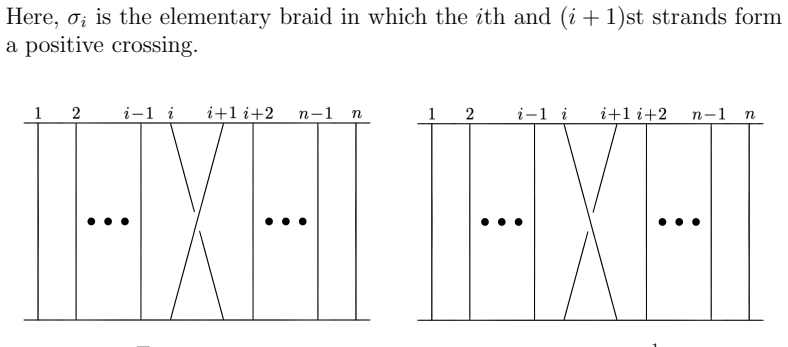
We derive explicit formulas for the HOMFLY polynomials of the torus links $T(3,n)$ using braid groups and the skein relation. We first treat the case of $T(2,n)$ and then derive a five-term linear recurrence for an auxiliary sequence associated with $T(3,n)$. By solving this recurrence using a generating function, we obtain an explicit formula for the HOMFLY polynomial $P(T(3,n);y,z)$ of $T(3,n)$. The corresponding formula for $T(-3,n)$ is subsequently obtained from the mirror-image formula for the HOMFLY polynomial. As an application, we show that the HOMFLY polynomial distinguishes the links $T(3,n)$ within this family and distinguishes $T(3,n)$ from its mirror image for $n\geq 2$.
On the Kirby list, Akbulut poses the question of whether there exists a homology 3-sphere $Y$, other than $S^3$, with the following property: Any knot $K$, representing $0\in\pi_{1}(Y),$ which is slice in some contractible 4-manifold $X$ which $Y$ bounds, is already slice in $Y\times[0,1]$. In this paper, we make progress on this question by producing a class of deeply slice knots. We construct these knots by first specifying a pair $(X, K)$, where $X$ is a contractible 4-manifold with integral homology 3-sphere boundary and $K$ is slice in $X$. Then, we show the knot is deeply slice using concordance invariants from Heegaard Floer homology. We employ immersed curve techniques to compute these invariants.
We examine how the Rasmussen invariant, satellite operations, and null-homologous twists can be used to establish infinite order of knots in the smooth concordance group. As an application, we show that the Conway knot has infinite concordance order.
Lipschitz maps between spaces with curvature bounded below have matching analytical and topological degrees, giving volume bounds and rigidi
abstractclick to expand
We present the entropy-degree theorem for Lipschitz maps between Alexandrov spaces with curvature bounded below, extending the classical Besson--Courtois--Gallot entropy-rigidity results to this singular setting. The proof requires a new degree theorem for Alexandrov spaces, developed using the Ambrosio--Kirchheim theory of integral currents, showing the equivalence between analytical and topological degrees.
Applications include geometric obstructions for negatively curved Einstein metrics on 4-orbifolds, volume bounds for cone-manifolds, quantitative inequalities for hyperbolic convex cores, and lower bounds on the asymptotic translation lengths of end-periodic surface homeomorphisms. We show that entropy-volume minimization under uniform lower curvature bounds obstructs to the formation of metric singularities in Gromov--Hausdorff limits, prove an Alexandrov boundary rigidity theorem, and establish volume minima for cone manifolds and cone orbifolds.
The map on Weil and Cartan models shows local neighborhood cohomology reduces exactly to the slice at a point.
abstractclick to expand
Let $G$ be a compact Lie group, $M$ be a smooth manifold with a $G$ action, then all the data of this model is contained in the action groupoid $G\ltimes M$. If $U_y$ is a small enough neighbourhood of $y\in M/G$, the slice theorem says that \begin{equation*}
\pi^{-1}(U_y)=S_{x}\times_{G_{x}} G \end{equation*} where $x$ is a point in the $y$ orbit, $S_x$ is the slice of $x$ and $G_x$ is the isotropy group of $x$. An alternative approach to describe group actions on spaces is through the language of groupoids. Local properties of Lie groupoids are often studied via linearization theorems.
One can compute the equivariant cohomology $H_G(\pi^{-1}(U_y))$ of $\pi^{-1}(U_y)$ using the Weil model or the Cartan model. Also by the homotopy theory, the equivariant cohomologies $H_G(\pi^{-1}(U_y))$ and $H_{G_x}(S_x)$ are isomorphic.
In this paper, we explicitly construct a natural chain map between the Weil (or Cartan) models of $(\pi^{-1}(U_y), G)$ and $(S_x, G_x)$, and prove that it induces an isomorphism in equivariant cohomology. We then introduce the notion of slice (or local linearizable) groupoids, which are locally modeled on Lie group actions on manifolds with gluing data, several examples and applications are discussed. In the last section, we generalize the equivariant theory to these groupoids using sheaf-theoretic methods. We further show that the equivariant cohomology is invariant under Morita equivalence.
In this paper, we upgrade the instanton TQFT from ordinary categories to a functor $CI$ from an $\infty$-cobordism category $\mathrm{BI}$ for instantons to an $\infty$-derived category $\mathsf{D}$ of $2$-periodic chain complexes and sums of homogeneous chain maps. The construction of $\mathrm{BI}$ is a modification of the $\infty$-cobordism category $\mathrm{Bord}_4$ constructed by Lurie and Calaque--Scheimbauer via complete Segal spaces. The construction of $\mathsf{D}$ follows from the dg-nerve of a dg-category of $2$-periodic chain complexes over finitely generated projective modules over $\mathbb{Z}$. The information encoded in the functor $CI$ was already developed by Kronheimer--Mrowka using families of metrics on cobordisms, but our reinterpretation through $\infty$-categories simplifies the construction of the hypercube of chain complexes for the link spectral sequence. In addition, we upgrade the generalized cap product $\mu$-operators in instanton Floer homology to the chain level and construct explicit homotopies and higher homotopies for commutativity of multiple $\mu$-operators in even degrees.
We prove the surgery exact triangle for monopole (Seiberg--Witten) Floer homology over integer coefficients, extending the work of Kronheimer--Mrowka--Ozsv\'{a}th--Szab\'{o} over $\mathbb{Z}/2$, Lin--Ruberman--Saveliev over $\mathbb{Q}$, and Freeman over $\mathbb{Z}[\sqrt{-1}]$. Our proof is based on a modification of Kronheimer--Mrowka's local system on monopole Floer homology and an adaptation of Freeman's computation. As a standard application, following Bloom and Scaduto, we obtain a spectral sequence $\widetilde{Kh}_{\mathrm{odd}}(L)\Rightarrow \widetilde{HM}_\bullet(-\Sigma_2(L))$ over integer coefficients for an oriented link $L\subset S^3$, thereby solving Ozsv\'{a}th--Rasmussen--Szab\'{o}'s conjecture.
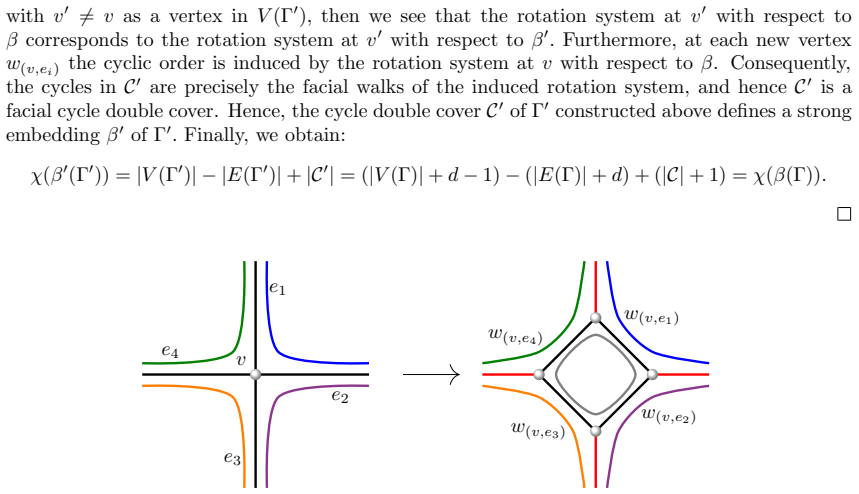
A classical theorem of Frucht states that every finite group occurs as the automorphism group of a finite graph. We prove an embedded analogue for regular graphs of arbitrary degree. In particular, we show that for every $d\geq 3$ and every finite group $G$, there exists a $d$-regular graph $\Gamma$ with a strong embedding $\beta$ such that $\mathrm{Aut}(\Gamma) \cong \mathrm{Aut}(\beta(\Gamma)) \cong G.$ Further, we prove that for every such $d$ and $G$ there exists a sequence of $d$-regular graphs with corresponding strong embeddings whose genera form an unbounded sequence and whose automorphism groups are isomorphic to $G$. Along the way, we identify an
oversight in Sabidussi's classical construction of regular graphs with prescribed automorphism group. We give an alternative construction that corrects this issue and strengthens Sabidussi's result by producing an automorphism group-invariant proper $d$-edge-colouring.
A simple undirected graph $M$ is called a discrete $d$-pseudomanifold if, for every vertex $v$, the induced subgraph $N_M(v)$ on the neighbors of $v$ is a discrete $(d-1)$-pseudomanifold, where a discrete $1$-pseudomanifold is defined to be an $n$-cycle with $n\geq 4$.
These objects arise naturally as graph-theoretic analogues of simplicial pseudomanifolds and provide a purely combinatorial framework for studying manifold-like structures through local neighborhood conditions. Understanding discrete pseudomanifolds with a small number of vertices is therefore a fundamental problem in combinatorial topology and extremal graph theory.
In this article, we first prove that every discrete $d$-pseudomanifold has at least $2(d+1)$ vertices. We then provide a complete classification of discrete $d$-pseudomanifolds with at most $2d+6$ vertices by determining all possible combinatorial types of such pseudomanifolds. Further, we establish an equivalence between discrete $d$-pseudomanifolds and edge graphs of flag normal $d$-pseudomanifolds. As a consequence, we derive a purely combinatorial characterization of flag normal $d$-pseudomanifolds with at most $2d+6$ vertices and prove that each such complex is a simplicial $d$-sphere.
Finally, we show that this sphere characterization is optimal within the class of flag normal $d$-pseudomanifolds by constructing examples on $2d+7$ vertices that are not spheres. Specifically, we prove that, for $d\geq 3$, every flag normal $d$-pseudomanifold with at most $2d+7$ vertices is either a simplicial $d$-sphere or a flag triangulation of the $(d-2)$-fold suspension of $\mathbb{RP}^{2}$.
Simplex count controlled only by dimension and embolic volume, giving a geometric bound on topological complexity.
abstractclick to expand
Let $M$ be a closed, connected, smooth $n$-dimensional manifold. We prove that $M$ is dominated by the underlying space of the $n$-skeleton of a finite simplicial complex. Furthermore, the total number of simplices in the $n$-skeleton is bounded above by a constant depending only on $n$ and the embolic volume of $M$.
We give a thorough analysis of the time complexity of computing Reshetikhin--Turaev knot polynomials via tensor contractions on the associated tensor networks, showing that the computation is fixed-parameter tractable with respect to a parameter at most linear in the tree-width of the input knot diagram. When combined with existing approximation algorithms for tree decomposition, this recovers the sub-exponential bound $e^{O(\sqrt{n})}$ for the time complexity of computing any Reshetikhin--Turaev knot polynomial. We accompany this paper with an implementation of such an algorithm in SnapPy, which computes any Reshetikhin--Turaev knot polynomial given its $R$-matrix and ribbon element.
We establish handle attachment formulas for the Khovanov skein lasagna module with 1-dimensional inputs over $\mathbb{Q}$, defined recently by Ren, Wedrich, Willis, Zhang, and the second author. For a $4$-manifold built out of $1$- and $2$-handles, the invariant can be computed in terms of a cabled colimit of Rozansky-Willis homologies, modulo a new relation which we call the lasso relation. We then present some explicit calculations for disk bundles over $S^{2}$, as well as a partial vanishing result for $4$-manifolds of the form $\Sigma_{g}\times D^{2}$, $g\geq 1$.
When π2 is a finitely generated projective Z[π]-module, π is FP of dimension 4 or splits as PD4-groups plus free factor if H3 vanishes.
abstractclick to expand
Let $X$ be a $PD_4$-complex and let $\pi=\pi_1(X)$. If $\pi$ is torsion-free and $\pi_2(X)$ is a finitely generated projective $\mathbb{Z}[\pi]$-module then either $\pi$ is free or $\pi$ is $FP$ and $c.d.\pi=4$. If, moreover, $H^3(\pi;\mathbb{Z}[\pi])=0$ then $\pi$ is a free product of $PD_4$-groups and a free group.
A matroid-based dynamic programming method counts all mod 2 toric-colorable seeds in four dimensions and verifies they are toric-colorable.
abstractclick to expand
We introduce a binary matroid approach to the enumeration of mod 2 toric-colorable seeds of fixed Picard number. We organize these matroids by their contraction category and enumerate weak pseudomanifold subcomplexes by a dynamic programming algorithm. The main computational step uses a Gray code traversal of the mod 2 kernel of the ridge-facet incidence matrix.
As the main new result, we find that there are 198,846 mod 2 toric-colorable seeds of dimension four and Picard number five. We also check that they all are toric-colorable. Finally, the same framework independently reproduces the Picard number 4 enumeration of Choi, Jang, and Vall\'{e}e much faster than their previous method.
For any knot in a closed orientable 3-manifold, Dehn surgery yields a surface-fibered result only for a sparse set of slopes.
abstractclick to expand
Let $M$ be a closed orientable 3-manifold and $k$ be a knot in $M$. Then the Dehn surgery of $M$ along $k$ with slope $\alpha$ is not surface fibered for all but a sparse set of slopes.
We construct, for every $g\ge2$, infinite families of homotopic smooth embeddings of a closed genus-$g$ surface whose images are pairwise not smoothly image-concordant, while each surface is $\pi_1$-injective. The main closed examples lie in one-fold stabilizations of closed aspherical mapping tori with torsion-free fundamental group: after stabilization by $S^2\times S^2$, the surfaces have a common framed dual sphere and the inclusion of each complement induces a $\pi_1$-isomorphism. The image-nonconcordance already occurs before stabilization, in the underlying closed aspherical mapping torus. The obstruction is a computable marked mod-two coordinate of Freedman--Quinn/Dax-type self-intersection data for concordance tracks, indexed by self-dual double-cosets of a possibly non-normal surface subgroup $H\leq\pi_1X$. The geometric source of the relevant labels is a M"obius-band square-root relation: elements $t\notin H$ with $t^2\in H$ produce self-dual labels in torsion-free ambient groups. These square roots are realized naturally in Klein-bottle $I$-bundle pieces and retained in closed graph-manifold mapping-torus examples.
This paper constructs a framed real monopole Floer homology for three-manifolds with involutions, marked with multiple basepoints. The relative gradings of these Floer homologies depend on the framing information and the paper gives a sufficient condition for the existence of relative mod two gradings. Assuming orientability and choices of orientations, this paper also proposes a definition of $\mathbf{Z}$-valued framed real Seiberg--Witten invariants for 4-manifolds with involutions, marked with circles.
This article relates the theory of embedded contact homology (ECH) with the dynamics of Anosov flows. We show that in many cases the ECH capacities of a symplectic 4-manifold are infinite, including cotangent disk bundles over closed oriented surfaces of genus at least two. We prove that ECH obstructs Reeb Anosov and Hamiltonian Anosov flows, addressing the four-dimensional case of a question posed by Herman in 1998. Further, we obtain Floer-theoretic obstructions to a 3-manifold admitting any Anosov flow. As an application, we give new constraints on the existence of embedded Lagrangians of genus at least two in symplectic 4-manifolds. In an appendix, some related results in all dimensions are proved for capacities constructed from rational symplectic field theory.
We extend the study of contact cosmetic surgeries to Legendrian knots in integer homology sphere L-spaces . We prove that the contact cosmetic surgery conjecture holds for all non-trivial Legendrian knots in this setting, with the possible exception of Lagrangian slice knots. Our argument adapts and refines techniques from the S3 case to the broader context of L-spaces, incorporating constraints arising from Heegaard Floer theory
We classify the sets of $L$-space surgeries on all two-bridge links, providing the first examples of hyperbolic links for which such sets cannot be described as unions of finitely many rectangles in $\mathbb{Q}^2$. The proof relies on several different techniques, each of which is applicable in greater generality: we introduce a sufficient diagrammatic condition for links in $S^3$ to be persistently foliar, a property that implies that every non-trivial surgery on such links supports a coorientable taut foliation. We define a simplified model for the Heegaard Floer homology of rational surgeries on two-component $L$-space links, following the work of Manolescu-Ozsv\'ath, Liu, and Zemke, and use it to obtain obstructions to $L$-space surgeries. Finally, we use explicit computations of Turaev torsions to determine $L$-space surgeries in the case of generalised $L$-space links. Among the consequences of our results, we obtain an optimal uniform bound on the volume of any hyperbolic $L$-space that is surgery on a two-bridge link, together with a classification of all $L$-space satellite knots whose associated two-component pattern link is a two-bridge link.
Algebraic criteria derived from relatively hyperbolic group fillings separate these manifolds by homotopy type.
abstractclick to expand
We develop criteria to distinguish the homotopy types of Gromov-Thurston manifolds. Our approach is based on a description of their fundamental groups as virtual Dehn fillings of relatively hyperbolic groups.
We consider the sum of the adjoint Reidemeister torsions and prove the integrality for twist knots and the meridian. We also give some concrete examples of the generating functions for these sums.
The fundamental group of the complement transforms in a fully characterized way when homotopies pass through cross-cap singularities.
abstractclick to expand
The notion of a quasi-holomorphic homotopy of two immersions of a $3$-manifold into a $5$-manifold extends the notion of their regular homotopy by also allowing the homotopy to pass through instances of maps with an isolated singularity around which the path of the homotopy forms a cross-cap (complex Whitney umbrella). We describe the local form of such homotopies and explain connections with the theory of holomorphic map germs from $\mathbb{C}^2$ to $\mathbb{C}^3$. Our main result is a complete a description of how the fundamental group of the complement of the image of an immersion of a $3$-manifold into a $5$-manifold (i.e. its knot group) changes under a quasi-holomorphic homotopy. As a corollary we will see that certain quasi-holomorphic homotopies of the standard embedding of the $3$-sphere into the $5$-sphere do not change its knot group.
Wedge construction from transverse real contacts on embedded 3-manifolds produces them, with dual hedge extraction.
abstractclick to expand
We establish new connections between real and complex contact geometry via embeddings of 3-manifolds into $\C^3$. We introduce a new \emph{contact wedge} construction combining two transverse real contact structures to make a new \emph{complex contact} structure, subject to obstructions measured by the Nijenhuis tensor and Dolbeault cohomology. Dually, we form a \emph{hedge} construction which extracts real contact structures from complex ones. Applying these tools, we prove that $\C^3$ admits uncountably many complex contact structures.
A subset $S$ of a group $G$ is \emph{conjugacy distinguished} if the union of all conjugates of $S$ is closed in the profinite topology on $G$. We prove that if $M = \mathbb{H}^3/\Gamma$ is a hyperbolic $3$-manifold of finite volume, $g \in \Gamma$, and $H$ is an abelian subgroup of $\Gamma$, then the coset $gH$ is conjugacy distinguished in $\Gamma$. A subset $S \subset G$ is \emph{conjugacy distinguished from a class of subgroups} if, for every $K$ in the class that is disjoint from the union of conjugates of $S$, there exists a homomorphism $\varphi \colon G \rightarrow F$, where $F$ is a finite group, such that $\varphi(K)$ is disjoint from the union of conjugates of $\varphi(S)$. In previous work, we proved that if $M = \mathbb{H}^3/\Gamma$ is a hyperbolic $3$-manifold of finite volume, then a coset of a maximal parabolic subgroup with cusp $C$ is conjugacy distinguished from the class of maximal parabolic subgroups of $\Gamma$ with cusps distinct from $C$. We extend this result by proving that a coset of a loxodromic subgroup is conjugacy distinguished from the class of maximal parabolic subgroups of $\Gamma$.
A classical question in the theory of hyperbolic surfaces is the study of lengths of closed geodesics under various constraints. A celebrated result in this area is M. Mirzakhani's asymptotic formula for the number of simple closed geodesics of length $\le L$ on a hyperbolic surface of genus $g$ with $n$ punctures. We investigate the number of simple closed geodesics of length $\le L$ representing a fixed primitive nonzero homology class $x$ on a hyperbolic surface $S$. We denote this number by $h_{S}(L, x)$. It follows from Mirzakhani's result that $h_{S}(L, x) \le C L^{6(g-1) + 2n}$. However, numerical evidence suggests that this bound is apparently not asymptotically sharp. We prove that for a surface $S$ of genus $g$ with $n$ punctures and $b$ geodesic boundary components, under the condition that $g \ge 1$ and $g+n+b \ge 3$, there exists a constant $C_1 > 0$ such that for sufficiently large $L$ the inequality \[ h_{S}(L, x) \ge C_1 L^{6(g-1) + 2(n + b-1)} \] holds. In the special case of a torus with two punctures $S_{1, 2}$, we obtain the following stronger result: there exists a constant $C_2 > 0$ such that for sufficiently large $L$ the inequality \[ h_{S_{1, 2}}(L, x) \ge C_2 L^{3.011057 \ldots } \] holds.
One phase has zero classical action; the other deforms hyperbolic volume of the knot complement as an integration constant.
abstractclick to expand
"Colored" knot polynomials satisfy difference equation w.r.t. the highest weights of the underlying representation -- which in the case of symmetrically colored Jones are named "quantum $A$-polynomials". In the double scaling quasiclassical (Kashaev) limit, when representation size $r\sim \hbar^{-1}$, there are different phases -- in one of them the classical action vanishes and in another one it is a deformation of hyperbolic volume (of a knot complement in $S^3$). This corresponds to a splitting of the non-homogeneous version of the quantum $A$-polynomial into two pieces, which we illustrate by more examples than just a figure-eight knot $4_1$ in the original paper. From the point of view of quasiclassics, hyperbolic volume is just an integration constant, which is not fully determined by the $A$-polynomial equation -- and actually remains ambiguous in this formalism. As a byproduct, we expect that classical $A$-polynomial at $L=1$ becomes proportional to Alexander: $A^{\cal K}(1,M)\sim \Delta^{\cal K}(M)$ -- this seems true, but $A$ should be consistent with the polynomiality of {\it non-homogeneous quantum} ${\cal A}$-polynomial, what sometime implies that it is not minimal.
Family Seiberg-Witten theory obstructs any map from BG to BDiff(M) for twists along (-2)-spheres.
abstractclick to expand
We study the homotopy coherent version of the Nielsen realization problem for smooth $4$-manifolds. Given a finite subgroup $G\subset \pi_0(\mathrm{Diff}(M))$, this problem asks whether there is a map $H\colon BG \to B\mathrm{Diff}(M)$ such that the induced map on fundamental groups coincides with the inclusion of $G$. Using family Seiberg-Witten theory, we prove that for $K3$-type $4$-manifolds, the Dehn twists along $(-2)$-spheres are not homotopy coherently Nielsen realizable. In particular, this gives an alternative proof of the failure of the classical Nielsen realization problem in this setting.
Let $\Sigma$ be a surface of genus $g$ with zero or one boundary component and $n$ marked points, and $H$ a finite-dimensional factorizable ribbon Hopf algebra. We compute the central extension of the mapping class group of $\Sigma$, associated to the projective representation defined from the stated skein algebra of $\Sigma$ and $H$. Our proof is purely two-dimensional, and makes no use of TQFT arguments.
Whether or not the 4-move is an unknotting operation remains an open problem. In this paper I show that every knot can be reduced to one with a trivial Alexander polynomial via a sequence of $4$-moves and isotopies.
In this paper, we explore links of Mazur manifolds in simple 4-manifolds. We construct non-split 2-component links in $S^4$. These are used to produce links in $\#^n \mathbb{C} \mathbb{P}^2$ which are split topologically but not smoothly. As a consequence, we obtain exotic pairs of simply connected, definite 4-manifolds with boundary, as well as exotic embeddings of various Mazur manifolds in $S^4$.
Result supplies counterexamples to Kontsevich conjecture on quadratic differentials and to conjectures on contractible stability spaces.
abstractclick to expand
We show that when the number of zeros or poles is at least four, every connected component of the strata of differentials in genus one with prescribed zero and pole orders is not an orbifold $K(\pi,1)$. For quadratic differentials, this provides infinitely many counterexamples to a conjecture attributed to Kontsevich, as well as to a folklore conjecture concerning the contractibility of spaces of Bridgeland stability conditions.
For two-component 2-bridge links a cohomology class fibers over the circle precisely when its 2-variable Alexander polynomial is monic in th
abstractclick to expand
For a compact 3-manifold W. Thurston introduced a norm on the first cohomology group of the manifold. The unit ball $B$ of this norm is a polyhedron and the set of cohomology classes that are representable by fibrations over a circle is a union of cones on some of the open faces of $B$. In the present paper we study the fibred faces of the Thurston polyhedra of exteriors of links in $S^3$. Our approach is based on the non-abelian Novikov homology associated with the universal covering of the exterior of the link. We prove in particular that for a 2-component 2-bridge link $L$ a cohomology class $\xi\in H^1(E(L))$ can be represented by a fibration over a circle if and only if its 2-variable Alexander polynomial is $\xi$-monic. We compute the Morse-Novikov numbers for a majority of 2-component prime links with number of crossings $\leq 8$.
This equivalence yields a combinatorial test for Sol geometry using immersions or triangulations.
abstractclick to expand
We show that there is a universal compact branched 3-manifold $W$ such that a closed 3-manifold $M$ immerses into $W$ if and only if $M$ admits a Sol structure. Equivalently, a closed 3-manifold is Sol if and only if it has a certain type of triangulation. The construction of $W$ is based on a regular language that characterizes Sol manifolds.
Differential topology supplies a short proof under Fenn conditions and a version for general boundaries.
abstractclick to expand
We revisit Fenn's table theorem from a differential-topological point of view. We prove a zero-existence theorem on a cylinder, which gives a short proof of the horizontal square-table theorem under Fenn's boundary conditions, and We establish a theorem under more general boundary conditions.
We also discuss square tables on saddle surfaces and conjecture that every sufficiently small square table can be placed horizontally on a saddle surface. We further conjecture that any prescribed rectangular table can be placed horizontally on a Fenn graph.
The generalization supplies answers to open questions on invariants for knots with multiple virtual crossings.
abstractclick to expand
In this paper, we extend the writhe polynomial invariant from virtual knots to multi-virtual knots. Several questions asked in [16] have been answered.
Let $M$ be a closed orientable $3$-manifold admitting a metric of nonpositive sectional curvature (an NPC metric), and let $G$ be a finite group acting freely on $M$ by orientation-preserving diffeomorphisms. Previous results showed that $M$ admits a $G$-invariant NPC metric except possibly when $M$ is a graph manifold. In this paper, we resolve the remaining case by proving that $M$ also admits a $G$-invariant NPC metric when $M$ is a graph manifold. This result advances our understanding in dimension $3$ of the question posed by Schoen-Yau about Nielsen realization for NPC $3$-manifolds.
The type-specific knotting probability of an arc diagram is earlier defined by using chord diagrams of ribbon surface-links in 4D space. By modifying this notion, Non-Trivialization probability (simply NT probability) for the arc diagram is introduced and generalized to an arc system diagram. Some properties of the NT probability are shown. The method of transforming a polygonal arc in 3D space into a unique arc diagram up to isomorphisms earlier developed is generalized to a polygonal arc system in 3D space to define the NT probability.
A knot P in the three-sphere is freely 2-periodic if it is preserved setwise by a free order-two action. There is a natural projective quotient knot associated to P. We establish a rank inequality between the knot Floer homologies of P and its quotient as a consequence of Large's generalization of Seidel--Smith's localization spectral sequence associated to order 2 actions in Lagrangian Floer homology. As a corollary we obtain an inequality between the Seifert genus of P and the rational Seifert genus of its quotient. We also implement a program which computes the E2 page of this spectral sequence using a modification of Baldwin--Gillam's grid homology calculator.
When a sublink bounds a surface in the complement, the singularities can be removed by a C^0-small isotopy localized near that surface.
abstractclick to expand
Let $M$ be a closed oriented $3$-manifold generically embedded in a complex $3$-manifold $X$. Its CR singular set is an oriented link $L\subset M$. We prove that if a sublink $L'\subset L$ bounds an oriented Seifert surface $S\subset M$ in the complement of $L\setminus L'$, then the CR singularities along $L'$ can be cancelled by an arbitrarily $\mathcal C^0$-small isotopy supported in an arbitrarily small neighbourhood of $S$.
Mathematical search problems present a unique challenge for Reinforcement Learning (RL) due to vast search spaces and sparse rewards. In previous works, the Andrews-Curtis (AC) conjecture was established as an illustrative example of such problems. In this work, we identify a critical structural barrier in the AC landscape: a "Two-Hump" distribution, where problem instances are either trivially solvable or effectively impossible, with a scarcity of intermediate "hard-but-solvable" instances required for effective learning. We tackle this challenge through two primary avenues: novel data generation techniques to populate the difficulty gap, and significant algorithmic enhancements including the introduction of supermoves and Transformer-based architectures. We demonstrate substantial performance improvements over previous baselines, and release new comprehensive benchmark datasets including AC-19 (125,192 AC-trivial presentations of varying difficulty with length at most 19) and AC-1M (1,136,154 hard AC-trivial presentations of length at most 30), the first large-scale, publicly available datasets of this kind.
We show there is a translation surface (the golden L) that has unbounded bunching: for every positive integer K there exists a ball B of radius 1 in R^2 that contains at least K vectors that are periods of saddle connections on this surface.
The topic of fixed points in digital metric spaces has drawn yet more publications with assertions that are incorrect, incorrectly proven, trivial, or incoherently stated. We discuss publications with bad assertions concerning fixed points of self-functions on digital images, as in some of our previous papers
We introduce a new two-variable polynomial invariant \(P^e\) of strongly involutive links, uniquely characterised by equivariant skein relations and naturally viewed as an equivariant analogue of the HOMFLY--PT polynomial. We prove that a specialisation of \(P^e\) recovers the graded Euler characteristic of the third page of the Lobb--Watson \(\mathcal{G}\)-filtration spectral sequence, generalising Couture's polynomial invariant. We further show that, after a change of variables, \(P^e\) reduces modulo \(2\) to the HOMFLY--PT polynomial, up to an explicit power of the skein variable, thereby answering a generalized form of a question of Couture. We use the resulting skein relations to distinguish infinitely many pairs of alternating mutant knots, and show that \(P^e\) is strictly stronger than the refined Lobb--Watson invariants on infinitely many strongly invertible knots.
Schmutz Schaller developed techniques for studying Teichm\"uller space using the systole function. These were presented in \cite{SchmutzMorse}, \cite{SchmutzVoronoi} as a hyperbolic analogue of Voronoi's theory of quadratic forms in the theory of Euclidean lattice packings and coverings \cite{VoronoiPDQF}. It is known that the packing density function on Euclidean space is a topological Morse function, \cite{TMFAsh}, and the same is true of the systole function on Teichm\"uller space, \cite{Akrout}, \cite{SchmutzMorse}. The study of hyperbolic packing and covering problems is technical, for example, the density depends on the scale, and very little is known about optimisers of the density \cite{t\'oth2022ballpackingshyperbolicspace}. At least in the Euclidean setting, there are also fewer techniques available for studying sphere covering as opposed to sphere packing problems, as the covering problems seem to have less discernible structure. One approach to studying efficient circle coverings in the hyperbolic plane is to study the critical points of the diameter function on Teichm\"uller space. This paper shows that the diameter function on Teichm\"uller space is a topological Morse function. As a mapping class group-equivariant topological Morse function, critical points of the diameter function are related to the homology of moduli space. It would seem that for small genus, the systole function and diameter function have a larger proportion of common critical points than at higher genus.
Twisted blow-up families over S2 produce manifold bundles whose classes form a free subgroup in the second homotopy group of the homotopy au
abstractclick to expand
By resolving the singularities of tailor-made orbifolds via twisted families of blow-ups, we construct manifold bundles $M \rightarrow E \rightarrow S^2$. Using tools from real homotopy theory, we show that these bundles determine a free subgroup in $\pi_2(B\mathrm{hAut}(M)_0)$. The proof relies on a generalisation of Sullivan's result, which describes the real homotopy groups of the monoid of homotopy automorphisms $\mathrm{hAut}(X)$ in terms of derivations of the minimal model of $X$, to the monoid $\mathrm{hAut}_A(X)$ of relative homotopy automorphisms.
As an application, we prove that the moduli space of torsion-free $\mathrm{G}_2$-structures arising from many generalised Kummer constructions contains a free subgroup of positive rank in its second homotopy group.
A unified algorithm for weighted bi-colored plane trees gives exact counts for both problems.
abstractclick to expand
This work solves the enumeration problem for weighted bi-colored plane trees with prescribed numbers of black and white vertices, together with prescribed total edge weights at each vertex. For the general case, we provide a unified algorithmic counting method. We then apply this result to two geometric problems. First, we compute the strong Hurwitz number for a special class of branch datum between Riemann spheres with three branched points. Second, we study the moduli space for a special class of extremal K\"{a}hler metrics on Riemann sphere (HCMU spheres), with a single conical singularity. We determine the number of its connected components with respect to the Gromov-Hausdorff topology.
We prove that the finite quotients of a fibered hyperbolic 3-manifold group detect the taut polynomials of fibered faces of the Thurston norm balls, whenever the monodromy map is fully-punctured. Toward this, we develop a general framework for the profinite invariance of twisted multivariable Alexander polynomials. We also identify specific hyperbolic one-cusped 3-manifolds that are profinitely rigid, by a strategy using normalized dilatations and the veering census.
Extends the knot case and detects infinite families of minimal links using Floer homology.
abstractclick to expand
We prove that strong ribbon concordance induces a partial order on links in the 3-sphere, extending a theorem of Agol. Using results from knot Floer homology, we certify minimality under the ribbon partial order for a handful of knots and give the first examples of ribbon minimal knots that are not transfinitely nilpotent, resolving a question of Tagami. Using a mixture of classical techniques and recent Heegaard Floer detection results for links, we give several infinite families of links whose members are minimal under the partial order induced by strong ribbon concordance.
We derive upper bounds for the Lagrangian capacities of Liouville domains with finite Gutt--Hutchings capacities and show that the Lagrangian capacity of a convex or concave toric domain of arbitrary dimension equals its diagonal. In particular, this completely settles the conjecture of Cieliebak-Mohnke on the Lagrangian capacity of ellipsoids. Our proof is based on an $S^1$-equivariant variant of the techniques of Fukaya and Irie, and does not use holomorphic curves with local tangency constraints, which would inevitably cause transversality issues. Moreover, we show that any extremal Lagrangian torus in an $n$-dimensional ellipsoid must lie on the boundary. Applications of our results and techniques include new upper bounds on the Lagrangian width for aspherical Lagrangians in Liouville manifolds and the first computations of the Lagrangian capacities for many non-subcritical Weinstein domains in dimensions 4 and 6.
The bound stays constant even when shadow centers lie deep inside cusps of the Gromov model.
abstractclick to expand
Patterson-Sullivan measures encode the distribution of orbits of discrete group actions near the boundary. In this paper, we prove a global shadow lemma for Patterson-Sullivan measures associated to relatively Morse subgroups of higher-rank semisimple Lie groups. The estimate is uniform for shadows centered at arbitrary points in a Gromov model, including points deep in the cuspidal part. This extends the global shadow lemma of Stratmann-Velani for geometrically finite real hyperbolic groups. As applications, we obtain uniform local estimates for Patterson-Sullivan measures, and we give sufficient conditions under which these measures agree, up to scale, with the Hausdorff measure defined by the associated visual quasi-metric.
A new construction from open books yields an element of the Picard group independent of the open book choice
abstractclick to expand
This paper introduces a new CR invariant for co-oriented contact structures on closed, orientable 3-manifolds. The invariant, which we denote as $\mu_M(\xi)$, takes values in the Picard group of complex line bundles $\Pic_{\C}(M)$. The construction associates to a contact structure $\xi$ and a supporting open book decomposition an embedding into $\C^3$, where the contact structure becomes the holomorphic line field along the binding. Using Stein theory, the induced holomorphic line bundle extends to all of $\C^3$ but we consider only its restriction to $M$. By Giroux's correspondence, we prove this construction is independent of the choice of open book, yielding a well-defined invariant $\mu_M(\xi) \in \Pic_{\C}(M)$ over the manifold. As an application, we distinguish two tight contact structures on the 3-torus $\T^3$ by showing their first Chern classes are different.
Sharp hyperbolic comparison to the universal cover spectrum yields the metric is Einstein when equality holds.
abstractclick to expand
We study Gromov's exact-lift two-form method in scalar-curvature geometry. For a closed Riemannian spin manifold carrying a homologically non-trivial closed two-form whose lift to the universal cover is exact, we prove the sharp hyperbolic scalar-curvature comparison with the bottom of the spectrum of the universal Riemannian covering. The two-form enters through Gromov's twisted \(L^2\)-index, which produces harmonic spinors for a family of small unitary twists. We analyze the equality case by interpreting the refined Kato equality defect conformally and use the harmonic spinors to construct a parallel spinor with respect to a suitable conformally related metric. This yields that the original metric is Einstein. In the positive-spectrum case, this method implies that the universal cover is real hyperbolic.
We construct a sequence of new universal quantum knot invariants that are lifts of both the semi-simple and non semi-simple $U_q(sl_2)$ quantum knot invariants. More specifically, for any level $\mathscr N$ we define a ``level $\mathscr N$ universal invariant'' $ \widetilde{\Omega}_{\mathscr N}(L)$ arising from quantum traces on finite quotients of the generic Verma module over certain quotient rings. We show that for $\mathscr N$ prime, this is the maximal invariant that can arise from the $\mathscr N$-part of the Verma module, and it is a specific interpolation between the $\mathscr N^{th}$ coloured Jones and $\mathscr N^{th}$ ADO polynomials. For $\mathscr N$ non prime $ \widetilde{\Omega}_{\mathscr N}(L)(q,s)$ has a richer structure, it recovers the $\mathscr N^{th}$ coloured Jones and $\mathscr N^{th}$ ADO polynomials, but it could contain more information which is not seen in the sequence of coloured Jones and ADO invariants.
 full image