pith. sign in

math.AT

Algebraic Topology

Homotopy theory, homological algebra, algebraic treatments of manifolds

Top Pith
4
math.NT 2026-05-13 3 theorems

Weil group fails to make number fields K(π,1) spaces

by Dustin Clausen

Weil-Moore anima

A new anima with the Weil group as fundamental group adds higher homotopy to produce better-behaved cohomology.

abstract click to expand
The Weil group of a number field is a refinement of its absolute Galois group arising from class field theory. The passage from Galois to Weil is important in several places in number theory. However, we will argue that while from the Galois perspective, a number field is a ``K($\pi$,1)'', from the Weil perspective it is not. Thus we are led to further refine the Weil group, by constructing an object, the Weil-Moore anima, which has the Weil group as its fundamental group, but with nontrivial higher homotopy groups. Our motivation is that the cohomological properties of Weil-Moore anima are in several ways nicer than those of the Weil or Galois groups.
0
0
math.PR 2026-07-03

Formula equates Wilson loop correlations to topology in cluster model

by Paul Duncan, Benjamin Schweinhart

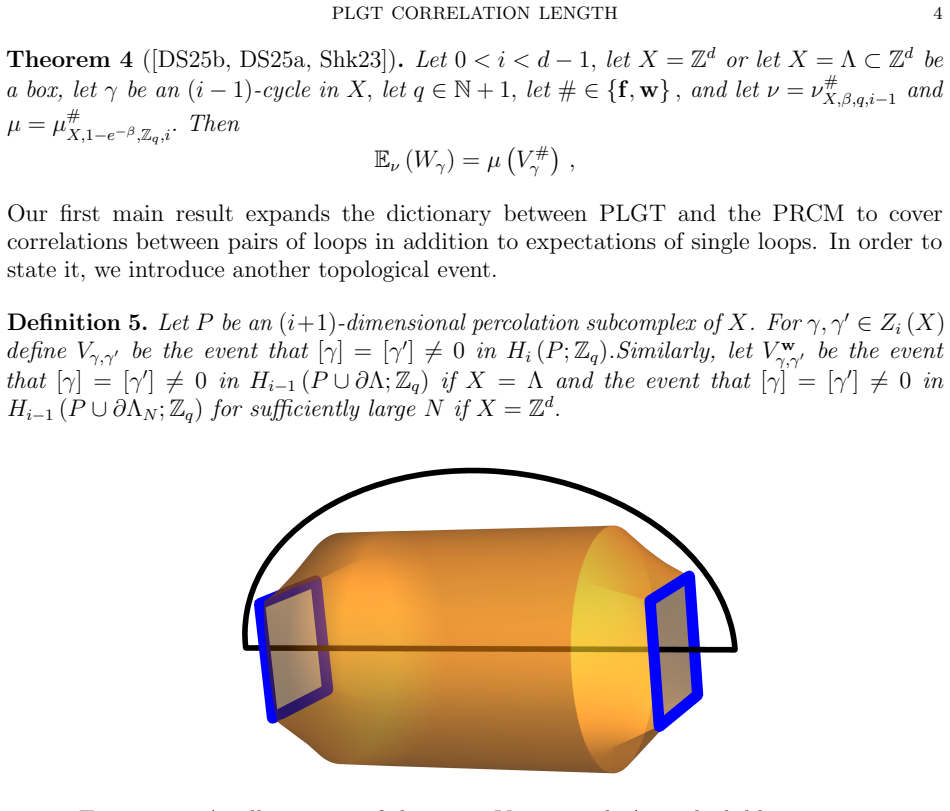
A Topological Formula for Potts Lattice Gauge Theory Correlations

The link yields equal correlation lengths across dual models and exponential decay away from criticality.

Figure from the paper full image
abstract click to expand
We exhibit a formula relating the correlation between Wilson loop variables in Potts lattice gauge theory to a topological quantity in the plaquette random cluster model. As applications we show that the correlation length of the model on $\mathbb{Z}^4$ with free boundary conditions equals that of the dual model with constant boundary conditions, we prove exponential decay of correlations between slowly growing Wilson loop variables for Ising lattice gauge theory on $\mathbb{Z}^3$ at all but the critical temperature, and we demonstrate that the correlation length is finite at sufficiently high or low temperatures in any dimension.
0
0
math.CT 2026-07-03

Directed univalence holds for simplicial objects in any ∞-topos

by Evan Cavallo, Emily Riehl +1 more

Directed univalence for simplicial objects in an infty-topos

Equivalence of hom types in the universal left fibration with function types validates the axiom in this semantic model.

abstract click to expand
A fundamental component of homotopy type theory, a synthetic theory of $\infty$-groupoids, is Voevodsky's univalence axiom. Univalence characterizes the identity types in the universal fibration, a classifier for small type families: identity types in the universe are equivalent to types of equivalences. The directed univalence axiom plays a similar foundational role in simplicial type theory, a synthetic theory of $\infty$-categories. In its original form, which does not include universes or directed univalence, the simplicial type theory has semantics in categories of simplicial objects in an $\infty$-topos, with synthetic $\infty$-categories corresponding to internal $\infty$-categories. We verify that directed univalence holds in this semantic setting, constructing an equivalence between hom types in the universal left fibration and function types. In fact, we verify a higher version of this result, constructing an equivalence between homotopy coherent composites in the universal left fibration and composable sequences of functions between types. Using the technique of weighted limits, we reduce this theorem for simplicial objects in an arbitrary $\infty$-topos to calculations "on the left" with simplicial sets.
0
0
math.AT 2026-07-03

Twisted algebras over real spectra realized as Thom spectra

by Samik Basu, Abhinandan Das

Equivariant twisted R-algebras via Thom spectra

C2-actions on the circle produce switched multiplications, giving Thom formulas for real THH and computations for KR/2

abstract click to expand
For a $C_2$-commutative ring spectrum $R$, a twisted $R$-algebra is an $R$-module with a multiplication whose order is switched by the $C_2$-action. In this paper, we construct various quotients of $R$ as twisted $R$-algebras, when $R$ is an even real commutative ring spectrum. These are constructed as Thom spectra of maps out of suitable $C_2$-actions on $S^1$ and $U(n)$. One such example is given by $K\mathbb{R}$ which is endowed with a twisted $K\mathbb{R}$-algebra structure. Other examples include quotients such as $M\mathbb{R}/(2,x_1,\dots, x_{n-1})$ over the real bordism spectrum $M\mathbb{R}$, and the real $2$-periodic Morava $K$-theories as modules over the real Morava $E$-theory spectra. In the context of twisted $R$-algebras, one may consider the real topological Hochschild homology, and for Thom spectra, one has a nice formula again as a Thom spectrum. We use this to obtain computations for the real topological Hochschild homology of $K\mathbb{R}/2$ as a twisted $K\mathbb{R}$-algebra. The computation also involves a splitting of the units spectrum $gl_1K\mathbb{R}$, which is an analogue of the classical splitting of the units of $K$-theory.
0
0
math.AT 2026-07-03

Single polynomial detects T^k-manifold equivariant bordism

by Runze Chen, Zhi Lü +1 more

Reduced characteristic number criteria for equivariant bordism of T^k- and (mathbb{Z}₂)^k-manifolds with isolated fixed points

Reduced Chern-class criterion also yields linear lower bounds on Euler characteristic inside Kosniowski conjecture.

abstract click to expand
Classical equivariant bordism theories require computing the full collection of equivariant characteristic numbers to detect whether an equivariant manifold bounds equivariantly or not. This paper establishes simplified equivariant bordism characterizations for two families of equivariant manifolds with isolated fixed points: unitary $T^k$-manifolds and closed smooth $(\mathbb{Z}_2)^k$-manifolds. For any unitary $T^k$-manifold $M$ with isolated fixed points, we establish an equivariant unitary bordism criterion built entirely from a single polynomial of equivariant Chern classes. We further introduce the minimal distinguishing degree and obtain two key inequalities that capture the interplay between $\dim M$ and the Euler characteristic $\chi(M)$ through this minimal distinguishing degree. These inequalities settle the existence problem of a linear lower bound for $\chi(M)$ within the framework of Kosniowski's conjecture and partially verify the conjecture under natural admissible assumptions. We also provide an alternative proof settling the toric generalization of Kosniowski's conjecture when $\dim M=2k$. By contrast, for a closed smooth $(\mathbb{Z}_2)^k$-manifold with isolated fixed points, we derive a more concise equivariant bordism criterion relying solely on the powers of the top equivariant Stiefel-Whitney class. Our new criteria substantially reduce computational demands.
0
0
math.AG 2026-07-03

Gm tensor with mod-2 motivic cohomology is free on (2,1) generator

by Tom Bachmann, Robert Burklund +2 more

Motivic Hochschild homology of mod 2 motivic cohomology over algebraically closed fields

The computation over complex numbers yields a motivic analog of Bökstedt periodicity via tau comparisons and power operation relations.

abstract click to expand
We compute the tensor of the multiplicative group scheme with the mod-$2$ motivic cohomology spectrum in normed motivic spectra over the complex numbers, and find that the resulting algebra is free on a generator in bidegree (2,1). This gives a motivic analog of B\"okstedt periodicity. The proof proceeds by comparing the tau-inverted and tau-reduced forms of the tensor. After inverting tau, the calculation reduces to classical B{\"o}kstedt periodicity via Betti realization. The reduction modulo tau is governed by a comparison between normed algebra structures and derived algebra structures on cellular modules over motivic cohomology mod tau. This comparison produces divided power operations and leads to mixed Cartan and Adem relations intertwining normed and topological power operations. A key input is a detailed analysis of motivic extended powers of spheres and their tau-torsion structure. In contrast with the corresponding simplicial-circle calculation due to Dundas-Hill-Ormsby-{\O}stv{\ae}r, the large families of tau-torsion classes disappear for the Gm-tensor, leaving a considerably more rigid algebraic structure.
0
0
math.GT 2026-07-03

Augmented racks constructed for reflection group braid spaces

by Tathagata Basak

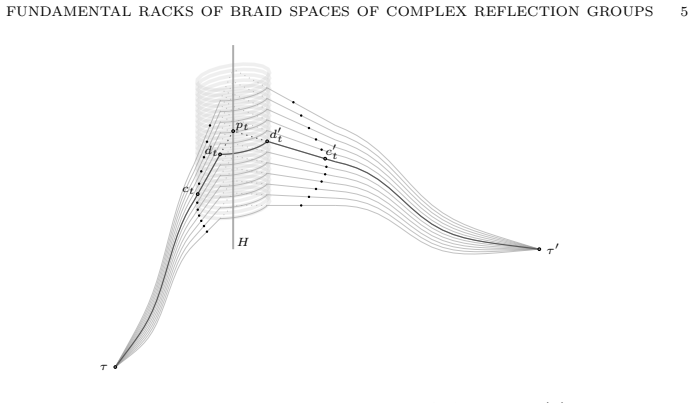
Fundamental racks of braid spaces of complex reflection groups

The construction yields representations of the orbifold fundamental group on rack space cohomology.

Figure from the paper full image
abstract click to expand
Let $\Gamma$ be a complex reflection group acting on the complex affine or hyperbolic space $X$ with the set of reflecting hyperplanes $\mathcal{H}$. We define an augmented rack $(G, \mathcal{K}, p)$ associated to the orbifold fundamental group $G := \pi_1^{\operatorname{orb}}( \Gamma \backslash (X - \mathcal{H}))$ which plays the role of the fundamental rack of a framed link complement as defined by Fenn and Rourke. This yields representations of the orbifold fundamental group $G$ on the cohomology of the associated rack space.
0
0
math.SG 2026-07-03

Kuranishi chart categories satisfy higher cocycle conditions automatically

by Taesu Kim

Kuranishi chart categories and higher cocycle conditions

A homotopy-theoretic property ensures the condition holds, relaxing rigid requirements in Kuranishi spaces.

abstract click to expand
Given an $L_\infty$-Kuranishi space introduced in \cite{Kim1}, we propose a notion called the Kuranishi chart category. Using the nerve of this category, together with a choice of atlas and a simplicial description of the covering of the underlying topological space, we formulate a higher homotopical version of the bundle-component cocycle condition. We show that this condition is always satisfied, by virtue of a property of the higher homotopy theory of $L_\infty[1]$-morphisms developed in \cite{Kim2}, concerning quasi-isomorphisms. As a consequence, the rigid cocycle condition of Fukaya-Oh-Ohta-Ono Kuranishi spaces is replaced by more flexible, homotopy-theoretic compatibility.
0
0
math.AT 2026-07-02

Unit sheaf endomorphisms recover the E∞-Thom spectrum

by Kenneth Blakey, Liam Keenan

A homotopy coherent Pontryagin-Thom isomorphism

This supplies an E∞-ring lift of the Pontryagin-Thom isomorphism between geometric cobordism cohomology and the associated Thom spectrum.

abstract click to expand
Classically, the Pontryagin-Thom isomorphism asserts that the multiplicative cohomology theory given by (structured) geometric cobordism is isomorphic to the cohomology theory determined by an associated Thom spectrum. We construct a presentably symmetric monoidal stable $\infty$-category of homotopy invariant sheaves with transfers on smooth manifolds whose unit is precisely (structured) geometric cobordism. We show the endomorphism ring of the unit sheaf can be canonically identified with the associated $\mathbb{E}_\infty$-Thom ring spectrum, i.e., we provide an $\mathbb{E}_\infty$-lift of the Pontryagin-Thom isomorphism.
0
0
math.SG 2026-07-02

L∞-Kuranishi spaces form category embedding smooth manifolds

by Taesu Kim

Categorical structures of Kuranishi spaces with L_(infty)[1]-algebras

Replacing tangent-bundle conditions with quasi-isomorphisms of L∞[1]-structures yields the categorical structure.

abstract click to expand
We introduce $L_{\infty}$-Kuranishi spaces by associating, to each chart, $L_{\infty}[1]$-algebras defined on open neighborhoods of points in the zero locus of the Kuranishi section. We show that these objects collectively form a category into which the category of smooth manifolds naturally embeds. Some notions in \cite{FOOO1} are modified to achieve the desired categorical structures; for instance, the tangent bundle condition for chart embeddings is replaced by a quasi-isomorphism condition for the $L_{\infty}[1]$-structures.
0
0
math.GR 2026-07-02

Pro-2 Demushkin groups have A3-formal cochain algebras

by Ambrus Pál, Gereon Quick

A₃-formality for pro-2 Demushkin groups

Explicit computation of the obstruction class via their classification confirms the weak formality over F2.

abstract click to expand
We study a weak form of formality for differential graded algebras, called $A_3$-formality, and show that the differential graded $\mathbb{F}_2$-algebras of continuous cochains of all pro-$2$ Demushkin groups are $A_3$-formal. We prove this result by an explicit computation of the Benson--Krause--Schwede canonical class using the classification of pro-$2$ Demushkin groups by Demushkin, Serre, and Labute. Compared to the case of odd primes, the new idea is to interpret the data of the canonical class as defining systems of higher Massey products.
0
0
math.AT 2026-07-02

Lie group actions build universal covers from discrete extensions

by Jules Chenal

Polar Coordinates and Fundamental Group

When the action admits a simply connected cross-section, the universal cover is formed by extending the Lie group with a discrete group.

Figure from the paper full image
abstract click to expand
In this article, we investigate the relationship between the fundamental group of a space and its continuous transformations. To be more precise, we show that if a continuous action of a Lie group on a space admits a simply connected cross-section, then we can build the universal covering of the space using an extension of the Lie group by a discrete group.
0
0
math.AT 2026-07-01

Six functors prove ANR homology manifolds are cohomologically smooth

by Markus Land, Marco Volpe

Homology manifolds via six functor formalisms

Compact cases are Poincaré duality complexes with Spivak tangent fibration matching the dualizing sheaf, and conical singularities force top

abstract click to expand
We study homology manifolds through the eyes of the six functor formalism of spectral sheaves on locally compact Hausdorff spaces. As main results, we characterize cohomologically smooth objects by adapting an argument of Scholze, deduce that any hypercomplete locally compact ANR homology manifold is cohomologically smooth, show that compact ANR homology manifolds $X$ are Poincar\'e duality complexes whose Spivak tangent fibration identifies with the dualizing sheaf of $X$, and prove a generalization of Wilder's monotone mapping theorem about cell-like maps. Moreover, we introduce the notion of homotopy manifolds for which we prove an unstable analog of Wilder's orientability conjecture and show that hypercomplete ANR homology manifolds are homotopy manifolds. As a consequence, we show that for a compact $d$-dimensional ANR homology manifold, the Spivak tangent fibration of its associated Poincar\'e duality complex canonically destabilizes to a pointed $S^d$-fibration. Finally, we introduce homotopy manifolds with conical singularities, a generalization of Cohen's triangulated homotopy manifolds, and show that such objects are in fact topological manifolds, generalizing a result of Siebenmann. Along the way, we obtain comparisons between sheaf and singular cohomology and between the shape and the weak homotopy type of a topological space, explore the relation between various notions of cohomological dimension and hypercompleteness, and study six functor formalisms satisfying the K\"unneth formula.
0
0
math.AT 2026-07-01

Tate varieties yield algebraic models for tame configuration space homotopy

by Joana Cirici, Geoffroy Horel

On the l-adic homotopy type of configuration spaces

Models from étale cohomology weights encode l-adic homotopy data and extend to general arrangement complements.

abstract click to expand
We give algebraic models for the tame homotopy type of the configuration spaces of certain algebraic varieties of Tate type. Such tame models carry information on the l-adic homotopy type. Our method uses the theory of weights in \'etale cohomology, and also produces models for more general arrangement complements, both in the tame sense and over the rationals.
0
0
math.AT 2026-07-01

Manifolds with vanishing L2-Betti numbers avoid virtual circle fibering

by Sam Hughes, Ian Leary +1 more

Some closed manifolds that do not fibre over the circle

Examples in dimensions three and higher show residual torsionfree nilpotence is insufficient for virtual algebraic fibering.

abstract click to expand
We construct closed manifolds with vanishing L^2-Betti numbers over every field) which do not virtually fibre over the circle. The class of fundamental groups that occurs is the largest possible, and in many cases the dimension may be taken to be six. We construct aspherical closed manifolds with residually (torsionfree and nilpotent) fundamental groups in all dimensions at least three whose L^2-Betti numbers vanish (over every field) and which do not virtually fibre over the circle. In particular this implies that in Kielak's Theorem about virtually algebraic fibring for RFRS-groups one cannot weaken the condition RFRS to residually (torsionfree and nilpotent.
0
0
math.AT 2026-06-30

Component dynamics graphs extract H0 H1 barcodes for video

by David Lanners

From Frames to Features: Scalable Zigzag Persistence for Binary Video

Bypassing cubical complexes enables real-time 4K zigzag persistence via linear-time graph construction on consumer hardware.

Figure from the paper full image
abstract click to expand
Zigzag persistence tracks topological features in spatio-temporal data through combinatorial invariants called barcodes. For binary videos, existing methods are bottlenecked by the construction of prohibitively large cubical complexes and performing Gaussian elimination on large boundary matrices, rendering high-resolution videos out of reach. We show that the $H_0$ and $H_1$ barcodes can be extracted directly from connected-component dynamics. By encoding these dynamics in a graph, we bypass cubical complexes entirely and are able to leverage the near-linear time barcode decomposition algorithm by Dey and Hou, leading to significant speedups. The total runtime of our pipeline is dominated by the construction of the underlying graph structures, which scales linearly with pixel count and is embarrassingly parallel across frames, ensuring excellent scalability. We demonstrate how this approach enables zigzag persistence on 4k video at real-time rates on consumer hardware.
0
0
math.AT 2026-06-30

Algebraic C_+ computes continuous homology of TP(MU)

by Sverre Lun{o}e-Nielsen, John Rognes

Continuous homology of topological periodic homology of complex cobordism

The construction supplies the E2-term of a multiplicative Adams-type spectral sequence to p-completed homotopy groups.

Figure from the paper full image
abstract click to expand
We determine the continuous mod $p$ homology of the topological periodic homology $TP(MU)$ of the complex cobordism spectrum, as a graded algebra with Steenrod operations. The answer is given in terms of an explicit and purely algebraic construction $C_+$, analogous to Singer's construction $R_+$. Its $Ext$-algebra provides the $E_2$-term for a multiplicative Adams-type spectral sequence converging strongly to the homotopy of $p$-completed $TP(MU)$.
0
0
math.AT 2026-06-30

Explicit chain map equates equivariant cohomologies of slices and orbits

by Zhenxi Huang

Equivariant cohomology of slice groupoids

The map on Weil and Cartan models shows local neighborhood cohomology reduces exactly to the slice at a point.

abstract click to expand
Let $G$ be a compact Lie group, $M$ be a smooth manifold with a $G$ action, then all the data of this model is contained in the action groupoid $G\ltimes M$. If $U_y$ is a small enough neighbourhood of $y\in M/G$, the slice theorem says that \begin{equation*} \pi^{-1}(U_y)=S_{x}\times_{G_{x}} G \end{equation*} where $x$ is a point in the $y$ orbit, $S_x$ is the slice of $x$ and $G_x$ is the isotropy group of $x$. An alternative approach to describe group actions on spaces is through the language of groupoids. Local properties of Lie groupoids are often studied via linearization theorems. One can compute the equivariant cohomology $H_G(\pi^{-1}(U_y))$ of $\pi^{-1}(U_y)$ using the Weil model or the Cartan model. Also by the homotopy theory, the equivariant cohomologies $H_G(\pi^{-1}(U_y))$ and $H_{G_x}(S_x)$ are isomorphic. In this paper, we explicitly construct a natural chain map between the Weil (or Cartan) models of $(\pi^{-1}(U_y), G)$ and $(S_x, G_x)$, and prove that it induces an isomorphism in equivariant cohomology. We then introduce the notion of slice (or local linearizable) groupoids, which are locally modeled on Lie group actions on manifolds with gluing data, several examples and applications are discussed. In the last section, we generalize the equivariant theory to these groupoids using sheaf-theoretic methods. We further show that the equivariant cohomology is invariant under Morita equivalence.
0
0
math.GT 2026-06-30

Instanton TQFT becomes functor between infinity-categories

by Fan Ye

An infinity-categorical TQFT from instantons

The lift reinterprets metric families on cobordisms and supplies chain-level homotopies for cap-product operators.

Figure from the paper full image
abstract click to expand
In this paper, we upgrade the instanton TQFT from ordinary categories to a functor $CI$ from an $\infty$-cobordism category $\mathrm{BI}$ for instantons to an $\infty$-derived category $\mathsf{D}$ of $2$-periodic chain complexes and sums of homogeneous chain maps. The construction of $\mathrm{BI}$ is a modification of the $\infty$-cobordism category $\mathrm{Bord}_4$ constructed by Lurie and Calaque--Scheimbauer via complete Segal spaces. The construction of $\mathsf{D}$ follows from the dg-nerve of a dg-category of $2$-periodic chain complexes over finitely generated projective modules over $\mathbb{Z}$. The information encoded in the functor $CI$ was already developed by Kronheimer--Mrowka using families of metrics on cobordisms, but our reinterpretation through $\infty$-categories simplifies the construction of the hypercube of chain complexes for the link spectral sequence. In addition, we upgrade the generalized cap product $\mu$-operators in instanton Floer homology to the chain level and construct explicit homotopies and higher homotopies for commutativity of multiple $\mu$-operators in even degrees.
0
0
cs.LG 2026-06-30

Topological vectorizations sometimes boost chatbots on small data

by Nithisha Raghavaraju, Barbara Giunti +1 more

Comparing Chatbot Performance Enhanced with Persistent Homology

Experiments find occasional large gains when persistent homology features are added to inputs without extra data or tuning.

abstract click to expand
Chatbots have become increasingly prevalent across various domains, offering automated assistance in many areas, especially mental health support. The training is done using extremely large datasets, which are sometimes not available in very specific domains. Moreover, it would sometimes be ideal to train the chatbot with personal information about the patients, which, of course, cannot be done on shared servers since it would violate patient confidentiality. Hence, being able to improve the performance of a chatbot, possibly trained locally and on a restricted dataset, without having to increase the dataset itself, would be extremely beneficial. In this work, we will enhance the input datasets using persistent homology (PH) vectorizations computed from the raw datasets themselves. Then we will compare, across several metrics, the performance of multiple chatbot models with or without the PH enhancement. Our experiments suggest that, while at times the PH enhancement is not particularly beneficial, it sometimes brings remarkable advantages for virtually no cost.
0
0
math.AT 2026-06-29

James-Hopf invariant fixed uniquely by Cartan formula and EHP property

by John R. Klein

A note on the second James-Hopf invariant

Stabilized second version is the only natural transformation that vanishes on suspensions and meets the metastable condition.

abstract click to expand
This paper characterizes the stabilized second James-Hopf invariant by means of three axioms. Specifically, we show that it is the unique natural transformation satisfying the Cartan formula, vanishing on suspensions, and a metastable EHP property. The proof combines the natural stable splitting of the James construction with Goodwillie calculus.
0
0
math.GR 2026-06-29

Binomial cup1 dgas yield pronilpotent groups matching pi1 R-completions

by Richard D. Porter, Alexander I. Suciu

Groups associated to 1-minimal models for binomial cup₁-algebras

The group depends only on the 1-quasi-isomorphism type of the algebra and recovers the known completion of the fundamental group for spaces.

abstract click to expand
We give an explicit, cochain-level algebraic model for the pronilpotent completion of a group with finitely generated first cohomology. To each binomial $\cup_1$-dga $(A,d_A)$ over $R=\mathbb{Z}$ or $\mathbb{F}_p$ ($p$ prime) -- a differential graded algebra endowed with a Steenrod $\cup_1$-product and a compatible binomial operation -- we associate a pronilpotent group $G(A)$ that depends only on the 1-quasi-isomorphism type of $A$, provided $H^0(A)=R$ and $H^1(A)$ is a finitely generated free $R$-module. This group arises functorially from the 1-minimal model of $A$, which is unique up to isomorphism. When $A=C^*(X;R)$ is the cochain algebra of a connected CW-complex $X$ with $H^1(X;R)$ finitely generated, the group $G(A)$ recovers the Bousfield--Kan $R$-completion of $\pi_1(X)$ when $R=\mathbb{F}_p$, and its pro-torsion-free-nilpotent completion when $R=\mathbb{Z}$. Moreover, the group $G(A)$ comes equipped with a natural inverse system $\{G_n(A)\}_{n\ge 1}$ whose structure maps $G_{n+1}(A)\to G_n(A)$ are surjective. If $A=C^*(X;R)$, then $G_n(A)$ is the quotient of $\pi_1(X)$ by the $(n+1)$th term of the fastest descending central series whose successive quotients are free $R$-modules. We give a purely algebraic necessary and sufficient criterion that, given an isomorphism $G_n(A)\cong G_n(B)$, determines whether $G_{n+1}(A)\cong G_{n+1}(B)$, and we illustrate the use of this criterion with examples distinguishing spaces with isomorphic cohomology rings.
0
0
math.AT 2026-06-29

Oriented polytopes present (∞,∞)-categories as sheaves

by David Gepner, Hadrian Heine

An Oriented Street--Roberts Conjecture

The presentation generalizes the Street-Roberts conjecture and derives geometric formulae for operations such as the Gray tensor.

abstract click to expand
We formulate a notion of oriented polytope, including Street's oriented simplices and Gray's oriented cubes, and use this to prove an oriented version of the Street--Roberts conjecture, presenting $(\infty,\infty)$-categories as sheaves on suitable families of oriented polytopes, generalizing work of Campion. This allows us to understand $(\infty, \infty)$-categories from a geometric perspective, as directed analogues of homotopy types. These familes of oriented polytopes induce basic operations in higher category theory: for instance, the join, Gray tensor, and bicone arise from the geometry of the orientals, cubes, and orthoplexes, respectively. We study the interaction of these operations and derive some geometric formulae, generalizing work of Ara--Maltsiniotis, Verity, and others.
0
0
math.AT 2026-06-29

Model extends A_infty homotopies to L_infty[1] with simplex filling

by Taesu Kim

Homotopy models for L_(infty)[1]-algebras in higher degrees

The framework proves that simplices whose vertices are quasi-isomorphisms admit fillings, supplying higher homotopies for L_infty[1]-morphis

abstract click to expand
We propose a model of higher homotopy theory of $L_{\infty}[1]$-morphisms as a natural generalization of the $A_{\infty}$-homotopies defined by Fukaya-Oh-Ohta-Ono \cite{FOOO1}. Within this framework, we show that a filling condition holds for simplices whose vertices are assigned quasi-isomorphisms.
2 0
0
math.AT 2026-06-29

Quasisymmetric cubical sets equate discrete and geometric homotopy groups

by Daisuke Kishimoto, Yichen Tong

Discrete homotopy groups of cubical sets

A combinatorial left adjoint whose unit is a weak equivalence transfers the isomorphism to all cubical sets.

abstract click to expand
We extend the notion of discrete homotopy groups of graphs to arbitrary cubical sets, and show that the discrete homotopy groups of quasisymmetric cubical sets are naturally isomorphic to the homotopy groups of their geometric realizations. Here, quasisymmetric cubical sets are cubical sets equipped with coordinate permutation symmetries that are compatible with faces and degeneracies, but not necessarily with connections. We give a purely combinatorial construction of the left adjoint of the forgetful functor from the category of quasisymmetric cubical sets to the category of cubical sets, and prove that the unit of this adjunction is an objectwise weak equivalence. As a consequence, we obtain a purely combinatorial description of the homotopy groups of the geometric realizations of arbitrary cubical sets. As an application, we establish the Hurewicz theorem for the discrete homotopy groups of quasisymmetric cubical sets.
0
0
math.AT 2026-06-29

Generalized Euler characteristics interpreted via Morava E-theories

by Gijs Heuts, Irakli Patchkoria

Chromatic Euler characteristics and duality for infinite groups

For infinite groups with finite proper universal spaces, a new duality on equivariant spectra implies vanishing results for generalized Farr

abstract click to expand
We study a family of generalizations of the notion of Euler characteristic of discrete groups (or of orbifolds, depending on one's perspective) indexed on the natural numbers. For $n=0$, this is the classical orbifold Euler characteristic as studied by Wall and Serre, whereas for $n \geq 1$ and finite groups, this is the chromatic cardinality as studied by Ben-Moshe--Carmeli--Schlank--Yanovski. For general $n$, we show that our generalized Euler characteristic admits a natural interpretation in terms of the Morava $E$-theories. Our work involves showing that the generalized cohomology of infinite groups $G$ with finite universal space for proper actions $\underline{E}G$ has a good theory of duality, as expressed by a new duality functor on the category of proper $G$-equivariant spectra. In particular, for such groups we prove the vanishing of Klein's generalized Farrell--Tate cohomology with $T(n)$-local coefficients. We compute our generalized orbifold Euler characteristics in a large number of examples. This includes many mapping class groups, where the classical calculation is a result of Harer--Zagier, and many arithmetic groups, whose classical orbifold Euler characteristics were computed by Harder.
0
0
math.AT 2026-06-29

Cohomology of parallelized n-manifolds gains homotopy Frobenius structure

by Florian Naef, Thomas Willwacher

Homotopy Frobenius structures on the cohomology of a manifold

Quillen equivalence with Poisson cooperad comodules transfers the operations, extending the rational homotopy type.

abstract click to expand
We show that the category of lax involutive $n$-Frobenius algebras is Quillen equivalent to the category of right comodules of the $n$-Poisson cooperad. It follows in particular, that the cohomology of a parallelized $n$-manifold is naturally endowed with a homotopy involutive $n$-Frobenius structure extending the rational homotopy type of $M$, solving a long-standing question.
0
0
math.CT 2026-06-26

Lax grids let Gray tensor product arise by Day convolution

by Shai Keidar, Leor Neuhauser

The Gray Product of (infty, n)-Categories via Lax Grids

Segal sheaves on these pasting diagrams match Campion's construction and support Gray algebra on cobordism categories.

abstract click to expand
We introduce a new model for $(\infty,n)$-categories as Segal sheaves on lax grids, which are pasting diagrams of lax cubes. This model allows for a direct construction of the Gray tensor product via Day convolution. We show that this agrees with Campion's construction of the Gray tensor product. These results will be applied in future work to equip the higher categories of cobordisms with a Gray-algebra structure given by the cartesian product of manifolds.
0
0
math.AT 2026-06-26

Realification and stabilisation are homomorphisms on bundle groups

by Guy Boyde, Niall Taggart

Realification of stably trivial vector bundles

For stably trivial complex bundles over projective spaces and spheres of small corank, the two operations respect the group law and can be c

Figure from the paper full image
abstract click to expand
The set of stably trivial complex vector bundles over complex projective spaces and spheres has a natural group structure when the corank is small enough. With respect to this group structure, the operations of taking the underlying real vector bundle (realification) and of adding a trivial line bundle (stabilisation), are group homomorphisms. Building on Hu's recent enumerations of stably trivial complex bundles, we compute these homomorphisms in a range by using Weiss calculus to translate the problem to stable homotopy theory.
0
0
math.AT 2026-06-26

Chain complexes compute configuration-space homology in positive characteristic

by Najib Idrissi, Victor Roca i Lucio

Homology of configuration spaces in positive characteristic via point-set constructions

Lifting Knudsen's theorem supplies explicit models and new spectral sequences over fields of prime characteristic.

Figure from the paper full image
abstract click to expand
The first goal of this paper is to provide concrete chain complexes computing the homology of (unordered) configuration spaces of manifolds in positive characteristic, lifting a theorem by Knudsen to the model category level. We make them fully explicit and provide a computer program to compute their homology. Our methods also allow us to construct several new spectral sequences converging to these homology groups. Finally, we conjecture that this equivalence of chain complexes can be promoted to an equivalence of \emph{twisted} $\EE_\infty$-coalgebras in right $\EE_d$-modules, and we explain how this conjecture would imply the homotopy invariance of the $\EE_d$-homotopy type of configuration spaces in positive characteristic via new ``twist'' and ``detwist'' functors.
0
0
math.AT 2026-06-26

Sandpile dynamics produce avalanche homology on digraphs

by Henri Riihimäki, Jason P. Smith

Avalanche homology of digraphs via sandpile dynamics

Unstable vertex sets across time steps form a complex whose homotopy types are computed for paths and cycles.

Figure from the paper full image
abstract click to expand
We introduce avalanche homology as a new (di)graph homology theory, based on the dynamics of the sandpile model. Avalanche homology is the simplicial homology of the avalanche complex generated from the sets of unstable vertices at the time steps of the sandpile dynamics. In this work we focus on digraphs, and our main results give the homotopy types of the avalanche complex for directed paths and directed cycles for certain initial configurations of the sandpile dynamics. Even for such simple digraphs a wide range of topologies can arise, and we compare this to the directed flag complex and to the recently introduced burning homology. Furthermore, the dynamics yields very naturally a filtered simplicial complex, and hence persistent avalanche homology.
0
0
math.NT 2026-06-25

Homology vanishing lines bound Gauss sum bias over function fields

by Zhao Yu Ma

Optimal homological vanishing: cancellation of character sums and Patterson's conjecture over mathbb{F}_q[t]

Explicit lines from finite n data converge to optimal slope, extending Patterson's conjecture to higher orders.

Figure from the paper full image
abstract click to expand
Many arithmetic sums over function fields can be expressed in terms of $H_i(B_n, V^{\otimes n})$ for some braided vector space $V$, and a vanishing line for these homology groups gives power-savings cancellation for the arithmetic sum. We prove an explicit vanishing line for $H_i(B_n,V^{\otimes n})$ depending only on the homology up to some finite $n$. Moreover, as the range of $n$ increases, the slope of the resulting vanishing line converges to the optimal slope. We also apply our methods to two different families of arithmetic sums. Firstly, we prove an upper bound for the bias of higher order Gauss sums over function fields, extending Patterson's conjecture beyond the cubic and quartic cases over number fields, and we conjecture this bound is sharp for orders that are prime powers. Secondly, we show that over Galois $G$-extensions, almost all character sums exhibit near square-root cancellation.
0
0
math.DS 2026-06-25

Singular flows give dynamical formulas for intersection homology

by Jean-Paul Brasselet, Dahisy Lima +1 more

Singular Morse-Smale Flows on Pseudomanifolds with Spherical-Cone Singularities: Conley Theory and Intersection Homology

Morsification turns pseudomanifolds with cone singularities into smooth manifolds whose Morse homology recovers intersection homology via Co

Figure from the paper full image
abstract click to expand
Classical Morse-Conley theory provides powerful tools for relating dynamical and topological invariants of smooth manifolds. In this paper, we extend this perspective to pseudomanifolds with spherical-cone singularities. By introducing and investigating singular Morse-Smale flows on pseudomanifolds with isolated singularities whose links are homeomorphic to finite disjoint unions of spheres. We establish formulas for the Conley indices of spherical-cone singularities in terms of their local dynamics, prove the existence of global Lyapunov functions, and investigate the structure of the associated Lyapunov graphs. These results yield alternative formulas for the Euler-Poincar\'e characteristic expressed in terms of Conley-theoretic invariants. To relate the singular and smooth settings, we introduce a global morsification procedure that associates a smooth manifold $\widetilde{X}$ to a singular pseudomanifold $X$. This construction allows us to compare the topology of $X$ and $\widetilde{X}$ and, in particular, to derive formulas relating their Euler-Poincar\'e characteristics. Finally, we study the intersection homology of pseudomanifolds with spherical-cone singularities. We establish connections between intersection homology, singular homology, and the Morse homology of the morsification, thereby providing a dynamical approach to the computation of intersection homology.
0
0
math.AT 2026-06-25

Smooth Artin motives match Bredon modules for étale fundamental group

by Yorick Fuhrmann

Profinite Borel completeness and smooth Artin motives

Nisnevich case extends Voevodsky theorem; étale case equates completeness notions with sheaves versus hypersheaves.

abstract click to expand
The purpose of this paper is twofold. In the first part, we revisit the description of the $\infty$-category of Borel complete equivariant spectra for a finite group given by Mathew-Naumann-Noel, introduce a version with coefficients, and then consider Borel equivariance for profinite groups. Here we identify two generally differing notions: levelwise Borel completeness and the hypercompletion thereof. In the second part, we study variants of smooth Artin motives, which are subcategories of the $\infty$-categories of effective Nisnevich and \'etale Voevodsky motives over a base scheme $S$ that are controlled by the \'etale fundamental group $\pi_1^{\mathrm{\'et}}(S)$. In the Nisnevich case, we extend a theorem of Voevodsky and identify smooth Artin motives with modules over the Bredon cohomology spectrum for the profinite group $\pi_1^{\mathrm{\'et}}(S)$. In the \'etale case, we show that the difference between our two notions of profinite Borel completeness is precisely the difference between \'etale sheaves and hypersheaves on finite \'etale schemes.
0
0
math.AT 2026-06-25

Real bordism quotients equipped with ring involution

by Ryan Quinn, Qi Zhu

Structured Quotients in Real Homotopy Theory

The structure orients Lubin-Tate theory and identifies which truncated Brown-Peterson spectra match it after chromatic localization.

abstract click to expand
We equip quotients of Real bordism with the structure of a ring involution, an important source of examples being the truncated Real Brown-Peterson spectra. Motivated by this, we orient Lubin-Tate theory by higher truncated Brown-Peterson spectra, which is a key input for Meier-Shi-Zeng's transchromatic isomorphism theorem. We use these orientations to characterize the higher truncated Brown-Peterson spectra that are equivalent to a form of Lubin-Tate theory after chromatic localization.
0
0
math.GR 2026-06-25

Non-proper actions yield polynomial homological Dehn functions

by Roman Sauer, Jannis Weis

Polynomial homological Dehn functions from non-proper actions

A homological algebra framework establishes the bounds and a combination theorem for groups.

abstract click to expand
We establish a homological algebra framework for proving polynomiality of higher homological Dehn functions of groups. As an application, we show a combination theorem for polynomial Dehn functions, which is reminiscent of a theorem of Brown for finiteness properties.
0
0
math.AT 2026-06-24

Hodge spectra relax discrete topology into smooth losses

by Satoshi Kanno, Yoshi-aki Shimada

Hodge Spectral Surrogates for Topology-Constrained Optimization

Soft clique complexes and low-pass filters supply distributed gradients for point clouds and graphs with target homology.

abstract click to expand
Topological information is widely used in data analysis, network design, and machine learning, and topological constraints naturally arise when optimizing or generating objects with prescribed homological structure. However, directly controlling Betti numbers and persistent homology is difficult because they are discrete and combinatorial. We propose a differentiable framework for topology-constrained optimization based on Hodge-spectral relaxations of homological constraints and low-pass spectral filters. From soft graphs and soft clique complexes, we construct Hodge-Laplacian-type spectral relaxations that unify graph clique complexes and Vietoris--Rips filtrations of point clouds. In the hard limit, the penalty-regularized ambient operator recovers the ordinary Hodge Laplacian on the active subcomplex, while in the soft regime it serves as a differentiable low-frequency spectral surrogate. Homological information is represented by zero and near-zero modes, and differentiable topological objectives are defined using heat filters, resolvent filters, and polynomial Laplacian moments. For point clouds, we show that the proposed Hodge spectral-filter losses yield more spatially distributed gradients, smoother scale-normalized behavior under persistence-pairing changes, and geometry-aware update directions than persistent-homology-based losses. For graph clique complexes, Laplacian moments control normalized first-Betti-type quantities and can be combined with ordinary graph-feature objectives. We also discuss connections to trace-based normalized Betti-number estimation, polynomial spectral methods, and possible quantum trace estimation.
0
0
math.CO 2026-06-24

Transfer systems form matroids only for cyclic p-groups

by Yuri J. F. Sulyma

Transfer systems give matroids only for cyclic p-groups

Minimal generating sets obey the matroid axioms solely for linear-order lattices and cyclic prime-power groups, where invariants become comp

abstract click to expand
Transfer systems as studied in equivariant algebra admit minimal generating sets, analogous to bases in linear algebra. It is natural to wonder if minimal generating sets form a matroid. We show that this happens only for lattices which are linear orders, or for cyclic groups of prime power order. In this case, we compute some invariants of the resulting matroid.
0
0
math.AT 2026-06-24

 is weakly equivalent to B haut(A)

by Jiahao Li

On the Classifying Space of Homogeneous Functors

The equivalence proves Tsopméné and Stanley's conjecture and extends Weiss classification to arbitrary simplicial model categories.

Figure from the paper full image
abstract click to expand
Let $M$ be a manifold and let $\mathcal{M}$ be a simplicial model category. Given an object $A$ in $\mathcal{M}$, Tsopm\'en\'e and Stanley constructed a topological space $\hat{A}$ that classifies homogeneous functors of degree $k$ from the poset of open subsets of $M$ into $\mathcal{M}$. They showed that the set of weak equivalent classes of such functors that maps disjoint union of $k$ open balls to $A$ is in bijection with the set $[F_k(M), \hat{A}]$ of homotopy classes of maps out of $F_k(M)$, the unordered configuration space of $k$ points in $M$. In this paper, we begin a study of the space $\hat{A}$, and we prove that $\hat{A}$ is weakly equivalent to the classifying space $B\mathrm{haut}(A)$, where $\mathrm{haut}(A)$ is the simplicial monoid of self weak equivalences of $A$. This proves a conjecture of Tsopm\'en\'e and Stanley. Our result enables us to generalize the classification of homogeneous functors of Weiss for $\mathcal{M}=\mathcal{T}\mathrm{op}$ to any simplicial model category.
0
0
math.DG 2026-06-24

Equivalence maps transitive L∞ algebroids to L∞ spaces

by Alberto S. Cattaneo, Shuhan Jiang

From L_infty algebroids to L_infty spaces: Part I

The correspondence detects weak equivalences and is accompanied by a faithful functor that does the same.

abstract click to expand
The notion of $L_\infty$ spaces over dg manifolds is developed. An equivalence between the category of transitive $L_\infty$ algebroids and that of $L_\infty$ spaces is established, and this equivalence detects weak equivalences. Moreover, a faithful functor from $L_\infty$ algebroids to $L_\infty$ spaces is constructed, which also detects weak equivalences.
0
0
math.GT 2026-06-24

Genus-one differential strata with four or more singularities are never orbifold K(π,1)

by Dawei Chen, Jingyin Huang +2 more

Non-asphericity of strata of genus-one differentials and stability spaces

Result supplies counterexamples to Kontsevich conjecture on quadratic differentials and to conjectures on contractible stability spaces.

abstract click to expand
We show that when the number of zeros or poles is at least four, every connected component of the strata of differentials in genus one with prescribed zero and pole orders is not an orbifold $K(\pi,1)$. For quadratic differentials, this provides infinitely many counterexamples to a conjecture attributed to Kontsevich, as well as to a folklore conjecture concerning the contractibility of spaces of Bridgeland stability conditions.
0
0
math.DG 2026-06-23

L∞ spaces over dg manifolds form fibrant object category

by Shuhan Jiang

Homotopy theory for curved L_infty spaces

The result equips curved L∞ structures and their transitive algebroids with homotopy theory axioms on dg manifolds.

abstract click to expand
This paper proves that $L_\infty$ spaces over a dg manifold form a category of fibrant objects. Together with the first main result of the companion paper [CJ26], this implies that transitive $L_\infty$ algebroids over a dg manifold also form a category of fibrant objects.
0
0
math.AG 2026-06-23

Tannakian duality unifies etale

by Loris De Vos

\'Etale Fundamental Groups -- a geometric and topological approach to fundamental groups in algebraic geometry

Fundamental groups arise as automorphisms of fibre functors, placing motivic Galois groups in the same framework.

abstract click to expand
This thesis explores the notion of fundamental groups across three mathematical settings. We begin with the classical topological theory of covering spaces, highlighting its structural analogy with Galois theory. We then follow Grothendieck in transporting these ideas to algebraic geometry. The inadequacy of the Zariski topology motivates the \'etale topology, from which the \'etale fundamental group is constructed and compared to its topological counterpart via transcendental methods. Finally, we linearise the theory through Tannakian duality, where fundamental groups are recovered as automorphism groups of fibre functors on certain monoidal categories, a framework broad enough to encompass \'etale, topological, and motivic Galois groups alike.
0
0
math.KT 2026-06-23

Goncharov coalgebra gives weight-3 K-theory via polylogarithms

by Alexander Kupers, Daniil Rudenko +1 more

The Goncharov Lie coalgebra of a field

Symbolic descriptions for rational K4(3) and indecomposable K5(3) of fields extend known low-weight cases.

Figure from the paper full image
abstract click to expand
This paper relates algebraic $K$-theory of fields to polylogarithms via general linear groups. We introduce the Goncharov Lie coalgebra, defined in terms of the $E_\infty$-homology of general linear groups. Using Steinberg modules, we find a presentation, compute its Lie cobracket, and construct motivic and Hodge realisations. Combining these results with the Rognes rank spectral sequence, we give symbolic descriptions of the rationalisation of the algebraic $K$-theory of fields beyond the cases studied by Matsumoto-Milnor and Bloch-Suslin: we express $K^{(3)}_4(F)$ and the indecomposable part of $K^{(3)}_5(F)$ in terms of Goncharov's polylogarithmic complex of weight 3.
0
0
math.AT 2026-06-23

Rational cohomology vanishes in two top degrees for large congruence subgroups

by Tatiana Abdelnaim, Jeremy Miller

Codimensions one and two cohomology of Hecke congruence subgroups

For each prime p the groups H^{binom(n,2)-1} and H^{binom(n,2)-2} of Γ_{0,n}(p) are zero once n exceeds a p-dependent bound.

Figure from the paper full image
abstract click to expand
For $n\geq 1$ and $p$ a prime, the Hecke congruence subgroup $\Gamma_{0,n}(p)\leq \mathrm{SL}_n(\mathbb{Z})$ is the subgroup of matrices whose first column is of the form $(*,0,\dots,0)^t\bmod p$. Borel--Serre showed that $\Gamma_{0,n}(p)$ has virtual cohomological dimension $\binom{n}{2}$. The first author proved that the rational cohomology in this top degree $\binom{n}{2}$ vanishes for $n$ sufficiently large compared to $p$. We prove analogous results in codimension $1$ and $2$.
0
0
math.AT 2026-06-23

Short proof of Real Snaith equivalences via Wilson orientations

by Ryan Quinn, Qi Zhu

Structured Real Snaith Equivalences

Wilson space theory yields E6-complex orientations for even periodic spectra and recovers E2ρ-structure on Real BP

abstract click to expand
We give a short proof of the Real Snaith equivalences and multiplicative refinements thereof. The key ingredient is control over structured Real orientations, which we manage through Wilson space theory. In particular, we develop a theory that produces $\mathbb{E}_6$-complex orientations of even periodic $\mathbb{E}_{\infty}$-ring spectra. This machinery can be used to recover an $\mathbb{E}_{2\rho}$-algebra structure on Real Brown-Peterson theory. We apply the Real Snaith theorems to compute $\mathrm{THR}(\mathrm{KU}_{\mathbb{R}})$ and $\mathrm{THR}(\mathrm{MUP}_{\mathbb{R}})$. This requires a norm inverted variant of the Real Snaith theorems, which we prove via the nilpotence theorem.
1 0
0
math.AT 2026-06-23

Generalized Milnor manifolds get exact topological complexity values

by Sarjick Bakshi, Manas Mandal +1 more

On Generalized Milnor Manifolds and Their Topological Complexity

Exact results for complex and quaternionic cases, bounds for real, via cohomology and fibre bundle techniques.

abstract click to expand
We introduce generalized Milnor manifolds (GMM), extending the classical Milnor manifolds over $\mathbb{R}$, $\mathbb{C}$, and $\mathbb{H}$. We compute their integral cohomology algebras in the complex and quaternionic cases and their mod-$2$ cohomology algebras in the real case. We compare GMM with partial flag manifolds, investigate when they are homotopy equivalent, and obtain a necessary and sufficient condition in the complex and quaternionic cases. We further prove that complex GMM are K\"ahler manifolds. As an application, we determine their higher topological complexities, obtaining exact values in the complex and quaternionic cases and bounds in the real case. Along the way, for a fibre bundle satisfying the Leray--Hirsch hypothesis, we establish a lower bound for the zero-divisor cup-length of the total space in terms of base and fibre.
0
0
math.GR 2026-06-22

Compact groups are Lie if free actions are all principal

by Alexandru Chirvasitu

Action principality as a Lie-group certificate

This holds for groups whose identity component has metrizable abelianization, as a converse to Gleason's theorem.

abstract click to expand
A continuous action $\mathbb{G}\circlearrowright X$ of a topological group is principal if its isotropy groups are all conjugate to $\mathbb{H}\le \mathbb{G}$ and the quotient map $X\to X/\mathbb{G}$ is a locally trivial $\mathbb{G}/\mathbb{H}$-fiber bundle. We prove that compact groups whose identity component has metrizable abelianization are Lie provided their free actions on Tychonoff (equivalently, compact Hausdorff) spaces are all principal; this is a converse to Gleason's theorem. A variant confirms the conclusion for Tychonoff or compact Hausdorff actions with constant central isotropy by compact connected groups.
0
0
math.AG 2026-06-22

Spectral sequence computes framed motives of Thom spectra after prime inversion

by Grigory Garkusha

Computing framed motives

The motivic Atiyah-Hirzebruch sequence reduces bigraded homotopy sheaves to framed motivic cohomology and reconstructs the rational theory v

abstract click to expand
We develop methods for computing framed motives associated with motivic Thom spectra. Our main tool is a motivic Atiyah--Hirzebruch spectral sequence relating framed motives to framed motivic cohomology. As a consequence, after inverting a finite set of primes, the bigraded homotopy sheaves of motivic Thom spectra are computed in terms of framed motivic cohomology. We further analyze the symmetric-group actions inherent in framed correspondences and introduce a theory of torsion framed motivic cohomology that yields new computational descriptions of framed motivic cohomology groups. These constructions lead to a category of permutation-free framed correspondences from which we reconstruct rational stable motivic homotopy theory.
0
0
math.AT 2026-06-22

No Mapper variant leads on stability

by Annesha Sen, Shivam Singh +1 more

A Three Axis Evaluation Framework for Mapper Algorithms

Tests on synthetic data and digits show the three axes conflict, so choices depend on priorities.

Figure from the paper full image
abstract click to expand
Mapper is a well-known tool in topological data analysis, which visualizes and summarizes high-dimensional data. However, its output is sensitive to choices of lens functions, cover parameters, and clustering strategies, making evaluation challenging. Most works that have attempted to evaluate the Mapper algorithm have done so visually. In this paper, we review a roadmap for assessing Mapper algorithms along three complementary axes: stability, cluster quality, and topological shape preservation. We analyze Mapper and its variants on synthetic datasets and the UCI Digits dataset. These modes include topological explosion at high resolutions. Our findings indicate that these axes of evaluation are often in tension and that no single Mapper variant performs optimally across all three. This review provides practical guidelines for choosing Mapper variants and identifies open challenges toward a principled Mapper analysis.
0
0
math.AT 2026-06-22

Ellipsoidal fuzzy covers keep Mapper graphs fixed after finite crossings

by Annesha Sen, Shivam Singh +1 more

GK-Mapper: A Stability Framework for Gustafson-Kessel Fuzzy Mapper Graphs

GK-Mapper graphs change only at membership thresholds and freeze when those crossings end, unlike spherical versions on non-round data.

Figure from the paper full image
abstract click to expand
Topological Data Analysis uses tools from algebraic topology to study the shape and structure of data. The Mapper algorithm provides a graph-based summary of high-dimensional datasets by combining a filter function, a cover of the filter range, and clustering on the corresponding pullback sets. Several variants of Mapper have been proposed, including Conventional Mapper, F-Mapper, and Shape Fuzzy C-Means Mapper. In this article, we introduce Gustafson-Kessel Fuzzy Mapper Graphs, a geometry-adaptive extension of Shape Fuzzy C-Means Mapper. The proposed method replaces spherical fuzzy covers with ellipsoidal covers induced by the Gustafson-Kessel fuzzy clustering framework, making it more suitable for high-dimensional datasets with anisotropic and non-spherical geometry. We develop a stability framework for the graphs produced by Gustafson-Kessel Mapper and Shape Fuzzy C-Means Mapper. We prove that the membership functions depend smoothly on the fuzzifier, establish a precise condition for the existence of edges, and show that the graph is locally stable under small perturbations of the fuzzifier. We further describe the critical-event structure of graph changes in terms of threshold crossings of the membership functions and show that the graph is constant between consecutive critical events. When the threshold-crossing set is finite, this yields an eventual freezing threshold. Finally, we empirically show that Gustafson-Kessel Mapper can produce more stable graphs than Shape Fuzzy C-Means Mapper on high-dimensional and geometrically complex datasets.
0
0
math.KT 2026-06-22

K-theory of k[SL_2(F_q)] computed via cyclic assembly

by Isaac Moselle

The algebraic K-theory of k[operatorname{SL}₂(mathbb{F}_q)]

The higher groups reduce to the Sylow p-subgroup ring k[C_p^r] and are obtained from topological cyclic homology for any perfect field of ch

abstract click to expand
We compute via trace methods the higher algebraic $K$-theory of the group ring $k[\operatorname{SL}_2(\mathbb{F}_q)]$, as well as the related groups $\operatorname{PSL}_2(\mathbb{F}_q)$, $\operatorname{PGL}_2(\mathbb{F}_q)$, and $\operatorname{GL}_2(\mathbb{F}_q)$, where $k$ is a perfect field of characteristic $p$ and $q=p^r$. At the core of the computation is the algebraic $K$-theory of the group ring of the Sylow $p$-subgroup, $k[C_p^r]$, which we determine via a theorem of L\"uck--Reich--Rognes--Varisco on cyclic assembly for topological cyclic homology. In the process, we reprove the cyclic assembly result in the language of Nikolaus--Scholze, analyse assembly for smaller families of subgroups, and develop further tools for computing topological cyclic homology of group rings.
0
0
math.AG 2026-06-22

Cellular decomposition computes homology for stable curve moduli

by Jan Hennig

A cellular (co)homology computation for overline{M_(0,n)}

The stratification into trivial pieces recovers Chow groups and real cohomology as special cases over any base field.

abstract click to expand
In this article we set up and showcase cellular computations for (co)homology with values in strictly $\mathbb{A}^1$-invariant sheaves. These computations encapsulate many classical invariants like Chow groups and singular cohomology of the real points. They also extend enumerative arguments from algebraically closed fields to more general fields. The spaces considered here have to admit a cellular structure. Instead of using the classical notion of cellularity, i.e. having a stratification by affine spaces, more general stratifications by cohomologically trivial spaces are used, following Morel--Sawant. Examples of cellular spaces include projective spaces and their products, but also spaces such as $\overline{M_{0,n}}$, the moduli space of stable genus $0$ curves with $n$ marked points. For these examples, we showcase the computations and show how to derive the classical results. Hopefully, the following text provides enough evidence to be convincing that such computations are doable and is encouraging to start computing the cohomology for more cellular spaces. This is part of the author's PhD thesis.
0
0
math.AT 2026-06-22

Orbifold resolutions yield bundles generating free pi2 subgroups

by Thorsten Hertl

Fibrewise Orbifold Resolutions with Applications to G₂-Moduli Spaces

Twisted blow-up families over S2 produce manifold bundles whose classes form a free subgroup in the second homotopy group of the homotopy au

abstract click to expand
By resolving the singularities of tailor-made orbifolds via twisted families of blow-ups, we construct manifold bundles $M \rightarrow E \rightarrow S^2$. Using tools from real homotopy theory, we show that these bundles determine a free subgroup in $\pi_2(B\mathrm{hAut}(M)_0)$. The proof relies on a generalisation of Sullivan's result, which describes the real homotopy groups of the monoid of homotopy automorphisms $\mathrm{hAut}(X)$ in terms of derivations of the minimal model of $X$, to the monoid $\mathrm{hAut}_A(X)$ of relative homotopy automorphisms. As an application, we prove that the moduli space of torsion-free $\mathrm{G}_2$-structures arising from many generalised Kummer constructions contains a free subgroup of positive rank in its second homotopy group.
0
0
math.AT 2026-06-22

Data as functions clarifies persistent homology

by Patrizio Frosini, Ulderico Fugacci +2 more

Persistent Homology and Equivariance in Data Analysis: A Topological Introduction

A topological introduction shows how treating information as functions bridges analysis to symmetry-aware learning via equivariant operators

Figure from the paper full image
abstract click to expand
This new book is intended as a first elementary introduction to Topological Data Analysis for mathematics students seeking a rigorous account of the foundations of persistent homology, as well as for computer scientists interested in its theoretical underpinnings. The exposition is as self-contained as possible: all the required background is recalled when needed, and only a few standard results are cited without proof. One section of the book, devoted to monodromy in biparameter persistence (Section 4.4), requires more advanced knowledge of algebraic topology. Persistent homology can be introduced from different perspectives, reflecting the variety of mathematical languages that have shaped its development over the years. Some approaches emphasize the algebraic foundations of the theory, while others highlight its topological essence. In this book, we adopt the latter viewpoint - the one that historically marked the birth of the subject - because we believe it offers both conceptual clarity and pedagogical effectiveness, making it particularly suitable for undergraduate and early graduate students. This book differs from existing introductory texts in several respects. First, it adopts a functional viewpoint: rather than representing data as finite (pseudo-)metric spaces, it treats them as functions encoding the information to be analyzed. This interpretative framework allows data to be viewed as measurable objects and highlights the role of observers and their equivariances in the analysis process. Second, this perspective provides a natural bridge between Topological Data Analysis and machine learning through the theory of Group Equivariant Non-Expansive Operators (GENEOs), which offers a mathematically grounded framework for incorporating symmetries and invariances into learning systems.
0
0
math.CO 2026-06-19

Hyperoctahedral group decomposes hypercube homology at r≤3 and r=n-1

by Federico Galetto, Jonathan Montaño +1 more

Homology of Vietoris-Rips complexes of hypercube graphs via group actions

Vietoris-Rips complexes on hypercubes admit full irrep decompositions for those scales via the natural group action.

Figure from the paper full image
abstract click to expand
The Vietoris-Rips complex of a metric space is the simplicial complex whose faces are the subsets of points with pairwise distance bounded above by a given scale $r$. In this paper, we study Vietoris-Rips complexes on the vertex set of the $n$-dimensional hypercube equipped with the Hamming distance. These complexes are stable under the action of the automorphism group of the hypercube graph, also known as the hyperoctahedral group, which therefore acts on their homology groups. Our results completely describe the decomposition of these homology groups into irreducible representations of the hyperoctahedral group at scales $r\leqslant 3$ and $r=n-1$.
0
0
eess.SY 2026-06-19

Topological summaries plus neural ODE flag industrial events

by Angan Mukherjee, Tyler A. Soderstrom +2 more

Topological Data Analysis for High-Dimensional Dynamic Process Monitoring

Sliding-window manifolds yield descriptors whose dynamics a neural ODE learns, outperforming PCA and autoencoders on real plant data.

Figure from the paper full image
abstract click to expand
Real-time process monitoring requires methods that extract actionable information from high-dimensional time-series data. In this work, we present a new approach for process monitoring that combines tools of topological data analysis (TDA) and machine learning. In the proposed approach, we represent multivariate time-series data as manifolds and use topological descriptors to summarize the structure of such data; we then use a neural ordinary differential equation to learn the dynamic evolution of the topological structure of the system. Using real data from an industrial process, we show that this trajectory-based event detection approach is effective at detecting diverse types of events. We contrast this approach against reconstruction-based approaches such as principal component analysis and autoencoders and against a trajectory-based approach that uses Koopman autoencoders.
0
0
math.CT 2026-06-19

Cofibrant A-sets yield branching spaces independent of epsilon

by Philippe Gaucher

Branching spaces of transverse sets

Coend over c-direct category from thick cubes gives homotopy-invariant result for transverse sets.

abstract click to expand
A c-direct category is a small category equipped with an ordinal degree function such that every morphism is level or degree-raising. Every c-direct category is c-Reedy. The c-Reedy model structure on any functor category from a c-direct category to a model category coincides with the projective model structure. In this framework, a realization functor is a colimit-preserving functor satisfying some mild homotopical conditions from the category of presheaves on a c-direct category with cofibrant representables to a model category. We prove that any two such realization functors are weakly equivalent on cofibrant presheaves. For categories of cubes, we prove that thick categories have cofibrant representables. As an application, we introduce the $\varepsilon$-branching space of an $\mathcal A$-set for any thick category of cubes $\mathcal A$. It is obtained as a coend over a c-direct category with cofibrant representables constructed from $\mathcal A$. We prove that, on free $\mathcal A$-sets generated by precubical sets, this new definition coincides with the earlier one. We prove that, for cofibrant $\mathcal A$-sets, the resulting space is independent of $\varepsilon$ up to homotopy.
0
0
math.CT 2026-06-19

Fiber bundles over categories reduce to constant fibers

by Isaac Carcacía-Campos

Fiber bundles over small categories

Monodromy representations of the fundamental groupoid classify them up to isomorphism and set their gauge groups as centralizers.

abstract click to expand
The theory of fiber bundles over small categories is developed, viewing them as locally constant functors to the category of small categories. The Grothendieck construction yields a total category equipped with a projection that is a bifibration. We show that, up to natural isomorphism, every such bundle admits a constant fiber, and that the monodromy gives a representation of the fundamental groupoid in the automorphism group of the fiber, which allows the classification of fiber bundles up to isomorphism. The gauge group of the bundle is proved to be isomorphic to the centralizer of the monodromy subgroup. We then give a precise analysis of sections and (lax) fixed points of the fiber bundle. Beat points for functors are introduced, and it is proved that every fiber bundle with some finiteness and acyclic conditions admits a minimal core, using a rigidity lemma for finite acyclic categories. These concepts are illustrated with explicit examples.
0
0
math.AT 2026-06-19

Configuration space spectral sequence splits into atomic summands

by Ben Knudsen, Dezhou Li

Configuration spaces and the Arone--Mahowald theorem

The direct-sum decomposition immediately recovers the Arone-Mahowald vanishing result for Goodwillie derivatives of the identity.

abstract click to expand
We take up the study, initiated by Fred Cohen, of the Cartan--Leray spectral sequence for Euclidean configuration spaces, establishing a decomposition as a direct sum of atomic spectral sequences. As an immediate consequence, we recover a difficult theorem of Arone--Mahowald on the vanishing of Goodwillie derivatives of the identity.
0
0
math.AT 2026-06-18

K-theory spectrum obstructs QCA linearization over any field

by Mattie Ji, Bowen Yang

K-Theoretic Obstructions to Linearizing QCA Representations

Homotopy types of QCA spaces produce universal classes that block linearization under locality constraints

Figure from the paper full image
abstract click to expand
Projective representations arise naturally in physics and representation theory, and determining whether they can be linearized has been a fundamental problem. In this work, we study the analogous problem for quantum cellular automata (QCA) representations, which incorporate locality constraints imposed by a metric space $X$. Over an arbitrary field $\mathbb{F}$, we develop an obstruction theory for the linearization of QCA representations, using the algebraic $K$-theory spectrum of QCA constructed in previous work of the authors. The resulting obstructions are governed by the homotopy type of the QCA spaces, from which we extract universal obstruction classes to linearization. In the complex algebraic and unitary case, we also fully compute the homotopy types of the QCA spaces over a point, a line, and a plane.
0
0
math.AT 2026-06-18

Ricci-positive manifolds span kernel of A-hat genus

by Gerald Höhn, Philipp Höhn

The Kernel of the hat A-Genus in Rational Spin Bordism is Generated by Ricci-Positive Manifolds

In every degree the rational Spin bordism classes with positive Ricci curvature exactly fill the kernel of the Â-genus map.

abstract click to expand
We prove that, in every degree, the rational Spin bordism classes represented by manifolds admitting metrics with positive Ricci curvature span exactly the kernel of the $\hat A$-genus. More precisely, for \[ R=\Omega_*^{Spin}\otimes\mathbb{Q},\qquad J=\ker(\hat A:R\longrightarrow\mathbb{Q}[u]),\] the $\mathbb{Q}$-span of bordism classes of Ricci-positive Spin manifolds equals $J$ in each degree. This answers, in the differentiable rational Spin category, a question about rational bordism obstructions to positive Ricci curvature which was raised in the context of complex elliptic genera. The proof uses smooth complete intersections of an odd number $\ell$ of quadrics \[ Y_{m,\ell}\subset \mathbb{CP}^{2m+\ell}, \qquad \ell=1,\, 3,\, \ldots,\, 2m-1. \] These manifolds have real dimension $4m$, are Spin and Fano, and therefore admit metrics with positive Ricci curvature. A first-order thickening of the $\hat A$-genus induces $m-1$ linear functionals on $(J/J^2)_{4m}$. Their values on the classes $[Y_{m,\ell}]$ are governed by polynomials $P_{m,q}(\ell)$ of strictly increasing degrees $q+1=1$, $2$, $\ldots$, $m-1$. This gives full rank by a polynomial-interpolation argument.
0
0
math.AT 2026-06-17

Quasi-isometry recovers part of persistent homology from noisy data

by Elli Karvonen, Matti Lassas +1 more

Unveiling topology in imaging problems via quasi-isometry and persistent homology

When measurements are quasi-isometric to the true object, loops and voids can be detected with explicit size bounds despite noise.

Figure from the paper full image
abstract click to expand
We show that the topological structures, such as loops, voids, and higher-dimensional holes of unknown objects (of flow of an object in space-time) can be recovered from noisy and indirect measurements. More precisely, we describe how the part of the persistent homology of a space can be determined from a noise-prone and discretized model space when there is a quasi-isometry between the original space and the space modeling indirect measurements. The result not only guarantees the existence of the structures but also provides size bounds for them. The structure is studied using persistent homology, and the results assume the existence of a quasi-isometry between a model space and the noisy measurements. We explore imaging problems, particularly X-ray imaging and EIT, that are well-suited to this framework.
0
0
cs.LG 2026-06-17

Topology scores regularise NMF to learn coherent bases

by Matias de Jong Van Lier, Shizuo Kaji +1 more

Non-negative Matrix Factorisation with Topological Regularisation

Persistent homology supplies threshold-free terms for images, time series and graphs in one optimisation.

Figure from the paper full image
abstract click to expand
We investigate the learning of interpretable bases in non-negative matrix factorisation (NMF) by regularising the topology of the learned basis functions. Our approach is motivated by the observation that many data modalities can be viewed as non-negative functions on a structured domain, where the quality of a basis is intrinsically linked to its topology. However, naive methods for incorporating the topology of the support are often hindered by discreteness and threshold dependence, rendering them unsuitable for continuous optimisation. We address these challenges by employing persistent homology as a stable, threshold-free topological quantifier and by designing topological scores that integrate into the NMF objective as regularisers. The resulting framework encompasses spatially coherent image components, periodic time-series structures, and clique-like graph signals within a unified modelling language.
0
0
math.AT 2026-06-16

Knotting creates distinct scores in persistent homology cycles

by Aurelie Jodelle Kemme, Collins A. Agyingi +2 more

A Persistent Homology Signature of Knotting

Scoring hypergraph curvature on homology cycles reveals systematic differences in proteins and synthetic examples.

Figure from the paper full image
abstract click to expand
We ask whether knotting can be recognised using persistent homology. Starting from a point-cloud representation of a curve, we compute one-dimensional persistent homology, extract cycle representatives, and assign a hypergraph curvature-based score to these cycles. Motivated by proteins but tested more broadly, the method reveals systematic differences between knotted and unknotted structures in both protein families and synthetic examples. This suggests that knotting leaves a detectable persistent-homology-based signature.
0
0
math.AT 2026-06-16

Free Lie functor preserves smash products on spectra

by Max Blans, Gijs Heuts

A characterization of the spectral Lie operad

This monoidality with respect to a smash-product analog distinguishes the spectral Lie operad among nonunital operads.

abstract click to expand
In this paper we study the structure of the $\infty$-category of spectral Lie algebras. We show that this $\infty$-category admits an interesting symmetric monoidal structure, defined by an analog of the smash product of pointed spaces, and that the free Lie algebra functor $\mathrm{Sp} \to \mathrm{Lie}(\mathrm{Sp})$ is symmetric monoidal with respect to it. Moreover, this property of the free functor essentially characterizes the spectral Lie operad (among nonunital operads in spectra). This result may be thought of as Koszul dual to the more familiar fact that the free commutative algebra functor takes direct sums to tensor products. One of the key ideas is that the $\infty$-category of spectral Lie algebras behaves in many ways like the $\infty$-category of pointed spaces. More precisely, we deduce structural facts about spectral Lie algebras from familiar statements about spaces by differentiating, in the sense of Goodwillie calculus. The tool to do this is the highly structured generalization of Arone-Ching's chain rule established by Blans-Blom. Numerous other features of spectral Lie algebras follow as well, such as a version of Mather's second cube lemma, the relation between the James construction and loop-suspensions, the Hilton-Milnor splitting, and a version of the EHP sequence.
0
0
math.AT 2026-06-16

Config spaces model braid groups as K(π,1) spaces on low-genus surfaces

by Fred Cohen, Jonathan Pakianathan

Configuration Spaces and Braid Groups

The models yield explicit cohomology for particles on punctured tori and other genus-zero-to-two cases, including under SL(2,ℤ) action.

abstract click to expand
The main thrust of these notes is 3-fold: (1) An analysis of certain $K(\pi,1)$'s that arise from the connections between configuration spaces, braid groups, and mapping class groups, (2) a function space interpretation of these results, and (3) a homological analysis of the cohomology of some of these groups for genus zero, one, and two surfaces possibly with marked points, as well as the cohomology of certain associated function spaces. An example of the type of results given here is an analysis of the space k particles moving on a punctured torus up to equivalence by the natural $SL(2,\mathbb{Z})$ action.
0
0
math.CO 2026-06-15

Filtered order complexes match manifold homology except at top dimension

by Yoh Kitajima

Filtered order complexes and magnitude homology of finite graded posets

In graded posets that subdivide closed manifolds the lower-dimensional groups agree while the top group is free abelian; shellable cases sta

Figure from the paper full image
abstract click to expand
In this paper, we study the family of subcomplexes of the order complexes of finite graded posets, defined via its rank function. We address three main topics. (1) We describe the general topological properties of these subcomplexes in relation to magnitude homology of graded posets. (2) For posets whose order complexes are simplicial subdivisions of closed manifolds, we show that the homology groups of these subcomplexes agree with that of the undelying manifold except for the top dimension, where it is a nontrivial free abelian group. (3) For shellable graded posets, we prove that each of the subcomplexes are also shellable. Moreover, in the case of geometric semilattices, we show that each subcomplexes are homotopy equivalent to a nontrivial wedge sums of spheres of the same dimension.
0
0
math.GT 2026-06-12

Torelli homology finitely generated up to degree g-2

by Alexander A. Gaifullin

Finite generation, algebraicity, and representation stability for homology of Torelli groups

Unipotency of transvections plus bounded generation of Sp(2g,Z) yields finite generation over Z and algebraicity over Q in the stable range.

abstract click to expand
We solve a long-standing problem of whether the homology groups of the Torelli subgroups $\mathcal{I}_g\le\mathrm{Mod}_g$ are finitely generated in stable range. Namely, we prove that the group $H_k(\mathcal{I}_g;\mathbb{Z})$ is finitely generated, provided that $k\le g-2$. Two main ingredients of our approach are as follows. First, we show that the action of any symplectic transvection $t_x\in\mathrm{Sp}_{2g}(\mathbb{Z})$ on the homology of $\mathcal{I}_g$ satisfies the following unipotency condition: $(t_x-1)^{k+1}H_k( \mathcal{I}_g;\mathbb{Z})=0$. The proof of this fact relies on the study of the spectral sequence for the action of $\mathcal{I}_g$ on the complex of homologous curves on $\Sigma_g$. The second key ingredient is Tavgen's theorem asserting that the group $\mathrm{Sp}_{2g}(\mathbb{Z})$ is boundedly elementarily generated. For homology with coefficients in $\mathbb{Q}$, we further prove that $H_k(\mathcal{I}_g;\mathbb{Q})$ is an algebraic $\mathrm{Sp}_{2g}(\mathbb{Z})$-representation in the same stable range $k\le g-2$. Kupers and Randal-Williams have obtained a conditional result: they computed the algebraic part of the rational cohomology of Torelli groups in stable range under the assumpition that the rational cohomology groups are finite-dimensional in this stable range. Our results turn this conditional computation into a precise theorem that describes the whole rational cohomology ring of Torelli groups in stable range. As further applications, we, firstly, prove Morita's conjecture asserting that the $\mathrm{Sp}_{2g}(\mathbb{Z})$-invariant part of the rational cohomology of $\mathcal{I}_g$ stabilizes to the polynomial ring $\mathbb{Q}[e_2,e_4,\ldots]$ in the even Miller-Morita-Mumford classes; secondly, we prove the uniform representation stability for the series of groups $\left\{ H_k\bigl(\mathcal{I}_g^1;\mathbb{Q})\right\}_{g=1}^{\infty}$.
1 0
0
math.AT 2026-06-12

Bott-Chern homotopy monoids match homology of Moore bicomplex

by Jiahao Hu

Bott-Chern and Aeppli homotopy

Definitions on fibrant bisimplicial sets recover the standard homology groups in the abelian case via natural isomorphism.

abstract click to expand
This paper introduces Bott-Chern and Aeppli homotopy sets for a fibrant class of bisimplicial sets and establishes their basic properties. In positive bidegrees, Bott-Chern homotopy sets carry natural monoid structures, while Aeppli homotopy sets carry natural group structures. They are related by a loop-space comparison: after a bidegree shift, the Aeppli homotopy groups of X are naturally identified with the Bott-Chern homotopy monoids of the loop space of X. In particular, the Bott-Chern homotopy monoids of loop spaces are groups. To justify our definitions, we show that the Bott-Chern homotopy monoids of a bisimplicial abelian group are naturally isomorphic to the Bott-Chern homology groups of its associated normalized Moore bicomplex. An analogous statement holds for Aeppli homotopy.
0
0
math.AT 2026-06-12

Vertex maps generate all homotopy of DJ(K) exactly when K is flag

by Taras Panov, Stephen Theriault +1 more

Iterated Whitehead products in the homotopy groups of polyhedral products

The Pi-subalgebra S(K) from Whitehead products and compositions fills the groups only for flag complexes.

abstract click to expand
We study structure within the homotopy groups of the Davis-Januszkiewicz space DJ(K) associated with a simplicial complex K. The inclusion of each vertex in K induces a map from the two-sphere into DJ(K). These maps generate a quasi-Lie subalgebra QL(K) via the Whitehead product and a Pi-subalgebra S(K) via the Whitehead product and composition. We describe the quasi-Lie subalgebra QL(K), and show that the Pi-subalgebra S(K) coincides with the whole of the homotopy groups of DJ(K) if and only if K is a flag complex. Extensions to more general polyhedral products are also considered.
0
0
math.AT 2026-06-11

Equivariant Milnor map exists for circle and C2

by Mathilda Campillo, Yuanxin Guan +2 more

Equivariant Milnor map

Generalization sends unitary bordism classes to unoriented ones; kernels equal magnetic unitary equivariant bordism of free conjugations.

abstract click to expand
The Milnor map is the homomorphism from the unitary bordism ring to the unoriented bordism ring, halving the dimension, that maps the unitary bordism classes of the complex Milnor hypersurfaces to the unoriented bordism classes of their real points. In this work, we propose to generalize this construction to the equivariant setup and we show the existence of such a map for the equivariant unitary groups of the circle and the cyclic group of order two. Furthermore, we relate the kernel of these Milnor maps to the magnetic unitary equivariant bordism groups of free conjugations.
0
0
math.AT 2026-06-11

Only HP^n and CP^2 admit almost quaternionic structures among CROSSes

by Oliver Goertsches, Panagiotis Konstantis +2 more

Almost quaternionic structures on compact rank one symmetric spaces

The classification applies without assuming the structures are homogeneous.

abstract click to expand
We prove that the only CROSSes that admit a (not necessarily homogeneous) almost quaternionic structure are ${\mathbb{H}} {\mathbb{P}}^n$ and ${\mathbb{C}} {\mathbb{P}}^2$.
0
0
hep-th 2026-06-11

Flux quantization completes higher gauge fields globally

by Hisham Sati, Urs Schreiber

Higher Gauge Theory via Differential Nonabelian Cohomology

Electromagnetic conditions in differential nonabelian cohomology supply the infrared completion for Maxwell-type fields and classify brane c

abstract click to expand
This is a streamlined introduction to the global (infrared) completion of Maxwell-type higher gauge fields (as in the higher gauge sectors of higher dimensional supergravity and its brane probes) by electromagnetic flux quantization in differential nonabelian cohomology, using cohesive homotopy theory. Applications include D/NS brane charge in (unstable) K-theory, M-brane charge in unstable Cohomotopy and geometric engineering of topological quantum order on probe M5-branes.
0
0
math.SG 2026-06-11

Injective quantum cohomology map forces split generation of Fukaya category

by M. Abouzaid, K. Fukaya +3 more

Quantum cohomology and split generation in Lagrangian Floer theory

When the map to Hochschild cohomology is injective, every other Lagrangian with a weak bounding cochain is split-generated and homologies ma

Figure from the paper full image
abstract click to expand
Given a finite collection of Lagrangian submanifolds $\mathscr L$ in a compact symplectic manifold $X$, we construct a cyclic, filtered, strictly unital curved $A_{\infty}$ category $\mathcal L$ and develop Floer theory of closed-open maps and open-closed maps. Using them, we prove that, whenever the map from the quantum cohomology of $X$ to the Hochschild cohomology of the Fukaya category $\mathcal L$ with objects $\mathscr L$ is injective, the following consequences follow: (1) any other Lagrangian submanifold equipped with a weak bounding cochain lies in the category split-generated by $\mathscr L$, and (2) the Hochschild homology and cohomology of the Fukaya category are isomorphic to quantum cohomology. In the exact case a similar result was obtained in [Ab]. We also provide some applications.
0
0
math.AT 2026-06-11

Stable homology computed for all complex braid group families

by Andrea Bianchi, Filippo Callegaro +2 more

Stable homology of complex braid groups

Quillenization of stable classifying spaces yields the groups and proves the type D identification claimed in the 1970s

abstract click to expand
We compute the stable homology of complex braid groups of types $B(e,e,n)$ and $B(2e,e,n)$ for fixed $e\ge2$ and increasing $n$. This accounts for the stable homology of all infinite families of complex braid groups. We achieve this by explicitly computing a quillenization of their stable classifying spaces. In particular, we provide a proof of an identification of the stable homology of Artin groups of type $D$ claimed by Fuchs in the '70s.
0
0
math.AT 2026-06-11

Toda brackets settle Mahowald conjecture

by Toshiyuki Miyauchi, Juno Mukai

Relations in the 24-th homotopy groups of spheres

Nontriviality of ⟨ν̄,σ,ν̄⟩ and ⟨ν,η,σ̄⟩ fixes relations in the 24-stem homotopy groups of spheres

abstract click to expand
The main purpose of this note is to give a proof of the fact that the Toda brackets \ $\langle\bar{\nu},\sigma,\bar{\nu}\rangle$ and $\langle\nu,\eta, \bar{\sigma}\rangle$ are not trivial. This is an affirmative answer of M.~Mahowald's Conjecture (J. Mukai, Determination of the $P$-image by Toda brackets, Geometry and Topology Monographs \textbf{13}(2008), 355--383). The second purpose is to determine the relations including $\bar{\nu}_6\omega_{14}$ in $\pi^6_{30}$ and $\bar{\nu}_7\omega_{15}$ in $\pi^7_{31}$. To this end, we provide relations between the Toda bracket and the $J$-homomorphism, and between the Toda bracket and the generalized $P$-homomorphism.
0
0
math.DG 2026-06-11

Iterated sphere bundles gain T-duals from reversed Massey products

by Gil R. Cavalcanti

Massey products, sphere bundles and T-duality

Gysin data repackages as a vanishing product; an integral transgressive class lets the dual bundle be read from the product backwards.

Figure from the paper full image
abstract click to expand
We study spherical T-duality for iterated sphere bundles. We show that for a class of iterated sphere bundles the cohomological data contained in its Gysin sequences can be repackaged into data for a vanishing Massey product. We further show that if these bundles are endowed with an integral cohomology class of transgressive degree one, then they have a T-dual iterated sphere bundle, namely, the one associated to the same Massey product read backwards.
0
0
math.AT 2026-06-11

MML splits as MSL plus suspended MGL after retraction choice

by Ahina Nandy, Egor Zolotarev

On the metalinear algebraic cobordism spectrum

The decomposition gives explicit low-degree Milnor-Witt stems via K-theory spectra and identifies the geometric diagonal with Stong's spin c

abstract click to expand
In this paper, we study the metalinear algebraic cobordism spectrum $\mathrm{MML}$ (also sometimes denoted $\mathrm{MSL}^c$), which is built from the structure groups of oriented vector bundles. We establish an interpolation between $\mathrm{MSL}$ and $\mathrm{MML}$ and deduce that the canonical morphism $\mathrm{MSL}\to \mathrm{MML}$ admits a retraction. We parametrize all such retractions in the category of $\mathrm{MSL}$-modules and, after fixing one of them, obtain an equivalence $\mathrm{MML}\cong\mathrm{MSL}\oplus \Sigma^{2,1}\mathrm{MGL}$. As an application of these results, we determine various invariants of the metalinear algebraic cobordism spectrum over a field (after inverting the exponential characteristic). More precisely, we determine the first few Milnor-Witt stems of $\mathrm{MML}$ in terms of the very effective algebraic and hermitian K-theory spectra, and the geometric diagonal of $\mathrm{MML}$ in terms of Stong's complex-spin cobordism ring. We also compute the slices and use them to describe the category of 2-inverted modules over the $\mathbb{E}_\infty$-ring spectrum $\mathrm{MML}$.
0
0
stat.ML 2026-06-11

Survival model turns persistence diagrams into testable features

by Juliette Murris, Bernadette Stolz +1 more

From Persistence to Survival: Hypothesis Testing, Effect Sizes and Vectorisation for Topological Features

One survival function yields calibrated two-sample tests, effect sizes, and 1-Wasserstein-stable vectors for machine learning.

Figure from the paper full image
abstract click to expand
Persistence diagrams are common representations in topological data analysis, but they do not naturally live in a vector space, and the statistical tools developed for comparing them have largely evolved separately from those used for downstream prediction. We introduce STRAND (Survival Topological Representation ANalysis of Diagrams), which treats (collections of) PDs as survival data: each topological feature with persistence value $p = d - b$ is a fully observed time-to-event, and the persistence survival function $S(t) = \mathbb{P}(p > t)$ is the central object for comparing diagrams. From this single representation we derive (i) a non-parametric two-sample test with calibrated Type I error and high power from a small number of diagrams; (ii) interpretable effect sizes; and (iii) a 1-Wasserstein-stable feature vector for downstream machine learning. We validate calibration and power on synthetic manifolds with controlled topology, demonstrate competitive vectorisation across 14 graph and 3D point cloud benchmarks, and apply the method to study functional brain connectivity in fMRI/neuroscience data. To our knowledge, STRAND is the first method to provide hypothesis testing and vectorisation for persistence diagrams from a single coherent and interpretable representation.
0

browse all of math.AT → full archive · search · sub-categories