pith. sign in

math.DG

Differential Geometry

Complex, contact, Riemannian, pseudo-Riemannian and Finsler geometry, relativity, gauge theory, global analysis

Top Pith
5
math.SG 2026-05-22 Recognition

All (p,q)-pinwheel embeddings in B_{p,q} are Hamiltonian isotopic

by Nikolas Adaloglou, Gerard Bargalló i Gómez +1 more

The nearby Lagrangian conjecture for pinwheels

The nearby Lagrangian conjecture holds for these singular Lagrangians because the symplectomorphism group is generated by a single twist.
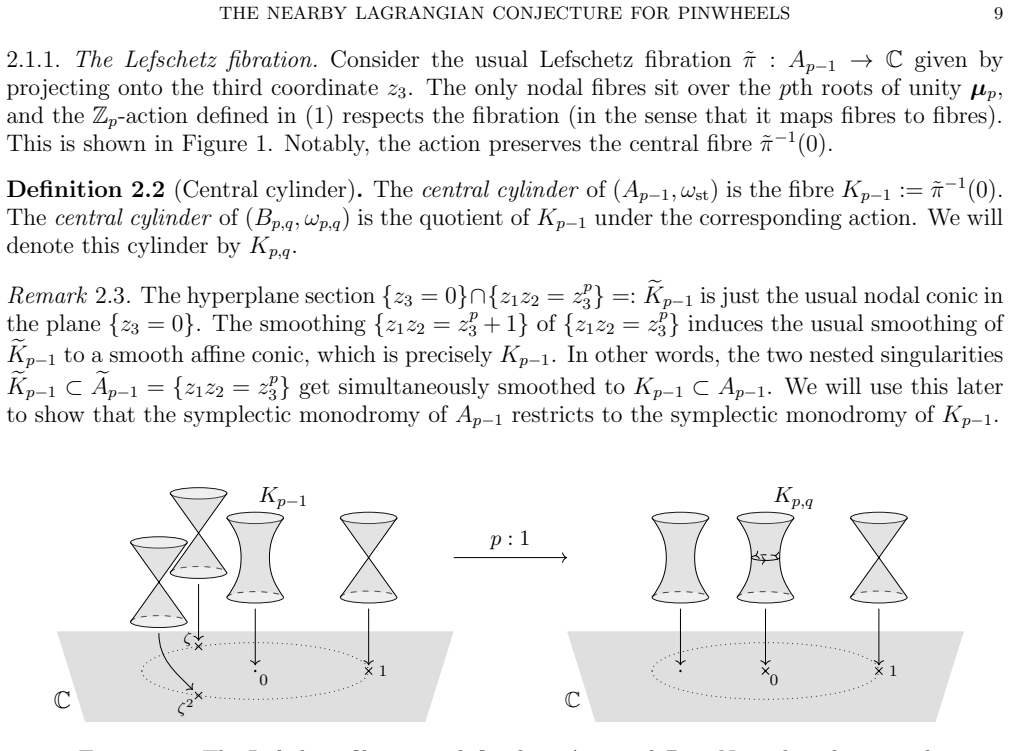
Figure from the paper full image
abstract click to expand
The Lagrangian skeleton of the rational homology ball $B_{p,q}$, for $0<q<p$ coprime integers, is an immersed but not embedded Lagrangian, called a $(p,q)$-pinwheel. We show that any two embeddings of Lagrangian $(p,q)$-pinwheels in $B_{p,q}$ are related by a compactly supported Hamiltonian isotopy, establishing Arnold's nearby Lagrangian conjecture for this wide class of singular Lagrangians. Our proof has two largely independent parts: the first uses neck-stretching and the symplectic rational blow-up to understand embeddings of pinwheels up to symplectomorphism; the second computes that $\text{Symp}_c(B_{p,q})$ is generated by a twist about the pinwheel, which we call the pintwist $\tau_{p,q}$. We provide three applications of our methods: Gromov non-squeezing for pin-balls; a new proof of the local Lagrangian unknotting theorem of Eliashberg--Polterovich; and that the only Lagrangian $(n,m)$-pinwheel in $B_{p,q}$ is of type $(p,q)$.
0
Top Pith
1
math.AP 2026-05-21 1 theorem

Analyticity sets exact uniqueness threshold in Calderón problems

by Thierry Daudé, Alberto Enciso +3 more

A Sharp Regularity Threshold for Uniqueness in Riemannian Calder\'on-type Problems

Uniqueness holds for analytic metrics but fails densely in every non-analytic Gevrey class for both fixed-potential and fixed-frequency data

abstract click to expand
We prove a sharp regularity threshold for uniqueness in two anisotropic Calder\'on-type inverse problems in dimension $n\ge 3$. The main setting is the Riemannian Schr\"odinger problem with fixed scalar potential: for a prescribed nonconstant analytic function $V$, we study whether the Dirichlet-to-Neumann map of $-\Delta_g+V$ on a domain $\Omega\subset\mathbb{R}^n$ determines the unknown metric $g$. The natural gauge is the group of boundary-fixing diffeomorphisms preserving $V$. We show that, while analytic metrics are uniquely determined modulo this gauge by a minor adaptation of the Lassas--Uhlmann reconstruction theorem, uniqueness fails densely in every non-analytic Gevrey class $G^\sigma$, $\sigma>1$. In fact, our counterexamples are not isometric in the sense that they are not connected by the pushforward of any diffeomorphism of $\overline\Omega$. We also prove the analogous sharp threshold for the anisotropic Calder\'on problem at fixed nonzero frequency, thereby upgrading the previously known finite-regularity counterexamples to Gevrey and $C^\infty$ regularity. The two constructions use different scalar mechanisms: for fixed potentials, the nonconstant potential itself provides a local coordinate, while at nonzero frequency one uses a compactly supported prescribed-Jacobian lemma in Gevrey spaces. Thus analyticity is the exact threshold for uniqueness in both problems.
0
Top Pith
2
math.MG 2026-05-18 2 theorems

Coarea formula holds for maps from Heisenberg group to R^{2n}

by Gioacchino Antonelli, Robert Young

Area of H\"older curves and coarea formula on the Heisenberg group

A new integral for the area of half-Holder curves makes this work even for the simplest vector-valued case.

abstract click to expand
We prove the coarea formula for Lipschitz maps from the subriemannian $n$th Heisenberg group $\mathbb H_n$ to $\mathbb R^{2n}$. Our result is new even when $n=1$ and provides the simplest vector-valued instance of the coarea formula in subriemannian geometry. This answers a question left open in the works of Magnani, Kozhevnikov, Magnani--Stepanov--Trevisan, and Julia--Nicolussi Golo--Vittone. The main difficulty of the proof is that a fiber of a $C^1_{\mathrm{H}}$ map $f: \mathbb H_n\to \mathbb R^{2n}$ is typically an unrectifiable curve. Its measure depends on the symplectic area of its projection to $\mathbb R^{2n}$. A bound on this area would imply the coarea formula, but examples of Kozhevnikov show that this area can be infinite or undefined. To overcome this, we introduce an integral that we use to define both the symplectic area of $\frac{1}{2}$--H\"older curves in $\mathbb R^{2n}$ and the symplectic area of projections of vertical curves in $\mathbb H_n$. Then, we give a geometric condition for this integral to converge. This yields, in addition, new results on the existence of the signed area of $\tfrac12$--H\"older planar curves that may be of independent interest. Finally, we use $\beta$--number estimates from the F\"assler--Orponen Dorronsoro Theorem to show that this geometric condition holds for almost every fiber.
0
0
math.AP 2026-07-03

Geodesic equation on Hermitian manifolds gains C^{1,1} solutions

by Mathew George

Regularity of a Geodesic equation in the space of mixed Volume Forms on Hermitian Manifolds

Under ellipticity on manifolds with balanced metrics the result also yields unique C^{1,1} solutions to the Donaldson equation.

abstract click to expand
We prove regularity of a fully nonlinear equation that arises from the study of geodesics in the space of mixed volume forms on Hermitian manifolds admitting a balanced metric. Under conditions for ellipticity, we prove that this degenerate equation has a $C^{1,1}$ solution on Hermitian manifolds. We derive uniform Laplacian estimates for the perturbed equation, and also construct explicit subsolutions. In particular, this shows the existence of a unique $C^{1,1}$ solution to the Donaldson equation on Hermitian manifolds.
0
0
math.DG 2026-07-03

Clifford torus is Willmore for every Berger sphere parameter

by Caio B. Rodrigues

Bifurcations of the Clifford Torus as Willmore Surfaces in Berger Spheres

Morse index estimates along the family detect bifurcation points that produce new symmetric Willmore tori.

Figure from the paper full image
abstract click to expand
The Clifford torus in a Berger sphere with parameter $\tau$ is a critical point of the Willmore functional for every $\tau>0$, yielding a smooth path of Willmore surfaces. By estimating the Morse index along this path, we apply bifurcation theory to produce new symmetric Willmore tori emerging from the Clifford torus.
0
0
math.AP 2026-07-03

Cartan equations hold for C^0 ∩ H^{1/2} coframes

by Isaac Newell, Luc Nguyen

Cartan's and Gauss's equations and rigidity theorems for isometric embeddings in low Sobolev regularity

The Gauss curvature identity then applies to isometric embeddings down to W^{1+2/3,3} regularity and yields convexity statements for nonnega

abstract click to expand
Let $\{\eta^i\}_{i=1}^2$ be a an orthonormal coframe on a domain $U$ on a smooth surface $(\Sigma,g)$. When $\eta^i$ is smooth, it is well-known that there is a unique connection 1-form $\omega$ verifying Cartan's first structural equations $d\eta^i = (*\eta^i) \wedge \omega$, and Cartan's second structural equation $d\omega = K_g dvol_g$. We prove that this statement remains valid when the frame is $C^0 \cap H^{\frac12}$, where the structural equations are understood in the sense of distributions. From this, we deduce that the Gauss equation $\mathrm{Det}\, D^2 f = K_g (1+|Df|^2)^2$ holds for every graphical representation $f$ of an isometric embedding of regularity $C^1 \cap W^{1+\frac23,3}$ or $c^{1,\frac12} \cap BV^2$. As an application, we prove regularity and convexity results for isometric embeddings of closed surfaces and convex caps with $K_g \geq 0$.
0
0
math.DG 2026-07-03

Intrinsic Brown-York mass expands to ADM mass plus shape correction

by Jiangcheng You

Intrinsic Brown--York Type Mass at Infinity in Four Dimensions

For large convex hypersurfaces the boundary term converges to ADM mass; the correction vanishes for nearly round surfaces under decay compat

abstract click to expand
We study a Brown--York type mass for closed hypersurfaces in four-dimensional asymptotically flat manifolds. The reference mean curvature is defined intrinsically as the trace of the positive solution of the contracted Gauss equation. For large uniformly convex hypersurfaces with controlled scale, we derive an expansion consisting of a boundary term converging to the ADM mass and a shape-dependent correction. For the four-dimensional analogue of the nearly round surfaces of Shi--Wang--Wu, this correction vanishes under a natural decay compatibility condition.
0
0
math.DG 2026-07-03

Mutual actions merge 3-anchored bundles into 3-Lie algebroids

by Begüm Ateşli, Oğul Esen +1 more

Couplings of 3-anchored Bundles

The bicocycle double cross product unifies semi-direct products, cocycle extensions and related constructions on Whitney sums.

abstract click to expand
This work develops an algebraic framework for merging two $3$-anchored bundles over the same base manifold, equipped with mutual actions and two twisted cocycle terms, so as to obtain a $3$-Lie algebroid structure on the corresponding Whitney sum. We also record the purely algebraic counterpart of this construction, namely the bicocycle double cross product $3$-Lie algebra, obtained by removing the anchor and Leibniz-type compatibility conditions. The resulting framework provides a unified setting for $3$-Lie algebroids and contains, as special cases, unified products, double cross products, semi-direct products, cocycle extensions, and direct products.
0
0
stat.ML 2026-07-03

LLM personas split into frame-stable aggregates and frame-sensitive geometry

by Yuan Yuan

The Dual Nature of LLM Persona: Aggregated Tendencies and Frame-Dependent Geometry

Aggregate trait scores resist frame changes while correlation structure drops 42% on mismatch and recovers with alignment.

Figure from the paper full image
abstract click to expand
Evaluations of LLM personas via psychometric questionnaires typically rely on aggregate scores, discarding within-instance correlation structure. We test whether this geometric structure is intrinsic or frame-dependent. Constructing within-instance correlation matrices from IPIP-50 responses, we analyze geometry on SPD manifolds under manipulated question orderings in GPT-4o simulating American and Chinese-American personas. We find that persona expression comprises two dissociable components: aggregated features (Big Five scores) degrade under randomization (21% drop) but are frame-robust; geometric features (SPD manifold) collapse under frame misalignment (42% drop) but recover substantially (to 84%) under shared frames, surpassing aggregated features (76%). This collapse-recovery pattern reveals that persona geometry is not intrinsic but a frame-dependent coordination pattern encoding information invisible to aggregation. Our findings establish a dual-nature framework for LLM personas, frame-dependent geometry versus frame-robust aggregates, necessitating frame-aware evaluation and challenging static trait conceptions.
0
0
math.CO 2026-07-03

Graphs exceeding T(n) edges must have positive curvature

by Kaizhe Chen, Shiping Liu +1 more

An extremal theorem for positive curvature of graphs

The bound is optimal, with a unique extremal example when n is even and at least 12.

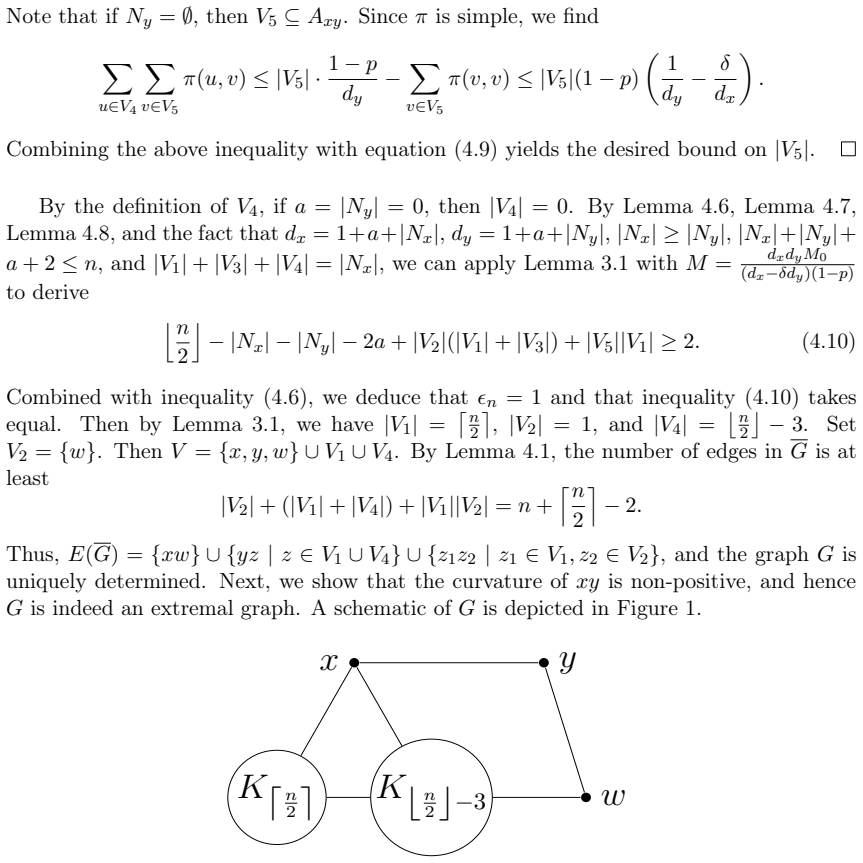
Figure from the paper full image
abstract click to expand
We prove an extremal theorem for positive Ollivier/Lin--Lu--Yau curvature: every graph of order \(n\geq 8\) with more than \[ T(n)=\frac{n^2-3n}{2}-\left\lceil\frac{n}{2}\right\rceil+2 \] edges has positive Ollivier/Lin--Lu--Yau curvature, and this threshold is optimal. Moreover, for even $n\geq 12$, there exists a unique graph with $T(n)$ edges that has an edge with non-positive curvature. For $n=8,10$ and odd $n\geq 9$, the extremal graphs are not unique. This suggests a new class of extremal graph-theoretic problems arising from discrete curvature notions.
0
0
math.DG 2026-07-03

STCMC foliations arise as flow limits near AdS-Schwarzschild

by Jacopo Tenan

Foliations by constant spacetime mean curvature surfaces for asymptotically hyperboloidal initial data sets

Volume-preserving spacetime mean curvature flow from a known CMC foliation produces the surfaces and a center-of-mass definition for hyperbo

abstract click to expand
We construct an exhaustive family of constant spacetime mean curvature (STCMC) surfaces for initial data sets close to the anti-de Sitter-Schwarzschild hyperboloid. In particular, we obtain such a foliation as the long time limit of the volume preserving spacetime mean curvature flow starting from the constant mean curvature foliation constructed by Neves-Tian (Geom. Funct. Anal., 2009). As an application, inspired by the definition of STCMC center of mass for initial data sets proposed in the asymptotically Euclidean setting by Cederbaum-Sakovich (Calc. Var. PDE, 2021), we study the center of mass of an asymptotically hyperboloidal initial data set.
0
0
math.DG 2026-07-03

Root spaces prove when G/H admits invariant complex structure

by David N. Pham

On a Theorem of Wang for Complex Homogeneous Manifolds

Wang's sufficiency result follows directly from the standard root decomposition of compact Lie algebras, without Borel or parabolic subalgeb

abstract click to expand
In \cite{Wang1954}, Wang proved (among other things) a sufficiency result for a compact homogeneous manifold $G/H$ to admit a $G$-invariant complex structure. In this note, we give a simple proof of Wang's theorem which relies on nothing more than the familiar properties of the root space decomposition of a compact Lie group. It should be noted that the recent work of Ni and Wallach \cite{NiWallach2025} also revisits the aforementioned theorem of Wang (and others) and offers new Lie theoretic proofs as well. However, the approach of \cite{NiWallach2025} relies on such objects as Borel subalgebras, parabolic subalgebras, and Iwasawa decomposition which may be somewhat less familiar to the working differential geometer.
0
0
math.DG 2026-07-03

Brownian loop mass asymptotes to (1/2) log g for large genus

by Jiankun Hou, Yunhui Wu

The total mass of Brownian loop measure of Riemann surfaces for large genus

When end lengths squared remain o(g), the expected total mass on non-peripheral classes converges to a κ-dependent function diverging as log

Figure from the paper full image
abstract click to expand
Let $\mathcal{M}_{g,n}(\mathbf{L})$ be the moduli space of hyperbolic surfaces of genus $g$ with $n \geq 0$ hyperbolic ends of widths $\mathbf{L} \in \mathbb{R}_{\geq 0}^n$. We regard the total mass $|\mu_X^\kappa|$ of the Brownian loop measure with the killing rate $\kappa$ as a random variable on $\mathcal{M}_{g,n}(\mathbf{L})$. Under the condition $|\mathbf{L}|^2 =o(g)$ as $g \to \infty$, we obtain the following two main results: $(1)$ For any $\kappa > 0$, the expected value of $|\mu_X^\kappa|$ on all non-peripheral homotopy classes over $\mathcal{M}_{g,n}(\mathbf{L})$ converges to an explicit function of $\kappa$, which blows up at the rate $ \log \left(\frac{1}{\kappa}\right)$ as $\kappa \to 0^+$. $(2)$ For $\kappa=0$, over $\mathcal{M}_{g,n}(\mathbf{L})$ the expected value of $|\mu_X|$ on homotopy classes of (iterates of) all non-peripheral simple closed geodesics is asymptotically $\frac{1}{2} \log g$.
0
0
math.DG 2026-07-03

Yamabe-type manifolds force potential fields to be Killing or zero

by Ramesh Mete

On the rigidity of generalized m-quasi-Einstein manifolds of Yamabe-type

Under natural assumptions the defining vector field on these generalized quasi-Einstein structures is either trivial or preserves the metric

abstract click to expand
Motivated by the concept of almost Yamabe solitons, a special class of generalized $m$-quasi-Einstein manifolds is investigated in this paper. We refer to these Riemannian manifolds as generalized $m$-quasi-Einstein manifolds of Yamabe-type. We study the rigidity properties for the potential (or defining) vector field associated to these manifolds in both the compact and non-compact settings. We show that under certain natural assumptions the potential vector field either vanishes identically or become a non-trivial Killing vector field.
0
0
math.DG 2026-07-03

Weak anisotropic inverse curvature flows smooth out far from origin

by Chaoqun Gao, Yong Wei +1 more

Higher regularity of the inverse anisotropic mean curvature flow

Global smooth solutions are built from C^1 star-shaped data with bounded weak curvature, then combined with asymptotics to get regularity at

abstract click to expand
We prove an anisotropic analogue of the higher regularity theorem of Huisken and Ilmanen for inverse mean curvature flow. For an arbitrary smooth Minkowski norm, we first prove a Huisken--Ilmanen type Harnack estimate for smooth closed strictly star-shaped solutions. We then construct global smooth solutions starting from $C^1$ strictly star-shaped hypersurfaces with bounded nonnegative weak anisotropic mean curvature. Combining this construction with the asymptotic theory for weak inverse anisotropic mean curvature flow, we show that weak solutions starting from bounded smooth initial sets become smooth outside a compact set.
0
0
math.DG 2026-07-03

Extended Frobenius theorem integrates discontinuous piecewise-C1 distributions

by Jack McKee

Complete Integrability for Piecewise-Smooth Distributions

Two sufficient criteria guarantee complete integrability in bi-Lipschitz coordinates when continuity fails.

Figure from the paper full image
abstract click to expand
Two generalizations of the Frobenius integrability theorem are proved concerning distributions which are piecewise-C1 but may fail to be continuous. The criteria presented are sufficient, but not necessary, for complete integrability of such distributions with bi-Lipschitz coordinates.
0
0
math.DG 2026-07-02

Local third Chern class defined via algebraic data at point singularities

by Xuemiao Chen

Point Singularities and Local Third Chern Classes for Rank-Two Torsion-free Sheaves on Threefolds

It is deformation invariant, matches K-theoretic charge, and recovers boundary topology for rank-two sheaves on threefolds.

abstract click to expand
In this paper, motivated by singularity formation in gauge theory, we study the local third Chern class contribution carried by isolated point singularities of rank-two torsion-free sheaves on complex threefolds. In the local rank-two setting considered here, the invariant is defined in terms of finite-length local algebraic data at the singular point. We prove that it can be computed from data on the total family; in particular, it is deformation invariant. We also prove that its parity recovers a topological invariant of the underlying smooth complex rank-two vector bundle on the boundary sphere. We then give a relative K-theoretic interpretation: a self-dual complex naturally associated with the sheaf defines a local $K$-theoretic charge, and this charge is equal to the local third Chern class. For rank-two reflexive sheaves, we relate the same invariant to several classical algebraic quantities, including the Fitting scheme and the Buchsbaum-Rim multiplicity. We also discuss applications to the boundary of moduli spaces of Hermitian-Yang-Mills connections.
0
0
math.DG 2026-07-02

Berwald manifolds with circle-preserving maps must be Riemannian

by Zohreh Fathi, Sajjad Lakzian

The rigidity of conformal circle-preserving transformations on Berwaldian manifolds

Complete Berwaldian structures with nontrivial conformal circle preservers reduce to Riemannian manifolds when flag curvature is nonvanishin

abstract click to expand
We prove that a complete Berwaldian manifold $\left(M,F\right)$ admitting a nontrivial conformal circle preserving transformation (\cpt for short) must be Riemannian, provided that it has a dense subset on which no flag curvature vanishes (in particular, if $(M,F)$ has positive or negative flag curvature).
0
0
cs.CG 2026-07-02

Vineyard monodromy tied only to symmetry set points

by Erin W. Chambers, Christopher Fillmore +4 more

The Singular Source of Vineyard Monodromy

For small loops on curves in the plane, diagram points permute only if the loop contains a multi-tangent sphere center.

Figure from the paper full image
abstract click to expand
Vineyards, or time-varying families of persistence diagrams, are widely used in topological data analysis (TDA) pipelines to track how topological features change and evolve as a parameter varies. When the parameter traces a closed loop, a vineyard can exhibit monodromy: diagram points permute over the course of a full traversal, which obstructs feature tracking and can complicate downstream analysis of such data. Chambers et al. considered the periodic vineyards that arise from the radial persistence transform, which maps the manifold to a family of persistence diagrams, where each diagram fixes a base point and considers the filtration that is based on Euclidean distance to that point, and showed that monodromy and knotting can occur. Other recent work by Arya et al. considers geometric conditions that exclude monodromy in two dimensions, in an effort to better understand when this effect happens. That said, understanding when and why monodromy occurs is a fundamental open problem with direct practical consequences for many data analysis pipelines. In this work, we study this question for 1-manifolds in $\mathbb{R}^2$, using a surprising connection with tools from singularity theory, and provide a classification for the causes of monodromy in vineyards. More precisely, we prove that the vineyard of a sufficiently small loop $\gamma$ cannot exhibit monodromy unless it contains a specific singularity of the distance function. The central geometric object in our analysis is the symmetry set, which is the locus of centers of spheres tangent in more than one point to the manifold; this object classifies singularities of the distance function, and in our setting, dictates precisely when monodromy occurs. This characterization opens the door to the development of algorithmic criteria for detecting and utilizing (or avoiding) monodromy in TDA pipelines.
0
0
math.DG 2026-07-02

Madelung map defines prequantum bundles for fluid group orbits

by Boris Khesin, Klas Modin

Madelung hydrodynamics and Poisson geometry of wave functions

The transform acts as a momentum map that links generic wave functions to coadjoint orbits on any oriented manifold and yields an infinite-d

Figure from the paper full image
abstract click to expand
We describe the Poisson geometry of the Madelung transform between quantum mechanics and hydrodynamics for generic wave functions. We prove that for arbitrary oriented manifolds this transform, being regarded as a momentum map, naturally defines prequantum bundles for coadjoint orbits of semidirect extensions of diffeomorphism groups. Furthermore, we show that the Madelung framework provides a natural infinite-dimensional version of the convexity results for Hamiltonian torus actions, thus giving a partial answer to Atiyah's question. In particular, for wave functions without zeros our results provide a K\"ahler map between the infinite-dimensional Fubini--Study and Fisher--Rao geometries, thus extending previous results to non-simply-connected manifolds. Furthermore, for wave functions with noncritical zeros, the Madelung transform is shown to be a symplectomorphism to the coadjoint orbits with Morse--Bott densities. The latter, in turn, furnishes a novel momentum map point of view on the Wallstrom quantization condition for the hydrodynamical form of quantum mechanics. We also comment on the relation between the Madelung setting and the Marsden--Weinstein symplectic structures on knots and membranes.
0
0
math.DG 2026-07-02

Yang-Mills-Higgs energy classifies labels on tori with exact energy 2 pi^2

by Catalin Vasii

Yang-Mills-Higgs: A Geometric Theory of Binary Labels on Non-Contractible Spaces

Curvature of the minimizing connection equals the antisymmetric attention bilinear and recovers harmonic interpolation on contractible bases

Figure from the paper full image
abstract click to expand
We reformulate binary classification on a manifold M as a Yang-Mills-Higgs variational problem. Labelled data is encoded as a functor from the fundamental groupoid of M to the one-object groupoid B(Z_2), whose monodromy class in H^1(M, Z_2) is a topological obstruction to realising the classifier by a sign function. The classifier-section and the connection jointly minimise a Yang-Mills-Higgs energy subject to hard data conditions: the matter sector carries the classification content, while the Yang-Mills sector is bounded below in each topological class by the Bogomolny inequality and selects the gauge background. This recovers the companion paper's harmonic interpolation as the contractible-base, flat-connection reduction. Two structural payoffs follow. First, the curvature 2-form of the selected connection has a precise dictionary with transformer attention: it is the antisymmetric part of the attention bilinear, and the abelian/non-abelian split of curvature corresponds to the single-head/multi-head split of attention. Second, XOR on the torus is solved in closed form by the covariantly harmonic section of the double-Mobius bundle, with minimum energy 2*pi^2 verified numerically to machine precision, whereas an MLP trained on the same data finds a structurally different boundary that ignores the toroidal identifications. Worked examples run an example ladder (circle, torus, S^2 Dirac monopole, S^4 BPST instanton); a matter-sector proximity-scaling theorem is proved in the two-point case.
0
0
math.DG 2026-07-02

Classifiers solve Laplace's equation on the data manifold

by Catalin Vasii

From Gradient Descent to Harmonic Interpolation: A Geometric Theory of Binary Classification

The RKHS kernel is the Green's function and the decision boundary is its zero equipotential.

Figure from the paper full image
abstract click to expand
We propose a dictionary between binary classification in machine learning and differential geometry. Classifiers are parallel sections of vector bundles over the data space; training labels become Dirichlet boundary conditions; the kernel of an RKHS interpolant is the Green's function of the Laplace-Beltrami operator; and backpropagation is the degenerate flat-geometry limit of an exact geometric problem. The central contribution is the identification that harmonic interpolation - find the minimum-Dirichlet-energy classifier satisfying the Laplace equation away from the data with prescribed values at training points - is precisely what RKHS interpolation already solves. The kernel is the Green's function, the coefficients are electrostatic capacitances, and the decision boundary is the zero equipotential of the resulting potential field. This reframes results of Kimeldorf-Wahba (1971) and Lindgren-Rue-Lindstrom (2011) as classical potential theory on a Riemannian manifold. For finite data on any smooth manifold, flat O(2) solutions always exist. The density of O(2) harmonic interpolants in the space of continuous classifiers is universal kernel theory (Steinwart; Micchelli-Xu-Zhang) in geometric language. The two arbitrary choices of classical ML - activation function and kernel - are identified as two independent geometric choices: the structure group G (fiber geometry, governing expressivity) and the Riemannian metric g (base geometry, determining the kernel). Code is available on GitHub.
0
0
math.DG 2026-07-02

Harmonic almost Hermitian immersions bound maximal normal curvature

by Tsz-Kiu Aaron Chow, Jingbo Wan

Maximal Normal Curvature and Veronese Rigidity

κ(F) ≥ √(2n/(n+1)) with equality only for Veronese embeddings of projective spaces.

abstract click to expand
We prove a sharp Veronese rigidity theorem for closed immersed submanifolds of the Euclidean unit ball under intrinsic harmonic-structure assumptions. For an isometric immersion $F:(\Sigma,g)\looparrowright\overline B(1)$, define the maximal normal curvature by \[ \kappa(F):= \sup_{x\in\Sigma} \sup_{\substack{v\in T_x\Sigma\\ |v|_g=1}} |A_x(v,v)|. \] If $\Sigma^{2n}$ is almost Hermitian with harmonic fundamental two-form, or $\Sigma^{4n}$ is almost quaternion-Hermitian with harmonic fundamental four-form, $n\ge2$, then \[ \kappa(F)\ge \sqrt{\frac{2n}{n+1}} . \] In the equality case the harmonic form is parallel and the immersion is, up to a totally geodesic inclusion, the standard complex or quaternionic Veronese embedding of projective spaces. The key input is a Bochner--Gauss mechanism that turns the Bochner curvature term of the harmonic form into a sharp algebraic estimate for the shape operators.
0
0
math.DG 2026-07-02

Twelve cases classify all invariant Gauss curvature solitons in Nil_3

by Rafael Belli, Rafael López

Classification of invariant Gauss curvature solitons in the Heisenberg space nil

Analysis of Killing fields and surface families shows no solitons in some symmetries and explicit forms in others.

Figure from the paper full image
abstract click to expand
In this paper, we classify all solitons of the Gauss curvature flow in the three-dimensional Heisenberg group $\mathrm{Nil}_3$ that are invariant under a one-parameter group of ambient isometries. By means of the four canonical types of Killing vector fields and the three families of invariant surfaces (vertical translations, horizontal translations, and helicoidal motions), we analyze the twelve resulting types of possible solitons. In some cases, there do not exist any invariant solitons; in others, we find explicit parametrizations, or describe their geometric properties.
0
0
math.DS 2026-07-02

Rational maps realize new branch data families with three points

by Zhiqiang Wei

Realizability of Certain Rational Maps with Three Branch Points

Extends the known realizable configurations in the Hurwitz existence problem for maps with exactly three branch points.

Figure from the paper full image
abstract click to expand
This paper investigates the Hurwitz existence problem for rational maps with three branch points. We establish several new families of realizable branch data and identify previously undocumented exceptional data. This work constitutes the second part of our systematic investigation of the Hurwitz problem, extending our earlier results obtained through the football decomposition method.
0
0
math.DG 2026-07-02

Two definitions of fractional s-mass agree for codim-2 currents

by Michele Caselli, Mattia Freguglia +1 more

Another look at a notion of fractional mass in codimension two

Energy minimization with Jacobian constraint yields the same values as weak linking, plus equi-coercivity and Gamma-convergence

abstract click to expand
We study a notion of fractional $s$-mass for codimension-two currents on closed Riemannian manifolds, defined via energy minimization with a prescribed Jacobian constraint. We prove equi-coercivity and $\Gamma$-convergence, with respect to the flat topology, of the $s$-mass on general codimension-two currents. We also prove several additional results for fixed $s$. We establish improved regularity for $s$-harmonic maps that are minimizing among competitors with vanishing Jacobian and show that their singular set has Minkowski dimension at most $n-3$. Moreover, we show that the $s$-mass defined via weak linking, as recently introduced by the authors, agrees with the prescribed Jacobian formulation used here, clarifying the extent to which the $s$-mass depends, or ultimately does not depend, on the way singularities are prescribed.
0
0
math.PR 2026-07-02

Brownian motion constructed in Minkowski normed spaces

by Shin-ichi Ohta, Marco Rehmeier +1 more

Brownian motion in Minkowski normed spaces

Marginals match the fundamental solution of the nonlinear Finsler heat equation via a singular McKean-Vlasov SDE with proven pathwise unique

abstract click to expand
A Minkowski normed space is the Euclidean space equipped with a (possibly asymmetric) uniformly convex and smooth norm, forming a particular class of Finsler manifolds. We construct a stochastic process with one-dimensional time marginal densities given by the fundamental solution to the nonlinear Finsler heat equation in Minkowski normed spaces. This process is constructed as a solution to a singular McKean--Vlasov stochastic differential equation and constitutes a nonlinear Markov process in the sense of McKean. Furthermore, we show that solutions to this stochastic differential equation are pathwise unique, and thus probabilistically strong solutions, though the equation has singular coefficients beyond the subcritical regime. Since our construction is a natural extension of the construction of standard Brownian motion from the standard heat kernel, we call this process \emph{Brownian motion in Minkowski normed spaces.} To the best of our knowledge, this is the first construction of stochastic processes associated with nonlinear heat equation in Finslerian spaces.
0
0
math.AG 2026-07-02

Two invariants match on every Fano manifold

by Jihao Liu, Sheng Qin

An equivariant fixed-level Demailly identity for Fano manifolds

The fixed-level equivariant Tian's alpha invariant equals the fixed-level equivariant global log canonical threshold in full generality.

abstract click to expand
Jin and Rubinstein asked whether the fixed-level equivariant Tian's alpha invariant equals the fixed-level equivariant global log canonical threshold, and proved this equality for toric varieties. In this paper we provide a positive answer to Jin and Rubinstein's question in full generality. The main result of this paper was obtained by Chatgpt 5.5 pro, and the Danus system based on the Rethlas system.
0
0
math.DG 2026-07-01

CMC hypersurfaces in H²×H² reduce to three explicit ODE regimes

by Julio Cesar Mohnsam

Constant mean curvature hypersurfaces in mathbb{H}²timesmathbb{H}² with double horocyclic symmetry

Double horocyclic invariance yields explicit solutions and classifies equilibria as H³, H²×R and Sol₃

Figure from the paper full image
abstract click to expand
We study constant mean curvature hypersurfaces in $\mathbb{H}^2\times\mathbb{H}^2$ invariant under a double horocyclic action. We show that the CMC condition reduces to a single autonomous ordinary differential equation for an angular function. From this reduction, we obtain three distinct regimes and solve the ODE explicitly in each case, obtaining an existence and uniqueness result for double horocyclic CMC hypersurfaces in $\mathbb{H}^2\times\mathbb{H}^2$. Finally, we classify the equilibrium solutions and identify the corresponding homogeneous models: $\mathbb{H}^3$, $\mathbb{H}^2\times\mathbb{R}$, $\mathrm{Sol}_3$, and left-invariant metrics on semidirect product Lie groups.
0
0
math.DG 2026-07-01

λ-translators in Nil₃ classified under three symmetries

by Antonio Bueno

Invariant λ-translators in the Heisenberg group

Surfaces with mean curvature tied to the vertical direction reduce to explicit ODEs when left-invariant, rotationally symmetric or helicoida

Figure from the paper full image
abstract click to expand
We study oriented surfaces in the Heisenberg space $\mathrm{Nil}_3$ whose mean curvature $H$ at each point is $H=\langle N,\partial_z\rangle+\lambda$, where $N$ is the unit normal, $\partial_z$ is the vertical Killing vector field and $\lambda\in\mathbb{R}$. These surfaces are known as $\lambda$-translators and generalize, among others, minimal and positive constant mean curvature surfaces, and also translating solitons of the mean curvature flow. The objective in this paper is to classify $\lambda$-translators invariant by the following one-parameter groups of isometries of $\mathrm{Nil}_3$: left-translations, rotations and helicoidal motions.
0
0
math.DG 2026-07-01

Invariant λ-translators in S²×R fully classified

by Antonio Bueno

Invariant λ-translators in mathbb{S}²timesmathbb{R}

Surfaces obeying H = ⟨N, vertical⟩ + λ are listed when unchanged by rotations around an axis and by vertical shifts.

Figure from the paper full image
abstract click to expand
A $\lambda$-translator in $\mathbb{S}^2\times\mathbb{R}$ is an oriented surface whose mean curvature $H$ satisfies $H=\langle N,\partial_z\rangle+\lambda$, where $N$ is the unit normal, $\partial_z$ is the vertical Killing vector field tangent to the fibers of the submersion and $\lambda\in\mathbb{R}$. When $\lambda=0$ we fall into the class of translators. In this paper, we classify all $\lambda$-translators that are invariant by a one-parameter group of rotations and by vertical translations of $\mathbb{S}^2\times\mathbb{R}$.
0
0
math.DG 2026-07-01

Gradient estimates hold for Neumann semigroups under unbounded curvature

by Li-Juan Cheng, Feng-Ya Lin

Gradient Estimates for Neumann Semigroups on Manifolds with Boundary under Unbounded Curvature Conditions

Bismut formulas produce pointwise bounds when Ricci and second fundamental form lower bounds are variable and possibly unbounded.

abstract click to expand
This paper establishes Bismut-type formulas and gradient estimates for Feynman--Kac semigroups on Riemannian manifolds with boundary, under geometric conditions formulated in terms of Ricci curvature $\mathrm{Ric}_Z \geq K$ and second fundamental form $\mathrm{II} \geq \sigma$ for potentially unbounded functions $K$ and $\sigma$. We then apply these formulas to derive pointwise gradient estimates for the Neumann semigroup under variable, possibly unbounded, lower curvature bounds. Both convex and non-convex boundary cases are treated. In the non-convex case, the boundary contribution is controlled by a conformal change of metric and an exponential estimate for the boundary local time.
0
0
math.DG 2026-07-01

Left-invariant complex structures force nilpotent groups to be C^n

by Keizo Hasegawa, Sönke Rollenske +3 more

Biholomorphism type of left-invariant complex structures on nilpotent Lie groups

A simply connected nilpotent Lie group of dimension 2n with such a structure is biholomorphic to complex n-space.

abstract click to expand
In this note we prove a conjecture by Hasegawa stating that a simply connected, nilpotent Lie group of dimension $2n$ endowed with a left-invariant complex structure is biholomorphic to $\mathbb{C}^n$.
0
0
cond-mat.mes-hall 2026-07-01

Hodge decomposition gives smooth Berry proxy for topological transport

by Zhi-Wei Wang, Samuel L. Braunstein

Hodge Topology of Semiclassical Transport: A Coordinate-Free Geometric Framework for the Anomalous Hall Effect and Non-Linear Berry Dipole

The approach partitions linear response into Fermi-sea and Fermi-surface parts and removes Dirac-string singularities for any Chern number.

Figure from the paper full image
abstract click to expand
We establish a coordinate-free differential geometric framework for anomalous transport in topological bands using the Hodge-de Rham decomposition of the Brillouin zone. Standard formulations face mathematical singularities (Dirac strings) when using the quantum Berry connection in bands with non-zero Chern numbers. Applying this decomposition to the Berry curvature 2-form isolates the quantized topological monopole flux from a globally smooth geometric 1-form proxy potential, $\mathcal{A}$. Substituting this regularized potential into semiclassical transport integrals yields distinct analytical advantages. For linear transverse transport, our cohomological decomposition enables an exact geometric derivation of Haldane's insight via the co-area formula, partitioning the response into a continuous Fermi sea topological background and a localized Fermi surface geometric line integral. For non-linear transport, this globally smooth proxy unifies the geometric description, reproducing the high numerical stability of scalar integration-by-parts techniques directly from its exact sector, accommodating arbitrary Chern numbers. By enforcing the continuous Coulomb-Hodge gauge ($\delta \mathcal{A} = 0$) alongside vanishing harmonic holonomies over fundamental 1-cycles ($\oint_{\gamma_i} \mathcal{A} = 0$), we map the Hodge potential $\mathcal{A}$ to the Maximally Localized Wannier Function (MLWF) gauge in trivial bands, providing a non-singular computational proxy for topologically obstructed bands. Finally, we analytically demonstrate that solving the Hodge Laplacian for $\mathcal{A}$ zeroes the macroscopic Brillouin zone average (uniform $\mathbf{R}=0$ zero-mode) topological divergence, yielding a mathematically consistent covariant formulation that matches the algorithmic robustness of standard methods against discrete $\mathbf{k}$-grid noise.
0
0
math.DG 2026-07-01

Repleteness equates R_φ- and K_φ-hyperbolicity on calibrated manifolds

by Anton Iliashenko, Spiro Karigiannis +1 more

Montel's theorem and tautness in calibrated geometry

The equivalence forces equicontinuity of Smith immersions from the Poincaré ball and yields a Montel theorem for compact cases.

abstract click to expand
We relate the hyperbolicity of a calibrated manifold $(X, \phi)$ to the analytic properties of the space of Smith immersions $\mathrm{SmIm}(B^k, X)$ from the Poincare $k$-ball into $X$. In particular, we establish the following calibrated analogue of a theorem of Royden: if $X$ is $\phi$-replete, then $R_\phi$- and $K_\phi$-hyperbolicity coincide, and either implies the equicontinuity of $\mathrm{SmIm}(B^k, X)$ with respect to the $\phi$-distance. This yields a Montel theorem for compact $\phi$-replete calibrated manifolds as an immediate corollary. Our primary technical tool is a new Schwarz lemma for Smith immersions from $B^k$ into $X$, which is of independent interest. In a similar spirit, we also prove a calibrated analogue of Kiernan's theorem to the effect that the $K_\phi$-hyperbolicity of $X$ is almost equivalent to $\mathrm{SmIm}(B^k, X)$ being a normal family. Finally, we prove that bounded domains in flat euclidean space are $R_\phi$-hyperbolic for any calibration $\phi$, and we investigate the hyperbolicity of products and discrete quotients.
0
0
math.GT 2026-07-01

Exotic diffeomorphisms exist on reducible 4-manifolds with odd b+

by David Baraglia

Exotic diffeomorphisms of reducible 4-manifolds with odd b_+

Pin-cobordism valued families invariant detects them where framed invariants cannot apply

abstract click to expand
A diffeomorphism of a $4$-manifold is said to be exotic if it is continuously isotopic to the identity but not smoothly isotopic to the identity. Ruberman constructed the first examples of exotic diffeomorphisms on simply-connected closed $4$-manifolds. His examples were reducible $4$-manifolds that necessarily have even $b_+$ in order that they can be detected by the families Seiberg--Witten or Donaldson invariants. Later Konno and Baraglia produced exotic diffeomorphisms on irreducible $4$-manifolds with odd $b_+$. In this paper, we will construct exotic diffeomorphisms on reducible $4$-manifolds with odd $b_+$. Exoticness is detected using a families Bauer--Furuta invariant. In proving our results we need to work with families moduli spaces which are not framed and so do not give rise to framed cobordism invariants. We overcome this difficulty by considering a Bauer--Furuta type invariant valued in {\em pin-cobordism}. In addition to constructing exotic diffeomorphisms, we also find new examples of simply-connected $4$-manifolds whose mapping class groups are not finitely generated.
0
0
math.DG 2026-07-01

Analytic construction yields nowhere-vanishing harmonic 1-forms on real loci

by Shih-Kai Chiu, Daniel Platt +1 more

Nowhere-vanishing harmonic 1-forms on real loci of K3-fibred Calabi-Yau 3-folds

The forms supply input for the Joyce-Karigiannis method, producing new compact 7-manifolds with G2 holonomy.

abstract click to expand
We develop an analytic construction of nowhere-vanishing harmonic $1$-forms on real loci of K3-fibred Calabi-Yau $3$-folds with collapsing Ricci-flat K\"ahler metrics. We apply our construction to examples whose real loci have connected components diffeomorphic to $S^1\times S^2$ and to both trivial and nontrivial mapping tori. As an application, we produce examples of compact $7$-manifold with holonomy $G_2$ via the Joyce-Karigiannis construction.
0
0
hep-th 2026-07-01

Fibering heterotic data over moduli space yields universal curvatures

by Jock McOrist

Universal geometry as an organising principle for heterotic moduli

Deformations appear as curvature components and α'² corrections are included automatically.

abstract click to expand
A family of heterotic compactifications carries more structure than a collection of solutions parametrised by moduli. Once the compactification data are fibred over moduli space, deformations become components of universal curvatures. This note reviews that organisation and explains how it incorporates the $\alpha'^2$ supersymmetry corrections.
0
0
math.DG 2026-07-01

Helix energy density L^p norm scales as rho to minus (2 minus 1/p)

by Yash Tiwari

L^p Asymptotics of the M\"obius Energy Density of Helix Curves

Exact blowup rate derived via contour integration as coil pitch shrinks, recovering log case for p=1

Figure from the paper full image
abstract click to expand
Motivated by the recent work of Lipton on the M\"obius energy of helix curves, we extend the study to the $L^p$ asymptotics of the meromorphic family \[ M_\rho(t) = \frac{\rho^2+1}{\rho^2 t^2 + 4 \sin^2(t/2)} - \frac{1}{t^2}. \] The helix has infinite M\"obius energy, but the arclength-rescaled energy density is finite. As $\rho \to 0$ the helix coils infinitely tight. Using contour integration and a careful Laurent expansion near the poles, we establish $I_p(\rho) := \left(\int_{-\infty}^\infty M_\rho(t)^p \, dt\right)^{1/p} \sim C_p \, \rho^{-(2-1/p)} $ for integer $p > 1$, extended to real $p > 1$, where $C_p$ is an explicit constant involving $\zeta(2p-1)$. The result gives the precise $L^p$ blowup rate of the M\"obius energy density as the pitch $\rho \to 0$. The borderline case $p=1$ yields a logarithmic correction $I_1(\rho) \sim \log(1/\rho)/\rho$, recovering Lipton's main theorem. We derive a quantitative coiling barrier and establish bilipschitz regularity for non-coiling helices. Numerical verification confirms the scaling exponent to high precision.
0
0
math.DG 2026-07-01

Odd-genus surfaces yield new minimal S^1-bundles in S^4

by Tongrui Wang

Embedded minimal S¹-bundles in mathbb{S}⁴

Equivariant min-max produces infinitely many distinct embedded hypersurface topologies in the 4-sphere.

abstract click to expand
We construct infinitely many embedded minimal hypersurfaces of pairwise distinct irreducible topological types in the unit $4$-sphere $\mathbb{S}^4$, which provides a new answer to a problem of Hsiang. These examples are topologically principal $S^1$-bundles and Seifert fibered manifolds over closed orientable surfaces. In particular, for any closed orientable surface $\Sigma_{2k-1}$ of odd genus $n=2k-1$, we show that $S^1\times \Sigma_{2k-1}$ admits a minimal embedding into $\mathbb{S}^4$. The construction is based on the equivariant min-max theory and the suspended (weighted) Hopf action on $\mathbb{S}^4$.
0
0
math.AG 2026-07-01

Fano geometry lets local node smoothings lift independently

by Rodolfo Aguilar

Log Conifold Transitions

Boundary del Pezzo surfaces make deformation theory unobstructed for log conifold transitions in index-two pairs

abstract click to expand
We define log conifold transitions for Fano threefold pairs of index two and study their deformation theory. Relying on the recent solution to the relative Clemens conjectures in this setting, we construct rational curves with normal bundle $\OO(-1)\oplus \OO(-1)$ by blowing up anchored points on the boundary divisor. Contracting these curves yields a singular space with ordinary double points. We prove that local smoothings of the nodes can be lifted to global first-order deformations, and that the global deformation theory of both the log resolution space and the singular log pair is unconditionally unobstructed. Crucially, the geometry of the boundary del Pezzo surface guarantees this unobstructedness. Furthermore, unlike the classical Calabi-Yau case, the underlying Fano geometry forces the vanishing of global topological balancing conditions, allowing local first-order smoothings of the nodes to be lifted independently. As applications, we construct new non-K\"ahler threefolds via smoothings, we analyze the effective geometry of the smoothed threefolds by determining their Picard groups and proving the persistence of free curves. Finally, we study the Hodge theory of these non-K\"ahler threefolds.
0
0
math-ph 2026-06-30

Homotopies from RG flow and gauge changes link BV actions with same effective physics

by Branislav Jurčo, Ján Pulmann +1 more

Homotopies in Batalin-Vilkovisky Formalism

Field redefinitions induced by these homotopies build spans of master actions whose extracted effective actions are isomorphic.

abstract click to expand
We review the notion of homotopy of quantum master actions in geometric Batalin-Vilkovisky formalism. Then we construct new examples of such homotopies, coming from renormalization group flow and non-infinitesimal changes of gauge fixing. Finally, we use the field redefinitions given by these homotopies to construct spans of quantum master actions with isomorphic effective actions.
0
0
math.MG 2026-06-30

Constant-width bodies on spheres stay between two positive ratios

by Abigail Hall, Andriy Prymak +1 more

On the spherical Blaschke-Lebesgue problem

For any fixed w not π/2 the relative effective radius is trapped between explicit bounds strictly above zero and below one as dimension grow

Figure from the paper full image
abstract click to expand
The Blaschke-Lebesgue theorem states that the Reuleaux triangle has the smallest area among planar convex bodies of a fixed constant width. We study how small bodies of constant width can be on the unit sphere $\mathbb S^n$ when $n$ is large. For a spherical convex body $K\subset \mathbb S^n$ of constant width $w\in(0,\pi)$, its relative effective radius is \[ \left(\frac{\mu_n(K)}{\mu_n(\mathbb B^n(w/2))}\right)^{1/n}, \] where $\mu_n$ is the spherical $n$-measure and $\mathbb B^n(w/2)$ is a geodesic ball of radius $w/2$. Let $\sigma_n(w)$ be the infimum of the relative effective radius over all spherical bodies of constant width $w$. Define $\underline{\sigma}(w)=\liminf_{n\to\infty}\sigma_n(w)$ and $\overline{\sigma}(w)=\limsup_{n\to\infty}\sigma_n(w)$. For each fixed $w\in(0,\pi)\setminus\{\pi/2\}$, we prove non-trivial bounds \[ 0<\sigma_{\ell}(w)\le \underline{\sigma}(w)\le \overline{\sigma}(w)\le \sigma_u(w)<1, \] where $\sigma_\ell(w)$ and $\sigma_u(w)$ are defined in terms of $w$ either explicitly or through a root of a quartic equation. The upper bounds are obtained by constructing small spherical bodies of constant width: for $w<\pi/2$ by a spherical version of the recent Arman-Bondarenko-Nazarov-Prymak-Radchenko Euclidean construction, and for $w>\pi/2$ by spherical duality. The lower bounds are obtained by generalizing ideas from Schramm's argument for illumination of Euclidean bodies of constant width.
0
0
math.DG 2026-06-30

Harmonic Weyl component forces 4D electrostatic systems into warped product form

by Robson Lousa

Four-dimensional electrostatic system with harmonic (anti-)self-dual Weyl tensor

Collinearity of electric field with lapse gradient plus harmonicity of one self-dual Weyl part yields local conformally flat geometry with c

abstract click to expand
We investigate four-dimensional electrostatic systems arising as spatial factors of static Einstein--Maxwell spacetimes with cosmological constant. Assuming that the electric field is everywhere collinear with the gradient of the lapse function, we prove that the harmonicity of one of the (anti-)self-dual components of the Weyl tensor imposes strong rigidity on the underlying geometry. More precisely, we show that the gradient of the lapse function is an eigenvector of the Ricci tensor and that the regular level sets of the lapse function are totally umbilic with constant mean curvature. As a consequence, the manifold is locally conformally flat and admits a local warped product structure with one-dimensional base and three-dimensional fiber of constant curvature.
0
0
math.AG 2026-06-30

Kapustin-Witten moduli on surfaces carry (-2)-shifted pretwistor structure

by Jacob Kryczka, Yuuji Tanaka +1 more

Lagrangian correspondences of nonabelian Hodge type and shifted twistor structures

The Deligne-Hitchin-Simpson stack on a projective variety X admits a canonical 2(1 - dim X) shifted pretwistor structure over the complex pr

abstract click to expand
Classical nonabelian Hodge theory identifies Dolbeault and de Rham moduli spaces by providing a real-analytic isomorphism. In this paper, motivated by the Kapustin--Witten theory, we study this correspondence in the more general framework of perfect complexes on proper varieties, paying special attention to the surface case. We establish a Lagrangian correspondence which relates the shifted symplectic geometries by Pantev--To\"en--Vaqui\'e--Vezzosi (PTVV) between the derived stacks of flat and Higgs perfect complexes. We investigate the existence of derived twistor structures of hyperk\"ahler type on the moduli stack of perfect complexes endowed with $\lambda$-connections by Deligne--Hitchin--Simpson. We establish a version of the AKSZ/PTVV transgression, Lagrangian intersection, and (hyperk\"ahler) symplectic reduction theorems in this context. Moreover, we prove that the derived Riemann--Hilbert correspondence of Porta and Holstein--Porta, which states an equivalence of derived analytic stacks of perfect complexes on $X_{\mathrm{Betti}}$ and $X_{\mathrm{DR}}$, is compatible with the natural shifted--symplectic structures. We then study the relation between the shifted (pre-)twistor structures and the shifted symplectic forms on the fibers, and prove that the analytic Deligne--Hitchin--Simpson moduli stack on a smooth projective variety $X$ has a canonical $2(1-\dim X)$ shifted pretwistor structure over $\mathbb{P}^1_{\mathbb{C}}$, a result which has been anticipated for some time. In particular, the moduli stack of solutions to the Kapustin--Witten equations modulo gauge equivalence on a smooth proper complex algebraic surface exibits a $(-2)$-shifted (pre)twistor structure as a family over $\mathbb{P}^1_{\mathbb{C}}$.
0
0
math.DG 2026-06-30

Jacobi structures induced on associated bundles

by Emmanuel Davakan, Djideme Franck Houenou +1 more

A Jacobi Coupling Construction on Associated Bundles

A nondegeneracy condition on curvature allows unification of symplectic, contact and conformal symplectic geometries.

abstract click to expand
We extend the Sternberg--Weinstein coupling construction to the Jacobi geometry setting. Starting from a Jacobi Hamiltonian $G$-space and a principal bundle equipped with a connection whose curvature satisfies some nondegeneracy condition, we show that the associated bundle naturally carries a Jacobi structure compatible with the canonical ones on the fibers. This construction provides a unified framework encompassing the symplectic, locally conformal symplectic, and contact cases. It reveals new coupling phenomena related to the presence of the Reeb vector field.
0
0
math.DG 2026-06-30

Flat tori realize dense constants of S+λ₂ in (2,3) for odd codim

by Fagui Li, Yuhang Zhao

Flat minimal tori and Lu's second-gap conjecture

The constructions give counterexamples showing Lu's second-gap conjecture fails for minimal surfaces.

abstract click to expand
Lu's first pinching theorem states that a closed minimal $n$-dimensional submanifold of the unit sphere satisfying $0\le S+\lambda_2\le n$ is one of the standard first-gap models; here $S$ is the squared norm of the second fundamental form and $\lambda_2$ is the second eigenvalue of Lu's fundamental matrix. Lu's second-gap conjecture asserts that, once $S+\lambda_2$ is constant and strictly larger than $n$, it is separated from $n$ by a positive gap depending only on the dimension and codimension. We construct closed embedded counterexamples for minimal surfaces in every codimension at least three. More precisely, in every odd codimension $q\ge3$ the constant values of $S+\lambda_2$ realized by linearly full embedded flat minimal tori are dense in $(2,3)$. Thus the analogue of Chern's discreteness statement fails for Lu's refined quantity.
0
0
math.DG 2026-06-30

Entropy-degree theorem extends to Alexandrov spaces

by P. Suárez-Serrato

The entropy-degree theorem for Alexandrov spaces

Lipschitz maps between spaces with curvature bounded below have matching analytical and topological degrees, giving volume bounds and rigidi

abstract click to expand
We present the entropy-degree theorem for Lipschitz maps between Alexandrov spaces with curvature bounded below, extending the classical Besson--Courtois--Gallot entropy-rigidity results to this singular setting. The proof requires a new degree theorem for Alexandrov spaces, developed using the Ambrosio--Kirchheim theory of integral currents, showing the equivalence between analytical and topological degrees. Applications include geometric obstructions for negatively curved Einstein metrics on 4-orbifolds, volume bounds for cone-manifolds, quantitative inequalities for hyperbolic convex cores, and lower bounds on the asymptotic translation lengths of end-periodic surface homeomorphisms. We show that entropy-volume minimization under uniform lower curvature bounds obstructs to the formation of metric singularities in Gromov--Hausdorff limits, prove an Alexandrov boundary rigidity theorem, and establish volume minima for cone manifolds and cone orbifolds.
0
0
math.AP 2026-06-30

Elastic flow with fixed area converges when curve is simple

by Florian Hauser, Christian Scharrer +1 more

Existence and convergence of the area-constrained elastic flow

Global existence holds always, but length stays bounded and the curve reaches a critical point only under an embeddedness assumption plus in

Figure from the paper full image
abstract click to expand
We study the evolution of plane closed curves with fixed area moving by the negative $L^2$-gradient of their elastic energy. For smooth initial data, we establish local and global existence of the flow. By imposing a simplicity assumption and an initial energy bound, we show that the length of the evolving curve remains uniformly bounded. This yields subconvergence to a critical point, which is then improved to full convergence by utilizing a {\L}ojasiewicz--Simon inequality. Conversely, an analysis of the energy profile curve, which maps a given length to the minimal energy among all curves with that length and fixed area, reveals that the length diverges to infinity for initial data satisfying specific length and energy criteria. We visualize our findings through numerical simulations.
0
0
math.DG 2026-06-30

Screen bundle generates all Carrollian spacetime invariants

by Boris Kruglikov, Eivind Schneider +1 more

Differential Invariants of Carrollian Spacetimes

Jet-space methods produce the Hilbert and Poincaré functions plus Spencer cohomology for torsion and curvature.

abstract click to expand
We compute invariants of Carrollian spacetimes, deriving them from the geometry of the screen bundle. For generic Carrollian structures we specify how to generate the entire algebra of differential invariants, with emphasis on dimension 3, which has special physical relevance. Then, in the framework of jet-spaces, we compute the numerology behind these invariants: the Hilbert and Poincar\'e functions that govern their numbers according to order. Finally, we compute the Spencer cohomology behind the Carrollian geometry that, in particular, contains the spaces of intrinsic torsion and intrinsic curvature, which are fundamental invariants, important in the equivalence problem and symmetry analysis. Thus, we also discuss symmetry sizes of Carrollian spacetimes.
0
0
math.DG 2026-06-30

Homogeneous hypersurfaces classified in three 4D Thurston geometries

by Xiaoge Lu, Zeke Yao +1 more

Homogeneous hypersurfaces of the four-dimensional Thurston geometries Sol₁⁴, Sol_(m,n)⁴ and Nil⁴

Four-dimensional isometry groups limit orbits to three dimensions and fix the admissible stabilizer types in each space.

abstract click to expand
In this paper, we focus on the four-dimensional Thurston geometries whose isometry groups are four-dimensional, namely $\mathrm{Sol}_1^4$, $\mathrm{Sol}_{m,n}^4$ and $\mathrm{Nil}^4$. We classify homogeneous hypersurfaces in the above three manifolds.
0
0
math.DG 2026-06-30

Gromov's conjecture proved for scalar curvature in 3D

by Jinmin Wang, Zhizhang Xie +1 more

Gromov's dihedral rigidity conjecture in dimension three

Self-contained proof shows curvature and angle conditions force three-dimensional manifolds to be rigid.

Figure from the paper full image
abstract click to expand
In this article, we present a self-contained proof of Gromov's dihedral rigidity conjecture on scalar curvature in the three-dimensional case. The proof avoids many of the technical complications that arise in higher dimensions, while still illustrating the essential ideas of the general approach developed in arXiv:2112.01510 (version 6) and arXiv:2203.09511. It is significantly shorter than the proof of the general case and is intended to be more accessible.
0
0
math.DG 2026-06-30

Iteration produces Hermitian-Einstein metrics on stable bundles

by Jiaxuan Fan, Zhiyao Xiong +2 more

Iterative construction of Hermitian-Einstein metrics on stable bundles

The sequence converges smoothly from any initial metric on Kähler or Gauduchon manifolds without variational methods.

abstract click to expand
Let $E$ be a stable holomorphic vector bundle over a compact K\"ahler (or Gauduchon) manifold $(M,\omega_g)$. We show that for any real number $\mu>0$ and any initial Hermitian metric $h_0$ on $E$, there exists a unique iteration sequence $\{h_m\}$ satisfying $$ \Lambda_{\omega_g}\left(\sqrt{-1}R^{h_{m+1}}\right) =(\lambda_E-\mu)h_{m+1}+\mu h_m, $$ and $\{h_m\}$ converges smoothly to a Hermitian-Einstein metric $h_\infty$ on $E$ satisfying $$ \Lambda_{\omega_g}\left(\sqrt{-1}R^{h_{\infty}}\right) =\lambda_Eh_\infty, $$ where $\lambda_E\in \mathbb R$ is the stability constant. A key feature of this proof is that it is independent of Donaldson's variational framework and applies to non-K\"ahler manifolds.
0
0
math.DG 2026-06-30

Minimizing sequences converge to smooth anisotropic minimal surfaces

by Antonio De Rosa, Aria Halavati +1 more

Min-Max Construction of Anisotropic Minimal Surfaces with Genus Bound

Anisotropic Meeks-Simon-Yau theorem yields genus lower semicontinuity and removable singularities under ellipticity or pinching conditions.

abstract click to expand
We establish an anisotropic analogue of the celebrated theorem of Meeks-Simon-Yau: every minimizing sequence of surfaces within a fixed isotopy class converges to a smooth stable anisotropic minimal surface, with genus lower semicontinuity. This result also strengthens White's foundational existence theory for anisotropic minimal disks. As an application, we develop an anisotropic Simon-Smith min-max theory. In every closed $3$-manifold, we construct anisotropic min-max sequences within fixed isotopy classes whose limits are stable anisotropic minimal surfaces that are smooth except possibly at a single point. If the integrand satisfies either an ellipticity bound or a $C^3$-pinching condition, we remove the singular point by proving two independent removable singularity theorems for anisotropic minimal surfaces that are smooth and stable away from finitely many points. These removable singularity results also allow to remove the singularities arising in the anisotropic Almgren-Pitts min-max construction in $3$-manifolds of De Philippis-De Rosa and in its multiparameter variants.
0
0
math.DG 2026-06-30

α-stationary hypersurfaces through origin are hyperplanes

by Hongbin Cui, Jiahuan Li +1 more

Bernstein-type theorem for stationary hypersurfaces of the Euler-Dierkes-Huisken functional

Rigidity theorem shows every such critical point of the |X|^α integral must be a flat plane.

abstract click to expand
We say that a hypersurface $\Sigma \subset\mathbb{R}^{n+1}$ is $\alpha$-stationary if it is a critical point of the Euler-Dierkes-Huisken functional $\mathcal{E}_\alpha(\Sigma)=\int_\Sigma|X|^\alpha\, d\mathcal{H}^n$, introduced by Dierkes and Huisken in \cite{[DH-24]}. In this paper, we prove that every smooth, complete, connected, embedded $\alpha$-stationary hypersurface in $\mathbb{R}^{n+1}$ passing through the origin with $\alpha>0$ is a linear hyperplane.
0
0
math.AP 2026-06-30

Brakke flow with free boundary exists globally in halfspace

by Alessandro Scapin

On the existence of canonical multi-phase free boundary Brakke flows: a case study

Canonical multi-phase version starting from rectifiable sets stays integer rectifiable up to boundary for all time.

Figure from the paper full image
abstract click to expand
We establish the global-in-time existence of a codimension $1$ canonical multi-phase free boundary Brakke flow in the upper halfspace which is integer rectifiable up boundary, starting from a countably $n$-rectifiable set. Under a suitable uniform density ratio assumption on the initial datum, we show that the free boundary carries no positive mass for some short time.
0
0
math.GT 2026-06-30

Instanton TQFT becomes functor between infinity-categories

by Fan Ye

An infinity-categorical TQFT from instantons

The lift reinterprets metric families on cobordisms and supplies chain-level homotopies for cap-product operators.

Figure from the paper full image
abstract click to expand
In this paper, we upgrade the instanton TQFT from ordinary categories to a functor $CI$ from an $\infty$-cobordism category $\mathrm{BI}$ for instantons to an $\infty$-derived category $\mathsf{D}$ of $2$-periodic chain complexes and sums of homogeneous chain maps. The construction of $\mathrm{BI}$ is a modification of the $\infty$-cobordism category $\mathrm{Bord}_4$ constructed by Lurie and Calaque--Scheimbauer via complete Segal spaces. The construction of $\mathsf{D}$ follows from the dg-nerve of a dg-category of $2$-periodic chain complexes over finitely generated projective modules over $\mathbb{Z}$. The information encoded in the functor $CI$ was already developed by Kronheimer--Mrowka using families of metrics on cobordisms, but our reinterpretation through $\infty$-categories simplifies the construction of the hypercube of chain complexes for the link spectral sequence. In addition, we upgrade the generalized cap product $\mu$-operators in instanton Floer homology to the chain level and construct explicit homotopies and higher homotopies for commutativity of multiple $\mu$-operators in even degrees.
0
0
math.GT 2026-06-30

Surgery exact triangle holds for monopole Floer homology over Z

by Haochen Qiu, Fan Ye

Monopole triangle over integers

Extends prior results to integer coefficients and yields integral spectral sequence from odd Khovanov homology to Floer homology of branched

Figure from the paper full image
abstract click to expand
We prove the surgery exact triangle for monopole (Seiberg--Witten) Floer homology over integer coefficients, extending the work of Kronheimer--Mrowka--Ozsv\'{a}th--Szab\'{o} over $\mathbb{Z}/2$, Lin--Ruberman--Saveliev over $\mathbb{Q}$, and Freeman over $\mathbb{Z}[\sqrt{-1}]$. Our proof is based on a modification of Kronheimer--Mrowka's local system on monopole Floer homology and an adaptation of Freeman's computation. As a standard application, following Bloom and Scaduto, we obtain a spectral sequence $\widetilde{Kh}_{\mathrm{odd}}(L)\Rightarrow \widetilde{HM}_\bullet(-\Sigma_2(L))$ over integer coefficients for an oriented link $L\subset S^3$, thereby solving Ozsv\'{a}th--Rasmussen--Szab\'{o}'s conjecture.
0
0
math.GT 2026-06-30

Closed n-manifolds dominated by bounded n-skeletons

by Lizhi Chen

Topological Complexity and Finite Domination

Simplex count controlled only by dimension and embolic volume, giving a geometric bound on topological complexity.

abstract click to expand
Let $M$ be a closed, connected, smooth $n$-dimensional manifold. We prove that $M$ is dominated by the underlying space of the $n$-skeleton of a finite simplicial complex. Furthermore, the total number of simplices in the $n$-skeleton is bounded above by a constant depending only on $n$ and the embolic volume of $M$.
0
0
math.DG 2026-06-29

Integral Gauss formula links G2-Laplacian to hypersurface geometry

by Timothy Buttsworth, Stepan Hudecek +1 more

Integral Gauss formula and the Poisson equation for the G₂-Laplacian

Necessary conditions for local Poisson solvability follow, and become sufficient under compact simple symmetry.

abstract click to expand
We produce a formula, analogous to the Gauss-Codazzi equation, which relates the geometry of a $G_2$-structure and its Hodge Laplacian to the geometry of the induced $SU(3)$-structure on an embedded hypersurface. As an application, we obtain necessary conditions for the solvability of the Poisson equation for (not necessarily closed) $G_2$-structures in a neighbourhood of this hypersurface. Next, we prove that our conditions are sufficient in the cohomogeneity one setting, assuming the symmetry group is compact and simple.
0
0
math.DG 2026-06-29

Entire solutions to self-shrinking J-equation are quadratic polynomials

by Yiyang Pan, Wenlong Wang

A Bernstein Theorem for the Self-Shrinking J-Equation and Some Generalizations

The rigidity holds without prior growth assumptions and extends to inverse complex Hessian quotients.

abstract click to expand
We prove that every entire smooth plurisubharmonic solution of the self-shrinking $J$-equation on $\mathbb{C}^n$ is a quadratic polynomial. This removes the asymptotic lower bound assumption on the complex Hessian in \cite[Theorem 4]{HJ}. The result also recovers the corresponding real rigidity theorem in \cite[Theorem 1.1]{HOW} as a special case. More generally, our method applies to a broad class of fully nonlinear elliptic operators satisfying suitable structural conditions, including the inverse complex Hessian quotient operators $-\sigma_{k-1}/\sigma_{k}$ for $1\leq k\leq n$.
0
0
math.DG 2026-06-29

Normal form for D4- front singularities yields Gauss-Bonnet formula

by Kentaro Saji

Geometry of D₄^--front singularities and a Gauss-Bonnet type formula

Source coordinate changes and target isometries reduce the singularity so that invariants and an integral curvature relation become computab

Figure from the paper full image
abstract click to expand
We construct a form of the $D_4^-$-singularity of fronts in $\R^3$ which uses coordinate transformation on the source and isometry on the target. As an application, we compute differential geometric invariants near the $D_4^-$-singularity, and give a Gauss-Bonnet type theorem for one-parameter generic fronts.
0
0
math.DG 2026-06-29

Endo-Pajitnov manifolds satisfy Hodge dimension relations

by Liviu Ornea, Miron Stanciu

Dolbeault cohomology of Endo-Pajitnov manifolds

Explicit Dolbeault cohomology computation on higher-dimensional non-Kähler examples extends the Inoue surface case.

abstract click to expand
Endo-Pajitnov manifolds are compact non-K\"ahler manifolds which generalize the Inoue surfaces $S_M$ to higher dimensions. We compute their Dolbeault cohomology and show that they satisfy the Hodge decomposition at the level of dimensions.
0
0
math.DG 2026-06-29

Tanaka-Webster curvatures defined for surfaces in 3D CR Lie groups

by Ioannis D. Platis, Dimitrios Tsolis

Tanaka-Webster curvatures of surfaces in 3D Lie groups with a CR structure

Gauss and mean curvature notions are introduced for embedded surfaces inside three-dimensional Lie groups equipped with contact forms.

abstract click to expand
We consider the Tanaka-Webster geometry of surfaces embedded in a 3-dimensional Lie group with a CR structure inherited by a contact form. We define the notions of Gauss and mean curvature and give specific examples.
0
0
math.DG 2026-06-29

Maxfaces allow approximation with prescribed singularities

by Shuki Sano

Approximation and Interpolation Theorems for Maximal Surfaces with Singularities

Methods from minimal surfaces extend to show existence of maxfaces with singularities at chosen points or dense singular sets in L^3.

abstract click to expand
In this paper, we prove an approximation and interpolation theorem for maxfaces in the Lorentz--Minkowski $3$-space $\mathbb{L}^3$. Alarc\'on, Forstneri\v{c}, and L\'opez established approximation and interpolation theorems for conformal minimal surfaces using the Enneper--Weierstrass representation formula. We survey their methods and apply them to maxfaces. Furthermore, by incorporating singularity criteria based on the Weierstrass data of maxfaces into the approximation and interpolation theorem, we demonstrate the existence of a maxface with prescribed singularities at specified points, as well as the existence of a maxface whose singular set has a dense image in $\mathbb{L}^3$.
0
0
math.DG 2026-06-29

Constant K forces isoparametricity for minimal hypersurfaces in S^5

by Jianquan Ge, Tong Liu +2 more

Rigidity of Closed Minimal Hypersurfaces in mathbb{S}⁵

Chern conjecture holds for M^4 in S^5 when both scalar curvature and Gauss-Kronecker curvature are constant, using weighted 3-forms and χ(M)

Figure from the paper full image
abstract click to expand
The celebrated Chern conjecture asserts that any closed minimal hypersurface in $\mathbb{S}^{n+1}$ with constant scalar curvature is isoparametric. In this paper, we resolve this conjecture in the affirmative for $M^4 \subset \mathbb S^5$ under the assumption that the Gauss-Kronecker curvature $K$ is constant. This result breaks the traditional reliance on consecutive trace conditions, demonstrating that the nonconsecutive spectral invariant set $\{H, S, K\}$ is sufficient to yield complete geometric rigidity. To overcome the analytical singular locus, we construct two novel weighted $3$-forms adapted to $S$ and $K$. Crucially, the global curvature estimates required to close our analysis are obtained unconditionally by proving the Euler characteristic $\chi(M)=0$. This local-to-global approach provides a new paradigm for higher-dimensional rigidity problems.
0
0
math.DG 2026-06-29

Counterexamples disprove Pogorelov and Toponogov questions

by Lei Ni, Wei Zhang +1 more

On questions of Pogorelov and Toponogov

Complete immersed saddle surfaces with nonpositive curvature lack closed asymptotic curves despite topological conditions.

abstract click to expand
We give explicit counterexamples to two questions. One is asked by Pogorelov and the other is by Toponogov. These questions concern the existence of closed asymptotic curves in a saddle surface, namely a complete immersed regular surface in $\mathbb{R}^3$ with nonpositive Gaussian/sectional curvature, and its geometric consequences under some topological conditions. We also modify the statements and prove a corrected version. In the appendix we include an example clarifying a conjecture of Milnor.
0
0
cs.LG 2026-06-29

Gauge-equivariant preconditioner cuts LM loss gap to 0.67 from 5.88

by Tejas Pradeep Shirodkar

Dead-Direction Conditioners: Gauge-Equivariant Preconditioning for Deep Networks

Conditioning on symmetry orbits keeps the trajectory on the quotient, making dead directions measurable in more cells and enabling grokking

Figure from the paper full image
abstract click to expand
A deep network's loss is invariant to continuous symmetries of its parameters: the logit shift, the ReLU rescaling, the LayerNorm scale, the per-head attention rotation. Adam's per-coordinate preconditioner drifts along each symmetry orbit, which pulls the trajectory off the symmetry quotient where the optimization lives and blurs the singular-learning rate the quotient makes readable. We build DDC, a Dead-Direction Conditioner that lifts a base optimizer into a $G$-equivariant one: it conditions the optimizer's state in the orbit decomposition of a $G$-invariant metric, so the trajectory stays a preconditioned gradient flow on the quotient $\bar\Theta = \Theta/G$. The construction carries four architectural gauges (cross-entropy shift, ReLU and SwiGLU rescaling, LayerNorm and RMSNorm scale, and a per-head $O(d_{\rm head})$ attention rotation matched to RoPE), proves exactly equivariant on an Adam base, and composes with a Muon base through a gauge-equivariant orthogonaliser. Respecting the symmetry changes both the minimum the optimizer reaches and what it leaves measurable there. On a language model trained past the point of fit, DDCAdam resists the over-training collapse AdamW falls into, holding a validation-train loss gap of 0.67 against 5.88, and reads the dead-direction rate in 32 of 65 layer-by-observable cells where AdamW reads it in 7. A vision transformer trained from scratch reaches lower validation loss (1.71 against 2.12) while compressing spare feed-forward capacity a matched AdamW leaves intact. On a Muon base, where the rotation gauge composes exactly, DDCMuon groks ten of eleven seeds at depth 24 that a plain Muon never reaches. Built into the optimizer, a network's gauge symmetry sharpens the minimum it finds and turns that minimum's geometry into something the trajectory can measure.
1 0
0
math.DG 2026-06-29

Gromov conjecture confirmed under weakened group decay

by Qiaochu Ma, Guoliang Yu

Gromov's Conjecture on Positive Scalar Curvature and Simplicial Volume under a Fundamental Group Decay Property

Positive scalar curvature forces zero simplicial volume for manifolds whose fundamental groups meet a relaxed rapid decay condition.

abstract click to expand
Gromov's simplicial volume is a fundamental invariant measuring the topological complexity of a manifold. A conjecture of Gromov predicts that every closed manifold admitting a metric of positive scalar curvature has vanishing simplicial volume. In this paper, we prove this conjecture under a natural weakening of the classical rapid decay (RD) property for the fundamental group.
0
0
math.DG 2026-06-29

Cahn-Hoffman transform yields optimal regularity for anisotropic free boundaries

by Ezequiel Barbosa, Rosivaldo Gonçalves +1 more

Anisotropic Parabolic Obstacle Problems and the Stefan Problem: Regularity of the Evolving Free Boundary

The linear mapping turns the direction-dependent problem into an isotropic obstacle problem whose free boundary is C^{1,α} at non-degenerate

abstract click to expand
We study a parabolic obstacle problem for surfaces evolving by anisotropic mean curvature flow subject to an obstacle constraint. Given a convex obstacle and initial data, we seek an evolving surface minimizing an anisotropic energy functional while remaining above the obstacle; as a special case, this framework includes the anisotropic Stefan problem, where the free boundary represents a phase transition interface with direction-dependent surface tension. The central tool is the Cahn--Hoffman transform $S(x) = A^{-1/2}x$, which maps the Wulff ellipsoid $\{x : x^T A^{-1}x \leq 1\}$ to the Euclidean unit ball and converts the anisotropic problem into an equivalent isotropic one with a generalized Robin-type condition on the free boundary. We prove optimal regularity of the solution ($C^{1,\alpha}$ in space and $C^{0,\alpha/2}$ in time up to the free boundary) and $C^{1,\alpha}$-regularity of the evolving free boundary at non-degenerate points. The parabolic Hausdorff dimension of the space-time singular set is shown to be at most $n - 1$.
0
0
math.DG 2026-06-29

Cahn-Hoffman transform yields free boundary regularity in anisotropic obstacle problems

by Ezequiel Barbosa, Rosivaldo Antonio Gonçalves +1 more

Anisotropic Obstacle Problems for Minimal Surfaces: Regularity of the Free Boundary via the Cahn-Hoffman Transform

Ellipsoidal anisotropic energies reduce to isotropic problems with Robin conditions, giving C^{1,1} solutions and C^{1,α} free boundaries.

abstract click to expand
We study an obstacle problem for surfaces minimizing an anisotropic surface energy of ellipsoidal type. Given a convex obstacle and a boundary datum, we seek a surface that minimizes the anisotropic area functional while remaining above the obstacle. The central novelty is the systematic use of the Cahn-Hoffman transform to convert the anisotropic problem into an equivalent isotropic problem with a generalized Robin boundary condition. We prove optimal regularity of the solution ($C^{1,1}$ up to the free boundary) and $C^{1,\alpha}$-regularity of the free boundary itself under a non-degeneracy condition. The singular set of the free boundary is shown to have Hausdorff dimension at most $n-1$, and a logarithmic epiperimetric inequality yields its $(n-1)$-rectifiability. The approach combines Caffarelli's classical theory of obstacle problems with the geometric theory of anisotropic mean curvature and the Alexandrov reflection principle adapted to the anisotropic setting.
0
0
math.DG 2026-06-29

Injectivity radius bound replaces genus in minimal surface compactness

by Luan de Figueiredo, Rosivaldo Gonçalves

Compactness for minimal surfaces with injectivity radius bounded from below

Proves compactness for closed embedded minimal surfaces in 3-manifolds when area and injectivity radius are both controlled.

abstract click to expand
We prove a compactness theorem for the space of closed embedded minimal surfaces with area bounded from above and injectivity radius bounded from below in a closed Riemannian $3$-manifold. This result is a variant of the Choi--Schoen compactness theorem in which the genus bound is replaced by a lower bound on the injectivity radius of the surface.
0
0
math.MG 2026-06-29

Hyperbolic surfaces filled by O(g/ln g) systoles

by Olivier Mathieu

Filling surfaces with very few systoles

Construction reaches the lower bound on shortest geodesics needed to cover high-genus surfaces.

abstract click to expand
In the paper we describe hyperbolic surfaces filled by their systoles, where the total number of systoles is in $O(\frac{g}{\ln \,g})$, that is equivalent to the lower bound of Anderson, Parlier and Pittet \cite{APP}. Various papers \cite{SS}\cite{FB20}\cite{Sanki}\cite{ IM}\cite{ Mathieu} have investigated the same question, and the best previously known upper bounds where in $o(\frac{g}{{\sqrt{\ln \,g}}})$. Surprizingly the present approach is, in our opinion, much simpler than the methods of earlier papers.
0
0
math.DG 2026-06-29

Critical L2 metrics are scalar-flat in dimensions 5-9

by Heng Zhang

Scalar-Flatness for Critical Metrics of the L²-Scalar Curvature Functional in Dimensions 5le nle 9

Finite-energy critical points of the integral of squared scalar curvature must have zero scalar curvature, closing the conjecture for all n

abstract click to expand
Let $(M^n,g)$ be a complete Riemannian manifold of dimension $n\geq 5$ endowed with a critical metric of the quadratic scalar-curvature functional $$ \mathcal S^2(g)=\int_M R_g^2\,dV_g . $$ For $n\geq 10$, Catino, Mastrolia and Monticelli [J. Math. Pures Appl. 211 (2026), 103883] established that all complete noncompact critical metrics with finite energy are scalar-flat, and they conjectured that this scalar-flatness result holds for all dimensions $n\geq 5$. In this paper, we settle the conjecture by verifying its validity for the remaining dimension range $5\leq n\leq 9$.
0
0
math-ph 2026-06-29

Larger bundle maps twisted gauge fields to standard ones

by Serge Lazzarini, Thierry Masson +1 more

How to Untwist Twisted Gauge Fields

The isomorphism lets local twisted fields enter ordinary Yang-Mills theories while two symmetry groups remain explicit.

abstract click to expand
This paper provides an isomorphism between the space of twisted gauge fields on a principal bundle $\mathcal{P}$ and the space of standard gauge fields on a different principal bundle $\mathcal{Q}$ associated to $\mathcal{P}$. This isomorphism extends to local fields on the base manifold, which enables the use of local twisted fields in standard gauge theories (e.g. Yang-Mills-like theories). This allows one to deal with two symmetry groups, coming from $\mathcal{P}$ and $\mathcal{Q}$, respectively. The construction makes use of a larger principal bundle $\mathcal{S}$ which has $\mathcal{P}$ and $\mathcal{Q}$ as quotient bundles. The gauge structure on $\mathcal{S}$ encodes both standard and twisted gauge structures on $\mathcal{P}$. In addition, the isomorphism classes of bundles $\mathcal{S}$ are in 1:1 correspondence with the equivalence classes of cocycles (up to a coboundary). This paper also provides a new interpretation of (full) dressing fields as dynamic (or active) sections of a principal bundle.
0
0
math.DG 2026-06-29

Lagrangian flow converges to special spheres but curvature blows up

by Ping-Hung Lee, Chung-Jun Tsai

Infinite-Time Singularities with Vanishing Mean Curvature for Lagrangian Mean Curvature Flow in Gibbons--Hawking Spaces

Mean curvature vanishes uniformly while log of max second fundamental form grows like sqrt(t) in Gibbons-Hawking spaces

abstract click to expand
We construct infinite-time singularities with vanishing mean curvature for Lagrangian mean curvature flow in Gibbons--Hawking spaces. We consider circle-invariant Lagrangian $2$-spheres whose quotient curves are concave and are $C^2$-close to a collection of consecutive collinear segments. We prove that the corresponding flow exists smoothly for all time and converges to the associated $A_{n-1}$-chain of special Lagrangian spheres. Although the mean curvature converges uniformly to zero, the second fundamental form becomes unbounded. More precisely, $\log\max |A(\,\cdot\,,t)|$ is comparable to $\sqrt{t}$ as $t\to\infty$. The proof is based on a one-parameter family of barrier curves and a detailed analysis of their asymptotics. In this way, we refine the infinite-time convergence picture arising in the work of Lotay and Oliveira by proving curvature blow-up and estimating its rate in this semi-stable case.
0
0
math.DG 2026-06-29

Conjugate point degree fixes Lévy capture correction on Zoll surfaces

by Yann Chaubet, Emanuel József Godfried +1 more

Geodesic L\'evy flights on Zoll surfaces

The first correction to the mean time for a geodesic Lévy process to hit a shrinking ball is set by the local singularity type at the neares

abstract click to expand
We study the mean first capture time of isotropic L\'evy flights on Zoll surfaces, namely the expected time for a geodesic L\'evy process to reach a shrinking geodesic ball. While the leading-order asymptotics are universal, we prove that the first correction term encodes subtle geometric information. More precisely, it is completely determined by the local singularity type of the conjugate locus, quantified by the degree of the conjugate point. This yields a hierarchy of asymptotic regimes governed by the L\'evy exponent.
0
0
math.DG 2026-06-29

Refocusing null geodesics force anti-de Sitter rigidity

by Gabriel Paternain, Eric Woolgar

Conformal boundary rigidity from null geodesic travel times

In asymptotically AdS spacetimes that obey the null energy condition or are static or stationary, complete refocusing at conformal infinity

abstract click to expand
The gravitational field of a distant, isolated system is manifested by the conformally invariant Weyl tensor. Thus the conformal structure far from the system encodes the system's gravitational mass. It also encodes the causal structure, thereby linking it to the mass. For asymptotically anti-de Sitter (AdS) spacetimes, this link led to a novel positive mass theorem of Page, Surya, and the second author \cite{PSW} which did not rely on any traditional energy condition. Here we ask whether that theorem has a rigidity case. Specifically, we consider all null geodesics in an asymptotically AdS spacetime that depart from the Penrose conformal infinity, travel through spacetime, and return to conformal infinity. If all such geodesics from a given point refocus at an antipodal point at infinity, is the spacetime conformal to anti-de Sitter space? It is easy to answer the question if the asymptotically AdS spacetime either (i) obeys the null energy condition or (ii) is static, and we give simple proofs in those cases. We also answer the question in the case of globally stationary, asymptotically AdS spacetimes, by applying the theory of magnetic geodesics on the Riemannian manifold-with-boundary obtained by quotienting by the stationary Killing vector field. The question has an analogue for asymptotically flat spacetimes, which we also discuss.
0
0
math.DG 2026-06-29

Astheno-Kähler metric forces 4D nilmanifold to be at most 2-step with b1 ≥6

by A. Latorre, L. Ugarte

On astheno-K\"ahler nilmanifolds with balanced metrics

The metric also requires a special complex structure; examples in all dimensions n≥4 pair it with balanced metrics and yield non-degenerate

abstract click to expand
In this paper we study the structure of complex nilmanifolds $X$ admitting some special classes of Hermitian metrics, namely, astheno-K\"ahler, strongly Gauduchon and balanced metrics. We prove that, in complex dimension 4, the existence of a (non necessarily invariant) astheno-K\"ahler metric on $X$ implies that the nilmanifold is at most $2$-step and it has first Betti number $\geq 6$. Moreover, the complex structure has a very specific form, sometimes called "of special type" in the literature. We also study the interplay between the existence of astheno-K\"ahler metrics and that of strongly Gauduchon or balanced metrics. A key result is the use of some obstructions that are preserved by what we call $\mathfrak{b}$-extensions. This allows us to study the existence of these metrics on important classes of complex nilmanifolds, such as almost abelian, those having maximal nilpotent complex structures, and 8-dimensional nilmanifolds with non-nilpotent complex structures. We also construct, in every complex dimension $n\geq 4$, complex nilmanifolds admitting both an astheno-K\"ahler metric (possibly also being strongly Gauduchon) and another metric that is balanced. As an application, astheno-K\"ahler nilmanifolds with balanced metrics and with Fr\"olicher spectral sequence not degenerating at the second or third pages are found. To our knowledge, these are the first compact astheno-K\"ahler manifolds with such properties.
0
0
math.DG 2026-06-29

Subalgebras classify homogeneous hypersurfaces in 4D Thurston geometries

by Tarcios Andrey Ferreira

Homogeneous Hypersurfaces in 4-dimensional Thurston Geometries with 4-dimensional Isometry Group

Classification of 3D subalgebras in the 4D isometry Lie algebras lists all such hypersurfaces up to isometry and describes the induced folia

abstract click to expand
We classify, up to conjugacy, the 3-dimensional subalgebras of the Lie algebras associated with the 4-dimensional Thurston geometries whose isometry groups have dimension 4. Since homogeneous hypersurfaces arise as orbits of subgroups of the isometry group acting transitively on the ambient space, we determine all such subgroups and describe their corresponding orbits, thereby obtaining a classification of the homogeneous hypersurfaces, up to ambient isometries, and we study the geometry of the orbit foliations in these geometries.
0

browse all of math.DG → full archive · search · sub-categories