A novel time-domain iterative method for a three-dimensional inverse acoustic obstacle scattering problem
Pith reviewed 2026-07-03 07:44 UTC · model grok-4.3
The pith
A retarded boundary integral on a homothetic surface enables iterative reconstruction of 3D rigid acoustic obstacles in the time domain.
A machine-rendered reading of the paper's core claim, the machinery that carries it, and where it could break.
Core claim
By introducing the retarded boundary integral defined on a homothetic surface, a novel time-domain convolution quadrature based iterative method is proposed to reconstruct both the shape and location of a rigid obstacle. The retarded integral in the time domain is reformulated into a system of integrals in the s-domain. The resulting s-domain integrals are very fast to compute, as they only involve non-singular integrals over the homothetic surfaces. Moreover, the Fréchet derivative with respect to the boundary can be derived straightforwardly. We also prove that the scattered field generated by the homothetic surface converges to the exact field in the time domain. To improve the stability
What carries the argument
The retarded boundary integral defined on a homothetic surface, which carries the reconstruction by allowing fast non-singular s-domain evaluation and direct access to the Fréchet derivative.
If this is right
- The algorithm recovers both the shape and the location of the rigid obstacle.
- All integrals reduce to non-singular evaluations over homothetic surfaces and are therefore fast to compute.
- The Fréchet derivative with respect to the boundary is obtained in a straightforward manner.
- Incremental truncation stabilizes the iterative inversion.
- Numerical experiments demonstrate effectiveness and robustness for the tested cases.
Where Pith is reading between the lines
- The s-domain reformulation may lower computational cost relative to direct time-domain boundary integrals in other inverse wave problems.
- The homothetic-surface construction could be tested on related time-domain inverse problems that currently require singular-integral handling on the unknown boundary.
- The convergence result supplies a concrete justification for replacing the true boundary with a nearby homothetic proxy during early iterations.
Load-bearing premise
The scattered field generated by the homothetic surface converges to the exact field in the time domain.
What would settle it
A numerical simulation or analytic counterexample in which the field produced by the homothetic surface fails to approach the exact scattered field as the homothety parameter tends to the true boundary.
Figures


read the original abstract
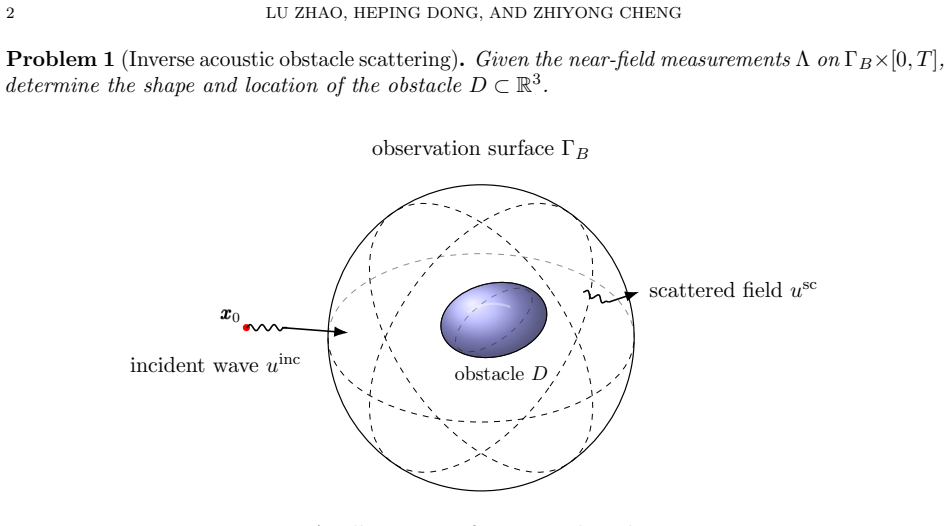
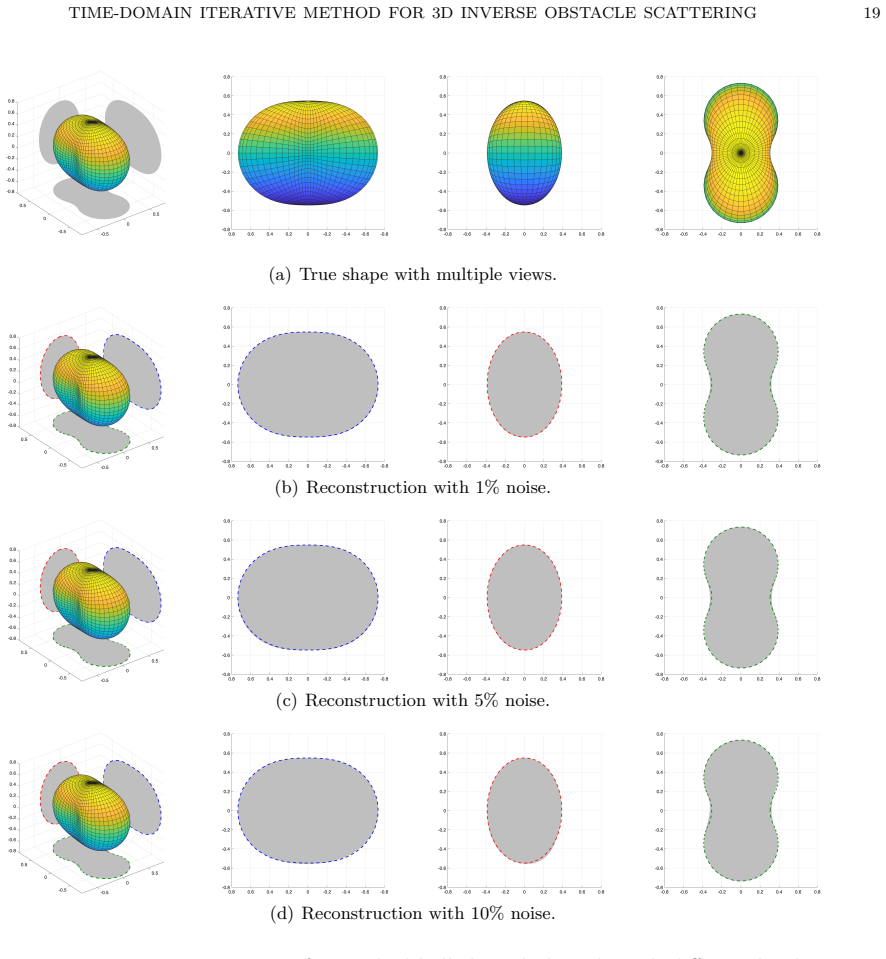
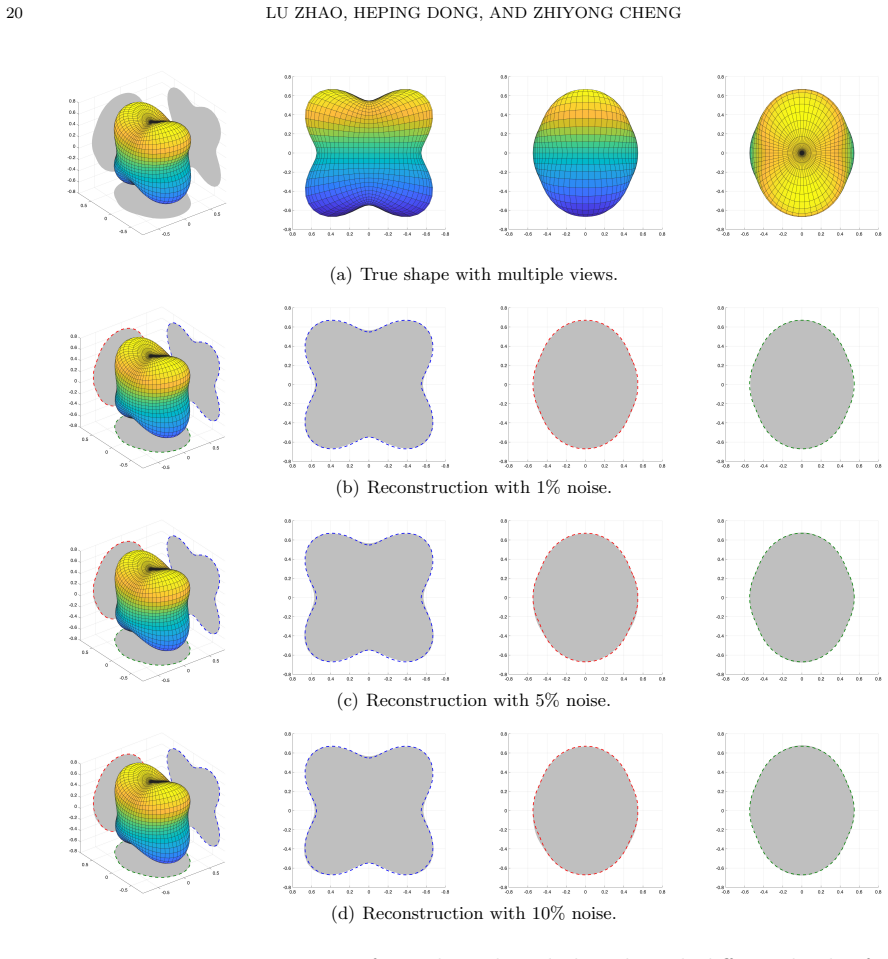
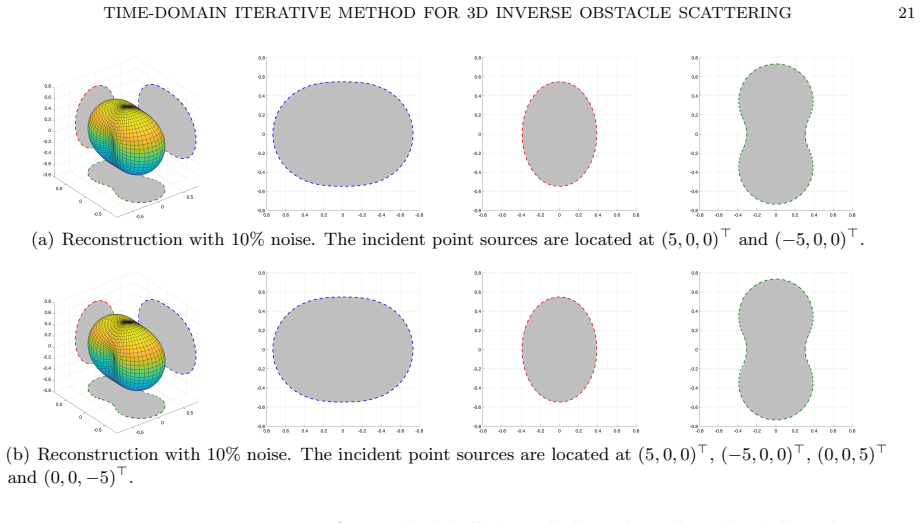
This paper concerns the three-dimensional forward and inverse acoustic obstacle scattering problem in the time domain. For the forward problem, a retarded potential formulation discretized by convolution quadrature and Galerkin methods is introduced. By introducing the retarded boundary integral defined on a homothetic surface, we propose a novel time-domain convolution quadrature based iterative method to reconstruct both the shape and location of a rigid obstacle. The retarded integral in the time domain is reformulated into a system of integrals in the s-domain. The resulting s-domain integrals are very fast to compute, as they only involve non-singular integrals over the homothetic surfaces. Moreover, the Fr\'echet derivative with respect to the boundary can be derived straightforwardly. We also prove that the scattered field generated by the homothetic surface converges to the exact field in the time domain. To improve the stability of the inversion algorithm, an incremental truncation technique is proposed, and numerical experiments confirm the effectiveness and robustness of our method.
Editorial analysis
A structured set of objections, weighed in public.
Referee Report
Summary. The manuscript addresses the three-dimensional forward and inverse acoustic obstacle scattering problem in the time domain. For the forward problem it introduces a retarded potential formulation discretized by convolution quadrature and Galerkin methods. For the inverse problem it proposes a novel iterative method based on retarded boundary integrals defined on a homothetic surface; the integrals are reformulated in the s-domain to yield non-singular computations, the Fréchet derivative with respect to the boundary is derived, convergence of the homothetic-surface scattered field to the exact field is proved, an incremental truncation technique is introduced for stability, and numerical experiments are presented to illustrate effectiveness and robustness.
Significance. If the convergence proof and the supporting analysis hold, the work offers a concrete advance in time-domain inverse scattering by replacing singular integrals with non-singular ones on homothetic surfaces and by supplying an explicit Fréchet derivative together with a stability device. The combination of a proved convergence result, an s-domain reformulation that accelerates evaluation, and numerical confirmation of robustness constitutes a substantive contribution to the numerical analysis of inverse obstacle problems.
minor comments (3)
- The abstract states that the s-domain integrals 'only involve non-singular integrals over the homothetic surfaces,' but the precise statement of the singularity removal (e.g., the distance between the two homothetic surfaces) should be made explicit in the first paragraph of §3 or §4 so that readers can verify the claim without searching later sections.
- Notation for the homothetic scaling parameter (denoted variously as λ or α in the abstract and later text) should be unified and introduced once in §2 before its repeated use in the convergence argument.
- The incremental truncation technique is mentioned in the abstract and claimed to improve stability, yet no reference is given to the specific truncation threshold or the section where its effect on the iteration is quantified; a short paragraph or table entry would clarify its implementation.
Simulated Author's Rebuttal
We thank the referee for the positive summary of our manuscript, the assessment of its significance, and the recommendation of minor revision. No specific major comments were provided in the report.
Circularity Check
No significant circularity
full rationale
The paper's derivation chain rests on an explicit proof that the scattered field generated by the homothetic surface converges to the exact field in the time domain; this convergence result is stated as independently established rather than assumed or fitted. The retarded-potential forward formulation, s-domain reformulation, Fréchet derivative, and incremental truncation are presented as separate technical steps whose validity does not reduce to the target inverse reconstruction by construction. No self-definitional relations, fitted inputs renamed as predictions, or load-bearing self-citations appear in the given description, so the central iterative method remains self-contained against external benchmarks.
Axiom & Free-Parameter Ledger
Reference graph
Works this paper leans on
-
[1]
Abboud, P
T. Abboud, P. Joly, J. Rodr´ ıguez, I. Terrasse, Coupling discontinuous Galerkin methods and retarded potentials for transient wave propagation on unbounded domains, J. Comput. Phys. 230 (2011) 5877–5907
2011
-
[2]
Ammari, An introduction to mathematics of emerging biomedical imaging, Math´ ematiques & Applications, Springer, Berlin, 2008
H. Ammari, An introduction to mathematics of emerging biomedical imaging, Math´ ematiques & Applications, Springer, Berlin, 2008
2008
-
[3]
Ammari, G
H. Ammari, G. Bao, J. L. Fleming, An inverse source problem for Maxwell’s equations in magnetoencephalography, SIAM J. Appl. Math. 62 (2002) 1369–1382
2002
-
[4]
Ammari, E
H. Ammari, E. Bretin, J. Garnier, A. Wahab, Time-reversal algorithms in viscoelastic media, European J. Appl. Math. 24 (2013) 565–600
2013
-
[5]
fast-hybrid
T. G. Anderson, O. P. Bruno, M. Lyon, High-order, dispersionless “fast-hybrid” wave equation solver. Part I: O(1) sampling cost via incident-field windowing and recentering, SIAM J. Sci. Comput. 42 (2020) A1348–A1379
2020
-
[6]
Banjai, S
L. Banjai, S. Sauter, Rapid solution of the wave equation in unbounded domains, SIAM J. Numer. Anal. 47 (2008) 227–249
2008
-
[7]
Banjai, M
L. Banjai, M. Kachanovska, Fast convolution quadrature for the wave equation in three dimensions, J. Comput. Phys. 279 (2014) 103–126
2014
-
[8]
Barnett, L
A. Barnett, L. Greengard, T. Hagstrom. High-order discretization of a stable time-domain integral equation for 3D acoustic scattering, J. Comput. Phys. 402 (2020) 109047
2020
-
[9]
Borden, Mathematical problems in radar inverse scattering, Inverse Problems 18 (2002) R1–R28
B. Borden, Mathematical problems in radar inverse scattering, Inverse Problems 18 (2002) R1–R28
2002
-
[10]
O. P. Bruno, T. Yin, Multiple-scattering frequency-time hybrid solver for the wave equation in interior domains, Math. Comput. 93 (2024) 551-587
2024
-
[11]
Burkard, R
C. Burkard, R. Potthast, A time-domain probe method for three-dimensional rough surface reconstructions, Inverse Probl. Imaging 3 (2009) 259–274
2009
-
[12]
Cakoni, J
F. Cakoni, J. D. Rezac, Direct imaging of small scatterers using reduced time dependent data, J. Comput. Phys. 338 (2017) 371–387
2017
-
[13]
Cakoni, H
F. Cakoni, H. Haddar, A. Lechleiter, On the factorization method for a far field inverse scattering problem in the time domain, SIAM J. Math. Anal. 51 (2019) 854–872
2019
-
[14]
Cakoni, P
F. Cakoni, P. Monk, V. Selgas, Analysis of the linear sampling method for imaging penetrable obstacles in the time domain. Anal. PDE 14 (2021) 667–688
2021
-
[15]
de Castro, E
P. de Castro, E. Silva, E. Fancello, A single level set function approach for multiple material-phases applied to full-waveform inversion in the time domain, Inverse Problems, 40 (2024) 055002
2024
-
[16]
Q. Chen, H. Haddar, A. Lechleiter, A sampling method for inverse scattering in the time domain, Inverse Problems, 26 (2010) 085001
2010
-
[17]
Colton, R
D. Colton, R. Kress, Inverse Acoustic and Electromagnetic Scattering Theory. 4nd edition, Springer, New York, 2019
2019
-
[18]
P. J. Davies, D. B. Duncan, Convolution-in-time approximations of time domain boundary integral equations, SIAM J. Sci. Comput. 35 (2013) B43–B61
2013
-
[19]
Epstein, L
C. Epstein, L. Greengard, T. Hagstrom, On the stability of time-domain integral equations for acoustic wave propagation, Discrete Contin. Dyn. Syst. 36 (2016) 4367–4382
2016
-
[20]
Ganesh, I.G
M. Ganesh, I.G. Graham, A high-order algorithm for obstacle scattering in three dimensions, J. Comput. Phys. 198 (2004) 211–242
2004
-
[21]
Ganesh, F
M. Ganesh, F. Le Lou¨ er, A high-order algorithm for time-domain scattering in three dimensions, Adv. Comput. Math. 49 (2023) 46. 28 LU ZHAO, HEPING DONG, AND ZHIYONG CHENG
2023
-
[22]
C. Geng, M. Song, X. Wang, Y. Wang, Time-domain direct sampling method for inverse electromagnetic scattering with a single incident source, SIAM J. Imag. Sci. 18 (2025) 1208-1234
2025
-
[23]
Y. Guo, P. Monk, D. Colton, Toward a time domain approach to the linear sampling method, Inverse Problems 29 (2013) 095016
2013
-
[24]
Y. Guo, P. Monk, D. Colton, The linear sampling method for sparse small aperture data, Appl. Anal. 95 (2016) 1599–1615
2016
-
[25]
Y. Guo, D. H ¨ omberg, G. Hu, J. Li, H. Liu, A time domain sampling method for inverse acoustic scattering problems, J. Comput. Phys. 314 (2016) 647–660
2016
-
[26]
Y. Guo, H. Li, X. Wang, A novel time-domain direct sampling approach for inverse scattering problems in acoustics, SIAM J. Appl. Math. 84 (2024) 2152–2174
2024
-
[27]
Haddar, A
H. Haddar, A. Lechleiter, S. Marmorat, An improved time domain linear sampling method for Robin and Neumann obstacles, Appl. Anal. 93 (2014) 369–390
2014
-
[28]
Haddar, X
H. Haddar, X. Liu, A time domain factorization method for obstacles with impedance boundary conditions, Inverse Problems 36 (2020) 105011
2020
-
[29]
S. Hou, H. Wang, An efficient algorithm for time-domain acoustic scattering in three dimensions by layer potentials, J. Comput. Phys. 514 (2024) 113258
2024
-
[30]
S. Hou, J. Liu, H. Wang, On the computation of time-domain acoustic scattering by multiple obstacles using a decomposition method, SIAM J. Appl. Math. 85 (2025) 2683–2703
2025
-
[31]
Ivanyshyn, R
O. Ivanyshyn, R. Kress, Identification of sound-soft 3D obstacle from phaseless data, Inverse Probl. Imaging 4 (2010) 131–149
2010
-
[32]
Kahlaoui, A non-iterative reconstruction method for the geometric inverse problem for the wave equation, J
H. Kahlaoui, A non-iterative reconstruction method for the geometric inverse problem for the wave equation, J. Sci. Comput. 102 (2025) 61
2025
-
[33]
Kn¨ oller, J
M. Kn¨ oller, J. Nick, The temporal domain derivative in inverse acoustic obstacle scattering, Numer. Math. (2025), to appear
2025
-
[34]
Kress, Newton’s method for inverse obstacle scattering meets the method of least squares, Inverse Problems 19 (2003) S91–S104
R. Kress, Newton’s method for inverse obstacle scattering meets the method of least squares, Inverse Problems 19 (2003) S91–S104
2003
-
[35]
X. Liu, J. Song, F. Pourahmadian, H. Haddar, Time-versus frequency-domain inverse elastic scattering: theory and experiment, SIAM J. Appl. Math. 83 (2023) 1296-1314
2023
-
[36]
Lubich, On the multistep time discretization of linear initial-boundary value problems and their boundary integral equations
C. Lubich, On the multistep time discretization of linear initial-boundary value problems and their boundary integral equations. Numer. Math. 67 (1994) 365–389
1994
-
[37]
D. R. Luke, R. Potthast, The point source method for inverse scattering in the time domain, Math. Methods Appl. Sci. 29 (2006) 1501–1521
2006
-
[38]
P¨ olz, M
D. P¨ olz, M. Schanz, Space-time discretized retarded potential boundary integral operators: quadrature for collocation methods, SIAM J. Sci. Comput. 41 (2019) A3860–A3886
2019
-
[39]
A. C. Prunty, R. K. Snieder, Theory of the linear sampling method for time-dependent fields, Inverse Problems 35 (2019) 055003
2019
-
[40]
Sauter, A
S. Sauter, A. Veit, A Galerkin method for retarded boundary integral equations with smooth and compactly supported temporal basis functions, Numer. Math. 123 (2013) 145–176
2013
-
[41]
Sayag, D
A. Sayag, D. Givoli, Shape identification of scatterers using a time-dependent adjoint method, Comput. Methods Appl. Mech. Engrg. 394 (2022) 114923
2022
-
[42]
Sayas, Retarded potentials and time domain boundary integral equations, Springer Series in Computational Mathematics, Switzerland, 2016
F. Sayas, Retarded potentials and time domain boundary integral equations, Springer Series in Computational Mathematics, Switzerland, 2016
2016
-
[43]
B. Wang, Z. Yang, L. Wang, S. Jiang, On time-domain NRBC for Maxwell’s equations and its application in accurate simulation of electromagnetic invisibility cloaks, J. Sci. Comput. 86 (2021) 20
2021
-
[44]
L. Zhao, H. Dong, F. Ma, Inverse obstacle scattering for acoustic waves in the time domain, Inverse Probl. Imaging, 15 (2021) 1269–1286
2021
-
[45]
L. Zhao, H. Dong, F. Ma, Inverse obstacle scattering for elastic waves in the time domain, Inverse Problems 38 (2022) 045005. Civil A viation University of China, 2898 Jinbei Road, Tianjin 300300, China Email address:zhaol@cauc.edu.cn Jilin University, Qianjin Street 2699, Changchun, Jilin 130012, China Email address:dhp@jlu.edu.cn Jilin University, Qianj...
2022
discussion (0)
Sign in with ORCID, Apple, or X to comment. Anyone can read and Pith papers without signing in.