Sensitivity Analysis and Robust Optimal Control for Coupled Evolution Inclusions with State-Dependent Maximal Monotone Operators
Pith reviewed 2026-07-03 08:18 UTC · model grok-4.3
The pith
For Bolza-type optimization over solutions of coupled evolution inclusions with state-dependent maximal monotone operators, optimal pairs exist, the value function is continuous, and the optimal-solution map is upper semicontinuous.
A machine-rendered reading of the paper's core claim, the machinery that carries it, and where it could break.
Core claim
The parameterized solution map for these coupled systems has well-posedness, compactness, and Painlevé-Kuratowski continuity properties. For Bolza-type optimization over the solution set, optimal pairs exist, the value function has continuity properties, and the optimal-solution map is upper semicontinuous. Existence results hold for fixed-parameter optimal control, simultaneous control-parameter design, min-max robust control, and Hurwicz-type compromise control under parameter uncertainty.
What carries the argument
The parameterized solution map of the coupled semilinear evolution inclusion and differential inclusion with state-dependent maximal monotone operators, which carries the well-posedness and continuity properties used for all optimization results.
If this is right
- Optimal pairs exist for the Bolza-type optimization problem over the solution set.
- The value function of the optimization problem is continuous.
- The optimal-solution map is upper semicontinuous.
- Existence holds for min-max robust control problems under parameter uncertainty.
- Existence holds for Hurwicz-type compromise control under parameter uncertainty.
Where Pith is reading between the lines
- These continuity properties may allow for numerical approximation schemes in practice.
- The results could extend to other classes of nonsmooth dynamical systems beyond sweeping processes.
- Parameter uncertainty handling suggests applications in uncertain environments like robotics or economics.
Load-bearing premise
The parameterized solution map possesses well-posedness, compactness, and Painlevé-Kuratowski continuity properties.
What would settle it
Finding a specific instance of the coupled system where no optimal pair exists for the Bolza problem or where the optimal-solution map fails to be upper semicontinuous despite the assumptions on the operators.
Figures
read the original abstract
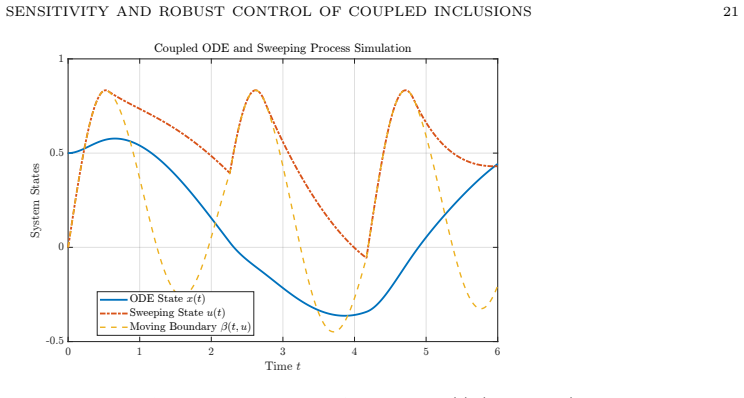
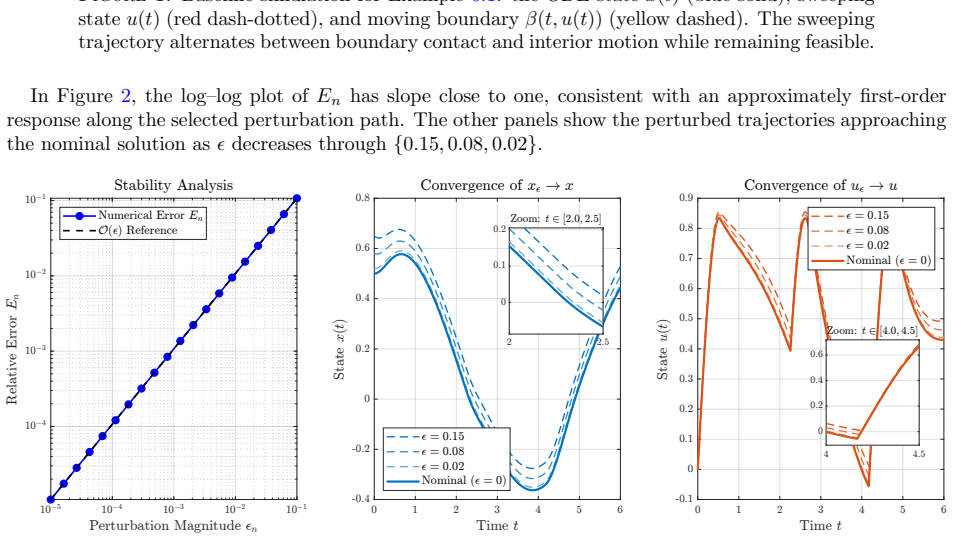
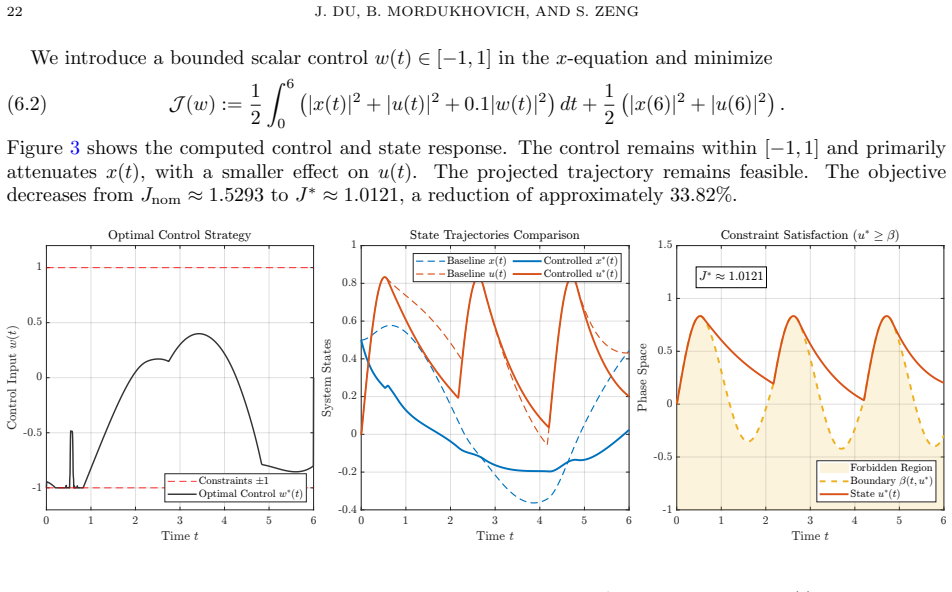
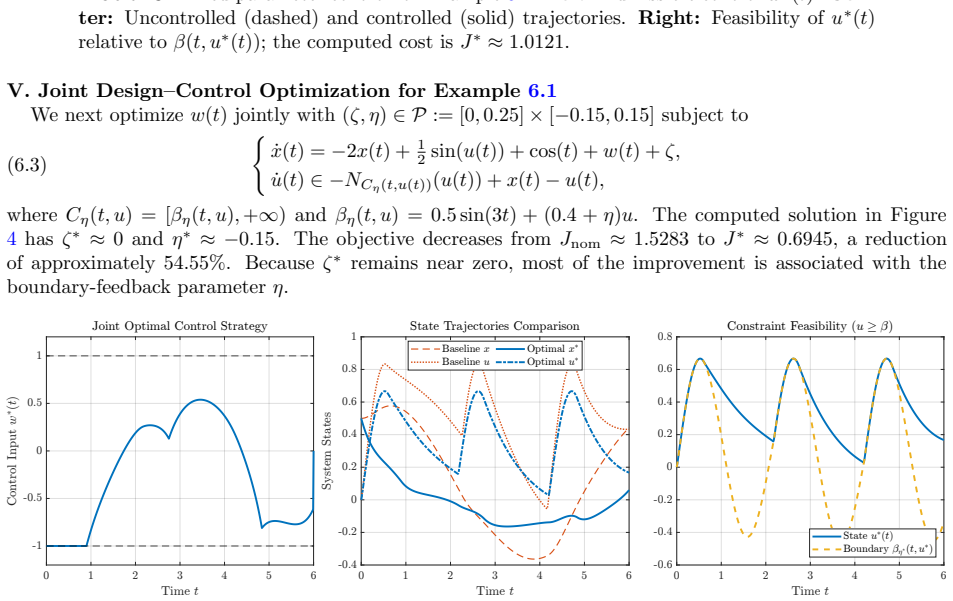
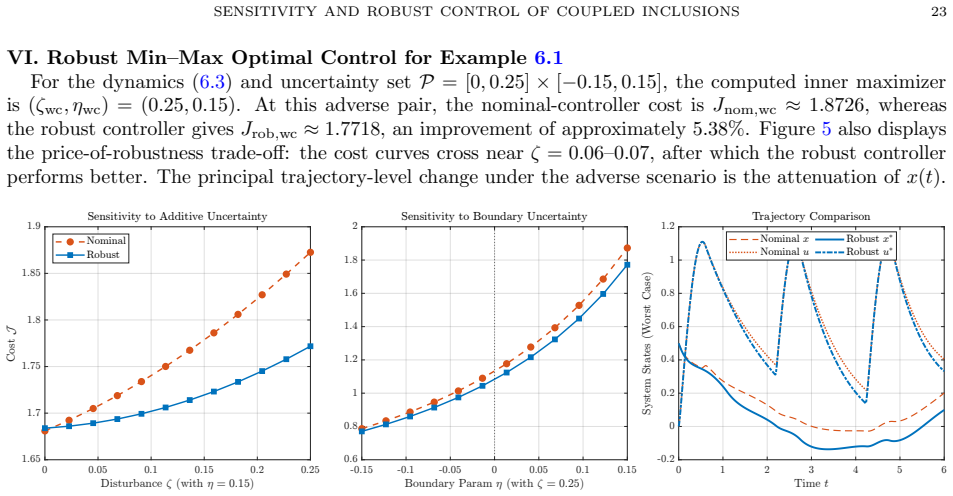
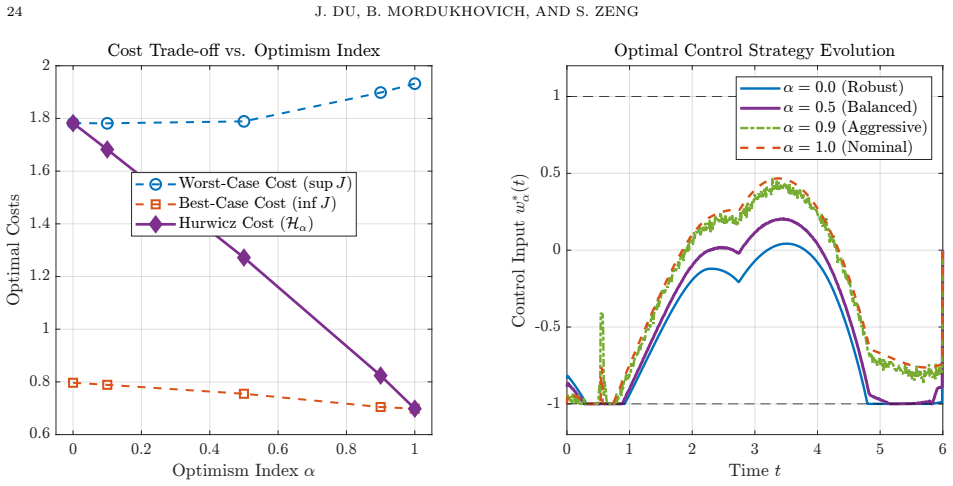
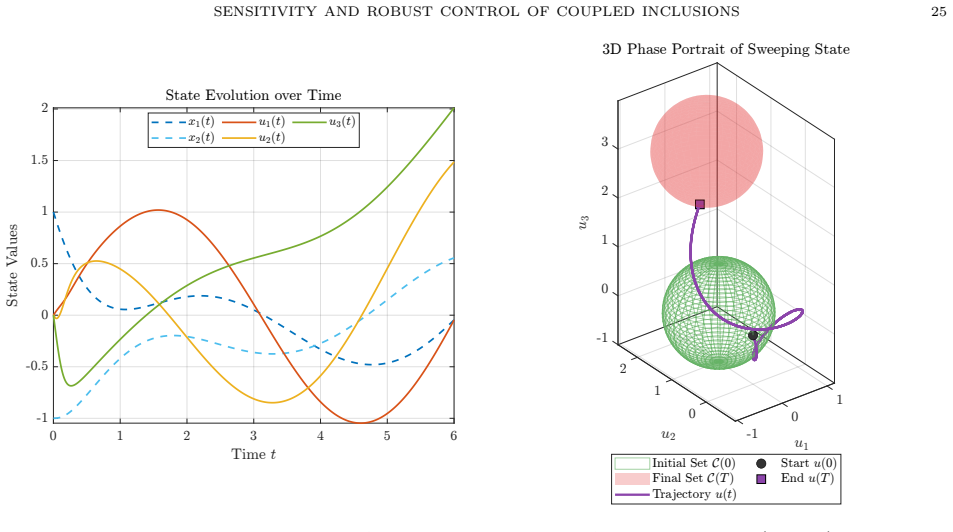
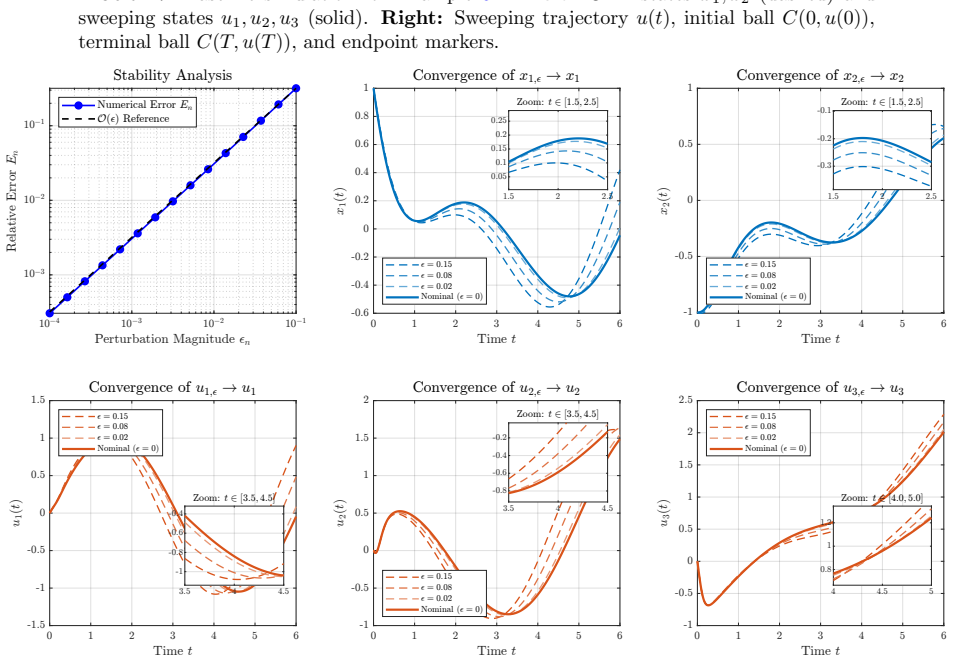
We consider a class of strongly coupled nonsmooth systems consisting of a semilinear evolution inclusion and a differential inclusion governed by state-dependent maximal monotone operators. Our main contributions are fourfold. First, we collect the well-posedness, compactness, and Painlev\'e--Kuratowski continuity properties of the parameterized solution map required for the subsequent optimization analysis. Second, for Bolza-type optimization over the solution set, we prove the existence of optimal pairs, establish continuity properties of the value function, and derive upper semicontinuity of the optimal-solution map. Third, we study fixed-parameter optimal control, simultaneous control-parameter design, min--max robust control, and Hurwicz-type compromise control under parameter uncertainty, and we establish existence results for each formulation. Fourth, we report numerical experiments for sweeping-type systems that illustrate the sensitivity and robustness phenomena predicted by the theory.
Editorial analysis
A structured set of objections, weighed in public.
Referee Report
Summary. The manuscript considers strongly coupled nonsmooth systems consisting of a semilinear evolution inclusion and a differential inclusion governed by state-dependent maximal monotone operators. The authors collect well-posedness, compactness, and Painlevé-Kuratowski continuity properties of the parameterized solution map. For Bolza-type optimization over the solution set they prove existence of optimal pairs, continuity properties of the value function, and upper semicontinuity of the optimal-solution map. They establish existence results for fixed-parameter optimal control, simultaneous control-parameter design, min-max robust control, and Hurwicz-type compromise control under parameter uncertainty. Numerical experiments for sweeping-type systems illustrate the predicted sensitivity and robustness phenomena.
Significance. If the well-posedness and continuity properties of the solution map hold, the work supplies a coherent framework for sensitivity analysis and robust optimal control in nonsmooth coupled systems with state-dependent maximal monotone operators. The systematic treatment of four distinct control formulations under parameter uncertainty, together with the numerical illustrations for sweeping processes, adds concrete value to the literature on set-valued optimal control.
minor comments (3)
- [Abstract / §2] The abstract states that the well-posedness, compactness, and Painlevé-Kuratowski continuity properties are 'collected'; a short paragraph in §2 or §3 clarifying which of these properties are proved anew versus invoked from prior literature would improve readability.
- [Numerical experiments] In the numerical section, the reported trajectories for the sweeping-type systems should include a brief statement of the discretization scheme and step-size used, so that the observed sensitivity phenomena can be reproduced from the given data.
- [Introduction] Notation for the set-valued map and the parameter dependence is introduced gradually; a consolidated table of symbols at the end of the introduction would aid readers.
Simulated Author's Rebuttal
We thank the referee for the constructive and positive assessment of our manuscript, including the recognition of its contributions to well-posedness, sensitivity analysis, and the four robust control formulations. We note the recommendation for minor revision and will address any editorial or minor points in the revised version.
Circularity Check
No significant circularity in derivation chain
full rationale
The paper first collects well-posedness, compactness, and Painlevé-Kuratowski continuity of the parameterized solution map for the coupled semilinear evolution inclusion and state-dependent maximal monotone differential inclusion, relying on standard properties of maximal monotone operators and set-valued analysis. All subsequent Bolza optimization results, value-function continuity, upper semicontinuity of the optimal-solution map, and existence theorems for the four control formulations (fixed-parameter, simultaneous design, min-max robust, Hurwicz compromise) are derived conditionally from these map properties using standard arguments from optimal control and variational analysis. No load-bearing step reduces by construction to fitted inputs, self-definitional relations, or self-citation chains that render the central claims equivalent to their premises; the derivation remains self-contained against external benchmarks.
Axiom & Free-Parameter Ledger
Reference graph
Works this paper leans on
-
[1]
Nonconvex sweeping process and prox-regularity in
Bounkhel, Messaoud and Thibault, Lionel , journal=. Nonconvex sweeping process and prox-regularity in. 2005 , publisher=
2005
-
[2]
2012 , publisher=
Semigroups of Linear Operators and Applications to Partial Differential Equations , author=. 2012 , publisher=
2012
-
[3]
2011 , publisher=
Multivalued Differential Equations , author=. 2011 , publisher=
2011
-
[4]
A qualitative mathematical analysis of a class of linear variational inequalities via semi-complementarity problems: applications in electronics , author=. Math. Program. , volume=. 2011 , publisher=
2011
-
[5]
1982 , publisher=
A Second Course on Real Functions , author=. 1982 , publisher=
1982
-
[6]
1984 , publisher=
Variational Convergence for Functions and Operators , author=. 1984 , publisher=
1984
-
[7]
Vladimirov, A. A. , journal=. Nonstationary dissipative evolution equations in a. 1991 , publisher=
1991
-
[8]
1990 , publisher=
Set-Valued Analysis , author=. 1990 , publisher=
1990
-
[9]
First and second order convex sweeping processes in reflexive smooth
Bounkhel, Messaoud and Al-Yusof, Rabab , journal=. First and second order convex sweeping processes in reflexive smooth. 2010 , publisher=
2010
-
[10]
Vietnam J
Nonconvex sweeping process with a moving set depending on the state , author=. Vietnam J. Math. , volume=. 2014 , publisher=
2014
-
[11]
Differential inclusion governed by a state dependent sweeping process , author=. Int. J. Difference Equ. , volume=
-
[12]
Set-Valued Var
Sensitivity properties of parametric nonconvex evolution inclusions with application to optimal control problems , author=. Set-Valued Var. Anal. , volume=. 2019 , publisher=
2019
-
[13]
Mixed semicontinuous perturbations of nonconvex sweeping processes , author=. Math. Program. , volume=. 2010 , publisher=
2010
-
[14]
Regularization of differential variational inequalities with locally prox-regular sets , author=. Math. Program. , volume=. 2013 , publisher=
2013
-
[15]
Set-Valued Anal
Non-convex quasi-variational differential inclusions , author=. Set-Valued Anal. , volume=. 2007 , publisher=
2007
-
[16]
2006 , publisher=
Edmond, Jean Fenel and Thibault, Lionel , journal=. 2006 , publisher=
2006
-
[17]
Convex Analysis and Measurable Multifunctions , pages=
Measurable multifunctions , author=. Convex Analysis and Measurable Multifunctions , pages=. 2006 , publisher=
2006
-
[18]
and Obukhovskii, Valeri V
Kamenskii, Mikhail I. and Obukhovskii, Valeri V. and Zecca, Pietro , volume=. Condensing Multivalued Maps and Semilinear Differential Inclusions in. 2011 , publisher=
2011
-
[19]
Existence and Uniqueness of Infinite Dimensional Dynamic Systems Governed by History/State-Dependent Sweeping Processes , author=
-
[20]
Zeng, Shengda and Du, Jinsheng and Timoshin, Sergey A. , note=. Non-Autonomous Evolution Inclusions with State-Dependent Sweeping Processes:
-
[21]
Well-Posedness and Painlev
Zeng, Shengda and Du, Jinsheng and Wang, Xianfu , note=. Well-Posedness and Painlev
-
[22]
2017 , publisher=
Variational-Hemivariational Inequalities with Applications , author=. 2017 , publisher=
2017
-
[23]
1992 , publisher=
Measures of Noncompactness and Condensing Operators , author=. 1992 , publisher=
1992
-
[24]
1990 , publisher=
Optimization and Nonsmooth Analysis , author=. 1990 , publisher=
1990
-
[25]
Dynamical systems coupled with monotone set-valued operators:
Brogliato, Bernard and Tanwani, Aneel , journal=. Dynamical systems coupled with monotone set-valued operators:. 2020 , publisher=
2020
-
[26]
1998 , publisher=
Nonsmooth Analysis and Control Theory , author=. 1998 , publisher=
1998
-
[27]
Nonlinear Anal
On various notions of regularity of sets in nonsmooth analysis , author=. Nonlinear Anal. , volume=. 2002 , publisher=
2002
-
[28]
Nonconvex differential variational inequality and state-dependent sweeping process , author=. J. Optim. Theory Appl. , volume=. 2013 , publisher=
2013
-
[29]
Truncated nonconvex state-dependent sweeping process: implicit and semi-implicit adapted
Nacry, Florent , journal=. Truncated nonconvex state-dependent sweeping process: implicit and semi-implicit adapted. 2018 , publisher=
2018
-
[30]
Rafle par un convexe variable (premi
Moreau, Jean Jacques , journal=. Rafle par un convexe variable (premi
-
[31]
Rafle par un convexe variable (deuxi
Moreau, Jean Jacques , journal=. Rafle par un convexe variable (deuxi
-
[32]
A method using the approach of
Addi, Khalid and Adly, Samir and Brogliato, Bernard and Goeleven, Daniel , journal=. A method using the approach of. 2007 , publisher=
2007
-
[33]
Kunze, Markus and Monteiro Marques, Manuel D. P. , booktitle=. An introduction to. 2000 , publisher=
2000
-
[34]
2018 , publisher=
A Variational Approach to Nonsmooth Dynamics: Applications in Unilateral Mechanics and Electronics , author=. 2018 , publisher=
2018
-
[35]
On parabolic quasi-variational inequalities and state-dependent sweeping processes , author=. Topol. Methods Nonlinear Anal. , volume=
-
[36]
2010 , publisher=
Nonsmooth Modeling and Simulation for Switched Circuits , author=. 2010 , publisher=
2010
-
[37]
A differential equation approach to implicit sweeping processes , author=. J. Differential Equations , volume=. 2019 , publisher=
2019
-
[38]
Implicit subdifferential inclusions with nonconvex-valued perturbations , author=. J. Fixed Point Theory Appl. , volume=. 2021 , publisher=
2021
-
[39]
State-dependent implicit sweeping process in the framework of quasistatic evolution quasi-variational inequalities , author=. J. Optim. Theory Appl. , volume=. 2019 , publisher=
2019
-
[40]
Well-posedness of fractional
Zeng, Shengda and Haddad, Tahar and Bouach, Abderrahim , journal=. Well-posedness of fractional. 2023 , publisher=
2023
-
[41]
A coupled problem described by time-dependent subdifferential operator and non-convex perturbed sweeping process , author=. Evol. Equ. Control Theory , volume=
-
[42]
arXiv preprint arXiv:2407.16304 , year=
Lipschitz multivalued perturbations of integro-differential prox-regular sweeping processes , author=. arXiv preprint arXiv:2407.16304 , year=
-
[43]
Galerkin-like method and generalized perturbed sweeping process with nonregular sets , author=. SIAM J. Control Optim. , volume=. 2017 , publisher=
2017
-
[44]
Fractional-order problem coupled with a second-order
Tamouza, Somia and Aliouane, Fatine and Azzam-Laouir, Dalila , journal=. Fractional-order problem coupled with a second-order. 2023 , publisher=
2023
-
[45]
Set-Valued Var
On a time and state dependent maximal monotone operator coupled with a sweeping process with perturbations , author=. Set-Valued Var. Anal. , volume=. 2021 , publisher=
2021
-
[46]
A maximum principle for optimal control problems involving sweeping processes with a nonsmooth set , author=. J. Optim. Theory Appl. , volume=. 2023 , publisher=
2023
-
[47]
Semialgebraic Geometric Methods , author=
An Approach to Simultaneous System Design, I. Semialgebraic Geometric Methods , author=. SIAM J. Control Optim. , volume=. 1986 , doi=
1986
-
[48]
Part II: Nonswitching Gain and Dynamic Feedback Compensation by Algebraic Geometric Methods , author=
An Approach to Simultaneous System Design. Part II: Nonswitching Gain and Dynamic Feedback Compensation by Algebraic Geometric Methods , author=. SIAM J. Control Optim. , volume=. 1988 , doi=
1988
-
[49]
Relaxed Minimax Control , author=. SIAM J. Control Optim. , volume=. 1995 , doi=
1995
-
[50]
Minimax Optimal Control , author=. SIAM J. Control Optim. , volume=. 2005 , doi=
2005
-
[51]
Stability and Continuity in Robust Optimization , author=. SIAM J. Optim. , volume=. 2017 , doi=
2017
-
[52]
Studies in Resource Allocation Processes , pages=
Appendix: An Optimality Criterion for Decision-Making Under Ignorance , author=. Studies in Resource Allocation Processes , pages=. 1977 , publisher=
1977
-
[53]
2009 , publisher=
Robust Optimization , author=. 2009 , publisher=
2009
-
[54]
2008 , publisher=
Ba. 2008 , publisher=
2008
-
[55]
Systems Control Lett
Minimax sliding mode control design for linear evolution equations with noisy measurements and uncertain inputs , author=. Systems Control Lett. , volume=. 2021 , doi=
2021
-
[56]
Sensitivity of Optimal Solutions to Control Problems for Second Order Evolution Subdifferential Inclusions , author=. Appl. Math. Optim. , volume=. 2015 , doi=
2015
-
[57]
Differentiating ambiguity and ambiguity attitude , author=. J. Econom. Theory , volume=. 2004 , doi=
2004
-
[58]
2002 , publisher=
Foundations of Bilevel Programming , author=. 2002 , publisher=
2002
-
[59]
Discrete Contin
Optimality conditions for a controlled sweeping process with applications to the crowd motion model , author=. Discrete Contin. Dyn. Syst. Ser. B , volume=. 2017 , doi=
2017
-
[60]
Maxmin expected utility with non-unique prior , author=. J. Math. Econom. , volume=. 1989 , doi=
1989
-
[61]
1996 , publisher=
Robust and Optimal Control , author=. 1996 , publisher=
1996
-
[62]
2000 , publisher=
Perturbation Analysis of Optimization Problems , author=. 2000 , publisher=
2000
-
[63]
Optimal control of sweeping processes in robotics and traffic flow models , author=. J. Optim. Theory Appl. , volume=. 2019 , publisher=
2019
-
[64]
Optimal control of nonconvex integro-differential sweeping processes , author=. J. Differential Equations , volume=. 2022 , publisher=
2022
-
[65]
Optimal control of a nonconvex perturbed sweeping process , author=. J. Differential Equations , volume=. 2019 , publisher=
2019
-
[66]
Controlled polyhedral sweeping processes:
Henrion, Ren. Controlled polyhedral sweeping processes:. J. Differential Equations , volume=. 2023 , publisher=
2023
-
[67]
Sweeping process with regular and nonregular sets , author=. J. Differential Equations , volume=. 2003 , publisher=
2003
-
[68]
Relaxation of an optimal control problem involving a perturbed sweeping process , author=. Math. Program. , volume=. 2005 , publisher=
2005
-
[69]
Optimal control of the sweeping process with a nonsmooth moving set , author=. SIAM J. Control Optim. , volume=. 2022 , publisher=
2022
-
[70]
A fixed-point approach to history-dependent sweeping processes , author=. J. Optim. Theory Appl. , volume=. 2025 , publisher=
2025
-
[71]
Well-posedness of history-dependent sweeping processes , author=. SIAM J. Math. Anal. , volume=. 2019 , publisher=
2019
-
[72]
Galerkin-like Method for Integro-Differential Inclusions with applications to
P. Galerkin-like Method for Integro-Differential Inclusions with applications to. arXiv preprint arXiv:2306.07821 , year=
-
[73]
Well-posedness for integro-differential sweeping processes of
Vilches, Emilio , journal=. Well-posedness for integro-differential sweeping processes of
-
[74]
Prox-Regular Integro-Differential Sweeping Process , author=. J. Optim. Theory Appl. , volume=. 2024 , publisher=
2024
-
[75]
Nonconvex integro-differential sweeping process with applications , author=. SIAM J. Control Optim. , volume=. 2022 , publisher=
2022
-
[76]
Well-posedness of a class of
Faiz, Zakaria and Zeng, Shengda and Benaissa, Hicham , journal=. Well-posedness of a class of. 2025 , publisher=
2025
-
[77]
A novel fractional
Faiz, Zakaria and Zeng, Shengda and Benaissa, Hicham , journal=. A novel fractional. 2024 , publisher=
2024
-
[78]
Well-posedness of history/state-dependent implicit sweeping processes , author=. J. Optim. Theory Appl. , volume=. 2020 , publisher=
2020
-
[79]
An implicit sweeping process approach to quasistatic evolution variational inequalities , author=. SIAM J. Math. Anal. , volume=. 2018 , publisher=
2018
-
[80]
Regularization of nonconvex sweeping process in
Thibault, Lionel , journal=. Regularization of nonconvex sweeping process in. 2008 , publisher=
2008
discussion (0)
Sign in with ORCID, Apple, or X to comment. Anyone can read and Pith papers without signing in.